EP0449172B1 - A method of reducing a carbonyl containing acridine - Google Patents
A method of reducing a carbonyl containing acridine Download PDFInfo
- Publication number
- EP0449172B1 EP0449172B1 EP91104661A EP91104661A EP0449172B1 EP 0449172 B1 EP0449172 B1 EP 0449172B1 EP 91104661 A EP91104661 A EP 91104661A EP 91104661 A EP91104661 A EP 91104661A EP 0449172 B1 EP0449172 B1 EP 0449172B1
- Authority
- EP
- European Patent Office
- Prior art keywords
- catalyst
- compound
- formula
- solvent
- hydrogen
- Prior art date
- Legal status (The legal status is an assumption and is not a legal conclusion. Google has not performed a legal analysis and makes no representation as to the accuracy of the status listed.)
- Expired - Lifetime
Links
- 238000000034 method Methods 0.000 title claims abstract description 22
- DZBUGLKDJFMEHC-UHFFFAOYSA-N acridine Chemical compound C1=CC=CC2=CC3=CC=CC=C3N=C21 DZBUGLKDJFMEHC-UHFFFAOYSA-N 0.000 title claims abstract description 10
- 125000002915 carbonyl group Chemical group [*:2]C([*:1])=O 0.000 title claims abstract description 8
- 229910052739 hydrogen Inorganic materials 0.000 claims abstract description 25
- 239000001257 hydrogen Substances 0.000 claims abstract description 25
- UFHFLCQGNIYNRP-UHFFFAOYSA-N Hydrogen Chemical compound [H][H] UFHFLCQGNIYNRP-UHFFFAOYSA-N 0.000 claims abstract description 13
- 150000002431 hydrogen Chemical group 0.000 claims abstract description 8
- 229910052736 halogen Inorganic materials 0.000 claims abstract description 4
- 150000002367 halogens Chemical class 0.000 claims abstract description 4
- 125000004435 hydrogen atom Chemical group [H]* 0.000 claims abstract description 4
- 125000002023 trifluoromethyl group Chemical group FC(F)(F)* 0.000 claims abstract description 4
- 125000004356 hydroxy functional group Chemical group O* 0.000 claims abstract 2
- BDERNNFJNOPAEC-UHFFFAOYSA-N propan-1-ol Chemical compound CCCO BDERNNFJNOPAEC-UHFFFAOYSA-N 0.000 claims description 30
- 239000003054 catalyst Substances 0.000 claims description 26
- LRHPLDYGYMQRHN-UHFFFAOYSA-N N-Butanol Chemical compound CCCCO LRHPLDYGYMQRHN-UHFFFAOYSA-N 0.000 claims description 24
- 239000002904 solvent Substances 0.000 claims description 24
- 150000001875 compounds Chemical class 0.000 claims description 22
- WMFOQBRAJBCJND-UHFFFAOYSA-M Lithium hydroxide Chemical compound [Li+].[OH-] WMFOQBRAJBCJND-UHFFFAOYSA-M 0.000 claims description 21
- XLYOFNOQVPJJNP-UHFFFAOYSA-N water Substances O XLYOFNOQVPJJNP-UHFFFAOYSA-N 0.000 claims description 20
- KFZMGEQAYNKOFK-UHFFFAOYSA-N Isopropanol Chemical compound CC(C)O KFZMGEQAYNKOFK-UHFFFAOYSA-N 0.000 claims description 18
- HEMHJVSKTPXQMS-UHFFFAOYSA-M Sodium hydroxide Chemical compound [OH-].[Na+] HEMHJVSKTPXQMS-UHFFFAOYSA-M 0.000 claims description 18
- BASFCYQUMIYNBI-UHFFFAOYSA-N platinum Chemical group [Pt] BASFCYQUMIYNBI-UHFFFAOYSA-N 0.000 claims description 16
- KJIFKLIQANRMOU-UHFFFAOYSA-N oxidanium;4-methylbenzenesulfonate Chemical group O.CC1=CC=C(S(O)(=O)=O)C=C1 KJIFKLIQANRMOU-UHFFFAOYSA-N 0.000 claims description 12
- 239000002585 base Substances 0.000 claims description 11
- LFQSCWFLJHTTHZ-UHFFFAOYSA-N Ethanol Chemical compound CCO LFQSCWFLJHTTHZ-UHFFFAOYSA-N 0.000 claims description 9
- BWHMMNNQKKPAPP-UHFFFAOYSA-L potassium carbonate Chemical compound [K+].[K+].[O-]C([O-])=O BWHMMNNQKKPAPP-UHFFFAOYSA-L 0.000 claims description 9
- NMCUIPGRVMDVDB-UHFFFAOYSA-L iron dichloride Chemical compound Cl[Fe]Cl NMCUIPGRVMDVDB-UHFFFAOYSA-L 0.000 claims description 8
- 150000003839 salts Chemical class 0.000 claims description 8
- 229910052783 alkali metal Inorganic materials 0.000 claims description 7
- 150000001340 alkali metals Chemical class 0.000 claims description 7
- 229910021577 Iron(II) chloride Inorganic materials 0.000 claims description 6
- 239000011736 potassium bicarbonate Substances 0.000 claims description 6
- 235000015497 potassium bicarbonate Nutrition 0.000 claims description 6
- 229910000028 potassium bicarbonate Inorganic materials 0.000 claims description 6
- 150000001251 acridines Chemical class 0.000 claims description 5
- 238000006243 chemical reaction Methods 0.000 claims description 5
- 229910052697 platinum Inorganic materials 0.000 claims description 5
- 229910000027 potassium carbonate Inorganic materials 0.000 claims description 5
- 238000007363 ring formation reaction Methods 0.000 claims description 5
- AFVFQIVMOAPDHO-UHFFFAOYSA-N Methanesulfonic acid Chemical compound CS(O)(=O)=O AFVFQIVMOAPDHO-UHFFFAOYSA-N 0.000 claims description 4
- CDBYLPFSWZWCQE-UHFFFAOYSA-L Sodium Carbonate Chemical compound [Na+].[Na+].[O-]C([O-])=O CDBYLPFSWZWCQE-UHFFFAOYSA-L 0.000 claims description 4
- UIIMBOGNXHQVGW-UHFFFAOYSA-M Sodium bicarbonate Chemical compound [Na+].OC([O-])=O UIIMBOGNXHQVGW-UHFFFAOYSA-M 0.000 claims description 4
- QAOWNCQODCNURD-UHFFFAOYSA-N Sulfuric acid Chemical compound OS(O)(=O)=O QAOWNCQODCNURD-UHFFFAOYSA-N 0.000 claims description 4
- PQVSTLUFSYVLTO-UHFFFAOYSA-N ethyl n-ethoxycarbonylcarbamate Chemical compound CCOC(=O)NC(=O)OCC PQVSTLUFSYVLTO-UHFFFAOYSA-N 0.000 claims description 4
- 229910017053 inorganic salt Inorganic materials 0.000 claims description 4
- GLXDVVHUTZTUQK-UHFFFAOYSA-M lithium hydroxide monohydrate Substances [Li+].O.[OH-] GLXDVVHUTZTUQK-UHFFFAOYSA-M 0.000 claims description 4
- 229940040692 lithium hydroxide monohydrate Drugs 0.000 claims description 4
- 229910000510 noble metal Inorganic materials 0.000 claims description 4
- 235000011181 potassium carbonates Nutrition 0.000 claims description 4
- TYJJADVDDVDEDZ-UHFFFAOYSA-M potassium hydrogencarbonate Chemical compound [K+].OC([O-])=O TYJJADVDDVDEDZ-UHFFFAOYSA-M 0.000 claims description 4
- 239000002253 acid Substances 0.000 claims description 3
- DGAQECJNVWCQMB-PUAWFVPOSA-M Ilexoside XXIX Chemical compound C[C@@H]1CC[C@@]2(CC[C@@]3(C(=CC[C@H]4[C@]3(CC[C@@H]5[C@@]4(CC[C@@H](C5(C)C)OS(=O)(=O)[O-])C)C)[C@@H]2[C@]1(C)O)C)C(=O)O[C@H]6[C@@H]([C@H]([C@@H]([C@H](O6)CO)O)O)O.[Na+] DGAQECJNVWCQMB-PUAWFVPOSA-M 0.000 claims description 2
- 229910021578 Iron(III) chloride Inorganic materials 0.000 claims description 2
- WHXSMMKQMYFTQS-UHFFFAOYSA-N Lithium Chemical compound [Li] WHXSMMKQMYFTQS-UHFFFAOYSA-N 0.000 claims description 2
- 150000004703 alkoxides Chemical class 0.000 claims description 2
- 150000003997 cyclic ketones Chemical class 0.000 claims description 2
- 150000004677 hydrates Chemical class 0.000 claims description 2
- RBTARNINKXHZNM-UHFFFAOYSA-K iron trichloride Chemical compound Cl[Fe](Cl)Cl RBTARNINKXHZNM-UHFFFAOYSA-K 0.000 claims description 2
- 229910052744 lithium Inorganic materials 0.000 claims description 2
- 229940098779 methanesulfonic acid Drugs 0.000 claims description 2
- 229910052708 sodium Inorganic materials 0.000 claims description 2
- 239000011734 sodium Substances 0.000 claims description 2
- 229910000030 sodium bicarbonate Inorganic materials 0.000 claims description 2
- 235000017557 sodium bicarbonate Nutrition 0.000 claims description 2
- 229910000029 sodium carbonate Inorganic materials 0.000 claims description 2
- 235000017550 sodium carbonate Nutrition 0.000 claims description 2
- BVKZGUZCCUSVTD-UHFFFAOYSA-M Bicarbonate Chemical compound OC([O-])=O BVKZGUZCCUSVTD-UHFFFAOYSA-M 0.000 claims 1
- 125000004432 carbon atom Chemical group C* 0.000 claims 1
- 150000004820 halides Chemical class 0.000 claims 1
- MUMZUERVLWJKNR-UHFFFAOYSA-N oxoplatinum Chemical compound [Pt]=O MUMZUERVLWJKNR-UHFFFAOYSA-N 0.000 claims 1
- 150000003057 platinum Chemical class 0.000 claims 1
- 229910003446 platinum oxide Inorganic materials 0.000 claims 1
- ZMXDDKWLCZADIW-UHFFFAOYSA-N N,N-Dimethylformamide Chemical compound CN(C)C=O ZMXDDKWLCZADIW-UHFFFAOYSA-N 0.000 description 19
- YXFVVABEGXRONW-UHFFFAOYSA-N Toluene Chemical compound CC1=CC=CC=C1 YXFVVABEGXRONW-UHFFFAOYSA-N 0.000 description 14
- 239000000203 mixture Substances 0.000 description 11
- IJGRMHOSHXDMSA-UHFFFAOYSA-N Atomic nitrogen Chemical compound N#N IJGRMHOSHXDMSA-UHFFFAOYSA-N 0.000 description 10
- 239000000047 product Substances 0.000 description 10
- HMCVXEQLTZHNSW-UHFFFAOYSA-N 9-amino-3,4-dihydro-2h-acridin-1-one;hydrochloride Chemical compound Cl.C1=CC=C2C(N)=C(C(=O)CCC3)C3=NC2=C1 HMCVXEQLTZHNSW-UHFFFAOYSA-N 0.000 description 7
- 230000015572 biosynthetic process Effects 0.000 description 6
- 238000001914 filtration Methods 0.000 description 6
- 238000003786 synthesis reaction Methods 0.000 description 6
- HLVVITIHAZBPKB-UHFFFAOYSA-N 9-amino-1,2,3,4-tetrahydroacridin-1-ol Chemical compound C1=CC=C2C(N)=C(C(O)CCC3)C3=NC2=C1 HLVVITIHAZBPKB-UHFFFAOYSA-N 0.000 description 5
- 239000012458 free base Substances 0.000 description 5
- 229910052757 nitrogen Inorganic materials 0.000 description 5
- JUSJJSHTMCPMOX-UHFFFAOYSA-N 9-amino-3,4-dihydro-2h-acridin-1-one Chemical compound C1=CC=C2C(N)=C(C(=O)CCC3)C3=NC2=C1 JUSJJSHTMCPMOX-UHFFFAOYSA-N 0.000 description 4
- XEEYBQQBJWHFJM-UHFFFAOYSA-N Iron Chemical compound [Fe] XEEYBQQBJWHFJM-UHFFFAOYSA-N 0.000 description 4
- 238000009903 catalytic hydrogenation reaction Methods 0.000 description 4
- 239000012043 crude product Substances 0.000 description 4
- 238000001035 drying Methods 0.000 description 4
- 238000004128 high performance liquid chromatography Methods 0.000 description 4
- 150000002576 ketones Chemical class 0.000 description 4
- YLJREFDVOIBQDA-UHFFFAOYSA-N tacrine Chemical compound C1=CC=C2C(N)=C(CCCC3)C3=NC2=C1 YLJREFDVOIBQDA-UHFFFAOYSA-N 0.000 description 4
- QTBSBXVTEAMEQO-UHFFFAOYSA-N Acetic acid Chemical compound CC(O)=O QTBSBXVTEAMEQO-UHFFFAOYSA-N 0.000 description 3
- UHOVQNZJYSORNB-UHFFFAOYSA-N Benzene Chemical compound C1=CC=CC=C1 UHOVQNZJYSORNB-UHFFFAOYSA-N 0.000 description 3
- RYGMFSIKBFXOCR-UHFFFAOYSA-N Copper Chemical compound [Cu] RYGMFSIKBFXOCR-UHFFFAOYSA-N 0.000 description 3
- YMWUJEATGCHHMB-UHFFFAOYSA-N Dichloromethane Chemical compound ClCCl YMWUJEATGCHHMB-UHFFFAOYSA-N 0.000 description 3
- VEXZGXHMUGYJMC-UHFFFAOYSA-N Hydrochloric acid Chemical compound Cl VEXZGXHMUGYJMC-UHFFFAOYSA-N 0.000 description 3
- HCHKCACWOHOZIP-UHFFFAOYSA-N Zinc Chemical compound [Zn] HCHKCACWOHOZIP-UHFFFAOYSA-N 0.000 description 3
- 229910052802 copper Inorganic materials 0.000 description 3
- 239000010949 copper Substances 0.000 description 3
- 239000000706 filtrate Substances 0.000 description 3
- 239000012074 organic phase Substances 0.000 description 3
- 238000010926 purge Methods 0.000 description 3
- 239000011541 reaction mixture Substances 0.000 description 3
- 238000010992 reflux Methods 0.000 description 3
- 239000002002 slurry Substances 0.000 description 3
- 239000012258 stirred mixture Substances 0.000 description 3
- 239000008096 xylene Substances 0.000 description 3
- 229910052725 zinc Inorganic materials 0.000 description 3
- 239000011701 zinc Substances 0.000 description 3
- HLCPWBZNUKCSBN-UHFFFAOYSA-N 2-aminobenzonitrile Chemical compound NC1=CC=CC=C1C#N HLCPWBZNUKCSBN-UHFFFAOYSA-N 0.000 description 2
- HERUZAOANPGYSY-UHFFFAOYSA-N 9-(benzylamino)-1,2,3,4-tetrahydroacridin-1-ol Chemical compound C=12C(O)CCCC2=NC2=CC=CC=C2C=1NCC1=CC=CC=C1 HERUZAOANPGYSY-UHFFFAOYSA-N 0.000 description 2
- FKLJPTJMIBLJAV-UHFFFAOYSA-N Compound IV Chemical compound O1N=C(C)C=C1CCCCCCCOC1=CC=C(C=2OCCN=2)C=C1 FKLJPTJMIBLJAV-UHFFFAOYSA-N 0.000 description 2
- CSNNHWWHGAXBCP-UHFFFAOYSA-L Magnesium sulfate Chemical compound [Mg+2].[O-][S+2]([O-])([O-])[O-] CSNNHWWHGAXBCP-UHFFFAOYSA-L 0.000 description 2
- SECXISVLQFMRJM-UHFFFAOYSA-N N-Methylpyrrolidone Chemical compound CN1CCCC1=O SECXISVLQFMRJM-UHFFFAOYSA-N 0.000 description 2
- ZLMJMSJWJFRBEC-UHFFFAOYSA-N Potassium Chemical compound [K] ZLMJMSJWJFRBEC-UHFFFAOYSA-N 0.000 description 2
- FAPWRFPIFSIZLT-UHFFFAOYSA-M Sodium chloride Chemical compound [Na+].[Cl-] FAPWRFPIFSIZLT-UHFFFAOYSA-M 0.000 description 2
- 150000001408 amides Chemical class 0.000 description 2
- 239000008346 aqueous phase Substances 0.000 description 2
- 238000010533 azeotropic distillation Methods 0.000 description 2
- MVPPADPHJFYWMZ-UHFFFAOYSA-N chlorobenzene Chemical compound ClC1=CC=CC=C1 MVPPADPHJFYWMZ-UHFFFAOYSA-N 0.000 description 2
- JHIVVAPYMSGYDF-UHFFFAOYSA-N cyclohexanone Chemical compound O=C1CCCCC1 JHIVVAPYMSGYDF-UHFFFAOYSA-N 0.000 description 2
- NLFBCYMMUAKCPC-KQQUZDAGSA-N ethyl (e)-3-[3-amino-2-cyano-1-[(e)-3-ethoxy-3-oxoprop-1-enyl]sulfanyl-3-oxoprop-1-enyl]sulfanylprop-2-enoate Chemical compound CCOC(=O)\C=C\SC(=C(C#N)C(N)=O)S\C=C\C(=O)OCC NLFBCYMMUAKCPC-KQQUZDAGSA-N 0.000 description 2
- 229960002089 ferrous chloride Drugs 0.000 description 2
- 238000005984 hydrogenation reaction Methods 0.000 description 2
- 125000002887 hydroxy group Chemical group [H]O* 0.000 description 2
- 229910052742 iron Inorganic materials 0.000 description 2
- 238000011031 large-scale manufacturing process Methods 0.000 description 2
- 239000012071 phase Substances 0.000 description 2
- 229940093956 potassium carbonate Drugs 0.000 description 2
- 238000002360 preparation method Methods 0.000 description 2
- 238000000746 purification Methods 0.000 description 2
- 239000007787 solid Substances 0.000 description 2
- 238000003756 stirring Methods 0.000 description 2
- 229960001685 tacrine Drugs 0.000 description 2
- 150000003738 xylenes Chemical class 0.000 description 2
- PXGRMZYJAOQPNZ-UHFFFAOYSA-N 1,2,3,4-tetrahydroacridin-9-ylazanium;chloride;hydrate Chemical compound O.Cl.C1=CC=C2C(N)=C(CCCC3)C3=NC2=C1 PXGRMZYJAOQPNZ-UHFFFAOYSA-N 0.000 description 1
- HTSGKJQDMSTCGS-UHFFFAOYSA-N 1,4-bis(4-chlorophenyl)-2-(4-methylphenyl)sulfonylbutane-1,4-dione Chemical compound C1=CC(C)=CC=C1S(=O)(=O)C(C(=O)C=1C=CC(Cl)=CC=1)CC(=O)C1=CC=C(Cl)C=C1 HTSGKJQDMSTCGS-UHFFFAOYSA-N 0.000 description 1
- OCJBOOLMMGQPQU-UHFFFAOYSA-N 1,4-dichlorobenzene Chemical compound ClC1=CC=C(Cl)C=C1 OCJBOOLMMGQPQU-UHFFFAOYSA-N 0.000 description 1
- JMKIIRWHVISOBM-UHFFFAOYSA-N 9-(benzylamino)-3,4-dihydro-2h-acridin-1-one Chemical compound C=12C(=O)CCCC2=NC2=CC=CC=C2C=1NCC1=CC=CC=C1 JMKIIRWHVISOBM-UHFFFAOYSA-N 0.000 description 1
- ZVIBBSODLMWVIH-UHFFFAOYSA-N 9-amino-1,2,3,4,5,6,7,8-octahydroacridin-1-ol Chemical compound C1CCC(O)C2=C1N=C1CCCCC1=C2N ZVIBBSODLMWVIH-UHFFFAOYSA-N 0.000 description 1
- OKTJSMMVPCPJKN-UHFFFAOYSA-N Carbon Chemical compound [C] OKTJSMMVPCPJKN-UHFFFAOYSA-N 0.000 description 1
- CTQNGGLPUBDAKN-UHFFFAOYSA-N O-Xylene Chemical compound CC1=CC=CC=C1C CTQNGGLPUBDAKN-UHFFFAOYSA-N 0.000 description 1
- VYPSYNLAJGMNEJ-UHFFFAOYSA-N Silicium dioxide Chemical compound O=[Si]=O VYPSYNLAJGMNEJ-UHFFFAOYSA-N 0.000 description 1
- 159000000021 acetate salts Chemical class 0.000 description 1
- 150000001298 alcohols Chemical class 0.000 description 1
- 238000004458 analytical method Methods 0.000 description 1
- 229940027998 antiseptic and disinfectant acridine derivative Drugs 0.000 description 1
- 239000003849 aromatic solvent Substances 0.000 description 1
- 125000003118 aryl group Chemical group 0.000 description 1
- 239000006227 byproduct Substances 0.000 description 1
- 229910052799 carbon Inorganic materials 0.000 description 1
- 239000003610 charcoal Substances 0.000 description 1
- 239000003153 chemical reaction reagent Substances 0.000 description 1
- 238000004587 chromatography analysis Methods 0.000 description 1
- 229940125890 compound Ia Drugs 0.000 description 1
- 238000009833 condensation Methods 0.000 description 1
- 230000005494 condensation Effects 0.000 description 1
- 239000007859 condensation product Substances 0.000 description 1
- 238000001816 cooling Methods 0.000 description 1
- HJSLFCCWAKVHIW-UHFFFAOYSA-N cyclohexane-1,3-dione Chemical compound O=C1CCCC(=O)C1 HJSLFCCWAKVHIW-UHFFFAOYSA-N 0.000 description 1
- 229940117389 dichlorobenzene Drugs 0.000 description 1
- 230000029087 digestion Effects 0.000 description 1
- 230000000694 effects Effects 0.000 description 1
- 230000003028 elevating effect Effects 0.000 description 1
- 230000002708 enhancing effect Effects 0.000 description 1
- 230000007613 environmental effect Effects 0.000 description 1
- 238000002474 experimental method Methods 0.000 description 1
- 239000012065 filter cake Substances 0.000 description 1
- 229910001385 heavy metal Inorganic materials 0.000 description 1
- 229910052943 magnesium sulfate Inorganic materials 0.000 description 1
- 235000019341 magnesium sulphate Nutrition 0.000 description 1
- 229910052751 metal Inorganic materials 0.000 description 1
- 239000002184 metal Substances 0.000 description 1
- 230000000813 microbial effect Effects 0.000 description 1
- 150000002825 nitriles Chemical class 0.000 description 1
- 231100000252 nontoxic Toxicity 0.000 description 1
- 230000003000 nontoxic effect Effects 0.000 description 1
- 230000003287 optical effect Effects 0.000 description 1
- 235000007686 potassium Nutrition 0.000 description 1
- 229920006395 saturated elastomer Polymers 0.000 description 1
- 239000000741 silica gel Substances 0.000 description 1
- 229910002027 silica gel Inorganic materials 0.000 description 1
- 239000011780 sodium chloride Substances 0.000 description 1
- 239000007858 starting material Substances 0.000 description 1
- 125000001424 substituent group Chemical group 0.000 description 1
- 239000000725 suspension Substances 0.000 description 1
- 125000003944 tolyl group Chemical group 0.000 description 1
- 231100000331 toxic Toxicity 0.000 description 1
- 230000002588 toxic effect Effects 0.000 description 1
- 239000002351 wastewater Substances 0.000 description 1
- 238000004065 wastewater treatment Methods 0.000 description 1
Classifications
-
- C—CHEMISTRY; METALLURGY
- C07—ORGANIC CHEMISTRY
- C07D—HETEROCYCLIC COMPOUNDS
- C07D219/00—Heterocyclic compounds containing acridine or hydrogenated acridine ring systems
-
- C—CHEMISTRY; METALLURGY
- C07—ORGANIC CHEMISTRY
- C07D—HETEROCYCLIC COMPOUNDS
- C07D219/00—Heterocyclic compounds containing acridine or hydrogenated acridine ring systems
- C07D219/04—Heterocyclic compounds containing acridine or hydrogenated acridine ring systems with hetero atoms or with carbon atoms having three bonds to hetero atoms with at the most one bond to halogen, e.g. ester or nitrile radicals, directly attached to carbon atoms of the ring system
- C07D219/08—Nitrogen atoms
- C07D219/10—Nitrogen atoms attached in position 9
Definitions
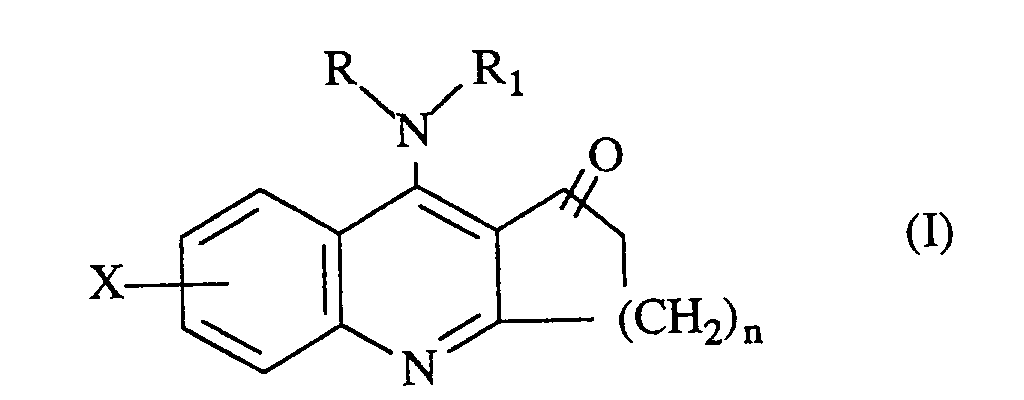
- the present invention relates to a method of reducing a carbonyl containing acridine of the formula (I) where n is 1, 2 or 3;
- X is hydrogen, loweralkyl, loweralkoxy, halogen, hydroxy, trifluoromethyl, or NR3R4 where R3 and R4 are independently hydrogen or loweralkyl;
- R is hydrogen or loweralkyl and R1 is hydrogen, loweralkyl, diloweralkylaminoloweralkyl, arylloweralkyl, diarylloweralkyl, furylloweralkyl, thienylloweralkyl, oxygen-bridged arylloweralkyl, oxygen-bridged diarylloweralkyl, oxygen-bridged furylloweralkyl or oxygen-bridged thienylloweralkyl.
- the compounds are prepared according to the following sequence of reactions.
- This reaction is typically conducted using a catalyst in a suitable solvent at a temperature of 80 to 180°C (or to reflux) for 1 to 24 hours.
- a preferred temperature range is 110-160°C for 1 to 6 hours.
- the catalyst is typically selected from p-toluenesulfonic acid monohydrate, methanesulfonic acid, sulfuric acid or the like; the preferred catalyst is p-toluenesulfonic acid monohydrate.
- the amount of catalyst necessary is typically in the range of .005 to .05 equivalents with .008 - .035 equivalents preferred.
- Solvents useful in the condensation include toluene, xylene, benzene or halogenated aromatic solvents such as chlorobenzene or dichlorobenzene.
- the preferred solvent is toluene.
- the volume to weight (v/w) ratio of solvent to nitrile starting material is typically in the range of 1:3 to 1:10 with a preferred ratio of 1:4 to 1:6.
- This cyclization reaction typically utilizes a catalyst such as FeCl2 ⁇ 4H2O, FeCl2, FeCl3, etc.; the preferred catalyst is FeCl2 ⁇ 4H2O.
- a catalyst such as FeCl2 ⁇ 4H2O, FeCl2, FeCl3, etc.
- the preferred catalyst is FeCl2 ⁇ 4H2O.
- Heavy metals such as copper and zinc are highly toxic and incompatible with microbial waste water treatment systems. If copper or zinc are released, they can cause serious environmental problems. Conversely, iron is essentially nontoxic and is even used in the treatment of waste water.
- the amount of catalyst employed is 5.0-13 mequiv.
- Basic inorganic salts which are typically utilized include potassium and sodium carbonate and potassium and sodium bicarbonate.
- the preferred salts are potassium carbonate and potassium bicarbonate.
- the amount of salt employed is typically in the range of 5.0 to 30 mequiv.
- the solvents which can be used in the cyclization include amide solvents such as dimethylformamide (DMF) or 1-methyl-2-pyrrolidinone; DMF is preferred.
- amide solvents such as dimethylformamide (DMF) or 1-methyl-2-pyrrolidinone; DMF is preferred.
- the v/w ratio of solvent to compound V is typically in the range of 3:1 to 5:1.
- This cyclization is typically conducted at a temperature range of 130-180°C for 1 to 24 hours; preferred conditions include a range of 140°-160°C for 1-8 hours.
- Compound I in its free base form, is reduced in a hydrogenation vessel charged under hydrogen pressure with a catalyst, alkali metal base selected from lithium hydroxide and its hydrates, sodium hydroxide, and lower alkoxides of sodium or lithium and a solvent at a temperature of ⁇ 120°C to afford Compound II.
- a catalyst alkali metal base selected from lithium hydroxide and its hydrates, sodium hydroxide, and lower alkoxides of sodium or lithium and a solvent at a temperature of ⁇ 120°C to afford Compound II.
- a noble metal catalyst such as platinum is employed.
- the platinum can be in the form of the metal supported on an inert surface, e.g., on carbon or as the oxide or salt.
- the platinum content of the catalyst typically varies from about 1-10%, preferably in the range of 2-5%.
- the weight ratio of the noble metal contained in the catalyst to the starting ketone is generally 0.05 to 0.25%; the preferred weight ratio being 0.1 to 0.15%.
- the alkali metal base which is preferably employed in the reduction is lithium hydroxide ⁇ H2O in a molar ratio of 0.1 to 0.5 equiv, preferably 0.2 equiv, with respect to the starting ketone.
- Lower alkanol solvents with 2 to 8 carbons are typically employed.
- Preferred solvents are ethanol, 1-propanol, 2-propanol and 1-butanol. Most preferred of these solvents is 1-butanol.
- Aqueous mixtures of lower alkanol solvents can also be utilized. For instance, a small volume of water may be added to the solvent in order to increase the solubility of the alkali metal base. The amount of water added is generally in the range of 2 to 10%, preferably 5 to 7% w/w.
- the typical volume to weight ratio of solvent to ketone is in the range of 3:1 to 10:1, preferably 4:1 to 8:1.
- the hydrogen pressure utilized is in the range of 50 to 1000 psi; typically in the range of 70 to 225 psi.
- the reduction is typically conducted at an operating temperature range of 40-100°C, for 4-20 hours; preferably in the range of 60-80°C for 6-10 hours.
- the ratio of catalyst to base is typically 1:0.5 to 1:3, preferably 1:1 to 1:2.
- Compound I can be further reduced to its saturated form (Compound VI) of the formula by elevating the temperature to a range of 120 to 150°C for 1 to 4 hours.
- a mixture of aminobenzonitrile (50.0 g), 1,3-cyclohexanedione (52.14 g), and p-toluenesulfonic acid monohydrate (2.57 g) in toluene (250 ml) is refluxed for several hours with simultaneous removal of water by azeotropic distillation.
- the reaction mixture is cooled to room temperature, and then water (100 ml) is added.
- the crude product is filtered and rinsed with toluene and water.
- the crude product is washed by slurrying with water (350 ml) at room temperature for 1-2 hours.
- aqueous hydrochloric acid (12.1 mL) is added to acidify the mixture to a pH of 2.2-2.4 while maintaining a temperature of 80-90°C.
- the crude product suspension is cooled and aged at 0-5°C for 1-2 hours.
- the crude product is filtered, rinsed with DMF (40 mL) and dried in vacuo to afford 22.7 g of 9-amino-3,4-dihydro-1(2H)-acridinone hydrochloride.
- a solution of 9-amino-3,4-dihydro-1(2H)-acridinone hydrochloride (100 g) in water (800 mL) at 80-85°C is basified by the addition of 50% sodium hydroxide (33.8 g) until the pH of the solution is greater than 11.
- the resultant slurry of product free base is aged at 60°C for 0.5 hour, filtered and dried in vacuo to give 85.4 g of 9-amino-3,4-dihydro-1(2H)-acridinone.
- the dissolved product is separated from the Pt/C catalyst by filtration followed by a 80% aqueous n-butanol (15.9 mL) rinse.
- the combined filtrate is basified to a pH greater than 10.5 by addition of 50% sodium hydroxide (10.8 g) at 25-30°C and the resultant heterogeneous slurry is aged at 25°C for 1 hour.
- the product, ( ⁇ )-9-amino-1,2,3,4-tetrahydroacridin-1-ol is isolated in 90.6% yield following filtration, 80% aqueous n-butanol (15.9 mL) wash, water (50 mL) wash, and drying in a vacuum oven.
- a 150 ml Parr hydrogenation vessel is charged with 9-amino-3,4-dihydro-1(2H)-acridinone (6.0 g), 3% Pt/C (with 65% H2O) (0.86 g) and 1-butanol (42 ml). The mixture is pressurized and vented three times with nitrogen (70 psi) and three times with hydrogen (70 psi) at 23-25°C. Following the final hydrogen purge, the flask is repressurized with hydrogen to 70 psi and heated to 70°C with shaking. Samples were removed at 2,4 and 12 hours for HPLC analyses. The results are given below in Table I.
- the aqueous phase was extracted with 25 ml of xylenes and the combined organic phase was stirred with 100 ml of water for 10 minutes after the pH was adjusted to around 8 or 9 with 10% aqueous sodium hydroxide.
- the phases were separated; the organic phase was washed with 100 ml of water, dried over magnesium sulfate, filtered, and concentrated on a rotary evaporator to yield 20.87 g of an oil.
- the crude mixture was used in the next step without purification.
- the dissolved product is separated from the Pt/C catalyst by filtration followed by a n-propanol (22.7 mL) rinse.
- the combined filtrate is concentrated below 30°C and the resultant heterogeneous slurry is aged at 5°C for 1 hour.
- the product 9-benzylamino-1,2,3,4-tetrahydroacridin-1-ol is isolated in 70% yield (99.0% HPLC purity) following filtration, n-propanol wash, and drying in a vacuum oven.
Landscapes
- Organic Chemistry (AREA)
- Chemical & Material Sciences (AREA)
- Low-Molecular Organic Synthesis Reactions Using Catalysts (AREA)
- Chemically Coating (AREA)
- Organic Low-Molecular-Weight Compounds And Preparation Thereof (AREA)
- Encapsulation Of And Coatings For Semiconductor Or Solid State Devices (AREA)
- Cephalosporin Compounds (AREA)
- Nitrogen Condensed Heterocyclic Rings (AREA)
- Manufacturing Of Electric Cables (AREA)
- Catalysts (AREA)
- Other In-Based Heterocyclic Compounds (AREA)
- Pyridine Compounds (AREA)
- Saccharide Compounds (AREA)
- Treatments For Attaching Organic Compounds To Fibrous Goods (AREA)
- Chemical Treatment Of Metals (AREA)
- Heterocyclic Carbon Compounds Containing A Hetero Ring Having Oxygen Or Sulfur (AREA)
- Electrical Discharge Machining, Electrochemical Machining, And Combined Machining (AREA)
- Carbon And Carbon Compounds (AREA)
- Manufacturing Of Printed Wiring (AREA)
- Mechanical Treatment Of Semiconductor (AREA)
- Electroplating Methods And Accessories (AREA)
Abstract
Description
- The present invention relates to a method of reducing a carbonyl containing acridine of the formula (I)

where n is 1, 2 or 3; X is hydrogen, loweralkyl, loweralkoxy, halogen, hydroxy, trifluoromethyl, or NR₃R₄ where R₃ and R₄ are independently hydrogen or loweralkyl; R is hydrogen or loweralkyl and R₁ is hydrogen, loweralkyl, diloweralkylaminoloweralkyl, arylloweralkyl, diarylloweralkyl, furylloweralkyl, thienylloweralkyl, oxygen-bridged arylloweralkyl, oxygen-bridged diarylloweralkyl, oxygen-bridged furylloweralkyl or oxygen-bridged thienylloweralkyl. - The reduction of these compounds is essential in the preparation of compounds which have been shown to be useful for enhancing memory. These include compounds of the formula

where p is 0 or 1; m is 1, 2 or 3; X is hydrogen, loweralkyl, loweralkoxy, halogen, hydroxy, trifluoromethyl, or NR₃R₄ where R₃ and R₄ are independently hydrogen or loweralkyl; R is hydrogen or loweralkyl; R₁ is hydrogen, loweralkyl, diloweralkylaminoloweralkyl, arylloweralkyl, diarylloweralkyl, furylloweralkyl, thienylloweralkyl, oxygen-bridged arylloweralkyl, oxygen-bridged diarylloweralkyl, oxygen-bridged furylloweralkyl, oxygen-bridged furylloweralkyl, oxygen-bridged thienylloweralkyl; the optical antipodes thereof, or the pharmaceutically acceptable acid addition salts thereof. - Of particular interest is the reduction of compound of the formula (Ia)

to (±)-9-amino-1,2,3,4-tetrahydroacridin-1-ol of the formula
The carbonyl containing acridines and the alcohols prepared from their reduction are known as disclosed in U.S. Patents 4,631,286, 4,695,573, 4,754,050, 4,835,275 and 4,839,364. The advantage of the subject invention for preparing the acridine derivatives is that it is less costly and provides high yields and high purity without undesirable side products. Accordingly, this invention aids in fulfilling the need for a process utilizing more economical, environmentally safer reagents which are more adaptable to large scale production. The target acridines are obtained in high yield and increased purity. - The substituents R, R₁, R₃, R₄, X, m, n and p are as defined above unless indicated otherwise.
- The compounds are prepared according to the following sequence of reactions. Compound III of the formula

is reacted with Compound IV, a cyclic ketone of the formula
where p is 0 or 1 with the proviso that if p=1, the second carbonyl group is at the 2 or 3 position of the ring, to afford known intermediate, Compound V of the formula
This reaction is typically conducted using a catalyst in a suitable solvent at a temperature of 80 to 180°C (or to reflux) for 1 to 24 hours. A preferred temperature range is 110-160°C for 1 to 6 hours. - The catalyst is typically selected from p-toluenesulfonic acid monohydrate, methanesulfonic acid, sulfuric acid or the like; the preferred catalyst is p-toluenesulfonic acid monohydrate. The amount of catalyst necessary is typically in the range of .005 to .05 equivalents with .008 - .035 equivalents preferred. Solvents useful in the condensation include toluene, xylene, benzene or halogenated aromatic solvents such as chlorobenzene or dichlorobenzene. The preferred solvent is toluene.
- The volume to weight (v/w) ratio of solvent to nitrile starting material is typically in the range of 1:3 to 1:10 with a preferred ratio of 1:4 to 1:6.
- The reaction of Compound IV where n=2 and p=0 with Compound III affords the condensation product (Va) of the formula

which is a useful intermediate in the preparation of Tacrine (9-amino-1,2,3,4-tetrahydroacridine hydrochloride hydrate). - Intermediate compound (V) where p is 1 is subsequently reacted with a catalyst in the presence of a basic inorganic salt in an amide solvent to afford Compound I.
- This cyclization reaction typically utilizes a catalyst such as FeCl₂·4H₂O, FeCl₂, FeCl₃, etc.; the preferred catalyst is FeCl₂·4H₂O. There are significant advantages in using an iron catalyst rather than previously known copper or zinc catalysts in this cyclization step. Heavy metals such as copper and zinc are highly toxic and incompatible with microbial waste water treatment systems. If copper or zinc are released, they can cause serious environmental problems. Conversely, iron is essentially nontoxic and is even used in the treatment of waste water. The amount of catalyst employed is 5.0-13 mequiv.
- Basic inorganic salts which are typically utilized include potassium and sodium carbonate and potassium and sodium bicarbonate. The preferred salts are potassium carbonate and potassium bicarbonate. The amount of salt employed is typically in the range of 5.0 to 30 mequiv.
- The solvents which can be used in the cyclization include amide solvents such as dimethylformamide (DMF) or 1-methyl-2-pyrrolidinone; DMF is preferred. The v/w ratio of solvent to compound V is typically in the range of 3:1 to 5:1.
- This cyclization is typically conducted at a temperature range of 130-180°C for 1 to 24 hours; preferred conditions include a range of 140°-160°C for 1-8 hours.
- Where compound Va is employed, under the typical conditions described above, Compound IIb (Tacrine) of the formula is prepared

The target acridines are prepared by the reduction of either the free base or salt of compound Ia. For large scale production, it is found that catalytic hydrogenation of the free base is the most practical method. - Compound I, in its free base form,
is reduced in a hydrogenation vessel charged under hydrogen pressure with a catalyst, alkali metal base selected from lithium hydroxide and its hydrates, sodium hydroxide, and lower alkoxides of sodium or lithium and a solvent at a temperature of <120°C to afford Compound II. - Typically, a noble metal catalyst such as platinum is employed. The platinum can be in the form of the metal supported on an inert surface, e.g., on carbon or as the oxide or salt. The platinum content of the catalyst typically varies from about 1-10%, preferably in the range of 2-5%. The weight ratio of the noble metal contained in the catalyst to the starting ketone is generally 0.05 to 0.25%; the preferred weight ratio being 0.1 to 0.15%.
- The alkali metal base which is preferably employed in the reduction is lithium hydroxide·H₂O in a molar ratio of 0.1 to 0.5 equiv, preferably 0.2 equiv, with respect to the starting ketone.
- Lower alkanol solvents with 2 to 8 carbons are typically employed. Preferred solvents are ethanol, 1-propanol, 2-propanol and 1-butanol. Most preferred of these solvents is 1-butanol. Aqueous mixtures of lower alkanol solvents can also be utilized. For instance, a small volume of water may be added to the solvent in order to increase the solubility of the alkali metal base. The amount of water added is generally in the range of 2 to 10%, preferably 5 to 7% w/w. The typical volume to weight ratio of solvent to ketone is in the range of 3:1 to 10:1, preferably 4:1 to 8:1.
- The hydrogen pressure utilized is in the range of 50 to 1000 psi; typically in the range of 70 to 225 psi.
- The reduction is typically conducted at an operating temperature range of 40-100°C, for 4-20 hours; preferably in the range of 60-80°C for 6-10 hours.
- The ratio of catalyst to base is typically 1:0.5 to 1:3, preferably 1:1 to 1:2.
- It is critical in this process that the alkali metal base is present. We have shown that without the inclusion of the base, reduction occurs at a ratio which is much less than the ratio when the base is present. For example, it has been found that this ratio can be as much as 9 times greater utilizing lithium hydroxide monohydrate as the base (see example 5).
- Compound I can be further reduced to its saturated form (Compound VI) of the formula

by elevating the temperature to a range of 120 to 150°C for 1 to 4 hours. - The invention is described in greater detail in the following examples in which all parts, proportions, ratios and percentages are by weight unless otherwise indicated.
- A mixture of aminobenzonitrile (50.0 g), 1,3-cyclohexanedione (52.14 g), and p-toluenesulfonic acid monohydrate (2.57 g) in toluene (250 ml) is refluxed for several hours with simultaneous removal of water by azeotropic distillation. The reaction mixture is cooled to room temperature, and then water (100 ml) is added. After stirring for 1-2 hours, the crude product is filtered and rinsed with toluene and water. The crude product is washed by slurrying with water (350 ml) at room temperature for 1-2 hours. The washed product, N-(3-oxocyclohexen-1-yl)-2-aminobenzonitrile, after filtration, rinsing with water and drying, is obtained in high yield.
- A mixture of N-(3-oxocyclohexen-1-yl)-2-aminobenzonitrile (20 g), potassium bicarbonate (0.122 g) and ferrous chloride tetrahydrate (0.121 g) in dimethylforamide (DMF) (80 mL) is stirred at reflux for 2-6 hours.
- After cooling the reaction mixture to 80-85°C, 30% aqueous hydrochloric acid (12.1 mL) is added to acidify the mixture to a pH of 2.2-2.4 while maintaining a temperature of 80-90°C. The crude product suspension is cooled and aged at 0-5°C for 1-2 hours. The crude product is filtered, rinsed with DMF (40 mL) and dried in vacuo to afford 22.7 g of 9-amino-3,4-dihydro-1(2H)-acridinone hydrochloride.
- A solution of 9-amino-3,4-dihydro-1(2H)-acridinone hydrochloride (24.8 g) in water (175 mL) at 70-80°C is treated with charcoal (2-2.1 g), aged at 90-100°C for 0.5 hour, filtered and the filter cake is washed with hot water (24.8 mL). The combined filtrate at 85°C is treated with 24% w/w aqueous sodium chloride (17 g) and aged at 0-5°C for 1 hour. Purified 9-amino-3,4-dihydro-1(2H)-acridinone hydrochloride (21.4 g) is obtained following filtration, water wash (24.8 mL) at 0-5°C and drying in vacuo.
- A solution of 9-amino-3,4-dihydro-1(2H)-acridinone hydrochloride (100 g) in water (800 mL) at 80-85°C is basified by the addition of 50% sodium hydroxide (33.8 g) until the pH of the solution is greater than 11. The resultant slurry of product free base is aged at 60°C for 0.5 hour, filtered and dried in vacuo to give 85.4 g of 9-amino-3,4-dihydro-1(2H)-acridinone.
- Into a 300 ml autoclave under a nitrogen purge is charged 9-amino-3,4-dihydro-1(2H)-acridinone (15.9 g), lithium hydroxide monohydrate (0.63 g), 3% Pt/C (1.26 g containing 58% water) and n-butanol (111 mL). The stirred mixture under a hydrogen atmosphere (125 psi), is heated to 70°C. After 10 hours the mixture contains 98.5% product by HPLC. The mixture is cooled to 25°C, vented, and purged with nitrogen. The product is dissolved as its acetate salt by addition of water (27.8 mL), acetic acid (6.5 g) and digestion at 25°C for 30 minutes.
- The dissolved product is separated from the Pt/C catalyst by filtration followed by a 80% aqueous n-butanol (15.9 mL) rinse. The combined filtrate is basified to a pH greater than 10.5 by addition of 50% sodium hydroxide (10.8 g) at 25-30°C and the resultant heterogeneous slurry is aged at 25°C for 1 hour. The product, (±)-9-amino-1,2,3,4-tetrahydroacridin-1-ol, is isolated in 90.6% yield following filtration, 80% aqueous n-butanol (15.9 mL) wash, water (50 mL) wash, and drying in a vacuum oven.
- The following table shows the effect on the yield of 9-amino-1,2,3,4-tetrahydroacridin-1-ol by varying some parameters of Example 3.
Solvent % Pt/C Time Hydrogen Pressure Yield 2-Propanol 3% 8 hours 150 psi 94.1% 2-Propanol 2% 14 hours 70 psi 94.5% 1-Propanol 5% 10 hours 70 psi 94.2% 2-Propanol 5% 10 hours 70 psi 81.5% 1-Propanol* 3% 6 hours 150 psi 92.0% 1-Propanol** 3% 6 hours 150 psi 91.7% 1-Propanol*** 3% 6 hours 150 psi 94.7% 1-Propanol**** 3% 8 hours 150 psi 89.8% 1-Propanol***** 3% 6 hours 150 psi 83.0% 2-Propanol¢ 3% 6 hours 380 psi 97.7% * - 70°C ** - 60°C *** - 80°C **** - 90°C ***** - 100°C ¢ - 50°C, 95% aqueous - A 150 ml Parr hydrogenation vessel is charged with 9-amino-3,4-dihydro-1(2H)-acridinone (6.0 g), 3% Pt/C (with 65% H₂O) (0.86 g) and 1-butanol (42 ml). The mixture is pressurized and vented three times with nitrogen (70 psi) and three times with hydrogen (70 psi) at 23-25°C. Following the final hydrogen purge, the flask is repressurized with hydrogen to 70 psi and heated to 70°C with shaking. Samples were removed at 2,4 and 12 hours for HPLC analyses. The results are given below in Table I.
TABLE 1 Time % Tetrahydro alcohol w/o LiOH % Tetrahydro* alcohol w/LiOH % Starting Ketone % Octahydro Alcohol 2 9.5% 52.6% 87.5% 3.1% 4 8.8% 81.9% 87.3% 3.9% 12 20.2% 96.8% 71.7% 8.1% *-similar experiment run using LiOH·H₂O (0.2 equiv) as promoter. - To a 300 ml, 3-neck round-bottom flask equipped with an overhead stirrer, Dean-Stark trap and thermometer was charged 13.3 g of 2-aminobenzonitrile, 133.5 ml of xylenes, 16.64 g of cyclohexanone and 0.905 g of p-toluenesulfonic acid monohydrate. The stirred solution was heated to reflux with simultaneous removal of water by azeotropic distillation for 9 hours. The mixture was then cooled to room temperature and poured into 150 ml of water. After stirring for 15 min., the phases were separated. The aqueous phase was extracted with 25 ml of xylenes and the combined organic phase was stirred with 100 ml of water for 10 minutes after the pH was adjusted to around 8 or 9 with 10% aqueous sodium hydroxide. The phases were separated; the organic phase was washed with 100 ml of water, dried over magnesium sulfate, filtered, and concentrated on a rotary evaporator to yield 20.87 g of an oil. The crude mixture was used in the next step without purification.
- To a 250 ml, 3-neck round-bottom flask equipped with an overhead stirrer, condenser and thermometer was charged 20.8 g of N-(cyclohexen-1-yl)-2-aminobenzonitrile, 90 ml of dimethylformamide, 2.26 g of ferrous chloride tetrahydrate and 1.13 g of potassium bicarbonate. The stirred mixture was refluxed for 2-4 hours, then allowed to cool. The reaction mixture was concentrated on a rotary evaporator to yield 21.72 g of an oil.
- The oil was partitioned between toluene and 3N HCl; and the aqueous phase was basified to extract the product into dichloromethane. The organic phase was dried over potassium carbonate, filtered and concentrated on a rotary evaporator to yield 10.1 g of a solid. A second crop of 3.28 g was also isolated. The two solids were combined and purified via chromatography using silica gel to yield 8.3 g of 9-amino-1,2,3,4-tetrahydroacridine.
- Into a 300 mL autoclave under a nitrogen purge is charged 9-benzylamino-3,4-dihydro-1(2H)-acridinone (22.7 g), lithium hydroxide monohydrate (0.63 g), 3% Pt/C (5.42 g containing 65% water) and n-propanol (159 mL). The stirred mixture (500 rpm), under a hydrogen atmosphere (400-1000 psi), is heated to 70°C. After 23 hours the mixture contains >99.5% product by HPLC. The mixture is cooled to 25°C, vented, and purged with nitrogen. The dissolved product is separated from the Pt/C catalyst by filtration followed by a n-propanol (22.7 mL) rinse. The combined filtrate is concentrated below 30°C and the resultant heterogeneous slurry is aged at 5°C for 1 hour. The product 9-benzylamino-1,2,3,4-tetrahydroacridin-1-ol, is isolated in 70% yield (99.0% HPLC purity) following filtration, n-propanol wash, and drying in a vacuum oven.
Claims (16)
- A method of reducing a carbonyl containing acridine derivative of the formula I

- The method of claim 1 wherein the noble metal catalyst is platinum, platinum oxide or a platinum salt.
- The method of claim 1 or claim 2 wherein the alkali metal base is sodium hydroxide or lithium hydroxide monohydrate.
- The method of any one of the proceding claims wherein the solvent is a lower alkanol solvent, having 2 to 8 carbon atoms.
- The method of claim 4 wherein the solvent is selected from: ethanol, 1-propanol, 2-propanol and 1-butanol.
- The method of claim 5 wherein the solvent is 1-butanol.
- The method of any one of the proceding claims wherein 2 to 10 % w/w water is added to the solvent.
- The method of any one of the proceding claims wherein the temperature is 40-100°C.
- The method of claim 8 wherein the temperature is 60-80°C.
- The method of claim 1 wherein the catalyst is platinum, the alkali metal base is lithium hydroxide and the solvent is 1-butanol.
- The method according to claim 1, wherein a compound of the formula Ia


- The method of claim 1, wherein the carbonyl containing acridine is obtained bya) reacting a compound of the formula III


 b) cyclizing a compound of the formula V wherein X and n are as defined and p is 1 in the presence of a metallic halide as a catalyst and a basic inorganic salt, to form a compound of the formula I.
 - The method of claim 12, wherein the catalyst used in the reaction of a compound of the formula III with a compound of the formula IV is selected from p-toluene sulfonic acid monohydrate, methanesulfonic acid and sulfuric acid.
- The method of claim 13, wherein the catalyst is p-toluenesulfonic acid monohydrate.
- The method any one of claims 12 to 14, wherein the catalyst used in the cyclization reaction is selected from: FeCl₂·4H₂O, FeCl₂ or FeCl₃ and the basic inorganic salt used is selected from potassium carbonate, sodium carbonate, potassium bicarbonate and sodium bicarbonate.
- The method of claim 15, wherein FeCl₂·4H₂O is used as the catalyst and potassium carbonate or bicarbonate is used as basic inorganic salt.
Applications Claiming Priority (2)
| Application Number | Priority Date | Filing Date | Title |
|---|---|---|---|
| US07/500,967 US5053513A (en) | 1990-03-29 | 1990-03-29 | Method of reducing a carbonyl containing acridine |
| US500967 | 1990-03-29 |
Publications (2)
| Publication Number | Publication Date |
|---|---|
| EP0449172A1 EP0449172A1 (en) | 1991-10-02 |
| EP0449172B1 true EP0449172B1 (en) | 1996-06-05 |
Family
ID=23991612
Family Applications (1)
| Application Number | Title | Priority Date | Filing Date |
|---|---|---|---|
| EP91104661A Expired - Lifetime EP0449172B1 (en) | 1990-03-29 | 1991-03-25 | A method of reducing a carbonyl containing acridine |
Country Status (24)
| Country | Link |
|---|---|
| US (1) | US5053513A (en) |
| EP (1) | EP0449172B1 (en) |
| JP (1) | JPH07113017B2 (en) |
| KR (1) | KR0178275B1 (en) |
| CN (1) | CN1032649C (en) |
| AT (1) | ATE138913T1 (en) |
| AU (1) | AU640759B2 (en) |
| BR (1) | BR9101252A (en) |
| CA (1) | CA2039318A1 (en) |
| CS (1) | CS83591A2 (en) |
| DE (1) | DE69119961T2 (en) |
| DK (1) | DK0449172T3 (en) |
| ES (1) | ES2099717T3 (en) |
| FI (1) | FI98366C (en) |
| GR (1) | GR3020518T3 (en) |
| HU (1) | HUT57732A (en) |
| IE (1) | IE76463B1 (en) |
| IL (1) | IL97697A (en) |
| NO (1) | NO177748C (en) |
| NZ (1) | NZ237603A (en) |
| PL (1) | PL165759B1 (en) |
| PT (1) | PT97196B (en) |
| RU (1) | RU2069659C1 (en) |
| ZA (1) | ZA912365B (en) |
Families Citing this family (6)
| Publication number | Priority date | Publication date | Assignee | Title |
|---|---|---|---|---|
| US5210087A (en) * | 1991-02-13 | 1993-05-11 | Hoechst-Roussel Pharmaceuticals Inc. | 9-aminotetrahydroacridines and related compounds |
| RU2024509C1 (en) * | 1991-05-07 | 1994-12-15 | Всероссийский научный центр по безопасности биологически активных веществ | Derivatives of 9-aminoacridine or their salts with organic or inorganic acids showing psychotropic, antiamnestic and lipid-regulating activity |
| US5247091A (en) * | 1992-07-30 | 1993-09-21 | Hoechst Celanese Corporation | Preparation of enamines in aqueous media |
| ES2059263B1 (en) * | 1992-10-27 | 1995-10-01 | Vita Invest Sa | PROCEDURE FOR OBTAINING THE (+) - 9-AMINO-1,2,3,4-TETRAHIDROACRIDIN-1-OL. |
| GB201312228D0 (en) | 2013-07-08 | 2013-08-21 | Ludlow Michael | A lip skin and a method and apparatus for forming a lip skin |
| RU2567388C1 (en) * | 2014-12-10 | 2015-11-10 | Открытое акционерное общество "Нижегородский химико-фармацевтический завод" | Method to produce 9-butylamino-3,3-dimethyl-3,4-dihydroacridin-1(2h)-on hydrochloride |
Family Cites Families (9)
| Publication number | Priority date | Publication date | Assignee | Title |
|---|---|---|---|---|
| DE3582995D1 (en) * | 1984-10-25 | 1991-07-04 | Hoechst Roussel Pharma | 9-AMINO-1,2,3,4-TETRAHYDROACRIDIN-1-OL AND RELATED COMPOUNDS, METHOD FOR THE PRODUCTION AND USE THEREOF AS A MEDICINAL PRODUCT. |
| US4835275A (en) * | 1984-10-25 | 1989-05-30 | Hoechst-Roussel Pharmaceuticals, Inc. | Method of preparing 9-amino-1,2,3,4,-tetrahydroacridin-1-ones and related compounds |
| US4695573A (en) * | 1984-10-25 | 1987-09-22 | Hoechst-Roussel Pharmaceuticals Inc. | 9-amino-1,2,3,4-tetrahydroacridin-1-ol and related compounds |
| US4631286A (en) * | 1984-10-25 | 1986-12-23 | Hoechst-Roussel Pharmaceuticals Inc. | 9-amino-1,2,3,4-tetrahydroacridin-1-ol and related compounds |
| US4754050A (en) * | 1984-10-25 | 1988-06-28 | Hoechst-Roussel Pharmaceuticals, Inc. | 9-amino-1,2,3,4-tetrahydroacridin-1-ol and related compounds |
| US4851536A (en) * | 1987-05-07 | 1989-07-25 | American Home Products Corporation | Cyclohexylquinolines as inhibitors of interleukin 1 |
| US4868177A (en) * | 1988-11-09 | 1989-09-19 | Hoechst-Roussel Pharmaceuticals, Inc. | 1,2,3,4-tetrahydro-1,9-acridinediamines, pharmaceutical compositions and use |
| GB8827704D0 (en) * | 1988-11-28 | 1988-12-29 | Fujisawa Pharmaceutical Co | New acridine derivatives & processes for their production |
| US5155226A (en) * | 1991-02-19 | 1992-10-13 | Hoechst-Roussel Pharmaceuticals Incorporated | Method for the preparation of 9-amino-1,2,3,4-tetrahydroacridine |
-
1990
- 1990-03-29 US US07/500,967 patent/US5053513A/en not_active Expired - Fee Related
-
1991
- 1991-03-25 ES ES91104661T patent/ES2099717T3/en not_active Expired - Lifetime
- 1991-03-25 DE DE69119961T patent/DE69119961T2/en not_active Expired - Fee Related
- 1991-03-25 DK DK91104661.3T patent/DK0449172T3/en active
- 1991-03-25 AT AT91104661T patent/ATE138913T1/en not_active IP Right Cessation
- 1991-03-25 EP EP91104661A patent/EP0449172B1/en not_active Expired - Lifetime
- 1991-03-27 IL IL9769791A patent/IL97697A/en not_active IP Right Cessation
- 1991-03-27 KR KR1019910004757A patent/KR0178275B1/en not_active Expired - Fee Related
- 1991-03-27 NO NO911255A patent/NO177748C/en unknown
- 1991-03-27 NZ NZ237603A patent/NZ237603A/en unknown
- 1991-03-27 FI FI911513A patent/FI98366C/en active
- 1991-03-27 CS CS91835A patent/CS83591A2/en unknown
- 1991-03-28 PT PT97196A patent/PT97196B/en not_active IP Right Cessation
- 1991-03-28 AU AU73870/91A patent/AU640759B2/en not_active Ceased
- 1991-03-28 CN CN91101914A patent/CN1032649C/en not_active Expired - Fee Related
- 1991-03-28 RU SU914895044A patent/RU2069659C1/en active
- 1991-03-28 BR BR919101252A patent/BR9101252A/en unknown
- 1991-03-28 JP JP3087252A patent/JPH07113017B2/en not_active Expired - Lifetime
- 1991-03-28 IE IE107091A patent/IE76463B1/en not_active IP Right Cessation
- 1991-03-28 CA CA002039318A patent/CA2039318A1/en not_active Abandoned
- 1991-03-28 ZA ZA912365A patent/ZA912365B/en unknown
- 1991-03-28 PL PL91289656A patent/PL165759B1/en unknown
- 1991-03-29 HU HU911055A patent/HUT57732A/en unknown
-
1996
- 1996-07-11 GR GR960401878T patent/GR3020518T3/en unknown
Also Published As
Similar Documents
| Publication | Publication Date | Title |
|---|---|---|
| HU203723B (en) | Process for producing intermediates for substituted indol derivatives | |
| SU1321376A3 (en) | Method of producing derivatives of quinolinecarboxylic acid | |
| US5053513A (en) | Method of reducing a carbonyl containing acridine | |
| CA2368815A1 (en) | Novel synthesis and crystallization of piperazine ring-containing compounds | |
| KR910009331B1 (en) | Diazabicycloamine compounds and the preparation process thereof | |
| JPS6046104B2 (en) | Method for producing butene derivatives | |
| CA2199645C (en) | Methods for the manufacture of quinolone carboxylic acids derivatives and intermediates thereof | |
| HK1046908A1 (en) | Intermediates for the production of naphthyridine-3-carboxylic acid derivatives | |
| US6111109A (en) | Process for the preparation of N-[2-(dimethylamino)ethyl]acridine-4-carboxamide | |
| Barbu et al. | A method for the synthesis of 3-methyl-2, 7-naphthyridine derivatives | |
| IE912005A1 (en) | "New process for the industrial preparation of 4-chloro 3-sulphamoyl-N-(2,3-dihydro-2-methyl-1H-indol-1- yl)- benzamide from 2,3-dihydro-2-methyl-1H-indole and hydrox ylamine-O-sulphonic acid" | |
| KR100283539B1 (en) | Intermediate compounds for the preparation of antifolate compounds and methods for their preparation | |
| US5561233A (en) | Process for the preparation of an intermediate of a benzo[a]quinolizinone derivative | |
| EP0393109B1 (en) | Novel 2,3-thiomorpholinedione-2-oxime derivatives, pharmaceutical compositions containing them and process for preparing same | |
| AU627609B2 (en) | New quinoline derivatives and process for the preparation thereof | |
| WO1991001315A1 (en) | New quinoline derivatives and process for the preparation thereof | |
| CN120904158A (en) | Preparation method of olanetidine and intermediate thereof | |
| KR860000671B1 (en) | Process for preparing piperazinyl derivatives of quinoline carboxylic acid | |
| KR100361830B1 (en) | Process for preparing alkali metal salts of quinolone carboxylic acid | |
| EP0195135B1 (en) | A process for the preparation of quinoline carboxylic acid derivatives | |
| KR20240038024A (en) | Method for producing hepatitis B virus nucleocapsid inhibitor | |
| JPS62263157A (en) | Quinolone derivative | |
| PL90861B1 (en) | ||
| JPH05202046A (en) | Pyrimidopteridine derivative and its production | |
| JPH05202053A (en) | Pyrimidopteridine derivative and its production |
Legal Events
| Date | Code | Title | Description |
|---|---|---|---|
| PUAI | Public reference made under article 153(3) epc to a published international application that has entered the european phase |
Free format text: ORIGINAL CODE: 0009012 |
|
| AK | Designated contracting states |
Kind code of ref document: A1 Designated state(s): AT BE CH DE DK ES FR GB GR IT LI LU NL SE |
|
| 17P | Request for examination filed |
Effective date: 19920201 |
|
| 17Q | First examination report despatched |
Effective date: 19940707 |
|
| GRAH | Despatch of communication of intention to grant a patent |
Free format text: ORIGINAL CODE: EPIDOS IGRA |
|
| GRAA | (expected) grant |
Free format text: ORIGINAL CODE: 0009210 |
|
| AK | Designated contracting states |
Kind code of ref document: B1 Designated state(s): AT BE CH DE DK ES FR GB GR IT LI LU NL SE |
|
| REF | Corresponds to: |
Ref document number: 138913 Country of ref document: AT Date of ref document: 19960615 Kind code of ref document: T |
|
| REF | Corresponds to: |
Ref document number: 69119961 Country of ref document: DE Date of ref document: 19960711 |
|
| ET | Fr: translation filed | ||
| ITF | It: translation for a ep patent filed | ||
| REG | Reference to a national code |
Ref country code: GR Ref legal event code: FG4A Free format text: 3020518 |
|
| REG | Reference to a national code |
Ref country code: DK Ref legal event code: T3 |
|
| RAP2 | Party data changed (patent owner data changed or rights of a patent transferred) |
Owner name: HOECHST MARION ROUSSEL, INC. |
|
| PLBE | No opposition filed within time limit |
Free format text: ORIGINAL CODE: 0009261 |
|
| STAA | Information on the status of an ep patent application or granted ep patent |
Free format text: STATUS: NO OPPOSITION FILED WITHIN TIME LIMIT |
|
| 26N | No opposition filed | ||
| REG | Reference to a national code |
Ref country code: ES Ref legal event code: FG2A Ref document number: 2099717 Country of ref document: ES Kind code of ref document: T3 |
|
| NLT2 | Nl: modifications (of names), taken from the european patent patent bulletin |
Owner name: HOECHST MARION ROUSSEL, INC. |
|
| REG | Reference to a national code |
Ref country code: GB Ref legal event code: IF02 |
|
| PGFP | Annual fee paid to national office [announced via postgrant information from national office to epo] |
Ref country code: FR Payment date: 20030213 Year of fee payment: 13 |
|
| PGFP | Annual fee paid to national office [announced via postgrant information from national office to epo] |
Ref country code: DE Payment date: 20030217 Year of fee payment: 13 |
|
| PGFP | Annual fee paid to national office [announced via postgrant information from national office to epo] |
Ref country code: AT Payment date: 20030219 Year of fee payment: 13 |
|
| PGFP | Annual fee paid to national office [announced via postgrant information from national office to epo] |
Ref country code: SE Payment date: 20030220 Year of fee payment: 13 Ref country code: NL Payment date: 20030220 Year of fee payment: 13 Ref country code: GB Payment date: 20030220 Year of fee payment: 13 |
|
| PGFP | Annual fee paid to national office [announced via postgrant information from national office to epo] |
Ref country code: CH Payment date: 20030221 Year of fee payment: 13 |
|
| PGFP | Annual fee paid to national office [announced via postgrant information from national office to epo] |
Ref country code: DK Payment date: 20030224 Year of fee payment: 13 |
|
| PGFP | Annual fee paid to national office [announced via postgrant information from national office to epo] |
Ref country code: GR Payment date: 20030306 Year of fee payment: 13 |
|
| PGFP | Annual fee paid to national office [announced via postgrant information from national office to epo] |
Ref country code: BE Payment date: 20030311 Year of fee payment: 13 |
|
| PGFP | Annual fee paid to national office [announced via postgrant information from national office to epo] |
Ref country code: LU Payment date: 20030312 Year of fee payment: 13 |
|
| PGFP | Annual fee paid to national office [announced via postgrant information from national office to epo] |
Ref country code: ES Payment date: 20030331 Year of fee payment: 13 |
|
| PG25 | Lapsed in a contracting state [announced via postgrant information from national office to epo] |
Ref country code: LU Free format text: LAPSE BECAUSE OF NON-PAYMENT OF DUE FEES Effective date: 20040325 Ref country code: GB Free format text: LAPSE BECAUSE OF NON-PAYMENT OF DUE FEES Effective date: 20040325 Ref country code: AT Free format text: LAPSE BECAUSE OF NON-PAYMENT OF DUE FEES Effective date: 20040325 |
|
| PG25 | Lapsed in a contracting state [announced via postgrant information from national office to epo] |
Ref country code: SE Free format text: LAPSE BECAUSE OF NON-PAYMENT OF DUE FEES Effective date: 20040326 Ref country code: ES Free format text: LAPSE BECAUSE OF NON-PAYMENT OF DUE FEES Effective date: 20040326 |
|
| PG25 | Lapsed in a contracting state [announced via postgrant information from national office to epo] |
Ref country code: LI Free format text: LAPSE BECAUSE OF NON-PAYMENT OF DUE FEES Effective date: 20040331 Ref country code: DK Free format text: LAPSE BECAUSE OF NON-PAYMENT OF DUE FEES Effective date: 20040331 Ref country code: CH Free format text: LAPSE BECAUSE OF NON-PAYMENT OF DUE FEES Effective date: 20040331 Ref country code: BE Free format text: LAPSE BECAUSE OF NON-PAYMENT OF DUE FEES Effective date: 20040331 |
|
| BERE | Be: lapsed |
Owner name: *HOECHST-ROUSSEL PHARMACEUTICALS INC. Effective date: 20040331 |
|
| PG25 | Lapsed in a contracting state [announced via postgrant information from national office to epo] |
Ref country code: NL Free format text: LAPSE BECAUSE OF NON-PAYMENT OF DUE FEES Effective date: 20041001 Ref country code: DE Free format text: LAPSE BECAUSE OF NON-PAYMENT OF DUE FEES Effective date: 20041001 |
|
| PG25 | Lapsed in a contracting state [announced via postgrant information from national office to epo] |
Ref country code: GR Free format text: LAPSE BECAUSE OF NON-PAYMENT OF DUE FEES Effective date: 20041006 |
|
| EUG | Se: european patent has lapsed | ||
| REG | Reference to a national code |
Ref country code: CH Ref legal event code: PL |
|
| GBPC | Gb: european patent ceased through non-payment of renewal fee |
Effective date: 20040325 |
|
| PG25 | Lapsed in a contracting state [announced via postgrant information from national office to epo] |
Ref country code: FR Free format text: LAPSE BECAUSE OF NON-PAYMENT OF DUE FEES Effective date: 20041130 |
|
| NLV4 | Nl: lapsed or anulled due to non-payment of the annual fee |
Effective date: 20041001 |
|
| REG | Reference to a national code |
Ref country code: FR Ref legal event code: ST |
|
| PG25 | Lapsed in a contracting state [announced via postgrant information from national office to epo] |
Ref country code: IT Free format text: LAPSE BECAUSE OF NON-PAYMENT OF DUE FEES;WARNING: LAPSES OF ITALIAN PATENTS WITH EFFECTIVE DATE BEFORE 2007 MAY HAVE OCCURRED AT ANY TIME BEFORE 2007. THE CORRECT EFFECTIVE DATE MAY BE DIFFERENT FROM THE ONE RECORDED. Effective date: 20050325 |
|
| REG | Reference to a national code |
Ref country code: ES Ref legal event code: FD2A Effective date: 20040326 |