EP0447288B1 - Amperometric detection cell - Google Patents
Amperometric detection cell Download PDFInfo
- Publication number
- EP0447288B1 EP0447288B1 EP91400553A EP91400553A EP0447288B1 EP 0447288 B1 EP0447288 B1 EP 0447288B1 EP 91400553 A EP91400553 A EP 91400553A EP 91400553 A EP91400553 A EP 91400553A EP 0447288 B1 EP0447288 B1 EP 0447288B1
- Authority
- EP
- European Patent Office
- Prior art keywords
- electrode
- palladium
- flow cell
- cell according
- reference electrode
- Prior art date
- Legal status (The legal status is an assumption and is not a legal conclusion. Google has not performed a legal analysis and makes no representation as to the accuracy of the status listed.)
- Expired - Lifetime
Links
- 238000001514 detection method Methods 0.000 title claims description 14
- KDLHZDBZIXYQEI-UHFFFAOYSA-N Palladium Chemical compound [Pd] KDLHZDBZIXYQEI-UHFFFAOYSA-N 0.000 claims abstract description 26
- 229910052763 palladium Inorganic materials 0.000 claims abstract description 11
- 239000000523 sample Substances 0.000 claims description 11
- 238000012360 testing method Methods 0.000 claims description 11
- 239000007787 solid Substances 0.000 claims description 7
- 229910003445 palladium oxide Inorganic materials 0.000 claims description 6
- 230000004044 response Effects 0.000 claims description 5
- 239000011888 foil Substances 0.000 claims description 3
- 239000012085 test solution Substances 0.000 claims description 3
- 239000012488 sample solution Substances 0.000 claims description 2
- JQPTYAILLJKUCY-UHFFFAOYSA-N palladium(ii) oxide Chemical compound [O-2].[Pd+2] JQPTYAILLJKUCY-UHFFFAOYSA-N 0.000 claims 3
- 238000000835 electrochemical detection Methods 0.000 abstract description 25
- 210000004027 cell Anatomy 0.000 description 14
- 238000004811 liquid chromatography Methods 0.000 description 14
- 238000004587 chromatography analysis Methods 0.000 description 11
- 150000001413 amino acids Chemical class 0.000 description 9
- 238000000926 separation method Methods 0.000 description 6
- 239000000463 material Substances 0.000 description 5
- 125000006850 spacer group Chemical group 0.000 description 5
- 150000001720 carbohydrates Chemical class 0.000 description 4
- 235000014633 carbohydrates Nutrition 0.000 description 4
- 230000003197 catalytic effect Effects 0.000 description 4
- 238000002347 injection Methods 0.000 description 4
- 239000007924 injection Substances 0.000 description 4
- 238000000034 method Methods 0.000 description 4
- 238000012544 monitoring process Methods 0.000 description 4
- 239000004809 Teflon Substances 0.000 description 3
- 229920006362 Teflon® Polymers 0.000 description 3
- 230000015572 biosynthetic process Effects 0.000 description 3
- 230000008859 change Effects 0.000 description 3
- 239000003792 electrolyte Substances 0.000 description 3
- 239000007789 gas Substances 0.000 description 3
- 239000011521 glass Substances 0.000 description 3
- 239000007788 liquid Substances 0.000 description 3
- HBEQXAKJSGXAIQ-UHFFFAOYSA-N oxopalladium Chemical compound [Pd]=O HBEQXAKJSGXAIQ-UHFFFAOYSA-N 0.000 description 3
- 239000000243 solution Substances 0.000 description 3
- PXHVJJICTQNCMI-UHFFFAOYSA-N Nickel Chemical compound [Ni] PXHVJJICTQNCMI-UHFFFAOYSA-N 0.000 description 2
- 239000000919 ceramic Substances 0.000 description 2
- 150000001875 compounds Chemical class 0.000 description 2
- 238000002484 cyclic voltammetry Methods 0.000 description 2
- PCHJSUWPFVWCPO-UHFFFAOYSA-N gold Chemical compound [Au] PCHJSUWPFVWCPO-UHFFFAOYSA-N 0.000 description 2
- 238000004019 gradient elution chromatography Methods 0.000 description 2
- 239000003456 ion exchange resin Substances 0.000 description 2
- 229920003303 ion-exchange polymer Polymers 0.000 description 2
- 239000000203 mixture Substances 0.000 description 2
- BASFCYQUMIYNBI-UHFFFAOYSA-N platinum Chemical compound [Pt] BASFCYQUMIYNBI-UHFFFAOYSA-N 0.000 description 2
- 230000008569 process Effects 0.000 description 2
- 230000035945 sensitivity Effects 0.000 description 2
- 239000002904 solvent Substances 0.000 description 2
- 239000000126 substance Substances 0.000 description 2
- RYGMFSIKBFXOCR-UHFFFAOYSA-N Copper Chemical compound [Cu] RYGMFSIKBFXOCR-UHFFFAOYSA-N 0.000 description 1
- 230000005526 G1 to G0 transition Effects 0.000 description 1
- 229910021607 Silver chloride Inorganic materials 0.000 description 1
- 241000982035 Sparattosyce Species 0.000 description 1
- 125000003158 alcohol group Chemical group 0.000 description 1
- 150000001298 alcohols Chemical class 0.000 description 1
- 150000001412 amines Chemical class 0.000 description 1
- 238000004458 analytical method Methods 0.000 description 1
- 230000004888 barrier function Effects 0.000 description 1
- 210000005056 cell body Anatomy 0.000 description 1
- 238000001311 chemical methods and process Methods 0.000 description 1
- 238000013375 chromatographic separation Methods 0.000 description 1
- 238000004140 cleaning Methods 0.000 description 1
- 238000010276 construction Methods 0.000 description 1
- 229910052802 copper Inorganic materials 0.000 description 1
- 239000010949 copper Substances 0.000 description 1
- ZOMNIUBKTOKEHS-UHFFFAOYSA-L dimercury dichloride Chemical class Cl[Hg][Hg]Cl ZOMNIUBKTOKEHS-UHFFFAOYSA-L 0.000 description 1
- 230000000694 effects Effects 0.000 description 1
- 239000011263 electroactive material Substances 0.000 description 1
- 238000003487 electrochemical reaction Methods 0.000 description 1
- 238000010828 elution Methods 0.000 description 1
- 230000007613 environmental effect Effects 0.000 description 1
- 238000004817 gas chromatography Methods 0.000 description 1
- 238000010353 genetic engineering Methods 0.000 description 1
- 229910021397 glassy carbon Inorganic materials 0.000 description 1
- 229910052737 gold Inorganic materials 0.000 description 1
- 239000010931 gold Substances 0.000 description 1
- 150000002500 ions Chemical class 0.000 description 1
- 238000012423 maintenance Methods 0.000 description 1
- 230000007246 mechanism Effects 0.000 description 1
- 229910052751 metal Inorganic materials 0.000 description 1
- 239000002184 metal Substances 0.000 description 1
- 229910052759 nickel Inorganic materials 0.000 description 1
- 229910000510 noble metal Inorganic materials 0.000 description 1
- 125000001741 organic sulfur group Chemical group 0.000 description 1
- 230000003647 oxidation Effects 0.000 description 1
- 238000007254 oxidation reaction Methods 0.000 description 1
- 238000012856 packing Methods 0.000 description 1
- 229910052697 platinum Inorganic materials 0.000 description 1
- 230000010287 polarization Effects 0.000 description 1
- -1 polytetrafluoroethylene fluorocarbon Polymers 0.000 description 1
- 239000005373 porous glass Substances 0.000 description 1
- 239000000843 powder Substances 0.000 description 1
- 238000000734 protein sequencing Methods 0.000 description 1
- 238000001650 pulsed electrochemical detection Methods 0.000 description 1
- 230000003252 repetitive effect Effects 0.000 description 1
- 239000011347 resin Substances 0.000 description 1
- 229920005989 resin Polymers 0.000 description 1
- 239000010865 sewage Substances 0.000 description 1
- 229910052709 silver Inorganic materials 0.000 description 1
- 239000004332 silver Substances 0.000 description 1
- HKZLPVFGJNLROG-UHFFFAOYSA-M silver monochloride Chemical compound [Cl-].[Ag+] HKZLPVFGJNLROG-UHFFFAOYSA-M 0.000 description 1
- 150000005846 sugar alcohols Polymers 0.000 description 1
- 229910000314 transition metal oxide Inorganic materials 0.000 description 1
- 229920011532 unplasticized polyvinyl chloride Polymers 0.000 description 1
- 239000002699 waste material Substances 0.000 description 1
- XLYOFNOQVPJJNP-UHFFFAOYSA-N water Substances O XLYOFNOQVPJJNP-UHFFFAOYSA-N 0.000 description 1
Images


Classifications
-
- G—PHYSICS
- G01—MEASURING; TESTING
- G01N—INVESTIGATING OR ANALYSING MATERIALS BY DETERMINING THEIR CHEMICAL OR PHYSICAL PROPERTIES
- G01N27/00—Investigating or analysing materials by the use of electric, electrochemical, or magnetic means
- G01N27/26—Investigating or analysing materials by the use of electric, electrochemical, or magnetic means by investigating electrochemical variables; by using electrolysis or electrophoresis
- G01N27/416—Systems
- G01N27/49—Systems involving the determination of the current at a single specific value, or small range of values, of applied voltage for producing selective measurement of one or more particular ionic species
Definitions
- the waveform exploits the surface-catalyzed oxidation of the amine and alcohol functionalities activated by the formation of noble metal surface oxides.
- Sensitivity in PCD is optimum at ca.pH > 11, and postcolumn addition of base may be desired.
- the catalytic nature of PCD for amino acids limits the use of gradient elution chromatography because the base-line signal corresponds to the oxide formation process which is very sensitive to small changes in the mobile phase composition, especially the pH.
- electrochemical detection apparatus 36 comprises an electrochemical detection cell comprising a cylindrical body 38 having a pair of end plates 40 and 42, respectively.
- Main cell body 38 and plates 40 and 42 comprise short, generally cylindrical plates formed of a rigid, liquid impervious, electrically-insulating, chemically inert material such as a synthetic polymeric material, e.g. a ceramic, an unplasticized polyvinyl chloride, a polytetrafluoroethylene fluorocarbon resin, or the like.
- An internally threaded screw mounting (not shown) is formed in plate 42 for connecting the outlet from chromatography column 28 via conduit 44 to an inlet 46.
- Inlet 46 communicates with a bore 48 formed in body 38 to the cell thin layer detection flow path indicated generally at 50.
- a plurality of bolt holes are formed through end plates 40, 42, spacer 68 and gasket 70 and provide entry for bolts, only one of which 72 is shown.
- Bolts 72 align the individual parts of the electrochemical detection cell and, when anchored with nuts 74, apply pressure to keep the electrochemical detection cell together.
- lead wires 92, 94 and 96 for connecting the testing electrode 90, counter electrode 86 and reference electrode 88 to controlled testing potentials, a working potentials (or ground), and reference potential.
- the invention is not limited to application to liquid chromatography, but, rather the electrochemical detection apparatus may also be employed to monitor and/or measure the progress of a gas chromatographic separation process.
- the electrochemical detection apparatus may also be employed to monitor and/or measure the progress of a gas chromatographic separation process.
- concentration or constitutional changes in the gases directly.
Landscapes
- Chemical & Material Sciences (AREA)
- Life Sciences & Earth Sciences (AREA)
- Health & Medical Sciences (AREA)
- Biochemistry (AREA)
- General Physics & Mathematics (AREA)
- Electrochemistry (AREA)
- Physics & Mathematics (AREA)
- Analytical Chemistry (AREA)
- Molecular Biology (AREA)
- General Health & Medical Sciences (AREA)
- Chemical Kinetics & Catalysis (AREA)
- Immunology (AREA)
- Pathology (AREA)
- Treatment Of Liquids With Adsorbents In General (AREA)
- Investigating Or Analysing Materials By Optical Means (AREA)
- Investigating Or Analysing Materials By The Use Of Chemical Reactions (AREA)
- Investigating Or Analyzing Materials By The Use Of Electric Means (AREA)
- Secondary Cells (AREA)
- Testing Resistance To Weather, Investigating Materials By Mechanical Methods (AREA)
Abstract
Description
- The present invention relates to a new electrochemical detector device and more particularly, to a new amperometric detector cell for qualitatively and quantitatively testing electroactive materials in solution. The invention has particular utility in connection with liquid chromatography separations and detection of amino acids and carbohydrates and will be described in connection with such use, although other uses are contemplated.
- With the burgeoning interest in genetic engineering and biotechnology, the determination of amino acids for protein sequencing and analysis has become increasingly important.
- Recent progress in amino acid determinations can be attributed, in part, to technological advances in liquid chromatography and chromatographic detectors. Separations of amino acids and their derivatives in liquid chromatography (LC) are readily achieved by using reversed-phase stationary phases and ion exchangers. For the separation of complex mixtures, gradient elution chromatography is essential.
- In recent years, electrochemical detection with liquid chromatography has gained prominence as a sensitive and selective detection technique for electroactive groups. Amino acids and carbohydrates generally have not been considered to be electroactive. Direct anodic detection at constant applied potential (DC) can occur by catalytic mechanisms on certain transition-metal oxides, e.g. nickel and copper. However, catalytic DC detections on nobel-metal electrodes is accompanied by loss of electrode activity with rapid decay of analytical sensitivity.
- Pulsed amperometric detection (PAD) and pulsed coulometric detection (PCD) following liquid chromatography has proven to be selective and sensitive techniques for the determination of alcohols, polyalcohols, carbohydrates, amino acids, aminoalkanols and many inorganic and organic sulfur-containing compounds. PAD uses a triple-step potential waveform to combine amperometric (PAD) detection followed by alternating anodic and cathodic polarizations to clean and reactivate the electrode surface whereas PCD uses three or more potential steps in a wave form to combine coulometric detection and eliminate the undesirable signal due to the electrode itself followed by the cleaning potential. In the detection of amino acids and carbohydrates, the waveform exploits the surface-catalyzed oxidation of the amine and alcohol functionalities activated by the formation of noble metal surface oxides. Sensitivity in PCD is optimum at ca.pH > 11, and postcolumn addition of base may be desired. However, the catalytic nature of PCD for amino acids limits the use of gradient elution chromatography because the base-line signal corresponds to the oxide formation process which is very sensitive to small changes in the mobile phase composition, especially the pH.
- As reported by Welch et al in their article Comparison of Pulsed Coulometric Detection and Potential-Sweep Pulsed Coulometric Detection for Underivatized Amino Acids in Liquid Chromatography in Analytical Chemistry, 1989, 61, 555-559, a major limitation in the electrochemical detection with liquid chromatography is the inability to efficiently couple gradient chromatography with pulsed electrochemical detection. According to Welsh et al prior attempts to use a four-solvent gradient system LC/PCD for the separation of a 17-component hydrolyzate resulted in such a severe base-line shift, as predicted by the cyclic voltammograms, so as to make the chromatograms virtually useless. A major cause for the shifting of the surface oxide background is a change in pH. While a glass pH electrode reportedly results in a shift of the reference potential substantially in unison with the pH gradient, a comparison of three-gradient solvents by cyclic voltammetry using a pH reference electrode revealed that the anodic waves for oxide formation are nearly superimposed.
- Another problem that is not generally recognized with amperometric detectors and especially amperometric detectors used in pulse detection is the large junction potentials and the large uncompensated current-resistance (IR) that is present with the generally used reference electrodes such as the silver/silver chloride and the saturated calomel electrode which are usually contained in glass tubes and separated from the flow stream by a porous glass or ceramic barrier. These typical reference electrode arrangements can lead to inadequate potential control of the working electrode and place larger demands on the compliance voltage of the potentiostat. These in turn can result in added noise and slower response of the EC detector.
- We have found that the aforesaid and other problems of the prior art may be obviated by the use of a solid state palladium reference electrode. More particularly, in accordance with the present invention, an amperometric detection cell is provided comprising a three-electrode system consisting of a working electrode of conventional construction, for example, gold, platinum, glassy carbon or the like, a counter-electrode and a solid state palladium reference electrode which is actually driven in response to changes in the test solution. Typically the reference electrode comprises at least one thin wire formed of palladium or palladium oxide, and the counter-electrode comprises a flat plate or foil formed of palladium or palladium oxide which defines one side of the thin layer sample detection flow path. Moreover, the cell includes an impedance network coupled in feedback arrangement to an amplifier whereby said reference electrode may be actively driven in response to changes in the test solution.
- For a further understanding of the nature and advantages of the present invention, reference should be had to the following detailed description taken in connection with the accompanying drawings, wherein like numbers denote like parts, and wherein:
- FIG. 1 is a schematic view of one form of liquid chromatography apparatus incorporating an electrochemical detection apparatus in accordance with the present invention;
- FIG. 2 is a side elevational view, in cross-section, of a preferred form of electrochemical detector made in accordance with the present invention;
- FIG. 3 is a cross-sectional view of an electrochemical detection cell of FIG. 2, taken along lines 3-3;
- FIG. 4 is a cross-sectional view of the electrochemical detection cell of FIG. 2, taken along lines 4-4; and
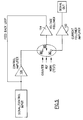
- FIG. 5 is a diagrammatic sketch of a preferred form of reference electrode control circuit of the present invention.
- Referring to FIG. 1, there is illustrated a liquid chromatography apparatus and electrochemical detection apparatus in accordance with the present invention. The illustrated liquid chromatography apparatus includes
mobile phase reservoirs 20a...20n coupled through suitable valves a constant volume pump means 22 and an injection valve 24 andsample inlet 26 to the top of a liquid chromatography column indicated generally at 28. In practice, sample materials to be tested are introduced into the chromatography apparatus either by direct injection of microliter amounts of sample material into thechromatography column 28, e.g. through a syringe atsample inlet 26, or the sample material may be introduced into thechromatography column 28 as a dilute solution of sample material at injection valve 24. Thus, if desired, either injection valve 24 orsample inlet 26 may be omitted from the system.Chromatography column 28 is packed with selected ion exchange resins in bed or powder form. The selection of the mobile phase, and the selection and packing order of the ion exchange resins will depend on the particular separations desired and can readily be determined by one skilled in the art and thus will not be further described herein. The base ofchromatography column 28 is coupled via anoutlet 30 to asplitter valve 32 which divides the eluant from thechromatography column 28 between a sample collection vessel orwaste container 34 and an electrochemical detection apparatus made in accordance with the present invention, and indicated generally at 36. - The illustrated chromatography apparatus (other than the electrochemical detection apparatus 36) is conventional and may be of the type described by P.H. Freeman and W.L. Zielinski, in U.S. Bureau of Standards Technological Note Number 589, Page 1, (July 1970 to June 1971). Moreover, it should also be noted that the
electrochemical detection apparatus 36 of the present invention is not limited to use with the particular type of chromatography apparatus illustrated in FIG. 1, which is merely given as exemplary. - As mentioned supra, a problem with prior art amperometric detectors not employing pH reference electrodes, is the inability to compensate fully for pH gradient shifts resulting from the use of different mobile phases. The present invention overcomes the aforesaid and other disadvantages of prior art amperometric detectors by employing a solid state reference electrode formed of palladium or palladium oxide. The use of a solid state palladium reference electrode in a coulometric detection cell is described in U.S. Patent 4,404,065 issued September 13, 1983 to Wayne R. Matson, and assigned to the assignee of the present application. However, prior to the present invention, the advantages of employing a solid state palladium reference electrode in an amperometric cell were not recognized.
- Referring to FIGS. 2 and 3,
electrochemical detection apparatus 36 comprises an electrochemical detection cell comprising acylindrical body 38 having a pair ofend plates Main cell body 38 andplates plate 42 for connecting the outlet fromchromatography column 28 viaconduit 44 to aninlet 46.Inlet 46 communicates with abore 48 formed inbody 38 to the cell thin layer detection flow path indicated generally at 50. In a similar manner, thereference electrode assembly 52 is threadedly mounted through a internally threaded screw mounting (not shown) inplate 42 and communicates via abore 54 with the thinlayer flow path 50.Flow path 50 communicates through abore 56 formed in the side wall ofbody 38 to a threadedfitting 58 fitted with anoutlet conduit 60. - The test electrode assembly is mounted on
plate 40, and comprises acylindrical spacer member 62 andcap member 64 which are threaded together, and the assembly in turn is threaded into an internally threaded aperture (not shown) inplate 40. The test electrode is mounted in a bore (not shown) which extends throughmembers plate 40 to the interior of the electrode assembly. Completing the electrode chemical cell assembly is arigid spacer member 68 andgasket 70 as will be described in detail hereinafter.Members spacer 68 all are formed of a rigid, liquid impervious electrically-insulating, chemically inert material.Gasket 70 preferably is formed of Teflon. A plurality of bolt holes are formed throughend plates spacer 68 and gasket 70 and provide entry for bolts, only one of which 72 is shown.Bolts 72 align the individual parts of the electrochemical detection cell and, when anchored withnuts 74, apply pressure to keep the electrochemical detection cell together. - Referring now to FIG. 3, a
recess 82 is formed inbody 38, communicating withinlet 48 andoutlet 56. A 0.25 millimeter thick palladiumfoil counter electrode 86 is positioned in the bottom ofrecess 82, and it is held in place by means of a Teflongasket 84. A palladiumwire reference electrode 88 is threaded throughbore 54 with its end mounted flush withcounter electrode 86. - Referring to FIG. 4, the testing electrode, which comprises a
solid gold wire 90 is positioned with its end surface flush with the surface ofspacer 68. Abushing member 92 formed of Teflon or the like, surroundselectrode 90, and maintainselectrode 90 in position in the assembly. - Completing the electrode cell in accordance with the present invention are
lead wires testing electrode 90,counter electrode 86 andreference electrode 88 to controlled testing potentials, a working potentials (or ground), and reference potential. - As shown in FIG. 5, the electrical controls and circuits include a
control amplifier 106 which controls the current that flows between thecounter electrode 86 and the workingelectrode 90 by means of the potential set by the input and maintained between thereference electrode 88 and the workingelectrode 90 via the feedback arrangement between thereference electrode 90, thevoltage follower 114, and the input to thecontrol amplifier 106. The thermodynamic state of the reference electrode(s) will change in response to the changing pH of the mobile phase gradient and the circuit will automatically keep the applied potential between the reference and the working electrode to that set by the input signal thus effectively responding to the pH gradient change of the mobile phase. This in turn keeps the desired catalytic potential of the working electrode at its optimal value throughout the gradient thus permitting compensation for the gradient elution changes and also avoids the maintenance problems and leakage problems typically associated with conventional glass electrodes. - As should be clear from the foregoing, the electrochemical detection apparatus of the present invention offers a number of advantages over prior art electrochemical detectors.
- It is to be appreciated that the invention is not limited to application to liquid chromatography, but, rather the electrochemical detection apparatus may also be employed to monitor and/or measure the progress of a gas chromatographic separation process. In this regard, in some cases it may be possible to measure concentration or constitutional changes in the gases directly. In other cases it will be necessary to carry out the method in the presence of a liquid, preferably an electrolyte, e.g. by dissolving the eluant gas from the gas chromatography apparatus in an electrolyte and passing the electrolyte through the electrochemical detection cell.
- Furthermore, the electrochemical detection apparatus is not limited to use with chromatography separations, but may also be advantageously employed for monitoring or directly measuring a variety of sample solutions, for example, of industrial, environmental, geophysical and biomedical interest. For example, the electrochemical detection apparatus of the present invention may be employed to provide on-line monitoring of a chemical process flow stream or a public water supply system, or for monitoring effluent from a sewage treatment facility.
- Moreover, the electrochemical detection apparatus made in accordance with the instant invention is not limited to measuring only those compounds capable of undergoing electrochemical reactions, but also is capable of capacitive monitoring streaming solutions. For example, the measuring electrochemically non-reactive materials, a repetitive pulse of short duration, e.g. 10 to 20 usec., may be fed to
current amplifier 100 and a capacitive spike accumulated in a signal accumulator for a period of time, e.g. 100 to 500 usec. prior to the calibration and recording. In this way any substance capable of changing the capacitance of the electrode double-layer can be seen at the signal output.
Claims (7)
- An amperometric flow cell for electrochemically testing a sample solution, said cell comprising a thin layer sample detection flow path having a testing electrode (90) in contact with said flow path, a counter electrode (86) and at least one solid state reference electrode (88) communicating therewith, whereby said reference electrode(s) (88) comprises a palladium electrode, said counter electrode (86) comprises a palladium or palladium oxide foil electrode which defines one side of the thin layer sample detection flow path (50); and the flow cell includes an impedance network (114) coupled in feedback arrangement to an amplifier (106) which controls the current that flows between the counter electrode (86) and the testing electrode (90) whereby said reference electrode(s) (88) may be actively driven in response to changes in the test solution.
- A flow cell according to claim 1, characterized in that said counter electrode (86) consists of palladium foil.
- A flow cell according to claim 2, characterized in that said counter electrode (86) consists of palladium oxide foil.
- A flow cell according to any of claims 1 to 3, characterized in that said reference electrode(s) (88) consists of palladium.
- A flow cell according to any of claims 1 to 3, characterized in that said reference electrode(s) (88) consists of palladium oxide.
- A flow cell according to any of claims 1 to 5, characterized by including means (92) for connecting said active testing electrode (90) to controlled testing potentials, means (94) for connecting said counter electrode (86) to a counter potential or ground, and means (96) for connecting said reference electrode(s) (88) to a reference potential.
- A flow cell according to any of claims 1 to 6, characterized in that said counter electrode (86) consists of a palladium foil electrode defining one side of said flow path (50).
Applications Claiming Priority (2)
| Application Number | Priority Date | Filing Date | Title |
|---|---|---|---|
| US48777490A | 1990-03-02 | 1990-03-02 | |
| US487774 | 1990-03-02 |
Publications (2)
| Publication Number | Publication Date |
|---|---|
| EP0447288A1 EP0447288A1 (en) | 1991-09-18 |
| EP0447288B1 true EP0447288B1 (en) | 1994-12-28 |
Family
ID=23937069
Family Applications (1)
| Application Number | Title | Priority Date | Filing Date |
|---|---|---|---|
| EP91400553A Expired - Lifetime EP0447288B1 (en) | 1990-03-02 | 1991-02-28 | Amperometric detection cell |
Country Status (5)
| Country | Link |
|---|---|
| EP (1) | EP0447288B1 (en) |
| JP (1) | JPH0772135A (en) |
| AT (1) | ATE116437T1 (en) |
| CA (1) | CA2034734A1 (en) |
| DE (1) | DE69106185T2 (en) |
Families Citing this family (3)
| Publication number | Priority date | Publication date | Assignee | Title |
|---|---|---|---|---|
| DE19530376C2 (en) * | 1995-08-18 | 1999-09-02 | Fresenius Ag | Biosensor |
| JP4312379B2 (en) * | 1998-03-10 | 2009-08-12 | ミクロナス ゲゼルシャフト ミット ベシュレンクテル ハフツング | Reference electrode |
| US20250251383A1 (en) * | 2024-02-07 | 2025-08-07 | Saudi Arabian Oil Company | Determining zeta potential of a core sample |
Family Cites Families (2)
| Publication number | Priority date | Publication date | Assignee | Title |
|---|---|---|---|---|
| US4404065A (en) * | 1980-01-14 | 1983-09-13 | Enviromental Sciences Associates, Inc. | Electrochemical detection system and method of analysis |
| US4818365A (en) * | 1986-10-14 | 1989-04-04 | Monsanto Company | Solid state indicator electrode and method of making same |
-
1991
- 1991-01-22 CA CA002034734A patent/CA2034734A1/en not_active Abandoned
- 1991-02-28 EP EP91400553A patent/EP0447288B1/en not_active Expired - Lifetime
- 1991-02-28 AT AT91400553T patent/ATE116437T1/en not_active IP Right Cessation
- 1991-02-28 DE DE69106185T patent/DE69106185T2/en not_active Expired - Fee Related
- 1991-03-01 JP JP3035821A patent/JPH0772135A/en active Pending
Also Published As
| Publication number | Publication date |
|---|---|
| DE69106185T2 (en) | 1995-07-27 |
| CA2034734A1 (en) | 1991-09-03 |
| JPH0772135A (en) | 1995-03-17 |
| EP0447288A1 (en) | 1991-09-18 |
| DE69106185D1 (en) | 1995-02-09 |
| ATE116437T1 (en) | 1995-01-15 |
Similar Documents
| Publication | Publication Date | Title |
|---|---|---|
| US4404065A (en) | Electrochemical detection system and method of analysis | |
| Huang et al. | Quantitative determination of low molecular weight carboxylic acids by capillary zone electrophoresis/conductivity detection | |
| Štulík et al. | Electrochemical detection techniques in high-performance liquid chromatography | |
| Brett | Electrochemical sensors for environmental monitoring. Strategy and examples | |
| Rucki | Electrochemical detectors for flowing liquid systems | |
| US8925374B2 (en) | Electrochemical detection cell for liquid chromatography system | |
| JPH0672862B2 (en) | Electrochemical cell | |
| LaCourse et al. | Anion-exchange separation of carbohydrates with pulsed amperometric detection using a pH-selective reference electrode | |
| EP0060082B1 (en) | Electrochemical flow cell for liquid chromatography | |
| US5368706A (en) | Amperometric detection cell | |
| EP0645623A2 (en) | Method of monitoring acid concentration in plating baths | |
| Last | Coulostatic voltammetric liquid chromatography detector | |
| Wang et al. | A flow detector based on square-wave polarography at the dropping mercury electrode | |
| US4552013A (en) | Electrochemical system | |
| Lacourse et al. | Pulsed electrochemical detection of nonchromophoric compounds following capillary electrophoresis | |
| Weber et al. | Electrochemical detectors in liquid chromatography. A short review of detector design | |
| Lunte et al. | Electrochemical detection in liquid chromatography and capillary electrophoresis | |
| EP0447288A1 (en) | Amperometric detection cell | |
| Thormann et al. | Detection of transient and steady states in electrophoresis: Description and applications of a new apparatus with 255 potential gradient detectors along the separation trough | |
| Han et al. | Alternating current adsorptive stripping voltammetry in a flow system for the determination of ultratrace amounts of folic acid | |
| Wang et al. | Ion transfer across water/solidified nitrobenzene interface as amperometric flow detector | |
| Hanekamp et al. | Application of pulse techniques in a polarographic flow-through detector with potential-controlled drop synchronization | |
| GB2079474A (en) | Electrocatalytic activation of electrodes | |
| US4497199A (en) | Liquid chromatography | |
| Alegret et al. | Flow-through pH-ISFET detector for flow-injection analysis |
Legal Events
| Date | Code | Title | Description |
|---|---|---|---|
| PUAI | Public reference made under article 153(3) epc to a published international application that has entered the european phase |
Free format text: ORIGINAL CODE: 0009012 |
|
| AK | Designated contracting states |
Kind code of ref document: A1 Designated state(s): AT BE CH DE DK ES FR GB GR IT LI LU NL SE |
|
| 17P | Request for examination filed |
Effective date: 19920220 |
|
| 17Q | First examination report despatched |
Effective date: 19931202 |
|
| GRAA | (expected) grant |
Free format text: ORIGINAL CODE: 0009210 |
|
| AK | Designated contracting states |
Kind code of ref document: B1 Designated state(s): AT BE CH DE DK ES FR GB GR IT LI LU NL SE |
|
| PG25 | Lapsed in a contracting state [announced via postgrant information from national office to epo] |
Ref country code: GR Free format text: LAPSE BECAUSE OF FAILURE TO SUBMIT A TRANSLATION OF THE DESCRIPTION OR TO PAY THE FEE WITHIN THE PRESCRIBED TIME-LIMIT Effective date: 19941228 Ref country code: ES Free format text: THE PATENT HAS BEEN ANNULLED BY A DECISION OF A NATIONAL AUTHORITY Effective date: 19941228 Ref country code: DK Effective date: 19941228 Ref country code: BE Effective date: 19941228 Ref country code: AT Effective date: 19941228 |
|
| REF | Corresponds to: |
Ref document number: 116437 Country of ref document: AT Date of ref document: 19950115 Kind code of ref document: T |
|
| PGFP | Annual fee paid to national office [announced via postgrant information from national office to epo] |
Ref country code: CH Payment date: 19950112 Year of fee payment: 5 |
|
| PGFP | Annual fee paid to national office [announced via postgrant information from national office to epo] |
Ref country code: FR Payment date: 19950113 Year of fee payment: 5 |
|
| PGFP | Annual fee paid to national office [announced via postgrant information from national office to epo] |
Ref country code: SE Payment date: 19950116 Year of fee payment: 5 |
|
| PGFP | Annual fee paid to national office [announced via postgrant information from national office to epo] |
Ref country code: DE Payment date: 19950123 Year of fee payment: 5 |
|
| PGFP | Annual fee paid to national office [announced via postgrant information from national office to epo] |
Ref country code: GB Payment date: 19950126 Year of fee payment: 5 |
|
| REF | Corresponds to: |
Ref document number: 69106185 Country of ref document: DE Date of ref document: 19950209 |
|
| ITF | It: translation for a ep patent filed | ||
| PG25 | Lapsed in a contracting state [announced via postgrant information from national office to epo] |
Ref country code: LU Free format text: LAPSE BECAUSE OF NON-PAYMENT OF DUE FEES Effective date: 19950228 |
|
| PGFP | Annual fee paid to national office [announced via postgrant information from national office to epo] |
Ref country code: NL Payment date: 19950228 Year of fee payment: 5 |
|
| ET | Fr: translation filed | ||
| PLBE | No opposition filed within time limit |
Free format text: ORIGINAL CODE: 0009261 |
|
| STAA | Information on the status of an ep patent application or granted ep patent |
Free format text: STATUS: NO OPPOSITION FILED WITHIN TIME LIMIT |
|
| 26N | No opposition filed | ||
| PG25 | Lapsed in a contracting state [announced via postgrant information from national office to epo] |
Ref country code: LI Free format text: LAPSE BECAUSE OF NON-PAYMENT OF DUE FEES Effective date: 19960228 Ref country code: GB Effective date: 19960228 Ref country code: CH Free format text: LAPSE BECAUSE OF NON-PAYMENT OF DUE FEES Effective date: 19960228 |
|
| PG25 | Lapsed in a contracting state [announced via postgrant information from national office to epo] |
Ref country code: SE Effective date: 19960301 |
|
| PG25 | Lapsed in a contracting state [announced via postgrant information from national office to epo] |
Ref country code: NL Effective date: 19960901 |
|
| REG | Reference to a national code |
Ref country code: CH Ref legal event code: PL |
|
| GBPC | Gb: european patent ceased through non-payment of renewal fee |
Effective date: 19960228 |
|
| PG25 | Lapsed in a contracting state [announced via postgrant information from national office to epo] |
Ref country code: FR Effective date: 19961031 |
|
| NLV4 | Nl: lapsed or anulled due to non-payment of the annual fee |
Effective date: 19960901 |
|
| PG25 | Lapsed in a contracting state [announced via postgrant information from national office to epo] |
Ref country code: DE Effective date: 19961101 |
|
| EUG | Se: european patent has lapsed |
Ref document number: 91400553.3 |
|
| REG | Reference to a national code |
Ref country code: FR Ref legal event code: ST |
|
| PG25 | Lapsed in a contracting state [announced via postgrant information from national office to epo] |
Ref country code: IT Free format text: LAPSE BECAUSE OF NON-PAYMENT OF DUE FEES Effective date: 20050228 |