EP0445974A2 - Spirocyclic antipsychotic agents - Google Patents
Spirocyclic antipsychotic agents Download PDFInfo
- Publication number
- EP0445974A2 EP0445974A2 EP91301683A EP91301683A EP0445974A2 EP 0445974 A2 EP0445974 A2 EP 0445974A2 EP 91301683 A EP91301683 A EP 91301683A EP 91301683 A EP91301683 A EP 91301683A EP 0445974 A2 EP0445974 A2 EP 0445974A2
- Authority
- EP
- European Patent Office
- Prior art keywords
- piperidine
- formula
- compound
- alkyl
- indane
- Prior art date
- Legal status (The legal status is an assumption and is not a legal conclusion. Google has not performed a legal analysis and makes no representation as to the accuracy of the status listed.)
- Ceased
Links
- 0 CC(C)(/C=C1)/C=C(\CCN(*)CCC(*OC2)N=O)/C2=C/C1(C)I Chemical compound CC(C)(/C=C1)/C=C(\CCN(*)CCC(*OC2)N=O)/C2=C/C1(C)I 0.000 description 2
Classifications
-
- C—CHEMISTRY; METALLURGY
- C07—ORGANIC CHEMISTRY
- C07D—HETEROCYCLIC COMPOUNDS
- C07D221/00—Heterocyclic compounds containing six-membered rings having one nitrogen atom as the only ring hetero atom, not provided for by groups C07D211/00 - C07D219/00
- C07D221/02—Heterocyclic compounds containing six-membered rings having one nitrogen atom as the only ring hetero atom, not provided for by groups C07D211/00 - C07D219/00 condensed with carbocyclic rings or ring systems
- C07D221/20—Spiro-condensed ring systems
-
- A—HUMAN NECESSITIES
- A61—MEDICAL OR VETERINARY SCIENCE; HYGIENE
- A61K—PREPARATIONS FOR MEDICAL, DENTAL OR TOILETRY PURPOSES
- A61K31/00—Medicinal preparations containing organic active ingredients
- A61K31/33—Heterocyclic compounds
- A61K31/335—Heterocyclic compounds having oxygen as the only ring hetero atom, e.g. fungichromin
- A61K31/357—Heterocyclic compounds having oxygen as the only ring hetero atom, e.g. fungichromin having two or more oxygen atoms in the same ring, e.g. crown ethers, guanadrel
- A61K31/36—Compounds containing methylenedioxyphenyl groups, e.g. sesamin
-
- A—HUMAN NECESSITIES
- A61—MEDICAL OR VETERINARY SCIENCE; HYGIENE
- A61K—PREPARATIONS FOR MEDICAL, DENTAL OR TOILETRY PURPOSES
- A61K31/00—Medicinal preparations containing organic active ingredients
- A61K31/33—Heterocyclic compounds
- A61K31/395—Heterocyclic compounds having nitrogen as a ring hetero atom, e.g. guanethidine or rifamycins
- A61K31/435—Heterocyclic compounds having nitrogen as a ring hetero atom, e.g. guanethidine or rifamycins having six-membered rings with one nitrogen as the only ring hetero atom
- A61K31/44—Non condensed pyridines; Hydrogenated derivatives thereof
- A61K31/445—Non condensed piperidines, e.g. piperocaine
-
- A—HUMAN NECESSITIES
- A61—MEDICAL OR VETERINARY SCIENCE; HYGIENE
- A61P—SPECIFIC THERAPEUTIC ACTIVITY OF CHEMICAL COMPOUNDS OR MEDICINAL PREPARATIONS
- A61P25/00—Drugs for disorders of the nervous system
- A61P25/18—Antipsychotics, i.e. neuroleptics; Drugs for mania or schizophrenia
-
- C—CHEMISTRY; METALLURGY
- C07—ORGANIC CHEMISTRY
- C07D—HETEROCYCLIC COMPOUNDS
- C07D401/00—Heterocyclic compounds containing two or more hetero rings, having nitrogen atoms as the only ring hetero atoms, at least one ring being a six-membered ring with only one nitrogen atom
- C07D401/02—Heterocyclic compounds containing two or more hetero rings, having nitrogen atoms as the only ring hetero atoms, at least one ring being a six-membered ring with only one nitrogen atom containing two hetero rings
- C07D401/06—Heterocyclic compounds containing two or more hetero rings, having nitrogen atoms as the only ring hetero atoms, at least one ring being a six-membered ring with only one nitrogen atom containing two hetero rings linked by a carbon chain containing only aliphatic carbon atoms
-
- C—CHEMISTRY; METALLURGY
- C07—ORGANIC CHEMISTRY
- C07D—HETEROCYCLIC COMPOUNDS
- C07D405/00—Heterocyclic compounds containing both one or more hetero rings having oxygen atoms as the only ring hetero atoms, and one or more rings having nitrogen as the only ring hetero atom
- C07D405/02—Heterocyclic compounds containing both one or more hetero rings having oxygen atoms as the only ring hetero atoms, and one or more rings having nitrogen as the only ring hetero atom containing two hetero rings
- C07D405/06—Heterocyclic compounds containing both one or more hetero rings having oxygen atoms as the only ring hetero atoms, and one or more rings having nitrogen as the only ring hetero atom containing two hetero rings linked by a carbon chain containing only aliphatic carbon atoms
Definitions
- This invention relates to a class of spirocyclic piperidine derivatives which are selective ligands at sigma recognition sites and are therefore useful as neuroleptic agents.
- JP-A-55-143980 generically discloses inter alia a class of spiro[indane-1,4′-piperidine] derivatives which are substituted on the ring nitrogen atom by hydrogen or by one of a range of hydrocarbon substituents.
- JP-A-55-143980 discloses inter alia a class of spiro[indane-1,4′-piperidine] derivatives which are substituted on the ring nitrogen atom by hydrogen or by one of a range of hydrocarbon substituents.
- the compounds described in JP-A-55-143980 are stated to exhibit antiallergic activity. No suggestion is made in JP-A-55-143980 that the compounds described therein may be of any assistance in solving the problem of providing an effective agent for the treatment and/or prevention of psychiatric disorders.
- US-3125580 describes inter alia a class of spiro[indane-1,4′-piperidine] derivatives. These compounds are variously N-substituted by a 3-cyano-3,3-diphenylpropyl or 3-alkanoyl-3,3-diphenylpropyl group. Unsubstituted, N-cyano-substituted and N-benzyl-substituted spiro[indane-1,4′-piperidine] derivatives are also disclosed as intermediates.
- the compounds described in US-3125580 are stated to be potent analgesics with a relatively long duration of activity, and to possess mydriatic activity. There is no suggestion in US-3125580 that the compounds disclosed therein may be of any use as neuroleptic agents.
- D2 receptor antagonists Most of the numerous currently available clinically effective antipsychotic drugs are dopamine D2 receptor antagonists. As a result, they produce a characteristic spectrum of undesirable side-effects. These include endocrine effects and extrapyramidal side-effects, as well as often irreversible tardive dyskinesia. In addition, D2 receptor antagonists are only palliative. They tend to alleviate only certain schizophrenic behaviour, especially the "positive" symptoms of florid delusions and hallucinations, with much less effect on the "negative" symptoms of emotional withdrawal.
- neuroleptic agents are ligands at sigma recognition sites in the brain.
- Various compounds are known which are capable of interacting with the sigma recognition site, and it is considered that this interaction is significant in the manifestation of their neuroleptic properties.
- Most of these compounds also display significant activity at the dopamine D2 receptor and consequently elicit the undesirable side-effects referred to above.
- haloperidol a widely used neuroleptic agent, interacts equally potently with sigma sites and D2 receptors.
- rimcazole One compound which is essentially inactive at dopamine D2 receptors is rimcazole. However, whilst showing some antischizophrenic activity, rimcazole displays only moderate potency at sigma sites.
- the analgesic compound N-allylnormetazocine (SKF 10047), whilst having an affinity for the sigma recognition site, also interacts strongly with the N-methyl-D-aspartate (NMDA) ion-channel complex, and thereby evokes a variety of psychotic symptoms including disorientation, excitement and hallucinations.
- NMDA N-methyl-D-aspartate
- the present invention accordingly provides the use of a compound of formula I or a pharmaceutically acceptable salt thereof: wherein A and B each represents hydrogen, or A and B together represent a chemical bond; Q represents a bond or a group of formula -(CH2)2-; R1 represents hydrocarbon; R2 and R3 independently represent hydrogen, hydrocarbon, halogen, cyano, trifluoromethyl, nitro, -OR x , -SR x , -NR x R y , -CO2R x or -CONR x R y , or together represent methylenedioxy; and R x and R y independently represent hydrogen or hydrocarbon; for the manufacture of a medicament for the treatment and/or prevention of psychiatric disorders.
- hydrocarbon as used herein includes straight-chained, branched and cyclic groups, including heterocyclic groups, containing up to 18 carbon atoms, suitably up to 15 carbon atoms, and conveniently up to 12 carbon atoms.
- Suitable hydrocarbon groups include C1 ⁇ 6 alkyl, C2 ⁇ 6 alkenyl, C2 ⁇ 6 alkynyl, C3 ⁇ 7 cycloalkyl, C3 ⁇ 7 cycloalkyl(C1 ⁇ 6)alkyl, aryl, aryl(C1 ⁇ 6)alkyl, C3 ⁇ 7 heterocycloalkyl, C3 ⁇ 7 heterocycloalkyl(C1 ⁇ 6)alkyl, heteroaryl and heteroaryl(C1 ⁇ 6)alkyl.
- Suitable alkyl groups include straight-chained and branched alkyl groups containing from 1 to 6 carbon atoms. Typical examples include methyl and ethyl groups, and straight-chained or branched propyl and butyl groups. Particular alkyl groups are n-propyl, isopropyl, n-butyl and t-butyl.
- Suitable alkenyl groups include straight-chained and branched alkenyl groups containing from 2 to 6 carbon atoms. Typical examples include vinyl, allyl and dimethylallyl groups.
- Suitable alkynyl groups include straight-chained and branched alkynyl groups containing from 2 to 6 carbon atoms. Typical examples include ethynyl and propargyl groups.
- Suitable cycloalkyl groups include groups containing from 3 to 7 carbon atoms. Particular cycloalkyl groups are cyclopropyl and cyclohexyl.
- Suitable aryl groups include phenyl and naphthyl groups.
- a particular aryl(C1 ⁇ 6)alkyl group is benzyl.
- Suitable heterocycloalkyl groups include pyrrolidinyl, piperidyl, piperazinyl and morpholinyl groups.
- Suitable heteroaryl groups include pyridyl, quinolyl, isoquinolyl, pyridazinyl, pyrimidinyl, pyrazinyl, pyranyl, furyl, benzofuryl, thienyl, benzthienyl, imidazolyl, oxadiazolyl and thiadiazolyl groups.
- Particular heteroaryl groups are pyridyl and furyl.
- the hydrocarbon group may in turn be optionally substituted by one or more groups selected from C1 ⁇ 6 alkyl, adamantyl, phenyl, halogen, C1 ⁇ 6 haloalkyl, trifluoromethyl, hydroxy, C1 ⁇ 6 alkoxy, aryloxy, C1 ⁇ 3 alkylenedioxy, nitro, cyano, carboxy, C2 ⁇ 6 alkoxycarbonyl, C2 ⁇ 6 alkoxycarbonyl(C1 ⁇ 6)alkyl, C2 ⁇ 6 alkylcarbonyloxy, optionally substituted arylcarbonyloxy, C2 ⁇ 6 alkylcarbonyl, optionally substituted arylcarbonyl, C2 ⁇ 6 alkylcarbonyl, optionally substituted arylcarbonyl, C1 ⁇ 6 alkylthio, C1 ⁇ 6 alkylsulphinyl, C1 ⁇ 6 alkylsulphonyl, amino, mono- or di(C1 ⁇ 6)alkylamino, C2 ⁇ 6 alky
- halogen as used herein includes fluorine, chlorine, bromine and iodine, especially chlorine.
- Suitable values for the substituent R1 in the compounds of formula I above include C3 ⁇ 6 alkyl, C2 ⁇ 6 alkenyl, aryl(C1 ⁇ 6)alkyl, C3 ⁇ 7 cycloalkyl(C1 ⁇ 6)alkyl, C3 ⁇ 7 heterocycloalkyl(C1 ⁇ 6)alkyl, and heteroaryl(C1 ⁇ 6)alkyl, any of which groups may be optionally substituted.
- a particular group R1 is benzyl.
- the compound 1′-benzylspiro[indane-1,4′-piperidine] is generically disclosed in JP-A-55-143980, and specifically disclosed in US-3125580 as an intermediate in the preparation of a class of analgesic and mydriatic agents. There is, however, no mention of therapeutic utility for this compound in US-3125580.
- the present invention accordingly provides a pharmaceutical composition comprising 1′-benzylspiro[indane-1,4′-piperidine] or a pharmaceutically acceptable salt thereof in association with one or more pharmaceutically acceptable carriers and/or excipients.
- the invention also provides 1′-benzylspiro[indane-1,4′-piperidine] or a pharmaceutically acceptable salt thereof for use in therapy.
- the present invention provides a compound of formula II or a salt thereof: wherein A and B each represents hydrogen, or A and B together represent a chemical bond; Q represents a bond or a group of formula -(CH2)2-; R11 represents hydrocarbon; R12 and R13 independently represent hydrogen, hydrocarbon, halogen, cyano, trifluoromethyl, nitro, -OR x , -SR x , -NR x R y , -CO2R x or -CONR x R y , or together represent methylenedioxy; and R x and R y independently represent hydrogen or hydrocarbon; provided that when A and B both represent hydrogen, Q is a bond and R11 represents alkyl, allyl, aryl, aralkyl, cycloalkyl or ar(cycloalkyl), then R12 and R13 do not represent hydrogen, alkoxy or hydroxyalkyl; provided also that when Q
- the invention provides a pharmaceutical composition
- a pharmaceutical composition comprising a compound of formula II as defined above or a pharmaceutically acceptable salt thereof in association with one or more pharmaceutically acceptable carriers and/or excipients.
- the invention also provides a compound of formula II as defined above or a pharmaceutically acceptable salt thereof for use in therapy.
- the salts of the compounds of formula II will be non-toxic pharmaceutically acceptable salts.
- Other salts may, however, be useful in the preparation of the compounds according to the invention or of their non-toxic pharmaceutically acceptable salts.
- Suitable pharmaceutically acceptable salts of the compounds of formulae I and II above include acid addition salts which may, for example, be formed by mixing a solution of the compound according to the invention with a solution of a pharmaceutically acceptable non-toxic acid such as hydrochloric acid, fumaric acid, maleic acid, succinic acid, acetic acid, citric acid, tartaric acid, carbonic acid or phosphoric acid.
- a pharmaceutically acceptable non-toxic acid such as hydrochloric acid, fumaric acid, maleic acid, succinic acid, acetic acid, citric acid, tartaric acid, carbonic acid or phosphoric acid.
- substituent R11 in the compounds of formula II include optionally substituted C3 ⁇ 6 alkyl, for example n-butyl and n-hexyl; optionally substituted C2 ⁇ 6 alkenyl, for example dimethylallyl; optionally substituted aryl(C1 ⁇ 6)alkyl, especially benzyl, phenethyl, methylbenzyl and methoxybenzyl; optionally substituted C3 ⁇ 7 cycloalkyl(C1 ⁇ 6)alkyl, for example cyclohexylmethyl; optionally substituted C3 ⁇ 7 heterocycloalkyl(C1 ⁇ 6)alkyl, for example tetrahydrofurylmethyl; and optionally substituted heteroaryl(C1 ⁇ 6)alkyl, for example furylmethyl and picolyl.
- examples of the substituents R12 and R13 in the compounds of formula II above include hydrogen, chlorine, C1 ⁇ 6 alkyl and C1 ⁇ 6 alkoxy.
- one of R12 and R13 represents hydrogen and the other represents hydrogen, chlorine, methyl or methoxy, especially hydrogen or methoxy.
- R12 and R13 both represent hydrogen.
- R12 and R13 in the compounds of formula II above are other than hydrogen, they may be present at any desired position of the aromatic moiety.
- R22 represents C1 ⁇ 6 alkyl, halogen, cyano, trifluoromethyl, nitro or hydroxy, especially methyl, chloro or hydroxy.
- R32 represents hydrogen, C1 ⁇ 6 alkyl, halogen, cyano, trifluoromethyl, nitro, hydroxy or C1 ⁇ 6 alkoxy
- R34 represents C1 ⁇ 6 alkyl, halogen, cyano, trifluoromethyl, nitro, hydroxy or C1 ⁇ 6 alkoxy.
- R32 represents hydrogen, methyl, chloro, hydroxy or methoxy
- R34 represents methyl, chloro, nitro or methoxy.
- R32 represents hydrogen.
- R34 represents methyl or methoxy.
- a further sub-class of compounds according to the invention is represented by the compounds of formula IIC and salts thereof: wherein R41 represents C3 ⁇ 6 alkyl, C2 ⁇ 6 alkenyl, C3 ⁇ 7 cycloalkyl(C1 ⁇ 6)alkyl, aryl(C1 ⁇ 6)alkyl, C3 ⁇ 7 heterocycloalkyl(C1 ⁇ 6)alkyl or heteroaryl(C1 ⁇ 6)alkyl, any of which groups may be optionally substituted; and R42 represents hydrogen, C1 ⁇ 6 alkyl, halogen, cyano, trifluoromethyl, nitro, hydroxy or C1 ⁇ 6 alkoxy.
- R41 examples include n-butyl, n-hexyl, dimethylallyl, benzyl, methylbenzyl, methoxybenzyl, phenethyl, cyclohexylmethyl, tetrahydrofurylmethyl and picolyl.
- R42 represents hydrogen, methyl, chloro, hydroxy or methoxy.
- Preferred values of R41 include n-butyl, dimethylallyl and benzyl.
- R42 is hydrogen.
- a still further sub-class of compounds according to the invention is represented by the compounds of formula IID and salts thereof: wherein m is 1, 2 or 3, preferably 1; R52 represents hydrogen, C1 ⁇ 6 alkyl, halogen, cyano, trifluoromethyl, nitro, hydroxy or C1 ⁇ 6 alkoxy; and R54 represents C3 ⁇ 5 alkenyl, C3 ⁇ 7 cycloalkyl, C3 ⁇ 7 heterocycloalkyl or heteroaryl, any of which groups may be optionally substituted. Suitable values of R52 include hydrogen, methyl, chloro, hydroxy and methoxy, especially hydrogen. Particular values of R54 include dimethylvinyl, cyclohexyl, tetrahydrofuryl and pyridyl.
- a yet further sub-class of compounds according to the invention is represented by the compounds of formula IIE and salts thereof: wherein A and B are as defined above; R61 represents C3 ⁇ 6 alkyl, C2 ⁇ 6 alkenyl, C3 ⁇ 7 cycloalkyl(C1 ⁇ 6)alkyl, aryl(C1 ⁇ 6)alkyl, C3 ⁇ 7 heterocycloalkyl(C1 ⁇ 6)alkyl or heteroaryl(C1 ⁇ 6)alkyl, any of which groups may be optionally substituted; and R62 and R63 independently represent hydrogen, C1 ⁇ 6 alkyl, halogen, cyano, trifluoromethyl, nitro, hydroxy or C1 ⁇ 6 alkoxy, especially hydrogen, methyl, chloro, hydroxy or methoxy.
- a and B each represents hydrogen in the compounds of formula IIE above.
- Preferred values of R61 are n-butyl, dimethylallyl, benzyl, methylbenzyl, phenethyl and picolyl.
- R62 and R63 both represent hydrogen.
- Specific compounds within the scope of the present invention include: 1′-(4 ⁇ -methylbenzyl)spiro[indane-1,4′-piperidine]; 1′-cyclohexylmethylspiro[indane-1,4′-piperidine]; 1′-(4 ⁇ -methoxybenzyl)spiro[indane-1,4′-piperidine]; 1′-(2 ⁇ -picolyl)spiro[indane-1,4′-piperidine]; 1′-(2 ⁇ -tetrahydrofurfuryl)spiro[indane-1,4′-piperidine]; 1′-(3 ⁇ -methylbut-2 ⁇ -enyl)spiro[indane-1,4′-piperidine]; 1′-(n-butyl)spiro[1H-indene-1,4′-piperidine]; 1′-(3 ⁇ -methylbut-2 ⁇ -enyl)spiro(1H
- the present invention also provides a pharmaceutical composition
- a pharmaceutical composition comprising a "previously undisclosed compound of formula I" as defined above or a pharmaceutically acceptable salt thereof in association with one or more pharmaceutically acceptable carriers and/or excipients.
- the present invention further provides a "previously undisclosed compound of formula I" as defined above or a pharmaceutically acceptable salt thereof for use in therapy.
- compositions of this invention are preferably in unit dosage forms such as tablets, pills, capsules, powders, granules, sterile parenteral solutions or suspensions, or suppositories, for oral, parenteral or rectal administration.
- a pharmaceutical carrier e.g. conventional tableting ingredients such as corn starch, lactose, sucrose, sorbitol, talc, stearic acid, magnesium stearate, dicalcium phosphate or gums, and other pharmaceutical diluents, e.g.
- a solid preformulation composition containing a homogeneous mixture of a compound of the present invention, or a non-toxic pharmaceutically acceptable salt thereof.
- preformulation compositions as homogeneous, it is meant that the active ingredient is dispersed evenly throughout the composition so that the composition may be readily subdivided into equally effective unit dosage forms such as tablets, pills and capsules.
- This solid preformulation composition is then subdivided into unit dosage forms of the type described above containing from 0.1 to about 500 mg of the active ingredient of the present invention.
- the tablets or pills of the novel composition can be coated or otherwise compounded to provide a dosage form affording the advantage of prolonged action.
- the tablet or pill can comprise an inner dosage component, the latter being in the form of an envelope over the former.
- the two components can be separated by an enteric layer which serves to resist disintegration in the stomach and permits the inner component to pass intact into the duodenum or to be delayed in release.
- enteric layers or coatings such materials including a number of polymeric acids and mixtures of polymeric acids with such materials as shellac, cetyl alcohol and cellulose acetate.
- liquid forms in which the novel compositions of the present invention may be incorporated for administration orally or by injection include aqueous solutions, suitably flavoured syrups, aqueous or oil suspensions and flavoured emulsions with edible oils such as cottonseed oil, sesame oil, coconut oil or peanut oil, as well as elixirs and similar pharmaceutical vehicles.
- Suitable dispersing or suspending agents for aqueous suspensions include synthetic and natural gums such as tragacanth, acacia, alginate, dextran, sodium carboxymethylcellulose, methylcellulose, polyvinyl-pyrrolidone or gelatin.
- a suitable dosage level is about 0.01 to 250 mg/kg per day, preferably about 0.05 to 100 mg/kg per day, and especially about 0.05 to 5 mg/kg per day.
- the compounds may be administered on a regimen of 1 to 4 times per day.
- the compounds of formula I above wherein A and B each represents hydrogen, including the novel compounds according to the invention, may be prepared by a process which comprises reducing a compound of formula III: wherein Q, R1, R2 and R3 are as defined above.
- the ketone of formula III may conveniently be reduced directly to the corresponding compound of formula I wherein A and B each represents hydrogen by the Wolff-Kishner method.
- This comprises treating the hydrazone derivative of the ketone of formula III with a strong base, e.g. potassium hydroxide, in a suitable solvent, such as diethylene glycol, at an elevated temperature, preferably the reflux temperature of the solvent.
- a strong base e.g. potassium hydroxide
- the intermediates of formula III above wherein Q is -(CH2)2- may conveniently be prepared by a method analogous to that described in J. Org. Chem. , 1966, 31 , 3345. This comprises reacting a compound of formula R1-N[(CH2)2Z]2 with a compound of formula IV: wherein R1, R2 and R3 are as defined above; and Z represents a leaving group, e.g. chlorine.
- reaction is carried out in the presence of a strong base such as potassium t-butoxide, in a suitable solvent, for example dimethyl sulphoxide/t-butanol, suitably at room temperature.
- a strong base such as potassium t-butoxide
- a suitable solvent for example dimethyl sulphoxide/t-butanol
- the compounds of formula I above wherein A and B together represent a chemical bond may be prepared by a process which comprises dehydrating a compound of formula V: wherein Q, R1, R2 and R3 are as defined above.
- a suitable dehydrating reagent for effecting the above conversion will, for example, be phosphorus oxychloride in the presence of pyridine.
- hydroxy intermediates of formula V above may conveniently be prepared by reduction of the keto group in the corresponding intermediate of formula III above using, for example, sodium borohydride under standard conditions.
- An alternative process for preparing the compounds of formula I above, including the novel compounds according to the invention, comprises reacting a compound of formula R1-L with a compound of formula VI: wherein A, B, Q, R1, R2 and R3 are as defined above; and L represents a leaving group.
- the leaving group L is suitably halogen, for example bromine.
- reaction is conveniently carried out in the presence of a mild base such as potassium carbonate, in a suitable solvent, e.g. N,N-dimethylformamide, suitably at an elevated temperature, for example a temperature in the region of 100°C.
- a mild base such as potassium carbonate
- a suitable solvent e.g. N,N-dimethylformamide
- the compounds of formula VI above wherein A and B each represents hydrogen may be prepared by a process which comprises reducing a compound of formula VII: wherein Q, R2 and R3 are as defined above, and R a represents hydrogen or an amino-protecting group; and subsequently, if necessary, removing the amino-protecting group R a .
- An appropriate method for reducing the intermediate of formula VII is catalytic hydrogenation.
- a suitable catalyst is palladium hydroxide on charcoal, and the reaction is conveniently carried out in formic acid/ethanol as solvent.
- amino-protecting groups for the substituent R a include carboxylic acid groups such as acetyl, chloroacetyl, trifluoroacetyl, formyl, benzoyl, phthaloyl, phenylacetyl or pyridinecarbonyl; acid groups derived from carbonic acid such as ethoxycarbonyl, benzyloxycarbonyl, t-butoxycarbonyl, biphenylisopropoxycarbonyl, p-methylbenzyloxycarbonyl, p-nitrobenzyloxycarbonyl, p-bromobenzyloxycarbonyl, p-phenylazobenzyloxycarbonyl, p-(p′-methoxyphenylazo)-benzyloxycarbonyl or t-amyloxycarbonyl; acid groups derived from sulphonic acid, e.g. p-toluenesulphonic acid; and other groups such as benzyl, trity
- Preferred amino-protecting groups are benzyl, benzyloxycarbonyl and t-butoxycarbonyl.
- the removal of the amino-protecting group present in the resultant compound may be effected by an appropriate procedure depending upon the nature of the protecting group. For example, if R a represents t-butoxycarbonyl this group may be removed by treatment with a mineral acid, e.g. gaseous HCl. Alternatively, if R a represents benzyl this group may be removed in situ during hydrogenation of the intermediate of formula VII.
- the intermediates of formula VII above wherein Q represents a bond may be prepared by a process which comprises reacting a compound of formula R a -N[(CH2)2Z]2 with an indene derivative of formula VIII: wherein R2, R3, R a and Z are as defined above; and subsequently, if desired, removing the amino-protecting group R a .
- reaction is carried out in the presence of a strong base such as lithium bis(trimethylsilyl)amide, in a suitable solvent, e.g. tetrahydrofuran, suitably at a temperature in the region of 0°C.
- a strong base such as lithium bis(trimethylsilyl)amide
- a suitable solvent e.g. tetrahydrofuran
- any of the above synthetic sequences it may be necessary and/or desirable to protect sensitive or reactive groups on any of the molecules concerned. This may be achieved by means of conventional protecting groups, such as those described in Protective Groups in Organic Chemistry , ed. J.F.W. McOmie, Plenum Press, 1973; and T.W. Greene, Protective Groups in Organic Synthesis , John Wiley & Sons, 1981.
- the protecting groups may be removed at a convenient subsequent stage using methods known from the art.
- Binding of test compounds to the sigma site in vitro was determined by the method of Weber et al ., Proc. Natl. Acad. Sci. USA , 1986, 83 , 8784.
- the compounds of each of the accompanying Examples displaced tritiated di-tolyl guanidine (DTG) from sigma sites with potencies better than 200 nM.
- Step 1 N- tert-Butyloxycarbonylbis(2-chloroethyl)amine
- Triethylamine (74ml, 0.58mol) was added dropwise, over 1 hour, to a stirred solution of di- tert -butyldicarbonate (125g, 0.57mol) and bis (2-chloroethyl)amine hydrochloride (85g, 0.48mol) in dichloromethane (600ml). After 1 hour more triethylamine (6ml, 0.04mol) was added, and the mixture stirred overnight, under nitrogen. The solvent was evaporated and the resulting oil taken up in ether (500ml) and washed with water (500ml). The organic phase was separated and the aqueous layer extracted with ether (500ml).
- Step 2 1′-( tert-Butyloxycarbonyl)spiro [indene-1,4′-piperidine]
- step 5 the title compound was prepared using spiro[indane-1,4′-piperidine] (77mg, 0.41mmol), DMF (10ml), potassium carbonate (68mg, 0.49mmol), and n -butyl iodide (0.05ml, 0.45mmol).
- the crude residue was chromatographed using 5:95 methanol: dichloromethane, to give 1′- n -butylspiro[indane- 1,4′piperidine] (53mg, 53%) as a beige solid.
- the hydrochloride salt was prepared using ethereal hydrogen chloride, to give the title compound hydrochloride (28mg, 46%) as white needles, after recrystallisation from 4:1 ethyl acetate: ethanol. m.p. 230-234°C.
- step 5 1′(4 ⁇ -methylbenzyl)spiro[indane-1,4′-piperidine] was prepared using spiro[indane-1,4′-piperidine] (0.25g, 1.3mmol), DMF (10ml), potassium carbonate (0.24g, 1.7mmol) and 4-methylbenzyl bromide (1.7mmol, 0.32g).
- the crude residue was chromatographed using 1:1 petrol:ether to give the title compound (0.1g, 26%) as a white crystalline solid.
- the hydrochloride salt of the title amine (94mg, 0.32mmol) was prepared using ethereal hydrogen chloride, to give 1′-(4 ⁇ -methylbenzyl)spiro [indane-1,4′-piperidine] (56mg, 53%) as white crystals, after recrystallisation from ethanol/ethyl acetate. m.p. 284-286°C. N.M.R.
- step 5 1′-cyclohexylmethylspiro[indane- 1,4′-piperidine] was prepared using spiro[indane-1,4′-piperidine] (0.4g, 2.2mmol), DMF (20ml), potassium carbonate (326mg, 2.4mmol) and cyclohexylmethyl bromide (0.51g, 2.9mmol).
- the crude residue was chromatographed using 1:1 petrol:ether, to give the title compound (433mg, 69%) as a beige solid.
- the hydrochloride salt was prepared using ethereal hydrogen chloride, to give the title compound hydrochloride (334mg, 68%) as a white solid.
- step 5 1′-(4 ⁇ -methoxybenzyl)spiro[indane-1,4′-piperidine] was prepared using spiro[indane-1,4′-piperidine] (0.4g, 2.2mmol), DMF (20ml), potassium carbonate (326mg, 2.4mmol) and 4-methoxybenzyl chloride (0.4ml, 3.1mmol). The crude residue was chromatographed using 1:1 petrol:ether, to give the title amine (459mg, 67%) as a white solid.
- the hydrochloride salt was prepared, using ethereal hydrogen chloride, to give 1′-(4 ⁇ -methoxybenzyl)spiro [indane-1,4′-piperidine] hydrochloride (207mg, 52%) as a white solid. m.p. 259-261°C. N.M.R. (D2O-D6-DMSO).
- step 5 the title compound was synthesised using spiro[indane-1,4′piperidine] (0.4g, 2.2mmol), DMF (15ml), potassium carbonate (0.33g, 2.4mmol) and iodohexane (0.62g, 2.9mmol).
- the crude residue was chromatographed in 1:1 petrol:ether to give 1′hexylspiro[indane- 1,4′-piperidine] (314mg, 52%) as a pale yellow oil.
- the hydrochloride salt of the title amine (300mg, 1.1mmol) was prepared using ethereal hydrogen chloride, to give 1′-hexylspiro[indane-1,4′-piperidine]hydrochloride (177mg, 52%) as white crystals, after recrystallisation from ethyl acetate/ethanol.
- step 5 1′-(2 ⁇ -picolyl)spiro[indane- 1,4′-piperidine] was prepared using spiro [indane-1,4′-piperidine] (0.4g, 2.2mmol), DMF (15ml), potassium carbonate (0.65g, 4.7mmol) and picolyl chloride hydrochloride (0.4g, 2.4mmol). The crude residue was chromatographed using 95:5 dichloromethane:methanol to afford the title compound (350mg, 56%) as a red oil.
- the hydrochloride salt was prepared by treating the title amine (340mg, 1.2mmol) with ethereal hydrogen chloride.
- 1′-(2 ⁇ -Picolyl)spiro[indane-1,4′-piperidine] hydrochloride (299mg, 78%) was isolated as white crystals, after recrystallisation from ethyl acetate/ethanol. m.p. 208-212°C. N.M.R.
- step 5 1′-(2 ⁇ -tetrahydrofurfuryl)spiro[indane- 1,4′-piperidine] was prepared, using spiro[indane-1,4′-piperidine] (0.4g, 2.2mmol), DMF (15ml), potassium carbonate (0.33g, 2.4mmol) and tetrahydrofurfuryl bromide (0.4ml, 2.9mmol).
- the crude residue was chromatographed using 1:1 petrol:ether eluant to give 1′-(2 ⁇ -tetrahydrofurfuryl)spiro[indane-1,4′-piperidine] (170mg, 28%) as a colourless oil.
- the hydrochloride salt was prepared by treating the title amine (165mg, 0.61mol) with ethereal hydrogen chloride, to give the title compound hydrochloride (89mg, 48%) as a white crystalline solid, after recrystallisation from ethyl acetate/ethanol.
- m.p. 215-219°C, N.M.R. (D2O) ⁇ 1.70 (1H, m), 1.87 (2H, m), 1.98 (2H, m), 2.20 (5H, m), 2.99 (2H, t, J 7Hz), 3.23 (4H, m), 3.64 (2H, m), 3.94 (2H, m), 4.95 (1H, m), 7.32 (4H, m).
- step 5 1′-(2 ⁇ -phenylethyl)spiro[indane-1,4′-piperidine] was prepared, using spiro[indane-1,4′-piperidine] (0.4g, 2.2mmol), DMF (15ml), potassium-carbonate (0.33g, 2.4mmol) and phenethyl bromide (0.4ml, 2. 9mmol).
- the crude residue was chromatographed using 1:1 petrol:ether to give the title amine (440mg, 68%) as a pale yellow oil.
- the hydrochloride salt was prepared by treating the title compound (430mg, 1.5mmol) with ethereal hydrogen chloride, to give 1′-(2 ⁇ -phenylethyl)spiro[indane-1,4′-piperidine] (343mg, 71%) as a white crystalline solid after recrystallisation from ethyl acetate/ethanol. m.p. 287-290°C. N.M.R.
- the hydrochloride salt of the title amine (130mg, 0.51mmol) was prepared using ethereal hydrogen chloride, to give 1′-(3 ⁇ -methylbut-2 ⁇ -enyl)spiro [indane- 1,4′-piperidine] (85mg, 57%) as white crystals, after recrystallisation from ethyl acetate/ethanol. m.p. 264-266°C. N.M.R. (D2O) ⁇ 1.
- step 5 the title compound was prepared, using spiro[1H-indene-1,4′-piperidine] (333mg, 1.8mmol), DMF (15ml), potassium carbonate (0.26g, 1.9mmol) and iodobutane (267 ⁇ l, 2.4mmol).
- the crude residue was chromatographed in dichloromethane:methanol 95:5, to give 1′-butylspiro [1H-indene-1,4′-piperidine] (136mg, 31%) as a clear oil.
- the hydrochloride salt was prepared using ethereal hydrogen chloride, to give the title amine hydrochloride (91mg, 58%) as a white crystalline solid, after recrystallisation from ethyl acetate/ethanol. m.p. 276-280°C. N.M.R.
- the hydrochloride salt was prepared using ethereal hydrogen chloride, to give the title compound hydrochloride (113mg, 38%) as white crystals, after recrystallisation from ethyl acetate/ethanol. m.p. 265-267°C. N.M.R.
- the hydrochloride salt was prepared using ethereal hydrogen chloride, to give the title amine hydrochloride (256mg, 36%) as white crystals, after recrystallisation from ethyl acetate/ethanol.
- Step 1 1′-Benzylspiro [5,7,8,9-tetrahydro-6H-Benzocyclohepten-6-on-5,4′-piperidine]
- Step 2 1′-Benzylspiro[6,7,8,9-tetrahydro-5H-benzocyclohepten-5,4′-piperidine]
- step 5 1′-butylspiro[6,7,8,9-tetrahydro-5H-benzocyclohepten-5,4′-piperidine] was prepared, using spiro[6,7,8,9-tetrahydro-5H-benzocyclohepten-5,4′-piperidine] (230mg, 1.1mmol), DMF (20ml), potassium carbonate (163mg, 1.2mmol) and iodobutane (0.16ml), 1.4mmol). The crude residue was chromatographed (eluant 95:5 dichloromethane:methanol) to give the title amine (80mg, 28%) as a pale yellow solid.
- the hydrochloride salt was prepared using ethereal hydrogen chloride to give 1′-butylspiro[6,7,8,9-tetrahydro-5H-benzocyclohepten-5,4′-piperidine]hydrochloride (52mg, 58%) as white crystals, after recrystallisation from ethyl acetate/ethanol. m.p. 288-294°C. N.M.R.
- Tablets containing 1.0, 2.0, 25.0, 26.0, 50.0 and 100.0mg, respectively of the following compounds are prepared as illustrated below: 1′-(4 ⁇ -Methylbenzyl)spiro[indane-1,4′-piperidine] 1′-(3 ⁇ -Methylbut-2 ⁇ -enyl)spiro[indane-1,4′-piperidine] 1′-Benzylspiro[6,7,8,9-tetrahydro-5H-benzocyclohepten-5,4′-piperidine]
- All of the active compound, cellulose, and a portion of the corn starch are mixed and granulated to 10% corn starch paste.
- the resulting granulation is sieved, dried and blended with the remainder of the corn starch and the magnesium stearate.
- the resulting granulation is then compressed into tablets containing 1.0mg, 2.0mg, 25.0mg, 26.0mg, 50.0mg and 100mg of the active ingredient per tablet.
Landscapes
- Chemical & Material Sciences (AREA)
- Organic Chemistry (AREA)
- Health & Medical Sciences (AREA)
- Veterinary Medicine (AREA)
- Medicinal Chemistry (AREA)
- Pharmacology & Pharmacy (AREA)
- Life Sciences & Earth Sciences (AREA)
- Animal Behavior & Ethology (AREA)
- General Health & Medical Sciences (AREA)
- Public Health (AREA)
- Epidemiology (AREA)
- Engineering & Computer Science (AREA)
- Bioinformatics & Cheminformatics (AREA)
- Psychiatry (AREA)
- Biomedical Technology (AREA)
- Neurology (AREA)
- Neurosurgery (AREA)
- Chemical Kinetics & Catalysis (AREA)
- General Chemical & Material Sciences (AREA)
- Nuclear Medicine, Radiotherapy & Molecular Imaging (AREA)
- Pharmaceuticals Containing Other Organic And Inorganic Compounds (AREA)
- Other In-Based Heterocyclic Compounds (AREA)
- Hydrogenated Pyridines (AREA)
Abstract
Description
- This invention relates to a class of spirocyclic piperidine derivatives which are selective ligands at sigma recognition sites and are therefore useful as neuroleptic agents.
- Various spirocyclic piperidine derivatives are already known. For example, JP-A-55-143980 generically discloses inter alia a class of spiro[indane-1,4′-piperidine] derivatives which are substituted on the ring nitrogen atom by hydrogen or by one of a range of hydrocarbon substituents. There is, however, no specific disclosure therein of a compound possessing a spiro[indane-1,4′-piperidine] ring system. The compounds described in JP-A-55-143980 are stated to exhibit antiallergic activity. No suggestion is made in JP-A-55-143980 that the compounds described therein may be of any assistance in solving the problem of providing an effective agent for the treatment and/or prevention of psychiatric disorders.
- US-3125580 describes inter alia a class of spiro[indane-1,4′-piperidine] derivatives. These compounds are variously N-substituted by a 3-cyano-3,3-diphenylpropyl or 3-alkanoyl-3,3-diphenylpropyl group. Unsubstituted, N-cyano-substituted and N-benzyl-substituted spiro[indane-1,4′-piperidine] derivatives are also disclosed as intermediates. The compounds described in US-3125580 are stated to be potent analgesics with a relatively long duration of activity, and to possess mydriatic activity. There is no suggestion in US-3125580 that the compounds disclosed therein may be of any use as neuroleptic agents.
- Most of the numerous currently available clinically effective antipsychotic drugs are dopamine D₂ receptor antagonists. As a result, they produce a characteristic spectrum of undesirable side-effects. These include endocrine effects and extrapyramidal side-effects, as well as often irreversible tardive dyskinesia. In addition, D₂ receptor antagonists are only palliative. They tend to alleviate only certain schizophrenic behaviour, especially the "positive" symptoms of florid delusions and hallucinations, with much less effect on the "negative" symptoms of emotional withdrawal.
- From receptor binding studies, it has been shown that many effective neuroleptic agents are ligands at sigma recognition sites in the brain. Various compounds are known which are capable of interacting with the sigma recognition site, and it is considered that this interaction is significant in the manifestation of their neuroleptic properties. Most of these compounds, however, also display significant activity at the dopamine D₂ receptor and consequently elicit the undesirable side-effects referred to above. For example, haloperidol, a widely used neuroleptic agent, interacts equally potently with sigma sites and D₂ receptors.
- One compound which is essentially inactive at dopamine D₂ receptors is rimcazole. However, whilst showing some antischizophrenic activity, rimcazole displays only moderate potency at sigma sites.
- The analgesic compound N-allylnormetazocine (SKF 10047), whilst having an affinity for the sigma recognition site, also interacts strongly with the N-methyl-D-aspartate (NMDA) ion-channel complex, and thereby evokes a variety of psychotic symptoms including disorientation, excitement and hallucinations.
- We have now found a class of potent, selective sigma receptor antagonists displaying negligible activity at D₂, NMDA and other CNS receptors, which are therefore of value as neuroleptic agents.
- The present invention accordingly provides the use of a compound of formula I or a pharmaceutically acceptable salt thereof:
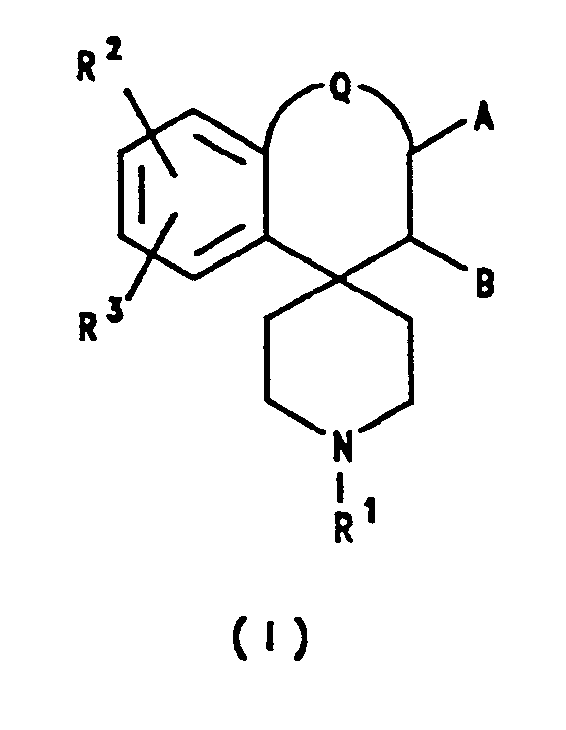
wherein
A and B each represents hydrogen, or A and B together represent a chemical bond;
Q represents a bond or a group of formula -(CH₂)₂-;
R¹ represents hydrocarbon;
R² and R³ independently represent hydrogen, hydrocarbon, halogen, cyano, trifluoromethyl, nitro, -ORx, -SRx, -NRxRy, -CO₂Rx or -CONRxRy, or together represent methylenedioxy; and
Rx and Ry independently represent hydrogen or hydrocarbon;
for the manufacture of a medicament for the treatment and/or prevention of psychiatric disorders. - The term "hydrocarbon" as used herein includes straight-chained, branched and cyclic groups, including heterocyclic groups, containing up to 18 carbon atoms, suitably up to 15 carbon atoms, and conveniently up to 12 carbon atoms. Suitable hydrocarbon groups include C₁₋₆ alkyl, C₂₋₆ alkenyl, C₂₋₆ alkynyl, C₃₋₇ cycloalkyl, C₃₋₇ cycloalkyl(C₁₋₆)alkyl, aryl, aryl(C₁₋₆)alkyl, C₃₋₇ heterocycloalkyl, C₃₋₇ heterocycloalkyl(C₁₋₆)alkyl, heteroaryl and heteroaryl(C₁₋₆)alkyl.
- Suitable alkyl groups include straight-chained and branched alkyl groups containing from 1 to 6 carbon atoms. Typical examples include methyl and ethyl groups, and straight-chained or branched propyl and butyl groups. Particular alkyl groups are n-propyl, isopropyl, n-butyl and t-butyl.
- Suitable alkenyl groups include straight-chained and branched alkenyl groups containing from 2 to 6 carbon atoms. Typical examples include vinyl, allyl and dimethylallyl groups.
- Suitable alkynyl groups include straight-chained and branched alkynyl groups containing from 2 to 6 carbon atoms. Typical examples include ethynyl and propargyl groups.
- Suitable cycloalkyl groups include groups containing from 3 to 7 carbon atoms. Particular cycloalkyl groups are cyclopropyl and cyclohexyl.
- Suitable aryl groups include phenyl and naphthyl groups.
- A particular aryl(C₁₋₆)alkyl group is benzyl.
- Suitable heterocycloalkyl groups include pyrrolidinyl, piperidyl, piperazinyl and morpholinyl groups.
- Suitable heteroaryl groups include pyridyl, quinolyl, isoquinolyl, pyridazinyl, pyrimidinyl, pyrazinyl, pyranyl, furyl, benzofuryl, thienyl, benzthienyl, imidazolyl, oxadiazolyl and thiadiazolyl groups. Particular heteroaryl groups are pyridyl and furyl.
- The hydrocarbon group may in turn be optionally substituted by one or more groups selected from C₁₋₆ alkyl, adamantyl, phenyl, halogen, C₁₋₆ haloalkyl, trifluoromethyl, hydroxy, C₁₋₆ alkoxy, aryloxy, C₁₋₃ alkylenedioxy, nitro, cyano, carboxy, C₂₋₆ alkoxycarbonyl, C₂₋₆ alkoxycarbonyl(C₁₋₆)alkyl, C₂₋₆ alkylcarbonyloxy, optionally substituted arylcarbonyloxy, C₂₋₆ alkylcarbonyl, optionally substituted arylcarbonyl, C₁₋₆ alkylthio, C₁₋₆ alkylsulphinyl, C₁₋₆ alkylsulphonyl, amino, mono- or di(C₁₋₆)alkylamino, C₂₋₆ alkylcarbonylamino and C₂₋₆ alkoxycarbonylamino.
- The term "halogen" as used herein includes fluorine, chlorine, bromine and iodine, especially chlorine.
- Suitable values for the substituent R¹ in the compounds of formula I above include C₃₋₆ alkyl, C₂₋₆ alkenyl, aryl(C₁₋₆)alkyl, C₃₋₇ cycloalkyl(C₁₋₆)alkyl, C₃₋₇ heterocycloalkyl(C₁₋₆)alkyl, and heteroaryl(C₁₋₆)alkyl, any of which groups may be optionally substituted. A particular group R¹ is benzyl.
- The compound 1′-benzylspiro[indane-1,4′-piperidine] is generically disclosed in JP-A-55-143980, and specifically disclosed in US-3125580 as an intermediate in the preparation of a class of analgesic and mydriatic agents. There is, however, no mention of therapeutic utility for this compound in US-3125580. The present invention accordingly provides a pharmaceutical composition comprising 1′-benzylspiro[indane-1,4′-piperidine] or a pharmaceutically acceptable salt thereof in association with one or more pharmaceutically acceptable carriers and/or excipients.
- The invention also provides 1′-benzylspiro[indane-1,4′-piperidine] or a pharmaceutically acceptable salt thereof for use in therapy.
- Certain compounds falling within the definition of formula I above are novel. Accordingly, in a further aspect the present invention provides a compound of formula II or a salt thereof:

wherein
A and B each represents hydrogen, or A and B together represent a chemical bond;
Q represents a bond or a group of formula -(CH₂)₂-;
R¹¹ represents hydrocarbon;
R¹² and R¹³ independently represent hydrogen, hydrocarbon, halogen, cyano, trifluoromethyl, nitro, -ORx, -SRx, -NRxRy, -CO₂Rx or -CONRxRy, or together represent methylenedioxy; and
Rx and Ry independently represent hydrogen or hydrocarbon;
provided that when A and B both represent hydrogen, Q is a bond and R¹¹ represents alkyl, allyl, aryl, aralkyl, cycloalkyl or ar(cycloalkyl), then R¹² and R¹³ do not represent hydrogen, alkoxy or hydroxyalkyl;
provided also that when Q is a bond, A, B and R¹² each represents hydrogen, and R¹¹ is benzyl, then R¹³ does not represent methyl in the 6-position of the indane moiety;
provided also that when Q is a bond, A, B and R¹² each represents hydrogen, and R¹¹ is a group of formula -CH₂CH₂CXPh₂ in which X represents cyano or C₂₋₇ alkylcarbonyl, then R¹³ does not represent hydrogen or methyl in the 6-position of the indane moiety. - In a still further aspect, the invention provides a pharmaceutical composition comprising a compound of formula II as defined above or a pharmaceutically acceptable salt thereof in association with one or more pharmaceutically acceptable carriers and/or excipients.
- The invention also provides a compound of formula II as defined above or a pharmaceutically acceptable salt thereof for use in therapy.
- For use in medicine, the salts of the compounds of formula II will be non-toxic pharmaceutically acceptable salts. Other salts may, however, be useful in the preparation of the compounds according to the invention or of their non-toxic pharmaceutically acceptable salts.
- Suitable pharmaceutically acceptable salts of the compounds of formulae I and II above include acid addition salts which may, for example, be formed by mixing a solution of the compound according to the invention with a solution of a pharmaceutically acceptable non-toxic acid such as hydrochloric acid, fumaric acid, maleic acid, succinic acid, acetic acid, citric acid, tartaric acid, carbonic acid or phosphoric acid.
- Subject to the above provisos, particular values for the substituent R¹¹ in the compounds of formula II include optionally substituted C₃₋₆ alkyl, for example n-butyl and n-hexyl; optionally substituted C₂₋₆ alkenyl, for example dimethylallyl; optionally substituted aryl(C₁₋₆)alkyl, especially benzyl, phenethyl, methylbenzyl and methoxybenzyl; optionally substituted C₃₋₇ cycloalkyl(C₁₋₆)alkyl, for example cyclohexylmethyl; optionally substituted C₃₋₇ heterocycloalkyl(C₁₋₆)alkyl, for example tetrahydrofurylmethyl; and optionally substituted heteroaryl(C₁₋₆)alkyl, for example furylmethyl and picolyl.
- Subject to the above provisos, examples of the substituents R¹² and R¹³ in the compounds of formula II above include hydrogen, chlorine, C₁₋₆ alkyl and C₁₋₆ alkoxy. Suitably one of R¹² and R¹³ represents hydrogen and the other represents hydrogen, chlorine, methyl or methoxy, especially hydrogen or methoxy. Preferably, R¹² and R¹³ both represent hydrogen. When R¹² and R¹³ in the compounds of formula II above are other than hydrogen, they may be present at any desired position of the aromatic moiety.
- One sub-class of compounds according to the invention is represented by the compounds of formula IIA and salts thereof:

wherein R²² represents C₁₋₆ alkyl, halogen, cyano, trifluoromethyl, nitro or hydroxy, especially methyl, chloro or hydroxy. - Another sub-class of compounds according to the invention is represented by the compounds of formula IIB and salts thereof:

wherein R³² represents hydrogen, C₁₋₆ alkyl, halogen, cyano, trifluoromethyl, nitro, hydroxy or C₁₋₆ alkoxy; and R³⁴ represents C₁₋₆ alkyl, halogen, cyano, trifluoromethyl, nitro, hydroxy or C₁₋₆ alkoxy. Suitably, R³² represents hydrogen, methyl, chloro, hydroxy or methoxy; and R³⁴ represents methyl, chloro, nitro or methoxy. Preferably, R³² represents hydrogen. Preferably, R³⁴ represents methyl or methoxy. - A further sub-class of compounds according to the invention is represented by the compounds of formula IIC and salts thereof:

- A still further sub-class of compounds according to the invention is represented by the compounds of formula IID and salts thereof:

wherein m is 1, 2 or 3, preferably 1; R⁵² represents hydrogen, C₁₋₆ alkyl, halogen, cyano, trifluoromethyl, nitro, hydroxy or C₁₋₆ alkoxy; and R⁵⁴ represents C₃₋₅ alkenyl, C₃₋₇ cycloalkyl, C₃₋₇ heterocycloalkyl or heteroaryl, any of which groups may be optionally substituted. Suitable values of R⁵² include hydrogen, methyl, chloro, hydroxy and methoxy, especially hydrogen. Particular values of R⁵⁴ include dimethylvinyl, cyclohexyl, tetrahydrofuryl and pyridyl. - A yet further sub-class of compounds according to the invention is represented by the compounds of formula IIE and salts thereof:

wherein A and B are as defined above; R⁶¹ represents C₃₋₆ alkyl, C₂₋₆ alkenyl, C₃₋₇ cycloalkyl(C₁₋₆)alkyl, aryl(C₁₋₆)alkyl, C₃₋₇ heterocycloalkyl(C₁₋₆)alkyl or heteroaryl(C₁₋₆)alkyl, any of which groups may be optionally substituted; and R⁶² and R⁶³ independently represent hydrogen, C₁₋₆ alkyl, halogen, cyano, trifluoromethyl, nitro, hydroxy or C₁₋₆ alkoxy, especially hydrogen, methyl, chloro, hydroxy or methoxy. - Preferably, A and B each represents hydrogen in the compounds of formula IIE above. Preferred values of R⁶¹ are n-butyl, dimethylallyl, benzyl, methylbenzyl, phenethyl and picolyl. Preferably, R⁶² and R⁶³ both represent hydrogen.
- Specific compounds within the scope of the present invention include:
1′-(4˝-methylbenzyl)spiro[indane-1,4′-piperidine];
1′-cyclohexylmethylspiro[indane-1,4′-piperidine];
1′-(4˝-methoxybenzyl)spiro[indane-1,4′-piperidine];
1′-(2˝-picolyl)spiro[indane-1,4′-piperidine];
1′-(2˝-tetrahydrofurfuryl)spiro[indane-1,4′-piperidine];
1′-(3˝-methylbut-2˝-enyl)spiro[indane-1,4′-piperidine];
1′-(n-butyl)spiro[1H-indene-1,4′-piperidine];
1′-(3˝-methylbut-2˝-enyl)spiro(1H-indene-1,4′-piperidine];
1′-benzylspiro[1H-indene-1,4′-piperidine];
1′-benzylspiro[6,7,8,9-tetrahydro-5H-benzocyclohepten-5,4′-piperidine];
1′-(n-butyl)spiro[6,7,8,9-tetrahydro-5H-benzocyclohepten-5,4′-piperidine];
and salts thereof. - In addition, the following compounds (each of which is referred to hereinafter as a "previously undisclosed compound of formula I") are not specifically disclosed in the prior art, and are therefore novel compounds according to the present invention:
1′-(n-butyl)spiro[indane-1,4′-piperidine];
1′-(n-hexyl)spiro[indane-1,4′-piperidine];
1′-(2˝-phenylethyl)spiro[indane-1,4′-piperidine];
and salts thereof. - The present invention also provides a pharmaceutical composition comprising a "previously undisclosed compound of formula I" as defined above or a pharmaceutically acceptable salt thereof in association with one or more pharmaceutically acceptable carriers and/or excipients.
- The present invention further provides a "previously undisclosed compound of formula I" as defined above or a pharmaceutically acceptable salt thereof for use in therapy.
- The pharmaceutical compositions of this invention are preferably in unit dosage forms such as tablets, pills, capsules, powders, granules, sterile parenteral solutions or suspensions, or suppositories, for oral, parenteral or rectal administration. For preparing solid compositions such as tablets, the principal active ingredient is mixed with a pharmaceutical carrier, e.g. conventional tableting ingredients such as corn starch, lactose, sucrose, sorbitol, talc, stearic acid, magnesium stearate, dicalcium phosphate or gums, and other pharmaceutical diluents, e.g. water, to form a solid preformulation composition containing a homogeneous mixture of a compound of the present invention, or a non-toxic pharmaceutically acceptable salt thereof. When referring to these preformulation compositions as homogeneous, it is meant that the active ingredient is dispersed evenly throughout the composition so that the composition may be readily subdivided into equally effective unit dosage forms such as tablets, pills and capsules. This solid preformulation composition is then subdivided into unit dosage forms of the type described above containing from 0.1 to about 500 mg of the active ingredient of the present invention. The tablets or pills of the novel composition can be coated or otherwise compounded to provide a dosage form affording the advantage of prolonged action. For example, the tablet or pill can comprise an inner dosage component, the latter being in the form of an envelope over the former. The two components can be separated by an enteric layer which serves to resist disintegration in the stomach and permits the inner component to pass intact into the duodenum or to be delayed in release. A variety of materials can be used for such enteric layers or coatings, such materials including a number of polymeric acids and mixtures of polymeric acids with such materials as shellac, cetyl alcohol and cellulose acetate.
- The liquid forms in which the novel compositions of the present invention may be incorporated for administration orally or by injection include aqueous solutions, suitably flavoured syrups, aqueous or oil suspensions and flavoured emulsions with edible oils such as cottonseed oil, sesame oil, coconut oil or peanut oil, as well as elixirs and similar pharmaceutical vehicles. Suitable dispersing or suspending agents for aqueous suspensions include synthetic and natural gums such as tragacanth, acacia, alginate, dextran, sodium carboxymethylcellulose, methylcellulose, polyvinyl-pyrrolidone or gelatin.
- In the treatment of psychiatric disorders, a suitable dosage level is about 0.01 to 250 mg/kg per day, preferably about 0.05 to 100 mg/kg per day, and especially about 0.05 to 5 mg/kg per day. The compounds may be administered on a regimen of 1 to 4 times per day.
- The compounds of formula I above wherein A and B each represents hydrogen, including the novel compounds according to the invention, may be prepared by a process which comprises reducing a compound of formula III:

wherein Q, R¹, R² and R³ are as defined above. - The ketone of formula III may conveniently be reduced directly to the corresponding compound of formula I wherein A and B each represents hydrogen by the Wolff-Kishner method. This comprises treating the hydrazone derivative of the ketone of formula III with a strong base, e.g. potassium hydroxide, in a suitable solvent, such as diethylene glycol, at an elevated temperature, preferably the reflux temperature of the solvent.
- The intermediates of formula III above wherein Q is -(CH₂)₂- may conveniently be prepared by a method analogous to that described in J. Org. Chem., 1966, 31, 3345. This comprises reacting a compound of formula R¹-N[(CH₂)₂Z]₂ with a compound of formula IV:

wherein R¹, R² and R³ are as defined above; and Z represents a leaving group, e.g. chlorine. - The reaction is carried out in the presence of a strong base such as potassium t-butoxide, in a suitable solvent, for example dimethyl sulphoxide/t-butanol, suitably at room temperature.
- The compounds of formula IV above, where they are not commercially available, can be prepared by the methods described in, for example, Russ. Chem. Rev. (Engl. Transl.), 1966, 35, 523; J. Org. Chem., 1968, 33, 4288; Tetrahedron Lett., 1971, 951; or J. Med. Chem., 1989, 32, 961; or by methods analogous thereto.
- The compounds of formula I above wherein A and B together represent a chemical bond, including the novel compounds according to the invention, may be prepared by a process which comprises dehydrating a compound of formula V:

wherein Q, R¹, R² and R³ are as defined above. - A suitable dehydrating reagent for effecting the above conversion will, for example, be phosphorus oxychloride in the presence of pyridine.
- The hydroxy intermediates of formula V above may conveniently be prepared by reduction of the keto group in the corresponding intermediate of formula III above using, for example, sodium borohydride under standard conditions.
- An alternative process for preparing the compounds of formula I above, including the novel compounds according to the invention, comprises reacting a compound of formula R¹-L with a compound of formula VI:

wherein A, B, Q, R¹, R² and R³ are as defined above; and L represents a leaving group. - The leaving group L is suitably halogen, for example bromine.
- The reaction is conveniently carried out in the presence of a mild base such as potassium carbonate, in a suitable solvent, e.g. N,N-dimethylformamide, suitably at an elevated temperature, for example a temperature in the region of 100°C.
- The compounds of formula VI above wherein A and B each represents hydrogen may be prepared by a process which comprises reducing a compound of formula VII:

wherein Q, R² and R³ are as defined above, and Ra represents hydrogen or an amino-protecting group; and subsequently, if necessary, removing the amino-protecting group Ra. - An appropriate method for reducing the intermediate of formula VII is catalytic hydrogenation. A suitable catalyst is palladium hydroxide on charcoal, and the reaction is conveniently carried out in formic acid/ethanol as solvent.
- Suitable examples of amino-protecting groups for the substituent Ra include carboxylic acid groups such as acetyl, chloroacetyl, trifluoroacetyl, formyl, benzoyl, phthaloyl, phenylacetyl or pyridinecarbonyl; acid groups derived from carbonic acid such as ethoxycarbonyl, benzyloxycarbonyl, t-butoxycarbonyl, biphenylisopropoxycarbonyl, p-methylbenzyloxycarbonyl, p-nitrobenzyloxycarbonyl, p-bromobenzyloxycarbonyl, p-phenylazobenzyloxycarbonyl, p-(p′-methoxyphenylazo)-benzyloxycarbonyl or t-amyloxycarbonyl; acid groups derived from sulphonic acid, e.g. p-toluenesulphonic acid; and other groups such as benzyl, trityl, o-nitrophenylsulphenyl or benzylidene.
- Preferred amino-protecting groups are benzyl, benzyloxycarbonyl and t-butoxycarbonyl.
- The removal of the amino-protecting group present in the resultant compound may be effected by an appropriate procedure depending upon the nature of the protecting group. For example, if Ra represents t-butoxycarbonyl this group may be removed by treatment with a mineral acid, e.g. gaseous HCl. Alternatively, if Ra represents benzyl this group may be removed in situ during hydrogenation of the intermediate of formula VII.
- The intermediates of formula VII above wherein Q represents a bond may be prepared by a process which comprises reacting a compound of formula Ra-N[(CH₂)₂Z]₂ with an indene derivative of formula VIII:

wherein R², R³, Ra and Z are as defined above; and subsequently, if desired, removing the amino-protecting group Ra. - The reaction is carried out in the presence of a strong base such as lithium bis(trimethylsilyl)amide, in a suitable solvent, e.g. tetrahydrofuran, suitably at a temperature in the region of 0°C.
- During any of the above synthetic sequences it may be necessary and/or desirable to protect sensitive or reactive groups on any of the molecules concerned. This may be achieved by means of conventional protecting groups, such as those described in Protective Groups in Organic Chemistry, ed. J.F.W. McOmie, Plenum Press, 1973; and T.W. Greene, Protective Groups in Organic Synthesis, John Wiley & Sons, 1981. The protecting groups may be removed at a convenient subsequent stage using methods known from the art.
- Binding of test compounds to the sigma site in vitro was determined by the method of Weber et al., Proc. Natl. Acad. Sci. USA, 1986, 83, 8784. The compounds of each of the accompanying Examples displaced tritiated di-tolyl guanidine (DTG) from sigma sites with potencies better than 200 nM.
- Triethylamine (74ml, 0.58mol) was added dropwise, over 1 hour, to a stirred solution of di-tert-butyldicarbonate (125g, 0.57mol) and bis (2-chloroethyl)amine hydrochloride (85g, 0.48mol) in dichloromethane (600ml). After 1 hour more triethylamine (6ml, 0.04mol) was added, and the mixture stirred overnight, under nitrogen. The solvent was evaporated and the resulting oil taken up in ether (500ml) and washed with water (500ml). The organic phase was separated and the aqueous layer extracted with ether (500ml). The ethereal layers were combined, dried (MgSO₄) and evaporated in vacuo. The crude residue was chromatographed in 1:1 petrol:ether, to give N-tert-butyloxycarbonylbis (2-chloroethyl)amine (102g, 88%) as a pale yellow oil. N.M.R. (CDCl₃) δ 1.48 (9H, s), 3.64 (4H, m). m/z (CI, NH₃), 242/244 (M+1), 205, 203, 188, 186, 168, 106, 92.
- To a solution of indene (5.ml, 0.04mol) in dry tetrahydrofuran (15ml), cooled in an ice bath and maintained under an atmosphere of nitrogen, was added lithium bis (trimethylsilyl) amide (82ml of a 1.0M solution in tetrahydrofuran, 0.08mol), over 15 minutes. The mixture was stirred in the cold for 30 minutes, then added dropwise to a solution of N-tert-butyloxycarbonylbis (2-chloroethyl)amine (9.9g, 0.04mol) in tetrahydrofuran (200ml), at 0°C. The mixture was stirred for 2 hours at this temperature, then allowed to warm to ambient temperature and stirred for a further 30 minutes. The solvent was removed in vacuo to leave a dark oil, which was chromatographed using 5:1 petrol:ether as the eluant, to give 1′-(tert-butyloxycarbonyl)spiro [indene- 1,4′-piperidine] (7.1g, 58%) as a pale yellow solid. N.M.R. (CDCl₃) δ 1.28 (2H, d, J = 12Hz), 1.50 (9H, s), 2.00 (2H, t of d, J = 12 and 4Hz), 3.13 (2H, t of d, J = 12 and 2Hz), 4.20 (2H, m), 6.79 (1H, d, J = 6Hz), 6.84 (1H, d, J = 6Hz), 7.30 (4H, m).
- A solution of 1′-(tert-butyloxycarbonyl)spiro [indene-1,4′-piperidine] (3.0g, 0.011mol) in ethyl acetate (150ml) was stirred at 0°C, and treated with hydrogen chloride for 30 minutes. The mixture was then evaporated to dryness, ethyl acetate (100ml) was added, then removed in vacuo three times. The residue was stirred with anhydrous ether (200ml), and the solid filtered off, to give spiro[indene-1,4′-piperidine] hydrochloride (2.3g, 99%) as a pale yellow solid. The product was not purified further.
- A solution of spiro[indene- 1,4′-piperidine]hydrochloride (1.9g, 8.6mmol) in ethanol (50ml) was hydrogenated at 50 p.s.i. for 1 hour, in the presence of 10% palladium on carbon (0.3g, 16% (w/w)). The catalyst was filtered off, and the ethanol removed in vacuo. The remaining solid was recrystallised from 4:1 ethyl acetate:ethanol to give spiro[indane-1,4′-piperidine] hydrochloride (814mg, 43%) as a white crystalline solid. N.M.R. (D₂O) δ 1.79 (2H, d, J = 14Hz), 2.06 (2H, t of d, J = 14 and 4Hz), 2.14 (2H, t, J = 7Hz), 2.98 (2H, t, J = 7Hz), 3.25 (2H, t of d, J = 14 and 2Hz), 3.48 (2H, m), 7.33 (4H, m)
- Spiro[indane-1,4′-piperidine]hydrochloride (0.4g, 1.8mmol) was dissolved in water (20ml), and the solution made alkaline using solid sodium carbonate. The mixture was extracted with ethyl acetate (5 x 20ml), and the organic layers combined and dried (MgSO₄). The solvent was removed in vacuo to give spiro[indane-1,4′-piperidine] as a clear oil, which was used without further purificiation.
- To a stirred solution of spiro[indane- 1,4′-piperidine] (110mg, 0.59mmol), in anhydrous DMF (10ml), under an atmosphere of nitrogen, was added potassium carbonate (98mg, 0.71mmol) followed by benzyl bromide (0.08ml, 0.65mmol) dropwise. The mixture was heated at 100°C for 2 hours, after which time the solution was cooled to ambient temperature. The solvent was removed in vacuo, then ether (20ml) was added to the residue and the mixture was washed with water (2 x 20ml). The organic layer was separated, dried (MgSO₄) and the solvent evaporated in vacuo. The crude residue was chromatographed using 1:1 petrol (60/80):ether, to give 1′-benzylspiro[indane- 1,4′-piperidine] as a viscous colourless oil (31mg, 20%).
- The hydrochloride salt was prepared using ethereal hydrogen chloride, which, after evaporation of the solvent in vacuo, gave the title compound hydrochloride (24mg, 70%) as a white solid, after recrystallisation from 4:1 ethyl acetate:ethanol. m.p. 270-274°C (sublimed). NMR (D₂O) δ 1.80 (2H, br d, J = 14Hz), 2.06 (4H, m), 2.96 (2H, t, J = 7Hz), 3.24 (2H, br t, J = 13Hz), 3.55 (2H, br d, J = 11.5Hz), 4.37 (2H, s), 7.30 (4H, m), 7.53 (5H, br s). m/z (EI) 277 (M⁺), 200, 146, 91.
- In the same way as that described in Example 1, step 5, the title compound was prepared using spiro[indane-1,4′-piperidine] (77mg, 0.41mmol), DMF (10ml), potassium carbonate (68mg, 0.49mmol), and n-butyl iodide (0.05ml, 0.45mmol). The crude residue was chromatographed using 5:95 methanol: dichloromethane, to give 1′-n-butylspiro[indane- 1,4′piperidine] (53mg, 53%) as a beige solid.
- The hydrochloride salt was prepared using ethereal hydrogen chloride, to give the title compound hydrochloride (28mg, 46%) as white needles, after recrystallisation from 4:1 ethyl acetate: ethanol. m.p. 230-234°C. NMR (D₂O) δ 0.96 (3H, t, J = 7Hz), 1.41 (2H, m, J = 7Hz), 1.76 (4H, m), 2.14 (4H, m), 2.98 (2H, t, J = 7Hz), 3.18 (4H, m), 3.62 (2H, m), 7.32 (4H, m). m/z (EI), 243 (M⁺), 200, 128.
- In the same way as that described in Example 1, step 5, 1′(4˝-methylbenzyl)spiro[indane-1,4′-piperidine] was prepared using spiro[indane-1,4′-piperidine] (0.25g, 1.3mmol), DMF (10ml), potassium carbonate (0.24g, 1.7mmol) and 4-methylbenzyl bromide (1.7mmol, 0.32g). The crude residue was chromatographed using 1:1 petrol:ether to give the title compound (0.1g, 26%) as a white crystalline solid.
- The hydrochloride salt of the title amine (94mg, 0.32mmol) was prepared using ethereal hydrogen chloride, to give 1′-(4˝-methylbenzyl)spiro [indane-1,4′-piperidine] (56mg, 53%) as white crystals, after recrystallisation from ethanol/ethyl acetate. m.p. 284-286°C. N.M.R. (D₂O) δ 1.80 (2H, br d, J = 14Hz), 2.10 (4H, m), 2.38 (3H, s), 2.95 (2H, t, J = 7Hz), 3.21 (2H, br t, J = 13Hz), 3.52 (2H, m), 4.32 (2H, s), 7.26-7.43 (8H, m). m/z (CI, NH₃), 292 (M⁺), 186, 160, 105.
- In the same way as that described in Example 1, step 5, 1′-cyclohexylmethylspiro[indane- 1,4′-piperidine] was prepared using spiro[indane-1,4′-piperidine] (0.4g, 2.2mmol), DMF (20ml), potassium carbonate (326mg, 2.4mmol) and cyclohexylmethyl bromide (0.51g, 2.9mmol). The crude residue was chromatographed using 1:1 petrol:ether, to give the title compound (433mg, 69%) as a beige solid.
- The hydrochloride salt was prepared using ethereal hydrogen chloride, to give the title compound hydrochloride (334mg, 68%) as a white solid. m.p. 304-306°C. N.M.R. (D₂O) δ 1.00-1.36 (5H, m), 1.67-1.91 (8H, m), 2.16 (4H, m), 3.00 (4H, m), 3.17 (2H, t, J = 11Hz), 3.60 (2H, d, J = 13Hz), 7.30 (4H, m). m/z (CI, NH₃), 284 (M+1), 200.
- In the same way as that described in Example 1, step 5, 1′-(4˝-methoxybenzyl)spiro[indane-1,4′-piperidine] was prepared using spiro[indane-1,4′-piperidine] (0.4g, 2.2mmol), DMF (20ml), potassium carbonate (326mg, 2.4mmol) and 4-methoxybenzyl chloride (0.4ml, 3.1mmol). The crude residue was chromatographed using 1:1 petrol:ether, to give the title amine (459mg, 67%) as a white solid.
- The hydrochloride salt was prepared, using ethereal hydrogen chloride, to give 1′-(4˝-methoxybenzyl)spiro [indane-1,4′-piperidine] hydrochloride (207mg, 52%) as a white solid. m.p. 259-261°C. N.M.R. (D₂O-D₆-DMSO). δ 1.79 (2H, d, J = 14Hz), 2.10 (4H, m), 2.96 (2H, t, J = 7Hz), 3.21 (2H, m), 3.49 (2H, m), 3.88 (3H, s), 4.08 (2H, s), 7.11 (2H, d, J = 9Hz), 7.30 (4H, m), 7.49 (2H, d, J = 9Hz). m/z (EI), 307 (M⁺), 186, 121, 91, 77.
- In the same way as that described in Example 1, step 5, the title compound was synthesised using spiro[indane-1,4′piperidine] (0.4g, 2.2mmol), DMF (15ml), potassium carbonate (0.33g, 2.4mmol) and iodohexane (0.62g, 2.9mmol). The crude residue was chromatographed in 1:1 petrol:ether to give 1′hexylspiro[indane- 1,4′-piperidine] (314mg, 52%) as a pale yellow oil.
- The hydrochloride salt of the title amine (300mg, 1.1mmol) was prepared using ethereal hydrogen chloride, to give 1′-hexylspiro[indane-1,4′-piperidine]hydrochloride (177mg, 52%) as white crystals, after recrystallisation from ethyl acetate/ethanol. m.p. 283-287°C. N.M.R. (D₂O) δ 0.89 (3H, t, J = 7Hz), 1.35 (6H, m), 1.79 (4H, m), 2.13 (4H, m), 2.98 (2H, t, J = 7Hz), 3.17 (4H, m), 3.60 (2H, m) 7.31 (4H, m). m/z (CI, NH₃), 272 (M+1), 200.
- In the same way as that described in Example 1, step 5, 1′-(2 ˝-picolyl)spiro[indane- 1,4′-piperidine] was prepared using spiro [indane-1,4′-piperidine] (0.4g, 2.2mmol), DMF (15ml), potassium carbonate (0.65g, 4.7mmol) and picolyl chloride hydrochloride (0.4g, 2.4mmol). The crude residue was chromatographed using 95:5 dichloromethane:methanol to afford the title compound (350mg, 56%) as a red oil.
- The hydrochloride salt was prepared by treating the title amine (340mg, 1.2mmol) with ethereal hydrogen chloride. 1′-(2˝-Picolyl)spiro[indane-1,4′-piperidine] hydrochloride (299mg, 78%) was isolated as white crystals, after recrystallisation from ethyl acetate/ethanol. m.p. 208-212°C. N.M.R. (D₂O) δ 1.83 (2H, d, J = 13Hz), 2.13 (4H, m), 2.97 (2H, t, J = 7Hz), 3.39 (2H, t, J = 12Hz), 3.59 (2H, m), 4.62 (2H, s), 7.34 (4H, m), 7.75 (1H, dd, J = 8 and 5Hz), 7.85 (1H, d, J = 8Hz), 8.24 (1H, t, J = 8Hz), 8.79 (1H, d, J = 5Hz). m/z (CI, NH₃), 279 (M+1), 186, 131, 115, 93.
- In the same way as that described in Example 1, step 5, 1′-(2˝-tetrahydrofurfuryl)spiro[indane- 1,4′-piperidine] was prepared, using spiro[indane-1,4′-piperidine] (0.4g, 2.2mmol), DMF (15ml), potassium carbonate (0.33g, 2.4mmol) and tetrahydrofurfuryl bromide (0.4ml, 2.9mmol). The crude residue was chromatographed using 1:1 petrol:ether eluant to give 1′-(2˝-tetrahydrofurfuryl)spiro[indane-1,4′-piperidine] (170mg, 28%) as a colourless oil.
- The hydrochloride salt was prepared by treating the title amine (165mg, 0.61mol) with ethereal hydrogen chloride, to give the title compound hydrochloride (89mg, 48%) as a white crystalline solid, after recrystallisation from ethyl acetate/ethanol. m.p. 215-219°C, N.M.R. (D₂O) δ 1.70 (1H, m), 1.87 (2H, m), 1.98 (2H, m), 2.20 (5H, m), 2.99 (2H, t, J = 7Hz), 3.23 (4H, m), 3.64 (2H, m), 3.94 (2H, m), 4.95 (1H, m), 7.32 (4H, m). m/z (EI), 271 (M⁺), 200.
- In the same way as that described in Example 1, step 5, 1′-(2˝-phenylethyl)spiro[indane-1,4′-piperidine] was prepared, using spiro[indane-1,4′-piperidine] (0.4g, 2.2mmol), DMF (15ml), potassium-carbonate (0.33g, 2.4mmol) and phenethyl bromide (0.4ml, 2. 9mmol). The crude residue was chromatographed using 1:1 petrol:ether to give the title amine (440mg, 68%) as a pale yellow oil.
- The hydrochloride salt was prepared by treating the title compound (430mg, 1.5mmol) with ethereal hydrogen chloride, to give 1′-(2˝-phenylethyl)spiro[indane-1,4′-piperidine] (343mg, 71%) as a white crystalline solid after recrystallisation from ethyl acetate/ethanol. m.p. 287-290°C. N.M.R. (D₆-DMSO) δ 1.67 (2H, d, J = 14Hz), 2.07 (2H, t, J = 7Hz), 2.26 (2H, m), 2.90 (2H, t, J = 7Hz), 3.12 (4H, m), 3.31 (2H, m), 3.57 (2H, d, J = 11Hz), 7.24 (9H, m), 10.82 (1H, br s). m/z (CI, NH₃), 292 (M+1), 200.
- To a stirred solution of spiro[indane- 1,4′-piperidine] (0.23g, 1.25mmol) in dichloromethane (20ml), under an atmosphere of nitrogen, was added 4-bromo-2-methylbut-2-ene (0.24g, 1.6mmol). The solution was stirred at room temperature for 3 hours, then saturated sodium bicarbonate solution (20ml) was added. The organic layer was separated, dried (MgSO₄) and evaporated in vacuo. The crude residue was chromatographed in 10:90 methanol:dichloromethane to give 1′-(3˝-methylbut-2˝-enyl)spiro[indane-1,4′-piperidine] (156mg, 50%) as a white crystalline solid.
- The hydrochloride salt of the title amine (130mg, 0.51mmol) was prepared using ethereal hydrogen chloride, to give 1′-(3˝-methylbut-2˝-enyl)spiro [indane- 1,4′-piperidine] (85mg, 57%) as white crystals, after recrystallisation from ethyl acetate/ethanol. m.p. 264-266°C. N.M.R. (D₂O) δ 1. 78-1.86 (8H, m), 2.12 (4H, m), 2.98 (2H, t, J = 7Hz), 3.16 (2H, br t, J = 13Hz), 3.58 (2H, m), 3.77 (2H, d, J = 8Hz), 5.35 (1H, br t, J = 8Hz), 7.35 (4H, m). m/z (CI, NH₃), 256 (M+1), 201, 129, 110.
- Spiro[1H-indene-1,4′-piperidine]hydrochloride (400mg, 1.8mmol), prepared according to Example 1, step 3, was dissolved in water (10ml), and the solution made alkaline with sodium carbonate. The mixture was extracted with dichloromethane (3 x 10ml), the organic layers separated, dried (MgSO₄) and evaporated in vacuo. The free base was used without any further purification.
- In the same way as that described in Example 1, step 5, the title compound was prepared, using spiro[1H-indene-1,4′-piperidine] (333mg, 1.8mmol), DMF (15ml), potassium carbonate (0.26g, 1.9mmol) and iodobutane (267µl, 2.4mmol). The crude residue was chromatographed in dichloromethane:methanol 95:5, to give 1′-butylspiro [1H-indene-1,4′-piperidine] (136mg, 31%) as a clear oil.
- The hydrochloride salt was prepared using ethereal hydrogen chloride, to give the title amine hydrochloride (91mg, 58%) as a white crystalline solid, after recrystallisation from ethyl acetate/ethanol. m.p. 276-280°C. N.M.R. (D₂O) δ 0.98 (3H, t, J = 6Hz), 1.45 (2H, m), 1.52 (2H, m), 1.80 (2H, m), 2.45 (2H, t of d, J = 14 and 2Hz), 3.28 (4H, m), 3.74 (2H, m), 6.98 (1H, d, J = 6Hz), 7.04 (1H, d, J = 6Hz), 7.38 (2H, m), 7.48 (2H, m). m/z (EI), 241 (M⁺), 198, 155, 141, 128, 112, 99, 81, 69.
- To a stirred solution of spiro[1H-indene- 1,4′-piperidine] (422mg, 2.2mmol) in dichloromethane, at 0°C under nitrogen, was added 4-bromo-2-methylbut-2-ene (233µl, 2.0mmol) dropwise over 15 minutes. The mixture was stirred at 0°C for 45 minutes before adding saturated sodium bicarbonate solution until alkaline. The organic phase was separated, dried (MgSO₄), and evaporated in vacuo. The crude residue was chromatographed in 95:5 dichloromethane:methanol to give 1′-(3˝-methylbut-2˝-enyl)spiro[1H-indene-1,4′-piperidine] (259mg, 45%) as a beige solid.
- The hydrochloride salt was prepared using ethereal hydrogen chloride, to give the title compound hydrochloride (113mg, 38%) as white crystals, after recrystallisation from ethyl acetate/ethanol. m.p. 265-267°C. N.M.R. (D₂O) δ 1.53 (2H, d, J = 14Hz), 1.81 (3H, s), 1.87 (3H, s), 2.41 (2H, t of d, J = 14 and 4Hz), 3.29 (2H, t of d, J = 13 and 3Hz), 3.71 (2H, m), 3.84 (2H, d, J = 8Hz), 5.38 (1H, t, J = 8Hz), 6.97 (1H, d, J = 6Hz), 7.02 (1H, d, J = 6Hz), 7.36 (2H, m), 7.48 (2H, m). m/z (EI), 253 (M⁺), 238, 185, 155, 141, 128, 112, 91, 69.
- To a stirred solution of potassium tert-butoxide (1.93g, 17mmol) in dimethyl sulphoxide (30ml), under an atmosphere of nitrogen, was added a solution of N-benzylbis (2-chloroethylamine) (2.2g, 9.5mmol) and indene (1.0g, 8.6mmol) in tert-butanol (2ml), over a period of 15 minutes. The solution was stirred for 24 hours at ambient temperature then 10% hydrochloric acid was added cautiously until pH1. The mixture was diluted with ether (50ml), and washed with water (50ml). The aqueous layer was separated, and the organic layer washed once more with 10% hydrochloric acid (50ml). The aqueous layers were combined, made alkaline with sodium carbonate, then extracted with ethyl acetate (5 x 50ml). The combined organic layers were dried (MgSO₄) and evaporated in vacuo. The crude residue was chromatographed in 1:1 petrol:ether to give 1′-benzylspiro[1H-indene-1,4′-piperidine] (632mg, 27%) as a yellow oil.
- The hydrochloride salt was prepared using ethereal hydrogen chloride, to give the title amine hydrochloride (256mg, 36%) as white crystals, after recrystallisation from ethyl acetate/ethanol. m.p. 270-274°C. N.M.R. (D₂O) δ 1.52 (2H, d, J = 15Hz), 2.39 (2H, t of d, J = 14 and 3Hz), 3.37 (2H, t, J = 11Hz), 3.67 (2H, m), 4.45 (2H, s), 6.97 (1H, d, J = 6Hz), 7.01 (1H, d, J = 6Hz), 7.32 (2H, m), 7.45 (2H, m), 7.57 (5H, s). m/z (EI), 275 (M⁺), 256, 234, 208, 180, 125, 110, 91, 81, 69.
- A stirred solution of bis (2-chloroethyl) amine hydrochloride (150g, 0.84mol), potassium carbonate (255g, 1.9mol) and benzyl bromide (110ml, 0.92mol) in DMF (1500ml) was heated at 100°C for 1 hour. The mixture was allowed to cool to ambient temperature, then the DMF removed in vacuo. The residue was taken into ethyl acetate (1000ml), then washed with water (2 x 1000ml). The organic phase was separated, dried (MgSO₄) and evaporated. The crude residue was chromatographed in 20:1 petrol:ether, to give N-benzyl bis(2-chloroethyl)amine (36g, 18%) as a pale yellow oil.
- To a stirred solution of potassium tert-butoxide (5.9g, 52.4mmol) in dimethyl sulphoxide (75ml), under an atmosphere of nitrogen, was added a solution of 5,7,8,9-tetrahydro-6H-benzocyclohepten-6-one (4.2g, 26mmol) and N-benzyl bis (2-chloroethyl)amine (6. 1g, 26mmol) in tert-butanol (9ml), over a period of 1 hour. The solution was stirred for 18 hours at ambient temperature then 6% hydrochloric acid was added cautiously, until pH1. The mixture was diluted with ether (200ml) and washed successively with water (200ml) and 6% hydrochloric acid (50ml). The aqueous layers were combined, made alkaline with solid sodium carbonate, then extracted with ethyl acetate (3 x 100ml). The combined organic layers were dried (MgSO₄) and evaporated in vacuo. The crude residue was chromatographed in 1:1 petrol:ether to give 1′-benzylspiro[5,7,8,9-tetrahydro-6H-benzocyclohepten-6-on-5,4′-piperidine] (0.56g, 7%) as a pale yellow oil. NMR (CDCl₃) δ 1.98 (2H, m), 2. 12 (2H, m), 2.26 (2H, m), 2.42 (2H, t of d, J = 13 and 3Hz), 2.56 (2H, t, J = 7Hz), 2.73 (2H, m), 2.85 (2H, t, J = 7Hz), 3.52 (2H, s), 7.05-7.39 (8H, m), 7.50 (1H, d, J = 9Hz). m/z (EI), 319 (M⁺), 251, 186, 146, 108, 91.
- A solution of 1′-benzylspiro[5,7,8,9-tetrahydro-6H-benzocyclohepten-6-on-5,4′-piperidine] (0.56g, 1.88mmol), hydrazine hydrate (0.31ml, 6.3mmol) and potassium hydroxide (0.35g, 6.3mmol) in diethylene glycol (10ml) was heated at reflux for 2 hours. After this time the reflux condenser was replaced by an air condenser, and heating continued for a further 2 hours. The solution was finally heated at reflux for 3 hours and then allowed to cool to ambient temperature. The mixture was diluted with ethyl acetate (100ml) and washed with water (50ml). The organic layer was separated, and the aqueous phase washed with ethyl acetate (2 x 50ml). The organic layers were combined, washed with brine (100ml), dried (MgSO₄) and evaporated under reduced pressure. The brown residue was chromatographed in 1:1 petrol:ether to give 1′-benzylspiro[6,7,8,9-tetrahydro-5H-benzocyclohepten-5,4′-piperidine] (305mg, 57%) as a pale yellow oil. NMR (CDCl₃) δ 1.77 (6H, m), 1.96 (2H, m), 2.09 (2H, m), 2.40 (2H, t of d, J = 14 and 4Hz), 2.64 (2H, m), 2.94 (2H, m), 3.51 (2H, s), 7.05-7.37 (9H, m). m/z (CI, NH₃), 306 (M+1), 174, 91.
- A solution of 1′-benzylspiro[6,7,8,9-tetrahydro-5H-benzocyclohepten-5,4′-piperidine] (526mg, 1.7mmol) in ethanol (100ml), containing formic acid (6ml), was hydrogenated at 50 p.s.i. in the presence of palladium hydroxide on carbon (Pearlman's catalyst) (250mg, 50% (w/w)) for 6 hours. The solution was filtered and the solvents removed in vacuo. The residue was taken up in ethyl acetate (50ml) and washed with 10% (w/v) potassium hydroxide in water (50ml). The organic phase was separated and the aqueous layer extracted once more with ethyl acetate (50ml). The combined organic layers were dried (MgSO₄) and the solvents removed in vacuo to give spiro [6,7,8,9-tetrahydro-5H-benzocyclohepten-5,4′-piperidine] (240mg, 65%), which was used without further purification.
- In the same way as that described in Example 1, step 5, 1′-butylspiro[6,7,8,9-tetrahydro-5H-benzocyclohepten-5,4′-piperidine] was prepared, using spiro[6,7,8,9-tetrahydro-5H-benzocyclohepten-5,4′-piperidine] (230mg, 1.1mmol), DMF (20ml), potassium carbonate (163mg, 1.2mmol) and iodobutane (0.16ml), 1.4mmol). The crude residue was chromatographed (eluant 95:5 dichloromethane:methanol) to give the title amine (80mg, 28%) as a pale yellow solid.
- The hydrochloride salt was prepared using ethereal hydrogen chloride to give 1′-butylspiro[6,7,8,9-tetrahydro-5H-benzocyclohepten-5,4′-piperidine]hydrochloride (52mg, 58%) as white crystals, after recrystallisation from ethyl acetate/ethanol. m.p. 288-294°C. N.M.R. (D₂O) δ 0.94 (3H, m), 1.34 (2H, m) 1.72 (9H, m), 2.08 (1H, br t, J = 12Hz), 2.44 (1H, brd, J = 14Hz), 2.83 (1H, m), 3.01 (3H, m), 3.20 (3H, m), 3.56 (2H, m), 7.32 (4H, m). m/z (EI), 271 (M⁺), 228, 208, 180, 152, 129.
- Tablets containing 1.0, 2.0, 25.0, 26.0, 50.0 and 100.0mg, respectively of the following compounds are prepared as illustrated below:
1′-(4˝-Methylbenzyl)spiro[indane-1,4′-piperidine]
1′-(3˝-Methylbut-2˝-enyl)spiro[indane-1,4′-piperidine]
1′-Benzylspiro[6,7,8,9-tetrahydro-5H-benzocyclohepten-5,4′-piperidine]
- All of the active compound, cellulose, and a portion of the corn starch are mixed and granulated to 10% corn starch paste. The resulting granulation is sieved, dried and blended with the remainder of the corn starch and the magnesium stearate. The resulting granulation is then compressed into tablets containing 1.0mg, 2.0mg, 25.0mg, 26.0mg, 50.0mg and 100mg of the active ingredient per tablet.
Claims (16)
- The use of a compound of formula I or a pharmaceutically acceptable salt thereof:
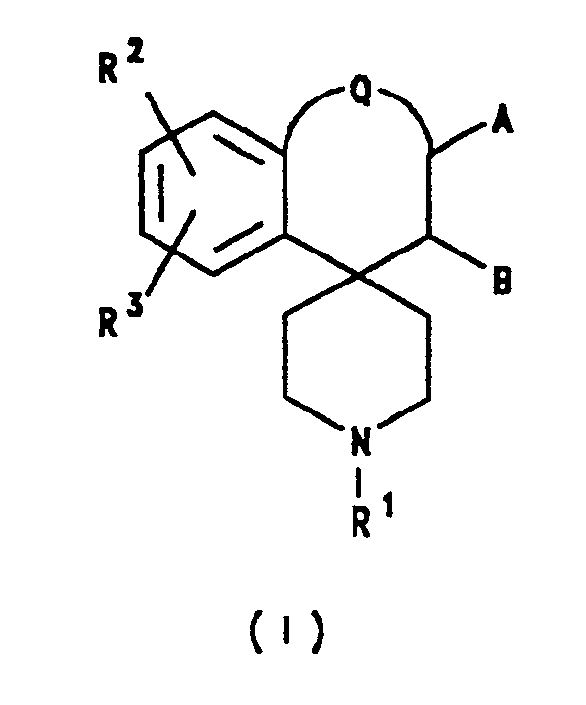
A and B each represents hydrogen, or A and B together represent a chemical bond;
Q represents a bond or a group of formula -(CH₂)₂-;
R¹ represents hydrocarbon;
R² and R³ independently represent hydrogen, hydrocarbon, halogen, cyano, trifluoromethyl, nitro, -ORx, -SRx, -NRxRy, -CO₂Rx or -CONRxRy, or together represent methylenedioxy; and
Rx and Ry independently represent hydrogen or hydrocarbon;
for the manufacture of a medicament for the treatment and/or prevention of psychiatric disorders. - A pharmaceutical composition comprising 1′-benzylspiro[indane-1,4′-piperidine] or a pharmaceutically acceptable salt thereof in association with one or more pharmaceutically acceptable carriers and/or excipients.
- 1′-Benzylspiro[indane-1,4′-piperidine] or a pharmaceutically acceptable salt thereof for use in therapy.
- A compound of formula II or a salt thereof:

A and B each represents hydrogen, or A and B together represent a chemical bond;
Q represents a bond or a group of formula -(CH₂)₂-;
R¹¹ represents hydrocarbon;
R¹² and R¹³ independently represent hydrogen, hydrocarbon, halogen, cyano, trifluoromethyl, nitro, -ORx, -SRx, -NRxRy, -CO₂Rx or -CONRxRy, or together represent methylenedioxy; and
Rx and Ry independently represent hydrogen or hydrocarbon;
provided that when A and B both represent hydrogen, Q is a bond and R¹¹ represents alkyl, allyl, aryl, aralkyl, cycloalkyl or ar(cycloalkyl), then R¹² and R¹³ do not represent hydrogen, alkoxy or hydroxyalkyl;
provided also that when Q is a bond, A, B and R¹² each represents hydrogen, and R¹¹ is benzyl, then R¹³ does not represent methyl in the 6-position of the indane moiety;
provided also that when Q is a bond, A, B and R¹² each represents hydrogen, and R¹¹ is a group of formula -CH₂CH₂CXPh₂ in which X represents cyano or C₂₋₇ alkylcarbonyl, then R¹³ does not represent hydrogen or methyl in the 6-position of the indane moiety. - A pharmaceutical composition comprising a compound of formula II as defined in Claim 4 or a pharmaceutically acceptable salt thereof in association with one or more pharmaceutically acceptable carriers and/or excipients.
- A compound of formula II as defined in Claim 4 or a pharmaceutically acceptable salt thereof for use in therapy.
- A compound as claimed in Claim 4 represented by formula IIA and salts thereof:

- A compound as claimed in Claim 4 represented by formula IIB and salts thereof:
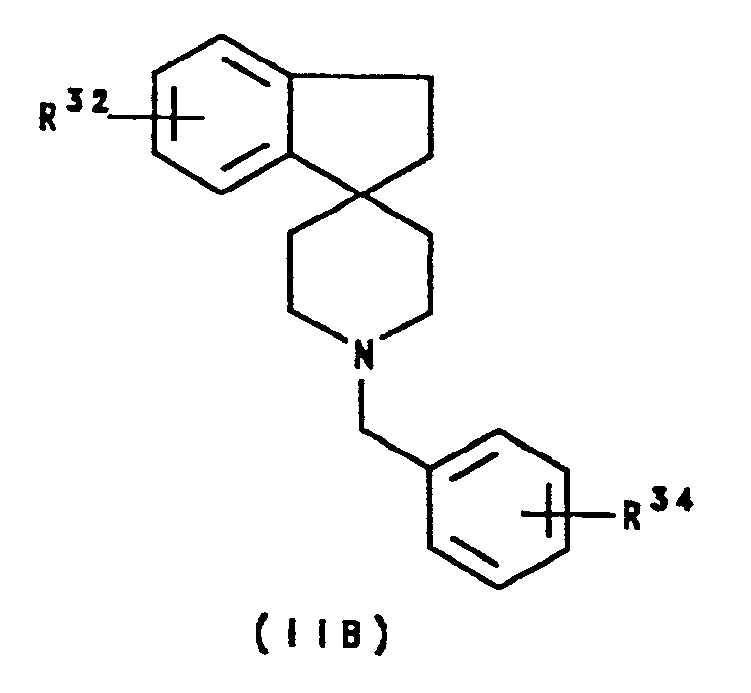
- A compound as claimed in Claim 4 represented by formula IIC and salts thereof:

- A compound as claimed in Claim 4 represented by formula IID and salts thereof:

- A compound as claimed in Claim 4 represented by formula IIE and salts thereof:

- A compound as claimed in Claim 4 selected from:
1′-(4˝-methylbenzyl)spiro[indane-1,4′-piperidine];
1′-cyclohexylmethylspiro[indane-1,4′-piperidine];
1′-(4˝-methoxybenzyl)spiro[indane-1,4′-piperidine];
1′-(2˝-picolyl)spiro[indane-1,4′-piperidine];
1′-(2˝-tetrahydrofurfuryl)spiro[indane-1,4′-piperidine];
1′-(3˝-methylbut-2˝-enyl)spiro[indane-1,4′-piperidine];
1′-(n-butyl)spiro[1H-indene-1,4′-piperidine];
1′-(3˝-methylbut-2˝-enyl)spiro[1H-indene-1,4′-piperidine];
1′-benzylspiro[1H-indene-1,4′-piperidine];
1′-benzylspiro[6,7,8,9-tetrahydro-5H-benzocyclohepten-5,4′-piperidine];
1′-(n-butyl)spiro[6,7,8,9-tetrahydro-5H-benzocyclohepten-5,4′-piperidine];
and salts thereof. - A compound selected from:
1′-(n-butyl)spiro[indane-1,4′-piperidine];
1′-(n-hexyl)spiro[indane-1,4′-piperidine];
1′-(2˝-phenylethyl)spiro[indane-1,4′-piperidine];
and salts thereof. - A pharmaceutical composition comprising a compound as claimed in Claim 13 or a pharmaceutically acceptable salt thereof in association with one or more pharmaceutically acceptable carriers and/or excipients.
- A compound as claimed in Claim 13 or a pharmaceutically acceptable salt thereof for use in therapy.
- A process for the preparation of a compound of formula I as defined in Claim 1, which process comprises:(A) for the preparation of a compound of formula I wherein A and B each represents hydrogen:
reduction of a compound of formula III: (B) for the preparation of a compound of formula I wherein A and B together represent a chemical bond:
dehydration of a compound of formula V: (C) reacting a compound of formula R¹-L with a compound of formula VI:
Applications Claiming Priority (4)
| Application Number | Priority Date | Filing Date | Title |
|---|---|---|---|
| GB909004900A GB9004900D0 (en) | 1990-03-05 | 1990-03-05 | Therapeutic agents |
| GB9004900 | 1990-03-05 | ||
| GB9025385 | 1990-11-22 | ||
| GB909025385A GB9025385D0 (en) | 1990-11-22 | 1990-11-22 | Therapeutic agents |
Publications (2)
| Publication Number | Publication Date |
|---|---|
| EP0445974A2 true EP0445974A2 (en) | 1991-09-11 |
| EP0445974A3 EP0445974A3 (en) | 1992-04-29 |
Family
ID=26296748
Family Applications (1)
| Application Number | Title | Priority Date | Filing Date |
|---|---|---|---|
| EP19910301683 Ceased EP0445974A3 (en) | 1990-03-05 | 1991-02-28 | Spirocyclic antipsychotic agents |
Country Status (4)
| Country | Link |
|---|---|
| US (2) | US5219860A (en) |
| EP (1) | EP0445974A3 (en) |
| JP (1) | JPH04211662A (en) |
| CA (1) | CA2037467A1 (en) |
Cited By (32)
| Publication number | Priority date | Publication date | Assignee | Title |
|---|---|---|---|---|
| EP0518805A1 (en) * | 1991-06-13 | 1992-12-16 | H. Lundbeck A/S | Piperidine derivatives |
| EP0533243A1 (en) * | 1991-09-16 | 1993-03-24 | Merck & Co. Inc. | Hydantoin and succinimide-substituted spiroindanylcamphorsulfonyl derivatives |
| EP0533244A1 (en) * | 1991-09-16 | 1993-03-24 | Merck & Co. Inc. | Amide-substituted derivatives of spiroindanylcamphorsulfonyl oxytocin antagonists |
| WO1993025527A1 (en) * | 1992-06-12 | 1993-12-23 | H. Lundbeck A/S | Dimeric piperidine, tetrahydropyridine and piperazine derivatives |
| WO1994007496A1 (en) * | 1992-10-07 | 1994-04-14 | Merck & Co., Inc. | Tocolytic oxytocin receptor antagonists |
| WO1994014438A1 (en) * | 1992-12-23 | 1994-07-07 | Merck & Co., Inc. | Hydantoin and succinimide-substituted derivatives of spiroindanylcamphorsulfonyl oxytocin antagonists |
| WO1994017045A1 (en) * | 1993-01-28 | 1994-08-04 | Merck & Co., Inc. | Spiro-substituted azacycles as tachykinin receptor antagonists |
| US5670509A (en) * | 1993-09-27 | 1997-09-23 | Merck & Co., Inc. | Tocolytic oxytocin receptor antagonists |
| US5693643A (en) * | 1991-09-16 | 1997-12-02 | Merck & Co., Inc. | Hydantoin and succinimide-substituted derivatives of spiroindanylcamphorsulfonyl oxytocin antagonists |
| WO2002085354A1 (en) | 2001-04-18 | 2002-10-31 | Euro-Celtique S.A. | Spiroindene and spiroindane compounds |
| WO2006023852A3 (en) * | 2004-08-19 | 2006-08-31 | Vertex Pharma | Modulators of muscarinic receptors |
| WO2007028638A1 (en) * | 2005-09-09 | 2007-03-15 | Euro-Celtique S.A. | Fused and spirocycle compounds and the use thereof |
| EP1829875A1 (en) | 2006-03-01 | 2007-09-05 | Laboratorios Del Dr. Esteve, S.A. | Pyrazole derivatives as sigma receptor inhibitors |
| EP1829867A1 (en) | 2006-03-03 | 2007-09-05 | Laboratorios Del Dr. Esteve, S.A. | Imidazole compounds having pharmaceutical activity towards the sigma receptor |
| EP1829866A1 (en) | 2006-03-02 | 2007-09-05 | Laboratorios Del Dr. Esteve, S.A. | Sigma receptor inhibitors |
| WO2007098953A1 (en) * | 2006-03-01 | 2007-09-07 | Laboratorios Del Dr. Esteve, S.A. | Pyrazole derivatives as sigma receptor inhibitors |
| WO2007100664A2 (en) | 2006-02-22 | 2007-09-07 | Vertex Pharmaceuticals Incorporated | Modulators of muscarinic receptors |
| US7282499B2 (en) | 2004-08-27 | 2007-10-16 | Laboratorios Del Dr. Esteve, S.A. | Sigma receptor inhibitors |
| WO2008005295A3 (en) * | 2006-06-29 | 2008-06-05 | Vertex Pharma | Modulators of muscarinic receptors |
| US7696199B2 (en) | 2004-08-27 | 2010-04-13 | Laboratorios Del Dr. Esteve, S.A. | Sigma receptor inhibitors |
| US7696201B2 (en) | 2006-08-15 | 2010-04-13 | Vertex Pharmaceuticals Incorporated | Modulators of muscarinic receptors |
| US7858635B2 (en) | 2005-12-22 | 2010-12-28 | Vertex Pharmaceuticals Incorporated | Spiro compounds as modulators of muscarinic receptors |
| WO2011147910A1 (en) | 2010-05-27 | 2011-12-01 | Laboratorios Del Dr. Esteve, S.A. | Pyrazole compounds as sigma receptor inhibitors |
| US8293740B2 (en) | 2004-08-27 | 2012-10-23 | Laboratories Del Dr. Esteve, S.A. | Sigma receptor inhibitors |
| US8394797B2 (en) | 2004-08-27 | 2013-03-12 | Laboratorios Del Dr. Esteve, S.A. | Substituted pyrazole sigma receptor antagonists |
| US9757358B2 (en) | 2010-02-04 | 2017-09-12 | Laboratorios Del Dr. Esteve, S.A. | Sigma ligands for potentiating the analgesic effect of opioids and opiates in post-operative pain and attenuating the dependency thereof |
| US9782483B2 (en) | 2010-05-21 | 2017-10-10 | Laboratories Del Dr. Esteve, S.A. | Sigma ligands for the prevention and/or treatment of emesis induced by chemotherapy or radiotherapy |
| US9789115B2 (en) | 2010-08-03 | 2017-10-17 | Laboratorios Del Dr. Esteve, S.A. | Use of sigma ligands in opioid-induced hyperalgesia |
| US9789117B2 (en) | 2011-05-18 | 2017-10-17 | Laboratorios Del Dr. Esteve, S.A. | Use of sigma ligands in diabetes type-2 associated pain |
| US9844516B2 (en) | 2010-02-04 | 2017-12-19 | Laboratorios De Dr. Esteve | Sigma ligands for use in the prevention and/or treatment of post-operative pain |
| US9914705B2 (en) | 2008-04-25 | 2018-03-13 | Laboratorios Del Dr. Esteve, S.A. | 1-aryl-3-aminoalkoxy pyrazoles as sigma ligands enhancing analgesic effect of opioids and attenuating the dependency thereof |
| US9931346B2 (en) | 2013-12-17 | 2018-04-03 | Laboratorios Del Dr. Esteve S.A. | Serotonin-norepinephrine reuptake inhibitors (SNRIs) and Sigma receptor ligands combinations |
Families Citing this family (15)
| Publication number | Priority date | Publication date | Assignee | Title |
|---|---|---|---|---|
| US6060473A (en) * | 1993-04-01 | 2000-05-09 | Ucb S.A. - Dtb | 7-azabicyclo[2.2.1]-heptane and -heptene derivatives as cholinergic receptor ligands |
| US5817679A (en) * | 1993-04-01 | 1998-10-06 | University Of Virginia | 7-Azabicyclo 2.2.1!-heptane and -heptene derivatives as cholinergic receptor ligands |
| AU701227B2 (en) * | 1993-09-10 | 1999-01-21 | Cytomed, Inc | Epibatidine and derivatives thereof as cholinergic receptor agonists and antagonists |
| US5457207A (en) * | 1993-10-05 | 1995-10-10 | Regents Of The University Of Minnesota | Spirovesamicols |
| US5439914A (en) * | 1994-02-18 | 1995-08-08 | Merck & Co., Inc. | Spirocycles |
| US6117889A (en) * | 1994-04-01 | 2000-09-12 | University Of Virginia | 7-Azabicyclo-[2.2.1]-heptane and -heptene derivatives as analgesics and anti-inflammatory agents |
| US5725838A (en) * | 1996-05-31 | 1998-03-10 | Resolution Pharmaceuticals, Inc. | Radiolabeled D4 receptor ligands |
| US5976497A (en) * | 1997-08-04 | 1999-11-02 | Resolution Pharmaceuticals, Inc. | Dopamine D4 receptor ligands |
| US6374762B1 (en) * | 1997-10-27 | 2002-04-23 | Correct Craft, Inc. | Water sport towing apparatus |
| US7045527B2 (en) * | 2002-09-24 | 2006-05-16 | Amgen Inc. | Piperidine derivatives |
| US7786141B2 (en) * | 2004-08-19 | 2010-08-31 | Vertex Pharmaceuticals Incorporated | Dihydrospiroindene modulators of muscarinic receptors |
| RU2007124373A (en) * | 2004-11-29 | 2009-01-10 | Вертекс Фармасьютикалз Инкорпорейтед (Us) | MUSCARINE RECEPTION MODULATORS |
| EP1987034B1 (en) * | 2006-02-22 | 2011-07-20 | Vertex Pharmceuticals Incorporated | Spiro condensed piperidines as modulators of muscarinic receptors |
| EP2051715A2 (en) * | 2006-08-18 | 2009-04-29 | Vertex Pharmceuticals Incorporated | Modulators of muscarinic receptors |
| US7973162B2 (en) * | 2007-10-03 | 2011-07-05 | Vertex Pharmaceuticals Incorporated | Modulators of muscarinic receptors |
Family Cites Families (10)
| Publication number | Priority date | Publication date | Assignee | Title |
|---|---|---|---|---|
| US3125580A (en) * | 1964-03-17 | x d diphenyl - | ||
| US3301857A (en) * | 1963-08-26 | 1967-01-31 | Hoffmann La Roche | Spiro |
| US3654287A (en) * | 1970-08-26 | 1972-04-04 | Mead Johnson & Co | Spiroindanylpiperidines |
| US3959475A (en) * | 1973-12-12 | 1976-05-25 | American Hoechst Corporation | Substituted 1,3-dihydrospiro(isobenzofuran)s |
| US4179732A (en) * | 1977-06-10 | 1979-12-18 | Dataproducts Corporation | Microprogrammable processor control printer system |
| GB8808433D0 (en) * | 1988-04-11 | 1988-05-11 | Merck Sharp & Dohme | Therapeutic agents |
| GB8816299D0 (en) * | 1988-07-08 | 1988-08-10 | Merck Sharp & Dohme | Therapeutic agents |
| GB8917069D0 (en) * | 1989-07-26 | 1989-09-13 | Merck Sharp & Dohme | Therapeutic agents |
| IL96507A0 (en) * | 1989-12-08 | 1991-08-16 | Merck & Co Inc | Nitrogen-containing spirocycles and pharmaceutical compositions containing them |
| US5091387A (en) * | 1990-03-02 | 1992-02-25 | Merck & Co., Inc. | Spirocyclic oxytocin antagonists |
-
1991
- 1991-02-28 EP EP19910301683 patent/EP0445974A3/en not_active Ceased
- 1991-03-01 US US07/662,602 patent/US5219860A/en not_active Expired - Fee Related
- 1991-03-04 CA CA002037467A patent/CA2037467A1/en not_active Abandoned
- 1991-03-05 JP JP3038555A patent/JPH04211662A/en not_active Withdrawn
-
1993
- 1993-04-22 US US08/052,016 patent/US5324733A/en not_active Expired - Fee Related
Cited By (59)
| Publication number | Priority date | Publication date | Assignee | Title |
|---|---|---|---|---|
| EP0518805A1 (en) * | 1991-06-13 | 1992-12-16 | H. Lundbeck A/S | Piperidine derivatives |
| US6207677B1 (en) | 1991-06-13 | 2001-03-27 | H. Lundbeck A/S | Piperidine derivatives having anxiolytic effect |
| US6031099A (en) * | 1991-06-13 | 2000-02-29 | H. Lundbeck A/S | Piperidine derivates having anxiolytic effect |
| US5807871A (en) * | 1991-06-13 | 1998-09-15 | H. Lundbeck A/S | Piperidine derivatives having anxiolytic effect |
| EP0853085A1 (en) * | 1991-06-13 | 1998-07-15 | H. Lundbeck A/S | Piperidine derivatives having anxiolytic effect |
| US5665725A (en) * | 1991-06-13 | 1997-09-09 | H. Lundbeck | Piperidine derivatives having anxiolytic effect |
| US5693643A (en) * | 1991-09-16 | 1997-12-02 | Merck & Co., Inc. | Hydantoin and succinimide-substituted derivatives of spiroindanylcamphorsulfonyl oxytocin antagonists |
| EP0533243A1 (en) * | 1991-09-16 | 1993-03-24 | Merck & Co. Inc. | Hydantoin and succinimide-substituted spiroindanylcamphorsulfonyl derivatives |
| EP0533244A1 (en) * | 1991-09-16 | 1993-03-24 | Merck & Co. Inc. | Amide-substituted derivatives of spiroindanylcamphorsulfonyl oxytocin antagonists |
| US5684012A (en) * | 1992-06-12 | 1997-11-04 | H. Lundbeck A/S | Dimeric piperidine, tetrahydropyridine and piperazine derivatives |
| US5830896A (en) * | 1992-06-12 | 1998-11-03 | H. Lundbeck A/S | Dimeric piperidine, tetrahydropyridine and piperazine derivatives |
| WO1993025527A1 (en) * | 1992-06-12 | 1993-12-23 | H. Lundbeck A/S | Dimeric piperidine, tetrahydropyridine and piperazine derivatives |
| US6090808A (en) * | 1992-06-12 | 2000-07-18 | H. Lundbeck A/S | Dimeric piperidine, tetrahydropyridine and piperazine derivatives |
| US5658921A (en) * | 1992-06-12 | 1997-08-19 | H. Lundbeck A/S | Dimeric piperidine, tetrahydropyridine and piperazine derivatives |
| US5837707A (en) * | 1992-06-12 | 1998-11-17 | H. Lundbeck A/S | Dimeric piperidine, tetrahydropyridine and piperazine derivatives |
| WO1994007496A1 (en) * | 1992-10-07 | 1994-04-14 | Merck & Co., Inc. | Tocolytic oxytocin receptor antagonists |
| WO1994014438A1 (en) * | 1992-12-23 | 1994-07-07 | Merck & Co., Inc. | Hydantoin and succinimide-substituted derivatives of spiroindanylcamphorsulfonyl oxytocin antagonists |
| US5869496A (en) * | 1993-01-28 | 1999-02-09 | Merck & Co., Inc. | Spiro-substituted azacycles as tachykinin receptor antagonists |
| AU693087B2 (en) * | 1993-01-28 | 1998-06-25 | Merck & Co., Inc. | Spiro-substituted azacycles as tachykinin receptor antagonists |
| WO1994017045A1 (en) * | 1993-01-28 | 1994-08-04 | Merck & Co., Inc. | Spiro-substituted azacycles as tachykinin receptor antagonists |
| US5670509A (en) * | 1993-09-27 | 1997-09-23 | Merck & Co., Inc. | Tocolytic oxytocin receptor antagonists |
| WO2002085354A1 (en) | 2001-04-18 | 2002-10-31 | Euro-Celtique S.A. | Spiroindene and spiroindane compounds |
| EP1385514A4 (en) * | 2001-04-18 | 2005-04-13 | Euro Celtique Sa | Spiroindene and spiroindane compounds |
| WO2006023852A3 (en) * | 2004-08-19 | 2006-08-31 | Vertex Pharma | Modulators of muscarinic receptors |
| US8394797B2 (en) | 2004-08-27 | 2013-03-12 | Laboratorios Del Dr. Esteve, S.A. | Substituted pyrazole sigma receptor antagonists |
| EP2325174A1 (en) | 2004-08-27 | 2011-05-25 | Laboratorios Del. Dr. Esteve, S.A. | Sigma receptor inhibitors |
| US7829559B2 (en) | 2004-08-27 | 2010-11-09 | Laboratorios Del Dr. Esteve, S.A. | Substituted pyrazole sigma receptor antagonists |
| US8470867B2 (en) | 2004-08-27 | 2013-06-25 | Laboratorios Del Dr. Esteve, S.A. | Sigma receptor inhibitors |
| US8293740B2 (en) | 2004-08-27 | 2012-10-23 | Laboratories Del Dr. Esteve, S.A. | Sigma receptor inhibitors |
| US8314096B2 (en) | 2004-08-27 | 2012-11-20 | Laboratorios Del Dr. Esteve, S.A. | Sigma receptor inhibitors |
| US7282499B2 (en) | 2004-08-27 | 2007-10-16 | Laboratorios Del Dr. Esteve, S.A. | Sigma receptor inhibitors |
| US7696199B2 (en) | 2004-08-27 | 2010-04-13 | Laboratorios Del Dr. Esteve, S.A. | Sigma receptor inhibitors |
| WO2007028638A1 (en) * | 2005-09-09 | 2007-03-15 | Euro-Celtique S.A. | Fused and spirocycle compounds and the use thereof |
| US8546417B2 (en) | 2005-09-09 | 2013-10-01 | Purdue Pharma L.P. | Fused and spirocycle compounds and the use thereof |
| US8883816B2 (en) | 2005-09-09 | 2014-11-11 | Purdue Pharma L.P. | Fused and spirocycle compounds and the use thereof |
| US8193208B2 (en) | 2005-09-09 | 2012-06-05 | Purdue Pharma L.P. | Fused and spirocycle compounds and the use thereof |
| US7858635B2 (en) | 2005-12-22 | 2010-12-28 | Vertex Pharmaceuticals Incorporated | Spiro compounds as modulators of muscarinic receptors |
| WO2007100664A3 (en) * | 2006-02-22 | 2008-03-06 | Vertex Pharma | Modulators of muscarinic receptors |
| WO2007100664A2 (en) | 2006-02-22 | 2007-09-07 | Vertex Pharmaceuticals Incorporated | Modulators of muscarinic receptors |
| US8304423B2 (en) | 2006-02-22 | 2012-11-06 | Vertex Pharmaceutical Incorporated | Modulators of muscarinic receptors |
| US8003660B2 (en) | 2006-02-22 | 2011-08-23 | Vertex Pharmaceuticals Incorporated | Modulators of muscarinic receptors |
| WO2007098953A1 (en) * | 2006-03-01 | 2007-09-07 | Laboratorios Del Dr. Esteve, S.A. | Pyrazole derivatives as sigma receptor inhibitors |
| US8202872B2 (en) | 2006-03-01 | 2012-06-19 | Laboratorios Del Dr. Esteve, S.A. | Pyrazole derivatives as sigma receptor inhibitors |
| EP1829875A1 (en) | 2006-03-01 | 2007-09-05 | Laboratorios Del Dr. Esteve, S.A. | Pyrazole derivatives as sigma receptor inhibitors |
| EP1829866A1 (en) | 2006-03-02 | 2007-09-05 | Laboratorios Del Dr. Esteve, S.A. | Sigma receptor inhibitors |
| EP1829867A1 (en) | 2006-03-03 | 2007-09-05 | Laboratorios Del Dr. Esteve, S.A. | Imidazole compounds having pharmaceutical activity towards the sigma receptor |
| US7858790B2 (en) | 2006-06-29 | 2010-12-28 | Vertex Pharmaceuticals Incorporated | Modulators of muscarinic receptors |
| WO2008005295A3 (en) * | 2006-06-29 | 2008-06-05 | Vertex Pharma | Modulators of muscarinic receptors |
| US7696201B2 (en) | 2006-08-15 | 2010-04-13 | Vertex Pharmaceuticals Incorporated | Modulators of muscarinic receptors |
| US9914705B2 (en) | 2008-04-25 | 2018-03-13 | Laboratorios Del Dr. Esteve, S.A. | 1-aryl-3-aminoalkoxy pyrazoles as sigma ligands enhancing analgesic effect of opioids and attenuating the dependency thereof |
| US9757358B2 (en) | 2010-02-04 | 2017-09-12 | Laboratorios Del Dr. Esteve, S.A. | Sigma ligands for potentiating the analgesic effect of opioids and opiates in post-operative pain and attenuating the dependency thereof |
| US9844516B2 (en) | 2010-02-04 | 2017-12-19 | Laboratorios De Dr. Esteve | Sigma ligands for use in the prevention and/or treatment of post-operative pain |
| US9782483B2 (en) | 2010-05-21 | 2017-10-10 | Laboratories Del Dr. Esteve, S.A. | Sigma ligands for the prevention and/or treatment of emesis induced by chemotherapy or radiotherapy |
| EP2395003A1 (en) | 2010-05-27 | 2011-12-14 | Laboratorios Del. Dr. Esteve, S.A. | Pyrazole compounds as sigma receptor inhibitors |
| WO2011147910A1 (en) | 2010-05-27 | 2011-12-01 | Laboratorios Del Dr. Esteve, S.A. | Pyrazole compounds as sigma receptor inhibitors |
| US9181195B2 (en) | 2010-05-27 | 2015-11-10 | Laboratorios Del Dr. Esteve, S.A. | Sigma receptor inhibitors |
| US9789115B2 (en) | 2010-08-03 | 2017-10-17 | Laboratorios Del Dr. Esteve, S.A. | Use of sigma ligands in opioid-induced hyperalgesia |
| US9789117B2 (en) | 2011-05-18 | 2017-10-17 | Laboratorios Del Dr. Esteve, S.A. | Use of sigma ligands in diabetes type-2 associated pain |
| US9931346B2 (en) | 2013-12-17 | 2018-04-03 | Laboratorios Del Dr. Esteve S.A. | Serotonin-norepinephrine reuptake inhibitors (SNRIs) and Sigma receptor ligands combinations |
Also Published As
| Publication number | Publication date |
|---|---|
| EP0445974A3 (en) | 1992-04-29 |
| CA2037467A1 (en) | 1991-09-06 |
| US5324733A (en) | 1994-06-28 |
| US5219860A (en) | 1993-06-15 |
| JPH04211662A (en) | 1992-08-03 |
Similar Documents
| Publication | Publication Date | Title |
|---|---|---|
| US5219860A (en) | Spirocyclic antipsychotic agents | |
| EP0414289B1 (en) | Spirocyclic antipsychotic agents | |
| US5563150A (en) | Pyrrolo-pyridine derivatives | |
| RU2086549C1 (en) | Derivatives of bis-benzo- or benzopyrido-cycloheptapiperidine, piperidylidene and piperazine and pharmaceutical composition based on thereof | |
| US5563152A (en) | Pyrrolo-pyridine derivatives | |
| TW200901994A (en) | Spiroindolinone derivatives | |
| JPH054983A (en) | Isoquinolinone derivative, method for producing the same, and 5-HT3 receptor antagonist containing the derivative as an active ingredient | |
| US4374139A (en) | Levorotatory N-substituted acylmorphinans useful as analgesic agents | |
| EP0489458A1 (en) | Hydroxyquinolone derivatives | |
| CN107663159A (en) | Polycyclic compound, its pharmaceutical composition and application | |
| US5670522A (en) | Dopamine receptor subtype ligands | |
| TW201735B (en) | ||
| JPH09502449A (en) | Fused tricyclic heteroaromatic derivatives as dopamine receptor subtype ligands | |
| EP0410535A2 (en) | Octahydrobenzisoquinoline derivatives as antipsychotic agents | |
| CA1259618A (en) | Tetrahydrocarbazole derivatives | |
| US5254561A (en) | Tricyclic antipsychotic agents | |
| AU2002224086B1 (en) | Indole derivatives and use thereof in medicines | |
| JP2004511486A (en) | Morphinoid derivatives as delta-opioid agonists and antagonists | |
| WO1995014672A1 (en) | Isoxazole and pyrazole derivatives as dopamine receptor subtype ligands | |
| IE50006B1 (en) | Derivatives of tetrahydropyrid-4-yl-indole | |
| JP2001507711A (en) | Preparation of tetrazolylbenzopyran | |
| US5700802A (en) | Furopyridine derivatives | |
| US5294618A (en) | Octahydrobenzisoquinoline derivatives as antipsychotic agents | |
| JPS6039679B2 (en) | Pentacyclic derivatives and their production method | |
| CN121426698A (en) | Deuterated diacylhydrazine compounds and pharmaceutical compositions comprising such compounds |
Legal Events
| Date | Code | Title | Description |
|---|---|---|---|
| PUAI | Public reference made under article 153(3) epc to a published international application that has entered the european phase |
Free format text: ORIGINAL CODE: 0009012 |
|
| AK | Designated contracting states |
Kind code of ref document: A2 Designated state(s): CH DE FR GB IT LI NL |
|
| PUAL | Search report despatched |
Free format text: ORIGINAL CODE: 0009013 |
|
| AK | Designated contracting states |
Kind code of ref document: A3 Designated state(s): CH DE FR GB IT LI NL |
|
| 17P | Request for examination filed |
Effective date: 19920908 |
|
| 17Q | First examination report despatched |
Effective date: 19950410 |
|
| STAA | Information on the status of an ep patent application or granted ep patent |
Free format text: STATUS: THE APPLICATION HAS BEEN REFUSED |
|
| 18R | Application refused |
Effective date: 19951002 |