EP0445738B1 - Perfluoropolyethers and processes for preparing them - Google Patents
Perfluoropolyethers and processes for preparing them Download PDFInfo
- Publication number
- EP0445738B1 EP0445738B1 EP91103324A EP91103324A EP0445738B1 EP 0445738 B1 EP0445738 B1 EP 0445738B1 EP 91103324 A EP91103324 A EP 91103324A EP 91103324 A EP91103324 A EP 91103324A EP 0445738 B1 EP0445738 B1 EP 0445738B1
- Authority
- EP
- European Patent Office
- Prior art keywords
- carbon atoms
- group
- perfluoropolyethers
- formula
- general formula
- Prior art date
- Legal status (The legal status is an assumption and is not a legal conclusion. Google has not performed a legal analysis and makes no representation as to the accuracy of the status listed.)
- Expired - Lifetime
Links
- VAJOZGQHDSIYFU-UHFFFAOYSA-N CCNC(C)N Chemical compound CCNC(C)N VAJOZGQHDSIYFU-UHFFFAOYSA-N 0.000 description 1
Classifications
-
- C—CHEMISTRY; METALLURGY
- C08—ORGANIC MACROMOLECULAR COMPOUNDS; THEIR PREPARATION OR CHEMICAL WORKING-UP; COMPOSITIONS BASED THEREON
- C08G—MACROMOLECULAR COMPOUNDS OBTAINED OTHERWISE THAN BY REACTIONS ONLY INVOLVING UNSATURATED CARBON-TO-CARBON BONDS
- C08G65/00—Macromolecular compounds obtained by reactions forming an ether link in the main chain of the macromolecule
- C08G65/02—Macromolecular compounds obtained by reactions forming an ether link in the main chain of the macromolecule from cyclic ethers by opening of the heterocyclic ring
- C08G65/32—Polymers modified by chemical after-treatment
- C08G65/329—Polymers modified by chemical after-treatment with organic compounds
-
- C—CHEMISTRY; METALLURGY
- C08—ORGANIC MACROMOLECULAR COMPOUNDS; THEIR PREPARATION OR CHEMICAL WORKING-UP; COMPOSITIONS BASED THEREON
- C08G—MACROMOLECULAR COMPOUNDS OBTAINED OTHERWISE THAN BY REACTIONS ONLY INVOLVING UNSATURATED CARBON-TO-CARBON BONDS
- C08G65/00—Macromolecular compounds obtained by reactions forming an ether link in the main chain of the macromolecule
- C08G65/002—Macromolecular compounds obtained by reactions forming an ether link in the main chain of the macromolecule from unsaturated compounds
- C08G65/005—Macromolecular compounds obtained by reactions forming an ether link in the main chain of the macromolecule from unsaturated compounds containing halogens
- C08G65/007—Macromolecular compounds obtained by reactions forming an ether link in the main chain of the macromolecule from unsaturated compounds containing halogens containing fluorine
-
- C—CHEMISTRY; METALLURGY
- C08—ORGANIC MACROMOLECULAR COMPOUNDS; THEIR PREPARATION OR CHEMICAL WORKING-UP; COMPOSITIONS BASED THEREON
- C08G—MACROMOLECULAR COMPOUNDS OBTAINED OTHERWISE THAN BY REACTIONS ONLY INVOLVING UNSATURATED CARBON-TO-CARBON BONDS
- C08G65/00—Macromolecular compounds obtained by reactions forming an ether link in the main chain of the macromolecule
- C08G65/02—Macromolecular compounds obtained by reactions forming an ether link in the main chain of the macromolecule from cyclic ethers by opening of the heterocyclic ring
- C08G65/32—Polymers modified by chemical after-treatment
- C08G65/321—Polymers modified by chemical after-treatment with inorganic compounds
Definitions
- the present invention relates to mixtures of new perfluoropolyethers and to processes for preparing them.
- perfluoropolyethers are known, which may be obtained, for example, by oxidation of perfluoroolefins, such as C 2 F 4 and C 3 F 6 , with oxygen, under the action of ultraviolet radiation.
- EP-A-259,980 describes perfluoropolyethers prepared in similar manner, starting from perfluoroolefins and perfluoroalkylvinylethers.
- Another object is the provision of a new class of non-peroxidic perfluoropolyethers prepared by the reduction of the above-mentioned peroxidic perfluoropolyethers.
- a further object is to provide a new class of perfluoropolyethers having perfluoroalkyl end groups and optionally perfluoroalkyl end groups containing one or more ether oxygen atoms; or having one or two fluoroalkyl end groups; or having one or two functional end groups.
- Still another object is that of providing new classes of perfluoropolyethers free of units of formula and (CF 2 -CF 2 O) having - at the same molecular weight as that of the perfluoropolyethers containing such units - a much lower viscosity than the perfluoropolyethers having such units.
- the present invention provides mixtures of peroxidic perfluoropolyethers of general formula (I): wherein the units in parentheses are statistically distributed along the chains;
- X represents a group of formula (CF 2 O) m R", wherein R" is a straight chain perfluoroalkyl group having from 1 to 10 carbon atoms, a branched chain perfluoroalkyl group having from 3 to 10 carbon atoms or a cyclic perfluoroalkyl group having from 3 to 6 carbon atoms, and m ranges from 0 to 6;
- a, b, c and d refer to the individual polymeric molecules.
- said subscripts assume average values, which can be integers or intermediate values between zero and 1 or between an integer and the successive integer.
- the mixture of polymeric molecules contains the four units (CF 2 O), and (O).
- the value of m in the group (CF 2 O) m R" ranges from 0 to 3; most preferably it equals zero.
- the groups R" are preferably selected from CF 3 , C 2 F 5 , n-C 3 F 7 , i-C 3 F 7 , n-C 4 F 9 , i-C 4 F 9 and t-C 4 F 9 .
- CF 3 , C 2 F 5 and n-C 3 F 7 are particularly preferred, CF 3 and C 2 F 5 being most preferred.
- the sum (b+c) generally ranges from 2 to 15,000 and particularly from 3 to 5,000.
- the sum (a+b+c) generally ranges from 2 to 15,000 and particularly from 3 to 5,000.
- the sum (a+b+c+d) generally ranges from 2 to 15,000 and particularly from 3 to 5,000.
- mixtures of peroxidic perfluoropolyethers according to the present invention are preferably prepared by the processes described hereinafter.
- CF 2 CF-OX (II) wherein X has the meaning defined hereinbefore, there are fed a gaseous oxygen stream and, optionally, a gaseous or liquid stream of one or more perfluoroalkylvinylethers of formula (II), the latter stream being always present if the liquid phase does not contain perfluoroalkylvinylethers at the beginning of the reaction, and the liquid phase is exposed to radiation having a wavelength of from 200 to 600 nm, preferably 200 to 500 nm.
- the first process is usually employed in the preparation of peroxidic perfluoropolyethers and is described, for example, in US-A-3,699,145.
- the temperature of the liquid phase is kept at from -100 to +50°C and, preferably, from -80 to 0°C.
- the temperature of the liquid phase generally ranges from -120°C to +25°C.
- the compounds having one or more F-Q bonds are referred to in the following as initiators (starters), this term, however, being not binding for the reaction mechanism.
- the starter is an organic compound containing one or more fluoroxy groups. More usually it is a perfluorinated alkyl or alkylene compound containing one or more fluoroxy groups and, optionally, one or more heteroatoms, in particular oxygen and chlorine atoms.
- the number of heteroatoms generally ranges from 1 to 10.
- the heteroatom is an ether oxygen atom.
- the compound having F-O bonds usually contains one or two fluoroxy groups.
- said radical can represent, in particular, a radical R 1 , where R 1 is equal to R 3 or R 4 -O(CF 2 O) n -CF 2 -, in which R 3 , R 4 and n are as defined hereinbefore, or a radical R 2 , derived from a cleavage of R 3 or R 4 -O(CF 2 O) n -CF 2 - and having a lower number of carbon atoms than R 1 (usually one carbon atom less than R 1 ).
- the solvent when used at all, is preferably selected from straight-chain and cyclic fluorocarbons, chlorofluorocarbons, perfluoroamines and perfluorinated ethers.
- fluorocarbons and chlorofluorocarbons examples include CFCl 3 , CF 2 Cl 2 , cyclo-C 4 F 8 , cyclo-C 6 F 12 , 1-chloropentafluoroethane, 1,1,2-trichloro-1,2,2-trifluoroethane, 1,2-dichlorotetrafluoroethane and 1,1,1-trifluorotrichloroethane.
- Suitable perfluoroamines are the perfluoroamines known under the tradename FLUORINERT® (3M).
- perfluorinated ethers examples include perfluoropolyethers having a boiling point lower than about 250°C, such as those known under the tradename GALDEN® (Montefluos).
- radicals P in the end groups A and B, said radicals being variable in nature, depending on the nature of the solvent.
- a gas which is inert under the reaction conditions is preferably introduced into the liquid phase.
- Said inert gas is usually fed in admixture with the starter or starters if said compounds are fed into the liquid phase in the form of a gaseous stream. It can be also fed, in part or as a whole, along with the oxygen. In other words, it is possible to use, instead of oxygen, mixtures of oxygen with inert gases, in particular air.
- the inert gas when used, is preferably selected from nitrogen, argon, helium, CF 4 and C 2 F 6 .
- oxygen is continuously fed into the liquid phase, the oxygen partial pressure in the reactor being generally in the range of from 0.001 to 1 MPa (0.01 to 10 atmospheres) and, more usually, from 0.005 to 0.1 MPa (0.05 to 1 atmosphere).
- the concentration of the perfluoroalkylvinylether(s) in the liquid phase generally ranges from 0.01 mole/liter to the molar concentration of the perfluoroalkylvinylether(s) in the pure (undiluted) state.
- the flowrate of thestarter(s) generally ranges from 0.001 to 5 moles per hour per liter of liquid phase and, more usually, from 0.01 to 2 moles per hour per liter of liquid phase.
- the feeding of the reagents is stopped.
- the solvent, if any, and the unreacted monomer or monomers are separated, preferably by distillation, and the peroxidic perfluoropolyethers are obtained as residue in the form of an oily liquid or a semisolid material.
- the reaction can also be conducted in a completely continuous manner, by continuously withdrawing a portion of the liquid phase from the reactor, subjecting it to distillation, recycling the solvent, if any, and the unreacted monomer or monomers and recovering the reaction product.
- a suitable process for preparing the non-peroxidic products (III) comprises subjecting the peroxidic products (I) to a thermal reduction at temperatures generally ranging from 150 to 250°C as described, for example, in US-A-4,668,357.
- Another suitable process comprises subjecting the peroxidic product (I) to a photochemical reduction at temperatures generally ranging from -40 to 150°C in the presence of radiation having a wavelength ranging from 200 to 600 nm (preferably 200 to 500 nm) and, optionally, in the presence of a solvent. This process is described, for example, in US-A-3,715,378.
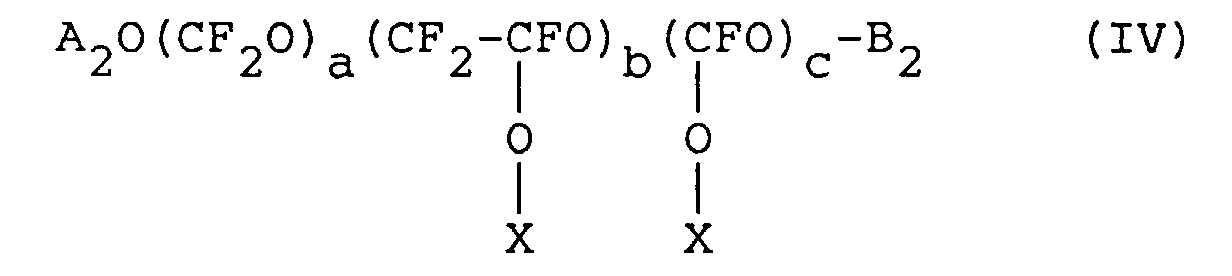
- Object of the present invention are also mixtures of new perfluoropolyethers having perfluoroalkyl end groups and optionally perfluoroalkyl end groups containing one or more ether oxygen atoms and being of general formula (IV): wherein a, b, c and X are as defined above.
- the end groups A 2 and B 2 are selected from and radicals P formed by bond cleavage in the starter or the solvent which have been used in the process for preparing the peroxidic perfluoropolyethers (I), Y 2 being F, Cl or a radical P as defined above.
- the radical P is in particular a radical R 1 or R 2 defined hereinbefore.
- perfluoroalkyl end groups containing one or more ether oxygen atoms is due to the use, in the preparation process, of starters comprising organic fluoroxy compounds containing one or more ether oxygen atoms.
- the number of ether oxygen atoms generally ranges from 1 to 10, and preferably from 1 to 2.
- a suitable process for obtaining the perfluoropolyethers of general formula (IV) comprises subjecting the non-peroxidic product (III) to a thermal treatment in the presence of fluorine at temperatures generally ranging from 150 to 250°C, as described, for example, in US-A-4,668,357.
- Another suitable process for preparing the perfluoropolyethers of general formula (IV) comprises subjecting the non-peroxidic product (III) to a photochemical reaction in the presence of fluorine. This treatment is generally carried out at temperatures ranging from 20 to 150°C in the presence of radiation having a wavelength preferably ranging from 200 to 500 nm and in the optional presence of a solvent. This process is described, for example, in US-A-4,664,766.
- Another object of the present invention are perfluoropolyethers having one or two (hydro)fluoroalkyl end groups and being of general formula (V): wherein a, b, c and X are as defined above and the end groups A 3 and B 3 , the same or different from each other, are selected from and the end groups A 2 and B 2 as defined hereinabove.
- perfluoropolyethers of formula (V) are preparable by reacting the non-peroxidic perfluoropolyether (III) with molten KOH at elevated temperature, as described, for example, in the article by D. Sianesi "Polieteri perfluorurati", La Chimica e l'Industria, Vol. 50 - No. 2, February 1968, pages 206-214.
- a further object of the present invention are new perfluoropolyethers having one or two functional end groups and being of general formula (VI): wherein:
- Z is a group OR 5 , wherein R 5 is selected from hydrogen; (wherein e is an integer of from 1 to 15) (wherein f is an integer ranging from 1 to 3) (wherein R 6 is an alkyl group containing 1 to 30 carbon atoms and, optionally, ether bonds of the type -C-O-C-, or R 6 is a group -(CH 2 -CH 2 O) p H wherein p ranges from 1 to 10) naphthyl; alkylbenzyl; and mono- or polysubstituted benzylalkoxy groups of formulae (wherein R 7 is an alkyl group containing from 1 to 4 carbon atoms); Z may also be a group NR 8 R 9 wherein R 8 and R 9 , the same or different from each other, represent hydrogen, groups R 6 as defined above, or, when R 8 is H, R 9 can be a group of formula or R 8 and R 9 together form a cyclic group of formula in
- R"' is a group NHR 10 wherein R 10 is hydrogen, alkyl containing 1 to 8 carbon atoms, mono- or polyhydroxyalkyl containing 1 to 8 carbon atoms, aminoalkyl containing 1 to 8 carbon atoms, allyl, methallyl, trimethoxy- or triethoxysilylalkyl of formula R 11 -Si(OCH 3 ) 3 or R 11 -Si(OC 2 H 5 ) 3 (R 11 being an alkylene group containing 1 to 8 carbon atoms), isocyanoalkyl of formula R 12 NCO, R 12 being an alkylene group containing 1 to 8 carbon atoms, isocyanocycloalkyl containing 5 or 6 carbon atoms in the ring or isocyanoaryl containing 6 to 10 carbon atoms in the ring (e.g.
- R''' may also be an aromatic group which is optionally substituted by halogen atoms (e.g. F, Cl, Br) and/or hydrocarbyl groups (e.g. C 1 -C 8 alkyl groups such as CH 3 and C 2 H 5 ). Examples thereof are pentafluorophenyl, bromotetrafluorophenyl, dibromodifluorophenyl, bromophenyl and bromobenzophenyl.
- halogen atoms e.g. F, Cl, Br
- hydrocarbyl groups e.g. C 1 -C 8 alkyl groups such as CH 3 and C 2 H 5 . Examples thereof are pentafluorophenyl, bromotetrafluorophenyl, dibromodifluorophenyl, bromophenyl and bromobenzophenyl.
- the new functionalized perfluoropolyethers of formula (VI) can be prepared by known processes, starting from the peroxidic perfluoropolyethers of general formula (I) or from the non-peroxidic perfluoropolyethers of general formula (III), and possible known subsequent reactions in order to convert one functional group into another functional group.
- a conventional reduction reaction for example with HI, may be carried out at temperatures generally ranging from 20 to 50°C and in the presence of alcohols, thereby obtaining perfluoropolyethers containing ester end groups.
- the average functionality of the resulting perfluoropolyethers having end groups of formula -COOH or -COOR generally ranges from 0.1 to 1.99 and preferably from 1 to 1.99. Products having a higher functionality are generally obtained by means of the first process for preparing peroxidic perfluoropolyethers (I), i.e. the process which utilizes ultra-violet radiation.
- the number average molecular weight of the perfluoropolyethers of formulae (I), (III), (IV), (V) and (VI) according to the present invention generally ranges from 500 to 500,000 and particularly from 500 to 200,000.
- peroxidic perfluoropolyethers (I) are useful intermediates for the preparation of perfluoropolyethers of formulae (IV), (V) and (VI). Particularly when they have a relatively low molecular weight they are also useful as crosslinking agents for elastomeric polymers, for example the elastomeric copolymers of vinylidene fluoride and hexafluoropropene.
- the non-peroxidic perfluoropolyethers (III) are useful as intermediates, as mentioned above.
- perfluoropolyethers of formulae (IV) and (V) are useful, in particular, as fluids for electronic tests, for example thermal shock, "NID” and cross leaks, as lubricants, as heat transfer fluids and as agents for protecting monuments from atmospheric agents and pollutants.
- the perfluoropolyethers containing functional end groups (VI) are useful, in particular, as lubricants, additives for lubricants, oil- and water-repellent fluids and as agents for protecting monuments from atmospheric agents and pollutants.
- the perfluoropolyethers according to the present invention are free of units and (CF 2 -CF 2 O).
- the perfluoropolyethers according to the present invention have a much higher molecular weight than the above known perfluoropolyethers, they show a much lower vapour tension, wherefore their field of application is by far wider, for example in applications where vacuum is employed.
- a 10.3 g portion of the product obtained in example 1A was introduced into a 25 ml flask equipped with a magnetic stirrer and was gradually heated to a temperature of 240°C within 5 hours. The flask was then maintained at this temperature for 2 hours.
- the amount of acid end groups was 0.07 mmole/g of oil.
- the product viscosity measured at 20°C was 350 mm 2 /s (cSt), and the iodometric analysis revealed the absence of peroxide groups.
- the starting product had a viscosity of 132 mm 2 /s (cSt) at 20°C, an (a+c)/b ratio of 0.80, an a/c ratio of 1.6 and a content of acid end groups equal to 0.23 mmole/g.
- F 2 (3Nl/h) was caused to flow from the plunging pipe, while the temperature inside the reactor rose until it reached about 140°C. After a total time of 36 hours and 45 minutes of irradiation in the presence of fluorine, the reactor was discharged.
- the product glass transition temperature was -96°C.
- the ratio (a+c)/b was 0.49 and the ratio a/c was 1.2.
- the product viscosity at 20°C was 2350 mm 2 /s (cSt).
- a 15.5 g portion of the product obtained in example 2A was placed into a 25 ml flask equipped with a magnetic stirrer and was gradually heated up to 190°C within 2 hours. This temperature was maintained for 1 hour. Thereafter the temperature was raised up to 240°C within 2 hours and was maintained at said value for a further 2 hours. At the end 10 g of product were recovered, which, according to 19 F-NMR analysis, exhibited the same structure as the product of example 1B.
- the end groups were: -CF 3 ; -CF 2 COF and
- the content of acid end groups (i.e. groups containing the -COF group) was 0.11 mmole/g of oil and the content of units having 4 to 6 carbon atoms as defined in example 1B was 0.67 mmole/g of oil.
- the product viscosity at 20°C was 300 mm 2 /s (cSt) and the iodometric analysis confirmed the absence of peroxide groups.
- a photooxidation of perfluoromethylvinylether at a temperature of -40°C was carried out by charging 50 g of liquid perfluoromethylvinylether and 40 g of liquid CF 2 Cl 2 (used as solvent).
- the ratio (a+c)/b was equal to 1.0 while the a/c ratio was equal to 1.4.
- the product viscosity at 20°C was 880 mm 2 /s (cSt).
- the product viscosity at 20°C was 7430 mm 2 /s cSt.
- the 19 F-NMR analysis revealed that the product was composed of polyether polyperoxide chains of general formula (Ib): wherein A and B represent end groups CF 3 , C 2 F 5 and COF.
- the ratio (a+c)/b was equal to 1.43 while the a/c ratio was equal to 1.5.
- the product viscosity at 20°C was 16,200 mm 2 /s (cSt).
- the 19 F-NMR analysis revealed that it consisted of polyether polyperoxide chains of the above general formula (IIb) wherein A and B represent end groups CF 3 , C 2 F 5 and COF.
- the ratio (a+c)/b was equal to 0.47 while the a/c ratio was equal to 0.4.
- a 9.1 g portion of the product obtained in example 5A was introduced into a 25 ml flask equipped with a magnetic stirrer and-was gradually heated up to 240°C within 5 hours.
- the product viscosity at 20°C was 180 mm 2 /s (cSt).
- the product viscosity at 20°C was 9,600 mm 2 /s (cSt).
- a 15 g portion of the product obtained in example 6A was dissolved in 70 g of perfluoroheptane and irradiated with ultra-violet light, using the apparatus described in example 1A, at a temperature of -20°C in a N 2 flow of 1 N l/h.
- a 70 g portion of the product obtained in example 6A was placed into a 25 ml flask equipped with a magnetic stirrer and was gradually heated up to 240°C within 5 hours. This temperature was maintained for another two hours. At the end of the reaction, 5.3 g of a product were recovered which, according to 19 F-NMR analysis, had the same structure and the same end groups as that of example 5B.
- the content of -COF end groups was 0.2 mmole/g of oil and the content of the sequences with 5 to 8 carbon atoms was 0.25 mmole/g of oil.
- the product viscosity at 20°C was 240 mm 2 /s (cSt).
- the iodometric analysis did not reveal the presence of peroxide groups.
- the active oxygen content determined by iodometric analysis, was 3.1% by weight.
- the content of active oxygen in the product was 2.2% by weight.
- the end groups A and B consisted of -CF 3 , -CF 2 Cl, -CF 2 -CF 2 Cl, -COF and
- the ratio a+c/b was 1.7 and the a/c ratio was 2.0.
- the number average molecular weight of the product was 2,200.
- the oxypolymerization temperature was -65°C. Volatile matter was removed by means of an anhydrous nitrogen flow whereupon the crude product was kept for about 24 hours in a N 2 flow at 50°C.
- the viscosity thereof at 20°C was 41 mm 2 /s (cSt) and the active oxygen content, determined by iodometric analysis, was equal to 0.4% by weight.
- the product was composed of a perfluoroether peroxide copolymer of formula (Id): in which the units derived from perfluoromethylvinylether (b+d) and the units derived from perfluoroethylvinylether (c+e) were present in a molar ratio of about 1:1.
- the end groups A and B consisted prevailingly of CF 3 , C 2 F 5 and COF.
- the equivalent weight of the product, determined by acidimetric titration, was 630.
- the product obtained in example 1C was subjected to fractionation according to the fractionated precipitation method.
- Table 1 shows the amounts of added methanol, the amounts of collected fractions and, for each fraction, the viscosity at 20°C and the number average molecular weight determined by V.P.O. TABLE 1 FRACTION NO. AMOUNT OF ADDED METHANOL (in ml) PRODUCT AMOUNT IN THE FRACTION (in g) VISCOSITY (mm 2 /s (cSt) at 20°C) AVERAGE NUMBER MOLECULAR WEIGHT 1 12 25,3 271 - 2 15 29,22 250 6,830 3 17 24,72 222 6,080 4 22 24,47 179 5,160 5 30 31,91 189 4,780 6 30 26,66 145 - 7 45 27,79 158 3,950 8 60 26,12 93 3,490 9 100 24,38 69 3,080 10 in dry condition (i.e. after evaporation of the whole solvent) 48,43 23 1,730
- Example 2 of EP-A-259,980 relating to perfluoropolyethers prepared from perfluoroolefins and vinylethers, reports a viscosity of 226 mm 2 /s (cSt) at 20°C for a product containing the oxyperfluoroalkylene units and having a number average molecular weight of 3,000 while a product of practically identical molecular weight but having only the units of formulae (CF 2 O) and shows a viscosity of 270 mm 2 /s (cSt) at 20°C.
Landscapes
- Chemical & Material Sciences (AREA)
- Health & Medical Sciences (AREA)
- Chemical Kinetics & Catalysis (AREA)
- Medicinal Chemistry (AREA)
- Polymers & Plastics (AREA)
- Organic Chemistry (AREA)
- General Chemical & Material Sciences (AREA)
- Inorganic Chemistry (AREA)
- Organic Low-Molecular-Weight Compounds And Preparation Thereof (AREA)
- Polyethers (AREA)
Description
- The present invention relates to mixtures of new perfluoropolyethers and to processes for preparing them.
- Various types of perfluoropolyethers are known, which may be obtained, for example, by oxidation of perfluoroolefins, such as C2F4 and C3F6, with oxygen, under the action of ultraviolet radiation. EP-A-259,980 describes perfluoropolyethers prepared in similar manner, starting from perfluoroolefins and perfluoroalkylvinylethers.
- EP-A-393 700, a document relevant under Art. 54(3) EPC, discloses a process for preparing peroxidic perfluoropolyethers wherein one or more perfluoroolefins are reacted with oxygen in the liquid phase at a temperature not exceeding 50°C and in the presence of one or more compounds having at least one F-X bond (X = F, O, Cl).
- It is an object of the present invention to provide a new class of peroxidic perfluoropolyethers.
- Another object is the provision of a new class of non-peroxidic perfluoropolyethers prepared by the reduction of the above-mentioned peroxidic perfluoropolyethers.
- A further object is to provide a new class of perfluoropolyethers having perfluoroalkyl end groups and optionally perfluoroalkyl end groups containing one or more ether oxygen atoms; or having one or two fluoroalkyl end groups; or having one or two functional end groups.
- Still another object is that of providing new classes of perfluoropolyethers free of units of formula

(CF2-CF2O)
having - at the same molecular weight as that of the perfluoropolyethers containing such units - a much lower viscosity than the perfluoropolyethers having such units. - Finally, another object is the provision of processes for preparing the above peroxidic perfluoropolyethers. Accordingly, the present invention provides mixtures of peroxidic perfluoropolyethers of general formula (I):

- the average values of a, b, c and d in the mixture are zero or numbers such that the sum (b+c) is at least 2 and the sum (a+b+c+d) is not higher than 15,000; (d being preferably different from zero);
- provided that when a and/or c are different from zero and also b is different from zero, the ratio b/a+c in the mixture ranges from 10-1 to 500; that when a and c are both different from zero, the ratio c/a in the mixture ranges from 10-1 to 10; and that when d is different from zero, the ratio d/(a+b+c) in the mixture ranges from 0.05 to 0.5; and
- the end groups A and B, the same or different from each other, are selected from

- and a radical P selected from R3 and R4-O(CF2O)n-CF2- in which R3 is a perfluoroalkyl group containing from 1 to 10 carbon atoms, R4 is a perfluoroalkyl group containing from 1 to 3 carbon atoms and n ranges from 1 to 10, or a radical formed by bond cleavage in a solvent selected from straight-chain and cyclic fluorocarbons, chlorofluorocarbons, perfluoroamines and perfluorinated ethers, Y being H (only for d=0), F, Cl, COF or a radical P as defined above. In these mixtures of perfluoropolyethers each individual molecule may lack one or more of the units (CF2O),

- The values for a, b, c and d refer to the individual polymeric molecules. In a mixture of molecules, said subscripts assume average values, which can be integers or intermediate values between zero and 1 or between an integer and the successive integer. Usually, the mixture of polymeric molecules contains the four units (CF2O),

- The ratios of the subscripts defined hereinbefore apply to the mixtures of said molecules.
- Preferably, the value of m in the group (CF2O)mR" ranges from 0 to 3; most preferably it equals zero.
- The groups R" are preferably selected from CF3, C2F5, n-C3F7, i-C3F7, n-C4F9, i-C4F9 and t-C4F9. Among these groups, CF3, C2F5 and n-C3F7 are particularly preferred, CF3 and C2F5 being most preferred.
- The value ranges for the subscripts a, b, c and d generally are as follows:
- a : from 0 to 10,000,
- b : from 0 to 10,000,
- c : from 0 to 10,000,
- d : from 0 to 10,000.
- The sum (b+c) generally ranges from 2 to 15,000 and particularly from 3 to 5,000. The sum (a+b+c) generally ranges from 2 to 15,000 and particularly from 3 to 5,000. The sum (a+b+c+d) generally ranges from 2 to 15,000 and particularly from 3 to 5,000.
- The mixtures of peroxidic perfluoropolyethers according to the present invention are preferably prepared by the processes described hereinafter.
- According to a first process, into a liquid phase maintained at a temperature not exceeding +50°C and comprising a solvent and/or one or more perfluoroalkylvinylethers of general formula (II):
CF2 = CF-OX (II)
wherein X has the meaning defined hereinbefore, there are fed a gaseous oxygen stream and, optionally, a gaseous or liquid stream of one or more perfluoroalkylvinylethers of formula (II), the latter stream being always present if the liquid phase does not contain perfluoroalkylvinylethers at the beginning of the reaction, and the liquid phase is exposed to radiation having a wavelength of from 200 to 600 nm, preferably 200 to 500 nm. - The first process is usually employed in the preparation of peroxidic perfluoropolyethers and is described, for example, in US-A-3,699,145.
- Generally, the temperature of the liquid phase is kept at from -100 to +50°C and, preferably, from -80 to 0°C.
- According to a second process, into a liquid phase maintained at a temperature not exceeding +25°C and comprising a solvent and/or one or more perfluoroalkylvinylethers of general formula (II) above there are introduced a gaseous oxygen stream, a gaseous or liquid stream of one or more compounds having one or more F-Q bonds (Q = F or O) and, optionally, a gaseous or liquid stream of one or more perfluoroalkylvinylethers of general formula (II), said last-mentioned stream being always present if the liquid phase does not contain perfluoroalkylvinylethers at the beginning of the reaction.
- This process for the preparation of perfluoropolyethers is disclosed, e.g., in IT-A-20207 A/89 (corresponding to EP-A-393700 and 393705).
- In this second process, the temperature of the liquid phase generally ranges from -120°C to +25°C.
- The compounds having one or more F-Q bonds are referred to in the following as initiators (starters), this term, however, being not binding for the reaction mechanism.
- When Q is oxygen, the starter is an organic compound containing one or more fluoroxy groups. More usually it is a perfluorinated alkyl or alkylene compound containing one or more fluoroxy groups and, optionally, one or more heteroatoms, in particular oxygen and chlorine atoms.
- The number of heteroatoms, if any, generally ranges from 1 to 10. Preferably the heteroatom is an ether oxygen atom.
- The compound having F-O bonds usually contains one or two fluoroxy groups.
- Examples of preferred starters are:
- (a) F2;
- (b) R3-OF, in which R3 is a perfluoroalkyl group containing 1 to 10, and preferably 1 to 3 carbon atoms (such as CF3, C2F5 and n- or i-C3F7);
- (c) R4-O(CF2O)nCF2OF, wherein R4 is a perfluoroalkyl group containing 1 to 3 carbon atoms, and n ranges from 1 to 10 and, preferably, from 1 to 2;
- (d) FO-CF2-OF.
- The use of fluoroxy compounds as starters results in the formation, in the end groups A and B of the obtained peroxidic perfluoropolyethers, of radicals P stemming from said starters. Such radicals are the result of the cleavage of the OF bond and other cleavages occuring in the fluoroxy-compound.
- When said end groups A and B consist of a radical P or contain it, said radical can represent, in particular, a radical R1, where R1 is equal to R3 or R4-O(CF2O)n-CF2-, in which R3, R4 and n are as defined hereinbefore, or a radical R2, derived from a cleavage of R3 or R4-O(CF2O)n-CF2- and having a lower number of carbon atoms than R1 (usually one carbon atom less than R1).
- Both in the first and in the second process, the solvent, when used at all, is preferably selected from straight-chain and cyclic fluorocarbons, chlorofluorocarbons, perfluoroamines and perfluorinated ethers.
- Examples of suitable fluorocarbons and chlorofluorocarbons are CFCl3, CF2Cl2, cyclo-C4F8, cyclo-C6F12, 1-chloropentafluoroethane, 1,1,2-trichloro-1,2,2-trifluoroethane, 1,2-dichlorotetrafluoroethane and 1,1,1-trifluorotrichloroethane.
- Examples of suitable perfluoroamines are the perfluoroamines known under the tradename FLUORINERT® (3M).
- Examples of suitable perfluorinated ethers are perfluoropolyethers having a boiling point lower than about 250°C, such as those known under the tradename GALDEN® (Montefluos).
- Also the use of a solvent can give rise to the presence of radicals P in the end groups A and B, said radicals being variable in nature, depending on the nature of the solvent.
- In the second process, also a gas which is inert under the reaction conditions is preferably introduced into the liquid phase. Said inert gas is usually fed in admixture with the starter or starters if said compounds are fed into the liquid phase in the form of a gaseous stream. It can be also fed, in part or as a whole, along with the oxygen. In other words, it is possible to use, instead of oxygen, mixtures of oxygen with inert gases, in particular air.
- The inert gas, when used, is preferably selected from nitrogen, argon, helium, CF4 and C2F6.
- Both in the first and in the second process, oxygen is continuously fed into the liquid phase, the oxygen partial pressure in the reactor being generally in the range of from 0.001 to 1 MPa (0.01 to 10 atmospheres) and, more usually, from 0.005 to 0.1 MPa (0.05 to 1 atmosphere).
- Both in the first and in the second process, the concentration of the perfluoroalkylvinylether(s) in the liquid phase generally ranges from 0.01 mole/liter to the molar concentration of the perfluoroalkylvinylether(s) in the pure (undiluted) state.
- In the second process, the flowrate of thestarter(s) generally ranges from 0.001 to 5 moles per hour per liter of liquid phase and, more usually, from 0.01 to 2 moles per hour per liter of liquid phase.
- Both in the first and in the second process, after a desired reaction time ranging, for example, from 0.1 to 20 hours, the feeding of the reagents is stopped. The solvent, if any, and the unreacted monomer or monomers are separated, preferably by distillation, and the peroxidic perfluoropolyethers are obtained as residue in the form of an oily liquid or a semisolid material.
- The reaction can also be conducted in a completely continuous manner, by continuously withdrawing a portion of the liquid phase from the reactor, subjecting it to distillation, recycling the solvent, if any, and the unreacted monomer or monomers and recovering the reaction product.
- It is also possible to combine the first and the second process, i.e. to conduct the reaction in the presence of ultra-violet radiation and, simultaneously, of starters.
- By reduction of the peroxidic products of general formula (I) it is possible to obtain, by means of known processes, mixtures of non-peroxidic products of general formula (III):

- A suitable process for preparing the non-peroxidic products (III) comprises subjecting the peroxidic products (I) to a thermal reduction at temperatures generally ranging from 150 to 250°C as described, for example, in US-A-4,668,357.
- Due to the thermal reduction, small amounts of units free of oxygen atoms in the polymeric chain, i.e. units of formulae

- Another suitable process comprises subjecting the peroxidic product (I) to a photochemical reduction at temperatures generally ranging from -40 to 150°C in the presence of radiation having a wavelength ranging from 200 to 600 nm (preferably 200 to 500 nm) and, optionally, in the presence of a solvent. This process is described, for example, in US-A-3,715,378.
- Object of the present invention are also mixtures of new perfluoropolyethers having perfluoroalkyl end groups and optionally perfluoroalkyl end groups containing one or more ether oxygen atoms and being of general formula (IV):

- The end groups A2 and B2, the same or different from each other, are selected from

- The radical P is in particular a radical R1 or R2 defined hereinbefore.
- Thus, it is apparent that the possible presence of perfluoroalkyl end groups containing one or more ether oxygen atoms is due to the use, in the preparation process, of starters comprising organic fluoroxy compounds containing one or more ether oxygen atoms. The number of ether oxygen atoms generally ranges from 1 to 10, and preferably from 1 to 2.
- A suitable process for obtaining the perfluoropolyethers of general formula (IV) comprises subjecting the non-peroxidic product (III) to a thermal treatment in the presence of fluorine at temperatures generally ranging from 150 to 250°C, as described, for example, in US-A-4,668,357.
- Another suitable process for preparing the perfluoropolyethers of general formula (IV) comprises subjecting the non-peroxidic product (III) to a photochemical reaction in the presence of fluorine. This treatment is generally carried out at temperatures ranging from 20 to 150°C in the presence of radiation having a wavelength preferably ranging from 200 to 500 nm and in the optional presence of a solvent. This process is described, for example, in US-A-4,664,766.
- Another object of the present invention are perfluoropolyethers having one or two (hydro)fluoroalkyl end groups and being of general formula (V):


- These perfluoropolyethers of formula (V) are preparable by reacting the non-peroxidic perfluoropolyether (III) with molten KOH at elevated temperature, as described, for example, in the article by D. Sianesi "Polieteri perfluorurati", La Chimica e l'Industria, Vol. 50 - No. 2, February 1968, pages 206-214.
- A further object of the present invention are new perfluoropolyethers having one or two functional end groups and being of general formula (VI):

- a, b, c and X are as defined above;
- W is a linking group of formula -CF2- or

- T is equal to D-W or is a perfluoroalkyl or oxyperfluoroalkyl group T1 which is selected from

- D is selected from CN, CH2Z, COR'",

- When D is CH2Z, Z is a group OR5, wherein R5 is selected from hydrogen;


Z may also be a group NR8R9 wherein R8 and R9, the same or different from each other, represent hydrogen, groups R6 as defined above, or, when R8 is H, R9 can be a group of formula


- When D is a group COR"', R"' is a group NHR10 wherein R10 is hydrogen, alkyl containing 1 to 8 carbon atoms, mono- or polyhydroxyalkyl containing 1 to 8 carbon atoms, aminoalkyl containing 1 to 8 carbon atoms, allyl, methallyl, trimethoxy- or triethoxysilylalkyl of formula R11-Si(OCH3)3 or R11-Si(OC2H5)3 (R11 being an alkylene group containing 1 to 8 carbon atoms), isocyanoalkyl of formula R12NCO, R12 being an alkylene group containing 1 to 8 carbon atoms, isocyanocycloalkyl containing 5 or 6 carbon atoms in the ring or isocyanoaryl containing 6 to 10 carbon atoms in the ring (e.g. isocyanophenyl); all of the above groups are optionally alkyl-substituted. R''' may also be an aromatic group which is optionally substituted by halogen atoms (e.g. F, Cl, Br) and/or hydrocarbyl groups (e.g. C1-C8 alkyl groups such as CH3 and C2H5). Examples thereof are pentafluorophenyl, bromotetrafluorophenyl, dibromodifluorophenyl, bromophenyl and bromobenzophenyl.
- The new functionalized perfluoropolyethers of formula (VI) can be prepared by known processes, starting from the peroxidic perfluoropolyethers of general formula (I) or from the non-peroxidic perfluoropolyethers of general formula (III), and possible known subsequent reactions in order to convert one functional group into another functional group.
- In order to prepare functionalized perfluoropolyethers (VI) starting from the peroxidic perfluoropolyethers (I), a conventional reduction reaction, for example with HI, may be carried out at temperatures generally ranging from 20 to 50°C and in the presence of alcohols, thereby obtaining perfluoropolyethers containing ester end groups.
- This reduction reaction is described, for example, in US-A-3,810,874.
- In order to obtain functionalized perfluoropolyethers (VI) starting from non-peroxidic perfluoropolyethers (III) one may, e.g., subject the latter to a hydrolysis, whereby end groups -COF are converted into -COOH groups. This process is described, for example, in EP-A-340740.
- The average functionality of the resulting perfluoropolyethers having end groups of formula -COOH or -COOR generally ranges from 0.1 to 1.99 and preferably from 1 to 1.99. Products having a higher functionality are generally obtained by means of the first process for preparing peroxidic perfluoropolyethers (I), i.e. the process which utilizes ultra-violet radiation.
- To convert perfluoropolyethers (VI) containing COOH or COOR end groups to perfluoropolyethers containing other end groups, known processes may be used, which processes are described in many publications, for example in US-A-3,810,874; 4,721,795 and 4,757,145.
- These processes are also described in IT-A-47869 A/89.
- The number average molecular weight of the perfluoropolyethers of formulae (I), (III), (IV), (V) and (VI) according to the present invention generally ranges from 500 to 500,000 and particularly from 500 to 200,000.
- The peroxidic perfluoropolyethers (I) are useful intermediates for the preparation of perfluoropolyethers of formulae (IV), (V) and (VI). Particularly when they have a relatively low molecular weight they are also useful as crosslinking agents for elastomeric polymers, for example the elastomeric copolymers of vinylidene fluoride and hexafluoropropene.
- The non-peroxidic perfluoropolyethers (III) are useful as intermediates, as mentioned above.
- The perfluoropolyethers of formulae (IV) and (V) are useful, in particular, as fluids for electronic tests, for example thermal shock, "NID" and cross leaks, as lubricants, as heat transfer fluids and as agents for protecting monuments from atmospheric agents and pollutants.
- The perfluoropolyethers containing functional end groups (VI) are useful, in particular, as lubricants, additives for lubricants, oil- and water-repellent fluids and as agents for protecting monuments from atmospheric agents and pollutants.
- In contrast to the known perfluoropolyethers, the perfluoropolyethers according to the present invention are free of units

(CF2-CF2O).
- As compared to the perfluoropolyethers containing such units, they exhibit a much lower viscosity at the same molecular weight. This property is particularly evident when X is CF3 or CF2-CF3 and reaches its maximum when X is CF3. This lower viscosity at the same molecular weight extends the field of use of the perfluoropolyethers according to the present invention both at low and high temperatures as compared to the above known perfluoropolyethers.
- Since at the same viscosity, the perfluoropolyethers according to the present invention have a much higher molecular weight than the above known perfluoropolyethers, they show a much lower vapour tension, wherefore their field of application is by far wider, for example in applications where vacuum is employed.
- The following examples are given to illustrate the present invention.
- Into a cylindrical glass reactor (having a volume of 50 ml and an optical path of 1 mm) equipped with a coaxial inner quartz sheath, a plunging pipe for the introduction of gas, a sheath with a thermocouple for determining the internal temperature, and a reflux cooler maintained at a temperature of -80°C, there were introduced, at a temperature of -40°C, 87 g of liquid CF2 = CFOCF3.
- 3.8 N l/h of oxygen were bubbled into the-reactor through the plunging pipe. By means of an external cooling bath the temperature of the liquid phase was maintained at -40°C throughout the reaction. After having had introduced into the quartz sheath an ultra-violet ray lamp (125 W, type HELIOS, emitting radication of a wavelength of from 200 to 600 nm) said lamp was switched on simultaneously with the start of the oxygen feeding, and irradiation as well as oxygen feeding were continued for 3 hours.
- Thereupon the lamp was switched off, the reaction mixture was degasified and the unreacted CF2 = CF-OCF3 was distilled off. Thereby an oily polymeric residue (21.4 g) was obtained. Said residue exhibited, on iodometric analysis, an active oxygen content of 1.0% by weight. According to 19F-NMR analysis it was-composed of peroxidic polyether chains of general formula (Ia):

- A 10.3 g portion of the product obtained in example 1A was introduced into a 25 ml flask equipped with a magnetic stirrer and was gradually heated to a temperature of 240°C within 5 hours. The flask was then maintained at this temperature for 2 hours.
- At the end of the reaction, 7.6 g of product were recovered, which, according to 19F-NMR analysis, had the general formula (IIIa):

-CF2COF
and
- The amount of acid end groups was 0.07 mmole/g of oil.
- Besides the oxyperfluoroalkylene units, there were present units of formula

In these units x + y + z = 2; or x = 0 and y + z = 2; or x = y = 0 and z = 2, respectively. - The product viscosity measured at 20°C was 350 mm2/s (cSt), and the iodometric analysis revealed the absence of peroxide groups.
- Into a 600 ml flat-bottom cylindrical reactor provided with a magnetic stirring system and equipped with a cooled quartz sheath containing a Hg lamp (type Hanau TQ 150), a plunging pipe for the gas feeding and a thermometer sheath, there were charged 944 g of a non-peroxidic acid perfluoropolyether derived from the photooxidation of CF3-O-CF = CF2 in the liquid phase and the subsequent thermal reduction thereof, both carried out according to modalities analogous to those described in examples 1A and 1B. The starting product had a viscosity of 132 mm2/s (cSt) at 20°C, an (a+c)/b ratio of 0.80, an a/c ratio of 1.6 and a content of acid end groups equal to 0.23 mmole/g.
- After the lamp, which emitted radiation of a wavelength ranging from 200 to 600 nm, had been turned on F2 (3Nl/h) was caused to flow from the plunging pipe, while the temperature inside the reactor rose until it reached about 140°C. After a total time of 36 hours and 45 minutes of irradiation in the presence of fluorine, the reactor was discharged.
- There were obtained 914 g of a product having a viscosity of 125 mm2/s (cSt) at 20°C which, according to 19F-NMR analysis, exhibited the chain structure of the starting product except that the acid end groups had been substituted by CF3 end groups.
- The product glass transition temperature was -96°C.
- Using the apparatus of example 1A and following the procedure described therein, a photooxidation of 87 g of perfluoromethylvinylether was carried out at a temperature of -55°C.
- At the end of the reaction, 25.8 g of product were obtained, which, on iodometric analysis, exhibited an active oxygen content of 1.6% by weight.
- The 19F-NMR analysis revealed that it consisted of polyetherpolyperoxide chains of general formula (Ia):

- The ratio (a+c)/b was 0.49 and the ratio a/c was 1.2. The product viscosity at 20°C was 2350 mm2/s (cSt).
- A 15.5 g portion of the product obtained in example 2A was placed into a 25 ml flask equipped with a magnetic stirrer and was gradually heated up to 190°C within 2 hours. This temperature was maintained for 1 hour. Thereafter the temperature was raised up to 240°C within 2 hours and was maintained at said value for a further 2 hours. At the end 10 g of product were recovered, which, according to 19F-NMR analysis, exhibited the same structure as the product of example 1B.
- The end groups were:
-CF3;
-CF2COF
and
- The content of acid end groups (i.e. groups containing the -COF group) was 0.11 mmole/g of oil and the content of units having 4 to 6 carbon atoms as defined in example 1B was 0.67 mmole/g of oil.
- The product viscosity at 20°C was 300 mm2/s (cSt) and the iodometric analysis confirmed the absence of peroxide groups.
- Utilizing the apparatus described in example 1A and following the procedure described therein, a photooxidation of perfluoromethylvinylether at a temperature of -40°C was carried out by charging 50 g of liquid perfluoromethylvinylether and 40 g of liquid CF2Cl2 (used as solvent).
- At the end of the reaction, the solvent and unreacted monomer were distilled off, thereby obtaining 14.6 g of an oily product which, according to iodometric analysis, exhibited an active oxygen content of 1.05% by weight.
- The 19F-NMR analysis revealed that it consisted of polyether polyperoxide chains of the above general formula (Ia), wherein A and B prevailingly represented
-CF2Cl
and
- Small amounts of end groups -CF3 and -COF were also present.
- The ratio (a+c)/b was equal to 1.0 while the a/c ratio was equal to 1.4.
The product viscosity at 20°C was 880 mm2/s (cSt). - Utilizing the apparatus and procedure described in example 1A, a photooxidation of 78 g of CF2=CFOCF2CF3 was carried out at a temperature of -20°C.
- At the end of the reaction, 17.2 g of product were obtained which, according to iodometric analysis, exhibited an active oxygen content of 0.4% by weight.
- The product viscosity at 20°C was 7430 mm2/s cSt.
The 19F-NMR analysis revealed that the product was composed of polyether polyperoxide chains of general formula (Ib):
- The ratio (a+c)/b was equal to 1.43 while the a/c ratio was equal to 1.5.
- Utilizing the apparatus and the procedure described in example 1A, a photooxidation of CF2 = CF-O-CF2-CF3 (89 g) was carried out at a temperature of -55°C.
- At the end of the reaction there were obtained 23.9 g of a product which, according to iodometric analysis, exhibited an active oxygen content of 1.2% by weight.
- The product viscosity at 20°C was 16,200 mm2/s (cSt).
- The 19F-NMR analysis revealed that it consisted of polyether polyperoxide chains of the above general formula (IIb) wherein A and B represent end groups CF3, C2F5 and COF. The ratio (a+c)/b was equal to 0.47 while the a/c ratio was equal to 0.4.
- A 9.1 g portion of the product obtained in example 5A was introduced into a 25 ml flask equipped with a magnetic stirrer and-was gradually heated up to 240°C within 5 hours.
- After 2 hours at said temperature, 5.6 g of a product were recovered which, according to iodometric analysis, did not contain peroxide groups.
- The 19F-NMR analysis revealed, besides the previously defined ether structures, the presence of end groups
-CF3,
-C2F5,
-CF2COF
and
- The content of acid end groups was 0.33 mmole/g of product. There was revealed also the presence of sequences of units having 5 to 8 carbon atoms (0.31 mmole/g of oil) of formula

x + y + z = 2; or y + z = 2; or z = 2, respectively.
The product viscosity at 20°C was 180 mm2/s (cSt). - Using the apparatus and the procedure described in example 1A, a photooxidation of CF2 = CF-O-CF2-CF3 (84 g) at a temperature of -40°C was carried out.
- At the end of the reaction there were obtained 22.2 g of oil which, according to iodometric analysis, exhibited an active oxygen content of 0.7% by weight.
- The product viscosity at 20°C was 9,600 mm2/s (cSt).
The general formula of the product, determined by means of 19F-NMR analysis, was identical with that of the product of example 4, with (a+c)/b = 0.74 and a/c = 1.0. - The end groups were identical with those of the product of example 4.
- A 15 g portion of the product obtained in example 6A was dissolved in 70 g of perfluoroheptane and irradiated with ultra-violet light, using the apparatus described in example 1A, at a temperature of -20°C in a N2 flow of 1 N l/h.
- After 15 hours the irradiation was stopped, the resulting solution was transferred into a 100 ml flask and the solvent was removed by evaporation under vacuum. There were obtained 12 g of a product having a viscosity of 2,700 mm2/s (cSt) at 20°C which, according to iodometric analysis, was free of peroxide groups.
- The ether structure of the product and its end groups, as determined by 19F-NMR were identical with those of the starting product.
- A 70 g portion of the product obtained in example 6A was placed into a 25 ml flask equipped with a magnetic stirrer and was gradually heated up to 240°C within 5 hours. This temperature was maintained for another two hours. At the end of the reaction, 5.3 g of a product were recovered which, according to 19F-NMR analysis, had the same structure and the same end groups as that of example 5B.
- The content of -COF end groups was 0.2 mmole/g of oil and the content of the sequences with 5 to 8 carbon atoms was 0.25 mmole/g of oil.
- The product viscosity at 20°C was 240 mm2/s (cSt). The iodometric analysis did not reveal the presence of peroxide groups.
- In a 500 ml glass reactor equipped with stirrer, thermometer, cooler (with a liquid at -78°C connected to the atmosphere) and gas feeding pipes reaching the reactor bottom, 200 g of perfluoromethylvinylether were condensed.
- Then, while keping the internal temperature at -72°C by means of external cooling, there were separately introduced, by bubbling into the liquid phase, an anhydrous oxygen flow of 2 N l/h and a flow of 0.5 N l/h of elemental F2 diluted with 10 N 1/h of nitrogen, for 3.5 hours.
- At the end of the reaction, the unreacted perfluoromethylvinylether and the reaction products having a boiling point lower than 30°C were removed from the reactor by means of an anhydrous N2 flow.
- Obtained were 23 g of a crude reaction product in the form of a colorless, transparent and viscous oil, the viscosity of which, measured at 20°C, was 355 mm2/s (cSt).
- The active oxygen content, determined by iodometric analysis, was 3.1% by weight.
- According to 19F-NMR analysis, the ether structure of the product and its end groups were analogous to those of the product of example 1A.
- Using the apparatus of example 7, maintained at -72°C, 150 ml of dichlorodifluoromethane were condensed, whereupon a perfluoromethylvinylether flow of 3 N l/h and a mixture of 7 N l/h of O2, 0.35 N l/h of methyl hypofluorite and 1 N l/h of nitrogen were introduced by separately bubbling them into the solvent.
- After 3 hours, the reagent feeding was stopped, and the solvent and the reaction products having a boiling point lower than 30°C were removed by means of an anhydrous nitrogen flow.
- Thus there were obtained 16 g of product in the form of a colorless, transparent and viscous oil.
- The content of active oxygen in the product, determined by means of iodometric analysis, was 2.2% by weight.
- The 19F-NMR analysis revealed that the product consisted of polyether polyperoxide chains of the above formula (Ia).
- The end groups A and B consisted of
-CF3,
-CF2Cl,
-CF2-CF2Cl,
-COF
and
- The ratio a+c/b was 1.7 and the a/c ratio was 2.0.
- Following the procedure described in example 5B, a 10 g portion of the product obtained in example 8A was subjected to thermal reduction. There were obtained 6.5 g of a non-peroxidic product which, according to 19F-NMR analysis, showed the same ether units and the same end groups as the starting product, but in the following ratios:

- The number average molecular weight of the product was 2,200.
- Using an apparatus similar to that employed in example 7, but having a volume of 250 ml, maintained at -72°C, 45 ml of dichlorodifluoromethane and 28 g of perfluoro n-propylvinylether were condensed.
- Then, a mixture of 4 N l/h of oxygen, 0.35 N l/h of methyl hypofluorite and 7 N l/h of nitrogen was introduced.
- After 1 hour and 25 minutes the feeding of the gas mixture was discontinued.
- The oxypolymerization temperature was -65°C.
Volatile matter was removed by means of an anhydrous nitrogen flow whereupon the crude product was kept for about 24 hours in a N2 flow at 50°C. - Thus 16.7 g of a product in the form of a colorless, transparent and viscous oil were obtained.
- The viscosity thereof at 20°C was 41 mm2/s (cSt) and the active oxygen content, determined by iodometric analysis, was equal to 0.4% by weight.
- The 19F-NMR analysis revealed that the product was composed of polyether polyperoxide chains of general formula (Ic):

- Using the same apparatus and the procedure-described in example 1A, a mixture of perfluoromethylvinylether (32 g; 0.193 moles) and perfluoroethylvinylether (42 g; 0.194 moles) was photo-oxidized for 3 hours at -40°C. After the distillation of unreacted monomers an oily residue (20.9 g) having a viscosity of 5460 mm2/s (cSt) at 20°C was obtained which, according to iodometric analysis, had an active oxygen content of 0.64% by weight.
- According to 19F-NMR analysis, the product was composed of a perfluoroether peroxide copolymer of formula (Id):

- In a 1,000 ml flask equipped with mechanical stirrer, thermometer, reflux cooler and dropping funnel, there was prepared a mixture of 99 g of peroxidic perfluoropolyether (derived from the photooxidation of CF3-O-CF=CF2 carried out according to a procedure similar to that described in example 1A), 150 ml of CF2Cl-CFCl2 and of 80 ml of CH3OH.
- The peroxidic crude product exhibited the following characteristics:
- active oxygen
- = 1.65% by weight
- viscosity
- = 2660 mm2/s (cSt) at 20°C
- (a+c)/b
- = 0.8
- a/c
- = 1.2.
- Then, 76 g of aqueous HI (at 57% by weight) were gradually introduced through a dropping funnel and under stirring.
- Upon completion of the addition the resulting mixture was maintained under reflux for about 7 hours in order to complete the reaction.
- After having had ascertained, by means of 19F-NMR analysis, the complete disappearance of peroxide groups, the mixture was transferred into a separatory funnel. The lower phase was separated, washed once with a 0.01 N solution of Na2S2O3 (in order to remove I2 residues) then twice with H2O and was finally dried over Na2SO4. After evaporation of the solvent under vacuum [2.7 kPa (20 Torr)], 77 g of perfluoropolyether having prevailingly -COOCH3 end groups were obtained. The infrared analysis exhibited an intense band at 1787 cm-1 which is attributable to the ester function.
- The equivalent weight of the product, determined by acidimetric titration, was 630.
- 9.3 g of the methyl ester derivative obtained in example 11 were charged into a 20 ml flask and 3 g of H2O were added thereto. The resulting mixture was heated at reflux while slightly bubbling nitrogen through a plunging pipe, in order to achieve an effective mixing of the two phases. After 14 hours, the infrared analysis revealed the complete disappearance of the band attributable to the ester function. The organic phase was separated and then dried under vacuum [0.67 kPa (5 torr)] at 100°C. 9.0 g of perfluoropolyether having prevailingly -COOH end groups were obtained. THe infrared analysis showed a broadened band at 1770 cm-1, typical of the -COOH group.
- Into a 250 ml flask equipped with mechanical stirrer, reflux cooler, thermometer and dropping funnel, there were charged 1.5 g of NaBH4 (previously ground and dried for 3 hours at 150°C) and 40 ml of anhydrous ethanol. To this solution there were added over about one hour, by means of the dropping funnel, 14.5 g of the ester derivative obtained in example 11. The addition was carried out under a slight nitrogen flow both to maintain the anhydrous atmosphere and to dilute the hydrogen which developed during the reduction reaction. The rate of addition was regulated in order to have a reaction mixture temperature not exceeding 25°C. Upon completion of the addition the resulting mixture was stirred for one hour, whereupon an infrared analysis of the fluorinated phase indicated the total disappearance of the ester band and, therefore, the completeness of the reduction.
- The hydrolysis of the intermediate boron alcoholate and the removal of the unreacted NaBH4 were carried out by dropwise addition of a 10% HCl solution. Stirring was conducted for 2 hours at 50°C whereafter the organic phase was separated and then dried by heating under vacuum [0.67 kPa (5 torr)] at 100°C.
- 13.3 g of perfluoropolyether having end groups prevailingly consisting of -CH2OH were obtained.
- The 1H-NMR analysis revealed that the following two types of alcohol end groups:
-OCF2CH2OH
and
-OCF(OCF3)CH2OH
were present in a 1 : 1.3 ratio. - The product obtained in example 1C was subjected to fractionation according to the fractionated precipitation method.
- To this end, 300 g of said product were dissolved, at 15°C, in 2,000 ml of Freon® 113.
- Maintaining a constant temperature of 15°C, variable amounts of methanol were progressively added and the insoluble fractions were collected time by time.
- Table 1 shows the amounts of added methanol, the amounts of collected fractions and, for each fraction, the viscosity at 20°C and the number average molecular weight determined by V.P.O.
TABLE 1 FRACTION NO. AMOUNT OF ADDED METHANOL (in ml) PRODUCT AMOUNT IN THE FRACTION (in g) VISCOSITY (mm2/s (cSt) at 20°C) AVERAGE NUMBER MOLECULAR WEIGHT 1 12 25,3 271 - 2 15 29,22 250 6,830 3 17 24,72 222 6,080 4 22 24,47 179 5,160 5 30 31,91 189 4,780 6 30 26,66 145 - 7 45 27,79 158 3,950 8 60 26,12 93 3,490 9 100 24,38 69 3,080 10 in dry condition (i.e. after evaporation of the whole solvent) 48,43 23 1,730 - Example 2 of EP-A-259,980, relating to perfluoropolyethers prepared from perfluoroolefins and vinylethers, reports a viscosity of 226 mm2/s (cSt) at 20°C for a product containing the oxyperfluoroalkylene units

(CF2O)
and
- From Table 1 it is apparent that for a product according to the present invention, having a molecular weight of about 3,000 (see fraction 9), the viscosity is only 69 mm2/s cSt at 20°C.
Claims (12)
- Mixtures of perfluoropolyethers of general formula (I):
 the average values of a, b, c and d in the mixture are zero or numbers such that the sum (b+c), is at least 2 and the sum (a+b+c+d) is not higher than 15,000;provided that when a and/or c are different from zero and also b is different from zero, the ratio b/a+c in the mixture ranges from 10-1 to 500; that when a and c are both different from zero, the ratio c/a in the mixture ranges from 10-1 to 10; and that when d is different from zero, the ratio d/(a+b+c) in the mixture ranges from 0.05 to 0.5; andthe end groups A and B, the same or different from each other, are selected from
 and a radical P selected from R3 and R4-O(CF2O)n-CF2- in which R3 is a perfluoroalkyl group containing from 1 to 10 carbon atoms, R4 is a perfluoroalkyl group containing from 1 to 3 carbon atoms and n ranges from 1 to 10, or a radical formed by bond cleavage in a solvent selected from straight-chain and cyclic fluorocarbons, chlorofluorocarbons, perfluoroamines and perfluorinated ethers, Y being H (only for d=0), F, Cl, COF or a radical P as defined above.
 - Process for preparing the mixtures of perfluoropolyethers of claim 1, wherein into a liquid phase maintained at a temperature not exceeding about +50°C and comprising a solvent and/or one or more perfluoroalkylvinylethers of general formula (II):
CF2 = CF-OX (II)
wherein X is as defined in claim 1, there are fed a gaseous oxygen stream and, optionally, a gaseous or liquid stream of one or more perfluoroalkylvinylethers of formula (II), the latter stream being always present if the liquid phase does not contain such perfluoroalkylvinylethers at the beginning of the reaction, and the liquid phase is subjected to irradiation with light having a wavelength of from 200 to 600 nm. - Process for preparing the mixtures of perfluoropolyethers of claim 1, wherein into a liquid phase maintained at a temperature not exceeding +25°C and comprising a solvent and/or one or more perfluoroalkylvinylethers of general formula (II) as defined in claim 2 there are fed a gaseous oxygen stream, a gaseous or liquid stream of one or more compounds having one or more F-Q bonds, wherein Q is selected from F and O, and, optionally, a gaseous or liquid stream of one or more perfluoroalkylvinylethers of general formula (II), the last-mentioned stream being always present if the liquid phase does not contain perfluoroalkylvinylethers at the beginning of the reaction.
- Process according to claim 3, wherein the compounds having one or more F-Q bonds are selected from F2 and organic compounds containing one or more fluoroxy bonds, particularly perfluorinated alkyl or alkylene compounds containing one or more fluoroxy groups and, optionally, one or more heteroatoms.
- Process according to any one of claims 2 to 4, wherein the solvent, if any, is selected from straight chain and cyclic fluorocarbons, chlorofluorocarbons, perfluoroamines and perfluorinated ethers.
- Process according to any one of claims 3 to 5, wherein a gas inert under the reaction conditions is also fed into the liquid phase.
- Process according to any one of claims 3 to 6, wherein the flowrate of the compound or compounds having one or more F-Q bonds ranges from 0.001 to 5 moles per hour per liter of liquid phase.
- Mixtures of perfluoropolyethers according to claim 1 of general formula (III):

- Mixtures of perfluoropolyethers according to claim 1 having perfluoroalkyl end groups which optionally contain one or more ether oxygen atoms and being of general formula (IV):

- Mixtures of perfluoropolyethers according to claim 1 having one or two fluoroalkyl end groups and being of general formula (V):


- Mixtures of perfluoropolyethers having one or two functional end groups and being of general formula (VI):
 W is a linking group of formula -CF2- or
 T is D-W or a perfluoroalkyl or oxyperfluoroalkyl groupT1 which is selected from
 X, a, b and c are as defined in claim 1;D is selected from CN, CH2Z, COR'",
 Z being a group OR5, wherein R5 is selected from hydrogen;


 or R8 and R9 together form a cyclic group of formula
 R''' being a group of formula NHR10 wherein R10 is hydrogen, alkyl having from 1 to 8 carbon atoms, mono- or polyhydroxyalkyl having from 1 to 8 carbon atoms, aminoalkyl having from 1 to 8 carbon atoms, allyl, methallyl, trimethoxy- or triethoxysilylalkyl of formula R11-Si(OCH3)3 or R11-Si(OC2H5)3, R11 being an alkylene group containing 1 to 8 carbon atoms, isocyanoalkyl of formula R12NCO, R12 being an alkylene group having from 1 to 8 carbon atoms, isocyanocycloalkyl having 5 or 6 carbon atoms in the ring and isocyanoaryl having from 6 to 10 carbon atoms in the ring; all of said groups being optionally alkyl-substituted; or being an aromatic radical cal optionally substituted by halogen atoms and/or hydrocarbyl groups.
 - Mixtures of perfluoropolyethers according to any one of claims 1 and 8 to 11 wherein, in the meaning of X, m is zero and/or R" is selected from CF3, C2F5, n-C3F7, i-C3F7, n-C4F9, i-C4F9 and t-C4F9, particularly from CF3, C2F5 and n-C3F7.
Applications Claiming Priority (2)
| Application Number | Priority Date | Filing Date | Title |
|---|---|---|---|
| IT19585A IT1241679B (en) | 1990-03-06 | 1990-03-06 | PERFLUOROPOLYETERS AND PROCESSES FOR THEIR PREPARATION |
| IT1958590 | 1990-03-06 |
Publications (3)
| Publication Number | Publication Date |
|---|---|
| EP0445738A2 EP0445738A2 (en) | 1991-09-11 |
| EP0445738A3 EP0445738A3 (en) | 1992-10-28 |
| EP0445738B1 true EP0445738B1 (en) | 1997-06-04 |
Family
ID=11159252
Family Applications (1)
| Application Number | Title | Priority Date | Filing Date |
|---|---|---|---|
| EP91103324A Expired - Lifetime EP0445738B1 (en) | 1990-03-06 | 1991-03-05 | Perfluoropolyethers and processes for preparing them |
Country Status (6)
| Country | Link |
|---|---|
| US (1) | US5144092A (en) |
| EP (1) | EP0445738B1 (en) |
| JP (1) | JP3093300B2 (en) |
| CA (1) | CA2037543A1 (en) |
| DE (1) | DE69126339T2 (en) |
| IT (1) | IT1241679B (en) |
Families Citing this family (33)
| Publication number | Priority date | Publication date | Assignee | Title |
|---|---|---|---|---|
| US5220076A (en) * | 1990-03-06 | 1993-06-15 | Ausimont S.R.L. | Perfluoropolyethers and processes for their preparation |
| IT1260479B (en) * | 1992-05-29 | 1996-04-09 | Ausimont Spa | PROCESS FOR THE PREPARATION OF FUNCTIONALIZED PERFLUOROPOLYXIALKYLENS |
| IT1265068B1 (en) * | 1993-05-18 | 1996-10-30 | Ausimont Spa | PROCESS OF (CO) RADICAL POLYMERIZATION OF FLUORINATED OLEFINIC MONOMERS IN WATER EMULSION |
| IT1264977B1 (en) * | 1993-11-17 | 1996-10-17 | Ausimont Spa | PROCESS FOR PREPARING PERFLUOROPOLYSTERS |
| IT1270703B (en) * | 1994-11-17 | 1997-05-07 | Ausimont Spa | MICROEMULSIONS OF FLUOROPOLYXIALKYLENES IN A MIXTURE WITH HYDROCARBONS, AND THEIR USE IN PROCESSES OF (CO) POLYMERIZATION OF FLUORINATED MONOMERS |
| IT1271075B (en) | 1994-11-21 | 1997-05-26 | Ausimont Spa | TERNARY SOLVENT MIXTURES, AND THEIR USE FOR THE REMOVAL OF OIL SUBSTANCES |
| IT1276072B1 (en) * | 1995-10-31 | 1997-10-24 | Ausimont Spa | PROCESS OF (CO) POLYMERIZATION OF FLUORINATED MONOMERS TO OBTAIN HYDROGEN CONTAINING POLYMERS |
| IT1284005B1 (en) * | 1996-04-23 | 1998-05-08 | Ausimont Spa | PROCESS FOR THE PREPARATION OF PERFLUOROPOLIETERS WITH BROMINATED OR IODURED TERMINALS |
| IT1286028B1 (en) * | 1996-07-09 | 1998-07-07 | Ausimont Spa | SUSPENSION POLYMERIZATION PROCESS OF FLUORINATED MONOMERS |
| IT1283136B1 (en) * | 1996-07-09 | 1998-04-07 | Ausimont Spa | AQUEOUS LACTICS BASED ON FLUOROPOLYMERS |
| IT1289937B1 (en) | 1997-02-20 | 1998-10-19 | Ausimont Spa | COMPOSITION TO REMOVE OIL SUBSTANCES FROM SUBSTRATES. |
| IT1290043B1 (en) * | 1997-03-11 | 1998-10-19 | Ausimont Spa | PROTECTIVE FOAMS OF PERFLUOROPOLYETERS |
| IT1290819B1 (en) * | 1997-03-25 | 1998-12-11 | Ausimont Spa | COMPOSITIONS TO REMOVE WATER AND / OR SOLVENTS |
| IT1292361B1 (en) | 1997-05-20 | 1999-01-29 | Ausimont Spa | VOLCANIZABLE FLUOROELASTOMERIC COMPOSITIONS |
| IT1293779B1 (en) | 1997-07-25 | 1999-03-10 | Ausimont Spa | FLUOROPOLYMER DISPERSIONS |
| ITMI991269A1 (en) | 1999-06-08 | 2000-12-08 | Ausimont Spa | MIXTURES OF FLUOROPOLYMER DISPERSIONS |
| IT1317716B1 (en) | 2000-01-04 | 2003-07-15 | Ausimont Spa | PROCESS FOR THE PREPARATION OF OXYDRYL CONTERMINAL PERFLUOROPOLYXIALKYLENES. |
| IT1318487B1 (en) | 2000-04-21 | 2003-08-25 | Ausimont Spa | FLUORO-ELASTOMERS. |
| IT1318488B1 (en) * | 2000-04-21 | 2003-08-25 | Ausimont Spa | FLUOROVINYLETERS AND POLYMERS THAT CAN BE OBTAINED. |
| US7534845B2 (en) | 2000-04-21 | 2009-05-19 | Solvay Solexis S.P.A. | Fluorovinyl ethers and polymers obtainable therefrom |
| IT1318669B1 (en) * | 2000-08-08 | 2003-08-27 | Ausimont Spa | SULPHONIC FLUORINATED IONOMERS. |
| IT1319676B1 (en) | 2000-12-05 | 2003-10-23 | Ausimont Spa | METHOD FOR REMOVING SURFACE WATER. |
| ITMI20011034A1 (en) | 2001-05-18 | 2002-11-18 | Ausimont Spa | PROCESS FOR THE PREPARATION OF FLUOROPOLOSSOALKYLENS WITH A TERMINAL -CH 2OH AND THE OTHER TERMINAL CONTAINING CHLORINE |
| EP1306417B1 (en) * | 2001-10-23 | 2012-08-01 | Solvay Specialty Polymers Italy S.p.A. | Use of fluorinated liquids for the heat exchange or as working fluids in the presence of ionizing radiations and/or irradiation with neutrons |
| ITMI20020513A1 (en) * | 2002-03-12 | 2003-09-12 | Ausimont Spa | LIQUID-LIQUID EXTRACTION OF POLAR ORGANIC SUBSTANCES FROM THEIR AQUEOUS SOLUTIONS WITH FLUORINATED EXTRACTIVE LIQUIDS |
| ITMI20021277A1 (en) * | 2002-06-11 | 2003-12-11 | Ausimont Spa | PERFLUOROPOLYETERS INCLUDING REPETITIVE UNITS OBTAINED FROM THE OXIDATION OF PERFLUORODIOSSOLI |
| WO2007032310A1 (en) * | 2005-09-16 | 2007-03-22 | Daikin Industries, Ltd. | Fluorinated elastomer, process for production of fluorinated elastomer, and silicon-containing compound |
| EP1980583A1 (en) * | 2007-04-10 | 2008-10-15 | Solvay Solexis S.p.A. | A method for preparing carbonylic perfluoropolyethers |
| US8394989B2 (en) * | 2007-09-27 | 2013-03-12 | 3M Innovative Properties Company | Fluorinated oxy-carboxylic acids, derivatives, and methods of preparation |
| CN101821316A (en) * | 2007-09-27 | 2010-09-01 | 3M创新有限公司 | Fluorizated polyethers and polyether oil and preparation method |
| EP2100909A1 (en) * | 2008-03-14 | 2009-09-16 | Solvay Solexis S.p.A. | (Per)fluorinated addition products |
| US8557952B2 (en) | 2008-12-05 | 2013-10-15 | Solvay Solexis S.P.A. | Polyfunctional (per)fluoropolyethers |
| WO2025205034A1 (en) * | 2024-03-26 | 2025-10-02 | Agc株式会社 | Compound, composition, and method for producing compound |
Family Cites Families (16)
| Publication number | Priority date | Publication date | Assignee | Title |
|---|---|---|---|---|
| DE1249247B (en) * | 1961-04-25 | 1967-09-07 | E. I. Du Pont De Nemours And Company, Wilmington, Del. (V. St. A.) | Process for the preparation of perfluoroolefin polyethers |
| NL6709067A (en) * | 1964-04-09 | 1968-01-08 | ||
| US3715378A (en) * | 1967-02-09 | 1973-02-06 | Montedison Spa | Fluorinated peroxy polyether copolymers and method for preparing them from tetrafluoroethylene |
| US3810874A (en) * | 1969-03-10 | 1974-05-14 | Minnesota Mining & Mfg | Polymers prepared from poly(perfluoro-alkylene oxide) compounds |
| IT1185518B (en) * | 1985-02-22 | 1987-11-12 | Montefluos Spa | OBTAINMENT OF MOLECULAR WEIGHT PERFLUOROPOLYTERS CONTROLLED BY THE PHOTOCHEMICAL OXIDATION PRODUCT OF C2F4 |
| CA1266750A (en) * | 1985-02-26 | 1990-03-13 | Giuseppe Marchionni | Bifunctional and monofunctional perfluoropolyethers having brominated end groups and a controlled molecular weight |
| IT1200604B (en) * | 1985-04-04 | 1989-01-27 | Montefluos Spa | FLUORURATION PROCESS IN LIQUID PHASE OF UNSATURATED COMPOUNDS |
| US5025093A (en) * | 1985-11-08 | 1991-06-18 | Exfluor Research Corporation | Pyrolysis of perfluoropolyethers |
| US4743300A (en) * | 1986-08-29 | 1988-05-10 | Minnesota Mining And Manufacturing Company | Polyfluoropolyethers having pendant perfluoroalkoxy groups |
| IT1198285B (en) * | 1986-11-14 | 1988-12-21 | Ausimont Spa | PROCEDURE FOR THE PREPARATION OF ETHER FLUOROALOGEN FROM FLUOROXY-COMPOUNDS AND ALGENATE OLEFINS |
| US4952735A (en) * | 1986-11-28 | 1990-08-28 | Nipon Mektron Ltd | Novel perfluoropolyether and process for producing the same |
| DE3863965D1 (en) * | 1987-04-25 | 1991-09-05 | Daikin Ind Ltd | FLUORINATED VINYLAETHER. |
| IT1233434B (en) * | 1987-12-23 | 1992-03-31 | Ausimont Spa | CHLOROTRIFLUOROETHYLENE TELOMERI AND PROCESS FOR THEIR PREPARATION |
| IT1231758B (en) * | 1989-04-20 | 1991-12-21 | Ausimont Srl | FUNCTIONALIZED FLUOROPOLITERS |
| US4960951A (en) * | 1989-01-30 | 1990-10-02 | E. I. Du Pont De Nemours And Company | Novel perfluoropolyethers |
| IT1229845B (en) * | 1989-04-20 | 1991-09-13 | Ausimont Srl | PROCEDURE FOR THE PREPARATION OF PEROXIDE PERFLUOROPOLYETERS. |
-
1990
- 1990-03-06 IT IT19585A patent/IT1241679B/en active IP Right Grant
-
1991
- 1991-03-05 DE DE69126339T patent/DE69126339T2/en not_active Expired - Fee Related
- 1991-03-05 EP EP91103324A patent/EP0445738B1/en not_active Expired - Lifetime
- 1991-03-05 US US07/664,858 patent/US5144092A/en not_active Expired - Lifetime
- 1991-03-05 CA CA002037543A patent/CA2037543A1/en not_active Abandoned
- 1991-03-06 JP JP03065401A patent/JP3093300B2/en not_active Expired - Fee Related
Non-Patent Citations (1)
| Title |
|---|
| EUR.POLYM JOURNAL, Vol 24, No 12, pages 1211-1216, 1988 * |
Also Published As
| Publication number | Publication date |
|---|---|
| JP3093300B2 (en) | 2000-10-03 |
| IT9019585A1 (en) | 1991-09-06 |
| CA2037543A1 (en) | 1991-09-07 |
| IT1241679B (en) | 1994-01-31 |
| EP0445738A3 (en) | 1992-10-28 |
| JPH05320329A (en) | 1993-12-03 |
| US5144092A (en) | 1992-09-01 |
| DE69126339D1 (en) | 1997-07-10 |
| DE69126339T2 (en) | 1997-09-25 |
| EP0445738A2 (en) | 1991-09-11 |
| IT9019585A0 (en) | 1990-03-06 |
Similar Documents
| Publication | Publication Date | Title |
|---|---|---|
| JP3093300B2 (en) | Novel perfluoropolyether and its production method | |
| US5237108A (en) | Perfluoropolyethers and processes for their preparation | |
| EP0151877B1 (en) | Perfluoropolyether oligomers and polymers | |
| CN102015828B (en) | (per)fluorinated addition products | |
| EP0427820B1 (en) | Process for preparing peroxidic perfluoropolyethers | |
| EP0340739B1 (en) | Process for preparing perfluoropolyethers of controlled molecular weight having perfluoroalkyl or perfluorochloralkyl end groups | |
| JP3073497B2 (en) | Perfluoropolyether containing an acid end group containing a halogen different from fluorine | |
| EP0259980B1 (en) | Polyfluoropolyethers having pendant perfluoroalkoxy groups | |
| US5539059A (en) | Perfluorinated polyethers | |
| EP2373720B1 (en) | Polyfunctional (per)fluoropolyethers | |
| US5506309A (en) | Perfluorinates polyethers | |
| KR0164217B1 (en) | Perhalogenated polyether | |
| US5220076A (en) | Perfluoropolyethers and processes for their preparation | |
| JP3229016B2 (en) | Method for producing perfluoropolyether | |
| EP1371677B1 (en) | Perfluoropolyethers comprising repeating units obtained from oxidation of perfluorodioxoles | |
| EP0638103B1 (en) | Preparation of fluorinated polyethers |
Legal Events
| Date | Code | Title | Description |
|---|---|---|---|
| PUAI | Public reference made under article 153(3) epc to a published international application that has entered the european phase |
Free format text: ORIGINAL CODE: 0009012 |
|
| AK | Designated contracting states |
Kind code of ref document: A2 Designated state(s): BE DE ES FR GB NL |
|
| PUAL | Search report despatched |
Free format text: ORIGINAL CODE: 0009013 |
|
| AK | Designated contracting states |
Kind code of ref document: A3 Designated state(s): BE DE ES FR GB NL |
|
| 17P | Request for examination filed |
Effective date: 19930319 |
|
| 17Q | First examination report despatched |
Effective date: 19941208 |
|
| GRAG | Despatch of communication of intention to grant |
Free format text: ORIGINAL CODE: EPIDOS AGRA |
|
| GRAH | Despatch of communication of intention to grant a patent |
Free format text: ORIGINAL CODE: EPIDOS IGRA |
|
| GRAH | Despatch of communication of intention to grant a patent |
Free format text: ORIGINAL CODE: EPIDOS IGRA |
|
| GRAA | (expected) grant |
Free format text: ORIGINAL CODE: 0009210 |
|
| AK | Designated contracting states |
Kind code of ref document: B1 Designated state(s): BE DE ES FR GB NL |
|
| PG25 | Lapsed in a contracting state [announced via postgrant information from national office to epo] |
Ref country code: ES Free format text: THE PATENT HAS BEEN ANNULLED BY A DECISION OF A NATIONAL AUTHORITY Effective date: 19970604 Ref country code: BE Effective date: 19970604 |
|
| REF | Corresponds to: |
Ref document number: 69126339 Country of ref document: DE Date of ref document: 19970710 |
|
| ET | Fr: translation filed | ||
| PLBE | No opposition filed within time limit |
Free format text: ORIGINAL CODE: 0009261 |
|
| STAA | Information on the status of an ep patent application or granted ep patent |
Free format text: STATUS: NO OPPOSITION FILED WITHIN TIME LIMIT |
|
| 26N | No opposition filed | ||
| REG | Reference to a national code |
Ref country code: GB Ref legal event code: IF02 |
|
| PGFP | Annual fee paid to national office [announced via postgrant information from national office to epo] |
Ref country code: GB Payment date: 20040303 Year of fee payment: 14 |
|
| PGFP | Annual fee paid to national office [announced via postgrant information from national office to epo] |
Ref country code: FR Payment date: 20040309 Year of fee payment: 14 |
|
| PGFP | Annual fee paid to national office [announced via postgrant information from national office to epo] |
Ref country code: NL Payment date: 20040310 Year of fee payment: 14 |
|
| PG25 | Lapsed in a contracting state [announced via postgrant information from national office to epo] |
Ref country code: GB Free format text: LAPSE BECAUSE OF NON-PAYMENT OF DUE FEES Effective date: 20050305 |
|
| PG25 | Lapsed in a contracting state [announced via postgrant information from national office to epo] |
Ref country code: NL Free format text: LAPSE BECAUSE OF NON-PAYMENT OF DUE FEES Effective date: 20051001 |
|
| GBPC | Gb: european patent ceased through non-payment of renewal fee |
Effective date: 20050305 |
|
| PG25 | Lapsed in a contracting state [announced via postgrant information from national office to epo] |
Ref country code: FR Free format text: LAPSE BECAUSE OF NON-PAYMENT OF DUE FEES Effective date: 20051130 |
|
| NLV4 | Nl: lapsed or anulled due to non-payment of the annual fee |
Effective date: 20051001 |
|
| REG | Reference to a national code |
Ref country code: FR Ref legal event code: ST Effective date: 20051130 |
|
| PGFP | Annual fee paid to national office [announced via postgrant information from national office to epo] |
Ref country code: DE Payment date: 20070301 Year of fee payment: 17 |
|
| PG25 | Lapsed in a contracting state [announced via postgrant information from national office to epo] |
Ref country code: DE Free format text: LAPSE BECAUSE OF NON-PAYMENT OF DUE FEES Effective date: 20081001 |