EP0443996B1 - Esters of (R)(-)-carnitine and acyl (R)(-)-carnitines with beta-hydroxybutyric acid and pharmaceutical compositions containing them for inhibiting neuronal degeneration, liver proteolysis and for the treatment of coma - Google Patents
Esters of (R)(-)-carnitine and acyl (R)(-)-carnitines with beta-hydroxybutyric acid and pharmaceutical compositions containing them for inhibiting neuronal degeneration, liver proteolysis and for the treatment of coma Download PDFInfo
- Publication number
- EP0443996B1 EP0443996B1 EP91830062A EP91830062A EP0443996B1 EP 0443996 B1 EP0443996 B1 EP 0443996B1 EP 91830062 A EP91830062 A EP 91830062A EP 91830062 A EP91830062 A EP 91830062A EP 0443996 B1 EP0443996 B1 EP 0443996B1
- Authority
- EP
- European Patent Office
- Prior art keywords
- carnitine
- acid
- hydroxybutyric acid
- acyl
- beta
- Prior art date
- Legal status (The legal status is an assumption and is not a legal conclusion. Google has not performed a legal analysis and makes no representation as to the accuracy of the status listed.)
- Expired - Lifetime
Links
- 0 *[C@](CC(OC(CC(*)=O)N=C)=O)CI* Chemical compound *[C@](CC(OC(CC(*)=O)N=C)=O)CI* 0.000 description 1
- BUJSWMYWZOWYBR-HFFOTSLKSA-N CC(CC(CC(OC(CC(N)=O)N)=O)OI)[C@H](C)S Chemical compound CC(CC(CC(OC(CC(N)=O)N)=O)OI)[C@H](C)S BUJSWMYWZOWYBR-HFFOTSLKSA-N 0.000 description 1
Classifications
-
- C—CHEMISTRY; METALLURGY
- C07—ORGANIC CHEMISTRY
- C07C—ACYCLIC OR CARBOCYCLIC COMPOUNDS
- C07C229/00—Compounds containing amino and carboxyl groups bound to the same carbon skeleton
- C07C229/02—Compounds containing amino and carboxyl groups bound to the same carbon skeleton having amino and carboxyl groups bound to acyclic carbon atoms of the same carbon skeleton
- C07C229/04—Compounds containing amino and carboxyl groups bound to the same carbon skeleton having amino and carboxyl groups bound to acyclic carbon atoms of the same carbon skeleton the carbon skeleton being acyclic and saturated
- C07C229/22—Compounds containing amino and carboxyl groups bound to the same carbon skeleton having amino and carboxyl groups bound to acyclic carbon atoms of the same carbon skeleton the carbon skeleton being acyclic and saturated the carbon skeleton being further substituted by oxygen atoms
-
- A—HUMAN NECESSITIES
- A61—MEDICAL OR VETERINARY SCIENCE; HYGIENE
- A61P—SPECIFIC THERAPEUTIC ACTIVITY OF CHEMICAL COMPOUNDS OR MEDICINAL PREPARATIONS
- A61P25/00—Drugs for disorders of the nervous system
-
- A—HUMAN NECESSITIES
- A61—MEDICAL OR VETERINARY SCIENCE; HYGIENE
- A61P—SPECIFIC THERAPEUTIC ACTIVITY OF CHEMICAL COMPOUNDS OR MEDICINAL PREPARATIONS
- A61P25/00—Drugs for disorders of the nervous system
- A61P25/28—Drugs for disorders of the nervous system for treating neurodegenerative disorders of the central nervous system, e.g. nootropic agents, cognition enhancers, drugs for treating Alzheimer's disease or other forms of dementia
Definitions
- the present invention relates to the esters of R(-)-carnitine and acyl (R) (-)-carnitines with beta-hydroxybutyric acid in the form of their pharmacologically acceptable salts of formula (I) wherein X ⁇ is the anion of a pharmacologically acceptable acid e.g.
- R is a hydrogen or a straight or branched acyl group having from 2 to 5 carbon atoms, such as for instance acetyl, propionyl, n-butyryl, isobutyryl and isovaleryl.
- These compounds are active in inhibiting neuronal degeneration (as it occurs in Alzheimer's senile dementia and Parkinson's disease) and liver proteolysis and in the treatment of coma.
- the present invention also relates to orally or parenterally administrable pharmaceutical compositions for treating the foregoing pathologies, which comprise one of the compounds of formula (I) or(I') as active principle.
- Esters of carnitine with hydroxy-substituted saturated organic acids are known already; see e.g. US patent 4,766,222 assigned to Sigma-Tau Industrie Farmaceutiche Riunite S.p.A. These compounds, however, are O-esters (i.e. esters on the carnitine hydroxyl group) and endowed with pharmacological properties entirely different from and in no way related to the properties of the esters of the present invention.
- Esters on the carnitine carboxyl group are described in Z. Physiol. Chem., 295 , 377, 1953 and Z. Physiol. Chem., 346, 314, 1966. These are, however, esters of carnitine with aliphatic alcohols such as methanol, ethanol and butanol or with aromatic alcohols such as benzyl alcohol, not with hydroxyacids.
- esters on both the hydroxyl and the carboxyl groups of carnitine are known, see e.g. DE-A-3015636. However, these compounds are not esters of beta-hydroxybutyric acid and moreover they are therapeutically useful for treating myocardial hypocontractility and as antidepressants in sleep disturbances. These pharmacological activities are totally unrelated to those of the present invention.
- Step b
- Step a same as in Example 1
- Step b same as in Example 1, except that isovaleryl (R)(-)-carnitine chloride was substituted by isobutyryl (R)(-)-carnitine chloride
- Step c
- Step a same as in Example 1
- Step b same as in Example 1, except that isovaleryl (R)(-)-carnitine chloride was substituted by acetyl (R)(-)-carnitine chloride.
- Step c
- Step a same as in Example 1
- Step b same as in Example 1, except that isovaleryl R(-)carnitine chloride was substituted by propionyl R(-)carnitine chloride.
- Step c
- the study was conducted with a view to assessing the therapeutical effect of ST 687 administered i.p. to rats immediately after the effect of a transient forebrain oligohaemia in the experiment animals were detected.
- the propensity of post-oligaemic rats to develop conditioning was studied in a one-trial passive avoidance task. Concurrently, the neurologic deficit during a 3-day period following the ischaemic insult was assessed, and finally the extent of the oedema was assessed by measuring the water content of the cerebral tissue.
- carotid arteries were isolated and loosely surrounded by a thread. Twenty-four hours later, reversible incomplete forebrain ischemia was produced by bilateral common carotid artery occlusion combined with sodium nitroprusside-induced arterial hypotension (1.1 mg/rat s.c.). Mean arterial blood pressure (MABP) was lowered and maintained nearby 6.6 kPa for 45 min. Then it gruadually returned to normal within the 60th minute when carotid occlusion was removed.
- MABP Mean arterial blood pressure
- the neurological deficit was assessed via the observational method described by Irwin S.: Comprehensive observational assessment: I a. A systematic, qualitative procedure for assessing the behavioural and physiologic states of the mouse. Psychopharmacologia (Berl.), 1968, 13 : 222-257, for quantifying the behavioural and physiologic state of the mouse. The rats were lifted vertically by mid-tail approximately 15 cm above a rod and lowered to elicit the visual placing response, usually characterized by an extension of forelimbs before contact.
- the neurological deficit according to this criterion was evaluated respectively 3, 24, 48 and 72 hours following oligohaemia.
- mice were sacrificed by decapitation, their brains rapidly removed and macroscopically examined in terms of swelling. Brain water content was determined by the method wet weight/dry weight.
- Paracetamol has been widely used as analgesic and antipyretic. Paracetamol overdosage is known to provoke serious hepatic damages.
- mice Male Wistar rats weighing 200-250 g (15 rats/group) that had been keept fasting for at least 12 hours, were administered a single dose of paracetamol (1 g/kg body weight, per os). 100 g paracetamol were dissolved in 1000 ml of 5% (w/v) carboxymethylcellulose suspension in water. (Hence, the animals were actually administered 10 ml paracetamol solution/kg body weight). 101 mg ST 784/kg body weight were administered orally (as aqueous solution) 1, 8 and 24 hours, respectively, following paracetamol administration. The animals were sacrificed 32 hours following paracetamol administration.
- Transaminases (SGOT and SGPT) were measured in blood serum. ST 784 provoked a decrease in transaminases exceding 60% (p ⁇ 5) with respect to the control animals.
- the compounds of the present invention are orally or parenterally administered, in any of the usual pharmaceutical forms which are prepared by conventional procedures well-known to those persons skilled in the pharmaceutical techonology.
- These forms include solid and liquid oral unit dosage forms such as tablets, capsules, solution, syrups and the like as well as injectable forms, such as sterile solutions for ampoules and phials.
- sweetening, flavouring and preservative agents can also be bresent.
- Non limiting examples of such agents are sodium carboxymethylcellulose, polysorbate, mannitol, sorbitol, starch, avicel, talcum and other agents which will be apparent to those skilled in the pharmaceutical technology.
- the dose which is administered will be determined by the attending physician having regard to the age, weight and general conditions of the patient, utilizing sound professional judgement. Although effective results can be noticed at doses as low as 5 to 8 mg/kg of body weight daily, a dose of from about 10 to about 50 mg/kg of body weight is preferred. Whenever necessary, larger doses can be safely administered in view of the low toxicity of the compounds of this invention.
Landscapes
- Health & Medical Sciences (AREA)
- Chemical & Material Sciences (AREA)
- Organic Chemistry (AREA)
- Engineering & Computer Science (AREA)
- Bioinformatics & Cheminformatics (AREA)
- Biomedical Technology (AREA)
- Neurology (AREA)
- Neurosurgery (AREA)
- Nuclear Medicine, Radiotherapy & Molecular Imaging (AREA)
- General Health & Medical Sciences (AREA)
- General Chemical & Material Sciences (AREA)
- Chemical Kinetics & Catalysis (AREA)
- Pharmacology & Pharmacy (AREA)
- Life Sciences & Earth Sciences (AREA)
- Animal Behavior & Ethology (AREA)
- Medicinal Chemistry (AREA)
- Public Health (AREA)
- Veterinary Medicine (AREA)
- Hospice & Palliative Care (AREA)
- Psychiatry (AREA)
- Acyclic And Carbocyclic Compounds In Medicinal Compositions (AREA)
- Organic Low-Molecular-Weight Compounds And Preparation Thereof (AREA)
Abstract
Description
- The present invention relates to the esters of R(-)-carnitine and acyl (R) (-)-carnitines with beta-hydroxybutyric acid in the form of their pharmacologically acceptable salts of formula (I)

wherein X⁻ is the anion of a pharmacologically acceptable acid e.g. chloride, bromide, orotate, acid aspartate, acid citrate, acid phosphate, acid fumarate, lactate, acid maleate, acid oxalate, acid sulfate and glucosephosphate, or in the form of inner salts of formula (I′)
wherein R is a hydrogen or a straight or branched acyl group having from 2 to 5 carbon atoms, such as for instance acetyl, propionyl, n-butyryl, isobutyryl and isovaleryl. - These compounds are active in inhibiting neuronal degeneration (as it occurs in Alzheimer's senile dementia and Parkinson's disease) and liver proteolysis and in the treatment of coma.
- The present invention also relates to orally or parenterally administrable pharmaceutical compositions for treating the foregoing pathologies, which comprise one of the compounds of formula (I) or(I') as active principle.
- Esters of carnitine with hydroxy-substituted saturated organic acids (e.g. 2-hydroxybutyric, 2-hydroxy-2-methylbutyric and 2-methyl-3-hydroxypropionic acid) are known already; see e.g. US patent 4,766,222 assigned to Sigma-Tau Industrie Farmaceutiche Riunite S.p.A. These compounds, however, are O-esters (i.e. esters on the carnitine hydroxyl group) and endowed with pharmacological properties entirely different from and in no way related to the properties of the esters of the present invention.
- Esters on the carnitine carboxyl group are described in Z. Physiol. Chem., 295, 377, 1953 and Z. Physiol. Chem., 346, 314, 1966. These are, however, esters of carnitine with aliphatic alcohols such as methanol, ethanol and butanol or with aromatic alcohols such as benzyl alcohol, not with hydroxyacids.
- Also esters on both the hydroxyl and the carboxyl groups of carnitine are known, see e.g. DE-A-3015636. However, these compounds are not esters of beta-hydroxybutyric acid and moreover they are therapeutically useful for treating myocardial hypocontractility and as antidepressants in sleep disturbances. These pharmacological activities are totally unrelated to those of the present invention.
- The non-limiting examples that follow show the preparation of the esters of acyl (R)(-)-carnitine chloride with beta-hydroxybutyric acid via the synthesis scheme which is illustrated hereinbelow.

- Preparation of the ester of isovaleryl (R)(-)-carnitine chloride with (R,S)(±)-beta-hydroxybutyric acid (ST 687).
- Preparation of the benzyl ester of (R,S)(±)-beta-hydroxybutyric acid 1 (R,S)(±)-beta-hydroxybutyric acid sodium salt (1.2 g; 0.01 moles) was suspended in benzyl bromide (6 ml; 0.05 moles).
18 crown - 6 (0.264 g) dissolved in 7 ml acetonitrile was added to the mixture.
The solution was partially concentrated under a nitrogen stream and then kept under stirring at 80°C for 90 minutes. Following cooling, hexane - H₂O was added. The separated and dried organic phase was concentrated and then distilled under vacuum to remove the excess of benzyl bromide.
A solid residue (1.1 g) was obtained which was identified as the title product, yield 56%, TLC CHCl₃9 - MetOH 1
Rf = 0.8
Gas chromatography column HP₁ 25 m; 0.32 mm ID; 0.33 »m film
thickness
carrier (He) flow rate: 1 ml/min
Make up gas 40 ml/min
Splitting ratio 40 ml/min
Injector 220°C
Detector(Fid) 280°C
T column 120°C for 3 minutes, 15°C/min 250°C
Rt = 9.36 product 1
Rt = 4.84 benzylbromide absent
NMR CDCl₃ δ 7.3(5H,s,benzyl); 5.2(2H,s,CH₂-benzyl); 4.2(1 H,m,CH);
2.8(1H,s,broad OH); 2.5(2H,d,-CH₂COO); 1.2(3H,d,CH₃) - Preparation of the acid chloride of isovaleryl R(-)-carnitine chloride 2 Thionyl chloride (7.7 ml; 0.1 moles) was added to isovaleryl (R)(-)-carnitine chloride (10 g; 0.035 moles).
The resulting mixture was kept at room temperature for 4 hours, then concentrated under vacuum to remove the excess of thionyl chloride. The residue was washed 3 times with anhydrous ethyl ether. The reaction raw product thus obtained was used in the following step without further purification. - Preparation of the ester of isovaleryl (R)(-)-carnitine chloride with (R,S)(±) beta-hydroxybutyric acid benzyl ester 3.
Acid chloride of isovaleryl (R)( -)-carnitine chloride of step b (0.035 moles) was dissolved in 25 ml anhydrous tetrahydrofurane.
(R,S)(±) beta-hydroxybutyric acid benzyl ester (7 g; 0.035 moles) of step a was added to the solution.
The resulting reaction mixture was kept at 25°C under stirring overnight, then ethyl ether was added till complete precipitation. The solid product thus obtained was filtered and washed with ethyl ether. 14 g of product 3 were obtained. Yield 89%. - NMR D₂O
- δ 5.7(5H,m,benzyl); 5.5(1H,m,-CH);
5.2(1H,m,COOCH); 5.0(2H,s,CH₂-benz.)
3.8(2H,m,NCH₂); 3.2(9H,s,(CH₃)₃N+);
2.8-2.5(4H,dd,CH₂-COOCH;CH₂COO) 2.2(2H,d,OCOCH₂) - Preparation of the ester of isovaleryl (R)(-)-carnitine chloride with (R,S)(±)-beta hydroxybutyric acid.
The product of step c (14 g; 0.031 moles) was dissolved in H₂O - ethanol (1:1) (1000 ml) and then hydrogenated in the presence of 1.5 g 10% Pd/C at the pressure of 4 atmospheres for 2 hours.
The reaction mixture was filtered, concentrated to dryness under vacuum and the residue was crystallized from acetone-ethyl ether giving 10 g of a hygroscopic product.
TLC chloroform 4.2 Isopr OH 0.7 MeOH 2.8 H₂O 1
AcOH 1.1 RF : 0.7
[α]

HPLC
Column »Bondapack - C₁₈
Eluant KH₂PO₄0.05 M - CH₃CN (85 -15)
UV detector λ = 205
Flowrate 1ml/min
Rt = 14-16 (the diastereomers are shown) - Preparation of the ester of isobutyryl (R)(-)-carnitine chloride with (R,S)(±)beta-hydroxybutyric acid (ST 730)
- The intermediate 3, ester of isobutyryl (R)(-)-carnitine chloride with (R,S)(±)-beta-hydroxybutyric acid benzyl ester was purified via δ prep 300 preparative HPLC.
Column prepak C₁₈
Eluant H₂O-CH₃CN 70-30
Flowrate 20 ml/min
Yield 50%
analytic HPLC
Column » Bondapak C₁₈
Eluant phosphate buffer 0.05M-CH₃CN 60-40
Flowrate 1 ml/min UV detector λ = 205 nm
Rt = 10.75 - Ester of isobutyryl-(R)(-)-carnitine with (R,S)(±)beta-hydroxybutyric acid (ST 730).
Same as step d of Example 1.
[α]
TLC CHCl₃ - H₂O-IsopOH - MeOH -AcOH
(4.2 - 1.05 - 0.7 - 2.8 - 1.05)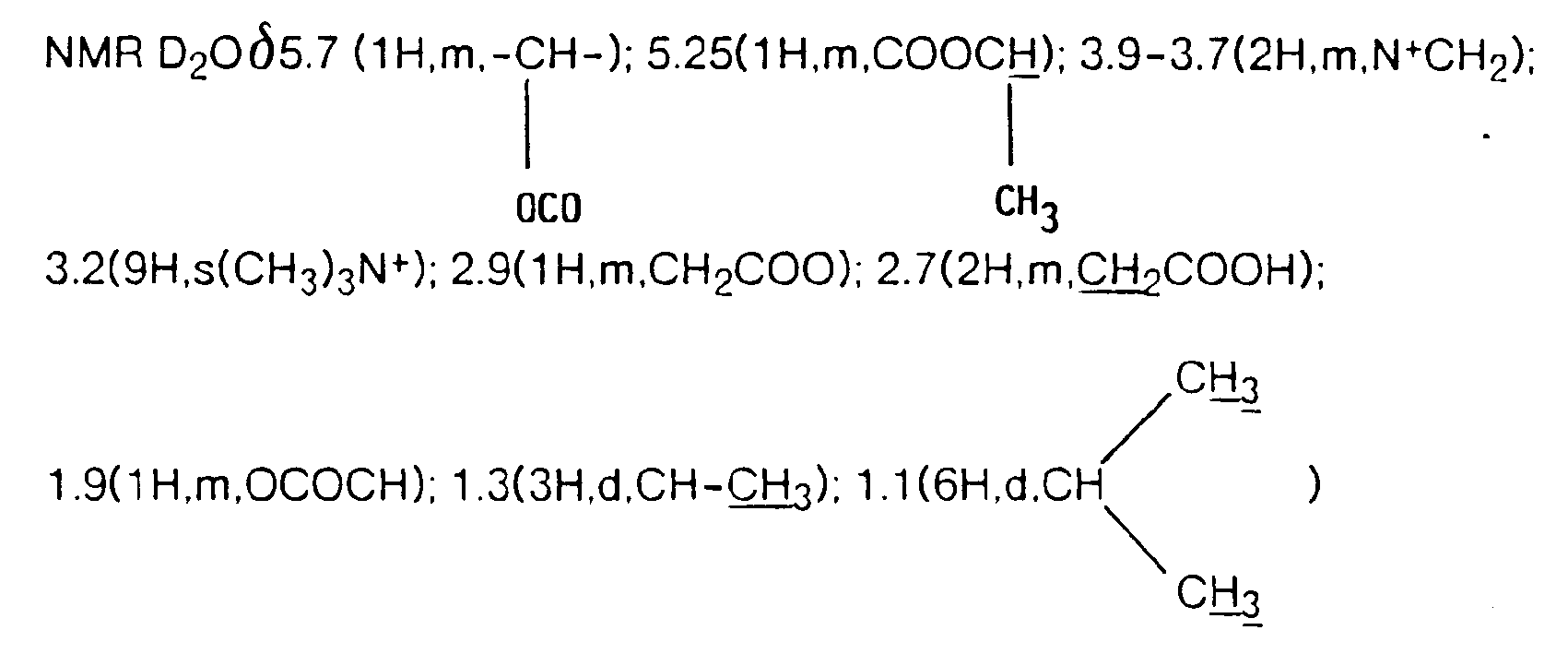

HPLC
Column » Bondapack - C₁₈
Eluant KH₂PO₄0.05M - CH₃CN 85-15
UV detector λ = 205 nm
Flowrate 1 ml/min
Rt = 8.10 - 9.98 (the two diastereomers are thus shown) - Preparation of the ester of acetyl (R)(-)-carnitine chloride with (R,S)(±)beta-hydroxybutyric acid (ST 765)
- Intermediate 3, ester of acetyl (R)( -)carnitine chloride with (R,S)(±)-beta-hydroxybutyric acid benzyl ester, was purified via preparative HPLC as described in step C of Example 2.
Yield 50%
analytic HPLC
Column » Bondapack C₁₈
Eluant phosphate buffer KH₂PO₄ 0.05M - CH₃CN 60-40
Flowrate 1 ml/min
UV detector λ = 205 nm
Rt = 11.73 - Ester of acetyl (R)(-)-carnitine chloride with (R,S)(±)beta-hydroxybutyric acid (ST 765)
Prepared as described in step d of Example 1
[α]
TLC CHCl₃ - H₂O - isoprOH - MetOH - AcOH (4.2 - 1.05 - 0.7 - 2.8 - 1.05)
Rf = 0.6

H₂O 0.46%
HPLC
Column » Bondapack C₁₈
Eluant phosphate buffer KH₂PO₄ 0.05M - CH₃CN 90 - 10
Flowrate 0.5 ml/min
UV detector λ = 205 nm
Rt = 11.68 - 12.83 (the two diastereomers are thus shown). - Preparation of the ester of propionyl (R)(-)-carnitine chloride with (R,S)(±)beta-hydroxybutyric acid (ST 780).
- Intermediate 3, ester of propionyl (R)(-)-carnitine chloride with (R,S)(±)-beta-hydroxybutyric acid benzyl ester, was purified via preparative HPLC as described in step c of example 2.
Yield 50%
analytic HPLC
Column » Bondapack C₁₈

Flowrate 1 ml/min
UV detector λ = 205 nm
Rt = 8.46 - Ester of propionyl-(R)(-)-carnitine chloride with (R,S)(±)beta-hydroxybutyric acid (ST 780).
Prepared as described in step d of Example 1.
[α]

HPLC
Column » Bondapack C₁₈
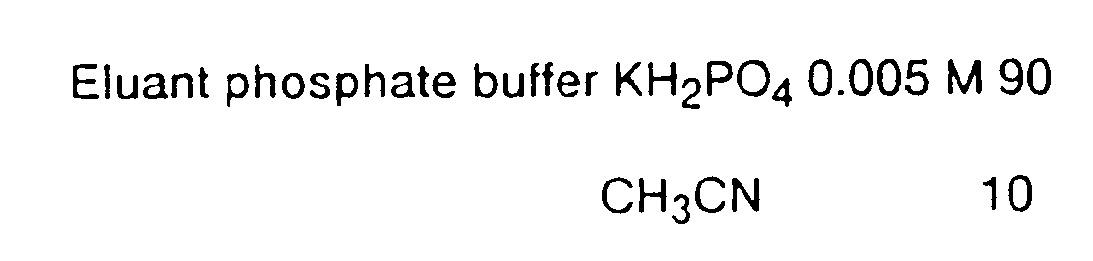
Flowrate 0.5 ml/min
UV detector λ = 20.5 nm
Rt = 6.40-7.07 (the two diastereomers are thus shown). - Preparation of the ester of R(-)-carnitine chloride with R,S(±)beta-hydroxybutyric acid (ST 784).
The compound was prepared as described in the previous Examples 1-4.
[α]

HPLC
Column Novapak C₁₈
mobile phase KH₂PO₄ 50 mM
Flowrate 1 ml/min
Rt = 4.56-5.01 min (the two diastereomers are thus shown) - Ester of isobutyryl (R)(-)-carnitine chloride with R(-)-beta-hydroxybutyric acid (ST 863).
The compound was prepared as described in Example 2 (ST 730)
The compound of step c, ester of isobutyryl (R)(-)-carnitine with R(-)-beta-hydroxybutyric acid benzyl ester, showed the following characteristics:
[α]
HPLC
Column » Bondapack C₁₈
mobile phase NaClO₄ 0.05M-CH₃CN (60-40)
Flowrate 1.5 ml/min
UV detector λ = 205 nm
Rt = 15.64 min
The compound of step d, i.e. the title compound ester of isobutyryl (R)(-)-carnitine chloride with R(-)-beta-hydroxybutyric acid (ST 863), showed the following characteristics:
[α]
HPLC
Column » Bondapack C₁₈
mobile phase KH₂PO₄ 0.05M - CH₃CN 70-30
Flowrate 1 ml/min
UV detector λ = 205 nm
Rt = 8.25 - Ester of isobutyryl (R)( -)-carnitine chloride with S(+)-beta-hydroxybutyric acid (ST 864).
The compound was prepared as described in Example 2 (ST 730)
The compound of step c, ester of isobutyryl (R)(-)-carnitine chloride with S(+)-beta-hydroxybutyric acid benzyl ester, showed the following characteristics:
[α]
HPLC
Column » Bondapak C₁₈
mobile phase NaClO₄ 0.05M-CH₃CN (60-40)
Flowrate 1.5 ml/min
UV detector λ = 205 nm
Rt = 14.79 min
The compound of step d, i.e. the title compound ester of isobutyryl (R)(-)-carnitine with S(+)-beta-hydroxybutyric acid (ST 864), showed the following characteristics:
[α]
HPLC
Column » Bondapack C₁₈
mobile phase KH₂PO₄ 0.05M-CH₃CN (70-30)
Flowrate 1 ml/min
UV detector λ = 205 nm
Rt = 7.32 min - Ester of butyryl (R)(-)-carnitine chloride with (R,S)(±)-betahydroxybutyric acid (ST 877).
The compound was prepared as described in Example 1.
The compound of step c, ester of butyryl (R)(-)-carnitine chloride with (R,S)(±)-betahydroxybutyric acid benzyl ester, showed the following characteristics:
[α]
HPLC
Column 53 ODS1 (100 mm x 1 mm) Sperisorb
mobile phase KH₂PO₄ 0.05M - CH₃CN 70-30
UV detector λ = 205 nm
Flowrate 0.1 ml/min
Rt = 30 min
The compound of step d, i.e. the title ester of butyryl (R)(-)-carnitine chloride with (R,S)(±)-beta-hydroxybutyric acid (ST 877), showed the following characteristics:
[α]
HPCL
Column Bondapak NH2
mobile phase KH₂PO₄ 0.05M - CH₃CN 35-65
UV detector λ = 205 nm
Flowrate 0.1 ml/min
Rt = 5.62
Effect of ST 687 on the neurologic deficit, memory impairment and cerebral oedema in post-oligaemic rats. - The study was conducted with a view to assessing the therapeutical effect of ST 687 administered i.p. to rats immediately after the effect of a transient forebrain oligohaemia in the experiment animals were detected. In particular, the propensity of post-oligaemic rats to develop conditioning was studied in a one-trial passive avoidance task. Concurrently, the neurologic deficit during a 3-day period following the ischaemic insult was assessed, and finally the extent of the oedema was assessed by measuring the water content of the cerebral tissue.
- The effects of ST 687 were compared with those of acetyl (R)(-)-carnitine studied under identical experimental conditions.
- In the experiments Sprague-Dawley (Iffa Credo) male rats weighing 230-250 g were used, that had been caged (5 rats/cage) under conditions of controlled temperature (22°C±1°C), 50% relative humidity and 12-hours dark-light cycle (light on from 8 a.m. to 8 p.m.). The rats were fed UAR (Epinay Orge, France) laboratory chow and had free access to tap water. The rats were caged for 5 days before surgery.
- Under light ether anesthesia, carotid arteries were isolated and loosely surrounded by a thread. Twenty-four hours later, reversible incomplete forebrain ischemia was produced by bilateral common carotid artery occlusion combined with sodium nitroprusside-induced arterial hypotension (1.1 mg/rat s.c.). Mean arterial blood pressure (MABP) was lowered and maintained nearby 6.6 kPa for 45 min. Then it gruadually returned to normal within the 60th minute when carotid occlusion was removed.
- The neurological deficit was assessed via the observational method described by Irwin S.: Comprehensive observational assessment: I a. A systematic, qualitative procedure for assessing the behavioural and physiologic states of the mouse. Psychopharmacologia (Berl.), 1968, 13 : 222-257, for quantifying the behavioural and physiologic state of the mouse. The rats were lifted vertically by mid-tail approximately 15 cm above a rod and lowered to elicit the visual placing response, usually characterized by an extension of forelimbs before contact. The rating was as follows: 3 = normal behaviour (the rat grasps the rod) : 2 = mild anterolateral rotation of the forelimbs (the grasping reflex only occurs when the rat is placed close to the rod) : 1 = severe rotation of the forelimbs and of the body (the grasping reflex occurs occasionally when the rat touches the rod) : 0 = no grasping reflex. The neurological deficit according to this criterion was evaluated respectively 3, 24, 48 and 72 hours following oligohaemia.
- The functional aspects of the cerebral ischemic injury were assessed by a one trial learning procedure (passive avoidance reaction) as originally described by Kurtz K. H. e Pearl J.: The effects of prior fear experience in acquired drive learning. J. Comp. Physiol, Psychol, 1960, 53 : 201-206, and more extensively developed by Buresova et al.: Effect of atropine on learning, extinction, retention and retrieval in rats. Psychopharmacologia, 1964, 5 : 255-263.
- Four hours after clipping-off untreated post-oligaemic rats were placed into an apparatus consisting of a large illuminated compartment (40 x 40 cm) connected by an opening to a small dark compartment (10 x 10 cm) with an electrified grid floor. The animals placed into the large compartment were allowed to explore the apparatus for three minutes. The latency to enter and the time spent in the small compartment were measured with a stop watch. Habituation to the experimental conditions was repeated 24 and 29 hours after ischemia. At the end of the third habituation trial, the opening between the two compartments was closed and the rat, placed into the small compartment, received intermittent electrical foot-shocks for one minute. The retention of the passive avoidance towards the small compartment was tested 24 and 48 hours after the last habituation trial i.e. 53 and 77 hours post-oligohaemia, respectively. The criterion used to determine whether an animal was conditioned was based upon the rat remaining in the large illuminated compartment for 180 sec. without entry into the small dark compartment.
- Immediately after the last retention trial, i.e. 77 hours post-oligohaemia, rats were sacrificed by decapitation, their brains rapidly removed and macroscopically examined in terms of swelling. Brain water content was determined by the method wet weight/dry weight.
- Death-rate, cerebral oedema and passive avoidance in post-oligaemic rats and following treatment with acetyl(R)(-)-carnitine and ST 687

Protective effect of ST 784 against acetaminophen (paracetamol)-induced hepatic damage. - Paracetamol has been widely used as analgesic and antipyretic. Paracetamol overdosage is known to provoke serious hepatic damages.
- Male Wistar rats weighing 200-250 g (15 rats/group) that had been keept fasting for at least 12 hours, were administered a single dose of paracetamol (1 g/kg body weight, per os). 100 g paracetamol were dissolved in 1000 ml of 5% (w/v) carboxymethylcellulose suspension in water. (Hence, the animals were actually administered 10 ml paracetamol solution/kg body weight). 101 mg ST 784/kg body weight were administered orally (as aqueous solution) 1, 8 and 24 hours, respectively, following paracetamol administration. The animals were sacrificed 32 hours following paracetamol administration.
- Transaminases (SGOT and SGPT) were measured in blood serum. ST 784 provoked a decrease in transaminases exceding 60% (p≦5) with respect to the control animals.
- The compounds of the present invention are orally or parenterally administered, in any of the usual pharmaceutical forms which are prepared by conventional procedures well-known to those persons skilled in the pharmaceutical techonology. These forms include solid and liquid oral unit dosage forms such as tablets, capsules, solution, syrups and the like as well as injectable forms, such as sterile solutions for ampoules and phials.
- For these pharmaceutical forms the usual solvents, diluents and excipients are used. Optionally, sweetening, flavouring and preservative agents can also be bresent. Non limiting examples of such agents are sodium carboxymethylcellulose, polysorbate, mannitol, sorbitol, starch, avicel, talcum and other agents which will be apparent to those skilled in the pharmaceutical technology.
- The dose which is administered will be determined by the attending physician having regard to the age, weight and general conditions of the patient, utilizing sound professional judgement. Although effective results can be noticed at doses as low as 5 to 8 mg/kg of body weight daily, a dose of from about 10 to about 50 mg/kg of body weight is preferred. Whenever necessary, larger doses can be safely administered in view of the low toxicity of the compounds of this invention.
- As non-limiting examples and depending on the specific pharmaceutical form of administration, the following dosages can be indicated:
- for the phials
- : from 5 to 500 mg
- for the capsules
- : from 15 to 50 mg
- for the tablets
- : from 15 to 500 mg
- for the oral solution
- : from 15 to 50 mg

Claims (7)
- A process for preparing esters of (R)(-)-carnitine and acyl (R)(-)-carnitine wiht β-hydroxybutyric acid of general formula (I)
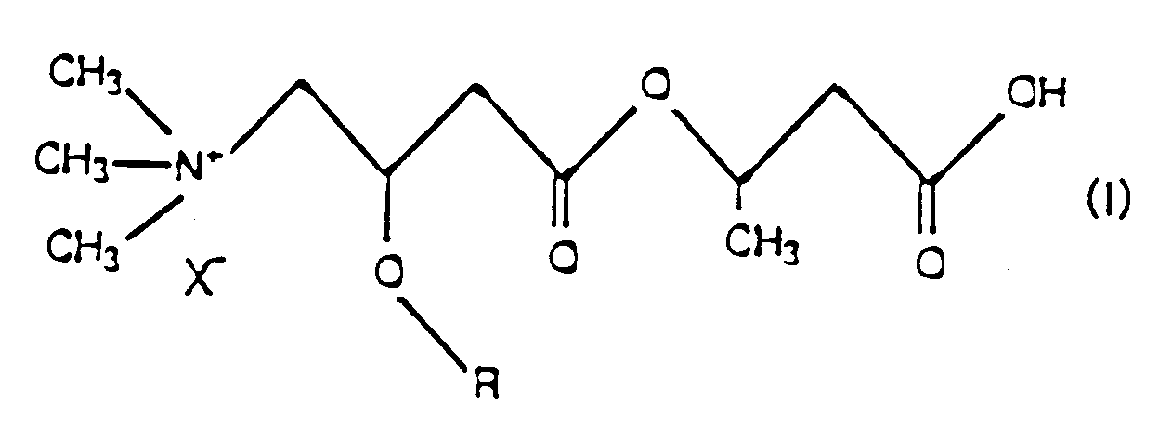 1) condensing the sodium salt of β-hydroxybutyric acid with benzyl chloride in the presence of crown-ethers, in an organic solvent, in an inert gas atmosphere, at a temperature comprised between 20°C and 30°C, for 1-2 hours, and isolating the benzylester of β-hydroxybutyric acid thus obtained via distillation under vacuum;2) condensing the acid chloride of (R)(-)-carnitine or acyl (R)(-)-carnitine with the benzylester of β-hydroxybutyric acid in an inert anhydrous organic solvent, at a temperature comprised between 20°C and 30°C, for 12-24 hours, and isolating the compound thus obtained, acyl (R)(-)-carnitine ester with β-hydroxybutyric acid and benzylester, from the reaction mixture by precipitation with an organic solvent, such as ethyl ether or acetonitrile; and3) hydrogenating the compound obtained in step 2) in a water or ethanol solution or mixtures thereof, in the presence of a hydrogenation catalyst, such as 5% or 10% Pd/C, for 30-180 minutes, at a hydrogen pressure of 2.026-5.066 bars, and isolating the product thus obtained, acyl (R)(-)-carnitine β-hydroxybutyric acid, by concentrating under vacuum the solution to dryness.
Applications Claiming Priority (2)
| Application Number | Priority Date | Filing Date | Title |
|---|---|---|---|
| IT4766990 | 1990-02-23 | ||
| IT47669A IT1240775B (en) | 1990-02-23 | 1990-02-23 | ESTERS OF L-CARNITINE AND ACYL-L-CARNITINE WITH BETA-HYDROXYBUTIRRIC ACID AND PHARMACEUTICAL COMPOSITIONS THAT CONTAIN THEM FOR THE INHIBITION OF NEURONAL DEGENERATION, HEPATIC PROTEOLYSIS AND COMA TREATMENT. |
Publications (2)
| Publication Number | Publication Date |
|---|---|
| EP0443996A1 EP0443996A1 (en) | 1991-08-28 |
| EP0443996B1 true EP0443996B1 (en) | 1994-06-22 |
Family
ID=11261785
Family Applications (1)
| Application Number | Title | Priority Date | Filing Date |
|---|---|---|---|
| EP91830062A Expired - Lifetime EP0443996B1 (en) | 1990-02-23 | 1991-02-21 | Esters of (R)(-)-carnitine and acyl (R)(-)-carnitines with beta-hydroxybutyric acid and pharmaceutical compositions containing them for inhibiting neuronal degeneration, liver proteolysis and for the treatment of coma |
Country Status (8)
| Country | Link |
|---|---|
| EP (1) | EP0443996B1 (en) |
| JP (1) | JP2930755B2 (en) |
| AT (1) | ATE107624T1 (en) |
| DE (1) | DE69102560T2 (en) |
| DK (1) | DK0443996T3 (en) |
| ES (1) | ES2056620T3 (en) |
| HK (1) | HK1005868A1 (en) |
| IT (1) | IT1240775B (en) |
Cited By (3)
| Publication number | Priority date | Publication date | Assignee | Title |
|---|---|---|---|---|
| US8748400B2 (en) | 2006-04-03 | 2014-06-10 | Accera, Inc. | Use of ketogenic compounds for treatment of age-associated memory impairment |
| US9175345B2 (en) | 2007-07-31 | 2015-11-03 | Accera, Inc. | Use of genomic testing and ketogenic compounds for treatment of reduced cognitive function |
| US10111849B2 (en) | 2000-05-01 | 2018-10-30 | Accera, Inc. | Use of medium chain triglycerides for the treatment and prevention of Alzheimer's disease and other diseases resulting from reduced neuronal metabolism II |
Families Citing this family (11)
| Publication number | Priority date | Publication date | Assignee | Title |
|---|---|---|---|---|
| IT1248321B (en) * | 1991-05-15 | 1995-01-05 | Sigma Tau Ind Farmaceuti | USE OF ACYL L-CARNITINE ESTERS WITH GAMMA-HYDROXYBUTIRRIC ACID TO PRODUCE PHARMACEUTICAL COMPOSITIONS FOR THE TREATMENT OF HEPATOPATHIES |
| IT1254136B (en) * | 1992-01-16 | 1995-09-08 | Sigma Tau Ind Farmaceuti | ACIL CARNITINE ESTERS WITH LONG CHAIN ALIPHATIC ALCOHOLS AND PHARMACEUTICAL COMPOSITIONS THAT CONTAIN THEM, WITH ANTI-Fungal activity. |
| IT1254135B (en) * | 1992-01-16 | 1995-09-08 | Sigma Tau Ind Farmaceuti | ACIL CARNITINE ESTERS WITH LONG CHAIN ALIPHATIC ALCOHOLS AND PHARMACEUTICAL COMPOSITIONS CONTAINING THEM, WITH ANTIBACTERIAL ACTIVITY. |
| IT1263013B (en) * | 1992-10-20 | 1996-07-23 | Avantgarde Spa | ESTERS OF L-CARNITINE AND ALCANOYL L-CARNITINE WITH GLYCOLIC ACID OR ITS ESTERS AND PHARMACEUTICAL COMPOSITIONS CONTAINING SUCH AS FOR THE TREATMENT OF SKIN DISEASES. |
| IT1261984B (en) * | 1993-06-22 | 1996-06-11 | Avantgarde Spa | USE OF L-CARNITINE ESTERS OR ACIL L-CARNITINE WITH HYDROXIACID TO PRODUCE PHARMACEUTICAL COMPOSITIONS FOR THE TREATMENT OF SKIN DISEASES. |
| US6323237B1 (en) | 1997-03-17 | 2001-11-27 | Btg International Limited | Therapeutic compositions |
| CN1315473C (en) * | 1997-03-17 | 2007-05-16 | 英国技术集团国际有限公司 | Therapeutic compositions |
| ES2752800T3 (en) * | 2000-05-01 | 2020-04-06 | Cerecin Inc | Use of medium chain triglycerides for the treatment and prevention of Parkinson's disease resulting from reduced neuronal metabolism |
| CN1995010B (en) * | 2006-12-29 | 2012-12-12 | 辽宁科硕营养科技有限公司 | Method for synthesizing propionyl levo-carnitine hydrochlorate |
| US9125881B2 (en) | 2008-07-03 | 2015-09-08 | Accera, Inc. | Monoglyceride of acetoacetate and derivatives for the treatment of neurological disorders |
| CN112341331B (en) * | 2019-08-07 | 2023-04-07 | 辽宁科硕营养科技股份有限公司 | 3-hydroxybutyrate and preparation method and application thereof |
Family Cites Families (3)
| Publication number | Priority date | Publication date | Assignee | Title |
|---|---|---|---|---|
| IT1116037B (en) * | 1979-04-23 | 1986-02-10 | Sigma Tau Ind Farmaceuti | ACIL CARNITINE ESTERS AND AMIDS THEIR PREPARATION PROCEDURES AND THERAPEUTIC USE |
| IT1145362B (en) * | 1980-03-06 | 1986-11-05 | Sigma Tau Ind Farmaceuti | ACYL-DERIVATIVES CLASS OF CARNITINE PROCEDURE FOR THEIR PREPARATION AND THERAPEUTIC USE |
| IT1209564B (en) * | 1984-06-29 | 1989-08-30 | Magis Farmaceutici | DERIVATIVES OF L-CARNITINE OR L-ACYL CARNITINE. |
-
1990
- 1990-02-23 IT IT47669A patent/IT1240775B/en active IP Right Grant
-
1991
- 1991-02-21 AT AT91830062T patent/ATE107624T1/en not_active IP Right Cessation
- 1991-02-21 DK DK91830062.5T patent/DK0443996T3/en active
- 1991-02-21 ES ES91830062T patent/ES2056620T3/en not_active Expired - Lifetime
- 1991-02-21 EP EP91830062A patent/EP0443996B1/en not_active Expired - Lifetime
- 1991-02-21 DE DE69102560T patent/DE69102560T2/en not_active Expired - Fee Related
- 1991-02-22 JP JP3050644A patent/JP2930755B2/en not_active Expired - Fee Related
-
1998
- 1998-06-05 HK HK98104950A patent/HK1005868A1/en not_active IP Right Cessation
Cited By (4)
| Publication number | Priority date | Publication date | Assignee | Title |
|---|---|---|---|---|
| US10111849B2 (en) | 2000-05-01 | 2018-10-30 | Accera, Inc. | Use of medium chain triglycerides for the treatment and prevention of Alzheimer's disease and other diseases resulting from reduced neuronal metabolism II |
| US8748400B2 (en) | 2006-04-03 | 2014-06-10 | Accera, Inc. | Use of ketogenic compounds for treatment of age-associated memory impairment |
| US9175345B2 (en) | 2007-07-31 | 2015-11-03 | Accera, Inc. | Use of genomic testing and ketogenic compounds for treatment of reduced cognitive function |
| US10105338B2 (en) | 2007-07-31 | 2018-10-23 | Accera, Inc. | Use of genomic testing and ketogenic compounds for treatment of reduced cognitive function |
Also Published As
| Publication number | Publication date |
|---|---|
| IT1240775B (en) | 1993-12-17 |
| DE69102560T2 (en) | 1994-10-13 |
| ATE107624T1 (en) | 1994-07-15 |
| IT9047669A1 (en) | 1991-08-24 |
| JPH0597785A (en) | 1993-04-20 |
| JP2930755B2 (en) | 1999-08-03 |
| HK1005868A1 (en) | 1999-01-29 |
| IT9047669A0 (en) | 1990-02-23 |
| DE69102560D1 (en) | 1994-07-28 |
| EP0443996A1 (en) | 1991-08-28 |
| DK0443996T3 (en) | 1994-07-25 |
| ES2056620T3 (en) | 1994-10-01 |
Similar Documents
| Publication | Publication Date | Title |
|---|---|---|
| HK1005868A1 (en) | Esters of (r)(-)-carnitine and acyl (r)(-)-carnitines with beta-hydroxybutyric acid and pharmaceutical compositions containing them for inhibiting neuronal degeneration, liver proteolysis and for the treatment of coma | |
| HK1005868B (en) | Esters of (r)(-)-carnitine and acyl (r)(-)-carnitines with beta-hydroxybutyric acid and pharmaceutical compositions containing them for inhibiting neuronal degeneration, liver proteolysis and for the treatment of coma | |
| EP0442850B1 (en) | Esters of acyl L-carnitines with gamma-hydroxybutyric acid and pharmaceutical compositions containing them for inhibiting neuronal degeneration and for the treatment of coma | |
| US4894476A (en) | Gabapentin monohydrate and a process for producing the same | |
| EP0631779B1 (en) | Use of esters of L-carnitine and acyl L-carnitine with hydroxyacids for producing pharmaceutical compositions for treating dermatoses | |
| HK1005859B (en) | Esters of acyl l-carnitines with gamma-hydroxybutyric acid and pharmaceutical compositions containing them for inhibiting neuronal degeneration and for the treatment of coma | |
| GB2048268A (en) | Amides of acyl-carnitines process for preparing same and pharmaceutical compositions containing such amides | |
| EP0429403B1 (en) | Ester of L-carnitine with gamma-hydroxybutyric acid and pharmaceutical compositions containing it for inhibiting neuronal degeneration and for the treatment of coma | |
| JP3502649B2 (en) | Method for producing L-(-)-carnitine from configurational isomer by-product | |
| AU2003290075B2 (en) | Method for production of the r,r (or s,s) configuration of glycopyrronium stereoisomers | |
| EP0559625B1 (en) | Esters of L-carnitine and acyl L-carnitine endowed with muscle relaxant activityselective on gastrointestinal tract and pharmaceutical compositions containing same | |
| US5246967A (en) | Use of esters of acyl l-carnitines with gamma-hydroxybutyric acid for producing pharmaceutical compositions for the treatment of hepatopathies | |
| US4784992A (en) | Phosphorylalkanolamide derivatives of L-carnitine and pharmaceutical compositions containing same | |
| HK1005848B (en) | Use of esters of acyl l-carnitines with gamma-hydroxybutyric acid for producing pharmaceutical compositions for the treatment of hepatopathies | |
| US4695588A (en) | Fluorinated amino acids | |
| US5625085A (en) | Esters of acyl L-carnitines and pharmaceutical compositons containing same for treating endotoxic shock | |
| EP2702033B1 (en) | Use of 3-carboxy-n-ethyl-n,n-dimethylpropan-1-aminium salts in the treatment of cardiovascular disease | |
| EP1853556A1 (en) | Derivatives of aminobutanoic acid inhibiting cpt | |
| AU8532198A (en) | Novel pentaerythrite derivatives, the production and use thereof and intermediate products for the synthesis of the same | |
| HK1006368B (en) | Esters of l-carnitine and acyl l-carnitine endowed with muscle relaxant activityselective on gastrointestinal tract and pharmaceutical compositions containing same | |
| FR2512015A1 (en) | 2-OXO-1,5-PENTANE DIOIC ACID SALTS, METHOD FOR THE PRODUCTION THEREOF AND MEDICAMENTS COMPRISING THESE SALTS | |
| GB2120250A (en) | Enantiomers of 2,3,3a,4,5,6- hexahydro-1H-indolo(3,2,1- de)-[1,5-naphthyridine] | |
| HK1008660A (en) | Use of esters of l-carnitine and acyl l-carnitine with hydroxyacids for producing pharmaceutical compositions for treating dermatoses. | |
| HK1005858B (en) | Ester of l-carnitine with gamma-hydroxybutyric acid and pharmaceutical compositions containing it for inhibiting neuronal degeneration and for the treatment of coma |
Legal Events
| Date | Code | Title | Description |
|---|---|---|---|
| PUAI | Public reference made under article 153(3) epc to a published international application that has entered the european phase |
Free format text: ORIGINAL CODE: 0009012 |
|
| AK | Designated contracting states |
Kind code of ref document: A1 Designated state(s): AT BE CH DE DK ES FR GB GR IT LI LU NL SE |
|
| 17P | Request for examination filed |
Effective date: 19911005 |
|
| 17Q | First examination report despatched |
Effective date: 19930430 |
|
| GRAA | (expected) grant |
Free format text: ORIGINAL CODE: 0009210 |
|
| AK | Designated contracting states |
Kind code of ref document: B1 Designated state(s): AT BE CH DE DK ES FR GB GR IT LI LU NL SE |
|
| REF | Corresponds to: |
Ref document number: 107624 Country of ref document: AT Date of ref document: 19940715 Kind code of ref document: T |
|
| REG | Reference to a national code |
Ref country code: DK Ref legal event code: T3 |
|
| REF | Corresponds to: |
Ref document number: 69102560 Country of ref document: DE Date of ref document: 19940728 |
|
| ET | Fr: translation filed | ||
| REG | Reference to a national code |
Ref country code: GR Ref legal event code: FG4A Free format text: 3012321 |
|
| ITF | It: translation for a ep patent filed | ||
| REG | Reference to a national code |
Ref country code: ES Ref legal event code: FG2A Ref document number: 2056620 Country of ref document: ES Kind code of ref document: T3 |
|
| EAL | Se: european patent in force in sweden |
Ref document number: 91830062.5 |
|
| PLBE | No opposition filed within time limit |
Free format text: ORIGINAL CODE: 0009261 |
|
| STAA | Information on the status of an ep patent application or granted ep patent |
Free format text: STATUS: NO OPPOSITION FILED WITHIN TIME LIMIT |
|
| 26N | No opposition filed | ||
| ITTA | It: last paid annual fee | ||
| REG | Reference to a national code |
Ref country code: GB Ref legal event code: IF02 |
|
| REG | Reference to a national code |
Ref country code: CH Ref legal event code: PFA Owner name: SIGMA-TAU INDUSTRIE FARMACEUTICHE RIUNITE S.P.A. Free format text: SIGMA-TAU INDUSTRIE FARMACEUTICHE RIUNITE S.P.A.#VIALE SHAKESPEARE, 47#ROMA (IT) -TRANSFER TO- SIGMA-TAU INDUSTRIE FARMACEUTICHE RIUNITE S.P.A.#VIALE SHAKESPEARE, 47#ROMA (IT) |
|
| PGFP | Annual fee paid to national office [announced via postgrant information from national office to epo] |
Ref country code: ES Payment date: 20080226 Year of fee payment: 18 Ref country code: CH Payment date: 20080228 Year of fee payment: 18 Ref country code: DK Payment date: 20080228 Year of fee payment: 18 |
|
| PGFP | Annual fee paid to national office [announced via postgrant information from national office to epo] |
Ref country code: SE Payment date: 20080227 Year of fee payment: 18 Ref country code: NL Payment date: 20080224 Year of fee payment: 18 Ref country code: IT Payment date: 20080228 Year of fee payment: 18 Ref country code: GB Payment date: 20080227 Year of fee payment: 18 Ref country code: LU Payment date: 20080307 Year of fee payment: 18 |
|
| PGFP | Annual fee paid to national office [announced via postgrant information from national office to epo] |
Ref country code: AT Payment date: 20080201 Year of fee payment: 18 |
|
| PGFP | Annual fee paid to national office [announced via postgrant information from national office to epo] |
Ref country code: FR Payment date: 20080218 Year of fee payment: 18 Ref country code: DE Payment date: 20080331 Year of fee payment: 18 |
|
| PGFP | Annual fee paid to national office [announced via postgrant information from national office to epo] |
Ref country code: BE Payment date: 20080306 Year of fee payment: 18 |
|
| PGFP | Annual fee paid to national office [announced via postgrant information from national office to epo] |
Ref country code: GR Payment date: 20080228 Year of fee payment: 18 |
|
| BERE | Be: lapsed |
Owner name: *SIGMA-TAU INDUSTRIE FARMACEUTICHE RIUNITE S.P.A. Effective date: 20090228 |
|
| REG | Reference to a national code |
Ref country code: CH Ref legal event code: PL |
|
| EUG | Se: european patent has lapsed | ||
| REG | Reference to a national code |
Ref country code: DK Ref legal event code: EBP |
|
| GBPC | Gb: european patent ceased through non-payment of renewal fee |
Effective date: 20090221 |
|
| PG25 | Lapsed in a contracting state [announced via postgrant information from national office to epo] |
Ref country code: AT Free format text: LAPSE BECAUSE OF NON-PAYMENT OF DUE FEES Effective date: 20090221 Ref country code: CH Free format text: LAPSE BECAUSE OF NON-PAYMENT OF DUE FEES Effective date: 20090228 Ref country code: LI Free format text: LAPSE BECAUSE OF NON-PAYMENT OF DUE FEES Effective date: 20090228 |
|
| NLV4 | Nl: lapsed or anulled due to non-payment of the annual fee |
Effective date: 20090901 |
|
| REG | Reference to a national code |
Ref country code: FR Ref legal event code: ST Effective date: 20091030 |
|
| PG25 | Lapsed in a contracting state [announced via postgrant information from national office to epo] |
Ref country code: NL Free format text: LAPSE BECAUSE OF NON-PAYMENT OF DUE FEES Effective date: 20090901 |
|
| PG25 | Lapsed in a contracting state [announced via postgrant information from national office to epo] |
Ref country code: DE Free format text: LAPSE BECAUSE OF NON-PAYMENT OF DUE FEES Effective date: 20090901 |
|
| PG25 | Lapsed in a contracting state [announced via postgrant information from national office to epo] |
Ref country code: BE Free format text: LAPSE BECAUSE OF NON-PAYMENT OF DUE FEES Effective date: 20090228 Ref country code: GR Free format text: LAPSE BECAUSE OF NON-PAYMENT OF DUE FEES Effective date: 20090902 |
|
| REG | Reference to a national code |
Ref country code: ES Ref legal event code: FD2A Effective date: 20090223 |
|
| PG25 | Lapsed in a contracting state [announced via postgrant information from national office to epo] |
Ref country code: GB Free format text: LAPSE BECAUSE OF NON-PAYMENT OF DUE FEES Effective date: 20090221 Ref country code: FR Free format text: LAPSE BECAUSE OF NON-PAYMENT OF DUE FEES Effective date: 20090302 |
|
| PG25 | Lapsed in a contracting state [announced via postgrant information from national office to epo] |
Ref country code: ES Free format text: LAPSE BECAUSE OF NON-PAYMENT OF DUE FEES Effective date: 20090223 Ref country code: DK Free format text: LAPSE BECAUSE OF NON-PAYMENT OF DUE FEES Effective date: 20090831 |
|
| PG25 | Lapsed in a contracting state [announced via postgrant information from national office to epo] |
Ref country code: IT Free format text: LAPSE BECAUSE OF NON-PAYMENT OF DUE FEES Effective date: 20090221 |
|
| PG25 | Lapsed in a contracting state [announced via postgrant information from national office to epo] |
Ref country code: LU Free format text: LAPSE BECAUSE OF NON-PAYMENT OF DUE FEES Effective date: 20090221 |
|
| PG25 | Lapsed in a contracting state [announced via postgrant information from national office to epo] |
Ref country code: SE Free format text: LAPSE BECAUSE OF NON-PAYMENT OF DUE FEES Effective date: 20090222 |