EP0443719B1 - Novel R106 compounds - Google Patents
Novel R106 compounds Download PDFInfo
- Publication number
- EP0443719B1 EP0443719B1 EP91300438A EP91300438A EP0443719B1 EP 0443719 B1 EP0443719 B1 EP 0443719B1 EP 91300438 A EP91300438 A EP 91300438A EP 91300438 A EP91300438 A EP 91300438A EP 0443719 B1 EP0443719 B1 EP 0443719B1
- Authority
- EP
- European Patent Office
- Prior art keywords
- compounds
- compound
- novel
- antibiotics
- mephe
- Prior art date
- Legal status (The legal status is an assumption and is not a legal conclusion. Google has not performed a legal analysis and makes no representation as to the accuracy of the status listed.)
- Expired - Lifetime
Links
- 150000001875 compounds Chemical class 0.000 title claims description 64
- SCIFESDRCALIIM-VIFPVBQESA-N N-methyl-L-phenylalanine Chemical compound C[NH2+][C@H](C([O-])=O)CC1=CC=CC=C1 SCIFESDRCALIIM-VIFPVBQESA-N 0.000 claims description 13
- PMMYEEVYMWASQN-UHFFFAOYSA-N dl-hydroxyproline Natural products OC1C[NH2+]C(C([O-])=O)C1 PMMYEEVYMWASQN-UHFFFAOYSA-N 0.000 claims description 7
- 241001102832 Meseres Species 0.000 claims description 4
- 229940121375 antifungal agent Drugs 0.000 claims description 3
- 239000003429 antifungal agent Substances 0.000 claims description 2
- 239000003795 chemical substances by application Substances 0.000 claims 1
- 239000008194 pharmaceutical composition Substances 0.000 claims 1
- CSCPPACGZOOCGX-UHFFFAOYSA-N Acetone Chemical compound CC(C)=O CSCPPACGZOOCGX-UHFFFAOYSA-N 0.000 description 21
- XEKOWRVHYACXOJ-UHFFFAOYSA-N Ethyl acetate Chemical compound CCOC(C)=O XEKOWRVHYACXOJ-UHFFFAOYSA-N 0.000 description 18
- ROHFNLRQFUQHCH-YFKPBYRVSA-N L-leucine Chemical compound CC(C)C[C@H](N)C(O)=O ROHFNLRQFUQHCH-YFKPBYRVSA-N 0.000 description 18
- COLNVLDHVKWLRT-QMMMGPOBSA-N L-phenylalanine Chemical compound OC(=O)[C@@H](N)CC1=CC=CC=C1 COLNVLDHVKWLRT-QMMMGPOBSA-N 0.000 description 16
- 229940024606 amino acid Drugs 0.000 description 16
- 150000001413 amino acids Chemical class 0.000 description 16
- 239000003242 anti bacterial agent Substances 0.000 description 16
- 229940088710 antibiotic agent Drugs 0.000 description 16
- FSYKKLYZXJSNPZ-UHFFFAOYSA-N sarcosine Chemical compound C[NH2+]CC([O-])=O FSYKKLYZXJSNPZ-UHFFFAOYSA-N 0.000 description 14
- 239000007788 liquid Substances 0.000 description 13
- 239000000243 solution Substances 0.000 description 13
- AGPKZVBTJJNPAG-UHNVWZDZSA-N L-allo-Isoleucine Chemical compound CC[C@@H](C)[C@H](N)C(O)=O AGPKZVBTJJNPAG-UHNVWZDZSA-N 0.000 description 12
- ROHFNLRQFUQHCH-UHFFFAOYSA-N Leucine Natural products CC(C)CC(N)C(O)=O ROHFNLRQFUQHCH-UHFFFAOYSA-N 0.000 description 12
- 238000004458 analytical method Methods 0.000 description 12
- 238000004992 fast atom bombardment mass spectroscopy Methods 0.000 description 12
- 239000011734 sodium Substances 0.000 description 12
- ONIBWKKTOPOVIA-UHFFFAOYSA-N Proline Natural products OC(=O)C1CCCN1 ONIBWKKTOPOVIA-UHFFFAOYSA-N 0.000 description 11
- 238000002360 preparation method Methods 0.000 description 11
- ONIBWKKTOPOVIA-BYPYZUCNSA-N L-Proline Chemical compound OC(=O)[C@@H]1CCCN1 ONIBWKKTOPOVIA-BYPYZUCNSA-N 0.000 description 10
- COLNVLDHVKWLRT-UHFFFAOYSA-N phenylalanine Natural products OC(=O)C(N)CC1=CC=CC=C1 COLNVLDHVKWLRT-UHFFFAOYSA-N 0.000 description 10
- 238000002953 preparative HPLC Methods 0.000 description 10
- WEVYAHXRMPXWCK-UHFFFAOYSA-N Acetonitrile Chemical compound CC#N WEVYAHXRMPXWCK-UHFFFAOYSA-N 0.000 description 9
- OKKJLVBELUTLKV-UHFFFAOYSA-N Methanol Chemical compound OC OKKJLVBELUTLKV-UHFFFAOYSA-N 0.000 description 9
- HEMHJVSKTPXQMS-UHFFFAOYSA-M Sodium hydroxide Chemical compound [OH-].[Na+] HEMHJVSKTPXQMS-UHFFFAOYSA-M 0.000 description 9
- OUYCCCASQSFEME-QMMMGPOBSA-N L-tyrosine Chemical compound OC(=O)[C@@H](N)CC1=CC=C(O)C=C1 OUYCCCASQSFEME-QMMMGPOBSA-N 0.000 description 8
- 238000000746 purification Methods 0.000 description 8
- SNDPXSYFESPGGJ-UHFFFAOYSA-N 2-aminopentanoic acid Chemical compound CCCC(N)C(O)=O SNDPXSYFESPGGJ-UHFFFAOYSA-N 0.000 description 7
- 206010017533 Fungal infection Diseases 0.000 description 7
- 208000031888 Mycoses Diseases 0.000 description 7
- 108010077895 Sarcosine Proteins 0.000 description 7
- 238000006243 chemical reaction Methods 0.000 description 7
- 238000011534 incubation Methods 0.000 description 7
- 238000004519 manufacturing process Methods 0.000 description 7
- 229940043230 sarcosine Drugs 0.000 description 7
- IAZDPXIOMUYVGZ-UHFFFAOYSA-N Dimethylsulphoxide Chemical compound CS(C)=O IAZDPXIOMUYVGZ-UHFFFAOYSA-N 0.000 description 6
- LRQKBLKVPFOOQJ-YFKPBYRVSA-N L-norleucine Chemical compound CCCC[C@H]([NH3+])C([O-])=O LRQKBLKVPFOOQJ-YFKPBYRVSA-N 0.000 description 6
- 238000003811 acetone extraction Methods 0.000 description 6
- 238000003810 ethyl acetate extraction Methods 0.000 description 6
- 238000000855 fermentation Methods 0.000 description 6
- 230000004151 fermentation Effects 0.000 description 6
- AKCRVYNORCOYQT-YFKPBYRVSA-N N-methyl-L-valine Chemical group CN[C@@H](C(C)C)C(O)=O AKCRVYNORCOYQT-YFKPBYRVSA-N 0.000 description 5
- 230000000843 anti-fungal effect Effects 0.000 description 5
- 239000003054 catalyst Substances 0.000 description 5
- 239000003814 drug Substances 0.000 description 5
- 239000000284 extract Substances 0.000 description 5
- XLYOFNOQVPJJNP-UHFFFAOYSA-N water Substances O XLYOFNOQVPJJNP-UHFFFAOYSA-N 0.000 description 5
- WSUWTUNKNBVDKB-IENPIDJESA-N (2s)-3-hydroxy-2-(methylamino)-3-phenylpropanoic acid Chemical compound CN[C@H](C(O)=O)C(O)C1=CC=CC=C1 WSUWTUNKNBVDKB-IENPIDJESA-N 0.000 description 4
- PMMYEEVYMWASQN-DMTCNVIQSA-N Hydroxyproline Chemical compound O[C@H]1CN[C@H](C(O)=O)C1 PMMYEEVYMWASQN-DMTCNVIQSA-N 0.000 description 4
- DZLNHFMRPBPULJ-VKHMYHEASA-N L-thioproline Chemical compound OC(=O)[C@@H]1CSCN1 DZLNHFMRPBPULJ-VKHMYHEASA-N 0.000 description 4
- KZSNJWFQEVHDMF-UHFFFAOYSA-N Valine Chemical group CC(C)C(N)C(O)=O KZSNJWFQEVHDMF-UHFFFAOYSA-N 0.000 description 4
- PBCJIPOGFJYBJE-UHFFFAOYSA-N acetonitrile;hydrate Chemical compound O.CC#N PBCJIPOGFJYBJE-UHFFFAOYSA-N 0.000 description 4
- 238000000034 method Methods 0.000 description 4
- 229960004441 tyrosine Drugs 0.000 description 4
- NYCRCTMDYITATC-UHFFFAOYSA-N 2-fluorophenylalanine Chemical compound OC(=O)C(N)CC1=CC=CC=C1F NYCRCTMDYITATC-UHFFFAOYSA-N 0.000 description 3
- 241000223678 Aureobasidium pullulans Species 0.000 description 3
- WQZGKKKJIJFFOK-GASJEMHNSA-N Glucose Natural products OC[C@H]1OC(O)[C@H](O)[C@@H](O)[C@@H]1O WQZGKKKJIJFFOK-GASJEMHNSA-N 0.000 description 3
- SNDPXSYFESPGGJ-BYPYZUCNSA-N L-2-aminopentanoic acid Chemical compound CCC[C@H](N)C(O)=O SNDPXSYFESPGGJ-BYPYZUCNSA-N 0.000 description 3
- ZMXDDKWLCZADIW-UHFFFAOYSA-N N,N-Dimethylformamide Chemical compound CN(C)C=O ZMXDDKWLCZADIW-UHFFFAOYSA-N 0.000 description 3
- PSFABYLDRXJYID-VKHMYHEASA-N N-Methylserine Chemical compound CN[C@@H](CO)C(O)=O PSFABYLDRXJYID-VKHMYHEASA-N 0.000 description 3
- PSFABYLDRXJYID-UHFFFAOYSA-N N-methyl-DL-serine Natural products CNC(CO)C(O)=O PSFABYLDRXJYID-UHFFFAOYSA-N 0.000 description 3
- KWYUFKZDYYNOTN-UHFFFAOYSA-M Potassium hydroxide Chemical compound [OH-].[K+] KWYUFKZDYYNOTN-UHFFFAOYSA-M 0.000 description 3
- VYPSYNLAJGMNEJ-UHFFFAOYSA-N Silicium dioxide Chemical compound O=[Si]=O VYPSYNLAJGMNEJ-UHFFFAOYSA-N 0.000 description 3
- ZMANZCXQSJIPKH-UHFFFAOYSA-N Triethylamine Chemical compound CCN(CC)CC ZMANZCXQSJIPKH-UHFFFAOYSA-N 0.000 description 3
- 238000010521 absorption reaction Methods 0.000 description 3
- 238000001514 detection method Methods 0.000 description 3
- 239000008103 glucose Substances 0.000 description 3
- 229960002591 hydroxyproline Drugs 0.000 description 3
- 231100000053 low toxicity Toxicity 0.000 description 3
- VWHRYODZTDMVSS-QMMMGPOBSA-N m-fluoro-L-phenylalanine Chemical compound OC(=O)[C@@H](N)CC1=CC=CC(F)=C1 VWHRYODZTDMVSS-QMMMGPOBSA-N 0.000 description 3
- 244000005700 microbiome Species 0.000 description 3
- 238000007254 oxidation reaction Methods 0.000 description 3
- 238000011218 seed culture Methods 0.000 description 3
- 239000000741 silica gel Substances 0.000 description 3
- 229910002027 silica gel Inorganic materials 0.000 description 3
- 229960001866 silicon dioxide Drugs 0.000 description 3
- 229940124597 therapeutic agent Drugs 0.000 description 3
- OUYCCCASQSFEME-UHFFFAOYSA-N tyrosine Natural products OC(=O)C(N)CC1=CC=C(O)C=C1 OUYCCCASQSFEME-UHFFFAOYSA-N 0.000 description 3
- VCCWMPOFGUHEIG-QMMMGPOBSA-N (2s)-2-(methylamino)-3-oxo-3-phenylpropanoic acid Chemical compound CN[C@H](C(O)=O)C(=O)C1=CC=CC=C1 VCCWMPOFGUHEIG-QMMMGPOBSA-N 0.000 description 2
- OMDFZKXSWRGNGX-SCSAIBSYSA-N (2s)-3-hydroxy-3-methyl-2-(methylamino)butanoic acid Chemical compound CN[C@H](C(O)=O)C(C)(C)O OMDFZKXSWRGNGX-SCSAIBSYSA-N 0.000 description 2
- 229920001817 Agar Polymers 0.000 description 2
- IJGRMHOSHXDMSA-UHFFFAOYSA-N Atomic nitrogen Chemical compound N#N IJGRMHOSHXDMSA-UHFFFAOYSA-N 0.000 description 2
- 241000223651 Aureobasidium Species 0.000 description 2
- HEDRZPFGACZZDS-UHFFFAOYSA-N Chloroform Chemical compound ClC(Cl)Cl HEDRZPFGACZZDS-UHFFFAOYSA-N 0.000 description 2
- KFZMGEQAYNKOFK-UHFFFAOYSA-N Isopropanol Chemical compound CC(C)O KFZMGEQAYNKOFK-UHFFFAOYSA-N 0.000 description 2
- 239000003810 Jones reagent Substances 0.000 description 2
- 239000007836 KH2PO4 Substances 0.000 description 2
- AXDLCFOOGCNDST-UHFFFAOYSA-N N-Methyltyrosine Chemical compound CNC(C(O)=O)CC1=CC=C(O)C=C1 AXDLCFOOGCNDST-UHFFFAOYSA-N 0.000 description 2
- FAPWRFPIFSIZLT-UHFFFAOYSA-M Sodium chloride Chemical compound [Na+].[Cl-] FAPWRFPIFSIZLT-UHFFFAOYSA-M 0.000 description 2
- 238000005273 aeration Methods 0.000 description 2
- 239000008272 agar Substances 0.000 description 2
- 238000013019 agitation Methods 0.000 description 2
- 230000004071 biological effect Effects 0.000 description 2
- 229940079593 drug Drugs 0.000 description 2
- 230000000694 effects Effects 0.000 description 2
- 239000002024 ethyl acetate extract Substances 0.000 description 2
- 125000001495 ethyl group Chemical group [H]C([H])([H])C([H])([H])* 0.000 description 2
- 229910000402 monopotassium phosphate Inorganic materials 0.000 description 2
- 230000003647 oxidation Effects 0.000 description 2
- GNSKLFRGEWLPPA-UHFFFAOYSA-M potassium dihydrogen phosphate Chemical compound [K+].OP(O)([O-])=O GNSKLFRGEWLPPA-UHFFFAOYSA-M 0.000 description 2
- 239000011541 reaction mixture Substances 0.000 description 2
- 239000002904 solvent Substances 0.000 description 2
- 230000009885 systemic effect Effects 0.000 description 2
- 231100000419 toxicity Toxicity 0.000 description 2
- 230000001988 toxicity Effects 0.000 description 2
- KDZUJZSBNBCYEK-URQIXXPJSA-N (2s,8s,14s,17s,20s,25s,28r,29s)-2,8-bis[(2s)-butan-2-yl]-28-ethyl-17-[(4-methoxyphenyl)methyl]-7,13,16,20,22,22,25,29-octamethyl-14-propan-2-yl-1-oxa-4,7,10,13,16,19,24,27-octazacyclotriacontane-3,6,9,12,15,18,21,23,26,30-decone Chemical compound CN1C(=O)[C@H](C(C)C)N(C)C(=O)CNC(=O)[C@H]([C@@H](C)CC)N(C)C(=O)CNC(=O)[C@H]([C@@H](C)CC)OC(=O)[C@@H](C)[C@@H](CC)NC(=O)[C@H](C)NC(=O)C(C)(C)C(=O)[C@H](C)NC(=O)[C@@H]1CC1=CC=C(OC)C=C1 KDZUJZSBNBCYEK-URQIXXPJSA-N 0.000 description 1
- LRQKBLKVPFOOQJ-UHFFFAOYSA-N 2-aminohexanoic acid Chemical compound CCCCC(N)C(O)=O LRQKBLKVPFOOQJ-UHFFFAOYSA-N 0.000 description 1
- APKFDSVGJQXUKY-KKGHZKTASA-N Amphotericin-B Natural products O[C@H]1[C@@H](N)[C@H](O)[C@@H](C)O[C@H]1O[C@H]1C=CC=CC=CC=CC=CC=CC=C[C@H](C)[C@@H](O)[C@@H](C)[C@H](C)OC(=O)C[C@H](O)C[C@H](O)CC[C@@H](O)[C@H](O)C[C@H](O)C[C@](O)(C[C@H](O)[C@H]2C(O)=O)O[C@H]2C1 APKFDSVGJQXUKY-KKGHZKTASA-N 0.000 description 1
- 241001225321 Aspergillus fumigatus Species 0.000 description 1
- UXVMQQNJUSDDNG-UHFFFAOYSA-L Calcium chloride Chemical compound [Cl-].[Cl-].[Ca+2] UXVMQQNJUSDDNG-UHFFFAOYSA-L 0.000 description 1
- 241000222122 Candida albicans Species 0.000 description 1
- 229910021578 Iron(III) chloride Inorganic materials 0.000 description 1
- KZSNJWFQEVHDMF-BYPYZUCNSA-N L-valine Chemical compound CC(C)[C@H](N)C(O)=O KZSNJWFQEVHDMF-BYPYZUCNSA-N 0.000 description 1
- 241000699670 Mus sp. Species 0.000 description 1
- SCIFESDRCALIIM-UHFFFAOYSA-N N-Me-Phenylalanine Natural products CNC(C(O)=O)CC1=CC=CC=C1 SCIFESDRCALIIM-UHFFFAOYSA-N 0.000 description 1
- 240000004808 Saccharomyces cerevisiae Species 0.000 description 1
- KEAYESYHFKHZAL-UHFFFAOYSA-N Sodium Chemical compound [Na] KEAYESYHFKHZAL-UHFFFAOYSA-N 0.000 description 1
- 238000002814 agar dilution Methods 0.000 description 1
- 238000005575 aldol reaction Methods 0.000 description 1
- BFNBIHQBYMNNAN-UHFFFAOYSA-N ammonium sulfate Chemical compound N.N.OS(O)(=O)=O BFNBIHQBYMNNAN-UHFFFAOYSA-N 0.000 description 1
- 229910052921 ammonium sulfate Inorganic materials 0.000 description 1
- APKFDSVGJQXUKY-INPOYWNPSA-N amphotericin B Chemical compound O[C@H]1[C@@H](N)[C@H](O)[C@@H](C)O[C@H]1O[C@H]1/C=C/C=C/C=C/C=C/C=C/C=C/C=C/[C@H](C)[C@@H](O)[C@@H](C)[C@H](C)OC(=O)C[C@H](O)C[C@H](O)CC[C@@H](O)[C@H](O)C[C@H](O)C[C@](O)(C[C@H](O)[C@H]2C(O)=O)O[C@H]2C1 APKFDSVGJQXUKY-INPOYWNPSA-N 0.000 description 1
- 229960003942 amphotericin b Drugs 0.000 description 1
- 229940091771 aspergillus fumigatus Drugs 0.000 description 1
- 238000009835 boiling Methods 0.000 description 1
- 239000006227 byproduct Substances 0.000 description 1
- 239000001110 calcium chloride Substances 0.000 description 1
- 229910001628 calcium chloride Inorganic materials 0.000 description 1
- 229940095731 candida albicans Drugs 0.000 description 1
- 229940041514 candida albicans extract Drugs 0.000 description 1
- 210000000692 cap cell Anatomy 0.000 description 1
- 108010079058 casein hydrolysate Proteins 0.000 description 1
- 238000007385 chemical modification Methods 0.000 description 1
- 239000003153 chemical reaction reagent Substances 0.000 description 1
- WORJEOGGNQDSOE-UHFFFAOYSA-N chloroform;methanol Chemical compound OC.ClC(Cl)Cl WORJEOGGNQDSOE-UHFFFAOYSA-N 0.000 description 1
- 229940121657 clinical drug Drugs 0.000 description 1
- 238000004440 column chromatography Methods 0.000 description 1
- 238000001816 cooling Methods 0.000 description 1
- 238000012136 culture method Methods 0.000 description 1
- 125000004122 cyclic group Chemical group 0.000 description 1
- BNIILDVGGAEEIG-UHFFFAOYSA-L disodium hydrogen phosphate Chemical compound [Na+].[Na+].OP([O-])([O-])=O BNIILDVGGAEEIG-UHFFFAOYSA-L 0.000 description 1
- 229910000397 disodium phosphate Inorganic materials 0.000 description 1
- 238000005516 engineering process Methods 0.000 description 1
- 229910052564 epsomite Inorganic materials 0.000 description 1
- 238000000605 extraction Methods 0.000 description 1
- XRECTZIEBJDKEO-UHFFFAOYSA-N flucytosine Chemical compound NC1=NC(=O)NC=C1F XRECTZIEBJDKEO-UHFFFAOYSA-N 0.000 description 1
- 229960004413 flucytosine Drugs 0.000 description 1
- 244000053095 fungal pathogen Species 0.000 description 1
- QKGYJVXSKCDGOK-UHFFFAOYSA-N hexane;propan-2-ol Chemical compound CC(C)O.CCCCCC QKGYJVXSKCDGOK-UHFFFAOYSA-N 0.000 description 1
- 238000004128 high performance liquid chromatography Methods 0.000 description 1
- 230000002209 hydrophobic effect Effects 0.000 description 1
- 239000004615 ingredient Substances 0.000 description 1
- 230000002401 inhibitory effect Effects 0.000 description 1
- RBTARNINKXHZNM-UHFFFAOYSA-K iron trichloride Chemical compound Cl[Fe](Cl)Cl RBTARNINKXHZNM-UHFFFAOYSA-K 0.000 description 1
- 238000002955 isolation Methods 0.000 description 1
- 230000014759 maintenance of location Effects 0.000 description 1
- 108010066861 majusculamide C Proteins 0.000 description 1
- XQYFZYBSNWJRDT-UHFFFAOYSA-N majusculamide C Natural products CCC(C)C(OC(=O)C(C)C(CC)NC(=O)C(C)NC(=O)C(C)(C)C(=O)C(C)NC(=O)C(Cc1ccc(OC)cc1)N(C)C(=O)C(C(C)C)N(C)C(=O)CN)C(=O)NCC(=O)N(C)C(C(C)CC)C(=O)C XQYFZYBSNWJRDT-UHFFFAOYSA-N 0.000 description 1
- 125000002496 methyl group Chemical group [H]C([H])([H])* 0.000 description 1
- 238000006386 neutralization reaction Methods 0.000 description 1
- 229910052757 nitrogen Inorganic materials 0.000 description 1
- 235000015097 nutrients Nutrition 0.000 description 1
- 239000003960 organic solvent Substances 0.000 description 1
- 229920001184 polypeptide Polymers 0.000 description 1
- 239000000843 powder Substances 0.000 description 1
- 238000012746 preparative thin layer chromatography Methods 0.000 description 1
- 108090000765 processed proteins & peptides Proteins 0.000 description 1
- 102000004196 processed proteins & peptides Human genes 0.000 description 1
- 150000003242 quaternary ammonium salts Chemical class 0.000 description 1
- 239000011780 sodium chloride Substances 0.000 description 1
- 239000001509 sodium citrate Substances 0.000 description 1
- NLJMYIDDQXHKNR-UHFFFAOYSA-K sodium citrate Chemical compound O.O.[Na+].[Na+].[Na+].[O-]C(=O)CC(O)(CC([O-])=O)C([O-])=O NLJMYIDDQXHKNR-UHFFFAOYSA-K 0.000 description 1
- 239000012312 sodium hydride Substances 0.000 description 1
- 229910000104 sodium hydride Inorganic materials 0.000 description 1
- 239000007858 starting material Substances 0.000 description 1
- 238000003756 stirring Methods 0.000 description 1
- 239000000126 substance Substances 0.000 description 1
- QAOWNCQODCNURD-UHFFFAOYSA-N sulfuric acid Substances OS(O)(=O)=O QAOWNCQODCNURD-UHFFFAOYSA-N 0.000 description 1
- 150000003512 tertiary amines Chemical class 0.000 description 1
- YMBCJWGVCUEGHA-UHFFFAOYSA-M tetraethylammonium chloride Chemical compound [Cl-].CC[N+](CC)(CC)CC YMBCJWGVCUEGHA-UHFFFAOYSA-M 0.000 description 1
- DZLNHFMRPBPULJ-UHFFFAOYSA-N thioproline Chemical compound OC(=O)C1CSCN1 DZLNHFMRPBPULJ-UHFFFAOYSA-N 0.000 description 1
- 231100000331 toxic Toxicity 0.000 description 1
- 230000002588 toxic effect Effects 0.000 description 1
- ILWRPSCZWQJDMK-UHFFFAOYSA-N triethylazanium;chloride Chemical compound Cl.CCN(CC)CC ILWRPSCZWQJDMK-UHFFFAOYSA-N 0.000 description 1
- 239000004474 valine Substances 0.000 description 1
- 239000012138 yeast extract Substances 0.000 description 1
- NWONKYPBYAMBJT-UHFFFAOYSA-L zinc sulfate Chemical compound [Zn+2].[O-]S([O-])(=O)=O NWONKYPBYAMBJT-UHFFFAOYSA-L 0.000 description 1
- 229910000368 zinc sulfate Inorganic materials 0.000 description 1
- 239000011686 zinc sulphate Substances 0.000 description 1
Classifications
-
- C—CHEMISTRY; METALLURGY
- C07—ORGANIC CHEMISTRY
- C07K—PEPTIDES
- C07K11/00—Depsipeptides having up to 20 amino acids in a fully defined sequence; Derivatives thereof
- C07K11/02—Depsipeptides having up to 20 amino acids in a fully defined sequence; Derivatives thereof cyclic, e.g. valinomycins ; Derivatives thereof
-
- A—HUMAN NECESSITIES
- A61—MEDICAL OR VETERINARY SCIENCE; HYGIENE
- A61P—SPECIFIC THERAPEUTIC ACTIVITY OF CHEMICAL COMPOUNDS OR MEDICINAL PREPARATIONS
- A61P31/00—Antiinfectives, i.e. antibiotics, antiseptics, chemotherapeutics
- A61P31/04—Antibacterial agents
Definitions
- the present invention relates to novel R106 compounds which are useful as therapeutic agents for fungal infection.
- antibiotics including amphotericin B, flucytosine, micanazole, etc.
- these antibiotics are questionable in their activity and toxicity.
- EP-0 060 121 discloses a cyclic polypeptide, majusculamide C as an antifungal drug useful in the treatment of fungal infection in plants. However, there is no suggestion that this compound is effective in the treatment of systemic fungal infection.
- An object of the present invention is to provide novel drugs which have activity and low toxicity as therapeutic agents for fungal infection.
- antibiotics R106 represented by the following general formula (II), which are produced by microorganisms belonging to aureobasidium spp, including Aureobasidium pullulans No. R106 (FERM BP-1938) deposited at Fermentation Research Institute, Agency of Industrial Science and Technology, on July 8, 1988.
- the invention of the antibiotics R106 has already been applied for patent as U.S. Patent Application Serial No. 07/379,629 filed July 13, 1989 and as European Patent Application No. 89307315.5 filed July 19, 1989. wherein:
- the present inventors furthermore searched for novel antifungal antibiotics in the fermentation broth of the antibiotics R106 producing organism described above and discovered novel R106 compounds represented by the following general formula (Ia): wherein:
- R106-I R; ethyl, X 1 ; MePhe, X 2 ; allo-Ile, X 3 ; MeVal, X 4 ; ⁇ -HOMeVal
- R106-IV R, X 2 , X 3 , and X 4 ; same as those in R106-I, X 1 ; ⁇ -HOMePhe
- novel R106 compounds represented by the following general formula (Ib) wherein:
- the present invention has been completed by finding that the novel R106 compounds represented by the general formula (Ia) and (Ib) have strong antifungal activity and low toxicity.
- Novel R106 compounds of the present invention represented by the general formula (I) include the compounds shown in Table 1 as the representatives.
- Novel R106 compounds represented by the general formula (Ia) indicated above, which are included in the compounds represented by the general formula (I), may be produced by fermentation of an antibiotics R106-producing organism in a nutrient medium followed by purification. To the medium should be added one, two or more amino acids that are not components of antibiotics R106 represented by the general formula (II). These amino acids include o-fluorophenylalanine, m-fluorophenylalanine, tyrosine, 4-hydroxyproline, thioproline, norvaline, norleucine, etc.
- Microorganisms, which can be used for the production of novel R106 compounds of the present invention can be a strain of the genus Aureobasidium which is capable of producing antibiotics R106.
- microorganisms is Aureobasidium pullulans No. R106 (FERM BP-1938), which can be used advantageously.
- the preferable amount of the amino acids to be added to the medium is usually 0.01 ⁇ 5.0% (w/v).
- Other ingredients to be added to the medium may be those that can be used for the production of antibiotics R106.
- the culture method may be that used for the production of antibiotics R106. Novel R106 compounds accumulated in the cultured broth can be isolated by the procedures used for isolation of antibiotics R106.
- novel R106 compounds can be purified by purification procedures, including extraction with a hydrophobic organic solvent such as ethyl acetate and chloroform, high performance liquid chromatography or column chromatography with silica-gel or octadecylsilanized (ODS) silica-gel etc.
- a hydrophobic organic solvent such as ethyl acetate and chloroform
- ODS octadecylsilanized
- Novel R106 compounds represented by the general formula (Ib) indicated above, which are included in the compounds represented by the general formula (I), may be produced from R106-I or R106-IV by a chemical modification described below.
- novel R106 compounds having sarcosine can be produced by converting ⁇ -hydroxy-N-methylvaline or ⁇ -hydroxy-N-methylphenylalanine contained in R106-I or R106-IV to sarcosine by retro-aldol reaction in the presence of a base catalyst.
- a base catalyst Usually, R106-I or R106-IV is dissolved in a hydrophilic solvent such as dimethylsulfoxide, acetonitrile and dimethylformamide, and to the solution is added a base catalyst to start reaction.
- a base catalyst sodium hydroxide, potassium hydroxide, sodium hydride, or a tertiary amine such as triethylamine or the like can be used.
- the amount of water in the reaction system should be preferably reduced, because the ester bond in antibiotics R106 is hydrolysed to by-produce a ring-opened compound when excess water is contained.
- the amount of the base, temperature and time for reaction may vary depending upon the base catalyst used, but generally 0.01 - 1.0%, 0°C to a boiling point, and 10 minutes to a overnight, respectively.
- novel R106 compounds having N-methylserine is produced from R106-IV as a by-product by conversion of ⁇ -hydroxy-N-methylphenylalanine in R106-IV to N-methylserine besides to sarcosine.
- novel R106 compounds having ⁇ -oxo-N-methylphenylalanine as converted from ⁇ -hydroxy-N-methylphenylalanine in R106-IV can be produced by an oxidation reaction from R106-IV.
- General oxidation reagents for example, chromic anhydride-sulfuric acid (Jones reagent), etc. and conventional oxidation methods may be used for the production of the object compounds.
- the representative compounds of the present invention have the following physicochemical and biological properties.
- Compounds 1, 2, 3, 4, 5, and 9 have higher solubility in water than antibiotics R106.
- Aureobasidium pullulans No. R106 (FERM BP-1938) was inoculated into a 500 ml Erlenmeyer flask containing 100 ml of liquid medium (0.67% (w/v) Difco yeast nitrogen base, 2% glucose) and shaken at 25°C for 2 days to give a seed culture.
- liquid medium 0.67% (w/v) Difco yeast nitrogen base, 2% glucose
- the seed culture 1000 ml, was inoculated into a 200 liter jar fermenter containing 100 liter of liquid medium A (2% glucose, 0.5% (NH 4 ) 2 SO 4 , 0.15% KH 2 PO 4 , 0.05% MgSO 4 ⁇ 7H 2 O, 0.01% CaCl 2 , 0.01% NaCl (concentration are all by w/v), 0.5 ⁇ g/ml FeCl 3 , 0.5 ⁇ g/ml ZnSO 4 ), followed by fermentation at 25°C for 90 hours with aeration (100 liters/min) and agitation (150 rpm).
- liquid medium A 2% glucose, 0.5% (NH 4 ) 2 SO 4 , 0.15% KH 2 PO 4 , 0.05% MgSO 4 ⁇ 7H 2 O, 0.01% CaCl 2 , 0.01% NaCl (concentration are all by w/v), 0.5 ⁇ g/ml FeCl 3 , 0.5 ⁇ g/ml Zn
- the thus obtained fermentation broth was centrifuged to obtain mycelial cake, which was extracted with 10 liters of acetone.
- the acetone extract was concentrated under reduced pressure to remove acetone and the residue was extracted twice with one liter of ethyl acetate.
- the ethyl acetate extract was concentrated under reduced pressure to dryness, and the residue was dissolved in 100 ml of acetonitrile.
- the seed culture 1 ml, prepared in the same manner as in Reference example, was inoculated into a 500 ml Erlenmeyer flask containing 100 ml of the liquid medium A followed by shaking culture at 25°C for 4 days to give a main culture A.
- To the main culture A was supplemented 10 ml of liquid medium B (ten-fold strength of liquid medium A) and 100 mg of o-fluorophenylalanine, and incubation was further carried out at 25°C for 4 days.
- the thus obtained culture broth (2.5 liters) was centrifuged to obtain mycelial cake, which was extracted with 250 ml of acetone.
- the acetone extract was concentrated under reduced pressure to remove acetone and the residue was extracted twice with 100 ml of ethyl acetate.
- the ethyl acetate extract was concentrated under reduced pressure to dryness, and the residue (1.5 g) was dissolved in methanol.
- the solution was divided into 40 and applied to preparative HPLC [column; YMC PAK C 18 (manufactured by YMC Co., Ltd.), 2 x 25 cm, mobile phase; 70% (v/v) acetonitrile-water, 10 ml/min, detection; UV absorption at 230 nm].
- the fractions containing compound No. 1 were collected and concentrated under reduced pressure to give compound No. 1 (13 mg).
- the thus obtained culture broth (4.5 liters), was centrifuged to obtain mycelial cake.
- the mycelial cake was treated by the same purification procedures as in Example 1, including acetone extraction, ethyl acetate extraction, preparative HPLC, to give compound No. 2 (7 mg).
- the thus obtained culture broth (4.5 liters), was centrifuged to obtain mycelial cake.
- the mycelial cake was treated by the same purification procedures as in Example 1, including acetone extraction, ethyl acetate extraction, preparative HPLC, to give compound No. 3 (3 mg).
- the thus obtained culture broth (3.6 liters), was centrifuged to obtain mycelial cake.
- the mycelial cake was treated by the same purification procedures as in Example 1, including acetone extraction, ethyl acetate extraction, preparative HPLC, to give compound No. 4 (14 mg).
- Amino acid analysis 4-hydroxyproline, alloisoleucine, leucine, phenylalanine.
- the thus obtained culture broth (3.4 liters), was centrifuged to obtain mycelial cake.
- the mycelial cake was treated by the same purification procedures as in Example 1, including acetone extraction, ethyl acetate extraction, preparative HPLC, to give compound No. 5 (3 mg).
- the thus obtained culture broth (2.1 liters), was centrifuged to obtain mycelial cake.
- the mycelial cake was treated by the same purification procedures as in Example 1, including acetone extraction, ethyl acetate extraction, preparative HPLC, to give compound No. 6 (48 mg).
- the thus obtained culture broth (2.7 liters), was centrifuged to obtain mycelial cake.
- the mycelial cake was treated by the same purification procedures as in Example 1, including acetone extraction, ethyl acetate extraction, preparative HPLC, to give compound No. 7 (12 mg).
- Amino acid analysis sarcosine, proline, alloisoleucine, leucine, phenylalanine.
- Amino acid analysis sarcosine, proline, alloisoleucine, leucine, phenylalanine.
- Amino acid analysis sarcosine, proline, alloisoleucine, leucine, phenylalanine.
- novel R106 compounds of the present invention have low toxicity and high antifungal activity against pathogenic fungi such as Candida albicans etc. Therefore the novel R106 compounds are useful as clinical drugs for fungal infections.
Landscapes
- Chemical & Material Sciences (AREA)
- Health & Medical Sciences (AREA)
- Organic Chemistry (AREA)
- Life Sciences & Earth Sciences (AREA)
- General Health & Medical Sciences (AREA)
- Medicinal Chemistry (AREA)
- Biochemistry (AREA)
- Biophysics (AREA)
- Genetics & Genomics (AREA)
- Molecular Biology (AREA)
- Proteomics, Peptides & Aminoacids (AREA)
- Oncology (AREA)
- Public Health (AREA)
- Chemical Kinetics & Catalysis (AREA)
- General Chemical & Material Sciences (AREA)
- Nuclear Medicine, Radiotherapy & Molecular Imaging (AREA)
- Pharmacology & Pharmacy (AREA)
- Animal Behavior & Ethology (AREA)
- Communicable Diseases (AREA)
- Veterinary Medicine (AREA)
- Peptides Or Proteins (AREA)
- Preparation Of Compounds By Using Micro-Organisms (AREA)
- Medicines That Contain Protein Lipid Enzymes And Other Medicines (AREA)
- Micro-Organisms Or Cultivation Processes Thereof (AREA)
- Organic Low-Molecular-Weight Compounds And Preparation Thereof (AREA)
Description
- The present invention relates to novel R106 compounds which are useful as therapeutic agents for fungal infection.
- As therapeutic agents for fungal infection, there are many known antibiotics including amphotericin B, flucytosine, micanazole, etc. However, these antibiotics are questionable in their activity and toxicity. In particular, there are only a few effective antifungal drugs for systemic fungal infection, which are recently increasing.
- EP-0 060 121 discloses a cyclic polypeptide, majusculamide C as an antifungal drug useful in the treatment of fungal infection in plants. However, there is no suggestion that this compound is effective in the treatment of systemic fungal infection.
- An object of the present invention is to provide novel drugs which have activity and low toxicity as therapeutic agents for fungal infection.
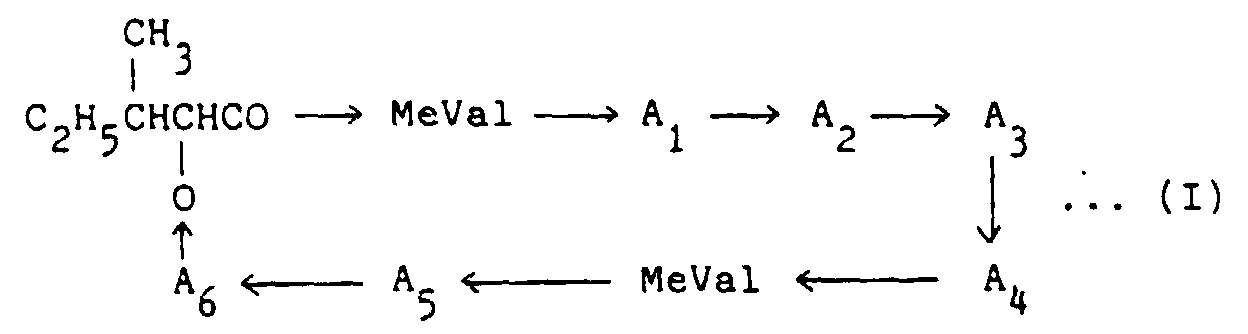
- The present inventors searched for novel antibiotics and discovered antibiotics R106 represented by the following general formula (II), which are produced by microorganisms belonging to aureobasidium spp, including Aureobasidium pullulans No. R106 (FERM BP-1938) deposited at Fermentation Research Institute, Agency of Industrial Science and Technology, on July 8, 1988. The invention of the antibiotics R106 has already been applied for patent as U.S. Patent Application Serial No. 07/379,629 filed July 13, 1989 and as European Patent Application No. 89307315.5 filed July 19, 1989.

- R is methyl or ethyl;
- X1 is MePhe, β-HOMePhe or Phe;
- X2 is allo-Ile, Val or Leu;
- X3 is MeVal or Val;
- X4 is β-HOMeVal, γ-HOMeVal, MeVal, Val, N,β-MeAsp, β-HOMePhe, MePhe, MeDH2,3Val or MeDH3,4 Val.
- The present inventors furthermore searched for novel antifungal antibiotics in the fermentation broth of the antibiotics R106 producing organism described above and discovered novel R106 compounds represented by the following general formula (Ia):

- A1 is Phe, o-FPhe, m-FPhe, or Tyr;
- A2a is MePhe, o-FMePhe, m-FMePhe, or MeTyr;
- A3 is Pro, 4Hyp, or SPro;
- A4 is allo-Ile or Nle;
- A5 is Leu or Nva;
- And, the present inventors studied about the derivatives synthesized from R106-I (R; ethyl, X1; MePhe, X2; allo-Ile, X3; MeVal, X4; β-HOMeVal) or R106-IV (R, X2, X3, and X4; same as those in R106-I, X1; β-HOMePhe), which are included in the compounds represented by the general formula (II) indicated above, and have found novel R106 compounds represented by the following general formula (Ib).

- A2b is MePhe, Sar, MeSer, or β-oxoMePhe,
- A6 is β-HOMeVal or Sar,
- As a result, the present invention has been completed by finding that the novel R106 compounds represented by the general formula (Ia) and (Ib) have strong antifungal activity and low toxicity.
- Thus the present invention relate to novel R106 compounds represented by the general formula (I) described below:

- A1 is Phe, o-FPhe, m-FPhe, or Tyr;
- A2 is MePhe, o-FMePhe, m-FMePhe, MeTyr, Sar, MeSer, or β-oxoMePhe;
- A3 is Pro, 4Hyp, or SPro;
- A4 is allo-Ile or Nle;
- A5 is Leu or Nva;
- A6 is β-HOMeVal or Sar;
- Novel R106 compounds of the present invention represented by the general formula (I) include the compounds shown in Table 1 as the representatives.

- Abbreviations for amino acids used in the present specification including the above formulas are given below.
- Val: valine
- MeVal: N-methylvaline
- Nva: norvaline
- β-HOMeVal: β-hydroxy-N-methylvaline
- Phe: phenylalanine
- MePhe: N-methylphenylalanine
- β-HOMePhe: β-hydroxy-N-methylphenylalanine
- β-oxoMePhe: β-oxo-N-methylphenylalanine
- o-FPhe: o(ortho)-fluorophenylalanine
- m-FPhe: m(meta)-fluorophenylalanine
- o-FMePhe: o(ortho)-fluoro-N-methylphenylalanine
- m-FMePhe: m(meta)-fluoro-N-methylphenylalanine
- allo-Ile: alloisoleucine
- Leu: leucine
- Nle: norleucine
- Pro: proline
- 4Hyp: 4-hydroxyproline
- SPro: thioproline (thiazolidine-4-carboxylic acid)
- MeSer: N-methylserine
- Sar: sarcosine
- Tyr: tyrosine
- MeTyr: N-methyltyrosine
- Novel R106 compounds represented by the general formula (Ia) indicated above, which are included in the compounds represented by the general formula (I), may be produced by fermentation of an antibiotics R106-producing organism in a nutrient medium followed by purification. To the medium should be added one, two or more amino acids that are not components of antibiotics R106 represented by the general formula (II). These amino acids include o-fluorophenylalanine, m-fluorophenylalanine, tyrosine, 4-hydroxyproline, thioproline, norvaline, norleucine, etc. Microorganisms, which can be used for the production of novel R106 compounds of the present invention, can be a strain of the genus Aureobasidium which is capable of producing antibiotics R106. An example of the microorganisms is Aureobasidium pullulans No. R106 (FERM BP-1938), which can be used advantageously. The preferable amount of the amino acids to be added to the medium is usually 0.01 ∼ 5.0% (w/v). Other ingredients to be added to the medium may be those that can be used for the production of antibiotics R106. The culture method may be that used for the production of antibiotics R106. Novel R106 compounds accumulated in the cultured broth can be isolated by the procedures used for isolation of antibiotics R106. That is, novel R106 compounds can be purified by purification procedures, including extraction with a hydrophobic organic solvent such as ethyl acetate and chloroform, high performance liquid chromatography or column chromatography with silica-gel or octadecylsilanized (ODS) silica-gel etc.
- Novel R106 compounds represented by the general formula (Ib) indicated above, which are included in the compounds represented by the general formula (I), may be produced from R106-I or R106-IV by a chemical modification described below.
- For example, novel R106 compounds having sarcosine can be produced by converting β-hydroxy-N-methylvaline or β-hydroxy-N-methylphenylalanine contained in R106-I or R106-IV to sarcosine by retro-aldol reaction in the presence of a base catalyst. Usually, R106-I or R106-IV is dissolved in a hydrophilic solvent such as dimethylsulfoxide, acetonitrile and dimethylformamide, and to the solution is added a base catalyst to start reaction. As for the base catalyst, sodium hydroxide, potassium hydroxide, sodium hydride, or a tertiary amine such as triethylamine or the like can be used. For this reaction, the amount of water in the reaction system should be preferably reduced, because the ester bond in antibiotics R106 is hydrolysed to by-produce a ring-opened compound when excess water is contained. The amount of the base, temperature and time for reaction may vary depending upon the base catalyst used, but generally 0.01 - 1.0%, 0°C to a boiling point, and 10 minutes to a overnight, respectively.
- When a quaternary ammonium salt, for example, tetraethylammonium chloride, β-(methoxyethoxymethyl)-triethylammonium chloride, etc. is used as a base catalyst, novel R106 compounds having N-methylserine is produced from R106-IV as a by-product by conversion of β-hydroxy-N-methylphenylalanine in R106-IV to N-methylserine besides to sarcosine.
- Further, novel R106 compounds having β-oxo-N-methylphenylalanine as converted from β-hydroxy-N-methylphenylalanine in R106-IV can be produced by an oxidation reaction from R106-IV. General oxidation reagents, for example, chromic anhydride-sulfuric acid (Jones reagent), etc. and conventional oxidation methods may be used for the production of the object compounds.
- The representative compounds of the present invention have the following physicochemical and biological properties.
- The representative compounds of the present invention shown in Table 1 have the physicochemical properties shown in Table 2.
- Compounds 1, 2, 3, 4, 5, and 9 have higher solubility in water than antibiotics R106.


-
- i) Antifungal activity
The minimum inhibitory concentrations (MIC, µg/ml) of the representative compounds of the present invention are shown in Table 3.
The MIC was determined by agar dilution method using Casitone agar medium (2.0% glucose, 0.9% Bacto-Casitone, 1.0% yeast extract, 0.1% KH2PO4, 0.1% Na2HPO4, 1.0% sodium citrate, 2.0% agar: concentrations are all by w/v).
Compound 8 is active against Aspergillus fumigatus F-48, against which antibiotics R106 are not active. - ii) Toxicity
When each of the representative compounds 1-12 of the present invention was administered intraperitoneally to mice once at a dose of 200 mg/kg, each compound caused no toxic sign.
- Next, an example of the production method of R106-I and R106-IV, which are used as the starting materials for the production of the novel compounds of the present invention is shown below.
- Aureobasidium pullulans No. R106 (FERM BP-1938) was inoculated into a 500 ml Erlenmeyer flask containing 100 ml of liquid medium (0.67% (w/v) Difco yeast nitrogen base, 2% glucose) and shaken at 25°C for 2 days to give a seed culture. The seed culture, 1000 ml, was inoculated into a 200 liter jar fermenter containing 100 liter of liquid medium A (2% glucose, 0.5% (NH4)2SO4, 0.15% KH2PO4, 0.05% MgSO4·7H2O, 0.01% CaCl2, 0.01% NaCl (concentration are all by w/v), 0.5 µg/ml FeCl3, 0.5 µg/ml ZnSO4), followed by fermentation at 25°C for 90 hours with aeration (100 liters/min) and agitation (150 rpm). To the culture was supplemented polypeptone (10 kg) dissolved in 10 liters of liquid medium B (ten-fold strength of liquid medium A), and the fermentation was further carried out at 25°C for 90 hours with aeration (100 liters/min) and agitation (150 rpm).
- The thus obtained fermentation broth was centrifuged to obtain mycelial cake, which was extracted with 10 liters of acetone. The acetone extract was concentrated under reduced pressure to remove acetone and the residue was extracted twice with one liter of ethyl acetate. The ethyl acetate extract was concentrated under reduced pressure to dryness, and the residue was dissolved in 100 ml of acetonitrile. The solution was divided into 30 and applied to preparative high performance liquid chromatography (HPLC) [column; SOKEN PAK C18 (manufactured by Soken Chemical & Engeneerig Co., Ltd.), 5 x 50 cm, mobile phase; 70% (v/v) acetonitrile-water, 50 ml/min, detection; UV absorption at 230 nm]. The fractions containing R106-IV and R106-I, eluted respectively at 50 min and 67 min of the retention time, were respectively collected and concentrated under reduced pressure of give white powders of R106-IV (81 mg) and R106-I (3500 mg).
- The present invention will be described in more detail by referring to the following examples. However, the present invention is not to be limited by these examples.
- The seed culture, 1 ml, prepared in the same manner as in Reference example, was inoculated into a 500 ml Erlenmeyer flask containing 100 ml of the liquid medium A followed by shaking culture at 25°C for 4 days to give a main culture A. To the main culture A was supplemented 10 ml of liquid medium B (ten-fold strength of liquid medium A) and 100 mg of o-fluorophenylalanine, and incubation was further carried out at 25°C for 4 days.
- The thus obtained culture broth (2.5 liters) was centrifuged to obtain mycelial cake, which was extracted with 250 ml of acetone. The acetone extract was concentrated under reduced pressure to remove acetone and the residue was extracted twice with 100 ml of ethyl acetate. The ethyl acetate extract was concentrated under reduced pressure to dryness, and the residue (1.5 g) was dissolved in methanol. The solution was divided into 40 and applied to preparative HPLC [column; YMC PAK C18 (manufactured by YMC Co., Ltd.), 2 x 25 cm, mobile phase; 70% (v/v) acetonitrile-water, 10 ml/min, detection; UV absorption at 230 nm]. The fractions containing compound No. 1 were collected and concentrated under reduced pressure to give compound No. 1 (13 mg).
- Molecular weight: FAB-MS m/z 1137 (M+H), 1159 (M+Na).
- Amino acid analysis: proline, alloisoleucine, leucine, o-fluorophenylalanine.
- To the main culture A, 100 ml, prepared in the same manner as in Example 1, was supplemented 10 ml of liquid medium B and 100 mg of m-fluorophenylalanine, and incubation under shaking was further carried out at 25°C for 4 days.
- The thus obtained culture broth (4.5 liters), was centrifuged to obtain mycelial cake. The mycelial cake was treated by the same purification procedures as in Example 1, including acetone extraction, ethyl acetate extraction, preparative HPLC, to give compound No. 2 (7 mg).
- Molecular weight: FAB-MS m/z 1137 (M+H), 1159 (M+Na).
- Amino acid analysis: proline, alloisoleucine, leucine, m-fluorophenylalanine.
- To the main culture A, 100 ml, prepared in the same manner as in Example 1, was supplemented 10 ml of liquid medium B and 500 mg of L-tyrosine, and incubation under shaking was further carried out at 25°C for 4 days.
- The thus obtained culture broth (4.5 liters), was centrifuged to obtain mycelial cake. The mycelial cake was treated by the same purification procedures as in Example 1, including acetone extraction, ethyl acetate extraction, preparative HPLC, to give compound No. 3 (3 mg).
- Molecular weight: FAB-MS m/z 1133 (M+H), 1155 (M+Na).
- Amino acid analysis: proline, alloisoleucine, leucine, tyrosine.
- To the main culture A, 100 ml, prepared in the same manner as in Example 1, was supplemented 10 ml of liquid medium B and 100 mg of L-4-hydroxyproline, and incubation under shaking was further carried out at 25°C for 4 days.
- The thus obtained culture broth (3.6 liters), was centrifuged to obtain mycelial cake. The mycelial cake was treated by the same purification procedures as in Example 1, including acetone extraction, ethyl acetate extraction, preparative HPLC, to give compound No. 4 (14 mg).
- Molecular weight: FAB-MS m/z 1117 (M+H), 1139 (M+Na)
- Amino acid analysis: 4-hydroxyproline, alloisoleucine, leucine, phenylalanine.
- To the main culture A, 100 ml, prepared in the same manner as in Example 1, was supplemented 10 ml of liquid medium B and 500 mg of L-thioproline, and incubation under shaking was further carried out at 25°C for 4 days.
- The thus obtained culture broth (3.4 liters), was centrifuged to obtain mycelial cake. The mycelial cake was treated by the same purification procedures as in Example 1, including acetone extraction, ethyl acetate extraction, preparative HPLC, to give compound No. 5 (3 mg).
- Molecular weight: FAB-MS m/z 1119 (M+H), 1141 (M+Na).
- Amino acid analysis: thioproline, alloisoleucine, leucine, phenylalanine.
- To the main culture A, 100 ml, prepared in the same manner as in Example 1, was supplemented 10 ml of liquid medium B and 100 mg of DL-norleucine, and incubation under shaking was further carried out at 25°C for 4 days.
- The thus obtained culture broth (2.1 liters), was centrifuged to obtain mycelial cake. The mycelial cake was treated by the same purification procedures as in Example 1, including acetone extraction, ethyl acetate extraction, preparative HPLC, to give compound No. 6 (48 mg).
- Molecular weight: FAB-MS m/z 1101 (M+H), 1123 (M+Na).
- Amino acid analysis: proline, leucine, norleucine, phenylalanine.
- To the main culture A, 100 ml, prepared in the same manner as in Example 1, was supplemented 10 ml of liquid medium B and 100 mg of DL-norvaline, and incubation under shaking was further carried out at 25°C for 4 days.
- The thus obtained culture broth (2.7 liters), was centrifuged to obtain mycelial cake. The mycelial cake was treated by the same purification procedures as in Example 1, including acetone extraction, ethyl acetate extraction, preparative HPLC, to give compound No. 7 (12 mg).
- Molecular weight: FAB-MS m/z 1087 (M+H), 1109 (M+Na).
- Amino acid analysis: proline, alloisoleucine, norvaline, phenylalanine.
- To a solution of R106-IV (99 mg) in anhydrous acetonitrile (20 ml) was added 40 mg of β-(methoxyethoxymethyl)triethylammonium chloride and the solution was refluxed for 16 hours. The reaction mixture was concentrated. To the residue was added water. The solution was extracted three times with ethyl acetate. The extract was concentrated under reduced pressure to dryness to give a residue (100 mg). The residue obtained was applied to preparative HPLC [column; CAPCELL PAK C18 (manufactured by Shiseido), 1 x 25 cm, mobile phase; 70% (v/v) acetonitrile-water, 3 ml/min, detection; UV absorption at 230 nm] to collect separately fractions of compounds Nos. 8 and 9. The fractions are respectively concentrated under reduced pressure to dryness to give compound No. 8 (30 mg) and compound No. 9 (6 mg).
- Molecular weight: FAB-MS m/z 1011 (M+H), 1033 (M+Na).
- Amino acid analysis: sarcosine, proline, alloisoleucine, leucine, phenylalanine.
- Specific rotary power: [α]

- Molecular weight: FAB-MS m/z 1041 (M+H), 1063 (M+Na).
- Amino acid analysis: proline, alloisoleucine, leucine, phenylalanine.
- Specific rotary power: [α]

- To a solution of R106-I (55 mg) in dimethylsulfoxide (5 ml) was added 8 µl of 6 N aqueous NaOH, and the solution was stirred at room temperature for 25 min. The reaction mixture was concentrated to dryness under reduced pressure after neutralization with 1 N aqueous HCl. The residue was extracted with ethyl acetate, and the extract was dryed and concentrated to dryness under reduced pressure to give a residue (56 mg). The residue was applied to preparative TLC [silica-gel plate of Merck No. 13895, solvent system: n-hexane-isopropanol (6:4)] and a fraction containing compound No. 10 was collected and eluted with 50 ml of chloroform-methanol (9:1). The eluate was concentrated to dryness under reduced pressure to give compound No. 10 (35 mg).
- Molecular weight: FAB-MS m/z 1043 (M+H), 1065 (M+Na).
- Amino acid analysis: sarcosine, proline, alloisoleucine, leucine, phenylalanine.
- To a solution of R106-IV (56 mg) in dimethylsulfoxide (5 ml) was added 8 µl of 6 N aqueous NaOH, and the solution was stirred at room temperature for 30 min. The reaction was then treated by the same procedures as in Example 9 to give compound No. 11 (28 mg).
- Molecular weight: FAB-MS m/z 953 (M+H), 975 (M+Na).
- Amino acid analysis: sarcosine, proline, alloisoleucine, leucine, phenylalanine.
- In a solution of R106-IV (76 mg) in acetone (5 ml) was dropped 0.5 ml of Jones reagent. After 30 min stirring at room temperature, isopropanol (1 ml) was dropped in the solution under ice cooling. To the reaction solution was added water and extracted with ethyl acetate. The extract was concentrated to dryness under reduced pressure to give a residue (55 mg).
- The residue obtained was applied to preparative HPLC [mobile phase; 80% acetonitrile-water, the other conditions were the same with those of Example 8] to collect fractions containing compound No. 12. The fractions were concentrated to dryness under reduced pressure to give compound No. 12 (20 mg).
- Molecular weight: FAB-MS m/z 1115 (M+H), 1137 (M+Na).
- Amino acid analysis: proline, alloisoleucine, leucine, phenylalanine.
- The novel R106 compounds of the present invention have low toxicity and high antifungal activity against pathogenic fungi such as Candida albicans etc. Therefore the novel R106 compounds are useful as clinical drugs for fungal infections.
Claims (3)
- R106 compounds represented by the following general formula (I):
 A1,is Phe, o-FPhe, m-FPhe, or Tyr;A2 is MePhe, o-FMePhe, m-FMePhe, MeTyr, Sar, MeSer, or β-oxoMePhe;A3 is Pro, 4Hyp, or SPro;A4 is allo-Ile or Nle;A5 is Leu or Nva;A6 is β-HOMeVal or Sar;excluding those wherein A1 is Phe and A2 is MePhe and A3 is Pro and A4 is allo-Ile and A5 is Leu and A6 is β-HOMeVal.
 - An antifungal agent comprising a compound according to claim 1.
- A pharmaceutical composition comprising a compound according claim 1 or an agent according to claim 2.
Applications Claiming Priority (2)
| Application Number | Priority Date | Filing Date | Title |
|---|---|---|---|
| JP2014384A JP2639737B2 (en) | 1990-01-23 | 1990-01-23 | New R106 compounds |
| JP14384/90 | 1990-01-23 |
Publications (2)
| Publication Number | Publication Date |
|---|---|
| EP0443719A1 EP0443719A1 (en) | 1991-08-28 |
| EP0443719B1 true EP0443719B1 (en) | 1997-05-07 |
Family
ID=11859560
Family Applications (1)
| Application Number | Title | Priority Date | Filing Date |
|---|---|---|---|
| EP91300438A Expired - Lifetime EP0443719B1 (en) | 1990-01-23 | 1991-01-21 | Novel R106 compounds |
Country Status (5)
| Country | Link |
|---|---|
| US (1) | US5200505A (en) |
| EP (1) | EP0443719B1 (en) |
| JP (1) | JP2639737B2 (en) |
| DE (1) | DE69125963T2 (en) |
| ES (1) | ES2100929T3 (en) |
Families Citing this family (23)
| Publication number | Priority date | Publication date | Assignee | Title |
|---|---|---|---|---|
| DE69206007T2 (en) * | 1991-02-19 | 1996-07-25 | Takara Shuzo Co | Fungicides for agriculture and horticulture. |
| EP0547484A1 (en) * | 1991-12-19 | 1993-06-23 | Nippon Kayaku Kabushiki Kaisha | Process for producing antibiotic R106-I |
| JP3480848B2 (en) * | 1992-06-19 | 2003-12-22 | タカラバイオ株式会社 | Method for synthesizing cyclic peptides |
| JPH0672890A (en) * | 1992-06-26 | 1994-03-15 | Nippon Kayaku Co Ltd | Emulsion preparation of aureobasidin |
| DE69434662T2 (en) | 1993-05-24 | 2006-12-07 | Takara Bio Inc., Otsu | Coding of a gene for aureobasidin sensitivity regulating protein |
| US6015689A (en) | 1993-05-24 | 2000-01-18 | Takara Shuzo Co., Ltd. | Regulation of aureobasidin sensitivity |
| EP0687686B1 (en) * | 1993-12-27 | 2000-08-30 | Takara Shuzo Co. Ltd. | Aureobasidins |
| US5739104A (en) * | 1994-05-04 | 1998-04-14 | Schering Corporation | Anti-fungal agents |
| DE69504596T2 (en) | 1994-06-29 | 1999-05-12 | Takara Shuzo Co., Ltd., Kyoto | Chromosomal integration vector |
| AU4106396A (en) * | 1994-11-15 | 1996-06-06 | Eli Lilly And Company | Process for performing retro-aldol reaction |
| JPH08322575A (en) * | 1995-05-30 | 1996-12-10 | Takara Shuzo Co Ltd | promoter |
| US5629289A (en) * | 1995-07-25 | 1997-05-13 | Eli Lilly And Company | Cyclic peptide antifungal agents |
| JP4261365B2 (en) * | 2002-02-13 | 2009-04-30 | テバ ジョジセルジャール ザ−トケルエン ムケド レ−スベニュタ−ルシャシャ−グ | Method for extracting macrolides from biological materials |
| US7452692B2 (en) * | 2002-02-13 | 2008-11-18 | Teva Gyógyszergyár Zártkörüen Müködö Részvénytársaság | Method for extracting a macrolide from biomatter |
| US20060169199A1 (en) * | 2003-03-31 | 2006-08-03 | Vilmos Keri | Crystallization and purification of macrolides |
| WO2004089958A2 (en) * | 2003-03-31 | 2004-10-21 | TEVA Gyógyszergyár Részvénytársaság | Crystallization and purification of macrolides |
| ATE378345T1 (en) * | 2003-07-24 | 2007-11-15 | Teva Gyogyszergyar Zartkoeruee | METHOD FOR PURIFYING MACROLIDS |
| JP3916166B2 (en) * | 2004-09-27 | 2007-05-16 | 学校法人慶應義塾 | Method for preparing compound library and screening method |
| US8940265B2 (en) * | 2009-02-17 | 2015-01-27 | Mcalister Technologies, Llc | Sustainable economic development through integrated production of renewable energy, materials resources, and nutrient regimes |
| WO2006069386A1 (en) * | 2004-12-22 | 2006-06-29 | Teva Gyógyszergyár Zártköruen Muködo Részvénytársaság | Method of purifying tacrolimus |
| EP1924699A4 (en) * | 2005-08-26 | 2009-11-11 | Aureogen Biosciences | Aureobasidin a synthetase |
| WO2020018888A1 (en) | 2018-07-20 | 2020-01-23 | The Board Of Regents Of The University Of Oklahoma | Antimicrobial peptides and methods of use |
| CN112779167B (en) * | 2021-01-11 | 2022-06-21 | 浙江珲达生物科技有限公司 | Aureobasidin A high-yield strain and application thereof |
Family Cites Families (3)
| Publication number | Priority date | Publication date | Assignee | Title |
|---|---|---|---|---|
| US4342751A (en) * | 1981-03-09 | 1982-08-03 | Eli Lilly And Company | Majusculamide C |
| GB8427651D0 (en) * | 1984-11-01 | 1984-12-05 | Beecham Group Plc | Compounds |
| US5057493A (en) * | 1988-07-19 | 1991-10-15 | Takara Shuzo Co., Ltd. | Novel antibiotics r106 |
-
1990
- 1990-01-23 JP JP2014384A patent/JP2639737B2/en not_active Expired - Lifetime
-
1991
- 1991-01-21 DE DE69125963T patent/DE69125963T2/en not_active Expired - Lifetime
- 1991-01-21 ES ES91300438T patent/ES2100929T3/en not_active Expired - Lifetime
- 1991-01-21 EP EP91300438A patent/EP0443719B1/en not_active Expired - Lifetime
- 1991-01-22 US US07/643,948 patent/US5200505A/en not_active Expired - Lifetime
Also Published As
| Publication number | Publication date |
|---|---|
| DE69125963T2 (en) | 1997-12-18 |
| US5200505A (en) | 1993-04-06 |
| JP2639737B2 (en) | 1997-08-13 |
| ES2100929T3 (en) | 1997-07-01 |
| DE69125963D1 (en) | 1997-06-12 |
| JPH03220199A (en) | 1991-09-27 |
| EP0443719A1 (en) | 1991-08-28 |
Similar Documents
| Publication | Publication Date | Title |
|---|---|---|
| US5200505A (en) | R106 compounds | |
| EP0431350B1 (en) | New polypeptide compound and a process for preparation thereof | |
| EP0359529B1 (en) | Method for the control of pneumocystis carinii | |
| EP0352092B1 (en) | Novel antibiotics R106 | |
| US5330973A (en) | Lipopeptide derivatives | |
| EP0510271A1 (en) | Novel R106 compounds | |
| CA2038497A1 (en) | Lipopeptide derivatives | |
| EP0916680B1 (en) | Lantibiotic related to Actagardine, process of preparation and use thereof | |
| KR101612275B1 (en) | Highly bridged peptides from Actinomadura namibiensis | |
| EP0584360B1 (en) | Wf11243 substance | |
| EP0687686A1 (en) | Aureobasidins | |
| DE3887292T2 (en) | Antibiotic compounds called A / 16686 factors A'1, A'2 and A'3. | |
| KR19990007955A (en) | FA-70D material, method for producing same and use thereof | |
| JPH05279384A (en) | New antifungal antibiotic | |
| Rodriguez et al. | The synthesis of pseudomycin C′ via a novel acid promoted side-chain deacylation of pseudomycin A | |
| AU738970B2 (en) | Novel antibiotic, feglymycin, processes for its preparation and its use | |
| CA2396174C (en) | Aerothricin analogs, their preparation and use | |
| JPH0832723B2 (en) | Antifungal peptide | |
| US5641485A (en) | Caledothricins used in the treatment mycotic diseases | |
| JP2661367B2 (en) | WF11243 substance | |
| MXPA98008484A (en) | New lantibiotic related with actagardine, procedure for its preparation and employment of the mi | |
| JPH05112599A (en) | Wf11243 substance, its production and biological use | |
| JPH1045617A (en) | Antiprotozoal agent | |
| WO2001000639A1 (en) | Novel sordarin derivative as a therapeutic antimicrobial agent | |
| JPH06145067A (en) | Carini infection preventive and therapeutic agent |
Legal Events
| Date | Code | Title | Description |
|---|---|---|---|
| PUAI | Public reference made under article 153(3) epc to a published international application that has entered the european phase |
Free format text: ORIGINAL CODE: 0009012 |
|
| AK | Designated contracting states |
Kind code of ref document: A1 Designated state(s): DE ES FR GB IT SE |
|
| 17P | Request for examination filed |
Effective date: 19911122 |
|
| 17Q | First examination report despatched |
Effective date: 19950728 |
|
| GRAG | Despatch of communication of intention to grant |
Free format text: ORIGINAL CODE: EPIDOS AGRA |
|
| GRAH | Despatch of communication of intention to grant a patent |
Free format text: ORIGINAL CODE: EPIDOS IGRA |
|
| GRAH | Despatch of communication of intention to grant a patent |
Free format text: ORIGINAL CODE: EPIDOS IGRA |
|
| GRAA | (expected) grant |
Free format text: ORIGINAL CODE: 0009210 |
|
| AK | Designated contracting states |
Kind code of ref document: B1 Designated state(s): DE ES FR GB IT SE |
|
| ITF | It: translation for a ep patent filed | ||
| REF | Corresponds to: |
Ref document number: 69125963 Country of ref document: DE Date of ref document: 19970612 |
|
| REG | Reference to a national code |
Ref country code: ES Ref legal event code: FG2A Ref document number: 2100929 Country of ref document: ES Kind code of ref document: T3 |
|
| ET | Fr: translation filed | ||
| PLBE | No opposition filed within time limit |
Free format text: ORIGINAL CODE: 0009261 |
|
| STAA | Information on the status of an ep patent application or granted ep patent |
Free format text: STATUS: NO OPPOSITION FILED WITHIN TIME LIMIT |
|
| 26N | No opposition filed | ||
| REG | Reference to a national code |
Ref country code: GB Ref legal event code: IF02 |
|
| REG | Reference to a national code |
Ref country code: ES Ref legal event code: PC2A |
|
| REG | Reference to a national code |
Ref country code: GB Ref legal event code: 732E |
|
| REG | Reference to a national code |
Ref country code: FR Ref legal event code: TP |
|
| PGFP | Annual fee paid to national office [announced via postgrant information from national office to epo] |
Ref country code: SE Payment date: 20091218 Year of fee payment: 20 |
|
| PGFP | Annual fee paid to national office [announced via postgrant information from national office to epo] |
Ref country code: ES Payment date: 20100126 Year of fee payment: 20 |
|
| PGFP | Annual fee paid to national office [announced via postgrant information from national office to epo] |
Ref country code: IT Payment date: 20100118 Year of fee payment: 20 Ref country code: FR Payment date: 20100208 Year of fee payment: 20 |
|
| PGFP | Annual fee paid to national office [announced via postgrant information from national office to epo] |
Ref country code: GB Payment date: 20100120 Year of fee payment: 20 Ref country code: DE Payment date: 20100114 Year of fee payment: 20 |
|
| REG | Reference to a national code |
Ref country code: GB Ref legal event code: PE20 Expiry date: 20110120 |
|
| PG25 | Lapsed in a contracting state [announced via postgrant information from national office to epo] |
Ref country code: GB Free format text: LAPSE BECAUSE OF EXPIRATION OF PROTECTION Effective date: 20110120 |
|
| REG | Reference to a national code |
Ref country code: ES Ref legal event code: FD2A Effective date: 20120206 |
|
| PG25 | Lapsed in a contracting state [announced via postgrant information from national office to epo] |
Ref country code: ES Free format text: LAPSE BECAUSE OF EXPIRATION OF PROTECTION Effective date: 20110122 |
|
| PG25 | Lapsed in a contracting state [announced via postgrant information from national office to epo] |
Ref country code: DE Free format text: LAPSE BECAUSE OF EXPIRATION OF PROTECTION Effective date: 20110121 |