EP0443474B1 - 1-Phenoxycarbonyl-2-pyrrolidinone derivatives and nootropic agents - Google Patents
1-Phenoxycarbonyl-2-pyrrolidinone derivatives and nootropic agents Download PDFInfo
- Publication number
- EP0443474B1 EP0443474B1 EP91102229A EP91102229A EP0443474B1 EP 0443474 B1 EP0443474 B1 EP 0443474B1 EP 91102229 A EP91102229 A EP 91102229A EP 91102229 A EP91102229 A EP 91102229A EP 0443474 B1 EP0443474 B1 EP 0443474B1
- Authority
- EP
- European Patent Office
- Prior art keywords
- pyrrolidinone
- mmol
- solution
- anhydrous benzene
- quintet
- Prior art date
- Legal status (The legal status is an assumption and is not a legal conclusion. Google has not performed a legal analysis and makes no representation as to the accuracy of the status listed.)
- Expired - Lifetime
Links
- 239000002664 nootropic agent Substances 0.000 title claims abstract description 12
- LSQDBVVVZIEZBQ-UHFFFAOYSA-N phenyl 2-oxopyrrolidine-1-carboxylate Chemical class C1CCC(=O)N1C(=O)OC1=CC=CC=C1 LSQDBVVVZIEZBQ-UHFFFAOYSA-N 0.000 title abstract description 6
- 150000001875 compounds Chemical class 0.000 claims abstract description 20
- 125000000449 nitro group Chemical group [O-][N+](*)=O 0.000 claims abstract description 6
- 125000004191 (C1-C6) alkoxy group Chemical group 0.000 claims abstract description 5
- 125000004169 (C1-C6) alkyl group Chemical group 0.000 claims abstract description 5
- 125000005843 halogen group Chemical group 0.000 claims abstract description 5
- 125000004435 hydrogen atom Chemical group [H]* 0.000 claims abstract 3
- 239000004480 active ingredient Substances 0.000 claims description 7
- 229910052794 bromium Inorganic materials 0.000 claims description 3
- 229910052801 chlorine Inorganic materials 0.000 claims description 3
- 229910052731 fluorine Inorganic materials 0.000 claims description 3
- 125000004178 (C1-C4) alkyl group Chemical group 0.000 claims 2
- 125000000229 (C1-C4)alkoxy group Chemical group 0.000 claims 2
- UHOVQNZJYSORNB-UHFFFAOYSA-N Benzene Chemical compound C1=CC=CC=C1 UHOVQNZJYSORNB-UHFFFAOYSA-N 0.000 description 114
- 239000000243 solution Substances 0.000 description 50
- KFZMGEQAYNKOFK-UHFFFAOYSA-N Isopropanol Chemical compound CC(C)O KFZMGEQAYNKOFK-UHFFFAOYSA-N 0.000 description 39
- HEDRZPFGACZZDS-MICDWDOJSA-N Trichloro(2H)methane Chemical compound [2H]C(Cl)(Cl)Cl HEDRZPFGACZZDS-MICDWDOJSA-N 0.000 description 38
- JUJWROOIHBZHMG-UHFFFAOYSA-N Pyridine Chemical compound C1=CC=NC=C1 JUJWROOIHBZHMG-UHFFFAOYSA-N 0.000 description 30
- 238000001953 recrystallisation Methods 0.000 description 20
- 238000005160 1H NMR spectroscopy Methods 0.000 description 19
- 238000001819 mass spectrum Methods 0.000 description 19
- 239000000047 product Substances 0.000 description 18
- YGYAWVDWMABLBF-UHFFFAOYSA-N Phosgene Chemical compound ClC(Cl)=O YGYAWVDWMABLBF-UHFFFAOYSA-N 0.000 description 17
- 238000001816 cooling Methods 0.000 description 17
- LFQSCWFLJHTTHZ-UHFFFAOYSA-N Ethanol Chemical compound CCO LFQSCWFLJHTTHZ-UHFFFAOYSA-N 0.000 description 16
- 238000000034 method Methods 0.000 description 16
- UMJSCPRVCHMLSP-UHFFFAOYSA-N pyridine Natural products COC1=CC=CN=C1 UMJSCPRVCHMLSP-UHFFFAOYSA-N 0.000 description 15
- 239000000203 mixture Substances 0.000 description 13
- YXFVVABEGXRONW-UHFFFAOYSA-N Toluene Chemical compound CC1=CC=CC=C1 YXFVVABEGXRONW-UHFFFAOYSA-N 0.000 description 12
- LUBVCBITQHEVCJ-UHFFFAOYSA-N 1-trimethylsilylpyrrolidin-2-one Chemical compound C[Si](C)(C)N1CCCC1=O LUBVCBITQHEVCJ-UHFFFAOYSA-N 0.000 description 9
- 230000002490 cerebral effect Effects 0.000 description 6
- 238000006243 chemical reaction Methods 0.000 description 6
- 230000006872 improvement Effects 0.000 description 6
- 239000011541 reaction mixture Substances 0.000 description 6
- 239000011343 solid material Substances 0.000 description 6
- 125000000956 methoxy group Chemical group [H]C([H])([H])O* 0.000 description 5
- 125000002496 methyl group Chemical group [H]C([H])([H])* 0.000 description 5
- 208000000044 Amnesia Diseases 0.000 description 4
- 208000031091 Amnestic disease Diseases 0.000 description 4
- PEDCQBHIVMGVHV-UHFFFAOYSA-N Glycerine Chemical compound OCC(O)CO PEDCQBHIVMGVHV-UHFFFAOYSA-N 0.000 description 4
- 241000699666 Mus <mouse, genus> Species 0.000 description 4
- 230000006986 amnesia Effects 0.000 description 4
- 230000005764 inhibitory process Effects 0.000 description 4
- RLSSMJSEOOYNOY-UHFFFAOYSA-N m-cresol Chemical compound CC1=CC=CC(O)=C1 RLSSMJSEOOYNOY-UHFFFAOYSA-N 0.000 description 4
- 239000000463 material Substances 0.000 description 4
- QWVGKYWNOKOFNN-UHFFFAOYSA-N o-cresol Chemical compound CC1=CC=CC=C1O QWVGKYWNOKOFNN-UHFFFAOYSA-N 0.000 description 4
- IWDCLRJOBJJRNH-UHFFFAOYSA-N p-cresol Chemical compound CC1=CC=C(O)C=C1 IWDCLRJOBJJRNH-UHFFFAOYSA-N 0.000 description 4
- HNJBEVLQSNELDL-UHFFFAOYSA-N pyrrolidin-2-one Chemical compound O=C1CCCN1 HNJBEVLQSNELDL-UHFFFAOYSA-N 0.000 description 4
- 238000002560 therapeutic procedure Methods 0.000 description 4
- 229930000680 A04AD01 - Scopolamine Natural products 0.000 description 3
- 208000024827 Alzheimer disease Diseases 0.000 description 3
- STECJAGHUSJQJN-GAUPFVANSA-N Hyoscine Natural products C1([C@H](CO)C(=O)OC2C[C@@H]3N([C@H](C2)[C@@H]2[C@H]3O2)C)=CC=CC=C1 STECJAGHUSJQJN-GAUPFVANSA-N 0.000 description 3
- STECJAGHUSJQJN-UHFFFAOYSA-N N-Methyl-scopolamin Natural products C1C(C2C3O2)N(C)C3CC1OC(=O)C(CO)C1=CC=CC=C1 STECJAGHUSJQJN-UHFFFAOYSA-N 0.000 description 3
- ISWSIDIOOBJBQZ-UHFFFAOYSA-N Phenol Chemical compound OC1=CC=CC=C1 ISWSIDIOOBJBQZ-UHFFFAOYSA-N 0.000 description 3
- 206010039966 Senile dementia Diseases 0.000 description 3
- ZXNRTKGTQJPIJK-UHFFFAOYSA-N aniracetam Chemical compound C1=CC(OC)=CC=C1C(=O)N1C(=O)CCC1 ZXNRTKGTQJPIJK-UHFFFAOYSA-N 0.000 description 3
- 239000011230 binding agent Substances 0.000 description 3
- -1 methoxy, ethoxy, n-propoxy, iso-propoxy, n-butoxy, iso-butoxy, tert-butoxy, amyloxy Chemical group 0.000 description 3
- 150000002989 phenols Chemical class 0.000 description 3
- 230000002265 prevention Effects 0.000 description 3
- STECJAGHUSJQJN-FWXGHANASA-N scopolamine Chemical compound C1([C@@H](CO)C(=O)O[C@H]2C[C@@H]3N([C@H](C2)[C@@H]2[C@H]3O2)C)=CC=CC=C1 STECJAGHUSJQJN-FWXGHANASA-N 0.000 description 3
- 229960002646 scopolamine Drugs 0.000 description 3
- 230000035939 shock Effects 0.000 description 3
- 239000002904 solvent Substances 0.000 description 3
- 239000000829 suppository Substances 0.000 description 3
- XLYOFNOQVPJJNP-UHFFFAOYSA-N water Substances O XLYOFNOQVPJJNP-UHFFFAOYSA-N 0.000 description 3
- YLCWIBKURAWRLT-UHFFFAOYSA-N (2,6-dimethoxyphenyl) 2-oxopyrrolidine-1-carboxylate Chemical compound COC1=CC=CC(OC)=C1OC(=O)N1C(=O)CCC1 YLCWIBKURAWRLT-UHFFFAOYSA-N 0.000 description 2
- RGWXNZOIOGWHFX-UHFFFAOYSA-N (2-bromophenyl) 2-oxopyrrolidine-1-carboxylate Chemical compound BrC1=CC=CC=C1OC(=O)N1C(=O)CCC1 RGWXNZOIOGWHFX-UHFFFAOYSA-N 0.000 description 2
- OXLCOHPGCBVFMI-UHFFFAOYSA-N (2-chlorophenyl) 2-oxopyrrolidine-1-carboxylate Chemical compound ClC1=CC=CC=C1OC(=O)N1C(=O)CCC1 OXLCOHPGCBVFMI-UHFFFAOYSA-N 0.000 description 2
- QRPHZSNMNSPQLW-UHFFFAOYSA-N (2-methoxyphenyl) 2-oxopyrrolidine-1-carboxylate Chemical compound COC1=CC=CC=C1OC(=O)N1C(=O)CCC1 QRPHZSNMNSPQLW-UHFFFAOYSA-N 0.000 description 2
- KIZPUYZADOTAPG-UHFFFAOYSA-N (2-methylphenyl) 2-oxopyrrolidine-1-carboxylate Chemical compound CC1=CC=CC=C1OC(=O)N1C(=O)CCC1 KIZPUYZADOTAPG-UHFFFAOYSA-N 0.000 description 2
- LQQNLLSPGYKMGF-UHFFFAOYSA-N (2-nitrophenyl) 2-oxopyrrolidine-1-carboxylate Chemical compound [O-][N+](=O)C1=CC=CC=C1OC(=O)N1C(=O)CCC1 LQQNLLSPGYKMGF-UHFFFAOYSA-N 0.000 description 2
- KTINMMSWOBONOA-UHFFFAOYSA-N (3,5-dimethoxyphenyl) 2-oxopyrrolidine-1-carboxylate Chemical compound COC1=CC(OC)=CC(OC(=O)N2C(CCC2)=O)=C1 KTINMMSWOBONOA-UHFFFAOYSA-N 0.000 description 2
- AXZFJOMBAQDMDN-UHFFFAOYSA-N (3-bromophenyl) 2-oxopyrrolidine-1-carboxylate Chemical compound BrC1=CC=CC(OC(=O)N2C(CCC2)=O)=C1 AXZFJOMBAQDMDN-UHFFFAOYSA-N 0.000 description 2
- OQRFFYPYCAWFJT-UHFFFAOYSA-N (3-chlorophenyl) 2-oxopyrrolidine-1-carboxylate Chemical compound ClC1=CC=CC(OC(=O)N2C(CCC2)=O)=C1 OQRFFYPYCAWFJT-UHFFFAOYSA-N 0.000 description 2
- OBAGEELHGDBORF-UHFFFAOYSA-N (3-methoxyphenyl) 2-oxopyrrolidine-1-carboxylate Chemical compound COC1=CC=CC(OC(=O)N2C(CCC2)=O)=C1 OBAGEELHGDBORF-UHFFFAOYSA-N 0.000 description 2
- WDDMPWWJOUXDPH-UHFFFAOYSA-N (3-methylphenyl) 2-oxopyrrolidine-1-carboxylate Chemical compound CC1=CC=CC(OC(=O)N2C(CCC2)=O)=C1 WDDMPWWJOUXDPH-UHFFFAOYSA-N 0.000 description 2
- LBFAWXRLZOIQTJ-UHFFFAOYSA-N (3-nitrophenyl) 2-oxopyrrolidine-1-carboxylate Chemical compound [O-][N+](=O)C1=CC=CC(OC(=O)N2C(CCC2)=O)=C1 LBFAWXRLZOIQTJ-UHFFFAOYSA-N 0.000 description 2
- KYYLYFAOEAAMSQ-UHFFFAOYSA-N (4-bromophenyl) 2-oxopyrrolidine-1-carboxylate Chemical compound C1=CC(Br)=CC=C1OC(=O)N1C(=O)CCC1 KYYLYFAOEAAMSQ-UHFFFAOYSA-N 0.000 description 2
- DILKXILZFDLVGI-UHFFFAOYSA-N (4-chlorophenyl) 2-oxopyrrolidine-1-carboxylate Chemical compound C1=CC(Cl)=CC=C1OC(=O)N1C(=O)CCC1 DILKXILZFDLVGI-UHFFFAOYSA-N 0.000 description 2
- PEHIVPDCMSHDEG-UHFFFAOYSA-N (4-fluorophenyl) 2-oxopyrrolidine-1-carboxylate Chemical compound C1=CC(F)=CC=C1OC(=O)N1C(=O)CCC1 PEHIVPDCMSHDEG-UHFFFAOYSA-N 0.000 description 2
- SZPRPJDBQHOITP-UHFFFAOYSA-N (4-methoxyphenyl) 2-oxopyrrolidine-1-carboxylate Chemical compound C1=CC(OC)=CC=C1OC(=O)N1C(=O)CCC1 SZPRPJDBQHOITP-UHFFFAOYSA-N 0.000 description 2
- GMGYZEDLDYWECZ-UHFFFAOYSA-N (4-methylphenyl) 2-oxopyrrolidine-1-carboxylate Chemical compound C1=CC(C)=CC=C1OC(=O)N1C(=O)CCC1 GMGYZEDLDYWECZ-UHFFFAOYSA-N 0.000 description 2
- GQSIAHIQHKRKFX-UHFFFAOYSA-N (4-nitrophenyl) 2-oxopyrrolidine-1-carboxylate Chemical compound C1=CC([N+](=O)[O-])=CC=C1OC(=O)N1C(=O)CCC1 GQSIAHIQHKRKFX-UHFFFAOYSA-N 0.000 description 2
- KLIDCXVFHGNTTM-UHFFFAOYSA-N 2,6-dimethoxyphenol Chemical compound COC1=CC=CC(OC)=C1O KLIDCXVFHGNTTM-UHFFFAOYSA-N 0.000 description 2
- XQDNFAMOIPNVES-UHFFFAOYSA-N 3,5-Dimethoxyphenol Chemical compound COC1=CC(O)=CC(OC)=C1 XQDNFAMOIPNVES-UHFFFAOYSA-N 0.000 description 2
- ASHGTJPOSUFTGB-UHFFFAOYSA-N 3-methoxyphenol Chemical compound COC1=CC=CC(O)=C1 ASHGTJPOSUFTGB-UHFFFAOYSA-N 0.000 description 2
- 208000007848 Alcoholism Diseases 0.000 description 2
- UFHFLCQGNIYNRP-UHFFFAOYSA-N Hydrogen Chemical compound [H][H] UFHFLCQGNIYNRP-UHFFFAOYSA-N 0.000 description 2
- 241000699670 Mus sp. Species 0.000 description 2
- VYPSYNLAJGMNEJ-UHFFFAOYSA-N Silicium dioxide Chemical compound O=[Si]=O VYPSYNLAJGMNEJ-UHFFFAOYSA-N 0.000 description 2
- 239000002253 acid Substances 0.000 description 2
- 201000007930 alcohol dependence Diseases 0.000 description 2
- 238000004440 column chromatography Methods 0.000 description 2
- 239000002552 dosage form Substances 0.000 description 2
- 239000003814 drug Substances 0.000 description 2
- 229940079593 drug Drugs 0.000 description 2
- 239000000706 filtrate Substances 0.000 description 2
- 238000001914 filtration Methods 0.000 description 2
- 239000000796 flavoring agent Substances 0.000 description 2
- 238000009472 formulation Methods 0.000 description 2
- 235000011187 glycerol Nutrition 0.000 description 2
- LHGVFZTZFXWLCP-UHFFFAOYSA-N guaiacol Chemical compound COC1=CC=CC=C1O LHGVFZTZFXWLCP-UHFFFAOYSA-N 0.000 description 2
- 229910052739 hydrogen Inorganic materials 0.000 description 2
- 239000001257 hydrogen Substances 0.000 description 2
- 239000007924 injection Substances 0.000 description 2
- 238000002347 injection Methods 0.000 description 2
- 150000007529 inorganic bases Chemical class 0.000 description 2
- 230000014759 maintenance of location Effects 0.000 description 2
- 150000007530 organic bases Chemical class 0.000 description 2
- 239000000825 pharmaceutical preparation Substances 0.000 description 2
- 239000002504 physiological saline solution Substances 0.000 description 2
- 239000000843 powder Substances 0.000 description 2
- 239000002244 precipitate Substances 0.000 description 2
- 238000002360 preparation method Methods 0.000 description 2
- 239000000741 silica gel Substances 0.000 description 2
- 229910002027 silica gel Inorganic materials 0.000 description 2
- 239000003826 tablet Substances 0.000 description 2
- 238000005303 weighing Methods 0.000 description 2
- HNKZMEOLQTVWDA-UHFFFAOYSA-N (2,6-dibromophenyl) 2-oxopyrrolidine-1-carboxylate Chemical compound BrC1=CC=CC(Br)=C1OC(=O)N1C(=O)CCC1 HNKZMEOLQTVWDA-UHFFFAOYSA-N 0.000 description 1
- IKMNJYGTSSQNSE-UHFFFAOYSA-N (4-bromophenyl) carbonochloridate Chemical compound ClC(=O)OC1=CC=C(Br)C=C1 IKMNJYGTSSQNSE-UHFFFAOYSA-N 0.000 description 1
- MSBGPEACXKBQSX-UHFFFAOYSA-N (4-fluorophenyl) carbonochloridate Chemical compound FC1=CC=C(OC(Cl)=O)C=C1 MSBGPEACXKBQSX-UHFFFAOYSA-N 0.000 description 1
- CCFSGQKTSBIIHG-UHFFFAOYSA-N (4-methoxyphenyl) carbonochloridate Chemical compound COC1=CC=C(OC(Cl)=O)C=C1 CCFSGQKTSBIIHG-UHFFFAOYSA-N 0.000 description 1
- KPEFUDLWGLJURU-UHFFFAOYSA-N 1-bromocyclohexa-2,4-dien-1-ol Chemical compound OC1(Br)CC=CC=C1 KPEFUDLWGLJURU-UHFFFAOYSA-N 0.000 description 1
- ISPYQTSUDJAMAB-UHFFFAOYSA-N 2-chlorophenol Chemical compound OC1=CC=CC=C1Cl ISPYQTSUDJAMAB-UHFFFAOYSA-N 0.000 description 1
- IQUPABOKLQSFBK-UHFFFAOYSA-N 2-nitrophenol Chemical compound OC1=CC=CC=C1[N+]([O-])=O IQUPABOKLQSFBK-UHFFFAOYSA-N 0.000 description 1
- MNOJRWOWILAHAV-UHFFFAOYSA-N 3-bromophenol Chemical compound OC1=CC=CC(Br)=C1 MNOJRWOWILAHAV-UHFFFAOYSA-N 0.000 description 1
- HORNXRXVQWOLPJ-UHFFFAOYSA-N 3-chlorophenol Chemical compound OC1=CC=CC(Cl)=C1 HORNXRXVQWOLPJ-UHFFFAOYSA-N 0.000 description 1
- RTZZCYNQPHTPPL-UHFFFAOYSA-N 3-nitrophenol Chemical compound OC1=CC=CC([N+]([O-])=O)=C1 RTZZCYNQPHTPPL-UHFFFAOYSA-N 0.000 description 1
- WXNZTHHGJRFXKQ-UHFFFAOYSA-N 4-chlorophenol Chemical compound OC1=CC=C(Cl)C=C1 WXNZTHHGJRFXKQ-UHFFFAOYSA-N 0.000 description 1
- BTJIUGUIPKRLHP-UHFFFAOYSA-N 4-nitrophenol Chemical compound OC1=CC=C([N+]([O-])=O)C=C1 BTJIUGUIPKRLHP-UHFFFAOYSA-N 0.000 description 1
- WKBOTKDWSSQWDR-UHFFFAOYSA-N Bromine atom Chemical compound [Br] WKBOTKDWSSQWDR-UHFFFAOYSA-N 0.000 description 1
- ZAMOUSCENKQFHK-UHFFFAOYSA-N Chlorine atom Chemical compound [Cl] ZAMOUSCENKQFHK-UHFFFAOYSA-N 0.000 description 1
- 229920002261 Corn starch Polymers 0.000 description 1
- FBPFZTCFMRRESA-FSIIMWSLSA-N D-Glucitol Natural products OC[C@H](O)[C@H](O)[C@@H](O)[C@H](O)CO FBPFZTCFMRRESA-FSIIMWSLSA-N 0.000 description 1
- FBPFZTCFMRRESA-JGWLITMVSA-N D-glucitol Chemical compound OC[C@H](O)[C@@H](O)[C@H](O)[C@H](O)CO FBPFZTCFMRRESA-JGWLITMVSA-N 0.000 description 1
- PXGOKWXKJXAPGV-UHFFFAOYSA-N Fluorine Chemical compound FF PXGOKWXKJXAPGV-UHFFFAOYSA-N 0.000 description 1
- 229920002153 Hydroxypropyl cellulose Polymers 0.000 description 1
- GUBGYTABKSRVRQ-QKKXKWKRSA-N Lactose Natural products OC[C@H]1O[C@@H](O[C@H]2[C@H](O)[C@@H](O)C(O)O[C@@H]2CO)[C@H](O)[C@@H](O)[C@H]1O GUBGYTABKSRVRQ-QKKXKWKRSA-N 0.000 description 1
- 241001465754 Metazoa Species 0.000 description 1
- XYVMBSCIEDOIJQ-UHFFFAOYSA-N Squamolone Chemical class NC(=O)N1CCCC1=O XYVMBSCIEDOIJQ-UHFFFAOYSA-N 0.000 description 1
- CZMRCDWAGMRECN-UGDNZRGBSA-N Sucrose Chemical compound O[C@H]1[C@H](O)[C@@H](CO)O[C@@]1(CO)O[C@@H]1[C@H](O)[C@@H](O)[C@H](O)[C@@H](CO)O1 CZMRCDWAGMRECN-UGDNZRGBSA-N 0.000 description 1
- 229930006000 Sucrose Natural products 0.000 description 1
- 239000000654 additive Substances 0.000 description 1
- 229960000793 aniracetam Drugs 0.000 description 1
- 239000003963 antioxidant agent Substances 0.000 description 1
- 150000004945 aromatic hydrocarbons Chemical class 0.000 description 1
- TXHIDIHEXDFONW-UHFFFAOYSA-N benzene;propan-2-one Chemical compound CC(C)=O.C1=CC=CC=C1 TXHIDIHEXDFONW-UHFFFAOYSA-N 0.000 description 1
- GDTBXPJZTBHREO-UHFFFAOYSA-N bromine Substances BrBr GDTBXPJZTBHREO-UHFFFAOYSA-N 0.000 description 1
- 239000000872 buffer Substances 0.000 description 1
- 239000001913 cellulose Substances 0.000 description 1
- 229920002678 cellulose Polymers 0.000 description 1
- 239000003795 chemical substances by application Substances 0.000 description 1
- 239000000460 chlorine Substances 0.000 description 1
- OAIVIYSBZFEOIU-UHFFFAOYSA-N chloroform;propan-2-one Chemical compound CC(C)=O.ClC(Cl)Cl OAIVIYSBZFEOIU-UHFFFAOYSA-N 0.000 description 1
- 238000003403 chloroformylation reaction Methods 0.000 description 1
- 238000004587 chromatography analysis Methods 0.000 description 1
- 239000003086 colorant Substances 0.000 description 1
- 230000000052 comparative effect Effects 0.000 description 1
- 239000008120 corn starch Substances 0.000 description 1
- 239000012043 crude product Substances 0.000 description 1
- 238000007907 direct compression Methods 0.000 description 1
- 201000010099 disease Diseases 0.000 description 1
- 208000037265 diseases, disorders, signs and symptoms Diseases 0.000 description 1
- 239000012153 distilled water Substances 0.000 description 1
- 239000008298 dragée Substances 0.000 description 1
- 230000000694 effects Effects 0.000 description 1
- 239000003995 emulsifying agent Substances 0.000 description 1
- 239000000839 emulsion Substances 0.000 description 1
- 125000001495 ethyl group Chemical group [H]C([H])([H])C([H])([H])* 0.000 description 1
- 238000001125 extrusion Methods 0.000 description 1
- 235000019634 flavors Nutrition 0.000 description 1
- 239000011737 fluorine Substances 0.000 description 1
- 235000013355 food flavoring agent Nutrition 0.000 description 1
- 239000008187 granular material Substances 0.000 description 1
- 238000005469 granulation Methods 0.000 description 1
- 230000003179 granulation Effects 0.000 description 1
- 229960001867 guaiacol Drugs 0.000 description 1
- 239000007902 hard capsule Substances 0.000 description 1
- 125000003707 hexyloxy group Chemical group [H]C([H])([H])C([H])([H])C([H])([H])C([H])([H])C([H])([H])C([H])([H])O* 0.000 description 1
- 239000001863 hydroxypropyl cellulose Substances 0.000 description 1
- 235000010977 hydroxypropyl cellulose Nutrition 0.000 description 1
- 125000000959 isobutyl group Chemical group [H]C([H])([H])C([H])(C([H])([H])[H])C([H])([H])* 0.000 description 1
- 238000002955 isolation Methods 0.000 description 1
- 125000001449 isopropyl group Chemical group [H]C([H])([H])C([H])(*)C([H])([H])[H] 0.000 description 1
- 239000008101 lactose Substances 0.000 description 1
- 239000007788 liquid Substances 0.000 description 1
- 239000000314 lubricant Substances 0.000 description 1
- 125000004108 n-butyl group Chemical group [H]C([H])([H])C([H])([H])C([H])([H])C([H])([H])* 0.000 description 1
- 125000001280 n-hexyl group Chemical group C(CCCCC)* 0.000 description 1
- 125000004123 n-propyl group Chemical group [H]C([H])([H])C([H])([H])C([H])([H])* 0.000 description 1
- 239000003960 organic solvent Substances 0.000 description 1
- 239000002245 particle Substances 0.000 description 1
- 238000011302 passive avoidance test Methods 0.000 description 1
- 239000000546 pharmaceutical excipient Substances 0.000 description 1
- 230000000144 pharmacologic effect Effects 0.000 description 1
- AHWALFGBDFAJAI-UHFFFAOYSA-N phenyl carbonochloridate Chemical compound ClC(=O)OC1=CC=CC=C1 AHWALFGBDFAJAI-UHFFFAOYSA-N 0.000 description 1
- 125000001997 phenyl group Chemical group [H]C1=C([H])C([H])=C(*)C([H])=C1[H] 0.000 description 1
- 229940057838 polyethylene glycol 4000 Drugs 0.000 description 1
- 239000003755 preservative agent Substances 0.000 description 1
- 125000001436 propyl group Chemical group [H]C([*])([H])C([H])([H])C([H])([H])[H] 0.000 description 1
- 230000000506 psychotropic effect Effects 0.000 description 1
- 150000004040 pyrrolidinones Chemical class 0.000 description 1
- 125000002914 sec-butyl group Chemical group [H]C([H])([H])C([H])([H])C([H])(*)C([H])([H])[H] 0.000 description 1
- 239000007901 soft capsule Substances 0.000 description 1
- 229960002920 sorbitol Drugs 0.000 description 1
- 239000003381 stabilizer Substances 0.000 description 1
- 238000007920 subcutaneous administration Methods 0.000 description 1
- 239000005720 sucrose Substances 0.000 description 1
- 239000007940 sugar coated tablet Substances 0.000 description 1
- 239000000725 suspension Substances 0.000 description 1
- 125000000999 tert-butyl group Chemical group [H]C([H])([H])C(*)(C([H])([H])[H])C([H])([H])[H] 0.000 description 1
- 239000000080 wetting agent Substances 0.000 description 1
Classifications
-
- C—CHEMISTRY; METALLURGY
- C07—ORGANIC CHEMISTRY
- C07D—HETEROCYCLIC COMPOUNDS
- C07D207/00—Heterocyclic compounds containing five-membered rings not condensed with other rings, with one nitrogen atom as the only ring hetero atom
- C07D207/02—Heterocyclic compounds containing five-membered rings not condensed with other rings, with one nitrogen atom as the only ring hetero atom with only hydrogen or carbon atoms directly attached to the ring nitrogen atom
- C07D207/18—Heterocyclic compounds containing five-membered rings not condensed with other rings, with one nitrogen atom as the only ring hetero atom with only hydrogen or carbon atoms directly attached to the ring nitrogen atom having one double bond between ring members or between a ring member and a non-ring member
- C07D207/22—Heterocyclic compounds containing five-membered rings not condensed with other rings, with one nitrogen atom as the only ring hetero atom with only hydrogen or carbon atoms directly attached to the ring nitrogen atom having one double bond between ring members or between a ring member and a non-ring member with hetero atoms or with carbon atoms having three bonds to hetero atoms with at the most one bond to halogen, e.g. ester or nitrile radicals, directly attached to ring carbon atoms
- C07D207/24—Oxygen or sulfur atoms
- C07D207/26—2-Pyrrolidones
- C07D207/263—2-Pyrrolidones with only hydrogen atoms or radicals containing only hydrogen and carbon atoms directly attached to other ring carbon atoms
- C07D207/27—2-Pyrrolidones with only hydrogen atoms or radicals containing only hydrogen and carbon atoms directly attached to other ring carbon atoms with substituted hydrocarbon radicals directly attached to the ring nitrogen atom
-
- A—HUMAN NECESSITIES
- A61—MEDICAL OR VETERINARY SCIENCE; HYGIENE
- A61P—SPECIFIC THERAPEUTIC ACTIVITY OF CHEMICAL COMPOUNDS OR MEDICINAL PREPARATIONS
- A61P25/00—Drugs for disorders of the nervous system
- A61P25/28—Drugs for disorders of the nervous system for treating neurodegenerative disorders of the central nervous system, e.g. nootropic agents, cognition enhancers, drugs for treating Alzheimer's disease or other forms of dementia
Definitions
- This invention relates to new 1-phenoxycarbonyl-2-pyrrolidinone derivatives, processes for preparing the same and nootropic agents comprising said derivatives as an active ingredient.
- Pyrrolidinone derivatives have heretofore been known as drugs for cerebral insufficiency disease and so on.
- U.S. Patent 4,369,139 discloses that 1-(p-methoxybenzoyl)-2-pyrrolidinone is useful in the prevention of cerebral insufficiency.
- European Patent 0 304 330 A1 discloses that 1-phenoxycarbonyl-2-pyrrolidinone is an intermediate for the preparation of carbamoylpyrrolidone derivatives which are useful as drugs for senile dementia, or as psychotropic and/or antiamnesia agents.
- said European patent gives no reference to the use as nootropic agents of 1-phenoxycarbonyl-2-pyrrolidinone and its derivatives having substituted phenyl.
- the present invention provides new compounds of formula (I) wherein R is a C1-C6 alkyl group, a C1-C6 alkoxy group, a nitro group or a halogen atom and n is 1 or 2.
- the present inventors have found that the compounds of formula (I') including further hydrogen in the definition of R for formula (I) are useful as nootropic agents capable of using in the inhibition or prevention of cerebral insufficiency, improvement or therapy of amnesia, improvement, inhibition or therapy of senile dementia and improvement of intellectual capacity in such conditions as cerebral seizure and alcoholism.
- the present invention also provides nootropic agents comprising the compounds of formula (I') as an active ingredient.
- C1-C6 alkyl group includes methyl, ethyl, n-propyl, iso-propyl, n-butyl, sec-butyl, iso-butyl, tert-butyl, n-amyl and n-hexyl.
- Representative of C1-C6 alkoxy group includes methoxy, ethoxy, n-propoxy, iso-propoxy, n-butoxy, iso-butoxy, tert-butoxy, amyloxy and hexyloxy.
- halogen atom includes fluorine, chlorine and bromine.
- the compounds of the invention can be prepared by reacting phenol or substituted phenol with phosgen to form corresponding chloroformylated phenol or substituted phenol followed by reacting with 2-pyrrolidinone or a reactive derivative of 2-pyrrolidinone, for example, 1-trimethylsilyl-2-pyrrolidinone.
- the reactions are represented by the following reaction scheme. In the above formulas, R and n are as defined above.
- the reaction is carried out by reacting phenol or substituted phenol with phosgen in approximately equimolar amounts in an organic solvent, e.g., an aromatic hydrocarbon solvent in the presence of an acid binder such as an inorganic or organic base in a conventional manner for chloroformylation.
- an organic solvent e.g., an aromatic hydrocarbon solvent
- an acid binder such as an inorganic or organic base
- the reaction is effected by reacting the chloroformylated product formed in the first step, with or without isolation, with 2-pyrrolidinone in the presence of an acid binder, e.g., an inorganic or organic base, or by reacting said chloroformylated product with 1-trimethylsilyl-2-pyrrolidinone.
- an acid binder e.g., an inorganic or organic base
- the amounts of the chloroformylated product and 2-pyrrolidinone or trimethylsilyl pyrrolidinone may be substantially equimolar amount.
- the crude products of the invention as produced after distilling off the solvent are purified by known means such as recrystallization, chromatography or the like.
- the compounds of formula (I') can be used for inhibition or prevention of cerebral insufficiency, improvement or therapy of amnesia, improvement, inhibition or therapy of senile dementia and improvement of intellectual capacity in such conditions as cerebral seizure and alcoholism.
- the compounds of formula (I') can be formulated in various dosage forms.
- the pharmaceutical preparations can be administered orally in the form of tablets, sugar-coated tablets, hard capsules, soft capsules, or liquids such as solutions, emulsions or suspensions.
- the preparations may be administered rectally in the form of suppositories or parenterally in the form of injections.
- compositions can be produced by known processes using additives well known in the art such as excipients, binders, dilluents, stabilizers, preservatives, solubilizers, wetting agents, emulsifiers, lubricants, sweetners, colorants, flavoring agents, buffers and antioxidants.
- Dosage of the present compounds is variable in a wide range, generally a daily dose of about 5 to 2500 mg/kg.
- the test apparatus was a light chamber (10 x 14 x 20 cm) and a dark chamber (24 x 24 x 20 cm) with a stainless grid floor to which an electroshock can be applied by a shock generator (SGS-002, manufactured by Muromachi Machine Co., Ltd.).
- the passive avoidance test was conducted on 3 groups of 10 DDY mice (male, 5 weeks age). To the animals of the first group as a control, CMC was orally administered and after 30 minutes, a solution of scopolamine in physiological saline was subcutaneously administered at a dose of 1.0 mg/kg.
- test compounds i.e., 1-(p-methoxybenzoyl)-2-pyrrolidinone (aniracetam) as a comparative compound and the present compounds were orally administered at doses of 30 mg/kg and after 30 minutes, a solution of scopolamine in physiological saline was subcutaneously administered at a dose of 1.0 mg/kg. 30 minutes after the subcutaneous administration, the acquisition trial was conducted and 24 hours thereafter the retention trial was conducted.
- mice were individually placed in the light chamber at a direction opposite to the passage inlet. A latency at which the limb of a mouse completely enters the dark chamber was measured. A foot shock (1 mA, for 0.5 sec.) was delivered through the grid floor as soon as the mouse entered the dark chamber. Thereafter, each mouse was returned to a conventional case.
- each mouse was again placed in the light chamber in accordance with the same procedure as done in the previous day. The latency was measured. In this case, no foot shock was given.
- the compounds of formula (I') can be used in various dosage forms depending upon the object of administration. Particular formulations are illustrated below.
- the components were uniformly blended to prepare powders for direct compression.
- the powders were formulated by a rotary tableting machine into tablets each 6 mm in diameter and weighing 100 mg.
- the active ingredient, lactose, corn starch and crystalline cellulose were uniformly blended, to which were added a solution of hydroxypropylcellulose and ethanol.
- the mixture was kneaded and granulated by extrusion granulation.
- the granules were dried in a drier at 50°C and screened to particle sizes of 297 »m - 1460 »m.
- the granular formulation was divided into 200 mg per division.
- Sucrose, D-sorbitol, methyl paraoxybenzoate, propyl paraoxybenzoate and the active ingredient were dissolved in 60 g of warm water. To the solution, after cooling, were added glycerin and the flavors dissolved in the ethanol. To the mixture was then added water to make up 100 ml.
- CMC and the active ingredient were suspended in distilled water to prepare an injection.
- the active ingredient was dissolved in glycerin. To the solution was added polyethylene glycol 4000, and the mixture was warmed to a solution. The solution was poured into a suppository mold and solidified by cooling to prepare suppositories weighing 1.5 g per piece.
Landscapes
- Organic Chemistry (AREA)
- Chemical & Material Sciences (AREA)
- Health & Medical Sciences (AREA)
- Neurosurgery (AREA)
- Engineering & Computer Science (AREA)
- Bioinformatics & Cheminformatics (AREA)
- Biomedical Technology (AREA)
- Neurology (AREA)
- Chemical Kinetics & Catalysis (AREA)
- Life Sciences & Earth Sciences (AREA)
- Hospice & Palliative Care (AREA)
- General Chemical & Material Sciences (AREA)
- Medicinal Chemistry (AREA)
- Nuclear Medicine, Radiotherapy & Molecular Imaging (AREA)
- Pharmacology & Pharmacy (AREA)
- Psychiatry (AREA)
- Animal Behavior & Ethology (AREA)
- General Health & Medical Sciences (AREA)
- Public Health (AREA)
- Veterinary Medicine (AREA)
- Pharmaceuticals Containing Other Organic And Inorganic Compounds (AREA)
- Pyrrole Compounds (AREA)
- Plural Heterocyclic Compounds (AREA)
Abstract
Description
- This invention relates to new 1-phenoxycarbonyl-2-pyrrolidinone derivatives, processes for preparing the same and nootropic agents comprising said derivatives as an active ingredient.
- Pyrrolidinone derivatives have heretofore been known as drugs for cerebral insufficiency disease and so on. For instance, U.S. Patent 4,369,139 discloses that 1-(p-methoxybenzoyl)-2-pyrrolidinone is useful in the prevention of cerebral insufficiency. European Patent 0 304 330 A1 discloses that 1-phenoxycarbonyl-2-pyrrolidinone is an intermediate for the preparation of carbamoylpyrrolidone derivatives which are useful as drugs for senile dementia, or as psychotropic and/or antiamnesia agents. However, said European patent gives no reference to the use as nootropic agents of 1-phenoxycarbonyl-2-pyrrolidinone and its derivatives having substituted phenyl.
- The present invention provides new compounds of formula (I)

wherein R is a C₁-C₆ alkyl group, a C₁-C₆ alkoxy group, a nitro group or a halogen atom and n is 1 or 2. - The present inventors have found that the compounds of formula (I') including further hydrogen in the definition of R for formula (I) are useful as nootropic agents capable of using in the inhibition or prevention of cerebral insufficiency, improvement or therapy of amnesia, improvement, inhibition or therapy of senile dementia and improvement of intellectual capacity in such conditions as cerebral seizure and alcoholism. Thus, the present invention also provides nootropic agents comprising the compounds of formula (I') as an active ingredient.
- The terms used in the definition of formula (I) and formula (I') are further illustrated below. The definition of R' in the claims is the same as R, but including further hydrogen. Representative of C₁-C₆ alkyl group includes methyl, ethyl, n-propyl, iso-propyl, n-butyl, sec-butyl, iso-butyl, tert-butyl, n-amyl and n-hexyl. Representative of C₁-C₆ alkoxy group includes methoxy, ethoxy, n-propoxy, iso-propoxy, n-butoxy, iso-butoxy, tert-butoxy, amyloxy and hexyloxy. Representative of halogen atom includes fluorine, chlorine and bromine.
- Representative compounds of the present invention are exemplified below.
1-(2'-methoxyphenoxycarbonyl)-2-pyrrolidinone;
1-(3'-methoxyphenoxycarbonyl)-2-pyrrolidinone;
1-(4'-methoxyphenoxycarbonyl)-2-pyrrolidinone;
1-(2'-methylphenoxycarbonyl)-2-pyrrolidinone;
1-(3'-methylphenoxycarbonyl)-2-pyrrolidinone;
1-(4'-methylphenoxycarbonyl)-2-pyrrolidinone;
1-(4'-fluorophenoxycarbonyl)-2-pyrrolidinone;
1-(2'-chlorophenoxycarbonyl)-2-pyrrolidinone;
1-(3'-chlorophenoxycarbonyl)-2-pyrrolidinone;
1-(4'-chlorophenoxycarbonyl)-2-pyrrolidinone;
1-(2'-bromophenoxycarbonyl)-2-pyrrolidinone;
1-(3'-bromophenoxycarbonyl)-2-pyrrolidinone;
1-(4'-bromophenoxycarbonyl)-2-pyrrolidinone;
1-(2',6'-dibromophenoxycarbonyl)-2-pyrrolidinone;
1-(2'-nitrophenoxycarbonyl)-2-pyrrolidinone;
1-(3'-nitrophenoxycarbonyl)-2-pyrrolidinone;
1-(4'-nitrophenoxycarbonyl)-2-pyrrolidinone;
1-(2',6'-dimethoxyphenoxycarbonyl)-2-pyrrolidinone; and
1-(3',5'-dimethoxyphenoxycarbonyl)-2-pyrrolidinone. - The compounds of the invention can be prepared by reacting phenol or substituted phenol with phosgen to form corresponding chloroformylated phenol or substituted phenol followed by reacting with 2-pyrrolidinone or a reactive derivative of 2-pyrrolidinone, for example, 1-trimethylsilyl-2-pyrrolidinone. The reactions are represented by the following reaction scheme.
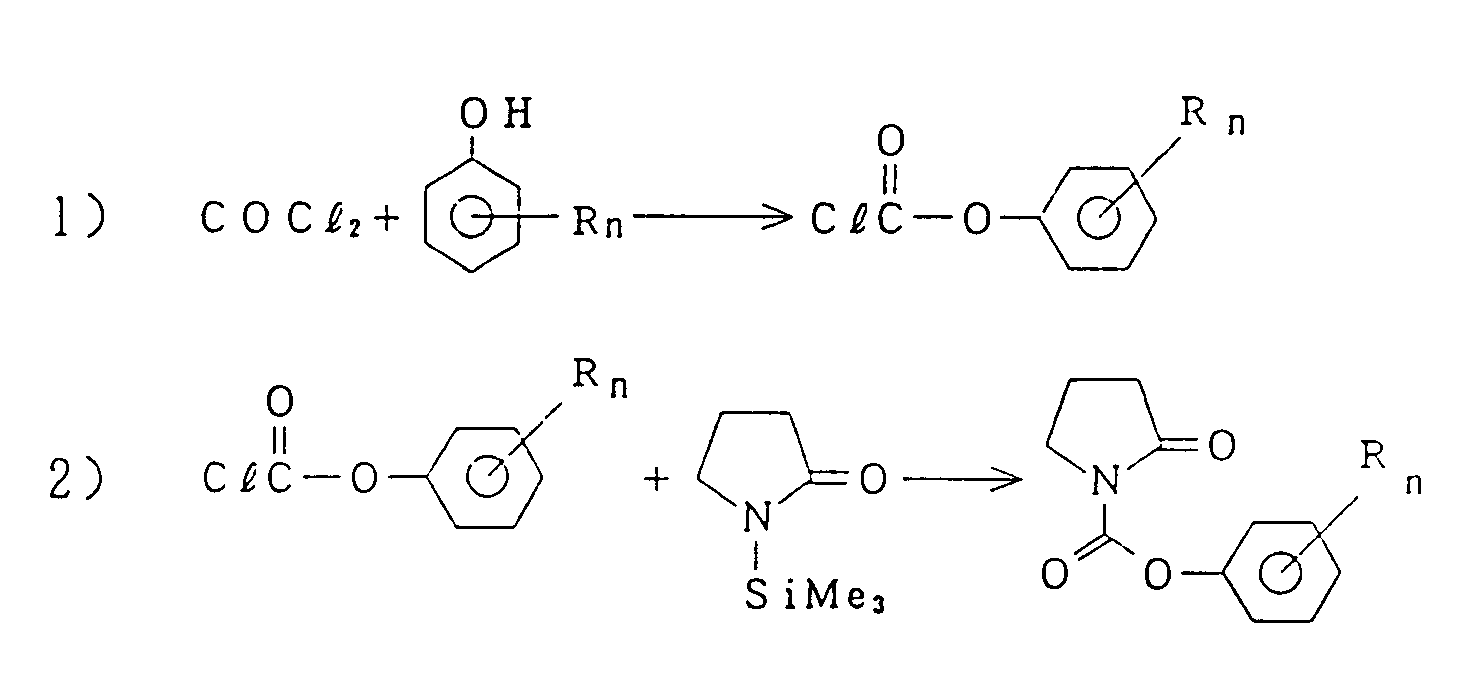
In the above formulas, R and n are as defined above. - In the first step 1), the reaction is carried out by reacting phenol or substituted phenol with phosgen in approximately equimolar amounts in an organic solvent, e.g., an aromatic hydrocarbon solvent in the presence of an acid binder such as an inorganic or organic base in a conventional manner for chloroformylation.
- In the second step 2), the reaction is effected by reacting the chloroformylated product formed in the first step, with or without isolation, with 2-pyrrolidinone in the presence of an acid binder, e.g., an inorganic or organic base, or by reacting said chloroformylated product with 1-trimethylsilyl-2-pyrrolidinone. The amounts of the chloroformylated product and 2-pyrrolidinone or trimethylsilyl pyrrolidinone may be substantially equimolar amount.
- The crude products of the invention as produced after distilling off the solvent are purified by known means such as recrystallization, chromatography or the like.
- As previously mentioned, the compounds of formula (I') can be used for inhibition or prevention of cerebral insufficiency, improvement or therapy of amnesia, improvement, inhibition or therapy of senile dementia and improvement of intellectual capacity in such conditions as cerebral seizure and alcoholism.
- The compounds of formula (I') can be formulated in various dosage forms. The pharmaceutical preparations can be administered orally in the form of tablets, sugar-coated tablets, hard capsules, soft capsules, or liquids such as solutions, emulsions or suspensions. Alternatively, the preparations may be administered rectally in the form of suppositories or parenterally in the form of injections.
- These pharmaceutical preparations can be produced by known processes using additives well known in the art such as excipients, binders, dilluents, stabilizers, preservatives, solubilizers, wetting agents, emulsifiers, lubricants, sweetners, colorants, flavoring agents, buffers and antioxidants. Dosage of the present compounds is variable in a wide range, generally a daily dose of about 5 to 2500 mg/kg.
- The invention is further illustrated by the following non-limitative examples.
- To a solution of phenyl chloroformate (3.13 g, 20.0 mmol) in anhydrous toluene (10 ml) was added a solution of 1-trimethylsilyl-2-pyrrolidinone (3.46 g, 22.0 mmol) in anhydrous toluene (10 ml). The mixture was stirred at room temperature for 30 min. The reaction mixture was evaporated under reduced pressure to dryness to give a solid material. Recrystallization from ethanol afforded 2.37 g of colorless prisms. Yield 57.7%.
m.p.: 123-124°C
IR (KBr) : 3006, 2969, 2841, 1796, 1698, 1506, 1380, 1308, 1192, 994 cm⁻¹
¹H-NMR (400 MHz, CDCℓ₃) δ : 7.38 (2H, t, J =7.5 Hz, H-3',5')7.24(1H, t, J=7.5 Hz, H-4') 7.18 (2H, d, J=7.5 Hz, H-2',6')
 3.95 (2H, t, J=8.1 Hz, H-5)
 2.61(2H, t, J=7.6 Hz, H-3)
 2.12 (2H, quintet, J=7.8 Hz, H-4)
Mass spectrum (m/e): 205(M⁺), 112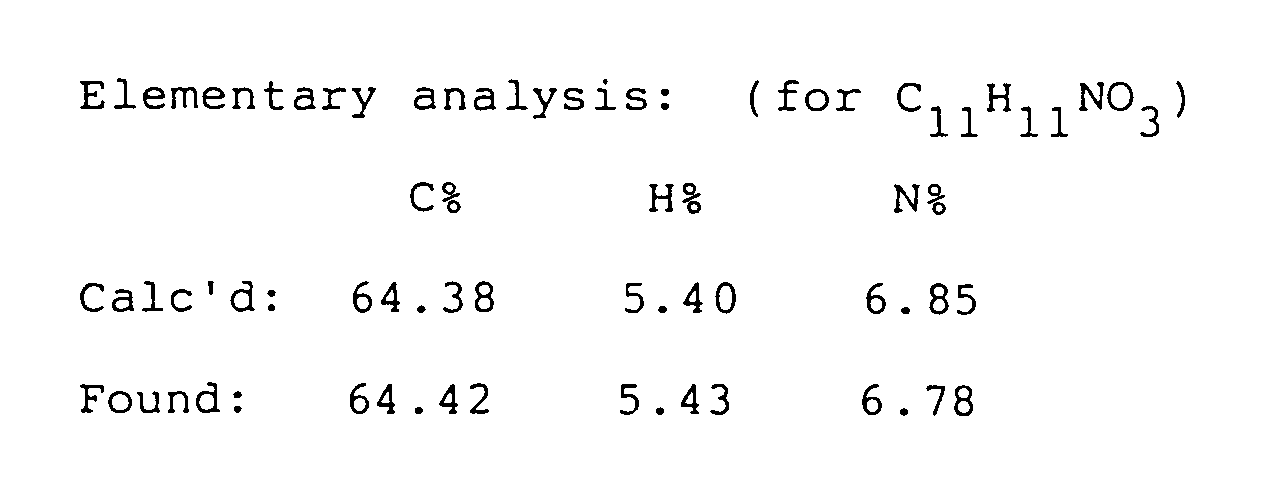
- To a solution of phosgen (6.27 g, 63.3 mmol) in anhydrous benzene (30 ml) was dropwise added under ice-cooling a solution of 2-methoxyphenol (7.86 g, 63.3 mmol) and purified pyridine (5.00 g, 63.3 mmol) in anhydrous benzene (20 ml). The mixture was stirred overnight at room temperature. From a reaction solution were separated white precipitates by filtration, and a filtrate was evaporated under reduced pressure to give a colorless oily material. The oily material was dissolved in anhydrous benzene (20 ml), to which was added a solution of 1-trimethylsilyl-2-pyrrolidinone (9.66 g, 63.3 mmol) in anhydrous benzene (10 ml). The mixture was stirred at room temperature for 30 min. The reaction mixture was evaporated under reduced pressure to dryness to give a solid material. The desired product was separated using column chromatography on silica gel (eluted with benzene-acetone 20:1 → 1:1). Recrystallization from 2-propanol afforded colorless prisms.
Yield 29.4%
m.p.: 104-105°C
IR (KBr) : 3071, 3050, 3031, 1790, 1701, 1611, 1589, 1300, 762, 746 cm⁻¹
¹H-NMR (400 MHz, CDCℓ₃) δ : 7.21(1H, t, J=7.9 Hz, H-5')7.11 (1H, dd, J=7.9, 1.5 Hz, H-6') 7.95 (1H, t, J=7.9 Hz, H-4')
 6.92 (1H, dd, J=7.9, 1.0 Hz, H-3')
 3.95 (2H, t,J=8.1 Hz, H-5)
 3.81 (3H, s, 2'-OCH₃)
 2.59 (2H, t, J=7.6 Hz, H-3)
 2.09 (2H, quintet, J=7.8 Hz, H-4)
Mass spectrum (m/e): 235(M⁺), 124
- To a solution of 4-methoxyphenyl chloroformate (3.73 g, 20.2 mmol) in anhydrous toluene (10 ml) was added a solution of 1-trimethylsilyl-2-pyrrolidinone (3.46 g, 22.0 mmol) in anhydrous toluene (10 ml). The mixture was stirred at room temperature for 30 min. The reaction mixture was evaporated under reduced pressure to dryness to give a solid material. Recrystallization from ethanol afforded 3.45 g of colorless prisms. Yield 73.4%
m.p.: 133-134°C
IR (KBr): 3006, 2969, 1799, 1698, 1506, 1380, 1309, 1192, 1170, 994, 746 cm⁻¹
¹H-NMR (400 MHz, CDCℓ₃)δ : 7.10 (2H, d, J=9.1 Hz, H-2',6') 6.89(2H, d, J=9.1 Hz, H-3',5')
 3.93 (2H, t, J=7.2 Hz, H-5)
 3.80 (3H, s, 4'-OCH₃)
 2.60(2H, t, J=8.2 Hz, H-3)
 2.11 (2H, quintet, J=7.6 Hz, H-4)
Mass spectrum (m/e): 235(M⁺), 124
- To a solution of phosgen (6.38 g, 64.5 mmol) in anhydrous benzene (30 ml) was added under ice-cooling a solution of 3-methoxyphenol (4.00 g, 32.3 mmol) and purified pyridine (2.55 g, 32.3 mmol) in anhydrous benzene (20 ml), and the same procedures as in Example 2 were repeated to obtain the product. Recrystallization from 2-propanol gave 2.44 g of colorless prisms. Yield 32.2 %
m.p.: 45-47°C
IR (KBr): 3066, 2977, 1800, 1709, 1306, 1138, 767, 692 cm⁻¹
¹H-NMR (400 MHz, CDCℓ₃) δ : 7.26(1H, t, J=8.2 Hz, H-5')6.77 (3H, m, H-2',4',6') 3.92 (2H, t, J=7.2 Hz, H-5)
 3.78 (3H, s, 3'-OCH₃)
 2.59 (2H, t, J=8.1 Hz, H-3)
 2.09 (2H, quintet, J=7.8 Hz, H-4)
Mass spectrum (m/e): 235(M⁺), 124 - To a solution of phosgen (6.00 g, 60.6 mmol) in anhydrous benzene (30 ml) was added under ice-cooling a solution of 2-methylphenol (o-cresol, 6.55 g, 60.6 mmol) and purified pyridine (4.79 g, 60.6 mmol) in anhydrous benzene (20 ml), and the same procedures as in Example 2 were repeated to obtain the product. Recrystallization from 2-propanol gave 7.16 g of colorless prisms. Yield 54.5%
m.p.: 85-87°C
IR (KBr): 3385, 2910, 1796, 1689, 1614, 1585, 1493, 1463, 760 cm⁻¹
¹H-NMR (400 MHz, CDCℓ₃) δ : 7.18 (4H, m, H-3',4',5',6')3.95 (2H, t, J=8.1 Hz, H-5) 2.63 (2H, t, J=7.6 Hz, H-3)
 2.25 (3H, s, 2'-CH₃)
 2.13 (2H, quintet, J=7.8 Hz, H-4)
Mass spectrum (m/e): 219(M⁺), 108
- To a solution of phosgen (6.55 g, 65.8 mmol) in anhydrous benzene (30 ml) was added under ice-cooling a solution of 3-methylphenol (m-cresol, 7.12 g, 65.8 mmol) and purified pyridine (5.20 g, 65.8 mmol) in anhydrous benzene (20 ml), and the same procedures as in Example 2 were repeated to obtain the product. Recrystallization from 2-propanol gave 5.75 g of colorless prisms. Yield 39.9%
m.p.: 58-59°C
IR (KBr): 3394, 3052, 1795, 1703, 1614, 1586, 1510, 1488, 783 cm⁻¹
¹H-NMR (400 MHz, CDCℓ₃) δ : 7.25(1H, t, J=7.7 Hz, H-5')7.05 (1H, d, J=7.7 Hz, H-4') 7.00 (1H, s, H-2')
 6.98 (1H, d, J=7.7 Hz, H-6')
 3.93 (2H, t, J=7.2 Hz, H-5)
 2.60 (2H, t, J=8.1 Hz, H-3)
 2.35 (3H, s, 3'-CH₃)
 2.09 (2H, quintet, J=7.8 Hz, H-4)
Mass spectrum (m/e): 219(M⁺), 108
- To a solution of phosgen (5.61 g, 56.6 mmol) in anhydrous benzene (30 ml) was added under ice-cooling a solution of 4-methylphenol (p-cresol, 6.17 g, 56.6 mmol) and purified pyridine (4.47 g, 56.6 mmol) in anhydrous benzene (20 ml), and the same procedures as in Example 2 were repeated to obtain the product. Recrystallization from 2-propanol gave 1.94 g of colorless prisms. Yield 15.7%
m.p.: 101-102°C
IR (KBr): 3071, 3031, 1785, 1695, 1509, 1463, 824 cm⁻¹
¹H-NMR (400 MHz, CDCℓ₃) δ : 7.17(2H, d, J=8.4 Hz, H-3',5')7.06 (2H, d, J=8.4 Hz, H-2',6') 3.94 (2H, t, J=7.2 Hz, H-5)
 2.61 (2H, t, J=8.1 Hz, H-3)
 2.34 (3H, s, 4'-CH₃)
 2.11 (2H, quintet, J=7.6 Hz, H-4)
Mass spectrum (m/e): 219(M⁺), 108
- To a solution of 4-fluorophenyl chloroformate (3.55 g, 20.0 mmol) in anhydrous benzene (10 ml) was added a solution of 1-trimethylsilyl-2-pyrrolidinone (3.46 g, 22.0 mmol) in anhydrous benzene (10 ml). The mixture was stirred at room temperature for 30 min. The reaction mixture was evaporated under reduced pressure to dryness to give a solid material. Recrystallization from 2-propanol afforded 2.24 g of colorless prisms. Yield 46.9%
m.p.: 89-90°C
IR (KBr): 3385, 2913, 1789, 1698, 1505, 1299, 1167, 875cm⁻¹
¹H-NMR (400 MHz, CDCℓ₃) δ : 7.14 (2H, dd, J=9.0, 4.0 Hz, H-2',6')7.06 (2H, dd, J=8.8, 8.6 Hz, H-3',5') 3.94 (2H, t, J=7.2 Hz, H-5)
 2.61(2H, t, J=7.6 Hz, H-3)
 2.09 (2H, quintet, J=7.8 Hz, H-4)
Mass spectrum (m/e): 239(M⁺), 112(M⁺-FC₆H₄O)
- To a solution of phosgen (6.04 g, 61.0 mmol) in anhydrous benzene (30 ml) was added under ice-cooling a solution of 2-chlorophenol (7.84 g, 61.0 mmol) and purified pyridine (4.82 g, 61.0 mmol) in anhydrous benzene (20 ml), and the same procedures as in Example 2 were repeated to obtain the product. Recrystallization from 2-propanol gave 4.23 g of colorless prisms. Yield 28.9%
m.p.: 92-93°C
IR (KBr): 3097, 1807, 1700, 1487, 1463, 1371, 1308, 1220, 762 cm⁻¹
¹H-NMR (400 MHz, CDCℓ₃) δ : 7.90 (1H, d, J=7.9 Hz, H-3')7.25 (3H, m, H-4',5',6') 4.00 (2H, t, J=7.1 Hz, H-5)
 2.63 (2H, t, J=8.0 Hz, H-3)
 2.13(2H, quintet, J=7.8 Hz, H-4)
Mass spectrum (m/e): 239(M⁺), 112(M⁺-ClC₆H₄O)
- To a solution of phosgen (5.79 g, 58.5 mmol) in anhydrous benzene (30 ml) was added under ice-cooling a solution of 3-chlorophenol (7.52 g, 58.5 mmol) and purified pyridine (4.62 g, 58.8 mmol) in anhydrous benzene (20 ml), and the same procedures as in Example 2 were repeated to obtain the product. Recrystallization from 2-propanol gave 4.24 g of colorless prisms. Yield 30.2%
m.p.: 88-89°C
IR (KBr): 3397, 3087, 1796, 1703, 1596, 1587, 1477, 1459, 1304, 995,757,679cm⁻¹
¹H-NMR (400 MHz, CDCℓ₃) δ : 7.31(1H, t, J=8.1 Hz, H-5')7.23 (2H, m, H-2',4') 7.10 (1H, d, J=7.2 Hz, H-6')
 3.93 (2H, t, J=6.9 Hz, H-5)
 2.61(2H, t, J=8.1 Hz, H-3)
 2.11 (2H, quintet, J=7.5 Hz, H-4)
Mass spectrum (m/e): 239(M⁺), 112(M⁺-ClC₆H₄O)
- To a solution of phosgen (5.94 g, 60.0 mmol) in anhydrous benzene (30 ml) was added under ice-cooling a solution of 4-chlorophenol (7.71 g, 60.0 mmol) and purified pyridine (4.74 g, 60.0 mmol) in anhydrous benzene (20 ml), and the same procedures as in Example 2 were repeated to obtain the product. Recrystallization from 2-propanol gave 5.55 g of colorless prisms. Yield 42.1%
m.p.: 99-100°C
IR (KBr): 3094, 3040, 1786, 1703, 1490, 1304, 756 cm⁻¹
¹H-NMR (400 MHz, CDCℓ₃) δ : 7.33 (2H, d, J=8.5 Hz, H-3',5')7.12 (2H, d, J=8.5 Hz, H-2',6') 3.91 (2H, t, J=7.2 Hz, H-5)
 2.59 (2H, t, J=8.0 Hz, H-3)
 2.11 (2H, quintet, J=7.6 Hz, H-4)
Mass spectrum (m/e): 239(M⁺), 112(M⁺-ClC₆H₄O)
- To a solution of phosgen (6.10 g, 61.6 mmol) in anhydrous benzene (30 ml) was added under ice-cooling a solution of 1-bromophenol (10.66 g, 61.6 mmol) and purified pyridine (4.87 g, 61.6 mmol) in anhydrous benzene (20 ml), and the same procedures as in Example 2 were repeated to obtain the product. Recrystallization from 2-propanol gave 4.93 g of colorless prisms. Yield 28.2%
m.p.: 103-104°C
IR (KBr): 3449, 2909, 1806, 1702, 1473, 1372, 1308, 989, 762 cm⁻¹
¹H-NMR (400 MHz, CDCℓ₃) δ : 7.61 (1H, dd, J=8.0, 1.5 Hz, H-3')7.34(1H, td, J=8.0, 8.0, 1.5 Hz, H-5') 7.26 (1H, dd, J=8.0, 1.6 Hz, H-6')
 7.14 (1H, td, J=8.0, 8.0, 1.6 Hz, H-4')
 4.03 (2H, t, J=7.1 Hz, H-5)
 2.64 (2H, t, J=8.0 Hz, H-3)
 2.15 (2H, quintet, J=7.7 Hz, H-4)
Mass spectrum (m/e): 283(M⁺), 112(M⁺-BrC₆H₄O)
- To a solution of phosgen (3.67 g, 37.1 mmol) in anhydrous benzene (30 ml) was added under ice-cooling a solution of 3-bromophenol (6.42 g, 37.1 mmol) and purified pyridine (2.93 g, 37.1 mmol) in anhydrous benzene (20 ml), and the same procedures as in Example 2 were repeated to obtain the product. Recrystallisation from 2-propanol gave 3.68 g of colorless prisms. Yield 35.0%
m.p.: 95-96°C
IR (KBr): 3388, 3082, 2976, 1796, 1702, 1589, 1301, 1190, 995, 756, 678cm⁻¹
¹H-NMR (400 MHz, CDCℓ₃) δ : 7.38 (2H, m, H-2',4')7.26 (1H, t, J=8.3 Hz, H-5') 7.15 (1H, d, J=8.3 Hz, H-6')
 3.93 (2H, t, J=7.0 Hz, H-5)
 2.61 (2H, t, J=8.1 Hz, H-3)
 2.12 (2H, quintet, J=7.5 Hz, H-4)
Mass spectrum (m/e): 283(M⁺), 112(M⁺-BrC₆H₄O)
- To a solution of 4-bromophenyl chloroformate (4.19 g, 20.0 mmol) in anhydrous benzene (20 ml) was added a solution of 1-trimethylsilyl-2-pyrrolidinone (3.46 g, 22.0 mmol) in anhydrous benzene (10 ml). The mixture was stirred at room temperature for 30 min. The reaction mixture was evaporated under reduced pressure to dryness to give a solid material. Recrystallization from 2-propanol afforded 3.00 g of colorless prisms. Yield 53%
m.p.: 107-108°C
IR (KBr): 3387, 3088, 1800, 1780, 1699, 1582, 1483, 1305, 1192, 991, 757 cm⁻¹
¹H-NMR (400 MHz, CDCℓ₃) δ : 7.49 (2H, d, J=8.8 Hz, H-3',5')7.07 (2H, d, J=8.8 Hz, H-2',6') 3.93 (2H, t, J=7.2 Hz, H-5)
 2.62 (2H, t, J=8.0 Hz, H-3)
 2.12 (2H, quintet, J=7.6 Hz, H-4)
Mass spectrum (m/e): 283(M⁺), 112(M⁺-BrC₆H₄O)
- To a solution of phosgen (6.12 g, 61.8 mmol) in anhydrous benzene (30 ml) was dropwise added under ice-cooling a solution of 2-nitrophenol (8.60 g, 61.8 mmol) and purified pyridine (4.88 g, 61.8 mmol) in anhydrous benzene (20 ml). The mixture was stirred for 30 min. at room temperature. From the reaction solution were separated precipitates by filtration, and a filtrate was evaporated under reduced pressure to give a colorless oily material. The oily material was dissolved in anhydrous benzene (20 ml), to which was added a solution of 1-trimethylsilyl-2-pyrrolidinone (4.00 g, 25.4 mmol) in anhydrous benzene (10 ml). The mixture was stirred at room temperature for 30 min. The reaction mixture was evaporated under reduced pressure to dryness to give a solid material. The desired product was separated using column chromatography on silica gel (eluted with chloroform-acetone 30:1 → 3:1). Recrystallization from ethanol afforded 1.98 g of colorless prisms. Yield 31.1%
m.p.: 135-136°C
IR (KBr): 3400, 3109, 2992, 1805, 1703, 1606, 1590, 1371, 1247, 1310, 1217, 1188, 989, 738 cm⁻¹
¹H-NMR (400 MHz, CDCℓ₃) δ : 8.14 (1H, d, J=8.1 Hz, H-3')7.68 (1H, t, J=8.1 Hz, H-5') 7.44(1H, t, J=8.1 Hz, H-4')
 7.36 (1H, d, J=8.1 Hz, H-6')
 3.99 (2H, t, J=7.2 Hz, H-5)
 2.64 (2H, t, J=8.0 Hz, H-3)
 2.16 (2H, quintet, J=7.8 Hz, H-4)
Mass spectrum (m/e): 250(M⁺), 112(M⁺-NO₂C₆H₄O)
- To a solution of phosgen (5.89 g, 59.5 mmol) in anhydrous benzene (30 ml) was added under ice-cooling a solution of 3-nitrophenol (8.28 g, 59.5 mmol) and purified pyridine (4.70 g, 59.5 mmol) in anhydrous benzene (20 ml), and the same procedures as in Example 15 were repeated to obtain the product. Recrystallization from ethanol gave 4.41 g of pale yellow prisms. Yield 58.8%
m.p.: 130-131°C
IR (KBr): 3393, 3102, 2998, 1795, 1703, 1531, 1352, 1304, 1273, 1211, 1191, 1160, 995, 816, 736 cm⁻¹
¹H-NMR (400 MHz, CDCℓ₃) δ : 8.12 (2H, m, H-4',5')7.77 (2H, m, H-2',6') 3.97 (2H, t, J=6.9 Hz, H-5)
 2.63 (2H, t, J=8.1 Hz, H-3)
 2.16 (2H, quintet, J=7.5 Hz, H-4)
Mass spectrum (m/e): 250(M⁺), 112(M⁺-NO₂C₆H₄O) - To a solution of phosgen (6.35 g, 64.2 mmol) in anhydrous benzene (30 ml) was added under ice-cooling a solution of 4-nitrophenol (10.10 g, 64.2 mmol) and purified pyridine (5.07 g, 64.2 mmol) in anhydrous benzene (20 ml), and the same procedures as in Example 15 were repeated to obtain the product. Recrystallization from ethanol gave 2.86 g of colorless prisms. Yield 35.6%
m.p.: 122-123°C
IR (KBr): 3396, 3078, 2998, 1807, 1784, 1704, 1612, 1595, 1515, 1312, 1230, 994, 861, 757 cm⁻¹
¹H-NMR (400 MHz, CDCℓ₃) δ : 8.28 (2H, d, J=9.2 Hz, H-3',5')7.39 (2H, d, J=9.2 Hz, H-2',6') 3.96 (2H, t, J=7.2 Hz, H-5)
 2.64 (2H, t, J=8.0 Hz, H-3)
 2.16 (2H, quintet, J=7.6 Hz, H-4)
Mass spectrum (m/e): 250(M⁺), 112(M⁺-NO₂C₆H₄O)
- To a solution of phosgen (5.80 g, 58.6 mmol) in anhydrous benzene (30 ml) was added under ice-cooling a solution of 2,6-dimethoxyphenol (9.03 g, 58.6 mmol) and purified pyridine (4.63 g, 58.6 mmol) in anhydrous benzene (20 ml), and the same procedures as in Example 2 were repeated to obtain the product. Recrystallisation from ethanol gave 5.35 g of colorless prisms. Yield 34.5%
m.p.: 163-165°C
IR (KBr): 2894, 2740, 1790, 1699, 1619, 1483, 1312, 1113, 761 cm⁻¹
¹H-NMR (400 MHz, CDCℓ₃) δ : 7.13 (1H, t, J=8.4 Hz, H-4')6.66 (2H, d, J=8.4 Hz, H-3',5') 3.87 (2H, t, J=7.1 Hz, H-5)
 3.75 (6H, s, 2',6'-OCH₃)
 2.58 (2H, t, J=8.0 Hz, H-3)
 2.09 (2H, quintet, J=7.8 Hz, H-4)
Mass spectrum (m/e): 265(M⁺), 154
- To a solution of phosgen (6.16 g, 62.2 mmol) in anhydrous benzene (30 ml) was added under ice-cooling a solution of 3,5-dimethoxyphenol (9.59 g, 62.2 mmol) and purified pyridine (4.63 g, 62.2 mmol) in anhydrous benzene (20 ml), and the same procedures as in Example 2 were repeated to obtain the product. Recrystallization from 2-propanol gave 5.13 g of pale brown prisms. Yield 31.1%
m.p.: 80-81°C
IR (KBr): 2968, 1790, 1775, 1626, 1592, 1468, 1329, 1312, 1158, 993, 868, 769 cm⁻¹
¹H-NMR (90 MHz, CDCℓ₃) δ : 6.35 (3H, s, H-2',4',6')3.90 (2H, t, J=7.0 Hz, H-5) 3.75 (6H, s, 3',5'-OCH₃)
 2.60 (2H, t, J=8.0 Hz, H-3)
 2.10 (2H, quintet, J=7.0 Hz, H-4)
Mass spectrum (m/e): 265(M⁺), 154
Representative compounds of the invention were evaluated for an activity against amnesia using "passive avoidance" test with a scopolamine-induced amnesia. - The test apparatus was a light chamber (10 x 14 x 20 cm) and a dark chamber (24 x 24 x 20 cm) with a stainless grid floor to which an electroshock can be applied by a shock generator (SGS-002, manufactured by Muromachi Machine Co., Ltd.). The passive avoidance test was conducted on 3 groups of 10 DDY mice (male, 5 weeks age). To the animals of the first group as a control, CMC was orally administered and after 30 minutes, a solution of scopolamine in physiological saline was subcutaneously administered at a dose of 1.0 mg/kg. To other two groups, the test compounds, i.e., 1-(p-methoxybenzoyl)-2-pyrrolidinone (aniracetam) as a comparative compound and the present compounds were orally administered at doses of 30 mg/kg and after 30 minutes, a solution of scopolamine in physiological saline was subcutaneously administered at a dose of 1.0 mg/kg. 30 minutes after the subcutaneous administration, the acquisition trial was conducted and 24 hours thereafter the retention trial was conducted.
- Mice were individually placed in the light chamber at a direction opposite to the passage inlet. A latency at which the limb of a mouse completely enters the dark chamber was measured. A foot shock (1 mA, for 0.5 sec.) was delivered through the grid floor as soon as the mouse entered the dark chamber. Thereafter, each mouse was returned to a conventional case.
- 24 hours after the acquisition trial, each mouse was again placed in the light chamber in accordance with the same procedure as done in the previous day. The latency was measured. In this case, no foot shock was given.
- In the following table, the results are shown as percent change in latencies over control defined as 100.

- In view of the pharmacological activity the compounds of formula (I') can be used in various dosage forms depending upon the object of administration.
Particular formulations are illustrated below.
- The components were uniformly blended to prepare powders for direct compression. The powders were formulated by a rotary tableting machine into tablets each 6 mm in diameter and weighing 100 mg.

- The active ingredient, lactose, corn starch and crystalline cellulose were uniformly blended, to which were added a solution of hydroxypropylcellulose and ethanol. The mixture was kneaded and granulated by extrusion granulation. The granules were dried in a drier at 50°C and screened to particle sizes of 297 »m - 1460 »m. The granular formulation was divided into 200 mg per division.

- Sucrose, D-sorbitol, methyl paraoxybenzoate, propyl paraoxybenzoate and the active ingredient were dissolved in 60 g of warm water. To the solution, after cooling, were added glycerin and the flavors dissolved in the ethanol. To the mixture was then added water to make up 100 ml.

- CMC and the active ingredient were suspended in distilled water to prepare an injection.

- The active ingredient was dissolved in glycerin. To the solution was added polyethylene glycol 4000, and the mixture was warmed to a solution. The solution was poured into a suppository mold and solidified by cooling to prepare suppositories weighing 1.5 g per piece.
Claims (11)
- A compound of formula (I)

- A compound of claim 1 wherein R is a C₁-C₄ alkyl group.
- A compound of claim 1 wherein R is a C₁-C₄ alkoxy group.
- A compound of claim 1 wherein R is a nitro group.
- A compound of claim 1 wherein R is F, Cl or Br.
- A nootropic agent comprising as an active ingredient an effective amount of a compound of formula (I')

- A nootropic agent of claim 6 wherein R' is a hydrogen atom.
- A nootropic agent of claim 6 wherein R' is a C₁-C₄ alkyl group.
- A nootropic agent of claim 6 wherein R' is a C₁-C₄ alkoxy group.
- A nootropic agent of claim 6 wherein R' is a nitro group.
- A nootropic agent of claim 6 wherein R' is F, Cl or Br.
Applications Claiming Priority (2)
| Application Number | Priority Date | Filing Date | Title |
|---|---|---|---|
| JP39064/90 | 1990-02-20 | ||
| JP2039064A JP2803882B2 (en) | 1990-02-20 | 1990-02-20 | 1-phenoxycarbonyl-2-pyrrolidinone derivative |
Publications (3)
| Publication Number | Publication Date |
|---|---|
| EP0443474A2 EP0443474A2 (en) | 1991-08-28 |
| EP0443474A3 EP0443474A3 (en) | 1992-04-22 |
| EP0443474B1 true EP0443474B1 (en) | 1995-08-16 |
Family
ID=12542704
Family Applications (1)
| Application Number | Title | Priority Date | Filing Date |
|---|---|---|---|
| EP91102229A Expired - Lifetime EP0443474B1 (en) | 1990-02-20 | 1991-02-17 | 1-Phenoxycarbonyl-2-pyrrolidinone derivatives and nootropic agents |
Country Status (8)
| Country | Link |
|---|---|
| US (1) | US5140041A (en) |
| EP (1) | EP0443474B1 (en) |
| JP (1) | JP2803882B2 (en) |
| KR (1) | KR0181963B1 (en) |
| AT (1) | ATE126504T1 (en) |
| CA (1) | CA2036630C (en) |
| DE (1) | DE69112095T2 (en) |
| ES (1) | ES2077697T3 (en) |
Families Citing this family (1)
| Publication number | Priority date | Publication date | Assignee | Title |
|---|---|---|---|---|
| JP3038032B2 (en) * | 1991-03-25 | 2000-05-08 | 日清製粉株式会社 | Platelet aggregation inhibitor |
Family Cites Families (4)
| Publication number | Priority date | Publication date | Assignee | Title |
|---|---|---|---|---|
| CA1115212A (en) * | 1978-02-10 | 1981-12-29 | Emilio Kyburz | Pyrrolidine derivatives |
| CU21107A3 (en) * | 1978-02-10 | 1988-02-01 | Hoffmann La Roche | DERIVATIVE PYRROLIDINES |
| CA1305148C (en) * | 1987-08-19 | 1992-07-14 | Hiromu Matsumura | Carbamoylpyrrolidone derivatives and drugs for senile dementia |
| EP0373226B1 (en) * | 1988-04-15 | 1994-06-15 | Taiho Pharmaceutical Company, Limited | Carbamoyl-2-pyrrolidinone compounds |
-
1990
- 1990-02-20 JP JP2039064A patent/JP2803882B2/en not_active Expired - Fee Related
-
1991
- 1991-02-17 DE DE69112095T patent/DE69112095T2/en not_active Expired - Fee Related
- 1991-02-17 ES ES91102229T patent/ES2077697T3/en not_active Expired - Lifetime
- 1991-02-17 AT AT91102229T patent/ATE126504T1/en not_active IP Right Cessation
- 1991-02-17 EP EP91102229A patent/EP0443474B1/en not_active Expired - Lifetime
- 1991-02-19 CA CA002036630A patent/CA2036630C/en not_active Expired - Fee Related
- 1991-02-20 KR KR1019910002699A patent/KR0181963B1/en not_active Expired - Fee Related
- 1991-02-20 US US07/658,300 patent/US5140041A/en not_active Expired - Lifetime
Also Published As
| Publication number | Publication date |
|---|---|
| DE69112095T2 (en) | 1996-01-11 |
| CA2036630C (en) | 1997-03-18 |
| EP0443474A2 (en) | 1991-08-28 |
| KR910021373A (en) | 1991-12-20 |
| KR0181963B1 (en) | 1999-05-01 |
| ATE126504T1 (en) | 1995-09-15 |
| CA2036630A1 (en) | 1991-08-21 |
| JP2803882B2 (en) | 1998-09-24 |
| ES2077697T3 (en) | 1995-12-01 |
| JPH03246275A (en) | 1991-11-01 |
| US5140041A (en) | 1992-08-18 |
| DE69112095D1 (en) | 1995-09-21 |
| EP0443474A3 (en) | 1992-04-22 |
Similar Documents
| Publication | Publication Date | Title |
|---|---|---|
| US5110823A (en) | Pyrrolidine derivatives as nootropic agents | |
| KR930011300B1 (en) | Oxindole derivative | |
| US4169152A (en) | Isohexide and tetrahydrofuran ethers and their carbamates in method of bringing about relaxation of skeletal musculature | |
| US4369139A (en) | 1-(P-Methoxy p-hydroxy, and p-benzyloxy benzoyl)-2-pyrrolidinones | |
| MC1418A1 (en) | 2,4-DIAMINO-PYRIMIDINES, THEIR PREPARATION AND MEDICINES CONTAINING THESE SUBSTANCES | |
| US4505907A (en) | N-Formyl and N-hydroxymethyl-3-phenoxy-1-azetidinecarboxamides | |
| EP0299493B1 (en) | N-[(2-Oxopyrrolidin-1-yl)-acetyl]piperazine derivatives and drug for senile dementia | |
| KR910000639B1 (en) | Method for preparing 4-cyanopyridazine | |
| ZA200307320B (en) | Novel cyano-substituted dihydropyrimidine compounds and their use to treat diseases. | |
| HU189608B (en) | Process for producing pyridazine derivatives | |
| EP0033617A2 (en) | Thiazolidine derivatives and their production and medicinal compositions containing them | |
| US5728709A (en) | Alkyl and aralkyl-substituted pyrrolocarbazole derivatives that stimulate platelet production | |
| US5140041A (en) | 1-phenoxycarbonyl-2-pyrrolidinone derivatives and nootropic agents | |
| CS208464B2 (en) | Method of making the 4-/n-acetyl/amino-tetrahydro-1,3,5-triazin-2,6-dions | |
| JP2584336B2 (en) | Carboxamide derivatives | |
| US4177273A (en) | 6-(Substituted phenyl)-4,5-dihydro-pyridazin-3(2H)-ones | |
| US4188323A (en) | Derivatives of 2-oxazolydone and methods for preparing the same | |
| GB2088872A (en) | 1-benzylimidazole derivatives | |
| US3914236A (en) | 1-(Imidazole-1-yl)-isoquinolines and process for preparing them | |
| US4536504A (en) | Hexahydrodioxopyrimidines, their production and use | |
| US4524147A (en) | Uracil derivatives, process for preparing same, and pharmaceutical compositions comprising same | |
| HU190710B (en) | Process for preparing 2-/4-piperazinyl/-4-phenyl-quinazoline derivatives | |
| US4251541A (en) | 1-Substituted-3-arylthio-4-hydroxypyrrolidines | |
| KR940004059B1 (en) | Bicyclolactam derivatives | |
| EP0030038B1 (en) | 1,2,4-triazine derivatives, process for their production and pharmaceutical composition |
Legal Events
| Date | Code | Title | Description |
|---|---|---|---|
| PUAI | Public reference made under article 153(3) epc to a published international application that has entered the european phase |
Free format text: ORIGINAL CODE: 0009012 |
|
| AK | Designated contracting states |
Kind code of ref document: A2 Designated state(s): AT BE CH DE ES FR GB IT LI SE |
|
| PUAL | Search report despatched |
Free format text: ORIGINAL CODE: 0009013 |
|
| AK | Designated contracting states |
Kind code of ref document: A3 Designated state(s): AT BE CH DE ES FR GB IT LI SE |
|
| 17P | Request for examination filed |
Effective date: 19921013 |
|
| 17Q | First examination report despatched |
Effective date: 19941213 |
|
| GRAA | (expected) grant |
Free format text: ORIGINAL CODE: 0009210 |
|
| AK | Designated contracting states |
Kind code of ref document: B1 Designated state(s): AT BE CH DE ES FR GB IT LI SE |
|
| REF | Corresponds to: |
Ref document number: 126504 Country of ref document: AT Date of ref document: 19950915 Kind code of ref document: T |
|
| REF | Corresponds to: |
Ref document number: 69112095 Country of ref document: DE Date of ref document: 19950921 |
|
| ET | Fr: translation filed | ||
| ITF | It: translation for a ep patent filed | ||
| REG | Reference to a national code |
Ref country code: ES Ref legal event code: FG2A Ref document number: 2077697 Country of ref document: ES Kind code of ref document: T3 |
|
| PLBE | No opposition filed within time limit |
Free format text: ORIGINAL CODE: 0009261 |
|
| STAA | Information on the status of an ep patent application or granted ep patent |
Free format text: STATUS: NO OPPOSITION FILED WITHIN TIME LIMIT |
|
| 26N | No opposition filed | ||
| PGFP | Annual fee paid to national office [announced via postgrant information from national office to epo] |
Ref country code: SE Payment date: 20010206 Year of fee payment: 11 |
|
| PGFP | Annual fee paid to national office [announced via postgrant information from national office to epo] |
Ref country code: AT Payment date: 20010213 Year of fee payment: 11 Ref country code: CH Payment date: 20010213 Year of fee payment: 11 |
|
| PGFP | Annual fee paid to national office [announced via postgrant information from national office to epo] |
Ref country code: ES Payment date: 20010214 Year of fee payment: 11 |
|
| PGFP | Annual fee paid to national office [announced via postgrant information from national office to epo] |
Ref country code: BE Payment date: 20010427 Year of fee payment: 11 |
|
| REG | Reference to a national code |
Ref country code: GB Ref legal event code: IF02 |
|
| PG25 | Lapsed in a contracting state [announced via postgrant information from national office to epo] |
Ref country code: AT Free format text: LAPSE BECAUSE OF NON-PAYMENT OF DUE FEES Effective date: 20020217 |
|
| PG25 | Lapsed in a contracting state [announced via postgrant information from national office to epo] |
Ref country code: ES Free format text: LAPSE BECAUSE OF NON-PAYMENT OF DUE FEES Effective date: 20020218 Ref country code: SE Free format text: LAPSE BECAUSE OF NON-PAYMENT OF DUE FEES Effective date: 20020218 |
|
| PG25 | Lapsed in a contracting state [announced via postgrant information from national office to epo] |
Ref country code: CH Free format text: LAPSE BECAUSE OF NON-PAYMENT OF DUE FEES Effective date: 20020228 Ref country code: LI Free format text: LAPSE BECAUSE OF NON-PAYMENT OF DUE FEES Effective date: 20020228 Ref country code: BE Free format text: LAPSE BECAUSE OF NON-PAYMENT OF DUE FEES Effective date: 20020228 |
|
| REG | Reference to a national code |
Ref country code: FR Ref legal event code: CD |
|
| BERE | Be: lapsed |
Owner name: NISSHIN FLOUR MILLING CO. LTD Effective date: 20020228 |
|
| EUG | Se: european patent has lapsed |
Ref document number: 91102229.1 |
|
| REG | Reference to a national code |
Ref country code: CH Ref legal event code: PL |
|
| REG | Reference to a national code |
Ref country code: ES Ref legal event code: FD2A Effective date: 20030922 |
|
| PGFP | Annual fee paid to national office [announced via postgrant information from national office to epo] |
Ref country code: GB Payment date: 20070214 Year of fee payment: 17 |
|
| PGFP | Annual fee paid to national office [announced via postgrant information from national office to epo] |
Ref country code: DE Payment date: 20070215 Year of fee payment: 17 |
|
| PGFP | Annual fee paid to national office [announced via postgrant information from national office to epo] |
Ref country code: IT Payment date: 20070623 Year of fee payment: 17 |
|
| PGFP | Annual fee paid to national office [announced via postgrant information from national office to epo] |
Ref country code: FR Payment date: 20070208 Year of fee payment: 17 |
|
| GBPC | Gb: european patent ceased through non-payment of renewal fee |
Effective date: 20080217 |
|
| REG | Reference to a national code |
Ref country code: FR Ref legal event code: ST Effective date: 20081031 |
|
| PG25 | Lapsed in a contracting state [announced via postgrant information from national office to epo] |
Ref country code: DE Free format text: LAPSE BECAUSE OF NON-PAYMENT OF DUE FEES Effective date: 20080902 |
|
| PG25 | Lapsed in a contracting state [announced via postgrant information from national office to epo] |
Ref country code: FR Free format text: LAPSE BECAUSE OF NON-PAYMENT OF DUE FEES Effective date: 20080229 |
|
| PG25 | Lapsed in a contracting state [announced via postgrant information from national office to epo] |
Ref country code: GB Free format text: LAPSE BECAUSE OF NON-PAYMENT OF DUE FEES Effective date: 20080217 |
|
| PG25 | Lapsed in a contracting state [announced via postgrant information from national office to epo] |
Ref country code: IT Free format text: LAPSE BECAUSE OF NON-PAYMENT OF DUE FEES Effective date: 20080217 |