EP0443374B1 - A method for producing a Ziegler-Natta catalyzer, a method for producing a polyolefine by utilizing this catalyzer as well as products made by means of these methods - Google Patents
A method for producing a Ziegler-Natta catalyzer, a method for producing a polyolefine by utilizing this catalyzer as well as products made by means of these methods Download PDFInfo
- Publication number
- EP0443374B1 EP0443374B1 EP91101704A EP91101704A EP0443374B1 EP 0443374 B1 EP0443374 B1 EP 0443374B1 EP 91101704 A EP91101704 A EP 91101704A EP 91101704 A EP91101704 A EP 91101704A EP 0443374 B1 EP0443374 B1 EP 0443374B1
- Authority
- EP
- European Patent Office
- Prior art keywords
- catalyst
- prepolymerization
- catalyzer
- ziegler
- olefine
- Prior art date
- Legal status (The legal status is an assumption and is not a legal conclusion. Google has not performed a legal analysis and makes no representation as to the accuracy of the status listed.)
- Expired - Lifetime
Links
- 238000000034 method Methods 0.000 title claims abstract description 29
- 229920000098 polyolefin Polymers 0.000 title claims abstract description 12
- 238000004519 manufacturing process Methods 0.000 title claims abstract description 11
- 239000002245 particle Substances 0.000 claims abstract description 29
- 238000009826 distribution Methods 0.000 claims abstract description 15
- 229910052723 transition metal Inorganic materials 0.000 claims abstract description 7
- 150000003623 transition metal compounds Chemical class 0.000 claims abstract description 7
- 150000003624 transition metals Chemical class 0.000 claims abstract description 7
- 230000000737 periodic effect Effects 0.000 claims abstract description 6
- 239000003054 catalyst Substances 0.000 claims description 71
- WSSSPWUEQFSQQG-UHFFFAOYSA-N 4-methyl-1-pentene Chemical compound CC(C)CC=C WSSSPWUEQFSQQG-UHFFFAOYSA-N 0.000 claims description 26
- 238000006116 polymerization reaction Methods 0.000 claims description 20
- 239000011954 Ziegler–Natta catalyst Substances 0.000 claims description 10
- 239000000178 monomer Substances 0.000 claims description 7
- 229910000077 silane Inorganic materials 0.000 claims description 6
- -1 titanium halide Chemical class 0.000 claims description 6
- WEEGYLXZBRQIMU-UHFFFAOYSA-N Eucalyptol Chemical compound C1CC2CCC1(C)OC2(C)C WEEGYLXZBRQIMU-UHFFFAOYSA-N 0.000 claims description 4
- 230000004913 activation Effects 0.000 claims description 4
- 239000010936 titanium Substances 0.000 claims description 4
- 229910052719 titanium Inorganic materials 0.000 claims description 3
- 239000005026 oriented polypropylene Substances 0.000 claims 1
- 239000007789 gas Substances 0.000 description 26
- 239000012071 phase Substances 0.000 description 17
- 229920000642 polymer Polymers 0.000 description 12
- IJGRMHOSHXDMSA-UHFFFAOYSA-N Atomic nitrogen Chemical compound N#N IJGRMHOSHXDMSA-UHFFFAOYSA-N 0.000 description 11
- 239000004743 Polypropylene Substances 0.000 description 9
- IMNFDUFMRHMDMM-UHFFFAOYSA-N N-Heptane Chemical compound CCCCCCC IMNFDUFMRHMDMM-UHFFFAOYSA-N 0.000 description 6
- 238000000113 differential scanning calorimetry Methods 0.000 description 6
- 239000004215 Carbon black (E152) Substances 0.000 description 5
- 150000001875 compounds Chemical class 0.000 description 5
- 229930195733 hydrocarbon Natural products 0.000 description 5
- 150000002430 hydrocarbons Chemical class 0.000 description 5
- 230000008018 melting Effects 0.000 description 5
- 238000002844 melting Methods 0.000 description 5
- 239000000203 mixture Substances 0.000 description 5
- 229910052757 nitrogen Inorganic materials 0.000 description 5
- 229920001155 polypropylene Polymers 0.000 description 5
- TWRXJAOTZQYOKJ-UHFFFAOYSA-L Magnesium chloride Chemical compound [Mg+2].[Cl-].[Cl-] TWRXJAOTZQYOKJ-UHFFFAOYSA-L 0.000 description 4
- 229910052749 magnesium Inorganic materials 0.000 description 4
- 239000011777 magnesium Substances 0.000 description 4
- 239000007787 solid Substances 0.000 description 4
- 239000002904 solvent Substances 0.000 description 4
- FYYHWMGAXLPEAU-UHFFFAOYSA-N Magnesium Chemical compound [Mg] FYYHWMGAXLPEAU-UHFFFAOYSA-N 0.000 description 3
- 125000000217 alkyl group Chemical group 0.000 description 3
- 239000007788 liquid Substances 0.000 description 3
- QQONPFPTGQHPMA-UHFFFAOYSA-N propylene Natural products CC=C QQONPFPTGQHPMA-UHFFFAOYSA-N 0.000 description 3
- 125000004805 propylene group Chemical group [H]C([H])([H])C([H])([*:1])C([H])([H])[*:2] 0.000 description 3
- XJDNKRIXUMDJCW-UHFFFAOYSA-J titanium tetrachloride Chemical compound Cl[Ti](Cl)(Cl)Cl XJDNKRIXUMDJCW-UHFFFAOYSA-J 0.000 description 3
- OFBQJSOFQDEBGM-UHFFFAOYSA-N Pentane Chemical compound CCCCC OFBQJSOFQDEBGM-UHFFFAOYSA-N 0.000 description 2
- 125000005234 alkyl aluminium group Chemical group 0.000 description 2
- 229920001577 copolymer Polymers 0.000 description 2
- 238000010586 diagram Methods 0.000 description 2
- 230000000694 effects Effects 0.000 description 2
- 238000010438 heat treatment Methods 0.000 description 2
- 229910052500 inorganic mineral Inorganic materials 0.000 description 2
- 229910001629 magnesium chloride Inorganic materials 0.000 description 2
- 229910052751 metal Inorganic materials 0.000 description 2
- 239000002184 metal Substances 0.000 description 2
- 239000011707 mineral Substances 0.000 description 2
- 150000002902 organometallic compounds Chemical group 0.000 description 2
- 239000002002 slurry Substances 0.000 description 2
- 239000000725 suspension Substances 0.000 description 2
- ZWYDDDAMNQQZHD-UHFFFAOYSA-L titanium(ii) chloride Chemical compound [Cl-].[Cl-].[Ti+2] ZWYDDDAMNQQZHD-UHFFFAOYSA-L 0.000 description 2
- 230000008016 vaporization Effects 0.000 description 2
- ZMZGFLUUZLELNE-UHFFFAOYSA-N 2,3,5-triiodobenzoic acid Chemical compound OC(=O)C1=CC(I)=CC(I)=C1I ZMZGFLUUZLELNE-UHFFFAOYSA-N 0.000 description 1
- 239000005995 Aluminium silicate Substances 0.000 description 1
- RTAQQCXQSZGOHL-UHFFFAOYSA-N Titanium Chemical compound [Ti] RTAQQCXQSZGOHL-UHFFFAOYSA-N 0.000 description 1
- 238000002441 X-ray diffraction Methods 0.000 description 1
- 238000002083 X-ray spectrum Methods 0.000 description 1
- 239000004411 aluminium Substances 0.000 description 1
- 229910052782 aluminium Inorganic materials 0.000 description 1
- PZZYQPZGQPZBDN-UHFFFAOYSA-N aluminium silicate Chemical compound O=[Al]O[Si](=O)O[Al]=O PZZYQPZGQPZBDN-UHFFFAOYSA-N 0.000 description 1
- 229910000323 aluminium silicate Inorganic materials 0.000 description 1
- 235000012211 aluminium silicate Nutrition 0.000 description 1
- 230000001174 ascending effect Effects 0.000 description 1
- 230000005587 bubbling Effects 0.000 description 1
- 238000006243 chemical reaction Methods 0.000 description 1
- 150000008280 chlorinated hydrocarbons Chemical class 0.000 description 1
- 238000001816 cooling Methods 0.000 description 1
- 238000007334 copolymerization reaction Methods 0.000 description 1
- 238000002425 crystallisation Methods 0.000 description 1
- 230000008025 crystallization Effects 0.000 description 1
- 230000007423 decrease Effects 0.000 description 1
- 229910001873 dinitrogen Inorganic materials 0.000 description 1
- 230000009969 flowable effect Effects 0.000 description 1
- 238000005243 fluidization Methods 0.000 description 1
- 229910052736 halogen Inorganic materials 0.000 description 1
- UWNADWZGEHDQAB-UHFFFAOYSA-N i-Pr2C2H4i-Pr2 Natural products CC(C)CCC(C)C UWNADWZGEHDQAB-UHFFFAOYSA-N 0.000 description 1
- 239000011261 inert gas Substances 0.000 description 1
- 239000007791 liquid phase Substances 0.000 description 1
- 150000002739 metals Chemical class 0.000 description 1
- 150000002899 organoaluminium compounds Chemical class 0.000 description 1
- SOQBVABWOPYFQZ-UHFFFAOYSA-N oxygen(2-);titanium(4+) Chemical class [O-2].[O-2].[Ti+4] SOQBVABWOPYFQZ-UHFFFAOYSA-N 0.000 description 1
- 230000000379 polymerizing effect Effects 0.000 description 1
- 229920005629 polypropylene homopolymer Polymers 0.000 description 1
- 238000012216 screening Methods 0.000 description 1
- 239000011949 solid catalyst Substances 0.000 description 1
- 230000006641 stabilisation Effects 0.000 description 1
- 238000011105 stabilization Methods 0.000 description 1
- 230000000087 stabilizing effect Effects 0.000 description 1
- 238000010561 standard procedure Methods 0.000 description 1
- 150000003608 titanium Chemical class 0.000 description 1
- OGIDPMRJRNCKJF-UHFFFAOYSA-N titanium oxide Inorganic materials [Ti]=O OGIDPMRJRNCKJF-UHFFFAOYSA-N 0.000 description 1
- YONPGGFAJWQGJC-UHFFFAOYSA-K titanium(iii) chloride Chemical compound Cl[Ti](Cl)Cl YONPGGFAJWQGJC-UHFFFAOYSA-K 0.000 description 1
- VOITXYVAKOUIBA-UHFFFAOYSA-N triethylaluminium Chemical group CC[Al](CC)CC VOITXYVAKOUIBA-UHFFFAOYSA-N 0.000 description 1
- MCULRUJILOGHCJ-UHFFFAOYSA-N triisobutylaluminium Chemical compound CC(C)C[Al](CC(C)C)CC(C)C MCULRUJILOGHCJ-UHFFFAOYSA-N 0.000 description 1
- LFXVBWRMVZPLFK-UHFFFAOYSA-N trioctylalumane Chemical compound CCCCCCCC[Al](CCCCCCCC)CCCCCCCC LFXVBWRMVZPLFK-UHFFFAOYSA-N 0.000 description 1
Images
Classifications
-
- C—CHEMISTRY; METALLURGY
- C08—ORGANIC MACROMOLECULAR COMPOUNDS; THEIR PREPARATION OR CHEMICAL WORKING-UP; COMPOSITIONS BASED THEREON
- C08F—MACROMOLECULAR COMPOUNDS OBTAINED BY REACTIONS ONLY INVOLVING CARBON-TO-CARBON UNSATURATED BONDS
- C08F10/00—Homopolymers and copolymers of unsaturated aliphatic hydrocarbons having only one carbon-to-carbon double bond
Definitions
- the invention relates to a method for producing a Ziegler-Natta catalyst, in which method prepolymerization is performed by bringing a transition metal compound activated by a donor and an Al-alkyl, which transition metal is included in the groups IV-VI of the periodic system, into contact with an ⁇ -olefine for obtaining a stable particle-shaped prepolymer.
- the invention also relates to a method for producing polyolefines by means of a prepolymerized Ziegler-Natta catalyst, in which method the prepolymerization is performed by bringing the Ziegler-Natta catalyst activated by a donor and and Al-alkyl into contact with an ⁇ -olefine for obtaining a stable particle-shaped prepolymer, as well as a polyolefine made to means of the method.
- Such catalyst systems for polymerizing and copolymerizing ⁇ -olefines and known as Ziegler-Natta catalysts are obtained by combining, on one hand, a catalyst that is a compound of such a transition metal which is included in the groups IV, V or VI of the periodic system, and on the other hand, a cocatalyst that is an organometallic compound of a metal in the groups I-III of said system.
- a catalyst that is a compound of such a transition metal which is included in the groups IV, V or VI of the periodic system and on the other hand, a cocatalyst that is an organometallic compound of a metal in the groups I-III of said system.
- compounds used most widely are halogenated titanium derivatives as well as alkyl aluminium compounds or alkyl aluminium chlorides.
- Mineral compounds used as a carrier include e.g. magnesium and titanium oxides, aluminium silicate and magnesium chloride.
- an ⁇ -olefine can be polymerized in a gas phase, e.g. in a fluidized bed reactor, in which a solid polymer to formed is maintained in fluidized state by means of an ascending gas flow containing the ⁇ -olefines to be polymerized.
- the gas mixture leaving the reactor generally cooled before recirculation by means of a quantity of ⁇ -olefines added to the reactor.
- the polymerization can be performed with a Ziegler-Natta type catalyst system, which is continuously or semicontinuosly supplied to the fluidized bed reactor. The removal of the polymer can also occur continuously or semicontinuosly.
- very active catalyst systems can be utilized comprising catalysts based on magnesium and transition metals. Because of the particle size and the very high activity, these catalysts are sometimes introduced into the fluidized bed polymerization reactor in the form of a prepolymer.
- the pretreatment of the Ziegler-Natta type catalysts with propylene is well known in the art.
- the pretreatment is generally performed for stabilizing the catalyzer, since after the activation of the catalyst, the catalyst easily decomposes and is not durable for longer periods of time without stabilization.
- a non-decomposing active Ziegler-Natta type titanium chloride catalyst which is obtained by reducing a titanium tetrachloride into a titanium trichloride in the presence of an organoaluminium compound at a low temperature, by bringing the titanium dichloride product into contact with an ⁇ -olefine for obtaining the titanium tetrachloride and by then treating the prepolymerized titanium dichloride with a chlorinated hydrocarbon.
- the prepolymerization is performed at a temperature of ca. 0-100°C, preferably at a temperature of 30-40°C.
- the ⁇ -olefine which can be e.g.
- a 4-methyl-1-pentene is added in a suitable hydrocarbon solvent.
- the US patent no. 4 543 400 is a further example of the prior art, in which the prepolymerization with 4-methyl-1-pentene is performed at a low temperature in a hydrocarbon solvent. This is also the case in the EP patent application no. 11 914. Also in the EP patent application no. 263 718, the prepolymerization with an ⁇ -olefine occurs in a hydrocarbon solvent within a temperature range of -40-80°C, preferably -20-40°C.
- 61 151 204 describes a method, in which an olefine is prepolymerized by means of 4-methyl-1-pentene and in which the same or different olefine is used in the main polymerization.
- the prepolymerization occurs in a liquid phase.
- the main polymerization is performed in a gas phase for eliminating the problems mentioned above.
- a Ziegler-Natta type catalyst system which on one hand comprises a solid catalyst which is in a particle form and contains halogen magnesium transition metal atoms included in the groups IV, V and VI of the periodic system, and on the other hand a cocatalyst comprised of an organometallic compound of metals in the groups I-III of said system for obtaining a prepolymer in the form of solid particles, and in the second phase said prepolymer as brought into contact with one or more ⁇ -olefines in polymerization or copolymerization conditions in a gas phase by means of a fluidized bed, whereby a polymer or copolymer of ⁇ -olefines is obtained directly in
- a prepolymer in accordance with the US patent no. 721 763 contains particles, whose average diameter is 80-300 ⁇ m (microns) and whose particle size distribution is such that the average diameter Dm of the mass in relation to the numeric average diameter Dn is ⁇ 3.
- the prepolymerization occurs in two stages: the first prepolymerization stage occurs in a suspension in a liquid medium, and the second prepolymerization stage can occur either in a suspension in a liquid medium or a gas phase.
- the second prepolymerization stage of the US patent no. 4 721 763 occurs at a temperature of 60-80°C.
- the fluidized prebed of the prepolymerization stage only part of the ⁇ -olefines are polymerized in the contact of the copolymer with the polymer particles.
- Those ⁇ -olefines which are not polymerized leave the fluidized bed and pass the cooling system, the purpose of which is to remove the heat produced during the reactions before it is again recirculated into the fluidized bed.
- a Ziegler-Natta catalyst composition which contains paraffinic hydrocarbon, which can be produced by prepolymerizing the same monomer as that used in the actual polymerization, which can occur in a hydrocarbon solvent or in a gas phase.
- the prepolymerization stage in a gas phase, which results in a uniform catalyst.
- the gas phase acts as a screen in such a way that the catalyst receives a smaller particle size distribution and becomes thus more stable.
- the problem related to the use of the gas phase is that the catalyst is easily destroyed.
- the object of this invention is to provide a method, in which the prepolymerization can be performed is a gas phase at a high temperature in such a way that a stable catalyst is obtained, which is not destroyed and which can be maintained for a longer time, owing to which the actual polymerization can be performed with a different polymer than the prepolymerization.
- the objects are solved by a method for producing a Ziegler-Natta catalyst, in which method prepolymerization is performed by bringing a transition metal compound activated by a donor and an Al-alkyl, which transition metal is an element of the IV-VI groups of the periodic system, into contact with an ⁇ -olefine for obtaining a stable particle-shaped prepolymer in a catalyst bed, wherein the prepolymerization is performed by bringing as said ⁇ -olefine a gaseous 4-methyl-1-pentene having a temperature of 70°C to 130°C into contact with said activated catalyst system, the flow rate of the gas is such that the catalyst bed is fluidized and the catalyst parts which have not been polymerized and have smaller particle sizes leave along with the gas flow, whereby a stable catalyst having a particle size distribution of 10 to 70 micrometers (10 to 70 microns), in particular 30 to 70 micrometers ( 30 to 70 microns), is obtained.
- the catalyst obtained by the method according to the invention is on its part mainly characterized in that its particle size distribution is 10-70 ⁇ m (microns).
- the present invention also provides a method for producing polyolefines by means of a prepolymerized Ziegler-Natta catalyst, in which method the prepolymerization is performed by bringing the Ziegler-Natta catalyst activated by a donor and an Al-alkyl in a catalyst bed into contact with an ⁇ -olefine for obtaining a stable particle-shaped prepolymer, wherein
- the polyolefine produced by means of the method according to the invention is on its part mainly characterized in that it is a polypropylene.
- the method according to the invention clearly deviates from other prepolymerization inventions described in the patent publications.
- the prepolymerization has earlier not been performed in a gas phase in such a way that a stable catalyst is obtained, which can be stored.
- the prepolymerization in the gas phase provides a possibility of very flexibly controlling the prepolymerization degree or the polymer/catalyst ratio in a prepolymerized catalyst.
- the inventive method can also be used when separating the finest fraction from the catalyst, i.e. for narrowing the particle size distribution as early as the prepolymerization stage.
- the inventive method produces a dry, loose, very flowable and mechanically durable prepolymerized catalyst, i.e. the product does not have to be dried.
- the polypropylene made according to the inventive method which polypropylene is produced in a gas phase by prepolymerizing a catalyst, is strongly oriented. It has unusually advantageous orientation properties.
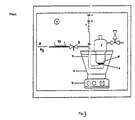
- Fig. 3 of the drawing shows a plant, with which the prepolymerization is performed.
- Fig. 3 is a gas phase in the prepolymerization plant generally marked with a reference number 1.
- the reactor is marked with a reference number 2 and the vaporizing tube with a reference number 3.
- the plant also contains a sinter marked with a reference number 4 and an oil bath marked with a reference number 5.
- 4-methyl-1-pentene is supplied by means of a syringe 7 via a heated nitrogen gas 8 trough a tube 9 to the catalyst bed.
- the tube 9 is heated by a heating element 10.
- the whole system is heated to a high temperature by a heating element 11.
- Differential scanning calorimetry can usually specify by means of a standard method one melting temperature for homopolypropylene grades.
- this inventive prepolymerization method it is possible to achieve such a prepolymerized catalyst that it produces polypropylene clearly having two different melting peaks.
- the polymer comprises an oriented ⁇ -polypropylene. The orientation affects the properties of the polymer.
- DMTA diagrams show that as for the mechanical properties of the polymers, the stiffness decreases.
- the prepolymerization stage was performed by feeding 4-methyl-1-pentene with a syringe to the vaporizing tube 3, from which it passed together with the heated nitrogen 8 through the sinter 4 in the lower part 6 of the reactor 2 to the catalyst layer 6, where part of the steam was polymerized and part exited with the gas flow.
- the flow rate of the gas was adjusted so high that the catalyst layer was fluidized. Since part of the catalyst or its finest fraction tended to escape from the reactor, this method can also be used for narrowing the particle size distribution of the catalyst.
- a catalyst, which does not have fine-fractions, i.e. its. particle size distribution is narrow, is clearly more useful when it is polymerized in a gas phase reactor.
- the prepolymerization degree can be flexibly controlled and the composition of the gas mixture used in the prepolymerization can be changed by varying the proportional quantities of the prepolymerization monomer (4-methyl-1-pentene) and the inert gas (N 2 ) and flow rate of the gas mixture. Similarly, the prepolymerization time affects the prepolymerization degree.
- the catalyst was dry and easy to handle as well as mechanically durable.
- the prepolymerization temperature was 75-130°C and time 10-15 min.
- the quantity of the catalyst was 2-3 g.
- Diphenyl-dimetoxy-silane (DPDMS) was used as a donor, but suitable donors include also 1,8-cineole or phenyl-trietoxy-silane (FES).
- the alkyl used was triisobutyl aluminium, but triethyl- or trioctyl aluminium (TEA or TOA) can also be used as an alkyl.
- TAA or TOA triethyl- or trioctyl aluminium
- prepolymerized catalyst 50 mg was weighed into a septum bottle, from which is was flushed with the aluminium-alkyl - donor heptane solution (the other half or 25 ml) into a feeding vessel, by means of which it was fed to the polymerization reactor.
- the polymerization conditions were: propylene partial pressure 10 bar, nitrogen partial pressure 0.3 bar, temperature 70°C and polymerization time 3 h.
- Table 1 lists the conditions of the prepolymerization examples 1-5.
- Table 2 shows the corresponding polymerization results (description as to how the polymerizations were performed), and Table 3 shows correspondingly the molar masses, results of differential scanning calorimetry and results of X-ray diffraction.
- the particle size distribution of the non-prepolymerized catalyst of the examples was 10-70 ⁇ m ( microns).
- the particle size distribution of the prepolymerized catalyst was 30-70 ⁇ m (microns).
- Fig. 1 shows a sample no. 1 (PC55/8) and Fig 2. a sample no. PC63/13.
Landscapes
- Chemical & Material Sciences (AREA)
- Health & Medical Sciences (AREA)
- Chemical Kinetics & Catalysis (AREA)
- Medicinal Chemistry (AREA)
- Polymers & Plastics (AREA)
- Organic Chemistry (AREA)
- Transition And Organic Metals Composition Catalysts For Addition Polymerization (AREA)
- Catalysts (AREA)
- Organic Low-Molecular-Weight Compounds And Preparation Thereof (AREA)
- Addition Polymer Or Copolymer, Post-Treatments, Or Chemical Modifications (AREA)
- Low-Molecular Organic Synthesis Reactions Using Catalysts (AREA)
Abstract
Description
- The invention relates to a method for producing a Ziegler-Natta catalyst, in which method prepolymerization is performed by bringing a transition metal compound activated by a donor and an Al-alkyl, which transition metal is included in the groups IV-VI of the periodic system, into contact with an α-olefine for obtaining a stable particle-shaped prepolymer.
- The invention also relates to a method for producing polyolefines by means of a prepolymerized Ziegler-Natta catalyst, in which method the prepolymerization is performed by bringing the Ziegler-Natta catalyst activated by a donor and and Al-alkyl into contact with an α-olefine for obtaining a stable particle-shaped prepolymer, as well as a polyolefine made to means of the method.
- Such catalyst systems for polymerizing and copolymerizing α-olefines and known as Ziegler-Natta catalysts are obtained by combining, on one hand, a catalyst that is a compound of such a transition metal which is included in the groups IV, V or VI of the periodic system, and on the other hand, a cocatalyst that is an organometallic compound of a metal in the groups I-III of said system. Among compounds used most widely are halogenated titanium derivatives as well as alkyl aluminium compounds or alkyl aluminium chlorides.
- It is well known that the properties of these catalysts can be improved, if said transition metal compounds are used together with solid mineral compound. This solid compound is often used as a carrier for said transition metal compounds.
- Mineral compounds used as a carrier include e.g. magnesium and titanium oxides, aluminium silicate and magnesium chloride.
- It is well known that an α-olefine can be polymerized in a gas phase, e.g. in a fluidized bed reactor, in which a solid polymer to formed is maintained in fluidized state by means of an ascending gas flow containing the α-olefines to be polymerized. The gas mixture leaving the reactor generally cooled before recirculation by means of a quantity of α-olefines added to the reactor. The polymerization can be performed with a Ziegler-Natta type catalyst system, which is continuously or semicontinuosly supplied to the fluidized bed reactor. The removal of the polymer can also occur continuously or semicontinuosly. It is also well known that very active catalyst systems can be utilized comprising catalysts based on magnesium and transition metals. Because of the particle size and the very high activity, these catalysts are sometimes introduced into the fluidized bed polymerization reactor in the form of a prepolymer.
- The pretreatment of the Ziegler-Natta type catalysts with propylene is well known in the art. The pretreatment is generally performed for stabilizing the catalyzer, since after the activation of the catalyst, the catalyst easily decomposes and is not durable for longer periods of time without stabilization.
- In known methods for producing polyolefines, in the presence of transition metal halide catalysts, as a titanium halide, the essential parts of the polymer particles are copies of the catalyst particles.
- For example in the US patent no. 4 431 569 is produced a non-decomposing active Ziegler-Natta type titanium chloride catalyst, which is obtained by reducing a titanium tetrachloride into a titanium trichloride in the presence of an organoaluminium compound at a low temperature, by bringing the titanium dichloride product into contact with an α-olefine for obtaining the titanium tetrachloride and by then treating the prepolymerized titanium dichloride with a chlorinated hydrocarbon. In this publication, the prepolymerization is performed at a temperature of ca. 0-100°C, preferably at a temperature of 30-40°C. The α-olefine, which can be e.g. a 4-methyl-1-pentene, is added in a suitable hydrocarbon solvent. The US patent no. 4 543 400 is a further example of the prior art, in which the prepolymerization with 4-methyl-1-pentene is performed at a low temperature in a hydrocarbon solvent. This is also the case in the EP patent application no. 11 914. Also in the EP patent application no. 263 718, the prepolymerization with an α-olefine occurs in a hydrocarbon solvent within a temperature range of -40-80°C, preferably -20-40°C. The JP patent no. 61 151 204 describes a method, in which an olefine is prepolymerized by means of 4-methyl-1-pentene and in which the same or different olefine is used in the main polymerization. The prepolymerization occurs in a liquid phase.
- In connection with the prepolymers used currently, a problem has been formed by the average diameter, which is too small, and/or by the particle size distribution, which is too wide, in order to be able to use sufficiently high fluidization rates, if it is desirable to avoid the entry of the catalyst particles above the fluidized bed.
- In the US patent no. 4 721 763, the main polymerization is performed in a gas phase for eliminating the problems mentioned above. In the US patent no. 4 721 763 is described a method, wherein in the first phase of the production of polyolefines one or more α-olefines is brought into contact with a Ziegler-Natta type catalyst system, which on one hand comprises a solid catalyst which is in a particle form and contains halogen magnesium transition metal atoms included in the groups IV, V and VI of the periodic system, and on the other hand a cocatalyst comprised of an organometallic compound of metals in the groups I-III of said system for obtaining a prepolymer in the form of solid particles, and in the second phase said prepolymer as brought into contact with one or more α-olefines in polymerization or copolymerization conditions in a gas phase by means of a fluidized bed, whereby a polymer or copolymer of α-olefines is obtained directly in a polymer form.
- A prepolymer in accordance with the US patent no. 721 763 contains particles, whose average diameter is 80-300 µm (microns) and whose particle size distribution is such that the average diameter Dm of the mass in relation to the numeric average diameter Dn is ≤ 3. According to the US patent no. 4 721 763, the prepolymerization occurs in two stages: the first prepolymerization stage occurs in a suspension in a liquid medium, and the second prepolymerization stage can occur either in a suspension in a liquid medium or a gas phase.
- The second prepolymerization stage of the US patent no. 4 721 763 occurs at a temperature of 60-80°C. In the fluidized prebed of the prepolymerization stage, only part of the α-olefines are polymerized in the contact of the copolymer with the polymer particles. Those α-olefines which are not polymerized leave the fluidized bed and pass the cooling system, the purpose of which is to remove the heat produced during the reactions before it is again recirculated into the fluidized bed.
- Various methods known per se exist for obtaining a prepolymer, whose particle size distribution is specified. In this US patent, such previously known screening and particle fractionating methods using a gas flow or a liquid flow must be used, or a magnesium-based carrier is utilized. In the system of the US patent no. 4 721 463, the monomer of the catalyst system is the same as that used in the actual polymerization.
- In the GB patent publication no. 2 189 252 is produced a Ziegler-Natta catalyst composition, which contains paraffinic hydrocarbon, which can be produced by prepolymerizing the same monomer as that used in the actual polymerization, which can occur in a hydrocarbon solvent or in a gas phase.
- It is most preferable to perform the prepolymerization stage in a gas phase, which results in a uniform catalyst. The gas phase acts as a screen in such a way that the catalyst receives a smaller particle size distribution and becomes thus more stable. However, the problem related to the use of the gas phase is that the catalyst is easily destroyed. Thus, it has been possible to use it earlier only after the actual polymerization has been performed with the same monomer as the prepolymerization. It has been possible to use only a low temperature in the gas phase prepolymerization, otherwise the catalyst has been destroyed.
- The object of this invention is to provide a method, in which the prepolymerization can be performed is a gas phase at a high temperature in such a way that a stable catalyst is obtained, which is not destroyed and which can be maintained for a longer time, owing to which the actual polymerization can be performed with a different polymer than the prepolymerization.
- The objects are solved by a method for producing a Ziegler-Natta catalyst, in which method prepolymerization is performed by bringing a transition metal compound activated by a donor and an Al-alkyl, which transition metal is an element of the IV-VI groups of the periodic system, into contact with an α-olefine for obtaining a stable particle-shaped prepolymer in a catalyst bed, wherein
the prepolymerization is performed by bringing as said α-olefine a gaseous 4-methyl-1-pentene having a temperature of 70°C to 130°C into contact with said activated catalyst system, the flow rate of the gas is such that the catalyst bed is fluidized and the catalyst parts which have not been polymerized and have smaller particle sizes leave along with the gas flow, whereby a stable catalyst having a particle size distribution of 10 to 70 micrometers (10 to 70 microns), in particular 30 to 70 micrometers ( 30 to 70 microns), is obtained. - The catalyst obtained by the method according to the invention is on its part mainly characterized in that its particle size distribution is 10-70 µm (microns).
- The present invention also provides a method for producing polyolefines by means of a prepolymerized Ziegler-Natta catalyst, in which method the prepolymerization is performed by bringing the Ziegler-Natta catalyst activated by a donor and an Al-alkyl in a catalyst bed into contact with an α-olefine for obtaining a stable particle-shaped prepolymer, wherein
- a) the prepolymerization is performed by bringing as said α-olefine a 4-methyl-1-pentene having a temperature of 70° C to 130° C into contact with said activated catalyst system, the flow rate of the gas being such that the catalyst bed is fluidized and the catalyst parts which have riot been polymerized and have smaller particle sizes leave along with the gas flow, whereby a stable catalyst having a particle size distribution of 10 to 70 micrometers (10 to 70 microns) is obtained, after which
- b) the actual polymerization is performed by means of the catalyst obtained in the section a) for obtaining a polyolefine.
- The polyolefine produced by means of the method according to the invention is on its part mainly characterized in that it is a polypropylene.
- The preferred embodiments of the invention have the features given in the subclaims.
- The method according to the invention clearly deviates from other prepolymerization inventions described in the patent publications. The prepolymerization has earlier not been performed in a gas phase in such a way that a stable catalyst is obtained, which can be stored. The prepolymerization in the gas phase provides a possibility of very flexibly controlling the prepolymerization degree or the polymer/catalyst ratio in a prepolymerized catalyst. The inventive method can also be used when separating the finest fraction from the catalyst, i.e. for narrowing the particle size distribution as early as the prepolymerization stage. The inventive method produces a dry, loose, very flowable and mechanically durable prepolymerized catalyst, i.e. the product does not have to be dried. The polypropylene made according to the inventive method, which polypropylene is produced in a gas phase by prepolymerizing a catalyst, is strongly oriented. It has unusually advantageous orientation properties.
- The methods according to the invention are next described in detail with reference to the accompanying drawing, which is not intended to limit the invention.
- Fig. 3 of the drawing shows a plant, with which the prepolymerization is performed. Fig. 3 is a gas phase in the prepolymerization plant generally marked with a
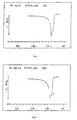
reference number 1. The reactor is marked with areference number 2 and the vaporizing tube with a reference number 3. The plant also contains a sinter marked with a reference number 4 and an oil bath marked with a reference number 5. There is a catalyst 6 on the bottom of the reactor. 4-methyl-1-pentene is supplied by means of a syringe 7 via aheated nitrogen gas 8 trough atube 9 to the catalyst bed. Thetube 9 is heated by aheating element 10. The whole system is heated to a high temperature by a heating element 11. - Differential scanning calorimetry (DSC) can usually specify by means of a standard method one melting temperature for homopolypropylene grades. By means of this inventive prepolymerization method, it is possible to achieve such a prepolymerized catalyst that it produces polypropylene clearly having two different melting peaks. On the basis of X-ray spectra, the polymer comprises an oriented α-polypropylene. The orientation affects the properties of the polymer. DMTA diagrams show that as for the mechanical properties of the polymers, the stiffness decreases.
- The activation of a Ziegler-Natta type MgCl2-based titanium catalyst, the internal donor of which was diisobutyl phtalate, was performed by feeding 2-3 g thereof (see Table 1) into the
reactor 2 in a pentane slurry together with an aluminium alkyl and a donor. After about 5 minutes, after nitrogen bubbling, the solution was compressed away by means of nitrogen. The catalyst was dried by allowing warm nitrogen to flow therethrough from billow upwards. - The prepolymerization stage was performed by feeding 4-methyl-1-pentene with a syringe to the vaporizing tube 3, from which it passed together with the
heated nitrogen 8 through the sinter 4 in the lower part 6 of thereactor 2 to the catalyst layer 6, where part of the steam was polymerized and part exited with the gas flow. The flow rate of the gas was adjusted so high that the catalyst layer was fluidized. Since part of the catalyst or its finest fraction tended to escape from the reactor, this method can also be used for narrowing the particle size distribution of the catalyst. A catalyst, which does not have fine-fractions, i.e. its. particle size distribution is narrow, is clearly more useful when it is polymerized in a gas phase reactor. - 4-methyl-1-pentene was fed 50 ml on an average. This means that the monomer concentration in the reactor was very low so that by circulating only heated 4-methyl-1-pentene steam, a higher polymerization degree is reached. The prepolymerization degree can be flexibly controlled and the composition of the gas mixture used in the prepolymerization can be changed by varying the proportional quantities of the prepolymerization monomer (4-methyl-1-pentene) and the inert gas (N2) and flow rate of the gas mixture. Similarly, the prepolymerization time affects the prepolymerization degree.
- After the prepolymerization, the catalyst was dry and easy to handle as well as mechanically durable.
- The prepolymerization temperature was 75-130°C and time 10-15 min. The quantity of the catalyst was 2-3 g. Diphenyl-dimetoxy-silane (DPDMS) was used as a donor, but suitable donors include also 1,8-cineole or phenyl-trietoxy-silane (FES).
- The actual polymerization was performed in a 2 l reactor, in which 1.2 l of heptane was placed. Al/ti = 100 and Al/donor = 20 were used. The alkyl used was triisobutyl aluminium, but triethyl- or trioctyl aluminium (TEA or TOA) can also be used as an alkyl. Half of the aluminium-alkyl - donor heptane solution (50 ml) or 25 ml was transferred to the reactor with a syringe. Ca. 50 mg of prepolymerized catalyst was weighed into a septum bottle, from which is was flushed with the aluminium-alkyl - donor heptane solution (the other half or 25 ml) into a feeding vessel, by means of which it was fed to the polymerization reactor. The polymerization conditions were: propylene
partial pressure 10 bar, nitrogen partial pressure 0.3 bar, temperature 70°C and polymerization time 3 h. - Table 1 lists the conditions of the prepolymerization examples 1-5. Table 2 shows the corresponding polymerization results (description as to how the polymerizations were performed), and Table 3 shows correspondingly the molar masses, results of differential scanning calorimetry and results of X-ray diffraction.
- Table 1. Conditions of prepolymerization results 1-5. TIBA as alkyl and DPDMS as donor. Prepolymerization time 15 min.
No. Catalyst g Al/Ti molar ratio AL/D molar ratio T °C Increase in weight % 1 3.0 1 1 70 100 2 2.0 5 1 75 50 3 2.1 5 5 90 30 4 2.2 5 5 110 15 5 2.1 5 5 130 10 - Table 2. Polymerization results of examples 1-5 of slurry polymerizations of propylene.
No. Activity kg PP/g (orig. cat.) Isotacticity % Bulk density g/cm3 Melt viscosity g/10 min 1 1.8 94.3 0,41 45.2 2 1.5 92.4 0.43 56.4 3 4.0 95.1 0.47 6.9 4 1.0 91.0 0.44 5.7 5 0.7 92.4 0.46 7.5 - Table 3. Molar masses of examples 1-3, DSC results and X-ray results. Two melting temperatures in DSC results.
No. Mw Mw/Mn Crystallization Tc(°C) DSC Melting Tm(°C) Crystallinity % X-ray 1 193 000 5.0 112.5 155/162 40.0 α-PP, oriented 2 202 000 4.8 - 157/163 43,9 α-PP, oriented 3 392 000 6.2 116.5 152/162 47.2 α-PP, oriented - The particle size distribution of the non-prepolymerized catalyst of the examples was 10-70 µm ( microns). In Example 1, the particle size distribution of the prepolymerized catalyst was 30-70 µm (microns).
- The figures of the DSC diagrams taken of polymers orresponding to Examples 1 and 2 clearly show two melting temperatures. Fig. 1 shows a sample no. 1 (PC55/8) and Fig 2. a sample no. PC63/13.
Claims (7)
- A method for producing a Ziegler-Natta catalyst, in which method prepolymerization is performed by bringing a transition metal compound activated by a donor and an Al-alkyl, which transition metal is an element of the IV-VI groups of the periodic system, into contact with an α-olefine for obtaining a stable particle-shaped prepolymer in a catalyst bed,characterized in thatthe prepolymerization is performed by bringing as said α-olefine a gaseous 4-methyl-1-pentene having a temperature of 70° C to 130°C into contact with said activated catalyst system, the flow rate of the gas is such that the catalyst bed is fluidized and the catalyst parts which have not been polymerized and have smaller particle sizes leave along with the gas flow, whereby a stable catalyst having a particle size distribution of 10 to 70 micrometers ( 10 to 70 microns) is obtained.
- A method according to claim 1,characterized in thatthe donor used in the activation of the catalyst is diphenyldimetoxy-silane (DPDMS), 1,8-cineole or phenyl-trietoxy-silane (FES).
- A catalyst produced by means of a method according to claim 1 or 2,characterized in thatthe transition metal compound of the catalyst is titanium halide.
- A method for producing polyolefines by means of a prepolymerized Ziegler-Natta catalyst, in which method the /29 prepolymerization is performed by bringing the Ziegler-Natta catalyst activated by a donor and an Al-alkyl in a catalyst bed into contact with an α-olefine for obtaining a stable particle-shaped prepolymer,
characterized in thata) the prepolymerization is performed by bringing as said α-olefine a 4-methyl-1-pentene having temperature of 70° C to 130° C into contact with said activated catalyst system, the flow rate of the gas being such that the catalyst bed is fluidized and the catalyst parts which have not been polymerized and have smaller particle sizes leave along with the gas flow, whereby a stable catalyst having a particle size distribution of 10 to 70 micrometers (10 to 70 microns) is obtained, after whichb) the actual polymerization is performed by means of the catalyst obtained in the section a) for obtaining a polyolefine. - A method according to claim 4,characterized in thatthe donor used in the activation of the catalyst is diphenyldimetoxy-silane (DPDMS), 1,8-cienole or phenyl-trietoxy-silane (FES).
- A method according to claim 4 or 5,characterized in thatthe monomer used in the stage b) is some other monomer than 4-methyl-1-pentene.
- A polyolefine produced by means of a method of any of the claims 4 to 6,characterized in thatit is an oriented polypropylene.
Applications Claiming Priority (2)
| Application Number | Priority Date | Filing Date | Title |
|---|---|---|---|
| FI900842 | 1990-02-20 | ||
| FI900842A FI87575C (en) | 1990-02-20 | 1990-02-20 | REFERENCE FORMING A FRAME STEERING CATALYTIC CONVERTER, REFERENCE FORMING A POLYOLEFIN GENOM ATT ANVAENDA SIG AV DENNA CATALYST SAMT PRODUCT SOM FRAMSTAELLTS MED DETTA FOERFARE |
Publications (3)
| Publication Number | Publication Date |
|---|---|
| EP0443374A2 EP0443374A2 (en) | 1991-08-28 |
| EP0443374A3 EP0443374A3 (en) | 1992-04-01 |
| EP0443374B1 true EP0443374B1 (en) | 1996-06-26 |
Family
ID=8529911
Family Applications (1)
| Application Number | Title | Priority Date | Filing Date |
|---|---|---|---|
| EP91101704A Expired - Lifetime EP0443374B1 (en) | 1990-02-20 | 1991-02-07 | A method for producing a Ziegler-Natta catalyzer, a method for producing a polyolefine by utilizing this catalyzer as well as products made by means of these methods |
Country Status (5)
| Country | Link |
|---|---|
| EP (1) | EP0443374B1 (en) |
| JP (1) | JPH04216805A (en) |
| AT (1) | ATE139785T1 (en) |
| DE (1) | DE69120437T2 (en) |
| FI (1) | FI87575C (en) |
Families Citing this family (1)
| Publication number | Priority date | Publication date | Assignee | Title |
|---|---|---|---|---|
| GB0217520D0 (en) | 2002-07-29 | 2002-09-04 | Borealis Tech Oy | Product |
Family Cites Families (4)
| Publication number | Priority date | Publication date | Assignee | Title |
|---|---|---|---|---|
| JPS5928573B2 (en) * | 1980-02-05 | 1984-07-13 | チッソ株式会社 | Method for producing α-olefin polymer |
| FR2541683B1 (en) * | 1983-02-28 | 1986-05-09 | Ato Chimie | PROCESS FOR THE PREPARATION OF AN ACTIVE HYDROCARBON SOLID USEFUL FOR POLYMERIZING OLEFINS, AND PROCESS FOR THE SYNTHESIS OF AN OLEFINIC POLYMER OR COPOLYMER USING SAID ACTIVE HYDROCARBON SOLID AS A SYSTEM |
| JPS59206418A (en) * | 1983-05-11 | 1984-11-22 | Mitsui Petrochem Ind Ltd | Production of 4-methyl-1-pentene polymer |
| FR2572082B1 (en) * | 1984-10-24 | 1987-05-29 | Bp Chimie Sa | PROCESS FOR STARTING POLYMERIZATION OF ETHYLENE OR COPOLYMERIZATION OF ETHYLENE AND ALPHA-OLEFIN IN THE GAS PHASE IN THE PRESENCE OF A CHROMIUM OXIDE CATALYST |
-
1990
- 1990-02-20 FI FI900842A patent/FI87575C/en not_active IP Right Cessation
-
1991
- 1991-02-07 DE DE69120437T patent/DE69120437T2/en not_active Expired - Fee Related
- 1991-02-07 AT AT91101704T patent/ATE139785T1/en active
- 1991-02-07 EP EP91101704A patent/EP0443374B1/en not_active Expired - Lifetime
- 1991-02-19 JP JP3045342A patent/JPH04216805A/en active Pending
Also Published As
| Publication number | Publication date |
|---|---|
| JPH04216805A (en) | 1992-08-06 |
| FI900842A0 (en) | 1990-02-20 |
| EP0443374A2 (en) | 1991-08-28 |
| DE69120437D1 (en) | 1996-08-01 |
| ATE139785T1 (en) | 1996-07-15 |
| EP0443374A3 (en) | 1992-04-01 |
| FI87575B (en) | 1992-10-15 |
| FI87575C (en) | 1993-01-25 |
| DE69120437T2 (en) | 1996-12-05 |
| FI900842L (en) | 1991-08-21 |
Similar Documents
| Publication | Publication Date | Title |
|---|---|---|
| US5990251A (en) | Process for polymerising olefin with a Ziegler-Natta catalyst | |
| EP0703246B1 (en) | Process for polymerising olefin with a Ziegler-Natta catalyst | |
| CA1299807C (en) | Process for producing olefin polymers and catalyst used therein | |
| US4721763A (en) | Process for the polymerization and copolymerization of alpha-olefins in fluidized bed | |
| US4970279A (en) | Process for polymerizing one or more 1-olefins in the gas phase in the presence of pulverulent inorganic material | |
| US4354009A (en) | Catalyst composition for copolymerizing ethylene | |
| US4894424A (en) | Polymerisation of olefins using modified ziegler-natta catalyst | |
| US4105847A (en) | Method for polymerization of ethylene | |
| JPH0796564B2 (en) | Olefin gas fluidized bed terpolymerization method | |
| NO156412B (en) | PROCEDURE FOR MANUFACTURING HD ETHYLENE POLYMERS IN VERTILE LAYER REACTOR. | |
| EP1303547B1 (en) | Propylene polymers with an ultra high melt flow rate | |
| BRPI0808544A2 (en) | OLEFIN POLYMERIZATION PROCESS | |
| JP2517395B2 (en) | Method for producing random copolymer | |
| EP0300638B1 (en) | A process for preparing highly crystalline poly-1-butene and the catalyst used in the process | |
| US6339136B1 (en) | Process for making propylene homo or copolymers | |
| HU208325B (en) | Process for controlled gas phase polymerization of alpha-olefin | |
| US4123387A (en) | Catalysts for polymerization of olefins | |
| US6645901B2 (en) | Prepolymerization catalyst for use in gas phase polymerization of olefins and process for producing the same | |
| US5208109A (en) | Process for the polymerization and copolymerization of alpha-olefins in a fluidized bed | |
| US4330433A (en) | Titanium trihalide catalyst and process for its production | |
| EP0443374A2 (en) | A method for producing a Ziegler-Natta catalyzer, a method for producing a polyolefine by utilizing this catalyzer as well as products made by means of these methods | |
| US3974237A (en) | Block copolymer processes | |
| CA2021196A1 (en) | Method for the preparation of catalyst components for the polymerization of ethylene with a relatively narrow molecule weight distribution | |
| US5225458A (en) | Powder of (co)polymer of one or more 1-olefins blended with pulverulent inorganic material | |
| US5063110A (en) | Composition comprising prepolymer powder and pulverulent inorganic material |
Legal Events
| Date | Code | Title | Description |
|---|---|---|---|
| PUAI | Public reference made under article 153(3) epc to a published international application that has entered the european phase |
Free format text: ORIGINAL CODE: 0009012 |
|
| AK | Designated contracting states |
Kind code of ref document: A2 Designated state(s): AT BE CH DE DK ES FR GB GR IT LI LU NL SE |
|
| PUAL | Search report despatched |
Free format text: ORIGINAL CODE: 0009013 |
|
| AK | Designated contracting states |
Kind code of ref document: A3 Designated state(s): AT BE CH DE DK ES FR GB GR IT LI LU NL SE |
|
| 17P | Request for examination filed |
Effective date: 19920327 |
|
| 17Q | First examination report despatched |
Effective date: 19940119 |
|
| GRAH | Despatch of communication of intention to grant a patent |
Free format text: ORIGINAL CODE: EPIDOS IGRA |
|
| RAP1 | Party data changed (applicant data changed or rights of an application transferred) |
Owner name: BOREALIS A/S |
|
| GRAA | (expected) grant |
Free format text: ORIGINAL CODE: 0009210 |
|
| AK | Designated contracting states |
Kind code of ref document: B1 Designated state(s): AT BE CH DE DK ES FR GB GR IT LI LU NL SE |
|
| PG25 | Lapsed in a contracting state [announced via postgrant information from national office to epo] |
Ref country code: NL Free format text: LAPSE BECAUSE OF FAILURE TO SUBMIT A TRANSLATION OF THE DESCRIPTION OR TO PAY THE FEE WITHIN THE PRESCRIBED TIME-LIMIT Effective date: 19960626 Ref country code: LI Effective date: 19960626 Ref country code: GR Free format text: LAPSE BECAUSE OF FAILURE TO SUBMIT A TRANSLATION OF THE DESCRIPTION OR TO PAY THE FEE WITHIN THE PRESCRIBED TIME-LIMIT Effective date: 19960626 Ref country code: ES Free format text: THE PATENT HAS BEEN ANNULLED BY A DECISION OF A NATIONAL AUTHORITY Effective date: 19960626 Ref country code: DK Effective date: 19960626 Ref country code: CH Effective date: 19960626 Ref country code: AT Effective date: 19960626 |
|
| REF | Corresponds to: |
Ref document number: 139785 Country of ref document: AT Date of ref document: 19960715 Kind code of ref document: T |
|
| REF | Corresponds to: |
Ref document number: 69120437 Country of ref document: DE Date of ref document: 19960801 |
|
| GRAH | Despatch of communication of intention to grant a patent |
Free format text: ORIGINAL CODE: EPIDOS IGRA |
|
| ITF | It: translation for a ep patent filed | ||
| ET | Fr: translation filed | ||
| NLV1 | Nl: lapsed or annulled due to failure to fulfill the requirements of art. 29p and 29m of the patents act | ||
| REG | Reference to a national code |
Ref country code: CH Ref legal event code: PL |
|
| PG25 | Lapsed in a contracting state [announced via postgrant information from national office to epo] |
Ref country code: SE Effective date: 19970208 |
|
| PG25 | Lapsed in a contracting state [announced via postgrant information from national office to epo] |
Ref country code: LU Free format text: LAPSE BECAUSE OF NON-PAYMENT OF DUE FEES Effective date: 19970228 |
|
| PLBE | No opposition filed within time limit |
Free format text: ORIGINAL CODE: 0009261 |
|
| STAA | Information on the status of an ep patent application or granted ep patent |
Free format text: STATUS: NO OPPOSITION FILED WITHIN TIME LIMIT |
|
| 26N | No opposition filed | ||
| EUG | Se: european patent has lapsed |
Ref document number: 91101704.4 |
|
| REG | Reference to a national code |
Ref country code: GB Ref legal event code: IF02 |
|
| PGFP | Annual fee paid to national office [announced via postgrant information from national office to epo] |
Ref country code: GB Payment date: 20040130 Year of fee payment: 14 |
|
| PGFP | Annual fee paid to national office [announced via postgrant information from national office to epo] |
Ref country code: DE Payment date: 20040203 Year of fee payment: 14 |
|
| PGFP | Annual fee paid to national office [announced via postgrant information from national office to epo] |
Ref country code: FR Payment date: 20040209 Year of fee payment: 14 |
|
| PGFP | Annual fee paid to national office [announced via postgrant information from national office to epo] |
Ref country code: BE Payment date: 20040401 Year of fee payment: 14 |
|
| PG25 | Lapsed in a contracting state [announced via postgrant information from national office to epo] |
Ref country code: IT Free format text: LAPSE BECAUSE OF NON-PAYMENT OF DUE FEES;WARNING: LAPSES OF ITALIAN PATENTS WITH EFFECTIVE DATE BEFORE 2007 MAY HAVE OCCURRED AT ANY TIME BEFORE 2007. THE CORRECT EFFECTIVE DATE MAY BE DIFFERENT FROM THE ONE RECORDED. Effective date: 20050207 Ref country code: GB Free format text: LAPSE BECAUSE OF NON-PAYMENT OF DUE FEES Effective date: 20050207 |
|
| PG25 | Lapsed in a contracting state [announced via postgrant information from national office to epo] |
Ref country code: BE Free format text: LAPSE BECAUSE OF NON-PAYMENT OF DUE FEES Effective date: 20050228 |
|
| BERE | Be: lapsed |
Owner name: *BOREALIS A/S Effective date: 20050228 |
|
| PG25 | Lapsed in a contracting state [announced via postgrant information from national office to epo] |
Ref country code: DE Free format text: LAPSE BECAUSE OF NON-PAYMENT OF DUE FEES Effective date: 20050901 |
|
| GBPC | Gb: european patent ceased through non-payment of renewal fee |
Effective date: 20050207 |
|
| PG25 | Lapsed in a contracting state [announced via postgrant information from national office to epo] |
Ref country code: FR Free format text: LAPSE BECAUSE OF NON-PAYMENT OF DUE FEES Effective date: 20051031 |
|
| REG | Reference to a national code |
Ref country code: FR Ref legal event code: ST Effective date: 20051031 |
|
| BERE | Be: lapsed |
Owner name: *BOREALIS A/S Effective date: 20050228 |