EP0442959B1 - Fingerprint reagent - Google Patents
Fingerprint reagent Download PDFInfo
- Publication number
- EP0442959B1 EP0442959B1 EP89913229A EP89913229A EP0442959B1 EP 0442959 B1 EP0442959 B1 EP 0442959B1 EP 89913229 A EP89913229 A EP 89913229A EP 89913229 A EP89913229 A EP 89913229A EP 0442959 B1 EP0442959 B1 EP 0442959B1
- Authority
- EP
- European Patent Office
- Prior art keywords
- amino acids
- detection
- nitrogen
- benzene ring
- compound
- Prior art date
- Legal status (The legal status is an assumption and is not a legal conclusion. Google has not performed a legal analysis and makes no representation as to the accuracy of the status listed.)
- Expired - Lifetime
Links
Classifications
-
- G—PHYSICS
- G01—MEASURING; TESTING
- G01N—INVESTIGATING OR ANALYSING MATERIALS BY DETERMINING THEIR CHEMICAL OR PHYSICAL PROPERTIES
- G01N33/00—Investigating or analysing materials by specific methods not covered by groups G01N1/00 - G01N31/00
- G01N33/48—Biological material, e.g. blood, urine; Haemocytometers
- G01N33/50—Chemical analysis of biological material, e.g. blood, urine; Testing involving biospecific ligand binding methods; Immunological testing
- G01N33/68—Chemical analysis of biological material, e.g. blood, urine; Testing involving biospecific ligand binding methods; Immunological testing involving proteins, peptides or amino acids
- G01N33/6803—General methods of protein analysis not limited to specific proteins or families of proteins
- G01N33/6806—Determination of free amino acids
- G01N33/6809—Determination of free amino acids involving fluorescent derivatizing reagents reacting non-specifically with all amino acids
-
- Y—GENERAL TAGGING OF NEW TECHNOLOGICAL DEVELOPMENTS; GENERAL TAGGING OF CROSS-SECTIONAL TECHNOLOGIES SPANNING OVER SEVERAL SECTIONS OF THE IPC; TECHNICAL SUBJECTS COVERED BY FORMER USPC CROSS-REFERENCE ART COLLECTIONS [XRACs] AND DIGESTS
- Y10—TECHNICAL SUBJECTS COVERED BY FORMER USPC
- Y10T—TECHNICAL SUBJECTS COVERED BY FORMER US CLASSIFICATION
- Y10T436/00—Chemistry: analytical and immunological testing
- Y10T436/17—Nitrogen containing
- Y10T436/173845—Amine and quaternary ammonium
- Y10T436/174614—Tertiary amine
-
- Y—GENERAL TAGGING OF NEW TECHNOLOGICAL DEVELOPMENTS; GENERAL TAGGING OF CROSS-SECTIONAL TECHNOLOGIES SPANNING OVER SEVERAL SECTIONS OF THE IPC; TECHNICAL SUBJECTS COVERED BY FORMER USPC CROSS-REFERENCE ART COLLECTIONS [XRACs] AND DIGESTS
- Y10—TECHNICAL SUBJECTS COVERED BY FORMER USPC
- Y10T—TECHNICAL SUBJECTS COVERED BY FORMER US CLASSIFICATION
- Y10T436/00—Chemistry: analytical and immunological testing
- Y10T436/17—Nitrogen containing
- Y10T436/173845—Amine and quaternary ammonium
- Y10T436/175383—Ammonia
Definitions
- This invention relates to a method for the detection and or quantitation of ⁇ -amino acids in chemical and biochemical analyses and particularly but not exclusively to a method for the detection of latent fingerprints.
- a common method of detection of amino acids comprises applying ninhydrin (1,2,3-triketohydrindene hydrate) to the amino acid.
- the ninhydrin reacts with the amino acid on heating yielding a purple colouration.
- ninhydrin is often used in the detection of latent fingerprints, in, for example, criminal investigation.
- a method of detection of amino acids comprising the application, to the material being tested, of a reagent comprising the following basic formula; wherein X, Y and/or Z may be nitrogen, C-H, C-alkyl or C-aryl and wherein A, B, C and/or D may be an alkyl or aryl substituent either alone or in combination, followed by developing and optionally subsequently illuminating the material having the compound (I) applied thereto.
- substituents X, Y, Z, A, B, C and D are one of the following combinations
- a method of detecting amino acids comprises the addition to the material being tested of a compound comprising the following basic structure wherein X, Y and Z may be nitrogen, C-H, C-alkyl or C-aryl and A, B, C and D may be alkyl, aryl alkyl or aryl substituent either alone or in combination.
- Each ring could be variously substituted, for example, with alkyl and aryl substituents.
- the compounds of the method of the invention may be synthesised by a variety of methods.
- One such method of producing such a compound is disclosed in Helv.Chim,Acta., 1950, 50, 1080, which reveals a method of synthesising 1,8-Diazafluoren-9-one (1).
- Other compounds of the invention could be produced, for example, by appropriate substitution reactions of 1,8-Diazofluoren-9-one of (1).
- the compound (I) is dissolved in a suitable solvent system such as methanol/acetic acid/ trichlorotrifluorethane so as the concentration of the reagent (I) solution is in the range from substantially 0.05 to 2%.
- a suitable solvent system such as methanol/acetic acid/ trichlorotrifluorethane so as the concentration of the reagent (I) solution is in the range from substantially 0.05 to 2%.
- the document or sample containing or supporting the amino acid such as a latent fingerprint is immersed in the reagent (I) solution.
- the amino acid sample may subsequently be removed from the reagent (I) solution after a suitable time period has elapsed, for example approximately five seconds.
- the sample is then allowed to dry. Drying should be complete after approximately thirty seconds.
- the sample is then re-immersed in the reagent (I) solution for example for thirty seconds.
- the sample is subsequently removed from the reagent (I) solution and the amino acids may then be developed by, for example, heating the sample at 110°C for ten minutes.
- the reagent (I) in combination with the amino acid produces coloured fluorescent species with ⁇ (excitation) in the order of 470 nm and ⁇ (emission) in the order of 570 nm on paper.
- the fluorescent fingerprints can be made visible by using blue/green light for excitation and observing the light emission through a filter such as a 610 nm filter.
- 1,8-Diazafluoren-9-one (1) (0.05g) was dissolved in a mixture of methanol (4ml) and acetic acid (2ml) and was then diluted up to 100ml with trichlorotrifluoroethane (Fluorosil) so as to form a reagent (1) solution.
- a sheet of paper on which a latent fingerprint was situated was immersed in the reagent (1) solution for 5 seconds.
- the paper was removed from the reagent (1) solution and allowed to dry for 30 seconds.
- the paper was then immersed for a further five seconds and was subsequently removed from the reagent (1) solution and heated at 110°C for 10 minutes.
- the fluorescent fingerprints were made visible by illumination with blue/green light (excitation) and were observed through a 610 nm filter.
- Example 1 The method of Example 1 was repeated substituting reagent (1) by reagents (2) to (7).
- Reagents (2) to (7) also produced fluorescent fingerprints which could be visualised by illumination with blue/green light (excitation) and observed through a 610 nm filter.
Landscapes
- Life Sciences & Earth Sciences (AREA)
- Health & Medical Sciences (AREA)
- Engineering & Computer Science (AREA)
- Molecular Biology (AREA)
- Hematology (AREA)
- Chemical & Material Sciences (AREA)
- Urology & Nephrology (AREA)
- Physics & Mathematics (AREA)
- Immunology (AREA)
- Biomedical Technology (AREA)
- Microbiology (AREA)
- General Health & Medical Sciences (AREA)
- Biotechnology (AREA)
- Proteomics, Peptides & Aminoacids (AREA)
- Biophysics (AREA)
- Bioinformatics & Computational Biology (AREA)
- Bioinformatics & Cheminformatics (AREA)
- Food Science & Technology (AREA)
- Medicinal Chemistry (AREA)
- Analytical Chemistry (AREA)
- Biochemistry (AREA)
- Cell Biology (AREA)
- General Physics & Mathematics (AREA)
- Pathology (AREA)
- Measurement Of The Respiration, Hearing Ability, Form, And Blood Characteristics Of Living Organisms (AREA)
- Investigating Or Analysing Biological Materials (AREA)
- Holo Graphy (AREA)
- Electrochromic Elements, Electrophoresis, Or Variable Reflection Or Absorption Elements (AREA)
- Sampling And Sample Adjustment (AREA)
- Organic Low-Molecular-Weight Compounds And Preparation Thereof (AREA)
- Measuring Or Testing Involving Enzymes Or Micro-Organisms (AREA)
Abstract
Description
- This invention relates to a method for the detection and or quantitation of α-amino acids in chemical and biochemical analyses and particularly but not exclusively to a method for the detection of latent fingerprints.
- At present a common method of detection of amino acids comprises applying ninhydrin (1,2,3-triketohydrindene hydrate) to the amino acid. The ninhydrin reacts with the amino acid on heating yielding a purple colouration.
- As amino acids are secreted from human finger tips, ninhydrin is often used in the detection of latent fingerprints, in, for example, criminal investigation.
- We have discovered an alternative group of compounds which can be used for this purpose.
- According to the present invention there is provided a method of detection of amino acids comprising the application, to the material being tested, of a reagent comprising the following basic formula;

wherein X, Y and/or Z may be nitrogen, C-H, C-alkyl or C-aryl and wherein A, B, C and/or D may be an alkyl or aryl substituent either alone or in combination, followed by developing and optionally subsequently illuminating the material having the compound (I) applied thereto. - In a preferred embodiment of the invention the substituents X, Y, Z, A, B, C and D are one of the following combinations
- (1) X and Y are C-H
Z is nitrogen
A, B, C and D are hydrogen - (2) X is nitrogen
Y and Z are C-H
A and B together are part of a benzene ring
C and D are hydrogen - (3) X, Y and Z are nitrogen
A, B, C and D are hydrogen - (4) X, Y and Z are nitrogen
A and B together are part of a benzene ring
C and D together are part of a benzene ring - (5) X and Y are C-H
Z is nitrogen
A and B together are part of a benzene ring
C and D together are part of a benzene ring - (6) Z is nitrogen
B and D are hydrogen
A and X together form part of a benzene ring
C and Y together form part of a benzene ring - (7) X and Z are nitrogen
Y is C-H
A and B together form part of a benzene ring
C and D are hydrogen. - In order that the invention may be more readily understood, a specific embodiment thereof will now be described by way of example:
- A method of detecting amino acids comprises the addition to the material being tested of a compound comprising the following basic structure

wherein X, Y and Z may be nitrogen, C-H, C-alkyl or C-aryl and A, B, C and D may be alkyl, aryl alkyl or aryl substituent either alone or in combination. - Some preferred examples of the compound used in the method are as follows:


- Many substituents of functional groups are possible. Each ring could be variously substituted, for example, with alkyl and aryl substituents.
- The compounds of the method of the invention may be synthesised by a variety of methods. One such method of producing such a compound is disclosed in Helv.Chim,Acta., 1950, 50, 1080, which reveals a method of synthesising 1,8-Diazafluoren-9-one (1). Other compounds of the invention could be produced, for example, by appropriate substitution reactions of 1,8-Diazofluoren-9-one of (1).
- In practice the compound (I) is dissolved in a suitable solvent system such as methanol/acetic acid/ trichlorotrifluorethane so as the concentration of the reagent (I) solution is in the range from substantially 0.05 to 2%.
- The document or sample containing or supporting the amino acid such as a latent fingerprint is immersed in the reagent (I) solution. The amino acid sample may subsequently be removed from the reagent (I) solution after a suitable time period has elapsed, for example approximately five seconds. The sample is then allowed to dry. Drying should be complete after approximately thirty seconds. The sample is then re-immersed in the reagent (I) solution for example for thirty seconds. The sample is subsequently removed from the reagent (I) solution and the amino acids may then be developed by, for example, heating the sample at 110°C for ten minutes.
- The reagent (I) in combination with the amino acid produces coloured fluorescent species with λ (excitation) in the order of 470 nm and λ (emission) in the order of 570 nm on paper. The fluorescent fingerprints can be made visible by using blue/green light for excitation and observing the light emission through a filter such as a 610 nm filter.
- The invention will now be further illustrated by the following examples.
- 1,8-Diazafluoren-9-one (1) (0.05g) was dissolved in a mixture of methanol (4ml) and acetic acid (2ml) and was then diluted up to 100ml with trichlorotrifluoroethane (Fluorosil) so as to form a reagent (1) solution. A sheet of paper on which a latent fingerprint was situated, was immersed in the reagent (1) solution for 5 seconds. The paper was removed from the reagent (1) solution and allowed to dry for 30 seconds. The paper was then immersed for a further five seconds and was subsequently removed from the reagent (1) solution and heated at 110°C for 10 minutes.
- The fluorescent fingerprints were made visible by illumination with blue/green light (excitation) and were observed through a 610 nm filter.
- The fluorescent fingerprints visualised by reagent (1) proved to reveal more fingerprint detail than ninhydrin.
- The method of Example 1 was repeated substituting reagent (1) by reagents (2) to (7). Reagents (2) to (7) also produced fluorescent fingerprints which could be visualised by illumination with blue/green light (excitation) and observed through a 610 nm filter.
- It is to be understood that the scope of the invention should not be limited to the above described embodiments thereof as those embodiments are for illustration only.
Claims (9)
- A method of detection of amino acids comprising the application, to the material being tested, of a reagent comprising the following basic formula:
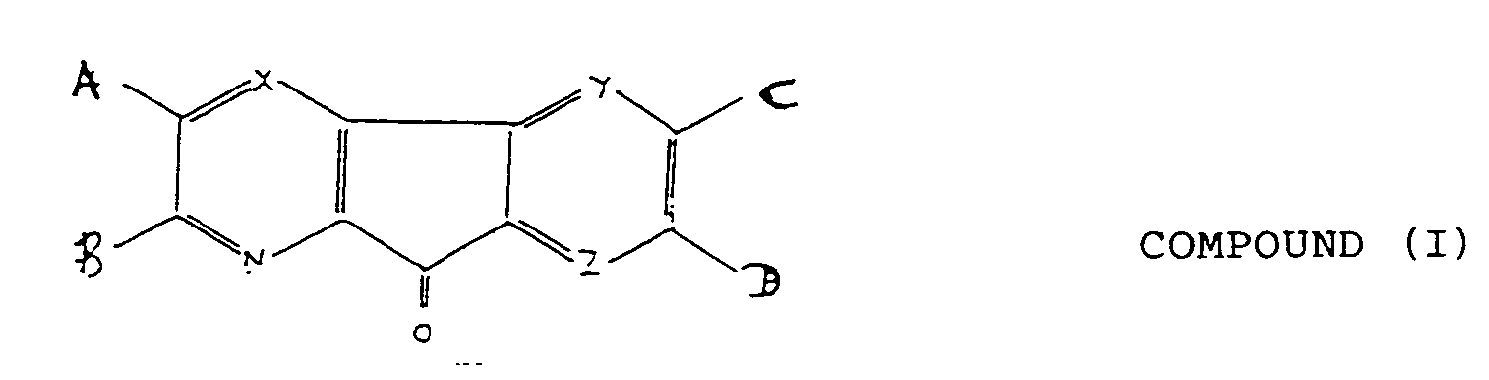
- A method of detection of amino acids as claimed in claim 1, wherein substituents X, Y, Z, A, B, C, and D are one of the following combinations(1) X and Y are C-H; and
Z is nitrogen; and
A, B, C and D are hydrogen
OR(2) X is nitrogen; and
Y and Z are C-H; and
A and B together are part of a benzene ring; and
C and D are hydrogen
OR(3) X, Y and Z are nitrogen; and
A, B, C and D are hydrogen
OR(4) X, Y and Z are nitrogen; and
A and B together are part of a further benzene ring; and
C and D together are part of a further benzene ring
OR(5) X and Y are C-H; and
Z is nitrogen; and
A and B together are part of a benzene ring; and
C and D together are part of a benzene ring
OR(6) Z is nitrogen; and
B and D are hydrogen; and
A and X together form part of a benzene ring; and
C and Y together form part of a benzene ring;
OR(7) X and Y are nitrogen;
Y is C-H;
A and B together form part of a benzene ring;
C and D are hydrogen. - A method of detection of amino acids as claimed in claim 1 or claim 2, wherein the said compound (I) is dissolved in a solvent system comprising: alcohol, acid and halo alkane.
- A method of detection of amino acids as claimed in claim 1, claim 2 or claim 3, wherein the said compound (I) is dissolved in a solvent system comprising methanol, acetic acid and trichlorotrifluoroethane so as the concentration of the reagent (I) solution is in the range from substantially 0.05% to 2%.
- A method of detection of amino acids as claimed in claim 3 or claim 4 wherein the material being tested is immersed in the compound (I) solution.
- A method of detection of amino acids as claimed in any preceding claim in which the material being tested is substantially dried after a first application of compound (I) prior to a second application of compound (I) to the material being tested.
- A method of detection of amino acids as claimed in any preceding claim in which the material being tested is developed by heating.
- A method of detection of amino acids as claimed in any preceding claim in which the amino acid in combination with compound (I) produces coloured fluorescent species which may be made visable by illumination by light.
- A method of detection of amino acids as claimed in claim 8 in which the excitation wavelength range of the said light comprises 470nm and the emission wavelength range of the said light comprises 570nm.
Applications Claiming Priority (3)
| Application Number | Priority Date | Filing Date | Title |
|---|---|---|---|
| GB8826237 | 1988-11-09 | ||
| GB888826237A GB8826237D0 (en) | 1988-11-09 | 1988-11-09 | Fingerprint reagent |
| PCT/GB1989/001329 WO1990005308A1 (en) | 1988-11-09 | 1989-11-09 | Fingerprint reagent |
Publications (2)
| Publication Number | Publication Date |
|---|---|
| EP0442959A1 EP0442959A1 (en) | 1991-08-28 |
| EP0442959B1 true EP0442959B1 (en) | 1994-08-31 |
Family
ID=10646574
Family Applications (1)
| Application Number | Title | Priority Date | Filing Date |
|---|---|---|---|
| EP89913229A Expired - Lifetime EP0442959B1 (en) | 1988-11-09 | 1989-11-09 | Fingerprint reagent |
Country Status (8)
| Country | Link |
|---|---|
| US (1) | US5221627A (en) |
| EP (1) | EP0442959B1 (en) |
| AT (1) | ATE110855T1 (en) |
| AU (1) | AU638221B2 (en) |
| CA (1) | CA2002620C (en) |
| DE (1) | DE68917934T2 (en) |
| GB (1) | GB8826237D0 (en) |
| WO (1) | WO1990005308A1 (en) |
Families Citing this family (16)
| Publication number | Priority date | Publication date | Assignee | Title |
|---|---|---|---|---|
| US6352863B1 (en) * | 1990-01-19 | 2002-03-05 | La Mina, Inc. | Assay device |
| TW387805B (en) | 1997-05-12 | 2000-04-21 | Taiho Ind Co | A fingerprint indicator and the method of detection |
| DE19830040B4 (en) * | 1998-06-26 | 2009-02-05 | Sensient Imaging Technologies Gmbh | New cyclopentadiquinoxaline derivatives |
| US6485981B1 (en) * | 1998-07-29 | 2002-11-26 | Ciencia, Inc. | Method and apparatus for imaging and documenting fingerprints |
| ES2243527T3 (en) | 2000-07-06 | 2005-12-01 | Qlt Inc. | HETEROPOLICICLIC INHIBITORS. |
| KR20010025234A (en) * | 2000-11-09 | 2001-04-06 | 김진삼 | A certification method of credit of a financing card based on fingerprint and a certification system thereof |
| US7741103B2 (en) * | 2006-03-31 | 2010-06-22 | Guirguis Raouf A | Integrated screening and confirmation device |
| US11906512B2 (en) | 2006-03-31 | 2024-02-20 | Zeus Diagnostics, LLC | Integrated device for analyte testing, confirmation, and donor identity verification |
| US7879623B2 (en) * | 2006-03-31 | 2011-02-01 | Guirguis Raouf A | Integrated device for analyte, testing, confirmation, and donor identity verification |
| US8940527B2 (en) * | 2006-03-31 | 2015-01-27 | Lamina Equities Corp. | Integrated device for analyte testing, confirmation, and donor identity verification |
| US20080022888A1 (en) * | 2006-07-27 | 2008-01-31 | Armor Holdings Forensics, Inc. | Ready to use combined skin marking stain compound and applicator requiring only the addition of water |
| WO2009067761A1 (en) * | 2007-11-29 | 2009-06-04 | University Of Technology, Sydney | A method of developing latent fingerprints |
| WO2009069687A1 (en) * | 2007-11-30 | 2009-06-04 | Osaka University | Conjugated compound, nitrogenated condensed-ring compound, nitrogenated condensed-ring polymer, organic thin film, and organic thin film element |
| US10564155B2 (en) | 2017-01-27 | 2020-02-18 | Raouf A Guirguis | Dual swab fluid sample collection for split sample testing and fingerprint identification device |
| CN113512027B (en) * | 2021-07-20 | 2022-06-14 | 华南理工大学 | Indenoquinoxaline derivative and preparation method and application thereof |
| PL246269B1 (en) * | 2022-12-31 | 2024-12-23 | Univ Gdanski | Method of visualizing fingerprint traces on an absorbent substrate and final solution for visualizing fingerprint traces on an absorbent substrate |
Family Cites Families (1)
| Publication number | Priority date | Publication date | Assignee | Title |
|---|---|---|---|---|
| BE621677A (en) * |
-
1988
- 1988-11-09 GB GB888826237A patent/GB8826237D0/en active Pending
-
1989
- 1989-11-09 DE DE68917934T patent/DE68917934T2/en not_active Expired - Fee Related
- 1989-11-09 US US07/689,750 patent/US5221627A/en not_active Expired - Lifetime
- 1989-11-09 EP EP89913229A patent/EP0442959B1/en not_active Expired - Lifetime
- 1989-11-09 AT AT89913229T patent/ATE110855T1/en not_active IP Right Cessation
- 1989-11-09 AU AU46397/89A patent/AU638221B2/en not_active Ceased
- 1989-11-09 WO PCT/GB1989/001329 patent/WO1990005308A1/en not_active Ceased
- 1989-11-09 CA CA002002620A patent/CA2002620C/en not_active Expired - Fee Related
Non-Patent Citations (2)
| Title |
|---|
| HELVETICA CHIMICA ACTA, fasc. IV, vol. 33, 1950; J. DRUEY et al., pp. 1080-1087# * |
| TETRAHEDRON, vol. 25, 1969, Pergamon Press (GB); S. SKUJINS et al., pp. 3935-3945# * |
Also Published As
| Publication number | Publication date |
|---|---|
| EP0442959A1 (en) | 1991-08-28 |
| CA2002620A1 (en) | 1990-05-09 |
| US5221627A (en) | 1993-06-22 |
| WO1990005308A1 (en) | 1990-05-17 |
| CA2002620C (en) | 2000-08-08 |
| ATE110855T1 (en) | 1994-09-15 |
| GB8826237D0 (en) | 1988-12-14 |
| AU4639789A (en) | 1990-05-28 |
| AU638221B2 (en) | 1993-06-24 |
| DE68917934T2 (en) | 1995-02-09 |
| DE68917934D1 (en) | 1994-10-06 |
Similar Documents
| Publication | Publication Date | Title |
|---|---|---|
| US5221627A (en) | Fingerprint reagent | |
| Berggren et al. | Background‐free, high sensitivity staining of proteins in one‐and two‐dimensional sodium dodecyl sulfate‐polyacrylamide gels using a luminescent ruthenium complex | |
| Pounds et al. | The use of 1, 8-diazafluoren-9-one (DFO) for the fluorescent detection of latent fingerprints on paper. A preliminary evaluation | |
| JPH0137694B2 (en) | ||
| JPH03505667A (en) | Improved uses of chemiluminescent 1,2-dioxetanes | |
| JPS62257064A (en) | Method of identifying n terminal amino acid of polypeptide | |
| US3892530A (en) | Colorimetric and fluorometric method | |
| Guo et al. | A highly sensitive assay for protein using resonance light-scattering technique with dibromohydroxyphenylfluorone–molybdenum (VI) complex | |
| US5270164A (en) | Process for enhancing the chemiluminescence of enzyme-triggered 1,2-dioxetanes and uses therefor | |
| Monforte et al. | Fluorometric determination of primary and secondary amines in blood and urine after thin-layer chromatography | |
| JPWO2008023489A1 (en) | Square acid derivative compound, protein detection reagent containing the compound, and protein detection method using the reagent | |
| STOWARD | Studies in fluorescence histochemistry: II. The demonstration of periodate‐reactive mucosubstances with pseudo‐Schiff reagents | |
| Almog et al. | Nitro-benzofurazanyl ethers—a new series of fluorigenic fingerprint reagents | |
| CN115449366A (en) | Application of semicyanine compounds in the identification of dimethyl sulfoxide | |
| ES2117629T3 (en) | METHOD FOR TESTING OILS. | |
| Bleay | Amino acid reagents | |
| EP1738177B1 (en) | Method for analyzing n-terminal protein adducts | |
| Inglis et al. | Rapid identification of amino acid derivatives from the sequenator | |
| Sano et al. | Fluorometric determination of aromatic aldehydes with 1, 4-dimethyl-3-carbamoylpyridinium chloride | |
| JP3658621B2 (en) | Detection method and detection kit for p-aminophenol derivative | |
| CN117964568A (en) | A trace-revealing oxazine fluorescent dye and its preparation method and application | |
| CN119086224A (en) | Biomolecule detection method and system | |
| SU1337773A1 (en) | Method of determining pyranthel embonate | |
| RU1831676C (en) | Determination of | |
| RU2114137C1 (en) | Method of preparing brown sulfurous dye |
Legal Events
| Date | Code | Title | Description |
|---|---|---|---|
| PUAI | Public reference made under article 153(3) epc to a published international application that has entered the european phase |
Free format text: ORIGINAL CODE: 0009012 |
|
| 17P | Request for examination filed |
Effective date: 19910508 |
|
| AK | Designated contracting states |
Kind code of ref document: A1 Designated state(s): AT BE CH DE FR GB IT LI LU NL SE |
|
| 111L | Licence recorded |
Free format text: 0100 HER BRITANNIC MAJESTY'S PRINCIPAL SECRETARY OF STATE FOR THE HOME DEPARTMENT |
|
| 17Q | First examination report despatched |
Effective date: 19930706 |
|
| GRAA | (expected) grant |
Free format text: ORIGINAL CODE: 0009210 |
|
| AK | Designated contracting states |
Kind code of ref document: B1 Designated state(s): AT BE CH DE FR GB IT LI LU NL SE |
|
| REF | Corresponds to: |
Ref document number: 110855 Country of ref document: AT Date of ref document: 19940915 Kind code of ref document: T |
|
| ITF | It: translation for a ep patent filed | ||
| REF | Corresponds to: |
Ref document number: 68917934 Country of ref document: DE Date of ref document: 19941006 |
|
| REG | Reference to a national code |
Ref country code: CH Ref legal event code: PLI Owner name: HER BRITANNIC MAJESTY'S PRINCIPAL SECRETARY OF STA |
|
| PGFP | Annual fee paid to national office [announced via postgrant information from national office to epo] |
Ref country code: CH Payment date: 19941028 Year of fee payment: 6 Ref country code: BE Payment date: 19941028 Year of fee payment: 6 |
|
| PGFP | Annual fee paid to national office [announced via postgrant information from national office to epo] |
Ref country code: LU Payment date: 19941101 Year of fee payment: 6 |
|
| PGFP | Annual fee paid to national office [announced via postgrant information from national office to epo] |
Ref country code: SE Payment date: 19941107 Year of fee payment: 6 |
|
| ET | Fr: translation filed | ||
| PGFP | Annual fee paid to national office [announced via postgrant information from national office to epo] |
Ref country code: FR Payment date: 19941124 Year of fee payment: 6 Ref country code: AT Payment date: 19941124 Year of fee payment: 6 |
|
| PGFP | Annual fee paid to national office [announced via postgrant information from national office to epo] |
Ref country code: NL Payment date: 19941130 Year of fee payment: 6 |
|
| PGFP | Annual fee paid to national office [announced via postgrant information from national office to epo] |
Ref country code: DE Payment date: 19941208 Year of fee payment: 6 |
|
| EAL | Se: european patent in force in sweden |
Ref document number: 89913229.4 |
|
| PLBE | No opposition filed within time limit |
Free format text: ORIGINAL CODE: 0009261 |
|
| STAA | Information on the status of an ep patent application or granted ep patent |
Free format text: STATUS: NO OPPOSITION FILED WITHIN TIME LIMIT |
|
| 26N | No opposition filed | ||
| PG25 | Lapsed in a contracting state [announced via postgrant information from national office to epo] |
Ref country code: LU Free format text: LAPSE BECAUSE OF NON-PAYMENT OF DUE FEES Effective date: 19951109 Ref country code: AT Effective date: 19951109 |
|
| PG25 | Lapsed in a contracting state [announced via postgrant information from national office to epo] |
Ref country code: SE Effective date: 19951110 |
|
| PG25 | Lapsed in a contracting state [announced via postgrant information from national office to epo] |
Ref country code: LI Effective date: 19951130 Ref country code: CH Effective date: 19951130 Ref country code: BE Effective date: 19951130 |
|
| BERE | Be: lapsed |
Owner name: THE QUEEN'S UNIVERSITY OF BELFAST Effective date: 19951130 |
|
| PG25 | Lapsed in a contracting state [announced via postgrant information from national office to epo] |
Ref country code: NL Effective date: 19960601 |
|
| REG | Reference to a national code |
Ref country code: CH Ref legal event code: PL |
|
| PG25 | Lapsed in a contracting state [announced via postgrant information from national office to epo] |
Ref country code: FR Effective date: 19960731 |
|
| NLV4 | Nl: lapsed or anulled due to non-payment of the annual fee |
Effective date: 19960601 |
|
| PG25 | Lapsed in a contracting state [announced via postgrant information from national office to epo] |
Ref country code: DE Effective date: 19960801 |
|
| EUG | Se: european patent has lapsed |
Ref document number: 89913229.4 |
|
| REG | Reference to a national code |
Ref country code: FR Ref legal event code: ST |
|
| REG | Reference to a national code |
Ref country code: GB Ref legal event code: IF02 |
|
| PGFP | Annual fee paid to national office [announced via postgrant information from national office to epo] |
Ref country code: GB Payment date: 20021112 Year of fee payment: 14 |
|
| PG25 | Lapsed in a contracting state [announced via postgrant information from national office to epo] |
Ref country code: GB Free format text: LAPSE BECAUSE OF NON-PAYMENT OF DUE FEES Effective date: 20031109 |
|
| GBPC | Gb: european patent ceased through non-payment of renewal fee |
Effective date: 20031109 |
|
| PG25 | Lapsed in a contracting state [announced via postgrant information from national office to epo] |
Ref country code: IT Free format text: LAPSE BECAUSE OF NON-PAYMENT OF DUE FEES;WARNING: LAPSES OF ITALIAN PATENTS WITH EFFECTIVE DATE BEFORE 2007 MAY HAVE OCCURRED AT ANY TIME BEFORE 2007. THE CORRECT EFFECTIVE DATE MAY BE DIFFERENT FROM THE ONE RECORDED. Effective date: 20051109 |