EP0442315B1 - Method for separating ionic species using capillary electrophoresis - Google Patents
Method for separating ionic species using capillary electrophoresis Download PDFInfo
- Publication number
- EP0442315B1 EP0442315B1 EP91101064A EP91101064A EP0442315B1 EP 0442315 B1 EP0442315 B1 EP 0442315B1 EP 91101064 A EP91101064 A EP 91101064A EP 91101064 A EP91101064 A EP 91101064A EP 0442315 B1 EP0442315 B1 EP 0442315B1
- Authority
- EP
- European Patent Office
- Prior art keywords
- salt
- anions
- capillary
- sample
- cations
- Prior art date
- Legal status (The legal status is an assumption and is not a legal conclusion. Google has not performed a legal analysis and makes no representation as to the accuracy of the status listed.)
- Expired - Lifetime
Links
- 238000000034 method Methods 0.000 title claims description 77
- 238000005251 capillar electrophoresis Methods 0.000 title claims description 54
- 150000001450 anions Chemical class 0.000 claims description 101
- 238000000926 separation method Methods 0.000 claims description 66
- 239000003792 electrolyte Substances 0.000 claims description 63
- 239000000203 mixture Substances 0.000 claims description 46
- 150000001768 cations Chemical class 0.000 claims description 37
- 238000001514 detection method Methods 0.000 claims description 29
- CXRFDZFCGOPDTD-UHFFFAOYSA-M Cetrimide Chemical compound [Br-].CCCCCCCCCCCCCC[N+](C)(C)C CXRFDZFCGOPDTD-UHFFFAOYSA-M 0.000 claims description 22
- ZCDOYSPFYFSLEW-UHFFFAOYSA-N chromate(2-) Chemical compound [O-][Cr]([O-])(=O)=O ZCDOYSPFYFSLEW-UHFFFAOYSA-N 0.000 claims description 15
- -1 alkyl quaternary ammonium salt Chemical class 0.000 claims description 14
- HMTSWYPNXFHGEP-UHFFFAOYSA-N (4-methylphenyl)methanamine Chemical group CC1=CC=C(CN)C=C1 HMTSWYPNXFHGEP-UHFFFAOYSA-N 0.000 claims description 12
- VUEDNLCYHKSELL-UHFFFAOYSA-N arsonium Chemical class [AsH4+] VUEDNLCYHKSELL-UHFFFAOYSA-N 0.000 claims description 10
- LSGOVYNHVSXFFJ-UHFFFAOYSA-N vanadate(3-) Chemical class [O-][V]([O-])([O-])=O LSGOVYNHVSXFFJ-UHFFFAOYSA-N 0.000 claims description 10
- KRKNYBCHXYNGOX-UHFFFAOYSA-K Citrate Chemical compound [O-]C(=O)CC(O)(CC([O-])=O)C([O-])=O KRKNYBCHXYNGOX-UHFFFAOYSA-K 0.000 claims description 9
- 150000001449 anionic compounds Chemical class 0.000 claims description 9
- 150000003839 salts Chemical group 0.000 claims description 9
- 125000000129 anionic group Chemical group 0.000 claims description 8
- 229910001412 inorganic anion Inorganic materials 0.000 claims description 8
- LZZYPRNAOMGNLH-UHFFFAOYSA-M Cetrimonium bromide Chemical compound [Br-].CCCCCCCCCCCCCCCC[N+](C)(C)C LZZYPRNAOMGNLH-UHFFFAOYSA-M 0.000 claims description 7
- 239000000654 additive Substances 0.000 claims description 7
- 239000002738 chelating agent Substances 0.000 claims description 7
- PXLIDIMHPNPGMH-UHFFFAOYSA-N sodium chromate Chemical group [Na+].[Na+].[O-][Cr]([O-])(=O)=O PXLIDIMHPNPGMH-UHFFFAOYSA-N 0.000 claims description 7
- HRQDCDQDOPSGBR-UHFFFAOYSA-M sodium;octane-1-sulfonate Chemical group [Na+].CCCCCCCCS([O-])(=O)=O HRQDCDQDOPSGBR-UHFFFAOYSA-M 0.000 claims description 7
- 125000000217 alkyl group Chemical group 0.000 claims description 6
- 230000000996 additive effect Effects 0.000 claims description 5
- 125000004432 carbon atom Chemical group C* 0.000 claims description 5
- WLGDAKIJYPIYLR-UHFFFAOYSA-M octane-1-sulfonate Chemical class CCCCCCCCS([O-])(=O)=O WLGDAKIJYPIYLR-UHFFFAOYSA-M 0.000 claims description 5
- 150000004714 phosphonium salts Chemical class 0.000 claims description 5
- 150000003242 quaternary ammonium salts Chemical class 0.000 claims description 5
- 150000001412 amines Chemical class 0.000 claims description 4
- 150000001735 carboxylic acids Chemical class 0.000 claims description 4
- 150000001767 cationic compounds Chemical class 0.000 claims description 4
- 229910001411 inorganic cation Inorganic materials 0.000 claims description 3
- BWLBGMIXKSTLSX-UHFFFAOYSA-N 2-hydroxyisobutyric acid Chemical compound CC(C)(O)C(O)=O BWLBGMIXKSTLSX-UHFFFAOYSA-N 0.000 claims description 2
- MUBZPKHOEPUJKR-UHFFFAOYSA-N Oxalic acid Chemical compound OC(=O)C(O)=O MUBZPKHOEPUJKR-UHFFFAOYSA-N 0.000 claims description 2
- KDYFGRWQOYBRFD-UHFFFAOYSA-L succinate(2-) Chemical compound [O-]C(=O)CCC([O-])=O KDYFGRWQOYBRFD-UHFFFAOYSA-L 0.000 claims description 2
- 229940095064 tartrate Drugs 0.000 claims description 2
- 238000005515 capillary zone electrophoresis Methods 0.000 claims 2
- FEWJPZIEWOKRBE-JCYAYHJZSA-L L-tartrate(2-) Chemical compound [O-]C(=O)[C@H](O)[C@@H](O)C([O-])=O FEWJPZIEWOKRBE-JCYAYHJZSA-L 0.000 claims 1
- 150000008051 alkyl sulfates Chemical class 0.000 claims 1
- 150000005323 carbonate salts Chemical class 0.000 claims 1
- 239000007979 citrate buffer Substances 0.000 claims 1
- 150000001860 citric acid derivatives Chemical class 0.000 claims 1
- 229910052751 metal Inorganic materials 0.000 claims 1
- 239000002184 metal Substances 0.000 claims 1
- 150000002739 metals Chemical class 0.000 claims 1
- 150000002891 organic anions Chemical class 0.000 claims 1
- 150000003460 sulfonic acids Chemical class 0.000 claims 1
- 239000000523 sample Substances 0.000 description 54
- 150000002500 ions Chemical class 0.000 description 26
- 238000004255 ion exchange chromatography Methods 0.000 description 24
- 239000003153 chemical reaction reagent Substances 0.000 description 17
- 230000037230 mobility Effects 0.000 description 15
- 239000011734 sodium Substances 0.000 description 14
- BVKZGUZCCUSVTD-UHFFFAOYSA-L Carbonate Chemical compound [O-]C([O-])=O BVKZGUZCCUSVTD-UHFFFAOYSA-L 0.000 description 11
- 239000003607 modifier Substances 0.000 description 11
- VEXZGXHMUGYJMC-UHFFFAOYSA-M Chloride anion Chemical compound [Cl-] VEXZGXHMUGYJMC-UHFFFAOYSA-M 0.000 description 10
- 229910002651 NO3 Inorganic materials 0.000 description 10
- NHNBFGGVMKEFGY-UHFFFAOYSA-N Nitrate Chemical compound [O-][N+]([O-])=O NHNBFGGVMKEFGY-UHFFFAOYSA-N 0.000 description 10
- 238000005370 electroosmosis Methods 0.000 description 10
- CPELXLSAUQHCOX-UHFFFAOYSA-M Bromide Chemical compound [Br-] CPELXLSAUQHCOX-UHFFFAOYSA-M 0.000 description 9
- QAOWNCQODCNURD-UHFFFAOYSA-L Sulfate Chemical compound [O-]S([O-])(=O)=O QAOWNCQODCNURD-UHFFFAOYSA-L 0.000 description 9
- 239000003795 chemical substances by application Substances 0.000 description 9
- 238000002347 injection Methods 0.000 description 9
- 239000007924 injection Substances 0.000 description 9
- 230000035945 sensitivity Effects 0.000 description 9
- KRHYYFGTRYWZRS-UHFFFAOYSA-M Fluoride anion Chemical compound [F-] KRHYYFGTRYWZRS-UHFFFAOYSA-M 0.000 description 8
- IOVCWXUNBOPUCH-UHFFFAOYSA-M Nitrite anion Chemical compound [O-]N=O IOVCWXUNBOPUCH-UHFFFAOYSA-M 0.000 description 8
- 229910019142 PO4 Inorganic materials 0.000 description 7
- 150000001875 compounds Chemical class 0.000 description 7
- 238000004458 analytical method Methods 0.000 description 6
- MEFBJEMVZONFCJ-UHFFFAOYSA-N molybdate Chemical compound [O-][Mo]([O-])(=O)=O MEFBJEMVZONFCJ-UHFFFAOYSA-N 0.000 description 6
- 239000010452 phosphate Substances 0.000 description 6
- 238000004611 spectroscopical analysis Methods 0.000 description 6
- 239000012491 analyte Substances 0.000 description 5
- 239000008139 complexing agent Substances 0.000 description 5
- 239000007788 liquid Substances 0.000 description 5
- XJPIGTIOWBWIMP-UHFFFAOYSA-N morpholin-4-yl ethanesulfonate Chemical compound CCS(=O)(=O)ON1CCOCC1 XJPIGTIOWBWIMP-UHFFFAOYSA-N 0.000 description 5
- NBIIXXVUZAFLBC-UHFFFAOYSA-K phosphate Chemical compound [O-]P([O-])([O-])=O NBIIXXVUZAFLBC-UHFFFAOYSA-K 0.000 description 5
- PBYZMCDFOULPGH-UHFFFAOYSA-N tungstate Chemical compound [O-][W]([O-])(=O)=O PBYZMCDFOULPGH-UHFFFAOYSA-N 0.000 description 5
- QTBSBXVTEAMEQO-UHFFFAOYSA-M Acetate Chemical compound CC([O-])=O QTBSBXVTEAMEQO-UHFFFAOYSA-M 0.000 description 4
- VYPSYNLAJGMNEJ-UHFFFAOYSA-N Silicium dioxide Chemical compound O=[Si]=O VYPSYNLAJGMNEJ-UHFFFAOYSA-N 0.000 description 4
- QAOWNCQODCNURD-UHFFFAOYSA-N Sulfuric acid Chemical compound OS(O)(=O)=O QAOWNCQODCNURD-UHFFFAOYSA-N 0.000 description 4
- 239000008151 electrolyte solution Substances 0.000 description 4
- 229940021013 electrolyte solution Drugs 0.000 description 4
- 238000010828 elution Methods 0.000 description 4
- 239000005350 fused silica glass Substances 0.000 description 4
- BDAGIHXWWSANSR-UHFFFAOYSA-M Formate Chemical compound [O-]C=O BDAGIHXWWSANSR-UHFFFAOYSA-M 0.000 description 3
- 239000004642 Polyimide Substances 0.000 description 3
- HEMHJVSKTPXQMS-UHFFFAOYSA-M Sodium hydroxide Chemical compound [OH-].[Na+] HEMHJVSKTPXQMS-UHFFFAOYSA-M 0.000 description 3
- 238000002835 absorbance Methods 0.000 description 3
- 239000011575 calcium Substances 0.000 description 3
- 230000000694 effects Effects 0.000 description 3
- 230000002706 hydrostatic effect Effects 0.000 description 3
- 239000011777 magnesium Substances 0.000 description 3
- PSZYNBSKGUBXEH-UHFFFAOYSA-N naphthalene-1-sulfonic acid Chemical compound C1=CC=C2C(S(=O)(=O)O)=CC=CC2=C1 PSZYNBSKGUBXEH-UHFFFAOYSA-N 0.000 description 3
- 150000002894 organic compounds Chemical class 0.000 description 3
- XYFCBTPGUUZFHI-UHFFFAOYSA-O phosphonium Chemical compound [PH4+] XYFCBTPGUUZFHI-UHFFFAOYSA-O 0.000 description 3
- XNGIFLGASWRNHJ-UHFFFAOYSA-L phthalate(2-) Chemical compound [O-]C(=O)C1=CC=CC=C1C([O-])=O XNGIFLGASWRNHJ-UHFFFAOYSA-L 0.000 description 3
- 229920001721 polyimide Polymers 0.000 description 3
- DHCDFWKWKRSZHF-UHFFFAOYSA-L thiosulfate(2-) Chemical compound [O-]S([S-])(=O)=O DHCDFWKWKRSZHF-UHFFFAOYSA-L 0.000 description 3
- ICSNLGPSRYBMBD-UHFFFAOYSA-N 2-aminopyridine Chemical compound NC1=CC=CC=N1 ICSNLGPSRYBMBD-UHFFFAOYSA-N 0.000 description 2
- UMCMPZBLKLEWAF-BCTGSCMUSA-N 3-[(3-cholamidopropyl)dimethylammonio]propane-1-sulfonate Chemical compound C([C@H]1C[C@H]2O)[C@H](O)CC[C@]1(C)[C@@H]1[C@@H]2[C@@H]2CC[C@H]([C@@H](CCC(=O)NCCC[N+](C)(C)CCCS([O-])(=O)=O)C)[C@@]2(C)[C@@H](O)C1 UMCMPZBLKLEWAF-BCTGSCMUSA-N 0.000 description 2
- TUBRCQBRKJXJEA-UHFFFAOYSA-N 3-[hexadecyl(dimethyl)azaniumyl]propane-1-sulfonate Chemical compound CCCCCCCCCCCCCCCC[N+](C)(C)CCCS([O-])(=O)=O TUBRCQBRKJXJEA-UHFFFAOYSA-N 0.000 description 2
- QGZKDVFQNNGYKY-UHFFFAOYSA-O Ammonium Chemical compound [NH4+] QGZKDVFQNNGYKY-UHFFFAOYSA-O 0.000 description 2
- FERIUCNNQQJTOY-UHFFFAOYSA-M Butyrate Chemical compound CCCC([O-])=O FERIUCNNQQJTOY-UHFFFAOYSA-M 0.000 description 2
- FERIUCNNQQJTOY-UHFFFAOYSA-N Butyric acid Natural products CCCC(O)=O FERIUCNNQQJTOY-UHFFFAOYSA-N 0.000 description 2
- OYPRJOBELJOOCE-UHFFFAOYSA-N Calcium Chemical compound [Ca] OYPRJOBELJOOCE-UHFFFAOYSA-N 0.000 description 2
- XTEGARKTQYYJKE-UHFFFAOYSA-M Chlorate Chemical compound [O-]Cl(=O)=O XTEGARKTQYYJKE-UHFFFAOYSA-M 0.000 description 2
- KCXVZYZYPLLWCC-UHFFFAOYSA-N EDTA Chemical compound OC(=O)CN(CC(O)=O)CCN(CC(O)=O)CC(O)=O KCXVZYZYPLLWCC-UHFFFAOYSA-N 0.000 description 2
- OWXMKDGYPWMGEB-UHFFFAOYSA-N HEPPS Chemical compound OCCN1CCN(CCCS(O)(=O)=O)CC1 OWXMKDGYPWMGEB-UHFFFAOYSA-N 0.000 description 2
- DGAQECJNVWCQMB-PUAWFVPOSA-M Ilexoside XXIX Chemical compound C[C@@H]1CC[C@@]2(CC[C@@]3(C(=CC[C@H]4[C@]3(CC[C@@H]5[C@@]4(CC[C@@H](C5(C)C)OS(=O)(=O)[O-])C)C)[C@@H]2[C@]1(C)O)C)C(=O)O[C@H]6[C@@H]([C@H]([C@@H]([C@H](O6)CO)O)O)O.[Na+] DGAQECJNVWCQMB-PUAWFVPOSA-M 0.000 description 2
- WHXSMMKQMYFTQS-UHFFFAOYSA-N Lithium Chemical compound [Li] WHXSMMKQMYFTQS-UHFFFAOYSA-N 0.000 description 2
- FYYHWMGAXLPEAU-UHFFFAOYSA-N Magnesium Chemical compound [Mg] FYYHWMGAXLPEAU-UHFFFAOYSA-N 0.000 description 2
- ZLMJMSJWJFRBEC-UHFFFAOYSA-N Potassium Chemical compound [K] ZLMJMSJWJFRBEC-UHFFFAOYSA-N 0.000 description 2
- XBDQKXXYIPTUBI-UHFFFAOYSA-M Propionate Chemical compound CCC([O-])=O XBDQKXXYIPTUBI-UHFFFAOYSA-M 0.000 description 2
- 229940045714 alkyl sulfonate alkylating agent Drugs 0.000 description 2
- 150000008052 alkyl sulfonates Chemical class 0.000 description 2
- 150000001540 azides Chemical class 0.000 description 2
- 229910052788 barium Inorganic materials 0.000 description 2
- DSAJWYNOEDNPEQ-UHFFFAOYSA-N barium atom Chemical compound [Ba] DSAJWYNOEDNPEQ-UHFFFAOYSA-N 0.000 description 2
- WPYMKLBDIGXBTP-UHFFFAOYSA-N benzoic acid Chemical compound OC(=O)C1=CC=CC=C1 WPYMKLBDIGXBTP-UHFFFAOYSA-N 0.000 description 2
- QDHFHIQKOVNCNC-UHFFFAOYSA-M butane-1-sulfonate Chemical compound CCCCS([O-])(=O)=O QDHFHIQKOVNCNC-UHFFFAOYSA-M 0.000 description 2
- 229910052791 calcium Inorganic materials 0.000 description 2
- 150000007942 carboxylates Chemical class 0.000 description 2
- 125000002091 cationic group Chemical group 0.000 description 2
- 238000013375 chromatographic separation Methods 0.000 description 2
- 238000004587 chromatography analysis Methods 0.000 description 2
- 230000000536 complexating effect Effects 0.000 description 2
- 230000001419 dependent effect Effects 0.000 description 2
- 238000005516 engineering process Methods 0.000 description 2
- CCIVGXIOQKPBKL-UHFFFAOYSA-M ethanesulfonate Chemical compound CCS([O-])(=O)=O CCIVGXIOQKPBKL-UHFFFAOYSA-M 0.000 description 2
- 229940084428 freezone Drugs 0.000 description 2
- 235000011389 fruit/vegetable juice Nutrition 0.000 description 2
- XMBWDFGMSWQBCA-UHFFFAOYSA-N hydrogen iodide Chemical compound I XMBWDFGMSWQBCA-UHFFFAOYSA-N 0.000 description 2
- 239000012535 impurity Substances 0.000 description 2
- 229910052744 lithium Inorganic materials 0.000 description 2
- 229910052749 magnesium Inorganic materials 0.000 description 2
- 238000013508 migration Methods 0.000 description 2
- 230000005012 migration Effects 0.000 description 2
- 238000012544 monitoring process Methods 0.000 description 2
- 229940074371 monofluorophosphate Drugs 0.000 description 2
- 230000007935 neutral effect Effects 0.000 description 2
- RJQRCOMHVBLQIH-UHFFFAOYSA-N pentane-1-sulfonic acid Chemical compound CCCCCS(O)(=O)=O RJQRCOMHVBLQIH-UHFFFAOYSA-N 0.000 description 2
- OJMIONKXNSYLSR-UHFFFAOYSA-N phosphorous acid Chemical compound OP(O)O OJMIONKXNSYLSR-UHFFFAOYSA-N 0.000 description 2
- 229920000642 polymer Polymers 0.000 description 2
- 229910052700 potassium Inorganic materials 0.000 description 2
- 239000011591 potassium Substances 0.000 description 2
- 238000002360 preparation method Methods 0.000 description 2
- KCXFHTAICRTXLI-UHFFFAOYSA-N propane-1-sulfonic acid Chemical compound CCCS(O)(=O)=O KCXFHTAICRTXLI-UHFFFAOYSA-N 0.000 description 2
- YGSDEFSMJLZEOE-UHFFFAOYSA-N salicylic acid Chemical compound OC(=O)C1=CC=CC=C1O YGSDEFSMJLZEOE-UHFFFAOYSA-N 0.000 description 2
- 125000005372 silanol group Chemical group 0.000 description 2
- 229910052708 sodium Inorganic materials 0.000 description 2
- 229910052712 strontium Inorganic materials 0.000 description 2
- CIOAGBVUUVVLOB-UHFFFAOYSA-N strontium atom Chemical compound [Sr] CIOAGBVUUVVLOB-UHFFFAOYSA-N 0.000 description 2
- 238000000825 ultraviolet detection Methods 0.000 description 2
- 238000007693 zone electrophoresis Methods 0.000 description 2
- LDMOEFOXLIZJOW-UHFFFAOYSA-N 1-dodecanesulfonic acid Chemical compound CCCCCCCCCCCCS(O)(=O)=O LDMOEFOXLIZJOW-UHFFFAOYSA-N 0.000 description 1
- SXGZJKUKBWWHRA-UHFFFAOYSA-N 2-(N-morpholiniumyl)ethanesulfonate Chemical compound [O-]S(=O)(=O)CC[NH+]1CCOCC1 SXGZJKUKBWWHRA-UHFFFAOYSA-N 0.000 description 1
- BRBUBVKGJRPRRD-UHFFFAOYSA-N 4,6-dimethylpyridin-2-amine Chemical compound CC1=CC(C)=NC(N)=C1 BRBUBVKGJRPRRD-UHFFFAOYSA-N 0.000 description 1
- FJKROLUGYXJWQN-UHFFFAOYSA-M 4-hydroxybenzoate Chemical compound OC1=CC=C(C([O-])=O)C=C1 FJKROLUGYXJWQN-UHFFFAOYSA-M 0.000 description 1
- ZEYHEAKUIGZSGI-UHFFFAOYSA-M 4-methoxybenzoate Chemical compound COC1=CC=C(C([O-])=O)C=C1 ZEYHEAKUIGZSGI-UHFFFAOYSA-M 0.000 description 1
- YHZPGCAQDKJEHE-UHFFFAOYSA-N 8-arsanyloctylarsane Chemical compound [AsH2]CCCCCCCC[AsH2] YHZPGCAQDKJEHE-UHFFFAOYSA-N 0.000 description 1
- AUKKNEZQECCVKF-UHFFFAOYSA-N 8-phosphanyloctylphosphane Chemical compound PCCCCCCCCP AUKKNEZQECCVKF-UHFFFAOYSA-N 0.000 description 1
- BVKZGUZCCUSVTD-UHFFFAOYSA-M Bicarbonate Chemical compound OC([O-])=O BVKZGUZCCUSVTD-UHFFFAOYSA-M 0.000 description 1
- RGHNJXZEOKUKBD-SQOUGZDYSA-M D-gluconate Chemical compound OC[C@@H](O)[C@@H](O)[C@H](O)[C@@H](O)C([O-])=O RGHNJXZEOKUKBD-SQOUGZDYSA-M 0.000 description 1
- FEWJPZIEWOKRBE-JCYAYHJZSA-N Dextrotartaric acid Chemical compound OC(=O)[C@H](O)[C@@H](O)C(O)=O FEWJPZIEWOKRBE-JCYAYHJZSA-N 0.000 description 1
- WHUUTDBJXJRKMK-VKHMYHEASA-N L-glutamic acid Chemical compound OC(=O)[C@@H](N)CCC(O)=O WHUUTDBJXJRKMK-VKHMYHEASA-N 0.000 description 1
- AFVFQIVMOAPDHO-UHFFFAOYSA-N Methanesulfonic acid Chemical compound CS(O)(=O)=O AFVFQIVMOAPDHO-UHFFFAOYSA-N 0.000 description 1
- 238000010521 absorption reaction Methods 0.000 description 1
- 239000002253 acid Substances 0.000 description 1
- 239000003513 alkali Substances 0.000 description 1
- 125000005210 alkyl ammonium group Chemical group 0.000 description 1
- 150000001413 amino acids Chemical class 0.000 description 1
- 150000003868 ammonium compounds Chemical class 0.000 description 1
- 238000012305 analytical separation technique Methods 0.000 description 1
- 238000003556 assay Methods 0.000 description 1
- GCAIEATUVJFSMC-UHFFFAOYSA-N benzene-1,2,3,4-tetracarboxylic acid Chemical compound OC(=O)C1=CC=C(C(O)=O)C(C(O)=O)=C1C(O)=O GCAIEATUVJFSMC-UHFFFAOYSA-N 0.000 description 1
- 239000013060 biological fluid Substances 0.000 description 1
- 239000000872 buffer Substances 0.000 description 1
- 239000001273 butane Substances 0.000 description 1
- 150000001720 carbohydrates Chemical class 0.000 description 1
- 235000014633 carbohydrates Nutrition 0.000 description 1
- 239000000969 carrier Substances 0.000 description 1
- 229910001919 chlorite Inorganic materials 0.000 description 1
- 229910052619 chlorite group Inorganic materials 0.000 description 1
- QBWCMBCROVPCKQ-UHFFFAOYSA-N chlorous acid Chemical compound OCl=O QBWCMBCROVPCKQ-UHFFFAOYSA-N 0.000 description 1
- KRVSOGSZCMJSLX-UHFFFAOYSA-L chromic acid Substances O[Cr](O)(=O)=O KRVSOGSZCMJSLX-UHFFFAOYSA-L 0.000 description 1
- 239000011248 coating agent Substances 0.000 description 1
- 238000000576 coating method Methods 0.000 description 1
- 230000003247 decreasing effect Effects 0.000 description 1
- 239000003599 detergent Substances 0.000 description 1
- 238000011161 development Methods 0.000 description 1
- 238000006073 displacement reaction Methods 0.000 description 1
- 230000005684 electric field Effects 0.000 description 1
- 238000001962 electrophoresis Methods 0.000 description 1
- 239000012149 elution buffer Substances 0.000 description 1
- 239000003623 enhancer Substances 0.000 description 1
- 238000002474 experimental method Methods 0.000 description 1
- YAGKRVSRTSUGEY-UHFFFAOYSA-N ferricyanide Chemical compound [Fe+3].N#[C-].N#[C-].N#[C-].N#[C-].N#[C-].N#[C-] YAGKRVSRTSUGEY-UHFFFAOYSA-N 0.000 description 1
- 238000001917 fluorescence detection Methods 0.000 description 1
- 235000013305 food Nutrition 0.000 description 1
- 235000015203 fruit juice Nutrition 0.000 description 1
- AWJWCTOOIBYHON-UHFFFAOYSA-N furo[3,4-b]pyrazine-5,7-dione Chemical compound C1=CN=C2C(=O)OC(=O)C2=N1 AWJWCTOOIBYHON-UHFFFAOYSA-N 0.000 description 1
- DSLZVSRJTYRBFB-DUHBMQHGSA-N galactaric acid Chemical compound OC(=O)[C@H](O)[C@@H](O)[C@@H](O)[C@H](O)C(O)=O DSLZVSRJTYRBFB-DUHBMQHGSA-N 0.000 description 1
- 239000000499 gel Substances 0.000 description 1
- 238000001502 gel electrophoresis Methods 0.000 description 1
- 229940050410 gluconate Drugs 0.000 description 1
- 229930195712 glutamate Natural products 0.000 description 1
- 150000002391 heterocyclic compounds Chemical class 0.000 description 1
- FYAQQULBLMNGAH-UHFFFAOYSA-N hexane-1-sulfonic acid Chemical compound CCCCCCS(O)(=O)=O FYAQQULBLMNGAH-UHFFFAOYSA-N 0.000 description 1
- 239000003317 industrial substance Substances 0.000 description 1
- 229910001410 inorganic ion Inorganic materials 0.000 description 1
- 230000003993 interaction Effects 0.000 description 1
- 230000002452 interceptive effect Effects 0.000 description 1
- 150000008040 ionic compounds Chemical class 0.000 description 1
- UETZVSHORCDDTH-UHFFFAOYSA-N iron(2+);hexacyanide Chemical compound [Fe+2].N#[C-].N#[C-].N#[C-].N#[C-].N#[C-].N#[C-] UETZVSHORCDDTH-UHFFFAOYSA-N 0.000 description 1
- 238000002218 isotachophoresis Methods 0.000 description 1
- 239000013627 low molecular weight specie Substances 0.000 description 1
- 239000011159 matrix material Substances 0.000 description 1
- IJDNQMDRQITEOD-UHFFFAOYSA-N n-butane Chemical compound CCCC IJDNQMDRQITEOD-UHFFFAOYSA-N 0.000 description 1
- RIWRFSMVIUAEBX-UHFFFAOYSA-N n-methyl-1-phenylmethanamine Chemical compound CNCC1=CC=CC=C1 RIWRFSMVIUAEBX-UHFFFAOYSA-N 0.000 description 1
- OFBQJSOFQDEBGM-UHFFFAOYSA-N n-pentane Natural products CCCCC OFBQJSOFQDEBGM-UHFFFAOYSA-N 0.000 description 1
- PSZYNBSKGUBXEH-UHFFFAOYSA-M naphthalene-1-sulfonate Chemical compound C1=CC=C2C(S(=O)(=O)[O-])=CC=CC2=C1 PSZYNBSKGUBXEH-UHFFFAOYSA-M 0.000 description 1
- HTKPDYSCAPSXIR-UHFFFAOYSA-N octyltrimethylammonium ion Chemical compound CCCCCCCC[N+](C)(C)C HTKPDYSCAPSXIR-UHFFFAOYSA-N 0.000 description 1
- 235000015205 orange juice Nutrition 0.000 description 1
- 150000007524 organic acids Chemical class 0.000 description 1
- 125000001453 quaternary ammonium group Chemical group 0.000 description 1
- 239000012488 sample solution Substances 0.000 description 1
- CMZUMMUJMWNLFH-UHFFFAOYSA-N sodium metavanadate Chemical group [Na+].[O-][V](=O)=O CMZUMMUJMWNLFH-UHFFFAOYSA-N 0.000 description 1
- 239000000243 solution Substances 0.000 description 1
- 239000000126 substance Substances 0.000 description 1
- 150000003871 sulfonates Chemical class 0.000 description 1
- 239000004094 surface-active agent Substances 0.000 description 1
- 238000012546 transfer Methods 0.000 description 1
- 229910052723 transition metal Inorganic materials 0.000 description 1
- 150000003624 transition metals Chemical class 0.000 description 1
- 238000002211 ultraviolet spectrum Methods 0.000 description 1
- 229940070710 valerate Drugs 0.000 description 1
- NQPDZGIKBAWPEJ-UHFFFAOYSA-N valeric acid Chemical compound CCCCC(O)=O NQPDZGIKBAWPEJ-UHFFFAOYSA-N 0.000 description 1
- 230000035899 viability Effects 0.000 description 1
- XLYOFNOQVPJJNP-UHFFFAOYSA-N water Substances O XLYOFNOQVPJJNP-UHFFFAOYSA-N 0.000 description 1
- 229910000166 zirconium phosphate Inorganic materials 0.000 description 1
Images




Classifications
-
- G—PHYSICS
- G01—MEASURING; TESTING
- G01N—INVESTIGATING OR ANALYSING MATERIALS BY DETERMINING THEIR CHEMICAL OR PHYSICAL PROPERTIES
- G01N27/00—Investigating or analysing materials by the use of electric, electrochemical, or magnetic means
- G01N27/26—Investigating or analysing materials by the use of electric, electrochemical, or magnetic means by investigating electrochemical variables; by using electrolysis or electrophoresis
- G01N27/416—Systems
- G01N27/447—Systems using electrophoresis
- G01N27/44704—Details; Accessories
- G01N27/44717—Arrangements for investigating the separated zones, e.g. localising zones
- G01N27/44721—Arrangements for investigating the separated zones, e.g. localising zones by optical means
Definitions
- the separation and/or detection of ionic species is generally carried out by utilizing electrochemical properties of analytes, such as ionic interactions and conductivity in ion chromatography or ionic mobility in capillary electrophoresis.
- Ion chromatography is capable of detecting simultaneously a large variety of ionic species at low concentration levels.
- the ability to separate and detect several widely different ionic species simultaneously is a unique characteristic of IC.
- the commercial viability of IC depends in part on its ability to simultaneously separate and detect, inter alia , seven common inorganic anions (F - , Cl - , NO - / 2, Br - , NO - / 3, HPO - / 4 and SO - / 4).
- F - , Cl - , NO - / 2, Br - , NO - / 3, HPO - / 4 and SO - / 4 seven common inorganic anions
- CE Capillary electrophoresis
- carrier electrolyte an electrically conductive medium
- a current is applied to the carrier electrolyte, and ionic species in the sample move from one electrode toward the other at a rate which is dependent upon certain characteristics, such as molecular charge, size and/or mobility.
- CE may be performed using gels or liquids, such as buffers, in the capillary. In the liquid mode, known as free zone electrophoresis, separations are based on the ratio of charge to Stoke's radius.
- CE has several advantages over IC and conventional gel electrophoresis for the separation of ionic species. These include improved resolution and smaller sample size. In part, high resolution can be obtained since band broadening is minimized due to the narrow capillary diameter.
- electroosmosis or electroosmotic flow (EOF)
- EEF electroosmotic flow
- ionic species by CE is problematical particularly if all seven of the common anions mentioned above are to be determined simultaneously. Most ions do not absorb light, so they cannot be detected by conventional photometric means, e.g., direct photometric or fluorescent detection. However, these ions can be detected using indirect photometric detection. Indirect photometric detection relies upon the presence of a light absorbing electrolyte ion in the background electrolyte. Non-absorbing species are detected as zones of decreased absorbance or voids in the background due to the displacement of the light absorbing electrolyte ion. Indirect photometric detection has been described using fluorescent, ultraviolet (UV) and UV-visible (UV-vis) absorbing ions in the background electrolyte. For example, Small et al.
- UV ultraviolet
- UV-vis UV-visible
- the present invention relates to methods for separating and detecting ions by CE using carrier electrolyte solutions which facilitate detection by indirect methods, particularly UV/visible spectroscopy.
- the present methods rely upon reagents which can simultaneously effect a sensitive, high resolution separation of several widely different ionic species, ranging from simple inorganic ions to complex organic ions, and both slowly migrating and quickly migrating ions. Methods for separating both anions and cations are disclosed.
- the methods generally involve introducing a sample containing the ions into a CE system which utilizes reagents which provide a light-absorbing background at a wavelength suitable for sensitive and interference-free indirect photometric detection of all ionic species without regard to their respective intrinsic UV absorption properties.
- the sample is injected into a capillary filled with the carrier electrolyte containing the reagent mixture, an electric current is applied to the capillary under conditions appropriate to cause the ions in the mixture to move toward the oppositely charged electrode and the ionic species are detected photometrically.
- the reagent mixture which is most effective as a component in a carrier electrolyte for separating anions consists of the salt of a UV-absorbing anion (e.g., iodide, tungstate, molybdate, chromate, ferrocyanide, ferricyanide or vanadate).
- a UV-absorbing anion e.g., iodide, tungstate, molybdate, chromate, ferrocyanide, ferricyanide or vanadate.
- Chromate and vanadate compounds are preferred reagents for most anion separations, in part because of their ionic mobilities relative to the common inorganic anions and because of their unusually broad UV spectra.
- one or more reagents for controlling the speed and/or direction of the electroosmotic flow of the carrier electrolyte can, optionally, be included in the electrolyte mixture.
- an alkyl quaternary ammonium, phosphonium or arsonium salt having at least eight carbon atoms in a linear or branched configuration can be added.
- Sodium chromate is a particularly preferred UV-absorbing salt and tetradecyltrimethylammonium bromide (TTAB) or cetyltrimethylammonium bromide (CTAB) are particularly preferred flow modifiers.
- the carrier electrolyte can contain only the salt of a UV-absorbing anion while the ammonium, arsonium or phosphonism groups are bound (chemically or by absorptive forces) to the capillary wall.
- an electromigrative agent can be added to the system.
- the electromigrative agent which enhances the detection of trace anions, e.g., species present in nanomole concentrations and is generally added to the sample containing the analyte ions.
- a reagent composition which is an effective carrier electrolyte for separating cations is also the subject of the present invention.
- the reagent is selected to allow separation and detection of cations having widely different properties (e.g., alkali and alkaline earth cations in a mixture with transition metals).
- This reagent composition consists of a UV absorbing amine, such as 4-methylbenzylamine, heterocyclic compounds with or without sulfonic groups, such as, for example, 2[N-morpholino] ethanesulfonic acid (MES) or naphthalene sulfonic acid, alkyl or aryl sulfonic acids, with or without additional UV absorbing groups, such as, for example, dodecylsulfonic acid.
- the carrier electrolyte can, optionally, also contain one or more chelating or complexing agents. The chelating or complexing agents are particularly useful for separating cations having the same or very close mobility.
- kit for separating anions
- a kit for separating anions would contain, inter alia , one or more light absorbing ions specific for the UV/visible range, such as a chromate and/or vanadate salt, and optionally, a quaternary ammonium, arsonium or phosphonium compound.
- the kit would contain a UV absorbing cation, such as 4-methylbenzylamine or MES, and optionally, one or more complexing or chelating agents, which are added to the sample in cases where groups of cations having approximately the same mobilities must be separated.
- the present reagent compositions and methods have several advantages, such as improved sensitivity, linearity of the range of calibration, the ability to separate and resolve a wide range of anionic and cationic species, the ability to detect ionic species which are not detectable by direct methods in addition to ions that are detectable by direct methods, less sample preparation and faster separation.
- the methods can be used to separate and detect both simple and complex anions or cations, and to detect a variety of analytes simultaneously.
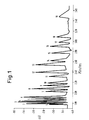
- Figure 1 is a chromatogram showing the separation of nineteen anions by CE using TTAB/Na 2 CrO 4 as the carrier electrolyte.
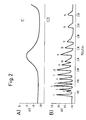
- Figure 2 compares (A) a chromatogram showing the separation of fifteen anions using IC; with (B) a chromatogram showing separation of the same mixture of anions by CE using TTAB/Na 2 CrO 4 as the carrier electrolyte.
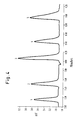
- Figure 3 is a chromatogram showing the separation of nine anions by CE using Na 2 CrO 4 as the carrier electrolyte and modifying the capillary walls with an uncharged polymer, effectively shielding the silanol groups on the walls.
- Figure 4 is a chromatogram showing the separation of five anions by CE using Na 2 CrO 4 and an amphoteric flow modifier as the carrier electrolyte.
- Figure 5 is a chromatogram showing the separation of eight anions by CE using TTAB/Na 2 CrO 4 and octanesulfonate as an electromigrative agent.
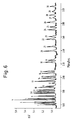
- Figure 6 is a chromatogram showing the separation of thirty anions by CE using TTAB/Na 2 CrO 4 and electromigrative sample injection.
- Figure 7 is a chromatogram showing the separation of nine anions by CE using naphthalene sulfonate as the electrolyte.
- Figure 8 is a chromatogram showing the separation of seven cations by CE using 4-methylbenzylamine as the carrier electrolyte.
- the present method utilizes CE to simultaneously separate and detect ionic species having widely different properties contained in a sample using indirect UV/visible detection.
- Indirect UV/visible spectroscopy is used because many ionic species cannot be detected using direct detection methods.
- CE is a well known technology, and has been described in detail, for example, by Compton and Brownlee in Biotechniques , 6(5) :432-440 (1988); and Jorgenson and Lukacs in Science , 222 :266-272 (1983).
- a method of utilizing indirect photometric detection in CE is described by Foret et al. in J. Chromatography , 470 :299-308 (1989).
- a capillary tube is filled with an electrically conductive liquid (the carrier electrolyte) containing one or more reagents which facilitate detection by UV/visible spectroscopy.
- a preferred capillary is generally a fused silica capillary having an internal diameter of from about 50 to 100 microns ( ⁇ m).
- the ionic sample is introduced into the capillary, for example, by hydrostatic pressure, vacuum or by electromigrative injection in which the liquid sample is moved into the capillary by an electric current.
- each end of the capillary is immersed in a reservoir which contains an electrode and the carrier electrolyte solution containing the reagents.
- the capillary tube is positioned with a detector on the column near the end opposite to sample introduction. Electric current is applied causing the anions or cations to move along the capillary toward the opposite electrode.
- the ions move at different speeds, depending upon several factors, such as their size and mobility.
- the electrophoretic separation is preferably monitored by indirect UV/visible spectroscopy. Other indirect detection methods can be used, however, UV/visible spectroscopy is preferred because it allows sensitive rapid detection of ionic species and is less costly than laser enhanced fluorescence detection, for example.
- the method relies upon reagents which facilitate detection by indirect UV/visible spectroscopy, comprising light-absorbing compounds specific for the UV/visible range.
- a UV-absorbing anion is used and for detecting cations, a UV-absorbing cation is used in the carrier electrolyte.
- UV/visible light-absorbing compounds which are useful for separating and detecting anions are UV-absorbing anions, such as iodide, tungstate, molybdate, chromate, ferrocyanide, ferrocyanate and vanadate salts. Absorbing anions which are particularly useful are selected chromate and vanadate salts.
- a preferred chromate salt is sodium chromate (Na 2 CrO 4 ) having a concentration of from about 1 mM to about 20 mM.
- a preferred vanadate salt is sodium vanadate having a concentration of from about 1 mM to about 10 mM.
- the carrier electrolyte can also contain, in addition to the UV-absorbing anion, a flow modifier, which is a compound which slows, stops or reverses the electroosmotic flow of the carrier electrolyte.
- a flow modifier which is a compound which slows, stops or reverses the electroosmotic flow of the carrier electrolyte. Electroosmotic flow is the bulk flow of the electrolyte through a capillary that is induced by an applied electric field. The amount of flow and its direction is dependent on the charge of the inner wall of the capillary. If there is no wall charge, there is no electroosmotic flow.
- flow modifier can eliminate or reverse the effects of the capillary wall on the flow of the electrolyte. Negating or counteracting the wall effects can improve the resolution of the desired analyte ions.
- Flow modifiers which are useful in the present method include cationic surface active agents, such as alkyl ammonium, arsonium and phosphonium compounds containing at least eight carbon atoms in a linear or branched configuration.
- cationic surface active agents such as alkyl ammonium, arsonium and phosphonium compounds containing at least eight carbon atoms in a linear or branched configuration.
- Such compounds include for example, quaternary ammonium salts, arsonium salts and phosphonium salts, biammonium salts, biphosphonium salts and biarsonium salts.
- These compounds include, for example, octyl trimethylammonium, phosphonium or arsonium, various alkyl derivatives of 1,8-diaminooctane, 1,8-diphosphinooctane or 1,8-diarsinooctane.
- polymeric ammonium, phosphonium and arsonium salts such as, for example, hexadimethine bromide.
- Amphoteric ammonium compounds such as, for example 3(N,N-dimethylpalmityl-ammonio)propanesulfonate are also useful flow modifiers.
- Compounds which are particularly useful are quaternary ammonium salts which contain alkyl groups having at least eight carbon atoms in a linear or branched configuration.
- Preferred quaternary ammonium salts are tetradecyltrimethylammonium bromide (TTAB) and/or cetyltrimethylammonium bromide (CTAB).
- a concentration of TTAB or CTAB of from about 0.1 mM to about 5.0 mM is useful in the present method.
- the use of flow modifiers facilitates control of both the direction, as well as the rate of electroosmotic flow. Control of this parameter permits the development of an assay that is both high in resolution and is complete in a short period of time.
- the carrier electrolyte solution generally has a pH of from about 7.5 to about 8.5.
- An acid such as sulfuric acid or chromic acid, can be added to the electrolyte solution to adjust the pH to the desired level.
- various aromatic carboxylic acids can be used as components in carrier electrolytes.
- the main usefulness of carboxylates as carrier electrolytes is in the CE analysis of less mobile anions (e.g., fluoride, carboxylic acids, alkylsulfonates), which may produce broadly asymmetric peaks if analyzed using the chromate electrolyte.
- aromatic carboxylates are less suitable than chromates as electrolytes for analysis of complex mixtures of highly mobile inorganic anions. The best results are obtained in CE when the mobilities between the main anionic components of the carrier electrolyte and the analyte ions is closely matched.
- Aromatic carboxylates are useful in the present method for detecting and measuring some organic anionic species having low ionic mobility and which are UV-transparent, such as carboxylic acids, amino acids, carbohydrates or sulfonates. Aromatic carboxylates such as phthalate, trimesate, benzenetetracarboxylate, p-hydroxybenzoate, and p-anisate are useful for this purpose.
- an electromigrative agent can be added to the sample in order to enhance the separation and/or detection of trace amounts of anions, e.g. nanomolar quantities.
- the addition of an electromigrative agent to the sample provides enrichment of the separation of anions present in the sample in concentrations in the nanomolar range.
- the agent is added to the sample, and the sample is injected into the capillary using electromigrative sample introduction.
- Electromigrative sample introduction involves applying a current having very low amperage which selectively causes the trace anions to migrate toward the capillary.
- sample of the electromigrative agent which has a lower ionic mobility in comparison to the carrier electrolyte anion, results in the selective migration of the trace anions into the capillary, which effectively preconcentrates these anions, thereby enriching the sample to be analyzed with the trace anions.
- analyte anions it is also possible to observe the enrichment of sample matrix anions acting as an isotachophoretic terminating electrolyte.
- Such anions may be added purposely.
- sample conductivity often becomes too low, and can be adjusted by a suitable additive to enable sufficient electric charge throughput for ionic transfer from the bulk of the sample solution into the capillary.
- citrate, carbonate and octanesulfonate salts can be used as electromigration additives.
- Citrate, carbonate and octanesulfonate salts which exhibit lower ionic mobilities in comparison with the UV-absorbing anion in the carrier electrolyte can be used as additives for electromigrative trace enrichment with the UV-absorbing anions in the carrier electrolyte.
- Sodium octanesulfonate adjusted within the range of 15 to 40 ⁇ m is particularly useful electromigration agent in low ionic content samples. Addition of relatively excessive concentrations of octanesulfonate does not lead to interfering comigration with any of over fifty anionic species analyzed by the present CE method.
- Sodium octanesulfonate can be obtained free of common ionic impurities which could disturb the quantitation of common anions such as sulfate and chloride in unknown samples.
- An example of a separation of common inorganic anions at low ppb levels using sodium octanesulfonate as an electromigrative agent is shown in Figure 5. As indicated, the detection limits (calculated as noise times three in concentration units) for this separation are in the low nanomolar range. This represents at least a hundredfold increase in sensitivity in comparison with the results achievable in the same carrier electrolyte and with hydrodynamic sample introduction.
- UV/visible light-absorbing compounds which are useful in the present method for separating and detecting cations are UV-absorbing cations, such as 4-methylbenzylamine, 2-aminopyridine, 2-amino-4,6-dimethylpyridine, MES, 3[(3-cholamidopropyl)dimethylammonio]-1-propane sulfonate (CHAPS) and N-[2-hydroxyethyl]piperazine-N'-[3-propane sulfonic acid] (EPPS).
- 4-Methylbenzylamine is the preferred UV-absorbing cation in the present method.
- the concentration of 4-methylbenzylamine is generally from about 3 mM to about 10 mM.
- the reagent mixuture for cation separation can optionally contain a complexing or chelating agent, such as ethylenediaminetetraacetic acid (EDTA), citrate, tartrate, hydroxyisobutyrate, oxalate and succinate.
- EDTA ethylenediaminetetraacetic acid
- the complexing agent allows cations having the same or similar mobilities to be differentiated.
- the present methods can be utilized to analyze most types of ionic species.
- Samples containing complex mixtures of ions, including anions, cations and organic compounds, for example can be analyzed using the method.
- the detector is placed just before the anode immersed in an electrolyte and the cathode is placed in another portion of the same electrolyte at the opposite end.
- the cations in the sample will move away from the detector, and the organic species will move very slowly toward the anode, thereby creating a window for the anionic species toward the detector.
- the anions move most rapidly toward the detector, thus are most efficiently resolved.
- the polarity of the electrodes is reversed, and the cations will move toward the detector (i.e., toward the cathode) while the anions in the sample will move away from the detector.
- the present methods are useful for analyzing samples containing multiple ionic species in the shortest time possible, or to scan an unknown sample for ionic compounds, since the methods and reagent mixtures can efficiently separate and resolve such mixtures.
- Samples which can be analyzed using the present methods include water, foods, such as juices, biological fluids or industrial chemical mixtures.
- a sample containing eight common inorganic anions bromide, chloride, nitrate, nitrite, sulfate, fluoride, phosphate and carbonate
- CE a mixture of 0.5 mM TTAB and 5 mM sodium chromate (Na 2 CrO 4 ) having a pH of 8 as the carrier electrolyte. All eight anions were detected by monitoring the absorbance of the carrier electrolyte at 254 or 272 nm. Separation of all eight anions was completed in about three minutes. The ionic species were separated based on their ionic mobilities. This is important because the elution sequence using the present method is predictable based on the known ion mobilities of various ions. This means that the chemical identity of an unknown analyte can be reliably determined from its position in the elution order.
- a sample containing seven inorganic cations potassium, barium, strontium, sodium, calcium, magnesium and lithium, was analyzed by CE using 5 mM 4-methylbenzylamine in 0.21 mM citrate having a pH of 5.5 as a carrier electrolyte. All seven cations were detected by monitoring the absorbance of the carrier electrolyte at 214 mM. Separation of all seven cations was complete in less than three minutes.
- Separation of ionic species using the present compositions and methods is superior to ion chromatographic separations of similar mixtures in several respects: improved separation efficiency, shorter runtime, better selectivity, linearity of the plot and improved sensitivity.
- the number of theoretical plates for sulfate in the illustrative example used above is 157,344.
- the highest plate-counts attainable by ion chromatography are smaller than 10,000.
- Separation of the standard eight anions was completed in three minutes by the present method, whereas ion chromatographic separations of identical mixtures take typically six to fifteen minutes.
- Injection volumes for the CE separation are less than about 40 nanoliters (nl) compared to about 50 to 100 microliters ( ⁇ l) for IC.
- the present methods provide ionic separations which are efficient, highly selective, and which have a predictable order of elution.
- the methods exhibit increased selectivity for ionic separations as compared to other methods such as IC.
- cationic compounds migrate in the opposite direction away from the anions of interest and are not seen in the electropherogram.
- anionic compounds migrate in the opposite direction away from the cations of interest.
- Neutral and slightly polar impurities are considerably less mobile than the anions or cations and have longer migration times. Thus, the anions or cations of interest are efficiently separated and resolved in the shortest time.
- a fused silica capillary externally coated with polyimide (Polymicro Technologies) was freshly cut from a roll and approximately 1 cm section of polyimide coating was burned off with a butane lighter for UV to pass through at 40.5 cm from one end.
- the total capillary length was 63 cm, and had an internal diameter of 75 ⁇ m.
- the capillary was installed into the cell and purged with electrolyte with a lcc luer syringe with an adapter.
- the electrolyte was 5 mM Na 2 CrO 4 and 0.5 mM TTAB, adjusted to pH 8 with 10 mN sulfuric acid.
- a 50 ml beaker and a 100 ml beaker were filled with electrolyte to equal heights. The 50 ml beaker was placed at the cathode end of the capillary and the 100 ml was placed at the anode end. Approximately 100 microliters of carrier electrolyte was run through the capillary
- the power supply (Spellman (0 to 30 KV)) was manually turned to zero.
- the capillary at the cathode end was picked up manually, raised to 16 cm height above the electrolyte level and placed in the sample for 30 seconds.
- the capillary was removed from the sample and placed promptly into the electrolyte.
- the voltage was manually ramped from 0 to 20 KV during approximately 10 seconds while the start integrate signal was initiated at the beginning of the voltage ramp. At 20 KV a typical current reading was about 20 ⁇ A.
- Detection was carried out using a Linear Instruments variable UV/Vis CE detector at two different wavelengths: 254 nm and 272 nm.
- the separation of a complex mixture of ten (10) weakly and strongly dissociated anionic species was carried out according to the procedure described in Example 1.
- the ten anions in the mixture were: Cl, SO 4 , NO 3 , F, CO 3 , formate, acetate, propionate, butyrate and an unidentified organic acid. Separation was completed within about 3.8 minutes. All ten anions eluted and were detected, and a clear and distinct peak was obtained for each anion.
- Figure 2A is a chromatogram of the IC results after 2.5 minutes.
- the large rounded peak represents the carbonate ion (HCO 3 - ), and the curve which starts upward at about the 2.5 minute mark represents the start of the chloride ion (Cl - ) peak.
- Figure 2B is a chromatogram showing the CE separation. Separation of all fifteen anions was completed in about 2.5 minutes, and a clear and distinct peak was obtained for each anion.
- the separation of a mixture of nine anions was carried out according to the procedure described in Example 1, except that no flow modifier (TTAB) was used.
- the capillary wall was modified by covering the inner wall with a layer of PSDVB polymer to shield the negative charges of the silanol groups present on the wall.
- the capillary was 46cm in length and had an internal diameter of 50 ⁇ m. All nine anions were separated by the procedure in less than nine minutes, as shown in Figure 3.
- the anions shown in Figure 3 are:
- CE separation of an eight anion mixture was carried out as described in Example 1 above, except that an electromigration enhancer sodium octanesulfonate, was added to enhance sensitivity for trace amounts of anions.
- the carrier electrolyte contained 5 mM chromate and 0.5 mM TTAB electroosmotic flow modifier and was adjusted to pH 8.1.
- Fused silica capillary 75 ⁇ m internal diameter, 52 cm from the point of sample introduction to the detector) was used for the separation.
- the injection side was at -20 kV.
- the electromigrative sample introduction was carried out at 5 kV for 45 seconds.
- Sample conductivity was adjusted by the addition of sodium octanesulfonate at 18 ⁇ N to the sample.
- the large peak at about 3.2 minutes is the carbonate. The levels of carbonate were not controlled under the conditions of this experiment.
- CE separation of a thirty anion mixture was carried out as described in Example 7, using electromigrative sample introduction.
- the electromigrative sample introduction was carried out at 1 KV for 14 seconds.
- the capillary was 60cm in length and had an internal diameter of 50 ⁇ m.
- the electrolyte was 5mM Na 2 CrO 4 and 0.5mM TTAB, pH 8.0. All thirty anions were separated in less than three minutes, as shown in Figure 6.
- the anions shown in Figure 6 are listed below:
- a mixture of nine anions was separated according to the procedure described in Example 1.
- the nine anions designated C4-C10, C12 and C14, are linear alkylsulfonates having from 4 to 14 carbon atoms, at a concentration of 25 ppm each.
- a capillary 60 cm long and having an internal diameter of 75 ⁇ m was used.
- the electrolyte was 10 mM naphthalene sulfonic acid (30% ACN) adjusted to pH 10 with NaOH.
- the sample was injected by hydrostatic injection for 30 seconds. Indirect UV detection was used at a wavelength of 254 nm.
- a sample containing the following seven inorganic cations was prepared: potassium (K), barium (Ba), strontium (Sr), sodium (Na), calcium (Ca), magnesium (Mg) and lithium (Li).
- a fused silica capillary externally coated with polyimide was freshly cut from a roll and prepared as described in Example 1.
- the total capillary length was about 60 cm, and had an internal diameter of 75 ⁇ m.
- the electrolyte was 5 mM 4-methylbenzylamine and 0.021 mM citrate, pH 5.5.
- the pH was adjusted to pH 5.5 using 2N morpholinoethanesulfonate (MES).
- MES 2N morpholinoethanesulfonate
- a 50 ml beaker and a 100 ml beaker were filled with electrolyte to equal heights. The 50 ml beaker was placed at the anode end of capillary and the 100 ml beaker was placed at the cathode end.
- the sample was injected by hydrostatic injection and the separation carried out according to the procedure described in Example 1.
- the voltage was 25.0 KV.
- Detection was carried out using a UV/Vis CE detector at a wavelength of 214 nm.
Landscapes
- Health & Medical Sciences (AREA)
- Life Sciences & Earth Sciences (AREA)
- Molecular Biology (AREA)
- Chemical & Material Sciences (AREA)
- Chemical Kinetics & Catalysis (AREA)
- Electrochemistry (AREA)
- Physics & Mathematics (AREA)
- Analytical Chemistry (AREA)
- Biochemistry (AREA)
- General Health & Medical Sciences (AREA)
- General Physics & Mathematics (AREA)
- Immunology (AREA)
- Pathology (AREA)
- Investigating Or Analyzing Non-Biological Materials By The Use Of Chemical Means (AREA)
- Investigating Or Analysing Materials By The Use Of Chemical Reactions (AREA)
Description
| | ppm | ||
| 1. | | 4 | |
| 2. | | 2 | |
| 3. | | 4 | |
| 4. | | 4 | |
| 5. | | 4 | |
| 6. | | 20 | |
| 7. | | 4 | |
| 8. | | 1 | |
| 9. | | 4 | |
| 10. | | 4 | |
| 11. | | 4 | |
| 12. | | 5 | |
| 13. | | 5 | |
| 14. | | 5 | |
| 15. | | 5 | |
| 16. | | 5 | |
| 17. | | 5 | |
| 18. | | 5 | |
| 19. | | 5 |
| | ppm | ||
| 1. | | 4 | |
| 2. | | 2 | |
| 3. | | 2 | |
| 4. | | 4 | |
| 5. | | 4 | |
| 6. | | 4 | |
| 7. | | 20 | |
| 8. | | 20 | |
| 9. | | 4 | |
| 10. | | 4 | |
| 11. | | 1 | |
| 12. | | 4 | |
| 13. | | 4 | |
| 14. | | 4 | |
| 15. | | 4 |
Claims (30)
- A method for detecting anions in a sample using capillary zone electrophoresis comprising the steps of:a) introducing the sample into a capillary;b) immersing the capillary in a carrier electrolyte containing a chromate and/or vanadate salt;c) applying an electrical current under conditions appropriate for the anions in the sample to move along the capillary toward the anode thereby causing separation of the anions to occur; andd) detecting the anions indirectly using a UV/visible photometric detector.
- The method of claim 1 wherein the chromate salt is sodium chromate having a concentration of from about 1.0 mM to about 20 mM.
- The method of claim 1 wherein an alkyl quaternary ammonium salt, arsonium salt or phosphonium salt containing at least one alkyl group having more than eight carbon atoms is added to the carrier electrolyte.
- The method of claim 3 wherein the alkyl quaternary salt is tetradecyltrimethylammonium bromide having a concentration of from about 0.1 mM to about 5.0 mM.
- The method of claim 3 wherein the alkyl quaternary salt is cetyltrimethyl ammonium bromide having a concentration of from about 0.1 mM to about 5.0 mM.
- The method of claim 1 wherein the alkyl quaternary ammonium, arsonium or phosphonium salt is immobilized on the capillary wall.
- The method of claim 1 wherein electrical voltage is from about 5 to about 40 kV.
- The method of claim 1 wherein an electromigration additive is added to the sample.
- The method of claim 8 wherein the electromigration additive is selected from the group of: an octanesulfonate salt, a carbonate salt and a citrate salt.
- The method of claim 9 wherein the electromigration additive is sodium octanesulfonate.
- The method of claim 1 wherein the anions are complex organic anions selected from the group consisting of: anionic complexes of metals, carboxylic acids, sulfonic acids and alkyl sulfates.
- The method of claim 1 wherein the anions are inorganic anions.
- A kit for use in capillary electrophoresis using indirect photometric detection containing a UV-absorbing anion selected from the group consisting of a chromate salt, a vanadate salt or a mixture thereof, and a quaternary ammonium salt, arsonium salt or phosphonium salt.
- The kit of claim 13 wherein the chromate salt is sodium chromate having a concentration of from about 1 mM to about 20 mM.
- The kit of claim 13 wherein the quaternary salt is tetradecyltrimethylammonium bromide having a concentration of from about 0.1 mM to about 5.0 mM.
- The kit of claim 13 wherein the quaternary ammonium salt is cetyltrimethyl ammonium bromide having a concentration of from about 0.1 mM to about 5.0 mM.
- The kit of claim 13 further comprising an electromigration additive.
- A composition comprising a mixture of sodium chromate and tetradecyltrimethylammonium bromide.
- The composition of claim 18 containing from about 1.0 mM to about 20 mM sodium chromate and about 0.1 mM to about 1.5 mM tetradecyltrimethylammonium bromide.
- A composition comprising a mixture of a vanadate salt and tetradecyltrimethylammonium bromide.
- The composition of claim 20 containing from about 1.0 mM to about 10 mM vanadate salt and from about 0.1 mM to about 1.5 mM tetradecyltrimethylammonium bromide.
- A method for detecting cations in a sample using capillary zone electrophoresis comprising the steps of:a) introducing the sample into a capillary;b) immersing the capillary into a carrier electrolyte containing a UV-absorbing amine or heterocyclic sulfonate compound;c) applying an electrical current under conditions appropriate for the cations in the sample to move along the capillary toward the cathode, thereby causing separation of the cations to occur; andd) detecting the cations indirectly using a UV/visible photometric detector.
- The method of claim 22 wherein the UV-absorbing amine is 4-methylbenzylamine having a concentration of from about 3 mM to about 10 mM.
- The method of claim 22 wherein a chelating agent is added to the carrier electrolyte.
- The method of claim 24 wherein the chelating agent is selected from the group consisting of citrate, succinate, tartrate, hydroxyisobutyrate, and oxalate.
- The method of claim 22 wherein the electrical voltage is from about 5 to about 40 kV.
- The method of claim 22 wherein the cations are inorganic cations.
- A kit for use in capillary electrophoresis using indirect photometric detection containing as UV absorbing amine, 4-methylbenzylamine having a concentration of from about 3 mM to about 10 mM.
- The kit of claim 28 further comprising a chelating agent.
- A compostion comprising 4-methylbenzylamine having a concentration of about 3 mM to about 10 mM in citrate buffer having a pH of about 5.5.
Applications Claiming Priority (4)
| Application Number | Priority Date | Filing Date | Title |
|---|---|---|---|
| US07/471,535 US5104506A (en) | 1990-01-29 | 1990-01-29 | Method for separating ionic species using capillary electrophoresis |
| US642685 | 1991-01-17 | ||
| US471535 | 1991-01-17 | ||
| US07/642,685 US5156724A (en) | 1990-01-29 | 1991-01-17 | Method for analyzing ionic species using capillary electrophoresis |
Publications (2)
| Publication Number | Publication Date |
|---|---|
| EP0442315A1 EP0442315A1 (en) | 1991-08-21 |
| EP0442315B1 true EP0442315B1 (en) | 1998-06-10 |
Family
ID=27043472
Family Applications (1)
| Application Number | Title | Priority Date | Filing Date |
|---|---|---|---|
| EP91101064A Expired - Lifetime EP0442315B1 (en) | 1990-01-29 | 1991-01-28 | Method for separating ionic species using capillary electrophoresis |
Country Status (4)
| Country | Link |
|---|---|
| US (2) | US5156724A (en) |
| EP (1) | EP0442315B1 (en) |
| JP (1) | JP2942639B2 (en) |
| DE (1) | DE69129555T2 (en) |
Families Citing this family (18)
| Publication number | Priority date | Publication date | Assignee | Title |
|---|---|---|---|---|
| US5156724A (en) * | 1990-01-29 | 1992-10-20 | Millipore Corporation | Method for analyzing ionic species using capillary electrophoresis |
| FR2671407B1 (en) * | 1991-01-08 | 1994-08-05 | Europhor Sa | METHOD OF ANALYSIS BY CAPILLARY ELECTROPHORESIS WITH FLUORESCENCE DETECTION, AND DEVICES FOR IMPLEMENTING SAME. |
| JPH0557114A (en) * | 1991-01-11 | 1993-03-09 | Millipore Corp | Highly efficient method for capillary electrophoretic separation |
| US5259939A (en) * | 1991-08-30 | 1993-11-09 | Beckman Instruments, Inc. | Capillary electrophoresis buffer |
| US5348633A (en) * | 1993-01-22 | 1994-09-20 | Northeastern University | Method for quantitating trace amounts of an analyte in a sample by affinity capillary electrophoresis |
| US5385654A (en) * | 1993-07-07 | 1995-01-31 | Thermo Separation Products Inc. | Controlled temperature anion separation by capillary electrophoresis |
| US6274017B1 (en) | 1996-12-14 | 2001-08-14 | National University Of Singapore | Buffer for analyzing small inorganic cations by capillary electrophoresis |
| US5887491A (en) * | 1997-05-14 | 1999-03-30 | Ag-Chem Equipment, Co., Inc. | Soil analysis assembly and system |
| US6706161B1 (en) * | 1998-06-10 | 2004-03-16 | Agilent Technologies, Inc. | Methods and compositions for modifying the surface of a polymeric substrate |
| US6570999B1 (en) | 1998-08-17 | 2003-05-27 | Ag-Chem Equipment Co., Inc. | Soil particle and soil analysis system |
| AU1810101A (en) * | 1999-11-30 | 2001-06-12 | Electric Power Research Institute, Inc. | Capillary electrophoresis probes and method |
| FR2819889B1 (en) * | 2001-01-19 | 2003-08-01 | Sebia Sa | METHOD OF CAPILLARY ELECTROPHORESIS IN FREE ALKALINE PH SOLUTION |
| US20040057835A1 (en) * | 2002-09-24 | 2004-03-25 | Kirby Brian J. | Method for improving the performance of electrokinetic micropumps |
| JP5158747B2 (en) * | 2007-01-12 | 2013-03-06 | 独立行政法人産業技術総合研究所 | Analysis of nitric oxide end metabolites using electrophoresis chip with integrated blood removal function |
| US20090205962A1 (en) * | 2007-07-11 | 2009-08-20 | West Virginia University | Electrophoresis device and method |
| EP2673626A1 (en) | 2011-02-11 | 2013-12-18 | Colgate-Palmolive Company | Methods of analyzing plaque |
| CN110646543A (en) * | 2019-10-08 | 2020-01-03 | 湘潭大学 | An ion chromatographic analysis method for simultaneous quantitative determination of 10 kinds of anions in rice |
| ES3058371T3 (en) * | 2021-04-21 | 2026-03-10 | Bl Technologies Inc | Methods for the analysis and monitoring of industrial fluids in relation to corrosive ions using capillary electrophoresis |
Family Cites Families (6)
| Publication number | Priority date | Publication date | Assignee | Title |
|---|---|---|---|---|
| SE369279B (en) * | 1973-01-15 | 1974-08-19 | Lkb Produkter Ab | |
| US4414842A (en) * | 1980-05-27 | 1983-11-15 | The Dow Chemical Company | Ion exchange chromatography with indirect photometric detection |
| US4936974A (en) * | 1988-11-03 | 1990-06-26 | The University Of North Carolina At Chapel Hill | Capillary separation system with electric field assisted post separation mixing |
| US5104506A (en) * | 1990-01-29 | 1992-04-14 | Millipore Corporation | Method for separating ionic species using capillary electrophoresis |
| US5128005A (en) * | 1990-01-29 | 1992-07-07 | Millipore Corporation | Method for separating ionic species using capillary electrophoresis |
| US5156724A (en) * | 1990-01-29 | 1992-10-20 | Millipore Corporation | Method for analyzing ionic species using capillary electrophoresis |
-
1991
- 1991-01-17 US US07/642,685 patent/US5156724A/en not_active Expired - Lifetime
- 1991-01-28 DE DE69129555T patent/DE69129555T2/en not_active Expired - Lifetime
- 1991-01-28 EP EP91101064A patent/EP0442315B1/en not_active Expired - Lifetime
- 1991-01-29 JP JP3026608A patent/JP2942639B2/en not_active Expired - Lifetime
-
1992
- 1992-10-20 US US07/963,685 patent/US5366601A/en not_active Expired - Lifetime
Also Published As
| Publication number | Publication date |
|---|---|
| JPH0694677A (en) | 1994-04-08 |
| US5156724A (en) | 1992-10-20 |
| EP0442315A1 (en) | 1991-08-21 |
| JP2942639B2 (en) | 1999-08-30 |
| DE69129555D1 (en) | 1998-07-16 |
| DE69129555T2 (en) | 1998-11-26 |
| US5366601A (en) | 1994-11-22 |
Similar Documents
| Publication | Publication Date | Title |
|---|---|---|
| US5156724A (en) | Method for analyzing ionic species using capillary electrophoresis | |
| Jones et al. | Various approaches to analysis of difficult sample matrices of anions using capillary ion electrophoresis | |
| Monnig et al. | Capillary electrophoresis | |
| Jones | Method development approaches for capillary ion electrophoresis | |
| Jackson et al. | Capillary electrophoresis of inorganic ions and low-molecular-mass ionic solutes | |
| Fukushi et al. | Application of capillary electrophoresis to the analysis of inorganic ions in environmental samples | |
| De Backer et al. | Potentiometric detection for capillary electrophoresis: Determination of organic acids | |
| Kuldvee et al. | Heteroconjugation‐based capillary electrophoretic separation of phenolic compounds in acetonitrile and propylene carbonate | |
| Pacáková et al. | Capillary electrophoresis of inorganic anions and its comparison with ion chromatography | |
| Doble et al. | Use of dyes as indirect detection probes for the high-sensitivity determination of anions by capillary electrophoresis | |
| CA2394847C (en) | Capillary electrophoresis probes and method | |
| Padarauskas | CE determination of small ions: methods and techniques | |
| US5128005A (en) | Method for separating ionic species using capillary electrophoresis | |
| Oefner | Surface‐charge reversed capillary zone electrophoresis of inorganic and organic anions | |
| Timerbaev et al. | Metal ion capillary zone electrophoresis with direct UV detection: Comparison of different migration modes for negatively charged chelates | |
| Trevaskis et al. | An investigation into the determination of oxalic acid in vegetables by capillary electrophoresis | |
| Harakuwe et al. | Manipulation of separation selectivity in capillary zone electrophoresis of anionic solutes | |
| US5104506A (en) | Method for separating ionic species using capillary electrophoresis | |
| US5385654A (en) | Controlled temperature anion separation by capillary electrophoresis | |
| Corradini et al. | Analysis of ε‐N‐2‐furoylmethyl‐l‐lysine (furosine) in dried milk by capillary electrophoresis with controlled electroosmotic flow using N, N, N′, N′‐tetramethyl‐1, 3‐butanediamine in the running electrolyte solution | |
| Padarauskas | Dual-opposite injection capillary electrophoresis for the simultaneous separation of anionic and cationic compounds | |
| Hata et al. | Simultaneous separation of 17 anions by capillary electrophoresis with the addition of an organic solvent | |
| Demay et al. | Capillary electrophoretic quantitative analysis of anions in drinking water | |
| Janusa et al. | Determination of chloride concentration using capillary zone electrophoresis: An instrumental analysis chemistry laboratory experiment | |
| Isoo et al. | Sweeping via dynamic complexation with cyclohexane-1, 2-diaminetetraacetic acid for trace metal analysis in capillary electrophoresis |
Legal Events
| Date | Code | Title | Description |
|---|---|---|---|
| PUAI | Public reference made under article 153(3) epc to a published international application that has entered the european phase |
Free format text: ORIGINAL CODE: 0009012 |
|
| AK | Designated contracting states |
Kind code of ref document: A1 Designated state(s): CH DE FR GB LI |
|
| 17P | Request for examination filed |
Effective date: 19911205 |
|
| RAP1 | Party data changed (applicant data changed or rights of an application transferred) |
Owner name: WATERS INVESTMENTS LIMITED |
|
| 17Q | First examination report despatched |
Effective date: 19950928 |
|
| GRAG | Despatch of communication of intention to grant |
Free format text: ORIGINAL CODE: EPIDOS AGRA |
|
| GRAG | Despatch of communication of intention to grant |
Free format text: ORIGINAL CODE: EPIDOS AGRA |
|
| GRAG | Despatch of communication of intention to grant |
Free format text: ORIGINAL CODE: EPIDOS AGRA |
|
| GRAG | Despatch of communication of intention to grant |
Free format text: ORIGINAL CODE: EPIDOS AGRA |
|
| GRAH | Despatch of communication of intention to grant a patent |
Free format text: ORIGINAL CODE: EPIDOS IGRA |
|
| GRAH | Despatch of communication of intention to grant a patent |
Free format text: ORIGINAL CODE: EPIDOS IGRA |
|
| GRAA | (expected) grant |
Free format text: ORIGINAL CODE: 0009210 |
|
| AK | Designated contracting states |
Kind code of ref document: B1 Designated state(s): DE FR GB |
|
| REF | Corresponds to: |
Ref document number: 69129555 Country of ref document: DE Date of ref document: 19980716 |
|
| ET | Fr: translation filed | ||
| PLBE | No opposition filed within time limit |
Free format text: ORIGINAL CODE: 0009261 |
|
| STAA | Information on the status of an ep patent application or granted ep patent |
Free format text: STATUS: NO OPPOSITION FILED WITHIN TIME LIMIT |
|
| 26N | No opposition filed | ||
| REG | Reference to a national code |
Ref country code: GB Ref legal event code: IF02 |
|
| PGFP | Annual fee paid to national office [announced via postgrant information from national office to epo] |
Ref country code: FR Payment date: 20100205 Year of fee payment: 20 |
|
| PGFP | Annual fee paid to national office [announced via postgrant information from national office to epo] |
Ref country code: GB Payment date: 20100125 Year of fee payment: 20 Ref country code: DE Payment date: 20100127 Year of fee payment: 20 |
|
| REG | Reference to a national code |
Ref country code: GB Ref legal event code: PE20 Expiry date: 20110127 |
|
| PG25 | Lapsed in a contracting state [announced via postgrant information from national office to epo] |
Ref country code: GB Free format text: LAPSE BECAUSE OF EXPIRATION OF PROTECTION Effective date: 20110127 |
|
| PG25 | Lapsed in a contracting state [announced via postgrant information from national office to epo] |
Ref country code: DE Free format text: LAPSE BECAUSE OF EXPIRATION OF PROTECTION Effective date: 20110128 |