EP0440930B1 - Process for the debromination of 2-substituted-5-bromo-6-methoxynaphthalenes - Google Patents
Process for the debromination of 2-substituted-5-bromo-6-methoxynaphthalenes Download PDFInfo
- Publication number
- EP0440930B1 EP0440930B1 EP90123978A EP90123978A EP0440930B1 EP 0440930 B1 EP0440930 B1 EP 0440930B1 EP 90123978 A EP90123978 A EP 90123978A EP 90123978 A EP90123978 A EP 90123978A EP 0440930 B1 EP0440930 B1 EP 0440930B1
- Authority
- EP
- European Patent Office
- Prior art keywords
- bromo
- process according
- bromine
- reaction
- methoxynaphthalene
- Prior art date
- Legal status (The legal status is an assumption and is not a legal conclusion. Google has not performed a legal analysis and makes no representation as to the accuracy of the status listed.)
- Expired - Lifetime
Links
- 238000000034 method Methods 0.000 title claims description 18
- 230000008569 process Effects 0.000 title claims description 16
- 238000007256 debromination reaction Methods 0.000 title claims description 10
- -1 2-substituted-5-bromo-6-methoxynaphthalenes Chemical class 0.000 title claims description 8
- GDTBXPJZTBHREO-UHFFFAOYSA-N bromine Substances BrBr GDTBXPJZTBHREO-UHFFFAOYSA-N 0.000 claims abstract description 14
- 229910052794 bromium Inorganic materials 0.000 claims abstract description 14
- WKBOTKDWSSQWDR-UHFFFAOYSA-N Bromine atom Chemical compound [Br] WKBOTKDWSSQWDR-UHFFFAOYSA-N 0.000 claims abstract description 13
- 239000000370 acceptor Substances 0.000 claims abstract description 13
- 239000002841 Lewis acid Substances 0.000 claims abstract description 10
- 150000007517 lewis acids Chemical class 0.000 claims abstract description 10
- 125000000217 alkyl group Chemical group 0.000 claims abstract description 4
- 125000002768 hydroxyalkyl group Chemical group 0.000 claims abstract description 3
- YMWUJEATGCHHMB-UHFFFAOYSA-N Dichloromethane Chemical compound ClCCl YMWUJEATGCHHMB-UHFFFAOYSA-N 0.000 claims description 48
- VSCWAEJMTAWNJL-UHFFFAOYSA-K aluminium trichloride Chemical compound Cl[Al](Cl)Cl VSCWAEJMTAWNJL-UHFFFAOYSA-K 0.000 claims description 40
- 150000001875 compounds Chemical class 0.000 claims description 17
- 239000000203 mixture Substances 0.000 claims description 15
- HEDRZPFGACZZDS-UHFFFAOYSA-N Chloroform Chemical compound ClC(Cl)Cl HEDRZPFGACZZDS-UHFFFAOYSA-N 0.000 claims description 12
- 238000006243 chemical reaction Methods 0.000 claims description 9
- 239000002904 solvent Substances 0.000 claims description 6
- 238000009835 boiling Methods 0.000 claims description 4
- 125000001501 propionyl group Chemical group O=C([*])C([H])([H])C([H])([H])[H] 0.000 claims description 3
- WSLDOOZREJYCGB-UHFFFAOYSA-N 1,2-Dichloroethane Chemical compound ClCCCl WSLDOOZREJYCGB-UHFFFAOYSA-N 0.000 claims description 2
- ILROLYQPRYHHFG-UHFFFAOYSA-N 1-$l^{1}-oxidanylprop-2-en-1-one Chemical group [O]C(=O)C=C ILROLYQPRYHHFG-UHFFFAOYSA-N 0.000 claims description 2
- 229910021578 Iron(III) chloride Inorganic materials 0.000 claims description 2
- RBTARNINKXHZNM-UHFFFAOYSA-K iron trichloride Chemical compound Cl[Fe](Cl)Cl RBTARNINKXHZNM-UHFFFAOYSA-K 0.000 claims description 2
- 229910052757 nitrogen Inorganic materials 0.000 claims description 2
- 125000004433 nitrogen atom Chemical group N* 0.000 claims description 2
- 125000001424 substituent group Chemical group 0.000 claims description 2
- XJDNKRIXUMDJCW-UHFFFAOYSA-J titanium tetrachloride Chemical compound Cl[Ti](Cl)(Cl)Cl XJDNKRIXUMDJCW-UHFFFAOYSA-J 0.000 claims description 2
- JIAARYAFYJHUJI-UHFFFAOYSA-L zinc dichloride Chemical compound [Cl-].[Cl-].[Zn+2] JIAARYAFYJHUJI-UHFFFAOYSA-L 0.000 claims 2
- 125000002777 acetyl group Chemical group [H]C([H])([H])C(*)=O 0.000 claims 1
- 235000005074 zinc chloride Nutrition 0.000 claims 1
- 239000011592 zinc chloride Substances 0.000 claims 1
- 229910052739 hydrogen Inorganic materials 0.000 abstract description 3
- 239000001257 hydrogen Substances 0.000 abstract description 3
- 150000002790 naphthalenes Chemical class 0.000 abstract description 2
- 125000003178 carboxy group Chemical group [H]OC(*)=O 0.000 abstract 1
- 125000004435 hydrogen atom Chemical group [H]* 0.000 abstract 1
- VEXZGXHMUGYJMC-UHFFFAOYSA-N Hydrochloric acid Chemical compound Cl VEXZGXHMUGYJMC-UHFFFAOYSA-N 0.000 description 32
- 238000003756 stirring Methods 0.000 description 27
- 239000011541 reaction mixture Substances 0.000 description 22
- 239000000243 solution Substances 0.000 description 19
- 239000007864 aqueous solution Substances 0.000 description 17
- YXFVVABEGXRONW-UHFFFAOYSA-N Toluene Chemical compound CC1=CC=CC=C1 YXFVVABEGXRONW-UHFFFAOYSA-N 0.000 description 12
- 239000010410 layer Substances 0.000 description 12
- GGWCZBGAIGGTDA-UHFFFAOYSA-N 1-(6-methoxynaphthalen-2-yl)ethanone Chemical compound C1=C(C(C)=O)C=CC2=CC(OC)=CC=C21 GGWCZBGAIGGTDA-UHFFFAOYSA-N 0.000 description 11
- XNIGURFWNPLWJM-UHFFFAOYSA-N 1-bromo-2-methoxynaphthalene Chemical compound C1=CC=CC2=C(Br)C(OC)=CC=C21 XNIGURFWNPLWJM-UHFFFAOYSA-N 0.000 description 10
- AUHZEENZYGFFBQ-UHFFFAOYSA-N mesitylene Substances CC1=CC(C)=CC(C)=C1 AUHZEENZYGFFBQ-UHFFFAOYSA-N 0.000 description 10
- 125000001827 mesitylenyl group Chemical group [H]C1=C(C(*)=C(C([H])=C1C([H])([H])[H])C([H])([H])[H])C([H])([H])[H] 0.000 description 10
- XLYOFNOQVPJJNP-UHFFFAOYSA-N water Substances O XLYOFNOQVPJJNP-UHFFFAOYSA-N 0.000 description 10
- 239000012044 organic layer Substances 0.000 description 9
- KDDYYAXVVDTNND-UHFFFAOYSA-N 1-(5-bromo-6-methoxynaphthalen-2-yl)ethanone Chemical compound C1=C(C(C)=O)C=CC2=C(Br)C(OC)=CC=C21 KDDYYAXVVDTNND-UHFFFAOYSA-N 0.000 description 8
- OAKJQQAXSVQMHS-UHFFFAOYSA-N Hydrazine Chemical compound NN OAKJQQAXSVQMHS-UHFFFAOYSA-N 0.000 description 8
- CMWTZPSULFXXJA-VIFPVBQESA-N naproxen Chemical compound C1=C([C@H](C)C(O)=O)C=CC2=CC(OC)=CC=C21 CMWTZPSULFXXJA-VIFPVBQESA-N 0.000 description 7
- IMNFDUFMRHMDMM-UHFFFAOYSA-N N-Heptane Chemical compound CCCCCCC IMNFDUFMRHMDMM-UHFFFAOYSA-N 0.000 description 6
- PXHVJJICTQNCMI-UHFFFAOYSA-N Nickel Chemical compound [Ni] PXHVJJICTQNCMI-UHFFFAOYSA-N 0.000 description 6
- KDLHZDBZIXYQEI-UHFFFAOYSA-N Palladium Chemical compound [Pd] KDLHZDBZIXYQEI-UHFFFAOYSA-N 0.000 description 6
- PMZURENOXWZQFD-UHFFFAOYSA-L Sodium Sulfate Chemical compound [Na+].[Na+].[O-]S([O-])(=O)=O PMZURENOXWZQFD-UHFFFAOYSA-L 0.000 description 6
- UIIMBOGNXHQVGW-UHFFFAOYSA-M Sodium bicarbonate Chemical compound [Na+].OC([O-])=O UIIMBOGNXHQVGW-UHFFFAOYSA-M 0.000 description 6
- HEMHJVSKTPXQMS-UHFFFAOYSA-M Sodium hydroxide Chemical compound [OH-].[Na+] HEMHJVSKTPXQMS-UHFFFAOYSA-M 0.000 description 6
- VLKZOEOYAKHREP-UHFFFAOYSA-N n-Hexane Chemical compound CCCCCC VLKZOEOYAKHREP-UHFFFAOYSA-N 0.000 description 6
- JZRWXNBIQCMXSU-UHFFFAOYSA-N 2-(5-bromo-6-methoxynaphthalen-2-yl)propanoic acid Chemical compound C1=C(C(C)C(O)=O)C=CC2=C(Br)C(OC)=CC=C21 JZRWXNBIQCMXSU-UHFFFAOYSA-N 0.000 description 5
- CMWTZPSULFXXJA-UHFFFAOYSA-N 2-(6-methoxy-2-naphthalenyl)propanoic acid Chemical compound C1=C(C(C)C(O)=O)C=CC2=CC(OC)=CC=C21 CMWTZPSULFXXJA-UHFFFAOYSA-N 0.000 description 5
- RDOXTESZEPMUJZ-UHFFFAOYSA-N anisole Chemical compound COC1=CC=CC=C1 RDOXTESZEPMUJZ-UHFFFAOYSA-N 0.000 description 4
- 239000008346 aqueous phase Substances 0.000 description 4
- 230000015572 biosynthetic process Effects 0.000 description 4
- SQNZJJAZBFDUTD-UHFFFAOYSA-N durene Chemical compound CC1=CC(C)=C(C)C=C1C SQNZJJAZBFDUTD-UHFFFAOYSA-N 0.000 description 4
- IVSZLXZYQVIEFR-UHFFFAOYSA-N m-xylene Chemical group CC1=CC=CC(C)=C1 IVSZLXZYQVIEFR-UHFFFAOYSA-N 0.000 description 4
- 229960002009 naproxen Drugs 0.000 description 4
- LQNUZADURLCDLV-UHFFFAOYSA-N nitrobenzene Chemical compound [O-][N+](=O)C1=CC=CC=C1 LQNUZADURLCDLV-UHFFFAOYSA-N 0.000 description 4
- QLNJFJADRCOGBJ-UHFFFAOYSA-N propionamide Chemical compound CCC(N)=O QLNJFJADRCOGBJ-UHFFFAOYSA-N 0.000 description 4
- 229940080818 propionamide Drugs 0.000 description 4
- LWOTXBQKJLOAOZ-UHFFFAOYSA-N 1-(6-methoxynaphthalen-2-yl)propan-1-one Chemical compound C1=C(OC)C=CC2=CC(C(=O)CC)=CC=C21 LWOTXBQKJLOAOZ-UHFFFAOYSA-N 0.000 description 3
- HBAQYPYDRFILMT-UHFFFAOYSA-N 8-[3-(1-cyclopropylpyrazol-4-yl)-1H-pyrazolo[4,3-d]pyrimidin-5-yl]-3-methyl-3,8-diazabicyclo[3.2.1]octan-2-one Chemical class C1(CC1)N1N=CC(=C1)C1=NNC2=C1N=C(N=C2)N1C2C(N(CC1CC2)C)=O HBAQYPYDRFILMT-UHFFFAOYSA-N 0.000 description 3
- QTBSBXVTEAMEQO-UHFFFAOYSA-N Acetic acid Chemical compound CC(O)=O QTBSBXVTEAMEQO-UHFFFAOYSA-N 0.000 description 3
- UHOVQNZJYSORNB-UHFFFAOYSA-N Benzene Chemical compound C1=CC=CC=C1 UHOVQNZJYSORNB-UHFFFAOYSA-N 0.000 description 3
- KFZMGEQAYNKOFK-UHFFFAOYSA-N Isopropanol Chemical compound CC(C)O KFZMGEQAYNKOFK-UHFFFAOYSA-N 0.000 description 3
- OKKJLVBELUTLKV-UHFFFAOYSA-N Methanol Chemical compound OC OKKJLVBELUTLKV-UHFFFAOYSA-N 0.000 description 3
- 150000004702 methyl esters Chemical class 0.000 description 3
- 229910052759 nickel Inorganic materials 0.000 description 3
- 229910052763 palladium Inorganic materials 0.000 description 3
- 229910000030 sodium bicarbonate Inorganic materials 0.000 description 3
- 235000017557 sodium bicarbonate Nutrition 0.000 description 3
- 238000003786 synthesis reaction Methods 0.000 description 3
- LUZDYPLAQQGJEA-UHFFFAOYSA-N 2-Methoxynaphthalene Chemical compound C1=CC=CC2=CC(OC)=CC=C21 LUZDYPLAQQGJEA-UHFFFAOYSA-N 0.000 description 2
- JWAZRIHNYRIHIV-UHFFFAOYSA-N 2-naphthol Chemical compound C1=CC=CC2=CC(O)=CC=C21 JWAZRIHNYRIHIV-UHFFFAOYSA-N 0.000 description 2
- 238000005727 Friedel-Crafts reaction Methods 0.000 description 2
- UFWIBTONFRDIAS-UHFFFAOYSA-N Naphthalene Chemical compound C1=CC=CC2=CC=CC=C21 UFWIBTONFRDIAS-UHFFFAOYSA-N 0.000 description 2
- URLKBWYHVLBVBO-UHFFFAOYSA-N Para-Xylene Chemical group CC1=CC=C(C)C=C1 URLKBWYHVLBVBO-UHFFFAOYSA-N 0.000 description 2
- 239000002253 acid Substances 0.000 description 2
- 150000008365 aromatic ketones Chemical class 0.000 description 2
- 229910052799 carbon Inorganic materials 0.000 description 2
- 239000000543 intermediate Substances 0.000 description 2
- UZKWTJUDCOPSNM-UHFFFAOYSA-N methoxybenzene Substances CCCCOC=C UZKWTJUDCOPSNM-UHFFFAOYSA-N 0.000 description 2
- ZFYFBPCRUQZGJE-UHFFFAOYSA-N methyl 2-(6-methoxynaphthalen-2-yl)propanoate Chemical compound C1=C(OC)C=CC2=CC(C(C)C(=O)OC)=CC=C21 ZFYFBPCRUQZGJE-UHFFFAOYSA-N 0.000 description 2
- 125000000896 monocarboxylic acid group Chemical group 0.000 description 2
- 239000012074 organic phase Substances 0.000 description 2
- 230000037361 pathway Effects 0.000 description 2
- 229920000137 polyphosphoric acid Polymers 0.000 description 2
- 239000012279 sodium borohydride Substances 0.000 description 2
- 229910000033 sodium borohydride Inorganic materials 0.000 description 2
- YTZKOQUCBOVLHL-UHFFFAOYSA-N tert-butylbenzene Chemical compound CC(C)(C)C1=CC=CC=C1 YTZKOQUCBOVLHL-UHFFFAOYSA-N 0.000 description 2
- 231100000331 toxic Toxicity 0.000 description 2
- 230000002588 toxic effect Effects 0.000 description 2
- MMALTXIRVFBJAH-UHFFFAOYSA-N 1-(5-bromo-6-methoxynaphthalen-2-yl)propan-1-one Chemical compound BrC1=C(OC)C=CC2=CC(C(=O)CC)=CC=C21 MMALTXIRVFBJAH-UHFFFAOYSA-N 0.000 description 1
- AZUYLZMQTIKGSC-UHFFFAOYSA-N 1-[6-[4-(5-chloro-6-methyl-1H-indazol-4-yl)-5-methyl-3-(1-methylindazol-5-yl)pyrazol-1-yl]-2-azaspiro[3.3]heptan-2-yl]prop-2-en-1-one Chemical compound ClC=1C(=C2C=NNC2=CC=1C)C=1C(=NN(C=1C)C1CC2(CN(C2)C(C=C)=O)C1)C=1C=C2C=NN(C2=CC=1)C AZUYLZMQTIKGSC-UHFFFAOYSA-N 0.000 description 1
- DLKQHBOKULLWDQ-UHFFFAOYSA-N 1-bromonaphthalene Chemical class C1=CC=C2C(Br)=CC=CC2=C1 DLKQHBOKULLWDQ-UHFFFAOYSA-N 0.000 description 1
- GJCIUIICLYZSQP-UHFFFAOYSA-N 2-(5-bromo-6-methoxynaphthalen-2-yl)propanenitrile Chemical compound C1=C(C(C)C#N)C=CC2=C(Br)C(OC)=CC=C21 GJCIUIICLYZSQP-UHFFFAOYSA-N 0.000 description 1
- ZCSPYHPIRDRSPR-UHFFFAOYSA-N 2-(6-methoxynaphthalen-2-yl)propanamide Chemical compound C1=C(C(C)C(N)=O)C=CC2=CC(OC)=CC=C21 ZCSPYHPIRDRSPR-UHFFFAOYSA-N 0.000 description 1
- QAILMFURFUYAJA-UHFFFAOYSA-N 2-(6-methoxynaphthalen-2-yl)propanenitrile Chemical compound C1=C(C(C)C#N)C=CC2=CC(OC)=CC=C21 QAILMFURFUYAJA-UHFFFAOYSA-N 0.000 description 1
- JCBPETKZIGVZRE-UHFFFAOYSA-N 2-aminobutan-1-ol Chemical compound CCC(N)CO JCBPETKZIGVZRE-UHFFFAOYSA-N 0.000 description 1
- PDBBUVMFTBQYAS-UHFFFAOYSA-N 2-bromo-1-(5-bromo-6-methoxynaphthalen-2-yl)propan-1-one Chemical compound C1=C(C(=O)C(C)Br)C=CC2=C(Br)C(OC)=CC=C21 PDBBUVMFTBQYAS-UHFFFAOYSA-N 0.000 description 1
- DRSZTATWOSZRAK-UHFFFAOYSA-N 3,4-dibromobutan-2-one Chemical compound CC(=O)C(Br)CBr DRSZTATWOSZRAK-UHFFFAOYSA-N 0.000 description 1
- OKTJSMMVPCPJKN-UHFFFAOYSA-N Carbon Chemical compound [C] OKTJSMMVPCPJKN-UHFFFAOYSA-N 0.000 description 1
- 238000005863 Friedel-Crafts acylation reaction Methods 0.000 description 1
- MBBZMMPHUWSWHV-BDVNFPICSA-N N-methylglucamine Chemical compound CNC[C@H](O)[C@@H](O)[C@H](O)[C@H](O)CO MBBZMMPHUWSWHV-BDVNFPICSA-N 0.000 description 1
- CYTYCFOTNPOANT-UHFFFAOYSA-N Perchloroethylene Chemical group ClC(Cl)=C(Cl)Cl CYTYCFOTNPOANT-UHFFFAOYSA-N 0.000 description 1
- 125000000218 acetic acid group Chemical group C(C)(=O)* 0.000 description 1
- WETWJCDKMRHUPV-UHFFFAOYSA-N acetyl chloride Chemical compound CC(Cl)=O WETWJCDKMRHUPV-UHFFFAOYSA-N 0.000 description 1
- 239000012346 acetyl chloride Substances 0.000 description 1
- 230000021736 acetylation Effects 0.000 description 1
- 238000006640 acetylation reaction Methods 0.000 description 1
- 150000007513 acids Chemical class 0.000 description 1
- 230000003213 activating effect Effects 0.000 description 1
- 230000004913 activation Effects 0.000 description 1
- 230000010933 acylation Effects 0.000 description 1
- 238000005917 acylation reaction Methods 0.000 description 1
- 150000001408 amides Chemical class 0.000 description 1
- 150000001414 amino alcohols Chemical class 0.000 description 1
- 239000002260 anti-inflammatory agent Substances 0.000 description 1
- 229940124599 anti-inflammatory drug Drugs 0.000 description 1
- 125000004429 atom Chemical group 0.000 description 1
- 125000001246 bromo group Chemical group Br* 0.000 description 1
- 125000002915 carbonyl group Chemical group [*:2]C([*:1])=O 0.000 description 1
- 239000003054 catalyst Substances 0.000 description 1
- 239000003153 chemical reaction reagent Substances 0.000 description 1
- 230000002860 competitive effect Effects 0.000 description 1
- 238000001816 cooling Methods 0.000 description 1
- 229940079593 drug Drugs 0.000 description 1
- 239000003814 drug Substances 0.000 description 1
- 150000008282 halocarbons Chemical class 0.000 description 1
- 238000009776 industrial production Methods 0.000 description 1
- 150000002576 ketones Chemical class 0.000 description 1
- 150000008379 phenol ethers Chemical class 0.000 description 1
- 150000002989 phenols Chemical class 0.000 description 1
- 238000002360 preparation method Methods 0.000 description 1
- 230000009467 reduction Effects 0.000 description 1
- 230000008929 regeneration Effects 0.000 description 1
- 238000011069 regeneration method Methods 0.000 description 1
- 150000003839 salts Chemical class 0.000 description 1
- 239000007858 starting material Substances 0.000 description 1
- 238000003860 storage Methods 0.000 description 1
- 239000000725 suspension Substances 0.000 description 1
- 229950011008 tetrachloroethylene Drugs 0.000 description 1
- 238000012795 verification Methods 0.000 description 1
Classifications
-
- C—CHEMISTRY; METALLURGY
- C07—ORGANIC CHEMISTRY
- C07C—ACYCLIC OR CARBOCYCLIC COMPOUNDS
- C07C255/00—Carboxylic acid nitriles
- C07C255/01—Carboxylic acid nitriles having cyano groups bound to acyclic carbon atoms
- C07C255/32—Carboxylic acid nitriles having cyano groups bound to acyclic carbon atoms having cyano groups bound to acyclic carbon atoms of a carbon skeleton containing at least one six-membered aromatic ring
- C07C255/37—Carboxylic acid nitriles having cyano groups bound to acyclic carbon atoms having cyano groups bound to acyclic carbon atoms of a carbon skeleton containing at least one six-membered aromatic ring the carbon skeleton being further substituted by etherified hydroxy groups
-
- C—CHEMISTRY; METALLURGY
- C07—ORGANIC CHEMISTRY
- C07C—ACYCLIC OR CARBOCYCLIC COMPOUNDS
- C07C231/00—Preparation of carboxylic acid amides
- C07C231/12—Preparation of carboxylic acid amides by reactions not involving the formation of carboxamide groups
-
- C—CHEMISTRY; METALLURGY
- C07—ORGANIC CHEMISTRY
- C07C—ACYCLIC OR CARBOCYCLIC COMPOUNDS
- C07C45/00—Preparation of compounds having >C = O groups bound only to carbon or hydrogen atoms; Preparation of chelates of such compounds
- C07C45/45—Preparation of compounds having >C = O groups bound only to carbon or hydrogen atoms; Preparation of chelates of such compounds by condensation
- C07C45/46—Friedel-Crafts reactions
-
- C—CHEMISTRY; METALLURGY
- C07—ORGANIC CHEMISTRY
- C07C—ACYCLIC OR CARBOCYCLIC COMPOUNDS
- C07C45/00—Preparation of compounds having >C = O groups bound only to carbon or hydrogen atoms; Preparation of chelates of such compounds
- C07C45/61—Preparation of compounds having >C = O groups bound only to carbon or hydrogen atoms; Preparation of chelates of such compounds by reactions not involving the formation of >C = O groups
- C07C45/65—Preparation of compounds having >C = O groups bound only to carbon or hydrogen atoms; Preparation of chelates of such compounds by reactions not involving the formation of >C = O groups by splitting-off hydrogen atoms or functional groups; by hydrogenolysis of functional groups
-
- C—CHEMISTRY; METALLURGY
- C07—ORGANIC CHEMISTRY
- C07C—ACYCLIC OR CARBOCYCLIC COMPOUNDS
- C07C51/00—Preparation of carboxylic acids or their salts, halides or anhydrides
- C07C51/347—Preparation of carboxylic acids or their salts, halides or anhydrides by reactions not involving formation of carboxyl groups
- C07C51/377—Preparation of carboxylic acids or their salts, halides or anhydrides by reactions not involving formation of carboxyl groups by splitting-off hydrogen or functional groups; by hydrogenolysis of functional groups
-
- C—CHEMISTRY; METALLURGY
- C07—ORGANIC CHEMISTRY
- C07C—ACYCLIC OR CARBOCYCLIC COMPOUNDS
- C07C69/00—Esters of carboxylic acids; Esters of carbonic or haloformic acids
- C07C69/66—Esters of carboxylic acids having esterified carboxylic groups bound to acyclic carbon atoms and having any of the groups OH, O—metal, —CHO, keto, ether, acyloxy, groups, groups, or in the acid moiety
- C07C69/73—Esters of carboxylic acids having esterified carboxylic groups bound to acyclic carbon atoms and having any of the groups OH, O—metal, —CHO, keto, ether, acyloxy, groups, groups, or in the acid moiety of unsaturated acids
- C07C69/734—Ethers
Definitions
- the object of the present invention is a process for the debromination of naphthalenes of formula wherein X is a substituent selected from the group consisting of acetyl, propionyl, 1-carboxyethyl, 1-alkoxycarbonylethyl, 1-cyanoethyl and 1-aminocarbonylethyl, the nitrogen atom of this latter group optionally being substituted by alkyl or hydroxyalkyl groups.
- the compounds obtained by debromination of the bromonaphthalenes of formula I represent as many intermediates for the preparation of the 2-(6-methoxy-2-naphthyl)propionic acid of formula whose dextro-rotatory enantiomer is a widely used anti-inflammatory drug, known as naproxen.
- X represents CH(CH 3 )COOH the debromination directly brings to the acid of formula II or to its enantiomer.
- Both these ketones can be prepared by means of a Friedel-Crafts acylation of the 2-methoxynaphthalene.
- the ( ⁇ )-2-(5-bromo-6-methoxy-2-naphthyl)propionic acid of formula VIII can then be transformed into naproxen by debromination and subsequent resolution of the enantiomers, or by resolution and subsequent debromination of the ( ⁇ )-2-(5-bromo-6-methoxy-2-naphthyl)propionic acid.
- the resolution can be carried out through the formation of diastereomer salts with (-)-N-methylglucamine, according to the already cited Italian Patent 1,168,387, or through the formation of diastereomer amides with optically active aminoalcohols (in particular one of the two enantiomers of the 2-aminobutanol)
- the debromination of the brominated acids which are in the above summarized pathway of synthesis, is carried out, according to the methods known till now, by means of a reduction with NaBH 4 in the presence of palladium, or with nickel and hydrazine (DE-A-3212170).
- the first method involves untenable expenses, firstly due to the use of great amounts of NaBH 4 , in a minor but not trascurable way to the unavoidable mechanical losses of palladium and to the cost of regeneration of the exhausted palladium.
- nickel presents the well known problems of storage (the user falls within the "high hazard" class above certain amounts), while hydrazine is rightly considered toxic and dangerous, so that the maximum allowed threshold of revealable hydrazine in the enviroment is 0.1 ppm according to the safety rules.
- All the compounds normally used as catalysts in the Friedel-Crafts reactions like AlCl 3 , FeCl 3 , ZnC1 2 , TiCI 4 can be used as Lewis acids, even if the aluminum chloride showed to be particularly useful.
- the molar ratio among the compound of formula I, the acceptor of bromine and the Lewis acid is generally comprised between 1:1:1 and 1:2:2. Preferably 1.5 moles of acceptor and 1.5 moles of Lewis acid for each mole of the compound of formula I are used.
- reaction is carried out in a solvent; also an excess of the compound used as acceptor of bromine can be used as solvent, but the use of quite low-boiling halogenated hydrocarbons like methylene chloride, chloroform or 1,2-dichloroethane is preferred because of practical reasons.
- the temperature of the reaction can vary from about -20 ° C and the boiling point of the reaction mixture; preferably the reaction is carried out between -10°C and + 30 ° C, practically at room temperature.
- European Patent 203,557 describes a process for the selective debromination of the (5-bromo-6-methoxy-2-naphthyl)-(1-bromoethyl)ketone or of its ketals in the presence of acceptors of bromine and of hydrogen halides (the patent also claims the use of the hydrogen halides in combination with the Lewis acids, but does not give any example).
- This patent claims phenols, phenolethers and aromatic ketones as acceptors of bromine and points out the fact that (6-methoxy-2-naphthyl)ethyl-ketone can be used as aromatic ketone, according to the below reported scheme:
- the layers are separated, the aqueous phase is extracted with 30 ml of methylene chloride and then is discarded, while the organic phases are collected and washed twice with 100 ml of a 6 N aqueous solution of hydrochloric acid and then with 50 ml of water.
- the organic layer is then added with 50 ml of water, the pH is brought to about 12 by adding a 30% (w/v) aqueous solution of sodium hydroxide and the aqueous phase is discarded.
- the organic layer first is twice washed with 50 ml of a 6 N aqueous solution of hydrochloric acid and then with 50 ml of water. The organic solution is then added with 50 ml of water and the pH is brought to 12 by means of a 30% (w/v) aqueous solution of sodium hydroxide.
- the aqueous phase is discarded while the organic phase is dried over anhydrous sodium sulfate and evaporated to dryness under vacuum.
- the residue is crystallized by n-heptane obtaining 20.2 g of product with a yield equal to 94.3%.
- the organic layer is twice washed with 25 ml of a 6 N aqueous solution of hydrochloric acid, then with 25 ml of water and is dried over anhydrous sodium sulfate.
- the organic solution is evaporated to dryness under vacuum and the residue is crystallized from tetrachloroethylene obtaining 7.5 g of product with a yield of 71 %.
- the organic layers are collected, first washed with 50 ml of a 1 N aqueous solution of hydrochloric acid, then with 50 ml of water and lastly with 50 ml of a 8% (w/v) aqueous solution of sodium bicarbonate. The organic solution is then dried over anhydrous sodium sulfate and concentrated to dryness under vacuum. The residue is crystallized from n-hexane obtaining 10.6 g of product with a yield equal to 86.7%.
- the organic layers are collected, first washed with 50 ml of a 1 N aqueous solution of hydrochloric acid, then with 50 ml of water and lastly with 50 ml of a 8% (w/v) aqueous solution of sodium bicarbonate.
- the organic solution is dried over anhydrous sodium sulfate and then is evaporated under vacuum.
- the residue is crystallized first with n-hexane and then with methyl alcohol obtaining 4 g of product with a yield equal to 32.7%.
- the layers are separated after 15 minutes of stirring, the aqueous phase is discarded while the organic layer is twice washed with 100 ml of a 1 N aqueous solution of hydrochloric acid, once with 100 ml of water and once with 100 ml of a 8% (w/v) aqueous solution of sodium bicarbonate.
- the organic solution is dried over anhydrous sodium sulfate and concentrated to dryness under vacuum.
- the layers are separated after having added further 100 ml of methylene chloride and heated to 35 °C.
- the organic layer is washed with 10 ml of hydrochloric acid and then with water and lastly is concentrated under vacuum in a rotating evaporator.
- the residue is added with 150 ml of toluene, heated to the boiling, cooled, filtered and dried obtaining 28 g of a -2-(6-methoxy-2-naphthyl)-N-[ a-2-(1-hydroxy)-buty!]propionamide with a yield of 95.7%.
Landscapes
- Chemical & Material Sciences (AREA)
- Organic Chemistry (AREA)
- Chemical Kinetics & Catalysis (AREA)
- Engineering & Computer Science (AREA)
- Oil, Petroleum & Natural Gas (AREA)
- Organic Low-Molecular-Weight Compounds And Preparation Thereof (AREA)
- Agricultural Chemicals And Associated Chemicals (AREA)
- Acyclic And Carbocyclic Compounds In Medicinal Compositions (AREA)
Abstract
Description
- The object of the present invention is a process for the debromination of naphthalenes of formula

- The compounds obtained by debromination of the bromonaphthalenes of formula I represent as many intermediates for the preparation of the 2-(6-methoxy-2-naphthyl)propionic acid of formula

- Many ways for the synthesis of naproxen are known: we will cite US Patents 3,896,157; 3,637,767; 3,658,858; 3,959,364; German Patent 2,646,792; Italian Patent Applications 20378 A/79; 20817 A/80; 24045 A/80; European Patent 35305.
- In almost all these syntheses, the 2-acetyl-6-methoxynaphthalene (III, wherein R=CH3) or the 2-propionyl-6-methoxynaphthalene (III, wherein R = C2H5) of formula

- Both these ketones can be prepared by means of a Friedel-Crafts acylation of the 2-methoxynaphthalene.
- However, Haworth R.D. and Sheldrick G. (J.C.S. 1934, 864) already showed that said acylation brought to 1-acyl-2-methoxynaphthaleneswhen carried out in solvents like benzene or CS2, while the desired isomers of formula III were obtained only by using nitrobenzene as solvent. Robinson R. and Rydon H.N. made the same verification (J.C.S. 1939, 1394), while Gupta B.P. and Haksar C.N. more recently [Agr.Univ.J.Res. 11, 2 (1962)] found the possibility to get the 2-acetyl-6-methoxynaphthalene with high yields by acylating the 2-methoxynaphthalene with acetic acid in a strong excess (10:1) of polyphosphoric acid.
- It is evident that both the use of nitrobenzene (toxic and dangerous to handle, at least in great amounts) and the use of the polyphosphoric acid (whose discharge, mainly in great amounts, gives the well known drawbacks of entrophy) is highly unadvisable for the industrial production.
- A synthetic pathway, object of Italian Patent 1,168,387, wherein the 1-bromo-2-methoxynaphthalene is the starting compound, turned out to be competitive with this process.
- By acetylation in methylene chloride according to Friedel-Crafts, this compound gives with high yields the corresponding 2-acetyl-5-bromo-6-methoxynaphthalene of formula
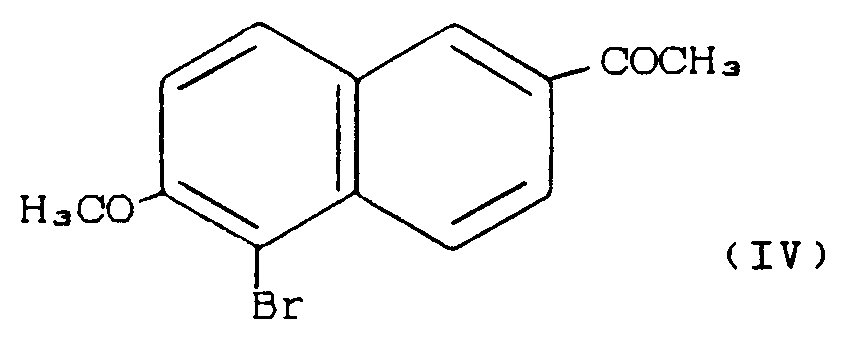

- The (±)-2-(5-bromo-6-methoxy-2-naphthyl)propionic acid of formula VIII can then be transformed into naproxen by debromination and subsequent resolution of the enantiomers, or by resolution and subsequent debromination of the (±)-2-(5-bromo-6-methoxy-2-naphthyl)propionic acid. For instance, the resolution can be carried out through the formation of diastereomer salts with (-)-N-methylglucamine, according to the already cited Italian Patent 1,168,387, or through the formation of diastereomer amides with optically active aminoalcohols (in particular one of the two enantiomers of the 2-aminobutanol)

- The debromination of the brominated acids (enantiomers or racemates) which are in the above summarized pathway of synthesis, is carried out, according to the methods known till now, by means of a reduction with NaBH4 in the presence of palladium, or with nickel and hydrazine (DE-A-3212170). The first method involves untenable expenses, firstly due to the use of great amounts of NaBH4, in a minor but not trascurable way to the unavoidable mechanical losses of palladium and to the cost of regeneration of the exhausted palladium. The process based on the use of nickel and hydrazine is much less costly: but nickel presents the well known problems of storage (the user falls within the "high hazard" class above certain amounts), while hydrazine is rightly considered toxic and dangerous, so that the maximum allowed threshold of revealable hydrazine in the enviroment is 0.1 ppm according to the safety rules.
- Now we have found that the above mentioned compounds of formula I can be debrominated in an easy manner, much less costly than the previous ways and by using non-dangerous reagents, by treating the same compounds by means of acceptors of bromine in the presence of Lewis acids, wherein alkylarenes such as toluene, m-xylene, mesitylene, durene etc., and alkoxyarenes such as anisole are used as acceptors of bromine.
- All the compounds normally used as catalysts in the Friedel-Crafts reactions, like AlCl3, FeCl3, ZnC12, TiCI4 can be used as Lewis acids, even if the aluminum chloride showed to be particularly useful.
- The molar ratio among the compound of formula I, the acceptor of bromine and the Lewis acid is generally comprised between 1:1:1 and 1:2:2. Preferably 1.5 moles of acceptor and 1.5 moles of Lewis acid for each mole of the compound of formula I are used.
- Generally the reaction is carried out in a solvent; also an excess of the compound used as acceptor of bromine can be used as solvent, but the use of quite low-boiling halogenated hydrocarbons like methylene chloride, chloroform or 1,2-dichloroethane is preferred because of practical reasons. The temperature of the reaction can vary from about -20 ° C and the boiling point of the reaction mixture; preferably the reaction is carried out between -10°C and + 30 ° C, practically at room temperature.
- The yields of reaction are generally quite high. This fact, coupled with the easiness of execution and the above mentioned advantages of cost and of lack of danger, gives a character of remarkable technical progress to the process according to the invention.
- European Patent 203,557 describes a process for the selective debromination of the (5-bromo-6-methoxy-2-naphthyl)-(1-bromoethyl)ketone or of its ketals in the presence of acceptors of bromine and of hydrogen halides (the patent also claims the use of the hydrogen halides in combination with the Lewis acids, but does not give any example). This patent claims phenols, phenolethers and aromatic ketones as acceptors of bromine and points out the fact that (6-methoxy-2-naphthyl)ethyl-ketone can be used as aromatic ketone, according to the below reported scheme:

- In other words, according to the above mentioned European Patent, the bromine in position 5 of the dibromoketone A goes to the position a of the propionyl residue of the compound B (this thing is easily explained because of the activation of said position a caused by the carbonyl).
- Therefore the fact that, in the process of debromination of the compounds of formula I according to the present invention, the transfer of bromine does not take place on the atom of carbon in a in respect of the activating group always present in the compounds themselves (either the group CO, or COOH, or COOR, or CN, or CONH-) has to be considered undoubtedly surprising.
- In other words, the teaching of the European Patent 203557 formed a technical prejudice to the carrying out of the present invention.
- The following examples show the here claimed process without limiting the extent.
- 2-acetyl-6-methoxynaphthalene
- a) 35.9 Grams of anhydrous aluminum chloride are suspended in 180 ml of anhydrous methylene chloride. The suspension is cooled to -10°C and added first with 19.9 ml of acetyl chloride and then, in about 30 minutes, with a solution containing 58 g of 1-bromo-2-methoxy naphthalene in 140 ml of anhydrous methylene chloride, while keeping the temperature at -10°C. This temperature is kept for other 30 minutes obtaining a solution containing the 2-acetyl-5-bromo-6-methoxynaphthalene.
- b) 8.2 Grams of anhydrous aluminum chloride and 59 ml of toluene are added to the solution of 2-acetyl-5-bromo-6-methoxynaphthalene obtained as in example 1, keeping the temperature at -10°C. The reaction mixture is kept under stirring at room temperature for 20 hours and then it is slowly poured into a mixture made by 200 g of crushed ice and by 75 ml of a 35% (w/v) aqueous solution of hydrochloric acid.
- The layers are separated, the aqueous phase is extracted with 30 ml of methylene chloride and then is discarded, while the organic phases are collected and washed twice with 100 ml of a 6 N aqueous solution of hydrochloric acid and then with 50 ml of water. The organic layer is then added with 50 ml of water, the pH is brought to about 12 by adding a 30% (w/v) aqueous solution of sodium hydroxide and the aqueous phase is discarded.
- The organic solution is dried over anhydrous sodium sulfate, evaporated to dryness under vacuum and the residue is crystallized by n-heptane obtaining 43.5 g of product, with a yield equal to 88.7% calculated over the 1-bromo-2-methoxynaphthalene.
- 45 MI of m-xylene are added in 15 minutes to the solution of 2-acetyl-5-bromo-6-methoxynaphthalene obtained as in example 1a) and then 8.2 g of anhydrous aluminum chloride are added, while keeping the temperature at -10°C. The reaction mixture is kept for three hours under stirring at room temperature and then it is worked as in example 1 obtaining 42.5 g of product with a yield equal to 86.7% calculated over the 1-bromo-2-methoxynaphthalene.
- 45.3 MI of p-xylene and 8.2 g of anhydrous aluminum chloride are added to the solution of 2-acetyl-5-bromo-6-methoxynaphthaleneobtained as in example 1 a), while keeping the temperature at -10°C. The reaction mixture is kept for 16 hours under stirring at room temperature and then it is worked as in example 1 obtaining 42.8 g of product with a yield equal to 87.3% calculated over the 1-bromo-2-methoxynaphthalene.
- 51 MI of mesitylene and 8.2 g of anhydrous aluminum chloride are added to the solution of 2-acetyl-5-bromo-6-methoxynaphthaleneobtained as in example 1 a), while keeping the temperature at -10°C. The reaction mixture is kept for 3 hours under stirring at 0 ° C and then it is worked as in example 1 obtaining 43.2 g of product with a yield equal to 88.2% calculated over the 1-bromo-2-methoxynaphthalene.
- 57 MI of tert-butylbenzene and 8.2 g of anhydrous aluminum chloride are added to the solution of 2- acetyl-5-bromo-6-methoxynaphthalene obtained as in example 1 a), while keeping the temperature at -10°C. The reaction mixture is kept for 16 hours under stirring at room temperature and then it is worked as in example 1 obtaining 41.8 g of product with a yield equal to 85.3% calculated over the 1-bromo-2-methoxynaphthalene.
- 42 MI of β-naphthol and 16.2 g of anhydrous aluminum chloride are added to the solution of 2-acetyl-5-bromo-6-methoxynaphthaleneobtained as in example 1 a), while keeping the temperature at -10°C. The reaction mixture is kept for 48 hours under stirring at room temperature and then it is worked as in example 1 with the only difference that the product is crystallized by isopropyl alcohol. 19 Grams of product are obtained with a yield equal to 38.7% calculated over the 1-bromo-2-methoxynaphthalene.
- 80 MI of anisole and 18 g of anhydrous aluminum chloride are added to the solution of 2-acetyl-5-bromo-6-methoxynaphthaleneobtained as in example 1 a), while keeping the temperature at -10°C. The reaction mixture is kept for 24 hours under stirring at room temperature and then it is worked as in example 1 obtaining 38.5 g of product with a yield equal to 78.5% calculated over the 1-bromo-2-methoxynaphthalene.
- 48 Grams of naphthalene and 16.7 g of anhydrous aluminum chloride are added to the solution of 2- acetyl-5-bromo-6-methoxynaphthalene obtained as in example 1 a), while keeping the temperature at -10°C. The reaction mixture is kept under stirring for 2 hours at 0°C and for 20 hours at room temperature and then it is worked as in example 1 obtaining 38.8 g of product with a yield equal to 79.2% calculated over the 1-bromo-2-methoxynaphthalene.
- 30 Grams of anhydrous aluminum chloride are added portionwise to a mixture made of 41.85 g of 2- acetyl-5-bromo-6-methoxynaphthalene, 22.15 g of durene and 180 ml of anhydrous methylene chloride cooled to -5°C, in such a manner that the temperature of 20 °C is not exceeded. The reaction mixture is kept for 2 hours at room temperature after the end of the addition and then it is worked as in example 1 obtaining 27.1 g of product with a yield equal to 90.6% calculated over the 2-acetyl-5-bromo-6-methoxynaphthalene.
- 29.3 Grams of 5-bromo-6-methoxy-2-propionylnaphthalene are dissolved in 100 ml of anhydrous methylene chloride and in 20.8 ml of mesitylene. 20 Grams of anhydrous aluminum chloride are added portionwise to the reaction mixture cooled to -5°C under strong stirring, while keeping the temperature below 20 °C. The reaction mixture is kept for over 3 hours under stirring at room temperature, then it is slowly poured under strong stirring into a mixture made of 110 g of ice and of 35 ml of a 35% (w/v) aqueous solution of hydrochloric acid. The layers are separated after 15 minutes of stirring and the aqueous layer is discarded. The organic layer first is twice washed with 50 ml of a 6 N aqueous solution of hydrochloric acid and then with 50 ml of water. The organic solution is then added with 50 ml of water and the pH is brought to 12 by means of a 30% (w/v) aqueous solution of sodium hydroxide.
- The aqueous phase is discarded while the organic phase is dried over anhydrous sodium sulfate and evaporated to dryness under vacuum. The residue is crystallized by n-heptane obtaining 20.2 g of product with a yield equal to 94.3%.
- 10 Grams of anhydrous aluminum chloride are added portionwise and under stirring to a solution containing 14.5 g of 2-(5-bromo-6-methoxy-2-naphthyl)propionitrile dissolved in 60 ml of methylene chloride and 8.3 ml of mesitylene, while keeping the temperature at about 20 ° C. The reaction mixture is kept at this temperature under stirring for 1 hour and then is slowly poured into a mixture made of 60 g of crushed ice and of 20 ml of a 6 N aqueous solution of hydrochloric acid. The layers are separated after 15 minutes of stirring and the aqueous layer is discarded. The organic layer is twice washed with 25 ml of a 6 N aqueous solution of hydrochloric acid, then with 25 ml of water and is dried over anhydrous sodium sulfate. The organic solution is evaporated to dryness under vacuum and the residue is crystallized from tetrachloroethylene obtaining 7.5 g of product with a yield of 71 %.
- 15.4 Grams of 2-(5-bromo-6-methoxy-2-naphthyl) propionamide are added to a mixture made of 60 ml of chloroform and 8.3 ml of mesitylene.
- 10 Grams of anhydrous aluminum chloride are added portionwise under stirring to the mixture cooled to 0°C, while keeping the temperature at about 20 °C. The reaction mixture is kept under stirring at about 20°C for 2 hours and then is worked as in example 11 obtaining 10.9 g of product with a yield equal to 95.1%.
- 10.4 MI of mesitylene are added to a solution containing 16.1 g of the methyl ester of the 2-(5-bromo-6-methoxy-2-naphthyl)propionic acid dissolved in 65 ml of methylene chloride.
- 13.5 Grams of anhydrous aluminum chloride are added portionwise under stirring to the reaction mixture cooled to -5°C, while keeping the temperature at about 15°C. The reaction mixture is kept under stirring at about 150 C for 2 hours and then is poured into a mixture made of 68 g of crushed ice and 15 ml of a 35% (w/v) aqueous solution of hydrochloric acid. The layers are separated, the aqueous layer is extracted with 30 ml of methylene chloride and then is discarded. The organic layers are collected, first washed with 50 ml of a 1 N aqueous solution of hydrochloric acid, then with 50 ml of water and lastly with 50 ml of a 8% (w/v) aqueous solution of sodium bicarbonate. The organic solution is then dried over anhydrous sodium sulfate and concentrated to dryness under vacuum. The residue is crystallized from n-hexane obtaining 10.6 g of product with a yield equal to 86.7%.
- 16.1 Grams of the methyl ester of the 2-(5-bromo-6-methoxy-2-naphthyl)propionic acid are dissolved in 65 ml of methylene chloride and then 10.4 ml of mesitylene and 12 ml of anhydrous titanium tetrachloride are added while keeping the temperature at about 20 ° C. The reaction mixture is kept under stirring at room temperature for 80 hours and then is poured into a mixture made of 68 g of crushed ice and of 15 ml of a 35% (w/v) aqueous solution of hydrochloric acid. The layers are separated after 15 minutes of stirring, the aqueous layer is extracted with 30 ml of methylene chloride and then is discarded. The organic layers are collected, first washed with 50 ml of a 1 N aqueous solution of hydrochloric acid, then with 50 ml of water and lastly with 50 ml of a 8% (w/v) aqueous solution of sodium bicarbonate. The organic solution is dried over anhydrous sodium sulfate and then is evaporated under vacuum. The residue is crystallized first with n-hexane and then with methyl alcohol obtaining 4 g of product with a yield equal to 32.7%.
- 20.8 MI of mesitylene are added to a solution of 32.3 g of the methyl ester of the d-2-(6-methoxy-2-naphthyl) propionic acid dissolved in 130 ml of methylene chloride. 20 Grams of anhydrous aluminum chloride are added portionwise under stirring to the reaction mixture cooled to -5°C, while keeping the temperature at about 10°C. The reaction mixture is kept under stirring for one hour at about 10°C and then is poured into a mixture made of 100 g of crushed ice and of 15 ml of a 35% (w/v) aqueous solution of hydrochloric acid. The layers are separated after 15 minutes of stirring, the aqueous phase is discarded while the organic layer is twice washed with 100 ml of a 1 N aqueous solution of hydrochloric acid, once with 100 ml of water and once with 100 ml of a 8% (w/v) aqueous solution of sodium bicarbonate. The organic solution is dried over anhydrous sodium sulfate and concentrated to dryness under vacuum. The residue is crystallized by n-hexane obtaining 22.8 g of pure product having [a]8° = + 80.3°(C = 1% in chloroform) with a yield equal to 93.3%.
- 20.8 MI (0.15 moles) of mesitylene and 38 g (0.1 moles) of a-2-(5-bromo-6-methoxy-2-naphthy!)-N-[ a - 2-(1-hydroxy)-butyl]propionamide are added to 200 ml of methylene chloride. The mixture is cooled to -3°C and 20 g (0.15 moles) of anhydrous aluminum chloride are added portionwise in such a manner that the temperature does not exceed 20 °C. The reaction mixture is kept one hour under stirring at 20 °C and then is poured under stirring into a mixture made of 120 g of ice and 10 ml of 32% hydrochloric acid. The layers are separated after having added further 100 ml of methylene chloride and heated to 35 °C. The organic layer is washed with 10 ml of hydrochloric acid and then with water and lastly is concentrated under vacuum in a rotating evaporator. The residue is added with 150 ml of toluene, heated to the boiling, cooled, filtered and dried obtaining 28 g of a -2-(6-methoxy-2-naphthyl)-N-[ a-2-(1-hydroxy)-buty!]propionamide with a yield of 95.7%.
- 20.8 MI (0.15 moles) of mesitylene and 30.9 g (0.10 moles) of (+)-2-(5-bromo-6-methoxy-2-naphthyl)-propionic acid are added to 150 ml of chloroform and the mixture is cooled to 0°C. 20 Grams (0.15 moles) of anhydrous aluminum chloride are added portionwise under strong stirring to the mixture while going on with the cooling so that temperature does not exceed 20°C. The reaction mixture is kept at this temperature for 3 hours and then is poured into a mixture made of 100 g of ice and 10 ml of 32% hydrochloric acid. The reaction mixture is heated to 45 °C, the layers are separated, the organic layer is twice washed with 50 ml of 1 M hydrochloric acid and then with 100 ml of water. The organic layer is concentrated under vacuum and the residue is crystallized from 75 ml of toluene. The product is filtered and dried obtaining 21 g of the title compound, which corresponds to the drug known as naproxen, having [a]8° + + 66.5° (C = 1% in chloroform), with a yield of 91 %.
Claims (8)

compounds selected from alkylarenes and alkoxyarenes are used as acceptors of bromine.
Applications Claiming Priority (2)
| Application Number | Priority Date | Filing Date | Title |
|---|---|---|---|
| IT01929990A IT1238008B (en) | 1990-02-08 | 1990-02-08 | PROCEDURE FOR THE DEBROMURATION OF 2-SUBSTITUTES-5-BROMO- 6-METOXYPHINAPHALENES |
| IT1929990 | 1990-02-08 |
Publications (4)
| Publication Number | Publication Date |
|---|---|
| EP0440930A2 EP0440930A2 (en) | 1991-08-14 |
| EP0440930A3 EP0440930A3 (en) | 1992-04-08 |
| EP0440930B1 true EP0440930B1 (en) | 1995-03-22 |
| EP0440930B2 EP0440930B2 (en) | 2001-09-12 |
Family
ID=11156536
Family Applications (1)
| Application Number | Title | Priority Date | Filing Date |
|---|---|---|---|
| EP90123978A Expired - Lifetime EP0440930B2 (en) | 1990-02-08 | 1990-12-12 | Process for the debromination of 2-substituted-5-bromo-6-methoxynaphthalenes |
Country Status (8)
| Country | Link |
|---|---|
| US (1) | US5107013A (en) |
| EP (1) | EP0440930B2 (en) |
| AT (1) | ATE120172T1 (en) |
| DE (1) | DE69018058T3 (en) |
| DK (1) | DK0440930T3 (en) |
| ES (1) | ES2070258T5 (en) |
| GR (1) | GR3015528T3 (en) |
| IT (1) | IT1238008B (en) |
Families Citing this family (3)
| Publication number | Priority date | Publication date | Assignee | Title |
|---|---|---|---|---|
| DE4318069C1 (en) * | 1993-06-01 | 1994-03-31 | Cassella Ag | Process for the preparation of methyl 5-bromo-6-methoxy-1-naphthoate |
| IT1285567B1 (en) | 1996-02-21 | 1998-06-18 | Alfa Chem Ital | NEW PROCESS FOR THE SYNTHESIS OF NABUMETONE |
| CN110183323A (en) * | 2019-07-09 | 2019-08-30 | 重庆医药高等专科学校 | The synthetic method of D, L- body naproxen |
Family Cites Families (2)
| Publication number | Priority date | Publication date | Assignee | Title |
|---|---|---|---|---|
| IT1168387B (en) * | 1981-04-01 | 1987-05-20 | Alfa Farmaceutici Spa | PROCEDURE FOR THE PREPARATION OF 2- (6-METHOXY-2-NAFTIL) -PROPIONIC ACID |
| IT1190362B (en) * | 1985-05-30 | 1988-02-16 | Zambon Spa | PREPARATION OF (6-METOXY-2-NAFTIL) - (1-BORMOETHL) -KETONE AND ITS DERIVATIVES |
-
1990
- 1990-02-08 IT IT01929990A patent/IT1238008B/en active IP Right Grant
- 1990-12-12 DK DK90123978.0T patent/DK0440930T3/en active
- 1990-12-12 EP EP90123978A patent/EP0440930B2/en not_active Expired - Lifetime
- 1990-12-12 ES ES90123978T patent/ES2070258T5/en not_active Expired - Lifetime
- 1990-12-12 AT AT90123978T patent/ATE120172T1/en not_active IP Right Cessation
- 1990-12-12 DE DE69018058T patent/DE69018058T3/en not_active Expired - Fee Related
- 1990-12-27 US US07/634,742 patent/US5107013A/en not_active Expired - Lifetime
-
1995
- 1995-03-23 GR GR940402780T patent/GR3015528T3/en unknown
Also Published As
| Publication number | Publication date |
|---|---|
| US5107013A (en) | 1992-04-21 |
| EP0440930A3 (en) | 1992-04-08 |
| ES2070258T3 (en) | 1995-06-01 |
| EP0440930B2 (en) | 2001-09-12 |
| IT9019299A1 (en) | 1991-08-09 |
| IT9019299A0 (en) | 1990-02-08 |
| IT1238008B (en) | 1993-06-21 |
| DE69018058T2 (en) | 1995-09-28 |
| ATE120172T1 (en) | 1995-04-15 |
| DE69018058T3 (en) | 2002-04-18 |
| ES2070258T5 (en) | 2002-02-01 |
| DK0440930T3 (en) | 1995-04-10 |
| DE69018058D1 (en) | 1995-04-27 |
| GR3015528T3 (en) | 1995-06-30 |
| EP0440930A2 (en) | 1991-08-14 |
Similar Documents
| Publication | Publication Date | Title |
|---|---|---|
| FI72712C (en) | Process for the preparation of esters of 2- (6'-methoxy-2'-naphthyl) propionic acid by rearrangement of new ketals of 2-halogen-1- (6'-methoxy-2'-naphthyl) propane -1-on and new ketals. | |
| IE850879L (en) | Preparing optically active arylalkanoic acid derivatives and¹intermediates thereof | |
| Tanner et al. | Oxidative decarboxylation. On the mechanism of the potassium persulfate-promoted decarboxylation reaction | |
| EP0440930B2 (en) | Process for the debromination of 2-substituted-5-bromo-6-methoxynaphthalenes | |
| FI78455C (en) | New process for the preparation of d-2- (6-methoxy-2-naphthyl) propionic acid. | |
| US4868338A (en) | Method for acylating a naphthalene compound | |
| EP0214426B1 (en) | Intermediates in the synthesis of carboxylic acids | |
| US5210313A (en) | Preparation of 2,5-dichlorobenzophenones | |
| US5041616A (en) | Preparation of aryl ketones | |
| US4851588A (en) | Novel process for the preparation of bronopol | |
| EP0140454B1 (en) | Process for forming esters of glyoxylic acids | |
| US3502697A (en) | Antibacterial agents | |
| US3703546A (en) | Preparation of 3-amino-2,5-dichlorobenzoic acid | |
| US3497532A (en) | Antibacterial agents | |
| Nakamura et al. | Restricted Rotation in Aromatic Ketones. I. Substituent Effects on the Barrier to Rotation about the Benzene-to-Carbonyl Bond | |
| US5142093A (en) | Process for the preparation of 4-(2,4-difluorophenyl)-phenyl 4-nitro-benzoate | |
| Thomas et al. | A Facile Synthesis of Bicyclo [4.2. 0] octa-1, 3, 5-trien-3-ol | |
| JPS61267538A (en) | Method for producing 2-alkyl-6-acylnaphthalene | |
| US5239114A (en) | Process for the preparation of 4-(2,4-difluorophenyl)-phenyl 4-nitrobenzoate | |
| Kwiecień et al. | Benzofuran systems. Synthesis and biological examination of 1‐(3‐benzofuranyl)‐2‐phenylethanones | |
| EP0110671B1 (en) | Preparation of optically active alpha-arylalkanoic acids and precursors thereof | |
| US4945168A (en) | Method of preparing aryl-(1-phthalimido)-alkyl ketones | |
| US3996286A (en) | α-Bromo-pivaloyl toluenes | |
| CA2204201A1 (en) | Process for preparing 4,5-dichloro-2-methylbenzoic acid | |
| EP0203557A1 (en) | Process for the preparation of (6-methoxy-2-naphthyl)-(1-bromoethyl)-ketone and its derivatives |
Legal Events
| Date | Code | Title | Description |
|---|---|---|---|
| PUAI | Public reference made under article 153(3) epc to a published international application that has entered the european phase |
Free format text: ORIGINAL CODE: 0009012 |
|
| AK | Designated contracting states |
Kind code of ref document: A2 Designated state(s): AT BE CH DE DK ES FR GB GR LI LU NL SE |
|
| PUAL | Search report despatched |
Free format text: ORIGINAL CODE: 0009013 |
|
| AK | Designated contracting states |
Kind code of ref document: A3 Designated state(s): AT BE CH DE DK ES FR GB GR LI LU NL SE |
|
| 17P | Request for examination filed |
Effective date: 19920428 |
|
| RAP1 | Party data changed (applicant data changed or rights of an application transferred) |
Owner name: ALFA CHEMICAL ITALIANA S.R.L. |
|
| 17Q | First examination report despatched |
Effective date: 19931130 |
|
| RAP1 | Party data changed (applicant data changed or rights of an application transferred) |
Owner name: ALFA CHEMICALS ITALIANA S.R.L. |
|
| GRAA | (expected) grant |
Free format text: ORIGINAL CODE: 0009210 |
|
| AK | Designated contracting states |
Kind code of ref document: B1 Designated state(s): AT BE CH DE DK ES FR GB GR LI LU NL SE |
|
| PG25 | Lapsed in a contracting state [announced via postgrant information from national office to epo] |
Ref country code: AT Free format text: LAPSE BECAUSE OF FAILURE TO SUBMIT A TRANSLATION OF THE DESCRIPTION OR TO PAY THE FEE WITHIN THE PRESCRIBED TIME-LIMIT Effective date: 19950322 |
|
| REF | Corresponds to: |
Ref document number: 120172 Country of ref document: AT Date of ref document: 19950415 Kind code of ref document: T |
|
| REG | Reference to a national code |
Ref country code: DK Ref legal event code: T3 |
|
| REF | Corresponds to: |
Ref document number: 69018058 Country of ref document: DE Date of ref document: 19950427 |
|
| ET | Fr: translation filed | ||
| REG | Reference to a national code |
Ref country code: GR Ref legal event code: FG4A Free format text: 3015528 |
|
| REG | Reference to a national code |
Ref country code: ES Ref legal event code: FG2A Ref document number: 2070258 Country of ref document: ES Kind code of ref document: T3 |
|
| PLBI | Opposition filed |
Free format text: ORIGINAL CODE: 0009260 |
|
| PLBF | Reply of patent proprietor to notice(s) of opposition |
Free format text: ORIGINAL CODE: EPIDOS OBSO |
|
| 26 | Opposition filed |
Opponent name: ZAMBON GROUP S.P.A. Effective date: 19951220 |
|
| NLR1 | Nl: opposition has been filed with the epo |
Opponent name: ZAMBON GROUP S.P.A. |
|
| PLBF | Reply of patent proprietor to notice(s) of opposition |
Free format text: ORIGINAL CODE: EPIDOS OBSO |
|
| PLBO | Opposition rejected |
Free format text: ORIGINAL CODE: EPIDOS REJO |
|
| APAC | Appeal dossier modified |
Free format text: ORIGINAL CODE: EPIDOS NOAPO |
|
| APAE | Appeal reference modified |
Free format text: ORIGINAL CODE: EPIDOS REFNO |
|
| REG | Reference to a national code |
Ref country code: CH Ref legal event code: PFA Free format text: ALFA CHEMICALS ITALIANA S.R.L. TRANSFER- ALFA CHEMICALS ITALIANA S.P.A. |
|
| REG | Reference to a national code |
Ref country code: FR Ref legal event code: CJ Ref country code: FR Ref legal event code: CA |
|
| NLT1 | Nl: modifications of names registered in virtue of documents presented to the patent office pursuant to art. 16 a, paragraph 1 |
Owner name: ALFA CHEMICALS ITALIANA S.P.A. |
|
| REG | Reference to a national code |
Ref country code: ES Ref legal event code: PC2A |
|
| APCC | Communication from the board of appeal sent |
Free format text: ORIGINAL CODE: EPIDOS OBAPO |
|
| APCC | Communication from the board of appeal sent |
Free format text: ORIGINAL CODE: EPIDOS OBAPO |
|
| PGFP | Annual fee paid to national office [announced via postgrant information from national office to epo] |
Ref country code: DK Payment date: 20000919 Year of fee payment: 11 |
|
| PGFP | Annual fee paid to national office [announced via postgrant information from national office to epo] |
Ref country code: GR Payment date: 20001023 Year of fee payment: 11 |
|
| PGFP | Annual fee paid to national office [announced via postgrant information from national office to epo] |
Ref country code: AT Payment date: 20001103 Year of fee payment: 11 |
|
| PGFP | Annual fee paid to national office [announced via postgrant information from national office to epo] |
Ref country code: SE Payment date: 20001201 Year of fee payment: 11 Ref country code: LU Payment date: 20001201 Year of fee payment: 11 |
|
| PG25 | Lapsed in a contracting state [announced via postgrant information from national office to epo] |
Ref country code: SE Free format text: LAPSE BECAUSE OF NON-PAYMENT OF DUE FEES Effective date: 20001213 |
|
| PGFP | Annual fee paid to national office [announced via postgrant information from national office to epo] |
Ref country code: BE Payment date: 20010118 Year of fee payment: 11 |
|
| APAC | Appeal dossier modified |
Free format text: ORIGINAL CODE: EPIDOS NOAPO |
|
| PLAW | Interlocutory decision in opposition |
Free format text: ORIGINAL CODE: EPIDOS IDOP |
|
| PUAH | Patent maintained in amended form |
Free format text: ORIGINAL CODE: 0009272 |
|
| STAA | Information on the status of an ep patent application or granted ep patent |
Free format text: STATUS: PATENT MAINTAINED AS AMENDED |
|
| 27A | Patent maintained in amended form |
Effective date: 20010912 |
|
| AK | Designated contracting states |
Kind code of ref document: B2 Designated state(s): AT BE CH DE DK ES FR GB GR LI LU NL SE |
|
| REG | Reference to a national code |
Ref country code: CH Ref legal event code: AEN Free format text: AUFRECHTERHALTUNG DES PATENTES IN GEAENDERTER FORM |
|
| NLR2 | Nl: decision of opposition | ||
| NLR3 | Nl: receipt of modified translations in the netherlands language after an opposition procedure | ||
| PGFP | Annual fee paid to national office [announced via postgrant information from national office to epo] |
Ref country code: ES Payment date: 20011210 Year of fee payment: 12 |
|
| PG25 | Lapsed in a contracting state [announced via postgrant information from national office to epo] |
Ref country code: LU Free format text: LAPSE BECAUSE OF NON-PAYMENT OF DUE FEES Effective date: 20011212 Ref country code: DK Free format text: LAPSE BECAUSE OF FAILURE TO SUBMIT A TRANSLATION OF THE DESCRIPTION OR TO PAY THE FEE WITHIN THE PRESCRIBED TIME-LIMIT Effective date: 20011212 |
|
| PG25 | Lapsed in a contracting state [announced via postgrant information from national office to epo] |
Ref country code: GR Free format text: LAPSE BECAUSE OF NON-PAYMENT OF DUE FEES Effective date: 20011231 Ref country code: BE Free format text: LAPSE BECAUSE OF NON-PAYMENT OF DUE FEES Effective date: 20011231 |
|
| REG | Reference to a national code |
Ref country code: GB Ref legal event code: IF02 |
|
| REG | Reference to a national code |
Ref country code: ES Ref legal event code: DC2A Kind code of ref document: T5 Effective date: 20011130 |
|
| ET3 | Fr: translation filed ** decision concerning opposition | ||
| PGFP | Annual fee paid to national office [announced via postgrant information from national office to epo] |
Ref country code: GB Payment date: 20021104 Year of fee payment: 13 |
|
| PGFP | Annual fee paid to national office [announced via postgrant information from national office to epo] |
Ref country code: NL Payment date: 20021112 Year of fee payment: 13 |
|
| PGFP | Annual fee paid to national office [announced via postgrant information from national office to epo] |
Ref country code: FR Payment date: 20021202 Year of fee payment: 13 |
|
| PGFP | Annual fee paid to national office [announced via postgrant information from national office to epo] |
Ref country code: CH Payment date: 20021223 Year of fee payment: 13 |
|
| PGFP | Annual fee paid to national office [announced via postgrant information from national office to epo] |
Ref country code: DE Payment date: 20021230 Year of fee payment: 13 |
|
| PG25 | Lapsed in a contracting state [announced via postgrant information from national office to epo] |
Ref country code: GB Free format text: LAPSE BECAUSE OF NON-PAYMENT OF DUE FEES Effective date: 20031212 |
|
| PG25 | Lapsed in a contracting state [announced via postgrant information from national office to epo] |
Ref country code: ES Free format text: LAPSE BECAUSE OF NON-PAYMENT OF DUE FEES Effective date: 20031213 |
|
| PG25 | Lapsed in a contracting state [announced via postgrant information from national office to epo] |
Ref country code: LI Free format text: LAPSE BECAUSE OF NON-PAYMENT OF DUE FEES Effective date: 20031231 Ref country code: CH Free format text: LAPSE BECAUSE OF NON-PAYMENT OF DUE FEES Effective date: 20031231 |
|
| PG25 | Lapsed in a contracting state [announced via postgrant information from national office to epo] |
Ref country code: NL Free format text: LAPSE BECAUSE OF NON-PAYMENT OF DUE FEES Effective date: 20040701 Ref country code: DE Free format text: LAPSE BECAUSE OF NON-PAYMENT OF DUE FEES Effective date: 20040701 |
|
| GBPC | Gb: european patent ceased through non-payment of renewal fee |
Effective date: 20031212 |
|
| REG | Reference to a national code |
Ref country code: CH Ref legal event code: PL |
|
| PG25 | Lapsed in a contracting state [announced via postgrant information from national office to epo] |
Ref country code: FR Free format text: LAPSE BECAUSE OF NON-PAYMENT OF DUE FEES Effective date: 20040831 |
|
| NLV4 | Nl: lapsed or anulled due to non-payment of the annual fee |
Effective date: 20040701 |
|
| REG | Reference to a national code |
Ref country code: FR Ref legal event code: ST |
|
| REG | Reference to a national code |
Ref country code: ES Ref legal event code: FD2A Effective date: 20031213 |
|
| APAH | Appeal reference modified |
Free format text: ORIGINAL CODE: EPIDOSCREFNO |