EP0439857B1 - A solvent-free process for the preparation of ((pyridinyloxy)phenoxy) propionate derivatives - Google Patents
A solvent-free process for the preparation of ((pyridinyloxy)phenoxy) propionate derivatives Download PDFInfo
- Publication number
- EP0439857B1 EP0439857B1 EP90203426A EP90203426A EP0439857B1 EP 0439857 B1 EP0439857 B1 EP 0439857B1 EP 90203426 A EP90203426 A EP 90203426A EP 90203426 A EP90203426 A EP 90203426A EP 0439857 B1 EP0439857 B1 EP 0439857B1
- Authority
- EP
- European Patent Office
- Prior art keywords
- phenoxy
- propionate
- hydroxyphenoxy
- propionate ester
- solvent
- Prior art date
- Legal status (The legal status is an assumption and is not a legal conclusion. Google has not performed a legal analysis and makes no representation as to the accuracy of the status listed.)
- Expired - Lifetime
Links
- -1 (pyridinyloxy)phenoxy Chemical group 0.000 title claims description 30
- 238000000034 method Methods 0.000 title claims description 24
- 238000002360 preparation method Methods 0.000 title claims description 9
- XBDQKXXYIPTUBI-UHFFFAOYSA-N Propionic acid Chemical class CCC(O)=O XBDQKXXYIPTUBI-UHFFFAOYSA-N 0.000 title 1
- 239000002585 base Substances 0.000 claims description 21
- MTAODLNXWYIKSO-UHFFFAOYSA-N 2-fluoropyridine Chemical compound FC1=CC=CC=N1 MTAODLNXWYIKSO-UHFFFAOYSA-N 0.000 claims description 15
- 239000003444 phase transfer catalyst Substances 0.000 claims description 14
- 239000002904 solvent Substances 0.000 claims description 13
- BWHMMNNQKKPAPP-UHFFFAOYSA-L potassium carbonate Chemical group [K+].[K+].[O-]C([O-])=O BWHMMNNQKKPAPP-UHFFFAOYSA-L 0.000 claims description 12
- 239000002245 particle Substances 0.000 claims description 8
- 125000000951 phenoxy group Chemical group [H]C1=C([H])C([H])=C(O*)C([H])=C1[H] 0.000 claims description 7
- 125000004432 carbon atom Chemical group C* 0.000 claims description 6
- 229910000027 potassium carbonate Inorganic materials 0.000 claims description 6
- 235000015320 potassium carbonate Nutrition 0.000 claims description 5
- 230000006340 racemization Effects 0.000 claims description 5
- 229910000288 alkali metal carbonate Inorganic materials 0.000 claims description 4
- 150000008041 alkali metal carbonates Chemical class 0.000 claims description 4
- 150000003242 quaternary ammonium salts Chemical group 0.000 claims description 4
- 229910052799 carbon Inorganic materials 0.000 claims description 3
- 230000003197 catalytic effect Effects 0.000 claims description 3
- 125000004122 cyclic group Chemical group 0.000 claims description 3
- 125000001183 hydrocarbyl group Chemical group 0.000 claims description 3
- 229920006395 saturated elastomer Chemical group 0.000 claims description 3
- 229930195734 saturated hydrocarbon Chemical group 0.000 claims description 3
- 229930195735 unsaturated hydrocarbon Chemical group 0.000 claims description 3
- OKTJSMMVPCPJKN-UHFFFAOYSA-N Carbon Chemical compound [C] OKTJSMMVPCPJKN-UHFFFAOYSA-N 0.000 claims description 2
- 125000000217 alkyl group Chemical group 0.000 claims description 2
- IAZDPXIOMUYVGZ-UHFFFAOYSA-N Dimethylsulphoxide Chemical compound CS(C)=O IAZDPXIOMUYVGZ-UHFFFAOYSA-N 0.000 description 10
- 238000006243 chemical reaction Methods 0.000 description 10
- 239000000047 product Substances 0.000 description 9
- XLYOFNOQVPJJNP-UHFFFAOYSA-N water Substances O XLYOFNOQVPJJNP-UHFFFAOYSA-N 0.000 description 7
- ZMXDDKWLCZADIW-UHFFFAOYSA-N N,N-Dimethylformamide Chemical compound CN(C)C=O ZMXDDKWLCZADIW-UHFFFAOYSA-N 0.000 description 6
- 239000000203 mixture Substances 0.000 description 6
- 239000011541 reaction mixture Substances 0.000 description 6
- 238000010931 ester hydrolysis Methods 0.000 description 5
- 239000003960 organic solvent Substances 0.000 description 5
- AQIHDXGKQHFBNW-UHFFFAOYSA-N 2-(4-hydroxyphenoxy)propanoic acid Chemical class OC(=O)C(C)OC1=CC=C(O)C=C1 AQIHDXGKQHFBNW-UHFFFAOYSA-N 0.000 description 4
- YMWUJEATGCHHMB-UHFFFAOYSA-N Dichloromethane Chemical compound ClCCl YMWUJEATGCHHMB-UHFFFAOYSA-N 0.000 description 4
- SECXISVLQFMRJM-UHFFFAOYSA-N N-Methylpyrrolidone Chemical compound CN1CCCC1=O SECXISVLQFMRJM-UHFFFAOYSA-N 0.000 description 4
- 238000005859 coupling reaction Methods 0.000 description 4
- 150000002148 esters Chemical class 0.000 description 4
- 239000000376 reactant Substances 0.000 description 4
- WEVYAHXRMPXWCK-UHFFFAOYSA-N Acetonitrile Chemical compound CC#N WEVYAHXRMPXWCK-UHFFFAOYSA-N 0.000 description 3
- OKKJLVBELUTLKV-UHFFFAOYSA-N Methanol Chemical compound OC OKKJLVBELUTLKV-UHFFFAOYSA-N 0.000 description 3
- 239000002253 acid Substances 0.000 description 3
- 238000013019 agitation Methods 0.000 description 3
- 150000001875 compounds Chemical class 0.000 description 3
- 238000004519 manufacturing process Methods 0.000 description 3
- 238000002156 mixing Methods 0.000 description 3
- 150000004714 phosphonium salts Chemical class 0.000 description 3
- 238000000926 separation method Methods 0.000 description 3
- 238000003756 stirring Methods 0.000 description 3
- 125000002023 trifluoromethyl group Chemical group FC(F)(F)* 0.000 description 3
- XIFCGIKPAAZFFS-UHFFFAOYSA-N 2,3-difluoro-5-(trifluoromethyl)pyridine Chemical compound FC1=CC(C(F)(F)F)=CN=C1F XIFCGIKPAAZFFS-UHFFFAOYSA-N 0.000 description 2
- RQIGXDGBBJMQAE-UHFFFAOYSA-N 2-(2-hydroxyphenoxy)propanoic acid Chemical compound OC(=O)C(C)OC1=CC=CC=C1O RQIGXDGBBJMQAE-UHFFFAOYSA-N 0.000 description 2
- JKQVYNWBZCEMOT-UHFFFAOYSA-N 2-[2-(2-pyridin-2-yloxyphenoxy)phenoxy]pyridine Chemical class C=1C=CC=C(OC=2C(=CC=CC=2)OC=2N=CC=CC=2)C=1OC1=CC=CC=N1 JKQVYNWBZCEMOT-UHFFFAOYSA-N 0.000 description 2
- 150000005756 2-fluoropyridines Chemical class 0.000 description 2
- 150000005749 2-halopyridines Chemical class 0.000 description 2
- IJGRMHOSHXDMSA-UHFFFAOYSA-N Atomic nitrogen Chemical compound N#N IJGRMHOSHXDMSA-UHFFFAOYSA-N 0.000 description 2
- QIGBRXMKCJKVMJ-UHFFFAOYSA-N Hydroquinone Chemical compound OC1=CC=C(O)C=C1 QIGBRXMKCJKVMJ-UHFFFAOYSA-N 0.000 description 2
- XBDQKXXYIPTUBI-UHFFFAOYSA-M Propionate Chemical class CCC([O-])=O XBDQKXXYIPTUBI-UHFFFAOYSA-M 0.000 description 2
- CDBYLPFSWZWCQE-UHFFFAOYSA-L Sodium Carbonate Chemical compound [Na+].[Na+].[O-]C([O-])=O CDBYLPFSWZWCQE-UHFFFAOYSA-L 0.000 description 2
- 230000009286 beneficial effect Effects 0.000 description 2
- 239000006227 byproduct Substances 0.000 description 2
- 238000000605 extraction Methods 0.000 description 2
- 238000010438 heat treatment Methods 0.000 description 2
- 230000002363 herbicidal effect Effects 0.000 description 2
- 230000007062 hydrolysis Effects 0.000 description 2
- 238000006460 hydrolysis reaction Methods 0.000 description 2
- 239000010410 layer Substances 0.000 description 2
- UUYSCNGPNOYZMC-UHFFFAOYSA-N methyl 2-(4-hydroxyphenoxy)propanoate Chemical compound COC(=O)C(C)OC1=CC=C(O)C=C1 UUYSCNGPNOYZMC-UHFFFAOYSA-N 0.000 description 2
- 238000004064 recycling Methods 0.000 description 2
- 239000002002 slurry Substances 0.000 description 2
- 239000007787 solid Substances 0.000 description 2
- 125000001424 substituent group Chemical group 0.000 description 2
- DZLFLBLQUQXARW-UHFFFAOYSA-N tetrabutylammonium Chemical group CCCC[N+](CCCC)(CCCC)CCCC DZLFLBLQUQXARW-UHFFFAOYSA-N 0.000 description 2
- JRMUNVKIHCOMHV-UHFFFAOYSA-M tetrabutylammonium bromide Chemical compound [Br-].CCCC[N+](CCCC)(CCCC)CCCC JRMUNVKIHCOMHV-UHFFFAOYSA-M 0.000 description 2
- 125000003698 tetramethyl group Chemical group [H]C([H])([H])* 0.000 description 2
- JFZJMSDDOOAOIV-UHFFFAOYSA-N 2-chloro-5-(trifluoromethyl)pyridine Chemical compound FC(F)(F)C1=CC=C(Cl)N=C1 JFZJMSDDOOAOIV-UHFFFAOYSA-N 0.000 description 1
- OKDGRDCXVWSXDC-UHFFFAOYSA-N 2-chloropyridine Chemical class ClC1=CC=CC=N1 OKDGRDCXVWSXDC-UHFFFAOYSA-N 0.000 description 1
- 125000003903 2-propenyl group Chemical group [H]C([*])([H])C([H])=C([H])[H] 0.000 description 1
- GDSROTVTTLUHCO-UHFFFAOYSA-N 3-chloro-2-fluoro-5-(trifluoromethyl)pyridine Chemical compound FC1=NC=C(C(F)(F)F)C=C1Cl GDSROTVTTLUHCO-UHFFFAOYSA-N 0.000 description 1
- HBAQYPYDRFILMT-UHFFFAOYSA-N 8-[3-(1-cyclopropylpyrazol-4-yl)-1H-pyrazolo[4,3-d]pyrimidin-5-yl]-3-methyl-3,8-diazabicyclo[3.2.1]octan-2-one Chemical class C1(CC1)N1N=CC(=C1)C1=NNC2=C1N=C(N=C2)N1C2C(N(CC1CC2)C)=O HBAQYPYDRFILMT-UHFFFAOYSA-N 0.000 description 1
- ISWSIDIOOBJBQZ-UHFFFAOYSA-N Phenol Chemical group OC1=CC=CC=C1 ISWSIDIOOBJBQZ-UHFFFAOYSA-N 0.000 description 1
- 229910052783 alkali metal Inorganic materials 0.000 description 1
- 150000001340 alkali metals Chemical class 0.000 description 1
- 150000003863 ammonium salts Chemical class 0.000 description 1
- 125000000129 anionic group Chemical group 0.000 description 1
- 238000010936 aqueous wash Methods 0.000 description 1
- VBQDSLGFSUGBBE-UHFFFAOYSA-N benzyl(triethyl)azanium Chemical group CC[N+](CC)(CC)CC1=CC=CC=C1 VBQDSLGFSUGBBE-UHFFFAOYSA-N 0.000 description 1
- 230000015572 biosynthetic process Effects 0.000 description 1
- 125000000484 butyl group Chemical group [H]C([*])([H])C([H])([H])C([H])([H])C([H])([H])[H] 0.000 description 1
- 150000001721 carbon Chemical group 0.000 description 1
- 150000004649 carbonic acid derivatives Chemical class 0.000 description 1
- 239000003054 catalyst Substances 0.000 description 1
- 239000012043 crude product Substances 0.000 description 1
- 125000000113 cyclohexyl group Chemical group [H]C1([H])C([H])([H])C([H])([H])C([H])(*)C([H])([H])C1([H])[H] 0.000 description 1
- 230000001419 dependent effect Effects 0.000 description 1
- 238000004821 distillation Methods 0.000 description 1
- 238000001035 drying Methods 0.000 description 1
- 125000001495 ethyl group Chemical group [H]C([H])([H])C([H])([H])* 0.000 description 1
- 238000001914 filtration Methods 0.000 description 1
- 239000007789 gas Substances 0.000 description 1
- 239000008187 granular material Substances 0.000 description 1
- 125000004051 hexyl group Chemical group [H]C([H])([H])C([H])([H])C([H])([H])C([H])([H])C([H])([H])C([H])([H])* 0.000 description 1
- 229910017053 inorganic salt Inorganic materials 0.000 description 1
- 238000005342 ion exchange Methods 0.000 description 1
- 125000000959 isobutyl group Chemical group [H]C([H])([H])C([H])(C([H])([H])[H])C([H])([H])* 0.000 description 1
- 125000001449 isopropyl group Chemical group [H]C([H])([H])C([H])(*)C([H])([H])[H] 0.000 description 1
- 229910052744 lithium Inorganic materials 0.000 description 1
- 239000000463 material Substances 0.000 description 1
- 238000002844 melting Methods 0.000 description 1
- 230000008018 melting Effects 0.000 description 1
- QSHDDOUJBYECFT-UHFFFAOYSA-N mercury Chemical compound [Hg] QSHDDOUJBYECFT-UHFFFAOYSA-N 0.000 description 1
- 229910052753 mercury Inorganic materials 0.000 description 1
- MFSWTRQUCLNFOM-UHFFFAOYSA-N methyl 2-(4-{[3-chloro-5-(trifluoromethyl)pyridin-2-yl]oxy}phenoxy)propanoate Chemical compound C1=CC(OC(C)C(=O)OC)=CC=C1OC1=NC=C(C(F)(F)F)C=C1Cl MFSWTRQUCLNFOM-UHFFFAOYSA-N 0.000 description 1
- GQOVRACYYSHEBJ-UHFFFAOYSA-N methyl 2-[4-[3-fluoro-5-(trifluoromethyl)pyridin-2-yl]oxyphenoxy]propanoate Chemical compound C1=CC(OC(C)C(=O)OC)=CC=C1OC1=NC=C(C(F)(F)F)C=C1F GQOVRACYYSHEBJ-UHFFFAOYSA-N 0.000 description 1
- ACEONLNNWKIPTM-UHFFFAOYSA-N methyl 2-bromopropanoate Chemical compound COC(=O)C(C)Br ACEONLNNWKIPTM-UHFFFAOYSA-N 0.000 description 1
- 125000002496 methyl group Chemical group [H]C([H])([H])* 0.000 description 1
- 229910052757 nitrogen Inorganic materials 0.000 description 1
- 125000002347 octyl group Chemical group [H]C([*])([H])C([H])([H])C([H])([H])C([H])([H])C([H])([H])C([H])([H])C([H])([H])C([H])([H])[H] 0.000 description 1
- 239000012044 organic layer Substances 0.000 description 1
- 238000005191 phase separation Methods 0.000 description 1
- 239000003495 polar organic solvent Substances 0.000 description 1
- 229910052700 potassium Inorganic materials 0.000 description 1
- 235000011181 potassium carbonates Nutrition 0.000 description 1
- 150000004672 propanoic acids Chemical class 0.000 description 1
- 235000019260 propionic acid Nutrition 0.000 description 1
- 125000001436 propyl group Chemical group [H]C([*])([H])C([H])([H])C([H])([H])[H] 0.000 description 1
- 239000002994 raw material Substances 0.000 description 1
- 238000011084 recovery Methods 0.000 description 1
- 238000001953 recrystallisation Methods 0.000 description 1
- 125000002914 sec-butyl group Chemical group [H]C([H])([H])C([H])([H])C([H])(*)C([H])([H])[H] 0.000 description 1
- 229910052708 sodium Inorganic materials 0.000 description 1
- 229910000029 sodium carbonate Inorganic materials 0.000 description 1
- 235000017550 sodium carbonate Nutrition 0.000 description 1
- 239000007858 starting material Substances 0.000 description 1
- HJHUXWBTVVFLQI-UHFFFAOYSA-N tributyl(methyl)azanium Chemical class CCCC[N+](C)(CCCC)CCCC HJHUXWBTVVFLQI-UHFFFAOYSA-N 0.000 description 1
- 239000002699 waste material Substances 0.000 description 1
Classifications
-
- C—CHEMISTRY; METALLURGY
- C07—ORGANIC CHEMISTRY
- C07D—HETEROCYCLIC COMPOUNDS
- C07D213/00—Heterocyclic compounds containing six-membered rings, not condensed with other rings, with one nitrogen atom as the only ring hetero atom and three or more double bonds between ring members or between ring members and non-ring members
- C07D213/02—Heterocyclic compounds containing six-membered rings, not condensed with other rings, with one nitrogen atom as the only ring hetero atom and three or more double bonds between ring members or between ring members and non-ring members having three double bonds between ring members or between ring members and non-ring members
- C07D213/04—Heterocyclic compounds containing six-membered rings, not condensed with other rings, with one nitrogen atom as the only ring hetero atom and three or more double bonds between ring members or between ring members and non-ring members having three double bonds between ring members or between ring members and non-ring members having no bond between the ring nitrogen atom and a non-ring member or having only hydrogen or carbon atoms directly attached to the ring nitrogen atom
- C07D213/60—Heterocyclic compounds containing six-membered rings, not condensed with other rings, with one nitrogen atom as the only ring hetero atom and three or more double bonds between ring members or between ring members and non-ring members having three double bonds between ring members or between ring members and non-ring members having no bond between the ring nitrogen atom and a non-ring member or having only hydrogen or carbon atoms directly attached to the ring nitrogen atom with hetero atoms or with carbon atoms having three bonds to hetero atoms with at the most one bond to halogen, e.g. ester or nitrile radicals, directly attached to ring carbon atoms
- C07D213/62—Oxygen or sulfur atoms
- C07D213/63—One oxygen atom
- C07D213/64—One oxygen atom attached in position 2 or 6
-
- C—CHEMISTRY; METALLURGY
- C07—ORGANIC CHEMISTRY
- C07D—HETEROCYCLIC COMPOUNDS
- C07D213/00—Heterocyclic compounds containing six-membered rings, not condensed with other rings, with one nitrogen atom as the only ring hetero atom and three or more double bonds between ring members or between ring members and non-ring members
- C07D213/02—Heterocyclic compounds containing six-membered rings, not condensed with other rings, with one nitrogen atom as the only ring hetero atom and three or more double bonds between ring members or between ring members and non-ring members having three double bonds between ring members or between ring members and non-ring members
- C07D213/04—Heterocyclic compounds containing six-membered rings, not condensed with other rings, with one nitrogen atom as the only ring hetero atom and three or more double bonds between ring members or between ring members and non-ring members having three double bonds between ring members or between ring members and non-ring members having no bond between the ring nitrogen atom and a non-ring member or having only hydrogen or carbon atoms directly attached to the ring nitrogen atom
- C07D213/60—Heterocyclic compounds containing six-membered rings, not condensed with other rings, with one nitrogen atom as the only ring hetero atom and three or more double bonds between ring members or between ring members and non-ring members having three double bonds between ring members or between ring members and non-ring members having no bond between the ring nitrogen atom and a non-ring member or having only hydrogen or carbon atoms directly attached to the ring nitrogen atom with hetero atoms or with carbon atoms having three bonds to hetero atoms with at the most one bond to halogen, e.g. ester or nitrile radicals, directly attached to ring carbon atoms
- C07D213/62—Oxygen or sulfur atoms
- C07D213/63—One oxygen atom
- C07D213/64—One oxygen atom attached in position 2 or 6
- C07D213/643—2-Phenoxypyridines; Derivatives thereof
Definitions
- the present invention concerns the preparation of optically active R-enantiomers of ((pyridinyloxy)phenoxy)propionate derivatives in the absence of an added solvent. More particularly, the present invention concerns a solvent-free process for the preparation of optically active R-enantiomers of 2-(4-(pyridinyl-2-oxy)phenoxy)propionate esters from 2-fluoropyridines and 2-(4-hydroxyphenoxy)propionate esters in the presence of an anhydrous base.
- optically active R-enantiomers are similarly prepared by using optically active R-2-(4-hydroxyphenoxy)propionate ester derivatives.
- the coupling reaction is generally conducted in a polar aprotic organic solvent such, as, for example, acetonitrile, dimethyl sulfoxide (DMSO), dimethyl formamide (DMF) or N-methylpyrrolidinone (NMP).
- a polar aprotic organic solvent such, as, for example, acetonitrile, dimethyl sulfoxide (DMSO), dimethyl formamide (DMF) or N-methylpyrrolidinone (NMP).
- pyridinyloxyphenyl ethers are prepared from 2-halopyridines and 4-hydroxyphenoxypropionates in DMSO.
- the present invention concerns a process for preparing an optically active R-enantiomer of a 2-(4-(pyridinyl-2-oxy)phenoxy)propionate ester of the formula: without a significant amount of racemization, wherein
- X is preferably CF3 and Y is preferably Cl or F.
- R is preferably a branched- or straight-chain alkyl group of from 1 to 4 carbon atoms.
- the preferred anhydrous base is K2CO3, preferably with a particle size between 100 and 350 ⁇ m (microns).
- the reaction can be optinally conducted in the presence of a phase-transfer catalyst.
- the phase-transfer catalyst is a quaternary ammonium salt, most preferably a tetraalkyl ammonium halide.
- the present invention has the advantage of simplifying the process for the preparation of optically active R-enantiomer of 2-(4-(pyridinyl-2-oxy)phenoxy)propionate ester by eliminating the need for solvent recovery and recycling operations. By eliminating the solvent, a savings in raw material cost and an effective increase in reactor capacity are achieved. Furthermore, when preparing optically active R-enantiomers, the present process provides a reduction in the amount of racemization experienced in comparison to those reactions conducted, for example, in DMSO.
- pyridinyloxyphenyl ethers may be prepared in a solvent free process.
- preparation of these esters is preferably carried out in a polar organic solvent.
- 2-fluoropyridine derivatives are not disclosed in connection with the absence of a solvent in these publications.
- the substituent R is meant to designate straight, branched or cyclic, saturated or unsaturated hydrocarbon groups of up to and including 8 carbon atoms, such as, for example, methyl, ethyl, propyl, iso -propyl, butyl, iso -butyl, sec -butyl, hexyl, ethylhexyl, octyl, allyl, cyclohexyl and the like.
- the 2-fluoropyridine starting materials are known compounds and can be prepared by known methods; see, for example, U.S. Patent Nos. 4 625 035, 4 745 193 and 4 851 539.
- the 2-(4-hydroxyphenoxy)propionate esters are known compounds and can be prepared by conventional synthetic procedures.
- the 2-fluoropyridines can be contacted with the 2-(4-hydroxyphenoxy)propionate ester in about equimolar ratios ranging from 0.9:1 to 1.5:1, more preferably from 1:1 to 1.15:1 (propionate ester:fluoropyridine).
- the anhydrous base is used to prepare and maintain the (hydroxyphenoxy)propionate ester in its reactive anionic or phenolate form during its reaction with the fluoropyridine, while avoiding the undesirable hydrolysis of the ester functionality.
- the anhydrous base should be unreactive with the fluoropyridine so as not to compete with the desired coupling reaction, particularly if an excess of the base be employed. Any anhydrous base that meets these criterion can be employed.
- the alkali metal (Li, Na, K) carbonates are among the preferred anhydrous bases with potassium carbonate being most preferred.
- the amount of anhydrous base employed in the present process can range from 1 to 5 moles of base and higher per mole of (hydroxyphenoxy)propionate ester. Generally from 1.1 to 1.5 moles of base per mole of (hydroxyphenoxy)propionate ester is preferred.
- the alkali metal carbonates are granular materials and the rate of the coupling reaction has been found to be dependent on particle size. In general, the smaller the particle size, the faster the reaction is completed. However, if the particle size becomes too small, stirring becomes difficult and ester hydrolysis increases. Particle sizes from 75 to 500 microns have been found to give acceptable rates without unacceptable levels of ester hydrolysis. Particles in the range of 100 to 350 microns are preferred.
- the contacting of the 2-fluoropyridine and the 2-(4-hydroxyphenoxy)propionate ester is carried out at temperatures ranging from 55 to 100°C, preferably from 75 to 90°C. Higher temperatures tend to increase the amount of ester hydrolysis.
- the contacting is normally carried out at ambient pressures with stirring or other means of agitation.
- phase transfer catalyst is intended to mean a material which catalyzes a reaction by the transfer of reactants from one phase to another.
- Phase-transfer catalysts suitable for use in the present process include quaternary ammonium and phosphonium salts. Suitable quaternary ammonium and phosphonium salts normally have an aggregate carbon content of at least 4 carbons to about 31 carbons, preferably from 4 carbons to 16 carbons. The ammonium salts are currently preferred over the phosphonium salts due to cost and commercial availability.
- Suitable catalysts are, for example, the tetramethyl, benzyltriethyl, tetra- n -butyl and tri- n -butylmethyl ammonium salts, most preferably the tetramethyl and tetra- n -butyl ammonium salts.
- phase-transfer catalysts can be used in the process in small but catalytic amounts. For example, amounts from 0.1 to 20 mole percent, based on the reactants, are suitable but amounts of from 0.1 to 10 mole percent are generally preferred. Amounts from 1 to 6 mole percent are most preferred.
- the use of a phase-transfer catalyst results in a reduction of ester hydrolysis. Thus, when a phase-transfer catalyst is employed, the order of addition of the reactants is of significantly less consequence.
- the coupling reaction can be carried out by vigorously mixing the 2-fluoropyridine, the 2-(4-hydroxyphenoxy)propionate ester, the anhydrous base and optionally a phase-transfer catalyst and by heating the mixture. If a phase transfer-catalyst is used, the order of mixing the components is not critical. Without a phase-transfer catalyst, it is beneficial to add the (hydroxyphenoxy)propionate ester to a mixture of anhydrous base and fluoropyridine. Because no solvent is added to the reaction mixture, it is desirable that the requisite reaction temperature be maintained above the melting point of the crude product.
- the product 2-(4-(pyridinyl-2-oxy)phenoxy)propionate ester is recovered by conventional procedures.
- any phase-transfer catalyst, residual base or inorganic salt produced during the reaction are typically removed by a simple aqueous wash, ion-exchange treatment, filtration, aqueous extraction or the like.
- the product can be recovered and purified by routine techniques such as phase separation, extraction, distillation or recrystallization.
- Tetra- n -butylammonium bromide (4.8 g; 0.015 moles) was added, followed by 100 g (0.5 moles) of 2-fluoro-3-chloro-5-trifluoromethylpyridine. After 70 min at 80°C, the temperature was raised to 90°C for an additional 230 min.
- the reaction mixture was allowed to cool and 750 mL of water and 500 mL of CH2Cl2 were added. After mixing, the layers were separated. The aqueous layer was extracted with 50 mL of CH2Cl2 and the combined organic layers were washed with 50 mL of water. The solvent was evaporated under reduced pressure to give 200.4 g of viscous oil. After 3 days, the oil began to crystallize. The product was recrystallized from methanol and dried to give 148.3 g of white solid, mp 55.5-56.5°C.
- a 22 liter (L), 3-necked round-bottom flask with a bottom outlet was fitted with a mechanical stirrer, a condenser topped with a nitrogen inlet, and an addition funnel.
- 6.546 kilograms (kg) (33.13 moles) of molten methyl 2-(4-hydroxyphenoxy)propionate, 6.571 kg (47.55 moles) of anhydrous K2CO3 and 319 g (0.99 moles) of tetra- n -butylammonium bromide were added to the reactor.
- the slurry was heated to 66°C with a steam-water mixture controlled by a microprocessor and 6.026 kg (32.93 moles) of 2,3-difluoro-5-trifluoromethylpyridine was added over 15 min.
- the reaction mixture was heated for 13 hours (hr) at 70-75°C after which the product was washed 5 times using a total 37 L of hot water.
- the washed product was stripped of residual water using a rotary evaporator at 75°C at a reduced pressure of 30 millimeters (mm) of mercury (4 kPa). A total 10.7 kg of product was collected having a purity of 97.9 percent.
- the washed product was stripped of residual water using a rotary evaporator at 75°C and 30 mm Hg (4 kPa). Product having a purity of 99.2 percent and an R/S ratio of 93/7 (no racemization) was recovered in a 96 percent yield.
Landscapes
- Chemical & Material Sciences (AREA)
- Organic Chemistry (AREA)
- Pyridine Compounds (AREA)
- Agricultural Chemicals And Associated Chemicals (AREA)
- Organic Low-Molecular-Weight Compounds And Preparation Thereof (AREA)
- Catalysts (AREA)
Description
- The present invention concerns the preparation of optically active R-enantiomers of ((pyridinyloxy)phenoxy)propionate derivatives in the absence of an added solvent. More particularly, the present invention concerns a solvent-free process for the preparation of optically active R-enantiomers of 2-(4-(pyridinyl-2-oxy)phenoxy)propionate esters from 2-fluoropyridines and 2-(4-hydroxyphenoxy)propionate esters in the presence of an anhydrous base.
- The herbicidal activity of 2-(4-(pyridinyl-2-oxy)phenoxy)propionic acids and derivatives thereof is well known in the art; see, for example, U.S. Patent Nos. 4,046,553, 4,565,568 and 4,753,673. Furthermore, U.S. Patent 4,531,969, for example, teaches that the R-enantiomers of these propionic acids exhibit enhanced herbicidal activity over the corresponding racemates. These same references teach that 2-(4-(pyridinyl-2-oxy)phenoxy)propionic acids and derivatives thereof can be conveniently prepared by reacting substituted 2-halopyridines with 2-(4-hydroxyphenoxy)propionic acid or derivatives thereof under alkaline conditions. The optically active R-enantiomers are similarly prepared by using optically active R-2-(4-hydroxyphenoxy)propionate ester derivatives. The coupling reaction is generally conducted in a polar aprotic organic solvent such, as, for example, acetonitrile, dimethyl sulfoxide (DMSO), dimethyl formamide (DMF) or N-methylpyrrolidinone (NMP).
- In EP-A-0 142 328 pyridinyloxyphenyl ethers are prepared from 2-halopyridines and 4-hydroxyphenoxypropionates in DMSO.
- Although this process generally achieves good yields, it has the disadvantage of using organic solvents which must be separated from the reaction mixture. The separation of the organic solvents from the reaction mixture after formation of the product can require multiple steps and high energy expenditures. After separation, the organic solvents require either waste disposal and/or recycling which often implies elaborate or expensive apparatus. Thus it would be highly desirable to have a process for preparing ((pyridinyloxy)phenoxy)propionate derivatives which eliminates the need of using any solvent. A further disadvantage of using an organic solvent like DMSO is that racemization takes place.
- The present invention concerns a process for preparing an optically active R-enantiomer of a 2-(4-(pyridinyl-2-oxy)phenoxy)propionate ester of the formula:
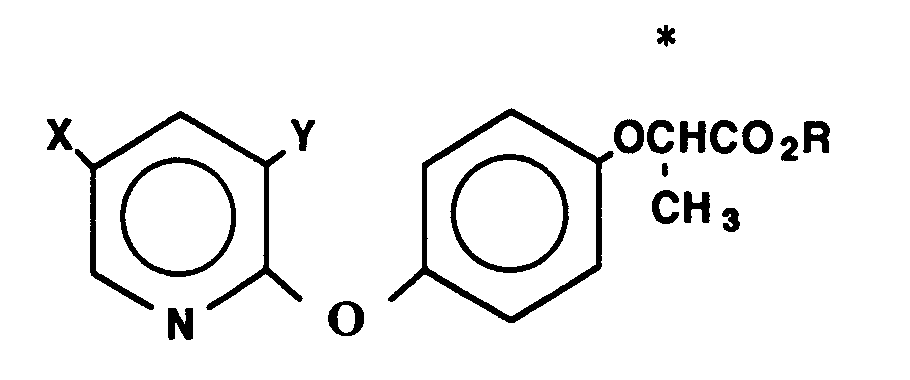
without a significant amount of racemization,
wherein - X
- represents Cl, Br, I or CF₃,
- Y
- represents H, F or Cl, provided that when Y is H, X is CF₃, and
- R
- represents straight, branched or cyclic, saturated or unsaturated hydrocarbon groups of up to and including 8 carbon atoms,
- As to the substituents X and Y, X is preferably CF₃ and Y is preferably Cl or F. As to the ester, R is preferably a branched- or straight-chain alkyl group of from 1 to 4 carbon atoms. The preferred anhydrous base is K₂CO₃, preferably with a particle size between 100 and 350 µm (microns).
- In another aspect of the present invention, the reaction can be optinally conducted in the presence of a phase-transfer catalyst. Preferably, the phase-transfer catalyst is a quaternary ammonium salt, most preferably a tetraalkyl ammonium halide.
- The present invention has the advantage of simplifying the process for the preparation of optically active R-enantiomer of 2-(4-(pyridinyl-2-oxy)phenoxy)propionate ester by eliminating the need for solvent recovery and recycling operations. By eliminating the solvent, a savings in raw material cost and an effective increase in reactor capacity are achieved. Furthermore, when preparing optically active R-enantiomers, the present process provides a reduction in the amount of racemization experienced in comparison to those reactions conducted, for example, in DMSO.
- It is suggested in FR-A-2 412 532 and DE-A-2 732 846 that pyridinyloxyphenyl ethers may be prepared in a solvent free process. However, in these publications it is explicitly stated that the preparation of these esters is preferably carried out in a polar organic solvent. In addition 2-fluoropyridine derivatives are not disclosed in connection with the absence of a solvent in these publications. Finally, it is known from US-A-4 266 063 that [4-[5-(trifluoromethyl)-2-pyridinyloxy]phenoxy]-2-propanoate may be prepared from hydroquinone, 2-chloro-5-trifluoromethyl-pyridine and methyl-2-bromopropionate in the presence of K₂CO₃ and in the absence of a solvent. However, if a 2-chloropyridine derivative is used instead of a 2-fluoropyridine in the process of the present invention a much slower reaction accompanied by significant amounts of hydrolysis of the ester to the acid, occurs. The production of this acid byproduct entails either awkward physical separations, additional reactions to reesterify the acid byproduct, or the addition of solvents which partially defeat the simplification of the process achieved by removal the solvent in the first place.
- The substituent R, as used herin, is meant to designate straight, branched or cyclic, saturated or unsaturated hydrocarbon groups of up to and including 8 carbon atoms, such as, for example, methyl, ethyl, propyl, iso-propyl, butyl, iso-butyl, sec-butyl, hexyl, ethylhexyl, octyl, allyl, cyclohexyl and the like.
- The 2-fluoropyridine starting materials are known compounds and can be prepared by known methods; see, for example, U.S. Patent Nos. 4 625 035, 4 745 193 and 4 851 539. Similarly, the 2-(4-hydroxyphenoxy)propionate esters are known compounds and can be prepared by conventional synthetic procedures.
- The 2-fluoropyridines can be contacted with the 2-(4-hydroxyphenoxy)propionate ester in about equimolar ratios ranging from 0.9:1 to 1.5:1, more preferably from 1:1 to 1.15:1 (propionate ester:fluoropyridine).
- The anhydrous base is used to prepare and maintain the (hydroxyphenoxy)propionate ester in its reactive anionic or phenolate form during its reaction with the fluoropyridine, while avoiding the undesirable hydrolysis of the ester functionality. In addition, the anhydrous base should be unreactive with the fluoropyridine so as not to compete with the desired coupling reaction, particularly if an excess of the base be employed. Any anhydrous base that meets these criterion can be employed.
- The alkali metal (Li, Na, K) carbonates are among the preferred anhydrous bases with potassium carbonate being most preferred.
- The amount of anhydrous base employed in the present process can range from 1 to 5 moles of base and higher per mole of (hydroxyphenoxy)propionate ester. Generally from 1.1 to 1.5 moles of base per mole of (hydroxyphenoxy)propionate ester is preferred.
- The alkali metal carbonates are granular materials and the rate of the coupling reaction has been found to be dependent on particle size. In general, the smaller the particle size, the faster the reaction is completed. However, if the particle size becomes too small, stirring becomes difficult and ester hydrolysis increases. Particle sizes from 75 to 500 microns have been found to give acceptable rates without unacceptable levels of ester hydrolysis. Particles in the range of 100 to 350 microns are preferred.
- The contacting of the 2-fluoropyridine and the 2-(4-hydroxyphenoxy)propionate ester is carried out at temperatures ranging from 55 to 100°C, preferably from 75 to 90°C. Higher temperatures tend to increase the amount of ester hydrolysis. The contacting is normally carried out at ambient pressures with stirring or other means of agitation.
- In many instances, the order of addition of the reactants is inconsequential with respect to the final results. In the present process, however, it has been found to be beneficial to add the (hydroxyphenoxy)propionate ester to a mixture of the fluoropyridine and the base. By adding the (hydroxyphenoxy)propionate to a mixture of the fluoropyridine and base rather than by adding the fluoropyridine to a mixture of (hydroxyphenoxy)propionate and base, the amount of ester hydrolysis is reduced.
- The contacting of the fluoropyridine and the (hydroxyphenoxy)propionate ester may optionally be conducted in the presence of a catalytic amount of phase transfer-catalyst. The term "phase-transfer catalyst" is intended to mean a material which catalyzes a reaction by the transfer of reactants from one phase to another. Phase-transfer catalysts suitable for use in the present process include quaternary ammonium and phosphonium salts. Suitable quaternary ammonium and phosphonium salts normally have an aggregate carbon content of at least 4 carbons to about 31 carbons, preferably from 4 carbons to 16 carbons. The ammonium salts are currently preferred over the phosphonium salts due to cost and commercial availability. Suitable catalysts are, for example, the tetramethyl, benzyltriethyl, tetra-n-butyl and tri-n-butylmethyl ammonium salts, most preferably the tetramethyl and tetra-n-butyl ammonium salts.
- The phase-transfer catalysts can be used in the process in small but catalytic amounts. For example, amounts from 0.1 to 20 mole percent, based on the reactants, are suitable but amounts of from 0.1 to 10 mole percent are generally preferred. Amounts from 1 to 6 mole percent are most preferred. The use of a phase-transfer catalyst results in a reduction of ester hydrolysis. Thus, when a phase-transfer catalyst is employed, the order of addition of the reactants is of significantly less consequence.
- The coupling reaction can be carried out by vigorously mixing the 2-fluoropyridine, the 2-(4-hydroxyphenoxy)propionate ester, the anhydrous base and optionally a phase-transfer catalyst and by heating the mixture. If a phase transfer-catalyst is used, the order of mixing the components is not critical. Without a phase-transfer catalyst, it is beneficial to add the (hydroxyphenoxy)propionate ester to a mixture of anhydrous base and fluoropyridine. Because no solvent is added to the reaction mixture, it is desirable that the requisite reaction temperature be maintained above the melting point of the crude product.
- After the reaction is complete, usually in from 1 to 24 hours (hr), the product 2-(4-(pyridinyl-2-oxy)phenoxy)propionate ester is recovered by conventional procedures. For example, any phase-transfer catalyst, residual base or inorganic salt produced during the reaction are typically removed by a simple aqueous wash, ion-exchange treatment, filtration, aqueous extraction or the like. The product can be recovered and purified by routine techniques such as phase separation, extraction, distillation or recrystallization.
- The following examples illustrate the present invention in a manner by which it can be practiced but, as such, should not be construed as limitations upon the overall scope of the same.
-

A 500 milliliter (mL) round-bottom flask was equipped with a mechanical paddle stirrer, an infrared heater connected to a thermocouple temperature controller and a drying tube. Methyl 2-(4-hydroxyphenoxy)propionate (103 grams (g); 0.5 moles) was introduced into the flask and heating was initiated to melt the solid. Stirring was begun and powdered anhydrous Na₂CO₃ (74.2 g; 0.70 moles) was added. After 5 minutes (min), the temperature was about 80°C and the evolution of gas was proceeding. Tetra-n-butylammonium bromide (4.8 g; 0.015 moles) was added, followed by 100 g (0.5 moles) of 2-fluoro-3-chloro-5-trifluoromethylpyridine. After 70 min at 80°C, the temperature was raised to 90°C for an additional 230 min. - The reaction mixture was allowed to cool and 750 mL of water and 500 mL of CH₂Cl₂ were added. After mixing, the layers were separated. The aqueous layer was extracted with 50 mL of CH₂Cl₂ and the combined organic layers were washed with 50 mL of water. The solvent was evaporated under reduced pressure to give 200.4 g of viscous oil. After 3 days, the oil began to crystallize. The product was recrystallized from methanol and dried to give 148.3 g of white solid, mp 55.5-56.5°C.
-

A 22 liter (L), 3-necked round-bottom flask with a bottom outlet was fitted with a mechanical stirrer, a condenser topped with a nitrogen inlet, and an addition funnel. Through the funnel, 6.546 kilograms (kg) (33.13 moles) of molten methyl 2-(4-hydroxyphenoxy)propionate, 6.571 kg (47.55 moles) of anhydrous K₂CO₃ and 319 g (0.99 moles) of tetra-n-butylammonium bromide were added to the reactor. Under constant agitation, the slurry was heated to 66°C with a steam-water mixture controlled by a microprocessor and 6.026 kg (32.93 moles) of 2,3-difluoro-5-trifluoromethylpyridine was added over 15 min. The reaction mixture was heated for 13 hours (hr) at 70-75°C after which the product was washed 5 times using a total 37 L of hot water. The washed product was stripped of residual water using a rotary evaporator at 75°C at a reduced pressure of 30 millimeters (mm) of mercury (4 kPa). A total 10.7 kg of product was collected having a purity of 97.9 percent. -

In a 1L flask equipped with a mechanical stirrer, condenser and addition funnel was charged 183 g (1.0 mole) of 2,3-difluoro-5-trifluoromethylpyridine and 193 g (1.4 moles) of anhydrous K₂CO₃ with a particle size range between 100 and 350 microns. Under constant agitation, the slurry was heated to 65°C and 198 g (1.0 moles) of molten methyl R-2-(4-hydroxyphenoxy)propionate (R/S = 93/7) was gradually added. The reaction mixture was heated for 16 hr at 85°C and was subsequently washed 5 times using hot water. The washed product was stripped of residual water using a rotary evaporator at 75°C and 30 mm Hg (4 kPa). Product having a purity of 99.2 percent and an R/S ratio of 93/7 (no racemization) was recovered in a 96 percent yield.

wherein
X and Y are as previously defined,
with from 0.9 to 1.5 equivalents of an (hydroxyphenoxy)propionate ester of the formula:

wherein
R is as previously defined, at a temperature between 55 and 100°C in the presence of an anhydrous base in an amount of from 1 to 5 moles per base of (hydroxyphenoxy)propionate ester and in the absence of an added solvent; and recovering said 2-(4-(pyridinyl-2-oxy)phenoxy)propionate ester. The "*" denotes a chiral carbon atom. Compounds with such chiral carbon atoms can exist as enantiomers, i.e., mirror image isomers that are not superimposable.
Claims (8)
- A process for the preparation of an optically active R-enantiomer of a 2-(4-(pyridinyl-2-oxy)phenoxy)propionate ester of the formula:

whereinX represents Cl, Br, I or CF₃,Y represents H, F or Cl, provided that when Y is H, X is CF₃, andR represents straight, branched or cyclic, saturated or unsaturated hydrocarbon groups of up to and including 8 carbon atoms,characterized by contacting a 2-fluoropyridine of the formula:
X and Y are as previously defined,
with from 0.9 to 1.5 equivalents of an (hydroxyphenoxy)(propionate ester of the formula
R is as previously defined, at a temperature between 55 and 100°C in the presence of an anhydrous base in an amount of from 1 to 5 moles of base per mole of (hydroxyphenoxy)propionate ester and in the absence of an added solvent; an recovering said 2-(4-(pyridinyl-2-oxy)phenoxy)propionate ester. - The process of Claim 1 in which X is CF₃, and Y is F or Cl.
- The process of Claim 1 or 2 in which R is a branched- or straight-chain alkyl group of from 1 to 4 carbon atoms.
- The process of any of the preceding claims in which the anhydrous base is an alkali metal carbonate.
- The process of Claim 4 in which the alkali metal carbonate is K₂CO₃.
- The process of Claim 4 or 5 in which the alkali metal carbonate has a particle size range from 100 to 350 µm (microns).
- The process of any of the preceding claims in which a catalytic amount of a phase-transfer catalyst is employed.
- The process of Claim 7 in which the phase-transfer catalyst is a quaternary ammonium salt having an aggregate carbon content of at least 4 carbons to 31 carbons.
Applications Claiming Priority (2)
| Application Number | Priority Date | Filing Date | Title |
|---|---|---|---|
| US07/471,347 US5049675A (en) | 1990-01-29 | 1990-01-29 | Solvent-free process for the preparation of ((pyridinyloxy)phenoxy) propionate derivatives |
| US471347 | 1990-01-29 |
Publications (3)
| Publication Number | Publication Date |
|---|---|
| EP0439857A2 EP0439857A2 (en) | 1991-08-07 |
| EP0439857A3 EP0439857A3 (en) | 1991-11-21 |
| EP0439857B1 true EP0439857B1 (en) | 1994-12-21 |
Family
ID=23871278
Family Applications (1)
| Application Number | Title | Priority Date | Filing Date |
|---|---|---|---|
| EP90203426A Expired - Lifetime EP0439857B1 (en) | 1990-01-29 | 1990-12-19 | A solvent-free process for the preparation of ((pyridinyloxy)phenoxy) propionate derivatives |
Country Status (10)
| Country | Link |
|---|---|
| US (1) | US5049675A (en) |
| EP (1) | EP0439857B1 (en) |
| JP (1) | JPH0770071A (en) |
| KR (1) | KR910014354A (en) |
| AU (1) | AU6999391A (en) |
| CA (1) | CA2035107A1 (en) |
| DE (1) | DE69015346T2 (en) |
| ES (1) | ES2065473T3 (en) |
| HU (1) | HUT56067A (en) |
| IL (1) | IL97077A (en) |
Families Citing this family (2)
| Publication number | Priority date | Publication date | Assignee | Title |
|---|---|---|---|---|
| AU719087B2 (en) | 1998-03-24 | 2000-05-04 | Syngenta Participations Ag | Process for preparation of propionic acid derivatives |
| CN102977010B (en) * | 2012-11-26 | 2014-05-28 | 台州学院 | Preparation method of 2-[4-(5-chloro-3-fluoro-2-pyridyloxy)phenoxy]propionate |
Family Cites Families (7)
| Publication number | Priority date | Publication date | Assignee | Title |
|---|---|---|---|---|
| DK154074C (en) * | 1974-10-17 | 1989-02-27 | Ishihara Sangyo Kaisha | ALFA- (4- (5 OR 3.5 SUBSTITUTED PYRIDYL-2-OXY) -PHENOXY) -ALKANE CARBOXYLIC ACIDS OR DERIVATIVES THEREOF USED AS HERBICIDES, HERBICIDES AND PROCEDURES |
| US4133675A (en) * | 1976-07-23 | 1979-01-09 | Ciba-Geigy Corporation | Pyridyloxy-phenoxy-alkanecarboxylic acid derivatives which are effective as herbicides and as agents regulating plant growth |
| US4753673A (en) * | 1977-07-22 | 1988-06-28 | The Dow Chemical Company | Trifluoromethyl pyridinyloxyphenoxy and pyridinylthiophenoxy propanoic acids and propanols and derivatives thereof and methods of herbicidal use |
| FR2412532A1 (en) * | 1977-12-23 | 1979-07-20 | Ciba Geigy Ag | 5'-Tri:fluoromethyl-2'-pyridyl-oxy-4-phenoxy propionic acid derivs. - are selective herbicides and plant growth regulators e.g. to control tobacco sucker growth |
| US4266063A (en) * | 1979-12-17 | 1981-05-05 | E. I. Du Pont De Nemours And Company | Process for preparing substituted pyridinyloxy ether intermediate |
| US4565568A (en) * | 1982-06-18 | 1986-01-21 | The Dow Chemical Company | Pyridyl(oxy/thio)phenoxy compounds, herbicidal compositions and methods |
| ZA848416B (en) * | 1983-11-10 | 1986-06-25 | Dow Chemical Co | Fluorophenoxy compounds,herbicidal compositions and methods |
-
1990
- 1990-01-29 US US07/471,347 patent/US5049675A/en not_active Expired - Lifetime
- 1990-12-19 ES ES90203426T patent/ES2065473T3/en not_active Expired - Lifetime
- 1990-12-19 DE DE69015346T patent/DE69015346T2/en not_active Expired - Fee Related
- 1990-12-19 EP EP90203426A patent/EP0439857B1/en not_active Expired - Lifetime
-
1991
- 1991-01-25 JP JP2373891A patent/JPH0770071A/en active Pending
- 1991-01-25 AU AU69993/91A patent/AU6999391A/en not_active Abandoned
- 1991-01-28 HU HU91291A patent/HUT56067A/en unknown
- 1991-01-28 KR KR1019910001392A patent/KR910014354A/en not_active Withdrawn
- 1991-01-28 IL IL9707791A patent/IL97077A/en not_active IP Right Cessation
- 1991-01-28 CA CA002035107A patent/CA2035107A1/en not_active Abandoned
Also Published As
| Publication number | Publication date |
|---|---|
| IL97077A (en) | 1995-03-15 |
| ES2065473T3 (en) | 1995-02-16 |
| CA2035107A1 (en) | 1991-07-30 |
| US5049675A (en) | 1991-09-17 |
| IL97077A0 (en) | 1992-03-29 |
| DE69015346T2 (en) | 1995-05-04 |
| AU6999391A (en) | 1991-08-01 |
| DE69015346D1 (en) | 1995-02-02 |
| EP0439857A2 (en) | 1991-08-07 |
| HUT56067A (en) | 1991-07-29 |
| EP0439857A3 (en) | 1991-11-21 |
| JPH0770071A (en) | 1995-03-14 |
| KR910014354A (en) | 1991-08-31 |
Similar Documents
| Publication | Publication Date | Title |
|---|---|---|
| KR0170779B1 (en) | Process for preparing higher alkyl esters of carboxylic acids | |
| US4665212A (en) | Process for preparing 2-(4-hydroxyphenoxy) alkanoic acid compounds | |
| US5049675A (en) | Solvent-free process for the preparation of ((pyridinyloxy)phenoxy) propionate derivatives | |
| JP3287845B2 (en) | Method for improving the synthesis of 2,6-dichloro-5-fluoronicotinic acid and 2,6-dichloro-5-fluoronicotinoyl chloride | |
| US4774355A (en) | Process for preparing pentaerythritol-tetrakis(3-alkylthio-propionate) | |
| EP0441457B1 (en) | Preparation of higher alkyl esters of carboxylic acids | |
| EP0634409A1 (en) | Process of producing 2-cyano-4-oxo-4H-benzopyran compounds | |
| CN121039103A (en) | Preparation method of 2-(pyridin-2-yloxymethyl)phenylacetic acid ester | |
| CA1131249A (en) | Process for the preparation of optically active aryloxyalkanoic acid compounds | |
| US5214150A (en) | Preparation of higher alkylesters of carboxylic acids | |
| IE49330B1 (en) | Process for producing substituted 4-(pyridyl-2-oxy)phenoxy-alkanecarboxylic acid or its derivatives | |
| JP2935431B2 (en) | Process for producing D (+)-2- (4-acetylphenoxy) propionates | |
| JPS6121229B2 (en) | ||
| EP0627421B1 (en) | Method of preparing 2-chloro-pyridinemethanol | |
| US4681941A (en) | Method of preparing esters of aryloxyphenoxy propanoic acid | |
| JPH0525876B2 (en) | ||
| JPS632954B2 (en) | ||
| JPH0720939B2 (en) | Method for producing alkoxypyridine-1-oxide compound | |
| IL104135A (en) | Process for the manufacture of monohalomaleate and monohalofumarate compounds from dihalosuccinate compounds using a phase-transfer catalyst | |
| JPH0372054B2 (en) | ||
| JPH01203369A (en) | Improved production of 3-((4-bromo-2- fluorophenyl)methyl)-3, 4-dihydro-4-oxo-1- phthaladinic acid | |
| CN110452165A (en) | A kind of preparation method of 2- picoline -4- formic acid | |
| JPH10114747A (en) | Method for producing biphenylmethylalkylamide pyridine derivative | |
| JPH0242039A (en) | Fluorophenoxyalkane derivative | |
| JPS5998046A (en) | N-(substituted-cyclohexyloxyphenyl)-alpha-amino acid compound and hypolipemic agent containing said compound |
Legal Events
| Date | Code | Title | Description |
|---|---|---|---|
| PUAI | Public reference made under article 153(3) epc to a published international application that has entered the european phase |
Free format text: ORIGINAL CODE: 0009012 |
|
| AK | Designated contracting states |
Kind code of ref document: A2 Designated state(s): CH DE ES FR GB IT LI NL |
|
| PUAL | Search report despatched |
Free format text: ORIGINAL CODE: 0009013 |
|
| AK | Designated contracting states |
Kind code of ref document: A3 Designated state(s): CH DE ES FR GB IT LI NL |
|
| 17P | Request for examination filed |
Effective date: 19920520 |
|
| 17Q | First examination report despatched |
Effective date: 19920915 |
|
| GRAA | (expected) grant |
Free format text: ORIGINAL CODE: 0009210 |
|
| AK | Designated contracting states |
Kind code of ref document: B1 Designated state(s): CH DE ES FR GB IT LI NL |
|
| ITF | It: translation for a ep patent filed | ||
| REF | Corresponds to: |
Ref document number: 69015346 Country of ref document: DE Date of ref document: 19950202 |
|
| REG | Reference to a national code |
Ref country code: ES Ref legal event code: FG2A Ref document number: 2065473 Country of ref document: ES Kind code of ref document: T3 |
|
| ET | Fr: translation filed | ||
| PLBE | No opposition filed within time limit |
Free format text: ORIGINAL CODE: 0009261 |
|
| STAA | Information on the status of an ep patent application or granted ep patent |
Free format text: STATUS: NO OPPOSITION FILED WITHIN TIME LIMIT |
|
| 26N | No opposition filed | ||
| PG25 | Lapsed in a contracting state [announced via postgrant information from national office to epo] |
Ref country code: GB Effective date: 19951219 |
|
| PG25 | Lapsed in a contracting state [announced via postgrant information from national office to epo] |
Ref country code: ES Free format text: LAPSE BECAUSE OF EXPIRATION OF PROTECTION Effective date: 19951220 |
|
| PGFP | Annual fee paid to national office [announced via postgrant information from national office to epo] |
Ref country code: CH Payment date: 19951231 Year of fee payment: 6 |
|
| PG25 | Lapsed in a contracting state [announced via postgrant information from national office to epo] |
Ref country code: NL Effective date: 19960701 |
|
| GBPC | Gb: european patent ceased through non-payment of renewal fee |
Effective date: 19951219 |
|
| PG25 | Lapsed in a contracting state [announced via postgrant information from national office to epo] |
Ref country code: FR Effective date: 19960830 |
|
| NLV4 | Nl: lapsed or anulled due to non-payment of the annual fee |
Effective date: 19960701 |
|
| PG25 | Lapsed in a contracting state [announced via postgrant information from national office to epo] |
Ref country code: DE Effective date: 19960903 |
|
| REG | Reference to a national code |
Ref country code: FR Ref legal event code: ST |
|
| PG25 | Lapsed in a contracting state [announced via postgrant information from national office to epo] |
Ref country code: LI Effective date: 19961231 Ref country code: CH Effective date: 19961231 |
|
| REG | Reference to a national code |
Ref country code: CH Ref legal event code: PL |
|
| REG | Reference to a national code |
Ref country code: ES Ref legal event code: FD2A Effective date: 20010301 |
|
| PG25 | Lapsed in a contracting state [announced via postgrant information from national office to epo] |
Ref country code: IT Free format text: LAPSE BECAUSE OF NON-PAYMENT OF DUE FEES;WARNING: LAPSES OF ITALIAN PATENTS WITH EFFECTIVE DATE BEFORE 2007 MAY HAVE OCCURRED AT ANY TIME BEFORE 2007. THE CORRECT EFFECTIVE DATE MAY BE DIFFERENT FROM THE ONE RECORDED. Effective date: 20051219 |