EP0438796B1 - Process for the enantioselection synthesis of alkylated oxindoles used as intermediates in the preparation of physostigmine - Google Patents
Process for the enantioselection synthesis of alkylated oxindoles used as intermediates in the preparation of physostigmine Download PDFInfo
- Publication number
- EP0438796B1 EP0438796B1 EP90125644A EP90125644A EP0438796B1 EP 0438796 B1 EP0438796 B1 EP 0438796B1 EP 90125644 A EP90125644 A EP 90125644A EP 90125644 A EP90125644 A EP 90125644A EP 0438796 B1 EP0438796 B1 EP 0438796B1
- Authority
- EP
- European Patent Office
- Prior art keywords
- enantiomers
- oxindole
- solvent
- mixture
- primary amines
- Prior art date
- Legal status (The legal status is an assumption and is not a legal conclusion. Google has not performed a legal analysis and makes no representation as to the accuracy of the status listed.)
- Expired - Lifetime
Links
- 238000000034 method Methods 0.000 title claims abstract description 66
- 150000005623 oxindoles Chemical class 0.000 title claims abstract description 57
- 230000008569 process Effects 0.000 title claims abstract description 45
- 230000015572 biosynthetic process Effects 0.000 title claims abstract description 30
- 238000003786 synthesis reaction Methods 0.000 title claims abstract description 29
- PIJVFDBKTWXHHD-UHFFFAOYSA-N Physostigmine Natural products C12=CC(OC(=O)NC)=CC=C2N(C)C2C1(C)CCN2C PIJVFDBKTWXHHD-UHFFFAOYSA-N 0.000 title claims abstract description 22
- PIJVFDBKTWXHHD-HIFRSBDPSA-N physostigmine Chemical compound C12=CC(OC(=O)NC)=CC=C2N(C)[C@@H]2[C@@]1(C)CCN2C PIJVFDBKTWXHHD-HIFRSBDPSA-N 0.000 title claims abstract description 22
- 229960001697 physostigmine Drugs 0.000 title claims abstract description 22
- 239000000543 intermediate Substances 0.000 title description 5
- 238000002360 preparation method Methods 0.000 title description 3
- HBAQYPYDRFILMT-UHFFFAOYSA-N 8-[3-(1-cyclopropylpyrazol-4-yl)-1H-pyrazolo[4,3-d]pyrimidin-5-yl]-3-methyl-3,8-diazabicyclo[3.2.1]octan-2-one Chemical class C1(CC1)N1N=CC(=C1)C1=NNC2=C1N=C(N=C2)N1C2C(N(CC1CC2)C)=O HBAQYPYDRFILMT-UHFFFAOYSA-N 0.000 claims abstract description 52
- 150000003141 primary amines Chemical class 0.000 claims abstract description 48
- 150000001875 compounds Chemical class 0.000 claims abstract description 28
- 239000002253 acid Substances 0.000 claims abstract description 24
- 230000000707 stereoselective effect Effects 0.000 claims abstract description 23
- 150000003839 salts Chemical class 0.000 claims abstract description 16
- 239000002244 precipitate Substances 0.000 claims abstract description 14
- 150000007960 acetonitrile Chemical class 0.000 claims abstract description 12
- 239000000047 product Substances 0.000 claims abstract description 10
- UFHFLCQGNIYNRP-UHFFFAOYSA-N Hydrogen Chemical compound [H][H] UFHFLCQGNIYNRP-UHFFFAOYSA-N 0.000 claims abstract description 7
- 238000010531 catalytic reduction reaction Methods 0.000 claims abstract description 6
- YXFVVABEGXRONW-UHFFFAOYSA-N Toluene Chemical compound CC1=CC=CC=C1 YXFVVABEGXRONW-UHFFFAOYSA-N 0.000 claims description 59
- 239000000203 mixture Substances 0.000 claims description 52
- 239000011541 reaction mixture Substances 0.000 claims description 37
- 239000002904 solvent Substances 0.000 claims description 37
- WEVYAHXRMPXWCK-UHFFFAOYSA-N Acetonitrile Chemical group CC#N WEVYAHXRMPXWCK-UHFFFAOYSA-N 0.000 claims description 21
- YMWUJEATGCHHMB-UHFFFAOYSA-N Dichloromethane Chemical compound ClCCl YMWUJEATGCHHMB-UHFFFAOYSA-N 0.000 claims description 21
- 125000002496 methyl group Chemical group [H]C([H])([H])* 0.000 claims description 17
- 239000003960 organic solvent Substances 0.000 claims description 17
- 125000001797 benzyl group Chemical group [H]C1=C([H])C([H])=C(C([H])=C1[H])C([H])([H])* 0.000 claims description 16
- PCKPVGOLPKLUHR-UHFFFAOYSA-N OH-Indolxyl Natural products C1=CC=C2C(O)=CNC2=C1 PCKPVGOLPKLUHR-UHFFFAOYSA-N 0.000 claims description 14
- 230000002051 biphasic effect Effects 0.000 claims description 14
- 239000012071 phase Substances 0.000 claims description 14
- 239000008346 aqueous phase Substances 0.000 claims description 13
- JYGFTBXVXVMTGB-UHFFFAOYSA-N indolin-2-one Chemical compound C1=CC=C2NC(=O)CC2=C1 JYGFTBXVXVMTGB-UHFFFAOYSA-N 0.000 claims description 13
- 239000000460 chlorine Substances 0.000 claims description 12
- 150000003892 tartrate salts Chemical class 0.000 claims description 12
- YONLFQNRGZXBBF-ZIAGYGMSSA-N (2r,3r)-2,3-dibenzoyloxybutanedioic acid Chemical compound O([C@@H](C(=O)O)[C@@H](OC(=O)C=1C=CC=CC=1)C(O)=O)C(=O)C1=CC=CC=C1 YONLFQNRGZXBBF-ZIAGYGMSSA-N 0.000 claims description 11
- 150000007529 inorganic bases Chemical class 0.000 claims description 10
- RENMDAKOXSCIGH-UHFFFAOYSA-N Chloroacetonitrile Chemical compound ClCC#N RENMDAKOXSCIGH-UHFFFAOYSA-N 0.000 claims description 9
- 239000001257 hydrogen Substances 0.000 claims description 8
- 229910052739 hydrogen Inorganic materials 0.000 claims description 8
- 229910052794 bromium Chemical group 0.000 claims description 7
- 229910052801 chlorine Inorganic materials 0.000 claims description 7
- 125000001495 ethyl group Chemical group [H]C([H])([H])C([H])([H])* 0.000 claims description 7
- UHOVQNZJYSORNB-UHFFFAOYSA-N Benzene Chemical compound C1=CC=CC=C1 UHOVQNZJYSORNB-UHFFFAOYSA-N 0.000 claims description 6
- WKBOTKDWSSQWDR-UHFFFAOYSA-N Bromine atom Chemical group [Br] WKBOTKDWSSQWDR-UHFFFAOYSA-N 0.000 claims description 6
- GDTBXPJZTBHREO-UHFFFAOYSA-N bromine Chemical group BrBr GDTBXPJZTBHREO-UHFFFAOYSA-N 0.000 claims description 6
- VLKZOEOYAKHREP-UHFFFAOYSA-N n-Hexane Chemical compound CCCCCC VLKZOEOYAKHREP-UHFFFAOYSA-N 0.000 claims description 6
- 125000002560 nitrile group Chemical group 0.000 claims description 6
- PIJVFDBKTWXHHD-DZGCQCFKSA-N [(3as,8br)-3,4,8b-trimethyl-2,3a-dihydro-1h-pyrrolo[2,3-b]indol-7-yl] n-methylcarbamate Chemical compound C12=CC(OC(=O)NC)=CC=C2N(C)[C@H]2[C@]1(C)CCN2C PIJVFDBKTWXHHD-DZGCQCFKSA-N 0.000 claims description 5
- 230000003197 catalytic effect Effects 0.000 claims description 5
- 239000003795 chemical substances by application Substances 0.000 claims description 5
- 239000012458 free base Substances 0.000 claims description 5
- 125000000956 methoxy group Chemical group [H]C([H])([H])O* 0.000 claims description 5
- MVPPADPHJFYWMZ-UHFFFAOYSA-N chlorobenzene Chemical compound ClC1=CC=CC=C1 MVPPADPHJFYWMZ-UHFFFAOYSA-N 0.000 claims description 4
- 239000011261 inert gas Substances 0.000 claims description 4
- 125000002023 trifluoromethyl group Chemical group FC(F)(F)* 0.000 claims description 4
- WMJNKBXKYHXOHC-PMACEKPBSA-N (2S,3S)-2,3-dihydroxy-2,3-bis(2-methylbenzoyl)butanedioic acid Chemical compound C=1(C(=CC=CC1)C(=O)[C@]([C@](C(=O)O)(O)C(=O)C=1C(=CC=CC1)C)(O)C(=O)O)C WMJNKBXKYHXOHC-PMACEKPBSA-N 0.000 claims description 3
- REXUYBKPWIPONM-UHFFFAOYSA-N 2-bromoacetonitrile Chemical compound BrCC#N REXUYBKPWIPONM-UHFFFAOYSA-N 0.000 claims description 3
- VODKOOOHHCAWFR-UHFFFAOYSA-N 2-iodoacetonitrile Chemical compound ICC#N VODKOOOHHCAWFR-UHFFFAOYSA-N 0.000 claims description 3
- ZAMOUSCENKQFHK-UHFFFAOYSA-N Chlorine atom Chemical compound [Cl] ZAMOUSCENKQFHK-UHFFFAOYSA-N 0.000 claims description 3
- PXGOKWXKJXAPGV-UHFFFAOYSA-N Fluorine Chemical compound FF PXGOKWXKJXAPGV-UHFFFAOYSA-N 0.000 claims description 3
- CTQNGGLPUBDAKN-UHFFFAOYSA-N O-Xylene Chemical compound CC1=CC=CC=C1C CTQNGGLPUBDAKN-UHFFFAOYSA-N 0.000 claims description 3
- 125000001931 aliphatic group Chemical group 0.000 claims description 3
- 150000004945 aromatic hydrocarbons Chemical class 0.000 claims description 3
- 239000003849 aromatic solvent Substances 0.000 claims description 3
- 125000003118 aryl group Chemical group 0.000 claims description 3
- 125000001309 chloro group Chemical group Cl* 0.000 claims description 3
- 229960001270 d- tartaric acid Drugs 0.000 claims description 3
- 230000005595 deprotonation Effects 0.000 claims description 3
- 238000010537 deprotonation reaction Methods 0.000 claims description 3
- 239000011737 fluorine Substances 0.000 claims description 3
- 229910052731 fluorine Inorganic materials 0.000 claims description 3
- 150000002431 hydrogen Chemical class 0.000 claims description 3
- 125000000391 vinyl group Chemical group [H]C([*])=C([H])[H] 0.000 claims description 3
- 239000008096 xylene Substances 0.000 claims description 3
- XDTMQSROBMDMFD-UHFFFAOYSA-N Cyclohexane Chemical compound C1CCCCC1 XDTMQSROBMDMFD-UHFFFAOYSA-N 0.000 claims description 2
- 239000012298 atmosphere Substances 0.000 claims description 2
- 239000003054 catalyst Substances 0.000 abstract description 40
- 230000000694 effects Effects 0.000 abstract description 6
- FEWJPZIEWOKRBE-UHFFFAOYSA-N Tartaric acid Natural products [H+].[H+].[O-]C(=O)C(O)C(O)C([O-])=O FEWJPZIEWOKRBE-UHFFFAOYSA-N 0.000 abstract description 4
- 235000002906 tartaric acid Nutrition 0.000 abstract description 4
- 239000011975 tartaric acid Substances 0.000 abstract description 4
- XEEBADQXIMNBQG-UHFFFAOYSA-N 3-(2-aminoethyl)-5-methoxy-1,3-dimethyl-2-indolone Chemical compound COC1=CC=C2N(C)C(=O)C(C)(CCN)C2=C1 XEEBADQXIMNBQG-UHFFFAOYSA-N 0.000 abstract description 3
- 238000006243 chemical reaction Methods 0.000 description 35
- HEMHJVSKTPXQMS-UHFFFAOYSA-M Sodium hydroxide Chemical compound [OH-].[Na+] HEMHJVSKTPXQMS-UHFFFAOYSA-M 0.000 description 30
- 239000000243 solution Substances 0.000 description 24
- SEZFNTZQMWJIAI-FLIBITNWSA-N (3z)-3-(1h-pyrrol-2-ylmethylidene)-1h-indol-2-one Chemical compound O=C1NC2=CC=CC=C2\C1=C\C1=CC=CN1 SEZFNTZQMWJIAI-FLIBITNWSA-N 0.000 description 22
- CPELXLSAUQHCOX-UHFFFAOYSA-M Bromide Chemical compound [Br-] CPELXLSAUQHCOX-UHFFFAOYSA-M 0.000 description 17
- 150000001412 amines Chemical class 0.000 description 16
- YLEIFZAVNWDOBM-ZTNXSLBXSA-N ac1l9hc7 Chemical compound C([C@H]12)C[C@@H](C([C@@H](O)CC3)(C)C)[C@@]43C[C@@]14CC[C@@]1(C)[C@@]2(C)C[C@@H]2O[C@]3(O)[C@H](O)C(C)(C)O[C@@H]3[C@@H](C)[C@H]12 YLEIFZAVNWDOBM-ZTNXSLBXSA-N 0.000 description 14
- IJGRMHOSHXDMSA-UHFFFAOYSA-N Atomic nitrogen Chemical compound N#N IJGRMHOSHXDMSA-UHFFFAOYSA-N 0.000 description 12
- 230000003287 optical effect Effects 0.000 description 12
- 238000011914 asymmetric synthesis Methods 0.000 description 11
- 239000000126 substance Substances 0.000 description 11
- 238000010268 HPLC based assay Methods 0.000 description 10
- VEXZGXHMUGYJMC-UHFFFAOYSA-M Chloride anion Chemical compound [Cl-] VEXZGXHMUGYJMC-UHFFFAOYSA-M 0.000 description 9
- OKKJLVBELUTLKV-UHFFFAOYSA-N Methanol Chemical compound OC OKKJLVBELUTLKV-UHFFFAOYSA-N 0.000 description 9
- XLYOFNOQVPJJNP-UHFFFAOYSA-N water Substances O XLYOFNOQVPJJNP-UHFFFAOYSA-N 0.000 description 9
- 239000002168 alkylating agent Substances 0.000 description 8
- 229940100198 alkylating agent Drugs 0.000 description 8
- 239000002585 base Substances 0.000 description 8
- 238000004128 high performance liquid chromatography Methods 0.000 description 8
- 238000003756 stirring Methods 0.000 description 7
- RTZKZFJDLAIYFH-UHFFFAOYSA-N Diethyl ether Chemical compound CCOCC RTZKZFJDLAIYFH-UHFFFAOYSA-N 0.000 description 6
- VEXZGXHMUGYJMC-UHFFFAOYSA-N Hydrochloric acid Chemical compound Cl VEXZGXHMUGYJMC-UHFFFAOYSA-N 0.000 description 6
- KWYUFKZDYYNOTN-UHFFFAOYSA-M Potassium hydroxide Chemical compound [OH-].[K+] KWYUFKZDYYNOTN-UHFFFAOYSA-M 0.000 description 6
- OIPILFWXSMYKGL-UHFFFAOYSA-N acetylcholine Chemical compound CC(=O)OCC[N+](C)(C)C OIPILFWXSMYKGL-UHFFFAOYSA-N 0.000 description 6
- 229960004373 acetylcholine Drugs 0.000 description 6
- 238000005804 alkylation reaction Methods 0.000 description 6
- 239000007864 aqueous solution Substances 0.000 description 6
- 230000001965 increasing effect Effects 0.000 description 6
- 229910052757 nitrogen Inorganic materials 0.000 description 6
- OEFXMHVYDQGQRW-UHFFFAOYSA-N 5-methoxy-1,3-dimethyl-3h-indol-2-one Chemical compound COC1=CC=C2N(C)C(=O)C(C)C2=C1 OEFXMHVYDQGQRW-UHFFFAOYSA-N 0.000 description 5
- 102000012440 Acetylcholinesterase Human genes 0.000 description 5
- 108010022752 Acetylcholinesterase Proteins 0.000 description 5
- 229940022698 acetylcholinesterase Drugs 0.000 description 5
- 239000000544 cholinesterase inhibitor Substances 0.000 description 5
- 238000002474 experimental method Methods 0.000 description 5
- 239000012074 organic phase Substances 0.000 description 5
- 238000000926 separation method Methods 0.000 description 5
- 208000024827 Alzheimer disease Diseases 0.000 description 4
- FEWJPZIEWOKRBE-JCYAYHJZSA-N Dextrotartaric acid Chemical compound OC(=O)[C@H](O)[C@@H](O)C(O)=O FEWJPZIEWOKRBE-JCYAYHJZSA-N 0.000 description 4
- 230000029936 alkylation Effects 0.000 description 4
- 230000008901 benefit Effects 0.000 description 4
- 238000007796 conventional method Methods 0.000 description 4
- 239000000706 filtrate Substances 0.000 description 4
- 230000014509 gene expression Effects 0.000 description 4
- 150000002825 nitriles Chemical class 0.000 description 4
- 239000000758 substrate Substances 0.000 description 4
- JMRWLRFPUMZEGA-UHFFFAOYSA-N 5-ethoxy-1,3-dimethyl-3h-indol-2-one Chemical compound CCOC1=CC=C2N(C)C(=O)C(C)C2=C1 JMRWLRFPUMZEGA-UHFFFAOYSA-N 0.000 description 3
- 102000004190 Enzymes Human genes 0.000 description 3
- 108090000790 Enzymes Proteins 0.000 description 3
- LFQSCWFLJHTTHZ-UHFFFAOYSA-N Ethanol Chemical compound CCO LFQSCWFLJHTTHZ-UHFFFAOYSA-N 0.000 description 3
- XEKOWRVHYACXOJ-UHFFFAOYSA-N Ethyl acetate Chemical compound CCOC(C)=O XEKOWRVHYACXOJ-UHFFFAOYSA-N 0.000 description 3
- KFZMGEQAYNKOFK-UHFFFAOYSA-N Isopropanol Chemical compound CC(C)O KFZMGEQAYNKOFK-UHFFFAOYSA-N 0.000 description 3
- WMFOQBRAJBCJND-UHFFFAOYSA-M Lithium hydroxide Chemical compound [Li+].[OH-] WMFOQBRAJBCJND-UHFFFAOYSA-M 0.000 description 3
- VYPSYNLAJGMNEJ-UHFFFAOYSA-N Silicium dioxide Chemical compound O=[Si]=O VYPSYNLAJGMNEJ-UHFFFAOYSA-N 0.000 description 3
- 210000003169 central nervous system Anatomy 0.000 description 3
- 239000007795 chemical reaction product Substances 0.000 description 3
- 230000001713 cholinergic effect Effects 0.000 description 3
- 125000004122 cyclic group Chemical group 0.000 description 3
- 125000006575 electron-withdrawing group Chemical group 0.000 description 3
- 229940088598 enzyme Drugs 0.000 description 3
- 238000001704 evaporation Methods 0.000 description 3
- 230000008020 evaporation Effects 0.000 description 3
- 230000006870 function Effects 0.000 description 3
- QKGYJVXSKCDGOK-UHFFFAOYSA-N hexane;propan-2-ol Chemical compound CC(C)O.CCCCCC QKGYJVXSKCDGOK-UHFFFAOYSA-N 0.000 description 3
- 239000002858 neurotransmitter agent Substances 0.000 description 3
- 239000003444 phase transfer catalyst Substances 0.000 description 3
- 239000002243 precursor Substances 0.000 description 3
- 125000001424 substituent group Chemical group 0.000 description 3
- 229960001367 tartaric acid Drugs 0.000 description 3
- 238000012546 transfer Methods 0.000 description 3
- KIUPCUCGVCGPPA-UHFFFAOYSA-N (5-methyl-2-propan-2-ylcyclohexyl) carbonochloridate Chemical compound CC(C)C1CCC(C)CC1OC(Cl)=O KIUPCUCGVCGPPA-UHFFFAOYSA-N 0.000 description 2
- LOCWWLLFHKDFLF-KFGLDPKJSA-M (s)-[(2r,4s,5r)-5-ethenyl-1-[[4-(trifluoromethyl)phenyl]methyl]-1-azoniabicyclo[2.2.2]octan-2-yl]-quinolin-4-ylmethanol;bromide Chemical compound [Br-].C([C@H]([C@H](C1)C=C)C[C@@H]2[C@@H](O)C=3C4=CC=CC=C4N=CC=3)C[N+]21CC1=CC=C(C(F)(F)F)C=C1 LOCWWLLFHKDFLF-KFGLDPKJSA-M 0.000 description 2
- ADHRNTVGCXNYKM-UHFFFAOYSA-N 1,3-dimethyl-5-phenylmethoxy-3h-indol-2-one Chemical compound C1=C2C(C)C(=O)N(C)C2=CC=C1OCC1=CC=CC=C1 ADHRNTVGCXNYKM-UHFFFAOYSA-N 0.000 description 2
- 125000000022 2-aminoethyl group Chemical group [H]C([*])([H])C([H])([H])N([H])[H] 0.000 description 2
- 125000006512 3,4-dichlorobenzyl group Chemical group [H]C1=C(Cl)C(Cl)=C([H])C(=C1[H])C([H])([H])* 0.000 description 2
- 125000006279 3-bromobenzyl group Chemical group [H]C1=C([H])C(=C([H])C(Br)=C1[H])C([H])([H])* 0.000 description 2
- 125000006281 4-bromobenzyl group Chemical group [H]C1=C([H])C(=C([H])C([H])=C1Br)C([H])([H])* 0.000 description 2
- 125000006283 4-chlorobenzyl group Chemical group [H]C1=C([H])C(=C([H])C([H])=C1Cl)C([H])([H])* 0.000 description 2
- XCQVCKFRFDYRJG-UHFFFAOYSA-N 6,7-dichloro-5-methoxy-2-phenyl-2,3-dihydroinden-1-one Chemical compound O=C1C=2C(Cl)=C(Cl)C(OC)=CC=2CC1C1=CC=CC=C1 XCQVCKFRFDYRJG-UHFFFAOYSA-N 0.000 description 2
- XKRFYHLGVUSROY-UHFFFAOYSA-N Argon Chemical compound [Ar] XKRFYHLGVUSROY-UHFFFAOYSA-N 0.000 description 2
- HEDRZPFGACZZDS-UHFFFAOYSA-N Chloroform Chemical compound ClC(Cl)Cl HEDRZPFGACZZDS-UHFFFAOYSA-N 0.000 description 2
- LRHPLDYGYMQRHN-UHFFFAOYSA-N N-Butanol Chemical compound CCCCO LRHPLDYGYMQRHN-UHFFFAOYSA-N 0.000 description 2
- NBIIXXVUZAFLBC-UHFFFAOYSA-N Phosphoric acid Chemical compound OP(O)(O)=O NBIIXXVUZAFLBC-UHFFFAOYSA-N 0.000 description 2
- 229910019020 PtO2 Inorganic materials 0.000 description 2
- CDBYLPFSWZWCQE-UHFFFAOYSA-L Sodium Carbonate Chemical compound [Na+].[Na+].[O-]C([O-])=O CDBYLPFSWZWCQE-UHFFFAOYSA-L 0.000 description 2
- QAOWNCQODCNURD-UHFFFAOYSA-N Sulfuric acid Chemical compound OS(O)(=O)=O QAOWNCQODCNURD-UHFFFAOYSA-N 0.000 description 2
- WYURNTSHIVDZCO-UHFFFAOYSA-N Tetrahydrofuran Chemical compound C1CCOC1 WYURNTSHIVDZCO-UHFFFAOYSA-N 0.000 description 2
- YKIOKAURTKXMSB-UHFFFAOYSA-N adams's catalyst Chemical compound O=[Pt]=O YKIOKAURTKXMSB-UHFFFAOYSA-N 0.000 description 2
- 238000001311 chemical methods and process Methods 0.000 description 2
- 239000003153 chemical reaction reagent Substances 0.000 description 2
- 239000012069 chiral reagent Substances 0.000 description 2
- NEHMKBQYUWJMIP-UHFFFAOYSA-N chloromethane Chemical compound ClC NEHMKBQYUWJMIP-UHFFFAOYSA-N 0.000 description 2
- 238000001816 cooling Methods 0.000 description 2
- 230000007423 decrease Effects 0.000 description 2
- 238000001212 derivatisation Methods 0.000 description 2
- 201000010099 disease Diseases 0.000 description 2
- 208000037265 diseases, disorders, signs and symptoms Diseases 0.000 description 2
- 229940079593 drug Drugs 0.000 description 2
- 239000003814 drug Substances 0.000 description 2
- OGPBJKLSAFTDLK-UHFFFAOYSA-N europium atom Chemical compound [Eu] OGPBJKLSAFTDLK-UHFFFAOYSA-N 0.000 description 2
- 150000004820 halides Chemical class 0.000 description 2
- 125000004435 hydrogen atom Chemical group [H]* 0.000 description 2
- 239000000463 material Substances 0.000 description 2
- -1 methyl halide Chemical class 0.000 description 2
- 230000011987 methylation Effects 0.000 description 2
- 238000007069 methylation reaction Methods 0.000 description 2
- 150000002894 organic compounds Chemical class 0.000 description 2
- 125000004095 oxindolyl group Chemical group N1(C(CC2=CC=CC=C12)=O)* 0.000 description 2
- BWHMMNNQKKPAPP-UHFFFAOYSA-L potassium carbonate Chemical compound [K+].[K+].[O-]C([O-])=O BWHMMNNQKKPAPP-UHFFFAOYSA-L 0.000 description 2
- 238000010926 purge Methods 0.000 description 2
- 238000000746 purification Methods 0.000 description 2
- 230000035484 reaction time Effects 0.000 description 2
- 238000001953 recrystallisation Methods 0.000 description 2
- 239000007787 solid Substances 0.000 description 2
- 229940124530 sulfonamide Drugs 0.000 description 2
- 150000003456 sulfonamides Chemical class 0.000 description 2
- QNYBOILAKBSWFG-SNVBAGLBSA-N (2s)-2-(phenylmethoxymethyl)oxirane Chemical compound C([C@H]1OC1)OCC1=CC=CC=C1 QNYBOILAKBSWFG-SNVBAGLBSA-N 0.000 description 1
- RYHBNJHYFVUHQT-UHFFFAOYSA-N 1,4-Dioxane Chemical compound C1COCCO1 RYHBNJHYFVUHQT-UHFFFAOYSA-N 0.000 description 1
- VHRHJUZJUZGSMY-UHFFFAOYSA-N 2-(1,3-dimethylindol-2-yl)ethanamine Chemical class C1=CC=C2C(C)=C(CCN)N(C)C2=C1 VHRHJUZJUZGSMY-UHFFFAOYSA-N 0.000 description 1
- CLBASJRFMLQNOX-UHFFFAOYSA-N 2-(5-methoxy-1,3-dimethylindol-2-yl)ethanamine Chemical compound COC1=CC=C2N(C)C(CCN)=C(C)C2=C1 CLBASJRFMLQNOX-UHFFFAOYSA-N 0.000 description 1
- LHTXNUDQFUSONG-UHFFFAOYSA-N 3-(ethylamino)-5-methoxy-1,3-dimethylindol-2-one Chemical compound C1=C(OC)C=C2C(NCC)(C)C(=O)N(C)C2=C1 LHTXNUDQFUSONG-UHFFFAOYSA-N 0.000 description 1
- BMYNFMYTOJXKLE-UHFFFAOYSA-N 3-azaniumyl-2-hydroxypropanoate Chemical compound NCC(O)C(O)=O BMYNFMYTOJXKLE-UHFFFAOYSA-N 0.000 description 1
- 0 CC(c(cc(cc1)O*)c1N1C)C1=O Chemical compound CC(c(cc(cc1)O*)c1N1C)C1=O 0.000 description 1
- KXDHJXZQYSOELW-UHFFFAOYSA-M Carbamate Chemical compound NC([O-])=O KXDHJXZQYSOELW-UHFFFAOYSA-M 0.000 description 1
- 239000004215 Carbon black (E152) Substances 0.000 description 1
- 108010009685 Cholinergic Receptors Proteins 0.000 description 1
- 235000021513 Cinchona Nutrition 0.000 description 1
- 241000157855 Cinchona Species 0.000 description 1
- 229910052693 Europium Inorganic materials 0.000 description 1
- 102000014415 Muscarinic acetylcholine receptor Human genes 0.000 description 1
- 108050003473 Muscarinic acetylcholine receptor Proteins 0.000 description 1
- 238000005481 NMR spectroscopy Methods 0.000 description 1
- 239000007832 Na2SO4 Substances 0.000 description 1
- 102000019315 Nicotinic acetylcholine receptors Human genes 0.000 description 1
- 108050006807 Nicotinic acetylcholine receptors Proteins 0.000 description 1
- 241000418087 Physostigma venenosum Species 0.000 description 1
- 206010039966 Senile dementia Diseases 0.000 description 1
- KEAYESYHFKHZAL-UHFFFAOYSA-N Sodium Chemical compound [Na] KEAYESYHFKHZAL-UHFFFAOYSA-N 0.000 description 1
- PMZURENOXWZQFD-UHFFFAOYSA-L Sodium Sulfate Chemical compound [Na+].[Na+].[O-]S([O-])(=O)=O PMZURENOXWZQFD-UHFFFAOYSA-L 0.000 description 1
- 239000007983 Tris buffer Substances 0.000 description 1
- JJSCUXAFAJEQGB-QMMMGPOBSA-N [(1s)-1-isocyanatoethyl]benzene Chemical compound O=C=N[C@@H](C)C1=CC=CC=C1 JJSCUXAFAJEQGB-QMMMGPOBSA-N 0.000 description 1
- PBCJIPOGFJYBJE-UHFFFAOYSA-N acetonitrile;hydrate Chemical compound O.CC#N PBCJIPOGFJYBJE-UHFFFAOYSA-N 0.000 description 1
- 102000034337 acetylcholine receptors Human genes 0.000 description 1
- 230000002378 acidificating effect Effects 0.000 description 1
- 150000007513 acids Chemical class 0.000 description 1
- 125000002015 acyclic group Chemical group 0.000 description 1
- 230000032683 aging Effects 0.000 description 1
- 239000000556 agonist Substances 0.000 description 1
- 230000001476 alcoholic effect Effects 0.000 description 1
- 229930013930 alkaloid Natural products 0.000 description 1
- 150000003797 alkaloid derivatives Chemical class 0.000 description 1
- 150000001347 alkyl bromides Chemical class 0.000 description 1
- 230000002152 alkylating effect Effects 0.000 description 1
- 150000001371 alpha-amino acids Chemical class 0.000 description 1
- 235000008206 alpha-amino acids Nutrition 0.000 description 1
- 229910000147 aluminium phosphate Inorganic materials 0.000 description 1
- 230000003466 anti-cipated effect Effects 0.000 description 1
- 229910052786 argon Inorganic materials 0.000 description 1
- 150000001491 aromatic compounds Chemical class 0.000 description 1
- 125000004429 atom Chemical group 0.000 description 1
- QVGXLLKOCUKJST-UHFFFAOYSA-N atomic oxygen Chemical compound [O] QVGXLLKOCUKJST-UHFFFAOYSA-N 0.000 description 1
- 210000003403 autonomic nervous system Anatomy 0.000 description 1
- 125000000051 benzyloxy group Chemical group [H]C1=C([H])C([H])=C(C([H])=C1[H])C([H])([H])O* 0.000 description 1
- 230000008512 biological response Effects 0.000 description 1
- 239000012455 biphasic mixture Substances 0.000 description 1
- 244000309464 bull Species 0.000 description 1
- 229940021260 by ache Drugs 0.000 description 1
- 150000004657 carbamic acid derivatives Chemical class 0.000 description 1
- 229910052799 carbon Inorganic materials 0.000 description 1
- 125000004432 carbon atom Chemical group C* 0.000 description 1
- 238000003442 catalytic alkylation reaction Methods 0.000 description 1
- 238000006555 catalytic reaction Methods 0.000 description 1
- 210000004027 cell Anatomy 0.000 description 1
- 239000000064 cholinergic agonist Substances 0.000 description 1
- 230000006378 damage Effects 0.000 description 1
- 230000007850 degeneration Effects 0.000 description 1
- 230000001419 dependent effect Effects 0.000 description 1
- 238000001514 detection method Methods 0.000 description 1
- 238000011161 development Methods 0.000 description 1
- 230000018109 developmental process Effects 0.000 description 1
- 238000004090 dissolution Methods 0.000 description 1
- 230000002255 enzymatic effect Effects 0.000 description 1
- 150000002170 ethers Chemical class 0.000 description 1
- 230000002964 excitative effect Effects 0.000 description 1
- 239000000284 extract Substances 0.000 description 1
- 230000002349 favourable effect Effects 0.000 description 1
- 238000001914 filtration Methods 0.000 description 1
- 210000000609 ganglia Anatomy 0.000 description 1
- 238000004817 gas chromatography Methods 0.000 description 1
- 150000002332 glycine derivatives Chemical class 0.000 description 1
- 239000001307 helium Substances 0.000 description 1
- 229910052734 helium Inorganic materials 0.000 description 1
- SWQJXJOGLNCZEY-UHFFFAOYSA-N helium atom Chemical compound [He] SWQJXJOGLNCZEY-UHFFFAOYSA-N 0.000 description 1
- 229930195733 hydrocarbon Natural products 0.000 description 1
- 150000002430 hydrocarbons Chemical class 0.000 description 1
- 238000005984 hydrogenation reaction Methods 0.000 description 1
- 230000007062 hydrolysis Effects 0.000 description 1
- 238000006460 hydrolysis reaction Methods 0.000 description 1
- 230000006872 improvement Effects 0.000 description 1
- 230000001939 inductive effect Effects 0.000 description 1
- 230000002401 inhibitory effect Effects 0.000 description 1
- 229910052500 inorganic mineral Inorganic materials 0.000 description 1
- 238000011835 investigation Methods 0.000 description 1
- 239000007788 liquid Substances 0.000 description 1
- 230000007246 mechanism Effects 0.000 description 1
- 239000003863 metallic catalyst Substances 0.000 description 1
- 229940050176 methyl chloride Drugs 0.000 description 1
- 239000011707 mineral Substances 0.000 description 1
- 230000004048 modification Effects 0.000 description 1
- 238000012986 modification Methods 0.000 description 1
- 210000000653 nervous system Anatomy 0.000 description 1
- 230000001537 neural effect Effects 0.000 description 1
- 210000000715 neuromuscular junction Anatomy 0.000 description 1
- 210000002569 neuron Anatomy 0.000 description 1
- 238000006386 neutralization reaction Methods 0.000 description 1
- 125000004433 nitrogen atom Chemical group N* 0.000 description 1
- 231100000252 nontoxic Toxicity 0.000 description 1
- 230000003000 nontoxic effect Effects 0.000 description 1
- 239000001301 oxygen Substances 0.000 description 1
- 229910052760 oxygen Inorganic materials 0.000 description 1
- 230000037361 pathway Effects 0.000 description 1
- 230000002093 peripheral effect Effects 0.000 description 1
- BASFCYQUMIYNBI-UHFFFAOYSA-N platinum Chemical compound [Pt] BASFCYQUMIYNBI-UHFFFAOYSA-N 0.000 description 1
- 229910000027 potassium carbonate Inorganic materials 0.000 description 1
- 230000001376 precipitating effect Effects 0.000 description 1
- 238000001556 precipitation Methods 0.000 description 1
- 230000000750 progressive effect Effects 0.000 description 1
- FVSKHRXBFJPNKK-UHFFFAOYSA-N propionitrile Chemical compound CCC#N FVSKHRXBFJPNKK-UHFFFAOYSA-N 0.000 description 1
- 150000003242 quaternary ammonium salts Chemical class 0.000 description 1
- 102000005962 receptors Human genes 0.000 description 1
- 108020003175 receptors Proteins 0.000 description 1
- 238000006722 reduction reaction Methods 0.000 description 1
- 238000010992 reflux Methods 0.000 description 1
- UQDJGEHQDNVPGU-UHFFFAOYSA-N serine phosphoethanolamine Chemical compound [NH3+]CCOP([O-])(=O)OCC([NH3+])C([O-])=O UQDJGEHQDNVPGU-UHFFFAOYSA-N 0.000 description 1
- 239000003579 shift reagent Substances 0.000 description 1
- 229910000029 sodium carbonate Inorganic materials 0.000 description 1
- 229910052938 sodium sulfate Inorganic materials 0.000 description 1
- 239000011877 solvent mixture Substances 0.000 description 1
- SFVFIFLLYFPGHH-UHFFFAOYSA-M stearalkonium chloride Chemical compound [Cl-].CCCCCCCCCCCCCCCCCC[N+](C)(C)CC1=CC=CC=C1 SFVFIFLLYFPGHH-UHFFFAOYSA-M 0.000 description 1
- 238000011915 stereoselective alkylation Methods 0.000 description 1
- 238000006467 substitution reaction Methods 0.000 description 1
- 239000004094 surface-active agent Substances 0.000 description 1
- 210000000225 synapse Anatomy 0.000 description 1
- 230000002194 synthesizing effect Effects 0.000 description 1
- 238000010189 synthetic method Methods 0.000 description 1
- YLQBMQCUIZJEEH-UHFFFAOYSA-N tetrahydrofuran Natural products C=1C=COC=1 YLQBMQCUIZJEEH-UHFFFAOYSA-N 0.000 description 1
- 239000012485 toluene extract Substances 0.000 description 1
- 125000003944 tolyl group Chemical group 0.000 description 1
- 238000006257 total synthesis reaction Methods 0.000 description 1
Classifications
-
- C—CHEMISTRY; METALLURGY
- C07—ORGANIC CHEMISTRY
- C07D—HETEROCYCLIC COMPOUNDS
- C07D209/00—Heterocyclic compounds containing five-membered rings, condensed with other rings, with one nitrogen atom as the only ring hetero atom
- C07D209/02—Heterocyclic compounds containing five-membered rings, condensed with other rings, with one nitrogen atom as the only ring hetero atom condensed with one carbocyclic ring
- C07D209/04—Indoles; Hydrogenated indoles
- C07D209/30—Indoles; Hydrogenated indoles with hetero atoms or with carbon atoms having three bonds to hetero atoms with at the most one bond to halogen, directly attached to carbon atoms of the hetero ring
- C07D209/32—Oxygen atoms
- C07D209/34—Oxygen atoms in position 2
Definitions
- This invention relates to a process for the stereoselective synthesis of (+)-physostigmine and (-)-physostigmine.
- the cholinergic neuronal system can be found in the central nervous system (CNS), in the autonomic nervous system, and in the skeletal motor system.
- Acetylcholine (ACh) is the neurotransmitter in all ganglia, the neuromuscular junction, and the post-ganglionic synapses of the cholinergic nervous system.
- Acetylcholine is normally an excitatory neurotransmitter that binds to nicotinic and muscarinic receptors.
- Acetylcholinesterase is an enzyme that hydrolyzes and thereby deactivates ACh after it binds to a receptor. This enzyme is present in all peripheral and central junctional sites and in certain cells of the body.
- acetylcholine receptors In some circumstances, it is desirable to stimulate acetylcholine receptors.
- One method involves the use of indirect agonists, such as anticholinesterase drugs, which inhibit the hydrolysis of ACh by AChE.
- anticholinesterase drugs which inhibit the hydrolysis of ACh by AChE.
- an anticholinesterase drug blocks AChE and inhibits the destruction of released ACh, a higher neurotransmitter level and increased biological response result.
- the alkaloid, physostigmine which can be isolated from the seeds of the Calabar bean, has been found to be particularly effective as an anticholinesterase drug.
- Physostigmine has a high affinity for AChE and is capable of inhibiting AChE for prolonged periods.
- cholinergic agonists such as the anticholinesterase drugs
- anticholinesterase drugs are useful in the treatment of Alzheimer's disease.
- drug treatment with anticholinesterase drugs has not proved entirely satisfactory.
- new forms of drugs for the treatment of this disease there is a need in the art for new forms of drugs for the treatment of this disease.
- the enantiomers of physostigmine and pharmaceutically active physostigmine-like compounds are under investigation for the treatment of Alzheimer's disease.
- a process for the stereoselective synthesis of the enantiomers In order to satisfy the need for compounds having the highest pharmaceutical activity, there exists a need in the art for a process for the stereoselective synthesis of the enantiomers.
- the enantiomer (-)-physostigmine is of current interest, and while methods for preparing physostigmine and physostigmine-like compounds have been proposed, there exists a need in the art for a stereoselective process for producing the S- or (-)-forms.
- Chem. Pharm. Bull. 30 (1982), 2641-2643, discloses a process to prepare (-)-physostigmine starting from (s)-(-)-benzyl-2,3-epoxypropyl ether.
- the compound 1,3-dimethyl-5-methoxyoxindolylethylamine also referred to as 3-(2-aminoethyl)-1,3-dihydro-1,3-dimethyl-5-methoxy-2H-indol-2-one
- 3-(2-aminoethyl)-1,3-dihydro-1,3-dimethyl-5-methoxy-2H-indol-2-one is an important intermediate in a recently discovered method of synthesizing (-)-physostigmine (B. Schonenberger and A. Brossi, Helvetica Chimica Acta 69, 1486 (1986)). While this amine can be prepared using conventional techniques, a racemic mixture is usually formed. Resolution of the racemic amine mixture into its R and S components makes it possible to synthesize (+)-physostigmine and (-)-physostigmine.
- a process for the stereoselective synthesis of the amines and their precursors could provide certain advantages. Such a process could reduce or eliminate the need for resolving mixtures of enantiomers. While stereoselective syntheses that are catalyzed by enzymes are highly enantioselective, non-enzymatic processes have a wide range of selectivity. Accordingly, the results obtained in processes based on synthetic chemical techniques are generally unpredictable, and successful results in stereoselective syntheses have been difficult to achieve.
- this invention aids in fulfilling these needs in the art by providing a process for the stereoselective synthesis of physostigmine of the formula wherein the process comprises:
- the process is used to produce (-)physostigmine from the S-form of 1,3-dimethyl-5-methoxyoxindolyl-ethylamine.
- the asymmetric synthesis of the present invention involves conversion of an achiral substrate to a chiral product using a chiral reagent.
- a prochiral function serves as the precursor for a chiral product during the reaction.
- the following nomenclature and conventions are employed in describing this invention.
- the expression "asymmetric synthesis” means a synthesis in which an asymmetric atom, instead of being in a molecule before the commencement of the synthesis, is introduced into the molecule in the course of chemical reaction.
- the asymmetric synthesis of the present invention is a reaction in which an achiral unit in a substrate molecule is converted by a chiral reagent into a chiral unit in such a manner that the stereoisomeric products are produced in unequal amounts.
- enantioselective synthesis means a synthesis that produces one enantiomer of a given structure in considerable predominance over the other possible enantiomer.
- the enantioselective synthesis of the present invention typically produces the predominant enantiomer in an amount of 70% to 90%, usually 85% to 88%, of the total enantiomers formed as products of the synthesis.
- enantiomeric mixture and “mixture of enantiomers” are used interchangeably to refer to racemic modifications of the enantiomers.
- the expressions also include solutions containing both of the enantiomers, wherein the solutions exhibit either (+) or (-) optical rotation as observed and measured with a polarimeter.
- the heavy line in the form of a wedge in the formulas herein signifies that the substituents are above the average plane of the ring system in connection with which the wedge appears.
- the heavy broken lines in the form of a wedge signify that the substituents are below the average plane of the ring system.
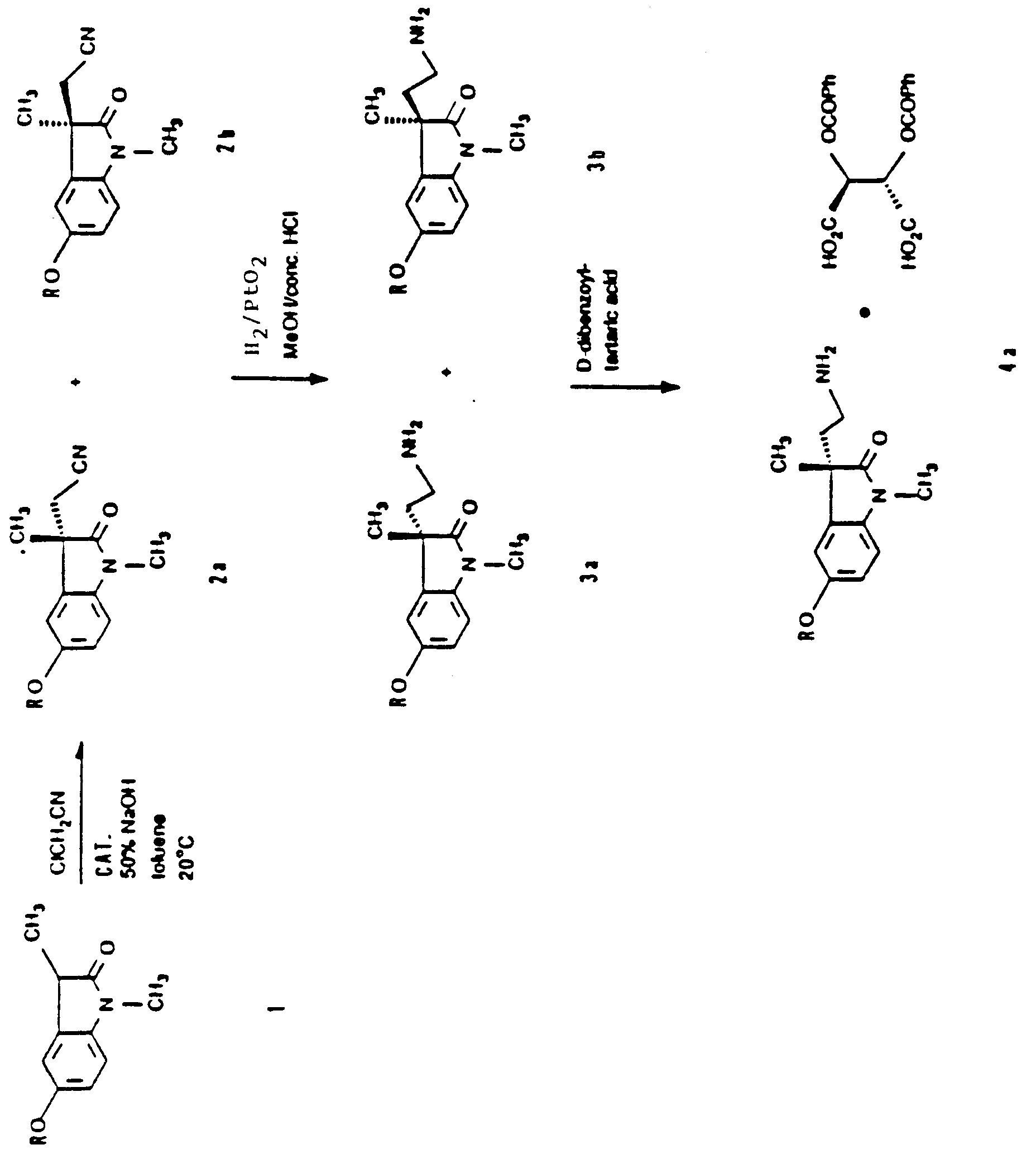
- the methyl group in the 3-position is above the average plane of the oxindole ring, whereas the aminoethyl group is below the average plane of the ring.
- the methyl group and the aminoethyl group are trans to each other relative to the average plane of the ring.
- an oxindole 1 can be alkylated with a halogenated acetonitrile in the presence of a chiral catalyst to give an enantiomeric mixture comprising alkylated oxindoles 2a and 2b , which are termed [R]- and [S]- 5-alkoxy-2,3-dihydro-1,3-dimethyl-2-oxo-1H-indole-3-acetonitriles.
- alkylated oxindoles 2a and 2b are termed [R]- and [S]- 5-alkoxy-2,3-dihydro-1,3-dimethyl-2-oxo-1H-indole-3-acetonitriles.
- the crude enantiomeric mixture comprising the alkylated oxindoles 2a and 2b can be hydrogenated in the presence of a catalyst to form a mixture comprising primary amines 3a and 3b, which are termed [R]- and [S]-5-alkoxy-3-(2-aminoethyl)-1,3-dihydro-1,3-dimethyl-2H-indol-2-ones.
- the primary amine 3a in which R is a methyl group is an important intermediate in the preparation of (-)-physostigmine.
- the primary amine should be available in as pure a form of the optical isomer as possible in order to obtain high yields and optical purity of physostigmine. This can be achieved by selectively precipitating the enantiomer 3a or 3b with a chiral tartaric acid to form a tartaric acid salt 4a or 4b.
- One method for preparing the enantiomeric mixture 3a and 3b will now be described in greater detail.
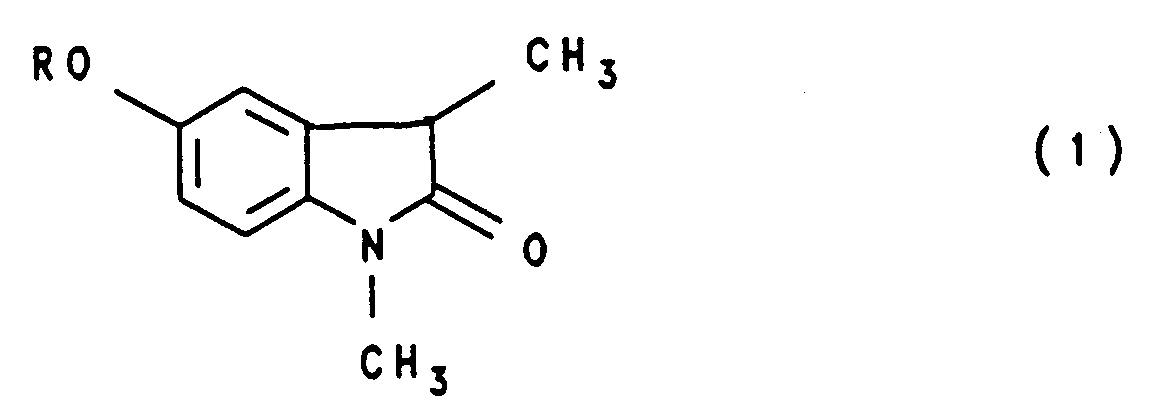
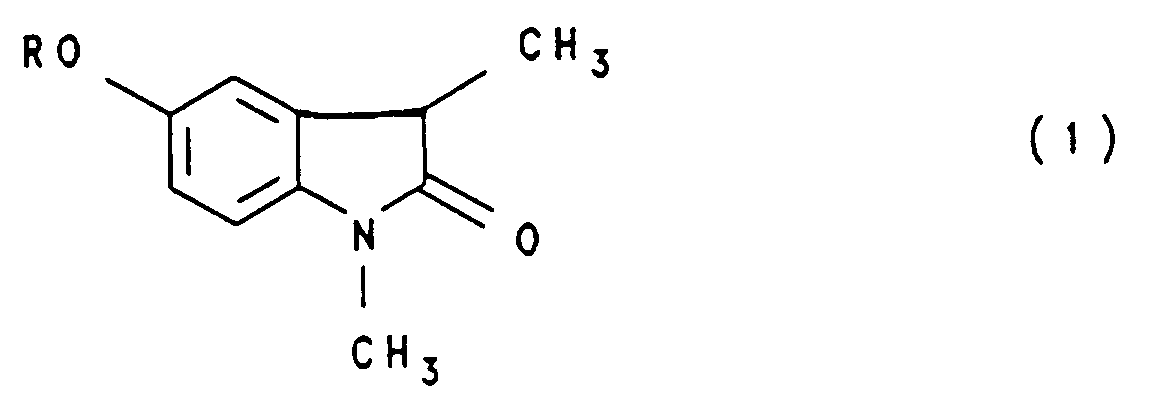
- the asymmetric synthesis of the present invention is carried out by the stereoselective alkylation of an oxindole of the formula: wherein the substituent R is selected from methyl (compound (1a)), ethyl (compound (1b)), and benzyl (compound (1c)).
- the oxindole 1 is a racemic mixture.
- the oxindole 1 is employed in the process of this invention as a racemic mixture, which can be prepared by the synthetic methods disclosed in F.E. King et al., J. Chem. Soc., 57:563-566 and Julian et al. J. Am. Chem. Soc. 57 (1935), 755-757 and in US-A-4,791,107.
- the oxindole 1 can be selectively converted to an enantiomeric mixture comprising alkylated oxindoles 2a and 2b using a chiral phase transfer catalyst.
- suitable catalysts are those derived from substituted N-benzyl cinchoninium or quininium halides. The reaction is characterized by high enantioselectively.
- the stereoselective conversion of oxindole 1 to an enantiomeric mixture comprising the alkylated oxindoles 2a and 2b can be carried out by stirring a racemic mixture of the oxindole 1 and a chiral catalyst in a two-phase system comprised of a strong inorganic base and an organic solvent under an inert gas atmosphere until the reaction goes to substantial completion.
- Chemical conversion can be monitored by analyzing the reaction mixture by GLC for the formation of the alkylated oxindoles 2a and 2b .
- the enantiomer 2a or 2b that predominates is dependent upon the nature of the chiral catalyst that is employed.
- the chiral catalyst for the selective conversion of oxindole 1 to the alkylated oxindole 2a or 2b is a substituted N-benzyl cinchoninium or quinidinium compound of the formula or a substituted N-benzyl cinchonidinium or quininium compound of the formula where
- the substituted N-benzyl cinchoninium and quinidinium compounds and the substituted N-benzyl cinchonidinium and quininium compounds are employed in the asymmetric synthesis of the invention in an amount sufficient to catalyze the reaction of the oxindole and the halogenated acetonitrile to produce one of the enantiomers of the alkylated oxindoles in a predominant amount over the other enantiomer.
- the catalyst can be employed in an amount of 5 to 50 mole % based upon the amount of oxindole 1 .
- the compounds are employed as catalysts in an amount of 10 to 15 mole % based upon oxindole 1 .
- the substituted N-benzyl cinchoninium and quinidinium compounds provide the alkylated oxindole 2a in excess while the substituted N-benzyl cinchonidinium and quininium compounds yield the alkylated oxindole 2b in excess when the compounds are used in a catalytically effective amount.
- a surfactant such as Triton X-400. See US-A-4,578,509 and US-A-4,605,761.
- Alkylation of the oxindole appears to proceed by conventional mechanisms. For this reason it was anticipated that a racemic mixture of the alkylated oxindoles would be obtained. Quite unexpectedly, however, it was found that the alkylation reaction was stereoselective and that either one of the enantiomers of the alkylated oxindoles can be obtained in excess, depending upon the choice of catalyst. Moreover, the predominant enantiomer is obtained in high chemical yield. The chemical yield is at least about 60% based on oxindole 1 , and is generally 65% to 85% based on oxindole 1 .
- the stereoselective synthesis of this invention is carried out in a biphasic reaction mixture comprised of an organic solvent phase containing the racemic mixture of oxindole 1 and the catalyst and an aqueous phase containing a strong inorganic base.
- the oxindole 1 and the catalyst are dissolved in an aromatic hydrocarbon solvent.
- Halogenated aromatic solvents and halogenated aliphatic solvents can also be employed. Typical of the solvents that can be utilized are benzene, toluene, xylene, chlorobenzene, and methylene chloride. Solvent mixtures of hexane and cyclohexane can also be utilized. Technical grade solvents have been found to yield acceptable results.
- the preferred solvent is toluene because reaction mixtures containing this solvent gave the highest selectively of the alkylated oxindole 2a or 2b in the examples hereinafter.
- the selectivity obtained with other solvents can be optimized with a minimum of experimentation.
- the aqueous phase of the reaction mixture contains a strong inorganic base, such as potassium hydroxide, sodium hydroxide, or lithium hydroxide.
- a strong inorganic base such as potassium hydroxide, sodium hydroxide, or lithium hydroxide.
- Technical grade bases have been found to produce acceptable results.
- the preferred base is sodium hydroxide because of its low cost, availability, and effectiveness in the process of the invention.
- the inorganic base is employed in an amount sufficient to support catalysis of the reaction.
- the base functions as a deprotonation agent. It has been found that the concentration of the base in the aqueous phase affects the selectivity.
- the concentration of base in the aqueous phase is 25 % to 50 % by weight. As the concentration of base decreases, the selectively for one of the alkylated oxindole decreases.
- the aqueous phase containing the inorganic base should have minimum solubility in the organic solvent phase containing the racemic oxindole 1 and the catalyst in order to maintain a biphasic reaction mixture.
- the volume ratio of the organic phase of the reaction mixture to the aqueous phase is 3:1 to 10:1.
- a reaction mixture containing the organic phase and the aqueous phase in a volume ratio of about 5:1 has been found to produce favorable results.
- the organic solvent phase and the oxindole 1 in the reaction mixture is 20:1 to 80:1, preferably 30:1 to 45:1.
- the particularly preferred ratio is 40:1. These ratios are expressed as the volume of the organic solvent phase to the weight of the oxindole 1.
- the alkylating agent for the racemic mixture of oxindole 1 is a halogenated acetonitrile selected from the group consisting of chloroacetonitrile, bromoacetonitrile, and iodoacetonitrile.
- Chloroacetonitrile is the preferred alkylating agent because it has provided the highest selectivity of the alkylated oxindoles 2a and 2b.
- Technical grade alkylating agents have yielded satisfactory results.
- the halogenated acetonitrile is employed in an amount of at least one equivalent, and preferably 1.1 to 1.5 equivalents, of the racemic mixture of oxindole 1.
- Increasing the amount of the alkylating agent relative to the oxindole generally increases chemical yield, although there is no apparent advantage in utilizing the alkylating agent in large excess.
- the stereoselective synthesis of the invention is carried out at a temperature of 5°C to 30°C. Lower temperatures are generally accompanied by higher selectively of the alkylated oxindole 2a or 2b, although caution must be exercised to avoid the inorganic base from separating from the aqueous solution at low temperatures.
- the preferred temperature range for carrying out the synthesis is 15°C to 25°C, especially about 20°C.
- the stereoselective synthesis of the alkylated oxindole 2a or 2b is an exothermic reaction.
- the reaction mixture can be cooled by internal or external means to maintain the reaction temperature. The need for cooling can be minimized and even avoided by gradually adding the halogenated acetonitrile to the biphasic reaction mixture.
- inert gas blanket over the biphasic reaction mixture in which the asymmetric synthesis is carried out in order to exclude oxygen from the reaction.
- suitable inert gases include nitrogen, argon, and helium. Nitrogen is preferred for economic reasons.
- the stereoselective synthesis of the invention can be carried out at atmospheric pressure. Sub-atmospheric pressures should be avoided.
- alkylation of the racemic mixture of oxindole 1 proceeds very rapidly. With gradual addition of the alkylating agent to the biphasic reaction mixture, the reaction is generally complete within 1 to 2 hours. Shorter reaction times can be employed, although cooling of the reaction mixture may be required. Similarly, longer reaction periods can be utilized, although there is no apparent advantage in extending the reaction time. In any event, the alkylating reaction is carried to substantial completion, which can be monitored by gas chromatography or other suitable means. In order to optimize selectivity for the alkylated oxindole 2a or 2b , the reaction mixture should be agitated.
- the biphasic reaction mixture can be prepared as follows.
- the racemic mixture of oxindole 1 can be dissolved in the organic solvent and the catalyst can be added to the resulting solution.
- the aqueous solution of the inorganic base can then be added to the organic solution and stirred for a sufficient period to form the biphasic reaction mixture. Mild stirring for about 10 minutes has been found to be sufficient to form the biphasic mixture.
- the halogenated acetonitrile employed as the alkylating agent can then be added to the biphasic reaction mixture. Slow addition of the alkylating agent improves selectivity for the predominating alkylated oxindole 2a or 2b .
- the optical purity of the enantiomers formed in the process of this invention can be expressed as the excess of the enantiomer in the reaction product as a percentage of the total enantiomers in the original solution.
- the amount of an enantiomer is conveniently expressed as the percent enantiomeric excess, which is abbreviated "% ee”.
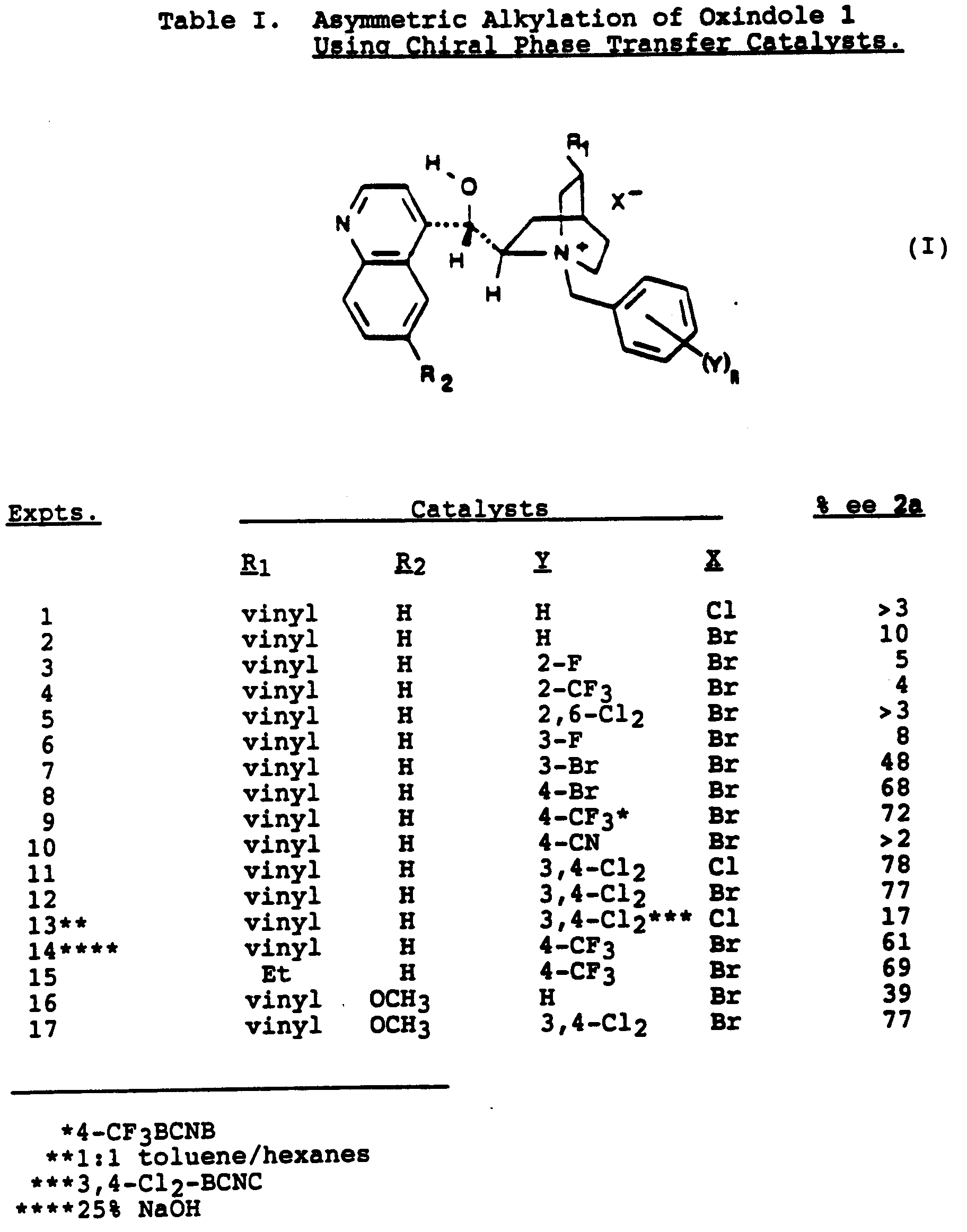
- a number of substituted N-benzyl cinchoninium salts have been screened for selective conversion of oxindole 1 to alkylated oxindole 2a . All the reactions were carried out by stirring a mixture of oxindole 1 (2.5 mmol) and the appropriate catalyst (0.25 mmol) in a two-phase system consisting of 8 ml of 50% NaOH and 20 ml of toluene under nitrogen for 10 min. A solution of chloroacetonitrile (2.75 mmol) in 20 ml of toluene was then added via a syringe pump over a period of 1 hour. After completion addition, the reaction mixture was analyzed by GLC for chemical conversion.
- Enantiomeric excess of alkylated oxindole 2a was determined by HPLC on a Chiralcel OD column or a Chiracel OJ column (Daicel Chemical Industries Ltd.) and by NMR spectroscopy using tris[3-(heptafluoropropyl-hydroxymethylene-d-camphorato]europium (III) as the chiral shift reagent. The results are summarized in Table I.
- the crude mixture containing the alkylated oxindole is employed in the next step of the reaction, which involves the conversion of the nitrile groups of the alkylated oxindoles to the corresponding primary amines via catalytic reduction in the presence of hydrogen gas.
- This step of the reaction can be carried out using conventional techniques.
- the crude reaction product from the stereoselective synthesis can be taken up in a suitable solvent, such as methanol, ethanol, or 2-propanol.
- the resulting solution can be hydrogenated in the presence of a catalytic amount of metallic catalyst, such as PtO 2 or platinum on carbon, in an aqueous, alcoholic, concentrated HCl medium to form a mixture comprising primary amines 3a and 3b.
- metallic catalyst such as PtO 2 or platinum on carbon
- the catalyst is typically employed in an amount of 5 % to 50 % by weight.
- the reaction carried out at a temperature of 15°C to 30°C for 1 hour to 2 hours until the reaction proceeds to substantial completion.
- Acids such as sulfuric acid, phosphoric acid, and hydrobromic acid, can be employed in place of HCl.
- the % ee of the primary amines are formed in approximately the same relative proportion as that of the oxindoles at the start of the catalytic reduction of the nitrile.
- the % ee of the primary amines 3a and 3b in the enantiomeric mixture from the reduction reaction is further improved by resolution with an optically active derivative of tartaric acid.
- Different solubility characteristics of the diastereomeric salts make it possible to preferentially isolate one of the salts. More particularly, a reaction mixture containing both of the enantiomers of the primary amine in solution is allowed to interact with an optically active derivative of tartaric acid to form a salt, which readily forms a precipitate in the reaction mixture.
- the enantiomer in an optically purified state is recovered from the precipitate by treatment with a mineral base.
- the enantiomers of the primary amines are resolved with a chiral acid selected from dibenzoyl-D-tartaric acid, dibenzoyl-L-tartaric acid, ditoluoyl D-tartaric acid, and ditoluoyl-L-tartaric acid.
- the preferred chiral acid is dibenzoyl-D-tartaric acid, because the S-enantiomer of 1,3-dimethyl-5-methoxyindolylethylamine can be selectively precipitated from an enantiomeric mixture with this acid in relatively high optical purity. It is preferred that the chiral acid be in a substantially optically pure state.
- the D-form of the chiral acid can be employed to preferentially precipitate enantiomer 3a, while the L-form of the chiral acid can be employed to preferentially precipitate the enantiomer 3b.
- the amount of the chiral acid employed in the enrichment process will generally be 0.5 to 1 equivalent of acid per equivalent of the primary amine, and preferably 0.6 to 0.9 equivalent. It has been found that the amount of the chiral acid used as the resolving agent can affect the identity of the enantiomer of the primary amine that is preferentially precipitated. For example, when the racemic amine 3a and 3b is treated with one or more equivalents of dibenzoyl-D-tartaric acid in an appropriate solvent, such as acetonitrile, the diastereomeric salt corresponding to the R-enantiomer 3b is preferentially precipitated.
- the diastereomeric salt corresponding to the S-enantiomer 3a is preferentially precipitated.
- the enantiomer 3a is preferentially precipitated from a racemic mixture of 3a and 3b with dibenzoyl-D-tartaric acid in an amount of 0.6 to 0.9 equivalent of the acid per equivalent of the primary amine.
- the enrichment process is carried out in a solution comprising the enantiomers and the chiral acid.
- the solution is prepared with an organic solvent in which the enantiomers and the chiral acid are soluble, but in which one of the tartaric acid salts of the enantiomers is less soluble so that one of the salts of the enantiomers will preferentially precipitate.
- the solvent is typically a liquid organic compound, such as a cyclic or acyclic substituted hydrocarbon. Ethers, such as diethyl ether, dioxane, and tetrahydrofuran, can be employed. Examples of suitable halogenated solvents are methylene chloride and chloroform.
- the organic compound can be an aromatic compound, such as toluene or xylene. Aliphatic nitriles, such as acetonitrile and propionitrile, can also be employed.
- the preferred solvent is acetonitrile.
- the ratio of the solvent volume to the amount of enantiomers in the mixture being resolved can be varied over a relatively broad range.
- the ratio of the amount of solvent to the amount of enantiomers can typically be 5:1 to 15:1, where the ratio is expressed as the volume of solvent relative to the weight of the enantiomers in the solvent.
- Preferably the ratio is 8:1 to 12:1.
- the ratio of the volume of solvent to the weight of enantiomers is about 10:1.
- the solution containing the enantiomers can be prepared by dissolving the enantiomeric mixture in the solvent. Dissolution can typically be carried out at a temperature of 0°C to 60°C, but will generally be carried out at room temperature of 18°C to 22°C. Similarly, the chiral acid can be dissolved in a solvent, which is generally the same solvent as the solvent employed for the enantiomeric mixture.
- the resulting solution is aged under conditions to form a precipitate comprising a salt of the chiral acid and the enantiomer that is selectively precipitated.
- Aging is typically carried out at a temperature of 0°C to 30°C.
- the use of temperatures within the lower end of this range will generally facilitate the formation of precipitates and increase the yield because the salts are generally less soluble in the solvent at the lower temperatures.
- the use of temperatures within the upper end of this range will generally provide higher selectivity; that is, formation of one of the salts of the enantiomers will be favored over the other salt.
- Resolution of the enantiomeric mixture of the primary amines according to this invention provides a precipitate of one of the enantiomers in the form of a salt of tartaric acid.
- the tartaric acid salt can be converted to the corresponding free base by conventional techniques.
- the tartaric acid salt can be dissolved in water, and the resulting solution can be treated with an aqueous solution comprised of a non-toxic inorganic base in an amount sufficient to provide a substantially basic mixture.
- suitable bases include sodium hydroxide, potassium hydroxide, sodium carbonate, and potassium carbonate.
- the amine is extracted with an organic solvent from the aqueous solution.
- An organic solvent such as methylene chloride, ethyl acetate, diethyl ether, or toluene, can be employed for this purpose.
- the organic phase can be separated from the aqueous phase. Evaporation of the solvent from the organic phase provides the amine in the form of a free base, which can generally be utilized without further purification. Conversion of the tartaric acid salt to the corresponding free base can be carried out at ambient temperatures.
- optical purity of the primary amine 3a or 3b expressed as % ee obtained by the asymmetric synthesis of this invention and resolution with the optically active derivative of tartaric acid will typically be at least about 70% ee.
- An optical purity of 70% ee to 80% ee can be attained without further purification by recrystallization.
- the level of optical purity can be increased to about 96-99% ee by one or two recrystallization steps. Optimum enrichment levels can be achieved with a minimum of experimentation.
- the stereoselective synthesis of the alkylated oxindoles 2a and 2b according to the present invention makes it possible to substantially increase the chemical yield of the enantiomer of the primary amine 3a or 3b of interest in the enrichment step.
- enrichment of an enantiomeric mixture of the alkylated oxindoles in which one of the alkylated oxindoles predominates (as in the process of the invention) will result in a higher chemical yield of the primary amine of interest than enrichment of a racemic mixture of the alkylated oxindoles, because of the higher concentration of the desired enantiomer in the starting mixture.
- the concentrations of enantiomers in a reaction mixture obtained in this invention can be determined by (1) treating the primary amine with (-)-menthyl chloroformate, followed by HPLC analysis of the corresponding diastereomeric carbamates; or (2) by treating the amine with (+)-camphorsulfonyl chloride, followed by HPLC analysis of the corresponding sulfonamide.
- the relative composition of a mixture of enantiomers is given by the areas under the peaks corresponding to the diastereomers in HPLC chromatograms.
- the absolute configuration of the enantiomer is assigned by converting the amines to known compounds whose absolute configurations have been established.
- the absolute configuration of the carbon atom at the 10-position of the primary amine can be determined by converting the tartaric acid salts of amines 3a or 3b into the corresponding optically pure primary amine 3a or 3b by neutralization with dilute NaOH.
- the resulting optically pure primary amine can be reductively cyclized in high yield by refluxing the amine in n-butanol in the presence of excess sodium metal.
- the product can then be derivatized with (s)-(-)- ⁇ -methylbenzyl isocyanate.
- the optical purity and absolute configuration of the resulting product can be confirmed by HPLC analysis according to the method of Schonenberger and Brossi, Helv. Chim. Acta., 69 :1486 (1986).
- Example 2 The procedure described in Example 1 was repeated with 0.12 g of N-[3,4-(dichloro)benzyl]cinchoninium chloride (3,4-Cl 2 -BCNC) in identical fashion.
- the enantiomeric excess of compound 2a in which R is methyl was found to be 78% as determined by HPLC assay of the reaction mixture.
- Example 2 The procedure described in Example 1 was repeated with 0.14 g of N-[4-bromobenzyl]cinchoninium bromide (4-Br-BCNB) in identical fashion.
- the enantiomeric excess of compound 2a in which R is methyl was found to be 68% as determined by HPLC assay of the reaction mixture.
- Example 2 The procedure described in Example 1 was repeated with 0.14 g of N-[3-bromobenzyl]cinchoninium bromide (3-Br-BCNB) in identical fashion.
- the enantiomeric excess of compound 2a in which R is methyl was found to be 48% as determined by HPLC assay of the reaction mixture.
- Example 2 The procedure described in Example 1 was repeated with 0.13 g N-benzylquinidinium bromide (BQNC) in identical fashion.
- BQNC N-benzylquinidinium bromide
- Example 2 The procedure described in Example 1 was repeated with 0.20 g of N-[3,4-dichlorobenzyl]quinidinium chloride (3,4-Cl 2 -BQNC) in identical fashion.
- the enantiomeric excess of compound 2a in which R is methyl was determined to be 77% by HPLC assay of the reaction mixture.
- Example 2 The procedure described in Example 1 was repeated with 0.13 g of N-[4-(trifluoromethyl)benzyl]dihydrocinchoninium bromide (4-CF 3 -H 2 -BCNB) in identical fashion.
- the enantiomeric excess of compound 2a in which R is methyl was found to be 69% by HPLC assay.
- Example 2 The procedure described in Example 1 was repeated with 0.13 g of N-[4-chlorobenzyl]cinchoninium bromide (4-Cl-BCNB) in identical fashion.
- the enantiomeric excess of compound 2a in which R is methyl was found to be 70% by HPLC assay of the reaction mixture.
- Example 2 The procedure described in Example 1 was repeated with 0.12 g of 3,4-Cl 2 -BCNB in identical fashion.
- the enantiomeric excess of compound 2a in which R is methyl was found to be 77% as determined by HPLC assay of the reaction mixture.
- the nitrile, 2a obtained from Step (A) was taken up in 50 ml of methanol and 7.25 ml of concentrated hydrochloric acid. A sample of 0.5 g of PtO 2 was added. The mixture was subjected to hydrogenation for 3 hours at 45 psi. The catalyst was removed by filtration through filter paper rinsing with 15 ml of methanol. The combined filtrate was concentrated under reduced pressure, and the residue was dissolved in 100 ml of ice-cold water. The acidic aqueous solution was first extracted with 50 ml of methylene chloride, and then basified with 5 ml of 50% NaOH. The basic aqueous solution was extracted with methylene chloride (3 x 50 ml). The combined organic extract was dried (Na 2 SO 4 ) and concentrated under reduced pressure giving 4.70 g (92%) of the corresponding amine, 3a .
- the amine, 3a from Step (B) was dissolved in 25 ml of acetonitrile.
- a solution containing 6.42 g of dibenzoyl-D-tartaric acid in 25 ml of acetonitrile was added rapidly under nitrogen. After stirring for another 30 minutes, the precipitate that formed was filtered to give 10.38 g of a white solid.
- This solid was recrystallized from 60 ml of 10% water-acetonitrile mixture giving 7.86 g (47.4%) of the tartrate salt of the amine; m.p. 136-137°C.
- the optical purity was determined to be 99% by means of derivatization with (+)-camphorsulfonyl chloride followed by HPLC analysis of the corresponding sulfonamide.
- Example 2 The procedure described in Example 1 was repeated with 0.13 g of N-[3-(trifluoromethyl)benzyl]cinchoninium bromide (3-CF 3 -BCNB) in identical fashion. The enantiomeric excess of compound 2a was found to be 68% as determined by HPLC assay of the reaction mixture.
- the reaction mixture was filtered through a Celite pad rinsing with 20 ml of toluene.
- the combined filtrate was transferred to a separatory funnel, and the two layers were separated.
- the toluene solution was extracted with 20 ml of 2N HCl, and twice with 20 ml of H 2 O. After evaporation of solvent, the slightly brownish oil was assayed on a Daicel Chiralcel OD column eluting with a. 10% isopropanol-hexanes mixture.
- the enantiomeric excess of the compound 2a in which R is ethyl was determined to be 71%.
- Example 13 The procedure described in Example 13 was repeated with 2.80 9 of ( ⁇ )-5-benzyloxy-1-1,3-dimethyloxindole, also referred to as 5-benzyloxy-1,3-dihydro-1,3-dimethyl-2H-indol-2-one in identical fashion.
- the enantiomeric excess of compound 2a in which R is benzyloxy was determined to be 73% by means of HPLC assay on a Daicel Chiralcel OJ column eluting with 40% isopropanol-hexanes.
- the compound ( ⁇ )-5-methoxy-1,3-dimethyl-oxindole employed in the Examples is also referred to as 1,3-dihydro-1,3-dimethyl-5-methoxy-2H-indol-2-one.
- the process of this invention has a number of advantages.
- the process for the stereoselective synthesis of enantiomers provides precursors of physostigmine in high chemical yield and purity.
- the availability of one enantiomer of a given structure in considerable predominance over other enantiomers makes it possible to enhance the results obtained when the enantiomers are subsequently resolved.
- the techniques for carrying out the stereoselective synthesis do not present any unusual difficulties.
- the reagents required for the process are readily available or can be easily prepared using conventional techniques.
- This invention provides a practical, economical process for the total synthesis of selected enantiomers of physostigmine.
Landscapes
- Chemical & Material Sciences (AREA)
- Organic Chemistry (AREA)
- Indole Compounds (AREA)
- Organic Low-Molecular-Weight Compounds And Preparation Thereof (AREA)
- Steroid Compounds (AREA)
- Saccharide Compounds (AREA)
- Catalysts (AREA)
- Low-Molecular Organic Synthesis Reactions Using Catalysts (AREA)
- Nitrogen Condensed Heterocyclic Rings (AREA)
- Inorganic Compounds Of Heavy Metals (AREA)
Abstract
Description


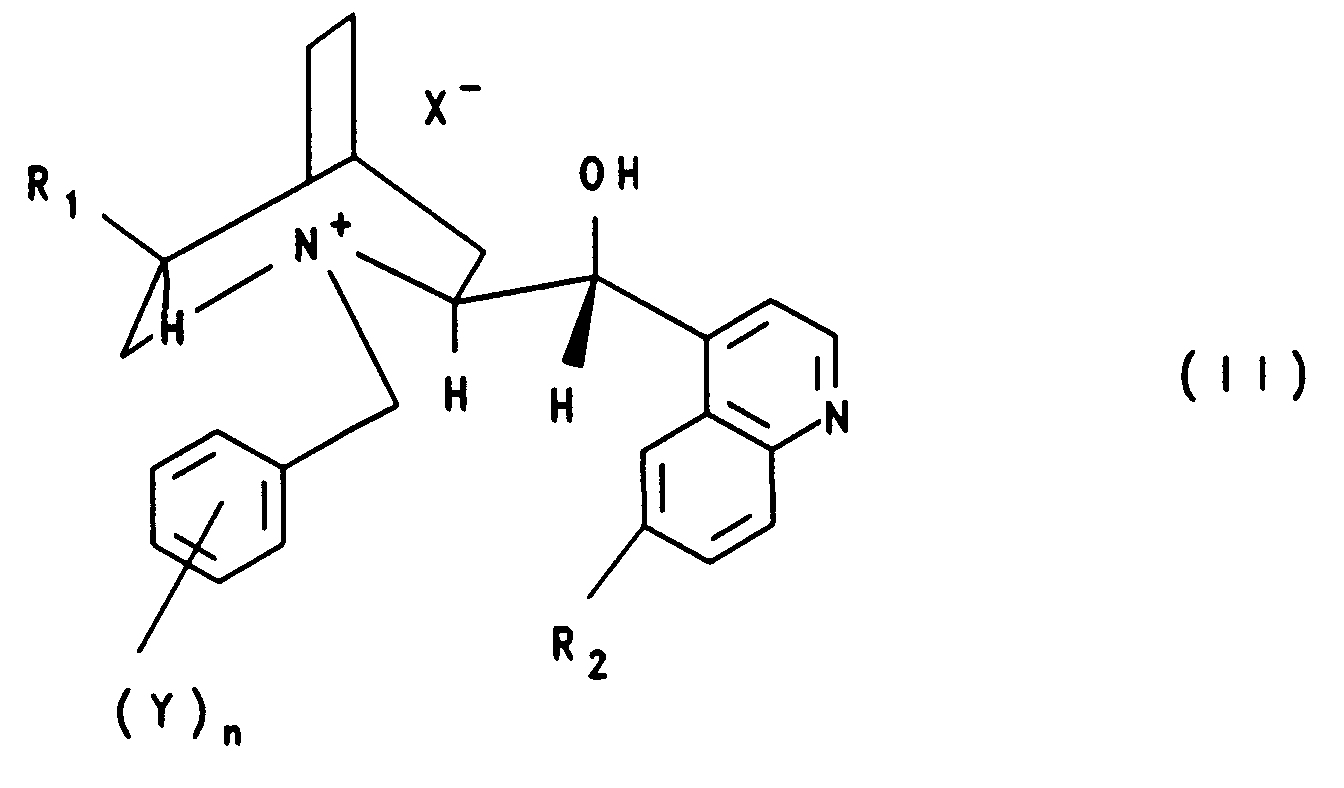
- R1
- is a vinyl group or an ethyl group,
- R2
- is hydrogen or a methoxy group,
- X
- is chlorine or bromine,
- Y
- is independently selected from: hydrogen, chlorine, bromine, fluorine, trifluormethyl groups, and nitrile groups, and
- n
- is 1, 2, 3, 4 or 5


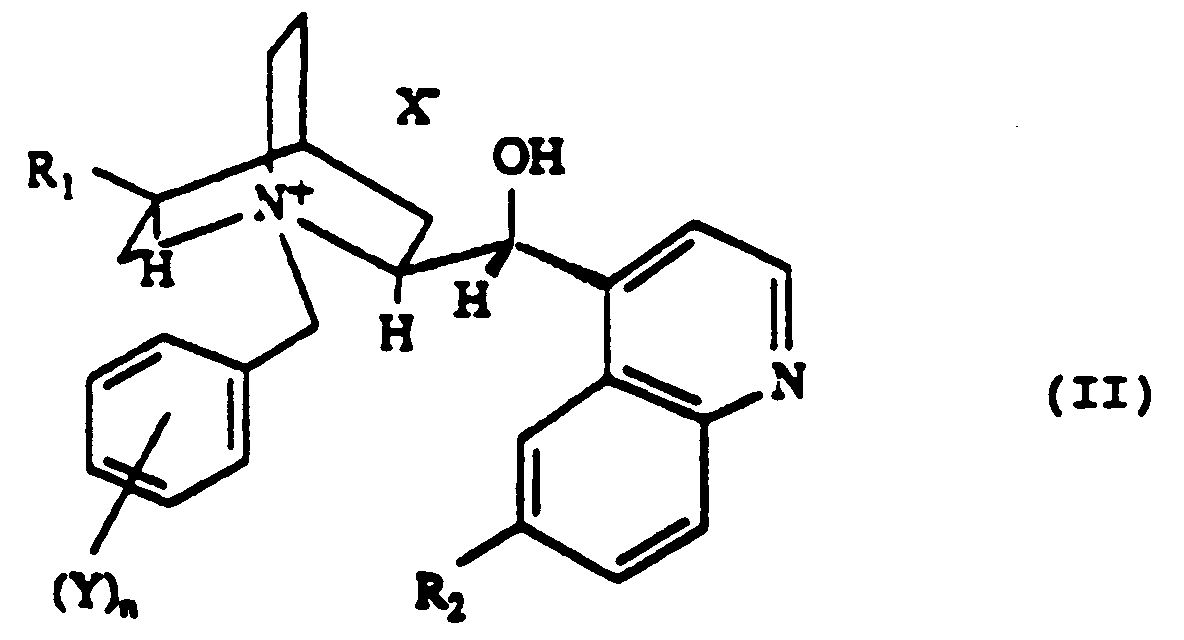
- R
- 1 is a vinyl group or an ethyl group,
- R2
- is hydrogen or a methoxy group,
- X
- is chlorine or bromine,
- Y
- is independently selected from hydrogen, chlorine, bromine, fluorine, trifluoromethyl groups, and nitrile groups; and
- n
- is 1, 2, 3, 4 or 5.
Claims (14)
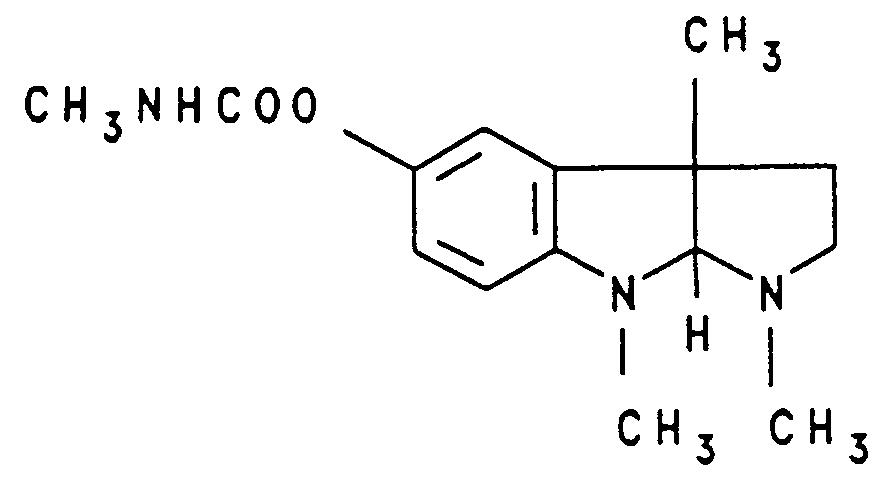
- A process for the stereoselective synthesis of physostigmine of the formulawherein the process comprises:
 a) reacting a racemic oxindole of the formulawhere R is selected from methyl, ethyl, and benzyl, with at least one equivalent of a halogenated acetonitrile selected from chloroacetonitrile, bromacetonitrile, and iodoacetonitrile, in a biphasic reaction mixture having an aqueous phase comprising 25 to 50 % weight of a strong inorganic base as a deprotonation agent and a solvent phase comprising an organic solvent for the oxindole selected from an aromatic hydrocarbon solvent, a halogenated aromatic solvent and a halogenated aliphatic solvent and a catalytic amount of a substituted N-benzyl cinchoninium or quinidinium compound of the formula
 or a substituted N-benzyl cinchonidinium or quininium compound of the formula
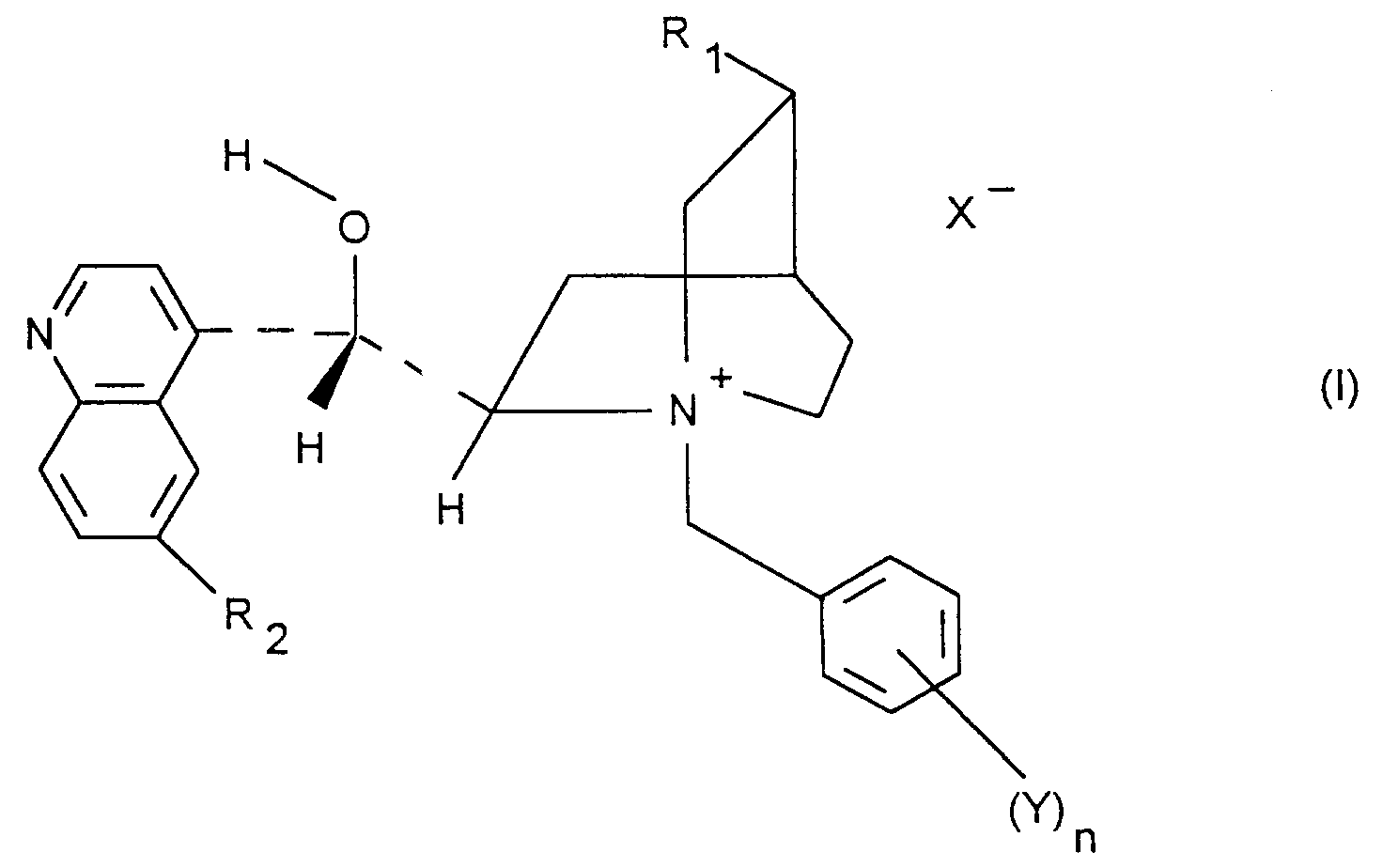 where
where
- R1
- is a vinyl group or an ethyl group,
- R2
- is hydrogen or a methoxy group,
- X
- is chlorine or bromine,
- Y
- is independently selected from: hydrogen, chlorine, bromine, fluorine, trifluormethyl groups, and nitrile groups, and
- n
- is 1, 2, 3, 4, or 5
b) converting nitrile groups of the resulting alkylated oxindole to corresponding primary amines by catalytic reduction in the presence of hydrogen gas to form a mixture of enantiomers of the primary amines,c) providing a solution of the mixture of enantiomers of the primary amines and a chiral acid with an organic solvent wherein the chiral acid is selected from: dibenzoyl-D-tartaric acid, dibenzoyl-L-tartaric acid, ditoluoyl-D-tartaric acid and ditoluoyl-L-tartaric acid and is present in an amount sufficient to preferentially precipitate a salt of the chiral acid and one of the enantiomers, and recovering the resulting precipitate,d) basifying the resulting tartaric acid salt of the enantiomer to form the corresponding free base, ande) converting the resultant product into (+) or (-)-physostigmine. - Process as claimed in claim 1, wherein the halogenated acetonitrile is 1.1 to 1.5 equivalents based on the oxindole.
- Process as claimed in claim 1 or 2, wherein the halogenated acetonitrile is chloroacetonitrile.
- Process as claimed in any of one of the preceding claims, wherein the stereoselective synthesis is carried out in an inert gas atmosphere.
- Process as claimed in claim 1, wherein substantially all of the oxindole is reacted with the halogenated acetonitrile.
- Process as claimed in any of the preceding claims, wherein the biphasic reaction mixture is stirred.
- Process as claimed in any one of the preceding claims, wherein R is methyl and Y is 3,4-dichloro or 4-trifluormethyl.
- Process as claimed in claim 1, wherein the solvent is selected from: benzene, toluene, xylene, chlorobenzene, methylene chloride, and a mixture of one of the above solvents with hexane or cyclohexane.
- Process as claimed in claim 1, wherein the organic solvent phase and the aqueous phase in the biphasic reaction mixture are in a volume ratio of 5:1.
- Process as claimed in claim 1, wherein the solvent phase and the racemic oxindole are in a ratio of about 30:1 to about 45:1 (v/w).
- Process as claimed in claim (1), wherein in step c the ratio of the volume of solvent to the total weight of enantiomers of the primary amines is 8:1 to 12:1.
- Process as claimed in claim 11, wherein the ratio of the volume of solvent to the total weight of enantiomers of the primary amines is 10:1.
- Process is claimed in claim 1, wherein in step c the solvent is acetonitrile.
- Process as claimed in claim I(c), wherein the chiral acid is employed in an amount of 0.5 to 1 equivalents of acid per equivalent of enantiomers of the primary amines.
Applications Claiming Priority (2)
| Application Number | Priority Date | Filing Date | Title |
|---|---|---|---|
| US46988290A | 1990-01-22 | 1990-01-22 | |
| US469882 | 1990-01-22 |
Publications (3)
| Publication Number | Publication Date |
|---|---|
| EP0438796A2 EP0438796A2 (en) | 1991-07-31 |
| EP0438796A3 EP0438796A3 (en) | 1992-03-18 |
| EP0438796B1 true EP0438796B1 (en) | 1998-08-26 |
Family
ID=23865415
Family Applications (1)
| Application Number | Title | Priority Date | Filing Date |
|---|---|---|---|
| EP90125644A Expired - Lifetime EP0438796B1 (en) | 1990-01-22 | 1990-12-28 | Process for the enantioselection synthesis of alkylated oxindoles used as intermediates in the preparation of physostigmine |
Country Status (22)
| Country | Link |
|---|---|
| EP (1) | EP0438796B1 (en) |
| JP (1) | JPH0757747B2 (en) |
| KR (1) | KR0175933B1 (en) |
| AT (1) | ATE170173T1 (en) |
| AU (1) | AU631957B2 (en) |
| CA (1) | CA2034668A1 (en) |
| CZ (1) | CZ278815B6 (en) |
| DE (1) | DE69032595T2 (en) |
| DK (1) | DK0438796T3 (en) |
| ES (1) | ES2120407T3 (en) |
| HR (1) | HRP930321B1 (en) |
| HU (2) | HUT56539A (en) |
| IE (1) | IE910194A1 (en) |
| IL (1) | IL97002A (en) |
| LT (1) | LT3982B (en) |
| NZ (1) | NZ236837A (en) |
| PH (1) | PH30059A (en) |
| PT (1) | PT96534B (en) |
| RU (1) | RU2072354C1 (en) |
| SG (1) | SG52631A1 (en) |
| YU (1) | YU9891A (en) |
| ZA (1) | ZA91410B (en) |
Cited By (1)
| Publication number | Priority date | Publication date | Assignee | Title |
|---|---|---|---|---|
| US7186745B2 (en) | 2001-03-06 | 2007-03-06 | Astrazeneca Ab | Indolone derivatives having vascular damaging activity |
Families Citing this family (8)
| Publication number | Priority date | Publication date | Assignee | Title |
|---|---|---|---|---|
| ES2075102T3 (en) * | 1989-09-19 | 1995-10-01 | Hoechst Roussel Pharma | PROCEDURE FOR THE CHEMICAL RESOLUTION OF (+/-) - 1,3-DIMETILOXIINDOLILETILAMINAS 5-ALCOXI SUBSTITUTED. |
| US4914102A (en) * | 1989-09-28 | 1990-04-03 | Hoechst Roussel Pharmaceuticals, Inc. | N-aminocarbamates related to physostigmine, pharmacentical compositions and use |
| US5840915A (en) * | 1990-01-22 | 1998-11-24 | Hoechst Marion Roussel, Inc. | Process for the enatioselective synthesis of intermediates used |
| US5521320A (en) * | 1990-01-22 | 1996-05-28 | Hoechst-Roussel Pharmaceuticals Incorporated | Process for the enantioselective synthesis of intermediates used in the preparation of physostigmine |
| GB0011120D0 (en) * | 2000-05-09 | 2000-06-28 | Avecia Ltd | Process |
| US6596870B2 (en) | 2000-07-13 | 2003-07-22 | Brandeis University | Asymmetric synthetic methods based on phase transfer catalysis |
| WO2013069731A1 (en) * | 2011-11-08 | 2013-05-16 | 日産化学工業株式会社 | Method for catalytic asymmetric synthesis of optically active isoxazoline compound, and optically active isoxazoline compound |
| AU2013232191B2 (en) * | 2012-03-14 | 2017-03-30 | Merck Sharp & Dohme Llc | Bis-quarternary cinchona alkaloid salts as asymmetric phase transfer catalysts |
Family Cites Families (5)
| Publication number | Priority date | Publication date | Assignee | Title |
|---|---|---|---|---|
| US4578509A (en) | 1983-04-01 | 1986-03-25 | Merck & Co., Inc. | Process for preparing a manipulated enantiomer mixture by asymmetric chiral phase transfer catalysis |
| US4791107A (en) | 1986-07-16 | 1988-12-13 | Hoechst-Roussel Pharmaceuticals, Inc. | Memory enhancing and analgesic 1,2,3,3A,8,8A-hexahydro-3A,8 (and) 1,3A,8)-di(and tri)methylpyrrolo(2,3-B)indoles, compositions and use |
| ES2075102T3 (en) * | 1989-09-19 | 1995-10-01 | Hoechst Roussel Pharma | PROCEDURE FOR THE CHEMICAL RESOLUTION OF (+/-) - 1,3-DIMETILOXIINDOLILETILAMINAS 5-ALCOXI SUBSTITUTED. |
| US4914102A (en) * | 1989-09-28 | 1990-04-03 | Hoechst Roussel Pharmaceuticals, Inc. | N-aminocarbamates related to physostigmine, pharmacentical compositions and use |
| DE69515062T2 (en) | 1994-11-28 | 2000-09-14 | Minnesota Mining And Mfg. Co., St. Paul | OBJECTS WITH PERMANENT COLOR AND / OR FLUORESCENT CHARACTERISTICS |
-
1990
- 1990-12-28 DK DK90125644T patent/DK0438796T3/en active
- 1990-12-28 DE DE69032595T patent/DE69032595T2/en not_active Expired - Fee Related
- 1990-12-28 EP EP90125644A patent/EP0438796B1/en not_active Expired - Lifetime
- 1990-12-28 SG SG1996007048A patent/SG52631A1/en unknown
- 1990-12-28 AT AT90125644T patent/ATE170173T1/en not_active IP Right Cessation
- 1990-12-28 ES ES90125644T patent/ES2120407T3/en not_active Expired - Lifetime
-
1991
- 1991-01-18 NZ NZ236837A patent/NZ236837A/en unknown
- 1991-01-21 JP JP3078153A patent/JPH0757747B2/en not_active Expired - Lifetime
- 1991-01-21 PT PT96534A patent/PT96534B/en not_active IP Right Cessation
- 1991-01-21 HU HU91210A patent/HUT56539A/en unknown
- 1991-01-21 PH PH41878A patent/PH30059A/en unknown
- 1991-01-21 IE IE019491A patent/IE910194A1/en not_active IP Right Cessation
- 1991-01-21 ZA ZA91410A patent/ZA91410B/en unknown
- 1991-01-21 AU AU69496/91A patent/AU631957B2/en not_active Ceased
- 1991-01-21 RU SU914894301A patent/RU2072354C1/en active
- 1991-01-21 HU HU9801313A patent/HU9801313D0/en unknown
- 1991-01-21 KR KR1019910000934A patent/KR0175933B1/en not_active Expired - Fee Related
- 1991-01-21 YU YU9891A patent/YU9891A/en unknown
- 1991-01-21 CZ CS91123A patent/CZ278815B6/en not_active IP Right Cessation
- 1991-01-21 CA CA002034668A patent/CA2034668A1/en not_active Abandoned
- 1991-01-22 IL IL9700291A patent/IL97002A/en not_active IP Right Cessation
-
1993
- 1993-03-11 HR HRP-98/91A patent/HRP930321B1/en not_active IP Right Cessation
- 1993-12-20 LT LTIP1629A patent/LT3982B/en not_active IP Right Cessation
Non-Patent Citations (1)
| Title |
|---|
| Helv. Chim. Acta 69(1986),pp.1486-1497 * |
Cited By (1)
| Publication number | Priority date | Publication date | Assignee | Title |
|---|---|---|---|---|
| US7186745B2 (en) | 2001-03-06 | 2007-03-06 | Astrazeneca Ab | Indolone derivatives having vascular damaging activity |
Also Published As
| Publication number | Publication date |
|---|---|
| IE910194A1 (en) | 1991-07-31 |
| ZA91410B (en) | 1991-10-30 |
| DK0438796T3 (en) | 1999-05-25 |
| KR910014349A (en) | 1991-08-31 |
| PT96534B (en) | 1998-07-31 |
| HRP930321A2 (en) | 1996-08-31 |
| EP0438796A3 (en) | 1992-03-18 |
| YU9891A (en) | 1994-06-24 |
| JPH0757747B2 (en) | 1995-06-21 |
| CS9100123A2 (en) | 1991-09-15 |
| HK1011993A1 (en) | 1999-07-23 |
| HU910210D0 (en) | 1991-08-28 |
| DE69032595D1 (en) | 1998-10-01 |
| HUT56539A (en) | 1991-09-30 |
| LTIP1629A (en) | 1995-07-25 |
| CA2034668A1 (en) | 1991-07-23 |
| PH30059A (en) | 1996-11-08 |
| RU2072354C1 (en) | 1997-01-27 |
| DE69032595T2 (en) | 1999-03-25 |
| ATE170173T1 (en) | 1998-09-15 |
| HU9801313D0 (en) | 1998-08-28 |
| IL97002A0 (en) | 1992-03-29 |
| LT3982B (en) | 1996-06-25 |
| NZ236837A (en) | 1993-03-26 |
| AU6949691A (en) | 1991-07-25 |
| SG52631A1 (en) | 1998-09-28 |
| CZ278815B6 (en) | 1994-07-13 |
| PT96534A (en) | 1991-10-15 |
| IL97002A (en) | 1994-10-21 |
| KR0175933B1 (en) | 1999-03-20 |
| AU631957B2 (en) | 1992-12-10 |
| HRP930321B1 (en) | 1999-02-28 |
| EP0438796A2 (en) | 1991-07-31 |
| ES2120407T3 (en) | 1998-11-01 |
| JPH04342566A (en) | 1992-11-30 |
Similar Documents
| Publication | Publication Date | Title |
|---|---|---|
| AU631957B2 (en) | Process for the enantioselection synthesis of alkylated oxindoles used as intermediates in the preparation of physostigmine | |
| US5274117A (en) | Process for the enantioselective synthesis of intermediates used in the preparation of physostigmine | |
| US5521320A (en) | Process for the enantioselective synthesis of intermediates used in the preparation of physostigmine | |
| US5387695A (en) | Process for the chemical resolution of 5-alkoxy-substituted (+)-1,3-dimethyloxindolylethylamines | |
| JP5822880B2 (en) | (7S) -1- (3,4-Dimethoxybicyclo [4.2.0] octa-1,3,5-trien-7-yl) N-methylmethanamine enzymatic synthesis method, ivabradine and salts thereof Application in the synthesis of | |
| US5840915A (en) | Process for the enatioselective synthesis of intermediates used | |
| HK1011993B (en) | Process for the enantioselection synthesis of alkylated oxindoles used as intermediates in the preparation of physostigmine | |
| JP2711828B2 (en) | Method for producing (6R) -tetrahydro-L-biopterin hydrochloride | |
| US20050171155A1 (en) | Method to separate stereoisomers |
Legal Events
| Date | Code | Title | Description |
|---|---|---|---|
| PUAI | Public reference made under article 153(3) epc to a published international application that has entered the european phase |
Free format text: ORIGINAL CODE: 0009012 |
|
| 17P | Request for examination filed |
Effective date: 19901228 |
|
| AK | Designated contracting states |
Kind code of ref document: A2 Designated state(s): AT BE CH DE DK ES FR GB GR IT LI LU NL SE |
|
| PUAL | Search report despatched |
Free format text: ORIGINAL CODE: 0009013 |
|
| AK | Designated contracting states |
Kind code of ref document: A3 Designated state(s): AT BE CH DE DK ES FR GB GR IT LI LU NL SE |
|
| 17Q | First examination report despatched |
Effective date: 19950206 |
|
| RAP1 | Party data changed (applicant data changed or rights of an application transferred) |
Owner name: HOECHST MARION ROUSSEL, INC. |
|
| GRAG | Despatch of communication of intention to grant |
Free format text: ORIGINAL CODE: EPIDOS AGRA |
|
| GRAG | Despatch of communication of intention to grant |
Free format text: ORIGINAL CODE: EPIDOS AGRA |
|
| GRAH | Despatch of communication of intention to grant a patent |
Free format text: ORIGINAL CODE: EPIDOS IGRA |
|
| GRAH | Despatch of communication of intention to grant a patent |
Free format text: ORIGINAL CODE: EPIDOS IGRA |
|
| GRAA | (expected) grant |
Free format text: ORIGINAL CODE: 0009210 |
|
| AK | Designated contracting states |
Kind code of ref document: B1 Designated state(s): AT BE CH DE DK ES FR GB GR IT LI LU NL SE |
|
| REF | Corresponds to: |
Ref document number: 170173 Country of ref document: AT Date of ref document: 19980915 Kind code of ref document: T |
|
| REG | Reference to a national code |
Ref country code: CH Ref legal event code: EP |
|
| REF | Corresponds to: |
Ref document number: 69032595 Country of ref document: DE Date of ref document: 19981001 |
|
| REG | Reference to a national code |
Ref country code: ES Ref legal event code: FG2A Ref document number: 2120407 Country of ref document: ES Kind code of ref document: T3 |
|
| ET | Fr: translation filed | ||
| REG | Reference to a national code |
Ref country code: DK Ref legal event code: T3 |
|
| PLBE | No opposition filed within time limit |
Free format text: ORIGINAL CODE: 0009261 |
|
| STAA | Information on the status of an ep patent application or granted ep patent |
Free format text: STATUS: NO OPPOSITION FILED WITHIN TIME LIMIT |
|
| 26N | No opposition filed | ||
| REG | Reference to a national code |
Ref country code: GB Ref legal event code: IF02 |
|
| PGFP | Annual fee paid to national office [announced via postgrant information from national office to epo] |
Ref country code: DE Payment date: 20021016 Year of fee payment: 13 |
|
| PGFP | Annual fee paid to national office [announced via postgrant information from national office to epo] |
Ref country code: ES Payment date: 20021129 Year of fee payment: 13 |
|
| PGFP | Annual fee paid to national office [announced via postgrant information from national office to epo] |
Ref country code: NL Payment date: 20031203 Year of fee payment: 14 Ref country code: AT Payment date: 20031203 Year of fee payment: 14 |
|
| PGFP | Annual fee paid to national office [announced via postgrant information from national office to epo] |
Ref country code: FR Payment date: 20031218 Year of fee payment: 14 |
|
| PGFP | Annual fee paid to national office [announced via postgrant information from national office to epo] |
Ref country code: SE Payment date: 20031219 Year of fee payment: 14 |
|
| PGFP | Annual fee paid to national office [announced via postgrant information from national office to epo] |
Ref country code: DK Payment date: 20031222 Year of fee payment: 14 |
|
| PGFP | Annual fee paid to national office [announced via postgrant information from national office to epo] |
Ref country code: CH Payment date: 20031223 Year of fee payment: 14 |
|
| PGFP | Annual fee paid to national office [announced via postgrant information from national office to epo] |
Ref country code: GB Payment date: 20031224 Year of fee payment: 14 |
|
| PG25 | Lapsed in a contracting state [announced via postgrant information from national office to epo] |
Ref country code: ES Free format text: LAPSE BECAUSE OF NON-PAYMENT OF DUE FEES Effective date: 20031229 |
|
| PGFP | Annual fee paid to national office [announced via postgrant information from national office to epo] |
Ref country code: GR Payment date: 20031229 Year of fee payment: 14 |
|
| PGFP | Annual fee paid to national office [announced via postgrant information from national office to epo] |
Ref country code: LU Payment date: 20031231 Year of fee payment: 14 |
|
| PGFP | Annual fee paid to national office [announced via postgrant information from national office to epo] |
Ref country code: BE Payment date: 20040128 Year of fee payment: 14 |
|
| PG25 | Lapsed in a contracting state [announced via postgrant information from national office to epo] |
Ref country code: DE Free format text: LAPSE BECAUSE OF NON-PAYMENT OF DUE FEES Effective date: 20040701 |
|
| PG25 | Lapsed in a contracting state [announced via postgrant information from national office to epo] |
Ref country code: LU Free format text: LAPSE BECAUSE OF NON-PAYMENT OF DUE FEES Effective date: 20041228 Ref country code: GB Free format text: LAPSE BECAUSE OF NON-PAYMENT OF DUE FEES Effective date: 20041228 Ref country code: AT Free format text: LAPSE BECAUSE OF NON-PAYMENT OF DUE FEES Effective date: 20041228 |
|
| PG25 | Lapsed in a contracting state [announced via postgrant information from national office to epo] |
Ref country code: SE Free format text: LAPSE BECAUSE OF NON-PAYMENT OF DUE FEES Effective date: 20041229 |
|
| PG25 | Lapsed in a contracting state [announced via postgrant information from national office to epo] |
Ref country code: LI Free format text: LAPSE BECAUSE OF NON-PAYMENT OF DUE FEES Effective date: 20041231 Ref country code: CH Free format text: LAPSE BECAUSE OF NON-PAYMENT OF DUE FEES Effective date: 20041231 Ref country code: BE Free format text: LAPSE BECAUSE OF NON-PAYMENT OF DUE FEES Effective date: 20041231 |
|
| PG25 | Lapsed in a contracting state [announced via postgrant information from national office to epo] |
Ref country code: DK Free format text: LAPSE BECAUSE OF NON-PAYMENT OF DUE FEES Effective date: 20050103 |
|
| REG | Reference to a national code |
Ref country code: ES Ref legal event code: FD2A Effective date: 20031229 |
|
| BERE | Be: lapsed |
Owner name: *HOECHST MARION ROUSSEL INC. Effective date: 20041231 |
|
| PG25 | Lapsed in a contracting state [announced via postgrant information from national office to epo] |
Ref country code: NL Free format text: LAPSE BECAUSE OF NON-PAYMENT OF DUE FEES Effective date: 20050701 |
|
| PG25 | Lapsed in a contracting state [announced via postgrant information from national office to epo] |
Ref country code: GR Free format text: LAPSE BECAUSE OF NON-PAYMENT OF DUE FEES Effective date: 20050704 |
|
| REG | Reference to a national code |
Ref country code: DK Ref legal event code: EBP |
|
| EUG | Se: european patent has lapsed | ||
| REG | Reference to a national code |
Ref country code: CH Ref legal event code: PL |
|
| GBPC | Gb: european patent ceased through non-payment of renewal fee |
Effective date: 20041228 |
|
| PG25 | Lapsed in a contracting state [announced via postgrant information from national office to epo] |
Ref country code: FR Free format text: LAPSE BECAUSE OF NON-PAYMENT OF DUE FEES Effective date: 20050831 |
|
| NLV4 | Nl: lapsed or anulled due to non-payment of the annual fee |
Effective date: 20050701 |
|
| REG | Reference to a national code |
Ref country code: FR Ref legal event code: ST |
|
| PG25 | Lapsed in a contracting state [announced via postgrant information from national office to epo] |
Ref country code: IT Free format text: LAPSE BECAUSE OF NON-PAYMENT OF DUE FEES Effective date: 20051228 |
|
| BERE | Be: lapsed |
Owner name: *HOECHST MARION ROUSSEL INC. Effective date: 20041231 |