EP0433817B1 - Combined anti-inflammatory agent - Google Patents
Combined anti-inflammatory agent Download PDFInfo
- Publication number
- EP0433817B1 EP0433817B1 EP90123628A EP90123628A EP0433817B1 EP 0433817 B1 EP0433817 B1 EP 0433817B1 EP 90123628 A EP90123628 A EP 90123628A EP 90123628 A EP90123628 A EP 90123628A EP 0433817 B1 EP0433817 B1 EP 0433817B1
- Authority
- EP
- European Patent Office
- Prior art keywords
- agent
- inflammatory agent
- inflammatory
- administration
- hyaluronic acid
- Prior art date
- Legal status (The legal status is an assumption and is not a legal conclusion. Google has not performed a legal analysis and makes no representation as to the accuracy of the status listed.)
- Revoked
Links
- 0 *C1C(Nc2c(*)cccc2*)=*C=CC1 Chemical compound *C1C(Nc2c(*)cccc2*)=*C=CC1 0.000 description 2
Classifications
-
- A—HUMAN NECESSITIES
- A61—MEDICAL OR VETERINARY SCIENCE; HYGIENE
- A61K—PREPARATIONS FOR MEDICAL, DENTAL OR TOILETRY PURPOSES
- A61K31/00—Medicinal preparations containing organic active ingredients
- A61K31/70—Carbohydrates; Sugars; Derivatives thereof
- A61K31/715—Polysaccharides, i.e. having more than five saccharide radicals attached to each other by glycosidic linkages; Derivatives thereof, e.g. ethers, esters
Definitions
- the present invention relates to a combined medicine for the purpose of treating inflammatory diseases and more particularly to a combined medicine useful for treating diseases of a joint with inflammation.
- Hyaluronic acid is one of the main components of joint liquid.
- the hyaluronic acid contained in the joint liquid has a reduced molecular weight and a reduced concentration.
- hyaluronic acid does not possess any direct activity of improving such symptoms.
- Anti-inflammatory agents are widely used in the clinical treatment of arthropathy. The reason therefor is presumed that many kinds of arthropathies involves inflammation. The reason why nonsteroidal anti-inflammatory agents are especially widely used is presumed that they have strong analgesic activity.
- Another object of the invention is to provide an efficient inflammation-treating agent, in particular, which does not develop any side effect even when a sufficient amount thereof required for the treatment of joint diseases is administered.
- the present invention provides a pharmaceutical composition for treating inflammatory diseases, comprising (A) an effective amount of hyaluronic acid or its salt, and (B) an effective amount of a nonsteroidal anti-inflammatory agent other than hyaluronic acid or its salt.
- a combined agent of hyaluronic acid or its saitwith h an anti-inflammatory agent in accordance with the present invention is an excellent agent for treating joint diseases, which develops the respective merits of both drugs and supresses the respective demerits of both drugs.
- Hyaluronic acid and its salts possess anti-inflammatory activity.
- Examples of the salt of hyaluronic acid include sodium salt, potassium salt, ammonium salt and salts with C 1 to C 5 alkyl amines.
- the sodium salt is preferred.
- hyaluronic acid or its salt is used in the form of a solution wherein it is dissolved in water or an aqueous solvent in such a concentration that the solution shows spinnability.
- An aqueous solution of hyaluronic acid or its salt which shows suitable spinnability has a viscosity of about 500 to 2,000 cps at 30 C.
- sodium hyaluronate having a molecular weight of 8 x 10 5 a concentration of not less than 0.5 % (w/v %, hereinafter the same), preferably 0.8 to 1.2 %, is required to obtain such a suitable spinnability.
- a lower concentration (lower than 0.5 %) is adoptable with increasing molecular weight of sodium hyaluronate and a higher concentration (more than 0.5 %) is required with decreasing molecular weight of sodium hyaluronate.
- Hyaluronic acid or its salt having a molecular weight within a wide range can be used in the present invention.
- the preferred molecular weight ranges from 4 x 10 5 to 3 x 10 6 .
- the molecular weight is less than the above range, the anti-inflammatory activity is poor and a suitable spinnability is not obtainable.
- the molecular weight is more than the above range, the viscosity of the resulting solution extremely increases and consequently the administration by injection is difficult, which results in the impossibility of practical application to the treatment of arthropathy.
- the anti-inflammatory agent which is preferably in the form of finely divided particles, is dissolved or suspended into a solution of hyaluronic acid or its salt in water or an aqueous solvent.
- the resulting solution or suspension is preferably adjusted so that the pH value is from 6.0 to 7.0 and the ratio of its osmotic pressure to that of a 0.9 % physiological saline solution is from 0.8 to 1.2, yielding a preparation suitable for administration in an articular cavity.
- the aqueous solvent include physiological saline solutions, 3 to 5 % glucose solutions and 3 to 5 % xylitol solutions and phosphate buffer solutions.
- Nonsteroidal anti-inflammatory agents are used as an anti-inflammatory agent.
- nonsteroidal anti-inflammatory agent Preferable examples of the nonsteroidal anti-inflammatory agent are as follows:
- anti-inflammatory agents include their salts, if any. These anti-inflammatory agents may be used singly or in admixtures thereof.
- the preferred anti-inflammatory agents are nonsteroidal acid anti-inflammatory agents represented by the following structure formulas (I) and (II): wherein R 1 is or and R 2 is -H or -CH 3 . wherein R 3 is -COOH or -CH 2 COOH, R 4 is -H or -Cf, R 5 is -Cf or -CH 3 , and R 6 is -H or -CH 3 .
- the more preferred anti-inflammatory agents are shown in Table 1.
- the ratio of hyaluronic acid or its salt to the anti-inflammatory agent can vary over a wide range.
- the ratio of hyaluronic acid or its salt to the anti-inflammatory agent ranges preferably from 1 : 0.03 to 2 (by weight), more preferably from 1 : 0.1 to 1.
- the proportion of hyaluronic acid or its salt is lower than the above range, the anti-inflammatory agent is not sufficiently retained by an aqueous solution of hyaluronic acid or its salt.
- the proportion of hyaluronic acid or its salt is higher than the above range, the anti-inflammatory activity is lowered.
- the combined agent of the present invention may contain other medicaments such as adrenocortical hormones, local anesthetic agents and antibiotics. Further, it may contain various additives including stabilizing agents, for example, antioxidants such as sodium sulfite and sodium hydrogen-sulfite; buffers such as citrates and phosphates; solubilizers or solubilizing agents such as alcohols, polyethylene glycols; and preservatives such as benzoic acid and salicylic acid.
- stabilizing agents for example, antioxidants such as sodium sulfite and sodium hydrogen-sulfite
- buffers such as citrates and phosphates
- solubilizers or solubilizing agents such as alcohols, polyethylene glycols
- preservatives such as benzoic acid and salicylic acid.
- the combined agent of the present invention can be applicable to the treatment of a variety of arthropathies such as osteoarthrisis, rheumatoid arthritis and periarthritis; and gout, and to treatments after operation of joints and eyes.
- the combined agent of the present invention is preferably administered into an articular cavity in a dose of 27.5 to 50 mg/one time per adult (based on the total amount of both drugs). More concretely, for example, 2.5 mf ampuls are prepared, each containing 25 mg of sodium hyaluronate and a given amount of an anti-inflammatory agent (e.g. 25 mg of diclofenac, ibuprofen or phenylbutazone, 7.5 mg of indometacin, or 375 mg of sodium salicylate) in an isotonic phosphate buffer solution as an aqueous solvent.
- the preparation is administered into an articular cavity in a dose of one ampul once per 7 to 10 days. In such a manner, the administration is continuously conducted 4 to 5 times while varying the dose if necessary.
- the combined agent of hyaluronic acid or its salt and an anti-inflammatory agent in accordance with the present invention is able to exhibit the effects ment ioned below.
- the combined agent of the present invention has a wide application as an arthropathy-treating agent because it is composed of two kinds of arthropathy-treating agents different in mechanism of action from each other.
- the combined agent of the present invention has a strong therapeutic effect due to a synergistic effect of the combination of the two kinds of the components.
- the combined agent of the present invention can be administered directly to an affected part to be treated so that the concentration of the drugs becomes higher at the affected part to be treated and lower in tissues, including the tissues of digestive system, other than the tissue to which the instant agent is administered.
- a strong therapeutic effect is obtained at the affected part and side effects such as ulcer and inflammation of digestive system and diarrhea hardly develop.
- the interruption of the administration and the extreme reduction of the dose due to the side effects can be avoided. Consequently a sufficient medical treatmemt is made possible.
- the anti-inflammatory agent dissolved in the aqueous solvent is retained in a hydrated hyaluronic acid or its salt for a long time and released gradually therefrom.
- the effective concentration of the drugs can be retained in the tissue to which the instant combined agent is administered and the action of the drugs continues. Consequently, it is sufficient to administer the instant combined agent about once per a week.
- the inhibitory effect on carrageenan-induced edema was investigated as to combined agents of sodium hyaluronate (molecular weight: 8 x 10 5 ) and various anti-inflammatory agents.
- Wister male rats weighing 240 to 260 g (6 weeks old) were preliminarily bred for not less than 1 week. Eight rats were used in one group.
- Each test agent shown in Table 2 was dissolved or suspended in an isotonic phosphate buffer solution (pH 7.0) to give a 1 % solution or suspension (hereinafter referred to as "1 % solution”).
- the solution was administered subcutaneously into the right foot pad of each rat.
- a 1 % solution of carrageenan was administered subcutaneously as an irritating agent into the right foot pad of the rat in a dose of 0.1 mf/animal.
- the volume of the right foot pad was measured before and 4 hours after the administration of carrageenan.
- the rate of edema inhibition (hereinafter referred to as "inhibitory rate”) by each test agent was calculated from the obtained measurements and thus the inhibitory effect on edema was evaluated. The results are shown in Table 2.
- Table 2 reveals that all anti-inflammatory agents tested, when being used in combination with sodium hyaluronate, showed strong inhibitory effect on edema in comparison with either each anti-inflammatory agent alone or sodium hyaluronate alone.
- diclofenac, ibuprofen and indometacin particularly, showed great synergistic effect in combination with sodium hyaluronate.
- the rate of inhibition (%) of the edema of the foot pad of each rat was calculated according to the following formula (III).
- stomach and the small intestine were autopsyed under anesthesia with ether 6 hours after the administration of carrageenan and no abnormal symptom was observed in the drug-given group.
- the inhibitory effect on carrageenan-induced edema was investigated as to combined agents of various grades of sodium hyaluronates having different molecular weights with diclofenac sodium.
- Wister male rats weighing 230 to 265 g (6 weeks old) were preliminarily bred for not less than 1 week. Eight rats were used in one group.
- a 1 % solution of each test agent shown in Table 3 was administered subcutaneously into the right foot pad of each rat.
- a 1 % solution of carrageenan was administered subcutaneously as an irritating agent into the right foot pad of the rat in a dose of 0.1 mf/animal.
- the volume of the right foot pad was measured before and 4 hours ater the administration of carrageenan. Then the inhibitory effect on edema was evaluated in the same way as in Test Example 1. The results are shown in Table 3.
- Table 3 reveals that sodium hyaluronates having a molecular weight within a wide range showed synergistic effect in combination with diclofenac sodium. However, sodium hyaluronate having too small molecular weight showed a smaller inhibitory effect itself and therefore the inhibitory effect of the combined agent thereof was also smaller. Accordingly the preferable molecular weight of sodium hyaluronate is not less than 4 x 10 5 .
- the inhibitory effect on carrageenan-induced edema was investigated with respect to combined agents of sodium hyaluronate (molecular weight: 8 x 10 5 ) and diclofenac sodium wherein the ratio of diclofenac sodium to sodium hyaluronate varied.
- Wister male rats weighing 235 to 260 g (6 weeks old) were preliminarily bred for not less than 1 week. Eight rats were used in one group.
- a 1 % solution of each test agent shown in Table 4 was administered subcutaneously into the right foot pad of each rat.
- a 1 % solution of carrageenan was administered subcutaneously as an irritating agent into the right foot pad of the rat in a dose of 0.1 mf/animal.
- the volume of the right foot pad was measured before and 4 hours after the administration of carrageenen. Then, the inhibitory effect on edema was evaluated in the same way as in Test Example 1. The results are shown in Table 4.
- the inhibitory effect on carrageenan-induced edema was investigated with respect to combined agents of sodium hyaluronate (molecular weight: 8 x 10 5 ) and various acid anti-inflammatory agents.
- Wister male rats weighing 240 to 255 (6 weeks old) were preliminarily bred for not less than 1 week. Eight rats were used in one group.
- a 1 % solution of each test agent shown in Table 5 was administered subcutaneously into the right foot pad of each rat.
- a 1 % solution of carrageenen was administered subcutaneously as an irritating agent into the right foot pad of each rat in a dose of 0.1 ml/animal.
- the volume of the right foot pad was measured before and 4 hours after the administration of carrageenen.
- the inhibitory effect on edema was evaluated in the same way as in Test Example 1. The results are shown in Table 5.
- Table 5 reveals that all anti-inflammatory agents tested, when being used in combination with sodium hyaluronate, showed strong inhibitory effect on edema in comparison with either each anti-inflammatory agent alone or sodium hyaluronate alone.
- mice After preliminary breeding of male ICR mice 5 weeks old weighing 23 to 28 g (5 mice per one group) for one week, a 1 % solution of each test agent shown in Table 6 was subcutaneously administered to the mice. The number of dead mice was counted 72 hours after the administration. The results are shown in Table 6.
- test Example 1 The doses of the test agent used in this test were about ten times those used in Test Example 1.
- Wister male rats weighing 240 to 260 g (6 weeks old) were preliminarily bred for not less than 1 week. Eight rats were used in one group.
- a 1 % solution of each test agent shown in Table 7 was administered subcutaneously into the right foot pad of each rat.
- a 1 % solution of carrageenan was administered subcutaneously as an irritating agent into the right foot pad of each rat in a dose of 0.1 me/an- imal.
- the volume of the right foot pad was measured before and 4 hours after the administration of carrageenen. Then, the inhibitory effect on edema was evaluated in the same way as in Test Example 1. The results are shown in Table 7.
- Rabbits (New Zealand White) weighing about 2 kg were preliminarily bred for not less than one week and healthy ones were selected (3 rabbits per group). The joint of right knee of each rabbit was fixed by applying a splint thereto and further completely fixed not so as to move by putting it in plaster. Then the rabbits were bred normally for one month.
- the rate of inhibition of the damage to the movable range of joint was calculated according to the following formula (IV), and the evaluation of synergistic effect was conducted under the same condition as in Test Example 1.
Landscapes
- Health & Medical Sciences (AREA)
- Life Sciences & Earth Sciences (AREA)
- Molecular Biology (AREA)
- Chemical & Material Sciences (AREA)
- Medicinal Chemistry (AREA)
- Pharmacology & Pharmacy (AREA)
- Epidemiology (AREA)
- Animal Behavior & Ethology (AREA)
- General Health & Medical Sciences (AREA)
- Public Health (AREA)
- Veterinary Medicine (AREA)
- Pharmaceuticals Containing Other Organic And Inorganic Compounds (AREA)
- Acyclic And Carbocyclic Compounds In Medicinal Compositions (AREA)
- Medicines Containing Material From Animals Or Micro-Organisms (AREA)
Description
- The present invention relates to a combined medicine for the purpose of treating inflammatory diseases and more particularly to a combined medicine useful for treating diseases of a joint with inflammation.
- It has been known that hyaluronic acid or its salt is effective to some kinds of arthropathies in clinical and fundamental tests. The theoretical bases are as follows: (1) Hyaluronic acid is one of the main components of joint liquid. In the case of rheumatoid arthritis and osteoarthritis which are included in arthropathy, the hyaluronic acid contained in the joint liquid has a reduced molecular weight and a reduced concentration. (2) As the main pharmacological actions of hyaluronic acid, there are exemplified an action of covering the surface of a cartilage, an inhibitory action on the liberation of proteoglycan, which action is exhibited by the hyaluronic acid migrated into a cartilage matrix, and an improving action on the spinnability of the joint liquid.
- However, most of the reported clinical cases wherein hyaluronic acid was applied are osteoarthritis and rheumatoid arthritis and its applicable range is relatively narrow. Further, although symptoms such as pain and stiffness become in serious problem in the treatment of joint diseases, hyaluronic acid does not possess any direct activity of improving such symptoms.
- Anti-inflammatory agents are widely used in the clinical treatment of arthropathy. The reason therefor is presumed that many kinds of arthropathies involves inflammation. The reason why nonsteroidal anti-inflammatory agents are especially widely used is presumed that they have strong analgesic activity.
- However, when anti-inflammatory agents are administered in a usual clinical method such as oral administration, administration using suppository, subcutaneous or intramuscular administration, side effects such as the inflammation and ulcer of digestive system, and diarrhea tend to develop because the drug reaches its effective concentration not only at a part to be treated but also in tissues of the whole body including blood. Further the development of the side effects is promoted due to the fact that a large amount of dose is required for t he treatment because of the distribution of the drug overthe whole body and the fact that the administration period is prolonged because most arthropathies are chronic. For the reasons, a sufficient amount of the drug required for the treatment cannot be administered or the administration is obliged to be interrupted, which results in failure of a suitable treatment. Consequently, there are many cases wherein the condition of the disease is worsened.
- It is an object of the present invention to provide an inflammation-treating agent, in particular, which is capable of curing inflammation in joint diseases and possesses the activity of improving symptoms such as pain and stiffness.
- Another object of the invention is to provide an efficient inflammation-treating agent, in particular, which does not develop any side effect even when a sufficient amount thereof required for the treatment of joint diseases is administered.
- These and other objects of the present invention will become apparent from the description hereinafter.
- The present invention provides a pharmaceutical composition for treating inflammatory diseases, comprising (A) an effective amount of hyaluronic acid or its salt, and (B) an effective amount of a nonsteroidal anti-inflammatory agent other than hyaluronic acid or its salt.
- A combined agent of hyaluronic acid or its saitwith h an anti-inflammatory agent in accordance with the present invention is an excellent agent for treating joint diseases, which develops the respective merits of both drugs and supresses the respective demerits of both drugs.
- Hyaluronic acid and its salts possess anti-inflammatory activity. Examples of the salt of hyaluronic acid include sodium salt, potassium salt, ammonium salt and salts with C1 to C5 alkyl amines. The sodium salt is preferred.
- In a preferable embodiment of the present invention, hyaluronic acid or its salt is used in the form of a solution wherein it is dissolved in water or an aqueous solvent in such a concentration that the solution shows spinnability. An aqueous solution of hyaluronic acid or its salt which shows suitable spinnability has a viscosity of about 500 to 2,000 cps at 30 C. In the case of sodium hyaluronate having a molecular weight of 8 x 10⁵, a concentration of not less than 0.5 % (w/v %, hereinafter the same), preferably 0.8 to 1.2 %, is required to obtain such a suitable spinnability. A lower concentration (lower than 0.5 %) is adoptable with increasing molecular weight of sodium hyaluronate and a higher concentration (more than 0.5 %) is required with decreasing molecular weight of sodium hyaluronate.
- Hyaluronic acid or its salt having a molecular weight within a wide range can be used in the present invention. From the viewpoints of the anti-inflammatory activity and spinnability, the preferred molecular weight ranges from 4 x 10⁵ to 3 x 10⁶. When the molecular weight is less than the above range, the anti-inflammatory activity is poor and a suitable spinnability is not obtainable. When the molecular weight is more than the above range, the viscosity of the resulting solution extremely increases and consequently the administration by injection is difficult, which results in the impossibility of practical application to the treatment of arthropathy.
- In a preferable embodiment of the present invention, the anti-inflammatory agent, which is preferably in the form of finely divided particles, is dissolved or suspended into a solution of hyaluronic acid or its salt in water or an aqueous solvent. The resulting solution or suspension is preferably adjusted so that the pH value is from 6.0 to 7.0 and the ratio of its osmotic pressure to that of a 0.9 % physiological saline solution is from 0.8 to 1.2, yielding a preparation suitable for administration in an articular cavity. Examples of the aqueous solvent include physiological saline solutions, 3 to 5 % glucose solutions and 3 to 5 % xylitol solutions and phosphate buffer solutions.
- Nonsteroidal anti-inflammatory agents are used as an anti-inflammatory agent.
- Preferable examples of the nonsteroidal anti-inflammatory agent are as follows:
- I Carboxylic acid anti-inflammatory agent
- 1. Salicylic acid anti-inflammatory agent Salicylic acid Aspirin
- 2. Anthranilic acid anti-inflammatory agent Mefenamic acid
- II Acetic acid anti-inflammatory agent
- 1. Phenylacetic acid anti-inflammatory agent Diclofenac Alclofenac
- 2. Indole anti-inflammatory agent Indometacin
- 3. Heteroarylacetic acid anti-inflammatory agent Tolmethin
- III Propionic acid anti-inflammatory agent
- 1. Phenyl anti-inflammatory agent Ibuprofen
- 2. Naphthalene anti-inflammatory agent Naproxen
- 3. Tricyclic anti-inflammatory agent Pranoprofen
- IV Pyrazolone anti-inflammatory agent Phenylbutazone
- V Benzthiazine anti-inflammatory agent Piroxicam
- The above-mentioned anti-inflammatory agents include their salts, if any. These anti-inflammatory agents may be used singly or in admixtures thereof.
- The preferred anti-inflammatory agents are nonsteroidal acid anti-inflammatory agents represented by the following structure formulas (I) and (II):


- The more preferred anti-inflammatory agents are shown in Table 1.

- In the present invention, the ratio of hyaluronic acid or its salt to the anti-inflammatory agent can vary over a wide range. For the purpose of obtaining a good synergistic effect, the ratio of hyaluronic acid or its salt to the anti-inflammatory agent ranges preferably from 1 : 0.03 to 2 (by weight), more preferably from 1 : 0.1 to 1. When the proportion of hyaluronic acid or its salt is lower than the above range, the anti-inflammatory agent is not sufficiently retained by an aqueous solution of hyaluronic acid or its salt. When the proportion of hyaluronic acid or its salt is higher than the above range, the anti-inflammatory activity is lowered.
- The combined agent of the present invention may contain other medicaments such as adrenocortical hormones, local anesthetic agents and antibiotics. Further, it may contain various additives including stabilizing agents, for example, antioxidants such as sodium sulfite and sodium hydrogen-sulfite; buffers such as citrates and phosphates; solubilizers or solubilizing agents such as alcohols, polyethylene glycols; and preservatives such as benzoic acid and salicylic acid.
- The combined agent of the present invention can be applicable to the treatment of a variety of arthropathies such as osteoarthrisis, rheumatoid arthritis and periarthritis; and gout, and to treatments after operation of joints and eyes.
- In the treatment of arthropathy, the combined agent of the present invention is preferably administered into an articular cavity in a dose of 27.5 to 50 mg/one time per adult (based on the total amount of both drugs). More concretely, for example, 2.5 mf ampuls are prepared, each containing 25 mg of sodium hyaluronate and a given amount of an anti-inflammatory agent (e.g. 25 mg of diclofenac, ibuprofen or phenylbutazone, 7.5 mg of indometacin, or 375 mg of sodium salicylate) in an isotonic phosphate buffer solution as an aqueous solvent. The preparation is administered into an articular cavity in a dose of one ampul once per 7 to 10 days. In such a manner, the administration is continuously conducted 4 to 5 times while varying the dose if necessary.
- The combined agent of hyaluronic acid or its salt and an anti-inflammatory agent in accordance with the present invention is able to exhibit the effects ment ioned below.
- The combined agent of the present invention has a wide application as an arthropathy-treating agent because it is composed of two kinds of arthropathy-treating agents different in mechanism of action from each other. The combined agent of the present invention has a strong therapeutic effect due to a synergistic effect of the combination of the two kinds of the components.
- The combined agent of the present invention can be administered directly to an affected part to be treated so that the concentration of the drugs becomes higher at the affected part to be treated and lower in tissues, including the tissues of digestive system, other than the tissue to which the instant agent is administered. Thus a strong therapeutic effect is obtained at the affected part and side effects such as ulcer and inflammation of digestive system and diarrhea hardly develop. The interruption of the administration and the extreme reduction of the dose due to the side effects can be avoided. Consequently a sufficient medical treatmemt is made possible.
- Moreover, in the case of the instant combined agent of hyaluronic acid or its salt with an anti-inflammatory agent, the anti-inflammatory agent dissolved in the aqueous solvent is retained in a hydrated hyaluronic acid or its salt for a long time and released gradually therefrom. The effective concentration of the drugs can be retained in the tissue to which the instant combined agent is administered and the action of the drugs continues. Consequently, it is sufficient to administer the instant combined agent about once per a week.
- The present invention is more specifically described and explained by means of the following Examples. It is to be understood that the present invention is not limited to the Examples, and various change and modifications may be made in the invention without departing from the spirit and scope thereof.
- The inhibitory effect on carrageenan-induced edema was investigated as to combined agents of sodium hyaluronate (molecular weight: 8 x 10⁵) and various anti-inflammatory agents.
- Wister male rats weighing 240 to 260 g (6 weeks old) were preliminarily bred for not less than 1 week. Eight rats were used in one group. Each test agent shown in Table 2 was dissolved or suspended in an isotonic phosphate buffer solution (pH 7.0) to give a 1 % solution or suspension (hereinafter referred to as "1 % solution"). The solution was administered subcutaneously into the right foot pad of each rat. Six hours after the administration, a 1 % solution of carrageenan was administered subcutaneously as an irritating agent into the right foot pad of the rat in a dose of 0.1 mf/animal. The volume of the right foot pad was measured before and 4 hours after the administration of carrageenan. The rate of edema inhibition (hereinafter referred to as "inhibitory rate") by each test agent was calculated from the obtained measurements and thus the inhibitory effect on edema was evaluated. The results are shown in Table 2.
- Table 2 reveals that all anti-inflammatory agents tested, when being used in combination with sodium hyaluronate, showed strong inhibitory effect on edema in comparison with either each anti-inflammatory agent alone or sodium hyaluronate alone. Among the anti-inflammatory agents tested, diclofenac, ibuprofen and indometacin, particularly, showed great synergistic effect in combination with sodium hyaluronate.
- The measurement of the volume was carried out according to the method of Fujimura et al. (see lyakuhin Kaihatsu Kisokoza, Vol. 6, "Yakubutsu no Hyoka (1)" ed itted by Tsuda and Nogami, p239-282, Kabushiki Kaisha Chizin-sha, 1971).
- The rate of inhibition (%) of the edema of the foot pad of each rat was calculated according to the following formula (III).

- MCEV : Average swollen rate of the foot pad 4 hours after the administration of carrageenan in the control group
- MTEV : Average swollen rate of the foot pad 4 hours after the administration of carrageenan in the drug-given group

- CEV : Volume of foot pad of each rat before the administration of carrageenan
- TEV : Volume of foot pad of each rat 4 hours after the administration of carrageenan
- With respect to each agent, the evaluation of the inhibitory effect on edema was carried out according to the following criteria:
- Synergistic effect was observed:
- Very great : HA % + DG % ≦ ED %
- Great :TD%≦ED%<HA%+DG%
- Small :MD%<ED%<TD%
- No synergistic effect was observed :

- HA % : Inhibitory rate by the administration of sodium hyaluronate alone
- DG % : Inhibitory rate by the administration of the anti-inflammatory agent alone
- ED % : Inhibitory rate by the administration of the combined agent
- MD % : {The greater one between HA % and DG %} x 1.2
- TD % : HA % + DG % (1-HA %/100)
- Besides, the stomach and the small intestine were autopsyed under anesthesia with ether 6 hours after the administration of carrageenan and no abnormal symptom was observed in the drug-given group.

- The inhibitory effect on carrageenan-induced edema was investigated as to combined agents of various grades of sodium hyaluronates having different molecular weights with diclofenac sodium.
- Wister male rats weighing 230 to 265 g (6 weeks old) were preliminarily bred for not less than 1 week. Eight rats were used in one group. A 1 % solution of each test agent shown in Table 3 was administered subcutaneously into the right foot pad of each rat. Six hours after the administration, a 1 % solution of carrageenan was administered subcutaneously as an irritating agent into the right foot pad of the rat in a dose of 0.1 mf/animal. The volume of the right foot pad was measured before and 4 hours ater the administration of carrageenan. Then the inhibitory effect on edema was evaluated in the same way as in Test Example 1. The results are shown in Table 3.
- Table 3 reveals that sodium hyaluronates having a molecular weight within a wide range showed synergistic effect in combination with diclofenac sodium. However, sodium hyaluronate having too small molecular weight showed a smaller inhibitory effect itself and therefore the inhibitory effect of the combined agent thereof was also smaller. Accordingly the preferable molecular weight of sodium hyaluronate is not less than 4 x 10⁵.

- The inhibitory effect on carrageenan-induced edema was investigated with respect to combined agents of sodium hyaluronate (molecular weight: 8 x 10⁵) and diclofenac sodium wherein the ratio of diclofenac sodium to sodium hyaluronate varied.
- Wister male rats weighing 235 to 260 g (6 weeks old) were preliminarily bred for not less than 1 week. Eight rats were used in one group. A 1 % solution of each test agent shown in Table 4 was administered subcutaneously into the right foot pad of each rat. Six hours after the administration, a 1 % solution of carrageenan was administered subcutaneously as an irritating agent into the right foot pad of the rat in a dose of 0.1 mf/animal. The volume of the right foot pad was measured before and 4 hours after the administration of carrageenen. Then, the inhibitory effect on edema was evaluated in the same way as in Test Example 1. The results are shown in Table 4.
- As is dear from Table 4, when the ratio of diclofenac sodium to sodium hyaluronate is approximately equal, the preferable results can be expected.

- The inhibitory effect on carrageenan-induced edema was investigated with respect to combined agents of sodium hyaluronate (molecular weight: 8 x 10⁵) and various acid anti-inflammatory agents.
- Wister male rats weighing 240 to 255 (6 weeks old) were preliminarily bred for not less than 1 week. Eight rats were used in one group. A 1 % solution of each test agent shown in Table 5 was administered subcutaneously into the right foot pad of each rat. Six hours after the administration, a 1 % solution of carrageenen was administered subcutaneously as an irritating agent into the right foot pad of each rat in a dose of 0.1 mℓ/animal. The volume of the right foot pad was measured before and 4 hours after the administration of carrageenen. Then, the inhibitory effect on edema was evaluated in the same way as in Test Example 1. The results are shown in Table 5.
- Table 5 reveals that all anti-inflammatory agents tested, when being used in combination with sodium hyaluronate, showed strong inhibitory effect on edema in comparison with either each anti-inflammatory agent alone or sodium hyaluronate alone.

- After preliminary breeding of male ICR mice 5 weeks old weighing 23 to 28 g (5 mice per one group) for one week, a 1 % solution of each test agent shown in Table 6 was subcutaneously administered to the mice. The number of dead mice was counted 72 hours after the administration. The results are shown in Table 6.
- The results of Table 6 reveal that the inflammation-treating agents of the present invention have no toxicity.
- The doses of the test agent used in this test were about ten times those used in Test Example 1.

- Wister male rats weighing 240 to 260 g (6 weeks old) were preliminarily bred for not less than 1 week. Eight rats were used in one group. A 1 % solution of each test agent shown in Table 7 was administered subcutaneously into the right foot pad of each rat. Sixteen hours after the administration, a 1 % solution of carrageenan was administered subcutaneously as an irritating agent into the right foot pad of each rat in a dose of 0.1 me/an- imal. The volume of the right foot pad was measured before and 4 hours after the administration of carrageenen. Then, the inhibitory effect on edema was evaluated in the same way as in Test Example 1. The results are shown in Table 7.
- As is clear from the results of Table 7, the combined agents composed of indometacin or diclofenac and sodium hyaluronate showed prolonged anti-inflammatory effects even in a low dose which does not cause any side effect. The effects were greater than that in the case of administering sodium hyaluronate alone or that in the case of administering each anti-inflammatory agent alone. Then it would be understood that the synergistic effect of the combined agent of the present invention is very great.

- Rabbits (New Zealand White) weighing about 2 kg were preliminarily bred for not less than one week and healthy ones were selected (3 rabbits per group). The joint of right knee of each rabbit was fixed by applying a splint thereto and further completely fixed not so as to move by putting it in plaster. Then the rabbits were bred normally for one month.
- During the normal breading, a 1 % solution of each test agent shown in Table 8 was administered using an injection needle of gauge No. 27 into the articular cavity of each rabbit except those of the control group in a dose of 0.3 mf/kg body weight once per three days.
- One day after the last administration, the splint and the plaster were removed and the movable range of the joint was measured with a protractor under anesthesia with Nembutal (trademark). The rate of inhibition of the damage to the movable range of joint with respect to each test agent was calculated from the obtained measurements and the curative effect was evaluated. The results are shown in Table 8.
- In the case of the rabbits of the control group, the adhesion and deformation of the bones were caused in one month normal breeding and a gait disturbance was observed even after removal of the splint and the plaster because the movable range of joint was rendered narrow.
- In the case of the rabbits of the drug-given groups, the following is apparent from Table 8. The administration of either diclofenac alone or sodium hyaluronate alone exhibited some curative effect, but the administration of the combined agent of both drugs exhibited an outstanding curative effect. That is, the movable range of joint was rendered wider than that of the single drug-given rabbits and the gait disturbance was also outstandingly remedied.
- The rate of inhibition of the damage to the movable range of joint was calculated according to the following formula (IV), and the evaluation of synergistic effect was conducted under the same condition as in Test Example 1.

- MCJV : Average movable range of joint with respect to the rabbits of the control group
- MTJV : Average movable range of joint with respect to the rabbits of the drug-given group
- A combined agent having the following formula was prepared.
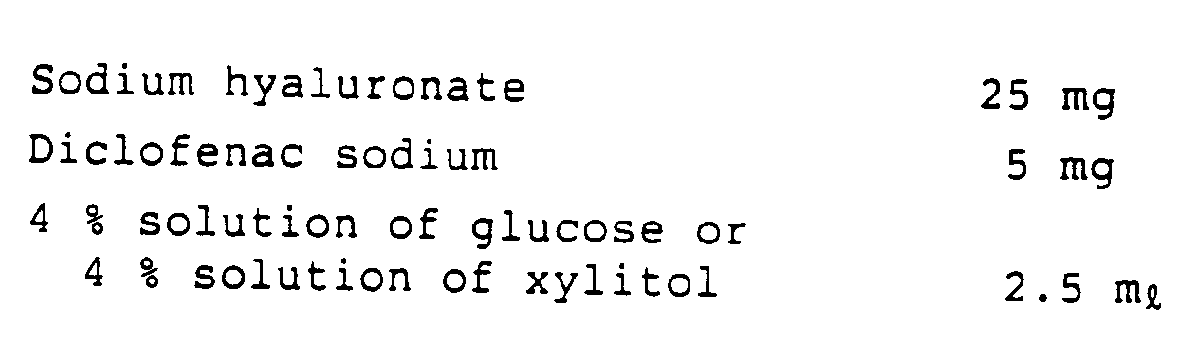
- Combined agents having following formulas were prepared.

- In addition to the ingredients used in the Examples, other ingredients can be used in the Examples as set forth in the specification to obtain substantially the same results.

Claims (6)


Applications Claiming Priority (2)
| Application Number | Priority Date | Filing Date | Title |
|---|---|---|---|
| JP33457189 | 1989-12-21 | ||
| JP334571/89 | 1989-12-21 |
Publications (2)
| Publication Number | Publication Date |
|---|---|
| EP0433817A1 EP0433817A1 (en) | 1991-06-26 |
| EP0433817B1 true EP0433817B1 (en) | 1993-09-08 |
Family
ID=18278891
Family Applications (1)
| Application Number | Title | Priority Date | Filing Date |
|---|---|---|---|
| EP90123628A Revoked EP0433817B1 (en) | 1989-12-21 | 1990-12-08 | Combined anti-inflammatory agent |
Country Status (7)
| Country | Link |
|---|---|
| US (1) | US5095037B1 (en) |
| EP (1) | EP0433817B1 (en) |
| CA (1) | CA2031880C (en) |
| DE (1) | DE69003229T2 (en) |
| ES (1) | ES2059965T3 (en) |
| FI (1) | FI906249L (en) |
| NO (1) | NO177525C (en) |
Cited By (6)
| Publication number | Priority date | Publication date | Assignee | Title |
|---|---|---|---|---|
| WO2005067943A1 (en) * | 2004-01-20 | 2005-07-28 | Panacea Biotec Ltd., | Compostions comprising glycosaminoglycan and nonsteroidal anti-inflammatory drug |
| US8287894B2 (en) | 2000-07-14 | 2012-10-16 | Alchemia Oncology Pty Limited | Hyaluronan as a drug pre-sensitizer and chemo-sensitizer in the treatment of disease |
| US8623354B2 (en) | 2005-09-07 | 2014-01-07 | Alchemia Oncology Pty Limited | Therapeutic compositions comprising hyaluronan and therapeutic antibodies as well as methods of treatment |
| US8741970B2 (en) | 1999-01-13 | 2014-06-03 | Alchemia Oncology Pty Limited | Composition and method for the enhancement of the efficacy of drugs |
| US8937052B2 (en) | 2005-07-27 | 2015-01-20 | Alchemia Oncology Pty Limited | Therapeutic protocols using hyaluronan |
| US9066919B2 (en) | 2000-07-14 | 2015-06-30 | Alchemia Oncology Pty Limited | Hyaluronan as a chemo-sensitizer in the treatment of cancer |
Families Citing this family (74)
| Publication number | Priority date | Publication date | Assignee | Title |
|---|---|---|---|---|
| IT1229075B (en) * | 1985-04-05 | 1991-07-17 | Fidia Farmaceutici | Topical compsn. contg. hyaluronic acid deriv. as vehicle |
| CA1340994C (en) * | 1989-09-21 | 2000-05-16 | Rudolf Edgar Dr. Falk | Treatment of conditions and disease |
| US5910489A (en) * | 1990-09-18 | 1999-06-08 | Hyal Pharmaceutical Corporation | Topical composition containing hyaluronic acid and NSAIDS |
| US5990096A (en) * | 1990-09-18 | 1999-11-23 | Hyal Pharmaceutical Corporation | Formulations containing hyaluronic acid |
| CA2061703C (en) * | 1992-02-20 | 2002-07-02 | Rudolf E. Falk | Formulations containing hyaluronic acid |
| US5639738A (en) * | 1992-02-20 | 1997-06-17 | Hyal Pharmaceutical Corporation | Treatment of basal cell carcinoma and actinic keratosis employing hyaluronic acid and NSAIDs |
| US5824658A (en) * | 1990-09-18 | 1998-10-20 | Hyal Pharmaceutical Corporation | Topical composition containing hyaluronic acid and NSAIDS |
| US5629287A (en) * | 1991-01-18 | 1997-05-13 | University College London | Depot formulations |
| US5610148A (en) * | 1991-01-18 | 1997-03-11 | University College London | Macroscopically oriented cell adhesion protein for wound treatment |
| JP2829794B2 (en) * | 1991-02-08 | 1998-12-02 | エスエス製薬 株式会社 | Orally administered pranoprofen formulation for sustained release |
| US5817642A (en) * | 1991-07-03 | 1998-10-06 | Hyal Pharmaceutical Corporation | Clearing of atherosclerosis |
| US6103704A (en) * | 1991-07-03 | 2000-08-15 | Hyal Pharmaceutical Corporation | Therapeutic methods using hyaluronic acid |
| EP0592569A1 (en) * | 1991-07-03 | 1994-04-20 | Sano Corporation | Composition and method for transdermal delivery of diclofenac |
| US5990095A (en) * | 1991-07-03 | 1999-11-23 | Hyal Pharmaceutical Corporation | Use of hyaluronic acid and forms to prevent arterial restenosis |
| US5817644A (en) * | 1991-07-03 | 1998-10-06 | Hyal Pharmaceutical Corporation | Targeting of dosages of medicine and therapeutic agents |
| US5977088A (en) * | 1991-07-03 | 1999-11-02 | Hyal Pharmaceutical Corporation | Formulations containing hyaluronic acid |
| CA2122551A1 (en) * | 1994-04-29 | 1995-10-30 | Rudolf Edgar Falk | Clearing of atherosclerosis |
| US5792753A (en) * | 1991-07-03 | 1998-08-11 | Hyal Pharmaceutical Corporation | Compositions comprising hyaluronic acid and prostaglandin-synthesis-inhibiting drugs |
| CA2061567C (en) * | 1992-02-20 | 1998-02-03 | Rudolf E. Falk | Use of hyaluronic acid to repair ischemia reperfusion damage |
| US6218373B1 (en) | 1992-02-20 | 2001-04-17 | Hyal Pharmaceutical Corporation | Formulations containing hyaluronic acid |
| US6147059A (en) * | 1992-02-20 | 2000-11-14 | Hyal Pharmaceutical Corporation | Formulations containing hyaluronic acid |
| US5767106A (en) * | 1992-02-21 | 1998-06-16 | Hyal Pharmaceutical Corporation | Treatment of disease and conditions associated with macrophage infiltration |
| US6114314A (en) * | 1992-02-21 | 2000-09-05 | Hyal Pharmaceutical Corp. | Formulations containing hyaluronic acid |
| US5847002A (en) * | 1993-04-16 | 1998-12-08 | Hyal Pharmaceutical Corporation | Compositions, for inhibition, control and regression of angiogenesis, containing hyaluronic acid and NSAID |
| CA2094203A1 (en) * | 1993-04-16 | 1994-10-17 | Derek A. Willoughby | Inhibition of angiogenesis |
| GB9425487D0 (en) * | 1994-12-16 | 1995-02-15 | Res Inst | Osteoarthritis treatment |
| US5939047A (en) * | 1996-04-16 | 1999-08-17 | Jernberg; Gary R. | Local delivery of chemotherapeutic agents for treatment of periodontal disease |
| US20030008396A1 (en) * | 1999-03-17 | 2003-01-09 | Ku David N. | Poly(vinyl alcohol) hydrogel |
| RU2141828C1 (en) * | 1998-03-26 | 1999-11-27 | ООО "Научно-исследовательский институт атеросклероза" (Медотель) | Substance prolonging garlic powder efficiency |
| US6645485B2 (en) * | 2000-05-10 | 2003-11-11 | Allan R. Dunn | Method of treating inflammation in the joints of a body |
| US6576226B1 (en) | 2000-11-17 | 2003-06-10 | Gary R. Jernberg | Local delivery of agents for disruption and inhibition of bacterial biofilm for treatment of periodontal disease |
| US6726898B2 (en) | 2000-11-17 | 2004-04-27 | Gary R. Jernberg | Local delivery of agents for disruption and inhibition of bacterial biofilm for treatment of periodontal disease |
| EP1354603A1 (en) * | 2000-12-26 | 2003-10-22 | Takeda Chemical Industries, Ltd. | Concomitant drugs |
| EP1369119B1 (en) * | 2001-03-15 | 2008-12-17 | Seikagaku Corporation | Il-12 expression controlling agents |
| WO2003000190A2 (en) * | 2001-06-25 | 2003-01-03 | Depuy | Liposomal encapsulation of glycosaminoglycans for the treatment of arthritic joints |
| AU2002322720B2 (en) | 2001-07-25 | 2008-11-13 | Raptor Pharmaceutical Inc. | Compositions and methods for modulating blood-brain barrier transport |
| US20050042303A1 (en) * | 2001-08-27 | 2005-02-24 | Brown Tracey Jean | Therapeutic protocols |
| EP1427410A1 (en) * | 2001-08-30 | 2004-06-16 | Merckle Gmbh | Use of annellated pyrrole compounds in the treatment of articular cartilage or subchondral bone degeneration |
| WO2003094937A1 (en) * | 2002-05-09 | 2003-11-20 | Medigenes | A pharmaceutical composition for treatment of wounds containing blood plasma or serum |
| US8273347B2 (en) | 2003-05-13 | 2012-09-25 | Depuy Spine, Inc. | Autologous treatment of degenerated disc with cells |
| US7344716B2 (en) * | 2003-05-13 | 2008-03-18 | Depuy Spine, Inc. | Transdiscal administration of specific inhibitors of pro-inflammatory cytokines |
| US20040229878A1 (en) * | 2003-05-13 | 2004-11-18 | Depuy Spine, Inc. | Transdiscal administration of specific inhibitors of P38 kinase |
| US7429378B2 (en) * | 2003-05-13 | 2008-09-30 | Depuy Spine, Inc. | Transdiscal administration of high affinity anti-MMP inhibitors |
| US7553827B2 (en) * | 2003-08-13 | 2009-06-30 | Depuy Spine, Inc. | Transdiscal administration of cycline compounds |
| US8361467B2 (en) * | 2003-07-30 | 2013-01-29 | Depuy Spine, Inc. | Trans-capsular administration of high specificity cytokine inhibitors into orthopedic joints |
| US8895540B2 (en) * | 2003-11-26 | 2014-11-25 | DePuy Synthes Products, LLC | Local intraosseous administration of bone forming agents and anti-resorptive agents, and devices therefor |
| WO2005077013A2 (en) | 2004-02-06 | 2005-08-25 | Georgia Tech Research Corporation | Surface directed cellular attachment |
| EP1729678A4 (en) * | 2004-02-06 | 2011-08-10 | Georgia Tech Res Inst | BEARING BIOCOMPATIBLE DEVICE |
| ES2434942T3 (en) * | 2004-05-27 | 2013-12-18 | Novozymes Biopharma Dk A/S | Dry and agglomerated hyaluronic acid product |
| US7956180B2 (en) * | 2004-05-27 | 2011-06-07 | Novozymes A/S | Dried and agglomerated hyaluronic acid product |
| US20050278025A1 (en) * | 2004-06-10 | 2005-12-15 | Salumedica Llc | Meniscus prosthesis |
| US20060122150A1 (en) * | 2004-09-30 | 2006-06-08 | Argentieri Dennis C | Pharmaceutical composition and method for treating a joint-capsule arthropathy |
| CN102379684B (en) | 2005-04-28 | 2014-11-19 | 普罗透斯数字保健公司 | Pharma-informatics system |
| US7323184B2 (en) * | 2005-08-22 | 2008-01-29 | Healagenics, Inc. | Compositions and methods for the treatment of wounds and the reduction of scar formation |
| US8598144B1 (en) | 2005-11-10 | 2013-12-03 | Reyn Pharma, Llc | Method of administering hyaluronan formulation for the amelioration of osteoarthritis |
| US9492381B1 (en) | 2005-11-10 | 2016-11-15 | Reyn Pharma, Llc | Method of administering hyaluronan formulation for preventing and ameliorating osteoarthritis |
| CN101522164B (en) * | 2006-09-13 | 2014-03-26 | 提升肤质产品公司 | Cosmetic composition for the treatment of skin and methods thereof |
| KR20090071598A (en) | 2006-09-18 | 2009-07-01 | 랩터 파마슈티컬 인코포레이티드 | Treatment of liver disease by administration of receptor binding protein (RAP) -conjugates |
| FR2918476B1 (en) * | 2007-07-02 | 2012-08-03 | Experts Enlargement Quality Exeq | DATA CONFORMITY CONTROL. |
| FR2918276B1 (en) | 2007-07-02 | 2010-01-22 | Anteis Sa | "USE OF A NATURAL POLYSACCHARIDE (S) GEL FOR THE PREPARATION OF AN INJECTION FORMULATION FOR THE TREATMENT OF JOINT DEGENERESCENCES" |
| US20090162351A1 (en) * | 2007-12-21 | 2009-06-25 | Depuy Spine, Inc. | Transdiscal administration of inhibitors of p38 MAP kinase |
| US8986696B2 (en) * | 2007-12-21 | 2015-03-24 | Depuy Mitek, Inc. | Trans-capsular administration of p38 map kinase inhibitors into orthopedic joints |
| US8178511B1 (en) * | 2008-07-02 | 2012-05-15 | Smith James D | Method of administering hyaluronan formulation for the amelioration of osteopenia |
| EP2398500B1 (en) | 2009-02-20 | 2019-03-13 | 2-BBB Medicines B.V. | Glutathione-based drug delivery system |
| ES2942923T3 (en) | 2009-05-06 | 2023-06-07 | Laboratory Skin Care Inc | Dermal delivery compositions comprising complexes of active agent-calcium phosphate particles and methods of use thereof |
| FR2945949B1 (en) * | 2009-05-26 | 2011-05-13 | Anteis Sa | HYDROGEL INJECTION FOR GLYCEROL SUPPLEMENTATION IN SKIN OVER LONG TERM. |
| IL206739A (en) | 2010-06-30 | 2016-06-30 | David Segal | Injectable pharmaceutical composition containing xylitol as active ingredient therein |
| US20120077778A1 (en) | 2010-09-29 | 2012-03-29 | Andrea Bourdelais | Ladder-Frame Polyether Conjugates |
| TWI382841B (en) * | 2010-10-29 | 2013-01-21 | Univ China Medical | Pharmaceutical composition for inhibiting inflammation |
| WO2012162552A1 (en) | 2011-05-26 | 2012-11-29 | Cartiva, Inc. | Tapered joint implant and related tools |
| NO2543357T3 (en) * | 2011-07-07 | 2018-08-18 | ||
| EP3636226A1 (en) | 2015-03-31 | 2020-04-15 | Cartiva, Inc. | Carpometacarpal (cmc) implants |
| WO2016161025A1 (en) | 2015-03-31 | 2016-10-06 | Cartiva, Inc. | Hydrogel implants with porous materials and methods |
| AU2016248062B2 (en) | 2015-04-14 | 2020-01-23 | Stryker Corporation | Tooling for creating tapered opening in tissue and related methods |
Family Cites Families (2)
| Publication number | Priority date | Publication date | Assignee | Title |
|---|---|---|---|---|
| US4808576A (en) * | 1986-04-28 | 1989-02-28 | Mobay Corporation | Remote administration of hyaluronic acid to mammals |
| EP0356435B1 (en) * | 1987-03-19 | 1995-10-18 | Arthropharm Pty. Limited | Anti-inflammatory compounds and compositions |
-
1990
- 1990-12-06 US US07623318 patent/US5095037B1/en not_active Expired - Lifetime
- 1990-12-08 EP EP90123628A patent/EP0433817B1/en not_active Revoked
- 1990-12-08 ES ES90123628T patent/ES2059965T3/en not_active Expired - Lifetime
- 1990-12-08 DE DE90123628T patent/DE69003229T2/en not_active Revoked
- 1990-12-10 CA CA002031880A patent/CA2031880C/en not_active Expired - Lifetime
- 1990-12-18 FI FI906249A patent/FI906249L/en not_active Application Discontinuation
- 1990-12-20 NO NO905514A patent/NO177525C/en not_active IP Right Cessation
Cited By (7)
| Publication number | Priority date | Publication date | Assignee | Title |
|---|---|---|---|---|
| US8741970B2 (en) | 1999-01-13 | 2014-06-03 | Alchemia Oncology Pty Limited | Composition and method for the enhancement of the efficacy of drugs |
| US8287894B2 (en) | 2000-07-14 | 2012-10-16 | Alchemia Oncology Pty Limited | Hyaluronan as a drug pre-sensitizer and chemo-sensitizer in the treatment of disease |
| US8388993B2 (en) | 2000-07-14 | 2013-03-05 | Alchemia Oncology Pty Limited | Hyaluronan-chemotherapeutic agent formulations for the treatment of colon cancer |
| US9066919B2 (en) | 2000-07-14 | 2015-06-30 | Alchemia Oncology Pty Limited | Hyaluronan as a chemo-sensitizer in the treatment of cancer |
| WO2005067943A1 (en) * | 2004-01-20 | 2005-07-28 | Panacea Biotec Ltd., | Compostions comprising glycosaminoglycan and nonsteroidal anti-inflammatory drug |
| US8937052B2 (en) | 2005-07-27 | 2015-01-20 | Alchemia Oncology Pty Limited | Therapeutic protocols using hyaluronan |
| US8623354B2 (en) | 2005-09-07 | 2014-01-07 | Alchemia Oncology Pty Limited | Therapeutic compositions comprising hyaluronan and therapeutic antibodies as well as methods of treatment |
Also Published As
| Publication number | Publication date |
|---|---|
| ES2059965T3 (en) | 1994-11-16 |
| NO177525C (en) | 2000-09-07 |
| NO905514L (en) | 1991-06-24 |
| NO177525B (en) | 1995-06-26 |
| FI906249A7 (en) | 1991-06-22 |
| US5095037B1 (en) | 1995-12-19 |
| CA2031880C (en) | 1999-09-21 |
| FI906249A0 (en) | 1990-12-18 |
| DE69003229D1 (en) | 1993-10-14 |
| FI906249L (en) | 1991-06-22 |
| CA2031880A1 (en) | 1991-06-22 |
| DE69003229T2 (en) | 1994-04-14 |
| US5095037A (en) | 1992-03-10 |
| NO905514D0 (en) | 1990-12-20 |
| EP0433817A1 (en) | 1991-06-26 |
Similar Documents
| Publication | Publication Date | Title |
|---|---|---|
| US5095037A (en) | Combined anti-inflammatory agent | |
| US6329429B1 (en) | Use of GABA analogs such as Gabapentin in the manufacture of a medicament for treating inflammatory diseases | |
| JPH082797B2 (en) | Degenerative joint disease therapeutic agent | |
| CA2735834C (en) | Composition comprising ibuprofen and paracetamol to treat pain caused by osteoarthritis and rheumatoid arthritis | |
| EP0994704B1 (en) | Use of gaba analogs such as gabapentin in the manufacture of a medicament for treating inflammatory diseases | |
| US20210145850A1 (en) | Composition, for osteoarthritis treatment, comprising hydrophilized sulfasalazine and hyaluronic acid and method for preparing same | |
| JP2002534477A (en) | New use of melagatran | |
| KR102285724B1 (en) | Composition for regenerating cartilage comprising polydeoxyribonucleotide and hyaluronic acid | |
| JP2788340B2 (en) | Inflammation treatment | |
| EP4108252A1 (en) | Pharmaceutical compositions comprising glp-1r agonists | |
| JP2001524080A (en) | Composition comprising hydrolyzed collagen protein and glucosamine for the treatment of arthritis | |
| JP3587851B2 (en) | Use of benzidamine in the treatment of TNF-induced pathologies | |
| JP7184792B2 (en) | Compositions for the treatment of osteoarthritis | |
| Altman et al. | Effects of edathamil disodium on the kidney | |
| US6696453B2 (en) | Use of NF-κB inhibitors to treat dry eye disorders | |
| HK40085325A (en) | Pharmaceutical compositions comprising glp-1r agonists | |
| AU2002309963A1 (en) | Use of NF-KAPPA-B inhibitors to treat dry eye disorders | |
| JPH10101577A (en) | Preventive / therapeutic agent for decreased range of motion of joint | |
| MXPA98001222A (en) | Quecontain composition mefenamic acid in association with code | |
| JPH01287030A (en) | Suppressant of urinary calculus |
Legal Events
| Date | Code | Title | Description |
|---|---|---|---|
| PUAI | Public reference made under article 153(3) epc to a published international application that has entered the european phase |
Free format text: ORIGINAL CODE: 0009012 |
|
| AK | Designated contracting states |
Kind code of ref document: A1 Designated state(s): DE ES FR GB IT SE |
|
| K1C3 | Correction of patent application (complete document) published |
Effective date: 19910626 |
|
| 17P | Request for examination filed |
Effective date: 19911218 |
|
| 17Q | First examination report despatched |
Effective date: 19920515 |
|
| GRAA | (expected) grant |
Free format text: ORIGINAL CODE: 0009210 |
|
| AK | Designated contracting states |
Kind code of ref document: B1 Designated state(s): DE ES FR GB IT SE |
|
| REF | Corresponds to: |
Ref document number: 69003229 Country of ref document: DE Date of ref document: 19931014 |
|
| ITF | It: translation for a ep patent filed | ||
| ET | Fr: translation filed | ||
| PLBI | Opposition filed |
Free format text: ORIGINAL CODE: 0009260 |
|
| 26 | Opposition filed |
Opponent name: HYAL CORPORATION Effective date: 19940607 |
|
| REG | Reference to a national code |
Ref country code: ES Ref legal event code: FG2A Ref document number: 2059965 Country of ref document: ES Kind code of ref document: T3 |
|
| EAL | Se: european patent in force in sweden |
Ref document number: 90123628.1 |
|
| PLAW | Interlocutory decision in opposition |
Free format text: ORIGINAL CODE: EPIDOS IDOP |
|
| APAC | Appeal dossier modified |
Free format text: ORIGINAL CODE: EPIDOS NOAPO |
|
| APAE | Appeal reference modified |
Free format text: ORIGINAL CODE: EPIDOS REFNO |
|
| APAC | Appeal dossier modified |
Free format text: ORIGINAL CODE: EPIDOS NOAPO |
|
| PLBQ | Unpublished change to opponent data |
Free format text: ORIGINAL CODE: EPIDOS OPPO |
|
| PLAB | Opposition data, opponent's data or that of the opponent's representative modified |
Free format text: ORIGINAL CODE: 0009299OPPO |
|
| R26 | Opposition filed (corrected) |
Opponent name: HYAL CORPORATION Effective date: 19940607 |
|
| REG | Reference to a national code |
Ref country code: GB Ref legal event code: IF02 |
|
| APCC | Communication from the board of appeal sent |
Free format text: ORIGINAL CODE: EPIDOS OBAPO |
|
| RAP2 | Party data changed (patent owner data changed or rights of a patent transferred) |
Owner name: NIPRO CORPORATION |
|
| REG | Reference to a national code |
Ref country code: FR Ref legal event code: CD |
|
| PLAB | Opposition data, opponent's data or that of the opponent's representative modified |
Free format text: ORIGINAL CODE: 0009299OPPO |
|
| PGFP | Annual fee paid to national office [announced via postgrant information from national office to epo] |
Ref country code: GB Payment date: 20031203 Year of fee payment: 14 |
|
| R26 | Opposition filed (corrected) |
Opponent name: SKYEPHARMA PLC Effective date: 19940607 |
|
| PGFP | Annual fee paid to national office [announced via postgrant information from national office to epo] |
Ref country code: SE Payment date: 20031204 Year of fee payment: 14 |
|
| PGFP | Annual fee paid to national office [announced via postgrant information from national office to epo] |
Ref country code: FR Payment date: 20031210 Year of fee payment: 14 |
|
| PGFP | Annual fee paid to national office [announced via postgrant information from national office to epo] |
Ref country code: DE Payment date: 20031218 Year of fee payment: 14 |
|
| PGFP | Annual fee paid to national office [announced via postgrant information from national office to epo] |
Ref country code: ES Payment date: 20031230 Year of fee payment: 14 |
|
| APBU | Appeal procedure closed |
Free format text: ORIGINAL CODE: EPIDOSNNOA9O |
|
| RDAF | Communication despatched that patent is revoked |
Free format text: ORIGINAL CODE: EPIDOSNREV1 |
|
| RDAG | Patent revoked |
Free format text: ORIGINAL CODE: 0009271 |
|
| STAA | Information on the status of an ep patent application or granted ep patent |
Free format text: STATUS: PATENT REVOKED |
|
| 27W | Patent revoked |
Effective date: 20040622 |
|
| GBPR | Gb: patent revoked under art. 102 of the ep convention designating the uk as contracting state |
Free format text: 20040622 |
|
| REG | Reference to a national code |
Ref country code: SE Ref legal event code: ECNC |
|
| APAH | Appeal reference modified |
Free format text: ORIGINAL CODE: EPIDOSCREFNO |