EP0433759A1 - 4-Substituted alkyl carbapenem antibiotics - Google Patents
4-Substituted alkyl carbapenem antibiotics Download PDFInfo
- Publication number
- EP0433759A1 EP0433759A1 EP90123258A EP90123258A EP0433759A1 EP 0433759 A1 EP0433759 A1 EP 0433759A1 EP 90123258 A EP90123258 A EP 90123258A EP 90123258 A EP90123258 A EP 90123258A EP 0433759 A1 EP0433759 A1 EP 0433759A1
- Authority
- EP
- European Patent Office
- Prior art keywords
- alkyl
- hydroxy
- hydroxyethyl
- azabicyclo
- ene
- Prior art date
- Legal status (The legal status is an assumption and is not a legal conclusion. Google has not performed a legal analysis and makes no representation as to the accuracy of the status listed.)
- Withdrawn
Links
- 239000003242 anti bacterial agent Substances 0.000 title description 19
- 229940088710 antibiotic agent Drugs 0.000 title description 19
- -1 azidoethyl Chemical group 0.000 claims abstract description 244
- 150000001875 compounds Chemical class 0.000 claims abstract description 237
- 229910052739 hydrogen Inorganic materials 0.000 claims abstract description 211
- 150000003839 salts Chemical class 0.000 claims abstract description 114
- 239000001257 hydrogen Substances 0.000 claims abstract description 102
- 125000004435 hydrogen atom Chemical group [H]* 0.000 claims abstract description 89
- 231100000252 nontoxic Toxicity 0.000 claims abstract description 85
- 230000003000 nontoxic effect Effects 0.000 claims abstract description 85
- IJGRMHOSHXDMSA-UHFFFAOYSA-N Atomic nitrogen Chemical group N#N IJGRMHOSHXDMSA-UHFFFAOYSA-N 0.000 claims abstract description 80
- 125000004178 (C1-C4) alkyl group Chemical group 0.000 claims abstract description 72
- 125000000217 alkyl group Chemical group 0.000 claims abstract description 59
- 125000003282 alkyl amino group Chemical group 0.000 claims abstract description 54
- 125000002947 alkylene group Chemical group 0.000 claims abstract description 54
- 125000002887 hydroxy group Chemical group [H]O* 0.000 claims abstract description 54
- 229910052760 oxygen Inorganic materials 0.000 claims abstract description 51
- QVGXLLKOCUKJST-UHFFFAOYSA-N atomic oxygen Chemical group [O] QVGXLLKOCUKJST-UHFFFAOYSA-N 0.000 claims abstract description 50
- 239000001301 oxygen Substances 0.000 claims abstract description 50
- 229910052757 nitrogen Chemical group 0.000 claims abstract description 48
- 229910052717 sulfur Inorganic materials 0.000 claims abstract description 47
- 125000000229 (C1-C4)alkoxy group Chemical group 0.000 claims abstract description 41
- NINIDFKCEFEMDL-UHFFFAOYSA-N Sulfur Chemical group [S] NINIDFKCEFEMDL-UHFFFAOYSA-N 0.000 claims abstract description 40
- 125000001997 phenyl group Chemical group [H]C1=C([H])C([H])=C(*)C([H])=C1[H] 0.000 claims abstract description 40
- 125000000852 azido group Chemical group *N=[N+]=[N-] 0.000 claims abstract description 37
- 125000002924 primary amino group Chemical group [H]N([H])* 0.000 claims abstract description 37
- 239000011593 sulfur Chemical group 0.000 claims abstract description 37
- 150000002825 nitriles Chemical group 0.000 claims abstract description 34
- 229910052736 halogen Inorganic materials 0.000 claims abstract description 29
- 150000002367 halogens Chemical group 0.000 claims abstract description 29
- 125000001424 substituent group Chemical group 0.000 claims abstract description 29
- 125000005842 heteroatom Chemical group 0.000 claims abstract description 27
- 125000002252 acyl group Chemical group 0.000 claims abstract description 25
- 229910052799 carbon Inorganic materials 0.000 claims abstract description 23
- 125000004432 carbon atom Chemical group C* 0.000 claims abstract description 23
- 150000001413 amino acids Chemical class 0.000 claims abstract description 18
- 125000003178 carboxy group Chemical group [H]OC(*)=O 0.000 claims abstract description 16
- 125000000623 heterocyclic group Chemical group 0.000 claims abstract description 16
- 125000004185 ester group Chemical group 0.000 claims abstract description 14
- 125000001072 heteroaryl group Chemical group 0.000 claims abstract description 14
- 108090000765 processed proteins & peptides Proteins 0.000 claims abstract description 14
- 125000002023 trifluoromethyl group Chemical group FC(F)(F)* 0.000 claims abstract description 13
- 125000000656 azaniumyl group Chemical group [H][N+]([H])([H])[*] 0.000 claims abstract description 11
- 125000004434 sulfur atom Chemical group 0.000 claims abstract description 10
- GAWIXWVDTYZWAW-UHFFFAOYSA-N C[CH]O Chemical group C[CH]O GAWIXWVDTYZWAW-UHFFFAOYSA-N 0.000 claims abstract description 9
- 125000000962 organic group Chemical group 0.000 claims abstract description 9
- 125000004169 (C1-C6) alkyl group Chemical group 0.000 claims abstract description 8
- 125000002373 5 membered heterocyclic group Chemical group 0.000 claims abstract description 8
- 125000004070 6 membered heterocyclic group Chemical group 0.000 claims abstract description 8
- 125000004433 nitrogen atom Chemical group N* 0.000 claims abstract description 8
- 125000000022 2-aminoethyl group Chemical group [H]C([*])([H])C([H])([H])N([H])[H] 0.000 claims abstract description 7
- 208000035473 Communicable disease Diseases 0.000 claims abstract description 7
- 125000002393 azetidinyl group Chemical group 0.000 claims abstract description 6
- 125000003917 carbamoyl group Chemical group [H]N([H])C(*)=O 0.000 claims abstract description 4
- 125000002496 methyl group Chemical group [H]C([H])([H])* 0.000 claims description 88
- 125000004105 2-pyridyl group Chemical group N1=C([*])C([H])=C([H])C([H])=C1[H] 0.000 claims description 83
- 125000003903 2-propenyl group Chemical group [H]C([*])([H])C([H])=C([H])[H] 0.000 claims description 81
- MNFORVFSTILPAW-UHFFFAOYSA-N azetidin-2-one Chemical compound O=C1CCN1 MNFORVFSTILPAW-UHFFFAOYSA-N 0.000 claims description 71
- 125000002816 methylsulfanyl group Chemical group [H]C([H])([H])S[*] 0.000 claims description 71
- 125000000446 sulfanediyl group Chemical group *S* 0.000 claims description 57
- 125000001731 2-cyanoethyl group Chemical group [H]C([H])(*)C([H])([H])C#N 0.000 claims description 33
- 125000006239 protecting group Chemical group 0.000 claims description 23
- 125000004453 alkoxycarbonyl group Chemical group 0.000 claims description 18
- 125000005913 (C3-C6) cycloalkyl group Chemical group 0.000 claims description 17
- UFHFLCQGNIYNRP-UHFFFAOYSA-N Hydrogen Chemical compound [H][H] UFHFLCQGNIYNRP-UHFFFAOYSA-N 0.000 claims description 15
- 125000000392 cycloalkenyl group Chemical group 0.000 claims description 13
- 125000003356 phenylsulfanyl group Chemical group [*]SC1=C([H])C([H])=C([H])C([H])=C1[H] 0.000 claims description 11
- 125000003545 alkoxy group Chemical group 0.000 claims description 10
- 125000004414 alkyl thio group Chemical group 0.000 claims description 10
- 150000001732 carboxylic acid derivatives Chemical class 0.000 claims description 10
- 125000001153 fluoro group Chemical group F* 0.000 claims description 10
- 125000000954 2-hydroxyethyl group Chemical group [H]C([*])([H])C([H])([H])O[H] 0.000 claims description 9
- 239000008194 pharmaceutical composition Substances 0.000 claims description 9
- 238000004519 manufacturing process Methods 0.000 claims description 8
- 125000005196 alkyl carbonyloxy group Chemical group 0.000 claims description 7
- 125000001495 ethyl group Chemical group [H]C([H])([H])C([H])([H])* 0.000 claims description 6
- 125000003349 3-pyridyl group Chemical group N1=C([H])C([*])=C([H])C([H])=C1[H] 0.000 claims description 5
- 125000003342 alkenyl group Chemical group 0.000 claims description 5
- 230000000844 anti-bacterial effect Effects 0.000 claims description 5
- 125000000753 cycloalkyl group Chemical group 0.000 claims description 5
- 125000000449 nitro group Chemical group [O-][N+](*)=O 0.000 claims description 5
- 238000007127 saponification reaction Methods 0.000 claims description 5
- 125000003161 (C1-C6) alkylene group Chemical group 0.000 claims description 4
- 238000007363 ring formation reaction Methods 0.000 claims description 4
- 125000001309 chloro group Chemical group Cl* 0.000 claims description 3
- 239000003937 drug carrier Substances 0.000 claims description 3
- 125000001449 isopropyl group Chemical group [H]C([H])([H])C([H])(*)C([H])([H])[H] 0.000 claims description 3
- 235000019730 animal feed additive Nutrition 0.000 claims description 2
- 239000003899 bactericide agent Substances 0.000 claims description 2
- 125000001246 bromo group Chemical group Br* 0.000 claims description 2
- 239000000645 desinfectant Substances 0.000 claims description 2
- DMJNNHOOLUXYBV-PQTSNVLCSA-N meropenem Chemical compound C=1([C@H](C)[C@@H]2[C@H](C(N2C=1C(O)=O)=O)[C@H](O)C)S[C@@H]1CN[C@H](C(=O)N(C)C)C1 DMJNNHOOLUXYBV-PQTSNVLCSA-N 0.000 claims description 2
- 125000000956 methoxy group Chemical group [H]C([H])([H])O* 0.000 claims description 2
- XSXHWVKGUXMUQE-UHFFFAOYSA-N osmium dioxide Inorganic materials O=[Os]=O XSXHWVKGUXMUQE-UHFFFAOYSA-N 0.000 claims description 2
- 239000003755 preservative agent Substances 0.000 claims description 2
- 125000006656 (C2-C4) alkenyl group Chemical group 0.000 claims 4
- 239000005864 Sulphur Substances 0.000 claims 3
- 125000004512 1,2,3-thiadiazol-4-yl group Chemical group S1N=NC(=C1)* 0.000 claims 2
- 125000004705 ethylthio group Chemical group C(C)S* 0.000 claims 2
- LMBFAGIMSUYTBN-MPZNNTNKSA-N teixobactin Chemical compound C([C@H](C(=O)N[C@@H]([C@@H](C)CC)C(=O)N[C@@H](CO)C(=O)N[C@H](CCC(N)=O)C(=O)N[C@H]([C@@H](C)CC)C(=O)N[C@@H]([C@@H](C)CC)C(=O)N[C@@H](CO)C(=O)N[C@H]1C(N[C@@H](C)C(=O)N[C@@H](C[C@@H]2NC(=N)NC2)C(=O)N[C@H](C(=O)O[C@H]1C)[C@@H](C)CC)=O)NC)C1=CC=CC=C1 LMBFAGIMSUYTBN-MPZNNTNKSA-N 0.000 claims 2
- 125000004214 1-pyrrolidinyl group Chemical group [H]C1([H])N(*)C([H])([H])C([H])([H])C1([H])[H] 0.000 claims 1
- 125000004777 2-fluoroethyl group Chemical group [H]C([H])(F)C([H])([H])* 0.000 claims 1
- 125000000339 4-pyridyl group Chemical group N1=C([H])C([H])=C([*])C([H])=C1[H] 0.000 claims 1
- 125000000250 methylamino group Chemical group [H]N(*)C([H])([H])[H] 0.000 claims 1
- 125000004482 piperidin-4-yl group Chemical group N1CCC(CC1)* 0.000 claims 1
- 230000002335 preservative effect Effects 0.000 claims 1
- 125000002112 pyrrolidino group Chemical group [*]N1C([H])([H])C([H])([H])C([H])([H])C1([H])[H] 0.000 claims 1
- 125000001889 triflyl group Chemical group FC(F)(F)S(*)(=O)=O 0.000 claims 1
- 238000000034 method Methods 0.000 abstract description 53
- 239000000543 intermediate Substances 0.000 abstract description 41
- 238000002360 preparation method Methods 0.000 abstract description 17
- 238000011282 treatment Methods 0.000 abstract description 14
- 230000008569 process Effects 0.000 abstract description 12
- 241001465754 Metazoa Species 0.000 abstract description 7
- 208000015181 infectious disease Diseases 0.000 abstract description 6
- 239000004599 antimicrobial Substances 0.000 abstract description 5
- XEKOWRVHYACXOJ-UHFFFAOYSA-N Ethyl acetate Chemical compound CCOC(C)=O XEKOWRVHYACXOJ-UHFFFAOYSA-N 0.000 description 282
- XLYOFNOQVPJJNP-UHFFFAOYSA-N water Substances O XLYOFNOQVPJJNP-UHFFFAOYSA-N 0.000 description 235
- YMWUJEATGCHHMB-UHFFFAOYSA-N Dichloromethane Chemical compound ClCCl YMWUJEATGCHHMB-UHFFFAOYSA-N 0.000 description 186
- 229910001868 water Inorganic materials 0.000 description 172
- 239000000243 solution Substances 0.000 description 155
- RTZKZFJDLAIYFH-UHFFFAOYSA-N Diethyl ether Chemical compound CCOCC RTZKZFJDLAIYFH-UHFFFAOYSA-N 0.000 description 143
- WEVYAHXRMPXWCK-UHFFFAOYSA-N Acetonitrile Chemical compound CC#N WEVYAHXRMPXWCK-UHFFFAOYSA-N 0.000 description 141
- 239000000203 mixture Substances 0.000 description 139
- 235000019439 ethyl acetate Nutrition 0.000 description 127
- JUJWROOIHBZHMG-UHFFFAOYSA-N Pyridine Chemical compound C1=CC=NC=C1 JUJWROOIHBZHMG-UHFFFAOYSA-N 0.000 description 125
- WYURNTSHIVDZCO-UHFFFAOYSA-N Tetrahydrofuran Chemical compound C1CCOC1 WYURNTSHIVDZCO-UHFFFAOYSA-N 0.000 description 118
- 125000003118 aryl group Chemical group 0.000 description 106
- CSNNHWWHGAXBCP-UHFFFAOYSA-L Magnesium sulfate Chemical compound [Mg+2].[O-][S+2]([O-])([O-])[O-] CSNNHWWHGAXBCP-UHFFFAOYSA-L 0.000 description 102
- 238000005481 NMR spectroscopy Methods 0.000 description 93
- VLKZOEOYAKHREP-UHFFFAOYSA-N n-Hexane Chemical compound CCCCCC VLKZOEOYAKHREP-UHFFFAOYSA-N 0.000 description 90
- YXFVVABEGXRONW-UHFFFAOYSA-N Toluene Chemical compound CC1=CC=CC=C1 YXFVVABEGXRONW-UHFFFAOYSA-N 0.000 description 87
- HEDRZPFGACZZDS-MICDWDOJSA-N Trichloro(2H)methane Chemical compound [2H]C(Cl)(Cl)Cl HEDRZPFGACZZDS-MICDWDOJSA-N 0.000 description 86
- VYPSYNLAJGMNEJ-UHFFFAOYSA-N Silicium dioxide Chemical compound O=[Si]=O VYPSYNLAJGMNEJ-UHFFFAOYSA-N 0.000 description 83
- 125000001570 methylene group Chemical group [H]C([H])([*:1])[*:2] 0.000 description 80
- 238000006243 chemical reaction Methods 0.000 description 75
- 239000002904 solvent Substances 0.000 description 71
- 239000012267 brine Substances 0.000 description 70
- HPALAKNZSZLMCH-UHFFFAOYSA-M sodium;chloride;hydrate Chemical compound O.[Na+].[Cl-] HPALAKNZSZLMCH-UHFFFAOYSA-M 0.000 description 70
- ZMANZCXQSJIPKH-UHFFFAOYSA-N Triethylamine Chemical compound CCN(CC)CC ZMANZCXQSJIPKH-UHFFFAOYSA-N 0.000 description 66
- 229910052943 magnesium sulfate Inorganic materials 0.000 description 65
- JGFZNNIVVJXRND-UHFFFAOYSA-N N,N-Diisopropylethylamine (DIPEA) Chemical compound CCN(C(C)C)C(C)C JGFZNNIVVJXRND-UHFFFAOYSA-N 0.000 description 60
- 239000000741 silica gel Substances 0.000 description 59
- 229910002027 silica gel Inorganic materials 0.000 description 59
- QTBSBXVTEAMEQO-UHFFFAOYSA-N Acetic acid Chemical compound CC(O)=O QTBSBXVTEAMEQO-UHFFFAOYSA-N 0.000 description 57
- UHOVQNZJYSORNB-UHFFFAOYSA-N Benzene Chemical compound C1=CC=CC=C1 UHOVQNZJYSORNB-UHFFFAOYSA-N 0.000 description 57
- UMJSCPRVCHMLSP-UHFFFAOYSA-N pyridine Natural products COC1=CC=CN=C1 UMJSCPRVCHMLSP-UHFFFAOYSA-N 0.000 description 55
- HEMHJVSKTPXQMS-UHFFFAOYSA-M Sodium hydroxide Chemical compound [OH-].[Na+] HEMHJVSKTPXQMS-UHFFFAOYSA-M 0.000 description 54
- 239000003921 oil Substances 0.000 description 53
- 229910000030 sodium bicarbonate Inorganic materials 0.000 description 50
- 125000000999 tert-butyl group Chemical group [H]C([H])([H])C(*)(C([H])([H])[H])C([H])([H])[H] 0.000 description 49
- 239000008363 phosphate buffer Substances 0.000 description 42
- 125000002348 vinylic group Chemical group 0.000 description 41
- 238000010828 elution Methods 0.000 description 39
- LFQSCWFLJHTTHZ-UHFFFAOYSA-N Ethanol Chemical compound CCO LFQSCWFLJHTTHZ-UHFFFAOYSA-N 0.000 description 37
- 238000001704 evaporation Methods 0.000 description 36
- 230000008020 evaporation Effects 0.000 description 36
- 239000011541 reaction mixture Substances 0.000 description 35
- YLQBMQCUIZJEEH-UHFFFAOYSA-N tetrahydrofuran Natural products C=1C=COC=1 YLQBMQCUIZJEEH-UHFFFAOYSA-N 0.000 description 35
- IKHGUXGNUITLKF-UHFFFAOYSA-N Acetaldehyde Chemical compound CC=O IKHGUXGNUITLKF-UHFFFAOYSA-N 0.000 description 34
- KDLHZDBZIXYQEI-UHFFFAOYSA-N Palladium Chemical compound [Pd] KDLHZDBZIXYQEI-UHFFFAOYSA-N 0.000 description 30
- UIIMBOGNXHQVGW-UHFFFAOYSA-M Sodium bicarbonate Chemical compound [Na+].OC([O-])=O UIIMBOGNXHQVGW-UHFFFAOYSA-M 0.000 description 30
- 239000007787 solid Substances 0.000 description 30
- FPGGTKZVZWFYPV-UHFFFAOYSA-M tetrabutylammonium fluoride Chemical compound [F-].CCCC[N+](CCCC)(CCCC)CCCC FPGGTKZVZWFYPV-UHFFFAOYSA-M 0.000 description 30
- 238000004128 high performance liquid chromatography Methods 0.000 description 28
- OKKJLVBELUTLKV-UHFFFAOYSA-N Methanol Chemical compound OC OKKJLVBELUTLKV-UHFFFAOYSA-N 0.000 description 27
- 125000000118 dimethyl group Chemical group [H]C([H])([H])* 0.000 description 27
- 239000012071 phase Substances 0.000 description 27
- YZBQHRLRFGPBSL-RXMQYKEDSA-N carbapenem Chemical compound C1C=CN2C(=O)C[C@H]21 YZBQHRLRFGPBSL-RXMQYKEDSA-N 0.000 description 26
- 150000003952 β-lactams Chemical class 0.000 description 26
- FAPWRFPIFSIZLT-UHFFFAOYSA-M Sodium chloride Chemical compound [Na+].[Cl-] FAPWRFPIFSIZLT-UHFFFAOYSA-M 0.000 description 24
- 239000011734 sodium Substances 0.000 description 23
- 125000000484 butyl group Chemical group [H]C([*])([H])C([H])([H])C([H])([H])C([H])([H])[H] 0.000 description 22
- 239000007858 starting material Substances 0.000 description 22
- DGAQECJNVWCQMB-PUAWFVPOSA-M Ilexoside XXIX Chemical compound C[C@@H]1CC[C@@]2(CC[C@@]3(C(=CC[C@H]4[C@]3(CC[C@@H]5[C@@]4(CC[C@@H](C5(C)C)OS(=O)(=O)[O-])C)C)[C@@H]2[C@]1(C)O)C)C(=O)O[C@H]6[C@@H]([C@H]([C@@H]([C@H](O6)CO)O)O)O.[Na+] DGAQECJNVWCQMB-PUAWFVPOSA-M 0.000 description 21
- 229910052708 sodium Inorganic materials 0.000 description 21
- RIOQSEWOXXDEQQ-UHFFFAOYSA-N triphenylphosphine Chemical compound C1=CC=CC=C1P(C=1C=CC=CC=1)C1=CC=CC=C1 RIOQSEWOXXDEQQ-UHFFFAOYSA-N 0.000 description 20
- 239000003054 catalyst Substances 0.000 description 19
- 239000003795 chemical substances by application Substances 0.000 description 19
- 239000003208 petroleum Substances 0.000 description 19
- 229920006395 saturated elastomer Polymers 0.000 description 19
- WSFSSNUMVMOOMR-UHFFFAOYSA-N Formaldehyde Chemical group O=C WSFSSNUMVMOOMR-UHFFFAOYSA-N 0.000 description 18
- 239000002253 acid Substances 0.000 description 18
- ZMXDDKWLCZADIW-UHFFFAOYSA-N N,N-Dimethylformamide Chemical compound CN(C)C=O ZMXDDKWLCZADIW-UHFFFAOYSA-N 0.000 description 17
- 125000000816 ethylene group Chemical group [H]C([H])([*:1])C([H])([H])[*:2] 0.000 description 17
- 238000004108 freeze drying Methods 0.000 description 16
- 239000000047 product Substances 0.000 description 16
- 238000005160 1H NMR spectroscopy Methods 0.000 description 15
- XKRFYHLGVUSROY-UHFFFAOYSA-N Argon Chemical compound [Ar] XKRFYHLGVUSROY-UHFFFAOYSA-N 0.000 description 15
- 239000008346 aqueous phase Substances 0.000 description 15
- 239000003960 organic solvent Substances 0.000 description 15
- 229960000583 acetic acid Drugs 0.000 description 14
- 150000002148 esters Chemical class 0.000 description 14
- 230000014759 maintenance of location Effects 0.000 description 14
- SJIIDWBFRZACDQ-UHFFFAOYSA-N pyridin-2-ylmethanethiol Chemical compound SCC1=CC=CC=N1 SJIIDWBFRZACDQ-UHFFFAOYSA-N 0.000 description 14
- RYHBNJHYFVUHQT-UHFFFAOYSA-N 1,4-Dioxane Chemical compound C1COCCO1 RYHBNJHYFVUHQT-UHFFFAOYSA-N 0.000 description 13
- OISVCGZHLKNMSJ-UHFFFAOYSA-N 2,6-dimethylpyridine Chemical compound CC1=CC=CC(C)=N1 OISVCGZHLKNMSJ-UHFFFAOYSA-N 0.000 description 12
- AFBPFSWMIHJQDM-UHFFFAOYSA-N N-methylaniline Chemical compound CNC1=CC=CC=C1 AFBPFSWMIHJQDM-UHFFFAOYSA-N 0.000 description 12
- 229910019142 PO4 Inorganic materials 0.000 description 12
- 229940024606 amino acid Drugs 0.000 description 12
- 235000001014 amino acid Nutrition 0.000 description 12
- 239000002585 base Substances 0.000 description 12
- 239000012074 organic phase Substances 0.000 description 12
- 239000000843 powder Substances 0.000 description 12
- 229940041011 carbapenems Drugs 0.000 description 11
- 239000010452 phosphate Substances 0.000 description 11
- 239000011780 sodium chloride Substances 0.000 description 11
- 239000000725 suspension Substances 0.000 description 11
- WKDDRNSBRWANNC-UHFFFAOYSA-N Thienamycin Natural products C1C(SCCN)=C(C(O)=O)N2C(=O)C(C(O)C)C21 WKDDRNSBRWANNC-UHFFFAOYSA-N 0.000 description 10
- BHIIGRBMZRSDRI-UHFFFAOYSA-N [chloro(phenoxy)phosphoryl]oxybenzene Chemical compound C=1C=CC=CC=1OP(=O)(Cl)OC1=CC=CC=C1 BHIIGRBMZRSDRI-UHFFFAOYSA-N 0.000 description 10
- NFHFRUOZVGFOOS-UHFFFAOYSA-N palladium;triphenylphosphane Chemical compound [Pd].C1=CC=CC=C1P(C=1C=CC=CC=1)C1=CC=CC=C1.C1=CC=CC=C1P(C=1C=CC=CC=1)C1=CC=CC=C1.C1=CC=CC=C1P(C=1C=CC=CC=1)C1=CC=CC=C1.C1=CC=CC=C1P(C=1C=CC=CC=1)C1=CC=CC=C1 NFHFRUOZVGFOOS-UHFFFAOYSA-N 0.000 description 10
- OKTJSMMVPCPJKN-UHFFFAOYSA-N Carbon Chemical compound [C] OKTJSMMVPCPJKN-UHFFFAOYSA-N 0.000 description 9
- ZLMJMSJWJFRBEC-UHFFFAOYSA-N Potassium Chemical compound [K] ZLMJMSJWJFRBEC-UHFFFAOYSA-N 0.000 description 9
- 125000001797 benzyl group Chemical group [H]C1=C([H])C([H])=C(C([H])=C1[H])C([H])([H])* 0.000 description 9
- 150000002085 enols Chemical class 0.000 description 9
- 125000004356 hydroxy functional group Chemical group O* 0.000 description 9
- RAXXELZNTBOGNW-UHFFFAOYSA-N imidazole Natural products C1=CNC=N1 RAXXELZNTBOGNW-UHFFFAOYSA-N 0.000 description 9
- 239000011591 potassium Substances 0.000 description 9
- 229910052700 potassium Inorganic materials 0.000 description 9
- 238000006722 reduction reaction Methods 0.000 description 9
- 239000000126 substance Substances 0.000 description 9
- NDLIRBZKZSDGSO-UHFFFAOYSA-N tosyl azide Chemical compound CC1=CC=C(S(=O)(=O)[N-][N+]#N)C=C1 NDLIRBZKZSDGSO-UHFFFAOYSA-N 0.000 description 9
- 229920002554 vinyl polymer Polymers 0.000 description 9
- 125000004066 1-hydroxyethyl group Chemical class [H]OC([H])([*])C([H])([H])[H] 0.000 description 8
- VHYFNPMBLIVWCW-UHFFFAOYSA-N 4-Dimethylaminopyridine Chemical compound CN(C)C1=CC=NC=C1 VHYFNPMBLIVWCW-UHFFFAOYSA-N 0.000 description 8
- NLXLAEXVIDQMFP-UHFFFAOYSA-N Ammonia chloride Chemical group [NH4+].[Cl-] NLXLAEXVIDQMFP-UHFFFAOYSA-N 0.000 description 8
- HEDRZPFGACZZDS-UHFFFAOYSA-N Chloroform Chemical compound ClC(Cl)Cl HEDRZPFGACZZDS-UHFFFAOYSA-N 0.000 description 8
- VEXZGXHMUGYJMC-UHFFFAOYSA-N Hydrochloric acid Chemical compound Cl VEXZGXHMUGYJMC-UHFFFAOYSA-N 0.000 description 8
- MHAJPDPJQMAIIY-UHFFFAOYSA-N Hydrogen peroxide Chemical compound OO MHAJPDPJQMAIIY-UHFFFAOYSA-N 0.000 description 8
- WLLIXJBWWFGEHT-UHFFFAOYSA-N [tert-butyl(dimethyl)silyl] trifluoromethanesulfonate Chemical compound CC(C)(C)[Si](C)(C)OS(=O)(=O)C(F)(F)F WLLIXJBWWFGEHT-UHFFFAOYSA-N 0.000 description 8
- 229910052786 argon Inorganic materials 0.000 description 8
- PFKFTWBEEFSNDU-UHFFFAOYSA-N carbonyldiimidazole Chemical compound C1=CN=CN1C(=O)N1C=CN=C1 PFKFTWBEEFSNDU-UHFFFAOYSA-N 0.000 description 8
- 150000007942 carboxylates Chemical class 0.000 description 8
- CSJLBAMHHLJAAS-UHFFFAOYSA-N diethylaminosulfur trifluoride Chemical compound CCN(CC)S(F)(F)F CSJLBAMHHLJAAS-UHFFFAOYSA-N 0.000 description 8
- 238000006073 displacement reaction Methods 0.000 description 8
- 239000000706 filtrate Substances 0.000 description 8
- 125000006503 p-nitrobenzyl group Chemical group [H]C1=C([H])C(=C([H])C([H])=C1[N+]([O-])=O)C([H])([H])* 0.000 description 8
- 230000009467 reduction Effects 0.000 description 8
- 239000000377 silicon dioxide Substances 0.000 description 8
- 238000000935 solvent evaporation Methods 0.000 description 8
- VZGDMQKNWNREIO-UHFFFAOYSA-N tetrachloromethane Chemical compound ClC(Cl)(Cl)Cl VZGDMQKNWNREIO-UHFFFAOYSA-N 0.000 description 8
- 150000007970 thio esters Chemical class 0.000 description 8
- JIAARYAFYJHUJI-UHFFFAOYSA-L zinc dichloride Chemical compound [Cl-].[Cl-].[Zn+2] JIAARYAFYJHUJI-UHFFFAOYSA-L 0.000 description 8
- FYYHWMGAXLPEAU-UHFFFAOYSA-N Magnesium Chemical compound [Mg] FYYHWMGAXLPEAU-UHFFFAOYSA-N 0.000 description 7
- OFOBLEOULBTSOW-UHFFFAOYSA-L Malonate Chemical compound [O-]C(=O)CC([O-])=O OFOBLEOULBTSOW-UHFFFAOYSA-L 0.000 description 7
- WKDDRNSBRWANNC-ATRFCDNQSA-N Thienamycin Chemical compound C1C(SCCN)=C(C(O)=O)N2C(=O)[C@H]([C@H](O)C)[C@H]21 WKDDRNSBRWANNC-ATRFCDNQSA-N 0.000 description 7
- 125000000746 allylic group Chemical group 0.000 description 7
- 125000004122 cyclic group Chemical group 0.000 description 7
- FAMRKDQNMBBFBR-BQYQJAHWSA-N diethyl azodicarboxylate Substances CCOC(=O)\N=N\C(=O)OCC FAMRKDQNMBBFBR-BQYQJAHWSA-N 0.000 description 7
- FAMRKDQNMBBFBR-UHFFFAOYSA-N ethyl n-ethoxycarbonyliminocarbamate Chemical compound CCOC(=O)N=NC(=O)OCC FAMRKDQNMBBFBR-UHFFFAOYSA-N 0.000 description 7
- 239000000284 extract Substances 0.000 description 7
- 239000011777 magnesium Substances 0.000 description 7
- 229910052749 magnesium Inorganic materials 0.000 description 7
- AICDYVDWYUUUGL-UHFFFAOYSA-L magnesium;propanedioate Chemical compound [Mg+2].[O-]C(=O)CC([O-])=O AICDYVDWYUUUGL-UHFFFAOYSA-L 0.000 description 7
- 238000010992 reflux Methods 0.000 description 7
- 239000010948 rhodium Substances 0.000 description 7
- ILMRJRBKQSSXGY-UHFFFAOYSA-N tert-butyl(dimethyl)silicon Chemical group C[Si](C)C(C)(C)C ILMRJRBKQSSXGY-UHFFFAOYSA-N 0.000 description 7
- CSCPPACGZOOCGX-UHFFFAOYSA-N Acetone Chemical compound CC(C)=O CSCPPACGZOOCGX-UHFFFAOYSA-N 0.000 description 6
- SJRJJKPEHAURKC-UHFFFAOYSA-N N-Methylmorpholine Chemical compound CN1CCOCC1 SJRJJKPEHAURKC-UHFFFAOYSA-N 0.000 description 6
- DWAQJAXMDSEUJJ-UHFFFAOYSA-M Sodium bisulfite Chemical compound [Na+].OS([O-])=O DWAQJAXMDSEUJJ-UHFFFAOYSA-M 0.000 description 6
- PBCJIPOGFJYBJE-UHFFFAOYSA-N acetonitrile;hydrate Chemical compound O.CC#N PBCJIPOGFJYBJE-UHFFFAOYSA-N 0.000 description 6
- 150000001412 amines Chemical class 0.000 description 6
- 239000006286 aqueous extract Substances 0.000 description 6
- 239000007864 aqueous solution Substances 0.000 description 6
- 238000004587 chromatography analysis Methods 0.000 description 6
- 125000000664 diazo group Chemical group [N-]=[N+]=[*] 0.000 description 6
- ZSKVGTPCRGIANV-ZXFLCMHBSA-N imipenem Chemical compound C1C(SCC\N=C\N)=C(C(O)=O)N2C(=O)[C@H]([C@H](O)C)[C@H]21 ZSKVGTPCRGIANV-ZXFLCMHBSA-N 0.000 description 6
- 229960002182 imipenem Drugs 0.000 description 6
- 229910000402 monopotassium phosphate Inorganic materials 0.000 description 6
- 229910052763 palladium Inorganic materials 0.000 description 6
- 125000001147 pentyl group Chemical group C(CCCC)* 0.000 description 6
- 238000003786 synthesis reaction Methods 0.000 description 6
- 239000011592 zinc chloride Substances 0.000 description 6
- GQHTUMJGOHRCHB-UHFFFAOYSA-N 2,3,4,6,7,8,9,10-octahydropyrimido[1,2-a]azepine Chemical compound C1CCCCN2CCCN=C21 GQHTUMJGOHRCHB-UHFFFAOYSA-N 0.000 description 5
- WFDIJRYMOXRFFG-UHFFFAOYSA-N Acetic anhydride Chemical compound CC(=O)OC(C)=O WFDIJRYMOXRFFG-UHFFFAOYSA-N 0.000 description 5
- XDTMQSROBMDMFD-UHFFFAOYSA-N Cyclohexane Chemical compound C1CCCCC1 XDTMQSROBMDMFD-UHFFFAOYSA-N 0.000 description 5
- XTHFKEDIFFGKHM-UHFFFAOYSA-N Dimethoxyethane Chemical compound COCCOC XTHFKEDIFFGKHM-UHFFFAOYSA-N 0.000 description 5
- 241000282412 Homo Species 0.000 description 5
- 239000007836 KH2PO4 Substances 0.000 description 5
- DBTDEFJAFBUGPP-UHFFFAOYSA-N Methanethial Chemical compound S=C DBTDEFJAFBUGPP-UHFFFAOYSA-N 0.000 description 5
- 125000002015 acyclic group Chemical group 0.000 description 5
- 125000000129 anionic group Chemical group 0.000 description 5
- 239000012298 atmosphere Substances 0.000 description 5
- 230000003115 biocidal effect Effects 0.000 description 5
- 230000015572 biosynthetic process Effects 0.000 description 5
- 150000001721 carbon Chemical group 0.000 description 5
- 150000008049 diazo compounds Chemical class 0.000 description 5
- 238000001914 filtration Methods 0.000 description 5
- VUWZPRWSIVNGKG-UHFFFAOYSA-N fluoromethane Chemical compound F[CH2] VUWZPRWSIVNGKG-UHFFFAOYSA-N 0.000 description 5
- JUINSXZKUKVTMD-UHFFFAOYSA-N hydrogen azide Chemical compound N=[N+]=[N-] JUINSXZKUKVTMD-UHFFFAOYSA-N 0.000 description 5
- 230000002829 reductive effect Effects 0.000 description 5
- 238000001228 spectrum Methods 0.000 description 5
- ITMCEJHCFYSIIV-UHFFFAOYSA-M triflate Chemical compound [O-]S(=O)(=O)C(F)(F)F ITMCEJHCFYSIIV-UHFFFAOYSA-M 0.000 description 5
- 125000002221 trityl group Chemical group [H]C1=C([H])C([H])=C([H])C([H])=C1C([*])(C1=C(C(=C(C(=C1[H])[H])[H])[H])[H])C1=C([H])C([H])=C([H])C([H])=C1[H] 0.000 description 5
- 125000004217 4-methoxybenzyl group Chemical group [H]C1=C([H])C(=C([H])C([H])=C1OC([H])([H])[H])C([H])([H])* 0.000 description 4
- ARGHCXLNROIOOZ-UHFFFAOYSA-N 5-azido-2-(pyridin-2-ylmethylsulfanyl)pentanoic acid Chemical compound [N-]=[N+]=NCCCC(C(=O)O)SCC1=CC=CC=N1 ARGHCXLNROIOOZ-UHFFFAOYSA-N 0.000 description 4
- 241000894006 Bacteria Species 0.000 description 4
- 108090001081 Dipeptidases Proteins 0.000 description 4
- 102000004860 Dipeptidases Human genes 0.000 description 4
- 241000282414 Homo sapiens Species 0.000 description 4
- 229930194542 Keto Natural products 0.000 description 4
- 125000000218 acetic acid group Chemical group C(C)(=O)* 0.000 description 4
- LSNKBVFMXFAUOF-UHFFFAOYSA-N benzyl methanimidate;hydrochloride Chemical compound Cl.N=COCC1=CC=CC=C1 LSNKBVFMXFAUOF-UHFFFAOYSA-N 0.000 description 4
- 239000003782 beta lactam antibiotic agent Substances 0.000 description 4
- WTEOIRVLGSZEPR-UHFFFAOYSA-N boron trifluoride Chemical compound FB(F)F WTEOIRVLGSZEPR-UHFFFAOYSA-N 0.000 description 4
- 239000003153 chemical reaction reagent Substances 0.000 description 4
- 239000000460 chlorine Substances 0.000 description 4
- IJOOHPMOJXWVHK-UHFFFAOYSA-N chlorotrimethylsilane Chemical compound C[Si](C)(C)Cl IJOOHPMOJXWVHK-UHFFFAOYSA-N 0.000 description 4
- 238000010511 deprotection reaction Methods 0.000 description 4
- 239000003480 eluent Substances 0.000 description 4
- OAYLNYINCPYISS-UHFFFAOYSA-N ethyl acetate;hexane Chemical compound CCCCCC.CCOC(C)=O OAYLNYINCPYISS-UHFFFAOYSA-N 0.000 description 4
- 125000004005 formimidoyl group Chemical group [H]\N=C(/[H])* 0.000 description 4
- 125000002485 formyl group Chemical group [H]C(*)=O 0.000 description 4
- 150000004820 halides Chemical class 0.000 description 4
- 238000010438 heat treatment Methods 0.000 description 4
- 238000005984 hydrogenation reaction Methods 0.000 description 4
- 238000006460 hydrolysis reaction Methods 0.000 description 4
- 239000012442 inert solvent Substances 0.000 description 4
- BDAGIHXWWSANSR-UHFFFAOYSA-N methanoic acid Natural products OC=O BDAGIHXWWSANSR-UHFFFAOYSA-N 0.000 description 4
- 125000000325 methylidene group Chemical group [H]C([H])=* 0.000 description 4
- 230000000269 nucleophilic effect Effects 0.000 description 4
- 239000008055 phosphate buffer solution Substances 0.000 description 4
- ZUFQCVZBBNZMKD-UHFFFAOYSA-M potassium 2-ethylhexanoate Chemical compound [K+].CCCCC(CC)C([O-])=O ZUFQCVZBBNZMKD-UHFFFAOYSA-M 0.000 description 4
- BWHMMNNQKKPAPP-UHFFFAOYSA-L potassium carbonate Chemical compound [K+].[K+].[O-]C([O-])=O BWHMMNNQKKPAPP-UHFFFAOYSA-L 0.000 description 4
- 229910000027 potassium carbonate Inorganic materials 0.000 description 4
- JUJWROOIHBZHMG-UHFFFAOYSA-O pyridinium Chemical compound C1=CC=[NH+]C=C1 JUJWROOIHBZHMG-UHFFFAOYSA-O 0.000 description 4
- BEOOHQFXGBMRKU-UHFFFAOYSA-N sodium cyanoborohydride Chemical compound [Na+].[B-]C#N BEOOHQFXGBMRKU-UHFFFAOYSA-N 0.000 description 4
- VYPDUQYOLCLEGS-UHFFFAOYSA-M sodium;2-ethylhexanoate Chemical compound [Na+].CCCCC(CC)C([O-])=O VYPDUQYOLCLEGS-UHFFFAOYSA-M 0.000 description 4
- 238000004809 thin layer chromatography Methods 0.000 description 4
- 125000000026 trimethylsilyl group Chemical group [H]C([H])([H])[Si]([*])(C([H])([H])[H])C([H])([H])[H] 0.000 description 4
- 239000002132 β-lactam antibiotic Substances 0.000 description 4
- 229940124586 β-lactam antibiotics Drugs 0.000 description 4
- SGUVLZREKBPKCE-UHFFFAOYSA-N 1,5-diazabicyclo[4.3.0]-non-5-ene Chemical compound C1CCN=C2CCCN21 SGUVLZREKBPKCE-UHFFFAOYSA-N 0.000 description 3
- XXJGBENTLXFVFI-UHFFFAOYSA-N 1-amino-methylene Chemical compound N[CH2] XXJGBENTLXFVFI-UHFFFAOYSA-N 0.000 description 3
- PJUPKRYGDFTMTM-UHFFFAOYSA-N 1-hydroxybenzotriazole;hydrate Chemical compound O.C1=CC=C2N(O)N=NC2=C1 PJUPKRYGDFTMTM-UHFFFAOYSA-N 0.000 description 3
- UUFQTNFCRMXOAE-UHFFFAOYSA-N 1-methylmethylene Chemical compound C[CH] UUFQTNFCRMXOAE-UHFFFAOYSA-N 0.000 description 3
- NTBZSTSHGBOWNJ-UHFFFAOYSA-N 4-azido-2-(pyridin-2-ylmethylsulfanyl)butanoic acid Chemical compound [N-]=[N+]=NCCC(C(=O)O)SCC1=CC=CC=N1 NTBZSTSHGBOWNJ-UHFFFAOYSA-N 0.000 description 3
- PJQNUZZMJJPLJI-UHFFFAOYSA-N 4-fluoro-2-(pyridin-2-ylmethylsulfanyl)butanoic acid Chemical compound FCCC(C(=O)O)SCC1=CC=CC=N1 PJQNUZZMJJPLJI-UHFFFAOYSA-N 0.000 description 3
- ZCYVEMRRCGMTRW-UHFFFAOYSA-N 7553-56-2 Chemical compound [I] ZCYVEMRRCGMTRW-UHFFFAOYSA-N 0.000 description 3
- 229920001817 Agar Polymers 0.000 description 3
- QOSSAOTZNIDXMA-UHFFFAOYSA-N Dicylcohexylcarbodiimide Chemical compound C1CCCCC1N=C=NC1CCCCC1 QOSSAOTZNIDXMA-UHFFFAOYSA-N 0.000 description 3
- 108090000204 Dipeptidase 1 Proteins 0.000 description 3
- 102000003850 Dipeptidase 1 Human genes 0.000 description 3
- MUBZPKHOEPUJKR-UHFFFAOYSA-N Oxalic acid Chemical compound OC(=O)C(O)=O MUBZPKHOEPUJKR-UHFFFAOYSA-N 0.000 description 3
- QAOWNCQODCNURD-UHFFFAOYSA-N Sulfuric acid Chemical compound OS(O)(=O)=O QAOWNCQODCNURD-UHFFFAOYSA-N 0.000 description 3
- 238000002835 absorbance Methods 0.000 description 3
- 230000002378 acidificating effect Effects 0.000 description 3
- 238000005917 acylation reaction Methods 0.000 description 3
- 125000004423 acyloxy group Chemical group 0.000 description 3
- 239000008272 agar Substances 0.000 description 3
- 239000002168 alkylating agent Substances 0.000 description 3
- 229940100198 alkylating agent Drugs 0.000 description 3
- 125000003236 benzoyl group Chemical group [H]C1=C([H])C([H])=C(C([H])=C1[H])C(*)=O 0.000 description 3
- 125000001584 benzyloxycarbonyl group Chemical group C(=O)(OCC1=CC=CC=C1)* 0.000 description 3
- 239000000872 buffer Substances 0.000 description 3
- 239000007853 buffer solution Substances 0.000 description 3
- 239000008366 buffered solution Substances 0.000 description 3
- 239000003638 chemical reducing agent Substances 0.000 description 3
- 238000001816 cooling Methods 0.000 description 3
- 239000013078 crystal Substances 0.000 description 3
- 238000010790 dilution Methods 0.000 description 3
- 239000012895 dilution Substances 0.000 description 3
- HPYNZHMRTTWQTB-UHFFFAOYSA-N dimethylpyridine Natural products CC1=CC=CN=C1C HPYNZHMRTTWQTB-UHFFFAOYSA-N 0.000 description 3
- CCGKOQOJPYTBIH-UHFFFAOYSA-N ethenone Chemical compound C=C=O CCGKOQOJPYTBIH-UHFFFAOYSA-N 0.000 description 3
- 239000012362 glacial acetic acid Substances 0.000 description 3
- 230000007062 hydrolysis Effects 0.000 description 3
- NPZTUJOABDZTLV-UHFFFAOYSA-N hydroxybenzotriazole Substances O=C1C=CC=C2NNN=C12 NPZTUJOABDZTLV-UHFFFAOYSA-N 0.000 description 3
- CBOIHMRHGLHBPB-UHFFFAOYSA-N hydroxymethyl Chemical compound O[CH2] CBOIHMRHGLHBPB-UHFFFAOYSA-N 0.000 description 3
- 238000000338 in vitro Methods 0.000 description 3
- 238000001727 in vivo Methods 0.000 description 3
- 239000011630 iodine Substances 0.000 description 3
- 229910052740 iodine Inorganic materials 0.000 description 3
- 150000002576 ketones Chemical class 0.000 description 3
- 239000010410 layer Substances 0.000 description 3
- 239000011968 lewis acid catalyst Substances 0.000 description 3
- 239000000463 material Substances 0.000 description 3
- 230000007935 neutral effect Effects 0.000 description 3
- 239000012038 nucleophile Substances 0.000 description 3
- NMFCUXDFBMUBKH-UHFFFAOYSA-L octanoate;rhodium(2+) Chemical compound [Rh+2].CCCCCCCC([O-])=O.CCCCCCCC([O-])=O NMFCUXDFBMUBKH-UHFFFAOYSA-L 0.000 description 3
- UYWQUFXKFGHYNT-UHFFFAOYSA-N phenylmethyl ester of formic acid Natural products O=COCC1=CC=CC=C1 UYWQUFXKFGHYNT-UHFFFAOYSA-N 0.000 description 3
- NBIIXXVUZAFLBC-UHFFFAOYSA-K phosphate Chemical compound [O-]P([O-])([O-])=O NBIIXXVUZAFLBC-UHFFFAOYSA-K 0.000 description 3
- 230000003389 potentiating effect Effects 0.000 description 3
- 239000002243 precursor Substances 0.000 description 3
- 230000002441 reversible effect Effects 0.000 description 3
- 239000006188 syrup Substances 0.000 description 3
- 235000020357 syrup Nutrition 0.000 description 3
- 150000003573 thiols Chemical class 0.000 description 3
- LMYRWZFENFIFIT-UHFFFAOYSA-N toluene-4-sulfonamide Chemical compound CC1=CC=C(S(N)(=O)=O)C=C1 LMYRWZFENFIFIT-UHFFFAOYSA-N 0.000 description 3
- WJKHJLXJJJATHN-UHFFFAOYSA-N triflic anhydride Chemical compound FC(F)(F)S(=O)(=O)OS(=O)(=O)C(F)(F)F WJKHJLXJJJATHN-UHFFFAOYSA-N 0.000 description 3
- 229940070710 valerate Drugs 0.000 description 3
- NQPDZGIKBAWPEJ-UHFFFAOYSA-N valeric acid Chemical compound CCCCC(O)=O NQPDZGIKBAWPEJ-UHFFFAOYSA-N 0.000 description 3
- LLAPDLPYIYKTGQ-UHFFFAOYSA-N 1-aminoethyl Chemical group C[CH]N LLAPDLPYIYKTGQ-UHFFFAOYSA-N 0.000 description 2
- 125000004776 1-fluoroethyl group Chemical class [H]C([H])([H])C([H])(F)* 0.000 description 2
- PAMIQIKDUOTOBW-UHFFFAOYSA-N 1-methylpiperidine Chemical compound CN1CCCCC1 PAMIQIKDUOTOBW-UHFFFAOYSA-N 0.000 description 2
- 125000000453 2,2,2-trichloroethyl group Chemical group [H]C([H])(*)C(Cl)(Cl)Cl 0.000 description 2
- HZAXFHJVJLSVMW-UHFFFAOYSA-N 2-Aminoethan-1-ol Chemical compound NCCO HZAXFHJVJLSVMW-UHFFFAOYSA-N 0.000 description 2
- SUHXTVABLHHRST-UHFFFAOYSA-N 2-azidoacetyl chloride Chemical compound ClC(=O)CN=[N+]=[N-] SUHXTVABLHHRST-UHFFFAOYSA-N 0.000 description 2
- XWKFPIODWVPXLX-UHFFFAOYSA-N 2-methyl-5-methylpyridine Natural products CC1=CC=C(C)N=C1 XWKFPIODWVPXLX-UHFFFAOYSA-N 0.000 description 2
- OSWFIVFLDKOXQC-UHFFFAOYSA-N 4-(3-methoxyphenyl)aniline Chemical compound COC1=CC=CC(C=2C=CC(N)=CC=2)=C1 OSWFIVFLDKOXQC-UHFFFAOYSA-N 0.000 description 2
- ULQRLPGOMMEUJI-UHFFFAOYSA-N 4-[tert-butyl(dimethyl)silyl]oxy-2-(pyridin-2-ylmethylsulfanyl)butanoic acid Chemical compound CC(C)(C)[Si](C)(C)OCCC(C(O)=O)SCC1=CC=CC=N1 ULQRLPGOMMEUJI-UHFFFAOYSA-N 0.000 description 2
- HCXJFMDOHDNDCC-UHFFFAOYSA-N 5-$l^{1}-oxidanyl-3,4-dihydropyrrol-2-one Chemical group O=C1CCC(=O)[N]1 HCXJFMDOHDNDCC-UHFFFAOYSA-N 0.000 description 2
- SHPDANKLQUNHLA-UHFFFAOYSA-N 5-[tert-butyl(dimethyl)silyl]oxypentanoic acid Chemical compound CC(C)(C)[Si](C)(C)OCCCCC(O)=O SHPDANKLQUNHLA-UHFFFAOYSA-N 0.000 description 2
- OZJPLYNZGCXSJM-UHFFFAOYSA-N 5-valerolactone Chemical compound O=C1CCCCO1 OZJPLYNZGCXSJM-UHFFFAOYSA-N 0.000 description 2
- IYFMRXJBXNNNDL-UHFFFAOYSA-N 6-[tert-butyl(dimethyl)silyl]oxyhexanoic acid Chemical compound CC(C)(C)[Si](C)(C)OCCCCCC(O)=O IYFMRXJBXNNNDL-UHFFFAOYSA-N 0.000 description 2
- BSIMZHVOQZIAOY-UHFFFAOYSA-N 7-oxo-1-azabicyclo[3.2.0]hept-2-ene-2-carboxylic acid Chemical compound OC(=O)C1=CCC2CC(=O)N12 BSIMZHVOQZIAOY-UHFFFAOYSA-N 0.000 description 2
- QTBSBXVTEAMEQO-UHFFFAOYSA-M Acetate Chemical compound CC([O-])=O QTBSBXVTEAMEQO-UHFFFAOYSA-M 0.000 description 2
- CIWBSHSKHKDKBQ-JLAZNSOCSA-N Ascorbic acid Chemical compound OC[C@H](O)[C@H]1OC(=O)C(O)=C1O CIWBSHSKHKDKBQ-JLAZNSOCSA-N 0.000 description 2
- 229910015900 BF3 Inorganic materials 0.000 description 2
- 125000000882 C2-C6 alkenyl group Chemical group 0.000 description 2
- IAZDPXIOMUYVGZ-UHFFFAOYSA-N Dimethylsulphoxide Chemical compound CS(C)=O IAZDPXIOMUYVGZ-UHFFFAOYSA-N 0.000 description 2
- 102000004190 Enzymes Human genes 0.000 description 2
- 108090000790 Enzymes Proteins 0.000 description 2
- KRHYYFGTRYWZRS-UHFFFAOYSA-M Fluoride anion Chemical compound [F-] KRHYYFGTRYWZRS-UHFFFAOYSA-M 0.000 description 2
- DHMQDGOQFOQNFH-UHFFFAOYSA-N Glycine Chemical compound NCC(O)=O DHMQDGOQFOQNFH-UHFFFAOYSA-N 0.000 description 2
- CPELXLSAUQHCOX-UHFFFAOYSA-N Hydrogen bromide Chemical compound Br CPELXLSAUQHCOX-UHFFFAOYSA-N 0.000 description 2
- KFZMGEQAYNKOFK-UHFFFAOYSA-N Isopropanol Chemical compound CC(C)O KFZMGEQAYNKOFK-UHFFFAOYSA-N 0.000 description 2
- LSDPWZHWYPCBBB-UHFFFAOYSA-N Methanethiol Chemical compound SC LSDPWZHWYPCBBB-UHFFFAOYSA-N 0.000 description 2
- YNAVUWVOSKDBBP-UHFFFAOYSA-N Morpholine Chemical compound C1COCCN1 YNAVUWVOSKDBBP-UHFFFAOYSA-N 0.000 description 2
- LRHPLDYGYMQRHN-UHFFFAOYSA-N N-Butanol Chemical compound CCCCO LRHPLDYGYMQRHN-UHFFFAOYSA-N 0.000 description 2
- TZSGADVRWSQOLG-UHFFFAOYSA-N [tert-butyl(dimethyl)silyl] 5-[tert-butyl(dimethyl)silyl]oxypentanoate Chemical compound CC(C)(C)[Si](C)(C)OCCCCC(=O)O[Si](C)(C)C(C)(C)C TZSGADVRWSQOLG-UHFFFAOYSA-N 0.000 description 2
- WETWJCDKMRHUPV-UHFFFAOYSA-N acetyl chloride Chemical compound CC(Cl)=O WETWJCDKMRHUPV-UHFFFAOYSA-N 0.000 description 2
- 239000012346 acetyl chloride Substances 0.000 description 2
- 150000008065 acid anhydrides Chemical class 0.000 description 2
- 230000003213 activating effect Effects 0.000 description 2
- 230000010933 acylation Effects 0.000 description 2
- 125000005092 alkenyloxycarbonyl group Chemical group 0.000 description 2
- 125000000304 alkynyl group Chemical group 0.000 description 2
- 125000003277 amino group Chemical group 0.000 description 2
- AOPRFYAPABFRPU-UHFFFAOYSA-N amino(imino)methanesulfonic acid Chemical compound NC(=N)S(O)(=O)=O AOPRFYAPABFRPU-UHFFFAOYSA-N 0.000 description 2
- 125000004202 aminomethyl group Chemical group [H]N([H])C([H])([H])* 0.000 description 2
- 235000019270 ammonium chloride Nutrition 0.000 description 2
- 230000000845 anti-microbial effect Effects 0.000 description 2
- 239000012300 argon atmosphere Substances 0.000 description 2
- 125000003710 aryl alkyl group Chemical group 0.000 description 2
- TZCXTZWJZNENPQ-UHFFFAOYSA-L barium sulfate Chemical compound [Ba+2].[O-]S([O-])(=O)=O TZCXTZWJZNENPQ-UHFFFAOYSA-L 0.000 description 2
- 238000009903 catalytic hydrogenation reaction Methods 0.000 description 2
- 150000001768 cations Chemical class 0.000 description 2
- 239000003610 charcoal Substances 0.000 description 2
- 208000014797 chronic intestinal pseudoobstruction Diseases 0.000 description 2
- 238000004440 column chromatography Methods 0.000 description 2
- 238000007796 conventional method Methods 0.000 description 2
- 230000008878 coupling Effects 0.000 description 2
- 238000010168 coupling process Methods 0.000 description 2
- 238000005859 coupling reaction Methods 0.000 description 2
- 239000013058 crude material Substances 0.000 description 2
- 238000002425 crystallisation Methods 0.000 description 2
- 230000008025 crystallization Effects 0.000 description 2
- HGCIXCUEYOPUTN-UHFFFAOYSA-N cyclohexene Chemical compound C1CCC=CC1 HGCIXCUEYOPUTN-UHFFFAOYSA-N 0.000 description 2
- LPIQUOYDBNQMRZ-UHFFFAOYSA-N cyclopentene Chemical compound C1CC=CC1 LPIQUOYDBNQMRZ-UHFFFAOYSA-N 0.000 description 2
- 238000000354 decomposition reaction Methods 0.000 description 2
- 238000001514 detection method Methods 0.000 description 2
- 238000006193 diazotization reaction Methods 0.000 description 2
- ZZVUWRFHKOJYTH-UHFFFAOYSA-N diphenhydramine Chemical group C=1C=CC=CC=1C(OCCN(C)C)C1=CC=CC=C1 ZZVUWRFHKOJYTH-UHFFFAOYSA-N 0.000 description 2
- ZPWVASYFFYYZEW-UHFFFAOYSA-L dipotassium hydrogen phosphate Chemical compound [K+].[K+].OP([O-])([O-])=O ZPWVASYFFYYZEW-UHFFFAOYSA-L 0.000 description 2
- KPUWHANPEXNPJT-UHFFFAOYSA-N disiloxane Chemical compound [SiH3]O[SiH3] KPUWHANPEXNPJT-UHFFFAOYSA-N 0.000 description 2
- 230000007071 enzymatic hydrolysis Effects 0.000 description 2
- 238000006047 enzymatic hydrolysis reaction Methods 0.000 description 2
- 239000002024 ethyl acetate extract Substances 0.000 description 2
- BVUDYOWHSJNSGH-UHFFFAOYSA-N ethyl n-amino-n-ethoxycarbonylcarbamate Chemical compound CCOC(=O)N(N)C(=O)OCC BVUDYOWHSJNSGH-UHFFFAOYSA-N 0.000 description 2
- 235000019253 formic acid Nutrition 0.000 description 2
- 125000000524 functional group Chemical group 0.000 description 2
- 239000011521 glass Substances 0.000 description 2
- YMAWOPBAYDPSLA-UHFFFAOYSA-N glycylglycine Chemical compound [NH3+]CC(=O)NCC([O-])=O YMAWOPBAYDPSLA-UHFFFAOYSA-N 0.000 description 2
- 125000004029 hydroxymethyl group Chemical group [H]OC([H])([H])* 0.000 description 2
- 239000003112 inhibitor Substances 0.000 description 2
- 230000002401 inhibitory effect Effects 0.000 description 2
- 150000007529 inorganic bases Chemical class 0.000 description 2
- 125000000468 ketone group Chemical group 0.000 description 2
- 239000008176 lyophilized powder Substances 0.000 description 2
- 238000002844 melting Methods 0.000 description 2
- 230000008018 melting Effects 0.000 description 2
- 125000004184 methoxymethyl group Chemical group [H]C([H])([H])OC([H])([H])* 0.000 description 2
- HAMGRBXTJNITHG-UHFFFAOYSA-N methyl isocyanate Chemical compound CN=C=O HAMGRBXTJNITHG-UHFFFAOYSA-N 0.000 description 2
- 125000002950 monocyclic group Chemical group 0.000 description 2
- SYSQUGFVNFXIIT-UHFFFAOYSA-N n-[4-(1,3-benzoxazol-2-yl)phenyl]-4-nitrobenzenesulfonamide Chemical class C1=CC([N+](=O)[O-])=CC=C1S(=O)(=O)NC1=CC=C(C=2OC3=CC=CC=C3N=2)C=C1 SYSQUGFVNFXIIT-UHFFFAOYSA-N 0.000 description 2
- 239000012299 nitrogen atmosphere Substances 0.000 description 2
- GVHCSUVJWSAGFS-UHFFFAOYSA-N o-methyl hexanethioate Chemical compound CCCCCC(=S)OC GVHCSUVJWSAGFS-UHFFFAOYSA-N 0.000 description 2
- 150000007530 organic bases Chemical class 0.000 description 2
- MUMZUERVLWJKNR-UHFFFAOYSA-N oxoplatinum Chemical compound [Pt]=O MUMZUERVLWJKNR-UHFFFAOYSA-N 0.000 description 2
- NXJCBFBQEVOTOW-UHFFFAOYSA-L palladium(2+);dihydroxide Chemical compound O[Pd]O NXJCBFBQEVOTOW-UHFFFAOYSA-L 0.000 description 2
- 150000002961 penems Chemical group 0.000 description 2
- 125000003170 phenylsulfonyl group Chemical group C1(=CC=CC=C1)S(=O)(=O)* 0.000 description 2
- 125000005544 phthalimido group Chemical group 0.000 description 2
- 230000004962 physiological condition Effects 0.000 description 2
- 229910003446 platinum oxide Inorganic materials 0.000 description 2
- 235000011181 potassium carbonates Nutrition 0.000 description 2
- NROKBHXJSPEDAR-UHFFFAOYSA-M potassium fluoride Chemical compound [F-].[K+] NROKBHXJSPEDAR-UHFFFAOYSA-M 0.000 description 2
- 238000012746 preparative thin layer chromatography Methods 0.000 description 2
- 102000004196 processed proteins & peptides Human genes 0.000 description 2
- 238000000746 purification Methods 0.000 description 2
- 125000004076 pyridyl group Chemical group 0.000 description 2
- 239000000376 reactant Substances 0.000 description 2
- 238000011084 recovery Methods 0.000 description 2
- 238000001953 recrystallisation Methods 0.000 description 2
- 235000017557 sodium bicarbonate Nutrition 0.000 description 2
- 229910000162 sodium phosphate Inorganic materials 0.000 description 2
- ZJDDLWNQIJLIQU-UHFFFAOYSA-M sodium;5-hydroxypentanoate Chemical compound [Na+].OCCCCC([O-])=O ZJDDLWNQIJLIQU-UHFFFAOYSA-M 0.000 description 2
- 238000003756 stirring Methods 0.000 description 2
- BCNZYOJHNLTNEZ-UHFFFAOYSA-N tert-butyldimethylsilyl chloride Chemical compound CC(C)(C)[Si](C)(C)Cl BCNZYOJHNLTNEZ-UHFFFAOYSA-N 0.000 description 2
- VZCYOOQTPOCHFL-UHFFFAOYSA-N trans-butenedioic acid Natural products OC(=O)C=CC(O)=O VZCYOOQTPOCHFL-UHFFFAOYSA-N 0.000 description 2
- 125000000025 triisopropylsilyl group Chemical group C(C)(C)[Si](C(C)C)(C(C)C)* 0.000 description 2
- GETQZCLCWQTVFV-UHFFFAOYSA-N trimethylamine Chemical compound CN(C)C GETQZCLCWQTVFV-UHFFFAOYSA-N 0.000 description 2
- HVLLSGMXQDNUAL-UHFFFAOYSA-N triphenyl phosphite Chemical compound C=1C=CC=CC=1OP(OC=1C=CC=CC=1)OC1=CC=CC=C1 HVLLSGMXQDNUAL-UHFFFAOYSA-N 0.000 description 2
- FIQMHBFVRAXMOP-UHFFFAOYSA-N triphenylphosphane oxide Chemical compound C=1C=CC=CC=1P(C=1C=CC=CC=1)(=O)C1=CC=CC=C1 FIQMHBFVRAXMOP-UHFFFAOYSA-N 0.000 description 2
- 125000000391 vinyl group Chemical group [H]C([*])=C([H])[H] 0.000 description 2
- 229910052725 zinc Inorganic materials 0.000 description 2
- 239000011701 zinc Substances 0.000 description 2
- 235000005074 zinc chloride Nutrition 0.000 description 2
- DGVVWUTYPXICAM-UHFFFAOYSA-N β‐Mercaptoethanol Chemical compound OCCS DGVVWUTYPXICAM-UHFFFAOYSA-N 0.000 description 2
- UKSZBOKPHAQOMP-SVLSSHOZSA-N (1e,4e)-1,5-diphenylpenta-1,4-dien-3-one;palladium Chemical compound [Pd].C=1C=CC=CC=1\C=C\C(=O)\C=C\C1=CC=CC=C1.C=1C=CC=CC=1\C=C\C(=O)\C=C\C1=CC=CC=C1 UKSZBOKPHAQOMP-SVLSSHOZSA-N 0.000 description 1
- PDVFSPNIEOYOQL-UHFFFAOYSA-N (4-methylphenyl)sulfonyl 4-methylbenzenesulfonate Chemical compound C1=CC(C)=CC=C1S(=O)(=O)OS(=O)(=O)C1=CC=C(C)C=C1 PDVFSPNIEOYOQL-UHFFFAOYSA-N 0.000 description 1
- KUQSHRXUEGEMBF-UHFFFAOYSA-N (4-nitrophenyl)sulfonyl 4-nitrobenzenesulfonate Chemical compound C1=CC([N+](=O)[O-])=CC=C1S(=O)(=O)OS(=O)(=O)C1=CC=C([N+]([O-])=O)C=C1 KUQSHRXUEGEMBF-UHFFFAOYSA-N 0.000 description 1
- OEYMQQDJCUHKQS-UHFFFAOYSA-N (4-oxoazetidin-2-yl) acetate Chemical compound CC(=O)OC1CC(=O)N1 OEYMQQDJCUHKQS-UHFFFAOYSA-N 0.000 description 1
- 125000000008 (C1-C10) alkyl group Chemical group 0.000 description 1
- 125000004191 (C1-C6) alkoxy group Chemical group 0.000 description 1
- 125000006828 (C2-C7) alkoxycarbonyl group Chemical group 0.000 description 1
- 125000006552 (C3-C8) cycloalkyl group Chemical group 0.000 description 1
- YBPBQQSHRUTWFG-UHFFFAOYSA-N (methylhydrazinylidene)methanesulfonic acid Chemical compound CNN=CS(O)(=O)=O YBPBQQSHRUTWFG-UHFFFAOYSA-N 0.000 description 1
- POILWHVDKZOXJZ-ARJAWSKDSA-M (z)-4-oxopent-2-en-2-olate Chemical compound C\C([O-])=C\C(C)=O POILWHVDKZOXJZ-ARJAWSKDSA-M 0.000 description 1
- QFMZQPDHXULLKC-UHFFFAOYSA-N 1,2-bis(diphenylphosphino)ethane Chemical compound C=1C=CC=CC=1P(C=1C=CC=CC=1)CCP(C=1C=CC=CC=1)C1=CC=CC=C1 QFMZQPDHXULLKC-UHFFFAOYSA-N 0.000 description 1
- WJWHNTAKUNTHFX-UHFFFAOYSA-N 1-azabicyclo[3.2.0]heptane Chemical group C1CCC2CCN21 WJWHNTAKUNTHFX-UHFFFAOYSA-N 0.000 description 1
- UTQNKKSJPHTPBS-UHFFFAOYSA-N 2,2,2-trichloroethanone Chemical group ClC(Cl)(Cl)[C]=O UTQNKKSJPHTPBS-UHFFFAOYSA-N 0.000 description 1
- VOHOMIHRRUINQY-UHFFFAOYSA-N 2,3,5,5-tetramethyl-2-silyloxyhexanoic acid Chemical compound C(C)(C)(C)CC(C(C(=O)O)(O[SiH3])C)C VOHOMIHRRUINQY-UHFFFAOYSA-N 0.000 description 1
- QTLYPQZWYOHATR-UHFFFAOYSA-N 2-methyl-3-ketovaleric acid Chemical compound CCC(=O)C(C)C(O)=O QTLYPQZWYOHATR-UHFFFAOYSA-N 0.000 description 1
- HDECRAPHCDXMIJ-UHFFFAOYSA-N 2-methylbenzenesulfonyl chloride Chemical compound CC1=CC=CC=C1S(Cl)(=O)=O HDECRAPHCDXMIJ-UHFFFAOYSA-N 0.000 description 1
- FYZUENZXIZCLAZ-UHFFFAOYSA-N 2-methylhept-2-enoic acid Chemical compound CCCCC=C(C)C(O)=O FYZUENZXIZCLAZ-UHFFFAOYSA-N 0.000 description 1
- BSKHPKMHTQYZBB-UHFFFAOYSA-N 2-methylpyridine Chemical compound CC1=CC=CC=N1 BSKHPKMHTQYZBB-UHFFFAOYSA-N 0.000 description 1
- QLVKECUOHNDWOI-UHFFFAOYSA-N 2-oxo-1,3,2$l^{5}-diazaphosphonan-2-amine Chemical compound NP1(=O)NCCCCCCN1 QLVKECUOHNDWOI-UHFFFAOYSA-N 0.000 description 1
- DVLFYONBTKHTER-UHFFFAOYSA-N 3-(N-morpholino)propanesulfonic acid Chemical compound OS(=O)(=O)CCCN1CCOCC1 DVLFYONBTKHTER-UHFFFAOYSA-N 0.000 description 1
- MBXKCLHOVPXMCJ-UHFFFAOYSA-N 3-(mercaptomethylene)pyridine Chemical compound SCC1=CC=CN=C1 MBXKCLHOVPXMCJ-UHFFFAOYSA-N 0.000 description 1
- INXMKYGSXJCUNS-UHFFFAOYSA-N 3-[(2,4-dimethoxyphenyl)methoxy]-3-oxopropanoic acid Chemical compound COC1=CC=C(COC(=O)CC(O)=O)C(OC)=C1 INXMKYGSXJCUNS-UHFFFAOYSA-N 0.000 description 1
- HXUIDZOMTRMIOE-UHFFFAOYSA-M 3-oxo-3-phenylpropionate Chemical compound [O-]C(=O)CC(=O)C1=CC=CC=C1 HXUIDZOMTRMIOE-UHFFFAOYSA-M 0.000 description 1
- FCTXEFOUDMXDPD-UHFFFAOYSA-N 3-sulfanylpropanenitrile Chemical compound SCCC#N FCTXEFOUDMXDPD-UHFFFAOYSA-N 0.000 description 1
- ZODCLDBFCPJENA-UHFFFAOYSA-N 4-azidobutanoyl chloride Chemical compound ClC(=O)CCCN=[N+]=[N-] ZODCLDBFCPJENA-UHFFFAOYSA-N 0.000 description 1
- OWULJVXJAZBQLL-UHFFFAOYSA-N 4-azidosulfonylbenzoic acid Chemical compound OC(=O)C1=CC=C(S(=O)(=O)N=[N+]=[N-])C=C1 OWULJVXJAZBQLL-UHFFFAOYSA-N 0.000 description 1
- KMMHZIBWCXYAAH-UHFFFAOYSA-N 4-bromobenzenesulfonyl chloride Chemical compound ClS(=O)(=O)C1=CC=C(Br)C=C1 KMMHZIBWCXYAAH-UHFFFAOYSA-N 0.000 description 1
- SVBKIWMZUWQUQI-UHFFFAOYSA-N 4-fluorobutanoyl chloride Chemical compound FCCCC(Cl)=O SVBKIWMZUWQUQI-UHFFFAOYSA-N 0.000 description 1
- FRZPJYYZSHFFJV-UHFFFAOYSA-N 5-azidopentanoyl chloride Chemical compound ClC(=O)CCCCN=[N+]=[N-] FRZPJYYZSHFFJV-UHFFFAOYSA-N 0.000 description 1
- RZVAJINKPMORJF-UHFFFAOYSA-N Acetaminophen Chemical compound CC(=O)NC1=CC=C(O)C=C1 RZVAJINKPMORJF-UHFFFAOYSA-N 0.000 description 1
- OMNVYXHOSHNURL-WPRPVWTQSA-N Ala-Phe Chemical compound C[C@H](N)C(=O)N[C@H](C(O)=O)CC1=CC=CC=C1 OMNVYXHOSHNURL-WPRPVWTQSA-N 0.000 description 1
- QGZKDVFQNNGYKY-UHFFFAOYSA-O Ammonium Chemical compound [NH4+] QGZKDVFQNNGYKY-UHFFFAOYSA-O 0.000 description 1
- 239000005695 Ammonium acetate Chemical group 0.000 description 1
- 239000004475 Arginine Substances 0.000 description 1
- 244000186140 Asperula odorata Species 0.000 description 1
- WKBOTKDWSSQWDR-UHFFFAOYSA-N Bromine atom Chemical compound [Br] WKBOTKDWSSQWDR-UHFFFAOYSA-N 0.000 description 1
- 238000009631 Broth culture Methods 0.000 description 1
- FERIUCNNQQJTOY-UHFFFAOYSA-M Butyrate Chemical compound CCCC([O-])=O FERIUCNNQQJTOY-UHFFFAOYSA-M 0.000 description 1
- FERIUCNNQQJTOY-UHFFFAOYSA-N Butyric acid Natural products CCCC(O)=O FERIUCNNQQJTOY-UHFFFAOYSA-N 0.000 description 1
- 125000003601 C2-C6 alkynyl group Chemical group 0.000 description 1
- OYPRJOBELJOOCE-UHFFFAOYSA-N Calcium Chemical compound [Ca] OYPRJOBELJOOCE-UHFFFAOYSA-N 0.000 description 1
- CURLTUGMZLYLDI-UHFFFAOYSA-N Carbon dioxide Chemical compound O=C=O CURLTUGMZLYLDI-UHFFFAOYSA-N 0.000 description 1
- ZAMOUSCENKQFHK-UHFFFAOYSA-N Chlorine atom Chemical compound [Cl] ZAMOUSCENKQFHK-UHFFFAOYSA-N 0.000 description 1
- KRKNYBCHXYNGOX-UHFFFAOYSA-K Citrate Chemical compound [O-]C(=O)CC(O)(CC([O-])=O)C([O-])=O KRKNYBCHXYNGOX-UHFFFAOYSA-K 0.000 description 1
- RYGMFSIKBFXOCR-UHFFFAOYSA-N Copper Chemical compound [Cu] RYGMFSIKBFXOCR-UHFFFAOYSA-N 0.000 description 1
- FEWJPZIEWOKRBE-JCYAYHJZSA-N Dextrotartaric acid Chemical compound OC(=O)[C@H](O)[C@@H](O)C(O)=O FEWJPZIEWOKRBE-JCYAYHJZSA-N 0.000 description 1
- BWLUMTFWVZZZND-UHFFFAOYSA-N Dibenzylamine Chemical compound C=1C=CC=CC=1CNCC1=CC=CC=C1 BWLUMTFWVZZZND-UHFFFAOYSA-N 0.000 description 1
- YIIMEMSDCNDGTB-UHFFFAOYSA-N Dimethylcarbamoyl chloride Chemical compound CN(C)C(Cl)=O YIIMEMSDCNDGTB-UHFFFAOYSA-N 0.000 description 1
- 108010016626 Dipeptides Proteins 0.000 description 1
- IMROMDMJAWUWLK-UHFFFAOYSA-N Ethenol Chemical group OC=C IMROMDMJAWUWLK-UHFFFAOYSA-N 0.000 description 1
- PXGOKWXKJXAPGV-UHFFFAOYSA-N Fluorine Chemical compound FF PXGOKWXKJXAPGV-UHFFFAOYSA-N 0.000 description 1
- BDAGIHXWWSANSR-UHFFFAOYSA-M Formate Chemical compound [O-]C=O BDAGIHXWWSANSR-UHFFFAOYSA-M 0.000 description 1
- VZCYOOQTPOCHFL-OWOJBTEDSA-N Fumaric acid Chemical compound OC(=O)\C=C\C(O)=O VZCYOOQTPOCHFL-OWOJBTEDSA-N 0.000 description 1
- 235000008526 Galium odoratum Nutrition 0.000 description 1
- DKEXFJVMVGETOO-LURJTMIESA-N Gly-Leu Chemical compound CC(C)C[C@@H](C(O)=O)NC(=O)CN DKEXFJVMVGETOO-LURJTMIESA-N 0.000 description 1
- 239000004471 Glycine Substances 0.000 description 1
- 108010008488 Glycylglycine Proteins 0.000 description 1
- 101000932213 Homo sapiens Dipeptidase 1 Proteins 0.000 description 1
- XUJNEKJLAYXESH-REOHCLBHSA-N L-Cysteine Chemical compound SC[C@H](N)C(O)=O XUJNEKJLAYXESH-REOHCLBHSA-N 0.000 description 1
- ONIBWKKTOPOVIA-BYPYZUCNSA-N L-Proline Chemical compound OC(=O)[C@@H]1CCCN1 ONIBWKKTOPOVIA-BYPYZUCNSA-N 0.000 description 1
- QNAYBMKLOCPYGJ-REOHCLBHSA-N L-alanine Chemical compound C[C@H](N)C(O)=O QNAYBMKLOCPYGJ-REOHCLBHSA-N 0.000 description 1
- DEFJQIDDEAULHB-IMJSIDKUSA-N L-alanyl-L-alanine Chemical compound C[C@H](N)C(=O)N[C@@H](C)C(O)=O DEFJQIDDEAULHB-IMJSIDKUSA-N 0.000 description 1
- ODKSFYDXXFIFQN-BYPYZUCNSA-P L-argininium(2+) Chemical compound NC(=[NH2+])NCCC[C@H]([NH3+])C(O)=O ODKSFYDXXFIFQN-BYPYZUCNSA-P 0.000 description 1
- AGPKZVBTJJNPAG-WHFBIAKZSA-N L-isoleucine Chemical compound CC[C@H](C)[C@H](N)C(O)=O AGPKZVBTJJNPAG-WHFBIAKZSA-N 0.000 description 1
- ROHFNLRQFUQHCH-YFKPBYRVSA-N L-leucine Chemical compound CC(C)C[C@H](N)C(O)=O ROHFNLRQFUQHCH-YFKPBYRVSA-N 0.000 description 1
- KDXKERNSBIXSRK-YFKPBYRVSA-N L-lysine Chemical compound NCCCC[C@H](N)C(O)=O KDXKERNSBIXSRK-YFKPBYRVSA-N 0.000 description 1
- FFEARJCKVFRZRR-BYPYZUCNSA-N L-methionine Chemical compound CSCC[C@H](N)C(O)=O FFEARJCKVFRZRR-BYPYZUCNSA-N 0.000 description 1
- COLNVLDHVKWLRT-QMMMGPOBSA-N L-phenylalanine Chemical compound OC(=O)[C@@H](N)CC1=CC=CC=C1 COLNVLDHVKWLRT-QMMMGPOBSA-N 0.000 description 1
- AYFVYJQAPQTCCC-GBXIJSLDSA-N L-threonine Chemical compound C[C@@H](O)[C@H](N)C(O)=O AYFVYJQAPQTCCC-GBXIJSLDSA-N 0.000 description 1
- JVTAAEKCZFNVCJ-UHFFFAOYSA-M Lactate Chemical compound CC(O)C([O-])=O JVTAAEKCZFNVCJ-UHFFFAOYSA-M 0.000 description 1
- ROHFNLRQFUQHCH-UHFFFAOYSA-N Leucine Natural products CC(C)CC(N)C(O)=O ROHFNLRQFUQHCH-UHFFFAOYSA-N 0.000 description 1
- KDXKERNSBIXSRK-UHFFFAOYSA-N Lysine Natural products NCCCCC(N)C(O)=O KDXKERNSBIXSRK-UHFFFAOYSA-N 0.000 description 1
- 239000004472 Lysine Substances 0.000 description 1
- 102000035195 Peptidases Human genes 0.000 description 1
- 108091005804 Peptidases Proteins 0.000 description 1
- 239000004793 Polystyrene Substances 0.000 description 1
- ONIBWKKTOPOVIA-UHFFFAOYSA-N Proline Natural products OC(=O)C1CCCN1 ONIBWKKTOPOVIA-UHFFFAOYSA-N 0.000 description 1
- 239000007868 Raney catalyst Substances 0.000 description 1
- 229910000564 Raney nickel Inorganic materials 0.000 description 1
- NPXOKRUENSOPAO-UHFFFAOYSA-N Raney nickel Chemical compound [Al].[Ni] NPXOKRUENSOPAO-UHFFFAOYSA-N 0.000 description 1
- 239000002262 Schiff base Substances 0.000 description 1
- 150000004753 Schiff bases Chemical class 0.000 description 1
- VMHLLURERBWHNL-UHFFFAOYSA-M Sodium acetate Chemical compound [Na+].CC([O-])=O VMHLLURERBWHNL-UHFFFAOYSA-M 0.000 description 1
- UIIMBOGNXHQVGW-DEQYMQKBSA-M Sodium bicarbonate-14C Chemical compound [Na+].O[14C]([O-])=O UIIMBOGNXHQVGW-DEQYMQKBSA-M 0.000 description 1
- QAOWNCQODCNURD-UHFFFAOYSA-L Sulfate Chemical compound [O-]S([O-])(=O)=O QAOWNCQODCNURD-UHFFFAOYSA-L 0.000 description 1
- AYFVYJQAPQTCCC-UHFFFAOYSA-N Threonine Natural products CC(O)C(N)C(O)=O AYFVYJQAPQTCCC-UHFFFAOYSA-N 0.000 description 1
- 239000004473 Threonine Substances 0.000 description 1
- HCHKCACWOHOZIP-UHFFFAOYSA-N Zinc Chemical compound [Zn] HCHKCACWOHOZIP-UHFFFAOYSA-N 0.000 description 1
- UEZICNJAMKJQMZ-UHFFFAOYSA-N [2,4,6-tri(propan-2-yl)phenyl]sulfonyl 2,4,6-tri(propan-2-yl)benzenesulfonate Chemical compound CC(C)C1=CC(C(C)C)=CC(C(C)C)=C1S(=O)(=O)OS(=O)(=O)C1=C(C(C)C)C=C(C(C)C)C=C1C(C)C UEZICNJAMKJQMZ-UHFFFAOYSA-N 0.000 description 1
- AOMOJFWVOHXBTN-UHFFFAOYSA-N [tert-butyl(diphenyl)silyl] trifluoromethanesulfonate Chemical compound C=1C=CC=CC=1[Si](OS(=O)(=O)C(F)(F)F)(C(C)(C)C)C1=CC=CC=C1 AOMOJFWVOHXBTN-UHFFFAOYSA-N 0.000 description 1
- 238000010521 absorption reaction Methods 0.000 description 1
- 239000008351 acetate buffer Substances 0.000 description 1
- WDJHALXBUFZDSR-UHFFFAOYSA-M acetoacetate Chemical compound CC(=O)CC([O-])=O WDJHALXBUFZDSR-UHFFFAOYSA-M 0.000 description 1
- SNZXMAHBUQXQSE-UHFFFAOYSA-N acetonitrile;benzene Chemical compound CC#N.C1=CC=CC=C1 SNZXMAHBUQXQSE-UHFFFAOYSA-N 0.000 description 1
- 125000003668 acetyloxy group Chemical group [H]C([H])([H])C(=O)O[*] 0.000 description 1
- 238000005903 acid hydrolysis reaction Methods 0.000 description 1
- 230000004913 activation Effects 0.000 description 1
- 229960003767 alanine Drugs 0.000 description 1
- 235000004279 alanine Nutrition 0.000 description 1
- 108010056243 alanylalanine Proteins 0.000 description 1
- CXISPYVYMQWFLE-UHFFFAOYSA-N alanylglycine Chemical compound CC(N)C(=O)NCC(O)=O CXISPYVYMQWFLE-UHFFFAOYSA-N 0.000 description 1
- 108010047495 alanylglycine Proteins 0.000 description 1
- 108010011559 alanylphenylalanine Proteins 0.000 description 1
- 125000003158 alcohol group Chemical group 0.000 description 1
- 125000002723 alicyclic group Chemical group 0.000 description 1
- 150000003973 alkyl amines Chemical class 0.000 description 1
- 125000005210 alkyl ammonium group Chemical group 0.000 description 1
- 150000001349 alkyl fluorides Chemical class 0.000 description 1
- 150000001350 alkyl halides Chemical class 0.000 description 1
- 125000005103 alkyl silyl group Chemical group 0.000 description 1
- XXROGKLTLUQVRX-UHFFFAOYSA-N allyl alcohol Chemical group OCC=C XXROGKLTLUQVRX-UHFFFAOYSA-N 0.000 description 1
- KCNKJCHARANTIP-SNAWJCMRSA-N allyl-{4-[3-(4-bromo-phenyl)-benzofuran-6-yloxy]-but-2-enyl}-methyl-amine Chemical group C=1OC2=CC(OC/C=C/CN(CC=C)C)=CC=C2C=1C1=CC=C(Br)C=C1 KCNKJCHARANTIP-SNAWJCMRSA-N 0.000 description 1
- 125000000539 amino acid group Chemical group 0.000 description 1
- 235000019257 ammonium acetate Nutrition 0.000 description 1
- 229940043376 ammonium acetate Drugs 0.000 description 1
- LDDQLRUQCUTJBB-UHFFFAOYSA-N ammonium fluoride Chemical class [NH4+].[F-] LDDQLRUQCUTJBB-UHFFFAOYSA-N 0.000 description 1
- 150000003863 ammonium salts Chemical class 0.000 description 1
- 239000003708 ampul Substances 0.000 description 1
- 150000008064 anhydrides Chemical class 0.000 description 1
- 238000013459 approach Methods 0.000 description 1
- 239000012062 aqueous buffer Substances 0.000 description 1
- ODKSFYDXXFIFQN-UHFFFAOYSA-N arginine Natural products OC(=O)C(N)CCCNC(N)=N ODKSFYDXXFIFQN-UHFFFAOYSA-N 0.000 description 1
- 125000004391 aryl sulfonyl group Chemical group 0.000 description 1
- 125000005110 aryl thio group Chemical group 0.000 description 1
- 229940072107 ascorbate Drugs 0.000 description 1
- 235000010323 ascorbic acid Nutrition 0.000 description 1
- 239000011668 ascorbic acid Substances 0.000 description 1
- 150000001540 azides Chemical class 0.000 description 1
- 125000003785 benzimidazolyl group Chemical group N1=C(NC2=C1C=CC=C2)* 0.000 description 1
- WPYMKLBDIGXBTP-UHFFFAOYSA-N benzoic acid Chemical compound OC(=O)C1=CC=CC=C1 WPYMKLBDIGXBTP-UHFFFAOYSA-N 0.000 description 1
- RWCCWEUUXYIKHB-UHFFFAOYSA-N benzophenone Chemical compound C=1C=CC=CC=1C(=O)C1=CC=CC=C1 RWCCWEUUXYIKHB-UHFFFAOYSA-N 0.000 description 1
- 239000012965 benzophenone Substances 0.000 description 1
- 125000004541 benzoxazolyl group Chemical group O1C(=NC2=C1C=CC=C2)* 0.000 description 1
- RJXCWYMBQYTWIS-UHFFFAOYSA-N benzyl methanimidate Chemical compound N=COCC1=CC=CC=C1 RJXCWYMBQYTWIS-UHFFFAOYSA-N 0.000 description 1
- 125000003460 beta-lactamyl group Chemical group 0.000 description 1
- 125000002618 bicyclic heterocycle group Chemical group 0.000 description 1
- 230000004071 biological effect Effects 0.000 description 1
- 125000006367 bivalent amino carbonyl group Chemical group [H]N([*:1])C([*:2])=O 0.000 description 1
- 238000009835 boiling Methods 0.000 description 1
- GDTBXPJZTBHREO-UHFFFAOYSA-N bromine Substances BrBr GDTBXPJZTBHREO-UHFFFAOYSA-N 0.000 description 1
- 229910052794 bromium Inorganic materials 0.000 description 1
- 244000309464 bull Species 0.000 description 1
- VHDSMAQKCCXCRP-UHFFFAOYSA-N butanimidoyl chloride Chemical compound CCCC(Cl)=N VHDSMAQKCCXCRP-UHFFFAOYSA-N 0.000 description 1
- 239000006227 byproduct Substances 0.000 description 1
- 239000011575 calcium Substances 0.000 description 1
- 229910052791 calcium Inorganic materials 0.000 description 1
- 239000002775 capsule Substances 0.000 description 1
- 235000011089 carbon dioxide Nutrition 0.000 description 1
- 150000001735 carboxylic acids Chemical class 0.000 description 1
- 238000010531 catalytic reduction reaction Methods 0.000 description 1
- 230000008859 change Effects 0.000 description 1
- 230000007073 chemical hydrolysis Effects 0.000 description 1
- 238000001311 chemical methods and process Methods 0.000 description 1
- 238000002512 chemotherapy Methods 0.000 description 1
- 229910052801 chlorine Inorganic materials 0.000 description 1
- 229940001468 citrate Drugs 0.000 description 1
- KTVIXTQDYHMGHF-UHFFFAOYSA-L cobalt(2+) sulfate Chemical compound [Co+2].[O-]S([O-])(=O)=O KTVIXTQDYHMGHF-UHFFFAOYSA-L 0.000 description 1
- 229910000365 copper sulfate Inorganic materials 0.000 description 1
- ARUVKPQLZAKDPS-UHFFFAOYSA-L copper(II) sulfate Chemical compound [Cu+2].[O-][S+2]([O-])([O-])[O-] ARUVKPQLZAKDPS-UHFFFAOYSA-L 0.000 description 1
- 125000004093 cyano group Chemical group *C#N 0.000 description 1
- 125000002993 cycloalkylene group Chemical group 0.000 description 1
- 125000001995 cyclobutyl group Chemical group [H]C1([H])C([H])([H])C([H])(*)C1([H])[H] 0.000 description 1
- 125000000582 cycloheptyl group Chemical group [H]C1([H])C([H])([H])C([H])([H])C([H])([H])C([H])(*)C([H])([H])C1([H])[H] 0.000 description 1
- 125000000113 cyclohexyl group Chemical group [H]C1([H])C([H])([H])C([H])([H])C([H])(*)C([H])([H])C1([H])[H] 0.000 description 1
- 125000001511 cyclopentyl group Chemical group [H]C1([H])C([H])([H])C([H])([H])C([H])(*)C1([H])[H] 0.000 description 1
- 125000001559 cyclopropyl group Chemical group [H]C1([H])C([H])([H])C1([H])* 0.000 description 1
- XUJNEKJLAYXESH-UHFFFAOYSA-N cysteine Natural products SCC(N)C(O)=O XUJNEKJLAYXESH-UHFFFAOYSA-N 0.000 description 1
- 235000018417 cysteine Nutrition 0.000 description 1
- 230000006378 damage Effects 0.000 description 1
- 238000007257 deesterification reaction Methods 0.000 description 1
- 238000001212 derivatisation Methods 0.000 description 1
- 238000011033 desalting Methods 0.000 description 1
- WBKFWQBXFREOFH-UHFFFAOYSA-N dichloromethane;ethyl acetate Chemical compound ClCCl.CCOC(C)=O WBKFWQBXFREOFH-UHFFFAOYSA-N 0.000 description 1
- LGTLXDJOAJDFLR-UHFFFAOYSA-N diethyl chlorophosphate Chemical compound CCOP(Cl)(=O)OCC LGTLXDJOAJDFLR-UHFFFAOYSA-N 0.000 description 1
- 125000004177 diethyl group Chemical group [H]C([H])([H])C([H])([H])* 0.000 description 1
- HPNMFZURTQLUMO-UHFFFAOYSA-N diethylamine Chemical compound CCNCC HPNMFZURTQLUMO-UHFFFAOYSA-N 0.000 description 1
- SBZXBUIDTXKZTM-UHFFFAOYSA-N diglyme Chemical compound COCCOCCOC SBZXBUIDTXKZTM-UHFFFAOYSA-N 0.000 description 1
- 239000003085 diluting agent Substances 0.000 description 1
- 125000002147 dimethylamino group Chemical group [H]C([H])([H])N(*)C([H])([H])[H] 0.000 description 1
- 229910000396 dipotassium phosphate Inorganic materials 0.000 description 1
- 239000002270 dispersing agent Substances 0.000 description 1
- 238000001035 drying Methods 0.000 description 1
- 230000000694 effects Effects 0.000 description 1
- 239000000839 emulsion Substances 0.000 description 1
- 238000005886 esterification reaction Methods 0.000 description 1
- TZUYFNORLRBWLP-UHFFFAOYSA-N ethanimidoyl chloride Chemical compound CC(Cl)=N TZUYFNORLRBWLP-UHFFFAOYSA-N 0.000 description 1
- 125000001033 ether group Chemical group 0.000 description 1
- SRCZQMGIVIYBBJ-UHFFFAOYSA-N ethoxyethane;ethyl acetate Chemical compound CCOCC.CCOC(C)=O SRCZQMGIVIYBBJ-UHFFFAOYSA-N 0.000 description 1
- JEZVIUQRUWOXRY-UHFFFAOYSA-N ethyl butanimidate Chemical compound CCCC(=N)OCC JEZVIUQRUWOXRY-UHFFFAOYSA-N 0.000 description 1
- WUDNUHPRLBTKOJ-UHFFFAOYSA-N ethyl isocyanate Chemical compound CCN=C=O WUDNUHPRLBTKOJ-UHFFFAOYSA-N 0.000 description 1
- HEZYPWDHDAPLSB-UHFFFAOYSA-N ethyl methanimidate Chemical compound CCOC=N HEZYPWDHDAPLSB-UHFFFAOYSA-N 0.000 description 1
- YKSUEQRNXOAPPK-UHFFFAOYSA-N ethyl pentanimidate Chemical compound CCCCC(=N)OCC YKSUEQRNXOAPPK-UHFFFAOYSA-N 0.000 description 1
- VBZCVIBBTVSYSO-UHFFFAOYSA-N ethyl propanimidate Chemical compound CCOC(=N)CC VBZCVIBBTVSYSO-UHFFFAOYSA-N 0.000 description 1
- 238000000605 extraction Methods 0.000 description 1
- 238000000855 fermentation Methods 0.000 description 1
- 230000004151 fermentation Effects 0.000 description 1
- 238000003818 flash chromatography Methods 0.000 description 1
- 239000011737 fluorine Substances 0.000 description 1
- 229910052731 fluorine Inorganic materials 0.000 description 1
- 239000006260 foam Substances 0.000 description 1
- 235000013305 food Nutrition 0.000 description 1
- 229940050411 fumarate Drugs 0.000 description 1
- 125000002541 furyl group Chemical group 0.000 description 1
- 230000008570 general process Effects 0.000 description 1
- 229940043257 glycylglycine Drugs 0.000 description 1
- 108010050848 glycylleucine Proteins 0.000 description 1
- 125000005843 halogen group Chemical group 0.000 description 1
- 125000004446 heteroarylalkyl group Chemical group 0.000 description 1
- 125000000592 heterocycloalkyl group Chemical group 0.000 description 1
- UQEAIHBTYFGYIE-UHFFFAOYSA-N hexamethyldisiloxane Chemical compound C[Si](C)(C)O[Si](C)(C)C UQEAIHBTYFGYIE-UHFFFAOYSA-N 0.000 description 1
- FUZZWVXGSFPDMH-UHFFFAOYSA-N hexanoic acid Chemical compound CCCCCC(O)=O FUZZWVXGSFPDMH-UHFFFAOYSA-N 0.000 description 1
- 125000004051 hexyl group Chemical group [H]C([H])([H])C([H])([H])C([H])([H])C([H])([H])C([H])([H])C([H])([H])* 0.000 description 1
- 238000001511 high performance liquid chromatography nuclear magnetic resonance spectroscopy Methods 0.000 description 1
- 239000008240 homogeneous mixture Substances 0.000 description 1
- BHEPBYXIRTUNPN-UHFFFAOYSA-N hydridophosphorus(.) (triplet) Chemical compound [PH] BHEPBYXIRTUNPN-UHFFFAOYSA-N 0.000 description 1
- 229930195733 hydrocarbon Natural products 0.000 description 1
- 150000002430 hydrocarbons Chemical class 0.000 description 1
- 150000003840 hydrochlorides Chemical group 0.000 description 1
- XMBWDFGMSWQBCA-UHFFFAOYSA-N hydrogen iodide Chemical compound I XMBWDFGMSWQBCA-UHFFFAOYSA-N 0.000 description 1
- 238000007327 hydrogenolysis reaction Methods 0.000 description 1
- 150000002440 hydroxy compounds Chemical class 0.000 description 1
- 125000002883 imidazolyl group Chemical group 0.000 description 1
- 239000012535 impurity Substances 0.000 description 1
- 238000011065 in-situ storage Methods 0.000 description 1
- 125000001041 indolyl group Chemical group 0.000 description 1
- 239000004615 ingredient Substances 0.000 description 1
- 230000005764 inhibitory process Effects 0.000 description 1
- 238000002347 injection Methods 0.000 description 1
- 239000007924 injection Substances 0.000 description 1
- 238000011081 inoculation Methods 0.000 description 1
- 238000010255 intramuscular injection Methods 0.000 description 1
- 239000007927 intramuscular injection Substances 0.000 description 1
- 238000010253 intravenous injection Methods 0.000 description 1
- XMBWDFGMSWQBCA-UHFFFAOYSA-M iodide Chemical compound [I-] XMBWDFGMSWQBCA-UHFFFAOYSA-M 0.000 description 1
- 125000000959 isobutyl group Chemical group [H]C([H])([H])C([H])(C([H])([H])[H])C([H])([H])* 0.000 description 1
- 238000002955 isolation Methods 0.000 description 1
- 229960000310 isoleucine Drugs 0.000 description 1
- AGPKZVBTJJNPAG-UHFFFAOYSA-N isoleucine Natural products CCC(C)C(N)C(O)=O AGPKZVBTJJNPAG-UHFFFAOYSA-N 0.000 description 1
- 125000001972 isopentyl group Chemical group [H]C([H])([H])C([H])(C([H])([H])[H])C([H])([H])C([H])([H])* 0.000 description 1
- 125000005928 isopropyloxycarbonyl group Chemical group [H]C([H])([H])C([H])(OC(*)=O)C([H])([H])[H] 0.000 description 1
- 125000002183 isoquinolinyl group Chemical group C1(=NC=CC2=CC=CC=C12)* 0.000 description 1
- 125000001786 isothiazolyl group Chemical group 0.000 description 1
- 125000000842 isoxazolyl group Chemical group 0.000 description 1
- 210000003734 kidney Anatomy 0.000 description 1
- 229940001447 lactate Drugs 0.000 description 1
- JEHCHYAKAXDFKV-UHFFFAOYSA-J lead tetraacetate Chemical compound CC(=O)O[Pb](OC(C)=O)(OC(C)=O)OC(C)=O JEHCHYAKAXDFKV-UHFFFAOYSA-J 0.000 description 1
- 239000003446 ligand Substances 0.000 description 1
- 239000007788 liquid Substances 0.000 description 1
- 239000000395 magnesium oxide Substances 0.000 description 1
- CPLXHLVBOLITMK-UHFFFAOYSA-N magnesium oxide Inorganic materials [Mg]=O CPLXHLVBOLITMK-UHFFFAOYSA-N 0.000 description 1
- 235000012245 magnesium oxide Nutrition 0.000 description 1
- 235000019341 magnesium sulphate Nutrition 0.000 description 1
- WAFDWKYNSTVECG-UHFFFAOYSA-L magnesium;3-[(4-nitrophenyl)methoxy]-3-oxopropanoate Chemical compound [Mg+2].[O-]C(=O)CC(=O)OCC1=CC=C([N+]([O-])=O)C=C1.[O-]C(=O)CC(=O)OCC1=CC=C([N+]([O-])=O)C=C1 WAFDWKYNSTVECG-UHFFFAOYSA-L 0.000 description 1
- AXZKOIWUVFPNLO-UHFFFAOYSA-N magnesium;oxygen(2-) Chemical compound [O-2].[Mg+2] AXZKOIWUVFPNLO-UHFFFAOYSA-N 0.000 description 1
- VZCYOOQTPOCHFL-UPHRSURJSA-N maleic acid Chemical compound OC(=O)\C=C/C(O)=O VZCYOOQTPOCHFL-UPHRSURJSA-N 0.000 description 1
- IZDROVVXIHRYMH-UHFFFAOYSA-N methanesulfonic anhydride Chemical compound CS(=O)(=O)OS(C)(=O)=O IZDROVVXIHRYMH-UHFFFAOYSA-N 0.000 description 1
- QKZHYYBXLJMLNM-UHFFFAOYSA-N methanimidoyl chloride Chemical compound ClC=N QKZHYYBXLJMLNM-UHFFFAOYSA-N 0.000 description 1
- WSFSSNUMVMOOMR-NJFSPNSNSA-N methanone Chemical compound O=[14CH2] WSFSSNUMVMOOMR-NJFSPNSNSA-N 0.000 description 1
- 229930182817 methionine Natural products 0.000 description 1
- SJFKGZZCMREBQH-UHFFFAOYSA-N methyl ethanimidate Chemical compound COC(C)=N SJFKGZZCMREBQH-UHFFFAOYSA-N 0.000 description 1
- FGQSMXLNUMMHOR-UHFFFAOYSA-N methyl methanimidate Chemical compound COC=N FGQSMXLNUMMHOR-UHFFFAOYSA-N 0.000 description 1
- OIRDBPQYVWXNSJ-UHFFFAOYSA-N methyl trifluoromethansulfonate Chemical compound COS(=O)(=O)C(F)(F)F OIRDBPQYVWXNSJ-UHFFFAOYSA-N 0.000 description 1
- 125000004170 methylsulfonyl group Chemical group [H]C([H])([H])S(*)(=O)=O 0.000 description 1
- 244000005700 microbiome Species 0.000 description 1
- 150000007522 mineralic acids Chemical class 0.000 description 1
- 238000002156 mixing Methods 0.000 description 1
- 239000002808 molecular sieve Substances 0.000 description 1
- 125000002757 morpholinyl group Chemical group 0.000 description 1
- 239000012452 mother liquor Substances 0.000 description 1
- FDHAYDXUNQEJQV-UHFFFAOYSA-N n,n-diethyl-1,1,2,3,3-pentafluoroprop-2-en-1-amine Chemical compound CCN(CC)C(F)(F)C(F)=C(F)F FDHAYDXUNQEJQV-UHFFFAOYSA-N 0.000 description 1
- VMWJCFLUSKZZDX-UHFFFAOYSA-N n,n-dimethylmethanamine Chemical compound [CH2]N(C)C VMWJCFLUSKZZDX-UHFFFAOYSA-N 0.000 description 1
- PSHKMPUSSFXUIA-UHFFFAOYSA-N n,n-dimethylpyridin-2-amine Chemical compound CN(C)C1=CC=CC=N1 PSHKMPUSSFXUIA-UHFFFAOYSA-N 0.000 description 1
- BHQIGUWUNPQBJY-UHFFFAOYSA-N n-diazomethanesulfonamide Chemical compound CS(=O)(=O)N=[N+]=[N-] BHQIGUWUNPQBJY-UHFFFAOYSA-N 0.000 description 1
- 125000000740 n-pentyl group Chemical group [H]C([H])([H])C([H])([H])C([H])([H])C([H])([H])C([H])([H])* 0.000 description 1
- QJGQUHMNIGDVPM-UHFFFAOYSA-N nitrogen group Chemical group [N] QJGQUHMNIGDVPM-UHFFFAOYSA-N 0.000 description 1
- 239000012434 nucleophilic reagent Substances 0.000 description 1
- WWZKQHOCKIZLMA-UHFFFAOYSA-M octanoate Chemical compound CCCCCCCC([O-])=O WWZKQHOCKIZLMA-UHFFFAOYSA-M 0.000 description 1
- JRZJOMJEPLMPRA-UHFFFAOYSA-N olefin Natural products CCCCCCCC=C JRZJOMJEPLMPRA-UHFFFAOYSA-N 0.000 description 1
- 230000003287 optical effect Effects 0.000 description 1
- 239000012044 organic layer Substances 0.000 description 1
- 125000001181 organosilyl group Chemical group [SiH3]* 0.000 description 1
- 125000001715 oxadiazolyl group Chemical group 0.000 description 1
- 235000006408 oxalic acid Nutrition 0.000 description 1
- 125000002971 oxazolyl group Chemical group 0.000 description 1
- BSCHIACBONPEOB-UHFFFAOYSA-N oxolane;hydrate Chemical compound O.C1CCOC1 BSCHIACBONPEOB-UHFFFAOYSA-N 0.000 description 1
- 125000003854 p-chlorophenyl group Chemical group [H]C1=C([H])C(*)=C([H])C([H])=C1Cl 0.000 description 1
- 230000020477 pH reduction Effects 0.000 description 1
- 238000012856 packing Methods 0.000 description 1
- 239000003973 paint Substances 0.000 description 1
- 150000002941 palladium compounds Chemical class 0.000 description 1
- YJVFFLUZDVXJQI-UHFFFAOYSA-L palladium(ii) acetate Chemical compound [Pd+2].CC([O-])=O.CC([O-])=O YJVFFLUZDVXJQI-UHFFFAOYSA-L 0.000 description 1
- 239000002245 particle Substances 0.000 description 1
- HHXMXAQDOUCLDN-RXMQYKEDSA-N penem Chemical compound S1C=CN2C(=O)C[C@H]21 HHXMXAQDOUCLDN-RXMQYKEDSA-N 0.000 description 1
- RGSFGYAAUTVSQA-UHFFFAOYSA-N pentamethylene Natural products C1CCCC1 RGSFGYAAUTVSQA-UHFFFAOYSA-N 0.000 description 1
- COLNVLDHVKWLRT-UHFFFAOYSA-N phenylalanine Natural products OC(=O)C(N)CC1=CC=CC=C1 COLNVLDHVKWLRT-UHFFFAOYSA-N 0.000 description 1
- 125000003884 phenylalkyl group Chemical group 0.000 description 1
- 235000021317 phosphate Nutrition 0.000 description 1
- DHRLEVQXOMLTIM-UHFFFAOYSA-N phosphoric acid;trioxomolybdenum Chemical compound O=[Mo](=O)=O.O=[Mo](=O)=O.O=[Mo](=O)=O.O=[Mo](=O)=O.O=[Mo](=O)=O.O=[Mo](=O)=O.O=[Mo](=O)=O.O=[Mo](=O)=O.O=[Mo](=O)=O.O=[Mo](=O)=O.O=[Mo](=O)=O.O=[Mo](=O)=O.OP(O)(O)=O DHRLEVQXOMLTIM-UHFFFAOYSA-N 0.000 description 1
- 238000006303 photolysis reaction Methods 0.000 description 1
- 230000015843 photosynthesis, light reaction Effects 0.000 description 1
- 125000004193 piperazinyl group Chemical group 0.000 description 1
- 125000005936 piperidyl group Chemical group 0.000 description 1
- 229920002223 polystyrene Polymers 0.000 description 1
- 235000007686 potassium Nutrition 0.000 description 1
- 239000011736 potassium bicarbonate Substances 0.000 description 1
- 235000015497 potassium bicarbonate Nutrition 0.000 description 1
- 229910000028 potassium bicarbonate Inorganic materials 0.000 description 1
- GNSKLFRGEWLPPA-UHFFFAOYSA-M potassium dihydrogen phosphate Chemical compound [K+].OP(O)([O-])=O GNSKLFRGEWLPPA-UHFFFAOYSA-M 0.000 description 1
- 239000011698 potassium fluoride Substances 0.000 description 1
- 235000003270 potassium fluoride Nutrition 0.000 description 1
- TYJJADVDDVDEDZ-UHFFFAOYSA-M potassium hydrogencarbonate Chemical compound [K+].OC([O-])=O TYJJADVDDVDEDZ-UHFFFAOYSA-M 0.000 description 1
- 239000008057 potassium phosphate buffer Substances 0.000 description 1
- 238000001556 precipitation Methods 0.000 description 1
- 238000002953 preparative HPLC Methods 0.000 description 1
- 229940002612 prodrug Drugs 0.000 description 1
- 239000000651 prodrug Substances 0.000 description 1
- ZNOOOJMNUGNAKI-UHFFFAOYSA-N propanimidoyl chloride Chemical compound CCC(Cl)=N ZNOOOJMNUGNAKI-UHFFFAOYSA-N 0.000 description 1
- RZWZRACFZGVKFM-UHFFFAOYSA-N propanoyl chloride Chemical compound CCC(Cl)=O RZWZRACFZGVKFM-UHFFFAOYSA-N 0.000 description 1
- 125000001436 propyl group Chemical group [H]C([*])([H])C([H])([H])C([H])([H])[H] 0.000 description 1
- 125000004309 pyranyl group Chemical group O1C(C=CC=C1)* 0.000 description 1
- 125000003373 pyrazinyl group Chemical group 0.000 description 1
- 125000003226 pyrazolyl group Chemical group 0.000 description 1
- 239000005297 pyrex Substances 0.000 description 1
- 125000002098 pyridazinyl group Chemical group 0.000 description 1
- 125000000714 pyrimidinyl group Chemical group 0.000 description 1
- 125000000719 pyrrolidinyl group Chemical group 0.000 description 1
- 125000000168 pyrrolyl group Chemical group 0.000 description 1
- 125000002294 quinazolinyl group Chemical group N1=C(N=CC2=CC=CC=C12)* 0.000 description 1
- 125000002943 quinolinyl group Chemical group N1=C(C=CC2=CC=CC=C12)* 0.000 description 1
- 125000001567 quinoxalinyl group Chemical group N1=C(C=NC2=CC=CC=C12)* 0.000 description 1
- 239000002516 radical scavenger Substances 0.000 description 1
- 230000035484 reaction time Effects 0.000 description 1
- ITDJKCJYYAQMRO-UHFFFAOYSA-L rhodium(2+);diacetate Chemical compound [Rh+2].CC([O-])=O.CC([O-])=O ITDJKCJYYAQMRO-UHFFFAOYSA-L 0.000 description 1
- SVOOVMQUISJERI-UHFFFAOYSA-K rhodium(3+);triacetate Chemical compound [Rh+3].CC([O-])=O.CC([O-])=O.CC([O-])=O SVOOVMQUISJERI-UHFFFAOYSA-K 0.000 description 1
- 238000000926 separation method Methods 0.000 description 1
- 238000007086 side reaction Methods 0.000 description 1
- 235000015424 sodium Nutrition 0.000 description 1
- 239000001632 sodium acetate Substances 0.000 description 1
- 235000017281 sodium acetate Nutrition 0.000 description 1
- URGAHOPLAPQHLN-UHFFFAOYSA-N sodium aluminosilicate Chemical compound [Na+].[Al+3].[O-][Si]([O-])=O.[O-][Si]([O-])=O URGAHOPLAPQHLN-UHFFFAOYSA-N 0.000 description 1
- 239000012279 sodium borohydride Substances 0.000 description 1
- 229910000033 sodium borohydride Inorganic materials 0.000 description 1
- 229910000029 sodium carbonate Inorganic materials 0.000 description 1
- AJPJDKMHJJGVTQ-UHFFFAOYSA-M sodium dihydrogen phosphate Chemical compound [Na+].OP(O)([O-])=O AJPJDKMHJJGVTQ-UHFFFAOYSA-M 0.000 description 1
- 235000010267 sodium hydrogen sulphite Nutrition 0.000 description 1
- 239000012064 sodium phosphate buffer Substances 0.000 description 1
- 159000000000 sodium salts Chemical class 0.000 description 1
- DILAZWBRGXXDCF-UHFFFAOYSA-M sodium;2-hydroxypentanoate Chemical compound [Na+].CCCC(O)C([O-])=O DILAZWBRGXXDCF-UHFFFAOYSA-M 0.000 description 1
- 241000894007 species Species 0.000 description 1
- 230000003595 spectral effect Effects 0.000 description 1
- 230000002269 spontaneous effect Effects 0.000 description 1
- 239000003381 stabilizer Substances 0.000 description 1
- 230000000087 stabilizing effect Effects 0.000 description 1
- 238000010186 staining Methods 0.000 description 1
- 230000000707 stereoselective effect Effects 0.000 description 1
- 239000008223 sterile water Substances 0.000 description 1
- 125000005415 substituted alkoxy group Chemical group 0.000 description 1
- 125000000547 substituted alkyl group Chemical group 0.000 description 1
- 238000006467 substitution reaction Methods 0.000 description 1
- 229940086735 succinate Drugs 0.000 description 1
- KDYFGRWQOYBRFD-UHFFFAOYSA-L succinate(2-) Chemical compound [O-]C(=O)CCC([O-])=O KDYFGRWQOYBRFD-UHFFFAOYSA-L 0.000 description 1
- 125000004646 sulfenyl group Chemical group S(*)* 0.000 description 1
- 125000000472 sulfonyl group Chemical group *S(*)(=O)=O 0.000 description 1
- 239000000375 suspending agent Substances 0.000 description 1
- 230000009897 systematic effect Effects 0.000 description 1
- 239000003826 tablet Substances 0.000 description 1
- 229940095064 tartrate Drugs 0.000 description 1
- 125000001981 tert-butyldimethylsilyl group Chemical group [H]C([H])([H])[Si]([H])(C([H])([H])[H])[*]C(C([H])([H])[H])(C([H])([H])[H])C([H])([H])[H] 0.000 description 1
- DZLFLBLQUQXARW-UHFFFAOYSA-N tetrabutylammonium Chemical compound CCCC[N+](CCCC)(CCCC)CCCC DZLFLBLQUQXARW-UHFFFAOYSA-N 0.000 description 1
- 125000003718 tetrahydrofuranyl group Chemical group 0.000 description 1
- 125000001412 tetrahydropyranyl group Chemical group 0.000 description 1
- CZDYPVPMEAXLPK-UHFFFAOYSA-N tetramethylsilane Chemical compound C[Si](C)(C)C CZDYPVPMEAXLPK-UHFFFAOYSA-N 0.000 description 1
- 125000003831 tetrazolyl group Chemical group 0.000 description 1
- 125000001113 thiadiazolyl group Chemical group 0.000 description 1
- 125000000335 thiazolyl group Chemical group 0.000 description 1
- 125000001544 thienyl group Chemical group 0.000 description 1
- 125000004568 thiomorpholinyl group Chemical group 0.000 description 1
- 125000005425 toluyl group Chemical group 0.000 description 1
- 125000003944 tolyl group Chemical group 0.000 description 1
- 125000002088 tosyl group Chemical group [H]C1=C([H])C(=C([H])C([H])=C1C([H])([H])[H])S(*)(=O)=O 0.000 description 1
- LHJCZOXMCGQVDQ-UHFFFAOYSA-N tri(propan-2-yl)silyl trifluoromethanesulfonate Chemical compound CC(C)[Si](C(C)C)(C(C)C)OS(=O)(=O)C(F)(F)F LHJCZOXMCGQVDQ-UHFFFAOYSA-N 0.000 description 1
- 125000005270 trialkylamine group Chemical group 0.000 description 1
- 125000005106 triarylsilyl group Chemical group 0.000 description 1
- 125000004306 triazinyl group Chemical group 0.000 description 1
- 125000001425 triazolyl group Chemical group 0.000 description 1
- IMFACGCPASFAPR-UHFFFAOYSA-N tributylamine Chemical compound CCCCN(CCCC)CCCC IMFACGCPASFAPR-UHFFFAOYSA-N 0.000 description 1
- STMPXDBGVJZCEX-UHFFFAOYSA-N triethylsilyl trifluoromethanesulfonate Chemical compound CC[Si](CC)(CC)OS(=O)(=O)C(F)(F)F STMPXDBGVJZCEX-UHFFFAOYSA-N 0.000 description 1
- 125000002827 triflate group Chemical class FC(S(=O)(=O)O*)(F)F 0.000 description 1
- 125000004044 trifluoroacetyl group Chemical group FC(C(=O)*)(F)F 0.000 description 1
- FTVLMFQEYACZNP-UHFFFAOYSA-N trimethylsilyl trifluoromethanesulfonate Chemical compound C[Si](C)(C)OS(=O)(=O)C(F)(F)F FTVLMFQEYACZNP-UHFFFAOYSA-N 0.000 description 1
- YFTHZRPMJXBUME-UHFFFAOYSA-N tripropylamine Chemical compound CCCN(CCC)CCC YFTHZRPMJXBUME-UHFFFAOYSA-N 0.000 description 1
- 238000001665 trituration Methods 0.000 description 1
- 238000000825 ultraviolet detection Methods 0.000 description 1
- 238000002211 ultraviolet spectrum Methods 0.000 description 1
- 238000002371 ultraviolet--visible spectrum Methods 0.000 description 1
- 239000003981 vehicle Substances 0.000 description 1
- 239000003643 water by type Substances 0.000 description 1
- 229910052726 zirconium Inorganic materials 0.000 description 1
Classifications
-
- C—CHEMISTRY; METALLURGY
- C07—ORGANIC CHEMISTRY
- C07D—HETEROCYCLIC COMPOUNDS
- C07D249/00—Heterocyclic compounds containing five-membered rings having three nitrogen atoms as the only ring hetero atoms
- C07D249/02—Heterocyclic compounds containing five-membered rings having three nitrogen atoms as the only ring hetero atoms not condensed with other rings
- C07D249/08—1,2,4-Triazoles; Hydrogenated 1,2,4-triazoles
-
- C—CHEMISTRY; METALLURGY
- C07—ORGANIC CHEMISTRY
- C07D—HETEROCYCLIC COMPOUNDS
- C07D477/00—Heterocyclic compounds containing 1-azabicyclo [3.2.0] heptane ring systems, i.e. compounds containing a ring system of the formula:, e.g. carbapenicillins, thienamycins; Such ring systems being further condensed, e.g. 2,3-condensed with an oxygen-, nitrogen- or sulphur-containing hetero ring
-
- C—CHEMISTRY; METALLURGY
- C07—ORGANIC CHEMISTRY
- C07D—HETEROCYCLIC COMPOUNDS
- C07D205/00—Heterocyclic compounds containing four-membered rings with one nitrogen atom as the only ring hetero atom
- C07D205/02—Heterocyclic compounds containing four-membered rings with one nitrogen atom as the only ring hetero atom not condensed with other rings
- C07D205/06—Heterocyclic compounds containing four-membered rings with one nitrogen atom as the only ring hetero atom not condensed with other rings having one double bond between ring members or between a ring member and a non-ring member
- C07D205/08—Heterocyclic compounds containing four-membered rings with one nitrogen atom as the only ring hetero atom not condensed with other rings having one double bond between ring members or between a ring member and a non-ring member with one oxygen atom directly attached in position 2, e.g. beta-lactams
-
- C—CHEMISTRY; METALLURGY
- C07—ORGANIC CHEMISTRY
- C07D—HETEROCYCLIC COMPOUNDS
- C07D231/00—Heterocyclic compounds containing 1,2-diazole or hydrogenated 1,2-diazole rings
- C07D231/02—Heterocyclic compounds containing 1,2-diazole or hydrogenated 1,2-diazole rings not condensed with other rings
- C07D231/10—Heterocyclic compounds containing 1,2-diazole or hydrogenated 1,2-diazole rings not condensed with other rings having two or three double bonds between ring members or between ring members and non-ring members
- C07D231/12—Heterocyclic compounds containing 1,2-diazole or hydrogenated 1,2-diazole rings not condensed with other rings having two or three double bonds between ring members or between ring members and non-ring members with only hydrogen atoms, hydrocarbon or substituted hydrocarbon radicals, directly attached to ring carbon atoms
-
- C—CHEMISTRY; METALLURGY
- C07—ORGANIC CHEMISTRY
- C07D—HETEROCYCLIC COMPOUNDS
- C07D233/00—Heterocyclic compounds containing 1,3-diazole or hydrogenated 1,3-diazole rings, not condensed with other rings
- C07D233/54—Heterocyclic compounds containing 1,3-diazole or hydrogenated 1,3-diazole rings, not condensed with other rings having two double bonds between ring members or between ring members and non-ring members
- C07D233/56—Heterocyclic compounds containing 1,3-diazole or hydrogenated 1,3-diazole rings, not condensed with other rings having two double bonds between ring members or between ring members and non-ring members with only hydrogen atoms or radicals containing only hydrogen and carbon atoms, attached to ring carbon atoms
-
- C—CHEMISTRY; METALLURGY
- C07—ORGANIC CHEMISTRY
- C07D—HETEROCYCLIC COMPOUNDS
- C07D401/00—Heterocyclic compounds containing two or more hetero rings, having nitrogen atoms as the only ring hetero atoms, at least one ring being a six-membered ring with only one nitrogen atom
- C07D401/02—Heterocyclic compounds containing two or more hetero rings, having nitrogen atoms as the only ring hetero atoms, at least one ring being a six-membered ring with only one nitrogen atom containing two hetero rings
- C07D401/12—Heterocyclic compounds containing two or more hetero rings, having nitrogen atoms as the only ring hetero atoms, at least one ring being a six-membered ring with only one nitrogen atom containing two hetero rings linked by a chain containing hetero atoms as chain links
-
- C—CHEMISTRY; METALLURGY
- C07—ORGANIC CHEMISTRY
- C07D—HETEROCYCLIC COMPOUNDS
- C07D477/00—Heterocyclic compounds containing 1-azabicyclo [3.2.0] heptane ring systems, i.e. compounds containing a ring system of the formula:, e.g. carbapenicillins, thienamycins; Such ring systems being further condensed, e.g. 2,3-condensed with an oxygen-, nitrogen- or sulphur-containing hetero ring
- C07D477/10—Heterocyclic compounds containing 1-azabicyclo [3.2.0] heptane ring systems, i.e. compounds containing a ring system of the formula:, e.g. carbapenicillins, thienamycins; Such ring systems being further condensed, e.g. 2,3-condensed with an oxygen-, nitrogen- or sulphur-containing hetero ring with hydrogen atoms, hydrocarbon or substituted hydrocarbon radicals, directly attached in position 4, and with a carbon atom having three bonds to hetero atoms with at the most one bond to halogen, e.g. an ester or nitrile radical, directly attached in position 2
- C07D477/12—Heterocyclic compounds containing 1-azabicyclo [3.2.0] heptane ring systems, i.e. compounds containing a ring system of the formula:, e.g. carbapenicillins, thienamycins; Such ring systems being further condensed, e.g. 2,3-condensed with an oxygen-, nitrogen- or sulphur-containing hetero ring with hydrogen atoms, hydrocarbon or substituted hydrocarbon radicals, directly attached in position 4, and with a carbon atom having three bonds to hetero atoms with at the most one bond to halogen, e.g. an ester or nitrile radical, directly attached in position 2 with hydrogen atoms, hydrocarbon or substituted hydrocarbon radicals, attached in position 6
- C07D477/16—Heterocyclic compounds containing 1-azabicyclo [3.2.0] heptane ring systems, i.e. compounds containing a ring system of the formula:, e.g. carbapenicillins, thienamycins; Such ring systems being further condensed, e.g. 2,3-condensed with an oxygen-, nitrogen- or sulphur-containing hetero ring with hydrogen atoms, hydrocarbon or substituted hydrocarbon radicals, directly attached in position 4, and with a carbon atom having three bonds to hetero atoms with at the most one bond to halogen, e.g. an ester or nitrile radical, directly attached in position 2 with hydrogen atoms, hydrocarbon or substituted hydrocarbon radicals, attached in position 6 with hetero atoms or carbon atoms having three bonds to hetero atoms with at the most one bond to halogen, e.g. an ester or nitrile radical, directly attached in position 3
- C07D477/20—Sulfur atoms
-
- Y—GENERAL TAGGING OF NEW TECHNOLOGICAL DEVELOPMENTS; GENERAL TAGGING OF CROSS-SECTIONAL TECHNOLOGIES SPANNING OVER SEVERAL SECTIONS OF THE IPC; TECHNICAL SUBJECTS COVERED BY FORMER USPC CROSS-REFERENCE ART COLLECTIONS [XRACs] AND DIGESTS
- Y02—TECHNOLOGIES OR APPLICATIONS FOR MITIGATION OR ADAPTATION AGAINST CLIMATE CHANGE
- Y02P—CLIMATE CHANGE MITIGATION TECHNOLOGIES IN THE PRODUCTION OR PROCESSING OF GOODS
- Y02P20/00—Technologies relating to chemical industry
- Y02P20/50—Improvements relating to the production of bulk chemicals
- Y02P20/55—Design of synthesis routes, e.g. reducing the use of auxiliary or protecting groups
Definitions
- the present invention relates to novel carbapenem antibiotics having a substituted alkyl group in the 4-position and non-toxic pharmaceutically acceptable salts thereof, which have antimicrobial activity. Therefore, the present carbapenem antibiotics and pharmaceutical compositions thereof are useful in the treatment of antibacterial infections in humans and other animals, either alone or in combination with other antibiotics (class 514, subclass 210).
- the present invention also provides processes for the preparation of the carbapenem antibiotics and to certain novel intermediates.
- carbapenem as used herein as a class of compounds, is intended to be used interchangeably with the name 7-oxo-1-azabicyclo[3.2.0]hept-2-ene-2-carboxylic acid.
- the numbering system employed will be the numbering system according to Chemical Abstracts as illustrated above.
- European Patent Publication EP-30,032 published on June 10, 1981, discloses a large number of carbapenems having the Formula wherein R', R 2 , R 6 , R 7 and R 8 are independently selected from the group consisting of inter alia hydrogen, (R 1 and R 2 are not hydrogen), substituted and unsubstituted: alkyl, alkenyl and alkynyl having from 1-10 carbon atoms.
- R', R 2 , R 6 , R 7 and R 8 are independently selected from the group consisting of inter alia hydrogen, (R 1 and R 2 are not hydrogen), substituted and unsubstituted: alkyl, alkenyl and alkynyl having from 1-10 carbon atoms.
- the generic disclosure does not provide any distinction between the various substituents on R', R 2 , R 6 , R 7 and R 8 except for the proviso that R' and R 2 are not hydrogen.
- European Patent Publication EP-45,198 published on February 3, 1982, describes a series of carbapenems having the Formula wherein R I is an alkyl, aryl, alkylthio, arylthio or acylaminoalkylthio group; R 2 and R 3 are each independently an alkoxycarbonyl or cyano group or a group of the formula COR' ; and R 3 may further be an alkyl or aryl group.
- the disclosure provides that the 4-position have two substituents with at least one of which is other than an alkyl group.
- EP-71,908 published on February 16, 1983, discloses a series of carbapenems having the Formula wherein R 6 and R 7 , and R 9 and R 10 is a group of substituents which are not distinguished but are the same for both groups. Although there is a preferred list of substituents on page 57 for R 9 and R 10 , only methyl is exemplified in the Examples.
- European Patent Publication EP-160,391 published on November 6, 1985, describes a series of carbapenems having the Formula wherein R I and R 2 are the same or different and each represents a hydrogen atom (provided that R 1 and R 2 do not both represent hydrogen atoms), a halogen atom, a C 2 -C 7 alkoxycarbonyl group or a substituted or unsubstituted C 1-10 alkyl, C 2 -C 6 alkenyl, C 2 -C 6 alkynyl, C 1 -C 6 alkoxy, Ci-C 6 alkylthio, C 3 -C 8 cycloalkyl, C 6 -C 10 carbocyclic aryl, aralkyl, aralkenyl or aralkynyl groups wherein the groups, inter alia, are substituted by various substituents or R' and R 2 , together with the carbon atom to which they are attached, form a C 3 -C 8 alicyclic ring.
- EP-170,019 published on February 5, 1986, discloses a series of carbapenems substituted in the 4-position with an ether group and having the Formula wherein R 1 is lower alkyl, aryl or aryl-lower alkyl and R 3 and R 4 are conventional substituents for carbapenems.
- the substituents exemplified in the examples are those wherein R 1 is methyl, ethyl, isopentyl and phenyl.
- E. Goetschi one of the inventors of EP-170,019 disclosed some 1 ⁇ -alkoxy carbapenems of which Ro 19-8928 was specifically exemplified wherein R' is hydroxyethyl.
- the present invention provides novel 4-substituted alkyl carbapenem antibiotics having the Formula wherein R 1 , R 2 , R 3 , R 3 , A and B are as defined below, which are potent inhibitors of microorganisms and are useful as antimicrobial agents in the treatment of infectious disease in humans and other animals. Also included are pharmaceutical compositions comprising said carbapenem antibiotics and to the method of treatment comprising administering said carbapenem antibiotic or pharmaceutical composition thereof. The present invention also provides useful intermediates, processes for their preparation and processes for the preparation of compounds of Formula I.
- the present invention provides novel 4-substituted alkyl-7-oxo-1-azabicyclo[3.2.0]hept-2-ene-2-carboxylic compounds which are antimicrobial agents useful in the treatment of infectious disease in humans and other animals, and which have the formula wherein R 1 is hydrogen, C 1-2 alkyl, -CH 2 OH, -CH 2 NH 2 ,
- This invention also provides stereoselective processes for the preparation of the compounds of Formula I and to novel intermediates in the preparation of compounds of Formula I.
- C 1-2 alkyl mean straight or branched chain alkyl or alkoxy groups such as methyl, ethyl, propyl, isopropyl, butyl, isobutyl, t-butyl, amyl, hexyl, and the like.
- these groups contain from 1 to 4 carbon atoms and, most preferably, they contain 1 or 2 carbon atoms.
- the term “lower” is intended to mean 1 to 6 carbon atoms, unless otherwise indicted.
- C 3-6 cycloalkyl as used herein and in the claims means a carbon cyclic ring system such as cyclopropyl, cyclobutyl, cyclopentyl, cycloheptyl and cyclohexyl.
- C 5 -s cycloalkylene as used herein and in the claims means a cyclic ring system containing an unsaturated bond such as cyclopentene, cyclohexene and the like.
- straight or branched C 1-10 alkylene group and “straight or branched c, 1-6 alkylene group” as used herein and in the claims for "A” and “B”, respectively means straight or branched alkylene groups such as methylene, ethylene, propylene, methylethylene, butylene, methylpropylene, ethylethylene, dimethylethylene, pentylene, methylbutylene, ethylpropylene, hexylene, methylpentylene, heptylene, and the like.
- hydroxy-substituted straight or branched C 1-10 alkylene group as used herein and in the claims for "A” means straight or branched alkylene groups substituted with hydroxy such as 2-hydroxyethylene, 2 or 3-hydroxypropylene, 2,3 or 4-hydroxybutylene, 2 or 3-hydroxy-methyl butylene, 2,3,4 or 5-hydroxypentylene and the like.
- straight or branched C 1-10 alkylene group having an intervening heteroatom selected from oxygen, sulfur and nitrogen as used herein and in the claims for "A” means straight or branched alkylene group which contains therein an oxygen, sulfur or nitrogen heteroatom such as -(CH 2 ) 1-6 -O-(CH 2 ) 2 - 6 -, -(CH 2 ) 1 - 6 -S-(CH 2 ) 2-6 , -(CH 2 ) 1-6 -NH-(CH 2 ) 2-6 , -(CH 2 ) 1-6 -NCH 3 -(CH 2 ) 2-6 -, and the like.
- halogen as used herein and in the claims is intended to include bromine, chlorine, iodine and fluorine while the term “halide” is intended to include bromide, chloride and iodide anion.
- quaternary ammonio group as used herein and in the claims means a quaternary ammonio group which may be acyclic, cyclic, or a combination of the two, and may contain one or more additional hetero atoms selected from nitrogen, sulfur and oxygen. Suitable acyclic, cyclic and combined acyclic/ cyclic quaternary ammonio groups are those illustrated herein and those as defined by in United States Patent No. 4,486,586, issued December 4, 1984, which is hereby incorporated by reference.
- An example of an acyclic quaternary ammonio group is a group of the formula
- R', R" and R"' may be the same or different and may, for example, be (lower)alkyl, (lower)alkenyl or substituted(lower)alkyl.
- cyclic quaternary ammonio groups are fully unsaturated monocyclic heterocyclic ring systems, and bicyclic heterocyclic ring systems in which at least one N-containing ring is fully saturated. Suitable cyclic ring systems are, for example, pyridinio, pyrimidinio, pyrazinio, thiazolio, thiadiazolio, quinolinio, isoquinolinio, thiazolo[4,5-c]-pyridinio and the like.
- Examples of combined acyclic;cyclic quaternary ammonio groups include, for example, 1-methyl pyrrolidino, 1-methyl piperidinio, 1-methyl morpholinio, 1-methyl piperazinio, 1-methyl imidazolidinio and 1-methyl isoindolinio.
- acyl residue of an amino acid or peptide means the acyl residue of a naturally occurring amino acid or a peptide derived therefrom.
- Suitable amino acids are those described herein and other known amino acids such as alanine, glycine, arginine, cysteine, isoleucine, leucine, lysine, methionine, phenylalanine, proline, threonine and the like.
- Suitable peptides are those containing naturally occurring amino acids.
- unnatural amino acids such as those in the D-configuration may be attached to the amino acid of the acyl residue which is in the naturally occurring L-configuration.
- suitable peptides are dipeptides of the natural occurring amino acids such as glycylglycine, glycylleucine, alanylalanine, alanylphenylalanine, alanylglycine and the like.
- R 2 contains an acyl residue of a naturally occurring amino acid or peptide may be active in vivo as a pro-drug, i.e., the amino acid residue may be hydrolyzed by peptidase enzymes in the host to produce a more active form of the desired carbapenem antibiotic.
- non-toxic pharmaceutically acceptable salt as used herein and in the claims is intended to include non-toxic acid and base salts, and salts of zwitterionic species.
- Salts with a base is intended to include inorganic metallic salts such as sodium, potassium, calcium and magnesium, the ammonium salt, and salts with non-toxic amines such as trialkylamines, pyridine, picoline, dibenzylamine, ethanolamine, N-methylmorpholine and other amines which have been used to form salts of carboxylic acids.
- Salts with an acid is intended to include inorganic acid salts such as hydrochloride, hydrobromide, hydroiodide, sulfate, phosphate, and the like, and organic acid salts such as formate, acetate, maleate, citrate, succinate, ascorbate, lactate, fumarate and tartrate which have been used to form salts of basic amines.
- inorganic acid salts such as hydrochloride, hydrobromide, hydroiodide, sulfate, phosphate, and the like
- organic acid salts such as formate, acetate, maleate, citrate, succinate, ascorbate, lactate, fumarate and tartrate which have been used to form salts of basic amines.
- non-toxic pharmaceutically acceptable salt include suitable acid or base addition salts of these functional groups such as hydrochloride, phosphate, sodium, potassium, ammonium chloride, acetate and other salts of an acidic group or a basic group as described above.
- a physiologically hydrolyzable ester group as used herein and in the claims is intended to include an ester group which is physiologically acceptable and hydrolyzable under physiological conditions such as C, - 6 alkyl, benzyl, 4-methoxybenzyl, (lower)alkanoyloxy(lower)alkyl, e.g., acetoxymethyl, propionyloxymethyl or pivaloxymethyl, (lower)-alkoxycarbonyloxy(lower)alkyl, e.g., methoxycarbonyloxymethyl, ethoxycarbonyloxymethyl or 2-methoxycar-bonyloxyethyl, (5-methyl-2-oxo-1,3-dioxol-4-yl)methyl and the like.
- Carboxy-protecting groups which can be employed in the present invention to block or protect the carboxylic acid function are well-known to those skilled in the art and, preferably, said groups can be removed, if desired, by methods which do not result in any appreciable destruction of the remaining portion of the molecule, for example, by chemical or enzymatic hydrolysis, treatment with chemical reducing agents under mild conditions, irradiation with ultraviolet light or catalytic hydrogenation.
- Examples of such readily removable carboxy-protecting groups include moieties such as C 1-6 alkyl, 2,2,2-trichloroethyl, silyl such as trimethylsilyl and t-butyldimethylsilyl, phenyl, ring substituted phenyl, e.g., 4-chlorophenyl, tolyl, and t-butylphenyl, phenyl(lower)alkyl, ring substituted phenyl(lower)alkyl, e.g., benzyl, 4-methoxybenzyl, 4-nitrobenzyl, benzyhydryl and trityl, methoxymethyl, 2,2,2-trichloroethoxycarbonyl, benzyloxymethyl, (lower) alkanoyloxy(lower)alkyl such as acetoxymethyl, propionyloxymethyl, (lower)alkenyl such as vinyl and allyl, unsubstituted or substituted phen
- carboxy protecting groups are benzyl, 4-nitrobenzyl, 2-nitrobenzyl, 2,4-dimethoxybenzyl, 4-methoxybenzyl and the like and, preferably, allyl or substituted allyl.
- Other suitable protecting groups are disclosed in "Protective Groups in Organic Synthesis", Theodora W. Greene (John Wiley & Sons, 1981), Chapter 5 for carboxy, which is hereby incorporated by reference.
- Amino-protecting groups which can be employed in the present invention to block or protect the amino group are well-known to those skilled in the art. Examples of conventional amino-protecting groups are described by J.W. Barton in Protective Groups in Organic Chemistry, J.F.W. McOmie, Ed., Plenum Press, New York, N.Y., 1973, Chapter 2 and by R.A. Boissonnas in Advances in Organic Chemistry, 3, 159-190 (1963). It will be evident to those skilled in the art that the particular amino-protecting group used is not critical and that one need only select a group stable to the subsequent steps of the reaction process, and which is capable of being removed under conditions which preserves the sensitive ⁇ 3-lactam nucleus.
- Suitable amino-protecting groups include, for example, acyl groups such as formyl, acetyl and substituted acetyl (e.g., halogenated acetyl), benzoyl and substituted benzoyl, alkoxycarbonyl, halogenated alkoxycarbonyl, alkenyloxycarbonyl, aralkoxycarbonyl, halogenated aralkoxycarbonyl, benzyl and benzyl derivatives, trityl and trityl derivatives, sulfenyl derivatives, sulfonyl derivatives, diacyl derivatives such as phthalimido or succinimido or derivatives thereof and Schiff bases formed with aldehydes or ketones.
- acyl groups such as formyl, acetyl and substituted acetyl (e.g., halogenated acetyl), benzoyl and substituted benzoyl, alkoxycarbonyl,
- suitable amino-protecting groups include formyl, acetyl, trifluoroacetyl, trichloroacetyl, benzoyl, toluoyl, 2,2,2-trichloroethoxycarbonyl, isopropoxycarbonyl, t-butoxycarbonyl, cyclopentyloxycarbonyl, cyclohexyloxycarbonyl, benzyloxycarbonyl, 2-nitrobenzyloxycarbonyl, 4-nitrobenzyloxycarbonyl, 4-methoxybenzyloxycarbonyl, 4-chlorobenzyloxycarbonyl, allyloxycarbonyl, 2-furfuryloxycarbonyl, trimethylsilylethoxycarbonyl, N-phenylcarbamoyl, benzyl, 4-nitrobenzyl, trityl, benzenesulfonyl, p-toluenesulfonyl, 2-nitrophenylsulfenyl,
- the compounds of the present invention have several asymmetric carbon atoms and can thus exist in several stereochemical forms.
- the invention includes the mixture of isomers and the individual stereoisomers.
- Preferred compounds of the Formula I wherein R' is other than hydrogen are those having the 4R, 5S, 6S configuration on the 1-azabicyclo[3.2.0]heptane ring structure which is the same stereochemical configuration as the antibiotic thienamycin.
- the substituents R' and A may themselves contain asymmetric carbon atoms. Where appropriate, the R I substituent can exist in either the R or S configuration.
- R and S configurations of R' are included in the present invention, for example, the R and S isomers of 1-hydroxyethyl, 1-fluoroethyl and 1-aminoethyl substituents.
- the R I substituent is in the R configuration such as 1 R-hydroxyethyl and 1 R-aminoethyl.
- the compounds of Formula I will have an additional asymmetric carbon atom.
- the present invention include both isomers of the compounds of Formula I, for example, the compounds of Example 57, 58 and 152.
- a residue of an organic group means any organic residue containing at least one carbon atom such as methyl.
- the organic group is intended to include but not limited to all the organic groups illustrated herein and 3-substituent groups which are known in the carbapenem art. Suitable quaternized nitrogen-containing heterocycles are disclosed in the United States Patent No. 4,642,341, issued February 10, 1987 and No. 4,644,061, issued on February 17, 1987, which are hereby incorporated by reference. Other suitable groups are disclosed in United States Patent No. 4,745,188, issued May 17, 1988, especially in the definition of R 8 which is hereby incorporated by reference. Additional organic groups suitable in the definition of R 3 are disclosed in United States Patent No.
- R 3 is hydrogen, C 3-6 cycloalkyl or substituted C 3-6 cycloalkyl, C s - s cycloalkenyl or substituted C 5-6 cycloalkenyl, phenyl or substituted phenyl, hydroxy, C 1-4 alkoxy, C 1-4 alkylthio, phenylthio or substituted ohenvlthio. haloaen. nitrile, nitro. -NR'R 8 .
- heterocyclic group selected from heteroaromatic, heteroalicyclic, having from one to two rings with 4 to 7 ring members in each ring and having up to four heteroatoms in each ring independently selected from oxygen, nitrogen and sulfur, wherein said C 3-6 cycloalkyl, C 5 - s cycloalkenyl, phenyl and heterocyclic substituent is selected from the group consisting of one or two C 1-4 alkyl, C 1-4 alkoxy, trifluoromethyl, hydroxy, halogen, amino, C 1-4 alkylamino, di(C 1-4 )alkylamino, nitrile, carboxy, C 1-4 alkoxycarbonyl, C 1-4 alkoxycarbonyl(C, 1-4 )alkyl, amino C, 1-4 alkylamino (C, -4 ) alkyl and C 1-4 alkylcarbonyloxy, and said heteroalicyclic group may also be substituted with
- heterocyclic group which is unsubstituted or substituted includes the heterocyclic groups illustrated herein and it is also intended to include but not limited to furyl, thienyl, thiazolyl, imidazolyl, oxazolyl, oxadiazolyl, thiadiazolyl, triazolyl, tetrazolyl, isoxazolyl, isothiazolyl, pyrrolyl, pyranyl, tetrahydropyranyl, pyrazolyl, pyridyl, pyrimidinyl, tetrahydrofuryl, pyridazinyl, pyrazinyl, triazinyl, azetidinyl, pyrrolidinyl, piperidyl, piperazinyl, thiazolidin-5-yl, morpholinyl, thio
- the carbapenem compounds of Formula I may be prepared by various procedures.
- the compounds of Formula I are preferably prepared from novel compounds of Formula II wherein R1 1 is hydrogen, C 1-2 alkyl, -CH 2 OH, -CH 2 O-P 2 , A is an unsubstituted or hydroxy-substituted straight or branched C 1-10 alkylene group or a straight or branched C 1-10 alkylene group having an intervening heteroatom selected from oxygen, sulfur and nitrogen; P' is a conventional readily removable carboxy-protecting group; R 12 is hydroxy, halogen, Ct- 4 alkoxy, azido, O-P 3 or N-P 4 ; P 2 and P 3 each are independently a conventional hydroxy-protecting group; and P 4 is a conventional amino-protecting group.
- the compounds of Formula II may be prepared from novel intermediates of Formula III wherein R", A, R 12 and P 1 are as defined above and R' 18 is hydrogen or P 4 in which P 4 is a conventional amino-protecting group.
- the compounds of Formula III may be prepared from novel intermediates of Formula IV wherein R", A, R' 2 and R 18 are as defined above.
- the compounds of Formula IV may be prepared by various procedures, and, by way of illustration, the process for preparing one of the more preferred embodiments of compounds of Formula IV may be summarized for the preparation of intermediate compounds of Formula IVa by the reaction sequence illustrated in Reaction Scheme I.
- Step(A) illustrates the esterification reaction of a thiol V to a thioester VI.
- the reaction of Step(A) is well-known to those skilled in the art and may be carried out with 2-picolyl mercaptan wherein R is hydrogen or methyl and an appropriately activated carboxy moiety as described herein wherein A and R' 2 are as previously defined.
- Step(B) illustrates the reaction between thioester VI and a triorganosilyl triflate silylating agent to form the silyl enol ether Vil.
- the reaction of Step(B) is carried out in an inert organic solvent and in the presence of an organic base.
- Suitable inert organic solvents which can be used include methylene chloride, tetrahydrofuran, carbon tetrachloride, cyclohexane, dioxane, dimethoxyethane, diethyl ether and chloroform.
- Reaction temperatures can be in the range of from about -40° C to + 30 C.
- the reaction is carried out by mixing the reactants under cooling, advantageously between about -15°C and 0°C and then allowing them to gradually warm to room temperature.
- Triorganosilyl triflate silylating agents are well known, and include trimethylsilyl trifluoromethanesulfonate, triisopropylsilyl trifluoromethanesulfonate, triethylsilyl trifluoromethanesulfonate, t-butyldimethylsilyl trifluoromethanesulfonate, t-butyldiphenylsilyl trifluoromethanesulfonate, or 2,4,6-tri(t-butylphenoxy)-dimethylsilyl trifluoromethanesulfonate.
- Advantageous results have been obtained using t-butyldimethylsilyl trifluoromethanesulfonate.
- P will be the triorganosilyl residue of the particular triorganosilyl triflate silylating agent used.
- Suitable organic amine bases include diisopropylethylamine, DBU (1,8 diazabicyclo[5.4.0]undec-7-ene)-,DBN (1,5-diazabicyclo[4.3.0]non-5-ene), but especially preferred are the tri(C 1 -C 4 )alkylamines such as trimethylamine, triethylamine, tributylamine and tripropylamine. It has been found, however, that in certain instances a stronger base may be necessary to carry out the reaction of Step(A).
- the organic base and triorganosilyl triflate silylating agent are present in an approximately twofold molar excess when compared to the thioester VI, with the base being slightly in excess of the triorganosilyl triflate silyating agent.
- Reaction times usually vary from about one hour to about five hours, but generally a maximum yield will be obtained in about three hours.
- the reaction is carried out under an inert atmosphere.
- Step(B) the silyl enol ether VII is reacted with a 4-position substituted azetidinone VIII to yield intermediate IX.
- the reaction is carried out in the presence of a Lewis acid catalyst and a solvent which is inert in the presence of the Lewis acid catalyst, and preferably under an inert atmosphere.
- Suitable inert solvents which are discussed above, are advantageously dry, and will generally comprise about 10% of the total reaction mixture volume. Dichloromethane has been found to provide satisfactory results.
- Suitable Lewis acid catalysts include zinc halides, zirconium halides and boron trifluoride. Zinc chloride has been found to provide satisfactory results.
- the silyl enol ether VII is substituted by a group "-A-R' 2 " wherein A is an unsubstituted or hydroxy-substituted straight or branched C 1-10 alkylene group or a straight or branched Ci-io alkylene group having an intervening heteroatom selected from oxygen, sulfur and nitrogen and R' 2 is hydroxy, halogen, C 1-4 alkoxy, azido, O-P 3 or N-P 4 in which P 3 is a conventional hydroxy-protecting group and P 4 is a conventional amino-protecting group.
- the 4-position substituent of the compound of Formula VIII is designated by "L", which represents a leaving group capable of being displaced by nucleophiclic substitution of the silyl enol ether VII.
- Such leaving groups include acyloxy (e.g., acetoxy, propionyloxy or t-butyryloxy), halogen (e.g., chloro), arylsulfonyl (e.g., phenylsulfonyl), mesyl and tosyl.
- “L” is acetoxy because 4-acetoxyazetidinone is a readily available starting material.
- hydroxy-protecting group " p2 " of azetidinone VIII and the hydroxy-protecting group of "P 31 " in substituent “R 12 " of the silyl enol ether of Formula Vil may be the same or different.
- P 2 " and P 3 " are the same and, more preferably, "P", " p2 " and “P 3 " are the same.
- Suitable hydroxy-protecting groups may be, for example, acyl groups such as benzyloxycarbonyl, benzhydryloxycar-bonyl, trityloxycarbonyl, p-nitro-benzyloxycarbonyl and 2,2,2-trichloroethoxycarbonyl, aralkyl groups such as benzyl, benzhydryl, trityl or p-nitrobenzyl, or triorganosilyl groups such as tri(C 1 -C 6 )alkylsilyl (e.g.
- triarylsilyl e.g. triphenylsilyl, tri-p-xylsilyl
- triaralkylsilyl e.g. tribenzylsilyl
- the hydroxy-protecting group selected for "P 2 " and "P 3 , is preferably one that is removable at a later stage of the reaction process.
- Bulky triorganosilyl groups such as triisopropylsilyl, t-butyldiphenylsilyl or t-butyldimethylsilyl are advantageously employed because they provide for an essentially stereo-controlled reduction step.
- Such groups can be readily removed under mild conditions, e.g., by treatment with methanolic HCI or with fluoride ion (e.g., tetra-n-butyl ammonium fluorideitetrahydrofuran), which preserves the sensitive ⁇ -lactam nucleus.
- the reaction of Step(C) is advantageously carried out under an inert atmosphere, and at a temperature of from about -30° C to about room temperature.
- the reactants are added under cooling, about -15 C to about + 5 C, and allowed to react at about 0-5 C and then, if desired, allowed to gradually warm to room temperature.
- the reaction can be stirred, if desired, for up to 30 hours to achieve maximum yield.
- the 0-isomer of the resulting intermediate IX can be separated from the corresponding a-isomer by conventional chromatography or HPLC, or preferably, by crystallization.
- the ⁇ -isomer can be separated from the a-isomer upon saponification of intermediate IX, as discussed below in Step(D), which yields the corresponding carboxylic acid IVa because the ⁇ -isomer preferentially crystallizes when the ⁇ / ⁇ ratio is about 2/1 or greater.
- Step(D) the compound of Formula IX is saponified to yield the corresponding carboxylic acid IVa.
- Saponification is well-known to those skilled in the art and can be carried out as follows.
- the compound of Formula IX may first be dissolved in a solvent such as tetrahydrofuran and aqueous tetrahydrofuran and then, under cooling, an excess of inorganic base, such as sodium hydroxide, is added.
- Hydrogen peroxide may also be added. It is preferred that hydrogen peroxide be added to the saponification reaction and, more preferably, it may be added prior to the addition of the inorganic base.
- the reaction is usually complete within 1-2 hours at about 0°C to about room temperature and the carboxylic acid IVa is produced upon subsequent acidification with an inorganic acid such as hydrochloric acid.
- reaction of the acid IVa to the keto ester X in Step(E) is conveniently carried out by a 2-step process.
- the carboxylic acid moiety is first activated by a conventional carboxy-activating group well-known to those skilled in the art and, preferably, with carbonyl-diimidazole in an inert solvent such as tetrahydrofuran, dimethoxyethane, acetonitrile, benzene and toluene, and preferably in benzene or toluene or a mixture of acetonitrile-benzene.
- Reaction temperatures can be in the range of from about -15 C to about 70° C and, preferably at about 0°-20°C.
- the activated carboxy intermediate may be isolated but it is preferred that the intermediated be reacted in situ under an inert atmosphere in the second step with a magnesium malonate which has been preferably dried prior to use such as azetropically removing any residual water with a Dean-Stark trap.
- the magnesium malonate is a monoalkyl or monoaryl malonate such as monoallyl or substituted allyl malonate, mono benzyl, 2-nitrobenzyl, 4-nitrobenzyl, 4-methoxybenzyl or 2,4-dimethoxybenzyl malonate.
- the reaction of a magnesium malonate with the activated carboxy moiety is carried out in an inert organic solvent such as tetrahydrofuran, dioxane, dichloromethane, acetonitrile, benzene and toluene and, preferably, in benzene or acetonitrile at a temperature of about 0°C to about 80 ° C.
- the reaction is allowed to proceed at about 60° C until the reaction is essentially complete which is usually about 18 hours.
- the magnesium malonate is advantageously present in an excess of about 1.1 to about 3.0 mole equivalent per equivalent of acid IVa. The excess of magnesium malonate may be added all at once to the reaction or, if desired, may be added stepwise until the reaction is complete and maximum yield has been achieved.
- Step(F) the keto ester X is diazotized to yield the corresponding diazo intermediate Illa.
- Diazotization is well-known in the art and can be carried out in an inert solvent such as acetonitrile, dichloromethane, toluene, benzene or the like.
- the reaction is carried out in acetonitrile with an azide such as 4-carboxybenzenesulfonylazide, p-toluenesulfonylazide, methanesulfonylazide or the like.
- the reaction is conducted in the presence of a base such as triethylamine, diethylamine, pyridine, lutidine or the like for about 1 to 30 hours at a temperature of about 0° to 50° C.
- R' 2 , A, P' and P 2 are as previously defined.
- the diazo compound of Formula llla is cyclized directly in Step(G) to the bicyclic ketone of Formula Ila.
- the diazo compound of Formula llla is deprotected at the 6-position in Step(H) before cyclization to the bicyclic ketone of Formula lib.
- Cyclization of the diazo compound of Formula Illa to the bicyclic compound of Formula Ila in Step(G) may be carried out in an inert organic solvent such as tetrahydrofuran, ethyl acetate, benzene, toluene, hexane, cyclohexane or the like at a temperature from about room temperature to about 110°C for 15 minutes to about 5 hours in the presence of a catalyst such as bis(acetylacetonate)-Cu(II), copper sulfate, copper powder, rhodium acetate [Rh 2 (OAc) 4 ], rhodium (II) octanoate, Pd(OAc) 2 , Pb(OAc) 4 or the like and, preferably, rhodium (II) acetate or octanoate.
- an inert organic solvent such as tetrahydrofuran, ethyl acetate, benzen
- the cyclization may be carried out by irradiation of the compound of Formula llla from a light source through a Pyrex filter (wavelength greater than 300 nm) in a solvent such as benzene, diethyl ether or the like at a temperature from about 0° to about room temperature for 30 minutes to about 2 hours.
- the diazo compound of Formula Illa wherein P 2 is preferably a triorganosilyl protecting group and, most preferably, a t-butyldimethyl silyl group is removed in Step(H) by subjecting the compound of Formula Illa to acidic hydrolysis in a solvent such as acetonitrile, methanol, ethanol, tetrahydrofuran, dioxane or the like in the presence of an acid such as hydrochloric acid, sulfuric acid or acetic acid and, preferably, with about 3 equivalents of 1N aqueous hydrochloric acid at about -10° to about 30° C.
- a solvent such as acetonitrile, methanol, ethanol, tetrahydrofuran, dioxane or the like
- an acid such as hydrochloric acid, sulfuric acid or acetic acid and, preferably, with about 3 equivalents of 1N aqueous hydrochloric acid at about -10° to about 30° C.
- the reaction is carried out from about 0° to about room temperature for about 6 to 18 hours, and, advantageously, at room temperature for 18 hours.
- the diazo compound of Formula IIIb is then subjected to cyclizing conditions in Step(I) which are the same as those for Step(G) discussed above to yield the bicyclic ketone of Formula llb.
- the compounds of Formula la wherein A, B, R 3 , R 4 , and R' 2 are as previously defined may be prepared from the bicyclic ketones of Formula Ila or lib following the sequence of reactions illustrated in Reaction Scheme 4. It should be appreciated by those skilled in the art that both reaction routes are suitable for the preparation of compounds of Formula la. Nevertheless, the choice of reaction route will depend on the starting material to be used such as compounds of Formula Ila or lib and the definition of the substituents A, B, R 3 and R 12 . Thus Steps(J) and (K) are carried out with and Steps(J') and (K') are carried out without the presence of a hydroxy-protecting group in the substituent at position 6 of the carbapenem nucleus.
- Steps(J) and (J') illustrate the acylation or activation of the keto esters Ila and Ilb.
- the reaction of Steps(J) and (J') are well-known to those skilled in the art and may be carried out with suitable acylating agents to provide a leaving group L' suitable for the displacement reaction of Steps(K) and (K').
- Suitable acylating agents to prepare L 1 may include acid anhydrides such as acetic acid anhydride, methanesulfonic acid anhydride, p-toluenesulfonic acid anhydride, p-nitrophenylsulfonic acid anhydride, 2,4,6-triisopropylphenylsulfonic acid anhydride, trifluoromethanesulfonic acid anhydride and the like or acid halides such as acetyl chloride, propionyl chloride, diethyl chlorophosphate, diphenyl chlorophosphate, toluenesulfonyl chloride, p-bromophenylsulfonyl chloride and the like or other agents which provide a leaving group L 1 by conventional procedures and are well-known in the art.
- the acylation is carried out with diphenyl chlorophosphate to establish the diphenylphosphonyloxy leaving group at the 2-position of the intermediates XI and X
- the acylation reaction of Step(J) or (J') is conducted in an inert organic solvent such as methylene chloride, acetonitrile, dimethylformamide, tetrahydrofuran or the like in the presence of a base such as diisopropylethylamine, triethylamine, 4-dimethylaminopyridine, imidazole, lutidine, N-methylmorpholine, N-methylpiperidine, 1,8-diazabicyclo[5.4.0]undec-7-ene, 1,5-diazabicyclo[4.3.0]-non-5-ene, or the like, at a temperature from about -20 to 40° C for about 0.5 to 18 hours and preferably for 1 to 3 hours at 0 0 to room temperature.
- the intermediates XI and XII may be isolated if desired, but is conveniently used for the next step without isolation or purification.
- the intermediates of Formula XI and XII are next converted in Steps(K) and (K') to the intermediates XIII and XIV, respectively, by a conventional displacement reaction.
- the intermediates of Formula XI or XII may be reacted with at least an equimolar amount of a mercaptan reagent of the formula HS-B- R3 wherein B is as previously defined and R 3 is a residue of an organic group in an inert organic solvent such as methylene chloride, dioxane, tetrahydrofuran, acetonitrile, dimethylformamide, dimethylsulfoxide, hexamethylene phosphoramide or the like, and preferably, in the presence of a base such as diisopropylethylamine, triethylamine, 4-dimethylaminopyridine, sodium hydrogen carbonate, potassium carbonate or the like.
- a base such as diisopropylethylamine, triethy
- the temperature is not critical for the displacement but is advantageously carried out from about -40 to 30° C for 30 minutes to 24 hours. Most conveniently, the reaction is carried out at about 0° to 5 °c for 2 to 4 hours.
- about an equimolar amount of trimethylsilylchloride may optionally be added to the reaction mixture prior to the addition of said mercaptan reagent to temporarily protect the 1 R-hydroxyethyl group.
- the trimethylsilyl protecting group may readily be removed as described herein for removal of the P 2 protecting group and, preferably, by treatment with acetic acid in tetrahydrofuran, tetrahydrofuran-water and the like at about 0 0 C to room temperature for about 1 to 4 hours.
- Step(L) the compound of Formula XIII is deprotected to produce the compound of Formula XIV.
- the deprotection is carried out in a conventional manner and when the hydroxyprotecting group is a triorganosilyl group such as t-butyldimethylsilyl, the deprotection is preferably carried out in the presence of a tetra(lower)alkylammonium fluoride such as tetrabutylammonium fluoride.
- reaction conditions are not critical, it is advantageously carried out with about three equivalents of an ammonium fluoride derivative and optionally in the presence of about six equivalents of glacial acetic acid in an inert organic solvent such as methanol, ethanol, dioxane, acetonitrile, dichloromethane, tetrahydrofuran and the like or a mixture thereof.
- the deprotection is usually carried out from about -40° to 30° C and, preferably, from -15° to 0° C for about 4 hours to 1 week and preferably for about 3 days.
- Step(M) the final deblocking step, Step(M) will naturally vary depending on the protecting groups present in substituents P', R 12 and R 3 .
- the deblocking Step(M) to remove the carboxy-protecting group P 1 of intermediate of Formula XIV to produce compounds of Formula la wherein R 4 is hydrogen or a non-toxic pharmaceutically acceptable cation such as sodium, potassium, ammonium and other cations of salts described herein is accomplished by conventional procedures such as hydrolysis, chemical reduction or hydrogenation.
- a protecting group such as p-nitrobenzyl, benzyl, benzhydryl or 2-naphthylmethyl
- intermediate of Formula XIV in a suitable solvent such as water, dioxane, tetrahydrofuran, ethanol, isopropanol, n-butanol or mixtures thereof containing a buffer solution such as phosphate buffer, dipotassium hydrogen phosphate, sodium bicarbonate, acetate buffer and the like
- a hydrogenation catalyst such as palladium on carbon, palladium hydroxide on carbon, platinum oxide, palladium on barium sulfate, Raney nickel and the like at a temperature of from 0 to 50° C for about 15 minutes to 4 hours.
- p1 is a group such as ⁇ -nitrobenzyl
- photolysis may also be used for deblocking.
- Protecting groups such as 2,2,2-trich
- the carboxy-protecting group P 1 When the carboxy-protecting group P 1 is an allyl group, it may be removed with a catalyst comprising a palladium compound and preferably a palladium-ligand complex such as tetrakis(triphenylphosphine)-palladium[0], bis(dibenzylideneacetone)palladium[0], di[1,2-bis(diphenylphosphino)ethane]palladium[0], tetrakis(triphenyl phosphite)palladium[0] and the like.
- a catalyst comprising a palladium compound and preferably a palladium-ligand complex such as tetrakis(triphenylphosphine)-palladium[0], bis(dibenzylideneacetone)palladium[0], di[1,2-bis(diphenylphosphino)ethane]palladium[0], tetrakis(triphenyl
- the reduction is preferably carried out in the presence of an allyl scavenger, for example, an amine such as N-methylaniline or morpholine, an activated methylene compound such as benzoylacetate or 2-methyl-3-oxovaleric acid, an alkanoic acid or a salt thereof such as sodium acetate, sodium 2-ethylhexanoate and the like.
- an allyl scavenger for example, an amine such as N-methylaniline or morpholine, an activated methylene compound such as benzoylacetate or 2-methyl-3-oxovaleric acid, an alkanoic acid or a salt thereof such as sodium acetate, sodium 2-ethylhexanoate and the like.
- compounds of Formula la wherein R 4 is a physiologically hydrolyzable ester group such as acetoxymethyl, pivaloyloxymethyl and methoxymethyl and the like may be administered directly to the host without deblocking since such esters are hydrolyzed in vivo under physiological conditions.
- reaction Step(M) may, if desired, contain an additional deblocking procedure for removing said protecting groups.
- the reaction may be carried out by conventional methods known per se for removing a protecting group such as hydrolysis, reduction and the like and includes the methods illustrated for the removal of the carboxy-protecting group p1 and the hydroxy-protecting group P 2 .
- R' 2 is azido in the compound of Formula XIV
- the reduction may be carried out in an aqueous or aqueous buffered solution at about pH 6-9 and preferably in an aqueous solution at about -10° to 30° C and preferably at about 0-5 C under a hydrogen pressure of from 1 to 4 atmospheres in the presence of a hydrogenation catalyst such as 30% palladium on Celite, 10% palladium on carbon, palladium hydroxide on carbon, platinum oxide, 5% palladium on barium sulfate, 5% palladium on alumina and the like, and preferably, on 5% palladium on barium sulfate and 5% palladium on alumina, for about 30 minutes to 3 hours until the reduction is completed.
- a hydrogenation catalyst such as 30% palladium on Celite, 10% palladium on carbon, palladium hydroxide on carbon, platinum oxide, 5%
- Step(M) may be removed at the same time during the reaction.
- the protecting groups may selectively be removed stepwise.
- sequence of removing the protecting groups will depend on the nature and selection of the protecting groups, and whether it is desired to prepare an intermediate of Formula XIV or Formula la containing some of the protecting groups such as P' , P 2 , O-P 3 and N-P 4 to prepare additional compounds of Formula I.
- the compounds of Formula I may be prepared from novel intermediates of the Formula XVI wherein A, B, R 3 and R" are as previously defined, P' is a conventional readily removable carboxy-protecting group and L 2 is a conventional leaving group.
- the compounds of Formula XVI may be used to prepare compounds of Formula I, and, by way of illustration, the process for preparing one of the more preferred embodiments of Formula I is illustrated in Reaction Scheme 5 for the preparation of compounds of Formula lb. Briefly, the protected intermediate of Formula XIII wherein R' 2 is O-P 3 is selectively deprotected in Step(N) to the alcohol of Formula XV. The alcohol moiety in the 4-position of carbapenem XV is converted in Step(O) to compounds of the Formula XVla having a conventional leaving group "L 2 " which is susceptible to displacement by a nucleophile in Step(P) to produce the compounds of Formula XVIII.
- Step(L+M) Deblocking of the protecting groups in Step(L+M) will yield the compounds of Formula lb wherein A, B, R 3 and R 4 are as previously defined and R 13 is a nucleophilic residue wherein R 13 may be azido, nitrile, substituted alkoxy or substituted alkylthio in which R 5 , R 6 , Y and Z are as previously defined.
- Step(N) is carried out in an inert organic solvent such as tetrahydrofuran, dioxane, ethyl acetate, dimethoxyethane, methylene chloride, carbon tetrachloride, toluene, cyclohexane and the like with about 1 to 10 mole equivalents of tetra(lower)alkyl fluoride, boron trifluoride or potassium fluoride and optionally containing about 1 to 20 equimolar amount of a lower alkyl organic acid, aromatic acid or heteroaromatic acid at a temperature of about -40° to 40°C for about 1 to 60 hours.
- an inert organic solvent such as tetrahydrofuran, dioxane, ethyl acetate, dimethoxyethane, methylene chloride, carbon tetrachloride, toluene, cyclohexane and the like with about 1 to 10 mole equivalents of t
- the reaction is conducted in tetrahydrofuran with about 3 equivalents of tetrabutylammonium fluoride in the presence of about 6 equivalents of acetic acid at a temperature from about -15 to 0° C for about 18 to 24 hours.
- Step(O) illustrates the reaction between the alcohol XV and a suitable acylating agent or activating agent to form the intermediate of Formula XVIa having a leaving group "L 2 " which can be displaced by a nucleophile.
- Suitable acylating agents for Step(O) may be the same as the agents used to prepare the leaving group "L' in Step(K) of Reaction Scheme 4 or other agents which provide a leaving group by conventional procedures and are well-known in the art.
- L 2 includes chloro, bromo, iodo, fluorosulfonyl, wherein R 14 is lower alkyl, trifluoromethyl, phenyl or substituted phenyl and R 15 is phenyl or substituted phenyl in which said substituent may be methyl, isopropyl, chloro, bromo or nitro.
- the reaction of Step(O) may be conducted in an inert organic solvent such as tetrahydrofuran, dimethoxyethane, dioxane, ethyl acetate, methylene chloride, chloroform, carbon tetrachloride, toluene.
- an inert organic solvent such as tetrahydrofuran, dimethoxyethane, dioxane, ethyl acetate, methylene chloride, chloroform, carbon tetrachloride, toluene.
- a non-nucleophilic base such as triethylamine, diisopropylethylamine, 2,6-lutidine, 1,8-diazobicyclo[5.4.0]undec-7-ene, 1,5-diazobicyclo[4.3.0]non-5-ene or the like at a temperature of from about -78° to room temperature.
- the reaction is carried out in methylene chloride with about 1.2 equivalents of trifluoromethanesulfonic anhydride in the presence of about 1.5 to 2 equivalents of diisopropylethylamine at about -78° C or in tetrahydrofuran with a mixture of triphenylphosphine and diethyl azodicarboxylate at about -40°C.
- Step(P) Preparation of the desired compounds of Formula XVII is carried out in Step(P) by a nucleophilic displacement of the L 2 leaving group of intermediate XVI A by the desired nitrogen, carbon, oxygen or sulfur-containing nucleophile R 13 wherein R 13 is as previosuly defined.
- the intermediate of Formula XVla is reacted with at least one equivalent, and preferably an excess, of the desired nucleophilic reagent in an inert organic solvent such as methylene chloride, tetrahydrofuran, chloroform, carbon tetrachloride, dioxane, ethyl acetate, diglyme, dimethoxyethane, cyclohexane, toluene and the like over a wide temperature range from -78° to about 30° C, but preferably from about -15° to 5°C until the reaction is complete as monitored by conventional methods of detection such as thin layer chromatography and high pressure liquid chromatography.
- an inert organic solvent such as methylene chloride, tetrahydrofuran, chloroform, carbon tetrachloride, dioxane, ethyl acetate, diglyme, dimethoxyethane, cyclohexane, toluene and the like over a
- the preparation of the desired carbapenem of Formula lb is accomplished by deblocking the protecting groups of intermediate XVII by conventional procedures. Suitable deblocking procedures for hydroxy, carboxy and amino-protecting groups are as previously discussed above in the processes of Steps(L) and (M).
- the compounds of Formula Ic may be prepared from the compounds of Formula XVIII in Step(Q) as illustrated in Reaction Scheme 6 wherein A, B, R 3 R 4 and P 2 are as previously defined, R 16 is hydrogen or C 1-4 alkyl and R 17 is C 1-4 alkyl or
- the derivatization of the amino group of Formula XVIII or salts thereof is carried out in Step-(Q) with suitable imidoylating agents, acylating agents or alkylating agents.
- the reaction is optionally carried out with compounds of the Formula XVIII wherein P 2 is a conventional hydroxy-protecting group and R 4 is a conventional carboxy-protecting group.
- the reaction is carried out without a hydroxy-protecting group (i.e., P 2 is hydrogen) and R 4 is hydrogen or salt thereof.
- Suitable imidoylating agents include formimidates and lower alkylimidates such as methyl formimidate, ethyl formimidate, benzyl formimidate, methyl acetimidate, ethyl propionimidate, ethyl butyrimidate, ethyl pentanimidate and lower alkanimidoyl halide such as formimidoyl chloride, acetimidoyl chloride, pro-pionimidoyl chloride, butyrimidoyl chloride and the like.
- the reaction is usually carried out in a conventional solvent such as tetrahydrofuran, dioxane, methanol, ethanol, water, buffer solution or a mixture thereof at a temperature from about -20 to 40°C for about 10 minutes to 18 hours.
- a conventional solvent such as tetrahydrofuran, dioxane, methanol, ethanol, water, buffer solution or a mixture thereof
- the reaction is carried out in an aqueous phosphate buffer solution at a slightly basic pH for about 10 to 30 minutes at about 5° C.
- Suitable acylating agents to prepare compounds of Formula lc include acid halides, acid anhydrides, mixed anhydrides, activated esters, thiolesters and the like such as acetyl chloride, azidoacetyl chloride, acetic anhydride, methyl isocyanate, ethyl isocyanate, N,N-dimethylcarbamoyl chloride, activated esters of N-protected amino acids, aminoiminomethanesulfonic acid, methylaminoiminomethanesulfonic acid and the like.
- the acylating reaction may be conducted in a variety of solvent systems including solvents such as tetrahydrofuran, dioxane, acetonitrile, ethanol, methanol, dimethylformamide, water and the like and mixtures thereof. It should be appreciated by those skilled in the art that the reaction may be conducted, when necessary, in the presence of a base or acid acceptor such as magnesium oxide, potassium carbonate, potassium bicarbonate, pyridine, lutidine, 2,6-lutidine, 4-dimethylaminopyridine, triethylamine, N,N-diisopropylethylamine and the like.
- a base or acid acceptor such as magnesium oxide, potassium carbonate, potassium bicarbonate, pyridine, lutidine, 2,6-lutidine, 4-dimethylaminopyridine, triethylamine, N,N-diisopropylethylamine and the like.
- the reaction is conducted in an aqueous organic mixture or aque
- Suitable alkylating agents are well-known in the art and include lower alkyl or substituted(lower)alkyl halides, lower alkyl or trifluoromethanesulfonates, formaldehyde, lower alkyl or substituted(lower)alkyl aldehydes, aromatic or heteroaromatic aldehydes, heterocycloalkyl or substituted heterocycloalkyl aldehydes wherein said aldehydes are reacted in the presence of reducing agents such as sodium cyanoborohydride, sodium borohydride and the like.
- the reaction may be concluded in a variety of solvents systems including tetrahydrofuran, dioxane, acetonitrile, ethanol, methanol, dimethylformamide, water and the like and mixtures thereof at a temperature from about -20° to 50° C for 15 minutes to 20 hours.
- the alkylating agent is formaldehyde
- the reaction is conducted with 37% formaldehyde in the presence of sodium cyanoborohydride in aqueous acetonitrile or aqueous buffered solution at slightly acid condition and at about 0-5 C for 15 minutes to 10 hours.
- Reaction Scheme 6 may contain additional deblocking procedures for removing said protecting groups. Suitable deblocking procedures may be carried out by methods known per se or by the procedures for removal of protecting groups previously described in Steps (L) and (M).
- the preparation of compounds of Formula I in the present invention is based upon any of several available beta lactam intermediates for the synthesis of carbapenem compounds of the thienamycin series.
- the previous Reaction Schemes illustrated the preparation of compounds of Formula I wherein R I is a 1-hydroxyethyl group in the 6-position of the beta lactam ring structure.
- the method involves protecting other reaction sensitive substituents with conventional hydroxy, carboxy and.'or amino-protecting groups, then reacting the suitable protected 1-hydroxyethyl starting material with triphenylphosphine, hydrazoic acid and diethyl azodicarboxylate (DEAD).
- DEAD diethyl azodicarboxylate
- the resulting azido group is substituted for the hydroxy group with inversion of configuration relative to the 1-hydroxyethyl starting material.
- the 1 (S)-OH starting material yields the 1 (R)-N 3 product
- the 1 (R)-OH starting material yields the 1 (S)-N 3 product.
- This method is similar to the above, and involves the reaction of the hydroxy compound with triphenylphosine, formic acid rather than hydrazoic acid, and diethyl azodicarboxylate to yield the formate ester of opposite configuration, for example, 1 (S)-OH yields 1 (R)-OCHO, and 1 (R)-OH yields 1 (S)-OCHO.
- the formate ester is then hydrolyzed to yield the required hydroxyethyl starting material.
- In vitro antibacterial activity was determined by serial 2-fold dilution of the compound in Mueller-Hinton agar and inoculation of the agar surface or broth with an appropriately diluted 18-24 h broth culture. Agar plates and tubes were incubated at 37° C for 17 h, and the lowest concentration causing inhibition of visible growth was considered to be the minimum inhibitory concentration (MIC).
- MIC minimum inhibitory concentration
- Biological stability toward renal dehydropeptidase I [renal dipeptidase (EC 3.4.13.11)] decomposition was determined and the values reported are relative to that observed with imipenem.
- Pure hog renal dipeptidase was prepared as described by Hitchcock et al, J. Anal. Biochem., 163, 219 (1987), while human renal dipeptidase was prepared as described by Campbell et al., J. Biol. Chem., 259, 14586-14590 (1984).
- compounds of general formula I may be converted by known procedures to pharmaceutically acceptable salts which, for purposes of the present invention, are substantially equivalent to the non-salted compounds.
- pharmaceutically acceptable salts which, for purposes of the present invention, are substantially equivalent to the non-salted compounds.
- one may dissolve a compound of formula I wherein R 4 is an anionic charge in a suitable inert solvent and then add an equivalent of a pharmaceutically acceptable acid.
- the desired acid addition salt may be recovered by conventional procedures, e.g. solvent precipitation, lyophilization, etc.
- pharmaceutically acceptable base addition salts and acid addition salts may be similarly prepared by known methods.
- a compound of formula I where R 4 is hydrogen or an anionic charge, or a pharmaceutically acceptable salt thereof may also be converted by conventional procedures to a corresponding compound where R 2 is a physiologically hydrolyzable ester group, or a compound of formula i wherein R 4 is a conventional carboxyl-protecting group may be converted to the corresponding compound where R 4 is hydrogen, an anionic charge or a physiologically hydrolyzable ester group, or a pharmaceutically acceptable salt thereof.
- novel carbapenem derivatives of general formula I wherein R 4 is hydrogen, an anionic charge or a physiologically hydrolyzable carboxyl-protecting group, or the pharmaceutically acceptable salts thereof are potent antibiotics active against various gram-positive and gram-negative bacteria and they may be used, for example, as animal feed additives for promotion of growth, as preservatives in food, as bactericides in industrial applications, for example in waterbased paint and in the white water of paper mills to inhibit the growth of harmful bacteria and as disinfectants for destroying or inhibiting the growth of harmful bacteria on medical and dental equipment. They are especially useful, however, in the treatment of infectious disease in humans and other animals caused by gram-positive or gram-negative bacteria.
- compositions comprising, in addition to the active carbapenem ingredient, a pharmaceutically acceptable carrier or diluent.
- the compounds may be administered by a variety of means; those of principal interest include: orally, of means; those of principal interest include: orally, topically or parenterally (intravenous or intramuscular injection).
- the pharmaceutical compositions may be in solid form such as capsules, tablets, powders, etc. or in liquid form such as solutions, suspensions or emulsions.
- Compositions for injection, the preferred route of delivery may be prepared in unit dose form in ampules or in multidose containers and may contain formulatory agents such as suspending, stabilizing and dispersing agents.
- the compositions may be in ready to use form or in powder form for reconstitution at the time of delivery with a suitable vehicle such as sterile water.
- the dosage to be administered depends to a large extent on the particular compound being used, the particular composition formulated, the route of administration, the nature and condition of the host and the particular situs and organism being treated. Selection of the particular preferred dosage and route of application, then, is left to the discretion of the physician. In general, however, the compounds may be administered parenterally or orally to mammalian hosts in a an amount of from about 5 to 200 mg/kg/day. Administration is generally carried out in divided doses, e.g. three to four times a day.
- Splitting patterns are designated as follows: S, singlet; d, doublet; t, triplet; q, quartet; m, multiplet; br, broad peak; dd, doublet of doublet; bd, broad doublet, dt doublet of triplet; bs, broad singlet, dq, doublet of quartet.
- IR Infrared
- spectra were determined on a Perkin Elmer 781 spectrometer from 4000 cm- 1 to 400 cm-' , calibrated to 1601 cm -1 absorption of a polystyrene film and reported in reciprocal centimeters (cm -1 ). Relative intensities are indicted as follows: s (strong), m (medium) and w (weak).
- Optical rotations were determined on a Perkin-Elmer 41 polarimeter in the solvents indicated.
- Ultraviolet spectra were determined on a Hewlett Packard 8451A diode array spectrophotometer in the solvent and concentration indicated.
- Analytical thin-layer chromatography was carried out on precoated silica gel plates (60F-254, 0.25 mm) and visualized using UV light, iodine vapors and/or staining with one of the following reagents: (a) methanolic phosphomolybdic acid (2%) and heating; (b) reagent (a) followed by 2% cobalt sulphate in 5M H 2 SO 4 and heating.
- Column chromatography also referred to as flash column chromatography, was performed in a glass column using finely divided silica gel (40-63 m on silica gel-H) and pressures somewhat above atomospheric pressure with the indicated solvents.
- Preparative thin layer chromatography was carried out on precoated silica gel plate (60F-254,2 mm) and visualized using UV light.
- Reversed phase analytical thin-layer chromatography was carried out on Analtech precoated reversed phase F (250 microns) plates and visualized suing UV light or iodine vapors.
- Reversed phase column chromatography was performed in a glass column using ⁇ Bondapek C 18 (55-100 m) prep 500.
- High pressure liquid chromatography was performed on a Waters 501 HPLC pump using a Varian 2550 UV detector and a Varian 4290 integrator.
- the column specifications are as follows: ⁇ Bondapak C 18 packing, 30 cm length, 3.9 mm I.D., particle size 10 kL and the mobile phase is CH 3 CN/aqueous K 2 HPO 4 0.01 M at pH 7.4.
- hexanes is a mixture of isomeric C G hydrocarbons, as specified by the American Chemical Society, petroleum ether refers to the 30-60°C fractions, and the term "inert" atmosphere is an argon or nitrogen atmosphere unless otherwise indicated.
- the mixture was diluted with EtOAc (20 mL) and extracted with an aqueous 0.05M pH 7.0 phosphate buffer (1 x 10 mL and 1 x 5 mL).
- the aqueous phases were combined, washed with ethyl acetate (10 mL) and passed through a ⁇ -Bondapak C 18 column (20 g, H 2 O, 2%, 5%, 7%, 10%, CH 3 CN/H 2 O) to give the title compound (50 mg, 40%).
- the resulting enol phosphate was then treated with trimethylsilyl chloride (0.14 mL, 1.1 mmol) and N,N-diisopropylethylamine (0.19 mL, 1.1 mmol) and was stirred for another 45 min.
- the resulting protected enol phosphate was then treated with 2-picolyl mercaptan (250 mg, 2.0 mmol) in CH 3 CN (1 mL) and N,N-diisopropylethylamine (0.34 mL, 2.0 mmol) and afterwards was stirred for 2 h.
- the reaction mixture was diluted with EtOAc (30 mL), washed with cold water (10 mL), 1 M aqueous NaHSO 3 (10 mL), water (10 mL), 1 M aqueous NaHC0 3 (10 mL), water (10 mL), brine (10 mL) and dried ( MgSO 4 ).
- the residue after solvent removal was taken up in cold (ice bath) THE (10 mL), treated with 2N aqueous CH 3 CO 2 H (3 mL, 6 mmol) and stirred for 1 h in cold and 1.5 h at about 22° C.
- the mixture was stirred for 1 h at about 22 C, diluted with diethyl ether (10 mL), then extracted with a 0.1 M aqueous pH 7.0 phosphate buffer solution (2 x 1.5 mL, 0.15 mmol), water (2 x 1.5 mL).
- the aqueous phases were washed with diethyl ether (5 mL) and the pH adjusted to pH 5.9-6.0 with a 1 M aqueous pH 4.2 phosphate buffer.
- the aqueous layer was then hydrogenolyzed at 45-50 p.s.i. and at 5°C to 15 C (temperature at the end of the reaction) for 1 h, using 10% Pd/C (75 mg) as catalyst..
- the catalyst was filtered, rinsed with a pH 6 phosphate buffer and purified on a C 18 ⁇ Bondapak (12 g) reversed phase column (2% CH 3 CN/H 2 O) then repurified in the same way to give the title compound (6 mg, 16%).
- the resulting 0-trimethylsilyl enol phosphate was treated with 2-picolyl mercaptan (517 mg, 4.10 mmol) in CH 3 CN (1 mL) followed by the dropwise addition of N,N-diisopropylethylamine (0.70 mL, 0.41 mmol) and stirred for I h.
- the mixture was diluted with EtOAc (40 mL), washed with cold water (20 mL), pH 7.4 phosphate buffer (20 mL), brine (20 mL) and dried ( MgSO 4 ).
- the mixture was treated portionwise with benzyl formimidate hydrochloride (410 mg, 2.4 mmol) and the pH was kept between 8-8.3 with 0.1 N NaOH .
- the reaction mixture was stirred for 15 min and passed through a ⁇ Bondapak C 18 column (10 g, H 2 O ⁇ 1,2 and 3% CH 3 CN/H 2 0) to give the title compound (30 mg).
- the product was repurified on the same material (C 18 , 6 g) to give pure title compound (13 mg, 13%).
- the concentrated solution was diluted with EtOAc (250 mL), washed with 1 N aqueous HCI (100 mL), water (100 mL), saturated aqueous NaHCO 3 (100 mL), water and brine (100 mL) and dried ( MgSO 4 ).
- the residue (15 g) was passed through a flash silica gel (300 g) column (1:3 EtOAc /hexane) to give the title compound (5.15 g, 57%) as a mixture of ketone and enol form.
- reaction mixture was then diluted with petroleum ether (1.5 L), washed with cold water (2 x 500 mL), 1M aqueous NaHC0 3 (2 x 500 mL), water (2 x 500 mL), brine (500 mL) and dried ( MgSO 4 ).
- the organic phase was then treated with neutral activated charcoal to give, after filtration and evaporation of solvent, title compound (48.9 g, 83%).
- the mixture was stirred for 1 h and left overnight (18 h) at 5° C (cold room).
- the reaction mixture was diluted with petroleum ether (1.2 L) and ice cold water (500 mL).
- the organic phase was washed with cold water (2 x 500 mL), 1 M aqueous ( NH 4 Cl) (1 x 500 mL) water (500 mL), 1 M aqueous NaHC0 3 (2 x 500 mL), water (2 x 500 mL), brine and dried ( MgSOa).
- the residue was passed through a silica gel pad (400 g, hexane, CH 2 Cl 2 , EtOAc ) to give the title compound (14.2 g, 44%) as an oil.
- the ice-MeOH bath was replaced with an ice bath and the mixture was stirred for 2 h after which it was diluted with EtOAc (100 mL), washed with cold water (50 mL), cold 1M aqueous NaHS0 3 (3 x 50 mL), water (2 x 50 mL), cold 1 M aqueous NaHC0 3 (2 x 50 mL), water (1 x 50 mL), brine (50 mL) and dried ( MgSO 4 ). The residue was passed through a silica gel column (30 g, hexane ⁇ 40% EtOAc/hexane) to give the title product contaminated with the starting thiol.
- This material was diluted with diethyl ether (50 mL) and washed again with cold water (20 mL), 1 M aqueous NaHS0 3 (3 x 20 mL), H 2 0 (2 x 20 mL), 1 M aqueous NaHC0 3 (2 x 20 mL), water (20 mL), brine (20 mL) and dried ( MgS0 4 ) to give pure title compound (1.45 g, 86%).
- the mixture was stirred at that temperature for 1 h, allowed to stand for 56 h at 5° C and then stirred at room temperature for 24 h.
- the mixture was cooled down to 0°C, neutralized with 1 M aqueous NaHC0 3 (16 mL) and the aqueous phase extracted with EtOAc diethyl ether (1:1 ) (2 x 100 mL).
- the organic extracts were combined, washed with cold 1 M aqueous NaHCO 3 (50 mL), water (2 x 50 mL) brine and dried ( MgSO 4 ).
- the reaction mixture was diluted with diethyl ether (40 mL) and extracted with a 0.05M pH 7.0 phosphate buffer (2 x 6 mL).
- the aqueous extracts were combined, washed with diethyl ether (2 x 20 mL) and acidified to pH 5.8-5.9 with a 0.05M, pH 4.2 phosphate buffer.
- the aqueous layer was hydrogenolyzed at 50 psi for 1 h at 5° C - 15 C using 10% PdiC (225 mg) as catalyst.
- the acyl imidazole was then diluted with benzene (20 mL) and added to the benzene solution of magnesium bis-allyl malonate.
- the mixture was heated at 67-70° C for 18 h, cooled down, diluted with cold EtOAc, washed with ice cold water (2 x 100 mL), HCI (100 mL); ice cold water (2 x 100 mL), 10% aqueous NazC0 3 (1 x 100 mL), ice cold water (1 x 100 mL), brine 100 mL, dried ( MgS0 4 ) and treated with activated charcoal. Evaporation of solvent afforded the title compound (6.2 g, 95%) as an oil.
- the reaction mixture was diluted with cold EtOAc (300 mL), washed with cold water (2 x 100 mL), ice cold 1 M aqueous NaHSO 3 (3 x 100 mL), ice cold water (2 x 100 mL), 1 M aqueous NaHC0 3 (2 x 100 mL) ice cold water (2 x 100 mL), brine (100 mL) and dried ( MgS0 4 ).
- the residue was passed through a silica gel flash column (60 g, hexane, 5%, 10%, 15%, 20% EtOAc /hexane) to give the title compound (3.2 g, 74%) as an oil.
- the mixture was kept in a cold room (5 C) for 30 h, then neutralized (ice bath) with 1M NaHCO 3 (30 mL, 30 mmol).
- the mixture was diluted with EtOAc (200 mL) and the aqueous phase was extracted twice with EtOAc (2 x 200 mL).
- the organic extracts were washed with ice cold 1 M aqueous NaHC0 3 (4 x 100 mL), ice cold water (2 x 100 mL), brine (100 mL) and dried ( MgSO 4 ).
- diethyl azodicarboxylate (0.80 mL, 5.08 mmol) was added dropwise over 5 min. After 30 min at -20° C, the reaction mixture was quenched by addition of EtOAc and saturated aqueous NaHCO 3 . The organic phase was washed with brine and dried (MgSOa). Evaporation of the solvent under reduced pressure gave an oil which was triturated with toluene ( ⁇ 25 mL). The crystalline diethyl hydrazine dicarboxylate was filtered and the filtrate was treated in the same manner with diethyl ether to crystallize the triphenylphosphine oxide.
- reaction mixture was diluted with diethyl ether (150 mL) and extracted three times with 75 mL of 0.05M pH 7.0 phosphate buffer.
- the combined aqueous extracts were diluted with 75 mL of 1M NaH 2 PO 4 (resulting pH 5.8) and then hydrogenated over 30% Palladium on Celite (0.8 g) under 45 psi at 0-5° C for 1.5 h.
- the catalyst was then filtered and the filtrate was concentrated to - 50 mL under vacuum ( ⁇ 15°C).
- the catalyst was removed by filtration and the pH of the aqueous solution was adjusted to 8.5 with 0.1 N aqueous NaOH solution. To this solution was added at 5°C (ice bath) aminoiminomethanesul- fonic acid (360 mg, 3.0 mmol) and the pH was kept at 8-8.5 by addition of the 0.10N aqueous NaOH solution. This mixture was stirred for 30 min and then neutralized to pH 7.0 with a 0.1 N aqueous HCI solution. it was passed twice through a C 18 ⁇ Bondapak (6 g and 3 g) column (H 2 0 -- 15% CH 3 CN/H 2 O) to give the title compound (15 mg, 13%).
- reaction mixture was stirred between 0 and 5° C for 48 h at which time ⁇ 10% of the starting material remained unreacted.
- the solvent was evaporated to give a foam which was chromatographed on silica (2.5 x 9 cm) packed in CH 2 CI 2 and eluted with a mixture of CH 2 Cl 2 and EtOAc (1:1, gradient elution) to give the title compound (0.26 g, 87%).
- the mixture was stirred between 0° and 5° C for 120 h at which time about half the starting material remained unreacted.
- the mixture was neutralized at 0°C with a 1 M NaHCO 3 solution (2.6 mL, 2.6 mmol) and extracted with EtOAc (3 x 50 mL).
- diethyl azodicarboxylate (0.90 mL, 5.7 mmol) was added dropwise over 5 min and the resulting mixture was stirred at the same temperature for 30 min.
- the reaction mixture was quenched by addition of EtOAc and saturated aqueous sodium bicarbonate.
- the organic phase was washed with brine, dried ( MgSO 4 ) and concentrated under reduced pressure.
- the residual oil was triturated with toluene (25 mL) and filtered to remove the crystalline diethyl hydrazine dicarboxylate. After a similar treatment with diethyl ether to remove the triphenylphosphine oxide, the filtrate was chromatographed on silica gel (4.5 x 11 cm). Elution with a mixture of toluene and EtOAc (8:2) gave 1.40 g (80%) of the title compound as an oil.
- reaction mixture was diluted with diethyl ether (150 mL) and extracted with 0.05M pH 7.0 aqueous phosphate buffer (3 x 75 mL).
- the combined aqueous phase was adjusted to pH 5.8 with 1M NaH 2 PO 4 and the traces of organic solvent were removed under vacuum.
- the aqueous solution was hydrogenated at 0-5 °C over 30% palladium on Celite under 45 psi for 2 h.
- the catalyst was then filtered on a Celite pad and washed with water.
- the crude fraction containing the 4"-hydroxybutyl compound (0.102 g, 90% pure) obtained by hydrogenation of the azido precursor in Example 17, Step E was purified by preparative HPLC (Zorbax ODS, Dupont, 21.2 mm x 25 cm, elution 5% CH 3 CN-H 2 0 pH 6.8 potassium phosphate buffer, UV detector) followed by desalting on ⁇ -Bondapak C-18. Lyophilization gave 0.045 g (45% recovery) of the title compound as a white amorphous powder.
- the pH of the solution was adjusted to 7 with a 1 M aqueous NaHC0 3 solution (15 mL) and ethanol was removed under vacuum.
- the residue obtained was diluted with EtOAc, washed with a 1 M aqueous NaHCO 3 solution (18 mL), water (10 mL), brine (10 mL) and dried (MgSO 4 ).
- the residue was passed through a silica gel flash (40 g) column (5, 10, 20, 40, 60, 80% EtOAc/ CH 2 Cl 2 ) to give the title compound (1.7 g, 93%) as an oil that crystallized out.
- reaction mixture was stirred at 0° C for 30 min. and then diluted with EtOAc (40 mL) and washed successively with a cold pH 7 phosphate buffer solution and brine. After drying ( MgSO 4 ) the solvent was evaporated to a syrup which was chromatographed on silica (2.3 x 11 cm) packed in CH 2 Cl 2 and eluted with a mixture of CH 2 Cl 2 and EtOAc (8:2, gradient elution) to give the title compound as a syrup (0.423 g, 73%).
- the combined aqueous solution was passed through a column of ⁇ -Bondapak C-18 reverse phase silica (2.5 x 10 cm).
- the compound was eluted with a mixture of water and CH 3 CN (9:1, gradient elution).
- the first compound obtained was shown to be the sodium (4R,5S,6S)-6-[(1'R)-1'-hydroxyethyl]-4-(2"hydroxyethyl)-3-[(pyridin-2-yl)methylthio]-7-oxo-1-azabicyclo-[3.2.0]hept-2-ene-2-carboxylate as a result of ester cleavage.
- the title compound was eluted next and was obtained as a white fluffy solid after lyophilization (0.035 g, 49%).
- reaction mixture was diluted with diethyl ether (150 mL) and extracted with 0.05M pH 7.0 phosphate buffer (3 x 75 mL).
- the combined aqueous phase was adjusted to pH 5.8 with 1M NaH 2 P0 4 and traces of organic solvent were removed in vacuo.
- the aqueous solution was then hydrogenated over 0.9 g of 30% palladium on Celite at 0-5° C and under 45 psi for 1.2 h.
- the catalyst was then filtered and the filtrate was chromatographed on reversed phase silica gel ( ⁇ -Bondapak c-18, 3.5 x 6.5 cm).
- reaction was kept at 5° C for 100 h, then neutralized with a 1M aqueous NaHC0 3 solution, diluted with EtOAc (200 mL), washed with cold 1 M aqueous NaHC0 3 solution (1 x 50 mL), water (2 x 150 mL), brine (1 x 150 mL) and dried ( MgSO 4 ).
- the mixture was diluted with EtOAc (10 mL) and extracted with a 0.05M phosphate buffer solution (1 x 10 mL, 1 x 5 mL).
- the aqueous extracts were combined, washed with diethyl ether and passed through a I'Bondapak C 18 reversed phase column (20 g, H 2 O ⁇ 2% CH 3 CN / H 2 0) to give the title compound (30 mg, 60%).
Landscapes
- Chemical & Material Sciences (AREA)
- Organic Chemistry (AREA)
- Pharmaceuticals Containing Other Organic And Inorganic Compounds (AREA)
- Nitrogen Condensed Heterocyclic Rings (AREA)
Abstract

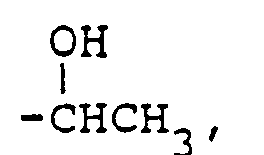

- A is an unsubstituted or hydroxy-substituted straight or branched C, -, 10 alkylene group or a straight or branched C1-10 alkylene group having an intervening heteroatom selected from oxygen, sulfur and nitrogen;
- R2 is hydroxy, halogen, C1-4 alkoxy, nitrile, azido, a quaternary ammonio group, -NRSR6,

- B is a straight or branched C, -6 alkylene group or a direct bond when R3 is joined to the sulfur atom through a carbon atom thereof;
- R3 is a residue of an organic group;
- R4 is hydrogen, a removable carboxy-protecting group or a physiologically hydrolyzable ester group;
- R5 and R6 each are independently hydrogen, C1-6 alkyl, C1-4 alkoxy, hydroxyethyl, azidoethyl, aminoethyl, and when R5 is hydrogen or C, -a alkyl, R6 is hydroxy, C1-4 alkoxy, amino, C1-4 alkylamino, di(Ci-4.)alkylamino, substituted C1-4 alkyl wherein said alkyl substituent is selected from hydroxy, azido, amino, guanidino, nitrile, carboxy, formimidoyl and phenyl, or an acyl residue of an amino acid or peptide; or R5 and R6, taken together with the nitrogen atom to which they are attached, is an unsubstituted or substituted heterocyclic ring having 1 to 2 ring members and having up to four heteroatoms in each ring independently selected from oxygen, nitrogen and sulfur, wherein said substituent is selected from the group consisting of C1-4 alkyl, C1-4 alkoxy, trifluoromethyl, hydroxy, halogen, amino, nitrile, carboxy, carbamido, carbamoyl, C, -4 alkylamino and amino (C1-4) alkyl; W is a direct bond, oxygen, sulfur or NR'°;
- Y is oxygen or NR10;
- Z is hydrogen, hydroxy, C1-4 alkyl, C1-4 alkoxy, -NR7R8, amino(C1-4)alkyl, azido(C1-4)alkyl or hydroxy (C1-4)alkyl;
- R7 and R8 each are independently hydrogen, C1-4 alkyl or alkanoyl; and
- R10 is hydrogen, C1-4 alkyl, C1-4 alkylamino or di(C1-4)alkylamino;
or a non-toxic pharmaceutically acceptable salt thereof, are novel antimicrobial agents which are useful in the treatment of infectious disease in humans and other animals. Novel intermediates and processes for their preparation are also disclosed.
Description
- The present invention relates to novel carbapenem antibiotics having a substituted alkyl group in the 4-position and non-toxic pharmaceutically acceptable salts thereof, which have antimicrobial activity. Therefore, the present carbapenem antibiotics and pharmaceutical compositions thereof are useful in the treatment of antibacterial infections in humans and other animals, either alone or in combination with other antibiotics (class 514, subclass 210). The present invention also provides processes for the preparation of the carbapenem antibiotics and to certain novel intermediates.
- The terminology for compounds of this class may either be based upon the root name "carbapenem" which employs a trivial system of nomenclature or on the systematic name according to Chemical Abstracts. In the present invention, the positions are numbered according to the Chemical Abstract system, for example, 3-R3, 4-R2, 6-R1-7-oxo-1-azabicyclo[3.2.0]hept-2-ene-2-carboxylic acid as shown in the following Formula

- The term "carbapenem", as used herein as a class of compounds, is intended to be used interchangeably with the name 7-oxo-1-azabicyclo[3.2.0]hept-2-ene-2-carboxylic acid. However, in all instances, the numbering system employed will be the numbering system according to Chemical Abstracts as illustrated above.
- A great number of carbapenem antibiotics are known in the art. This class of antibiotics is typefied by thienamycin (U.S. Pat. No. 3,950,357, issued April 13, 1976) which was first isolated from fermentation and exhibits a broad spectrum of antibiotic activity. lmipenem (U.S. Pat. No. 4,194,047, issued March 18, 1980), a subsequent chemically more stable derivative of thienamycin, was developed. Clinical utility was limited, however, owing to its rapid decomposition in man by kidney dehydropeptidase (DHP). For this reason, imipenem is clinically administered in combination with a DHP inhibitor.

- Despite the broad spectrum of antibiotic activity of imipenem, there still exists a need for more effective carbapenem antibiotics which are both chemically and biologically more stable than imipenem in the treatment of infectious disease. The search for improved carbapenem antibiotics is continuing which is exemplified by the large number of patents that have been granted and published in this field. The closest carbapenem art is represented by the following publications and patents.
- European Patent Publication EP-30,032, published on June 10, 1981, discloses a large number of carbapenems having the Formula

- European Patent Publication EP-45,198, published on February 3, 1982, describes a series of carbapenems having the Formula

- European Patent Publication EP-71,908, published on February 16, 1983, discloses a series of carbapenems having the Formula

- European Patent Publication EP-160,391, published on November 6, 1985, describes a series of carbapenems having the Formula

- European Patent Publication EP-160,876, published on November 13, 1985, discloses a series of carbapenems having the Formula


- European Patent Publication EP-170,019, published on February 5, 1986, discloses a series of carbapenems substituted in the 4-position with an ether group and having the Formula

- Thus, it is the object of the present invention to provide a novel class of antibiotics which have antimicrobial activity and are useful in the treatment of infectious diseases in humans and other animals. Further objects of this invention are to provide chemical processes and intermediates for the preparation of such antibiotics and their non-toxic pharmaceutically acceptable salts and derivatives and to pharmaceutical compositions comprising such antibiotics and methods of treatment by administering such antibiotics and compositions thereof to a human or animal in need thereof.
- The present invention provides novel 4-substituted alkyl carbapenem antibiotics having the Formula

- The present invention provides novel 4-substituted alkyl-7-oxo-1-azabicyclo[3.2.0]hept-2-ene-2-carboxylic compounds which are antimicrobial agents useful in the treatment of infectious disease in humans and other animals, and which have the formula


- A is an unsubstituted or hydroxy-substituted straight or branched C1-10 alkylene group or a straight or branched C1-10 alkylene group having an intervening heteroatom selected from oxygen, sulfur and nitrogen;
- R2 is hydroxy, halogen, C1-4 alkoxy, nitrile, azido, a quaternary ammonio group, -NRSR6,

- B is a straight or branched C1-6 alkylene group or a direct bond when R3 is joined to the sulfur atom through a carbon atom thereof;
- R3 is a residue of an organic group;
- R4 is hydrogen, a removable carboxy-protecting group or a physiologically hydrolyzable ester group;
- RS and R6 each are independently hydrogen, C1-6 alkyl, C1-4 alkoxy, hydroxyethyl, azidoethyl, aminoethyl, and when R5 is hydrogen or C1-4 alkyl, R6 is hydroxy, C1-4 alkoxy, amino, C1-4 alkylamino, di(C1-4)-alkylamino, substituted C,-4 alkyl wherein said alkyl substituent is selected from hydroxy, azido, amino, guanidino, nitrile, carboxy, formimidoyl and phenyl, or an acyl residue of an amino acid or peptide; or R5 and R6, taken together with the nitrogen atom to which they are attached, is an unsubstituted or substituted heterocyclic ring having 1 to 2 ring members and having up to four heteroatoms in each ring independently selected from oxygen, nitrogen and sulfur, wherein said substituent is selected from the group consisting of C, -4 alkyl, C, -4 alkoxy, trifluoromethyl, hydroxy, halogen, amino, nitrile, carboxy, carbamido, carbamoyl, C,-4 alkylamino and amino(C1-4)-alkyl;
- W is a direct bond, oxygen, sulfur or NR'°;
- Y is oxygen or NR10;
- Z is hydrogen, hydroxy, C1-4 alkyl, C1-4,alkoxy, -NR'Rs, amino(C1-4)alkyl, azido(C1-4)alkyl or hydroxy (C1-4)alkyl;
- R7 and R8 each are independently hydrogen, C,-4 alkyl or alkanoyl; and
- R10 is hydrogen, C1-4 alkyl, Ci-4 alkylamino or di(C, -4)alkylamino;
- This invention also provides stereoselective processes for the preparation of the compounds of Formula I and to novel intermediates in the preparation of compounds of Formula I.
- The terms "C1-2 alkyl", "C, -4- alkyl", "C1-6alkyl", and "C1-4 alkoxy" as used herein and in the claims (unless the context indicates otherwise) mean straight or branched chain alkyl or alkoxy groups such as methyl, ethyl, propyl, isopropyl, butyl, isobutyl, t-butyl, amyl, hexyl, and the like. Preferably, these groups contain from 1 to 4 carbon atoms and, most preferably, they contain 1 or 2 carbon atoms. The term "lower" is intended to mean 1 to 6 carbon atoms, unless otherwise indicted. The term "C3-6 cycloalkyl" as used herein and in the claims means a carbon cyclic ring system such as cyclopropyl, cyclobutyl, cyclopentyl, cycloheptyl and cyclohexyl. The term "C5-s cycloalkylene" as used herein and in the claims means a cyclic ring system containing an unsaturated bond such as cyclopentene, cyclohexene and the like. The terms "straight or branched C1-10 alkylene group" and "straight or branched c,1-6 alkylene group" as used herein and in the claims for "A" and "B", respectively means straight or branched alkylene groups such as methylene, ethylene, propylene, methylethylene, butylene, methylpropylene, ethylethylene, dimethylethylene, pentylene, methylbutylene, ethylpropylene, hexylene, methylpentylene, heptylene, and the like. The term "hydroxy-substituted straight or branched C1-10 alkylene group" as used herein and in the claims for "A" means straight or branched alkylene groups substituted with hydroxy such as 2-hydroxyethylene, 2 or 3-hydroxypropylene, 2,3 or 4-hydroxybutylene, 2 or 3-hydroxy-methyl butylene, 2,3,4 or 5-hydroxypentylene and the like. The term "straight or branched C1-10 alkylene group having an intervening heteroatom selected from oxygen, sulfur and nitrogen" as used herein and in the claims for "A" means straight or branched alkylene group which contains therein an oxygen, sulfur or nitrogen heteroatom such as -(CH2)1-6-O-(CH2)2-6-, -(CH2)1-6-S-(CH2)2-6, -(CH2)1-6-NH-(CH2)2-6, -(CH2)1-6-NCH3-(CH2)2-6-, and the like. Unless otherwise specified, the term "halogen" as used herein and in the claims is intended to include bromine, chlorine, iodine and fluorine while the term "halide" is intended to include bromide, chloride and iodide anion. The term "quaternary ammonio group" as used herein and in the claims means a quaternary ammonio group which may be acyclic, cyclic, or a combination of the two, and may contain one or more additional hetero atoms selected from nitrogen, sulfur and oxygen. Suitable acyclic, cyclic and combined acyclic/ cyclic quaternary ammonio groups are those illustrated herein and those as defined by

- An example of an acyclic quaternary ammonio group is a group of the formula
-

- The term "acyl residue of an amino acid or peptide" means the acyl residue of a naturally occurring amino acid or a peptide derived therefrom. Suitable amino acids are those described herein and other known amino acids such as alanine, glycine, arginine, cysteine, isoleucine, leucine, lysine, methionine, phenylalanine, proline, threonine and the like. Suitable peptides are those containing naturally occurring amino acids. However, it should be appreciated by those skilled in the art that unnatural amino acids such as those in the D-configuration may be attached to the amino acid of the acyl residue which is in the naturally occurring L-configuration. Preferably, suitable peptides are dipeptides of the natural occurring amino acids such as glycylglycine, glycylleucine, alanylalanine, alanylphenylalanine, alanylglycine and the like. It should also be appreciated by those skilled in the art that the carbapenems of Formula I wherein R2 contains an acyl residue of a naturally occurring amino acid or peptide may be active in vivo as a pro-drug, i.e., the amino acid residue may be hydrolyzed by peptidase enzymes in the host to produce a more active form of the desired carbapenem antibiotic. The compounds of the present invention which contain an acyl residue of an amino acid or peptide are more active in vivo than in vitro. The term "non-toxic pharmaceutically acceptable salt" as used herein and in the claims is intended to include non-toxic acid and base salts, and salts of zwitterionic species. Salts with a base is intended to include inorganic metallic salts such as sodium, potassium, calcium and magnesium, the ammonium salt, and salts with non-toxic amines such as trialkylamines, pyridine, picoline, dibenzylamine, ethanolamine, N-methylmorpholine and other amines which have been used to form salts of carboxylic acids. Salts with an acid is intended to include inorganic acid salts such as hydrochloride, hydrobromide, hydroiodide, sulfate, phosphate, and the like, and organic acid salts such as formate, acetate, maleate, citrate, succinate, ascorbate, lactate, fumarate and tartrate which have been used to form salts of basic amines. Since the compounds of Formula I may also have an acidic or basic group in the R', R2 and R3 substituents, it is intended that "non-toxic pharmaceutically acceptable salt" include suitable acid or base addition salts of these functional groups such as hydrochloride, phosphate, sodium, potassium, ammonium chloride, acetate and other salts of an acidic group or a basic group as described above. Unless otherwise specified, the term "a physiologically hydrolyzable ester group" as used herein and in the claims is intended to include an ester group which is physiologically acceptable and hydrolyzable under physiological conditions such as C, - 6 alkyl, benzyl, 4-methoxybenzyl, (lower)alkanoyloxy(lower)alkyl, e.g., acetoxymethyl, propionyloxymethyl or pivaloxymethyl, (lower)-alkoxycarbonyloxy(lower)alkyl, e.g., methoxycarbonyloxymethyl, ethoxycarbonyloxymethyl or 2-methoxycar-bonyloxyethyl, (5-methyl-2-oxo-1,3-dioxol-4-yl)methyl and the like.
- Carboxy-protecting groups which can be employed in the present invention to block or protect the carboxylic acid function are well-known to those skilled in the art and, preferably, said groups can be removed, if desired, by methods which do not result in any appreciable destruction of the remaining portion of the molecule, for example, by chemical or enzymatic hydrolysis, treatment with chemical reducing agents under mild conditions, irradiation with ultraviolet light or catalytic hydrogenation. Examples of such readily removable carboxy-protecting groups include moieties such as C1-6 alkyl, 2,2,2-trichloroethyl, silyl such as trimethylsilyl and t-butyldimethylsilyl, phenyl, ring substituted phenyl, e.g., 4-chlorophenyl, tolyl, and t-butylphenyl, phenyl(lower)alkyl, ring substituted phenyl(lower)alkyl, e.g., benzyl, 4-methoxybenzyl, 4-nitrobenzyl, benzyhydryl and trityl, methoxymethyl, 2,2,2-trichloroethoxycarbonyl, benzyloxymethyl, (lower) alkanoyloxy(lower)alkyl such as acetoxymethyl, propionyloxymethyl, (lower)alkenyl such as vinyl and allyl, unsubstituted or substituted phenyl(C1-4)alkoxycarbonyl such as benzyloxycarbonyl and 4-nitrobenzyloxycarbonyl, and (C2-4)alkenyloxycarbonyl such as allyoxycarbonyl. Particularly advantageous carboxy protecting groups are benzyl, 4-nitrobenzyl, 2-nitrobenzyl, 2,4-dimethoxybenzyl, 4-methoxybenzyl and the like and, preferably, allyl or substituted allyl. Other suitable protecting groups are disclosed in "Protective Groups in Organic Synthesis", Theodora W. Greene (John Wiley & Sons, 1981), Chapter 5 for carboxy, which is hereby incorporated by reference.
- Amino-protecting groups which can be employed in the present invention to block or protect the amino group are well-known to those skilled in the art. Examples of conventional amino-protecting groups are described by J.W. Barton in Protective Groups in Organic Chemistry, J.F.W. McOmie, Ed., Plenum Press, New York, N.Y., 1973, Chapter 2 and by R.A. Boissonnas in Advances in Organic Chemistry, 3, 159-190 (1963). It will be evident to those skilled in the art that the particular amino-protecting group used is not critical and that one need only select a group stable to the subsequent steps of the reaction process, and which is capable of being removed under conditions which preserves the sensitive ¡3-lactam nucleus.
- Suitable amino-protecting groups include, for example, acyl groups such as formyl, acetyl and substituted acetyl (e.g., halogenated acetyl), benzoyl and substituted benzoyl, alkoxycarbonyl, halogenated alkoxycarbonyl, alkenyloxycarbonyl, aralkoxycarbonyl, halogenated aralkoxycarbonyl, benzyl and benzyl derivatives, trityl and trityl derivatives, sulfenyl derivatives, sulfonyl derivatives, diacyl derivatives such as phthalimido or succinimido or derivatives thereof and Schiff bases formed with aldehydes or ketones. Specific examples of suitable amino-protecting groups include formyl, acetyl, trifluoroacetyl, trichloroacetyl, benzoyl, toluoyl, 2,2,2-trichloroethoxycarbonyl, isopropoxycarbonyl, t-butoxycarbonyl, cyclopentyloxycarbonyl, cyclohexyloxycarbonyl, benzyloxycarbonyl, 2-nitrobenzyloxycarbonyl, 4-nitrobenzyloxycarbonyl, 4-methoxybenzyloxycarbonyl, 4-chlorobenzyloxycarbonyl, allyloxycarbonyl, 2-furfuryloxycarbonyl, trimethylsilylethoxycarbonyl, N-phenylcarbamoyl, benzyl, 4-nitrobenzyl, trityl, benzenesulfonyl, p-toluenesulfonyl, 2-nitrophenylsulfenyl, phenylthiocarbonyl, trimethylsilyl, triethylsilyl, triphenylsilyl, t-butyldimethylsilyl, methyldiphenylsilyl and diacyl amino-protecting groups such as phthalimido, succinimido and derivatives thereof.
- The compounds of the present invention have several asymmetric carbon atoms and can thus exist in several stereochemical forms. The invention includes the mixture of isomers and the individual stereoisomers. Preferred compounds of the Formula I wherein R' is other than hydrogen are those having the 4R, 5S, 6S configuration on the 1-azabicyclo[3.2.0]heptane ring structure which is the same stereochemical configuration as the antibiotic thienamycin. In addition, the substituents R' and A may themselves contain asymmetric carbon atoms. Where appropriate, the RI substituent can exist in either the R or S configuration. It is intended that both the A and S configurations of R' are included in the present invention, for example, the R and S isomers of 1-hydroxyethyl, 1-fluoroethyl and 1-aminoethyl substituents. Preferably, the RI substituent is in the R configuration such as 1 R-hydroxyethyl and 1 R-aminoethyl. In the instance when the alkylene group of substituent A has a branched alkyl substituent or a hydroxy substituent, the compounds of Formula I will have an additional asymmetric carbon atom. It is intended that the present invention include both isomers of the compounds of Formula I, for example, the compounds of Example 57, 58 and 152.
- In the definition of R3 the term "a residue of an organic group" as used herein and in the claims means any organic residue containing at least one carbon atom such as methyl. In addition, the organic group is intended to include but not limited to all the organic groups illustrated herein and 3-substituent groups which are known in the carbapenem art. Suitable quaternized nitrogen-containing heterocycles are disclosed in the United States Patent No. 4,642,341, issued February 10, 1987 and No. 4,644,061, issued on February 17, 1987, which are hereby incorporated by reference. Other suitable groups are disclosed in United States Patent No. 4,745,188, issued May 17, 1988, especially in the definition of R8 which is hereby incorporated by reference. Additional organic groups suitable in the definition of R3 are disclosed in United States Patent No. 4,822,787, issued April 18, 1989; No. 4,840,946, issued June 20, 1989; No. 4,863,916, issued September 5, 1989; No. 4,888,344, issued December 19, 1989 and No. 4,962,103, issued October 9, 1990, which are all hereby incorporated by reference.
- Preferably R3 is hydrogen, C3-6 cycloalkyl or substituted C3-6 cycloalkyl, Cs-s cycloalkenyl or substituted C5-6 cycloalkenyl, phenyl or substituted phenyl, hydroxy, C1-4 alkoxy, C1-4 alkylthio, phenylthio or substituted ohenvlthio. haloaen. nitrile, nitro. -NR'R8.


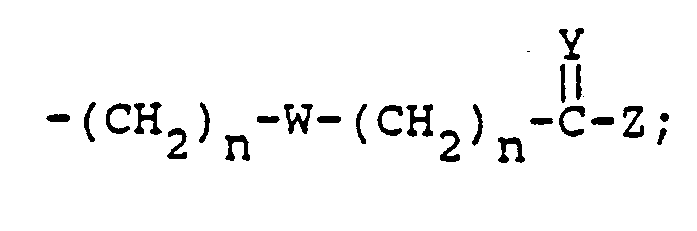
- In the definitions of R2, R3, R5 and R6 of the compounds of Formula I, the term "heterocyclic group" which is unsubstituted or substituted includes the heterocyclic groups illustrated herein and it is also intended to include but not limited to furyl, thienyl, thiazolyl, imidazolyl, oxazolyl, oxadiazolyl, thiadiazolyl, triazolyl, tetrazolyl, isoxazolyl, isothiazolyl, pyrrolyl, pyranyl, tetrahydropyranyl, pyrazolyl, pyridyl, pyrimidinyl, tetrahydrofuryl, pyridazinyl, pyrazinyl, triazinyl, azetidinyl, pyrrolidinyl, piperidyl, piperazinyl, thiazolidin-5-yl, morpholinyl, thiomorpholinyl, 1,4-thiazin-2-yl, benzoxazolyl, indolyl, benzimidazolyl, quinolinyl, isoquinolinyl, quinoxalinyl and quinazolinyl.
- Compounds of Formula I wherein R4 is hydrogen, an anionic charge or a physiologically hydrolyzable ester group together with non-toxic pharmaceutically acceptable salts thereof are useful as antimicrobial agents. The remaining compounds of Formula I are valuable intermediates which can be converted into the above-mentioned biologically active compounds.
- The carbapenem compounds of Formula I may be prepared by various procedures. In one embodiment, the compounds of Formula I are preferably prepared from novel compounds of Formula II


- In another embodiment, the compounds of Formula II may be prepared from novel intermediates of Formula III

- In yet another embodiment, the compounds of Formula III may be prepared from novel intermediates of Formula IV

- The compounds of Formula IV may be prepared by various procedures, and, by way of illustration, the process for preparing one of the more preferred embodiments of compounds of Formula IV may be summarized for the preparation of intermediate compounds of Formula IVa by the reaction sequence illustrated in Reaction Scheme I.
- In this sequence, the thioester VI which is prepared in Step(A) from the thiol V is converted to the silyl enol ether VII in Step(B), and without separation is coupled, in Step(C), to the azetidinone VIII by nucleophilic displacement of the 4-position leaving group "L". The resulting intermediate IX (illustrated in the β-isomer form) can then be saponified in Step(D) to yield the corresponding carboxylic acid IVa. The general process and methods of the reactions illustrated in Reaction Scheme I is described by the present inventor in U.S. Patent NO. 4,772,683 patented September 20, 1988 and is hereby incorporated by reference.

- Referring now to Reaction Scheme 1, Step(A) illustrates the esterification reaction of a thiol V to a thioester VI. The reaction of Step(A) is well-known to those skilled in the art and may be carried out with 2-picolyl mercaptan wherein R is hydrogen or methyl and an appropriately activated carboxy moiety as described herein wherein A and R'2 are as previously defined.
- Step(B) illustrates the reaction between thioester VI and a triorganosilyl triflate silylating agent to form the silyl enol ether Vil. The reaction of Step(B) is carried out in an inert organic solvent and in the presence of an organic base. Suitable inert organic solvents which can be used include methylene chloride, tetrahydrofuran, carbon tetrachloride, cyclohexane, dioxane, dimethoxyethane, diethyl ether and chloroform. Reaction temperatures can be in the range of from about -40° C to + 30 C. Most conveniently, the reaction is carried out by mixing the reactants under cooling, advantageously between about -15°C and 0°C and then allowing them to gradually warm to room temperature.
- Triorganosilyl triflate silylating agents are well known, and include trimethylsilyl trifluoromethanesulfonate, triisopropylsilyl trifluoromethanesulfonate, triethylsilyl trifluoromethanesulfonate, t-butyldimethylsilyl trifluoromethanesulfonate, t-butyldiphenylsilyl trifluoromethanesulfonate, or 2,4,6-tri(t-butylphenoxy)-dimethylsilyl trifluoromethanesulfonate. Advantageous results have been obtained using t-butyldimethylsilyl trifluoromethanesulfonate. Thus, P will be the triorganosilyl residue of the particular triorganosilyl triflate silylating agent used.
- Suitable organic amine bases include diisopropylethylamine, DBU (1,8 diazabicyclo[5.4.0]undec-7-ene)-,DBN (1,5-diazabicyclo[4.3.0]non-5-ene), but especially preferred are the tri(C1-C4)alkylamines such as trimethylamine, triethylamine, tributylamine and tripropylamine. It has been found, however, that in certain instances a stronger base may be necessary to carry out the reaction of Step(A).
- Generally, the organic base and triorganosilyl triflate silylating agent are present in an approximately twofold molar excess when compared to the thioester VI, with the base being slightly in excess of the triorganosilyl triflate silyating agent. Reaction times usually vary from about one hour to about five hours, but generally a maximum yield will be obtained in about three hours. Advantageously, the reaction is carried out under an inert atmosphere.
- In Step(B), the silyl enol ether VII is reacted with a 4-position substituted azetidinone VIII to yield intermediate IX. The reaction is carried out in the presence of a Lewis acid catalyst and a solvent which is inert in the presence of the Lewis acid catalyst, and preferably under an inert atmosphere.
- Suitable inert solvents, which are discussed above, are advantageously dry, and will generally comprise about 10% of the total reaction mixture volume. Dichloromethane has been found to provide satisfactory results.
- Suitable Lewis acid catalysts include zinc halides, zirconium halides and boron trifluoride. Zinc chloride has been found to provide satisfactory results.
- The silyl enol ether VII is substituted by a group "-A-R'2" wherein A is an unsubstituted or hydroxy-substituted straight or branched C1-10 alkylene group or a straight or branched Ci-io alkylene group having an intervening heteroatom selected from oxygen, sulfur and nitrogen and R'2 is hydroxy, halogen, C1-4 alkoxy, azido, O-P3 or N-P4 in which P3 is a conventional hydroxy-protecting group and P4 is a conventional amino-protecting group.
- The 3,4-disubstituted azetidinone intermediates such as that of Formula VIII wherein P2 represents a conventional hydroxy-protecting group and L represents a conventional leaving group are known per se and are key intermediates in the synthesis of carbapenem and penem antibiotics having an (R)-hydroxyethyl substituent at the 6-position of the carbapenem or penem nucleus.
- The 4-position substituent of the compound of Formula VIII is designated by "L", which represents a leaving group capable of being displaced by nucleophiclic substitution of the silyl enol ether VII. Such leaving groups include acyloxy (e.g., acetoxy, propionyloxy or t-butyryloxy), halogen (e.g., chloro), arylsulfonyl (e.g., phenylsulfonyl), mesyl and tosyl. Advantageously, "L" is acetoxy because 4-acetoxyazetidinone is a readily available starting material.
- The hydroxy-protecting group "p2" of azetidinone VIII and the hydroxy-protecting group of "P31" in substituent "R12" of the silyl enol ether of Formula Vil may be the same or different. Preferably, "P2" and P3" are the same and, more preferably, "P", "p2" and "P3" are the same.
- Hydroxy-protecting groups, which are known to those skilled in the art, are desirable because they prevent side reactions and provide increased yields in later steps of the reaction sequence. Suitable hydroxy-protecting groups may be, for example, acyl groups such as benzyloxycarbonyl, benzhydryloxycar-bonyl, trityloxycarbonyl, p-nitro-benzyloxycarbonyl and 2,2,2-trichloroethoxycarbonyl, aralkyl groups such as benzyl, benzhydryl, trityl or p-nitrobenzyl, or triorganosilyl groups such as tri(C1-C6)alkylsilyl (e.g. trimethylsilyl, triethylsilyl, triisopropylsilyl, isopropyldimethylsilyl, t-butyldimethylsilyl, methyldiisopropylsilyl or methyldi-t-butylsilyl), triarylsilyl (e.g. triphenylsilyl, tri-p-xylsilyl) or triaralkylsilyl (e.g. tribenzylsilyl). Examples of these and other suitable hydroxy-protecting groups and methods for their formation and removal are known in the art, e.g. see Protective Groups in Organic Synthesis, T.W. Greene, John Wiley & Sons, New York 1981, Chapter 2.
- The hydroxy-protecting group selected for "P2" and "P3,, is preferably one that is removable at a later stage of the reaction process. Bulky triorganosilyl groups such as triisopropylsilyl, t-butyldiphenylsilyl or t-butyldimethylsilyl are advantageously employed because they provide for an essentially stereo-controlled reduction step. Such groups can be readily removed under mild conditions, e.g., by treatment with methanolic HCI or with fluoride ion (e.g., tetra-n-butyl ammonium fluorideitetrahydrofuran), which preserves the sensitive β-lactam nucleus.
- The reaction of Step(C) is advantageously carried out under an inert atmosphere, and at a temperature of from about -30° C to about room temperature. Preferably, the reactants are added under cooling, about -15 C to about + 5 C, and allowed to react at about 0-5 C and then, if desired, allowed to gradually warm to room temperature. The reaction can be stirred, if desired, for up to 30 hours to achieve maximum yield.
- The 0-isomer of the resulting intermediate IX can be separated from the corresponding a-isomer by conventional chromatography or HPLC, or preferably, by crystallization. Alternatively, the β-isomer can be separated from the a-isomer upon saponification of intermediate IX, as discussed below in Step(D), which yields the corresponding carboxylic acid IVa because the β-isomer preferentially crystallizes when the β/α ratio is about 2/1 or greater.
- In Step(D), the compound of Formula IX is saponified to yield the corresponding carboxylic acid IVa. Saponification is well-known to those skilled in the art and can be carried out as follows. The compound of Formula IX may first be dissolved in a solvent such as tetrahydrofuran and aqueous tetrahydrofuran and then, under cooling, an excess of inorganic base, such as sodium hydroxide, is added. Hydrogen peroxide may also be added. It is preferred that hydrogen peroxide be added to the saponification reaction and, more preferably, it may be added prior to the addition of the inorganic base. The reaction is usually complete within 1-2 hours at about 0°C to about room temperature and the carboxylic acid IVa is produced upon subsequent acidification with an inorganic acid such as hydrochloric acid.
- The process for preparing diazo intermediates of Formula Illa may conviently be summarized by Reaction Scheme 2. Briefly, in this reaction sequence, the carboxylic acid moiety of azetidinone IVa is activated and displaced with a mono carboxy-protected magnesium malonate in Step(E) to produce the β-keto ester X which is then follwed by diazotization in Step(F) to yield the corresponding diazo intermediate Illa.

- Referring now to Reaction Scheme 2, the reaction of the acid IVa to the keto ester X in Step(E) is conveniently carried out by a 2-step process. The carboxylic acid moiety is first activated by a conventional carboxy-activating group well-known to those skilled in the art and, preferably, with carbonyl-diimidazole in an inert solvent such as tetrahydrofuran, dimethoxyethane, acetonitrile, benzene and toluene, and preferably in benzene or toluene or a mixture of acetonitrile-benzene. Reaction temperatures can be in the range of from about -15 C to about 70° C and, preferably at about 0°-20°C. The activated carboxy intermediate may be isolated but it is preferred that the intermediated be reacted in situ under an inert atmosphere in the second step with a magnesium malonate which has been preferably dried prior to use such as azetropically removing any residual water with a Dean-Stark trap. Preferably, the magnesium malonate is a monoalkyl or monoaryl malonate such as monoallyl or substituted allyl malonate, mono benzyl, 2-nitrobenzyl, 4-nitrobenzyl, 4-methoxybenzyl or 2,4-dimethoxybenzyl malonate.
- The reaction of a magnesium malonate with the activated carboxy moiety is carried out in an inert organic solvent such as tetrahydrofuran, dioxane, dichloromethane, acetonitrile, benzene and toluene and, preferably, in benzene or acetonitrile at a temperature of about 0°C to about 80 ° C. Advantageously, the reaction is allowed to proceed at about 60° C until the reaction is essentially complete which is usually about 18 hours. Generally, the magnesium malonate is advantageously present in an excess of about 1.1 to about 3.0 mole equivalent per equivalent of acid IVa. The excess of magnesium malonate may be added all at once to the reaction or, if desired, may be added stepwise until the reaction is complete and maximum yield has been achieved.
- In Step(F), the keto ester X is diazotized to yield the corresponding diazo intermediate Illa. Diazotization is well-known in the art and can be carried out in an inert solvent such as acetonitrile, dichloromethane, toluene, benzene or the like. Preferably, the reaction is carried out in acetonitrile with an azide such as 4-carboxybenzenesulfonylazide, p-toluenesulfonylazide, methanesulfonylazide or the like. The reaction is conducted in the presence of a base such as triethylamine, diethylamine, pyridine, lutidine or the like for about 1 to 30 hours at a temperature of about 0° to 50° C.
- In reaction scheme 3, R'2 , A, P' and P2 are as previously defined. Generally, the diazo compound of Formula llla is cyclized directly in Step(G) to the bicyclic ketone of Formula Ila. Alternatively, if desired, the diazo compound of Formula llla is deprotected at the 6-position in Step(H) before cyclization to the bicyclic ketone of Formula lib.

- Cyclization of the diazo compound of Formula Illa to the bicyclic compound of Formula Ila in Step(G) may be carried out in an inert organic solvent such as tetrahydrofuran, ethyl acetate, benzene, toluene, hexane, cyclohexane or the like at a temperature from about room temperature to about 110°C for 15 minutes to about 5 hours in the presence of a catalyst such as bis(acetylacetonate)-Cu(II), copper sulfate, copper powder, rhodium acetate [Rh2 (OAc)4], rhodium (II) octanoate, Pd(OAc)2, Pb(OAc)4 or the like and, preferably, rhodium (II) acetate or octanoate. Alternatively, the cyclization may be carried out by irradiation of the compound of Formula llla from a light source through a Pyrex filter (wavelength greater than 300 nm) in a solvent such as benzene, diethyl ether or the like at a temperature from about 0° to about room temperature for 30 minutes to about 2 hours.
- In an alternate reaction route, the diazo compound of Formula Illa wherein P2 is preferably a triorganosilyl protecting group and, most preferably, a t-butyldimethyl silyl group is removed in Step(H) by subjecting the compound of Formula Illa to acidic hydrolysis in a solvent such as acetonitrile, methanol, ethanol, tetrahydrofuran, dioxane or the like in the presence of an acid such as hydrochloric acid, sulfuric acid or acetic acid and, preferably, with about 3 equivalents of 1N aqueous hydrochloric acid at about -10° to about 30° C. Preferably, the reaction is carried out from about 0° to about room temperature for about 6 to 18 hours, and, advantageously, at room temperature for 18 hours. the diazo compound of Formula IIIb is then subjected to cyclizing conditions in Step(I) which are the same as those for Step(G) discussed above to yield the bicyclic ketone of Formula llb.
- The compounds of Formula la wherein A, B, R3, R4, and R'2 are as previously defined may be prepared from the bicyclic ketones of Formula Ila or lib following the sequence of reactions illustrated in Reaction Scheme 4. It should be appreciated by those skilled in the art that both reaction routes are suitable for the preparation of compounds of Formula la. Nevertheless, the choice of reaction route will depend on the starting material to be used such as compounds of Formula Ila or lib and the definition of the substituents A, B, R3 and R12. Thus Steps(J) and (K) are carried out with and Steps(J') and (K') are carried out without the presence of a hydroxy-protecting group in the substituent at position 6 of the carbapenem nucleus.

- To elaborate on the processes of Reaction Scheme 4, Steps(J) and (J') illustrate the acylation or activation of the keto esters Ila and Ilb. The reaction of Steps(J) and (J') are well-known to those skilled in the art and may be carried out with suitable acylating agents to provide a leaving group L' suitable for the displacement reaction of Steps(K) and (K').
- Suitable acylating agents to prepare L1 may include acid anhydrides such as acetic acid anhydride, methanesulfonic acid anhydride, p-toluenesulfonic acid anhydride, p-nitrophenylsulfonic acid anhydride, 2,4,6-triisopropylphenylsulfonic acid anhydride, trifluoromethanesulfonic acid anhydride and the like or acid halides such as acetyl chloride, propionyl chloride, diethyl chlorophosphate, diphenyl chlorophosphate, toluenesulfonyl chloride, p-bromophenylsulfonyl chloride and the like or other agents which provide a leaving group L1 by conventional procedures and are well-known in the art. Advantageously, the acylation is carried out with diphenyl chlorophosphate to establish the diphenylphosphonyloxy leaving group at the 2-position of the intermediates XI and XII.
- Typically, the acylation reaction of Step(J) or (J') is conducted in an inert organic solvent such as methylene chloride, acetonitrile, dimethylformamide, tetrahydrofuran or the like in the presence of a base such as diisopropylethylamine, triethylamine, 4-dimethylaminopyridine, imidazole, lutidine, N-methylmorpholine, N-methylpiperidine, 1,8-diazabicyclo[5.4.0]undec-7-ene, 1,5-diazabicyclo[4.3.0]-non-5-ene, or the like, at a temperature from about -20 to 40° C for about 0.5 to 18 hours and preferably for 1 to 3 hours at 00 to room temperature. The intermediates XI and XII may be isolated if desired, but is conveniently used for the next step without isolation or purification.
- The intermediates of Formula XI and XII are next converted in Steps(K) and (K') to the intermediates XIII and XIV, respectively, by a conventional displacement reaction. Thus, the intermediates of Formula XI or XII may be reacted with at least an equimolar amount of a mercaptan reagent of the formula HS-B-R3 wherein B is as previously defined and R3 is a residue of an organic group in an inert organic solvent such as methylene chloride, dioxane, tetrahydrofuran, acetonitrile, dimethylformamide, dimethylsulfoxide, hexamethylene phosphoramide or the like, and preferably, in the presence of a base such as diisopropylethylamine, triethylamine, 4-dimethylaminopyridine, sodium hydrogen carbonate, potassium carbonate or the like. The temperature is not critical for the displacement but is advantageously carried out from about -40 to 30° C for 30 minutes to 24 hours. Most conveniently, the reaction is carried out at about 0° to 5 °c for 2 to 4 hours. In the displacement reaction of Step(K'), about an equimolar amount of trimethylsilylchloride may optionally be added to the reaction mixture prior to the addition of said mercaptan reagent to temporarily protect the 1 R-hydroxyethyl group. After the displacement is complete, the trimethylsilyl protecting group may readily be removed as described herein for removal of the P2 protecting group and, preferably, by treatment with acetic acid in tetrahydrofuran, tetrahydrofuran-water and the like at about 00 C to room temperature for about 1 to 4 hours.
- In Step(L), the compound of Formula XIII is deprotected to produce the compound of Formula XIV. The deprotection is carried out in a conventional manner and when the hydroxyprotecting group is a triorganosilyl group such as t-butyldimethylsilyl, the deprotection is preferably carried out in the presence of a tetra(lower)alkylammonium fluoride such as tetrabutylammonium fluoride. Although the reaction conditions are not critical, it is advantageously carried out with about three equivalents of an ammonium fluoride derivative and optionally in the presence of about six equivalents of glacial acetic acid in an inert organic solvent such as methanol, ethanol, dioxane, acetonitrile, dichloromethane, tetrahydrofuran and the like or a mixture thereof. The deprotection is usually carried out from about -40° to 30° C and, preferably, from -15° to 0° C for about 4 hours to 1 week and preferably for about 3 days.
- It should be appreciated by those skilled in the art that the final deblocking step, Step(M), will naturally vary depending on the protecting groups present in substituents P', R12 and R3. The deblocking Step(M) to remove the carboxy-protecting group P1 of intermediate of Formula XIV to produce compounds of Formula la wherein R4 is hydrogen or a non-toxic pharmaceutically acceptable cation such as sodium, potassium, ammonium and other cations of salts described herein is accomplished by conventional procedures such as hydrolysis, chemical reduction or hydrogenation. Where a protecting group such as p-nitrobenzyl, benzyl, benzhydryl or 2-naphthylmethyl is used which can be removed by catalytic hydrogenation, intermediate of Formula XIV in a suitable solvent such as water, dioxane, tetrahydrofuran, ethanol, isopropanol, n-butanol or mixtures thereof containing a buffer solution such as phosphate buffer, dipotassium hydrogen phosphate, sodium bicarbonate, acetate buffer and the like may be treated under a hydrogen pressure of from 1 to about 4 atmospheres in the presence of a hydrogenation catalyst such as palladium on carbon, palladium hydroxide on carbon, platinum oxide, palladium on barium sulfate, Raney nickel and the like at a temperature of from 0 to 50° C for about 15 minutes to 4 hours. When p1 is a group such as σ-nitrobenzyl, photolysis may also be used for deblocking. Protecting groups such as 2,2,2-trichloroethyl may be removed by mild zinc reduction.
- When the carboxy-protecting group P1 is an allyl group, it may be removed with a catalyst comprising a palladium compound and preferably a palladium-ligand complex such as tetrakis(triphenylphosphine)-palladium[0], bis(dibenzylideneacetone)palladium[0], di[1,2-bis(diphenylphosphino)ethane]palladium[0], tetrakis(triphenyl phosphite)palladium[0] and the like. The reduction is preferably carried out in the presence of an allyl scavenger, for example, an amine such as N-methylaniline or morpholine, an activated methylene compound such as benzoylacetate or 2-methyl-3-oxovaleric acid, an alkanoic acid or a salt thereof such as sodium acetate, sodium 2-ethylhexanoate and the like.
- The reaction is usually carried out in a non-reducing solvent such as tetrahydrofuran, water, ethanol, dioxane, acetonitrile, dichloromethane, ethyl acetate or mixtures thereof at a temperature from 0° to 50°C for about 15 minutes to 4 hours. Advantageously, the catalytic reduction is carried out in ethyl acetate or dichloromethane at about 0°C in the presence of tetrakis(triphenylphosphine)palladium[0] containing about 1.1 molar equivalents of potassium ethyl-2-hexanoate. Similarly, other conventional carboxy-protecting groups may be removed by methods known to those skilled in the art. Finally, as mentioned above, compounds of Formula la wherein R4 is a physiologically hydrolyzable ester group such as acetoxymethyl, pivaloyloxymethyl and methoxymethyl and the like may be administered directly to the host without deblocking since such esters are hydrolyzed in vivo under physiological conditions.
- As mentioned above, the compounds of Formula XIV may optionally contain additional hydroxy-protecting groups 0-P3 and/or amino-protecting groups N-P4 wherein P3 and P4 are as previously defined. Thus, reaction Step(M) may, if desired, contain an additional deblocking procedure for removing said protecting groups. The reaction may be carried out by conventional methods known per se for removing a protecting group such as hydrolysis, reduction and the like and includes the methods illustrated for the removal of the carboxy-protecting group p1 and the hydroxy-protecting group P2.
- In the particular instance when R'2 is azido in the compound of Formula XIV, it may be desired to reduce said azido to an amine in the deblocking procedure of Step(M). The reduction may be carried out in an aqueous or aqueous buffered solution at about pH 6-9 and preferably in an aqueous solution at about -10° to 30° C and preferably at about 0-5 C under a hydrogen pressure of from 1 to 4 atmospheres in the presence of a hydrogenation catalyst such as 30% palladium on Celite, 10% palladium on carbon, palladium hydroxide on carbon, platinum oxide, 5% palladium on barium sulfate, 5% palladium on alumina and the like, and preferably, on 5% palladium on barium sulfate and 5% palladium on alumina, for about 30 minutes to 3 hours until the reduction is completed.
- It should be appreciated by those skilled in the art that the deblocking of the carboxy- and/or hydroxy-and/or amino-protecting groups in Step(M) may be removed at the same time during the reaction. Alternatively, or, if desired, the protecting groups may selectively be removed stepwise. Nevertheless, it should be evident to those skilled in the art that the sequence of removing the protecting groups will depend on the nature and selection of the protecting groups, and whether it is desired to prepare an intermediate of Formula XIV or Formula la containing some of the protecting groups such as P' , P2, O-P3 and N-P4 to prepare additional compounds of Formula I.
- In another embodiment, the compounds of Formula I may be prepared from novel intermediates of the Formula XVI

- The compounds of Formula XVI may be used to prepare compounds of Formula I, and, by way of illustration, the process for preparing one of the more preferred embodiments of Formula I is illustrated in Reaction Scheme 5 for the preparation of compounds of Formula lb. Briefly, the protected intermediate of Formula XIII wherein R'2 is O-P3 is selectively deprotected in Step(N) to the alcohol of Formula XV. The alcohol moiety in the 4-position of carbapenem XV is converted in Step(O) to compounds of the Formula XVla having a conventional leaving group "L2" which is susceptible to displacement by a nucleophile in Step(P) to produce the compounds of Formula XVIII. Deblocking of the protecting groups in Step(L+M) will yield the compounds of Formula lb wherein A, B, R3 and R4 are as previously defined and R13 is a nucleophilic residue wherein R13 may be azido,
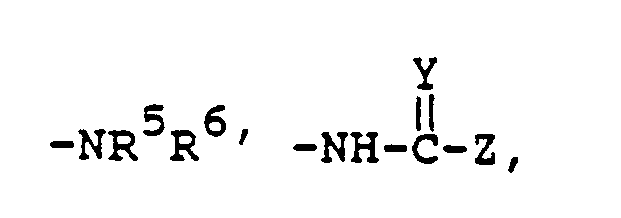

- Referring now to Reaction Scheme 5, Step(N) illustrates the removal of a hydroxy-protecting group from the intermediate of Formula XIII wherein R12 is O-P3 in which P3 is a conventional hydroxy-protecting group. Preferably, the protecting group P3 is a triorganosilyl protecting group and, most preferably, is t-butyldimethylsilyl. The reaction of Step(N) is carried out in an inert organic solvent such as tetrahydrofuran, dioxane, ethyl acetate, dimethoxyethane, methylene chloride, carbon tetrachloride, toluene, cyclohexane and the like with about 1 to 10 mole equivalents of tetra(lower)alkyl fluoride, boron trifluoride or potassium fluoride and optionally containing about 1 to 20 equimolar amount of a lower alkyl organic acid, aromatic acid or heteroaromatic acid at a temperature of about -40° to 40°C for about 1 to 60 hours. Advantageously, the reaction is conducted in tetrahydrofuran with about 3 equivalents of tetrabutylammonium fluoride in the presence of about 6 equivalents of acetic acid at a temperature from about -15 to 0° C for about 18 to 24 hours.
- Step(O) illustrates the reaction between the alcohol XV and a suitable acylating agent or activating agent to form the intermediate of Formula XVIa having a leaving group "L2" which can be displaced by a nucleophile. Suitable acylating agents for Step(O) may be the same as the agents used to prepare the leaving group "L' in Step(K) of Reaction Scheme 4 or other agents which provide a leaving group by conventional procedures and are well-known in the art. Preferably, L2 includes chloro, bromo, iodo, fluorosulfonyl,

- The reaction of Step(O) may be conducted in an inert organic solvent such as tetrahydrofuran, dimethoxyethane, dioxane, ethyl acetate, methylene chloride, chloroform, carbon tetrachloride, toluene. benzene, cyclohexane or the like with an acylating or activating agent in the presence of a non-nucleophilic base such as triethylamine, diisopropylethylamine, 2,6-lutidine, 1,8-diazobicyclo[5.4.0]undec-7-ene, 1,5-diazobicyclo[4.3.0]non-5-ene or the like at a temperature of from about -78° to room temperature. Advantageously, the reaction is carried out in methylene chloride with about 1.2 equivalents of trifluoromethanesulfonic anhydride in the presence of about 1.5 to 2 equivalents of diisopropylethylamine at about -78° C or in tetrahydrofuran with a mixture of triphenylphosphine and diethyl azodicarboxylate at about -40°C.
- Preparation of the desired compounds of Formula XVII is carried out in Step(P) by a nucleophilic displacement of the L2 leaving group of intermediate XVIA by the desired nitrogen, carbon, oxygen or sulfur-containing nucleophile R13 wherein R13 is as previosuly defined. The intermediate of Formula XVla is reacted with at least one equivalent, and preferably an excess, of the desired nucleophilic reagent in an inert organic solvent such as methylene chloride, tetrahydrofuran, chloroform, carbon tetrachloride, dioxane, ethyl acetate, diglyme, dimethoxyethane, cyclohexane, toluene and the like over a wide temperature range from -78° to about 30° C, but preferably from about -15° to 5°C until the reaction is complete as monitored by conventional methods of detection such as thin layer chromatography and high pressure liquid chromatography.
- The preparation of the desired carbapenem of Formula lb is accomplished by deblocking the protecting groups of intermediate XVII by conventional procedures. Suitable deblocking procedures for hydroxy, carboxy and amino-protecting groups are as previously discussed above in the processes of Steps(L) and (M).
- In another reaction route, the compounds of Formula Ic may be prepared from the compounds of Formula XVIII in Step(Q) as illustrated in Reaction Scheme 6 wherein A, B, R3 R4 and P2 are as previously defined, R16 is hydrogen or C1-4 alkyl and R17 is C1-4 alkyl or
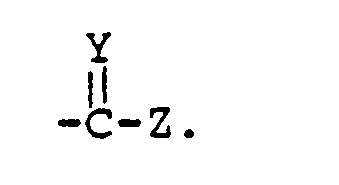

- Generally, the derivatization of the amino group of Formula XVIII or salts thereof is carried out in Step-(Q) with suitable imidoylating agents, acylating agents or alkylating agents. The reaction is optionally carried out with compounds of the Formula XVIII wherein P2 is a conventional hydroxy-protecting group and R4 is a conventional carboxy-protecting group. Advantageously, the reaction is carried out without a hydroxy-protecting group (i.e., P2 is hydrogen) and R4 is hydrogen or salt thereof.
- Suitable imidoylating agents include formimidates and lower alkylimidates such as methyl formimidate, ethyl formimidate, benzyl formimidate, methyl acetimidate, ethyl propionimidate, ethyl butyrimidate, ethyl pentanimidate and lower alkanimidoyl halide such as formimidoyl chloride, acetimidoyl chloride, pro-pionimidoyl chloride, butyrimidoyl chloride and the like. The reaction is usually carried out in a conventional solvent such as tetrahydrofuran, dioxane, methanol, ethanol, water, buffer solution or a mixture thereof at a temperature from about -20 to 40°C for about 10 minutes to 18 hours. Advantageously, the reaction is carried out in an aqueous phosphate buffer solution at a slightly basic pH for about 10 to 30 minutes at about 5° C.
- Suitable acylating agents to prepare compounds of Formula lc include acid halides, acid anhydrides, mixed anhydrides, activated esters, thiolesters and the like such as acetyl chloride, azidoacetyl chloride, acetic anhydride, methyl isocyanate, ethyl isocyanate, N,N-dimethylcarbamoyl chloride, activated esters of N-protected amino acids, aminoiminomethanesulfonic acid, methylaminoiminomethanesulfonic acid and the like. The acylating reaction may be conducted in a variety of solvent systems including solvents such as tetrahydrofuran, dioxane, acetonitrile, ethanol, methanol, dimethylformamide, water and the like and mixtures thereof. It should be appreciated by those skilled in the art that the reaction may be conducted, when necessary, in the presence of a base or acid acceptor such as magnesium oxide, potassium carbonate, potassium bicarbonate, pyridine, lutidine, 2,6-lutidine, 4-dimethylaminopyridine, triethylamine, N,N-diisopropylethylamine and the like. Advantageously, the reaction is conducted in an aqueous organic mixture or aqueous buffered solution at a temperature of from -20 to 50° C for 15 minutes to 15 hours.
- Suitable alkylating agents are well-known in the art and include lower alkyl or substituted(lower)alkyl halides, lower alkyl or trifluoromethanesulfonates, formaldehyde, lower alkyl or substituted(lower)alkyl aldehydes, aromatic or heteroaromatic aldehydes, heterocycloalkyl or substituted heterocycloalkyl aldehydes wherein said aldehydes are reacted in the presence of reducing agents such as sodium cyanoborohydride, sodium borohydride and the like. The reaction may be concluded in a variety of solvents systems including tetrahydrofuran, dioxane, acetonitrile, ethanol, methanol, dimethylformamide, water and the like and mixtures thereof at a temperature from about -20° to 50° C for 15 minutes to 20 hours. Advantageously, when the alkylating agent is formaldehyde the reaction is conducted with 37% formaldehyde in the presence of sodium cyanoborohydride in aqueous acetonitrile or aqueous buffered solution at slightly acid condition and at about 0-5 C for 15 minutes to 10 hours.
- As mentioned above, the compounds of Formula XVIII may optionally contain a hydroxy-protecting group and/or a carboxy-protecting group. Thus, Reaction Scheme 6 may contain additional deblocking procedures for removing said protecting groups. Suitable deblocking procedures may be carried out by methods known per se or by the procedures for removal of protecting groups previously described in Steps (L) and (M).
- The preparation of compounds of Formula I in the present invention is based upon any of several available beta lactam intermediates for the synthesis of carbapenem compounds of the thienamycin series. By way of illustration, the previous Reaction Schemes illustrated the preparation of compounds of Formula I wherein RI is a 1-hydroxyethyl group in the 6-position of the beta lactam ring structure.
- In the case when it is desired to prepare compounds of the Formula I wherein RI is a 1-aminoethyl group, the process to transform the 1-hydroxyethyl group to a 1-aminoethyl group via a 1-azidoethyl intermediate in the 6-positon of the azabicyclo ring structure is illustrated in Reaction Scheme 7 for the preparation of the desired 1 (S) and 1 (R)-configuration.
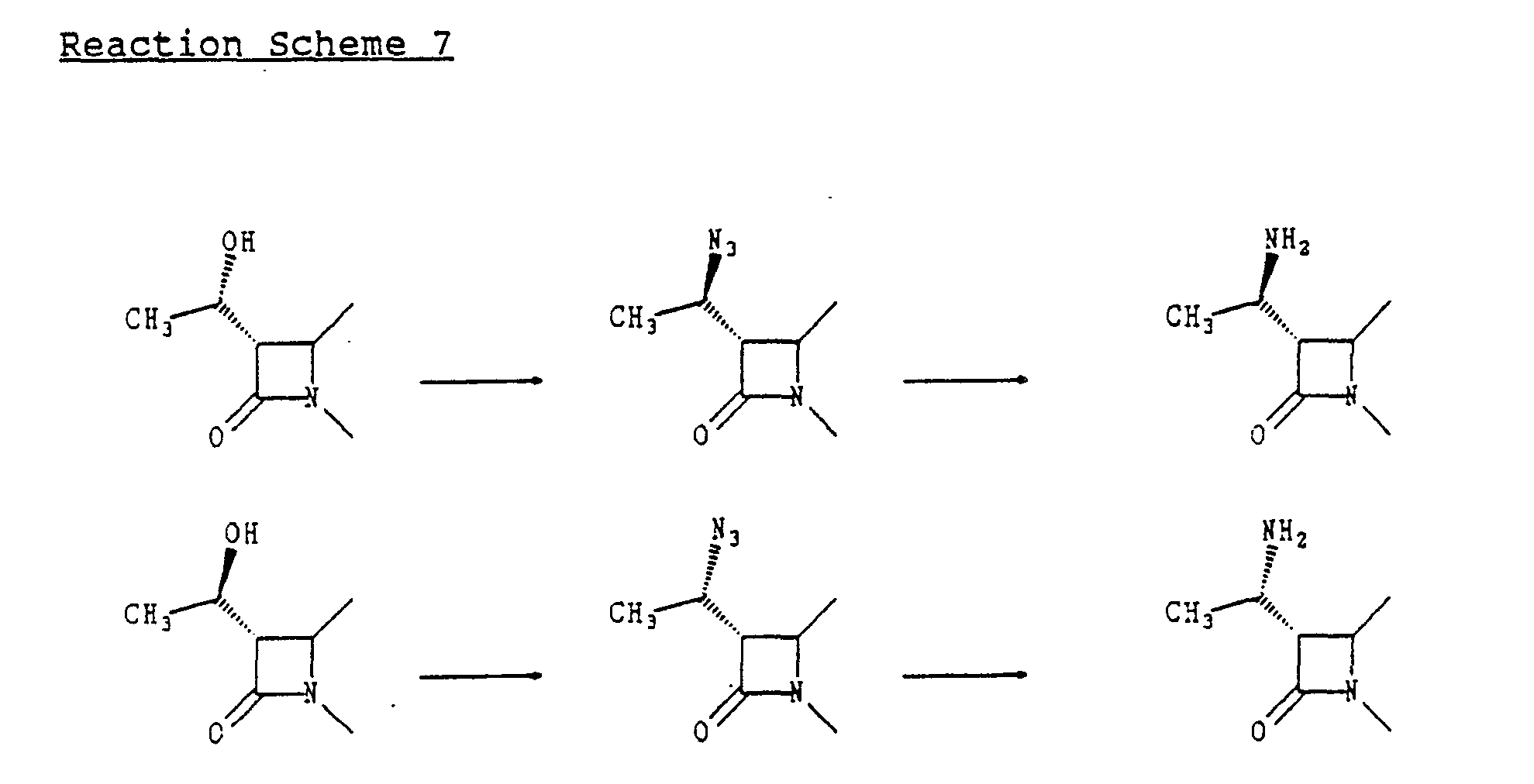
- The method involves protecting other reaction sensitive substituents with conventional hydroxy, carboxy and.'or amino-protecting groups, then reacting the suitable protected 1-hydroxyethyl starting material with triphenylphosphine, hydrazoic acid and diethyl azodicarboxylate (DEAD). The resulting azido group is substituted for the hydroxy group with inversion of configuration relative to the 1-hydroxyethyl starting material. Thus, for example, the 1 (S)-OH starting material yields the 1 (R)-N3 product, and the 1 (R)-OH starting material yields the 1 (S)-N3 product. This method was first used by D.F. Corbett et al and described in J. Chem. Soc. Perkin Trans. 1, 3011 (1982) and in Tetrahedron Letters, 24, No. 49, 55
43 -55 46 (1983). The reduction of the appropriate 1-azidoethyl intermediate to the corresponding 1-aminoethyl product is advantageously carried out by methods well-known in the art and also as described herein for the reduction of the azido group. Finally, where appropriate, the protecting groups are removed by well-known conventional procedures and the procedures described herein. - In cases where the hydroxyethyl starting material of the require 1 (S)- or 1 (R)- configuration is not readily available, but the related starting material of the opposite configuration is available, the latter can be transformed into the former by the method of 0. Mitsunobu, Synthesis, 1-28 (1981) or 0. Mitsunobu et al, Bull. Chem. Soc. Japan, 49 510 (1976). This method is similar to the above, and involves the reaction of the hydroxy compound with triphenylphosine, formic acid rather than hydrazoic acid, and diethyl azodicarboxylate to yield the formate ester of opposite configuration, for example, 1 (S)-OH yields 1 (R)-OCHO, and 1 (R)-OH yields 1 (S)-OCHO. The formate ester is then hydrolyzed to yield the required hydroxyethyl starting material.
- In the case when it is desired to prepare compounds of the Formula I wherein R' is aminomethyl, the process described above to transform 1-hydroxyethyl to 1-aminoethyl may also be used to transform a beta lactam intermediate wherein R1 is hydroxymethyl to an intermediate wherein R' is aminomethyl. However, in this instance, there is no difference in the relative configuration.
- The preparation of compounds of Formula I wherein R' is a 1-fluoroethyl group is carried out by reacting a suitable protected 1-hydroxyethyl starting material with diethylaminosulfur trifluoride (DAST). The resulting fluoro group is substituted for the hydroxy group with inversion of configuration relative to the 1-hydroxyethyl starting material, for example, the 1 (S)-OH starting material yields the 1 (R)-F product, and the 1 (R)-OH starting material yields the 1 (S)-F product. When the hydroxyethyl starting material of the required 1 (S)- or 1 (R)- configuration is not readily available, but the related starting material of the opposite configuration is available, the latter can be transformed into the former by the method described previously. The method is more fully described by C.P. Mak and K. Wagner, Synthesis of florinated carbapenems. Reaction of monocyclic and bicyclic β-lactams with diethylaminosulfur trifluoride. In "Recent Advances in the Chemistry of β-Lactam Antibiotics" Eds. A.G. Brown and S.M. Roberts, Third International Symposium, pp. 366-370 (1984). The Royal Society of Chemistry, Burlington House, London and references cited therein. More recently, the DAST method and a new method using a mixture of diethylaminohex-afluoropropane and diethylaminopentafluoropropene was described by T. Yoshioka et al in Journal of Antibiotics, 42, No. 10, 1520-1522 (1989). Both methods are hereby incorporated by reference.
- Other methods for the preparation of intermediates of Formula I wherein R' is hydrogen, C, -z alkyl or hydroxymethyl are known per se and may be found in references such as Penems, Synthetic approach to thienamycin analogs by S. Oida in "Recent Advances in the Chemistry of β-Lactam Antibiotics" Ed. G.I. Gregory, Second International Symposium, 1980, and The Chemistry of Thienamycin and other Carbapenem Antibiotics by R.W. Ratcliffe and G. Alkers-Schonberg in "Chemistry and Biology of β-Lactam Antibiotics" Ed. R.B. Morin and M. Gorman, Vol. 2, Academic Press, 1982 which are also incorporated by reference.
- To illustrate the potent antibacterial activity and the superior chemical and biological stability of the carbapenems of the present invention, a representative member of Examples of the present invention for purposes of illustration are presented in Table I with in vitro activities (MIC), chemical stability (T 112) and biological stability (DHPI).
- In vitro antibacterial activity was determined by serial 2-fold dilution of the compound in Mueller-Hinton agar and inoculation of the agar surface or broth with an appropriately diluted 18-24 h broth culture. Agar plates and tubes were incubated at 37° C for 17 h, and the lowest concentration causing inhibition of visible growth was considered to be the minimum inhibitory concentration (MIC).
- Chemical stability in aqueous solution at pH 7.4 and 37° C is reported as half-life (T 1/2) in hours. These values were determined by the method of Woodward et al, J. Am. Chem. Soc., 102, 2042 (1980)
- Biological stability toward renal dehydropeptidase I [renal dipeptidase (EC 3.4.13.11)] decomposition was determined and the values reported are relative to that observed with imipenem. Pure hog renal dipeptidase was prepared as described by Hitchcock et al, J. Anal. Biochem., 163, 219 (1987), while human renal dipeptidase was prepared as described by Campbell et al., J. Biol. Chem., 259, 14586-14590 (1984).
- Solutions of carbapenem (0.10 mM) in buffer (50 mM) 4-morpholinepropanesulfonic acid, pH 7.1, were freshly prepared. The UV/vis spectrum of a 2.5 ml aliquot was measured and then 0.025 ml of 1 M NHzOH was added to degrade the β-lactam bond. The spectrum was again measured after 30 min at 25 C for hog dipeptidase and at 37° C for human dipeptidase and again at 5-10 min intervals until no further decrease in absorbance was observed. The different spectrum between intact and degraded β-lactam was used to calculate a x max and ε. A similar aliquot of carbapenem solution was incubated at 25°C for hog dipeptidase and at 37°C for human dipeptidase and the rate of change in absorbance at max was determined. Enzyme was then added to give a rate of at least 10' 4 absorbance units per second. The rate of enzymatic hydrolysis was corrected for spontaneous hydrolysis and then converted with E to nmol min-' (ml of enzyme)-' . All rates are reported relative to that observed with imipenem.


- As in the case of other β-lactam antibiotics, compounds of general formula I may be converted by known procedures to pharmaceutically acceptable salts which, for purposes of the present invention, are substantially equivalent to the non-salted compounds. Thus, for example, one may dissolve a compound of formula I wherein R4 is an anionic charge in a suitable inert solvent and then add an equivalent of a pharmaceutically acceptable acid. The desired acid addition salt may be recovered by conventional procedures, e.g. solvent precipitation, lyophilization, etc. Where other basic or acidic functional groups are present in the compound of formula I, pharmaceutically acceptable base addition salts and acid addition salts may be similarly prepared by known methods.
- A compound of formula I where R4 is hydrogen or an anionic charge, or a pharmaceutically acceptable salt thereof may also be converted by conventional procedures to a corresponding compound where R2 is a physiologically hydrolyzable ester group, or a compound of formula i wherein R4 is a conventional carboxyl-protecting group may be converted to the corresponding compound where R4 is hydrogen, an anionic charge or a physiologically hydrolyzable ester group, or a pharmaceutically acceptable salt thereof.
- The novel carbapenem derivatives of general formula I wherein R4 is hydrogen, an anionic charge or a physiologically hydrolyzable carboxyl-protecting group, or the pharmaceutically acceptable salts thereof, are potent antibiotics active against various gram-positive and gram-negative bacteria and they may be used, for example, as animal feed additives for promotion of growth, as preservatives in food, as bactericides in industrial applications, for example in waterbased paint and in the white water of paper mills to inhibit the growth of harmful bacteria and as disinfectants for destroying or inhibiting the growth of harmful bacteria on medical and dental equipment. They are especially useful, however, in the treatment of infectious disease in humans and other animals caused by gram-positive or gram-negative bacteria.
- The pharmaceutically active compounds of this invention may be used alone or formulated as pharmaceutical compositions comprising, in addition to the active carbapenem ingredient, a pharmaceutically acceptable carrier or diluent. The compounds may be administered by a variety of means; those of principal interest include: orally, of means; those of principal interest include: orally, topically or parenterally (intravenous or intramuscular injection). The pharmaceutical compositions may be in solid form such as capsules, tablets, powders, etc. or in liquid form such as solutions, suspensions or emulsions. Compositions for injection, the preferred route of delivery, may be prepared in unit dose form in ampules or in multidose containers and may contain formulatory agents such as suspending, stabilizing and dispersing agents. The compositions may be in ready to use form or in powder form for reconstitution at the time of delivery with a suitable vehicle such as sterile water.
- The dosage to be administered depends to a large extent on the particular compound being used, the particular composition formulated, the route of administration, the nature and condition of the host and the particular situs and organism being treated. Selection of the particular preferred dosage and route of application, then, is left to the discretion of the physician. In general, however, the compounds may be administered parenterally or orally to mammalian hosts in a an amount of from about 5 to 200 mg/kg/day. Administration is generally carried out in divided doses, e.g. three to four times a day.
- The following examples which illustrate specific embodiments of the invention are given for illustration and do not limit the scope of the present invention. The abbreviations used in the present invention are conventional abbreviations well-known to those skilled in the art. Some of which are included below.

- In the following examples, all temperatures are given in degrees Centigrade. Melting points were recorded on a Gallenkamp capillary melting point apparatus and boiling points were measured at specific pressures (mm Hg) and both temperatures are uncorrected. Proton magnetic resonance ('H NMR) spectra were recorded on a Bruker AC-200. All spectra were determined in the solvents indicated and chemical shifts are reported in δ units downfield from the internal standard tetramethylsilane (TMS) and interproton coupling constants are reported in Hertz (HZ). Splitting patterns are designated as follows: S, singlet; d, doublet; t, triplet; q, quartet; m, multiplet; br, broad peak; dd, doublet of doublet; bd, broad doublet, dt doublet of triplet; bs, broad singlet, dq, doublet of quartet. Infrared (IR) spectra were determined on a Perkin Elmer 781 spectrometer from 4000 cm-1 to 400 cm-' , calibrated to 1601 cm-1 absorption of a polystyrene film and reported in reciprocal centimeters (cm-1 ). Relative intensities are indicted as follows: s (strong), m (medium) and w (weak). Optical rotationswere determined on a Perkin-Elmer 41 polarimeter in the solvents indicated. Ultraviolet spectra were determined on a Hewlett Packard 8451A diode array spectrophotometer in the solvent and concentration indicated.

- Analytical thin-layer chromatography (TLC) was carried out on precoated silica gel plates (60F-254, 0.25 mm) and visualized using UV light, iodine vapors and/or staining with one of the following reagents: (a) methanolic phosphomolybdic acid (2%) and heating; (b) reagent (a) followed by 2% cobalt sulphate in 5M H2SO4 and heating. Column chromatography, also referred to as flash column chromatography, was performed in a glass column using finely divided silica gel (40-63 m on silica gel-H) and pressures somewhat above atomospheric pressure with the indicated solvents. Preparative thin layer chromatography was carried out on precoated silica gel plate (60F-254,2 mm) and visualized using UV light.
- Reversed phase analytical thin-layer chromatography was carried out on Analtech precoated reversed phase F (250 microns) plates and visualized suing UV light or iodine vapors.
- Reversed phase column chromatography was performed in a glass column using µ Bondapek C18 (55-100 m) prep 500. High pressure liquid chromatography was performed on a Waters 501 HPLC pump using a Varian 2550 UV detector and a Varian 4290 integrator. The column specifications are as follows: µBondapak C18 packing, 30 cm length, 3.9 mm I.D., particle size 10kL and the mobile phase is CH3CN/aqueous K2HPO4 0.01 M at pH 7.4.
- All evaporations of solvents were performed under reduced pressure. As used herein, the term hexanes is a mixture of isomeric CG hydrocarbons, as specified by the American Chemical Society, petroleum ether refers to the 30-60°C fractions, and the term "inert" atmosphere is an argon or nitrogen atmosphere unless otherwise indicated.
-

-

- IR (CH2Cl2) vmax: 1690 cm-1 (C = O);
- 1H NMR (CDCI3) δ: 8.55-8.51 (1H, m, pyridine-H), 7.67-7.58 (1H, m, pyridine-H), 7.35-7.31 (1H, bd, J=7.8 Hz, pyridine-H), 7.2-7.12 (1H, m, pyridine-H), 4.61, 4.58, 4.55, 4.37, 4.34, 4.3 (2H, dt, J=5.8 Hz, J=47.1 Hz, CH2-F), 4.27 (2H, s, CH2-S), 2.74 (2H, t, J = 7.2 Hz, CH2C=O) and 2.2-1.92 ppm (2H, m, CH2).
-

- ' H NMR ( CDCl3, 200 MHz) s: 8.56-8.52 (1H, m, aromatic H), 7.67-7.58 (1H, m, aromatic-H), 7.28-7.23 (1H, m, aromatic H), 7.18-7.11 (1 H, m, aromatic-N), 5.02 (0.4 H, t, J = 7.5 Hz, vinylic H), 4.85 (0.6 H, t, J = 7.2 Hz, vinylic H), 4.40 and 4.16 (d, 2H, dt, J = 6.7 Hz, J = 47.2 Hz, CH2 F ), 4.28, 4.05 (0.8 H, dt, J = 6.4 Hz, J = 47.2 Hz, CH2F 4.05 (0.8 H, s, CH2-pyridine), 3.98 (1.2 H, s, CH2-pyridine), 2.5-2.2 (2H, m, CH2), 0.98 and 0.97 (9H, 2s, t-butyl), 0.25 and 0.21 ppm (6H, 2s, dimethyl).
-

- To a cold (ice bath) freshly fused ZnCl2(5.45 g, 40 mmol) under argon was added (3S,4R)-4-acetoxy-3-[(1'R)-1'-tert-butyldimethylsilyloxyethyl]azetidin-2-one (5.75 g, 20 mmol) in CH2Cl2(60 ml) followed by the dropwise addition of the silylenol ether (14 g, 40 mmol) prepared in Step B in CH2Cl2(20 mL). The mixture was stirred for 20 h at 5°C (cold room), then poured over a cold saturated aqueous NaHC03solution and extracted with ethyl acetate (2 x 100 mL). The ethyl acetate extracts were washed with saturated NH4Cl, brine and dried (MgSO4). The residue upon solvent evaporation was triturated with petroleum ether and filter to give the product (4.0 g, 45%). Recrystallization from ethyl acetate gave the title compound; m.p. = 114-115°C.
- IR (CH2Cl2) vmax: 3410 (NH), 1770 and 1680 cm-1 (C=O);
- ' H NMR (CDCI3) 5: 8.55-8.52 (1H, m, aromatic-H), 7.68, 7.59 (1H, m, aromatic-H), 7.33-7.29 (1H, bd, J=7.8 Nz, aromatic-H), 7.21-7.14 (1H, m, aromatic-H), 5.86 (1H, bs, NH), 5.71-4.29 (2H, 2 sets of m, CH2F ), 4.277 (2H, s, CH2S ), 4.22-4.11 (1 H, m, H-1'), 3.88 (1 H, dd, J = 2.0 Hz, J = 6.7 Hz, H-4), 3.075-2.97 (2H, m, H=3 and H-1"), 2.3-1.8 (2H, 2 sets of m, CHz-2 "), 1.01 (3H, d, J=6.3 Hz, CH3), 0.855 (9H, s, tert-butyl) and 0.048 ppm (6H, s, dimethyl); Anal. Calcd. for C21H33N2O3SSiF: C, 57.24; H, 7.55; N, 6. 36; S, 7. 28. Found: C, 57.01; H, 7.74; N, 6.17; S, 7.24.
-

- IR (CH2Cl2) νmax: 3410 (NH), 1770, 1750 and 1715 cm-' (C=O);
- 'H NMR ( CDCl3, 200 MHz) δ: 6.34 (1 H, bs, NH), 4.8-4.6 and 4.6-4.35 (2H, 2 sets of m, CH2F ), 4.35-4.1 (1H, m, H-1'), 3.95 (1 H, dd. J = 1.9 Hz, J = 6.0 Hz, H-4), 3.15-3.12 (1 H, m, H-3), 2.95-2.8 (1H, m, H = 1"), 2.3-1.8 (2H, m, CH2), 1.18 (3H, d, J=6.3 Hz, CH3), 0.87 (9H, s, tert-butyl), 0.072 and 0.063 ppm (6H, 2s, dimethyl);
- Anal. Calcd. for C15H28NO4SiF: C, 54.03; H, 8.46; N, 4.20. Found: C, 53.75; H, 8.55; N, 4.05.
-

- A suspension (3S,4S)-3-[(1'R)-1'-tert-butyldimethylsilyloxyethyl]-4-[(1"R)-1 "-carboxy-3"-fluoropropyl]-azetidin-2-one (0.75 g, 2.3 mmol) in CH3CN (15 mL) was treated with carbonyl-diimidazole (0.39 g, 2.4 mmol) and stirred for 1 h at 22°C. The resulting acyl imidazole was treated with anhydrous magnesium monoallyl malonate (0.73 g, 2.4 mmol) and stirred for 50 h at 22°C. The mixture was diluted with EtOAc (60 mL), washed with cold 1N aqueous HCI (1 x 60 mL), water (2 x 60 mL), saturated aqueous NaHCOa(1 x 60 mL), water (2 x 60 mL), brine (60 mL) and dried (MgSO4). Evaporation of solvent left a residue (1.7 9) that was passed through a silica gel (100 g) pad to give the title compound (Hexane - 20% EtOAc/hexane) as an oil (96 mg, 10%).
- IR (CH2Cl2) νmax: 3410 (NH), 1770, 1715, 1655 and 1630 cm-1 (C=0);
- ' H NMR (CDCl3, 200 MHz) 6: 6.01, 6.00 (1H, 2 bs, NH), 6.0-5.8 (IH, m, vinylic H), 5.4-5.15 (2H, m, vinylic H), 5.14 (0.5H, s, vinyl H of enol), 4.7-4.6 (2H, m, CH2-vinyl), 4.7-4.2 (2H, 2 sets of m, CH2F ), 4.21-4.13 (1 H, m, H-1'), 3.91 (0.5 H, dd, J =2.1 Hz, J = 4.4 Hz, H4), 3.88 (0.5 H, dd, J =2.1 Hz, J =6.9 Hz, H-4), 3.60 (1 H, s, CH2CO ), 3.26-3.17 (0.5 H, m, H-1 "), 2.99 (0.5 H, dd, J = 2.2 Hz, J = 4.4 Hz, H-3), 2.95-2.92 (0.5 H, m, H-3), 2.55-2.35 (0.5 H, m, H-1 "), 2.3-1.7 (2H, m, CH2), 1.175 and 1.12 (3H, 2d, J =6.28 Hz and J = 6.34 Hz, CH3), 0.86 (9H, s tert-butyl), 0.067 and 0.055 (6H, 2s, dimethyl).
-

- A cold (ice bath) solution of (3S,4R)-3-[(1'R)-1'-tertbutyldimethylsiyloxyethyl]-4-[(1"R)-1 "-(2-fluoroethyl)-3"-allyloxycarbonyl-2"-oxopropyl]azetidin-2-one (0.20 g, 0.48 mmol) in CH3CN was treated with triethylamine (64 mL, 0.48 mmol) and p-toluenesulfonyl azide (95 mg, 0.48 mmol). The ice bath was removed and the mixture was stirred for 1 h. Evaporation of CH3CN gave a semi-solid residue that was triturated with petroleum ether (10 mL). The solid was removed by filtration and the solution was applied on a silica gel column (6 g, 10% EtOAc-hexane) to give the title compound (190 mg, 90%).
- IR (CN2Cl2) νmax: 3410 (NH), 2150 (N2), 1777, 1715 and 1650 cm-' (C=0);
- ' H NMR ( CDCl3, 200 MHz) 5: 6.03-5.83 (1 H, m, vinylic H), 5.90 (1 H, bs, NH), 5.40-5.28 (2H, m, vinylic H), 4.73-4.7 (2H, m, CH2 vinylic) 4.7-4.4, 4.4-4.2 (2H, 2 sets of m, CHz-F ), 4.3-4.1 (2H, m, H-1' and H-1 "), 3.90 (1H, dd, J = 2.0 Hz, J = 5.2 Hz, H-4), 3.06-3.03 (1 H, dd, J = 2.1 Hz, J = 3.5 Hz, H-3), 2.2-2.0, 2.0-1.8 (2H, 2 sets of m, CH2), 1.18 (3H, d, J=6.3 Hz, CH3), 0.86 (9H, s, tert-butyl), 0.061 and 0.051 ppm (6H, 2s, dimethyl).
-
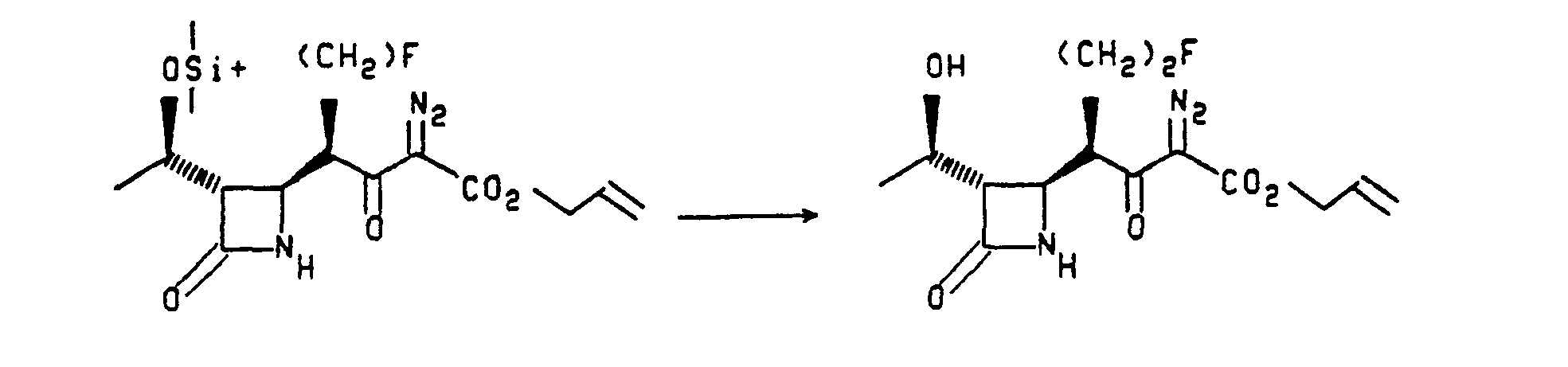
- A cold (ice bath) solution of (3S,4R)-3-[(1'R)-1'-tert-butyldimethylsilyloxyethyl]-4-[(1"R)-1"-(2-fluoroethyl)-3"-diazo-3"-allyloxycarbonyl-2"-oxopropyl]azetidin-2-one (170 mg, 0.390 mmol) in CH3CN (2 mL) was treated with a 1 N aqueous HCI solution (0.78 mL, 0.78 mmol). The ice bath was removed and the mixture was stirred 4 h. The solvent was removed under vacuum and the residue was diluted with EtOAc (15 mL). The organic phase was washed with 0.1 M aqueous NaHC03 (10 mL), water (10 mL), brine (10 mL) and dried (MgSO4). The solvent was evaporated and the residue was passed through a silica gel (5 g) pad (1:1 ethyl acetate: hexane) to give the title compound (130 mg, 100%).
- IR (CH2Cl2) νmax: 3680, 3600 (OH), 3400 (NH), 2150 (N2), 1765, 1715 and 1650 cm-1 (C=0);
- ' H NMR ( CDCl3, 200 MHz) δ: 6.04 (1H, bs, NH), 6.0-5.8 (1H, m, vinylic-H), 5.4-5.29 (2H, m, vinylic-H), 4.75-4.71 (2H, m, CH2-vinylic), 4.7-4.5, 4.5-4.3 (2N, 2 sets of m, CH2F ), 2.2-2.0 (2H, m H-1' and H-1 "), 3.88 (1 H, dd, J = 2.0 Hz, J = 6.5 Hz, H-4), 2.98 (1 H, dd, J = 2.0 Hz, J = 7.2 Hz, H-3), 2.34 (1 H, d, J = 3.6 Hz, OH), 2.4-1.8 (2H, 2 sets of m, CH2), and 1.31 ppm (3H, d, J=6.3 Hz, CH3).
-

- A solution of (3S,4R)-3-[(1'R)-1'-hydroxyethyl]-4-[(1"R)-1"-(2-fluoroethyl)-3"-diazo-3"-allyloxycarbonyl-2"-oxopropyl]azetidin-2-one (150 mg, 0.46 mmol) in 25% hexane-ethyl acetate (5 mL) was refluxed for 2.5 h using Rh(OAc)z as catalyst. The solvent was evaporated to give the title bicyclic ketone (140 mg, 100%).
- IR (CH2Cl2) νmax: 3680, 3600 (OH), 1770, 1745 and 1735 cm-1 (C=O);
- 1H NMR (CDCl3, 200 MHz) δ: 6.0-5.80 (1H, m, vinylic -H), 5.4-5.26 (2H, m, vinylic H), 4.79-4.68 (1H, m, HCH-F), 4.69-4.65 (2H, m, CH2-vinyl), 4.68 (1 H, s, H-2), 4.57-4.44 (1 H, m, HCHF), 4.37 (1 H, dd, J =2.5 Hz, J = 8.6 Hz, H-5), 4.38-4.24 (1 H, m, H-1'), 3.29 (1 H, dd, J = 2.5 Hz, J = 7.2 Hz, H-6), 3.02-2.9 (1 H, m, H-4), 2.3-1.7 (3H, 2 sets of m and bs, CH2 and OH) and 1.39 (3H, d, J=6.3 Hz, CH3). I. Allyl (4R,5S,65)-4-(2"-fluoroethyl)-6-[(1'R)-1'-hydroxy
-

- IR (CH2CI2) νmax: 3600 (OH), 1775 and 1715 cm-1 (C=0);
- ' H NMR (CDCI3, 200 MHz) 5: 8.53-8.51 (1 H, bd, aromatic H), 7.71-7.62 (1 H, m, aromatic H), 7.38, 7.34 (1H, bd, J = 7.8 z, aromatic -H), 7.23-7.16 (1H, m, aromatic -H), 6.0-5.85 (1H, m, vinylic -H), 5.47-5.21 (2H, m, vinylic H), 4.86-4.6 (3H, m, CH2-vinylic and HCHF), 4.52-4.44 (1H, m, HcHF), 4.26-4.19, 4.06, 3.99 (2H, ABq, J= 13.9 Hz, CH2-pyridine), 4.28-4.18 (2H, m, H-1' and H-5), 3.85-3.73 (1H, m, H-4), 3.23 (1H, dd, J=2.7 Hz, J = 7.3 Hz, H-6), 2.4-1.6 (3H, m and bs, CH2 and OH) and 1.36 ppm (3H, d, J=6.3 Hz, CH3).
-

- A cold (ice bath) solution of allyl (4R,5S,6S)-4-(2"-fluoroethyl)-6-[(1'R)-1'-hydroxyethyl]-3-[(pyridin-2-yl)-methylthio]-7-oxo-1-azabicyclo[3.2.0]hept-2-ene-2-carboxylate (125 mg, 0.320 mmol) in THF (3 mL) was treated with Pd(PPh3)4 (10 mg) and N-methylaniline (60 µl, 0.55 mmol). The ice bath was removed and the mixture was stirred for 1.5 h. The mixture was diluted with EtOAc (20 mL) and extracted with an aqueous 0.05M pH 7.0 phosphate buffer (1 x 10 mL and 1 x 5 mL). The aqueous phases were combined, washed with ethyl acetate (10 mL) and passed through a µ-Bondapak C18 column (20 g, H2O, 2%, 5%, 7%, 10%, CH3CN/H2O) to give the title compound (50 mg, 40%).
- Purity by HPLC: 99.23%, retention time 15.90 min (10% CH3CN/KH2PO4, 0.01 M, pH 7.4);
- UV (H 20) λmax: 266 (6300), 304 (8700);
- IR (Nujol) vma x : 1750 and 1600 cm-1 (C=0);
- ' H NMR (CDCl3, 200 MHz) 3: 8.47-8.45 (1H, m, aromatic-H), 7.89-7.81 (1H, m, aromatic-H), 7.53-7.49 (1 H, bd, J = 7.9 Hz, aromatic H), 7.39-7.32 (1 H, m, aromatic-H), 4.8-4.6, 4.55-4.35 (2H, 2 sets of m, CH2-F), 4.24, 4.17, 4.10, 4.03 (2H, ABq, J = 13.8 Hz, CH2-pyridine), 4.3-4.17 (1H, m, H-1'), 4.10 (1H, dd, J = 9.5 Hz, J = 2.6 Hz, H-5), 3.43 (1H, dd, J = 6.1 Hz, J = 2.6 Hz, H-6), 3.41-3.29 (1H, m, H-4) and 1.27 ppm (1H, d, J=6.4 Hz, CH3).
-

-

- A cold (ice bain) solution 2-mercaptomethylpyridine (46.5 g, 0.372 mol) in CH2Cl2was treated with pyridine (37.5 mL. 0.465 mol), followed by the dropwise addition of 4-azidobutyryl chloride (54.9 g, 0.372 mol) in CH2Cl2(100 mL). The mixture was stirred at 5°C for 1 h, diluted with EtOAc (2 L), washed with cold water (500 mL), aqueous 1 M NaHS03(500 mL), water (500 mL) then with aqueous 1 M NaHC03(500 mL), water (500 mL) and brine. The residue was passed through a silica gel (900 g) pad to give the title compound (88.9 g, 91 %) as an oil.
- IR (CH2Cl2) νmax: 2100 (N3), and 1690 cm-' (C=O);
- 1H NMR ( CDCI3, 200 MHz) δ: 8.55-8.52 (1H, m, aromatic H), 7.66-7.58 (1H, m, aromatic H), 7.34-7.31 (1H, bd, aromatic H), 7.19-7.12 (1H, m, aromatic H), 4.26 (2H, s, CH2-pyridine), 3.335 (2H, t, J=6.6 Hz, CH2N3), 2.688 (2H, t, J = 7.2 Hz, CH2CO) and 2.03-1.87 ppm (2H, m, CH2).
-

- 'H NMR ( CDCI3, 200 MHz) δ: 8.56-8.53 (1H, m, aromatic H), 7.67-7.59 (1H, m, aromatic H), 7.28-7.25 (1H, bd, aromatic H), 7.18-7.12 (1H, m, aromatic H), 3.989 (0.45 H, t, J=7.6 Hz, vinylic H), 4.828 (0.55 H, t, J=7.2 Hz, vinylic H), 4.048 (0.9 H, s, CH2-pyridine), 3.978 (1.1 H, s, CH2-pyridine), 3.128 (1.1 H, t, J = 7.2 Hz, CH2N3), 3.004 (0.9 H, t, J=6.9 Hz, CH2N3), 2.35-2.22 (2H, m, CH2), 0.985, 0.969 (9H, 2s, tert-butyl), 0.251 and 0.215 ppm (6H, 2s, dimethyl).
-

- To freshly fused ZnCl2(38.6 g, 0.284 mol) was added first at 0°C (ice bath), under an Argon atmosphere (3S,4R)-4-acetoxy-3-[(1'R)-1'-tert-butyldimethylsilyloxyethyl]azetidin-2-one (40.75 g, 0.142 mol) in CH2Cl2(500 mL) and then dropwise a solution of tert-butyldimethylsilylenol ether of 4-azido-[(pyridin-2-yl)-methylthio)butyrate (100 g, 0.284 mol) prepared in Step B in CH2Cl2140 mL. The mixture was stirred (ice bath) for 1 h then was allowed to stand for 15 h at 5 C (cold room). The mixture was stirred again for 4 h at about 22 C, then diluted with aqueous saturated NH4CI (700 mL) and extracted twice with EtOAc (2 x 1 L). The organic phases were combined, washed with water (3 x 500 mL), brine (500 mL) and dried ( MgSO4). Evaporation of the solvent afforded a residue that was diluted with petroleum ether (200 mL), seeded with title compound and allowed to crystallize for 18 h at 5 C (cold room). The crystals were collected and the mother liquor was purified on a silica gel flash (500 g) pad [8/2: CH2Cl2/hexane → 50% EtOAc/ CH2Cl2] to give a total of 50.5 g (74%) of the title compound; m.p. = 95-6°C (petroleum ether).
- IR (CH2Cl2) νmax: 3400 (NH), 2100 (N3), 1770 and 1680 cm-' (C=O);
- 1H NMR ( CDC13, 200 MHz) δ: 8.55-8.52 (1H, m, aromatic H), 7.67-7.59 (1H, m, aromatic H), 7.34-7.30 (1 H, bd, aromatic H), 7.21-7.14 (1 H, m, aromatic H), 5.93 (1 H, bs, NH), 4.278 (2H, s, CH2-pyridine), 4.2-4.09 (1H, m, H-1') 3.839 (1 H, dd, J =2.1 Hz, J =6.7 Hz, H-4), 3.47-3.22 (2H, m, CH2-N3), 3.053 (1 H, dd, J =2.3 Hz, J = 3.3 Hz, H-3), 2.99-2.89 (1 H, m, H-1 "), 2.09-1.97 (1 H, m, HCH), 1.79-1.65 (1 H, m, HCH), 1.009 (3H, d, J = 6.3 Hz, CH3), 0.852 (9H, s, tert-butyl) and 0.044 (6H, s, dimethyl).
-

- A cold (ice bath) solution of (3S,4S)-3-[(1'R)-1'-tert-butyldimethylsilyloxyethyl]-4-[(1"R)-1"-(pyridin-2-yl)-methylthiocarbonyl-3"-azidopropyl]azetidin-2-one (4.79 g, 10 mmol) in THF (50 mL) was treated with H2O230% (2.58 mL, 30.0 mmol) followed by the dropwise addition of a 1 N aqueous NaOH solution (30 mL, 30 mmol). The ice bath was removed and the mixture was stirred for 1 h then cooled again (ice bath). The reaction mixture was acidified with 1 N aqueous HCI (60 mL, 60 mmol) and extracted with EtOAc (3 x 50 mL). The organic extracts were combined, washed with water (50 mL), 1 M aqueous NaHS03, water (50 mL), brine (50 mL) and dried ( MgSO4). Evaporation of the solvent afforded the title compound (3.64 g, 98%) as a white solid; m.p. = 138-139° C (diethyl ether, petroleum ether).
- IR ( CH2Cl2) νmax: 3410 (NH), 2100 (N3), 1770, 1740 and 1710 cm-1 (C=0);
- ' H NMR (CDCI3, 200 MHz) δ: 6.57 (1H, bs, NH), 4.23-4.18 (1H, m, H-1'), 3.932 (1H, dd, J =2.0 Hz, J = 5.8 Hz, H-4), 3.52-3.36 (2H, m, CH2N3), 3.146 (1H, dd, J = 1.8 Hz, J = 3.7 Hz, H-3), 2.85-2.74 (1H, m, H-1"), 2.1-1.94 (1H, m, HCH), 1.9-1.7 (1H, m, HCH), 1.1830 (3H, t, J=6.3 Hz, CH3), 0.868 (9H, s, tert-butyl), 0.072 and 0.059 ppm (6H, 2s, dimethyl).
-

- A suspension of (3S,4S)-3-[(1'R)-1'-tert-butyldimethylsilyloxyethyl]-4-[(1"R)-1"-carboxy-3"-azidopropyl]-azetidin-2-one (3.56 g, 10 mmol) in anhydrous CH3CN , under a nitrogen atmosphere, was first treated with carbonyldiimidazole (1.94 g, 12 mmol) and stirred for 30 min. To the clear solution was added monoallyl magnesium malonate (3.73 g, 12 mmol) and the mixture was stirred for 18 h at 60°C. Then more malonate (932 mg, 3 mmol) was added and the mixture was heated at 60°C for 4 additional hours. This process was repeated twice with a heating period of 18 and 4 h respectively. Acetonitrile was then evaporated and the residue was taken up in EtOAc (200 mL). This solution was washed with cold water (100 mL), 1 N aqueous HCI (100 mL), 10% aqueous Na2C03(100 mL), brine (100 mL) and dried ( MgSO4). Evaporation of the solvent afforded crude (3S,4R)-3-[(1'R)-1'-tert-butyldimethylsilyloxyethyl)-4-[(1"R)-1 "-(2-azidoethyl)-3"-allyloxycarbonyl-2"-oxopropyl]-azetidin-2-one (4.2 g, 100%). Part of this crude material (1.85 g, 4.22 mmol) in CH3CN (19 mL) was cooled down (ice bath), treated successively with triethylamine (0.6 mL, 4.3 mmol) and p-toluenesulfonyl azide (847 mg, 3.2 mmol) and stirred at about 22° C for 3.5 h. The solvent was evaporated and the residue was passed through a silica gel (20 g, CH2CI2, 10% EtOAc/CH2Cl2) column to give the title compound (1.21 g, 62%) contaminated with a small amount of p-toluenesulfonamide.
- IR (CH2Cl2) νmax: 3410 (NH), 2150 (N2), 2100 (N3), 1765, 1715 and 1645 cm-1 (C=O);
- ' H NMR (CDCI3, 200 MHz) 6: 6.1-5.8 (1H, m, vinylic H), 5.87 (1H, bs, NH), 5.41-5.29 (2H, m, vinylic H), 4.75-4.7 (2H, m, CH2), 4.23-4.1 (2H, m, H-1' and H-1 "), 3.873 (1 H, dd, J = 2.1 Hz, J = 5.2 Hz, H-4), 3.39-3.24 (2H, m, CH2N3), 3.049 (1H, dd, J = 2.1 Hz, J=3.7 Hz, H-3), 2.21-2.05 (1H, m, HCH), 1.75-1.60 (1H, m, HCH), 1.179 (3H, d, J=6.3 Hz, CH3), 0.864 (9H, s, tert-butyl), 0.064 and 0.052 ppm (6H, 2s, dimethyl).
-

- IR ( CH2Cl2) vmax: 3600, 3500 (OH), 2150 (N2), 2100 (N3), 1765, 1715 and 1645 cm-1 (C=O);
- ' H NMR ( CDCl3, 200 MHz) δ: 6.25 (1H, bs, NH ), 6.04-5.8 (1H m, vinylic H), 5.4-5.2 (2H, m, vinylic H), 4.9-4.8 (2H, m, CH2), 4.17-4.01 (2H, m, H-1' and H-1"), 3.844 (1H, dd, J=2.1 Hz, J=6.1 Hz, H-4), 3.42-3.2 (2H, m, CH2N3), 3.017 (1H, dd, J = 2.1 Hz, J = 6.7 Hz, H-3), 2.5 (1H, bs, OH), 2.2-2.0 (1H, m, HCH), 1.85-1.7 (1H m, HCH) and 1.286 ppm (3H, d, J = 6.4 Hz, CH3).
-

- 1H NMR ( CDCl3, 200 MHz) δ: 6.05-5.9 (1H, m, vinylic H), 5.5-5.2 (2H, m, vinylic H), 4.77 (1H, s, H-2), 4.48-4.6 (2H, m, CH2), 4.329 (1 H, dd, J = 2.5 Hz, J = 8.7 Hz, H-5), 4.3-4.1 (1 H, m, H-1'), 3.568 (2H, t, J = 6.5 Hz, CH2N3), 3.234 (1H, dd, J =2.5 Hz, J=8.0 Hz, H-6), 2.95-2.75 (1H, m, H-4), 2.1-1.9 (1H, m, HCH), 1.8-1.6 (1H, m, HCH) and 1.412 ppm (3H, d, J=6.2 Hz, CH3).
-

- A cold (ice-CH30H bath) of allyl (2R,4R,SR,6S)-4-(2"-azidoethyl)-6-[(1'R)-1'-hydroxyethyl]-3,7-dioxo-1-azabicyclo [3.2.0]heptane-2-carboxylate (338 mg, 1 mmol) in CH3CN (8 mL) was treated successively with CIPO(OPh)2(0.23 mL, 1.1 mmol) and N,N-diisopropylethylamine (0.19 mL, 1.1 mmol) and stirred for 45 min. The resulting enol phosphate was then treated with trimethylsilyl chloride (0.14 mL, 1.1 mmol) and N,N-diisopropylethylamine (0.19 mL, 1.1 mmol) and was stirred for another 45 min. The resulting protected enol phosphate was then treated with 2-picolyl mercaptan (250 mg, 2.0 mmol) in CH3CN (1 mL) and N,N-diisopropylethylamine (0.34 mL, 2.0 mmol) and afterwards was stirred for 2 h. The reaction mixture was diluted with EtOAc (30 mL), washed with cold water (10 mL), 1 M aqueous NaHSO3(10 mL), water (10 mL), 1 M aqueous NaHC03(10 mL), water (10 mL), brine (10 mL) and dried ( MgSO4). The residue after solvent removal was taken up in cold (ice bath) THE (10 mL), treated with 2N aqueous CH3CO2H (3 mL, 6 mmol) and stirred for 1 h in cold and 1.5 h at about 22° C. The mixture was diluted with ethyl acetate (20 mL), washed with cold water (10 mL), 1 M aqueous NaHC03(10 mL), water (10 mL), brine and dried ( MgSO4). The residue was eluded through a silica gel (15 g) column ( Ch2Cl2 → 60% EtOAc/CH2Cl2) to give the title compound (175 mg, 38%).
- IR 3600, 3500-3400 (OH), 2100 (N3), 1775 and 1710 cm-' (C=O);
- ' H NMR ( CDCI3, 200 MHz), 5: 8.54-8.51 (1H, m, aromatic H), 7.7-7.6 (1H, m. aromatic H), 7.38, 7.34 (1H, m, aromatic H), 7.25-7.15 (1H, m, aromatic H), 6.1-5.8 (1H, m, allyl H), 5.5 (2H, m, allyl H), 4.8-4.55 (2H, m, CH2-allyl), 4.294, 4.225, 4.072, 4.002 (2H, ABq, J = 14.0 Hz, CH2-pyridyl), 4.3-4.1 (1H, m, H-1'), 4.166 (1 H, dd, J =2.7 Hz, J = 9.5 Hz, H-5), 3.8-3.65 (1H, m, H-4), 3.6-3.3 (2H, m, CH2-N3), 3.162 (1 H, dd, J =2.7 Hz, J = 7.7 Hz, H-6), 2.2-2 (1 H, m, HCH), 1.95 (1 H, bs, OH), 1.9-1.6 (1H, m HCH) and 1.382 ppm (3H, d, J = 6.2 Hz, CH3).
-

- A cold (ice bath) solution of allyl (4R,5S,6S)-4-(2"-azidoethyl)-6-[(1'R-1'-hydroxyethyl]-3-[(pyridin-2-yl)-methylthio]-7-oxo-1-azabicyclo[3.2.0]hept-2-ene-2-carboxylate (43 mg, 0.1 mmol) in CH2Cl2was treated with ( PPh3)4. Pd (21 mg, 0.018 mmol) and with N-methylaniline (0.03 mL, 0.26 mmol). The mixture was stirred for 1 h at about 22 C, diluted with diethyl ether (10 mL), then extracted with a 0.1 M aqueous pH 7.0 phosphate buffer solution (2 x 1.5 mL, 0.15 mmol), water (2 x 1.5 mL). The aqueous phases were washed with diethyl ether (5 mL) and the pH adjusted to pH 5.9-6.0 with a 1 M aqueous pH 4.2 phosphate buffer. The aqueous layer was then hydrogenolyzed at 45-50 p.s.i. and at 5°C to 15 C (temperature at the end of the reaction) for 1 h, using 10% Pd/C (75 mg) as catalyst.. The catalyst was filtered, rinsed with a pH 6 phosphate buffer and purified on a C18 µBondapak (12 g) reversed phase column (2% CH3CN/H2O) then repurified in the same way to give the title compound (6 mg, 16%).
- Purity by HPLC: 98.11%, retention time = 6.08 min. (302 mm, 10% CH3CN , 0.01 M pH 7.4 phosphate buffer);
- UV (H20) xmax: 266 (4600), 302 (5300);
- IR (Nujol) νmax: 1755 and 1590 cm-' C = O);
- ' H NMR (D20, 200 MHz) 5: 8.48-8.45 (1H, m, aromatic), 7.9-7.8 (1 H, m, aromatic H), 7.51, 7.47 (1 H, bd, aromatic H), 7.4-7.33 (1H, m, aromatic H), 4.22, 4.15, 4.09, 4.02 (2H, ABq, J = 14.5 Hz, CH2-picolyl), 4.3-4.14 (1H, m, H-1'), 4.097 (1H, dd, J = 2.8 Hz, J = 9.6 Hz, H-5), 3.374 (1H, dd, J = 2.8 Hz. J = 6.6 Hz, H-6), 3.3-3.16 (1H, m, H-4), 3.03 (1H, t, J = 7.8 Hz, CH2 N ), 2.2-2.05 (1H, m HCH), 1.82-1.6 (1H, m, HCH) and 1.299 ppm (3H, d, J = 6.4 Hz, CH3).
-

-

- 1H NMR ( CDCI3, 200 MHz) δ: 8.3-8.23 (2H, m, aromatic H), 7.56, 7.52 (2H, bd, J = 8.7 Hz, aromatic H), 6.02 (1H, bs, NH), 5.44, 5.37, 5.35, 5.29 (2H, Abq, J = 13.1 Hz, CH2), 4.16-4.01 (2H, m, H-1' and H-1 "), 3.849 (1H, dd, J = 2.2 Hz, J = 6.0 Hz, H-4), 3.43-3.25 (2H, m, CH2N3), 3.041 (1H, dd, J = 2.1 Hz, J = 6.9 Hz, H-3), 2.3-2.0 (1 H, m, HCH, 2.130 (1 H, d, J = 4.1 Hz, OH), 1.9-1.7 (1 H, m, HCH) and 1.30 ppm (3H, d, J = 6.3 Hz, CH3).
-

- 'H NMR (CDC13, 200 MHz) δ:8.2 (2H, d, aromatic H), 7.5 (2H, d, aromatic H), 5.4 (1H, s, H-2), 5.3 (2H, center of ABq, CH2 aromatic), 4.3 (1 H, dd, H-5), 4.3-4.1 (1H, m, H-1'), 3.5 (2H, t, CH2 N3), 3.3 (1 H, dd, H-6), 3.0-2.8 (1 H, m, H-4); 2.1-1.9 (1 H, m, HCH), 1.9-1.7 (1 H, m, HCH), 1.43 (3H, d, CH3).
- A cold (ice-CH3OH bath) solution of the crude ketone (860 mg, 1.86 mmol) in CH3CN (20 mL) was treated with diphenyl chlorophosphate (0.43 mL, 2.05 mmol) followed by the slow addition of N,N-diisopropylethylamine (0.35 mL, 2.05 mmol) and a trace of 4-dimethylaminopyridine. The mixture was stirred for 30 min after which trimethylsilyl chloride (0.26 mL, 2.05 mmol) and N,N-diisopropylethylamine (0.35 mL, 2.05 mmol) were successively added in and stirring was continued for 30 more min. The resulting 0-trimethylsilyl enol phosphate was treated with 2-picolyl mercaptan (517 mg, 4.10 mmol) in CH3CN (1 mL) followed by the dropwise addition of N,N-diisopropylethylamine (0.70 mL, 0.41 mmol) and stirred for I h. The mixture was diluted with EtOAc (40 mL), washed with cold water (20 mL), pH 7.4 phosphate buffer (20 mL), brine (20 mL) and dried ( MgSO4). The residue obtained after evaporation of the solvent was taken up in THE (100 mL), cooled to 5 C (ice bath), treated with 2N aqueous CH3CO2H (5 mL) and stirred for 2 h. The mixture was diluted with ethyl acetate (25 mL), washed with water, pH 7.5 phosphate buffer (20 mL), brine and dried ( MgS04). The residue was purified on a silica gel flash (20 g) chromatography column ( CH2Cl2 → EtOAc ) to give the title compound (500 mg, 49%).
- IR ( CH2CI2) νmax: 3600, 3509, 3400 (OH), 2100 (N3), 1775, 1710 (C=0) and 1525 cm-1 (NO2);
- 1H NMR (CDCl3, 200 MHz) δ: 8.54, 8.52 (1H, bd, aromatic H), 8.198 (2H, d, J = 8.7 Hz, p-NB ester), 7.7-7.5 (3H, m, and d, J = 8.7, aromatic H, p-NB ester), 7.36-7.32 (1 H, bd, aromatic H), 7.24-7.17 (1 H, m, aromatic H), 5.517, 5.448, 5.230, 5.161 (2H, ABq, J = 14.8 Hz, CH2-pNB), 4.305, 4.236, 4.087, 4.018 (2H, ABq, J = 13.9 Hz, CH2-pyridyl), 4.3-4.2 (1 H, m, H-1'), 4.190, 4.177 (part of dd, J = 2.6 Hz, part of H-5), 3.85-3.72 (1H, m, H-4), 3.7-3.3 (2H, m, CH2N3), 3.198 (1H, dd, J = 2.6 Hz, J = 7.6 Hz, H-6), 2.2-1.95 (1N, m, H-CH), 1.9-1.6 (1 H, m, HCH), 1.64 (1 H, bs, OH) and 1.399 ppm (3H, d, J = 6.3 Hz, CH3).
-

- A solution of p-nitrobenzyl (4R,5S,6S)-4-(2"-azidoethyl)-6-[(1'R)-1'-hydroxyethyl]-3-[(pyridin-2-yl)-methylthio]-7-oxo-1-azabicyclo[3.2.0]hept-2-ene-2-carboxylate (55 mg, 0.1 mmol) in a two phase system of diethyl ether:THF (1:1, 20 mL) and water 0.05M, pH 7.0 phosphate buffer (7 mL + 3 mL) was hydrogenolyzed over 10% Pd/C (84 mg) at 50 psi for 5 h in the cold (ice bath). The catalyst was filtered off and the organic layer was washed with water. The aqueous layers were combined and passed through a µBondapak C18 reversed phase column to give the title compound (6 mg) whose spectral data were identical to the compound prepared in Example 2 Step I.
-

- A cold (ice bath) solution of sodium (4R,5S,6S)-4-(2"-azidoethyl)-6-[(1'R)-1'-hydroxyethyl]-3-[(pyridin-2-yl)-methylthio]-7-oxo-1-azabicyclo[3.2.0]hept-2-en-2-carboxylate (100 mg, 0.24 mmol) in water (12 mL) and a 0.1 M pH 6.0 phosphate buffer (7 mL) was hydrogenolyzed for 2 h using 10% Pd/C as catalyst. The catalyst was filtered off and the pH of the aqueous solution (ice bath) was adjusted to 8.5 with a 1 N and 0.1 N aqueous NaOH . The mixture was treated portionwise with benzyl formimidate hydrochloride (410 mg, 2.4 mmol) and the pH was kept between 8-8.3 with 0.1 N NaOH . The reaction mixture was stirred for 15 min and passed through a µBondapak C18 column (10 g, H2O→1,2 and 3% CH3CN/H20) to give the title compound (30 mg). The product was repurified on the same material (C18, 6 g) to give pure title compound (13 mg, 13%).
- Purity by HPLC: 92.6% (µBondapak C18, 8% CH3CN/KH2P04 0.01M pH 7.4, r.t. = 7.095 min);
- UV (H20) λmax: 304 (6445), 266 (5592);
- IR (Nujol) νmax: 1755, 1595 (C = O) and 1715 cm-1 (C = N);
- ' H NMR (D20, 200 MHz) 5: 8.47, 8.45 (1H, bd, aromatic H) 7.9-7.8 (1H, m, aromatic H), 7.805 (1H, s, C = NH), 7.5-7.2 (2H, m, aromatic H), 4.3-4.1 (1H, m, H-1'), 4.2.17, 4.141, 4.078, 4.008 (2H, ABq, J = 15.2 Hz, CH2-pyridine), 4.14-4.07 (1H, hidden H-5), 3.5-3.1 (4H, m, H-6, CH2N, H-4), 2.1-1.1 (1H, m, HCH), 1.75-1.5 (1H, m, HCH) and 1.296 ppm (3H, d, J=6.3 Hz, CH3).
-

-

- A cold (ice bath) solution of 4-tert-butyldimethyl-silyloxybutyric acid (2.7 g, 13 mmol) and 2-picolyl mercaptan (1.67 g, 13 mmol) in CH2Cl2(40 mL) was treated with 1.3-dicyclohexyl carbodiimide (2.8 g, 13 mmol) and 1-hydroxybenzotriazole hydrate (1.81 g, 13 mmol) and stirred at about 22° C for 20 h. The mixture was diluted with ethyl acetate, washed with water, brine and dried (MgSO4). Evaporation of solvent gave a residue which was passed through a silica gel pad ( EtOAc :Hexane, 1:3) to give the title compound (3.08 g, 71%).
- IR (neat) v max : 1690 cm-1 C=O;
- ' H NMR (CDCl3, 200 MHz) δ: 8.54, 8.52 (1H, bd, aromatic), 7.68, 7.66, 1.63, 7.62, 7.59, 7.58 (1H, dt, aromatic), 7.36, 7.32 (1H, d, aromatic), 7.26, 7.19, 7.166, 7.16, 7.15, 7.13 (1 H, m, aromatic), 4.25 (2H, s, CH2), 3.62 (2H, t, J=6.1 Hz, CH2), 2.68 (2H, t, J=7.5 Hz, CH2), 1.90 (2H, center of 5 lines; CH2), 0.87 (9H, s, t-butyl) and 0.019 ppm (6H, s, dimethyl).
-

- A cold (ice bath) solution of S-(2-picolylthio)4-tert-butyldimethylsilyloxybutyrate (1.3 g, 4.0 mmol) in CH2Cl2(15 mL) was treated dropwise with tert-butyldimethylsilyltrifluoromethanesulfonate (1.1 mL, 6.0 mmol), triethylamine (1.14, 8.00 mmol) and stirred for 3 h at room temperature (about 22° C). The mixture was diluted with petroleum ether (60 mL), washed with cold water (3 x 50 mL), brine (50 mL) and dried ( MgSO4). The solution was treated with charcoal, filtered and the solvent was evaporated to give the title compound (1.8 g, 100%) as an oil.
- R (neat) νmax: 1630 cm-1 olefine;
- 'H NMR ( CDCI3, 200 MHz) δ: 8.54, 8.53, 8.52, 8.51 (1H, d, aromatic-H), 7.30-7.24 (1H, m, aromatic-H), 7.16-7.10 (1H, m, aromatic-H), 6.00 (0.6 H, t, J = 7.5 Hz, olefinic H), 4.89 (0.4 H, t, J = 7.1 Hz, olefinic H), 4.04 (1.2 H, s, CH2), 3.97 (0.8 H, s, CH2), 3.47 (0.8 H, t, J = 7.1 Hz, CH2), 3.38 (0.8 H, t, J=6.8 Hz, CH2), 2.28-2.15 (2H, m, CH2), 0.98, 0.96 (2s, 9H, t-butyl), 0.864, 0.861 (9H, 2s, t-butyl), 0.237, 0.196 (6H, 2s, dimethyl), 0.014 and 0.003 ppm (6H, 2s, dimethyl).
-

- IR (CH2Cl2) νmax: 3410 (NH), 1765 and 1680 cm-1 (C=O);
- ' H NMR (CDCI3, 200 MHz) 5: 8.54-8.51 (1 H, m, aromatic H), 7.66-7.57 (1H, m, aromatic H), 7.34 (1 H, d, J = 7.8 Hz, aromatic H), 7.20-7.12 (1 H, m, aromatic H); 5.99 (1 H, bs, NH), 4.24 (2H, s, CH2), 4.2-4.09 (1 H, m, H-1'), 3.83 (1 H, dd, J =2.0 Hz, J =6.9 Hz, H-4), 3.73-3.49 (2H, m, CH20 ), 3.04-2.94 (2H, m, H-1" and H-3), 2.01-1.89 (1H, m, H-2"), 1.80-1.64 (1H, m, H-2"), 1.00 3H, d, J=6.4 Hz, CH3), 0.861, 0.850 (18H, 2s, tert-butyl), 0.040 and 0.004 ppm (12H, 2s, dimethyl);
- Anal. Calcd. for C27H47N2O4SSi2: C 58.76, H 8.58, N 5.08, S 5.81. Found: C 58.57, H 9.00, N 4.97, S 5.89.
-

- A cold (ice bath) solution of (3S,4S)-3-[(1'R)-1'-tert-butyldimethylsilyloxyethyl]-4-[(1"R)-1"-(pyridin-2-yl)-methyl-thiocarbonyl-3"-tert-butyldimethylsilyloxy-propyl]-azetidin-2-one (480 mg, 0.87 mmol) in THF (5 mL) was treated with 30% H2O2(0.15 mL, 1.7 mmol) followed by the dropwise addition of a 1 N aqueous NaOH (1.7 mL, 1.7 mmol) solution. The ice bath was removed and the mixture was stirred for 90 min after which it was diluted with ethyl acetate (30 mL), washed with 1 N aqueous HCI (25 mL), 1 N aqueous NaHS03(25 mL), water and brine, and dried. Evaporation of the solvent afforded the title compound (0.37 g, 96%) as a white solid; m.p. = 125-127° C (ethyl acetate).
- IR (CH2CI2) "max: 3410 (NH), 1765 (β-lactam) and 1710 cm-' (acid);
- 1H NMR ( CDCl3 ) 5: 6.23 (1H, bs, NH), 4.204 (1H, m, H-1'), 2.94 (1H, dd, J = 2.0 Hz, J = 5.9 Hz, H-4), 3.72 (2H, bt, J = 5.7 Hz, CH2), 3.07 (1H, dd, J = 1.7 Hz, J = 4.1 Hz, H-3), 2.84-2.74 (1H, m, H-1 "), 2.02-1.81 (1 H, m, HCH), 1.78-1.69 (1 H, m, HCH), 1.18 (3H, d, J = 6.3 Hz, CH3), 0.889, 0.866 (18H, 2s, tert-butyl), and 0.065 ppm (12H, s, dimethyl);
- Anal. Calcd. for C21H42NO5Si2: C 56.71, H 9.52, N 3.15. Found C 56.55, H 9.67, N 3.13.
-

- IR (Nujol) vmax: 3150-3100 (OH), 1760, 1710, 1650 and 1620 cm-1 (C=0 and enol);
- ' H NMR (CDCI3, 200 MHz) 5: 6.03-5.80 (2H, 2 bs and m, NH and allyl), 5.38-5.23 (2H, m, allyl), 5.07 (0.5 H, s, vinylic H of enol), 4.67-4.60 (2H, m, CH2), 4.24-4.12 (1H, m, H-1'), 3.90 (0.47 H, dd, J = 2.2 Hz, J = 5.6 Hz, H-4), 3.83 (0.53 H, dd, J = 2.1 Hz, J = 7.1 Hz, H-4), 3.75-3.48 (32 H, m, CH2OSi and COCH2CO), 3.10 (0.47 H, m, H-1 "), 2.94 (1H, m, H-3), 2.55-2.40 (0.45 H, m, H-1 "), 1.97-1.6 (2H, 2 m, CH2), 1.17 (1.3 H, d, J=6.3 Hz, CH3), 1.11 (1.4 H, d, J=6.3 Hz, CH3), 0.882, 0.878, 0.865 (18 H, 3s, tert-butyl), 0.064, 0.056, 0.049 and 0.031 ppm (12H, 4s, dimethyl);
- Anal. Calcd. for C26H49NO6Si2: C 59.16, H 9.36, N 2.65. Found: C 59.11, H 9.36, N 2.60.
-

- A solution of (3S,4R)-3-[(1'R)-1'-tert-butyldimethyl-silyloxyethyl]-4-[(1 "R)-1 "-(2-tert-butyldimethylsilyloxymethyl)-3"-allyloxycarbonyl-2"-oxopropyl]azetidine-2-one (0.60 g, 1.1 mmol) in CH3CN (10 ml) was treated with p-toluenesulfonyl azide (240 mg, 1.2 mmol) and triethylamine (160 µ1, 1.1 mmol) and stirred for 2 h at about 22° C. The solvent was removed and the residue titurated with petroleum ether (20 mL) in order to precipitate p-toluenesulfonamide. The yellow oil (0.61 g) was passed through a silica gel (25 g, 10%-20% EtOAc 'hexane) to give pure title compound (420 mg); m.p. = 53-55 C.
- IR (CH2Cl2) νmax: 3400 (NH), 3140 (N2), 1765, 1715 and 1050 cm-1 (C=0);
- ' H NMR (CDCl3, 200 MHz) δ: 6.02-5.8 (2H, bs and m, NH, allyl), 5.4-5.27 (2H, m, allyl), 4.72-4.68 (2H, m, CH2), 4.23-4.13 (2H, m, H-1' and H-1 "), 3.87 (1H, dd, J = 2.1 Hz, J-5.5 Hz, H-4), 3.67-3.52 (2H, m, CH20), 3.04 (1H, bt, J = 4.0 Hz, H-3), 2.10-2.01 (1H, m, HCH), 1.66-1.57 (1H m, HCH), 1.165 (3H, d, J = 6.4 Hz, CH3), 0.862 and 0.849 (18H, 2s, tert-butyl), 0.058, 0.053, 0.0005 and 0.0061 ppm (12H, 4s, dimethyl);
- Anal. Calcd. for C26H47N3O6Si2: C 56.39, H 8.55, N 7.59. Found: C 56.44, H 8.80, N 7.50.
-

- A solution of (3S,4R)-3-[(1'R)-1'-tert-butyldimethylsilyloxyethyl]-4-[(1"R)-1"-(2-tert-butyldimethylsilyloxyethyl)-3"-diazo-3"-allyloxycarbonyl-2"-oxopropyl]azetidin-2-one (1.0 g, 1.8 mmol), Rhodium (II) octanoate (3 mg) in 75% hexane-EtOAc (10 mL) was heated under reflux for 3 h and evaporated down to give the title compound as an oil, in quantitative yield (1 g, 100%).
- IR (neat) νmax: 1765 (C = O), 1745 (shoulder C = O) and 1735 cm-1 (shoulder, C = O);
- ' H NMR (CDCl3, 200 MHz) δ: 5.99-8.79 (1 H, m, allyl), 5.39 (2H, m, allyl), 4.7-4.6 (2H, m, CH2), 4.63 (1 H, s, H-2), 4.35-4.2 (1H, m, H-1'), 4.25 (1H, dd, J = 2.4 Hz, J = 8.4 Hz, H-5), 3.8-3.6 (2H, m, CH2-0), 3.21 (1H, dd, J=2.4 Hz, J = 5.8 Hz, H-6), 2.99-2.87 (1H, m, H-4), 2.0-1.58 (2H, m, CH2), 1.28 (3H, d, J=6.2 Hz, CH3), 0.886, 0.879 (18H, 2s, tert-butyl), 0.094, 0.087, 0.054 and 0.045 ppm (12H, 4s, dimethyl).
-

- A cold (ice bath) solution of allyl (4R-5R-6S)-6-[(1'R)-1'-tert-butyldimethylsilyloxyethyl]-4-(2"-tert-butyldimethylsilyloxyethyl)-3,7-dioxo-1-azabicyclo[3.2.0]heptane-2-carboxylate (0.92 g, 1.8 mmol) in CH3CN (10 mL) was treated with diphenyl chlorophosphate (0.4 mL, 2 mmol), N,N-diisopropylethylamine (0.36 mL, 2 mmol), dimethylaminopyridine (1 mg) and stirred for 1 h at 22° C. The mixture was cooled again (ice bath), treated with 2-picolyl mercaptan (0.38 g, 3 mmol) and N,N-diisopropylethylamine (0.6 ul, 3.2 mmol) and stirred for 20 h at 5° C. The reaction mixture was diluted with EtOAc (60 mL), washed with cold NaHC03, water (3 x 50 mL), brine and dried (MgS04). The residue obtained upon solvent evaporation was passed through a silica gel column (16 g, 1:9 → 1.3 EtOAc :Hexane) to give the title compound (0.63 g, 56%).
- IR (CH2CI2) vrt,ax: 1775 and 1710 cm-1 (C=0);
- ' H NMR (CDCI3, 200 MHz) 5: 8.52-8.49 (1 H, m aromatic), 7.68-7.59 (1 H, m, aromatic), 7.34-7.30 (1 H, d, aromatic), 7.20-7.13 (1 H, m, aromatic), 6.03-5.84 (1 H, m, allylic H), 5.47-5.18 (1 H, m, allylic H), 3.82-4.6 (2H, m, CH2), 4.354, 4.287 (1H, part of ABq, J = 13.5 Hz, CH2-pyridyl), 4.28-4.14 (1H, m, H-1'), 4.143, 4.075 (1H, part of ABq, J = 13.5 Hz, CH2-pyridyl) 4.08 (1H, dd, J = 2.4 Hz, J = 9.2 Hz, H-5), 3.84-3.70 (2H, m, CH2O), 3.65-3.51 (1H, m, H-4), 3.100 (1H, dd, J = 2.4Hz, J = 6.9 Hz, H-6), 2.12-1.69 (1 H, m, HCH), 1.56-1.56 (1 H, m HCH), 1.284 (3H, d, J=6.1, CH3), 0.888, 0.850 (18H, 2s, tert-butyl), 0.081 (6H, s, dimethyl), 0.051 and 0.045 ppm (6H, 2s, dimethyl).
-

- IR (CH2CI) νmax: 3690, 3610, 3530 (OH), 1775 and 1710 cm-' (C = 0);
- ' H NMR (CDCIs, 200 MHz) δ: 8.5-8.47 (1H, m, aromatic H), 7.75-7.66 (1H, m, aromatic H), 7.42, 7.38 (1H, d, aromatic H), 7.23-7.19 (1H, aromatic H), 6.05-5.86 (1H, m, allylic H), 5.48-5.21 (2H, m, allylic H), 4.87-4.60 (2H, m, CH2), 4.343, 4.273 (1H part of ABq, J = 14.1 Hz, CH2-pyridyi), 4.204 (1H, dd, J = 2.7 Hz, J = 9.6 Hz, H-5), 4.142, 4.072 (1H, part of ABq, J = 14.1 Hz, CH2-pyridyl), 4.27-4.14 (1H, m, H-1'), 3.89-3.70 (3H, m, CH2-O and H-4), 3.261 (1 H, dd, J = 2.7 Hz, J = 7.8 Hz, H-6), 2.17-2.02 (1 H, m, HCH), 1.89-1.67 (1 H, m, HCH), 1.66 (2H, bs, OH) and 1.364 ppm (3H, d, J=6.3 Hz, CH3).
-

- A cold (ice bath) solution of allyl (4R,5S,6S)-6-[(1'R)-1'-hydroxyethyl]-4-(2"-hydroxyethyl)-3-[(pyridin-2-yl)methylthio]-7-oxo-1-azabicyclo[3.2.0]hept-2-ene-2-carboxylate (60 mg, 0.15 mmol) in freshly distilled THE (2 mL) was treated with PPh3(5 mg), ( PPh3)4Pd (5 mg) and N-methylaniline (33 µl, 0.3 mmol). The ice bath was removed and the mixture was stirred for 1 h, then diluted with EtOAc (8 mL) and extracted twice with 0.1 M, pH7 aqueous buffer solution(4 mL + 2 mL). The aqueous phases were combined, washed with EtOAc (5 mL), pumped under vacuum and passed through a reversed phase silica gel C18 column (10 g, H2O-10% CH3CN/H20 ) to give the title compound as a lyophilized powder (25 mg, 43%).
- Purity by HPLC: 99.5% (10% CH3CN/KH2PO40.01 M, pH 7.4, C18 µ Bondapak, r.t. 4.49 min).
- IR (Nujol) vmax: 1750 and 1600 cm-1 (C=O);
- UV: (H 2 0) λmax 266 (5100), 306 (6800);
- ' H NMR (D20, 200 MHz) 5: 8.48-8.45 (1H, m, aromatic H), 7.89-7.81 (1H m, aromatic H), 7.53-7.49 (1H, d, J = 7.9 Hz, aromatic H), 7.39-7.33 (1H, m, aromatic H), 4.25-4.186, 4.103, 4.033 (2H, ABq, J = 13.8, CH2-pyridyl), 4.25-4.18 (1H, m, H-1'), 4.0587, 4.0457 (part of dd, J = 2.6, H-5), 3.74-3.61 (1H, m, H-CH-0), 3.57-3.44 (1H, m, HCH-O), 3.383 (1H, dd, J = 2.6 Hz, J = 5.9 Hz, H-6), 3.31-3.19 (1H, m, H-4), 2.1-1.9 (1H, m, HCH), 1.69-1.5 (1H m HCH), and 1.285 ppm (3H, d, J-6.4 Hz, CH3).
-

-

- A cold (ice bath) solution of allyl (4R,5S,6S)-6-[(1'R)-1'-tert-butyldimethylsilyloxyethyl]-4-(2"-tert-butyldimethylsilyloxyethyl)-3-[pyridin-2-yl)methylthio]-7-oxo-1-azabicyclo[3.2.0]hept-2-ene-2-carboxylate (630 mg, 1.00 mmol) prepared as in Example 5 Step H in freshly distilled THF (10 mL) was treated first with AcOH (0.35 mL, 6 mmol) and then dropwise with a 1 M THF solution of tetrabutylammonium fluoride (3.0 mL, 3 mmol). The mixture was stirred for 20 h at 5° C, neutralized to pH 7.0 with a 1 M aqueous NaHC03 solution and extracted with EtOAc (2 x 15 mL). The organic solution was washed with 1 M aqueous NaHC03 (1 x 20 mL), water (3 x 20 mL) brine and dried (MgSO4). The residue (0.6 g) was passed through a flash silica gel (20 g) column to give the title compound (1:1 hexane, EtOAc) as an oil (0.39 g, 75%).
- IR (CH2Cl2) v",ax: 3680, 3610 (OH), 1770 and 1710 cm-1 (C=O);
- ' H NMR (CDCI3, 200 MHz) δ 8.479 (1H, bd, J = 4.1 Hz, aromatic H), 7.710 (1H, dt, J = 7.7 Hz, J = 1.78 Hz, aromatic H), 7.40 (1H, d, J = 8.8 Hz, aromatic H), 7.26-7.19 (1H, m, aromatic H), 6.04-5.85 (1H, m, allylic-H), 5.48-5.20 (2H, m, allylic H), 4.83-4.61 (2H, m, CH2), 4.387, 4.317, 4.178, 4.109 (2H, ABq, J = 14.0 Hz, CH2-pyridine), 4.27-4.12 (1 H, m, H-1), 4.122, 4.075, 4.063 (1H, dd, J = 2.4 Hz, J = 9.4 Hz, H-5), 3.93-3.82 (2H, m, H-4 and HCH-O), 3.65-3.55 (2H, m, H-CH-O and OH), 3.130 (1H, dd, J = 2.4 Hz, J = 7.0 Hz, H-6), 2.2-2.0 (1H, m, HCH), 1.9-1.6 (1H, m, HCH) 1.279 (3H, t, J =7.1 Hz, CH3), 0.889 (9H, s, tert-butyl) and 0.076 ppm (6H, s, dimethyl).
-

- A cold (-20 °C) solution of allyl (4R,5S,6S)-6-[(1'R)-1'-tert-butyldimethylsilyloxyethyl]-4-(2"-hydroxyethyl)-3-[(pyridin-2-yl)methylthio]-7-oxo-1-azabicyclo[3.2.0]hept-2-ene-2-carboxylate (0.39 g, 0.75 mmol) in THF (80 mL) was treated with triphenylphosphine (315 mg, 1.2 mmol), a 0.43M solution of hydrazoic acid in toluene (0.21 mL, 1.3 mmol) and diethyl azodicarboxylate (0.21 mL, 1.3 mmol). The mixture was stirred for 30 min at -20° C, diluted with EtOAc (30 mL), washed with 1M aqueous NaHCO3, (1 x 20 mL), water (2 x 20 mL), brine and dried ( MgSO4). The residue (about 1 g) was passed through a silica gel (50 g) column (1/3:AcOEt/hexane) to give the title compound (0.30 g, 74%).
- IR (CH2CI2) νmax: 2105 (N3), 1775 and 1710 cm-1 (C=0);
- 'H NMR (CDCl3, 200 MHz) 5: 8.53-8.50 (1H, m, aromatic H), 7.71-7.62 (1H, m, aromatic H), 7.38, 7.34 (1H, d, aromatic H), 7.22-7.16 (1H, m, aromatic H), 6.03-5.84 (1H, m, allylic H), 5.46-5.20 (2H, m, allylic H), 4.83-4.59 (2H, m, CH2), 4.306, 4.237, 4.096, 4.628 (2H, ABq, J = 13.7 Hz, CH2 pyridyl), 4.23-4.1 (1H, m, H-1'), 4.076, 4.063, 4.016 (1 H, dd, J = 2.6 Hz, J = 9.4 Hz, H-5), 3.75-3.6 (1 H, m, H-4), 3.6-3.45 (1 H, m HCH-O), 3.45-3.25 (1H, m, HCH-O), 3.071 (1H, dd, J = 2.6 Hz, J = 7.8 Hz, H-6), 2.13-1.95 (1H, m, HCH), 1.8-1.5 (1H, m, HCH), 1.302 (3H, d, J=6.0 Hz, CH3), 0.892 (9H, s, tert-butyl), 0.086 and 0.081 ppm (6H, 2s, dimethyl).
-

- A cold (-20 °C) solution of allyl (4R,5S,6S)-4-(2"-azidoethyl)-6-[(1'R)-1'-tert-butyldimethylsilyloxyethyl]-3-[(pyridin-2-yl)methylthio]-7-oxo-1-azabicyclo[3.2.0]hept-2-ene-2-carboxylate (0.30 g, 0.55 mmol) in freshly distilled THF (10 mL) was treated with AcOH (0.2 mL, 3.3 mmol) and dropwise with a 1 M THF solution of tetrabutylammonium fluoride (1.7 mL, 1.7 mmol). The mixture was then stirred at 5° C for 90 h, diluted with EtOAc (40 mL), washed with 1 M aqueous NaHCOs(1 x 30 mL), water (2 x 30 mL), brine and dried ( MgSO4). The residue 0.3 g was passed through a silica gel (10 g) column (1:1 hexane: EtOAc ) to give the title compound (0.21 g, 89%).
- IR (CH2CI2) νmax:3680-3600 (OH), 2100 (N3) 1775 and 1710 cm-1 (C=O);
- 'H NMR (CDCl3, 200 MHz) 5: 8.54-8.51 (1H, m, aromatic H), 7.7-7.6 (1H, m, aromatic H), 7.38, 7.34 (1H, m, aromatic H), 7.25-7.15 (1H, m, aromatic H), 6.1-5.8 (1H, m, allyl H), 5.5 (2H, m, allyl H), 4.8-4.55 (2H, m, CH2-allyl), 4.294, 4.225, 4.072, 4.002 (2H, ABq, J = 14.0 Hz, CH2-pyridyl), 4.3-4.1 (1H, m, H-1), 4.166 (1H, dd, J = 2.7 Hz, J = 9.5 Hz, H-5), 3.8-3.65 (1 H, m, H-4), 3.6-3.3 (2H, m, CH2-N3), 3.162 (1 H, dd, J = 2.7 Hz, J = 7.7 Hz, H-6), 2.2-2 (1 H, m, HCH), 1.95 (1 H, bs, OH), 1.9-1.6 (1 H, m, HCH) 1.382 (3H, d, J = 6.2 Hz, CH3).
-

- A cold (ice bath) solution of allyl (4R,5S,6S)-4-(2-azidoethyl)-6-[(1'R)-1'-hydroxyethyl]-3-[(pyridin-2-yl)]-7-oxo-1-azabicyclo[3.2.0]hept-2-ene-2-carboxylate (74 mg, 0.17 mmol) in CH2CI2 (3 mL) was treated with Pd-(PPh3)4 (35 mg) followed by the addition of N-methylaniline (0.5 mL, 0.45 mmol). The resulting mixture was stirred at about 22" C for 1 h, then diluted with a 0.1M pH 7.1 aqueous phosphate buffer solution (0.35 mmol) and diethyl ether (10 mL). The phases were separated and the aqueous phase was washed with diethyl ether (2 x 10 mL), pumped under high vacuum, and passed through a C18 microBondapak reversed phase column (35 g, 4%→10% CH3CN/H2O) to give the title compound (55 mg, 41%) after lyophilization.
- UV :(H 2 0) λmax: 266 (7800), 304 (10500);
- Purity by HPLC: 99.5% (304 nm, 10% CH3CN/KH2PO40.01M pH 7.4).
- IR (Nujol) νmax: 2100 (N3) 1750 and 1600 cm-' (C=O);
- ' H NMR (D2O, 200 MHz) 6: 8.5-8.4 (1H, m, aromatic H), 7.9-7.8 (1 H, m, aromatic H), 7.54, 7.50 (1 H, dd, aromatic H), 7.4-7.3 (1H, m, aromatic H), 4.27, 4.20, 4.11, 4.04 (2H, ABq, J = 14.2 Hz, CH2-pyridine), 4.25-4.15 (1H, m, H-1'), 4.067, 4.054 (part of dd, J=2.6 Hz, part of H-5), 3.52-3.17 (4H, m, CH2N3, H-4 and H-6), 3.389 (1H, dd, J = 2.7 Hz, J = 6.3 Hz, H-6), 2.1-1.9 (1H m HCH), 1.75-1.5 (1H, m, HCH) and 1.297 ppm (3H, d, J =6.4 Hz, CH3).
-

-

- A cold (ice bath) solution of 2-picolyl mercaptan (20.2 g, 162 mmol) in CH2Cl2(200 mL) was treated with pyridine (16.3 mL, 203 mmol) followed by dropwise addition of 5-azidovaleryl chloride (27.0 g, 167 mmol) in CH2Cl2(50 mL). The mixture was stirred for 30 min, diluted with diethyl ether (1 L), washed with cold water (500 mL), 1 M aqueous NaHSO3(2 x 500 mL), water (500 mL), 1 M aqueous NaHC03(500 mL), water (500 mL), brine (500 mL) and dried ( MgS04). Evaporation of the solvent afforded the title compound (40.8 g, 100%).
- 'H NMR (CDCl3, 200 MHz) δ: 8.54, 8.52 (1H, bd, aromatic H), 7.6-7.5 (1H, m, aromatic H), 7.35-7.31 (1H, bd, aromatic H), 7.19-7.12 (1H, m, aromatic H), 4.25 (2H, s, CH2), 3.27 (2H, t, J=6.6 Hz, CH2N3), 2.62 (2H, t, J=6.9 Hz, CH2CO), and 1.8-1.5 ppm (4H, m, CH2CH2).
-

- A cold (ice-MeOH bath) solution of 5-azido-[(pyridin-2-yl)methylthio]valerate (44.0 g, 162 mmol) in CH2Cl2(400 mL) was successively treated with triethylamine (50 mL, 356 mmol) and dropwise with tert-butyldimethylsilyl trifluoromethanesulfonate (76.6 mL, 333 mmol). The cold bath was removed and the mixture was stirred for 2 h. The reaction mixture was then diluted with petroleum ether (1.5 L), washed with cold water (2 x 500 mL), 1M aqueous NaHC03 (2 x 500 mL), water (2 x 500 mL), brine (500 mL) and dried ( MgSO4). The organic phase was then treated with neutral activated charcoal to give, after filtration and evaporation of solvent, title compound (48.9 g, 83%).
- ' H NMR (CDCl3, 200 MHz) δ: 8.56-8.53 (1H, m, aromatic H), 7.67-7.57 (1H, m, aromatic H), 7.28-7.23 (1H, m, aromatic H), 7.18-7.11 (1H, m, aromatic H), 4.96 (0.5 H, t, J = 7.6 Hz, vinylic H), 4.80 (0.5 H, t, J = 7.3 Hz, vinylic H), 4.030 and 3.955 (2H, 2s, CH2-pyridyl), 3.097 and 3.040 (2H, 2t, J = 7.0 Hz, J = 7.3 Hz, CH2), 2.06 (2H, center of 4 lines, J = 7.1 Hz, CH2 vinyl), 1.57-1.38 (2H, m, CH2), 0.989, 0.970 (9H, 2s, tert-butyl) and 0.243, 0.205 ppm (6H, 2s, dimethyl).
-

- To a cold (ice bath) freshly fused ZnCl2 (18.0 g, 133 mmol) was added successively (3S,4R)-4-acetoxy-3-[(1'R)-1'-tert-butyldimethylsilyloxyethyl]azetidin-2-one (19.0 g, 67.0 mmol) in CH2Cl2(200 mL) and dropwise a solution of tert-butyldimethylsilylenol ether of 5-azido-[(pyridin-2-yl)methylthio]-valerate (48.5 g, 133 mmol) prepared in Step B in CH2Cl2(100 mL). The mixture was stirred for 1 h and left overnight (18 h) at 5° C (cold room). The reaction mixture was diluted with petroleum ether (1.2 L) and ice cold water (500 mL). The organic phase was washed with cold water (2 x 500 mL), 1 M aqueous ( NH4Cl) (1 x 500 mL) water (500 mL), 1 M aqueous NaHC03(2 x 500 mL), water (2 x 500 mL), brine and dried ( MgSOa). The residue was passed through a silica gel pad (400 g, hexane, CH2Cl2, EtOAc ) to give the title compound (14.2 g, 44%) as an oil.
- IR (CH2Cl2) νmax: 3400 (NH), 2100 (N3) 1770 and 1680 cm-1 (C=0),
- 'H NMR (CDCIs, 200 MHz) δ :8.55-8.51 (1H, m, aromatic H), 7.68-7.59 (1H, m, aromatic H), 7.35-7.30 (1H, m, aromatic H), 7.21-7.14 (1H, m, aromatic H), 5.89 (1H, bs, NH), 4.27 (2H, s, CH2-pyridyl), 4.20-4.10 (1H, m, H-1'), 3.81 (1H, dd, J = 2.1 Hz, J = 7.0 Hz, H-4), 3.279 (2H, bt, J = 6.3 Hz, CH2N3), 3.048 (1H, dd, J = 2.4 Hz, J = 3.2 Hz, H-3), 2.9-1.7 (1H, m, H-1 "), 1.9-1.7 (1H, m, HCH), 1.7-1.5 (3H, m, HCH and CH2), 0.987 (3H, d, J=6.3 Hz, CH3), 0.851 (9H, s, tert-butyl) and 0.042 ppm (6H, s, dimethyl).
-

- IR (CH2CI2) νmax: 3410 (NH), 2100 (N3), 1765, 1740 and 1710 cm-' (C=0);
- ' H NMR (CDCl3, 200 MHz) s: 6.43 (1H, bs. NH), 4.3-4.1 (1H, m, H-1'), 3.89 (1H, dd, J =2.0 Hz, J = 6.1 Hz, H-4), 3.337 (2H, bt, J = 6.1 Hz, CH2N3), 3.148 (1H, dd, J = 2.0 Hz, J = 3.7 Hz, H-3), 2.75-2.6 (1H, m, H-1"), 1.9-1.5 (4H, m, CH2CH2), 1.176 (3H, d, J=6.3 Hz, CHa), 0.868 (9H, s, tert-butyl), 0.071 and 0.060 ppm (6H, 2s, dimethyl).
-

- IR (CH2Cl2) νmax: 3400 (NH), 2150 (N2), 2100 (N3), 1765, 1715 and 1650 cm-1 (C=O)
- ' H NMR (CDCl3, 200 MHz) δ: 6.1-5.8 (1H, m, vinylic H), 5.85 (1H, bs, NH), 5.41-5.29 (2H, m, vinylic H), 4.74-4.70 (2H, m, allylic CH2), 4.3-4.0 (2H, m, H-1' and H-1 "), 3.85 (1H, dd, J = 2.1 Hz, J = 5.3 Hz, H-4), 3.267 (2H, m, CH2N3), 3.044 (1H, dd, J =2.1 Hz, J =3.6 Hz, H-3), 2.0-1.8 (1H, m, HCH), 1.7-1.4 (3H, m, CH2HCH), 1.172 (3H, d, J=6.3 Hz, CH3), 0.863 (9H, s, tert-butyl) 0.063 and 0.052 (6H, 2s, dimethyl).
-

- A solution of (3S,4R)-3-[(1'R)-1'-tert-butyldimethylsilyloxyethyl)-4-[(1"R)-1"-(3-azidopropyl)-3"-diazo-3"-allyloxycarbonyl-2"-oxopropyl]azetidin-2-one (1.45 g, 303 mmol) in benzene (50 mL) previously purged with Argon (10 min) was heated under reflux for 40 min using Rh(OAc)2(40 mg) as catalyst. The solvent was then evaporated to give title compound (1.45 g, 100%) as an oil.
- IR (CH2Cl2) vmax: 2100 (N3), 1770 and 1745 cm-' (C=O);
- ' H NMR (CDCl3, 200 MHz) δ: 6.0-5.8 (1H, m, vinylic H), 5.4-5.25 (2H, m, vinylic H), 4.67 (1H, s, H-2), 4.64 (2H, m, CH2), 4.4-4.2 (1H, m, H-1'), 4.255, 1H, dd, J=2.4 Hz, J = 8.3 Hz, H-5), 3.5-3.2 (2H, m, CH2N3), 3.24 (1 H, dd, J = 2.4 Hz, J = 6.2 Hz, H-6), 2.8-2.6 (1 H, m, H-4), 1.85-1.55 (4H, m, CH2CH2CO), 1.304 (3H, d, J=6.2 Hz, CH3), 0.886 (9H, s, tert-butyl), 0.102 and 0.090 ppm (6H, 2s, dimethyl).
-

- A cold (ice-MeOH bath) solution of allyl (4R,5R,6S)-4-(3"-azidopropyl)-6-[(1'R)-1'-tert-butyldimethylsilyloxyethyl]-3,7-dioxo-1-azabicyclo[3.2.0]heptane-2-carboxylate (1.45 g, 3.03 mmol) in CH3CN (25 mL) was treated with diphenyl chlorophosphate (0.67 mL, 3.3 mmol) and dropwise with N,N-diisopropylethylamine (0.55 mL, 3.3 mmol) and stirred for 45 min. The resulting enol phosphate was then treated with 2-picolyl mercaptan (2.90 g, 23.2 mmol) and dropwise with N,N-diisopropylethylamine (3.86 mL, 23.2 mmol). The ice-MeOH bath was replaced with an ice bath and the mixture was stirred for 2 h after which it was diluted with EtOAc (100 mL), washed with cold water (50 mL), cold 1M aqueous NaHS03(3 x 50 mL), water (2 x 50 mL), cold 1 M aqueous NaHC03(2 x 50 mL), water (1 x 50 mL), brine (50 mL) and dried ( MgSO4). The residue was passed through a silica gel column (30 g, hexane → 40% EtOAc/hexane) to give the title product contaminated with the starting thiol. This material was diluted with diethyl ether (50 mL) and washed again with cold water (20 mL), 1 M aqueous NaHS03(3 x 20 mL), H20 (2 x 20 mL), 1 M aqueous NaHC03(2 x 20 mL), water (20 mL), brine (20 mL) and dried ( MgS04) to give pure title compound (1.45 g, 86%).
- IR (CH2CI2) vmax: 2105 (N3), 1775 and 1710 cm-1 (C=0);
- ' H NMR (CDCI3, 200 MHz) δ: 8.5-8.4 (1H, m, aromatic H), 7.8-7.6 (1 H, m, aromatic H), 7.4-7.39 (1 H, bd, aromatic H), 7.3-7.18 (1H, m, aromatic H), 6.05-5.80 (1H, m, vinylic H), H-1'), 4.01 (1H, dd, J = 2.6 Hz, J = 9.5 Hz, H-5), 3.6-3.4 (1H, m, 5.5.-5.2 (2H, m, vinylic H), 4.9-4.6 (2H, m, CH2), 4.287, 4:217, 4.083, 4.013 (2H, ABq, J = 14.0 Hz, CH2-pyridyl), 4.21-4.08 (1H, m, H-4), 3.4-3.2 (2H, m, CH2N3), 3.145 (1H, dd, J =2.6 Hz, J = 7.5 Hz, H-6), 2.0-1.4 (4H, m, CH2CH2), 1.288 (3H, d, J=6.1 Hz, CH3), 0.874 (9H, s, tert-butyl), 0.073 and 0.059 (6H, 2s, dimethyl).
-

- A cold (ice-MeOH bath) THF (30 mL) solution of allyl (4R,5S,6S)-4-(3"-azidopropyl)-6-[(1'R)-1'-tert-butyldimethyl-silyloxyethyl]-3-[(pyridin-2-yl)methylthio]-7-oxo-1-azabicyclo[3.2.0]hept-2-ene-2-carboxylate (1.5 g, 2.6 mmol) was treated dropwise with CH3C02H (0.9 mL, 15.6 mmol) and with a 1M THF solution of tetrabutylammonium fluoride (7.8 mL, 7.8 mmol). The mixture was stirred at that temperature for 1 h, allowed to stand for 56 h at 5° C and then stirred at room temperature for 24 h. The mixture was cooled down to 0°C, neutralized with 1 M aqueous NaHC03(16 mL) and the aqueous phase extracted with EtOAc diethyl ether (1:1 ) (2 x 100 mL). The organic extracts were combined, washed with cold 1 M aqueous NaHCO3(50 mL), water (2 x 50 mL) brine and dried ( MgSO4). The residue was passed through a silica gel column (30 g, hexane/ CH2Cl2 → CH2Cl2/ EtOAc → EtOAc ) to give the title compound (679 mg, 64%) and starting material (160 mg, 11%).
- IR (CH2CI2) νmax: 3600, 3500 (OH), 2100 (N3), 1775 and 1710 cm-' (C=O);
- ' H NMR (CDCl3, 200 MHz) δ: 8.51-8.49 (1H, m, aromatic H), 7.7-7.6 (1H, m, aromatic H), 7.41, 7.37 (1H, bd, aromatic H), 7.23-7.16 (1H, m, aromatic H), 6.05-5.8 (1 H, m, vinylic H), 5.5-5.2 (2H, m, vinylic H), 4.86-4.6 (2H, m, vinylic CH2), 4.256, 4.185, 4.056, 3.985 (2H, ABq, J = 14.2 Hz, CH2-pyridyl), 4.25-4.15 (1 H, m, H-1'), 1.121 (1H, dd, J=2.7 Hz, J=9.5 Hz, H-5), 3.6-3.45 (1H, hidden, H-4), 3.45-3.24 (2 H, m, CH2N3), 3.214 (1H, dd, J=2.7 Hz, J = 7.5 Hz, H-6), 1.87 (1H, bd, J=6.5, OH), 2.0-1.5 (4H, m, CH2CH2), and 1.37 ppm (3H, d, J=6.3 Hz, CH3).
-

- A cold (ice bath) solution of allyl (4R,5S,6S)-4-(3"-azidopropyl)-6-[(1'R)-1'-hydroxyethyl]-3-[(pyridin-2-yl)-methylthio]-7-oxo-1-azabicyclo[3.2.0]hept-2-ene-2-carboxylate (133 mg, 0.3 mmol) in CH2Cl2(10 mL) was treated with (PhaP)4Pd (63 mg) and N-methyl aniline (0.1 mL, 0.6 mmol). The ice bath was removed and the mixture was stirred for 1 h after which it was cooled again (ice bath). The reaction mixture was diluted with diethyl ether (40 mL) and extracted with a 0.05M pH 7.0 phosphate buffer (2 x 6 mL). The aqueous extracts were combined, washed with diethyl ether (2 x 20 mL) and acidified to pH 5.8-5.9 with a 0.05M, pH 4.2 phosphate buffer. The aqueous layer was hydrogenolyzed at 50 psi for 1 h at 5° C - 15 C using 10% PdiC (225 mg) as catalyst. At the end of hydrogenolysis the catalyst was removed, passed on a C18 µBondapak column (35 g, H20 - 4% CH3CN/H20 ) and lyophilized to give the title compound which was repurified again on a C, 8 µBondapak column (15 g) and lyophilized (17 mg, 11 %).
- Purity: 97.5% determined by HPLC (10% CH3CN/KH2PO40.01M, pH 7.4, r.t. 5.66 min, µBondapak C18 10µ);
- UV (H20) λmax: 304 (9383), 266 (6895);
- IR (Nujol) λmax: 1755 and 1590 cm-' (C = 0);
- ' H NMR (D20, 200 MHz) δ: 8.48-8.45 (1H, bd, aromatic H), 7.9-7.8 (1H, m, aromatic H), 7.54, 7.49 (1H, bd, aromatic H), 7.4-7.3 (1H, m, aromatic H), 4.3-4.1 (1H, m, H-1'), 4.225, 4.157, 4.106, 4.043 (2H, ABq, J = 13.2 Hz, CH2-pyridine), 4.056, 4.043 (part of dd, J = 2.6 Hz, H-5), 3.31 (1 H, dd, J = 2.6 Hz, J = 6.5 Hz, H-6), 3.197 (1H, bt, J=9.4 Hz, H-4), 3.0-2.85 (2H, m, CH2N3), 1.9-1.55 (3H, m, HCH and CH2), 1.55-1.2 (1H, m, HCH) and 1.295ppm (3H, d, J = 6.4 Hz, CH3).
-

- The pH of the crude hydrogenolyzed product (4R,5S,6S)-4-(3"-aminopropyl)-6-[(1'R)-1'-hydroxyethyl]-3-[(pyridin-2-yl)-methylthio]-7-oxo-1-azabicyclo[3.2.0]hept-2-ene-2-carboxylic acid obtained from the deprotection of allyl (4R,5S,6S)-4-(3"-azidopropyl)-6-[(1'R)-1-hydroxyethyl]-3-[(pyridin-2-yl)methylthio]-7-oxo-1-azabicyclo[3.2.0]hept-2-ene-2-carboxylate (150 mg, 0.338 mmol) as described in Example 7 Step I was adjusted to 8.5 with 1M aqueous NaOH at 5° C (ice bath). To the aqueous mixture was added portionwise benzyl formimidate hydrochloride (583 mg, 3.41 mmol) while maintaining the pH at 8.3-8.4 with 1 M aqueous NaOH. At the end of the addition, the mixture was stirred for 6 min and then applied on a µBondapak C, 18 reversed phase column (40 g, H2O → 1,2,3,4 and 6% CH3CNiH20 ) to give the title product which was repurified on a µBondapak C18 reversed phase column (H2O → 2,3,4, and 6% CH3CN/H2O ). Pure title compound (19 mg, 11%) was obtained as a white fluffy solid.
- Purity: 98.9% as determined by HPLC(10% CH3CN/K2PO40.01M, pH 7.4, r.t. 6.77 min, µBondapak C18 10 u);
- UV (H20) λmax: 304 (7791 266 (5941); );
- IR (Nujol) νmax: 1755, 1690 (C = O), and 1715 cm-1 (C = NH);
- ' H NMR (D20, 200 MHz) s: 8.45-8.42 (1 H, bd, aromatic H), 7.87-7.75 (1 H, m, aromatic H), 7.77 (1 H, bs, C = NH), 7.51, 7.47 (1H, bd, aromatic H), 7.37, 7.3 (1H, m, aromatic H), 4.3-4.1 (1H, m, H-1'), 4.198, 4.134, 4.072, 4.001 (2H, ABq, J=13.5 Hz, CH2pyridine), 4.045-4.07 (1H, hidden H-5), 3.4-3.05 (4H, m, CH2N, H-4, H-6), 1.8-1.4 (3H, m, HCH and CH2), 1.4-1.15 (1 H, m, HCH) and 1.259 ppm (3H, d, J = 6.3 Hz, CH3).
-

-

- A cold (ice bath) suspension of valerolactone (20 g, 0.20 mol) in water (100 mL) was treated dropwise with a solution of NaOH (8.0 g, 0.20 mol) in water (100 mL). The mixture was stirred for 15 min after which the cold bath was removed and stirring was continued for 15 more min. The mixture was then filtered to remove the solid and lyophilization of the filtrate gave the title compound (26.2 g, 94%) as a white solid.
- IR (Nujol) vmax: 3600-3100 (OH), and 1560 cm-1 (C=0);
- 'H NMR (D20, 200 MHz) 5: 3.61 (2H, t, J=6.1 Hz, CH20H), 2.20 (2H, t, J=7.0 Hz, CH2C02) and 1.58, 1.57, 1.55 ppm (4H, m, CH2CH2).
-

- To a cold (ice bath) suspension of sodium 5-hydroxyvalerate (25.0 g, 179 mmol) in DMF (250 mL) was added portionwise t-butyldimethylsilyl chloride (80.8 g, 536 mmol) followed by the dropwise addition of triethylamine (32 mL, 232 mmol). The ice bath was removed and the mixture was stirred for 2.5 days at about 22° C. The reaction mixture was diluted with ice cold water (700 mL) and extracted with diethyl ether (2 x 800 mL). The organic extracts were combined, washed with cold water (5 x 500 mL), brine (500 mL) and dried ( MgSO4). Evaporation of the solvent gave the title compound (70 g, >100%) as an oil.
- IR (neat) vmax: 1720 cm-' (C = O);
- 'H NMR (CDCI3, 200 MHz) 5: 3.61 (2H, t, J=6.0 Hz, CH20), 2.33 (2H, t, J=7.0 Hz, CH2C02), 2.8-2.5 (4H, m, (CH2)2), 0.92, 0.88 (18 H, 2s, t-butyl), 0.25, 0.09, and 0.04 ppm (12H, 3s, CH3).
-

- A solution of t-butyldimethylsilyl 5-(t-butyldimethylsilyloxy)valerate (70 g, from 178.6 mmol of sodium hydroxyvalerate) in MeOH (550 mL) was treated with a 5N solution of AcOH in water (50 mL, 250 mmol) and then stirred for 1.5-2.0 h. The solvent was removed and the residue was taken up in CH2Cl2(1 L) and washed with ice cold water (4 x 500 mL), brine (500 mL) and dried ( MgSO4). The residue (58 g) upon solvent evaporation was taken up in diethyl ether (600 mL) and extracted with 1M aqueous NaHC03(3 x 200 mL). The aqueous extracts were combined, washed with diethyl ether (3 x 200 mL), acidified with 5M aqueous AcOH to pH 5.0 and then extracted with diethyl ether (4 x 200 mL). The organic extracts were combined, washed with cold water (4 x 200 mL), brine (200 mL) and dried ( MgSOa) to give the title compound (25 g, 60%) as an oil.
- IR ( CH2Cl2) νmax: 3660-2500 (OH), 1750-1710 cm-' (C=0);
- ' H NMR (CDCl3, 200 MHz) δ: 3.63 (2H, t, J =6.0 Hz, CH20), 2.39 (2H, t, J =7.2 Hz, CH2C02), 1.78-1.49 (4H, m, (CH2)2), 0.89 (9H, s, t-butyl) and 0847 ppm (6H, s, CH3).
-

- IR (CH2Cl2) vmax: 1690 cm-' (C=0);
- ' H NMR (CDCI3, 200 MHz) δ: 8.55-8.52 (1H, m, pyridine-H), 7.68-7.59 (1H, m, pyridine-H), 7.37-7.33 (1H, bd, J =7.7 Hz, pyridine-H), 7.20-7.14 (1H, m, pyridine-H), 4.26 (2H, s, CH2S), 3.60 (2N, t, J=6.1 Hz, CH20), 2.61 (2H, t, J=7.1 Hz, CH2CO2), 1.85-1.6 (2H, m, CH2), 1.6-1.4 (2H, m, CH2), 0.88 (9H, s, t-butyl) and 0.03 (6H, 9, CH3).
-

- ' H NMR ( CDCI3, 200 MHz) δ: 8.54-8.51 (1H, m, pyridine -H), 7.65-7.56 (1H, m, pyridine-H), 7.31-7.23 (1H, m, pyridine-H), 7.16-7.09 (1H, m, pyridine H), 5.02 (0.55 H, t, J=7.6 Hz, vinylic H), 4.87 (0.45 H, t, J=7.2 Hz, vinylic H), 4.03 (1.1 H, s, CH2S), 3.96 (0.9 H, s, CH2S), 3.55, 3.52, 3.49, 3.46 (2H, 4 lines, J=6.4 Hz, CH20), 2.1-1.96 (2H, m, CH2-vinyl), 1.52-1.29 (2H, m, CH2), 0.985, 0.977 (9H, 2s, t-butyl), 0.879, 0.873 (9H, 2s, t-butyl), 0.236 g, 0.194 g, 0.02 g and 0.013 ppm (12H, 4s, CH3).
-

- To a cold (ice bath) freshly melt ZnCl2(10.0 g, 73.5 mmol) under nitrogen was added (3S,4R)-4-acetoxy-3-[(1'R)-1'-tert-butyldimethylsilyloxyethyl]azetidin-2-one (10.5 g, 36.7 mmol) in CH2Cl2(100 mL) followed by the slow addition of the enol silyl ether (33.2 g, 73.3 mmol) prepared in Step E in CH2C12(50 mL). The mixture was stirred for 18.5 h at 5° C after which it was diluted with petroleum ether (1 L) and poured on ice and water (500 mL). The organic phase was washed with cold water (2 x 500 mL), 1 M aqueous NH4Cl (500 mL), water (500 mL), 1 M aqueous NaHC03(500 mL), water (2 x 500 mL) brine (500 mL) and dried ( MgSO4). The residue was passed through a silica gel pad (100 g, CH2CI2, 3%, 5%, 8%, 10%, 20% EtOAc/CH2Cl2) to give the title compound (9.2 g, 44%) as a solid; m.p. = 110-111°C (diethyl etherpetroleum ether:1/4).
- IR (CH2Cl2) νmax: 3400 (NH), 1770 and 1680 cm-' (C=0);
- 1H NMR (CDCI3, 200 MHz)b: 8.54-8.50 (1H, m, pyridine-H), 7.66-7.58 (1 H, m, pyridine-H), 7.34, 7.30 (1 H, bd, J =7.5 Hz, pyridine-H), 7.2-7.13 (1 H, m, pyridine-H), 5.85 (1 H, bs, NH), 4.25 (2H, s, CH2S), 4.20-4.09 (1H, m, H-1'), 3.82 (1H, dd, J=2.0 Hz, J=7.1.Hz, H-4), 3.61-3.55 (2H; m, CH20), 3.05-3.02 (1H, m, H-3), 2.84-2.75 (1H, m, H-1 "), 1.9-1.4 (4H, m, (CH2)2), 0.98 (3H, d, J =6.3 Hz, CH3), 0.87, 0.85 (18H, 2s, t-butyl), 0.04 and 0.023 ppm (12H, 2s, CH3).
- Anal. Calcd. for C28H50N2O4SSi: C, 59.32; H, 8.89; N, 4.94. Found: C, 59.35; H, 9.03; N, 4.95.
-

- A cold (ice bath) solution of (3S,4S)-3-[(1'R)-1'-tert-butyldimethylsilyloxyethyl]-4-[(1"R)-1"-(pyridin-2-yl)-methylthiocarbonyl-4"-tert-butyldimethylsilyloxybutyl]azetidin-2-one (7.30 g, 12.9 mmol) in THF (70 mL) was treated with 30% v/v H2O2 (4.45 mL, 51.0 mmol) followed by the dropwise addition of 1 M aqueous NaOH (38.7 mL, 38.7 mmol). The ice bath was removed and the mixture was stirred for 30 min after which it was cooled again (ice bath). Then 1 N aqueous HCI (77 mL) was added in and the mixture was extracted with EtOAc (3 x 50 mL). The organic extracts were washed with ice cold water (2 x 50 mL), 1 M aqueous NaHS03(2 x 50 mL), ice cold water (3 x 50 mL), brine and dried ( MgSO4) to give the title compound (5.5 g, 92%) as a white solid; m.p. = 127-128° C (petroleum ether/diethyl ether:1/2).
- IR (CH2Cl2) νmax:3410 (NH), 1755, 1740 and 1710 cm-' (C=O);
- 1H NMR (CDCl3, 200 MHz) δ: 6.28 (1 H, bs, NH), 4.23-4.18 (1 H, m, H-1'), 3.89 (1 H, dd, J =2.0 Hz, J =6.3 Hz, H-4), 3.7-3.55 (2H, m, CH20), 3.15-3.05 (1H, m, H-3), 2.8-2.6 (1H, m, H-1 "), 1.8-1.5 (4H, m, (CH2)2), 1.17 (3H, d, J=6.3 Hz, CH3), 0.89, 0.86 (18H, 2s, t-butyl), 0.064, 0.057 and 0.051 (12H, 3s, CH3).
- Anal. Calc'd. for C28H45NO5Si2: C, 57.47, H, 9.86, N, 3.05. Found: C, 57.41, H, 10.04, N, 3.07.
-
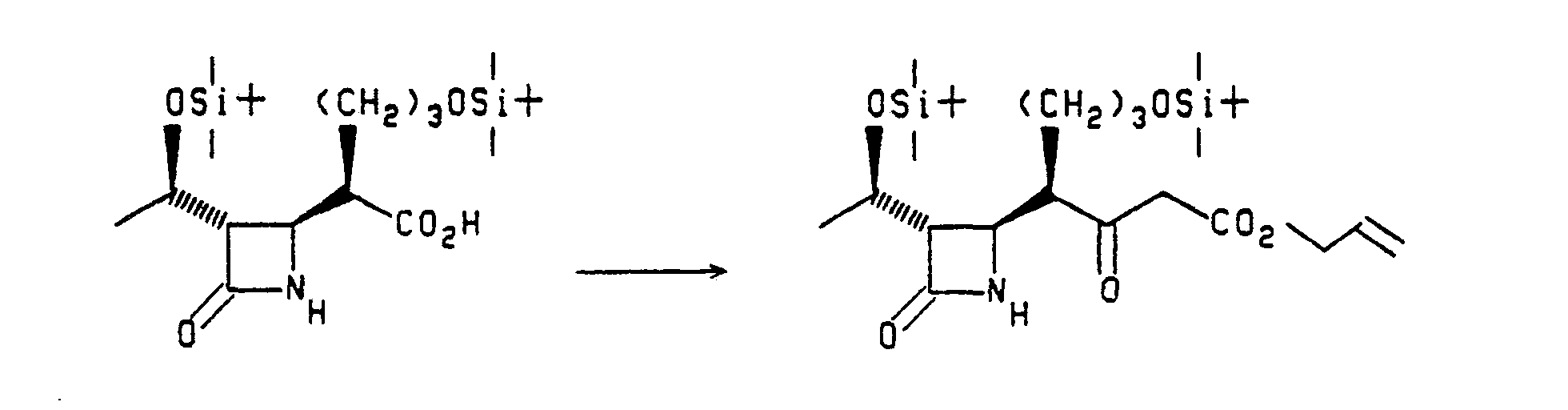
- A solution of magnesium bis-allyl malonate (5.7 g, 18.1 mmol) in benzene (80 mL) was heated under reflux, using a Dean Stark condenser. The first 20 mL of benzene were removed and the Dean Stark was replaced by a dropping funnel filled with 3A molecular sieves. The refluxing period was continued for 3 more hours and this solution was allowed to cool down.
- In a separate flask, a solution of (3S,4S)-3-[(1'R)-1'-tert-butyldimethylsilyloxyethyl]-4-[(1 "R)-1 "-carboxy-4"-tert-butyldimethylsilyloxybutyl]azetidin-2-one (5.50 g, 12.1 mmol) in toluene (100 mL) was treated with carbonyl diimidazole (2.15 g, 13.3 mmol). The mixture was stirred for 2 h and the solvent was evaporated to give an oil which was pumped under high vacuum for 2 h. The acyl imidazole was then diluted with benzene (20 mL) and added to the benzene solution of magnesium bis-allyl malonate. The mixture was heated at 67-70° C for 18 h, cooled down, diluted with cold EtOAc, washed with ice cold water (2 x 100 mL), HCI (100 mL); ice cold water (2 x 100 mL), 10% aqueous NazC03(1 x 100 mL), ice cold water (1 x 100 mL), brine 100 mL, dried ( MgS04) and treated with activated charcoal. Evaporation of solvent afforded the title compound (6.2 g, 95%) as an oil.
- IR (CH2Cl2) νmax: 3410 (NH), 1765 and 1715 cm-' (C=O);
- ' H NMR (CDCl3, 200 MHz) δ: 12.03, 12.02 (0.5 H, 2s, enolylic-H), 6.0-5.8 (1H, m, vinylic-H), 5.87 (1H, bs, NH), 5.38-5.24 (2H, m, vinylic-H), 5.07 (0.52 H, s, vinylic-H of enol form), 4.65-4.61 (2H, m, CH2-vinyl), 4.19-4.1 (1H, m, H-1'), 3.89 (0.5H, dd, J=2.0 Hz, J = 6.2 Hz, H-4), 3.82 (0.5H, dd, J = 2.0 Hz, J = 7.4 Hz, H-4), 3.64-3.4 (2.5 H, m, CH20 and H-1 "), 2.97-2.91 (1H, m, H-3), 2.3-2.1 (0.5H, m, H-1 "), 1.8-1.4 (4H, m, (CH2)2), 1.17 (1.5H. d, J=6.2 Hz, CH3), 1.11 (1.5 H, d, J=6.4 Hz, CH3), 0.88, 0.86 (18H, 2s, tert-butyl), 0.06 and 0.054 ppm (12H, 2s, CH3).
-

- A cold (ice bath) solution of (3S,4R)-3-[(1'R)-1'-tert-butyldimethylsilyloxyethyl]-4-[(1"R)-1"-(3-tert-butyl-dimethylsilyloxypropyl)-3"-allyloxycarbonyl-2"-oxopropyl]azetidin-2-one (6.20 g, 11.5 mmol) in anhydrous CH3CN (50 mL) was treated with triethylamine (1.16 mL, 11.5 mmol) followed by the dropwise addition of p-toluenesulfonyl azide (2.27 g, 11.5 mmol) in CH3CN (10 mL). The mixture was stirred for 3 h at about 22 C and the solvent was removed under vacuum. The oily residue was triturated with hexane and the solid was removed by filtration. The residue, upon evaporation of hexane, was passed through a silica gel pad (100 g, hexane, 20%, 30%, 40% ether/hexane) to give the title compound as a yellow oil (4.88 g, 75.0%).
- IR (CH2CI2) νmax: 3410 (NH), 2150 (N2), 1765, 1715 and 1650 cm-' (C=0);
- ' H NMR (CDCI3, 200 MHz) δ: 6.03-5.80 (1H, m, vinylic -H), 5.84 (1H, bs, NH), 5.4-5.28 (2H, m, vinylic-H), 4.73-4.68 (2H, m, vinylic -CH2), 4.23-4.12 (1 H, m, H-1'), 4.07-4.0 (1 H, m, H-1 "), 3.88 (1 H, dd, J = 2.0 Hz, J = 5.5 Hz, H-4), 3.59, 3.56, 3.54 (2H, 3 lines, CH20), 3.04 (1 H, t, J = 2.5 Hz, H-3), 1.9-1.7 (1H, m, H-C-H), 1.6-1.4 (3H, m, HCH and CH2), 1.16 (3H, d, J=6.3 Hz, CH3), 0.87, 0.86 (18H, 2s, tert-butyl), 0.056, 0.050 and 0.027 ppm (12H, 3s, CH3).
-

- A solution of (3S,4R)-3-[(1'R)-1'-tert-butyldimethylsilyloxyethyl]-4-[ (1 "R)-1 "-(3-tert-butyldimethylsilylox-ypropyl)-3"-diazo-3"-allyloxycarbonyl-2"-oxopropyl]azetidin-2-one (3.8 g, 6.7 mmol) in benzene (300 mL) was purged with Argon for 10 min. Then Rh(OAc)2(100 mg) was added in and the mixture was heated under reflux for 70 min. The solvent was removed under vacuum to give the title compound (3.9 g, >100%) as an oil.
- IR (CH2CI2) νmax: 1765 and 1745 cm-1 (C=0);
- 1H NMR (CDCl3, 200 MHz) s: 5.99-5.79 (1 H, m, vinylic H), 5.39-5.20 (2H, m, vinylic H), 4.66-4.60 (2H, m, CH2-vinyl), 4.63 (1 H, s, H-2), 4.36, 4.33, 4.30, 4.27 (1 H, 4 lines out of 5, H-1'), 4.24 (1 H, dd, J = 2.4 Hz, J=8.1 Hz, H-5), 2.7-2.5 (2H, m, CH20), 3.31 (1H, dd, J=2.3 Hz, J=5.8 Hz, H-6), 2.8-2.6 (1H, m, H-4), 1.8-1.5 (4H, m, (CH2)2), 1.29 (3H, d, J=6.2 Hz, CH3), 0.881, 0.878 (18H, 2s, tert-butyl), 0.093, 0.085 and 0.033 ppm (12H, 3s, CH3).
-
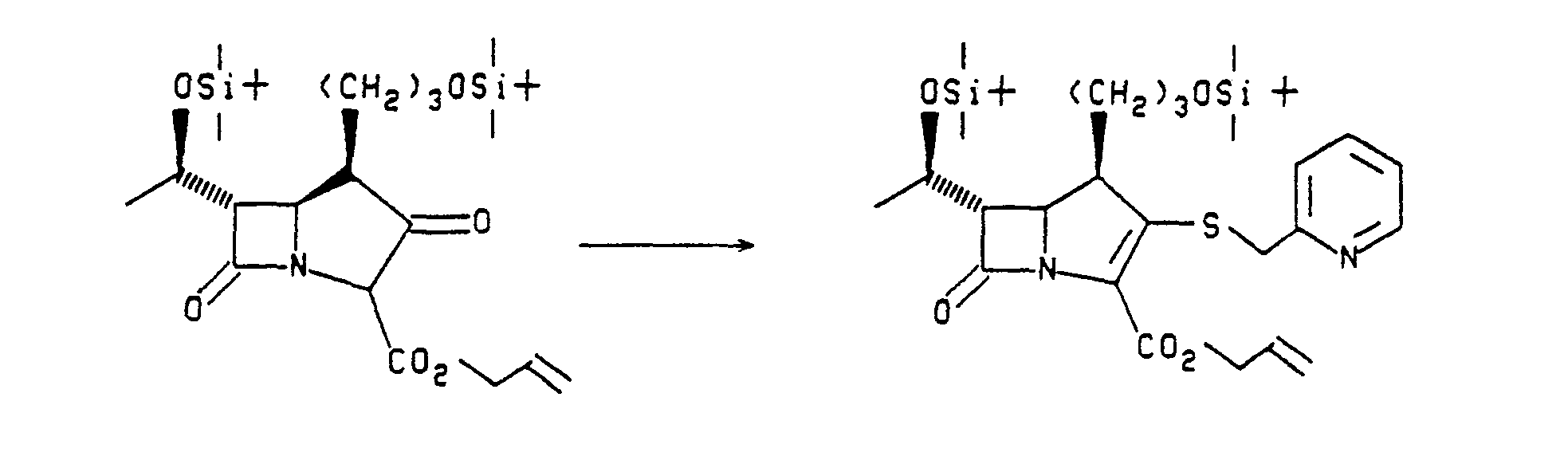
- A cold (ice-MeOH bath) solution of allyl (2R,4R,5R,6S)-6-[(1'R)-1'-tert-butyldimethylsilyloxyethyl]-4-(3"-tert-butyldimethylsilyloxypropyl)-3,7-dioxo-1-azabicyclo[3.2.0]heptane-2-carboxylate (from 3.8 g, 6.7 mmol of the corresponding diazo) in CH3CN (40 mL) was treated dropwise with diphenyl chlorophosphate (1.52 mL, 7.37 mmol) and N,N-diisopropylethylamine (1.03 mL, 7.37 mmol). The mixture was stirred for 1 h at -15°C to -10 C. The resulting enol phosphate was then treated in the cold (-15° C) with 2-picolylmercaptan (1.68 g, 13.4 mmol) in CH3CN (10 mL) followed by the dropwise addition of N,N-diisopropylethylamine (2.36 mL, 13.4 mmol). The mixture was stirred for 1 h at -10° C to 0°C and then for 1.5 h at 5° C (ice bath). The reaction mixture was diluted with cold EtOAc (300 mL), washed with cold water (2 x 100 mL), ice cold 1 M aqueous NaHSO3 (3 x 100 mL), ice cold water (2 x 100 mL), 1 M aqueous NaHC03(2 x 100 mL) ice cold water (2 x 100 mL), brine (100 mL) and dried ( MgS04). The residue was passed through a silica gel flash column (60 g, hexane, 5%, 10%, 15%, 20% EtOAc /hexane) to give the title compound (3.2 g, 74%) as an oil.
- IR (CH2 C12) vmax: 1770 and 1715 cm-' (C=0);
- ' H NMR (CDCl3, 200 MHz) δ: 8.50-8.48 (1 H, m, pyridine-H), 7.7-7.6 (1 H, pyridine-H), 7.41-7.36 (1 H, bd, J =7.9, pyridine-H), 7.21-7.15 (1H, m, pyridine-H, 6.05-5.8 (1H, m, vinylic H), 5.47-5.19 (2H, m, vinylic-H), 4.9-4.6 (2H, m, CH2-vinyl), 4.28, 4.21., 4.09, 4.02 (2H, ABq, J=13.8 Hz, CH2-picolyl), 4.21-4.08 (1H, m, H-1'), 4.01 (1H, dd, J=2.4 Hz, J=9.3 Hz, H-5), 3.7-3.5 (2H, m, CH2-0), 3.5-3.4 (1H, m, H-4), 3.27 (1H, dd, J=2.5 Hz, J=7.3 Hz, H-6), 1.9-1.4 [4H, m, (CH2)2], 1.28 (3H, d, J=6.3 Hz, CH3), 0.877, 0.871 (18H, 2s, tert-butyl), 0.066, 0.057, 0.036 and 0.029 ppm (12H, 4s, CH3).
-

- A cold (ice-MeOH bath) solution of allyl (4R 5S 6S)-6-[(1'R)1'-tert-butyldimethylsilyloxyethyl]-4-(3"-tert-butyldimethylsilyloxypropyl)-3-[(pyridin-2-yl)methylthio]-7-oxo-1-azabicyclo[3.2.0]hept-2-ene-2-carboxylate (3.20 g, 4.95 mmol) in dry THF (60 mL) was treated with CH3CO2H (1.72 mL, 30 mmol) followed by the dropwise addition of a 1 M solution of tetrabutylammonium fluoride in THF (15 mL, 15 mmol). The mixture was kept in a cold room (5 C) for 30 h, then neutralized (ice bath) with 1M NaHCO3 (30 mL, 30 mmol). The mixture was diluted with EtOAc (200 mL) and the aqueous phase was extracted twice with EtOAc (2 x 200 mL). The organic extracts were washed with ice cold 1 M aqueous NaHC03(4 x 100 mL), ice cold water (2 x 100 mL), brine (100 mL) and dried ( MgSO4). The residue was passed through a silica gel flash column (75 g, CH2Cl2, 5%, 10%, 20%, 30%, 40%, 60% EtOAc/CH2Cl2) to give allyl (4R,5S,6S)-6-[(1'R)-1'-tert-butyldimethylsilyl-oxyethyl]-4-(3"-hydroxypropyl)-3-[(pyridin-2-yl)methylthio]-7-oxo-1-azabicyclo[3.2.0]hept-2- ene-2-carboxylate (1.5 g, 57%) as a white solid.
- IR (CH2CI2) νmax: 3600-3300 (OH), 1770 and 1720 cm-' (C=0);
- ' H NMR (CDCl3, 200 MHz) δ: 8.48-8.45 (1H, m, pyridine-H), 7.77-7.67 (1H, m-, pyridine-H), 7.50-7.46 (1H, d, J=7.9 Hz, pyridine-H), 7.26-7.19 (1H. m, pyridine -H), 6.05-5.85 (1H, m, vinylic -H), 5.47-5.20 (2H, m, vinylic-H), 4.84-4.61 (2H, m, vinylic -CH2), 4.46, 4.39, 4.05, 3.98 (2H, ABq, J=14.4 Hz, CH2- pyridine), 4.20, 4.16, 4.13 (1 H, 3 lines out of 5, H-1'), 3.96 (1H, dd, J=2.5 Hz, J=9.5 Hz, H-5), 3.8-3.6 (2H, m, CH20), 3.5-3.3 (1H, m, H-4), 3.22 (1H, dd, J =2.5 Hz, J =7.3 Hz, H-6), 1.9-1.6 (4H, m, (CH2)2), 1.64 (1H, bs, OH), 1.27 (3H, d, J=6.1 Hz, CH3), 0.857 (9H, s, tert-butyl), 0.059 and 0.039 (6H, 2s, CH3).
- Elution of the above column with acetone gave the title compound (411 mg, 20%).
- IR (CH2Cl2) vrt,ax· 3700-3200 (OH), 1770 and 1710 cm-' (C=0);
- ' H NMR (CDCI3, 200 MHz) s: 8.49-8.46 (1H, m, pyridine-H), 7.75-7.66 (1H, m, pyridine-H), 7.48-7.45 (1H, bd, J=8.9 Hz, pyridine-H), 7.23-7.19 (1 H, m, pyridine-H), 6.06-5.86 (1H, m, vinylic-H), 5.48-5.21 (1H, m vinylic-H), 4.88-4.60 (2H, m, CH2-vinylic), 4.41, 4.33, 4.06, 3.98 (2H, ABq, J=14.5 Hz, CH2-pyridine), 4.22-4.13 (1H, m, H-1'), 4.11, 4.09 ( part of dd, J=2.6 Hz, part of H-5), 3.8-3.6 (2H, m, CH2O) 3.6-3.45 (1H, m, H-4), 3.30 (1 H, dd, J =2.6 Hz, J =7.6 Hz, H-6), 1.9-1.5 (5H, m, (CH2)2 and OH), and 1.35 ppm (3H, d, J =6.3 Hz, CH3).
-

- To a cold (ice bath) solution of allyl (4R,5S,6S)-6-[(1'R)-1'-hydroxyethyl]-4-(3"-hydroxypropyl)-3[(pyridin-2-yl)-methylthio]-7-oxo-1-azabicyclo[3.2.0]hept-2-ene-2-carboxylate (166 mg, 0.400 mmol) in CH2Cl2(10 mL) was added Pd(PPh3)4 followed by the dropwise addition of potassium 2-ethylhexanoate (0.5M in EtOAc , 1 mL, 0.5 mmol). The mixture was stirred for 15 min, diluted with diethyl ether (25 mL) and extracted with an ice cold 0.04M aqueous pH 7.0 buffer (3 x 5 mL). The aqueous extracts were washed with diethyl ether (2 x 25 mL) and passed through a C,8 µBondapak reversed phase column (40 g, H20, 1%, 2%, 3%, 5% CH3CN/H20 ) to give the title compound (120 mg, 75%) as a lyophilized powder.
- Purity 99.6% as determined by HPLC;
- UV (H20) λmax: 306 (11900), 266 (8000);
- IR (Nujol) νmax: 1745 and 1590 cm-1 (C=0);
- ' H NMR (D20, 200 MHz) δ: 8.47, 8.45 (1 H, bd, J = 4.8 Hz, pyridine-H), 7.85 (1 H, bt, J = 7.8 Hz, pyridine-H), .7.52 (1H, bd, J=7.8 Hz, pyridine-H), 7.39-7.33 (1H, m, pyridine-H), 4.22, 4.17, 4.11, 4.06 (2H, ABq, J =10.5 Hz, CH2-pyridine), 4.3-4.0 (2H, m, hidden H-1' and H-5), 3.57, 3.54, 3.51 (2H, m, hidden H-1' and H-5), 3.57, 3.54, 3.51 (2H, m, CH20), 3.35 (1H, dd, J=2.3 Hz, J=6.0 Hz, H-6), 3.21, 3.17, 3.12 (1 H, m, H-4), 2.8-2.2 (4H, m, (CH2)2) and 1.28 ppm (3H, d, J=6.3 Hz, CH3).
-

- A suspension of potassium (4R,5S,6S)-4-(2"-azidoethyl)-6-[(1'R)-1'-hydroxyethyl]-3-[(pyridin-2-yl)-methylthio]-7-oxo-1-azabicyclo[3.2.0]hept-2-ene-2-carboxylate (prepared as in Example 6) (0.300 g, 0.70 mmol) in dry acetonitrile (3 mL) was cooled to -20 C and treated with 98% formic acid (0.030 mL, 0.79 mmol). After 15 min, the clear solution was treated with methyl trifluoromethanesulfonate (0.12 mL, 1.06 mmol) and stirred for 1.5 h. The reaction mixture was then quenched by addition of 20 mL of 0.1 M pH 7.4 phosphate buffer and the acetonitrile was evaporated under vacuum. The aqueous phase was diluted with 40 mL of 0.1 M pH 6.0 phosphate buffer and hydrogenated at 0° Cover 30% palladium on Celite (0.40 g) under 45 psi of hydrogen for 1.5 h. The catalyst was filtered on a celite pad and the filtrate was chromatographed on reversed phase silica gel (µ-Bondapak C18, 3 x 15 cm). Elution with a gradient of acetonitrile (0-5%) in water gave 0.062 g (19%) of the title compound as a white amorphous solid after freeze drying. The purity of the product by H NMR was estimated to 80%.
- Purity by HPLC: 97% (µ-Bondapak C18, 3.9 mm x 30 cm), elution 10% CH3CN-H2O pH 7.4 phosphate buffer, flow rate 1.5 mL/min, uv detector 300 nm, retention time 10.0 min.
- UV (H20, pH 7.4 phosphate buffer) λmax: 270 nm (6,630) and 300 nm (sh, 3480);
- IR (KBr) νmax: 1765 (C=O of ß-lactam), 1635, 1610 and 1585 cm-';
- 'H NMR (200 MHz, D20) s: 1.32 (d, J=6.39 Hz, CH3CHO), 1.7-2.3 (m, 2N, CH2-4), 3.1-3.3 (m, 2H, CH2 NH2),3.37 (dT, JH4, CH2 =10.1 Hz, JH4,H5 = 3.86Hz, 1H, H-4), 3.53 (dd, JH6, H5 =3.20 Hz,JH6,H1 =6.42 Hz, 1H, H-6), 4.2-4.4 (m, H-5 and H-1' overlapping), 4.40 (s, 3H, CH3 of pyridinium), 7.79 (-d, J=7.8 Hz, 1 H, H-3 of pyridinium), 7.92 (m, 1 H, H-5), 8.44 (m, 1 H, H-4 of pyridinium) and 8.78 ppm (d, J = 5.5 Hz, 1 H, H-6 of pyridinium).
-

- A solution of (4R,5S,6S)-4-(2"-aminoethyl)-6-[(1'R)-1'-hydroxyethyl]3-[pyridin-2-yl)methylthio]-7-oxo-1-azabicyclo[3.2.0]hept-2-ene-2-carboxylic acid (Example 2) (0.187 g, 0.51 mmol) in cold water(3 mL) was diluted with CH3CN (2 mL) and then treated at 0-5 C with 37% aqueous formaldehyde (0.21 mL). The pH of the solution (pH-meter) was 7.2. Then sodium cyanoborohydride (0.058 g, 0.93 mmol) was added all at once (pH 8.5-9.0) followed after 2 min by glacial acetic acid (3 drops, pH 5.2-5.5). The resulting homogeneous mixture was stirred at 0-5 C for 30 min. Then 20 mL of 0.1 M pH 6.0 phosphate buffer were added and the acetonitrile was removed under vacuum (<15°C). The residual aqueous phase was chromatographed on reversed phase silica gel (µ-Bondapak C18, 2.5 x 10 cm) using a gradient of acetonitrile (0-10%) in water as eluent. The UV active fractions were collected, freeze dried and chromatographed a second time using the same system. The title compound was obtained as a white amorphous powder: 0.117 g (58%);-4.0° (c 1.0, H20).

- Purity by HPLC: 88% on µ-Bondapak C18, 3.9 mm x 30 cm, flow rate 2 mL/min, 5% CH3CN-H2O pH 7.4 phosphate buffer, uv detector 300 nm, retention time 9.02 min.
- UV (H20, pH 7.4 phosphate buffer) 'max: 266 (7,039) and 302 nm (7,707);
- IR (KBr) νmax: 1762 (C=0 of β-lactam) and 1595 cm-1(C=O of carboxylic acid);
- 'H NMR (200 MHz, D2O) δ: 1.30 (d, J=6.35 Hz, 3H, CH3CH O), 1.6-2.2 (m, 2H, CH2-4), 2.86 (s, 6H, N-(CH3)2), 3.15 (m, 3H, H-4and CH2N ), 3.32 (dd, JH6,H5=2.91 Hz, JH6,H1,=6.75 Hz, 1H, H-6), 4.10 (ABq, JAB=14.06 Hz, Δν=25.4 Hz, SCH2), 4.1-4.3 (m, 2H, H-5 and CH3CHOoverlapping), 7.38 (m, 1H, H-3 of pyridine), 7.47 (d, J =7.87 Hz, 1 H, H-5 of pyridine), 7.86 (m, 1 H, H-4 of pyridine) and 8.47 ppm (d, J=5.0 Hz, 1 H, H-2 of pyridine).
-

-

- Saponification of c-caprolactone (20.6 g, 0.18 mol) as described by P.A. Aristoff et al. in J. Org. Chem., 48, 5341 (1983) gave 30.0 g of the sodium salt as a white solid: ' H NMR (200 MHz, D20) δ: 1.2-1.7 (m, 6H), 2.19 (t, J=7.32 Hz, 2H, CH2CO2Na ) and 3.61 ppm (t, J=6.51 Hz, 2H, CH2OH).
- The crude salt was suspended in N,N-dimethylformamide (250 mL) cooled to 0-5' C and treated with tert-butyldimethylsilyl chloride (81.6 g, 0.54 mol) followed by triethylamine (32.6 mL, 0.23 mol) added dropwise. After 26 h at 22° C, the solid formed was filtered and washed with petroleum ether (bp 20-60° C). After dilution with more petroleum ether (500 mL) the filtrate was washed with saturated NaHCO3, brine and dried ( MgS04). After evaporation of the solvent, the residue was distilled under vacuum to give 60.8 g (93%) of the title ester as a clear oil: bp = 106-107 C/0.015 torr.
- IR (NaCI, film) νmax: 1722 cm-1 (C = 0 of ester);
- 'H NMR (200 MHz, CDCI3) 8: 0.04 and 0.26 (2s, 2 x 6H, SiCH3), 0.88 and 0.92 (2s, 2 x 9H, tert-butyl), 1.2-1.7 ppm (m, 6H, CH2-3.4 and 5).
-

- A solution of the silyl ester prepared in Step A (82.0 g, 0.227 mol) in a mixture of tetrahydrofuran (800 mL) and water (800 mL) was treated at 22° C with oxalic acid (8.2 g, 0.09 mol) and stirred for 2 h. The reaction mixture was then diluted with EtOAc (1 L), washed with water and brine and dried ( MgSO4). Evaporation of the solvent gave 72 g of an oil which is a mixture of the title acid and disiloxane. This product was used without purification in the next step:
- IR (NaCl, film) νmax: 1715 cm-1 (C=O of carboxylic acid);
- 'H NMR (200 MHz, CDCl3) s: 0.41 (s, SiCH3), 0.88 (s, Si-tert-butyl), 1.3-1.8 (m, CH2-3 , 4 and 5), 2.3-2.4 (m, CH2CO2H) and 3.6-3.7 ppm (m, CH2OSi).
-

- A solution of the crude 6-(tert-butyldimethylsilyloxy) hexanoic acid from Step B (- 0.227 mol) in dry CH2C12(500 mL) was treated at 0-5 °C with 2-picolyl mercaptan (28.4 g, 0.227 mol), 1-hydroxybenzotriazole hydrate (34.8 g, 0.227 mol) and 1,3-dicyclohexylcarbodiimide (46.9 g, 0.227 mol). After 16 h at 22°C, the solid formed was filtered and washed with EtOAc. The filtrates were washed with water, brine and then dried ( MgSO4). Evaporation of the solvent gave an oil which was chromatographed on silica gel (9x10 cm). Elution with a mixture of toluene and EtOAc (95:5) gave 40.0 g (50%) of the title thioester as a clear oil:
- IR (NaCl, film) Pmax: 1695 cm-' (C=O of thioester);
- 1H NMR (200 MHz, CDCl3) s: 0.28 (s, 6H, SiCH3), 0.88 (s, 9H, t-Bu), 1.3-1.8 (m, 6H, CH2-3,4 and 5), 2.58 (t, J =7.5 Hz, 2H, CH2-2), 3.57 (t, J =6.2 Hz, 2H, CH2-6), 4.24 (s, 2H, CH2 of picolyl), 7.15 (m, 1 H, H-5 of pyridine), 7.33 (d, J=7.8 Hz, 1 H, H-3 of pyridine), 7.62 (m, 1 H, H-4 of pyridine) and 8.52 ppm (d, J=8.5 Hz, 1 H, H-6 of pyridine).
-

- A solution of 6-(tert-butyldimethylsilyloxy)-1-(pyridin-2-yl)methylthiohexanoate (40.0 g, 0.113 mol) in dry CH2C12(400 mL) was treated at 0-5° C with triethylamine (32 mL, 0.23 mol) followed by tert-butyldimethylsilyl trifluoromethanesulfonate (40 mL, 0.174 mol) added dropwise. The reaction mixture was then stirred at 22° C for 3 h. After dilution with petroleum ether (bp 30-60 C, 1L), the organic phase was washed with water, dried ( MgSO4) and evaporated under reduced pressure. The residual hard oil (53.0 g) was immediately used as such for the coupling in the next step.
- 'H NMR (200 MHz, CDCl3) indicated a 1:1 mixture of E and Z isomers; 6: 3.95 and 4.03 (2 x s, SCH2), 4.85 (t, J = 7.25 Hz, C = CH) and 5.0 ppm (t, J = 7.54 Hz, C = CH).
-

- To a suspension of freshly fused zinc chloride (15.4 g, 0.113 mol) in dry CH2Cl2(200 mL) at 0-5° C was added (3S.4R)-4-acetoxy-3-[(1'R)-1'-tert-butyldimethylsilyloxyethyl]azetidin-2-one (16.25 g 0.056 mol). Then a solution of the crude silyl enol ether (0.113 mol) prepared in Step D in dry CH2C12(200 mL) was added dropwise (-15 min) and the resulting mixture was stirred at 0-5° C for 18 h. The reaction mixture was then diluted with EtOAc, washed with saturated aqueous ammonium chloride, saturated NaHCO3, brine and dried ( MgSO4). Evaporation of the solvent gave a dark residue which was chromatographed on silica gel (15 x 11 cm). Elution with a mixture of toluene and EtOAc (1:1 ) gave 23 g (70%) of the title compound as a gum which was used as such in the next step. 1H NMR indicates a 9:1 β to a ratio of isomers. Crystallization of an aliquot from hexanes gave the cure β isomer of the title compound as white plates; mp= 82-83° C;-9.0° (c 1.0, CHCl3).

- UV (EtOH) λmax: 238 (5.080) and 264 nm (4,600);
- IR (KBr) νmax: 1770 (C=O) of β-lactam and 1682 cm-1 (C = 0 of thioester);
- ' H NMR (200 MHz, CDCI3) 6: 0.02 and 0.04 (2 x s, 2 x 6H, SiCH3), 0.84 and 0.87 (2 x S, 2 x 9H, Si tert-butyl), 0.97 (d, J=6.31 Hz, 3H, CH3CHO ), 1.2-2.0 (m, 6H, CH2-2,3,4 of pentyl), 2.8 (m, 1H, H-1 of pentyl), 3.03 (m, 1 H, H-6), 3.56 (t, J=5.9 Hz, 2H, CH2-5 of pentyl), 3.80 (dd, JH4,H3 = 2.05 Hz, JH4,H = 7.08 Hz, 1 H, H-4), 4.14 (m, 1H, CH3 CHO), 4.26 (ABq, JAB= 14.0 Hz, Δν=7.3 Hz, 2H, SCH2), 5.88 (broad s, 1H, NH ), 7.18 (m, 1 H, H-5 of pyridine), 7.33 (d, J =7.8 Hz, 1 H, H-3 of pyridine), 7.64 (m, 1 H, H-4 of pyridine), and 8.52 ppm (d, J = 4.8 Hz, 1 H H-6 of pyridine).
- Anal. Calcd for C29H51N2O4SSi2: C, 60.06; H, 8.86; N, 4.83; S, 5.53; Found: C, 60.30; H, 8.82; N, 4.72; S, 5.67.
-

- A solution of (3S,4R)-3-[(1'R)-1'-tert-butyldimethylsilyloxyethyl]-4-[(1"R)-1 "-(pyridin-2-yl)-methylthiocarbonyl-5"-tert-butyldimethyl-silyloxypentyl]azetidin-2-one (23.0 g, 39.7 mmol, mixture of β and a isomer in a ~9:1 ratio) in tetrahydrofuran (200 mL) was treated at 0-5° C with 30% hydrogen peroxide (7.0 mL, 81.2 mmol) followed by 80 mL (80.0 mmol) of 1M sodium hydroxide added dropwise. After 2 h at 22°C, the reaction mixture was diluted with EtOAc (500 mL) and acidified with 1 N HCI (100 mL). The organic phase was washed with 1 N sodium bisulfite (100 mL), brine and dried (MgSO4). Evaporation of the solvent gave a solid which was recrystallized from AcOEt-hexanes to give 12.4 g (66%) of the title compound as a white solid: mp = 136-138° C;-3.6 (c 1.0, CHC13).

- IR (KBr) νmax: 1760 (sh), 1715 (C=O of acid) and 1690 cm-';
- 'H NMR (200 MHz, CDCI3) δ: 0.04, 0.05 and 0.06 (3 x s, 6H, 3H and 3H, SiCH3), 0.86 and 0.88 (2 x s, 2 x 9H, sir-Bu), 1.16 (d, J=6.28 Hz, 3H, CH3CHO ), 1.2-1.8 (m, 6H, CH2-2,3 and 4 of pentyl), 2.6 (m, 1H, H-1 of pentyl), 3.13 (m, 1 H, H-3), 3.60 (t, J = 5.82 Hz, 2H, CH2-5 of pentyl), 3.86 (dd, JH4,H3 1.92 Hz, JH4,H = 6.46 Hz, 1 H, H-4), 4.20 (dg, JH1',CH3 = 6.28 Hz, JH1,H3 = 3.86 Hz, 1 H, CH3 CHO), and 6.32 ppm (broad s, 1 H, NH).
- Anal. Calcd. for C23H47NO5Si2: C, 58.31; H, 10.00; N, 2.96; Found: C, 58.18; H, 10.18; N, 2.91.
-

- A suspension of (3S,4S)-3-[(1'R)-1'-tert-butyldimethylsilyloxyethyl]-4-[(1"R)-1 "-carboxy-5"-tert-butyldimethylsilyloxypentyl]azetidin-2-one (4.70 g, 9.92 mmol) in dry toluene (125 mL) was treated at 22 C with 1,1-carbonyldiimidazole (1.80 g, 11.1 mmol). After 5 h, the solvent was evaporated under reduced pressure and the residue was dissolved in dry benzene (15 mL). This solution was added to a solution of magnesium monoallyl malonate (4.7 g, 15.3 mmol) in dry benzene (100 mL) and the resulting mixture was stirred at 80° C for 18 h. The reaction mixture was then diluted with EtOAc, washed with cold 1N HCI, saturated NaHC03, brine and dried ( MgSO4). Evaporation of the solvent gave a residue which was chromatographed on silica gel (6.5 x 11 cm). Elution with a mixture of toluene and EtOAc (8:2) gave 3.48 g (63%) of the title compound as a white solid. 'H NMR of this product indicated a 1:1 mixture of keto and enol form of the acetoacetate. Recrystallization of the solid in petroleum ether (30-60°C) at -20°C gave some pure enol form of the product as white needles: mp = 72-73 C;0° (c 1.0, CHCI3).

- UV (EtOH) λmax : 248 nm (11,090);
- IR (KBr) vmax: 1761 (C=0 of β-lactam), 1718, 1650 and 1625 cm-1
- 'H NMR (200 MHz, CDCI3) δ: 0.03 and 0.05 (2 x s, 2 x 6H, SiCH3), 0.86 and 0.88 (2 x s, 2 x 9H, Sit-Bu), 1.10 (d, J =6.29 Hz, 3H, CH3CHO) , 1.2-1.8 (m, 6H, CH2-1,2 and 3 of butyl), 2.19 (m, 1 H, H-1 of oxopropyl), 2.90 (m, 1 H, H-3), 3.59 (t, J = 5.96 Hz, CH2-4 of butyl), 3.81 (dd, JH4,H3 = 2.03 Hz, JH4,H1 = 7.41 Hz, 1 H, H-4), 4.18 -(dq, JH,CH3 = 6.29 Hz, JH,H3 = 3.67 Hz, CH3CHO ), 4.63 (m, 2H, CH2 of allyl), 5.06 (s, 1 H, H-3 of oxopropyl enol form), 5.2-5.4 (m, 2H, CH of allyl) and 5.8-6.1 ppm (m, 2H, CH of allyl and NH).
- Anal. Calcd for C28H53NO6Si2: C, 60.50; H, 9.61; N, 2.52; Found: C, 60.62; H, 9.64; N, 2.45.
-

- A solution of (3S,4R)-3-[(1'R)-1'-tert-butyldimethylsilyl-oxyethyl]-4-[(1"R)-1"-(4-tert-butyldimethylsilylox-ybutyl)-3"-allyloxycarbonyl-2"-oxopropyl]azetidin-2-one (3.4 g, 6.12 mmol) in acetonitrile (50 mL) was treated at 22° C with p-toluenesulfonyl azide (6.9 mmol, 2.3 mL of a 3M solution in CH3CN ) and triethylamine (0.85 mL, 6.1 mmol). After 1.5 h, the reaction mixture was diluted with EtOAc (200 mL) washed with water, saturated aqueous NaHC03, brine and dried ( MgSO4). Evaporation of the solvent gave a residue which was triturated with a mixture of toluene and EtOAc (9:1 ~30 mL). The crystalline p-toluenesulfonamide was filtered and the filtrate was chromatographed on silica gel (5 x 11 cm). Elution with a mixture of toluene and EtOAc (9:1 ) gave 3.56 g (100%) of the title compound as a clear oil:
- IR (NaCI, film) νmax: 2140 (N2), 1760 (C=0 of β-lactam), 1720 (C=0 of ester) and 1650 cm-1;
- 'H NMR (200 MHz, CDCl3) δ: 0.03 and 0.05 (2 x s, 2 x 6H, SiCH3), 0.9 (s, 18H, Si t-Bu), 1.16 (d, J = 6.29 Hz, 3H, CH3CHO ), 1.2-1.9 (m, 6H, CH2-1, 2 and 3 of butyl), 3.04 (m, 1 H, H-3), 3.57 (t, J =6.2 Hz, 1H, CH2-4 of butyl), 3.85 (dd, JH4.H3=2.11 Hz, JH4,H=5.48 Hz, 1H, H-4), 4.05 (m, 1H, H-1 of oxopropyl), 4.17 (dq, JH,CH3=6.29 Hz, JH2,H3 = 3.68 Hz, 1 H, CH3CHO ), 4.7 (m, 2H CH2 of allyl), 5.3-5.5 (m, 2H, CH of allyl), and 5.8-6.1 ppm (m, 2H, NH and CH of allyl).
-

- A solution of (3S,4R)-3-[(1'R)-1'-tert-butyldimethylsilyloxyethyl]-4-[(1"R)-1"-(4-tert-butyldimethylsilylox-ybutyl)-3"-diazo-3"-allyloxycarbonyl-2"-oxopropyl]azetidin-2-one (3.50 g, 6.0 mmol) in dry benzene (350 mL) was treated under nitrogen with Rhodium (II) octanoate (0.14 g) and heated under reflux for 45 min. Evaporation of the solvent gave the crude bicyclic ketone as an oil which was used in the next step.
- IR (NaCl, film) νmax· 1770 (C = 0 of β-lactam) and 1745 cm-' (C = O of keto ester);
- 'H NMR (200 MHz, CDCl3) 5: 0.03, 0.08 and 0.09 (3 x s, 6H, 3H and 3H, SiCH3), 0.86 (s, 18H, SitBu), 1.1-1.8 (m, 6H, CH2-1, 2 and 3 of butyl), 1.28 (d, J =6.16 Hz, 3H, CH3CHO ), 2.64 (m, 1 H, H-4), 3.22 dd, JH6.H5=2.36 Hz, JH6,H1' = 5.54 Hz, 1 H, H-6), 3.6 (m, 2H, CH20Si ), 4.24 (dd, JH5.H6 =2.36 Hz, JH5.H4 = 8.03 Hz, 1 H, H-5), 4.30 (m, 1 H, CH2CHO ), 4.61 (s, 1 H, H-2), 4.64 (m, 2H, CH2 of allyl), 5.2-5.4 and 5.8-6.0 ppm (2 x m, 2H and 1 H, CH of allyl).
-
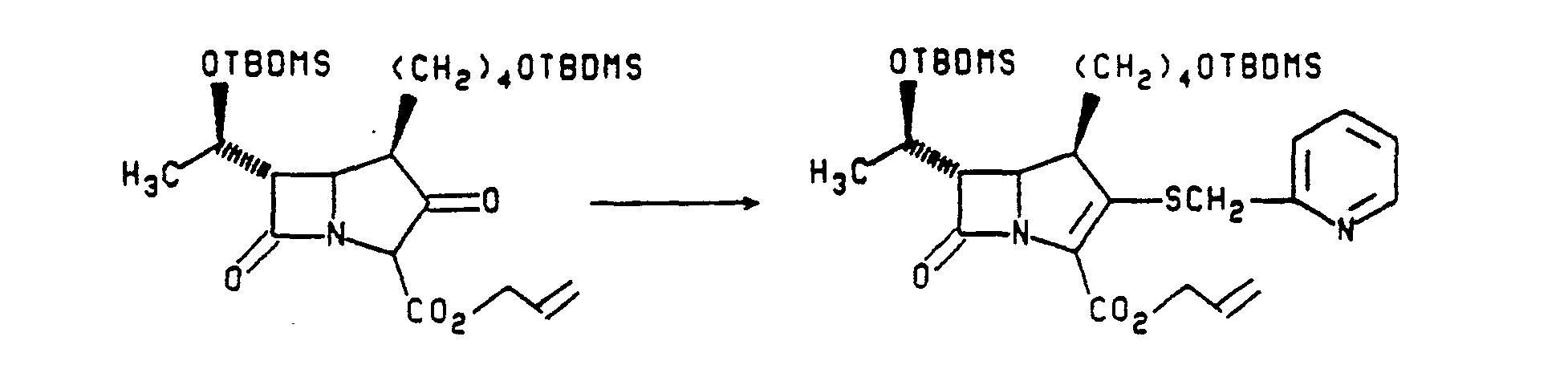
- A solution of allyl (4R,5R,6S)-6-[(1'R)-1'-tert-butyldimethylsilyloxyethyl)-4-(4"-tert-butyldimethylsilylox-ybutyl)-3,7-dioxo-1-azabicyclo[3.2.0]heptane-2-carboxylate (6.0 mmol) in dry CH3CN (35 mL) at 0-5 C was treated, under nitrogen, with diphenyl chlorophosphate (1.4 mL, 6.8 mmol) and N,N-diisopropylethylamine (1.2 mL, 6.9 mmol) added simultaneously over 5 min. 4-N,N-dimethylaminopyridine (- 3 mg) was then added and the resulting mixture was stirred at the same temperature for 1 h. After the addition of 2-picolyl mercaptan (1.5 g, 12.0 mmol) and N,N-diisopropylethylamine, the mixture was stirred at 0-5° C for 16 h. The reaction mixture was then diluted with EtOAc, washed with saturated NaHCO 3, brine and dried ( MgS04). Evaporation of the solvent gave an oil which was chromatographed on silica gel (5 x 10 cm). Elution with a mixture of toluene and EtOAc (9:1 ) gave 2.95 g (74%) of title compound as an oil.
- IR (NaCl, film) νmax: 1775 (C=O of β-lactam) and 1710 cm-1 (C=O of ester);
- 'H NMR (200 MHz, CDCIs) δ: 0.04, 0.05 and 0.06 (3 x s, 6H, 3H and 3H, SiCH3), 0.87 and 0.88 (2 x s, 2 x 9H, Si t-Bu), 1.2-2.0 (m, 6H, CH2-1,2 and 3 of butyl), 1.26 (d, J=6.13 Hz, 3H, CH3CHO ), 3.12 (dd, JH6,H5 = 2.48 Hz, JH6,H1 = 6.68 Hz, 1 H, H-6), 3.40 (m, 1 H, H-4), 3.59 (m, 2H, CH2-4 of butyl), 4.03 (dd, JH5.H6 = 2.48 Hz, JH5.H4 = 9.17 Hz,- 1 H, H-5), 4.13 (ABq, JAB= 14.3 Hz, Δν = 30.4 Hz, 2H, SCH2), 4.20 (m, 1 H, CH3CHO), 4.72 (m, 2H, CH2 of allyl); 5.2-5.5 and 5.8-6.1 (2 x m, 2H and 1 H, CH of allyl), 7.20 (m, 1 H, H-5 of pyridyl), 7.4 (d, J = 7.9 Hz, 1 H, H-3 of pyridine), 7.67 (m, 1 H, H-4 of pyridine) and 8.5 ppm (m, 1 H, H-6 of pyridine).
-
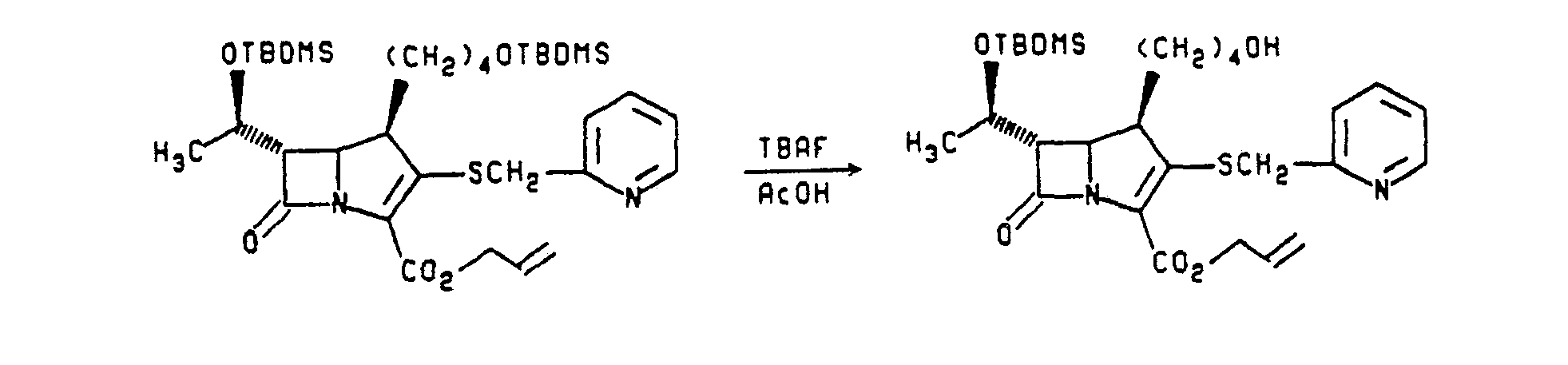
- A solution of allyl (4R,5S,6S)-6-(1'R)-1'-tert-butyldimethylsilyloxyethyl]-4-(4"-tert-butyldimethylsilylox-ybutyl)-3-[ (pyridin-2-yl)methylthio]-7-oxo-1-azabicyclo-[3.2.0]hept-2-ene-2-carboxylate (2.95 g, 4.46 mmol) in dry tetrahydrofuran (70 mL) was treated at -10° C and under nitrogen with glacial acetic acid (1.6 mL, 28.0 mmol) followed by 13.4 mL of 1.0M tetrabutylammonium fluoride in tetrahydrofuran. The resulting mixture was then stirred at 0°C for 17 h. The reaction mixture was then diluted with EtOAc, washed with cold saturated NaHC03, brine and dried ( MgS04) Evaporation of the solvent gave an oil which was chromatographed on silica gel (6 x 8 cm). Elution with a gradient of EtOAc (50 → 100%) in toluene gave 1.64 g (67%) of the title compound as a clear oil.
- IR (NaCl, film) νmax· 1775 (C=O of β-lactam) and 1710 cm-' (C=0 of ester);
- 'H NMR (200 MHz, CDCl3) δ: 0.06 and 0.07 (2s, 2 x 3H, SiCH3), 0.87 (s, 9H, Si t-Bu), 1.28 (d, J=6.08 Hz, 3H, CH3 CHO ),1.3-2.0 (m, 6H, CH2-1,2 and 3 of butyl), 3.14 (dd, JH6,H5 = 2.54 Hz, JH6,H1'= 7.19 Hz, 1 H, H-6), 3.37 (m, 1H, H-4), 3.65 (m, 2H, CH2-4 of butyl), 4.02 (dd, JH5,H6= 2.54 Hz, JH5,H4= 9.37 Hz, 1H, H-5), 4.14 (ABq, JAB= 13.8 Hz, Δν= 33.2 Hz, 2H, SCH2), 4.2 (m, 1H, CH3CHO ), 4.72 (m, 2H, CH2 of allyl), 5.2-5.5 and 5.9-6.1 (2xm, 2H and 1 H, CH of allyl), 7.2 (m, 1 H, H-5 of pyridine), 7.4 (d, J =7.9 Hz, 1 H, H-3 of pyridine), 7.68 (m, 1 H, H-4 of pyridine) and 8.50 ppm (1H, H-6 of pyridine).
-

- A solution of allyl (4R,5S,6S)-6-[(1'R)-1'-tert-butyldimethylsilyloxy]-4-(4"-hydroxybutyl)-3-[(pyridin-2-yl)-methylthio]-7-oxo-1-azabicyclo[3.2.0]hept-2-ene-2-carboxylate (1.64 g, 3.0 mmol) in dry tetrahydrofuran (250 mL) was treated at -20° C and under nitrogen with triphenylphosphine (1.26 g, 4.8 mmol) and 8.5 mL (5.1 mmol) of a 0.6M solution of hydrazoic acid in toluene. Then diethyl azodicarboxylate (0.80 mL, 5.08 mmol) was added dropwise over 5 min. After 30 min at -20° C, the reaction mixture was quenched by addition of EtOAc and saturated aqueous NaHCO3. The organic phase was washed with brine and dried (MgSOa). Evaporation of the solvent under reduced pressure gave an oil which was triturated with toluene (~25 mL). The crystalline diethyl hydrazine dicarboxylate was filtered and the filtrate was treated in the same manner with diethyl ether to crystallize the triphenylphosphine oxide. The residue was finally chromatographed on silica gel (5 x 9 cm) using a mixture of toluene and EtOAc (8:2) as eluent. Evaporation of the UV active fractions gave 1.60 g (93%) of the title compound as a clear oil.
- IR (NaCl, film) νmax· 2100 (N3), 1775 (C=O of β-lactam) and 1710 cm-' (C=0 of ester);
- 'H NMR (200 MHz, CDCI3) 6: 0.06 and 0.07 (2 x s, 2 x 3H, SiCH3), 0.88 (s, 9H, Si t-Bu), 1.29 (d, J = 6.07 Hz, 3H, CH3CHO ), 1.2-1.9 (m, 6H, CH2-1, 2 and 3 of butyl), 3.10 (dd, JH6,H5 = 2.55 Hz, JH6,H1'= 7.20 Hz, 1H, H-6), 3.29 (t, J=6.2 Hz, 2H, CH2 N3) 3.42 (m, 1H, H-4), 4.02 (dd, JH5,H6 = 2.55 Hz, JH5.H4 = 9.36 Hz, 1H, H-5), 4.13 (ABq, JAB= 14.0 Hz, Δν= 31.9 Hz, 2H, SCH2), 4.19 (m, 1H, overlapping with SCH2, CH3CHO ), 4.72 (m. 2H, SCH2 of allyl), 5.2-5.5 and 5.9-6.1 (2 x m, 2H and 1 H, CH of allyl), 7.21 (m, 1 H, H-5 of pyridine), 7.41 (d, J = 7.8 Hz, 1 H, H-3 of pyridine), 7.69 (m, 1H, H-4 of pyridine) and 8.50 ppm (m, 1 H, H-6 of pyridine).
-

- A solution of allyl (4R,5S,6S)-4-(4"-azidobutyl)-6-[(1'R)-1'-tert-butyldimethylsilyloxyethyl]-3-[(pyridin-2-yl)-methylthio]-7-oxo-1-azabicyclo[3.2.0]hept-2-ene-2-carboxylate (1.60 g, 2.80 mmol) in dry tetrahydrofuran (40 mL) was treated at 5°C with acetic acid (1.0 mL, 17.5 mmol) and then 8.4 mL (8.4 mmol) of a 1.0M solution of tetrabutylammonium fluoride in tetrahydrofuran. After 112 h at 5°C the reaction mixture was diluted with EtOAc, washed with saturated NaHC03and brine and dried ( MgSO4). Evaporation of the solvent gave an oil which was chromatographed on silica gel (4 x 11 cm). Elution with a mixture of toluene and EtOAc (1:1) gave 0.57 g (36%) of recovered starting material. Then elution with EtOAc gave 0.76 g (59%, 92% based on recovered starting material) of the title compound as an oil.
- IR (NaCI, film) νmax: 2100 (N2), 1772 (C=0 of β-lactam) and 1708 cm-' (C=0 of ester);
- 'H NMR (200 MHz, CDCl3) δ : 1.38 (d, J=6.28 Hz, 3H, CH3C HO), 1.3-1.9 (m, 6H, CH2-1, 2 and 3 of butyl), 1.84 (d, J = 5.2 Hz, 1 H, OH), 3.15 (dd, JH6.H5 = 2.64 Hz JH6.H1' = 7.28 Hz, 1 H, H-6), 3.31 (t, J = 6.2 Hz, 2H, CH2N3), 3.48 (m, 1H, H-4), 4.13 (dd, JH5,H6 = 2.64 Hz, JH5,H4= 9.43 Hz, 1H, H-5), 4.11 (ABq, JAB= 14.16 Hz, Δν= 33.3 Hz, 2H, SCH2), 4.2 (m, 1H, CH3CHO), 4.74 (m, 2H, CH2 of allyl), 5.2-5.5 and 5.9-6.1 (m, 2H, CH of allyl), 7.2 (m, 1 H, H-5 of pyridine), 7.40 (d, J = 7.9 Hz, 1 H, H-3 of pyridine), 7.67 (m, 1 H, H-4 of pyridine) and 8.50 ppm (m, 1 H, H-6 of pyridine).
-

- A solution of allyl (4R,5S,6S)-4-(4"-azidobutyl)-6-[(1'R)-1'-hydroxyethyl]-3-[(pyridin-2-yl)methylthio]-7-oxo-1-azabicyclo[3.2.0]hept-2-ene-2-carboxylate (0.76 g, 1.66 mmol) in dry CH2Cl2was treated at 0-5° C and under nitrogen with tetrakis(triphenylphosphine)palladium [0] (0.14 g) and 3.6 mL (1.8 mmol) of a 0.5M solution of potassium 2-ethylhexanoate in EtOAc. After 30 min the reaction mixture was diluted with diethyl ether (150 mL) and extracted three times with 75 mL of 0.05M pH 7.0 phosphate buffer. The combined aqueous extracts were diluted with 75 mL of 1M NaH2PO4 (resulting pH 5.8) and then hydrogenated over 30% Palladium on Celite (0.8 g) under 45 psi at 0-5° C for 1.5 h. The catalyst was then filtered and the filtrate was concentrated to - 50 mL under vacuum (< 15°C). Chromatography of the residue on reversed phase silica gel (n-Bondapak C18, 5 x 9 cm) using a gradient of acetonitrile (0-10%) in water gave first 0.125 g (17%) of potassium (4R,5S,6S)-6-[(1'R)-1'-hydroxyethyl]-4-(4"-hydroxybutyl)-3-[(pyridin-2-yl)-methylthio]-7-oxo-1-azabicyclo[3.2.0]hept-2-ene-2-carboxylate as a white powder after lyophilisation.
- The end fractions then gave 0.273 g (42%) of the title compound as a white powder after freeze drying. By 1H NMR and HPLC this product was contaminated by 7% of the above hydroxybutyl side product. A portion of the product, 0.175 g, was purified a second time by chromatography to give 0.152 g (87% recovery) of the pure title compound: [α]D 0° (c 1.0, H20).
- Purity by HPLC: 94% on µ-Bondapak C18, 3.9 mm x 30 cm, elution 5% CH3 CN-H2O pH 7.4 phosphate buffer, flow rate 1.5 mL'min, uv detector 306 nm, retention time 8.92 min.
- UV (H20, pH 7.4 phosphate buffer) λmax: 266 (6,490) and 306 nm (9,377);
- IR (KBr) νmax: 1758 (C = 0 of β-lactam) and 1590 cm-1 (C = 0 of carboxylate);
- 'H NMR (200 MHz, CDCI3) 5: 1.29 (d, J=6.36 Hz, 3H, CH3CHO ), 1.2-1.8 (m, 6H, CH2-1,2 and 3 of butyl), 2.97 (t, J=7.6 Hz, 2H, CH2NH2), 3.16 (m, 1 H, H-4), 3.29 (dd, JH6.H5= 2.52 Hz, JH6,H1' = 6.35 Hz, 1 H, H-6), 4.0-4.3 (m, 4H, H-5, CH3CHN and SCH2 overlapping), 7.37 (m, 1H, H-5 of pyridine), 7.52 (d, J=7.9 Hz, 1 H, H-3 of pyridine), 7.86 (m, 1H, H-4 of pyridine), and 8.47 ppm (m, 1 H, H-6 of pyridine).
-

-

- A solution of allyl (4R,5S,6S)-6-[(1'R)-1'-tert-butyldimethylsilyloxyethyl]-4-(4"-tert-butyldimethylsilylox-ybutyl)-3-[[pyridin-2-yl)methylthio]-7-oxo-1-azabicyclo-[3.2.0]hept-2-ene-2-carboxylate (prepared in Example 12, Step J) (0.67 g, 1.01 mmol) in dry tetrahydrofuran (15 mL) was treated at -10° C and under nitrogen with acetic acid (0.7 mL, 12.2 mmol) followed by 6.0 mL (6.0 mmol) of a 1.0M solution of tetrabutylammonium fluoride in tetrahydrofuran. After 140 h at 0-5° C, the reaction mixture was diluted with EtOAc, washed with saturated NaHCO3, brine and dried ( MgSO4.). Evaporation of the solvent gave an oil which was chromatographed on silica gel (3 x 7 cm). Elution with a gradient of CH3CN in EtOAc first gave 0.17 g (30%) of the monodeprotected allyl (4R,5S,6S)-6-[(1'R)-1'-tert-butyidimethylsilyloxyethyl]-4-(4"-hydroxybutyl)-3-[(pyridin-2-yl)-methylthio]-7-oxo-1-azabicyclo[3.2.0]hept-2-ene-2-carboxy-late as an oil which is identical to compound of Example 12, Step K.
- Elution with acetonitrile then gave 0.20 g (45%) of the title compound as an oil.
- IR (NaCl, film) νmax: 3400 (OH), 1770 (C=0 of β-lactam) and 1705 cm-' (C=0 of carboxylate);
- 'H NMR (200 MHz CDCl3) 5: 1.37 (d, J=6.26 Hz, 3H, CH3CHO ), 1.3-2.0 (m, 6H, CH2-1, 2 and 3 of butyl), 3.21 (dd, JH6,H5 = 2.65 Hz, JH6,H1 = 8.09 Hz, 1 H, H-6), 3.44 (m, 1 H, H-4) 3.68 (-t, J = 5.0, 2H, CH2OH ), 4.1-4.2 (m, overlapping with SCH2, 2H, H-5 and CH3CHO ), 4.14 (ABq, JAB=14.08 Hz, Δν=35.7 Hz, 2H, SCH2), 4.74 (m, 2H, CH2 of allyl), 5.2-5.5 and 5.9-6.1 (2 x m, 2H and 1 H, CH of allyl),7.21 (m, 1 H, H-5 of pyridine), 7.42 (d, J = 7.8 Hz, 1 H, H-3 of pyridine), 7.69 (m, 1 H, H-4 of pyridine) and 8.5 ppm (m, 1 H, H-6 of pyridine).
-

- A solution of allyl (4R,5S,6S)-6[(1'R)-1'-hydroxyethyl]-4-(4"-hydroxybutyl)-3[(pyridin-2-yl)methylthio]-7-oxo-1-azabicyclo[3.2.0]hept-2-ene-2-carboxylate (0.20 g, 0.46 mmol) in dry dichloromethane (10 mL) was treated at 22° C and under nitrogen with triphenylphosphine (0.020 g), tetrakis (triphenylphosphine) palladium [0] (0.020 g) and 1.0 mL (0.5 mmol) of a 0.5M solution of potassium 2-ethylhexanoate in ethyl acetate. After 20 min, the reaction mixture was extracted with water (3 x 10 mL) and the combined aqueous extracts were maintained under vacuum to remove traces of organic solvent. Chromatography on reversed phase silica gel (µ-Bondapak C-18, 3.5 x 6.5 cm, elution 0-5% CH3CN in water) gave 0.151 g (75%) of the title compound as a white amorphous solid after freeze drying:-4.1 (c 1.0, H20).

- Purity by HPLC: 99% (µ-Bondapak C-18, 3.9 mm x 30 cm, elution 5% CH3CN-H2O pH 7.4 phosphate buffer, flow rate 2 mL/min, uv detector 304 nm, retention time 10.0 min.
- UV (H20, pH 7.4 phosphate buffer) λmax: 266 (7,243) and 306 nm (10,819);
- IR (KBr) vrt,ax: 1750 (C = 0 of β-lactam) and 1590 cm-1 (C = 0 of carboxylate);
- 'H NMR (200 MHz D2O) δ: 1.28 (d, J=6.33 Hz, 3H, CH3CH 0), 1.1-1.7 (m, 6H, CH2CH2CH2CH20H ) 3.13 (m, 1 H, H-4) 3.32 (dd, JH6,H5=2.50 Hz, JH6.H1= 5.93 Hz, 1 H, H-6), 3.56 (t, J =6.3 Hz, CH2OH ), 4.14 (ABq, JAB=14.5 Hz, vv=24.6 Hz, 2H, SCH2), 4.0-4.3 (m overlapping with SCH2, 2H, H-5 and CH3CHO ), 7.37 (m, 1 H, H-5 of pyridine), 7.52 (d, J = 7.9 Hz, 1 H, H-3 of pyridine), 7.86 (m, 1 H, H-4 of pyridine) and 8.47 ppm (d, J = 4.9 Hz, 1 H, H-6 of pyridine).
-

- A solution of (4R,5S,6S)-4-(4"-aminobutyl)-6-[(1'R)-1'-hydroxyethyl]-3-[(pyridin-2-yl)methylthio]-7-oxo-1-azabicyclo[3.2.0]hept-2-ene-2-carboxylic acid (0.098 g, 0.25 mmol) in 25 mL of 0.04M pH 7.0 phosphate buffer at 0°C, was adjusted to pH 8.5 with 0.1 M sodium hydroxide. Benzylformimidate hydrochloride (0.43 g, 2.5 mmol) was then added in small portions (~10 min) while maintaining the pH around 8.3 with 0.1 M NaOH. After 15 min at 0-5 C, the pH of the solution was adjusted to 7.0 with 0.1 M HCI, and the aqueous phase was washed with EtOAc. The aqueous phase was then maintained under vacuum to remove traces of organic solvent and then chromatographed on reversed phase silica gel (µ-Bondapak C-18, 3.5 x 6.5 cm, elution with a gradient of acetonitrile 0-5% in water). Lyophilization of the UV active fractions gave 0.076 g (72%) of the title compound as a white amorphous powder:+ 2.4° (c 1.0, H20).

- Purity by HPLC: 97.9% on µ-Bondapak c-18, 3.9 mm x 30 cm, elution 10% CH3CN-H20 , pH 7.4 phosphate buffer, flow rate 1 mUmin, uv detector 306 nm, retention time 8.68 min.
- UV (H2O, pH 7.4 phosphate buffer) λmax: 266 (6,680) and 306 nm (8,980);
- IR (KBr) vrt,ax: 1758 (C = O of β-lactam), 1715 and 1590 (C = O of carboxylate);
- 'H NMR (200 MHz, D20) δ: 1.28 (d, J=6.31 Hz, CH3CHO ), 1.2-1.7 (m, 6H, CH2CH2CH2CH2NH ), 3.16 (-t, 1H, H-4), 3.3 (m, 3H, H-6 and CH2NHCH =NH overlapping), 4.0-4.3 (m, 4H, H-5, CH3CHO and SCH2 overlapping), 7.37 (m, 1 H, H-5 of pyridine), 7.53 (d, J = 7.9 Hz, 1 H, H-3 of pyridine), 7.79 (s, 1 H, NH-CH = NH ), 7.86(m, 1 H, H-4 of pyridine) and 8.47 ppm (d, J = 4.4 Hz, 1 H, H-6 of pyridine).
-

- A solution of sodium (4R,5S,6S)-4-(3"-azidopropyl)-6-[(1'R)-1'-hydroxyethyl]-3-[(pyridin-2-yl)methylthio]-7-oxo-1-azabicyclo[3.2.0]hept-2-ene-2-carboxylate (120 mg, 0.28 mmol) [obtained by treating the compound of Example 7, Step H by the gen6ral procedure described in Example 6, Step D] in a 0.1 M aqueous pH 5.9 phosphate buffer (8.4 mL, 0.84 mmol), water (8 mL) was shaken in a Parr hydrogenator at 40-50 psi hydrogen for 90 min at 5° C to 15 C (temperature at the end of the reaction) using 30% Pd on Celite (60 mg) as catalyst. The catalyst was removed by filtration and the pH of the aqueous solution was adjusted to 8.5 with 0.1 N aqueous NaOH solution. To this solution was added at 5°C (ice bath) aminoiminomethanesul- fonic acid (360 mg, 3.0 mmol) and the pH was kept at 8-8.5 by addition of the 0.10N aqueous NaOH solution. This mixture was stirred for 30 min and then neutralized to pH 7.0 with a 0.1 N aqueous HCI solution. it was passed twice through a C18 µBondapak (6 g and 3 g) column (H20 -- 15% CH3CN/H2O) to give the title compound (15 mg, 13%).
- Purity by HPLC: 100% (304 nm, 10% CH3CN/KH2PO40.01M, pH 7.4), r.t. 7.3 min;
- UV (H20) ?.max:266 (5830), 306 (8250);
- IR (Nujol) νmax: 3500-3000 (OH and NH2)' 1755, 1590 (C = 0), and 1660, 1630 cm-' (C = N);
- ' H NMR (D20, 200 MHz) δ: 8.47-8.45 (1H, m, aromatic-H), 7.9-7.81 (1H, m, aromatic-H), 7.54-7.50 (1H, bd, J = 7.9 Hz, aromatic-H), 7.40-7.34 (1H, m, aromatic-H), 4.25-4.16 (1H, m, H-1'), 4.22, 4.17, 4.10, 4.03 (2H, ABq, J = 14.4 Hz, CH2 pyridine), 4.06 (= 0.5 H, d, J = 2.3 Hz, part of H-5), 3.24 (1H, dd, J = 2.7 Hz, J=6.3 Hz, H-6), 3.2-3.1 (2H, m, CH2-N ), 3.27-3.1 (1H, m, hidden H-4), 1.7-1.1 (4H, m, CH2CH2) and 1.28 (3H, d, J=6.3 Hz, CH3).
-

-

- To a cold (0°C) solution of allyl (4R,5S,6S)-[(1'R)-1'-(tert-butyldimethylsilyloxyethyl)]-4-(2"-hydroxyethyl)-3-[(pyridin-2-yl)methylthio]-7-oxo-1-azabicyclo[3.2.0]hept-2-ene-2-carboxylate (0.27 g, 0.52 mmol) prepared in Example 6, Step A in CH2C12(5 mL), under Argon, was added methyl isocyanate (0.31 mL, 5.23 mmol). The reaction mixture was stirred between 0 and 5° C for 48 h at which time ~10% of the starting material remained unreacted. The solvent was evaporated to give a foam which was chromatographed on silica (2.5 x 9 cm) packed in CH2CI2 and eluted with a mixture of CH2Cl2and EtOAc (1:1, gradient elution) to give the title compound (0.26 g, 87%).
- 'H NMR (200 MHz, CDC137.24) δ: 0.02 (s, 3H, SiCH3), 0.04 (s, 3H, SiCH3), 0.82 (s, 9H, SiC(CH3)3, 1.24 (d, CH3, JCH3, 1 = 6.14 Hz), 1.69-1.85 (m, 1H, CH2), 2.05-2.18 (m, 1H, CH2), 2.79 (d, NHCH3, J=4.81 Hz), 3.16 (dd, H-6, J5,6= 2.33 Hz, J6,1= 6.74 Hz), 3.47 (t, H-4, J=9.69 Hz), 3.84-4.39 (m, 6H, CH2O , CHOH, H-5, SCH2), 4.57-4.83 (m, OCH2, allyl), 5.18-5.46 (m, =CH2, allyl), 5.8-6.02 (m, CH=, allyl), 7.19 (m, H-5, py, J4,5 = 7.72 Hz, J5,6 = 4.77 Hz), 7.48 (d, H-3, py, J3,4 = 7.82 Hz), 7.69 (dt, H-4, py, J4,6 = 1.64 Hz), 8.45 (dd, H-6, py).
-

- A cold (0°C) solution of allyl (4R,5S,6S)-6-[(1'R)-1'-(tert-butyldimethylsilyloxyethyl)]-4-(2"-methylcar-bamoyloxyethyl)-3-[(pyridin-2-yl)methylthio]-7-oxo-1-azabicyclo-[3.2.0]hept-2-ene-2-carboxylate (0.25 g, 0.43 mmol) in dry THF (5 mL) was treated with acetic acid (0.15 mL, 2.6 mmol) followed by a 1 M solution of tetrabutylammonium fluoride in THF (1.3 mL, 1.3 mmol). The mixture was stirred between 0° and 5° C for 120 h at which time about half the starting material remained unreacted. The mixture was neutralized at 0°C with a 1 M NaHCO3solution (2.6 mL, 2.6 mmol) and extracted with EtOAc (3 x 50 mL). The combined organic extract was washed successively with a cold 1 M NaHCO3solution, water and brine, dried ( MgS04) and solvent evaporated to a solid plus syrup which was chromatographed on silica (2.5 x 9 cm) packed in CH2Cl2and eluted first with a mixture of CH2Cl2and EtOAc (gradient elution), then with EtOAc and finally with a mixture of CH3CN and CH2Cl2(1:1, gradient elution) to give the title compound as a white powder (0.1 g, 50%).
- 'H NMR (200 MHz, CDCl37.24) δ: 1.37 (d, CH3, JCH3,1.=6.25 Hz), 1.66-1.84 (m, 1H, CH2), 2.11-2.27 (m, 1H, CH2), 2.78 (d, NHCH3, J=4.95 Hz), 3.32 (dd, H-6, Js,s= 2.52 Hz, J6,1= 8.47 Hz), 3.45 (t, H-4, J= 10.26 Hz), 3.93-4.31 (m, 6H, CH20, CHOH, H-5, SCH2), 4.59-4.87 (m, OCH2, allyl), 5.19-5.48 (m, =CH2, allyl), 5.84-6.04 (m, CH=, allyl), 7.19 (m, H-5, py, J4,5= 7.71 Hz, J5,6= 5.31 Hz), 7.41 (d, H-3, py, J3,4= 7.85 Hz), 7.66 (dt, H-4, py, J4,6 = 1.77 Hz), 8.45 (m, H-6, py, J3,6 = 0.96 Hz).
-

- A cold (0°C) solution of allyl (4R,5S,6S)-6-[(1'R)-1'-hydroxyethyl]-4-(2"-methylcarbamoyloxyethyl)-3-[-(pyridin-2-yl)methylthio]-7-oxo-1-azabicyclo[3.2.0]-hept-2-ene-2-carboxylate (0.094 g, 0.204 mmol) in CH2Cl2(10 mL) was treated with Pd[Ph3P]4(0.03 g, 0.026 mmol) followed by a 0.5M solution of sodium 2-ethylhexanoate in EtOAc (0.45 mL, 0.224 mmol). The mixture was stirred at 0° C for 2 h and then extracted with water (3 x 15 mL). The combined aqueous phase was passed through a column of µ-Bondapak C-18 reverse phase silica (2.5 x 9 cm). The title compound was eluted with a mixture of water and CH3CN (95:5, gradient elution) and was obtained as a white fluffy solid after lyophilization (0.062 g, 69%).
- Purity by HPLC: 99.7%, UV detection at 304 nm on µ-Bondapak C-18 (4 mm x 30 cm), 8% CH3CN in pH 7.4 phosphate buffer, flow rate 1 mLmin, retention time 9.04 min.
- UV (pH 7.4) λmax : 304 (8778).
- IR (nujol) νmax: 1750 cm-' (C=O, µ-lactam), 1710 cm-1 (NHCO).
- 'H NMR (200 MHz, D20) 5: 1.305 (d, CH3, JCH3,1= = 6.38 Hz), 1.6-1.73 (m, 1 H, CH2), 2.00-2.07 (m, 1 H, CH2), 2.71 (s, NCH3), 3.23 (t, H-4, J = 9.7 Hz), 3.48 (dd, H-6, J5,6 = 2.61 Hz, J6,1 = 5.84 Hz), 3.93-4.31 (m, 6H, CH20, CHOH, H-5, SCH2), 7.39 (dd, H-5, py, J5,6= 4.84 Hz, J4,5 = 7.74 Hz), 7.52 (d, H-3, py, J3,4= 7.84 Hz), 7.89 (dt, H-4, py, J4,6 = 1.72 Hz), 8.48 (d, H-6, py).
-

-

- A solution of allyl (4R,5R,6S)-6-[(1'R)-1'-tert-butyldimethylsilyloxyethyl]-4-(4"-tert-butyldimethylsilylox-ybutyl)-3,7-dioxo-1-azabicyclo[3.2.0)heptane-2-carboxylate (6.87 mmol, prepared from 4.0 g, 6.87 mmol of diazo precursor according to the procedure of Example 12, Step I), in dry CH3CN (40 mL) was treated at 0-5°C and under nitrogen with diphenyl chlorophosphate (1.56 mL, 7.52 mmol) and N,N-diisopropylethylamine (1.31 mL, 7.52 mmol) added simultaneously over 5 min. A small crystal of 4-N,N-dimethylaminopyridine was then added and the mixture was stirred for 1 h. The solution was then cooled to -20°C and treated with β-mercaptopropionitrile [L. Bauer and T.L. Welsh, J. org. Chem., 26, 1443 (1961)] (1.23 g, 14.1 mmol) in acetonitrile (5 mL), followed by N,N-diisopropylethylamine (1.31 mL, 7.52 mmol). The temperature of the solution was then allowed to reach 0-5° C, and the mixture was stirred for 2 h. The reaction mixture was then diluted with EtOAc, washed with saturated aqueous NaHCO3, brine and dried ( MgSO4). Evaporation of the solvent gave an oil which was chromatographed on silica gel (5 x 9 cm). Elution with a gradient of EtOAc (0-5%) in toluene gave 3.42 g (80%) of the title compound as an oil.
- IR (NaCl, film) νmax: 2260 (CN), 1778 (C=0 of β-lactam) and 1715 cm-1 (C=O of ester);
- ' H NMR (200 MHz, CDCI3) δ 0.04 and 0.08 (2 x s, 2 x 6H, SiCH3), 0.88 and 0.89 (2 x s, 2 x 9H, Si tert-Bu) 1.27 (d, J=6.14 Hz, 3H, CH3CH 0), 1.3-1.8 (m, 6H, CH2-1 2 and 3 of butyl), 2.5 - 3.2 (m, 6H, SCH2CH2CN, H-4 and H-6 overlapping), 3.61 (m, 2H, CH2OSi ), 4.1-4.3 (m, 2H, H-5 and CH3CHO overlapping), 4.7 (m, 2H, CH2 of allyl), 5.2-5.5 and 5.9-6.1 ppm (2 x m, 2H and 1 H, CH of allyl).
-

- A solution of allyl (4R,5S,6S)-6-[(1'R)-1'-tert-butyldimethylsilyloxyethyl]-4-(4"-tert-butyldimethylsilylox-ybutyl)-3-[(2-cyanoethyl)thio]-7-oxo-1-azabicyclo[3.2.0]hept-2-ene-2-carboxylate (3.42 g, 5.49 mmol) in dry tetrahydrofuran (75 mL) was treated at 0-5°C with acetic acid (1.9 mL, 33.2 mmol) followed by 16.5 mL (16.5 mmol) of a 1.0M solution of tetrabutylammonium fluoride in tetrahydrofuran. After 24 h at 4°C, the reaction mixture was diluted with EtOAc, washed with saturated aqueous NaHC03, brine and dried ( MgSO4). Evaporation of the solvent gave an oil which was chromatographed on silica gel (5 x 11 cm). Elution with a mixture of toluene and EtOAc (1:1 to AcOEt) gave 1.67 g (68%) of the title compound as an oil.
- IR (NaCl, film) νmax : 3500 (OH), 2250 (CN), 1775 (C=0 of β-lactam) and 1710 cm-' (C=0 of ester);
- 'H NMR (200 MHz, CDCI3) 6: 0.08 (s, 6H, SiCH3), 0.88 (s, 9H, Sit-Bu), 1.29 (d, J=6.12 Hz, 3H, CH3CHO ), 1.2-1.9 (m, 6H, CH2-1,2 and 3 of butyl), 2.68 (m, 2H, CH2CN ), 2.7-3.2 (m, 3H, H-4 and SCH2), 3.21 (dd, JH6,H5=2.62 Hz, JH6,H1=6.78 Hz, 1H, H-6), 3.66 (m, 2H, CH20H ), 4.2 (m, 2H, H-5 and CH3CHO overlapping), 4.74 (m, 2H, CH2 of allyl), 5.2-5.5 and 5.9-6.1 ppm (2 x m, 2H and 1 H, CH of allyl).
-

- A solution of allyl (4R,5S,6S)-6-[(1'R)-1'-tert-butyldimethylsilyloxyethyl]-3-[(2-cyanoethyl)thio]-4-(4"-hydroxybutyl)-7-oxo-1-azabicyclo[3.2.0]hept-2-ene-2-carboxylate (1.67 g, 3.28 mmol) in dry tetrahydrofuran (250 mL) was treated at -20° C with triphenylphosphine (1.38 g, 5.26 mmol) and 7.6 mL (5.7 mmol) of a 0.75M solution of hydrazoic acid in toluene. Then diethyl azodicarboxylate (0.90 mL, 5.7 mmol) was added dropwise over 5 min and the resulting mixture was stirred at the same temperature for 30 min. The reaction mixture was quenched by addition of EtOAc and saturated aqueous sodium bicarbonate. The organic phase was washed with brine, dried ( MgSO4) and concentrated under reduced pressure. The residual oil was triturated with toluene (25 mL) and filtered to remove the crystalline diethyl hydrazine dicarboxylate. After a similar treatment with diethyl ether to remove the triphenylphosphine oxide, the filtrate was chromatographed on silica gel (4.5 x 11 cm). Elution with a mixture of toluene and EtOAc (8:2) gave 1.40 g (80%) of the title compound as an oil.
- IR (NaCl, film) vmax : 2250 (CN), 2100 (N3), 1765 (C=0 of β-lactam) and 1710 cm-' (C=0 of ester);
- 'H NMR (200 MHz, CDCl3) 6: 0.08 (s, 6H, SiCH3), 0.89 (s, 9H, t-Bu), 1.30 (d, J=6.12 Hz, 3H, CH3CHO ), 1.2-1.9 (m, 6H, CH2-1,2 and 3 of butyl), 2.68 (m, 2H CH2CN ), 2.9-3.2 (m, 3H, H-4 and SCH2), 3.17 (dd, JH6,H5=2.58 Hz, JH6,Hl = 6.9 Hz, H-6), 3.32 (broad t, J=6.0 Hz, 2H, CH2N3), 4.1-4.3 (m, 2H, H-5 and CH3CHO overlapping), 4.74 (m, 2H, CH2 of allyl), 5.2-5.5 and 5.9-6.1 ppm(2 x m, 2H and 1H, CH of allyl).
-
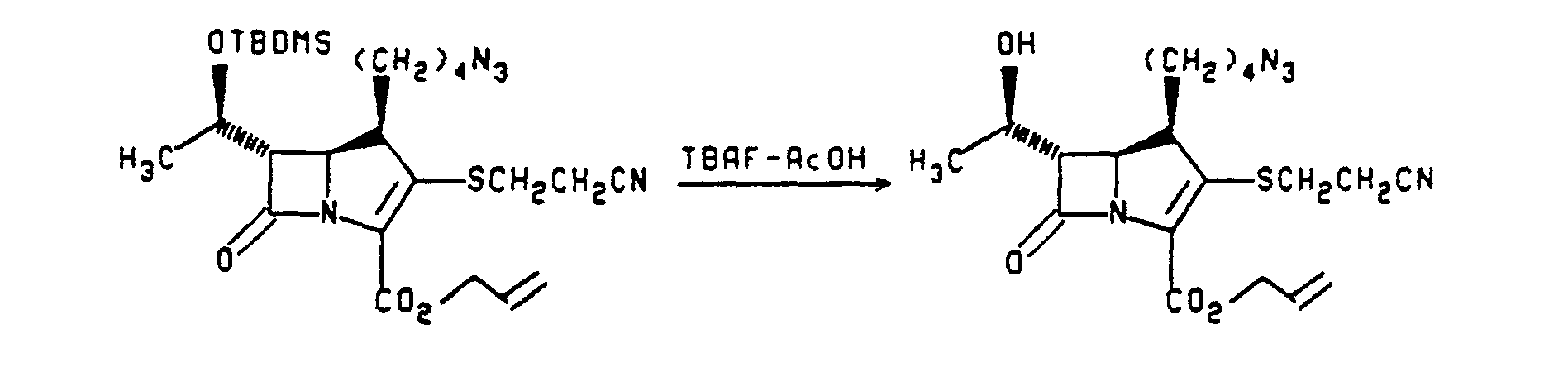
- A solution of allyl (4R,5S,6S)-4-(4"-azidobutyl)-6-[(1'R)-1'-tert-butyldimethylsilyloxyethyl]-3-[(2-cyanoethyl)thio]-7-oxo-1-azabicyclo[3.2.0] hept-2-ene-2-carboxylate (1.40 g, 2.62 mmol) in dry tetrahydrofuran (40 mL) was treated at 0-5° C with acetic acid (1.0 mL, 17.5 mmol) followed by 8.4 mL (8.4 mmol) of a 1.0M solution of tetrabutylammonium fluoride in tetrahydrofuran. The solution was stored at 5° C for 10 days. The reaction mixture was then diluted with cold EtOAc, washed with saturated NaHC03, brine and dried ( MgS04). Evaporation of the solvent gave an oil which was chromatographed on silica gel (4.5 x 11 cm) using a gradient of EtOAc in toluene (1:1 to EtOAc) as eluent.
- The early fractions gave 0.23 g (16%) of recovered starting material. The following fractions then gave 0.78 g (71 %) of the title compound as an oil.
- IR (NaCl, film) vmax: 3500 (OH), 2250 (CN), 2100 (N3), 1770 (C=0 of β-lactam) and 1710 cm-1 (C=O of ester);
- 'H NMR (200 MHz, CDCl3) δ: 1.40 (d, J=6.26 Hz, 3H, CH3CHO ), 1.4-1.8 (m, 6H, CH2-1 , 2 and 3 of butyl), 1.83 (d, J=5.1 Hz, 1 H, OH), 2.9-3.3 (m, 3H, H-4 andSCH2), 3.22 (dd, JH6.H5 = 2.75 Hz, JH6,Hl' = 7.37 Hz, 1 H, H-6), 3.34 (broad t, J =6.0 Hz, 2H, CH2N3), 4.25 (m overlapping with H-5, 1 H, CH3CHO ), 4.28 (dd, JH5,H6=2.75 Hz, JH5,H4= 9.58 Hz, 1H, H-5), 4.77 (m, 2H, CH2 of allyl), 5.2-5.5 and 5.9-6.1 ppm (2 x m, 2H and 1 H, CH of allyl).
-
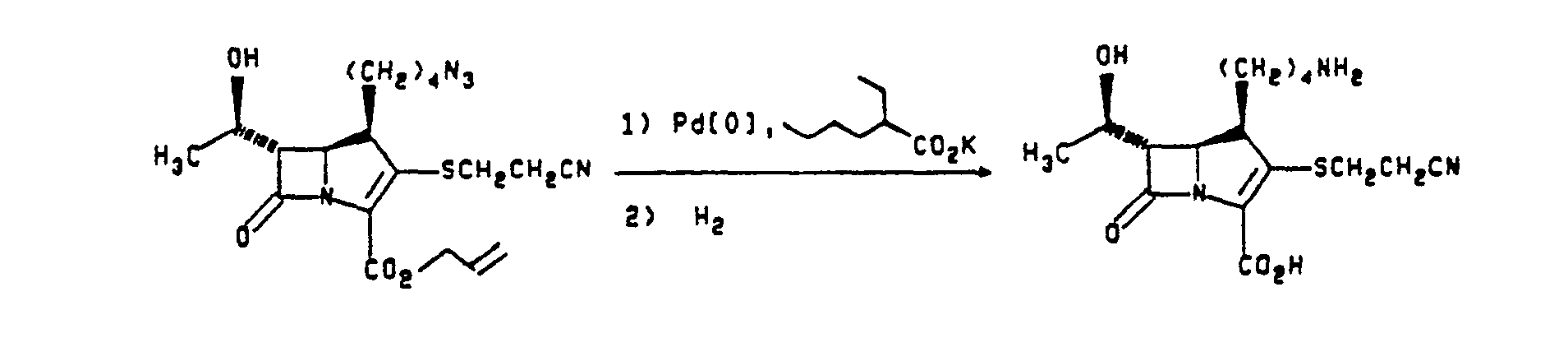
- A solution C allyl (4R,5S,6S)-4-(4"-azidoethyl)-3-[(2-cyanoethyl)thio]-6-[(1'R)-1'-hydroxyethyl]-7-oxo-1-azabicyclo[3.2.0]hept-2-ene-2-carboxylate (0.78 g, 1.86 mmol) in dry CH2Cl2(50 mL) was treated at 0-5°C and under nitrogen, with tetrakis(triphenylphosphine)palladium [0] (0.1 g) and 4.1 mL (2.05 mmol) of a 0.5M solution of potassium 2-ethylhexanoate in EtOAc. After 30 min, the reaction mixture was diluted with diethyl ether (150 mL) and extracted with 0.05M pH 7.0 aqueous phosphate buffer (3 x 75 mL). The combined aqueous phase was adjusted to pH 5.8 with 1M NaH2PO4and the traces of organic solvent were removed under vacuum. The aqueous solution was hydrogenated at 0-5 °C over 30% palladium on Celite under 45 psi for 2 h. The catalyst was then filtered on a Celite pad and washed with water. HPLC (µ-Bondapak C-18, elution 5% CH3CN-H2O pH 6.8 phosphate buffer) indicated a 70:30 mixture of the 4"-aminobutyl compound (eluted first) and the 4-hydroxybutyl compound.
- The solution was then chromatographed rapidly on reversed phase silica gel (µ-Bondapak C-18, 4 x 7 cm, elution H20-CH3CN 5%) to remove the inorganic salts. The UV active fractions were lyophilized and chromatographed on the same column using 5% CH3CN-H2O , 0.01 M pH 6.8 phosphate buffer as eluent. Two main fractions were obtained which were again desalted on reversed phase silica gel. Lyophilisation of the first fraction gave 0.33 g (50%) of the title 4"-aminobutyl compound as a white amorphous powder. By HPLC and 1H NMR this fraction was -90% pure and was contaminated by some 4"-hydroxybutyl compound and other impurities.
- The second fraction gave 0.102 g (14%) of the 4-hydroxybutyl compound as a white amorphous powder, 90% pure by HPLC and H NMR which is used in Example 18.
- Careful chromatography of the above, 4'-aminobutyl compound on reversed phase (µ-Bondapak C-18, same conditions as above) gave pure fractions of the title compound: [α]D 22 + 60.4° (c 1.0, H20).
- Purity by HPLC: 98.5% on p-Bondapak C-18, 3.9 mm x 30 cm, elution 5% CH3CN-H20 pH 7.4 phosphate buffer, flow rate 1 mUmin, UV detector 306 nm, retention time 5.25 min;
- UV (H2O, pH 7.4 phosphate buffer) xmax: 300 nm (10,267);
- IR (KBr) νmax: 2250 (CN), 1760 (C=0 of β-lactam) and 1690 cm-1 (C-0 of carboxylate);
- 'H NMR (200 MHz, D20) δ: 1.33 (d, J=6.38 Hz, 1H, CH3 CHO), 1.3-1.9 (m, 6H, CH2-1, 2 and 3 of butyl), 2.86 (m, 2H, CH2CN), 2.9-3.2 (m, 2H, SCH2), 3.02 (t, J=7.6 Hz, 2H, CH2NH2), 3.4 (m, JH6.H5 = 2.66 Hz, 2H, H-6 and H-4 overlapping), and 4.3 ppm (m, 2H, H-5 and CH3CHO overlapping).
-

- The crude fraction containing the 4"-hydroxybutyl compound (0.102 g, 90% pure) obtained by hydrogenation of the azido precursor in Example 17, Step E was purified by preparative HPLC (Zorbax ODS, Dupont, 21.2 mm x 25 cm, elution 5% CH3CN-H20 pH 6.8 potassium phosphate buffer, UV detector) followed by desalting on µ-Bondapak C-18. Lyophilization gave 0.045 g (45% recovery) of the title compound as a white amorphous powder.
- Purity by HPLC: 99% on µ-Bondapak c-18, 3.9 mm x 30 cm, elution 10% CH3CN-H20 pH 7.4 phosphate buffer, flow rate 0.6 mUmin, uv detector 306 nm, retention time 6.93 min;
- UV (H20, pH 7.4 phosphate buffer) λmax: 302 nm (7,364);
- IR (KBr) vmax: 2250 (CN), 1750 (C=O of a-lactam) and 1600 cm-1 (C=O of carboxylate);
- 'H NMR (200 MHz, D20) 6: 1.33 (d, J=6.41 Hz, 3H, CH3CHO), 1.3-2.0 (m, 6H, CH2-1,2 and 3 of butyl), 2.86 (m, 2H, CH2CN), 2.8-3.3 (m, 2H, SCH2), 3.35 (m, 1H,H-4), 3.43 (dd, JH6,H5 = 2.59 Hz, JH6,H1 = 6.0 Hz, 1 H, H-6), 3.62 (t, J =6.3 Hz, 2H, CH20H), and 4.3 ppm (m, 2H, H-5 and CH3CHO overlapping).
-

- A cold (0-5° C) solution of (4R,5S,6S)-4-(4"-aminobutyl)-3-[(2-cyanoethyl)thio]-6-[(1'R)-1'-hydroxyethyl]-7-oxo-1-azabicyclo[3.2.0] hept-2-ene-2-carboxylic acid (0.113 g, 0.32 mmol) in 30 mL of 0.04M pH 7.0 phosphate buffer was adjusted to pH 8.5 with 0.1 M NaOH. Then benzylformimidate hydrochloride (0.54 g, 3.17 mmol) was added in small portions while maintaining the pH at 8.0-8.5 with 0.1 N NaOH (-10 min). After 10 min, the pH was adjusted to 7.0 with 0.1 N HCI, and the reaction mixture was washed with EtOAc. The aqueous phase was maintained under vacuum to remove traces of organic solvent and then chromatographed on reversed phase silica gel (µ-Bondapak c-18, 3.5 x 7 cm). Elution with a gradient of acetonitrile (0-10%) in water gave 0.106 g (86%) of the title compound as a white amorphous powder after freeze drying: [α]D 22 + 53.5 (c 1.0, H20).
- Purity by HPLC: 93% on µ-Bondapak C-18, 3.9 mm x 30 cm, elution 5% CH3CN-H20 pH 7.4 phosphate buffer, flow rate 1 mUmin, uv detector 300 nm, retention time 7.74 min.
- UV (H20, pH 7.4 phosphate buffer) λmax; 300 nm (10,481); );
- IR (KBr) νmax: 2250 (CN), 1760 (C=O of β-lactam) and 1715 cm-1 (C=0 of carboxylate);
- 'H NMR (200 MHz, D20) 5: 1.34 (d, J=6.34 Hz, 3H, CH3CHO), 1.3-2.0 (m, 6H, CH2-1,2 and 3 of butyl), 2.8-2.9 (m, 2H, CH2CN), 2.9-3.3 (m, 2H, SCH2), 3.3-3.5 (m, 4H, H-4, H-6 and CH2N), 4.3 (m, 2H, H-5 and CH3 CHO overlapping), and 7.81 ppm (s, 1 H, CH=N).
-

- A solution of (4R,5S,6S)-4-(4"-aminobutyl)-3-[(2-cyanoethyl)thio]-6-[(1'R)-1'-hydroxyethyl]-7-oxo-1-azabicyclo[3.2.0]hept-2-ene-2-carboxylic acid (0.054 g, 0.15 mmol) in water (1 mL) at 0-5° C, was diluted with acetonitrile (1 mL) and then treated with 37% aqueous formaldehyde (0.075 mL, 0.81 mmol) followed by sodium cyanoborohydride (0.024 g, 0.38 mmol) and one drop of acetic acid. After 15 min, the reaction mixture was quenched by the addition of 0.2M pH 6.0 phosphate buffer and the organic solvent was removed in vacuo. The aqueous phase was then chromatographed on reversed phase silica gel (µ-Bondapak C-18, 3.5 x 6.5 cm). Elution with a gradient of acetonitrile (0-10%) in water gave 0.016 g (27%) of the title compound as a white amorphous powder after lyophilization.
- Purity by HPLC: 96% on µ-Bondapak C-18, 3.9 mm x 30 cm, elution 5% CH3CN-H2O pH 7.0 phosphate buffer, flow rate 1 mUmin, UV detector 300 nm, retention time 10.9 min.
- UV (H20, pH 7.4 phosphate buffer) λmax· 300 nm (9,907);
- IR (KBr) vmax: 2250 (weak CN), 1759 (C = 0 of µ-lactam) and 1590 cm-1 (C = 0 of carboxylate);
- 'H NMR (200 MHz, D2O) δ: 1.33 (d, J=6.37 Hz, 3H, CH3CHO), 1.3-1.9 (m, 6H, CH2-1, 2 and 3 of butyl), 2.87 (s, 6H, N(CH3)2), 2.87 (m overlapping with NCH3,2H, CH2CN), 2.9-3.2 (m, 2H, SCH2), 3.15 (~t overlapping with SCH2, 2H CH2N(CH3)2). 3.38 (dd, JH6.H5= 2.6 Hz. JH6,H1= 6.25 Hz, 1H, H-6), 3.38 (m overlapping with H-6, 1H, H-4), and 4.27 ppm (m, 2H, H-5 and CH3CHO).
-

-

- To a cold (ice bath) solution of (3S,4R)-3-[(1'R)-1'-tert-butyldimethylsilyloxyethyl]-4-[(1"R)-1"-(3-azidopropyl)-3"-diazo-3"-allyloxycarbonyl-2"-oxopropyl]azetidin-2-one (2.4 g, 5.0 mmol) from Example 7, Step E in EtOH (50 mL) was added a 2N aqueous HCI solution (7 mL). The ice bath was removed and the mixture was stirred for 20 h. The pH of the solution was adjusted to 7 with a 1 M aqueous NaHC03solution (15 mL) and ethanol was removed under vacuum. The residue obtained was diluted with EtOAc, washed with a 1 M aqueous NaHCO3solution (18 mL), water (10 mL), brine (10 mL) and dried (MgSO4). The residue was passed through a silica gel flash (40 g) column (5, 10, 20, 40, 60, 80% EtOAc/ CH2Cl2) to give the title compound (1.7 g, 93%) as an oil that crystallized out.
- IR (CH2Cl2) νmax: 3600, 3500 (OH), 3400 (NH), 2150 (N2), 2100 (N3), 1765, 1715 and 1650 cm-1. (C = O);
- ' H NMR (CDCI3, 200 MHz) δ: 6.04-5.84 (1 H, m, vinylic-H), 6.01 (1 H, bs, NH), 5.42-5.29 (2H, m, vinylic-H), 4.75-4.63 (2H, m, CH2vinyl), 4.19-4.01 (1H, m, H-1'), 4.02-3.89 (1H, m, H-1 "), 3.83 (1H, dd, J=6.5 Hz, J =2.1 Hz, H-4), 3.31-3.25 (2H, m, CH2N3), 3.01 (1H, dd, J=1.9 Hz, J=6.9 Hz, H-3), 2.23 (1H, d, J = 3.9 Hz, OH), 1.98-1.75 (1 H, m, HCH), 1.73-1.48 (3H, m, CH2-HCH)and 1.29 ppm (3H, d, J =6.3 Hz, CH3).
-

- IR (CH2Cl2) νmax: 3610 (OH), 2100 (N3), 1770 and 1745 cm-1 (C=O);
- ' H NMR (CDCl3, 200 MHz) 6: 5.96-5.8 (1 H, m, vinylic H), 5.39-5.25 (2H, m, vinylic H), 4.75-4.64 (2H, m, CH2-vinylic), 4.66 (1 H, s, H-2), 4.35-4.26 (1 H, m, H-1'), 4.29 (1H, dd, J = 2.2 Hz, J = 8.1 Hz, H-5), 3.45-3.25 (2H, m, CH2N3), 3.29 (1H, dd, J=2.4 Hz, J=7.7 Hz, H-6), 2.8-2.6 (1H, m, H-4), 1.9-1.5 (4H, m, OH, CH2-CH2) and 1.42 ppm (3H, t, J=6.2 Hz, CH3).
-

- IR (CH2Cl2) vmax· 3600 (OH), 2100 (N3), 1775 and 1710 cm-1 (C=O);
- ' H NMR (CDCl3, 200 MHz) δ: 6.04-5.90 (1H, m, vinylic H), 5.50-5.23 (2H, m, vinylic-H), 4.82-4.63 (2H, m, CH2-vinylic), 4.27-4.19 (1H, m, H-1'), 4.22 (1H, dd, J =2.7 Hz, J=9.5 Hz, H-5), 3.9-3.75 (2H, m, CH20), 3.42-3.26 (2H, m, CH2-N3 and H-4), 3.24 (1H, dd, J=2.7 Hz, J=7.3 Hz, H-6), 3.08-2.8 (2H, m, SCH2), 2.3-1.9 (1 H, bs, OH), 1.95-1.54 (4H, m, CH2-CH2) and 1.37 ppm (3H, d, J = 6.2 Hz, CH3).
-

- A cold (ice bath) solution of allyl (4R,5S,6S)-4-(3"-azidopropyl)-6-[(1'R)-1'-hydroxyethyl]-3-[(2-hydroxyethyl)-thio]-7-oxo-1-azabicyclo[3.2.0]hept-2-ene-2-carboxylate (63 mg, 0.16 mmol) in CH2CI2 (7 mL) was treated with Pd(PPh3)4(12 mg, 0.012 mmol) and a 0.5M solution of sodium 2-ethylhexanoate in ethyl acetate (0.32 mL, 0.16 mmol). The mixture was stirred at 5°C for 40 min, then diluted with diethyl ether (30 mL) and extracted with a cold pH 7.0 buffer solution (3 x 3.5 mL) and water (1x 3 mL). The aqueous extracts were combined, washed with diethyl ether (2 x 10 mL), passed through a µBondapak C18 (15 g) reversed phase column (H20, 1,2,3,4% CH3CN/H20) to give the title compound (30 mg, 50%) after lyophilization.
- Purity by HPLC: 98.6% (5% CH3CN/buffer pH 7.4 0.014M), retention time 8.87 min;
- UV (H20) xmax: 304 (10,770);
- IR (Nujol) νmax: 3600-3100 (OH), 2100 (N3), 1750 and 1600 cm-1 (C=O);
- 'H NMR (D20, 200 MHz) 5: 4.35-4.20 (1H, m, H-1'), 4.22 (1H, dd, J=2.4 Hz, J=9.3 Hz, H-5), 3.8-3.7 (2H, m, CH2O), 3.45-3.3 (4H, CH2N3, H-6 and H-1'), 3.11-2.8 (2H, m, SCH2), 1.95-1.45 (4H, m, CH2CH2) and 1.33 ppm (3H, d, J=6.4 Hz, CH3).
-

-

- To a solution of allyl (4R,5S,6S)-6-[(1'R)-1'-(tert-butyldimethylsilyloxyethyl)]-4-(2"-hydroxyethyl)-3-[-(pyridin-2-yl)methylthio]-7-oxo-1-azabicyclo[3.2.0]hept-2-ene-2-carboxylate (0.5 g, 0.96 mmol) [prepared in Example 6, Step A] in CH2C12(10 mL) at 0°C, under Argon, was added pyridine (0.1 mL, 1.2 mmol) followed by a solution of azidoacetyl chloride (0.14 g, 1.2 mmol) in CH2Cl2(2 mL). The reaction mixture was stirred at 0° C for 30 min. and then diluted with EtOAc (40 mL) and washed successively with a cold pH 7 phosphate buffer solution and brine. After drying ( MgSO4) the solvent was evaporated to a syrup which was chromatographed on silica (2.3 x 11 cm) packed in CH2Cl2 and eluted with a mixture of CH2Cl2 and EtOAc (8:2, gradient elution) to give the title compound as a syrup (0.423 g, 73%).
- ' H NMR (200 MHz, CDCl3) 6: 0.04 (s, 3H, SiCH3), 0.05 (s, 3H, SiCH3), 0.84 (s, 9H, SiC(CH3)3), 1.28 (d, CH3, JCH3,1,=6.12 Hz), 1.70-1.87 (m, 1H, CH2), 2.16-2.33 (m, 1H, CH2), 3.16 (dd, H-6, J5,6=2.64 Hz, J6,1=7.04 Hz), 3.67 (m, H-4, J=2.1, 8.03, 10.63 Hz), 3.98 (s, CH2N3) 3.83-4.43 (overlapping, 6H, CH20, CHOH, H-5, SCH2) 4.57-4.82 (m, OCH2 allyl), 5.18-5.45 (m, =CH2, allyl), 5.82-6.01 (m, CH=, allyl), 7.17 (m, H-5, py, J4.5=7.68 Hz, J5,6= 4.9 Hz), 7.38 (d, H-3, py, J3,4 = 7.83 Hz), 7.66 (dt, H-4, py, J4,6 =1.8 Hz), 8.45 (m, H-6, py, J3,6= 0.8 Hz).
-

- A cold (0°C) solution of allyl (4R,5S,6S)-6-[(1'R)-1'-(tert-butyldimethylsilyloxyethyl)]-4-(2"-azidoacetox-yethyl)-3-[(pyridin-2-yl)methylthio]-7-oxo-1-azabicyclo[3.2.0]hept-2-ene-2-carboxylate (0.423 g, 0.7 mmol) in dry THF (8 mL) was treated with acetic acid (0.24 mL, 4.22 mmol) followed by a 1 M solution of tetrabutylammonium fluoride in THF (2.11 mL, 2.11 mmol). The mixture was stirred between 0° and 5°C for 120 h at which time -25% of the starting material remained unreacted. The mixture was neutralized at 0° C with a 1 M NaHCO3solution (4.3 mL, 4.22 mmol) and extracted with EtOAc (3 x 50 mL). The combined organic phase was washed successively with a cold 1M NaHCO3solution; water and brine, dried ( MgS04) and solvent evaporated to give a sticky gum which was chromatographed on silica (2.5 x 12 cm) packed in CH2Cl2and eluted with a mixture of CH2C12and EtOAc (3:7, gradient elution) to give the title compound (0.23 g, 68%).
- ' H NMR (200 MHz, CDCl37.24) δ: 1.38 (d, CH3, JCH3,1. =6.24 Hz), 1.71-1.87 (m, 1 H, CH2), 2.26-2.38 (m, 1 H, CH2), 3.24 (dd, H-6, J5,6=2.82 Hz, J6,1. = 8.08 Hz), 3.7 (m, H-4, J = 2.16, 9.79 Hz), 3.86-4.53 (m, 8H, CH2O, CH2N3, CHOH, H-5, SCH2), 4.57-4.85 (m, OCH2 allyl), 5.19-5.45 (m, =CH2, allyl), 5.83-6.02 (m, CH=, allyl), 7.14-7.21 (m, H-5, py, J3,5= 1.03 Hz, J4,s =7.71 Hz, J5,6 = 4.82 Hz), 7.38 (d, H-3, py, J3,6 = 0.98 Hz, J3,4 = 7.86 Hz), 7.65 (dt, H-4, py, J3,4 = 7.86 Hz, J4,6 = 1.81 Hz), 8.46 (m, H-6, py).
-

- To a cold (0°C) solution of allyl (4R,5S,6S)-6-[(1'R)-1'-hydroxyethyl]-4-(2"-azidoacetoxyethyl)-3-[-(pyridin-2-yl)-methylthiol-7-oxo-1-azabicyclo[3.2.0]hept-2-ene-2-carboxylate (0.22 g, 0.46 mmol) in CH2Cl2(10 mL), under Argon, was added Pd[Ph3P]4(0.08 g, 0.07 mmol) followed by a 0.5M solution of sodium 2-ethylhexanoate in EtOAc (1.01 mL, 0.5 mmol). The mixture was stirred at 0°C for 2 h and then extracted with water (3 x 15 mL). The combined aqueous phase was passed through a column of µ-Bondapak C-18 reverse phase silica (2.5 x 10 cm). The title compound was eluted with a mixture of water and CH3CN (9:1, gradient elution) and was obtained as a white fluffy solid after lyophilization (0.1 g, 48%).
- 'H NMR (200 MHz, D20) δ: 1.31 (d, CH3, JCH3,1'= 6.4 Hz), 1.65-1.84 (m, 1H, CH2), 2.03-2.2 (m, 1H, CH2), 3.28 (dt, H-4, J=2.72, 11.33 Hz), 3.48 (dd, H-6, J5,6 = 2.64 Hz, J6,1'= 6.03 Hz), 4.13 (s, 2H, CH2N3), 4.05-4.35 (m, 6H, CH20, CHOH, H-5, SCH2), 7.39 (m, H-5, py, J4,5 = 7.73 Hz, J5,6=4.92 Hz), 7.51 (d, H-3, py, J3,4=7.83 Hz), 7.87 (dt, H-4, py, J4,6 =-1.75 Hz), 8.48 (d, H-6, py).
-

- A solution of sodium (4R,5S,6S)-6-[(1'R)-1'-hydroxyethyl]4-(2"-azidoacetoxyethyl)-3-[(pyridin-2-yl)-methylthio]-7-oxo-1-azabicyclo[3.2.0]hept-2-ene-2-carboxylate (0.08 g, 0.17 mmol) in a 0.05 M solution of pH 7 sodium phosphate buffer (20 mL) was hydrogenated at 0°C over 5% palladium on BaSO4(0.04 g) at 40 psi for 30 min. The catalyst was filtered and washed with water. The combined aqueous solution was passed through a column of µ-Bondapak C-18 reverse phase silica (2.5 x 10 cm). The compound was eluted with a mixture of water and CH3CN (9:1, gradient elution). The first compound obtained was shown to be the sodium (4R,5S,6S)-6-[(1'R)-1'-hydroxyethyl]-4-(2"hydroxyethyl)-3-[(pyridin-2-yl)methylthio]-7-oxo-1-azabicyclo-[3.2.0]hept-2-ene-2-carboxylate as a result of ester cleavage. The title compound was eluted next and was obtained as a white fluffy solid after lyophilization (0.035 g, 49%).
- Purity by HPLC: 93.1% (actually >98%) U.V. detection at 304 nm, µ-Bondapack C-18 (4 mm x 30 cm); 10% CH3CN in pH 7.4 phosphate buffer; flow rate 1 mUmin; retention time: 5.37 min.
- UV (pH 7.4) λmax: 304 (8260).
- IR (Nujol) vmax: 1750 cm-1 (C = 0 β-lactam);
- ' H NMR (200 MHz, D20) δ: 1.29 (d, CH3, JCH3,1= 6.4 Hz), 1.69-1.87 (m, 1 H, CH2), 2.06-2.21 (m, 1 H, CH2), 3.27 (dt, H-4, J=2.79, 10.83 Hz), 3.46 (dd, H-6, J5,6=2.7 Hz, J6,1 = 6.33 Hz), 3.89 (s, 2H, CH2NH2), 4.04-4.38 (m, 6H, CH2O, CHOH, H-5, SCH2), 7.36 (m, H-5, py, J4,5= 7.73 Hz, J5,6= = 5.08 Hz), 7.5 (d, H-3, py, J3,4 = 7.93 Hz), 7.85 (dt, H-4, py, J4,6 =1.77 Hz, 8.45 (d, H-6 py).
-

-

- IR (NaCl, film) νmax: 2100 (N3), 1775 (C=O of β-lactam) and 1710 cm-' (C=O of ester);
- 1H NMR (200 MHz, CDCI3) δ: 0.07 and 0.08 (2 x s, 2 x 3H, SiCH3), 0.88 (s, 9H, Sit-Bu), 1.29 (d, J =6.12 Hz, 3H, CH3CHO), 1.6-2.2 (m, 2H, CH2-4), 3.06 (dd, JH6,H5=2.70 Hz, JH6,H1 =7.74 Hz, 1H, H-6), 3.2-3.7 (m, H, CH2N;and H-4), 4.05 (dd overlapping with SCH2, JH5,H6=2.70 Hz, JH5,H4 = 9.54 Hz, 1H, H-5), 4.07 (ABq, JAB = 15.6 Hz, Δν=15.2 Hz, 1H, SCH2), 4.17 (m, 1H, CH3CHO), 4.74 (m, 2H, CH2 of allyl), 5.2-5.5 and 5.8-6.1 (2 x m, 2H and 1 H, CH of allyl), 7.29 (m, 1 H, H-5 of pyridine), 7.79 (m, 1 H, H-4 of pyridine), 8.54 (dd, J =15.0 Hz and J=4.8 Hz, 1 H, H-6 of pyridine) and 8.62 ppm (d, J =2.0 Hz, 1 H, H-2 of pyridine).
-

- IR (NaCl, film) νmax: 2100 (N3), 1775 (C=O of β-lactam) and 1710 cm-1 (C=0 of ester);
- 'H NMR (200 MHz, CDCl3) 6: 1.38 (d, J=6.23 Hz, 3H, CH3CHO), 1.6-2.2 (m, 2H, CH2-4), 3.12 (dd, JH6.H5=2.77 Hz, JH6,H1=7.89 Hz, 1H, H-6), 3.3-3.7 (m, 3H, CH2N3 and H-4), 4.05 (ABq, JAB= 13.4 Hz, Δν=23.0 Hz, 2H, SCH2), 4.1-4.3 (m, 2H, H-5 and CH3CHO overlapping), 4.75 (m, 2H, CH2 of allyl), 5.3-5.5 and 5.9-6.1 (2 x m, 2H and 1 H, CH of allyl), 7.3 (m, 1 H, H-5 of pyridine), 7.72 (m, 1 H, H-4 of pyridine), 8.53 (dd, J=1.58 Hz and J=4.8 Hz, 1 H, H-6 of pyridine) and 8.6 ppm (d, J=2.0 Hz, 1 H, H-2 of pyridine).
-

- A solution of allyl (4R,5S,6S)-4-(2"azidoethyl)-6-[(1'R)-1'-hydroxyethyl]-3-[(pyridin-3-yl)methylthio]-7-oxo-1-azabicyclo[3.2.0]hept-2-ene-2-carboxylate (0.90 g, 2.09 mmol) in dry CH2Cl2(50 mL) was treated at 0-5°C and under nitrogen with tetrakis(triphenylphosphine)palladium [0] (0.13 g) and 4.6 mL (2.3 mmol) of a 0.5M solution of potassium 2-ethylhexanoate in EtOAc. After 15 min, the reaction mixture was diluted with diethyl ether (150 mL) and extracted with 0.05M pH 7.0 phosphate buffer (3 x 75 mL). The combined aqueous phase was adjusted to pH 5.8 with 1M NaH2P04and traces of organic solvent were removed in vacuo. The aqueous solution was then hydrogenated over 0.9 g of 30% palladium on Celite at 0-5° C and under 45 psi for 1.2 h. The catalyst was then filtered and the filtrate was chromatographed on reversed phase silica gel (µ-Bondapak c-18, 3.5 x 6.5 cm). Elution with a gradient of CH3CN (0-5%) in water gave the title material as a white amorphous powder after freeze drying. Crystallization in water ( 30 mL) gave 0.137 g of the title compound as a very fine solid. A second chromatography of the mother liquors gave 0.27 g (total yield 0.397 g, 52%) of the title compound as a white amorphous powder.
- Purity by HPLC: 94.5% on µ-Bondapak c-18, 3.9 mm x 30 cm, elution 8% CH3CN-H20 pH 7.4 phosphate buffer, flow rate 1 mUmin, UV detector 300 nm, retention time 5.35 min;
- UV (H20, pH 7.4 phosphate buffer) λmax: 268 (6,010) and 302 nm (7,740);
- IR (KBr) vmax: 1770 (C=0 of µ-lactam) and 1590 cm-' (C=0 of carboxylate);
- 'H NMR (200 MHz, D20 ) δ: 1.30 (d, J=6.29 Hz, 3H, CH3CHO), 1.6-2.2 (m, 2H, CH2-4), 3.04 (broad t, J = 8.3 Hz, 2H, CH2NH2), 3.20 (m, 1H, H-4), 3.38 (dd, JH6,H5=2.72 Hz, JH6,H1 =6.45 Hz, 1H, H-6), 4.06 (ABq, JAB 13.6 Hz, Δν=24.3, 2H, SCH2), 4.1-4.3 (m, 2H, H-5 and CH3CHO), 7.44 (m, 1H, H-5 of pyridine), 7.85 (d, J = 7.8 Hz, 1 H, H-4 of pyridine), 8.44 (d, J=4.9 Hz, 1 H, H-6 of pyridine) and 8.50 ppm (broad s, 1H, H-2 of pyridine).
-

- A suspension of (4R,5S,6S)-4-(2"-aminoethyl)-6-[(1'R)-1'-hydroxyethyl]-3-[(pyridin-3-yl)methylthio]-7-oxo-1-azabicyclo-[3.2.0]hept-2-ene-2-carboxylic acid from Example 24 (0.150 g, 0.41 mmol) in a mixture of water (3 mL) and acetonitrile (3 mL) was treated at 0-5 C with 37% aqueous formaldehyde (0.23 mL, 2.4 mmol), sodium cyanoborohydride (0.048 g, 0.72 mmol) and two drops of acetic acid. After 20 min, the reaction mixture was diluted with 30 mL of 0.2M pH 6.0 phosphate buffer and the traces of organic solvent were removed in vacuo. The aqueous phase was chromatographed twice on reversed phase silica gel (µ-Bondapak c-18, 4 x 9 cm) using a gradient of acetonitrile (0-5%) in water as eluent. Lyophilization of the UV active fractions gave 0.080 g (-50%) of a white amorphous powder. By HPLC, this product is a mixture of the title dimethylamino compound and N-methyl-N-cyanomethyl compound (Example 26) in a 3:1 ratio. Purification by preparative HPLC (µ-Bondapak c-18, 10 mm x 30 cm, elution 5% CH3CN-H2O ) gave 0.047 g (29%) of pure dimethylamino title compound.
- Purity by HPLC: 97% on µ-Bondapak c-18, 3.9 mm x 30 cm, elution 8% CH3CN-H20 pH 7.4 phosphate buffer, flow rate 1 mL;min, retention time 5.42 min.;
- UV (H20, pH 7.4 phosphate buffer) λmax: 268 nm (6592) and 302 nm (7,793);
- IR (KBr) νmax: 1765 (C=0 of β-lactam) and 1605 cm-1 (C=O of carboxylate);
- 'H NMR (200MHz, D20) 5: 1.30 (d, J=6.37 Hz, 3H, CH3CHO), 1.5-2.2 (m, 2H, CH2-4), 2.87 (s, 6H, N-(CH3)2), 3.15 (m, 3H, CH2N and H-4), 3.32 (dd, JH6.H5 2.90 Hz, JH6,H1 = 6.80 Hz, 1H, H-6), 4.05 (ABq, JAB= 14.1 Hz, Δν= 29.7 Hz, 2H, SCH2), 4.12 (dd, partially overlapping with SCH2, JH5,H6=2.90 Hz, 1H, H-5), 4.22 (m, 1 H, CH3CHO), 7.44 (dd, J = 5.0 Hz and J=7.9 Hz, 1 H, H-5 of pyridine), 7.84 (m, 1 H, H-4 of pyridine), 8.44 (dd, J = 1.5 Hz, and J = 5.0 Hz, 1 H, H-6 of pyridine) and 8.50 ppm (d, J =1.8 Hz, 1 H, H-2 of pyridine).
-
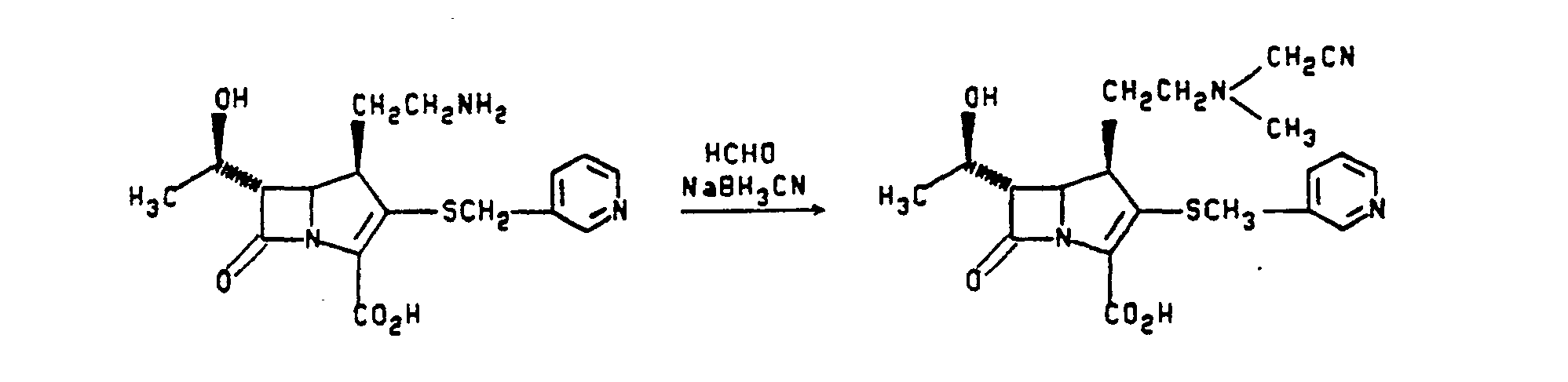
- The mixture of products obtained by the reductive alkylation of (4R,5S,6S)-4-(2"-aminoethyl)-6-[(1'R)-1'- hydroxyethyl]-3-[(pyridin-3-yl)methylthio]-7-oxo-1-azabicyclo[3.2.0]hept-2-ene-2-carboxylic acid as described in Example 25 was purified by preparative HPLC (µ-Bondapak c-18). The minor component of the mixture with a longer reaction time gave 0.011 g of the title compound as a white amorphous powder after lyophilization:
- Purity by HPLC: 92% on µ-Bondapak c-18, 3.9 mm x 30 cm, elution 8% CH3CN-H20 pH 7.4 phosphate buffer, flow rate 1 mL/min, uv detector 302 nm, retention time 23.5 min.;
- UV (H20, pH 7.4 phosphate buffer) λmax: 268 and 304 nm;
- IR (KBr) νmax: 1752 (C = 0 of β-lactam) and 1605 cm-1 (C = 0 of carboxylate);
- ' H NMR (200 MHz, D20) 6: 1.31 (d, J=6.36 Hz, 1 H, CH3CHO), 1.4 and 1.9 (2 x m, 2 x 1 H, CH2-4), 2.35
- (s, 3H, N-CH3), 2.3-2.6 (m, 2H, CH2CH2N), 3.12 (m, 1 H, H-4), 3.33 (dd, JH6,H5 = 2.68 Hz, JH6,H1 = 5.95 Hz, 1 H, H-6), 3.70 (s, 2H, NCH2CN), 4.09 (ABq, JAB= 14.14 Hz, Δν=29.5 Hz, 2H, SCH2), 4.12 (dd overlapping with SCH2, JH5,H6 = 2.68 Hz, 1H, H-5), 4.24 (m, 1H, CH3CHO), 7.49 (m, 1H, H-5 of pyridine), 7.92 (d, J=8.0 Hz, 1 H, H-4 of pyridine), 8.46 (broad d, J =4.3 Hz, 1 H, H-6 of pyridine) and 8.54 ppm (broad s, 1 H, H-2 of pyridine).
-

- A 0.04M pH 7.0 phosphate buffer solution (50 mL, 2.0 mmol) of sodium (4R,5S,6S)-4-(3"-azidopropyl)-6-[(1'R)-1'-hydroxyethyl]-3-[(2-hydroxyethyl)thio]-7-oxo-1-azabicyclo-[3.2.0]hept-2-en-2-carboxylate obtained from the corresponding allyl ester (404 mg, 1.02 mmol) as described in Example 21 was adjusted at 5°C to pH 5.8-5.9 with a 1.0M pH 4.2 NaH2PO4buffer solution. To this mixture was added 30% Pd/Celite (400 mg) and it was shaken on a Parr hydrogenator at 45-50 psi hydrogen for 1.5 h at an initial temperature of 5° C (ice bath) and final temperature of 15°C. The catalyst was filtered off and the solution was passed through a µBondapak C,8 reversed phase column (60 g, H20) to give impure title material contaminated with sodium (4R,5S,6S)-4-(3"-hydroxypropyl)-6-[(1'R)-1'-hydroxyethyl]-3-[(2-hydroxyethyl)thio]-7-oxo-1-azabicyclo[3.2.0]hept-2-ene-2-carboxylate (Example 28). This contaminated material dissolved in a 0.01 M pH 6.0 phosphate buffer was poured again on a µBondapak C18 column (ratio 500/1). The first two volumes of the column were eluted with the pH 6.0 buffer and then elution with water gave 3-aminopropyl pure title compound (95 mg, 28%) and the 3-hydroxypropyl derivative (from 340 mg, 0.85 mmol of allyl ester, 45 mg, 17% as described in Example 28).
- Purity of title compound by HPLC: 88% (KH2PO4 0.01M, pH 7.4) retention time 5.54 min;
- UV (H20) λmax: 302 (9000);
- IR (Nujol) νmax: 3600-3100 (OH), 1750 and 1585 cm-1 (C=0);
- 1 H NMR (D20, 200 MHz ) 5: 4.33-4.2 (1H, m, H-1'), 4.23 (1H, dd, J=2.5 Hz, J=9.2 Hz, H-5), 3.82-3.67 (2H, m, CH20), 3.43-3.34 (1H, m H-4), 3.36 (1H, dd, J=2.5 Hz, J=6.6 Hz, H6), 3.09-3.02 (2H, m; CH2N), 3.06-2.79 (2H, 2 sets of m, SCH2), 1.95-1.5 (4H, m, CH2CH2) and 1.33 ppm (3H, d, J=6.4 Hz, CH3).
-

- Purity of title compound by HPLC: 95.2% (KH2PO4, 0.01 M pH 7.4), retention time 7.9 min;
- UV (H20) λmax: 302 (10,300);
- IR (Nujol) vmax: 3600-3100 (OH), 1740 and 1690 cm-1 (C=0);
- ' H NMR (D20, 200 MHz) 5: 4.35-4.2 (1H, m, H-1'), 4.23 (1H, dd, J =9.2 Hz, J =2.5 Hz, H-5), 3.77 (2H, m, SCH2CH20), 3.65 (2H, m, CH20), 3.41 (1H. dd, J=2.5 Hz, J = 6.1 Hz, H-6), 3.42-3.36 (1H. m, H-4), 3.1-2.8 (2H, 2 sets of m, SCH2), 2.0-1.4 (4H, m, CH2CH2) and 1.33 ppm (3H, d, J=6.4 Hz, CH3).
-

-

- A solution of (3S,4R)-3-[(1'R)-1'-tert-butyldimethylsilyloxyethyl]-4-[(1 "R)-1 "-(3-azidopropyl)-3"-diazo-3"-allyl-oxycarbonyl-2"-oxypropyl]azetidin-2-one prepared in Example 7, Step E (2.0 g, 4.2 mmol) and Rh-(OAc)2 in benzene (80 mL) was heated under reflux for 20 min. Benzene was removed under vacuum and the resulting bicyclic ketone was diluted with CH3CN (80 mL). It was cooled to -10* C (ice-MeOH bath) and treated dropwise with diphenyl chlorophosphate (1.0 mL, 4.6 mmol) and N,N-diisopropylethylamine (0.84 mL, 4.6 mmol) and 4-dimethylaminopyridine (2.3 mg). The mixture was stirred for 2 h then N,N-diisopropylethylamine (1.7 mL, 9.2 mmol) was added in, followed by the addition of a stream of CH3SH gas (10 min). The mixture was kept at 5 C (cold room) for 18 h, then diluted with cold EtOAc (400 mL), washed with cold 1 N aqueous HCI (400 mL), ice cold water (200 mL), 1 M aqueous NaHC03(2 x 400 mL), ice cold water (3 x 400 m), brine and dried ( MgSO4). The residue obtained (2 g) upon solvent evaporation was passed through a silica gel flash column (100 g, Hexane - 20% EtOAc/Hexane) to give the title compound (1.0 g, 50%) as an oil.
- IR (CH2 C12) νmax: 2100 (N3), 1775 and 1710 cm-' (C=0);
- ' H NMR (CDCl3, 200 MHz) 6: 5.97-5.89 (1 H, m, vinylic H), 5.48-5.21 (2H, m, vinylic H), 4.9-4.6 (2H, m, CH2-vinyl), 4.3-4.15 (1 H, m, H-1'), 4.12 (1H, dd, J=2.5 Hz, J=9.4 Hz, H-5), 3.5-3.3 (2H, m, CH2N3), 3.3-3.1 (1H, m, H-4), 3.16 (1 H, dd, J=7.4 Hz, J-2.7 Hz, H-6), 2.38 (3H, s, CH3), 1.9-1.5 (4H, m, CH2CH2), 1.31 (3H, d, J=6.1 Hz, CH3), 0.88 (9H, s, tert-butyl), 0.086 and 0.078 ppm (6H, 2s, CH3).
-
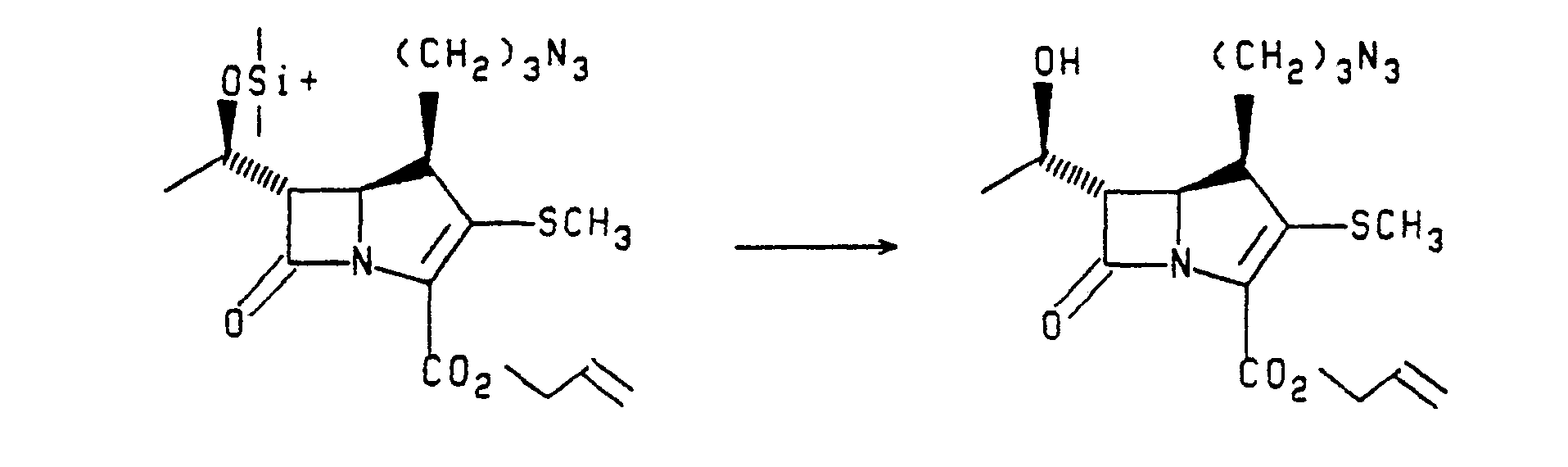
- A cold (-20 °C) solution of allyl (4R,5S,6S)-4-(3"-azidopropyl)-6-[(1'R)-1'-tert-butyldimethylsilyloxyethyl]-3-methylthio-7-oxo-1-azabicyclo[3.2.0]hept-2-ene-2-carboxylate (1.0 g, 2.1 mmol) in THF (60 mL) was treated with glacial AcOH (1.5 mL, 25.2 mmol) and then with a 1 M THF solution of tetrabutylammonium fluoride (12.7 mL, 12.6 mmol). The reaction was kept at 5° C for 100 h, then neutralized with a 1M aqueous NaHC03 solution, diluted with EtOAc (200 mL), washed with cold 1 M aqueous NaHC03 solution (1 x 50 mL), water (2 x 150 mL), brine (1 x 150 mL) and dried ( MgSO4). The residue (1.2 g) obtained upon solvent evaporation was passed through a silica gel flash column (1/1, Hexane/EtOAc → EtOAc) to give the title compound (0.30 g) and the starting ether (0.42 g) which was retreated again with tetrabutylammonium fluoride under the same conditions to give the title compound (0.13 g); combined yield 0.43 g, 56%.
- IR (CH2CI2) νmax: 3600 (OH), 2100 (N3), 1775 and 1710
- ' H NMR (CDCI3, 200 MHz) δ: 6.07-5.87 (1H, m, vinylic H), 5.5-5.21 (2H, m, vinylic-H), 4.87-4.62 (2H, m, CH2-vinylic), 4.3-4.18 (1H, m, H-1'), 4.22 (1H, dd, J=2.6 Hz, J=9.3 Hz, H-5), 3.5-3.3 (2H, m, CH2N3), 3.3-3.2 (1H, m, H-4), 3.23 (1H. dd, J =2.6 Hz, J =7.6 Hz, H-6), 2.37 (3H, s, SCH3), 1.9-1.55 (4H, m, CH2CH2), 1.77 (1H, d, J=4.8 Hz, OH) and 1.39 ppm (3H, d, J=6.3 Hz, CH3).
-

- Purity by HPLC: 97.2% (10% CH3CN KH2PO40.01M, pH 7.4), retention time 7.56 min;
- UV (H20) λmax: 304 (8070);
- IR (Nujol) vmax: 3600-3100 (OH), 2100 (N3), 1745 and 1595 cm-' (C=O);
- ' H NMR (D20. 200 MHz) δ: 4.34-4.2 (1H. m, H-1'), 4.22 (1H, dd, J =2.3 Hz, J=9.0 Hz, H-5), 3.47-3.37 (4H, m, H-6, H-4 and CH2N3), 3.375 (d, J=2.3 Hz, part of dd of H-6), 2.37 (3H, s, CH3), 1.95-1.4 (4H, m, CH2CH2) and 1.35 ppm (3H, d, J=6.4 Hz, CH3).
-

- The pH of a cold (ice bath) 0.05M pH 7.0 sodium phosphate buffer (25 mL) of sodium (4R,5S,6S)-4-(3"-azidopropyl)-6-[(1'R)-1'-hydroxyethyl]-3-methylthio-7-oxo-1-azabicyclo[3.2.0]hept-2-ene-2-carboxylate made from the corresponding allyl ester (0.12 g, 0.33 mmol), as described in Example 29, was adjusted to 5.8 with a 1.0M pH 4.2 NaH2PO4 buffer solution. The mixture was then shaken on a Parr hydrogenator at a hydrogen pressure of 45-50 p.s.i. for 90 min at - 10° C (initial temperature: 5° C) using 30% Pd/Celite (120 mg) as catalyst. The catalyst was removed by filtration and the solution was passed through a µBondapak C18 reversed phase column (50 g, H2O → 2% CH3CN/H20 ) to give a mixture of two compounds (0.3 g). This lyophilized powder was passed again on the reversed phase column (45 g, 150 mL of 0.05M pH 6.0 phosphate buffer, H2O → 2% CH3CN/H2O ) to give impure 3-aminopropyl derivative (125 mg) and the 3-hydroxypropyl derivative of Example 31 (20 mg, 20%). The 3-aminopropyl derivative was repurified on the reversed phase column (45 g, H2O → 2% CH3CN/H2O) to give the pure title 3-aminopropyl compound (25 mg, 25%).
- Purity by HPLC: 96.5% ( KHzP04buffer 0.01M, pH 7.4), retention time: 7.50 min;
- UV (H20) λmax: 304 (8580);
- IR (Nujol) λmax: 3600-3100 (OH, NH2), 1750 and 1580 cm-' (C=0);
- ' H NMR (D20, 200 MHz) 5: 4.3-4.2 (1H, m, H-1'), 4.21 (1H, dd, J=2.4 Hz, J =9.1 Hz, H-5), 3.48-3.39 (1H, m, H-4), 3.33 (1H, dd, J =2.4 Hz, J =6.5 Hz, H-6), 3.15-3.0 (2H, m, CH2N), 2.34 (3H, s, SCH3), 1.9-1.5 (4H, m, CHzCHz) and 1.33 ppm (3H, d, J=6.4 Hz, CH3).
-

- Purity by HPLC: 97.5% (2% CH3CN/pH 7.4 0.01M phosphate buffer), retention time: 7.79 min;
- UV (H20) λmax: 306 (9700);
- IR (Nujol) Vmax: 3500-3100 (OH), 1740 and 1590 cm-1 (C = 0);
- ' H NMR (D20, 200 MHz) δ: 4.34-4.18 (1 H, m, H-1'), 4.21 (1 H, dd, J =2.4 Hz, J=9.3 Hz, H-5), 3.69-3.63 (2H, m, CH20), 3.46-3.36 (1H, m, H-4), 3.38 (1 H, dd, J =2.4 Hz, J =6.3 Hz, H-6), 2.36 (3H, s, SCH3), 1.95-1.4 (4H, m, CH2CH2) and 1.34 ppm (3H, d, J = 6.4 Hz, CH3).
-

- To a cold (ice bath) solution of (4R,5S,6S)-4-(3"-aminopropyl)-6-[(1'R)-1'-hydroxyethyl]-3-[(2-hydroxyethyl)-thio]-7-oxo-1-azabicyclo[3.2.0]hept-2-ene-2-carboxylic acid (50 mg, 0.15 mmol) prepared in Example 27 in a 0.04M pH 7.0 phosphate buffer solution (10 mL, 0.4 mmol) was added a 0.1 N aqueous NaOH solution in order to bring the pH to 8.2-8.4. To this solution was added portionwise benzylformimidate hydrochloride (257 mg, 1.5 mmol) while maintaining the pH at 8.0-8.5 with the 0.1 N aqueous NaOH solution. The mixture was stirred for 10 min and then the pH was adjusted to 7.0 with 0.1 N aqueous HCI. The solution was passed through a µ-Bondapak C18 column (25 g, H2O → 2%, 4% CH3CN/H20) to give the pure title compound (33 mg, 62%) as a lyophilized powder.
- Purity by HPLC: 93.8% (2% CH3CN/KH2HPO40.01 M, pH 7.4), retention time: 5.73 min;
- UV (H20) λmax): 302 (7651);
- IR (Nujol) Pm,,: 3600-3100 (NH,OH), 1755, 1585 (C=0) and 1710 cm-1 (C=NH);
- ' H NMR (D20, 200 MHz) 6: 7.83, 7.80 (1 H, 2s, NCHN), 4.35-4.2 (1.5 H, m, H-1'), 4.21 (0.5 H, d, J = 2.2 Hz, part of H-5), 3.8-3.7 (2H, m, CH20), 3.55-3.25 (4H, m, CH2N, H-6, H-4), 3.1-2.8 (2H, 2 sets of m, SCH2), 1.95-1.4 (4H, m, CH2CH2) and 1.32 ppm (3H, d, J=6.3 Hz, CH3).
-

- Purity by HPLC: 97.8% (304 nm, 2% CH3CN/KH2P40.01M pH 7.4) retention time 8.33 min;
- UV (H20) λmax: 306 (12,200);
- IR (Nujol) vmax: 3600-3100 (OH, NH2), 1750, 1590 (C=O) and 1710 cm-1 (C=N);
- ' H NMR (D20; 200 MHz) δ: 7.83, 7.80 (1 H, 2s, CH), 4.35-4.18 (2H, m, H-1' and H-5), 3.45-3.35 (3H, m, CH2N, H-4), 3.30 (1H, dd, J=2.4 Hz, J=6.2 Hz, H-6), 2.34 (3H, s, SCH3), 1.9-1.45 (4H, m, CH2CH2) and 1.32 ppm (3H, d, J=6.4 Hz, CH3).
-

- The pH of a cold (ice bath) solution of (4R,5S,6S)-4-(3"-aminopropyl)-6-[(1'R)-1'-hydroxyethyl]-3-methylthio-7-oxo-1-azabicyclo[3.2.0]hept-2-ene-2-carboxylic acid (50 mg, 0.17 mmol) prepared in Example 30 in a 0.05M pH 7.0 phosphate buffer was adjusted to pH 8 with a 0.1 N aqueous NaOH solution. To this mixture was added portionwise aminoiminomethanesulfonic acid (211 mg, 1.70 mmol); the pH of the reaction mixture being kept at 7.8-8.0 with the 0.1 N aqueous NaOH solution. It was then stirred for 1 h and the pH of the mixture was adjusted to 7.0 with a 0.1 N aqueous HCI solution. It was passed through a µBondapak C18 reversed phase column (25 g, H20) to give the title compound (17 mg, 40%) as a lyophilized powder.
- Purity by HPLC: 99.4% (304 nm, 2% CH3CN/KH2PO4 0.01 M pH 7.4), retention time 9.19 min;
- UV (H2O) λmax: 306 (10,700);
- IR (Nujol) νmax: 3600-3100 (NH2, OH), 1750, 1680 (C=O) and 1660 cm-1 (C=N);
- ' H NMR (D2O, 200 MHz) δ: 4.3-4.17 (1H, m, H-1'), 4.20 (1H, dd. J =2.4 Hz. J=9.1 Hz, H-5), 3.46-3.30 (1H, m, H-4), 3.26 (1H, dd, J=2.5 Hz, J=6.3 Hz, H-6), 3.3-3.2 (2H, m, CH2N), 2.34 (3H, s, SCH3), 1.9-1.4 (4H, m, CH2CH2) and 1.32 ppm (3H, d, J=6.3 Hz, CH3).
-

- Purity by HPLC: 99.1 % (2% CH3CN !buffer pH 7.4, 0.01 M), retention time 7.5 min;
- UV (H20) λmax: 304 (7800);
- IR (Nujol) vrt,ax: 3320, 3180 (NH, OH), 1750, 1580 (C=O) and 1665 cm-1 (C=N);
- ' H NMR (D20, 200 MHz) 3: 4.3-4.2 (2H, m, H-1' and H-5), 3.77 (2H, t, J =6.2 Hz, CH20), 3.28 (1 H, dd, J=2.4 Hz, J=6.2 Hz, H-6), 3.45-3.15 (3H, m, H-4 and CH2 N), 3.15-2.8 (2H, 2 sets of m, SCH2), 2.0-1.45 (4H, m, CH2CH2) and 1.32 (3H, d, J=6.3 Hz, CH3).
-

-

- IR (NaCI, film) vmax: 2250 (CN), 2100 (N3), 1775 (C=0 of β-lactam) and 1710 cm-1 (C=0 of ester);
- 'H NMR (200 MHz, CDCl3) δ: 0.19 (s, 6H, SiCH3), 0.99 (s, 9H, Sit-Bu) 1.41 (d, J=6.11 Hz, 3H, CH3CHO), 1.7-2.2 (m, 2H, CH2-4), 2.7-3.4 (m, 5H, SCH2CH2CN and H-6), 3.4-3.8 (m, 3H, CH2N3 and H-4),
4.3 (m, 2H, H-5 and CH3 CHO), 4.85 (m, 2H, CH2 of allyl), 5.3-5.6 and 5.9-6.2 ppm (2 x m, 2H and 1H, CH of allyl). -
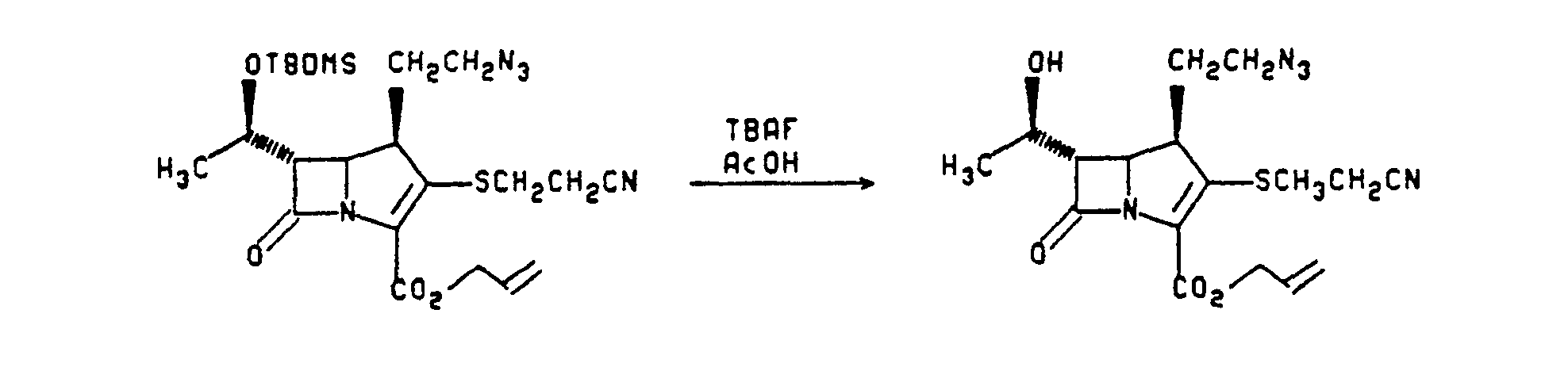
- A solution of crude allyl (4R,5S,6S)-4-(2"-azidoethyl)-6-[(1'R)-1'tert-butyldimethyldimethylsilyloxyethyl]-3-[(2-cyanoethyl)thio]-7-oxo-1-azabicyclo[3.2.0]hept-2-ene-2-carboxylate (3.3 g, 6.4 mmol) from Step A in dry tetrahydrofuran (100 mL) was treated at 0-5° C and under nitrogen with acetic acid (2.2 mL, 38.4 mmol) followed by 20 mL (20.0 mmol) of 1 M solution of tetrabutylammonium fluoride in tetrahydrofuran. The solution was stored at 5° C for 8 days. The reaction mixture was then diluted with EtOAc, washed with saturated NaHCO3, brine and dried ( MgSO4). Evaporation of the solvent gave an oil which was chromatographed on silica gel (5 x 11 cm). Elution with a mixture of toluene and EtOAc (1:1 ) gave 0.92 g (36%, yield from the diazoazetidinone) of the title compound as a clear oil.
- IR (NaCI, film) νmax: 3500 (OH), 2250 (CN), 2105 (N3), 1775 (C=0 of β-lactam) and 1710 cm-1 (C=0 of carboxylate);
- ' H NMR (200 MHz, CDCI3) δ: 1.40 (d, J =6.23 Hz, 3H, CH3CHO), 1.6-2.1 (m, 2H, CH2-4), 2.7 (m, 2H, CH2CN), 2.9-3.3 (m, 3H, H-6 and SCH2), 3.4-3.7 (m, 3H, H-4 and CH2N3), 4.25 (m overlapping with H-5, 1 H, CH3CHO), 4.29 (dd, JH5,H6 = 2.80 Hz, JH5,H4=9.69 Hz, 1H, H-5), 4.77 (m, 2H, CH2 of allyl), 5.2-5.5 and 5.9-6.1 ppm (2 x m, 2H and 1 H, CH of allyl).
-

- Purity by HPLC: 99% on µ-Bondapak c-18, 3.9 mm x 30 cm, elution H20 pH 7.4 phosphate buffer, flow rate 1 mL/min, UV detector 304 nm, retention time 4.67 min;
- UV (H20, pH 7.4 phosphate buffer) λmax: 298 nm (7,709);
- IR (KBr) νmax: 2250 (CN), 1760 (C = 0 of ,6-lactam) and 1590 cm-1 (C = 0 of carboxylate);
- 'H NMR (200 MHz D20) 5: 1.33 (d, J=6.35 Hz, 3H, CH3CHO), 1.8-2.4 (m, 2H, CH2-4), 2.85 (m, 2H, CH2CN), 2.9-3.3 (m, 4H, SCH2 and CH2NH2), 3.45 (m, overlapping with H-6, 1H, H-4), 3.47 (dd, JH6,H5=2.90 Hz, JH6,H1=6.47 Hz, 1H, H-6), and 4.2-4.4 ppm (m, 2H, H-5 and CH3CHO).
-

-

- To a mixture of allyl (4R,5S,6S)-6-[(1'R)-1'-(tert-butyidimethylsilyloxyethyl)]-4-(2"-hydroxyethyl)-3-[ (pyridin-2-yl)methylthio ]-7-oxo-1-azabicyclo[3.2.0]hept-2-ene-2-carboxylate (0.29 g, 0.56 mmol), prepared in Example 6, Step A, N-hydroxysuccinimide (0.07 g, 0.62 mmol) and triphenylphosphine (0.176 g, 0.67 mmol) in dry THF (8 mL) at 0°ç. under Argon, was added diethyl azodicarboxylate (0.117 g, 0.67 mmol). The reaction mixture was stirred at 00 C for 1 hour and at room temperature for an additional hour. The solvent was removed under reduced pressure and the residue was chromatographed on silica (3 x 9 cm) packed in CH2Cl2 and eluted with a mixture of CH2Cl2 and EtOAc (4:6, gradient elution) to give the title compound mixed with about one equivalent of Ph3P=O (0.465 g).
- 'H NMR (200 MHz, CDCl3 7.24) 6: 0.04 (s, 6H, Si(CH3)2), 0.84 (s, 9H, SiC(CH3)3), 1.23 (d, CH3, JcH3,1 = 6.07 Hz), 1.73-1.95 (m, 1 H, CH2), 2.19-2.33 (m, 1 H, CH2), 2.67 (s, 4H, O = C(CH2)2C = O), 3.14 (dd, H-6, Js,s =2.56 Hz, J6,1=64.4 Hz), 3.81 (m, H-4), 3.96-4.33 (overlapping, 6H, CH2O, CHOH, H-5, SCH2), 4.59-4.81 (m, OCH2, allyl), 5.17-5.44 (m, =CH2, allyl), 5.82-5.98 (m, CH=, allyl), 7.16 (m, H-5, py, J4.5=7.47 Hz, J5,6 =4.91 Hz), 8.49 (d, H-6, py).
-

- 1H NMR (200 MHz, CDCl3 7.24) 5: 1.37 (d, CH3, JCH3,1'= 6.25 Hz), 1.71-1.9 (m, 1H, CH2), 2.31-2.44 (m, 1 H, CH2), 2.7 (s, 4H, O = C(CH2)2C = O), 3.25 (dd, H-6, J5,6 = 2.73 Hz, J6,1. = 8.77 Hz), 3.91 (m, H-4), 3.85-4.30 (overlapping, 6H, CH20, CHOH, H-5, SCH2), 4.58-4.86 (m, OCH2, allyl), 5.19-5.46 (m, =CH2, allyl), 5.84-6.03 (m, CH=, allyl), 7.16 (m, H-5, py, J3,5= 0.93 Hz, J4,5 =7.67 Hz, Js.6 =4.04 Hz), 7.34 (m, H-3, py, J3,4 = 7.8 Hz), 7.64 (m, H-4, py, J4,6 =1.82 Hz), 8.48 (m, H-6, py).
-

- Purity by HPLC: 97.6%; UV detection at 304 nm on µ-Bondapak C-18 (4 mm x 30 cm), 8% CH3CN in pH 7.4 phosphate buffer, flow rate 1 mL/min, retention time 9.7 min;
- IR (nujol) νmax: 1750 cm-1 (C=0, β-lactam), 1720 cm-1 (amide C = 0).
- UV (pH 7.4) λmax:304 (7756).
- ' H NNR (200 MHz, D20) δ: 1.25 (d, CH3, JCH3,1 = 6.39 Hz), 1.75-1.91 (m, 1 H, CH2), 2.11 - 2.25 (m, 1 H, CH2), 2.82 (s, 4H, O=C(CH2)2C=O), 3.41 - 3.52 (overlapping, 2H. H-4, H-6), 3.98 - 4.30 (overlapping, 6H, CH20, CHOH, H-5, SCH2), 7.41 (dd, H-5, py; J3,4 = 7.9 Hz), 7.91 (dt, H-4, py, J4,6 =1.68 Hz), 8.48 (d, H-6, PY).
-

-

- IR (CH2Cl2) νmax: 2100 (N3), 1775 and 1710 cm-' (C=0);
- ' H NMR (CDC13, 200 MHz) δ: 8.44 (1H, s, aromatic-H), 6.00-5.83 (1H, m, vinylic-H), 5.46-5.20 (2H, m, vinylic -H), 4.82-4.60 (2H, allylic CH2), 4.774, 4.701, 3.397, 4.324 (2H, ABq, J=14.6 Hz, CH2), 4.25-4.13 (1 H, m, H-1'), 4.113 (1H, dd, J =2.7 Hz, J =9.6 Hz, H-5), 3.69-3.55 (2H, m, CH2-N3), 3.46-3.32 (1H, m, H-4), 3.094 (1H, dd, J=2.7 Hz, J=7.4 Hz, H-6), 2.16-1.98, 1.78-1.65 (2H, 2 sets of m, CH2-4), 1.291 (3H, d, J=6.1 Hz, CH3), 0.882 (9H, s, tert-butyl) and 0.080 ppm (6H, s, dimethyl).
-

- IR (CH2Cl2) Pm.x: 3600 (OH), 2100 (N3), 1780 and 1710 cm-1 (C=0);
- ' H NMR ( CDCI3, 200 MHz) 3: 8.46 (1 H, s, aromatic -H), 6.04-5.84 (1 H, m, vinylic -H), 5.47-5.21 (2H, m, vinylic-H), 4.87-4.59 (2H, m, allylic H), 4.799, 4.725, 4.353, 4.278 (2H, ABq, J = 15.0 Hz, CH2-aromatic) 4.216 (1 H, dd, J=2.8 Hz, J = 6.7 Hz, H-5), 4.72-4.18 (1H, m, H-1'), 3.79-3.67 (1 H, m, H-4), 3.66-2.56, 3.52. 3.38 (2H, 2 sets of m, CH2-N3), 3.176 (1H, dd, J=2.8 Hz, J=7.9 Hz, H6), 2.20-2.03, 1.88-1.67 (2H, 2 sets o m, CH2-4), 1.874 (1H, d, J=4.3 Hz, OH) and 1.495 ppm (3H, d, J=6.5 Hz, CH3).
-

- Purity: 97.9% by HPLC (300 nm);
- UV (H20) λmax: 300 (ε 9240);
- IR (Nujol) δ: 1770 and 1580 cm-1 (C = 0);
- ' H NMR (D20, 200 MHz) s: 8.87 (1 H, s, aromatic H), 4.73, 4.67, 4.43, 4.35 (2H, ABq, J=14.0 Hz, CH2-aromatic), 4.31-4.18 (1H, m, H-1'), 4.157 (1H, dd, J=2.8 Hz, J=9.7 Hz, H-5), 3.417 (1H, dd, J=2.8 Hz, J =6.5 Hz, H-6), 3.38-3.26 (1H, m, H-4), 3.17-3.02 (2H, m, CH2-N), 2.25-2.07, 1.86-1.65 (2H, 2 sets of m, CH2-4), and 1.306 ppm (3H, d, J=6.4 Hz, CH3).
-

-

- IR (neat) νmax: 3600-3200 (OH), 2100 (N3), 1770 and 1705 cm-1 (C=O);
- ' H NMR (CDCl3, 200 MHz) 5: 6.07-5.87 (1 H, m, vinylic H), 5.49-5.22 (2H, m, vinylic -H), 4.88-4.63 (2H, m, allylic CH2), 4.30-4.19 (1H, m, H-1'), 4.227 (1H, dd, J=2.6 Hz, J=9.4 Hz, H-5), 3.66-3.54 (1H, m, H-4), 3.49-3.34 (2H, m, CH2N), 3.142 (1H, dd, J=2.6 Hz, J=7.9 Hz, H-6), 2.394 (3H, s, SCH3), 2.17-1.68 (3H, m, and bs, OH and CH2-4) and 1.391 ppm (3H, d, J=6.2 Hz, CH3).
-

- 'H NMR (D20, 200 MHz) s: 4.33-4.19 (1H, m, H-1'), 4.221 (1H, dd, J=2.7 Hz, J=9.6 Hz, H-5), 3.63-3.33 (3H, m, H-4, CH2-N), 3.401 (1H, dd, J=2.7 Hz, J=6.4 Hz, H-6), 2.365 (3H, s, SCH3), 2.13-1.95, 1.89-1.70 (2H, 2 sets of m, CH2-4) and 1.334 ppm (3H, d, J=6.4 Hz, CH3).
-

- Purity: 91.8% (HPLC, 304 nm);
- UV (H20) h max: 304 (E 8110);
- IR (Nujol) δ: 3600-3200 (OH), 1750 and 1600 cm-1 (C=0);
- ' H NMR (D20, 200 MHz) δ: 4.34-4.21 (1 H, m, H-1'), 4.231 (1 H, dd, J = 2.6 Hz, J =6.6 Hz, H-5), 3.53-3.40 (1 H, m, H-4), 3.385 (1 H, dd, J = 2.6 Hz, J = 6.6 Hz, H-6), 3.14-3.05 (2H, m, CH2 N), 2.34 (3H, s, SCH3), 2.23-2.80 (2H, 2 sets of m, CH2-4) and 1.335 ppm (3H, d, J=6.3 Hz, CH3).
-

- Purity: 99.7% (HPLC, 300 nm);
- UV (H20) xmax: 302 (e 8300);
- IR (Nujol) vR,ax: 3400-3100 (OH), 1755 (C=0), 1665 (C=N) and 1585 cm-1 (C=0);
- 1H NMR (D20, 200 MHz) s: 8.886 (1 H, s, aromatic -H), 4.651, 4.577, 4.421, 4.347 (2H, ABq, J=14.9 Hz, CH2-aromatic), 4.3-4.17 (1H, m, H-1'), 4.143 (1H, dd, J=2.7 Hz, J=9.7 Hz, H-5), 3.405 (1H, dd, J=2.7 Hz, J=6.8 Hz, H-6), 3.38-3.1 (3H, m, H-4 and CH2-N), 2.15-1.95, 1.8-1.55 (2H, 2 set of m, CH2-4) and 1.315 (3H, d, J = 6.4 Hz, CH3).
-

-

- A cold solution (ice-MeOH bath) of allyl (2R,4R,5R,6S)-4-(3"-azidopropyl)-6-[(1'R)-1'-hydroxyethyl]-3,7-dioxo-1-azabicyclo[3.2.0]heptan-2-carboxylate, prepared from (3S,4R)-3-[(1'R)-1'-hydroxyethyl]-4-[(1 "R)-1 "-(3-azidopropyl)-3"-diazo-3"-allyloxycarbonyl-2"-oxopropyl]azetidin-2-one (2.16 g, 5.90 mmol), as prepared in Example 21, Step B in CH3CN (40 mL) was treated dropwise with diphenyl chlorophosphate (1.3 mL, 6.5 mmol) and N,N-diisopropylethylamine (1.12 mL, 6.5 mmol) and a trace of 4-dimethylaminopyridine. The mixture was stirred for 45 min and the resulting enolphosphate was silylated by the successive addition of trimethylsilyl chloride (0.84 mL, 6.5 mmol) and N,N-diisopropylethylamine (1.12 mL, 6.50 mmol).
- The mixture was stirred for 30 min and the resulting enol phosphate silyl ether was treated with cyanoethanethiol (640 mg, 7.37 mmol) and N,N-diisopropylethylamine (1.27 mL, 7.37 mmol). The mixture was stirred for 30 min after which the ice-MeOH bath was replaced by an ice bath and stirring was continued for 30 more minutes. Then cyanoethanethiol (160 mg, 1.84 mmol) and N,N-diisopropylethylamine (0.317 mL, 1.84 mmol) was added in, followed by a stirring period of 1 h. More cyanoethanethiol (160 mg, 1.84 mmol) and N,N-diisopropylethylamine (0.317 mL, 1.84 mmol) was added and after 30 min stirring the mixture was diluted with EtOAc (100 mL), washed with ice cold water (3 x 40 mL), 1M aqueous NaHS03(3 x 40 mL), water (40 mL), 1 M aqueous NaHCO3 (40 mL), water (40 mL), brine (40 mL) and dried ( MgS04). The residue obtained upon solvent evaporation was dissolved in THF (40 mL), cooled to -15°C (ice-MeOH bath) and treated successively with acetic acid (2 mL, 35.4 mmol) and dropwise with a 1 M solution of tetrabutylammonium fluoride in THF (17.7 mL, 17.7 mmol). The mixture was stirred for 40 min, diluted with EtOAc (100 mL), washed with cold 1 N aqueous HCI (20 mL), water (2 x 20 mL), 1 M aqueous NaHC03(20 mL), water (2 x 20 mL), brine and dried ( MgS04). The residue was passed through a silica gel flash column (50 g, CHzCIz -10, 20, 40, 60% EtOAc/ CH2Cl2) to give the title compound as an oil (1.41 g, 59.0%);
- IR (CH2Cl2) νmax: 3600, 3500 (OH), 2100 (N3), 1780 and 1710 cm-1 (C=0);
- ' H NMR ( CDCl3, 200 MHz) 6: 6.07-5.87 (1H, m, vinylic H), 5.50-5.24 (2H, m, vinylic H), 4.89-4.63 (2H, m, allylic-CH2), 4.279 (1H, dd, J=2.8 Hz, J=9.7 Hz, H-5), 4.3-4.17 (1H, m, H-1'), 3.52-3.36 (2H, m, CH2N3), 3.30-3.2 (1 H, m, H-4), 3.277 (1H, dd, J = 2.8 Hz, J = 7.6 Hz, H-6), 3.22-2.93 (2H, m, SCH2), 2.82-2.56 (2H, m, CH2CN), 2.0-1.7 (5H, m, OH, CH2CH2) and 1.395 ppm (3H, d, J=6.2 Hz, CH3).
-

- A cold (ice bath) solution of allyl (4R,5S,6S)-4-(3"-azidopropyl)-3-[(2-cyanoethyl)thio]-6-[(1'R)-1'-hydroxyethyl]-7-oxo-1-azabicyclo[3.2.0]hept-2-ene-2-carboxylate (661 mg, 1.63 mmol) in CH2Cl2(66 mL) was treated with Pd(PPh3)4 (132 mg, 0.110 mmol) and dropwise with a 0.5M solution of sodium ethyl-2-hexanoate (3.3 mL, 1.7 mmol). The mixture was stirred for 50 min, diluted with diethyl ether (250 mL) and extracted with a 0.04M pH 7 phosphate solution (3 × 10 mL). The aqueous extracts were combined, washed with diethyl ether (2 x 50 mL) and the pH was lowered to 5.9 with a 1M aqueous NaH2PO4buffer solution. To this mixture (crude sodium salt of (4R,5S,6S)-4-(3"-azidopropyl)-3-(2-cyanoethylthio)-6-[(1'R)-1'-hydroxyethyl]-7-oxo-l-azabicyclo[3.2.0]hept-2-ene-2-carboxylate) was added 30% Pd/Celite (660 mg) and it was shaken on a Parr hydrogenator at 45-50 psi hydrogen for 1 h at 5°C (ice bath, initial temperature, 15°C final temperature). The catalyst was removed by filtration and washed with water (2 x 10 mL). The aqueous solution was passed through a -Bondapak C18 reversed phase column (165 g, H20 - 1 % CH3CN ) to give the 3-aminopropyl title compound and the 3-hydroxypropyl derivative (363 mg) described in Example 42 as 74:26 mixture. The mixture was passed again on the reversed phase column (180 g, pH 6.0, 0.01 M phosphate buffer) to give both derivatives with phosphate salts.
- The salt of the 3-aminopropyl compound was removed by reversed phase chromatography to give pure title compound (182 mg, 33%);
- Purity: 98.3% (HPLC 300 nm);
- UV (H20) λmax: 300 (7900);
- IR (nujol) vmax: 1755 and 1585 cm-1 (C = O);
- ' H NMR (D20, 200 MHz) 5: 4.34-4.21 (1H, m, H-1'), 4.268 (1H, dd, J =2.5 Hz, J=6.8 Hz, H-5), 3.408 (1H, dd, J=2.5 Hz, J=6.5 Hz, H-6), 3.47-3.38 (1H, m, H-4), 3.23-2.91 (4H, m, CH2NH2, CH2S), 2.89-2.80 (2H, m, CH2CN), 1.92-1.50 (4H, m, CH2CH2) and 1.334 ppm (3H, d, J=6.3 Hz, CH3).
-

- A cold (ice bath) solution of allyl (4R,5S,6S)-4-(3"-azidopropyl)-3-[(2-cyanoethyl)thio]-6-[(1'R)-1'-hydroxyethyl]-7-oxo-1-azabicyclo[3.2.0]hept-2-ene-2-carboxylate (661 mg, 1.63 mmol) from Example 41, Step A in CH2Cl2 (66 mL) was treated with Pd(PPh3)4 (132 mg, 0.110 mmol) and dropwise with a 0.5M solution of sodium ethyl-2-hexanoate (3.3 mL, 1.7 mmol). The mixture was stirred for 50 min, diluted with diethyl ether (250 mL) and extracted with a 0.04M pH 7 phosphate solution (3 x 10 mL). The aqueous extracts were combined, washed with diethyl ether (2 x 50 mL) and the pH was lowered to 5.9 with a 1 M aqueous NaH2P04buffer solution. To this mixture (crude sodium salt of (4R,5S,6S)-4-(3"-azidopropyl)-3-(2-cyanoethylthio)-6-[(l'R)-l'-hydroxyethyl]-7-oxo-l-azabicyclo[3.2.0]hept-2-ene-2-carboxylate) was added 30% Pd/Celite (660 mg) and it was shaken on a Parr hydrogenator at 45-50 psi hydrogen for 1 h at 5°C (ice bath, initial temperature, 15°C final temperature). The catalyst was removed by filtration and washed with water (2 x 10 mL). The aqueous solution was passed through a µ-Bondapak C18 reversed phase column (165 g, H2O → 1% CH3CN ) to give the 3-aminopropyl compound of Example 41 and the 3-hydroxypropyl title compound (363 mg) as 74:26 mixture. The mixture was passed again on the reversed phase column (180 g, pH 6.0, 0.01 M phosphate buffer) to give both derivatives with phosphate salts.
- The salt of the 3-hydroxypropyl compound was removed by reversed phase chromatography (H20) to give the title compound (85 mg, 14%) as a lyophilized powder;
- Purity: 92.5% (HPLC 300 nm);
- IR (Nujol) νmax: 1745 and 1695 cm-1 (C=0);
- UV (H20) λmax: 302 (9600);
- ' H NMR (D20, 200 MHz) s: 4.34-4.21 (1H, m, H-1'); 4.270 (1H, dd, J =2.4 Hz, J=12.0 Hz, H-5), 3.65, 2H, bt, J = 6.0 Hz, CH2O), 3.450 (1H, dd, J = 2.5 Az, J = 6.0 Hz, H-6); 3.45-3.35 (1H, m, H-4), 3.25-3.06, 3.03-2.9 (2H, 2 sets of m, SCH2), 2.88-2.80 (2H, m, CH2CN), 1.94-1.41 (4H, m, CH2CH2) and 1.331 ppm (3H, d, J=6.4 Hz, CH3).
-

- To a cold (ice bath) solution of (4R,5S,6S)-4-(3"-aminopropyl)-3-[(2-cyanoethyl)thio]-6-[(1'R)-1'-hydroxyethyl]-7-oxo-1-azabicyclo[3.2.0]hept-2-ene-2-carbocylic acid (135 mg, 0.400 mmol) from Example 41 in a 0.04M pH 7.0 aqueous phosphate buffer solution (25 mL) was added a 0.1 N aqueous NaOH solution to bring the pH to 8.2-8.4 and benzyl formimidate hydrochloride (685 mg, 4.00 mmol) portionwise; the pH of the aqueous mixture being maintained at 8.0-8.4. The mixture was stirred for 10 min and then the pH was lowered to 7.0 with a 0.1 N aqueous HCI solution. The solution was passed twice through a µ-Bondapak C18 reversed phase column (30 g, H2O → 1%, 2% CH3CN/H20 ) to give the title compound (99 mg, 69%) as a lyophilized powder;
- Purity: 97.8% (HPLC 300 nm);
- UV (H20) Àmax: 300 (9350);
- IR (Nujol) vmax: 1760 (C = O), 1710 (C = N) and 1590 cm-1 (C = 0);
- 1 H NMR (D20, 200 MHz) δ: 7.83, 7.81 (1 H, 2s, CH), 4.725 (1 H dd, J =2.5 Hz, J = 6.1 Hz, H-5), 4.31-4.20 (1H, m, H-1'), 3.50-3.35 (4H, m, H-4, H-6 and CH2N), 3.22-3.08 and 3.02-2.91 (2H, 2 sets of m, SCH2), 2.89-2.80 (2H, m, CH2CN), 1.92-1.50 (4H, m, CHzCH2) and 1.323 ppm (3H, d, J=6.4 Hz, CH3).
-

-

- A cold (ice MeOH bath) solution of allyl (4R 5S 6S)-6'-[(1'R)-1'-hydroxyethyl]-4-(3"-azidopropyl)-3,7-dioxo-1-azabicyclo[3.2.0]hept-2-ene-2-carboxylate" [from (3S,4R)-3-[(1'R)-1'-hydroxyethyl]-4-[(1 "R)-1 "-(3-azidopropyl)-3"-diazo-3"-allyloxycarbonyl-2"-oxopropyl]azetidin-2-one (4.0 g, 11 mmol) as prepared in Example 21, Step B heated under reflux in benzene (300 mL) with Rh(OAc)2(100 mg) for 45 min] in CH3CN (100 mL) was treated dropwise with diphenyl chlorophosphate (2.6 mL, 12 mmol), N,N-diisopropylethylamine (2.2 mL, 12 mmol) and 4-N,N-dimethylaminopyridine (20 mg). The mixture was stirred for 1 h, then treated with 4-picolyl mercaptan (2.07 g, 16.5 mmol) and N,N-diisopropylethylamine (3.1 mL, 17 mmol) and kept for 18 h at 5 C. The mixture was diluted with ethyl acetate (300 mL), washed with cold 1M aqueous NaHCO3(1 x 100 mL), H20 (2 x 100 mL), 1M aqueous NaHSO3(1 x 100 mL), water (2 x 100 mL), brine (100 mL) and dried ( MgSO4). The residue (5 g) was passed through a silica gel flash pad (150 g, hexane/EtOAc → CH3CN) to give the title compound (3.0 g, 62%) as an oil.
- IR (CH2Cl2) νmax: 3680-3600 (OH), 2100 (N3), 1780 and 1710 cm-1 (C=0);
- ' H NMR ( CDCI3, 200 MHz) δ: 8.58-8.55 (2H, m, aromatic -H), 7.29-7.20 (2H, m aromatic H), 6.06-5.86 (1H, m, vinylic -H), 5.49-5.22 (2H, m, vinylic -H), 4.89-4.63 (2H, m, allylic -CH2), 4.27-4.14 (1H, m, H-1'), 4.109 (1H, dd, J =2.7 Hz, J=9.6 Hz, H-5), 4.10, 4.03, 3.98, 3.91 (2H, ABq, J=14.2 Hz, CHz-aromatic), 3.43-3.22 (2H, m, CH2-N), 3.200 (1H, dd, J =2.7 Hz, J=7.6 Hz, H-6), 3.10-2.98 (1H, m, H-4), 2.19 (1H, bs, OH), 1.91-1.43 (4H, m, CH2CH2-4) and 1.360 (3H, d, J=6.2 Hz, CH3).
-
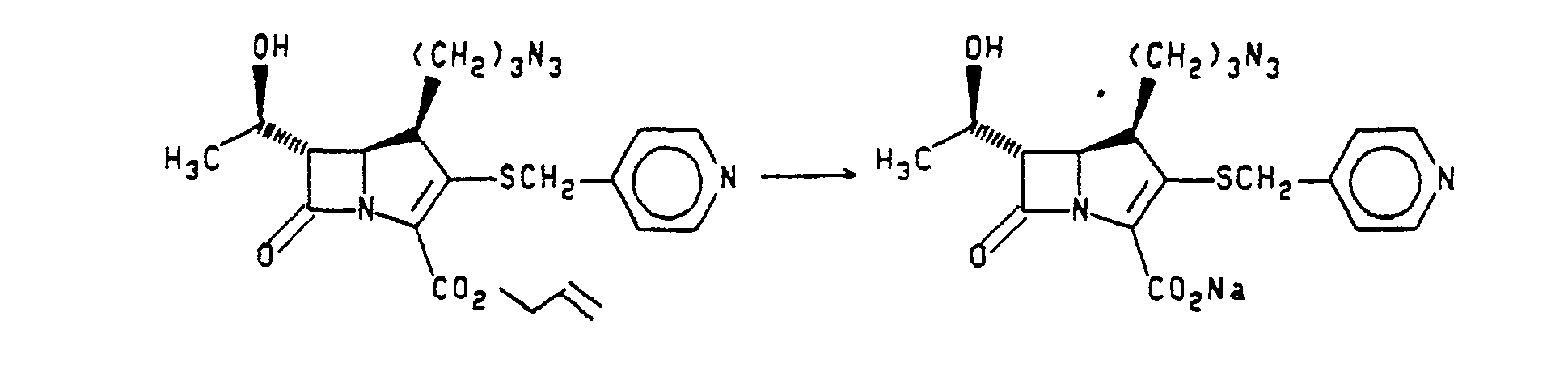
- ' H NMR (D2O, 200 MHz) s: 8.50-8.46 (2H, m aromatic -H), 7.50-7.20 (2H, m, aromatic -H), 4.28-4.15 (1H, m, H-1'), 4.19, 4.11, 4.03, 3.95 (2H, ABq, J=14.6 Hz, CH2-aromatic), 4.073 (1H, dd, J=2.7 Hz, J=9.5 Hz, H-5), 3.37-3.29 (3H, m, H-6 and CH2N), 3.16-3.06 (1H, m, H-4), 1.8-1.38 (4H, 2 sets of m, CH2CH2-4) and 1.288 ppm (3H, d, J=6.4 Hz, CH3).
-

- Purity: 97.2% (HPLC, 300 nm);
- UV (H20) λmax: 262 (e 5210), 304 (e 7950);
- IR (nujol) νmax: 3600-3100 (OH), 1760 and 1600 cm-1 (C = 0);
- 1H NMR (D20 200 MHz) δ: 8.49-8.46 (2H, m, aromatic -H), 7.52-7.24 (2H, m, aromatic -H), 4.28-4.16 (1 H, m H-1'), 4.16, 4.08, 4.02, 3.94 (2H, ABq, J=14.6 Hz, CH2-aromatic), 4.076 (1 H, dd, J = 2.7 Hz, J = 6.5 Hz, H-6), 3.20-3.10 (1H m, H-4), 3.00-2.93 (2H, m, CH2N), 1.80-1.38 (4H, m, CH2CH2-4) and 1.292 ppm (3H, d, J=6.4 Hz, CH3).
-

-

- IR (NaCL, film) νmax: 2100 (N3 ) and 1800 cm-1 (C=0);
- 1 H NMR (200 MHz, CDCI3) δ: 1.3-1.9 (m, 6H, CH2-3,4 and 5), 2.9 (t, J =7 Hz, 2H, CH2-2) and 3.3 ppm (t, J = 6.5 Hz, 2H, CH2-6).
-

- A solution of 2-picolyl mercaptan (130.6 g, 1.04 mol) in dry CH2C12 (1.3 L) was cooled to 0-5° C, treated with pyridine (85 mL, 1.05 mol) and a solution of 6-azidohexanoyl chloride (179 g, 1.02 mol) in CH2C12(200 mL) added dropwise over 1 h. After another hour at 0-5°C, the organic phase was washed with water, saturated NaHCO3, brine and dried ( MgSO4). Evaporation of the solvent gave 244 g (90%) of the thioester as a clear oil which was used as such for the next step:
- IR (NaCl, film) vmax: 2100 (N3) and 1680 cm-1 (C=0 of thioester);
- 'H NMR (200 MHz, CDCIs) s: 1.3-1.8 (m, 6H, CH2-3,4, and 5), 2.6 (t, J=7.34 Hz, 2H, CH2-2), 3.25 (t, J = 6.7 Hz, 2H, CH2-6), 4.25 (s, 2H, SCH2), 7.16 (m, 1 H, H-5 of pyridine), 7.33 (d, J=7.8 Hz, 1 H, H-3 of pyridine), 7.62 (m, 1 H, H-4 of pyridine) and 8.53 ppm (m, 1 H, H-6 of pyridine).
-

- IR (NaCl, film) vmax: 2090 (N3), 1625 and 1590 cm-1;
- ' H NMR (200 MHz, CDCl3) δ: 0.2 and 0.24 (2 x s, 6H, SiCH3), 0.97 and 0.98 (2 x s, 9H, Si t-Bu), 1.2-1.8 (m, 4H, CH2-4 and 5), 2.0 (m, 2H, CH2-CH=C), 3.17 (m, 2H, CH2N3), 3.95 and 4.03 (2 x s, 2H, SCH2), 4.82 and 4.97 (2 x t, 1 H, J = 7.26 Hz, and J=7.58 Hz, 2 x 1 H, CH2-CH = C), 7.14 (m, 1 H, H-5 of pyridine), 7.26 (m, 1 H, H-3 of pyridine), 7.6 (m, 1 H, H-4 of pyridine) and 8.55 ppm (m, 1 H, H-6 of pyridine).
-

- UV (EtOH) λmax: 236 (5576) and 264 nm (4,989);
- IR (KBr) νmax: 2100 (N3), 1758 (C=O of β-lacta), 1718 (C=O of ester) and 1680 cm-' (C=O of thioester);
- 'H NMR (200 MHz, CDCI3), 5: 0.04 (s, 6H, SiCH3), 0.85 (s, 9H, Sit-Bu), 0.99 (d, J=6.32 Hz, 3H, CH3CHO), 1.2-2.0 (m, 6H, CH2-2,3 and 4 of pentyl) 2.79 (m, 1 H, H-1 of pentyl), 3.04 (broad s, 1 H, H-3 of azetidinone), 3.23 (t, J=6.56 Hz, 2H, CH2N3), 3.80 (dd, JH3.H4= 2.08 Hz, JH3,H1 =6.97 Hz, 1 H, H-3 of azetidinone), 4.14 (m, 1 H, CH3CHO) 4.26 (s, 2H, SCH2), 5.85 (broad s, 1 H, NH), 7.18 (m, 1 H, H-5 of pyridine), 7.32 (d, J = 7.8 Hz, 1 H, H-3 of pyridine), 7.62 (m, 1 H, H-4 of pyridine) and 8.5 ppm (m, 1 H, H-6 of pyridine).
- Anal. Calcd. for C23H37N5O3SSi: C, 56.18; H, 7.58; N, 14.24. Found: C, 56.25; H, 7.59; N, 14.10.
-

- A solution of the crude (3S,4S)-3-[(1'R)-1'-tert-butyldimethylsilyloxyethyl]-4-[(1"R)-1"-(pyridin-2-yl)-methylthiocarbonyl-5"-azidopentyl]azetidin-2-one (-400 g, 0.83 mol) in 3 L of tetrahydrofuran was cooled to 0°C and treated with 30% hydrogen peroxide (1 L, 11.6 mol) added cautiously in portions, followed by 2.8 L of 1 M NaOH added dropwise over 2 h. The solution was stirred for two more hours at 0-5 C and acidified to pH 2.0 with 3N HCI (- 1 L). The reaction mixture was then extracted with EtOAc (2 L and 3 x 1 L) and the combined organic extract was washed with water, 1M NaHSO3, brine and dried ( MgSO4). Evaporation of the solvent gave a dark oil which was dissolved in hexanes (2 L) and extracted with saturated NaHC03(4 x 1 L). The combined aqueous phase was cooled to 0 - 5°C and acidified to pH 2 with 3N HCI. The white precipitate formed was collected and washed with water. The moist cake was dissolved in CH2Cl2, dried (MgSO4) and evaporated to give 114 g of the crude product. Crystallization from a mixture of ethyl acetate and hexanes gave 67.4 g (21 %) of the pure title acid as white plates; mp = 132-133 C.
- IR (KBr) νmax: 3280 (NH), 2500 (COOH), 2110 (N3), 1760 (sh), 1715 and 1690 cm-1 (C=0 of acid and β-lactam);
- ' H NMR (200 MHz, CDCl3) δ: 0.06 and 0.07 (2 x s, 2 x 3H, SiCH3), 0.87 (s, 9H, Si t-Bu), 1.17 (d, J=6.29 Hz, 3H, CH3CHO), 1.4-1.8 (m, 6H, CH2-2, 3 and 4 of pentyl), 2.64 (m, 1H, H-1 of pentyl), 3.14 (m, 1 H, H-3), 3.29 (t,
J =6.5 Hz, 2H, CH2 N3), 3.87 (dd, JH4,H3 = 1.90 Hz, JH4,H1 = 6.22 Hz, 1 H, H-4), 4.20 (dq, JH,CH3=6.29 Hz, JH,H3=4.04 Hz, 1H, CH3CHO), and 6.46 ppm (s, 1H, NH). - Anal. Calcd. for C17H32N4O4S: C, 53.10; H, 8.39; N, 14.57. Found: C, 53.08; H, 8.12; N, 14.56.
-

- A suspension of (3S,4S)-3-[(1'R)-1'-tert-butyldimethylsilyloxyethyl]-4-[(1 "R)-1 "-carboxy-5"-azidopentyl]-azetidin-2-one (67.0 g, 0.174 mol) in dry CH3CN (1.5 L) was treated at 22 C and under nitrogen with 1,1-carbonyldiimidazole (31.1 g, 0.192 mol) and the resulting mixture was stirred for 2 h. The solution was then concentrated under vacuum to give the crude imidazolide as an oil: IR ,(NaCl, film) 2100 (N3), 1755 (C = 0 of β-lactam) and 1730 cm-' (C = O of imidazolide).
- The crude imidazolide in dry CH3CN (200 mL) was then added to a solution of dried magnesium monoallyl malonate (87.0 g, 0.28 mol) in benzene (1.4 L), and the resulting mixture was stirred at 60-65° C for 16 h. The cooled reaction mixture was then diluted with ethyl acetate (1 L), washed successively with cold water. 0.1 N HCI, saturated NaHC03, water and brine. After drying ( MgSO4), evaporation of the solvent gave 80.3 g of the crude keto ester as an oil which was used as such for the next step. Purification of a small aliquot on silica gel gave the pure title compound as a clear oil. By 1H NMR this product is a 1:1 mixture of keto and enol form:
- IR (NaCl, film) νmax: 2100 (N3), 1760 (C=0 of β-lactam) and 1715 cm-';
- ' H NMR (200 MHz, CDCI3) δ: 0.05 and 0.06 (2 x s, 6H, SiCH3), 0.86 (s, 9H, Si t-Bu), 1.10 and 1.17 (2d, J=6.33 Hz, and J=6.28 Hz, 3H, CH3CHO), 1.2-1.8 (m, 6H, CH2-1.2 and 3 of butyl), 2.1-2.3 (m, 1H, H-1 of butyl), 1.2-2.3 (m, 6H, CH2-1,2 and 3 of butyl), 2.9 and 2.97 (2 x m. 1 H, H-3 of azetidinone), 3.27 (broad t, 2H, CH2N3). 3.54 (s, CH2-3 of oxopropyl, keto form), 3.83 (two overlapping dd, 1H, H-4 of azetidinone), 4.17 (m, 1 H, CH2CHO), 4.64 (m, 2H, CH2 of allyl), 5.07 (s, CH-3 of oxopropyl, enol form), 5.2-5.4 and 5.8-6.0 (2 x m, 2H and 1 H, CH of allyl) and 6.0 ppm (broad s, 1 H, NH).
-

- A solution of crude (3S,4R)-4-[(1"R)-1"-(4-azidobutyl)-3"-allyloxycarbonyl-2"-oxopropyl]-3-[(1'R)-1'-tert-butyldimethylsilyloxyethyl]azetidin-2-one (79 g, 0.169 mol) in acetonitrile (400 mL) was cooled to 0-5° C and treated with a solution of p-toluenesulfonyl azide (40 g, 0.20 mol) in acetonitrile (500 mL). Then triethylamine (28.3 mL, 0.20 mmol) was added dropwise (5 min) and the resulting mixture was stirred for 2 h. The solvent was then concentrated under vacuum and the residue was triturated with a mixture of diethyl ether and hexanes (1:1). The crystalline p-toluenesulfonamide was collected by filtration and the filtrate was evaporated to give the title diazo compound as an oil (86 g). This material can be used as such for the cleavage of the silyl ether.
- Purification of part of the crude (30 g) on silica gel (9 × 13 cm, elution hexanes-EtOAc, 9:1 to 7:3) gave 17.5 g (correspond to a 59% yield from the acid, two steps) of the title diazo azetidinone as a clear oil:
- IR (NaCl, film) νmax: 2140 (N2), 2100 (N3 ), 1760 (C=O of β-lactam), 1720 (C=O of ester) and 1650 cm-1;
- 'H NMR (200 MHz, CDCI3) s: 0.05 and 0.06 (2 x s, 2 x 3H, Si CH3), 0.86 (s, 9H, t-Bu), 1.17 (d, J=6.31 Hz, 3H, CH3CHO), 3.04 (m, 1H, H-3 of azetidinone), 3.25 (m, 2H, CH2N3), 3.84 (dd, JH4,H3= 2.09 Hz, JH4,H1 = 5.33 Hz, 1 H, H-4 of azetidinone), 4.07 (m, 1 H, H-1 of oxopropyl), 4.17 (dq, JH,CH3 = 6.31 Hz, JH,H3 = 3.94 Hz, 1 H, CH3CHO), 4.72 (m, 2H, CH2 of allyl), 5.3-5.4 and 5.9-6.1 (2 x m, 2H and 1 H, CH of allyl), and 5.84 ppm (s, 1 H, NH).
-

- UV (EtOH) λmax: 260 nm (8,365);
- IR (KBr) vmax: 3350 (OH), 2160 (N2), 2080 (N3), 1738 (C=O of β-lactam), 1716 (C=O of ester) and 1650 cm-1;
- 'H NMR (200 MHz, CDCl3) δ: 1.30 (d, J=6.33 Hz, 3H, CH3CHO), 1.3-2.0 (m, 6H, CH2-1,2 and 3 of butyl), 2.28 (d, J = 3.8 Hz, 1 H, OH), 3.0 (dd, JH3.H4 = 2.0 Hz, JH3,Ht = 6.97 Hz, 1 H, H-3 of azetidinone), 3.27 (t, J=6.58 Hz, 2H, CH2N3), 3.8 (dd, JH4,H3 = 2.0 Hz, JH4,H1 = 6.55 Hz, 1 H, H-4), 3.95 (m, 1 H, H-1 of oxopropyl), 4.15 (m, 1 H, CH3CHO), 4.73 (m, 2H, CH2 of allyl), 5.3-5.4 and 5.9-6.1 (2 x m, 2H and 1 H, CH of allyl) and 6.0 ppm (broad s, 1H, NH).
- Anal. Calcd. for C16H22N6O5: C, 50.79; H, 5.86; N, 22.21. Found: C, 50.87; H, 5.87; N, 22.31.
-

- A solution of (3S,4R)-4-[(1"R)-1"-(4-azidobutyl)-3"-allyloxycarbonyl-3"-diazo-2"-oxopropyl]-3-[(1'R)-1'-hydroxyethyl]azetidin-2-one (1.88 g, 4.97 mmol) in dry benzene (60 mL) was treated under nitrogen with rhodium (II) octanoate dimer (0.050 9) and heated under reflux (bath temperature 90°C) for 20 min. The solvent was then evaporated under vacuum to give the title bicyclic ketone as an oil:
- IR (NaCl, film) νmax: 2100 (N3), 1762 (C = 0 of β-lactam) and 1745 cm-';
- 'H NMR (200 MHz, CDCI3) δ: 1.41 (d, J=6.26 Hz, 3H, CH2CHO), 1.4-2.0 (m, 6H, CH2-1,2 and 3 of butyl), 2.7 (m, 1H, H-4), 3.2-3.4 (m, 3H, H-6 and CH2N3 overlapping), 4.28 (dd, JH5,H6= 2.37 Hz, JH5,H4= 8.15 Hz, 1 H, H-5), 4.3 (m. overlapping with H-5, 1 H, CH3CHO), 4.65 (s, 1 H, H-2), 4.66 (m, 2H, CH2 of allyl), 5.2-5.4 and 5.8-6.0 ppm (2 x m, 2 and 1 H, CH of allyl).
-

- IR (NaCl, film) νmax: 2100 (N3), 1770 (C = 0 of β-lactam) and 1705 m-' (C = 0 of ester);
- 'H NMR (200 MHz, CDC13) δ: 1.38 (d, J=6.26 Hz, 3H, CH3CHO), 1.3-2.0 (m, 6H, CH2-1,2 and 3 of butyl), 3.1 (m, 1 H, H-4), 3.16 (dd, JH6,H5 = 2.72 Hz, JH6.Nl = 7.33 Hz, 1 H, H-6), 3.32 (t, J = 6.0 Hz, 2H, CH2N3), 4.02 (ABq, 2H, SCH2), 4.14 (dd, JH5.H6= 2.72 Hz, JH5,H4= 9.56 Hz, 1H, H-5), 4.22 (m, 1H,
CH 3CHO), 4.75 (m, 2H, CH2 of allyl), 5.2-5.5 and 5.9-6.1 (2 x m, 2H and 1 H, CH of allyl), 7.3 (m, 1 H, H-5 of pyridine), 7.7 (m, 1 H, H-4 of pyridine) and 8.5 ppm (m, 2H, H-2 and H-6 of pyridine). -
 -3.5 (c 1.0, H20);
- Purity by HPLC: 98.7% on µBondapak C18, 3.9 mm x 30 cm, elution 5% CH3CN-H2O , pH 7.4 phosphate buffer, flow rate 1 mUmin, UV detector 300 nm, retention time 9.6 min;
- UV (H20, pH 7.4 phosphate buffer) xmax: 268 (5740) and 306 nm (8810);
- IR (KBr) νmax: 1755 (C = 0 of β-lactam) and 1585 cm-' (C = 0 of carboxylate);
- 'H NMR (200 MHz, D20) δ: 1.29 -(d, J=6.33 Hz, 3H, CH3CHO), 1.2-1.8 (m, 6H, CH2-1, 2 and 3 of butyl), 2.96 (t, J=7.6 Hz, 2H, CH2N3), 3.15 (m, 1H, H-4), 3.29 (dd, JH6,H5 = 2.54 Hz, JH6,H1 = 6.36 Hz, 1H H-6), 4.07 (ABq, JAB = 14.2 Hz,
Δν = 24.3 Hz, 2H, SCH2), 4.07 (overlapping with SCH2, 1 H, H-5), 4.22 (m, 1 H, CH3CHO), 7.44 (dd, JH5,H6= 4.95 Hz, JH5,H4=7.9 Hz, 1H, H-5 of pyridine), 7.88 (m, 1H, H-4 of pyridine), 8.43 (dd, JH6,H5 = 4.95 Hz, JH6,H4 = 1.52 Hz, 1H, H-6 of pyridine) and 8.52 ppm (d, JH2,H4 = 1.75 ppm, 1H, H-2 of pyridine). -
 -3.2° (c 0.5, H20);
- Purity by HPLC: 99% on µ-Bondapak c18, 3.9 mm x 30 cm, elution 10% CH3CN-H20 pH 7.4 phosphate buffer, flow rate 2 mL/min, UV detector 300 nm, retention time 6.44 min.
- UV (H20, pH 7.4 phosphate buffer) λmax: 266 (6,300) and 304 nm (9,600);
- IR (KBr) νmax: 1755 (C=O of β-lactam), 1715 and 1590 cm-' (C=O of carboxylate);
- 1H NMR (200 MHz, D20) δ: 1.28 (d, J=6.34 Hz, 3H, CH3CHO), 1.2-1.8 (m, 6H, CH2-1, 2 and 3 of butyl), 3.2 (m, 3H, H-6 and CH2NH2), 4.07 (overlapping with SCHz, 1H, H-5), 4.07 (ABq, JAB=14.3 Hz, Δν=23.5 Hz, 2H, SCH2), 4.22 (m, 1H, CH3CHO), 7.44 (m, 1 H, H-5 of pyridine), 7.79 (s, 1 H CH = NH), 7.89 (m, 1 H, H-4 of pyridine), 8.43 (m, 1 H H-6 of pyridine) and 8.52 ppm (m, 1 H, H-2 of pyridine).
-

-

- A solution of allyl (4R,5R,6S)-4-(2"-azidoethyl)-6-[(1'R)-1'-tert-butyldimethylsilyloxyethyl]-3,7-dioxo-1-azabicyclo[3.2.0]heptane-2-carboxylate (6.46 mmol, prepared by cyclization of 3.0 g, 6.46 mmol of the diazo precursor prepared in Example 2, Step E) in dry acetonitrile (50 mL) was treated at -15° C and under Argon with diphenyl chlorophosphate (1.4 mL, 6.75 mmol) and N,N-diisopropylethylamine (1.2 mL, 6.9 mmol) added simultaneously over 5 min. A small crystal of 4-N,N-dimethylaminopyridine was then added and the temperature of the mixture was slowly warmed to 0-5° C over 30 min. N,N-Diisopropylethylamine (1.2 mL, 6.9 mmol) and 4-mercaptobutyronitrile (1.31 g, 13.0 mmol) [obtained from basic hydrolysis of an aqueous tetrahydrofuran solution of 4-acetylmercaptobutyronitrile (U.S. 3,223,585)] were added and the mixture was stirred at 0-5 C for 4 h and overnight at -15° C. The reaction mixture was then diluted with EtOAc (300 mL), washed with water, 1 M NaHS03, saturated NaHCO3, brine and dried ( MgSO4). Evaporation of the solvent gave an oil which was chromatographed on silica gel (5 x 15 cm). Elution with a mixture of EtOAc and toluene (1:9) gave 2.62 g (78%) of the title compound as a brown oil:
- IR (NaCl, film) νmax: 2250 (CN), 2100 (N3), 1775 (C=O of β-lactam) and 1710 cm-1 (C=0 of ester).
- 'H NMR (200 MHz, CDCl3) δ: 0.10 (s, 6H, SiCH3), 0.90 (s, 9H, Si-t-Bu) 1.31 (d, 3H, J=6.11 Hz, CH3CHO), 1.7-2.12 (m, 4H, CH2-4 and CH2CH2-CN), 2.4-3.12 (m, SH, CH2-S, CH2CN and H-6), 3.32-3.7 (m, 3H, CH2N3 and H-4), 4.16 (dd, J4-5=9.6 Hz, J5-6=2.70 Hz, 1 H, H-4), 4.21 (dd, J6-8=7.47 Hz, J8-9=6.2 Hz, CH3CHO), 4.75 (m, 2H, CH2 of allyl), 5.20-6.50 and 5.96 (2 x m, 2H and 1 H, CH of allyl).
-

- A solution of allyl (4R,5S,6S)-4-(2"-azidoethyl)-6-[(1'R)-1'-tert-butyldimethylsilyloxyethyl]-3-[(3-cyanopropyl)thio]-7-oxo-1-azabicyclo[3.2.0]hept-2-ene-2-carboxylate (2.48 g, 4.77 mmol) in dry tetrahydrofuran (75 mL) was treated at 0-5° C and under. Argon with acetic acid (1.64 ml, 28.6 mmol) followed by 14.9 mL (14.8 mmol) of 1 M solution of tetrabutylammonium fluoride in tetrahydrofuran. The solution was stored at 5°C for 4 1/2 days. The reaction mixture was then diluted with EtOAc, washed with saturated NaHCO3, brine and dried ( MgSO4). Evaporation of the solvent gave an oil which was chromatographed on silica gel (5 x 15 cm). Elution with a mixture of toluene and EtOAc (9:11) gave 0.91 g (37%, yield from the diazoazetidinone) of the title compound as a yellow oil:
- IR (NaCI, film) vmax: 3500 (OH), 2250 (CN), 2100 (N3), 1775 (C = O of β-lactam) and 1705 cm-1 (C = O of carboxylate;
- 'H NMR (200 MHz, CDCIa) δ: 1.40 (d, 3H, J=6.21 Hz, CH3CHO), 1.6-2.15 (m, 4H, CH2CH2CN and CH2-4), 2.55 (m, 2H, CH2CN), 2.85-3.09 (m, 2H, SCH2), 3.18 (dd. 1H, J6-8=7.84 Hz, J5.6=2.66 Hz, H-6), 3.37-3.67 (m, 3H, H-4 and CH2N3), 4.26 (m, overlapping with H-5, 1H CH3CHO), 4.26 (dd, J4,5=9.70 Hz, J5. 6 = 2.61 Hz, 1 H, H-5), 4.78 (m, 2H, CH2 of allyl), 5.24-5.30 and 5.96 (2 x m, 2H and 1 H, CH of allyl).
-

- IR (NaCl, film) νmax: 2250 (CN), 2105 (N3), 1750 (C=O of β-lactam) and 1600 (C=O of carboxylate);
- 'H NMR (200 MHz, D20) δ: 1.31 (d, J=6.40 Hz, 3H, CH3CHO), 1.71-2.01 (m, 4H, CH2CH2CN and CH2-4), 2.73 and 2.74 (2t, J=6.94 and J = 7.04, 2H, CH2CN), 2.80-3.19 (m, 2H, SCH2), 3.35-3.67 (m, 4H, CH2N3, H-4 and H-6), 4.29-4.42 (m, 2H, H-5 and CH3CHO).
-
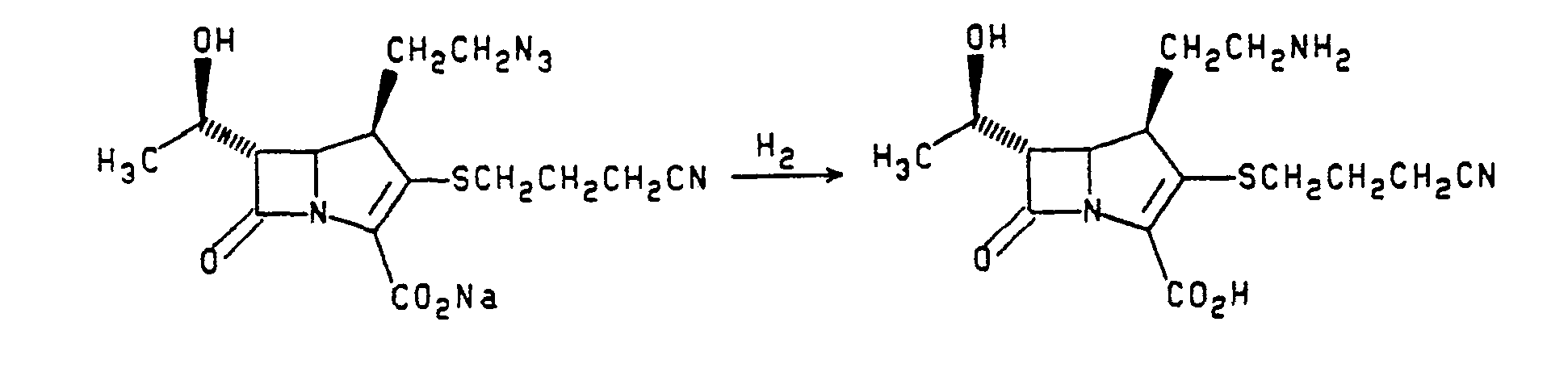
- A solution of sodium (4R,5S,6S)-4-(2"-azidoethyl)-3-[(3-cyanopropyl)thio]-6-[(1'R)-1'-hydroxyethyl]-7-oxo-1-azabicyclo[3.2.0]hept-2-ene-2-carboxylate (250 mg, 0.64 mmol) in water was hydrogenated at 0-5 C over 250 mg of 5% palladium on alumina and under 45 psi of hydrogen for 1 h. The catalyst was filtered and the filtrate was chromatographed on reversed phase silica gel (Bondapak c-18, 7 x 10.5 cm) using water as eluent. Lyophilization of the UV active fractions gave 18 mg (8%) of the title compound slightly contaminated with sodium 2-ethylhexanoate as a light yellow amorphous powder and 129 mg (59%) of the pure title compound as an off-white amorphous powder:
- Purity by HPLC: 97% µ-Bondapak c-18, 3.9 mm x 30 cm, elution 2% CH3CN/H2O pH 7.4 phosphate buffer, flow rate 1 mUmin, uv detector 302 nm, retention time 5.24 min;
- UV (H20 pH7.4 phosphate buffer) λmax: 302 nm (5982);
- IR (KBr) vmax: 2250 (CN), 1760 (C = O of β-lactam) and 1590 cm-1 (C = O of carboxylate);
- 'H NMR (200 MHz, D20) δ: 1.33 (d, J=6.35 Hz, 3H, CH3CHO), 1.75-2.30 (m, 4H, CH2CH2CN and CH2-4), 2.63 (t, J=7.07 Hz, 2H, CH2CN), 2.69-3.19 (m, 4H, SCH2 and CH2NH2), 3.41 (m, overlapping with H-6, 1H, H-4), 3.44 (dd, J1-6=6.6 Hz, J5-6=2.85 Hz, H-6), 4.21-4.33 (m, 2H, H-5 and CH3CHO).
-
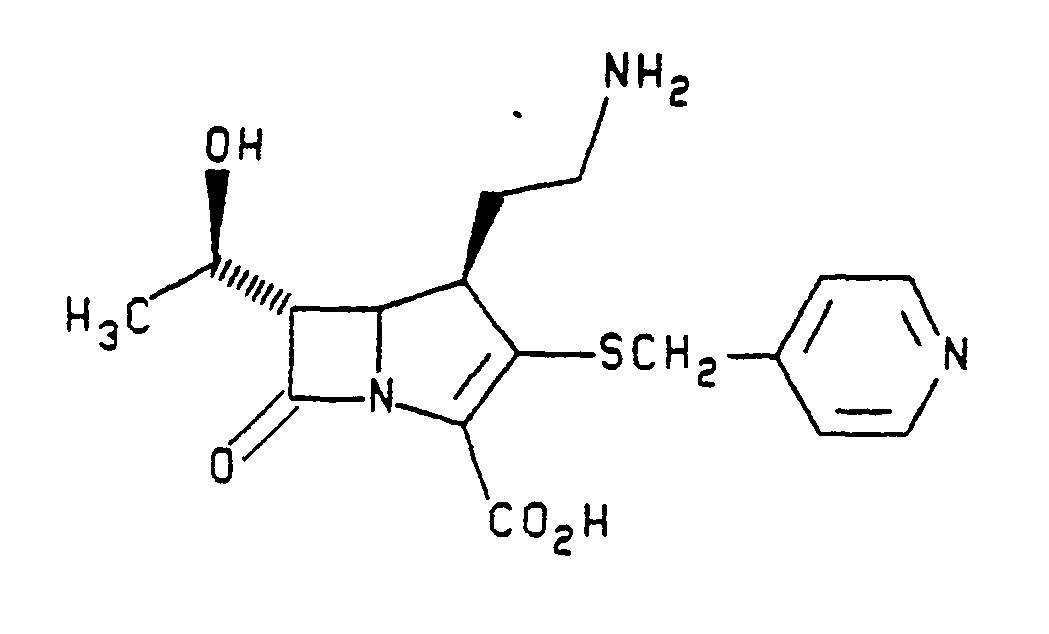
-

- A cold (0°C) solution of allyl (4R,5R,6S)-6-[(1'R)-1'-(tert-butyldimethylsilyloxyethyl)]-4-(2"-azidoethyl)-3,7-dioxo-1-azabicyclo[3.2.0]heptane-2-carboxylate (4.7 g, 10.76 mmol) prepared as in Example 2 in CH3CN (50 mL) was treated with diphenyl chlorophosphate (2.45 mL, 11.84 mmol) followed by N,N-diisopropylethylamine (2.06 mL, 11.84 mmol) and 4-N,N-dimethylaminopyridine (10 mg). The mixture was stirred at 0 for 2 h, under Argon, after which Argon was bubbled through the solution for 10 min. The enol-phosphate was then treated with 4-picolyl mercaptan (2.02 g, 16.15 mmol) in CH3CN (10 mL) followed by N,N-diisopropylethylamine (2.81 mL, 16.15 mmol) and stirred at 0°C for 3 hours. The reaction mixture was diluted with EtOAc (350 mL) and washed successively with cold 1 M NaHS03, 1 M NaHCO3and brine. The organic phase was dried ( MgSO4) and solvent evaporated to a syrup which was chromatographed on silica (7.5 x 11 cm) packed in CH2Cl2 and eluted with a mixture of CH2Cl2 and EtOAc (8:2 gradient elution) to give the title compound as a syrup (2.28 g, 39%).
- 'H NMR (200 MHz, CDCl3 7.24) δ: 0.04 (s, 3H, SiCH3), 0.06 (s, 3H, SiCH3), 0.86 (s, 9H, SiC(CH3)3), 1.27 (d, CH3, JCH3.1=6.12 Hz), 1.63-1.76 (m, 1 H, CH2), 1.93-2.05 (m, 1 H, CH2), 3.02 (dd, H-6, J5,6 = 2.68 Hz, J6,1 =7.91 Hz), 3.18-3.67 (overlapping, 3H, H-4, CH2N3), 3.9-4.17 (overlapping, 4H, CHOH, H-5, SCH2), 4.6-4.85 (m, OCH2, allyl), 5.2-5.47 (m, =CH2, allyl), 5.84-6.03 (m, CH = , allyl), 7.29 (A of A2B2, H-3,5 py, J2,3 =5.98 Hz), 8.56 (B of A2B2, H-2,6 py).
-

- A cold (0°C) solution of allyl (4R,5S,6S)-6-[(1'R)-1'-tert-butyldimethylsilyloxyethyl]-4-(2"-azidoethyl)-3-[-(pyridin-4-yl)methylthio]-7-oxo-1-azabicyclo[3.2.0]hept-2-ene-2-carboxylate (2.26 g, 4.16 mmol) in dry THF (35 mL) was treated, under Argon, with acetic acid (1.43 mL, 24.94 mmol) followed by a 1 M solution of tetrabutylammonium floride in THF (12.47 mL, 12.47 mmol). The mixture was stirred between 0 and 5°C for 120 h and then neutralized at 0°C with a 1M NaHCO3solution (25 mL, 25 mmol). The mixture was extracted with EtOAc (3 x 75 mL) and the combined organic phase was washed successively with a cold 1M NaHCO3solution, H20 and brine, dried ( MgSO4) and solvent evaporated to give a sticky foam which was chromatographed on silica (4.5 x 11) packed in CH2Cl2and eluted first with a mixture of CH2Cl2 and EtOAc (50 to 100% EtOAc) and then with a mixture of CH3CN and EtOAc (1:1 gradient elution) to give the title compound as a foam (1.23 g, 69%).
- 'H NMR (200 MHz, CDCl3 7.24) δ: 1.36 (d, CH3, JCH3.1 =6.23 Hz), 1.64-1.79 (m, 1H, CH2), 1.94-2.09 (m, 1H, CH2), 3.09 (dd, H-6, J5.6=2.78 Hz, J6,1,=8.08 Hz), 3.19-3.65 (overlapping, 3H, H-4, CH2N3), 3.88-4.23 (overlapping, 4H, CHOH, H-5,-SCH2), 4.61-4.88 (m, OCH2, allyl), 5.21-5.47 (m, =CH2' allyl), 5.85-6.04 (m, CHO, allyl), 7.28 (A of A2B2, 2H, H-3,5, py, J2,3 =6.01 Hz), 8.56 (B of A2B2, 2H, H-2,6; py).
-

- To a cold (0°C) solution of allyl (4R,5S,6S)-6-[(1'R)-1'-hydroxyethyl]-4-(2"-azidoethyl)-3-[(pyridin-4-yl)-methylthio]-7-oxo-1-azabicyclo[3.2.0]hept-2-ene-2-carboxylate (1.23 g, 2.86 mmol) in CH2C12(25 mL), under Argon, was added Pd[Ph3P]4 (0.3 g, 0.26 mmol) followed by a 0.5M solution of sodium 2-ethylhexanoate in EtOAc (5.73 mL, 2.86 mmol). The mixture was stirred at 0 C for 1 h and then extracted with water (3 x 25 mL). The combined aqueous phase was passed through a column of µ-Bondapak C-18 reverse phase silica (4.5 x 11 cm). The title compound was eluted with a mixture of water and CH3CN (9:1, gradient elution) and was obtained as a fluffy solid after lyophilization (0.69 g, 58.5%).
- 'H NMR (200 MHz, D2O)δ: 1.29 (d, CH3, JCH3,1 = 6.37 Hz), 1.6-1.78 (m 1 H, CH2), 1.93-2.09 (m, 1 H, CH2), 3.14-3.58 (overlapping, 3H, H-4, CH2N3), 3.4 (dd, H-6, J5,6=2.64 Hz, J6,1=6.22 Hz), 3.96-4.28 (overlapping, 4H, CHOH, H-5, SCH2), 7.5 (A of A2B2, H-3,5, py, J2,3 =5.35 Hz), 8.49 (br s, B of A2B2, H-2,6, py).
-

- A solution of sodium (4R,5S,6S)-6-[(1'R)-1'-hydroxyethyl]-4-(2"-azidoethyl)-3-[(pyridin-4-yl)methylthio]-7-oxo--1-azabicyclo[3.2.0]hept-2-ene-2-carboxylate (0.16 g, 0.39 mmol) in 40 mL of a 0.05M pH 7 phosphate buffer was hydrogenated at 45 psi over 5% Pd on alumina (0.32 g) at 0°C for 1 h. After removing the catalyst, the filtrate was passed through a column of µ-Bondapak C-18 reverse phase silica (4.5 x 11 cm). The title compound was eluted with a mixture of water and CH3CN (95:5, gradient elution) and was obtained as a fluffy solid after lyophilization (0.044 g, 31.4%).
- Purity by HPLC: 95.9%; UV detection at 302 nm on µ-Bondapak C-18 (4 mm x 30 cm), 10% CH3CN in pH 7.4 phosphate buffer, flow rate 1 mL'min, retention time 7.24 min.
- IR (nujol) νmax: 1750 cm-1 (C=O, β-lactam).
- 'H NMR (D20, 200 MHz) δ: 1.31 (d, CH3, JCH3,1 = 6.35 Hz), 1.65-1.85 (m, 1H, CH2), 2.04-2.22 (m, 1H, CH2), 3.04 (t, 2H, CH2NH2), 3.19 (dt, H-4, J4,5 =10.05, J = 3.44 Hz), 3.4 (dd, H-6, J5,6 = 2.8 Hz, J6,1 = 6.52 Hz), 3.99, 4.13 (AB, SCH2, Jgem=14.39 Hz), 4.11 (dd, H-5), 4.24 (m, H-1'), 7.46 (A of A2B2, H-3,5, py, J2,3=6.1 Hz), 8.49 (B of A2B2, H-2-6, py).
-

-

- IR (neat) νmax: 2250 (C = N), 1775 and 1710 cm-1 (C = O);
- 'H NMR (CDCI3, 200 MHz) 5: 6.05-5.85 (1H, m, vinylic H), 5.49-5.21 (2H, m, vinylic H), 4.9-4.55 (2H, m, allylic CH2), 4.27-4.18 (2H, m, H-1' and H-5), 4.195 (part of H-5, d, J=2.6 Hz), 3.89-3.75 (1H. m, HCH-OSi), 3.60-3.45 (2H, m, H-4 and HCH-OSi), 3.35-3.22, 3.12-2.93 (2H, 2 sets of m, SCH2), 3.102 (1 H, dd, J = 2.5 Hz, J=6.3 Hz, H-6), 2.70-2.60 (2H, m, CH2-CN 2.04-1.90, 1.80-1.60 (2H, 2 sets of m, CH2-4), 1.267 (3H, D, J=6.1 Hz, CH3), 0.907 and 0.887 (18H, 2s, tert-butyl), 0.084 and 0.074 ppm (12 H, 2s, dimethyl).
-

- IR (Neat) νmax: 3600-3200 (OH), 2250 (C = N), 1770 and 1710 cm-' (C = 0);
- 'N NMR (CDCI3, 200 MHz) 5: 6.03-5.86 (1H, m, vinylic -H), 5.50-5.22 (2H, m, vinylic H), 4.80-4.66 (2H, m, allylic CH2), 4.222 (1 H, dd, J = 2.7 Hz, J = 9.8 Hz, H-5), 4.25-4.19 (1 H, m, H-1'), 3.95-3.82, 3.75-3.65 (2H, 2 sets of m, CH20), 3.59-3.48 (1H, m, H-4), 3.31-3.16, 3.09-2.94 (2H, 2 sets of m, S-CH2), 3.184 (1H, dd, J = 2.6 Hz, J = 6.9 Hz, H-6), 2.74-2.66 (2H,- m, CH2-CN), 2.15-1.95, 1.90-1.70 (2H, 2 sets of m, CH2-4), 1.56 (1H, s, OH), 1.290 (3H, 4, J=6.2 Hz, CH3), 0.891 (9H, s, tert-butyl) and 0.090 ppm (6H, s dimethyl).
-

- IR (neat) νmax: 1775 and 1710 cm-' (C = 0);
- ' H NMR (CDCl3, 200 MHz) 5: 6.04-5.84 (1 H, m, vinylic-H), 4.85-4.62 (2H, m, allylic-CH2), 4.192 (1 H, dd, J = 2.2 Hz, J =11.8 Hz, H-5), 4.29, 4.26, 4.20 (1 H, m, part of H-1'), 3.70 (4H, bs, CH2OCH2), 3.35-3.16 (3H, m, H-4, H-6, HCHS), 3.03-2.89 (1H, m, HCHS), 2.72-2.55 (2H, m, CH2CN), 2.52-2.22 (6H, m, (CH2)3N), 1.98-1.86 (1H, m, CH-4), 1.69-1.48 (1 H, m, CH-4), 1.279 (3H, d, J = 6.1 Hz, CH3), 0.877 (9H, s, tert-butyl) and 0.076 (6H, s, dimethyl).
-

- IR (nujol) νmax: 3600-3200 (OH), 1770 and 1710 cm-1 (C = 0);
- 'H NMR(CDCI3, 200 MHz) 6: 6.04-5.87 (1H, m, vinylic H), 5.49-5.24 (2H, m, vinylic H), 4.88-4.64 (2H, m, allylic CH2), 4.276 (1H, dd, J=2.8 Hz, J = 9.8 Hz, H-5), 4.3-4.1 (1H, m, H-1'), 3.76-3.7 (4H, bm, CH20CH2), 3.45-3.31 (1 H, m, H-4), 3.269 (1 H, dd, J = 2.9 Hz, J = 8.0 Hz, H-6), 3.25-3.16, 3.03-2.90 (2H, 2 sets of m, SCH2), 2.72-2.35 (8H, CH2CN, (CH2)3N), 2.1-1.9 and 1.8-1.6 (2H, 2 sets of m, CH2) and 1.388 ppm (3H, d, J=6.2 Hz, CH3).
-
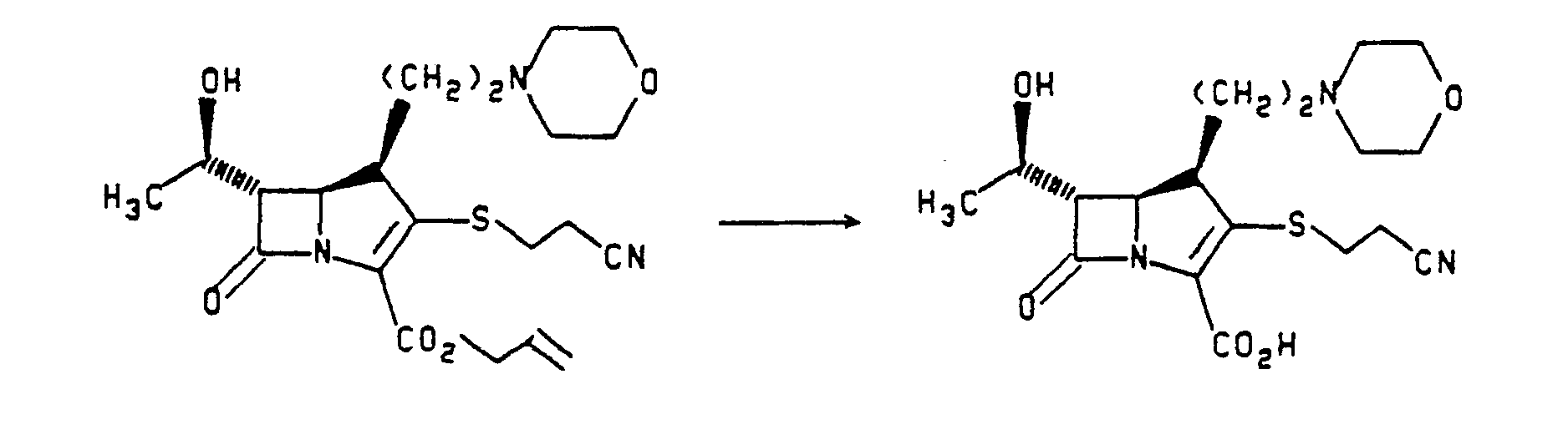
- Purity by HPLC: 99.7% (300 nm);
- UV (H2O)λmax: 300 (7900);
- IR (Nujol) 'max: 1750 and 1600 cm-' (C=0);
- 'H NMR (D20, 200 MHz) δ: 4271 (1H, dd, J=2.7 Hz, J=6.8 Hz, H-5), 4.4-4.22 (1H, m, H-1'), 3.84-3.80 (4H, m, CH20CH2), 3.424 (1H, dd, J=2.7 Hz, J=6.3 Hz, H-6), 3.43-3.33 (1H, m, H-4), 3.21-3.08, 3.01-2.90 (2H, 2 sets of m, SCH2), 2.90-2.6 (8H, m, CH2CN, (CH2)3N) , 2.2-2.0, 1.90-1.70 (2H, 2 sets of m, CH2) and 1.336 (3H, d, J = 6.3 Hz, CH3).
-

-

- A cold solution (ice-MeOH bath) of allyl (2R 4R 5R,6S)-4-(3"-azidopropyl)-6-[(1'R)-1'-hydroxyethyl]-3,7-dioxo-1-azabicyclo[3.2.0]heptan-2-carboxylate, prepared from (3S,4R)-3-[(1'R)-1'-hydroxyethyl]-4-[(1"R)-1 "-(3-azidopropyl)-3"-diazo-3"-allyloxycarbonyl-2"-oxopropyl]azetidin-2-one (2.00 9, 5.49 mmol), as prepared in Example 21, in CH3CN (40 mL) was treated dropwise with diphenyl chlorophosphate (1.2 mL, 6.0 mmol) and N,N-diisopropylethylamine (1.03 mL, 6.00 mmol) and a trace of 4-N,N-dimethylaminopyridine. The mixture was stirred for 30 min and the resulting enolphosphate was treated dropwise with cyanopropyl mercaptan (693 mg, 6.86 mmol) and N,N-diisopropylethylamine (1.19 mL, 6.90 mmol). The mixture was stirred for 1 h, then the ice-MeOH bath was replaced by an ice bath and stirring was pursued for 2 more hours. Then more cyanopropyl mercaptan (280 mg, 2.74 mmol) and N,N-diisopropylethylamine (0.480 mL, 2.74 mmol) were added then followed by a stirring period of 18 h at 5° C (cold room). More thiol (280 mg, 2.74 mmol) and N,N-diisopropylethylamine (0.480 mL, 2.74 mmol) were added and stirring was continued for 3 h after which, the mixture was diluted with ethyl acetate (100 mL), washed with cold 1 M aqueous NaHS03(2 x 40 mL), water (40 mL), 1 N aqueous HCI (40 mL), water (40 mL), 1 M aqueous NaHC03(40 mL), water (40 mL), brine (40 mL) and dried ( MgSOa). The residue was passed through a silica gel flash column (75 g, EtOAc Hexane:1/3 → EtOAc) to give the title compound (1.33 g, 59%) as an oil;
- IR ( CH2CI2) vmax: 3600-3500 (OH), 2250 (CN), 2100 (N3), 1780 and 1710 0 cm"' (C=0);
- 'H NMR (CDCl3, 200 MHz) δ: 6.04-5.87 (1H, m, vinylic-H), 5.50-5.23 (2H, m, vinylic-H), 4.89-4.63 (2H, m, allylic CH2), 4.29-4.20 (1H, m, H-1'), 4.248 (1H, dd, J=2.7 Hz, J=9.5 Hz, H-5), 3.50-3.35 (2H, m, CH2N3), 3.267 (1H, dd, J=2.7 Hz, J=7.6 Hz, H-6), 3.30-3.20 (1H, m, H-4), 3.05-2.85 (2H, m, SCH2), 2.59-2.51 (2H, m, CH2CN ), 2.06-1.93 (2H, CH2CH2CH2CN ), 1.93-1.57 (4H, CH2-CH2-CH2N3), 1.76 (1H, d, J = 3.7 Hz, OH) and 1.393 ppm (3H, d, J = 6.3 Hz, CH3).
-
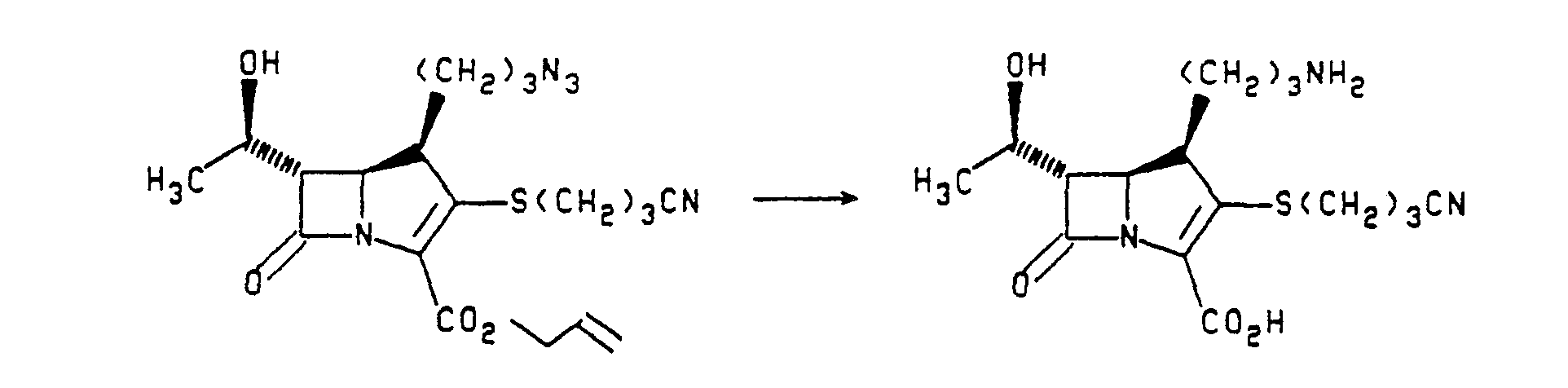
- Purity by HPLC: 99.9% (300 nm);
- UV (H2O) λ max: 302 (e 8000);
- IR (Nujol) νmax: 2250 (CN), 1760 and 1595 cm-1 (C=O);
- 'H NMR (D20, 200 MHz) δ: 4.34-4.32 (2H, m, H-1' and H-5), 4.239, 4.226 (d, J=2.6 Hz, part of H-5), 3.42-3.33 (1H, m, H-4), 3.383 (1H, dd, J = 2.7 Hz, J = 6.2 Hz, H-6), 3.09-2.94 (3H, m, CH2 N and S-HCH), 2.85-2.74 (1H, m, SHCH), 2.70-2.61 (2H, m, CH2CN ), 2.10-1.49 (6H, m, CH2CH2CH2CN, CH2CH2) and 1.334 ppm (3H, d, J = 6.4 Hz, CH3).
-

- Purity by HPLC: 94.4% (300 nm);
- UV (H2O) λ max : 302 (E 9100);
- IR (Nujol) νmax: 2250 (CN), 1755 (C = 0), 1715 (C = N) and 1590 cm-1 (C = O);
- 'H NMR (D20, 200 MHz) s: 7.83, 7.81 (1H, 2s, CH), 4.34-4.22 (2H, m, H-1' and H-4), 4.231 (d, J=2.9 Hz, part of H-4), 3.49-3.32 (4H, m, H-4, H-6 and CH2N), 3.06-2.92, 2.84-2.74 (2H, 2 sets of m, SCH2), 2.70-2.61 (2H, m, CH2CN ), 2.10-1.47 (6H, CH2 CH2 CH2 CN, CH2-CH2 )and 1.323 ppm (3H, d, J=6.4 Hz, CH3).
-

-

- A solution of allyl (4R,5R,6S)-4-(4"-azidobutyl)-6-[(1'R)-1'-hydroxyethyl]-3,7-dioxo-1-azabicyclo[3.2.0]-heptane-2-carboxylate (6.71 mmol, prepared by cyclization of 1.54 g, 6.71 mmol of the diazo precursor as described in Example 45) in dry acetonitrile (40 mL) was treated at 0-5° C and under nitrogen with diphenyl chlorophosphate (1.53 mL, 7.4 mmol) and N,N-diisopropylethylamine (1.3 mL, 7.5 mmol) added simultaneously over 5 min. A small crystal of 4-N,N-dimethylaminopyridine was then added and the mixture was stirred for 1 h. Then N,N-diisopropylethylamine (1.75 mL, 10.0 mmol) followed by 4-mercaptobutyronitrile (1.01 g, 10.0 mmol) [from basic hydrolysis of 4-acetylmercaptobutyronitrile (U.S. 3,223,585)] were added and the mixture was stirred at 0-5°C for 18 h. The reaction mixture was then diluted with EtOAc (300 mL) washed with water, saturated NaHC03, pH 7.0 phosphate buffer and brine and dried ( MgSO4); Evaporation of the solvent gave an oil which was chromatographed on silica gel (4.5 x 11 cm) using a gradient of EtOAc in toluene (8:2 to 1:1) to give 2.14 g (73%) of the title compound as an oil:
- JR (NaCI, film) vmax: 2250 (CN), 2100 (N3), 1772 (C=0 of β-lactam) and 1710 cm-1 (C=0 of ester);
- 'H NMR (200 MHz, CDCI3) δ: 1.39 (d, J=6.25 Hz, 3H, CH3CHO ), 1.4-2.1 (m, 8H, CH2-1,2 and 3 of butyl and CH2-2 of cyanopropylthio), 2.55 (m, 2H, CH2CN ), 2.8-3.1 (m, 2H, SCH2), 3.2 (dd, JH6.H5=2.70 Hz, JH6-H1 =7.22 Hz, 1 H, H-6), 3.2 (m, overlapping with H-6, 1 H, H-4), 3.33 (t, J = 6.1 Hz, 2H, cH2N3), 4.25 (dd, JH5,H6=2.70 Hz, JH5,H4=9.49 Hz, 1H, H-5), 4.75 (m, 2H, CH2 of allyl), 5.2-5.5 and 5.9-6.1 ppm (2 x m, 2H and 1 H, CH of allyl).
-

- Purity by HPLC: 99% on µ-Bondapak C-18, 3.9 mm x 30 cm, 5% CH3CN-H20 pH 7.4 phosphate buffer, flow rate 1 mL/min, UV detector 300 nm, retention time 7.89 min;
- UV (H20, pH 7.4 phosphate buffer) λmax: 302 nm (9,528);
- IR (KBr) vmax: 2250 (CN), 1755 (C = 0 of β-lactam) and 1590 cm-' (C=0 of carboxylate);
- 'H NMR (200 MHz, D2O) δ: 1.32 (d, J=6.37 Hz, 3H, CH3CHO), 1.3-2.1 (m, 8H, CH2-1,2 and 3 of butyl and CH2-2 of cyanopropylthio), 2.64 (t, J = 7.0, Hz, 2H, CH2 CN), 2.6-3.1 (m, 2H, SCH2 ), 3.0 (t, J-7.6 Hz, 2H, CH 2 NH2 ), 3.3 (m, overlapping with H-6, 1 H, H-4), 3.35 (dd, J H6.H5 = 2.46 Hz, JH6.H1 =6.39 Hz, 1 H, H-6), 4.22 (dd, JH5.H6 = 2.46 Hz, JH5.H4= 6.83 Hz, 1 H, H-5) and 4.26 ppm (m, 1 H, CH3CHO).
-

-

- A solution of allyl (4R,5R,6S)-4(4"-azidobutyl)-6-[(1'R)-1-hydroxyethyl]-3,7-dioxo-1-azabicyclo[3.2.0]-heptane-2-carboxylate (5.28 mmol, prepared by cyclization of 2.0 g of the diazo precursor as described in Example 45) in dry acetonitrile (35 mL) was treated at 0-5°C and under nitrogen with diphenyl chlorophosphate (1.49 g, 5.5 mmol) and N,N-diisopropylethylamine (0.97 mL, 5.5 mmol) added simultaneously over 5 min. A small crystal of 4-N,N-dimethylaminopyridine was then added and the solution was stirred for 1 h. Then more N,N-diisopropylethylamine (1.4 mL, 7.9 mmol) followed by 4-picolyl mercaptan (1.0 g, 7.9 mmol) were added and the mixture was stirred at 0-5°C for 3 h. The reaction mixture was quenched by addition of EtOAc (300 mL) and 0.2M pH 7.0 phosphate buffer. The organic phase was washed with brine, dried (MgSO4) and concentrated. The residue was chromatographed on silica gel (3.5 x 13 cm) using EtOAc as eluent and gave 1.89 g (78%) of the title compound as a clear oil:
- IR (NaCl, film) vmax : 2100 (N3), 1770 (C=O of β-lactam) and 1710 cm-1 (C=0 of ester);
- 'H NMR (200 MHz, CDCI3) B: 1.37 (d, J=6.27 Hz, 3H, CH3CHO), 1.3-1.9 (m, 6H, CH2-1,2 and 3 of butyl), 3.02 (m, 1 H, H-4), 3.14 (dd, JH6,H5 = 2.65 Hz, JH6.Hl = 77.41 Hz, 1 H, H-6), 3.31 (t, J = 6.1 Hz, CH2 N3), 3.98 (ABq, J AB = 14.22 Hz, Δν = 15.7 Hz, 2H, SCH2), 4.21 (m, 1 H, CH3CHO, 4.76 (m, 2H, CH2 of allyl), 5.2-5.5 and 5.9-6.1 (2 x m, 2H and 1 H, CH of allyl), 7.27 ( - d, 2N, H-3 of pyridyl) and 8.57 ppm (~ d, 2H, H-2 of pyridyl).
-

- The first fractions gave, after lyophilisation, 0.050 g (4%) of (4R,5S,6S)-4-(4"-hydroxybutyl)-6-[(1'R)-I'-hydroxy-ethyl]-3-[ (pyridin-4-yl)methyithio]-7-oxo-1-azabicyclo-[3.2.O]hept-2-ene-2-carboxylate (mixture of Na and K salt) as a white solid.
- The following fractions gave 0.830 g (54%) of the title compound as a white amorphous solid:.9.5° (c 1.0, H2O);

- Purity by HPLC: 97.8% on µ-Bondapak C-18, 3.9 mm x 30 cm, 5% CH3CN-H20 pH 7.4 phosphate buffer, flow rate 2 mL/min, UV detector 300 nm, retention time 7.42 min;
- UV (H20, pH 7.4 phosphate buffer) λmax:: 262 (5,195) and 304 nm (8,370);
- IR (KBr) vmax:1755 (C=O of β-lactam) and 1600 cm-1 (C=O) of carboxylate);
- 1H NMR (200 MHz, D20) δ: 1.29 (d, J=6.37 Hz, 3H, CH3CHO), 1.2-1.8 (m, 6H, CH2-1,2 and 3 of butyl), 2.94 (t, J = 7.5 Hz, CH2NH2), 3.10 (m, 1 H, H-4), 3.28 (dd, JH6.5=2.53 Hz, JH6.H1 = 6.30 Hz, 1 H, H-6), 4.05 (m, 3H, H-5 and SCH2overlapping), 4.21 (m, 1H, CH3CHO), 7.48 (~d, 2H, H-3 of pyridine), and 8.49 ppm (-d, 2H, H-2 of pyridine).
-
 -3.6° (c 0.55, H20);
- Purity by HPLC: 97.5% on µ-Bondapak c-18, 3.9 mm/30 cm, 15% CH3CN-H20 pH 7.4 phosphate buffer, flow rate 1 mL'min, UV detector 300 nm, retention time 5.8 min;
- UV (H20, pH 7.4 phosphate buffer) λmax: 262 (5,476) and 304 nm (8,790);
- IR (KBr) νmax: 1750 (C = 0 of β-lactam), 1715 and 1600 (C = 0 of carboxylate);
- 1H NMR (200 MHz, D20) s: 1.27 (d, J=6.35 Hz, 3H, CH3CHO), 1.1-1.7 (m, 6H, CH2-1,2 and 3 of butyl), 3.11 (m, 1 H, H-4), 3.2-3.4 (m, 3H, H-6 and CH2 NH), 4.08 (m overlapping with SCH2, 1 H, H-5), 4.08 (ABq, J AB=14.75 Hz, Δν=23.2 Hz, SCH2), 4.21 (m, 1H, CH3CHOH), 7.47 (m, 2H, H-3 of pyridine), 7.78 (s, 1H, CH-NH) and 8.47 ppm (m, 2H, H-2 of pyridine).
-

- Purity: 96.7% (HPLC 304 nm);
- UV (H2O) λ max: 262 (∈ 7120), 304 (∈ 10700);
- IR (Nujol) νmax: 3600-3100 (OH, NH2), 1755 (C=0), 1710 (C=N) and 1600 cm-1 (C=0);
- 'H NMR (D20, 200 MHz) δ: 8.48-8.44 (2H, m, aromatic -H), 7.78-7.44 (2H, m, aromatic H), 4.27-4.15 (1 H, m, H-1'), 4.14, 4.07, 4.00, 3.93 (2H, ABq, J = Hz, CH2-aromatic), 4.075 (1 H, dd, J = 2.6 Hz, J = 9.3 Hz, H-5), 3.34-3.23 (3H, m, H-5 and CH2-N), 3.303, 3.291 (part of H-6, d, J=2.5 Hz), 3.17-3.07 (1H, m, H-4), 1.70-1.36 (4H, m, CH2CH2-4 ), and 1.268 ppm (3H, d, J=6.3 Hz, CH3).
-

-

- A solution of allyl (4R,5R,6S)-4-(2"-tert-butyldimethylsilyloxyethyl)-6-[(1'R)-1'-tert-butyldimethylsilyloxyethyl]-3,7-dioxo-1-azabicyclo[3.2.0]heptane-2-carboxylate (5.41 mmol, prepared by cyclization of 3.0 g, 5.41 mmol of the diazo precursor as in Example 5) in dry acetonitrile (25 mL) was treated at 0-5° C and under nitrogen with diphenyl chlorophosphate (1.18 mL, 5.65 mmol) and N,N-diisopropylethylamine (1.0 mL, 5.65 mmol) added simultaneously over 5 min. Then a small crystal of 4-N,N-dimethylaminopyridine was added and the solution was stirred for 90 min. More N,N-diisopropylethylamine (1.42 mL, 8.1 mmol) followed by p-nitrobenzyl 2-mercaptoethylcarbamate (2.10 g, 8.19 mmol) [J. Shinkai et al., Synthesis, 924 (1980)] were added and the mixture was stirred for 16 h. The reaction mixture was then diluted with EtOAc (400 mL) washed with water, brine and dried ( MgSO4). After evaportion of the solvent under reduced pressure, the residue was chromatographed on silica gel (3.5 x 10 cm). Elution with a gradient of ethyl acetate (5 - 10%) in toluene gave 1.75 g (42%) of the title compound as an oil:
- JR (NaCl,- film) νmax: 1772 (C = 0 of β-lactam) and 1720 cm-' (C = 0 of carboxylate);
- 'H NMR (200 MHz, CDCl3) 5: 0.04, 0.05 and 0.08 (3 x s, 3H, 3H and 6H, SiCH3), 0.88 (s, 18H, Si t-Bu), 1.27 (d, J=6.14 Hz, 3H, CH3 CHO ), 1.5-2.1 (m, 2H, CH 2 CH2 OTBDMS), 2.8-3.2 (m, 2H, SCH2), 3.10 (dd, JH6.H5 = 2.49 Hz, JH6,Hl = 6.34 Hz, 1H, H-6), 3.2-3.9 (m, 5H, H-4, CH20TBDMS and CH2NH), 4.16 (dd, JH5.H6 = 2.49 Hz, JH5,H4= 9.37 Hz, 1H, H-5), 4.23 (m, 1H, CH3CHO),
4.7 4 (m, 2H, CH2 ofal lyl), 5.18 (s, 2H, CH2 of p-nitrobenzyl, 5.2-5.5 and 5.9-6.1 (2 x m, 2H and 1 H,CH of allyl), 7.5 (d, J = 8.7 Hz, 2H, H ortho of p-nitrobenzyl) and 8.22 ppm (d, J=8.7 Hz, 2H, H meta of p-nitrobenzyl). -

- A solution of allyl (4R,5S,6S)-4-(2"-tert-butyldimethylsilyloxyethyl)-6-[(1'R)-1'-tert-butyldimethylsilyloxyethyl]-3-[(2-p-nitrobenzyloxycarbonylaminoethyl)thio]-7-oxo-1 -azabicyclo[3.2.0]hept-2- ene-2-carboxylate (1.75 g, 2.29 mmol) in dry tetrahydrofuran (20 mL) was cooled to 0-5° C and treated under nitrogen with acetic acid (1.6 mL, 27.5 mmol) followed by 13 mL (13.0 mmol) of a 1.0M solution of tetrabutylammonium fluoride in tetrahydrofuran. After 120 h at 5° C, the reaction mixture was diluted with ethyl acetate (200 mL), washed with water, saturated NaHC03, 0.2M pH 7.0 phosphate buffer, brine and dried ( MgSO4). The residue obtained after evaporation of the solvent was chromatographed on silica gel (3 x 11 cm) using ethyl acetate and then, a mixture of ethyl acetate, acetone and acetonitrile (18:1:1) as eluent.
- The first fractions gave 0.78 g (50%) of mono deprotected product, allyl (5S-6S)-6-[(1'R)-1'-tert-butyldimethylsilyloxyethyl]-4-(2"-hydroxyethyl)-3-[(2-p-nitrobenzy[oxycarbonylaminoethyl)thio]-7-oxo-1 - azabicyclo[3.2.0]hept-2-ene-2-carboxylate as an oil.
- The following fractions gave 0.23 g (19%) of the title compound as a foam:
- IR (NaCl, film) vmax: 1770 (C = 0 of β-lactam), 1725 and 1705 cm-1 (C = 0 of ester);
- 'H NMR (200 MHz, CDCl3) δ: 1.37 (d, J=6.23 Hz, 3H, CH3CH O), 1.7-2.1 (m, 2H, CH2CH20H ), 2.8-3.2 (m, 2H, SCH2), 3.26 (dd, JH6,H5=2.55 Hz, JH6,H1 =7.77 Hz, 1H, H-6), 3.3-3.9 (m, 5H, H-4, CH20H and CH2NH) , 4.1-4.4 (m, 2H, H-5 and CH3CHO overlapping), 4.75 (m, 2H, CH2 of allyl), 5.19 (s, 2H, CH2 of p-nitrobenzyl), 5.2-5.5 and 5.9-6.1 (2 x m, 2H and 1 H, CH of allyl), 7.5 (d, J =8.7 Hz, 2H, H ortho of p-nitrobenzyl) and 8.22 ppm (d, J=8.7 Hz, H meta of p-nitrobenzyl).
-

- A solution of allyl (4R,5S,6S)-4-(2"-hydroxyethyl)-6-[(1'R)-1'-hydroxyethyl]-3-[(2-p-nitrobenzyloxycar-bonylaminoethyl)thio]-7-oxo-1-azabicyclo[3.2.0]hept-2-ene-2-carboxylate (0.99 g, 1.85 mmol) in dry ethyl acetate (40 mL) was treated at 22°C and under nitrogen with tetrakis(triphenylphosphine)palladium [0]-(0.050g) and 4 mL (2.0 mmol) of a 0.5M solution of potassium 2-ethylhexanoate in ethyl acetate. After 30 min, a precipitate was formed and the reaction mixture was cooled to 0-5°C for 2h. The solid was then filtered and dried under vacuum to give 1.0 g of the intermediate potassium salt as a light brown solid. The solid was then added to a mixture of cold 0.2M pH 7.0 phosphate buffer (40 mL), tetrahydrofuran (20 mL) and diethyl ether (20 mL) and hydrogenated at 0-5 C over 1.2 g of 10% palladium on activated carbon and under 45 psi of hydrogen for 1 h. The catalyst was filtered and the filtrate was chromatographed twice on reversed phase silica gel (µBondapak C18, 3 x 14 cm) using a gradient of acetonitrile (0-10%) in water as eluent. Lyophilization of the first fractions gave 0.150 g (26%) of the title compound as a white amorphous solid. The tail fractions also gave 0.450 g of partialy reduced material. Crystallization of the first fractions in water (1 mL) gave 0.096 g of the title compound as small cubes:
- Purity by HPLC: 99.8% on µBondapak C18, 3.9 mm x 30 cm, elution 2% CH3CN-H20 pH 7.4 phosphate buffer, flow rate 1 mL/min, uv detector 300 nm, retention time 6.24 min;
- UV (water, pH 7.4, phosphate buffer) λmax: 298 nm (8,510);
- IR (KBr) vmax: 1758 (C = O of β-lactam), 1638, 1618 and 1580 cm-1 (C = 0 of carboxylate);
- 'H NMR (200 MHz, D2O) δ: 1.32 (d, J=6.42 Hz, 3H, CH3CHO ), 1.4-2.2 (m, 2H, CH2-1 of hydroxyethyl), 2.9-3.8 (m, 7H, H-4, SCH2CH2NH2and CH2OH ), 3.49 (dd, JH6,H5 = 2.72 Hz, JH6,H1 = 5.37 Hz, 1 H, H-6), and 4.2-4.4 ppm (m, 2H,
H-5 and CH3CHO overlapping). -

-

- A cold (5°C) solution of 4-azido valeric acid (59.0 g, 412.2 mmol) and N-methyl imidazole (33.84 g, 412.2 mmol) in CH2C12(1200 mL) was treated dropwise with SOCl2(15 min). The reaction mixture was stirred at 5° C for 1 h and 20° C for 2.5 h. The reaction mixture was again cooled in an ice-bath and treated dropwise this time (15 min) with a solution of 2-mercaptomethyl pyridine (51.6 g, 412.2 mmol) and N-methylimidazole (37.2 g, 453.4 mmol) in CH2Cl2(50 mL). After stirring for 15 min at 5°C, the solvent was evaporated and replaced by ethyl acetate (500 mL). The solution was washed with water (250 mL). The organic layers were combined and washed with NaHCO3. Finally after washing with brine, the organic solution was dried ( MgSO4) and evaporated to give 97.23 g (94.2%) of the title compound.
- IR (CH2C12) vmax : 2110 cm 2 (-N3), 1690 cm-1 (thioester);
- 'H NMR ( CDCI3) δ: 8.55-8.52 (1H,, m, pyridine -H), 7.67-7.58 (1H, m, pyridine-H), 7.35-7.31 (1H, m, pyridine-H), 7.20-7.13 (1 H, m, pyridine-H), 4.36 (2H, s, CH2-S ), 3.55-3.45 (1H, m, CH-N3), 2.74-2.65 (2H, m, CH2COS ). 1.89-1.62 (2H, m, CH2C-N3), 1.28 (3H, d, J: 6.53 Hz, CH3-).
- A cold (5°C) solution of 4-azido-(pyridin-2-yl)methylthiovalerate (97.2 g, 388.4 mmol) and triethylamine (86.5g, 854.5 mmol) in CH2Cl2(1000 mL) was treated dropwise (25 min) with tert-butyldimethylsilyl trifluoromethanesulfonate (205.3 g, 776.8 mmol). The ice-bath was allowed to become exhausted and the solution stirred at 20°C for 15h. Then the solvent was evaporated and replaced by petroleum ether (1000 mL). The solution was shaken with cold water (500 mL) and the two phases filtered through a pad of Celite. The aqueous layer was discarded and the organic phase washed successively with cold water, aqueous NaHC03, cold water again and finally brine. The organic solution was dried ( MgS04) and treated with charcoal. After filtration through a pad of Celite, the dark filtrate was given two additional charcoal treatments to finally yield a red solution. After evaporation of the solvent there was obtained 99.4g (70.2%) of the title compound as a red oil.
- IR (CH2 C1 2) νmax: 2110 cm-1 (-N3);
- ' H NMR ( CDCI3, 200 MHz) 6: 8.57-8.53 (1H, m, pyridine-H), 7.67-7.58 (1H, m, pyridine-H), 7.30-7.25 (1 H, m, pyridine-H), 7.18-7.11 (1 H, m, pyridine-H), 5.00 (0.32 H, t, J: 7.65 Hz, vinylic H), 4.85 (0.68 H, t, j: 7.29 Hz, vinylic-H), 4.05 (0.64 H, s, -SCH2), 3.98 (1.36 H, s, - SCH2-), 3.34 (0.68 H, m, CH-N3), 3.22 (0.32 H, m, CH-N3), 2.25-2.15 (2H, m, -CH2-), 1.10 (2.04 H, d, J: 6.54 Hz, H3C-), 1.08 (0.96 H, d, J: 6.53 H, H3C-), 0.99 (9H, 2s, t-butyl), 0.25 and 0.22 ppm (6H, 2s, dimethyl).
-

- To a cold (5°C) suspension of fused ZnC12(33.4 g, 245 mmol) in CH2CI 2 (500 mL) was added successively (3S,4R)-4-acetoxy-3-[(1'R)-1'-tert-butyldimethylsilyloxyethyl]azetidin-2-one (70.42g, 245 mmol) and the tert-butyldimethylsilylenol ether of 4-azido-(pyridin-2-yl)methylthiovalerate from Step B (99.4 g, 272.6 mmol). The ice-bath was allowed to become exhausted while stirring the mixture mechanically overnight (18h). Then the solvent was evaporated and the viscous residue partitioned between diethyl ether (500 m) and water (100 mL). The aqueous phase was discarded and the organic solution washed successively with water, NaHC03, water again and finally brine. The organic phase was dried ( MgSO4), treated with charcoal, filtered and evaporated. The red viscous oil (142.5 g) thus obtained was purified by chromatography ( Si02, CH2C12, 5% CH3CN in CH2Cl2and ethyl acetate) to give 38.0 g (32.5%) of the title compound as a 1:1 mixture of isomeric compounds at C-3".
- IR (CH 2 C1 2) v : 3405 (NH), 2115 (-N3), 1765 (β-lactam), 1680 cm-1 (CO-S);
- 'H NMR ( CDCI3) δ: 8.56-8.52 (1H, m, pyridine -H), 7.68-7.60 (1H, m, pyridine -H), 7.33-7.26 (1H, m, pyridine ), 7.21-7.15 (1 H, m, pyridine -H), 5.83 (1 H, s, NH), 4.29 (2H, s SCH2-), 4.15 (1 H, m, CH'), 3.80 (1 H, dd, J: 6.20, 2.14 Hz, H-4), 3.48 (1H, m, CH-N3), 3.16-3.05 (2H, m, H-3, H-1 "), 1.96 and 1.44 (2H, 2m, -CH2"), 1.29 (3H, d, J: 6.41, H3C-C-N3), 1.03 (3H, d, J: 6.29, -CH3), 0.854 (9H, s, t-butyl), 0.05 (6H, s, Si-(CH3)2).
- 'H NMR ( CDCl3) δ: 8.54-8.52 (1H, m, pyridine -H), 7.68-7.59 (1H, m, pyridine -H), 7.36-7.26 (1H, m, pyridine -H), 7.21-7.15 (1H, m, pyridine -H), 5.85 (1H, s, NH), 4.28 (2H, d, J: 5.25 Hz, S-CH2), 4.17 (1H, m, CH'), 3.89 (1 H, dd, J: 2.05, 6.87 Hz, H-4), 3.49 (1 H, m, CH-N3), 3.05 (1 H, m, H-3), 2.85 (1 H, m, H-1 "), 2.05 and 1.57 (1H, 2m, CH2"), 1.28 (3H, d, J: 6.47, N3CC-N3), 1.01 (3H, d, J: 6.32, H3C), 0.85 (9H, s, t-butyl), 0.05 (6H, s, Si(CH3)2.
-

- Hydrogen peroxide (30%, 27 mL, 314 mmol) was added to a cold (5° C) solution of (3S,4S)-3-[(1'R)-1'- tert-butyldimethylsilyloxyethyl]-4-[(1"R)-1 "-(pyridin-2-yl)methylthiocarbonyl-3"-azidobutyl]azetidin-2-one (37.5g, 78.5 mmol) followed by the dropwise addition of 1N NaOH (235.5 mL, 235.5 mmol). The addition was done in 40 min keeping T<10° C. The mixture was stirred for an additional 30 min and then acidified to pH ~1.0 with conc. HCI (30 mL). The solution was extracted with ethyl acetate. The extracts were washed twice with brine, dried ( MgS04) and evaporated. The solid thus obtained was triturated in petroleum ether and collected by filtration to give 24.0 g (82.6%) of the title compound; mp = 123-125°C (dec).
- IR (CH2Cl2) vmax: 2110 (-N3), 1765 (β-lactam), 1740 and 1710 cm-1 (-C02H).
- ' H NMR ( CDCI3) 5: 6.35 (1 H, s, NH), 4.20 (1 H, m, CH'), 3.89 (1 H, dd, J: 2.05, 5.50 Hz, H-4), 3.58 (1 H, m, CH-N3), 3.13 (1H, m, H-3), 2.95 (1H, m, H-1 "), 1.88 and 1.48 (2H, 2m, -CH3), 1.34 (3H, d, J: 6.45 Hz, CN3-C-N3), 1.19 (3H, d, J: 6.26 -CH3), 0.87 (9H, s, t-butyl), 0.07 (6H, 2s, Si(CH3)2).
- 'H NMR ( CDCI3) δ: 6.42 (1H, s, NH), 4.20 (1H, m, CH'), 3.88 (1H, dd, J: 1.94, 6.42 Hz, H-4), 3.55 (1H, m, CH-N3), 3.15 (1 H, m, H-3), 2.74 (1H, m, H-1 "), 1.98 and 1.59 (2H, 2m, -CH2), 1.33 (3H, d, J: 6.50 Hz, H3CC-N3), 1.18 (3H, d, J: 6.28, -CH3), 0.87 (9H, s, t-butyl), 0.068 (6H, 2s, Si(CH3)2).
-

- A mixture of (3S,4S)-3-[(1'R)-1'-tert-butyldimethylsilyloxyethyl]-4-[(1"R)-1"-carboxy-3"-azidobutyl]-azetidin-2-one (3.48 g, 9.39 mmol) and carbonyldiimidazole (1.70 g, 10.33 mmol) in CH3CN was stirred at 20° C for 30 min and then evaporated to dryness to leave a foamy material.
- In a separate flask, a suspension of magnesium monoallyl malonate (4.37 g, 14 mmol) in benzene (75 mL) was refluxed collecting the residual water in a Dean Stark trap. After 1.5h at reflux, this solution was cooled to 20 °C and added to the above imidazolide. This mixture was placed in an oil bath preheated at 70°C and heated for 18h. Then the mixture was diluted with an equal volume of ethyl acetate and washed with water, dilute HCI, water again, dilute NaHC03and finally water and brine. The organic phase was dried ( MgSO4) and evaporated. The crude product was purified by chromatography (Si02, CH2Cl2then 5-10% CH3CN in CH2Cl2) to give 3.37 g (79.3%) of the title compound as an oil which solidified;
- IR (CH2Cl2) vmax: 2115 (-N3), 1765, 1715 cm-1 (C=O)
- ' H NMR ( CDCl3) δ: 4.6-6.0 (5H, allyl pattern) 4.18 (1H, m, H-1'), 3.80-3.85 (1H, m, H-4), 3.62 (1H, d, -CHC=O), 3.46 (1H, m, CH-N3), 3.27 (0.6H, m, H-1 "), 2.99 and 2.93 (1H, m, H-3), 2.55 (0.4H, m, H-1 "), 1.93 and 1.41 (2H, 2m, - CH2C-N3) 1.32 and 1.31 (3H, 2d, J: 6.45, 6.40 Hz, CH3CN3), 1.19 and 1.12 (3H, 2d, J: 6.27, 6.29 Hz, -CH3), 0.87 (9H, 5, t-butyl), 0.07 and 0.06 (6H, 2s, Si(CH3)2).
- 'H NMR ( CDCl3) δ: 4.6-6.0 (5H, allyl patttern) 4.17 (1H, m, H-1'), 3.84 (1H, dd, J: 2.1, 5.35 Hz, H-4), 3.63 (1H, d, CH2CO ) 3.48 (1H, m, CHN3), 3.07 (0.6 H, m, H-1 "), 2.93 (1 H, m, H-3), 2.0 and 1.6 (2H, 2m, CH2CN3), 1.27 and 1.32 (3H, 2d, J: 6.5 Hz, CH3CN3) 1.09 and 1.18 (3H, 2d, J: 6.25 Hz, CH3), 0.87 (9H, s, t-butyl), 0.06 (6H, 2s, Si(CH3)2).
-
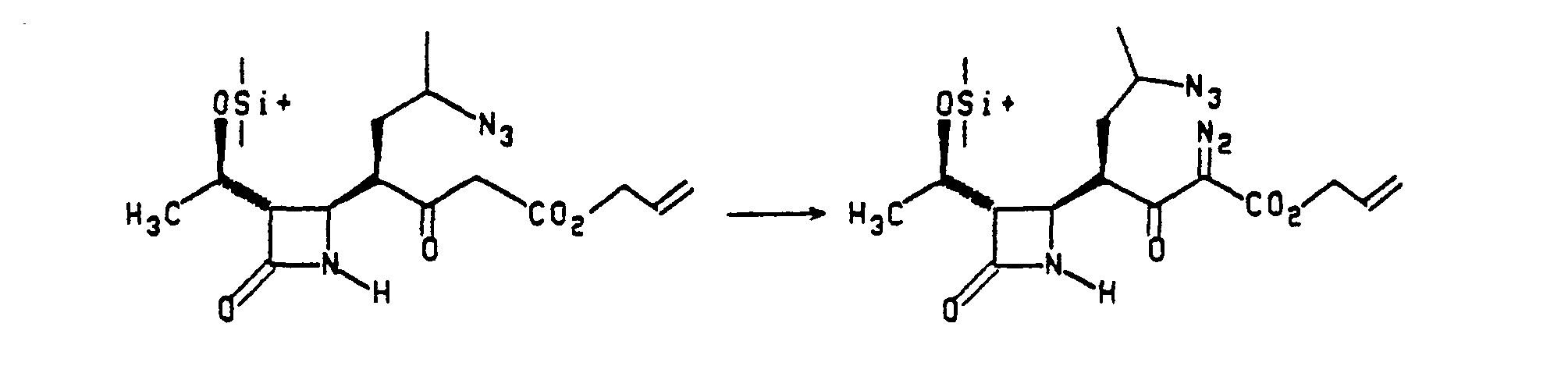
- A mixture of p-toluenesulfonyl chloride (442 mg, 2.32 mmol), sodium azide (154 mg, 2.37 mmol) and tetrabutylammonium chloride (12mg) in CH3CN (15 mL) was stirred at 20° C for 4 h. Then this mixture was cooled to 5°C and (3S,4R)-3-[(1'R)-1'-tert-butyldimethylsilyloxyethyl]-4-[(1"R)-I"-(2-azidopropyl)-3"-allyloxycarbonyl-2"-oxopropyl]-azetidin-2-one (953 mg, 2.11 mmol) in a minimum amount of CH3CN was added followed, dropwise, by triethylamine (235 mg, 2.32 mmol). The rection mixture was stirred at 5° C for 1.5h and then evaporated. The residue was taken up in diethyl ether and washed with water and brine. The organic phase was dried ( MgS04) and evaporated to leave a soft solid. This material was triturated in petroleum ether and the insoluble tosylamide (74.3%) filtered off. The filtrate was evaporated to give a yellow viscous oil which was purified by chromatography ( Si02, CH2Cl2then 5% CH3CN in CH2CI2) to give 825 mg (81.7%) of the title compound as a viscous oil;
- IR ( CH2Cl2) νmax: 2125 (=N2), 2118 (-N3), 1765 (β-lactam), 1713 cm-1 (-CO2-);
- ' H NMR ( CDCI3) 6: 4.7-6.0 (5H, allyl pattern) 4.31 (1H, m, H-1 "), 4.16 (1H, m, H-1'); 3.81 (1H, dd, J: 2.08, 4.90 Hz, H-4), 3.38 (1H, m, CH-N3), 3.05 (1H, m, H-3), 2.69 and 1.39 (2H, 2m, CH2-CN3), 1.28 (3H, d, J: 6.42 Hz, H3CCN3), 1.18 (3H, d, J: 6.29 Hz, -CH3), 0.86 (9H, s, t-butyl), 0.064 and 0.052 (6H, 2s, Si(CH3)-2).
- ' H NMR ( CDCIs) s: 4.7-6.0 (5H, allyl pattern) 4.15 (2H, m, H-1', H-1 "), 3.84 (1H, m, H-4), 3.45 (1H, m, CH-N3), 3.05 (1H, m, H-3), 2.10 and 1.5 (2H, 2m, CH2C-N3), 1.27 (3H, d, J: 6.43 Hz, CH3-CN3), 1.17 (3H, d, J: 6.27 Hz, -CH3), 0.87 (9H, s, t-butyl), 0.064 and 0.053 (6H, 2S, Si(CH3)2).
-

- IR (CH2Cl2) νmax: 3600 (-OH), 3400 (NH), 2145 (= N2), 2115 (-N3), 1763 (β-lactam), 1713 (C=O).
- 1H NMR ( CDCI3) 5: 4.7-6.0 (5H, allyl pattern), 4.12 (2H, m, H-1' and H-1 "), 3.81 (1H, m, H-4), 3.45 (1H, m CH-N3), 3.05 (1H, m, H-3), 2.05 and 1.55 (2H, 2m, CH2CN3), 1.30 (6H, several peaks, 2-CH3).
-

- A suspension of rhodium octanoate dimer (55 mg) in C6H6(110 mL) was placed in an oil bath preheated at 130°C and refluxed for 30 min. Then (3S,4R)-3-[(1'R)-1'-hydroxy-ethyl]-4-[(1'R)-1 "-(2-azidopropyl)-3"-diazo-3"-allyloxycarbonyl-2"-oxopropyl]azetidin-2-one (2.0 g, 5.49 mmol) was added. Cyclization was completed after 25 min under vigorous reflux. The solvent was evaporated and replaced by CH3CN (55 mL). This solution was treated with diphenyl chlorophosphate (1.6g, 6 mmol), N,N-diisopropylethylamine (0.78 g, 6 mmol) and a catalytic amount of 4-N,N-dimethylaminopyridine. After 15 min at 5°C the reaction was complete. So the reaction mixture was diluted with ethyl acetate and washed with water and brine. After drying ( MgS04), the organic phase was evaporated and the crude product purified by chromatography ( Si02/Et20 ) to give 1.63 g (52.0%) of enol phosphate.
- The purified enol was dissolved in cold (5°C) DMF (16 mL) and treated with 2-picolylthiol (465 mg, 3.72 mmol) and N,N-diisopropylethylamine (481 mg, 3.72 mmol). The reaction mixture was stirred at 5 C for 17h and 20 C for 24h. The solution was then diluted with ethyl acetate (100 mL) and washed with cold brine (3 x 50 mL), 10% NaHS03(2 x 25 mL), water and finally brine. The organic phase was dried ( MgS04) and evaporated to leave a brown viscous oil. Chromatography resulted in the purification and separation of the two isomers of the title compound (Si02;cold Et20) 470 mg (37%) of the less polar isomer A and 325 mg (25.6%) of the more polar isomer B:
- IR ( CH2Cl2) νmax: 3600 (-OH), 2115 (-N3), 1775 (β-lactam), 1710 cm-1 (-CO2-);
- 'H NMR ( CDCI3) δ: 8.55 (1H, m, Ar-H), 7.66 (1H, m, Ar-H), 7.34 (1H, m, Ar-H), 7.19 (1 H, m, Ar-H), 4.6-6.0 (5H, allyl pattern), 4.19 (2H, ABq, J: 13.8 Hz, S-CH2), 4.16-4.24 (2H, m, H-1', H-5), 3.87 (1H, m, CH-N3), 3.65 (1 H, m, H-4), 3.05 (1 H, dd, J: 2.70, 7.92 Hz, H-6), 1.6-2.0 (2H, 2m, CH2CN3), 1.39 (6H, d, J: 6.15 Hz, 2-CH3).
- IR( CH2Cl2) νmax: 3600 (-OH) 2115 (-N3), 1772 (β-lactam). 1710 cm (-CO2-);
- ' H NMR ( CDC13) 5: 8.51 (1 H, m, Ar-H), 7.64 (1 H, m, Ar-H), 7.37 (1 H, m, Ar-H), 7.21 (1 H, m, Ar-H), 4.6-6.10 (5H, allyl pattern), 4.22 (1H, m, H-1'), 4.14 (1H, dd, J: 2.66, 9.60 Hz, H-5), 4.11 (2H, ABq, J: 14.18 Hz, -SCH2), 3.75 (1 H, m, CH-N3), 3.62 (1 H, m, H-4), 3.32 (1 H, dd, J: 2.70, 7.32, H-6), 1.6-2.0 (2H, 2m, -CH2C-N3), 1.39 (3H, d, J: 6.42 Hz, -CH3), 1.38 (3H, d, J: 6.25 Hz, -CH3)
-
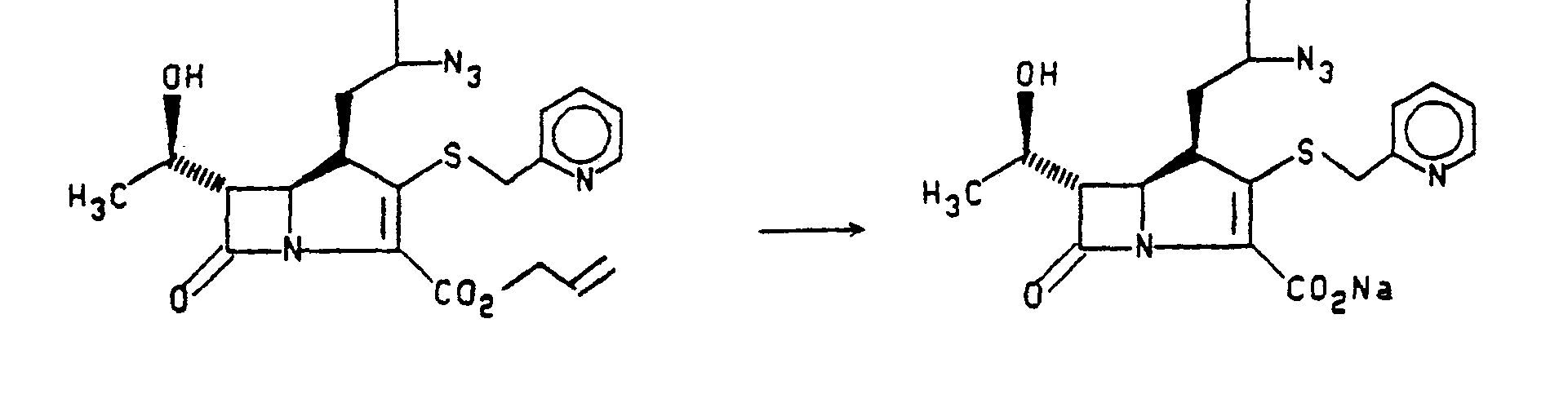
- 1H NMR (D20) δ: 8.50 (1H, m, Ar-H), 7.89 (1 H, m, Ar-H), 7.4-7.6 (2H, 2m, 2 Ar-H), 4.26-4.06 (2H, m, H-1', H-5), 4.18 (2H, ABq, J: 14.09, S-CH2), 3.6 (1H, m, CH-N3), 3.35 (2H, m, H-6, H-4), 1.8 and 1.56 (2H, 2m, CH2C-N3), 1.35 (3K, d, J: 6.71 Hz, -CH3), 1.32 (3H, d, J: 6.65 Hz, -CH3).
-

- UV (H 20) λmax: 266 (4093), 300 (3945);
- IR (Nujol) νmax: 1755 (β-lactam), 1595 cm-1 (-CO2-);
- 'H NMR (D20) δ 8.46 (1H, m, Ar-H), 7.84 (1H, m, Ar-H),, 7.46-7.29 (2H, m, 2 Ar-H), 4.24-4.01 (4H, m, H-1', H-5, -SCH2), 3.17-3.46 (3H, m, H-4, H-6, CH-N-), 1.4-2.0 (2H, 2m, CH2C-N), 1.31 (3H, d, J: 6.53 Hz, -CH3), 1.29 (3H, d, J: 6.31 Hz, -CH3).
-

-

- 'H NMR (D20) δ : 8.48 (1H, m, Ar-H), 7.88 (1H, m, Ar-H), 7.49 (1H, m, Ar-H), 7.40 (1H, m, Ar-H), 4.02-4.27 (4H, m, H-1', H-5, SCH2), 3.67 (1H, m, CH-N3), 3.43 (1H, dd, J: 2.5, 5.84, H-6), 3.15 (1 H, m, H-4), 1.50-1.90 (2H, 2m, CH2C-N3), 1.28 (6H, d, J: 6.35 Hz, 2-CH3).
-

- UV (H 20) λmax: 268 (8362), 302 (9583);
- IR (Nujol) λmax: 1760 (β-lactam), 1595 cm-1 (-COz-); .
- ' H NMR (D20) δ: 8.46 (1H, m, Ar-H), 7.83 (1H, m, Ar-H), 7.47 (1H, m, Ar-H), 7.36 (1H, m, Ar-H), 4.01-4.25 (4H, m, H-1', H-5, SCh2), 3.40 (2H, m, -CH-N, dd, J: 2.95, 6.66, H-6), 3.14 (1H, m, H-4), 1.98 and 1.75 (2H, 2m, CH2-CN), 1.35 (3H, d, J: 6.44 Hz, -CH3), 1.29 (3H, d, J: 6.37, -CH3).
-

- Purity 98.4% (HPLC 300 nm);
- UV (H20) λmax: 302 (∈ = 8230);
- IR (Nujol) νmax: 2250 (C = N), 1750 (C = 0), 1700 (C = N) and 1585 cm-1 (C = 0);
- ' H NMR (D20, 200 MHz) δ: 4.33-4.21 (1 H, m, H-1'), 4.243 (1 H, dd, J = 2.5 Hz, J = 9.4 Hz, H-4), 3.41-3.23 (3H, m, H-4 and CH2-N), 3.330 (1 H, dd, J = 2.5 Hz, J=6.3 Hz, H-6), 3.06-292, 2.85-2.73 (2H, 2 sets of m, SCH2), 2.71-2.60 (2H, m, CH2CN), 2.06-1.49 (6H, m, CH2CH2CH2CN and CH2CH2) and 1.321 ppm (3H, d, 6.4 Hz, CH3).
-

- A cold (ice bath) solution of (4R,5S,6S)-4-(3"-amino-propyl)-6-[(1'R)-1'-hydroxyethyl]-3-[(pyridin-4-yl)-methyl-thio]-7-oxo-1-azabicyclo[3.2.0]hept-2-ene-2-carboxylic acid (0.16 g, 0.42 mmol) [Example 44] in a 0.05M pH 7.0 aqueous phosphate buffer (30 mL) was treated with a 0.1N aqueous NaOH solution (to raise and maintain the pH around 7.7-8.1 ) and aminoiminomethanesulfonic acid (525 mg, 4.2 mmol). The mixture was stirred for 90 min, neutralized to pH 7.0 with a 1.0M aqueous NaH2PO4solution and passed through a µBondapak C18 reversed phase column (30g, H2O → 8% CH3CN,H20 ) to give the title compound (85 mg, 57%) as a lyophilized powder;
- Purity: 95.2% (HPLC, 304 nm);
- UV (H20) λmax: 304 (∈ 8,000), 262 (∈ 5200);
- I R (Nujol) νmax: 3500-3100 (OH, NH), 1755 (C = 0), 1660 (C = N) and 1600 cm-' (C = 0);
- 'H NMR (D20, 200 MHz) δ: 8.49-8.46 (2H, m, aromatic H), 7.49-7.46 (2H, m, aromatic -H), 4.25-4.16 (1H, m, H-1'), 4.16, 4.09, 4.01, 3.94 (2H, ABq, J = 14.4 Hz, CH2-aromatic), 4.058 (Part of H-5, d, J=2.4 Hz), 3.261 (1H, dd, J=2.5 Hz, J=6.02 Hz, H-6), 3.20-3.07 (3H, m, CH2N, H-4), 1.8-1.5, 1.5-1.26 (4H, 2 sets of m, CH2CH2-4), and 1.280 ppm (3H, d, J=6.4 Hz, CH3).
-

- Purity 98.8% (HPLC, 300 nm);
- UV (H20) \max: 300 (∈ 8990);
- IR (Nujol) νmax: 1755 (C = O), 1665 (C = N) and 1585 cm-' (C = 0);
- ' H NMR (D2O, 200 MHz) δ: 4.34-4.21 (1 H, m, H-1'), 4.259 (1H, dd, J =2.6 Hz, J = 9.2 Hz, H-5), 3.45-3.33 (1 H, m, H-4), 3.351 (1 H, dd, J = 2.6 Hz, J = 6.5 Hz, H-6), 3.29-3.22 (2H, m, CH2-N), 3.18-3.08, 3.02-2.92 (2H, 2 sets of m, SCH2), 2.91-2.80 (2H, m, CH2CN), 1.92-1.44 (4H, m, CH2CH2) and 1.321 ppm (3H, d, J=6.3 Hz, CH3).
-

-

- A solution of allyl (4R,5R,6S)-4-(4"-azidobutyl)-6-[(1'R)-1'-hydroxyethyl]-3,7-dioxo-1-azabicyclo[3.2.0]-heptane-2-carboxylate (5.28 mmole, prepared by cyclization of 2.0g, 5.28 mmol of the diazo precursor) in dry acetonitrile (40 mL) was treated at 0-5°C and under nitrogen with diphenyl chlorophosphate (1.2 mL, 5.8 mmol) and N,N-diisopropylethylamine (1.0 mL, 5.8 mmol) added simultaneously over 5 min. A small crystal of 4-N,N-dimethylaminopyridine was then added and the clear mixture was stirred at the same temperature for 1h. Then more N,N-diisopropylethylamine (1.8 mL, 10.6 mmol) followed by 1-methyl-4-mercaptomethyl-1,2,3-triazole (1.36g, 10.5 mmol) were added and the mixture was stirred for 3h. The reaction mixture was then quenched by addition of EtOAc (200 mL) and cold water. The organic phase was washed with 1 M NaHS03, saturated NaHC03, brine and dried ( MgSO4). Evaporation of the solvent gave an oil which was chromatographed on silica gel (5 x 10 cm) using a gradient of EtOAc in toluene (1:1 to EtOAc ). Evaporation of the UV active fractions gave 1.51g (62%) of the title compound as a foam:
- IR (NaCl, film) νmax: 3400 (broad, OH) 2100 (N3), 1770 (C=O of β-lactam) and 1710 cm-1 (C=O of ester);
- 'H NMR (200 MHz, CDCl3) δ: 1.37 (d, J=6.26 Hz, 3H, CH3CHO), 1.3-1.9 (m, 6H, CH2-1,2, and 3 of butyl), 1.92 (d, J=1.9 Hz, 1 H, OH), 3.17 (dd, JH6,H5 = 2.66 Hz, JH6,H1 = 7.09 Hz, 1 H, H-6), 3.33 (broad t, J=6.2 Hz, 2H, CH2N3), 3.52 (broad t, J=9.0 Hz, 1 H, H-4), 4.07 (ABq, JAB=14.75 Hz, Δν= 54.4 Hz, 2H, SCH2), 4.08 (s, 3H, CH3-1 of triazole), 4.2 (m, 2H, H-5 and CH3CHO overlapping), 4.74 (m, 2H, CH2 of allyl), 5.2-5.5 and 5.9-6.1 (2 x m, 2H and 1 H, CH of allyl) and 7.48 ppm (s, 1 H, H-5 of triazole).
-

- A solution of allyl (4R,5S,6S)-4-(4"-azidobutyl)-6-[(1'R)-1'-hydroxyethyl]-3-[(1-methyl-1,2,3-triazol-4-yl)-methylthio]-7-oxo-1-azabicyclo[3.2.0]hept-2-ene-2-carboxylate (1.51g, 3.27 mmol) in dry EtOAc (75 mL) was treated at 22°C and under nitrogen with tetrakis(triphenylphosphine)palladium [0] (0.075 g) and 7.2 mL (3.6 mmol) of a 0.5M solution of potassium 2-ethylhexanoate in EtOAc . After 45 min, the reaction mixture was extracted with water (2 x 75 mL). The combined aqueous phase was maintained under vacuum to remove traces of organic solvent and then hydrogenated at 0-5°C over 1.7 g of 5% Pd over alumina at 45 psi of hydrogen for 1h (final pH 10.5). Then 25 mL of 0.2M pH 6.0 phosphate buffer was added and the catalyst was filtered on a Celite pad. The filtrate was concentrated by half under vacuum and then chromatographed on reversed phase silica gel µ-Bondapak C-18, 3-5x 12 cm). Elution with a gradient of acetonitrile (0-5%) in water gave 1.0 g (76%) of the title compound as a white amorphous powder after freeze drying:
- Purity by HPLC: 97% on µ-Bondapak C-18, 3.9 mm x 30 cm, elution 5% CH3CN-H2O pH 7.4 phosphate buffer, flow rate 1 mUmin, UV detector 300 nm, retention time 6.07 min;
- UV (H20, pH 7.4 phosphate buffer) λmax: 302 nm (9,098);
- IR (KBr) νmax : 1755 (C = 0 of β-lactam) and 1690 cm-1 (C = 0 of carboxylate);
- 1H NMR (200 MHz, D20) δ: 1.30 (d, J=6.35 Hz, 3H, CH3CHO), 1.2-1.9 (m, 6H, CH2-1,2 and 3 of butyl), 3.0 (t, J=7.6 Hz, 2H, CH2NH2), 3.23 (broad t, 1 H, H-4), 3.33 (dd, JH6,H5 = 2.52 Hz, JH6,H1 = 6.33 Hz, 1 H, H-6), 4.08 (s, 3H, CH3-1 of triazole), 4.09 (ABq, JAB = 14.93 Hz, Δν =33.7 Hz, 2H, SCH2), 4.1 (overlapping with SCH2, 1 H, H-5), 4.24 (m, 1 H, CH3CHO) and 7.87 ppm (s, 1 H, H-5 of triazole).
-

-

- IR (neat) vmax: 1700 and 1710 cm-' (C = O);
- 1H NMR ( CDCI3, 200 MHz) δ: 6.05-5.85 (1 H, m, vinylic-H), 5.49-5.72 (2H, m, vinylicH), 4.85-4.63 (2H, m, allylic-CH2), 4.3-4.13 (1 H, m, H-1'), 4.193 (1H, dd, J=2.7 Hz, J=9.4 Hz, H-5), 3.224 (1H, dd, J=2.7 Hz, J=9.5 Hz, H-6), 3.37-3.19 (2H, m, H-4 and HCHS), 3.07-2.93 (1H, m, HCHS), 2.72-2.5 (8H, m, CH2CN and (CH2)3N) , 2.1-1.8 (6H, m, CH2-4 and CH2-CH2), 1.587 (3H, d, J=6.1 Hz, CH3), 0.892 (9H, s, tert-butyl) and 0.088 ppm (6H, s, dimethyl).
-

- IR (neat) νmax: 3600-3200 (OH), 1775 and 1710 cm-1 (C=O);
- 'H NMR ( CDCl3, 200 MHz) δ: 6.07-5.87 (1H, m, vinylic H), 5.49-5.24 (2H, m, vinylic H), 4.88-4.6 (2H, m, allylic-CH2), 4.293 (1H, dd, J = 3.2 Hz, J = 10.4 Hz, H-5), 4.17-4.02 (1H, m, H-1'), 3.366 (1H, dd, J = 3.2 Hz. J=9.2 Hz, H-6), 3.2-2.8 (9H, CH2S, (CH2)3N, H-4), 2.7-2.62 (2H, m, CH2CN), 2.4-2.2 (1H, m, NCH-4), 2.1-1.8 (5H, m, CH2CH2, HCH-4) and 1.404 ppm (3H, d, J=6.3 Hz, CH3).
-

- Purity by HPLC: 97.2% (300 nm);
- UV (H20) λmax: 300 (ε=7500);
- IR (Nujol) vmax· 1760 and 1600 cm-1 (C=0);
- ' H NMR (D2O, 200 MHz) s: 4.33-4.24 (1H, m, H-1'), 4.298 (1H, dd, J = 2.9 Hz, J = 9.3 Hz, H-5), 3.43 (1H, dd, J=2.9 Hz, J=6.8 Hz, H-6), 3.50-2.4 (7H, m, (CH2)3N, H-4), 3.21-3.07, 3.01-2.90 (2H, 2 sets of m, CH2-S), 2.88-2.78 (2H, m, CH2CN), 2.24-1.93 (5H, m, CH2CH2 and CH2-4) and 1.336 ppm (3H, d, J=6.3 Hz, CH3).
-

-
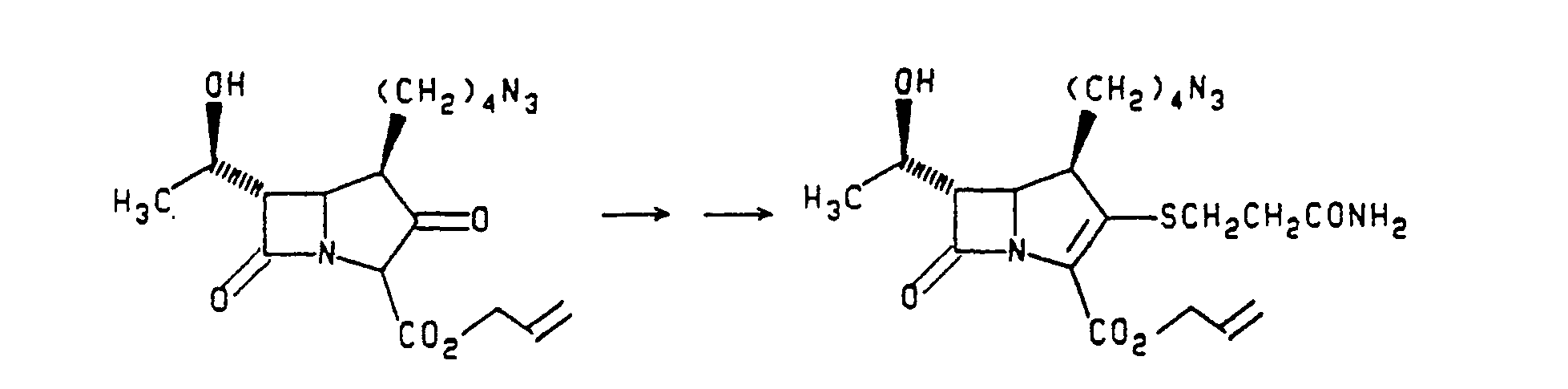
- IR (NaCI, film) νmax: 2100 (N3), 1770 (C = O of β-lactam), 1710 (sh C = O of ester) and 1680 cm-' (C = O of amide);
- 'H NMR (200 MHz, CDCl3) δ: 1.38 (d, J=6.27 Hz, 3H, CH3CHO), 1.3-1.9 (m, 6H, CH2-1,2,3 of azidobutyl), 2.05 (d, J=2.0 Hz, 1H, OH), 2.53 (-t, J=7 Hz, 2H, SCH2CH2CONH2), 3.0-3.3 (m, 4H, SCH2, H-6 and H-4 overlapping), 3.33 (t, J = 6.1 Hz, 2H, CH2N3), 4.26 (dd, JH5,H6 = 2.61 Hz, JH5,H4 = 9.37 Hz, 1 H, H-5), 4.26 (overlapping with H-5, 1 H, CH3CHO), 4.75 (m, 2H, CH2 of allyl), 5.2-5.5 and 5.9-6.1 (2 x m, 2H and 1 H, CH of allyl), 5.5 and 5.6 ppm (2 broad s, 2 x 1 H, CONH2).
-

- A solution of allyl (4R,5S,6S)-4-(4"azidobutyl)-3-[(2-carbamoylethyl)thio]-6-[(1'R)-1'-hydroxyethyl]-7-oxo-1-aza-bicyclo[3.2.0]hept-2-ene-2-carboxylate (1.06 g, 2.42 mmol) in EtOAc (50 mL) was treated at 22°C and under nitrogen with tetrakis(triphenylphosphine)palladium [0] (0.074 g) and 5.3 mL (2.65 mmol) of a 0.5M solution of potassium 2-ethylhexanoate in EtOAc . After 30 min, the reaction mixture was extracted with water (2 x 50 mL) and the combined aqueous phase was maintained under vacuum to remove traces of organic solvent. The aqueous phase was then hydrogenated over 1.25g of 5% palladium over alumina at 0-5°C and under 45 psi of hydrogen for 1 h. After the addition of 20 mL of 0.2M pH 6.0 phosphate buffer, the catalyst was filtered and the filtrate was chromatographed twice on reversed phase silica gel (µ-Bondapak c-18, 3.5 x 15 cm). Elution with a gradient of acetonitrile (0-5%) in water gave 0.36 g (40%) of the title compound as a white amorphous powder (93% pure by hplc) after freeze drying. The purity can be increased to 99% by another chromatography on the same column using 0.01 M pH 7.0 phosphate buffer instead of water followed by desalting of the product:
- Purity by HPLC: 99.5% on µ-Bondapak c-18, 3.9 mm x 30 cm, elution 5% CH3CN-H20 , pH 7.4 phosphate buffer, flow rate 0.7 mL/min, UV detector 304 nm, retention time 6.96 min;
- UV (H20, pH 7.4 phosphate buffer) λmax: 302 nm (8,865);
- IR (KBr) Ym.x: 1750 (C = 0 of β-lactam), 1670 (C = 0 of amide) and 1590 cm-1 (C = 0 of carboxylate);
- 'H NMR (200 MHz, D20) δ: 1.33 (d, J=6.37 Hz, 3H, CH3CHO), 1.3-2.0 (m, 6H, CH2-1,2 and 3 of butyl), 2.60 p, J=6.4 Hz, 2H, CH2CONH2), 2.9-3.2 (m, 4H, SCH2 and CH2NH2 overlapping), 3.4 (m, 2H H-4 and H-6), 4.23 (dd, JH5.H6=2.6 Hz, JH5,H4=9.15 Hz, 1 H, H-5) and 4.27 ppm (m, 1 H, CH3CHO).
-

- A solution of (4R,5S,6S)-4-(2"-aminoethyl)-3-[(2-cyanoethyl)thio]-6-[(1'R)-1'-hydroxyethyl]-7-oxo-1-azabicyclo-[3.2.0]-hept-2-ene-2-carboxylic acid (0.290 g, 0.89 mmol) in 35 mL of cold (0-5°C) water was adjusted to pH 8.5 with 1 M NaOH and treated with benzyl formimidate hydrochloride (0.76 g, 4.4 mmol) added in small portions over 10 min while maintaining the pH to 8-8.5 (1 N NaOH). After 20 min, the reaction mixture was quenched by addition of 25 mL of 0.2M pH 6.0 phosphate buffer and washed with EtOAc. The aqueous phase was maintained under vacuum to remove traces of organic solvent and then chromatographed on reverse phase silica gel (µ-Bondapak c-18, 3.5 x 12 cm). The column was eluted first with 0.01 M pH 7.0 phosphate buffer. The UV active fractions were combined, lyophilized and desalted on the same column using water as eluent. After freeze drying, the title compound was obtained as a white amorphous powder (0.120 g, 38%):
- Purity by HPLC: 99% on µ-Bondapak c-18, 3.9 mm x 30 cm, elution 1.5% CH3CN-H20 , pH 7.4 phosphate buffer, flow rate 1 mL/min, UV detector 300 nm, retention time 4.91 min;
- UV (H20, pH 7.4 phosphate buffer) λmax: 300 nm (7,429);
- IR (KBr) νmax: 2250 (weak CN), 1755 (C=0 of ,6-lactam), 1610 (C=N of formimidoyl) and 1580 cm-1 - (C = 0 of carboxylate);
- 'H NMR (200 MHz, D20) 6: 1.34 (d, J=6.37 Hz, 3H, CH3CHO), 1.8-2.3 (m, 2H, CH2-1 of aminoethyl), 2.8-3.2 (m, 4H, SCH2CH2CN), 3.45 (overlapping with H-6,
1 H , H-4), 3.47 (dd, JH6.H5 = 2.92 Hz, JH6.H1 = 6.87 Hz, 1H, H-6), 4.28 (m, 1H, CH3CHO), 4.32 (dd, JH5,H6=2.92 Hz, JH5,H4=6.68 Hz, 1H, H-5), and 7.85 ppm (s, 1 H, CH = NH). -

-

- IR (CH2Cl2) νmax: 3680, 3600, 3540, 3420 (OH, NH2) 2100 (N3), 1775, 1740 and 1710 cm-1 (C = 0);
- ' H NMR (CDCl3, 200 MHz) δ: 6.04-5.87 (1 H, m, vinylic-H), 5.50-5.22 (2H, m, vinylic-H), 4.88-4.63 (4H, m, NH2 and allylic-CH2), 4.37-4.10 (4H, m, H-1', CH20 and H-4), 4.276 (part of H-4, d, J=2.7 Hz), 3.49-3.35 (3H, m, CH2 N3 and H-4), 3.247 (1 H, dd, J = 2.7 Hz, J = 7.5 Hz, H-6), 3.8-3.09, 2.97-2.63 (2H, 2 sets of m, SCH2), 1.96-1.55 (3H, m, OH and CH2CH2) and 1.388 ppm (3H, d, J=6.3 Hz, CH3).
-

- Purity: 99.0% (HPLC, 300 nm);
- UV (H20) λmax: 302 (E 10600);
- 1 R (Nujol) vmax: 1755, 1710 and 1585 cm-1 (C = 0);
- ' H NMR (D20, 200 MHz) δ: 4.34 - 4.21 (4H, m, H-1', H-5 and CH20), 3.47-3.35 (1 H, m, H-4), 3.356 (1 H, dd, J=2.7 Hz, J=6.5 Hz, H-6), 3.21-2.88 (4H, m, CH2N,SCH2), 2.0-1.4 (4H, m, CH2CH2) and 1.334 ppm (3H, d, J=6.3 Hz, CH3).
-

-

- A solution of allyl (4R,5R,6S)-4-(2"-azidoethyl)-6-[(1'R)-1'-tert-butyldimethylsilyloxyethyl]-3,7-dioxo-1-azabicyclo(4.69 mmol, prepared by cyclization of 2.18 g, 4.69 mmol of the diazo precursor as described in Example 2) in dry acetonitrile (36 mL) was treated at -15°C and under Argon with diphenyl chlorophosphate (1.02 mL, 4.9 mmol) and N,N-diisopropylethylamine (0.87 mL, 5.0 mmol). A small crystal of 4-N,N-dimethylaminopyridine was added and the mixture was stirred at -15°C for 30 min. N,N-Diisopropylethylamine (0.87 mL, 5.0 mmol) and 1-methyl4-thiomethyl-1,2,3-triazole (1.22 g, 9.4 mmol) were added and the mixture was stirred overnight at -15°C. The reaction mixture was diluted with EtOAc (250 mL) and mixed with a mixture coming from a similar experiment starting from 0.54 mmol of the diazo precursor. The resulting solution was washed with water, 1 M NaHSO3saturated NaHC03, brine and dried ( MgSO4). Evaporation of the solvent gave an oil which was chromatographed on silica gel (5 x 15 cm). Elution with a mixture of EtOAc and toluene (7:13) gave 1.99 g (69%) of the title compound as a brown oil:
- IR (Nujol) vmax: 2105 (N3), 1775 (C=0 of β-lactam) and 1710 (C=O of ester).
- 'H NMR (200 MHz, CDCl3) δ: 0.09 (s, 6H, SiCHa), 0.89 (s, 9H, Si-t-bu), 1.29 (d, J=6.14 Hz, 3H, CH3CHO), 1.72 and 2.04 (2 x m, 2 x 1H, CH2-4), 3.10 (dd, J1'6=7.19 Hz, J5-6=2.73 Hz, 1H, H-6), 3.30-3.64 (m, 2H, CH2N3), 3.65 (ddd, J4-5 = J =10.06 Hz, J = 2.73 Hz, 1 H, H-4), 4.01 (d, Jgem 14.62 Hz, 1 H, CH2-S), 4.02-4.35 (m, 2H, H-5 and CH3CHO), 4.08 (s, 3H, CH3-N), 4.26 (d, Jgem = 14.58 Hz, 1 H, CH2-S), 4.72 (m, 2H, CH2 of allyl), 5.21-5.47 and 5.95 (2 x m, 2H and 1 H, CH of allyl), 7.48 (s, 1 H, CH of triazole).
-

- A solution of allyl (4R,5S,6S)-4-(2"-azidoethyl)-6-[(1'R)-1'-tert-butyldimethylsilyloxyethyl]-3-[(1-methyl-1,2,3-triazol-4-yl)methylthio]-7-oxo-1-azabicyclo[3.2.0]-hept-2-ene-2-carboxylate (1.99 g, 3.63 mmol) in dry tetrahydrofuran (57 mL) was treated at 0-5° C and under Argon with acetic acid (1.25 mL, 21.8 mmol) followed by 11.3 mL (11.3 mmol) of 1 M solution of tetrabutylammonium fluoride in tetrahydrofuran. The solution was stored at 5°C for 10 days. The reaction mixture was then diluted with EtOAc , washed with saturated NaHCO3, brine and dried ( MgS04). Evaporation of the solvent gave an oil which was chromatographed on silica gel (5 x 15 cm). Elution with a mixture of acetonitrile and EtOAc (3:97) gave 1.09 g (48%, yield from the diazo azetidinone) of the title compound as a foamy light yellow solid:
- 1 R (NaCl, film) νmax: 3490 (OH), 2105 (N3), 1780 (C=0 of β-lactam), and 1710 (C=0 of ester).
- ' H NMR (200 MHz, CDCl3) 6: 1.38 (d, J=6.26 Hz, 3H, CH3CHO), 1.78 and 2.02-2.18 (2 x m, 2 x 1 H, CH2-4), 2.07 (d, J=4.42 Hz, 1H, OH), 3.17 (dd, J1'-6=7.71 Hz, J5.6=2.76 Hz, H-6), 3.39-3.65 (m 2H, CH2N3), 3.74 (ddd, J4-5:10,40 Hz, J = 10.40 Hz, J = 2.42 Hz, H-4), 3.95 (d, Jgem = 14.89 Hz, 1 H, CH2-S), 4.08 (s, 3H, CH3-N), 4.14-4.27 (m, 1H, CH3CHO), 4.21 (dd, J4.5=9.54 Hz, J5.6=2.69 Hz, H-5), 4.28 (d, Jgem = 15.05 Hz, 1 H, CH2-S), 4.73 (m, 2H, CH2 of allyl), 5.22-5.48 and 5.94 (2 x m, 2H and 1 H, CH of allyl), 7.48 (s, 1 H, CH of triazole).
-

- A solution of allyl (4R,5S,6S)-4-(2"-azidoethyl)-3-[(1-methyl-1,2,3-triazol-4-yl)methylthio]-6-[(1'R)-1'-hydroxyethyl]-7-oxo-1-azabicyclo[3.2.0]hept-2-ene-2-carboxylate (495 mg, 1.14 mmol) in dry CH2 CI2 (25 mL) was treated at 0-5°C and under Argon, with tetrakis(triphenylphosphine)palladium [O] (83 mg) and 2.5 mL (1.25 mmol) of a 0.5M solution of sodium 2-ethylhexanoate in EtOAc . Then 50 mL of water were added and the organic layer was separated. The organic phase was re-extracted with 3 x 15 mL of water and the combined aqueous layers were pumped to remove organic solvent. The residual aqueous phase was hydrogenated over 419 mg of 5% palladium on alumina and under 45 psi of hydrogen for 1 hour. The catalyst was filtered and the filtrate was neutralized with a solution of NaH2PO41M (a few drops). The mixture was chromatographed on reversed phase silica gel (µ-bondapak c-18, 7 x 11 cm) using gradient of acetonitrile in water (0-1%) followed by lyophilization of the UV active fractions gave 290 mg (69%) of the title compound as a light yellow amorphous powder:
- Purity by HPLC: 97.3% on µ-bondapak c-18, 3.9 mm x 30 cm, elution 1.5% acetonitrile in water pH 7.4 phosphate buffer, flow rate 1 mL/min, UV detector 302 nm, retention time 5.82 min;
- UV (H20, pH 7.4 phosphate buffer) λmax; 302 nm (6091);
- IR (KBr) νmax: 1760 (C=0 of β-lactam) and 1600 (C = 0 of carboxylate);
- 'H NMR (200 Hz, D20) δ: 1.31 (d, J=6.34 Hz, 3H, CH3CHO), 1.80 and 2.17 (2 x m, 2 x 1H, CH2-4), 3.09 (t, J = 8.33 Hz, CH2N3), 3.32 (ddd, J4-5 = J = 10.06 Hz, J = 3.06 Hz, 1 H, H-4), 3.41 (dd, J7-6 = 6.56 Hz, J5. 6=2.79 Hz, H-6), 3.95-4.28 (m, 4H, CH2-S, CH3CHO, H-5), 4.08 (s, 3H, CH3-N), 7.85 (s, 1H, CH of triazol).
-

- A solution of (4R,5S,6S)-4-(4"-aminobutyl)-3-[(3-cyano-propyl)thio]-6-[(1'R)-1'-hydroxyethyl]-7-oxo-1-azabicyclo-[3.2.0]hept-2-ene-2-carboxylic acid (0.411 g, 1.12 mmol) in water (50 mL) was adjusted to pH 8.5 with 1 M NaOH. Then benzylformimidate hydrochloride (0.94 g, 5.4 mmol) was added in small portions over 5 min while maintaining the pH to 8-8.5 with 1 M NaOH. After 20 min, 40 mL of 0.2M pH 6.0 phosphate buffer was added and the solution was washed with ethyl acetate and the aqueous phase was maintained under vacuum to remove traces of organic solvent. The aqueous solution was chromatographed at 0-5°C on reversed phase silica gel (3.5 x 15 cm, µ-Bondapak) using a gradient of acetonitrile (0-10%) in 0.01 M pH 7.0 phosphate buffer. The UV active fractions were combined, concentrated under vacuum (t
- Purity by HPLC: 99% on µBondapak C,8, 3.9 mm x 30 cm, elution 8% CH3CN-H20, pH 7.4 phosphate buffer, flow rate 1 mL/min, uv detector 304 nm, retention time 6.85 min;
- UV (H20, pH 7.4 phosphate buffer) λmax: 304 nm (9,324);
- IR (KBr) νmax: 2250 (CN), 1755 (C = 0 of β-lactam), 1715 (C = N of formimidoyl) and 1590 cm-' (C = O of carboxylate);
- 'H NMR (200 MHz, D20) 5: 1.32 (d, J=6.31 Hz, 3H, CH3CHO), 1.3-2.1 (m, 8H, CH2-1,2 and 3 of butyl and CH2-2 of cyanopropyl), 2.64 (t, J=6.9 Hz, 2H, CH2CN), 2.7-3.1 (m, 2H, SCH2), 3.35 (m, 4H, CH2NH H-4 and H-6 overlapping), 4.2-4.4 (m, 2H, H-5 and CHsCHO overlapping) and 7.79 ppm (s, 1H, CH=NH).
-

- A solution of (4R,5S,6S)-4-(4"-aminobutyl)-6-[(1'R)-1'-hydroxyethyl]-3-[(pyridin-3-yl)methylthio]-7-oxo-1-azabicyclo[3.2.0]hept-2-ene-2-carboxylic acid (0.221 g, 0.56 mmol) in 5 mL of cold water (0-5°C) was treated with 37% w/w formaldehyde (0.23 mL, 2.8 mmol) and acetic acid (0.2 mL, 3.5 mmol). The resulting pH was 4.0. Then 0.071 g (1.1 mmol) of sodium borohydride was added all at once followed by another 0.130 g (2.1 mmol) added in small portions over 2 h. The reaction mixture was then quenched by addition of 20 mL of 0.2M pH 7.0 phosphate buffer and then chromatographed on reversed phase silica gel (µBondapak C18, 2 x 15 cm). Elution with a gradient of acetonitrile (0-5%) in water gave 0.161 g (68%) of the title compound as a white amorphous solid after freeze drying:
- Purity by HPLC: 94% on µBondapak C18, 3.9 mm/30 cm, elution 10% CH3CN-H2O pH 7.4 phosphate buffer, flow rate 1.5 mL/min, uv detector 300 nm, retention time 8.19 min;
- UV (water, pH 7.4 phosphate buffer) λmax: 266 (4980) and 304 nm (7.540);
- IR (KBr) νmax:: 1758 (C = 0 of β-lactam) and 1582 cm-1 (C = 0 of carboxylate);
- 'H NMR (200 MHz, D2O) δ: 1.29 (d, J=6.34 Hz, 3H, CH3CHO), 1.2-1.8 (m, 6H, CH2-1,2 and 3 of butyl), 2.86 (s, 6H, NCH3), 3.1 (m, 3H, CH2N and H-4), 3.29 (dd, JH6,H5 = 2.54 Hz, JH6,H1 = 6.35 Hz, 1H, H-6), 4.08 (ABq, JAB = 14.9 Hz, Δv = 24.2 Hz, 2H, SCH2), 4.08 (overlapping with SCH2, 1H, H-5), 4.22 (m, 1H, CH3CHO), 7.45 (dd, J = 4.9 Hz, and J = 7.9 Hz, 1 H, H-5 of pyridine), 7.9 (m, 1 H, H-4 of pyridine), 8.44 (dd, J = 1.5 Hz, and J = 4.9 Hz, 1 H, H-6 of pyridine) and 8.53 ppm (d, J =1.8 Hz, 1 H, H-2 of pyridine).
-

- A solution of (4R,5S,6S)-4-(4"-aminobutyl)-6-[(1'R)-1'-hydroxyethyl]-3-[(1-methyl-1,2,3-triazol-4-yl)-methylthio]-7-oxo-1-azabicyclo[3.2.0]hept-2-ene-2-carboxylic acid (0.296 g, 0.75 mmol) [prepared in Example 62] in water (30 mL) was treated at 0-5°C with benzylformimidate hydrochloride (0.65 g, 3.8 mmol) added in small portions over 10 min while maintaining the pH to 8-8.5 with 1 M NaOH . After 30 min, 25 mL of 0.2M pH 6.0 phosphate buffer were added and the resulting mixture was washed with EtOAc (20 mL). The aqueous phase was maintained under vacuum to remove traces of organic solvent and then chromatographed on reversed phase silica gel (µ-Bondapak c-18, 3.5 x 14 cm). The column was eluted first with a gradient of CH3CN (0-8%) in 0.01 M pH 7 phosphate buffer. The UV active fractions were concentrated in vacuo (T <15°C) and chromatographed again on the same column using water instead of buffer. Lyophilization of the UV active fractions gave 0.21 g (66%) of the title compound as a white amorphous powder:
- Purity by HPLC: 98% on µ-Bondapak c-18, 3.9 mm x 30 cm, elution 8% CH3CN-H2O , pH 7.4 phosphate buffer, flow rate 1 mL/min, uv detector 304 nm, retention time 6.34 min;
- UV (H20, pH 7.4 phosphate buffer) λmax: 302 nm (8,586);
- IR (KBr) νmax: 1755 (C=O of β-lactam), 1715 (C=N of formimidoyl) and 1590 cm-' (C=O of carboxylate);
- 'H NMR (200 MHz, D20) δ: 1.30 (d, J=6.36 Hz, 3H, CH3CHO), 1.3-1.9 (m, 6H, CH2-1,2 and 3 of butyl), 3.1-3.5 (m, 4H, H-4, H-6 and CH2-4 of butyl overlapping), 4.08 (s, 3H, CH3-1 of triazole), 4.09 (ABq, JAB= 14.85 Hz, Ov = 31.9 Hz, 2H, SCH2), 4.15 (overlapping SCH2 and CH3, 1 H, H-5), 4.27 (m, 1 H. CH3CHO), 7.8 (broad S, 1 H, CH = NH) and 7.87 ppm (s, 1 H, H-5 of triazole).
-

-

- A solution of allyl (4R,5R,6S)-4-(4"-azidobutyl)-6-[(1'R)-1'-hydroxyethyl]-3,7-dioxo-1-azabicyclo[3.2.0]-heptane-2-carboxylate (11.8 mmol, prepared by cyclization of 4.47 g, 11.8 mmol of diazo precursor as in Example 45) in dry acetonitrile (50 mL) was cooled to 0-5°C and treated with diphenyl chlorophosphate (2.57 mL, 12.4 mmol) and N,N-diisopropylethylamine (2.16 mL, 12.4 mmol) added simultaneously over 5 min. After 1 h, N,N-diisopropylethylamine (2.16 mL, 12.4 mmol) followed by chlorotrimethylsilane (1.57 mL, 12.4 mmol) were added dropwise over 5 min. Then more N,N-diisopropylethylamine (2.16 mL, 12.4 mmol) and 2-mercaptoethanol (1.84 g, 23.5 mmol) were added and the mixture was stirred at 0-5°C for 16 h. The reaction mixture was then diluted with ethyl acetate (500 mL), washed with cold water, brine and dried ( MgSO4). Evaporation of the solvent gave an oil which was then diluted with tetrahydrofuran (100 mL) and water (20 mL) and treated with acetic acid (2 mL) at 20°C for 2 h. The solution was diluted again with ethyl acetate, washed with saturated NaHCO 3, 0.2M pH 7.0 phosphate buffer and brine. After drying over anhydrous MgS04, evaporation of the solvent gave an oil which was chromatographed on silica gel (4.5 x 10 cm). Elution with a mixture of toluene and ethyl acetate (1:1 ) gave 2.56 g (52%) of the title compound as an oil:
- IR (NaCl, film) νmax: 2100 (N3) 1765 (C = 0 of β-lactam) and 1705 cm-1 (C = 0 of ester);
- 'H NMR (200 MHz, CDCI3) δ: 1.38 (d, J=6.29 Hz, 3H, CH3CHO), 1.3-2.0 (m, 6H, CH2-1, 2 and 3 of butyl), 2.8-3.2 (m, 2H, SCH2CH2OH), 3.18 (dd JH6,H5=2.60 Hz,JH6,H1 = 7.18 Hz, 1H, H-6), 3.3 (m, 3H, CH2N3 and H'-4 overlapping), 3.82 (t, J=6.0 Hz, 2H, SCH2CH20H), 4.1-4.3 (m, 2H, H-5 and CH3CHO overlapping), 4.75 (m, 2H, CH2 of allyl), 5.2-5.5 and 5.9-6.1 ppm (2 x m, 2H and 1 H, CH of allyl).
-
 + 74.0 (c 1.0, H20);
- Purity by HPLC: 99% on µBondapak C18, 3.9 mm x 30 cm, elution with pH 7.4 phosphate buffer, flow rate 1 mL/min, retention time (9.68 min);
- UV (H20, pH 7.4 phosphate buffer) λmax: 304 nm (7,616);
- IR (KBr) νmax: 1750 (C = 0 of fl-lactam) and 1585 cm-1 (C = 0 of carboxylate);
- 1H NMR (200 MHz, D20): 1.33 (d, J=6.38 Hz, 3H, CH3CHO) 1.3-1.9 (m, 6H, CH2-1, 2 and 3 of butyl), 2.8-3.1 (m, 2H, SCH2CH20H), 3.02 (t, J=7.6 Hz, 2H, CH2NH2) 3.36 (m, 2H, H-4 and H-6 overlapping), 3.77 (t, J=6.2 Hz, 2H, SCH2CH2OH), 4.22 (dd, JH5,H6=2.43 Hz, 1H, H-5) and 4.26 ppm (m, overlapping with H-5, 1 H, CH3CHO).
-
 + 45.5° (c 1.0, H20);
- Purity by HPLC: 99% on µ-Bondapak c-18, 3.9 mm x 30 cm, elution 5% CH3CN-H20, pH 7.4 phosphate buffer, flow rate 1 mL/min, uv detector 300 nm, retention time 11.1 min;
- UV (H20, pH 7.4 phosphate buffer) λmax: 302 nm (8,676);
- IR (KBr) νmax: 2250 (weak CN), 1755 (C = O of β-lactam), 1665 (C = N of guanidyl) and 1685 cm-' - (C = 0 of carboxylate);
- 'H NMR (200 MHz, D20) δ: 1.32 (d, J=6.39 Hz, 3H, CH3CHO), 1.3-1.9 (m, 6H, CH2-1, 2 and 3 of butyl), 2.8-3.3 (m, 4H, SCH2CH2CN), 3.22 (t, J6.5 Hz CH2NH), 3.36 (dd, JH6,H5=2.34 Hz, JH6,H1 =6.22 Hz, 1H, H-6), 3.4 (overlapping with H-6, 1 H, H-4) and 4.2-4.4 ppm (m, 2H, H-5 and CH3CHO overlapping).
-

- Purity by HPLC: 99% on µ-Bondapak c-18, 3.9 mm/30 cm, elution 2% CH3CN-H2O, pH 7.4 phosphate buffer, flow rate 1 mUmin, UV detector 300 nm, retention time 5.98 min;
- UV (H20, pH 7.4 phosphate buffer) xmax: : 300 nm (7,483);
- IR (KBr) vmax: 2255 (weak CN), 1755 (C = 0 of β-lactam), 1660 (C = N of guanidine) and 1590 cm-' (C = 0 of carboxylate);
- 'H NMR (200 MHz, D2O) δ: 1.34 (d, J=6.34 Hz, 3H, CH3CHO), 1.7-2.3 (m, 2H, CH2-1 of guanidinoethyl), 2.7-3.4 (m, 7H SCH2CH2CN, CH2-2 of guanidinoethyl and H-4), 3.45 (dd, JH6H5 = 2.69 Hz, JH6,H1 = 6.8 Hz, 1H, H-6) and 4.3 ppm (m, 2H, H-5 and CH3CHO overlapping).
-
 + 67.0° (c 1.0, H20);
- Purity by HPLC: 99% on µBondapak C18, 3.9 mm x 30 cm, elution 2% CH3CN-H2O, pH 7.4 phosphate buffer, flow rate 1 mLmin, uv detector 300 nm, retention time 10.2 min:
- UV (H20, pH 7.4 phosphate buffer) λmax: 304 nm (10,105);
- IR (KBr) νmax: 1750 (C = 0 of β-lactam), 1715 (C = N of formimidoyl) and 1590 cm-1 (C = 0 of carboxylate);
- 'H NMR (200 MHz, D20) s: 1.32 (d, J=6.37 Hz, 3H, CH3CHO), 1.3-1.9 (m, 6H, CH2-1,2 and 3 of butyl), 2.8-3.1 (m, 2H, SCH2CH20H), 3.3-3.5 (m, 4H, H-4, H-6 and CH2NH overlapping), 3.77 (t, J=6.21 Hz, 2H, SCH2CH20H), 4.21 (dd, JHS,H6 =2.25 Hz, 1H, H-5), 4.26 (m overlapping with H-5, 1H, CH3CHO), and 7.78 ppm (broad s, 1 H, CH = NH).
-

-

- IR (NaCI. film) νmax: 2100 (N3), 1770 (C=0 of β-lactam) and 1710 cm-' (C=0 of ester);
- 'H NMR (200 MHz, CDC13)6: 1.38 (d, J=6.25 Hz, 3H, CH3CHO), 1.4-1.9 (m, 6H, CH2-1,2 and 3 of butyl), 3.17 (dd, JH5,H6 = 2.72 Hz, JH3,H4=7.36 Hz, 1H, H-6), 3.2 (m, 1H, H-4), 3.32 (t, J=6.0 Hz, 2H, CH2N3), 3.68 (s, 3H, CH3-1 of imidazole), 4.02 (ABq, JAB = 14.3 Hz, Δν = 33.0 Hz, 2H, SCH2), 4.1-4.3 (m, 2H, H-5 and CH3CHO), 4.74 (m, 2H, CH2 of allyl), 5.2-5.5 and 5.9-6.1 (2 x m, 2H and 1 H, CH of allyl), 6.93 (s, 1 H, H-4 of imidazole), and 7.42 ppm (s, 1 H, H-2 of imidazole).
-
 -22.4 (c 1.0, H20);
- Purity by HPLC: 97.3% on µBondapak C18, 3.9 mm x 30 cm, elution 8% CH3CN-H20 pH 7.4 phosphate buffer, flow rate 1 mLmin, uv detector 302 nm, retention time 5.88 min;
- UV (water, pH 7.4 phosphate buffer) λma: 302 nm (7,569);
- IR (KBr) νmax: : 1755 (C=0 of β-lactam) and 1585 cm-' (C=0 of carboxylate);
- 'H NMR (200 MHz, D20) δ: 1.31 (d, 3=6.35 Hz, 3H, CH3CHO), 1.3-1.8 (m, 6H, CH2-1,2 and 3 of butyl), 2.99 (t, J = 7.6 Hz, 2H, CH2NH2), 3.22 (broad t, 1 H, H-4), 3.33 (dd, JH6.H5 = 2.56 Hz, JH6,H1 = 6.34 Hz, 1 H, H-6), 3.71 (s, 3H, CH3-1 of imidazole), 4.07 (ABq, JAB = 14 8 Hz, Δν= 38.45 Hz, 2H, SCH2), 4.13 (dd overlapping with SCH2, JH5,H6 = 2.56 Hz, 1 H, H-5), 4.24 (m, 1 H, CH3CHO), 6.94 (s, 1 H, H-4 of imidazole) and 7.66 ppm (s, 1 H, H-2 of imidazole).
-

-

- IR (CH2CI2) νmax: 3680, 3600, 3520, 3410 (OH and NH2), 2100 N3, 1775, 1710, 1690 and 1675 cm-1 (C=O);
- 1H NMR (CDCI3, 200 MHz) δ : 6.03-5.89 (1H, m vinylicH), 5.7, 5.6 (2H, bd, NH2), 5.27 (2H, m, vinylic-H), 4.9-4.6 (2H, m, allylic-CH2), 4.266 (1H, dd, J=2.6 Hz, J=7.5 Hz, H-5), 3.6-3.27 (3H, m, CH2N3 and H-4), 3.251 (1H, dd, J =2.7 Hz, J=7.2 Hz, H-6), 3.23-2.95 (2H, m, SCH2), 2.6-2.45 (2H, m, CH2CON), 2.25 (1H, bs, OH), 1.95-1.5 (4H, m CH2-CH2-4) and 1.373 ppm (3H, d, J=6.2 Hz, CH3).
-

- Purity: 94.7% (304 nm, HPLC);
- UV (H20) λmax: : 302 (E 9260);
- IR (Nujol) νmaX: 3600-3100 (OH, NH2); 1750-1665 and 1600 cm-1 (C=0);
- 'H NMR (D2O, 200 MHz) δ: 4.35-4.21 (1H, m, H-1'), 4.239 (1H, dd, J=2.6 Hz, J=5.3 Hz, H-5), 3.45-3.36 (1 H, m, H-4), 3.385 (1 H, dd, J =2.6 Hz, J =6.6 Hz, H-6), 3.2-2.8 (4H, m, CH2N and SCH2), 2.63-5.55 (2H, m, CH2CO), 2.0-1.45 (4H, m, (CH2)2-4) and 1.331 ppm (3H, d, J=6.4 Hz, CH3).
-
 -23.1 (c 1.0, water);
- Purity by HPLC: 97.6% on µBondapak C18, 3.9 mm x 30 cm, elution 8% CH3CN-H20 pH 7.4 phosphate buffer, flow rate 1 mUmin, uv detector 302 nm, retention time 9.45 min;
- IR (KBr) νmax: 1750 (C=0 of β-lactam), 1715 (C=N of formimidoyl) and 1590 cm-1 (C=0 of carboxylate);
- 'H NMR (200 MHz, D20) s: 1.30 (d, J=6.34 Hz, 3H, CH3CHO), 1.3-1.8 (m, 6H, CH2-1,2 and 3 of butyl), 3.2-3.5 (m, 4H, H-4, H-6 and CH2N), 3.71 (s, 3H, CH3-1 of imidazole), 4.08 (ABq, JAB= 14.68 Hz, Δν= 37.4 Hz, 2H, SCH2), 4.14 (dd overlapping with SCH2, JH5.6= 2.43 Hz, JH5.H4= 9.38 Hz, 1H, H-5), 4.24 (m, 1H, CH3 CHO), 6.93 (s, 1 H, H-4 of imidazole), 7.62 (s, 1 H, H-2 of imidazole) and 7.79 ppm (s, 1 H, CH=NH).
-

- Purity by HPLC: 99% on µ-Bondapak c-18, 3.9 mm x 30 cm, elution 10% CH3CN-H2O pH 7.4 phosphate buffer, flow rate 1.5 mL'min, UV detector 300 nm, retention time 7.47 min;
- UV (H2O, pH 7.4 phosphate buffer) λmax: : 262 (5,360) and 304 nm (8,765);
- IR (KBr) νmax: 1752 (C=0 of β-lactam), 1665 (C = N of guanidine), 1600 cm-1 (C=0 of carboxylate);
- 1H NMR (200 MHz, D20) δ: 1.27 (d, J=6.33 Hz, 3H, CH3CHO), 1.1-1.7 (m, 6H, CH2-1,2,3 of butyl), 3.1 (m, 1H, H-4), 3.15 (t, J=6.4 Hz, 2H, CH2N), 3.26 (dd, JH6,H5=2.45 Hz, JH6,H1 =6.06 Hz, 1H, H-6), 4.05 (ABq, JAB=14.76 Hz, Δν=22.9 Hz, 2H, SCH2), 4.05 (overlapping with SCH2, 1H, H-5), 4.21 (m, 1H, CH3CHO), 7.47 (d, J = 6.2 Hz, 2H, H-3 of pyridine) and 8.47 ppm (d, J = 6.2 Hz, 2H, H-2 of pyridine).
-

-

- IR (NaCl, film) vmax:2100 (N3), 1775 (C=0 of β-lactam) and 1710 cm-1 (C=0 of ester);
- 'H NMR (200 MHz, CDC13) 5: 1.38 (d, J=6.24 Hz, 3H, CH3CHO), 1.4-2.0 (m, 4H, CH2-1 and 2 of propyl), 3.23 (dd, JH5,H6=2.69 Hz, JH3.H4=7.73 Hz, 1H, H-6), 3.3-3.4 (m, 3H, H-4 and CH2-N3 overlapping), 3.70 (s, 3H, CH3-1 of imidazol), 4.05 (ABq, 2H, SCH2), 4.1-4.3 (m, 2H, H-5 and CH3CHO), 4.75 (m, 2H, CH2 of allyl), 5.2-5.5 and 5.9-6.1 (2 x m, 2H and 1 H, CH of allyl), 6.94 (s, 1 H, H-4 of imidazol), and 7.45 ppm (s, 1 H, H-2 of imidazol).
-

- A solution of allyl (4R,5S,6S)-4-(3"-azidopropyl)-6-[(1'R)-1'-hydroxyethyl]-3-[(1-N-methylimidazol-5-yl)-methyl-thio]-7-oxo-1-azabicyclo[3.2.0]hept-2-ene-2-carboxylate (1.25 g, 2.8 mmol) in ethyl acetate (35 mL) was treated at 0-5°C and under nitrogen with tetrakis(triphenylphosphine)-palladium [O] (0.275 g) and sodium 2-ethylhexanoate (0.450 g). The cold bath was removed and the reaction mixture was stirred at 22 C for 1 h. Then the reaction mixture was extracted with water (3 x 60 mL) and the combined aqueous phase was maintained under vacuum to remove traces of organic solvent. The aqueous solution was then hydrogenated at 0-5°C over 5% palladium on alumina (1.25 g) under 50 psi of hydrogen for 3 h. The catalyst was filtered, the pH adjusted to 6.2 with 2N HCI. The resulting filtrate was concentrated to about 50 mL and was chromatographed twice on reversed phase silica gel (µBondapak C18, 3.5 x 14 cm) using a gradient of acetonitrile (0-5%) in water eluent. Lyophilization of pure fractions (checked by reversed phase-TLC) gave 0.39 g (38%) of the title compound as an off-white amorphous powder.
- Purity by HPLC: 97.8% on µBondapak C,8, 3.9 mm x 30 cm, elution with 8% CH3CN-H2O pH 7.4 phosphate buffer, flow rate 1 mLmin, uv detector 300 nm, retention time 5.00 min;
- UV (H20) λmax: 300 nm (7396);
- IR (KBr) νmax: 1755 (C=0 of β-lactam) and 1590 cm-1 (C=O of carboxylate);
- 'H NMR (200 MHz, D20) δ: 1.31 (d, J=6.36 Hz, 3H, CH2CHO), 1.3-1.9 (m, 3H, CH2-1,2 of propyl), 2.99 (t, J=7.15, 2H CH2NH2), 3.25 (broad t, 1H, H-4), 3.37 (dd, JH6,H5=2.66, JH6.N1 =6.46 Hz, 1H, H-6), 3.72 (a, 3H, CH3-1 of imidazol), 4.08 (ABq, 2H, SCH2), 4.15-4.3 (m overlapping with SCH2, 2H, H-5 and CH3CHO), 6.96 (s, 1 H, H-4 of imidazol and 7.67 ppm (s, 1 H, H-2 of imidazol).
-

- A solution of (4R,5S,6S)-4-[3"-aminopropyl)-6-[(1'R)-1'-hydroxyethyl]-3-[(1-N-methylimidazol-5-yl)-methylthio]-7-oxo-1-azabicyclo[3.2.0]hept-2-ene-2-carboxylic acid (300 mg, 0.789 mmol) in water (40 mL) was cooled in an ice bath and the pH of the solution was adjusted to 8 with 1 N aqueous NaOH solution. To the mixture was added portionwise benzyl formimidate hydrochloride (5 eg., 3.94 mmol, 0.68 g), the pH being kept at 8-8.5 with 1 N aqueous NaOH solution. The reaction mixture was stirred 15 min after the end of addition then the pH was adjusted to 6.5 with 1 N aqueous HCI solution and washed with ethyl acetate (2 x 30 mL). The aqueous phase was concentrated under vacuum without heating and purified on reversed phase silica gel [µBondapak C18, 3x5 x 13 cm, elution with 0.01 M pH 6.0 phosphate buffer and gradient of CH3CN (0-3%)]. The pure fractions were lyophilized, repurified on the reversed phase column to remove salts (water → 5% CH3CN/H20) to give 0.115 g (36%) of the title compound as a white amorphous solid after lyophilization.
- Purity by HPLC: 99.2% on µBondapak C18, 3.9 mm x 30 cm, flow rate 1 mL/min, elution 8% CH3CN-KH2P04 0.01 M pH 7.4, uv detector 300 nm, retention time 6.30 min;
- UV (H2O) λmax: 300 nm (∈ = 7853);
- IR (KBr) vmax: 1755 (C = 0 of β-lactam), 1715 (C = N and 1590 cm-1 (C = 0 of carboxylate;
- 'H NMR (200 MHz, D2O) δ: 1.30(d, J=6.37 Hz, CH3), 1.3-1.72 (4H, m, CH2CH2), 3.19-3.40 (3H, m, CH2N and H-6 overlapping), 3.71 (3H, s, N-CH3), 4.08 (ABq, J=14.87 Hz, Δν= 45.5 Hz, 2H, SCH2), 4.2 (m, 1 H, CH3CHO), 6.95 (s, 1 H, H-4 of imidazol), 7.65 (s, 1 H, H-2 of imidazol and 7.81 (s, 1 H, CH=NH).
-

- A solution of (4R,5S,6S)-4-(4"-aminobutyl)-6-[(1'R)-1'-hydroxyethyl]-3-[(pyridin-4-yl)methylthio]-7-oxo-1-azabicyclo[3.2.0]hept-2-ene-2-carboxylic acid (0.176 g, 0.45 mmol) in water (8 mL) was treated at 0-5°C, with 37% formaldehyde (0.2 mL, -2.5 mmol), acetic acid (0.052 mL, 0.9 mmol) and sodium cyanoborohydride (0.056 g, 0.9 mmol). The final mixture has a pH of 4.2. Completion of the reaction was monitored by HPLC. Over 5 h, sodium cyanoborohydride (6 x 0.050 g) and formaldehyde (2 x 0.1 mL) were added while maintaining the pH at 4.5-5 with acetic acid. The reaction mixture was then quenched by addition of 15 mL of 0.2M pH 7.0 phosphate buffer and the pH of the solution was adjusted to 6.5 with 1 M NaOH. By HPLC, the product is a 74:20 mixture of dimethyl and N-methyl-N-cyanomethyl derivatives. The solution was chromatographed twice on reversed phase silica gel (µBondapak C18, 2.5 x 18 cm) using a gradient of acetonitrile (0-10%) in water.
- Lyophilization of the first fractions gave 0.021 g of the N-methyl-N-cyanomethyl compound.
- The following fractions gave 0.104 g (55%) of the title compound as a white amorphous powder:+ 4.0° (c 0.5, water);

- Purity by HPLC: 95% on µBondapak C18, 3.9 mm x 30 cm, elution 10% CH3CN-H20 , pH 7.4 phosphate buffer, flow rate 1 mUmin, retention time 12.0 min;
- UV (water, pH 7.4 phosphate buffer) λmax: 262 (6032) and 304 nm (9,937);
- IR (KBr) v,nax: 1758 (C=O of β-lactam) and 1600 cm-' (C=O of carboxylate);
- 'H NMR (200 MHz, D20) δ: 1.1-1.8 (m, 6H, CH2-1,2 and 3 of butyl), 1.28 (d, J=6.37 Hz, 3H, CH3CHO), 2.85 (s, 6H, NCH3), 2.9-3.2 (m, 3H, H-4 and CH2N), 3.27 (dd, JH6,H5= 2.54 Hz, JH6,H1=6.34 Hz, 1H, H-6), 4.06 (ABq, JAB=14.9 Hz, Δν= 23.4 Hz, 2H, SCH2), 4.08 (overlapping with SCH2, 1 H, H-5), 4.21 (m, 1 H, CH3CHO), 7.49 (~d, 2H, H-3 of pyridine) and 8.49 ppm (~d, 2H, H-2 of pyridine).
-

-

- IR (CH2C12) Pmax: 3680, 3600, 3400 (OH), 2100 (N3), 1775 and 1710 cm-1 (C=0);
- ' H NMR ( CDCI3, 200 MHz) δ: 7.489 (1H, s, aromatic-H), 6.02-5.87 (1H, m, vinylic-H), 5.47-5.20 (2H, m, vinylic -H), 4.85-4.59 (2H, m, allylic CH2), 4.274, 4.199, 3.961, 3.886 (2H, ABq, J=15.1 Hz, CH2-aromatic), 4.25-4.12 (1 H, m, H-1'), 4.159 (1 H, dd, J = 2.6 Hz, J = 9.6 Hz, H-5), 4.071 (3H, s, N-Me), 3.64-3.53 (1 H, m, H-4), 3.49-3.36 (2H, m, CH2-N3), 3.228 (1 H, dd, J =2.7 Hz, J=7.3 Hz, H-6), 2.3 (1 H, bs, OH), 2.03-1.5 (4H, m, (CH2)2-4 ) and 1.357 ppm (3H, d, J=6.3 Hz, CH3).
-

- Purity: 97.2% (304 nm, HPLC);
- UV (H20) λmax: 302 (∈ 8250);
- IR (Nujol) vn,ax: 3600-3100 (OH), 1755 and 1585 cm-1 (C = 0);
- ' H nmr (D2 0, 200 MHz) s: 7.866 (1H, s, aromatic H), 4.30-4.18 (1H, m, H-1' ), 4.216, 4.143, 4.034, 3.959 (2H, ABq, J=14.7 Hz, CH2-aromatic), 4.085 (3H, s, N-CH3), 4.10-4.08 (1 H, m, hidden H-5), 3.356 (1 H, dd, J=2.6 Hz, J=6.5 Hz, H-6), 3.33-3.20 (1H, m, H-4), 3.07-3.00 (2H, m, CH2N3), 1.95-1.40 (4H, m, (CH2)2-4) and 1.312 ppm (3H, d J=6.3 Hz, CH3).
-

- Purity: 95% (304 nm, HPLC);
- UV (H2 0) λmax: 302 (∈ = 7810);
- IR (Nujol) vmax: 3600-3100 OH, NH), 1755, 1650 and 1600 cm-1 (C=0);
- ' H nmr (D2O, 200 MHz) 8: 4.30-4.20 (1H, m, H-1'), 4.230 (1H, dd, J=2.6 Hz, J=9.3 Hz, H-5), 3.5-3.3 (4H, m, H-6, H-4 and CH2-NAc), 3.1-2.95 (3H, SHCH and CH2N), 1.9-1.7 (1H, m, SHCH), 1.999 (3H, s, NAc), 1.9-1.5 (4H, m, (CH2)2-4) and 1.332 ppm (3H, d, J = 6.4 Hz, CH3).
-

- Purity: 93.1% (HPLC, 302 mm);
- UV (H20) λmax: 302 (∈ 7550);
- IR (Nujol) νmax: 3600-3100 (NH2, OH), 1750, 1665 and 1590 cm-1 (C=0);
- 'H NMR (D20 200 MHz) δ: 4.34-4.22 (2H, m, H-1' and H-5), 4.225 (part of H-5, d, J=2.6 Hz), 3.49-3.34 (4H, m, CH2N3, H-5 and H-4), 3.351 (part of H6, d, J=2.4 Hz), 3.15-2.85 (1H, 2 sets of m, SCH2), 2.71-2.51 (2H, m, CH2CON), 2.0-1.46 (4H, m, (CH22-4) and 1.322 ppm (3H, d, J=6.4 Hz, CH3).
-

-

- A solution of allyl (4R,5R,6S)-4-(4"azidobutyl)-6-[(1'R)-1'-hydroxyethyl]-3,7-dioxo-1-azabicyclo[3.2.0]-heptane-2-carboxylate (5.28 mmol, prepared by cyclization of 2.0 g, 5.28 mmol of diazo precursor), in dry acetonitrile (40 mL) was treated at 0-5° C and under nitrogen with diphenyl chlorophosphate (1.2 mL, 5.8 mmol) and N,N-diisopropylethylamine (1.0 mL, 5.7 mmol) added simultaneously over 5 min. A small crystal of 4-N,N-dimethylaminopyridine was then added and the mixture was stirred for 1 h. The solution was then cooled to -20° C and treated with N,N-diisopropylethylamine (1.84 mL, 10.56 mmol) followed by 4-mercaptomethyl-1,2,3-thiadiazole (1.45 g, 10.96 mmol) in 5 mL of acetonitrile. The temperature was slowly raised to 0°C over 1 h and the mixture was partitioned between water and ethyl acetate (400 mL). The organic phase was washed with 1 M NaHS03, saturated NaHCO3, brine and dried (MgSO4) . Evaportion of the solvent gave an oil which was chromatographed on silica gel (5 × 11 cm). Elution with a gradient of ethyl acetate in toluene (8:2 to 1:1 ) gave 1.95 g (79%) of the title compound as an oil:
- IR (NaCl, film) νmax: 2100 (N3), 1770 (C=0 of ,6-lactam) and 1708 cm-' (C=O of ester);
- 'H NMR (200 MHz, CDCla) δ: 1.38 (d, J=6.28 Hz, 3H, CH3CHO), 1.3-2.0 (m, 6H, CH2-1,2 and 3 of butyl), 3.18 (dd, JH6,H5=2.70 Hz, JH6,H1=7.21 Hz, 1H, H-6), 3.34 (t, J=6.1 Hz, 2H, CH2N3), 3.46 (broad t, 1H, H-4), 4.17 (dd, JH5.H6=2.70 Hz, JH5,H4=9.7 Hz, 1H, H-5), 4.22 (m, 1H, CH3CHO), 4.50 (ABq, JAB=14.95 Hz, Δν = 73.5 Hz, 2H, SCH2), 4.74 (m, 2H, CH2 of allyl), 5.2-5.5 and 5.9-6.1 (2 x m, 2H and 1 H, CH of allyl), and 8.47 ppm (s, 1 H, H-5 of thiadiazole).
-

- A solution of allyl (4R,5S,6S)-4-(4"-azidobutyl)-6-[(1'R)1'-hydroxyethyl]-3-[(1,2,3-thiadiazol-4-yl)-methylthio]-7-oxo-1-azabicyclo[3.2.0]hept-2-ene-2-carboxylate (1.95 g, 4.2 mmol) in ethyl acetate (75 mL) was treated at 22°C and under nitrogen with tetrakis(triphenylphosphine)-palladium [O] (0.075 g) and 9.2 mL (4.6 mmol) of a 0.5M solution of potassium 2-ethylhexanoate in ethyl acetate. After 45 min, the reaction mixture was extracted with water (2 x 75 mL) and the combined aqueous extract was maintained under vacuum to remove traces of organic solvent. The aqueous phase was then hydrogenated at 0-5 C over 2.1 g of 5% palladium on alumina and under 45 psi of hydrogen for 2 h. Then 30 mL of 0.2M pH 6.0 phosphate buffer was added and the catalyst was filtered. The filtrate was chromatographed on reversed phase silica gel (µBondapak C18, 3.5 x 15 cm) using a gradient of acetonitrile (0-8%) in water as eluent.
- The first fractions collected gave 0.17 g of (4R,5S,6S)-4-(4"-hydroxybutyl)-6-[(1'R)-1'-hydroxyethyl]-3-(1,2,3-thiadiazol-4-yl)methylthio-7-oxo-1-azabicyclo[3.2.0]-hept-2-ene-2-carboxylate (Na, K salt) as a white solid after freeze drying. The following fractions gave 0.576 g (34%) of the title compound as a white amorphous solid:
- Purity by HPLC: 97.7% on µBondapak Cis, 3.9 mm x 30 cm, elution 8% CH3CN-H2O , pH 7.4 phosphate buffer, flow rate 0.8 mLmin, retention time 6.75 min;
- UV (water, pH 7.4 phosphate buffer) λmax: 260 (5470) and 302 nm (9,209);
- IR (KBr) νmax: 1755 (C = 0 of β-lactam) and 1585 cm-1 (C = 0 of carboxylate);
- 'H NMR (200 MHz, D20) 5: 1.29 (d, J=6.36 Hz, 3H, CH3CHO), 1.3-1.8 (m, 6H, CH2-1, 2 and 3 of butyl), 3.0 (t, J = 7.6 Hz, 2H, CH2NH2), 3.21 (broad t, 1 H, H-4), 3.32 (dd, JH6.5=2.45 Hz, JH6,H1 = 6.25 Hz, 1 H, H-6), 4.10 (dd, JH5,H6= 2.45 Hz, JHS,H4= 9.42 Hz, 1 H, H-5), 4.23 (m, 1 H, CH3CHO), 4.51 (ABq, JAB=14.94 Hz, Δν = 40.2 Hz, 2H, SCH2), and 8.89 ppm (s, 1 H, H-5 of thiadiazole).
-

- A solution of (4R,5S,6S)-4-(4"-aminobutyl)-6-[(1'R)-1'-hydroxyethyl]-3-[(1,2,3-thiadiazol-4-yl)methylthio]-7-oxo-1-azabicyclo[3.2.0]hept-2-ene-2-carboxylic acid (0.250 g, 0.63 mmol) in water (30 mL) was treated at 0-5°C with benzylformimidate hydrochloride (0.60 g, 3.5 mmol) added in small portions over 10 min while maintaining the pH between 8-8.5 with 1 M NaOH . After 20 min, 25 mL of 0.2M pH 6 buffer were added and the mixture was washed with ethyl acetate (20 mL). The aqueous phase was maintained under vacuum to remove traces of organic solvent and chromatographed on reversed phase silica gel (µBondapak C18, 3.5 x 15 cm). The column was eluted first with a gradient of acetonitrile (0-8%) in a 0.01M pH 7.0 phosphate buffer. The UV active fractions were combined, lyophilized and chromatographed again on the same column using water instead of buffer. Freeze drying of the UV active fractions gave 0.21 g (78%) of the title compound as a white amorphous solid:-28.4° (c 1.0, water);

- Purity by HPLC: 98% on µBondapak C18, 3.9 mm x 30 cm, elution 8% CH3CN-H20 , pH 7.4 phosphate buffer, flow rate 1 mL'min, uv detector 302 nm, retention time 7.8 min;
- UV (H20, pH 7.4 phosphate buffer) λmax: 258 (5,318) and 302 nm (8,795);
- IR (KBr) vmax: 1755 (C = 0 of β-lactam), 1710 (C = N of formimidoyl) and 1590 cm-' (C = 0 of carboxylate);
- 1H NMR (200 MHz, D20) 8: 1.29 (d, J=6.39 Hz, 3H, CH3CHO), 1.2-1.8 (m, 6H, CH2-1, 2 and 3 of butyl 3.2-3.5 (m, 4H, H-6 and CH2-4 of butyl overlapping), 4.10 (dd, JH5,H6= 2.47 Hz, JH5,H4= = 9.43 Hz, 1 H, H-5), 4.23 (m, 1H, CH3CHO), 4.51 (ABq, JAB= 15.0 Hz, Δν= 39.4 Hz, 2H, SCH2), 7.8 (broad s, 1 H, CH = NH), and 8.9 ppm (s, 1 H, H-5 of thiadiazole).
-

- A solution of (4R,5S,6S)-4-(4"-aminobutyl)-6-[(1'R)-1'-hydroxyethyl]-3-[(2-hydroxyethyl)thio]-7-oxo-1-azabicyclo-[3.2.0]hept-2-ene-2-carboxylic acid (0.150 g, 0.44 mmol) in cold (0-5 °C) water (10 mL) was adjusted to pH 8 with 1 M NaOH and then treated with aminoiminomethanesulfonic acid (0.216 g, 1.74 mmol) added in small portions over 5 min. The pH was maintained at 8-8.5 throughout the addition and for another three hours with 1 M NaOH . The cold reaction mixture was then quenched by the addition of 10 mL of 0.2M pH 6.0 phosphate buffer and then chromatographed on reversed phase silica gel (µBondapak C18, 2.5 x 16 cm). Elution with a gradient of acetonitrile (0-5%) in water gave 0.115 g (68%) of the title compound after lyophilization of the UV active fractions:
- Purity by HPLC: 99% on µBondapak C18, 3.9 mm x 30 cm, elution 5% CH3CN-H2O , pH 7.4 phosphate buffer, flow rate 1 mL/min, UV detector 300 nm, retention time 7.19 min;
- UV (water, pH 7.4 phosphate buffer) λmax: 304 nm (9,530);
- IR (KBr) νmax: 1750 (C = 0 of β-lactam), 1665 (C = N of guanidyl) and 1580 cm-1 (C=0 of carboxylate);
- 'H NMR (200 MHz, D20) δ: 1.32 (d, J=6.35 Hz, 3H, CH3CHO), 1.3-1.9 (m, 6H, CH2-1,2 and 3 of butyl), 2.8-3.1 (m, 2H, SCH2), 3.22 (t, J=6.5 Hz, 2H, CH2NH2), .32 (dd, JH6,H5=2.45 Hz, JH6,H1=6.19 Hz, 1H, H-6), 3.35 (overlapping with H-6, 1H, H-4), 3.77 (t, J=6.3 Hz, 2H, CH2OH), 4.21 (dd, JH5,H6=2.45 Hz, JH5,H4=9.34 Hz, 1 H, H-5), and 4.27 ppm (m, 1 H, CH3CHO).
-

- Purity: 98.7% (300 nm, HPLC);
- UV (H 2 0) λmax: 302 (7520);
- IR (Nujol) vmax: 3600-3100 (OH, NH2), 1750, 1710 and 1585 cm-1 (C=0);
- ' H NMR (D20, 200 MHz) δ: 7.830, 7.807 (1 H, 2s, CH = N), 4.83-4.20 (4H, m, H-1', H4. and CH20); 3.45-3.33 (4H, m, CH2N, H-6, H-4), 3.19-3.05, 2.98-2.85 (2H, 2 sets of m, S-CH2), 1.95-1.51 (4H, 4-CH2CH2) and 1.320 ppm (3H, d, J=6.4 Hz, CH3).
-
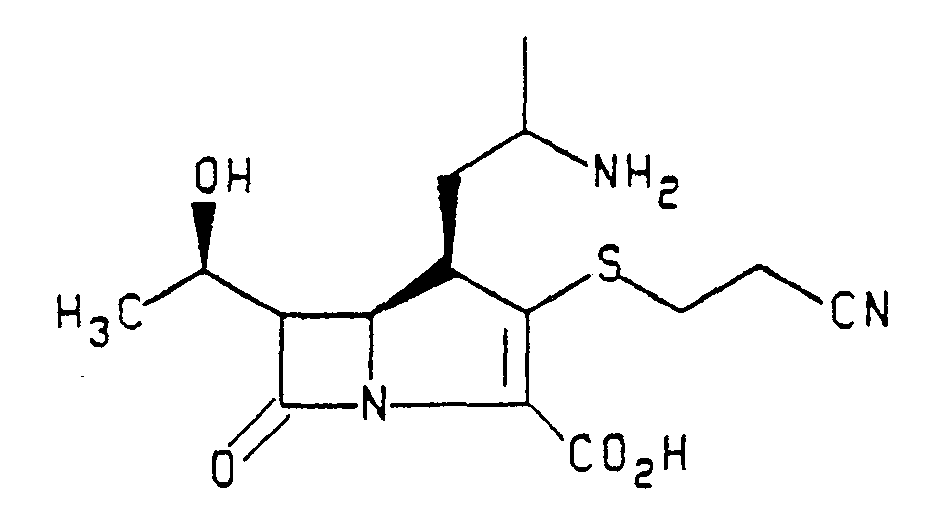
-

- A cold (5°C) solution of allyl (4R,5S,6S)-4-(2"-azidopropyl)-3-(diphenylphosphono)-6-[(1'R)-1'-hydroxyethyl]-7-oxo-1-azabicyclo[3.2.0]hept-2-ene-2-carboxylate (1.48 g, 2.6 mmol) [prepared as in Example 57, Step H] in DMF (15 mL) was treated with 3-mercaptopropionitrile (300 mg, 3.44 mmol) and N,N-diisopropylethylamine (445 mg, 3.44 mmol). The ice-bath was allowed to become exhausted and the reaction mixture stirred at 20°C for a total of 18 h. The solution was diluted with ethyl acetate (100 mL) and washed three times with cold brine. The organic phase was dried (MgSO4) and evaporated to give a mixture which was chromatographed on Si02 eluting with diethyl ether. Of the two isomeric A and B products produced, the more polar isomer B was purified to give 212 mg (20.1 %) of the title compound;
- IR (CH2CI2) νmax: 3600 (-OH), 2115 (-N3), 1778 (β-lactam), 1710 (-COz-)
- ' H NMR (CDCl3) δ: 4.6-6.10 (5H, allyl pattern), 4.21-4.32 (2H, m, H-1', 4.28, dd, J; 2.79, 9.60 Hz, H-5), 3.51-3.69 (2H, m, CH-N3, H-4), 3.23 and 3.0 (2H, 2m, S-CH2), 3.06 (1H, dd, J:2.72, 8.14 Hz, H-6), 2.72 (2H, m, CH2CN), 1.6-1.9 (2H, m, CH2C-N3), 1.39 (3H, d, J: 6.2 Hz, -CH3), 1.38 (3H, d, J: 6.38 Hz, -CH3).
-

- 'H NMR (D20) 15: 4.25-4.35 (2H, m, H-1', H-5), 3.54-3.69 (2H, m, CH-N3, H-4), 3.42 (1H, dd, J: 2.72, 6.38 Hz, H-6), 3.19 and 2.99 (2H, 2m, SCH2), 2.84-2.94 (2H, m, CH2CN ), 1.82 (2H, m, CH2-CN3), 1.38 (3H, d, J: 6.52 Hz, -CH3), 1.34 (3H, d, J: 6.47 Hz, -CH3).
-

- UV (H20) λmax: 296 (6200);
- IR (Nujol) νmax: 1755 (β-lactam), 1585 cm-1 (-CO2-);
- 'H NMR (D20) δ: 4.26-4.40 (2H, m, H-5, H-1'), 3.43-3.69 (3H, m, H-4, CH-N3, H-6), 2.8-3.16 (4H,, m, SCH2CH2CN), 1.8-2.2 (2H, m, CH2CN3), 1.43 (3H, d, J: 6.62 Hz, -CH3), 1.35 (3H, d, J: 6.37 Hz, -CH3).
-

-

- IR (neat) vmax: 1775 and 1710 cm-1 (C = O);
- 'H NMR (CDCl3, 200 MHz) δ: 7.53 (1H, s, aromatic -H), 7.14 (1H, s, aromatic H), 6.99 (1H, s, aromatic H), 5.97-5.88 (1H, m, vinylic-H), 5.48-5.23 (2H, m vinylic-H), 4.80-4.69 (2H, m, allylic-CH2), 4.255 (1H, dd, J =2.5 Hz, J=9.6 Hz, H-5), 4.35-4.2 (2H, m, H-1' and HCH-imidazole), 4.0-3.9 (1 H, m HCH-imidazole), 3.173 (1H, dd, J =2.7 Hz, J=9.0 Hz, H-6), 3.2-3.1 (1H, m, H-4), 3.7-3.5 (4H, SCH2CH2CN), 2.3-2.15, 2.1-1.9 (2H, 2 sets of m, CH2-4), 1.369 (3H, d, J=6.1 Hz, CH3), 0.912 (9H, s, tert-butyl), 0.133 and 0.127 ppm (6H, 2s, CH3).
-

- IR (neat) vrt,ax: 3600-3100 (OH), 1775 and 1710 cm-' (C = 0);
- ' H NMR (CDCI3, 200 MHz) δ: 7.70 (1H, s, aromatic-H), 7.17 (1H, s, aromatic-H), 7.05 (1H, s, aromatic H), 6.05-5.99 (1 H, m, vinylic H), 5.49-5.24 (2H, m, vinylic-H), 4.9-4.6 (2H, m, allylic-CH2), 4.4-4.2 (4H, m, H-5, H-1' and CH2-imidazole), 3.217 (1H, dd, J =2.9 Hz, J=9.3 Hz, H-6), 3.05-2.90 (1H, m, H-4), 2.75-2.55 (4H, m, SCH2CH2CN), 2.50-2.25, 2.05-1.85 (2H, 2 sets of m, CH2-4), 1.6 (1H, bs, OH) and 1.447 ppm (3H, d, J=6.1 Hz, CH3).
-

- Purity: 99.8% (HPLC 300 nm);
- UV (H20) λmax: 300 (7800);
- IR vmax: 1750 and 1600 cm-1 (C = O);
- ' H NMR (D20, 200 MHz) s: 8.00 (1H, s, aromatic H), 7.36 (1H, s, aromatic-H), 7.19 (1H, s, aromatic H),
- 3.41-3.26 (3H, m, H-5, H-1' and HCH-imidazole), 4.25-4.05 (1H, m, HCH-imidazole), 3.528 (1H, dd, J =2.7 Hz, J=6.8 Hz, H6), 3.25-3.10 (1H, m, H-4), 2.74-2.66 (4H, m, SCH2CH2CN), 2.4-2.25, 2.25-2.0 (2H, 2 sets of m, CH2-4), and 1.383 ppm (3H, d. J=6.4 Hz, CH3).
-
 + 78.5° (c 1.0, H20);
- Purity by HPLC: 98% on µBondapak C18, 3.9 mm x 30 cm, elution 5% CH3CN-H20 pH 7.4 phosphate buffer, flow rate 1 mUmin, UV detector 300 nm, retention time 6.68 min;
- UV (water, pH 7.4 phosphate buffer) λmax: 304 nm (8,500);
- IR (KBr) vmax: 1750 (C = 0 of β-lactam) and 1590 cm-1 (C=0 of carboxylate);
- 'H NMR (200 MHz, D20) 5 : 1.33 (d, J=6.37 Hz, 3H, CH3CHO), 1.3-2.0 (m, 6H, CH2-1,2 and 3 of butyl), 2.84 (s, 6H, NCH3), 2.8-3.2 (m 2H, SCH2), 3.11 (t, J=8.0 Hz, 2H, CH2N), 3.34 (dd, JH6.H5=2.40 Hz, JH6,H1 =6.41 Hz, 1 H, H-6), 3.35 (overlapping with H-6, 1 H, H-4), 3.77 (t, J=6.16 Hz, CH20H), 4.22 (dd, JH5,H6 = 2.40 Hz, JH5,H4 = 10.1 Hz, 1H, H-5) and 4.26 ppm (m, 1H, CH3 CHO).
-

-

- A solution of allyl (4R,5R,6S)-4-(4"-azidobutyl)-6-[(1'R)-1'-hydroxyethyl]-3,7-dioxo-1-azabicyclo[3.2.0]-heptane-2-carboxylate (5.28 mmol, prepared from 2.0 g, 5.28 mmol of the diazo precursor) in dry acetonitrile (40 mL) was treated at 0-5° C and under nitrogen with diphenyl chlorophosphate (1.2 mL, 5.79 mmol) and N,N-diisopropylethylamine (1.0 mL, 5.74 mmol) added simultaneously over 5 min. A small crystal of 4-N,N-dimethylaminopyridine was added and the mixture was stirred for 40 min. Then N,N-diisopropylethylamine (0.92 mL, 5.28 mmol) followed by chlorotrimethylsilane (0.67 mL, 5.28 mmol) were added and the mixture was stirred for 5 min. The solution was then treated with N,N-diisopropylethylamine (1.84 mL, 10.56 mmol) and excess methanethiol (0.7 g, 15 mmol) was condensed in the solution. The reaction mixture was then stirred at 0-5°C for 48 h. After addition of ethyl acetate (400 mL), the organic phase was washed successively with water, 1 M NaHS03, 1 M NaHC03, brine and dried (MgSO4). The solution was then concentrated under reduced pressure, and the residue was diluted with tetrahydrofuran (20 mL) and water (5 mL) and treated at 0-5 C with acetic acid (2 mL). The resulting mixture was stored at 0-5° C for 16 h. After dilution with ethyl acetate and work-up as above (sat. NaHC03, brine, MgSO4), the product obtained was chromatographed on silica gel (5 x 10 cm). Elution with a gradient of ethyl acetate in toluene (2:8 to 3:7) gave 1.38 g (69%) of the title compound as a clear oil:
- IR (NaCl3, film) vmax: 2100 (N3), 1770 (C=O of β-lactam) and 1705 cm-1 (C=0 of ester);
- 'H NMR (200 MHz, CDCI3) δ: 1.39 (d, J=6.26 Hz, 3H, CH3CHO), 1.4-1.8 (m, 6H, CH2-1,2 and 3 of butyl), 1.90 (d, J=5.14 Hz, 1 H, OH), 2.36 (s, 3H, SCH3), 3.16 (dd, JH6,H5 = 2.58 Hz, JH6,H1 = 7.38 Hz, 1 H, H-6), 3.20 (overlapping with H-6, 1H, H-4), 3.33 (t, J=6.2 Hz, 2H, CH2N3), 4.21 (dd, JH5.H6=2.68 Hz, JH5.H4 = 9.29 Hz, 1 H, H-5), 4.25 (overlapping with H-5, 1 H, CH3CHO), 4.75 (m, 2H, CH2 of allyl), 5.2-5.5 and 5.9-6.1 ppm (2 x m, 2H and 1 H, CH of allyl).
-

- A solution of allyl (4R,5S,6S)-4-(4"-azidobutyl)-6-[(1'R)-1'-hydroxyethyl]-3-methylthio-7-oxo-1-azabicyclo-[3.2.0]hept-2-ene-2-carboxylate (1.38 g, 3.63 mmol) in dry ethyl acetate (75 mL) was treated at 22°C and under nitrogen with tetrakis(triphenylphosphine)palladium [0] (0.12 g) and 8 mL (4.0 mmol) of a 0.5M solution of potassium 2-ethylhexanoate in ethyl acetate. After 1.5 h, the reaction mixture was extracted with cold water (2 x 75 mL) and the combined aqueous extract was maintained under vacuum to remove traces of organic solvent. The aqueous phase was then hydrogenated at 0-5° C over 2 g of 5% palladium on alumina and under 45 psi of hydrogen for 1.2 h. Then 25 mL of 0.2M pH 6.0 phosphate buffer were added and the catalyst was filtered. The filtrate was chromatographed on reversed phase silica gel (µBondapak C18, 3.5 x 15 cm)'using a gradient of acetonitrile (0-4%) in water as eluent. Lyophilization of the uv active fractions gave 0.57 g (50%) of the title compound as a white amorphous powder:+ 97.2° (c 1.0, water);

- Purity by HPLC: 98.9% on µBondpak C18, 3.9 mm x 30 cm, elution 5% CH3CN-H2O, pH 7.4 phosphate buffer, flow rate 0.8 mUmin, UV detector 300 nm, retention time 6.05 min;
- UV (water, pH 7.4 phosphate buffer) λmax: 306 nm (9,475);
- IR (KBr) νmax: 1750 (C=0 of β-lactam) and 1580 cm-1 (C=O of carboxylate);
- 'H NMR (200 MHz, D20) δ: 1.33 (d, J=6.34 Hz, 3H, CH3CHO), 1.3-1.9 (m, 6H, CH2-1,2 and 3 of butyl), 2.34 (s, 3H, SCH3), 3.01 (t, J=7.6 Hz, 2H, CH2NH2), 3.31 (dd, JH6,H5 = 2.36 Hz, JH6,H1 = 6.47 Hz, 1H, H-6), 3.39 (broad t, J = 9 Hz, 1 H, H-4), 4.19 (dd, JH5,H6 = 2.36 Hz, JH5,H4 = 9.06 Hz, 1 H, H-5) and 4.26 ppm (m, 1 H, CH3CHO).
-
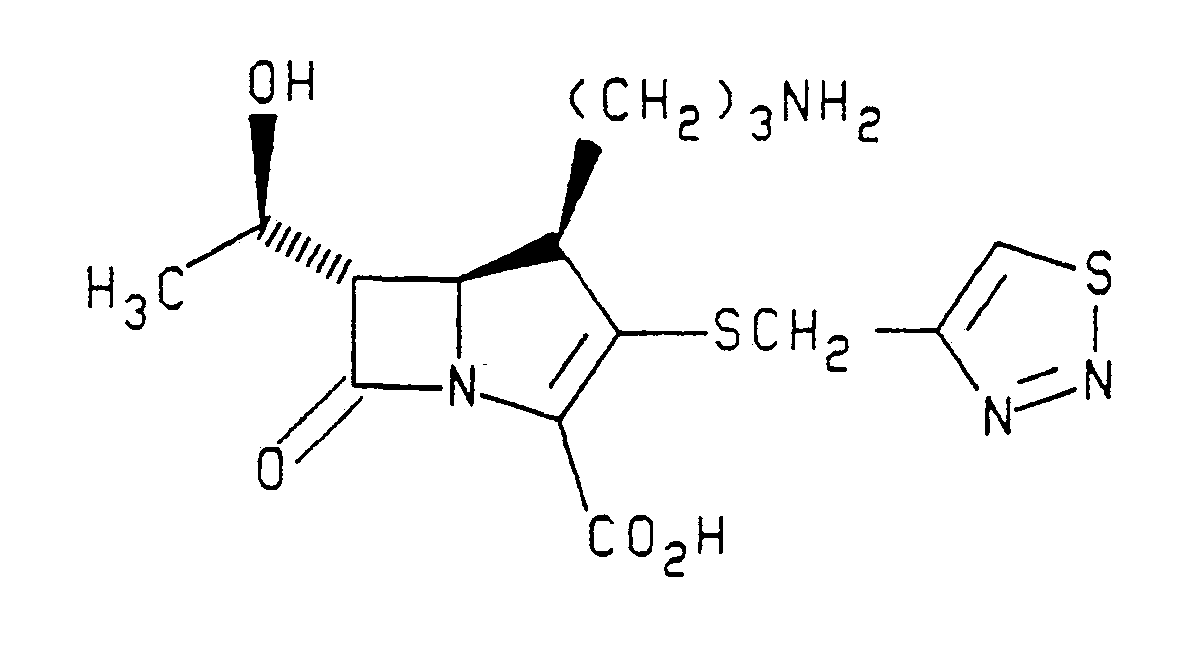
-

- A cold solution (ice-MeOH bath) of allyl (2R,4R,5R,6S)-4-(3"-azidopropyl)-6-[(1'R)-1'-hydroxyethyl]-3,7-dioxo-1-azabicyclo[3.2.0]heptan-2-carboxylate, freshly prepared from (3S,4R)-3-[(1'R)-1'-hydroxyethyl]-4-[-(1 "R)-1"-(3-azido-propyl)-3"-diazo-3"-allyloxycarbonyl-2"-oxopropyl]azetidin-2-one (1.7 g, 4.7 mmol) in CH3CN (50 mL) was treated dropwise with diphenyl chlorophosphate (1.1 mL, 5.0 mmol) and N,N-diisopropylethylamine (0.92 mL, 5.0 mmol) and with a trace of 4-N,N-dimethylaminopyridine (5 mg). The mixture was stirred for 1 h and the enol phosphate was treated with 4-mercaptomethyl-1,2,3-thiadiazole (925 mg, 7.0 mmol) and N,N-diisopropylethylamine (1.84 mL, 10.0 mmol). The mixture was stirred for 2 h at 5 C (ice bath) and more thiol (0.46 g, 3.5 mmol) and N,N-diisopropylethylamine (0.92 mL, 5 mmol) were added. The reaction mixture was left for 18 h at 5 C (cold room), diluted with ethyl acetate (200 mL), washed with 1 M aqueous NaHCO3, (100 mL) water, (100 mL) 1 M aqueous NaHSO3(100 mL), water (100 mL), brine (100 mL) and dried (MgS04) . The residue (4.0 g) was passed through a silica gel flash column (200 g, Hexane/ EtOAc 1/1) to give the title compound (0.90 g, 43%) as an oil;
- IR (CH2Cl2) νmax: 3680, 3600 (OH), 2100 (N3), 1775 and 1710 cm-' (C=0);
- 'H NMR (CDCl3, 200 MHz) 6: 8.477 (1H, s, aromatic-H), 6.02-5.85 (1H, m, vinylic-H), 5.48-5.22 (2H, m, vinylic H), 4.87-4.61 (2H, m, allylic -CH2), 4.771, 4.696, 4.337, 4.260 (2H, ABq, J=15.2 Hz, CH2-aromatic), 4.28-4.14 (1H, m, H-1'), 4.162 (1H, dd, J=2.6 Hz, J=9.6 Hz, H-5), 3.60-3.27 (3H, m, CH2N3 and H-4), 3.245 (1 H, dd, J = 2.7 Hz, J=7.5 Hz, H-6), 2.04-1.50 (4H, m, (CH2)2-4), 1.597 (1 H, bs, OH) and 1.377 ppm (3H, d, J=6.3 Hz, CH3).
-

- ' H NMR (D20, 200 MHz) δ: 8.897 (1 H, s, aromatic -H), 4.679, 4.605, 4.447, 4.372 (2H, ABq, J=15 Hz, CH2-aromatic), 4.299-4.173 (1H, 5 lines, H-1' ), 4.124 (1H, dd, J=2.5 Hz, J=9.5 Hz, H-5), 3.412, 3.401 (part of H-6, d, J=2.5 Hz), 3.41-3.34 (3H, m, H-6 and CH2-N3), 3.31-3.20 (1H m, H-4), 1.9-1.32 (4H, m, (CH2)2-4) and 1.300 ppm (3H, d, J=6.4 Hz, CH3).
- The sodium carboxylate (500 mg, 1.22 mmol) in water (75 mL) was shaken at 0°C (ice bath) in a Parr hydrogenator at 45-50 psi hydrogen for 1 h using 5% Pd/Alumina as catalyst (500 mg). More catalyst (500 mg) was added and the hydrogenation was pursued for one more hour at 0° C. The catalyst was removed by filtration and the pH (10-11) was adjusted to 7.0 with a 1M aqueous NaH2PO4 solution. The mixture was passed through a µBondapak C18 reversed phase column (100 g, H2O → 5% CH3CN/H2O) to give the final compound (250 mg, 53%) as a lyophilized powder;
- Purity: 99.93% (304 nm, HPLC);
- UV (H20) λmax: 302 (E 8050); IR (Nujol) vrt,ax: 3600-3100 (OH, NH2), 1755 and 1685 cm-1 (C=0);
- 'H NMR (D20, 200 MHz) 5: 8.894 (1H, s, aromatic H), 4.660, 4.586, 4.440, 4.365 (2H, ABq, J=14.9 Hz, CH2-aromatic), 4.302-4.174 (1 H, 5 lines, H-1'), 4.125 (1 H, dd, J =2.6 Hz, J =9.5 Hz, H-5), 3.359 (1 H, dd, J =2.7 Hz, J =6.5 Hz, H-6), 3.32-3.22 (1H, m, H-4), 3.06-2.97 (2H, m, CH2-N), 1.83-1.32 (4H, m, (CH2)2-4) and 1.304 ppm (3H, d, J=6.4 Hz, CH3).
-

- Purity: 97.2% (302 nm, HPLC);
- UV (H20) λmax: 302 (e 9260);
- IR (Nujol) vmax: 3600-3700 (OH), 1750 (C = 0), 1710 (C = N) and 1585 cm-' (C = 0);
- ' H NMR (D2O, 200 MHz) δ: 7.867 (1H, s, aromatic -H), 7.834, 7.812 (1H, 2s, CH), 4.30-4.18 (1H, m, H-1'), 4.212, 4.137, 4.031, 3.957 (2H, ABq, J=14.9 Hz, CH2-aromatic), 4.159, 4.112, 4.099 (1H, 1s and 1d, J=2.6 Hz, part of H-5), 4.083 (3H, s, N-CH3), 3.330 (1H, dd, J=2.6 Hz, J=6.1 Hz, H-6), 3.45-3.20 (3H, m, H-4 and CH2N), 1.9-1.32 (4H, m, (CH2)2-4) and 1.300 ppm (3H, d, J=6.4 Hz, CH3).
-

- Purity: 99.85% (302 nm, HPLC);
- UV (H20) λmax: 302 (e 9150);
- IR (Nujol) vrt,ax: 3600-3100 (NH, OH), 1755 (C = 0), 1670-1630 (C=N) and 1590 cm-1 (C = 0);
- 'H NMR (D2O, 200 MHz) 8 7.871 (1H, s, aromatic H), 4.31-4.16 (1H, 5 lines, H-1' ), 4.211, 4.135, 4.037, 3.962 (2H, ABq, J=15 Hz, CH2-aromatic), 4.063 (3H, s, CH3-triazole), 4.155-4.06 (1H, m, hidden H-5), 3.318, 3.306, 3.267 (part of H-6, d + s), 3.32-3.22 (3H, m, CH2-N and H-4), 1.9-1.30 (4H, m, (CH2)2-4) and 1.29 ppm (3H, d, J=6.4 Hz, CH3).
-

-

- A solution of allyl (4R,5,6S)-4-(4"-azidobutyl)-6-[(1'R)-1'-hydroxyethyl]-3,7-dioxo-1-azabicyclo[3.2.0]-hept-2-ene-2-carboxylate (7.6 mmol, prepared from 2.88 g, 7.6 mmol of the diazo precursor) in dry acetonitrile (35 mL) was treated at 0-5°C and under nitrogen with diphenyl chlorophosphate (1.65 mL, 8.0 mmol) and N,N-diisopropylethylamine (1.38 mL, 8.0 mmol) added simultaneously over 5 min. A small crystal of 4-N,N-dimethylaminopyridine was then added and the mixture was stirred for 30 min. Then N,N-diisopropylethylamine (1.38 mL, 8.0 mmol) followed by chlorotrimethylsilane (1.0 mL, 8.0 mmol) were added and the mixture was stirred for 10 min. More N,N-diisopropylethylamine (1.38 mL, 8.0 mmol) followed by 2-carbamoyloxyethanethiol (1.8 g, 15.2 mmol) in acetonitrile were added and the resulting mixture was stirred at 0-5° C for 18 h. The reaction mixture was then quenched by addition of cold 0.2M pH 7.0 phosphate buffer (100 mL) and ethyl acetate (500 mL). The organic phase was washed with water, brine and dried (MgSO4) . Evaporation of the solvent gave an oil which was dissolved in tetrahydrofuran (50 mL) and water (50 mL) and treated at O-5° C with acetic acid (1.5 mL). The temperature was then slowly allowed to reach 22° C over 1 h. The reaction mixture was then diluted with ethyl acetate (400 mL) and the work-up was done as above. The residue obtained after evaporation of the solvent was chromatographed twice on silica gel (4 x 12 cm) using first a mixture of toluene and ethyl acetate (1:1) and then a mixture of dichloromethane and acetonitrile (7:3) as eluent. Evaporation of the UV active fractions gave 1.71 g (49%) of the title compound as an oil:
- IR (NaCl, film) v",ax: 2,100 (N3), 1770 (C=0 of β-lactam) and 1720 (broad C = 0 of ester and carbamate);
- 1H NMR (200 MHz, CDCI3) δ: 1.39 (d, J=6.25 Hz, 3H, CH3CHO), 1.4-1.8 (m, 6H, CH2-1, 2 and 3 of butyl), 2.8-3.2 (m, 5H, SCH2, CH2N3 and H-4), 3.18 (dd, JH6,H5=2.62 Hz, JH6,Hi * 7.17 Hz, 1H, H-6), 4.1-4.4 (m, 4H, H-5, CH3CHO and CH2OCONH2 overlapping), 4.6-4.9 (m, 4H, CH2 of allyl and OCONH2), 5.2-5.5 and 5.9-6.1 ppm (2m, 2H and 1 H, CH of allyl).
-

- A solution of allyl (4R,5S,6S)-4-(4"-azidobutyl)-3-[(2-carbamoyloxy)ethylthio]-6-[(1'R)-1'-hydroxyethyl]-7-oxo-1-azabicyclo[3.2.0]hept-2-ene-2-carboxylate (1.71 g, 3.77 mmol) in dry ethyl acetate (50 mL) was treated at 22° C and under nitrogen with tetrakis(triphenylphosphine)palladium [0] (0.100 g) followed by 8 mL (4.0 mmol) of a 0.5M solution of potassium 2-ethylhexanoate in ethyl acetate. The reaction mixture was then extracted with water (3 x 50 mL) and the combined aqueous extract was chromatographed on reversed phase silica gel (µBondapak C18, 3 x 13 cm). Elution with a gradient of acetonitrile (0 - 5%) in water gave 1.0 g (59%) of the intermediate potassium salt as a white solid after freeze drying.
- The potassium salt was then dissolved in cold water 150 mL and hydrogenated at O-5°C over 1.5 g of 5% palladium over alumina and under 45 psi of hydrogen for 1 h. Then 20 mL of 0.2M pH 6.0 phosphate buffer were added, the catalyst was filtered and the filtrate was chromatographed on reversed phase silica gel (µBondapak C18, 3 x 15 cm). Elution with a gradient of acetonitrile (0-5%) in water gave 0.722 g (83%, 49% combined) of the title compound as a white amorphous powder after lyophilization:+ 74.6° (c 1.0, H20);

- Purity by HPLC: 96.4% on µBondapak C18, 3.9 mm x 30 cm, elution 5% CH3CN-H2O pH 7.4 phosphate buffer, flow rate 0.8 mL/min, uv detector 300 nm, retention time 5.56 min;
- UV (water, pH 7.4 phosphate buffer) λmax: 302 nm (9,219);
- IR (KBr) vmax: 1750 (C = 0 of β-lactam), 1720 (C = 0 of carbamate) and 1585 cm-1 (C = 0 of carboxylate);
- 'H NMR (200 MHz, D2O) 5 1.33 (d, J=6.34 Hz, 3H, CH3 CHO), 1.3-2.0 (m, 6H, CH2-1, 2 and 3 of butyl), 2.9-3.2 (m, 4H, SCH2 and CH2NH2), 3.36 (dd, JH6.H5= 2.51 Hz, JH6,H1= 6.27 Hz, 1H, H-6), 3.4 (m, overlapping with H-6, 1H, H-4) and 4.2-4.4 ppm (m, 4H, H-5, CH3CHO and CH20CONH2).
-
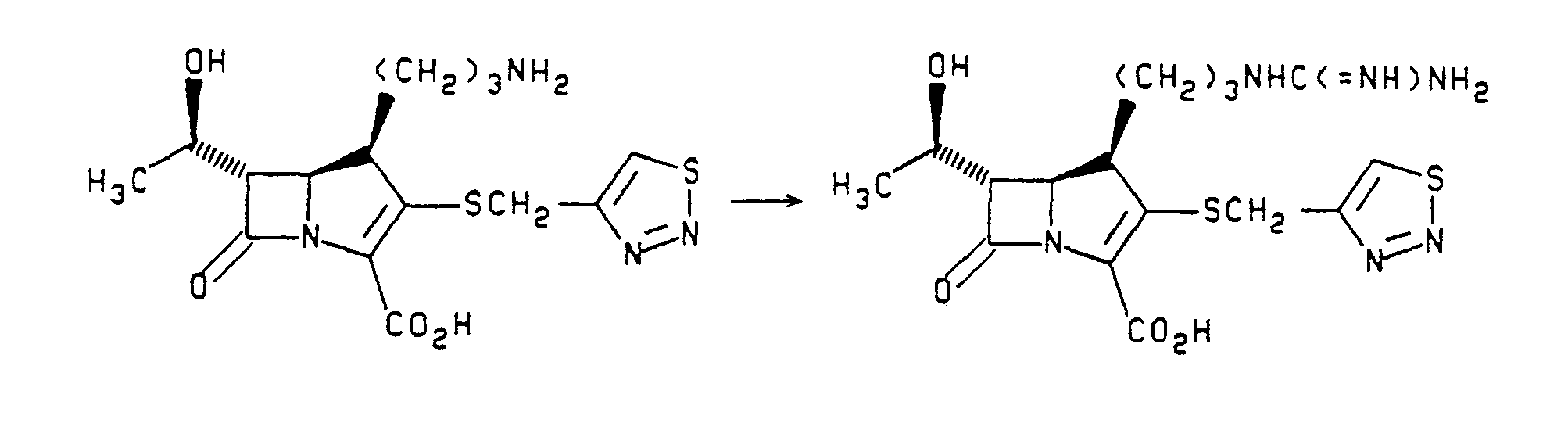
- Purity: 98.5% (302 nm, HPLC);
- UV (H20) λmax: 302 (∈ 8400);
- IR (Nujol) νmax: 3600-3100 (OH, NH3), 1750 (C=O), 1770-1730 (C=N) and 1680 cm-' (C=0);
- ' H NMR (D20, 200 MHz) 5: 8.896 (1 H, s, aromatic H), 4.654, 4.580, 4.446, 4.371 (2H, ABq, J=15 Hz CH2-aromatic), 4.29-4.17 (1H, 5 lines, H-1'), 4.124 (1H, dd, J=2.5 Hz, J=9.5 Hz, H-5), 3.298 (1H, dd, J=2.5, Hz, 1 =6.5 Hz, H-6), 3.30-3.10 (3H, m. CH2-N and H-4), 1.90-1.30 (4H, m, (CH2)2-4) and 1.291 ppm (3H, d J=6.4 Hz, CH3).
-


- Purity by HPLC: 98.8% on µBondapak C18, 3.9 mm x 30 cm, elution 5% CH3CN-H2O, pH 7.4 phosphate buffer, flow rate 1 mL'min, uv detector 300 nm, retention time 6.12 min;
- UV (water, pH 7.4 phosphate buffer) λmax: 302 nm (9,228);
- IR (KBr) νmax: 1750 (C = 0 of β-lactam), 1715 cm-' (C = 0 of carbamate and formimidoyl) and 1590 cm-1 (C = O of carboxylate);
- 'H NMR (200 MHz, D20) δ: 1.31 (d, J=6.32 Hz, 3H, CH3CHO), 1.3-2.0 (m, 6H, CH2-1, 2 and 3 of butyl), 2.8-3.2 (m, 2H, SCH2), 3.3-3.5 (m, 4H, H-4, H-6 and CH2NH 4.2-4.4 (m, 3H, CH2OCONH2, H-5 and CHzCHO and 7.79 ppm (broad s, 1 H, CHNH).
-

-

- A solution of allyl (4R,5R,6S)-4-(2"-azidoethyl)-6-[(1'R)-1'-tert-butyldimethylsilyloxyethyl]-3,7-dioxo-1-azabicyclo[3.2.0]heptane-2-carboxylate (5.10 mmol, prepared by cyclization of 2.37 g, 5.10 mmol of the diazo precursor) in dry acetonitrile (39 mL) was treated at -15°C and under Argon with diphenyl chlorophosphate (1.10 mL, 5.3 mmol) and N,N-diisopropylethylamine (0.95 mL, 5.3 mmol). A small crystal of 4-N,N-dimethylaminopyridine was added and the mixture was stirred at -15°C for 30 min. N,N-Diisopropylethylamine (0.95 mL, 5.4 mmol) and 1-methyl-5-thiomethyl-1,3-imidazole (1.31 g, 10.2 mmol) were added and the mixture was stirred for 3 h at 0°C. The reaction mixture was diluted with EtOAc (272 mL) and washed with water, 1 M NaHSO3saturated NaHCO3, brine and dried (MgSO4) . Evaporation of the solvent gave an oil which was chromatographed on silica gel. Elution with a mixture of EtOAc:CH3CN:acetone (12:87:1) gave 1.5 g (54%) of the title compound as a yellow oil:
- IR (CH2Cl2) λmax: 2100 (N3) 1775 (C=O of β-lactam) and 1710 (C=0 of ester).
- 'H NMR (200 MHz, CDCI3) 6: 0.09 (s, 6H, SiCH3), 0.90 (s, 9H, Si-t-bu), 1.31 (d, J=6.1 Hz, 3H, CH3CHO), 1.7 and 2.0 (2 x m, 2 x 1H, CH2-4), 3.08 (dd, Ji 6 =7.17 Hz, J5-6=2.76 Hz, 1H, H-6), 3.3-3.6 (m, 2H, CH2N3), 3.69 (s, 3H, CH3-N), 3.9-4.2 (m, 4H), 4.7 (m, 2H, CH2 of allyl), 5.2-5.5 and 6.0 (2 x m, 2H and 1 H, CH of allyl), 6.99 and 7.46 (2xS, 2H, imidazoyl).
-

- A solution of allyl (4R,5S,6S)-4-(2"-azidoethyl)-6-[(1'R)-1'tert-butyldimethylsilyloxyethyl]-3-[(1-methyl-1,3-imidazol-5-yl)-methylthio]-7-oxo-1-azabicyclo[3.2.0]hept-2-ene-2-carboxylate (1.50 g, 2.74 mmol) in dry tetrahydrofuran (43 mL) was treated at 0-5' C and under Argon with acetic acid (0.94 mL, 16.4 mmol) followed by 8.5 mL (8.5 mmol) of 1 M solution of tetrabutylammonium fluoride in tetrahydrofuran. The solution was stored at 5 C for 8.5 days. The reaction mixture was then diluted with EtOAc , washed with saturated NaHCO3, brine and dried (MgSO4) . Evaporation of the solvent gave an oil which was chromatographed on silica gel (4.5 x 15 cm). Elution with acetone gave 1.87 g (73%) of the title compound as a foamy light yellow solid:
- IR (NaCI, film) vmax· 3200 (broad, OH), 2105 (N3), 1780 (C=0 of β-lactam), and 1710 (C=0 of ester).
-

- A solution of allyl (4R,5S,6S)-4-(2"-azidoethyl)-3-[(1-methyl-1,3-imidazol-5-yl)-methylthio]-6-[(1'R)-1'-hydroxy-ethyl]7-oxo-1-azabicyclo[3.2.0]hept-2-ene-2-carboxylate (558 mg, 1.29 mmol) in dry CH2CI2 (29 mL) was treated at 0-5° C and under Argon, with tetrakis(triphenylphosphine)palladium [0] (112 mg) and 2.84 mL (1.42 mmol) of a 0.5M solution of sodium 2-ethylhexanoate in EtOAc . Then 39 mL of water was added and the organic layer was separated. The organic phase was reextracted with 2 x 22 mL of water and the combined aqueous layers were evaporated to remove organic solvent. The residual aqueous phase was hydrogenated over 396 mg of 5% palladium on alumina and under 45 psi of hydrogen for 1 hour. The catalyst was filtered and the filtrate was neutralized with a solution of NaH2PO41M (a few drops). The mixture was chromatographed on reversed phase silica gel (Bondapak C18, 7 x 11 cm) using a gradient of acetonitrile in water (0-1 %) followed by lyophilization of the UV active fractions to give 130 mg of the title compound as a light yellow amorphous powder:
- UV (water, pH 7.4 phosphate buffer) λmax: 302 nm (6000);
- IR (KBr) vmax: 1765 (C=O of β-lactam) and 1625 (C=O of carboxylate);
- 'HNMR (200 Hz, D2O) δ: 1.32 (d, J=6.3 Hz, 3H, CH3CHO), 1.7 and 2.1 (2 x m, 2 x 1H, CH2-4), 3.05 (t, J=9.0 Hz, CH2NH2), 3.23 (m, 1 H, H-4), 3.41 (dd, J7-6 = 6.5 Hz, J5-6 = 2.7 Hz, H-6), 3.7 (s, 3H, CH3-N), 3.9-4.3 (m, 4H, CH2-S, CH3CHO, H-5), 6.93 and 7.63 (2 x s, 2H, imidazoyl).
-

- A solution of (4R,5S,6S)-4-(4'aminobutyl)-3-[(2-carbamoyloxyethyl)thio]-6-[(l'R)-l'-hyd *roxyethyll-7-oxo-1-azabicyclo[3.2.0]hept-2-ene-2-carboxylic acid (0.172 g, 0.44 mmol) in cold water (0-5° C, 13 mL) was adjusted to pH 8.5 with 1 M NaOH . Then aminoiminomethanesulfonic acid (0.275 g, 2.21 mmol) was added in small portions over 10 min while maintaining the pH between 8 and 8.5. After 45 min at 0-5° C, the reaction mixture was quenched by addition of 15 mL of 0.2M pH 6.0 phosphate buffer and chromatographed on reversed phase silica gel (µBondapak C18, 2.5 x 15 cm). Elution with a gradient of acetonitrile (0-5%) in water gave 0.149 g (78%) of the title compound as a white amorphous solid after freeze drying:
- Purity by HPLC: 99% on µBondapak C18, 3.9 mm x 30 cm, elution 10% CH3CN-H2O, pH 7.4 phosphate buffer, flow rate 0.8 mL/min, uv detector 300 nm, retention time 6.0 min;
- UV (water, pH 7.4 phosphate buffer) λmax: 302 nm (9,371);
- IR (KBr) νmax: 1750 (sh, C = O of β-lactam), 1730 (broad C = O of carbamate), 1670 (C=O of guanidine) and 1590 cm-1 (C=0 of carboxylate);
- 'H NMR (200 MHz, D20) δ: 1.32 (d, J=6.32 Hz, 3H, CH3CHO), 1.3-1.9 (m, 6H, CH2-1,2 and 3 of butyl), 2.8-3.2 (m, 2K, SCH2), 3.22 (t, J = 6.5 Hz, CH2N), 3.34 (dd, JH6,H5= 2.55 Hz, JH6,H1= 6.10 Hz, 1H, H-6), 3.36 (m, overlapping with H-6, 1 H, H-4) and 4.2-4.4 ppm (m, 4H, CH2 0, H-5 and CH3CHO).
-

-

- IR (neat) νmax: 2250 (C=N), 1775 and 1710 cm-1 (C = O);
- 'H NMR (CDCl3, 200 MHz) 5: 6.03-4.85 (1H, m, vinylic -H), 5.49-5.22 (2H, m, vinylic H), 4.9-4.6 (2H, m, allylic -CH2), 4.30-4.17 (1H, m, H-1'), 4.205 (1H, dd, J=2.7 Hz, J=9.7 Hz, H-5), 3.40-3.20 (2H, m H-4 and NCH-N), 3.254 (1H, dd, J=2.8 Hz, J=7.0 Hz, H-6), 3.15-2.95 (2H, m, SCH2), 2.72-2.63 (2H, m, CH2CN), 2.5-2.30 (1H, m HCH-N), 2.254 (6H, s, N(CH3)2), 2.05-1.80 (1H. m, HCH-4), 1.7-1.4 (1H, m, HCH-4), 1.290 (3H, d, J=6.1 Hz, CH3), 0.890 (9H, s, tert-butyl)and 0.086 ppm.(6H, s, dimethyl).
-
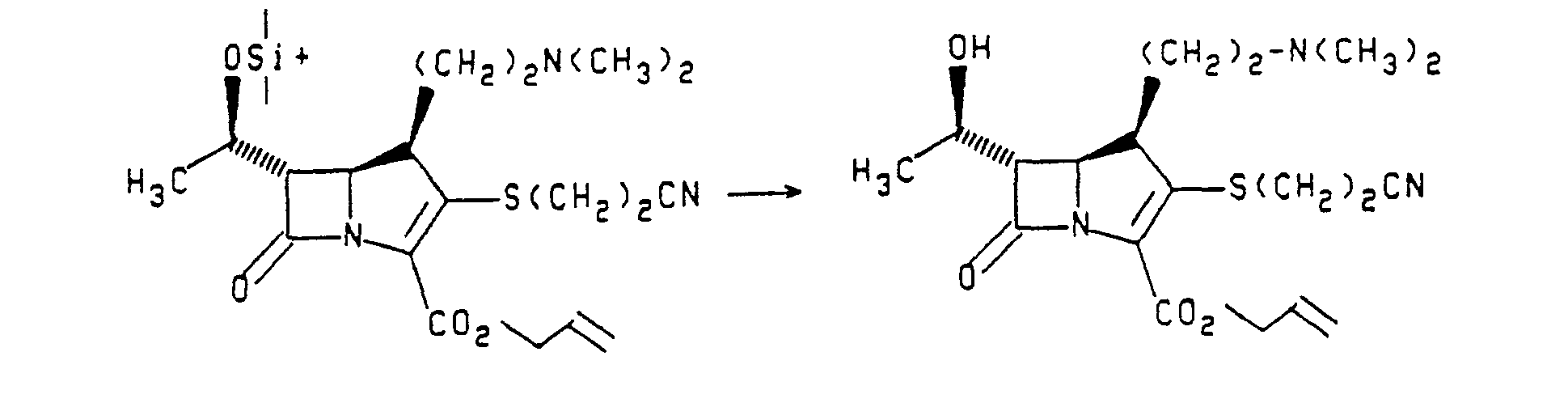
- A cold solution (ice-MeOH bath) of allyl (4R,5S,6S)-6-[(1'R)-1'-tert-butyldimethylsilyloxyethyl]-3-[(2-cyanoy)thio]-4-(2"-dimethylaminoethyl)-7-oxo-1-azabicyclo-[3.2.0]hept-2-ene-2-carboxylate (390 mg, 0.768 mmol) in tetrahydrofuran (10 mL) was treated with acetic acid (600 µl, 10.5 mmol) and dropwise with a 1 M solution of tetrabutylammonium fluoride in tetrahydrofuran (6.0 mL, 6.0 mmol). The mixture was stirred for 1 h and then was allowed to set in the cold room for 144 h. The mixture was diluted with ethyl acetate (100 mL) and washed with ice cold 1M aqueous NaHC03(2 x 100 mL), cold brine (2 x 100 mL) and dried (MgS04) to give the title compound (270 mg, 89%) as a crude oil;
- IR (neat) Pma,: 3600-3200 (OH), 1775 and 1710 cm-1 (C=0);
- 'H NMR (CDCI3, 200 MHz) 5: 6.05-1.90 (1H, m, vinylic H), 5.50-5.24 (2H, m, vinylic-H), 4.9-4.6 (2H, m, allylic-H), 4.294, 4.279 (part of H-5, d, J = 2.9 Hz), 4.29-4.15 (1 H, m, H-1'), 3.45-3.9 (3H, m, H-4 and SCH2), 3.302 (1 H, dd, J =2.9 Hz, J=7.9 Hz, H-6), 2.8-2.6 (4H, m, CH2-N and CH2CN), 2.264 (6H, s, N(CH3)2), 2.0-1.6 (3H, m, CH2-4 and OH) and 1.377 ppm (3H, d, J=6.2 Hz, CH3).
-

- Purity: 99.5% (298 nm, HPLC);
- UV (H20) λmax; 298 (∈ 6960);
- IR (Nujol) vmax: 3600-31200 (OH), 2250 (ON), 1750 and 1590 cm-' (C=O);
- 'H NMR (D20, 200 MHz) 3: 4.33-4.21 (1H, m, H-1'), 4.289 (1H, dd, J=2.8 Hz, J = 9.3 Hz, H-5), 3.429 (1H, dd, J=2.9 Hz, J=6.6 Hz, H-6), 3.48-3.35 (H, m, H-4), 3.21-2.76 (6H, SCH2, CH2-N, CH2CN) 2.758 (6H, s, N(CH3)2), 2.27-2.14 and 1.98-1.80 (2H, 2 sets of m, CH2-4) and 1.339 ppm (3H, d, J=6.4 Hz, CH3).
-

- A solution of (4R,5S,6S)-4-(4"-aminobutyl)-6-[(1'R)-1'-hydroxyethyl]-3-methylthio-7-oxo-1-azabicyclo-[3.2.0]hept-2-ene-2-carboxylic acid (0.226 g, 0.72 mmol) in cold water (0 - 5 C, 20 mL) was adjusted to pH 8.5 with NaOH 1 M and then treated with aminoiminomethanesulfonic acid (0.40 g, 3.22 mmol) added in small portions over 5 min. The pH was maintained at 8-8.5 throughout the addition and for another two hours with 1 M NaOH. The reaction mixture was then quenched by the addition of 20 mL of 0.2M pH 6.0 phosphate buffer and chromatographed on reversed phase silica gel (µBondapak C18, 3.5 x 15 cm). Elution with a gradient of acetonitrile (0-5%) in water gave 0.169 g (66%) of the title compound as a white amorphous powder after lyophilization:
- Purity by HPLC: 99.8% on µBondapak C18, 3.9 mm x 30 cm, 5% CH3CN-H20, pH 7.4 phosphate buffer, flow rate 1.5 mumin, UV detector 304 nm, retention time 5.77 min;
- UV (water, pH 7.4 phosphate buffer) λmax: 306 nm (9,411 );
- IR (KBr) Pmax: 1750 (C = 0 of β-lactam), 1665 (C = N of guanidine) and 1580 cm-' (C = 0 of carboxylate);
- 1H NMR (200 MHz, D20) δ: 1.32 (d, J=6.35 Hz, 3H, CH3CHO), 1.3-1.9 (m, 6H, CH2-1,2 and 3 of butyl), 2.34 (s, 3H, SCH3), 3.22 (t, J=6.S Hz, 2H, CH2N), 3.28 (dd, JH6,H5 = 2.39 Hz, JH6,H1 = 6.26 Hz, 1H, H-6), 3.38 (broad t, 1 H, H-4), 4.19 (dd, JH5.H6=2.39 Hz, JH5,H4= 9.04 Hz, 1 H, H5) and 4.27 ppm (m, 1 H, CH3CHO).
-
 + 110.3° (c 1.0, water);
- Purity by HPLC: 99% on µBondapak C18, 3.9 mm x 30 cm, elution 3% CH3CN-H2O, pH 7.4 phosphate buffer, flow rate 1.5 mL/min, uv detector 304 nm, retention time 6.48 min;
- UV (water, pH 7.4 phosphate buffer) λmax; 306 nm (10,187);
- IR (KBr) νmax: 1750 (C = O of β-lactam), 1715 (C=N of formimidoyl) and 1580 cm-1 (C = O of carboxylate);
- 'H NMR (200 MHz, D20) s: 1.32 (d, J=6.-27 Hz, 3H, CH3CHO), 1.3-1.9 (m, 6H, CH2-1,2 and 3 of butyl), 2.34 (s, 3H, SCHs), 3.3-3.5 (m, 4H, H-6, H-4 and CH2NH), 4.18 (dd, JH5.H6 = 1.92 Hz, JH5,H4=9.0 Hz, 1H, H-5), 4.26 (m, 1 H, CH3CHO) and 7.8 ppm (broad s, 1H, CH = NH).
-

-

-

- IR (neat) νmax: 2250 (C≡N), 1775, 1720 and 1710 cm-1 (C = O);
- 'H NMR (CDCI3, 200 MHz) δ: 9.849 (1H, s, CHO), 6.01-5.87 (1H, m, vinylic-H), 5.49-5.22 (2H, m, vinylic -H), 4.80-4.60 (2H, m, allylic -CH2), 4.371 (1H, dd, J=2.7 Hz, J=9.8 Hz, H-5), 4.28-4.18 (1H, 6 lines, H-1'), 3.763 (1H, dt, J = 3.5 Hz, J =10.2 Hz, H-4), 3.2-2.77 (5H, m, H-6, SCH2 and CH2CHO), 2.70-2.63 (2H, m, CH2CN), 1.161 (3H, d, J=6.2 Hz, CH3), 0.883 (9H, s, tert-butyl) and 0.068 ppm (6H, s, dimethyl).
-

- IR (neat) vmax: 2250 (C=N), 1775, 1710 (C = 0) and 1550 cm-1 (C = N);
- ' H NMR (CDCI3, 200 MHz), 5: 6.474 (1H, bt, J=4.2 Hz, CH=N), 6.04-5.85 (1H, m, vinylic H), 5.48-5.21 (2H, m, vinylic H), 4.85-4.70 (2H, m, allylic -H), 4.298 (1 H, dd, J = 2.5 Hz, J=9.4 Hz, H-5), 4.28-4.22 (1 H, m, H-1'), 3.64-3.55 (1 H, m, H-4), 3.319 (1 H, dd, J = 2.7 Hz, J=3.9 Hz, H-6), 3.25-2.92 (2H, m, SCH2), 2.754 (6H, s, N(CH3)2), 2.73-2.60 (3H, m, CH2CN and HCH-4), 2.55-2.3 (1H, m, HCH-4) 1.148 (3H, d, J=6.2 Hz, CH3), 0.0878 (9H, s, tert-butyl) and 0.066, 0.060 ppm (6H, 2s, dimethyl).
-

- IR (neat) νmax: 3600-3200 (OH), 2250 (C=N), 1775, 1710 (C = 0) and 1550 cm-' (C = N);
- ' H NMR (CDCl3, 200 MHz) δ: 6.602 (1H, bt, J =4.8 Hz, CH-N), 6.05-5.90 (1H, m, vinylic H), 5.51-5.24 (1H, m, vinylic H), 4.90-4.64 (2H, m, allylic CH2), 4.311 (1H, dd, J=2.9 Hz, J=9.8 Hz, H-5), 4.20-4.00 (1H, m, H-1'), 3.73-3.60 (1H, m, H-4), 3.307 (1H, dd, J = 2.9 Hz, J = 8.0 Hz, H-6), 3.18-2.90 (2H, m, SCH2), 2.773 (6H, s, N(CH3)2), 2.87-2.63 (3H, m, CH2CN and HCH-4), 2.56-2.40 (1H, m, HCH-4), 1.59 (1H, bs, OH) and 1.310 ppm (3H, d, J = 6.3 Hz, CH3).
-

- Purity: 97.9% (302 nm, HPLC);
- Uv (H20) v",ax: 240 (e 7440), 302 (e 8150);
- IR (Nujol) vmax: 3600-3100 (OH), 2250 (C=N), 1750 and 1590 (C = O) and 1560 cm-' (C = N);
- 1H NMR (D2O, 200 MHz) 5: 4.425 (1 H, dt, J = 5.4 Hz, CH = N), 4.288 (1 H, dd, J = 2.62 Hz, J = 9.5 Hz, H-5), 4.30-4.17 (1 H, m, H-1' ), 3.79-3.67 (1 H, , H-4), 3.518 (1H, dd, J = 2.6 Hz, J = 5.8 Hz, H-6), 3.30-3.13, 3.05-2.90 (2H, 2 sets of m, SCH2), 2.90-2.80 (2H, m, CH2CN), 2.90-2.50 (2H, m, CH2-4), 2.691 [6H, s, N(CH3)21 and 1.274 ppm (3H, d, J = 6.4 Hz, CH3).
-

-

- IR (neat) vmax: 3600-330 (OH), 2250 (CN), 1775 and 1720
- 'H NMR (CDCl3, 200 MHz) s: 9.869 (1H, s, CHO), 6.04-5.87 and 5.49-5.25 (3H, m, vinyl H), 4.89-4.65 (2H, m, CH2-vinyl), 3.416 (1 H, dd, J =2.8 Hz, J=9.9 Hz, H-5), 4.24-4.13 (1 H, 5 lines, H-1' ), 3.84-3.71 (1H, 6 lines, H-4), 3.19-2.81 (3H, m, H-6, CH2S and CH20), 2.75-2.63 (2H, m, CH2-CN), 1.57 (1H, bs, OH) and 1.298 ppm (3H, d, J=6.3 Hz, CH3).
-

- A cold (ice bath) solution of allyl (4R,5S,6S)-4-(2"-acetaldehydo)-6-[(1'R)-1'-hydroxyethyl]-3-[(2-cyanoethyl)-thio]7-oxo-1-azabicyclo[3.2.0]hept-2-ene-2-carboxylate (40 mg, 0.11 mmol) in dichloromethane (2 mL) was treated with Pd(PPh3)4(10 mg) and with N-methylaniline (20 al, excess). The mixture was stirred for 30 min, then diluted with diethyl ether (20 mL) and extracted with a 0.05M pH 7.4 aqueous phosphate buffer (4 x 5 mL). The aqueous extracts were combined, washed with diethyl ether and passed through a reversed phase µBondpak C18 column (9 g, H20) to give the title compound (10 mg, 26%) as a lyophilized powder;
- IR (Nujol) vmax: 3600-3100 (OH), 2250 (CN), 1755, 1720 and 1600 (C=0);
- 1H NMR (D20, 200 MHz) 3: 9.789 (0.5H, s, CHO), 5.244, 5.226, 5.208, 5.189 (0.5H, 4 lines, CH(OH)2), 4.409 (0.5 H, dd, J = 2.7 Hz, J = 9.7 Hz, H-5), 4.36-4.20 (1 H, m, H-1'), 3.92-3.84 (0.5 H, 6 lines, J=3.7 Hz, 10.2 Hz, H-4), 3.556 (0.5 H, dd, J = 2.6 Hz, J = 5.8 Hz, H-6), 3.56-3.46 (0.5H, m, H-4), 3.27-2.80 (5.5 H, m, 0.5 H-6, SCH2, CH2CN and 1H for CH2CHO), 2.15-1.90 (1H, m, CH2CH(OH)2), 1.336 (1.5H, d, J=6.4 Hz, CH3) and 1.248 ppm (1.5 H, d, J=6.5 Hz, CH3).
-

-

- IR (neat) νmax: 2250 (C=N), 1780, 1735 and 1710 cm-' (C = O);
- 'H NMR (CDCI3, 200 MH) δ: 6.03-5.81, 5.48-5.22 (6H, m, vinylic H), 4.82-4.58 (4H, 2 sets of m, CH2-vinyl), 3.370 (1 H, dd, J =2.7 Hz, J =9.6 Hz, H-5), 4.30-4.19 (1 H, 6 lines, H-1' ), 3.7 (1 H, X part of ABX, J=3.4 Hz, H-4), 3.24-3.11, 3.04-2.90 (2H, 2 sets of m, SCH2), 3.128 (1H, dd, J=2.7 Hz, J=4.2 Hz, H-6), 2.877, 2.860, 2.792, 2.774 (1 H, AB part of ABx, J = 3.4 Hz, J=17.1 Hz), 2.601, 2.545, 2.516, 2.460 (1 H, AB part of ABX, J=17.1 Hz, J =11.3 Hz, CH2-4), 2.72-2.63 (2H, m, CH2CN), 1.147 (3H, d, J=6.3 Hz, CH3), 0.879 (9H, s, tert-butyl), 0.068 and 0.063 ppm (6H, 2 s, dimethyl).
-

- IR (neat) vmax: 3600-3300 (OH), 2250 (C≡N), 1775, 1730 and 1710 cm-1 (C = 0);
- 'H NMR (CDCI3, 200 MHz) 5: 6.04-5.83, 5.50-5.24 (6H, 2 sets of m, vinylic-H), 4.89-4.61 (4H, 2 sets of m, CH2-vinyl), 4,395 (1 H, dd, J = 3.0 Hz, J = 9.8 Hz, H-5), 4.30-4.10 (1 H, m, H-1' ), 3.803-3.678 (1 H, X part of ABX, J = 3.4 Hz, H-4), 3.173 (1H, dd, J=3.1 Hz, J = 6.9 Hz, H-6), 3.20-3.133, 3.09-2.9 (2.5 H, 2 sets of m, SCH2 and hidden d of ABq), 2.884, 2.867 (1 part of AB, J =3.4 Hz, CH2-4), 2.688 (2H, t, J=7.2 Hz, CH2CN), 2.649, 2.589, 2.562, 2.503 (1H, AB part of ABX, J = 11.9 Hz, J=17.5 Hz, CH2-4), 1.974 (1H, d, J=4.6 Hz, OH) and 1.300 ppm (3H, d, J=6.3 Hz, CH3).
-

- IR (nujol) νmax: 3600-3200 (OH), 2250 (C≡N), 1755 and 1600 cm-1 (C=0);
- ' H NMR (D2 O, 200 MHz) δ: 4.328 (1H, dd, J=2.8 Hz, J=9.5 Hz, H-5), 4.297-4.22 (1H, m, H-1' ), 3.778-3.653 (1 H, x part of ABX, J=3.7 Hz, H-4), 3.419) 1 H, dd, J=2.8 Hz, J=4.2 Hz, H-6). 3.30-3.15, 3.01-2.90 (2H, 2 sets of m, SCH2), 2.90-2.81 (= 2.5H, m, SCH2CN and 1 d of the B part of ABX), 2.760-2.742 (0.77H, d, J = 3.7 Hz, B part of ABX, CH2CO2), 2.346, 2.286, 2.262 and 2.203 (1 H, A part of ABX, J=11.8 Hz, J=16.7 Hz, CH2CO2) and 1.241 ppm (3H, d, J=6.4 Hz, CH3).
-

-

- A solution of (3S,4R)-3-[(1'R)-1'-tert-butyldimethylsilyloxyethyl]-4-[(1R)-1-(2-tert-butyldimethylsilyloxyethyl)-3-allyloxycarbonyl-3-diazo-2-oxopropyl]azetidin-2-one (6.93 g, 12.5 mmol) in dry benzene (150 mL) was treated with rhodium (II) octanoate dimer (0.2 g) and heated under reflux (bath temperature 90-95°C) for 1 h. The solvent was evaporated under reduced pressure and the residue was dissolved in acetonitrile (80 mL) and cooled to 0-5°C. Then N,N-diisopropylethylamine (2.40 mL, 13.78 mmol) and diphenyl chlorophosphate (2.85 mL, 13.75 mmol) were added simultaneously over 5 min. A small crystal of 4-N,N-dimethylaminopyridine was then added and the mixture was stirred for 1 h. The reaction mixture was then diluted with ethyl acetate (500 mL) and washed successively with cold water, 0.2M pH 7.0 phosphate buffer, brine and dried (MgS04) . Evaporation of the solvent under vacuum gave an oil which was chromatographed on silica gel (5 x 12 cm). Elution with a mixture of toluene and ethyl acetate (95:5) gave 5.77 g (61%) of the title compound as a clear oil:
- IR (NaCl, film) νmax: 1788 (C=O of β-lactam) and 1730 cm-1 (C=O of ester);
- 'H NMR (200 MHz, CDCl3) δ: -0.01, 0.06 and 0.07 (3 x s, 6H, 3H and 3H, SiCH3), 0.83 and 0.87 (2 x s, 2 x 9H, Sitert-Bu), 1.27 (d, J=6.14 Hz, 3H, CH3CHO), 1.5-1.8 and 1.9-2.1 (m, 2H, CH2-4), 3.25 (dd, JH6,H5 = 2.77 Hz, JH6,H1 = 6.92 Hz, 1 H, H-6), 3.3-3.7 (m, 3H, H-4 and CH2CH2OSi), 4.12 (dd, JH5.H6 = 2.77 Hz, JH5.H4 = 10.35 Hz, 1H, H-5), 4.20 (m, 1H, CH3 CHO), 4.64 (broad d, J=5.1 Hz, 2H, CH2 of allyl), 5.1-5.4 and 5.7-6.0 (2 x m, 2H and 1 H, CH of allyl) and 7.1-7.4 ppm (m, 10H, aromatics).
-

- A solution of allyl (4R,5S,6S)-3-diphenylphosphoryloxy-6-[(1'R)-1-tert-butyldimethylsilyloxyethyl]-4-(2"-tert-butyldimethylsilyloxyethyl)-7-oxo-1-azabicyclo[3.2.0]hept-2-ene-2-carboxylate (1.24 g, 1.63 mmol) in dry acetonitrile (20 mL) was cooled to 0-5°C and treated successively with N,N,diisopropylethylamine (0.57 mL, 3.27 mmol) and (2S,4S) 1-N-allyloxycarbonyl-2-dimethylaminocarbonyl-4-mercapto-pyrrolidine (0.84 g, 3.27 mmol) [prepared by the general procedures described in European Patent Application EP-126,587] in acetonitrile (3 mL). The reaction mixture was then stirred at 0-5°C for 16 h. The solution was then diluted with ethyl acetate (200 mL), washed with water, 0.2M phosphate buffer pH 7.0, brine and dried (MgSO4.) Evaporation of the solvent in vacuo gave an oil which was chromatographed on silica gel (2.5 x 20 cm). Elution with a mixture of toluene and ethyl acetate (1:1) gave 0.80 g (64%) of the title compound as an oil:
- IR (NaCI, film) vmax: 1775 (C = 0 of β-lactam), 1710 (C = 0 of ester) and 1660 cm-1 (C=0 of amide);
- 'H NMR (200 MHz, CDCI3) δ: 0.03, 0.05 and 0.09 (3 x s, 3H, 3H and 6H, SiCH3), 0.87 and 0.89 (2 x s, 2 x 9H, Sit-But), 1.26 (d, J=6.25 Hz, 3H, CH3CHO), 1.6-2.1 (m, 3H, CH2-4 and H-3 of pyrrolidine), 2.6 (m, 1H, H-3 of pyrrolidine), 2.95, 1.97, 3.03 and
3.08 (4s, total 6H, CON(CH3)2, 3.05 (overlapping with NCH3, 1 H, H-6), 3.4-3.6 and 3.7-3.9 (2 x m, 3H and 2H, H-4, CH20Si and H-5 of pyrrolidine), 4.0-4.2 (m, 1 H, H-4 of pyrrolidine), 4.2-4.4 (m, 2H, H-5 and CH3CHO), 4.5-4.9 (m, 5H, CH2 of allyl and H-2 of pyrrolidine), 5.1-5.5 and 5.8-6.1 ppm (2 x m, 4H and 2H, CH oTallyl). -

- A solution of allyl (4R,5S,6S)-3-((4S)-4-[1-N-allyloxycarbonyl-(2S)-2-dimethylaminocarbonyl]-pyrrolidinylthio)-6-[(1'R)-1'-tertbutyldimethylsilyloxyethyl]-4-(2"-tert-butyldimethylsilyloxyethyl)-7-oxo-1-azabicyclo[3.2.0]hept-2-ene-2-carboxylate (0.70 g, 0.91 mmol) in dry tetrahydrofuran (10 mL) was treated dropwise at 0-5°C with acetic acid (0.62 mL, 11.0 mmol) followed by 5.5 mL (5.5 mmol) of a 1 M solution of tetrabutylammonium fluoride in tetrahydrofuran. The reaction mixture was then stored at 10°C for 144 h. The solution was then diluted with ethyl acetate (200 mL) washed with cold saturated sodium bicarbonate, brine and dried (MgSO4). Evaporation of the solvent in vacuo gave an oil which was chromatographed on silica gel (2.5 x 12 cm). Elution with ethyl acetate first gave 0.30 g (50%) of mono deprotected allyl (4R,5S,6S)-3-((4S)-4-[1-N-allyloxycarbonyl-(2S)-2-dimethylaminocarbonyl]pyrrolidinylthio)-6-[(1'R)-1'-tert-butyldimethylsilyoxyethyl]-4-(2"-hydroxyethyl)-7-oxo-1-azabicyclo[3.2.0]hept-2-ene-2-carboxylate [see Example 109, Method B, Step A].
- Elution with a mixture of ethyl acetate, acetone and acetonitrile (6:2:2) then gave 0.179 g (36%) of the title carbapenem as an oil contaminated by some tetrabutylammonium salt. This product was used as such for the next step:
- IR (NaCl, film) vmax: 3400 (OH), 1775 (C=O of B-lactam), 1710 (C=0 of ester) and 1650 cm" (C=0 of amide);
- 'H NMR (200 MHz, CDCIa) 5: 1.33 (d, J=6.33, Hz, 3H, CH3CHO), 1.6-2.0 (m, 3H, CH2-4 and H-3 of pyrrolidine), 2.9 (m, 1 H, H-3 of pyrrolidine). 2.95, 2.97, 3.03 and 3.09 (4 x s, total 6H, NCH3), 3.4 - 5.0 (broad, 16H), 5.2 - 5.5 and 6.8 - 6.1 ppm (4H and 2H, CH of allyl).
-
 = -58.5° (c 1.0, H20);
- Purity by HPLC: 94.7% on µ-Bondapak c-18, 3.9 mm x 30 cm, elution 5% CH3CN-H20, pH 7.4 phosphate buffer, flow rate 1 mL/min, UV detector 300 nm, retention time 5.9 min;
- Uv (H2O, pH 7.4 phosphate buffer) λmax: 302 nm (8,680);
- IR (KBr) νmax: 1750 (CO of β-lactam), 1650, 1660 (C=O of amide) and 1600 cm-1 (C=O of carboxylate);
- 'H NMR (200 MHz, D20) s: 1.32 (d, J=6.37 Hz, 3H, CH3CHO), 1.7-2.2 (m, 3H, CH2-1 of hydroxyethyl . and H-3 of pyrrolidine), 3.0 (m overlapping with NCH3, 1H, H-3 of pyrrolidine), 3.0 and 3.07 (2 x s, 2 x 3H, NCH3), 3.3 - 3.9 (m, 5H, H-4, CH2CH2OH and CH2-5 of pyrrolidine), 3.48 (dd, JH6.H5=2.73 Hz, JH6.Hi =5.91 Hz, 1 H, H-6), 3.95 (m, 1 H, H-4 of pyrrolidine), 4.2-4.4 (m, 2H, H-5 and CH3CHO overlapping), and 4.83 ppm (t, J = 5.8 Hz, 1 H, H-2 of pyrrolidine).
-

-

- A solution of (3S,4S)-4-[(1R)-1 -(2-azidoethyl)-3-allyl-oxycarbonyl-3-diazo-2-oxopropyl]-3-[(1'R)-1'-tert-butyldimethylsilyloxyethyl]azetidin-2-one (4.0 g, 8.6 mmol) in dry benzene (125 mL) was treated under nitrogen with Rhodium(II)octanoate dimer (0.075 g) and then heated under reflux (bath temperature 90 °C) for 30 min. The solvent was then evaporated under reduced pressure and the intermediate bicyclic ketone was dissolved in dry acetonitrile (60 mL) and cooled to 0-5°C The solution was then treated with diphenyl chlorophosphate (2.0 mL, 9.65 mmol) and N,N-diisopropylethylamine (1.68 mL, 9.64 mmol) added simultaneously over 5 min. Then a small crystal of 4-N,N-dimethylaminopyridine was then added and the mixture was stirred at 0-5°C for 45 min. The reaction mixture was then diluted with ethyl acetate (500 mL), washed with cold water, 0.2M pH 7.0 phosphate buffer, brine and dried (MgSO4). After evaporation of the solvent under reduced pressure, the residue was chromatographed on silica gel (5 x 10 cm). Elution with a gradient of ethyl acetate (0-5%) in toluene gave 3.84 g (66%) of the title compound as an oil:
- IR (NaCl, film) νmax: 2100 (N3), 1788 (C=O of p-lactam) and 1730 cm-1 (C=O of ester);
- 'H NMR (200 MHz, CDCl3) δ: 0.07 and 0.08 (2s, 6H, SiCH3), 0.87 (s, 9H, Si-tBu), 1.28 (d, J=6.18 Hz, 3H, CH3CHO), 1.6-2.2 (m, 2H, CH2-4), 3.18 (dd, JH6,H5=2.95 Hz, JH6,H1 =7.38 Hz, 1H, H-6), 3.1-3.5 (m, 3H, CH2OH and H-4), 4.12 (dd, JH5,H6=2.95 Hz, JH5.H4=10.54 Hz, 1H, H-5), 4.19 (m, 1H, CH3CHO), 4.65 (m, 2H, CH2 of allyl), 5.1-5.5 and 5.8-6.0 (2m, 2H and 1 H, CH of allyl), and 7.2-7.5 (m, 10H, aromatics).
-

- A solution of allyl (4R,5S,6S)-4-(2"-azidoethyl)-3-diphenylphosphoryloxy-6-[(1'R)-1'-tert-butyldimethylsilyloxy ethyl]-7-oxo-1-azabicyclo[3.2.0]hept-2-ene-2-carboxylate (3.84 g, 5.74 mmol) in dry acetonitrile (40 mL) was cooled to 0-5°C and treated under nitrogen with N,N-diisopropylethylamine (2.0 mL, 11.6 mmol) followed by (2S,4S)-1-N-allyloxycarbonyl-2-dimethylaminocarbonyl-4-mercapto-pyrrolidine [prepared according to the general procedures in EP-126,587] (3.0 g, 11.6 mmol) in acetonitrile (7 mL). After 17 h at 0-5°C, the reaction mixture was diluted with ethyl acetate (500 mL), washed with cold water, saturated sodium bicarbonate, brine and dried (MgSO4). The residue obtained after evaporation of the solvent under reduced pressure was chromatographed on silica gel (5 x 10 cm) using a mixture of toluene and ethyl acetate (1:1 ) as eluent and gave 2.47 g (64%) of the title compound as a white foam:
- IR (NaCI, film) νmax: 2100 (N3) 1780 (C=0 of β-lactam), 1710 (C=0 of ester) and 1660 cm-1 (C=0 of amide);
- 'H NMR (200 MHz, CDCl3) 5: 0.1 (s, 6H, SiCH3), 0.9 (s, 9H, Si-tBu), 1.31 (d, J=6.03 Hz, 3H CH3CHO), 1.6-2.1 (m, 3H, H-3 of pyrrolidine and CH2-4), 2.6-2.8 (m, 1 H, H-3 of pyrrolidine), 2.96, 2.98, 3.05 and 3.11 (4s, total 6H, NCH3), 3.1 (overlapping with NCH3, 1H, H-6), 3.3-3.8 (m, 5H, CH2-5 of pyrrolidine, CH2N3 and H-4), 4.1 (m, 1 H, H-4 of pyrrolidine), 4.1-4.3 (m, 2H, H-5 and CH3CHO), 4.5-4.9 (m, 5H, CH2 of allyl and H-2 of pyrrolidine), 5.1-5.5 and 5.8-6.1 ppm (2 x m, 4H and 2H, CH of allyl).
-

- A solution of allyl (4R,5S,6S)-3-((4S)-4-[1-N-allyloxycarbonyl-(2S)-2-dimethylaminocarbonyl]-pyrrolidinylthio)-6-[(1'R)-1'-tert-butyldimethylsilyloxyethyl]-4-(2"-tert-butyl-dimethylsilyloxyethyl)-7-oxo-1-azabicyclo[3.2.0]hept-2-ene-2-carboxylate (2.64 g, 3.44 mmol) [prepared in Example 108, Step B] in dry tetrahydrofuran (50 mL) was treated at 0-5°C and under nitrogen with acetic acid (1.2 mL, 21.0 mmol) followed by 10.3 mL (10.3 mmol) of a 1 M solution of tetrabutylammonium fluoride in tetrahydrofuran. After 16 h at 10°C, the reaction mixture was diluted with ethyl acetate (400 mL) washed with cold saturated sodium bicarbonate, brine and dried (MgS04) . Evaporation of the solvent under reduced pressure gave an oil which was chromatographed on silica gel (4 x 8 cm). Elution with ethyl acetate gave 1.82 g (81%) of the title carbapenem as an oil:
- IR (NaCI, film) vmax: 3450 (OH), 1755 (C=0 of β-lactam), 1705 (C = 0 of ester) and 1650 cm-1 (C=0 of amide);
- 'H NMR (200 MHz, CDCI3) δ: 0.09 (s, 6H, SiCH3), 0.89 (s, 9H, Si-tBu), 1.29 (d, J=6.1 Hz, 3H, CH3CHO), 1.6-2.1 (m, 3H, CH2CH20H and H-3 of pyrrolidine), 2.6-2.8 (m, 1 H, H-3 of pyrrolidine), 2.96, 2.98, 3.05 and 3.09 (4s, total 6H, CON(CH3)2), 3.17 (broad dd, JH6,H5=2.5 Hz, JH6,Ht=6.1 Hz, 1H, H-6), 3.46 (-t, 2H, H-5 of pyrrolidine and H-4 overlapping), 3.6-3.9 (m, 3H, CH2CH20H and H-5 of pyrrolidine), 4.1 (m, 1 H, H-4 of pyrrolidine), 4.15-4.3 (m, 2H, H-5 and CH3CHO), 4.5-4.9 (m, 5H, CH2 of allyl and H-2 of pyrrolidine), 5.1-5.5 and 5.9-6.1 ppm (2 x m, 4H and 2H, CH of allyl).
-

- A solution of allyl (4R,5S,6S)-3-((4S)-4-[1-N-allyloxycarbonyl-(2S)-2-dimethylaminocarbonyl]-pyrrolidinylthio)-6-[(1'R)-1'-tert-butyldimethylsilyloxyethyl]-4-(2"-hydroxyethyl)-7-oxo-1-azabicyclo[3.2.0]hept-2-ene-2-carboxylate (1.82 g, 2.79 mmol) in dry tetrahydrofuran (200 mL) at -20 C and under nitrogen was treated with triphenylphosphine (1.17 g, 4.46 mmol) and 6.5 mL (4.81 mmol) of a 0.74M solution of hydrazoic acid in toluene. Diethyl azodicarboxylate (0.75 mL (4.76 mmol) was then added dropwise and the resulting mixture was stirred for 30 min. The reaction mixture was then diluted with ethyl acetate (500 mL), washed with cold saturated sodium bicarbonate, brine and dried (MgS04) . The solvent was then concentrated in vacuo to give a paste which was triturated at 0-5°C with toluene (25 mL) and filtered to remove the crystalline diethyl hydrazinedicarboxylate. The filtrate was concentrated and treated in the same manner with diethyl ether (25 mL) to remove the triphenylphosphine oxide. The filtrate was then chromatographed on silica gel (4 x 11 cm) using a mixture of toluene and ethyl acetate (1:1 ) as eluent and gave 2.3 g of the title compound as an oil which was contaminated with triphenylphosphine oxide. The infrared and 1H NMR spectra of the product are identical to the spectra of the product obtained in Method A.
-

- A solution of allyl (4R,5S,6S)-3-((4S)-4-[1-N-allyloxycarbonyl-(2S)-2-dimethylaminocarbonyl]-pyrrolidinylthio)-4-(2"-azidoethyl)-6-[(1'R)-1'-tert-butyidimethylsiiyloxyethyl]-7-oxo-1-azabicyclo[3.2.0]hept-2- ene-2-carboxylate (2.47 g, 3.65 mmol) in dry tetrahydrofuran (50 mL) was cooled to 0-5°C and treated under nitrogen with acetic acid (1.25 mL, 21.8 mmol) followed by 11.0 mL (11.0 mmol) of a 1M solution of tetrabutylammonium fluoride in tetrahydrofuran. The solution was stored at 10°C for 7 days. The reaction mixture was diluted with ethyl acetate (500 mL), washed with cold saturated sodium bicarbonate, brine and dried (MgSO4) . Evaporation of the solvent under reduced pressure gave an oil which was chromatographed on silica gel (4 x 11 cm). Elution with a gradient of ethyl acetate in toluene (50 -100%) gave 1.43 g (70%) of the title compound as a white foam:
- IR (NaCI, film) vmax: 2105 (N3), 1780 (C=O of β-lactam) 1710 (C=O of ester) and 1650 cm-1 (C=O of amide);
- 'H NMR (200 MHz, CDCI3) δ: 1.39 (d, J=6.17 Hz, 3H, CH3CHO), 1.7-2.2 (m, 3H, H-3 of pyrrolidine and CH2-4), 2.6-2.8 (m, 1H, H-3 of pyrrolidine), 2.96, 2.98, 3.06 and 3.10 (4 x s, total 6H, NCH3), 3.15 overlapping with NCH3, 1 H, H-6), 3.3-3.7 (m, 5H, CH2-5 pyrrolidine, H-4 and CH2N3), 4-4:2 (m, 1 H, H-4 of pyrrolidine), 4.2-4.4 (m, 2H, H-5 and CH3CHO), 4.5-4.9 (m, 5H, CH2 of allyl and H-2 of pyrrolidine), 5.1-5.5 and 5.7-6.1 ppm (2 x m, 4H, and 2H, CH of allyl).
-
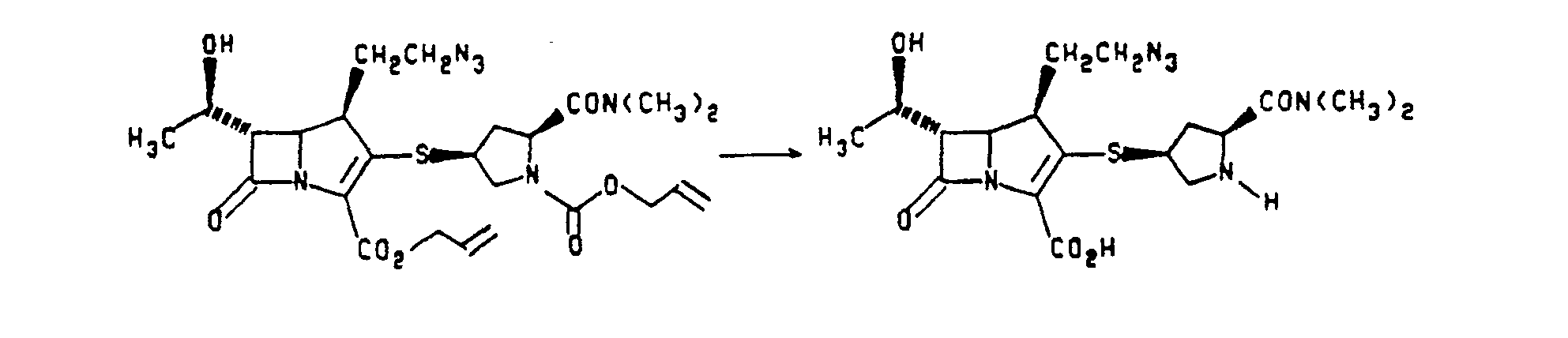
- Purity by HPLC: 96% on µ-Bondapak c-18, 3.9 mm x 30 cm, 15% CH3CN-H20 pH 7.4 phosphate buffer, flow rate 1 mL/min, uv detector 302 nm, retention time 7.6 min;
- UV (H20, pH 7.4 phosphate buffer) λmax: 302 nm (8,420);
- IR (KBr) vmax: 2100 (N3 ), 1760 (C=O of β-lactam), 1655 (C=0 of amide) and 1600 cm-' (C=O of carboxylate);
- 'H NMR (200 MHz, D20) δ: 1.33 (d, J=6.36 Hz, 3H, CH3CHO ), 1.7-2.3 (m, 3H, H-3 of pyrrolidine and CH2-4), 3.0 and 3.07 (2 X s, 2 x 3H, NCH3), 3.1 (m, 1 H, H-3 of pyrrolidine), 3.3-3.7 (m, 5H, H-5 pyrrolidine, H-4, H-6 and CH2N3), 3.77 (dd, Jgem = 12.15 Hz, JH5.H4= 6.32 Hz, H-5 of pyrrolidine), 4.0 (m, 1H, H-4 of pyrrolidine), 4.27 (m, 1 H, CH3CHO) 4.30 (dd overlapping with CH3CHO, JH5,H6=2.7 Hz, H-5) and 4.9 ppm (overlapping with HOD, H-2 of pyrrolidine).
-

- Purity by HPLC: 98.8% on µBondapak C18, 3.4 mm x 30 cm, 5% CH3CN-H2O pH 7.4 phosphate buffer, flow rate 1 mL/min, uv detector 300 nm, retention time 11.3 min;
- UV (H20, pH 7.4 phosphate buffer) λmax: 300 nm (8,130);
- IR (KBr) νmax: 1760 (C=O of β-lactam), 1660 (C=O of amide) and 1600 cm-1 (broad, C=O of carboxylate).
- 1 H NMR (200 MHz, D20) δ: 1.35 (d, J =6.35 Hz, 3H, CH3CH 0), 1.8-2.4 (m, 3H, H-3 of pyrrolidine and CH2-4), 1.94 (s, CH3C02H ), 3.02 and 3.09 (2s, 2 x 3H, CON(CH3)2), 2.9-3.2 (m overlapping with NCH3, 3H, H-3 of pyrrolidine and CH2NH2), 3.25-3.5 (m, 2H, H-5 of pyrrolidine and H-4), 3.51 (dd, JH6,H5=2.89 Hz, JH6,H1 =6.44 Hz, 1 H, H-6),3.6-3.75 (m, 1 H, H-5 of Pyrrolidine), 3.98 (m, 1 H, H-4 of pyrrolidine), 4.3 (m, 1 H, CH3CHO), 4.34 (dd overlapping with CH3CHO, JH5,H6=2.89 Hz, JH5,H4=9.70 Hz, 1H, H-5) and 4.74 ppm (t, J = 8.6 Hz, 1 H, H-2 of pyrrolidine).
-

-

- A solution of allyl (2R,4R,5R,6S)-4-(3"-azidopropyl)-6-[(1'R)-1'-hydroxyethyl]-3,7-dioxo-1-azabicyclo-[3.2.0]-heptane-2-carboxylate (8.23 mmole, prepared by cyclization of 3.0 g, 8.23 mmol of diazo precursor) in dry acetonitrile (60 mL) was treated at 0-5° C. and under nitrogen with diphenyl chlorophosphate (1.9 mL, 9.18 mmol) and N,N-diisopropylethylamine (1.6 mL, 9.18 mmol) added simultaneously over 5 min. A small crystal of 4-N,N-dimethylaminopyridine was then added and the solution was stirred for 1 h. Then more N,N-diisopropylethylamine (2.0 mL, 11.5 mmol) was added followed by a solution of (25,4S 1-N-allyloxycarbonyl-2-dimethylaminocarbonyl-4-mercaptopyrrolidine (3.0 g, 11.65 mmol) in acetonitrile (7 mL) and the resulting mixture was stirred at 0-5° C for 18 h. The reaction mixture was quenched by the addition of ethyl acetate (500 mL) and washed with cold water, saturated sodium bicarbonate, brine and dried ( MgS04). Evaporation of the solvent under reduced pressure gave an oil which was chromatographed on silica gel (6.5 x 12 cm). Elution with a gradient of ethyl acetate in toluene (1:1 to EtOAc ) gave 1.59 g (33%) of the title compound as a white foam:
- IR ( NaCI , film) vmax: 2100 (N3), 1775 (C=O of β-lactam), 1705 (C=O of ester) and 1650 cm-' (C=0 of amide);
- 'H NMR (200 MHz, CDCl3) s: 1.37 and 1.39 (2d, J=6.1 Hz, and J=6.18 Hz, 3H, CH3CHO ), 1.5-2.0 (m, 5H, H-3 of pyrrolidine), CH2-1 and 2 of propyl), 2.6-2.8 (m, 1 H, H-3 of pyrrolidine), 2.96, 2.97, 3.05 and 3.1 (45, total 6H, CON(CH3)2), 3.1-3.7 (m, 6H, CH2-5 of pyrrolidine, CH2N3, H-4 and H-6), 4.0 (m, 1 H, H-4 of pyrrolidine), 4.1-4.3 (m, 2H, H-5 and CH3CHO), 4.5-4.9 (m, 5H, H-2 of pyrrolidine and CH2 of allyl), 5.1-5.5 and 5.8-6.1 ppm (2m, 4H and 2H, CH of allyl).
-

- A solution of allyl (4R,5S,6S)-3-((4S)-4-[1-N-allyloxycarbonyl)-(2S)-2-dimethylaminocarbonyl]-pyrrolidinylthio)-4-(3"-azidopropyl)-6-[(1'R)-1'-hydroxyethyl]-7-oxo-1-azabicyclo[3.2.0]hept-2-ene-2-carboxylate (1.59 g, 2.76 mmol) in dry dichloromethane (50. mL) was treated at 22° C and under nitrogen with tetrakis (triphenylphosphine) palladium [0] (0.12 g) followed by 1.2 mL (11.1 mmol) of N-methylaniline. After 3 h the reaction mixture was extracted with water (3 x 50 mL), and the combined aqueous phase was maintained in vacuo to remove traces of organic solvent. Chromatography of the aqueous phase on reversed phase silica gel (µ-Bondapak C18, 3.5 x 15 cm) using a gradient of acetonitrile (0-15%) in water gave 0.60 g (48%) of the title carbapenem as a white amorphous powder after freeze drying: [α]D 22 -47.7 (c 1.0, H20);
- Purity by HPLC: 99% on µ-Bondapak C18, 3.9 mm'30 cm, elution 15% CH3CN-H20, pH 7.4 phosphate buffer, flow rate 1.5 mL/min, UV detector 302 nm, retention time 9.0 min;
- UV (H20, pH 7.4 phosphate buffer) λmax: 302 nm (9,737);
- IR (KBr) vrt,ax: 2100 (N3), 1755 (C=0 of β-lactam), 1655 (C=0 of amide) and 1600 cm-' (C=0 of carboxylate);
- 'H NMR (200 MHz, D20) δ: 1.32 (d, J=6.39 Hz, 3H, CH3CHO ), 1.4-2.0 (m, 5H, CH2-1 and 2 of propyl and H-3 of pyrrolidine), 2.99 and 3.07 (2s, 2 x 3N, CON(CH3)2), 2.9-3.1 (overlapping with CON(CH3)2' 1 H, H-3 of pyrrolidine), 3.2-3.5 (m, 5H, H-5 of pyrrolidine, H-4, H-6 and CH2N3), 3.63 (dd, Jgem 12.25 Hz, JH5,H4=6.16 Hz, 1H, H-5 of pyrrolidine), 3.93 (m, 1H. H-4 of pyrrolidine), 4.2-4.4 (m, 2H, H-5 and CH3CHOoverlapping) and 4.65 ppm (t, J=8.5 Hz, 1H, H-2 of pyrrolidine).
-

- Purity by HPLC: 99% on µ-Bondapak C18, 3.9 mm x 30 cm, elution 8% CH3CN-H20 pH 7.4 phosphate buffer, flow rate 0.8 mL/min, uv detector 302 nm, retention time 5.68 min;
- UV (H2O, pH 7.4 phosphate buffer) λmax: 302 nm (10,400);
- IR (KBr) νmax: 1760 (C=O of ,8-lactam), 1645 (C=0 of amide) and 1590 cm-1 (C=O of carboxylate);
- 'H NMR (200 MHz, D20) δ 1.33 (d, J=6.33 Hz, 3H, CH3CHO ), 1.4-2.0 (m, 5H, H-3 of pyrrolidine and CH2-1 and 2 of propyl), 2.73 (m, 1 H, H-3 of pyrrolidine), 2.97 and 3.07 (2s, 2 x 3H, CON(CH3)2), 3-3.2 (overlapping with NCH3, 4H, CH2-5 of pyrrolidine and CH2NH2), 3.34 (broad t, 1H, H-4), 3.38 (dd, JH6,H5= 2.59 Hz, JH6,H1 = 6.27 Hz, 1 H, H-6), 3.73 (m, 1 H, H-4 of pyrrolidine), 4.10 (dd collapsed into a t, J=8.0 Hz, 1H, H-2 of pyrrolidine) and 4.2-4.4 ppm (m, 2H, CH3CHOand H-5 overlapping).
-

- A solution of (4R,5S,6S)-4-(3"-aminopropyl)-3-[(4S)-4-[(2S)-2-dimethylaminocarbonyl]pyrrolidinylthio]-6-[-(1'R)-1'-hydroxyethyl]-7-oxo-1-azabicyclo[3.2.0]hept-2-ene-2-carboxylic acid, phosphate salt dibasic (0.14 g, 0.33 mmol) in water (15 mL) at 0-5 C was adjusted to pH 8-8.5 with 1 N sodium hydroxide and then treated with aminoiminomethanesulfonic acid (0.22 g, 1.77 mmol) added in small portions over 5 min. The pH of the reaction mixture was maintained at 8-8.5 during the addition and for another 2 h. Then 15 mL of 0.2M pH 6.0 phosphate buffer were added and resulting solution was chromatographed on reversed phase silica gel (µBondapak C18, 2.5 x 14 cm). Elution with a gradient of acetonitrile (0-15%) in water gave 0.068 g (45%) of the title compound as a white amorphous powder after freeze drying:
- Purity by HPLC: 99% on µBondapak C18, 3.9 mm x 30 cm, elution 8% CH3CN-H2O, pH 7.4 phosphate buffer, flow rate 1 mL/min, UV detector 302 nm, retention time 7.2 min;
- UV (H20, pH 7.4 phosphate buffer) λmax: 302 nm (10,800);
- IR (KBr) vrt,ax: 1755 (C=O of β-lactam), 1640 (C=O of amide) and 1590 cm-1 (sh, C=O of carboxylate);
- 'H NMR (200 MHz, D20) 5: 1.32 (d, J=6.38 Hz, 3H, CH3CHO ), 1.4-2.0 (m, 5H, H-3 of pyrrolidine and CH2-1 and 2 of propyl), 2.75 (m, 1 H, H-3 of pyrrolidine), 2.97 and 3.08 (2s, 2 x 3N, NCH3), 3.1-3.4 (m, 5H, CH2-5 of pyrrolidine, CH2N-3 of propyl and H-4), 3.33 (dd, JH6,H5=2.55 Hz, JH6,H1=6.21 Hz, 1H, H-6), 3.75 (m, 1H, H-4 of pyrrolidine), 4.16 (X part of AMX system, JAX=8.8 Hz, JMX=7.4 Hz, 1H, H-2 of pyrrolidine), 4.25 (dd overlapping with CH3CHO, JH5.H6 = 2.55 Hz, 1 H, H-5) and 4.27 ppm (m, 1 H, CH3CHO).
-

-
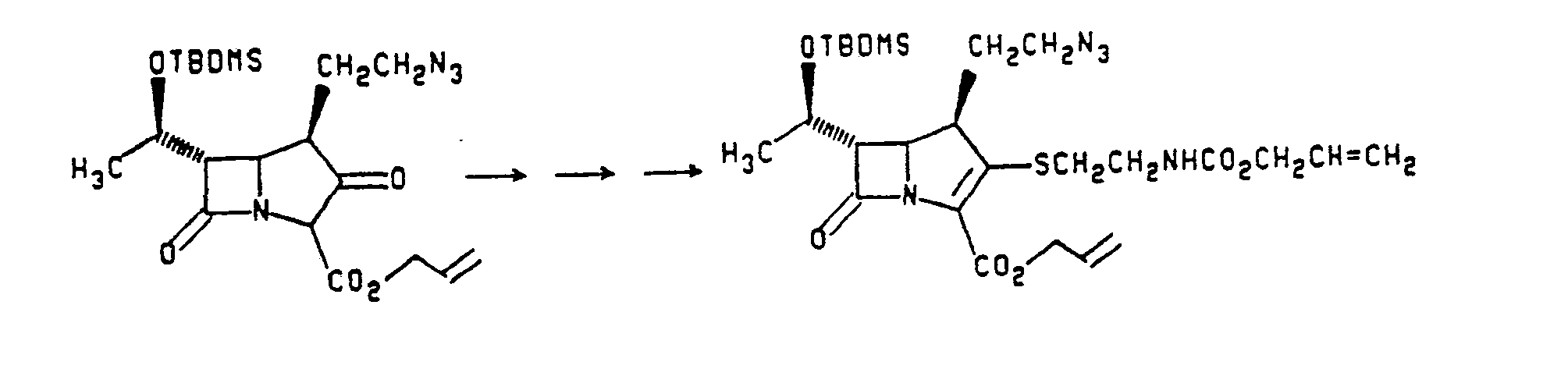
- A solution of allyl (2R,4R,5R,6S)-4-(2"-azidoethyl)-6-[(1'R)-1'-tert-butyldimethylsilyloxyethyl]-3,7-dioxo-1-azabicyclo[3.2.0]heptane-2-carboxylate (10.0 mmol, prepared by cyclization of 4.64 g, 10.0 mmol of diazo precursor) in dry acetonitrile (75 mL) was treated at 0-5 °C and under nitrogen with diphenyl chlorophosphate (2.3 mL, 11.1 mmol) and N,N-diisopropylethylamine (1.9 mL, 10.9 mmol) added simultaneously over 5 min. A small crystal of 4-N,N-dimethylaminopyridine was then added and the resulting mixture was stirred at 0-5° C for 30 min. The solution was then treated with more N,N-diisopropylethylamine (6.0 mL, 34.5 mmol) followed by allyl 2-mercaptoethylcarbamate [see Example 116, Step A] (5.1 g, 33.4 mmol) in acetonitrile (5 mL) and the resulting mixture was stirred at 0-5° C for 20 h. The solution was then diluted with ethyl acetate (500 mL) washed with water, saturated sodium bicarbonate, brine and dried ( MgS04). The residue obtained after evaporation of the solvent under vacuum was chromatographed on silica gel (5 x 10 cm) using a gradient of ethyl acetate (0-10%) in toluene as eluent. Evaporation of the pertinent fractions gave 4.37 g (75%) of the title compound as a light yellow oil. By TLC and 'H NMR this material was contaminated with some impurities (disulfide) but was used as such in the next step:
- IR ( NaCI , film) vmax· 2100 (N3), 1775 (C=0 of β-lactam) and 1720 cm-1 (broad, C=0 of ester);
- 'H NMR (200 MHz, CDCI3) δ: 0.09 (s, 6N, SiCH3), 0.89 (s, 9N, Si-tBu ), 1.30 (d, J=6.05 Hz, 3H, CH3CHO ), 1.5-2.0 (m, 2N, CH2-4), 2.8-3.6 (m, 8H, SCH2CH2N , CH2N3, H-4 and H-6), 4.1-4.3 (m, 2H, H-5 and CH3CHO ), 4.5-4.9 (m, 4H, CH2 of allyl), 5.1-5.5 and 5.8-6.1 ppm (2m, 6H, and 2H, CH of allyl and NH).
-

- A solution of allyl (4R,5S,6S)-3-[(1-allyloxycarbonyl-aminoethyl)thio]-4-(2"-azidoethyl)-6-[(1'R)-1'-tert-butyldimethylsilyloxyethyl]-7-oxo-1-azabicyclo[3.2.0]hept-2-ene-2-carboxylate (4.37 g, 7.54 mmol) in dry tetrahydrofuran (120 mL) was treated at 0-5 °C and under nitrogen with acetic acid (2.7 mL, 47.5 mmol) followed by 24 mL (24.0 mmol) of a 1 M solution of tetrabutylammonium fluoride in tetrahydrofuran added dropwise over 5 min. The solution was then stored at 10° C for 7 days. The reaction mixture was then diluted with ethyl acetate (500 mL), washed with saturated .sodium bicarbonate (2x), brine and dried ( MgSO4). Evaporation of the solvent under reduced presure gave an oil which was chromatographed on silica gel (6.5 x 11 cm) using a gradient of ethyl acetate in toluene (7:3 to 1:1) as eluent. Evaporation of the UV active fractions gave 1.17 g (33%) of the title compound as a clear oil:
- IR ( NaCl) νmax: 3480 (OH), 2100 (N3), 1770 (C = 0 of ,6-lactam) and 1710 cm-1 (C = 0 of ester);
- 1H NMR (200 MHz, CDCI3) 6: 1.39 (d, J=6.24 Hz, 3H, CH3CHO ),1.7-2.1 (m, 2H, CH2-4), 2.7-3.15 (m, 2H, SCH2), 3.18 (dd, JH6,H5 = 2.66 Hz, JH6,H1=7.97 Hz, 1H, H-6), 3.2-3.7 (m, 5H, CH2NH , CH2N3and H-4), 4.23 (m, overlapping with H-5, 1 H, CH3 CHO), 4.25 (dd, JH5,H6 = 2.66 Hz, JH5,H4 = 9.57 Hz, 1 H, H-5), 4.57 and 4.75 (2m, 2 x 2H, CH2 of allyl), 5.1-5.5 and 5.8-6.1 ppm (2m, 6H and 2H, CH of allyl and NH).
-

- Purity by HPLC: 99.2% on µBondapak C18 (3.9 mm x 30 cm, 10% CH3CN-H20 pH 7.4 phosphate buffer, flow rate 1 mL/min, uv detector 302 nm, retention time 7.68 min;
- UV (H20, pH 7.4 phosphate buffer) λmax: 298 nm (7401 nm);
- IR (KBr) vmax: 2100 (N3), 1760 (C=O of β-lactam) and 1590 cm-1 (broad, C=O of carboxylate);
- 'H NMR (200 MHz, D20) 5: 1.33 (d, J=6.38 Hz, 3H, CH3CHO ), 1.7-2.2 (m, 2H, CH2-4), 2.9-3.7 (broad m, 7H, SCH2CH2NH2, CH2N3and H-4), 3.50 (dd, JH6,H5 =2.67 Hz, JH6.H1 = 6.24 Hz, 1 H, H-6) and 4.2-4.4 ppm (m, 2H, H-5 and CH3CHO overlapping).
-

- A solution of (4R,5S,6S)-3-[(2-aminoethyl)thio]-4-(2"-azidoethyl)-6-[(1'R)-1'-hydroxyethyl]-7-oxo-1 - azabicyclo-[3.2.0]hept-2-ene-2-carboxylic acid (0.30 g, 0.88 mmol) in cold water (90 mL) was hydrogenated at 0-5° C over 1.2 g of 5% palladium on alumina and under 45 psi of hydrogen for 50 min. Then 0.1 mL (1.6 mmol) of acetic acid was added (pH changed grom 9.3 to 4.3) and the catalyst was filtered on a Celite pad. The filtrate was chromatographed on reversed phase silica gel (2.5 x 14 cm) using 0.005M aqueous acetic acid as eluent. The product was eluted very fast from the column with the solvent front. The UV active fractions were combined, lyophilized and chromatographed on the same column a second time. Lyophilization gave 0.22 g (66%) of the title carbapenem as a white amorphous powder. By UV and 1H NMR, this product was 60% pure and contained some inorganic salts of acetic acid (based on a UV absorption of 7400 for the azido precursor);
- Purity by HPLC: 99% on µBondapak C18, 3.9 mm x 30 cm, elution 5% CH3CN-H20 pH 7.4 phosphate buffer, flow rate 0.9 mL/min, uv detector 300 nm, retention time 5.7 min;
- UV (H20, pH 7.4 phosphate buffer) λmax: 296 nm (4,446);
- IR (KBr) vmax: 1760 (C = 0 of β-lactam) and 1570 cm-1 (broad, C=0 of carboxylate);
- 'H NMR (200 MHz, D20) 5: 1.33 (d, J-6.36 Hz, 3H, CH3CHO ), 1.9 (s, CH3CO2H ), 1.8-2.4 (m, 2H, CH2-4), 2.8-3.45 (m, 7H, SCH2CH2NH2, H-4 and CH2NH2), 3.49 (dd, JH6,H5=2.84 Hz, JH6,H4=6.42 Hz, 1H, H-6), 4.2-4.4 ppm (m, 2H, H-5 and CH3CHO).
-

- HSCH2CH2NH2.HC1 + CH2=CH-CH2OCOCl → HSCH2CH2NHCO2CH2-CH=CH2
- A suspension of 2-aminoethanethiol hydrochloride (4.4 g, 38.7 mmol) in dry acetonitrile (30 mL) was cooled to 0-5° C and treated under nitrogen with N,N-diisopropylethylamine (16.0 mL, 91.8 mmol). After 5 min, trimethylsilyl chloride (6.56 mL, 51.7 mmol) was added all at once and the mixture was stirred for 15 min. Then allyl chloroformate (4.24 mL, 40.0 mmol) followed by N,N-diisopropylethylamine (6.9 mL, 29.6 mmol) were added dropwise (10 min) and the resulting mixture was stirred for 30 min at 0-5° C and for 2 h at 22° C. Water (100 mL) was then added and the reaction mixture was extracted with dichloromethane (2 x 100 mL). The combined organic phase was washed with 1 N hydrochloric acid (20 mL), 0.2M pH 7.0 phosphate buffer, brine and dried ( Na2SO4). Evaporation of the solvent under reduced pressure gave 6.5 g of the crude thiol as a clear oil which was used immediately for the coupling step. The preparation of the title compound was based on the procedure of I. Shinkai et al, Synthesis, 924, (1980).
- ' H NMR (200 MHz, CDCl3) 5: 1.36 (t, J=8.53 Hz, 1H, SH), 2.66 (m, 2H, SCH2), 3.37 (m, 2H, CH2N), 4.57 (m, 2H, CH2 of allyl), 5.2 (broad, 1 H, NH), 5.2-5.4 and 5.8-6.1 ppm (2m, 2H and 1 H, CH of allyl).
-

- IR (NaCl, film) νmax: 3400 (OH), 2100 (N3), 1755 (C=0 of β-lactam) and 1705 cm-1 (broad, C=0 of ester);
- 'H NMR (200 MHz , CDC13) δ: 1.39 (d, J=6.25 Hz, 3H, CH3CHO), 1.5-2.0 (m, 4H, CH2-1 and 2 of propyl), 2.7-3.2 (m, 2H, SCH2), 3.24 (dd, JH6,H5 =2.63 Hz, JH6,Hl = 7.46 Hz, 1 H, H-6), 3.2-3.6 (m, 5H. CH2 N3, CH2N and H-4), 4.24 (dd, JH5.H6 =2.63 Hz, JH5,H4=9.43 Hz, 1 H, H-5), 4.24 (overlapping with H-5, 1 H, CH3CHO), 4.56 and 4.75 ppm (2m, 2 x 2H, CH2 of allyl), 5.1-5.5 (m, 5H, CH of allyl and NH) and 5.8-6.1 ppm (m, 2H, CH of allyl).
-

- Purity by HPLC: 99% on µBondapak C18, 3.9 mm x 30 cm, elution 10% CH3CN-H2O pH 7.4 phosphate buffer, flow rate 1 mUmin, uv detector 300 nm, retention time 13.3 min;
- UV (H20, pH 7.4 phosphate buffer) λmax: 298 nm (8,425);
- IR (KBr) νmax: 2100 (N3), 1760 (C=0 of β-lactam) and 1590 cm-1 (C=0 of carboxylate);
- 'H NMR (200 MHz, D20) δ: 1.33 (d, J=6.37 Hz, 3H, CHsCHO), 1.5-2.0 (m, 4H, CH2-1 and 2 of propyl), 2.8-3.5 (m, 5H, SCH2CH2NH2 and H-4), 3.42 (t, J=6.2 Hz, 3H, CH2N3), 3.47 (dd, JH6.H5=2.70 Hz, JH6.H1 = 5.98 Hz, 1H, H-6), 4.26 (dd, JH5,H6 = 2.70 Hz, JH5,H4 =9.35 Hz, 1H, H-5) and 4.28 ppm (m overlapping with H-5, 1 H, CH3CHO).
-
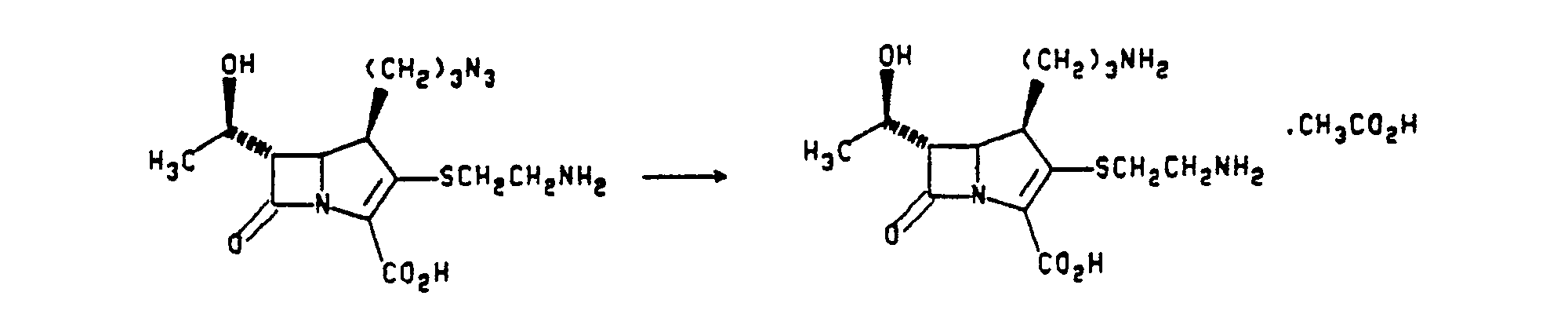
- Purity by HPLC: 98% on µBondapak C18, 3.9 mm x 30 cm, elution 5% CH3CN-H2O pH 7.4 phosphate buffer, flow rate 0.8 mUmin, UV detector 300 nm, retention time 4.9 min;
- UV (H20, pH 7.4 phosphate buffer) λmax: 298 nm (7,517);
- IR (KBr) νmax: 1755 (C = 0 of β-lactam) and 1570 cm-' (broad, C = 0 of carboxylate);
- 'H NMR (200 MHz, D20) 8: 1.33 (d, J=6.34 Hz, 3H, CH3CHO), 1.4-2.0 (m, 4H, CH2-1 and 2 of propyl), 1.92 (s, CH3C02H), 2.8-3.4 (m, 7H, SCH2CH2NH2, CH2NH2-3 of propyl and H-4), 3.43 (dd, JH6,H5=2.73 Hz, JH6,H, = 6.37 Hz, 1 H, H-6), 4.2-4.3 ppm (m, 2H, H-5 and CH3CHO overlapping).
-

- Purity by HPLC: 99.4% on µBondapak C18, 3.9 mm x 30 cm, elution 20% CH3CN-H20, pH 7.4 phosphate buffer, flow rate 0.8 mUmin, UV detector 300 nm, retention time 6.06 min;
- UV (H20, pH 7.4 phosphate buffer) λmax:302 nm (9,768);
- IR (KBr) νmax: 2100 (N3), 1955 (C = O of β-lactam), 1715 (CN of formimidoyl) and 1590 cm-1 (C = O of carboxylate);
- 'H NMR (200 MHz, D20) s: 1.33 (d, J=6.35 Hz, 3H, CH3CHO), 1.4-2.0 (m, 4H, CH2-1 and 2 of butyl), 2.8-3.3 (m, 2H. SCH2), 3.3-3.8 (m, 6H, H-6, H-4, CH2N3 and CH2NH), 4.2-4.4 (m, 2H, H-5 and CH3CHO overlapping), 7.76 and 7.83 ppm (25, 1 H, NHCH = NH).
-

- Purity by HPLC: 94% on µBondapak C18, 3.9 mm x 30 cm, elution 5% CH3CN-H2O pH 7.4 phosphate buffer, flow rate 1 mL/min. UV detector 300 nm, retention time 7.57 min;
- UV (H20, pH 7.4 phosphate buffer) λmax: 300 nm (6,900);
- IR (KBr) νmax: 1755 (C = O of β-lactam), 1720 (CN of formimidoyl) and 1570 cm-1 (broad, C = O of carboxylate);
- 1H NMR (200 MHz, D20) 8: 1.33 (d, J=6.36 Hz, 3H, CH3CHO), 1.5-2.0 (m, 4N, CH2-1 and 2 of propyl), 1.92 (s, 3H, CH3CO2H), 3.04 (t, J=7.0 Hz, 2H, CH2NH2), 3.42 (dd, JH6.H5= 2.64 Hz, JH6,H1 =6.31 Hz, 1H, H-6), 2.8-3.7 (m, 5H, SCH2, CH2 NHCH = NH and H-4), 4.26 (dd, overlapping with CH3CHO, JH5,H6=2.64 Hz, 1 H, H-5), 4.28 (m, 1 H, CH3CHO), 7.74 and 7.83 ppm (25, 1 H, NHCH = NH).
-

-

- A cold (ice-methanol bath) solution of allyl (2R,4R,5R,6S)-4-(3"-azidopropyl)-6-[(1'R)-1'-hydroxyethyl]-3,7-dioxo-1-azabicyclo[3.2.0]heptan-2-carboxylate [prepared from (3S,4R)-3-[(1'R)-1'-hydroxyethyl]-4-[(1 "R)-1 "-(3-azidopropyl)-3"-diazo-3"-allyloxycarbonyl-2"-oxopropyl]-azetidin-2-one (1.0 g, 2.75 mmol)] was treated slowly with diphenyl chlorophosphate (0.6 mL, 3.0 mmol) followed by the dropwise addition of diisopropylethylamine (0.52 mL, 3.0 mmol). The mixture was stirred for 1 h, then triethylsilyl chloride (0.5 mL, 3 mmol) and diisopropylethylamine (0.52 mL, 3.0 mmol) were added in. The mixture was stirred for 30 min at -15°C. The resulting silylated enol phosphate was treated with 2-mercaptoethanol (430 mg, 5.5 mmol) in CH3CN (0.5 mL) and diisopropylethylamine (0.95 mL, 5.5 mmol). The mixture was stirred for 19 h at 5-8° C (cold room), then diluted with ethyl acetate (50 mL), washed with ice cold water (2 x 20 mL), 1 M aqueous NaHSO3 (3 x 20 mL), water (20 mL), 1 N aqueous HCI (20 mL), water (2 x 20 mL), 1 M aqueous NaHC03 (20 mL), water (20 mL), brine (20 mL) and dried (MgSO4). The residue was passed through a silica gel flash column (50 g, 0-50% ethyl acetateihexane) to give the title compound (883 mg, 63%) as an oil.
- IR (CH2CI2) νmax: 3600 (OH), 2100 (N3), 1775 (C=O β-lactam) and 1710 cm-1 (C=O ester);
- ' H NMR (CDCl3, 200 MHz) δ: 6.05-5.8 (1H, m, vinylic H), 5.49-5.2 (2H, m, vinylic H), 4.9-4.6 (2H, m, allylic CH2), 4.30-4.16 (1H, m, H-1'), 4.145 (1H, dd, J = 2.5 Hz, J = 9.6 Hz, H-5), 3.803 (2H, t, J = 5.9 Hz, CH20, 3.40-3.28 (2H, m, CH2N3), 3.24-3.28 (1H, m, H-1'), 3.192 (1H, dd, J=2.8 Hz, J=7.5 Hz, H-6), 3.15-2.87 (2H, m, SCH2), 1.89-1.75 (1 H, m, part of CH2-4), 1.7-1.45 (3H, m, CH2-CH2 at 4), 1.552 (1H, bs, OH), 1.316 (3H, d, J=6.1 Hz, CH3), 0.998, 0.957 and 0.920 (9H, 3 lines, CH3), 0.662, 0.659, 0.623,0.584, 0.546 and 0.539 ppm (6H, 6 lines, CH2).
-

- A cold (dry ice-acetone) solution of allyl (4R,5S,6S)-4-(3"-azidopropyl)-3-[(2-hydroxyethyl)thio]-6-[(1'R)-1'-triethylsilyloxyethyl]-7-oxo-1-azabicyclo-[3.2.0]hept-2-ene-2-carboxylate (883 mg, 1.73 mmol) in dichloromethane (20 mL) was treated first with diisopropylethylamine (0.80 mL, 4.5 mmol) and dropwise with trifluoromethanesulfonic anhydride (0.35 mL, 2.1 mmol). The mixture was stirred for 20 min and pyrrolidine (0.90 mL, 10.4 mmol) in dichloromethane (1 mL) was added in. Stirring was continued for 30 min at -78° C (dry ice-acetone) and for 30 min at -15°C (ice-methanol bath). The reaction mixture was diluted with ethyl acetate (100 mL) and petroleum ether (20 mL), washed with ice cold water (10 x 25 mL), brine (25 mL), dried ( MgSO4) and the residue upon solvent evaporation was passed through a silica gel flash pad (45 g, 33→ 100% ethyl acetate/hexane, 10% → 40% acetone/ethyl acetate) to give title compound (510 mg, 52%) as an oil.
- IR (CH2CI2) vmax· 2100 (N3) 1775 (C=0 β-lactam) and 1710 cm-1 (C=0 ester);
- 'H NMR (CDCl3, 200 MHz) δ: 6.03-5.9 (1H, m, vinylic H), 5.49-5.21 (2H, m, vinylic H), 4.9-4.6 (2H, m, allylic CH2) , 4.30-4.14 (1 H, m, H-1') , 4.121 (1 H, dd, J =2.6 Hz, J=9.6 Hz, H-5), 3.4-3.30 (2H, m, CH2N3) , 3.23-3.14 (1 H, m, H-4), 3.169 (1H, dd, J = 2.6 Hz, J =7.6 Hz, H-6) , 2.98-2.88, 2.75-2.63 (2H, 2 sets of m, SCH2), 2.63-2.45 (6H, m, CH2N), 1.9-1.5 (8H, m, CH2CH2-4 and CH2CH2 pyrrolidine), 1.317 (3H, d, J=6.1 Hz, CH3) , 0.0993, 0.952, 0.916 (9H, 3 lines, CH3), 0.697, 0.658, 0.655, 0.619, 0.579, 0.542 and 0.535 ppm (6H, 7 lines, SiCH2).
-

- A cold (ice-methanol) solution of allyl (4R,5S,6S)-4-(3"-azidopropyl)-3-[2-(1-pyrrolidinyl)ethylthio]-6-[-(1'R)-1'triethylsilylethylsilyloxyethyl]-7-oxo-1-azabicyclo[3.2.0]hept-2-ene-2-carboxylate (500 mg, 0.77 mmol) in anhydrous tetrahydrofuran (5 mL) was treated first with glacial acetic acid (0.290 mL, 5.28 mmol) followed by the dropwise addition of a 1 M solution of tetrabutylammonium fluoride in tetrahydrofuran (2.64 mL, 2.64 mmol). The mixture was allowed to stand at -20 C for 20 h, then diluted with ethyl acetate (25 mL), washed with ice cold 1 M aqueous NaHCO3, (3 x 10 mL), brine (10 mL) dried ( MgSO4). The residue obtained (370 mg, 94%) upon solvent evaporation was used as such in the next step.
- IR (CH2Cl2) vmaxi 3600 (OH), 2100 (N3), 1775 (C=O β-lactam) and 1710 cm-' (C=O ester);
- ' H NMR (CDCl3, 200 MHz) 5: 6.04-5.90 (1H, m, vinylic H) , 5.49-5.22 (2H, m, vinylic H) , 4.82-4.62 (2H, m, allylic H) , 4.27-4.18 (1 H, m, h-1') , 4.217 (1H, dd, J=2.7 Hz, J=9.7 Hz, H-5), 3.45-3.25 (3H, m, CH2N3 and H-4), 3.233 (1 H, dd, J =2.7 Hz, J=7.6 Hz, H-6), 2.99-2.82, 2.76-2.65 (2H, 2 sets of m, SCH2), 2.65-2.4 (6H, m, CH2N), 1.95-1.50 (9H, m, CH2CH2-4, OH and CH2CH2 pyrrolidine) and 1.388 ppm (3H, d, J=6.2 Hz, CH3).
-

- A cold (ice bath) solution of allyl (4R,5S,6S)-4-(3"-azidopropyl)-6-[(1'R)-1'-hydroxyethyl]-3-[2-(1-pyrrolidinyl)ethylthio]-7-oxo-1-azabicyclo[3.2.0]hept-2-ene-2-carboxylate (360 mg, 0.80 mmol) in dichloromethane (20 mL) was treated first with Pd(PPh3)4 followed by the dropwise addition of a N-methyl aniline (0.17 mL, 1.6 mmol). The mixture was stirred for 15 min, then a 0.1 M pH 7.0 aqueous phosphate buffer (50 mL, 5 mmol) and diethyl ether (50 mL) were added in. The organic phase was extracted again with the 0.1 M pH 7.0 buffer (2 x 15 mL) and water (15 mL). The aqueous extracts were combined, washed with diethyl ether (2 x 25 mL) and passed through a µBondapak C18 reversed phase column (50 g, 0 - 30% CH3CN/H2O) to give title compound (200 mg, 58%) as a lyophilized powder.
- Purity: 99.9% as determined by HPLC (r.t. = 7.751, µBondapak C18, 10u, 15% CH3CN/KH2PO4.0.01M, pH 7.4);
- UV (water) λmax: 296(7170);
- IR (Nujol) νmax: 3500-3100 (OH), 2100 (N3), 1755 (C=0 β-lactam) and 1600 cm-1 (C=0 carboxylate);
- ' H NMR (D20, 200 MHz) δ: 4.35 - 4.20 (1 H, m, H-1'), 4.263 (1 H, dd, J =2.7 Hz, J=9.4 Hz, H-5), 3.475 (1H, dd, J=2.7 Hz, J=6.1 Hz, H-6), 3.46-3.39 (2H, m, CH2N), 3.10-2.9 (1H, m, 1H of SCH2), 2.10-1.85 (5H, m, CH2CH2 pyrrolidine and 1H of CH2-4), 1.80-1.45 (3H, m, CH2CH2-4) and 1.331 ppm (3H, d, J=6.4 Hz, CH3).
-
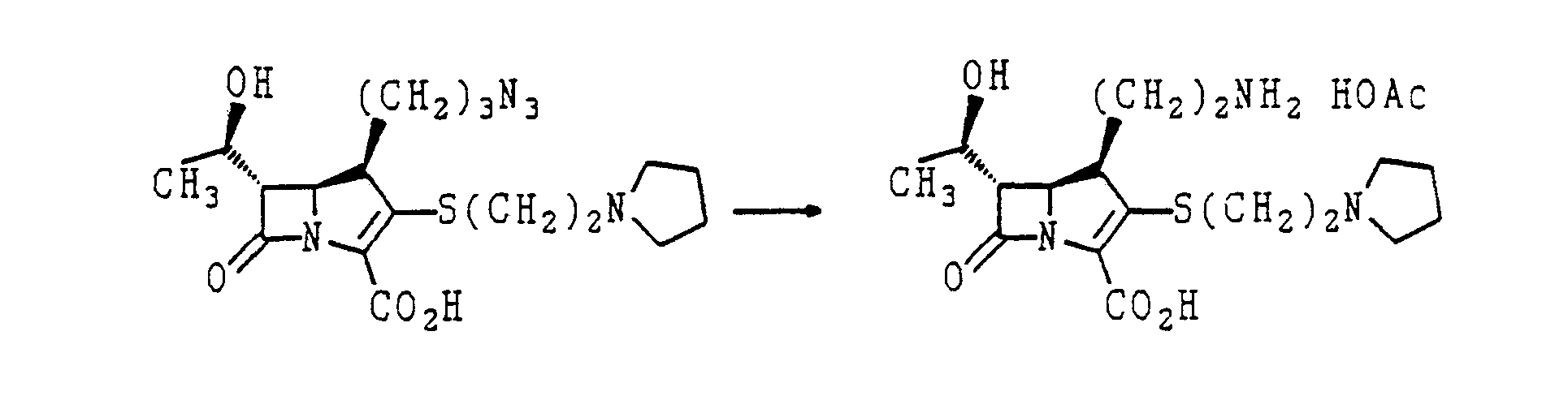
- A cold (ice bath) solution of (4R,55,65)-4-(3"-azidopropyl)-6-[(1'R)-1'-hydroxyethyl]-3-[2-(1-pyrrolidinyl)-ethylthio]-7-oxo-1-azabicyclo[3.2.0]hept-2-ene-2-carboxylic acid (150 mg, 0.34 mmol) in water (30 mL) was shaken in a Parr hydrogenator at 45-50 psi of hydrogen for 1 h using 5% Pd/Alumina (750 mg) as catalyst. The catalyst was removed, washed with water (2 x 5 mL), and the pH of the solution (9.5) was adjusted to 4.6 with a 1M aqueous acetic acid solution. The aqueous solution was passed twice through a µBondapak C18 reversed phase column (45 g and 35 g, 0.005M aqueous acetic acid, 1% → 2% CH3CN /0.005M aqueous acetic acid) to give the title compound (138 mg, 67%) as a pale yellow lyophilized powder.
- Purity: 99.5% as determined by HPLC (r.t. = 7.338, µBondapak C18, 10u., 10% CH3CN/KH2PO4, 0.01 M, pH 7.4);
- UV (H20) λmax: 296 (8426);
- IR (Nujol) νmax: 3500-3100 (OH, NH2), 1755 (C=0 β-lactam) and 1590 cm-' (C=O carboxylate);
- 'H NMR (D20, 200 MHz) δ: 4.33-4.20 (2H, m, H-1' and H-5), 3.412 (1H, dd, J=2.6 Hz, J=6.4 Hz, H-6), 3.5-3.1 (1H, m, CH2N, H-4, 1 H of SCH2), 3.09, 3.051, 3.016 (2H, 3 lines, CH2N), 3.10-2.95 (1H, m, 1 H of SCH2), 2.09 (4H, bs, CH2CH2 pyrrolidine), 1.92 (2H, s, CH3C02), 2.0-1.45 (4H, m, CH2CH2-4) and 1.331 ppm (3H, d, J=6.4 Hz, CH3).
-

-

- IR (NaCl, film) vmax: 2100 (N3) and 1710 cm-1 (C=O of acid);
- 'H NMR (200 MHz, CDCl3) δ: 1.3-1.8 (m, 8H, CH2-3,4,5 and 6), 2.36 (t, J=7.35 Hz, 2H, CH2-2) and 3.26 ppm (t, J=6.77 Hz, 2H, CH2-7).
-

- A solution of 7-azidoheptanoic acid from Step A (40.9 g, 0.24 mol) in dry dichloromethane (200 mL) was treated at 22°C with oxalyl chloride (22.0 mL, 0.25 mol) dropwise over 10 min. After 1 h, two drops of N,N-dimethylformamide were added and the mixture was stirred for another hour. Evaporation of the solvent under reduced pressure gave the crude acid chloride as an oil which was used as such for the next step:
- IR (NaCl, film) νmax: 2100 (N3) and 1800 cm-1 (C=O of acid chloride);
- ' H NMR (200 MHz, CDCI3) δ: 1.3-1.9 (m, 8H, CH2-3,4,5 and 6), 2.9 (t, J=7.18 Hz, 2H, CH2-2) and 3.27 ppm (t, J = 6.7 Hz, 2H, CH2-7).
-

- A solution of 2-picolyl mercaptan (30.0 g, 0.24 mol) in dry dichloromethane (400 mL) was treated at 0-5°C and under argon with pyridine (21.0 mL, 0.26 mol) followed by a solution of 7-azidheptanoyl chloride (45.5 g, 0.24 mol) in dichloromethane (100 mL) dropwise over 10 min. After 30 min, the reaction mixture was washed with cold saturated sodium bicarbonate, brine and dried ( MgSO4). Evaporation of the solvent under reduced pressure gave the crude thioester as a clear oil. Filtration on a silica gel pad (9 x 11 cm) using a mixture of toluene and ethyl acetate (8:2) as eluent gave 60.3 g (90%) of the title thioester as a clear oil:
- IR (NaCI, film) vmax: 2100 (N3) and 1690 cm-' (C=O of thioester);
- 'H NMR (200 MHz, CDCl3) δ: 1.2-1.8 (m, 8H, CH2-3,4,5 and 6), 2.59 (t, J=7.4 Hz, 2H, CH2-2), 3.24 (t, J=6.79 Hz, 2H, CH2-7), 4.25 (s, 2H, SCH2), 7.15 (m, 1H, H-5 of pyridine), 7.33 (d, J=7.8 Hz, 1H, H-3 of pyridine), 7.62 (m, 1 H, H-4 of pyridine) and 8.53 ppm (m, 1 H, H-6 of pyridine).
-

- A solution of 2-picolyl 7-azidothiolheptanoate (60.0 g, 0.215 mol) in dry dichloromethane (250 mL) was cooled to -10°C and treated with triethylamine (60.0 mL, 0.43 mmol). Then 74 mL (0.32 mmol) of tert-butyldimethylsilyl trifluoromethanesulfonate was added dropwise over 40 min. The temperature of the mixture was allowed to reach 20°C and the solution was stirred for 3 h. The reaction mixture was then diluted with hexanes (600 mL) and washed with cold water (3x), saturated NaHCO3, brine and dried ( MgSO4). Evaporation of the solvent gave the crude silyl enol ether as a dark oil which was used as such for the next step. By 'H NMR it was a 1:1 mixture of E and Z isomer:
- IR (NaCl, film) νmax: : 2100 cm-1 (N3);
- 'H NMR (200 MHz, CDCl3) 8: 0.2 and 0.23 (2 x s, 6H, SiCH3), 0.96 and 0.98 (2 x s, 9H, Sit-Bu), 1.2-2.1 (m, CH2-4,5 and 6), 3.2 (m, 4N, CH2-3 and 7), 3.95 and 4.03 (2 x s, 2H, SCH2), 4.84 and 4.99 (2 x t, J=7.22 Hz and J=7.6 Hz, 1 H, CH-2), 7.14 (m, 1 H, H-5 of pyridine), 7.28 (m, 1 H, H-3 of pyridine), 7.61 (m, 1H, H-4-of pyridine) and 8.53 ppm (m, 1 H, H-6 of pyridine).
-

- To a cold (0-5°C) suspension of freshly fused zinc chloride (38 g, 0.28 mol) in dry dichloromethane (600 mL) was added 60.0 g (0.208 mmol) of (3S,4R)-4-acetoxy-3-[(1'R)-1'-tertbutyldimethylsilyloxyethyl]-azetidin-2-one followed by a solution of the crude 0-tert-butyldimethyl-silylenol ether of 2-picolyl 7-azidothiolheptanoate (0.215 mol) in dichloromethane (125 mL). The reaction mixture was then stirred at 22°C for 18 h. The mixture was then washed successively with water, saturated ammonium chloride, saturated sodium bicarbonate, brine and dried ( MgSO4). Evaporation of the solvent under vacuum gave 131 g of the crude thioester as a dark oil which was used as such for the next step. 1H NMR and HPLC analysis of this mixture indicated a 85:15 mixture of epimers at position 1 of the hexyl (isomer ratio β:α 85:15). Chromatography of an aliquot (4 g) on silica gel (4 x 20 cm, elution toluene-ethyl acetate, 1:1) gave 1.0 g of the pure title material as an oil followed by mixed fractions (0.25 g) of β and α epimers. Pure β epimer had the following characteristics: .
- IR (NaCl, film) νmax: 2100 (N3), 1761 (C=0 of β-lactam) and 1685 cm-' (C=0 of thioester);
- 'H NMR (200 MHz, CDC13) δ: 0.04 (s, 6H, SiCH3), 0.85 (s, 9H, Si t-Bu), 0.99 (d, J=6.32 Hz, 3H, CH3CHO), 1.2-1.9 (m, 8H, CH2=2,3,4 and 5 of hexyl), 2.9 (m, 1 H, H-1 of hexyl), 3.03 (m, 1 H, H-3), 3.22 (t, J=6.73 Hz, 2H, CH2N3), 3.79 (dd, JH4,H3=2.07 Hz, JH4,H7=7.01 Hz, 1H, H-4), 4.14 (qd, JH,CH3=6.32 Hz, JH,H3=3.60 Hz, 1 H, CH3CHO), 5.86 (broad s, 1 H, NH), 7.18 (m, 1 H, H-5 of pyridine), 7.32 (d, J=7.8 Hz, 1 H, H-3 of pyridine), 7.63 (m, 1H, H-4 of pyridine) and 8.54 ppm (m, 1 H, H-6 of pyridine).
- F. (3S,4S)-3-[(1'R)-1'-tert-Butyldimethylsilyloxyethyl]-4-[(1"R)-1"-carboxy-6"-azidor)exy)]azetidin-2-one

- A solution of the crude thioester (~0.2 mmol) from Step E in tetrahydrofuran (700 mL) was cooled to 0-5°C and treated dropwise with 150 mL (1.74 mol) of 30% hydrogen peroxide (addition time 15 min). Then 700 mL of 1 N sodium hydroxide (2.7 mol) was added dropwise over 1 h. The mixture was allowed to react at 18°C and the solution was stirred for another hour. The mixture was then diluted with hexanes (700 mL) and the aqueous phase was collected, cooled to 0-5 C and acidified to pH 2.0 with concentrated hydrochloric acid. The aqueous solution was then extracted with ethyl acetate (500 mL and 200 mL). The combined organic phase was washed successively with water, 1 M sodium bisulfite, brine and dried ( MgSO4). The solvent was then evaporated to a paste which was triturated with hexanes (200 mL). Filtration of the solid gave 16.1 g (19% yield from the acetoxy azetidinone) of the title acid as a white solid. 'H NMR did not show any α isomer present. Recrystallization from a mixture of ethyl acetate and hexanes gave white plates: mp= 145-147° C (dec); [α]24 D -7.1 ° (c 1.0, CHCl3).
- IR (KBr) vmax: 2100 (N3) and 1715 and 1690 (broad C=O);
- 'H NMR (200 MHz, CDCl3) δ: 0.06 and 0.07 (2 x s, 2 x 3H, SiCH3), 0.87 (s, 9H, Si t-Bu), 1.17 (d, J = 6.31 Hz, 3H, CH3CHO) 1.2-1.8 (m, 8H, CH2-2,3,4 and 5 of hexyl), 2.65 (m, 1 H, H-1 of hexyl), 3.13 (broad dd, 1H, H-3), 3.26 (t, J=6.7 Hz, 2H, CH2N3), 3.86 (dd, JH4,H3=1.98 Hz, JH4,H1=6.92 Hz, 1H, H-4), 4.20 (dq, JH,CH3=6.31 Hz, JH,H3= 4.0 Hz, 1H, CH3CHO), and 6.34 ppm (s, 1H, NH).
- Anal. Calcd. for C18H34N4O4Si: C 54.24, H 8.60, N 14.06; Found: C 54.18, H 8.54, N 13.91.
-
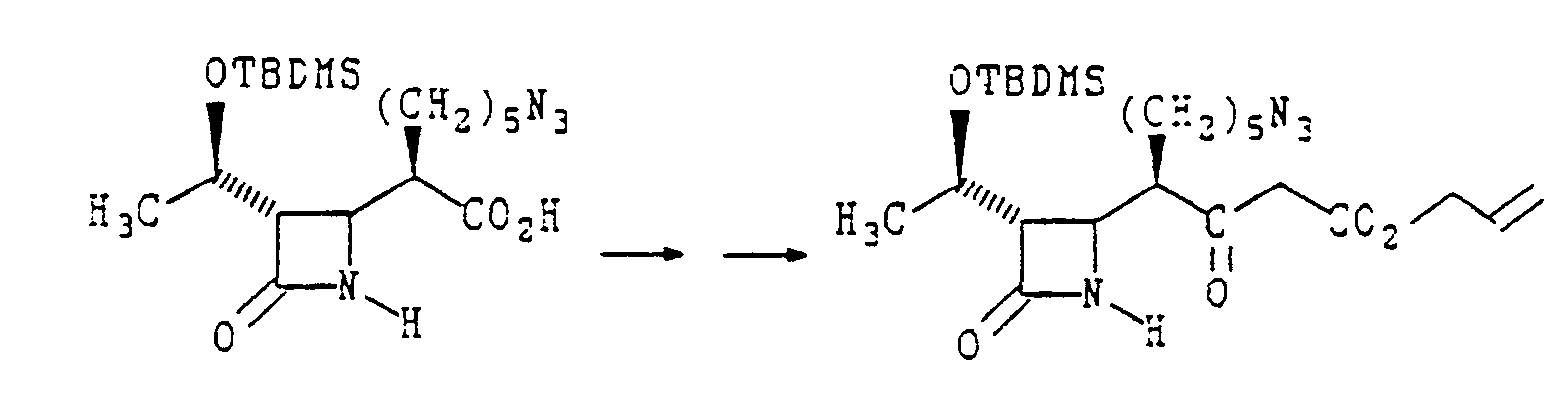
- A suspension of (3S,4S)-3-[(1'R)-1'tert-butyldimethylsilyloxyethyl]-4-[(1"R)-1 "-carboxy-6"-azidohexyl]-azetidin-2-one (15.0 g, 37.6 mmol) in dry acetonitrile (350 mL) was treated at 22 C and under nitrogen with 1,1-carbonyldiimidazole (6.7 g, 41.3 mmol). The resulting mixture was stirred for 2 h and the solvent was evaporated under vacuum to give the crude imidazolide as an oil:
- IR (NaCl, film) νmax: 2100 (N3), 1760 (C=0 of β-lactam) and 1735 cm-1 (C=0 of imidazolide).
- The crude imidazolide in dry acetonitrile (50 mL) was then added to a solution of magnesium monoallyl malonate (19.0 g, 61.2 mmol) in benzene (300 mL) and the resulting mixture was heated at 65 C for 28 h. The cooled reaction mixture was diluted with ethyl acetate (500 mL), washed successively with water, cold 1 N hydrochloric acid, saturated sodium bicarbonate and brine. After drying ( MgSO4), evaporation of the solvent gave the crude title material as an oil (-20 g) which was used as such for the next step.
- Chromatography of a small aliquot on silica gel (elution toluene-ethyl acetate 8:2) gave the title material as an oil:
- IR (NaCI, film) νmax: 2100 (N3) 1760 (C=0 of β-lactam), 1715, 1650 and 1630 cm-1;
- 'H NMR (200 MHz, CDCl3) mixture of keto and enol form in a 1:1 ratio; δ: 0.05 and 0.07 (2s, 6H, SiCH3), 0.87 (s, 9H, Si t-Bu), 1.1 and 1.17 (2d,, J=6.31 Hz, and J=6.33 Hz, 3H, CH3CHO), 1.2-1.8 (m, 8H, CH2-1,2,3 and 4 of pentyl), 2.2 (m, H-I of oxopropyl, enol form), 2.9-3.0 (m, H-3 and H-I of oxopropyl keto form), 3.26 (t, J=6.7 Hz, CH2N3), 3.54 (s, CH2-3 of oxopropyl, keto form), 3.8 (m, 1H, H-4), 4.2 (m, 1H, CH3CHO), 4.8 (m, 2H, CH2 of allyl), 5.07 (s, 1 H, H-3 of oxopropyl, enol form), 5.2-5.4 and 5.9-6.1 (2m, 2H and 1H, CH of allyl) and 5.9 ppm (broad s, 1 H, NH).
-

- A solution of the crude (3S,4R)-4-[(1"R)-1"-(5-azidopentyl)-3"-allyloxycarbonyl-2"-oxopropyl]-3-[(1'R)-1'-tert-butyldimethylsilyloxyethyl]azetidin-2-one (37.6 mmol) in acetonitrile (100 mL) was treated at 0-5°C with a solution of p-toluenesulfonyl azide (9.1 g, 46.1 mmol) in acetonitrile (115 mL) followed by triethylamine (6.5 mL, 46.0 mmol). The reaction mixture was then stirred at 22°C for 30 min. The solvent was then evaporated under vacuum and the residue was triturated with a mixture of diethyl ether and hexanes (1:1 ). The crystalline p-toluenesulfonamide was collected by filtration. The filtrate was concentrated under vacuum to give the title compound as an oil. This product was used as such for the next step. Chromatography of an aliquot on silica gel with a mixture Of toluene and ethyl acetate (9:1 ) gave the pure title material as an oil:
- IR (NaCI, film) vmax: 2140 (N2), 2100 (N3), 1760 (C=0 of β-lactam), 1720 and 1650 cm-1;
- ' H NMR (200 MHz, CDCI3) δ: 0.05 and 0.06 (2 x s, 6H, SiCH3), 0.86 (s, 9H, Si t-Bu), 1.17 (d, J =6.3 Hz, 3H, CH3CHO), 1.2-2.0 (m, 8H, CH2-1,2,3 and 4 of pentyl), 3.03 (broad dd, 1 H, H-3), 3.24 (t, J =6.7 Hz, 2H, CH2N3), 3.84 (dd, JH4,H3=2.07 Hz, JH4,H-1= 5.37 Hz, 1 H, H-4), 4.1 (m, 1 H, H-1 of oxopropyl), 4.17 (dq, JH,CH3=6.3 Hz, JH,H3=3.86 Hz, 1H, CH3CHO), 4.72 (m, 2H, CH2 of allyl), 5.3-5.4 and 5.9-6.1 (2m, 2H and 1 H, CH of allyl) and 5.84 ppm (broad s, 1 H, NH).
-

- A solution of the crude (3S,4R)-4-[(1"R)-1"-(5-azidopentyl)-3"-allyloxycarbonyl-3"-diazo-2"-oxopropy]-3-[(1'R)-1'-tert-butyldimethylsilyloxyethyl]azetidin-2-one (37.6 mmol) in ethanol (250 mL) was treated at 5°C with 100 mL of 1 N aqueous hydrochloric acid. After 65 h, the pH of the reaction mixture was adjusted to 6 with sodium bicarbonate and the ethanol was removed under reduced pressure. The residue was diluted with ethyl acetate (500 mL) and the organic phase was washed with water, 0.2M pH 7 phosphate buffer and brine. After drying ( MgSO4), the solvent was evaporated under vacuum and the residue was chromatographed on silica gel (9 x 12 cm, elution with a gradient of ethyl acetate in toluene (1:1) to pure ethyl acetate). Evaporation of the pertinent fractions gave 8.95 (61 % for three steps from the carboxylic acid) of the title azetidinone as a solid. Recrystallization from a mixture of diethyl ether and hexanes gave white prisms: mp=65-66°C; [α]22 D -31.2° (c 1.0, CHCI3).
- UV (EtOH) λmax: 260 nm (8,440);
- IR (KBr) vn,ax: 2158 (N2) , 2100 (N3 ), 1730 and 1712 (C=0 β-lactam and ester) and 1650 cm-1;
- 'H NMR (200 MHz, CDCl3) δ: 1.29 (d, J=6.3 Hz, 3H, CH3CHO), 1.2-1.9 (m, 8H, CH2-1,2,3 and 4 of pentyl), 2.31 (d, J=3.75 Hz, 1 H, OH), 2.99 (dd, JH3,H4 = 2.0 Hz, JH3,H1 = 6.93 Hz, 1 H, H-3) , 3.25 (t, J = 6.7 Hz, 2H, CH2N3) , 3.82 (dd, JH4,H3=2.0 Hz, JH4,H1 = 6.63 Hz, 1 H, H-4), 3.95 (m, 1 H, H-1 of azidopentyl), 4.11 (m, 1 H, CH3CHO), 4.73 (m, 2H, CH2 of allyl), 5.3-5.4 and 5.9-6.1 (2 x m, 2H and 1 H, CH of allyl) and 6.0 ppm (broad s, 1 H, NH).
- Anal. Calcd. for C17H24N6O5: C 52.09, H 6.16, N 21.42; Found: C 51.85, H 6.04, N 21.33.
-

- A solution of (3S,4R)-4-[(1"R)-1 "-(5-azidopentyl)-3"-allyloxycarbonyl-3"-diazo-2"-oxopropyl]-3-[(1'R)-1'-hydroxyethyl]azetidin-2-one (2.50 g, 6.37 mmol) in dry benzene (80 mL) was treated under argon with Rhodium (II) octanoate dimer (0.050 g) and heated under reflux (bath temperature 95°C) for 20 min. The solvent was then evaporated under vacuum to give the crude title bicyclic compound as an oil which was used immediately for the next step:
- IR (NaCI, film) vmax: 2100 (N3), 1760 (C=0 of β-lactam) and 1745 cm-1 (sh C=0 of ketoester);
- 'H NMR (200 MHz, CDCI3) δ: 1.4 (d, J=6.30 Hz, 3H, CH3CHO), 1.4-2.0 (m, 8H, CH2-1, 2, 3 and 4 of pentyl), 2. (m, 1H, H-4), 3.2-3.4 (m, 3H, H-6 and CH2N3), 4.276 (dd, JH5.H6= 2.32 Hz, JH5,H4 = 8.06 Hz, 1H, H-5), 4.28 (m, 1 H, CH3CHO), 4.64 (s, 1 H, H-2), 4.66 (m, 2H, CH2 of allyl), 5.2-5.4 and 5.8-6.0 ppm (2 x m, 2H and 1 H, CH of allyl).
-

- IR (NaCl, film) vrt,ax: 2258 (CN), 2100 (N3), 1770 (C=0 of β-lactam) and 1710 cm-' (C=0 of ester);
- 'H NMR (200 MHz, CDCI3) s: 1.38 (d, J=6.28 Hz, 3H, CH3CHO), 1.3-1.9 (m, 8H, CH2-1,2,3 and 4 of pentyl), 1.89 (d, J=4.6 Hz, 1H, OH), 2.7 (--dt" 2H, CH2CN), 2.9-3.2 (m, 2H, SCH2), 3.19 (dd, JH6,H5=2.65 Hz, JH6,H1=7.34 Hz, 1 H, H-6), 3.2 (overlapping with H-6, 1 H, H-4), 3.30 (t, J =6.5 Hz, 1 H, CH2N3), 4.24 (overlapping with H-5, 1H, CH3CHO), 4.26 (dd, JH5,H6=2.65 Hz, JH5,H4=9.52 Hz, 1H, H-5), 4.76 (m, 2H, CH2 of allyl), 5.2-5.5 and 5.9-6.1 ppm (2 x m, 2H and 1 H, CH of allyl).
-

- A solution of allyl (4R,5S,6S)-4-(5"-azidopentyl)-3-[(2-cyanoethyl)thio]-6-[(1'R)-1'-hydroxyethyl]-7-oxo-1-azabicyclo[3.2.0]hept-2-ene-2-carboxylate (2.52 g, 5.8mmol) in dry acetonitrile (125 mL) was treated at 22° C and under argon with tetrakis(triphenylphosphine)palladium [0] (0.13 g) followed by 12.8 mL (6.4 mmol) of a 0.5M solution of potassium 2-ethylhexanoate in ethyl acetate. After 45 min, the reaction mixture was extracted with water (125mL) and the aqueous phase was maintained under vacuum to remove traces of organic solvent. The aqueous solution was then hydrogenated at 0-5 C over 4.0 g of 5% palladium over alumina under 45 psi of hydrogen for 1 h (initial pH 7, final pH 11). Then 50 mL of 0.2M pH 6.0 phosphate buffer was added and the catalyst was filtered. The filtrate was concentrated by half under vacuum (T <10°C) and then chromatographed on reversed phase silica gel (βBondapak C18, 3.5 x 14 cm) using a gradient of acetonitrile (0-5%) in water as eluent. Lyophilization of the UV active fractions gave 1.06 g (49%) of the title carbapenem as a white amorphous solid after freeze drying: [α]22 D + 52.1 ° (c 1.0, H2O).
- Purity by HPLC: 99% on µBondapak C18, 3.9 mm x 30 cm, elution 5% CH3CN-H20 , pH 7.4 phosphate buffer, flow rate 1 mL/min, uv detector 306 nm, retention time.
- UV (water, pH 7.4 phosphate buffer) λmax: 302 nm (9,055);
- IR (KBr) vmax: 2255 (CN), 1755 (C = 0 of β-lactam), and 1590 cm-1 (C = 0 of carboxylate);
- 'H NMR (200 MHz, D20) δ: 1.33 (d, J=6.35 Hz, 3H, CH3CHO), 1.3-1.9 (m, 8H, CH2-1,2,3 and 4 of pentyl), 2.8-3.2 (m, 4H, SCH2CH2CN), 3.0 (t, J=7.4 Hz, 2H, CH2NH2), 3.36 (overlapping with H-6, 1H, H-4), 3.38 (dd, JH6,H5=2.53 Hz, JH6,H1=6.30 Hz, 1H, H-6), 4.25 (dd Xz, 3H6,XI=630 Xz, IX, X-6); 4.25 (dd overlapping with CH3CHO, JH5,H =2.53 Hz, 1H, H-5) and 4.27 ppm (m, 1H, CH3CHO).
-

-

- A cold (0°C) solution of allyl (4R,5S,6S)-6-[(1'R)-1'-(tert-butyldimethylsilyloxyethyl)]-4-(2"-azidoethyl)-3,7-dioxo-1-azabicyclo[3.2.0]heptane-2-carboxylate (0.47 g, 1.08 mmol) in CH3CN (10 mL) was treated with diphenyl chlorophosphate (0.25 mL, 1.18 mmol) followed by N,N-diisopropylethylamine (0.21 mL, 1.18 mmol) and 4-N,N-dimethylaminopyridine (2 mg). The mixture was stirred at 0°C for 2 h, under Argon, after which Argon was bubbled through the solution for 15 min. The enol-phosphate was then treated with 2-mercaptoethanol (0.15 mL, 2.15 mmol) in CH3CN (2 mL) followed by N,N-diisopropylethylamine (0.38 mL, 2.15 mmol) and stirred at 0°C for 1 h and left in cold (5°C) for 16 h. The reaction mixture was diluted with EtOAc (50 mL) and washed successively with cold water, 1 M NaHS03, water, 1 N HCI, water, 1 M NaHC03and brine. The organic phase was dried ( MgS04) and solvent evaporated to a syrup which was chromatographed on silica (3.5 x 11 cm) packed in CH2Cl2 and eluted with a mixture of CH2Cl2 and EtOAc (8:2, gradient elution) to give the title compound as a syrup (0.35 g, 65.5%).
- 1H NMR (200 MHz, CDCI3 7.24) 5: 0.06 (s, 6H, Si(CH3)2) , 0.87 (S, 9H, SiC(CH3)3, 1.35 (d, 3H, CH3, J=6.3 Hz,), 2.85-3.9 (overlap, 8H, CH20H, CH2N3, H-4, H-6, SCH2), 4.22 (centre m, 2H, h-5, H-1'), 4.6-4.9 (m, 2H, OCH2, allyl), 5.2-5.5 (m, 2H, =CH2, allyl), 5.86-6.05 (m 1 H, CH = allyl).
-
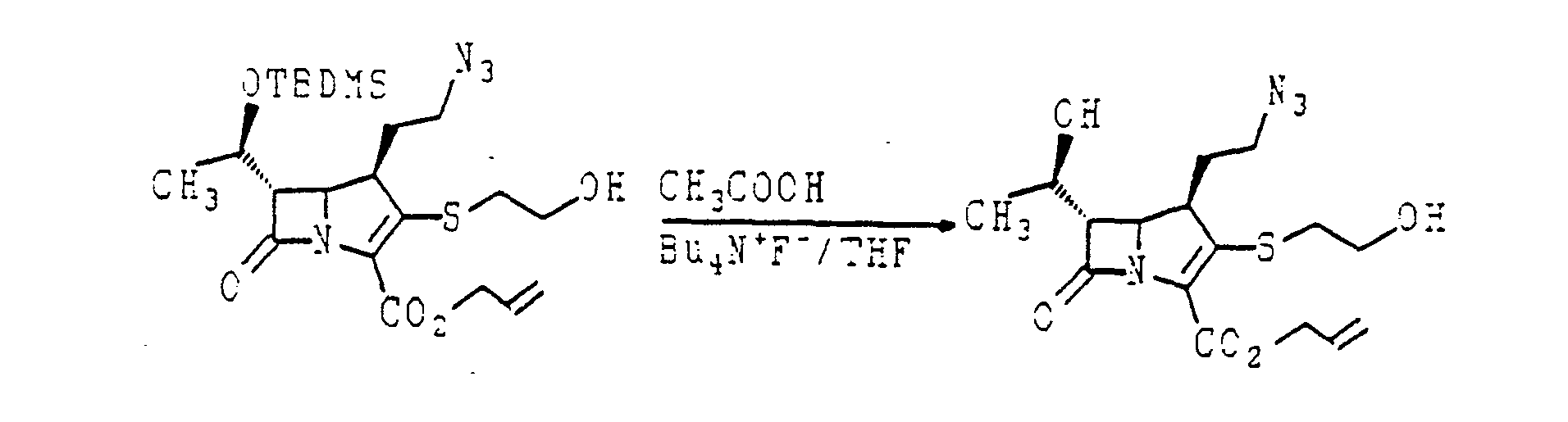
- 'H NMR (200 MHz, CDCI3) 5: 1.37 (d, 3H, CH3, J= 6.26 Hz) 2.82-3.17 (m, 2H, SCH2) , 3.15 (m, 1H, H-6) , 3.34-3.64 (overlap, 3H, CH2N3, H-4), 3.82 (t, 2H, CH2OH, J=5.43 Hz), 4.22 (m, 1H, H-1'), 4.22 (dd, 1H, H-5, J4,5 = 9.64 Hz, J5,6= 2.78 Hz), 4.62-4.87 (m, 2H, OCH2 allyl) , 5.21-5.49 (m, 2H, =CH2, allyl), 5.86-6.05 (m, 1 H, CH =, allyl).
-

- To a cold (0 " c) solution of allyl (4R,5S,6S)-6-[(1'R)-1'-hydroxyethyl]-3-[(2-hydroxyethyl)thio]-4-(2"-azidoethyl)-7-oxo-1-azabicyclo[3.2.0]hept-2-ene-2-carboxylate (0.09 g, 0.24 mmol) in CH2Cl2(10 mL), under Argon, was added Pd[Ph3P]4(0.04 g, 0.035 mmol) followed by a 0.5M solution of 2-ethylhexanoate in EtOAc (0.52 mL, 0.26 mmol). The mixture was stirred at 0°C for 1 h, diethyl ether (50 mL) was added and extracted with water (3 x 25 mL). To the combined aqueous extract was added a 0.05M solution of pH 7.0 phosphate buffer (10 mL) and was hydrogenated at 0°C over 5% palladium on alumina (0.3 g) at 40 psi for 2 h. The catalyst was filtered, washed with water and the combined filtrate was passed through a column of µBondapak C18 reverse phase silica (3.5 x 9 cm). Appropriate fractions corresponding to the product were lyophilized to a solid which was rechromatographed on µBondapak C18 reverse phase silica (3.5 x 9 cm). The compound was eluted with water and was obtained as a pale yellow fluffy solid after lyophilization (0.021 g, 28.2%).
- Purity by HPLC: 93.9% with UV detection at 302 nm on µBondapak C'8 (4 mm x 30 cm); pH 6.8 phosphate buffer; flow rate 1 mL/min; retention time: 3.89 min.
- UV λmax: 302 nm.
- IR (Nujol): νmax: 1750 cm-1 (C = 0, β-lactam);
- 'H NMR (200 MHz, D20) δ: 1.33 (d, 3H, CH3, J=6.37 Hz), 1.82-1.98; 2.1-2.27 (m, 2H, CH2), 2.79-3.23 (overlap, 4H, CH2NH2, SCH2), 3.44 (centre m, 2H, H-4, H-6), 3.76 (m, 2H, CH20H, J=6.24 Hz), 4.26 (dd, 1 H, H-5, J4,5 = 9.14 Hz, JS.6 = 2.56 Hz), 4.28 (m, 1 H, H-1').
-

- Purity by HPLC: 99% on µBondapak C18, 3.9 mm x 30 cm, elution 5% CH3CN-H2O, pH 7.4 phosphate buffer, flow rate 1 mLmin, uv detector 300 nm, retention time 6.24 min.
- UV (water, pH 7.4 phosphate buffer) xmax: 298 nm (6,660);
- IR (KBr) νmax: 2250 (CN), 1760 (C=0 of β-lactam) and 1600 cm-' (C=0 of carboxylate);
- 'H NMR (200 MHz, D20) δ: 1.34 (d, J=6.35 Hz, 3H, CH3CHO), 2.0-2.4 (m, 6H, CH2-1 of ethyl and CH2-3,3' of pyrrolidine), 2.8-3.2 (m, 4H, SCH2CH2CN), 3.11 (s, 3H, NCH3), 3.4-3.7 (m, 8H, H-4, H-6, CH2-2 of ethyl and CH2-2,2' of pyrrolidine), 4.28 (m, 1H, CH3CHO) and 4.31 ppm (dd, JH5,H6=3.01 Hz, JH5,H4=9.0 Hz, 1 H, H-5).
-

-

- A cold (dry ice-acetone) solution of allyl (4R,5S,6S)-6[(1'R)-1'-tert-butyldimethylsilyloxyethyl]-3-[(2-cyano-ethyl)thio]-4-(2"-hydroxyethyl)-7-oxo-1-azabicyclo[3.2.0]-hept-2-ene2-carboxylate (400 mg, 0.830 mmol) in dichloromethane (10 mL) was treated first with diisopropylethylamine (0.380 mL, 2.16 mmol) and then dropwise with trifluoromethanesulfonic anhydride (0.17 mL, 1.0 mmol). The mixture was stirred for 25 min, treated with N-methyl-β-alaninenitrile (0.23 mL, 2.5 mmol) in dichloromethane (0.5 mL) and then stirred for 3 h at -15 C (dry ice bath replaced by ice-methanol bath). The mixture was allowed to stand in the cold room (5 C) for 18 h, then diluted with ethyl acetate (20 mL), washed with ice cold 1M aqueous NaHC03(5 mL), ice cold water (5 mL), brine (5 mL) and dried (MgSO4) . The residue was passed through a silica gel flash pad (15 g, 30 - 80% ethyl acetate/hexane) to give title compound (315 mg, 69%) as a pale yellow oil.
- IR (CH2CL2) vmax: 2250 (CN), 1775 (C=O β-lactam) and 1715 cm-' (C = 0);
- 'H NMR (CDCI3, 200 MHz) δ: 6.03-5.86 (1H, m, vinylic H) , 5.486-5.224 (2H, m, vinylic H) , 4.851-4.666 (2H, m, allylic CH2) , 4.29-4.18 (1H, m, H-1'), 4.197, 4.184 (d, J =2.6 Hz, part of H-5), 3.541-3.450 (1H, m, H-4), 3.380-3.242, 3.069-2.929 (2H, 2 sets of m, SCH2), 3.110 (1H, dd, J=2.4 Hz, J=7.0 Hz, H-6), 2.807-2.315 (8H, m, CH2N and CH2CN), 2.315 (3H, s, NCH3) , 2.04-1.87, 1.70-1.55 (2H, 2 sets of m, CH2-4), 1.30 (3H, d, J=6.1 Hz, CH3), 0.895 (9H, s, tert-butyl) and 0.096 ppm (6H, s, dimethyl).
-
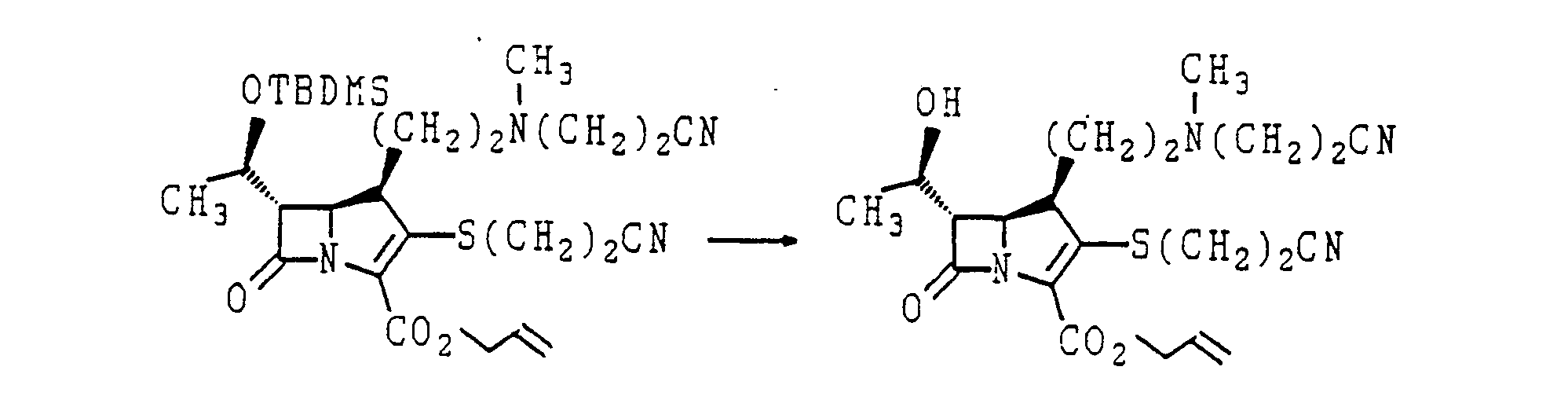
- A cold (ice-methanol bath) solution of allyl (4R,5S,6S)-6-[(1'R)-1'-tert-butyldimethylsilyloxyethyl]-3-[(2-cyanoethyl)thio]-4-[2"-[N,N-(2-cyanoethyl)methyl-amino]ethyl]-7-oxo-1-azabicyclo[3.2.0]hept-2-ene-2-carboxylate (305 mg, 0.560 mmol) in tetrahydrofuran (5 mL) was treated with glacial acetic acid (0.18 mL, 3.4 mmol) and dropwise with a 1M solution of tetrabutylammonium fluoride in tetrahydrofuran (1.68 mL, 1.68 mmol). The mixture was allowed to stand in the cold room for 8 days, then diluted with ethyl acetate (25 mL), washed with ice cold 1 M aqueous NaHC03(3 x 5 mL), water (2 x 5 mL), brine (5 mL) and dried ( MgSO4) . The residue was passed through a silica gel flash pad (6 g, 40% - 100% ethyl acetate/hexane, 1/1 ethyl acetate/acetone) to give title compound (195 mg, 80%) as an oil.
- IR (CH2CI2) νmax: 3600, 3500 (OH), 2250 (CN), 1775 (C=O β-lactam) and 1710 cm-' (C=0);
- ' H NMR (CDCl3, 200 MHz) δ: 6.04-5.85 (1 H, m, vinylic H), 5.494-5.238 (2H, m, vinylic H), 4.9-4.70 (2H, m, allylic H), 4.282 (1H, dd, J = 2.6 Hz, J = 9.6 Hz, H-5), 4.29-4.13 (1H, m, H-I') , 3.80-3.70 (1H, m, H-4) , 3.35-3.20, 3.05-2.90 (2H, 2 sets of m, SCH2), 3.152 (1 H, dd, J = 2.6 Hz, J=8.8 Hz, H-6), 2.8-2.6 (4H, m, CH2CN), 2.6-2.45 (2H, m, CH2N), 2.1-1.9, 1.7-1.5 (2H, 2 sets of m, CH2-4), 1.60 (1H, bs, OH) and 1.404 ppm (3H, d, J=6.2 Hz, CH3).
-

- A cold (ice bath) solution of allyl (4R,5S,6S)-3-[(2-cyanoethyl)thio]-4-[2"-[N,N-(2-cyanoethyl)-methylamino]-ethyl]-6-[(1'R)-1'-hydroxyethyl]-7-oxo-1-azabicyclo-[3.2.0]hept-2-ene-2-carboxylate (195 mg, 0.45 mmol) in dichloromethane (12 mL) was treated with Pd(Ph3)4(42 mg, 0.034 mmole) and dropwise with a 0.5M solution of potassium 2-ethylhexanoate in ethyl acetate 0.90 mL, 0.45 mmol). The mixture was stirred for 30 min, the diluted with diethyl ether and extracted with a 0.04M aqueous phosphate buffer (3 x 15 mL) and water (2 x 15 mL). The aqueous extracts were combined, washed with diethyl ether (2 x 10 mL) and passed through a µBondapak C18 reversed phase column (150 g, 0 → 3% CH3CN/H20 ) to give title compound (127 mg, 72%) as a lyophilized powder.
- Purity: 99.2% as determined by HPLC (r.t.= 7.89 min, µBondapak C18, 10u., 5% CH3CN/KH2PO40.01M, pH 7.4);
- UV (H20) λmax: 300 (7887);
- IR (Nujol) vmax: 3600-3100 (OH), 2250 (CN), 1745 (C=0 β-lactam) and 1595 cm-' (C = O);
- 'H NMR (D20, 200 MHz) 5: 4.35-3.25 (2H, m, H-1' and H-5), 3.404 (1H, dd, J=2.6 Hz, J=6.3 Hz, H-6), 3.42-3.30 (1H, m, H-4), 3.25-3.1, 3.03-2.9 (2H, 2 sets of m, SCH2), 2.87-2.81 (4H, m, CH2N), 2.75-2.65, 2.62-2.54 (4H, 2 sets of 3 lines, CH2CN), 2.328 (3H, s, N-CH3), 2.15-1.95, 1.8-1.6 (2H, 2 sets of m, CH2-4) and 1.341 ppm (3H, d, J=6.3 Hz, CH3).
-

-

- A solution of allyl (2R,4R,5R,65)-6-[(1'R)-1'-tert-butyldimethylsilyloxyethyl]-4-(2"-tert-butyldimethylsilyloxyethyl)-3,7-dioxo-1-azabicyclo[3.2.0]heptane-2-c-arboxylate (27.2 mmol, prepared by cyclization of 15.08 g, 27.2 mmol of the diazo precursor) in dry acetonitrile (200 mL) was treated at 0-5°C and under nitrogen with diphenyl chlorophosphate (6.3 mL, 30.4 mmol) and N,N-diisopropylethylamine (5.0 mL, 28.7 mmol) added simultaneously over 5 min. A small crystal of 4-N,N-dimethylaminopyridine was then added and the mixture was stirred for 1 h. More N,N-diisopropylethylamine (9.5 mL, 54.5 mmol) followed by β-mercaptopropionitrile (4.6 g, 53.8 mmol) in acetonitrile (10 mL) were added dropwise and the resulting mixture was stirred for 30 min.
- The reaction mixture was then diluted with ethyl acetate (1 L), washed with cold water, saturated sodium bicarbonate, 0.2M pH 7.0 phosphate buffer, brine and dried (MgS04) . The solvent was evaporated under reduced pressure and the residue was chromatpgraphed over silica gel (7.5 x 11 cm) using a gradient of ethyl acetate (0-5%) in toluene as eluent. Evaporation of the UV active fractions gave 11.19 g (69%) of the title material as an oil which solidified upon standing. Recrystallization from hexanes gave the title compound as long needles: mp = 95 C; [α]22D + 48.9° (c 1.0, CHCI3).
- UV (EtOH) λmax: 318 nm (11,930);
- IR (KBr) vmax: 1770 (C = O of β-lactam) and 1700 cm-1 (C = O of ester);
- ' H NMR (200 MHz, CDCI3) 6: 0.08 and 0.09 (2s, 3H and 9H, SiCH3), 0.89 and 0.91 (2s, 2 x 9H, Si-tBu), 1.27 (d, J=6.15 Hz, 3H, CH3CHO), 1.6-2.1 (m, 2H, CH2-4), 2.67 (-t, 2H, Ch2CN), 2.9-3.1 and 3.2-3.4 (2m, 2H, SCH2), 3.10 (dd, JH6,H5=2.52 Hz, JH6,H1 =6.26 Hz, 1 H, H-6), 3.45-3.65 and 3.75-3.9 (2m, 2H and 1H, H-4 and CH20Si), 4.21 (dd overlapping with CH3CHO, JHS,H6= 2.52 Hz, 1H, H-5), 4.24 (m, 1H, CH3CHO), 4.74 (m, 2H, CH2 of allyl), 5.2-5.5 and 5.9-6.1 ppm (2m, 2H and 1 H, CH of allyl).
- Anal. Calcd. for C29H50N2O5SSi2: C 58.55, H 8.47, N 4.71, S 5.39; Found: C 58.45, H 8.37, N 4.73, S 5.24.
-
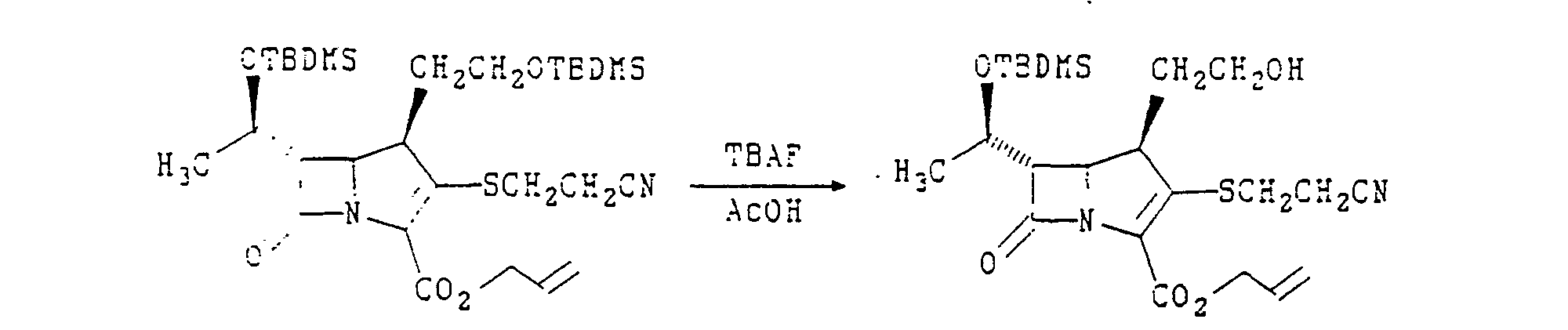
- A solution of allyl (4R,5S,6S)-6-[(1'R)-1'-tert-butyldimethylsilyloxyethyl]-4-(2"-tert-butyldimethyl-silylox-yethyl)-3-[(2-cyanoethyl)thio]-7-oxo-1-azabicyclo-[3.2.0]hept-2-ene-2-carboxylate (11.19 g, 18.8 mmol) in tetrahydrofuran (250 mL) was treated at 0-5°C and under nitrogen with acetic acid (6.5 mL, 0.113 mol) followed by 56 mL (56.0 mmol) of a 1.0M solution of tetrabutylammonium fluoride in tetrahydrofuran. The solution was then stored at 10°C for 18 h. The reaction mixture was then diluted with ethyl acetate (1 L), washed with cold saturated sodium bicarbonate, brine and dried (MgSO4) . Evaporation of the solvent under reduced pressure gave an oil which was chromatographed on silica gel (7.5 x 12 cm). Elution with a gradient of ethyl acetate in toluene (3:7 to 1:1) gave 6.80 g (75%) of the title compound as a thick glass:
- IR (NaCl, film) νmax: 3500 (OH), 2260 (CN), 1775 (C = 0 of β-lactam and 1710 cm-1 (C = 0 of ester);
- 'H NMR (200 MHz, CDCl3) s: 0.09 (s, 6H, SiCH3), 0.89 (s, 9H, Si-tBu), 1.29 (d, J=6.13 Hz, 3H, CH3CHO), 1.6-2.1 (m, 2H, CH2-4), 2.70 (-t, 2H, CH2CN), 2.95-3.1 and 3.2-3.4 (2m, 2H, SCH2), 3.18 (dd, JH6,H5= 2.63 Hz, JH6,H=7.02 Hz, 1 H, H-6), 3.54 (broad t, 1 H, H-4), 3.6-4.0 (m, 2H, CH20H), 4.15-4.3 (m, 2H, H-5 and CH3CHO overlapping), 4.75 (m, 2H, CH2 of allyl), 5.2-5.5 and 5.9-6.1 ppm (2m, 2H and 1H, CH of allyl).
-

- A solution of allyl (4R,5S,6S)-6-[(1'R)-1'-tert-butyldimethylsilyloxyethyl]-3-[(2-cyanoethyl)thio]-4-(2"-hydroxyethyl)-7-oxo-1-azabicyclo[3.2.0]hept-2-ene-2-carboxylate (1.07 g, 2.22 mmol) in dry dichloromethane (18 mL) was cooled to -78°C and treated under nitrogen with N,N-diisopropylethylamine (0.57 mL, 3.27 mmol) followed by trifluoromethanesulfonic anhydride (0.39 mL, 2.31 mmol) dropwise over 5 min. After 30 min at -78°C, more N,N-diisopropylethylamine (0.57 mL, 3.27 mmol) was added followed by azetidine (0.18 mL, 2.67 mmol) dropwise over 5 min. The reaction mixture was stirred at -78°C for 30 min, slowly warmed up to -20°C over 30 min and stirred at this temperature for 1 h. The reaction mixture was then quenched by addition to a cold mixture of ethyl acetate (200 mL) and water (20 mL). The organic phase was washed with brine (2 x 20 mL), dried (MgSO4) and evaporated under reduced pressure. The residue was chromatographed on silica gel (3.5 x 12 cm) using acetone as eluent. Evaporation of the UV active fractions gave 0.639 g (55%) of the title compound as an oil. By TLC and 1H NMR this material contained 25% of a product resulting from the opening of the β-lactam by the azetidine.
- IR (NaCl, film)νmax: 2255 (CN), 1775 (C=0 of β-lactam), 1712 (C=0 of ester), and 1645 (amide of the open product);
- 'H NMR (200 MHz, CDCl3) δ: 0.08 (s, 6H, SiCH3), 0.88 (s, 9H, Si-tBu), 1.29 (d, J=6.13 Hz, 3H, CH3CHO), 1.4-1.8 (m, 2H, CH2-4), 2.07 (m, 2H, CH2-3 of azetidine), 2.69 (-t, 2H, CH2CN), 2.9-3.5 (broad m, 10H, CH2-2 and 4 of azetidine, CH2-2 of ethyl, H-4 and H-6 and SCH2), 4.15 (dd, JH5,H6=2.55 Hz, JH5,H4=9.45 Hz, 1H, H-5), 4.17 (m, 1H, CH3CHO), 4.73 (m, 2H, CH2 of allyl), 5.2-5.5 and 5.9-6.1 ppm (2m, 2H and 1 H, CH of allyl).
-

- A solution of allyl (4R,5S,6S)-4-[2"-(1-N-azetidino)-ethyl]-6-[(1'R)-1'-tert-butyldimethylsilyloxyethyl]-3-[(2-cyanoethyl)thio]-7-oxo-1-azabicyclo[3.2.0]hept-2-ene-2-carboxylate (0.639 g, 1.23 mmol) in dry tetrahydrofuran (8 mL) was cooled to -15°C and treated under nitrogen with acetic acid (0.42 mL, 3.7 mmol) followed by 3.7 mL (3.7 mmol) of a 1 M solution of tetrabutylammonium fluoride in tetrahydrofuran. The solution was then stirred at 0°C for 140 h. Then 1.2 g of solid powdered sodium bicarbonate was added and the mixture was stirred for 10 min. The organic phase was then chromatographed on silica gel (3.5 x 3.5 cm) using a mixture of acetone and N,N-dimethylformamide (9:1) as eluent. Evaporation of the pertinent fractions gave 0.39 g (78%) of the title material as an oil. By 1H NMR this material was about 50% pure and contained some N,N-dimethylformamide and some tetrabutylammonium salt. This product was used as such for the next step.
- IR (NaCl, film) νmax: 2250 (CN), 1775 (C=0 of β-lactam) and 1710 cm-' (C=0 of ester);
- 'H NMR (200 MHz, CDC13) δ: 1.39 (d, J=6.31 Hz, 3H, - CH3CHO), 1.7 (m, 2H, CH2-4), 2.27 (m, 2H, CH2-3 of azetidine), 2.67 (~t, 2H, CH2CN), 2.9-3.2 (m, 2H, SCH2), 3.2-3.4 (m, 4H, H-4, H-6 and CH2-2 of ethyl), 3.58 (t, J=7.6 Hz, CH2-2 and 4 of azetidine), 4.10 (dq, JH,CH3=6.31 Hz, JH,H6=8.86 Hz, 1H, CH3CHO), 4.28 (dd, JH5,H6=3.12 Hz, JH5,H4 =10.26 Hz, 1H, H-5), 4.75 (m, 2H, CH2 of allyl), 5.2-5.5 and 5.9-6.1 ppm (2m, 2H and 1 H, CH of allyl).
-

- A solution of crude allyl (4R,5S,6S)-4-[2"-(1-N-azetidino)ethyl]-3-[(2-cyanoethyl)thio]-6-[(1'R)-1'-hydroxyethyl]-7-oxo-1-azabicyclo[3.2.0]hept-2-ene-2-carboxylate (0.39 g, 0.96 mmol) in ethyl acetate (15 mL) was treated at 22°C and under nitrogen with tetrakis(triphenylphosphine)palladium [0] (0.050 g) and 3 mL (1.5 mmol) of a 0.5M solution of potassium 2-ethyl-hexanoate in ethyl acetate. After 30 min, the reaction mixture was extracted with water (30 mL and 20 mL) and the combined extract was maintained under vacuum to remove traces of organic solvent. Then 8 mL of 0.2M pH6 phosphate buffer were added and the solution was chromatographed on reversed phase silica gel (µBondapak C18, 3 x 13 cm) using a gradient of acetonitrile (0-5%) in water as eluent. The UV active fractions were combined lyophilized and chromatographed a second time on the same column. Final lyophilization gave 0.065 g (19%) of the title carbapenem as a white amorphous powder:
- Purity by HPLC: 99.4% on µBondapak C18, 3.9 mm x 30 cm, elution 5% CH3CN-H20 pH 7.4 phosphate buffer, flow rate 1 mL/min, uv detector 300 nm, retention time 6.41 min,;
- UV (H20, pH 7.4 phosphate buffer) λmax: 298 nm (8,422);
- IR (KBr) vmax: 2250 (CN), 1760 (C = 0 of β-lactam) and 1600 cm-1 (C = 0 of carboxylate);
- 'H NMR (200 MHz, D20) s: 1.33 (d, J=6.38 Hz, 3H, CH3CHO), 1.7-2.2 (m, 2H, CH2-4), 2.52 (m, 2H, CH2-3 of azetidine), 2.85 (m, 2H, CH2CN), 2.85-3.2 (m, 2H, SCH2), 3.2-3.5 (m, 3H, CH2-2 of ethyl and H-4), 3.41 (dd overlapping with CH2-2 of ethyl, JH6,H5=2.70 Hz, JH6,H1=6.86 Hz, 1 H, H-6), 4.17 (m, 4H, CH2-2 and 4 of azetidine), and 4.2-4.35 ppm (m, 2H, H-5 and CH3CHO).
-

-

- 'H NMR (200 MHz, CDC13) δ: 0.08 (s, 6H, SiCH3) , 0.88 (2, 9H, Si-tBut), 1.28 (d, J=6.05 Hz. 3H, CH3CHO) , 1.5-2.0 (m, 2H, CH2-4) , 2.3 (s, 3H, NCH3) , 2.3-2.6 (m, 10H, CH2-2 of ethyl and CH2 of piperazine), 2.6-2.8 (m, 2H, CH2CN), 2.9-3.1 and 3.2-3.4 (m, 2H, SCH2), 3.19 (dd, JH6,H5=2.37 Hz, JH6,H1=6.6 Hz, 1H, H-6) , 3.3 (m, 1H, H-4) , 4.19 (dd overlapping with CH3CHO, JHS,H6=2.37 Hz, 1H, H-5), 4.22 (m, 1 H, CH3CHO), 4.73 (m, 2H, CH2 of allyl), 5.2-5.5 and 5.9-6.1 ppm (2 x m, 2H and 1 H, CH of allyl).
-

- A solution of allyl (4R,5S,6S)-6-[(1'R)-1'-tert-butyldimethylsilyloxyethylj-3-[(2-cyanoethyl)thio]-4-[2"-(4-methylpiperazine-1-yl)ethyl]-7-oxo-1-azabicyclo-[3.2.0]hept-2-ene-2-carboxylate (1.17 g, 2.08 mmol) in dry tetrahydrofuran (50 mL) was cooled to -20 C, and treated dropwise under nitrogen with acetic acid (1.55 mL, 27.1 mmol) followed by 14.6 mL (14.6 mmol) of a 1M solution of tetrabutylammonium fluoride in tetrahydrofuran. The solution was then stored at 10°C for 7 days. The reaction mixture was then diluted with ethyl acetate (300 mL), washed with cold saturated sodium bicarbonate, brine and dried (MgS04-) . Evaporation of the solvent under reduced pressure gave 1.45 g of the crude carbapenem. Chromatography on silica gel (3.5 x 6 cm) using a mixture of acetone and N,N-dimethylformamide (9:1) gave 0.57 g (61%, for two steps) of the title carbapenem as an oil. By 'H NMR, this material contained one equivalent of N,N-dimethylformamide.
- IR (NaCI, film) vmax: 2250 (CN), 1770 (C=0 of β-lactam) and 1710 cm-1 (C=O of ester);
- 1H NMR (200 MHz, CDCl3) 5: 1.38 (d, J=6.24 Hz, 3H, CH3CHO) , 1.6-2.0 (m, 2H, CH2-4), 2.29 (s, 3H, NCH3), 2.3-2.8 (m, 12H. CH2 of piperazine, CH2-2 of ethyl and CH2CN), 2.9-3.1 and 3.2-3.4 (m, 2H, SCH2), 3.24 (dd overlapping with SCh2. JH6,H5=2.7 Hz, JH6,H1=6.9 Hz, 1H, H-6), 3.42 (m, 1H, H-4), 4.23 (m, 1H, CH3CHO), 4.28 (dd, JH5.H6=2.7 Hz, JH5,H4=9.5 Hz, 1H, H-5) , 4.76 (m, 2H, CH2 of allyl), 5.2-5.5 and 5.9-6.1 ppm (2 x m, 2H and 1 H, CH of allyl).
-

- A solution of allyl (4R,5S,6S)-3-[(2-cyanoethyl)thio]-6-[(1'R)-1'-hydroxyethyl]-4-[2"-(4-methylpiperazine-1-yl)-ethyl]-7-oxo-1-azabicyclo[3.2.0]hept-2-ene-2-carboxylate (0.57 g, 1.27 mmol) in dry ethyl acetate (25 mL) was treated at 22°C and under nitrogen with tetrakis (triphenylphosphine) palladium [0] (0.075 g) followed by 2.8 mL (1.4 mmol) of a 0.5M solution of potassium 2-ethylhexanoate in ethyl acetate. After 45 min, the reaction mixture was extracted successively with 50 mL of a 0.1 M pH 6.0 phosphate buffer and 25 mL of water. The combined aqueous phase was maintained under vacuum to remove traces of organic solvent and then chromatographed twice on reversed phase silica gel (µ-Bondapak C18, 2.5 x 14 cm). Elution with a gradient of acetonitrile (0-5%) in water gave 0.28 g (54%) of the title carbapenem as a white amorphous powder after freeze drying: [α]22 D + 35.3° (c 1.0, H20).
- Purity by HPLC: 97% on µ-Bondapak C18, 3.9 mm x 30 cm, elution 10 % CH3CN-H2O pH 7.4 phosphate buffer flow rate 1 mL'min, uv detector 302 nm, retention time 6.6 min;
- UV (H20, pH 7.4 phosphate buffer) λmax: 300 nm (8,390);
- IR (KBr) vmax: 2250 (CN), 1755 (C = 0 of β-lactam) and 1595 cm-' (C=0 of carboxylate);
- 'H NMR (200 MHz, D20) δ: 1.33 (d, J=6.39 Hz, 3H, CH3CHO), 1.6-2.2 (m, 2H, CH2-4), 2.75 (s, 3H, NCH3), 2.6-3.3 (m, 12H, CH2 of piperazine, SCH2 and CH2-2 of 4-ethyl), 3.3-3.5 (m, 2H, H-4 and H-6 overlapping) and 4.2-4.4 ppm (m, 2H, H-5 and CH3CHO).
-

- A cold (ice bath) solution of (4R,5S,6S)-4-(3"-aminopropyl)-6-[(1'R)-1'-hydroxyethyl]-3-([2(1-pyrrolidinyl)-ethyl]thio)-7-oxo-1-azabicyclo[3.2.0]hept-2-ene-2-carboxylic acid (from hydrogenolysis of the corresponding azido derivative 115 mg, 0.270 mmol) in a 0.05M aqueous phosphate buffer (15 mL) was treated with 0.1 N aqueous NaOH to raise and maintain the pH at 8.0-8.2 during the portionwise addition of aminoiminomethanesulfonic acid (170 mg, 1.30 mmol). The mixture was stirred for 3 h (pH maintained between 8-8.2), then was neutralized with 0.1 Maqueous NaH2PO4. It was passed through a µBondapak C. 18 reversed phase column (20 g, 0.005M aqueous acetic acid, 1 → 2% CH3CN 0.005M aqueous acetic acid) to give the title compound (75 mg, 57%) as a white lyophilized powder.
- Purity: 98.07% as determined by HPLC (r.t. = 8.86 min, µBondapak C18, 10M, 20% CH3CN/KH2PO40.01M, pH 7.4);
- UV (water) λmax: 296 (6723);
- IR (Nujol) νmax: 3400-3100 (OH, NH2), 1760 (C=O of β-lactam), 1670, 1635 (C=N), and 1485 cm-1 - (C = 0 of carboxylate);
- ' H NMR (D20, 200 MHz) , 5: 4.35-4.23 (1 H, m, H-1') 4.264 (1 H, dd, J=3.1 Hz, J=9.8 Hz, H-5) , 3.399, 3.384 (d, J=3.1 Hz, part of H-6), 3.40-3.138 (11 H, m, H-4 (CH2-NH, S-CH2CH2N, CH2-N-CH2 and part of H-6), 2.12-2.05 (4H, (CH2)2 pyrrolidine), 1.919 (1.5 H, s, CH3C52), 1.95-1.4 (2 sets of m, CH2CH2 at position 4) and 1.320 ppm (3H, d, J=6.4 Hz, CH3).
-

-

- To a cold (dry ice-acetone bath) solution of allyl (4R,5S,6S)-4-(3"-azidopropyl)-3-[(2-N,N-dimethyl aminoethyl)thio]-6-[(1'R)-1'-triethylsilyloxyethyl]-7-oxo-1-azabicyclo[3.2.0]hept-2-ene-2-carboxylate (3.29 g, 6.45 mmol) in CH2Cl2 (60 mL) was added N,N-diisopropylethylamine (2.90 mL, 16.8 mmol) followed by the dropwise addition of trifluoromethanesulfonic anhydride (1.29 mL, 7.7 mmol). After a 20 min stirring period, a stream of gaseous dimethyl amine was passed through the reaction mixture for 1.5 min. The mixture was stirred for 15 min at -78°C and for 30 min at -15° C (ice-methanol), then diluted with ice cold ethyl acetate (250 mL) and diethyl ether (50 mL), washed with ice cold water (10 x 50 mL), brine (50 mL) and dried (MgSO4.) . The residue upon solvent evaporation was dissolved in anhydrous tetrahydrofuran (30 mL), cooled to -15°C (ice-methanol), then treated with glacial acetic acid (2.1 mL, 38.7 mmol) and a 1 M tetrahydrofuran solution of tetrabutylammonium fluoride (19.4 mL, 19.4 mmol) and allowed to stand at - 20°C for 18 h. The mixture was diluted with ice cold ethyl acetate (150 mL), washed with cold 1 M aqueous NaHC03(3 x 75 mL), brine (75 mL) and dried (MgSOa) . The residue was passed through a silica gel flash column (75 g, 50-100% ethyl acetate: hexane, 10% → 100% acetone/ethyl acetate, 15% methanol,acetone) to give the title compound (605 mg, 22%) as a yellow oil.
- IR (CH2Cl2) νmax: 3600, 330 (OH), 2100(N3), 1775 and 1610 cm-' (C=O);
- ' H NMR (CDCl3, 200 MHz) δ: 6.1-5.9 (1H, m, vinylic H), 5.5-5.2 (2H, m, vinylic H) , 4.88-4.62 (2H, m, allylic CH2) , 4.247 (1H, dd, J=2.7 Hz, J=9.5 Hz), 4.3-4.2 (1H, m, H-1'), 3.43-3.2 (3H, m, H-1', CH2N3) , 3.244 (1H, dd, J=2.7 Hz, J=7.4 Hz, H-6) , 3.1-2.8 (2H, m, SCH3) 2.65-2.56 (2H, m, CH2N), 2.335 (6H, s, N-(CH3)2), 2.0-1.56 (5H, m, CH2-CH2-4, OH) and 1.391 ppm (3H, d, J=6.3 Hz, CH3).
-

- A cold (ice bath) solution of allyl (4R,5S,6S)-4-(3"-azidopropyl)-3-[(2-N,N-dimethylaminoethyl)thio]-6-[-(1'R)-1'-hydroxyethyl]-7-oxo-1-azabicyclo[3.2.0]hept-2-ene-2-carboxylate (588 mg, 1.39 mmol) in CH2Cl2(35 mL) was treated first with Pd(PPh3)4(123 mg, 0.1 mmol) followed by a dropwise addition of N-methyl aniline (0.3 mL, 2.78 mmol). The mixture was stirred for 25 min. Then a 0.1 M aqueous pH 7.0 phosphate buffer solution (80 mL) and diethyl ether (150 mL) were added. The phases were separated and the organic phase was extracted with a 0.01 M aqueous phosphate pH 7.0 buffer solution (2 x 30 mL). The aqueous phases were combined, washed with diethyl ether (2 x 50 mL) and passed through a µBondapak C18 reversed phase column (75 g, water, 2% → 30% CH3CN/H2O ) to give the title compound (399 mg, 75%) as a pale yellow lyophilized powder.
- IR (Nujol) vmax: 3500-3100 (OH) , 2100 (N3) , 1750 and 1590 cm-1 (C=0);
- ' H NMR (D20, 200 MHz) δ: 4.264 (1H, dd, J =2.7 Hz, J =9.3 Hz, H-5) , 4.34-4.2 (1H, m, H-1') , 3.475 (1H, dd, J=2.7 Hz, J=6.0 Hz, H-6), 3.5-3.2 (3H, m, CH2N3 and H-1'), 3.2-2.95 (4H, m, SCH2 and CH2N), 2.0-1.8, 1.8-1.47 (4H, 2 sets of m, H-CH-4 and HCHCH2-4) and 1.33 ppm (3H, d, J=6.3 Hz, CH3).
-

- A cold (ice bath) solution of (4R,5S,6S)-4-(2"-azidopropyl)-3-[(2-N,N-dimethyl aminoethyl)thio]-6-[(1'R)-1'-hydroxyethyl]-7-oxo-1-azabicyclo[3.2.0]-hept-2-ene-2-carboxylic acid (250 mg, 0.65 mmol) in water (50 mL) was shaken on a Parr hydrogenator at 45-50 psi of hydrogen, for 1 h using 5% Pd/Alumina as catalyst. More catalyst (600 mg) was then added and the hydrogenation period was pursued for one more hour. The catalyst was removed by filtration and washed with water (3 x 5 mL). The pH of the aqueous mixture was adjusted to 4.5 with a 1 M aqueous acetic acid solution after which it was passed through a I'Bondapak C18 reversed phase column (75 g, 0.005 M ice cold aqueous acetic acid, 1% CH3CN/0.005 M aqeuous acetic acid) to give the title compound (215 mg, 79%) as a pale yellow lyophilized solid.
- Purity: 96.1% as determined by HPLC (r.t.= 5.83 min, µBondapak C18, 10 µ, 10% CH3CN/KH2PO40.01M, pH 7.4);
- UV (water) λmax: 296 (8142);
- IR (Nujol) νmax: 3400-3100 (OH, NH2), 1755 and 1600 cm-' (C=0);
- ' H NMR (D20, 200 MHz) δ: 4.273 (1 H, dd, J = 2.7 H2, J = 6.9 Hz, H-5), 4.4-4.2 (1 H, m, H-1'), 3.458 (1 H, dd, J=2.8 Hz, J=6.2 Hz, H-6), 3.4-3.2 (3H, m, CH2N and H-4), 3.2-3.0 (4H, m, SCH2 and CH2N), 2.91 (6H, s, (N(CH3)2), 1.92 (2.5 H, s, CH3CO2H), 2.0-1.4 (4H, m, CH2CH2-4) and 1.330 (3H, d, J=6.4 Hz, CH3).
-
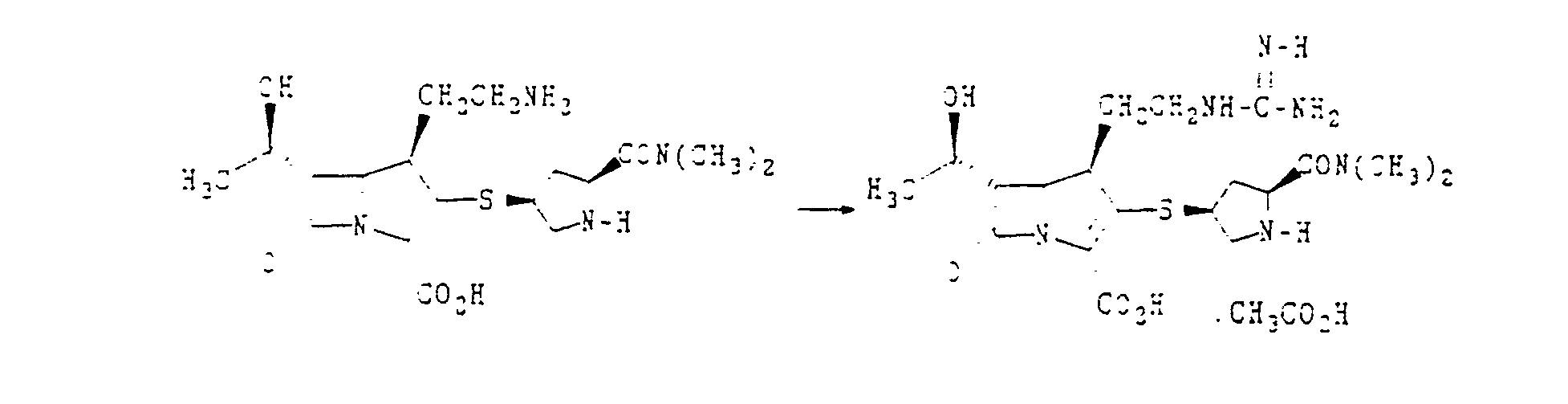
- A solution of (4R,5S,6S)-4-(2"-aminoethyl)-3-{(4S)-4-[(2S)-2-dimethylaminocarbonyl]pyrrolidinylthio}-6-[-(1'R)-1'-hydroxyethyl]-7-oxo-1-azabicyclo[3.2.0]hept-2-ene-2-carboxylic acid acetic acid salt (0.24 g, 0.51 mmol) in 25 mL of cold (0-5°C) water was adjusted to pH 8-8.5 with 1 M sodium hydroxide. Then aminoiminomethanesulfonic acid (0.38 g, 3.06 mmol) was added in small portions (5 min) while maintaining the pH at 8-8.5 with 1 M sodium hydroxide during the addition and for another 2 h. The pH was then adjusted to 5 with acetic acid and the resulting solution was chromatographed on reversed phase silica gel (µBondapak C18, 2.5 x 15 cm). Elution with a gradient of acetonitrile (0-20%) in 0.005M aqueous acetic acid gave 0.063 g (24%) of the title carbapenem as a white amorphous solid after freeze drying:
- Purity by HPLC: 94% on µBondapak C18, 3.9 mm x 30 cm, elution 5% CH3CN-H20 pH 7.4 phosphate buffer, flow rate 1 mL/min, uv detector 302 nm, retention time 15.6 min ;
- UV (H2O, pH 7.4 phosphate buffer) λmax: 300 nm (8,011); );
- IR (KBr) νmax: 1760 (C = 0 of β-lactam), 1660 (C=0 of amide) and 1600 (C = 0 of carboxylate);
- 'H NMR (200 MHz, D20) 6: 1.33 (d, J=6.32 Hz, 3H, CH3CHO) 1.7-2.2 (m, 3H, H-3 of pyrrolidine and CH2-4), 1.92 (s, CH3C02H), 3.0 and 3.07 (25, 2 x 3H, CON(
CH 3)2), 3-3.1 (m overlapping with NCH3, 1 H, H-3 of pyrrolidine), 3.2-3.6 (m, 5H, H-5 of pyrrolidine, H-4, H-6 and CH2NH of ethyl), 3.65 (dd, Jgem = 12.2 Hz, JH5,H4=5.85 Hz, 1 H, H-5 of pyrrolidine), 3.9 (m, 1 H, H-4 of pyrrolidine), 4.28 (m overlapping with H-5, 1 H, CH3CHO), 4.31 (dd, JH5,H6 = 2.75 Hz, JH5,H4=9.8 Hz, 1 H, H-5) and 4.70 ppm (t, J=8.5 Hz, 1 H, H-2 of pyrrolidine). -

- A solution of (4R,5S,6S)-4-(3"-azidopropyl)-3-[(N,N-dimethylaminomethyl)thio]-6-[(1'R)-1'-hydroxyethyl]-7-oxo-1-azabicyclo[3.2.0]hept-2-ene-2-carboxylic acid (0.270 g, 0.68 mmol) in cold water (80 mL) was hydrogenated at 0-5°C over 1.2 g of 5% palladium on alumina under 45 psi of hydrogen for 1 h. Then acetic acid (0.08 mL, 1.4 mmol) was added (pH change from 9 to 4) and the catalyst was filtered. The filtrate was chromatographed on reversed phase silica gel (µBondapak C18, 3 x 12 cm) using a gradient of acetonitrile (0-20%) in 0.01 M aqueous acetic acid. Lyophilization of the UV active fractions gave 0.200 g of a white amorphous powder which by 1H NMR was an equimolar mixture of title material and acetamidine acetate. This mixture was dissolved in ethanol (1 mL) and precipitated with diethyl ether (3 mL). The solid obtained (0.088 g) was chromatographed on the same column as above to give 0.080 g (27%) of the pure title compound as a white amorphous powder:
- Purity by HPLC: 96% on µBondapak C18, 3.9 mm x 30 cm, elution 3% C H3CN-H2O, pH 7.4 phosphate buffer, flow rate 2 mLmin, uv detector 300 nm, retention time 9.3 min;
- UV (H20. pH 7.4 phosphate buffer) λmax:292 nm (5,872);
- IR (KBr) vmax:l 760 (C=0 of β-lactam), 1645 (sh) and 1575 cm-1 (C = 0 of carboxylate);
- 'H NMR (200 MHz, D20) δ: 1.32 (d, J=6.38 Hz, 3H, CHaCHO), 1.4-2.0 (m, 4H, CH2-1 and 2 of propyl), 1.91 (s, 3H, CH3C02H), 3-3.4 (m, 3H, H-4 and CH2NH2) 3.12 and 3.29 (2s, 2 x 3H, N(CH3)2), 3.50 (dd, JH6,H5 = 2.92 Hz, JH6,H1 =6.32 Hz, 1 H, H-6), 3.84 (s, partially exchanged, SCH2), and 4.2-4.4 ppm (m, 2H, H-5 and CH3CHO overlapping).
-

-

- A cold (dry ice-acetone) solution of allyl (4R,5S,6S)-6-[(1'R)-1'-tert-butyldimethylsilyloxyethyl]-3-[(2-cyanoethyl)thio]-4-(2"-hydroxyethyl)-7-oxo-1-azabicyclo-[3.2.0]hept-2-ene2-carboxylate (350 mg, 0.73 mmol) in dichloromethane (7 mL) was treated first with diisopropylethylamine (0.34 mL, 1.9 mmol) and then dropwise with trifluoromethanesulfonic anhydride (0.14 mL, 0.88 mmol). The mixture was stirred for 25 min, treated dropwise with N-allyloxycarbonyl cysteamine (354 mg, 2.2 mmol) in dichloromethane (1 mL) and then stirred for 0.5 h at -15°C (dry ice bath was replaced by an ice-methanol bath). The mixture was treated again with more thiol (177 mg, 1.1 mmol) in dichloromethane (0.5 mL) and diisopropylethylamine (0.13 mL, 0.73 mmol), then stirred for 30 more min. It was diluted with ethyl acetate (30 mL), washed with ice cold 1M aqueous NaHS03(2 x 10 mL) water (10 mL), 1M aqueous NaHC03(2 x 10 mL), water (10 mL), brine (10 mL) and dried (MgSO4) . The residue was passed through a silica gel flash column (35 g, 10% - 50% ethyl acetate/hexane) to give title compound (321 mg, 70%).
- IR (CH2CI2) νmax: 3450 (NH), 2250 (CN) , 1775 (C=0 β-lactam) and 1720 cm-' (C=0 ester and carbamoyl);
- ' H NMR (CDCl3, 200 MHz) 8: 6.03-5.82 (2H, m, vinylic H), 5.48-5.19 (4H, m, vinylic H), 5.1 (1H, bs, NH), 4.9-4.63 (2H, m, allylic CH2), 4.583-4.55 (2H, m, allylic CH2), 4.3-4.13 (1H, m, H-1'), 4.158 (1H, dd, J = 2.5 Hz, J = 9.5 Hz, H-5), 3.55-3.33 (3H, m, CH2N and H-4), 3.33-3.19, 3.05-2.9 (2H. 2 sets of m, SCH2 at position 3), 3.11 (1H, dd, J=2.7 Hz, J=6.9 Hz, H-6), 2.9-2.63 (6H, 2 sets of m, CH2CN and CH2S), 2.1-1.96, 1.96-1.75 (2H, 2 sets of m, CH2-4), 1.300 (3H, d, J=6.1 Hz, CH3), 0.884 (9H, s, tert-butyl) and 0.090 ppm (6H, s, dimethyl).
-

- A cold (ice methanol bath) solution of allyl (4R,5S,6S)-4-[2"-(2-allyloxycarbonylaminoethylthio)-ethyl]-6-[-(1'R)-1'-tert-butyldimethylsilyloxyethyl]-3-[(2-cyanoethyl)thio]-7-oxol-azabicyclo[3.2.0]hept-2-ene-2-carboxylate (310 mg, 0.500 mmol) in tetrahydrofuran (7 mL) was treated with glacial acetic acid (0.16 mL, 3.0 mmol) and dropwise with a 1 M solution of tetrabutylammonium fluoride in tetrahydrofuran (1.5 mL, 1.5 mmol). The mixture was allowed to stand in the cold room (5°C) for 15 days, then diluted with ethyl acetate (30 mL), washed with ice cold 1 M aqueous NaHC03(3 x 15 mL), water (2 x 15 mL), brine (15 mL) and dried (MgSO4) . The residue was passed through a silica gel flash column (15 g, 40 → 100% ethyl acetate/hexane) to give the title compound (155 mg, 60%) as a yellow oil.
- IR (CH2Cl2) νmax: 3600 (OH), 3450 (NH), 2250 (CN), 1775 (C=0 β-lactam) and 1715 cm-' (C=0, ester and carbamoyl);
- 1H NMR (CDCl3, 200 MHz) δ: 6.05-5.8 (2H, m, vinylic H), 5.50-5.20 (4H, m, vinylic H), 5.05 (1H, bt, NH), 4.82-4.65 (2H, m, allylic CH2) , 4.586, 4.559 (2H, d, J=5.5 Hz, allylic CH2), 4.206 (d, J=2.7 Hz, part of H-5) , 4.22-4.05 (1H, m, H-1') , 3.7-3.5 (1H, m H-4) , 3.5-3.3, 3.3-3.1, 3.1-2.8, 2.8-2.6 (11H, H-6, CH2N, SCH2, CH2CN) , 2.1-1.6 (3H, m, CH2-4 and OH) and 1.427 ppm (3H, d, J=6.1 Hz, CH3).
-

- A cold (ice bath) solution of allyl (4R,5S,6S)-4-[2"-(2-allyloxycarbonylaminoethylthio)ethyl]-3-[(2-cyanoethyl)thio]-6-[(1'R)-1'-hydroxyethyl]-7-oxo-1-aza bicyclo[3.2.0]hept-2-ene-2-carboxylate (150 mg, 0.29 mmo) in dichloromethane (8 mL) was treated first with Pd(Pd3)4(53 mg, 0.040 mmol) followed by the dropwise addition of N-methyl aniline (0.15 mL, 1.2 mmol). The mixture was stirred for 20 min, then diluted diethyl ether (30 mL) and a 0.1 M pH 7.0 aqueous phosphate buffer (15 mL). The organic layer was extracted again with a 0.1 M buffer solution (2 x 7 mL) and water (7 mL,).
- The aqueous extracts were washed with diethyl ether (2 x 20 mL) and passed through a µBondapak C, 18 reversed phase column (45 g, water, 1 → 6% CH3CN /water) to give the title compound as a lyophilized powder (31 mg, 28%).
- Purity: 98.0% as determined by HPLC (r.t. = 6.26 min, µBondapak C18, 10µ, 5% CH3CN/KH2PO40.01M, pH 7.4);
- UV (water) λmax: 300 (10,964);
- IR (Nujol) vmax: 3500-3100 (OH, NH2), 2250 (CN), 1755 (C=0 β-lactam) and 1590 cm-1 (C=0);
- ' H NMR (D20, 200 MHz) δ: 4.32-4.20 (1 H, m, H-1') 4.244 (d, J = 2.7 Hz, part of H-5), 3.608-3.494 (1 H, m, H-4), 3.407 (1 H, dd, J = 2.7 Hz, J=6.6 Hz, H-6) , 3.278-3.04 (3H, m, CH2 N and parts of SCH2 at position 3), 3.03-2.71 (6H, m, SCH2 at 3, SCH2 and CH2CN), 3.70-2.49 (1 H, m, part of SCH2) , 2.10-1.95, 1.95-1.75 (2H, 2 sets of m, CH2-4) and 1.322 ppm (3H, d, J=6.4 Hz, CH3).
-

-

- A cold (dry ice-acetone) solution of allyl (4R,5S,6S)-4(2"-azidoethyl)-6-[(1'R)-1'-tert-butyldimethylsilyloxyethyl]-3-[(2-hydroxyethyl)thio]-7-oxo-1-azabicyclo[3.2.0]-hept-2-ene-2-carboxylate (1.0 g, 2.0 mmol) in dry CH2C12(20 mL) was treated first with diisopropylethyl amine (0.92 mL, 5.2 mmol) and dropwise with trifluoromethane-sulfonic anhydride (0.40 mL, 2.4 mmol). The mixture was stirred for 30 min, pyrrolidine (1.0 mL, 12 mmol) was added in dropwise and it was stirred for 1 h at -15°C (ice-MeOH) . The mixture was diluted with a 1:1 EtOAc;petroleum ether mixture (100 mL) and washed with ice cold water (10 x 25 mL). The organic fraction was dried (MgSO4) and passed through a silica gel flash pad (60 g, 20% → 100% EtOAciHexane, 20% acetone/EtOAc) to give the title compound (640 mg, 58%) as an oil.
- IR (CH2CI2) νmax: 2100 (N3), 1775 and 1720 cm-1 (C=0);
- ' H NMR (CDCI3, 200 MHz) δ: 6.1-5.8 (1H, m, vinylic H), 5.5-5.2 (2H, m, vinylic H), 4.9-4.55 (2H, m, allylic CH2), 4.3-4.1 (1H, m, H-1'), 4.12 (1H, dd, J=2.5 Hz, J=9.5 Hz, H-5), 3.7-3.5 (1H, m, H-4) , 3.4-3.2 (2H, m, CN2N3) , 3.07 (1H, dd, J=2.5 Hz, J=7.9 Hz, H-6), 3.04-2.76 (2H, 2 sets of m, SCH2), 2.76-2.5 (6H, m, CHzN), 2.15-1.95 (1H, m HCH), 1.9-1.6 (5H, m, (CH2)2 and H-CH), 1.313 (3H, d, J=6.2 Hz, CH3), 0.895 (9H, s, tert-butyl) and 0.094 ppm (6H, s, dimethyl).
-

- A cold (ice-MeOH bath) solution of allyl (4R,5S,6S)-4-(2"-azidoethyl)-6-[(1'R)-1'-tert-butyldimethylsilyloxyethyl]-3-[2-(1-pyrrolidinyl)ethylthio]-7-oxo-1-azabicyclo-[3.2.0]hept-2-ene-2-carboxylate (620 mg, 1.1 mmol) in anhydrous tetrahydrofuran (8 mL) was treated first with acetic acid (0.36 mL, 6.6 mmol) followed by the dropwise addition of a 1 M tetrahydrofuran solution of tetrabutylammonium fluoride (3.3 mL, 3.3 mmol). The mixture was stirred for 15 min, then at 5° C (ice bath) for 1 h and it was allowed to stand for twelve days in the cold room (5-8° C).
- The mixture was diluted with ethyl acetate (30 mL), washed with 1M aqueous NaHC03(4 x 5 mL), brine (5 mL) and dried (Mgs04-) . The residue was passed through a silica gel flash pad (5 g, ethyl acetate/hexane 50 → 100%; acetone,ethyl acetate 20% → 100%) to give the title compound (200 mg, 42%) as an oil.
- IR (CH2CI2) Pmax: 3600 (OH), 2100 (N3). 1775 and 1620 cm-1 (C=O);
- 'H NMR (CDCI3, 200 MHz) δ: 6.05-5.95 (1H, m, vinylic H), 5.5-5.2 (2H, m, vinylic H), 4.9-4.6 (2H, m, allylic CH2), 4.3-4.2 (1.5 H, m, H-1' and hidden part of H-5), 4.208 (d, J=2.7 Hz, part of H-5) , 3.63-3.53 (1H, m, H-4), 3.49-3.35 (2H, m, CH2N3)-, 3.155 (1H, dd, J=2.7 Hz, J=7.9 Hz, H-6), 3.09-2.6 (4H, SCH2CH2-pyrrolidine), 2.56 (4H, bs, CH2NCH2), 2.2-1.7 (6H, m, CH2-4 and CH2CH2 for pyrrolidine) and 1.395 ppm (3H, d, J=6.2 Hz, CH3).
-

- A cold (ice bath) solution of allyl (4R,5S,6S)-4-(2"-azidoethyl)-6-[(1'R)-1'-hydroxyethyl]-3-[2-(1-pyrrolidinyl)ethylthio]-7-oxo-1-azabicycio[3.2.0]hept-2-ene-2-carboxyiate (160 mg, 0.370 mmol) in CH2Cl2(12 mL) was treated with Pd[PPh3]4, (30 mg, 0.02 mmol) followed by the dropwise addition of a 0.5M solution of potassium 2-ethylhexanoate in ethyl acetate (0.74 mL, 0.37 mmol). The mixture was stirred for 15 min, then diluted with diethyl ether (70 mL) and extracted with a 0.04M pH 7.0 aqueous phosphate buffer (3 x 15 mL) and water (1 x 15 mL). The aqueous extracts were combined, washed with diethyl ether (2 x 30 mL) and the pH was adjusted (ice bath) to 5.9 with a 1M aqueous NaH2P04buffer solution. The aqueous mixture was shaken on a Parr hydrogenator at 45-50 psi of hydrogen at 5° C (ice bath) for 1 h using 30% Pd/Celite (160 mg) as catalyst. Then more catalyst (100 mg) was added and the hydrogenation was carried out for 30 more minutes. The catalyst was removed by filtration and washed with water (2 x 5 mL). The pH of the aqueous solution (ice bath) was adjusted to 8.0 with a 0.5M aqueous NaOh solution and aminoiminomethane sulfonic acid (360 mg, 2.96 mmol, 8 eq.) was added in portionwise while maintaining the pH between 7.8-8.0 with the NaOH solution. The reaction mixture was stirred for 3 h (ice bath) after which the pH was adjusted to 7.0 with a 1 M aqueous acetic acid solution. The aqueous mixture was passed through a µBondapak C18 reversed phase column (60 g) stabilized and eluted with 0.005M aqueous acetic acid solution (1 % - 2% CH3CN) to give the title compound (45 mg, 26) as a lyophilized powder.
- Purity: 97.5% determined by HPLC (r.t.= 7.17 min, µBondapak C18, 10 u, 10% CH3CN/KH2PO4 0.01M, pH 7.4);
- UV (water) λmax: 294 (5427);
- IR (Nujol) vmax: 3400-3100 (NH), 1765, 1000 (C = O) and 1675-1630 cm-1 (C=N); 1H NMR (D20, 200 MHz) δ: 4.35-4.2 (1 H, m, H-1') , 4.292 (1 H, dd, J = 2.9 Hz, J = 9.5 Hz, H-5), 3.502 (1 H, dd, J = 2.9 Hz, J = 6.6 Hz, H-6), 3.8-3.0 (9H, m, H-4, SCH2CH2N CH2NCH2 of pyrrolidine), 2.2-1.95 (5H, CH2CH2 pyrrolidine, H-CH at position -4), 1.95-1.7 (1H, m, HC-H at position -4), 1.91 (1.5 H, s, CH3CO) and 1.328 ppm (3H, d, j = 6.3 Hz, CH3).
-

-

- A cold solution (5°C) of (3R)-N-allyloxycarbonyl-3-hydroxypyrrolidine (1.0 g, 5.84 mmol) in CH2Cl2 was treated with pyridine (0.532 g, 6.72 mmol) followed by trifluoromethanesulfonic anhydride (1.90 g, 6.72 mmol). After stirring for 15 min, the solvent was evaporated, the residue triturated in diethyl ether and filtered. The crude triflate was redissolved in cold (5°C) CH3CN and while bubbling H2S into the solution, triethylamine (0.71 g, 7 mmol) was added dropwise. Formation of the thiol was completed in 15 min. The solvent was thus evaporated and the crude product purified by chromatography. (SiO2/5% CH3CN in CH2Cl2) to yield 0.787 g (71.9%) of the title compound.
- IR (CH2Cl2)νmax: 1700 (-CO2-) , 1650 cm-' (> = <).
- 'H NMR (CDCl3) s: 4.50-6.10 (5H, allyl pattern), 3.70-3.90 (1H, m, CH-S-) 3.20-3.70 [4H, m, -(CH2-)2N], 2.20-2.40 and 1.70-2.00 (2H, 2m, 2 H-4) , 1.70 (1 H, d, J = 6.57, - SH).
-

- A cold (5°C) solution of allyl (4R,5S,6S)-4-(3"-azidopropyl)-3-(diphenylphosphono)-6-[(1'R)-1'-hydroxyethyl]-7-oxo-1-azabicyclo[3.2.0]hept-2-ene-2-carboxylate (from 1.09 g, 3 mmol, of diazoketone) in CH3CN was treated with (3S)-N-allyloxycarbonyl-3-mercaptopyrrolidine (0.79 g, 4.2 mmol) followed by diisopropylethylamine (0.54 g, 4.2 mmol). The reaction mixture was stirred at 5° C for 18 h then diluted with EtOAc and washed successively with brine, dilute hydrochloric acid, dilute bicarbonate and finally brine again. The organic layer was dried (MgS04) and evaporated. The crude product was purified by chromatography (SiO2/15% CH3CN in CH2CI2)tO yield 441 mg (29.1%) of the title compound.
- IR (CH2Cl2) νmax: 3610 (-OH), 2105 (-N3) , 1775 (β-lactam), 1700 (-CO2-) , 1650 cm-1 (>=<).
- 'H NMR (CDCl3) 5: 4.50-6.10 (10H, 2 allyl patterns), 4.15-4.25 (2H, m, H-5, H-1') , 3.70-3.90 (2H, m, H-4, -CHS-), 3.0-3.90 (7H, m CH2-N3, H-6, >CH2)2)N-) , 1.50-2.40 (6H, m, 2H-1 ", 2H-2", 2H-4 of pyrrolidine), 1.40 (3H, d, J = 6.23, -CH2').
-

- A solution of allyl (4R,5S,6S)-4-(3"-azidopropyl)-3-[(3S)-N-(allyloxycarbonyl)-3-pyrrolidinylthio]-6-[(1'R)-1'-hydroxyethyl]-7-oxo-1-azabicyclo[3.2.0]hept-2-ene-2-carboxylate (0.15 g, 0.3 mmol), triphenylphosphine (0.03 g) and N-methylaniline (0.127 g, 1.19 mmol) in EtOAc (10 mL) was cooled in ice and treated with tetrakis(triphenylphosphine) palladium [0] (0.03 g). The ice bath was removed and the reaction mixture stirred at 20° C for 30 min. Addition of more tetrakis(triphenylphosphine) palladium [0] (0.025 g) completed the reaction in 45 min. The reaction mixture was then extracted with cold water and the aqueous extracts chromatographed on reversed phase silica gel (Partisil). Elution was done with 0-20% CH3CN in water. The pertinent fractions were lyophilized to give 0.028g (24.5%) of the title compound as a white foam.
- IR (Nujol) vmax: 2100 (-N3), 1765 (β-lactam), 1595 cm-' (-CO2-).
- 'H NMR (D20) δ: 4.15-4.35 (2H, m, H-5, H-1') , 3.97 (1H, m, -CH-S-), 3.20-3.70 (8H, m, H-4, H-6, CH2-N3, - CH2)2N), 2.40-2.60 and 1.25-2.20 (6H, m, 2 H-1", 2H-2", 2H-4 of pyrrolidine), 1.31 (3H, d, J=6.35, -CH3,).
-

- A cold (5°C) solution of (4R,5S,6S)-4-(3"-azidopropyl)-3-[(3S)-3-pyrrolidinylthio]-6-[(1'R)-1'- hydroxyethyl]-7-oxo-1-azabicyclo[3.2.0]hept-2-ene-2-carboxylic acid (0.042 g, 0.11 mmol) in water (15 mL) was hydrogenated for 1 h at 43 psi, in the presence of 5% PdIA1203(0.04 g). Then the catalyst was filtered off and the pH of the fiitrate lowered to 6.3 by adding 1M NaH2PO4. The aqueous solution was chromatographed on reversed phase silica gel (Partisil) eluting with cold water. Lyophilization of the pertinent fractions gave an impure white solid. A second chromatography, this time eluting with 0.6 ml acetic acid :1 L of water gave 0.025 g (54.7%) of the pure title compound as the acetic acid salt.
- IR (Nujol) νmax: 1755 cm-1 (β-lactam);
- 'H NMR (D20) 5: 4.20-4.40 (2H, m, H-5, H-1') , 3.99 (1H, m, -CH-S) , 3.15-3.70 (6H, m, H-6, H-4, -CN2)2 N), 3.05 (2H, m, CH2-N), 2.30-2.60 and 1.50-2.15 (6H, m, 2H-1 ", 2H-2", 2H-4 of pyrrolidine) , 1.33 (3H, d, J: 6.33 - CH3'), 1.92 (3H, s, acetic acid).
-

- A suspension of (4R,5S,6S)-4-(3"-azidoethyl)-3-[(2-guanidinoethyl)thio]-6-[(1'R)-1'-hydroxyethyl]-7-oxo-1-azabicyclo[3.2.0]hept-2-ene-2-carboxylic acid (0.300 g, 0.76 mmol) in cold water (150 mL) was hydrogenated at 0-5 C over 1.0 g of 5% palladium on alumina under 45 psi of hydrogen for 1 h. After the addition of 0.1 mL (1.6 mmol) of acetic acid, the catalyst was filtered and the filtrate was chromatographed twice on reversed phase silica gel (µBondapak C18, 2.5 x 15 cm) using 0.005M acetic acid as eluent. Lyophilization of the UV active fractions gave 0.23 g (70%) of the title carbapenem as a white amorphous solid: [α]22 D + 32.2° (c 1.0, water).
- Purity by HPLC: 99% on µBondapak C18, 3.9 mm x 30 cm, elution water pH 7.4 phosphate buffer, flow rate 0.8 mL/min, UV detector 302 nm, retention time 8.27 min;
- UV (water, pH 7.4 phosphate buffer) λmax: 302 nm (6,390);
- IR (KBr) νmax: 1750 (C=O of β-lactam), 1680, 1630 and 1580 cm-1 (C=0 of carboxylate);
- 'H NMR (200 MHz, D20) δ: 1.33 (d, J=6.34 Hz, 3H, CH3CHO), 1.4-2.0 (m, 4H, CH2-1 and 2 of propyl), 1.92 (s, CH3CO2H), 2.8-3.4 (m, 4H, SCH2 and CH2NH2), 3.37 (m, overlapping with H-6, 1H, H-4), 3.40 (dd, JH6,H5 = 2.6 Hz, JH6,H1 = 6.4 Hz, 1H, H-6), 3.48 (t, J = 5.8 Hz, 2H, CH2 NH-C(NH)NH2), 4.25 (dd, overlapping with CH3CHO, JH5,H6=2.6 Hz, 1H, H-5) and 4.28 ppm (m, 1H, CH3CHO).
-

- A solution of (4R,5S,6S)-4-(2"-aminoethyl)-3-[(2-aminoethyl)thio]-6-[(1'R)-1'-hydroxyethyl]-7-oxo-1-azabicyclo[3.2.0]hept-2-ene-2-carboxylic acid, acetic acid salt (0.270 g, 0.73 mmol) [prepared in Example 115] in cold water (50 mL) was adjusted to pH 8.5 with 1M aqueous sodium hydroxide and treated at 0-5 C with aminoiminomethanesulfonic acid (0.80 g, 6.44 mmol) added in small portions over 5 min while maintaining the pH between 8 and 8.5 with the base. After 2.5 h, the pH was adjusted to 4.5 with acetic acid and the solution was chromatographed twice on reversed phase silica gel (µBondapak C18, 2.5 x 15 cm) using water as eluent. Lyophilization of the UV active fractions gave 0.080 g (23%) of the title carbapenem as a white amorphous solid.
- Purity by HPLC: 99% on µBondapak C18, 3.9 mm x 30 cm, elution 0.01M phosphate buffer, flow rate 2 mLmin, uv detector 300 nm, retention time 6.75 min;
- UV (water, pH 7.4 phosphate buffer) λmax: 302nm (7,250);
- IR (KBr) νmax: 1755 (C=0 of ,6-lactam), 1670, 1640 and 1570 cm-' (C=0 of carboxylate);
- 'H NMR (200 MHz, D20) 5: 1.33 (d, J=6.34 Hz, 3H, CH3CHO), 1.7-2.2 (m, 2H, CH2-1 of ethyl), 1.92 (s, CH3C02H), 2.7-3.2 (m, 2H, SCH2), 3.2-3.7 (m, 6H, H-4, H-6, CH2-2 of ethyl and SCH2CH2N), and 4.2-4.4 ppm (m, 2H, H-5 and CH3CHO).
-

- A solution of allyl (4R,5S,6S)-6-[(1'R)-1'-tert-butyldimethylsilyloxyethyl]-3-[(2-cyanoethyl)thio]-4-(2"-hydroxyethyl)-7-oxo-1-azabicyclo[3.2.0]hept-2-ene-2-carboxylate (0.481 g, 1 mmol) [prepared in Example 125] in dry dichloromethane (10 mL) was cooled to -78°C and treated under Argon with N,N-diisopropylethylamine (0.262 mL, 1.5 mmol) followed by trifluoromethanesulfonic anhydride (0.194 mL, 1.15 mmol) dropwise over 3 min. After 20 min at -78° C, pyridine (0.324 mL, 4 mmol) was added. The reaction mixture was left standing at -20° C for 18 h, then concentrated under vacuum without heating. The residue was dissolved in dry tetrahydrofuran (20 mL), cooled to -15°C and treated under Argon with acetic acid (0.76 mL) followed by 6 mL (6 mmol) of a 1 M solution of tetrabutylammonium fluoride in tetrahydrofuran. The solution was allowed to stand at 0° C for 96 h, then tetrakis (triphenylphosphine) palladium [0] (0.090 g) was added followed by N,N-diisopropylethylamine (0.350 mL, 2 mmol). The resulting reaction mixture was stirred under Argon at 0-C. After 3 h the reaction mixture was extracted with cold water (30 mL). The pH of the aqueous phase was adjusted to 6.5 by NaOH 1 N then the aqueous extract was washed with diethyl ether and maintained under vacuum to remove traces of organic solvent. The solution was filtered then was chromatographed on reversed phase silica gel (µBondapak C18, 3.5 x 14 cm) using water as eluent. The UV active fractions were combined, lyophilized and chromatographed a second time on the same column using a gradient of acetonitrile (0-1%) in water as eluent. Final lyophilization gave 0.310 g of white amorphous powder which was crystallized in cold methanol (20 mL) to give the pure crystalline title carbapenem (0.262 g, 68%)
- Purity by HPLC: 99.96% on µBondapak C18, 3.9 mm x 30 cm, elution 2% CH3CN-water pH 7.4 phosphate buffer, flow rate 0.8 mLmin, UV detector 300 nm, retention time 9.97 min,;
- UV (water, pH 7.4 phosphate buffer) λmax: 298 nm (8101 ) , 260 nm (7531);
- IR (KBr) vrt,ax: 2250 (CN, 1755 (C=0 of β-lactam and 1600 cm-1 (C=0 of carboxylate);
- 1H NMR (200 MHz, D20) δ: 1.37 (d, J=6.35, 3H, CH3CHO), 2.2-2.6 (m, 2H, CH2-4), 2.8 (m, 2H, CH2CN), 2.9-3.1 (m, 2H, SCH2), 3.45 (m, 1 H, H-4), 3.56 (dd, JH6,H5 = 2.97 Hz, JH6,H1 = 7.04 Hz, 1 H, H-6), 4.20-4.40 (m, 2H, H-5 and CH3CHO), 4.81 m, overlapping with HOD signal, 2H, N-CH2), 8.11 (m, 2H, H-3 and H-5 on pyridinium), 8.59 (m, 1H, H-4 on pyridinium), 8.91 (m, H-2 and H-6 on pyridinium).
-

- A solution of (4R,5S,6S)-6-[(1'R)-1'-hydroxyethyl]-3-[(2-cyanoethyl)thio]-4-(2"-aminoethyl)-7-oxo-1 - azabicyclo-[3.2.0]hept-2-ene-2-carboxylic acid (0.475 g, 1.46 mmol) in 0.2M pH 7.0 phosphate buffer (15 mL) was cooled to 0°C while bubbling Argon through the solution. The pH was adjusted to 10.2 with 1 N NaOH and N-carboxyanhydride of β-chloro-L-alanine (0.22 g, 1.46 mmol) in dioxane (1.5 mL) was added in one portion with vigorous stirring. When the pH dropped to 7.2, it was readjusted to 10.2 and left there for 1 h. The reaction was stopped by adjusting the pH to 6.0 with 1 N HCI. Argon was bubbled through the solution for 30 min at 00 C while readjusting the pH to 6.0 whenever it rose above 6.0. The crude reaction mixture was passed through a column of µBondapak C18 reverse phase silica (4.5 x 10.5 cm). Appropriate fractions belonging to the product were combined and lyophilized to a solid which was rechromatographed on µBondapak C18 reverse phase silica (4.5 x 10.5 cm). The slightly less polar title compound, separated very closely from the monopeptide derivative, was eluted with a mixture of water and CH3CN (94:6, gradient elution) and was obtained as a yellowish fluffy solid after lyophilization (0.049 g, 6.8%).
- Purity 92.2% by HPLC: UV detection at 300 nm on µBondapak C, (4 mm x 30 cm), 10% CH3CN in pH 6.8 phosphate buffer, flow rate 1 mL min, retention time 8.31 min.
- UV λmax: 300 nm;
- IR (Nujol) νmax: 1750 cm-1 (C = 0, β-lactam).
- 'H NMR (200 MHz, D20) δ: 1.37 (d, 3H, CH3, J=6.4 Hz), 1.66-1.77; 2.06-2.16 (m, 2H, CH2) , 2.83-2.89 (m, 2H, CH2CN), 2.91-3.04; 3.08-3.21 (m, 2H, SCH2), 3.32-3.41 (m, 3H, CH2NH, H-4), 3.58 (dd, 1H, H-6, J6,1'=5.88 Hz), 3.78-4.08 (m, 4H, CsH2), 4.17 (t, 1H, CαH, Jα,β= 4.61 Hz), 4.27 (dd, 1H, H-5, J4,5 = 7.92 Hz, J5,6 = 2.48 Hz), 4.31 (m, 1 H, H-1'), 4.76 (t, 1 H, CαH, Jα,β = 5.37 Hz).
-

-

- To a cold (ice bath) and well stirred solution of diethylammonium sulfur trifluoride (DAST, 1.05 mL, 8.06 mmol) in CH2Cl2(20 mL ) was added dropwise, over a 10 min period, allyl (4R,5S,6S)-4-(2"-azidoethyl)-6-[-(1'R)-1'-tert-butyldimethylsilyloxyethyl]-3-[(2-hydroxyethyl)thio]-7-oxo-1-azabicyclo[3.2.0]hept-2-ene-2-carboxylate in CH2C12(80 mL). The mixture was stirred for 15 min, then quenched with ice cold water (100 mL) and finally diluted with a 1/1 mixture of ethyl acetate/ diethyl ether and water (400 mL). The aqueous phase was extracted with ethyl acetate/diethyl ether (1/1, 300 mL) and the organic extracts were combined, washed with ice cold water (2 x 250 mL), ice cold 1 N aqueous HCI, water, 1 M aqueous NaHCO3, brine and dried (MgSO4) . The residue was passed through a silica gel flash pad (180 g, hexane, 5 → 25% ethyl acetate/hexane) to give the title compound (1.54 g, 38%) as a yellow oil:
- IR (CH2CI2) νmax: 2100 (N3), 1775 and 1710 cm-' (C=O);
- 1H NMR (CDCIa, 200 MHz) 5: 6.05-5.85 (1 H, m, vinylic H) , 5.49-5.22 (2H, m, vinylic H), 4.9-4.4 (4H, m, allylic CH2 and CH2F), 4.3-4.13 (1 H, m, H-1'), 4.145 (1 H, dd, J =2.7 Hz, J = 9.5 Hz, H-5), 3.7-3.55 (1 H, m, H-4), 3.46-3.3 (2H, m, CH2N3), 3.4-3.15, 3.05-2.8 (2H, 2 sets of m, SCH2), 3.088 (1H, dd, J=2.7 Hz, J=7.7 Hz, H-6), 2.13-1.95, 1.85-1.65 (2H, 2 sets of m, CH2-4), 1.309 (3H, d, J=6.1 Hz, CH3), 0.897 (9H, S, tert-butyl) and 0.095 ppm (6H, s, dimethyl).
-

- A cold (ice-MeOH) solution of allyl (4R,5S,6S)-4-(2"-azidoethyl)-6-[(1'R)-1'-tert-butyldimethylsilyloxyethyl]-3-[(2-fluoroethyl)thio]-7-oxo-1-azabicyclo[3.2.0]hept-2-ene-2-carboxylate (457 mg, 0.92 mmol) in tetrahydrofuran (8 mL) was treated first with glacial acetic acid (0.3 mL, 5.5 mmol) and then dropwise with a 1 M solution of tetrabutylammonium fluoride in tetrahydrofuran (2.75 mL, 2.75 mmol). The mixture was stirred for 10 min and then was allowed to stand in the Cold room (5-8° C) for nine days. It was then diluted with ethyl acetate (50 mL), washed with ice cold 1 M aqueous NaHC03(4 x 25 mL), water (2 x 25 mL), brine (25 mL) and dried (MgSO4). It was passed through a silica gel flash column (15 g, hexane, ethyl acetate,hexane 10% → 50%) to give the title compound (240 mg, 68%) as an oil.
- IR (CH2Cl2) "max: 3400 (OH), 3100 (N3), 1778 and 1612 cm-' (C=O);
- 'H NMR (CDCI3, 200 MHz) δ: 6.03-5.9 (1H, m, vinylic H), 5.5-5.2 (2H, m, vinylic H), 4.9-4.35 (4H, m, allylic CH2 and CH2-F), 4.3-4.15 (1 H, m, H-1'), 4.248 (1 H, dd, J = 2.7 Hz, J = 9.5 Hz, H-5) , 3.7-3.5 (1 H, m, H-4) , 3.5-3.3 (2H, m, CH2N3), 3.3-2.8 (2H, 2 sets of m, SCH2), 3.160 (1H, dd, J=2.7 Hz, J=8.0 Hz, H-6) , 2.15-1.95, 1.84-1.65 (2H, 2 sets of m, CH2-4), 1.834 (1H, d, J=5.1 Hz, OH) and 1.395 ppm (3H, d, J = Hz, CH3).
-

- To a cold (ice bath) solution of allyl (4R,5S,6S)-4-(2"-azidoethyl)-3-[(2-fluoroethyl)thio]-6-[(1'R)-1'-hydroxyethyl]-7-oxo-1-azabicyclo[3.2.0]hept-2-ene-2-carboxylate (585 mg, 1.52 mmol) in CH2Cl2(20 mL) was added Pd(PPh3)4(142 mg, 0.114 mmol) and dropwise a 0.5M solution of potassium ethyl-2-hexanoate in ethyl acetate (3.0 mL, 1.50 mmol). The mixture was stirred for 20 min, diluted with diethyl ether (80 mL) and extracted with water (4 x 15 mL). The aqueous extracts were combined, washed with water (2 x 20 mL) and passed through a µBondapak C18 reversed phase column (200 g, 1%→10% CH3CN/water) to give the title compound (40.2 mg, 72%) as an off-white lyophilized solid.
- Purity: 97.8% determined by HPLC (r.t.= 14.85 min, µBondapak C18, 10µ, 5% C H3CN/KH2PO4.0.01M, pH 7.4);
- Uv (H20) λmax: 302 (9184);
- IR (Nujol) vr"ax: 3350 (OH) , 2100 (N3) , 1750 and 1600
- 'H NMR (D20, 200 MHz) δ: 4.83-4.75, 4.6-4.5 (2H, 2 sets of m, CH2F), 4.35-4.2 (1H, m, H-1'), 4.210 (1H, dd, J=2.8 Hz, J=9.0 Hz, H-5), 3.65-2.9 (6H, m, H-4, SCH2, CH2N3, H-6), 2.17-2.0, 1.9-1.7 (2H, 2 sets of m, CH2-4) and 1.331 ppm (3H, d, J= Hz, CH3).
-

- A cold (5°C) solution of (4R,5S,6S)-4-(3"-azidopropyl)-3-((4-piperidinyl)thio]-6-[(1'R)-1'-hydroxyethyl]-7-oxo-1-azabicyclo[3.2.0]hept-2-ene-2-carboxylic acid (0.08 g, 0.20 mmol) in water (40 mL) was hydrogenated at 45 psi for 1 h in the presence of 5% Pd/Al2O3(0.08 g). The catalyst was then filtered off and the pH of the filtrate lowered to 5.0 by adding acetic acid. This acidified aqueous soilution was chromatographed on reversed phase silica gel (Partisil) eluting with 15% CH3CN in water. Lyophilization of the pertinent fractions gave 0.066 g (76.8%) of the title compound as the acetic acid salt.
- IR (Nujol) νmax: 1760 (β-lactam), 1580 cm-' (-CO2-).
- ' H NMR (D20) 5: 4.20-4.40 (2H, m, H-5, H-1') , 3.25-3.60 [5H, m, H-6, (2 H-2, 2 H-6 of piperidine) ], 2.95-3.15 (4H, m, CH2-N, H-4, N-4 of piperidine), 1.50-2.40 [8H, m, 2H-1 ", 2H-2", (2H-3, 2H-5 of piperidine)-], 1.93 (3H, s, acetic acid), 1.34 (3H, d, J=6.30, -CH3').
-

- A solution of (4R,5S,6S)-4-(3"-aminopropyl)-3-[(N,N-dimethylamidinomethyl)thio]-6-[ (1'R)-1'-hydroxyethyl]-7-oxo-1-azabicyclo[3.2.0]hept-2-ene-2-carboxylic acid (0.203 g, 0.47 mmol) in cold water (0-5°C, 30 mL) was adjusted to pH 8.5 with 1 M aqueous sodium hydroxide and then treated with aminoiminomethanesulfonic acid (0.230 g, 1.85 mmol) added in small portions over 5 min while maintaining the pH at 8-8.5. After 2 h, the pH was adjusted to 4.8 with glacial acetic acid and the solution was chromatographed on reversed phase silica gel (µBondapak C18, 2.5 x 13.5 cm) using 0.01M aqueous acetic acid as eluent. Lyophilization of the UV active fractions gave 0.090 g (40%) of the title carbapenem as a white amorphous solid:
- Purity by HPLC: 98% on µBondapak C18, 3.9 mm x 30 cm, elution 5% CH3CN-H2O, pH 7.4 phosphate buffer, flow rate 1 mumin, UV detector 292 nm, retention time 7.52 min;
- UV (water, pH 7.4 phosphate buffer) λmax: 292 nm (6,340);
- IR (KBr) νmax: 1760 (C = 0 of β-lactam), 1680, 1650 and 1580 cm-1 (C = 0 of crboxylate);
- 1H NMR (200 MHz, D20) 6: 1.32 (d, J=6.36 Hz, 3H, CH3CHO), 1.4-1.9 (m, 4H, CH2-1 and 2 of propyl), 1.92 (s, CH3C02H), 3.12 and 3.29 (2s, 2 x 3H, NCH3), 3.1-3.4 (m, 3H, H-4 and CH2-3 of propyl), 3.44 (dd, JH6,H5 = 2.83 Hz, JH6,H1 = 5.97 Hz, 1H, H-6), 3.86 (s, 2H, SCH2) and 4.2-4.4 ppm (m, 2H, H-5 and CH3 CHO overlapping).
-
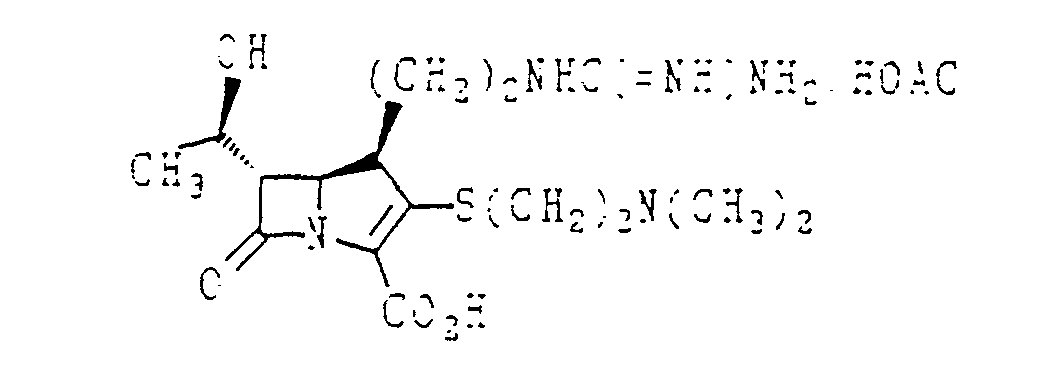
-

- . The residue was passed through a silica gel flash column (100 g, 50 → 100% ethyl acetate/hexane, 10% acetone/ethyl acetate) to give the title compound (4.0 g, 76%) contaminated with the opened β-lactam side product.
- IR (CH2CI2) νmax: 2100 N3, 1775 and 1715 cm-' (C=O);
- 'H NMR (CDCI3, 200 MHz)δ: 6.1-5.8 (1H, m, vinylic H), 5.5-5.1 (2H, m, vinylic 3H), 4.9-4.6 (2H, m, allylic-CH2), 4.3-4.1 (1H, m, H-1') , 4.2-4.15 (1H, dd, H-5) , 3.7-3.5 (1H, m, H-4), 3.5-3.3 (2H, m, CH2-N3), 3.071 (1H, dd, J = 3.0 Hz, J = 7.1 Hz, H-6), 3.1-2.85 (2H, m, SCH2), 2.7-2.4 (2H, m CH2-N), 2.28 (6H, s, N-(CH3)2), 2.1-1.6 (2H, m, CH2-4), 1.314 (3H, d, J=6.1 Hz, CH3), 0.897 (9H, s, tert-butyl) and 0.069 ppm (6H, s, dimethyl).
-

- A cold (ice-methanol bath) solution of allyl (4R,5S,6S)-4-(2"-azidoethyl)-6-[(1'R)-1'-tert-butyldimethylsilyloxyethyl]-3-[(2-N,N-dimethylaminoethyl)thio]-7-oxo-1-azabfcyclo[3.2.0]hept-2-ene-2- carboxylate (4.0 g, 7.6 mmol, 37% pure) in tetrahydrofuran was treated first with glacial acetic acid (2.5 mL, 45.6 mmol) and dropwise with a 1M tetrahydrofuran solution of tetrabutylammonium fluoride (22.8 mL, 22.8 mmol). The mixture was allowed to stand at 5°C for eleven days, then diluted with ethyl acetate (400 mL), washed with ice cold 1M aqueous NaHC03(2 x 25 mL) ice cold water (3 x 25 mL), brine (25 mL) and dried. The residue was passed through a silica gel flash column (60 g, 10 - 100% acetone/ ethyl acetate) to give the title compound (473 mg, 41%) as a yellow oil.
- IR (CH2CI2) νmax: 3610, 3450 (OH), 2110 (N3), 1780 and 1610 cm-' (C=0);
- ' H NMR (CDCI3, 200 MHz) 3: 6.1-5.9 (1H, m, vinylic H), 5.49-5.22 (2H, m, vinylic H), 4.9-4.6 (2H, m, allylic CH2), 4.235 (1H, dd, J =2.7 Hz, J=9.3 Hz, H-5), 4.33-4.2 (1H, m H-1'), 3.7-3.5 (1H, m, H-4), 3.47-3.3 (2H, m, CH2N3), 3.150 (1H, dd, J=2.7 Hz, J=7.9 Hz, H-6), 3.1-2.9 (2H, m, SCH2), 2.7-2.4 (2H, m, CH2N), 2.284 (6H, s, N(CH3)2), 1.95-1.7 (3H, m, OH, CH2-4) and 1.400 ppm (3H, d, J=6.2 Hz, CH3).
-

- To a cold (ice bath) solution of allyl (4R,5S,6S)-4-(2"-azidoethyl)-3-((2-N,N-dimethylamino-ethyl)thio]-6-[-(1'R)-1'-hydroxyethyl]-7-oxo-1-azabi-cyclo[3.2.0]hept-2-ene-2-carboxylate (470 mg, 1.14 mmol) in CH2Cl2(17 mL) was added Pd(PPh3)4(105 mg, 0.086 mmol) and a 0.5M solution of potassium 2-ethylhexanoate in ethyl acetate (2.28 mL, 1.14 mmol). The mixture was stirred for 15 min, diluted with diethyl ether (100 mL) and extracted with ice cold water (4 x 20 mL). The organic extracts were combined, washed with diethyl ether (2 x 40 mL) and passed through a µBondapak C18 reversed phase column (67.5 g, water, 1% → 10% CH3CN/H20 ) to give the title compound (200 mg, 46%) as a yellow lyophilized powder.
- IR (Nujol) vmax: 3400-3100 (OH), 2100 (N3), 1755 and 1600 cm-' (C=O);
- ' H NMR (D20, 200 MHz) δ: 4.280 (1 H, dd, J =2.4 Hz, J =6.8 Hz, H-5), 4.32-4.2 (1 H, m, H-1'), 3.67-3.54 (1H, m, H-4), 3.481 (1H, dd, J = 2.7 Hz, J = 6.1 Hz, H-6), 3.5-3.34 (2H, m, CH2N3), 3.2-2.92 (4H, m, SCH2 and CH2N), 2.60 (6H, s, N(CH3)2), 2.18-2.02, 1.91-1.75 (2H, 2 sets of m, CH2-4) and 1.329 ppm (3H, d, J=6.1 Hz, CH3).
-

- The pH of a cold (ice bath) 0.04M pH 7.0 aqueous phosphate buffer solution (67 mL) of (4R,5S,6S)-4-(2"-azidoethyl)-3-[(2-N,N-dimethylaminoethyl)thio]-6-[(1'R)-1'-hydroxyethyl]-7-oxo-1-azabicyclo[3.2.0]hept-2- ene-2-carboxylic acid (190 mg, 0.514 mmol) was adjusted to 5.9 with a 1M aqueous NaH2PO4solution. The mixture (ice bath) was shaken on a Parr hydrogenator at 45-50 psi of hydrogen for 1 h using 30% Pd/Celite (270 mg) as catalyst. More Pd/Celite was added (270 mg) and the hydrogenation was pursued for one more hour. The catalyst was removed by filtration and washed with water (2 x 10 mL). The pH of the aqueous solution (ice bath) was adjusted to 7.8-8.0 with a 1 N aqueous NaOH solution. Then aminoiminomethanesulfonic acid (354 mg, 2.87 mmol) was added portionwise and the pH was maintained at 7.8-8.0 with the 1 N aqueous NaOH solution. The reaction mixture was stirred for a 1.5 h period after which more aminoiminomethanesulfonic acid (124 mg, 1 mmol) was added. The pH was maintained at 7.8-8.0 and the stirring period was pursued for one more hour. At the end of the reaction, the pH was adjusted to 7.0 with a 1.0M aqueous acetic acid solution and the mixture was passed through a µBondapak C18 reversed phase column (130 g, ice cold 0.005M aqueous AcOH , 1 % CH3CN/0.005M AcOH ) to give the title compound (60 mg, 26%) as an off-white lyophilized powder.
- Purity: 96.9% as determined by HPLC (r.t.= 6.02 min, µBondapak C18, 10µ, 3% CH3CN/KH2PO40.01M, pH 7.4);
- UV (H20) λmax: 296 (6089);
- IR (Nujol) νmax: 3400-3100 (NH, OH), 1760, 1600-1540 (C=0), 1680-1620 cm-1 (C=N);
- 'H NMR (D2 0, 200 NH2) 5: 4.33, 4.32 (d, J=2.9 Hz, part of H-5), 4.33-4.2 (m, H-1' and part of H-5), 3.51 (1H, dd, J = 2.9 Hz, J = 6.6 Hz, H-6), 3.41-3.21 (5H, m, CH2-guanidine, CH2N, H-4), 3.20-2.96 (2H, m, SCH2), 2.91 (6H, s, NCH3), 2.24-2.03, 1.9-1.55 (2H, 2 sets of m, CH2-4), 1.925 (2, 2H, s, CH3C02) and 1.33 ppm (3H, d, J = 6.4 Hz, CH3).
-

- A solution of (4R,5S,6S)-4-(3"-aminopropyl)-3-[(N,N-dimethylamidinomethyl)thio]-6-[(1'R)-1'- '-hydroxyethyl]-7-oxo-1-azabicyclo[3.2.0]hept-2-ene-2-carboxylic acid, acetic acid salt (0.204 g, 0.474 mmol) in cold water (30 mL, 0-5° C) was adjusted to pH 8.5 with 1M aqueous sodium hydroxide and then treated with benzyl formimidate hydrochloride (0.40 g, 2.3 mmol) added in small portions over 5 min while maintaining the pH at 8-8.5 with 1 M sodium hydroxide. After 15 min, the pH was adjusted to 5 with concentrated acetic acid and the reaction mixture was washed with ethyl acetate (25 mL). The aqueous phase was maintained under vacuum to remove traces of organic solvent and then chromatographed twice at 4°C on reversed phase silica gel (µBondapak C18, 2.5 x 14 cm). Elution with 0.01 M aqueous acetic acid gave 0.088 g (41%) of the title compound as a white amorphous powder after lyophilization.
- Purity by HPLC: 97% on µBondapak C,B, 3.9 mm/30 cm, elution 3% CH3CN-water , pH 7.4 phosphate buffer, flow rate 0.8 mL min, UV detector 292 nm, retention time 5.8 min;
- UV (water, pH 7.4 phosphate buffer) λmax: 292 nm (7,200);
- IR (KBr) vrt,ax: 1750 (C=0 of β-lactam), 1715, 1645 and 1590 cm-' (C = O of carboxylate);
- 'H NMR (200 MHz, D20) 6: 1.32 (d, J=6.32 Hz, 3H, CH3CHO), 1.4-1.9 (m, 4H, CH2-1 and 2 of propyl), 1.92 (s, CH3C02H), 3.12 and 3.28 (2 x s, 2 x 3H, NCH3), 3.0-3.6 (m, 4H, H-4, H-6 and CH2-3 of propyl), 3.84 (s, 2H, SCH2), 4.2-4.4 (m, 2H, H-5 and CH3CHO overlapping) and 7.81 ppm (s, 1 H, CH = NH).
-

- A solution of (4R,5S,6S)-4-(3"-aminopropyl)-3-[(2-guanidinoethyl)thio]-6-[(1'R)-1'-hydroxyethyl]-7-oxo-1-azabicyclo[3.2.0]hept-2-ene-2-carboxylic acid, acetic acid salt (0.300 g, 0.695 mmol) in cold water (30 mL, 0-5°C) was adjusted to pH 8.5 with 1 M aqueous sodium hydroxide and then treated with benzyl formimidate hydrochloride (0.60 g, 3.5 mmol) added in small portions over 5 min. The pH was maintained at 8-8.5 with 1 H sodium hydroxide throughout the addition and for another 15 min. The pH was then adjusted to 5 with concentrated acetic acid and the reaction mixture was washed with ethyl acetate (20 mL). The aqueous phase was then maintained under vacuum to remove traces of organic solvent and then chromatographed at 4°C on reversed phase silica gel (µBondapak C18, 2.5 x 15 cm). Elution with 0.01M aqueous acetic acid gave 0.190 g (59%) of the title carbapenem as a white amorphous solid after lyophilization: [α]D 22 + 26.6 (c 1.0, water).
- Purity by HPLC: 97% on µBondapak C18, 3.9 mm x 30 cm, elution 2% CH3CN-water , pH 7.4 phosphate buffer, flow rate 1 mL/min, UV detector 300 nm, retention time 6.1 min.;
- UV (water, pH 7.4 phosphate buffer) λmax: 302 nm (8,677);
- IR (KBr) νmax: 1755 (C = O of β-lactam), 1710, 1670, 1620 and 1580 cm-1 (C = O of carboxylate);
- 'H NMR (200 MHz, D20) δ: 1.32 (d, J=6.33 Hz, 3H, CH3CHO) , 1.4-2.0 (m, 4H, CH2-1 and 2 of propyl), 1.93 (s, CH3C02H), 2.8-3.2 (m, 2H, SCH2), 3.3-3.5 (m, 6H, H-4, H-6, CH2-3 of propyl and SCH2CH2N), 4.2-4.4 (m, 2H, H-5 and CH3CHO) and 7.8 ppm (s, 1 H, CH = NH).
-

- A solution of (4R,5S,6S)-4-(3"-aminopropyl)-3-[(2-guanidinoethyl)thio]-6-[(1'R)-1'-hydroxyethyl]-7-oxo-1-azabicyclo[3.2.0]hept-2-ene-2-carboxylic acid, acetic acid salt (0.300 g, 0.695 mmol) in cold water (30 mL, 0-5°C) was adjusted to pH 8.5 with 1 N aqueous sodium hydroxide and then treated with aminoiminomethanesulfonic acid (0.43 g, 3.46 mmol) added in small portions over 5 min. The pH was maintained at 8.0-8.5 throughout the addition and for another 2 h with 1 M sodium hydroxide. The pH was then adjusted to 5 with glacial acetic acid and the solution was chromatographed on reversed phase silica gel (µBondapak C18, 2.5 x 15 cm). Elution with 0.01 M aqueous acetic acid gave 0.213 g (64%) of the title carbapenem as a white amorphous solid after lyophilization: [α]22 o + 11.3° (c 1.0, water).
- Purity by HPLC: 99% on µBondapak C18, 3.9 nm x 30 cm, elution 2% CH3CN-H20, pH 7.4 phosphate buffer, flow rate 1 mL/min, UV detector 300 nm, retention time 10.4 min;
- UV (water, pH 7.4 phosphate buffer) λmax: 302 nm (10,260);
- IR (KBr) νmax:1755 (C=0 of β-lactam), 1670, 1630 and 1580 cm-1 (G=0 of carboxylate);
- 'H NMR (200 MHz, D20) δ: 1.32 (d, J=6.38 Hz, 3H, CH3CH3CHO), 1.4-2.0 (m, 4H, CH2-1 and 2 of propyl), 1.92 (s, CH3CO2H), 2.8-3.2 (m, 2H, SCH2), 3.2-3.6 (m, 6H, H-4, H-6, CH2-3 of propyl and SCH2CH2N), 4.23 (dd, JH5,H6 = 2.49 Hz, JH5.H4= 9.2 Hz, 1H, H-5) and 4.27 ppm (m overlapping with H-5, 1 H. CH3CHO).
-

- A solution of (4R,5S,6S)-6-[(l'R)-1'-hydroxyethyl]-3-[(2-cyanoethyl)thio]-4-(2"-aminoethyl)-7-oxo-1 - azabicyclo[3.2.0]-hept-2-ene-carboxylic acid (0.512 g, 1.57 mmol) in 0.2M pH 7.0 phosphate buffer (15 mL) was cooled to 0°C while bubbling Argon through the solution. The pH was adjusted to 10.2 with 1 N NaOH and N-carboxyanhydride of L-alanine (0.181 g, 1.57 mmol) in dioxane (1.5 mL) was added in one portion with vigorous stirring. When the pH dropped to 7.2, it was readjusted to 10.2 and left there for 1 h. The reaction was stopped by adjusting the pH to 6.0 with 1 H HCI. Argon was bubbled through the solution for 30 Thin at 0°C while readjusting the pH to 6.0 whenever it rose above 6.0. The crude reaction mixture was passed through a column of µBondapak C18 reverse phase silica (4.5 x 11.5 cm). Appropriate fractions belonging to the product were combined and lyophilized to a solid which was rechromatographed on µBondapak C18 reverse phase silica (4.5 x 11 cm). The slightly more polar title compound, separated very closely from the dipeptide derivative, was eluted with a mixture of water and CH3CN (97:3, gradient elution) and was obtained as a yellow fluffy solid after lyophilization (0.099 g, 15.9%).
- Purity 96.5% by HPLC: UV detection at 300 nm on µBondapak C18 (4 mm x 30 cm), 5% CH3CN in pH 6.8 phosphate buffer, flow rate 0.6 mUmin, retention time 7.25 min.
- UV λmax: 300;
- IR (Nujol) νmax: 1750 cm-1 (C = 0, β-lactam).
- 'H NMR (200 MHz, D2O) 6: 1.38 (d, 3H, CH3, J=6.4 Hz,), 1.47 (d, 3H, CH3, J=7.0 Hz) , 1.52-1.77; 1.97-2.11 (m, 2H, CH2), 2.82-2.89 (overlap, 2H, CH2CN), 2.91-3.17 (overlap, 2H, SCH2), 3.27-3.43 (overlap, 3H, CH2N, H-4), 3.59 (dd, 1H, H-6, J5,6=2.66 Hz, J6,1'=6.06 Hz), 3.91 (q, 1H, CαH, Jα,CH3= 7.02 Hz), 4.74-4.96 (overlap, 2H, H-5, H-1').
-

- A solution of (4R,5S,6S)-6-[(1'R)-1'-hydroxyethyl]-3-[(2-cyanoethyl)thiol-4-(2"-aminoethyl)-7-oxo-1-azabicyclo-[3.2.0]-hept-2-ene-2-carboxylic acid (0.512 g, 1.57 mmol) in 0.2M pH 7.0 phosphate buffer (15 mL) was cooled to 0°C while bubbling Argon through the solution. The pH was adjusted to 10.2 with 1 N NaOH and N-carboxyanhydride of L-alanine (0.181 g, 1.57 mmol) in dioxane (1.5 mL) was added in one portion with vigorous stirring. When the pH dropped to 7.2, it was readjusted to 10.2 and left there for 1 h. The reaction was stopped by adjusting the pH to 6.0 with 1 N HCI. Argon was bubbled through the solution for 30 min at 0 while readjusting the pH to 6.0 whenever it rose above 6.0. The crude reaction mixture was passed through a column of µBondapak C18 reverse phase silica (4.5 x 11.5 cm). Appropriate fractions belonging to the product were combined and lyophilized to a solid which was rechromatographed on µBondapak C18 reverse phase silica (4.5 x 11 cm). The slightly less polar title compound, separated very closely from the monopeptide derivative, was eluted with a mixture of water and CH3CN (96:4, gradient elution) and was obtained as a yellowish fluffy solid after lyophilization (0.069 g, 9.4%).
- Purity 96.6% by HPLC: UV detection at 300 nm on µBondapak C18 (4 mm x 30 cm), 5% CH3CN in pH 6.8 phosphate buffer, flow rate 0.6 mUmin, retention time 9.1 min.
- UV λmax: 300 nm.
- IR (Nujol) νmax: 1750 cm-1 (C = 0, β-lactam);
- 'H NMR (200 MHz, D20) δ: 1.37 (d, 3H, CH3, J=6.45 Hz), 1.42 (d, 3H, CH3, J=7.39 Hz), 1.46 (d, 3H, CH3, J=8.85 Hz), 1.59-1.75; 1.99-2.14 (m, 2H, CH2), 2.84-2.89 (overlap, 2H, CH2CN), 2.92-3.22 (overlap, 2H, SCH2), 3.3-3.42 (overlap, 3H, CH2N, H-4), 3.59 (dd, 1 H, H-6, J5,6= 2.56 Hz, J6,i'= 5.88 Hz), 3.9 (br, 1 H, CαH) 4.25-4.34 (overlap, 3H, H-5, H-1', CαH).
-

- A cold (5°C) solution of (4R,5S,6S)-4-(3"-azidopropyl)-3-[(3-azetidinyl)thio]-6-[(1'R)-1'-hydroxyethyl)-7-oxo-1-azabicyclo[3.2.0]hept-2-ene-2-carboxylic acid (0.235 g, 0.64 mmol) in water (75 mL) was hydrogenated over 5% Pd/Al2O3(0.235 g) under a pressure of 45 psi. After 1 hour, the used catalyst was replaced by some fresh catalyst (0.235 g) and the hydrogenation resumed for one additional hour. At that point, the reaction mixture was filtered, acidified to pH 5.7 with AcOH and finally chromatographed on reversed phase silica gel (Partisil) eluting with water. The material obtained after lyophilization required two additional chromatograph purifications to obtain 0.045 g (17.5%) of the title compound of good purity.
- IR (Nujol) vmax: 1750 cm-1 (β-lactam);
- 1H NMR (D20) δ: 4.00-4.15 and 4.50-4.70 (4H, 2m, 2H-2, 2H-4 of azetidine), 4.15-4.20 (3H, m, H-5, H-1', CH-S), 3.47 (1H, dd, J =2.72, J =6.33, H-6), 3.00-3.25 (3H, m, CH2-N, H-4) , 1.50-1.95 (4H, m, 2H-1 ", 2H-2") , 1.38 (3H, d, J=6.34, -CH3').
-

-

- IR (NaCI, film) vmax: 1772 (C=0 of p-lactam) and 1708
- 'H NMR (200 MHz, CDCI3) δ: 0.5 (SiCH3), 0.9 (Si-t-Bu), 1.27 (d, J=6.13H, CH3CHO), 1.6-2.2 (m, CH2CH20Si), 3.09 (dd, JH8,H6= 2.45 Hz, JH6,H1 = 6.63 Hz, H-6), 3.5-4.3 (m, H-4, H-5, SCH2, CH3CHO, CH2CH2OSi), 4.7 (m, CH2 of allyl), 5.1-5.5 and 5.8-6.1 (2m, CH of allyl), 6.9 (s, H-5 of imidazole) and 7.6 ppmfl H-2 of imidazole).
-
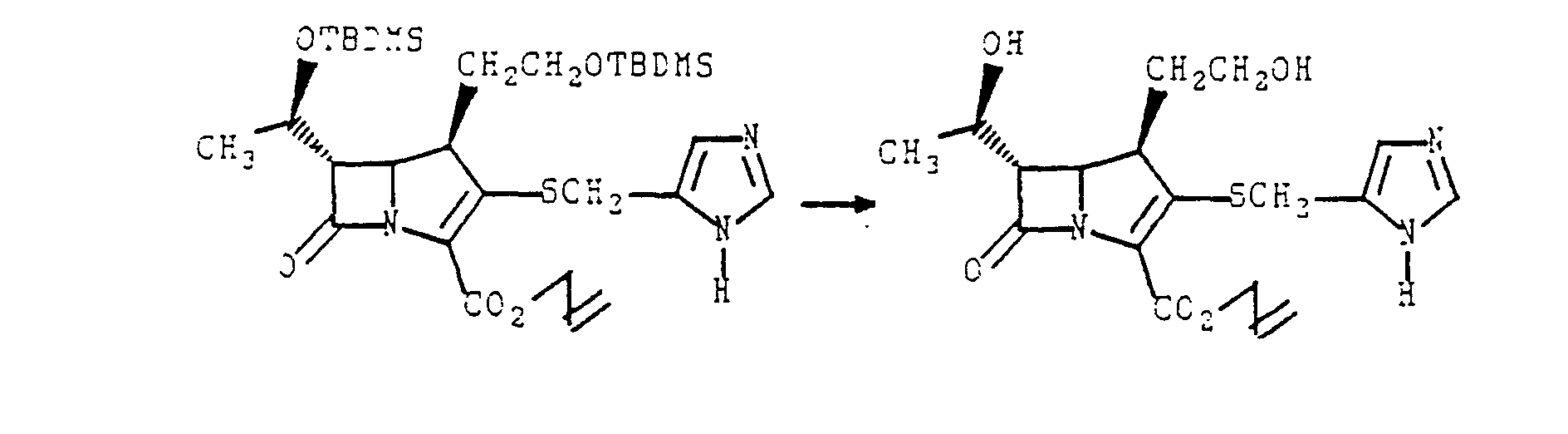
- A solution of allyl (4R,5S,6S)-6-[(1'R)-1'-tert-butyldimethylsilyloxyethyl]-4-(2"-tert-butyldimethyl-silylox-yethyl)-3-[(imidazol-4-yl)methylthio]-7-oxo-1-azabicyclo[3.2.0]hept-2-ene-2-carboxylate (2.65 g, 4.26 mmol) in tetrahydrofuran (60 mL) was cooled to 0-5°C and treated with glacial acetic acid (3.0 mL, 52.4 mmol) followed by 26 mL (26.0 mmol) of a 1.0M solution of tetrabutylammonium fluoride in tetrahydrofuran. The solution was then stored at 5°C for twelve days. The reaction mixture was then diluted with ethyl acetate (300 mL), washed with saturated sodium bicarbonate, brine and dried. Evaporation of the solvent under reduced pressure gave an oil which was chromatographed on a silica gel pad (5 x 5 cm) using a gradient of methanol (0-20%) in ethyl acetate as eluent. The product obtained (0.37 g, 20%) contained some tetrabutylammonium salt and was used as such for the deprotection step.
- IR (NaCI, film) νmax: 1765 (C=0 of β-lactam) and 1700 cm-' (C=0 of ester).
-

- Purity by HPLC: 100% on µBondapak C18, 3.9 mm x 30 cm, elution pH 7.0 phosphate buffer, flow rate 1.5 mlimin, UV detector 300 nm, retention time 9.04 min;
- UV (water, pH 7.4 phosphate buffer) λmax: 304 nm (10,153);
- IR (KBr) νmax: 1750 (C = 0 of β-lactam) and 1590 cm-i (C = 0 of carboxylate);
- 1 H NMR (200 MHz, D20) δ: 1.30 (d, J=6.37 Hz, 3H, CH3CHO), 1.5-2.1 (2M, 2H, CH2CH20H) 3.3-3.5 (m, 2H, H-6 and H-4 overlapping), 3.5-3.8 (m, 2H, CH2CH2
OH ), 4.03 (ABq, JAB= 14.6 Hz, Δν=37.0 Hz, 2H, SCH2), 4.13 (dd overlapping with SCH2, JH5,H6= 2.53 Hz, JH5.H4= 9.60 Hz, 1H, H-5), 4.24 (m, 1H, CH3CHO), 7.10 (s, 1 H, H-5 of imidazole) and 7.79 ppm (s. 1 H, H-2 of imidazole). -

-

- IR (CH2Cl2) vmax: 3603, 3440 (-OH), 1697 (-C02), 1650
- ' H NMR (CDCI3) 5: 4.8-6.1 (5H, allyl pattern), 4.48 (1H, broad s, H-3), 3.40-3.60 (4H, m, 2H-2, 2H-5), 1.80-2.10 (3H, m, 2H-4, -OH).
-

- A cold solution (5°C) of (3R)-N-allyloxycarbonyl-3-hydroxypyrrolidine (2.16 g, 12.62 mmol) in CH2Cl2 was treated with pyridine (1.15 g, 14.5 mmol) and trifluoromethanesulfonic anhydride (4.09 g, 14.5 mmol). After stirring for 15 min, the solvent was evaporated, the residue triturated in diethyl ether and filtered. The filtrate was then evaporated, the crude triflate dissolved in cold (5°C) CH2Cl2and treated with a preformed solution of formic acid (0.87-g, 18.93 mmol) and triethylamine (1.9 g, 18.93 mmol) in CH2CI2. The ice bath was removed and the solution stirred at room temperature for 45 min. Then the reaction mixture was washed with cold water and brine. After drying (MgSO4.) , the solvent was evaporated and the crude formate purified by chromatography (Si02; 10% CH3CN in CH2Cl2) to yield 2.13 g (84.7%). This purified material was dissolved in cold (5°C) tetrahydrofuran and 1 N NaOH (11 mL, 11 mmol) was added dropwise. After stirring for 10 min, the reaction mixture was neutralized with HCI, diluted with EtOAc and washed with cold water and brine. After evaporation of the solvent, the product was chromatographed (SiO2 EtOAc) to yield 1.51 g (82.5%) of the title compound.
- IR (CH2Cl2) νmax: 3605, 3440 (-OH), 1695 (-CO2-), 1650 cm-' (>=
- 'H NMR (CDCl3) δ: 4.40-6.10 (5H, allyl pattern), 4.50 (1H, m, H-3) , 3.40-3.70 (4H, m, 2H-2, 2H-5) , 1.90-2.10 (2H, m, 2H-4). [α]20 D: +26.9 (130 mg/100 mL, MeOH).
-

- A cold solution (5°C) of (3S) N-allyloxycarbonyl-3-hydroxypyrrolidine (1.51 g, 8.82 mmol) in CH2 CI2 was treated with pyridine (0.80 g, 10.14 mmol) followed by trifluoromethanesulfonic anhydride (2.86 g, 10.14 mmol). After stirring for 15 min, the solvent was evaporated, the residue triturated in diethyl ether and filtered after evaporating the filtrate, the crude triflate was redissolved in cold (5°C) CH3CN and while bubbling H2S into the solution, triethylamine (1.07 g, 10.58 mmol) was added dropwise. The starting material disappeared in 30 min. The solvent was then evaporated and the crude thiol purified by chromatography (Si02,CH2CI2) to yield 1.25 (75.7%) of the title compound.
- 'H NMR (CDCl3) δ: 4.60-6.10 (5H, allyl pattern), 3.20-3.90 (5H, m, H-3, 2H-2, 2H-5), 2.20-2.40 (1H, m, H-5), 1.80-2.00 (1 H, m, H-5), 1.71 (1 H, d, J =6.65, SH).
-

- A cold (5°C) solution of allyl (4R,5S,6S)-4-(3"-azidopropyl)-3-(diphenylphosphono)-6-((1'R)-1'-hydroxyethyl]-7-oxo-1-azabicyclo[3.2.0]hept-2-ene-2-carboxylate (1.85 g, 3.25 mmol) in DMF (35 mL) was treated with (3R) N-allyloxycarbonyl-3-mercaptopyrrolidine (1.25 g, 6.68 mmol) followed by diisopropylethylamine (0.863 g, 6.68 mmol). The ice bath was removed and after stirring at room temperature for 15 h, the solution was diluted with diethyl ether (90 mL) and washed three times with cold brine. After drying (MgS04) the organic solution was evaporated and the crude carbapenem purified by chromatography (Si02, 30% CH3CN in CH2Cl2) to yield 1.27 g (77.1%) of the title compound.
- IR (CH2Cl2) νmax: 3610 (-OH), 2105 (-N3), 1778 (β-lactam), 1700 (-C02 ), 1650 cm-' (>=<).
- 1H NMR (CDCl3) δ: 4.5-6.10 (10H, 2 allyl patterns), 4.15-4.30 (2H, m, H-5, H-1'), 3.70-3.90 (2H, m, H-4, CH-S-) , 3.10-3.70 (7H, m, H-6, -CH2N3, -(CH2)2N-) , 1.40-2.40 (6H, m, 2H-1 ", 2H-2", 2H-4 of pyrrolidine), 1.40 (3H, d, J = 6.23, -CH3').
-

- A cold (5°C) solution of allyl (4R,5S,6S)-4-(3"-azidopropyl)-3-[(3R)-N-(allyloxycarbonyl]-3-pyrrolidinylthio]-6-[(1'R)-1'-hydroxyethyl]-7-oxo-1-azabicyclo[3.2.0]hept-2-ene-2-carboxylate (0.932 g, 1.84 mmol) in EtOAc (50 mL) was treated with 0.5M sodium ethylhexanoate (11.04 mL, 5.52 mmol) and (PPh3)-4Pd (0.90 g). The solution was stirred for 20 h at 5°C then diluted with EtOAc and extracted with cold water. The aqueous extracts were acidified to pH ~7.0 with AcOH and chromatographed on reversed phase silica gel (partisil). Elution was done with 0-25% CH3CN in water to yield 15 mg (2.1 %) of the title compound. [The major product isolated was the corresponding mono deprotected ester, (31%)].
- 'H NMR (D20) δ: 4.20-4.40 (2H, m, H-5, H-1'), 3.95 (1H, m, -CH-S) , 2.96-3.42 (1H, m, H-4) , 3.1-3.42 (7H, m, H-6, -CH2 N3, -(CH2)2N-) , 1.50-2.50 (6H, m, 2H-1 ", 2H-2", 2H-4 of pyrrolidine), 1.33 (3H, d, J- 6.37, -CH3').
-

- A solution of (4R,5S,6S)-4-(3"-azidopropyl)-3-[(3R)-3-pyrrolidinylthio]-6-[(1'R)-1'-hydroxyethyl]-7-oxo-1-azabicyclo[3.2.0]hept-2-ene-2-carboxylic acid (0.54 g, 0.142 mmol) in cold water (15 mL) was hydrogenated at 5 C for 1 h at 60 psi of hydrogen in the presence of 5% Pd/A]2O3 (60 mg). Then the catalyst was filtered off and the filtrate acidified to pH=5.5 with acetic acid. Chromatography on reversed phase silica gel (partisil) of this acidified solution gave 30 mg (50.9%) of the title compound as its acetic acid salt.
- IR (Nujol) νmax: 1750 cm-' (β-lactam), 1590 (-CO2 -1). ).
- 'H NMR (D20) δ: 4.20- 4.40 (2H, m, H-5, H-1') , 3.90-4.10 (1H, m, -CH-S) , 3.60-3.70 (1H, m, H-4) , 3.20-3.50 (5H, m, H-6, (-CH2)2N-), 3.05 (2H, m, CH2-N-), 1.50-2.60 (6H, m, 2H-1 ", 2H-2", 2H-4 of pyrrolidine), 1.33 (3H, s, J= 6.40, -CH3'), 1.92 (3H, s, acetic acid).
-

-

- IR (NaCl, film) νmax: 2100(N3) and 1765 cm-' (C=0 of β-lactam).
-

- A solution of allyl (4R,5S,6S)-4-(2"azidoethyl)-6-[(1"R)-1'-tert-butyldimethylsilyloxyethyf)-3-[(imidazol-4-yl)methylthio]-7-oxo-1-azabicyclo[3.2.0]hept-2-ene-2-carboxylate (1.45 g, 2.72 mmol) in tetrahydrofuran (40 mL) was cooled to 0-5 C and treated with acetic acid (1.0 mL, 17.5 mmol) followed by 8.2 mL (8.2 mmol) of 1.0M tetrabutylammonium fluoride in tetrahydrofuran. After fourteen days at 0-5°C, the reaction mixture was diluted with ethyl acetate (400 mL), washed with saturated sodium bicarbonate, brine and dried (MgSO4). The solvent was evaporated under reduced pressure and the residue was chromatographed on silica gel (4x6 cm). Elution with a gradient of methanol (0-20%) in ethyl acetate gave 0.34 g (30%) of the title compound as an oil.
- IR (NaCl, film) v,nax: 2100 (N3), 1765 (C=0 of ,8-lactam) and 1700 cm-1 (C=0 of ester);
- 'H NMR (200 MHz, CDCl3) δ: 1.38 (d, J=6.25 Hz, 3H, CH3 CHO), 1.5-2.1 (m, CH2CH2N3), 3.15 (dd, JH6,H5 = 2.63 Hz, JH6,H1= 7.72 Hz; 1 H, H-6), 3.3-3.7 (m, 3H, H-4 and CH2CH2 N3 overlapping), 4.06 (ABq, JAB= 14.6 Hz, Δν= 45.2 Hz, 2H, SCH2), 4.1-4.4 (m, 2H, H-5 and CH3CHO overlapping), 4.6-4.9 (m, 2H, CH2 of allyl), 5.2-5.5 and 5.9-6.1 (2m, 2H, and 1 H, CH of allyl), 6.98 (s, 1H, H-5 of imidazole) and 7.59 ppm (s, 1 H, H-2 of imidazole).
-

- A solution of allyl (4R,5S,6S)-4-(2"-azidoethyl)-6-[(1'R)-1'-hydroxyethyl]-3-[(imidazol-4-yl)methylthio]-7-oxo-1-azabicyclo[3.2.0]hept-2-ene-2-carboxylate (0.304 g, 0.81 mmol) in dichloromethane (20 mL) was treated at 25°C and under nitrogen with tetrakis(triphenylphosphine) palladium [0] (0.040 g) and 1.8 mL (0.9 mmol) of a 0.5M solution of potassium 2-ethylhexanoate in ethyl acetate. After 1.2 h, the reaction mixture was extracted with water (2 x 50 mL) and the combined extract was chromatographed on reversed phase silica gel (µBondapak C18, 2.5 x 15 cm). The column was eluted with a gradient of acetonitrile (0-5%) in 0.01 M pH 7.0 phosphate buffer. The UV active fractions were collected, concentrated and desalted on the same column using water instead of buffer as eluent. Lyophilization of the pertinent fractions gave 0.047 g (14%) of the title carbapenem as a white amorphous solid:
- Purity by HPLC: 99% on µBondapak C18, 3.9 mm x 30 cm, elution 10% CH3CN- water pH 7.4 phosphate buffer, flow rate 1 ml'min, UV detector 302 nm, retention time 6.83 min;
- UV (water, pH 7.4 phosphate buffer) Xmax:: 304 nm (8,380);
- IR (KBr) νmax: 2100 (N3), 1745 (C=0 of β-lactam) and 1600 cm-1 (C=0 of carboxylate);
- 'H NMR (200 MHz, D20) 5: 1.31 (d, J=6.40 Hz, 3H, CH3CHO), 1.6-2.1 (m, 2H,2CH2CH2N3), 3.2-3.6 (m, 4H, H-6, H-4 and CH2CH2N3 overlapping), 4.03 (ABq, JAB= 14.52 Hz, Δν=33.6 Hz, 2H, SCH2), 4.14 (dd, JH5,H6 = 2.42 Hz, JH5,H4= 9.48 Hz, 1 H, H-5) , 4.24 (m, 1 H, CH3CHO), 7.09 (s, 1 H, H-5 of imidazole) and 7.72 ppm (s, 1 H, H-2 of imidazole).
-

-

- To a cold (ice bath) solution of 5-azido-4-(tert-butyldimethylsilyloxy)pentanoic acid (38 g, 0.14 mmol) from iodolactonization described by P.A. Bartlett et al in J. Am. Chem. Soc. 100, 3950 (1978) in dimethyl formamide (250 mL) was added 2-picolyl mercaptan (17.5 g, 0.140 mol), 1,3-dicyclohexylcarbodiimide (30 g, 0.15 mol) and 1-hydroxybenzotriazole (10 g, 0.074 mol). The mixture was stirred for 60 h in the cold room (5-8°C), diluted with water (1 L) and extracted with diethyl ether (5 x 250 mL). The diethyl ether extracts were combined, washed with water (5 x 250 mL), brine (200 mL), dried and passed through a silica gel flash pad (500 g, Hexane, 5 → 30% ethyl acetate/hexane) to give the title compound (30 g, %) as an oil.
- IR (film) νmax: 2100 (N3) and 1690 cm-' (C=0).
- ' H NMR (CDCl3, 200 MHz) δ: 8.558-8.525 (1H, m, pyridine H-6), 7.672=7.586 (1H, m, pyridine H-4), 7.336 (1H, d, J =7.9 Hz, pyridine H-3), 7.199-7.131 (1H, m, pyridine H-5), 4.257 (2H, s, CH2S, 3.834 (1H, center of 5 lines, J=5.41-2, CHO), 3.197 (2H, center of ABX, J=4.5 Hz, J=5.4 Hz, J =12.5 Hz, CH2N3), ), 2.659 (2H, t, J=7.6 Hz, CH2CO), 2.01-1.786 (2H, m, CH2), 0.893 (9H, s, tert-butyl), 0.094 and 0.061 ppm (6H, 2s, dimethyl).
-

- A cold (ice-methanol bath) solution of (pyridin-2-yl)-methylthio-5-azido-4-(tert-butyldimethylsilyloxy)-pentanoate (30 g, 78.9 mmol) in dichloromethane (500 mL) was treated with triethylamine (35 mL, 0.15 mol) and dropwise with tert-butyldimethylsilyltrifluoromethanesulfonate (46 mL, 0.20 mmol). At the end of the addition, the mixture was allowed to stand for 18 h at 5-8° C, then diluted with hexane (1 L), washed with water (5 x 500 mL), brine (500 mL), dried (MgSO4) and treated with activated charcoal. The residue (20 g, 51%. 0.040 mmol), a red oil, was added to a cold (ice bath) mixture of freshly fused zinc chloride (13 g, 0.096 mol), and (3S,4R)-4-acetoxy-3-[(1'R)-1'-tert-butyl-dimethyl-silyloxyethyl] azetidin-2-one (20 9, 0.069 mol) in dichloromethane (250 mL). It was allowed to stand in a cold room for 18 h, diluted with diethyl ether (1 I), washed with saturated aqueous NH4Cl (3 x 250 mL), water (3 x 250 mL), ice cold saturated aqueous NaHCO3, water (250 mL), brine (250 mL) and dried (MgS04). The residue was passed through a silica gel flash column (500 g, Hexane - 50% ethyl acetate/hexane) to give the title compounds as separated diastereomers (30 g of each diastereomers, 24% combined yield).
- Rf = 0.33 (hexane/ethyl acetate:1/1);
- IR (film) vmax: 3300-3200 (NH) , 2700 (N3) , 1765 and 1680 cm-' (C=0);
- ' H NMR (CDCI3, 200 MHz) δ: 8.54-8.51 (1H, m, pyridine-H6) , 7.64-7.58 (1H, m, pyridine H-4) 7.314 (1H, d, J =7.8 Hz, pyridine H-3), 7.21-7.14 (1H, m, pyridine H-5), 5.845 (1H, bs, NH), 4.280, 4.269 (2H, 2 lines, part of ABq, CH2S), 4.2-4.05 (1H, m, CHO), 3.832 (1H, dd, J =2.05 Hz, J=6.0 Hz, H-4), 3.83-3.70 (1H, m, CHO), 3.227 (2H, ABX, J=4.6 Hz, J=5.1 Hz, J =12.5 Hz, CH2N3), 3.08-2.95 (2H, m, H-3 and H-1 "), 2.15-1.98, 1.67-1.55 (2H, m, CH2-1"), 1.025 (3H, d, J=6.3 Hz, CH3), 0.883, 0.868 (18H, 2s, tert-butyl), 0.070 and 0.047 ppm (3H and 5H, 2s, dimethyl.
- Rf = 0.42 (hexane/ethyl acetate: 1/1);
- IR (film) νmax: : 3250 (NH), 2100 (N3), 1765 and 1685 cm-1 (C = O);
- ' H NMR (CDCI3, 200 MHz) δ: 8.55-8.52 (1H, m, pyridine H-6), 7.67-7.58 (1H, m, pyridine H-4), 7.32 (1H, d, J=7.8 Hz, pyridine H-3), 7.21-7.14 (1 H, m, pyridine H-5), 5.90 (1H, bs, NH), 4.336, 4.267, 4.245, 4.174 (2H, ABq, J = 14.0 Hz, CH2S), 4.20-4.13 (1 H, m, CHO), 3.794 (1 H, dd, J= 2.1 Hz, J = 6.9 Hz, H-4), 3.82-3.75 (1 H, m, CHO), 3.207 (2H, ABX, J = 3.8 Hz, J = 5.2 Hz, J =12.8 Hz, CH2S), 3.048 (1 H, bt, J = 2.5 Hz, H-3) , 2.86-2.75 (1H, m, H-1 ") , 2.10-1.96, 1.85-1.70 (2H, 2 sets of m, CH2-4), 1.050 (3H, d, J =6.3 Hz, CH3), 0.883, 0.857 (18H, 2s, tert-butyl) and 0.047 ppm (12H, s, dimethyl).
-

- A cold (ice bath) solution of (3S,4S)-3-[(1'R)-1'-tert-butyldimethylsilyloxyethyl]-4-[(1 "R)-1 "-(pyridin-2-yl)-methylthiocarbonyl-4"-azido-(3" R or S)-3"-tert-butyldimethylsilyloxy)butyl]-azetidin-2-one (2.38 g, 3.9 mmol) in tetrahydrofuran (25 mL ) was treated with 30% aqueous hydrogen peroxide (1.3 mL, 15.6 mmol), followed by the slow addition of 1M aqueous NaOH (11.7 mL, 11.7 mmol). The mixture was stirred for 30 min, then acidified with 1 N aqueous HCI (14 mL) and extracted with ethyl acetate (3 x 30 mL). The organic extracts were combined, washed with water (2 x 20 mL), 1 M aqueous NaHS03 (2 x 20 mL), water (30 mL), brine and dried (MgSO4) to give the title compound (1.8 g, 92%) as an oil.
- IR (CH2CI) νmax: 3400 (NH), 2100 (N3), 1765, 1740 and 1710 cm-1 (C=0);
- 'H NMR (CDCl3, 200 MHz) δ: 6.329 (1H, bs, NH) , 4.23-4.14 (1H, m, CHO), 3.867 (1H, dd, J-2.2 Hz, J=6.4 Hz, H-4), 3.26 (2H, center of ABX, J=4.2 Hz, J=4.7 Hz, J=12.7 Hz, CH2N3), 3.13 (1H, center of m, H-3), 2.70-2.60 (1H, m, H-1 ") , 2.04-1.7 (2H, m, CH2-1 ") , 1.171 (3H, d, J =6.3 Hz, CH3) , 0.898, 0.869 (18H, 2s, tert-butyl) , 0.109, 0.099, 0.070 and 0.062 ppm (12H, 4s, CHs).
-

- A solution of (3S,4S)-3-[(1'R)-1'-tert-butyldimethyl-silyloxyethyl]-4-[(1"R)-1"-carboxy-4"-azido-(3" R or S)-3"-tert-butyldimethylsilyloxybutyl]azetidin-2-one (1.8 g, 3.6 mmol) in toluene (25 mL) was treated with carbonyldiimidazole (642 mg, 3.96 mmol) and then stirred for 1.5 h. The solvent was removed and the residue was dissolved again in toluene. The solvent was removed again and the residue was dried under high vacuum. To this resulting acyl imidazole was added a pre-dried solution (heated for 2.5 h over 3A° and 4A° mole sieves) of magnesium monoallyl malonate (4.5 g, 14.4 mmol) in benzene (40 mL). The mixture was heated for 1.6 h (bath temp. 75°C), diluted with a 1/1 mixture of diethyl ether and ethyl acetate, washed with ice cold water (2 x 40 mL) ice cold 1 N aqueous HCI (40 mL), water (2 x 40 mL) brine 40 mL and dried (MgS04) to give crude title compound (2.29 g,>100%) which was used as such in the next step.
- IR (CH2CI2) νmax: 3420 (NH), 2120 (N3), 1770 (C=0 ,6-lactam), 1720, 1660 and 1630 cm-' (C=0);
- ' H NMR (CDCIs, 200 MHz) δ: 12.113 (0.5H, bs, OH enol), 6.03 - 5.80 (1H, m, vinylic H) 5.927 (1H, bs, NH), 5.387 - 5.253 (2H, m, vinylic H), 5.058 (2.6H, s, olefinic H of enol), 4.665 - 4.616 (2H, m, allylic H), 4.24 - 4.12, 3.883 - 3.764 (2H, m, H-4 and H-1') , 3.775, 3.764 (d, J=2.1 Hz, part of H-4), 3.680, 3.600, 3.592, 3.513 (2H, ABq, J=15.9 Hz, CH2 of acetoacetate), 3.357 - 3.269 (1 H, m, part of CH2N3), 3.187 - 3.01 (2H, m, H-1" and part of CH2Ns) , 2.955 (0.5 H, dd, J=2.1 Hz, J=4.1 Hz, H-3), 2.905 (0.5 H, dt, J=2.6 Hz, part of H-3), 2.256 - 2.146, 2.065 - 1.91, 1.836 - 1.6 (2H, 3 series of m, CH2-4) 1.180 (1.4 H, d, J=6.2 Hz, CH3), 1.086 (1.6 H, d, J=6.3 Hz, CH3)), 0.896 and 0.866 (18H, 2s, tert-butyl), 0.108, 0.091, 0.087, 0.069 and 0.056 ppm (12H, 5s, dimethyl).
-

- A cold (ice bath) solution of (3S,4R)-3-[(1'R)-1'-tert-butyldimethylsilyloxyethyl]-4-[(1"R)-1 "-(4-azido-(3R or S)-3-tert-butyldimethylsilyloxypropyl)-3"-allyloxylcarbonyl-2"-oxopropyl]azetidin-2-one (2.2 g, 3.6 mmol) in CH3CN (22 mL) was treated first with triethylamine (0.51 mL, 3.6 mmol) and dropwise with tosyl azide (709 mg, 3.6 mL) in CH3CN (3 mL). The mixture was stirred for 1.5 h and the solvent was removed under vacuum. The residue was triturated with hexane and the solid tosyl amide was removed by filtration and washed with hexane. The residue upon evaporation of the hexanes fractions was passed through a silica gel flash column (60 g, hexane, 10 → 40% ether.hexane) to give the title compound (650 mg, 30%) as an oil.
- IR (CH2Cl2) νmax: 3410 (NH), 2150 (N2), 2100 (N3), 1765 (C=0 β-lactam), 1715 and 1650 cm-' (C=O);
- ' H NMR (CDCl3, 200 MHz) δ: 6.03 - 5.832 (1H, m, vinylic H), 5.862 (1 H, bs, NH), 5.40 - 5.29 (2H, m, vinylic H), 4.72 - 4.689 (2H, m, CH2 allylic), 4.215 -4.07 (2H, m, CHO and H-1'), 3.805 - 3.71 (1H, m, H-1 "), 3.189 (2H, ABX, J=3.9 Hz, J = 5.5 Hz, J =12.7 Hz, CH2N3), 3.023 (1 H, bt, J = 2.5 Hz, H-3) , 2.175 - 2.03, 1.73 - 1.57 (2H, 2 sets of m, CHz-1 "), 1.162 (3H, d, J=6.4 Hz, CH3), 0.891, 0.865 (18H, 2s, tert-butyl), 0.094, 0.062 and 0.053 ppm (12H, 3s, dimethyl).
-

- A solution of (3S,4R)-3-[(1'R)-1'-tert-butyldimethylsilyloxyethyl]-4-[(1"R)-1"-[4-azido-(3R or S)-3-tert-butyldimethylsilyloxypropyl]-3"-diazo-3"-allyloxycarbonyl-2"-oxopropyl]azetidin-2-one (690 mg, 1.1 mmol) in benzene (20 mL) was heated under reflux in the presence of Rh(OAc)z(17 mg) for 45 min. More catalyst (17 mg) was added and the heating period was continued for 30 more min. The catalyst was removed by filtration and benzene was removed under vacuum to give the title compound (700 mg, 100%) as an oil.
- IR (CH2Cl2) νmax: 2110 (N3), 1770 and 1745 cm-1 (C=0);
- 'H NMR (CDCI3, 200 MHz) 5: 6.0-5.79 (1 H, m, vinylic H), 5.38 - 5.24 (2H, m, vinylic H), 4.72 - 4.88 (2H, m, allylic CH2), 4.633 (1 H s, CH-2), 4.58 - 4.28 (1H, m, H-1'), 4.325 (1 H, dd, J =2.5 Hz, J = 8.4 Hz, N-5), 3.91-3.82 (1H, m, CHO) 3.40-3.2 (2N, m, CHzN3), 3.246 (1H dd, J =2.5 Hz, J=4.3 Hz, H-6), 2.839 (1H, bq, J=7.9 Hz, H-4), 1.84-1.72 (2H, m, CH2-4), 1.270 (3H, d, J=6.2 Hz, CH3), 0.897 (18H, s, tert-butyl), 0.112, 0.099, 0.092 and 0.083 ppm (12H, 4s, dimethyl).
-

- A cold (ice-methanol bath) solution of allyl (4R,5S,6S)-4-[3"-azido-(2" R or S)-2-tert-butyidimethylsilyloxypropyl]-6-[(1'R)-1'-tert-buty[dimethylsilyl-oxyethyl]-3,7-dioxo-1-azabicyclo(3.2.0]hept-2- ene-2-carboxylate (from 690 mg, 1.1 mmol of diazo) in CH3CN (8 mL) was treated dropwise with diphenyl chlorophosphate (0.26 mL, 1.32 mmol) and diisopropylethyl amine (0.23 mL, 1.32 mmol) and a trace amount of 4-N,N-dimethylaminopyridine (20 mg). The mixture was stirred for 1 h and then two portions of cyanoethyl mercaptan (130 mg, 1.5 mmol and 52 mg, 0.60 mmol) and diisopropylethyl amine (0.26 mL, 1.50 mmol and 0.10 mL, 0.60 mmol) were successively added within 1 h period. The mixture was stirred for 1.5 h, diluted with ethyl acetate (25 mL), washed with ice cold water (3 x 10 mL), 1 M aqueous NaHS03(3 x 10 mL), water (2 x 10 mL), 1N aqueous HCI (10 mL), water (2 x 10 mL), 1M aqueous NaHC03(10 mL), water (10 mL), brine (10 mL) and dried (MgSO4) . The residue was passed through a silica gel flash column (25 g, petroleum ether, 10 → 40% diethyl ether/petroleum ether) to give the title compound (442 mg, 62%) as an oil.
- IR (CH2CI2) νmax 2250 (CN), 2110 (N3), 1775 (C=O β-lactam), 1710 cm-' (C=O);
- ' H NMR (CDCl3, 200 MHz) δ: 6.03-5.84 (1H, m, vinylic H), 5.48 - 5.20 (2H, m vinylic H), 4.85 - 4.6 (2H, m, allylic CH2), 4.38 - 4.3 (1 H, m H-1'), 4.284 (1 H, dd, J =2.5 Hz, J=9.5 Hz, H-5), 3.65-3.50 (1 H, m, CHO), 3.47-2.93 (5H, m, H-4, CH2N3, SCH2), 3.205 (1H, dd, J=2.5 Hz, J=6.4 Hz, H-6), 2.699, 2.664, 2.632 (2H, m, CH2CN), 1.90-1.75 (2H, m, CH2-4), 1.245 (3H, d, J=6.2 Hz, CH3), 0.935 and 0.898 (18H, 2s, tert-butyl), 0.143 and 0.091 (12H, 2s, dimethyl).
-

- IR (CH2CI2) νmax: 3600, 3450 (OH), 2250 (CN), 2110 (N3), 1775 (C=0 β-lactam) and 1710 cm-1 (C = 0);
- 'H NMR (CDCl3, 200 MHz) δ: 6.04-5.87 (1H, m, vinylic H), 5.493 - 4.24 (2H, m, vinylic H), 4.88 - 4.64 (2H, m, allylic H), 4.294 (1 H, dd, J = 2.6 Hz, J = 9.7 Hz, H-5), 4.3-4.17 (1 H, m, H-1'), 3.9-3.67 (2H, m, CHO and H-4), 3.382, 3.353 (2H, 2 lines, CH2 N3), 3.35-3.23 (1H, m, 1 proton of SCH2), 3.159 (1H, dd, J = 2.6 Hz, J=8.0 Hz, H-6), 3.05 - 2.91 (1H, m, 1 proton of SCH2), 3.91 (1H, bs, OH), 2.81 - 2.63 (2H, m, CH2CN), 2.377 (1 H, bs, OH), 1.94-1.64 (2H, m, CH2-4) and 1.388 ppm (3H, d, J = 6.2 Hz, CH3).
-

- A cold (ice bath) solution of allyl (4R,5S,6S)-4-[3"-azido-(2"R or S)-2"-hydroxypropyl]-6-[(1'R)-1'-hydroxyethyl]-3-[(2-cyanoethyl)thio]-7-oxo-1-azabicyclo[3.2.0]-hept-2-ene-2-carboxylate (180 mg, 0.43 mmol) in CH2Cl2(7 mL) was treated with Pd(PPha)4and dropwise with N-methylaniline (0.11 mL, 0.86 mmol). The mixture was stirred for 30 min then diluted with a 0.1M pH 7.0 aqueous phosphate buffer (10 mL) and diethyl ether (20 mL). The organic layer was extracted with more pH 7.0 buffer (2 x 5 mL) and water (5 mL). The aqueous layers were combined, washed with diethyl ether and passed through a µBondapak C18 reversed phase column (50 g, water → 2% CH3CN /water) to give the title compound (105 mg, 61%) as a lyophilized powder.
- IR (Nujol) νmax: 3500-3100 (OH), 2100 (N3), 1745 (C = O β-lactam) and 1595 cm-1 (C = 0);
- 1 H NMR (D20, 200 MHz) s: 4.343, 4.33 (d, J =2.5 Hz, part of H-5), 4.35-4.21 (2H, m, H-1' and H-5), 3.9-3.8 (1H, m, CHO) , 3.679-3.583 (1H, m, H-4), 3.435, 3.422 (part of H-6, d, J=2.5 Hz), 3.48-3.31 (3H, m, H-6 and CH2N3), 3.257-3.134, 3.087-2.91 (2H, 2 sets of m, SCH2), 2.91-2.83 (2H, m, CH2CN), 1.99-1.876, 1.783-1.655 (2H, 2 sets of m, CH2-4) and 1.321 ppm (3H, d, J=6.4 Hz, CH3).
-

- A cold (ice bath) solution of sodium (4R,5S,6S)-4-[3"-azido-(2"R or S)-2"-hydroxypropyl]-6-[(1'R)-1'-hydroxyethyl]-3-[(2-cyanoethyl)thio]-7-oxo-1 -azabicyclo[3.2.0]-hept-2-ene-2-carboxylate (105 mg, 0.26 mmol) in water (20 mL) was shaken on a Parr hydrogenator for 1 h at 45-50 psi of hydrogen, using 5% Pd/Alumina as catalyst. The catalyst was removed by filtration and washed with water (2 x 2 mL). The pH of the aqueous reaction mixture was adjusted to 7.05 with a 0.1 M aqueous NaH2PO4solution. The neutralized solution was passed through a µBondapak C,8 reversed phase column (50 g, water) to give the title compound (65 mg, 43%) as a white lyophilized powder.
- Purity: 98.2% as determined by HPLC (r.t. = 5.92 min, µBondapak C18, 10µ, KH2PO40.01M. pH 7.4);
- UV (water) X max:300 (8008);
- IR (Nujol) νmax: 3600-3100 (OH, NH2), 2250 (CN), 1750 (C=O β-lactam) and 1590 cm-' (C=0);
- 'H NMR (D20, 200 MHz) δ: 4.312 (1H, dd, J=2.8 Hz, J = 9.7 Hz, H-5), 4.32-4.207 (1H, m, H-1'), 3.948-3.849 (1H, m CHO), 3.68-3.575 (1 H, m, H-4), 3.380 (1 H, dd, J =2.8 Hz, J =6.6 Hz, H-6). 3.235, 3.219, 3.169, 3.154 (1H, part of ABX, J = 3.1 Hz, J=13.2 Hz, CH2 N3), 3.23-3.11 (1 H, m, 1 proton of SCH2), 3.008-2.95 (2H, m, part of CH2CN and part of SCH2), 2.88-2.82 (2H, m, CH2CN), 2.002-1.699 (2H, m, CH2-4) and 1.328 ppm (3H, d, J = 6.4 Hz, CH3).
-

-

- A cold (0°C) solution of allyl (4R,5S,6S)-6-[(1'R)-1'-(tert-butyldimethylsilyloxyethyl)]-4-[2"-tert-butyldimethylsilyloxyethyl]-3,7-dioxo-1-azabicyclo[3.2.0]heptane-2-carboxylate (4.75 g, 9.03 mmol) in CH3CN (50 mL) was treated with CIPO(OPh)2(2.06 mL, 9.93 mmol) followed by N,N-diisopropylethylamine (1.73 mL, 9.93 mmol) and 4-N,N-dimethylaminopyridine (10 mg). The mixture was stirred at 0 C for 2.5 h, under Argon, after which Argon was bubbled through the solution for 10 min. The enol-phosphate was then treated with benzylmercaptan (2.54 mL, 21.58 mmol) followed by N,N-diisopropylethylamine (3.8 mL, 21.68 mmol) and stirred at 0°C for 20 h. The reaction mixture was diluted with EtOAc (300 mL) and washed successively with cold 1 M NaHS03, water and brine, dried (MgSO4) and solvent evaporated to a syrup which was chromatographed on silica (9 x 10 cm) packed in hexane and eluted with a mixture of hexane and EtOAc (85:15, gradient elution) to give the title compound as a foam (4.35 g, 76.2%).
- 'H NMR (200 MHz, CDCl3 7.24) δ: 0.05 (s, 12H, Si(CH3)2), 0.857, 0.86 (2s, 18H, SiC(CH3)2), 1.26 (d, 3H, CH3), 1.62-1.78; 1.98.2.12 (m, 2H, CH2), 3.05 (dd, 1 H, H-6, Js,1 ' = 6.93 Hz), 3.45-3.6 (m, 1 H, H-4), 3.53-3.8 (centers m, 2H, CH2O), 4.03 (dd, 1H, H-5, J5,6= 2.38 Hz, J4,5 = 9.21 Hz), 4.1 (tight AB, 2H, SCH2), 4.18 (m, 1 H, H-1'), 4.59-4.82 (m, 2H, OCH2, allyl), 5.17-5.46 (m, 2H, =CH2, allyl), 5.83-6.02 (m, 1 H, CH = , allyl), 7.16-7.34 (m, 5H, phenyl).
-

- A cold (0°C) solution of allyl (4R,5S,6S)-6-[(1'R)-1'-(tert-butyldimethylsilyloxyethyl)]-3-benzylthio-4-[2"-tert-butyldimethylsilyloxyethyl]-7-oxo-1-azabicyclo[3.2.0]hept-2-ene-2-carboxylate (4.35 g, 6.88 mmol) in drytetrahydrofuran (65 mL) was treated, under Argon, with acetic acid (2.36 mL, 41.26 mmol) followed by a 1 M solution of tetrabutylammonium fluoride in tetrahydrofuran (20.63 mL, 20.63 mmol). The mixture was stirred at 0°C for 5 h and left at -20 °C for 18 h after which it was neutralized at 0°C with a 1 M NaHC03solution (42 mL, 42 mmol). The mixture was extracted with EtOAc (3 x 75 mL) and the combined organic phase was washed successively with cold 1 M NaHC03, water and brine, dried (MgS04) and solvent evaporated to give a foam which was chromatographed on silica (7.5 x 8 cm) packed in CH2Cl2and eluted with a mixture of CH2Cl2and CH3CN (8:2, gradient elution) to give the title compound as a foam (2.49 g, 69.9%).
- 'H NMR (200 MHz, CDCl3, 7.24) s: 0.04, 0.05 (2 s, 6H, Si(CH3)2), 0.86 (s, 9H, SiC(CH3)2), 1.26 (d, 3H, CH3), 1.63-1.8; 1.98-2.14 (m, 2H, CH2), 3.12 (dd, 1 H, H-6, J6,1 = 7.46 Hz), 3.45 (m, 1 H, H-4, J=2.19, 9.45, 11.5 Hz), 3.63, 3.82 (centers of m, 2H, CH20), 4.01 (dd, 1 H, H-5, Js,6 = 2.59 Hz, J4,5 = 9.45 Hz), 4.03-4.13 (AB, 2H, SCH2, J =13.26 Hz), 4.155 (m, 1 H, H-1'), 4.59-4.84 (m, 2H, OCH2, allyl), 5.18-5.46 (m, 2H, = CH2, allyl), 5.83-6.03 (m, 1 H, CH =, allyl), 7.19-7.38 (m, 5H, phenyl).
-

- A solution of allyl (4R,5S,6S)-6-[(1'R)-1'-(tert-butyldimethylsilyloxyethyl)]-3-benzylthio-4-[2"-hydroxyethyl]-7-oxo-1-azabicyclo[3.2.0]hept-2-ene-2-carboxylate (0.5 g, 0.97 mmol) in dry CH2C12(15 mL) was cooled to -78°C under Argon and treated with diisopropylethylamine (0.185 mL, 1.06 mmol) followed by (CF3S02)20 (0.18 mL, 1.06 mmol). After 1 h at -78° C, N-benzyl-N-methylamine (0.75 mL, 5.8 mmol) was added and the mixture was stirred at -78° C for 1 h and at 0°C for 5 h and left at 5°C for 16h. The reaction mixture was diluted with EtOAc (200 mL) and washed with cold water and brine, dried (MgSO4) and solvent evaporated to a syrup which was chromatographed on silica (4.5 x 13 cm) packed in CH2CI2. The title compound was eluted with a mixture of CH2Cl2and EtOAc (7:3, gradient elution) to give a syrup (0.4 g, 66.7%).
- ' H NMR (200 MHz, CDCl3 7.24) δ: 0.036, 0.045 (2 s, 6H, Si(CH3)2), 0.86 (s, 9H, SiC(CH3)3), 1.07 (d, 3H, CH3, J=6.16 Hz), 2.26 (s, 3H, NCH3), 3.18 (m,1 H, H-4, J=1.94, 9.27, 11.37 Hz), 3.44-3.56 (AB, 2H, NCH2, JAB= 13.15 Hz), 3.94 (dd, 1 H, H-5, J5,6 = 2.47 Hz, J4,5 = 9.32 Hz), 4.0-4.1 (AB, 2H, SCH2, JAB= 13.21 Hz), 4.14 (m, 1 H, H-1'), 4.7-4.8 (m, 2H, OCH2, allyl), 5.19-5.48 (m 2H, =CH2, allyl), 5.85-6.04 (m, 1 H, CH =, allyl), 7.19-7.78 (m, 10H, phenyl).
-

- A cold (0° C) solution of allyl (4R,5S,6S)-6-[(1'R)-1'-tert-butyldimethylsilyloxyethyl]-3-benzylthio-4-[2"-(N-benzyl-N-methyl)-aminoethyl]-7-oxo-1-azabi-cyclo[3.2.0]hept-2-ene-2-carboxylate (0.4 g, 0.65 mmol)in dry tetrahydrofuran (8 mL) was treated, under Argon with HOAc (0.22 mL, 3.89 mmol) followed by a 1 M solution of tetrabutylammonium fluoride in tetrahydrofuran (1.95 mL, 1.95 mmol). The mixture was stirred between 0° and 5°C for 168 h and then neutralized at 0°C with a 1 M NaHC03solution (3.9 mL, 3.9 mmol). The mixture was extracted with EtOAc (3 x 80 mL) and the combined organic extract was washed successively with a cold 1 M NaHC03, water and brine, dried (MgSO4) and solvent evaporated to give a gum which was chromatographed on silica (3.2 x 12 cm) nacked in CH2Cl2. The column was eluted first with a mixture of CH2Cl2and EtOAc (100:0 → 0:100, gradient elution) and finally the title compound was eluted with a mixture of EtOAc and acetone (8:2, gradient elution) to give a foam (0.093 g, 28.3%).
- 'H NMR (200 MHz, CDCl3 7.24) 6: 1.13 (d, 3H, CH3, J=6.28 Hz), 1.94-2.39 (m, 2H, CH2N), 2.34 (s, 3H, NCH3), 2.9 (dd, 1H, H-6, J6,1'= 7.77 Hz), 3.23 (m, 1H, H-4), 3.44, 3.52 (AB, 2H, NCH2, JAB= 13.1 Hz), 3.77 (dd, 1 H, H-5, J4,5 = 9.56 Hz, J5,6 = 2.57 Hz), 3.88 (m, 1 H, H-1'), 3.98-4.09 (AB, 2H, SCH2, JAB= 13.59 Hz), 4.59-4.86 (m, 2H, OCH2, allyl), 5.19-5.45 (m, 2H, =CH2, allyl), 5.84-6.03 (m, 1 H, CH = , allyl), 7.24-7.32 (m, 10H, phenyl).
-

- To a cold (0°C) solution of allyl (4R,5S,6S)-6-[(1'R)-1'-hydroxyethyl]-3-benzylthio-4-[2"-(N-benzyl-N-methyl)-aminoethyl]-7-oxo-1-azabicyclo[3.2.0]hept-2-ene-2-carboxylate (0.093 g, 0.18 mmol) in CH2Cl2(5 mL), under Argon, was added Pd[Ph3P]4(0.026 g, 0.023 mmol) followed by a 0.5M solution of 2-ethyl hexanoate in EtOAc (0.37 mL, 0.18 mmol). The mixture was stirred at 0° C for 50 min, diluted with diethyl ether (50 mL) and extracted with 0.1 M pH 7.0 phosphate buffer (3 x 10 mL). The combined aqueous extract was passed through a column of µBondapak C18 reverse phase silica (3.2 x 7 cm). The title compound was eluted with a mixture of water and CH3CN (7:3, gradient elution) and was obtained as a fluffy solid (0.067 g, 78.2%).
- Purity: 99.9% by HPLC, UV detection at max: 304 nm, on µBondapak C, (4 mm x 30 cm), pH 6.8 phosphate buffer, flow rate 1 mL-min, retention time: 7.22 min.
- UV λmax: 304 nm.
- IR (Nujol) v max: 1750 cm-' (C=0, β-lactam).
- 'H NMR (200 MHz, D20) 5: 1.12 (d, 3H, CH3, J=6.35 Hz), 1.38, 1.94 (centres m, 2H, CH2), 2.38 (s, 3H, NCH3), 2.47 (centre m, 2H, CH2CN), 3.04 (m, overlap, 1 H, H-6), 3.05 (m, overlap, 1 H, H-4), 3.72 (tight AB, 2H, NCH2), 4.05 (dd, 1 H, H-5), 3.96, 4.09 (AB, 2H, SCH2, JAB= 13.8 Hz), 4.11 (m, 1 H, H-1'), 7.35-7.54 (m, 10H, phenyl).
-

-

- IR (NaCl, film) vmax: 1740, 1710 and 1680 cm-1 (sh);
- 'H NMR (200 MHz, CDCI3) δ: 1.5-1.7 (m, 4H, CH2-3 and 4), 2.35-2.45 (m, 2H, CH2-2), 2.90 (s, 3H, NCH3), 3.25-3.35 (m, 2H, CH2N), 4.55-4.6 (m, 2H, CH2 of allyl), 5.15-5.35 and 5.85-6.05 ppm (2m, 2H and 1 H, CH of allyl).
-

- A solution of 5-N-allyloxycarbonyl-N-methylaminovaleric acid (35.26 g, 0.164 mol) in dry dichloromethane (175 mL) was treated dropwise at 22° C with oxalyl chloride (15.7 mL, 0.180 mol). After 10 min, 4 drops of N,N-dimethylformamide were added and the reaction mixture was stirred for 2.0 h, while the evacuation of gas slowly ceased. The solvent and excess reagent were evaporated under reduced pressure and the residual acid chloride was used as such for the next step:
- IR (NaCl, film) λmax: 1800 (C=O of acid chloride), 1740 (sh), 1705 and 1670 cm-' (sh);
- 'H NMR (200 MHz, CDCI3) s: 1.5-1.8 (m, 4H, CH2-3 and 4), 2.90 (s, 3H, NCH3), 2.9-3.0 (m, 2H, CH2-2), 3.29 (t, 2H, CH2N), 4.55-4.6 (m, 2H, CH2 of allyl), 5.15-5.35 and 5.8-6.0 ppm (2m, 2H and 1H CH of allyl).
-

- A solution of 2-picolyl mercaptan (20.5 g, 0.164 mol) in dry dichloromethane (350 mL) was treated at 0° C and under nitrogen with pyridine (16.0 mL, 0.197 mol) followed by a solution of 5-N-allyloxycarbonyl-N-methylaminovaleryl chloride (46.0 g, 0.164 mol) in dichloromethane (75 mL) added dropwise over 10 min. After 1.5 h at 0-5° C, the reaction mixture was washed with saturated sodium bicarbonate, brine and dried (MgSO4). Evaporation of the solvent under reduced pressure gave an oil which was filtered through a silica gel pad (7.5 x 12 cm) using a mixture of toluene and ethyl acetate (1:1 ) as eluent. Evaporation of the UV active fractions gave 48.4 g (92%) of the title material as a clear oil:
- IR (NaCI, film) νmax: 1700 and 1690 (sh) cm-' ;
- 'H NMR (200 MHz, D20) 6: 1.5-1.7 (m, 4H, CH2-3 and 4), 2.61 (t, J=7.0 Hz, 2H, CH2-2), 2.87 (s, 3H, NCH3), 3.26 (t, J=6.6 Hz, 2H, CH2-5), 4.24 (s, 2H, CH2Pyr), 4.55-4.6 (m, 2H, CH2 of allyl), 5.15-5.3 and 5.9-6.05 (2 m, 2H and 1 H, H of allyl), 7.1-7.2 (m, 1 H, H-5 of pyridine), 7.33 (d, J = 7.8 Hz, 1 H, H-3 of pyridine), 7.62 (m, 1 H, H-4 of pyridine) and 8.5-8.55 ppm (m, 1 H, H-6 of pyridine).
-

- A solution of 2-picolyl 5-(N-allyloxycarbonyl-N-methylamino)thiolvalerate (51.3 g, 0.159 mol) in dry dichloromethane (225 mL) was cooled to -10°C and treated with triethylamine (44 mL, 0.315 mol) followed by tert-butyldimethylsilyl trifluoromethanesulfonate (56 mL, 0.243 mol) dropwise over 40 min. After warming to 22° C, the solution was stirred for 3 h. The reaction mixture was then diluted with hexane (1 L) and washed with cold water (3 x 300 mL). The combined aqueous washings were extracted with hexanes (300 mL) and the combined organic extracts were washed with brine and dried (MgSO4). After treating with activated carbon, the solvent was evaporated under vacuum to give the crude silyl enol ether as a dark oil which was used as such for the next step. By H NMR, the product was a 1:1 mixture of E and Z isomers.
- IR (NaCl, film) vmax: 1705 cm-' (C = 0 of carbamate);
- 'H NMR (200 MHz, CDCl3) 3: 2.83 and 2.85 (2s, NCH3), 3.96 and 4.03 (2s, CH2Pyr), 4.85 (t, J=5 Hz, CH = CSO) and 5.0 ppm (broad t, CH = CSO).
-

- To a suspension of freshly fused zinc chloride (35.0 g, 0.256 mol) in dry dichloromethane (400 mL) was added at 22" C solid 4R-acetoxy-3S-[(1'R)-1'-tert-butyldimethylsilyl-oxyethyl]azetidin-2-one (36.5 g, 0.127 mol) followed by a solution of the crude silyl enol ether (0.159 mol) in dry dichloromethane (50 mL). The reaction mixture was then stirred at 22° C for 18 h. The mixture was then washed with water, saturated ammonium chloride, saturated sodium bicarbonate, brine and dried (MgSO4). Evaporation of the solvent under reduced pressure gave an oil which was chromatographed on silica gel (15 x 12 cm). Elution with a gradient of ethyl acetate (50-100%) in toluene gave 34.16 g (49%) of the title material as an oil. By 1 H NMR this product was a 84:16 mixture of and α isomers.
- IR (NaCl, film) νmax: 1765 (C=0 of β-lactam), 1705 (sh) and 1685 cm-1 (C=O of carbamate and thioester);
- 1 H NMR (200 MHz, CDCIs, major isomer, β) δ: 0.04 (s, 6H, SiCH3), 0.85 (s, 9H, Si-t-Bu), 0.97 (d, J=6.33 Hz, 3H, CH3 CHO), 1.3-1.8 (m, 4H, CH2-2 and 3 of butyl), 2.83 (s, 3H, NCH3), 2.83 (m overlapping with NCH3, 1 H, H-1 of butyl), 3.03 (broad t, 1 H, H-3), 3.1-3.4 (m, 2H, CH2N), 3.79 (dd, JH4.H3 = 1.96 Hz, JH4,H1 = 7.16 Hz, 1 H, H-4), 4.1-4.25 (m, 1 H CH3CHO), 4.26 (s, 2H, CH2Pyr), 4.55-4.6 (m, 2H, CH2 of allyl), 5.15-5.35 (m, 2H, CH of allyl), 5.85-6.1 (m, 2H, NH and CH of allyl), 7.15-7.20 (m, 1 H, H-5 of pyridine), 7.32 (d, J =7.78 Hz, 1 H, H-3 of pyridine), 7.55-7.65 (m, 1 H, H-4 of pyridine) and 8.5-8.55 ppm (m, 1 H, H-6 of pyridine).
-

- A solution of (3S,4S)-3-[(1'R)-1'-tert-buty!dimethylsilyloxyethyl]-4-[(1 R)-1-carboxy-4-(N-allyloxycarbonyl-N-methylamino)butyl]azetidin-2-one (13.56 g, 31.6 mmol) in dry acetonitrile (300 mL) was treated at 22°C and under nitrogen with 1,1-carbonyldiimidazole (5.64 g, 34.8 mmol). After 3 h, the solvent was evaporated under reduced pressure and the crude imidazolide was used as such for the next step.
- IR (NaCl, film) vmax: 1760, 1740 and 1700 cm-1.
-

- A solution of (3S,4S)-3-[(1'R)-1'-tert-butyldimethylsilyloxyethyl]-4-[(1R)-1-(2-pyridyl)methylthiocarbonyl-4-(N-allyloxycarbonyl-N-methylamino)butyl]-azetidin-2-one (32.16 g, 58.5 mmol) in dry tetrahydrofuran (250 mL) was treated dropwise at 0-5° C with 30% hydrogen peroxide (20 mL, 0.23 mol) (addition time 5 min) followed by 64 mL (64.0 mmol) of 1 N aqueous sodium hydroxide (addition time 20 min). The reaction mixture is then stirred at 22 C for 1 h. Then hexane (500 mL) was added and the mixture was stirred for another 10 min. The aqueous phase formed was collected and the organic phase was extracted with 100 mL of 0.1 N sodium hydroxide. The combined aqueous extracts were cooled to 0-5 C, acidified to pH 2 with concentrated hydrochloric acid and extracted with ethyl acetate (2 x 350 mL). The combined organic extracts were washed with 1 M sodium bisulfite, brine and dried (MgSO4). Evaporation of the solvent under reduced pressure gave 13.56 g (52%) of the crude title acid as a foam. H NMR indicated a 8:2 mixture of and α isomers.
- IR (NaCl, film) νmax: 1740 (C=0 of β-lactam) and 1700 (broad, C=0 of carbamate and acid);
- 'H NMR (200 MHz, CDCl3) δ: 0.05 and 0.06 (2s, 6H, SiCH3), 0.86 (s, 9H, Si-t-Bu), 1.15 (d, J=6.30 Hz, 3H, CH3CHO), 1.4-1.8 (m, 4H, CH2-2 and 3 of propyl), 2.6-2.7 (m, 1H, H-1 of butyl), 2.89 (s 3H, NCH3), 3.12 (broad t, 1H, H-3), 3.2-3.5 (m, 2H, CH2N), 3.86 (dd, JH4.H3 = 1.84
- 4.19 (dq, J H,CH3 = 6.30,
- Hz, JH4,H1 = 6.38 Hz, 1 H, H-4), JH,H3=3.8 Hz, 1 H, CH3 CHO), 4.55-4.6 (m, 2H, CH2 of allyl), 5.15-5.35 and 5.8-6.05 (2m, 2H and 1 H, CH of allyl) and 6.53 ppm (broad s, 1 H, NH).
-

- A solution of the crude imidazole (31.6 mmol) in dry acetonitrile (50 mL) was added to a mixture of magnesium monoallyl malonate (16.0 g, 51.5 mmol) in dry benzene (300 mL) and the resulting mixture was maintained at 65° C for 16 h. The cooled reaction mixture was then diluted with ethyl acetate (500 mL) washed with cold 1 N aqueous hydrochloric acid, saturated sodium bicarbonate and brine. After drying (MgSO4), the organic phase was evaporated under reduced pressure and the residual oil was used as such for the next step. Chromatography of a small aliquot on silica gel (elution toluene-ethyl acetate 9:1 to 1:1) gave the title compound as an oil. ' 1H NMR indicated a 1:1 mixture of keto and enol form.
- IR (NaCl, film) v max : 1760 (C = 0 of β-lactam) and 1705
- 'H NMR (200 MHz, CDCI3) δ: 0.05 and 0.06 (2s, SiCH3), 0.86 (s, Si-t-Bu), 1.09 and 1.16 (2d, J=6.31 Hz, J = 6.29 Hz, CH3CHO), 1.3-1.8 (m, CH2-1 and 2 of butyl), 2.1 (m, H-1 of oxopropyl, keto form), 2.88 (s, NCH3), 2.8-3.1 (m, H-3), 3.2-3.3 (m, CH2N), 3.55 (s, CH2-3 of oxopropyl keto form), 3.82 (2 dd overlapping, H-4), 4.1 (m, 1H, CH3CHO), 4.57 and 4.63 (2m, CH2 of allyl), 5.08 (s, CH-3 of oxopropyl, enol form), 5.15-5.4 (m, CH of allyl) and 5.8-6.1 ppm (m, CH of allyl and NH).
-

- A solution of (3S,4R)-3-[(1'R)-1'-tert-butyldimethylsilyloxyethyl]-4-{(1 R)-1-[(3-N-allyloxycarbonyl-N-methylamino)propyl]-3-allyloxycarbonyl-2-oxopropyl}azetidin-2-one (crude from the previous step, 31.6 mmol) in acetonitrile (100 mL) was cooled to 0-5 C and treated with a solution of p-toluenesulfonyl azide (6.45 g, 32.7 mmol) in acetonitrile (35 mL). Then N,N-diisopropylethylamine (4.6 mL, 33.0 mmol) was added dropwise over 5 min and the resulting mixture was stirred for 45 min at 22° C. The solvent was then evaporated under reduced pressure and the residue was triturated with a mixture of diethyl ether and hexanes (1:1, 100 mL). The crystalline p-toluenesulfonamide was collected by filtration and washed with a mixture of diethyl ether and hexanes (1:1). The filtrate and the washing were evaporated under reduced pressure to give the crude diazoazetidinone which was used as such for the next step. Purification of a small aliquot on silica gel (elution toluene ethyl acetate 1:1) gave the title compound as an oil.
- IR (NaCl, film) νmax: 2140 (N2), 1760 (C=0 of β-lactam), 1710 and 1650 cm-1;
- ' H NMR (200 MHz, CDCl3) δ: 0.05 and 0.06 (2s, 6H, SiCH3), 0.86 (s, 9H, Si-t-Bu), 1.15 (d, J=6.35 Hz, 3H, CH3 CHO), 1.3-1.9 (m, 4H, CH2-1 and 2 of propyl), 2.87 (s, 3H, NCH3), 3.03 (m, 1 H, H-3), 3.23 (broad t, J=6.7Hz, CH2N), 3.84 (dd, JH4,H3=2.09 Hz, JH4,H1=5.51 Hz, 1H, H-4), 4.0-4.15 (m, 1H, H-1 of oxopropyl), 4.15-4.25 (m, 1H, CH3CHO), 4.5-4.6 and 4.7-4.8 (2m, 2 x 2H, CH2 of allyl), 5.1-5.3 (m, 4H, CH of allyl) and 5.8-6.1 ppm (m, 3H, CH of allyl and NH).
-

- A solution of (3S,4R)-3-[(1'R)-1'-tert-butyldimethylsilyloxyethyl]-4-{(1 R)-1-[(3-N-allyloxycarbonyl-N-methylamino)propyl]-3-allyloxycarbonyl-3-diazo-2-oxopropyl}azetidin-2-one (31.6 mmol, crude from the previous step) in ethanol (175 mL) was cooled to 0-5 C and treated with 1 N aqueous hydrochloric acid (100 mL). After 18 h at 5°C, the pH was adjusted to 6 with solid sodium bicarbonate and the ethanol was evaporated under reduced pressure. The residue was diluted with ethyl acetate (300 mL) and the organic phase was washed with 0.2M pH 7.0 phosphate buffer and brine. After drying (MgSO4), the solvent was evaporated under reduced pressure and the residue was chromatographed on silica gel (9 x 11 cm). Elution with a mixture of toluene and ethyl acetate (1:1) gave 5.92 g-(43%, yield for 5 steps from the acid) of the title compound as an oil.
- IR (NaCl, film) vmax: 3450 and 3280 (broad OH and NH), 2140 (N2), 1755 (C=0 of β-lactam). 1700 (broad) and 1645 cm-' ;
- ' H NMR (200 MHz, CDCIa) δ: 1.29 (d, J =6.33 Hz, 1 H, CH3 HO), 1.4-1.8 (m, 4H, CH2-1 and 2 of propyl), 2.88 (s, 3H, NCH3), 2.9 (broad, 1H. H-3), 3.1-3.4 (m, 2H, CH2N), 3.80 (dd, JH4,H3 = 1.98 Hz, JH4,H1 = 6.95 Hz, 1 H, H-4), 3.9-4.0 (m, 1 H, H-1 of oxopropyl), 4.1 (m, 1H, CH3CHO), 4.55-4.6 and 4.7-4.75 (2m, 2 x 2H, CH2 of allyl), 5.2-5.45 and 5.9-6.1 (2m, 4H and 2H, CH of allyl) and 6.6 ppm (broad s, NH).
-

- A solution of (3S,4R)-4-{(1 R)-1-[(3-N-allyloxycarbonyl-N-methylamino)propyl]-3-allyloxycarbonyl-3-diazo-2-oxopropyl}-3-[(1'R)-1'-hydroxyethyl]azetidin-2-one(2.00 g, 4.58 mmol) in dry benzene (80 mL) was heated under reflux in presence of rhodium octanoate dimer (0.050 g) for 30 min. The solvent was evaporated under reduced pressure and the title bicyclic product was used as such for the next step.
- IR (NaCl, film) vmax: 3450 (OH), 1762 (C=0 of β-lactam), 1645 (sh) and 1690 cm-';
- 'H NMR (200 MHz, CDCl3) δ: 1.43 (broad d, J=6.1 Hz, 3H, CH3,CHO), 1.5-2.0 (m, 4H, CH2-1 and 2 of propyl), 2.9 (m, 1 H, H-4 of propyl), 2.92 (s, 3H, NCH3), 3.1-3.4 (m, 3H, H-6 and CH2N), 4.1-4.3 (m, 1 H, CH3CHO), 4.3 broad dd, 1 H, H-5), 4.56 and 4.66 (2m, 2 x 2H, CH2 of allyl), 5.15-5.4 and 5.8-6.15 ppm (2m, 4H and 2H, CH of allyl).
-

- A solution of the crude bicyclic ketone prepared in Step K (4.58 mmol) in dry acetonitrile (40 mL) was treated at 0-5° C and under nitrogen with diphenyl chlorophosphate (1.04 mL, 5.02 mmol) and N,N-diisopropylethylamine (0.88 mL, 5.06 mmol) added simultaneously over 2 min. A small crystal of 4-N,N-dimethylaminopyridine was added and the mixture was stirred for 45 min. Then more N,N-diisopropylethylamine (0.80 mL, 4.60 mmol) followed by a solution of β-mercaptopropionitrile (0.40 g, 4.60 mmol) in acetonitrile (2 mL) were added and the resulting mixture was stirred for 1 h. The reaction mixture was then diluted with ethyl acetate (300 mL) washed with cold water, saturated sodium bicarbonate, brine and dried (MgSO4). Evaporation of the solvent under reduced pressure gave an oil which was chromatographed on silica gel (5 x 10 cm). Elution with a gradient of ethyl acetate in toluene (1:1 to EtOAc) gave 1.45 g (67%) of the title compound as an oil.
- IR (NaCl, film) νmax: 3450 (OH), 2250 (CN), 1775 (C=0 of β-lactam) and 1700 cm-' (C=0 of ester and carbamate);
- 'H NMR (200 MHz. CDCI3) δ: 1.44 (broad d, J=6.0 Hz, 3H, CH3CHO), 1.5-2.0 (m, 4H, CH2-1 and 2 of propyl), 2.67 (broad t, 2H, SCH2CH2CN), 2.94 (s, 3H, NCH3), 2.9-3.5 (m, 4H, H-6, H-4 and CH2N), 4.06 (m, 1 H, CH3CHO), 4.28 (dd, JH5,H6 = 2.78 Hz, JH5,H4 = 9.79 Hz, 1 H, H-5), 4.57 and 4.76 (2m, 2 x 2H, CH2 of allyl), 5.2-5.5 and 5.8-6.1 ppm (2m, 4H and 2H, CH of allyl).
-

- A solution of allyl (4R,5S,6S)-4-[(3"-N-allyloxycarbonyl-N-methylamino)propyl]-3-[(2-cyanoethyl)thio]-6-[-(1'R)-1'-hydroxyethyl]-7-oxo-1-azabicyclo[3.2.0]hept-2-ene-2-carboxylate (0.760 g, 1.59 mmol) in dry dichloromethane (25 mL) was treated at 22° C and under nitrogen with N-methylaniline (1.0 mL, 9.23 mmol) followed by tetrakis(triphenylphosphine)palladium [0] (0.060 g). After 3 h, the reaction mixture was extracted with water (2 x 25 mL) and 0.05M pH 6.0 phosphate buffer (35 mL). The combined aqueous extract was chromatographed on reversed phase silica gel (3 x 13 cm) using a gradient of acetonitrile (0-10%) in water as eluent. Lyophilization of the first fractions gave 0.156 g (27%) of the title compound as a white amorphous solid: [α]D 22 + 57.9° (c 1.0, water).
- Purity by HPLC: 99.7% on µBondapak C18, 3.9 mm x 30 cm, elution 5% CH3CN-H2O pH 7.4 phosphate buffer, flow rate 0.7 mLmin. UV detector 302 nm, retention time 6.37 min;
- UV (water pH 7.4 phosphate buffer) λmax: 300 nm (9,050);
- IR (KBr) νmax: 1250 (CN), 1755 (C=0 of β-lactam) and 1590 cm-' (C=O of carboxylate);
- 1 H NMR (200 MHz, D20) δ: 1.33 (d, J =6.35 Hz, 3H, CH3 CHO), 1.5-2.0 (m, 4H, CH2-1 and 2 of propyl), 2.72 (s, 3H, CH3N), 2.75-2.9 (m, 2H, SCH2CH2CN), 2.9-3.25 (m, 2H, CH2N), 3.40 (dd, JH6,H5= 2.61 Hz, JH6.H1 =6.53 Hz, 1 H, H-6), 3.42 (m overlapping with H-6, 1 H, H-4) and 4.2-4.35 ppm (m, 2H, H-5 and CH3CHO overlapping).
- When the general procedures of the foregoing text and examples are repeated with the appropriate intermediate and mercaptan compound, there is thereby produced a compound or salt thereof having the formula

-





- When the general procedures of the foregoing text and examples are repeated with the appropriate intermediate and mercaptan compound, there is thereby produced a compound or salt thereof having the formula

-


or a non-toxic pharmaceutically acceptable salt thereof.
Claims (46)


or a non-toxic pharmaceutically acceptable salt thereof.

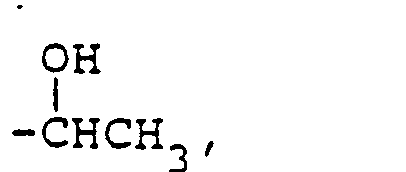


or a non-toxic pharmaceutically acceptable salt thereof.


or a non-toxic pharmaceutically acceptable salt thereof.

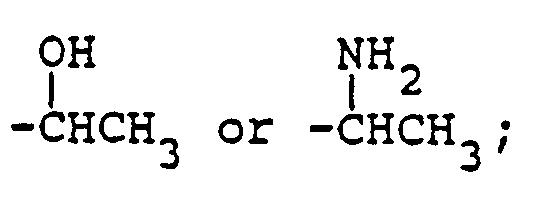
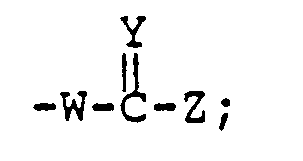


or a non-toxic pharmaceutically acceptable salt thereof.


or a non-toxic pharmaceutically acceptable salt thereof.


or a non-toxic pharmaceutically acceptable salt thereof.


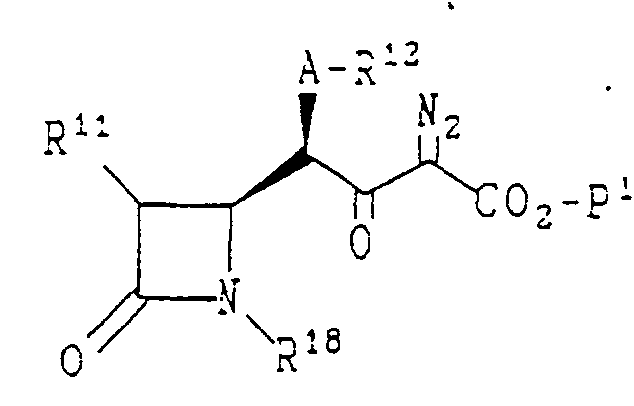


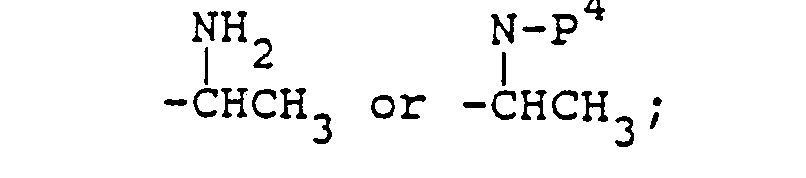


or a non-toxic pharmaceutically acceptable salt thereof.


or a non-toxic pharmaceutically acceptable salt thereof.


Applications Claiming Priority (4)
| Application Number | Priority Date | Filing Date | Title |
|---|---|---|---|
| US44601789A | 1989-12-04 | 1989-12-04 | |
| US446017 | 1989-12-04 | ||
| US61392190A | 1990-11-20 | 1990-11-20 | |
| US613921 | 1990-11-20 |
Publications (1)
| Publication Number | Publication Date |
|---|---|
| EP0433759A1 true EP0433759A1 (en) | 1991-06-26 |
Family
ID=27034476
Family Applications (1)
| Application Number | Title | Priority Date | Filing Date |
|---|---|---|---|
| EP90123258A Withdrawn EP0433759A1 (en) | 1989-12-04 | 1990-12-04 | 4-Substituted alkyl carbapenem antibiotics |
Country Status (13)
| Country | Link |
|---|---|
| EP (1) | EP0433759A1 (en) |
| KR (1) | KR910011856A (en) |
| AU (2) | AU643735B2 (en) |
| CA (1) | CA2031487A1 (en) |
| FI (1) | FI96311C (en) |
| HU (1) | HU213265B (en) |
| IE (1) | IE904348A1 (en) |
| IL (1) | IL96528A (en) |
| NO (1) | NO177640C (en) |
| NZ (1) | NZ236319A (en) |
| OA (1) | OA09333A (en) |
| PT (1) | PT96080B (en) |
| YU (1) | YU229290A (en) |
Cited By (3)
| Publication number | Priority date | Publication date | Assignee | Title |
|---|---|---|---|---|
| US5672701A (en) * | 1990-01-16 | 1997-09-30 | Bristol-Myers Squibb Company | 4-substituted alkyl carbapenem antibiotics |
| US5703243A (en) * | 1991-08-20 | 1997-12-30 | Shionogi Seiyaku Kabushiki Kaisha | Intermediates for pyrrolidylthiocarbapenem derivative |
| WO2012158843A2 (en) | 2011-05-17 | 2012-11-22 | The Regents Of The University Of California | Kinase inhibitors |
Families Citing this family (1)
| Publication number | Priority date | Publication date | Assignee | Title |
|---|---|---|---|---|
| NO20015844L (en) | 2001-11-30 | 2003-06-02 | Arne Kristiansen | Apparatus for producing a pressure potential over a body |
Citations (4)
| Publication number | Priority date | Publication date | Assignee | Title |
|---|---|---|---|---|
| US4312871A (en) * | 1979-12-03 | 1982-01-26 | Merck & Co., Inc. | 6-, 1- And 2-substituted-1-carbadethiapen-2-em-3-carboxylic acids |
| EP0160391A1 (en) * | 1984-03-27 | 1985-11-06 | Sankyo Company Limited | Carbapenem derivatives and compositions containing them |
| EP0235823A2 (en) * | 1986-03-06 | 1987-09-09 | Bristol-Myers Squibb Company | Carbapenem antibiotics, a process for preparing them and pharmaceutical compositions containing them |
| EP0336143A1 (en) * | 1988-03-23 | 1989-10-11 | Shionogi Seiyaku Kabushiki Kaisha | A new process for carbapenem intermediates |
Family Cites Families (1)
| Publication number | Priority date | Publication date | Assignee | Title |
|---|---|---|---|---|
| US5189158A (en) * | 1991-03-20 | 1993-02-23 | American Cyanamid Company | 4-substituted azetidinones as precursors to 2-substituted-3-carboxy carbapenem antibiotics and a method of producing them |
-
1990
- 1990-11-30 FI FI905912A patent/FI96311C/en not_active IP Right Cessation
- 1990-12-03 KR KR1019900019777A patent/KR910011856A/en not_active Ceased
- 1990-12-03 NZ NZ236319A patent/NZ236319A/en unknown
- 1990-12-03 NO NO905215A patent/NO177640C/en unknown
- 1990-12-03 IE IE434890A patent/IE904348A1/en unknown
- 1990-12-04 EP EP90123258A patent/EP0433759A1/en not_active Withdrawn
- 1990-12-04 CA CA002031487A patent/CA2031487A1/en not_active Abandoned
- 1990-12-04 PT PT96080A patent/PT96080B/en not_active IP Right Cessation
- 1990-12-04 IL IL9652890A patent/IL96528A/en not_active IP Right Cessation
- 1990-12-04 OA OA59911A patent/OA09333A/en unknown
- 1990-12-04 YU YU229290A patent/YU229290A/en unknown
- 1990-12-04 HU HU908046A patent/HU213265B/en not_active IP Right Cessation
- 1990-12-04 AU AU67688/90A patent/AU643735B2/en not_active Ceased
-
1993
- 1993-09-03 AU AU46117/93A patent/AU661192B2/en not_active Ceased
Patent Citations (4)
| Publication number | Priority date | Publication date | Assignee | Title |
|---|---|---|---|---|
| US4312871A (en) * | 1979-12-03 | 1982-01-26 | Merck & Co., Inc. | 6-, 1- And 2-substituted-1-carbadethiapen-2-em-3-carboxylic acids |
| EP0160391A1 (en) * | 1984-03-27 | 1985-11-06 | Sankyo Company Limited | Carbapenem derivatives and compositions containing them |
| EP0235823A2 (en) * | 1986-03-06 | 1987-09-09 | Bristol-Myers Squibb Company | Carbapenem antibiotics, a process for preparing them and pharmaceutical compositions containing them |
| EP0336143A1 (en) * | 1988-03-23 | 1989-10-11 | Shionogi Seiyaku Kabushiki Kaisha | A new process for carbapenem intermediates |
Cited By (4)
| Publication number | Priority date | Publication date | Assignee | Title |
|---|---|---|---|---|
| US5672701A (en) * | 1990-01-16 | 1997-09-30 | Bristol-Myers Squibb Company | 4-substituted alkyl carbapenem antibiotics |
| US5703243A (en) * | 1991-08-20 | 1997-12-30 | Shionogi Seiyaku Kabushiki Kaisha | Intermediates for pyrrolidylthiocarbapenem derivative |
| EP0528678B1 (en) * | 1991-08-20 | 2001-05-23 | SHIONOGI SEIYAKU KABUSHIKI KAISHA trading under the name of SHIONOGI & CO. LTD. | A pyrrolidylthiocarbapenem derivative with antibacterial activity |
| WO2012158843A2 (en) | 2011-05-17 | 2012-11-22 | The Regents Of The University Of California | Kinase inhibitors |
Also Published As
| Publication number | Publication date |
|---|---|
| IE904348A1 (en) | 1991-06-05 |
| FI96311C (en) | 1996-06-10 |
| HU213265B (en) | 1997-04-28 |
| FI905912L (en) | 1991-06-05 |
| PT96080B (en) | 1998-02-27 |
| AU643735B2 (en) | 1993-11-25 |
| NO177640B (en) | 1995-07-17 |
| OA09333A (en) | 1992-09-15 |
| HU908046D0 (en) | 1991-06-28 |
| IL96528A (en) | 1996-06-18 |
| CA2031487A1 (en) | 1991-06-05 |
| NZ236319A (en) | 1994-02-25 |
| AU4611793A (en) | 1993-12-02 |
| FI96311B (en) | 1996-02-29 |
| PT96080A (en) | 1991-09-30 |
| AU6768890A (en) | 1991-06-06 |
| NO177640C (en) | 1995-10-25 |
| YU229290A (en) | 1993-05-28 |
| NO905215L (en) | 1991-06-05 |
| AU661192B2 (en) | 1995-07-13 |
| HUT56371A (en) | 1991-08-28 |
| KR910011856A (en) | 1991-08-07 |
| NO905215D0 (en) | 1990-12-03 |
| FI905912A0 (en) | 1990-11-30 |
Similar Documents
| Publication | Publication Date | Title |
|---|---|---|
| EP0343499B1 (en) | 3-Pyrrolidinylthio-1-azabicyclo(3,2,0) hept-2-ene-2-carboxylic acid compounds | |
| US4925838A (en) | 3-pyrrolidinylthio-1-azabicyclo[3.2.0]-hept-2-ene-2-carboxylic acid compounds | |
| EP0337637B1 (en) | 2-(Heterocyclylthio)carbapenem derivatives their preparation and their use as antibiotics | |
| FI83419B (en) | FOERFARANDE FOER FRAMSTAELLNING AV SOM CEILING MODEL ANVAENDBARA 1,2,6-SUBSTITUERAD KARBAPEN-2-EM-3-CARBOXYLSYRA. | |
| US5608056A (en) | Substituted 3-pyrrolidinylthio-carbapenems as antimicrobial agents | |
| KR100247855B1 (en) | 1-methylcarbapenem derivatives, the process for preparing thereof and their use as antibiotics | |
| RU2247725C2 (en) | 1-methylcarbapenam derivatives | |
| RU2097383C1 (en) | Carbopenem derivatives and a method of their synthesis | |
| IE853300L (en) | Carbapenem compounds | |
| GB2128187A (en) | Carbapenem antibiotics | |
| US5194624A (en) | Intermediates for the preparation of compounds of antimicrobial activity | |
| AU643735B2 (en) | 4-substituted alkyl carbapenem antibiotics | |
| EP1340756B1 (en) | Novel beta-lactam compounds and process for producing the same | |
| CA2175054C (en) | 2-(pyrazol-3-yl)carbapenem derivatives | |
| JPH04368386A (en) | Production of 1-methylcarbapenem-3-carboxylic acid | |
| NZ247420A (en) | Azetidine derivatives as intermediates in the preparation of carbapenams, | |
| EP0469844A1 (en) | 2-(9-fluorenonyl)-carbapenem | |
| EP0341557A1 (en) | 3-pyrrolidinylthio-1-azabicyclo(3.2.0)-hept-2-ene-2-carboxylic acid derivatives and their preparation | |
| US5306816A (en) | Processes for preparing carbapenem derivatives | |
| EP0466253A1 (en) | 2-naphthyl-carbapenems | |
| EP0538017A1 (en) | 2-(N-Imidazoliumphenyl)-carbapenems | |
| EP0208889A1 (en) | 2-Aza-substituted 1-carbadethiapen-2-EM-3-carboxylic acids | |
| HU192431B (en) | Process for producing carbapeneme antibiotics | |
| JPH0379355B2 (en) | ||
| HU197904B (en) | Process for producing carbapenem antibiotics |
Legal Events
| Date | Code | Title | Description |
|---|---|---|---|
| PUAI | Public reference made under article 153(3) epc to a published international application that has entered the european phase |
Free format text: ORIGINAL CODE: 0009012 |
|
| AK | Designated contracting states |
Kind code of ref document: A1 Designated state(s): AT BE CH DE DK ES FR GB GR IT LI LU NL SE |
|
| 17P | Request for examination filed |
Effective date: 19911223 |
|
| 17Q | First examination report despatched |
Effective date: 19930916 |
|
| APAB | Appeal dossier modified |
Free format text: ORIGINAL CODE: EPIDOS NOAPE |
|
| APAB | Appeal dossier modified |
Free format text: ORIGINAL CODE: EPIDOS NOAPE |
|
| APAD | Appeal reference recorded |
Free format text: ORIGINAL CODE: EPIDOS REFNE |
|
| APAB | Appeal dossier modified |
Free format text: ORIGINAL CODE: EPIDOS NOAPE |
|
| STAA | Information on the status of an ep patent application or granted ep patent |
Free format text: STATUS: THE APPLICATION IS DEEMED TO BE WITHDRAWN |
|
| 18D | Application deemed to be withdrawn |
Effective date: 19980701 |
|
| APAF | Appeal reference modified |
Free format text: ORIGINAL CODE: EPIDOSCREFNE |