EP0430209B1 - Resin composition for cast polymerization - Google Patents
Resin composition for cast polymerization Download PDFInfo
- Publication number
- EP0430209B1 EP0430209B1 EP90122751A EP90122751A EP0430209B1 EP 0430209 B1 EP0430209 B1 EP 0430209B1 EP 90122751 A EP90122751 A EP 90122751A EP 90122751 A EP90122751 A EP 90122751A EP 0430209 B1 EP0430209 B1 EP 0430209B1
- Authority
- EP
- European Patent Office
- Prior art keywords
- meth
- acrylate
- diisocyanate
- glycol
- resin composition
- Prior art date
- Legal status (The legal status is an assumption and is not a legal conclusion. Google has not performed a legal analysis and makes no representation as to the accuracy of the status listed.)
- Expired - Lifetime
Links
- 239000011342 resin composition Substances 0.000 title claims description 34
- 238000006116 polymerization reaction Methods 0.000 title claims description 30
- NIXOWILDQLNWCW-UHFFFAOYSA-M Acrylate Chemical compound [O-]C(=O)C=C NIXOWILDQLNWCW-UHFFFAOYSA-M 0.000 claims description 102
- -1 polybutylene Polymers 0.000 claims description 57
- LYCAIKOWRPUZTN-UHFFFAOYSA-N Ethylene glycol Chemical compound OCCO LYCAIKOWRPUZTN-UHFFFAOYSA-N 0.000 claims description 54
- 238000006243 chemical reaction Methods 0.000 claims description 26
- WGCNASOHLSPBMP-UHFFFAOYSA-N hydroxyacetaldehyde Natural products OCC=O WGCNASOHLSPBMP-UHFFFAOYSA-N 0.000 claims description 26
- 150000001875 compounds Chemical class 0.000 claims description 22
- 229920001748 polybutylene Polymers 0.000 claims description 22
- 239000004593 Epoxy Substances 0.000 claims description 17
- CERQOIWHTDAKMF-UHFFFAOYSA-N Methacrylic acid Chemical compound CC(=C)C(O)=O CERQOIWHTDAKMF-UHFFFAOYSA-N 0.000 claims description 16
- 229920000193 polymethacrylate Polymers 0.000 claims description 16
- UHOVQNZJYSORNB-UHFFFAOYSA-N benzene Substances C1=CC=CC=C1 UHOVQNZJYSORNB-UHFFFAOYSA-N 0.000 claims description 11
- JOYRKODLDBILNP-UHFFFAOYSA-N Ethyl urethane Chemical compound CCOC(N)=O JOYRKODLDBILNP-UHFFFAOYSA-N 0.000 claims description 9
- SMZOUWXMTYCWNB-UHFFFAOYSA-N 2-(2-methoxy-5-methylphenyl)ethanamine Chemical compound COC1=CC=C(C)C=C1CCN SMZOUWXMTYCWNB-UHFFFAOYSA-N 0.000 claims description 8
- NIXOWILDQLNWCW-UHFFFAOYSA-N 2-Propenoic acid Natural products OC(=O)C=C NIXOWILDQLNWCW-UHFFFAOYSA-N 0.000 claims description 8
- VVQNEPGJFQJSBK-UHFFFAOYSA-N Methyl methacrylate Chemical compound COC(=O)C(C)=C VVQNEPGJFQJSBK-UHFFFAOYSA-N 0.000 claims description 8
- 125000002887 hydroxy group Chemical group [H]O* 0.000 claims description 8
- 239000005057 Hexamethylene diisocyanate Substances 0.000 claims description 7
- KXBFLNPZHXDQLV-UHFFFAOYSA-N [cyclohexyl(diisocyanato)methyl]cyclohexane Chemical compound C1CCCCC1C(N=C=O)(N=C=O)C1CCCCC1 KXBFLNPZHXDQLV-UHFFFAOYSA-N 0.000 claims description 7
- GYZLOYUZLJXAJU-UHFFFAOYSA-N diglycidyl ether Chemical compound C1OC1COCC1CO1 GYZLOYUZLJXAJU-UHFFFAOYSA-N 0.000 claims description 7
- RRAMGCGOFNQTLD-UHFFFAOYSA-N hexamethylene diisocyanate Chemical compound O=C=NCCCCCCN=C=O RRAMGCGOFNQTLD-UHFFFAOYSA-N 0.000 claims description 7
- 239000013638 trimer Substances 0.000 claims description 7
- PPBRXRYQALVLMV-UHFFFAOYSA-N Styrene Chemical compound C=CC1=CC=CC=C1 PPBRXRYQALVLMV-UHFFFAOYSA-N 0.000 claims description 6
- ATOUXIOKEJWULN-UHFFFAOYSA-N 1,6-diisocyanato-2,2,4-trimethylhexane Chemical compound O=C=NCCC(C)CC(C)(C)CN=C=O ATOUXIOKEJWULN-UHFFFAOYSA-N 0.000 claims description 5
- SOGAXMICEFXMKE-UHFFFAOYSA-N Butylmethacrylate Chemical compound CCCCOC(=O)C(C)=C SOGAXMICEFXMKE-UHFFFAOYSA-N 0.000 claims description 5
- 239000005058 Isophorone diisocyanate Substances 0.000 claims description 5
- 125000005442 diisocyanate group Chemical group 0.000 claims description 5
- NIMLQBUJDJZYEJ-UHFFFAOYSA-N isophorone diisocyanate Chemical compound CC1(C)CC(N=C=O)CC(C)(CN=C=O)C1 NIMLQBUJDJZYEJ-UHFFFAOYSA-N 0.000 claims description 5
- FKTHNVSLHLHISI-UHFFFAOYSA-N 1,2-bis(isocyanatomethyl)benzene Chemical compound O=C=NCC1=CC=CC=C1CN=C=O FKTHNVSLHLHISI-UHFFFAOYSA-N 0.000 claims description 4
- BPXVHIRIPLPOPT-UHFFFAOYSA-N 1,3,5-tris(2-hydroxyethyl)-1,3,5-triazinane-2,4,6-trione Chemical compound OCCN1C(=O)N(CCO)C(=O)N(CCO)C1=O BPXVHIRIPLPOPT-UHFFFAOYSA-N 0.000 claims description 4
- XFCMNSHQOZQILR-UHFFFAOYSA-N 2-[2-(2-methylprop-2-enoyloxy)ethoxy]ethyl 2-methylprop-2-enoate Chemical compound CC(=C)C(=O)OCCOCCOC(=O)C(C)=C XFCMNSHQOZQILR-UHFFFAOYSA-N 0.000 claims description 4
- ZJRAAAWYHORFHN-UHFFFAOYSA-N 2-[[2,6-dibromo-4-[2-[3,5-dibromo-4-(oxiran-2-ylmethoxy)phenyl]propan-2-yl]phenoxy]methyl]oxirane Chemical compound C=1C(Br)=C(OCC2OC2)C(Br)=CC=1C(C)(C)C(C=C1Br)=CC(Br)=C1OCC1CO1 ZJRAAAWYHORFHN-UHFFFAOYSA-N 0.000 claims description 4
- 125000000954 2-hydroxyethyl group Chemical group [H]C([*])([H])C([H])([H])O[H] 0.000 claims description 4
- VPWNQTHUCYMVMZ-UHFFFAOYSA-N 4,4'-sulfonyldiphenol Chemical compound C1=CC(O)=CC=C1S(=O)(=O)C1=CC=C(O)C=C1 VPWNQTHUCYMVMZ-UHFFFAOYSA-N 0.000 claims description 4
- 239000002253 acid Substances 0.000 claims description 4
- LUYHWJKHJNFYGV-UHFFFAOYSA-N 1,2-diisocyanato-3-phenylbenzene Chemical compound O=C=NC1=CC=CC(C=2C=CC=CC=2)=C1N=C=O LUYHWJKHJNFYGV-UHFFFAOYSA-N 0.000 claims description 3
- ZXHZWRZAWJVPIC-UHFFFAOYSA-N 1,2-diisocyanatonaphthalene Chemical compound C1=CC=CC2=C(N=C=O)C(N=C=O)=CC=C21 ZXHZWRZAWJVPIC-UHFFFAOYSA-N 0.000 claims description 3
- VGHSXKTVMPXHNG-UHFFFAOYSA-N 1,3-diisocyanatobenzene Chemical compound O=C=NC1=CC=CC(N=C=O)=C1 VGHSXKTVMPXHNG-UHFFFAOYSA-N 0.000 claims description 3
- OVBFMUAFNIIQAL-UHFFFAOYSA-N 1,4-diisocyanatobutane Chemical compound O=C=NCCCCN=C=O OVBFMUAFNIIQAL-UHFFFAOYSA-N 0.000 claims description 3
- JTINZFQXZLCHNS-UHFFFAOYSA-N 2,2-bis(oxiran-2-ylmethoxymethyl)butan-1-ol Chemical compound C1OC1COCC(CO)(CC)COCC1CO1 JTINZFQXZLCHNS-UHFFFAOYSA-N 0.000 claims description 3
- IVIDDMGBRCPGLJ-UHFFFAOYSA-N 2,3-bis(oxiran-2-ylmethoxy)propan-1-ol Chemical compound C1OC1COC(CO)COCC1CO1 IVIDDMGBRCPGLJ-UHFFFAOYSA-N 0.000 claims description 3
- SEFYJVFBMNOLBK-UHFFFAOYSA-N 2-[2-[2-(oxiran-2-ylmethoxy)ethoxy]ethoxymethyl]oxirane Chemical compound C1OC1COCCOCCOCC1CO1 SEFYJVFBMNOLBK-UHFFFAOYSA-N 0.000 claims description 3
- WTYYGFLRBWMFRY-UHFFFAOYSA-N 2-[6-(oxiran-2-ylmethoxy)hexoxymethyl]oxirane Chemical compound C1OC1COCCCCCCOCC1CO1 WTYYGFLRBWMFRY-UHFFFAOYSA-N 0.000 claims description 3
- UPMLOUAZCHDJJD-UHFFFAOYSA-N 4,4'-Diphenylmethane Diisocyanate Chemical compound C1=CC(N=C=O)=CC=C1CC1=CC=C(N=C=O)C=C1 UPMLOUAZCHDJJD-UHFFFAOYSA-N 0.000 claims description 3
- OMRDSWJXRLDPBB-UHFFFAOYSA-N N=C=O.N=C=O.C1CCCCC1 Chemical compound N=C=O.N=C=O.C1CCCCC1 OMRDSWJXRLDPBB-UHFFFAOYSA-N 0.000 claims description 3
- 239000007795 chemical reaction product Substances 0.000 claims description 3
- 239000000539 dimer Substances 0.000 claims description 3
- 125000004435 hydrogen atom Chemical group [H]* 0.000 claims description 3
- 125000002496 methyl group Chemical group [H]C([H])([H])* 0.000 claims description 3
- DVKJHBMWWAPEIU-UHFFFAOYSA-N toluene 2,4-diisocyanate Chemical compound CC1=CC=C(N=C=O)C=C1N=C=O DVKJHBMWWAPEIU-UHFFFAOYSA-N 0.000 claims description 3
- SYEWHONLFGZGLK-UHFFFAOYSA-N 2-[1,3-bis(oxiran-2-ylmethoxy)propan-2-yloxymethyl]oxirane Chemical compound C1OC1COCC(OCC1OC1)COCC1CO1 SYEWHONLFGZGLK-UHFFFAOYSA-N 0.000 claims description 2
- GZPRASLJQIBVDP-UHFFFAOYSA-N 2-[[4-[2-[4-(oxiran-2-ylmethoxy)cyclohexyl]propan-2-yl]cyclohexyl]oxymethyl]oxirane Chemical compound C1CC(OCC2OC2)CCC1C(C)(C)C(CC1)CCC1OCC1CO1 GZPRASLJQIBVDP-UHFFFAOYSA-N 0.000 claims description 2
- MECNWXGGNCJFQJ-UHFFFAOYSA-N 3-piperidin-1-ylpropane-1,2-diol Chemical compound OCC(O)CN1CCCCC1 MECNWXGGNCJFQJ-UHFFFAOYSA-N 0.000 claims description 2
- SAPGBCWOQLHKKZ-UHFFFAOYSA-N 6-(2-methylprop-2-enoyloxy)hexyl 2-methylprop-2-enoate Chemical compound CC(=C)C(=O)OCCCCCCOC(=O)C(C)=C SAPGBCWOQLHKKZ-UHFFFAOYSA-N 0.000 claims description 2
- 229910052739 hydrogen Inorganic materials 0.000 claims description 2
- 239000001257 hydrogen Substances 0.000 claims description 2
- 229940048053 acrylate Drugs 0.000 description 106
- YXFVVABEGXRONW-UHFFFAOYSA-N Toluene Chemical compound CC1=CC=CC=C1 YXFVVABEGXRONW-UHFFFAOYSA-N 0.000 description 24
- STVZJERGLQHEKB-UHFFFAOYSA-N ethylene glycol dimethacrylate Chemical compound CC(=C)C(=O)OCCOC(=O)C(C)=C STVZJERGLQHEKB-UHFFFAOYSA-N 0.000 description 22
- 239000000047 product Substances 0.000 description 18
- 229920000642 polymer Polymers 0.000 description 17
- XLYOFNOQVPJJNP-UHFFFAOYSA-N water Substances O XLYOFNOQVPJJNP-UHFFFAOYSA-N 0.000 description 15
- 230000000052 comparative effect Effects 0.000 description 14
- 238000010521 absorption reaction Methods 0.000 description 12
- RTZKZFJDLAIYFH-UHFFFAOYSA-N ether Substances CCOCC RTZKZFJDLAIYFH-UHFFFAOYSA-N 0.000 description 11
- 239000001294 propane Substances 0.000 description 11
- 230000003287 optical effect Effects 0.000 description 10
- 238000010438 heat treatment Methods 0.000 description 9
- 230000015572 biosynthetic process Effects 0.000 description 8
- 238000003786 synthesis reaction Methods 0.000 description 8
- 150000002148 esters Chemical class 0.000 description 6
- 239000012948 isocyanate Substances 0.000 description 6
- 239000005340 laminated glass Substances 0.000 description 6
- 239000000178 monomer Substances 0.000 description 6
- 229920003023 plastic Polymers 0.000 description 6
- 239000004033 plastic Substances 0.000 description 6
- 239000002202 Polyethylene glycol Substances 0.000 description 5
- 150000001732 carboxylic acid derivatives Chemical class 0.000 description 5
- 125000003055 glycidyl group Chemical group C(C1CO1)* 0.000 description 5
- 239000000203 mixture Substances 0.000 description 5
- 229920001223 polyethylene glycol Polymers 0.000 description 5
- 229920001451 polypropylene glycol Polymers 0.000 description 5
- LCFVJGUPQDGYKZ-UHFFFAOYSA-N Bisphenol A diglycidyl ether Chemical compound C=1C=C(OCC2OC2)C=CC=1C(C)(C)C(C=C1)=CC=C1OCC1CO1 LCFVJGUPQDGYKZ-UHFFFAOYSA-N 0.000 description 4
- 239000004721 Polyphenylene oxide Substances 0.000 description 4
- WYURNTSHIVDZCO-UHFFFAOYSA-N Tetrahydrofuran Chemical compound C1CCOC1 WYURNTSHIVDZCO-UHFFFAOYSA-N 0.000 description 4
- 125000003118 aryl group Chemical group 0.000 description 4
- 238000005266 casting Methods 0.000 description 4
- 239000003054 catalyst Substances 0.000 description 4
- NWVVVBRKAWDGAB-UHFFFAOYSA-N p-methoxyphenol Chemical compound COC1=CC=C(O)C=C1 NWVVVBRKAWDGAB-UHFFFAOYSA-N 0.000 description 4
- 229920000570 polyether Polymers 0.000 description 4
- 238000003756 stirring Methods 0.000 description 4
- WYGWHHGCAGTUCH-UHFFFAOYSA-N 2-[(2-cyano-4-methylpentan-2-yl)diazenyl]-2,4-dimethylpentanenitrile Chemical compound CC(C)CC(C)(C#N)N=NC(C)(C#N)CC(C)C WYGWHHGCAGTUCH-UHFFFAOYSA-N 0.000 description 3
- PEDCQBHIVMGVHV-UHFFFAOYSA-N Glycerine Chemical compound OCC(O)CO PEDCQBHIVMGVHV-UHFFFAOYSA-N 0.000 description 3
- OKKJLVBELUTLKV-UHFFFAOYSA-N Methanol Chemical compound OC OKKJLVBELUTLKV-UHFFFAOYSA-N 0.000 description 3
- 238000006482 condensation reaction Methods 0.000 description 3
- MTHSVFCYNBDYFN-UHFFFAOYSA-N diethylene glycol Chemical compound OCCOCCO MTHSVFCYNBDYFN-UHFFFAOYSA-N 0.000 description 3
- MKVYSRNJLWTVIK-UHFFFAOYSA-N ethyl carbamate;2-methylprop-2-enoic acid Chemical compound CCOC(N)=O.CC(=C)C(O)=O.CC(=C)C(O)=O MKVYSRNJLWTVIK-UHFFFAOYSA-N 0.000 description 3
- WGOQVOGFDLVJAW-UHFFFAOYSA-N ethyl carbamate;prop-2-enoic acid Chemical compound OC(=O)C=C.OC(=O)C=C.OC(=O)C=C.CCOC(N)=O WGOQVOGFDLVJAW-UHFFFAOYSA-N 0.000 description 3
- IQPQWNKOIGAROB-UHFFFAOYSA-N isocyanate group Chemical group [N-]=C=O IQPQWNKOIGAROB-UHFFFAOYSA-N 0.000 description 3
- 238000002156 mixing Methods 0.000 description 3
- 239000003505 polymerization initiator Substances 0.000 description 3
- PUPZLCDOIYMWBV-UHFFFAOYSA-N (+/-)-1,3-Butanediol Chemical compound CC(O)CCO PUPZLCDOIYMWBV-UHFFFAOYSA-N 0.000 description 2
- SZCWBURCISJFEZ-UHFFFAOYSA-N (3-hydroxy-2,2-dimethylpropyl) 3-hydroxy-2,2-dimethylpropanoate Chemical compound OCC(C)(C)COC(=O)C(C)(C)CO SZCWBURCISJFEZ-UHFFFAOYSA-N 0.000 description 2
- MYRTYDVEIRVNKP-UHFFFAOYSA-N 1,2-Divinylbenzene Chemical compound C=CC1=CC=CC=C1C=C MYRTYDVEIRVNKP-UHFFFAOYSA-N 0.000 description 2
- OZAIFHULBGXAKX-UHFFFAOYSA-N 2-(2-cyanopropan-2-yldiazenyl)-2-methylpropanenitrile Chemical compound N#CC(C)(C)N=NC(C)(C)C#N OZAIFHULBGXAKX-UHFFFAOYSA-N 0.000 description 2
- DXVLAUMXGHQKAV-UHFFFAOYSA-N 2-[2-[2-[2-[2-[2-[2-[2-(2-hydroxypropoxy)propoxy]propoxy]propoxy]propoxy]propoxy]propoxy]propoxy]propan-1-ol Chemical compound CC(O)COC(C)COC(C)COC(C)COC(C)COC(C)COC(C)COC(C)COC(C)CO DXVLAUMXGHQKAV-UHFFFAOYSA-N 0.000 description 2
- TXBCBTDQIULDIA-UHFFFAOYSA-N 2-[[3-hydroxy-2,2-bis(hydroxymethyl)propoxy]methyl]-2-(hydroxymethyl)propane-1,3-diol Chemical compound OCC(CO)(CO)COCC(CO)(CO)CO TXBCBTDQIULDIA-UHFFFAOYSA-N 0.000 description 2
- OMIGHNLMNHATMP-UHFFFAOYSA-N 2-hydroxyethyl prop-2-enoate Chemical compound OCCOC(=O)C=C OMIGHNLMNHATMP-UHFFFAOYSA-N 0.000 description 2
- VHSHLMUCYSAUQU-UHFFFAOYSA-N 2-hydroxypropyl methacrylate Chemical compound CC(O)COC(=O)C(C)=C VHSHLMUCYSAUQU-UHFFFAOYSA-N 0.000 description 2
- 125000003903 2-propenyl group Chemical group [H]C([*])([H])C([H])=C([H])[H] 0.000 description 2
- WGKYSFRFMQHMOF-UHFFFAOYSA-N 3-bromo-5-methylpyridine-2-carbonitrile Chemical compound CC1=CN=C(C#N)C(Br)=C1 WGKYSFRFMQHMOF-UHFFFAOYSA-N 0.000 description 2
- SXIFAEWFOJETOA-UHFFFAOYSA-N 4-hydroxy-butyl Chemical group [CH2]CCCO SXIFAEWFOJETOA-UHFFFAOYSA-N 0.000 description 2
- WKBOTKDWSSQWDR-UHFFFAOYSA-N Bromine atom Chemical compound [Br] WKBOTKDWSSQWDR-UHFFFAOYSA-N 0.000 description 2
- QIGBRXMKCJKVMJ-UHFFFAOYSA-N Hydroquinone Chemical compound OC1=CC=C(O)C=C1 QIGBRXMKCJKVMJ-UHFFFAOYSA-N 0.000 description 2
- WHNWPMSKXPGLAX-UHFFFAOYSA-N N-Vinyl-2-pyrrolidone Chemical compound C=CN1CCCC1=O WHNWPMSKXPGLAX-UHFFFAOYSA-N 0.000 description 2
- 229910019142 PO4 Inorganic materials 0.000 description 2
- ATUOYWHBWRKTHZ-UHFFFAOYSA-N Propane Chemical compound CCC ATUOYWHBWRKTHZ-UHFFFAOYSA-N 0.000 description 2
- QAOWNCQODCNURD-UHFFFAOYSA-N Sulfuric acid Chemical compound OS(O)(=O)=O QAOWNCQODCNURD-UHFFFAOYSA-N 0.000 description 2
- ZJCCRDAZUWHFQH-UHFFFAOYSA-N Trimethylolpropane Chemical compound CCC(CO)(CO)CO ZJCCRDAZUWHFQH-UHFFFAOYSA-N 0.000 description 2
- FKXJWELJXMKBDI-UHFFFAOYSA-K [butyl-di(dodecanoyloxy)stannyl] dodecanoate Chemical compound CCCCCCCCCCCC(=O)O[Sn](CCCC)(OC(=O)CCCCCCCCCCC)OC(=O)CCCCCCCCCCC FKXJWELJXMKBDI-UHFFFAOYSA-K 0.000 description 2
- 125000003647 acryloyl group Chemical group O=C([*])C([H])=C([H])[H] 0.000 description 2
- 238000007259 addition reaction Methods 0.000 description 2
- 239000000654 additive Substances 0.000 description 2
- WNLRTRBMVRJNCN-UHFFFAOYSA-N adipic acid Chemical compound OC(=O)CCCCC(O)=O WNLRTRBMVRJNCN-UHFFFAOYSA-N 0.000 description 2
- 125000001931 aliphatic group Chemical group 0.000 description 2
- 150000001346 alkyl aryl ethers Chemical class 0.000 description 2
- 238000010533 azeotropic distillation Methods 0.000 description 2
- KXHPPCXNWTUNSB-UHFFFAOYSA-M benzyl(trimethyl)azanium;chloride Chemical compound [Cl-].C[N+](C)(C)CC1=CC=CC=C1 KXHPPCXNWTUNSB-UHFFFAOYSA-M 0.000 description 2
- 230000005540 biological transmission Effects 0.000 description 2
- LLEMOWNGBBNAJR-UHFFFAOYSA-N biphenyl-2-ol Chemical compound OC1=CC=CC=C1C1=CC=CC=C1 LLEMOWNGBBNAJR-UHFFFAOYSA-N 0.000 description 2
- IISBACLAFKSPIT-UHFFFAOYSA-N bisphenol A Chemical compound C=1C=C(O)C=CC=1C(C)(C)C1=CC=C(O)C=C1 IISBACLAFKSPIT-UHFFFAOYSA-N 0.000 description 2
- PXKLMJQFEQBVLD-UHFFFAOYSA-N bisphenol F Chemical compound C1=CC(O)=CC=C1CC1=CC=C(O)C=C1 PXKLMJQFEQBVLD-UHFFFAOYSA-N 0.000 description 2
- GDTBXPJZTBHREO-UHFFFAOYSA-N bromine Substances BrBr GDTBXPJZTBHREO-UHFFFAOYSA-N 0.000 description 2
- 229910052794 bromium Inorganic materials 0.000 description 2
- 125000003178 carboxy group Chemical group [H]OC(*)=O 0.000 description 2
- 239000003795 chemical substances by application Substances 0.000 description 2
- GPLRAVKSCUXZTP-UHFFFAOYSA-N diglycerol Chemical compound OCC(O)COCC(O)CO GPLRAVKSCUXZTP-UHFFFAOYSA-N 0.000 description 2
- ZUOUZKKEUPVFJK-UHFFFAOYSA-N diphenyl Chemical compound C1=CC=CC=C1C1=CC=CC=C1 ZUOUZKKEUPVFJK-UHFFFAOYSA-N 0.000 description 2
- 238000009826 distribution Methods 0.000 description 2
- 125000005843 halogen group Chemical group 0.000 description 2
- 150000002430 hydrocarbons Chemical group 0.000 description 2
- 229910052751 metal Inorganic materials 0.000 description 2
- 239000002184 metal Substances 0.000 description 2
- SLCVBVWXLSEKPL-UHFFFAOYSA-N neopentyl glycol Chemical compound OCC(C)(C)CO SLCVBVWXLSEKPL-UHFFFAOYSA-N 0.000 description 2
- 229920000847 nonoxynol Polymers 0.000 description 2
- NBIIXXVUZAFLBC-UHFFFAOYSA-K phosphate Chemical compound [O-]P([O-])([O-])=O NBIIXXVUZAFLBC-UHFFFAOYSA-K 0.000 description 2
- 239000010452 phosphate Substances 0.000 description 2
- 230000000704 physical effect Effects 0.000 description 2
- 239000005056 polyisocyanate Substances 0.000 description 2
- 229920001228 polyisocyanate Polymers 0.000 description 2
- 238000013094 purity test Methods 0.000 description 2
- 239000000376 reactant Substances 0.000 description 2
- 238000007151 ring opening polymerisation reaction Methods 0.000 description 2
- 239000000243 solution Substances 0.000 description 2
- 238000012360 testing method Methods 0.000 description 2
- YLQBMQCUIZJEEH-UHFFFAOYSA-N tetrahydrofuran Natural products C=1C=COC=1 YLQBMQCUIZJEEH-UHFFFAOYSA-N 0.000 description 2
- 239000005341 toughened glass Substances 0.000 description 2
- 239000012780 transparent material Substances 0.000 description 2
- 238000005292 vacuum distillation Methods 0.000 description 2
- DTGKSKDOIYIVQL-WEDXCCLWSA-N (+)-borneol Chemical group C1C[C@@]2(C)[C@@H](O)C[C@@H]1C2(C)C DTGKSKDOIYIVQL-WEDXCCLWSA-N 0.000 description 1
- FVQMJJQUGGVLEP-UHFFFAOYSA-N (2-methylpropan-2-yl)oxy 2-ethylhexaneperoxoate Chemical compound CCCCC(CC)C(=O)OOOC(C)(C)C FVQMJJQUGGVLEP-UHFFFAOYSA-N 0.000 description 1
- 229920002818 (Hydroxyethyl)methacrylate Polymers 0.000 description 1
- 229940058015 1,3-butylene glycol Drugs 0.000 description 1
- UWFRVQVNYNPBEF-UHFFFAOYSA-N 1-(2,4-dimethylphenyl)propan-1-one Chemical compound CCC(=O)C1=CC=C(C)C=C1C UWFRVQVNYNPBEF-UHFFFAOYSA-N 0.000 description 1
- AYMDJPGTQFHDSA-UHFFFAOYSA-N 1-(2-ethenoxyethoxy)-2-ethoxyethane Chemical compound CCOCCOCCOC=C AYMDJPGTQFHDSA-UHFFFAOYSA-N 0.000 description 1
- IGGDKDTUCAWDAN-UHFFFAOYSA-N 1-vinylnaphthalene Chemical compound C1=CC=C2C(C=C)=CC=CC2=C1 IGGDKDTUCAWDAN-UHFFFAOYSA-N 0.000 description 1
- FGPFIXISGWXSCE-UHFFFAOYSA-N 2,2-bis(oxiran-2-ylmethoxymethyl)propane-1,3-diol Chemical compound C1OC1COCC(CO)(CO)COCC1CO1 FGPFIXISGWXSCE-UHFFFAOYSA-N 0.000 description 1
- BBBUAWSVILPJLL-UHFFFAOYSA-N 2-(2-ethylhexoxymethyl)oxirane Chemical compound CCCCC(CC)COCC1CO1 BBBUAWSVILPJLL-UHFFFAOYSA-N 0.000 description 1
- YSUQLAYJZDEMOT-UHFFFAOYSA-N 2-(butoxymethyl)oxirane Chemical compound CCCCOCC1CO1 YSUQLAYJZDEMOT-UHFFFAOYSA-N 0.000 description 1
- JKNCOURZONDCGV-UHFFFAOYSA-N 2-(dimethylamino)ethyl 2-methylprop-2-enoate Chemical compound CN(C)CCOC(=O)C(C)=C JKNCOURZONDCGV-UHFFFAOYSA-N 0.000 description 1
- HDPLHDGYGLENEI-UHFFFAOYSA-N 2-[1-(oxiran-2-ylmethoxy)propan-2-yloxymethyl]oxirane Chemical compound C1OC1COC(C)COCC1CO1 HDPLHDGYGLENEI-UHFFFAOYSA-N 0.000 description 1
- RQZUWSJHFBOFPI-UHFFFAOYSA-N 2-[1-[1-(oxiran-2-ylmethoxy)propan-2-yloxy]propan-2-yloxymethyl]oxirane Chemical compound C1OC1COC(C)COC(C)COCC1CO1 RQZUWSJHFBOFPI-UHFFFAOYSA-N 0.000 description 1
- KQFHZFMPTSHGLV-UHFFFAOYSA-N 2-[1-[1-[1-[1-(oxiran-2-ylmethoxy)propan-2-yloxy]propan-2-yloxy]propan-2-yloxy]propan-2-yloxymethyl]oxirane Chemical compound C1OC1COC(C)COC(C)COC(C)COC(C)COCC1CO1 KQFHZFMPTSHGLV-UHFFFAOYSA-N 0.000 description 1
- WMYINDVYGQKYMI-UHFFFAOYSA-N 2-[2,2-bis(hydroxymethyl)butoxymethyl]-2-ethylpropane-1,3-diol Chemical compound CCC(CO)(CO)COCC(CC)(CO)CO WMYINDVYGQKYMI-UHFFFAOYSA-N 0.000 description 1
- VSRMIIBCXRHPCC-UHFFFAOYSA-N 2-[2-[2-[2-[2-(oxiran-2-ylmethoxy)ethoxy]ethoxy]ethoxy]ethoxymethyl]oxirane Chemical compound C1OC1COCCOCCOCCOCCOCC1CO1 VSRMIIBCXRHPCC-UHFFFAOYSA-N 0.000 description 1
- JDPZLHCKBWMLDH-UHFFFAOYSA-N 2-[2-[2-[2-[2-[2-[2-[2-(2-prop-2-enoyloxyethoxy)ethoxy]ethoxy]ethoxy]ethoxy]ethoxy]ethoxy]ethoxy]ethyl prop-2-enoate Chemical compound C=CC(=O)OCCOCCOCCOCCOCCOCCOCCOCCOCCOC(=O)C=C JDPZLHCKBWMLDH-UHFFFAOYSA-N 0.000 description 1
- HLGNMOUJXWELKK-UHFFFAOYSA-N 2-[2-[2-[2-[2-[2-[2-[2-[2-(2-methylprop-2-enoyloxy)ethoxy]ethoxy]ethoxy]ethoxy]ethoxy]ethoxy]ethoxy]ethoxy]ethyl 2-methylprop-2-enoate Chemical compound CC(=C)C(=O)OCCOCCOCCOCCOCCOCCOCCOCCOCCOC(=O)C(C)=C HLGNMOUJXWELKK-UHFFFAOYSA-N 0.000 description 1
- HXEWWQYSYQOUSD-UHFFFAOYSA-N 2-[5-ethyl-5-(hydroxymethyl)-1,3-dioxan-2-yl]-2-methylpropan-1-ol Chemical compound CCC1(CO)COC(C(C)(C)CO)OC1 HXEWWQYSYQOUSD-UHFFFAOYSA-N 0.000 description 1
- KUAUJXBLDYVELT-UHFFFAOYSA-N 2-[[2,2-dimethyl-3-(oxiran-2-ylmethoxy)propoxy]methyl]oxirane Chemical compound C1OC1COCC(C)(C)COCC1CO1 KUAUJXBLDYVELT-UHFFFAOYSA-N 0.000 description 1
- PLDLPVSQYMQDBL-UHFFFAOYSA-N 2-[[3-(oxiran-2-ylmethoxy)-2,2-bis(oxiran-2-ylmethoxymethyl)propoxy]methyl]oxirane Chemical compound C1OC1COCC(COCC1OC1)(COCC1OC1)COCC1CO1 PLDLPVSQYMQDBL-UHFFFAOYSA-N 0.000 description 1
- AGXAFZNONAXBOS-UHFFFAOYSA-N 2-[[3-(oxiran-2-ylmethyl)phenyl]methyl]oxirane Chemical compound C=1C=CC(CC2OC2)=CC=1CC1CO1 AGXAFZNONAXBOS-UHFFFAOYSA-N 0.000 description 1
- FUYSWVDPJOQTDO-UHFFFAOYSA-N 2-[[7,7-dimethyl-11-(oxiran-2-ylmethoxy)tridecan-3-yl]oxymethyl]oxirane Chemical compound C1OC1COC(CC)CCCC(C)(C)CCCC(CC)OCC1CO1 FUYSWVDPJOQTDO-UHFFFAOYSA-N 0.000 description 1
- SBYMUDUGTIKLCR-UHFFFAOYSA-N 2-chloroethenylbenzene Chemical compound ClC=CC1=CC=CC=C1 SBYMUDUGTIKLCR-UHFFFAOYSA-N 0.000 description 1
- XMLYCEVDHLAQEL-UHFFFAOYSA-N 2-hydroxy-2-methyl-1-phenylpropan-1-one Chemical compound CC(C)(O)C(=O)C1=CC=CC=C1 XMLYCEVDHLAQEL-UHFFFAOYSA-N 0.000 description 1
- QCDWFXQBSFUVSP-UHFFFAOYSA-N 2-phenoxyethanol Chemical compound OCCOC1=CC=CC=C1 QCDWFXQBSFUVSP-UHFFFAOYSA-N 0.000 description 1
- 229940061334 2-phenylphenol Drugs 0.000 description 1
- KXYAVSFOJVUIHT-UHFFFAOYSA-N 2-vinylnaphthalene Chemical compound C1=CC=CC2=CC(C=C)=CC=C21 KXYAVSFOJVUIHT-UHFFFAOYSA-N 0.000 description 1
- VTPXYFSCMLIIFK-UHFFFAOYSA-N 3-(oxiran-2-ylmethoxy)-2,2-bis(oxiran-2-ylmethoxymethyl)propan-1-ol Chemical compound C1OC1COCC(COCC1OC1)(CO)COCC1CO1 VTPXYFSCMLIIFK-UHFFFAOYSA-N 0.000 description 1
- SKKHNUKNMQLBTJ-UHFFFAOYSA-N 3-bicyclo[2.2.1]heptanyl 2-methylprop-2-enoate Chemical compound C1CC2C(OC(=O)C(=C)C)CC1C2 SKKHNUKNMQLBTJ-UHFFFAOYSA-N 0.000 description 1
- 239000004342 Benzoyl peroxide Substances 0.000 description 1
- OMPJBNCRMGITSC-UHFFFAOYSA-N Benzoylperoxide Chemical compound C=1C=CC=CC=1C(=O)OOC(=O)C1=CC=CC=C1 OMPJBNCRMGITSC-UHFFFAOYSA-N 0.000 description 1
- HOPKZRBGDGXKSX-UHFFFAOYSA-N C(CCC)C(C([O-])(CCCC)CCCC)(CC)CCCC.[Ti+4].C(CCC)C(C([O-])(CCCC)CCCC)(CC)CCCC.C(CCC)C(C([O-])(CCCC)CCCC)(CC)CCCC.C(CCC)C(C([O-])(CCCC)CCCC)(CC)CCCC Chemical compound C(CCC)C(C([O-])(CCCC)CCCC)(CC)CCCC.[Ti+4].C(CCC)C(C([O-])(CCCC)CCCC)(CC)CCCC.C(CCC)C(C([O-])(CCCC)CCCC)(CC)CCCC.C(CCC)C(C([O-])(CCCC)CCCC)(CC)CCCC HOPKZRBGDGXKSX-UHFFFAOYSA-N 0.000 description 1
- GAWIXWVDTYZWAW-UHFFFAOYSA-N C[CH]O Chemical group C[CH]O GAWIXWVDTYZWAW-UHFFFAOYSA-N 0.000 description 1
- FBPFZTCFMRRESA-FSIIMWSLSA-N D-Glucitol Natural products OC[C@H](O)[C@H](O)[C@@H](O)[C@H](O)CO FBPFZTCFMRRESA-FSIIMWSLSA-N 0.000 description 1
- FBPFZTCFMRRESA-JGWLITMVSA-N D-glucitol Chemical compound OC[C@H](O)[C@@H](O)[C@H](O)[C@H](O)CO FBPFZTCFMRRESA-JGWLITMVSA-N 0.000 description 1
- SJIXRGNQPBQWMK-UHFFFAOYSA-N DEAEMA Natural products CCN(CC)CCOC(=O)C(C)=C SJIXRGNQPBQWMK-UHFFFAOYSA-N 0.000 description 1
- 239000004641 Diallyl-phthalate Substances 0.000 description 1
- BRLQWZUYTZBJKN-UHFFFAOYSA-N Epichlorohydrin Chemical compound ClCC1CO1 BRLQWZUYTZBJKN-UHFFFAOYSA-N 0.000 description 1
- IAYPIBMASNFSPL-UHFFFAOYSA-N Ethylene oxide Chemical compound C1CO1 IAYPIBMASNFSPL-UHFFFAOYSA-N 0.000 description 1
- WOBHKFSMXKNTIM-UHFFFAOYSA-N Hydroxyethyl methacrylate Chemical compound CC(=C)C(=O)OCCO WOBHKFSMXKNTIM-UHFFFAOYSA-N 0.000 description 1
- FQYUMYWMJTYZTK-UHFFFAOYSA-N Phenyl glycidyl ether Chemical compound C1OC1COC1=CC=CC=C1 FQYUMYWMJTYZTK-UHFFFAOYSA-N 0.000 description 1
- GOOHAUXETOMSMM-UHFFFAOYSA-N Propylene oxide Chemical compound CC1CO1 GOOHAUXETOMSMM-UHFFFAOYSA-N 0.000 description 1
- 229920000297 Rayon Polymers 0.000 description 1
- 229910000831 Steel Inorganic materials 0.000 description 1
- ATJFFYVFTNAWJD-UHFFFAOYSA-N Tin Chemical compound [Sn] ATJFFYVFTNAWJD-UHFFFAOYSA-N 0.000 description 1
- RTAQQCXQSZGOHL-UHFFFAOYSA-N Titanium Chemical compound [Ti] RTAQQCXQSZGOHL-UHFFFAOYSA-N 0.000 description 1
- OKKRPWIIYQTPQF-UHFFFAOYSA-N Trimethylolpropane trimethacrylate Chemical compound CC(=C)C(=O)OCC(CC)(COC(=O)C(C)=C)COC(=O)C(C)=C OKKRPWIIYQTPQF-UHFFFAOYSA-N 0.000 description 1
- 239000007983 Tris buffer Substances 0.000 description 1
- HCHKCACWOHOZIP-UHFFFAOYSA-N Zinc Chemical compound [Zn] HCHKCACWOHOZIP-UHFFFAOYSA-N 0.000 description 1
- YMOONIIMQBGTDU-VOTSOKGWSA-N [(e)-2-bromoethenyl]benzene Chemical compound Br\C=C\C1=CC=CC=C1 YMOONIIMQBGTDU-VOTSOKGWSA-N 0.000 description 1
- UKLDJPRMSDWDSL-UHFFFAOYSA-L [dibutyl(dodecanoyloxy)stannyl] dodecanoate Chemical compound CCCCCCCCCCCC(=O)O[Sn](CCCC)(CCCC)OC(=O)CCCCCCCCCCC UKLDJPRMSDWDSL-UHFFFAOYSA-L 0.000 description 1
- 239000006096 absorbing agent Substances 0.000 description 1
- 150000008065 acid anhydrides Chemical class 0.000 description 1
- 150000001252 acrylic acid derivatives Chemical class 0.000 description 1
- 125000005073 adamantyl group Chemical group C12(CC3CC(CC(C1)C3)C2)* 0.000 description 1
- 235000011037 adipic acid Nutrition 0.000 description 1
- 239000001361 adipic acid Substances 0.000 description 1
- 125000002723 alicyclic group Chemical group 0.000 description 1
- 125000003277 amino group Chemical group 0.000 description 1
- 229910052787 antimony Inorganic materials 0.000 description 1
- WATWJIUSRGPENY-UHFFFAOYSA-N antimony atom Chemical compound [Sb] WATWJIUSRGPENY-UHFFFAOYSA-N 0.000 description 1
- 239000003963 antioxidant agent Substances 0.000 description 1
- 230000003078 antioxidant effect Effects 0.000 description 1
- 229910052788 barium Inorganic materials 0.000 description 1
- DSAJWYNOEDNPEQ-UHFFFAOYSA-N barium atom Chemical compound [Ba] DSAJWYNOEDNPEQ-UHFFFAOYSA-N 0.000 description 1
- 235000019400 benzoyl peroxide Nutrition 0.000 description 1
- 125000001797 benzyl group Chemical group [H]C1=C([H])C([H])=C(C([H])=C1[H])C([H])([H])* 0.000 description 1
- 235000010290 biphenyl Nutrition 0.000 description 1
- 239000004305 biphenyl Substances 0.000 description 1
- VBOAJKNHWJRWGY-UHFFFAOYSA-N bis(2-methylprop-2-enoyl) benzene-1,2-dicarboxylate Chemical compound CC(=C)C(=O)OC(=O)C1=CC=CC=C1C(=O)OC(=O)C(C)=C VBOAJKNHWJRWGY-UHFFFAOYSA-N 0.000 description 1
- QUDWYFHPNIMBFC-UHFFFAOYSA-N bis(prop-2-enyl) benzene-1,2-dicarboxylate Chemical compound C=CCOC(=O)C1=CC=CC=C1C(=O)OCC=C QUDWYFHPNIMBFC-UHFFFAOYSA-N 0.000 description 1
- SYFOAKAXGNMQAX-UHFFFAOYSA-N bis(prop-2-enyl) carbonate;2-(2-hydroxyethoxy)ethanol Chemical compound OCCOCCO.C=CCOC(=O)OCC=C SYFOAKAXGNMQAX-UHFFFAOYSA-N 0.000 description 1
- XUCHXOAWJMEFLF-UHFFFAOYSA-N bisphenol F diglycidyl ether Chemical compound C1OC1COC(C=C1)=CC=C1CC(C=C1)=CC=C1OCC1CO1 XUCHXOAWJMEFLF-UHFFFAOYSA-N 0.000 description 1
- 125000006278 bromobenzyl group Chemical group 0.000 description 1
- 125000004799 bromophenyl group Chemical group 0.000 description 1
- 235000019437 butane-1,3-diol Nutrition 0.000 description 1
- WERYXYBDKMZEQL-UHFFFAOYSA-N butane-1,4-diol Chemical compound OCCCCO WERYXYBDKMZEQL-UHFFFAOYSA-N 0.000 description 1
- 125000006226 butoxyethyl group Chemical group 0.000 description 1
- 125000004803 chlorobenzyl group Chemical group 0.000 description 1
- 238000009833 condensation Methods 0.000 description 1
- 230000005494 condensation Effects 0.000 description 1
- 238000004132 cross linking Methods 0.000 description 1
- 125000000113 cyclohexyl group Chemical group [H]C1([H])C([H])([H])C([H])([H])C([H])(*)C([H])([H])C1([H])[H] 0.000 description 1
- 125000001511 cyclopentyl group Chemical group [H]C1([H])C([H])([H])C([H])([H])C([H])(*)C1([H])[H] 0.000 description 1
- 150000002009 diols Chemical class 0.000 description 1
- 125000003438 dodecyl group Chemical group [H]C([H])([H])C([H])([H])C([H])([H])C([H])([H])C([H])([H])C([H])([H])C([H])([H])C([H])([H])C([H])([H])C([H])([H])C([H])([H])C([H])([H])* 0.000 description 1
- 230000000694 effects Effects 0.000 description 1
- 125000003700 epoxy group Chemical group 0.000 description 1
- SUPCQIBBMFXVTL-UHFFFAOYSA-N ethyl 2-methylprop-2-enoate Chemical compound CCOC(=O)C(C)=C SUPCQIBBMFXVTL-UHFFFAOYSA-N 0.000 description 1
- 125000001495 ethyl group Chemical group [H]C([H])([H])C([H])([H])* 0.000 description 1
- ZZUFCTLCJUWOSV-UHFFFAOYSA-N furosemide Chemical compound C1=C(Cl)C(S(=O)(=O)N)=CC(C(O)=O)=C1NCC1=CC=CO1 ZZUFCTLCJUWOSV-UHFFFAOYSA-N 0.000 description 1
- 239000011521 glass Substances 0.000 description 1
- VOZRXNHHFUQHIL-UHFFFAOYSA-N glycidyl methacrylate Chemical compound CC(=C)C(=O)OCC1CO1 VOZRXNHHFUQHIL-UHFFFAOYSA-N 0.000 description 1
- 238000010348 incorporation Methods 0.000 description 1
- 239000003112 inhibitor Substances 0.000 description 1
- 239000003999 initiator Substances 0.000 description 1
- 230000001678 irradiating effect Effects 0.000 description 1
- 125000000959 isobutyl group Chemical group [H]C([H])([H])C([H])(C([H])([H])[H])C([H])([H])* 0.000 description 1
- 150000002513 isocyanates Chemical class 0.000 description 1
- ZFSLODLOARCGLH-UHFFFAOYSA-N isocyanuric acid Chemical compound OC1=NC(O)=NC(O)=N1 ZFSLODLOARCGLH-UHFFFAOYSA-N 0.000 description 1
- 238000004519 manufacturing process Methods 0.000 description 1
- 239000000463 material Substances 0.000 description 1
- 125000005394 methallyl group Chemical group 0.000 description 1
- 238000000034 method Methods 0.000 description 1
- 238000012986 modification Methods 0.000 description 1
- 230000004048 modification Effects 0.000 description 1
- 239000012778 molding material Substances 0.000 description 1
- 125000004108 n-butyl group Chemical group [H]C([H])([H])C([H])([H])C([H])([H])C([H])([H])* 0.000 description 1
- 125000001280 n-hexyl group Chemical group C(CCCCC)* 0.000 description 1
- 125000001624 naphthyl group Chemical group 0.000 description 1
- 150000001451 organic peroxides Chemical class 0.000 description 1
- 235000010292 orthophenyl phenol Nutrition 0.000 description 1
- WXZMFSXDPGVJKK-UHFFFAOYSA-N pentaerythritol Chemical compound OCC(CO)(CO)CO WXZMFSXDPGVJKK-UHFFFAOYSA-N 0.000 description 1
- JLFNLZLINWHATN-UHFFFAOYSA-N pentaethylene glycol Chemical compound OCCOCCOCCOCCOCCO JLFNLZLINWHATN-UHFFFAOYSA-N 0.000 description 1
- 125000001147 pentyl group Chemical group C(CCCC)* 0.000 description 1
- 125000001997 phenyl group Chemical group [H]C1=C([H])C([H])=C(*)C([H])=C1[H] 0.000 description 1
- XNGIFLGASWRNHJ-UHFFFAOYSA-N phthalic acid Chemical compound OC(=O)C1=CC=CC=C1C(O)=O XNGIFLGASWRNHJ-UHFFFAOYSA-N 0.000 description 1
- 239000000049 pigment Substances 0.000 description 1
- 229920001610 polycaprolactone Polymers 0.000 description 1
- 239000004632 polycaprolactone Substances 0.000 description 1
- 229920000515 polycarbonate Polymers 0.000 description 1
- 239000004417 polycarbonate Substances 0.000 description 1
- 229920000728 polyester Polymers 0.000 description 1
- 239000004814 polyurethane Substances 0.000 description 1
- 229920002635 polyurethane Polymers 0.000 description 1
- FBCQUCJYYPMKRO-UHFFFAOYSA-N prop-2-enyl 2-methylprop-2-enoate Chemical compound CC(=C)C(=O)OCC=C FBCQUCJYYPMKRO-UHFFFAOYSA-N 0.000 description 1
- HJWLCRVIBGQPNF-UHFFFAOYSA-N prop-2-enylbenzene Chemical compound C=CCC1=CC=CC=C1 HJWLCRVIBGQPNF-UHFFFAOYSA-N 0.000 description 1
- 125000001436 propyl group Chemical group [H]C([*])([H])C([H])([H])C([H])([H])[H] 0.000 description 1
- 238000007142 ring opening reaction Methods 0.000 description 1
- 150000003839 salts Chemical class 0.000 description 1
- 229920006395 saturated elastomer Polymers 0.000 description 1
- 239000000600 sorbitol Substances 0.000 description 1
- 125000004079 stearyl group Chemical group [H]C([*])([H])C([H])([H])C([H])([H])C([H])([H])C([H])([H])C([H])([H])C([H])([H])C([H])([H])C([H])([H])C([H])([H])C([H])([H])C([H])([H])C([H])([H])C([H])([H])C([H])([H])C([H])([H])C([H])([H])C([H])([H])[H] 0.000 description 1
- 239000010959 steel Substances 0.000 description 1
- 125000000999 tert-butyl group Chemical group [H]C([H])([H])C(*)(C([H])([H])[H])C([H])([H])[H] 0.000 description 1
- ILLKMACMBHTSHP-UHFFFAOYSA-N tetradecaethylene glycol Chemical compound OCCOCCOCCOCCOCCOCCOCCOCCOCCOCCOCCOCCOCCOCCO ILLKMACMBHTSHP-UHFFFAOYSA-N 0.000 description 1
- UWHCKJMYHZGTIT-UHFFFAOYSA-N tetraethylene glycol Chemical compound OCCOCCOCCOCCO UWHCKJMYHZGTIT-UHFFFAOYSA-N 0.000 description 1
- 229910052718 tin Inorganic materials 0.000 description 1
- 239000011135 tin Substances 0.000 description 1
- 239000010936 titanium Substances 0.000 description 1
- 229910052719 titanium Inorganic materials 0.000 description 1
- 125000003944 tolyl group Chemical group 0.000 description 1
- ZIBGPFATKBEMQZ-UHFFFAOYSA-N triethylene glycol Chemical compound OCCOCCOCCO ZIBGPFATKBEMQZ-UHFFFAOYSA-N 0.000 description 1
- 125000000391 vinyl group Chemical group [H]C([*])=C([H])[H] 0.000 description 1
- 230000004584 weight gain Effects 0.000 description 1
- 235000019786 weight gain Nutrition 0.000 description 1
- 229910052725 zinc Inorganic materials 0.000 description 1
- 239000011701 zinc Substances 0.000 description 1
- PAPBSGBWRJIAAV-UHFFFAOYSA-N ε-Caprolactone Chemical compound O=C1CCCCCO1 PAPBSGBWRJIAAV-UHFFFAOYSA-N 0.000 description 1
Classifications
-
- C—CHEMISTRY; METALLURGY
- C08—ORGANIC MACROMOLECULAR COMPOUNDS; THEIR PREPARATION OR CHEMICAL WORKING-UP; COMPOSITIONS BASED THEREON
- C08F—MACROMOLECULAR COMPOUNDS OBTAINED BY REACTIONS ONLY INVOLVING CARBON-TO-CARBON UNSATURATED BONDS
- C08F20/00—Homopolymers and copolymers of compounds having one or more unsaturated aliphatic radicals, each having only one carbon-to-carbon double bond, and only one being terminated by only one carboxyl radical or a salt, anhydride, ester, amide, imide or nitrile thereof
- C08F20/02—Monocarboxylic acids having less than ten carbon atoms, Derivatives thereof
- C08F20/10—Esters
- C08F20/12—Esters of monohydric alcohols or phenols
-
- C—CHEMISTRY; METALLURGY
- C08—ORGANIC MACROMOLECULAR COMPOUNDS; THEIR PREPARATION OR CHEMICAL WORKING-UP; COMPOSITIONS BASED THEREON
- C08F—MACROMOLECULAR COMPOUNDS OBTAINED BY REACTIONS ONLY INVOLVING CARBON-TO-CARBON UNSATURATED BONDS
- C08F290/00—Macromolecular compounds obtained by polymerising monomers on to polymers modified by introduction of aliphatic unsaturated end or side groups
- C08F290/02—Macromolecular compounds obtained by polymerising monomers on to polymers modified by introduction of aliphatic unsaturated end or side groups on to polymers modified by introduction of unsaturated end groups
- C08F290/06—Polymers provided for in subclass C08G
- C08F290/062—Polyethers
-
- C—CHEMISTRY; METALLURGY
- C08—ORGANIC MACROMOLECULAR COMPOUNDS; THEIR PREPARATION OR CHEMICAL WORKING-UP; COMPOSITIONS BASED THEREON
- C08F—MACROMOLECULAR COMPOUNDS OBTAINED BY REACTIONS ONLY INVOLVING CARBON-TO-CARBON UNSATURATED BONDS
- C08F22/00—Homopolymers and copolymers of compounds having one or more unsaturated aliphatic radicals each having only one carbon-to-carbon double bond, and at least one being terminated by a carboxyl radical and containing at least one other carboxyl radical in the molecule; Salts, anhydrides, esters, amides, imides or nitriles thereof
- C08F22/10—Esters
- C08F22/1006—Esters of polyhydric alcohols or polyhydric phenols, e.g. ethylene glycol dimethacrylate
-
- G—PHYSICS
- G02—OPTICS
- G02B—OPTICAL ELEMENTS, SYSTEMS OR APPARATUS
- G02B1/00—Optical elements characterised by the material of which they are made; Optical coatings for optical elements
- G02B1/04—Optical elements characterised by the material of which they are made; Optical coatings for optical elements made of organic materials, e.g. plastics
Definitions
- the present invention relates to a resin composition for cast polymerization containing polybutylene glycol dimethacrylate. More particularly, the present invention relates to a resin composition for cast polymerization containing polybutylene glycol dimethacrylate, which are useful for the production of plastics having high heat resistance, good flexibility, and low water absorption.
- plastics find use in a variety of fields as molding materials, optical lenses, optical discs, electric and electronic parts, film, machine parts, and laminated glass.
- Plastics for these applications are required to have improved toughness, flexibility, and impact resistance. This requirement is met by incorporating polymer chains with polyether, polyurethane, polyester, or polycarbonate which has an elastic structure. The incorporation is carried out in the stage of monomer or oligomer prior to polymerization.
- plastics are required to be moisture-resistant. This requirement is met by incorporating polymer molecules with hydrocarbon chains, aromatic rings, halogen atoms. etc.
- polymer In the case where a polymer is produced by cast polymerization, it is desirable to use a monomer of low viscosity for good workability. This requirement is met when the polymer molecular chain has the polyether structure which is highly elastic. This polyether structure is imparted by polyethylene glycol di(meth)acrylate or polypropylene glycol di(meth)acrylate. The flexibility of polymer increases in proportion to the number of such repeating units as ethylene oxide and propylene oxide contained therein.
- the resulting polymer lacks flexibility.
- the requirement for flexibility is met by the above-mentioned polyethylene glycol di(meth)acrylate for cast polymerization which has the polyether structure. This polymer, however, has a water absorption as high as 10-20%.
- the present invention was completed to eliminate the above-mentioned disadvantages. Accordingly, it is an object of the present invention to provide a resin composition for cast polymerization which yields a molded product having both good flexibility and low water absorption, without loss of impact resistance, heat resistance and surface hardness.
- the polybutylene glycol dimethacrylate is represented by the general formula below. (where n is an integer of 5 to 16.)
- the resin composition for cast polymerization pertaining to the present invention is composed of:
- the polybutylene glycol dimethacrylate is polybutylene glycol having a degree of polymerization in the range of 5 to 16, with its both terminals blocked with methacrylic acid.
- the degree of polymerization denotes the number of repeating units represented by the formula (CH2CH2CH2CH2O), and it should be in the range of 5 to 16 according to the present invention. With a degree of polymerization smaller than 5, it yields a polymer which lacks sufficient flexibility. With a degree of polymerization greater than 16, it yields a polymer which has a high water absorption and viscosity and a low crosslinking density and hardness and is poor in heat resistance and workability.
- the degree of polymerization should preferably be in the range 7 to 12. Needless to say, the polybutylene glycol dimethacrylate is a mixture of species which differ in molecular-weight distribution.
- the polybutylene glycol methacrylate includes, for example, pentabutylene glycol dimethacrylate, hexabutylene glycol dimethacrylate, heptabutylene glycol dimethacrylate, octabutylene glycol dimethacrylate, nonabutylene glycol dimethacrylate, decabutylene glycol dimethacrylate, undecabutylene glycol dimethacrylate, dodecabutylene glycol dimethacrylate, tridecabutylene glycol dimethacrylate, tetradecabutylene glycol dimethacrylate, pentadecabutylene glycol dimethacrylate, and hexadecabutylene glycol dimethacrylate.
- the polybutylene glycol dimethacrylate can be easily produced by the condensation reaction between polybutylene glycol (which is obtained by the ring-opening polymerization of tetrahydrofuran) and methacrylic acid, or by the ester interchange reaction between polybutylene glycol and methyl methacrylate. Which to choose depends on the end use of the polymer. If the polymer is to be made into a transparent material, it is necessary to choose the ester interchange reaction which gives rise to a colorless transparent monomer.
- the present invention covers resin composition for casing. It is composed of component (a) and component (b).
- Component (a) is at least one compound selected from the group consisting of urethane poly(meth)-acrylate having two or more (meth)acryloyloxy groups in one molecule and epoxy poly(meth)acrylate having two or more (meth)acryloyloxy groups in one molecule.
- the urethane poly(meth)acrylate includes those products which are formed by reaction between a hydroxyl group-containing (meth)acrylate and an isocyanate compound having at least two isocyanate groups in the molecule.
- Component (a) enhances the heat resistance imparted by component (b) which is polybutylene glycol di(meth)acrylate.
- isocyanate compound having at least two isocyanate groups in the molecule examples include aliphatic, aromatic, and alicyclic isocyanates such as tetramethylene diisocyanate, hexamethylene diisocyanate, 2,2,4-trimethylhexamethylene diisocyanate, dimer acid diisocyanate, cyclohexane diisocyanate, isophorone diisocyanate, tolylene diisocyanate, xylylene diisocyanate, 1,3-bis-( ⁇ , ⁇ -dimethylisocyanatemethyl)benzene, diphenylmethane diisocyanate, m-phenylene diisocyanate, dicyclohexylmethane diisocyanate, naphthalene diisocyanate, and biphenyl diisocyanate.
- aliphatic, aromatic, and alicyclic isocyanates such as tetramethylene diisocyanate, hexamethylene di
- isocyanate compound examples include those compounds having at least two isocyanate groups in the molecule, which are formed by the reaction of one of said isocyanates with a compound having at least two active hydrogen atoms in the form of amino group, hydroxyl group, carboxyl group, or water.
- the above-mentioned diisocyanate compounds may be used in the form of trimer, tetramer, or pentamer.
- hydroxyl group-containing (meth)acrylate such as 2-hydroxyethyl (meth)-acrylate, 2-hydroxypropy
- the addition reaction between polyisocyanate and hydroxyl group-containing (meth)acrylate may be accomplished by any known process which consists of adding dropwise a mixture of hydroxyl group-containing (meth)-acrylate and a catalyst (such as di-n-butyl tin dilaurate) to an isocyanate compound at 50-90°C.
- a catalyst such as di-n-butyl tin dilaurate
- the urethane poly(meth)acrylates may be used individually or in combination with one another. Those which are preferable from the standpoint of clarity and heat resistance of cast products are adducts of 2-hydroxyethyl (meth)acrylate or 2-hydroxypropyl (meth)acrylate with isophorone diisocyanate, trimer of hexamethylene diisocyanate, 2,2,4-trimethylhexamethylene diisocyanate, dicyclohexylmethane diisocyanate, 1,3-bis( ⁇ , ⁇ -dimethyl-isocyanatemethyl)benzene, or xylylene diisocyanate.
- component (a) which is epoxy poly(meth)acrylate
- component (b) is polybutylene glycol di(meth)acrylate.
- the epoxy compound having at least two glycidyl groups in the molecule includes the following. Aliphatic and alicyclic epoxy compounds such as 1,6-hexanediol diglycidyl ether, ethylene glycol diglycidyl ether, diethylene glycol diglycidyl ether, tetraethylene glycol diglycidyl ether, nonaethylene glycol diglycidyl ether, propylene glycol diglycidyl ether, dipropylene glycol diglycidyl ether, tetrapropylene glycol diglycidyl ether, nonapropylene glycol diglycidyl ether, neopentyl glycol diglycidyl ether, diglycidyl ether of neopentyl glycol hydroxypivalate ester, trimethylolpropane diglycidyl ether, trimethylolpropane triglycidyl ether, glycerol diglycidyl ether, gly
- Aromatic epoxy compounds such as resorcin diglycidyl ether, bisphenol A diglycidyl ether, bisphenol F diglycidyl ether, bisphenol S diglycidyl ether (which are obtained by condensation of epichlorohydrin with bisphenol A, bisphenol F, and bisphenol S, respectively), tetrabromobisphenol A diglycidyl ether, orthophthalic acid diglycidyl ether, phenolnovolak polyglycidyl ether, and cresolnovolak polyglycidyl ether.
- the compound (such as acrylic acid and methacrylic acid) having a (meth)acryloyl group and a carboxylic acid in the molecule, which is to be reacted with one of the above-mentioned epoxy groups includes acrylic acid, methacrylic acid, carboxylic acid-containing (meth)acrylate (which is obtained by reaction between hydroxyethyl (meth)acrylate and an acid anhydride such as o-phthalic anhydride), and carboxylic acid-containing (meth)acrylate (which is obtained by reaction between glycidyl (meth)-acrylate and a compound (such as adipic acid) which has two or more carboxyl groups in the molecule.
- carboxylic acid-containing (meth)acrylate which is obtained by reaction between hydroxyethyl (meth)acrylate and an acid anhydride such as o-phthalic anhydride
- carboxylic acid-containing (meth)acrylate which is obtained by reaction between glycidyl (meth)-
- the reaction between the epoxy compound and the carboxylic acid-containing (meth)acrylate may be accomplished by heating at 60-110°C in the presence of a catalyst, e.g., a tertiary amino compound (such as dimethylaminoethyl methacrylate) and a quaternary amine salt (such as benzyltrimethylammonium chloride).
- a catalyst e.g., a tertiary amino compound (such as dimethylaminoethyl methacrylate) and a quaternary amine salt (such as benzyltrimethylammonium chloride).
- the epoxy poly(meth)acrylates may be used alone or in combination with one another.
- Those which are preferable from the standpoint of clarity and heat resistance of cast products are reaction products of acrylic acid or methacrylic acid with 1,6-hexanediol diglycidyl ether, diethylene glycol diglycidyl ether, trimethylolpropane diglycidyl ether, trimethylolpropane triglycidyl, glycerol diglycidyl ether, glycerol triglycidyl, triglycidyl of tris(2-hydroxyethyl)isocyanurate, 2,2-bis(4-glycidyloxy-hexyl)propane, bisphenol A diglycidyl ether, bisphenol S diglycidyl ether, and tetrabromobisphenol A diglycidyl ether.
- the resin composition for cast polymerization contains component (b) which is polybutylene glycol di(meth)acrylate.
- This compound is polybutylene glycol having a degree of polymerization in the range of 5 to 16, with its both terminals blocked with acrylic acid or methacrylic acid.
- the degree of polymerization denotes the number (n) of the repeating units represented by the formula (CH2CH2CH2CH2O) n . With the value of n smaller than 5, the resin composition yields a cast product which lacks sufficient flexibility.
- the resin composition has such a high viscosity as to deteriorate workability and yields a cast product which has a high water absorption and a low crosslink density and hardness and is poor in heat resistance.
- the preferred degree of polymerization ranges from 7 to 12.
- n denotes the center value because the polybutylene glycol dimethacrylate is a mixture of species which differ in molecular-weight distribution.
- the polybutylene glycol di(meth)acrylate used in the present invention can be easily produced by the condensation reaction between polybutylene glycol (which is obtained by the ring-opening polymerization of tetrahydrofuran) and acrylic acid or methacrylic acid, or by the ester interchange reaction between polybutylene glycol and methyl methacrylate or ethyl methacrylate. Which to choose depends on the end use of the polymer. If the polymer is to be made into a transparent material, it is necessary to choose the ester interchange reaction which gives rise to a colorless transparent monomer.
- the resin composition for cast polymerization should be composed of 10-90 parts by weight of component (a) and 90-10 parts by weight of component (b), with the total amount of components (a) and (b) being 100 parts by weight.
- component (a) less than 10 parts by weight the resulting resin composition yields a polymer lacking sufficient heat resistance.
- component (a) in excess of 90 parts by weight the resin composition has such a high viscosity that it is poor in workability.
- the preferred amount of component (a) is 20-70 parts by weight.
- component (b) less than 10 parts by weight the resin composition yields a polymer lacking sufficient flexibility but having high water absorption.
- component (b) in excess of 90 parts by weight the resin composition yields a polymer lacking sufficient heat resistance and surface hardness.
- the preferred amount of component (b) is 20-60 parts by weight.
- the resin composition for cast polymerization should preferably be incorporated further with a compound having at least one polymerizable double bond in the molecule.
- This compound imparts heat resistance and surface hardness and lowers viscosity. It is desirable that the resin composition have a low viscosity for the ease of casting operation, because it contains highly viscous urethane poly(meth)-acrylate and/or epoxy poly(meth)acrylate.
- the compound should preferably be a low-viscosity ester monomer.
- mono(meth)acrylates such as methyl (meth)-acrylate, ethyl (meth)acrylate, propyl (meth)acrylate, n-butyl (meth)acrylate, i-butyl (meth)acrylate, t-butyl (meth)acrylate, pentyl (meth)acrylate, 2-ethylhexyl (meth)acrylate, n-hexyl (meth)acrylate, lauryl (meth)-acrylate, stearyl (meth)acrylate, butoxyethyl (meth)-acrylate, allyl (meth)acrylate, methallyl (meth)acrylate, glycidyl (meth) acrylate, N, N-dimethylaminoethyl (meth)-acrylate, N,N-diethylaminoethyl (meth)acrylate, 2-ciano-ethyl (meth) acrylate, dibro
- resin composition for cast polymerization may be incorporated with additives such as antioxidant, antiyellowing agent, UV light absorber, bluing agent, and pigment, in an amount not harmful to the effect of the present invention, if necessary.
- the second resin composition for cast polymerization can be readily produced by mixing the above-mentioned components (a) and (b) and optional additives in the usual way.
- the resin composition for cast polymerization may be used in various fields after curing in a proper way selected for the individual usage. Curing is accomplished by the aid of a polymerization initiator which includes organic peroxides (such as benzoyl peroxide, t-butyl peroxyisobutyrate, and t-butyl peroxy-2-ethylhexanoate), azo compounds (such as 2,2'-azobisisobutyronitrile, and 2,2'-azobis(2,4-dimethylvaleronitrile), and photopolymerization initiators (such as 2-hydroxy-2-methyl-1-phenyl-propan-1-one, methylphenyl glyoxilate, and 2,4,6-tri-methylbenzoyldiphenylsulfonoxide.
- organic peroxides such as benzoyl peroxide, t-butyl peroxyisobutyrate, and t-butyl peroxy-2-ethylhexanoate
- azo compounds
- polymerization initiators may be used alone or in combination with one another. They may be used in an amount of 0.005-5 parts by weight for 100 parts by weight of the total amount of components (a) and (b). Curing may be accomplished by casting the resin composition, which has been incorporated with a polymerization initiator, into a mold cavity through a gasket, and subsequently heating the mold or irradiating the mold (one side or both sides) with active energy rays. Heating and irradiation may be used together.
- the mold may be composed of two mold halves, each made of glass, plastics, or metal, if the resin composition is to be made into optical lenses, laminated glass, optical discs, or film. After polymerization and curing, the casting may be demolded or used without demolding (as in the case of laminated glass).
- the thus produced castings will find use as optical lenses, optical discs, electric and electronic parts, films, machine parts, and laminated glass. They are most suitable for optical lenses, optical discs, laminated glass, and films on account of their good flexibility and low water absorption.
- the resin composition pertaining to the present invention was prepared from components (a), (b) and (c) shown in Table 2 and 0.02 g of 2,2'-azobis(2,4-dimethylvaleronitrile) by mixing at room temperature.
- the resin composition was cast into a mold made up of two tempered glass plates (each measuring 100 mm square and 5 mm thick) and a gasket of PVC tube (6 mm in outside diameter for 2 mm thick plate or 10 mm in outside diameter for 5 mm thick plate).
- the cast resin composition was cured by heating at 80°C for 3 hours and further heating at 120°C for 3 hours. After demolding, the cured product was annealed at 100°C for 1 hour to remove internal strains.
- the thus obtained plate was tested for physical properties in the following manner. The results are shown in Table 1.
- Molded products for comparison were prepared and evaluated in the same manner as in Example 3 to 10, except that the combination of components (a) and (b) was changed as shown in Table 1. The results are shown in Table 1.
- Table 1 a component (g) b component (g) c component (g) light transmission (%) water absorption at saturation (%) ball drop test (g) Rockwell hardness (M) heat resistance (Tg, °C) example 3 UA170 9BGDM30 - 92 1.5 24 95 105 example 4 UA150 9BGDM50 - 92 1.2 32 85 100 example 5 UA130 9BGDM70 - 92 1.1 50 72 85 example 6 UA280 9BGDM15 MMA5 91 1.3 24 102 117 example 7 UA260 9BGDM30 BP2EA10 90 1.4 28 97 110 example 8 UA240 12BGDM40 HDDM20 91 1.2 32 89 105 example 9 UA220 9BGDM70 TMPM10 90 1.1 50 78 98 example 10 UA240 9BGDM40 HD
- the resin composition pertaining to the present invention was prepared from components (a), (b) and (c) as shown in Table 2 and 0.02 g of 2,2'-azobis(2,4-dimethylvaleronitrile) by mixing at room temperature.
- the resin composition was cast into a mold made up of two tempered glass plates (each measuring 100 mm square and 5 mm thick) and a gasket of PVC tube (6 mm in outside diameter for 2 mm thick plate or 10 mm in outside diameter for 5 mm thick plate).
- the cast resin composition was cured by heating at 80°C for 3 hours and further heating at 120°C for 3 hours. After demolding, the cured product was annealed at 100°C for 1 hour to remove internal strains.
- the thus obtained plate was tested for physical properties in the same manner as in Examples 3 to 10. The results are shown in Table 2.
- Molded products for comparison were prepared and evaluated in the same manner as in Example 11 to 18, except that the combination of components (a), (b) and (c) was changed as shown in Table 2. The results are shown in Table 2.
- the polybutylene glycol dimethacrylate of the present invention provides various kinds of plastics having good flexibility and low water absorption.
- the resin composition for cast polymerization pertaining to the present invention provides molded products which have good flexibility and low absorption, without sacrificing heat resistance, impact resistance, and surface hardness. Therefore, they will find use as optical materials, lenses, optical discs, laminated glass, and film.
Landscapes
- Chemical & Material Sciences (AREA)
- Health & Medical Sciences (AREA)
- Chemical Kinetics & Catalysis (AREA)
- Medicinal Chemistry (AREA)
- Polymers & Plastics (AREA)
- Organic Chemistry (AREA)
- Physics & Mathematics (AREA)
- General Physics & Mathematics (AREA)
- Optics & Photonics (AREA)
- Macromonomer-Based Addition Polymer (AREA)
Description
- The present invention relates to a resin composition for cast polymerization containing polybutylene glycol dimethacrylate. More particularly, the present invention relates to a resin composition for cast polymerization containing polybutylene glycol dimethacrylate, which are useful for the production of plastics having high heat resistance, good flexibility, and low water absorption.
- At present, plastics find use in a variety of fields as molding materials, optical lenses, optical discs, electric and electronic parts, film, machine parts, and laminated glass. Plastics for these applications are required to have improved toughness, flexibility, and impact resistance. This requirement is met by incorporating polymer chains with polyether, polyurethane, polyester, or polycarbonate which has an elastic structure. The incorporation is carried out in the stage of monomer or oligomer prior to polymerization. There are application areas where plastics are required to be moisture-resistant. This requirement is met by incorporating polymer molecules with hydrocarbon chains, aromatic rings, halogen atoms. etc.
- In the case where a polymer is produced by cast polymerization, it is desirable to use a monomer of low viscosity for good workability. This requirement is met when the polymer molecular chain has the polyether structure which is highly elastic. This polyether structure is imparted by polyethylene glycol di(meth)acrylate or polypropylene glycol di(meth)acrylate. The flexibility of polymer increases in proportion to the number of such repeating units as ethylene oxide and propylene oxide contained therein.
- Although it is possible to lower the water absorption of a polymer by incorporating it with hydrocarbon chains, aromatic rings, or halogen atoms, the resulting polymer lacks flexibility. The requirement for flexibility is met by the above-mentioned polyethylene glycol di(meth)acrylate for cast polymerization which has the polyether structure. This polymer, however, has a water absorption as high as 10-20%.
- The present invention was completed to eliminate the above-mentioned disadvantages. Accordingly, it is an object of the present invention to provide a resin composition for cast polymerization which yields a molded product having both good flexibility and low water absorption, without loss of impact resistance, heat resistance and surface hardness.
- The polybutylene glycol dimethacrylate is represented by the general formula below.

- The resin composition for cast polymerization pertaining to the present invention is composed of:
- (a) 10-90 parts by weight of at least one compound selected from the group consisting of epoxy poly-(meth)acrylate having two or more (meth)acryloyloxy groups in one molecule and urethane poly(meth)-acrylate having two or more (meth)acryloyloxy groups in one molecule, said urethane poly(meth)-acrylate having been obtained by the reaction of a hydroxy group-containing (meth)acrylate with isophorone diisocyanate, trimer of hexamethylene diisocyanate, 2,2,4-trimethylhexamethylene diisocyanate, dicyclohexyl-methane diisocyanate, 1,3-bis (α,α-dimethylisocyanatethyl)-benzene, xyloplene diisocyanate, tetramethylene diisocyanate, dimer acid diisocyanate, cyclohexane diisocyanate, tolylene diisocyanate, diphenyl-methane diisocyanate, m-phenylene diisocyanate, naphthalene diisocyanate or biphenyl diisocyanate, and
- (b) 10-90 parts by weight of polybutylene glycol di(meth)acrylate represented by the general formula below,

- The above and other objects, features, and advantages of the present invention will become readily apparent from the following detailed description.
- The polybutylene glycol dimethacrylate is polybutylene glycol having a degree of polymerization in the range of 5 to 16, with its both terminals blocked with methacrylic acid. The degree of polymerization denotes the number of repeating units represented by the formula (CH₂CH₂CH₂CH₂O), and it should be in the range of 5 to 16 according to the present invention. With a degree of polymerization smaller than 5, it yields a polymer which lacks sufficient flexibility. With a degree of polymerization greater than 16, it yields a polymer which has a high water absorption and viscosity and a low crosslinking density and hardness and is poor in heat resistance and workability. The degree of polymerization should preferably be in the range 7 to 12. Needless to say, the polybutylene glycol dimethacrylate is a mixture of species which differ in molecular-weight distribution.
- The polybutylene glycol methacrylate includes, for example, pentabutylene glycol dimethacrylate, hexabutylene glycol dimethacrylate, heptabutylene glycol dimethacrylate, octabutylene glycol dimethacrylate, nonabutylene glycol dimethacrylate, decabutylene glycol dimethacrylate, undecabutylene glycol dimethacrylate, dodecabutylene glycol dimethacrylate, tridecabutylene glycol dimethacrylate, tetradecabutylene glycol dimethacrylate, pentadecabutylene glycol dimethacrylate, and hexadecabutylene glycol dimethacrylate.
- The polybutylene glycol dimethacrylate can be easily produced by the condensation reaction between polybutylene glycol (which is obtained by the ring-opening polymerization of tetrahydrofuran) and methacrylic acid, or by the ester interchange reaction between polybutylene glycol and methyl methacrylate. Which to choose depends on the end use of the polymer. If the polymer is to be made into a transparent material, it is necessary to choose the ester interchange reaction which gives rise to a colorless transparent monomer.
- The present invention covers resin composition for casing. It is composed of component (a) and component (b). Component (a) is at least one compound selected from the group consisting of urethane poly(meth)-acrylate having two or more (meth)acryloyloxy groups in one molecule and epoxy poly(meth)acrylate having two or more (meth)acryloyloxy groups in one molecule. The urethane poly(meth)acrylate includes those products which are formed by reaction between a hydroxyl group-containing (meth)acrylate and an isocyanate compound having at least two isocyanate groups in the molecule. Component (a) enhances the heat resistance imparted by component (b) which is polybutylene glycol di(meth)acrylate.
- Examples of the isocyanate compound having at least two isocyanate groups in the molecule include aliphatic, aromatic, and alicyclic isocyanates such as tetramethylene diisocyanate, hexamethylene diisocyanate, 2,2,4-trimethylhexamethylene diisocyanate, dimer acid diisocyanate, cyclohexane diisocyanate, isophorone diisocyanate, tolylene diisocyanate, xylylene diisocyanate, 1,3-bis-(α,α-dimethylisocyanatemethyl)benzene, diphenylmethane diisocyanate, m-phenylene diisocyanate, dicyclohexylmethane diisocyanate, naphthalene diisocyanate, and biphenyl diisocyanate. Additional examples of the isocyanate compound include those compounds having at least two isocyanate groups in the molecule, which are formed by the reaction of one of said isocyanates with a compound having at least two active hydrogen atoms in the form of amino group, hydroxyl group, carboxyl group, or water. The above-mentioned diisocyanate compounds may be used in the form of trimer, tetramer, or pentamer.
- The hydroxyl group-containing (meth)acrylate to be reacted with a polyisocyanate includes hydroxyl group-containing (meth)acrylate (such as 2-hydroxyethyl (meth)-acrylate, 2-hydroxypropyl (meth)acrylate, 2-hydroxybutyl (meth)acrylate, and 4-hydroxybutyl (meth)acrylate); products formed by addition reaction between a monoepoxy compound and (meth)acrylic acid (such as butyl glycidyl ether, 2-ethylhexyl glycidyl ether, phenyl glycidyl ether, and glycidyl methacrylate); mono(meth)acrylic ester with polyethylene glycol or polypropylene glycol; and mono-(meth)acrylic ester with polycaprolactone diol (n = 1-5).
- The addition reaction between polyisocyanate and hydroxyl group-containing (meth)acrylate may be accomplished by any known process which consists of adding dropwise a mixture of hydroxyl group-containing (meth)-acrylate and a catalyst (such as di-n-butyl tin dilaurate) to an isocyanate compound at 50-90°C.
- The urethane poly(meth)acrylates may be used individually or in combination with one another. Those which are preferable from the standpoint of clarity and heat resistance of cast products are adducts of 2-hydroxyethyl (meth)acrylate or 2-hydroxypropyl (meth)acrylate with isophorone diisocyanate, trimer of hexamethylene diisocyanate, 2,2,4-trimethylhexamethylene diisocyanate, dicyclohexylmethane diisocyanate, 1,3-bis(α,α-dimethyl-isocyanatemethyl)benzene, or xylylene diisocyanate.
- Another member of component (a), which is epoxy poly(meth)acrylate, is a product formed by the ring-opening reaction of glycidyl group which takes place between an epoxy compound having two or more glycidyl groups in the molecule and a compound (such as acrylic acid and methacrylic acid) having a (meth)acryloyl group and a carboxylic acid in the molecule. This component enhances the heat resistance imparted by component (b) which is polybutylene glycol di(meth)acrylate.
- The epoxy compound having at least two glycidyl groups in the molecule includes the following. Aliphatic and alicyclic epoxy compounds such as 1,6-hexanediol diglycidyl ether, ethylene glycol diglycidyl ether, diethylene glycol diglycidyl ether, tetraethylene glycol diglycidyl ether, nonaethylene glycol diglycidyl ether, propylene glycol diglycidyl ether, dipropylene glycol diglycidyl ether, tetrapropylene glycol diglycidyl ether, nonapropylene glycol diglycidyl ether, neopentyl glycol diglycidyl ether, diglycidyl ether of neopentyl glycol hydroxypivalate ester, trimethylolpropane diglycidyl ether, trimethylolpropane triglycidyl ether, glycerol diglycidyl ether, glycerol triglycidyl ether, diglycerol diglycidyl ether, diglycerol triglycidyl ether, pentaerythritol diglycidyl ether, pentaerythritol triglycidyl ether, pentaerythritol tetraglycidyl ether, sorbitol tetraglycidyl ether, diglycidyl ether of tris-(2-hydroxyethyl)isocyanurate, triglycidyl ether of tris-(2-hydroxyethyl)isocyanurate, and 2,2-bis(4-glycidyloxy-cyclohexyl)propane.
Aromatic epoxy compounds such as resorcin diglycidyl ether, bisphenol A diglycidyl ether, bisphenol F diglycidyl ether, bisphenol S diglycidyl ether (which are obtained by condensation of epichlorohydrin with bisphenol A, bisphenol F, and bisphenol S, respectively), tetrabromobisphenol A diglycidyl ether, orthophthalic acid diglycidyl ether, phenolnovolak polyglycidyl ether, and cresolnovolak polyglycidyl ether. - The compound (such as acrylic acid and methacrylic acid) having a (meth)acryloyl group and a carboxylic acid in the molecule, which is to be reacted with one of the above-mentioned epoxy groups, includes acrylic acid, methacrylic acid, carboxylic acid-containing (meth)acrylate (which is obtained by reaction between hydroxyethyl (meth)acrylate and an acid anhydride such as o-phthalic anhydride), and carboxylic acid-containing (meth)acrylate (which is obtained by reaction between glycidyl (meth)-acrylate and a compound (such as adipic acid) which has two or more carboxyl groups in the molecule.
- The reaction between the epoxy compound and the carboxylic acid-containing (meth)acrylate may be accomplished by heating at 60-110°C in the presence of a catalyst, e.g., a tertiary amino compound (such as dimethylaminoethyl methacrylate) and a quaternary amine salt (such as benzyltrimethylammonium chloride).
- The epoxy poly(meth)acrylates may be used alone or in combination with one another. Those which are preferable from the standpoint of clarity and heat resistance of cast products are reaction products of acrylic acid or methacrylic acid with 1,6-hexanediol diglycidyl ether, diethylene glycol diglycidyl ether, trimethylolpropane diglycidyl ether, trimethylolpropane triglycidyl, glycerol diglycidyl ether, glycerol triglycidyl, triglycidyl of tris(2-hydroxyethyl)isocyanurate, 2,2-bis(4-glycidyloxy-hexyl)propane, bisphenol A diglycidyl ether, bisphenol S diglycidyl ether, and tetrabromobisphenol A diglycidyl ether.
- According to the present invention, the resin composition for cast polymerization contains component (b) which is polybutylene glycol di(meth)acrylate. This compound is polybutylene glycol having a degree of polymerization in the range of 5 to 16, with its both terminals blocked with acrylic acid or methacrylic acid. The degree of polymerization denotes the number (n) of the repeating units represented by the formula (CH₂CH₂CH₂CH₂O)n. With the value of n smaller than 5, the resin composition yields a cast product which lacks sufficient flexibility. With the value of n greater than 16, the resin composition has such a high viscosity as to deteriorate workability and yields a cast product which has a high water absorption and a low crosslink density and hardness and is poor in heat resistance. The preferred degree of polymerization ranges from 7 to 12. The value n denotes the center value because the polybutylene glycol dimethacrylate is a mixture of species which differ in molecular-weight distribution.
- The polybutylene glycol di(meth)acrylate used in the present invention can be easily produced by the condensation reaction between polybutylene glycol (which is obtained by the ring-opening polymerization of tetrahydrofuran) and acrylic acid or methacrylic acid, or by the ester interchange reaction between polybutylene glycol and methyl methacrylate or ethyl methacrylate. Which to choose depends on the end use of the polymer. If the polymer is to be made into a transparent material, it is necessary to choose the ester interchange reaction which gives rise to a colorless transparent monomer.
- According to the present invention, the resin composition for cast polymerization should be composed of 10-90 parts by weight of component (a) and 90-10 parts by weight of component (b), with the total amount of components (a) and (b) being 100 parts by weight. With component (a) less than 10 parts by weight, the resulting resin composition yields a polymer lacking sufficient heat resistance. With component (a) in excess of 90 parts by weight, the resin composition has such a high viscosity that it is poor in workability. The preferred amount of component (a) is 20-70 parts by weight. With component (b) less than 10 parts by weight, the resin composition yields a polymer lacking sufficient flexibility but having high water absorption. With component (b) in excess of 90 parts by weight, the resin composition yields a polymer lacking sufficient heat resistance and surface hardness. The preferred amount of component (b) is 20-60 parts by weight.
- According to the present invention, the resin composition for cast polymerization should preferably be incorporated further with a compound having at least one polymerizable double bond in the molecule. This compound imparts heat resistance and surface hardness and lowers viscosity. It is desirable that the resin composition have a low viscosity for the ease of casting operation, because it contains highly viscous urethane poly(meth)-acrylate and/or epoxy poly(meth)acrylate. The compound should preferably be a low-viscosity ester monomer.
- It includes mono(meth)acrylates such as methyl (meth)-acrylate, ethyl (meth)acrylate, propyl (meth)acrylate, n-butyl (meth)acrylate, i-butyl (meth)acrylate, t-butyl (meth)acrylate, pentyl (meth)acrylate, 2-ethylhexyl (meth)acrylate, n-hexyl (meth)acrylate, lauryl (meth)-acrylate, stearyl (meth)acrylate, butoxyethyl (meth)-acrylate, allyl (meth)acrylate, methallyl (meth)acrylate, glycidyl (meth) acrylate, N, N-dimethylaminoethyl (meth)-acrylate, N,N-diethylaminoethyl (meth)acrylate, 2-ciano-ethyl (meth) acrylate, dibromopropyl (meth) acrylate, N-vinyl-2-pyrrolidone (meth)acrylate, polyethylene glycol monoalkylether (meth)acrylate, polypropylene glycol monoalkylether (meth)acrylate, 2-hydroxyethyl (meth)acrylate, 2-hydroxypropyl (meth)acrylate, 2-hydroxybutyl (meth)-acrylate, 4-hydroxybutyl (meth)acrylate, tetrahydrofurfuryl (meth)acrylate, cyclopentyl (meth)acrylate, cyclohexyl (meth)acrylate, methylcyclohexyl (meth)-acrylate, trimethylcyclohexyl (meth)acrylate, norbornyl (meth)acrylate, isobornyl (meth)acrylate, adamantyl (meth)acrylate, dicyclopentenyl (meth)acrylate, dicyclopentanyl (meth)acrylate, phosphoethyl (meth)acrylate, phenyl (meth)acrylate, benzyl (meth)acrylate, phenoxyethyl (meth)acrylate, phenoxypropyl (meth)acrylate, phenyl-glycidyl (meth) acrylate, phenylcellosolve (meth) acrylate, nonylphenoxyethyl (meth)acrylate, biphenyl (meth) acrylate, naphthyl (meth) acrylate, bromophenyl (meth) acrylate, tribromophenyl (meth)acrylate, pentabromophenyl (meth)-acrylate, chlorobenzyl (meth)acrylate, bromobenzyl (meth)-acrylate, tribromobenzyl (meth)acrylate, and 2-phenylphenol (meth)acrylate;
di(meth)acrylate of polyethylene glycol such as ethylene glycol di(meth)acrylate, diethylene glycol di(meth)-acrylate, triethylene glycol di(meth)acrylate, tetra-ethylene glycol di(meth)acrylate, pentaethylene glycol di(meth)acrylate, and nonaethylene glycol di(meth)-acrylate;
di(meth)acrylate of polypropylene glycol such as polypropylene glycol di(meth)acrylate, dipolypropylene glycol di(meth)acrylate, tripolypropylene glycol di(meth)-acrylate, tetrapolypropylene glycol di(meth)acrylate, and nonapolypropylene glycol di(meth)acrylate;
polyfunctional (meth)acryl compounds such as 1,3-butylene glycol di(meth)acrylate, 1,4-butylene glycol di(meth)acrylate 1,6-hexamethylene di(meth)acrylate, 1,14-tetradecamethylene di(meth)acrylate, neopentyl glycol di(meth)acrylate, neopentyl glycol hydroxypivalate di(meth)acrylate, di-(meth)acrylate of caprolactone adduct of neopentyl glycol hydroxypivalate, neopentyl glycol di(meth)acrylate, dicyclopentenyl di(meth)acrylate, dicyclopentanyl di(meth)-acrylate, 2-(2-hydroxy-1,1-dimethylethyl)-5-hydroxymethyl-5-ethyl-1,3-dioxane di(meth)acrylate,trimethylolpropane tri(meth)acrylate, ditrimethylolpropane tetra(meth)acryl-ate, pentaerythritol tri(meth)acrylate, dipentaerythritol penta(meth)acrylate, dipentaerythritol hexa(meth)acrylate, di(meth)acryloxyethylisocyanurate, tris (meth)acryloxyethyl isocyanurate, 2,2'-bis(4-(meth)acryloxyphenyl)-propane, 2,2'-bis(4-(meth)acryloxyethoxyphenyl)-propane, 2,2'-bis-(4-(meth)acryloxydiethoxyphenyl)-propane, 2,2' -bis-(4-(meth)acryloxypentaethoxyphenyl)-propane, 2,2'-bis-(4-(meth)acryloxyethoxy-3,5-dibromophenyl)-propane, 2,2'-bis(4-(meth)acryloxydiethoxy-3,5-dibromophenyl)-propane, 2,2'-bis(4-(meth)acryloxypentaethoxy-3,5-di-bromophenyl)-propane, 2,2'-bis(4-(meth)acryloxyethoxy-3,5-dimethylphenyl)-propane, 2,2'-bis(4-(meth)acryloxy-ethoxy-3-phenylphenyl)-propane, 2,2'-bis(4-(meth)acryl-oxyethoxyphenyl)-sulfone, 2,2'-bis(4-(meth)acryloxydi-ethoxyphenyl)-sulfone, 2,2'-bis(4-(meth)acryloxypenta-ethoxyphenyl)-sulfone, 2,2'-bis(4-(meth)acryloxyethoxy-3-phenylphenyl)-sulfone, 2,2'-bis(4-(meth)acryloxyethoxy-3,5-dimethylphenyl)-sulfone, di ((meth) acryloxyethoxy) phosphate, and tri((meth) acryloxyethoxy) phosphate; vinyl compounds such as styrene, vinyltoluene, chlorostyrene, bromostyrene, divinylbenzene, 1-vinylnaphthalene, 2-vinylnaphthalene, and N-vinylpyrrolidone;
allyl compounds such as diethylene glycol bisallyl carbonate, trimethylolpropane diallyl, diallyl phthalate, dimethacryl phthalate, and allyl methacrylate; and metal salts of (meth)acrylic acid such as barium, lead, antimony, titanium, tin, and zinc (meth)acrylate. - These compounds may be used alone or in combination with one another.
- According to the present invention, resin composition for cast polymerization may be incorporated with additives such as antioxidant, antiyellowing agent, UV light absorber, bluing agent, and pigment, in an amount not harmful to the effect of the present invention, if necessary.
- According to the present invention, the second resin composition for cast polymerization can be readily produced by mixing the above-mentioned components (a) and (b) and optional additives in the usual way.
- According to the present invention, the resin composition for cast polymerization may be used in various fields after curing in a proper way selected for the individual usage. Curing is accomplished by the aid of a polymerization initiator which includes organic peroxides (such as benzoyl peroxide, t-butyl peroxyisobutyrate, and t-butyl peroxy-2-ethylhexanoate), azo compounds (such as 2,2'-azobisisobutyronitrile, and 2,2'-azobis(2,4-dimethylvaleronitrile), and photopolymerization initiators (such as 2-hydroxy-2-methyl-1-phenyl-propan-1-one, methylphenyl glyoxilate, and 2,4,6-tri-methylbenzoyldiphenylsulfonoxide.
- These polymerization initiators may be used alone or in combination with one another. They may be used in an amount of 0.005-5 parts by weight for 100 parts by weight of the total amount of components (a) and (b). Curing may be accomplished by casting the resin composition, which has been incorporated with a polymerization initiator, into a mold cavity through a gasket, and subsequently heating the mold or irradiating the mold (one side or both sides) with active energy rays. Heating and irradiation may be used together. The mold may be composed of two mold halves, each made of glass, plastics, or metal, if the resin composition is to be made into optical lenses, laminated glass, optical discs, or film. After polymerization and curing, the casting may be demolded or used without demolding (as in the case of laminated glass).
- The thus produced castings will find use as optical lenses, optical discs, electric and electronic parts, films, machine parts, and laminated glass. They are most suitable for optical lenses, optical discs, laminated glass, and films on account of their good flexibility and low water absorption.
- The present invention will be described in more detail with reference to the following examples and comparative examples. Monomers used in the examples are abbreviated as follows:
- 9BGDM :
- nonabutylene glycol dimethacrylate
- 12BGDM :
- dodecabutylene glycol dimethacrylate
- 9BGDA :
- nonabutylene glycol diacrylate
- UA1 :
- urethane triacrylate formed by reaction between hexamethylene diisocyanate trimer and 2-hydroxyethyl acrylate
- UA2 :
- urethane dimethacrylate formed by reaction between dicyclohexylmethane diisocyanate and 2-hydroxypropyl methacrylate
- EA1 :
- epoxy dimethacrylate formed by reaction between bisphenol A diglycidyl ether and methacrylic acid
- EA2 :
- epoxy dimethacrylate formed by reaction between tetrabromobisphenol A diglycidyl ether and acrylic acid
- EA3 :
- epoxy dimethacrylate formed by reaction between 2,2-(4-glycidyloxycyclohexyl)propane and methacrylic acid
- BP2EA :
- 2,2'-bis(4-acryloxydiethoxyphenyl)-propane
- HDDM :
- 1,6-hexamethylene dimethacrylate
- TMPM :
- trimethylolpropane trimethacrylate
- MMA :
- methyl methacrylate
- St :
- styrene
- 2GDM :
- diethylene glycol dimethacrylate
- n-BMA :
- n-butyl methacrylate
- 9EGDM :
- nonaethylene glycol dimethacrylate
- 9EGDA :
- nonaethylene glycol diacrylate
- 9PGDM :
- nonapropylene glycol dimethacrylate
- 14EGDM :
- tetradecaethylene glycol dimethacrylate
- 14EGDA :
- tetradecaethylene glycol diacrylate
- In a 5-liter four-neck flask were placed 2.0 kg of nonabutylene glycol (having an average molecular weight of 680, PTG-650SN, a product of Hodogaya Kagaku Co., Ltd.), 2.0 kg of MMA, 0.5 g of hydroquinone monomethyl ether, and 50 g of titanium tetrabutyl-n-butoxide (as a catalyst). Reaction was carried out for 3 hours by stirring the reactants at 100-120°C, while slowly removing methanol (formed by the reaction) together with MMA by azeotropic distillation. After the reaction, excess MMA was distilled away under reduced pressure. To the residue was added 1 kg of toluene and the toluene solution was washed with alkaline water and finally freed of toluene by vacuum distillation. Thus there was obtained 9BGDM, which was colorless transparent and 100% pure according to the bromine addition purity test.
- In a 5-liter four-neck flask were placed 2.0 kg of dodecabutylene glycol (having an average molecular weight of 890, PTG-850SN, a product of Hodogaya Kagaku Co., Ltd.), 1.5 kg of toluene, 0.6 kg of methacrylic acid, 1 g of hydroquinone, and 50 g of sulfuric acid. Reaction was carried out for 4 hours by stirring the reactants at 120°C, while removing water (formed by the reaction) together with toluene by azeotropic distillation. After the reaction, 1 kg of toluene was added, and the toluene solution was washed with alkaline water and finally freed of toluene by vacuum distillation. Thus there was obtained 12BGDM, which was slightly yellowish transparent and 98% pure according to the bromine addition purity test.
- In a three-neck flask were placed 200 parts of hexamethylene diisocyanate trimer ("Sumidule N3200", a product of Sumitomo Bayer Urethane Co., Ltd.) and 0.2 part of hydroquinone monomethyl ether. To the flask was added dropwise a mixture of 140 parts of 2-hydroxyethyl acrylate and 0.2 part of n-butyl tin laurate over 3 hours with stirring and heating at 60°C. Reaction was continued for 3 hours at 70°C. Thus there was obtained urethane triacrylate.
- In a three-neck flask were placed 258 parts of dicyclohexylmethane diisocyanate and 0.3 part of hydroquinone monomethyl ether. To the flask was added dropwise a mixture of 302 parts of 2-hydroxypropyl methacrylate and 0.3 part of n-butyl tin laurate over 3 hours with stirring and heating at 60°C. Reaction was continued for 3 hours at 70°C. Thus there was obtained urethane dimethacrylate.
- The resin composition pertaining to the present invention was prepared from components (a), (b) and (c) shown in Table 2 and 0.02 g of 2,2'-azobis(2,4-dimethylvaleronitrile) by mixing at room temperature. The resin composition was cast into a mold made up of two tempered glass plates (each measuring 100 mm square and 5 mm thick) and a gasket of PVC tube (6 mm in outside diameter for 2 mm thick plate or 10 mm in outside diameter for 5 mm thick plate). The cast resin composition was cured by heating at 80°C for 3 hours and further heating at 120°C for 3 hours. After demolding, the cured product was annealed at 100°C for 1 hour to remove internal strains. The thus obtained plate was tested for physical properties in the following manner. The results are shown in Table 1.
- . Light transmission (%) : Measured according to ASTM D1003-61.
- . Water absorption at saturation (wt%) : The weight gain of a discoid specimen (75 mm in diameter and 5 mm thick) was measured after standing in a saturated steam bath at 70°C for 3 days.
- . Ball chop test : The 2-mm thick plate specimen was tested according to the FDA standards. The result is indicated in terms of the maximum weight of the steel ball which broke the specimen when dropped at a height of 127 cm.
- Molded products for comparison were prepared and evaluated in the same manner as in Example 3 to 10, except that the combination of components (a) and (b) was changed as shown in Table 1. The results are shown in Table 1.
Table 1 a component (g) b component (g) c component (g) light transmission (%) water absorption at saturation (%) ball drop test (g) Rockwell hardness (M) heat resistance (Tg, °C) example 3 UA170 9BGDM30 - 92 1.5 24 95 105 example 4 UA150 9BGDM50 - 92 1.2 32 85 100 example 5 UA130 9BGDM70 - 92 1.1 50 72 85 example 6 UA280 9BGDM15 MMA5 91 1.3 24 102 117 example 7 UA260 9BGDM30 BP2EA10 90 1.4 28 97 110 example 8 UA240 12BGDM40 HDDM20 91 1.2 32 89 105 example 9 UA220 9BGDM70 TMPM10 90 1.1 50 78 98 example 10 UA240 9BGDM40 HDDM20 90 1.3 35 85 101 comparative example 1 - - MMA100 92 2.2 10 90 80 comparative example 2 UA1100 - - 91 2.4 12 110 130 comparative example 3 UA280 - MMA20 92 2.2 12 105 108 comparative example 4 UA240 - HDDM60 90 1.5 8 100 115 comparative example 5 - 9BGDM70 HDDM30 91 1.1 32 40 58 comparative example 6 - 9BGDM30 MMA70 92 1.5 22 50 70 comparative example 7 - 9BGDA30 MMA70 90 1.7 22 45 50 comparative example 8 UA15 9BGDM95 - 91 1.1 100 48 60 comparative example 9 UA150 [9EGDM]50 - 89 3.7 24 70 101 comparative example 10 UA150 [9PGDM]50 - 87 3.4 16 75 105 comparative example 11 UA150 [14EGDA]50 - 88 4.5 28 55 82 - In a 5-liter three-neck flask were placed 3015 g of bisphenol A diglycidyl ether ("YD-8125", a product of Toto Kasei Co., Ltd.), 1485 g of methacrylic acid ("Methacrylic acid", a product of Mitsubishi Rayon Co., Ltd.), 45 g of benzyltrimethylammonium chloride (as a catalyst), and 1 g of hydroquinone monomethyl ether (as an inhibitor). Reaction was carried out at 70°C for 3 hours, at 80°C for 3 hours, and at 110°C for 8 hours. Reaction was suspended when the acid value of the reaction product reached 0.15. Thus there was obtained epoxy dimethacrylate (EAl).
- The resin composition pertaining to the present invention was prepared from components (a), (b) and (c) as shown in Table 2 and 0.02 g of 2,2'-azobis(2,4-dimethylvaleronitrile) by mixing at room temperature. The resin composition was cast into a mold made up of two tempered glass plates (each measuring 100 mm square and 5 mm thick) and a gasket of PVC tube (6 mm in outside diameter for 2 mm thick plate or 10 mm in outside diameter for 5 mm thick plate). The cast resin composition was cured by heating at 80°C for 3 hours and further heating at 120°C for 3 hours. After demolding, the cured product was annealed at 100°C for 1 hour to remove internal strains. The thus obtained plate was tested for physical properties in the same manner as in Examples 3 to 10. The results are shown in Table 2.
- Molded products for comparison were prepared and evaluated in the same manner as in Example 11 to 18, except that the combination of components (a), (b) and (c) was changed as shown in Table 2. The results are shown in Table 2.
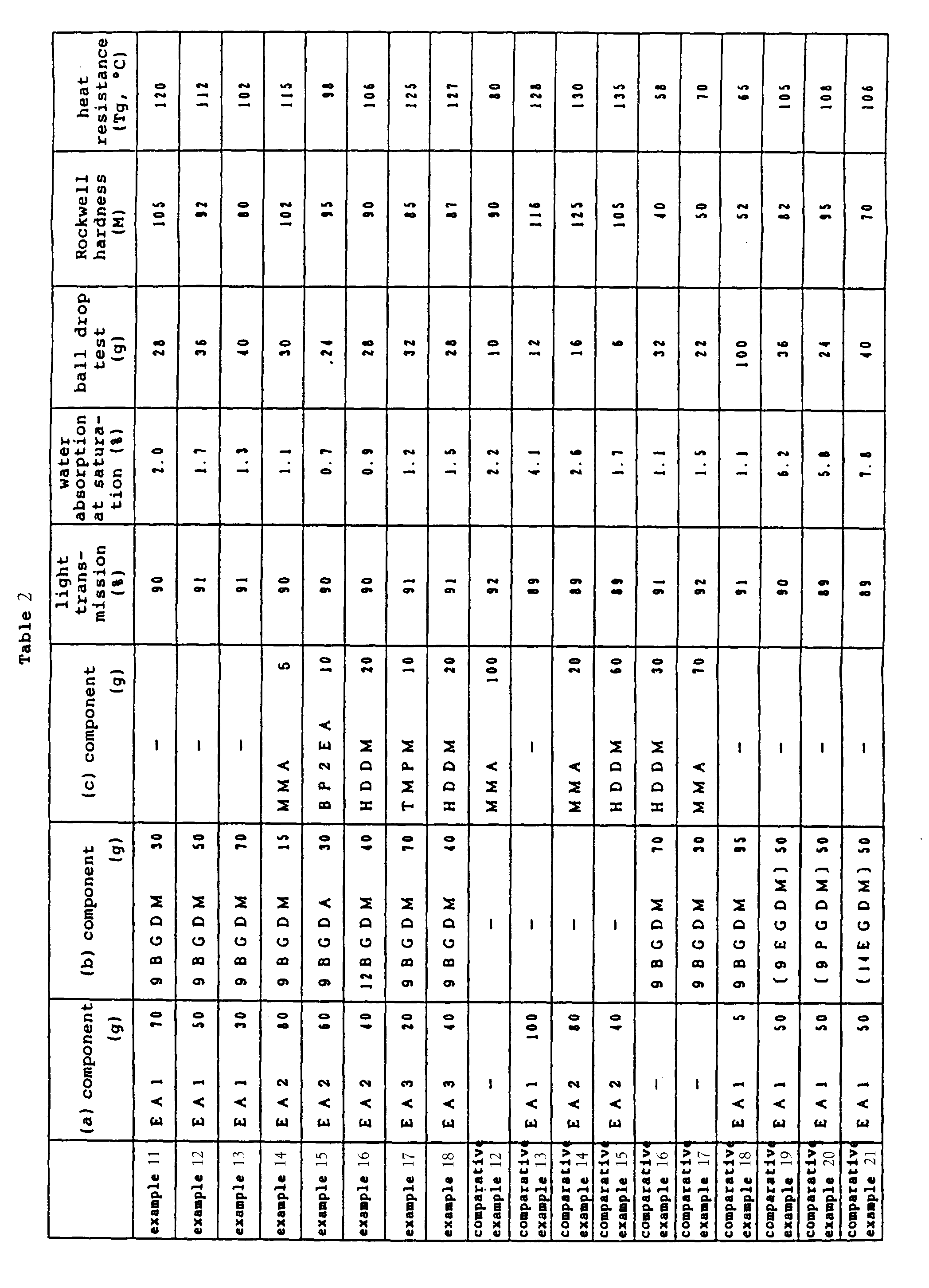
- As mentioned above in detail, the polybutylene glycol dimethacrylate of the present invention provides various kinds of plastics having good flexibility and low water absorption. The resin composition for cast polymerization pertaining to the present invention provides molded products which have good flexibility and low absorption, without sacrificing heat resistance, impact resistance, and surface hardness. Therefore, they will find use as optical materials, lenses, optical discs, laminated glass, and film.
- Having described a specific preferred example of the present invention, it is to be understood that the invention is not limited to that precise example, and that various changes and modifications may be effected therein by one skilled in the art without departing from the scope or spirit of the invention as defined in the appended claims.
Claims (6)
- A resin composition for cast polymerization which comprises(a) 10-90 parts by weight of at least one compound selected from the group consisting of epoxy poly(meth)acrylate having two or more (meth)acryloyloxy groups in one molecule and urethane poly(meth)-acrylate having two or more (meth)acryloyloxy groups in one molecule, said urethane poly(meth)-acrylate having been obtained by the reaction of a hydroxy group-containing (meth)acrylate with isophorone diisocyanate, trimer of hexamethylene diisocyanate, 2,2,4-trimethylhexamethylene diisocyanate, dicyclohexylmethane diisocyanate, 1.3-bis (α,α-dimethylisocyanatethyl)-benzene, xylylene diisocyanate, tetramethylene diisocyanate, dimer acid diisocyanate, cyclohexane diisocyanate, tolylene diisocyanate, diphenylmethane diisocyanate, m-phenylene diisocyanate, naphthalene diisocyanate or biphenyl diisocyanate, and(b) 10-90 parts by weight of polybutylene glycol di(meth)acrylate represented by the general formula below:

- A resin composition for cast polymerization as claimed in claim 1, wherein the urethane poly(meth)acrylate having two or more (meth)acryloyloxy groups in one molecule is an adduct of 2 -hydroxyethyl (meth)acrylate or 2-hydroxypropyl (meth)acrylate with isophorone diisocyanate, trimer of hexamethylene diisocyanate, 2,2,4-trimethylhexamethylene diisocyanate, dicyclohexylmethane diisocyanate, 1,3-bis(α,α-dimethylisocyanatemethyl)benzene, or xylylene diisocyanate.
- A resin composition for cast polymerization as claimed in claim 1, wherein the epoxy poly(meth)acrylate having two or more (meth)acryloloxy groups in one molecule is a reaction product of acrylic acid or methacrylic acid with 1,6-hexanediol diglycidyl ether, diethylene glycol diglycidyl ether, trimethylolpropane diglycidyl ether, trimethylolpropane triglycidyl ether, glycerol diglycidyl ether, glycerol triglycidyl ether, triglycidyl of tris(2-hydroxyethyl)isocyanurate, 2,2-bis(4-glycidyloxycyclohexyl) propane, bisphenol S diglycidyl ether, or tetrabromobisphenol A diglycidyl ether.
- A resin composition for cast polymerization as claimed in claim 1, wherein the polybutylene glycol di(meth)acrylate is one member selected from the group consisting of heptabutylene glycol di(meth)acrylate, octabutylene glycol di(meth)acrylate, nonabutylene glycol di(meth)acrylate, decabutylene glycol di(meth)acrylate, undecabutylene glycol di(meth)acrylate, and dodecabutylene glycol di(meth)acrylate.
- A resin composition for cast polymerization as claimed in claim 1, which further comprises a compound having at least one polymerizable double bond in the molecule.
- A resin composition for cast polymerization as claimed in claim 5, wherein the compound having at least one polymerizable double bond in the molecule is at least one member selected from the group consisting of methyl methacrylate, styrene, n-butyl methacrylate, diethylene glycol dimethacrylate, and 1,6-hexamethylene dimethacrylate.
Applications Claiming Priority (8)
| Application Number | Priority Date | Filing Date | Title |
|---|---|---|---|
| JP310240/89 | 1989-11-29 | ||
| JP31024089 | 1989-11-29 | ||
| JP8322/90 | 1990-01-19 | ||
| JP2008322A JPH03215512A (en) | 1990-01-19 | 1990-01-19 | Resin composition for cast polymerization |
| JP49034/90 | 1990-02-28 | ||
| JP2049034A JPH03218335A (en) | 1989-11-29 | 1990-02-28 | Polybutyleneglycol dimethacrylate and flexible and low water-absorptive composition containing the same compound |
| JP142537/90 | 1990-05-31 | ||
| JP14253790A JP2855359B2 (en) | 1990-05-31 | 1990-05-31 | Resin composition for casting polymerization |
Publications (3)
| Publication Number | Publication Date |
|---|---|
| EP0430209A2 EP0430209A2 (en) | 1991-06-05 |
| EP0430209A3 EP0430209A3 (en) | 1991-11-27 |
| EP0430209B1 true EP0430209B1 (en) | 1996-02-28 |
Family
ID=27454923
Family Applications (1)
| Application Number | Title | Priority Date | Filing Date |
|---|---|---|---|
| EP90122751A Expired - Lifetime EP0430209B1 (en) | 1989-11-29 | 1990-11-28 | Resin composition for cast polymerization |
Country Status (4)
| Country | Link |
|---|---|
| EP (1) | EP0430209B1 (en) |
| KR (1) | KR0178036B1 (en) |
| AU (1) | AU6690790A (en) |
| DE (1) | DE69025555T2 (en) |
Families Citing this family (3)
| Publication number | Priority date | Publication date | Assignee | Title |
|---|---|---|---|---|
| AU634338B2 (en) * | 1990-02-08 | 1993-02-18 | Mitsubishi Rayon Company Limited | Composition for plastic lenses |
| WO2011007720A1 (en) * | 2009-07-14 | 2011-01-20 | 三菱レイヨン株式会社 | Acrylic film for punching, surface light source device, and process for production of optical member |
| EP3037447B1 (en) * | 2013-08-20 | 2018-11-07 | Mitsubishi Chemical Corporation | Dispersion-type acrylic copolymer |
Family Cites Families (2)
| Publication number | Priority date | Publication date | Assignee | Title |
|---|---|---|---|---|
| US4873086A (en) * | 1986-03-03 | 1989-10-10 | Ciba-Geigy Corporation | Hydrogels with increased organic solvent soluble active agent loading capacity, their preparation and the use thereof |
| JPS6424816A (en) * | 1987-07-21 | 1989-01-26 | Mitsui Toatsu Chemicals | Photo-setting resin composition |
-
1990
- 1990-11-23 AU AU66907/90A patent/AU6690790A/en not_active Abandoned
- 1990-11-28 EP EP90122751A patent/EP0430209B1/en not_active Expired - Lifetime
- 1990-11-28 DE DE69025555T patent/DE69025555T2/en not_active Expired - Lifetime
- 1990-11-29 KR KR1019900019416A patent/KR0178036B1/en not_active Expired - Lifetime
Also Published As
| Publication number | Publication date |
|---|---|
| KR0178036B1 (en) | 1999-05-15 |
| DE69025555T2 (en) | 1996-10-02 |
| EP0430209A2 (en) | 1991-06-05 |
| AU6690790A (en) | 1991-08-15 |
| KR910009742A (en) | 1991-06-28 |
| DE69025555D1 (en) | 1996-04-04 |
| EP0430209A3 (en) | 1991-11-27 |
Similar Documents
| Publication | Publication Date | Title |
|---|---|---|
| US5183870A (en) | Composition for plastic lenses | |
| US4985472A (en) | Actinic ray curable composition for casting polymerization and casting polymerization molded products | |
| US5247038A (en) | Polybutylene glycol dimethacrylate and resin composition for cast polymerization | |
| JP2992325B2 (en) | Polybutylene glycol di (meth) acrylate and resin composition for casting polymerization containing the same | |
| JPH06211960A (en) | Polymerizable composition and high refractive index plastic lens obtained therefrom | |
| JP3362987B2 (en) | Composition for plastic lens | |
| EP0430209A2 (en) | Resin composition for cast polymerization | |
| JPH07206974A (en) | Polymerizable composition and high refractive index plastic lens obtained therefrom | |
| JP2726325B2 (en) | Composition for plastic lens | |
| JPH03215512A (en) | Resin composition for cast polymerization | |
| JP2760624B2 (en) | Composition for plastic lens | |
| JP2855359B2 (en) | Resin composition for casting polymerization | |
| JPH08208776A (en) | Resin composition, composition for lens and cured material thereof | |
| JPH08208775A (en) | Resin composition, composition for lens and cured material thereof | |
| JP3524739B2 (en) | Composition for spectacle lens and spectacle lens | |
| JPH03255117A (en) | Composition for plastic lens | |
| JP2961158B2 (en) | Optical resin molding | |
| JP3528984B2 (en) | Resin composition, lens composition and cured product thereof | |
| JP2661145B2 (en) | Plastic lens | |
| JP2879587B2 (en) | Photocurable composition | |
| JP3260461B2 (en) | High refractive index optical material and method for producing the same | |
| JPH01103616A (en) | Plastic lens material | |
| JPH03218335A (en) | Polybutyleneglycol dimethacrylate and flexible and low water-absorptive composition containing the same compound | |
| JP2692169B2 (en) | Styrene-based thermosetting organic glass | |
| JP2849172B2 (en) | Composition for plastic lens |
Legal Events
| Date | Code | Title | Description |
|---|---|---|---|
| PUAI | Public reference made under article 153(3) epc to a published international application that has entered the european phase |
Free format text: ORIGINAL CODE: 0009012 |
|
| AK | Designated contracting states |
Kind code of ref document: A2 Designated state(s): DE FR NL |
|
| PUAL | Search report despatched |
Free format text: ORIGINAL CODE: 0009013 |
|
| AK | Designated contracting states |
Kind code of ref document: A3 Designated state(s): DE FR NL |
|
| 17P | Request for examination filed |
Effective date: 19920129 |
|
| 17Q | First examination report despatched |
Effective date: 19940520 |
|
| GRAH | Despatch of communication of intention to grant a patent |
Free format text: ORIGINAL CODE: EPIDOS IGRA |
|
| GRAA | (expected) grant |
Free format text: ORIGINAL CODE: 0009210 |
|
| AK | Designated contracting states |
Kind code of ref document: B1 Designated state(s): DE FR NL |
|
| REF | Corresponds to: |
Ref document number: 69025555 Country of ref document: DE Date of ref document: 19960404 |
|
| ET | Fr: translation filed | ||
| PLBE | No opposition filed within time limit |
Free format text: ORIGINAL CODE: 0009261 |
|
| STAA | Information on the status of an ep patent application or granted ep patent |
Free format text: STATUS: NO OPPOSITION FILED WITHIN TIME LIMIT |
|
| 26N | No opposition filed | ||
| PGFP | Annual fee paid to national office [announced via postgrant information from national office to epo] |
Ref country code: DE Payment date: 20091126 Year of fee payment: 20 |
|
| PGFP | Annual fee paid to national office [announced via postgrant information from national office to epo] |
Ref country code: NL Payment date: 20091114 Year of fee payment: 20 |
|
| PGFP | Annual fee paid to national office [announced via postgrant information from national office to epo] |
Ref country code: FR Payment date: 20091123 Year of fee payment: 20 |
|
| REG | Reference to a national code |
Ref country code: NL Ref legal event code: V4 Effective date: 20101128 |
|
| PG25 | Lapsed in a contracting state [announced via postgrant information from national office to epo] |
Ref country code: NL Free format text: LAPSE BECAUSE OF EXPIRATION OF PROTECTION Effective date: 20101128 |
|
| PG25 | Lapsed in a contracting state [announced via postgrant information from national office to epo] |
Ref country code: DE Free format text: LAPSE BECAUSE OF EXPIRATION OF PROTECTION Effective date: 20101128 |