EP0429162B1 - Hydrolysis of amino bond of L-asparagine and reagent therefor - Google Patents
Hydrolysis of amino bond of L-asparagine and reagent therefor Download PDFInfo
- Publication number
- EP0429162B1 EP0429162B1 EP90305628A EP90305628A EP0429162B1 EP 0429162 B1 EP0429162 B1 EP 0429162B1 EP 90305628 A EP90305628 A EP 90305628A EP 90305628 A EP90305628 A EP 90305628A EP 0429162 B1 EP0429162 B1 EP 0429162B1
- Authority
- EP
- European Patent Office
- Prior art keywords
- asparagine
- terminal side
- enzyme
- hydrolysis
- amide bond
- Prior art date
- Legal status (The legal status is an assumption and is not a legal conclusion. Google has not performed a legal analysis and makes no representation as to the accuracy of the status listed.)
- Expired - Lifetime
Links
- DCXYFEDJOCDNAF-REOHCLBHSA-N L-asparagine Chemical compound OC(=O)[C@@H](N)CC(N)=O DCXYFEDJOCDNAF-REOHCLBHSA-N 0.000 title claims description 29
- 230000007062 hydrolysis Effects 0.000 title claims description 18
- 238000006460 hydrolysis reaction Methods 0.000 title claims description 18
- 229960001230 asparagine Drugs 0.000 title claims description 15
- 239000003153 chemical reaction reagent Substances 0.000 title claims description 7
- 102000004190 Enzymes Human genes 0.000 claims description 31
- 108090000790 Enzymes Proteins 0.000 claims description 31
- 210000004899 c-terminal region Anatomy 0.000 claims description 23
- 238000000034 method Methods 0.000 claims description 17
- 239000000872 buffer Substances 0.000 claims description 9
- 230000000694 effects Effects 0.000 claims description 9
- 102000030431 Asparaginyl endopeptidase Human genes 0.000 claims description 7
- 108010055066 asparaginylendopeptidase Proteins 0.000 claims description 7
- 108090000765 processed proteins & peptides Proteins 0.000 claims description 7
- 238000001962 electrophoresis Methods 0.000 claims description 3
- 230000002255 enzymatic effect Effects 0.000 claims description 3
- 229920002401 polyacrylamide Polymers 0.000 claims description 3
- 150000001875 compounds Chemical class 0.000 claims description 2
- 229940088598 enzyme Drugs 0.000 description 28
- 239000000758 substrate Substances 0.000 description 9
- 150000001413 amino acids Chemical class 0.000 description 8
- 238000006243 chemical reaction Methods 0.000 description 8
- VHJLVAABSRFDPM-QWWZWVQMSA-N dithiothreitol Chemical compound SC[C@@H](O)[C@H](O)CS VHJLVAABSRFDPM-QWWZWVQMSA-N 0.000 description 8
- 102000004169 proteins and genes Human genes 0.000 description 7
- 108090000623 proteins and genes Proteins 0.000 description 7
- 235000018102 proteins Nutrition 0.000 description 6
- 102000016943 Muramidase Human genes 0.000 description 5
- 108010014251 Muramidase Proteins 0.000 description 5
- 108010062010 N-Acetylmuramoyl-L-alanine Amidase Proteins 0.000 description 5
- 238000003776 cleavage reaction Methods 0.000 description 5
- 229960000274 lysozyme Drugs 0.000 description 5
- 239000004325 lysozyme Substances 0.000 description 5
- 235000010335 lysozyme Nutrition 0.000 description 5
- 230000007017 scission Effects 0.000 description 5
- KCXVZYZYPLLWCC-UHFFFAOYSA-N EDTA Chemical compound OC(=O)CN(CC(O)=O)CCN(CC(O)=O)CC(O)=O KCXVZYZYPLLWCC-UHFFFAOYSA-N 0.000 description 4
- FAPWRFPIFSIZLT-UHFFFAOYSA-M Sodium chloride Chemical compound [Na+].[Cl-] FAPWRFPIFSIZLT-UHFFFAOYSA-M 0.000 description 4
- 229960001484 edetic acid Drugs 0.000 description 4
- BDAGIHXWWSANSR-UHFFFAOYSA-N methanoic acid Natural products OC=O BDAGIHXWWSANSR-UHFFFAOYSA-N 0.000 description 4
- 235000010520 Canavalia ensiformis Nutrition 0.000 description 3
- 238000001042 affinity chromatography Methods 0.000 description 3
- 229940024606 amino acid Drugs 0.000 description 3
- 235000001014 amino acid Nutrition 0.000 description 3
- 238000002360 preparation method Methods 0.000 description 3
- 238000004366 reverse phase liquid chromatography Methods 0.000 description 3
- 125000001917 2,4-dinitrophenyl group Chemical group [H]C1=C([H])C(=C([H])C(=C1*)[N+]([O-])=O)[N+]([O-])=O 0.000 description 2
- OSWFIVFLDKOXQC-UHFFFAOYSA-N 4-(3-methoxyphenyl)aniline Chemical compound COC1=CC=CC(C=2C=CC(N)=CC=2)=C1 OSWFIVFLDKOXQC-UHFFFAOYSA-N 0.000 description 2
- 229920000936 Agarose Polymers 0.000 description 2
- 241000220451 Canavalia Species 0.000 description 2
- CKLJMWTZIZZHCS-UHFFFAOYSA-N D-OH-Asp Natural products OC(=O)C(N)CC(O)=O CKLJMWTZIZZHCS-UHFFFAOYSA-N 0.000 description 2
- 241000196324 Embryophyta Species 0.000 description 2
- 102000004157 Hydrolases Human genes 0.000 description 2
- 108090000604 Hydrolases Proteins 0.000 description 2
- CKLJMWTZIZZHCS-UWTATZPHSA-N L-Aspartic acid Natural products OC(=O)[C@H](N)CC(O)=O CKLJMWTZIZZHCS-UWTATZPHSA-N 0.000 description 2
- 125000000010 L-asparaginyl group Chemical group O=C([*])[C@](N([H])[H])([H])C([H])([H])C(=O)N([H])[H] 0.000 description 2
- CKLJMWTZIZZHCS-REOHCLBHSA-N L-aspartic acid Chemical compound OC(=O)[C@@H](N)CC(O)=O CKLJMWTZIZZHCS-REOHCLBHSA-N 0.000 description 2
- QIVBCDIJIAJPQS-VIFPVBQESA-N L-tryptophane Chemical compound C1=CC=C2C(C[C@H](N)C(O)=O)=CNC2=C1 QIVBCDIJIAJPQS-VIFPVBQESA-N 0.000 description 2
- 108091005804 Peptidases Proteins 0.000 description 2
- 239000004365 Protease Substances 0.000 description 2
- 102100037486 Reverse transcriptase/ribonuclease H Human genes 0.000 description 2
- 239000008351 acetate buffer Substances 0.000 description 2
- 229960005261 aspartic acid Drugs 0.000 description 2
- 238000003556 assay Methods 0.000 description 2
- 238000005119 centrifugation Methods 0.000 description 2
- 235000019253 formic acid Nutrition 0.000 description 2
- 239000012634 fragment Substances 0.000 description 2
- 238000002523 gelfiltration Methods 0.000 description 2
- 238000004255 ion exchange chromatography Methods 0.000 description 2
- 235000012054 meals Nutrition 0.000 description 2
- 239000011780 sodium chloride Substances 0.000 description 2
- WPLOVIFNBMNBPD-ATHMIXSHSA-N subtilin Chemical compound CC1SCC(NC2=O)C(=O)NC(CC(N)=O)C(=O)NC(C(=O)NC(CCCCN)C(=O)NC(C(C)CC)C(=O)NC(=C)C(=O)NC(CCCCN)C(O)=O)CSC(C)C2NC(=O)C(CC(C)C)NC(=O)C1NC(=O)C(CCC(N)=O)NC(=O)C(CC(C)C)NC(=O)C(NC(=O)C1NC(=O)C(=C/C)/NC(=O)C(CCC(N)=O)NC(=O)C(CC(C)C)NC(=O)C(C)NC(=O)CNC(=O)C(NC(=O)C(NC(=O)C2NC(=O)CNC(=O)C3CCCN3C(=O)C(NC(=O)C3NC(=O)C(CC(C)C)NC(=O)C(=C)NC(=O)C(CCC(O)=O)NC(=O)C(NC(=O)C(CCCCN)NC(=O)C(N)CC=4C5=CC=CC=C5NC=4)CSC3)C(C)SC2)C(C)C)C(C)SC1)CC1=CC=CC=C1 WPLOVIFNBMNBPD-ATHMIXSHSA-N 0.000 description 2
- 239000006228 supernatant Substances 0.000 description 2
- PWKSKIMOESPYIA-UHFFFAOYSA-N 2-acetamido-3-sulfanylpropanoic acid Chemical compound CC(=O)NC(CS)C(O)=O PWKSKIMOESPYIA-UHFFFAOYSA-N 0.000 description 1
- 102400000748 Beta-endorphin Human genes 0.000 description 1
- 101800005049 Beta-endorphin Proteins 0.000 description 1
- 102000013585 Bombesin Human genes 0.000 description 1
- 108010051479 Bombesin Proteins 0.000 description 1
- 244000045232 Canavalia ensiformis Species 0.000 description 1
- 108010093096 Immobilized Enzymes Proteins 0.000 description 1
- 108090001061 Insulin Proteins 0.000 description 1
- 102400000454 Insulin B chain Human genes 0.000 description 1
- FFEARJCKVFRZRR-UHFFFAOYSA-N L-Methionine Natural products CSCCC(N)C(O)=O FFEARJCKVFRZRR-UHFFFAOYSA-N 0.000 description 1
- ONIBWKKTOPOVIA-BYPYZUCNSA-N L-Proline Chemical compound OC(=O)[C@@H]1CCCN1 ONIBWKKTOPOVIA-BYPYZUCNSA-N 0.000 description 1
- ODKSFYDXXFIFQN-BYPYZUCNSA-N L-arginine Chemical compound OC(=O)[C@@H](N)CCCN=C(N)N ODKSFYDXXFIFQN-BYPYZUCNSA-N 0.000 description 1
- 229930064664 L-arginine Natural products 0.000 description 1
- 235000014852 L-arginine Nutrition 0.000 description 1
- 150000008536 L-asparagines Chemical class 0.000 description 1
- ZDXPYRJPNDTMRX-VKHMYHEASA-N L-glutamine Chemical compound OC(=O)[C@@H](N)CCC(N)=O ZDXPYRJPNDTMRX-VKHMYHEASA-N 0.000 description 1
- FFEARJCKVFRZRR-BYPYZUCNSA-N L-methionine Chemical compound CSCC[C@H](N)C(O)=O FFEARJCKVFRZRR-BYPYZUCNSA-N 0.000 description 1
- 229930195722 L-methionine Natural products 0.000 description 1
- 229930182821 L-proline Natural products 0.000 description 1
- 102000004856 Lectins Human genes 0.000 description 1
- 108090001090 Lectins Proteins 0.000 description 1
- 102400001103 Neurotensin Human genes 0.000 description 1
- 101800001814 Neurotensin Proteins 0.000 description 1
- 102000003982 Parathyroid hormone Human genes 0.000 description 1
- 108090000445 Parathyroid hormone Proteins 0.000 description 1
- 102000007079 Peptide Fragments Human genes 0.000 description 1
- 108010033276 Peptide Fragments Proteins 0.000 description 1
- 108010071384 Peptide T Proteins 0.000 description 1
- 108010003205 Vasoactive Intestinal Peptide Proteins 0.000 description 1
- 102400000015 Vasoactive intestinal peptide Human genes 0.000 description 1
- 238000002835 absorbance Methods 0.000 description 1
- 239000002253 acid Substances 0.000 description 1
- 125000000539 amino acid group Chemical group 0.000 description 1
- BFNBIHQBYMNNAN-UHFFFAOYSA-N ammonium sulfate Chemical class N.N.OS(O)(=O)=O BFNBIHQBYMNNAN-UHFFFAOYSA-N 0.000 description 1
- 238000004458 analytical method Methods 0.000 description 1
- WOPZMFQRCBYPJU-NTXHZHDSSA-N beta-endorphin Chemical compound C([C@@H](C(=O)N[C@@H](CCCCN)C(=O)N[C@@H](CC(N)=O)C(=O)N[C@@H](C)C(=O)N[C@@H]([C@@H](C)CC)C(=O)N[C@@H]([C@@H](C)CC)C(=O)N[C@@H](CCCCN)C(=O)N[C@@H](CC(N)=O)C(=O)N[C@@H](C)C(=O)N[C@@H](CC=1C=CC(O)=CC=1)C(=O)N[C@@H](CCCCN)C(=O)N[C@@H](CCCCN)C(=O)NCC(=O)N[C@@H](CCC(N)=O)C(O)=O)NC(=O)[C@H](CC(C)C)NC(=O)[C@@H](NC(=O)[C@@H](NC(=O)[C@H](CC(C)C)NC(=O)[C@H]1N(CCC1)C(=O)[C@@H](NC(=O)[C@H](CCC(N)=O)NC(=O)[C@H](CO)NC(=O)[C@H](CCCCN)NC(=O)[C@H](CCC(N)=O)NC(=O)[C@H](CO)NC(=O)[C@@H](NC(=O)[C@H](CCSC)NC(=O)[C@H](CC=1C=CC=CC=1)NC(=O)CNC(=O)CNC(=O)[C@@H](N)CC=1C=CC(O)=CC=1)[C@@H](C)O)[C@@H](C)O)C(C)C)[C@@H](C)O)C1=CC=CC=C1 WOPZMFQRCBYPJU-NTXHZHDSSA-N 0.000 description 1
- DNDCVAGJPBKION-DOPDSADYSA-N bombesin Chemical compound C([C@@H](C(=O)N[C@@H](CC(C)C)C(=O)N[C@@H](CCSC)C(N)=O)NC(=O)CNC(=O)[C@@H](NC(=O)[C@H](C)NC(=O)[C@H](CC=1NC2=CC=CC=C2C=1)NC(=O)[C@H](CCC(N)=O)NC(=O)[C@H](CC(N)=O)NC(=O)CNC(=O)[C@H](CC(C)C)NC(=O)[C@H](CCCNC(N)=N)NC(=O)[C@H](CCC(N)=O)NC(=O)[C@H]1NC(=O)CC1)C(C)C)C1=CN=CN1 DNDCVAGJPBKION-DOPDSADYSA-N 0.000 description 1
- 239000012295 chemical reaction liquid Substances 0.000 description 1
- 239000003795 chemical substances by application Substances 0.000 description 1
- 239000012141 concentrate Substances 0.000 description 1
- 238000010828 elution Methods 0.000 description 1
- 238000004128 high performance liquid chromatography Methods 0.000 description 1
- 238000000265 homogenisation Methods 0.000 description 1
- 238000011534 incubation Methods 0.000 description 1
- 239000003112 inhibitor Substances 0.000 description 1
- 238000011835 investigation Methods 0.000 description 1
- VBUWHHLIZKOSMS-RIWXPGAOSA-N invicorp Chemical compound C([C@@H](C(=O)N[C@@H](CC(C)C)C(=O)N[C@@H](CC(N)=O)C(=O)N[C@@H](CO)C(=O)N[C@@H]([C@@H](C)CC)C(=O)N[C@@H](CC(C)C)C(=O)N[C@@H](CC(N)=O)C(O)=O)NC(=O)[C@H](CCCCN)NC(=O)[C@H](CCCCN)NC(=O)[C@@H](NC(=O)[C@H](C)NC(=O)[C@H](CCSC)NC(=O)[C@H](CCC(N)=O)NC(=O)[C@H](CCCCN)NC(=O)[C@H](CCCNC(N)=N)NC(=O)[C@H](CC(C)C)NC(=O)[C@H](CCCNC(N)=N)NC(=O)[C@@H](NC(=O)[C@H](CC=1C=CC(O)=CC=1)NC(=O)[C@H](CC(N)=O)NC(=O)[C@H](CC(O)=O)NC(=O)[C@@H](NC(=O)[C@H](CC=1C=CC=CC=1)NC(=O)[C@@H](NC(=O)[C@H](C)NC(=O)[C@H](CC(O)=O)NC(=O)[C@H](CO)NC(=O)[C@@H](N)CC=1NC=NC=1)C(C)C)[C@@H](C)O)[C@@H](C)O)C(C)C)C1=CC=C(O)C=C1 VBUWHHLIZKOSMS-RIWXPGAOSA-N 0.000 description 1
- 239000002523 lectin Substances 0.000 description 1
- MASXKPLGZRMBJF-MVSGICTGSA-N mastoparan Chemical compound CC[C@H](C)[C@H](N)C(=O)N[C@@H](CC(N)=O)C(=O)N[C@@H](CC(C)C)C(=O)N[C@@H](CCCCN)C(=O)N[C@@H](C)C(=O)N[C@@H](CC(C)C)C(=O)N[C@@H](C)C(=O)N[C@@H](C)C(=O)N[C@@H](CC(C)C)C(=O)N[C@@H](C)C(=O)N[C@@H](CCCCN)C(=O)N[C@@H](CCCCN)C(=O)N[C@@H]([C@@H](C)CC)C(=O)N[C@@H](CC(C)C)C(N)=O MASXKPLGZRMBJF-MVSGICTGSA-N 0.000 description 1
- 108010019084 mastoparan Proteins 0.000 description 1
- 239000012528 membrane Substances 0.000 description 1
- 229960004452 methionine Drugs 0.000 description 1
- 239000000203 mixture Substances 0.000 description 1
- PCJGZPGTCUMMOT-ISULXFBGSA-N neurotensin Chemical compound C([C@@H](C(=O)N[C@@H]([C@@H](C)CC)C(=O)N[C@@H](CC(C)C)C(O)=O)NC(=O)[C@H]1N(CCC1)C(=O)[C@H](CCCN=C(N)N)NC(=O)[C@H](CCCN=C(N)N)NC(=O)[C@H]1N(CCC1)C(=O)[C@H](CCCCN)NC(=O)[C@H](CC(N)=O)NC(=O)[C@H](CCC(O)=O)NC(=O)[C@H](CC=1C=CC(O)=CC=1)NC(=O)[C@H](CC(C)C)NC(=O)[C@H]1NC(=O)CC1)C1=CC=C(O)C=C1 PCJGZPGTCUMMOT-ISULXFBGSA-N 0.000 description 1
- 125000000962 organic group Chemical group 0.000 description 1
- 239000000199 parathyroid hormone Substances 0.000 description 1
- 239000002244 precipitate Substances 0.000 description 1
- 102000004196 processed proteins & peptides Human genes 0.000 description 1
- 229960002429 proline Drugs 0.000 description 1
- 230000009145 protein modification Effects 0.000 description 1
- 238000000746 purification Methods 0.000 description 1
- 239000011541 reaction mixture Substances 0.000 description 1
- 238000004007 reversed phase HPLC Methods 0.000 description 1
- 239000007974 sodium acetate buffer Substances 0.000 description 1
- 238000012916 structural analysis Methods 0.000 description 1
- 239000000126 substance Substances 0.000 description 1
- 229960004799 tryptophan Drugs 0.000 description 1
- 239000003643 water by type Substances 0.000 description 1
Images


Classifications
-
- C—CHEMISTRY; METALLURGY
- C12—BIOCHEMISTRY; BEER; SPIRITS; WINE; VINEGAR; MICROBIOLOGY; ENZYMOLOGY; MUTATION OR GENETIC ENGINEERING
- C12N—MICROORGANISMS OR ENZYMES; COMPOSITIONS THEREOF; PROPAGATING, PRESERVING, OR MAINTAINING MICROORGANISMS; MUTATION OR GENETIC ENGINEERING; CULTURE MEDIA
- C12N9/00—Enzymes; Proenzymes; Compositions thereof; Processes for preparing, activating, inhibiting, separating or purifying enzymes
- C12N9/14—Hydrolases (3)
- C12N9/24—Hydrolases (3) acting on glycosyl compounds (3.2)
- C12N9/2402—Hydrolases (3) acting on glycosyl compounds (3.2) hydrolysing O- and S- glycosyl compounds (3.2.1)
- C12N9/2462—Lysozyme (3.2.1.17)
-
- C—CHEMISTRY; METALLURGY
- C12—BIOCHEMISTRY; BEER; SPIRITS; WINE; VINEGAR; MICROBIOLOGY; ENZYMOLOGY; MUTATION OR GENETIC ENGINEERING
- C12N—MICROORGANISMS OR ENZYMES; COMPOSITIONS THEREOF; PROPAGATING, PRESERVING, OR MAINTAINING MICROORGANISMS; MUTATION OR GENETIC ENGINEERING; CULTURE MEDIA
- C12N9/00—Enzymes; Proenzymes; Compositions thereof; Processes for preparing, activating, inhibiting, separating or purifying enzymes
- C12N9/14—Hydrolases (3)
- C12N9/48—Hydrolases (3) acting on peptide bonds (3.4)
- C12N9/50—Proteinases, e.g. Endopeptidases (3.4.21-3.4.25)
-
- C—CHEMISTRY; METALLURGY
- C12—BIOCHEMISTRY; BEER; SPIRITS; WINE; VINEGAR; MICROBIOLOGY; ENZYMOLOGY; MUTATION OR GENETIC ENGINEERING
- C12N—MICROORGANISMS OR ENZYMES; COMPOSITIONS THEREOF; PROPAGATING, PRESERVING, OR MAINTAINING MICROORGANISMS; MUTATION OR GENETIC ENGINEERING; CULTURE MEDIA
- C12N9/00—Enzymes; Proenzymes; Compositions thereof; Processes for preparing, activating, inhibiting, separating or purifying enzymes
- C12N9/14—Hydrolases (3)
- C12N9/48—Hydrolases (3) acting on peptide bonds (3.4)
- C12N9/50—Proteinases, e.g. Endopeptidases (3.4.21-3.4.25)
- C12N9/63—Proteinases, e.g. Endopeptidases (3.4.21-3.4.25) derived from plants
-
- C—CHEMISTRY; METALLURGY
- C12—BIOCHEMISTRY; BEER; SPIRITS; WINE; VINEGAR; MICROBIOLOGY; ENZYMOLOGY; MUTATION OR GENETIC ENGINEERING
- C12P—FERMENTATION OR ENZYME-USING PROCESSES TO SYNTHESISE A DESIRED CHEMICAL COMPOUND OR COMPOSITION OR TO SEPARATE OPTICAL ISOMERS FROM A RACEMIC MIXTURE
- C12P21/00—Preparation of peptides or proteins
- C12P21/06—Preparation of peptides or proteins produced by the hydrolysis of a peptide bond, e.g. hydrolysate products
Definitions
- This invention relates to a method for the hydrolysis of the amide bond on the C-terminal side of L-asparagine, by the use of a hydrolase which is specific for only the amide bond on the C-terminal side of L-asparagine contained in a compound having a peptide chain which has at least one amide bond on the C-terminal side of L-asparagine, to a reagent for use in such hydrolysis, and also to a novel asparaginyl endopeptidase which is of the same description as the above hydrolase.
- the object of this invention is to provide a method and reagent for the hydrolysis of amide bonds on the C-terminal side of L-asparagine residues.
- the present invention provides a novel asparaginyl endopeptidase having the enzymatic properties defined in claim 1.
- the invention further provides a method and a reagent for the hydrolysis of the amide bond on the C-terminal side of L-asparagine using the asparaginyl endopeptidase.
- the enzyme to be used in this invention can be prepared by, for example, the homogenization of commercially available jack bean meal in the presence of a suitable reduction agent in a buffer at pH 4-6, to solubilize this enzyme, after which centrifugation or the like is carried out to remove insoluble matter, followed by purification steps with the use of a variety of ion-exchange chromatography columns, gel filtration, etc., for increasing purity of the enzyme, and next the use of paramercuribenzoic acid (PMB), which is a specific inhibitor for this enzyme, immobilized to agarose in affinity chromatography, by which a single protein is obtained, which is the purified enzyme.
- PMB paramercuribenzoic acid
- any enzyme which has the activity as defined in the claims can be used in the method for the hydrolysis and the reagent of this invention.
- the substrate used in the assay of the enzyme is DNP-L-Pro-L-Glu-L-Ala-L-Asn-NH2, where DNP is 2,4-dinitrophenyl.
- a reaction mixture containing this substrate at a concentration of 0.02 mM, 5 mM of dithiothreitol (DTT), 2 mM of ethylenediamine tetracetic acid (EDTA), the enzyme, and 0.002 mM of DNP-L-Ser as the internal standard in 20 mM acetate buffer (pH 5.0) is heated 10-20 minutes at 37°C to proceed the reaction, and then formic acid is added to be a final concentration of 10% to stop the reaction.
- a portion of the reaction liquid is then analyzed by high-performance liquid chromatography (HPLC) with, for example, an ODS column, after which the activity of this enzyme can be calculated by the relative amount of DNP-L-Pro-L-Glu-L-Ala-L-Asn produced and the amount of DNP-L-Ser used as the internal standard.
- HPLC high-performance liquid chromatography
- One unit of enzyme activity is defined as the amount of enzyme needed to produce 1 »mol of DNP-L-Pro-L-Glu-L-Ala-L-Asn in one minute.
- the substance adsorbed to the SP-Toyopearl 650M column was eluted with 0.5 M sodium chloride, and the active fraction was precipitated with 60% saturated ammonium sulfate and dialyzed against the same buffer as before. Then the dialysate was treated by affinity chromatography on an affinity column of agarose on which PMB had been immobilized. The active fraction eluted from this column with 0.5 M sodium chloride was dialyzed against the same buffer, and then treated by affinity chromatography on a Leu-ArgH column (Organo), with collection of the active fraction which was not adsorbed on the column.
- the active fraction was concentrated in a membrane filter with a molecular weight cut-off of 10,000, and the concentrate was treated by gel filtration on Toyopearl HW-55S (Tosoh).
- the amount of purified enzyme thus obtained was 2.6 mg, and the activity was 180 mU.
- the protein was a single protein, judging from the results of electrophoresis on SDS-polyacrylamide and reverse-phase chromatography with a C4 column.
- Example 1 The enzyme obtained in Example 1 was used for the limited hydrolysis of commercially available soluble reduced lysozyme (Seikagaku Kogyo). The reaction was in 20 mM sodium acetate buffer (pH 5.0) containing 10 mM DTT and 1 mM EDTA; the concentration of the substrate was 0.2 mM and that of the enzyme was 0.004 mM; the reaction was conducted for 15 hours at 37°C. The reaction was stopped by the addition of formic acid to a final concentration of 10%. The peptide fragments produced were separated by reversed-phase chromatography on a C4 column (Waters; »Bondasphere 3.9 x 150 mm), and the amino acid composition and the amino acid sequence of each fragment were analyzed.
- a C4 column Waters; »Bondasphere 3.9 x 150 mm
- the soluble reduced lysozyme had the amino acid sequence shown in Figure 1.
- the results of the reversed-phase chromatography on a C4 column are shown in Figure 2, and the amino acid sequence of each fragment obtained are shown in Table 2.
- the results showed that this enzyme cleaved only amide bonds on the C-terminal side of the L-asparagines contained in the soluble reduced lysozyme.
- this invention provides a method for the hydrolysis of the amide bonds on the C-terminal side of L-asparagine in peptide chains, and provides a reagent for use in the hydrolysis, and novel asparaginyl endopeptidase.
- This invention can be used in procedures indispensible to the structural analysis of proteins.
Landscapes
- Life Sciences & Earth Sciences (AREA)
- Chemical & Material Sciences (AREA)
- Health & Medical Sciences (AREA)
- Organic Chemistry (AREA)
- Zoology (AREA)
- Engineering & Computer Science (AREA)
- Wood Science & Technology (AREA)
- Genetics & Genomics (AREA)
- Bioinformatics & Cheminformatics (AREA)
- Microbiology (AREA)
- Biotechnology (AREA)
- Molecular Biology (AREA)
- Biochemistry (AREA)
- General Engineering & Computer Science (AREA)
- General Health & Medical Sciences (AREA)
- Biomedical Technology (AREA)
- Medicinal Chemistry (AREA)
- Chemical Kinetics & Catalysis (AREA)
- General Chemical & Material Sciences (AREA)
- Botany (AREA)
- Enzymes And Modification Thereof (AREA)
- Preparation Of Compounds By Using Micro-Organisms (AREA)
Description
- This invention relates to a method for the hydrolysis of the amide bond on the C-terminal side of L-asparagine, by the use of a hydrolase which is specific for only the amide bond on the C-terminal side of L-asparagine contained in a compound having a peptide chain which has at least one amide bond on the C-terminal side of L-asparagine, to a reagent for use in such hydrolysis, and also to a novel asparaginyl endopeptidase which is of the same description as the above hydrolase.
- Methods for the hydrolysis of peptide bonds only on the N-terminal side or the C-terminal side of a specific amino acid residue which is contained in a peptide chain, in which the recognition is selective and specific, are essential procedures for the analysis of protein structure and for the modification of proteins
- At the present, methods by which this purpose can be achieved have been established for the hydrolysis of the peptide bond on the C-terminal side of L-lysine, for the hydrolysis of the peptide bond on the N-terminal side of L-lysine, for the hydrolysis of the peptide bond on the C-terminal side of L-arginine, for the hydrolysis of the peptide bond on the C-terminal side of L-glutaminate and L-aspartic acid, for the hydrolysis of the peptide bond on the N-terminal side of L-aspartic acid, and for the hydrolysis of the peptide bond on the C-terminal side of L-proline, all of which are methods involving biochemistry. There are also methods which involve organic chemistry for the cleavage of the peptide bond on the C-terminal side of L-methionine, the cleavage of the peptide bond on the N-terminal side of L-cysteine, and the cleavage of the peptide bond on the C-terminal side of L-tryptophan.
- In protein engineering, methods for the specific cleavage of particular peptide bond of each of various amino acid are desired. However, there has been no method for the specific cleavage of amino acids other than those mentioned above.
- The object of this invention is to provide a method and reagent for the hydrolysis of amide bonds on the C-terminal side of L-asparagine residues.
- The present invention provides a novel asparaginyl endopeptidase having the enzymatic properties defined in claim 1. The invention further provides a method and a reagent for the hydrolysis of the amide bond on the C-terminal side of L-asparagine using the asparaginyl endopeptidase.
- Based on the fact that there is L-asparagine at the C-terminal of lectins and stored proteins, in plant seeds, the inventors of this invention searched for a protease which would hydrolyze the amide bond on the C-terminal side of the L-asparagine in the peptide chains in plant seeds, and isolated and purified a protease which hydrolyzes only the amide bond on the C-terminal side of the L-asparagine in the peptide chains from the seeds of Canavalia ensiformis, thus accomplishing this invention. This invention has been completed by the establishment of a method for the preparation of this enzyme, by the investigation of its properties and by a study on use thereof. This invention will be explained in detail as follows.
- The enzyme to be used in this invention can be prepared by, for example, the homogenization of commercially available jack bean meal in the presence of a suitable reduction agent in a buffer at pH 4-6, to solubilize this enzyme, after which centrifugation or the like is carried out to remove insoluble matter, followed by purification steps with the use of a variety of ion-exchange chromatography columns, gel filtration, etc., for increasing purity of the enzyme, and next the use of paramercuribenzoic acid (PMB), which is a specific inhibitor for this enzyme, immobilized to agarose in affinity chromatography, by which a single protein is obtained, which is the purified enzyme.
- Although only one example of the enzyme and of the method for its preparation is given here, any enzyme which has the activity as defined in the claims can be used in the method for the hydrolysis and the reagent of this invention.
- The substrate used in the assay of the enzyme is DNP-L-Pro-L-Glu-L-Ala-L-Asn-NH₂, where DNP is 2,4-dinitrophenyl. A reaction mixture containing this substrate at a concentration of 0.02 mM, 5 mM of dithiothreitol (DTT), 2 mM of ethylenediamine tetracetic acid (EDTA), the enzyme, and 0.002 mM of DNP-L-Ser as the internal standard in 20 mM acetate buffer (pH 5.0) is heated 10-20 minutes at 37°C to proceed the reaction, and then formic acid is added to be a final concentration of 10% to stop the reaction. A portion of the reaction liquid is then analyzed by high-performance liquid chromatography (HPLC) with, for example, an ODS column, after which the activity of this enzyme can be calculated by the relative amount of DNP-L-Pro-L-Glu-L-Ala-L-Asn produced and the amount of DNP-L-Ser used as the internal standard. One unit of enzyme activity is defined as the amount of enzyme needed to produce 1 »mol of DNP-L-Pro-L-Glu-L-Ala-L-Asn in one minute.
- The following were used as substrates for the enzyme at the substrate-to-enzyme ratio of 50:1 and reaction was conducted for 15 hours at 37°C and pH 5.0: neurotensin, mastoparan, β-endorphin, parathyroid hormone (1-34), vasoactive intestinal peptide, peptide T, bombesin, oxidized insulin B chain, and physalamin. It was found that only the amide bond on the C-terminal side of the L-asparagine was hydrolyzed and no other peptide bonds were hydrolyzed. Table 1 shows the amino acid sequences of the synthetic peptides used as substrates and the location of the amide bond or bonds which were hydrolyzed.


-
- 1) Molecular weight
- 32,200 as found by SDS-polyacrylamide electrophoresis on 12% gel. 26,550 as found by gel permeation on Tosoh G3000SW.
- 2) Optimal pH
- pH 6.0 - 7.0 The reaction was with DNP-L-Pro-L-Glu-L-Ala-L-Asn-NH₂ as substrate in the presence of 5 mM DTT in buffer at different pH for 20 minutes at 37°C,
- 3) Optimum temperature
- Vicinity of 45°C The reaction was with DNP-L-Pro-L-Glu-L-Ala-L-Asn-NH₂ as substrate in the presence of 5 mM DTT in buffer at pH 5.0 at different temperatures for 20 minutes.
- 4) Stability against pH
- Stable at pH 4.5 - 6.5 The remaining activity was assayed after 6 hours of incubation of the enzyme in buffer containing 1 mM DTT at different pH at 37°C.
- 5) Stability against heat
- When the enzyme was heated at 55°C for 15 minutes in buffer containing 1 mM DTT at pH 5.0, enzyme activity was not lost. When the enzyme was heated at 65°C for 15 minutes, 90% or more of the enzyme activity was lost.
- The invention will be further explained by the following Examples and by referring partly to the accompanying drawings wherein:
- Fig. 1 shows the amino acid sequence of the commercial soluble reduced lysozyme used as the substrate in Example 2;
- Figure 2 shows the elution profile of fractions by reversed-phase HPLC with the use of a C4 column when a digest of soluble reduced lysozyme obtained by treatment with the enzyme of this invention is put on the column, in which the X-axis is time (min) and the Y-axis (0.32 of the original scale) is the absorbance at 215 nm.
- First, 500 g of commercially available jack bean meal (Sigma) was homogenized in acetate buffer (pH 5.0) containing 1 mM DTT and 1 mM EDTA, and the homogenate was centrifuged. The supernatant obtained was dialyzed in the same buffer, after which the formed precipitate was removed by centrifugation, and the supernatant was treated by ion-exchange chromatography on a column of SP-Toyopearl 650M (Tosoh Corp.). The substance adsorbed to the SP-Toyopearl 650M column was eluted with 0.5 M sodium chloride, and the active fraction was precipitated with 60% saturated ammonium sulfate and dialyzed against the same buffer as before. Then the dialysate was treated by affinity chromatography on an affinity column of agarose on which PMB had been immobilized. The active fraction eluted from this column with 0.5 M sodium chloride was dialyzed against the same buffer, and then treated by affinity chromatography on a Leu-ArgH column (Organo), with collection of the active fraction which was not adsorbed on the column. The active fraction was concentrated in a membrane filter with a molecular weight cut-off of 10,000, and the concentrate was treated by gel filtration on Toyopearl HW-55S (Tosoh). The amount of purified enzyme thus obtained was 2.6 mg, and the activity was 180 mU. The protein was a single protein, judging from the results of electrophoresis on SDS-polyacrylamide and reverse-phase chromatography with a C4 column.
- The enzyme obtained in Example 1 was used for the limited hydrolysis of commercially available soluble reduced lysozyme (Seikagaku Kogyo). The reaction was in 20 mM sodium acetate buffer (pH 5.0) containing 10 mM DTT and 1 mM EDTA; the concentration of the substrate was 0.2 mM and that of the enzyme was 0.004 mM; the reaction was conducted for 15 hours at 37°C. The reaction was stopped by the addition of formic acid to a final concentration of 10%. The peptide fragments produced were separated by reversed-phase chromatography on a C4 column (Waters; »Bondasphere 3.9 x 150 mm), and the amino acid composition and the amino acid sequence of each fragment were analyzed. The soluble reduced lysozyme had the amino acid sequence shown in Figure 1. The results of the reversed-phase chromatography on a C4 column are shown in Figure 2, and the amino acid sequence of each fragment obtained are shown in Table 2.

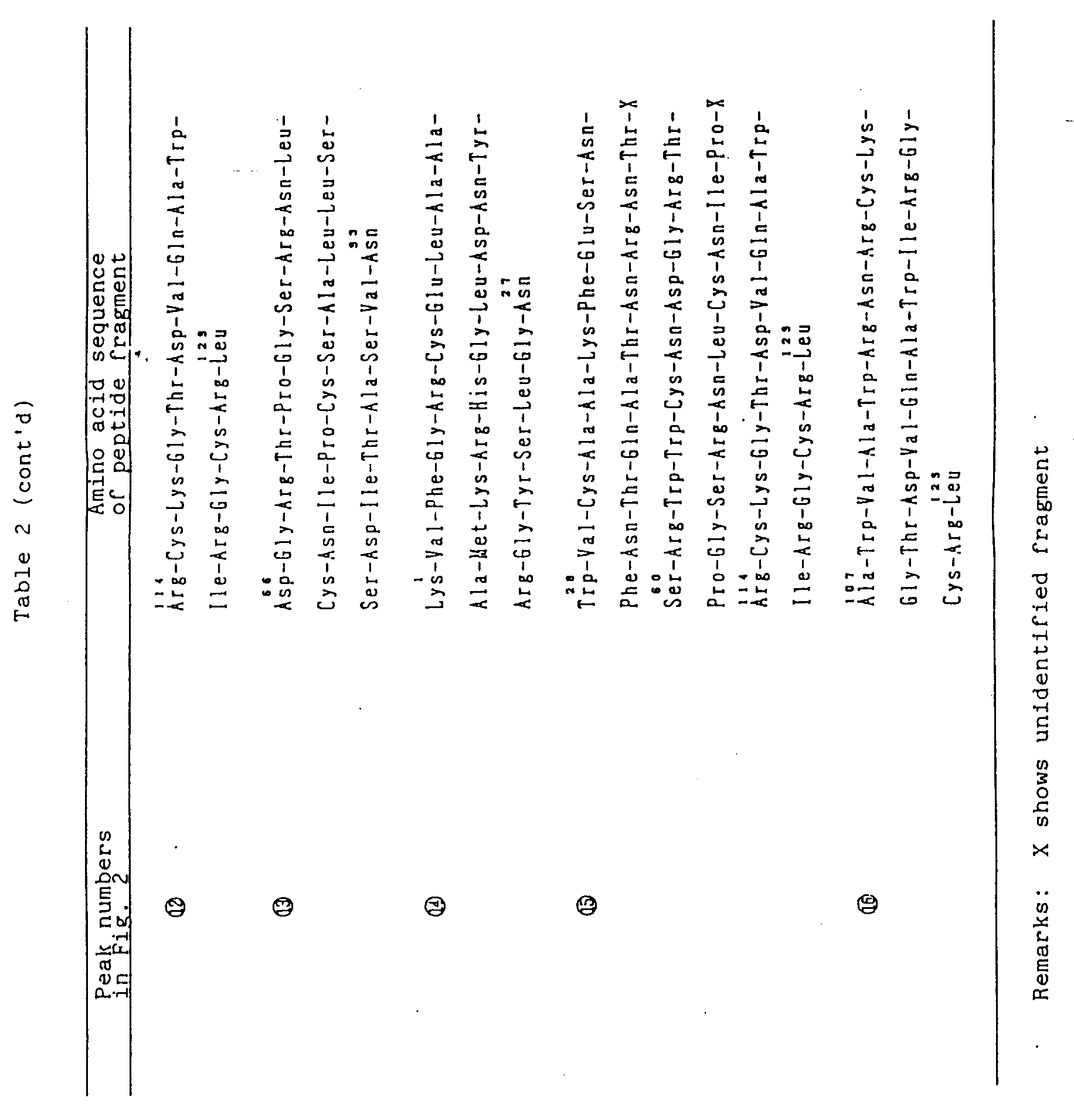
The results showed that this enzyme cleaved only amide bonds on the C-terminal side of the L-asparagines contained in the soluble reduced lysozyme. - As described in detail above, this invention provides a method for the hydrolysis of the amide bonds on the C-terminal side of L-asparagine in peptide chains, and provides a reagent for use in the hydrolysis, and novel asparaginyl endopeptidase. This invention can be used in procedures indispensible to the structural analysis of proteins.
Claims (3)
- A novel asparaginyl endopeptidase having the following enzymatic properties:(1) Action
it hydrolyzes the amide bond on the C-terminal side of L-asparagine and is specific for only the amide bond on the C-terminal side of L-asparagine contained in a compound which has a peptide chain having at least one amide bond on the C-terminal side of L-asparagine;(2) Molecular weight
The molecular weight is 32,200 as found by SDS-polyacrylamide electrophoresis on 12% gel, and 26,550 as found by gel permeation on a Tosoh G3000SW column;(3) Optimum pH
pH 6.0 - 7.0;(4) Optimum temperature
vicinity of 45°C;(5) Stability against pH
stable at pH 4.5 - 6.5;(6) Stability against heat
When the enzyme is heated at 55°C for 15 minutes in a buffer containing 1 mM DTT at pH 5.0, enzyme activity is not lost; when the enzyme is heated at 65° for 15 minutes, 90% or more of the enzyme activity is lost. - A method for the hydrolysis of the amide bond on the C-terminal side of L-asparagine characterised by the use of asparaginyl endopeptidase according to claim 1.
- A reagent for use in the hydrolysis of the amide bond on the C-terminal side of L-asparagine which comprises asparaginyl endopeptidase according to claim 1.
Applications Claiming Priority (2)
| Application Number | Priority Date | Filing Date | Title |
|---|---|---|---|
| JP1297450A JPH0773508B2 (en) | 1989-11-17 | 1989-11-17 | Method and reagent for hydrolyzing amide bond of L-asparagine |
| JP297450/89 | 1989-11-17 |
Publications (2)
| Publication Number | Publication Date |
|---|---|
| EP0429162A1 EP0429162A1 (en) | 1991-05-29 |
| EP0429162B1 true EP0429162B1 (en) | 1995-04-26 |
Family
ID=17846668
Family Applications (1)
| Application Number | Title | Priority Date | Filing Date |
|---|---|---|---|
| EP90305628A Expired - Lifetime EP0429162B1 (en) | 1989-11-17 | 1990-05-23 | Hydrolysis of amino bond of L-asparagine and reagent therefor |
Country Status (4)
| Country | Link |
|---|---|
| US (1) | US5094952A (en) |
| EP (1) | EP0429162B1 (en) |
| JP (1) | JPH0773508B2 (en) |
| DE (1) | DE69018935T2 (en) |
Families Citing this family (3)
| Publication number | Priority date | Publication date | Assignee | Title |
|---|---|---|---|---|
| JPH0824576B2 (en) * | 1992-07-22 | 1996-03-13 | 農林水産省食品総合研究所長 | Novel asparaginyl endoprotease, its production and use |
| JP3012928B1 (en) * | 1998-11-04 | 2000-02-28 | 農林水産省食品総合研究所長 | Plant-derived asparagine residue-specific endoprotease cDNA and gene |
| JP3015886B1 (en) * | 1998-11-04 | 2000-03-06 | 農林水産省食品総合研究所長 | A rapid method for the determination of asparagine residue-specific endoprotease activity from plants |
Family Cites Families (3)
| Publication number | Priority date | Publication date | Assignee | Title |
|---|---|---|---|---|
| US3929756A (en) * | 1973-11-21 | 1975-12-30 | Univ Brandeis | Synthetically produced tridecapeptide having the same activity as the hypothalamic substance, neurotensin |
| US4086136A (en) * | 1975-10-23 | 1978-04-25 | (Zaidanhojin) Sagami Chemical Research Center | Process for producing a peptide using a serine or thiol proteinase |
| DE3346953A1 (en) * | 1983-12-24 | 1985-08-14 | Organogen Medizinisch-Molekularbiologische Forschungsgesellschaft mbH, 6900 Heidelberg | CARDIODILATIN, A NEW PEPTIDE HORMONE AND METHOD FOR THE PRODUCTION THEREOF |
-
1989
- 1989-11-17 JP JP1297450A patent/JPH0773508B2/en not_active Expired - Fee Related
-
1990
- 1990-05-23 EP EP90305628A patent/EP0429162B1/en not_active Expired - Lifetime
- 1990-05-23 DE DE69018935T patent/DE69018935T2/en not_active Expired - Fee Related
- 1990-05-23 US US07/527,729 patent/US5094952A/en not_active Expired - Lifetime
Also Published As
| Publication number | Publication date |
|---|---|
| US5094952A (en) | 1992-03-10 |
| JPH03160997A (en) | 1991-07-10 |
| JPH0773508B2 (en) | 1995-08-09 |
| DE69018935D1 (en) | 1995-06-01 |
| DE69018935T2 (en) | 1996-01-04 |
| EP0429162A1 (en) | 1991-05-29 |
Similar Documents
| Publication | Publication Date | Title |
|---|---|---|
| Eisen et al. | Collagenolytic protease from the hepatopancreas of the fiddler crab, Uca pugilator. Purification and properties | |
| Kawata et al. | Amino‐acid sequence of ribonuclease T2 from Aspergillus oryzae | |
| Sebald et al. | The Dicyclohexylcarbodiimide‐Binding Protein of the Mitochondrial ATPase Complex from Neurospora crassa and Saccharomyces cerevisiae: Identification and Isolation | |
| Howard et al. | L-Asparaginase from Erwinia carotovora: substrate specificity and enzymatic properties | |
| Neurath | The activation of zymogens | |
| Pazur et al. | A glycoprotein structure for glucose oxidase from Aspergillus niger | |
| Yoshimoto et al. | Post-proline cleaving enzyme (prolyl endoeptidase) from bovine brain | |
| Kole et al. | Reconstitution of RNase P activity from inactive RNA and protein. | |
| Nakamura et al. | Intracellular proclotting enzyme in limulus (Tachypleus tridentatus) hemocytes: its purification and properties | |
| Piez et al. | Proteolysis in stored serum and its possible significance in cell culture | |
| Liao | Bovine pancreatic deoxyribonuclease D | |
| Light | [20] Leucine aminopeptidase in sequence determination of peptides | |
| Wingard et al. | Myxobacter AL-1 protease II: specific peptide bond cleavage on the amino side of lysine | |
| Uchikoba et al. | Cleavage specificity of cucumisin, a plant serine protease | |
| Marinkovic et al. | Purification of carboxypeptidase B from human pancreas | |
| Light | [48] Leucine aminopeptidase (LAP) | |
| Maitre et al. | Comparison of the structural characteristics of the 4-aminobutyrate: 2-oxoglutarate transaminases from rat and human brain, and of their affinities for certain inhibitors | |
| Lemaire et al. | Multiple forms of tryptophanyl‐tRNA synthetase from beef pancreas | |
| EP0429162A1 (en) | Hydrolysis of amino bond of L-asparagine and reagent therefor | |
| Baratti et al. | On the catalytic and binding sites of porcine enteropeptidase | |
| Baines et al. | Isolation and characterization of the four major cysteine-proteinase components of the latex of Carica papaya L. reactivity characteristics towards 2, 2′-dipyridyl disulfide of the thiol groups of papain, chymopapains a and B, and papaya peptidase A | |
| Epely et al. | Limited Proteolysis of Tryptophanyl‐tRNA Synthetase from Beef Pancreas | |
| US4035234A (en) | Process for the preparation of the kallikrein-trypsin inhibitor | |
| Wang et al. | Purification and properties of Arthrobacter neuraminidase | |
| Higaki et al. | The identification of neotrypsinogens in samples of bovine trypsinogen |
Legal Events
| Date | Code | Title | Description |
|---|---|---|---|
| PUAI | Public reference made under article 153(3) epc to a published international application that has entered the european phase |
Free format text: ORIGINAL CODE: 0009012 |
|
| 17P | Request for examination filed |
Effective date: 19901127 |
|
| AK | Designated contracting states |
Kind code of ref document: A1 Designated state(s): DE FR GB |
|
| 16A | New documents despatched to applicant after publication of the search report | ||
| 17Q | First examination report despatched |
Effective date: 19940121 |
|
| GRAA | (expected) grant |
Free format text: ORIGINAL CODE: 0009210 |
|
| AK | Designated contracting states |
Kind code of ref document: B1 Designated state(s): DE FR GB |
|
| REF | Corresponds to: |
Ref document number: 69018935 Country of ref document: DE Date of ref document: 19950601 |
|
| ET | Fr: translation filed | ||
| PLBE | No opposition filed within time limit |
Free format text: ORIGINAL CODE: 0009261 |
|
| STAA | Information on the status of an ep patent application or granted ep patent |
Free format text: STATUS: NO OPPOSITION FILED WITHIN TIME LIMIT |
|
| 26N | No opposition filed | ||
| REG | Reference to a national code |
Ref country code: GB Ref legal event code: IF02 |
|
| REG | Reference to a national code |
Ref country code: GB Ref legal event code: 732E |
|
| REG | Reference to a national code |
Ref country code: FR Ref legal event code: TP |
|
| PGFP | Annual fee paid to national office [announced via postgrant information from national office to epo] |
Ref country code: FR Payment date: 20060515 Year of fee payment: 17 |
|
| PGFP | Annual fee paid to national office [announced via postgrant information from national office to epo] |
Ref country code: GB Payment date: 20060517 Year of fee payment: 17 |
|
| PGFP | Annual fee paid to national office [announced via postgrant information from national office to epo] |
Ref country code: DE Payment date: 20060518 Year of fee payment: 17 |
|
| GBPC | Gb: european patent ceased through non-payment of renewal fee |
Effective date: 20070523 |
|
| REG | Reference to a national code |
Ref country code: FR Ref legal event code: ST Effective date: 20080131 |
|
| PG25 | Lapsed in a contracting state [announced via postgrant information from national office to epo] |
Ref country code: DE Free format text: LAPSE BECAUSE OF NON-PAYMENT OF DUE FEES Effective date: 20071201 |
|
| PG25 | Lapsed in a contracting state [announced via postgrant information from national office to epo] |
Ref country code: GB Free format text: LAPSE BECAUSE OF NON-PAYMENT OF DUE FEES Effective date: 20070523 |
|
| PG25 | Lapsed in a contracting state [announced via postgrant information from national office to epo] |
Ref country code: FR Free format text: LAPSE BECAUSE OF NON-PAYMENT OF DUE FEES Effective date: 20070531 |