EP0425831B1 - Contact lens - Google Patents
Contact lens Download PDFInfo
- Publication number
- EP0425831B1 EP0425831B1 EP90118968A EP90118968A EP0425831B1 EP 0425831 B1 EP0425831 B1 EP 0425831B1 EP 90118968 A EP90118968 A EP 90118968A EP 90118968 A EP90118968 A EP 90118968A EP 0425831 B1 EP0425831 B1 EP 0425831B1
- Authority
- EP
- European Patent Office
- Prior art keywords
- acrylate
- contact lens
- meth
- pentene
- carbon atoms
- Prior art date
- Legal status (The legal status is an assumption and is not a legal conclusion. Google has not performed a legal analysis and makes no representation as to the accuracy of the status listed.)
- Expired - Lifetime
Links
- 239000000178 monomer Substances 0.000 claims description 61
- 125000004432 carbon atom Chemical group C* 0.000 claims description 16
- 125000003342 alkenyl group Chemical group 0.000 claims description 5
- 125000000217 alkyl group Chemical group 0.000 claims description 5
- 125000003118 aryl group Chemical group 0.000 claims description 5
- 125000006165 cyclic alkyl group Chemical group 0.000 claims description 5
- 229910052731 fluorine Inorganic materials 0.000 claims description 5
- 125000001153 fluoro group Chemical group F* 0.000 claims description 5
- 125000004435 hydrogen atom Chemical group [H]* 0.000 claims description 5
- 229920001577 copolymer Polymers 0.000 claims description 3
- 125000003262 carboxylic acid ester group Chemical class [H]C([H])([*:2])OC(=O)C([H])([H])[*:1] 0.000 claims 2
- NIXOWILDQLNWCW-UHFFFAOYSA-M Acrylate Chemical compound [O-]C(=O)C=C NIXOWILDQLNWCW-UHFFFAOYSA-M 0.000 description 53
- -1 fluoroalkyl acrylate Chemical compound 0.000 description 23
- 150000001733 carboxylic acid esters Chemical class 0.000 description 18
- QVGXLLKOCUKJST-UHFFFAOYSA-N atomic oxygen Chemical compound [O] QVGXLLKOCUKJST-UHFFFAOYSA-N 0.000 description 17
- 239000001301 oxygen Substances 0.000 description 17
- 229910052760 oxygen Inorganic materials 0.000 description 17
- 230000035699 permeability Effects 0.000 description 15
- 238000000034 method Methods 0.000 description 12
- 238000006116 polymerization reaction Methods 0.000 description 12
- IJGRMHOSHXDMSA-UHFFFAOYSA-N Atomic nitrogen Chemical compound N#N IJGRMHOSHXDMSA-UHFFFAOYSA-N 0.000 description 10
- 239000003505 polymerization initiator Substances 0.000 description 10
- VVQNEPGJFQJSBK-UHFFFAOYSA-N Methyl methacrylate Chemical compound COC(=O)C(C)=C VVQNEPGJFQJSBK-UHFFFAOYSA-N 0.000 description 9
- 238000011109 contamination Methods 0.000 description 9
- 230000000704 physical effect Effects 0.000 description 9
- 125000000391 vinyl group Chemical group [H]C([*])=C([H])[H] 0.000 description 9
- 229920002554 vinyl polymer Polymers 0.000 description 9
- 238000005259 measurement Methods 0.000 description 8
- 239000004342 Benzoyl peroxide Substances 0.000 description 7
- CERQOIWHTDAKMF-UHFFFAOYSA-M Methacrylate Chemical compound CC(=C)C([O-])=O CERQOIWHTDAKMF-UHFFFAOYSA-M 0.000 description 7
- 235000019400 benzoyl peroxide Nutrition 0.000 description 7
- 239000000203 mixture Substances 0.000 description 7
- 229920000642 polymer Polymers 0.000 description 7
- VZSRBBMJRBPUNF-UHFFFAOYSA-N 2-(2,3-dihydro-1H-inden-2-ylamino)-N-[3-oxo-3-(2,4,6,7-tetrahydrotriazolo[4,5-c]pyridin-5-yl)propyl]pyrimidine-5-carboxamide Chemical compound C1C(CC2=CC=CC=C12)NC1=NC=C(C=N1)C(=O)NCCC(N1CC2=C(CC1)NN=N2)=O VZSRBBMJRBPUNF-UHFFFAOYSA-N 0.000 description 6
- WYGWHHGCAGTUCH-UHFFFAOYSA-N 2-[(2-cyano-4-methylpentan-2-yl)diazenyl]-2,4-dimethylpentanenitrile Chemical compound CC(C)CC(C)(C#N)N=NC(C)(C#N)CC(C)C WYGWHHGCAGTUCH-UHFFFAOYSA-N 0.000 description 6
- CERQOIWHTDAKMF-UHFFFAOYSA-N Methacrylic acid Chemical compound CC(=C)C(O)=O CERQOIWHTDAKMF-UHFFFAOYSA-N 0.000 description 6
- 239000007983 Tris buffer Substances 0.000 description 5
- NUHSROFQTUXZQQ-UHFFFAOYSA-N isopentenyl diphosphate Chemical compound CC(=C)CCO[P@](O)(=O)OP(O)(O)=O NUHSROFQTUXZQQ-UHFFFAOYSA-N 0.000 description 5
- 229910052757 nitrogen Inorganic materials 0.000 description 5
- FBCQUCJYYPMKRO-UHFFFAOYSA-N prop-2-enyl 2-methylprop-2-enoate Chemical compound CC(=C)C(=O)OCC=C FBCQUCJYYPMKRO-UHFFFAOYSA-N 0.000 description 5
- 230000000052 comparative effect Effects 0.000 description 4
- 238000007334 copolymerization reaction Methods 0.000 description 4
- 239000011521 glass Substances 0.000 description 4
- 239000011261 inert gas Substances 0.000 description 4
- 125000001449 isopropyl group Chemical group [H]C([H])([H])C([H])(*)C([H])([H])[H] 0.000 description 4
- XYFCBTPGUUZFHI-UHFFFAOYSA-N phosphine group Chemical group P XYFCBTPGUUZFHI-UHFFFAOYSA-N 0.000 description 4
- 239000007870 radical polymerization initiator Substances 0.000 description 4
- 238000006467 substitution reaction Methods 0.000 description 4
- 238000012360 testing method Methods 0.000 description 4
- WZFUQSJFWNHZHM-UHFFFAOYSA-N 2-[4-[2-(2,3-dihydro-1H-inden-2-ylamino)pyrimidin-5-yl]piperazin-1-yl]-1-(2,4,6,7-tetrahydrotriazolo[4,5-c]pyridin-5-yl)ethanone Chemical compound C1C(CC2=CC=CC=C12)NC1=NC=C(C=N1)N1CCN(CC1)CC(=O)N1CC2=C(CC1)NN=N2 WZFUQSJFWNHZHM-UHFFFAOYSA-N 0.000 description 3
- LYCAIKOWRPUZTN-UHFFFAOYSA-N Ethylene glycol Chemical compound OCCO LYCAIKOWRPUZTN-UHFFFAOYSA-N 0.000 description 3
- 238000006243 chemical reaction Methods 0.000 description 3
- 239000000463 material Substances 0.000 description 3
- 239000002904 solvent Substances 0.000 description 3
- VZCYOOQTPOCHFL-UHFFFAOYSA-N trans-butenedioic acid Natural products OC(=O)C=CC(O)=O VZCYOOQTPOCHFL-UHFFFAOYSA-N 0.000 description 3
- XLYOFNOQVPJJNP-UHFFFAOYSA-N water Substances O XLYOFNOQVPJJNP-UHFFFAOYSA-N 0.000 description 3
- MYRTYDVEIRVNKP-UHFFFAOYSA-N 1,2-Divinylbenzene Chemical compound C=CC1=CC=CC=C1C=C MYRTYDVEIRVNKP-UHFFFAOYSA-N 0.000 description 2
- RYHBNJHYFVUHQT-UHFFFAOYSA-N 1,4-Dioxane Chemical compound C1COCCO1 RYHBNJHYFVUHQT-UHFFFAOYSA-N 0.000 description 2
- HMUNWXXNJPVALC-UHFFFAOYSA-N 1-[4-[2-(2,3-dihydro-1H-inden-2-ylamino)pyrimidin-5-yl]piperazin-1-yl]-2-(2,4,6,7-tetrahydrotriazolo[4,5-c]pyridin-5-yl)ethanone Chemical compound C1C(CC2=CC=CC=C12)NC1=NC=C(C=N1)N1CCN(CC1)C(CN1CC2=C(CC1)NN=N2)=O HMUNWXXNJPVALC-UHFFFAOYSA-N 0.000 description 2
- 125000004206 2,2,2-trifluoroethyl group Chemical group [H]C([H])(*)C(F)(F)F 0.000 description 2
- OZAIFHULBGXAKX-UHFFFAOYSA-N 2-(2-cyanopropan-2-yldiazenyl)-2-methylpropanenitrile Chemical compound N#CC(C)(C)N=NC(C)(C)C#N OZAIFHULBGXAKX-UHFFFAOYSA-N 0.000 description 2
- SMZOUWXMTYCWNB-UHFFFAOYSA-N 2-(2-methoxy-5-methylphenyl)ethanamine Chemical compound COC1=CC=C(C)C=C1CCN SMZOUWXMTYCWNB-UHFFFAOYSA-N 0.000 description 2
- NIXOWILDQLNWCW-UHFFFAOYSA-N 2-Propenoic acid Natural products OC(=O)C=C NIXOWILDQLNWCW-UHFFFAOYSA-N 0.000 description 2
- 125000003903 2-propenyl group Chemical group [H]C([*])([H])C([H])=C([H])[H] 0.000 description 2
- QCVGEOXPDFCNHA-UHFFFAOYSA-N 5,5-dimethyl-2,4-dioxo-1,3-oxazolidine-3-carboxamide Chemical compound CC1(C)OC(=O)N(C(N)=O)C1=O QCVGEOXPDFCNHA-UHFFFAOYSA-N 0.000 description 2
- OMPJBNCRMGITSC-UHFFFAOYSA-N Benzoylperoxide Chemical compound C=1C=CC=CC=1C(=O)OOC(=O)C1=CC=CC=C1 OMPJBNCRMGITSC-UHFFFAOYSA-N 0.000 description 2
- CURLTUGMZLYLDI-UHFFFAOYSA-N Carbon dioxide Chemical compound O=C=O CURLTUGMZLYLDI-UHFFFAOYSA-N 0.000 description 2
- 102000002322 Egg Proteins Human genes 0.000 description 2
- 108010000912 Egg Proteins Proteins 0.000 description 2
- JIGUQPWFLRLWPJ-UHFFFAOYSA-N Ethyl acrylate Chemical compound CCOC(=O)C=C JIGUQPWFLRLWPJ-UHFFFAOYSA-N 0.000 description 2
- YCKRFDGAMUMZLT-UHFFFAOYSA-N Fluorine atom Chemical compound [F] YCKRFDGAMUMZLT-UHFFFAOYSA-N 0.000 description 2
- VZCYOOQTPOCHFL-OWOJBTEDSA-N Fumaric acid Chemical compound OC(=O)\C=C\C(O)=O VZCYOOQTPOCHFL-OWOJBTEDSA-N 0.000 description 2
- 102000016943 Muramidase Human genes 0.000 description 2
- 108010014251 Muramidase Proteins 0.000 description 2
- 108010062010 N-Acetylmuramoyl-L-alanine Amidase Proteins 0.000 description 2
- XUIMIQQOPSSXEZ-UHFFFAOYSA-N Silicon Chemical compound [Si] XUIMIQQOPSSXEZ-UHFFFAOYSA-N 0.000 description 2
- PPBRXRYQALVLMV-UHFFFAOYSA-N Styrene Chemical compound C=CC1=CC=CC=C1 PPBRXRYQALVLMV-UHFFFAOYSA-N 0.000 description 2
- 239000003054 catalyst Substances 0.000 description 2
- 230000000694 effects Effects 0.000 description 2
- 235000014103 egg white Nutrition 0.000 description 2
- 210000000969 egg white Anatomy 0.000 description 2
- FJKIXWOMBXYWOQ-UHFFFAOYSA-N ethenoxyethane Chemical compound CCOC=C FJKIXWOMBXYWOQ-UHFFFAOYSA-N 0.000 description 2
- SUPCQIBBMFXVTL-UHFFFAOYSA-N ethyl 2-methylprop-2-enoate Chemical compound CCOC(=O)C(C)=C SUPCQIBBMFXVTL-UHFFFAOYSA-N 0.000 description 2
- 239000011737 fluorine Substances 0.000 description 2
- 239000003999 initiator Substances 0.000 description 2
- 150000002632 lipids Chemical class 0.000 description 2
- 239000004325 lysozyme Substances 0.000 description 2
- 229960000274 lysozyme Drugs 0.000 description 2
- 235000010335 lysozyme Nutrition 0.000 description 2
- 150000001451 organic peroxides Chemical class 0.000 description 2
- PNJWIWWMYCMZRO-UHFFFAOYSA-N pent‐4‐en‐2‐one Natural products CC(=O)CC=C PNJWIWWMYCMZRO-UHFFFAOYSA-N 0.000 description 2
- 229910000073 phosphorus hydride Inorganic materials 0.000 description 2
- 238000012545 processing Methods 0.000 description 2
- LYBIZMNPXTXVMV-UHFFFAOYSA-N propan-2-yl prop-2-enoate Chemical compound CC(C)OC(=O)C=C LYBIZMNPXTXVMV-UHFFFAOYSA-N 0.000 description 2
- BWJUFXUULUEGMA-UHFFFAOYSA-N propan-2-yl propan-2-yloxycarbonyloxy carbonate Chemical compound CC(C)OC(=O)OOC(=O)OC(C)C BWJUFXUULUEGMA-UHFFFAOYSA-N 0.000 description 2
- 102000004169 proteins and genes Human genes 0.000 description 2
- 108090000623 proteins and genes Proteins 0.000 description 2
- 229910052710 silicon Inorganic materials 0.000 description 2
- 239000010703 silicon Substances 0.000 description 2
- HXYIHVOBEJDZFC-UHFFFAOYSA-N tris(2,2,2-trifluoroethyl) 1-methylbut-3-ene-1,2,3-tricarboxylate Chemical compound FC(F)(F)COC(=O)C(C)C(C(=O)OCC(F)(F)F)C(=C)C(=O)OCC(F)(F)F HXYIHVOBEJDZFC-UHFFFAOYSA-N 0.000 description 2
- LGKFCFJVKCTTHC-UHFFFAOYSA-N tris(2,2,2-trifluoroethyl) but-3-ene-1,2,3-tricarboxylate Chemical compound FC(F)(F)COC(=O)CC(C(=O)OCC(F)(F)F)C(=C)C(=O)OCC(F)(F)F LGKFCFJVKCTTHC-UHFFFAOYSA-N 0.000 description 2
- JEBQXXNZVSWKJJ-UHFFFAOYSA-N tris(2,2,2-trifluoroethyl) pent-4-ene-1,2,4-tricarboxylate Chemical compound FC(F)(F)COC(=O)CC(C(=O)OCC(F)(F)F)CC(=C)C(=O)OCC(F)(F)F JEBQXXNZVSWKJJ-UHFFFAOYSA-N 0.000 description 2
- FVQMJJQUGGVLEP-UHFFFAOYSA-N (2-methylpropan-2-yl)oxy 2-ethylhexaneperoxoate Chemical compound CCCCC(CC)C(=O)OOOC(C)(C)C FVQMJJQUGGVLEP-UHFFFAOYSA-N 0.000 description 1
- KDGNCLDCOVTOCS-UHFFFAOYSA-N (2-methylpropan-2-yl)oxy propan-2-yl carbonate Chemical compound CC(C)OC(=O)OOC(C)(C)C KDGNCLDCOVTOCS-UHFFFAOYSA-N 0.000 description 1
- LGPOVVSUOOCVJO-ONEGZZNKSA-N (E)-4-(5,5,6,6,7,7,8,8,9,9,10,10,11,11,12,12,12-heptadecafluoro-2-methyldodecan-3-yl)oxy-4-oxobut-2-enoic acid Chemical compound OC(=O)/C=C/C(=O)OC(C(C)C)CC(F)(F)C(F)(F)C(F)(F)C(F)(F)C(F)(F)C(F)(F)C(F)(F)C(F)(F)F LGPOVVSUOOCVJO-ONEGZZNKSA-N 0.000 description 1
- HHYCMOBDXMPGPO-BUHFOSPRSA-N (E)-4-[4,4-dimethyl-3-tris(trimethylsilyloxy)silylpentoxy]-4-oxobut-2-enoic acid Chemical compound C[Si](C)(C)O[Si](O[Si](C)(C)C)(O[Si](C)(C)C)C(C(C)(C)C)CCOC(=O)\C=C\C(O)=O HHYCMOBDXMPGPO-BUHFOSPRSA-N 0.000 description 1
- QKLNJAOSOLPTDR-OUKQBFOZSA-N (E)-4-[4-methyl-3-tris(trimethylsilyloxy)silylpentoxy]-4-oxobut-2-enoic acid Chemical compound C[Si](C)(C)O[Si](O[Si](C)(C)C)(O[Si](C)(C)C)C(C(C)C)CCOC(=O)\C=C\C(O)=O QKLNJAOSOLPTDR-OUKQBFOZSA-N 0.000 description 1
- FMQPBWHSNCRVQJ-UHFFFAOYSA-N 1,1,1,3,3,3-hexafluoropropan-2-yl 2-methylprop-2-enoate Chemical compound CC(=C)C(=O)OC(C(F)(F)F)C(F)(F)F FMQPBWHSNCRVQJ-UHFFFAOYSA-N 0.000 description 1
- KTZVZZJJVJQZHV-UHFFFAOYSA-N 1-chloro-4-ethenylbenzene Chemical compound ClC1=CC=C(C=C)C=C1 KTZVZZJJVJQZHV-UHFFFAOYSA-N 0.000 description 1
- UZKWTJUDCOPSNM-UHFFFAOYSA-N 1-ethenoxybutane Chemical compound CCCCOC=C UZKWTJUDCOPSNM-UHFFFAOYSA-N 0.000 description 1
- QYFPSTFHVATNRM-UHFFFAOYSA-N 1-o,2-o-dipropan-2-yl 3-o-(2,2,2-trifluoroethyl) 1-methylbut-3-ene-1,2,3-tricarboxylate Chemical compound CC(C)OC(=O)C(C)C(C(=O)OC(C)C)C(=C)C(=O)OCC(F)(F)F QYFPSTFHVATNRM-UHFFFAOYSA-N 0.000 description 1
- BYOVUCDCWALPAX-UHFFFAOYSA-N 1-o,2-o-dipropan-2-yl 3-o-(2,2,2-trifluoroethyl) but-3-ene-1,2,3-tricarboxylate Chemical compound CC(C)OC(=O)CC(C(=O)OC(C)C)C(=C)C(=O)OCC(F)(F)F BYOVUCDCWALPAX-UHFFFAOYSA-N 0.000 description 1
- KGMLMSQQGRHKOT-UHFFFAOYSA-N 1-o,2-o-dipropan-2-yl 4-o-(2,2,2-trifluoroethyl) pent-4-ene-1,2,4-tricarboxylate Chemical compound CC(C)OC(=O)CC(C(=O)OC(C)C)CC(=C)C(=O)OCC(F)(F)F KGMLMSQQGRHKOT-UHFFFAOYSA-N 0.000 description 1
- UVKUWVHJFGDQAJ-UHFFFAOYSA-N 1-o-ethyl 4-o-[3-tris(trimethylsilyloxy)silylpropyl] 2-methylidenebutanedioate Chemical compound CCOC(=O)C(=C)CC(=O)OCCC[Si](O[Si](C)(C)C)(O[Si](C)(C)C)O[Si](C)(C)C UVKUWVHJFGDQAJ-UHFFFAOYSA-N 0.000 description 1
- QTKPMCIBUROOGY-UHFFFAOYSA-N 2,2,2-trifluoroethyl 2-methylprop-2-enoate Chemical compound CC(=C)C(=O)OCC(F)(F)F QTKPMCIBUROOGY-UHFFFAOYSA-N 0.000 description 1
- OHJOIIYRROFIDQ-UHFFFAOYSA-N 2,2,2-trifluoroethyl 5-prop-2-enoyloxypentanoate Chemical compound FC(F)(F)COC(=O)CCCCOC(=O)C=C OHJOIIYRROFIDQ-UHFFFAOYSA-N 0.000 description 1
- BJELTSYBAHKXRW-UHFFFAOYSA-N 2,4,6-triallyloxy-1,3,5-triazine Chemical compound C=CCOC1=NC(OCC=C)=NC(OCC=C)=N1 BJELTSYBAHKXRW-UHFFFAOYSA-N 0.000 description 1
- JAHNSTQSQJOJLO-UHFFFAOYSA-N 2-(3-fluorophenyl)-1h-imidazole Chemical compound FC1=CC=CC(C=2NC=CN=2)=C1 JAHNSTQSQJOJLO-UHFFFAOYSA-N 0.000 description 1
- ISRGONDNXBCDBM-UHFFFAOYSA-N 2-chlorostyrene Chemical compound ClC1=CC=CC=C1C=C ISRGONDNXBCDBM-UHFFFAOYSA-N 0.000 description 1
- 125000000954 2-hydroxyethyl group Chemical group [H]C([*])([H])C([H])([H])O[H] 0.000 description 1
- KGIGUEBEKRSTEW-UHFFFAOYSA-N 2-vinylpyridine Chemical compound C=CC1=CC=CC=N1 KGIGUEBEKRSTEW-UHFFFAOYSA-N 0.000 description 1
- MJLRQSWNYZOPSG-UHFFFAOYSA-N 3-(3-hydroxy-2-methylpropyl)peroxy-2,4,4-trimethylpentan-1-ol Chemical compound CC(CO)COOC(C(C)CO)C(C)(C)C MJLRQSWNYZOPSG-UHFFFAOYSA-N 0.000 description 1
- JLBJTVDPSNHSKJ-UHFFFAOYSA-N 4-Methylstyrene Chemical compound CC1=CC=C(C=C)C=C1 JLBJTVDPSNHSKJ-UHFFFAOYSA-N 0.000 description 1
- HRPVXLWXLXDGHG-UHFFFAOYSA-N Acrylamide Chemical compound NC(=O)C=C HRPVXLWXLXDGHG-UHFFFAOYSA-N 0.000 description 1
- 241000894006 Bacteria Species 0.000 description 1
- 239000004641 Diallyl-phthalate Substances 0.000 description 1
- YIVJZNGAASQVEM-UHFFFAOYSA-N Lauroyl peroxide Chemical compound CCCCCCCCCCCC(=O)OOC(=O)CCCCCCCCCCC YIVJZNGAASQVEM-UHFFFAOYSA-N 0.000 description 1
- WHNWPMSKXPGLAX-UHFFFAOYSA-N N-Vinyl-2-pyrrolidone Chemical compound C=CN1CCCC1=O WHNWPMSKXPGLAX-UHFFFAOYSA-N 0.000 description 1
- XTXRWKRVRITETP-UHFFFAOYSA-N Vinyl acetate Chemical compound CC(=O)OC=C XTXRWKRVRITETP-UHFFFAOYSA-N 0.000 description 1
- 238000002835 absorbance Methods 0.000 description 1
- 239000006096 absorbing agent Substances 0.000 description 1
- 239000002253 acid Substances 0.000 description 1
- 239000000654 additive Substances 0.000 description 1
- 239000003513 alkali Substances 0.000 description 1
- 239000007864 aqueous solution Substances 0.000 description 1
- 201000009310 astigmatism Diseases 0.000 description 1
- 238000005452 bending Methods 0.000 description 1
- 125000001797 benzyl group Chemical group [H]C1=C([H])C([H])=C(C([H])=C1[H])C([H])([H])* 0.000 description 1
- QUDWYFHPNIMBFC-UHFFFAOYSA-N bis(prop-2-enyl) benzene-1,2-dicarboxylate Chemical compound C=CCOC(=O)C1=CC=CC=C1C(=O)OCC=C QUDWYFHPNIMBFC-UHFFFAOYSA-N 0.000 description 1
- ZDNFTNPFYCKVTB-UHFFFAOYSA-N bis(prop-2-enyl) benzene-1,4-dicarboxylate Chemical compound C=CCOC(=O)C1=CC=C(C(=O)OCC=C)C=C1 ZDNFTNPFYCKVTB-UHFFFAOYSA-N 0.000 description 1
- SYFOAKAXGNMQAX-UHFFFAOYSA-N bis(prop-2-enyl) carbonate;2-(2-hydroxyethoxy)ethanol Chemical compound OCCOCCO.C=CCOC(=O)OCC=C SYFOAKAXGNMQAX-UHFFFAOYSA-N 0.000 description 1
- 239000001569 carbon dioxide Substances 0.000 description 1
- 229910002092 carbon dioxide Inorganic materials 0.000 description 1
- 239000003086 colorant Substances 0.000 description 1
- 150000001875 compounds Chemical class 0.000 description 1
- 210000000795 conjunctiva Anatomy 0.000 description 1
- 238000007796 conventional method Methods 0.000 description 1
- 210000004087 cornea Anatomy 0.000 description 1
- 125000000113 cyclohexyl group Chemical group [H]C1([H])C([H])([H])C([H])([H])C([H])(*)C([H])([H])C1([H])[H] 0.000 description 1
- 238000000354 decomposition reaction Methods 0.000 description 1
- FWLDHHJLVGRRHD-UHFFFAOYSA-N decyl prop-2-enoate Chemical compound CCCCCCCCCCOC(=O)C=C FWLDHHJLVGRRHD-UHFFFAOYSA-N 0.000 description 1
- 230000008021 deposition Effects 0.000 description 1
- IJBBERPAEBYDJT-UHFFFAOYSA-N dipropan-2-yl 2-methylidenebutanedioate Chemical compound CC(C)OC(=O)CC(=C)C(=O)OC(C)C IJBBERPAEBYDJT-UHFFFAOYSA-N 0.000 description 1
- SZXQTJUDPRGNJN-UHFFFAOYSA-N dipropylene glycol Chemical compound OCCCOCCCO SZXQTJUDPRGNJN-UHFFFAOYSA-N 0.000 description 1
- 229940113120 dipropylene glycol Drugs 0.000 description 1
- MSVGHYYKWDQHFV-BQYQJAHWSA-N ditert-butyl (e)-but-2-enedioate Chemical compound CC(C)(C)OC(=O)\C=C\C(=O)OC(C)(C)C MSVGHYYKWDQHFV-BQYQJAHWSA-N 0.000 description 1
- ZPIUXAZYNQLASP-UHFFFAOYSA-N ditert-butyl 2-methylidenebutanedioate Chemical compound CC(C)(C)OC(=O)CC(=C)C(=O)OC(C)(C)C ZPIUXAZYNQLASP-UHFFFAOYSA-N 0.000 description 1
- YCUBDDIKWLELPD-UHFFFAOYSA-N ethenyl 2,2-dimethylpropanoate Chemical compound CC(C)(C)C(=O)OC=C YCUBDDIKWLELPD-UHFFFAOYSA-N 0.000 description 1
- FFYWKOUKJFCBAM-UHFFFAOYSA-N ethenyl 2-methylprop-2-enoate Chemical compound CC(=C)C(=O)OC=C FFYWKOUKJFCBAM-UHFFFAOYSA-N 0.000 description 1
- UIWXSTHGICQLQT-UHFFFAOYSA-N ethenyl propanoate Chemical compound CCC(=O)OC=C UIWXSTHGICQLQT-UHFFFAOYSA-N 0.000 description 1
- 125000001495 ethyl group Chemical group [H]C([H])([H])C([H])([H])* 0.000 description 1
- 229940093476 ethylene glycol Drugs 0.000 description 1
- 238000011156 evaluation Methods 0.000 description 1
- 238000010559 graft polymerization reaction Methods 0.000 description 1
- 239000001307 helium Substances 0.000 description 1
- 229910052734 helium Inorganic materials 0.000 description 1
- SWQJXJOGLNCZEY-UHFFFAOYSA-N helium atom Chemical compound [He] SWQJXJOGLNCZEY-UHFFFAOYSA-N 0.000 description 1
- PYGSKMBEVAICCR-UHFFFAOYSA-N hexa-1,5-diene Chemical group C=CCCC=C PYGSKMBEVAICCR-UHFFFAOYSA-N 0.000 description 1
- 229910010272 inorganic material Inorganic materials 0.000 description 1
- 239000011147 inorganic material Substances 0.000 description 1
- 238000011835 investigation Methods 0.000 description 1
- HNEGQIOMVPPMNR-NSCUHMNNSA-N mesaconic acid Chemical compound OC(=O)C(/C)=C/C(O)=O HNEGQIOMVPPMNR-NSCUHMNNSA-N 0.000 description 1
- 125000002496 methyl group Chemical group [H]C([H])([H])* 0.000 description 1
- LVHBHZANLOWSRM-UHFFFAOYSA-N methylenebutanedioic acid Natural products OC(=O)CC(=C)C(O)=O LVHBHZANLOWSRM-UHFFFAOYSA-N 0.000 description 1
- 239000002504 physiological saline solution Substances 0.000 description 1
- 229920003023 plastic Polymers 0.000 description 1
- 239000004033 plastic Substances 0.000 description 1
- 230000002265 prevention Effects 0.000 description 1
- 230000002250 progressing effect Effects 0.000 description 1
- 230000002035 prolonged effect Effects 0.000 description 1
- 238000010526 radical polymerization reaction Methods 0.000 description 1
- 239000000126 substance Substances 0.000 description 1
- OPQYOFWUFGEMRZ-UHFFFAOYSA-N tert-butyl 2,2-dimethylpropaneperoxoate Chemical compound CC(C)(C)OOC(=O)C(C)(C)C OPQYOFWUFGEMRZ-UHFFFAOYSA-N 0.000 description 1
- 125000000999 tert-butyl group Chemical group [H]C([H])([H])C(*)(C([H])([H])[H])C([H])([H])[H] 0.000 description 1
- ISXSCDLOGDJUNJ-UHFFFAOYSA-N tert-butyl prop-2-enoate Chemical compound CC(C)(C)OC(=O)C=C ISXSCDLOGDJUNJ-UHFFFAOYSA-N 0.000 description 1
- ZIBGPFATKBEMQZ-UHFFFAOYSA-N triethylene glycol Chemical compound OCCOCCOCCO ZIBGPFATKBEMQZ-UHFFFAOYSA-N 0.000 description 1
- GRPURDFRFHUDSP-UHFFFAOYSA-N tris(prop-2-enyl) benzene-1,2,4-tricarboxylate Chemical compound C=CCOC(=O)C1=CC=C(C(=O)OCC=C)C(C(=O)OCC=C)=C1 GRPURDFRFHUDSP-UHFFFAOYSA-N 0.000 description 1
Classifications
-
- G—PHYSICS
- G02—OPTICS
- G02B—OPTICAL ELEMENTS, SYSTEMS OR APPARATUS
- G02B1/00—Optical elements characterised by the material of which they are made; Optical coatings for optical elements
- G02B1/04—Optical elements characterised by the material of which they are made; Optical coatings for optical elements made of organic materials, e.g. plastics
- G02B1/041—Lenses
- G02B1/043—Contact lenses
-
- C—CHEMISTRY; METALLURGY
- C08—ORGANIC MACROMOLECULAR COMPOUNDS; THEIR PREPARATION OR CHEMICAL WORKING-UP; COMPOSITIONS BASED THEREON
- C08F—MACROMOLECULAR COMPOUNDS OBTAINED BY REACTIONS ONLY INVOLVING CARBON-TO-CARBON UNSATURATED BONDS
- C08F230/00—Copolymers of compounds having one or more unsaturated aliphatic radicals, each having only one carbon-to-carbon double bond, and containing phosphorus, selenium, tellurium or a metal
- C08F230/04—Copolymers of compounds having one or more unsaturated aliphatic radicals, each having only one carbon-to-carbon double bond, and containing phosphorus, selenium, tellurium or a metal containing a metal
- C08F230/08—Copolymers of compounds having one or more unsaturated aliphatic radicals, each having only one carbon-to-carbon double bond, and containing phosphorus, selenium, tellurium or a metal containing a metal containing silicon
Definitions
- This invention relates to a contact lens and, more particularly, to a contact lens having, above all, an excellent oxygen permeability.
- GP contact lens an oxygen-permeable hard contact lens
- water-containing soft contact lens which may be worn more comfortably, are unsatisfactory in oxygen permeability of the lens material. While it may be contemplated to raise the water content of the lens material to thereby raise its oxygen permeability, such lens may be contaminated easily by bacteria, according to recent clinical reports, to cause serious complications to cornea or conjunctiva.
- the GP contact lenses on the other hand, have acquired high evaluation because of high oxygen permeability, astigmatism curative effects, durability and safety, and have come to be used predominantly as the contact lenses. In keeping therewith, studies and investigations of the GP hard contact lenses are progressing briskly. However, special emphasis is put only on the oxygen permeability of the conventional GP contact lenses with disregard to other properties required of the contact lenses.
- the contact lenses described in Japanese Laid-open Patent Applications Nos. 8769/1987, 61928/1987 and 36646/1988 are excellent in oxygen permeability, but are unsatisfactory in shape stability or resistance to contamination.
- the contact lenses disclosed in Japanese Laid-open Patent Application Nos. 99720/1987 and 212618/1987 are formed of dialkyl fumarate, which is poor in copolymerizability and, even when it is copolymerized ultimately, it is so brittle that it can be cracked easily, causing danger to users.
- the contact lens disclosed in Japanese Laid-open Patent Application No. 176909/1986 is low in oxygen permeability and unsuitable for continuous wearing to the eye to which special attention is directed recently.
- a contact lens comprising a copolymer obtained by copolymerizing, as an indispensable feed monomer, 2 to 95 wt.% of a carboxylic acid ester monomer and 98 to 5 wt.% of a copolymerizable monomer, the carboxylic acid ester monomer being represented by the formula (I) wherein R1 stands for a hydrogen atom, an alkyl group having 1 to 12 carbon atoms, an alkenyl group having 1 to 12 carbon atoms, a cyclic alkyl group having 3 to 12 carbon atoms or an aryl group, and X stands for in which R2 and R3 each stand for a hydrogen atom, an alkyl group having 1 to 12 carbon atoms, an alkenyl group having 1 to 12 carbon atoms, a cyclic alkyl group having 3 to 12 carbon atoms or an aryl group, m and l being integers of from 0 to 4, at least one of R1,
- the contact lens of the present invention is characterized in that it contains a copolymer in which a specific carboxylic acid ester monomer is copolymerized as an essential starting or feed monomer with a copolymerizable monomer.
- R1 stands for a hydrogen atom, an alkyl group having 1 to 12 carbon atoms, an alkenyl group having 1 to 12 carbon atoms, a cyclic alkyl group having 3 to 12 carbon atoms or an aryl group
- X stands for wherein R2 and R3 each stand for a group which is the same as or different from R1 and m and l each stand for an integer of from 0 to 4.
- At least one of R1, R2 and R3 stands for a group containing a fluorine atom and n stands for an integer of from 0 to 4.
- R1, R2 and R3 has 13 or more carbon atoms or if at least one of m, n and l is 5 or more, it becomes difficult to produce such compounds.
- the number of the fluorine atoms contained in at least one of the groups R1, R2 and R3 is 3 or more.
- the aforementioned carboxylic acid ester monomer as one of the copolymerization components may be used either singly or as a mixture and is contained in an amount ranging between 2 and 95 wt.% based on the total feed monomers. If the amount of the carboxylic acid ester monomer is less than 2 wt.%, oxygen permeability is drastically lowered, whereas, if the amount of the monomer exceeds 95 wt.%, the comonomer cannot be used as the lens material because the strength required of the contact lens cannot be maintained and water-repellency is increased on account of the content of fluorine atoms.
- the carboxylic acid ester monomer which is the indispensable monomer component and which is represented by the formula (I) may be prepared by the conventional methods.
- the carboxylic acid ester monomer of the formula (I) wherein X denotes may be prepared by dissolving fluoroalkyl acrylate in a solvent dioxane and allowing the reaction to proceed at approximately 90°C for about seven hours under an inert gas atmosphere in the presence of a tertiary phosphine as a catalyst.
- the carboxylic acid ester monomer of the formula wherein X denotes may be prepared by dissolving alkyl- or fluoroalkyl acrylate and alkyl- or fluoroalkyl itaconate in a solvent such as dioxane and allowing the reaction to proceed at approximately 90°C for about seven hours under an inert gas atmosphere in the presence of a catalyst such as tertiary phosphine.
- any copolymerizable monomers other than the carboxylic acid ester monomer represented by the formula (I) may be used, on the condition that the carboxylic acid ester monomer of the formula (I) is contained as the indispensable feed monomer.
- radically polymerizable vinyl monomers, silicon-containing vinyl monomers, fluorine-containing vinyl monomers, cross-linkable polyfunctional vinyl monomers, or mixtures thereof may be preferably used as the copolymerizable monomers besides the aforementioned indispensable feed monomer.
- Examples of the radically polymerizable vinyl monomers, silicon-containing vinyl monomers, fluorine-containing vinyl monomers and cross-linkable polyfunctional vinyl monomers other than the indispensable feed monomer preferably include methyl (meth)acrylate, ethyl (meth)acrylate, isopropyl (meth)acrylate, tert-butyl (meth)acrylate, cyclohexyl (meth)acrylate, benzyl (meth)acrylate, styrene, p-methylstyrene, p-chlorostyrene, o-chlorostyrene, divinylbenzene, vinyl acetate, vinyl propionate, vinyl pivalate, vinyl (meth)acrylate, allyl (meth)acrylate, 2,2,2-trifluoroethyl (meth)acrylate, ethyl vinyl ether, n-butylvinyl ether, (meth)acrylic amide, 2-hydroxyethyl (meth
- the content of the copolymerizable monomers other than the aforementioned indispensable feed monomer is 98 to 5 %, preferably 85 to 5 wt.% based on the total weight of the total components. If the above content is less than 5 wt.%, sufficient thermal stability, mechanical strength or machinability cannot be obtained as a result of copolymerization. The above content in excess of 98 wt.% is also not desirable since oxygen permeability of the contact lens is drastically lowered.
- the DK value is preferably 6 to 12 X 10 ⁇ 10 ml ⁇ cm/cm2 ⁇ sec ⁇ mmHg and more preferably 7 to 11 X 10 ⁇ 10 ml ⁇ cm/cm2 ⁇ sec ⁇ mmHg when the carboxylic acid ester monomer of the formula (I) wherein X denotes is used as the copolymerization component.
- the DK value is preferably 6 to 15 X 10 ⁇ 10 ml ⁇ cm/cm2 ⁇ sec ⁇ mmHg and more preferably 8 to 14 X 10 ⁇ 10 ml ⁇ cm/cm2 ⁇ sec ⁇ mmHg. If the DK value is less than the above range, the lens cannot be worn continuously for a long time because of insufficient oxygen permeability, whereas, if the DK value is in excess of the above range, certain physical properties of the lens, such as strength, are undesirably lowered.
- the contact lens of the present invention may be prepared by any methods which are known per se.
- the feed monomers may be polymerized in a suitable vessel, such as a test tube, along with a polymerisation initiator, to produce a round rod or a block, which is then machined or ground to produce a contact lens.
- the feed monomers may be charged into a mold along with a polymerization initiator and directly formed to a contact lens by mold polymerization.
- a polymer is produced in advance by, for example, radical polymerization, and the polymer is dissolved in a suitable solvent, which is then removed to produce the contact lens.
- the polymerisation initiator may be one or more selected from the group consisting of azo compounds or organic peroxides having a decomposition temperature of 120°C or less at selected half-life value for ten hours.
- the aforementioned azo compounds or organic peroxides may be enumerated by, for example, benzoyl peroxide, diisopropyl peroxydicarbonate, t-butylperoxy-2-ethyl hexanoate, t-butylperoxy pivalate, t-butylperoxy diisobutylate, lauroyl peroxide, azobisisobutyronitrile, azobis(2,4-dimethylvaleronitrile) and t-butylperoxyisopropyl carbonate.
- These polymerization initiators may be used in an amount preferably not more than 10 parts by weight and more preferably not more than 5 parts by weight to 100 parts by weight of the feed monomers.
- the monomer components are preferably copolymerized under a deaerating condition or an atomsphere of inert gases, such as nitrogen, carbon dioxide or helium or under such condition that the atmosphere in the polymerization system is replaced by these inert gases.
- the copolymerization temperature is preferably in the range of from 30°C to 120°C depending on the type of the polymerization initiator employed.
- the total polymerization time is preferably in the range of from 10 to 72 hours.
- Colorants such as dyestuffs or additives such as UV absorbers may also be added to the feed monomers prior to polymerization.
- the contact lens obtained by the above mentioned methods may be surface-modified by treatment with an acid or an alkali or low temperature plasma processing.
- the wearing feel of the contact lens may also be improved by graft polymerization of hydrophilic monomers by low temperature plasma processing.
- the contact lens of the present invention which makes use of a specific carboxylic acid ester polymer, has excellent properties as compared to the conventional contact lens, such as higher oxygen permeability or more effective prevention of deposition of protein, lipids or inorganic materials on the lens surface.
- This sealed tube was placed stationarily for 24 hours in a constant temperature vessel maintained at 70°C for polymerization and further heated at 100°C for two hours.
- the produced polymer was cut, machined and ground to produce a contact lens.
- Various physical properties of the produced contact lens were measured by the following methods. Table 1-1 shows the amounts of the feed monomers, while Table 1-2 shows the results of measurement.
- the DK value in cc ⁇ cm/cm2 ⁇ sec ⁇ mmHg was measured of a test contact lens having a diameter of 12.7 mm and a thickness of 0.2 mm at 35°C in 0.9% physiological saline, using a multirange analyser for dissoved oxygen sold by Xertex Corporation under a trade name of MODEL 2110.
- test contact lens having a diameter of 12.7 mm and a thickness of 0.2 mm was immersed at 37°C for 24 hours in a 0.2% aqueous solution of egg white lysozyme and changes in absorbance at 280 nm were measured to find the affixed amount of egg white lysozyme.
- the Vickers hardness was measured using a Terasawa's MM-2 type micro hardness tester manufactured by Taiyo Tester Co., Ltd.
- Example 1-1 By using the method similar to that of Example 1-1, the various feed monomers shown in Table 1-1 were cured using radical polymerization initiators shown in Table 1-1. Contact lenses were prepared from the cured mass and various physical properties thereof were measured. Table 1-1 shows the amounts of the feed monomers and the polymerization initiators, while Table 1-2 shows the results of measurement.
- the produced polymer was cut, machined and ground to produce a contact lens.
- Various physical properties of the produced contact lens were measured by the method similar to that used in Example 1-1.
- Table 2-1 shows the relative amounts of the feed monomer and polymerization initiator, while Table 2-2 shows the results of measurement.
- Example 2-1 By using the method similar to that of Example 2-1, the various feed monomers shown in Table 2-1 were cured using radical polymerization initiators shown in Table 2-1 under polymerization conditions. Contact lenses were prepared from the cured mass and various physical properties thereof were measured. Table 2-1 shows the amounts of the feed monomers and the polymerization initiators, while Table 2-2 shows the results of measurement.
- 35 parts of 2,3,4-tri(1′,1′,1′,3′,3′,3′-hexafluoroisopropyloxycarbonyl)-1-butene, 35 parts of tristrimethylsiloxysilylpropyl methacrylate, 20 parts of methyl methacrylate, 5 parts of allyl methacrylate and 5 parts of methacrylic acid were mixed with 1.0 part of azobis(2,4-dimethylvaleronitrile). The resulting mixture was charged into a glass seal tube, which was melt-sealed under vacuum after atmosphere substitution by nitrogen and repeated deaeration.
- This sealed tube was placed stationarily for 24 hours in a constant temperature vessel maintained at 70°C for polymerization and further heated at 100°C for two hours.
- the produced polymer was cut, machined and ground to produce a contact lens.
- Various physical properties of the produced contact lens were measured by the method similar to that used in Example 1-1.
- Table 3-1 shows the relative amounts of the feed monomer and polymerization initiator, while Table 3-2 shows the results of measurement.
- Example 3-1 By using the method similar to that of Example 3-1, the various feed monomers shown in Table 3-1 were cured using radical polymerization initiators shown in Table 3-1 under polymerization conditions. Contact lenses were prepared from the cured mass and various physical properties thereof were measured. Table 3-1 shows the amounts of the feed monomers and the polymerization initiators, while Table 3-2 shows the results of measurement.
- Table 3-1 Examples 3-1 3-2 3-3 3-4 3-5 TF3-A2 20 20 TF6-A2 35 F8/DF6-A2 30 20 F17/DE-A2 25 Si-MA 35 40 25 20 F6-MA 30 25 F17-MA 15 10 Si-Fu 15 MMA 20 15 15 EMA 15 20 A-MA 5 5 V-MA 5 5 5 MA 5 5 5 AA 5 5 5 ABVN 1.0 1.5 IPP 1.0 1.0 BPO 1.0 (Units are by weight parts) Table 3-2 DK value (*1) Resistance to Contamination HV Bending Stress (*2) Modulus of Elasticity (*3) Ex. 3-1 10.3 Good 8. 6 85.3(8.7) 1110 Ex. 3-2 11.0 Good 8. 6 85.3(8.7) 1240 Ex.
- This sealed tube was placed stationarily for 24 hours in a constant temperature vessel maintained at 70°C for polymerization and further heated at 100°C for two hours.
- the produced polymer was cut, machined and ground to produce a contact lens.
- Various physical properties of the produced contact lens were measured by the method similar to that used in Example 1-1.
- Table 4-1 shows the relative amounts of the feed monomer and the polymerization initiator, while Table 4-2 shows the results of measurement.
- Example 4-1 By using the method similar to that of Example 4-1, the various feed monomers shown in Table 4-1 were cured using radical polymerization initiators shown in Table 4-1 under polymerization conditions. Contact lenses were prepared from the cured mass and various physical properties thereof were measured. Table 4-1 shows the amounts of the feed monomers and the polymerization initiators, while Table 4-2 shows the results of measurement.
- the contact lens of the present invention has a higher DK value and excellent oxygen permeability and resistance to contamination besides moderate physical strength.
Landscapes
- Physics & Mathematics (AREA)
- Chemical & Material Sciences (AREA)
- General Physics & Mathematics (AREA)
- Optics & Photonics (AREA)
- Health & Medical Sciences (AREA)
- Chemical Kinetics & Catalysis (AREA)
- Medicinal Chemistry (AREA)
- Polymers & Plastics (AREA)
- Organic Chemistry (AREA)
- Addition Polymer Or Copolymer, Post-Treatments, Or Chemical Modifications (AREA)
Description
- This invention relates to a contact lens and, more particularly, to a contact lens having, above all, an excellent oxygen permeability.
- Contact lenses now in extensive use may be classified into an oxygen-permeable hard contact lens, referred to hereinafter as a GP contact lens, and a water-containing soft contact lens. The water-containing soft contact lenses, which may be worn more comfortably, are unsatisfactory in oxygen permeability of the lens material. While it may be contemplated to raise the water content of the lens material to thereby raise its oxygen permeability, such lens may be contaminated easily by bacteria, according to recent clinical reports, to cause serious complications to cornea or conjunctiva. The GP contact lenses, on the other hand, have acquired high evaluation because of high oxygen permeability, astigmatism curative effects, durability and safety, and have come to be used predominantly as the contact lenses. In keeping therewith, studies and investigations of the GP hard contact lenses are progressing briskly. However, special emphasis is put only on the oxygen permeability of the conventional GP contact lenses with disregard to other properties required of the contact lenses.
- For example, the contact lenses described in Japanese Laid-open Patent Applications Nos. 8769/1987, 61928/1987 and 36646/1988 are excellent in oxygen permeability, but are unsatisfactory in shape stability or resistance to contamination. On the other hand, the contact lenses disclosed in Japanese Laid-open Patent Application Nos. 99720/1987 and 212618/1987 are formed of dialkyl fumarate, which is poor in copolymerizability and, even when it is copolymerized ultimately, it is so brittle that it can be cracked easily, causing danger to users. The contact lens disclosed in Japanese Laid-open Patent Application No. 176909/1986 is low in oxygen permeability and unsuitable for continuous wearing to the eye to which special attention is directed recently.
- It is therefore an object of the present invention to provide an oxygen permeable contact lens which is superior in optesthesia improving effects and which may be worn continuously for prolonged time.
- It is another object of the present invention to provide a contact lens which is excellent in shape stability and durability.
- It is a further object of the present invention to provide a contact lens which is excellent in resistance to contamination and capable of preventing protein, lipids or inorganic substances from being deposited on the lens surface.
- The above and other objects of the present invention will become more apparent from the following detailed description of the present invention.
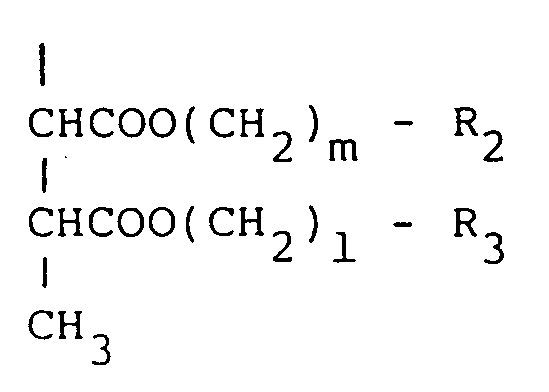
- In accordance with the present invention, there is provided a contact lens comprising a copolymer obtained by copolymerizing, as an indispensable feed monomer, 2 to 95 wt.% of a carboxylic acid ester monomer and 98 to 5 wt.% of a copolymerizable monomer, the carboxylic acid ester monomer being represented by the formula (I)

wherein R₁ stands for a hydrogen atom, an alkyl group having 1 to 12 carbon atoms, an alkenyl group having 1 to 12 carbon atoms, a cyclic alkyl group having 3 to 12 carbon atoms or an aryl group, and X stands for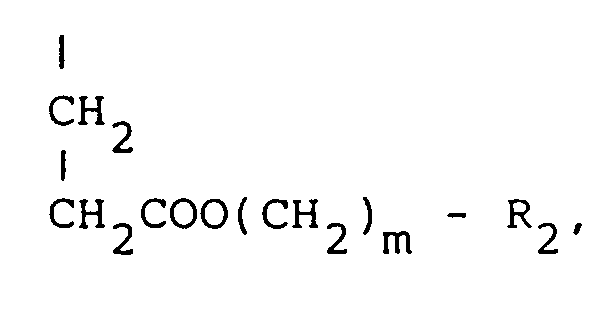

in which R₂ and R₃ each stand for a hydrogen atom, an alkyl group having 1 to 12 carbon atoms, an alkenyl group having 1 to 12 carbon atoms, a cyclic alkyl group having 3 to 12 carbon atoms or an aryl group, m and l being integers of from 0 to 4, at least one of R₁, R₂ and R₃ being a group containing a fluorine atom and n being an integer of from 0 to 4. - The contact lens of the present invention is characterized in that it contains a copolymer in which a specific carboxylic acid ester monomer is copolymerized as an essential starting or feed monomer with a copolymerizable monomer.
- The specific carboxylic acid ester monomer employed in the present invention is represented by the formula

wherein R₁ stands for a hydrogen atom, an alkyl group having 1 to 12 carbon atoms, an alkenyl group having 1 to 12 carbon atoms, a cyclic alkyl group having 3 to 12 carbon atoms or an aryl group , and X stands for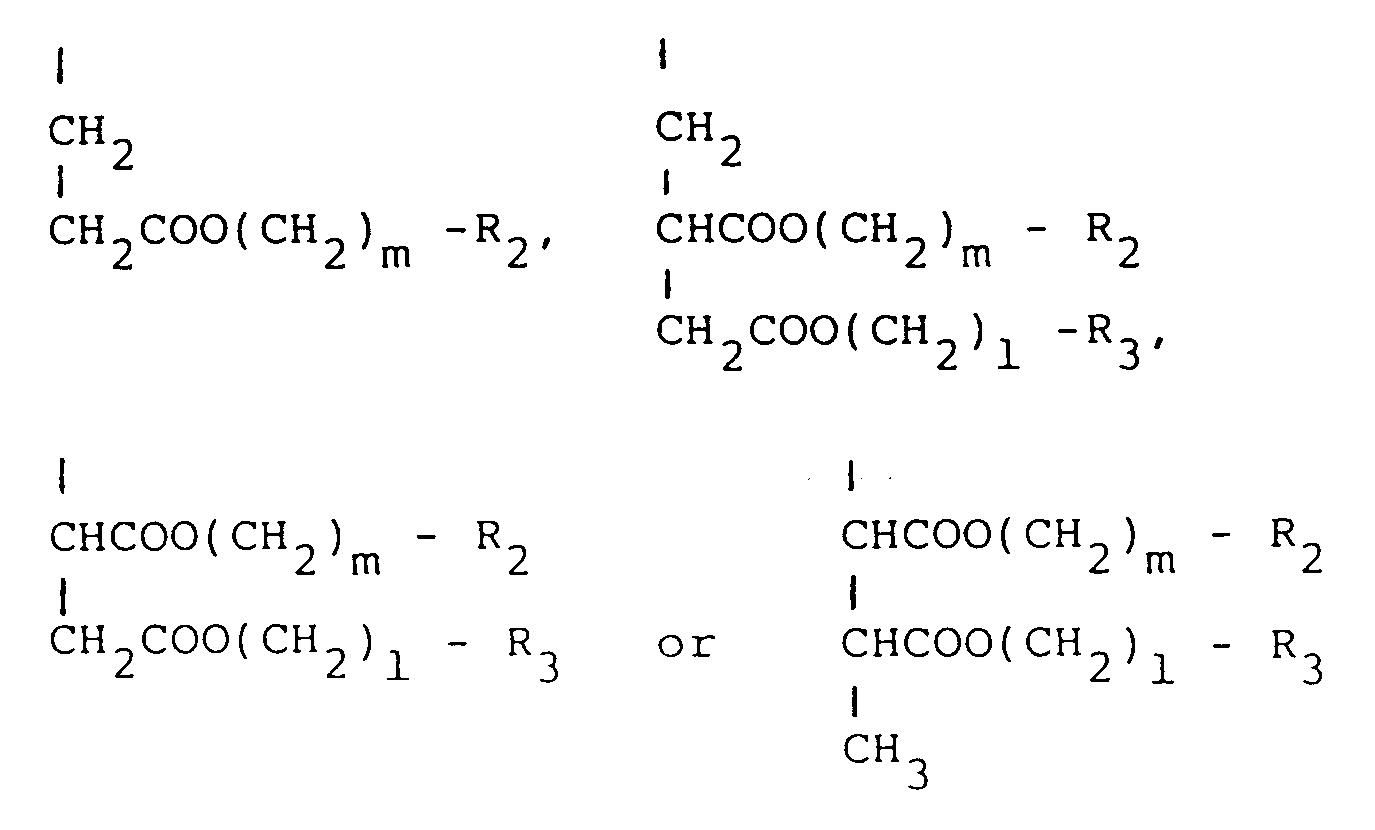
wherein R₂ and R₃ each stand for a group which is the same as or different from R₁ and m and l each stand for an integer of from 0 to 4. At least one of R₁, R₂ and R₃ stands for a group containing a fluorine atom and n stands for an integer of from 0 to 4. If at least one of R₁, R₂ and R₃ has 13 or more carbon atoms or if at least one of m, n and l is 5 or more, it becomes difficult to produce such compounds. Preferably, the number of the fluorine atoms contained in at least one of the groups R₁, R₂ and R₃ is 3 or more. - Examples of the carboxylic acid ester monomers of the above formula (I) wherein X stands for

preferably include 2-(methoxycarbonylethyl)-2′,2′,2′-trifluoroethyl acrylate, 2-(methoxycarbonylethyl)-1′,1′,1′,3′,3′,3′-hexafluoroisopropyl acrylate, 2-(methoxycarbonylethyl)-1′,1′,2′,2′-tetrahydroperfluorooctyl acrylate, 2-(methoxycarbonylethyl)-1′,1′,2′,2′-tetrahydroperfluorodecyl acrylate, 2-(ethoxycarbonylethyl)-2′,2′,2′-trifluoroethyl acrylate, 2-(ethoxycarbonylethyl)-1′,1′,1′,3′,3′,3′-hexafluoro-2-isopropyl acrylate, 2-(ethoxycarbonylethyl)-1′,1′,2′,2′-tetrahydroperfluorooctyl acrylate, 2-(ethoxycarbonylethyl)-1′,1′,2′,2′-tetrahydroperfluorodecyl acrylate, 2-(isopropyloxycarbonylethyl)-2′,2′,2′-trifluoroethyl acrylate, 2-isopropyloxycarbonylethyl)-1′,1′,1′,3′,3′,3′-hexafluoro- 2-isopropyl acrylate, 2-(isopropyloxycarbonylethyl)-1′,1′,5′-trihydroperfluoropentyl acrylate, 2-(isopropyloxycarbonylethyl)-1′,1′,2′,2′-tetrahydroperfluorooctyl acrylate, 2-(isopropyloxycarbonylethyl)-1′,1′,2′,2′-tetrahydroperfluorodecyl acrylate, 2-(tert-butyloxycarbonylethyl)-2′,2′,2′-trifluoroethyl acrylate, 2-(tert-butyloxycarbonylethyl)-1′,1′,1′,3′,3′,3′-hexafluoro-2-isopropyl acrylate, 2-tert-butyloxycarbonylethyl)-1′,1′,2′,2′-tetrahydroperfluorooctyl acrylate, 2-(tert-butyloxycarbonylethyl)-1′,1′,2′,2′ -tetrahydroperfluorodecyl acrylate, 2-(2′,2′,2′-trifluoroethyloxycarbonylethyl)ethyl acrylate, 2-(2′,2′,2′-trifluoroethyloxycarbonylethyl)isopropyl acrylate, 2-(1′,1′,1′,3′,3′,3′-hexafluoro-2-isopropyloxycarbonylethyl)ethyl acrylate, 2-(1′,1′,2′,2′-tetrahydroperfluorooctyloxycarbonylethyl)ethyl acrylate, 2-(2′,2′,2′-trifluoroethyloxycarbonylethyl)tert-butyl acrylate, 2-(1′,1′,2′,2′-tetrahydroperfluorooctyloxycarbonylethyl)isopropyl acrylate, 2-(2′,2′,2′-trifluoroethyloxycarbonylethyl)-2˝,2˝,2˝-trifluoroethyl acrylate, 2-(1′,1′,1′,3′,3′,3′-hexafluoro-2-isopropyloxycarbonylethyl)-1˝,1˝,1˝,3˝,3˝,3˝-hexafluoroisopropyl acrylate, 2-(1′,1′,2′,2′-tetrafluoropropyloxycarbonylethyl)-1˝,1˝,2˝,2˝-tetrafluoropropyl acrylate, and 2-(1′,1′,5′-trihydroperfluoropentyloxycarbonylethyl)-1˝,1˝,5˝-trihydroperfluoropentyl acrylate. - Examples of the carboxylic acid ester monomers of the above formula (I) wherein X stands for

preferably include 2-(2′,2′,2′-trifluoroethoxycarbonyl)-4,5-di(isopropyloxycarbonyl)-1-pentene, 2-(1′,1′,1′,3′,3′,3′-hexafluoroisopropyloxycarbonyl)-4,5-di(tert-butyloxycarbonyl)-1-pentene, 2-(1′,1′,5′-trihydroperfluoropentyloxycarbonyl)-4,5-di(tert-butyloxycarbonyl)-1-pentene, 2-(1′,1′,2′,2′-tetrahydroperfluorodecyloxycarbonyl)-4,5-di(ethoxycarbonyl)-1-pentene, 2-(2′,2′,2′-trifluoroethyloxycarbonyl)-4,5-di(1′,1′,1′,3′,3′,3′-hexafluoroisopropyloxycarbonyl)-1-pentene, 2-(1′,1′,1′,3′,3′,3′-hexafluoroisopropyloxycarbonyl)-4,5-di(2′,2′,2′-trifluoroethyloxycarbonyl)-1-pentene, 2-(2′,2′,2′-trifluoroethyloxycarbonyl)-4,5-di(1′,1′,5′-trihydroperfluoropentyloxycarbonyl)-1-pentene, 2-(1′,1′,2′,2′-tetrahydroperfluorodecyloxycarbonyl)-4,5-di(2′,2′,2′-trifluoroethyloxycarbonyl)-1-pentene, 2,4,5-tri(2′,2′,2′-trifluoroethyloxycarbonyl)-1-pentene, 2,4,5-tri(1′,1′,1′,3′,3′,3′-hexafluoroisopropyloxycarbonyl)-1-pentene, 2,5-di(2′,2′,2′-trifluoroethyloxycarbonyl)-4-(1′,1′,1′,3′,3′,3′-hexafluoroisopropyloxy carbonyl)-1-pentene and 2,5-di(2′,2′,2′-trifluoroethyloxycarbonyl)-4-(1′,1′,5′-trihydroperfluoropentyloxycarbonyl)-1-pentene. - Examples of the carboxylic acid ester monomers of the above formula (I) wherein X denotes
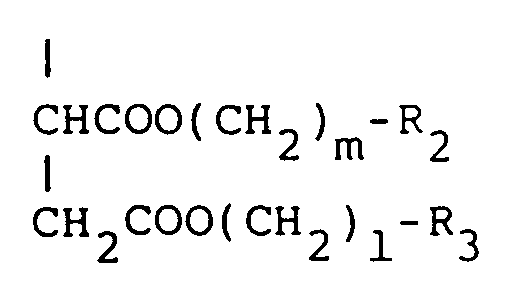
preferably include 2-(2′,2′,2′-trifluoroethoxycarbonyl)-3,4-di(isopropyloxycarbonyl)-1-butene, 2-(1′,1′,1′,3′,3′,3′-hexafluoroisopropyloxycarbonyl)-3,4-di(tert-butyloxycarbonyl)-1-butene, 2-(1′,1′,5′-trihydroperfluoropentyloxycarbonyl)-3,4-di(tert-butyloxycarbonyl)-1-butene, 2-(1′,1′,2′,2′-tetrahydroperfluorodecyloxycarbonyl)-3,4-di(ethoxycarbonyl)-1-butene, 2-(2′,2′,2′-trifluoroethoxycarbonyl)-3,4-di(1′,1′,1′,3′,3′,3′-hexafluoroisopropyloxycarbonyl)-1-butene, 2-(1′,1′,1′,3′,3′,3′-hexafluoroisopropyloxycarbonyl)-3,4-di(2′,2′,2′-trifluoroethyloxycarbonyl)-1-butene, 2-(2′,2′,2′-trifluoroethoxycarbonyl)-3,4-di(1′,1′,5′-trihydroperfluoropentyloxycarbonyl)-1-butene, 2-(1′,1′,2′,2′-tetrahydroperfluorodecyloxycarbonyl)-3,4-di(2′,2′,2′-trifluoroethyloxycarbonyl)-1-butene, 2,3,4-tri(2′,2′,2′-trifluoroethoxycarbonyl)-1-butene, 2,3,4-tri(1′,1′,1′,3′,3′,3′-hexafluoroisopropyloxycarbonyl)-1-butene, 2,4-di(2′,2′,2′-trifluoroethoxycarbonyl)-3-(1′,1′,1′,3′,3′,3′-hexafluoro isopropyloxycarbonyl)-1-butene and 2,4-di(2′,2′,2′-trifluoroethoxycarbonyl)-3-(1′,1′,5′-trihydroperfluoropentyloxycarbonyl)-1-butene. - Examples of the carboxylic acid ester monomers of the above formula (I) wherein X denotes

preferably include 2-(2′,2′,2′-trifluoroethoxycarbonyl)-3,4-di(isopropyloxycarbonyl)-1-pentene, 2-(1′,1′,1′,3′,3′,3′-hexafluoroisopropyloxycarbonyl)-3,4-di(tert-butyloxycarbonyl)-1-pentene, 2-(1′,1′,5′-trihydroperfluoropentyloxycarbonyl)-3,4-di(tert-butyloxycarbonyl)-1-pentene, 2-(1′,1′,2′,2′-tetrahydroperfluorodecyloxycarbonyl)-3,4-di(ethoxycarbonyl)-1-pentene, 2-(2′,2′,2′-trifluoroethoxycarbonyl)-3,4-di(1′,1′,1′,3′,3′,3′-hexafluoroisopropyloxycarbonyl)-1-pentene, 2-(1′,1′,1′,3′,3′,3′-hexafluoroisopropyloxycarbonyl)-3,4-di(2′,2′,2′-trifluoroethyloxycarbonyl)-1-pentene, 2-(2′,2′,2′-trifluoroethoxycarbonyl)-3,4-di(1′,1′,5′-trihydroperfluoropentyloxycarbonyl)-1-pentene, 2-(1′,1′,2′,2′-tetrahydroperfluorodecyloxycarbonyl)-3,4-di(2′,2′,2′-trifluoroethyloxycarbonyl)-1-pentene, 2,3,4-tri(2′,2′,2′-trifluoroethoxycarbonyl)-1-pentene, 2,3,4-tri(1′,1′,1′,3′,3′,3′-hexafluoroisopropyloxycarbonyl)-1-pentene, 2,4-di(2′,2′,2′-trifluoroethoxycarbonyl)-3-(1′,1′,1′,3′,3′,3′-hexafluoro isopropyloxycarbonyl)-1-pentene and 2,4-di(2′,2′,2′-trifluoroethoxycarbonyl)-3-(1′,1′,5′-trihydroperfluoropentyloxycarbonyl)-1-pentene. - The aforementioned carboxylic acid ester monomer as one of the copolymerization components may be used either singly or as a mixture and is contained in an amount ranging between 2 and 95 wt.% based on the total feed monomers. If the amount of the carboxylic acid ester monomer is less than 2 wt.%, oxygen permeability is drastically lowered, whereas, if the amount of the monomer exceeds 95 wt.%, the comonomer cannot be used as the lens material because the strength required of the contact lens cannot be maintained and water-repellency is increased on account of the content of fluorine atoms.
- According to the present invention, the carboxylic acid ester monomer, which is the indispensable monomer component and which is represented by the formula (I), may be prepared by the conventional methods. For example, the carboxylic acid ester monomer of the formula (I) wherein X denotes

may be prepared by dissolving fluoroalkyl acrylate in a solvent dioxane and allowing the reaction to proceed at approximately 90°C for about seven hours under an inert gas atmosphere in the presence of a tertiary phosphine as a catalyst. On the other hand, the carboxylic acid ester monomer of the formula wherein X denotes
may be prepared by dissolving alkyl- or fluoroalkyl acrylate and alkyl- or fluoroalkyl itaconate in a solvent such as dioxane and allowing the reaction to proceed at approximately 90°C for about seven hours under an inert gas atmosphere in the presence of a catalyst such as tertiary phosphine. - With the contact lens of the present invention, any copolymerizable monomers other than the carboxylic acid ester monomer represented by the formula (I) may be used, on the condition that the carboxylic acid ester monomer of the formula (I) is contained as the indispensable feed monomer. However, in view of thermal stability, mechanical strength and machinability of the produced contact lens, radically polymerizable vinyl monomers, silicon-containing vinyl monomers, fluorine-containing vinyl monomers, cross-linkable polyfunctional vinyl monomers, or mixtures thereof, may be preferably used as the copolymerizable monomers besides the aforementioned indispensable feed monomer. Examples of the radically polymerizable vinyl monomers, silicon-containing vinyl monomers, fluorine-containing vinyl monomers and cross-linkable polyfunctional vinyl monomers other than the indispensable feed monomer preferably include methyl (meth)acrylate, ethyl (meth)acrylate, isopropyl (meth)acrylate, tert-butyl (meth)acrylate, cyclohexyl (meth)acrylate, benzyl (meth)acrylate, styrene, p-methylstyrene, p-chlorostyrene, o-chlorostyrene, divinylbenzene, vinyl acetate, vinyl propionate, vinyl pivalate, vinyl (meth)acrylate, allyl (meth)acrylate, 2,2,2-trifluoroethyl (meth)acrylate, ethyl vinyl ether, n-butylvinyl ether, (meth)acrylic amide, 2-hydroxyethyl (meth)acrylate, N-vinyl pyrrolidone, vinyl pyridine, allyl (meth)acrylate, trimethylsilylmethyl (meth)acrylate, pentamethyl disiloxanylmethyl (meth)acrylate, methylbis(trimethylsiloxy)silylmethyl (meth)acrylate, tris(trimethylsiloxy)silylmethyl (meth)acrylate, tris(pentamethyldisiloxanyloxy)silylmethyl (meth)acrylate, trimethylsilylethyl (meth)acrylate, pentamethyldisiloxanylethyl (meth)acrylate, methylbis(trimethylsiloxy)silylethyl (meth)acrylate, tris(trimethylsiloxy)silylethyl (meth)acrylate, tris(pentamethyl disiloxanyloxy)silylethyl (meth)acrylate, trimethylsilylpropyl (meth)acrylate, pentamethyldisiloxanyl (meth)acrylate, methylbis(trimethylsiloxy)silylpropyl (meth)acrylate, tris(trimethylsiloxy)silylpropyl(meth)acrylate, tris(pentamethyldisiloxanyloxy)silylpropyl (meth)acrylate, methylbis(trimethylsiloxy)silylethylglycerolmono (meth)acrylate, tris(trimethylsiloxy)silylethylglycerolmono (meth)acrylate, tris(pentamethyldisiloxanyloxy)silylethylglycerolmono (meth)acrylate, methylbis(trimethylsiloxy)silylpropylglycerolmono (meth)acrylate, tris(trimethylsiloxy)silylglycerolmono (meth)acrylate, tris(pentamethyldisiloxanyloxy) silylpropylglycerolmono (meth)acrylate, dimethyl(triphenylsiloxy)silylpropyl (meth)acrylate, 2,2,2-trifluoroethyl (meth)acrylate, 2,2,2-trifluoro-1-trifluoromethyl (meth)acrylate, 3,3,4,4,5,5,6,6,6-nonafluorohexyl (meth)acrylate, 2,2,3,3,4,4,5,5-octafluoropentyl (meth)acrylate, 1,1,2,2-tetrahydroperfluorooctyl (meth)acrylate, ethyleneglycol di(meth)acrylate, diethyleneglycoldi(meth)acrylate, triethyleneglycol di(meth)acrylate, dipropyleneglycol di(meth)acrylate, diallyl phthalate, diallyl isofumarate, diallyl terephthalate, diethyleneglycolbisallyl carbonate, triallyl trimellitate, triallyl cyanurate, diisopropyl itaconate, ditert-butyl itaconate, di-2,2,2-trifluoroethyl itaconate, ethyl tristrimethylsiloxysilylpropyl itaconate, diisopropyl mesaconate, ditert-butyl mesaconate, di-2,2,2-trifluoroethyl mesaconate, isopropyl-1,1,2,2-tetrahydroperfluorodecyl mesaconate, isopropyl-tristrimethylsiloxysilylpropyl mesaconate, ditert-butyl fumarate, di-2,2,2-trifluoroethyl fumarate, isopropyl-3,3,4,4,5,5,6,6,7,7,8,8,9,9,10,10,10-heptadecafluorodecyl fumarate, tert-butyl-tristrimethylsiloxysilylpropyl fumarate, methacrylic acid, acrylic acid and itaconic acid. These may be used alone or as a mixture.
- The content of the copolymerizable monomers other than the aforementioned indispensable feed monomer is 98 to 5 %, preferably 85 to 5 wt.% based on the total weight of the total components. If the above content is less than 5 wt.%, sufficient thermal stability, mechanical strength or machinability cannot be obtained as a result of copolymerization. The above content in excess of 98 wt.% is also not desirable since oxygen permeability of the contact lens is drastically lowered.
- For affording excellent oxygen permeability to the contact lens of the present invention, the DK value is preferably 6 to 12 X 10⁻¹⁰ ml·cm/cm²·sec·mmHg and more preferably 7 to 11 X 10⁻¹⁰ ml·cm/cm²·sec·mmHg when the carboxylic acid ester monomer of the formula (I) wherein X denotes

is used as the copolymerization component. On the other hand, when the carboxylic acid ester monomer of the formula (I) wherein X denotes
is used, the DK value is preferably 6 to 15 X 10⁻¹⁰ ml·cm/cm²·sec·mmHg and more preferably 8 to 14 X 10⁻¹⁰ ml·cm/cm²·sec·mmHg. If the DK value is less than the above range, the lens cannot be worn continuously for a long time because of insufficient oxygen permeability, whereas, if the DK value is in excess of the above range, certain physical properties of the lens, such as strength, are undesirably lowered. - The contact lens of the present invention may be prepared by any methods which are known per se. For example, the feed monomers may be polymerized in a suitable vessel, such as a test tube, along with a polymerisation initiator, to produce a round rod or a block, which is then machined or ground to produce a contact lens. Alternatively, the feed monomers may be charged into a mold along with a polymerization initiator and directly formed to a contact lens by mold polymerization. Still alternatively, a polymer is produced in advance by, for example, radical polymerization, and the polymer is dissolved in a suitable solvent, which is then removed to produce the contact lens. With these methods, the polymerisation initiator may be one or more selected from the group consisting of azo compounds or organic peroxides having a decomposition temperature of 120°C or less at selected half-life value for ten hours. The aforementioned azo compounds or organic peroxides may be enumerated by, for example, benzoyl peroxide, diisopropyl peroxydicarbonate, t-butylperoxy-2-ethyl hexanoate, t-butylperoxy pivalate, t-butylperoxy diisobutylate, lauroyl peroxide, azobisisobutyronitrile, azobis(2,4-dimethylvaleronitrile) and t-butylperoxyisopropyl carbonate. These polymerization initiators may be used in an amount preferably not more than 10 parts by weight and more preferably not more than 5 parts by weight to 100 parts by weight of the feed monomers.
- With the above methods, the monomer components are preferably copolymerized under a deaerating condition or an atomsphere of inert gases, such as nitrogen, carbon dioxide or helium or under such condition that the atmosphere in the polymerization system is replaced by these inert gases. The copolymerization temperature is preferably in the range of from 30°C to 120°C depending on the type of the polymerization initiator employed. The total polymerization time is preferably in the range of from 10 to 72 hours.
- Colorants such as dyestuffs or additives such as UV absorbers may also be added to the feed monomers prior to polymerization.
- In accordance with the present invention, the contact lens obtained by the above mentioned methods may be surface-modified by treatment with an acid or an alkali or low temperature plasma processing. The wearing feel of the contact lens may also be improved by graft polymerization of hydrophilic monomers by low temperature plasma processing.
- The contact lens of the present invention, which makes use of a specific carboxylic acid ester polymer, has excellent properties as compared to the conventional contact lens, such as higher oxygen permeability or more effective prevention of deposition of protein, lipids or inorganic materials on the lens surface.
- The present invention will be explained in more detail with reference to Examples and Comparative Examples.
- In these Examples, parts are indicated by those by weight.
- 40 parts of 2-(isopropyloxycarbonylethyl)-1′,1′,5′-trihydroperfluoropentyl acrylate, 15 parts of tristrimethylsiloxysilylpropyl methacrylate, 15 parts of 1,1,2,2-tetrahydroperfluorodecyl methacrylate, 20 parts of ethyl methacrylate, 5 parts of allyl methacrylate and 5 parts of methacrylic acid were mixed with 1.0 part of azobis(2,4-dimethylvaleronitrile). The resulting mixture was charged into a glass seal tube, which was melt-sealed under vacuum after atmosphere substitution by nitrogen and repeated deaeration. This sealed tube was placed stationarily for 24 hours in a constant temperature vessel maintained at 70°C for polymerization and further heated at 100°C for two hours. The produced polymer was cut, machined and ground to produce a contact lens. Various physical properties of the produced contact lens were measured by the following methods. Table 1-1 shows the amounts of the feed monomers, while Table 1-2 shows the results of measurement.
- The DK value in cc·cm/cm²·sec·mmHg was measured of a test contact lens having a diameter of 12.7 mm and a thickness of 0.2 mm at 35°C in 0.9% physiological saline, using a multirange analyser for dissoved oxygen sold by Xertex Corporation under a trade name of MODEL 2110.
- To convert the DK value, which comprises "mmHg", into a corresponding SI unit, the following conversion can be carried out:

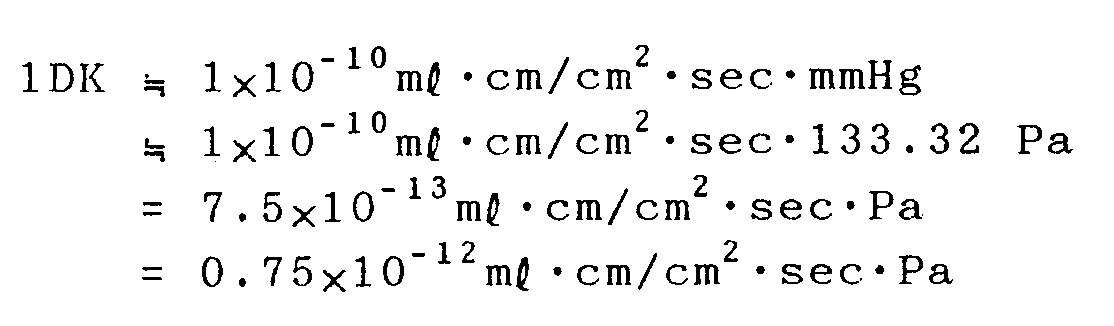
Since, however, the DK value in cc·cm/cm²·sec·mmHg is used worldwide based on ASTM standard D 3985-81, this system will also be used in the present description and in the claims. - A test contact lens having a diameter of 12.7 mm and a thickness of 0.2 mm was immersed at 37°C for 24 hours in a 0.2% aqueous solution of egg white lysozyme and changes in absorbance at 280 nm were measured to find the affixed amount of egg white lysozyme.
- The Vickers hardness was measured using a Terasawa's MM-2 type micro hardness tester manufactured by Taiyo Tester Co., Ltd.
- The mechanical strengths of a flat plate sample 2 mm thick, 50 mm long and 10 mm wide, which was prepared separately by polymerization, were measured in accordance with the testing method for bending hard plastics prescribed in JIS K7203.
- By using the method similar to that of Example 1-1, the various feed monomers shown in Table 1-1 were cured using radical polymerization initiators shown in Table 1-1. Contact lenses were prepared from the cured mass and various physical properties thereof were measured. Table 1-1 shows the amounts of the feed monomers and the polymerization initiators, while Table 1-2 shows the results of measurement.
- The following are abbreviations of the components shown in Tables 1-1, 2-1, 3-1 and 4-1.
- DF3-A :
- 2-(2′,2′,2′-trifluoroethyloxycarbonylethyl)-2˝,2˝,2˝-trifluoroethyl acrylate
- iPF8-A :
- 2-(isopropyloxycarbonylethyl) -1′,1′,5′-trihydroperfluoropentyl acrylate
- tBF17-A :
- 2-(tert-butyloxycarbonylethyl)-1′,1′,2′,2′-tetrahydroperfluoro decyl acrylate
- Si-MA :
- tristrimethylsiloxysilylpropyl methacrylate
- F3-MA :
- 2,2,2-trifluoroethyl methacrylate
- F6-MA :
- 1,1,1,3,3,3-hexafluoroisopropyl methacrylate
- F17-MA :
- 1,1,2,2-tetrahydroperfluorodecyl methacrylate
- Si-Fu :
- isopropyl-tristrimethylsiloxysilylpropyl fumarate
- MMA :
- methyl methacrylate
- EMA :
- ethyl methacrylate
- A-MA :
- allyl methacrylate
- V-MA :
- vinyl methacrylate
- MA :
- methacrylic acid
- AA :
- acrylic acid
- ABVN :
- azobis(2,4-dimethylvaleronitrile)
- IPP :
- diisopropylperoxydicarbonate
- BPO :
- benzoyl peroxide
- TF3-A₁ :
- 2,4,5-tri(2′,2′,2′-trifluoroethoxycarbonyl)-1-pentene
- TF6-A₁ :
- 2,4,5-tri(1′,1′,1′,3′,3′,3′-hexafluoroisopropyloxycarbonyl)-1-pentene
- F8/DF6-A₁ :
- 2-(1′1′,5′-trihydroperfluoropentyloxycarbonyl)-4,5-di(1′,1′,1′,3′,3′,3′-hexafluoroisopropyloxycarbonyl)-1-pentene
- F17/DE-A₁ :
- 2-(1′,1′,2′,2′-tetrahydroperfluorodecyloxycarbonyl)-4,5-di(ethoxycarbonyl)-1-pentene
- F17-Fu :
- isopropyl-1,1,2,2-tetrahydroperfluorodecyl fumarate
- TF3-A₂ :
- 2,3,4-tri(2′,2′,2′-trifluoroethoxycarbonyl)-1-butene
- TF6-A₂ :
- 2,3,4-tri(1′,1′,1′,3′,3′,3′-hexafluoroisopropyloxycarbonyl)-1-butene
- F8/DF6-A₂ :
- 2-(1′,1′,5′-trihydroperfluoropentyloxycarbonyl)-3,4-di(1′,1′,1′,3′,3′,3′-hexafluoroisopropyloxycarbonyl)-1-butene
- F17/DE-A₂ :
- 2-(1′,1′,2′,2′-tetrahydroperfluorodecyloxycarbonyl)-3,4-di(ethoxycarbonyl)-1-butene
- TF3-A₃ :
- 2,3,4-tri(2′,2′,2′-trifluoroethoxycarbonyl)-1-pentene
- TF6-A₃ :
- 2,3,4-tri(1′,1′,1′,3′,3′,3′-hexafluoroisopropyloxycarbonyl)-1-pentene
- F8/DF6-A₃ :
- 2-(1′,1′,5′-trihydroperfluoropentyloxycarbonyl)-3,4-di(1′,1′,1′,3′,3′,3′-hexafluoroisopropyloxycarbonyl)-1-pentene
- F17/DE-A₃ :
- 2-(1′,1′,2′,2′-tetrahydroperfluorodecyloxycarbonyl)-3,4-di(ethoxy carbonyl)-1-pentene
- It is seen from the results of Table 1-2 that the contact lens of the present invention is markedly superior in oxygen permeability while being superior in resistance to contamination.
- 35 parts of 2,4,5-tri(1′,1′,1′,3′,3′,3′-hexafluoroisopropyloxycarbonyl)-1-pentene, 35 parts of tristrimethylsiloxysilylpropyl methacrylate, 20 parts of methyl methacrylate, 5 parts of allyl methacrylate and 5 parts of methacrylic acid were mixed with 1.0 part of azobis(2,4-dimethylvaleronitrile). The resulting mixture was charged into a glass seal tube, which was melt-sealed under vacuum after atmosphere substitution by nitrogen and repeated deaeration. This sealed tube was placed stationarily for 24 hours in a constant temperature vessel maintained at 70°C for polymerization and further heated at 100°C for two hours. The produced polymer was cut, machined and ground to produce a contact lens. Various physical properties of the produced contact lens were measured by the method similar to that used in Example 1-1. Table 2-1 shows the relative amounts of the feed monomer and polymerization initiator, while Table 2-2 shows the results of measurement.
- By using the method similar to that of Example 2-1, the various feed monomers shown in Table 2-1 were cured using radical polymerization initiators shown in Table 2-1 under polymerization conditions. Contact lenses were prepared from the cured mass and various physical properties thereof were measured. Table 2-1 shows the amounts of the feed monomers and the polymerization initiators, while Table 2-2 shows the results of measurement.
Table 2-1 Example 2-1 2-2 2-3 2-4 2-5 TF3-A₁ 20 20 TF6-A₁ 35 F8/DF6-A₁ 30 20 F17/DE-A₁ 25 Si-MA 35 40 25 20 F6-MA 30 25 F17-MA 15 10 Si-Fu 15 MMA 20 15 15 EMA 15 20 A-MA 5 5 V-MA 5 5 5 MA 5 5 AA 5 5 5 ABVN 1.0 1.5 IPP 1.0 1.0 BPO 1.0 (Units are by weight parts) Table 2-2 DK value (*1) Resistance to Contamination HV Bending Stress (*2) Modulus of Elasticity (*3) Ex. 2-1 10.3 Good 8. 6 85.3 (8.7) 1110 Ex. 2-2 11.0 Good 8. 6 85.3 (8.7) 1240 Ex. 2-3 12.1 Good 8. 4 94.1 (9.6) 1030 Ex. 2-4 9.7 Good 9. 2 91.4 (9.3) 1270 Ex. 2-5 9.4 Good 8. 8 77.4 (7.9) 1030 (*1) × 10⁻¹⁰mℓ · cm/cm² · sec · mmHg (*2) MPa (kgf/mm²) (*3) × 10⁶Pa (N/mm²) - 35 parts of 2,3,4-tri(1′,1′,1′,3′,3′,3′-hexafluoroisopropyloxycarbonyl)-1-butene, 35 parts of tristrimethylsiloxysilylpropyl methacrylate, 20 parts of methyl methacrylate, 5 parts of allyl methacrylate and 5 parts of methacrylic acid were mixed with 1.0 part of azobis(2,4-dimethylvaleronitrile). The resulting mixture was charged into a glass seal tube, which was melt-sealed under vacuum after atmosphere substitution by nitrogen and repeated deaeration. This sealed tube was placed stationarily for 24 hours in a constant temperature vessel maintained at 70°C for polymerization and further heated at 100°C for two hours. The produced polymer was cut, machined and ground to produce a contact lens. Various physical properties of the produced contact lens were measured by the method similar to that used in Example 1-1. Table 3-1 shows the relative amounts of the feed monomer and polymerization initiator, while Table 3-2 shows the results of measurement.
- By using the method similar to that of Example 3-1, the various feed monomers shown in Table 3-1 were cured using radical polymerization initiators shown in Table 3-1 under polymerization conditions. Contact lenses were prepared from the cured mass and various physical properties thereof were measured. Table 3-1 shows the amounts of the feed monomers and the polymerization initiators, while Table 3-2 shows the results of measurement.
Table 3-1 Examples 3-1 3-2 3-3 3-4 3-5 TF3-A₂ 20 20 TF6-A₂ 35 F8/DF6-A₂ 30 20 F17/DE-A₂ 25 Si-MA 35 40 25 20 F6-MA 30 25 F17-MA 15 10 Si-Fu 15 MMA 20 15 15 EMA 15 20 A-MA 5 5 V-MA 5 5 5 MA 5 5 AA 5 5 5 ABVN 1.0 1.5 IPP 1.0 1.0 BPO 1.0 (Units are by weight parts) Table 3-2 DK value (*1) Resistance to Contamination HV Bending Stress (*2) Modulus of Elasticity (*3) Ex. 3-1 10.3 Good 8. 6 85.3(8.7) 1110 Ex. 3-2 11.0 Good 8. 6 85.3(8.7) 1240 Ex. 3-3 12.1 Good 8. 4 94.1(9.6) 1030 Ex. 3-4 9.7 Good 9. 2 91.4(9.3) 1270 Ex. 3-5 9.4 Good 8. 8 77.4(7.9) 1030 (*1) × 10⁻¹⁰mℓ · cm/cm² · sec · mmHg (*2) MPa (kgf/mm²) (*3) × 10⁶Pa (N/mm²) - 35 parts of 2,3,4-tri(1′,1′,1′,3′,3′,3′-hexafluoroisopropyloxycarbonyl)-1-pentene, 35 parts of tristrimethylsiloxysilylpropyl methacrylate, 20 parts of methyl methacrylate, 5 parts of allyl methacrylate and 5 parts of methacrylic acid were mixed with 1.0 part of azobis(2,4-dimethylvaleronitrile). The resulting mixture was charged into a glass seal tube, which was melt-sealed under vacuum after atmosphere substitution by nitrogen and repeated deaeration. This sealed tube was placed stationarily for 24 hours in a constant temperature vessel maintained at 70°C for polymerization and further heated at 100°C for two hours. The produced polymer was cut, machined and ground to produce a contact lens. Various physical properties of the produced contact lens were measured by the method similar to that used in Example 1-1. Table 4-1 shows the relative amounts of the feed monomer and the polymerization initiator, while Table 4-2 shows the results of measurement.
- By using the method similar to that of Example 4-1, the various feed monomers shown in Table 4-1 were cured using radical polymerization initiators shown in Table 4-1 under polymerization conditions. Contact lenses were prepared from the cured mass and various physical properties thereof were measured. Table 4-1 shows the amounts of the feed monomers and the polymerization initiators, while Table 4-2 shows the results of measurement.
Table 4-1 Example 4-1 4-2 4-3 4-4 4-5 TF3-A₃ 20 20 TF6-A₃ 35 F8/DF6-A₃ 30 20 F17/DE-A₃ 25 Si-MA 35 40 25 20 F6-MA 30 25 F17-MA 15 10 Si-Fu 15 MMA 20 15 15 EMA 15 20 A-MA 5 5 V-MA 5 5 5 MA 5 5 AA 5 5 5 ABVN 1.0 1.5 IPP 1.0 1.0 BPO 1.0 (Units are by weight parts) Table 4-2 DK value (*1) Resistance to Contamination HV Bending Stress (*2) Modulus of Elasticity (*3) Ex. 4-1 10.0 Good 8. 6 82.3 (8.4) 1020 Ex. 4-2 11.0 Good 8. 4 80.4 (8.2) 1190 Ex. 4-3 11.3 Good 8. 4 91.1 (9.3) 1036 Ex. 4-4 9.1 Good 9. 3 89.2 (9.1) 1240 Ex. 4-5 9.1 Good 8. 3 77.4 (7.9) 1020 (*1) × 10⁻¹⁰mℓ · cm/cm² · sec · mmHg (*2) MPa (kgf/mm²) (*3) × 10⁶Pa (N/mm²) - It is seen from the results of Tables 2-2, 3-2 and 4-2 that, as compared to the products of Comparative Examples 1-1 to 1-3, the contact lens of the present invention has a higher DK value and excellent oxygen permeability and resistance to contamination besides moderate physical strength.
| Example | Comparative Example | |||||||
| 1-1 | 1-2 | 1-3 | 1-4 | 1-5 | 1-1 | 1-2 | 1-3 | |
| DF3-A | 35 | 30 | ||||||
| iPF8-A | 40 | 30 | ||||||
| tBF17-A | 35 | 35 | ||||||
| Si-MA | 15 | 25 | 10 | 15 | 40 | 45 | ||
| F3-MA | 45 | |||||||
| F6-MA | 20 | |||||||
| F17-MA | 15 | 10 | 30 | |||||
| Si-Fu | 20 | 20 | ||||||
| MMA | 20 | 15 | 20 | 50 | 60 | |||
| EMA | 20 | 20 | ||||||
| A-MA | 5 | 5 | 5 | |||||
| V-MA | 5 | 5 | 5 | 5 | 5 | |||
| MA | 5 | 5 | 5 | |||||
| AA | 5 | 5 | 5 | 5 | 5 | |||
| ABVN | 1.5 | 1.5 | 1.5 | |||||
| IPP | 1.0 | 1.0 | 1.0 | |||||
| BPO | 1.0 | 1.0 | ||||||
| (Units are by weight parts) | ||||||||
| DK value (*1) | Resistance to Contamination | HV | Bending Stress (*2) | Modulus of Elasticity (*3) | |
| Ex. 1-1 | 10.1 | Good | 8. 9 | 85.3(8.7) | 1110 |
| Ex. 1-2 | 9.7 | Good | 8. 6 | 85.3(8.7) | 1240 |
| Ex. 1-3 | 10.5 | Good | 8. 4 | 94.1(9.6) | 1030 |
| Ex. 1-4 | 8.9 | Good | 9. 5 | 91.1(9.3) | 1270 |
| Ex. 1-5 | 10.2 | Good | 8. 1 | 77.4(7.9) | 1130 |
| Comp.Ex.1-1 | 2.4 | Good | 8. 6 | 76.4(7.8) | 1280 |
| Comp.Ex.1-2 | 5.4 | 1.2»g/cm² | 7. 1 | 60.8(6.2) | 780 |
| Comp.Ex.1-3 | 2.0 | Good | 9. 8 | 81.3(8.3) | 1310 |
| (*1) × 10⁻¹⁰mℓ · cm/cm² · sec · mmHg | |||||
| (*2) MPa (kgf/mm²) | |||||
| (*3) × 10⁶Pa (N/mm²) |
Claims (5)
- A contact lens comprising a copolymer obtained by copolymerizing, as an indispensable feed monomer, 2 to 95 wt.% of a carboxylic acid ester monomer and 98 to 5 wt.% of a copolymerizable monomer, said carboxylic acid ester monomer being represented by the formula (I)


- The contact lens according to claim 1 wherein a DK value of the contact lens obtained when X in the formula (I) is

- The contact lens according to claim 1 wherein a DK value of the contact lens obtained when X in the formula (I) is

- The contact lens according to claim 1 wherein a DK value of the contact lens obtained when X in the formula (I) is

- The contact lens according to claim 1 wherein a DK value of the contact lens obtained when X in the formula (I) is
Applications Claiming Priority (6)
| Application Number | Priority Date | Filing Date | Title |
|---|---|---|---|
| JP28194289A JP2803233B2 (en) | 1989-10-31 | 1989-10-31 | contact lens |
| JP28194089A JP2803232B2 (en) | 1989-10-31 | 1989-10-31 | contact lens |
| JP281942/89 | 1989-10-31 | ||
| JP28194189A JPH03144543A (en) | 1989-10-31 | 1989-10-31 | Contact lens |
| JP281940/89 | 1989-10-31 | ||
| JP281941/89 | 1989-10-31 |
Publications (3)
| Publication Number | Publication Date |
|---|---|
| EP0425831A2 EP0425831A2 (en) | 1991-05-08 |
| EP0425831A3 EP0425831A3 (en) | 1992-01-15 |
| EP0425831B1 true EP0425831B1 (en) | 1995-05-03 |
Family
ID=27336895
Family Applications (1)
| Application Number | Title | Priority Date | Filing Date |
|---|---|---|---|
| EP90118968A Expired - Lifetime EP0425831B1 (en) | 1989-10-31 | 1990-10-04 | Contact lens |
Country Status (3)
| Country | Link |
|---|---|
| US (1) | US5883152A (en) |
| EP (1) | EP0425831B1 (en) |
| DE (1) | DE69019103T2 (en) |
Families Citing this family (4)
| Publication number | Priority date | Publication date | Assignee | Title |
|---|---|---|---|---|
| KR100230417B1 (en) * | 1997-04-10 | 1999-11-15 | 윤종용 | Silicon-contained chemically amplified resist composition |
| KR100261224B1 (en) * | 1998-05-07 | 2000-09-01 | 윤종용 | Si-containing polymers and chemically amplified resists comprising the same |
| US7084188B2 (en) | 2003-12-05 | 2006-08-01 | Bausch & Lomb Incorporated | Surface modification of contact lenses |
| US7176268B2 (en) * | 2003-12-05 | 2007-02-13 | Bausch & Lomb Incorporated | Prepolymers for improved surface modification of contact lenses |
Family Cites Families (6)
| Publication number | Priority date | Publication date | Assignee | Title |
|---|---|---|---|---|
| US4996275A (en) * | 1985-10-11 | 1991-02-26 | Polymer Technology Corporation | Fluorine containing polymeric compositions useful in contact lenses |
| US4686267A (en) * | 1985-10-11 | 1987-08-11 | Polymer Technology Corporation | Fluorine containing polymeric compositions useful in contact lenses |
| CA1222845A (en) * | 1986-02-06 | 1987-06-09 | Progressive Chemical Research Ltd. | Silicone-sulfone and silicone-fluorocarbon-sulfone gas permeable contact lenses and compositions thereof |
| DE3750703T2 (en) * | 1986-03-25 | 1995-03-30 | Nippon Oils & Fats Co Ltd | Transparent optical object and process for its manufacture. |
| AU5286390A (en) * | 1989-03-28 | 1990-10-22 | Ciba-Geigy Ag | Hydrogels based on sugar alcohol monomers |
| US5032658A (en) * | 1989-10-17 | 1991-07-16 | Polymer Technology Corporation | Polymeric compositions useful in oxygen permeable contact lenses |
-
1990
- 1990-10-04 DE DE69019103T patent/DE69019103T2/en not_active Expired - Fee Related
- 1990-10-04 EP EP90118968A patent/EP0425831B1/en not_active Expired - Lifetime
-
1997
- 1997-06-25 US US08/882,660 patent/US5883152A/en not_active Expired - Fee Related
Also Published As
| Publication number | Publication date |
|---|---|
| DE69019103D1 (en) | 1995-06-08 |
| EP0425831A2 (en) | 1991-05-08 |
| DE69019103T2 (en) | 1995-10-12 |
| EP0425831A3 (en) | 1992-01-15 |
| US5883152A (en) | 1999-03-16 |
Similar Documents
| Publication | Publication Date | Title |
|---|---|---|
| EP0277771B1 (en) | Continuous-wear lenses having improved physical properties | |
| EP0231572B1 (en) | Silicone-sulfone and silicone-fluorocarbon-sulfone gas permeable contact lenses and compositions thereof | |
| EP0524557B1 (en) | Ocular lens material | |
| US4933406A (en) | Contact lens article made of silicon- and fluorine-containing resin | |
| JPS628769B2 (en) | ||
| EP0213412B1 (en) | Contact lenses | |
| US5883152A (en) | Contact lens | |
| US5391591A (en) | Oxygen permeable hard contact lens materials comprising a fluoroalkyl(silicon-containing alkyl) fumarate copolymer | |
| JP2591154B2 (en) | contact lens | |
| KR920000976B1 (en) | Contact lens article made of silicon-and fluorine-containing resin | |
| JP2808295B2 (en) | Contact lens materials and contact lenses | |
| JP2803152B2 (en) | contact lens | |
| JP2803232B2 (en) | contact lens | |
| JP2803233B2 (en) | contact lens | |
| JP2803242B2 (en) | contact lens | |
| JP2803241B2 (en) | contact lens | |
| JP2803255B2 (en) | contact lens | |
| JP2935118B2 (en) | Contact lens materials and contact lenses | |
| JPH0812340B2 (en) | contact lens | |
| JP2623248B2 (en) | contact lens | |
| JP2565316B2 (en) | contact lens | |
| JP2588948B2 (en) | Hard contact lens material | |
| JPH03144543A (en) | Contact lens | |
| JPH04190213A (en) | Contact lens | |
| JPH03154022A (en) | Contact lens |
Legal Events
| Date | Code | Title | Description |
|---|---|---|---|
| PUAI | Public reference made under article 153(3) epc to a published international application that has entered the european phase |
Free format text: ORIGINAL CODE: 0009012 |
|
| AK | Designated contracting states |
Kind code of ref document: A2 Designated state(s): BE CH DE FR GB IT LI NL |
|
| PUAL | Search report despatched |
Free format text: ORIGINAL CODE: 0009013 |
|
| AK | Designated contracting states |
Kind code of ref document: A3 Designated state(s): BE CH DE FR GB IT LI NL |
|
| 17P | Request for examination filed |
Effective date: 19920129 |
|
| 17Q | First examination report despatched |
Effective date: 19931221 |
|
| GRAA | (expected) grant |
Free format text: ORIGINAL CODE: 0009210 |
|
| AK | Designated contracting states |
Kind code of ref document: B1 Designated state(s): BE CH DE FR GB IT LI NL |
|
| PG25 | Lapsed in a contracting state [announced via postgrant information from national office to epo] |
Ref country code: BE Effective date: 19950503 |
|
| REF | Corresponds to: |
Ref document number: 69019103 Country of ref document: DE Date of ref document: 19950608 |
|
| ITF | It: translation for a ep patent filed | ||
| ET | Fr: translation filed | ||
| PLBE | No opposition filed within time limit |
Free format text: ORIGINAL CODE: 0009261 |
|
| STAA | Information on the status of an ep patent application or granted ep patent |
Free format text: STATUS: NO OPPOSITION FILED WITHIN TIME LIMIT |
|
| 26N | No opposition filed | ||
| PGFP | Annual fee paid to national office [announced via postgrant information from national office to epo] |
Ref country code: NL Payment date: 19961031 Year of fee payment: 7 |
|
| PG25 | Lapsed in a contracting state [announced via postgrant information from national office to epo] |
Ref country code: NL Free format text: LAPSE BECAUSE OF NON-PAYMENT OF DUE FEES Effective date: 19980501 |
|
| NLV4 | Nl: lapsed or anulled due to non-payment of the annual fee |
Effective date: 19980501 |
|
| REG | Reference to a national code |
Ref country code: GB Ref legal event code: IF02 |
|
| PGFP | Annual fee paid to national office [announced via postgrant information from national office to epo] |
Ref country code: GB Payment date: 20021002 Year of fee payment: 13 |
|
| PGFP | Annual fee paid to national office [announced via postgrant information from national office to epo] |
Ref country code: FR Payment date: 20021008 Year of fee payment: 13 |
|
| PGFP | Annual fee paid to national office [announced via postgrant information from national office to epo] |
Ref country code: DE Payment date: 20021011 Year of fee payment: 13 |
|
| PGFP | Annual fee paid to national office [announced via postgrant information from national office to epo] |
Ref country code: CH Payment date: 20021016 Year of fee payment: 13 |
|
| PG25 | Lapsed in a contracting state [announced via postgrant information from national office to epo] |
Ref country code: GB Free format text: LAPSE BECAUSE OF NON-PAYMENT OF DUE FEES Effective date: 20031004 |
|
| PG25 | Lapsed in a contracting state [announced via postgrant information from national office to epo] |
Ref country code: LI Free format text: LAPSE BECAUSE OF NON-PAYMENT OF DUE FEES Effective date: 20031031 Ref country code: CH Free format text: LAPSE BECAUSE OF NON-PAYMENT OF DUE FEES Effective date: 20031031 |
|
| PG25 | Lapsed in a contracting state [announced via postgrant information from national office to epo] |
Ref country code: DE Free format text: LAPSE BECAUSE OF NON-PAYMENT OF DUE FEES Effective date: 20040501 |
|
| GBPC | Gb: european patent ceased through non-payment of renewal fee |
Effective date: 20031004 |
|
| REG | Reference to a national code |
Ref country code: CH Ref legal event code: PL |
|
| PG25 | Lapsed in a contracting state [announced via postgrant information from national office to epo] |
Ref country code: FR Free format text: LAPSE BECAUSE OF NON-PAYMENT OF DUE FEES Effective date: 20040630 |
|
| REG | Reference to a national code |
Ref country code: FR Ref legal event code: ST |
|
| PG25 | Lapsed in a contracting state [announced via postgrant information from national office to epo] |
Ref country code: IT Free format text: LAPSE BECAUSE OF NON-PAYMENT OF DUE FEES;WARNING: LAPSES OF ITALIAN PATENTS WITH EFFECTIVE DATE BEFORE 2007 MAY HAVE OCCURRED AT ANY TIME BEFORE 2007. THE CORRECT EFFECTIVE DATE MAY BE DIFFERENT FROM THE ONE RECORDED. Effective date: 20051004 |