EP0423232B1 - Novel glass elements for use in balances - Google Patents
Novel glass elements for use in balances Download PDFInfo
- Publication number
- EP0423232B1 EP0423232B1 EP89908648A EP89908648A EP0423232B1 EP 0423232 B1 EP0423232 B1 EP 0423232B1 EP 89908648 A EP89908648 A EP 89908648A EP 89908648 A EP89908648 A EP 89908648A EP 0423232 B1 EP0423232 B1 EP 0423232B1
- Authority
- EP
- European Patent Office
- Prior art keywords
- glass
- mass
- accordance
- glass element
- elements
- Prior art date
- Legal status (The legal status is an assumption and is not a legal conclusion. Google has not performed a legal analysis and makes no representation as to the accuracy of the status listed.)
- Expired - Lifetime
Links
- 239000011521 glass Substances 0.000 title claims abstract description 93
- VYPSYNLAJGMNEJ-UHFFFAOYSA-N Silicium dioxide Chemical compound O=[Si]=O VYPSYNLAJGMNEJ-UHFFFAOYSA-N 0.000 claims abstract description 33
- 235000012239 silicon dioxide Nutrition 0.000 claims abstract description 16
- 239000000377 silicon dioxide Substances 0.000 claims abstract description 14
- 229910052681 coesite Inorganic materials 0.000 claims abstract description 12
- 229910052906 cristobalite Inorganic materials 0.000 claims abstract description 12
- 229910052682 stishovite Inorganic materials 0.000 claims abstract description 12
- 229910052905 tridymite Inorganic materials 0.000 claims abstract description 12
- 229910011255 B2O3 Inorganic materials 0.000 claims abstract description 9
- JKWMSGQKBLHBQQ-UHFFFAOYSA-N diboron trioxide Chemical compound O=BOB=O JKWMSGQKBLHBQQ-UHFFFAOYSA-N 0.000 claims abstract description 9
- KKCBUQHMOMHUOY-UHFFFAOYSA-N Na2O Inorganic materials [O-2].[Na+].[Na+] KKCBUQHMOMHUOY-UHFFFAOYSA-N 0.000 claims abstract description 8
- PNEYBMLMFCGWSK-UHFFFAOYSA-N aluminium oxide Inorganic materials [O-2].[O-2].[O-2].[Al+3].[Al+3] PNEYBMLMFCGWSK-UHFFFAOYSA-N 0.000 claims abstract description 8
- 229910052593 corundum Inorganic materials 0.000 claims abstract description 7
- 229910001845 yogo sapphire Inorganic materials 0.000 claims abstract description 7
- 238000005452 bending Methods 0.000 claims description 6
- 238000005303 weighing Methods 0.000 claims description 6
- 239000007787 solid Substances 0.000 claims 2
- 239000000725 suspension Substances 0.000 claims 2
- 230000000284 resting effect Effects 0.000 claims 1
- 239000000203 mixture Substances 0.000 description 19
- QVQLCTNNEUAWMS-UHFFFAOYSA-N barium oxide Inorganic materials [Ba]=O QVQLCTNNEUAWMS-UHFFFAOYSA-N 0.000 description 13
- 238000004519 manufacturing process Methods 0.000 description 9
- 239000000463 material Substances 0.000 description 9
- 239000000835 fiber Substances 0.000 description 8
- 238000005259 measurement Methods 0.000 description 8
- 230000001419 dependent effect Effects 0.000 description 6
- 230000001747 exhibiting effect Effects 0.000 description 6
- 238000000034 method Methods 0.000 description 5
- 230000010355 oscillation Effects 0.000 description 5
- 239000000126 substance Substances 0.000 description 5
- FUJCRWPEOMXPAD-UHFFFAOYSA-N Li2O Inorganic materials [Li+].[Li+].[O-2] FUJCRWPEOMXPAD-UHFFFAOYSA-N 0.000 description 4
- XUCJHNOBJLKZNU-UHFFFAOYSA-M dilithium;hydroxide Chemical compound [Li+].[Li+].[OH-] XUCJHNOBJLKZNU-UHFFFAOYSA-M 0.000 description 4
- 239000010453 quartz Substances 0.000 description 4
- 230000001133 acceleration Effects 0.000 description 3
- 230000008901 benefit Effects 0.000 description 3
- 239000013078 crystal Substances 0.000 description 3
- 238000006073 displacement reaction Methods 0.000 description 3
- 230000000694 effects Effects 0.000 description 3
- 239000003365 glass fiber Substances 0.000 description 3
- 239000005368 silicate glass Substances 0.000 description 3
- 239000011734 sodium Substances 0.000 description 3
- 229910000990 Ni alloy Inorganic materials 0.000 description 2
- 229910052910 alkali metal silicate Inorganic materials 0.000 description 2
- 238000013459 approach Methods 0.000 description 2
- ZGDWHDKHJKZZIQ-UHFFFAOYSA-N cobalt nickel Chemical compound [Co].[Ni].[Ni].[Ni] ZGDWHDKHJKZZIQ-UHFFFAOYSA-N 0.000 description 2
- 238000000105 evaporative light scattering detection Methods 0.000 description 2
- 230000005484 gravity Effects 0.000 description 2
- 238000007537 lampworking Methods 0.000 description 2
- 239000000155 melt Substances 0.000 description 2
- BASFCYQUMIYNBI-UHFFFAOYSA-N platinum Chemical compound [Pt] BASFCYQUMIYNBI-UHFFFAOYSA-N 0.000 description 2
- 238000007789 sealing Methods 0.000 description 2
- 230000035945 sensitivity Effects 0.000 description 2
- 229910052708 sodium Inorganic materials 0.000 description 2
- 239000000758 substrate Substances 0.000 description 2
- 238000002604 ultrasonography Methods 0.000 description 2
- 238000012935 Averaging Methods 0.000 description 1
- DGAQECJNVWCQMB-PUAWFVPOSA-M Ilexoside XXIX Chemical compound C[C@@H]1CC[C@@]2(CC[C@@]3(C(=CC[C@H]4[C@]3(CC[C@@H]5[C@@]4(CC[C@@H](C5(C)C)OS(=O)(=O)[O-])C)C)[C@@H]2[C@]1(C)O)C)C(=O)O[C@H]6[C@@H]([C@H]([C@@H]([C@H](O6)CO)O)O)O.[Na+] DGAQECJNVWCQMB-PUAWFVPOSA-M 0.000 description 1
- 229910007676 ZnO—SiO2 Inorganic materials 0.000 description 1
- 229910000272 alkali metal oxide Inorganic materials 0.000 description 1
- 239000005391 art glass Substances 0.000 description 1
- WUKWITHWXAAZEY-UHFFFAOYSA-L calcium difluoride Chemical compound [F-].[F-].[Ca+2] WUKWITHWXAAZEY-UHFFFAOYSA-L 0.000 description 1
- 229910001634 calcium fluoride Inorganic materials 0.000 description 1
- 238000005266 casting Methods 0.000 description 1
- 230000015556 catabolic process Effects 0.000 description 1
- 239000000470 constituent Substances 0.000 description 1
- 238000002425 crystallisation Methods 0.000 description 1
- 230000008025 crystallization Effects 0.000 description 1
- 238000006731 degradation reaction Methods 0.000 description 1
- 238000013461 design Methods 0.000 description 1
- 230000000368 destabilizing effect Effects 0.000 description 1
- 238000001514 detection method Methods 0.000 description 1
- 238000004031 devitrification Methods 0.000 description 1
- 230000005489 elastic deformation Effects 0.000 description 1
- 230000008030 elimination Effects 0.000 description 1
- 238000003379 elimination reaction Methods 0.000 description 1
- 239000005350 fused silica glass Substances 0.000 description 1
- 238000010438 heat treatment Methods 0.000 description 1
- 239000012510 hollow fiber Substances 0.000 description 1
- 238000002844 melting Methods 0.000 description 1
- 230000008018 melting Effects 0.000 description 1
- 238000012986 modification Methods 0.000 description 1
- 230000004048 modification Effects 0.000 description 1
- 230000000704 physical effect Effects 0.000 description 1
- 229910052697 platinum Inorganic materials 0.000 description 1
- 229910052700 potassium Inorganic materials 0.000 description 1
- 238000003380 quartz crystal microbalance Methods 0.000 description 1
- 238000012552 review Methods 0.000 description 1
- 229910001948 sodium oxide Inorganic materials 0.000 description 1
- 239000011343 solid material Substances 0.000 description 1
- 238000006467 substitution reaction Methods 0.000 description 1
- 230000002277 temperature effect Effects 0.000 description 1
Images
Classifications
-
- G—PHYSICS
- G01—MEASURING; TESTING
- G01G—WEIGHING
- G01G3/00—Weighing apparatus characterised by the use of elastically-deformable members, e.g. spring balances
- G01G3/12—Weighing apparatus characterised by the use of elastically-deformable members, e.g. spring balances wherein the weighing element is in the form of a solid body stressed by pressure or tension during weighing
Definitions
- This invention is related to an invention in the names of William H. Dumbaugh and Henry E. Hagy entitled “Glasses Exhibiting Low Thermal Coefficients of Elasticity” (US-A-4 855 260 published 8,8,89).
- This invention pertains to improved balances which utilize an elastic property of glass to determine mass. More particularly, it pertains to balances for which the resolution shows a low or minimal sensitivity to changes of temperature.
- Young's modulus For an accurate measurement, therefore, it is important that Young's modulus remain essentially constant, and for measurement of very small masses or for extremely accurate measurement of mass the constancy of Young's modulus is critical. In virtually all materials, however, the value of Young's modulus changes with temperature. In the determination of very small masses, or for high resolution, unless the temperature is carefully controlled this effect can result in significant errors. Constant temperature can be achieved and maintained only within certain limits even with considerable effort and expense, and the equipment required also contributes to operational inconvenience. In some applications adequate temperature control is nearly impossible, which results in a severe degradation or loss of resolution. These problems can be significantly reduced by the use of material which has low or minimal temperature dependence of Young's modulus over the nominal temperature operating range of the system.
- Gravitational systems include:
- Systems 2 through 4 are sensitive to temperature variation, since they all involve deflection of a member which has a temperature sensitive Young's modulus.
- the degree of deflection depends on the stiffness of the member material which is partially dependent on geometric considerations but is also dependent on the Young's modulus of the material.
- Inertial systems include:
- glasses share the characteristic of exhibiting an elastic modulus which varies depending upon temperature with most other solid materials. It is also known that the extent of this dependence can vary substantially depending upon the composition of the glass and the temperature bracket over which the elastic modulus of the glass is measured.
- V.S. Postnikov et al. in "Temperature Dependence of the Shear Modulus and Attenuation of Ultrasound in Silicate Glasses," Izv. Akad. Naukd. SSSR, Neorg. Matr. .
- Glasses exhibiting a low thermal coefficient of elastic modulus are useful for applications wherein the detection and measurement of a deflection in a glass element is used to provide an indication of a mass or applied stress. As discussed above, most types of balances may be made employing glass elements as mass detection means.
- U.S. Patent No. 2,392,3144 describes glasses consisting essentially of 60-75% SiO2 10-20% B2O3, 10-15% BaO and/or CaF2, and 5-10% Al2O3, and also comprising an alkali metal oxide component including up to about 5% K2O, up to about 2% Li2O, and up to 3% Na2O.
- Glasses of this type were originally developed for sealing to cobalt-nickel alloys.
- a related glass having the composition SiO2 63.1%, B2O3 19.0%, Al2O3 7.5%, Li2O 0.65%, Na2O 2.15%, K2O 3.20%, BaO 2.70%, F 0.6%, which is sold commercially for sealing to cobalt-nickel alloys, exhibits a relatively low thermal coefficient of elastic modulus at ambient temperatures. Further, in contrast to the glasses of Postikov et al., this glass is readily formed by standard glass-working methods into shapes such as rods, fibers, hollow fibers, springs and the like required for balance elements.
- Desirable characteristics of elements to be used for technical applications such as described above further include ease of fabrication, good dimensional stability, a low coefficient of thermal expansion, and good chemical durability.
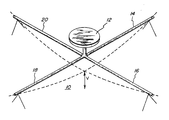
- the drawing is a schematic illustration of an embodiment of the linear motion inertial balance described in copending U.S. Patent Application, Serial No. 147,252, mentioned above.
- the present invention provides shaped glass elements for use as mass detection means in gravimetric and inertial balances which exhibit thermal coefficients of elastic modulus well below those of glass elements of commercial balances, and which in addition offer good stability, low thermal expansion, and good chemical durability.
- Glass elements satisfying these characteristics are generally of two distinct types.
- the first type preferred from the standpoint of glass stability and ease of fabrication, includes elements made from glasses consisting essentially, in weight percent on the oxide basis, of about 60-64% SiO2, 14-18% B2O3, 8.5-10% Al2O3, 4-7% Na2O, and 2-12% BaO.
- a second group of glass elements which also exhibit low thermal coefficients of elastic modulus but are more difficult to fabricate than the preferred elements, comprises those made from alkali silicate glasses containing ZnO, BaO, and PbO as principal modifying constituents. These glasses consist essentially, in weight percent on the oxide basis, of about 51-55% SiO2, 10-13% K2O, 5-15% ZnO, 5-15% BaO, and 10-20% PbO. While exhibiting somewhat higher thermal expansion coefficients and being less preferred from the standpoint of ease of manufacture these elements still combine adequate ease of manufacture with a low thermal coefficient of elasticity and reasonable chemical durability.
- the velocity of an ultrasound wave in a glass sample depends on the shear modulus of the glass, and can be measured at various temperatures to evaluate the thermal coefficient of shear modulus or elastic modulus for that glass.
- Shaped glass elements having a low temperature coefficient of elastic modulus are useful in the manufacture of balances capable of measuring very small masses and/or larger masses with high resolution.
- These balances typically comprise an oscillating or bending system consisting of elastic glass members, whereby the resonance frequency of an oscillating system or the amount of displacement in a bending system depends upon the mass deposited on a shaped glass substrate surface.
- a sample table or weighing platform 12 is attached at the intersection of four symmetrically disposed, elongate, elastic support elements 14, 16, 18 and 20 arranged in a cross configuration or arrangement 10. As shown, the outer ends of the support members are, in turn, supported at equal distances from the intersection, in a manner which permits their operation in a bending mode (as indicated by the dashed lines).
- the four support members lie in a common plane when the weighing platform is at rest.
- a vibration of the platform is introduced in a direction perpendicular to the plane containing the support members, as indicated by double headed arrow V.
- the weighing platform 12 is constrained to undergo uniform linear motion.
- the mass measurement accuracy of a vibratory inertial balance is dependent upon the precision with which linear motion is maintained at the weighing platform undergoing oscillation.
- the moving mass of the measuring system determines its sensitivity because the lower the oscillating system mass the greater the shift in frequency for a given sample mass.
- a glass which has been used for this purpose contains about 63% SiO2, 19% B 2O3, 7.5% Al 2O3, 0.65% Li2O 2.15% Na 2O, 3.2% K 2O, 2.7% BaO and 0.6% F, has a thermal coefficient of elastic modulus of about 60 ppm/°C at 50°C and an average coefficient of thermal expansion (0-300°C) of about 46 x 10 ⁇ 7/°C.
- the shaped glass elements also must exhibit excellent dimensional stability, and will preferably demonstrate a relatively low coefficient of thermal expansion so as to provide stable physical dimensions in use. Finally the elements should exhibit reasonable chemical durability, particularly for applications requiring exposure of the element to corrosive environments.
- Table I Examples of glasses which have been found to meet these requirements are reported in Table I below. Melts of the glasses reported in Table I may be conveniently compounded in 1000 gram batches, with the batches then being tumble mixed to assure melt homogeneity. The batches may then be melted In platinum crucibles in an electric furnace, with melting being carried out over a 4-hour interval at 1550°C. The melts are then stirred for 15 minutes and allowed to soak at 1550° for an additional one and one-half hours before casting into slabs. The glasses are finally annealed at 500°C.
- These glasses consist essentially, in weight percent on the oxide basis, of about 60-64% SiO2, 14-18% B2O3, 8.5-10% Al2O3, 4-7% Na2O and 2-12% BaO.
- Samples of the glasses are formed into glass fibers, rods or hollow elements by the standard glass-working technique of heating in a flame and reshaping. They may be further modified for particular applications. For example, a glass rod or fiber may be heated in a flame and then wound around a mandrel to form a spring for use in a spring balance.
- Several elements may be fused together to form the linear motion device of the aforementioned U.S. Patent Application, Serial No. 147,252.
- Simple glass fibers formed by this glass-working method were tested to determine their normalized thermal coefficient of elastic modulus (in short normalized elastic modulus or NEM). The values given in Table II below were determined at 50°C. These values represent a substantial improvement over the performance of the prior art glass element, which exhibits a normalized elastic modulus of 62 ppm/°C at 50°C.
- the composition of the shaped glass element is found to critically affect the elastic and other physical properties thereof.
- balance elements made from glasses close in composition to those within the scope of the invention but outside the ranges specified generally will not exhibit the combination of properties needed for applications requiring a low thermal coefficient of elastic modulus.
- Table III reports the results for a number of elements made from related alkali silicate glasses. These elements do not meet the requirement for a low thermal coefficient. The elements reported include one made from the previously preferred commercial glass, as well as compositional variations thereupon which were prepared in an effort to modify thermal properties of the glass elements without destabilizing the glass element or affecting other essential properties. Also included in Table III for each of the elements shown is the normalized elastic modulus of the element as determined at 50°C.
- element 6 represents an improvement over the prior art element with respect to normalized elastic modulus due to the elimination of mixed alkalis therefrom.
- This modification has the further advantage of improving the dimensional stability of the element in the high temperature regime below the glass strain point.
- the normalized elastic modulus of this all-sodium glass element is clearly still too high to be acceptable.
- the presently preferred glass element in accordance with the invention is 3 in Table I.
- E dE dT 3 x 10 ⁇ 6 [°C] ⁇ 1 at room temperature.
- compositions 10 and 11 in Table V below are representative of these glasses, the compositions being reported in weight percent but with molar compositions being reported in parentheses. Although these materials were reported as having a low thermal coefficient of elastic modulus, the data in Table V indicate that these glasses are also difficult or impossible to fabricate. Thus glass 10 in Table V exhibits difficult to unsatisfactory lampworking or fabricating characteristics while glass 11 devitrified during lampworking. Therefore, shaped glass balance elements of the invention could not be prepared from these glasses, and their normalized elastic moduli could not be determined.
- glass 12 in Table V exhibits improved stability manifested by satisfactory fabricating characteristics while still retaining a low thermal coefficient of elastic modulus.
- shaped glass element 12 exhibits an NEM value of -8.8 ppm/°C and elements made from glasses close to that composition will exhibit similarly low values for this parameter.
- compositions basis of about 51-55% SiO2, 10-13% K2O, 5-15% ZnO, 5-15% BaO and 10-20% PbO, are presently considered suitable for the manufacture of workable glasses exhibiting low temperature coefficients of elastic modulus.
- Compositions which are higher in ZnO and/or BaO or lower in SiO2 and/or K2O have demonstrated poor fabrication characteristics as well as, in many cases, a larger temperature dependence of elastic modulus on temperature than the preferred compositions.
Landscapes
- Physics & Mathematics (AREA)
- General Physics & Mathematics (AREA)
- Glass Compositions (AREA)
Abstract
Description
- This invention is related to an invention in the names of William H. Dumbaugh and Henry E. Hagy entitled "Glasses Exhibiting Low Thermal Coefficients of Elasticity" (US-A-4 855 260 published 8,8,89).
- This invention pertains to improved balances which utilize an elastic property of glass to determine mass. More particularly, it pertains to balances for which the resolution shows a low or minimal sensitivity to changes of temperature.
- There are a number of approaches for the accurate measurement of mass. Each approach in one way or another relates the mass (m) through a force (F) by means of acceleration (a), i.e.

In most laboratory balances, acceleration is provided by gravity. Inertial balances, on the other hand, provide the acceleration by mechanical (usually oscillating) motion. For gravity-dependent balances, masses are measured by counterweights or through deformation leading to a restoring force in a supporting member. These restoring forces are produced by elastic deformation or torsional moments in supporting members. These quantities result from the stiffness of the members which are characterized by their elastic or Young's modulus. For an accurate measurement, therefore, it is important that Young's modulus remain essentially constant, and for measurement of very small masses or for extremely accurate measurement of mass the constancy of Young's modulus is critical. In virtually all materials, however, the value of Young's modulus changes with temperature. In the determination of very small masses, or for high resolution, unless the temperature is carefully controlled this effect can result in significant errors. Constant temperature can be achieved and maintained only within certain limits even with considerable effort and expense, and the equipment required also contributes to operational inconvenience. In some applications adequate temperature control is nearly impossible, which results in a severe degradation or loss of resolution. These problems can be significantly reduced by the use of material which has low or minimal temperature dependence of Young's modulus over the nominal temperature operating range of the system. - Balances are conveniently divided into the two types mentioned above; gravitational and inertial, almost all of which may be designed to use the elastic properties of glass as the measuring means. In the case of counterweight type balances, the consideration of variability of Young's modulus does not apply; however for other gravitational or inertial balances, the constancy of Young's modulus becomes a significant or oven critical factor when determining masses with high resolution. In a system which utilizes the bending or vibration of a member to determine mass, the restoring force, which together with mass determines frequency, is proportional to Young's modulus. A change in Young's modulus results in a change in the amount of displacement or frequency which can be misinterpreted as a change in mass. Consequently, the use of a material with minimal temperature dependence of Young's modulus becomes critical.
- Three of the four types of gravitational balances are sensitive to Young's modulus temperature effects. All six types of inertial balances are sensitive to temperature changes in Young's modulus; however one, the piezoelectric quartz crystal balance, by its nature cannot utilize glass as the measuring element.
- Gravitational systems include:
- 1. Balance beam - This is the most familiar design of analytical balances. A mass to be measured is counterbalanced by known masses along a beam. As mentioned above, Young's modulus does not enter into the measurement because the balance beam is pivoted and is designed for minimal bending.
- 2. Cantilever beam - An unknown mas is determined by the deflection produced by the mass on the end of a cantilevered beam. Glass fibers, rods, and the like may be used as beams in such balances.
- 3. Torsion balance - An unknown mass is determined by the amount of torsion produced on a rod (or fiber) on which a torque arm is mounted to hold the mass to be measured. Such rods and fibers are often constructed of glass.
- 4. Spring balance - The deflection (extension) of a spring is used to measure mass. Glass may be used in making springs for such balances.
- Systems 2 through 4 are sensitive to temperature variation, since they all involve deflection of a member which has a temperature sensitive Young's modulus. The degree of deflection depends on the stiffness of the member material which is partially dependent on geometric considerations but is also dependent on the Young's modulus of the material.
- Inertial systems include:
- 1. Oscillating fiber microbalance - described by H. Patashnick and C. L. Hemenway, Review of Scientific Instruments, Vol. 40, No. 8, pp. 1008-1011, August 1969. Mass determination is dependent upon the frequency change of a fiber clamped at one end which is caused to oscillate with and without a mass load on its free end. Fibers (or rods) for such balances are often made of glass.
- 2. Tapered element oscillating microbalance described in U.S. Patent 3, 926,271. This balance works on the same operating principle as (1) but using a tapered rod or hollow tube instead of a fiber. Glass is a material of choice for making the tapered rods or hollow tubes for these devices.
- 3. Linear motion inertial balance - described in copending U.S. Patent Application, Serial No. 147,252, filed January 22 1988 (US-A-4838371 published 13, 6, 89). A mass is forced to undergo a linear motion in oscillation. Glass members are a material of choice for making the oscillating devices of this invention.
- 4. Spring balance - Mass is determined by the measurement of frequency change of an oscillating coil spring. Glass may be used for making such springs.
- 5. Oscillating band balance - a band or string clamped on both ends is set into oscillation. A mass added to the oscillating member causes a frequency shift. The band used in these devices may be made from glass.
- 6. Quartz crystal microbalance - A quartz crystal is oscillated via the piezoelectrlc effect. A mass deposited on the crystal surface changes the resonant frequency. Since the operation depends on the piezoelectric properties of quartz, the quartz itself is a critical material for operation of this system, and the use of glass therfore is not applicable for this system.
- These six examples are typical of inertial balance types. Other configurations may exist; however, all require an oscillating member or members whose restoring force is essential for oscillation and the change in frequency of oscillation with load is used to determine the mass of the load. The stability of this restoring force with temperature variation is directly related to the stability of the Young's modulus of the member or members with temperature, and the stability of the restoring force in turn affects the resolution of the balance.
- The effect of Young's modulus changes due to temperature on mass resolution when using an inertial balance as described in U.S. Patent 3,926,271 serves as an example of the significance of this factor in the determination of mass.
- The relationship between the uncertainty of mass with temperature, dm/dT, resulting from Young's modulus change with temperature, dE/dT, is:

where m is the total effective oscillating mass of the balance. As a result,

at room temperature for a commercial
glass having the composition 63.1% SiO₂, 19.0% B₂O₃, 7.5% Al₂O₃, 0.65% Li₂O, 2.15% Na₂O, 3.20% K₂O, 2.70% BaO and 0.6% F and a relatively low temperature coefficient of elasticity is 5 x 10⁻⁵ [°C]⁻¹ at room temperature. For a measuring element of this composition weighing 0.2g (200 milligrams)
- As is well known, glasses share the characteristic of exhibiting an elastic modulus which varies depending upon temperature with most other solid materials. It is also known that the extent of this dependence can vary substantially depending upon the composition of the glass and the temperature régime over which the elastic modulus of the glass is measured. Thus V.S. Postnikov et al., in "Temperature Dependence of the Shear Modulus and Attenuation of Ultrasound in Silicate Glasses," Izv. Akad. Naukd. SSSR, Neorg. Matr.. 7 (3) pages 485-489 (1971) report a large positive thermal coefficient of shear modulus with temperature for fused quartz, and also describe glasses in the SiO₂-K₂O-ZnO-BaO-PbO composition system which exhibit relatively low thermal coefficients of shear modulus over the temperature range -160 to +160° C.
- Glasses exhibiting a low thermal coefficient of elastic modulus are useful for applications wherein the detection and measurement of a deflection in a glass element is used to provide an indication of a mass or applied stress. As discussed above, most types of balances may be made employing glass elements as mass detection means.
- While some of the glasses disclosed by Postnikov et al. exhibit relatively temperature-independent elastic modulus behavior, these glasses are generally quite unstable and therefore very difficult to melt and fabricate into shapes such as those required for balance elements without devitrification. To our knowledge these glasses have not been used as balance elements nor in any other applications.
- Commercial glasses which inherently exhibit relatively low thermal coefficients of elasticity are also known. U.S. Patent No. 2,392,314, for example, describes glasses consisting essentially of 60-75% SiO₂ 10-20% B₂O₃, 10-15% BaO and/or CaF₂, and 5-10% Al₂O₃, and also comprising an alkali metal oxide component including up to about 5% K₂O, up to about 2% Li₂O, and up to 3% Na₂O.
- Glasses of this type were originally developed for sealing to cobalt-nickel alloys. A related glass, having the composition SiO₂ 63.1%, B₂O₃ 19.0%, Al₂O₃ 7.5%, Li₂O 0.65%, Na₂O 2.15%, K₂O 3.20%, BaO 2.70%, F 0.6%, which is sold commercially for sealing to cobalt-nickel alloys, exhibits a relatively low thermal coefficient of elastic modulus at ambient temperatures. Further, in contrast to the glasses of Postikov et al., this glass is readily formed by standard glass-working methods into shapes such as rods, fibers, hollow fibers, springs and the like required for balance elements.
- Unfortunately, however, balance elements made from these commercial compositions do not exhibit sufficiently low thermal coefficients of elastic modulus. Hence having elements thermal coefficients on the order of 20% or less of that the known elements would be preferred for this application.
- Desirable characteristics of elements to be used for technical applications such as described above further include ease of fabrication, good dimensional stability, a low coefficient of thermal expansion, and good chemical durability.
- It is therefore a principal object of the present Invention to provide shaped glass elements of novel composition for balances which exhibit very low thermal coefficients of elastic modulus in combination with the ease of fabrication, high dimensional stability, a low thermal expansion coefficient and good chemical durability.
- Other objects and advantages of the invention will become apparent from the following description thereof.
- The invention is set out in claim 1, Further embodiments are contained in dependent claims.
- The drawing is a schematic illustration of an embodiment of the linear motion inertial balance described in copending U.S. Patent Application, Serial No. 147,252, mentioned above.
- The present invention provides shaped glass elements for use as mass detection means in gravimetric and inertial balances which exhibit thermal coefficients of elastic modulus well below those of glass elements of commercial balances, and which in addition offer good stability, low thermal expansion, and good chemical durability. Glass elements satisfying these characteristics are generally of two distinct types. The first type, preferred from the standpoint of glass stability and ease of fabrication, includes elements made from glasses consisting essentially, in weight percent on the oxide basis, of about 60-64% SiO₂, 14-18% B₂O₃, 8.5-10% Al₂O₃, 4-7% Na₂O, and 2-12% BaO.
- A second group of glass elements which also exhibit low thermal coefficients of elastic modulus but are more difficult to fabricate than the preferred elements, comprises those made from alkali silicate glasses containing ZnO, BaO, and PbO as principal modifying constituents. These glasses consist essentially, in weight percent on the oxide basis, of about 51-55% SiO₂, 10-13% K₂O, 5-15% ZnO, 5-15% BaO, and 10-20% PbO. While exhibiting somewhat higher thermal expansion coefficients and being less preferred from the standpoint of ease of manufacture these elements still combine adequate ease of manufacture with a low thermal coefficient of elasticity and reasonable chemical durability.
- A variety of techniques for measuring the thermal coefficient of elastic modulus of glass are known. For example, as disclosed by Postnikov et al., the velocity of an ultrasound wave in a glass sample depends on the shear modulus of the glass, and can be measured at various temperatures to evaluate the thermal coefficient of shear modulus or elastic modulus for that glass.
- Shaped glass elements having a low temperature coefficient of elastic modulus are useful in the manufacture of balances capable of measuring very small masses and/or larger masses with high resolution. These balances typically comprise an oscillating or bending system consisting of elastic glass members, whereby the resonance frequency of an oscillating system or the amount of displacement in a bending system depends upon the mass deposited on a shaped glass substrate surface.
- One such system is depicted in the drawing. A sample table or weighing
platform 12 is attached at the intersection of four symmetrically disposed, elongate,elastic support elements arrangement 10. As shown, the outer ends of the support members are, in turn, supported at equal distances from the intersection, in a manner which permits their operation in a bending mode (as indicated by the dashed lines). The four support members lie in a common plane when the weighing platform is at rest. A vibration of the platform is introduced in a direction perpendicular to the plane containing the support members, as indicated by double headed arrow V. As a result of the dynamic restrictions imposed by the symmetric arrangement ofsupport members platform 12 is constrained to undergo uniform linear motion. - The mass measurement accuracy of a vibratory inertial balance is dependent upon the precision with which linear motion is maintained at the weighing platform undergoing oscillation. The moving mass of the measuring system determines its sensitivity because the lower the oscillating system mass the greater the shift in frequency for a given sample mass.
- Of course, as the elastic modulus of the elastic members of the system changes with temperature, the resonance frequency or amount of displacement changes, even though the mass on the substrate is unchanged. Therefore, an error in the mass determination is introduced.
- Practical requirements for shaped glass elements for these applications have been identified. If possible, the elements should exhibit a normalized temperature coefficient of elastic modulus averaging less than about 10 ppm/°C over a projected use temperature range perhaps as large as -50° C to + 150° C. Thus coefficients of less than 20% and preferably less than 10% of that of elements of the prior art are needed. A glass which has been used for this purpose contains about 63% SiO₂, 19% B ₂O₃, 7.5% Al ₂O₃, 0.65% Li₂O 2.15% Na ₂O, 3.2% K ₂O, 2.7% BaO and 0.6% F, has a thermal coefficient of elastic modulus of about 60 ppm/°C at 50°C and an average coefficient of thermal expansion (0-300°C) of about 46 x 10⁻⁷/°C.
- The shaped glass elements also must exhibit excellent dimensional stability, and will preferably demonstrate a relatively low coefficient of thermal expansion so as to provide stable physical dimensions in use. Finally the elements should exhibit reasonable chemical durability, particularly for applications requiring exposure of the element to corrosive environments.
- Examples of glasses which have been found to meet these requirements are reported in Table I below. Melts of the glasses reported in Table I may be conveniently compounded in 1000 gram batches, with the batches then being tumble mixed to assure melt homogeneity. The batches may then be melted In platinum crucibles in an electric furnace, with melting being carried out over a 4-hour interval at 1550°C. The melts are then stirred for 15 minutes and allowed to soak at 1550° for an additional one and one-half hours before casting into slabs. The glasses are finally annealed at 500°C.

- These glasses consist essentially, in weight percent on the oxide basis, of about 60-64% SiO₂, 14-18% B₂O₃, 8.5-10% Al₂O₃, 4-7% Na₂O and 2-12% BaO. Samples of the glasses are formed into glass fibers, rods or hollow elements by the standard glass-working technique of heating in a flame and reshaping. They may be further modified for particular applications. For example, a glass rod or fiber may be heated in a flame and then wound around a mandrel to form a spring for use in a spring balance. Several elements may be fused together to form the linear motion device of the aforementioned U.S. Patent Application, Serial No. 147,252.
- Simple glass fibers formed by this glass-working method were tested to determine their normalized thermal coefficient of elastic modulus (in short normalized elastic modulus or NEM). The values given in Table II below were determined at 50°C. These values represent a substantial improvement over the performance of the prior art glass element, which exhibits a normalized elastic modulus of 62 ppm/°C at 50°C.

- Not suprisingly, the composition of the shaped glass element is found to critically affect the elastic and other physical properties thereof. Hence, balance elements made from glasses close in composition to those within the scope of the invention but outside the ranges specified generally will not exhibit the combination of properties needed for applications requiring a low thermal coefficient of elastic modulus.
- Table III below reports the results for a number of elements made from related alkali silicate glasses. These elements do not meet the requirement for a low thermal coefficient. The elements reported include one made from the previously preferred commercial glass, as well as compositional variations thereupon which were prepared in an effort to modify thermal properties of the glass elements without destabilizing the glass element or affecting other essential properties. Also included in Table III for each of the elements shown is the normalized elastic modulus of the element as determined at 50°C.

- Referring more particularly to the compositions in Table III, element 6 represents an improvement over the prior art element with respect to normalized elastic modulus due to the elimination of mixed alkalis therefrom. This modification has the further advantage of improving the dimensional stability of the element in the high temperature regime below the glass strain point. However, the normalized elastic modulus of this all-sodium glass element is clearly still too high to be acceptable.
- Lowering the boric oxide level as in element 7 results in a slight further improvement in normalized elastic modulus with some additional benefit being obtained by substituting alumina for silica as seen in 8 and 9. However, continued substitution of this nature is not useful because it rapidly degrades the stability of the element against crystallization and thus both its ease of fabrication and its stability.
- In fact, low values for the normalized elastic modulus in combination with other desired properties were ultimately achieved in this system by replacing some of the Na₂O with barium oxide, with a general increase in sodium and/or barium oxide content at the expense of silica and/or boric oxide also being employed. Examples of the resulting glass elements and their properties are shown in Tables I and II above.
- The presently preferred glass element in accordance with the invention is 3 in Table I. For a shaped glass measuring element of this composition

at room temperature.
Once again for a balance having an effective oscillating mass of 200 mg.
- As shown above, for a similar element of the prior art
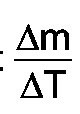

- As previously noted, a study by V.S. Postnikov et al.,
Izv. Akad. Nauk SSSR, Neorg. Mater., 7 (3), 485-489 (1971), had identified a group of glass compositions in the K₂O-PbO-BaO-ZnO-SiO₂ system exhibiting a low thermal coefficient of shear modulus.Compositions 10 and 11 in Table V below are representative of these glasses, the compositions being reported in weight percent but with molar compositions being reported in parentheses. Although these materials were reported as having a low thermal coefficient of elastic modulus, the data in Table V indicate that these glasses are also difficult or impossible to fabricate. Thusglass 10 in Table V exhibits difficult to unsatisfactory lampworking or fabricating characteristics while glass 11 devitrified during lampworking. Therefore, shaped glass balance elements of the invention could not be prepared from these glasses, and their normalized elastic moduli could not be determined.
- In contrast to the glasses reported by Postnikov et al.,
glass 12 in Table V exhibits improved stability manifested by satisfactory fabricating characteristics while still retaining a low thermal coefficient of elastic modulus. Thus shapedglass element 12 exhibits an NEM value of -8.8 ppm/°C and elements made from glasses close to that composition will exhibit similarly low values for this parameter. - The combination of characteristics shown by
element 12 and closely related elements is attributed to somewhat reduced ZnO levels in combination with increased amounts of K₂O as compared with the Postnikov et al. glasses. Thus, for glasses of this general type, compositions basis, of about 51-55% SiO₂, 10-13% K₂O, 5-15% ZnO, 5-15% BaO and 10-20% PbO, are presently considered suitable for the manufacture of workable glasses exhibiting low temperature coefficients of elastic modulus. Compositions which are higher in ZnO and/or BaO or lower in SiO₂ and/or K₂O have demonstrated poor fabrication characteristics as well as, in many cases, a larger temperature dependence of elastic modulus on temperature than the preferred compositions. - Of course, the foregoing is merely illustrative of articles and methods which may be practiced within the scope of the appended claims.
Claims (8)
- An improved glass element useful in determining the mass of objects by means of measuring an elastic property of said element selected from the group consisting of:
its frequency of vibration,
its amount of bending or deflection, and
its amount of extension,
first in the absence of the mass to be determined and second with said mass resting at some point on said element, determining the difference in said property and calculating the mass from said difference in said elastic property wherein said element is comprised of a glass which exhibits an average thermal coefficient of elastic modulus over the temperature range -50 to +150°C which does not exceed about 10 ppm/°C. - A glass element in accordance with claim 1 which is comprised of a glass chosen from the group consisting of a glass consisting essentially, in weight percent on the oxide basis, of about 60-64% SiO₂, 14-18% B₂O₃, 8.5-10%, Al₂O₃, 4-7% Na₂O, and 2-12% BaO and a glass consisting essentially, in weight percent on the oxide basis, of about 51-55% SiO₂, 10-13% K₂O, 5-15% ZnO, 5-15% BaO, and 10-20% PbO.
- A glass element in accordance with claim 1 which is a solid rod.
- A glass element in accordance with claim 1 which is a tapered solid rod.
- A glass element in accordance with claim 1 which is a hollow tube.
- A glass element in accordance with claim 1 which is a tapered hollow tube.
- A glass element in accordance with claim 1 which is a coil spring.
- A glass element in accordance with claim 1 which is a suspension system for an inertial balance, said suspension system comprising:
a supporting framework; and
means for suspending the weighing platform from the supporting framework such that the platform when oscillated is constrained to undergo uniform linear motion with respect to said framework.
Applications Claiming Priority (2)
| Application Number | Priority Date | Filing Date | Title |
|---|---|---|---|
| US07/216,812 US4836314A (en) | 1988-07-08 | 1988-07-08 | Novel glass elements for use in balances |
| US216812 | 1994-03-23 |
Publications (3)
| Publication Number | Publication Date |
|---|---|
| EP0423232A1 EP0423232A1 (en) | 1991-04-24 |
| EP0423232A4 EP0423232A4 (en) | 1991-07-03 |
| EP0423232B1 true EP0423232B1 (en) | 1993-02-10 |
Family
ID=22808609
Family Applications (1)
| Application Number | Title | Priority Date | Filing Date |
|---|---|---|---|
| EP89908648A Expired - Lifetime EP0423232B1 (en) | 1988-07-08 | 1989-06-01 | Novel glass elements for use in balances |
Country Status (4)
| Country | Link |
|---|---|
| US (1) | US4836314A (en) |
| EP (1) | EP0423232B1 (en) |
| JP (1) | JP2622763B2 (en) |
| WO (1) | WO1990000727A1 (en) |
Families Citing this family (6)
| Publication number | Priority date | Publication date | Assignee | Title |
|---|---|---|---|---|
| EP0545930A1 (en) * | 1990-05-16 | 1993-06-16 | Edward Victor Byers | Weighing machine |
| US5321209A (en) * | 1992-12-17 | 1994-06-14 | Tif Instruments, Inc. | Electronic weighing device |
| US5506057A (en) * | 1994-06-15 | 1996-04-09 | Sierracin Corporation | Thin laminated heated glass face ply for aircraft windshields |
| US5443912A (en) * | 1993-11-24 | 1995-08-22 | Sierracin Corporation | Laminated environmental protection layer for acrylic aircraft windows |
| US6080939A (en) * | 1998-06-12 | 2000-06-27 | Rupprecht & Pataschnick Company, Inc. | Mass determination device having counterbalanced normalized temperature coefficients |
| US6465749B1 (en) | 2000-07-07 | 2002-10-15 | Los Robles Advertising, Inc. | Magnetostrictive mass sensing apparatus and method |
Family Cites Families (8)
| Publication number | Priority date | Publication date | Assignee | Title |
|---|---|---|---|---|
| US2392314A (en) * | 1943-03-02 | 1946-01-08 | Corning Glass Company | Glass-to-metal seal |
| DE1696064A1 (en) * | 1968-03-08 | 1972-03-09 | Jenaer Glaswerk Schott & Gen | GLASSES FOR ULTRASONIC DELAY CABLES WITH LOWER INTERNAL DAMPING AND TRANSFORMATION TEMPERATURES BETWEEN 550 AND 620 DEGREES C. |
| DE2146339B2 (en) * | 1971-09-16 | 1975-04-03 | Industrie-Automation Gmbh & Co, 6900 Heidelberg | Electromechanical force or pressure transducer |
| DE2234025A1 (en) * | 1972-07-11 | 1974-01-31 | Siemens Ag | FORCE MEASURING DEVICE |
| US3926271A (en) * | 1975-02-03 | 1975-12-16 | Rupprecht Georg | Microbalance |
| US3950987A (en) * | 1975-05-13 | 1976-04-20 | Isaak Isaevich Slezinger | Piezo-optic measuring transducer and accelerometer, pressure gauge, dynamometer, and thermometer based thereon |
| US4838371A (en) * | 1988-01-22 | 1989-06-13 | Rupprecht & Patashnick Co., Inc. | Constrained linear motion inertial balance |
| US4855260A (en) * | 1988-07-08 | 1989-08-08 | Corning Incorporated | Glasses exhibiting low thermal coefficients of elasticity |
-
1988
- 1988-07-08 US US07/216,812 patent/US4836314A/en not_active Expired - Lifetime
-
1989
- 1989-06-01 JP JP1507980A patent/JP2622763B2/en not_active Expired - Lifetime
- 1989-06-01 WO PCT/US1989/002389 patent/WO1990000727A1/en not_active Ceased
- 1989-06-01 EP EP89908648A patent/EP0423232B1/en not_active Expired - Lifetime
Also Published As
| Publication number | Publication date |
|---|---|
| JPH03502006A (en) | 1991-05-09 |
| WO1990000727A1 (en) | 1990-01-25 |
| EP0423232A1 (en) | 1991-04-24 |
| JP2622763B2 (en) | 1997-06-18 |
| EP0423232A4 (en) | 1991-07-03 |
| US4836314A (en) | 1989-06-06 |
Similar Documents
| Publication | Publication Date | Title |
|---|---|---|
| Webb et al. | Non‐Newtonian rheology of igneous melts at high stresses and strain rates: Experimental results for rhyolite, andesite, basalt, and nephelinite | |
| Spinner | Elastic moduli of glasses by a dynamic method | |
| Levin et al. | The system barium oxide-boric oxide-silica | |
| Kodama et al. | Velocity of Sound and Elastic Properties of L i 2 O-B 2 O 3 Glasses | |
| Glaze et al. | Properties of arsenic sulfide glass | |
| Richet et al. | Heat capacity of sodium silicate liquids | |
| US4836314A (en) | Novel glass elements for use in balances | |
| Coon et al. | Mechanical properties of silicon-oxynitride glasses | |
| Lower et al. | Inert failure strain studies of sodium silicate glass fibers | |
| Marzouk | The acoustic properties of borosilicate glass affected by oxide of rare earth gadolinium | |
| US4855260A (en) | Glasses exhibiting low thermal coefficients of elasticity | |
| Webber et al. | Measurement of the viscosity of chalcogenide glasses by a parallel plate technique | |
| Steele et al. | Sensitive micro-balances and a new method of weighing minute quantities | |
| EP0402409B1 (en) | Constrained linear motion inertial balance | |
| DE68904913T2 (en) | GLASS ELEMENTS FOR USE ON SCALES. | |
| Shelby | Properties and morphology of barium germanate glasses | |
| Lower et al. | Inert failure strains of sodium aluminosilicate glass fibers | |
| Mills et al. | Stress relaxation modulus of a commercial glass | |
| BRANNAN | Further evidence against the orientation of structure in glass fibers | |
| Hagy | Rheological behavior of glass | |
| Kodama et al. | Thermal and mechanical properties of lithium borate glasses in relation to the glass structure | |
| JPH07247134A (en) | Glass for silicon-holding base and silicon substrate-type sensor | |
| Lower et al. | Inert failure strain measurements of sodium borate glass fibres | |
| Wiederhorn et al. | Application of fracture mechanics concepts to structural ceramics | |
| JP3084772B2 (en) | Borosilicate glass |
Legal Events
| Date | Code | Title | Description |
|---|---|---|---|
| PUAI | Public reference made under article 153(3) epc to a published international application that has entered the european phase |
Free format text: ORIGINAL CODE: 0009012 |
|
| 17P | Request for examination filed |
Effective date: 19901102 |
|
| AK | Designated contracting states |
Kind code of ref document: A1 Designated state(s): DE FR GB IT |
|
| A4 | Supplementary search report drawn up and despatched |
Effective date: 19910515 |
|
| AK | Designated contracting states |
Kind code of ref document: A4 Designated state(s): DE FR GB IT |
|
| 17Q | First examination report despatched |
Effective date: 19920416 |
|
| GRAA | (expected) grant |
Free format text: ORIGINAL CODE: 0009210 |
|
| AK | Designated contracting states |
Kind code of ref document: B1 Designated state(s): DE FR GB IT |
|
| REF | Corresponds to: |
Ref document number: 68904913 Country of ref document: DE Date of ref document: 19930325 |
|
| ITF | It: translation for a ep patent filed | ||
| ET | Fr: translation filed | ||
| PLBE | No opposition filed within time limit |
Free format text: ORIGINAL CODE: 0009261 |
|
| STAA | Information on the status of an ep patent application or granted ep patent |
Free format text: STATUS: NO OPPOSITION FILED WITHIN TIME LIMIT |
|
| 26N | No opposition filed | ||
| PGFP | Annual fee paid to national office [announced via postgrant information from national office to epo] |
Ref country code: FR Payment date: 19950614 Year of fee payment: 7 |
|
| PG25 | Lapsed in a contracting state [announced via postgrant information from national office to epo] |
Ref country code: FR Effective date: 19970228 |
|
| REG | Reference to a national code |
Ref country code: FR Ref legal event code: ST |
|
| REG | Reference to a national code |
Ref country code: GB Ref legal event code: IF02 |
|
| PG25 | Lapsed in a contracting state [announced via postgrant information from national office to epo] |
Ref country code: IT Free format text: LAPSE BECAUSE OF NON-PAYMENT OF DUE FEES;WARNING: LAPSES OF ITALIAN PATENTS WITH EFFECTIVE DATE BEFORE 2007 MAY HAVE OCCURRED AT ANY TIME BEFORE 2007. THE CORRECT EFFECTIVE DATE MAY BE DIFFERENT FROM THE ONE RECORDED. Effective date: 20050601 |
|
| PGFP | Annual fee paid to national office [announced via postgrant information from national office to epo] |
Ref country code: DE Payment date: 20080829 Year of fee payment: 20 |
|
| PGFP | Annual fee paid to national office [announced via postgrant information from national office to epo] |
Ref country code: GB Payment date: 20080507 Year of fee payment: 20 |
|
| REG | Reference to a national code |
Ref country code: GB Ref legal event code: PE20 Expiry date: 20090531 |
|
| PG25 | Lapsed in a contracting state [announced via postgrant information from national office to epo] |
Ref country code: GB Free format text: LAPSE BECAUSE OF EXPIRATION OF PROTECTION Effective date: 20090531 |