EP0421701A1 - Enhanced production of propylene from higher hydrocarbons - Google Patents
Enhanced production of propylene from higher hydrocarbons Download PDFInfo
- Publication number
- EP0421701A1 EP0421701A1 EP90310719A EP90310719A EP0421701A1 EP 0421701 A1 EP0421701 A1 EP 0421701A1 EP 90310719 A EP90310719 A EP 90310719A EP 90310719 A EP90310719 A EP 90310719A EP 0421701 A1 EP0421701 A1 EP 0421701A1
- Authority
- EP
- European Patent Office
- Prior art keywords
- propylene
- zone
- ethylene
- via line
- metathesis
- Prior art date
- Legal status (The legal status is an assumption and is not a legal conclusion. Google has not performed a legal analysis and makes no representation as to the accuracy of the status listed.)
- Granted
Links
- QQONPFPTGQHPMA-UHFFFAOYSA-N propylene Natural products CC=C QQONPFPTGQHPMA-UHFFFAOYSA-N 0.000 title claims abstract description 38
- 125000004805 propylene group Chemical group [H]C([H])([H])C([H])([*:1])C([H])([H])[*:2] 0.000 title claims abstract description 38
- 229930195733 hydrocarbon Natural products 0.000 title claims abstract description 28
- 150000002430 hydrocarbons Chemical class 0.000 title claims abstract description 28
- 238000004519 manufacturing process Methods 0.000 title claims description 10
- VGGSQFUCUMXWEO-UHFFFAOYSA-N Ethene Chemical compound C=C VGGSQFUCUMXWEO-UHFFFAOYSA-N 0.000 claims abstract description 26
- 239000005977 Ethylene Substances 0.000 claims abstract description 26
- 239000004215 Carbon black (E152) Substances 0.000 claims abstract description 21
- 238000000034 method Methods 0.000 claims abstract description 17
- 238000005336 cracking Methods 0.000 claims abstract description 6
- 239000003054 catalyst Substances 0.000 claims description 27
- 150000001336 alkenes Chemical class 0.000 claims description 23
- 239000010457 zeolite Substances 0.000 claims description 21
- HNPSIPDUKPIQMN-UHFFFAOYSA-N dioxosilane;oxo(oxoalumanyloxy)alumane Chemical compound O=[Si]=O.O=[Al]O[Al]=O HNPSIPDUKPIQMN-UHFFFAOYSA-N 0.000 claims description 16
- 229910021536 Zeolite Inorganic materials 0.000 claims description 15
- JRZJOMJEPLMPRA-UHFFFAOYSA-N olefin Natural products CCCCCCCC=C JRZJOMJEPLMPRA-UHFFFAOYSA-N 0.000 claims description 11
- 239000011541 reaction mixture Substances 0.000 claims description 9
- 239000012188 paraffin wax Substances 0.000 claims description 2
- 238000005649 metathesis reaction Methods 0.000 abstract description 27
- 238000002360 preparation method Methods 0.000 abstract description 2
- VYPSYNLAJGMNEJ-UHFFFAOYSA-N Silicium dioxide Chemical compound O=[Si]=O VYPSYNLAJGMNEJ-UHFFFAOYSA-N 0.000 description 24
- 238000006243 chemical reaction Methods 0.000 description 17
- 239000000203 mixture Substances 0.000 description 17
- 239000000047 product Substances 0.000 description 16
- 238000004821 distillation Methods 0.000 description 15
- 239000000463 material Substances 0.000 description 15
- 238000000926 separation method Methods 0.000 description 13
- 239000000377 silicon dioxide Substances 0.000 description 11
- 239000003795 chemical substances by application Substances 0.000 description 9
- 229910052723 transition metal Inorganic materials 0.000 description 9
- 150000003624 transition metals Chemical class 0.000 description 9
- 230000003213 activating effect Effects 0.000 description 8
- MCMNRKCIXSYSNV-UHFFFAOYSA-N Zirconium dioxide Chemical compound O=[Zr]=O MCMNRKCIXSYSNV-UHFFFAOYSA-N 0.000 description 6
- -1 butene Chemical class 0.000 description 6
- 238000010926 purge Methods 0.000 description 6
- 238000006555 catalytic reaction Methods 0.000 description 5
- 239000011159 matrix material Substances 0.000 description 5
- PNEYBMLMFCGWSK-UHFFFAOYSA-N aluminium oxide Inorganic materials [O-2].[O-2].[O-2].[Al+3].[Al+3] PNEYBMLMFCGWSK-UHFFFAOYSA-N 0.000 description 4
- 239000002178 crystalline material Substances 0.000 description 4
- 229910052751 metal Inorganic materials 0.000 description 4
- 239000002184 metal Substances 0.000 description 4
- VLKZOEOYAKHREP-UHFFFAOYSA-N n-Hexane Chemical compound CCCCCC VLKZOEOYAKHREP-UHFFFAOYSA-N 0.000 description 4
- GWEVSGVZZGPLCZ-UHFFFAOYSA-N Titan oxide Chemical compound O=[Ti]=O GWEVSGVZZGPLCZ-UHFFFAOYSA-N 0.000 description 3
- 238000005865 alkene metathesis reaction Methods 0.000 description 3
- 150000001768 cations Chemical class 0.000 description 3
- 229910044991 metal oxide Inorganic materials 0.000 description 3
- 150000004706 metal oxides Chemical class 0.000 description 3
- 229910052680 mordenite Inorganic materials 0.000 description 3
- 125000000383 tetramethylene group Chemical group [H]C([H])([*:1])C([H])([H])C([H])([H])C([H])([H])[*:2] 0.000 description 3
- VXNZUUAINFGPBY-UHFFFAOYSA-N 1-Butene Chemical compound CCC=C VXNZUUAINFGPBY-UHFFFAOYSA-N 0.000 description 2
- IJGRMHOSHXDMSA-UHFFFAOYSA-N Atomic nitrogen Chemical compound N#N IJGRMHOSHXDMSA-UHFFFAOYSA-N 0.000 description 2
- PXHVJJICTQNCMI-UHFFFAOYSA-N Nickel Chemical compound [Ni] PXHVJJICTQNCMI-UHFFFAOYSA-N 0.000 description 2
- 229910052783 alkali metal Inorganic materials 0.000 description 2
- 150000001340 alkali metals Chemical class 0.000 description 2
- 229910000323 aluminium silicate Inorganic materials 0.000 description 2
- 230000015572 biosynthetic process Effects 0.000 description 2
- IAQRGUVFOMOMEM-UHFFFAOYSA-N butene Natural products CC=CC IAQRGUVFOMOMEM-UHFFFAOYSA-N 0.000 description 2
- 239000003085 diluting agent Substances 0.000 description 2
- 239000000499 gel Substances 0.000 description 2
- 125000002524 organometallic group Chemical group 0.000 description 2
- 239000003208 petroleum Substances 0.000 description 2
- 229910052761 rare earth metal Inorganic materials 0.000 description 2
- 150000002910 rare earth metals Chemical class 0.000 description 2
- QGZKDVFQNNGYKY-UHFFFAOYSA-O Ammonium Chemical compound [NH4+] QGZKDVFQNNGYKY-UHFFFAOYSA-O 0.000 description 1
- CIWBSHSKHKDKBQ-JLAZNSOCSA-N Ascorbic acid Chemical compound OC[C@H](O)[C@H]1OC(=O)C(O)=C1O CIWBSHSKHKDKBQ-JLAZNSOCSA-N 0.000 description 1
- OKTJSMMVPCPJKN-UHFFFAOYSA-N Carbon Chemical compound [C] OKTJSMMVPCPJKN-UHFFFAOYSA-N 0.000 description 1
- VEXZGXHMUGYJMC-UHFFFAOYSA-M Chloride anion Chemical compound [Cl-] VEXZGXHMUGYJMC-UHFFFAOYSA-M 0.000 description 1
- ZOKXTWBITQBERF-UHFFFAOYSA-N Molybdenum Chemical compound [Mo] ZOKXTWBITQBERF-UHFFFAOYSA-N 0.000 description 1
- OAICVXFJPJFONN-UHFFFAOYSA-N Phosphorus Chemical compound [P] OAICVXFJPJFONN-UHFFFAOYSA-N 0.000 description 1
- QAOWNCQODCNURD-UHFFFAOYSA-L Sulfate Chemical compound [O-]S([O-])(=O)=O QAOWNCQODCNURD-UHFFFAOYSA-L 0.000 description 1
- 239000002253 acid Substances 0.000 description 1
- 229910000287 alkaline earth metal oxide Inorganic materials 0.000 description 1
- HPTYUNKZVDYXLP-UHFFFAOYSA-N aluminum;trihydroxy(trihydroxysilyloxy)silane;hydrate Chemical compound O.[Al].[Al].O[Si](O)(O)O[Si](O)(O)O HPTYUNKZVDYXLP-UHFFFAOYSA-N 0.000 description 1
- 239000000440 bentonite Substances 0.000 description 1
- 229910000278 bentonite Inorganic materials 0.000 description 1
- SVPXDRXYRYOSEX-UHFFFAOYSA-N bentoquatam Chemical compound O.O=[Si]=O.O=[Al]O[Al]=O SVPXDRXYRYOSEX-UHFFFAOYSA-N 0.000 description 1
- LTPBRCUWZOMYOC-UHFFFAOYSA-N beryllium oxide Inorganic materials O=[Be] LTPBRCUWZOMYOC-UHFFFAOYSA-N 0.000 description 1
- 239000001273 butane Substances 0.000 description 1
- UNYSKUBLZGJSLV-UHFFFAOYSA-L calcium;1,3,5,2,4,6$l^{2}-trioxadisilaluminane 2,4-dioxide;dihydroxide;hexahydrate Chemical compound O.O.O.O.O.O.[OH-].[OH-].[Ca+2].O=[Si]1O[Al]O[Si](=O)O1.O=[Si]1O[Al]O[Si](=O)O1 UNYSKUBLZGJSLV-UHFFFAOYSA-L 0.000 description 1
- 229910052799 carbon Inorganic materials 0.000 description 1
- 230000003197 catalytic effect Effects 0.000 description 1
- 229910052676 chabazite Inorganic materials 0.000 description 1
- 239000007795 chemical reaction product Substances 0.000 description 1
- 239000000571 coke Substances 0.000 description 1
- 150000001875 compounds Chemical class 0.000 description 1
- 238000010276 construction Methods 0.000 description 1
- 229910002026 crystalline silica Inorganic materials 0.000 description 1
- 230000009849 deactivation Effects 0.000 description 1
- 238000011161 development Methods 0.000 description 1
- 230000018109 developmental process Effects 0.000 description 1
- GUJOJGAPFQRJSV-UHFFFAOYSA-N dialuminum;dioxosilane;oxygen(2-);hydrate Chemical compound O.[O-2].[O-2].[O-2].[Al+3].[Al+3].O=[Si]=O.O=[Si]=O.O=[Si]=O.O=[Si]=O GUJOJGAPFQRJSV-UHFFFAOYSA-N 0.000 description 1
- 150000001993 dienes Chemical class 0.000 description 1
- 238000007323 disproportionation reaction Methods 0.000 description 1
- 230000000694 effects Effects 0.000 description 1
- 238000005516 engineering process Methods 0.000 description 1
- 125000002534 ethynyl group Chemical group [H]C#C* 0.000 description 1
- 239000012013 faujasite Substances 0.000 description 1
- 238000009472 formulation Methods 0.000 description 1
- 239000002737 fuel gas Substances 0.000 description 1
- 229910052621 halloysite Inorganic materials 0.000 description 1
- 239000002638 heterogeneous catalyst Substances 0.000 description 1
- RYPKRALMXUUNKS-UHFFFAOYSA-N hex-2-ene Chemical class CCCC=CC RYPKRALMXUUNKS-UHFFFAOYSA-N 0.000 description 1
- 125000004836 hexamethylene group Chemical class [H]C([H])([*:2])C([H])([H])C([H])([H])C([H])([H])C([H])([H])C([H])([H])[*:1] 0.000 description 1
- 239000001257 hydrogen Substances 0.000 description 1
- 229910052739 hydrogen Inorganic materials 0.000 description 1
- 125000004435 hydrogen atom Chemical class [H]* 0.000 description 1
- 239000011261 inert gas Substances 0.000 description 1
- 229910052809 inorganic oxide Inorganic materials 0.000 description 1
- 238000005342 ion exchange Methods 0.000 description 1
- CPLXHLVBOLITMK-UHFFFAOYSA-N magnesium oxide Inorganic materials [Mg]=O CPLXHLVBOLITMK-UHFFFAOYSA-N 0.000 description 1
- 239000000395 magnesium oxide Substances 0.000 description 1
- 239000002808 molecular sieve Substances 0.000 description 1
- 229910052750 molybdenum Inorganic materials 0.000 description 1
- 239000011733 molybdenum Substances 0.000 description 1
- 229910000476 molybdenum oxide Inorganic materials 0.000 description 1
- 229910052901 montmorillonite Inorganic materials 0.000 description 1
- IJDNQMDRQITEOD-UHFFFAOYSA-N n-butane Chemical compound CCCC IJDNQMDRQITEOD-UHFFFAOYSA-N 0.000 description 1
- OFBQJSOFQDEBGM-UHFFFAOYSA-N n-pentane Natural products CCCCC OFBQJSOFQDEBGM-UHFFFAOYSA-N 0.000 description 1
- 229910052759 nickel Inorganic materials 0.000 description 1
- 150000002823 nitrates Chemical class 0.000 description 1
- 229910052757 nitrogen Inorganic materials 0.000 description 1
- QGLKJKCYBOYXKC-UHFFFAOYSA-N nonaoxidotritungsten Chemical compound O=[W]1(=O)O[W](=O)(=O)O[W](=O)(=O)O1 QGLKJKCYBOYXKC-UHFFFAOYSA-N 0.000 description 1
- 150000002902 organometallic compounds Chemical class 0.000 description 1
- PQQKPALAQIIWST-UHFFFAOYSA-N oxomolybdenum Chemical compound [Mo]=O PQQKPALAQIIWST-UHFFFAOYSA-N 0.000 description 1
- 229910052698 phosphorus Inorganic materials 0.000 description 1
- 239000011574 phosphorus Substances 0.000 description 1
- 230000001737 promoting effect Effects 0.000 description 1
- 239000002994 raw material Substances 0.000 description 1
- 238000012552 review Methods 0.000 description 1
- 229910052702 rhenium Inorganic materials 0.000 description 1
- WUAPFZMCVAUBPE-UHFFFAOYSA-N rhenium atom Chemical compound [Re] WUAPFZMCVAUBPE-UHFFFAOYSA-N 0.000 description 1
- 239000012266 salt solution Substances 0.000 description 1
- 229920006395 saturated elastomer Polymers 0.000 description 1
- 239000000741 silica gel Substances 0.000 description 1
- 229910002027 silica gel Inorganic materials 0.000 description 1
- 150000004760 silicates Chemical class 0.000 description 1
- 235000012239 silicon dioxide Nutrition 0.000 description 1
- URGAHOPLAPQHLN-UHFFFAOYSA-N sodium aluminosilicate Chemical compound [Na+].[Al+3].[O-][Si]([O-])=O.[O-][Si]([O-])=O URGAHOPLAPQHLN-UHFFFAOYSA-N 0.000 description 1
- 239000007787 solid Substances 0.000 description 1
- 238000004230 steam cracking Methods 0.000 description 1
- 239000000126 substance Substances 0.000 description 1
- 239000011885 synergistic combination Substances 0.000 description 1
- VXKWYPOMXBVZSJ-UHFFFAOYSA-N tetramethyltin Chemical compound C[Sn](C)(C)C VXKWYPOMXBVZSJ-UHFFFAOYSA-N 0.000 description 1
- WFKWXMTUELFFGS-UHFFFAOYSA-N tungsten Chemical compound [W] WFKWXMTUELFFGS-UHFFFAOYSA-N 0.000 description 1
- 229910052721 tungsten Inorganic materials 0.000 description 1
- 239000010937 tungsten Substances 0.000 description 1
- 229910001930 tungsten oxide Inorganic materials 0.000 description 1
Images

Classifications
-
- C—CHEMISTRY; METALLURGY
- C07—ORGANIC CHEMISTRY
- C07C—ACYCLIC OR CARBOCYCLIC COMPOUNDS
- C07C11/00—Aliphatic unsaturated hydrocarbons
- C07C11/02—Alkenes
- C07C11/06—Propene
-
- Y—GENERAL TAGGING OF NEW TECHNOLOGICAL DEVELOPMENTS; GENERAL TAGGING OF CROSS-SECTIONAL TECHNOLOGIES SPANNING OVER SEVERAL SECTIONS OF THE IPC; TECHNICAL SUBJECTS COVERED BY FORMER USPC CROSS-REFERENCE ART COLLECTIONS [XRACs] AND DIGESTS
- Y02—TECHNOLOGIES OR APPLICATIONS FOR MITIGATION OR ADAPTATION AGAINST CLIMATE CHANGE
- Y02P—CLIMATE CHANGE MITIGATION TECHNOLOGIES IN THE PRODUCTION OR PROCESSING OF GOODS
- Y02P20/00—Technologies relating to chemical industry
- Y02P20/50—Improvements relating to the production of bulk chemicals
- Y02P20/52—Improvements relating to the production of bulk chemicals using catalysts, e.g. selective catalysts
Definitions
- the present invention provides an improved method for the production of propylene from a C4 or higher hydrocarbon feed. specifically, in accordance with the invention, a higher hydrocarbon is converted over a zeolite catalyst at conditions which favor production of a product mixture containing ethylene and propylene. Propylene is separated from this product mixture and recovered. The ethylene from the reaction mixture is metathesized with C4+ olefin in order to form further quantities of product propylene.
- Propylene is an important chemical of commerce.
- propylene is largely derived from selected petroleum feed materials by procedures such as steam cracking which also produce high quantities of other materials.
- procedures such as steam cracking which also produce high quantities of other materials.
- propylene which result in uncertainties in feed supplies, rapidly escalating raw material costs and similar situations which are undesirable from a commercial standpoint.
- economics favor using alternate feedstocks provided an effective process for forming propylene was available.
- the present invention provides an improved process for the selective production of propylene from C4 and higher hydrocarbons, especially from C4 and olefins paraffins.
- the higher olefin and/or paraffin hydrocarbon is reacted over zeolitic type catalyst at conditions selected to produce high yields of ethylene and propylene.
- Propylene from this reactor sis recovered as a product of the process.
- ethylene from the zeolite conversion reaction is passed to a metathesis reaction zone wherein it is metathesized with C4+ olefin to produce further quantities of the desired propylene product.
- the higher hydrocarbon feed stock preferably butenes and/or higher olefins and/or paraffins
- these conditions generally involve low hydrocarbon partial pressure and high reaction temperatures.
- the product mixture from this reaction is separated into various components.
- the propylene component comprises a product of the process.
- the ethylene component is passed to a metathesis zone in admixture with a higher olefin such as butene, also contained in the reaction mixture.
- the ethylene metathesis is carried out under conditions and using catalysts which are known in the art.
- a catalyst containing a catalytic amount of at least one of molybdenum oxide and tungsten oxide is suitable for the metathesis reaction.
- Conditions of the metathesis generally include reaction temperatures ranging from about 100 to about 450 o C, preferably 150 to 350 o C, and pressures varying frog about atmospheric to upwards of 3,000 psig, although higher pressures can be employed if desired.
- Catalysts which are active for the metathesis of olefins and which can be used in the process of this invention are of a generally known type.
- Such catalysts may be homogeneous or heterogeneous, with heterogeneous catalysts being preferred.
- the catalyst preferable comprises a catalytically effective amount of a transition metal component.
- the preferred transition metals for use in the present invention include tungsten, molybdenum, nickel, rhenium and mixtures thereof.
- the transition metal component may be present as elemental metal and/or one or more compounds of the metal. If the catalyst is heterogeneous, it is preferred that the transition metal component be associated with a support. Any suitable support material may be employed provided that it does not substantially interfere with the feedstock components, or the lower olefin component conversion.
- the support material is an oxide, such as silica, alumina, titania, zirconia and mixtures thereof.
- Silica is a particularly preferred support material. If a support material is employed, the oxy of transition metal component used in combination with the support material may vary widely depending, for example, on the particular application involved and/or the transition metal being used. Preferably, the transition metal comprises about 1% to about 20%, by weight (calculated as elemental metal) of the total catalyst.
- the metathesis catalysts advantageously comprise a catalytically effective amount of at least one of the above-noted transition metals, and are capable of promoting olefin metathesis.
- the metathesis catalyst further comprises at least one activating agent present in an amount to improve the effectiveness of the catalyst.
- activating agents include activating agents which are well known in the art to facilitate metathesis reactions.
- Preferred activating agents include organo-metallic compounds, such as tetra methyl tin, oxides, such as alkaline earth metal oxides, alumina and silica and mixtures thereof.
- the activating agent when the activating agent is at least one oxide, the activating agent may be used as a support for the transition metal component.
- the agent may be included with the catalyst during catalyst preparation, or it may be added during reaction.
- the amount of organo-metallic activating agent is relatively minor compared to the amount of catalytically active metal component in the first catalyst.
- the metathesis mixture is resolved by conventional separation means into a light ethylene fraction which can be recycled, a product propylene fraction, and a butene and higher hydrocarbon fraction which is preferably recycled to the higher hydrocarbon conversion zone for the production of further amounts of ethylene and propylene, and to metathesis.
- the specified combination of the conversion of the higher hydrocarbons to a mixture comprised of ethylene and propylene at conditions favoring the production of these components coupled with the use of the thus formed ethylene to produce further quantities of desired propylene provides a synergistic combination of reaction steps whereby there are obtained substantially improved yields of the desired light olefin, propylene, from inexpensive and readily available higher hydrocarbon feed materials.
- feed hydrocarbon is introduced into cracking zone 101 via line 102.
- the feed hydrocarbon can be olefinic or paraffinic, or mixtures of olefins and paraffins can be used.
- C4 and higher hydrocarbons are used, examples being butane, the butenes, hexane, hexenes, methyl pentanes, methyl pentenes, cetane, petroleum naphtha fractions and the like.
- zone 101 the hydrocarbon feed, plus any recycle as hereinafter described, is cracked over a zeolitic catalyst such as ZSM-5 at conditions selected to form light olefin product.
- the conversion is carried out at temperatures in the range of about 400 o to 800 o C, preferably 500 o to 700 o C.
- Low hydrocarbon partial pressures and low conversions per pass favor the lower olefin formation.
- the hydrocarbon can be admixed with steam or inert gas such as nitrogen.
- the hydrocarbon partial pressure is as low as practical, illustratively 1 to 30 psia. Where no diluents are employed, system pressures ranging from about -12 to 50 psig, preferably -5 to 30 psig are suitable. Higher pressures can be used when diluents are employed.
- Space velocities are 1 to 5000, preferably 5 to 2000 hr. ⁇ 1 WHSV.
- Zeolite catalysts used in the invention can be silaceous, crystalline molecular sieves.
- Such silica-containing crystalline materials include materials which contain, in addition to silica, significant amounts of alumina. These crystalline materials are frequently named "zeolites, i.e., crystalline aluminosilicates.” Silica-containing crystalline materials also include essentially aluminum-free silicates. These crystalline materials are exemplified by crystalline silica polymorphs (e.g., silicalite, disclosed in U.S. Patent 4,061,724 and organosilicates, disclosed in U.S. Patent Re.
- Crystalline aluminosilicate zeolites are best exemplified by ZSM-5 (see U.S. Patents 3,702,886 and 3,770,614), ZSM-11 (see U.S. Patent 3,709,979), ZSM-12 (see U.S. Patent 3,832,449), ZSM-21 and ZSM-38 (see U.S. Patent 3,948,758), ZSM-23 (see U.S. Patent 4,076,842), and ZSM-35 (see U.S. Patent 4,016,246).
- Acid zeolites are especially preferred, particularly the ZSM type and borosilicates.
- ZSM-5 is especially useful.
- Phosphorus containing zeolites such as are described in U.S. Patent 3,972,832 are also especially useful.
- zeolite-containing materials can be used.
- zeolite A U.S. Patent 2,882,243
- zeolite X U.S. Patent 2,882,244
- zeolite Y U.S. Patent 3,130,007
- zeolite ZK-5 U.S. Patent 3,247,195
- zeolite ZK-4 U.S. Patent 3,314,752
- synthetic mordenite and dealuminized mordenite as well as naturally occurring zeolites, including chabazite, faujasite, mordenite and the like.
- the zeolites are ordinarily ion-exchanged with a desired cation to replace alkali metal present in the zeolite as found naturally or as synthetically prepared.
- the exchange treatment is such as to reduce the alkali metal content of the final catalyst to less than about 0.5 weight percent.
- Preferred exchanging cations are hydrogen, ammonium, rare earth metals and mixtures thereof, with particular preference being accorded rare earth metals.
- Ion exchange is suitably accomplished by conventional contact of the zeolite with a suitable salt solution of the desired cation, such as, for example, the sulfate, chloride or nitrate salts.
- the crystalline zeolite of a suitable matrix since the catalyst form is generally characterized by a high resistance to attrition, high activity and exceptional steam stability.
- Such catalysts are readily prepared by dispersing the crystalline zeolite in a suitable siliceous sol and gelling the sol by various means.
- the inorganic oxide which serves as the matrix in which the above crystalline zeolite is distributed includes silica gel or a cogel of silica and a suitable metal oxide.
- cogels include silica-aluminia, silica-magnesia, silica-zirconia, silica-thoria, silica-beryllia, silica-titania as well as ternary combinations, such as silica-alumina-magnesia, silica-aluminia-zirconia and silica-magnesia-sirconia.
- Preferred cogels include silica-alumina, silica-zirconia or silica-alumina-zirconia. The above gels and cogels will generally comprise a major proportion of silica and a minor proportion of the other aforementioned oxide or oxides.
- the silica content of the siliceous gel or cogel matrix will generally fall within the range of 55 to 100 weight percent, preferably 60 to 95 weight percent, and the other metal oxide or oxides content will generally be within the range of 0 to 45 weight percent.
- the matrix may also comprise natural or synthetic clays, such as kaoline type clays, montmorillonite bentonite or halloysite. These clays may be used either alone or in combination with silica or any of the above specified cogels in a matrix formulation.
- reaction mixture passes via line 103 to separation zone 104.
- zone 104 the reaction mixture from zone 101 is separated by conventional distillation procedures into an overhead fraction comprised of C4 and lighter components and a heavier bottoms fraction.
- the bottoms fraction is removed via line 105 and recycled to zone 101, a small purge stream being separated via line 106.
- a side draw of heavy olefins may be removed from zone 104 and sent to metathesis (zone 110). This may be desirable for raising the propylene yield in metathesis.
- the overhead fraction comprised primarily of ethylene, propylene and C4 saturated and unsaturated components, passes via line 107 to separation zone 108.
- zone 108 an ethylene fraction is separated overhead by conventional distillation and passes via lines 109 and 116 to metathesis zone 110.
- a bottoms fraction comprised of C3 and C4 components is removed from zone 108 via line 111 and passes to separation zone 112.
- zone 112 the mixture is separated by conventional distillation into an overhead product propylene stream which is recovered via lines 113 and 121 and a primarily C4 fraction which is removed via line 114.
- the C4 fraction is combined with ethylene from lines 109 and 119 and passes via lines 114 and 116 to metathesis zone 113.
- zone 110 the mixture of ethylene and C4 olefins is metathesized in order to form additional product propylene.
- Zone 118 has a side draw, line 119, for separation and recycle of unconverted ethylene to metathesis.
- a C3+ stream is removed from zone 118 via line 128 and passes to separation zone 123.
- product propylene is separated overhead via line 122, combined with propylene via line 113 and recovered via line 121.
- a C4 and higher fraction is recovered from zone 123 via line 124 and passed to separation zone 130 wherein by distillation a C4 fraction is separated overhead from a heavier fraction which is removed via line 125, combined with the heavies purge via line 106 and purged via line 126.
- a portion of the overhead C4 fraction from zone 130 is purged via line 127 in order to prevent paraffins build-up.
- the remainder is passed via line 115 to cracking zone 101.
- Propylene yields as high as 60% based on the carbon content of the higher hydrocarbon feed can be achieved.
- the process requires no extraordinary catalysts, materials or construction, reaction conditions, and the like
- C4 Raffinate II feed in amount of 92.3 parts is fed via line 102 to cracking zone 101.
- Combined with the fresh Raffinate is a stream from separation zone 130 passing via line 115 to line 102 and thence to zone 101, and a stream from separation zone 104 passing via line 105 to line 102 and thence to zone 101.
- the combined hydrocarbons mixture is contacted with a ZSM-5 catalyst in zone 101.
- Temperature is 550 o C and space velocity is 40 hr. ⁇ 1 WHSV.
- Conditions in zone 101 favor the formation of lower olefins.
- reaction mixture from zone 101 containing ethylene and propylene passes via line 103 to separation zone 104.
- An overhead fraction comprised of C4 and lighter components passes from zone 104 via line 107 to separation zone 108.
- a heavier C5+ fraction is recycled via line 105, a purge stream being separated via lines 106 and 126.
- the overhead from zone 104 passes to distillation zone 108 wherein an ethylene fraction is separated overhead and passed via lines 109 and 116 to metathesis zone 110.
- a bottom C3+ stream passes via line 111 to distillation zone 112; from zone 112, product propylene is separated overhead by distillation and recovered via lines 113 and 121.
- a C4 stream is removed from zone 112 and passes via lines 114 and 116 to metathesis zone 110 along with ethylene via lane 109 and recycle ethylene via line 119.
- a metathesis catalyst comprised of WO3 supported in silica; temperature is 300 o C and space velocity is 25 hr. ⁇ 1 WHSV.
- the metathesis product mixture passes via line 117 to distillation separation zone 118; a light purge stream is separated overhead by conventional distillation and separated via line 120. A sidestream of ethylene is separated and recycled to metathesis via lines 119 and 116. A C3+ stream is removed as bottoms and passes to distillation zone 123.
- product propylene is separated overhead and recovered via lines 122 and 121.
- a C4+ fraction is removed via line 124 as bottoms and passes via line 124 to distillation zone 130.
- a heavies purge is removed via line 125 and purged via line 120.
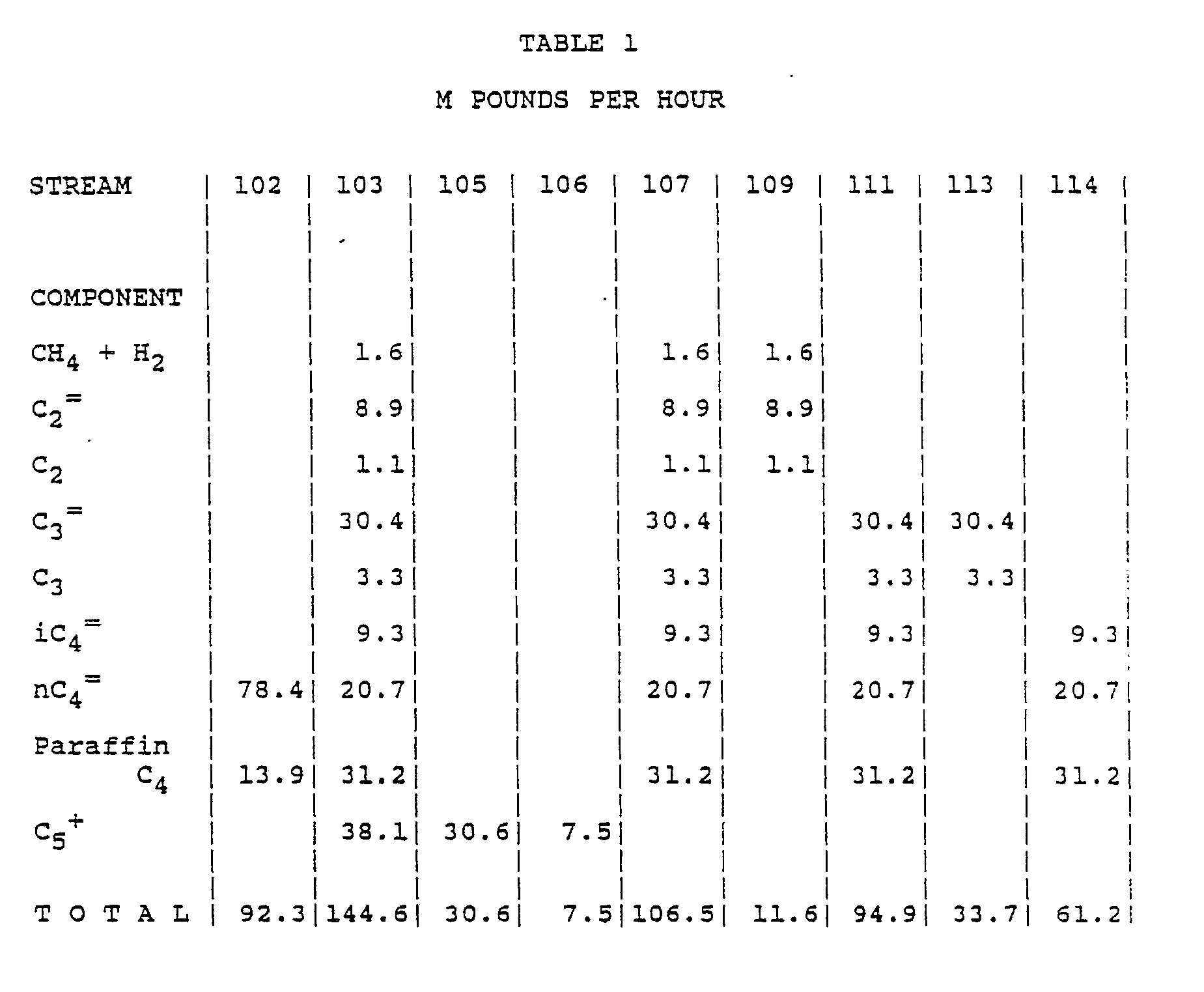
- compositions of the various process and product streams expressed in 1000 pounds per hour is given in the following Table 1. (Table 1 is continued on next two pages):
Landscapes
- Chemical & Material Sciences (AREA)
- Organic Chemistry (AREA)
- Organic Low-Molecular-Weight Compounds And Preparation Thereof (AREA)
- Catalysts (AREA)
- Low-Molecular Organic Synthesis Reactions Using Catalysts (AREA)
- Production Of Liquid Hydrocarbon Mixture For Refining Petroleum (AREA)
Abstract
Description
- The present invention provides an improved method for the production of propylene from a C₄ or higher hydrocarbon feed. specifically, in accordance with the invention, a higher hydrocarbon is converted over a zeolite catalyst at conditions which favor production of a product mixture containing ethylene and propylene. Propylene is separated from this product mixture and recovered. The ethylene from the reaction mixture is metathesized with C₄⁺ olefin in order to form further quantities of product propylene.
- Propylene is an important chemical of commerce. In general, propylene is largely derived from selected petroleum feed materials by procedures such as steam cracking which also produce high quantities of other materials. At times, there exist shortages of propylene which result in uncertainties in feed supplies, rapidly escalating raw material costs and similar situations which are undesirable from a commercial standpoint. Also, due to imbalances in hydrocarbon values, economics favor using alternate feedstocks provided an effective process for forming propylene was available.
- Methods are known for the conversion of higher hydrocarbons to reaction mixtures comprised of the C₂ and C₃ lighter olefins. For example, published European patent applications Publication Nos. 0109059 and 0109060 provide illustrative teachings of conditions and catalysts which are effective for the conversion of higher hydrocarbons such as butenes to the lighter olefins. Copending European patent application publication No. EP-A-0395345, likewise provides a comprehensive teaching of prior methods for the production of the lower olefins from higher hydrocarbon feed materials. In certain instances, it would be distinctly advantageous to provide means for still further improving yields of propylene which result from the conversion of less expensive higher hydrocarbon feed materials.
- The disproportionation or metathesis of olefins is likewise a known reaction. In this regard, reference can be made to Banks U.S. Patent 3,261,879, to Banks "Olefin Metathesis Technology and Application," Applied Industrial Catalysis, Volume III, Chapter 7, Pages 215, et seq., Leach, Editor (1984). In addition, olefin metathesis reaction and catalysts useful therefor are described in U.S. Patent Nos. 3883606, 3915897, 3952070, 4180524, 4431855, 4499328, 4504694, 4517401 and 4547617.
- Despite developments in the art, it remains desirable to provide methods for producing higher yields of propylene from the less expensive higher hydrocarbon feed materials.
- The present invention provides an improved process for the selective production of propylene from C₄ and higher hydrocarbons, especially from C₄ and olefins paraffins. In accordance with the invention, in a first step, the higher olefin and/or paraffin hydrocarbon is reacted over zeolitic type catalyst at conditions selected to produce high yields of ethylene and propylene. Propylene from this reactor sis recovered as a product of the process. In order to enhance propylene yields, ethylene from the zeolite conversion reaction is passed to a metathesis reaction zone wherein it is metathesized with C₄⁺ olefin to produce further quantities of the desired propylene product.
- The attached drawing illustrates in schematic fashion practice of the invention.
- In accordance with the present invention, the higher hydrocarbon feed stock, preferably butenes and/or higher olefins and/or paraffins, is reacted under conditions which favor the production of lower olefins. These conditions generally involve low hydrocarbon partial pressure and high reaction temperatures. The product mixture from this reaction is separated into various components. The propylene component comprises a product of the process. The ethylene component is passed to a metathesis zone in admixture with a higher olefin such as butene, also contained in the reaction mixture.
- The ethylene metathesis is carried out under conditions and using catalysts which are known in the art. Generally, a catalyst containing a catalytic amount of at least one of molybdenum oxide and tungsten oxide is suitable for the metathesis reaction. Conditions of the metathesis generally include reaction temperatures ranging from about 100 to about 450oC, preferably 150 to 350oC, and pressures varying frog about atmospheric to upwards of 3,000 psig, although higher pressures can be employed if desired.
- Catalysts which are active for the metathesis of olefins and which can be used in the process of this invention are of a generally known type. In this regard, reference is made to "Journal of Molecular Catalysis", 28 (1984) pages 117-131, to "Journal of Catalysis", 13 (1969) pages 99-113, to "Applied Catalysis" 10 (1984) pages 219-229 and to "Catalysis Reviews", 3 (1) (1969) pages 37-60.
- Such catalysts may be homogeneous or heterogeneous, with heterogeneous catalysts being preferred. The catalyst preferable comprises a catalytically effective amount of a transition metal component. The preferred transition metals for use in the present invention include tungsten, molybdenum, nickel, rhenium and mixtures thereof. The transition metal component may be present as elemental metal and/or one or more compounds of the metal. If the catalyst is heterogeneous, it is preferred that the transition metal component be associated with a support. Any suitable support material may be employed provided that it does not substantially interfere with the feedstock components, or the lower olefin component conversion. Preferably, the support material is an oxide, such as silica, alumina, titania, zirconia and mixtures thereof. Silica is a particularly preferred support material. If a support material is employed, the amour of transition metal component used in combination with the support material may vary widely depending, for example, on the particular application involved and/or the transition metal being used. Preferably, the transition metal comprises about 1% to about 20%, by weight (calculated as elemental metal) of the total catalyst.
- The metathesis catalysts advantageously comprise a catalytically effective amount of at least one of the above-noted transition metals, and are capable of promoting olefin metathesis.
- Preferably, the metathesis catalyst further comprises at least one activating agent present in an amount to improve the effectiveness of the catalyst. Various activating agents may be employed, including activating agents which are well known in the art to facilitate metathesis reactions. Preferred activating agents include organo-metallic compounds, such as tetra methyl tin, oxides, such as alkaline earth metal oxides, alumina and silica and mixtures thereof. In one particular embodiment, when the activating agent is at least one oxide, the activating agent may be used as a support for the transition metal component. If an organo-metallic activating agent is employed the agent may be included with the catalyst during catalyst preparation, or it may be added during reaction. Preferably, the amount of organo-metallic activating agent is relatively minor compared to the amount of catalytically active metal component in the first catalyst.
- The metathesis mixture is resolved by conventional separation means into a light ethylene fraction which can be recycled, a product propylene fraction, and a butene and higher hydrocarbon fraction which is preferably recycled to the higher hydrocarbon conversion zone for the production of further amounts of ethylene and propylene, and to metathesis.
- The specified combination of the conversion of the higher hydrocarbons to a mixture comprised of ethylene and propylene at conditions favoring the production of these components coupled with the use of the thus formed ethylene to produce further quantities of desired propylene provides a synergistic combination of reaction steps whereby there are obtained substantially improved yields of the desired light olefin, propylene, from inexpensive and readily available higher hydrocarbon feed materials.
- Referring to Figure 1, feed hydrocarbon is introduced into
cracking zone 101 vialine 102. The feed hydrocarbon can be olefinic or paraffinic, or mixtures of olefins and paraffins can be used. Preferably C₄ and higher hydrocarbons are used, examples being butane, the butenes, hexane, hexenes, methyl pentanes, methyl pentenes, cetane, petroleum naphtha fractions and the like. - In
zone 101, the hydrocarbon feed, plus any recycle as hereinafter described, is cracked over a zeolitic catalyst such as ZSM-5 at conditions selected to form light olefin product. The conversion is carried out at temperatures in the range of about 400o to 800oC, preferably 500o to 700oC. Low hydrocarbon partial pressures and low conversions per pass favor the lower olefin formation. The hydrocarbon can be admixed with steam or inert gas such as nitrogen. The hydrocarbon partial pressure is as low as practical, illustratively 1 to 30 psia. Where no diluents are employed, system pressures ranging from about -12 to 50 psig, preferably -5 to 30 psig are suitable. Higher pressures can be used when diluents are employed. - High space velocity and short residence times are preferred in order to maintain the desired low conversions per pass. Space velocities are 1 to 5000, preferably 5 to 2000 hr.⁻¹ WHSV.
- Fixed bed reactions can be used, but fluidized solid procedures are preferred.
- Zeolite catalysts used in the invention can be silaceous, crystalline molecular sieves. Such silica-containing crystalline materials include materials which contain, in addition to silica, significant amounts of alumina. These crystalline materials are frequently named "zeolites, i.e., crystalline aluminosilicates." Silica-containing crystalline materials also include essentially aluminum-free silicates. These crystalline materials are exemplified by crystalline silica polymorphs (e.g., silicalite, disclosed in U.S. Patent 4,061,724 and organosilicates, disclosed in U.S. Patent Re. 29948), chromia silicates (e.g., CZM), ferrosilicates and galliosilicates (see U.S. Patent 4,238,318), and borosilicates (see U.S. patents 4,226,420; 4,269,813; 4,327,236)
- Crystalline aluminosilicate zeolites are best exemplified by ZSM-5 (see U.S. Patents 3,702,886 and 3,770,614), ZSM-11 (see U.S. Patent 3,709,979), ZSM-12 (see U.S. Patent 3,832,449), ZSM-21 and ZSM-38 (see U.S. Patent 3,948,758), ZSM-23 (see U.S. Patent 4,076,842), and ZSM-35 (see U.S. Patent 4,016,246).
- Acid zeolites are especially preferred, particularly the ZSM type and borosilicates. ZSM-5 is especially useful.
- Phosphorus containing zeolites such as are described in U.S. Patent 3,972,832 are also especially useful.
- In addition to the above, zeolite-containing materials can be used. Representative of such materials are zeolite A (U.S. Patent 2,882,243), zeolite X (U.S. Patent 2,882,244), zeolite Y (U.S. Patent 3,130,007), zeolite ZK-5 (U.S. Patent 3,247,195), zeolite ZK-4 (U.S. Patent 3,314,752), synthetic mordenite, and dealuminized mordenite as well as naturally occurring zeolites, including chabazite, faujasite, mordenite and the like.
- In general, the zeolites are ordinarily ion-exchanged with a desired cation to replace alkali metal present in the zeolite as found naturally or as synthetically prepared. The exchange treatment is such as to reduce the alkali metal content of the final catalyst to less than about 0.5 weight percent. Preferred exchanging cations are hydrogen, ammonium, rare earth metals and mixtures thereof, with particular preference being accorded rare earth metals. Ion exchange is suitably accomplished by conventional contact of the zeolite with a suitable salt solution of the desired cation, such as, for example, the sulfate, chloride or nitrate salts.
- It is preferred to have the crystalline zeolite of a suitable matrix, since the catalyst form is generally characterized by a high resistance to attrition, high activity and exceptional steam stability. Such catalysts are readily prepared by dispersing the crystalline zeolite in a suitable siliceous sol and gelling the sol by various means. The inorganic oxide which serves as the matrix in which the above crystalline zeolite is distributed includes silica gel or a cogel of silica and a suitable metal oxide. Representative cogels include silica-aluminia, silica-magnesia, silica-zirconia, silica-thoria, silica-beryllia, silica-titania as well as ternary combinations, such as silica-alumina-magnesia, silica-aluminia-zirconia and silica-magnesia-sirconia. Preferred cogels include silica-alumina, silica-zirconia or silica-alumina-zirconia. The above gels and cogels will generally comprise a major proportion of silica and a minor proportion of the other aforementioned oxide or oxides. Thus, the silica content of the siliceous gel or cogel matrix will generally fall within the range of 55 to 100 weight percent, preferably 60 to 95 weight percent, and the other metal oxide or oxides content will generally be within the range of 0 to 45 weight percent. In addition to the above, the matrix may also comprise natural or synthetic clays, such as kaoline type clays, montmorillonite bentonite or halloysite. These clays may be used either alone or in combination with silica or any of the above specified cogels in a matrix formulation.
- From
zone 101, the reaction mixture passes vialine 103 toseparation zone 104. Inzone 104, the reaction mixture fromzone 101 is separated by conventional distillation procedures into an overhead fraction comprised of C₄ and lighter components and a heavier bottoms fraction. The bottoms fraction is removed vialine 105 and recycled tozone 101, a small purge stream being separated vialine 106. - A side draw of heavy olefins (not shown) may be removed from
zone 104 and sent to metathesis (zone 110). This may be desirable for raising the propylene yield in metathesis. - The overhead fraction, comprised primarily of ethylene, propylene and C₄ saturated and unsaturated components, passes via
line 107 toseparation zone 108. Inzone 108, an ethylene fraction is separated overhead by conventional distillation and passes vialines metathesis zone 110. A bottoms fraction comprised of C₃ and C₄ components is removed fromzone 108 via line 111 and passes toseparation zone 112. Inzone 112, the mixture is separated by conventional distillation into an overhead product propylene stream which is recovered vialines line 114. The C₄ fraction is combined with ethylene fromlines lines metathesis zone 113. Inzone 110, the mixture of ethylene and C₄ olefins is metathesized in order to form additional product propylene. - The metathesis reaction product mixture passes from
zone 110 vialine 117 toseparation zone 118 wherein by conventional distillation a light purge stream suitable as fuel gas is separated overhead vialine 120.Zone 118 has a side draw,line 119, for separation and recycle of unconverted ethylene to metathesis. - A C₃⁺ stream is removed from
zone 118 vialine 128 and passes toseparation zone 123. By conventional distillation, product propylene is separated overhead vialine 122, combined with propylene vialine 113 and recovered vialine 121. - A C₄ and higher fraction is recovered from
zone 123 vialine 124 and passed toseparation zone 130 wherein by distillation a C₄ fraction is separated overhead from a heavier fraction which is removed vialine 125, combined with the heavies purge vialine 106 and purged vialine 126. - A portion of the overhead C₄ fraction from
zone 130 is purged vialine 127 in order to prevent paraffins build-up. The remainder is passed vialine 115 to crackingzone 101. - Although not shown, it is usually desirable to hydrotreat the feed to the
metathesis zone 110 in order to convert coke formers such as diolefins and acetylene compounds and thus avoid rapid deactivation of the metathesis catalyst. - Propylene yields as high as 60% based on the carbon content of the higher hydrocarbon feed can be achieved. The process requires no extraordinary catalysts, materials or construction, reaction conditions, and the like
- The following example, with special reference to the attached drawing, serves to more fully illustrate practice of the invention. In the example, parts are 1000 lbs. per hour unless otherwise indicated.
- Referring to Figure 1, C₄ Raffinate II feed in amount of 92.3 parts is fed via
line 102 to crackingzone 101. Combined with the fresh Raffinate is a stream fromseparation zone 130 passing vialine 115 toline 102 and thence to zone 101, and a stream fromseparation zone 104 passing vialine 105 toline 102 and thence tozone 101. - The combined hydrocarbons mixture is contacted with a ZSM-5 catalyst in
zone 101. Temperature is 550oC and space velocity is 40 hr.⁻¹ WHSV. Conditions inzone 101 favor the formation of lower olefins. - The reaction mixture from
zone 101 containing ethylene and propylene passes vialine 103 toseparation zone 104. - An overhead fraction comprised of C₄ and lighter components passes from
zone 104 vialine 107 toseparation zone 108. A heavier C₅⁺ fraction is recycled vialine 105, a purge stream being separated vialines - The overhead from
zone 104 passes todistillation zone 108 wherein an ethylene fraction is separated overhead and passed vialines metathesis zone 110. A bottom C₃⁺ stream passes via line 111 todistillation zone 112; fromzone 112, product propylene is separated overhead by distillation and recovered vialines - A C₄ stream is removed from
zone 112 and passes vialines metathesis zone 110 along with ethylene vialane 109 and recycle ethylene vialine 119. - In
zone 110, the ethylene and C₄= is contacted at metathesis conditions with a metathesis catalyst comprised of WO₃ supported in silica; temperature is 300oC and space velocity is 25 hr.⁻¹ WHSV. - The metathesis product mixture passes via
line 117 todistillation separation zone 118; a light purge stream is separated overhead by conventional distillation and separated vialine 120. A sidestream of ethylene is separated and recycled to metathesis vialines distillation zone 123. - By conventional distillation, product propylene is separated overhead and recovered via
lines line 124 as bottoms and passes vialine 124 todistillation zone 130. - By distillation, a C₄ overhead is removed with a portion purged via
line 127 and the remainder recycled vialines zone 101. - A heavies purge is removed via
line 125 and purged vialine 120. - The compositions of the various process and product streams expressed in 1000 pounds per hour is given in the following Table 1. (Table 1 is continued on next two pages):


Claims (2)
Applications Claiming Priority (2)
| Application Number | Priority Date | Filing Date | Title |
|---|---|---|---|
| US07/415,747 US5026936A (en) | 1989-10-02 | 1989-10-02 | Enhanced production of propylene from higher hydrocarbons |
| US415747 | 1989-10-02 |
Publications (2)
| Publication Number | Publication Date |
|---|---|
| EP0421701A1 true EP0421701A1 (en) | 1991-04-10 |
| EP0421701B1 EP0421701B1 (en) | 1996-04-24 |
Family
ID=23647033
Family Applications (1)
| Application Number | Title | Priority Date | Filing Date |
|---|---|---|---|
| EP90310719A Expired - Lifetime EP0421701B1 (en) | 1989-10-02 | 1990-10-01 | Enhanced production of propylene from higher hydrocarbons |
Country Status (7)
| Country | Link |
|---|---|
| US (1) | US5026936A (en) |
| EP (1) | EP0421701B1 (en) |
| JP (1) | JP2920841B2 (en) |
| KR (1) | KR0164220B1 (en) |
| CA (1) | CA2024902C (en) |
| DE (1) | DE69026671T2 (en) |
| ES (1) | ES2087131T3 (en) |
Cited By (9)
| Publication number | Priority date | Publication date | Assignee | Title |
|---|---|---|---|---|
| WO2004009519A1 (en) * | 2002-07-19 | 2004-01-29 | Lurgi Ag | Method for producing propylene from a flow containing c4 to c8 olefins |
| WO2004110967A1 (en) | 2003-06-11 | 2004-12-23 | Abb Lummus Global, Inc. | Process for production of propylene and ethylbenzene from dilute ethylene streams |
| WO2005049534A1 (en) * | 2003-11-18 | 2005-06-02 | Abb Lummus Global Inc. | Production of propylene from steam cracking of hydrocarbons, particularly ethane |
| EP2321382A4 (en) * | 2008-08-12 | 2015-07-22 | Lummus Technology Inc | INTEGRATED PROPYLENE PRODUCTION |
| WO2018116091A1 (en) * | 2016-12-21 | 2018-06-28 | Sabic Global Technologies B.V. | Process to produce olefins from a catalytically cracked hydrocarbons stream |
| WO2020214273A1 (en) * | 2019-04-17 | 2020-10-22 | Saudi Arabian Oil Company | Process for fluidized catalytic cracking of disulfide oil to produce ethylene used for metathesis to produce propylene |
| KR20210003202A (en) * | 2018-05-23 | 2021-01-11 | 켈로그 브라운 앤드 루트 엘엘씨 | Control controller for use in catalytic olefin units |
| KR20210031742A (en) * | 2018-07-16 | 2021-03-22 | 차이나 페트로리움 앤드 케미컬 코포레이션 | Hydrocarbon oil catalytic cracking method and system |
| KR20210032467A (en) * | 2018-07-16 | 2021-03-24 | 차이나 페트로리움 앤드 케미컬 코포레이션 | Hydrocarbon oil catalytic cracking method, reactor and system |
Families Citing this family (110)
| Publication number | Priority date | Publication date | Assignee | Title |
|---|---|---|---|---|
| US5220089A (en) * | 1991-06-21 | 1993-06-15 | Mobil Oil Corporation | Olefin upgrading by selective catalysis |
| CN1034223C (en) * | 1993-03-29 | 1997-03-12 | 中国石油化工总公司 | Cracking catalyst for producing light olefins |
| CN1034586C (en) * | 1993-11-05 | 1997-04-16 | 中国石油化工总公司 | Catalytic conversion method of low-carbon olefines high-output |
| US5523502A (en) * | 1993-11-10 | 1996-06-04 | Stone & Webster Engineering Corp. | Flexible light olefins production |
| US6159433A (en) * | 1995-05-11 | 2000-12-12 | Institut Francais Du Petrole | Plant for the conversion of olefinic C4 and C5 cuts to an ether and to propylene |
| US5990369A (en) * | 1995-08-10 | 1999-11-23 | Uop Llc | Process for producing light olefins |
| US5942653A (en) * | 1995-09-08 | 1999-08-24 | Sasol Technology (Proprietary) Limited | Metathesis process for treating unsaturated hydrocarbons |
| US5962363A (en) * | 1996-09-06 | 1999-10-05 | Sasol Technology (Proprietary) Limited | Catalyst system suitable for use in the metathesis of unsaturated hydrocarbons |
| EP0921175A1 (en) * | 1997-12-05 | 1999-06-09 | Fina Research S.A. | Production of olefins |
| EP0921180A1 (en) * | 1997-12-05 | 1999-06-09 | Fina Research S.A. | Production of olefins |
| EP0921177A1 (en) * | 1997-12-05 | 1999-06-09 | Fina Research S.A. | Production of olefins |
| EP0921181A1 (en) * | 1997-12-05 | 1999-06-09 | Fina Research S.A. | Production of propylene |
| US6583329B1 (en) * | 1998-03-04 | 2003-06-24 | Catalytic Distillation Technologies | Olefin metathesis in a distillation column reactor |
| US6049017A (en) * | 1998-04-13 | 2000-04-11 | Uop Llc | Enhanced light olefin production |
| US6455750B1 (en) * | 1998-05-05 | 2002-09-24 | Exxonmobil Chemical Patents Inc. | Process for selectively producing light olefins |
| US6069287A (en) * | 1998-05-05 | 2000-05-30 | Exxon Research And Engineering Co. | Process for selectively producing light olefins in a fluid catalytic cracking process |
| US6602403B1 (en) | 1998-05-05 | 2003-08-05 | Exxonmobil Chemical Patents Inc. | Process for selectively producing high octane naphtha |
| US6093867A (en) * | 1998-05-05 | 2000-07-25 | Exxon Research And Engineering Company | Process for selectively producing C3 olefins in a fluid catalytic cracking process |
| US6339180B1 (en) | 1998-05-05 | 2002-01-15 | Exxonmobil Chemical Patents, Inc. | Process for producing polypropylene from C3 olefins selectively produced in a fluid catalytic cracking process |
| US6315890B1 (en) | 1998-05-05 | 2001-11-13 | Exxonmobil Chemical Patents Inc. | Naphtha cracking and hydroprocessing process for low emissions, high octane fuels |
| US6106697A (en) | 1998-05-05 | 2000-08-22 | Exxon Research And Engineering Company | Two stage fluid catalytic cracking process for selectively producing b. C.su2 to C4 olefins |
| US6313366B1 (en) | 1998-05-05 | 2001-11-06 | Exxonmobile Chemical Patents, Inc. | Process for selectively producing C3 olefins in a fluid catalytic cracking process |
| US6118035A (en) * | 1998-05-05 | 2000-09-12 | Exxon Research And Engineering Co. | Process for selectively producing light olefins in a fluid catalytic cracking process from a naphtha/steam feed |
| US6388152B1 (en) | 1998-05-05 | 2002-05-14 | Exxonmobil Chemical Patents Inc. | Process for producing polypropylene from C3 olefins selectively produced in a fluid catalytic cracking process |
| US6803494B1 (en) | 1998-05-05 | 2004-10-12 | Exxonmobil Chemical Patents Inc. | Process for selectively producing propylene in a fluid catalytic cracking process |
| US6238550B1 (en) | 1998-05-26 | 2001-05-29 | Exxon Research And Engineering Company | Silicoaluminophosphates having AEL structure, a method for their preparation and their use as catalysts for the hydroprocessing of hydrocarbon feedstocks |
| AU1109600A (en) * | 1998-11-04 | 2000-05-22 | Equistar Chemicals, Lp | Process for making propylene and ethylene |
| US6835863B2 (en) | 1999-07-12 | 2004-12-28 | Exxonmobil Oil Corporation | Catalytic production of light olefins from naphtha feed |
| US6222087B1 (en) | 1999-07-12 | 2001-04-24 | Mobil Oil Corporation | Catalytic production of light olefins rich in propylene |
| US6339181B1 (en) | 1999-11-09 | 2002-01-15 | Exxonmobil Chemical Patents, Inc. | Multiple feed process for the production of propylene |
| AU2001251074A1 (en) * | 2000-04-26 | 2001-11-07 | Equistar Chemicals, Lp | Catalytic process for making propylene and ethylene |
| IT1318527B1 (en) * | 2000-05-19 | 2003-08-27 | Enichem Spa | PROCEDURE FOR THE PRODUCTION OF PROPYLENE FROM OLEFINIC CURRENTS. |
| US6797851B2 (en) | 2001-08-30 | 2004-09-28 | Exxonmobil Chemical Patents Inc. | Two catalyst process for making olefin |
| US6783659B2 (en) | 2001-11-16 | 2004-08-31 | Chevron Phillips Chemical Company, L.P. | Process to produce a dilute ethylene stream and a dilute propylene stream |
| US6888038B2 (en) * | 2002-03-18 | 2005-05-03 | Equistar Chemicals, Lp | Enhanced production of light olefins |
| US6867341B1 (en) | 2002-09-17 | 2005-03-15 | Uop Llc | Catalytic naphtha cracking catalyst and process |
| AU2003264377A1 (en) * | 2003-09-03 | 2005-03-29 | The Circle For The Promotion Of Science And Engineering | Metathesis catalyst and process for producing olefin with the same |
| US7259282B2 (en) * | 2003-09-08 | 2007-08-21 | Abb Lummus Global Inc. | Process for production of ethylbenzene from dilute ethylene streams |
| US7128827B2 (en) * | 2004-01-14 | 2006-10-31 | Kellogg Brown & Root Llc | Integrated catalytic cracking and steam pyrolysis process for olefins |
| US7220886B2 (en) * | 2004-10-27 | 2007-05-22 | Catalytic Distillation Technologies | Olefin metathesis |
| KR100675913B1 (en) * | 2005-02-14 | 2007-01-29 | 이상대 | Liquid shut-off and liquid shut-off monitoring devices with alarm or radio call device and storage bag |
| US7459596B1 (en) | 2005-07-26 | 2008-12-02 | Uop Llc | Nanocrystalline silicalite for catalytic naphtha cracking |
| CN101304963A (en) * | 2005-11-14 | 2008-11-12 | 三井化学株式会社 | Method for producing propylene containing carbon derived from biological organisms |
| DE102006020293B4 (en) * | 2006-04-27 | 2013-07-11 | Wirtgen Gmbh | Road construction machine, leveling device and method for controlling the cutting depth or milling inclination in a road construction machine |
| EP1860087A1 (en) * | 2006-05-22 | 2007-11-28 | Total Petrochemicals Research Feluy | Production of Propylene and Ethylene from Butane and Ethane |
| US7491315B2 (en) * | 2006-08-11 | 2009-02-17 | Kellogg Brown & Root Llc | Dual riser FCC reactor process with light and mixed light/heavy feeds |
| CN101279879B (en) * | 2007-04-04 | 2010-10-27 | 中国石油化工股份有限公司 | Method for producing propone by comprehensive utilization of mixed C4 |
| US20090005624A1 (en) * | 2007-06-27 | 2009-01-01 | Bozzano Andrea G | Integrated Processing of Methanol to Olefins |
| US7728185B2 (en) * | 2007-07-23 | 2010-06-01 | Uop Llc | Integration of olefin cracking with metathesis to increase light olefins production |
| KR100904297B1 (en) * | 2007-10-26 | 2009-06-25 | 한국화학연구원 | Process for preparing light olefins from syngas using continuous two-stage catalysis |
| US20090203950A1 (en) * | 2008-02-12 | 2009-08-13 | Halsey Richard B | Metathesis process using a fluidized bed reactor |
| US20090281364A1 (en) * | 2008-05-12 | 2009-11-12 | Halsey Richard B | Metathesis process using a moving phase reactor |
| US8137533B2 (en) | 2008-10-24 | 2012-03-20 | Uop Llc | Mixture of catalysts for cracking naphtha to olefins |
| WO2010053482A1 (en) * | 2008-11-06 | 2010-05-14 | Uop Llc | Nanocrystalline silicalite for catalytic naphtha cracking |
| FR2940801B1 (en) * | 2009-01-06 | 2012-08-17 | Arkema France | PROCESS FOR THE PRODUCTION OF A METHYL METHACRYLATE DERIVED FROM BIOMASS |
| CN101844960B (en) * | 2009-03-23 | 2013-08-21 | 上海傲佳能源科技有限公司 | Method for producting propylene by catalytic pyrolysis of liquefied gas |
| CN101935265B (en) * | 2009-06-29 | 2013-08-21 | 上海傲佳能源科技有限公司 | Liquefied gas catalytic pyrolysis process |
| US8895795B2 (en) * | 2010-02-05 | 2014-11-25 | Uop Llc | Acid washed silica supported catalysts and their use in olefin metathesis |
| US8324440B2 (en) * | 2010-02-05 | 2012-12-04 | Uop Llc | Support properties of silica supported catalysts and their use in olefin metathesis |
| US20110230333A1 (en) * | 2010-03-16 | 2011-09-22 | Uop Llc | Olefin Cracking Catalyst and Manufacturing Process |
| US8704028B2 (en) | 2010-03-30 | 2014-04-22 | Uop Llc | Conversion of acyclic symmetrical olefins to higher and lower carbon number olefin products |
| US8704029B2 (en) | 2010-03-30 | 2014-04-22 | Uop Llc | Conversion of butylene to propylene under olefin metathesis conditions |
| US9233885B2 (en) | 2010-06-03 | 2016-01-12 | Uop Llc | Two stage oxygenate conversion reactor with improved selectivity |
| US9040763B2 (en) | 2010-06-28 | 2015-05-26 | Uop Llc | Method for quenching paraffin dehydrogenation reaction in counter-current reactor |
| BR112013002359B1 (en) * | 2010-08-03 | 2019-10-08 | Total Research & Technology Feluy | PROCESS TO MAKE OLEFINS FROM ISOBUTHANOL |
| US8829259B2 (en) | 2010-08-10 | 2014-09-09 | Uop Llc | Integration of a methanol-to-olefin reaction system with a hydrocarbon pyrolysis system |
| US9150465B2 (en) | 2010-09-21 | 2015-10-06 | Uop Llc | Integration of cyclic dehydrogenation process with FCC for dehydrogenation of refinery paraffins |
| US8935891B2 (en) | 2011-06-09 | 2015-01-20 | Uop Llc | Olefin metathesis catalyst containing tungsten fluorine bonds |
| US9079159B2 (en) | 2011-04-14 | 2015-07-14 | Uop Llc | Olefin metathesis process using a treated tungsten oxide catalyst |
| WO2013016660A1 (en) | 2011-07-27 | 2013-01-31 | Saudi Arabian Oil Company | Fluidized catalytic cracking of paraffinic naphtha in a downflow reactor |
| US20130150643A1 (en) * | 2011-12-08 | 2013-06-13 | Saudi Basic Industries Corporation | Mixed-phase operation of butenes metathesis process for maximizing propylene production |
| US9328298B2 (en) | 2013-06-04 | 2016-05-03 | Uop Llc | Naphtha cracking |
| US9328299B2 (en) | 2013-06-04 | 2016-05-03 | Uop Llc | Naphtha cracking |
| US9399603B2 (en) | 2013-11-25 | 2016-07-26 | Uop Llc | Increased conversion of recycled oxygenates in MTO |
| CN104370676B (en) * | 2014-11-11 | 2016-06-08 | 中国石油天然气集团公司 | A kind of take C 4 olefin as the method for raw material production propylene by-product ethene |
| JP6803861B2 (en) * | 2015-07-02 | 2020-12-23 | サウジ アラビアン オイル カンパニーSaudi Arabian Oil Company | Systems and methods for producing propylene |
| CN108137438A (en) | 2015-07-02 | 2018-06-08 | 沙特阿拉伯石油公司 | Dual Catalyst System for Propylene Production |
| JP6704941B2 (en) | 2015-07-02 | 2020-06-03 | サウジ アラビアン オイル カンパニーSaudi Arabian Oil Company | System and method for producing propylene |
| US10005703B2 (en) | 2015-07-02 | 2018-06-26 | Saudi Arabian Oil Company | Propylene production using a mesoporous silica foam metathesis catalyst |
| US20170327750A1 (en) * | 2016-05-12 | 2017-11-16 | Saudi Arabian Oil Company | Internal heat generating material coupled hydrocarbon cracking |
| US10105689B2 (en) | 2016-05-12 | 2018-10-23 | Saudi Arabian Oil Company | Heat generating catalyst for hydrocarbons cracking |
| US9981888B2 (en) | 2016-06-23 | 2018-05-29 | Saudi Arabian Oil Company | Processes for high severity fluid catalytic cracking systems |
| CN110139846B (en) | 2017-01-05 | 2022-07-01 | 沙特基础全球技术有限公司 | Conversion of waste plastics to propylene and cumene |
| WO2018127817A1 (en) | 2017-01-05 | 2018-07-12 | Sabic Global Technologies, B.V. | Conversion of waste plastic to propylene and cumene |
| US10550048B2 (en) | 2017-01-20 | 2020-02-04 | Saudi Arabian Oil Company | Multiple-stage catalyst system for self-metathesis with controlled isomerization and cracking |
| US10329225B2 (en) | 2017-01-20 | 2019-06-25 | Saudi Arabian Oil Company | Dual catalyst processes and systems for propylene production |
| US10934231B2 (en) | 2017-01-20 | 2021-03-02 | Saudi Arabian Oil Company | Multiple-stage catalyst systems and processes for propene production |
| US10870802B2 (en) | 2017-05-31 | 2020-12-22 | Saudi Arabian Oil Company | High-severity fluidized catalytic cracking systems and processes having partial catalyst recycle |
| US10889768B2 (en) | 2018-01-25 | 2021-01-12 | Saudi Arabian Oil Company | High severity fluidized catalytic cracking systems and processes for producing olefins from petroleum feeds |
| EP3620499A1 (en) | 2018-09-06 | 2020-03-11 | INDIAN OIL CORPORATION Ltd. | Process for selective production of light olefins and aromatics from cracked light naphtha |
| US11242299B2 (en) | 2018-10-10 | 2022-02-08 | Saudi Arabian Oil Company | Catalyst systems that include metal oxide co-catalysts for the production of propylene |
| US10961171B2 (en) | 2018-10-10 | 2021-03-30 | Saudi Arabian Oil Company | Catalysts systems that include metal co-catalysts for the production of propylene |
| NL2021941B1 (en) * | 2018-11-06 | 2020-05-15 | Gasolfin B V | Process to prepare propylene |
| US11185850B2 (en) | 2019-12-02 | 2021-11-30 | Saudi Arabian Oil Company | Dual functional composite catalyst for olefin metathesis and cracking |
| US11517892B2 (en) | 2019-12-03 | 2022-12-06 | Saudi Arabian Oil Company | Methods of producing isomerization catalysts |
| US11311869B2 (en) | 2019-12-03 | 2022-04-26 | Saudi Arabian Oil Company | Methods of producing isomerization catalysts |
| US11339332B2 (en) | 2020-01-29 | 2022-05-24 | Saudi Arabian Oil Company | Systems and processes integrating fluidized catalytic cracking with metathesis for producing olefins |
| EP3858478A1 (en) | 2020-01-31 | 2021-08-04 | SCG Chemicals Co., Ltd. | Stable, high selectivity catalysts and catalyst systems, and processes for their use |
| US11572516B2 (en) | 2020-03-26 | 2023-02-07 | Saudi Arabian Oil Company | Systems and processes integrating steam cracking with dual catalyst metathesis for producing olefins |
| US11434432B2 (en) | 2020-09-01 | 2022-09-06 | Saudi Arabian Oil Company | Processes for producing petrochemical products that utilize fluid catalytic cracking of a greater boiling point fraction with steam |
| US11242493B1 (en) | 2020-09-01 | 2022-02-08 | Saudi Arabian Oil Company | Methods for processing crude oils to form light olefins |
| US11230672B1 (en) | 2020-09-01 | 2022-01-25 | Saudi Arabian Oil Company | Processes for producing petrochemical products that utilize fluid catalytic cracking |
| US11352575B2 (en) | 2020-09-01 | 2022-06-07 | Saudi Arabian Oil Company | Processes for producing petrochemical products that utilize hydrotreating of cycle oil |
| US11505754B2 (en) | 2020-09-01 | 2022-11-22 | Saudi Arabian Oil Company | Processes for producing petrochemical products from atmospheric residues |
| US11332680B2 (en) | 2020-09-01 | 2022-05-17 | Saudi Arabian Oil Company | Processes for producing petrochemical products that utilize fluid catalytic cracking of lesser and greater boiling point fractions with steam |
| US11230673B1 (en) | 2020-09-01 | 2022-01-25 | Saudi Arabian Oil Company | Processes for producing petrochemical products that utilize fluid catalytic cracking of a lesser boiling point fraction with steam |
| US11679378B2 (en) | 2021-02-25 | 2023-06-20 | Saudi Arabian Oil Company | Methods of producing isomerization catalysts |
| US11845705B2 (en) | 2021-08-17 | 2023-12-19 | Saudi Arabian Oil Company | Processes integrating hydrocarbon cracking with metathesis for producing propene |
| WO2024168329A1 (en) | 2023-02-10 | 2024-08-15 | Exelus Inc. | Multifunctional catalyst for naphtha cracking |
| US20260035319A1 (en) | 2024-07-31 | 2026-02-05 | Basell Poliolefine Italia S.R.L. | Waste stream conversion to olefin monomer |
Citations (2)
| Publication number | Priority date | Publication date | Assignee | Title |
|---|---|---|---|---|
| US3431316A (en) * | 1965-01-04 | 1969-03-04 | Phillips Petroleum Co | Conversion of olefins |
| EP0109059A1 (en) * | 1982-11-10 | 1984-05-23 | MONTEDIPE S.p.A. | Process for converting olefins having 4 to 12 carbon atoms into propylene |
Family Cites Families (2)
| Publication number | Priority date | Publication date | Assignee | Title |
|---|---|---|---|---|
| RO64554A2 (en) * | 1976-12-07 | 1980-01-15 | Institutul De Inginerie Tehnologica Si Proiectare Pentru Industria Chimica,Ro | CATALYTIC PROCESS FOR OBTAINING OLEFINS AND LOW DIOLEFINES THROUGH HYDROCARBON PIROLYSIS |
| US4613721A (en) * | 1983-11-15 | 1986-09-23 | Union Carbide Corporation | Small olefin interconversions |
-
1989
- 1989-10-02 US US07/415,747 patent/US5026936A/en not_active Expired - Lifetime
-
1990
- 1990-09-07 CA CA002024902A patent/CA2024902C/en not_active Expired - Fee Related
- 1990-09-28 KR KR1019900015764A patent/KR0164220B1/en not_active Expired - Lifetime
- 1990-10-01 ES ES90310719T patent/ES2087131T3/en not_active Expired - Lifetime
- 1990-10-01 DE DE69026671T patent/DE69026671T2/en not_active Expired - Fee Related
- 1990-10-01 EP EP90310719A patent/EP0421701B1/en not_active Expired - Lifetime
- 1990-10-02 JP JP2263241A patent/JP2920841B2/en not_active Expired - Fee Related
Patent Citations (2)
| Publication number | Priority date | Publication date | Assignee | Title |
|---|---|---|---|---|
| US3431316A (en) * | 1965-01-04 | 1969-03-04 | Phillips Petroleum Co | Conversion of olefins |
| EP0109059A1 (en) * | 1982-11-10 | 1984-05-23 | MONTEDIPE S.p.A. | Process for converting olefins having 4 to 12 carbon atoms into propylene |
Cited By (17)
| Publication number | Priority date | Publication date | Assignee | Title |
|---|---|---|---|---|
| WO2004009519A1 (en) * | 2002-07-19 | 2004-01-29 | Lurgi Ag | Method for producing propylene from a flow containing c4 to c8 olefins |
| WO2004110967A1 (en) | 2003-06-11 | 2004-12-23 | Abb Lummus Global, Inc. | Process for production of propylene and ethylbenzene from dilute ethylene streams |
| AU2004247692B2 (en) * | 2003-06-11 | 2010-12-16 | Lummus Technology Inc | Process for production of propylene and ethylbenzene from dilute ethylene streams |
| WO2005049534A1 (en) * | 2003-11-18 | 2005-06-02 | Abb Lummus Global Inc. | Production of propylene from steam cracking of hydrocarbons, particularly ethane |
| US7223895B2 (en) | 2003-11-18 | 2007-05-29 | Abb Lummus Global Inc. | Production of propylene from steam cracking of hydrocarbons, particularly ethane |
| US7525007B2 (en) | 2003-11-18 | 2009-04-28 | Abb Lummus Global Inc. | Production of propylene from steam cracking of hydrocarbons, particularly ethane |
| EP2321382A4 (en) * | 2008-08-12 | 2015-07-22 | Lummus Technology Inc | INTEGRATED PROPYLENE PRODUCTION |
| CN110088067A (en) * | 2016-12-21 | 2019-08-02 | 沙特基础全球技术有限公司 | Process for producing olefins from catalytically cracked hydrocarbon streams |
| WO2018116091A1 (en) * | 2016-12-21 | 2018-06-28 | Sabic Global Technologies B.V. | Process to produce olefins from a catalytically cracked hydrocarbons stream |
| US11267770B2 (en) | 2016-12-21 | 2022-03-08 | Sabic Global Technologies B.V. | Process to produce olefins from a catalytically cracked hydrocarbons stream |
| KR20210003202A (en) * | 2018-05-23 | 2021-01-11 | 켈로그 브라운 앤드 루트 엘엘씨 | Control controller for use in catalytic olefin units |
| KR20210031742A (en) * | 2018-07-16 | 2021-03-22 | 차이나 페트로리움 앤드 케미컬 코포레이션 | Hydrocarbon oil catalytic cracking method and system |
| KR20210032467A (en) * | 2018-07-16 | 2021-03-24 | 차이나 페트로리움 앤드 케미컬 코포레이션 | Hydrocarbon oil catalytic cracking method, reactor and system |
| WO2020214273A1 (en) * | 2019-04-17 | 2020-10-22 | Saudi Arabian Oil Company | Process for fluidized catalytic cracking of disulfide oil to produce ethylene used for metathesis to produce propylene |
| US11124713B2 (en) | 2019-04-17 | 2021-09-21 | Saudi Arabian Oil Company | Process for fluidized catalytic cracking of disulfide oil to produce ethylene used for metathesis to produce propylene |
| CN113710774A (en) * | 2019-04-17 | 2021-11-26 | 沙特阿拉伯石油公司 | Process for fluid catalytic cracking of disulfide oils to produce ethylene for metathesis production of propylene |
| CN113710774B (en) * | 2019-04-17 | 2022-07-05 | 沙特阿拉伯石油公司 | Process for fluid catalytic cracking of disulfide oils to produce ethylene for metathesis production of propylene |
Also Published As
| Publication number | Publication date |
|---|---|
| DE69026671T2 (en) | 1996-09-19 |
| EP0421701B1 (en) | 1996-04-24 |
| JP2920841B2 (en) | 1999-07-19 |
| CA2024902A1 (en) | 1991-04-03 |
| KR0164220B1 (en) | 1999-03-20 |
| CA2024902C (en) | 2001-02-27 |
| US5026936A (en) | 1991-06-25 |
| ES2087131T3 (en) | 1996-07-16 |
| JPH03167137A (en) | 1991-07-19 |
| DE69026671D1 (en) | 1996-05-30 |
| KR910007843A (en) | 1991-05-30 |
Similar Documents
| Publication | Publication Date | Title |
|---|---|---|
| US5026936A (en) | Enhanced production of propylene from higher hydrocarbons | |
| US5026935A (en) | Enhanced production of ethylene from higher hydrocarbons | |
| US5043522A (en) | Production of olefins from a mixture of Cu+ olefins and paraffins | |
| US4851602A (en) | Alkanes and alkenes conversion to high octane gasoline | |
| EP0432321B1 (en) | Improved process for olefins to gasoline conversion | |
| EP0183727B1 (en) | Two stage process for catalytic conversion of olefins to higher hydrocarbons | |
| JPH09509207A (en) | Oligomerization method and catalyst therefor | |
| US5198597A (en) | Bimetallic catalysts for dehydroisomerization of N-butane to isobutene | |
| AU609237B2 (en) | Process for the catalytic hydration of olefins | |
| US4605807A (en) | Process for catalytic conversion of ethylene to higher hydrocarbons | |
| EP0302581B1 (en) | Catalytic conversion of c3 aliphatics to higher hydrocarbons | |
| EP0410600B1 (en) | Propylene oxide production | |
| US4547609A (en) | Multi-stage process for the conversion of olefins into high viscosity lubricants | |
| JPS60222428A (en) | Catalytic conversion of hydrocarbon | |
| US5639931A (en) | Process for producing low aromatic diesel fuel with high cetane index | |
| US5107001A (en) | Propylene oxide production | |
| JPH01213247A (en) | How to make ether | |
| CN116615516A (en) | Method for producing propylene | |
| EP0439865B1 (en) | Process for preparing normally liquid hydrocarbons | |
| CA2004906A1 (en) | Process for olefins to gasoline conversion |
Legal Events
| Date | Code | Title | Description |
|---|---|---|---|
| PUAI | Public reference made under article 153(3) epc to a published international application that has entered the european phase |
Free format text: ORIGINAL CODE: 0009012 |
|
| AK | Designated contracting states |
Kind code of ref document: A1 Designated state(s): BE DE ES FR GB IT NL |
|
| 17P | Request for examination filed |
Effective date: 19910522 |
|
| RAP1 | Party data changed (applicant data changed or rights of an application transferred) |
Owner name: ARCO CHEMICAL TECHNOLOGY, L.P. |
|
| 17Q | First examination report despatched |
Effective date: 19921117 |
|
| GRAH | Despatch of communication of intention to grant a patent |
Free format text: ORIGINAL CODE: EPIDOS IGRA |
|
| GRAA | (expected) grant |
Free format text: ORIGINAL CODE: 0009210 |
|
| AK | Designated contracting states |
Kind code of ref document: B1 Designated state(s): BE DE ES FR GB IT NL |
|
| ITF | It: translation for a ep patent filed | ||
| REF | Corresponds to: |
Ref document number: 69026671 Country of ref document: DE Date of ref document: 19960530 |
|
| REG | Reference to a national code |
Ref country code: ES Ref legal event code: BA2A Ref document number: 2087131 Country of ref document: ES Kind code of ref document: T3 |
|
| REG | Reference to a national code |
Ref country code: ES Ref legal event code: FG2A Ref document number: 2087131 Country of ref document: ES Kind code of ref document: T3 |
|
| ET | Fr: translation filed | ||
| PLBE | No opposition filed within time limit |
Free format text: ORIGINAL CODE: 0009261 |
|
| STAA | Information on the status of an ep patent application or granted ep patent |
Free format text: STATUS: NO OPPOSITION FILED WITHIN TIME LIMIT |
|
| 26N | No opposition filed | ||
| REG | Reference to a national code |
Ref country code: GB Ref legal event code: IF02 |
|
| PGFP | Annual fee paid to national office [announced via postgrant information from national office to epo] |
Ref country code: NL Payment date: 20081024 Year of fee payment: 19 |
|
| PGFP | Annual fee paid to national office [announced via postgrant information from national office to epo] |
Ref country code: DE Payment date: 20081201 Year of fee payment: 19 |
|
| PGFP | Annual fee paid to national office [announced via postgrant information from national office to epo] |
Ref country code: ES Payment date: 20081027 Year of fee payment: 19 |
|
| PGFP | Annual fee paid to national office [announced via postgrant information from national office to epo] |
Ref country code: BE Payment date: 20081112 Year of fee payment: 19 Ref country code: IT Payment date: 20081030 Year of fee payment: 19 |
|
| PGFP | Annual fee paid to national office [announced via postgrant information from national office to epo] |
Ref country code: FR Payment date: 20081018 Year of fee payment: 19 |
|
| PGFP | Annual fee paid to national office [announced via postgrant information from national office to epo] |
Ref country code: GB Payment date: 20081029 Year of fee payment: 19 |
|
| BERE | Be: lapsed |
Owner name: *ARCO CHEMICAL TECHNOLOGY L.P. Effective date: 20091031 |
|
| REG | Reference to a national code |
Ref country code: NL Ref legal event code: V1 Effective date: 20100501 |
|
| REG | Reference to a national code |
Ref country code: FR Ref legal event code: ST Effective date: 20100630 |
|
| PG25 | Lapsed in a contracting state [announced via postgrant information from national office to epo] |
Ref country code: DE Free format text: LAPSE BECAUSE OF NON-PAYMENT OF DUE FEES Effective date: 20100501 Ref country code: FR Free format text: LAPSE BECAUSE OF NON-PAYMENT OF DUE FEES Effective date: 20091102 Ref country code: NL Free format text: LAPSE BECAUSE OF NON-PAYMENT OF DUE FEES Effective date: 20100501 |
|
| PG25 | Lapsed in a contracting state [announced via postgrant information from national office to epo] |
Ref country code: BE Free format text: LAPSE BECAUSE OF NON-PAYMENT OF DUE FEES Effective date: 20091031 |
|
| PG25 | Lapsed in a contracting state [announced via postgrant information from national office to epo] |
Ref country code: GB Free format text: LAPSE BECAUSE OF NON-PAYMENT OF DUE FEES Effective date: 20091001 |
|
| PG25 | Lapsed in a contracting state [announced via postgrant information from national office to epo] |
Ref country code: IT Free format text: LAPSE BECAUSE OF NON-PAYMENT OF DUE FEES Effective date: 20091001 |
|
| REG | Reference to a national code |
Ref country code: ES Ref legal event code: FD2A Effective date: 20110407 |
|
| PG25 | Lapsed in a contracting state [announced via postgrant information from national office to epo] |
Ref country code: ES Free format text: LAPSE BECAUSE OF NON-PAYMENT OF DUE FEES Effective date: 20110324 |
|
| PG25 | Lapsed in a contracting state [announced via postgrant information from national office to epo] |
Ref country code: ES Free format text: LAPSE BECAUSE OF NON-PAYMENT OF DUE FEES Effective date: 20091002 |