EP0420630B1 - Antiplaque oral compositions - Google Patents
Antiplaque oral compositions Download PDFInfo
- Publication number
- EP0420630B1 EP0420630B1 EP90310564A EP90310564A EP0420630B1 EP 0420630 B1 EP0420630 B1 EP 0420630B1 EP 90310564 A EP90310564 A EP 90310564A EP 90310564 A EP90310564 A EP 90310564A EP 0420630 B1 EP0420630 B1 EP 0420630B1
- Authority
- EP
- European Patent Office
- Prior art keywords
- farnesol
- composition
- mouthrinse
- oral
- antiplaque
- Prior art date
- Legal status (The legal status is an assumption and is not a legal conclusion. Google has not performed a legal analysis and makes no representation as to the accuracy of the status listed.)
- Expired - Lifetime
Links
- 239000000203 mixture Substances 0.000 title claims abstract description 57
- 230000002882 anti-plaque Effects 0.000 title claims abstract description 39
- WPYMKLBDIGXBTP-UHFFFAOYSA-N benzoic acid Chemical compound OC(=O)C1=CC=CC=C1 WPYMKLBDIGXBTP-UHFFFAOYSA-N 0.000 claims abstract description 65
- LFQSCWFLJHTTHZ-UHFFFAOYSA-N Ethanol Chemical compound CCO LFQSCWFLJHTTHZ-UHFFFAOYSA-N 0.000 claims abstract description 38
- 239000005711 Benzoic acid Substances 0.000 claims abstract description 33
- 235000010233 benzoic acid Nutrition 0.000 claims abstract description 33
- 229930004725 sesquiterpene Natural products 0.000 claims abstract description 31
- 150000004354 sesquiterpene derivatives Chemical class 0.000 claims abstract description 25
- 239000000796 flavoring agent Substances 0.000 claims abstract description 19
- 239000003755 preservative agent Substances 0.000 claims abstract description 17
- 229920005646 polycarboxylate Polymers 0.000 claims abstract description 12
- 230000002335 preservative effect Effects 0.000 claims abstract description 11
- 208000002064 Dental Plaque Diseases 0.000 claims abstract description 10
- 239000000654 additive Substances 0.000 claims abstract description 7
- 230000000996 additive effect Effects 0.000 claims abstract description 4
- 239000000260 (2E,6E)-3,7,11-trimethyldodeca-2,6,10-trien-1-ol Substances 0.000 claims description 51
- 229930002886 farnesol Natural products 0.000 claims description 51
- 229940043259 farnesol Drugs 0.000 claims description 51
- CRDAMVZIKSXKFV-UHFFFAOYSA-N trans-Farnesol Natural products CC(C)=CCCC(C)=CCCC(C)=CCO CRDAMVZIKSXKFV-UHFFFAOYSA-N 0.000 claims description 51
- 239000002324 mouth wash Substances 0.000 claims description 37
- 239000000551 dentifrice Substances 0.000 claims description 18
- 230000000845 anti-microbial effect Effects 0.000 claims description 16
- 239000003795 chemical substances by application Substances 0.000 claims description 15
- XLYOFNOQVPJJNP-UHFFFAOYSA-N water Substances O XLYOFNOQVPJJNP-UHFFFAOYSA-N 0.000 claims description 12
- PGRHXDWITVMQBC-UHFFFAOYSA-N dehydroacetic acid Natural products CC(=O)C1C(=O)OC(C)=CC1=O PGRHXDWITVMQBC-UHFFFAOYSA-N 0.000 claims description 11
- 125000000129 anionic group Chemical group 0.000 claims description 10
- 239000007788 liquid Substances 0.000 claims description 9
- QELSKZZBTMNZEB-UHFFFAOYSA-N propylparaben Chemical compound CCCOC(=O)C1=CC=C(O)C=C1 QELSKZZBTMNZEB-UHFFFAOYSA-N 0.000 claims description 9
- FQTLCLSUCSAZDY-UHFFFAOYSA-N (+) E(S) nerolidol Natural products CC(C)=CCCC(C)=CCCC(C)(O)C=C FQTLCLSUCSAZDY-UHFFFAOYSA-N 0.000 claims description 7
- 229920001577 copolymer Polymers 0.000 claims description 7
- 239000003906 humectant Substances 0.000 claims description 7
- 239000007787 solid Substances 0.000 claims description 7
- RGZSQWQPBWRIAQ-CABCVRRESA-N (-)-alpha-Bisabolol Chemical compound CC(C)=CCC[C@](C)(O)[C@H]1CCC(C)=CC1 RGZSQWQPBWRIAQ-CABCVRRESA-N 0.000 claims description 6
- 239000001306 (7E,9E,11E,13E)-pentadeca-7,9,11,13-tetraen-1-ol Substances 0.000 claims description 6
- 241000894006 Bacteria Species 0.000 claims description 6
- 239000004287 Dehydroacetic acid Substances 0.000 claims description 6
- FQTLCLSUCSAZDY-ATGUSINASA-N Nerolidol Chemical compound CC(C)=CCC\C(C)=C\CC[C@](C)(O)C=C FQTLCLSUCSAZDY-ATGUSINASA-N 0.000 claims description 6
- RGZSQWQPBWRIAQ-LSDHHAIUSA-N alpha-Bisabolol Natural products CC(C)=CCC[C@@](C)(O)[C@@H]1CCC(C)=CC1 RGZSQWQPBWRIAQ-LSDHHAIUSA-N 0.000 claims description 6
- 235000019258 dehydroacetic acid Nutrition 0.000 claims description 6
- 229940061632 dehydroacetic acid Drugs 0.000 claims description 6
- 239000003349 gelling agent Substances 0.000 claims description 6
- WASNIKZYIWZQIP-AWEZNQCLSA-N nerolidol Natural products CC(=CCCC(=CCC[C@@H](O)C=C)C)C WASNIKZYIWZQIP-AWEZNQCLSA-N 0.000 claims description 6
- 238000005498 polishing Methods 0.000 claims description 6
- WTVHAMTYZJGJLJ-UHFFFAOYSA-N (+)-(4S,8R)-8-epi-beta-bisabolol Natural products CC(C)=CCCC(C)C1(O)CCC(C)=CC1 WTVHAMTYZJGJLJ-UHFFFAOYSA-N 0.000 claims description 5
- HHGZABIIYIWLGA-UHFFFAOYSA-N bisabolol Natural products CC1CCC(C(C)(O)CCC=C(C)C)CC1 HHGZABIIYIWLGA-UHFFFAOYSA-N 0.000 claims description 5
- 229940036350 bisabolol Drugs 0.000 claims description 5
- 150000007942 carboxylates Chemical class 0.000 claims description 5
- 235000010232 propyl p-hydroxybenzoate Nutrition 0.000 claims description 5
- 239000004405 propyl p-hydroxybenzoate Substances 0.000 claims description 5
- 229960003415 propylparaben Drugs 0.000 claims description 4
- 238000010186 staining Methods 0.000 claims description 4
- 229920002125 Sokalan® Polymers 0.000 claims description 3
- 239000012141 concentrate Substances 0.000 claims description 3
- DNIAPMSPPWPWGF-GSVOUGTGSA-N (R)-(-)-Propylene glycol Chemical compound C[C@@H](O)CO DNIAPMSPPWPWGF-GSVOUGTGSA-N 0.000 claims description 2
- 239000003945 anionic surfactant Substances 0.000 claims description 2
- CRDAMVZIKSXKFV-FBXUGWQNSA-N (2-cis,6-cis)-farnesol Chemical compound CC(C)=CCC\C(C)=C/CC\C(C)=C/CO CRDAMVZIKSXKFV-FBXUGWQNSA-N 0.000 claims 7
- JEQRBTDTEKWZBW-UHFFFAOYSA-N dehydroacetic acid Chemical compound CC(=O)C1=C(O)OC(C)=CC1=O JEQRBTDTEKWZBW-UHFFFAOYSA-N 0.000 claims 1
- 230000015572 biosynthetic process Effects 0.000 abstract description 3
- CRDAMVZIKSXKFV-YFVJMOTDSA-N (2-trans,6-trans)-farnesol Chemical compound CC(C)=CCC\C(C)=C\CC\C(C)=C\CO CRDAMVZIKSXKFV-YFVJMOTDSA-N 0.000 description 44
- 238000009472 formulation Methods 0.000 description 14
- -1 sesquiterpene alcohols Chemical class 0.000 description 14
- 239000000047 product Substances 0.000 description 13
- PEDCQBHIVMGVHV-UHFFFAOYSA-N Glycerine Chemical compound OCC(O)CO PEDCQBHIVMGVHV-UHFFFAOYSA-N 0.000 description 12
- 239000004615 ingredient Substances 0.000 description 12
- MGSRCZKZVOBKFT-UHFFFAOYSA-N thymol Chemical compound CC(C)C1=CC=C(C)C=C1O MGSRCZKZVOBKFT-UHFFFAOYSA-N 0.000 description 12
- 230000000694 effects Effects 0.000 description 11
- 238000012360 testing method Methods 0.000 description 11
- FBPFZTCFMRRESA-FSIIMWSLSA-N D-Glucitol Natural products OC[C@H](O)[C@H](O)[C@@H](O)[C@H](O)CO FBPFZTCFMRRESA-FSIIMWSLSA-N 0.000 description 10
- FBPFZTCFMRRESA-JGWLITMVSA-N D-glucitol Chemical compound OC[C@H](O)[C@@H](O)[C@H](O)[C@H](O)CO FBPFZTCFMRRESA-JGWLITMVSA-N 0.000 description 10
- 235000019634 flavors Nutrition 0.000 description 10
- 239000000600 sorbitol Substances 0.000 description 10
- 235000010356 sorbitol Nutrition 0.000 description 10
- 239000002253 acid Substances 0.000 description 9
- 235000015218 chewing gum Nutrition 0.000 description 9
- 239000000243 solution Substances 0.000 description 8
- 230000000844 anti-bacterial effect Effects 0.000 description 7
- 125000002091 cationic group Chemical group 0.000 description 7
- 229940112822 chewing gum Drugs 0.000 description 7
- 239000000463 material Substances 0.000 description 7
- DNIAPMSPPWPWGF-UHFFFAOYSA-N Propylene glycol Chemical compound CC(O)CO DNIAPMSPPWPWGF-UHFFFAOYSA-N 0.000 description 6
- 239000005844 Thymol Substances 0.000 description 6
- UPBDXRPQPOWRKR-UHFFFAOYSA-N furan-2,5-dione;methoxyethene Chemical compound COC=C.O=C1OC(=O)C=C1 UPBDXRPQPOWRKR-UHFFFAOYSA-N 0.000 description 6
- 239000000499 gel Substances 0.000 description 6
- 235000011187 glycerol Nutrition 0.000 description 6
- 238000000338 in vitro Methods 0.000 description 6
- 239000007937 lozenge Substances 0.000 description 6
- 238000000034 method Methods 0.000 description 6
- 229960000790 thymol Drugs 0.000 description 6
- 239000000341 volatile oil Substances 0.000 description 6
- 150000001875 compounds Chemical class 0.000 description 5
- 230000002195 synergetic effect Effects 0.000 description 5
- VYPSYNLAJGMNEJ-UHFFFAOYSA-N Silicium dioxide Chemical compound O=[Si]=O VYPSYNLAJGMNEJ-UHFFFAOYSA-N 0.000 description 4
- DBMJMQXJHONAFJ-UHFFFAOYSA-M Sodium laurylsulphate Chemical compound [Na+].CCCCCCCCCCCCOS([O-])(=O)=O DBMJMQXJHONAFJ-UHFFFAOYSA-M 0.000 description 4
- GWEVSGVZZGPLCZ-UHFFFAOYSA-N Titan oxide Chemical compound O=[Ti]=O GWEVSGVZZGPLCZ-UHFFFAOYSA-N 0.000 description 4
- 239000011149 active material Substances 0.000 description 4
- 239000004599 antimicrobial Substances 0.000 description 4
- 230000003385 bacteriostatic effect Effects 0.000 description 4
- 239000002585 base Substances 0.000 description 4
- 239000003086 colorant Substances 0.000 description 4
- 235000009508 confectionery Nutrition 0.000 description 4
- 235000003599 food sweetener Nutrition 0.000 description 4
- OSWPMRLSEDHDFF-UHFFFAOYSA-N methyl salicylate Chemical compound COC(=O)C1=CC=CC=C1O OSWPMRLSEDHDFF-UHFFFAOYSA-N 0.000 description 4
- 238000002156 mixing Methods 0.000 description 4
- 210000000214 mouth Anatomy 0.000 description 4
- 239000013588 oral product Substances 0.000 description 4
- 239000010671 sandalwood oil Substances 0.000 description 4
- PUZPDOWCWNUUKD-UHFFFAOYSA-M sodium fluoride Chemical compound [F-].[Na+] PUZPDOWCWNUUKD-UHFFFAOYSA-M 0.000 description 4
- 235000019333 sodium laurylsulphate Nutrition 0.000 description 4
- 239000000126 substance Substances 0.000 description 4
- 239000003765 sweetening agent Substances 0.000 description 4
- 230000001988 toxicity Effects 0.000 description 4
- 231100000419 toxicity Toxicity 0.000 description 4
- WEEGYLXZBRQIMU-UHFFFAOYSA-N 1,8-cineole Natural products C1CC2CCC1(C)OC2(C)C WEEGYLXZBRQIMU-UHFFFAOYSA-N 0.000 description 3
- NIXOWILDQLNWCW-UHFFFAOYSA-N 2-Propenoic acid Natural products OC(=O)C=C NIXOWILDQLNWCW-UHFFFAOYSA-N 0.000 description 3
- WEEGYLXZBRQIMU-WAAGHKOSSA-N Eucalyptol Chemical compound C1C[C@H]2CC[C@]1(C)OC2(C)C WEEGYLXZBRQIMU-WAAGHKOSSA-N 0.000 description 3
- 241000628997 Flos Species 0.000 description 3
- KFZMGEQAYNKOFK-UHFFFAOYSA-N Isopropanol Chemical compound CC(C)O KFZMGEQAYNKOFK-UHFFFAOYSA-N 0.000 description 3
- 239000007864 aqueous solution Substances 0.000 description 3
- 230000001580 bacterial effect Effects 0.000 description 3
- YMKDRGPMQRFJGP-UHFFFAOYSA-M cetylpyridinium chloride Chemical compound [Cl-].CCCCCCCCCCCCCCCC[N+]1=CC=CC=C1 YMKDRGPMQRFJGP-UHFFFAOYSA-M 0.000 description 3
- 229960001927 cetylpyridinium chloride Drugs 0.000 description 3
- 229960005233 cineole Drugs 0.000 description 3
- 239000002781 deodorant agent Substances 0.000 description 3
- 239000003599 detergent Substances 0.000 description 3
- 235000014113 dietary fatty acids Nutrition 0.000 description 3
- 238000010790 dilution Methods 0.000 description 3
- 239000012895 dilution Substances 0.000 description 3
- 239000000194 fatty acid Substances 0.000 description 3
- 229930195729 fatty acid Natural products 0.000 description 3
- 208000007565 gingivitis Diseases 0.000 description 3
- 239000000314 lubricant Substances 0.000 description 3
- FPYJFEHAWHCUMM-UHFFFAOYSA-N maleic anhydride Chemical compound O=C1OC(=O)C=C1 FPYJFEHAWHCUMM-UHFFFAOYSA-N 0.000 description 3
- 238000002360 preparation method Methods 0.000 description 3
- CVHZOJJKTDOEJC-UHFFFAOYSA-N saccharin Chemical compound C1=CC=C2C(=O)NS(=O)(=O)C2=C1 CVHZOJJKTDOEJC-UHFFFAOYSA-N 0.000 description 3
- 239000011734 sodium Substances 0.000 description 3
- 239000007921 spray Substances 0.000 description 3
- 239000000758 substrate Substances 0.000 description 3
- 239000000606 toothpaste Substances 0.000 description 3
- 229940034610 toothpaste Drugs 0.000 description 3
- 229920002554 vinyl polymer Polymers 0.000 description 3
- 229920001285 xanthan gum Polymers 0.000 description 3
- NOOLISFMXDJSKH-UTLUCORTSA-N (+)-Neomenthol Chemical compound CC(C)[C@@H]1CC[C@@H](C)C[C@@H]1O NOOLISFMXDJSKH-UTLUCORTSA-N 0.000 description 2
- 229920002818 (Hydroxyethyl)methacrylate Polymers 0.000 description 2
- LDVVTQMJQSCDMK-UHFFFAOYSA-N 1,3-dihydroxypropan-2-yl formate Chemical compound OCC(CO)OC=O LDVVTQMJQSCDMK-UHFFFAOYSA-N 0.000 description 2
- SMZOUWXMTYCWNB-UHFFFAOYSA-N 2-(2-methoxy-5-methylphenyl)ethanamine Chemical compound COC1=CC=C(C)C=C1CCN SMZOUWXMTYCWNB-UHFFFAOYSA-N 0.000 description 2
- 241000186044 Actinomyces viscosus Species 0.000 description 2
- 240000008025 Alternanthera ficoidea Species 0.000 description 2
- VTYYLEPIZMXCLO-UHFFFAOYSA-L Calcium carbonate Chemical compound [Ca+2].[O-]C([O-])=O VTYYLEPIZMXCLO-UHFFFAOYSA-L 0.000 description 2
- GHXZTYHSJHQHIJ-UHFFFAOYSA-N Chlorhexidine Chemical compound C=1C=C(Cl)C=CC=1NC(N)=NC(N)=NCCCCCCN=C(N)N=C(N)NC1=CC=C(Cl)C=C1 GHXZTYHSJHQHIJ-UHFFFAOYSA-N 0.000 description 2
- NOOLISFMXDJSKH-UHFFFAOYSA-N DL-menthol Natural products CC(C)C1CCC(C)CC1O NOOLISFMXDJSKH-UHFFFAOYSA-N 0.000 description 2
- 206010013911 Dysgeusia Diseases 0.000 description 2
- JIGUQPWFLRLWPJ-UHFFFAOYSA-N Ethyl acrylate Chemical compound CCOC(=O)C=C JIGUQPWFLRLWPJ-UHFFFAOYSA-N 0.000 description 2
- KRHYYFGTRYWZRS-UHFFFAOYSA-M Fluoride anion Chemical compound [F-] KRHYYFGTRYWZRS-UHFFFAOYSA-M 0.000 description 2
- 108010010803 Gelatin Proteins 0.000 description 2
- WOBHKFSMXKNTIM-UHFFFAOYSA-N Hydroxyethyl methacrylate Chemical compound CC(=C)C(=O)OCCO WOBHKFSMXKNTIM-UHFFFAOYSA-N 0.000 description 2
- DGAQECJNVWCQMB-PUAWFVPOSA-M Ilexoside XXIX Chemical compound C[C@@H]1CC[C@@]2(CC[C@@]3(C(=CC[C@H]4[C@]3(CC[C@@H]5[C@@]4(CC[C@@H](C5(C)C)OS(=O)(=O)[O-])C)C)[C@@H]2[C@]1(C)O)C)C(=O)O[C@H]6[C@@H]([C@H]([C@@H]([C@H](O6)CO)O)O)O.[Na+] DGAQECJNVWCQMB-PUAWFVPOSA-M 0.000 description 2
- ABLZXFCXXLZCGV-UHFFFAOYSA-N Phosphorous acid Chemical compound OP(O)=O ABLZXFCXXLZCGV-UHFFFAOYSA-N 0.000 description 2
- 239000002202 Polyethylene glycol Substances 0.000 description 2
- 241000191967 Staphylococcus aureus Species 0.000 description 2
- PPBRXRYQALVLMV-UHFFFAOYSA-N Styrene Chemical compound C=CC1=CC=CC=C1 PPBRXRYQALVLMV-UHFFFAOYSA-N 0.000 description 2
- CZMRCDWAGMRECN-UGDNZRGBSA-N Sucrose Chemical compound O[C@H]1[C@H](O)[C@@H](CO)O[C@@]1(CO)O[C@@H]1[C@H](O)[C@@H](O)[C@H](O)[C@@H](CO)O1 CZMRCDWAGMRECN-UGDNZRGBSA-N 0.000 description 2
- 229930006000 Sucrose Natural products 0.000 description 2
- 241001454295 Tetranychidae Species 0.000 description 2
- 240000008042 Zea mays Species 0.000 description 2
- 235000005824 Zea mays ssp. parviglumis Nutrition 0.000 description 2
- 235000002017 Zea mays subsp mays Nutrition 0.000 description 2
- 229910052783 alkali metal Inorganic materials 0.000 description 2
- 150000001340 alkali metals Chemical class 0.000 description 2
- PNEYBMLMFCGWSK-UHFFFAOYSA-N aluminium oxide Inorganic materials [O-2].[O-2].[O-2].[Al+3].[Al+3] PNEYBMLMFCGWSK-UHFFFAOYSA-N 0.000 description 2
- 230000002421 anti-septic effect Effects 0.000 description 2
- 239000001506 calcium phosphate Substances 0.000 description 2
- OSGAYBCDTDRGGQ-UHFFFAOYSA-L calcium sulfate Chemical compound [Ca+2].[O-]S([O-])(=O)=O OSGAYBCDTDRGGQ-UHFFFAOYSA-L 0.000 description 2
- 229960003260 chlorhexidine Drugs 0.000 description 2
- 235000008504 concentrate Nutrition 0.000 description 2
- 238000013270 controlled release Methods 0.000 description 2
- 235000005822 corn Nutrition 0.000 description 2
- 239000002537 cosmetic Substances 0.000 description 2
- FJKIXWOMBXYWOQ-UHFFFAOYSA-N ethenoxyethane Chemical compound CCOC=C FJKIXWOMBXYWOQ-UHFFFAOYSA-N 0.000 description 2
- RRAFCDWBNXTKKO-UHFFFAOYSA-N eugenol Chemical compound COC1=CC(CC=C)=CC=C1O RRAFCDWBNXTKKO-UHFFFAOYSA-N 0.000 description 2
- 150000004665 fatty acids Chemical class 0.000 description 2
- 229940091249 fluoride supplement Drugs 0.000 description 2
- 229920000159 gelatin Polymers 0.000 description 2
- 239000008273 gelatin Substances 0.000 description 2
- 235000019322 gelatine Nutrition 0.000 description 2
- 235000011852 gelatine desserts Nutrition 0.000 description 2
- 230000005764 inhibitory process Effects 0.000 description 2
- 230000007246 mechanism Effects 0.000 description 2
- 229940041616 menthol Drugs 0.000 description 2
- 125000002496 methyl group Chemical group [H]C([H])([H])* 0.000 description 2
- 229960001047 methyl salicylate Drugs 0.000 description 2
- LXCFILQKKLGQFO-UHFFFAOYSA-N methylparaben Chemical compound COC(=O)C1=CC=C(O)C=C1 LXCFILQKKLGQFO-UHFFFAOYSA-N 0.000 description 2
- 239000003921 oil Substances 0.000 description 2
- 229940023486 oral product Drugs 0.000 description 2
- PNJWIWWMYCMZRO-UHFFFAOYSA-N pent‐4‐en‐2‐one Natural products CC(=O)CC=C PNJWIWWMYCMZRO-UHFFFAOYSA-N 0.000 description 2
- 239000008363 phosphate buffer Substances 0.000 description 2
- 229940068196 placebo Drugs 0.000 description 2
- 239000000902 placebo Substances 0.000 description 2
- 230000007505 plaque formation Effects 0.000 description 2
- 239000004014 plasticizer Substances 0.000 description 2
- 229920001983 poloxamer Polymers 0.000 description 2
- 229920001223 polyethylene glycol Polymers 0.000 description 2
- 229920000642 polymer Polymers 0.000 description 2
- 235000013772 propylene glycol Nutrition 0.000 description 2
- 230000009467 reduction Effects 0.000 description 2
- 235000019204 saccharin Nutrition 0.000 description 2
- 229940081974 saccharin Drugs 0.000 description 2
- 239000000901 saccharin and its Na,K and Ca salt Substances 0.000 description 2
- 150000003839 salts Chemical group 0.000 description 2
- 235000012420 sanguinaria Nutrition 0.000 description 2
- 238000012216 screening Methods 0.000 description 2
- 239000000377 silicon dioxide Substances 0.000 description 2
- 229910052708 sodium Inorganic materials 0.000 description 2
- 239000011775 sodium fluoride Substances 0.000 description 2
- 235000013024 sodium fluoride Nutrition 0.000 description 2
- 239000005720 sucrose Substances 0.000 description 2
- 235000000346 sugar Nutrition 0.000 description 2
- 239000004094 surface-active agent Substances 0.000 description 2
- 239000003826 tablet Substances 0.000 description 2
- 235000010215 titanium dioxide Nutrition 0.000 description 2
- 235000013311 vegetables Nutrition 0.000 description 2
- 235000010493 xanthan gum Nutrition 0.000 description 2
- 239000000230 xanthan gum Substances 0.000 description 2
- 229940082509 xanthan gum Drugs 0.000 description 2
- 239000001500 (2R)-6-methyl-2-[(1R)-4-methyl-1-cyclohex-3-enyl]hept-5-en-2-ol Substances 0.000 description 1
- JLPAMKUIIFHLBH-UHFFFAOYSA-N 1,2-dihydroxypropane-1-sulfonic acid Chemical compound CC(O)C(O)S(O)(=O)=O JLPAMKUIIFHLBH-UHFFFAOYSA-N 0.000 description 1
- OZCMOJQQLBXBKI-UHFFFAOYSA-N 1-ethenoxy-2-methylpropane Chemical compound CC(C)COC=C OZCMOJQQLBXBKI-UHFFFAOYSA-N 0.000 description 1
- IXPNQXFRVYWDDI-UHFFFAOYSA-N 1-methyl-2,4-dioxo-1,3-diazinane-5-carboximidamide Chemical compound CN1CC(C(N)=N)C(=O)NC1=O IXPNQXFRVYWDDI-UHFFFAOYSA-N 0.000 description 1
- JVTIXNMXDLQEJE-UHFFFAOYSA-N 2-decanoyloxypropyl decanoate 2-octanoyloxypropyl octanoate Chemical compound C(CCCCCCC)(=O)OCC(C)OC(CCCCCCC)=O.C(=O)(CCCCCCCCC)OCC(C)OC(=O)CCCCCCCCC JVTIXNMXDLQEJE-UHFFFAOYSA-N 0.000 description 1
- WLAMNBDJUVNPJU-UHFFFAOYSA-N 2-methylbutyric acid Chemical compound CCC(C)C(O)=O WLAMNBDJUVNPJU-UHFFFAOYSA-N 0.000 description 1
- XGRSAFKZAGGXJV-UHFFFAOYSA-N 3-azaniumyl-3-cyclohexylpropanoate Chemical compound OC(=O)CC(N)C1CCCCC1 XGRSAFKZAGGXJV-UHFFFAOYSA-N 0.000 description 1
- FJKROLUGYXJWQN-UHFFFAOYSA-N 4-hydroxybenzoic acid Chemical compound OC(=O)C1=CC=C(O)C=C1 FJKROLUGYXJWQN-UHFFFAOYSA-N 0.000 description 1
- GJCOSYZMQJWQCA-UHFFFAOYSA-N 9H-xanthene Chemical compound C1=CC=C2CC3=CC=CC=C3OC2=C1 GJCOSYZMQJWQCA-UHFFFAOYSA-N 0.000 description 1
- 244000215068 Acacia senegal Species 0.000 description 1
- 235000006491 Acacia senegal Nutrition 0.000 description 1
- 241000416162 Astragalus gummifer Species 0.000 description 1
- 241001474374 Blennius Species 0.000 description 1
- 208000035985 Body Odor Diseases 0.000 description 1
- 229920002134 Carboxymethyl cellulose Polymers 0.000 description 1
- NPBVQXIMTZKSBA-UHFFFAOYSA-N Chavibetol Natural products COC1=CC=C(CC=C)C=C1O NPBVQXIMTZKSBA-UHFFFAOYSA-N 0.000 description 1
- 229920001412 Chicle Polymers 0.000 description 1
- 241000238586 Cirripedia Species 0.000 description 1
- 244000060011 Cocos nucifera Species 0.000 description 1
- 235000013162 Cocos nucifera Nutrition 0.000 description 1
- 241000195493 Cryptophyta Species 0.000 description 1
- 235000019739 Dicalciumphosphate Nutrition 0.000 description 1
- 240000000896 Dyera costulata Species 0.000 description 1
- IAYPIBMASNFSPL-UHFFFAOYSA-N Ethylene oxide Chemical compound C1CO1 IAYPIBMASNFSPL-UHFFFAOYSA-N 0.000 description 1
- 239000005770 Eugenol Substances 0.000 description 1
- WQZGKKKJIJFFOK-GASJEMHNSA-N Glucose Natural products OC[C@H]1OC(O)[C@H](O)[C@@H](O)[C@@H]1O WQZGKKKJIJFFOK-GASJEMHNSA-N 0.000 description 1
- 229920000084 Gum arabic Polymers 0.000 description 1
- 229920000569 Gum karaya Polymers 0.000 description 1
- 239000004354 Hydroxyethyl cellulose Substances 0.000 description 1
- 229920002153 Hydroxypropyl cellulose Polymers 0.000 description 1
- VQTUBCCKSQIDNK-UHFFFAOYSA-N Isobutene Chemical group CC(C)=C VQTUBCCKSQIDNK-UHFFFAOYSA-N 0.000 description 1
- VHOQXEIFYTTXJU-UHFFFAOYSA-N Isobutylene-isoprene copolymer Chemical compound CC(C)=C.CC(=C)C=C VHOQXEIFYTTXJU-UHFFFAOYSA-N 0.000 description 1
- 239000004166 Lanolin Substances 0.000 description 1
- 240000001794 Manilkara zapota Species 0.000 description 1
- 235000011339 Manilkara zapota Nutrition 0.000 description 1
- 241001465754 Metazoa Species 0.000 description 1
- 102220594421 NmrA-like family domain-containing protein 1_T14V_mutation Human genes 0.000 description 1
- 239000004677 Nylon Substances 0.000 description 1
- BPQQTUXANYXVAA-UHFFFAOYSA-N Orthosilicate Chemical compound [O-][Si]([O-])([O-])[O-] BPQQTUXANYXVAA-UHFFFAOYSA-N 0.000 description 1
- 241000283973 Oryctolagus cuniculus Species 0.000 description 1
- NBIIXXVUZAFLBC-UHFFFAOYSA-N Phosphoric acid Chemical compound OP(O)(O)=O NBIIXXVUZAFLBC-UHFFFAOYSA-N 0.000 description 1
- 239000004698 Polyethylene Substances 0.000 description 1
- 229920002367 Polyisobutene Polymers 0.000 description 1
- 239000004372 Polyvinyl alcohol Substances 0.000 description 1
- ZLMJMSJWJFRBEC-UHFFFAOYSA-N Potassium Chemical compound [K] ZLMJMSJWJFRBEC-UHFFFAOYSA-N 0.000 description 1
- GOOHAUXETOMSMM-UHFFFAOYSA-N Propylene oxide Chemical compound CC1CO1 GOOHAUXETOMSMM-UHFFFAOYSA-N 0.000 description 1
- UVMRYBDEERADNV-UHFFFAOYSA-N Pseudoeugenol Natural products COC1=CC(C(C)=C)=CC=C1O UVMRYBDEERADNV-UHFFFAOYSA-N 0.000 description 1
- 244000174883 Santalum spicatum Species 0.000 description 1
- 235000000944 Santalum spicatum Nutrition 0.000 description 1
- 206010040904 Skin odour abnormal Diseases 0.000 description 1
- 241000191940 Staphylococcus Species 0.000 description 1
- 229920002472 Starch Polymers 0.000 description 1
- 235000021355 Stearic acid Nutrition 0.000 description 1
- 229920001615 Tragacanth Polymers 0.000 description 1
- YKTSYUJCYHOUJP-UHFFFAOYSA-N [O--].[Al+3].[Al+3].[O-][Si]([O-])([O-])[O-] Chemical compound [O--].[Al+3].[Al+3].[O-][Si]([O-])([O-])[O-] YKTSYUJCYHOUJP-UHFFFAOYSA-N 0.000 description 1
- 235000010489 acacia gum Nutrition 0.000 description 1
- 150000007513 acids Chemical class 0.000 description 1
- BAPJBEWLBFYGME-UHFFFAOYSA-N acrylic acid methyl ester Natural products COC(=O)C=C BAPJBEWLBFYGME-UHFFFAOYSA-N 0.000 description 1
- 150000008055 alkyl aryl sulfonates Chemical class 0.000 description 1
- 150000008051 alkyl sulfates Chemical class 0.000 description 1
- WNROFYMDJYEPJX-UHFFFAOYSA-K aluminium hydroxide Chemical compound [OH-].[OH-].[OH-].[Al+3] WNROFYMDJYEPJX-UHFFFAOYSA-K 0.000 description 1
- SNAAJJQQZSMGQD-UHFFFAOYSA-N aluminum magnesium Chemical compound [Mg].[Al] SNAAJJQQZSMGQD-UHFFFAOYSA-N 0.000 description 1
- 150000003863 ammonium salts Chemical class 0.000 description 1
- 230000003110 anti-inflammatory effect Effects 0.000 description 1
- 239000002519 antifouling agent Substances 0.000 description 1
- 239000000022 bacteriostatic agent Substances 0.000 description 1
- 239000000440 bentonite Substances 0.000 description 1
- 229910000278 bentonite Inorganic materials 0.000 description 1
- SVPXDRXYRYOSEX-UHFFFAOYSA-N bentoquatam Chemical compound O.O=[Si]=O.O=[Al]O[Al]=O SVPXDRXYRYOSEX-UHFFFAOYSA-N 0.000 description 1
- WQZGKKKJIJFFOK-VFUOTHLCSA-N beta-D-glucose Chemical compound OC[C@H]1O[C@@H](O)[C@H](O)[C@@H](O)[C@@H]1O WQZGKKKJIJFFOK-VFUOTHLCSA-N 0.000 description 1
- 239000011230 binding agent Substances 0.000 description 1
- 239000007844 bleaching agent Substances 0.000 description 1
- 230000001680 brushing effect Effects 0.000 description 1
- 239000000872 buffer Substances 0.000 description 1
- MTAZNLWOLGHBHU-UHFFFAOYSA-N butadiene-styrene rubber Chemical compound C=CC=C.C=CC1=CC=CC=C1 MTAZNLWOLGHBHU-UHFFFAOYSA-N 0.000 description 1
- 229910000019 calcium carbonate Inorganic materials 0.000 description 1
- JUNWLZAGQLJVLR-UHFFFAOYSA-J calcium diphosphate Chemical compound [Ca+2].[Ca+2].[O-]P([O-])(=O)OP([O-])([O-])=O JUNWLZAGQLJVLR-UHFFFAOYSA-J 0.000 description 1
- 229940043256 calcium pyrophosphate Drugs 0.000 description 1
- 235000010948 carboxy methyl cellulose Nutrition 0.000 description 1
- 239000001768 carboxy methyl cellulose Substances 0.000 description 1
- 229920003064 carboxyethyl cellulose Polymers 0.000 description 1
- 229920003090 carboxymethyl hydroxyethyl cellulose Polymers 0.000 description 1
- 239000008112 carboxymethyl-cellulose Substances 0.000 description 1
- 229940105329 carboxymethylcellulose Drugs 0.000 description 1
- 239000001913 cellulose Substances 0.000 description 1
- 229920002678 cellulose Polymers 0.000 description 1
- 230000001055 chewing effect Effects 0.000 description 1
- 239000004927 clay Substances 0.000 description 1
- 229910052570 clay Inorganic materials 0.000 description 1
- 238000004040 coloring Methods 0.000 description 1
- 230000000295 complement effect Effects 0.000 description 1
- 239000006071 cream Substances 0.000 description 1
- 239000003431 cross linking reagent Substances 0.000 description 1
- 235000019821 dicalcium diphosphate Nutrition 0.000 description 1
- NEFBYIFKOOEVPA-UHFFFAOYSA-K dicalcium phosphate Chemical compound [Ca+2].[Ca+2].[O-]P([O-])([O-])=O NEFBYIFKOOEVPA-UHFFFAOYSA-K 0.000 description 1
- 229910000390 dicalcium phosphate Inorganic materials 0.000 description 1
- 229940038472 dicalcium phosphate Drugs 0.000 description 1
- XPPKVPWEQAFLFU-UHFFFAOYSA-J diphosphate(4-) Chemical compound [O-]P([O-])(=O)OP([O-])([O-])=O XPPKVPWEQAFLFU-UHFFFAOYSA-J 0.000 description 1
- 235000011180 diphosphates Nutrition 0.000 description 1
- 239000002270 dispersing agent Substances 0.000 description 1
- GVGUFUZHNYFZLC-UHFFFAOYSA-N dodecyl benzenesulfonate;sodium Chemical compound [Na].CCCCCCCCCCCCOS(=O)(=O)C1=CC=CC=C1 GVGUFUZHNYFZLC-UHFFFAOYSA-N 0.000 description 1
- 239000003995 emulsifying agent Substances 0.000 description 1
- 210000002615 epidermis Anatomy 0.000 description 1
- BEFDCLMNVWHSGT-UHFFFAOYSA-N ethenylcyclopentane Chemical compound C=CC1CCCC1 BEFDCLMNVWHSGT-UHFFFAOYSA-N 0.000 description 1
- 229960002217 eugenol Drugs 0.000 description 1
- 239000012467 final product Substances 0.000 description 1
- 150000002222 fluorine compounds Chemical class 0.000 description 1
- 238000005187 foaming Methods 0.000 description 1
- 235000001727 glucose Nutrition 0.000 description 1
- 239000008103 glucose Substances 0.000 description 1
- 238000010438 heat treatment Methods 0.000 description 1
- 229940071826 hydroxyethyl cellulose Drugs 0.000 description 1
- 235000019447 hydroxyethyl cellulose Nutrition 0.000 description 1
- 229940031574 hydroxymethyl cellulose Drugs 0.000 description 1
- 229920003063 hydroxymethyl cellulose Polymers 0.000 description 1
- 235000010977 hydroxypropyl cellulose Nutrition 0.000 description 1
- 239000001863 hydroxypropyl cellulose Substances 0.000 description 1
- 229940071676 hydroxypropylcellulose Drugs 0.000 description 1
- 238000001727 in vivo Methods 0.000 description 1
- 239000002054 inoculum Substances 0.000 description 1
- 229910021432 inorganic complex Inorganic materials 0.000 description 1
- 235000010494 karaya gum Nutrition 0.000 description 1
- 235000019388 lanolin Nutrition 0.000 description 1
- 229940039717 lanolin Drugs 0.000 description 1
- 239000012263 liquid product Substances 0.000 description 1
- XCOBTUNSZUJCDH-UHFFFAOYSA-B lithium magnesium sodium silicate Chemical compound [Li+].[Li+].[OH-].[OH-].[OH-].[OH-].[OH-].[OH-].[OH-].[OH-].[OH-].[OH-].[OH-].[OH-].[Na+].[Na+].[Mg+2].[Mg+2].[Mg+2].[Mg+2].[Mg+2].[Mg+2].[Mg+2].[Mg+2].[Mg+2].[Mg+2].[Mg+2].[Mg+2].[Mg+2].[Mg+2].[Mg+2].[Mg+2].O1[Si](O2)([O-])O[Si]3([O-])O[Si]1([O-])O[Si]2([O-])O3.O1[Si](O2)([O-])O[Si]3([O-])O[Si]1([O-])O[Si]2([O-])O3.O1[Si](O2)([O-])O[Si]3([O-])O[Si]1([O-])O[Si]2([O-])O3.O1[Si](O2)([O-])O[Si]3([O-])O[Si]1([O-])O[Si]2([O-])O3.O1[Si](O2)([O-])O[Si]3([O-])O[Si]1([O-])O[Si]2([O-])O3.O1[Si](O2)([O-])O[Si]3([O-])O[Si]1([O-])O[Si]2([O-])O3 XCOBTUNSZUJCDH-UHFFFAOYSA-B 0.000 description 1
- 239000006210 lotion Substances 0.000 description 1
- ZLNQQNXFFQJAID-UHFFFAOYSA-L magnesium carbonate Chemical compound [Mg+2].[O-]C([O-])=O ZLNQQNXFFQJAID-UHFFFAOYSA-L 0.000 description 1
- 239000001095 magnesium carbonate Substances 0.000 description 1
- 229910000021 magnesium carbonate Inorganic materials 0.000 description 1
- 150000002688 maleic acid derivatives Chemical class 0.000 description 1
- BSDKWFAJZDUHKQ-UHFFFAOYSA-N methoxyethene Chemical compound COC=C.COC=C BSDKWFAJZDUHKQ-UHFFFAOYSA-N 0.000 description 1
- 229920000609 methyl cellulose Polymers 0.000 description 1
- 235000010270 methyl p-hydroxybenzoate Nutrition 0.000 description 1
- 239000004292 methyl p-hydroxybenzoate Substances 0.000 description 1
- XJRBAMWJDBPFIM-UHFFFAOYSA-N methyl vinyl ether Chemical compound COC=C XJRBAMWJDBPFIM-UHFFFAOYSA-N 0.000 description 1
- 235000010981 methylcellulose Nutrition 0.000 description 1
- 239000001923 methylcellulose Substances 0.000 description 1
- 229960002216 methylparaben Drugs 0.000 description 1
- 238000012009 microbiological test Methods 0.000 description 1
- 239000002480 mineral oil Substances 0.000 description 1
- 230000003129 miticidal effect Effects 0.000 description 1
- 239000000178 monomer Substances 0.000 description 1
- 229940051866 mouthwash Drugs 0.000 description 1
- BDERNNFJNOPAEC-UHFFFAOYSA-N n-propyl alcohol Natural products CCCO BDERNNFJNOPAEC-UHFFFAOYSA-N 0.000 description 1
- 125000004123 n-propyl group Chemical group [H]C([H])([H])C([H])([H])C([H])([H])* 0.000 description 1
- 229920001206 natural gum Polymers 0.000 description 1
- 230000017066 negative regulation of growth Effects 0.000 description 1
- 229920001778 nylon Polymers 0.000 description 1
- QIQXTHQIDYTFRH-UHFFFAOYSA-N octadecanoic acid Chemical compound CCCCCCCCCCCCCCCCCC(O)=O QIQXTHQIDYTFRH-UHFFFAOYSA-N 0.000 description 1
- OQCDKBAXFALNLD-UHFFFAOYSA-N octadecanoic acid Natural products CCCCCCCC(C)CCCCCCCCC(O)=O OQCDKBAXFALNLD-UHFFFAOYSA-N 0.000 description 1
- 150000002894 organic compounds Chemical class 0.000 description 1
- 150000002895 organic esters Chemical class 0.000 description 1
- 239000012188 paraffin wax Substances 0.000 description 1
- WXZMFSXDPGVJKK-UHFFFAOYSA-N pentaerythritol Chemical compound OCC(CO)(CO)CO WXZMFSXDPGVJKK-UHFFFAOYSA-N 0.000 description 1
- 239000012169 petroleum derived wax Substances 0.000 description 1
- 235000019381 petroleum wax Nutrition 0.000 description 1
- 235000011007 phosphoric acid Nutrition 0.000 description 1
- 229920000573 polyethylene Polymers 0.000 description 1
- 229920001444 polymaleic acid Polymers 0.000 description 1
- 235000013824 polyphenols Nutrition 0.000 description 1
- 229920002689 polyvinyl acetate Polymers 0.000 description 1
- 239000011118 polyvinyl acetate Substances 0.000 description 1
- 229920002451 polyvinyl alcohol Polymers 0.000 description 1
- 229910052700 potassium Inorganic materials 0.000 description 1
- 239000011591 potassium Substances 0.000 description 1
- 229940114930 potassium stearate Drugs 0.000 description 1
- ANBFRLKBEIFNQU-UHFFFAOYSA-M potassium;octadecanoate Chemical compound [K+].CCCCCCCCCCCCCCCCCC([O-])=O ANBFRLKBEIFNQU-UHFFFAOYSA-M 0.000 description 1
- 239000000843 powder Substances 0.000 description 1
- 230000002265 prevention Effects 0.000 description 1
- 230000003449 preventive effect Effects 0.000 description 1
- HNJBEVLQSNELDL-UHFFFAOYSA-N pyrrolidin-2-one Chemical compound O=C1CCCN1 HNJBEVLQSNELDL-UHFFFAOYSA-N 0.000 description 1
- GIZKAXHWLRYMLE-UHFFFAOYSA-M sanguinarium chloride Chemical compound [Cl-].C1=C2OCOC2=CC2=C3[N+](C)=CC4=C(OCO5)C5=CC=C4C3=CC=C21 GIZKAXHWLRYMLE-UHFFFAOYSA-M 0.000 description 1
- 239000002453 shampoo Substances 0.000 description 1
- 210000003491 skin Anatomy 0.000 description 1
- 239000000344 soap Substances 0.000 description 1
- 235000010413 sodium alginate Nutrition 0.000 description 1
- 239000000661 sodium alginate Substances 0.000 description 1
- 229940005550 sodium alginate Drugs 0.000 description 1
- WXMKPNITSTVMEF-UHFFFAOYSA-M sodium benzoate Chemical compound [Na+].[O-]C(=O)C1=CC=CC=C1 WXMKPNITSTVMEF-UHFFFAOYSA-M 0.000 description 1
- 235000010234 sodium benzoate Nutrition 0.000 description 1
- 239000004299 sodium benzoate Substances 0.000 description 1
- 229940080264 sodium dodecylbenzenesulfonate Drugs 0.000 description 1
- 229960000414 sodium fluoride Drugs 0.000 description 1
- 229960004711 sodium monofluorophosphate Drugs 0.000 description 1
- RYYKJJJTJZKILX-UHFFFAOYSA-M sodium octadecanoate Chemical compound [Na+].CCCCCCCCCCCCCCCCCC([O-])=O RYYKJJJTJZKILX-UHFFFAOYSA-M 0.000 description 1
- 229940080350 sodium stearate Drugs 0.000 description 1
- 235000010199 sorbic acid Nutrition 0.000 description 1
- 239000004334 sorbic acid Substances 0.000 description 1
- 229940075582 sorbic acid Drugs 0.000 description 1
- 241000894007 species Species 0.000 description 1
- 238000005507 spraying Methods 0.000 description 1
- ANOBYBYXJXCGBS-UHFFFAOYSA-L stannous fluoride Chemical compound F[Sn]F ANOBYBYXJXCGBS-UHFFFAOYSA-L 0.000 description 1
- 229960002799 stannous fluoride Drugs 0.000 description 1
- 235000019698 starch Nutrition 0.000 description 1
- 239000008107 starch Substances 0.000 description 1
- 239000008117 stearic acid Substances 0.000 description 1
- 229960004274 stearic acid Drugs 0.000 description 1
- 239000011885 synergistic combination Substances 0.000 description 1
- 229920003002 synthetic resin Polymers 0.000 description 1
- 239000000057 synthetic resin Substances 0.000 description 1
- 239000006188 syrup Substances 0.000 description 1
- 235000020357 syrup Nutrition 0.000 description 1
- 239000000454 talc Substances 0.000 description 1
- 229910052623 talc Inorganic materials 0.000 description 1
- 235000007586 terpenes Nutrition 0.000 description 1
- 239000004408 titanium dioxide Substances 0.000 description 1
- 230000036344 tooth staining Effects 0.000 description 1
- QORWJWZARLRLPR-UHFFFAOYSA-H tricalcium bis(phosphate) Chemical compound [Ca+2].[Ca+2].[Ca+2].[O-]P([O-])([O-])=O.[O-]P([O-])([O-])=O QORWJWZARLRLPR-UHFFFAOYSA-H 0.000 description 1
- 229940078499 tricalcium phosphate Drugs 0.000 description 1
- 229910000391 tricalcium phosphate Inorganic materials 0.000 description 1
- 235000019731 tricalcium phosphate Nutrition 0.000 description 1
- 239000008158 vegetable oil Substances 0.000 description 1
- 229920003169 water-soluble polymer Polymers 0.000 description 1
- 239000001993 wax Substances 0.000 description 1
- 239000000080 wetting agent Substances 0.000 description 1
- 229910052726 zirconium Inorganic materials 0.000 description 1
Images

Classifications
-
- A—HUMAN NECESSITIES
- A61—MEDICAL OR VETERINARY SCIENCE; HYGIENE
- A61K—PREPARATIONS FOR MEDICAL, DENTAL OR TOILETRY PURPOSES
- A61K8/00—Cosmetics or similar toiletry preparations
- A61K8/18—Cosmetics or similar toiletry preparations characterised by the composition
- A61K8/72—Cosmetics or similar toiletry preparations characterised by the composition containing organic macromolecular compounds
- A61K8/81—Cosmetics or similar toiletry preparations characterised by the composition containing organic macromolecular compounds obtained by reactions involving only carbon-to-carbon unsaturated bonds
- A61K8/8164—Compositions of homopolymers or copolymers of compounds having one or more unsaturated aliphatic radicals, each having only one carbon-to-carbon double bond, and at least one being terminated by a carboxyl radical, and containing at least one other carboxyl radical in the molecule, or of salts, anhydrides, esters, amides, imides or nitriles thereof; Compositions of derivatives of such polymers, e.g. poly (methyl vinyl ether-co-maleic anhydride)
-
- A—HUMAN NECESSITIES
- A61—MEDICAL OR VETERINARY SCIENCE; HYGIENE
- A61K—PREPARATIONS FOR MEDICAL, DENTAL OR TOILETRY PURPOSES
- A61K8/00—Cosmetics or similar toiletry preparations
- A61K8/18—Cosmetics or similar toiletry preparations characterised by the composition
- A61K8/30—Cosmetics or similar toiletry preparations characterised by the composition containing organic compounds
- A61K8/33—Cosmetics or similar toiletry preparations characterised by the composition containing organic compounds containing oxygen
- A61K8/34—Alcohols
- A61K8/342—Alcohols having more than seven atoms in an unbroken chain
-
- A—HUMAN NECESSITIES
- A61—MEDICAL OR VETERINARY SCIENCE; HYGIENE
- A61K—PREPARATIONS FOR MEDICAL, DENTAL OR TOILETRY PURPOSES
- A61K8/00—Cosmetics or similar toiletry preparations
- A61K8/18—Cosmetics or similar toiletry preparations characterised by the composition
- A61K8/30—Cosmetics or similar toiletry preparations characterised by the composition containing organic compounds
- A61K8/33—Cosmetics or similar toiletry preparations characterised by the composition containing organic compounds containing oxygen
- A61K8/36—Carboxylic acids; Salts or anhydrides thereof
- A61K8/368—Carboxylic acids; Salts or anhydrides thereof with carboxyl groups directly bound to carbon atoms of aromatic rings
-
- A—HUMAN NECESSITIES
- A61—MEDICAL OR VETERINARY SCIENCE; HYGIENE
- A61K—PREPARATIONS FOR MEDICAL, DENTAL OR TOILETRY PURPOSES
- A61K8/00—Cosmetics or similar toiletry preparations
- A61K8/18—Cosmetics or similar toiletry preparations characterised by the composition
- A61K8/72—Cosmetics or similar toiletry preparations characterised by the composition containing organic macromolecular compounds
- A61K8/81—Cosmetics or similar toiletry preparations characterised by the composition containing organic macromolecular compounds obtained by reactions involving only carbon-to-carbon unsaturated bonds
- A61K8/8141—Compositions of homopolymers or copolymers of compounds having one or more unsaturated aliphatic radicals, each having only one carbon-to-carbon double bond, and at least one being terminated by only one carboxyl radical, or of salts, anhydrides, esters, amides, imides or nitriles thereof; Compositions of derivatives of such polymers
- A61K8/8147—Homopolymers or copolymers of acids; Metal or ammonium salts thereof, e.g. crotonic acid, (meth)acrylic acid; Compositions of derivatives of such polymers
-
- A—HUMAN NECESSITIES
- A61—MEDICAL OR VETERINARY SCIENCE; HYGIENE
- A61Q—SPECIFIC USE OF COSMETICS OR SIMILAR TOILETRY PREPARATIONS
- A61Q11/00—Preparations for care of the teeth, of the oral cavity or of dentures; Dentifrices, e.g. toothpastes; Mouth rinses
Definitions
- the prevent invention relates to novel oral antiplaque products including mouthwashes, mouthrinse concentrates, dentifrice, lozenges, chewing gums, and dental floss, having a low acid pH, comprising a sesquiterpene alcohol flavor compound combined with at least one of benzoic acid or preservative or a polycarboxylate to inhibit the formation of dental plaque.
- Dental plaque is a film of bacteria which adheres to teeth. It is established that there is a relationship between dental plaque and gingivitis. Due to the inadequacy of mechanical removal of plaque via toothbrushing, there is much interest in chemical inhibition of plaque formation.
- cationic antimicrobials such as chlorhexidine, cetyl pyridinium chloride, sanguinarine chloride and the like in oral compositions to reduce dental plaque and gingivitis.
- the efficacy of the cationics is believed to be due to their substantivity to oral surfaces and their slow release over a long period of time.
- anionic ingredients such as surfactants, fluoride, and sweeteners.
- Other problems associated with the cationics include the staining of oral surfaces, and bitter after-taste.
- sandalwood oil containing farnesol and santalol is also disclosed in the prior art.
- some Australian essential oils such as sandalwood oil containing farnesol and santalol
- sandalwood oil could be formulated into cosmetics such as creams, lotions, deodorants, shampoos, and bath oils, for its antiseptic activity.
- U.S. Patent No. 4,214,909 discloses sesquiterpene alcohols such as farnesol, nerolidol, and organic esters thereof as anti-fouling agents for controlling aquatic organisms such as algae, barnacles, seaweed, slime.
- U.S. Patent 4,775,534 discloses a miticidal composition against spider mites comprising farnesol and/or nerolidol impregnated into a controlled release substrate in solid or liquid form.
- Said solid substrates are porous particulates such as silica, talc, clay, gelatin and gels, polymers, nylon, cellulose and, finely ground corn cobs.
- Liquid forms of said controlled release substrate include vegetable and/or mineral oils, preferably containing surfactants, wetting agents, emulsifying agents, dispersing agents and the like.
- the farnesol and/or the nerolidol functions as behavior or modifying chemicals for attracting spider mites, thereby reducing their population.
- FR-A-2194411 discloses oral compositions which may be dentifrices or mouthwashes and contain a cyclic terpene such as santalol in an amount of 0.002 to 0.2% by weight and a humectant such as sorbitol.
- Patent Abstracts of Japan Vol. 13, No. 101 (c-574) [3449] of 9th March 1989 discloses oral compositions for the inhibition of dental plaque, which use a combination of ⁇ -bisabolol and an organic preservative such as eugenol or menthol.
- None of the above cited prior art discloses an oral antiplaque product containing low concentrations of a sesquiterpene alcohol flavor compound as the antiplaque agent in the presence of at least one of benzoic acid, preservative, or a polymeric polycarboxylate in an oral vehicle having a low pH of 3 to 5.
- oral antiplaque compositions containing very low concentrations of sesquiterpene alcohols in the presence of benzoic acid, preservative, an anionic linear polymeric polycarboxylate, or an anionic crosslinked polycarboxylate, in an oral vehicle having a low pH can provide significant antimicrobial activity against human oral dental plaque producing bacteria.
- a primary object of this invention is to provide an oral antiplaque product containing an antiplaque sesquiterpene alcohol flavor compound having antimicrobial activity at low concentrations.
- Another object of present invention is to provide an oral product containing a sesquiterpene alcohol flavor component selected from the group consisting of farnesol, nerolidol, bisabolol and santalol (sandalwood oil) to inhibit the formation of dental plaque in the presence of benzoic acid and at a low pH.
- a sesquiterpene alcohol flavor component selected from the group consisting of farnesol, nerolidol, bisabolol and santalol (sandalwood oil) to inhibit the formation of dental plaque in the presence of benzoic acid and at a low pH.
- Still another object of present invention is to provide an oral antiplaque non-staining product containing a sesquiterpene alcohol antiplaque agent having a pleasant taste and compatible with anionic components in the oral formulation.
- the novel antiplaque oral product of this invention has enhanced antimicrobial properties and contains as the essential antiplaque agent a low concentration of a sesquiterpene alcohol flavor compound in the presence of benzoic acid, a preservative, a polymeric linear or crosslinked carboxylate, or a combination thereof, in an oral vehicle having a low pH of 3-5 and preferably 3-4.
- the non-staining pleasant tasting antiplaque oral composition comprises as the essential antiplaque agent a sesquiterpene alcohol selected from the group consisting of farnesol, nerolidol, bisabolol and santalol in an amount of 0.05 to 1.0% by weight, in the presence of 0.1% to 2.0% by weight of at least one additive selected from the group consisting of benzoic acid, organic preservative, and a polymeric carboxylate, in a dental vehicle having a pH of 3 to 5.0, preferably 3-4.
- a sesquiterpene alcohol selected from the group consisting of farnesol, nerolidol, bisabolol and santalol in an amount of 0.05 to 1.0% by weight, in the presence of 0.1% to 2.0% by weight of at least one additive selected from the group consisting of benzoic acid, organic preservative, and a polymeric carboxylate, in a dental vehicle having a pH of 3 to 5.0, preferably 3-4.
- the oral composition may be in the form of a mouthwash or rinse, dentifrice, lozenge, chewing gum and dental floss.
- sesquiterpene alcohol flavor compounds such as farnesol, nerolidol, bisabolol and santalol, formulated into oral compositions such as mouthrinses and, dentifrices, provide antimicrobial activity at very low concentrations.
- These flavor compounds are different from commonly used phenolics such as thymol, in that they show antimicrobial activity at lower concentrations, have lower toxicity and less objectionable taste.
- the sesquiterpene alcohols have the advantages of compatibility with anionic components in the formulation, better taste and lower toxicity.
- antibacterial activity of the sesquiterpene alcohol is increased in the presence of benzoic acid, in the oral formulation having a low pH.
- Suitable preservatives include propyl-paraben, (propyl-parahydroxy benzoate), methyl paraben, dehydroacetic acid and, sorbic acid, in amounts of 0.1 to 2.0% by weight.
- the polymeric carboxylates utilized in present invention in amounts of 0.1 to 2% by weight are anionic linear or crosslinked polymeric polycarboxylates preferably having a molecular weight of about 1,000 to about 1,000,000, preferably in the form of water soluble alkali metal (potassium and sodium) or ammonium salts.
- the linear polycarboxylates are preferably 1:4 to 4:1 copolymers of maleic anhydride or acid with another polymerizable ethylenically unsaturated monomer, preferably methyl vinyl ether (methoxyethylene) having a molecular weight (M.W.) of about 30,000 to about 1,000,000.
- M.W. molecular weight
- These copolymers are available for example as Gantrez AN 139 (M.W. 500,000), A.N.
- linear polymeric polycarboxylates include 1:1 copolymers of maleic anhydride with ethyl acrylate, hydroxyethyl methacrylate or methyl vinyl ether; 1:1 copolymers of acrylic acid with methyl or hydroxyethyl methacrylate, methyl or ethyl acrylate, iso-butyl vinyl ether or N-vinyl-2-pyrrolidore; copolymers of maleic anhydride with styrene, isobutylene or ethyl vinyl ether, polyacrylic, polyitaconic and polymaleic acids, and sulfoacrylic oligomers.
- the copolymers contain sufficient carboxylic salt groups for water-solubility.
- the crosslinked polycarboxylates are preferably carboxyvinyl polymers made by B.F. Goodrich and designated by the trademarks Carbopol 934, Carbopol 940 and Carbopol 941.
- Each of these products consist essentially of a colloidally water soluble polymer of acrylic acid crosslinked with 0.75 to 2.0% of a crosslinking agent selected from the class consisting of polyalkyl sucrose and polyyalkyl pentaerythritol.
- Combinations of preservatives and Gantrez can also be used as additives for the sesquiterpene alcohol flavor compounds.
- benzoic acid can be combined with preservatives such as parabens or dehydroacetic acid.
- the SIKT test is a basic microbiological test which incorporates a fixed contact time. 1 ml of dentifrice or rinse solution is mixed with a pre-determined inoculum of Actinomyces viscosus T14V (between 1 X 10⁶ to 1 X 10⁷ cfu/ml) for a 60 second contact time. The system is then neutralized to inhibit further antimicrobial activity. The surviving bacteria are enumerated using plate count methodology. The reduction in counts compared to a water control is the basis for expressing activity. A three log reduction is usually considered significant.
- the sesquiterpene alcohol compound constitutes 0.05 to 1.0% by weight of the oral composition.
- the benzoic acid ingredient constitutes 0.1 to 2.0% by weight of the oral composition.
- the synergistic mixture of farnesol and benzoic acid in an acid medium having a pH of 3 to 5 in an oral composition exhibits superior antiplaque activity in vivo as disclosed in Table IV.
- a procedure for measuring the amount of plaque growth on human teeth after 24 hours was used as a screening test to examine the antiplaque mouthrinses. Human panelists clean their teeth with thorough toothbrushing with an inert dentifrice. The remaining plaque is disclosed and photographed for scoring (obtaining a 0 hr. score). The test rinse is used for 30 seconds, after which no oral hygiene is permitted for 24 hours. After 24 hours, the plaque growth is disclosed, photographed and scored (obtaining a 24 hr. score). Subtraction of the 0 hr. score from the 24 hr.
- plaque growth score results in the 24 hr. plaque growth score. This procedure is repeated four days consecutively (Monday through Friday) to get four 24 hr. plaque growth scores per panelist for each test product. A three day wash-out period over the weekend prevents carry-over effects on the next test product. Results of this screening test have been shown to correlate to longer-term clinical plaque studies.
- the farnesol mouthrinse was tested against a placebo rinse and commercially available products containing 0.26% essential oils such as thymol, menthol, methyl salicylate, eucalyptol, 0.03% sanguinaria extract, and 0.05% cetyl pyridinium chloride.
- the results show that the 0.08% farnesol mouthrinse (Example 1) has excellent antiplaque activity compared to commercially available products, i.e. sanguinaria extract mouthrinse and the essential oils mouthrinse, significantly higher antiplaque activity than the placebo, and the cetyl pyridinium chloride mouthrinse. It is also noted that the amount of 0.26% essential oils in the said mouthrinse is over three times greater than the 0.08% farnesol mouthrinse.
- synergistic mixture of farnesol and preservatives or Gantrez in an acid medium having a low pH of 3 to 5 also exhibits greater antimicrobial activity in vitro than farnesol at a low pH alone as disclosed in Table V and Figure 1.
- the synergistic mixture of farnesol and Carbopol in an acid medium also exhibits greater antimicrobial activity in vitro than farnesol alone, at a low pH, as disclosed in Table VI.
- Table VIII compares the in vitro activity of farnesol vs. thymol at different concentrations. The results show that farnesol significantly killed plaque bacteria at one-tenth the effective concentration of thymol.
- farnesol or other sesquiterpene alcohol in antiplaque oral compositions, in lieu of prior art cationic antimicrobial agents, affords multiple advantages.
- Farnesol is compatible with anionic surfactants, fluoride and sweeteners. There is no bitter aftertaste nor tooth staining associated with cationic antimicrobials.
- farnesol has advantages over other antimicrobial essential oils such as thymol and eucalyptol in that the sesquiterpene alcohols have a more pleasant taste, and have a lower toxicity as shown in Table IX.
- the toxicity values are reported in the literature.
- LD50 is the amount of agent necessary to kill 50% of the test animals.
- the antiplaque sesquiterpene alcohol flavor compound may be incorporated into oral compositions generally, such as mouthrinses, mouthrinse concentrates, dentifrices, lozenges, chewing gum or dental floss containing a dental vehicle.
- the vehicle often referred to as a dental vehicle contains liquids and solids in a dentifrice.
- the liquid comprises water and/or a humectant such as glycerine, sorbitol, propylene glycol or polyethylene glycol including suitable mixtures thereof. It is usually advantageous to use a mixture of both water and one or two humectants.
- the total liquid content is generally 20-90 percent by weight of the vehicle. In transparent and translucent vehicles, the liquid content of the toothpaste may be 20-90 percent by weight, while in opaque vehicles the total liquid content is usually 20-50 percent by weight.
- the preferred humectants are glycerine, sorbitol, and polyethylene glycol.
- the solid portion of the vehicle is preferably a gelling agent.
- the gelling agent includes alkali metal carboxymethyl cellulose, hydroxy ethyl cellulose, and hydroxymethyl cellulose preferably in an amount of at least about 0.5 percent by weight of the vehicle. Additional gelling agents may also be present.
- Gelling agents which may be additionally present include xanthan gum, viscarin, gelatin, starch, glucose, sucrose, polyvinyl pyrollidone, polyvinyl alcohol, gum tragacanth, gum karaya, hydroxy propyl cellulose, methyl cellulose, carboxyethyl cellulose and sodium alginate, Laponite CP or SP, which are each synthetic inorganic complex silicate clays sold under trademark by Laporte Industries, Ltd., and magnesium aluminum silicate gel.
- the solid portion or gelling agent of the vehicle is typically present in an amount of 0.5-5 percent by weight of the toothpaste and preferably 0.5-2 percent by weight.
- any suitable substantially water-insoluble polishing agent may be added to the gel vehicle of the dentifrice.
- suitable materials include, for example, dicalcium phosphate, tricalcium phosphate, aluminum hydroxide, magnesium carbonate, calcium carbonate, calcium pyrophosphate, calcium sulfate, bentonite, alumina, hydrated alumina, aluminum silicate, zirconium silicates, silica, including suitable mixtures thereof.
- these polishing agents will comprise a major proportion by weight of the solid ingredients.
- the polishing agent content is variable, but will generally be up to about 75 percent by weight of the total composition, generally 20-75 percent; although, even lower amounts of polishing agent can be employed.
- any suitable surface-active or detersive material may be incorporated in the gel vehicle.
- Such compatible materials are desirable to provide detersive and foaming properties depending upon the specific type of surface-active material selected.
- These detergents are water-soluble organic compounds usually, and may be anionic, non-ionic, or cationic in structure. It is preferred to use the water-soluble non-soap or synthetic organic detergents.
- Suitable detersive materials include, for example, the water-soluble anionic salts of higher fatty acid monoglyceride monosulfate detergent (e.g., sodium coconut fatty acid monoglyceride monosulfate), higher alkyl sulfates (e.g., sodium lauryl sulfate), alkyl aryl sulfonate (e.g., sodium dodecyl benzene sulfonate), and higher fatty acid esters of 1,2-dihydroxypropane sulfonate).
- suitable surface active materials include nonionic surface active materials such as condensates of ethylene oxide with propylene oxide condensates of propylene glycol (“Pluronics").
- the various surface-active materials may be used in any suitable amount, generally from 0.05 to 10 percent by weight, and preferably from 0.5 to 5 percent by weight of the dentifrice composition.
- the oral products of the present invention may also contain antiplaque activity boosters in minimal amounts up to 5% by weight, such as polyvinyl phosphonic acid which deposits on tooth surfaces and inhibits plaque adhesion onto the surface.
- antiplaque activity boosters in minimal amounts up to 5% by weight, such as polyvinyl phosphonic acid which deposits on tooth surfaces and inhibits plaque adhesion onto the surface.
- Farnesol works by a different mechanism: as an antimicrobial it inhibits bacterial reproduction and hence plaque growth. Therefore, the two different mechanisms for fighting plaque could be complementary, showing an additive or even synergistic effect.
- the oral products of this invention may also contain conventional ingredients such as coloring or whitening agents such as titanium dioxide, flavoring and/or sweetening materials, fluorides such as sodium fluoride, stannous fluoride and sodium monofluorophosphate. These additional ingredients may each be added to the dentifrice in minimal amounts of up to 5% by weight, and preferably up to 1%, provided they do not interfere with the antiplaque properties of the finished product.
- coloring or whitening agents such as titanium dioxide, flavoring and/or sweetening materials, fluorides such as sodium fluoride, stannous fluoride and sodium monofluorophosphate.
- the oral preparation may also be a liquid such as mouth rinse which typically contains 20-99% by weight of an aqueous lower aliphatic alcohol, preferably having 10-30% by weight alcohol such as ethanol, n-propyl, or isopropyl alcohol, water and, often, 5-35% humectant.
- aqueous lower aliphatic alcohol typically having 10-30% by weight alcohol such as ethanol, n-propyl, or isopropyl alcohol, water and, often, 5-35% humectant.
- Such oral preparations are typically applied by brushing the teeth with a dentifrice or toothpaste, or rinsing the oral cavity for 30-90 seconds or in the case of a lozenge, candy or gum, by sucking or chewing in the oral cavity, or in the case of a mouthspray by spraying into contact with oral surfaces at least once daily.
- Typical oral preparations of the invention which can be applied in this manner are set forth below.
- the mouthrinse is prepared by forming two separate solutions, an ethanol solution containing farnesol, benzoic acid and flavor and an aqueous solution containing sodium lauryl sulfate, glycerin, sodium saccharin and color, combining the two solutions with mixing to complete the mouthrinse.
- the benzoic acid, farnesol and flavor is dissolved in ethanol and mixed for five minutes.
- the sodium lauryl sulfate and the water is mixed slowly for five minutes.
- Glycerin, saccharin and color are added to the water solution and mixed about 10 minutes.
- the alcohol solution is slowly added thereto, and mixed for ten minutes.
- the resultant mouthrinse composition is a clear liquid product.
- This mouthrinse is prepared according to the procedure of Example 1 except that the polyvinyl phosphonic acid and the sorbitol is dissolved in the aqueous solution.
- the Pluronic is dissolved in the ethanol solution.
- This antiplaque mouthrinse also exhibits superior antiplaque activity.
- This antiplaque mouthrinse also inhibits plaque formation in the oral cavity.
- the dentifrice is prepared by first forming a gel phase by dispersing the xanthan gum in glycerin and mixing for five minutes.
- the salts NaF, Na saccharin, benzoic acid and TiO2
- Sorbitol is slowly added to the mixture and mixed another ten minutes.
- Water is slowly added, followed by H3PO4 and mixed ten additional minutes.
- the resultant gel phase is placed in a mixer to which is added the polishing agent (Zeodent) and the Sylox, and mixed under a vacuum for fifteen minutes at high speed.
- Sodium lauryl sulfate, flavor and farnesol are added to the mixer and mixed under vacuum for five minutes at a low speed, and recovering the antiplaque dentifrice which is packaged in any suitable container, i.e. tubes, spray or cans.
- the 1% farnesol-containing dentifrice in the presence of 1.0% benzoic acid at an acid pH of 4.02 exhibits excellent antibacterial activity compared to the dentifrice without farnesol as shown in Table X.
- An effective amount e.g., 0.05-0.2% by weight of a sesquiterpene alcohol and 0.1-2.0% by weight of benzoic acid or other additives such as preservatives, e.g. propylparaben, dehydroacetic acid, etc., and Gantrez is also incorporated in an inert carrier or dissolved in a suitable vehicle in the formulation of chewing gums and lozenges. Gantrez may be replaced by other polycarboxylates.
- a typical lozenge formula contains the following ingredients, in percent by weight, based on the weight of the total formulation:
- Sugarless pressed candy may also be formulated to include the synergistic combination of sesquiterpene alcohol and benzoic acid antiplaque agent of this invention.
- products of this type which usually contain powdered sorbitol instead of sugar, synthetic sweeteners are mixed with the powdered sorbitol and flavor(s), colorant(s) and a tablet lubricant are then added. The formula is introduced into a tablet machine to shape the final product.
- a typical sugarless pressed candy contains the following ingredients, in percent by weight, based on the weight of the total formulation:
- a typical chewing gum may contain the following ingredients, in percent by weight based on the weight of the total gum formulation:
- An alternate chewing gum formulation is as follows: In certain sugarless gums, there is used as the binder ingredient a solution of sorbitol in water containing from 10% to 80%, preferably from 50% to 75% by weight of sorbitol in H2O. In others, there is used a gum acacia-in-water system containing from 30% to 60%, preferably from 45% to 50% by weight of gum acacia powder.
- a gum base is prepared by heating and blending various ingredients, such as natural gums, synthetic resins, waxes, plasticizers, etc. in a manner well known in the art.
- Typical examples of the ingredients found in a chewing gum base are masticatory substances of vegetable origin, such as chicle, crown gum, nispero, rosidinha, jelutong, pendare, perillo, niger gutta or, tunu; masticatory substances of synthetic origin such as butadiene-styrene polymer, isobutyleneisoprene copolymer, paraffin, petroleum wax, polyethylene, polyisobutylene or polyvinylacetate; plasticizers such as lanolin, stearic acid, sodium stearate or potassium stearate.
- vegetable origin such as chicle, crown gum, nispero, rosidinha, jelutong, pendare, perillo, niger gutta or, tunu
- masticatory substances of synthetic origin such as butadiene-styrene polymer, isobutyleneisoprene copolymer, paraffin, petroleum wax, polyethylene, poly
- an antiplaque oral composition is characterised in that it contains as essential antiplaque agent a sesquiterpene alcohol flavour compound, and preferably benzoic acid and has a pH of 3 to 5.
- an antiplaque oral composition is characterised in that it contains a sesquiterpene alcohol flavour compound and an organic preservative, preferably a paraben or dehydroacetic acid. The composition is buffered to a pH of 3 to 5. The sesquiterpene is present in an amount of 0.05 to 1.0% by weight.
- the benzoic acid, organic preservative or polycarboxylate is present in the amount of 0.1 to 2.0% by weight.
- point A is Farnesol with 0.10% propyl paraben
- point B is Farnesol with 0.10% dehydroacetic acid
- point C is Farnesol with 0.13% gantrez S-97
- point D is Farnesol with 0.10% benzoic acid
- Curve E is a plot of pH v Farnesol antimicrobial activity (without preservatives)
- Curve F is 0.12% chlorhexidine antimicrobial activity.
Landscapes
- Health & Medical Sciences (AREA)
- Life Sciences & Earth Sciences (AREA)
- Animal Behavior & Ethology (AREA)
- General Health & Medical Sciences (AREA)
- Public Health (AREA)
- Veterinary Medicine (AREA)
- Birds (AREA)
- Epidemiology (AREA)
- Emergency Medicine (AREA)
- Oral & Maxillofacial Surgery (AREA)
- Cosmetics (AREA)
- Acyclic And Carbocyclic Compounds In Medicinal Compositions (AREA)
Abstract
Description
- The prevent invention relates to novel oral antiplaque products including mouthwashes, mouthrinse concentrates, dentifrice, lozenges, chewing gums, and dental floss, having a low acid pH, comprising a sesquiterpene alcohol flavor compound combined with at least one of benzoic acid or preservative or a polycarboxylate to inhibit the formation of dental plaque.
- Dental plaque is a film of bacteria which adheres to teeth. It is established that there is a relationship between dental plaque and gingivitis. Due to the inadequacy of mechanical removal of plaque via toothbrushing, there is much interest in chemical inhibition of plaque formation.
- The prior art has disclosed the use of cationic antimicrobials such as chlorhexidine, cetyl pyridinium chloride, sanguinarine chloride and the like in oral compositions to reduce dental plaque and gingivitis. The efficacy of the cationics is believed to be due to their substantivity to oral surfaces and their slow release over a long period of time. However, an inherent problem in formulating cationics into oral formulations is their incompatibility with anionic ingredients such as surfactants, fluoride, and sweeteners. Other problems associated with the cationics include the staining of oral surfaces, and bitter after-taste.
- The prior art has also disclosed the use of essential oils such as thymol, methyl salicylate and eucalyptol in a hydro-alcoholic mouthrinse vehicle, to reduce plaque and gingivitis, in the Journal of Clinical Periodontology 1987; 14:285-288; Clinical Preventive Dentistry, Vol. 5, No. 6, November-December 1983; Journal of Clinical Periodontology 1985:12:697-704; and Journal of Dent. Res. 65:274(Abstract 941), 1986. The efficacy of these compounds is thought to be related to their antiseptic properties. However, mouthrinses formulated with these compounds are characterized by a strong, unpleasant taste.
- Also disclosed in the prior art is the bacteriostatic activity of some Australian essential oils such as sandalwood oil containing farnesol and santalol, in an article by Beylier in Perfumer and Flavorist, 4 (April-May), 1979, pp. 23-25. Since the bacteriostatic activity of Australian Sandalwood oil exhibits inhibition of growth of the test organism Staphylococcus aureus, it was suggested that sandalwood oil could be formulated into cosmetics such as creams, lotions, deodorants, shampoos, and bath oils, for its antiseptic activity.
- DE Patent Disclosure No. 3,315,058 (June 13, 1985) by Brunke et al discloses synthetic farnesol, synthetic farnesol mixtures, and isomers of farnesol which can be used as bacteriostatics in cosmetic products for the protection and care of the human skin, particularly in a deodorant pump spray or deodorant stick. Discernable antibacterial action against the tested bacterial species Staphylococcus epidermis, Staphylococcus aureus and Cornebacterium species exhibited the prevention of body odor.
- An article by Brunke, E.J., Jellinek, J.S. and Koester, F.W., in Pollena - TSPK, 5-8/86 XXX, pp. 151-155, discloses that four stereoisomers of farnesol have bacteriostatic activity against various bacterial cultures in vitro, and stereoisomers of bisabolol possess anti-inflammatory activity in rabbits.
- U.S. Patent No. 4,214,909 discloses sesquiterpene alcohols such as farnesol, nerolidol, and organic esters thereof as anti-fouling agents for controlling aquatic organisms such as algae, barnacles, seaweed, slime.
- U.S. Patent 4,775,534 discloses a miticidal composition against spider mites comprising farnesol and/or nerolidol impregnated into a controlled release substrate in solid or liquid form. Said solid substrates are porous particulates such as silica, talc, clay, gelatin and gels, polymers, nylon, cellulose and, finely ground corn cobs. Liquid forms of said controlled release substrate include vegetable and/or mineral oils, preferably containing surfactants, wetting agents, emulsifying agents, dispersing agents and the like. The farnesol and/or the nerolidol functions as behavior or modifying chemicals for attracting spider mites, thereby reducing their population.
- FR-A-2194411 discloses oral compositions which may be dentifrices or mouthwashes and contain a cyclic terpene such as santalol in an amount of 0.002 to 0.2% by weight and a humectant such as sorbitol.
- Patent Abstracts of Japan Vol. 13, No. 101 (c-574) [3449] of 9th March 1989 discloses oral compositions for the inhibition of dental plaque, which use a combination of α-bisabolol and an organic preservative such as eugenol or menthol.
- None of the above cited prior art discloses an oral antiplaque product containing low concentrations of a sesquiterpene alcohol flavor compound as the antiplaque agent in the presence of at least one of benzoic acid, preservative, or a polymeric polycarboxylate in an oral vehicle having a low pH of 3 to 5.
- It has now been found that oral antiplaque compositions containing very low concentrations of sesquiterpene alcohols in the presence of benzoic acid, preservative, an anionic linear polymeric polycarboxylate, or an anionic crosslinked polycarboxylate, in an oral vehicle having a low pH, can provide significant antimicrobial activity against human oral dental plaque producing bacteria.
- Accordingly, a primary object of this invention is to provide an oral antiplaque product containing an antiplaque sesquiterpene alcohol flavor compound having antimicrobial activity at low concentrations.
- Another object of present invention is to provide an oral product containing a sesquiterpene alcohol flavor component selected from the group consisting of farnesol, nerolidol, bisabolol and santalol (sandalwood oil) to inhibit the formation of dental plaque in the presence of benzoic acid and at a low pH.
- Still another object of present invention is to provide an oral antiplaque non-staining product containing a sesquiterpene alcohol antiplaque agent having a pleasant taste and compatible with anionic components in the oral formulation.
- Additional objects, advantages and novel features of the invention will be set forth in part in the description which follows, and in part will become apparent to those skilled in the art upon examination of the following or may be learned by practice of the invention. The objects and advantages of the invention may be realized and attained by means of the instrumentalities and combinations particularly pointed out in the appended claims.
- To achieve the foregoing and other objects and in accordance with the present invention, as embodied and broadly described herein, the novel antiplaque oral product of this invention has enhanced antimicrobial properties and contains as the essential antiplaque agent a low concentration of a sesquiterpene alcohol flavor compound in the presence of benzoic acid, a preservative, a polymeric linear or crosslinked carboxylate, or a combination thereof, in an oral vehicle having a low pH of 3-5 and preferably 3-4.
- More specifically, the non-staining pleasant tasting antiplaque oral composition comprises as the essential antiplaque agent a sesquiterpene alcohol selected from the group consisting of farnesol, nerolidol, bisabolol and santalol in an amount of 0.05 to 1.0% by weight, in the presence of 0.1% to 2.0% by weight of at least one additive selected from the group consisting of benzoic acid, organic preservative, and a polymeric carboxylate, in a dental vehicle having a pH of 3 to 5.0, preferably 3-4.
- The oral composition may be in the form of a mouthwash or rinse, dentifrice, lozenge, chewing gum and dental floss.
- It has been unexpectedly found that sesquiterpene alcohol flavor compounds such as farnesol, nerolidol, bisabolol and santalol, formulated into oral compositions such as mouthrinses and, dentifrices, provide antimicrobial activity at very low concentrations. These flavor compounds are different from commonly used phenolics such as thymol, in that they show antimicrobial activity at lower concentrations, have lower toxicity and less objectionable taste. The sesquiterpene alcohols have the advantages of compatibility with anionic components in the formulation, better taste and lower toxicity.
- It has also been found that antibacterial activity of the sesquiterpene alcohol is increased in the presence of benzoic acid, in the oral formulation having a low pH. The addition of components which raise pH, such as pyrophosphate and sodium benzoate, result in reduced antibacterial activity.
- It has additionally been found that the addition of an organic preservative or a polymeric carboxylate to a sesquiterpene alcohol-containing oral composition having a low pH of 3 to 5, exhibits increased antimicrobial activity and superior antiplaque activity. Suitable preservatives include propyl-paraben, (propyl-parahydroxy benzoate), methyl paraben, dehydroacetic acid and, sorbic acid, in amounts of 0.1 to 2.0% by weight.
- The polymeric carboxylates utilized in present invention, in amounts of 0.1 to 2% by weight are anionic linear or crosslinked polymeric polycarboxylates preferably having a molecular weight of about 1,000 to about 1,000,000, preferably in the form of water soluble alkali metal (potassium and sodium) or ammonium salts. The linear polycarboxylates are preferably 1:4 to 4:1 copolymers of maleic anhydride or acid with another polymerizable ethylenically unsaturated monomer, preferably methyl vinyl ether (methoxyethylene) having a molecular weight (M.W.) of about 30,000 to about 1,000,000. These copolymers are available for example as Gantrez AN 139 (M.W. 500,000), A.N. 119 (M.W. 250,000) and preferably S-97 Pharmaceutical Grade (M.W. 70,000), of GAF Corporation. Other linear polymeric polycarboxylates include 1:1 copolymers of maleic anhydride with ethyl acrylate, hydroxyethyl methacrylate or methyl vinyl ether; 1:1 copolymers of acrylic acid with methyl or hydroxyethyl methacrylate, methyl or ethyl acrylate, iso-butyl vinyl ether or N-vinyl-2-pyrrolidore; copolymers of maleic anhydride with styrene, isobutylene or ethyl vinyl ether, polyacrylic, polyitaconic and polymaleic acids, and sulfoacrylic oligomers. The copolymers contain sufficient carboxylic salt groups for water-solubility.
- The crosslinked polycarboxylates are preferably carboxyvinyl polymers made by B.F. Goodrich and designated by the trademarks Carbopol 934, Carbopol 940 and Carbopol 941. Each of these products consist essentially of a colloidally water soluble polymer of acrylic acid crosslinked with 0.75 to 2.0% of a crosslinking agent selected from the class consisting of polyalkyl sucrose and polyyalkyl pentaerythritol.
- Combinations of preservatives and Gantrez can also be used as additives for the sesquiterpene alcohol flavor compounds. Likewise, benzoic acid can be combined with preservatives such as parabens or dehydroacetic acid.
- In one study using the SIKT test, farnesol rinses without benzoic acid were formulated and adjusted to
pH - The SIKT test is a basic microbiological test which incorporates a fixed contact time. 1 ml of dentifrice or rinse solution is mixed with a pre-determined inoculum of Actinomyces viscosus T14V (between 1 X 10⁶ to 1 X 10⁷ cfu/ml) for a 60 second contact time. The system is then neutralized to inhibit further antimicrobial activity. The surviving bacteria are enumerated using plate count methodology. The reduction in counts compared to a water control is the basis for expressing activity. A three log reduction is usually considered significant.

- Farnesol rinses without benzoic acid at various pHs showed a lack of antibacterial activity with farnesol alone even at low pH. However, further analysis of these samples revealed that they were not sufficiently buffered to keep the pH stable after dilution with phosphate buffer. It has been found that incorporating acids such as citric, ascorbic or phosphoric have sufficient buffer capacity to keep the pH after dilution between 3 and 4.
- Accordingly, sufficiently buffered farnesol rinses, to keep the low pH stable after dilution with a phosphate buffer, exhibit antimicrobial activity in vitro as disclosed in Table II.

- In a second study, farnesol rinses containing benzoic acid were formulated at three different pHs, 3, 5 and 6. The results in Table III confirm the antibacterial activity of farnesol in the presence of benzoic acid and at a low pH (Sample 3).

- These results suggest a synergistic relationship between farnesol and benzoic acid, at an acid pH of 3.15 (Sample 3).
- The sesquiterpene alcohol compound constitutes 0.05 to 1.0% by weight of the oral composition. The benzoic acid ingredient constitutes 0.1 to 2.0% by weight of the oral composition.
- The synergistic mixture of farnesol and benzoic acid in an acid medium having a pH of 3 to 5 in an oral composition exhibits superior antiplaque activity in vivo as disclosed in Table IV. A procedure for measuring the amount of plaque growth on human teeth after 24 hours was used as a screening test to examine the antiplaque mouthrinses. Human panelists clean their teeth with thorough toothbrushing with an inert dentifrice. The remaining plaque is disclosed and photographed for scoring (obtaining a 0 hr. score). The test rinse is used for 30 seconds, after which no oral hygiene is permitted for 24 hours. After 24 hours, the plaque growth is disclosed, photographed and scored (obtaining a 24 hr. score). Subtraction of the 0 hr. score from the 24 hr. score results in the 24 hr. plaque growth score. This procedure is repeated four days consecutively (Monday through Friday) to get four 24 hr. plaque growth scores per panelist for each test product. A three day wash-out period over the weekend prevents carry-over effects on the next test product. Results of this screening test have been shown to correlate to longer-term clinical plaque studies.
- The farnesol mouthrinse was tested against a placebo rinse and commercially available products containing 0.26% essential oils such as thymol, menthol, methyl salicylate, eucalyptol, 0.03% sanguinaria extract, and 0.05% cetyl pyridinium chloride.
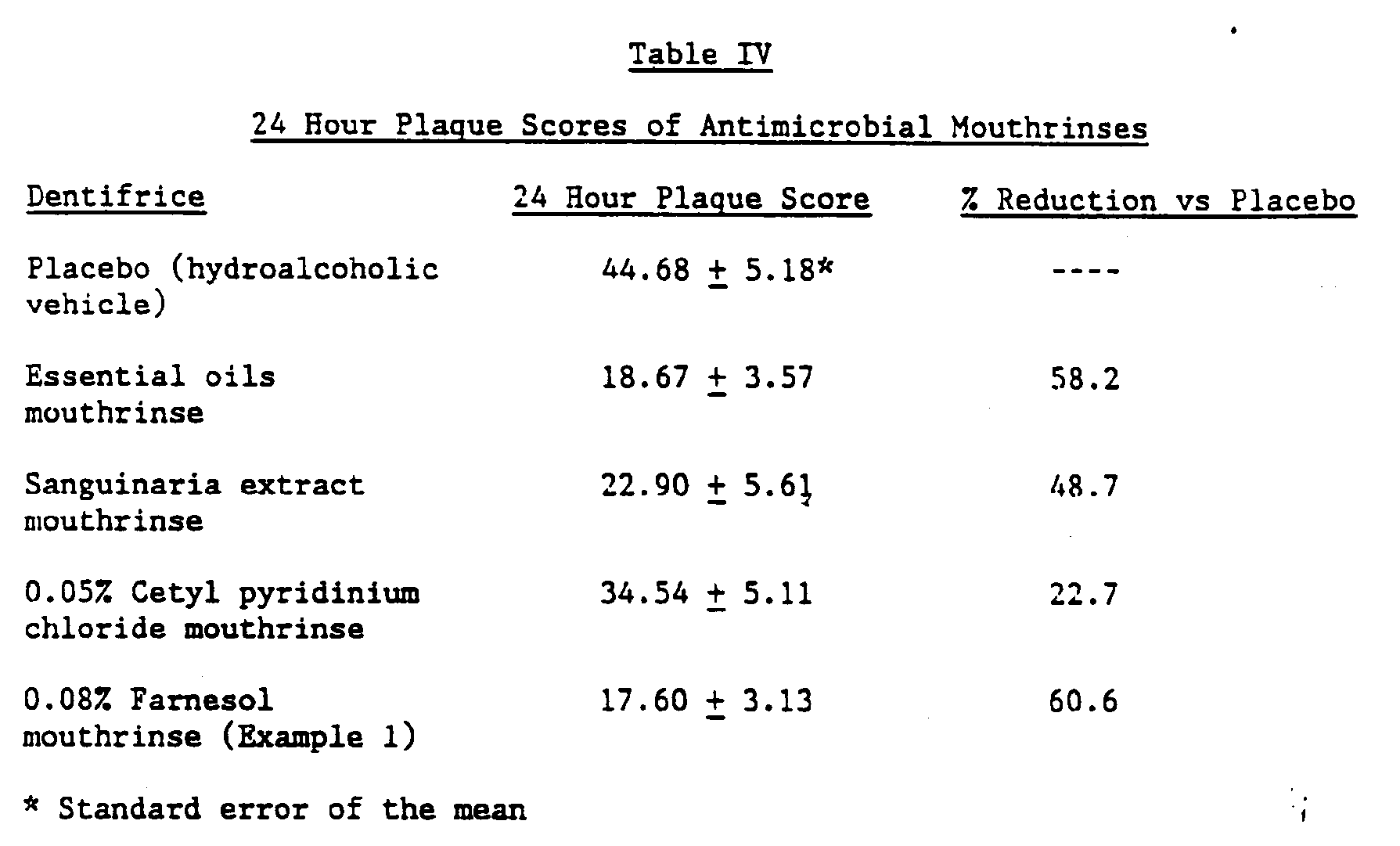
The results show that the 0.08% farnesol mouthrinse (Example 1) has excellent antiplaque activity compared to commercially available products, i.e. sanguinaria extract mouthrinse and the essential oils mouthrinse, significantly higher antiplaque activity than the placebo, and the cetyl pyridinium chloride mouthrinse. It is also noted that the amount of 0.26% essential oils in the said mouthrinse is over three times greater than the 0.08% farnesol mouthrinse. - The synergistic mixture of farnesol and preservatives or Gantrez in an acid medium having a low pH of 3 to 5 also exhibits greater antimicrobial activity in vitro than farnesol at a low pH alone as disclosed in Table V and Figure 1.

- The synergistic mixture of farnesol and Carbopol in an acid medium also exhibits greater antimicrobial activity in vitro than farnesol alone, at a low pH, as disclosed in Table VI.

- In vitro testing of farnesol and other sesquiterpene alcohols demonstrates their antimicrobial activity against a dominant strain of humane dental plaque producing bacteria, Actinomyces viscosus, in Table VII, using the SIKT test which has been previously described in Table I.

- Table VIII compares the in vitro activity of farnesol vs. thymol at different concentrations. The results show that farnesol significantly killed plaque bacteria at one-tenth the effective concentration of thymol.


- The use of farnesol or other sesquiterpene alcohol in antiplaque oral compositions, in lieu of prior art cationic antimicrobial agents, affords multiple advantages. Farnesol is compatible with anionic surfactants, fluoride and sweeteners. There is no bitter aftertaste nor tooth staining associated with cationic antimicrobials.
- In addition, farnesol has advantages over other antimicrobial essential oils such as thymol and eucalyptol in that the sesquiterpene alcohols have a more pleasant taste, and have a lower toxicity as shown in Table IX. The toxicity values are reported in the literature. LD50 is the amount of agent necessary to kill 50% of the test animals.

- The antiplaque sesquiterpene alcohol flavor compound may be incorporated into oral compositions generally, such as mouthrinses, mouthrinse concentrates, dentifrices, lozenges, chewing gum or dental floss containing a dental vehicle.
- The vehicle, often referred to as a dental vehicle contains liquids and solids in a dentifrice. In general, the liquid comprises water and/or a humectant such as glycerine, sorbitol, propylene glycol or polyethylene glycol including suitable mixtures thereof. It is usually advantageous to use a mixture of both water and one or two humectants. The total liquid content is generally 20-90 percent by weight of the vehicle. In transparent and translucent vehicles, the liquid content of the toothpaste may be 20-90 percent by weight, while in opaque vehicles the total liquid content is usually 20-50 percent by weight. The preferred humectants are glycerine, sorbitol, and polyethylene glycol.
- The solid portion of the vehicle is preferably a gelling agent. In the instant invention the gelling agent includes alkali metal carboxymethyl cellulose, hydroxy ethyl cellulose, and hydroxymethyl cellulose preferably in an amount of at least about 0.5 percent by weight of the vehicle. Additional gelling agents may also be present. Gelling agents which may be additionally present include xanthan gum, viscarin, gelatin, starch, glucose, sucrose, polyvinyl pyrollidone, polyvinyl alcohol, gum tragacanth, gum karaya, hydroxy propyl cellulose, methyl cellulose, carboxyethyl cellulose and sodium alginate, Laponite CP or SP, which are each synthetic inorganic complex silicate clays sold under trademark by Laporte Industries, Ltd., and magnesium aluminum silicate gel. The solid portion or gelling agent of the vehicle is typically present in an amount of 0.5-5 percent by weight of the toothpaste and preferably 0.5-2 percent by weight.
- Any suitable substantially water-insoluble polishing agent may be added to the gel vehicle of the dentifrice. There is a relatively large number of such materials known in the art. Representative materials include, for example, dicalcium phosphate, tricalcium phosphate, aluminum hydroxide, magnesium carbonate, calcium carbonate, calcium pyrophosphate, calcium sulfate, bentonite, alumina, hydrated alumina, aluminum silicate, zirconium silicates, silica, including suitable mixtures thereof. In general, these polishing agents will comprise a major proportion by weight of the solid ingredients. The polishing agent content is variable, but will generally be up to about 75 percent by weight of the total composition, generally 20-75 percent; although, even lower amounts of polishing agent can be employed.
- Any suitable surface-active or detersive material may be incorporated in the gel vehicle. Such compatible materials are desirable to provide detersive and foaming properties depending upon the specific type of surface-active material selected. These detergents are water-soluble organic compounds usually, and may be anionic, non-ionic, or cationic in structure. It is preferred to use the water-soluble non-soap or synthetic organic detergents. Suitable detersive materials are known and include, for example, the water-soluble anionic salts of higher fatty acid monoglyceride monosulfate detergent (e.g., sodium coconut fatty acid monoglyceride monosulfate), higher alkyl sulfates (e.g., sodium lauryl sulfate), alkyl aryl sulfonate (e.g., sodium dodecyl benzene sulfonate), and higher fatty acid esters of 1,2-dihydroxypropane sulfonate). Other suitable surface active materials include nonionic surface active materials such as condensates of ethylene oxide with propylene oxide condensates of propylene glycol ("Pluronics").
- The various surface-active materials may be used in any suitable amount, generally from 0.05 to 10 percent by weight, and preferably from 0.5 to 5 percent by weight of the dentifrice composition.
- The oral products of the present invention may also contain antiplaque activity boosters in minimal amounts up to 5% by weight, such as polyvinyl phosphonic acid which deposits on tooth surfaces and inhibits plaque adhesion onto the surface. Farnesol works by a different mechanism: as an antimicrobial it inhibits bacterial reproduction and hence plaque growth. Therefore, the two different mechanisms for fighting plaque could be complementary, showing an additive or even synergistic effect.
- The oral products of this invention may also contain conventional ingredients such as coloring or whitening agents such as titanium dioxide, flavoring and/or sweetening materials, fluorides such as sodium fluoride, stannous fluoride and sodium monofluorophosphate. These additional ingredients may each be added to the dentifrice in minimal amounts of up to 5% by weight, and preferably up to 1%, provided they do not interfere with the antiplaque properties of the finished product.
- The oral preparation may also be a liquid such as mouth rinse which typically contains 20-99% by weight of an aqueous lower aliphatic alcohol, preferably having 10-30% by weight alcohol such as ethanol, n-propyl, or isopropyl alcohol, water and, often, 5-35% humectant.
- Such oral preparations are typically applied by brushing the teeth with a dentifrice or toothpaste, or rinsing the oral cavity for 30-90 seconds or in the case of a lozenge, candy or gum, by sucking or chewing in the oral cavity, or in the case of a mouthspray by spraying into contact with oral surfaces at least once daily. Typical oral preparations of the invention which can be applied in this manner are set forth below.
-

- The mouthrinse is prepared by forming two separate solutions, an ethanol solution containing farnesol, benzoic acid and flavor and an aqueous solution containing sodium lauryl sulfate, glycerin, sodium saccharin and color, combining the two solutions with mixing to complete the mouthrinse.
- More specifically, the benzoic acid, farnesol and flavor is dissolved in ethanol and mixed for five minutes. In a separate vessel, the sodium lauryl sulfate and the water is mixed slowly for five minutes. Glycerin, saccharin and color are added to the water solution and mixed about 10 minutes. While mixing the aqueous solution, the alcohol solution is slowly added thereto, and mixed for ten minutes.
- The resultant mouthrinse composition is a clear liquid product.
- The 0.08% farnesol-containing mouthrinse in the presence of 0.1% benzoic acid and at an acid pH of 3.2 exhibits excellent antiplaque activity compared to prior art antiplaque mouthrinses as shown in Table IV, above.
-

- This mouthrinse is prepared according to the procedure of Example 1 except that the polyvinyl phosphonic acid and the sorbitol is dissolved in the aqueous solution. The Pluronic is dissolved in the ethanol solution.
- This antiplaque mouthrinse also exhibits superior antiplaque activity.
-

pH = 3.2 - This mouthrinse is prepared according to the procedure of Example 3.
- This antiplaque mouthrinse also inhibits plaque formation in the oral cavity.

- The dentifrice is prepared by first forming a gel phase by dispersing the xanthan gum in glycerin and mixing for five minutes. The salts (NaF, Na saccharin, benzoic acid and TiO₂) are added to the glycerin/xanthan mixture and mixed another five minutes. Sorbitol is slowly added to the mixture and mixed another ten minutes. Water is slowly added, followed by H₃PO₄ and mixed ten additional minutes. The resultant gel phase is placed in a mixer to which is added the polishing agent (Zeodent) and the Sylox, and mixed under a vacuum for fifteen minutes at high speed. Sodium lauryl sulfate, flavor and farnesol are added to the mixer and mixed under vacuum for five minutes at a low speed, and recovering the antiplaque dentifrice which is packaged in any suitable container, i.e. tubes, spray or cans.
- The 1% farnesol-containing dentifrice in the presence of 1.0% benzoic acid at an acid pH of 4.02 exhibits excellent antibacterial activity compared to the dentifrice without farnesol as shown in Table X.

- An effective amount, e.g., 0.05-0.2% by weight of a sesquiterpene alcohol and 0.1-2.0% by weight of benzoic acid or other additives such as preservatives, e.g. propylparaben, dehydroacetic acid, etc., and Gantrez is also incorporated in an inert carrier or dissolved in a suitable vehicle in the formulation of chewing gums and lozenges. Gantrez may be replaced by other polycarboxylates. Similarly, the sesquiterpene alcohol and benzoic acid or the other additives are also incorporated into a mouth spray.


pH = adjust to between 3 and 5.
These rinse formulations exhibit superior antiplaque activity. - A typical lozenge formula contains the following ingredients, in percent by weight, based on the weight of the total formulation:
- 75%
- to 98% Sugar
- 1%
- to 20% Corn Syrup
- 0.1%
- to 1% Flavor oil
- 0%
- to 0.03% Colorant(s)
- 0.1%
- to 5% Tableting Lubricant
- 0.2%
- to 2% Water
- 0.05%
- to 0.2% Sesquiterpene Alcohol
- 0.1%
- to 2.0% Benzoic Acid
- Sugarless pressed candy may also be formulated to include the synergistic combination of sesquiterpene alcohol and benzoic acid antiplaque agent of this invention. For products of this type, which usually contain powdered sorbitol instead of sugar, synthetic sweeteners are mixed with the powdered sorbitol and flavor(s), colorant(s) and a tablet lubricant are then added. The formula is introduced into a tablet machine to shape the final product. A typical sugarless pressed candy contains the following ingredients, in percent by weight, based on the weight of the total formulation:
- 98%
- to 99.5% Sorbitol
- 0.1%
- to 0.9% Flavor(s)
- 0%
- to 0.02% Synthetic Sweeteners
- 0%
- to 0.03% Colorant(s)
- 0.05%
- to 1% Tableting Lubricant
- 0.05%
- to 0.27% Sesquiterpene Alcohol
- 0.01%
- to 2.0% Benzoic Acid
- A typical chewing gum may contain the following ingredients, in percent by weight based on the weight of the total gum formulation:

- An alternate chewing gum formulation is as follows:

In certain sugarless gums, there is used as the binder ingredient a solution of sorbitol in water containing from 10% to 80%, preferably from 50% to 75% by weight of sorbitol in H₂O. In others, there is used a gum acacia-in-water system containing from 30% to 60%, preferably from 45% to 50% by weight of gum acacia powder. - The above chewing gum formulations are exemplary only. Many additional formulations are described in the prior art, and in carrying out this invention, such formulations can be employed. It is also possible to prepare an acceptable chewing gum product containing a gum base, flavoring material and a sesquiterpene alcohol - benzoic acid combination according to the teaching of this invention.
- The ingredient referred to heretofore in the formulations simply as "gum base" is susceptible to many variations. In general, a gum base is prepared by heating and blending various ingredients, such as natural gums, synthetic resins, waxes, plasticizers, etc. in a manner well known in the art. Typical examples of the ingredients found in a chewing gum base are masticatory substances of vegetable origin, such as chicle, crown gum, nispero, rosidinha, jelutong, pendare, perillo, niger gutta or, tunu; masticatory substances of synthetic origin such as butadiene-styrene polymer, isobutyleneisoprene copolymer, paraffin, petroleum wax, polyethylene, polyisobutylene or polyvinylacetate; plasticizers such as lanolin, stearic acid, sodium stearate or potassium stearate.
- In one broader aspect of the invention an antiplaque oral composition is characterised in that it contains as essential antiplaque agent a sesquiterpene alcohol flavour compound, and preferably benzoic acid and has a pH of 3 to 5. In another aspect of the invention, an antiplaque oral composition is characterised in that it contains a sesquiterpene alcohol flavour compound and an organic preservative, preferably a paraben or dehydroacetic acid. The composition is buffered to a pH of 3 to 5. The sesquiterpene is present in an amount of 0.05 to 1.0% by weight. The benzoic acid, organic preservative or polycarboxylate is present in the amount of 0.1 to 2.0% by weight.
- In the accompanying Figure point A is Farnesol with 0.10% propyl paraben, point B is Farnesol with 0.10% dehydroacetic acid, point C is Farnesol with 0.13% gantrez S-97, point D is Farnesol with 0.10% benzoic acid, Curve E is a plot of pH v Farnesol antimicrobial activity (without preservatives) and Curve F is 0.12% chlorhexidine antimicrobial activity.
Obviously many variations of the above described procedures may be used to prepare pressed candies.
Claims (10)
- A non-staining, pleasant tasting antiplaque oral composition comprising as the essential antiplaque agent, a sesquiterpene alcohol flavour compound having antimicrobial activity against dental plaque producing bacteria at low concentrations of 0.05% to 1.0% by weight in the presence of 0.1 to 2.0% by weight of at least one additive selected from the group consisting of benzoic acid, an organic preservative, an anionic linear polymeric carboxylate, and an anionic crosslinked polycarboxylate, in an oral vehicle having a pH of 3 to 5.
- A composition as claimed in Claim 1 characterised in that the antiplaque sesquiterpene alcohol agent is selected from the group consisting of farnesol, nerolidol, bisabolol and santalol.
- A composition as claimed in Claim 1 or Claim 2 characterised in that it is in the form of a mouthrinse or a mouthrinse concentrate wherein the oral vehicle preferably is an aqueous lower aliphatic alcohol, and the said oral vehicle preferably also contains a humectant.
- A composition as claimed in Claim 3 characterised in that the mouthrinse contains 0.08% to 0.16% farnesol and about 0.1% benzoic acid.
- A composition as claimed in Claim 1 or Claim 2 characterised in that it is in the form of a dentifrice, wherein the oral vehicle is a dental vehicle containing liquids comprising water and humectants, and solids comprising a gelling agent, the said oral vehicle preferably also containing an anionic surfactant, and preferably also a water-insoluble polishing agent.
- A composition as claimed in Claim 5 characterised in that the dentifrice contains about 1.0% farnesol and about 1.0% benzoic acid.
- A composition as claimed in Claim 4 characterised in that the mouthrinse contains about 0.05% farnesol and about 0.1% propylparaben.
- A composition as claimed in Claim 4 characterised in that the mouthrinse contains about 0.05% farnesol and about 0.1% dehydroacetic acid.
- A composition as claimed in Claim 4 characterised in that the mouthrinse contains about 0.05% farnesol and 0.13% methyl vinyl ether-maleic anhydride copolymer.
- A composition as claimed in Claim 4 characterised in that the mouthrinse contains about 0.05% farnesol and 0.2% of a carboxyvinyl polymer.
Priority Applications (1)
| Application Number | Priority Date | Filing Date | Title |
|---|---|---|---|
| AT90310564T ATE98473T1 (en) | 1989-09-27 | 1990-09-27 | ORAL PREPARATIONS AGAINST DENTAL PLAQUE. |
Applications Claiming Priority (2)
| Application Number | Priority Date | Filing Date | Title |
|---|---|---|---|
| US07/413,366 US5116602A (en) | 1989-09-27 | 1989-09-27 | Antiplaque oral compositions |
| US413366 | 2003-04-15 |
Publications (3)
| Publication Number | Publication Date |
|---|---|
| EP0420630A2 EP0420630A2 (en) | 1991-04-03 |
| EP0420630A3 EP0420630A3 (en) | 1991-05-29 |
| EP0420630B1 true EP0420630B1 (en) | 1993-12-15 |
Family
ID=23636957
Family Applications (1)
| Application Number | Title | Priority Date | Filing Date |
|---|---|---|---|
| EP90310564A Expired - Lifetime EP0420630B1 (en) | 1989-09-27 | 1990-09-27 | Antiplaque oral compositions |
Country Status (15)
| Country | Link |
|---|---|
| US (1) | US5116602A (en) |
| EP (1) | EP0420630B1 (en) |
| JP (1) | JPH03120210A (en) |
| AT (1) | ATE98473T1 (en) |
| AU (1) | AU630233B2 (en) |
| CA (1) | CA2026299A1 (en) |
| DE (1) | DE69005247T2 (en) |
| FI (1) | FI904742A7 (en) |
| GR (1) | GR1000678B (en) |
| IE (1) | IE65783B1 (en) |
| NO (1) | NO177886C (en) |
| NZ (1) | NZ235407A (en) |
| PH (1) | PH27500A (en) |
| PT (1) | PT95416A (en) |
| ZA (1) | ZA907448B (en) |
Families Citing this family (44)
| Publication number | Priority date | Publication date | Assignee | Title |
|---|---|---|---|---|
| US5256401A (en) * | 1987-01-30 | 1993-10-26 | Colgate-Palmolive Company | Antibacterial antiplaque mouthwash composition |
| FR2697133B1 (en) * | 1992-10-28 | 1995-01-13 | Transbiotech | Biocidal and / or biostatic composition and its applications. |
| DE69333625T2 (en) * | 1992-10-28 | 2005-09-22 | Den-Mat Corp., Santa Maria | ANTIBACTERIAL MOUTHWATER |
| US5368845A (en) * | 1993-01-07 | 1994-11-29 | Colgate Palmolive Company | Oral composition |
| US5472684A (en) * | 1993-06-02 | 1995-12-05 | Colgate Palmolive Company | Oral compositions for plaque and gingivitis |
| US5587358A (en) * | 1994-05-09 | 1996-12-24 | Asahi Kasei Kogyo Kabushiki Kaisha | Potentiators of antimicrobial activity |
| GB9414721D0 (en) * | 1994-07-21 | 1994-09-07 | Smithkline Beecham Plc | Dentifrice composition |
| US6361787B1 (en) | 1998-05-27 | 2002-03-26 | The Clorox Company | Enhanced antimicrobial composition |
| US6319958B1 (en) | 1998-06-22 | 2001-11-20 | Wisconsin Alumni Research Foundation | Method of sensitizing microbial cells to antimicrobial compound |
| EP1181866A1 (en) * | 2000-08-14 | 2002-02-27 | Givaudan SA | Antibacterial composition comprising Sandela |
| US6696043B2 (en) * | 2000-09-20 | 2004-02-24 | Scientific Pharmaceuticals, Inc. | Teeth whitening composition in the form of a chewing gum |
| CA2431044A1 (en) * | 2000-12-13 | 2002-06-20 | University Of Rochester | Oral compositions and use thereof |
| EP1231273A1 (en) * | 2001-02-12 | 2002-08-14 | Plant Research International B.V. | Terpene synthase/cyclase and olefin synthase and uses thereof |
| US6846846B2 (en) * | 2001-10-23 | 2005-01-25 | The Trustees Of Columbia University In The City Of New York | Gentle-acting skin disinfectants |
| US20040057908A1 (en) * | 2001-12-13 | 2004-03-25 | Bowen William H. | Oral compositions and use thereof |
| EP1470921A1 (en) | 2002-01-28 | 2004-10-27 | Sharp Kabushiki Kaisha | Capacitive load driving circuit, capacitive load driving method, and apparatus using the same |
| US7879365B2 (en) * | 2002-02-07 | 2011-02-01 | The Trustees Of Columbia University In The City Of New York | Zinc salt compositions for the prevention of dermal and mucosal irritation |
| US7745425B2 (en) * | 2002-02-07 | 2010-06-29 | The Trustees Of Columbia University In The City Of New York | Non-irritating compositions containing zinc salts |
| US7563461B2 (en) * | 2002-02-07 | 2009-07-21 | The Trustees Of Columbia University In The City Of New York | Zinc salt compositions for the prevention of dermal and mucosal irritation |
| CA2475224C (en) * | 2002-02-07 | 2011-11-01 | The Trustees Of Columbia University In The City Of New York | Zinc salt compositions for the prevention of mucosal irritation from spermicides and microbicides |
| US7435429B2 (en) * | 2002-02-07 | 2008-10-14 | Trustees Of Columbia University In The City Of New York | Zinc salt compositions for the prevention of dermal and mucosal irritation |
| ITMI20020884A1 (en) * | 2002-04-23 | 2003-10-23 | Farmaceutici S R L | NON-ABRASIVE WHITENING TOOTHPASTE COMPOSITION |
| DE10245212B4 (en) * | 2002-09-27 | 2008-01-03 | Ivoclar Vivadent Ag | Use of acidic desensitizing agent for teeth |
| US20040101494A1 (en) * | 2002-11-26 | 2004-05-27 | Scott Douglas Craig | Chewable solid unit dosage forms and methods for delivery of active agents into occlusal surfaces of teeth |
| BRPI0412675A (en) * | 2003-07-17 | 2006-10-03 | Univ Columbia | antimicrobial compositions containing synergistic combinations of quaternary ammonium compounds and essential oils and / or constituents |
| US8858920B2 (en) * | 2004-12-21 | 2014-10-14 | Colgate-Palmolive Company | Anti-caries oral care composition with xylitol |
| US20060134020A1 (en) * | 2004-12-21 | 2006-06-22 | Robinson Richard S | Anti-caries oral care composition with a chelating agent |
| DE602006017057D1 (en) | 2005-01-26 | 2010-11-04 | Procter & Gamble | DEHYDRACETIC ACID COMPOSITIONS WITH LOW PH |
| US20060257347A1 (en) * | 2005-05-13 | 2006-11-16 | Kim Joo W | Self-preservation system |
| US7759327B2 (en) * | 2006-01-06 | 2010-07-20 | The Trustees Of Columbia University In The City Of New York | Compositions containing zinc salts for coating medical articles |
| CA2730085A1 (en) * | 2008-07-09 | 2010-01-14 | Board Of Regents Of The University Of Nebraska | Functional micelles for hard tissue targeted delivery of chemicals |
| US8362077B2 (en) | 2008-08-15 | 2013-01-29 | Pibed Limited | Chemical compositions for skin care emulsions and heavy duty hand cleansers |
| US8580861B2 (en) | 2008-08-15 | 2013-11-12 | Pibed Limited | Chemical composition for skin care formulations |
| BR112012002992A2 (en) | 2009-08-12 | 2016-04-19 | Colgate Palmolive Co | oral care composition, composition, method for inhibiting biofilm formation and / or degrading a biofilm in a patient, use of a sesquiterpenoid. |
| JP5852007B2 (en) | 2009-12-18 | 2016-02-03 | コルゲート・パーモリブ・カンパニーColgate−Palmolive Company | Chalcones as enhancers of antimicrobial agents |
| MX2012007876A (en) | 2010-01-07 | 2012-08-03 | Colgate Palmolive Co | Color change of chalcone-containing oral care formulations. |
| DE102010031291A1 (en) * | 2010-07-13 | 2012-01-19 | Henkel Ag & Co. Kgaa | Teeth-whitening mouthwash and mouthwash concentrates |
| US20130224125A1 (en) * | 2010-08-03 | 2013-08-29 | Narayanan S. Kolazi | Alcohol-free slightly-alcoholic oral care composition and a process for preparing same |
| WO2012087434A2 (en) * | 2010-11-05 | 2012-06-28 | Healthypharma, Llc | Use of phosphoric acid |
| CN104822422B (en) | 2012-12-03 | 2018-03-13 | 高露洁-棕榄公司 | For treating the composition and method of carious tooth |
| EP2958557B1 (en) * | 2013-02-25 | 2019-11-27 | University Of Rochester | Nanoparticles for controlled release of anti-biofilm agents |
| US9072687B2 (en) * | 2013-02-26 | 2015-07-07 | Mcneil-Ppc, Inc. | Oral care compositions |
| US10399006B2 (en) * | 2015-03-17 | 2019-09-03 | California Extraction Ventures, Inc. | Catalyzing pressure wave extraction method and apparatus |
| CA3000854A1 (en) * | 2015-10-07 | 2017-04-13 | Santalis Pharmaceuticals, Inc. | Sandalwood oil and its uses related to oral mucositis |
Family Cites Families (11)
| Publication number | Priority date | Publication date | Assignee | Title |
|---|---|---|---|---|
| GB1429774A (en) * | 1972-07-28 | 1976-03-24 | Unilever Ltd | Oral compositions |
| US4294894A (en) * | 1979-01-15 | 1981-10-13 | E. R. Squibb & Sons, Inc. | Transparent toothpaste having a medicinal action and process for its production |
| DE2928944A1 (en) * | 1979-07-18 | 1981-02-12 | Basf Ag | IMPROVED METHOD FOR PRODUCING HIGHER UNSATURATED KETONES |
| US4446125A (en) * | 1981-08-13 | 1984-05-01 | International Flavors & Fragrances Inc. | Use of isomeric farnesene product-by-process for augmenting or enhancing the aroma or taste of foodstuffs, chewing gums, medicinal products and toothpastes |
| JPS58213706A (en) * | 1982-06-08 | 1983-12-12 | Lion Corp | Agent for inhibiting dental plaque formation |
| US4562064A (en) * | 1984-02-09 | 1985-12-31 | Colgate-Palmolive Company | Stabilizing of cinnamic aldehyde-containing flavors with terpenes and sesqueterpenes |
| DE3623826A1 (en) * | 1986-07-15 | 1988-01-28 | Wella Ag | COSMETIC AGENTS CONTAINING HYDROGEN PEROXIDE AND ALPHA-BISABOLOL AND THE USE OF ALPHA-BISABOLOL FOR THE STABILIZATION OF HYDROGEN PEROXIDE |
| JPS6333326A (en) * | 1986-07-29 | 1988-02-13 | Kao Corp | Antibacterial composition |
| JP2605714B2 (en) * | 1987-05-11 | 1997-04-30 | ライオン株式会社 | Oral composition |
| JPH01247495A (en) * | 1988-03-29 | 1989-10-03 | Eikoudou:Kk | Production of alpha-bisabolol |
| US4891447A (en) * | 1988-12-16 | 1990-01-02 | Basf K&F Corporation | Sandalwood odorants |
-
1989
- 1989-09-27 US US07/413,366 patent/US5116602A/en not_active Expired - Fee Related
-
1990
- 1990-09-18 ZA ZA907448A patent/ZA907448B/en unknown
- 1990-09-20 NZ NZ235407A patent/NZ235407A/en unknown
- 1990-09-21 AU AU63085/90A patent/AU630233B2/en not_active Ceased
- 1990-09-24 GR GR900100713A patent/GR1000678B/en unknown
- 1990-09-25 PT PT95416A patent/PT95416A/en not_active Application Discontinuation
- 1990-09-26 NO NO904196A patent/NO177886C/en unknown
- 1990-09-26 CA CA002026299A patent/CA2026299A1/en not_active Abandoned
- 1990-09-26 FI FI904742A patent/FI904742A7/en not_active Application Discontinuation
- 1990-09-26 PH PH41261A patent/PH27500A/en unknown
- 1990-09-27 EP EP90310564A patent/EP0420630B1/en not_active Expired - Lifetime
- 1990-09-27 AT AT90310564T patent/ATE98473T1/en active
- 1990-09-27 DE DE90310564T patent/DE69005247T2/en not_active Expired - Fee Related
- 1990-09-27 JP JP2258798A patent/JPH03120210A/en active Pending
- 1990-09-27 IE IE347290A patent/IE65783B1/en not_active IP Right Cessation
Also Published As
| Publication number | Publication date |
|---|---|
| GR1000678B (en) | 1992-10-08 |
| NO177886C (en) | 1995-12-13 |
| AU630233B2 (en) | 1992-10-22 |
| PH27500A (en) | 1993-07-23 |
| PT95416A (en) | 1991-06-25 |
| IE65783B1 (en) | 1995-11-15 |
| FI904742A7 (en) | 1991-03-28 |
| JPH03120210A (en) | 1991-05-22 |
| ZA907448B (en) | 1992-05-27 |
| NO177886B (en) | 1995-09-04 |
| US5116602A (en) | 1992-05-26 |
| AU6308590A (en) | 1991-04-11 |
| NO904196D0 (en) | 1990-09-26 |
| NZ235407A (en) | 1993-01-27 |
| CA2026299A1 (en) | 1991-03-28 |
| EP0420630A2 (en) | 1991-04-03 |
| EP0420630A3 (en) | 1991-05-29 |
| FI904742A0 (en) | 1990-09-26 |
| GR900100713A (en) | 1992-01-20 |
| DE69005247T2 (en) | 1994-03-31 |
| NO904196L (en) | 1991-04-02 |
| ATE98473T1 (en) | 1994-01-15 |
| DE69005247D1 (en) | 1994-01-27 |
| IE903472A1 (en) | 1991-04-10 |
Similar Documents
| Publication | Publication Date | Title |
|---|---|---|
| US5116602A (en) | Antiplaque oral compositions | |
| US5472684A (en) | Oral compositions for plaque and gingivitis | |
| AU630028B2 (en) | Antibacterial antiplaque anticalculus oral composition | |
| US5891422A (en) | Antimicrobial composition containing a C3 -C6 alcohol | |
| US4272513A (en) | Stabilized oral composition | |
| HRP950385A2 (en) | Antiseptic dentifrice | |
| JPH0543439A (en) | Sordes resisting composition for oral application | |
| US5185153A (en) | Agents effecting the lysis of oral bacteria | |
| EP0854702B1 (en) | Antimicrobial compositions containing a c 3-c 6 alcohol | |
| US6861048B2 (en) | Dentifrice compositions having reduced abrasivity | |
| NZ525212A (en) | Tooth whitening composition and method employing dicarboxylic acid whitening agent | |
| US5085850A (en) | Anti-plaque compositions comprising a combination of morpholinoamino alcohol and metal salts | |
| US20030133883A1 (en) | Oral care compositions containing grapefruit seed extract | |
| AU761558B2 (en) | Synergistic antibacterial combination | |
| JPH11180839A (en) | Oral composition for suppressing bad breath | |
| US20020068039A1 (en) | Oral care compositions containing grapefruit seed extract | |
| CA2754213C (en) | Desensitizing dentifrice exhibiting dental tissue antibacterial agent uptake | |
| JP2001002542A (en) | Oral composition | |
| WO2002050002A1 (en) | Non-halogenated phenyl substituted phenols, antimicrobial compositions containing the same, and methods of using the same | |
| AU783747B2 (en) | Dentifrice compositions having reduced abrasivity | |
| JPH01246214A (en) | Composition for oral cavity | |
| JP2023177682A (en) | Composition for inhibiting plaque formation | |
| US20030139479A1 (en) | Non-halogenated biphenyl triol compounds, antimicrobial compositions containing the same, and methods of using the same |
Legal Events
| Date | Code | Title | Description |
|---|---|---|---|
| PUAI | Public reference made under article 153(3) epc to a published international application that has entered the european phase |
Free format text: ORIGINAL CODE: 0009012 |
|
| 17P | Request for examination filed |
Effective date: 19901009 |
|
| AK | Designated contracting states |
Kind code of ref document: A2 Designated state(s): AT BE CH DE DK ES FR GB IT LI LU NL SE |
|
| PUAL | Search report despatched |
Free format text: ORIGINAL CODE: 0009013 |
|
| AK | Designated contracting states |
Kind code of ref document: A3 Designated state(s): AT BE CH DE DK ES FR GB IT LI LU NL SE |
|
| 17Q | First examination report despatched |
Effective date: 19921002 |
|
| GRAA | (expected) grant |
Free format text: ORIGINAL CODE: 0009210 |
|
| AK | Designated contracting states |
Kind code of ref document: B1 Designated state(s): AT BE CH DE DK ES FR GB IT LI LU NL SE |
|
| PG25 | Lapsed in a contracting state [announced via postgrant information from national office to epo] |
Ref country code: IT Free format text: LAPSE BECAUSE OF FAILURE TO SUBMIT A TRANSLATION OF THE DESCRIPTION OR TO PAY THE FEE WITHIN THE PRE;WARNING: LAPSES OF ITALIAN PATENTS WITH EFFECTIVE DATE BEFORE 2007 MAY HAVE OCCURRED AT ANY TIME BEFORE 2007. THE CORRECT EFFECTIVE DATE MAY BE DIFFERENT FROM THE ONE RECORDED.SCRIBED TIME-LIMIT Effective date: 19931215 Ref country code: SE Effective date: 19931215 Ref country code: NL Effective date: 19931215 Ref country code: BE Effective date: 19931215 Ref country code: DK Effective date: 19931215 Ref country code: FR Effective date: 19931215 |
|
| REF | Corresponds to: |
Ref document number: 98473 Country of ref document: AT Date of ref document: 19940115 Kind code of ref document: T |
|
| REF | Corresponds to: |
Ref document number: 69005247 Country of ref document: DE Date of ref document: 19940127 |
|
| PG25 | Lapsed in a contracting state [announced via postgrant information from national office to epo] |
Ref country code: ES Free format text: LAPSE BECAUSE OF FAILURE TO SUBMIT A TRANSLATION OF THE DESCRIPTION OR TO PAY THE FEE WITHIN THE PRESCRIBED TIME-LIMIT Effective date: 19940326 |
|
| EN | Fr: translation not filed | ||
| NLV1 | Nl: lapsed or annulled due to failure to fulfill the requirements of art. 29p and 29m of the patents act | ||
| PGFP | Annual fee paid to national office [announced via postgrant information from national office to epo] |
Ref country code: DE Payment date: 19940921 Year of fee payment: 5 |
|
| PGFP | Annual fee paid to national office [announced via postgrant information from national office to epo] |
Ref country code: CH Payment date: 19940923 Year of fee payment: 5 |
|
| PGFP | Annual fee paid to national office [announced via postgrant information from national office to epo] |
Ref country code: ES Payment date: 19940930 Year of fee payment: 5 |
|
| PGFP | Annual fee paid to national office [announced via postgrant information from national office to epo] |
Ref country code: LU Payment date: 19941001 Year of fee payment: 5 |
|
| PLBE | No opposition filed within time limit |
Free format text: ORIGINAL CODE: 0009261 |
|
| STAA | Information on the status of an ep patent application or granted ep patent |
Free format text: STATUS: NO OPPOSITION FILED WITHIN TIME LIMIT |
|
| 26N | No opposition filed | ||
| PG25 | Lapsed in a contracting state [announced via postgrant information from national office to epo] |
Ref country code: LU Free format text: LAPSE BECAUSE OF NON-PAYMENT OF DUE FEES Effective date: 19950927 |
|
| PG25 | Lapsed in a contracting state [announced via postgrant information from national office to epo] |
Ref country code: CH Effective date: 19950930 Ref country code: LI Effective date: 19950930 |
|
| REG | Reference to a national code |
Ref country code: CH Ref legal event code: PL |
|
| PG25 | Lapsed in a contracting state [announced via postgrant information from national office to epo] |
Ref country code: DE Effective date: 19960601 |
|
| PGFP | Annual fee paid to national office [announced via postgrant information from national office to epo] |
Ref country code: AT Payment date: 19980930 Year of fee payment: 9 |
|
| PGFP | Annual fee paid to national office [announced via postgrant information from national office to epo] |
Ref country code: GB Payment date: 19981001 Year of fee payment: 9 |
|
| PG25 | Lapsed in a contracting state [announced via postgrant information from national office to epo] |
Ref country code: GB Free format text: LAPSE BECAUSE OF NON-PAYMENT OF DUE FEES Effective date: 19990927 Ref country code: AT Free format text: LAPSE BECAUSE OF NON-PAYMENT OF DUE FEES Effective date: 19990927 |
|
| GBPC | Gb: european patent ceased through non-payment of renewal fee |
Effective date: 19990927 |