EP0420619B1 - Engineering plastic composition and articles made of the same - Google Patents
Engineering plastic composition and articles made of the same Download PDFInfo
- Publication number
- EP0420619B1 EP0420619B1 EP19900310548 EP90310548A EP0420619B1 EP 0420619 B1 EP0420619 B1 EP 0420619B1 EP 19900310548 EP19900310548 EP 19900310548 EP 90310548 A EP90310548 A EP 90310548A EP 0420619 B1 EP0420619 B1 EP 0420619B1
- Authority
- EP
- European Patent Office
- Prior art keywords
- engineering plastic
- polyester
- aliphatic
- aliphatic polyester
- fibres
- Prior art date
- Legal status (The legal status is an assumption and is not a legal conclusion. Google has not performed a legal analysis and makes no representation as to the accuracy of the status listed.)
- Expired - Lifetime
Links
- 0 Cc1ccc(*)cc1 Chemical compound Cc1ccc(*)cc1 0.000 description 3
- NBLMGZWFBUSJSG-UHFFFAOYSA-N CC(C)(C)[NH+](c(cc1)ccc1OC(C)(C)C)[O-] Chemical compound CC(C)(C)[NH+](c(cc1)ccc1OC(C)(C)C)[O-] NBLMGZWFBUSJSG-UHFFFAOYSA-N 0.000 description 1
Classifications
-
- C—CHEMISTRY; METALLURGY
- C08—ORGANIC MACROMOLECULAR COMPOUNDS; THEIR PREPARATION OR CHEMICAL WORKING-UP; COMPOSITIONS BASED THEREON
- C08L—COMPOSITIONS OF MACROMOLECULAR COMPOUNDS
- C08L67/00—Compositions of polyesters obtained by reactions forming a carboxylic ester link in the main chain; Compositions of derivatives of such polymers
- C08L67/02—Polyesters derived from dicarboxylic acids and dihydroxy compounds
-
- C—CHEMISTRY; METALLURGY
- C08—ORGANIC MACROMOLECULAR COMPOUNDS; THEIR PREPARATION OR CHEMICAL WORKING-UP; COMPOSITIONS BASED THEREON
- C08G—MACROMOLECULAR COMPOUNDS OBTAINED OTHERWISE THAN BY REACTIONS ONLY INVOLVING UNSATURATED CARBON-TO-CARBON BONDS
- C08G63/00—Macromolecular compounds obtained by reactions forming a carboxylic ester link in the main chain of the macromolecule
- C08G63/02—Polyesters derived from hydroxycarboxylic acids or from polycarboxylic acids and polyhydroxy compounds
- C08G63/12—Polyesters derived from hydroxycarboxylic acids or from polycarboxylic acids and polyhydroxy compounds derived from polycarboxylic acids and polyhydroxy compounds
- C08G63/16—Dicarboxylic acids and dihydroxy compounds
- C08G63/18—Dicarboxylic acids and dihydroxy compounds the acids or hydroxy compounds containing carbocyclic rings
- C08G63/19—Hydroxy compounds containing aromatic rings
-
- C—CHEMISTRY; METALLURGY
- C08—ORGANIC MACROMOLECULAR COMPOUNDS; THEIR PREPARATION OR CHEMICAL WORKING-UP; COMPOSITIONS BASED THEREON
- C08G—MACROMOLECULAR COMPOUNDS OBTAINED OTHERWISE THAN BY REACTIONS ONLY INVOLVING UNSATURATED CARBON-TO-CARBON BONDS
- C08G63/00—Macromolecular compounds obtained by reactions forming a carboxylic ester link in the main chain of the macromolecule
- C08G63/02—Polyesters derived from hydroxycarboxylic acids or from polycarboxylic acids and polyhydroxy compounds
- C08G63/12—Polyesters derived from hydroxycarboxylic acids or from polycarboxylic acids and polyhydroxy compounds derived from polycarboxylic acids and polyhydroxy compounds
- C08G63/16—Dicarboxylic acids and dihydroxy compounds
- C08G63/20—Polyesters having been prepared in the presence of compounds having one reactive group or more than two reactive groups
-
- C—CHEMISTRY; METALLURGY
- C08—ORGANIC MACROMOLECULAR COMPOUNDS; THEIR PREPARATION OR CHEMICAL WORKING-UP; COMPOSITIONS BASED THEREON
- C08L—COMPOSITIONS OF MACROMOLECULAR COMPOUNDS
- C08L101/00—Compositions of unspecified macromolecular compounds
Definitions
- This invention relates to an engineering plastic composition with excellent flowability, heat stability, and desirable mechanical properties, and to articles made of the same.
- engineering plastic materials include polyetherimide, polyarylketone, aromatic polysulfone resin, polyarylenesulfide, polyarylate, saturated polyester (liquid crystal polyester), polyamide-imide, polycarbonate, polyphenyleneoxide, polyamide, polyoxymethylene, etc.
- These engineering plastic materials can be used in various kinds of articles that require a high-performance material with qualities such as excellent heat stability and mechanical properties.
- the melt viscosities of engineering plastic materials are high, and as a result, the workability of the materials is poor. Therefore, it is not easy to use these engineering plastic materials for products which must be formed with accuracy. For these reasons, there is a need for an engineering plastic composition that has a low melt viscosity, that is, satisfactory flowability, and workability, during molding.
- melt viscosity of polymers can be lowered.
- two methods have been adopted: (1) to decrease the molecular weight of the polymer, and (2) to add a plasticizer or to add a processing aid.
- the tensile strength, the impact strength, and other mechanical properties of the articles that are made of the polymer are worsened, and the heat stability of the articles declines.
- the second method many of the substances that can provide engineering plastic materials with plasticity have poor heat stability, so that these substances are not stable at the molding temperature for the engineering plastic materials. For these reasons, a plasticizer or processing aid that is effective with engineering plastic materials has not yet been found.
- polyetherimide Since polyetherimide has a high glass transition temperature of 217°C, it is used as a thermoplastic resin with heat stability. However, the melt viscosity of polyetherimide is high, so the moldability is poor and it is not easy to use these engineering plastic materials for products which must be formed with accuracy.
- Polyarylketone is used for applications which require high performance with qualities, as a thermoplastic resin with excellent heat, hydrolysis and solvent stability, and desirable mechanical strength.
- the melt viscosity of polyarylketone is also high, so it is not easy to use these engineering plastic materials for products to be formed with accuracy.
- Aromatic polysulfone resin is used in various kinds of articles as a thermoplastic resin with excellent heat stability.
- the melt viscosity of aromatic polysulfone resin is also high, so the moldability is poor and it is not easy to use these engineering plastic materials for products which must be formed with accuracy.
- thermoplastic resins used in the above methods are inferior to that of aromatic polysulfone resin. For that reason, the excellent heat stability of the aromatic polysulfone resin is decreased by their use.
- Polyarylenesulfide is a resin with excellent heat stability.
- reinforced polyarylenesulfide making use of the good affinity for various fillers and reinforcing fibers, has excellent mechanical properties, heat stability and electric properties.
- methods have been proposed in which solid polyethylene is added to polyarylenesulfide (Japanese Laid-Open Patent Publication No. 54-47752) and in which a block copolymer of hydrogenated conjugated dienes and aromatic compounds with one vinyl group is added to polyarylenesulfide (Japanese Laid-Open Patent Publication No. 59-217760).
- Japanese Laid-Open Patent Publication No. 59-217760 Japanese Laid-Open Patent Publication No. 59-217760
- Saturated polyester has excellent mechanical properties, heat stability, electric properties, and the like.
- liquid crystal polyester has excellent heat stability, high strength, excellent modulus of elasticity, and a low linear expansion coefficient, so it is used for parts such as machine parts and electrical parts which require high performance with these qualities.
- stiffeners such as reinforcing fibers or fillers are added to liquid crystal polyester.
- the flowability is decreased. Therefore, it is necessary to raise the molding temperature when thin articles or articles with complex structures are molded, but resins are degraded during a prolonged heating in a molder with a high temperature and hence desirable molded articles cannot be obtained.
- Polyamide-imide has a high glass transition temperature of 280°C-290°C, so it is used for applications which require high performance, as a thermoplastic resin with excellent mechanical properties at a high temperature.
- the melt viscosity of polyamide-imide is high, so it is necessary to mold at a high temperature of 320°C-350°C and the viscosity is prone to increase because of the molecular chain elongation reaction occuring when heating at 360°C or more. Therefore, it is not easy to use polyamide-imide for products which must be formed with accuracy.
- Polycarbonate has a high glass transition temperature of 140°C-150°C, and its mechanical properties, dimensional stability and transparency are extremely good. Because of its mechanical properties, heat stability and other qualities, polycarbonate is suitable for use in machine parts, electrical parts, optical parts, and other products in which high performance is needed. On the other hand, polycarbonate has excellent impact strength, but the problem is that the value of impact strength is prone to change with the thickness of the articles.
- reinforcing fibers such as glass fibers and fillers such as silica are added to the polycarbonate.
- the impact strength of a polycarbonate composition in which these are added generally decreases; and high temperatures of 300°C-360°C are needed in molding. If this composition is heated to 350°C or more, the product may be discolored.
- Polyphenylene oxide (PPO resin) is an engineering plastic material with excellent heat stability.
- various methods have been proposed in order to solve the problems.
- a method in which polyphenylene oxide is blended with other polymers has been proposed and polymer-blended mixtures, for example, polyphenylene oxide/styrene or polyphenylene oxide/nylon are commercially available.
- NORYL® and NORYL GTX® available from GE Corp.
- XYRON® available from Asahi Chemical Industry Co., Ltd.
- YUPIACE® available from Diamarl are known.
- Polyamide has excellent mechanical properties, heat stability and wear resistance and is used, making use of these excellent properties, in various kinds of articles such as machine parts and electrical parts which require high performance.
- stiffeners such as reinforcing fibers or fillers are added.
- the flowability is decreased. Therefore, it is necessary to raise the molding temperature when thin articles or articles with complex structures are molded, but resins are degraded during the prolonged heating in a molder with a high temperature and hence desirable molded articles cannot be obtained.
- Polyoxymethylene has excellent mechanical properties, heat stability and dimensional stability, so it is widely used in parts such as machine parts, electrical parts, automotive parts, as an engineering plastic material with well-balanced properties.
- polyoxymethylenes suitable for each application have been developed. Complexation between polyoxymethylene and other resins is an effective means to change the properties.
- polymer alloy in which polyoxymethylene is complexed with urethane thermoplastic elastomer is commercially available.
- a method in which a specific modified ⁇ -olefin polymer is blended with polyoxymethylene is disclosed in Japanese Laid-Open Patent Publication No. 59-204652, in order to improve the impact strength of polyoxymethylene.
- these methods decrease the heat stability of polyoxymethylene.
- An engineering plastic composition of the present invention which overcomes the above-discussed and numerous other disadvantages and deficiencies of the prior art, comprises an engineering plastic material and an aliphatic polyester, said aliphatic polyester is one formed by the copolymerisation of monomers comprising an aliphatic dicarboxylic acid of formula I; an aliphatic diol; and at least either a dihydroxy compound of formula II or a monohydroxy compound of formula III: HOOC-(CH2) n -COOH [I] (wherein n is zero or an integer of up to 10) (wherein R1 and R2 are, independently, alkylene, p is 3 or 4, and q and r, independently, are O or integers of 1 or more) (wherein R3 is alkylene, l is 2 or 3, and m is O or integers of 1 or more).
- said engineering plastic material is at least one selected from polyetherimide, polyarylketone, aromatic polysulfone resin, polyarylenesulfide, polyarylate, saturated polyester (liquid crystal polyester), polyamide-imide, polycarbonate, polyphenyleneoxide, polyamide, and polyoxymethylene.
- said aliphatic polyester contains said aliphatic dicarboxylic acid, said aliphatic diol and said dihydroxy compound, as components thereof, wherein said dihydroxy compound is present in an amount of from 0.1 to 30 mol% based on the total amount of monomer of said aliphatic polyester.
- said aliphatic polyester contains said aliphatic dicarboxylic acid, said aliphatic diol and said monohydroxy compound, as components thereof, wherein said monohydroxy compound is present in an amount of from 0.1 to 20 mol% based on the total amount of monomer of said aliphatic polyester.
- the total amount of said dihydroxy compound and said monohydroxy compound added is from 0.1 to 30 mol% based on the total amount of monomer of said aliphatic polyester.
- said dihydroxy compound is one selected from 4,4''-dihydroxy-p-terphenyl, 4,4'''-dihydroxy-p-quarterphenyl, or 4,4'''-di(2-hydroxyethoxy)-p-quarterphenyl.
- reinforcing fibers are present in an amount of from 1.0 to 400 parts by weight for each 100 parts by weight of said engineering plastic composition.
- said renforcing fibre is at least one selected from glass fibres, carbon fibres, boron fibres, silicon carbide fibres, graphite fibres, alumina fibres, amorphous-metal fibres, silicon-titanium-carbon inorganic fibres, and aramide fibres.
- an article is obtained from said engineering plastic composition by a melt-molding technique.
- said melt-molding technique is one selected from compression moulding, extrusion moulding, injection moulding, and blow-moulding.
- the invention described herein makes possible the objectives of: (1) providing an engineering plastic composition that has excellent workability, as well as excellent heat stability and superior mechanical properties that originate from the said engineering plastic material contained therein; (2) providing an engineering plastic composition that has excellent heat stability and mechanical properties which an engineering plastic material originally has and the impact strength of which is further improved; (3) providing an engineering plastic composition that is rubbery elasticity and has excellent heat stability; (4) providing an engineering plastic composition that can be used in electronic products, film, sheets, pipes, and the like, in which high heat stability and superior mechanical properties are needed, and in paints, adhesives, fibers, and the like in which high heat stability is needed; (5) providing an engineering plastic composition that has excellent flowability even when it contains reinforcing fibers, so that the moldability is satisfactory, and also has the excellent qualities described in (1) to (4) above; and (6) providing an article obtained from the above-mentioned engineering plastic composition, which has superior heat stability and mechanical properties.
- Engineering plastic materials that can be used in this invention include polyetherimide, polyarylketone, aromatic polysulfone resin, polyarylenesulfide, polyarylate, saturated polyester (liquid crystal polyester), polyamide-imide, polycarbonate, polyphenyleneoxide, polyamide, polyoxymethylene, etc.
- the polyetherimide mentioned above is a polymer that has essentially ether-bonds and imide bonds.
- the polymer with a repeating unit of formula IV as the major component is preferred: wherein Ar1 is a divalent aromatic group that contains at least one six-membered carbon ring, such as, for example wherein X1 is -O-, -S-, -CO-, -SO2- -SO-, or alkylene that contains 1 to 5 carbon atoms.
- Ar2 is a divalent aromatic group, such as, for example, wherein X2 is -O-, -S-, -CO-, -SO2-, -SO-, or alkylene that contains 1 to 5 carbon atoms.
- the polyetherimide with a repeating unit of the following formula as the main component is particularly preferred, for example, ULTEM® available from GE Corp.
- a polymer with a repeating unit of formula V as the main component is preferred: wherein the Ar3 groups, independently, are divalent aromatic groups with at least one six-membered carbon ring such as, for example, or the like.
- X3 is, independently, -O-, -CO-, or a direct bond, and s is an integer from 0 to 3.
- polyarylketone that has the repeating unit V-I and polyarylketone that has the repeating unit V-II are particularly preferred:
- polymers with a repeating unit of formula V-I include ULTRAPEK® available from BASF Corp.
- polymers with the repeating unit of the formula V-II include VICTREX PEEK® available from ICI Corp.
- aromatic polysulfone resin that can be used in the present invention, an aromatic polysulfone resin with a repeating unit of formula VI or VII is particularly suitable.
- aromatic polysulfone resins of formula VI include VICTREX PES® available from ICI Corp.
- aromatic polysulfone resins of formula VII include UDEL® available from UCC Corp.
- Polyarylenesulfide that can be used in the present invention includes polyphenylenesulfide, poly-4,4'-diphenylenesulfide, poly-2,4-tolylenesulfide, a copolymer synthesized by a reaction of p-dichlorobenzene and 2,4-dichlorotoluene with sodium sulfide, etc.
- Polyphenylenesulfide with a repeating unit of the following formula as the main component is particularly preferred: These polyphenylenesulfides include RYTON® available from Phillips Petroleum International Inc., FORTRON® available from Kureha Chemical Industry Co., Ltd., SUSTEED® available from Tosoh-Susteel Corp., TORPREN® available from Torpren Corp., etc.
- a polymer with a repeating unit of formula VIII as the main component is preferred: wherein the Ar4 groups, independently, are divalent aromatic groups with at least one six-membered carbon ring.
- Ar4 include: wherein X4 is -O-, -S-, -CO-, -SO2-, -SO-, or alkyl that contains 1 to 5 carbon atoms.
- polyarylates with a repeating unit of the following formula are particularly preferred:
- the polyarylates include U Polymer® available from Unitika Ltd., APE® available from Bayer Corp., DURED® available from Hooker Corp., etc.
- Examples of the aforementioned saturated polyester include a polyester which is obtained by polymerization between terephthalic acid as a component of dicarboxylic acid and an diol component and a liquid crystal polyester.
- diol component of said polyester examples include aliphatic glycol containing 2 to 20 carbon atoms such as ethylene glycol, 1,3-propanediol, 1,4-butanediol, 1,6-hexanediol, and 1,10-decanediol; alicyclic glycol such as 1,4-cyclohexanedimethanol; aromatic glycol such as 2,2-bis(4-hydroxyphenyl)propane; polyalkylene oxides such as polyethylene oxide, polypropylene oxide, and polytetramethylene oxide, and one of or a mixture of them is used.
- aliphatic glycol containing 2 to 20 carbon atoms such as ethylene glycol, 1,3-propanediol, 1,4-butanediol, 1,6-hexanediol, and 1,10-decanediol
- alicyclic glycol such as 1,4-cyclohexanedimethanol
- aromatic glycol such
- Polyethylene terephtalate (PET) or polybutylene terephtalate (PBT) are preferably used among these polyesters and desirable effects of the present invention are obtained when it is molded as a resin composition.
- PET polyethylene terephtalate
- PBT polybutylene terephtalate
- Examples of commercial polyethylene terephtalates include FR-PET® available from Teijin, Ltd. and VYLOPET® available from Toyobo Co., Ltd.
- Examples of commercial polybutylene terephtalates include VALOX® available from GE Corp., Teijin-PBT® available from Teijin, Ltd., Toray-PBT® available from Toray Industries Inc., etc.
- Lactone can be contained as another component besides polyester. Examples of lactone are ⁇ -caprolactone, ⁇ -valerolactone. and ⁇ -butyrolactone.
- the liquid crystal polyester can be obtained in the following way. 1) An aromatic dicarboxylic acid and an aromatic dihydroxy compound are polycondensed. 2) An aromatic hydroxycarboxylic acid is polycondensed. 3) An aromatic dicarboxylic acid, an aromatic dihydroxy compound, and an aromatic hydroxycarboxylic acid are polycondensed.
- the following compounds are examples of aromatic dihydroxy compounds that can be used as a component of the above liquid crystal polyesters: resorcin, 4-acetylresorcin, hydroquinone, chlorohydroquinone, bromohydroquinone, methylhydroquinone, phenylhydroquinone (i.e., 2,5-dihydroxybiphenyl), methoxyhydroquinone, phenoxyhydroquinone, 4,4'-dihydroxybiphenyl, 3,3'-diphenyl-4,4'-dihydroxybiphenyl, 4,4'-dihydroxydiphenyl ether, 4,4'-dihydroxydiphenylsulfide, 4,4'-dihydroxydiphenylsulfone, 3,3'-diphenyl-4,4'-dihydroxydiphenylsulfone, 4,4'-dihydroxybenzophenone, 4,4'-dihydroxydiphenylmethane, Bisphenol
- aromatic dihydroxy compounds those that can be used to give liquid crystal polyesters of high crystallinity are hydroquinone, 4,4'-dihydroxybiphenyl, 4,4'-dihydroxydiphenyl ether and 4,4'-dihydroxydiphenylsulfide.
- the aromatic dicarboxylic acid mentioned above includes isophthalic acid, metal salts of 5-sulfoisophthalic acid, terephthalic acid, 4,4'-biphenyldicarboxylic acid, 4,4'-dicarboxydiphenyl ether, 4,4'-dicarboxydiphenylsulfide, 4,4'-dicarboxydiphenylsulfone, 3,3'-benzophenonedicarboxylic acid, 4,4'-benzophenonedicarboxylic acid, 1,2-bis(4-carboxyphenoxy)ethane, 1,4-naphthalenedicarboxylic acid, 2,6-naphthalenedicarboxylic acid, etc.
- aromatic dicarboxylic acids those that can be used to give liquid crystal polyesters of high crystallinity are terephthalic acid, 4,4'-biphenyldicarboxylic acid, 4,4'-dicarboxydiphenyl ether, 4,44-dicarboxydiphenylsulfide, 4,4'-benzophenonedicarboxylic acid, 1,2-bis(4-carboxyphenoxy)ethane, and 2,6-naphthalenedicarboxylic acid.
- the aromatic hydroxycarboxylic acid mentioned above includes salicylic acid, m-hydroxybenzoic acid, p-hydroxybenzoic acid, 3-chloro-4-hydroxybenzoic acid, 3-bromo-4-hydroxybenzoic acid, 3-methyl-4-hydroxybenzoic acid, 3-phenyl-4-hydroxybenzoic acid, 3-methoxy-4-hydroxybenzoic acid, 4-hydroxy-4'-carboxybiphenyl, 2-hydroxy-6-carboxynaphthalene, etc.
- aromatic hydroxycarboxylic acids those that can be used to give liquid crystal polyesters of high crystallinity include p-hydroxybenzoic acid and 4-hydroxy-4'-carboxybiphenyl.
- Liquid crystal polyesters that contain p-hydroxybenzoic acid are particularly suitable.
- the liquid crystal polyesters include EKONOL® available from Sumitomo Chemical Co. Ltd., and XYDAR® available from Dartco Corp., that have repeating units of the following formulae as the main component: and
- the liquid crystal polyesters also include VECTRA® available from Hoechst Celanese Corp., that has repeating units of the following formulae as the main component:
- the liquid crystal polyesters further include X7G® available from Eastman Kodak Corp., NOVACCURATE® available from Mitsubishi Kasei Corp., LODRUN® available from Unitika Ltd., IDEMITSU LCP® available from Idemitsu Sekiyu Kagaku Corp., etc.; all of these liquid crystal polyesters have repeating units of the following formulae as the main component: and ⁇ OCH2CH2O ⁇
- a polyamide-imide that can be used in the present invention is a polymer that essentially has amide linkages and imide linkages, and in particular, a polymer with a repeating unit of formula IX as the main component is preferred: wherein Ar5 is a divalent aromatic group with at least one six-membered carbon ring. Examples of Ar5 include wherein X5 is -O-, -S-, -CO-, SO2-, -SO-, or alkylene that contains 1 to 5 carbon atoms. Examples of such a polyamide-imide includes TORLON® available from Amoco Chemical Co., TI-5000® available from Toray Industries Inc., etc.
- a polymer with a repeating unit of formula X as the main component is preferred: wherein X6 is -O-, -S-, -CO-, -SO2-, -SO-, or a divalent aliphatic group, alicyclic group, or phenyl-substituted alkylene that contains 1 to 10 carbon atoms.
- a polycarbonate with a repeating unit of the following formula as the main component is particularly suitable:
- the polycarbonate include IUPILON® available from Mitsubishi Gas Chemical Company Inc., PANLITE® available from Teijin Kasei Corp., NOVAREX® available from Mitsubishi Kasei Co., LEXAN® available from GE Corp., MAKROLON® available from Bayer Corp., etc.
- a polymer with a repeating unit of formula XI as the main component is preferred: wherein X7 is alkyl that contains 1 to 4 carbon atoms, alkoxy that contains 1 to 4 carbon atoms, or halogen.
- polyphenyleneoxide with the repeating unit of the following formula as the main component is particularly preferred:
- Polyphenylene oxide is not sold by itself commercially, but only as a mixture with other resins.
- mixtures with styrene-type resins such as polystyrene, styrene-acrylonitrile copolymer, styrene-acrylonitrile-butadiene copolymer, styrene-methylmethacrylate copolymer; or with nylon are commercially available.
- This kind of product includes NORYL® and NORYL GTX® available from GE Corp., XYRON® available from Asahi Chemical Industry Co., Ltd., etc.
- 20-400 parts by weight of a styrene-type resin or nylon is mixed with 100 parts by weight of the polyphenyleneoxide.
- the aforementioned polyamide can be any polyamide which comprises amide-bonds with polymer main chains and can melt when heated.
- aliphatic nylons such as 4-nylon, 6-nylon, 6.6-nylon, 11-nylon, 12-nylon, 6.10-nylon, and 6.12-nylon; and polyamides in which an aromatic monomer such as isophthalic acid, terephthalic acid, and metaxylylenediamine, an alicyclic monomer such as 2,2-bis(paraaminocyclohexyl)propane and 4,4'-diaminodicyclohexylmethane, or a side-chain substituted aliphatic monomer such as 2,2,4- or 2,4,4-trinethylhexamethylenediamine is polycondensed.
- the aforementioned polyoxymethylene is a polymer with a repeating unit of the below formula as the main component: ⁇ CH2-O ⁇ and may include 0.1 to 20% by weight of oxyalkylene component units containing 2 to 8 adjoining carbon atoms in the main chain.
- Examples of commercial polyoxymethylenes include DELRIN® available from E.I. Dupont de Nemours & Co., JYERACON® available from Polyplastics Co., Ltd., TENAC® available from Asahi Chemical Industry Co., Ltd., etc.
- the aliphatic polyester used in this invention comprises aliphatic dicarboxylic acid of formula I, aliphatic diol, and at least either of dihydroxy compound of formula II or monohydroxy compound of formula III as components.
- n is 0 to 10.
- dicarboxylic acids include oxalic acid, malonic acid, succinic acid, glutaric acid, adipic acid, suberic acid, or sebacic acid. These can be used alone or together in a mixture of two or more.
- examples include a glycol and a polyalkylene oxide.
- the glycol for example, ethylene glycol, propylene glycol, trimethylene glycol, 1,4-butanediol, 1,3-butanediol, 1,5-pentanediol, 1,6-hexanediol, 1,7-heptanediol, 1,8-octanediol, 1,9-nonanediol, 1,10-decanediol, 1,2-cyclopentanediol, 1,2-cyclohexanediol, 1,3-cyclohexanediol, 1,4-cyclohexanediol, 1,4-cyclohexanedimethanol, etc are used.
- polyethylene oxide, polypropylene oxide, polytetramethylene oxide, polyhexamethylene oxide, etc. are used. These can be used alone or together in a mixture of two or more. If the average molecular weight of the polyalkylene oxide is low, elasticity will not be conferred on the polyester made with it, and if it is too high, the heat stability of the polyester made with it will be low, and other physical properties will also be worsened. Thus, the preferable average molecular weight is 100-20,000, and more preferably 500-5,000.
- the dihydroxy compound of formula II is a compound of low molecular weight with liquid-crystal properties, wherein alkylene R1 and R2 are preferably ethylene or propylene and q and r are preferably 0 or 1, respectively, for which it is preferable to use 4,4''-dihydroxy-p-terphenyl of formula A, 4,4'''-dihydroxy-p-quaterphenyl of formula B and 4,4'''-di(2-hydroxyethoxy)-p-quaterphenyl of formula C.
- the transition temperature from a crystal to a liquid crystal for 4,4,''-dihydroxy-p-terphenyl A is 260°C
- this temperature for 4,4'''-dihydroxy-p-quaterphenyl B is 336°C
- this temperature for 4,4'''-di(2-hydroxyethoxy)-p-quaterphenyl C is 403°C.
- liquid crystal is used to mean the state in which the compound has melted but the orientation of the molecules is still maintained. It is acceptable to use each dihydroxy compound II alone or in a mixture thereof.
- 4,4'''-Dihydroxy-p-quaterphenyl B is prepared in any of the known methods, for example, a method described in the Journal of the Chemical Society, 1379-85 (1940), and another method in which 4-hydroxy-4'-bromobiphenyl is heated to react under pressure in the presence of alkali with use of a palladium catalyst, resulting in a sodium salt of 4,4'''-dihydroxy-p-quaterphenyl, and then acid is added to precipitate 4,4'''-dihydroxy-p-quaterphenyl.
- 4,4'''-di(2-hydroxyethoxy)-p-quaterphenyl C by the addition of ethylene oxide to 4,4'''-dihydroxy-p-quaterphenyl.
- 4,4'''-Diacetoxy-p-quaterphenyl and 4,4'''-di(2-acetoxyethoxy)-p-quaterphenyl obtained by the acetylation of 4,4'''-dihydroxy-p-quaterphenyl B and 4,4'''-di(2-hydroxyethoxy)-p-quaterphenyl C, respectively, can be used for the preparation of the polyester instead of the 4,4'''-dihydroxy-p-quaterphenyl B and the 4,4'''-di(2-hydroxyethoxy)-p-quaterphenyl C, respectively.
- the crystallinity of the molecules of liquid crystals is high, and as described before, the transition temperature of 4,4'''-dihydroxy-p-terphenyl A, 4,4'''-dihydroxy-p-quaterphenyl B and 4,4'''-di(2-hydroxyethoxy-p-quaterphenyl C from a crystal to a liquid crystal is high, so when these dihydroxy compounds II are incorporated into a polymer chain, the polymer obtained has specific properties, as follows.
- polyester that has the properties of a thermoplastic elastomer, with excellent heat stability.
- the reason for this phenomenon is as follows. Because this polyester has soft segments and hard segments, the hard-segment portions of the chains of the polyester nolecules come to be cross-linked physically, as mentioned above. At this time, because the crystallinity of the dihydroxy compound II is high, the cross-linking is strong; also, the dihydroxy compound has a high liquid-crystal transition temperature, so the heat stability of the polyester obtained is excellent. These effects can be achieved even when only a small amount of dihydroxy compound is used. Also, because the polyester molecules contain soft segments, the polyester has the characteristics of a thermoplastic elastomer, with elasticity that originates from the soft segments.
- R3 is preferably ethylene or propylene, m is preferably 0 or 1, and l is preferably 2 or 3.
- m is preferably 0 or 1
- l is preferably 2 or 3.
- 4-hydroxy-p-terphenyl, 4-hydroxy-p-quaterphenyl, 4-(2-hydroxyethoxy)-p-terphenyl and 4-(2-hydroxyethoxy)-p-quaterphenyl it is preferable to use each monohydroxy compound II alone or in a mixture thereof.
- a monohydroxy compound of the aforementioned formula III is a compound with low molecular weight which has a rod like structure comprising a paraphenylene skeleton.
- the melting points of these compounds are very high because of their molecular structure.
- the paraphenylene skeleton is effective as a mesogen of low molecular weight with liquid-crystal properties, which means that said skeleton has a strong agglutinability not only in a solid state but also in a state of a high temperature (melted state). Therefore, when the aforementioned monohydroxy compound III is incorporated into a polymer chain, very strong physical cross-linking with high heat stability is caused, thereby forming a thermoplastic elastomer with excellent heat stability.
- the polysilicone is an organopolysiloxane having two hydroxyl groups, and a polysilicone with two hydroxyl groups at the termini of the molecule is preferable.
- examples of the polysilicone include dimethylpolysiloxane, diethylpolysiloxane, diphenylpolysiloxane, etc., with two hydroxyl groups at the termini of the molecule. If the average molecular weight of the polysilicone is low, elasticity will not be conferred on the polyester made with it, and if it is too high, the polycondensation of a polyester from it will be difficult. Thus, the preferable average molecular weight is 100-20,000, and more preferably 500-5,000.
- the lactone reacts with a mononer that contains a carboxyl group and/or hydroxyl group in a ring-opening reaction, resulting in an aliphatic portion in the polyester chain.
- lactone lactones with four or more carbon atoms in their ring are preferable, and those with five to eight carbon atoms in the ring are more preferable.
- the lactone include ⁇ -caprolactone, ⁇ -valerolactone, ⁇ -butyrolactone, and the like.
- the amount of lactone to be used can be decided as the amount appropriate to give a polyester with the desired properties. If the amount of lactone used is large, the molecular weight of the polyester will not be high, and there is a tendency for the elasticity of the polyester to decrease, so it is preferable to use 90 mol% or less based on the total amount of monomer of the polyester, and more preferably 75 mol% or less.
- the aromatic hydroxycarboxylic acid is a component that confers rigidity and liquid-crystal properties on the polyester.
- the hydroxycarboxylic acid include salicylic acid, m-hydroxybenzoic acid, p-hydroxybenzoic acid, 3-chloro-4-hydroxybenzoic acid, 3-bromo-4-hydroxybenzoic acid, 3-methoxy-4-hydroxybenzoic acid, 3-methyl-4-hydroxybenzoic acid, 3-phenyl-4-hydroxybenzoic acid, 2-hydroxy-6-naphthoic acid, 4-hydroxy-4'-carboxybiphenyl, etc.
- p-hydroxybenzoic acid, 2-hydroxy-6-naphthoic acid, and 4-hydroxy-4'-carboxybiphenyl are preferable.
- the amount of the aromatic hydroxycarboxylic acid to be used can be decided as the amount appropriate to give an aliphatic polyester with the desired properties. If the amount of the aromatic hydroxycarboxylic acid used is large, the rigidity of the polyester increases, and elasticity decreases, so that it is not suitable for use as a thermoplastic elastomer. Thus, it is preferable to use 30 mol% or less based on the total amount of monomer of the aliphatic polyester, and the total amount of the dihydroxy compound II and and the total amount of the dihydroxy compound II and the aromatic hydroxycarboxylic acid is preferably in the range of from 0.1-30 mol% based on the total amount of monomer of the aliphatic polyester.
- an aromatic diol other than dihydroxy compound II and monohydroxy compound III, and/or an aromatic dicarboxylic acid may be included as monomer components in the aliphatic polyester mentioned above.
- aromatic diol examples include hydroquinone, resorcinol, chlorohydroquinone, bromohydroquinone, methylhydroquinone, phenylhydroquinone, methoxyhydroquinone, phenoxyhydroquinone, 4,4'-dihydroxybiphenyl, 4,4'-dihydroxydiphenyl ether, 4,4'-dihydroxydiphenylsulfide, 4,4'-dihydroxydiphenylsulfone, 4,4'-dihydroxybenzophenone, 4,4'-dihydroxydiphenylmethane, bisphenol A, 1,1-di(4-hydroxyphenyl)cyclohexane, 1,2-bis(4-hydroxyphenoxy)ethane, 1,4-dihydroxynaphthalene, 2,6-dihydroxynaphthalene, and the like.
- aromatic dicarboxylic acid examples include terephthalic acid, isophthalic acid, metal salts of 5-sulfoisophthalic acid, 4,4'-biphenyldicarboxylic acid, 4,4'-dicarboxydiphenyl ether, 4,4'-dicarboxydiphenyl sulfide, 4,4'-dicarboxydiphenyl sulfone, 3,3'-benzophenonedicarboxylic acid, 4,4'-benzophenonedicarboxylic acid, 1,2-bis(4-carboxyphenoxy)ethane, 1,4-naphthalenedicarboxylic acid, 2,6-naphthalenedicarboxylic acid, and the like.
- the polyester will lose elasticity, and properties of an aliphatic polyester. Therefore, the amount of the aromatic diol other than dihydroxy compound II and monohydroxy compound III, and/or the aromatic dicarboxylic acid in the polyester is preferably 30 mol% or less, and more preferably, 25 mol% or less based on the total moles of monomer components of the polyester; and the combined amount of the dihydroxy compound II and monohydroxy compound III and the aromatic diol and/or aromatic dicarboxylic acid is preferably in the range of from 0.2 to 40 mol%, and more preferably 0.5 to 30 mol%, based on the total moles of monomer components of the polyester.
- the amount of the dihydroxy compound II in the polyester is preferably 0.1 to 30 mol%, more preferably, 0.5 to 20 mol%, and most preferably, 1.0 to 10 mol% based on the total amount of monomer of the polyester.
- polyalkylene oxide or polysilicone is used as a diol other than an aromatic, a unit structure is counted as 1 monomer unit. That is, polyethylene oxide having polymerization degree of 10 is counted as 10 monomer units.
- the amount of monohydroxy compound III used in the aliphatic polyester made from the aforementioned monohydroxy compound III, aliphatic diol and aliphatic dicarboxylic acid is small, the heat stability decreases. If the amount used is large, the molecular weight of the aliphatic polyester will not be high, thereby deteriorating the physical properties. Thus, the amount used is preferably 0.1-20 mol% based on the total amount of monomer of the aliphatic polyester.
- the amount is preferably 0.1 to 30 mol% based on the total amount of monomer of the polyester.
- the ratio of dihydroxy compound II and monohydroxy compound III is preferably in the range of: O ⁇ III/II+III ⁇ 2/3.
- the aliphatic polyester of this invention made from the aforementioned components can be prepared by any of the following well-known methods for polycondensation.
- catalysts that are generally used in the preparation of polyesters can be used.
- examples of such catalysts include metals such as lithum, sodium, potassium, cesium, magnesium, calcium, barium, strontium, zinc, aluminium, titanium, cobalt, germanium, tin, lead, antimony, arsenic, cerium, boron, cadmium, manganese, and the like; metal oxides thereof; and organometallic compounds containing these metals such as salts of organic acids and metal alkoxides.
- catalysts especially preferred are calcium acetate, diacyltin, tetraacyltin, dibutyltin oxide, dibutyltin dilaurate, dimethyltin maleate, dioctyltin, tetraacetyltin, triisobutylaluminium, tetrabutyl titanate, germanium dioxide, and antimony trioxide. It is also possible to use a mixture of two or more of these catalysts.
- the pressure of the reaction system is 1 mm Hg or less at the late stage of the polycondensation.
- the reaction temperature is 150°C-350°C.
- the polyester can take on various structures by changes in order of the addition of the dihydroxy compound II at the time of polycondensation. For example, when dihydroxy compound II is added together with the dicarboxylic acid and the other diol component, a random copolymer is readily obtained. When the dihydroxy compound II is added at a late stage of the polycondensation, a block copolymer is readily obtained. Furthermore, when the above-mentioned dihydroxy compound II or an acetylated dihydroxy compound is added to an already prepared polyester and mixed by being kneaded under reduced pressure with heat, it is possible to introduce segments derived from the dihydroxy compound II into the chain of the polyester molecules by reaction with elimination of ethylene glycol or by transesterification.
- An engineering plastic composition according to this invention can be prepared by the commonly known methods. For example, there is a method in which the engineering plastic material and the aliphatic polyester are melted and mixed together. In order to mix the engineering, plastic material and the aliphatic polyester uniformly, methods for melting and kneading by the use of an extruder, kneader, Banbury mixer, roll, or the like are particularly preferred.
- the mixing ratio of the above engineering plastic material and the above aliphatic polyester can be determined in a wide range according to the objectives.
- the mixing ratio of the above aliphatic polyester is preferably in the range of 1 to 50% by weight, more preferably 3 to 40% by weight. If the amount added exceeds 50% by weight, the mechanical strength are worsened and the performance as the engineering plastic material is not sufficient. If the amount added is less than 1% by weight, an engineering plastic material with excellent moldability and impact strength cannot be obtained.
- the mixing ratio of said aliphatic polyester is preferably in the range of 3 to 30% by weight, more preferably 5 to 25% by weight. If the amount added exceeds 30% by weight, the heat stability and mechanical strength are worsened and the performance as an engineering plastic material is not sufficient. If the amount added is less than 3% by weight, the moldability is worsened.
- the mixing ratio of said aliphatic polyester is preferably in the range of 1 to 25% by weight, more preferably 3 to 20% by weight. If the amount added exceeds 25% by weight, the heat stability and mechanical strength are worsened and the performance as an engineering plastic material is not sufficient. If the amount added is less than 1% by weight, the moldability is worsened.
- the mixing ratio of the aforementioned polyester is in the range of 50 to 99% by weight, more preferably in the range of 60 to 95% by weight. If the amount added is less than 50% by weight, the rubber-like elasticity decreases and if the amount added exceeds 99% by weight, the heat stability of the aliphatic polyester is not improved.
- reinforcing fibers for the purposes such as increasing the heat stability and improving the mechanical properties, provided that the composition is suitable for practical use.
- reinforcing fibers Per 100 parts by weight of said composition, reinforcing fibers can be added at the proportion of 1.0-400 parts by weight, and preferably at the proportion of 5-200 parts by weight. If the proportion of the reinforcing fibers is less than 1.0 part by weight per 100 parts by weight of said composition, the additive effect by which the mechanical strength of said composition is increased is small. If the proportion of the reinforcing fibers exceeds 400 parts by weight per 100 parts by weight of said composition, the melt viscosity of the mixture becomes higher, and the moldability of the mixture is poor. Generally, the impact strength is worsened when reinforcing fibers are contained, but this problem can be avoided because of the presence of aliphatic polyester components.
- inorganic fibers such as glass fibers, carbon fibers, boron fibers, silicon carbide fibers, graphite fibers, alumina fibers, amorphous-metal fibers, silicon-titanium-carbon fibers, and organic fibers such as aramide fibers, can be used for preference.
- glass fibers with a diameter of 1-50 ⁇ m and the length of 0.1 mm to 5 cm that are used to reinforced plastics are suitable for use.
- inorganic fillers such as calcium carbonate, titanium oxide, mica, and talc
- heat stabilizers such as triphenylphosphite, trilaurylphosphite, trisnonylphenylphosphite, and 2-tert-butyl- ⁇ -(3-tert-butyl-4-hydroxyphenyl)-p-cumenyl-bis(p-nonylphenyl)phosphite
- flame retardants such as hexabromocyclododecane, tris-(2,3-dichloropropyl) phosphate, and pentabromophenyl arylether
- UV absorbers such as p-tert-butylphenyl salicylate, 2-hydroxy-4-methoxybenzophenone, 2-hydroxy-4-methoxy-2'-carboxybenzophenone, and 2,4,5-
- the engineering plastic composition thus obtained can be formed into articles of the desired shape by compression molding, extrusion molding, injection molding, blow molding, and the like.
- Articles can be used for mechanical parts, electronic parts, films, pipes, and the like.
- test sample with a notch was prepared and the average of the results of tests measured 10 times by the method of JIS K-7110 at room temperature (23°C) was calculated.
- the average of the results of tests measured 5 times with a load of 18.6 kg/cm2 by the method of JIS K-7207 at a room temperature of 23°C was calculated using a sample 6.4 mm in thickness, 12.6 mm in width, and 130 mm in length.
- the surface hardness was measured by the method of ASTM D-2240, using a D-type durometer.
- test sample of 3 mm thick was prepared and measured by the method of JIS K-7206 with a load of 1 kg.
- DHQ 4,4'''-dihydroxy-p-quaterphenyl
- the limiting viscosity [ ⁇ ] of the aliphatic polyester (A) thus obtained was 1.15 (30°C, orthochlorophenol solvent).
- the limiting viscosity ( ⁇ ) of the aliphatic polyester (B) thus obtained was 1.35 (30°C, orthochlorophenol solvent).
- the limiting viscosity [ ⁇ ] of the aliphatic polyester (C) thus obtained was 1.10 (30°C, orthochlorophenol solvent).
- the limiting viscosity [ ⁇ ] of the aliphatic polyester (D) thus obtained was 1.05 (30°C, orthochlorophenol solvent).
- the limiting viscosity [ ⁇ ] of the aliphatic polyester (E) thus obtained was 1.27 (30°C, orthochlorophenol solvent).
- DHEQ 4,4'''-di(2-hydroxyethoxy)-p-quarterphenyl
- the limiting viscosity [ ⁇ ] of the aliphatic polyester (F) thus obtained was 1.20 (30°C, orthochlorophenol solvent).
- Polyamide-imide (Amoco Chemical Co., TORLON®-4203L) and the aliphatic polyester (A) were dryblended in the weight ratio as shown in Table 1, and then melted and mixed with in a plastograph at 340-350°C for 5 minutes, resulting in a polyamide-imide resin composition.
- the melt viscosity of this resin composition was measured at 330°C.
- This resin composition was injection-molded at 340°C at the pressure of 2200 kg/cm2, the temperature of the mold being at 200°C, and the sheet so obtained was heat-treated at 165°C for 24 hours, at 245°C for 24 hours, and at 260°C for 48 hours.
- Polyetherimide (GE Corp., ULTEM® 1000) and the aliphatic polyester (A) were dryblended in the weight ratio as shown in Table 2, and then melted and mixed with in a plastograph at 360°C for 3 minutes, resulting in a polyetherimide resin composition.
- the melt viscosity of the polyetherimide resin composition was measured at 340°C.
- a sample of 3.2 mm thick for the Izod impact strength test, a No. 3 dumbbell of 2.0 mm thick and a sample of 6.4 mm thick for the deflection temperature test were obtained by compression-molding of this resin composition at 340°C.
- the impact strength, the tensile strength and the deflection temperature were measured using the test samples and the dumbbell thus obtained, respectively. The results are shown in Table 2.
- Polyetheretherketone (ICI Corp., VICTEREX PEEK® 450G) and the aliphatic polyester (A) were dryblended in the weight ratio as shown in Table 3, and then melted and mixed with in a plastograph at 380°C for 3 minutes, resulting in a polyetheretherketone resin composition. The melt viscosity of this resin composition was measured at 380°C. A sample 3.2 mm thick for the Izod impact strength test was obtained by compression-molding of this resin composition. The impact strength was measured and the results are shown in Table 3.
- Polyethersulfone (ICI Corp., VICTEREX PES® 4800G) and the aliphatic polyester (A) were dryblended in the weight ratio as shown in Table 4, and then melted and mixed with in a plastograph at 360°C for 3 minutes, resulting in a polyethersulfone resin composition.
- the melt viscosity of this resin composition was measured at 350°C.
- a sample of 3.2 mm thick for the Izod impact strength test and a sample of 6.4 mm thick for the deflection temperature test were obtained by compression-molding of this resin composition at 360°C. The impact strength and the deflection temperature was measured. The results are shown in Table 4.
- Liquid crystal polyester (Unitika Ltd., LODRUN® LC-3000) and the aliphatic polyester (A) were dryblended in the weight ratio as shown in Table 5, and then melted and mixed with in a plastograph at 260°C for 5 minutes, resulting in a liquid crystal polyester resin composition.
- the melt viscosity of this resin composition was measured at 240°C.
- a sample 3.2 mm thick for the Izod impact strength test was obtained by compression-molding of this resin composition at 240°C and the impact strength was measured. The results are shown in Table 5.
- Glass-fiber reinforced polyamide (Asahi Kasei Co., REONA® 1300G; 33% by weight glass fibers, with glass fibers 20 ⁇ m diameter and 0.2-1.0 mm long) and the aliphatic polyester (A) was dryblended in the weight ratio as shown in Table 8, and then melted and mixed with in a plastograph at 260°C for 5 minutes, resulting in a reinforced polyamide resin composition.
- the melt viscosity of this resin composition was measured at 260°C.
- a sample 3.2 mm thick for the Izod impact strength test was obtained by compression-molding of this resin composition at 280°C and the impact strength of the test sample thus obtained was measured. The results are shown in Table 8.
- Glass-fiber reinforced polyphenylenesulfide Phillips Petroleum International Inc., RYTON® R-4; 40% by weight glass fibers, with glass fibers 20 ⁇ m diameter and 0.2-1.0 mm long
- the aliphatic polyester (A) were dryblended in the weight ratio as shown in Table 9, and then melted and mixed with in a plastograph at 300°C for 5 minutes, resulting in a reinforced polyphenylenesulfide resin composition.
- the melt viscosity of this resin composition was measured at 300°C.
- a sample 3.2 mm thick for the Izod impact strength test was obtained by compression-molding of this resin composition at 310°C and the impact strength of the test sample thus obtained was measured. The results are shown in Table 9.
- Polybutylene terephthalate (Teijin Ltd., TEIJIN PBT®-C7000) and the aliphatic polyester (A) were dryblended in the weight ratio as shown in Table 10, and then melted and mixed with in a plastograph at 240°C for 5 minutes, resulting in a polybutylene terephthalate resin composition.
- the melt viscosity of this resin composition was measured at 230°C.
- a sample 3.2 mm thick for the Izod impact strength test was obtained by compression-molding of this resin composition at 260°C and the impact strength of the test sample thus obtained was measured. The results are shown in Table 10.
- Glass-fiber reinforced polybutylene terephthalate (Teijin Ltd., TEIJIN, PBT®-C7030; 30% by weight glass fibers, with glass fibers 20 ⁇ m diameter and 0.2-1.0 mm long) and the aliphatic polyester (A) were dryblended in the weight ratio as shown in Table 11, and then melted and mixed with in a plastograph at 250°C for 5 minutes, resulting in a reinforced polybutylene terephthalate resin composition. The melt viscosity of this resin composition was measured at 230°C. A sample 3.2 mm thick for the Izod impact strength test was obtained by compression-molding of this resin composition at 270°C and the impact strength of the test sample thus obtained was measured. The results are shown in Table 11.
- Glass-fiber reinforced polyethylene terephthalate (Teijin Ltd, FR-PET®C3030; 30% by weight glass fibers, with glass fibers 20 ⁇ m diameter and 0.2-1.0 mm long) and the aliphatic polyester (A) were dryblended in the weight ratio as shown in Table 12, and then melted and mixed with in a plastograph at 260°C for 5 minutes, resulting in a reinforced polyethylene terephthalate resin composition. The melt viscosity of this resin composition was measured at 260°C. A sample 3.2 mm thick for the Izod impact strength test was obtained by compression-molding of this resin composition at 270°C and the impact strength of the test sample thus obtained was measured. The results are shown in Table 12.
- Modified polyphenyleneoxide (GE Corp., NORYL®-PPO 534J; 60% by weight polyphenyleneoxide) and the aliphatic polyester (A) were dryblended in the weight ratio as shown in Table 13, and then melted and mixed with in a plastograph at 300°C for 5 minutes, resulting in a polyphenyleneoxide resin composition.
- the melt viscosity of the polyphenyleneoxide resin composition was measured at 300°C and the results are shown in Table 13.
- a sample 3.2 mm thick for the Izod impact strength test was obtained by compression-molding of the polyphenyleneoxide composition at 300°C and the impact strength of the test sample thus obtained was measured. The results are shown in Table 13.
- a polyphenyleneoxide resin composition was prepared in the same way as in Example 39, except that glass-fiber reinforced modified polyphenyleneoxide (GE Corp., NORYL®-GFN 3J; approximately 20-30% by weight polyphenyleneoxide and 30% by weight glass fibers, with glass fibers 20 ⁇ m diameter and 0.2-1.0 mm long) and the aliphatic polyester (A) were dryblended in the weight ratio as shown in Table 14.
- the melt viscosity and the Izod impact strength of the polyphenyleneoxide resin composition thus obtained were measured in the same way as in Example 39 and the results are shown in Table 14.
- Glass-fiber reinforced polycarbonate (Teijin Kasei Corp., PANLITE® G-3130; 30% by weight glass fibers, with glass fibers 20 ⁇ m diameter and 0.2-1.0 mm long) and the aliphatic polyester (A) were dryblended in the weight ratio as shown in Table 16, and then melted and mixed with in a plastograph at 320°C for 5 minutes, resulting in a polycarbonate composition.
- the melt viscosity of the polycarbonate resin composition was measured at 260°C.
- the results are shown in Table 16.
- a sample 3.2 mm thick for the Izod impact strength test was obtained by compression-molding of this resin composition at 300°C and the impact strength of the test sample thus obtained was measured. The results are shown in Table 16.
- Polyoxymethylene (Asahi Chemical Industry Co., Ltd., TENAC 5010) and the aliphatic polyester (A) were dryblended in the weight ratio as shown in Table 17, and then melted and mixed with in a plastograph at 210°C for 5 minutes, resulting in a polyoxymethylene composition.
- the melt viscosity of this resin composition was measured at 210°C.
- a sample 3.2 mm thick for the Izod impact strength test was obtained by compression-molding of this resin composition at 210°C and the impact strength of the test sample thus obtained was measured. The results are shown in Table 17.
- Glass-fiber reinforced polyoxymethylene (Asahi Chemical Industry Co., Ltd., TENAC GA520; 20% by weight glass fibers, with glass fibers 20 ⁇ m diameter and 0.2-1.0 mm long) and the aliphatic polyester (A) were dryblended in the weight ratio as shown in Table 18, and then melted and mixed with in a plastograph at 220°C for 5 minutes, resulting in a polyoxymethylene composition.
- the melt viscosity of this resin composition was measured at 220°C.
- a sample 3.2 mm thick for the Izod impact strength test was obtained by compression-molding of this resin composition at 220°C and the impact strength of the test sample thus obtained was measured. The results are shown in Table 18.
- Polyarylate (Unitika Ltd., U polymer® U-8000) and the aliphatic polyester (B) were dryblended in the weight ratio as shown in Table 19, and then melted and mixed with in a plastograph at 280°C for 10 minutes, resulting in a polyarylate resin composition.
- a sample of 3 mm thick was obtained by compression-molding of this resin composition at 290°C and the surface hardness and the Vicat softening temperature thereof were measured. The results are shown in Table 19.
- Liquid crystal polyester (Unitika Ltd., LODRUN® LC-3000) and the aliphatic polyester (B) were dryblended in the weight ratio as shown in Table 20, and then melted and mixed with in a plastograph at 260°C for 10 minutes, resulting in a liquid crystal polyester resin composition.
- a sample of 3 mm thick was obtained by compression-molding of this resin composition at 240°C and the surface hardness and the Vicat softening temperature thereof were measured. The results are shown in Table 20.
- Polycarbonate (Teijin Kasei Corp., PANLITE® L-1225L) and the aliphatic polyester (B) were dryblended in the weight ratio as shown in Table 21, and then melted and mixed with in a plastograph at 280°C for 10 minutes, resulting in a polycarbonate resin composition.
- a sample of 3 mm thick was obtained by compression-molding of this resin composition at 280°C and the surface hardness and the Vicat softening temperature thereof were measured. The results are shown in Table 21.
- Polyamide (Toyobo Co., Ltd., T-802) and the aliphatic polyester (B) were dryblended in the weight ratio as shown in Table 22, and then melted and mixed with in a plastograph at 250°C for 10 minutes, resulting in a polyamide resin composition.
- a sample of 3 mm thick was obtained by compression-molding of this resin composition at 250°C and the surface hardness and the Vicat softening temperature thereof were measured. The results are shown in Table 22.
- Polybutylene terephthalate (Teijin Ltd., TEIJIN PBT-C7000) and the aliphatic polyester (B) were dryblended in the weight ratio as shown in Table 23, and then melted and mixed with in a plastograph at 240°C for 10 minutes, resulting in a polybutylene terephthalate resin composition.
- a sample of 3 mm thick was obtained by compression-molding of this resin composition at 260°C and the surface hardness and the Vicat softening temperature thereof were measured. The results are shown in Table 23.
- Polyethylene terephthalate (Teijin Ltd., TEIJIN PET-TR8550) and the aliphatic polyester (B) were dryblended in the weight ratio as shown in Table 24, and then melted and mixed with in a plastograph at 260°C for 10 minutes, resulting in a polyethylene terephthalate resin composition.
- a sample of 3 mm thick was obtained by compression-molding of this resin composition at 270°C and the surface hardness and the Vicat softening temperature thereof were measured. The results are shown in Table 24.
- Modified polyphenyleneoxide (GE Corp., NORYL®-PPO 534J; approximately 60% by weight polyphenyleneoxide) and the aliphatic polyester (C) were dryblended in the weight ratio as shown in Table 25, and then melted and mixed with in a plastograph at 300°C for 5 minutes, resulting in a polyphenyleneoxide resin composition.
- the melt viscosity of the polyphenyleneoxide resin composition was measured at 300°C and the results are shown in Table 25.
- a sample 3.2 mm thick for the Izod impact strength test was obtained by compression-molding of the polyphenyleneoxide composition at 300°C and the impact strength of the test sample thus obtained was measured. The results are shown in Table 25.
- Polyoxymethylene (Asahi Chemical Industry, Co., Ltd., TENAC® 5010) and the aliphatic polyester (C) were dryblended in the weight ratio as shown in Table 26, and then melted and mixed with in a plastograph at 210°C for 5 minutes, resulting in a polyoxymethylene resin composition.
- the melt viscosity of the polyphenyleneoxide resin composition was measured at 210°C.
- a sample 3.2 mm thick for the Izod impact strength test was obtained by compression-molding of the polyphenyleneoxide composition at 210°C and the impact strength of the test sample thus obtained was measured. The results are shown in Table 26.
- Polycarbonate Teijin Kasei Corp., PANLITE® L-1225L
- the aliphatic polyester D
- the melt viscosity of the polycarbonate resin composition was measured at 270°C.
- the results are shown in Table 28.
- a sample 3.2 mm thick for the Izod impact strength test was obtained by compression-molding of this resin composition at 280°C and the impact strength of the test sample was measured. The results are shown in Table 28.
- Liquid crystal polyester (Unitika Ltd., LODRUN® LC-3000) and the aliphatic polyester (E) were dryblended in the weight ratio as shown in Table 29, and then melted and mixed with in a plastograph at 260°C for 10 minutes, resulting in a liquid crystal polyester resin composition.
- a sample of 3 mm thick was obtained by compression-molding of this resin composition at 240°C and the surface hardness and the Vicat softening temperature thereof were measured. The results are shown in Table 29.
- Polyethylene terephthalate (Teijin Ltd., TEIJIN PET-TR8550) and the aliphatic polyester (E) were dryblended in the weight ratio as shown in Table 30, and then melted and mixed with in a plastograph at 260°C for 10 minutes, resulting in a polyethylene terephthalate resin composition.
- a sample of 3 mm thick was obtained by compression-molding of this resin composition at 270°C and the surface hardness and the Vicat sofening temperature thereof were measured. The results are shown in Table 30.
- Glass-fiber reinforced polyphenylenesulfide (Phillips Petroleum International Inc., RYTON® R-4; 40% by weight glass fibers, with glass fibers 20 ⁇ m diameter and 0.2-1.0 mm long) and the aliphatic polyester (F) were dryblended in the weight ratio as shown in Table 31, and then melted and mixed with in a plastograph at 300°C for 5 minutes, resulting in a reinforced polyphenylenesulfide resin composition. The melt viscosity of this resin composition was measured at 300°C. A sample 3.2 mm thick for the Izod impact strength test was obtained by compression-molding of this resin composition at 310°C and the impact strength of the test sample thus obtained was measured. The results are shown in Table 31.
- Glass-fiber reinforced polyethylene terephthalate (Teijin Ltd., TEIJIN FR-PET®-C3030; 30% by weight glass fibers, with glass fibers 20 ⁇ m diameter and 0.2-1.0 mm long) and the aliphatic polyester (F) were dryblended in the weight ratio as shown in Table 32, and then melted and mixed with in a plastograph at 260°C for 5 minutes, resulting in a reinforced polyethylene terephthalate resin composition. The melt viscosity of this resin composition was measured at 260°C. A sample 3.2 mm thick for the Izod impact strength test was obtained by compression-molding of this resin composition at 270°C and the impact strength of the test sample thus obtained was measured. The results are shown in Table 32.
Landscapes
- Chemical & Material Sciences (AREA)
- Health & Medical Sciences (AREA)
- Chemical Kinetics & Catalysis (AREA)
- Medicinal Chemistry (AREA)
- Polymers & Plastics (AREA)
- Organic Chemistry (AREA)
- Compositions Of Macromolecular Compounds (AREA)
- Manufacture Of Macromolecular Shaped Articles (AREA)
- Polyesters Or Polycarbonates (AREA)
Description
- This invention relates to an engineering plastic composition with excellent flowability, heat stability, and desirable mechanical properties, and to articles made of the same.
- Many resins are known as engineering plastic materials. They include polyetherimide, polyarylketone, aromatic polysulfone resin, polyarylenesulfide, polyarylate, saturated polyester (liquid crystal polyester), polyamide-imide, polycarbonate, polyphenyleneoxide, polyamide, polyoxymethylene, etc. These engineering plastic materials can be used in various kinds of articles that require a high-performance material with qualities such as excellent heat stability and mechanical properties. However, in general, the melt viscosities of engineering plastic materials are high, and as a result, the workability of the materials is poor. Therefore, it is not easy to use these engineering plastic materials for products which must be formed with accuracy. For these reasons, there is a need for an engineering plastic composition that has a low melt viscosity, that is, satisfactory flowability, and workability, during molding.
- In general, as methods by which the melt viscosity of polymers can be lowered, the following two methods have been adopted: (1) to decrease the molecular weight of the polymer, and (2) to add a plasticizer or to add a processing aid.
- When the first method is used, the tensile strength, the impact strength, and other mechanical properties of the articles that are made of the polymer are worsened, and the heat stability of the articles declines. In the second method, many of the substances that can provide engineering plastic materials with plasticity have poor heat stability, so that these substances are not stable at the molding temperature for the engineering plastic materials. For these reasons, a plasticizer or processing aid that is effective with engineering plastic materials has not yet been found.
- Many attempts have been made to improve the moldability or workability of engineering plastic materials. With respect to the engineering plastic materials listed above, the characteristics and the methods for the improvement of the moldability or workability will be described below in detail.
- Since polyetherimide has a high glass transition temperature of 217°C, it is used as a thermoplastic resin with heat stability. However, the melt viscosity of polyetherimide is high, so the moldability is poor and it is not easy to use these engineering plastic materials for products which must be formed with accuracy.
- In order to improve the moldability of polyetherimide, methods that involve the blending of polyetherimide with other thermoplastic resins have been proposed. For example, there are methods in which polyarylether with a low molecular weight is included in a blend (Japanese Laid-Open Patent Publication No. 59-12967), in which polyalkyl lactone with a molecular weight within specified limits is included in a blend (Japanese Laid-Open Patent Publication No. 60-156754), and in which a block copolymer made of vinyl aromatic compounds and diene compounds is included in a blend (Japanese Laid-Open Patent Publication No. 60-156753). However, compared to the heat stability of polyetherimide, the heat stability of all of these thermoplastic resins is low. Therefore, in these methods, the heat stability of the polyetherimide compound is decreased.
- Polyarylketone is used for applications which require high performance with qualities, as a thermoplastic resin with excellent heat, hydrolysis and solvent stability, and desirable mechanical strength. However, the melt viscosity of polyarylketone is also high, so it is not easy to use these engineering plastic materials for products to be formed with accuracy.
- A method has been proposed in which the moldability of polyarylketone is improved by its being blended with polyphenylenesulfide (Japanese Laid-Open Patent Publication No. 57-172954). In this method, in order that the moldability will be improved sufficiently, it is necessary to include a large amount (tens of percents by weight based on the total weight of the resin) of polyphenylenesulfide in the blend. For this reason, the excellent mechanical properties of polyarylketone decline.
- Aromatic polysulfone resin is used in various kinds of articles as a thermoplastic resin with excellent heat stability. However, the melt viscosity of aromatic polysulfone resin is also high, so the moldability is poor and it is not easy to use these engineering plastic materials for products which must be formed with accuracy.
- In order to improve the flowability of resins, methods that involve the blending of the aforementioned resin with other thermoplastic resins have been proposed besides the aforementioned method. For example, there is a method in which polyurethane is blended with aromatic polysulfone resin (Japanese Laid-Open Patent Publication No. 50-144750); there is another method in which polyalkylene-phenyleneester or polyalkylene-phenyleneether is blended with aromatic polysulfone resin (Japanese Laid-Open Patent Publication No. 50-146648); there is still another method in which a copolymer of an aromatic vinyl monomer and maleimide monomer is blended with aromatic polysulfone resin (Japanese Laid-Open Patent Publication No. 61-66750), and there is further method in which a copolymer of acrylonitrile, butadiene, and styrene is blended with aromatic polysulfone resin (Japanese Laid-Open Patent Publication No. 56-167752). The heat stability of all of the thermoplastic resins used in the above methods is inferior to that of aromatic polysulfone resin. For that reason, the excellent heat stability of the aromatic polysulfone resin is decreased by their use.
- Polyarylenesulfide is a resin with excellent heat stability. Particularly, reinforced polyarylenesulfide, making use of the good affinity for various fillers and reinforcing fibers, has excellent mechanical properties, heat stability and electric properties. In order to improve the flowability of polyarylenesulfide, methods have been proposed in which solid polyethylene is added to polyarylenesulfide (Japanese Laid-Open Patent Publication No. 54-47752) and in which a block copolymer of hydrogenated conjugated dienes and aromatic compounds with one vinyl group is added to polyarylenesulfide (Japanese Laid-Open Patent Publication No. 59-217760). However, with these techniques, because the heat stability of the polymers used is inferior to that of the polyarylenesulfide, the superior heat stability of the polyarylenesulfide is decreased.
- When polyarylate is prepared by polymerization, an agent for regulating the molecular weight is added, said agent being a monohydric aliphatic alcohol or an aliphatic monocarboxylic acid, and accordingly it is possible to obtain polyarylate with a comparatively low molecular weight. This method has been proposed (Japanese Patent Publication No. 57-49046); other methods that have been proposed include a method in which a branching agent such as alcohol that has three or more hydroxyl groups is used (Japanese Patent Publication No. 61-26567). However, in such methods, the excellent mechanical and other properties of the polyarylate are worsened.
- Saturated polyester has excellent mechanical properties, heat stability, electric properties, and the like. Particularly, liquid crystal polyester has excellent heat stability, high strength, excellent modulus of elasticity, and a low linear expansion coefficient, so it is used for parts such as machine parts and electrical parts which require high performance with these qualities. In order to improve the mechanical properties of polyester, a method has been proposed in which stiffeners such as reinforcing fibers or fillers are added to liquid crystal polyester. However, when these additives are added, the flowability is decreased. Therefore, it is necessary to raise the molding temperature when thin articles or articles with complex structures are molded, but resins are degraded during a prolonged heating in a molder with a high temperature and hence desirable molded articles cannot be obtained.
- In order to improve the flowability of polyester, a method has been proposed in which a small amount of a liquid crystal compound of low molecular weight is blended with liquid crystal polyester (Japanese Laid-Open Patent Publication No. 59-85733). However, because the liquid-crystal transition temperature of liquid crystal compounds of low molecular weight is relatively low, the heat stability of the polyester is decreased.
- Polyamide-imide has a high glass transition temperature of 280°C-290°C, so it is used for applications which require high performance, as a thermoplastic resin with excellent mechanical properties at a high temperature. However, the melt viscosity of polyamide-imide is high, so it is necessary to mold at a high temperature of 320°C-350°C and the viscosity is prone to increase because of the molecular chain elongation reaction occuring when heating at 360°C or more. Therefore, it is not easy to use polyamide-imide for products which must be formed with accuracy.
- In order to improve the flowability of polyamide-imide, a method has been proposed in which an aromatic aminocarboxylic acid or its derivative or else an aromatic diamine with one of its amino groups masked is added as an agent to regulate the molecular weight when polyamide-imide is polycondensed (Japanese Laid-Open Patent Publication No. 61-44928). However, although the moldability and workability of the polyamide-imide obtained by this method are good, the density of cross-linking caused by the reaction that takes place in the polyamide-imide during the time of post-curing is decreased, so that the excellent qualities of polyamide-imide cannot be maintained.
- Polycarbonate has a high glass transition temperature of 140°C-150°C, and its mechanical properties, dimensional stability and transparency are extremely good. Because of its mechanical properties, heat stability and other qualities, polycarbonate is suitable for use in machine parts, electrical parts, optical parts, and other products in which high performance is needed. On the other hand, polycarbonate has excellent impact strength, but the problem is that the value of impact strength is prone to change with the thickness of the articles.
- When polycarbonate is used as a resin in machine parts or electrical parts, in order to increase the mechanical properties of the part, reinforcing fibers such as glass fibers and fillers such as silica are added to the polycarbonate. However, the impact strength of a polycarbonate composition in which these are added generally decreases; and high temperatures of 300°C-360°C are needed in molding. If this composition is heated to 350°C or more, the product may be discolored.
- Therefore, there is a strong need for a polycarbonate resin composition with low melt viscosity, that is, excellent flowability, excellent moldability, and high impact strength.
- In order to obtain a polycarbonate resin composition with improved impact strength, a method in which α-olefin glycidyl(meth)acrylate copolymer is blended with polycarbonate (Japanese Laid-Open Patent Publication No. 61-44897) has been proposed. However, the problem is that the excellent heat stability of polycarbonate is greatly decreased. Besides the aforementioned method, another method in which polycarbonate is blended with other polymers has been proposed. Particularly, a mixture with polystyrene resins is most popular and acceptable on the market. For example, IUPILON® available from Mitsubishi Gas Chemical Company Inc., MALTILON® available from Teijin Kasei Corp., and NOVAMATE® available from Mitsubishi Kasei Corp. are commercially available. And if a new complex with polycarbonate is developed, a new market is opened up which is of very great importance.
- Polyphenylene oxide (PPO resin) is an engineering plastic material with excellent heat stability. However, for reasons such as poor moldability and low impact strength, various methods have been proposed in order to solve the problems. For example, in order to improve the moldability of polyphenylene oxide, a method in which polyphenylene oxide is blended with other polymers has been proposed and polymer-blended mixtures, for example, polyphenylene oxide/styrene or polyphenylene oxide/nylon are commercially available. For example, NORYL® and NORYL GTX® available from GE Corp., XYRON® available from Asahi Chemical Industry Co., Ltd., YUPIACE® available from Diamarl are known.
- However, in a composition of polyphenylene oxide that contains a large amount of polystyrene or nylon, the moldability is improved but the heat stability is deceased. When glass fibers are added to these blends, the heat stability and mechanical properties of the mixtures obtained are excellent, but the flowability is poor and the moldability declines.
- Other methods have also been proposed. For example, there is a method in which a copolymer of a vinyl aromatic compound and an unsaturated dicarboxylic anhydride is blended with polyphenylene oxide (Japanese Laid-Open Patent Publication No. 58-42648); there is another method in which polyalkylene glycol is blended with polyphenylene oxide (Japanese Laid-Open Patent Publication No. 59-20354); and there is still another method in which olefin groups and glycidyl(meth)acrylate copolymer is blended with polyphenylene oxide (Japanese Laid-Open Patent Publication No. 57-108153). In these methods also, however, the heat stability of the polyphenylene oxide are worsened.
- Polyamide has excellent mechanical properties, heat stability and wear resistance and is used, making use of these excellent properties, in various kinds of articles such as machine parts and electrical parts which require high performance. In order to further improve the mechanical properties of this resin, a method has been proposed in which stiffeners such as reinforcing fibers or fillers are added. However, when these additives are added, the flowability is decreased. Therefore, it is necessary to raise the molding temperature when thin articles or articles with complex structures are molded, but resins are degraded during the prolonged heating in a molder with a high temperature and hence desirable molded articles cannot be obtained.
- Polyoxymethylene has excellent mechanical properties, heat stability and dimensional stability, so it is widely used in parts such as machine parts, electrical parts, automotive parts, as an engineering plastic material with well-balanced properties.
- Recently, according to various needs on the market, polyoxymethylenes suitable for each application have been developed. Complexation between polyoxymethylene and other resins is an effective means to change the properties. For example, in order to improve the impact strength of polyoxymethylene, polymer alloy in which polyoxymethylene is complexed with urethane thermoplastic elastomer is commercially available. A method in which a specific modified α-olefin polymer is blended with polyoxymethylene is disclosed in Japanese Laid-Open Patent Publication No. 59-204652, in order to improve the impact strength of polyoxymethylene. However, these methods decrease the heat stability of polyoxymethylene.
- When polyoxymethylene is used as a resin in machine parts or electrical parts, in order to increase the mechanical properties of the part, reinforcing fibers such as glass fibers and fillers such as silica are added to the polyoxymethylene. However, the impact strength of a polyoxymethylene composition in which these are added, generally decreases; and, moreover, the flowability decreases. Therefore, it is necessary to mold at a high temperature but the resin is prone to degrade.
- Therefore, there is a strong need for a polyoxymethylene composition with low melt viscosity, that is, excellent workability, excellent moldability, and high impact strength.
- An engineering plastic composition of the present invention, which overcomes the above-discussed and numerous other disadvantages and deficiencies of the prior art, comprises an engineering plastic material and an aliphatic polyester, said aliphatic polyester is one formed by the copolymerisation of monomers comprising an aliphatic dicarboxylic acid of formula I; an aliphatic diol; and at least either a dihydroxy compound of formula II or a monohydroxy compound of formula III:
HOOC-(CH₂)n-COOH [I]
(wherein n is zero or an integer of up to 10)
(wherein R¹ and R² are, independently, alkylene, p is 3 or 4, and q and r, independently, are O or integers of 1 or more)
(wherein R³ is alkylene, ℓ is 2 or 3, and m is O or integers of 1 or more). - In a preferred embodiment, said engineering plastic material is at least one selected from polyetherimide, polyarylketone, aromatic polysulfone resin, polyarylenesulfide, polyarylate, saturated polyester (liquid crystal polyester), polyamide-imide, polycarbonate, polyphenyleneoxide, polyamide, and polyoxymethylene.
- In a preferred embodiment, said aliphatic polyester contains said aliphatic dicarboxylic acid, said aliphatic diol and said dihydroxy compound, as components thereof, wherein said dihydroxy compound is present in an amount of from 0.1 to 30 mol% based on the total amount of monomer of said aliphatic polyester.
- In a preferred embodiment, said aliphatic polyester contains said aliphatic dicarboxylic acid, said aliphatic diol and said monohydroxy compound, as components thereof, wherein said monohydroxy compound is present in an amount of from 0.1 to 20 mol% based on the total amount of monomer of said aliphatic polyester.
- In a preferred embodiment, the total amount of said dihydroxy compound and said monohydroxy compound added is from 0.1 to 30 mol% based on the total amount of monomer of said aliphatic polyester.
- In a preferred embodiment, said dihydroxy compound is one selected from 4,4''-dihydroxy-p-terphenyl, 4,4'''-dihydroxy-p-quarterphenyl, or 4,4'''-di(2-hydroxyethoxy)-p-quarterphenyl.
- In a preferred embodiment, reinforcing fibers are present in an amount of from 1.0 to 400 parts by weight for each 100 parts by weight of said engineering plastic composition.
- In a preferred embodiment, said renforcing fibre is at least one selected from glass fibres, carbon fibres, boron fibres, silicon carbide fibres, graphite fibres, alumina fibres, amorphous-metal fibres, silicon-titanium-carbon inorganic fibres, and aramide fibres.
- In a preferred embodiment, an article is obtained from said engineering plastic composition by a melt-molding technique.
- In a preferred embodiment, said melt-molding technique is one selected from compression moulding, extrusion moulding, injection moulding, and blow-moulding.
- Thus, the invention described herein makes possible the objectives of: (1) providing an engineering plastic composition that has excellent workability, as well as excellent heat stability and superior mechanical properties that originate from the said engineering plastic material contained therein; (2) providing an engineering plastic composition that has excellent heat stability and mechanical properties which an engineering plastic material originally has and the impact strength of which is further improved; (3) providing an engineering plastic composition that is rubbery elasticity and has excellent heat stability; (4) providing an engineering plastic composition that can be used in electronic products, film, sheets, pipes, and the like, in which high heat stability and superior mechanical properties are needed, and in paints, adhesives, fibers, and the like in which high heat stability is needed; (5) providing an engineering plastic composition that has excellent flowability even when it contains reinforcing fibers, so that the moldability is satisfactory, and also has the excellent qualities described in (1) to (4) above; and (6) providing an article obtained from the above-mentioned engineering plastic composition, which has superior heat stability and mechanical properties.
- Engineering plastic materials that can be used in this invention include polyetherimide, polyarylketone, aromatic polysulfone resin, polyarylenesulfide, polyarylate, saturated polyester (liquid crystal polyester), polyamide-imide, polycarbonate, polyphenyleneoxide, polyamide, polyoxymethylene, etc.
- The polyetherimide mentioned above is a polymer that has essentially ether-bonds and imide bonds. The polymer with a repeating unit of formula IV as the major component is preferred:

wherein Ar¹ is a divalent aromatic group that contains at least one six-membered carbon ring, such as, for example
wherein X¹ is -O-, -S-, -CO-, -SO₂- -SO-, or alkylene that contains 1 to 5 carbon atoms. - Ar² is a divalent aromatic group, such as, for example,

wherein X² is -O-, -S-, -CO-, -SO₂-, -SO-, or alkylene that contains 1 to 5 carbon atoms. - In this invention, the polyetherimide with a repeating unit of the following formula as the main component is particularly preferred, for example, ULTEM® available from GE Corp.

- As the polyarylketone mentioned above, a polymer with a repeating unit of formula V as the main component is preferred:

wherein the Ar³ groups, independently, are divalent aromatic groups with at least one six-membered carbon ring such as, for example,
or the like. - X³ is, independently, -O-, -CO-, or a direct bond, and s is an integer from 0 to 3.
- In this invention, polyarylketone that has the repeating unit V-I and polyarylketone that has the repeating unit V-II are particularly preferred:


Examples of polymers with a repeating unit of formula V-I include ULTRAPEK® available from BASF Corp. Examples of polymers with the repeating unit of the formula V-II include VICTREX PEEK® available from ICI Corp. - As the aromatic polysulfone resin that can be used in the present invention, an aromatic polysulfone resin with a repeating unit of formula VI or VII is particularly suitable.


Examples of aromatic polysulfone resins of formula VI include VICTREX PES® available from ICI Corp., and examples of aromatic polysulfone resins of formula VII include UDEL® available from UCC Corp. - Polyarylenesulfide that can be used in the present invention includes polyphenylenesulfide, poly-4,4'-diphenylenesulfide, poly-2,4-tolylenesulfide, a copolymer synthesized by a reaction of p-dichlorobenzene and 2,4-dichlorotoluene with sodium sulfide, etc. Polyphenylenesulfide with a repeating unit of the following formula as the main component is particularly preferred:

These polyphenylenesulfides include RYTON® available from Phillips Petroleum International Inc., FORTRON® available from Kureha Chemical Industry Co., Ltd., SUSTEED® available from Tosoh-Susteel Corp., TORPREN® available from Torpren Corp., etc. - As a polyarylate that can be used in the present invention, a polymer with a repeating unit of formula VIII as the main component is preferred:

wherein the Ar⁴ groups, independently, are divalent aromatic groups with at least one six-membered carbon ring. Examples of Ar⁴ include:
wherein X⁴ is -O-, -S-, -CO-, -SO₂-, -SO-, or alkyl that contains 1 to 5 carbon atoms. - In this invention, polyarylates with a repeating unit of the following formula are particularly preferred:

The polyarylates include U Polymer® available from Unitika Ltd., APE® available from Bayer Corp., DURED® available from Hooker Corp., etc. - Examples of the aforementioned saturated polyester include a polyester which is obtained by polymerization between terephthalic acid as a component of dicarboxylic acid and an diol component and a liquid crystal polyester.
- Examples of the diol component of said polyester are aliphatic glycol containing 2 to 20 carbon atoms such as ethylene glycol, 1,3-propanediol, 1,4-butanediol, 1,6-hexanediol, and 1,10-decanediol; alicyclic glycol such as 1,4-cyclohexanedimethanol; aromatic glycol such as 2,2-bis(4-hydroxyphenyl)propane; polyalkylene oxides such as polyethylene oxide, polypropylene oxide, and polytetramethylene oxide, and one of or a mixture of them is used. Polyethylene terephtalate (PET) or polybutylene terephtalate (PBT) are preferably used among these polyesters and desirable effects of the present invention are obtained when it is molded as a resin composition. Examples of commercial polyethylene terephtalates include FR-PET® available from Teijin, Ltd. and VYLOPET® available from Toyobo Co., Ltd. Examples of commercial polybutylene terephtalates include VALOX® available from GE Corp., Teijin-PBT® available from Teijin, Ltd., Toray-PBT® available from Toray Industries Inc., etc. Lactone can be contained as another component besides polyester. Examples of lactone are ε-caprolactone, δ-valerolactone. and γ-butyrolactone.
- The liquid crystal polyester can be obtained in the following way. 1) An aromatic dicarboxylic acid and an aromatic dihydroxy compound are polycondensed. 2) An aromatic hydroxycarboxylic acid is polycondensed. 3) An aromatic dicarboxylic acid, an aromatic dihydroxy compound, and an aromatic hydroxycarboxylic acid are polycondensed.
- The following compounds are examples of aromatic dihydroxy compounds that can be used as a component of the above liquid crystal polyesters: resorcin, 4-acetylresorcin, hydroquinone, chlorohydroquinone, bromohydroquinone, methylhydroquinone, phenylhydroquinone (i.e., 2,5-dihydroxybiphenyl), methoxyhydroquinone, phenoxyhydroquinone, 4,4'-dihydroxybiphenyl, 3,3'-diphenyl-4,4'-dihydroxybiphenyl, 4,4'-dihydroxydiphenyl ether, 4,4'-dihydroxydiphenylsulfide, 4,4'-dihydroxydiphenylsulfone, 3,3'-diphenyl-4,4'-dihydroxydiphenylsulfone, 4,4'-dihydroxybenzophenone, 4,4'-dihydroxydiphenylmethane, Bisphenol A, 1,1-di(4-hydroxyphenyl)cyclohexane, 1,2-bis(4-hydroxyphenoxy)ethane, 1,4-dihydroxynaphthalene, 2,6-dihydroxynaphthalene, etc. Of these aromatic dihydroxy compounds, those that can be used to give liquid crystal polyesters of high crystallinity are hydroquinone, 4,4'-dihydroxybiphenyl, 4,4'-dihydroxydiphenyl ether and 4,4'-dihydroxydiphenylsulfide.
- The aromatic dicarboxylic acid mentioned above includes isophthalic acid, metal salts of 5-sulfoisophthalic acid, terephthalic acid, 4,4'-biphenyldicarboxylic acid, 4,4'-dicarboxydiphenyl ether, 4,4'-dicarboxydiphenylsulfide, 4,4'-dicarboxydiphenylsulfone, 3,3'-benzophenonedicarboxylic acid, 4,4'-benzophenonedicarboxylic acid, 1,2-bis(4-carboxyphenoxy)ethane, 1,4-naphthalenedicarboxylic acid, 2,6-naphthalenedicarboxylic acid, etc. Of these aromatic dicarboxylic acids, those that can be used to give liquid crystal polyesters of high crystallinity are terephthalic acid, 4,4'-biphenyldicarboxylic acid, 4,4'-dicarboxydiphenyl ether, 4,44-dicarboxydiphenylsulfide, 4,4'-benzophenonedicarboxylic acid, 1,2-bis(4-carboxyphenoxy)ethane, and 2,6-naphthalenedicarboxylic acid.
- The aromatic hydroxycarboxylic acid mentioned above includes salicylic acid, m-hydroxybenzoic acid, p-hydroxybenzoic acid, 3-chloro-4-hydroxybenzoic acid, 3-bromo-4-hydroxybenzoic acid, 3-methyl-4-hydroxybenzoic acid, 3-phenyl-4-hydroxybenzoic acid, 3-methoxy-4-hydroxybenzoic acid, 4-hydroxy-4'-carboxybiphenyl, 2-hydroxy-6-carboxynaphthalene, etc. Of these aromatic hydroxycarboxylic acids, those that can be used to give liquid crystal polyesters of high crystallinity include p-hydroxybenzoic acid and 4-hydroxy-4'-carboxybiphenyl.
- Liquid crystal polyesters that contain p-hydroxybenzoic acid are particularly suitable. The liquid crystal polyesters include EKONOL® available from Sumitomo Chemical Co. Ltd., and XYDAR® available from Dartco Corp., that have repeating units of the following formulae as the main component:


and
The liquid crystal polyesters also include VECTRA® available from Hoechst Celanese Corp., that has repeating units of the following formulae as the main component:
The liquid crystal polyesters further include X7G® available from Eastman Kodak Corp., NOVACCURATE® available from Mitsubishi Kasei Corp., LODRUN® available from Unitika Ltd., IDEMITSU LCP® available from Idemitsu Sekiyu Kagaku Corp., etc.; all of these liquid crystal polyesters have repeating units of the following formulae as the main component:
and
⁅OCH₂CH₂O⁆
- A polyamide-imide that can be used in the present invention is a polymer that essentially has amide linkages and imide linkages, and in particular, a polymer with a repeating unit of formula IX as the main component is preferred:

wherein Ar⁵ is a divalent aromatic group with at least one six-membered carbon ring. Examples of Ar⁵ include
wherein X⁵ is -O-, -S-, -CO-, SO₂-, -SO-, or alkylene that contains 1 to 5 carbon atoms. Examples of such a polyamide-imide includes TORLON® available from Amoco Chemical Co., TI-5000® available from Toray Industries Inc., etc. - As the polycarbonate that can be used in the present invention, a polymer with a repeating unit of formula X as the main component is preferred:

wherein X⁶ is -O-, -S-, -CO-, -SO₂-, -SO-, or a divalent aliphatic group, alicyclic group, or phenyl-substituted alkylene that contains 1 to 10 carbon atoms. - In this invention, a polycarbonate with a repeating unit of the following formula as the main component is particularly suitable:

Examples of the polycarbonate include IUPILON® available from Mitsubishi Gas Chemical Company Inc., PANLITE® available from Teijin Kasei Corp., NOVAREX® available from Mitsubishi Kasei Co., LEXAN® available from GE Corp., MAKROLON® available from Bayer Corp., etc. - As the polyphenyleneoxide that can be used in the present invention, a polymer with a repeating unit of formula XI as the main component is preferred:

wherein X⁷ is alkyl that contains 1 to 4 carbon atoms, alkoxy that contains 1 to 4 carbon atoms, or halogen. - In this invention, polyphenyleneoxide with the repeating unit of the following formula as the main component is particularly preferred:

- Polyphenylene oxide is not sold by itself commercially, but only as a mixture with other resins. For example, mixtures with styrene-type resins such as polystyrene, styrene-acrylonitrile copolymer, styrene-acrylonitrile-butadiene copolymer, styrene-methylmethacrylate copolymer; or with nylon are commercially available. This kind of product includes NORYL® and NORYL GTX® available from GE Corp., XYRON® available from Asahi Chemical Industry Co., Ltd., etc. Generally, 20-400 parts by weight of a styrene-type resin or nylon is mixed with 100 parts by weight of the polyphenyleneoxide.
- The aforementioned polyamide can be any polyamide which comprises amide-bonds with polymer main chains and can melt when heated. For example, aliphatic nylons such as 4-nylon, 6-nylon, 6.6-nylon, 11-nylon, 12-nylon, 6.10-nylon, and 6.12-nylon; and polyamides in which an aromatic monomer such as isophthalic acid, terephthalic acid, and metaxylylenediamine, an alicyclic monomer such as 2,2-bis(paraaminocyclohexyl)propane and 4,4'-diaminodicyclohexylmethane, or a side-chain substituted aliphatic monomer such as 2,2,4- or 2,4,4-trinethylhexamethylenediamine is polycondensed.
- The aforementioned polyoxymethylene is a polymer with a repeating unit of the below formula as the main component:
⁅CH₂-O⁆
and may include 0.1 to 20% by weight of oxyalkylene component units containing 2 to 8 adjoining carbon atoms in the main chain. Examples of commercial polyoxymethylenes include DELRIN® available from E.I. Dupont de Nemours & Co., JYERACON® available from Polyplastics Co., Ltd., TENAC® available from Asahi Chemical Industry Co., Ltd., etc. - The aliphatic polyester used in this invention comprises aliphatic dicarboxylic acid of formula I, aliphatic diol, and at least either of dihydroxy compound of formula II or monohydroxy compound of formula III as components.
HOOC-(CH₂)n-COOH [I]

- When the aliphatic dicarboxylic contains more than 10 carbons, the physical properties such as rubbery elasticity of the articles made of the aliphatic polyester will be worsened, so n is 0 to 10. Examples of the aforementioned dicarboxylic acids include oxalic acid, malonic acid, succinic acid, glutaric acid, adipic acid, suberic acid, or sebacic acid. These can be used alone or together in a mixture of two or more.
- As the aliphatic diol mentioned above, examples include a glycol and a polyalkylene oxide. As the glycol, for example, ethylene glycol, propylene glycol, trimethylene glycol, 1,4-butanediol, 1,3-butanediol, 1,5-pentanediol, 1,6-hexanediol, 1,7-heptanediol, 1,8-octanediol, 1,9-nonanediol, 1,10-decanediol, 1,2-cyclopentanediol, 1,2-cyclohexanediol, 1,3-cyclohexanediol, 1,4-cyclohexanediol, 1,4-cyclohexanedimethanol, etc are used. These can be used alone or together in a mixture of two or more. As the polyalkylene oxide mentioned above, polyethylene oxide, polypropylene oxide, polytetramethylene oxide, polyhexamethylene oxide, etc., are used. These can be used alone or together in a mixture of two or more. If the average molecular weight of the polyalkylene oxide is low, elasticity will not be conferred on the polyester made with it, and if it is too high, the heat stability of the polyester made with it will be low, and other physical properties will also be worsened. Thus, the preferable average molecular weight is 100-20,000, and more preferably 500-5,000.
- The dihydroxy compound of formula II is a compound of low molecular weight with liquid-crystal properties, wherein alkylene R¹ and R² are preferably ethylene or propylene and q and r are preferably 0 or 1, respectively, for which it is preferable to use 4,4''-dihydroxy-p-terphenyl of formula A, 4,4'''-dihydroxy-p-quaterphenyl of formula B and 4,4'''-di(2-hydroxyethoxy)-p-quaterphenyl of formula C.


- The transition temperature from a crystal to a liquid crystal for 4,4,''-dihydroxy-p-terphenyl A is 260°C, this temperature for 4,4'''-dihydroxy-p-quaterphenyl B is 336°C, and this temperature for 4,4'''-di(2-hydroxyethoxy)-p-quaterphenyl C is 403°C. Here, "liquid crystal" is used to mean the state in which the compound has melted but the orientation of the molecules is still maintained. It is acceptable to use each dihydroxy compound II alone or in a mixture thereof.
- When 4,4'''-dihydroxy-p-quaterphenyl B is used alone as the dihydroxy compound II, the heat stability tends to increase, but the moldability is slightly worsened. When 4,4'''-di(2-hydroxyethoxy)-p-quaterphenyl C is used in combination with the 4,4'''-dihydroxy-p-quaterphenyl B, it is possible to achieve satisfactory moldability.
- 4,4'''-Dihydroxy-p-quaterphenyl B is prepared in any of the known methods, for example, a method described in the Journal of the Chemical Society, 1379-85 (1940), and another method in which 4-hydroxy-4'-bromobiphenyl is heated to react under pressure in the presence of alkali with use of a palladium catalyst, resulting in a sodium salt of 4,4'''-dihydroxy-p-quaterphenyl, and then acid is added to precipitate 4,4'''-dihydroxy-p-quaterphenyl. It is possible to obtain 4,4'''-di(2-hydroxyethoxy)-p-quaterphenyl C by the addition of ethylene oxide to 4,4'''-dihydroxy-p-quaterphenyl. 4,4'''-Diacetoxy-p-quaterphenyl and 4,4'''-di(2-acetoxyethoxy)-p-quaterphenyl obtained by the acetylation of 4,4'''-dihydroxy-p-quaterphenyl B and 4,4'''-di(2-hydroxyethoxy)-p-quaterphenyl C, respectively, can be used for the preparation of the polyester instead of the 4,4'''-dihydroxy-p-quaterphenyl B and the 4,4'''-di(2-hydroxyethoxy)-p-quaterphenyl C, respectively.
- In general, the crystallinity of the molecules of liquid crystals is high, and as described before, the transition temperature of 4,4'''-dihydroxy-p-terphenyl A, 4,4'''-dihydroxy-p-quaterphenyl B and 4,4'''-di(2-hydroxyethoxy-p-quaterphenyl C from a crystal to a liquid crystal is high, so when these dihydroxy compounds II are incorporated into a polymer chain, the polymer obtained has specific properties, as follows.
- For example, if dihydroxy compound II and a compound that has a soft segment are used as the main monomer components of the polyester, a polyester that has the properties of a thermoplastic elastomer, with excellent heat stability, is obtained. The reason for this phenomenon is as follows. Because this polyester has soft segments and hard segments, the hard-segment portions of the chains of the polyester nolecules come to be cross-linked physically, as mentioned above. At this time, because the crystallinity of the dihydroxy compound II is high, the cross-linking is strong; also, the dihydroxy compound has a high liquid-crystal transition temperature, so the heat stability of the polyester obtained is excellent. These effects can be achieved even when only a small amount of dihydroxy compound is used. Also, because the polyester molecules contain soft segments, the polyester has the characteristics of a thermoplastic elastomer, with elasticity that originates from the soft segments.
- In the monohydroxy compound of the aforementioned formula III, R³ is preferably ethylene or propylene, m is preferably 0 or 1, and ℓ is preferably 2 or 3. As the aforementioned monohydroxy compound, it is preferable to use 4-hydroxy-p-terphenyl, 4-hydroxy-p-quaterphenyl, 4-(2-hydroxyethoxy)-p-terphenyl and 4-(2-hydroxyethoxy)-p-quaterphenyl. It is acceptable to use each monohydroxy compound II alone or in a mixture thereof.
- A monohydroxy compound of the aforementioned formula III is a compound with low molecular weight which has a rod like structure comprising a paraphenylene skeleton. The melting points of these compounds are very high because of their molecular structure. Furthermore, it is known that the paraphenylene skeleton is effective as a mesogen of low molecular weight with liquid-crystal properties, which means that said skeleton has a strong agglutinability not only in a solid state but also in a state of a high temperature (melted state). Therefore, when the aforementioned monohydroxy compound III is incorporated into a polymer chain, very strong physical cross-linking with high heat stability is caused, thereby forming a thermoplastic elastomer with excellent heat stability.
- It is acceptable to include polysilicone with two hydroxyl groups, lactone, and/or an aromatic hydroxycarboxylic acid, as monomer components, in an aliphatic polyester made from the aforementioned aliphatic dicarboxylic acid I, aliphatic diol and at least either of dihydroxy compound II and monohydroxy compound III.
- The polysilicone is an organopolysiloxane having two hydroxyl groups, and a polysilicone with two hydroxyl groups at the termini of the molecule is preferable. Examples of the polysilicone include dimethylpolysiloxane, diethylpolysiloxane, diphenylpolysiloxane, etc., with two hydroxyl groups at the termini of the molecule. If the average molecular weight of the polysilicone is low, elasticity will not be conferred on the polyester made with it, and if it is too high, the polycondensation of a polyester from it will be difficult. Thus, the preferable average molecular weight is 100-20,000, and more preferably 500-5,000.
- The lactone reacts with a mononer that contains a carboxyl group and/or hydroxyl group in a ring-opening reaction, resulting in an aliphatic portion in the polyester chain. When lactone is used, the polyester becomes more elastic. As the lactone, lactones with four or more carbon atoms in their ring are preferable, and those with five to eight carbon atoms in the ring are more preferable. Examples of the lactone include ε-caprolactone, δ-valerolactone, γ-butyrolactone, and the like.
- The amount of lactone to be used can be decided as the amount appropriate to give a polyester with the desired properties. If the amount of lactone used is large, the molecular weight of the polyester will not be high, and there is a tendency for the elasticity of the polyester to decrease, so it is preferable to use 90 mol% or less based on the total amount of monomer of the polyester, and more preferably 75 mol% or less.
- The aromatic hydroxycarboxylic acid is a component that confers rigidity and liquid-crystal properties on the polyester. Examples of the hydroxycarboxylic acid include salicylic acid, m-hydroxybenzoic acid, p-hydroxybenzoic acid, 3-chloro-4-hydroxybenzoic acid, 3-bromo-4-hydroxybenzoic acid, 3-methoxy-4-hydroxybenzoic acid, 3-methyl-4-hydroxybenzoic acid, 3-phenyl-4-hydroxybenzoic acid, 2-hydroxy-6-naphthoic acid, 4-hydroxy-4'-carboxybiphenyl, etc. In particular, p-hydroxybenzoic acid, 2-hydroxy-6-naphthoic acid, and 4-hydroxy-4'-carboxybiphenyl are preferable.
- The amount of the aromatic hydroxycarboxylic acid to be used can be decided as the amount appropriate to give an aliphatic polyester with the desired properties. If the amount of the aromatic hydroxycarboxylic acid used is large, the rigidity of the polyester increases, and elasticity decreases, so that it is not suitable for use as a thermoplastic elastomer. Thus, it is preferable to use 30 mol% or less based on the total amount of monomer of the aliphatic polyester, and the total amount of the dihydroxy compound II and and the total amount of the dihydroxy compound II and the aromatic hydroxycarboxylic acid is preferably in the range of from 0.1-30 mol% based on the total amount of monomer of the aliphatic polyester.
- In order to improve the mechanical and other properties of a polyester, an aromatic diol other than dihydroxy compound II and monohydroxy compound III, and/or an aromatic dicarboxylic acid may be included as monomer components in the aliphatic polyester mentioned above.
- Examples of the aromatic diol include hydroquinone, resorcinol, chlorohydroquinone, bromohydroquinone, methylhydroquinone, phenylhydroquinone, methoxyhydroquinone, phenoxyhydroquinone, 4,4'-dihydroxybiphenyl, 4,4'-dihydroxydiphenyl ether, 4,4'-dihydroxydiphenylsulfide, 4,4'-dihydroxydiphenylsulfone, 4,4'-dihydroxybenzophenone, 4,4'-dihydroxydiphenylmethane, bisphenol A, 1,1-di(4-hydroxyphenyl)cyclohexane, 1,2-bis(4-hydroxyphenoxy)ethane, 1,4-dihydroxynaphthalene, 2,6-dihydroxynaphthalene, and the like.
- Examples of the aromatic dicarboxylic acid mentioned above include terephthalic acid, isophthalic acid, metal salts of 5-sulfoisophthalic acid, 4,4'-biphenyldicarboxylic acid, 4,4'-dicarboxydiphenyl ether, 4,4'-dicarboxydiphenyl sulfide, 4,4'-dicarboxydiphenyl sulfone, 3,3'-benzophenonedicarboxylic acid, 4,4'-benzophenonedicarboxylic acid, 1,2-bis(4-carboxyphenoxy)ethane, 1,4-naphthalenedicarboxylic acid, 2,6-naphthalenedicarboxylic acid, and the like.
- If a large amount of an aromatic diol other than dihydroxy compound II and monohydroxy compound III or an aromatic dicarboxylic acid is added, the polyester will lose elasticity, and properties of an aliphatic polyester. Therefore, the amount of the aromatic diol other than dihydroxy compound II and monohydroxy compound III, and/or the aromatic dicarboxylic acid in the polyester is preferably 30 mol% or less, and more preferably, 25 mol% or less based on the total moles of monomer components of the polyester; and the combined amount of the dihydroxy compound II and monohydroxy compound III and the aromatic diol and/or aromatic dicarboxylic acid is preferably in the range of from 0.2 to 40 mol%, and more preferably 0.5 to 30 mol%, based on the total moles of monomer components of the polyester.
- If the amount of the dihydroxy compound II in the aliphatic polyester made from the dihydroxy compound II and aliphatic diol is small, the heat stability decreases and if the amount is large, the elasticity of the polyester decreases, therefore it will not be suitable for a thermoplastic elastomer. Therefore, the amount of the dihydroxy compound II in the polyester is preferably 0.1 to 30 mol%, more preferably, 0.5 to 20 mol%, and most preferably, 1.0 to 10 mol% based on the total amount of monomer of the polyester. In this case, polyalkylene oxide or polysilicone is used as a diol other than an aromatic, a unit structure is counted as 1 monomer unit. That is, polyethylene oxide having polymerization degree of 10 is counted as 10 monomer units.
- If the amount of monohydroxy compound III used in the aliphatic polyester made from the aforementioned monohydroxy compound III, aliphatic diol and aliphatic dicarboxylic acid is small, the heat stability decreases. If the amount used is large, the molecular weight of the aliphatic polyester will not be high, thereby deteriorating the physical properties. Thus, the amount used is preferably 0.1-20 mol% based on the total amount of monomer of the aliphatic polyester.
- If the total amount of the hydroxy compound of dihydroxy compound II and monohydroxy compound III in the aliphatic polyester made from the dihydroxy compound II, monohydroxy compound III, aliphatic diol and aliphatic dicarboxylic acid is small, the heat stability decreases and if the amount is large, the elasticity of the polyester decreases and the molecular weight of the aliphatic polyester will not be high. Therefore, the amount is preferably 0.1 to 30 mol% based on the total amount of monomer of the polyester. The ratio of dihydroxy compound II and monohydroxy compound III is preferably in the range of:
O<III/II+III<2/3.
- The aliphatic polyester of this invention made from the aforementioned components can be prepared by any of the following well-known methods for polycondensation.
- 1. A direct reaction between dicarboxylic acid and diol (including aliphatic diol, dihydroxy compound, monohydroxy compound, etc.).
- 2. A transesterification reaction between a lower alkyl ester of dicarboxylic acid and diol.
- 3. A reaction between halogenated dicarboxylic acid and diol in an appropriate solvent of pyridine or the like.
- 4. A reaction between an alcholate of diol and a halogenated dicarboxylic acid.
- 5. A transesterification reaction between an acetylated diol and a dicarboxylic acid.
- When the polycondensation mentioned above is carried out, catalysts that are generally used in the preparation of polyesters can be used. Examples of such catalysts include metals such as lithum, sodium, potassium, cesium, magnesium, calcium, barium, strontium, zinc, aluminium, titanium, cobalt, germanium, tin, lead, antimony, arsenic, cerium, boron, cadmium, manganese, and the like; metal oxides thereof; and organometallic compounds containing these metals such as salts of organic acids and metal alkoxides.
- Among such catalysts, especially preferred are calcium acetate, diacyltin, tetraacyltin, dibutyltin oxide, dibutyltin dilaurate, dimethyltin maleate, dioctyltin, tetraacetyltin, triisobutylaluminium, tetrabutyl titanate, germanium dioxide, and antimony trioxide. It is also possible to use a mixture of two or more of these catalysts. In order to remove efficiently by-products arising from polycondensation such as water, alcohols, glycols, and the like, and to obtain a polyester of high molecular weight, it is preferable to reduce the pressure of the reaction system to 1 mm Hg or less at the late stage of the polycondensation. In general, the reaction temperature is 150°C-350°C.
- The polyester can take on various structures by changes in order of the addition of the dihydroxy compound II at the time of polycondensation. For example, when dihydroxy compound II is added together with the dicarboxylic acid and the other diol component, a random copolymer is readily obtained. When the dihydroxy compound II is added at a late stage of the polycondensation, a block copolymer is readily obtained. Furthermore, when the above-mentioned dihydroxy compound II or an acetylated dihydroxy compound is added to an already prepared polyester and mixed by being kneaded under reduced pressure with heat, it is possible to introduce segments derived from the dihydroxy compound II into the chain of the polyester molecules by reaction with elimination of ethylene glycol or by transesterification.
- An engineering plastic composition according to this invention can be prepared by the commonly known methods. For example, there is a method in which the engineering plastic material and the aliphatic polyester are melted and mixed together. In order to mix the engineering, plastic material and the aliphatic polyester uniformly, methods for melting and kneading by the use of an extruder, kneader, Banbury mixer, roll, or the like are particularly preferred.
- The mixing ratio of the above engineering plastic material and the above aliphatic polyester can be determined in a wide range according to the objectives. For example, in order to obtain an engineering plastic composition with excellent moldability and impact strength, the mixing ratio of the above aliphatic polyester is preferably in the range of 1 to 50% by weight, more preferably 3 to 40% by weight. If the amount added exceeds 50% by weight, the mechanical strength are worsened and the performance as the engineering plastic material is not sufficient. If the amount added is less than 1% by weight, an engineering plastic material with excellent moldability and impact strength cannot be obtained.
- Particularly, in a polyetherimide composition, in order to obtain an engineering plastic composition with excellent moldability and impact strength, the mixing ratio of said aliphatic polyester is preferably in the range of 3 to 30% by weight, more preferably 5 to 25% by weight. If the amount added exceeds 30% by weight, the heat stability and mechanical strength are worsened and the performance as an engineering plastic material is not sufficient. If the amount added is less than 3% by weight, the moldability is worsened.
- Furthermore, in a polyamide-imide composition, in order to obtain an engineering plastic composition with excellent moldability and impact strength, the mixing ratio of said aliphatic polyester is preferably in the range of 1 to 25% by weight, more preferably 3 to 20% by weight. If the amount added exceeds 25% by weight, the heat stability and mechanical strength are worsened and the performance as an engineering plastic material is not sufficient. If the amount added is less than 1% by weight, the moldability is worsened.
- In addition, in order to obtain an engineering plastic composition with excellent heat stability and rubber-like elasticity, the mixing ratio of the aforementioned polyester is in the range of 50 to 99% by weight, more preferably in the range of 60 to 95% by weight. If the amount added is less than 50% by weight, the rubber-like elasticity decreases and if the amount added exceeds 99% by weight, the heat stability of the aliphatic polyester is not improved.
- In the engineering plastic composition of this invention, it is possible to include reinforcing fibers for the purposes such as increasing the heat stability and improving the mechanical properties, provided that the composition is suitable for practical use. Per 100 parts by weight of said composition, reinforcing fibers can be added at the proportion of 1.0-400 parts by weight, and preferably at the proportion of 5-200 parts by weight. If the proportion of the reinforcing fibers is less than 1.0 part by weight per 100 parts by weight of said composition, the additive effect by which the mechanical strength of said composition is increased is small. If the proportion of the reinforcing fibers exceeds 400 parts by weight per 100 parts by weight of said composition, the melt viscosity of the mixture becomes higher, and the moldability of the mixture is poor. Generally, the impact strength is worsened when reinforcing fibers are contained, but this problem can be avoided because of the presence of aliphatic polyester components.
- As reinforcing fibers, inorganic fibers such as glass fibers, carbon fibers, boron fibers, silicon carbide fibers, graphite fibers, alumina fibers, amorphous-metal fibers, silicon-titanium-carbon fibers, and organic fibers such as aramide fibers, can be used for preference. In particular, glass fibers with a diameter of 1-50µm and the length of 0.1 mm to 5 cm that are used to reinforced plastics are suitable for use.
- In the engineering plastic composition of this invention, it is possible to further include the following additives, provided that the composition is suitable for practical use. That is, inorganic fillers such as calcium carbonate, titanium oxide, mica, and talc; heat stabilizers such as triphenylphosphite, trilaurylphosphite, trisnonylphenylphosphite, and 2-tert-butyl-α-(3-tert-butyl-4-hydroxyphenyl)-p-cumenyl-bis(p-nonylphenyl)phosphite; flame retardants such as hexabromocyclododecane, tris-(2,3-dichloropropyl) phosphate, and pentabromophenyl arylether; UV absorbers such as p-tert-butylphenyl salicylate, 2-hydroxy-4-methoxybenzophenone, 2-hydroxy-4-methoxy-2'-carboxybenzophenone, and 2,4,5-trihydroxybutyrophenone; antioxidants such as butylhydroxyanisol, butylhydroxytoluene, distearyl thiodipropionate, dilauryl thiodipropionate, and hindered phenol antioxidants; antistatic agents such as N,N-bis(hydroxyethyl)alkylamine, alkylarylsulfonate, and alkylsulfonate; inorganic substrates such as barium sulfate, alumina, and silicon oxide; salts of higher fatty acids such as sodium stearate, barium stearate, and sodium palmitate; organic substances such as benzyl alcohol and benzophenone; and agents to accelerate crystallization such as highly crystallized polyethylene terephthalate and highly crystallized poly-trans-cyclohexanedimethanol terephthalate.
- The engineering plastic composition thus obtained can be formed into articles of the desired shape by compression molding, extrusion molding, injection molding, blow molding, and the like. Articles can be used for mechanical parts, electronic parts, films, pipes, and the like.
- Below, this invention will be explained with reference to examples.
- The properties of the engineering plastic compositions obtained in the following examples and comparative examples were evaluated by the following methods.
- The average of the results of tests measured three times by the method of JIS K 7210 (flowability test; auxiliary test) with a Koka-type flow tester, was calculated. The measurements were done with a plunger with the cross-sectional area of 1 cm², a die that was 10 mm long with a 1 mm diameter, and a load of 100 kg. The temperature used is given in the corresponding tables of examples.
- A test sample with a notch was prepared and the average of the results of tests measured 10 times by the method of JIS K-7110 at room temperature (23°C) was calculated.
- The average of the results of tests measured 5 times by the method of JIS K-6301 at a room temperature of 23°C was calculated. A No. 3 dumbbell was used as a sample.
- The average of the results of tests measured 5 times with a load of 18.6 kg/cm² by the method of JIS K-7207 at a room temperature of 23°C was calculated using a sample 6.4 mm in thickness, 12.6 mm in width, and 130 mm in length.
- The surface hardness was measured by the method of ASTM D-2240, using a D-type durometer.
- A test sample of 3 mm thick was prepared and measured by the method of JIS K-7206 with a load of 1 kg.
- Into a 1-liter glass flask equipped with a stirrer, thermometer, gas inlet, and distillation outlet were added 87.1 g (0.50 moles) of dimethyl adipate, 74.4 g (1.20 moles) of ethylene glycol, and small amounts of calcium acetate and antimony trioxide as catalysts. The mixture in the flask was purged with nitrogen, heated to 180°C and reacted at this temperature for 2 hours. Bis(2-hydroxyethyl)adipate (BHEA) was produced by the removal of methanol from the flask by distillation.
- To the reaction mixture in the flask obtained above, 4,4'''-dihydroxy-p-quaterphenyl (DHQ) was added at the molar ratio of 10% to BHEA. The mixture was heated to 320°C and reacted for about 30 minutes. Then, after the distillation outlet was connected to a vacuum device, the mixture was reacted at 300°C for 2 hours under a reduced pressure of 1 mm Hg. As the reaction proceeded, a highly viscous liquid was formed by removal of ethylene glycol from the flask.
- The limiting viscosity [η] of the aliphatic polyester (A) thus obtained was 1.15 (30°C, orthochlorophenol solvent).
- To the BHEA in the flask obtained in the same manner as is in (A), DHQ was added at the molar ratio of 10% to BHEA. The mixture was heated to 320°C and reacted for about 30 minutes. Then, after the distillation outlet was connected to a vacuum device, the mixture was reacted at 300°C for 2.5 hours under a reduced pressure of 1 mm Hg. As the reaction proceeded, a highly viscous liquid was formed by removal of ethylene glycol from the flask.
- The limiting viscosity (η) of the aliphatic polyester (B) thus obtained was 1.35 (30°C, orthochlorophenol solvent).
- To the BHEA in the flask obtained in the same manner as is in (A), 4,4''-dilydroxy-p-terphenyl (DHT) was added at the molar ratio of 10% to BHEA.The mixture was heated to 280°C and reacted for about 1 hour. Then, after the distillation outlet was connected to a vacuum device, the mixture was reacted at this temperature for 2 hours under a reduced pressure of 1 mm Hg. As the reaction proceeded, a highly viscous liquid was formed by removal of ethylene glycol from the flask.
- The limiting viscosity [η] of the aliphatic polyester (C) thus obtained was 1.10 (30°C, orthochlorophenol solvent).
- To the BHEA in the flask obtained in the same manner as is in (A), 4-hydroxy-p-terphenyl (HT) and DHT were added at the molar ratio of 5%, respectively, to BHEA.The mixture was heated to 280°C and reacted for about 1 hour. Then, after the distillation outlet was connected a vacuum device, the mixture was reacted at this temperature for 2 hours under a reduced pressure of 1mm Hg. As the reaction proceeded, a highly viscous liquid was formed by removal of ethylene glycol from the flask.
- The limiting viscosity [η] of the aliphatic polyester (D) thus obtained was 1.05 (30°C, orthochlorophenol solvent).
- To the BHEA in the flask obtained in the same manner as is in (A), 4-hydroxy-p-quaterphenyl (HQ) and DHQ were added at the molar ratio of 5%, respectively, to BHEA. The mixture was heated to 320°C and reacted for about 30 minutes. Then, after the distillation outlet was connected to a vacuum device, the mixture was reacted at 300°C for 2.5 hours under a reduced pressure of 1 mm Hg. As the reaction proceeded, a highly viscous liquid was formed by removal of ethylene glycol from the flask.
- The limiting viscosity [η] of the aliphatic polyester (E) thus obtained was 1.27 (30°C, orthochlorophenol solvent).
- Into a 1-liter glass flask equipped with a stirrer, thermometer, gas inlet, and distillation outlet were added 101 g (0.50 moles) of dimethyl sebacate, 74.4 g (1.20 moles) of ethylene glycol, and small amounts of calcium acetate and antimony trioxide as catalysts. The mixture in the flask was purged with nitrogen, heated to 180°C and reacted at this temperature for 2 hours. Bis(2-hydroxyethyl)sebacate (BHES) was produced by the removal of methanol from the flask by distillation.
- To the reaction mixture in the flask obtained above, 4,4'''-di(2-hydroxyethoxy)-p-quarterphenyl (DHEQ) was added at the molar ratio of 10% to BHES. The mixture was heated to 320°C and reacted for about 30 minutes. Then, after the distillation outlet was connected to a vacuum device, the mixture was reacted at 300°C for 2 hours under a reduced pressure of 1 mm Hg. As the reaction proceeded, a highly viscous liquid was formed by removal of ethylene glycol from the flask.
- The limiting viscosity [η] of the aliphatic polyester (F) thus obtained was 1.20 (30°C, orthochlorophenol solvent).
- Polyamide-imide (Amoco Chemical Co., TORLON®-4203L) and the aliphatic polyester (A) were dryblended in the weight ratio as shown in Table 1, and then melted and mixed with in a plastograph at 340-350°C for 5 minutes, resulting in a polyamide-imide resin composition. The melt viscosity of this resin composition was measured at 330°C. This resin composition was injection-molded at 340°C at the pressure of 2200 kg/cm², the temperature of the mold being at 200°C, and the sheet so obtained was heat-treated at 165°C for 24 hours, at 245°C for 24 hours, and at 260°C for 48 hours. Next, a sample of 3.2 mm thick for the Izod impact strength test and a No. 3 dumbbell of 2.0 mm thick were produced. The impact strength and the tensile strength were measured, using the test sample and the dumbbell thus obtained, respectively. The results are shown in Table 1.
- Polyetherimide (GE Corp., ULTEM® 1000) and the aliphatic polyester (A) were dryblended in the weight ratio as shown in Table 2, and then melted and mixed with in a plastograph at 360°C for 3 minutes, resulting in a polyetherimide resin composition. The melt viscosity of the polyetherimide resin composition was measured at 340°C. A sample of 3.2 mm thick for the Izod impact strength test, a No. 3 dumbbell of 2.0 mm thick and a sample of 6.4 mm thick for the deflection temperature test were obtained by compression-molding of this resin composition at 340°C. The impact strength, the tensile strength and the deflection temperature were measured using the test samples and the dumbbell thus obtained, respectively. The results are shown in Table 2.
- Polyetheretherketone (ICI Corp., VICTEREX PEEK® 450G) and the aliphatic polyester (A) were dryblended in the weight ratio as shown in Table 3, and then melted and mixed with in a plastograph at 380°C for 3 minutes, resulting in a polyetheretherketone resin composition. The melt viscosity of this resin composition was measured at 380°C. A sample 3.2 mm thick for the Izod impact strength test was obtained by compression-molding of this resin composition. The impact strength was measured and the results are shown in Table 3.
- Polyethersulfone (ICI Corp., VICTEREX PES® 4800G) and the aliphatic polyester (A) were dryblended in the weight ratio as shown in Table 4, and then melted and mixed with in a plastograph at 360°C for 3 minutes, resulting in a polyethersulfone resin composition. The melt viscosity of this resin composition was measured at 350°C. A sample of 3.2 mm thick for the Izod impact strength test and a sample of 6.4 mm thick for the deflection temperature test were obtained by compression-molding of this resin composition at 360°C. The impact strength and the deflection temperature was measured. The results are shown in Table 4.
- Liquid crystal polyester (Unitika Ltd., LODRUN® LC-3000) and the aliphatic polyester (A) were dryblended in the weight ratio as shown in Table 5, and then melted and mixed with in a plastograph at 260°C for 5 minutes, resulting in a liquid crystal polyester resin composition. The melt viscosity of this resin composition was measured at 240°C. A sample 3.2 mm thick for the Izod impact strength test was obtained by compression-molding of this resin composition at 240°C and the impact strength was measured. The results are shown in Table 5.
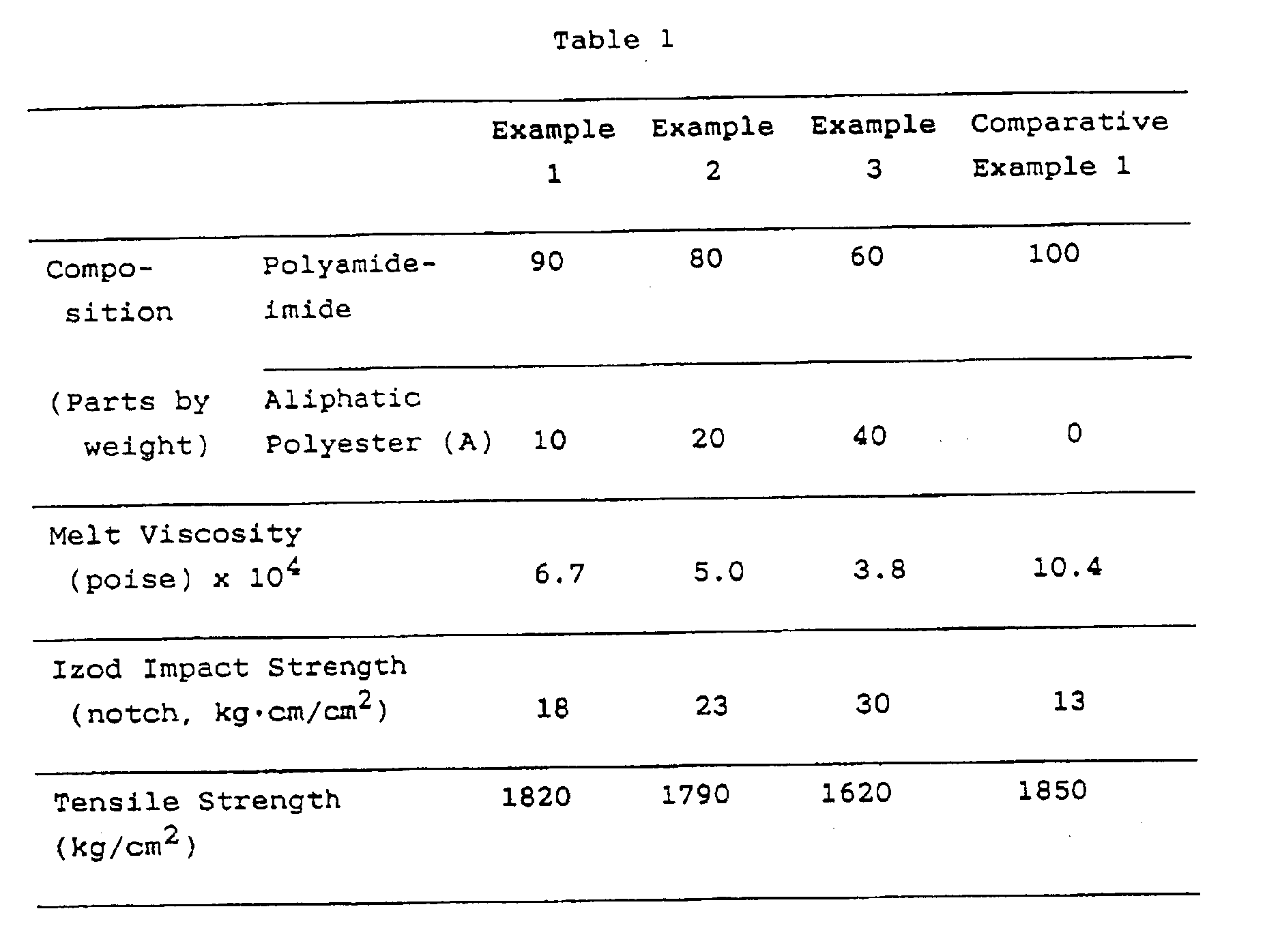


- Polyarylate (Unitika Ltd., U polymer® U-8000) and the aliphatic polyester (A) were dryblended in the weight ratio as shown in Table 6, and then melted and mixed with in a plastograph at 280°C for 5 minutes, resulting in a polyarylate resin composition. The melt viscosity of this resin composition was measured at 260°C. A sample of 3.2 mm thick for the Izod impact strength test and a No. 3 dumbbell of 2.0 mm thick were obtained by compression-molding of this resin composition at 290°C and the impact strength of the test sample and the tensile strength of the dumbbell thus obtained were measured, respectively. The results are shown in Table 6.
- Glass-fiber reinforced polyarylate (Unitika Ltd., U polymer® U-8000-30; 30% by weight glass fibers, with glass fibers 20 µm diameter and 0.2-1.0 mm long) and the aliphatic polyester (A) were dryblended in the weight ratio as shown in Table 7, and then melted and mixed with in a plastograph at 280°C for 5 minutes, resulting in a polyarylate resin composition. The melt viscosity of this resin composition was measured at 280°C. A sample of 3.2 mm thick for the Izod impact strength test and a No. 3 dumbbell of 2.0 mm thick were obtained by compression-molding of this resin composition at 300°C and the impact strength of the test sample and the strength of the dumbbell thus obtained were measured, respectively. The results are shown in Table 7.
- Glass-fiber reinforced polyamide (Asahi Kasei Co., REONA® 1300G; 33% by weight glass fibers, with glass fibers 20 µm diameter and 0.2-1.0 mm long) and the aliphatic polyester (A) was dryblended in the weight ratio as shown in Table 8, and then melted and mixed with in a plastograph at 260°C for 5 minutes, resulting in a reinforced polyamide resin composition. The melt viscosity of this resin composition was measured at 260°C. A sample 3.2 mm thick for the Izod impact strength test was obtained by compression-molding of this resin composition at 280°C and the impact strength of the test sample thus obtained was measured. The results are shown in Table 8.
- Glass-fiber reinforced polyphenylenesulfide (Phillips Petroleum International Inc., RYTON® R-4; 40% by weight glass fibers, with glass fibers 20 µm diameter and 0.2-1.0 mm long) and the aliphatic polyester (A) were dryblended in the weight ratio as shown in Table 9, and then melted and mixed with in a plastograph at 300°C for 5 minutes, resulting in a reinforced polyphenylenesulfide resin composition. The melt viscosity of this resin composition was measured at 300°C. A sample 3.2 mm thick for the Izod impact strength test was obtained by compression-molding of this resin composition at 310°C and the impact strength of the test sample thus obtained was measured. The results are shown in Table 9.
- Polybutylene terephthalate (Teijin Ltd., TEIJIN PBT®-C7000) and the aliphatic polyester (A) were dryblended in the weight ratio as shown in Table 10, and then melted and mixed with in a plastograph at 240°C for 5 minutes, resulting in a polybutylene terephthalate resin composition. The melt viscosity of this resin composition was measured at 230°C. A sample 3.2 mm thick for the Izod impact strength test was obtained by compression-molding of this resin composition at 260°C and the impact strength of the test sample thus obtained was measured. The results are shown in Table 10.
- Glass-fiber reinforced polybutylene terephthalate (Teijin Ltd., TEIJIN, PBT®-C7030; 30% by weight glass fibers, with glass fibers 20 µm diameter and 0.2-1.0 mm long) and the aliphatic polyester (A) were dryblended in the weight ratio as shown in Table 11, and then melted and mixed with in a plastograph at 250°C for 5 minutes, resulting in a reinforced polybutylene terephthalate resin composition. The melt viscosity of this resin composition was measured at 230°C. A sample 3.2 mm thick for the Izod impact strength test was obtained by compression-molding of this resin composition at 270°C and the impact strength of the test sample thus obtained was measured. The results are shown in Table 11.
- Glass-fiber reinforced polyethylene terephthalate (Teijin Ltd, FR-PET®C3030; 30% by weight glass fibers, with glass fibers 20 µm diameter and 0.2-1.0 mm long) and the aliphatic polyester (A) were dryblended in the weight ratio as shown in Table 12, and then melted and mixed with in a plastograph at 260°C for 5 minutes, resulting in a reinforced polyethylene terephthalate resin composition. The melt viscosity of this resin composition was measured at 260°C. A sample 3.2 mm thick for the Izod impact strength test was obtained by compression-molding of this resin composition at 270°C and the impact strength of the test sample thus obtained was measured. The results are shown in Table 12.


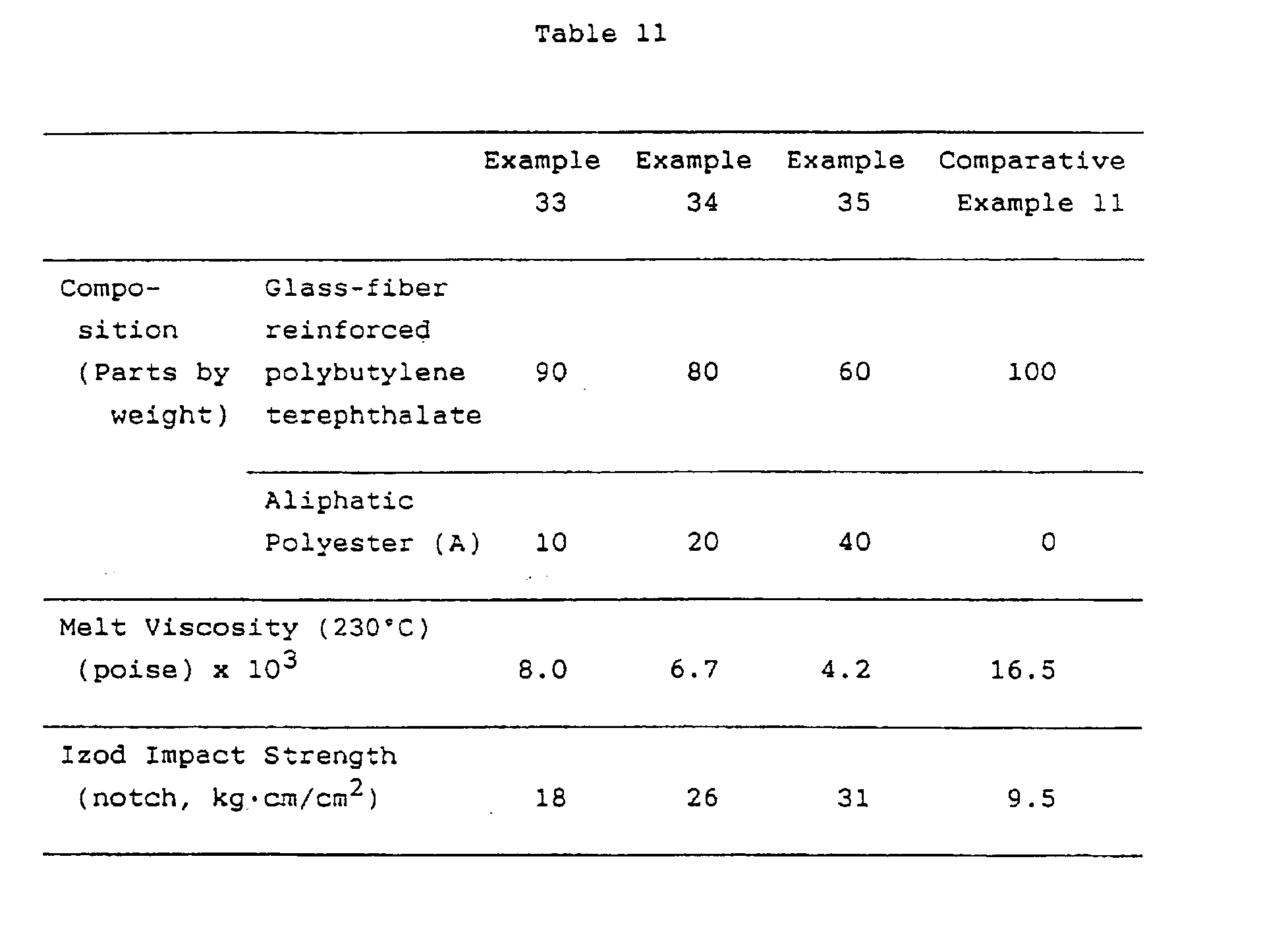

- Modified polyphenyleneoxide (GE Corp., NORYL®-PPO 534J; 60% by weight polyphenyleneoxide) and the aliphatic polyester (A) were dryblended in the weight ratio as shown in Table 13, and then melted and mixed with in a plastograph at 300°C for 5 minutes, resulting in a polyphenyleneoxide resin composition. The melt viscosity of the polyphenyleneoxide resin composition was measured at 300°C and the results are shown in Table 13. A sample 3.2 mm thick for the Izod impact strength test was obtained by compression-molding of the polyphenyleneoxide composition at 300°C and the impact strength of the test sample thus obtained was measured. The results are shown in Table 13.
- A polyphenyleneoxide resin composition was prepared in the same way as in Example 39, except that glass-fiber reinforced modified polyphenyleneoxide (GE Corp., NORYL®-GFN 3J; approximately 20-30% by weight polyphenyleneoxide and 30% by weight glass fibers, with glass fibers 20 µm diameter and 0.2-1.0 mm long) and the aliphatic polyester (A) were dryblended in the weight ratio as shown in Table 14. The melt viscosity and the Izod impact strength of the polyphenyleneoxide resin composition thus obtained were measured in the same way as in Example 39 and the results are shown in Table 14.


- Polycarbonate (Teijin Kasei Corp., PANLITE® L-1225L) and the aliphatic polyester (A) were dryblended in the weight ratio as shown in Table 15, and then melted and mixed with in a plastograph at 280°C for 5 minutes, resulting in a polycarbonate composition. The melt viscosity of the polycarbonate resin composition was measured at 270°C. The results are shown in Table 15. Samples 3.2 mm thick and 6.4 mm thick, respectively, for the Izod impact strength test was obtained by compression-molding of this resin composition at 280°C and the impact strengths of each test sample thus obtained were measured. The results are shown in Table 15.
- Glass-fiber reinforced polycarbonate (Teijin Kasei Corp., PANLITE® G-3130; 30% by weight glass fibers, with glass fibers 20 µm diameter and 0.2-1.0 mm long) and the aliphatic polyester (A) were dryblended in the weight ratio as shown in Table 16, and then melted and mixed with in a plastograph at 320°C for 5 minutes, resulting in a polycarbonate composition. The melt viscosity of the polycarbonate resin composition was measured at 260°C. The results are shown in Table 16. A sample 3.2 mm thick for the Izod impact strength test was obtained by compression-molding of this resin composition at 300°C and the impact strength of the test sample thus obtained was measured. The results are shown in Table 16.
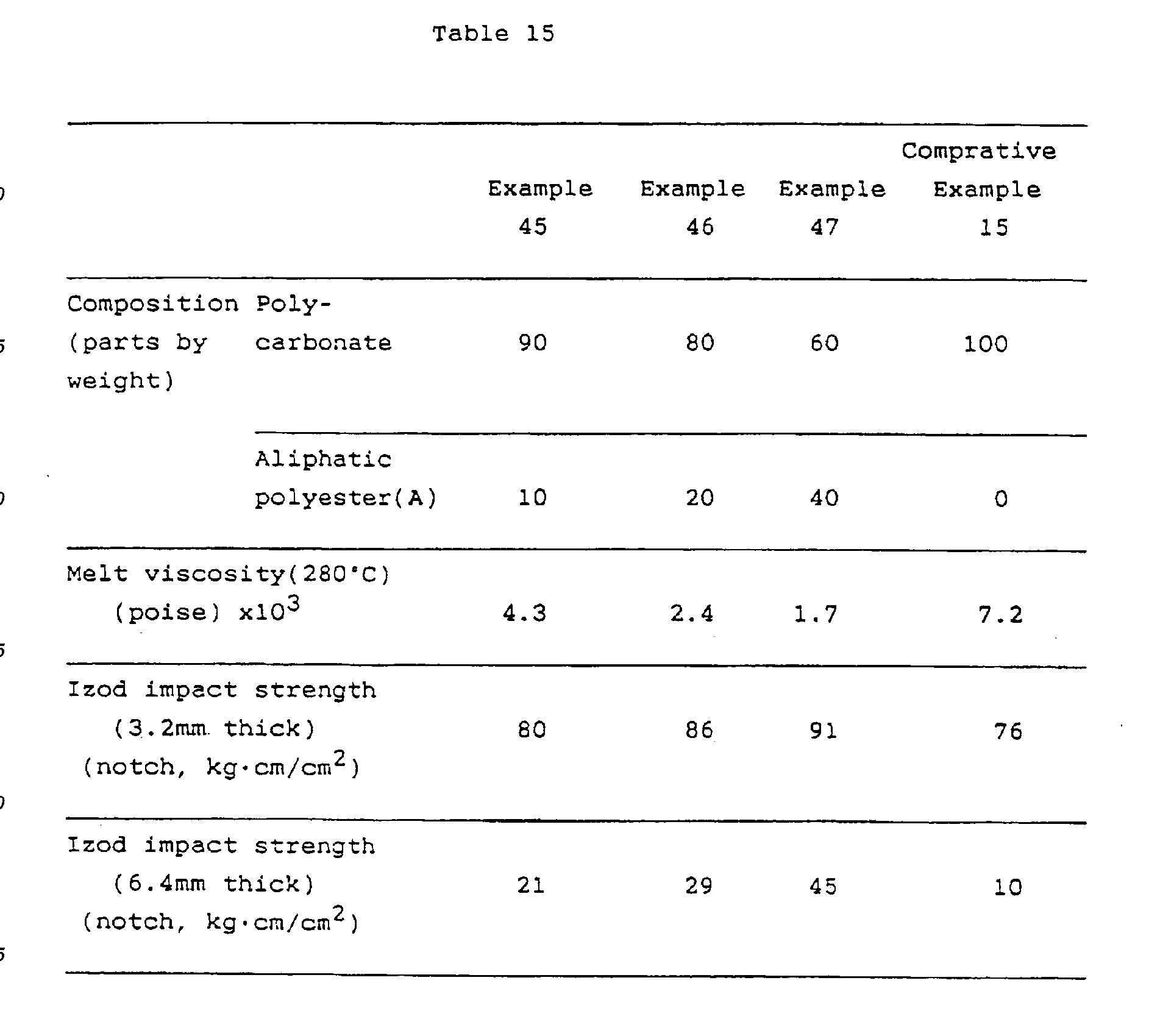

- Polyoxymethylene (Asahi Chemical Industry Co., Ltd., TENAC 5010) and the aliphatic polyester (A) were dryblended in the weight ratio as shown in Table 17, and then melted and mixed with in a plastograph at 210°C for 5 minutes, resulting in a polyoxymethylene composition. The melt viscosity of this resin composition was measured at 210°C. A sample 3.2 mm thick for the Izod impact strength test was obtained by compression-molding of this resin composition at 210°C and the impact strength of the test sample thus obtained was measured. The results are shown in Table 17.
- Glass-fiber reinforced polyoxymethylene (Asahi Chemical Industry Co., Ltd., TENAC GA520; 20% by weight glass fibers, with glass fibers 20 µm diameter and 0.2-1.0 mm long) and the aliphatic polyester (A) were dryblended in the weight ratio as shown in Table 18, and then melted and mixed with in a plastograph at 220°C for 5 minutes, resulting in a polyoxymethylene composition. The melt viscosity of this resin composition was measured at 220°C. A sample 3.2 mm thick for the Izod impact strength test was obtained by compression-molding of this resin composition at 220°C and the impact strength of the test sample thus obtained was measured. The results are shown in Table 18.


- Polyarylate (Unitika Ltd., U polymer® U-8000) and the aliphatic polyester (B) were dryblended in the weight ratio as shown in Table 19, and then melted and mixed with in a plastograph at 280°C for 10 minutes, resulting in a polyarylate resin composition. A sample of 3 mm thick was obtained by compression-molding of this resin composition at 290°C and the surface hardness and the Vicat softening temperature thereof were measured. The results are shown in Table 19.
- Liquid crystal polyester (Unitika Ltd., LODRUN® LC-3000) and the aliphatic polyester (B) were dryblended in the weight ratio as shown in Table 20, and then melted and mixed with in a plastograph at 260°C for 10 minutes, resulting in a liquid crystal polyester resin composition. A sample of 3 mm thick was obtained by compression-molding of this resin composition at 240°C and the surface hardness and the Vicat softening temperature thereof were measured. The results are shown in Table 20.
- Polycarbonate (Teijin Kasei Corp., PANLITE® L-1225L) and the aliphatic polyester (B) were dryblended in the weight ratio as shown in Table 21, and then melted and mixed with in a plastograph at 280°C for 10 minutes, resulting in a polycarbonate resin composition. A sample of 3 mm thick was obtained by compression-molding of this resin composition at 280°C and the surface hardness and the Vicat softening temperature thereof were measured. The results are shown in Table 21.
- Polyamide (Toyobo Co., Ltd., T-802) and the aliphatic polyester (B) were dryblended in the weight ratio as shown in Table 22, and then melted and mixed with in a plastograph at 250°C for 10 minutes, resulting in a polyamide resin composition. A sample of 3 mm thick was obtained by compression-molding of this resin composition at 250°C and the surface hardness and the Vicat softening temperature thereof were measured. The results are shown in Table 22.
- Polybutylene terephthalate (Teijin Ltd., TEIJIN PBT-C7000) and the aliphatic polyester (B) were dryblended in the weight ratio as shown in Table 23, and then melted and mixed with in a plastograph at 240°C for 10 minutes, resulting in a polybutylene terephthalate resin composition. A sample of 3 mm thick was obtained by compression-molding of this resin composition at 260°C and the surface hardness and the Vicat softening temperature thereof were measured. The results are shown in Table 23.
- Polyethylene terephthalate (Teijin Ltd., TEIJIN PET-TR8550) and the aliphatic polyester (B) were dryblended in the weight ratio as shown in Table 24, and then melted and mixed with in a plastograph at 260°C for 10 minutes, resulting in a polyethylene terephthalate resin composition. A sample of 3 mm thick was obtained by compression-molding of this resin composition at 270°C and the surface hardness and the Vicat softening temperature thereof were measured. The results are shown in Table 24.


- Modified polyphenyleneoxide (GE Corp., NORYL®-PPO 534J; approximately 60% by weight polyphenyleneoxide) and the aliphatic polyester (C) were dryblended in the weight ratio as shown in Table 25, and then melted and mixed with in a plastograph at 300°C for 5 minutes, resulting in a polyphenyleneoxide resin composition. The melt viscosity of the polyphenyleneoxide resin composition was measured at 300°C and the results are shown in Table 25. A sample 3.2 mm thick for the Izod impact strength test was obtained by compression-molding of the polyphenyleneoxide composition at 300°C and the impact strength of the test sample thus obtained was measured. The results are shown in Table 25.
- Polyoxymethylene (Asahi Chemical Industry, Co., Ltd., TENAC® 5010) and the aliphatic polyester (C) were dryblended in the weight ratio as shown in Table 26, and then melted and mixed with in a plastograph at 210°C for 5 minutes, resulting in a polyoxymethylene resin composition. The melt viscosity of the polyphenyleneoxide resin composition was measured at 210°C. A sample 3.2 mm thick for the Izod impact strength test was obtained by compression-molding of the polyphenyleneoxide composition at 210°C and the impact strength of the test sample thus obtained was measured. The results are shown in Table 26.


- Polyarylate (Unitika Ltd., U polymer® U-8000) and the aliphatic polyester (D) were dryblended in the weight ratio as shown in Table 27, and then melted and mixed with in a plastograph at 280°C for 5 minutes, resulting in a polyarylate resin composition. The melt viscosity of this resin composition was measured at 260°C. A sample of 3.2 mm thick for the Izod impact strength test and a No. 3 dumbbell of 2.0 mm thick were obtained by compression-molding of this resin composition at 290°C and the impact strength of the test sample and the tensile strength of the dumbbell thus obtained were measured, respectively. The results are shown in Table 27.
- Polycarbonate (Teijin Kasei Corp., PANLITE® L-1225L) and the aliphatic polyester (D) were dryblended in the weight ratio as shown in Table 28, and then melted and mixed with in a plastograph at 280°C for 5 minutes, resulting in a polycarbonate resin composition. The melt viscosity of the polycarbonate resin composition was measured at 270°C. The results are shown in Table 28. A sample 3.2 mm thick for the Izod impact strength test was obtained by compression-molding of this resin composition at 280°C and the impact strength of the test sample was measured. The results are shown in Table 28.


- Liquid crystal polyester (Unitika Ltd., LODRUN® LC-3000) and the aliphatic polyester (E) were dryblended in the weight ratio as shown in Table 29, and then melted and mixed with in a plastograph at 260°C for 10 minutes, resulting in a liquid crystal polyester resin composition. A sample of 3 mm thick was obtained by compression-molding of this resin composition at 240°C and the surface hardness and the Vicat softening temperature thereof were measured. The results are shown in Table 29.
- Polyethylene terephthalate (Teijin Ltd., TEIJIN PET-TR8550) and the aliphatic polyester (E) were dryblended in the weight ratio as shown in Table 30, and then melted and mixed with in a plastograph at 260°C for 10 minutes, resulting in a polyethylene terephthalate resin composition. A sample of 3 mm thick was obtained by compression-molding of this resin composition at 270°C and the surface hardness and the Vicat sofening temperature thereof were measured. The results are shown in Table 30.

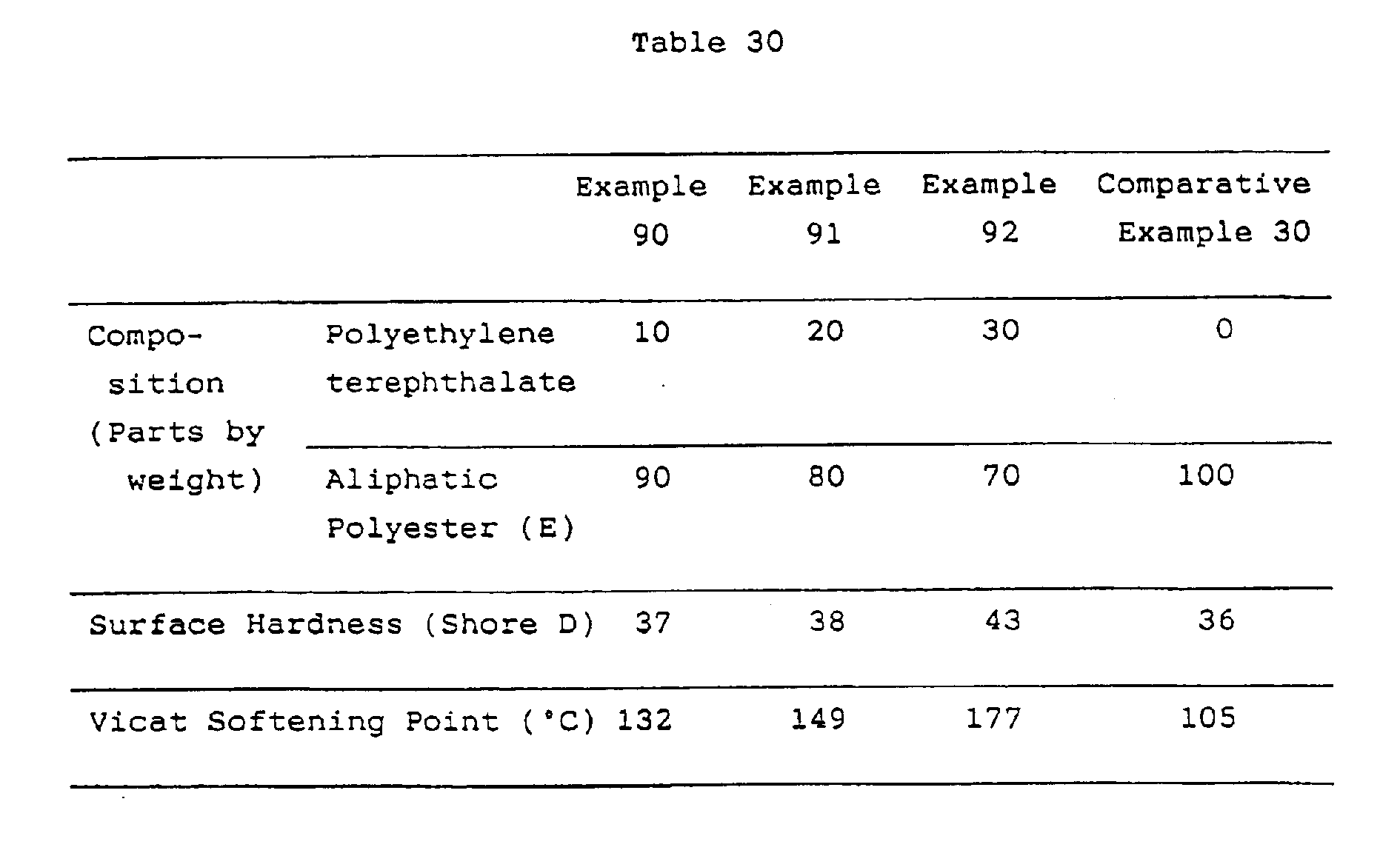
- Glass-fiber reinforced polyphenylenesulfide (Phillips Petroleum International Inc., RYTON® R-4; 40% by weight glass fibers, with glass fibers 20 µm diameter and 0.2-1.0 mm long) and the aliphatic polyester (F) were dryblended in the weight ratio as shown in Table 31, and then melted and mixed with in a plastograph at 300°C for 5 minutes, resulting in a reinforced polyphenylenesulfide resin composition. The melt viscosity of this resin composition was measured at 300°C. A sample 3.2 mm thick for the Izod impact strength test was obtained by compression-molding of this resin composition at 310°C and the impact strength of the test sample thus obtained was measured. The results are shown in Table 31.
- Glass-fiber reinforced polyethylene terephthalate (Teijin Ltd., TEIJIN FR-PET®-C3030; 30% by weight glass fibers, with glass fibers 20 µm diameter and 0.2-1.0 mm long) and the aliphatic polyester (F) were dryblended in the weight ratio as shown in Table 32, and then melted and mixed with in a plastograph at 260°C for 5 minutes, resulting in a reinforced polyethylene terephthalate resin composition. The melt viscosity of this resin composition was measured at 260°C. A sample 3.2 mm thick for the Izod impact strength test was obtained by compression-molding of this resin composition at 270°C and the impact strength of the test sample thus obtained was measured. The results are shown in Table 32.


Claims (11)
- An engineering plastic composition comprising an engineering plastic material and an aliphatic polyester,
wherein said aliphatic polyester is one formed by the copolymerisation of monomers comprising an aliphatic dicarboxylic acid of formula I; an aliphatic diol; and at least either a dihydroxy compound of formula II or a monohydroxy compound of formula III:
HOOC-(CH₂)n-COOH [I]
(wherein n is zero or an integer of up to 10)
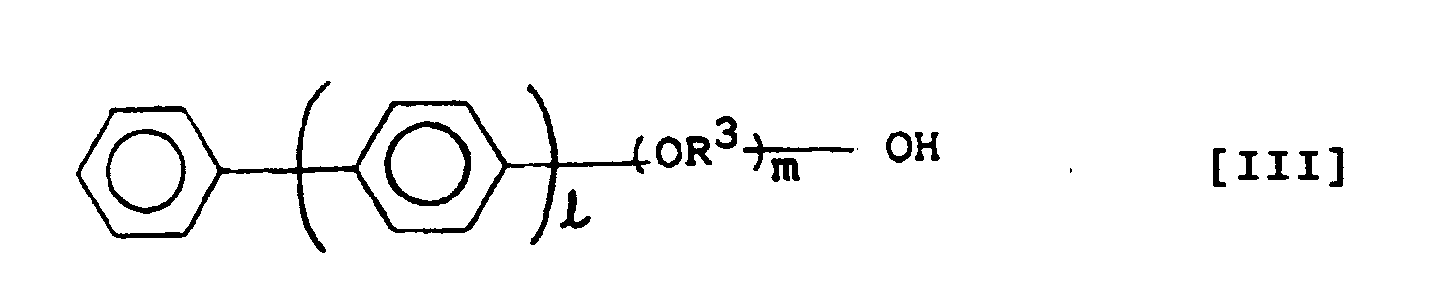
- An engineering plastic composition according to claim 1,
wherein said engineering plastic material is at least one selected from polyetherimide, polyarylketone, aromatic polysulfone resin, polyarylenesulfide, polyarylate, saturated polyester (liquid crystal polyester), polyamide-imide, polycarbonate, polyphenyleneoxide, polyamide, and polyoxymethylene. - An engineering plastic composition according to claim 1 or 2,
wherein said aliphatic polyester is formed by the copolymerisation of said aliphatic dicarboxylic acid, said aliphatic diol and said dihydroxy compound, and
said dihydroxy compound is present in an amount of from 0.1 to 30 mol% based on the total amount of monomers from which the said aliphatic polyester is formed. - An engineering plastic composition according to claim 1 or 2,
wherein said aliphatic polyester is formed by the copolymerisation of said aliphatic dicarboxylic acid, said aliphatic diol and said monohydroxy compound, and
wherein said monohydroxy compound is present in an amount of from 0.1 to 20 mol% based on the total amount of monomers from which said aliphatic polyester is formed. - An engineering plastic composition according to claim 1 or 2,
wherein said aliphatic polyester is formed by the copolymerisation of said aliphatic dicarboxylic acid, said aliphatic diol, said dihydroxy compound and said monohydroxy compound, and
wherein the total amount of said dihydroxy compound and said monohydroxy compound is from 0.1 to 30 mol% based on the total amount of monomers from which aliphatic polyester is formed. - An engineering plastic composition according to claim 1, 2, 3 or 5,
wherein said dihydroxy compound is at least one selected from 4,4''-dihydroxy-p-terphenyl, 4,4'''-dihydroxy-p-quarterphenyl, and 4,4'''-di(2-hydroxyethoxy)-p-quarterphenyl. - An engineering plastic composition according to any preceding claim, further comprising reinforcing fibres,
wherein said reinforcing fibres are present in an amount of from 1.0 to 400 parts by weight for each 100 parts by weight of said engineering plastic composition. - An engineering plastic composition according to claim 7,
wherein said reinforcing fibre is at least one selected from glass fibres, carbon fibres, boron fibres, silicon carbide fibres, graphite fibres, alumina fibres, amorphous-metal fibres, silicon-titanium-carbon inorganic fibres, and aramide fibres. - An engineering plastic composition according to any preceding claim, wherein said monomers further include at least one selected from polysilicone having two hydroxyl groups, lactone, aromatic hydroxycarboxylic acid, aromatic dicarboxylic acid, and aromatic diol other than said dihydroxy compound.
- An article obtained from an engineering plastic composition according to any preceding claim by a melt-moulding technique.
- An article according to claim 10, wherein said melt-moulding technique is one selected from compression moulding, extrusion moulding, injection moulding, and blow-moulding.
Applications Claiming Priority (8)
| Application Number | Priority Date | Filing Date | Title |
|---|---|---|---|
| JP249998/89 | 1989-09-26 | ||
| JP24999889 | 1989-09-26 | ||
| JP25282489 | 1989-09-28 | ||
| JP252824/89 | 1989-09-28 | ||
| JP263475/89 | 1989-10-09 | ||
| JP26347589 | 1989-10-09 | ||
| JP4686690 | 1990-02-26 | ||
| JP46866/90 | 1990-02-26 |
Publications (3)
| Publication Number | Publication Date |
|---|---|
| EP0420619A2 EP0420619A2 (en) | 1991-04-03 |
| EP0420619A3 EP0420619A3 (en) | 1991-10-02 |
| EP0420619B1 true EP0420619B1 (en) | 1993-09-29 |
Family
ID=27461955
Family Applications (1)
| Application Number | Title | Priority Date | Filing Date |
|---|---|---|---|
| EP19900310548 Expired - Lifetime EP0420619B1 (en) | 1989-09-26 | 1990-09-26 | Engineering plastic composition and articles made of the same |
Country Status (7)
| Country | Link |
|---|---|
| US (1) | US5236988A (en) |
| EP (1) | EP0420619B1 (en) |
| JP (1) | JPH0726034B2 (en) |
| KR (1) | KR910006422A (en) |
| AU (1) | AU631457B2 (en) |
| CA (1) | CA2026201A1 (en) |
| DE (1) | DE69003644T2 (en) |
Families Citing this family (29)
| Publication number | Priority date | Publication date | Assignee | Title |
|---|---|---|---|---|
| JP2975035B2 (en) * | 1990-01-18 | 1999-11-10 | 旭化成工業株式会社 | Polyoxymethylene resin composition |
| US5210155A (en) * | 1990-08-24 | 1993-05-11 | Exxon Chemical Patents Inc. | Phenol terminated diester compositions derived from dicarboxylic acids, polyester polymers or alkyd polymers, and curable compositions containing same |
| US5300812A (en) * | 1992-12-09 | 1994-04-05 | General Electric Company | Plasticized polyetherimide adhesive composition and usage |
| EP0637613B1 (en) * | 1993-02-17 | 2000-10-25 | Mitsubishi Gas Chemical Company, Inc. | Resin composition |
| JPH07281143A (en) * | 1994-01-10 | 1995-10-27 | Motoo Takayanagi | Liquid crystal polymer composition |
| US5585592A (en) * | 1994-05-31 | 1996-12-17 | Motorola, Inc. | Shock tolerant fuze |
| US5502121A (en) * | 1994-09-30 | 1996-03-26 | Eastman Chemical Company | Blends of polyarylates with aliphatic polyesters |
| DE4437792A1 (en) * | 1994-10-21 | 1996-04-25 | Inventa Ag | Molding compounds based on aliphatic polyesters |
| US6194524B1 (en) * | 1996-04-11 | 2001-02-27 | Sumitomo Chemical Company, Limited | Thermoplastic resin composition |
| US6015510A (en) * | 1996-08-29 | 2000-01-18 | E. I. Du Pont De Nemours And Company | Polymer flame retardant |
| US6191207B1 (en) * | 1997-06-19 | 2001-02-20 | Asahi Kasei Kogyo Kabushiki Kaisha | Polyamide resin composition and molded articles |
| GB2337756B (en) * | 1998-05-29 | 2002-08-28 | Nokia Mobile Phones Ltd | Composite injection mouldable material |
| AU4502399A (en) | 1998-05-29 | 1999-12-20 | Nokia Mobile Phones Limited | Composite injection mouldable material |
| US6150473A (en) * | 1998-12-14 | 2000-11-21 | General Electric Company | Polyetherimide resin/polyester resin blends having improved properties |
| US6558764B2 (en) * | 1999-03-05 | 2003-05-06 | General Electric Company | Single layered polypropylene containers and their use |
| US6753363B1 (en) * | 1999-07-16 | 2004-06-22 | Polyplastics Co., Ltd. | Polyacetal resin composition and process for production thereof |
| GB2408087A (en) * | 2003-11-13 | 2005-05-18 | Wavin Bv | Jetting resistant sewer pipes |
| US8399546B2 (en) * | 2004-08-05 | 2013-03-19 | Sabic Innovative Plastics Ip B.V. | Flame retardant thermoplastic compositions having EMI shielding |
| US20060100330A1 (en) * | 2004-11-10 | 2006-05-11 | Natarajan Kavilipalayam M | Composition for use in forming an article |
| US7375167B2 (en) * | 2005-05-09 | 2008-05-20 | Basf Se | Hydrolysis-resistance composition |
| US8552096B2 (en) * | 2009-07-31 | 2013-10-08 | Sabic Innovative Plastics Ip B.V. | Flame-retardant reinforced polycarbonate compositions |
| US11067889B2 (en) * | 2015-09-03 | 2021-07-20 | Mitsubishi Gas Chemical Company, Inc. | Compound, composition, and method for producing same, underlayer film forming material for lithography, composition for underlayer film formation for lithography, and purification method |
| KR20210059654A (en) | 2019-11-15 | 2021-05-25 | 다윈그룹(주) | Rice processed plastic composition and manufacturing method thereof |
| KR102207908B1 (en) | 2020-03-17 | 2021-01-26 | 다윈그룹(주) | Manufacturing method of rice plastic molding by 3D printing |
| KR102207871B1 (en) | 2020-03-17 | 2021-01-26 | 다윈그룹(주) | Rice plastic raw material manufacturing method and manufacturing apparatus thereof |
| KR102355548B1 (en) | 2020-12-29 | 2022-02-08 | 다윈그룹(주) | Biodegradable composite resin composition including rice flour and manufacturing method of biodegradable composite resin using the same |
| KR102607209B1 (en) | 2021-08-31 | 2023-11-29 | 다윈그룹(주) | Foamed plastic composition using rice powder |
| CN115746564B (en) * | 2022-12-07 | 2024-06-04 | 广东优巨先进新材料股份有限公司 | Polysulfone composite material and preparation method and application thereof |
| TWI909492B (en) * | 2023-06-15 | 2025-12-21 | 達輝光電股份有限公司 | Polyester with a diphenyl ether structure and its optical materials thereof |
Family Cites Families (29)
| Publication number | Priority date | Publication date | Assignee | Title |
|---|---|---|---|---|
| US926008A (en) * | 1908-01-09 | 1909-06-22 | John C Kenmonth | Adjustable downdraft oil-burner. |
| JPS50144750A (en) * | 1974-05-14 | 1975-11-20 | ||
| JPS50146648A (en) * | 1974-05-16 | 1975-11-25 | ||
| FR2356697A1 (en) * | 1976-06-30 | 1978-01-27 | Sumitomo Chemical Co | COMPOSITION OF POLYESTER RESIN CONTAINING A POLYCARBONATE AND AN AROMATIC POLYESTER |
| US4134874A (en) * | 1977-09-19 | 1979-01-16 | Phillips Petroleum Company | Processing aid for poly(arylene sulfide) resins |
| US4246381A (en) * | 1979-06-18 | 1981-01-20 | Union Carbide Corporation | Polyarylate blends with copolyesters |
| EP0030417B2 (en) * | 1979-11-30 | 1994-03-30 | Imperial Chemical Industries Plc | Compositions of melt-processable polymers having improved processibility, and method of processing |
| JPS56167752A (en) * | 1980-05-28 | 1981-12-23 | Sumitomo Chem Co Ltd | Polyether sulfone resin composition |
| JPS5749046A (en) * | 1980-09-05 | 1982-03-20 | Hitachi Ltd | Correcting device of carburetor for idling revolution |
| JPS57108153A (en) * | 1980-12-25 | 1982-07-06 | Sumitomo Chem Co Ltd | Resin composition |
| CA1191989A (en) * | 1981-03-30 | 1985-08-13 | Union Carbide Corporation | Alloys of a poly(arylene sulfide) and a poly(aryl ketone) |
| JPS5842648A (en) * | 1981-09-09 | 1983-03-12 | Asahi Chem Ind Co Ltd | Heat-resistant resin composition having good flow characteristics |
| CA1205236A (en) * | 1982-06-30 | 1986-05-27 | Bp Corporation North America Inc. | Plasticized thermoplastic polymer |
| JPS5920354A (en) * | 1982-07-26 | 1984-02-02 | Asahi Chem Ind Co Ltd | Heat-resistant, impact-resistant thermoplastic resin composition having good flow property in processing |
| US4581399A (en) * | 1982-09-30 | 1986-04-08 | Celanese Corporation | Method for the melt processing of thermotropic liquid crystal polymers |
| US4451607A (en) * | 1983-01-27 | 1984-05-29 | Phillips Petroleum Company | Poly(arylene sulfide) compositions |
| JPS59204652A (en) * | 1983-05-10 | 1984-11-20 | Mitsui Petrochem Ind Ltd | Polyacetal resin composition |
| US4481325A (en) * | 1983-12-29 | 1984-11-06 | General Electric Company | Polyalkylenelactone modified polyetherimides |
| US4587299A (en) * | 1983-12-29 | 1986-05-06 | General Electric Company | Polyetherimide blends |
| JPS6126567A (en) * | 1984-07-13 | 1986-02-05 | 四国化成工業株式会社 | Manufacture of sialon substance |
| JPS6144928A (en) * | 1984-08-09 | 1986-03-04 | Toray Ind Inc | Production of aromatic polyamide-imide |
| JPS6144897A (en) * | 1984-08-10 | 1986-03-04 | Terumo Corp | 5-fluorouracil derivative and medical drug containing same |
| JPH0699632B2 (en) * | 1984-09-06 | 1994-12-07 | アトランティック・リッチフィールド・カンパニー | Method for reducing melt viscosity of polyethersulfone resin |
| US4562231A (en) * | 1984-09-06 | 1985-12-31 | Atlantic Richfield Company | Polyether sulfone resin containing molding composition and method |
| JP2517568B2 (en) * | 1986-11-13 | 1996-07-24 | ポリプラスチックス株式会社 | Liquid crystalline copolyester with molecular chain ends blocked |
| US4778855A (en) * | 1986-12-23 | 1988-10-18 | General Electric Company | Thermoplastic molding compositions exhibiting improved melt flow properties |
| DE68922137T2 (en) * | 1988-05-26 | 1995-08-10 | Sanko Kaihatsu Kagaku Kenk | Polyester and molded article made from it. |
| EP0343606B1 (en) * | 1988-05-26 | 1995-01-18 | Sekisui Kagaku Kogyo Kabushiki Kaisha | An engineering plastic composition and an article made of the same |
| USD871877S1 (en) | 2018-04-24 | 2020-01-07 | Hole Dynamics, LLC | Hole saw arbor |
-
1990
- 1990-09-25 CA CA002026201A patent/CA2026201A1/en not_active Abandoned
- 1990-09-25 US US07/587,924 patent/US5236988A/en not_active Expired - Lifetime
- 1990-09-25 JP JP25635390A patent/JPH0726034B2/en not_active Expired - Fee Related
- 1990-09-26 KR KR1019900015255A patent/KR910006422A/en not_active Abandoned
- 1990-09-26 AU AU63194/90A patent/AU631457B2/en not_active Ceased
- 1990-09-26 EP EP19900310548 patent/EP0420619B1/en not_active Expired - Lifetime
- 1990-09-26 DE DE90310548T patent/DE69003644T2/en not_active Expired - Fee Related
Also Published As
| Publication number | Publication date |
|---|---|
| AU6319490A (en) | 1991-04-11 |
| JPH03277660A (en) | 1991-12-09 |
| AU631457B2 (en) | 1992-11-26 |
| DE69003644D1 (en) | 1993-11-04 |
| US5236988A (en) | 1993-08-17 |
| KR910006422A (en) | 1991-04-29 |
| EP0420619A3 (en) | 1991-10-02 |
| CA2026201A1 (en) | 1991-03-27 |
| EP0420619A2 (en) | 1991-04-03 |
| DE69003644T2 (en) | 1994-02-03 |
| JPH0726034B2 (en) | 1995-03-22 |
Similar Documents
| Publication | Publication Date | Title |
|---|---|---|
| US5236988A (en) | Engineering plastic composition and articles made of the same | |
| KR920009537B1 (en) | Injection Molding Composition | |
| JPS6279222A (en) | Polycarbonate-polyether block copolymer, polymer blend and intermediate | |
| EP0111810A2 (en) | High strength, reduced heat distortion temperature thermoplastic composition | |
| EP0344099B1 (en) | A polyester and an article made of the same | |
| EP0528462A1 (en) | Solvent-resistant polycarbonate-polyester blends with improved impact properties | |
| KR100230631B1 (en) | Thermoplastic resin composition superior in transparency and antistatic property | |
| US5011879A (en) | Engineering plastic composition and an article made of the same | |
| US5084527A (en) | Thermoplastic resin composition | |
| EP0470557A2 (en) | Resin composition | |
| US5235024A (en) | Polyester and an article made of the same | |
| US5191036A (en) | Thermoplastic resin composition | |
| USH766H (en) | Polyarylate compositions | |
| US4898918A (en) | Thermoplastic resin composition | |
| JPH021738A (en) | Molding resin | |
| JP2617282B2 (en) | Thermoplastic elastomer composition | |
| US4603170A (en) | Moulding compositions comprising an aromatic polycarbonate and a sulfone group containing polyester | |
| JPH02311543A (en) | Engineering plastic composition and molding produced therefrom | |
| JPH0288667A (en) | Liquid crystal polyester resin composition | |
| JPH02222447A (en) | thermoplastic resin composition | |
| JPH0539410A (en) | Resin composition | |
| JP2969725B2 (en) | Resin speaker diaphragm | |
| JP3048457B2 (en) | Resin composition containing liquid crystal polyester | |
| JPS6053531A (en) | Modified polyetherester block copolymer | |
| JPH05156135A (en) | High-impact polyester composition |
Legal Events
| Date | Code | Title | Description |
|---|---|---|---|
| PUAI | Public reference made under article 153(3) epc to a published international application that has entered the european phase |
Free format text: ORIGINAL CODE: 0009012 |
|
| AK | Designated contracting states |
Kind code of ref document: A2 Designated state(s): DE FR GB IT NL SE |
|
| PUAL | Search report despatched |
Free format text: ORIGINAL CODE: 0009013 |
|
| AK | Designated contracting states |
Kind code of ref document: A3 Designated state(s): DE FR GB IT NL SE |
|
| 17P | Request for examination filed |
Effective date: 19920323 |
|
| 17Q | First examination report despatched |
Effective date: 19920703 |
|
| GRAA | (expected) grant |
Free format text: ORIGINAL CODE: 0009210 |
|
| AK | Designated contracting states |
Kind code of ref document: B1 Designated state(s): DE FR GB IT NL SE |
|
| REF | Corresponds to: |
Ref document number: 69003644 Country of ref document: DE Date of ref document: 19931104 |
|
| ET | Fr: translation filed | ||
| ITF | It: translation for a ep patent filed | ||
| RIN2 | Information on inventor provided after grant (corrected) |
Free format text: DOYAMA, KAZUO * YAMAGUCHI, MAKOTO * OHSUGA, MAKOTO * YAMAGATA, KAZUO * NIKI, AKIHIRO * SAITO, TORANOSUKE * TSUNOMACHI, HIROKI * KISHIMOTO, DAISHIRO |
|
| K2C1 | Correction of patent specification (title page) published |
Effective date: 19930929 |
|
| PLBE | No opposition filed within time limit |
Free format text: ORIGINAL CODE: 0009261 |
|
| STAA | Information on the status of an ep patent application or granted ep patent |
Free format text: STATUS: NO OPPOSITION FILED WITHIN TIME LIMIT |
|
| 26N | No opposition filed | ||
| EAL | Se: european patent in force in sweden |
Ref document number: 90310548.4 |
|
| REG | Reference to a national code |
Ref country code: GB Ref legal event code: IF02 |
|
| PGFP | Annual fee paid to national office [announced via postgrant information from national office to epo] |
Ref country code: NL Payment date: 20040905 Year of fee payment: 15 |
|
| PGFP | Annual fee paid to national office [announced via postgrant information from national office to epo] |
Ref country code: SE Payment date: 20040906 Year of fee payment: 15 |
|
| PGFP | Annual fee paid to national office [announced via postgrant information from national office to epo] |
Ref country code: FR Payment date: 20050823 Year of fee payment: 16 |
|
| PGFP | Annual fee paid to national office [announced via postgrant information from national office to epo] |
Ref country code: GB Payment date: 20050921 Year of fee payment: 16 |
|
| PGFP | Annual fee paid to national office [announced via postgrant information from national office to epo] |
Ref country code: DE Payment date: 20050922 Year of fee payment: 16 |
|
| PG25 | Lapsed in a contracting state [announced via postgrant information from national office to epo] |
Ref country code: IT Free format text: LAPSE BECAUSE OF NON-PAYMENT OF DUE FEES;WARNING: LAPSES OF ITALIAN PATENTS WITH EFFECTIVE DATE BEFORE 2007 MAY HAVE OCCURRED AT ANY TIME BEFORE 2007. THE CORRECT EFFECTIVE DATE MAY BE DIFFERENT FROM THE ONE RECORDED. Effective date: 20050926 |
|
| PG25 | Lapsed in a contracting state [announced via postgrant information from national office to epo] |
Ref country code: SE Free format text: LAPSE BECAUSE OF NON-PAYMENT OF DUE FEES Effective date: 20050927 |
|
| PG25 | Lapsed in a contracting state [announced via postgrant information from national office to epo] |
Ref country code: NL Free format text: LAPSE BECAUSE OF NON-PAYMENT OF DUE FEES Effective date: 20060401 |
|
| EUG | Se: european patent has lapsed | ||
| NLV4 | Nl: lapsed or anulled due to non-payment of the annual fee |
Effective date: 20060401 |
|
| PG25 | Lapsed in a contracting state [announced via postgrant information from national office to epo] |
Ref country code: DE Free format text: LAPSE BECAUSE OF NON-PAYMENT OF DUE FEES Effective date: 20070403 |
|
| GBPC | Gb: european patent ceased through non-payment of renewal fee |
Effective date: 20060926 |
|
| REG | Reference to a national code |
Ref country code: FR Ref legal event code: ST Effective date: 20070531 |
|
| PG25 | Lapsed in a contracting state [announced via postgrant information from national office to epo] |
Ref country code: GB Free format text: LAPSE BECAUSE OF NON-PAYMENT OF DUE FEES Effective date: 20060926 |
|
| PG25 | Lapsed in a contracting state [announced via postgrant information from national office to epo] |
Ref country code: FR Free format text: LAPSE BECAUSE OF NON-PAYMENT OF DUE FEES Effective date: 20061002 |