EP0420356B1 - Control of isomer distribution in a chlorination process - Google Patents
Control of isomer distribution in a chlorination process Download PDFInfo
- Publication number
- EP0420356B1 EP0420356B1 EP90202562A EP90202562A EP0420356B1 EP 0420356 B1 EP0420356 B1 EP 0420356B1 EP 90202562 A EP90202562 A EP 90202562A EP 90202562 A EP90202562 A EP 90202562A EP 0420356 B1 EP0420356 B1 EP 0420356B1
- Authority
- EP
- European Patent Office
- Prior art keywords
- trichloromethyl
- pyridine
- dichloro
- hydrogen chloride
- chlorination
- Prior art date
- Legal status (The legal status is an assumption and is not a legal conclusion. Google has not performed a legal analysis and makes no representation as to the accuracy of the status listed.)
- Expired - Lifetime
Links
- 238000005660 chlorination reaction Methods 0.000 title claims abstract description 32
- 238000000034 method Methods 0.000 title claims description 22
- 238000009826 distribution Methods 0.000 title description 3
- VEXZGXHMUGYJMC-UHFFFAOYSA-N Hydrochloric acid Chemical compound Cl VEXZGXHMUGYJMC-UHFFFAOYSA-N 0.000 claims abstract description 56
- IXCSERBJSXMMFS-UHFFFAOYSA-N hydrogen chloride Substances Cl.Cl IXCSERBJSXMMFS-UHFFFAOYSA-N 0.000 claims abstract description 56
- 229910000041 hydrogen chloride Inorganic materials 0.000 claims abstract description 56
- ZHNXVFQAGRDLBV-UHFFFAOYSA-N 2,3-dichloro-6-(trichloromethyl)pyridine Chemical compound ClC1=CC=C(C(Cl)(Cl)Cl)N=C1Cl ZHNXVFQAGRDLBV-UHFFFAOYSA-N 0.000 claims abstract description 28
- 239000000203 mixture Substances 0.000 claims abstract description 25
- MWFCRQNUHFSUNY-UHFFFAOYSA-N 3,6-dichloro-2-(trichloromethyl)pyridine Chemical compound ClC1=CC=C(Cl)C(C(Cl)(Cl)Cl)=N1 MWFCRQNUHFSUNY-UHFFFAOYSA-N 0.000 claims abstract description 24
- DCUJJWWUNKIJPH-UHFFFAOYSA-N nitrapyrin Chemical compound ClC1=CC=CC(C(Cl)(Cl)Cl)=N1 DCUJJWWUNKIJPH-UHFFFAOYSA-N 0.000 claims abstract description 19
- 239000000460 chlorine Substances 0.000 claims abstract description 16
- 229910052801 chlorine Inorganic materials 0.000 claims abstract description 16
- 239000007791 liquid phase Substances 0.000 claims abstract description 14
- 239000003054 catalyst Substances 0.000 claims abstract description 10
- 229910001507 metal halide Inorganic materials 0.000 claims abstract description 6
- 150000005309 metal halides Chemical class 0.000 claims abstract description 6
- 230000001105 regulatory effect Effects 0.000 claims abstract description 5
- 239000011261 inert gas Substances 0.000 claims abstract 3
- ZAMOUSCENKQFHK-UHFFFAOYSA-N Chlorine atom Chemical compound [Cl] ZAMOUSCENKQFHK-UHFFFAOYSA-N 0.000 claims abstract 2
- IJGRMHOSHXDMSA-UHFFFAOYSA-N Atomic nitrogen Chemical compound N#N IJGRMHOSHXDMSA-UHFFFAOYSA-N 0.000 claims description 10
- 239000012808 vapor phase Substances 0.000 claims description 6
- 230000001276 controlling effect Effects 0.000 claims description 5
- 229910052757 nitrogen Inorganic materials 0.000 claims description 5
- 229910021578 Iron(III) chloride Inorganic materials 0.000 abstract description 4
- RBTARNINKXHZNM-UHFFFAOYSA-K iron trichloride Chemical compound Cl[Fe](Cl)Cl RBTARNINKXHZNM-UHFFFAOYSA-K 0.000 abstract description 4
- 239000007789 gas Substances 0.000 description 19
- KZBUYRJDOAKODT-UHFFFAOYSA-N Chlorine Chemical compound ClCl KZBUYRJDOAKODT-UHFFFAOYSA-N 0.000 description 18
- 239000000047 product Substances 0.000 description 11
- 238000006243 chemical reaction Methods 0.000 description 7
- 239000007788 liquid Substances 0.000 description 7
- XEEYBQQBJWHFJM-UHFFFAOYSA-N Iron Chemical compound [Fe] XEEYBQQBJWHFJM-UHFFFAOYSA-N 0.000 description 6
- 239000006227 byproduct Substances 0.000 description 5
- 239000003085 diluting agent Substances 0.000 description 5
- 239000002841 Lewis acid Substances 0.000 description 4
- 229910052751 metal Inorganic materials 0.000 description 4
- 239000002184 metal Substances 0.000 description 4
- 229910000792 Monel Inorganic materials 0.000 description 3
- HEMHJVSKTPXQMS-UHFFFAOYSA-M Sodium hydroxide Chemical compound [OH-].[Na+] HEMHJVSKTPXQMS-UHFFFAOYSA-M 0.000 description 3
- 230000015572 biosynthetic process Effects 0.000 description 3
- 150000001875 compounds Chemical class 0.000 description 3
- 210000003317 double-positive, alpha-beta immature T lymphocyte Anatomy 0.000 description 3
- 238000010438 heat treatment Methods 0.000 description 3
- 229910052742 iron Inorganic materials 0.000 description 3
- 150000007517 lewis acids Chemical class 0.000 description 3
- 150000003839 salts Chemical class 0.000 description 3
- BSKHPKMHTQYZBB-UHFFFAOYSA-N 2-methylpyridine Chemical class CC1=CC=CC=N1 BSKHPKMHTQYZBB-UHFFFAOYSA-N 0.000 description 2
- CRQVZDUGJCBXJH-UHFFFAOYSA-N 3,4-dichloro-2-(trichloromethyl)pyridine Chemical compound ClC1=CC=NC(C(Cl)(Cl)Cl)=C1Cl CRQVZDUGJCBXJH-UHFFFAOYSA-N 0.000 description 2
- YSEYOMUPVMGJPP-UHFFFAOYSA-N 3-chloro-2-methylpyridine Chemical class CC1=NC=CC=C1Cl YSEYOMUPVMGJPP-UHFFFAOYSA-N 0.000 description 2
- XKRFYHLGVUSROY-UHFFFAOYSA-N Argon Chemical compound [Ar] XKRFYHLGVUSROY-UHFFFAOYSA-N 0.000 description 2
- -1 Lewis acid salts Chemical class 0.000 description 2
- 241000282346 Meles meles Species 0.000 description 2
- HCHKCACWOHOZIP-UHFFFAOYSA-N Zinc Chemical compound [Zn] HCHKCACWOHOZIP-UHFFFAOYSA-N 0.000 description 2
- 229910052782 aluminium Inorganic materials 0.000 description 2
- XAGFODPZIPBFFR-UHFFFAOYSA-N aluminium Chemical compound [Al] XAGFODPZIPBFFR-UHFFFAOYSA-N 0.000 description 2
- 210000004027 cell Anatomy 0.000 description 2
- 150000005753 chloropyridines Chemical class 0.000 description 2
- 238000011437 continuous method Methods 0.000 description 2
- 238000004508 fractional distillation Methods 0.000 description 2
- 229910000856 hastalloy Inorganic materials 0.000 description 2
- 239000002243 precursor Substances 0.000 description 2
- 150000003222 pyridines Chemical class 0.000 description 2
- VZGDMQKNWNREIO-UHFFFAOYSA-N tetrachloromethane Chemical compound ClC(Cl)(Cl)Cl VZGDMQKNWNREIO-UHFFFAOYSA-N 0.000 description 2
- 229910052725 zinc Inorganic materials 0.000 description 2
- 239000011701 zinc Substances 0.000 description 2
- DNDPLEAVNVOOQZ-UHFFFAOYSA-N 2,3,4,5,6-pentachloropyridine Chemical compound ClC1=NC(Cl)=C(Cl)C(Cl)=C1Cl DNDPLEAVNVOOQZ-UHFFFAOYSA-N 0.000 description 1
- YMBFWRZKTZICHS-UHFFFAOYSA-N 2,3,4,5-tetrachloro-6-(trichloromethyl)pyridine Chemical compound ClC1=NC(C(Cl)(Cl)Cl)=C(Cl)C(Cl)=C1Cl YMBFWRZKTZICHS-UHFFFAOYSA-N 0.000 description 1
- FATBKZJZAHWCSL-UHFFFAOYSA-N 2,3,5,6-tetrachloropyridine Chemical compound ClC1=CC(Cl)=C(Cl)N=C1Cl FATBKZJZAHWCSL-UHFFFAOYSA-N 0.000 description 1
- PXHVJJICTQNCMI-UHFFFAOYSA-N Nickel Chemical compound [Ni] PXHVJJICTQNCMI-UHFFFAOYSA-N 0.000 description 1
- 229920000784 Nomex Polymers 0.000 description 1
- KJTLSVCANCCWHF-UHFFFAOYSA-N Ruthenium Chemical compound [Ru] KJTLSVCANCCWHF-UHFFFAOYSA-N 0.000 description 1
- 239000003905 agrochemical Substances 0.000 description 1
- PNEYBMLMFCGWSK-UHFFFAOYSA-N aluminium oxide Inorganic materials [O-2].[O-2].[O-2].[Al+3].[Al+3] PNEYBMLMFCGWSK-UHFFFAOYSA-N 0.000 description 1
- 238000004458 analytical method Methods 0.000 description 1
- 229910052786 argon Inorganic materials 0.000 description 1
- 150000001805 chlorine compounds Chemical class 0.000 description 1
- HUBANNPOLNYSAD-UHFFFAOYSA-N clopyralid Chemical compound OC(=O)C1=NC(Cl)=CC=C1Cl HUBANNPOLNYSAD-UHFFFAOYSA-N 0.000 description 1
- 238000010924 continuous production Methods 0.000 description 1
- 238000007796 conventional method Methods 0.000 description 1
- 230000007423 decrease Effects 0.000 description 1
- 230000002950 deficient Effects 0.000 description 1
- 238000004821 distillation Methods 0.000 description 1
- 239000003814 drug Substances 0.000 description 1
- 238000004817 gas chromatography Methods 0.000 description 1
- 150000004820 halides Chemical class 0.000 description 1
- 239000001307 helium Substances 0.000 description 1
- 229910052734 helium Inorganic materials 0.000 description 1
- SWQJXJOGLNCZEY-UHFFFAOYSA-N helium atom Chemical compound [He] SWQJXJOGLNCZEY-UHFFFAOYSA-N 0.000 description 1
- 230000002363 herbicidal effect Effects 0.000 description 1
- 239000004009 herbicide Substances 0.000 description 1
- 239000012535 impurity Substances 0.000 description 1
- 238000011065 in-situ storage Methods 0.000 description 1
- 239000003701 inert diluent Substances 0.000 description 1
- UQSXHKLRYXJYBZ-UHFFFAOYSA-N iron oxide Inorganic materials [Fe]=O UQSXHKLRYXJYBZ-UHFFFAOYSA-N 0.000 description 1
- 238000004519 manufacturing process Methods 0.000 description 1
- 229910044991 metal oxide Inorganic materials 0.000 description 1
- 150000004706 metal oxides Chemical class 0.000 description 1
- 150000002739 metals Chemical class 0.000 description 1
- 229910052754 neon Inorganic materials 0.000 description 1
- GKAOGPIIYCISHV-UHFFFAOYSA-N neon atom Chemical compound [Ne] GKAOGPIIYCISHV-UHFFFAOYSA-N 0.000 description 1
- 239000004763 nomex Substances 0.000 description 1
- 238000011017 operating method Methods 0.000 description 1
- NDLPOXTZKUMGOV-UHFFFAOYSA-N oxo(oxoferriooxy)iron hydrate Chemical compound O.O=[Fe]O[Fe]=O NDLPOXTZKUMGOV-UHFFFAOYSA-N 0.000 description 1
- 238000002360 preparation method Methods 0.000 description 1
- 229910052707 ruthenium Inorganic materials 0.000 description 1
- 238000005070 sampling Methods 0.000 description 1
- 238000005201 scrubbing Methods 0.000 description 1
- 239000007858 starting material Substances 0.000 description 1
- 239000000126 substance Substances 0.000 description 1
- 229910052715 tantalum Inorganic materials 0.000 description 1
- GUVRBAGPIYLISA-UHFFFAOYSA-N tantalum atom Chemical compound [Ta] GUVRBAGPIYLISA-UHFFFAOYSA-N 0.000 description 1
- WFKWXMTUELFFGS-UHFFFAOYSA-N tungsten Chemical compound [W] WFKWXMTUELFFGS-UHFFFAOYSA-N 0.000 description 1
- 229910052721 tungsten Inorganic materials 0.000 description 1
- 239000010937 tungsten Substances 0.000 description 1
- XLYOFNOQVPJJNP-UHFFFAOYSA-N water Substances O XLYOFNOQVPJJNP-UHFFFAOYSA-N 0.000 description 1
Classifications
-
- C—CHEMISTRY; METALLURGY
- C07—ORGANIC CHEMISTRY
- C07D—HETEROCYCLIC COMPOUNDS
- C07D213/00—Heterocyclic compounds containing six-membered rings, not condensed with other rings, with one nitrogen atom as the only ring hetero atom and three or more double bonds between ring members or between ring members and non-ring members
- C07D213/02—Heterocyclic compounds containing six-membered rings, not condensed with other rings, with one nitrogen atom as the only ring hetero atom and three or more double bonds between ring members or between ring members and non-ring members having three double bonds between ring members or between ring members and non-ring members
- C07D213/04—Heterocyclic compounds containing six-membered rings, not condensed with other rings, with one nitrogen atom as the only ring hetero atom and three or more double bonds between ring members or between ring members and non-ring members having three double bonds between ring members or between ring members and non-ring members having no bond between the ring nitrogen atom and a non-ring member or having only hydrogen or carbon atoms directly attached to the ring nitrogen atom
- C07D213/60—Heterocyclic compounds containing six-membered rings, not condensed with other rings, with one nitrogen atom as the only ring hetero atom and three or more double bonds between ring members or between ring members and non-ring members having three double bonds between ring members or between ring members and non-ring members having no bond between the ring nitrogen atom and a non-ring member or having only hydrogen or carbon atoms directly attached to the ring nitrogen atom with hetero atoms or with carbon atoms having three bonds to hetero atoms with at the most one bond to halogen, e.g. ester or nitrile radicals, directly attached to ring carbon atoms
- C07D213/61—Halogen atoms or nitro radicals
Definitions
- the present invention relates to a process for controlling the isomer distribution of the chlorination products obtained in the liquid phase chlorination of 2-chloro-6-(trichloromethyl)pyridine by regulating the concentration of hydrogen chloride in the system.
- dichloro-6-(trichloromethyl)pyridine isomers are much more valuable as individual entities than as mixtures and because typically only one of the isomers is desired at any one time, methods of controlling the isomer distribution obtained in the chlorination are highly desirable.
- 3,6-Dichloro-2-(trichloromethyl)pyridine is useful as an intermediate in the production of 3,6-dichloropicolinic acid, a commercial herbicide, and other valuable compounds.
- 5,6-Dichloro-2-(trichloromethyl)pyridine is similarly useful as a chemical intermediate for agricultural chemicals and pharmaceuticals.
- the process of the invention includes an improved process for chlorinating 2-chloro-6-(trichloromethyl)pyridine in the liquid phase at elevated temperatures and in the presence of a metal halide catalyst to obtain a chlorination mixture containing 5,6-dichloro-2-(trichloromethyl)pyridine and 3,6-dichloro-2-(trichloromethyl)pyridine isomers, wherein the improvement is characterized by controlling the ratio of said isomers by regulating the amount of hydrogen chloride present in the system, adding hydrogen chloride to obtain a mixture enriched in 5,6-dichloro-2-(trichloromethyl)pyridine or removing hydrogen chloride to obtain a mixture enriched in 3,6-dichloro-2-(trichloromethyl)pyridine.
- 2-chloro-6-(trichloromethyl)pyridine and chlorine are combined in the liquid phase under conditions conducive to monochlorination in a medium in which the concentration of hydrogen chloride is controlled by the addition or by removal of hydrogen chloride.
- the chlorination is carried out in the presence of added hydrogen chloride so that the concentration of hydrogen chloride in the medium is greater than that which would have been present as a result of its formation as a by-product in the reaction.
- hydrogen chloride is removed from the system so that the concentration of hydrogen chloride in the medium is less than that which would have been present as a result of its formation as a by-product in the reaction.
- Conditions conducive to the liquid phase chlorination of 2-chloro-6-(trichloromethyl)pyridine are essentially those described in U. S. Patent 4,256,894.
- the 2-chloro-6-(trichloromethyl)pyridine is generally heated in a pressure reactor with an effective catalyst and an amount of chlorine gas in excess of the theoretical amount in a manner such that good contact between the liquid and the chlorine gas is achieved.
- the mixture is generally agitated. Temperatures of 160°C to 220°C are satisfactory and temperatures of 170°C to 210°C are generally preferred.
- the pressure is maintained at just above atmospheric to 1600 kiloPascals by allowing gases to escape through a vent as required. Pressures of 130 to 700 kiloPascals are preferred.
- Lewis acid metal salts and precursors to Lewis acid metal salts are generally effective catalysts for the reaction.
- Typical Lewis acid salts that are effective include the halides of ruthenium, tantalum, tungsten, aluminum, zinc, and iron. Chlorides are preferred. Ferric chloride is especially preferred.
- Typical precursors to Lewis acid metal salts include the metals, themselves, such as iron, aluminum, and zinc, and the corresponding metal oxides, such as alumina, and ferric oxide.
- the catalysts are employed in an effective amount. Generally, 0.5 to 20 mole percent based on the starting 2-chloro-6-(trichloromethyl)pyridine is a satisfactory amount. One to five mole percent is preferred and 1 to 3 percent is more preferred.
- the 2-chloro-6-(trichloromethyl)pyridine employed as a starting material is a well known compound having the common name nitrapyrin. It can be employed in the present invention in either essentially pure form or in the form of a mixture with other chlorinated alpha-picoline compounds or with suitable diluents.
- the chlorination process can be carried out in a variety of ways including batchwise and continuous methods as is known in the art. Suitable continuous methods include those wherein multiple chlorination vessels connected in series are employed. It is often preferred to use a continuous process.
- the products of the invention can be recovered from the chlorination mixture obtained in the present process by conventional methods, such as by distillation.
- a mixture enriched in a combination of the two products is first recovered by fractional distillation and then that mixture is separated into its individual components by further fractional distillation.
- Hydrogen chloride can be removed from the chlorination medium in a variety of ways. Usually, it is removed as a gas though a vent in the pressure reactor. Removal as a gas can be facilitated by the adding other gases to the system and controlling the pressure by simultaneously removing gases by means of the vent.
- the added gas can be excess chlorine or an inert diluent. Suitable diluent gases include nitrogen. argon, neon, helium, and carbon tetrachloride (a gas at the chlorination temperature). Generally, the more diluent gas or excess chlorine added, the more hydrogen chloride is removed.
- the average mole ratio of chlorine to hydrogen chloride during the process will typically be greater than 5 in the liquid phase and greater than 1.3 in the vapor phase (vent gas).
- the mole percent of hydrogen chloride in the liquid phase is preferably less than the mole percent of metal halide catalyst for this embodiment of the invention.
- Hydrogen chloride can be added to the chlorination medium in a variety of ways. Usually, it sis added as a gas either through a separate orifice or as a mixture with the chlorine added. It can also be "added” by adding a readily chlorinated compound to the medium and generating it in situ . An enhanced amount of 5,6-dichloro-2-(trichloromethyl)pyridine as compared with 3,6-dichloro-2-(trichloromethyl)pyridine is obtained whenever any hydrogen chloride is added to the medium. As a rule, the amount increases as the amount of hydrogen chloride added increases. It is, therefore, generally preferred to add as much of the hydrogen chloride as is practical in view of the cost of doing so.
- the costs include the cost of hydrogen chloride and its recycle as well as the cost of heating it.
- the addition of too large amounts further makes it difficult to maintain a sufficiently large chlorine concentration in the reactor to achieve a reasonable rate of chlorination.
- Application of the present invention allows one to prepare 5,6-dichloro-2-(trichloromethyl)pyridine as the major dichloro-2-(trichloromethyl)pyridine along with co-product, 3,6-dichloro-2-(trichloromethyl)pyridine in a ratio of up to 10:1 5,6-dichloro-2-(trichloromethyl)pyridine to 3,6-dichloro-2-(trichloromethyl)pyridine. Conditions leading to a ratio of at least 4.5:1 are preferred.
- the method further allows one to prepare 3,6-dichloro-2-(trichloromethyl)pyridine as a leading dichloro-2-(trichloromethyl)pyridine along with co-product, 5,6-dichloro-2-(trichloromethyl)pyridine in a ratio of up to 1:1.9 3,6-dichloro-2-(trichloromethyl)pyridine to 5,6-dichloro-2-(trichloromethyl)pyridine.
- Conditions leading to a ratio of at least 1:2.2 are preferred.
- a 1-liter Monel Parr pressure reactor (Model 4521) was employed which was fitted with a Monel gas inlet tube having a differential pressure transducer cell (DP cell) and a Badger Meter research control valve with P-7 Hastalloy trim which was attached separately to a chlorine reservoir and a nitrogen cylinder, a Monel gas inlet tube having a DP cell and a Badger Meter Research Control valve with P-7 Hastalloy trim which was attached separately to a hydrogen chloride cylinder and a nitrogen cylinder, a 0.64 centimeter (cm) diameter Monel double-block sampling tube with ball valves, a thermowell with thermocouple, a 7000 kiloPascal (kPa) rupture disc, an air motor-powered magnetic drive stirrer with pitched-blade turbines attached to the reactor head, and a vent tube with a Research Control air-to-close valve leading to an aqueous scrubbing column with a recirculation system containing 10 percent sodium hydroxide.
- DP cell differential
- An insulated Hoke 4HDM1000 1-liter high pressure sample cylinder was installed as a trap between each inlet and outlet tube and the reactor.
- the DP cells which were used to keep the flows of chlorine and hydrogen chloride constant by means of a constant pressure drop across a 122 cm x 1.6 millimeter (mm) outside diameter nickel tubing capillary, were Validyne DP-15-30 cells equipped with 8.6 kPa rated diaphragms. Additional traps, filters, valves, and pressure release discs were installed as appropriate to protect the system from particulates and back-ups and for safety.
- the reactor was heated by means of a 1500-Watt Parr heater and, where necessary, the lines were heated with a heating tape or steam tracing and insulated with Nomex brand insulating wrap.
- the temperature, pressure, and gas inlet flows were controlled by computer.
- a 2-liter Monel Parr reactor having a copper-coil water jacket connected to a constant temperature bath was used as a chlorine reservoir.
- the chlorine reservoir and hydrogen chloride cylinder were placed on electronic Mettler balances so that their weights could be monitored.
- the reactor and the lines were heated to at least about 50°C and the stirrer was activated. Chlorine and, where desired, hydrogen chloride or nitrogen were then fed to the reactor, the reactor was heated to the desired temperature for the run, and then the automatic pressure control valve and flow control valves were set at the desired values for the run. When the temperature and pressure had stabilized to the desired values, an initial (0 time) liquid sample was withdrawn for analysis. Thereafter samples were taken about every 6 hours and were analyzed by standardized gas chromatography using a Hewlett Packard 5890A chromatograph with a thermal conductivity detector for chlorinated picolines and pyridines. The system was standardized to convert peak size to weight percent. The concentration of hydrogen chloride in the vapor phase and the liquid phase were calculated using the feed rates and the extent of reaction to determine total the total amount and the vapor-liquid equilibrium constant to determine the split between liquid and vapor phases.
Landscapes
- Chemical & Material Sciences (AREA)
- Organic Chemistry (AREA)
- Pyridine Compounds (AREA)
- Organic Low-Molecular-Weight Compounds And Preparation Thereof (AREA)
- Low-Molecular Organic Synthesis Reactions Using Catalysts (AREA)
- Inorganic Compounds Of Heavy Metals (AREA)
Abstract
Description
- The present invention relates to a process for controlling the isomer distribution of the chlorination products obtained in the liquid phase chlorination of 2-chloro-6-(trichloromethyl)pyridine by regulating the concentration of hydrogen chloride in the system.
- The chlorination of 2-chloro-6-(trichloromethyl)pyridine in the liquid phase at elevated temperatures is disclosed in U. S. Patent No. 4,256,894 to produce 3,6-dichloro-2-(trichloromethyl)pyridine and 5,6-dichloro-2-(trichloromethyl)pyridine as well as higher chlorination products, such as 2,3,4,5-tetrachloro-6-(trichloromethyl)pyridine, 2,3,5,6-tetrachloropyridine, and pentachloropyridine. Hydrogen chloride is a by-product. Catalysts, such as metal halides, especially ferric chloride, are often employed. Application of this process to the preparation of either 3,6-dichloro-2-(trichloromethyl)pyridine or 5,6-dichloro-2-(trichloromethyl)pyridine specifically is deficient in that both of these two monochlorination products are always formed and there is no way reported to alter their ratio in favor of the isomer specifically desired.
- Since the dichloro-6-(trichloromethyl)pyridine isomers are much more valuable as individual entities than as mixtures and because typically only one of the isomers is desired at any one time, methods of controlling the isomer distribution obtained in the chlorination are highly desirable. 3,6-Dichloro-2-(trichloromethyl)pyridine is useful as an intermediate in the production of 3,6-dichloropicolinic acid, a commercial herbicide, and other valuable compounds. 5,6-Dichloro-2-(trichloromethyl)pyridine is similarly useful as a chemical intermediate for agricultural chemicals and pharmaceuticals.
- It has now been found that the ratio of 5,6-dichloro-2-(trichloromethyl)pyridine to 3,6-dichloro-2-(trichloromethyl)pyridine obtained on chlorination of 2-chloro-6-(trichloromethyl)pyridine in the liquid phase can be controlled by regulating the amount of hydrogen chloride present in the system.
- The process of the invention includes an improved process for chlorinating 2-chloro-6-(trichloromethyl)pyridine in the liquid phase at elevated temperatures and in the presence of a metal halide catalyst to obtain a chlorination mixture containing 5,6-dichloro-2-(trichloromethyl)pyridine and 3,6-dichloro-2-(trichloromethyl)pyridine isomers, wherein the improvement is characterized by controlling the ratio of said isomers by regulating the amount of hydrogen chloride present in the system, adding hydrogen chloride to obtain a mixture enriched in 5,6-dichloro-2-(trichloromethyl)pyridine or removing hydrogen chloride to obtain a mixture enriched in 3,6-dichloro-2-(trichloromethyl)pyridine.
- It is usually preferred to remove hydrogen chloride from the chlorination medium and obtain a mixture of dichloro-6-(trichloromethyl)pyridines enriched in 3,6-dichloro-2-(trichloromethyl)pyridine.
- In carrying out the present invention 2-chloro-6-(trichloromethyl)pyridine and chlorine are combined in the liquid phase under conditions conducive to monochlorination in a medium in which the concentration of hydrogen chloride is controlled by the addition or by removal of hydrogen chloride. A mixture containing as a primary product a combination of 3,6-dichloro-2-(trichloromethyl)pyridine (which could alternatively be named 2,5-dichloro-6-(trichloromethyl)pyridine) and 5,6-dichloro-2-(trichloromethyl)pyridine (which could alternatively be named 2,3-dichloro-6-(trichloromethyl)pyridine), usually along with varying amounts of other polychloro-6-(trichloromethyl)pyridines, polychloropyridines, and unreacted 2-chloro-6-(trichloromethyl)pyridine, is obtained. Hydrogen chloride is a by-product. When the desired monochlorination product is 5,6-dichloro-2-(trichloromethyl)pyridine, the chlorination is carried out in the presence of added hydrogen chloride so that the concentration of hydrogen chloride in the medium is greater than that which would have been present as a result of its formation as a by-product in the reaction. When 3,6-dichloro-2-(trichloromethyl)pyridine is the desired product, hydrogen chloride is removed from the system so that the concentration of hydrogen chloride in the medium is less than that which would have been present as a result of its formation as a by-product in the reaction.
- Conditions conducive to the liquid phase chlorination of 2-chloro-6-(trichloromethyl)pyridine are essentially those described in U. S. Patent 4,256,894. The 2-chloro-6-(trichloromethyl)pyridine is generally heated in a pressure reactor with an effective catalyst and an amount of chlorine gas in excess of the theoretical amount in a manner such that good contact between the liquid and the chlorine gas is achieved. The mixture is generally agitated. Temperatures of 160°C to 220°C are satisfactory and temperatures of 170°C to 210°C are generally preferred. The pressure is maintained at just above atmospheric to 1600 kiloPascals by allowing gases to escape through a vent as required. Pressures of 130 to 700 kiloPascals are preferred. he reaction is allowed to continue under these conditions until a significant amount of a mixture of dichloro-6-(trichloromethyl)pyridines is present, usually until over half of the chloropicolines and chloropyridines in the mixture are dichloro-6-(trichloromethyl)pyridines. The amount of dichloro-6-(trichloromethyl)pyridines in the mixture goes though a maximum and then decreases, due to the formation of higher chlorinated products, as the chlorination is continued.
- Lewis acid metal salts and precursors to Lewis acid metal salts are generally effective catalysts for the reaction. Typical Lewis acid salts that are effective include the halides of ruthenium, tantalum, tungsten, aluminum, zinc, and iron. Chlorides are preferred. Ferric chloride is especially preferred. Typical precursors to Lewis acid metal salts include the metals, themselves, such as iron, aluminum, and zinc, and the corresponding metal oxides, such as alumina, and ferric oxide. The catalysts are employed in an effective amount. Generally, 0.5 to 20 mole percent based on the starting 2-chloro-6-(trichloromethyl)pyridine is a satisfactory amount. One to five mole percent is preferred and 1 to 3 percent is more preferred.
- The 2-chloro-6-(trichloromethyl)pyridine employed as a starting material is a well known compound having the common name nitrapyrin. It can be employed in the present invention in either essentially pure form or in the form of a mixture with other chlorinated alpha-picoline compounds or with suitable diluents.
- The chlorination process can be carried out in a variety of ways including batchwise and continuous methods as is known in the art. Suitable continuous methods include those wherein multiple chlorination vessels connected in series are employed. It is often preferred to use a continuous process.
- The products of the invention, 3,6-dichloro-2-(trichloromethyl)pyridine or 5,6-dichloro-2-(trichloromethyl)pyridine, can be recovered from the chlorination mixture obtained in the present process by conventional methods, such as by distillation. Typically, a mixture enriched in a combination of the two products is first recovered by fractional distillation and then that mixture is separated into its individual components by further fractional distillation.
- Hydrogen chloride can be removed from the chlorination medium in a variety of ways. Usually, it is removed as a gas though a vent in the pressure reactor. Removal as a gas can be facilitated by the adding other gases to the system and controlling the pressure by simultaneously removing gases by means of the vent. The added gas can be excess chlorine or an inert diluent. Suitable diluent gases include nitrogen. argon, neon, helium, and carbon tetrachloride (a gas at the chlorination temperature). Generally, the more diluent gas or excess chlorine added, the more hydrogen chloride is removed. An enhanced amount of 3,6-dichloro-2-(trichloromethyl)pyridine as compared with 5,6-dichloro-2-(trichloromethyl)pyridine is obtained whenever any of the hydrogen chloride formed in the reaction is removed. As a rule, the amount increases as the amount of hydrogen chloride removed increases. It is, therefore, preferred to remove as much of the hydrogen chloride by-product as is practical in view of the cost of doing so. The costs include the cost of the diluent and its disposal or recycle and the cost of heating the diluent. Generally, it is preferred to remove sufficient hydrogen chloride so that its concentration in the chlorination liquid is less than 0.2 weight percent. It is more preferred to remove sufficient hydrogen chloride so that its concentration in the chlorination liquid is less than 0.1 weight percent and most preferred to remove sufficient hydrogen chloride so that its concentration in the chlorination liquid is less than 0.05 weight percent. This is accomplished when the concentration of hydrogen chloride in the vapor space above the chlorination liquid (same as the vent gas) is less than 25 weight percent, 20 weight percent, and 10 weight percent, respectively. The average mole ratio of chlorine to hydrogen chloride during the process will typically be greater than 5 in the liquid phase and greater than 1.3 in the vapor phase (vent gas). The mole percent of hydrogen chloride in the liquid phase is preferably less than the mole percent of metal halide catalyst for this embodiment of the invention.
- Hydrogen chloride can be added to the chlorination medium in a variety of ways. Usually, it sis added as a gas either through a separate orifice or as a mixture with the chlorine added. It can also be "added" by adding a readily chlorinated compound to the medium and generating it in situ. An enhanced amount of 5,6-dichloro-2-(trichloromethyl)pyridine as compared with 3,6-dichloro-2-(trichloromethyl)pyridine is obtained whenever any hydrogen chloride is added to the medium. As a rule, the amount increases as the amount of hydrogen chloride added increases. It is, therefore, generally preferred to add as much of the hydrogen chloride as is practical in view of the cost of doing so. The costs include the cost of hydrogen chloride and its recycle as well as the cost of heating it. The addition of too large amounts further makes it difficult to maintain a sufficiently large chlorine concentration in the reactor to achieve a reasonable rate of chlorination. It is further preferred to add the hydrogen chloride to the reactor in a continuous manner, replacing at least a portion of any removed from the system in the vent gas. Generally, a total of at least 0.25 mole of hydrogen chloride per mole of the 2-chloro-6-(trichloromethyl)pyridine present is added. It is preferred to add a total of at least 1 mole of hydrogen chloride per mole of 2-chloro-6-(trichloro-methyl) pyridine present and more preferred to add a total of at least 2 moles of hydrogen chloride per mole of 2-chloro-6-(trichloromethyl)pyridine present. It is further preferred to add at least one-third as much hydrogen chloride as chlorine in the process. The average mole ratio of chlorine to hydrogen chloride during the process will typically be less than 5 in the liquid phase and less than 1.3 in the vapor phase (vent gas). The mole percent of hydrogen chloride in the liquid phase is usually greater than the mole percent of metal halide catalyst for this embodiment of the invention.
- Application of the present invention allows one to prepare 5,6-dichloro-2-(trichloromethyl)pyridine as the major dichloro-2-(trichloromethyl)pyridine along with co-product, 3,6-dichloro-2-(trichloromethyl)pyridine in a ratio of up to 10:1 5,6-dichloro-2-(trichloromethyl)pyridine to 3,6-dichloro-2-(trichloromethyl)pyridine. Conditions leading to a ratio of at least 4.5:1 are preferred. The method further allows one to prepare 3,6-dichloro-2-(trichloromethyl)pyridine as a leading dichloro-2-(trichloromethyl)pyridine along with co-product, 5,6-dichloro-2-(trichloromethyl)pyridine in a ratio of up to 1:1.9 3,6-dichloro-2-(trichloromethyl)pyridine to 5,6-dichloro-2-(trichloromethyl)pyridine. Conditions leading to a ratio of at least 1:2.2 are preferred.
- The following example is presented to illustrate the invention. It should not be construed as limiting.
- Apparatus: A 1-liter Monel Parr pressure reactor (Model 4521) was employed which was fitted with a Monel gas inlet tube having a differential pressure transducer cell (DP cell) and a Badger Meter research control valve with P-7 Hastalloy trim which was attached separately to a chlorine reservoir and a nitrogen cylinder, a Monel gas inlet tube having a DP cell and a Badger Meter Research Control valve with P-7 Hastalloy trim which was attached separately to a hydrogen chloride cylinder and a nitrogen cylinder, a 0.64 centimeter (cm) diameter Monel double-block sampling tube with ball valves, a thermowell with thermocouple, a 7000 kiloPascal (kPa) rupture disc, an air motor-powered magnetic drive stirrer with pitched-blade turbines attached to the reactor head, and a vent tube with a Research Control air-to-close valve leading to an aqueous scrubbing column with a recirculation system containing 10 percent sodium hydroxide. An insulated Hoke 4HDM1000 1-liter high pressure sample cylinder was installed as a trap between each inlet and outlet tube and the reactor. The DP cells, which were used to keep the flows of chlorine and hydrogen chloride constant by means of a constant pressure drop across a 122 cm x 1.6 millimeter (mm) outside diameter nickel tubing capillary, were Validyne DP-15-30 cells equipped with 8.6 kPa rated diaphragms. Additional traps, filters, valves, and pressure release discs were installed as appropriate to protect the system from particulates and back-ups and for safety. The reactor was heated by means of a 1500-Watt Parr heater and, where necessary, the lines were heated with a heating tape or steam tracing and insulated with Nomex brand insulating wrap. The temperature, pressure, and gas inlet flows were controlled by computer. A 2-liter Monel Parr reactor having a copper-coil water jacket connected to a constant temperature bath was used as a chlorine reservoir. The chlorine reservoir and hydrogen chloride cylinder were placed on electronic Mettler balances so that their weights could be monitored.
- Operating Procedure: Approximately 1100 grams (g) of about 90 percent purity 2-chloro-6-(trichloromethyl)pyridine (containing 4,6-trichloro-2-(trichloromethyl)pyridine as the major impurity along with small amounts of other chloropicolines and chloropyridines) was weighed and placed in the reactor. To this was added 1.0 weight percent (based on iron) of ferric chloride catalyst (approximately 33 g) and the reactor was closed. The chlorine reservoir was cooled to about 5°C, filled with up to 1800 g of liquid chlorine, and then heated to a temperature which would produce a pressure in the reservoir at least 275 kPa greater than that to be employed in the reactor (28°C when the reactor pressure was about 275 kPa). The reactor and the lines were heated to at least about 50°C and the stirrer was activated. Chlorine and, where desired, hydrogen chloride or nitrogen were then fed to the reactor, the reactor was heated to the desired temperature for the run, and then the automatic pressure control valve and flow control valves were set at the desired values for the run. When the temperature and pressure had stabilized to the desired values, an initial (0 time) liquid sample was withdrawn for analysis. Thereafter samples were taken about every 6 hours and were analyzed by standardized gas chromatography using a Hewlett Packard 5890A chromatograph with a thermal conductivity detector for chlorinated picolines and pyridines. The system was standardized to convert peak size to weight percent. The concentration of hydrogen chloride in the vapor phase and the liquid phase were calculated using the feed rates and the extent of reaction to determine total the total amount and the vapor-liquid equilibrium constant to determine the split between liquid and vapor phases.
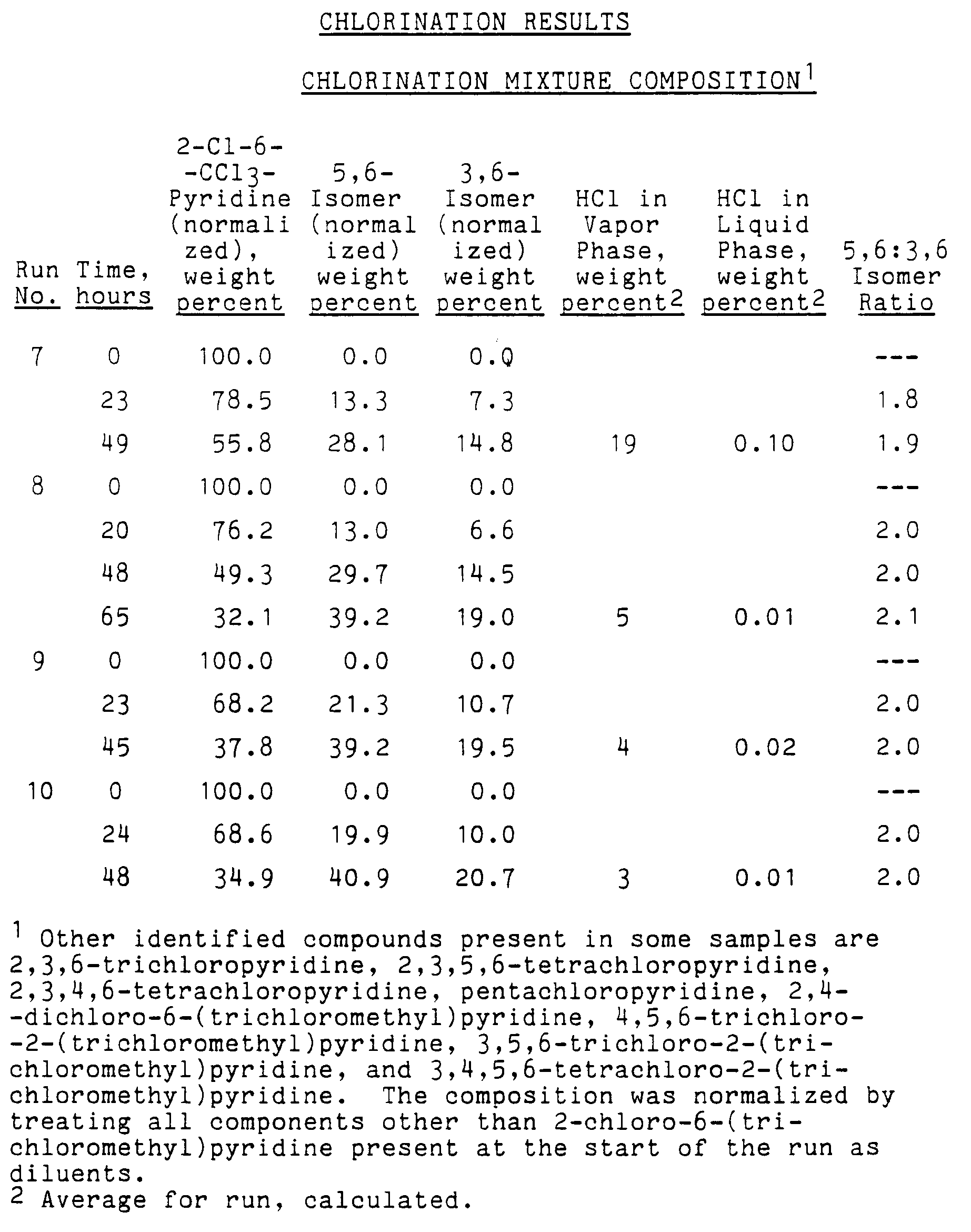
- Results: The results of several runs are given in the following tables.
-
Run No. Temp., °C Press., kPa Total Gas Feed, g-moles/hour Feed Gas Composition (Percent) Cl₂ HCl N₂ 1 200 1480 0.40±0.02 100 0 0 2 200 1480 0.36±0.07 55 45 0 3 175 380 0.22±0.02 100 0 0 4 175 380 0.36±0.06 19 81 0 5 175 380 0.37±0.02 51 49 0 6 175 380 0.42±0.09 76 24 0 7 175 380 0.37±0.04 52 0 48 8 175 380 0.28±0.07 62 0 38 9 175 380 0.44±0.09 100 0 0 10 175 380 0.44±0.14 79 0 21 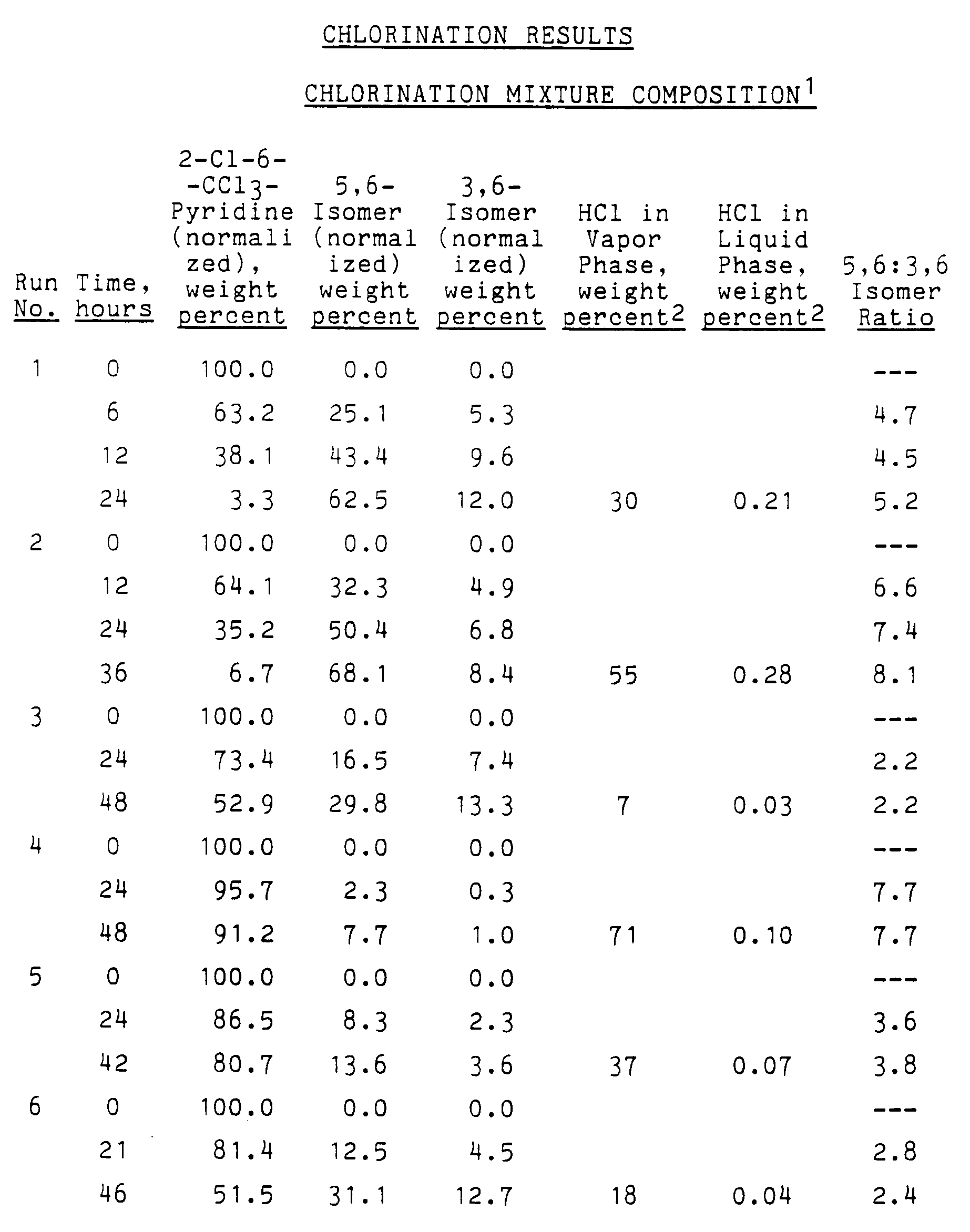
Claims (10)
- Process for chlorinating 2-chloro-6-(trichloromethyl)pyridine in the liquid phase at elevated temperatures and in the presence of a metal halide catalyst to obtain a chlorination mixture containing 5,6-dichloro-2-(trichloromethyl)pyridine and 3,6-dichloro-2-(trichloromethyl)pyridine isomers, wherein the improvement is characterized by controlling the ratio of said isomers by regulating the amount of hydrogen chloride present in the chlorination system, adding hydrogen chloride to obtain a mixture enriched in 5,6-dichloro-2-(trichloromethyl)pyridine or removing hydrogen chloride to obtain a mixture enriched in 3,6-dichloro-2-(trichloromethyl)pyridine.
- A process according to Claim 1 wherein hydrogen chloride is removed to obtain a mixture enriched in 3,6-dichloro-2-(trichloromethyl)pyridine.
- A process according to Claim 2 wherein the hydrogen chloride is removed by passing excess chlorine or an inert gas through the chlorination system.
- A process according to Claim 3 wherein the inert gas is nitrogen.
- A process according to any one of Claims 1 to 4 wherein the concentration of hydrogen chloride in the vapor phase of the chlorination system is maintained at less than 20 weight percent.
- A process according to Claim 5 wherein the concentration of hydrogen chloride in the vapor phase of the chlorination system is maintained at less than 10 weight percent.
- A process according to any one of Claims 1 to 6 wherein the chlorination mixture obtained contains a ratio of 5,6-dichloro-2-(trichloromethyl)pyridine to 3,6-dichloro-2-(trichloromethyl)pyridine of less than about 2.2.
- A process according to Claim 1 wherein hydrogen chloride is added to obtain a mixture enriched in 5,6-dichloro-2-(trichloromethyl)pyridine.
- A process according to either one of Claims 1 or 8 wherein at least 0.25 mole of hydrogen chloride per mole of 2-chloro-6-(trichloromethyl)pyridine present is added.
- A process according to any one of Claims 1, 8, or 9 wherein the chlorination mixture obtained contains a ratio of 5,6-dichloro-2-(trichloromethyl)pyridine to 3,6-dichloro-2-(trichloromethyl)pyridine of greater than about 4.5.
Applications Claiming Priority (2)
| Application Number | Priority Date | Filing Date | Title |
|---|---|---|---|
| US07/413,926 US4939263A (en) | 1989-09-28 | 1989-09-28 | Control of isomer distribution in a chlorination process |
| US413926 | 1989-09-28 |
Publications (3)
| Publication Number | Publication Date |
|---|---|
| EP0420356A2 EP0420356A2 (en) | 1991-04-03 |
| EP0420356A3 EP0420356A3 (en) | 1991-10-09 |
| EP0420356B1 true EP0420356B1 (en) | 1995-03-01 |
Family
ID=23639230
Family Applications (1)
| Application Number | Title | Priority Date | Filing Date |
|---|---|---|---|
| EP90202562A Expired - Lifetime EP0420356B1 (en) | 1989-09-28 | 1990-09-27 | Control of isomer distribution in a chlorination process |
Country Status (10)
| Country | Link |
|---|---|
| US (1) | US4939263A (en) |
| EP (1) | EP0420356B1 (en) |
| JP (1) | JP2856527B2 (en) |
| AT (1) | ATE119153T1 (en) |
| AU (1) | AU626463B2 (en) |
| CA (1) | CA2026360C (en) |
| DE (1) | DE69017337T2 (en) |
| DK (1) | DK0420356T3 (en) |
| ES (1) | ES2068994T3 (en) |
| IL (1) | IL95808A (en) |
Families Citing this family (2)
| Publication number | Priority date | Publication date | Assignee | Title |
|---|---|---|---|---|
| US4939263A (en) * | 1989-09-28 | 1990-07-03 | The Dow Chemical Company | Control of isomer distribution in a chlorination process |
| WO2004078726A1 (en) * | 2003-03-04 | 2004-09-16 | Dow Agrosciences Llc | Preparation of 3,6-dichloro-2-trichloromethylpyridine by vapor phase chlorination of 6-chloro-2-trichlormethylpyridine |
Family Cites Families (15)
| Publication number | Priority date | Publication date | Assignee | Title |
|---|---|---|---|---|
| FR1347180A (en) * | 1961-11-15 | 1963-12-27 | Dow Chemical Co | Process for the production of chlorinated derivatives of alpha-picoline and novel 2- (trichloromethyl) pyridines |
| US3418323A (en) * | 1961-11-15 | 1968-12-24 | Dow Chemical Co | 2-chloro-6-(trichloromethyl)pyridine compounds |
| US3732230A (en) * | 1970-12-07 | 1973-05-08 | Dow Chemical Co | Liquid phase polychlorination of pyridine hydrochlorides |
| US4256894A (en) * | 1978-04-24 | 1981-03-17 | The Dow Chemical Company | Preparation of chlorinated pyridines |
| JPS54140526A (en) | 1978-04-24 | 1979-10-31 | Toyoda Chuo Kenkyusho Kk | Electrostrictive vibrator drive circuit |
| CA1089468A (en) * | 1978-04-24 | 1980-11-11 | The Dow Chemical Company | Process for preparing 2,3,5,6-tetrachloropyridine and pentachloropyridine |
| US4227001A (en) * | 1978-06-19 | 1980-10-07 | The Dow Chemical Company | Preparation of polychlorinated pyridines from 2,4-dichloro-6-(trichloro methyl)pyridine |
| US4331811A (en) * | 1981-03-12 | 1982-05-25 | The Dow Chemical Company | Preparation of 2,3-dichloro-5-trichloromethylpyridine |
| US4577027A (en) * | 1982-09-24 | 1986-03-18 | Kalama Chemical, Inc. | Production of polychlorinated pyridine mixtures by direct liquid phase chlorination of alpha-picoline |
| US4564681A (en) * | 1982-09-24 | 1986-01-14 | Kalama Chemical, Inc. | Production of mixtures rich in 3-chloro-2-trichloromethyl pyridine |
| US4487935A (en) * | 1982-09-24 | 1984-12-11 | Kalama Chemical, Inc. | Production of mixtures rich in 6-chloro-2-trichloromethyl pyridine |
| US4517369A (en) * | 1982-09-29 | 1985-05-14 | Kalama Chemical, Inc. | Preparation of mixtures rich in 3,4,5,6-tetrachloro-2-trichloromethyl pyridine |
| US4701532A (en) * | 1983-03-25 | 1987-10-20 | The Dow Chemical Company | Method of selectively chlorinating 2-chloro-5-(trichloromethyl) pyridine in the 3-position |
| US4713460A (en) * | 1986-07-22 | 1987-12-15 | The Dow Chemical Company | 2,3-bis-(poly)(chloromethyl)pyridines |
| US4939263A (en) * | 1989-09-28 | 1990-07-03 | The Dow Chemical Company | Control of isomer distribution in a chlorination process |
-
1989
- 1989-09-28 US US07/413,926 patent/US4939263A/en not_active Expired - Lifetime
-
1990
- 1990-09-26 AU AU63642/90A patent/AU626463B2/en not_active Ceased
- 1990-09-26 IL IL9580890A patent/IL95808A/en not_active IP Right Cessation
- 1990-09-27 AT AT90202562T patent/ATE119153T1/en not_active IP Right Cessation
- 1990-09-27 CA CA002026360A patent/CA2026360C/en not_active Expired - Lifetime
- 1990-09-27 EP EP90202562A patent/EP0420356B1/en not_active Expired - Lifetime
- 1990-09-27 JP JP2255461A patent/JP2856527B2/en not_active Expired - Fee Related
- 1990-09-27 DE DE69017337T patent/DE69017337T2/en not_active Expired - Fee Related
- 1990-09-27 ES ES90202562T patent/ES2068994T3/en not_active Expired - Lifetime
- 1990-09-27 DK DK90202562.6T patent/DK0420356T3/en active
Also Published As
| Publication number | Publication date |
|---|---|
| IL95808A0 (en) | 1991-06-30 |
| JPH03209365A (en) | 1991-09-12 |
| EP0420356A2 (en) | 1991-04-03 |
| JP2856527B2 (en) | 1999-02-10 |
| CA2026360A1 (en) | 1991-03-29 |
| US4939263A (en) | 1990-07-03 |
| AU6364290A (en) | 1991-04-11 |
| DE69017337T2 (en) | 1995-06-29 |
| IL95808A (en) | 1994-04-12 |
| DE69017337D1 (en) | 1995-04-06 |
| ATE119153T1 (en) | 1995-03-15 |
| ES2068994T3 (en) | 1995-05-01 |
| AU626463B2 (en) | 1992-07-30 |
| EP0420356A3 (en) | 1991-10-09 |
| CA2026360C (en) | 2001-01-30 |
| DK0420356T3 (en) | 1995-07-17 |
Similar Documents
| Publication | Publication Date | Title |
|---|---|---|
| US5856593A (en) | Process for the production of fluorine containing olefins | |
| EP0449977B1 (en) | Improved hydrogenolysis/dehydrohalogenation process | |
| EP0349115B1 (en) | Hydrodehalogenation of 1,1,1,2-tetrafluorochloroethane in the presence of supported pd | |
| US3538100A (en) | Process for preparing highly chlorinated pyridines | |
| EP0078410B1 (en) | Process for producing 3-chloro-5-trifluoromethylpyridines | |
| CA1162550A (en) | Preparation of 2,3-dichloro-5-trichloromethylpyridine | |
| EP0420356B1 (en) | Control of isomer distribution in a chlorination process | |
| US5146018A (en) | Hydrogenolysis/dehydrohalogenation process | |
| EP0110690B1 (en) | Preparation of (trifluoromethyl)pyridines | |
| EP0544267B1 (en) | Selective gas phase chlorination of polychlorinated beta-picolines to produce 2,3,5,6-tetrachloropyridine and its precursors | |
| US4448967A (en) | Process for preparing chloro-trifluoromethyl pyridines | |
| US4701532A (en) | Method of selectively chlorinating 2-chloro-5-(trichloromethyl) pyridine in the 3-position | |
| CA1084936A (en) | Preparation of polychlorinated pyridines from 2,4- dichloro-6-(trichloromethyl) pyridines | |
| EP0285324B1 (en) | Preparation of substituted fluorobenzenes | |
| JPH03163062A (en) | Fluorination by hydrogen fluoride | |
| US4891108A (en) | Process for preparing tetrahalopyridines | |
| EP0363404B1 (en) | Process for the production of 2,3,5,6-tetrachloropyridine and 2,3,6-trichloropyridine | |
| US5229520A (en) | Polychlorodipyridoimidazolium compounds and their use in the preparation of pentachloropyridine | |
| US4782161A (en) | Preparation of fluoropyridines | |
| JPS6339861A (en) | Production of polychloropyridine from polychloro-2, 3-lutidine | |
| CA1202975A (en) | Preparation of (trifluoromethyl)pyridines | |
| EP0022885B1 (en) | Process for recovering 2,3,5,6-tetrachloropyridine from mixtures of chlorinated pyridines | |
| JPH07116151B2 (en) | Method for producing 2,6-dichloropyridine | |
| EP0402536A1 (en) | Preparation of 2,3,4,6-tetrachloropyridine | |
| HU202836B (en) | Process for selective chlorinating 2-chloro-5-(trichloro-methyl)-pyridine at the 3 position |
Legal Events
| Date | Code | Title | Description |
|---|---|---|---|
| PUAI | Public reference made under article 153(3) epc to a published international application that has entered the european phase |
Free format text: ORIGINAL CODE: 0009012 |
|
| AK | Designated contracting states |
Kind code of ref document: A2 Designated state(s): AT BE CH DE DK ES FR GB GR IT LI LU NL SE |
|
| PUAL | Search report despatched |
Free format text: ORIGINAL CODE: 0009013 |
|
| AK | Designated contracting states |
Kind code of ref document: A3 Designated state(s): AT BE CH DE DK ES FR GB GR IT LI LU NL SE |
|
| 17P | Request for examination filed |
Effective date: 19920325 |
|
| 17Q | First examination report despatched |
Effective date: 19940505 |
|
| GRAA | (expected) grant |
Free format text: ORIGINAL CODE: 0009210 |
|
| AK | Designated contracting states |
Kind code of ref document: B1 Designated state(s): AT BE CH DE DK ES FR GB GR IT LI LU NL SE |
|
| PG25 | Lapsed in a contracting state [announced via postgrant information from national office to epo] |
Ref country code: GR Free format text: LAPSE BECAUSE OF FAILURE TO SUBMIT A TRANSLATION OF THE DESCRIPTION OR TO PAY THE FEE WITHIN THE PRESCRIBED TIME-LIMIT Effective date: 19950301 |
|
| REF | Corresponds to: |
Ref document number: 119153 Country of ref document: AT Date of ref document: 19950315 Kind code of ref document: T |
|
| ET | Fr: translation filed | ||
| ITF | It: translation for a ep patent filed | ||
| REF | Corresponds to: |
Ref document number: 69017337 Country of ref document: DE Date of ref document: 19950406 |
|
| REG | Reference to a national code |
Ref country code: ES Ref legal event code: FG2A Ref document number: 2068994 Country of ref document: ES Kind code of ref document: T3 |
|
| REG | Reference to a national code |
Ref country code: DK Ref legal event code: T3 |
|
| PG25 | Lapsed in a contracting state [announced via postgrant information from national office to epo] |
Ref country code: LU Free format text: LAPSE BECAUSE OF NON-PAYMENT OF DUE FEES Effective date: 19950930 |
|
| PLBE | No opposition filed within time limit |
Free format text: ORIGINAL CODE: 0009261 |
|
| STAA | Information on the status of an ep patent application or granted ep patent |
Free format text: STATUS: NO OPPOSITION FILED WITHIN TIME LIMIT |
|
| 26N | No opposition filed | ||
| PGFP | Annual fee paid to national office [announced via postgrant information from national office to epo] |
Ref country code: SE Payment date: 19990526 Year of fee payment: 10 |
|
| PGFP | Annual fee paid to national office [announced via postgrant information from national office to epo] |
Ref country code: BE Payment date: 19990720 Year of fee payment: 10 |
|
| PGFP | Annual fee paid to national office [announced via postgrant information from national office to epo] |
Ref country code: ES Payment date: 19990908 Year of fee payment: 10 |
|
| PGFP | Annual fee paid to national office [announced via postgrant information from national office to epo] |
Ref country code: NL Payment date: 19990930 Year of fee payment: 10 |
|
| PG25 | Lapsed in a contracting state [announced via postgrant information from national office to epo] |
Ref country code: ES Free format text: LAPSE BECAUSE OF NON-PAYMENT OF DUE FEES Effective date: 20000928 |
|
| PG25 | Lapsed in a contracting state [announced via postgrant information from national office to epo] |
Ref country code: SE Free format text: THE PATENT HAS BEEN ANNULLED BY A DECISION OF A NATIONAL AUTHORITY Effective date: 20000929 |
|
| PG25 | Lapsed in a contracting state [announced via postgrant information from national office to epo] |
Ref country code: BE Free format text: LAPSE BECAUSE OF NON-PAYMENT OF DUE FEES Effective date: 20000930 |
|
| BERE | Be: lapsed |
Owner name: DOWELANCO Effective date: 20000930 |
|
| PG25 | Lapsed in a contracting state [announced via postgrant information from national office to epo] |
Ref country code: NL Free format text: LAPSE BECAUSE OF NON-PAYMENT OF DUE FEES Effective date: 20010401 |
|
| EUG | Se: european patent has lapsed |
Ref document number: 90202562.6 |
|
| NLV4 | Nl: lapsed or anulled due to non-payment of the annual fee |
Effective date: 20010401 |
|
| REG | Reference to a national code |
Ref country code: GB Ref legal event code: IF02 |
|
| REG | Reference to a national code |
Ref country code: ES Ref legal event code: FD2A Effective date: 20011011 |
|
| PGFP | Annual fee paid to national office [announced via postgrant information from national office to epo] |
Ref country code: DK Payment date: 20080620 Year of fee payment: 19 |
|
| PGFP | Annual fee paid to national office [announced via postgrant information from national office to epo] |
Ref country code: CH Payment date: 20080723 Year of fee payment: 19 |
|
| PGFP | Annual fee paid to national office [announced via postgrant information from national office to epo] |
Ref country code: FR Payment date: 20080716 Year of fee payment: 19 Ref country code: AT Payment date: 20080724 Year of fee payment: 19 Ref country code: IT Payment date: 20080711 Year of fee payment: 19 |
|
| PGFP | Annual fee paid to national office [announced via postgrant information from national office to epo] |
Ref country code: GB Payment date: 20080801 Year of fee payment: 19 |
|
| PGFP | Annual fee paid to national office [announced via postgrant information from national office to epo] |
Ref country code: DE Payment date: 20080715 Year of fee payment: 19 |
|
| REG | Reference to a national code |
Ref country code: CH Ref legal event code: PL |
|
| REG | Reference to a national code |
Ref country code: DK Ref legal event code: EBP |
|
| GBPC | Gb: european patent ceased through non-payment of renewal fee |
Effective date: 20090927 |
|
| REG | Reference to a national code |
Ref country code: FR Ref legal event code: ST Effective date: 20100531 |
|
| PG25 | Lapsed in a contracting state [announced via postgrant information from national office to epo] |
Ref country code: AT Free format text: LAPSE BECAUSE OF NON-PAYMENT OF DUE FEES Effective date: 20090927 |
|
| PG25 | Lapsed in a contracting state [announced via postgrant information from national office to epo] |
Ref country code: FR Free format text: LAPSE BECAUSE OF NON-PAYMENT OF DUE FEES Effective date: 20090930 Ref country code: DE Free format text: LAPSE BECAUSE OF NON-PAYMENT OF DUE FEES Effective date: 20100401 |
|
| PG25 | Lapsed in a contracting state [announced via postgrant information from national office to epo] |
Ref country code: CH Free format text: LAPSE BECAUSE OF NON-PAYMENT OF DUE FEES Effective date: 20090930 Ref country code: LI Free format text: LAPSE BECAUSE OF NON-PAYMENT OF DUE FEES Effective date: 20090930 |
|
| PG25 | Lapsed in a contracting state [announced via postgrant information from national office to epo] |
Ref country code: GB Free format text: LAPSE BECAUSE OF NON-PAYMENT OF DUE FEES Effective date: 20090927 |
|
| PG25 | Lapsed in a contracting state [announced via postgrant information from national office to epo] |
Ref country code: DK Free format text: LAPSE BECAUSE OF NON-PAYMENT OF DUE FEES Effective date: 20090930 |
|
| PG25 | Lapsed in a contracting state [announced via postgrant information from national office to epo] |
Ref country code: IT Free format text: LAPSE BECAUSE OF NON-PAYMENT OF DUE FEES Effective date: 20090927 |