EP0417562B1 - Water-in-oil emulsion composition - Google Patents
Water-in-oil emulsion composition Download PDFInfo
- Publication number
- EP0417562B1 EP0417562B1 EP90116677A EP90116677A EP0417562B1 EP 0417562 B1 EP0417562 B1 EP 0417562B1 EP 90116677 A EP90116677 A EP 90116677A EP 90116677 A EP90116677 A EP 90116677A EP 0417562 B1 EP0417562 B1 EP 0417562B1
- Authority
- EP
- European Patent Office
- Prior art keywords
- oil
- emulsion
- water
- mixture
- phospholipid
- Prior art date
- Legal status (The legal status is an assumption and is not a legal conclusion. Google has not performed a legal analysis and makes no representation as to the accuracy of the status listed.)
- Expired - Lifetime
Links
- 239000000203 mixture Substances 0.000 title claims description 82
- 239000007762 w/o emulsion Substances 0.000 title claims description 26
- 150000003904 phospholipids Chemical class 0.000 claims description 40
- 239000012071 phase Substances 0.000 claims description 33
- 239000000839 emulsion Substances 0.000 claims description 24
- 239000008346 aqueous phase Substances 0.000 claims description 17
- -1 nitrogen-containing phospholipid Chemical class 0.000 claims description 13
- PORPENFLTBBHSG-MGBGTMOVSA-N 1,2-dihexadecanoyl-sn-glycerol-3-phosphate Chemical compound CCCCCCCCCCCCCCCC(=O)OC[C@H](COP(O)(O)=O)OC(=O)CCCCCCCCCCCCCCC PORPENFLTBBHSG-MGBGTMOVSA-N 0.000 claims description 10
- 150000008103 phosphatidic acids Chemical class 0.000 claims description 6
- 125000004432 carbon atom Chemical group C* 0.000 claims description 4
- 125000002252 acyl group Chemical group 0.000 claims description 2
- 125000001931 aliphatic group Chemical group 0.000 claims description 2
- 229920006395 saturated elastomer Polymers 0.000 claims description 2
- 125000005313 fatty acid group Chemical group 0.000 claims 2
- 125000005314 unsaturated fatty acid group Chemical group 0.000 claims 1
- 239000003921 oil Substances 0.000 description 59
- 235000019198 oils Nutrition 0.000 description 58
- 238000002156 mixing Methods 0.000 description 16
- XLYOFNOQVPJJNP-UHFFFAOYSA-N water Substances O XLYOFNOQVPJJNP-UHFFFAOYSA-N 0.000 description 12
- 239000003925 fat Substances 0.000 description 9
- 235000019197 fats Nutrition 0.000 description 9
- PEDCQBHIVMGVHV-UHFFFAOYSA-N Glycerol Natural products OCC(O)CO PEDCQBHIVMGVHV-UHFFFAOYSA-N 0.000 description 8
- 235000019484 Rapeseed oil Nutrition 0.000 description 8
- 239000012153 distilled water Substances 0.000 description 8
- 239000000194 fatty acid Substances 0.000 description 8
- 238000000034 method Methods 0.000 description 8
- IIZPXYDJLKNOIY-JXPKJXOSSA-N 1-palmitoyl-2-arachidonoyl-sn-glycero-3-phosphocholine Chemical compound CCCCCCCCCCCCCCCC(=O)OC[C@H](COP([O-])(=O)OCC[N+](C)(C)C)OC(=O)CCC\C=C/C\C=C/C\C=C/C\C=C/CCCCC IIZPXYDJLKNOIY-JXPKJXOSSA-N 0.000 description 7
- 235000014113 dietary fatty acids Nutrition 0.000 description 7
- 229930195729 fatty acid Natural products 0.000 description 7
- 235000010445 lecithin Nutrition 0.000 description 7
- 239000000787 lecithin Substances 0.000 description 7
- 229940067606 lecithin Drugs 0.000 description 7
- 230000000052 comparative effect Effects 0.000 description 6
- 235000013310 margarine Nutrition 0.000 description 6
- 235000011187 glycerol Nutrition 0.000 description 5
- 239000003264 margarine Substances 0.000 description 5
- 238000000926 separation method Methods 0.000 description 5
- JZNWSCPGTDBMEW-UHFFFAOYSA-N Glycerophosphorylethanolamin Natural products NCCOP(O)(=O)OCC(O)CO JZNWSCPGTDBMEW-UHFFFAOYSA-N 0.000 description 4
- 150000004665 fatty acids Chemical group 0.000 description 4
- 150000004676 glycans Chemical class 0.000 description 4
- 125000005456 glyceride group Chemical group 0.000 description 4
- WTJKGGKOPKCXLL-RRHRGVEJSA-N phosphatidylcholine Chemical compound CCCCCCCCCCCCCCCC(=O)OC[C@H](COP([O-])(=O)OCC[N+](C)(C)C)OC(=O)CCCCCCCC=CCCCCCCCC WTJKGGKOPKCXLL-RRHRGVEJSA-N 0.000 description 4
- 150000008104 phosphatidylethanolamines Chemical class 0.000 description 4
- 229920001282 polysaccharide Polymers 0.000 description 4
- 239000005017 polysaccharide Substances 0.000 description 4
- LDVVTQMJQSCDMK-UHFFFAOYSA-N 1,3-dihydroxypropan-2-yl formate Chemical compound OCC(CO)OC=O LDVVTQMJQSCDMK-UHFFFAOYSA-N 0.000 description 3
- 241001465754 Metazoa Species 0.000 description 3
- 239000008157 edible vegetable oil Substances 0.000 description 3
- 238000004519 manufacturing process Methods 0.000 description 3
- 150000003905 phosphatidylinositols Chemical class 0.000 description 3
- 150000003839 salts Chemical class 0.000 description 3
- 239000007858 starting material Substances 0.000 description 3
- 238000003860 storage Methods 0.000 description 3
- JLPULHDHAOZNQI-ZTIMHPMXSA-N 1-hexadecanoyl-2-(9Z,12Z-octadecadienoyl)-sn-glycero-3-phosphocholine Chemical compound CCCCCCCCCCCCCCCC(=O)OC[C@H](COP([O-])(=O)OCC[N+](C)(C)C)OC(=O)CCCCCCC\C=C/C\C=C/CCCCC JLPULHDHAOZNQI-ZTIMHPMXSA-N 0.000 description 2
- WRGQSWVCFNIUNZ-GDCKJWNLSA-N 1-oleoyl-sn-glycerol 3-phosphate Chemical compound CCCCCCCC\C=C/CCCCCCCC(=O)OC[C@@H](O)COP(O)(O)=O WRGQSWVCFNIUNZ-GDCKJWNLSA-N 0.000 description 2
- 235000019482 Palm oil Nutrition 0.000 description 2
- 102000011420 Phospholipase D Human genes 0.000 description 2
- 108090000553 Phospholipase D Proteins 0.000 description 2
- 229920002472 Starch Polymers 0.000 description 2
- 229930006000 Sucrose Natural products 0.000 description 2
- 240000008042 Zea mays Species 0.000 description 2
- 235000005824 Zea mays ssp. parviglumis Nutrition 0.000 description 2
- 235000002017 Zea mays subsp mays Nutrition 0.000 description 2
- AWUCVROLDVIAJX-UHFFFAOYSA-N alpha-glycerophosphate Natural products OCC(O)COP(O)(O)=O AWUCVROLDVIAJX-UHFFFAOYSA-N 0.000 description 2
- 239000003795 chemical substances by application Substances 0.000 description 2
- 235000005822 corn Nutrition 0.000 description 2
- 230000006378 damage Effects 0.000 description 2
- 230000000694 effects Effects 0.000 description 2
- 238000004945 emulsification Methods 0.000 description 2
- 239000003995 emulsifying agent Substances 0.000 description 2
- 230000002255 enzymatic effect Effects 0.000 description 2
- 238000005194 fractionation Methods 0.000 description 2
- 239000000463 material Substances 0.000 description 2
- 235000013336 milk Nutrition 0.000 description 2
- 239000008267 milk Substances 0.000 description 2
- 210000004080 milk Anatomy 0.000 description 2
- 238000000199 molecular distillation Methods 0.000 description 2
- 239000002540 palm oil Substances 0.000 description 2
- 239000002304 perfume Substances 0.000 description 2
- 238000004321 preservation Methods 0.000 description 2
- RMAQACBXLXPBSY-UHFFFAOYSA-N silicic acid Chemical compound O[Si](O)(O)O RMAQACBXLXPBSY-UHFFFAOYSA-N 0.000 description 2
- 235000012239 silicon dioxide Nutrition 0.000 description 2
- 229940083466 soybean lecithin Drugs 0.000 description 2
- 239000008107 starch Substances 0.000 description 2
- 239000000126 substance Substances 0.000 description 2
- 239000005720 sucrose Substances 0.000 description 2
- 150000004670 unsaturated fatty acids Chemical group 0.000 description 2
- 235000015112 vegetable and seed oil Nutrition 0.000 description 2
- 235000013311 vegetables Nutrition 0.000 description 2
- IXPNQXFRVYWDDI-UHFFFAOYSA-N 1-methyl-2,4-dioxo-1,3-diazinane-5-carboximidamide Chemical compound CN1CC(C(N)=N)C(=O)NC1=O IXPNQXFRVYWDDI-UHFFFAOYSA-N 0.000 description 1
- 244000215068 Acacia senegal Species 0.000 description 1
- QGZKDVFQNNGYKY-UHFFFAOYSA-O Ammonium Chemical compound [NH4+] QGZKDVFQNNGYKY-UHFFFAOYSA-O 0.000 description 1
- 240000002791 Brassica napus Species 0.000 description 1
- 235000004977 Brassica sinapistrum Nutrition 0.000 description 1
- OYPRJOBELJOOCE-UHFFFAOYSA-N Calcium Chemical compound [Ca] OYPRJOBELJOOCE-UHFFFAOYSA-N 0.000 description 1
- OKTJSMMVPCPJKN-UHFFFAOYSA-N Carbon Chemical compound [C] OKTJSMMVPCPJKN-UHFFFAOYSA-N 0.000 description 1
- 229920002134 Carboxymethyl cellulose Polymers 0.000 description 1
- 229920001353 Dextrin Polymers 0.000 description 1
- 239000004375 Dextrin Substances 0.000 description 1
- 244000068988 Glycine max Species 0.000 description 1
- 235000010469 Glycine max Nutrition 0.000 description 1
- 229920002907 Guar gum Polymers 0.000 description 1
- 229920000084 Gum arabic Polymers 0.000 description 1
- 244000020551 Helianthus annuus Species 0.000 description 1
- 235000003222 Helianthus annuus Nutrition 0.000 description 1
- DGAQECJNVWCQMB-PUAWFVPOSA-M Ilexoside XXIX Chemical compound C[C@@H]1CC[C@@]2(CC[C@@]3(C(=CC[C@H]4[C@]3(CC[C@@H]5[C@@]4(CC[C@@H](C5(C)C)OS(=O)(=O)[O-])C)C)[C@@H]2[C@]1(C)O)C)C(=O)O[C@H]6[C@@H]([C@H]([C@@H]([C@H](O6)CO)O)O)O.[Na+] DGAQECJNVWCQMB-PUAWFVPOSA-M 0.000 description 1
- 229920000161 Locust bean gum Polymers 0.000 description 1
- FYYHWMGAXLPEAU-UHFFFAOYSA-N Magnesium Chemical compound [Mg] FYYHWMGAXLPEAU-UHFFFAOYSA-N 0.000 description 1
- 102000014171 Milk Proteins Human genes 0.000 description 1
- 108010011756 Milk Proteins Proteins 0.000 description 1
- OAICVXFJPJFONN-UHFFFAOYSA-N Phosphorus Chemical compound [P] OAICVXFJPJFONN-UHFFFAOYSA-N 0.000 description 1
- ZLMJMSJWJFRBEC-UHFFFAOYSA-N Potassium Chemical compound [K] ZLMJMSJWJFRBEC-UHFFFAOYSA-N 0.000 description 1
- 235000019485 Safflower oil Nutrition 0.000 description 1
- 240000004584 Tamarindus indica Species 0.000 description 1
- 235000004298 Tamarindus indica Nutrition 0.000 description 1
- ATBOMIWRCZXYSZ-XZBBILGWSA-N [1-[2,3-dihydroxypropoxy(hydroxy)phosphoryl]oxy-3-hexadecanoyloxypropan-2-yl] (9e,12e)-octadeca-9,12-dienoate Chemical compound CCCCCCCCCCCCCCCC(=O)OCC(COP(O)(=O)OCC(O)CO)OC(=O)CCCCCCC\C=C\C\C=C\CCCCC ATBOMIWRCZXYSZ-XZBBILGWSA-N 0.000 description 1
- 235000010489 acacia gum Nutrition 0.000 description 1
- 239000000205 acacia gum Substances 0.000 description 1
- 239000002253 acid Substances 0.000 description 1
- 150000007513 acids Chemical class 0.000 description 1
- 229910052783 alkali metal Inorganic materials 0.000 description 1
- 150000001340 alkali metals Chemical class 0.000 description 1
- 229910052784 alkaline earth metal Inorganic materials 0.000 description 1
- 150000001342 alkaline earth metals Chemical class 0.000 description 1
- 229910052782 aluminium Inorganic materials 0.000 description 1
- XAGFODPZIPBFFR-UHFFFAOYSA-N aluminium Chemical compound [Al] XAGFODPZIPBFFR-UHFFFAOYSA-N 0.000 description 1
- 239000002585 base Substances 0.000 description 1
- 235000015278 beef Nutrition 0.000 description 1
- 229910052791 calcium Inorganic materials 0.000 description 1
- 239000011575 calcium Substances 0.000 description 1
- AXCZMVOFGPJBDE-UHFFFAOYSA-L calcium dihydroxide Chemical compound [OH-].[OH-].[Ca+2] AXCZMVOFGPJBDE-UHFFFAOYSA-L 0.000 description 1
- 239000000920 calcium hydroxide Substances 0.000 description 1
- 229910001861 calcium hydroxide Inorganic materials 0.000 description 1
- 159000000007 calcium salts Chemical class 0.000 description 1
- 150000001720 carbohydrates Chemical class 0.000 description 1
- 229910052799 carbon Inorganic materials 0.000 description 1
- 239000001768 carboxy methyl cellulose Substances 0.000 description 1
- 235000010948 carboxy methyl cellulose Nutrition 0.000 description 1
- 239000008112 carboxymethyl-cellulose Substances 0.000 description 1
- 235000010418 carrageenan Nutrition 0.000 description 1
- 239000000679 carrageenan Substances 0.000 description 1
- 229920001525 carrageenan Polymers 0.000 description 1
- 229940113118 carrageenan Drugs 0.000 description 1
- 239000003240 coconut oil Substances 0.000 description 1
- 235000019864 coconut oil Nutrition 0.000 description 1
- 238000004440 column chromatography Methods 0.000 description 1
- 238000010411 cooking Methods 0.000 description 1
- 235000005687 corn oil Nutrition 0.000 description 1
- 239000002285 corn oil Substances 0.000 description 1
- 230000003247 decreasing effect Effects 0.000 description 1
- 235000019425 dextrin Nutrition 0.000 description 1
- RCJVRSBWZCNNQT-UHFFFAOYSA-N dichloridooxygen Chemical compound ClOCl RCJVRSBWZCNNQT-UHFFFAOYSA-N 0.000 description 1
- 239000006185 dispersion Substances 0.000 description 1
- 210000002969 egg yolk Anatomy 0.000 description 1
- 238000000909 electrodialysis Methods 0.000 description 1
- 150000002148 esters Chemical class 0.000 description 1
- 230000001747 exhibiting effect Effects 0.000 description 1
- 235000021323 fish oil Nutrition 0.000 description 1
- 230000037406 food intake Effects 0.000 description 1
- 235000010417 guar gum Nutrition 0.000 description 1
- 239000000665 guar gum Substances 0.000 description 1
- 229960002154 guar gum Drugs 0.000 description 1
- 239000011872 intimate mixture Substances 0.000 description 1
- 238000005342 ion exchange Methods 0.000 description 1
- 239000007788 liquid Substances 0.000 description 1
- 235000010420 locust bean gum Nutrition 0.000 description 1
- 239000000711 locust bean gum Substances 0.000 description 1
- 229910052749 magnesium Inorganic materials 0.000 description 1
- 239000011777 magnesium Substances 0.000 description 1
- OHZZTXYKLXZFSZ-UHFFFAOYSA-I manganese(3+) 5,10,15-tris(1-methylpyridin-1-ium-4-yl)-20-(1-methylpyridin-4-ylidene)porphyrin-22-ide pentachloride Chemical compound [Cl-].[Cl-].[Cl-].[Cl-].[Cl-].[Mn+3].C1=CN(C)C=CC1=C1C(C=C2)=NC2=C(C=2C=C[N+](C)=CC=2)C([N-]2)=CC=C2C(C=2C=C[N+](C)=CC=2)=C(C=C2)N=C2C(C=2C=C[N+](C)=CC=2)=C2N=C1C=C2 OHZZTXYKLXZFSZ-UHFFFAOYSA-I 0.000 description 1
- 235000010746 mayonnaise Nutrition 0.000 description 1
- 229920000609 methyl cellulose Polymers 0.000 description 1
- 239000001923 methylcellulose Substances 0.000 description 1
- 235000010981 methylcellulose Nutrition 0.000 description 1
- 235000021243 milk fat Nutrition 0.000 description 1
- 235000021239 milk protein Nutrition 0.000 description 1
- 239000004006 olive oil Substances 0.000 description 1
- 235000008390 olive oil Nutrition 0.000 description 1
- 239000007800 oxidant agent Substances 0.000 description 1
- 230000003647 oxidation Effects 0.000 description 1
- 238000007254 oxidation reaction Methods 0.000 description 1
- 239000003346 palm kernel oil Substances 0.000 description 1
- 235000019865 palm kernel oil Nutrition 0.000 description 1
- 239000001814 pectin Substances 0.000 description 1
- 235000010987 pectin Nutrition 0.000 description 1
- 229920001277 pectin Polymers 0.000 description 1
- 239000011574 phosphorus Substances 0.000 description 1
- 229910052698 phosphorus Inorganic materials 0.000 description 1
- 229910052700 potassium Inorganic materials 0.000 description 1
- 239000011591 potassium Substances 0.000 description 1
- 238000002360 preparation method Methods 0.000 description 1
- 238000007670 refining Methods 0.000 description 1
- 230000003578 releasing effect Effects 0.000 description 1
- WBHHMMIMDMUBKC-XLNAKTSKSA-N ricinelaidic acid Chemical compound CCCCCC[C@@H](O)C\C=C\CCCCCCCC(O)=O WBHHMMIMDMUBKC-XLNAKTSKSA-N 0.000 description 1
- 229960003656 ricinoleic acid Drugs 0.000 description 1
- FEUQNCSVHBHROZ-UHFFFAOYSA-N ricinoleic acid Natural products CCCCCCC(O[Si](C)(C)C)CC=CCCCCCCCC(=O)OC FEUQNCSVHBHROZ-UHFFFAOYSA-N 0.000 description 1
- 239000003813 safflower oil Substances 0.000 description 1
- 235000005713 safflower oil Nutrition 0.000 description 1
- 229910052708 sodium Inorganic materials 0.000 description 1
- 239000011734 sodium Substances 0.000 description 1
- 235000010413 sodium alginate Nutrition 0.000 description 1
- 239000000661 sodium alginate Substances 0.000 description 1
- 229940005550 sodium alginate Drugs 0.000 description 1
- 239000002904 solvent Substances 0.000 description 1
- 239000003549 soybean oil Substances 0.000 description 1
- 235000012424 soybean oil Nutrition 0.000 description 1
- 235000019698 starch Nutrition 0.000 description 1
- 210000002784 stomach Anatomy 0.000 description 1
- 239000003760 tallow Substances 0.000 description 1
- 238000005809 transesterification reaction Methods 0.000 description 1
- UFTFJSFQGQCHQW-UHFFFAOYSA-N triformin Chemical compound O=COCC(OC=O)COC=O UFTFJSFQGQCHQW-UHFFFAOYSA-N 0.000 description 1
- 239000008158 vegetable oil Substances 0.000 description 1
- 235000010493 xanthan gum Nutrition 0.000 description 1
- 239000000230 xanthan gum Substances 0.000 description 1
- 229920001285 xanthan gum Polymers 0.000 description 1
- 229940082509 xanthan gum Drugs 0.000 description 1
- UHVMMEOXYDMDKI-JKYCWFKZSA-L zinc;1-(5-cyanopyridin-2-yl)-3-[(1s,2s)-2-(6-fluoro-2-hydroxy-3-propanoylphenyl)cyclopropyl]urea;diacetate Chemical compound [Zn+2].CC([O-])=O.CC([O-])=O.CCC(=O)C1=CC=C(F)C([C@H]2[C@H](C2)NC(=O)NC=2N=CC(=CC=2)C#N)=C1O UHVMMEOXYDMDKI-JKYCWFKZSA-L 0.000 description 1
Classifications
-
- A—HUMAN NECESSITIES
- A23—FOODS OR FOODSTUFFS; TREATMENT THEREOF, NOT COVERED BY OTHER CLASSES
- A23D—EDIBLE OILS OR FATS, e.g. MARGARINES, SHORTENINGS OR COOKING OILS
- A23D7/00—Edible oil or fat compositions containing an aqueous phase, e.g. margarines
- A23D7/01—Other fatty acid esters, e.g. phosphatides
- A23D7/013—Spread compositions
-
- A—HUMAN NECESSITIES
- A23—FOODS OR FOODSTUFFS; TREATMENT THEREOF, NOT COVERED BY OTHER CLASSES
- A23J—PROTEIN COMPOSITIONS FOR FOODSTUFFS; WORKING-UP PROTEINS FOR FOODSTUFFS; PHOSPHATIDE COMPOSITIONS FOR FOODSTUFFS
- A23J7/00—Phosphatide compositions for foodstuffs, e.g. lecithin
Definitions
- This invention relates to a water-in-oil emulsion having excellent emulsion stability.
- the emulsion state gets unstable and the separation between the aqueous phase and the oil phase and furthermore the phase inversion from the water-in-oil type to the oil-in-water type are likely to occur during the production process.
- the problems with the water-in-oil emulsion described above cannot be solved sufficiently. More specifically, when the sucrose fatty acid esters of HLB of 1 to 4 or the glycerine fatty acid esters described above are used, the water-in-oil emulsion can be produced in fact, but the resulting product has low stability with the passage of time even when stored below normal temperatures and causes exudation of the moisture and destruction of the emulsion, followed by the separation of the aqueous phase when it is spread.
- the tissue of the product is soft and exhibits a paste-like form, so that shape retentivity is low and oil-off is likely to occur.
- the product is kept at low temperatures, stability with the passage of time is low and the separation of the aqueous phase occurs.
- EP-A-0 378 893 describes an edible oil and fat composition wherein the oil and fat composition comprises a glyceride mixture and a phospholipid mixture wherein the phospholipid mixture preferably contains nitrogeneous phospholipids in an amount equal to or less than the amount of non-nitrogeneous phospholipids.
- the glyceride mixture preferably comprises 5-100 wt.% of diglycerides.
- the edible oil/fat compositions comprising the diglyceride mixture and the phospholipids exhibit advantages as good stability against oxidation and heat which may occur by cooking and provide little greasy or oily distastefulness and do not sit heavy in the stomach when taken in the raw state as in dressings and mayonnaises.
- Object of the edible oil/fat composition of this document is to produce no greasy or oily distastefulness after ingestion, good mould releasing effects, superior anti-spattering effects and the like. There is no teaching or suggestion of forming a w/o emulsion exhibiting emulsion stability during storage as in the present claimed invention.
- US-A-2,062,782 relates to the treatment of lecithin and lecithin containing materials and particularly relates to the facilitation of a dispersion of lecithin in aqueous and olagineous media and the preservation thereof over a relatively long period of time.
- US-A-2,089,470 describes margarines, particularly methods of producing improved and non-weeping margarine.
- the principle object of this invention is the provision of an improved margarine and the applicants of this document have found that an intimate mixture of a commercial lecithin and a substantial proportion of a dye-fatty acid glyceride can be dispersed in an aqueous material forming a paste which can be readily and easily kneaded or blended into a plastic margarine emulsion to produce a commercially satisfactory margarine, whereby the proportions of lecithin and diglycerides employed maybe decreased without any sacrifice in anti-spattering and anti-weeping functions in the margarine.
- Object of the invention is the provision of a water-in-oil emulsion which does not show the above mentioned problems, has excellent stability and shape retentivity during storage for an extended period of time or at high temperatures.
- the present invention provides a water-in-oil emulsion comprising (a) the oil phase of a diglyceride mixture, (b) the aqueous phase and (c) 0.01 to 10 wt.% based on the oil phase, of a phospholipid mixture comprising (c-1) a nitrogen-free phospholipid and (c-2) a nitrogen-containing phospholipid at a weight ratio of (c-1) to (c-2) of at least 1.0, wherein the weight ratio of the oil phase to the aqueous phase ranges from 99/1 to 5/99 and the phospholipid mixture (c) contains at least 15 wt.%, based on the entire phospholipids, of phosphatidic acid and/or phosphatidic acid salt and wherein the diglyceride mixture contains 0.1 to 80 wt.% of one or more diglycerides.
- the diglyceride mixture contains 0.1 to 80 wt.% of one or more diglycerides and the diglycerides have fatty acid moieties of 8 to 24 carbon atoms and at least 70 wt.%, based on the entire fatty acid moieties, of unsaturated fatty acid moieties.
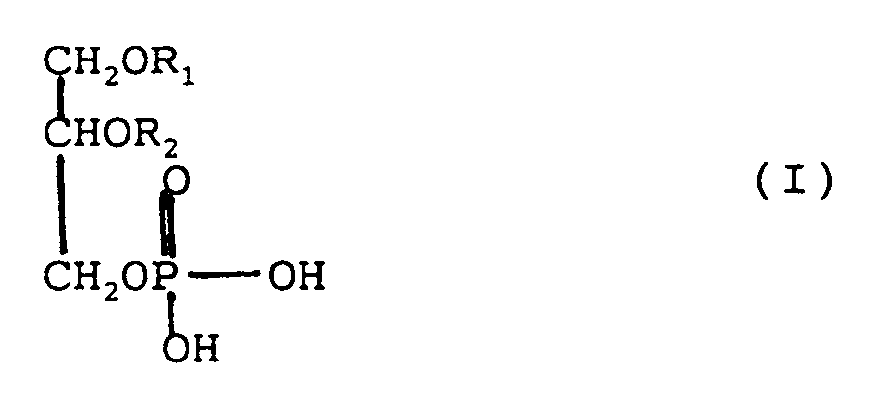
- the phospholipid mixture (c) contains at least 15 wt.%, based on the entire phospholipids, of phosphatidic acid and/or a phosphatidic acid salt and the phosphatidic acid has the formula (I) or (II): in which R1 or R2 each are an aliphatic acyl group having 8 to 24 carbon atoms, saturated or unsaturated.
- the phospholipid mixture to be used in the water-in-oil emulsion of the present invention is one containing a reduced amount of phosphatidylcholine or phosphatidylethanolamine wherein the weight ratio of a nitrogen-free phospholipid to a nitrogenous phospholipid is at least 1.0.
- the quantity of this phospholipid mixture in the water-in-oil emulsion of the present invention is 0.01 to 10 wt.%, preferably 0.05 to 5 wt.%, in the oil phase.
- Examples of the phospholipid mixture containing a reduced amount of the nitrogenous phospholipid such as phosphatidylcholine or phosphatidylethanolamine which can be used in the present invention include those containing phosphatidic acid or/and its salts, phosphatidylinositol, phosphatidylglycerol and further their lysophospholipids.
- Examples of the salts that constitute the phosphatidic acid salts are sodium, potassium, calcium, aluminum, magnesium and ammonium.
- the phosphatidic acid or/and phosphatidic acid salts may contain lysophosphatidic acid or/and lysophosphatidic acid salts described above.
- the phospholipid mixture described above in which a weight ratio of the nitrogen-free phospholipid to the nitrogenous phospholipid is at least 1.0 can be obtained by reducing the content of phosphatidylcholine and phosphatidylethanolamine through the enzymatic treatment (treatment by phospholipase D) using natural lecithin as the starting material or through the fractionation, for example, and increasing the content of the phosphatidic acid and phosphatidylinositol above the specific values.
- the natural lecithin used here is one originating in vegetables such as soybean, rapeseed, sunflower, or corn, or animals such as yolk.
- the phospholipid mixture described above may further be treated by fractionation with a solvent, an ion-exchange column or a silicic acid column and electrodialysis.
- those phospholipids which are obtained by treating a monoglyceride or diglyceride with a phosphorus oxidizing agent (e.g. pentoxide, pentachloride or oxychloride) can be likewise used in the present invention.
- a phosphorus oxidizing agent e.g. pentoxide, pentachloride or oxychloride
- the diglyceride-containing fat and oil components used in the present invention can be obtained by transesterifying in the presence of an alkali metal or (and) an alkaline earth metal a mixture of glycerine with at least one fat or oil selected from the group consisting of ordinary vegetable oils such as safflower oil, olive oil, corn seed oil, rapeseed oil, coconut oil, palm kernel oil, palm oil, soybean oil and corn oil,, animal fats and oils such as lard, beef tallow, fish oil, and milk fat,, or fractionated oils, transesterified oils, randomized oils and hardened oils of these vegetable and animal fats and oils, by esterifying a mixture of a fatty acid with glycerine.
- ordinary vegetable oils such as safflower oil, olive oil, corn seed oil, rapeseed oil, coconut oil, palm kernel oil, palm oil, soybean oil and corn oil
- animal fats and oils such as lard, beef tallow, fish oil, and milk fat
- the treatment by molecular distillation or silicic acid column chromatography is suitable and in order to reduce the diglyceride content, on the contrary, at least one of the starting fats and oils described above may be added thereto.
- the diglyceride content of the water-in-oil emulsion of the present invention ranges from 0.1 to 80 wt% in the oil phase, preferably from 2 to 60 wt%. It is further preferred that the diglyceride exist in liquid form in the oil phase at a temperature at which the emulsion composition is used. Preferably, the diglyceride is at least one of those consisting of C8 to C24, preferably C16 to C22 fatty acid residues containing at least 70 wt% of unsaturated fatty acid residues of the total fatty acid residues.
- the water-in-oil emulsion of the present invention may contain milk products, inorganic salts, saccharides, high-molecular polysaccharides, perfumes, acids and tasting agents as the side components of the aqueous phase or oil phase in accordance with the intended object.
- the high-molecular polysaccharides are especially effective in further improving emulsion stability at high temperatures.
- the polysaccharides include gum arabic, carrageenan, locust bean gum, xanthan gum, guar gum, tamarind seed polysaccharides, taracant gum, dextrin, ⁇ -starch, starch, carboxymethylcellulose, methylcellulose, sodium alginate, and pectin.
- the aqueous phase which constitutes the water-in-oil emulsion of the present invention and uses water as the base may consist of water alone. It may contain milk products (e.g. milk protein), perfumes, tasting agents, and the like as the side components in the same way as that described above.
- milk products e.g. milk protein
- perfumes e.g. perfumes, tasting agents, and the like as the side components in the same way as that described above.
- mixing and emulsification are preferably made so that the mixing ratio of the oil phase containing 0.01 to 10 wt% of the phospholipid mixture, wherein the weight ratio of the nitrogen-free phospholipid to the nitrogenous phospholipid is at least 1.0, to the aqueous phase is 99/1 to 5/95 by weight. It is further preferred that the mixing and emulsification are made so that 0.1 to 80 wt% of the diglyceride is contained in the oil phase.
- the preservation stability for a long time and high temperature resistance of the emulsion composition having a weight ratio of the oil phase to the aqueous phase of 99/1 to 5/95 can be improved drastically, and particularly the problems of exudation of the moisture, oil-off and the drop of shape retentivity that are likely to occur in the conventional water-in-oil emulsion compositions can be satisfactorily solved. Furthermore, the effect described above can be still increased by blending a specific amount of a diglyceride in the oil phase.
- Soybean lecithin as the starting material was treated with phospholipase D to reduce the content of phosphatidylcholine and phosphatidylethanolamine and to increase the content of phosphatidylinositol and phosphatidic acid (and its calcium salts), thus obtaining phospholipid mixtures (1) and (2).
- the chemical compositions of these mixtures are given in the following Table 1.
- soybean lecithin phospholipid mixture (3)
- Table 1 the chemical composition of soybean lecithin (phospholipid mixture (3)) is also given in Table 1.
- glycerine After 25 parts of glycerine were added to 75 parts of refined rapeseed oil, 0.1 parts of calcium hydroxide were added to the mixture to conduct transesterification in a customary manner. Then, monoglyceride was removed by molecular distillation and refining was further carried out in a customary manner to obtain a transesterified oil.
- the glyceride composition of this oil was 19.4% of triglyceride, 79.6% of diglyceride and 1.0% of monoglyceride.
- oil composition (1) The oil composition consisting of the refined rapeseed oil alone was referred to as the oil composition (1).
- Oil compositions (6) and (7) were prepared in the same way by using palm oil and lard as the starting materials, respectively.
- Oil phases were prepared by blending 0.05, 0.1, 0.2, 0.5 and 1.0 wt%, based on the refined rapeseed oil, of the phospholipid composition (1) or (2) prepared above with 50 parts of the refined rapeseed oil and 50 parts of distilled water were added to each of these oil phases. Each mixture was emulsified with a homomixer to prepare a water-in-oil emulsion composition.
- Each of the resulting compositions was transferred into a graduated test tube and either left settled at 25°C for 24 hours or at 80°C for 30 minutes, or centrifuged at 3000 rpm for 5 minutes after being left settled at 80°C for 30 minutes.
- the proportion of the separated aqueous phase to the total aqueous phase was measured so as to evaluate emulsion stability. The results are given in Table 3.
- Oil phases were prepared by blending 0.05, 0.1, 0.2, 0.5 and 1.0 wt%, based on the refined rapeseed oil, of the phospholipid mixture (3) to 50 parts of the refined rapeseed oil and 50 parts of distilled water were added to each oil phase. Each mixture was emulsified with a homomixer to obtain a water-in-oil emulsion composition.
- Oil phases were prepared by blending 0.1 wt% of the phospholipid mixture (1) listed in Table 1 into 50 parts of each of the oil compositions (1) to (4) listed in Table 2, and 50 parts of distilled water were added to each of the oil phases. Each mixture was emulsified with a homomixer to prepare a water-in-oil emulsion composition.
- Oil phases were prepared by blending 0.1 wt%, based on each oil compositions (1) to (4) listed in Table 2, of the phospholipid mixture (3) listed in Table 1 with 50 parts of the oil compositions (1) to (4), and 50 parts of distilled water were added to each of the oil phases. Each mixture was emulsified with a homomixer to prepare a water-in-oil emulsion composition.
- a water-in-oil emulsion was prepared by mixing 0.1 wt%, based on the oil composition, of the phospholipid mixture (1) shown in Table 1 with 40 parts of the oil composition (4) shown in Table 2 to prepare an oil phase and then mixing the oil phase with 60 parts of distilled water, emulsified with a homomixer.
- a water-in-oil emulsion was prepared by mixing 0.1 wt%, based on the oil composition, of the phospholipid mixture (1) shown in Table 1 with 30 parts of the oil composition (4) shown in Table 2 to prepare an oil phase and then mixing the oil phase with 70 parts of distilled water, emulsified with a homomixer.
- a water-in-oil emulsion was prepared by mixing 0.1 wt%, based on the oil composition, of the phospholipid mixture (3) shown in Table 1 with 40 parts of the oil composition (4) shown in Table 2 to prepare an oil phase and then mixing the oil phase with 60 parts of distilled water, emulsified with a homomixer.
- a water-in-oil emulsion was prepared by mixing 0.1 wt%, based on the oil composition, of the phospholipid mixture (3) shown in Table 1 with 30 parts of the oil composition (4) shown in Table 2 to prepare an oil phase and then mixing the oil phase with 70 parts of distilled water, emulsified with a homomixer.
Landscapes
- Chemical & Material Sciences (AREA)
- Life Sciences & Earth Sciences (AREA)
- Engineering & Computer Science (AREA)
- Food Science & Technology (AREA)
- Polymers & Plastics (AREA)
- Biochemistry (AREA)
- Oil, Petroleum & Natural Gas (AREA)
- Colloid Chemistry (AREA)
- Edible Oils And Fats (AREA)
- Emulsifying, Dispersing, Foam-Producing Or Wetting Agents (AREA)
Description
- This invention relates to a water-in-oil emulsion having excellent emulsion stability.
- When the proportion of the aqueous phase increases in a water-in-oil emulsion, the emulsion state gets unstable and the separation between the aqueous phase and the oil phase and furthermore the phase inversion from the water-in-oil type to the oil-in-water type are likely to occur during the production process.
- In the above emulsion, exudation of the moisture and oil-off occur during storage and, when bulk handling is made, destruction of emulsion and the resulting separation of the aqueous phase and rottening take place. For these reasons, this type of emulsion cannot be used satisfactorily for various applications.
- The use of various emulsifiers has been proposed in the past in order to solve these problems. For instance, a method which uses sucrose fatty acid esters of HLB of 1 to 4 (JP-B-56-11014), a method which uses glycerine fatty acid esters (US-A-3,889,005) and a method which uses polyglycerine fatty acid esters in combination with saturated fatty acid esters having a carbon number of at least 12 (JP-A-58-170432) are known.
- However, even when these emulsifiers are used, the problems with the water-in-oil emulsion described above cannot be solved sufficiently. More specifically, when the sucrose fatty acid esters of HLB of 1 to 4 or the glycerine fatty acid esters described above are used, the water-in-oil emulsion can be produced in fact, but the resulting product has low stability with the passage of time even when stored below normal temperatures and causes exudation of the moisture and destruction of the emulsion, followed by the separation of the aqueous phase when it is spread.
- When polyglycerine ester of condensed ricinoleic acid which has particularly high emulsion stability among the polyglycerine fatty acid esters is used, the tissue of the product is soft and exhibits a paste-like form, so that shape retentivity is low and oil-off is likely to occur. In addition, when the product is kept at low temperatures, stability with the passage of time is low and the separation of the aqueous phase occurs.
- EP-A-0 378 893 describes an edible oil and fat composition wherein the oil and fat composition comprises a glyceride mixture and a phospholipid mixture wherein the phospholipid mixture preferably contains nitrogeneous phospholipids in an amount equal to or less than the amount of non-nitrogeneous phospholipids. The glyceride mixture preferably comprises 5-100 wt.% of diglycerides. The edible oil/fat compositions comprising the diglyceride mixture and the phospholipids exhibit advantages as good stability against oxidation and heat which may occur by cooking and provide little greasy or oily distastefulness and do not sit heavy in the stomach when taken in the raw state as in dressings and mayonnaises. Object of the edible oil/fat composition of this document is to produce no greasy or oily distastefulness after ingestion, good mould releasing effects, superior anti-spattering effects and the like. There is no teaching or suggestion of forming a w/o emulsion exhibiting emulsion stability during storage as in the present claimed invention.
- US-A-2,062,782 relates to the treatment of lecithin and lecithin containing materials and particularly relates to the facilitation of a dispersion of lecithin in aqueous and olagineous media and the preservation thereof over a relatively long period of time.
- US-A-2,089,470 describes margarines, particularly methods of producing improved and non-weeping margarine. The principle object of this invention is the provision of an improved margarine and the applicants of this document have found that an intimate mixture of a commercial lecithin and a substantial proportion of a dye-fatty acid glyceride can be dispersed in an aqueous material forming a paste which can be readily and easily kneaded or blended into a plastic margarine emulsion to produce a commercially satisfactory margarine, whereby the proportions of lecithin and diglycerides employed maybe decreased without any sacrifice in anti-spattering and anti-weeping functions in the margarine.
- Object of the invention is the provision of a water-in-oil emulsion which does not show the above mentioned problems, has excellent stability and shape retentivity during storage for an extended period of time or at high temperatures.
- The present invention provides a water-in-oil emulsion comprising (a) the oil phase of a diglyceride mixture, (b) the aqueous phase and (c) 0.01 to 10 wt.% based on the oil phase, of a phospholipid mixture comprising (c-1) a nitrogen-free phospholipid and (c-2) a nitrogen-containing phospholipid at a weight ratio of (c-1) to (c-2) of at least 1.0, wherein the weight ratio of the oil phase to the aqueous phase ranges from 99/1 to 5/99 and the phospholipid mixture (c) contains at least 15 wt.%, based on the entire phospholipids, of phosphatidic acid and/or phosphatidic acid salt and wherein the diglyceride mixture contains 0.1 to 80 wt.% of one or more diglycerides.
- Preferably the diglyceride mixture contains 0.1 to 80 wt.% of one or more diglycerides and the diglycerides have fatty acid moieties of 8 to 24 carbon atoms and at least 70 wt.%, based on the entire fatty acid moieties, of unsaturated fatty acid moieties.
- Preferably the phospholipid mixture (c) contains at least 15 wt.%, based on the entire phospholipids, of phosphatidic acid and/or a phosphatidic acid salt and the phosphatidic acid has the formula (I) or (II):


in which R₁ or R₂ each are an aliphatic acyl group having 8 to 24 carbon atoms, saturated or unsaturated. - Now the present invention will be described in detail.
- The phospholipid mixture to be used in the water-in-oil emulsion of the present invention is one containing a reduced amount of phosphatidylcholine or phosphatidylethanolamine wherein the weight ratio of a nitrogen-free phospholipid to a nitrogenous phospholipid is at least 1.0. The quantity of this phospholipid mixture in the water-in-oil emulsion of the present invention is 0.01 to 10 wt.%, preferably 0.05 to 5 wt.%, in the oil phase.
- Examples of the phospholipid mixture containing a reduced amount of the nitrogenous phospholipid such as phosphatidylcholine or phosphatidylethanolamine which can be used in the present invention include those containing phosphatidic acid or/and its salts, phosphatidylinositol, phosphatidylglycerol and further their lysophospholipids.
- Examples of the salts that constitute the phosphatidic acid salts are sodium, potassium, calcium, aluminum, magnesium and ammonium. The phosphatidic acid or/and phosphatidic acid salts may contain lysophosphatidic acid or/and lysophosphatidic acid salts described above.
- The phospholipid mixture described above in which a weight ratio of the nitrogen-free phospholipid to the nitrogenous phospholipid is at least 1.0 can be obtained by reducing the content of phosphatidylcholine and phosphatidylethanolamine through the enzymatic treatment (treatment by phospholipase D) using natural lecithin as the starting material or through the fractionation, for example, and increasing the content of the phosphatidic acid and phosphatidylinositol above the specific values. The natural lecithin used here is one originating in vegetables such as soybean, rapeseed, sunflower, or corn, or animals such as yolk.
- The phospholipid mixture described above may further be treated by fractionation with a solvent, an ion-exchange column or a silicic acid column and electrodialysis.
- Besides these phospholipids thus subjected to the enzymatic treatment, those phospholipids which are obtained by treating a monoglyceride or diglyceride with a phosphorus oxidizing agent (e.g. pentoxide, pentachloride or oxychloride) can be likewise used in the present invention.
- The diglyceride-containing fat and oil components used in the present invention can be obtained by transesterifying in the presence of an alkali metal or (and) an alkaline earth metal a mixture of glycerine with at least one fat or oil selected from the group consisting of ordinary vegetable oils such as safflower oil, olive oil,
corn seed oil, rapeseed oil, coconut oil, palm kernel oil, palm oil, soybean oil and corn oil,, animal fats and oils such as lard, beef tallow, fish oil, and milk fat,, or fractionated oils, transesterified oils, randomized oils and hardened oils of these vegetable and animal fats and oils, by esterifying a mixture of a fatty acid with glycerine. - In order to increase the diglyceride content of the resulting diglyceride-containing component, the treatment by molecular distillation or silicic acid column chromatography is suitable and in order to reduce the diglyceride content, on the contrary, at least one of the starting fats and oils described above may be added thereto.
- The diglyceride content of the water-in-oil emulsion of the present invention ranges from 0.1 to 80 wt% in the oil phase, preferably from 2 to 60 wt%. It is further preferred that the diglyceride exist in liquid form in the oil phase at a temperature at which the emulsion composition is used. Preferably, the diglyceride is at least one of those consisting of C₈ to C₂₄, preferably C₁₆ to C₂₂ fatty acid residues containing at least 70 wt% of unsaturated fatty acid residues of the total fatty acid residues.
- The water-in-oil emulsion of the present invention may contain milk products, inorganic salts, saccharides, high-molecular polysaccharides, perfumes, acids and tasting agents as the side components of the aqueous phase or oil phase in accordance with the intended object.
- Among them, the high-molecular polysaccharides are especially effective in further improving emulsion stability at high temperatures. Particular examples of the polysaccharides include gum arabic, carrageenan, locust bean gum, xanthan gum, guar gum, tamarind seed polysaccharides, taracant gum, dextrin, α-starch, starch, carboxymethylcellulose, methylcellulose, sodium alginate, and pectin.
- The aqueous phase which constitutes the water-in-oil emulsion of the present invention and uses water as the base may consist of water alone. It may contain milk products (e.g. milk protein), perfumes, tasting agents, and the like as the side components in the same way as that described above.
- In the production of the water-in-oil emulsion of the present invention, mixing and emulsification are preferably made so that the mixing ratio of the oil phase containing 0.01 to 10 wt% of the phospholipid mixture, wherein the weight ratio of the nitrogen-free phospholipid to the nitrogenous phospholipid is at least 1.0, to the aqueous phase is 99/1 to 5/95 by weight. It is further preferred that the mixing and emulsification are made so that 0.1 to 80 wt% of the diglyceride is contained in the oil phase.
- Since the water-in-oil emulsion in accordance with the present invention contains a specific amount of a specific phospholipid mixture in the oil phase, the preservation stability for a long time and high temperature resistance of the emulsion composition having a weight ratio of the oil phase to the aqueous phase of 99/1 to 5/95 can be improved drastically, and particularly the problems of exudation of the moisture, oil-off and the drop of shape retentivity that are likely to occur in the conventional water-in-oil emulsion compositions can be satisfactorily solved. Furthermore, the effect described above can be still increased by blending a specific amount of a diglyceride in the oil phase.
- Now the present invention will be described in further detail with reference to Reference Example, Examples and Comparative Examples, though the present invention is not limited to these examples.
- The terms "part(s)" and "%" in the examples are by weight unless otherwise specified.
- Soybean lecithin as the starting material was treated with phospholipase D to reduce the content of phosphatidylcholine and phosphatidylethanolamine and to increase the content of phosphatidylinositol and phosphatidic acid (and its calcium salts), thus obtaining phospholipid mixtures (1) and (2). The chemical compositions of these mixtures are given in the following Table 1.
- For comparison, the chemical composition of soybean lecithin (phospholipid mixture (3)) is also given in Table 1.


- After 25 parts of glycerine were added to 75 parts of refined rapeseed oil, 0.1 parts of calcium hydroxide were added to the mixture to conduct transesterification in a customary manner. Then, monoglyceride was removed by molecular distillation and refining was further carried out in a customary manner to obtain a transesterified oil. The glyceride composition of this oil was 19.4% of triglyceride, 79.6% of diglyceride and 1.0% of monoglyceride.
- Next, this oil was mixed with the refined rapeseed oil in the proportions specified in Table 2 to prepare oil compositions (2), (3), (4) and (5). The oil composition consisting of the refined rapeseed oil alone was referred to as the oil composition (1).
- Oil compositions (6) and (7) were prepared in the same way by using palm oil and lard as the starting materials, respectively.
- The glyceride compositions of these compositions are given in Table 2.

- Oil phases were prepared by blending 0.05, 0.1, 0.2, 0.5 and 1.0 wt%, based on the refined rapeseed oil, of the phospholipid composition (1) or (2) prepared above with 50 parts of the refined rapeseed oil and 50 parts of distilled water were added to each of these oil phases. Each mixture was emulsified with a homomixer to prepare a water-in-oil emulsion composition.
- Each of the resulting compositions was transferred into a graduated test tube and either left settled at 25°C for 24 hours or at 80°C for 30 minutes, or centrifuged at 3000 rpm for 5 minutes after being left settled at 80°C for 30 minutes. The proportion of the separated aqueous phase to the total aqueous phase was measured so as to evaluate emulsion stability. The results are given in Table 3.
- Oil phases were prepared by blending 0.05, 0.1, 0.2, 0.5 and 1.0 wt%, based on the refined rapeseed oil, of the phospholipid mixture (3) to 50 parts of the refined rapeseed oil and 50 parts of distilled water were added to each oil phase. Each mixture was emulsified with a homomixer to obtain a water-in-oil emulsion composition.
- The emulsion stability of each of these emulsion compositions was evaluated by the same method as that of Examples 1 and 2. The results are given in Table 3.


- Oil phases were prepared by blending 0.1 wt% of the phospholipid mixture (1) listed in Table 1 into 50 parts of each of the oil compositions (1) to (4) listed in Table 2, and 50 parts of distilled water were added to each of the oil phases. Each mixture was emulsified with a homomixer to prepare a water-in-oil emulsion composition.
- The emulsion stability of each of the resulting emulsion compositions was evaluated by the same method as that of Examples 1 and 2. The results are given in Table 4.
- Oil phases were prepared by blending 0.1 wt%, based on each oil compositions (1) to (4) listed in Table 2, of the phospholipid mixture (3) listed in Table 1 with 50 parts of the oil compositions (1) to (4), and 50 parts of distilled water were added to each of the oil phases. Each mixture was emulsified with a homomixer to prepare a water-in-oil emulsion composition.
- The emulsion stability of each of these emulsion compositions was evaluated by the same method as that of Examples 1 and 2. The results are given in Table 4.

- A water-in-oil emulsion was prepared by mixing 0.1 wt%, based on the oil composition, of the phospholipid mixture (1) shown in Table 1 with 40 parts of the oil composition (4) shown in Table 2 to prepare an oil phase and then mixing the oil phase with 60 parts of distilled water, emulsified with a homomixer.
- A water-in-oil emulsion was prepared by mixing 0.1 wt%, based on the oil composition, of the phospholipid mixture (1) shown in Table 1 with 30 parts of the oil composition (4) shown in Table 2 to prepare an oil phase and then mixing the oil phase with 70 parts of distilled water, emulsified with a homomixer.
- A water-in-oil emulsion was prepared by mixing 0.1 wt%, based on the oil composition, of the phospholipid mixture (3) shown in Table 1 with 40 parts of the oil composition (4) shown in Table 2 to prepare an oil phase and then mixing the oil phase with 60 parts of distilled water, emulsified with a homomixer.
- A water-in-oil emulsion was prepared by mixing 0.1 wt%, based on the oil composition, of the phospholipid mixture (3) shown in Table 1 with 30 parts of the oil composition (4) shown in Table 2 to prepare an oil phase and then mixing the oil phase with 70 parts of distilled water, emulsified with a homomixer.
- The emulsion compositions obtained in Examples 7 and 8, Comparative Examples 6 and 7 were evaluated in view of the emulsion stability by the same method as that of Eample 1. Results are shown in Table 5, which evidently show the water-in-oil emulsion compositions obtained in Examples are stabler as emulsions having a large amount of water. In the table, figures in the rightmost column show percent by volume of the separated aqueous phase to the total aqueous phase after the cetrifugal separation.

Claims (3)
- A water-in-oil emulsion comprising (a) the oil phase of a diglyceride mixture, (b) the aqueous phase and (c) 0.01 to 10 wt.% based on the oil phase, of a phospholipid mixture comprising (c-1) a nitrogen-free phospholipid and (c-2) a nitrogen-containing phospholipid at a weight ratio of (c-1) to (c-2) of at least 1.0, wherein the weight ratio of the oil phase to the aqueous phase ranges from 99/1 to 5/95 and the phospholipid mixture (c) contains at least 15 wt.%, based on the entire phospholipids, of phosphatidic acid and/or phosphatidic acid salt and wherein the diglyceride mixture contains 0.1 to 80 wt.% of one or more diglycerides.
- The emulsion as claimed in claim 1, in which the diglyceride mixture contains 0.1 to 80 wt.% of one or more diglycerides and the diglycerides have fatty acid moieties of 8 to 24 carbon atoms and at least 70 wt.%, based on the entire fatty acid moieties, of unsaturated fatty acid moieties.
- The emulsion as claimed in claim 1, in which the phospholipid mixture (c) contains at least 15 wt.%, based on the entire phospholipids, of phosphatidic acid and/or a phosphatidic acid salt and the phosphatidic acid has the formula (I) or (II) in which R₁ or R₂ each are an aliphatic acyl group having 8 to 24 carbon atoms, saturated or unsaturated.

Applications Claiming Priority (2)
| Application Number | Priority Date | Filing Date | Title |
|---|---|---|---|
| JP1226842A JP2736273B2 (en) | 1989-09-01 | 1989-09-01 | Water-in-oil emulsion composition |
| JP226842/89 | 1989-09-01 |
Publications (2)
| Publication Number | Publication Date |
|---|---|
| EP0417562A1 EP0417562A1 (en) | 1991-03-20 |
| EP0417562B1 true EP0417562B1 (en) | 1994-02-09 |
Family
ID=16851424
Family Applications (1)
| Application Number | Title | Priority Date | Filing Date |
|---|---|---|---|
| EP90116677A Expired - Lifetime EP0417562B1 (en) | 1989-09-01 | 1990-08-30 | Water-in-oil emulsion composition |
Country Status (4)
| Country | Link |
|---|---|
| EP (1) | EP0417562B1 (en) |
| JP (1) | JP2736273B2 (en) |
| DE (1) | DE69006562T2 (en) |
| ES (1) | ES2062236T3 (en) |
Families Citing this family (9)
| Publication number | Priority date | Publication date | Assignee | Title |
|---|---|---|---|---|
| AU1664595A (en) * | 1994-02-18 | 1995-09-04 | Loders Croklaan B.V. | Fat blends, based on diglycerides |
| AU1705595A (en) * | 1994-02-18 | 1995-09-04 | Loders Croklaan B.V. | Fat blends containing diglycerides |
| WO1996032022A1 (en) * | 1995-04-13 | 1996-10-17 | Unilever N.V. | Edible plastic spread |
| JP3550017B2 (en) * | 1998-03-03 | 2004-08-04 | 花王株式会社 | Water-in-oil type emulsified fat composition |
| CN1115970C (en) * | 1998-05-21 | 2003-07-30 | 花王株式会社 | Water-in-oil emulsified fat composition |
| GB9823837D0 (en) * | 1998-10-30 | 1998-12-23 | St Ivel Ltd | Edible emulsion |
| JP3589904B2 (en) * | 1999-06-17 | 2004-11-17 | 花王株式会社 | Acidic oil-in-water emulsion composition |
| JP3662445B2 (en) | 1999-06-30 | 2005-06-22 | 花王株式会社 | Water-in-oil emulsified fat composition |
| JP5921944B2 (en) * | 2012-04-12 | 2016-05-24 | 花王株式会社 | Water-in-oil emulsion composition |
Family Cites Families (7)
| Publication number | Priority date | Publication date | Assignee | Title |
|---|---|---|---|---|
| US2062782A (en) * | 1936-01-10 | 1936-12-01 | Albert K Epstein | Treatment of lecithin |
| US2089470A (en) * | 1936-03-11 | 1937-08-10 | Albert K Epstein | Improved margarine |
| USRE28903E (en) * | 1970-09-23 | 1976-07-13 | Lever Brothers Company | Phosphatide separation |
| US3896975A (en) * | 1972-06-28 | 1975-07-29 | Dan W Follmer | Non foaming lecithin emulsion cookware lubricant |
| JPS5851853A (en) * | 1981-09-18 | 1983-03-26 | Kyowa Hakko Kogyo Co Ltd | Emulsifier for food |
| GB8418154D0 (en) * | 1984-07-17 | 1984-08-22 | Unilever Plc | Edible fat composition |
| JPH0738771B2 (en) * | 1989-01-17 | 1995-05-01 | 花王株式会社 | Liquid edible oil composition |
-
1989
- 1989-09-01 JP JP1226842A patent/JP2736273B2/en not_active Expired - Fee Related
-
1990
- 1990-08-30 DE DE69006562T patent/DE69006562T2/en not_active Expired - Fee Related
- 1990-08-30 EP EP90116677A patent/EP0417562B1/en not_active Expired - Lifetime
- 1990-08-30 ES ES90116677T patent/ES2062236T3/en not_active Expired - Lifetime
Also Published As
| Publication number | Publication date |
|---|---|
| EP0417562A1 (en) | 1991-03-20 |
| ES2062236T3 (en) | 1994-12-16 |
| DE69006562T2 (en) | 1994-05-26 |
| JP2736273B2 (en) | 1998-04-02 |
| DE69006562D1 (en) | 1994-03-24 |
| JPH0391441A (en) | 1991-04-17 |
Similar Documents
| Publication | Publication Date | Title |
|---|---|---|
| US5160759A (en) | Edible oil-in-water emulsion | |
| JP2862981B2 (en) | Oil-in-oil-in-oil double emulsified fat composition | |
| EP1227733B1 (en) | Water-in-oil type emulsified fat and/or oil composition | |
| EP0525915A1 (en) | Edible oil/fat compositions | |
| EP0253429B1 (en) | Phosphatide-containing compositions and process for making same | |
| AU2002231724B2 (en) | Microemulsions | |
| JPS647754B2 (en) | ||
| AU2002231724A1 (en) | Microemulsions | |
| JP2002176952A (en) | Acidic oil-in-water emulsion composition | |
| JP2736273B2 (en) | Water-in-oil emulsion composition | |
| US3663235A (en) | Process of preparing margarine containing diacyglycerophatide | |
| JPH07121196B2 (en) | Water-in-oil type emulsion oil composition | |
| JPH038431A (en) | Oil-in-water type emulsified composition | |
| JP2905275B2 (en) | Antioxidant composition | |
| JP2996793B2 (en) | Acidic oil-in-water emulsion | |
| JP2777217B2 (en) | Oil-in-water emulsion composition | |
| JP2704004B2 (en) | Oil-in-water emulsion | |
| JP2719003B2 (en) | Acidic oil-in-water emulsion composition | |
| JP3473073B2 (en) | Method for producing acidic oil-in-water emulsion | |
| JP2510651B2 (en) | Water-in-oil type emulsion oil composition | |
| JPH05146270A (en) | Emulsified oil and fat composition | |
| JPH04262761A (en) | Oil-in-acidic water type emulsion composition | |
| JP2900586B2 (en) | Water-in-oil emulsion | |
| JPH012532A (en) | Water-in-oil emulsified oil and fat composition | |
| JPH0347137B2 (en) |
Legal Events
| Date | Code | Title | Description |
|---|---|---|---|
| PUAI | Public reference made under article 153(3) epc to a published international application that has entered the european phase |
Free format text: ORIGINAL CODE: 0009012 |
|
| AK | Designated contracting states |
Kind code of ref document: A1 Designated state(s): CH DE ES FR GB LI NL |
|
| 17P | Request for examination filed |
Effective date: 19910307 |
|
| 17Q | First examination report despatched |
Effective date: 19920427 |
|
| GRAA | (expected) grant |
Free format text: ORIGINAL CODE: 0009210 |
|
| AK | Designated contracting states |
Kind code of ref document: B1 Designated state(s): CH DE ES FR GB LI NL |
|
| REF | Corresponds to: |
Ref document number: 69006562 Country of ref document: DE Date of ref document: 19940324 |
|
| ET | Fr: translation filed | ||
| PGFP | Annual fee paid to national office [announced via postgrant information from national office to epo] |
Ref country code: FR Payment date: 19940809 Year of fee payment: 5 |
|
| PGFP | Annual fee paid to national office [announced via postgrant information from national office to epo] |
Ref country code: GB Payment date: 19940822 Year of fee payment: 5 |
|
| PGFP | Annual fee paid to national office [announced via postgrant information from national office to epo] |
Ref country code: DE Payment date: 19940823 Year of fee payment: 5 |
|
| PGFP | Annual fee paid to national office [announced via postgrant information from national office to epo] |
Ref country code: CH Payment date: 19940824 Year of fee payment: 5 |
|
| PGFP | Annual fee paid to national office [announced via postgrant information from national office to epo] |
Ref country code: ES Payment date: 19940830 Year of fee payment: 5 |
|
| PGFP | Annual fee paid to national office [announced via postgrant information from national office to epo] |
Ref country code: NL Payment date: 19940831 Year of fee payment: 5 |
|
| PLBE | No opposition filed within time limit |
Free format text: ORIGINAL CODE: 0009261 |
|
| STAA | Information on the status of an ep patent application or granted ep patent |
Free format text: STATUS: NO OPPOSITION FILED WITHIN TIME LIMIT |
|
| REG | Reference to a national code |
Ref country code: ES Ref legal event code: FG2A Ref document number: 2062236 Country of ref document: ES Kind code of ref document: T3 |
|
| 26N | No opposition filed | ||
| PG25 | Lapsed in a contracting state [announced via postgrant information from national office to epo] |
Ref country code: GB Effective date: 19950830 |
|
| PG25 | Lapsed in a contracting state [announced via postgrant information from national office to epo] |
Ref country code: LI Effective date: 19950831 Ref country code: ES Free format text: LAPSE BECAUSE OF NON-PAYMENT OF DUE FEES Effective date: 19950831 Ref country code: CH Effective date: 19950831 |
|
| PG25 | Lapsed in a contracting state [announced via postgrant information from national office to epo] |
Ref country code: NL Effective date: 19960301 |
|
| REG | Reference to a national code |
Ref country code: CH Ref legal event code: PL |
|
| PG25 | Lapsed in a contracting state [announced via postgrant information from national office to epo] |
Ref country code: FR Effective date: 19960430 |
|
| GBPC | Gb: european patent ceased through non-payment of renewal fee |
Effective date: 19950830 |
|
| NLV4 | Nl: lapsed or anulled due to non-payment of the annual fee |
Effective date: 19960301 |
|
| PG25 | Lapsed in a contracting state [announced via postgrant information from national office to epo] |
Ref country code: DE Effective date: 19960501 |
|
| REG | Reference to a national code |
Ref country code: FR Ref legal event code: ST |
|
| REG | Reference to a national code |
Ref country code: ES Ref legal event code: FD2A Effective date: 19960911 |