EP0415786B1 - Information storage and processing - Google Patents
Information storage and processing Download PDFInfo
- Publication number
- EP0415786B1 EP0415786B1 EP90309556A EP90309556A EP0415786B1 EP 0415786 B1 EP0415786 B1 EP 0415786B1 EP 90309556 A EP90309556 A EP 90309556A EP 90309556 A EP90309556 A EP 90309556A EP 0415786 B1 EP0415786 B1 EP 0415786B1
- Authority
- EP
- European Patent Office
- Prior art keywords
- data
- format
- directories
- computer system
- optical disk
- Prior art date
- Legal status (The legal status is an assumption and is not a legal conclusion. Google has not performed a legal analysis and makes no representation as to the accuracy of the status listed.)
- Expired - Lifetime
Links
Images





Classifications
-
- G—PHYSICS
- G11—INFORMATION STORAGE
- G11B—INFORMATION STORAGE BASED ON RELATIVE MOVEMENT BETWEEN RECORD CARRIER AND TRANSDUCER
- G11B27/00—Editing; Indexing; Addressing; Timing or synchronising; Monitoring; Measuring tape travel
- G11B27/10—Indexing; Addressing; Timing or synchronising; Measuring tape travel
- G11B27/19—Indexing; Addressing; Timing or synchronising; Measuring tape travel by using information detectable on the record carrier
- G11B27/28—Indexing; Addressing; Timing or synchronising; Measuring tape travel by using information detectable on the record carrier by using information signals recorded by the same method as the main recording
- G11B27/32—Indexing; Addressing; Timing or synchronising; Measuring tape travel by using information detectable on the record carrier by using information signals recorded by the same method as the main recording on separate auxiliary tracks of the same or an auxiliary record carrier
- G11B27/327—Table of contents
- G11B27/329—Table of contents on a disc [VTOC]
-
- G—PHYSICS
- G06—COMPUTING OR CALCULATING; COUNTING
- G06F—ELECTRIC DIGITAL DATA PROCESSING
- G06F16/00—Information retrieval; Database structures therefor; File system structures therefor
- G06F16/20—Information retrieval; Database structures therefor; File system structures therefor of structured data, e.g. relational data
- G06F16/25—Integrating or interfacing systems involving database management systems
- G06F16/258—Data format conversion from or to a database
-
- G—PHYSICS
- G16—INFORMATION AND COMMUNICATION TECHNOLOGY [ICT] SPECIALLY ADAPTED FOR SPECIFIC APPLICATION FIELDS
- G16H—HEALTHCARE INFORMATICS, i.e. INFORMATION AND COMMUNICATION TECHNOLOGY [ICT] SPECIALLY ADAPTED FOR THE HANDLING OR PROCESSING OF MEDICAL OR HEALTHCARE DATA
- G16H30/00—ICT specially adapted for the handling or processing of medical images
- G16H30/20—ICT specially adapted for the handling or processing of medical images for handling medical images, e.g. DICOM, HL7 or PACS
-
- G—PHYSICS
- G11—INFORMATION STORAGE
- G11B—INFORMATION STORAGE BASED ON RELATIVE MOVEMENT BETWEEN RECORD CARRIER AND TRANSDUCER
- G11B2220/00—Record carriers by type
- G11B2220/20—Disc-shaped record carriers
- G11B2220/25—Disc-shaped record carriers characterised in that the disc is based on a specific recording technology
- G11B2220/2537—Optical discs
Definitions
- This invention relates to an information processing system. More particularly the invention is directed to an information storage and processing system that is effectively configured to ensure compatibility of removable stored media among different systems.
- Apparatus of this type includes optical disk filing systems and word processors which store information in different proprietary formats. These different formats are inconvenient and have hindered the spread of such systems, because removable stored media from one system are not compatible with other systems. Accordingly, information stored on one system has not been usable on another system.
- the invention concerns 5.25-inch and 3.5-inch optical disks which conform to ISO SC23.
- the storage capacity of a 3.5-inch optical disk is about 100 megabytes (MB), and that of a 5.25-inch optical disk is about 600 MB.
- the storage capacity of such discs is much greater than the capacity of equivalent physical size other storage media such as magnetic disks.
- IBM PC/AT Trademark
- MacIntosh Trademark
- SUN Trademark
- IBM PC/AT processing system includes diferent clone systems. Such operating systems however are basically incompatible and this limits the ability to process information and transfer data from one system to another.
- An object of the invention is to provide an information processing system which is highly usable.
- the system seeks to solve the incompatibility problems between different conventional computer, processing and storage systems.
- Another object of the invention is to provide a compatible system that can be used with optical disks containing data stored in a compatible format that differs from the storage format used by the operating system of a computer system concerned. It is an object to provide a system which employs essentially a digital or binary format for data processing, storage and display which is essentially compatible with multiple computer operating systems.
- Compatibility between different systems can be achieved by making the information stored on removable media the same, or partly the same, and providing each system with a translation capability.
- an information processing system comprises an information processor for processing information, the processor having a specific operating system.
- an external storage for connection to the information processor, the external storage having data and directories written and read in a first format based on the specific operating system.
- a format converter for connection to the external storage and the information processor converts data and directories in the first format from the external storage to data and directories in a second format.
- the format converter includes designation means for designating different areas for storing the data and the directories in the second format.
- the format converter also converts data and directories from the second format to the first format.
- An optical disk drive connected to the format converter permits storing of the data and the directories in the second format on an optical disk.
- the designation means includes sequential storage means whereby the directories are recorded sequentially on the optical disk starting from an inner track and the data are recorded sequentially on the optical disk starting from an outer track. There is means for dividing data read from the external storage into an optical disk sector portion.
- respective designation means designates that the data and the directories read from the optical disk by the optical disk drive are each stored in a continuous form in one area of the external storage. Different format data and directories separately read from the optical disk by the optical disk drive are combined and converted to data in the first format.
- a method for processing and storing data in an information processing system provided with an information processor, a magnetic disk system for connection to the information processor and for storing data designated by the information processor, and an optical disk drive for storing data designated by the information processor.
- Data and directories in a first format based on a specific operating system of the information processor are combined, and the combined data and directories are stored on the magnetic disk system.
- the data and directories stored on the magnetic disk system are separated in the first format, and the data in the first format is divided into sector units used by the optical disk in the optical disk drive.
- the divided data is stored on the optical disk and directories containing file names is stored onto the optical disk on which data divided into sector units have been stored.
- the data are written sequentially onto the optical disk in sector length units, starting from an outer track.
- directory storing the directories are written sequentially starting from an inner track.
- medical information can be stored on a removable and portable optical disk.
- This disk can then be inputted into different computer systems, which would otherwise have normally have incompatible operating systems.
- the information can then be read out into the different computer systems for information processing.
- new information and data can be written onto the disk by the different computer operating systems.
- a system configuration comprises a host computer system 1.
- the computer usually is at least a 16-bit model.
- There is also a first storage namely, an external storage 2 such as a magnetic disk, and a display 3 capable of a resolution of at least 1,024 by 1,024 pixels by 8 bits.
- An optical disk drive 4 for 5.25-inch or 3.5-inch disks is connected with the computer system 1.
- An optical disk 5, namely, a second storage, which has stored data is supplied for the disk drive 4.
- FIG. 1 the system configuration is illustrated for a computer system A, designated by numeral 1, computer system B designated by numeral 6, and computer system C designated by numeral 11.
- Each of these computer systems, A, B and C could respectively be different.
- the operating systems are respectively different.
- each has its own optical disks 5, 10 and 15 respectively.
- the arrowed line interconnecting the three optical disks 5, 10, 15 designations indicates that the disks 5, 10 and 15 is intercompatible with any of the systems.
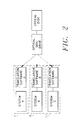
- Figure 2 illustrates a specific optical disk filing format and computer system operation. This format is the same on all computer systems A, B and C.
- An optical disk drive is used to perform optical disk read/write operations when connected to one or another of the computer systems A, B or C. Since each system A, B and C handles files in a different way, additional translation software A, B or C respectively is required to convert the files for each respective computer system, A, B or C.
- three different translation software programs A, B and C would be provided to render the optical disk information accessible to the respective computer systems 1, 6 and 11.
- the data can be displayed on respective screens 3, 8 and 13 of the respective computer systems. This is further illustrated in Figure 3.
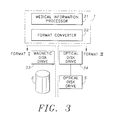
- FIG 3 shows an example of the software configuration of a medical information processing system.
- a medical information processor section 31 converts and outputs data read in from the optical disk 5 or data input from an external source 2.
- Programs and data for the computer system 1 are usually stored in the external floppy magnetic disk storage 2 in the first format used by the operating system concerned. This format is termed Format I.
- a magnetic disk drive 33 is equipped with the ability to write to the external storage 2 data converted to Format I by a format converter 32, and to read out data from the external storage 2.
- Each computer system 1 is equipped with a format converter 32 for data conversion between a first format in which the data is stored on a magnetic disk external storage 2 and to a second format for stored on the optical disk 5.
- An optical disk drive 34 is provided with the capabilities of reading and writing data. Medical image and other such data are stored on the optical disk 5 in a second format. This format is termed Format II.
- Format II When the data stored on the optical disk 5 are to be read out, displayed or otherwise processed by the medical information processing section 31, data that have been read out in Format II are converted by the format converter 32. The converted data is sent to the medical information processing section 31 from the format converter 32.
- Data conversion between the external storage 2 and the optical disk 5 is also possible.
- the format converter 32 converts each such format I or II to the other format II or I respectively.
- Formats I and II without depending on the operating system. Compatibility is thus provided among the plurality of different computer systems 1, 6 and 11.
- Image data in files are stored on an external storage 2 for the computer system 1 host computer A in a Format I based on the particular used operating system used.
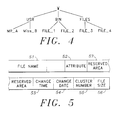
- Figures 4 and 5 illustrate the directory structure of an external storage 2, showing the location and type of the image data.
- Image file FILE_3 can be accessed on the basis of the directory information.
- the directory information is illustrated. This includes a file name 51 given to each file, attribute 52 indicating the type of file, and the time 53 and date 54 the file was recorded on the disk 5.
- the header cluster number indicates the first data set of the file, and the file size 56.
- the external storage 2 contains four areas shown in the memory map of Figure 6. There is a reserved area 66, a file allocation table (FAT) area 67, a directory area 68 and a data area 69.
- the data area 69 is divided into sectors, which form the access units and clusters. Each of these consists of a plurality of sectors. External access is performed on a cluster basis.
- the FAT area 67 has locations corresponding to each of the clusters in the data area. This includes the number of the cluster containing the next portion of the data in the file.
- Image file FILE_3 is stored in Format II in the external storage 2.
- the data are not necessarily stored in contiguous locations but may instead be divided up as shown in Figure 7.
- the sequence for reading out FILE_3 from the external storage 2 of the computer system 1 is described with reference to Figure 7.
- the computer system 1 host computer A To read out FILE_3, the computer system 1 host computer A first accesses the directory area to locate the directory information relating to FILE_3. The data in cluster 2 is obtained from the header cluster number information. Following this, cluster 4 is read out from the cluster 2 area of the FAT. Cluster 4 containing the next portion of the data is then accessed. This read operation is repeated to acquire the data in a continuous flow until the cluster in the FAT area containing an end-of-file marker FF H is reached.
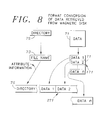
- Figure 8 illustrates the method of format converting FILE_3 data and directory information read out from the magnetic disk of the external storage 2.
- Image file data and directory information are stored in the external storage 2, as shown in Figure 7.
- the magnetic disk drive 33 reads out image data from the external storage 2 and writes it into the memory of the computer system 1 host computer A.
- the format converter program in computer A interprets the attribute information from the first file 73. These attributes which are added would indicate whether the file is an image from a CT scan, MR scan or an X-ray scan. This is added to the directory 75. File name 73 would be indicative of FILE_3 or FILE_4, and directory 75 would be indicative of DIR_3 or DIR_4. The format converter then writes only the data onto the memory of the system computer A. It repeats the similar procedures for the second file, for instance, FILE_4, and writes the DATA 2 onto the immediately adjacent memory which holds the data, DATA 2 from the last file (FILE_3) and so forth. As a result a contiguous block of memory 171 in computer A contains all image data 71. This block 171 of image data 71 is transferred and designated by the format converter program to the optical disk as multiple files or consecutive DATA 1, DATA 2, namely section 271.
- a 1,024 byte file directory block for instance DIR_3, DIR_4, is generated for each file, for instance, FILE_3, FILE_4.
- These file directory blocks are written on the optical disk 5 as the optical disk directories.
- Both the information contained in the file directory blocks and the image data files, for instance, FILE_3, and FILE_4, is the direct result from the format converter program.
- the format of the file directory block is set out below.
- the file structure is stored in a non-consecutive fashion with a directory pointing to the proper locations of individual files stored with gaps between them.
- the format converter transfers this data to the optical disk 5 for storage in a consecutive manner with the files and directories separated and each respectively consecutive.
- the data is consecutively stored in a manner similar to the optical disk storage. This provides for efficient retrieval of information, such as radiological medical images, from a personal computer storage.
- an optical disk 5 ID block is automatically generated when a new optical disk is created.
- the disk ID is written at the time of disk initialization.
- the redundancy is for security.
- the file directory block is written upon successful archive of a file.
- Archival Date 11 char (dd-mmm-yyyy) Creation Date 11 char (dd-mmm-yyyy)
- Figure 8 shows the directory information of Figure 4. This includes information in an operating system dependent format.
- Image data read out from the external storage 2 and stored in the computer system 1 are in a format in which they can be displayed on the display 3 by means of the display functions of the computer system 1.
- the format converter 32 retrieves file name 73 from the directory information that has been read into the computer system 1.
- the image files are stored on the optical disk 5 as separate data and directory entries.
- the image data are stored at a location where the images can be recorded as contiguous blocks of data.
- Directory information is stored at a separate location from the data. Due to this, the format converter 32 shown in Figure 3 uses the image data length information to calculate the number of sectors required to store the image data on the optical disk 5. Storage areas on the optical disk 5 which are not in use are then located and the header sector numbers of the areas to which image data and directory information can be written are calculated.
- Date information is obtained from a real-time clock, for example, provided in the computer system 1. If necessary, a comment can be inputted into the computer system 1 via a keyboard, for example, and will be added to the directory information.
- the format converter 32 thus generates the directory information stored on the optical disk 5.
- Image data stored on the optical disk 5 are sequentially read out from the system memory of the computer system 1 and are divided into sector lengths, for example, 1,024 bytes. These form the units in which data on the optical disk 5 are accessed. In this way, an image file that has undergone format conversion is transferred by the optical disk drive 34 into areas designated by the format converter 32.
- Figure 9 illustrates the operation of the image data stored on the optical disk 5 in format I being read out by the computer system 1 and converted to format II by the format converter 32.
- a data area to store the data and a directory area to store the directory corresponding to the data are established on the optical disk 5.
- the directory information corresponding to the designated file name is read from the directory area of the optical disk 5.
- the header sector number of the data of the designated file is acquired together with the size, and the data are read out.
- Image data read out from the optical disk 5 by the computer system 1 are, as shown in Figure 9, stored contiguously on the optical disk 5.
- the format converter 32 extracts the file name from the directory information obtained from the optical disk 5.
- the conversion date and time, cluster number, size and the required attributes for format II are added.
- Directory information for the new format II is then generated. Following this the image data are written to the external storage 2 by the method shown in Figure 7.
- a format is established that is independent of the storage format, for instance, Format II of the operating system used by the computer system 1.
- the first and second formats namely, Format I and Format II, can be converted each way by the format converter 32.
- software was employed to perform a one-to-one conversion. As this merely preserved compatibility among the same specific formats, the range of application was limited.
- each computer system 1, 6 and 11 By providing each computer system 1, 6 and 11 with a format converter 32 written in computer program language of System 1, 6, and 11 respectively, compatibility is maintained over a broader range.
- the format converter 32 incorporated by each computer system 1, 6 and 11 is provided with a conversion function for conversion between the operating system-based format of only each respective computer system 1, 6 and 11 and the specific format of the optical disk format 5, 10 and 15. This facilitates the generation process and makes it possible to adapt to the addition of new computer systems 1, 6 and 11.
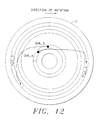
- Figure 12 shows an example of the format in which data are stored on the optical disk 5.
- the direction of rotation of the optical disk 5 is indicated by the arrow.
- access starts from a first direction, namely, the innermost part, or track of the disk 5.
- Data is read out in a continuous stream by moving an optical head of the drive 4 in a straight line toward the outer edge of the disk.
- the direction of rotation of the disk 5 is fixed and cannot be reversed. Therefore, in order to access the data in a continuous fashion, the data is stored in a continuous, contiguous stream that starts at the inner part of the disk and goes toward the outer edge.
- the speed of the optical disk drive is usually lower than the speed at which the data are processed, so it has to be performed efficiently.
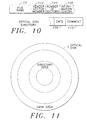
- the file directory information is recorded on the optical disk 5 starting from the inner part of the disk.
- the substance of the file (data, etc.) is stored in a direction going towards the outer edge or track, namely, a second direction of the disk.
- the mechanical movements that the optical head needs to make are reduced by storing the substance of the file in contiguous sectors.
- the directory has less data than the file and the speed of operation of the disk drive 4 is constant. There is thus a correlation between the directory information contained closer to the center of the disk 5 and occupying less space of the disk 5, and the file data closer to the outer perimeter and occupying more space of the disk. Thus, for the same degree of disk rotation, the appropriate directory and file data is obtained. Also, the spacing on the disk 5 allocated to directory data and file data is efficiently distributed and maximized. By having the directories use space in an outward direction and the file use space in an inward direction, effectively all the space on the disk 5 is used.
- FILE_3 and FILE_4 are stored on the optical disk.
- Each file namely, FILE_3 and FILE_4 consists of directory information and the substance of the file.
- the computer system 1 reads the directory information of all the files on the optical disk 5 and keeps this information in its internal memory.
- FILE_3 or FILE_4 only the substance of the file is accessed based on the directory information that was read into memory. This enables mechanical movements of the optical disk drive 4 to be reduced. It increases the speed and efficiency of disk access of subsequent files, for instance, from FILE_5 onwards, when large quantities of data have been stored on the optical disk 5.
- the directory information includes the file name, header sector number, size, date, and so forth.
- FILE_3 When data are read from the file, FILE_3, on the optical disk 5, a search is run on the directory information that has already been read in the memory of the computer system 1 to obtain directory information relating to FILE_3.
- a command is issued instructing the optical disk drive 4 to read out the data.
- the data thus read out are written to memory for processing operations, such as conversion, display, and storage on a magnetic disk of the external storage 2.
- FILE_4 can be accessed using the same procedure.
- each section namely format conversion, is configured totally or partially in software, firmware or hardware.
- optical disk storage formats are made the same.
- translation software A, B or C, or circuitry it is possible to configure an optical disk file system that can be used on any system. Widespread implementation of this translation software A, B or C or circuitry makes it possible for a person to use the same optical disk file system anywhere.
- the system of the invention permits for the efficient processing of voluminous data such as radiological medical information on transportable storage media such as small optical disks.
- the disks can be a write once, read many memory (WORM) disks or disks capable of multiple writings.
- WORM read many memory
- the disks can be capable of data storage on one or both sides.
- the invented system In the medical field of application, it is possible with the invented system for a patient to have individual storage of their medical records, and for this to be transported from one computer based processing center to another. In the radiological field, this should minimize the misplacing and loss of images from radiologic examinations and the like which is unfortunately becoming an increasing problem in most hospitals. As the optical disc can be readable irrespective of the operating system of various different computers, the invention markedly extends the ability and accessibility and usefulness of the stored information.
Landscapes
- Engineering & Computer Science (AREA)
- Databases & Information Systems (AREA)
- Theoretical Computer Science (AREA)
- Health & Medical Sciences (AREA)
- Nuclear Medicine, Radiotherapy & Molecular Imaging (AREA)
- General Health & Medical Sciences (AREA)
- General Engineering & Computer Science (AREA)
- Physics & Mathematics (AREA)
- Data Mining & Analysis (AREA)
- Radiology & Medical Imaging (AREA)
- Epidemiology (AREA)
- General Physics & Mathematics (AREA)
- Medical Informatics (AREA)
- Primary Health Care (AREA)
- Public Health (AREA)
- Information Retrieval, Db Structures And Fs Structures Therefor (AREA)
- Communication Control (AREA)
- Medical Treatment And Welfare Office Work (AREA)
Abstract
Description
| | 8 |
| Version # | |
| 2 char | |
| Protection code | 16 char (optional password) |
| | 32 |
| Initialization Date | |
| 11 char (dd-mmm-yyyy) | |
| Comment | 512 char |
| | 32 char |
| Address | long int |
| File Size | long int (specified in bytes) |
| | 11 char (dd-mmm-yyyy) |
| | 11 char (dd-mmm-yyyy) |
| File Type | int (0 = IMAGE, 1 = ASCII, 2 = PICT, etc) |
| | 32 char (for images only) |
Claims (26)
- An information processing system comprising a plurality of computer systems, each having its own operating system different from each other and including an information processor for processing data and directories in a specific format based on the specific operating system, wherein the information processing system is characterised in that:whereby the data and directories of the firstly accessed computer system are utilised in the subsequently accessed computer system irrespective of any difference in the operating systems of the different computer systems.common storage means is provided in common to the plurality of the computer systems for operatively storing therein and retrieving therefrom data and directories in an independent format which is designed for the common storage means independently of the respective formats based on the respective operating systems of the respective computer systems;format converters are provided to react with each of the computer systems for operatively converting data and directories in its own specific format into data and directories in the independent format, and vice versa;any one of the computer systems is caused to be firstly accessed to said common storage means so that data and directories in its specific format are converted by the format converter into data and directories in the independent format, and the thus converted data and directories are operatively stored in said common storage means by the format converter of the firstly accessed computer system; andany one of the computer systems is caused to be subsequently accessed to the common storage means, so that data and directories stored in the common storage means, in the independent format, are retrieved therefrom and converted by the format converter of the thus subsequently accessed computer system into data and directories in its specific format, based on its own specific operating system;
- An information processing system according to claim 1, wherein each computer system additionally includes a storage for operatively storing therein and retrieving therefrom data and directories in a specific format based on its operating system, wherein said data and directories are stored in and retrieved from the computer system's storage and are utilised in its information processor.
- An information processing system according to claim 2, wherein each format converter includes designation means for designating areas on the storage of the computer system, in which data and directories are stored in the specific format of the computer system, and areas on the common storage, in which data and directories are stored in the independent format, and whereby the format conversion of data and directories is based upon areas designated by said designation means.
- An information processing system according to claim 3, wherein each designation means includes dividing means for dividing a unit of data read in the specific format of the computer system from the storage of the computer system into a plurality of sector data to be stored in sector portions of the common storage means.
- An information processing system according to any one of claims 1 to 4, wherein the common storage means includes a portable information storage medium to which the different computer systems are accessible.
- An information processing system according to claim 5 wherein said portable information storage medium comprises an optical disk.
- A method of transporting information from a first computer system to a second computer system, the computer systems having different operating systems, wherein each computer system includes an information processor and a format converter, said method comprising:causing the first computer system to access an independent storage means, such that information data and directories which are utilised in the first computer system in a specific format based on its operating system are converted into data and directories in an independent format for the independent storage means, which is independent of the formats based on the operating systems of the different computer systems, and are written to the independent storage means through the format converter of the first computer system; andsubsequently causing the second computer to access the independent storage means such that the data and directories in the independent format are retrieved from the independent storage means are converted into data and directories in a specific format, based on the operating system of the second computer system, through the format converter of the second system, whereby the information data of the first computer system can be read by the second computer system irrespective of any difference in the operating systems.
- A method according to claim 7, comprising:combining data in the first computer system with directories in a first specific format based on the first specific operating system associated with the first computer system by the first format converter of the first computer system so that directories in the first format are generated;storing the combined data and directories in the first format in a first storage of the first computer system;converting the data to be transferred in the first format into an independent format which is independent of the formats based on the operating systems of the different computer systems by the first format converter;storing the data and directories in the independent format in the independent storage means through the first format converter;retrieving the data and directories in the independent format from said independent storage means through the second format converter of the second computer system;converting the retrieved data and directories into data and directories in a second specific format based in a second specific operating system of the second computer system by the second format converter;separating the data to be transferred from the directories in the independent format through the second format converter, and after conversion to data and directories in the second format, storing the converted information in a second storage, thereby to make the data of the first computer system utilisable in the second computer system irrespective of the difference in operating systems.
- A method according to claim 7 or claim 8, wherein the data and directories stored in the independent format contain file names.
- A method according to any one of claims 7 to 9, wherein said first and second storage are magnetic storage disks.
- A method according to claim 10, wherein the data and directories in the first format are stored in the magnetic disk non-consecutively.
- A method according to any one of claims 7-11, wherein said independent storage means is an optical disk, the optical disk being selectively portable between the first computer system and the second computer system.
- A method according to claim 12, wherein the data are stored sequentially in the optical disk in sector length units starting from an outer track inwardly, and the directories are sotred sequentially in the optical disk starting from an inner track outwardly.
- A method according to claim 12, wherein the data and directories are each stored, respectively, in a continuous form in one area of the optical disk.
- A method according to any one of claims 7-12, wherein the data are stored sequentially in the independent storage means starting from a first location toward a second location and the directories are stored sequentially in the independent storage means starting from the second location towards the first location.
- A method according to any one of claims 7-15, wherein the first and second computer systems are selected from PC/AT™, Macintosh™, and Sun™ systems.
- A method according to any one of claims 7-16, wherein the information data are medical data.
- An information processing system as claimed in claim 1, wherein said common storage means is characterised by being compatibly operable with the different information processing systems so to transport the data and directories from one information processing system to another in the independent format, irrespective of any difference in operating systems.
- An information processing system as claimed in claim 18, wherein the common storage means comprises a disk storage medium.
- An information processing system as claimed in claim 19, wherein the data to be stored in the optical disk are divided in accordance with an optical disk sector program.
- An information processing system as claimed in claim 19 or claim 20, wherein the directories in the independent format are stored sequentially on the disk starting from an inner track outwardly and the data in the independent format are stored sequentially on the disk starting from an outer track inwardly.
- An information processing system as claimed in claim 19 or claim 20, wherein the data are stored sequentially in the optical disk starting from a first track and the directories are stored sequentially in the optical disk starting from a second track in opposite directions towards each other.
- An information processing system as claimed in claim 19 or claim 20, wherein the data and directories are each stored, respectively, in a continuous form in one area of the disk storage medium.
- An information processing system as claimed in any one of claims 19-23, wherein said disk is an optical disk.
- An information processing system as claimed in claim 24, wherein each information processing system has its own optical disk drive capable of reading and writing said optical disk.
- An information processing system as claimed in claim 24, wherein the information processing systems share a common optical disk drive capable of reading and writing said optical disk that is compatibly operable with all said information processing systems.
Applications Claiming Priority (2)
| Application Number | Priority Date | Filing Date | Title |
|---|---|---|---|
| US40114689A | 1989-08-31 | 1989-08-31 | |
| US401146 | 1999-09-22 |
Publications (3)
| Publication Number | Publication Date |
|---|---|
| EP0415786A2 EP0415786A2 (en) | 1991-03-06 |
| EP0415786A3 EP0415786A3 (en) | 1993-04-21 |
| EP0415786B1 true EP0415786B1 (en) | 1999-01-20 |
Family
ID=23586507
Family Applications (1)
| Application Number | Title | Priority Date | Filing Date |
|---|---|---|---|
| EP90309556A Expired - Lifetime EP0415786B1 (en) | 1989-08-31 | 1990-08-31 | Information storage and processing |
Country Status (5)
| Country | Link |
|---|---|
| US (2) | US5410676A (en) |
| EP (1) | EP0415786B1 (en) |
| JP (1) | JPH03149614A (en) |
| AT (1) | ATE176065T1 (en) |
| DE (1) | DE69032904T2 (en) |
Families Citing this family (48)
| Publication number | Priority date | Publication date | Assignee | Title |
|---|---|---|---|---|
| US5953513A (en) * | 1992-07-09 | 1999-09-14 | Hitachi, Ltd. | Recording and reproducing device for recording and reproducing information from different kinds of storage media having different sector formats |
| GB2270791B (en) * | 1992-09-21 | 1996-07-17 | Grass Valley Group | Disk-based digital video recorder |
| DE69431777T2 (en) * | 1993-07-16 | 2003-04-10 | Fujitsu Ltd | Recording medium, method of controlling it, and system using electronic publications |
| JP3433978B2 (en) * | 1993-07-30 | 2003-08-04 | 富士通株式会社 | Input/Output Control Unit |
| US5640549A (en) * | 1993-08-04 | 1997-06-17 | Powsner; Seth M. | Method and apparatus for graphical modeling of psychiatric and medical records |
| JP2883791B2 (en) * | 1993-08-26 | 1999-04-19 | 富士通株式会社 | Storage medium and control method thereof |
| JPH0765540A (en) * | 1993-08-27 | 1995-03-10 | Olympus Optical Co Ltd | Apparatus for controlling data of optical card |
| DE69318038T2 (en) | 1993-10-29 | 1998-10-29 | Toshiba Kawasaki Kk | RECORDING MEDIUM THAT CAN PROCESS DIFFERENT LANGUAGES AND PLAYBACK DEVICE |
| EP0674316B1 (en) * | 1994-03-19 | 2006-05-31 | Sony Corporation | Optical disk and method and apparatus for recording and then playing information back from that disk |
| EP0684565A1 (en) * | 1994-05-27 | 1995-11-29 | Eastman Kodak Company | Medical image archiving of lossy and lossless images on a recordable CD |
| US5724582A (en) * | 1994-05-27 | 1998-03-03 | Eastman Kodak Company | Medical image archiving with lossy images on two or more recordable CDs |
| EP0702309A1 (en) * | 1994-06-24 | 1996-03-20 | Aarhuus Stiftsbogtrykkerie S.M.B.A. | A computerized image displaying system, a data carrying medium for use in a computerized displaying system, and a method of displaying images |
| US5778142A (en) * | 1994-11-24 | 1998-07-07 | Kabushiki Kaisha Toshiba | Large capacity recording medium, method and apparatus for reproducing data from a large-capacity recording medium, and method and apparatus for recording data on a large-capacity recording medium |
| CA2168327C (en) * | 1995-01-30 | 2000-04-11 | Shinichi Kikuchi | A recording medium on which a data containing navigation data is recorded, a method and apparatus for reproducing a data according to navigationdata, a method and apparatus for recording a data containing navigation data on a recording medium. |
| DE69618684T2 (en) * | 1995-02-16 | 2002-10-10 | Kabushiki Kaisha Toshiba, Kawasaki | Output control system for switchable gate channels |
| US6009234A (en) * | 1995-04-14 | 1999-12-28 | Kabushiki Kaisha Toshiba | Method of reproducing information |
| CA2173929C (en) * | 1995-04-14 | 2001-04-03 | Kazuhiko Taira | Method, apparatus and recording medium for reproducing information |
| US5721878A (en) * | 1995-06-07 | 1998-02-24 | International Business Machines Corporation | Multimedia control system and method for controlling multimedia program presentation |
| US5721815A (en) * | 1995-06-07 | 1998-02-24 | International Business Machines Corporation | Media-on-demand communication system and method employing direct access storage device |
| US5930493A (en) * | 1995-06-07 | 1999-07-27 | International Business Machines Corporation | Multimedia server system and method for communicating multimedia information |
| JP3184763B2 (en) | 1995-06-07 | 2001-07-09 | インターナショナル・ビジネス・マシーンズ・コーポレ−ション | Multimedia direct access storage device and format method |
| US6069706A (en) * | 1995-07-31 | 2000-05-30 | Canon Kabushiki Kaisha | Image reading device and image processing method utilizing the same |
| JP3421897B2 (en) | 1996-03-29 | 2003-06-30 | ソニー株式会社 | Data recording and / or reproducing apparatus and method |
| US5907679A (en) * | 1996-08-19 | 1999-05-25 | Visiontek | Hard drive upgrade system |
| US5991542A (en) * | 1996-09-13 | 1999-11-23 | Apple Computer, Inc. | Storage volume handling system which utilizes disk images |
| DE19643204A1 (en) * | 1996-10-19 | 1998-04-23 | Philips Patentverwaltung | Electronic device |
| US6349373B2 (en) | 1998-02-20 | 2002-02-19 | Eastman Kodak Company | Digital image management system having method for managing images according to image groups |
| ATE210854T1 (en) * | 1999-04-10 | 2001-12-15 | Basis Gmbh Edv Vertriebs Ges | DATA CARRIER WITH RECOVERABLE BASE DATA BASE AND METHOD FOR PRODUCING SAME |
| JP4057201B2 (en) * | 1999-09-16 | 2008-03-05 | 富士通株式会社 | High-speed data exchange method between different computers and extent extraction / conversion program recording medium |
| US20020046061A1 (en) | 2000-02-11 | 2002-04-18 | Wright Kenneth L. | Personal information system |
| US7302164B2 (en) | 2000-02-11 | 2007-11-27 | Datcard Systems, Inc. | System and method for producing medical image data onto portable digital recording media |
| US6601056B1 (en) * | 2000-09-28 | 2003-07-29 | Microsoft Corporation | Method and apparatus for automatic format conversion on removable digital media |
| JP2002236682A (en) * | 2001-02-13 | 2002-08-23 | Fuji Photo Film Co Ltd | Database system |
| US20050043827A1 (en) * | 2003-07-16 | 2005-02-24 | St. Clair Hospital | System and method for storing and accessing medical data |
| KR20070005599A (en) * | 2004-01-21 | 2007-01-10 | 오리엔토 솟키 콤퓨타 가부시키가이샤 | Recording medium recording data cleaning processing program |
| KR100647314B1 (en) * | 2005-01-31 | 2006-11-23 | 삼성전자주식회사 | Alignment system for nanoimprint lithography and imprint lithography method using the same |
| US20060199673A1 (en) * | 2005-03-07 | 2006-09-07 | Littlejohn Michael G | Pitcher's training device |
| US7933472B1 (en) | 2006-04-26 | 2011-04-26 | Datcard Systems, Inc. | System for remotely generating and distributing DICOM-compliant media volumes |
| US20080006282A1 (en) * | 2006-05-04 | 2008-01-10 | Predrag Sukovic | Medical imaging exchange network |
| US8386116B2 (en) * | 2006-10-26 | 2013-02-26 | Service Solutions U.S., Llc | Universal serial bus memory device for use in a vehicle diagnostic device |
| US8756437B2 (en) * | 2008-08-22 | 2014-06-17 | Datcard Systems, Inc. | System and method of encryption for DICOM volumes |
| US8788519B2 (en) | 2008-10-24 | 2014-07-22 | John C. Canessa | System and methods for metadata management in content addressable storage |
| KR101339429B1 (en) | 2009-11-03 | 2013-12-12 | 도시바삼성스토리지테크놀러지코리아 주식회사 | Optical disc drive and driving method thereof |
| US9235351B2 (en) * | 2009-06-26 | 2016-01-12 | Toshiba Samsung Storage Technology Korea Corporation | Selective interfacing apparatus and method |
| WO2011133917A2 (en) | 2010-04-23 | 2011-10-27 | Datcard Systems, Inc. | Event notification in interconnected content-addressable storage systems |
| WO2012078898A2 (en) | 2010-12-10 | 2012-06-14 | Datcard Systems, Inc. | Secure portable medical information access systems and methods related thereto |
| KR101151684B1 (en) * | 2010-12-17 | 2012-06-14 | 주식회사 히타치엘지 데이터 스토리지 코리아 | Method for converting data in optical disc drive |
| CN102687149B (en) * | 2012-02-13 | 2014-03-12 | 华为技术有限公司 | Media storage system and method |
Family Cites Families (25)
| Publication number | Priority date | Publication date | Assignee | Title |
|---|---|---|---|---|
| US3886325A (en) * | 1973-04-18 | 1975-05-27 | Ibm | Formatting for record-controlled machines |
| US4141005A (en) * | 1976-11-11 | 1979-02-20 | International Business Machines Corporation | Data format converting apparatus for use in a digital data processor |
| US4281315A (en) * | 1979-08-27 | 1981-07-28 | Bell Telephone Laboratories, Incorporated | Collection of messages from data terminals using different protocols and formats |
| US4433377A (en) * | 1981-06-29 | 1984-02-21 | Eustis Mary S | Data processing with format varying |
| US4419750A (en) * | 1981-07-13 | 1983-12-06 | Eastman Kodak Company | Constant track width optical disk recording |
| US4485439A (en) * | 1982-07-27 | 1984-11-27 | S.A. Analis | Standard hardware-software interface for connecting any instrument which provides a digital output stream with any digital host computer |
| US4559614A (en) * | 1983-07-05 | 1985-12-17 | International Business Machines Corporation | Interactive code format transform for communicating data between incompatible information processing systems |
| JPS6047564A (en) * | 1983-08-26 | 1985-03-14 | Toshiba Corp | Storing and retrieving device for image information |
| JPS6074020A (en) * | 1983-09-30 | 1985-04-26 | Toshiba Corp | Storage device |
| US4833471A (en) * | 1984-03-26 | 1989-05-23 | Canon Kabushiki Kaisha | Data processing apparatus |
| US4575827A (en) * | 1984-05-18 | 1986-03-11 | International Business Machines Corporation | Self-archiving data recording |
| JPS6254329A (en) * | 1985-05-22 | 1987-03-10 | Hitachi Ltd | How to register and search data on file device |
| US4802152A (en) * | 1986-04-07 | 1989-01-31 | U.S. Philips Corporation | Compact disc drive apparatus having an interface for transferring data and commands to and from a host controller |
| US5034914A (en) * | 1986-05-15 | 1991-07-23 | Aquidneck Systems International, Inc. | Optical disk data storage method and apparatus with buffered interface |
| JP2556682B2 (en) * | 1986-07-03 | 1996-11-20 | パイオニア株式会社 | Optical disk device |
| US4791558A (en) * | 1987-02-13 | 1988-12-13 | International Business Machines Corporation | System and method for generating an object module in a first format and then converting the first format into a format which is loadable into a selected computer |
| US4827462A (en) * | 1987-03-26 | 1989-05-02 | International Business Machines Corporation | Modular data storage directories for large-capacity data storage units |
| JPS6419467A (en) * | 1987-07-15 | 1989-01-23 | Toshiba Corp | Medical image preserving and communicating system |
| US4896289A (en) * | 1987-07-29 | 1990-01-23 | Xitron, Inc. | Expansion interface board system for connecting several personal computers to an electronic typesetter connected to a host personal computer |
| US5040232A (en) * | 1987-09-07 | 1991-08-13 | Kabushiki Kaisha Toshiba | Information processing apparatus using a data format converter |
| US4866601A (en) * | 1987-09-24 | 1989-09-12 | Ncr Corporation | Digital data bus architecture for computer disk drive controller |
| US4956806A (en) * | 1988-07-12 | 1990-09-11 | International Business Machines Corporation | Method and apparatus for editing source files of differing data formats using an edit tracking file |
| US5070474A (en) * | 1988-07-26 | 1991-12-03 | Disk Emulation Systems, Inc. | Disk emulation system |
| US5053945A (en) * | 1988-10-06 | 1991-10-01 | Alphatronix | System and method for performing a multi-file transfer operation |
| EP0372703A3 (en) * | 1988-10-28 | 1992-01-22 | Hitachi Maxell Ltd. | Information management system and medium used with the same system |
-
1990
- 1990-08-30 JP JP2229514A patent/JPH03149614A/en active Pending
- 1990-08-31 EP EP90309556A patent/EP0415786B1/en not_active Expired - Lifetime
- 1990-08-31 AT AT90309556T patent/ATE176065T1/en not_active IP Right Cessation
- 1990-08-31 DE DE69032904T patent/DE69032904T2/en not_active Expired - Fee Related
-
1992
- 1992-10-27 US US07/967,558 patent/US5410676A/en not_active Expired - Lifetime
-
1994
- 1994-03-14 US US08/212,066 patent/US5471606A/en not_active Expired - Lifetime
Also Published As
| Publication number | Publication date |
|---|---|
| US5410676A (en) | 1995-04-25 |
| EP0415786A3 (en) | 1993-04-21 |
| DE69032904T2 (en) | 1999-06-02 |
| ATE176065T1 (en) | 1999-02-15 |
| EP0415786A2 (en) | 1991-03-06 |
| DE69032904D1 (en) | 1999-03-04 |
| JPH03149614A (en) | 1991-06-26 |
| US5471606A (en) | 1995-11-28 |
Similar Documents
| Publication | Publication Date | Title |
|---|---|---|
| US5410676A (en) | Information system using designating areas for retrieving/converting data and directories of different formats storing in optical and magnetic storage | |
| Dwyer 3rd et al. | The cost of managing digital diagnostic images. | |
| US5724582A (en) | Medical image archiving with lossy images on two or more recordable CDs | |
| US6675276B2 (en) | Method for providing extensible dos-fat system structures on one-time programmable media | |
| US7277903B2 (en) | Method and apparatus for distributed data archiving | |
| US5359512A (en) | Picture archiving communication system with migration processing file management for medical application | |
| JPS6176144A (en) | Medical image file apparatus | |
| US6675271B1 (en) | PACS archive techniques | |
| JPS636667A (en) | Picture filing device | |
| JP2603144B2 (en) | Image filing equipment | |
| JPH07327196A (en) | Irreversible/reversible compressed medical picture storage device based on writable cd | |
| US5608905A (en) | DOS and Macintosh preformatted computer storage media | |
| JPS62121576A (en) | Data base system | |
| Mankovich et al. | A general purpose optical disk system with a radiological imaging application | |
| Dwyer III et al. | A study of archiving requirements for a radiology department | |
| Bulatek et al. | Working PACS prototype | |
| Smith et al. | Data-base management system on a CT scanner computer: application to teaching file and procedure records | |
| Behlen et al. | Long-term strategies for PACS archive design | |
| EP0372703A2 (en) | Information management system and medium used with the same system | |
| JPH03174661A (en) | Medical picture controller | |
| Stahl et al. | Customized medical image databases: a low-cost approach | |
| Strickland et al. | A radiological education system—organization of an image library | |
| JP2876123B2 (en) | Method of using digital audio tape for recording and reproducing personal medical diagnostic information | |
| JPS636666A (en) | Medical picture retrieving device | |
| JPH04130582A (en) | Medical image filing method |
Legal Events
| Date | Code | Title | Description |
|---|---|---|---|
| PUAI | Public reference made under article 153(3) epc to a published international application that has entered the european phase |
Free format text: ORIGINAL CODE: 0009012 |
|
| AK | Designated contracting states |
Kind code of ref document: A2 Designated state(s): AT BE CH DE DK ES FR GB GR IT LI LU NL SE |
|
| PUAL | Search report despatched |
Free format text: ORIGINAL CODE: 0009013 |
|
| AK | Designated contracting states |
Kind code of ref document: A3 Designated state(s): AT BE CH DE DK ES FR GB GR IT LI LU NL SE |
|
| 17P | Request for examination filed |
Effective date: 19930928 |
|
| 17Q | First examination report despatched |
Effective date: 19960112 |
|
| GRAG | Despatch of communication of intention to grant |
Free format text: ORIGINAL CODE: EPIDOS AGRA |
|
| GRAG | Despatch of communication of intention to grant |
Free format text: ORIGINAL CODE: EPIDOS AGRA |
|
| GRAH | Despatch of communication of intention to grant a patent |
Free format text: ORIGINAL CODE: EPIDOS IGRA |
|
| GRAH | Despatch of communication of intention to grant a patent |
Free format text: ORIGINAL CODE: EPIDOS IGRA |
|
| GRAA | (expected) grant |
Free format text: ORIGINAL CODE: 0009210 |
|
| AK | Designated contracting states |
Kind code of ref document: B1 Designated state(s): AT BE CH DE DK ES FR GB GR IT LI LU NL SE |
|
| PG25 | Lapsed in a contracting state [announced via postgrant information from national office to epo] |
Ref country code: GR Free format text: LAPSE BECAUSE OF NON-PAYMENT OF DUE FEES Effective date: 19990120 Ref country code: LI Free format text: LAPSE BECAUSE OF FAILURE TO SUBMIT A TRANSLATION OF THE DESCRIPTION OR TO PAY THE FEE WITHIN THE PRESCRIBED TIME-LIMIT Effective date: 19990120 Ref country code: FR Free format text: LAPSE BECAUSE OF FAILURE TO SUBMIT A TRANSLATION OF THE DESCRIPTION OR TO PAY THE FEE WITHIN THE PRESCRIBED TIME-LIMIT Effective date: 19990120 Ref country code: NL Free format text: LAPSE BECAUSE OF FAILURE TO SUBMIT A TRANSLATION OF THE DESCRIPTION OR TO PAY THE FEE WITHIN THE PRESCRIBED TIME-LIMIT Effective date: 19990120 Ref country code: ES Free format text: THE PATENT HAS BEEN ANNULLED BY A DECISION OF A NATIONAL AUTHORITY Effective date: 19990120 Ref country code: SE Free format text: THE PATENT HAS BEEN ANNULLED BY A DECISION OF A NATIONAL AUTHORITY Effective date: 19990120 Ref country code: BE Free format text: LAPSE BECAUSE OF FAILURE TO SUBMIT A TRANSLATION OF THE DESCRIPTION OR TO PAY THE FEE WITHIN THE PRESCRIBED TIME-LIMIT Effective date: 19990120 Ref country code: CH Free format text: LAPSE BECAUSE OF FAILURE TO SUBMIT A TRANSLATION OF THE DESCRIPTION OR TO PAY THE FEE WITHIN THE PRESCRIBED TIME-LIMIT Effective date: 19990120 Ref country code: AT Free format text: LAPSE BECAUSE OF FAILURE TO SUBMIT A TRANSLATION OF THE DESCRIPTION OR TO PAY THE FEE WITHIN THE PRESCRIBED TIME-LIMIT Effective date: 19990120 Ref country code: IT Free format text: LAPSE BECAUSE OF FAILURE TO SUBMIT A TRANSLATION OF THE DESCRIPTION OR TO PAY THE FEE WITHIN THE PRESCRIBED TIME-LIMIT;WARNING: LAPSES OF ITALIAN PATENTS WITH EFFECTIVE DATE BEFORE 2007 MAY HAVE OCCURRED AT ANY TIME BEFORE 2007. THE CORRECT EFFECTIVE DATE MAY BE DIFFERENT FROM THE ONE RECORDED. Effective date: 19990120 |
|
| REF | Corresponds to: |
Ref document number: 176065 Country of ref document: AT Date of ref document: 19990215 Kind code of ref document: T |
|
| REG | Reference to a national code |
Ref country code: CH Ref legal event code: EP |
|
| REF | Corresponds to: |
Ref document number: 69032904 Country of ref document: DE Date of ref document: 19990304 |
|
| PG25 | Lapsed in a contracting state [announced via postgrant information from national office to epo] |
Ref country code: DK Free format text: LAPSE BECAUSE OF FAILURE TO SUBMIT A TRANSLATION OF THE DESCRIPTION OR TO PAY THE FEE WITHIN THE PRESCRIBED TIME-LIMIT Effective date: 19990420 |
|
| PG25 | Lapsed in a contracting state [announced via postgrant information from national office to epo] |
Ref country code: DE Free format text: LAPSE BECAUSE OF FAILURE TO SUBMIT A TRANSLATION OF THE DESCRIPTION OR TO PAY THE FEE WITHIN THE PRESCRIBED TIME-LIMIT Effective date: 19990421 |
|
| EN | Fr: translation not filed | ||
| NLV1 | Nl: lapsed or annulled due to failure to fulfill the requirements of art. 29p and 29m of the patents act | ||
| REG | Reference to a national code |
Ref country code: CH Ref legal event code: PL |
|
| PGFP | Annual fee paid to national office [announced via postgrant information from national office to epo] |
Ref country code: GB Payment date: 19990803 Year of fee payment: 10 |
|
| PGFP | Annual fee paid to national office [announced via postgrant information from national office to epo] |
Ref country code: LU Payment date: 19990820 Year of fee payment: 10 |
|
| PLBE | No opposition filed within time limit |
Free format text: ORIGINAL CODE: 0009261 |
|
| STAA | Information on the status of an ep patent application or granted ep patent |
Free format text: STATUS: NO OPPOSITION FILED WITHIN TIME LIMIT |
|
| 26N | No opposition filed | ||
| PG25 | Lapsed in a contracting state [announced via postgrant information from national office to epo] |
Ref country code: GB Free format text: LAPSE BECAUSE OF NON-PAYMENT OF DUE FEES Effective date: 20000831 Ref country code: LU Free format text: LAPSE BECAUSE OF NON-PAYMENT OF DUE FEES Effective date: 20000831 |
|
| GBPC | Gb: european patent ceased through non-payment of renewal fee |
Effective date: 20000831 |
|
| PGFP | Annual fee paid to national office [announced via postgrant information from national office to epo] |
Ref country code: DE Payment date: 20071001 Year of fee payment: 18 |
|
| PG25 | Lapsed in a contracting state [announced via postgrant information from national office to epo] |
Ref country code: DE Free format text: LAPSE BECAUSE OF NON-PAYMENT OF DUE FEES Effective date: 20090303 |