EP0414493A2 - 2-(heterocyclylalkyl) phenyl carbapenem antibacterial agents - Google Patents

2-(heterocyclylalkyl) phenyl carbapenem antibacterial agents Download PDF

Info

Publication number
EP0414493A2
EP0414493A2 EP90309148A EP90309148A EP0414493A2 EP 0414493 A2 EP0414493 A2 EP 0414493A2 EP 90309148 A EP90309148 A EP 90309148A EP 90309148 A EP90309148 A EP 90309148A EP 0414493 A2 EP0414493 A2 EP 0414493A2
Authority
EP
European Patent Office
Prior art keywords
alkyl
radical
group
nitrogen
phenyl
Prior art date
Legal status (The legal status is an assumption and is not a legal conclusion. Google has not performed a legal analysis and makes no representation as to the accuracy of the status listed.)
Withdrawn
Application number
EP90309148A
Other languages
German (de)
French (fr)
Other versions
EP0414493A3 (en
Inventor
Frank P. Dininno
Thomas N. Salzmann
Current Assignee (The listed assignees may be inaccurate. Google has not performed a legal analysis and makes no representation or warranty as to the accuracy of the list.)
Merck and Co Inc
Original Assignee
Merck and Co Inc
Priority date (The priority date is an assumption and is not a legal conclusion. Google has not performed a legal analysis and makes no representation as to the accuracy of the date listed.)
Filing date
Publication date
Application filed by Merck and Co Inc filed Critical Merck and Co Inc
Publication of EP0414493A2 publication Critical patent/EP0414493A2/en
Publication of EP0414493A3 publication Critical patent/EP0414493A3/en
Withdrawn legal-status Critical Current

Links

Classifications

    • CCHEMISTRY; METALLURGY
    • C07ORGANIC CHEMISTRY
    • C07DHETEROCYCLIC COMPOUNDS
    • C07D477/00Heterocyclic compounds containing 1-azabicyclo [3.2.0] heptane ring systems, i.e. compounds containing a ring system of the formula:, e.g. carbapenicillins, thienamycins; Such ring systems being further condensed, e.g. 2,3-condensed with an oxygen-, nitrogen- or sulphur-containing hetero ring
    • C07D477/10Heterocyclic compounds containing 1-azabicyclo [3.2.0] heptane ring systems, i.e. compounds containing a ring system of the formula:, e.g. carbapenicillins, thienamycins; Such ring systems being further condensed, e.g. 2,3-condensed with an oxygen-, nitrogen- or sulphur-containing hetero ring with hydrogen atoms, hydrocarbon or substituted hydrocarbon radicals, directly attached in position 4, and with a carbon atom having three bonds to hetero atoms with at the most one bond to halogen, e.g. an ester or nitrile radical, directly attached in position 2
    • C07D477/12Heterocyclic compounds containing 1-azabicyclo [3.2.0] heptane ring systems, i.e. compounds containing a ring system of the formula:, e.g. carbapenicillins, thienamycins; Such ring systems being further condensed, e.g. 2,3-condensed with an oxygen-, nitrogen- or sulphur-containing hetero ring with hydrogen atoms, hydrocarbon or substituted hydrocarbon radicals, directly attached in position 4, and with a carbon atom having three bonds to hetero atoms with at the most one bond to halogen, e.g. an ester or nitrile radical, directly attached in position 2 with hydrogen atoms, hydrocarbon or substituted hydrocarbon radicals, attached in position 6
    • C07D477/14Heterocyclic compounds containing 1-azabicyclo [3.2.0] heptane ring systems, i.e. compounds containing a ring system of the formula:, e.g. carbapenicillins, thienamycins; Such ring systems being further condensed, e.g. 2,3-condensed with an oxygen-, nitrogen- or sulphur-containing hetero ring with hydrogen atoms, hydrocarbon or substituted hydrocarbon radicals, directly attached in position 4, and with a carbon atom having three bonds to hetero atoms with at the most one bond to halogen, e.g. an ester or nitrile radical, directly attached in position 2 with hydrogen atoms, hydrocarbon or substituted hydrocarbon radicals, attached in position 6 with hydrogen atoms, hydrocarbon or substituted hydrocarbon radicals, attached in position 3
    • AHUMAN NECESSITIES
    • A61MEDICAL OR VETERINARY SCIENCE; HYGIENE
    • A61PSPECIFIC THERAPEUTIC ACTIVITY OF CHEMICAL COMPOUNDS OR MEDICINAL PREPARATIONS
    • A61P31/00Antiinfectives, i.e. antibiotics, antiseptics, chemotherapeutics
    • A61P31/04Antibacterial agents

Definitions

  • the present invention relates to antibacterial agents of the carbapenem class, in which the 2-position sidechain is characterized by a phenyl moiety, optionally substituted, to which is attached, usually through an alkyl bridge, a nitrogen-containing heterocyclic group, with attachment being through the nitrogen atom, as described in more detail further below.
  • Thienamycin was an early carbapenem antibacterial agent having a broad spectrum; it has the following-formula:
  • the 2-(heterocyclylheteroaryliumalkyl)phenyl carbapenems of the present invention have an anti- bacterial potency equal to or greater than, in most cases, that of either thienamycin or N-formimidoyl thienamycin.
  • the compounds of the present invention are also more resistant than thienamycin or N-formimidoyl thienamycin to degradation by the dehydropeptidase enzyme DHP-I, thus permitting greater therapeutic application of the compounds.
  • carbapenem antibacterial agents which have a 2-substituent which is an aryl moiety optionally substituted by, e.g., aminomethyl and substituted aminomethyl. These agents are described in U.S. pat. Nos. 4,543,257 and 4,260,627 and have the formula:
  • the present invention provides novel carbapenem compounds of the formula: wherein:
  • alkyl means a straight or branched chain aliphatic hydrocarbon radical.
  • the term “pharmaceutically acceptable ester or salt” refers to those salt and ester forms of the compounds of the present invention which would be apparent to the pharmaceutical chemist, i.e., those which are non-toxic and which would favorably affect the pharmacokinetic properties of said compounds, their palatability, absorption, distribution, metabolism and excretion.
  • Other factors, more practical in nature, which are also important in the selection, are cost of raw materials, ease of crystallization, yield, stability, hygroscopicity, and flowability of the resulting bulk drug.
  • the salts would be cations such as benzathine, chloroprocaine, choline, diethanolamine, meglumine and procaine.
  • the metallic cations such as aluminum, calcium, lithium, magnesium and zinc are potential choices.
  • the alkali metal cations sodium and potassium are specifically defined.
  • the compounds of the present invention are potentially internal salts or zwitterions, since under physiological conditions the carboxyl group may be anionic, and this electronic charge will be balanced off internally against the cationic charge of the heteroarylium group. Where this is not the case, it is recognized that a counterion must be present. This counterion is selected from the group of suitable pharmaceutical anions, e.g., chloride, phosphate and tartrate.
  • R' or R 2 is H
  • the other is (R)-CH 3 CH(OH)- or (R)-CH 3 CH(F)-, and (R)-CH 3 CH(OH)- is most preferred.
  • the configuration at C-6 is ( S ), and that at C-5 is (R).).
  • a groups are -CH 2 -, -CH 2 CH 2 -, and -OCH 2 CH 2 -. Preferred is -CH 2 -.
  • R C groups are -CH 3 , -CH 2 CH 3 , -(CH 2 ) 3 CH 3 , -OCH 3 , -SCH 3 , -COOH, -NHCH 2 COOH, -OH, -CH 2 0H, -CH 2 COOH, -CH 2 CH 2 COOH, -CH 2 CONH 2 , -CH 2 CH 2 S + (CH 3 ) 2 , -CH 2 CH 2 SO 3 H, -CONH 2 , -S0 2 NH 2 , -SO 3 H, -NH 2 , -N(CH 3 ) 2 , -CON(CH 3 ) 2 , -NHCH 3 , -CH 2 NH 2 , -CN, -CH 2 CN, -CH 2 SCH 3 , -CH 2 SO 3 , -CH 2 SOCH 3 , -CH 2 SO 2 CH 3 , -SO 2 CH 3 , -SOCH 3 , -CH 2 0
  • the moiety a central feature of the compounds of the present invention, defines a nitrogen-containing heterocyclic structure joined to the 2-phenyl sidechain of the overall nucleus by a bridging element "A", which is directly attached to the nitrogen atom.
  • This nitrogen atom may be quaternary, in which case R d is other than absent.
  • the heterocyclic moiety is non-aromatic, i.e., there is no unsaturation anywhere in the heterocyclic ring.
  • the ring size may vary from 5-membered to 7-membered, depending upon the definitions of "m" and "n”.
  • a second heteroatom may be present, and is defined by the entity "Z”.
  • the second heteroatom may be O, S, or N, including oxygenated species of S, as well as substituted species of N, defined by R' and R".
  • This second nitrogen atom may be quaternary, but it is not desired to have both nitrogen atoms quaternary at the same time. Accordingly, the specification recites that where R d is not absent, i.e., where the first nitrogen atom (attached to "A") is quaternary, then the second nitrogen atom cannot be quaternary, i.e., Z cannot be N(R')(R").
  • the nitrogen-containing heterocyclic moiety is selected from: where R is a negative charge , or a pharmaceutically acceptable salt or ester.
  • carbapenem compounds of the present invention are useful per se and in their pharmaceutically acceptable salt and ester forms in the treatment of bacterial infections in animal and human subjects.
  • pharmaceutical compositions may be prepared from the active ingredients in combination with pharmaceutically acceptable carriers.
  • the present invention is also concerned with pharmaceutical compositions and methods of treating bacterial infections utilizing as an active ingredient the novel carbapenem compounds of the present invention.
  • the pharmaceutically acceptable salts referred to above include non-toxic acid addition salts.
  • the Formula I compounds can be used in the form of salts derived from inorganic or organic acids. Included among such salts are the following: acetate, adipate, alginate, aspartate, benzoate, benzenesulfonate, bisulfate, butyrate, citrate, camphorate, camphorsulfonate, cyclopentanepropionate, digluconate, dodecylsulfate, ethanesulfonate, fumarate, glucoheptanoate, glycerophosphate, hemisulfate, heptanoate, hexanoate, hydrochloride, hydrobromide, hydroiodide, 2-hydroxyethanesulfonate, lactate, maleate, methanesulfonate, 2-naphthalenesulfonate, nicotinate
  • the basic nitrogen-containing groups can be quaternized with such agents as lower alkyl halides, such as methyl, ethyl, propyl, and butyl chloride, bromides and iodides; dialkyl sulfates like dimethyl, diethyl, dibutyl; and diamyl sulfates, long chain halides such as decyl, lauryl, myristyl and stearyl chlorides, bromides and iodides, aralkyl halides like benzyl and phenethyl bromides and others. Water or oil-soluble or dispersible products are thereby obtained.
  • lower alkyl halides such as methyl, ethyl, propyl, and butyl chloride, bromides and iodides
  • dialkyl sulfates like dimethyl, diethyl, dibutyl
  • diamyl sulfates long chain halides
  • esters of the novel carbapenem compounds of the present invention are such as would be readily apparent to a medicinal chemist, and include, for example, those described in detail in U.S. Pat. No. 4,309,438, Column 9, line 61 to Column 12, line 51, which is incorporated herein by reference. Included within such pharmaceutically acceptable esters are those which are hydrolyzed under physiological conditions, such as pivaloyloxymethyl, acetoxymethyl, phthalidyl, indanyl and methoxymethyl, and those described in detail in U.S. Pat. No. 4,479,947, which is incorporated herein by reference.
  • the compounds of the present invention are valuable antibacterial agents active against various Gram- positive and Gram-negative bacteria and accordingly find utility in human and veterinary medicine.
  • Representative pathogens which are sensitive to the antibacterial agents of the present invention include various species or strains of the following: Staphylococcus , Enterococcus , Escherichia coli , Klebsiella , Enterobacter , Bacillus , Salmonella , Pseudomonas , Serratia , Proteus , and Bacterium .
  • the antibacterials of the invention are not limited to utility as medicaments; they may be used in all manner of industry, for example: additives to animal feed, preservation of food, disinfectants, and in other industrial systems where control of bacterial growth is desired.
  • compositions may be employed in aqueous compositions in concentrations ranging from 0.1 to 100 parts of antibiotic per million parts of solution in order to destroy or inhibit the growth of harmful bacteria on medical and dental equipment and as bactericides in industrial applications, for example in waterbased paints and in the white water of paper mills to inhibit the growth of harmful bacteria.
  • the compounds of this invention may be used in any of a variety of pharmaceutical preparations. They may be employed in capsule, powder form, in liquid solution, or in suspension. They may be administered by a variety of means; those of principal interest include: topically or parenterally by injection (intravenously or intramuscularly).
  • compositions for injection may be prepared in unit dosage form in ampules, or in multidose containers.
  • the compositions may take such forms as suspensions, solutions, or emulsions in oily or aqueous vehicles, and may contain formulatory agents.
  • the active ingredient may be in powder form for reconstitution, at the time of delivery, with a suitable vehicle, such as sterile water.
  • Topical applications may be formulated in hydrophobic or hydrophilic bases as ointments, creams, lotions, paints, or powders.
  • a daily dosage consists of from about 5 to about 600 mg of active ingredient per kg of body weight of the subject in one or more treatments per day.
  • a preferred daily dosage for adult humans lies in the range of from about 10 to 240 mg of active ingredient per kg of body weight.
  • Another factor influencing the precise dosage regimen, apart from the nature of the infection and peculiar identity of the individual being treated, is the molecular weight of the chosen species of this invention.
  • compositions for human delivery per unit dosage may contain from 0.1% to 99% of active material, the preferred range being from about 10-60%.
  • the composition will generally contain from about 15 mg to about 1500 mg of the active ingredient; however, in general, it is preferable to employ a dosage amount in the range of from about 250 mg to 1000 mg.
  • the unit dosage is usually the pure compound I in sterile water solution or in the form of a soluble powder intended for solution.
  • the preferred method of administration of the Formula I antibacterial compounds is parenteral by i.v. infusion, i.v. bolus, or i.m. injection.
  • Preferred dosage is 250 mg to 1000 mg of the Formula I antibacterial given two (b.i.d.) three (t.i.d.) or four (q.i.d.) times per day. More specifically, for mild infections, and particularly urinary tract infections, a dose of 250 mg t.i.d. or q.i.d. is recommended. For moderate infections against highly susceptible gram positive and gram negative organisms, a dose of 500 mg t.i.d. or q.i.d. is recommended. For severe, life- threatening infections against organisms at the upper limits of sensitivity to the antibiotic, a dose of 1000 mg t.i.d. or q.i.d. is recommended.
  • a dose of 5-25 mg/kg of body weight given 2, 3, or 4 times per day is preferred; a dose of 10 mg/kg t.i.d. or q.i.d. is usually recommended.
  • Antibacterial compounds of Formula I are of the broad class known as carbapenems or 1-car- badethiapenems.
  • Naturally occurring carbapenems are susceptible to attack by a renal enzyme known as dehydropeptidase (DHP). This attack or degradation may reduce the efficacy of the carbapenem anti- bacterial agent.
  • DHP dehydropeptidase
  • the compounds of the present invention are significantly less subject to such attack, and therefore may not require use of a DHP inhibitor. However, such use is optional and contemplated to be a part of the present invention.
  • Inhibitors of DHP and their use with carbapenem antibacterial agents are disclosed in the prior art [see European Patent Applications No. 79102616.4 filed July 24, 1979 (Patent No. 0 010 573); 79102615.6, filed July 24, 1979 (Patent No. 0 007 614); and No. 82107174.3, filed August 9, 1982 (Publication No. 0 072 014)].
  • the compounds of the present invention may, where DHP inhibition is desired or necessary, be combined or used with the appropriate DHP inhibitor as described in the aforesaid patents and published application.
  • DHP inhibition is desired or necessary
  • suitable inhibitors, combination compositions and methods of treatment they are incorporated herein by reference.
  • a preferred weight ratio of Formula I compound:DHP inhibitor in the combination compositions is about 1:1.
  • a preferred DHP inhibitor is 7-(L-2-amino-2-carboxyethylthio)-2-(2,2-dimethylcyclopropanecarboxamide)-2-heptenoic acid or a useful salt thereof.
  • the 2-(heterocyclylalkyl)phenyl carbapenem compounds of the present invention may be prepared in accordance with well known procedures in the art. Particularly useful are the following synthetic schemes in which the symbols R, R', R 2 , R a , R b , and A are as defined above, and A. Heterocyclylalkylophenyl addition:
  • the bridging element "A" is already in place when the phenyl group becomes a part of the carbapenem compound at the time of cyclization.
  • the bridgeing element "A” is simply alkyl.
  • the bridging element terminates in a hydroxyl group which is then changed to an active leaving group, e.g., iodide.
  • Treatment with the desired heterocycle reactant directly provides the heterocyclylalkylphenyl sidechain. More particularly, three alternative procedures may be utilized for addition of the heterocyclyl group.
  • the step of activating the phenyl-A-OH groups may be carried out in accordance with well-known procedures, some of which are exemplified in the following equations.
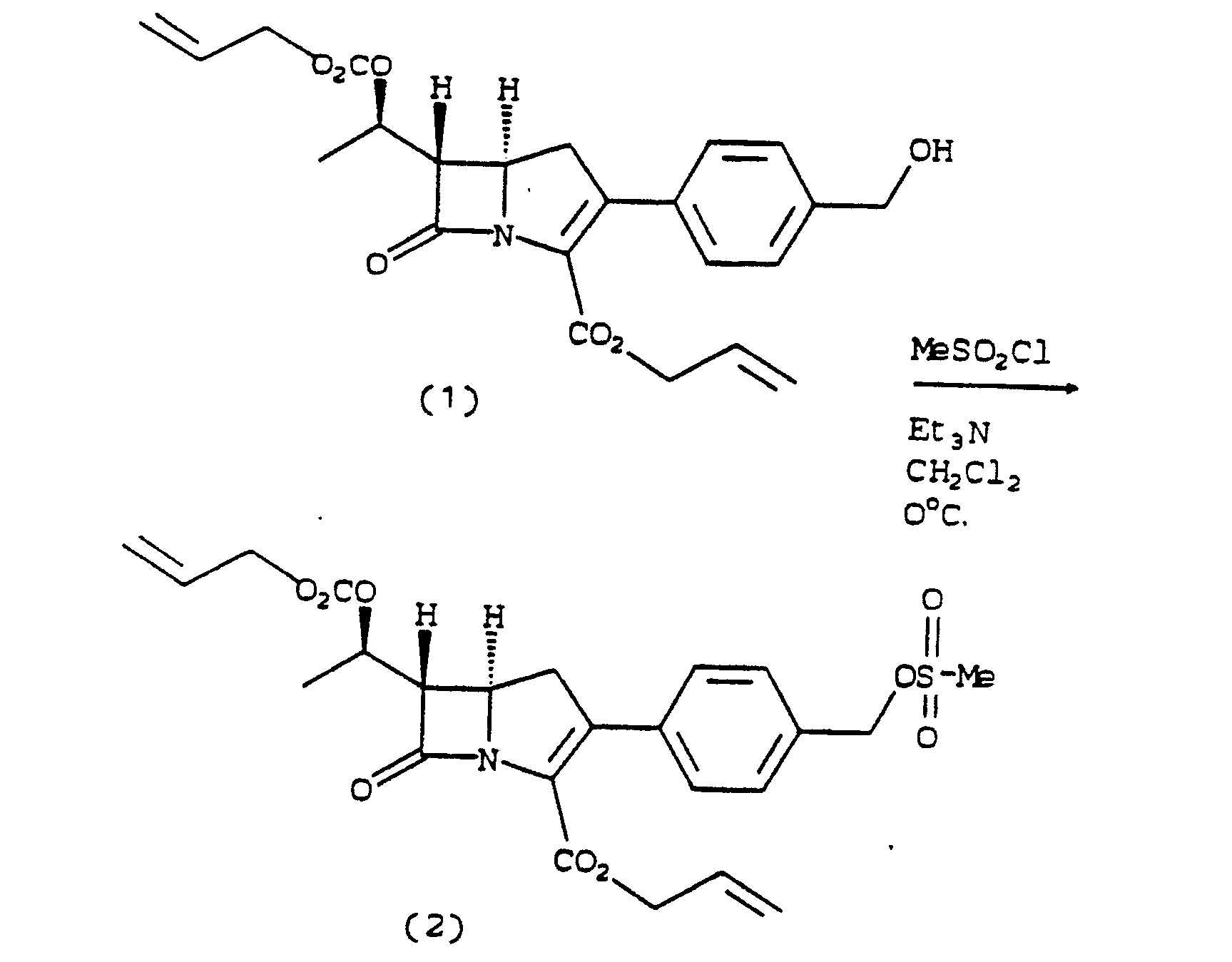
  • the hydroxyl group may be converted to a methanesulfonate group by treating with methanesulfonyl chloride in the presence of triethylamine.
  • a suitable solvent e.g., dichloromethane
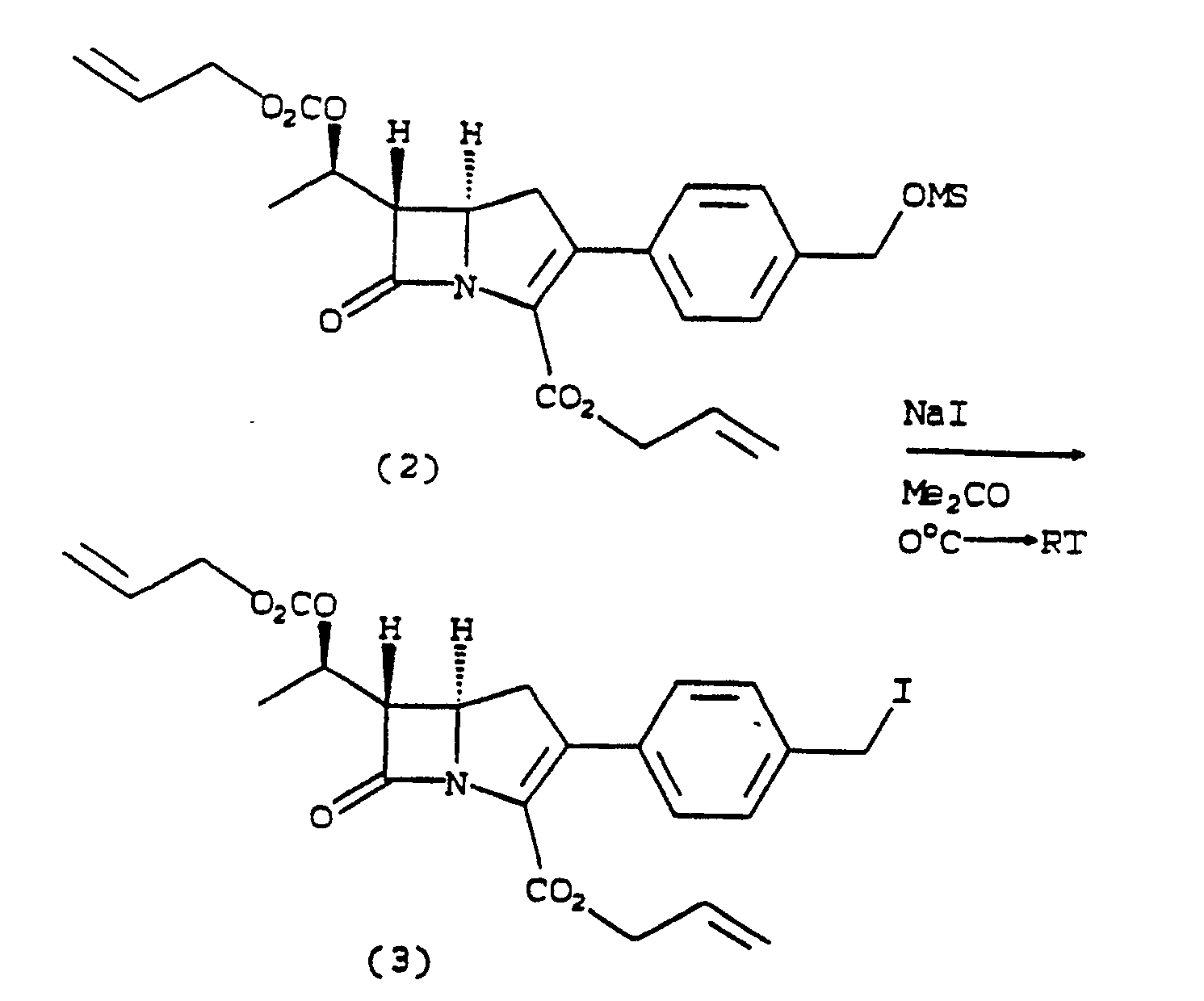
  • the methanesulfonate intermediate may be converted to the more reactive iodide derivative by treatment with sodium iodide in a suitable solvent, e.g., acetone, at reduced or ambient temperatures.
  • the hydroxyl group may be directly converted into the iodide group by common methods known in the art.
  • hydroxyl group For example, treatment of the hydroxyl group with methyl triphenoxyphosphonium iodide in a suitable solvent, such as dimethylformamide, at reduced or ambient temperatures, directly provides the desired iodide. Further, the hydroxyl group may be converted into the very reactive trifluoromethanesulfonate group.
  • a suitable solvent such as dimethylformamide
  • an activating group cannot be isolated by conventional techniques but may be formed and used in situ .
  • treatment of the hydroxyl group with trifluoromethanesulfonic acid anhydride in the presence of, usually, the reacting heterocyclyl base in a suitable solvent, such as dichloromethane, at reduced temperatures provides for the in situ generation of this activating group.
  • the trifluoromethanesulfonate group may be generated in situ from the iodide group by treatment with excess silver trifluoromethanesulfonate in a suitable solvent, e.g., acetonitrile, at reduced temperatures.
  • introduction of the heterocyclyl group can then proceed.
  • One of the following three procedures has been found suitable for such introduction.
  • heterocyclyl group has one or more substituents R° and R d
  • the most facile method of providing such a substituent is to employ as the reactant in the preparation methods described above a heterocyclyl compound which already has the desired substituent(s).
  • Such substituted heterocyclyl compounds are readily available starting materials or may be prepared in a straight-forward manner using known literature methods.
  • the carboxyl group at the 3-position remains blocked by a carboxyl covering group until the final product is prepared. Then, deblocking may be carried out in a conventional manner, with care being taken to avoid a procedure which is so harsh as to disrupt other portions of the final product molecule.
  • the R substituent is hydrogen, which is preferred.
  • R methyl
  • the analogous 6-(1-hydroxyethyl) and 6-(1-fluoroethyl)carbapenems of the present invention are prepared in the manner described herein utilizing the appropriately chosen synthons which are known in the art. See, for example, L. M. Fuentes, I. Shinkai, and T. N. Salzmann, JACS , 108, 4675 (1986); and BE-900-718-A (Sandoz) respectively.
  • reaction product was partitioned between dichloromethane and water, and the organic phase was separated, washed with water and dried over sodium sulfate, filtered and evaporated to give 104mg of foamy final product (7), a 93.1 % yield.
  • the product was purified using PLC, 2x2000 micron plates, eluting with dichloromethane (CH 2 CI 2 ) - ethyl acetate (4:1), to give 222.7mg of final product (9); a 98.8% yield.
  • the product was partitioned between ethyl acetate and water and the organic phase was separated, washed with saturated sodium chloride solution, dried over sodium sulfate, filtered and evaporated
  • the product was purified by PLC, 2x1000 micron plates, eluting with ethyl acetate tetrahydrofuran (3:1) to give 59.4mg of final product (11), a 62.5% yield.
  • the reaction mixture was stirred at room temperature under nitrogen for 4.5hrs.
  • the reaction mixture was then partitioned between dichloromethane and water while cold and the water layer was separated. The procedure was repeated and the water phases were combined, washed with ethyl acetate, and concentrated in vacuo .
  • the product was purified by reverse phase chromatography using 3x500 micron plates, eluting with 30% tetrahydrofuran in water. After extraction and lyophilization, the product was repurified using the above procedure, but eluting with 10% ethanol in water, to give 58.1 mg of final product (17), a 17.5% yield.
  • the reaction mixture was stirred at room temperature under nitrogen for about 3.5hrs, after which it was partitioned between dichloromethane and water in the cold.
  • the aqueous phase was separated and washed with water, and the combined aqueous extracts were filtered through a Gelmann filter and then concentrated.
  • the product was purified by reverse phase chromatography using 2x500 micron plates, eluting with 40% tetrahydrofuran in water, under cold conditions, followed by lyophilization to give 74.8mg of final product (18), a 39.9% yield.
  • the penultimate products of Examples 3- 9 may be deblocked in accordance with the procedures described in Examples 10 and 11 to give the final products set out in Table I below, which also includes three other compounds of the present invention prepared in accordance with the procedures described above.

Landscapes

  • Chemical & Material Sciences (AREA)
  • Organic Chemistry (AREA)
  • Health & Medical Sciences (AREA)
  • Communicable Diseases (AREA)
  • Oncology (AREA)
  • Chemical Kinetics & Catalysis (AREA)
  • General Chemical & Material Sciences (AREA)
  • Medicinal Chemistry (AREA)
  • Nuclear Medicine, Radiotherapy & Molecular Imaging (AREA)
  • Pharmacology & Pharmacy (AREA)
  • Life Sciences & Earth Sciences (AREA)
  • Animal Behavior & Ethology (AREA)
  • General Health & Medical Sciences (AREA)
  • Public Health (AREA)
  • Veterinary Medicine (AREA)
  • Pharmaceuticals Containing Other Organic And Inorganic Compounds (AREA)
  • Nitrogen Condensed Heterocyclic Rings (AREA)

Abstract

Carbapenems having the formula: are useful antibacterial agents.

Description

    BACKGROUND OF THE INVENTION
  • The present invention relates to antibacterial agents of the carbapenem class, in which the 2-position sidechain is characterized by a phenyl moiety, optionally substituted, to which is attached, usually through an alkyl bridge, a nitrogen-containing heterocyclic group, with attachment being through the nitrogen atom, as described in more detail further below.
  • Thienamycin was an early carbapenem antibacterial agent having a broad spectrum; it has the following-formula:
    Figure imgb0001
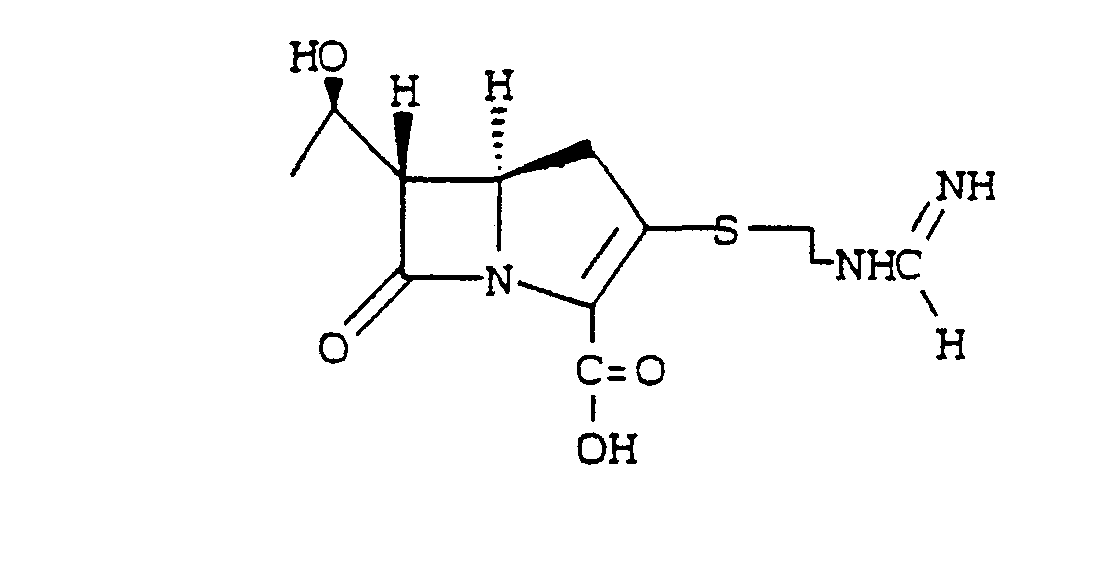
  • Later, N-formimidoyl thienamycin was discovered; it has the formula:
    Figure imgb0002
  • The 2-(heterocyclylheteroaryliumalkyl)phenyl carbapenems of the present invention have an anti- bacterial potency equal to or greater than, in most cases, that of either thienamycin or N-formimidoyl thienamycin. The compounds of the present invention are also more resistant than thienamycin or N-formimidoyl thienamycin to degradation by the dehydropeptidase enzyme DHP-I, thus permitting greater therapeutic application of the compounds.
  • More recently, carbapenem antibacterial agents have been described which have a 2-substituent which is an aryl moiety optionally substituted by, e.g., aminomethyl and substituted aminomethyl. These agents are described in U.S. pat. Nos. 4,543,257 and 4,260,627 and have the formula:
    Figure imgb0003
  • However, these compounds belong to a different class from those of the present invention and are distinguished by different physiological properties.
  • SUMMARY OF THE INVENTION
  • The present invention provides novel carbapenem compounds of the formula:
    Figure imgb0004
    wherein:
    • R is H or CH3;
    • R1 and R2 are independently H, CH3-, CH3CH2-, (CH3)2CH-, HOCH2-, CH3CH(OH)-, (CH3)2C(OH)-, FCH2CH(OH)-, F2CHCH(OH)-, F3CCH(OH)-, CH3CH(F)-, CH3CF2-, or (CH3)2C(F)-;
    • Ra, Rb, and R° are independently selected from the group consisting of
      • a) a trifluoromethyl group: -CF3;
      • b) a halogen atom: -Br, -Cl, -F, or -I;
      • c) C1-C4 alkoxy radical: -OC1-4 alkyl;
      • d) a hydroxy group: -OH;
      • e) (C1-C6 alkyl) carbonyloxy radical:
        Figure imgb0005
      • f) a carbamoyloxy radical which is unsubstituted or substituted on nitrogen with one or two C1-C4 alkyl groups:
        Figure imgb0006
        where Ry and Rz are independently H or C1 -4 alkyl;
      • g) a C1-C6 alkylthio radical, C1-C6 alkylsulfinyl radical or C1-C6 alkylsulfonyl radical:
        Figure imgb0007
        alkyl where n = 0-2, and the alxyl portion is optionally substituted by cyano; h) a sulfamoyl group which is unsubstituted or substituted on nitrogen by one or two C1-C4 alkyl groups:
        Figure imgb0008
        where RY and Rz are as defined above;
      • i) an amino group, or a mono (C1-C4 alkyl) amino or di(C1-C4 alkyl)amino group:
        Figure imgb0009
        where Ry and Rz are as defined above;
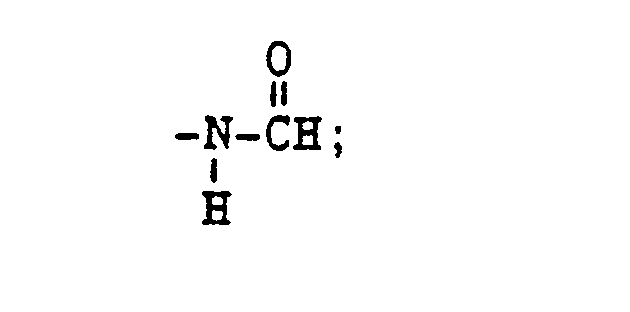
      • j) a formylamino group:
        Figure imgb0010
      • k) (C1-C6 alkyl)carbonylamino radical:
        Figure imgb0011
      • I) a (C1-C4 alkoxy) carbonylamino radical:
        Figure imgb0012
        alkyl;
      • m) a ureido group in which the terminal nitrogen is unsubstituted or substituted with one or two C1-C4 alkyl groups:
        Figure imgb0013
        where RY and Rz are as defined above;
      • n) a sulfonamido group:
        Figure imgb0014
      • o) a cyano group: -CN;
      • p) a formyl or acetalized formyl radical:
        Figure imgb0015
      • q) (C1-C6 alxyl)carbonyl radical wherein the carbonyl is free or acetalized:
        Figure imgb0016
      • r) phenylcarbonyl;
      • s) a hydroximinomethyl radical in which the oxygen or carbon atom is optionally substituted by a C1-C4 alkyl group:
        Figure imgb0017
        where RY and Rz are as defined above;
      • t) a (C1-C6 alkoxy)carbonyl radical:
        Figure imgb0018
      • u) a carbamoyl radical which is unsubstituted or substituted on nitrogen by one or two C1-C4 alkyl groups:
        Figure imgb0019
        where Ry and Rz are as defined above;
      • v) an N-hydroxycarbamoyl or N(C1-C4 alkoxy)carbamoyl radical in which the nitrogen atom may be additionally substituted by a C1-C4 alkyl group:
        Figure imgb0020
        where Ry and Rz are as defined above;
      • w) a thiocarbamoyl group:
        Figure imgb0021
        x) an amidino group
        Figure imgb0022
        where R5, R6 and R7 are independently hydrogen, C1-C4alkyl or wherein two of the alkyl groups together form a C2-C6alkylidene radical optionally interrupted by a heteroatom and joined together to form a ring; y) a carboxamidino group
        Figure imgb0023
        where R5, R6 and R7 are as defined above;
      • z) a guanidinyl group where R6 in a) above is NR8R9 and R8 and R8 are as defined for R5 through R7
      • above;
      • aa) hydrogen;
      • ab) C2-C6 alkenyl radical;
      • ac) an unsubstituted or substituted C2-C6 alkynyl radical;
      • ad) C3-C7 cycloalkyl radical;
      • ae) C3-C7 cycloalkyl methyl radical;
      • af) C5-C7 cycloalkenyl radical;
      • ag) phenyl, except that only RC may be phenyl;
      • ah) C1-C6 all radical;
      • ai) C1-C4 alkyl monosubstituted by one of the substituents a) - ag) above;
      • aj) an anionic function selected from the group consisting of:
      • phosphono [P=O(OMc)2]; alkylphosphono {P=0(OMc)-[O(C1-C4 alkyl)]}; alkylphosphinyl [P=0(OMc)-(C1-C4alkyl)]; phosphoramido [P=O(OMc)N(Ry)Rz and P=O(OMc)NHRx]; sulfino (SO2Mc); sulfo (SO3Mc); acylsulfonamides selected from the structures CONMcSO2Rx, CONMcSO2N(Ry)Rz, SO2NMcCON(Ry)Rz; and SO2NMcCN, where
      • Rx is phenyl or heteroaryl, where heteroaryl is as defined below except that there is no quaternary nitrogen and attachment through nitrogen is optional, and the phenyl and heteroaryl are optionally monosubstituted by Rq; M° is hydrogen or an alkali metal; RY and Rz are as defined above; where
      • Rq is a member selected from the group consisting of -OH; -OCH3-; -CN; -C(O)NH2; -OC(0)NH2; -OC(O)-N(CH3)2; -S02NH2; -SO2N(CH3)2; -SOCH3; -F; -CF3; tetrazolyl; and -COOMa, where Ma is hydrogen, alkali metal, methyl or phenyl;
      • Rd is C1-C4 alkyl, making the nitrogen atom of the N-heterocyclyl moiety to which it is attached quaternary; or it may be absent ;
      • A is para ( p ) or meta ( m ) with respect to the point of attachment of the phenyl ring to the carbapenem nucleus, and is (CH2)m-Q-(CH2)n, where m is 0 to 2 and n is 1 or 2; and Q is a covalent bond; O; S; SO; or S02;
      • Z is a member selected from the group consisting of CH2, O, S, SO, S02, N(R') and +N(R')(R"), where R' and R" are independently hydrogen, C1-C4 alkyl, or oxo; provided that where Rd is not absent, Z cannot be N(R')(R");
      • m is 2 or 3; n is 1 or 2; and Y is selected from:
        • i) COOH or a pharmaceutically acceptable ester thereof;
        • ii) COOM wherein M is an alkali metal or other pharmaceutically acceptable salt;
        • iii) COOM wherein M is a negative charge in the case where a permanent positive charge exists elsewhere in the molecule.
  • The overall molecule must be electronically balanced. Since a quaternary nitrogen may be present in the compounds of the present invention, a balancing anion must also be present. This is usually accomplished by having Y be COO-. However, where Y is, e.g., a pharmaceutically acceptable ester, a counterion (anion) Z- must be provided, or alternatively, an anionic substituent might be utilized. Further, it is within the scope of this invention to utilize an anionic substituent where the quaternary nitrogen is already balanced by Y=COO-. In that case, it will be understood that it is necessary to provide a counterion (cation) for the anionic substituent. However, it is well within the skill of a medicinal chemist, to whom there is available many suitable anionic and cationic counterions, to make such choices.
  • With reference to the above definitions, "alkyl" means a straight or branched chain aliphatic hydrocarbon radical.
  • Under the definition of "Y", the term "pharmaceutically acceptable ester or salt" refers to those salt and ester forms of the compounds of the present invention which would be apparent to the pharmaceutical chemist, i.e., those which are non-toxic and which would favorably affect the pharmacokinetic properties of said compounds, their palatability, absorption, distribution, metabolism and excretion. Other factors, more practical in nature, which are also important in the selection, are cost of raw materials, ease of crystallization, yield, stability, hygroscopicity, and flowability of the resulting bulk drug. Since the compounds of the present invention may be carboxylates, the salts would be cations such as benzathine, chloroprocaine, choline, diethanolamine, meglumine and procaine. The metallic cations such as aluminum, calcium, lithium, magnesium and zinc are potential choices. The alkali metal cations sodium and potassium are specifically defined. It will also be noted that the compounds of the present invention are potentially internal salts or zwitterions, since under physiological conditions the carboxyl group may be anionic, and this electronic charge will be balanced off internally against the cationic charge of the heteroarylium group. Where this is not the case, it is recognized that a counterion must be present. This counterion is selected from the group of suitable pharmaceutical anions, e.g., chloride, phosphate and tartrate.
  • It is preferred that when one of R' or R2 is H, the other is (R)-CH3CH(OH)- or (R)-CH3CH(F)-, and (R)-CH3CH(OH)- is most preferred. Further it is preferred that the configuration at C-6 is ( S ), and that at C-5 is (R).).
  • Representative A groups are -CH2-, -CH2CH2-, and -OCH2CH2-. Preferred is -CH2-.
  • Representative RC groups are -CH3, -CH2CH3, -(CH2)3CH3, -OCH3, -SCH3, -COOH, -NHCH2COOH, -OH, -CH20H, -CH2COOH, -CH2CH2COOH, -CH2CONH2, -CH2CH2S+(CH3)2, -CH2CH2SO3H, -CONH2, -S02NH2, -SO3H, -NH2, -N(CH3)2, -CON(CH3)2, -NHCH3, -CH2NH2, -CN, -CH2CN, -CH2SCH3, -CH2SO3, -CH2SOCH3, -CH2SO2CH3, -SO2CH3, -SOCH3, -CH20CH3,
    Figure imgb0024
    -CF3,
    Figure imgb0025
    -CH2S02NH2, -SCH2CH2CN, Br, Cl, F, -SCF3, -CH2SCF3, and -SCH2CF3. The moiety
    Figure imgb0026
    a central feature of the compounds of the present invention, defines a nitrogen-containing heterocyclic structure joined to the 2-phenyl sidechain of the overall nucleus by a bridging element "A", which is directly attached to the nitrogen atom. This nitrogen atom may be quaternary, in which case Rd is other than absent. The heterocyclic moiety is non-aromatic, i.e., there is no unsaturation anywhere in the heterocyclic ring. The ring size may vary from 5-membered to 7-membered, depending upon the definitions of "m" and "n". A second heteroatom may be present, and is defined by the entity "Z". Thus, the second heteroatom may be O, S, or N, including oxygenated species of S, as well as substituted species of N, defined by R' and R". This second nitrogen atom may be quaternary, but it is not desired to have both nitrogen atoms quaternary at the same time. Accordingly, the specification recites that where Rd is not absent, i.e., where the first nitrogen atom (attached to "A") is quaternary, then the second nitrogen atom cannot be quaternary, i.e., Z cannot be N(R')(R").
  • With regard to all of the preferred substituents described above, the following compounds are preferred embodiments of the present invention:
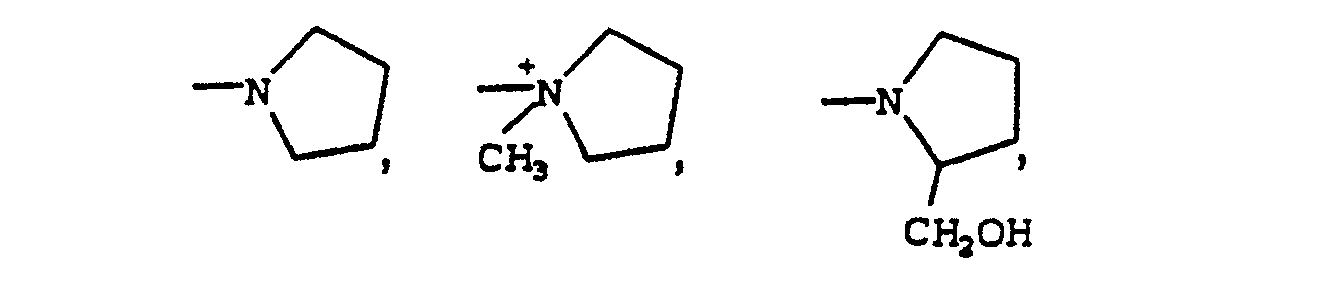
    Figure imgb0027
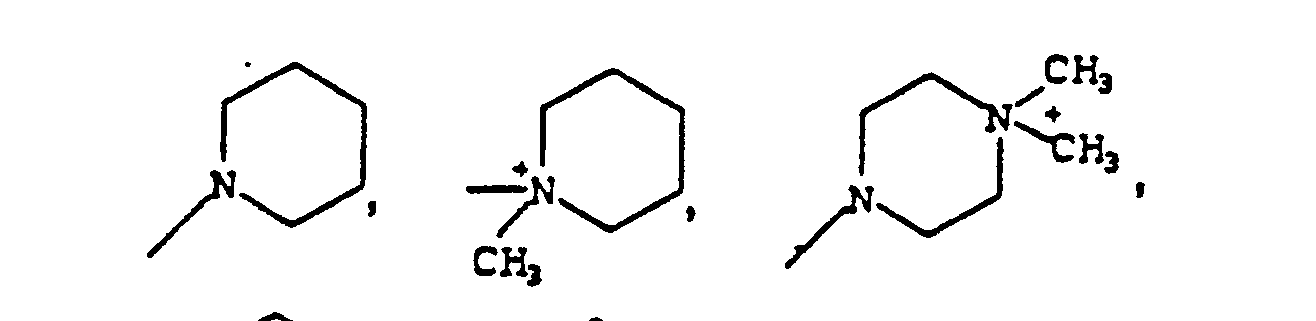
    where the nitrogen-containing heterocyclic moiety is selected from:
    Figure imgb0028
    Figure imgb0029
    Figure imgb0030
    Figure imgb0031
    where R is a negative charge , or a pharmaceutically acceptable salt or ester.
  • While R = H is usually preferred, there are instances in which R = CH3 may provide improved chemical stability, water solubility, or pharmacokinetic behavior. The substituent R = CH3 may be of either configuration, i.e., the a or a-stereoisomer.
  • For most of the compounds exemplified herein, the R substituent is hydrogen. This is the result not only of a more facile synthesis for such compounds, but also of a preference for R = hydrogen based on the superior antibacterial activity of such compounds.
  • The carbapenem compounds of the present invention are useful per se and in their pharmaceutically acceptable salt and ester forms in the treatment of bacterial infections in animal and human subjects. Conveniently, pharmaceutical compositions may be prepared from the active ingredients in combination with pharmaceutically acceptable carriers. Thus, the present invention is also concerned with pharmaceutical compositions and methods of treating bacterial infections utilizing as an active ingredient the novel carbapenem compounds of the present invention.
  • The pharmaceutically acceptable salts referred to above include non-toxic acid addition salts. In those cases where the Formula I compounds possess a basic functional group, they can be used in the form of salts derived from inorganic or organic acids. Included among such salts are the following: acetate, adipate, alginate, aspartate, benzoate, benzenesulfonate, bisulfate, butyrate, citrate, camphorate, camphorsulfonate, cyclopentanepropionate, digluconate, dodecylsulfate, ethanesulfonate, fumarate, glucoheptanoate, glycerophosphate, hemisulfate, heptanoate, hexanoate, hydrochloride, hydrobromide, hydroiodide, 2-hydroxyethanesulfonate, lactate, maleate, methanesulfonate, 2-naphthalenesulfonate, nicotinate, oxalate, pamoate, pectinate, persulfate, 3-phenylpropionate, picrate, pivalate, propionate, succinate, tartrate, thiocyanate, tosylate, and undecanoate. Also, the basic nitrogen-containing groups can be quaternized with such agents as lower alkyl halides, such as methyl, ethyl, propyl, and butyl chloride, bromides and iodides; dialkyl sulfates like dimethyl, diethyl, dibutyl; and diamyl sulfates, long chain halides such as decyl, lauryl, myristyl and stearyl chlorides, bromides and iodides, aralkyl halides like benzyl and phenethyl bromides and others. Water or oil-soluble or dispersible products are thereby obtained.
  • The pharmaceutically acceptable esters of the novel carbapenem compounds of the present invention are such as would be readily apparent to a medicinal chemist, and include, for example, those described in detail in U.S. Pat. No. 4,309,438, Column 9, line 61 to Column 12, line 51, which is incorporated herein by reference. Included within such pharmaceutically acceptable esters are those which are hydrolyzed under physiological conditions, such as pivaloyloxymethyl, acetoxymethyl, phthalidyl, indanyl and methoxymethyl, and those described in detail in U.S. Pat. No. 4,479,947, which is incorporated herein by reference.
  • The compounds of the present invention are valuable antibacterial agents active against various Gram- positive and Gram-negative bacteria and accordingly find utility in human and veterinary medicine. Representative pathogens which are sensitive to the antibacterial agents of the present invention include various species or strains of the following: Staphylococcus , Enterococcus , Escherichia coli , Klebsiella , Enterobacter , Bacillus , Salmonella , Pseudomonas , Serratia , Proteus , and Bacterium . The antibacterials of the invention are not limited to utility as medicaments; they may be used in all manner of industry, for example: additives to animal feed, preservation of food, disinfectants, and in other industrial systems where control of bacterial growth is desired. For example, they may be employed in aqueous compositions in concentrations ranging from 0.1 to 100 parts of antibiotic per million parts of solution in order to destroy or inhibit the growth of harmful bacteria on medical and dental equipment and as bactericides in industrial applications, for example in waterbased paints and in the white water of paper mills to inhibit the growth of harmful bacteria.
  • The compounds of this invention may be used in any of a variety of pharmaceutical preparations. They may be employed in capsule, powder form, in liquid solution, or in suspension. They may be administered by a variety of means; those of principal interest include: topically or parenterally by injection (intravenously or intramuscularly).
  • Compositions for injection, a preferred route of delivery, may be prepared in unit dosage form in ampules, or in multidose containers. The compositions may take such forms as suspensions, solutions, or emulsions in oily or aqueous vehicles, and may contain formulatory agents. Alternatively, the active ingredient may be in powder form for reconstitution, at the time of delivery, with a suitable vehicle, such as sterile water. Topical applications may be formulated in hydrophobic or hydrophilic bases as ointments, creams, lotions, paints, or powders.
  • The dosage to be administered depends to a large extent upon the condition and size of the subject being treated as well as the route and frequency of administration, the parenteral route by injection being preferred for generalized infections. Such matters, however, are left to the routine discretion of the therapist according to principles of treatment well known in the anti-bacterial art. In general, a daily dosage consists of from about 5 to about 600 mg of active ingredient per kg of body weight of the subject in one or more treatments per day. A preferred daily dosage for adult humans lies in the range of from about 10 to 240 mg of active ingredient per kg of body weight. Another factor influencing the precise dosage regimen, apart from the nature of the infection and peculiar identity of the individual being treated, is the molecular weight of the chosen species of this invention.
  • The compositions for human delivery per unit dosage, whether liquid or solid, may contain from 0.1% to 99% of active material, the preferred range being from about 10-60%. The composition will generally contain from about 15 mg to about 1500 mg of the active ingredient; however, in general, it is preferable to employ a dosage amount in the range of from about 250 mg to 1000 mg. In parenteral administration, the unit dosage is usually the pure compound I in sterile water solution or in the form of a soluble powder intended for solution.
  • The preferred method of administration of the Formula I antibacterial compounds is parenteral by i.v. infusion, i.v. bolus, or i.m. injection.
  • For adults, 5-50 mg of Formula I antibacterial compounds per kg of body weight given 2, 3, or 4 times per day is preferred. Preferred dosage is 250 mg to 1000 mg of the Formula I antibacterial given two (b.i.d.) three (t.i.d.) or four (q.i.d.) times per day. More specifically, for mild infections, and particularly urinary tract infections, a dose of 250 mg t.i.d. or q.i.d. is recommended. For moderate infections against highly susceptible gram positive and gram negative organisms, a dose of 500 mg t.i.d. or q.i.d. is recommended. For severe, life- threatening infections against organisms at the upper limits of sensitivity to the antibiotic, a dose of 1000 mg t.i.d. or q.i.d. is recommended.
  • For children, a dose of 5-25 mg/kg of body weight given 2, 3, or 4 times per day is preferred; a dose of 10 mg/kg t.i.d. or q.i.d. is usually recommended.
  • Antibacterial compounds of Formula I are of the broad class known as carbapenems or 1-car- badethiapenems. Naturally occurring carbapenems are susceptible to attack by a renal enzyme known as dehydropeptidase (DHP). This attack or degradation may reduce the efficacy of the carbapenem anti- bacterial agent. The compounds of the present invention, on the other hand, are significantly less subject to such attack, and therefore may not require use of a DHP inhibitor. However, such use is optional and contemplated to be a part of the present invention. Inhibitors of DHP and their use with carbapenem antibacterial agents are disclosed in the prior art [see European Patent Applications No. 79102616.4 filed July 24, 1979 (Patent No. 0 010 573); 79102615.6, filed July 24, 1979 (Patent No. 0 007 614); and No. 82107174.3, filed August 9, 1982 (Publication No. 0 072 014)].
  • The compounds of the present invention may, where DHP inhibition is desired or necessary, be combined or used with the appropriate DHP inhibitor as described in the aforesaid patents and published application. Thus, to the extent that the cited European patent applications 1.) define the procedure for determining DHP susceptibility of the present carbapenems and 2.) disclose suitable inhibitors, combination compositions and methods of treatment, they are incorporated herein by reference. A preferred weight ratio of Formula I compound:DHP inhibitor in the combination compositions is about 1:1. A preferred DHP inhibitor is 7-(L-2-amino-2-carboxyethylthio)-2-(2,2-dimethylcyclopropanecarboxamide)-2-heptenoic acid or a useful salt thereof.
  • These combination compositions and their use are further embodiments of the present invention.
  • DETAILED DESCRIPTION OF THE INVENTION
  • The 2-(heterocyclylalkyl)phenyl carbapenem compounds of the present invention may be prepared in accordance with well known procedures in the art. Particularly useful are the following synthetic schemes in which the symbols R, R', R2, Ra, Rb, and A are as defined above, and
    Figure imgb0032
    A. Heterocyclylalkylophenyl addition:
    Figure imgb0033
    Figure imgb0034
    Figure imgb0035
    Figure imgb0036
    Figure imgb0037
  • B. Quaternization:
    Figure imgb0038
  • The steps for preparing the 2-phenyl carbapenem intermediate are well known in the art and are explained in ample detail in U.S. Pat. Nos. 4,260,627 and 4,543,257, which are incorporated herein by reference. Addition of the heterocyclylalkyl moiety is as represented in the schematic diagram above.
  • The bridging element "A" is already in place when the phenyl group becomes a part of the carbapenem compound at the time of cyclization. In the preferred embodiments of the present invention, the bridgeing element "A" is simply alkyl. However, it is also an embodiment of the present invention to include a heteroatom in the alkyl chain, as defined further above. Preparation of such a heteroatom- containing alkyl bridge is in accordance with the following synthetic scheme:
    Figure imgb0039
  • The bridging element terminates in a hydroxyl group which is then changed to an active leaving group, e.g., iodide. Treatment with the desired heterocycle reactant directly provides the heterocyclylalkylphenyl sidechain. More particularly, three alternative procedures may be utilized for addition of the heterocyclyl group.
  • The step of activating the phenyl-A-OH groups may be carried out in accordance with well-known procedures, some of which are exemplified in the following equations.
    Figure imgb0040
    Figure imgb0041
  • In words relative to the equations, the hydroxyl group may be converted to a methanesulfonate group by treating with methanesulfonyl chloride in the presence of triethylamine. A suitable solvent, e.g., dichloromethane, is employed and the reaction is carried out at reduced temperatures. In turn, the methanesulfonate intermediate may be converted to the more reactive iodide derivative by treatment with sodium iodide in a suitable solvent, e.g., acetone, at reduced or ambient temperatures. Alternatively, the hydroxyl group may be directly converted into the iodide group by common methods known in the art. For example, treatment of the hydroxyl group with methyl triphenoxyphosphonium iodide in a suitable solvent, such as dimethylformamide, at reduced or ambient temperatures, directly provides the desired iodide. Further, the hydroxyl group may be converted into the very reactive trifluoromethanesulfonate group.
  • However, such an activating group cannot be isolated by conventional techniques but may be formed and used in situ . Thus, treatment of the hydroxyl group with trifluoromethanesulfonic acid anhydride in the presence of, usually, the reacting heterocyclyl base in a suitable solvent, such as dichloromethane, at reduced temperatures provides for the in situ generation of this activating group. Alternatively, the trifluoromethanesulfonate group may be generated in situ from the iodide group by treatment with excess silver trifluoromethanesulfonate in a suitable solvent, e.g., acetonitrile, at reduced temperatures.
  • Once the desired activation has been carried out, introduction of the heterocyclyl group can then proceed. One of the following three procedures has been found suitable for such introduction.
  • Method A:
    • The activated group is iodide and the addition of the heterocyclyl group, e.g., pyrrolidinyl, is accomplished simply by treating with the corresponding heterocycle, e.g., pyrrolidine, in a suitable solvent, e.g., acetonitrile, at about 0 C.
  • Method B:
    • The activating group is trifluoromethanesulfonate and is formed in situ by treatment of the alcohol with trifluoromethanesulfonic acid anhydride in the presence of at least two equivalents of heterocycle to provide the corresponding heterocyclyl substituent in a suitable solvent, e.g., dichloromethane, at reduced temperatures.
  • Method C:
    • The activated group is trifluoromethane sulfonate which is formed in situ by treatment of the iodide derivative with excess silver trifluoromethanesulfonate in a suitable solvent, e.g., acetonitrile, at reduced temperatures. As with Method A, the heterocycle to provide the corresponding heterocyclyl substituent is simply added and displacement of the activating group then takes place directly.
  • Where the heterocyclyl group has one or more substituents R° and Rd, the most facile method of providing such a substituent is to employ as the reactant in the preparation methods described above a heterocyclyl compound which already has the desired substituent(s). Such substituted heterocyclyl compounds are readily available starting materials or may be prepared in a straight-forward manner using known literature methods.
  • In the preparation methods described above, the carboxyl group at the 3-position remains blocked by a carboxyl covering group until the final product is prepared. Then, deblocking may be carried out in a conventional manner, with care being taken to avoid a procedure which is so harsh as to disrupt other portions of the final product molecule.
  • The general synthesis description above and the particular exemplifications which follow show the 6-(1-hydroxyethyl) moiety, which is preferred in most cases. However, it has been found that with certain 2- sidechain selections, the ultimate balance of favorable clinical properties in the overall molecule may be enhanced by selection of the 6-(1-fluoroethyl) moiety instead. Preparation of this and other 6-fluoroalkyl compounds within the scope of the present invention may be carried out in a straightforward manner using techniques well know in the art of preparing carbapenem antibacterial compounds. See, e.g., J. G deVries et al., Heterocycles , 23 (8), (1985); J6-0163-882-A (Sanraku Ocean).
  • For all of the compounds exemplified herein, the R substituent is hydrogen, which is preferred. However, when R=methyl, the analogous 6-(1-hydroxyethyl) and 6-(1-fluoroethyl)carbapenems of the present invention are prepared in the manner described herein utilizing the appropriately chosen synthons which are known in the art. See, for example, L. M. Fuentes, I. Shinkai, and T. N. Salzmann, JACS , 108, 4675 (1986); and BE-900-718-A (Sandoz) respectively.
  • In the following examples, unless otherwise stated, degrees are in Celsius (C).
  • EXAMPLE 1 EXAMPLE 1
  • Figure imgb0042
  • To a stirred solution of 42.7 mg (0.1 mmole) of 1 in 1 ml of sieve dried CH2Cl2 at 0° C under a nitrogen atmosphere was added sequentially 15.2 mg (0.15 mmole) of neat Et3N and then 14.9 mg (0.13 mmole) of neat mesyl chloride. The resulting mixture was stirred for 15 minutes, and then partitioned between EtOAc, ice-H20, and some 2 N HCI. The organic phase was separated, washed with saturated NaCl solution, dried over Na2SO4, filtered, evaporated, and dried in vacuo to give a quantitative yield of 2; IR (CH2Cl2): 1780, 1745, 1725 cm-'; 200 MHz 'H-NMR (CDCl3) δ: 1.49 (d J=6.4 Hz, C H 3CH), 2.96 (s, C H 3SO3), 3.18 (dd, J=9.9, 18.1 Hz, H-1 ), 3.34 (dd, J=8.9, 18.1 Hz, H-1 ), 3.43 (dd, J=2.8, 8.1 Hz, H-6 ), 4.30 (dt, J=2.3, 2.8, 9.9 Hz, H-5 ), 4.66 (m, CH3C H OH and C H 2CH=CH2), 5.26 (m, OCH2C H=CH2), 5.29 (s, ArC H 2OSO2), 7.40 (s, Ar-H ). OCH2CH=CH2), UV: λ p-diox = 314 nm. max
  • EXAMPLE 2
  • Figure imgb0043
  • To a stirred solution of 38.8 mg (0.077 mmole) of 2 in 1 ml of acetone at 0° C was added all at once 23 mg (0.15 mmole) of Nal. The ice-H20 bath was removed and the mixture stirred further under a nitrogen atmosphere for 0.5 hour. After this time, the resulting mixture was partitioned between EtOAc, ice-H20, 5% Na2S2O4 (aq.) solution and saturated NaCI solution. The organic phase was separated, dried over Na2SO4, filtered, evaporated and dried in vacuo to give 3; IR (CH2Cl2): 1780, 1745, 1725, 1725 cm-1; 200 MHz 1H-NMR (CHCl3) δ: 1.49 (d, J=7.4 Hz, C H 3), 3.17 (dd, J=9.8, 18.1 Hz, H-1 ), 3.29 (dd, J=8.7, 18.1 Hz, H-1 ), 3.41 (dd, J=2.9, 8.7 Hz, H-6 ), 4.27 (dt, J = 2.9, 8.7, 9.8 Hz, H-5 ), 4.65 (m, C H 3CH OH and OC H 2CH=CH2), 5.26 (m, OCH2CH=C H 2), 5.89 (m, OCH2C H =CH2), 7.32 (m, Ar-H ). UV:λ iox 322 nm.
  • EXAMPLE 3
  • (5R, 6S)-6-(1-(R)-hydroxyethyl)-2-(4-pyrrolidinylmethylphenyl)carbapenem-3-carboxylic acid
  • Figure imgb0044
  • To a stirred solution of 2-(iodomethyl-4-phenyl) carbapenem (3) (107.5mg, 2x10⁻⁴moles) in 2ml of sieve dried acetonitrile (CH3CN) at 0 degrees C under a nitrogen atmosphere there was added dropwise neat, distilled pyrrolidine (4) (33.4 microliters, 4x10⁻⁴moles). The reaction mixture was stirred at 0 degrees C for 0.5hr under nitrogen until the reaction was complete. The reaction mixture was then partitioned between ethyl acetate (EtOAc) / ice-water (H20) / saturated sodium bicarbonate (NaHCO3); and the organic phase separated, washed with saturated sodium chloride (NaCI) solution, dried over sodium sulfate (Na2SO4), filtered and evaporated. The final product was purified by HPLC on a 1000 micron silica gel plate eluting with ethyl acetate (EtOAc) - tetrahydrofuran (THF) in a 3:2 ratio to give 72.4mg of oily product (5), a yield of 75.3%.
  • EXAMPLE 4
  • (5R, 6S)-6-(1-(R)-hydroxyethyl)-2-(4 -N-methyl-N-pyrrolidiniummethylphenyl)carbapenem-3-carboxylate
    Figure imgb0045
  • To a stirred solution of carbinol derivative (1) (74mg, 1.73x10⁻⁴moles) in 2ml of sieve dried dichloromethane (CH2Cl2) at 0 degrees C under a nitrogen atmosphere was added sequentially neat N-methyl pyrrolidine (6) (32.4mg, 3.8x10⁻⁴moles); and then trifluoromethanesulfonic acid anhydride [(CF3SO2)2O] (53.7mg, 1.9x10⁻⁴moles). The reaction mixture was stirred at 0 degrees C under nitrogen for 16min and then evaporated and dried in vacuo to give 163.5mg or residual oil. The reaction product was partitioned between dichloromethane and water, and the organic phase was separated, washed with water and dried over sodium sulfate, filtered and evaporated to give 104mg of foamy final product (7), a 93.1 % yield.
  • EXAMPLE 5
  • (5R, 6S)-6-(1-(R)-hydroxyethyl)-2-(4-N-4 -thiamorpholinylmethylphenyl)carbapenem-3-carboxylic acid
    Figure imgb0046
  • To a stirred solution of crude iodide (3) (236.3mg, 4.4x10⁻⁴moles) in 4mi of sieve dried acetonitrile (CH3CN) at 0 degrees C under a nitrogen atmosphere was added neat thiomorpholine (8) (90.8mg, 8.8x10⁻⁴moles). The reaction mixture was stirred at room temperature under nitrogen for lhr, and then partitioned between ethyl acetate (EtOAc) / ice water. The organic phase was separated, washed with saturated sodium chloride (NaCI) solution, dried over sodium sulfate (Na2SO4), filtered and evaporated. The product was purified using PLC, 2x2000 micron plates, eluting with dichloromethane (CH2CI2) - ethyl acetate (4:1), to give 222.7mg of final product (9); a 98.8% yield.
  • EXAMPLE 6
  • (5R, 6S)-6-(1-(R)-hydroxyethyl)-2-(4-N-2-(S)-hydroxymethylpyrrolidinylmethylphenyl)carbapenem-3-carboxylic acid
    Figure imgb0047
  • To a stirred aliquot of the stock solution of crude iodide (3) (100mg, 1.86x10⁻⁴moles) in 1 ml of acetonitrile (CH3CN) at 0 degrees C under a nitrogen atmosphere was added neat (S)-(+)-prolinol (10) (37.7mg, 3.7x10⁻⁴moles). The reaction mixture was stirred at 0 degrees C under nitrogen for 50 min; 20 microliters of prolinol being added after 30 min in order to drive the reaction to completion. The product was partitioned between ethyl acetate and water and the organic phase was separated, washed with saturated sodium chloride solution, dried over sodium sulfate, filtered and evaporated The product was purified by PLC, 2x1000 micron plates, eluting with ethyl acetate tetrahydrofuran (3:1) to give 59.4mg of final product (11), a 62.5% yield.
  • EXAMPLE 7
  • (5R, 6S)-6-(1-hydroxyethyl)-2-(N-4-methylpiperazinomethylphenyl)carbapenem-3-carboxylic acid
    Figure imgb0048
  • To a stirred solution of chlorobenzyl carbapenem derivative (12) (56.5mg, 3.77x10⁻⁴moles) in 2 ml of acetone (CH3COCH3) at 0 degrees C was added solid sodium iodide (Nal) (56.5mg, 3.77x10⁻⁴moles). The reaction mixture was stirred for 0.5hr at 0 degrees C under nitrogen, after which the acetone was evaporated off and the residue dried in vacuo . There was then added 1.5ml of sieve dried acetonitrile (CHsCN), and the reaction mixture was stirred in an ice/water bath, after which neat N-methyl piperazine (13) (20.7mg, 2.07x10⁻⁴moles) was added. The reaction mixture was again stirred at 0 degrees C under nitrogen for 3hrs. The product was partitioned between ethyl acetate / ice water / saturated sodium bicarbonate solution; the organic phase was separated, washed with a saturated sodium chloride solution, dried over sodium sulfate, filtered and evaporated. This product was then purified by PLC, 1x1000 micron plate, eluting with ethyl acetate / distilled tetrahydrofuran (1:1), to give 20.1 mg of the oily final product (14), a 20.2% yield.
  • EXAMPLE 8
  • (5R, 6S)-6-(1-(R)-hydroxyethyl)-2-(4-N,N-dimethylpiperaziniummethyl)phenyl)carbapenem-3-carboxylate
    Figure imgb0049
  • Compound (14) (23.4mg, 4.6x10⁻⁵moles) and methyl iodide (6.5mg, 4.6x10⁻⁵moles) were mixed in 0.5ml of dichloromethane at 0 degrees C under a nitrogen atmosphere and stirred 15min. The ice water bath was removed; and the reaction mixture was stirred for an additional 2.5hrs, after which it was evaporated and dried in vacuo to a foamy residue (15).
  • EXAMPLE 9
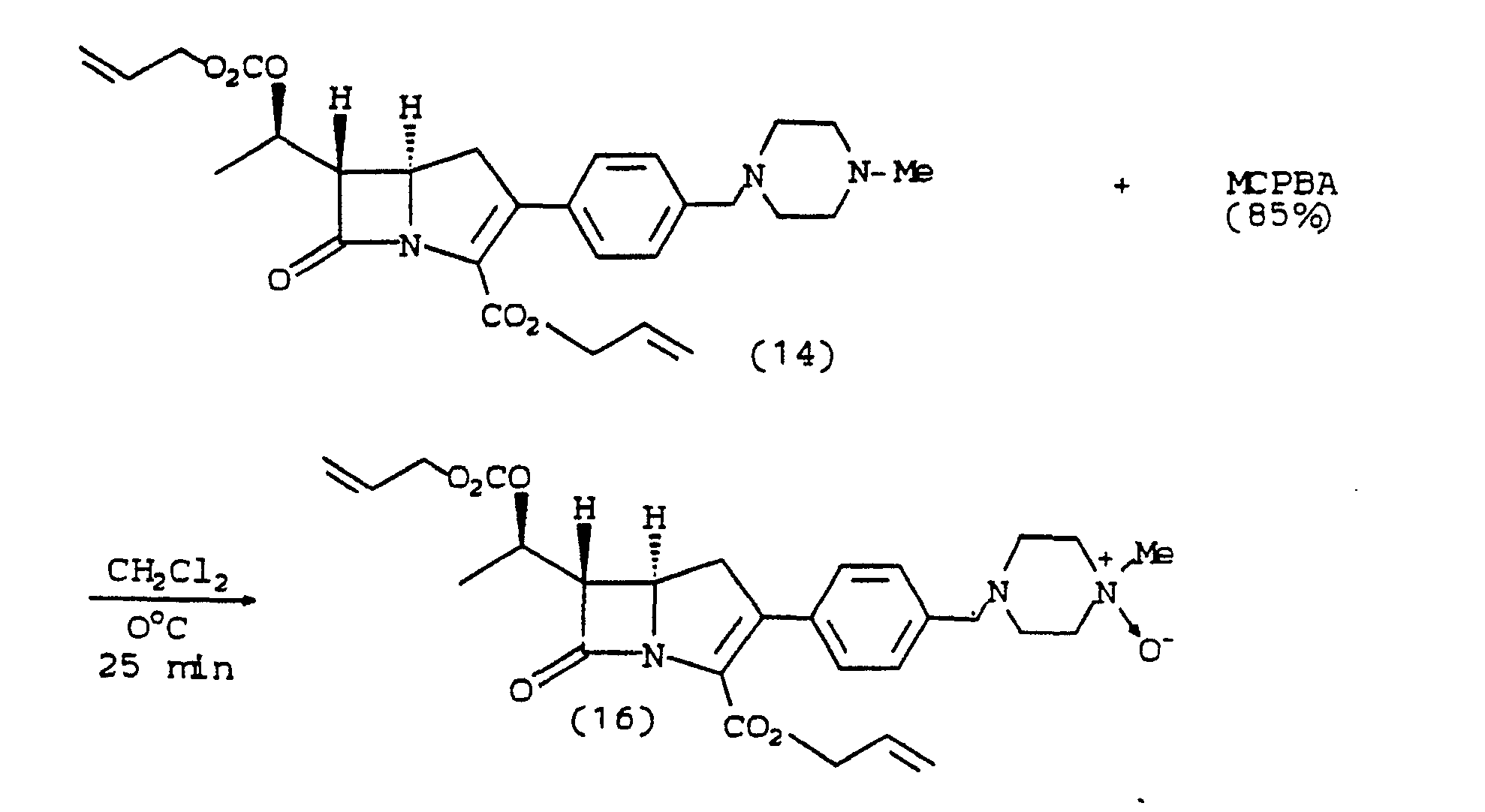
  • (5R, 6S)-6-(1-(R)-hydroxyethy!)-2-(4-N'-methyl-N -oxide-N-piperazinomethylphenyl)carbapenem-3-carboxylic acid
    Figure imgb0050
  • To a stirred solution of carbapenem derivative (14) (76.6mg, 1.5x10⁻⁴moles) in 3ml of dichloromethane at 0 degrees C under nitrogen was added all at once neat m -chloroperbenzoic acid (MCPBA - m - CIC6H5C000H) (28.6mg, 1.66x10⁻⁴moles). The reaction mixture was then stirred at 0 degrees C under nitrogen for 25min, after which it was partitioned between dichloromethane (CH2Cl2) / ice water / saturated sodium bicarbonate (NaHCOs) solution.
  • The organic phase was separated, washed with saturated sodium chloride (NaCI) solution, dried over sodium sufate (NaSO4), filtered and evaporated to give 41.4mg of foamy product (16), a 52.4% yield.
  • The next two examples illustrate procedures described herein for the last step of deblocking to give the final product.
  • EXAMPLE 10
  • (5R, 6S)-6-(1-(R)-hydroxyethyl)-2-(4-N-pyrrolidinyl methylphenyl)carbapenem-3-carboxylic acid
    Figure imgb0051
  • To a stirred solution of (5) (446.7mg, 9.3x10⁻⁴moles) in 10ml of sieve dried dichloromethane (CH2CI2) and 10ml ethyl acetate (EtOAc) at room temperature was added sequentially neat 2-ethylhexanoic acid (134.2mg, 9.3x10⁻⁴moles), and then a solution of potassium 2-ethylhexanoate (2.05ml, 1.02x10⁻³moles) in ethyl acetate, followed by triphenylphosphine (73.2mg, 2.79x10⁻⁴moles) and tetrakistriphenylphosphinepalladium (107.4mg, 9.3x10-Smoles) as catalyst. The reaction mixture was stirred at room temperature under nitrogen for 4.5hrs. The reaction mixture was then partitioned between dichloromethane and water while cold and the water layer was separated. The procedure was repeated and the water phases were combined, washed with ethyl acetate, and concentrated in vacuo . The product was purified by reverse phase chromatography using 3x500 micron plates, eluting with 30% tetrahydrofuran in water. After extraction and lyophilization, the product was repurified using the above procedure, but eluting with 10% ethanol in water, to give 58.1 mg of final product (17), a 17.5% yield.
  • EXAMPLE 11
  • (5R, 6S)-6-(1-(R)-hydroxyethyl)-2-(4 -N-methyl-N-pyrrolidiniummethylphenyl)carbapenem-3-carboxylate
    Figure imgb0052
  • To a stirred solution of compound (7) (326.9mg, 5.07x10⁻⁴moles) in 6ml of sieve dried dichloromethane and 6ml of ethyl acetate at room temperature there was added sequentially neat 2-ethylhexanoic acid (72.2mg, 5x10⁻⁴moles), potassium 2-ethylhexanoate (1 ml, 5x10⁻⁴moles) in ethyl acetate, and then a mixture of solid triphenylphosphine (35.4mg, 1.35x10⁻⁴-moles) and tetrakistriphenylphosphinepalladium (51.9mg, 4.5x10⁻⁵moles) as catalyst. The reaction mixture was stirred at room temperature under nitrogen for about 3.5hrs, after which it was partitioned between dichloromethane and water in the cold. The aqueous phase was separated and washed with water, and the combined aqueous extracts were filtered through a Gelmann filter and then concentrated. The product was purified by reverse phase chromatography using 2x500 micron plates, eluting with 40% tetrahydrofuran in water, under cold conditions, followed by lyophilization to give 74.8mg of final product (18), a 39.9% yield.
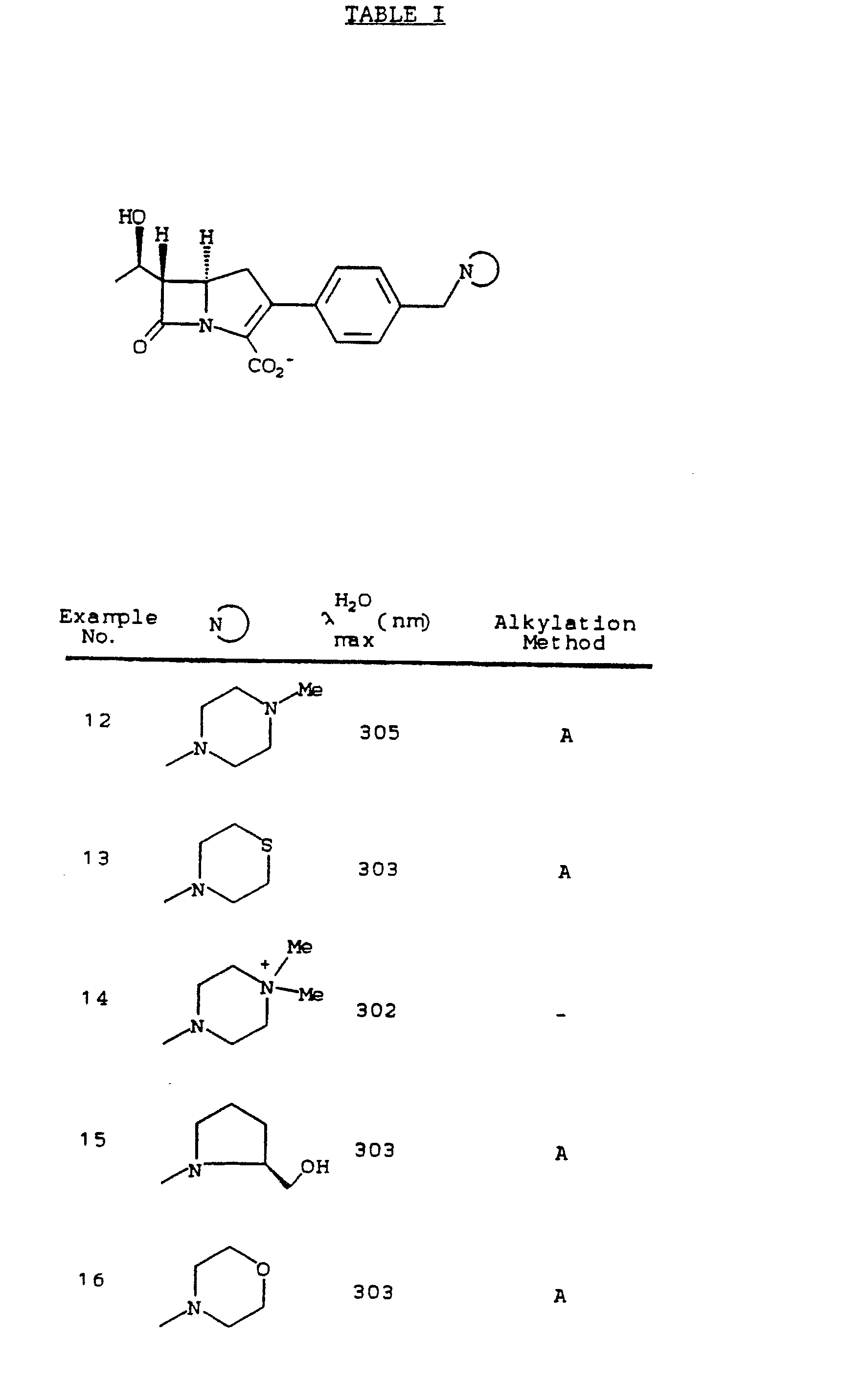
  • EXAMPLES 12 - 21
  • As previously indicated, the penultimate products of Examples 3- 9 may be deblocked in accordance with the procedures described in Examples 10 and 11 to give the final products set out in Table I below, which also includes three other compounds of the present invention prepared in accordance with the procedures described above.
    Figure imgb0053
    Figure imgb0054

Claims (10)

1. A compound of the formula:
Figure imgb0055
wherein: R is H or CH3; R1 and R2 are independently H, CH3-, CH3CH2-, (CH3)2CH-, HOCH2-, CH3CH(OH)-, (CH3)2C(OH)_, FCH2CH(OH)-, F2CHCH(OH)-, F3CCH(OH)-, CH3CH(F)-, CH3CF2-, or (CH3)2C(F)-; Ra, Rb, and R° are independently selected from the group consisting of
a) a trifluoromethyl group: -CF3;
b) a halogen atom: -Br, -CI, -F, or -I;
c) C1-C4 alkoxy radical: -OC1-4 alkyl;
d) a hydroxy group: -OH;
e) (C1-C6 alkyl) carbonyloxy radical:
Figure imgb0056
f) a carbamoyloxy radical which is unsubstituted or substituted on nitrogen with one or two C1-C4 alkyl groups:
Figure imgb0057
where RY and Rz are independently H or C1-4 alkyl;
g) a C1-C6 alkylthio radical, C1-C6 alkylsulfinyl radical or C1-C6 alkylsulfonyl radical:
Figure imgb0058
alkyl where n = 0-2, and the alkyl portion is optionally substituted by cyano;
h) a sulfamoyl group which is unsubstituted or substituted on nitrogen by one or two C1-C4 alkyl groups:
Figure imgb0059
where RY and Rz are as defined above;
i) an amino group, or a mono (C1-C4 alkyl) amino or di(C1-C4 alkyl)-amino group:
Figure imgb0060
where Ry and Rz are as defined above:
j) a formylamino group:
Figure imgb0061
k) (C1-C6 alkyl)carbonylamino radical:
Figure imgb0062
I) a (C1-C4 alkoxy) carbonylamino radical:
Figure imgb0063
m) a ureido group in which the terminal nitrogen is unsubstituted or substituted with one or two C1-C4 alkyl groups:
Figure imgb0064
where Ry and Rz are as defined above;
n) a sulfonamido group:
Figure imgb0065
o) a cyano group: -CN;
p) a formyl or acetalized formyl radical:
Figure imgb0066
q) (C1-C6 alkyl)carbonyl radical wherein the carbonyl is free or acetalized:
Figure imgb0067
r) phenylcarbonyl;
s) a hydroximinomethyl radical in which the oxygen or carbon atom is optionally substituted by a C1-C4 alkyl group:
Figure imgb0068
where Ry and Rz are as defined above:
t) a (C1-C6 alkoxy)carbonyl radical:
Figure imgb0069
u) a carbamoyl radical which is unsubstituted or substituted on nitrogen by one or two C1-C4 alkyl groups:
Figure imgb0070
where Ry and Rz are as defined above;
v) an N-hydroxycarbamoyl or N(C1-C4 alkoxy)carbamoyl radical in which the nitrogen atom may be additionally substituted by a C1-C4 alkyl group:
Figure imgb0071
where Ry and Rz are as defined above;
w) a thiocarbamoyl group:
Figure imgb0072
x) an amidino group
Figure imgb0073
where R5, R6 and R7 are independently hydrogen, C1-C4 alkyl or wherein two of the alkyl groups together form a C2-C6alkylidene radical optionally interrupted by a heteroatom and joined together to form a ring; y) a carboxamidino group
Figure imgb0074
where R5, R6 and R7 are as defined above;
z) a guanidinyl group where R6 in a) above is NR8R9 and R8 and R9 are as defined for R5 through R7 above; aa) hydrogen;
ab) C2-C6 alkenyl radical;
ac) an unsubstituted or substituted C2-C6 alkynyl radical:
ad) C3-C7 cycloalkyl radical;
ae) C3-C7 cycloalkyl methyl radical;
af) C5-C7 cycloalkenyl radical;
ag) phenyl, except that only R° may be phenyl;
ah) C1-C6 alkyl radical;
ai) C1-C4 alkyl monosubstituted by one of the substituents a) - ag) above;
aj) an anionic function selected from the group consisting of:
phosphono [P=O(OMC)2]; alkylphosphono {P=0(OMc)-[O(C1-C4 alkyl)]}; alkylphosphinyl [P=O(OMc)-(C1-C4alkyl)]; phosphoramido [P=O(OMc)N(Ry)Rz and P=O(OMcNHRx]: sulfino (SO2Mc); sulfo (SO3Mc);
acylsulfonamides selected from the structures CONMcSO2Rx, CONMcSO2N(Ry)Rz, SO2NMcCON(Ry)Rz; and SO2NMcCN, where
R" is phenyl or heteroaryl, where heteroaryl is as defined below except that there is no quaternary nitrogen and attachment through nitrogen is optional, and the phenyl and heteroaryl are optionally monosubstituted by Rq; MC is hydrogen or an alkali metal; Ry and Rz are as defined above; where
Rq is a member selected from the group consisting of -OH; -OCH3-; -CN; -C(0)NH2; -OC(0)NH2; -OC(O)-N(CH3)2; -S02NH2; -S02N(CH3)2; -SOCH3; -F; -CF3; tetrazolyl; and -COOMa, where Ma is hydrogen, alkali metal, methyl or phenyl;
Rd is C1-C4 alkyl, making the nitrogen atom of the N-heterocyclyl moiety to which it is attached quaternary: or it may be absent;
A is para ( p ) or meta ( m ) with respect to the point of attachment of the phenyl ring to the carbapenem nucleus, and is (CH2)m-Q-(CH2)n, where m is 0 to 2 and n is 1 or 2; and Q is a covalent bond; O; S; SO; or SO2;
Z is a member selected from the group consisting of CH2, O, S, SO, S02, N(R') and +N(R')(R"), where R and R are independently hydrogen, C1-C4 alkyl, or oxo; provided that where Rd is not absent, Z cannot be +N(R')(R");
m is 2 or 3;
n is 1 or 2; and
Y is selected from:
i) COOH or a pharmaceutically acceptable ester thereof;
ii) COOM wherein M is an alkali metal or other pharmaceutically acceptable salt;
iii) COOM wherein M is a negative charge in the case where a permanent positive charge exists elsewhere in the molecule.
2. A compound according to Claim 1 wherein R1/R2 is H- and R2/R1 is CH3CH(OH)-; A is -CH2-; and Rc, Rd, Z, m and n are selected in such a manner that the following structures result:
Figure imgb0075
Figure imgb0076
Figure imgb0077
Figure imgb0078
3 . A pharmaceutical composition for antibacterial use comprising an antibacterially effective amount of a compound of Claim 1 and a pharmaceutically acceptable carrier therefor.
4. The use of a compound of Claim 1 for the preparation of a medicament useful for treating bacterial infections in human or animal subjects.
5. The combination of a compound of Claim 1 and a DHP inhibitor.
6. The combination of a compound of Claim 2 and the DHP inhibitor 7-(L-2-amino-2-carboxyethylthio)-2-(2,2-dimethylcyclopropanecarboxamide)-2-heptenoic acid.
7. A pharmaceutical composition for antibacterial use comprising an antibacterially effective amount of a compound of Claim 1, an inhibitorily effective amount of a DHP inhibitor, and a pharmaceutically acceptable carrier therefor.
8. A pharmaceutical composition according to Claim 7 wherein the DHP inhibitor is 7-(L-2-amino-2-carboxyethylthio)-2-(2,2-dimethylcyclopropanecarboxamide)-2-heptenoic acid.
9. The use of a compound of Claim 1 and an inhibitorily effective amount of a DHP inhibitor for the preparation of a medicament useful for treating bacterial infections in human or animal subjects.
10. The use according to Claim 9 wherein the DHP inhibitor is 7-(L-2-amino-2-carboxyethylthio)-2-(2,2-dimethylcyclopropanecarboxamide)-2-heptenoic acid.
EP19900309148 1989-08-21 1990-08-21 2-(heterocyclylalkyl) phenyl carbapenem antibacterial agents Withdrawn EP0414493A3 (en)

Applications Claiming Priority (2)

Application Number Priority Date Filing Date Title
US04/396,163 US4962101A (en) 1989-08-21 1989-08-21 2-(Heterocyclylalkyl)phenyl carbapenem antibacterial agents
US396163 1989-08-21

Publications (2)

Publication Number Publication Date
EP0414493A2 true EP0414493A2 (en) 1991-02-27
EP0414493A3 EP0414493A3 (en) 1992-02-26

Family

ID=23566120

Family Applications (1)

Application Number Title Priority Date Filing Date
EP19900309148 Withdrawn EP0414493A3 (en) 1989-08-21 1990-08-21 2-(heterocyclylalkyl) phenyl carbapenem antibacterial agents

Country Status (4)

Country Link
US (1) US4962101A (en)
EP (1) EP0414493A3 (en)
JP (1) JPH03163081A (en)
CA (1) CA2023156A1 (en)

Cited By (1)

* Cited by examiner, † Cited by third party
Publication number Priority date Publication date Assignee Title
EP0480712A1 (en) * 1990-10-11 1992-04-15 Merck & Co. Inc. 2-(substituted-dibenzofuranyl and dibenzothienyl) carbapenem antibacterial agents

Families Citing this family (60)

* Cited by examiner, † Cited by third party
Publication number Priority date Publication date Assignee Title
US5004740A (en) * 1990-06-26 1991-04-02 Merck & Co., Inc. 2-phenanthrenyl-carbapenem antibacterial agents
US5004739A (en) * 1990-06-26 1991-04-02 Merck & Co., Inc. 2-phenanthrenyl carbapenem antibacterial agents
US5025006A (en) * 1990-06-26 1991-06-18 Merck & Co., Inc. 2-biphenyl-carbapenem antibacterial agents
US5034385A (en) * 1990-06-26 1991-07-23 Merck & Co., Inc. 2-(heteroarylsubstituted)phenyl carbapenem antibacterial agents
US5011832A (en) * 1990-06-26 1991-04-30 Merck & Co., Inc. 2-biphenyl-carbapenem antibacterial agents
US5182385A (en) * 1990-10-09 1993-01-26 Merck & Co., Inc. 2-biphenyl-carbapenems intermediates
US5037820A (en) * 1990-06-29 1991-08-06 Merck & Co., Inc. Carbapenem antibacterial agents
EP0465126A3 (en) * 1990-06-29 1992-03-11 Merck & Co. Inc. Carbapenem antibacterial agents
US5132421A (en) * 1990-10-09 1992-07-21 Merck & Co., Inc. 2-naphthyl-carbapenem intermediates
US5132422A (en) * 1990-10-09 1992-07-21 Merck & Co., Inc. 2-naphthyl-carbapenem intermediates
US5032587A (en) * 1990-07-11 1991-07-16 Merck & Co., Inc. 2-naphthyl-carbapenem antibacterial agents
US5006519A (en) * 1990-07-11 1991-04-09 Merck & Co., Inc. 2-naphthyl-carbapenem antibacterial agents
US5356889A (en) * 1990-08-01 1994-10-18 Merck & Co., Inc. 2-(9-fluorenonyl)-carbapenem intermediates
US5409920A (en) * 1990-10-05 1995-04-25 Merck & Co., Inc. 2-(3-pyridyl)-carbapenem antibacterial agents
US5247074A (en) * 1990-10-09 1993-09-21 Merck & Co., Inc. (2-substituted phenyl) carbapenems
US5208329A (en) * 1990-10-09 1993-05-04 Merck & Co., Inc. 2-biphenyl carbapenem intermediates
US5208229A (en) * 1990-11-29 1993-05-04 Merck & Co., Inc. 2-(1,2,3-triazolylsubstituted)phenyl carbapenem antibacterial agents
US5214139A (en) * 1991-04-16 1993-05-25 Merck & Co., Inc. 2-phenanthridonyl-carbapenems
US5157033A (en) * 1991-04-16 1992-10-20 Merck & Co., Inc. 2-phenanthridonyl carbapenems having cationizeable substituents
US5153185A (en) * 1991-04-16 1992-10-06 Merck & Co., Inc. 2-phenanthridonyl carbapenems
US5208328A (en) * 1991-04-16 1993-05-04 Merck & Co., Inc. 2-phenanthridonyl carbapenem intermediates
US5216146A (en) * 1991-05-24 1993-06-01 Merck & Co., Inc. 2-benzocoumarinyl-carbapenems
US5153186A (en) * 1991-05-24 1992-10-06 Merck & Co., Inc. 2-benzocoumarinyl-carbapenems
US5162314A (en) * 1991-05-24 1992-11-10 Merck & Co., Inc. 2-benzocoumarinyl carbapenems
US5182384A (en) * 1991-05-24 1993-01-26 Merck & Co., Inc. 2-benzocoumarinyl carbapenems
US5256777A (en) * 1991-10-17 1993-10-26 Merck & Co., Inc. 2-phenyl-carbapenems
US5276149A (en) * 1991-10-17 1994-01-04 Merck & Co., Inc. 2-(N-imidazoliumphenyl)-carbapenems
US5382575A (en) * 1991-10-17 1995-01-17 Merck & Co., Inc. (N-pyridiniumphenyl)-carbapenems
US5334590A (en) * 1991-10-17 1994-08-02 Merck & Co., Inc. MRSA active 2-phenyl-carbapenems
GB9218240D0 (en) * 1992-08-27 1992-10-14 Glaxo Spa Heterocyclic compounds
US5292879A (en) * 1992-08-28 1994-03-08 Merck & Co., Inc. Intermediates for preparing cationic-2-heteroaryl-phenyl-carbapenem antibacterial agents
US5342933A (en) * 1992-08-28 1994-08-30 Merck & Co., Inc. Cationic-2-heteroarylphenyl-carbapenem antibacterial agents
US6268380B1 (en) 1993-02-19 2001-07-31 G. D. Searle & Co. Urea derivatives useful as platelet aggregation inhibitors
AU6267894A (en) * 1993-03-02 1994-09-26 G.D. Searle & Co. N-acyl beta amino acid derivatives useful as platelet aggregation inhibitors
US5350746A (en) * 1993-04-14 1994-09-27 Merck & Co., Inc. Triazolyl and tetrazolyl phenyl substituted carbapenems, compositions containing such compounds and methods of use
US5451579A (en) * 1994-02-15 1995-09-19 Merck & Co., Inc. 1-β-methyl-carbapenem, compositions containing same and methods of use
US5532261A (en) * 1994-12-12 1996-07-02 Merck & Co., Inc. Carbapenem antibiotics, compositions containing such compounds and methods of use
EP2085378A1 (en) * 2001-06-01 2009-08-05 Merck Patent GmbH Perfluor alkane sulphonic acid salts
EP2127650B1 (en) * 2004-06-10 2018-12-05 FOB Synthesis, Inc. Carbapenem antibacterials with gram-negative activity and processes for their preparation
WO2006103999A1 (en) * 2005-03-25 2006-10-05 Dainippon Sumitomo Pharma Co., Ltd. Novel carbapenem compound
WO2006119646A1 (en) 2005-05-13 2006-11-16 Virochem Pharma Inc. Compounds and methods for the treatment or prevention of flavivirus infections
BR112014015197A8 (en) 2011-12-21 2017-06-13 Novira Therapeutics Inc hepatitis b antiviral agents
KR102271574B1 (en) 2012-08-28 2021-07-01 얀센 사이언시즈 아일랜드 언리미티드 컴퍼니 Sulfamoyl-arylamides and the use thereof as medicaments for the treatment of hepatitis B
WO2014131847A1 (en) 2013-02-28 2014-09-04 Janssen R&D Ireland Sulfamoyl-arylamides and the use thereof as medicaments for the treatment of hepatitis b
MX353412B (en) 2013-04-03 2018-01-10 Janssen Sciences Ireland Uc N-phenyl-carboxamide derivatives and the use thereof as medicaments for the treatment of hepatitis b.
TWI733288B (en) 2013-05-17 2021-07-11 愛爾蘭商健生科學愛爾蘭無限公司 Sulphamoylpyrrolamide derivatives and the use thereof as medicaments for the treatment of hepatitis b
DK2997019T3 (en) 2013-05-17 2018-12-03 Janssen Sciences Ireland Uc SULFAMOYLTHIOPHENAMIDE DERIVATIVES AND USE THEREOF AS MEDICINES FOR TREATING HEPATITIS B
HRP20180791T1 (en) 2013-07-25 2018-09-07 Janssen Sciences Ireland Uc Glyoxamide substituted pyrrolamide derivatives and the use thereof as medicaments for the treatment of hepatitis b
CA2923712C (en) 2013-10-23 2021-11-02 Janssen Sciences Ireland Uc Carboxamide derivatives and the use thereof as medicaments for the treatment of hepatitis b
US9169212B2 (en) 2014-01-16 2015-10-27 Novira Therapeutics, Inc. Azepane derivatives and methods of treating hepatitis B infections
US10392349B2 (en) 2014-01-16 2019-08-27 Novira Therapeutics, Inc. Azepane derivatives and methods of treating hepatitis B infections
CA2936947A1 (en) 2014-02-05 2015-08-13 Novira Therapeutics, Inc. Combination therapy for treatment of hbv infections
TW201620893A (en) 2014-02-06 2016-06-16 健生科學愛爾蘭無限公司 Sulphamoylpyrrolamide derivatives and the use thereof as medicaments for the treatment of hepatitis B
JP2018510159A (en) 2015-03-19 2018-04-12 ノヴィラ・セラピューティクス・インコーポレイテッド Azocan and azonan derivatives and methods for treating hepatitis B infection
US10875876B2 (en) 2015-07-02 2020-12-29 Janssen Sciences Ireland Uc Cyclized sulfamoylarylamide derivatives and the use thereof as medicaments for the treatment of hepatitis B
TW201718496A (en) 2015-09-29 2017-06-01 諾維拉治療公司 Crystalline forms of a hepatitis B antiviral agent
AU2017248828A1 (en) 2016-04-15 2018-11-01 Janssen Sciences Ireland Uc Combinations and methods comprising a capsid assembly inhibitor
MX2020009531A (en) 2018-03-14 2020-10-05 Janssen Sciences Ireland Unlimited Co Capsid assembly modulator dosing regimen.
WO2020169784A1 (en) 2019-02-22 2020-08-27 Janssen Sciences Ireland Unlimited Company Amide derivatives useful in the treatment of hbv infection or hbv-induced diseases
AR119732A1 (en) 2019-05-06 2022-01-05 Janssen Sciences Ireland Unlimited Co AMIDE DERIVATIVES USEFUL IN THE TREATMENT OF HBV INFECTION OR HBV-INDUCED DISEASES

Family Cites Families (4)

* Cited by examiner, † Cited by third party
Publication number Priority date Publication date Assignee Title
US4543257A (en) * 1977-10-19 1985-09-24 Merck & Co., Inc. 1-Carba-2-penem-3-carboxylic acid
US4260627A (en) * 1978-10-24 1981-04-07 Merck & Co., Inc. 1-, 6- And 2-substituted-1-carba-2-penem-3-carboxylic acids
CA1272719A (en) * 1986-03-06 1990-08-14 Pierre Dextraze Carbapenem antibiotics
EP0277743A1 (en) * 1987-02-02 1988-08-10 Merck & Co. Inc. 2-(heteroaryliumalkyl)phenyl carbapenem antibacterial agents

Cited By (1)

* Cited by examiner, † Cited by third party
Publication number Priority date Publication date Assignee Title
EP0480712A1 (en) * 1990-10-11 1992-04-15 Merck & Co. Inc. 2-(substituted-dibenzofuranyl and dibenzothienyl) carbapenem antibacterial agents

Also Published As

Publication number Publication date
CA2023156A1 (en) 1991-02-22
US4962101A (en) 1990-10-09
JPH03163081A (en) 1991-07-15
EP0414493A3 (en) 1992-02-26

Similar Documents

Publication Publication Date Title
EP0414493A2 (en) 2-(heterocyclylalkyl) phenyl carbapenem antibacterial agents
US4978659A (en) 2-(Heteroaryliumalkyl)phenyl carbapenem antibacterial agents
US5037820A (en) Carbapenem antibacterial agents
EP0277743A1 (en) 2-(heteroaryliumalkyl)phenyl carbapenem antibacterial agents
EP0184843A1 (en) Carbapenems and 1-methylcarbapenems having an externally alkylated mono- or bicyclic 2-quaternary heteroarylalkyl substituent
EP0185315A1 (en) Carbapenems and 1-methylcarbapenems having a 2-heteroaryliumaliphatic substituent
US5409920A (en) 2-(3-pyridyl)-carbapenem antibacterial agents
EP0414489A2 (en) 2-(Quinoliniumalkyl and isoquinoliniumalkyl) phenyl carbapenem antibacterial agents
US5162314A (en) 2-benzocoumarinyl carbapenems
EP0414492A1 (en) 2-(heterocyclheterioaryliumalkyl) phenyl carbapenem antibacterial agents
US5247074A (en) (2-substituted phenyl) carbapenems
US5384317A (en) Bridged biphenyl carbapenem compounds, compositions containing such compounds and methods of use
AU4216199A (en) Benzothiazolythiomethyl carbapenem antibacterial
US5362723A (en) 2-(heterocyclylheteroaryliumalkyl) phenyl carbapenem antibacterial agents
WO1994017065A1 (en) 2-phenanthridinyl carbapenem antibacterial agents
US5276149A (en) 2-(N-imidazoliumphenyl)-carbapenems
US5182384A (en) 2-benzocoumarinyl carbapenems
US5372993A (en) Bridged carbapenem compounds, compositions containing such compounds and methods of use
WO1994028719A1 (en) Bridged carbapenem antibacterial compounds
CA2335510A1 (en) Naphtho[1,8-de]thiasin-2-yl methyl carbapenem antibacterials
AU4205499A (en) Naphthosulfamylmethyl penem antibacterials
EP0515217A1 (en) 2-Benzocoumarinyl carbapenems
US6291448B1 (en) Carbapenem antibacterial compounds, compositions containing such compounds and method of treatment
EP0465126A2 (en) Carbapenem antibacterial agents
US6346525B1 (en) Carbapenem antibacterial compounds, compositions containing such compounds and methods of treatment

Legal Events

Date Code Title Description
PUAI Public reference made under article 153(3) epc to a published international application that has entered the european phase

Free format text: ORIGINAL CODE: 0009012

AK Designated contracting states

Kind code of ref document: A2

Designated state(s): CH DE FR GB IT LI NL

PUAL Search report despatched

Free format text: ORIGINAL CODE: 0009013

AK Designated contracting states

Kind code of ref document: A3

Designated state(s): CH DE FR GB IT LI NL

17P Request for examination filed

Effective date: 19920706

17Q First examination report despatched

Effective date: 19930308

STAA Information on the status of an ep patent application or granted ep patent

Free format text: STATUS: THE APPLICATION IS DEEMED TO BE WITHDRAWN

18D Application deemed to be withdrawn

Effective date: 19930921