EP0414377A2 - Polymers and prepolymers and their use in a method for the treatment of wool - Google Patents
Polymers and prepolymers and their use in a method for the treatment of wool Download PDFInfo
- Publication number
- EP0414377A2 EP0414377A2 EP90307951A EP90307951A EP0414377A2 EP 0414377 A2 EP0414377 A2 EP 0414377A2 EP 90307951 A EP90307951 A EP 90307951A EP 90307951 A EP90307951 A EP 90307951A EP 0414377 A2 EP0414377 A2 EP 0414377A2
- Authority
- EP
- European Patent Office
- Prior art keywords
- residue
- group
- reaction
- wool
- polyfunctional
- Prior art date
- Legal status (The legal status is an assumption and is not a legal conclusion. Google has not performed a legal analysis and makes no representation as to the accuracy of the status listed.)
- Granted
Links
- 229920000642 polymer Polymers 0.000 title claims abstract description 61
- 210000002268 wool Anatomy 0.000 title claims abstract description 54
- 238000000034 method Methods 0.000 title claims abstract description 38
- 238000011282 treatment Methods 0.000 title claims abstract description 33
- 238000006243 chemical reaction Methods 0.000 claims abstract description 51
- 239000000835 fiber Substances 0.000 claims abstract description 21
- 125000000217 alkyl group Chemical group 0.000 claims abstract description 17
- 239000001257 hydrogen Substances 0.000 claims abstract description 16
- 229910052739 hydrogen Inorganic materials 0.000 claims abstract description 16
- 229910052757 nitrogen Inorganic materials 0.000 claims abstract description 14
- 150000001875 compounds Chemical class 0.000 claims abstract description 13
- OKKJLVBELUTLKV-UHFFFAOYSA-N Methanol Chemical class OC OKKJLVBELUTLKV-UHFFFAOYSA-N 0.000 claims abstract description 12
- 150000001412 amines Chemical class 0.000 claims abstract description 12
- IJGRMHOSHXDMSA-UHFFFAOYSA-N Atomic nitrogen Chemical compound N#N IJGRMHOSHXDMSA-UHFFFAOYSA-N 0.000 claims abstract description 10
- UFHFLCQGNIYNRP-UHFFFAOYSA-N Hydrogen Chemical compound [H][H] UFHFLCQGNIYNRP-UHFFFAOYSA-N 0.000 claims abstract description 10
- 229920002647 polyamide Polymers 0.000 claims abstract description 10
- 239000004952 Polyamide Substances 0.000 claims abstract description 9
- 239000004721 Polyphenylene oxide Substances 0.000 claims abstract description 9
- WSFSSNUMVMOOMR-NJFSPNSNSA-N methanone Chemical compound O=[14CH2] WSFSSNUMVMOOMR-NJFSPNSNSA-N 0.000 claims abstract description 9
- 125000004433 nitrogen atom Chemical group N* 0.000 claims abstract description 9
- 229920000570 polyether Polymers 0.000 claims abstract description 9
- 125000002768 hydroxyalkyl group Chemical group 0.000 claims abstract description 8
- 125000002877 alkyl aryl group Chemical group 0.000 claims abstract description 6
- 229920000233 poly(alkylene oxides) Polymers 0.000 claims abstract description 6
- 229920000058 polyacrylate Polymers 0.000 claims abstract description 6
- 229920005862 polyol Polymers 0.000 claims abstract description 6
- 150000003077 polyols Chemical class 0.000 claims abstract description 6
- 230000009257 reactivity Effects 0.000 claims abstract description 6
- 150000001450 anions Chemical class 0.000 claims abstract description 4
- 150000002431 hydrogen Chemical class 0.000 claims abstract description 4
- 230000001590 oxidative effect Effects 0.000 claims description 11
- -1 polysiloxane Chemical group 0.000 claims description 9
- 125000003277 amino group Chemical group 0.000 claims description 7
- 230000001588 bifunctional effect Effects 0.000 claims description 5
- 239000007787 solid Substances 0.000 claims description 5
- 239000002253 acid Substances 0.000 claims description 4
- 125000000524 functional group Chemical group 0.000 claims description 4
- 239000004215 Carbon black (E152) Substances 0.000 claims description 3
- 239000007864 aqueous solution Substances 0.000 claims description 3
- 239000012320 chlorinating reagent Substances 0.000 claims description 3
- 229910052736 halogen Inorganic materials 0.000 claims description 3
- 229930195733 hydrocarbon Natural products 0.000 claims description 3
- 150000002430 hydrocarbons Chemical group 0.000 claims description 3
- 125000003545 alkoxy group Chemical group 0.000 claims description 2
- 125000003282 alkyl amino group Chemical group 0.000 claims description 2
- 125000004947 alkyl aryl amino group Chemical group 0.000 claims description 2
- 125000002091 cationic group Chemical group 0.000 claims description 2
- 238000010924 continuous production Methods 0.000 claims description 2
- 125000004435 hydrogen atom Chemical group [H]* 0.000 claims description 2
- 125000005191 hydroxyalkylamino group Chemical group 0.000 claims description 2
- 229920001296 polysiloxane Chemical group 0.000 claims description 2
- 125000004178 (C1-C4) alkyl group Chemical group 0.000 claims 1
- 125000006527 (C1-C5) alkyl group Chemical group 0.000 claims 1
- 238000010923 batch production Methods 0.000 claims 1
- 125000005843 halogen group Chemical group 0.000 claims 1
- 230000008569 process Effects 0.000 abstract description 13
- 238000004132 cross linking Methods 0.000 abstract description 5
- KFZMGEQAYNKOFK-UHFFFAOYSA-N Isopropanol Chemical compound CC(C)O KFZMGEQAYNKOFK-UHFFFAOYSA-N 0.000 description 25
- XLYOFNOQVPJJNP-UHFFFAOYSA-N water Substances O XLYOFNOQVPJJNP-UHFFFAOYSA-N 0.000 description 22
- 239000000203 mixture Substances 0.000 description 19
- BRLQWZUYTZBJKN-UHFFFAOYSA-N Epichlorohydrin Chemical compound ClCC1CO1 BRLQWZUYTZBJKN-UHFFFAOYSA-N 0.000 description 15
- 238000002360 preparation method Methods 0.000 description 11
- 238000004043 dyeing Methods 0.000 description 10
- 238000010992 reflux Methods 0.000 description 10
- 229920005989 resin Polymers 0.000 description 10
- 239000011347 resin Substances 0.000 description 10
- 239000000243 solution Substances 0.000 description 10
- 239000004753 textile Substances 0.000 description 10
- 239000003795 chemical substances by application Substances 0.000 description 9
- 239000000047 product Substances 0.000 description 8
- 239000000975 dye Substances 0.000 description 6
- 125000002924 primary amino group Chemical group [H]N([H])* 0.000 description 5
- 239000000126 substance Substances 0.000 description 5
- OZAIFHULBGXAKX-UHFFFAOYSA-N 2-(2-cyanopropan-2-yldiazenyl)-2-methylpropanenitrile Chemical compound N#CC(C)(C)N=NC(C)(C)C#N OZAIFHULBGXAKX-UHFFFAOYSA-N 0.000 description 4
- QGZKDVFQNNGYKY-UHFFFAOYSA-N Ammonia Chemical compound N QGZKDVFQNNGYKY-UHFFFAOYSA-N 0.000 description 4
- WSFSSNUMVMOOMR-UHFFFAOYSA-N Formaldehyde Chemical compound O=C WSFSSNUMVMOOMR-UHFFFAOYSA-N 0.000 description 4
- 239000004902 Softening Agent Substances 0.000 description 4
- 239000000463 material Substances 0.000 description 4
- 229920000768 polyamine Polymers 0.000 description 4
- 238000012360 testing method Methods 0.000 description 4
- ZWEHNKRNPOVVGH-UHFFFAOYSA-N 2-Butanone Chemical compound CCC(C)=O ZWEHNKRNPOVVGH-UHFFFAOYSA-N 0.000 description 3
- ZAMOUSCENKQFHK-UHFFFAOYSA-N Chlorine atom Chemical compound [Cl] ZAMOUSCENKQFHK-UHFFFAOYSA-N 0.000 description 3
- WYURNTSHIVDZCO-UHFFFAOYSA-N Tetrahydrofuran Chemical class C1CCOC1 WYURNTSHIVDZCO-UHFFFAOYSA-N 0.000 description 3
- XSQUKJJJFZCRTK-UHFFFAOYSA-N Urea Chemical compound NC(N)=O XSQUKJJJFZCRTK-UHFFFAOYSA-N 0.000 description 3
- 239000001361 adipic acid Substances 0.000 description 3
- 239000004202 carbamide Substances 0.000 description 3
- 239000000460 chlorine Substances 0.000 description 3
- 229910052801 chlorine Inorganic materials 0.000 description 3
- 238000000576 coating method Methods 0.000 description 3
- 229920001451 polypropylene glycol Polymers 0.000 description 3
- 239000002904 solvent Substances 0.000 description 3
- 238000003756 stirring Methods 0.000 description 3
- 238000004448 titration Methods 0.000 description 3
- 238000005406 washing Methods 0.000 description 3
- VEXZGXHMUGYJMC-UHFFFAOYSA-N Hydrochloric acid Chemical compound Cl VEXZGXHMUGYJMC-UHFFFAOYSA-N 0.000 description 2
- BJSKBZUMYQBSOQ-UHFFFAOYSA-N Jeffamine M-600 Chemical compound COCCOCC(C)OCC(C)OCC(C)OCC(C)OCC(C)OCC(C)OCC(C)OCC(C)OCC(C)N BJSKBZUMYQBSOQ-UHFFFAOYSA-N 0.000 description 2
- PXHVJJICTQNCMI-UHFFFAOYSA-N Nickel Chemical compound [Ni] PXHVJJICTQNCMI-UHFFFAOYSA-N 0.000 description 2
- 239000004677 Nylon Substances 0.000 description 2
- 239000002202 Polyethylene glycol Substances 0.000 description 2
- ZLMJMSJWJFRBEC-UHFFFAOYSA-N Potassium Chemical compound [K] ZLMJMSJWJFRBEC-UHFFFAOYSA-N 0.000 description 2
- UIIMBOGNXHQVGW-UHFFFAOYSA-M Sodium bicarbonate Chemical compound [Na+].OC([O-])=O UIIMBOGNXHQVGW-UHFFFAOYSA-M 0.000 description 2
- 150000007513 acids Chemical class 0.000 description 2
- 150000001266 acyl halides Chemical class 0.000 description 2
- WNLRTRBMVRJNCN-UHFFFAOYSA-N adipic acid Chemical compound OC(=O)CCCCC(O)=O WNLRTRBMVRJNCN-UHFFFAOYSA-N 0.000 description 2
- 229910021529 ammonia Inorganic materials 0.000 description 2
- 150000008064 anhydrides Chemical class 0.000 description 2
- 239000002216 antistatic agent Substances 0.000 description 2
- 230000008901 benefit Effects 0.000 description 2
- 230000015572 biosynthetic process Effects 0.000 description 2
- IISBACLAFKSPIT-UHFFFAOYSA-N bisphenol A Chemical compound C=1C=C(O)C=CC=1C(C)(C)C1=CC=C(O)C=C1 IISBACLAFKSPIT-UHFFFAOYSA-N 0.000 description 2
- 239000003054 catalyst Substances 0.000 description 2
- 239000007795 chemical reaction product Substances 0.000 description 2
- 229920001577 copolymer Polymers 0.000 description 2
- 239000003431 cross linking reagent Substances 0.000 description 2
- QGBSISYHAICWAH-UHFFFAOYSA-N dicyandiamide Chemical compound NC(N)=NC#N QGBSISYHAICWAH-UHFFFAOYSA-N 0.000 description 2
- 239000004205 dimethyl polysiloxane Substances 0.000 description 2
- 235000013870 dimethyl polysiloxane Nutrition 0.000 description 2
- 239000000839 emulsion Substances 0.000 description 2
- 238000011156 evaluation Methods 0.000 description 2
- 239000004744 fabric Substances 0.000 description 2
- 150000002367 halogens Chemical group 0.000 description 2
- WQYVRQLZKVEZGA-UHFFFAOYSA-N hypochlorite Chemical compound Cl[O-] WQYVRQLZKVEZGA-UHFFFAOYSA-N 0.000 description 2
- 229920001778 nylon Polymers 0.000 description 2
- 239000003921 oil Substances 0.000 description 2
- 229920000435 poly(dimethylsiloxane) Polymers 0.000 description 2
- 229920000647 polyepoxide Polymers 0.000 description 2
- 229920001223 polyethylene glycol Polymers 0.000 description 2
- 239000011591 potassium Substances 0.000 description 2
- 229910052700 potassium Inorganic materials 0.000 description 2
- 102000004169 proteins and genes Human genes 0.000 description 2
- 108090000623 proteins and genes Proteins 0.000 description 2
- 239000011541 reaction mixture Substances 0.000 description 2
- 230000002829 reductive effect Effects 0.000 description 2
- 238000012552 review Methods 0.000 description 2
- GEHJYWRUCIMESM-UHFFFAOYSA-L sodium sulfite Chemical compound [Na+].[Na+].[O-]S([O-])=O GEHJYWRUCIMESM-UHFFFAOYSA-L 0.000 description 2
- WRIDQFICGBMAFQ-UHFFFAOYSA-N (E)-8-Octadecenoic acid Natural products CCCCCCCCCC=CCCCCCCC(O)=O WRIDQFICGBMAFQ-UHFFFAOYSA-N 0.000 description 1
- UNWRHVZXVVTASG-UHFFFAOYSA-N 1,3-dichloro-1,3,5-triazinane-2,4,6-trione;sodium Chemical compound [Na].ClN1C(=O)NC(=O)N(Cl)C1=O UNWRHVZXVVTASG-UHFFFAOYSA-N 0.000 description 1
- JKNCOURZONDCGV-UHFFFAOYSA-N 2-(dimethylamino)ethyl 2-methylprop-2-enoate Chemical compound CN(C)CCOC(=O)C(C)=C JKNCOURZONDCGV-UHFFFAOYSA-N 0.000 description 1
- LQJBNNIYVWPHFW-UHFFFAOYSA-N 20:1omega9c fatty acid Natural products CCCCCCCCCCC=CCCCCCCCC(O)=O LQJBNNIYVWPHFW-UHFFFAOYSA-N 0.000 description 1
- QSBYPNXLFMSGKH-UHFFFAOYSA-N 9-Heptadecensaeure Natural products CCCCCCCC=CCCCCCCCC(O)=O QSBYPNXLFMSGKH-UHFFFAOYSA-N 0.000 description 1
- USFZMSVCRYTOJT-UHFFFAOYSA-N Ammonium acetate Chemical compound N.CC(O)=O USFZMSVCRYTOJT-UHFFFAOYSA-N 0.000 description 1
- 239000005695 Ammonium acetate Substances 0.000 description 1
- VEXZGXHMUGYJMC-UHFFFAOYSA-M Chloride anion Chemical compound [Cl-] VEXZGXHMUGYJMC-UHFFFAOYSA-M 0.000 description 1
- KZBUYRJDOAKODT-UHFFFAOYSA-N Chlorine Chemical compound ClCl KZBUYRJDOAKODT-UHFFFAOYSA-N 0.000 description 1
- VYZAMTAEIAYCRO-UHFFFAOYSA-N Chromium Chemical compound [Cr] VYZAMTAEIAYCRO-UHFFFAOYSA-N 0.000 description 1
- RYGMFSIKBFXOCR-UHFFFAOYSA-N Copper Chemical compound [Cu] RYGMFSIKBFXOCR-UHFFFAOYSA-N 0.000 description 1
- 239000009261 D 400 Substances 0.000 description 1
- RPNUMPOLZDHAAY-UHFFFAOYSA-N Diethylenetriamine Chemical compound NCCNCCN RPNUMPOLZDHAAY-UHFFFAOYSA-N 0.000 description 1
- 239000004593 Epoxy Substances 0.000 description 1
- OAKJQQAXSVQMHS-UHFFFAOYSA-N Hydrazine Chemical compound NN OAKJQQAXSVQMHS-UHFFFAOYSA-N 0.000 description 1
- OWYWGLHRNBIFJP-UHFFFAOYSA-N Ipazine Chemical compound CCN(CC)C1=NC(Cl)=NC(NC(C)C)=N1 OWYWGLHRNBIFJP-UHFFFAOYSA-N 0.000 description 1
- OFOBLEOULBTSOW-UHFFFAOYSA-N Malonic acid Chemical compound OC(=O)CC(O)=O OFOBLEOULBTSOW-UHFFFAOYSA-N 0.000 description 1
- VVQNEPGJFQJSBK-UHFFFAOYSA-N Methyl methacrylate Chemical compound COC(=O)C(C)=C VVQNEPGJFQJSBK-UHFFFAOYSA-N 0.000 description 1
- 239000005642 Oleic acid Substances 0.000 description 1
- ZQPPMHVWECSIRJ-UHFFFAOYSA-N Oleic acid Natural products CCCCCCCCC=CCCCCCCCC(O)=O ZQPPMHVWECSIRJ-UHFFFAOYSA-N 0.000 description 1
- CYTYCFOTNPOANT-UHFFFAOYSA-N Perchloroethylene Chemical group ClC(Cl)=C(Cl)Cl CYTYCFOTNPOANT-UHFFFAOYSA-N 0.000 description 1
- 239000004698 Polyethylene Substances 0.000 description 1
- 229910000564 Raney nickel Inorganic materials 0.000 description 1
- NPXOKRUENSOPAO-UHFFFAOYSA-N Raney nickel Chemical compound [Al].[Ni] NPXOKRUENSOPAO-UHFFFAOYSA-N 0.000 description 1
- 238000005299 abrasion Methods 0.000 description 1
- 229920006243 acrylic copolymer Polymers 0.000 description 1
- 239000000654 additive Substances 0.000 description 1
- 235000011037 adipic acid Nutrition 0.000 description 1
- 239000003905 agrochemical Substances 0.000 description 1
- 150000001299 aldehydes Chemical class 0.000 description 1
- 238000005576 amination reaction Methods 0.000 description 1
- 235000019257 ammonium acetate Nutrition 0.000 description 1
- 229940043376 ammonium acetate Drugs 0.000 description 1
- 238000009835 boiling Methods 0.000 description 1
- 239000003153 chemical reaction reagent Substances 0.000 description 1
- 239000003638 chemical reducing agent Substances 0.000 description 1
- 229910052804 chromium Inorganic materials 0.000 description 1
- 239000011651 chromium Substances 0.000 description 1
- 239000011248 coating agent Substances 0.000 description 1
- 239000002131 composite material Substances 0.000 description 1
- 238000009833 condensation Methods 0.000 description 1
- 230000005494 condensation Effects 0.000 description 1
- 238000006482 condensation reaction Methods 0.000 description 1
- 229910052802 copper Inorganic materials 0.000 description 1
- 239000010949 copper Substances 0.000 description 1
- 239000002537 cosmetic Substances 0.000 description 1
- MGNCLNQXLYJVJD-UHFFFAOYSA-N cyanuric chloride Chemical compound ClC1=NC(Cl)=NC(Cl)=N1 MGNCLNQXLYJVJD-UHFFFAOYSA-N 0.000 description 1
- 230000001419 dependent effect Effects 0.000 description 1
- 239000003599 detergent Substances 0.000 description 1
- 150000004985 diamines Chemical class 0.000 description 1
- 150000001991 dicarboxylic acids Chemical class 0.000 description 1
- MTHSVFCYNBDYFN-UHFFFAOYSA-N diethylene glycol Chemical compound OCCOCCO MTHSVFCYNBDYFN-UHFFFAOYSA-N 0.000 description 1
- 239000006185 dispersion Substances 0.000 description 1
- 238000004821 distillation Methods 0.000 description 1
- 230000000694 effects Effects 0.000 description 1
- 229920001971 elastomer Polymers 0.000 description 1
- 239000000806 elastomer Substances 0.000 description 1
- 229920006332 epoxy adhesive Polymers 0.000 description 1
- 125000003700 epoxy group Chemical group 0.000 description 1
- 239000003822 epoxy resin Substances 0.000 description 1
- 239000008098 formaldehyde solution Substances 0.000 description 1
- 239000000295 fuel oil Substances 0.000 description 1
- 239000011521 glass Substances 0.000 description 1
- KWIUHFFTVRNATP-UHFFFAOYSA-N glycine betaine Chemical compound C[N+](C)(C)CC([O-])=O KWIUHFFTVRNATP-UHFFFAOYSA-N 0.000 description 1
- 125000004356 hydroxy functional group Chemical group O* 0.000 description 1
- 230000006872 improvement Effects 0.000 description 1
- 238000011065 in-situ storage Methods 0.000 description 1
- QXJSBBXBKPUZAA-UHFFFAOYSA-N isooleic acid Natural products CCCCCCCC=CCCCCCCCCC(O)=O QXJSBBXBKPUZAA-UHFFFAOYSA-N 0.000 description 1
- 239000000314 lubricant Substances 0.000 description 1
- 210000004072 lung Anatomy 0.000 description 1
- 230000007246 mechanism Effects 0.000 description 1
- 238000002156 mixing Methods 0.000 description 1
- 229910052759 nickel Inorganic materials 0.000 description 1
- ZQPPMHVWECSIRJ-KTKRTIGZSA-N oleic acid Chemical compound CCCCCCCC\C=C/CCCCCCCC(O)=O ZQPPMHVWECSIRJ-KTKRTIGZSA-N 0.000 description 1
- 150000002924 oxiranes Chemical class 0.000 description 1
- 125000005702 oxyalkylene group Chemical group 0.000 description 1
- 229920001281 polyalkylene Polymers 0.000 description 1
- 229920006122 polyamide resin Polymers 0.000 description 1
- 229920000728 polyester Polymers 0.000 description 1
- 229920000573 polyethylene Polymers 0.000 description 1
- 239000012286 potassium permanganate Substances 0.000 description 1
- 239000002244 precipitate Substances 0.000 description 1
- 238000002203 pretreatment Methods 0.000 description 1
- 238000012545 processing Methods 0.000 description 1
- 230000001681 protective effect Effects 0.000 description 1
- 239000002994 raw material Substances 0.000 description 1
- 239000000376 reactant Substances 0.000 description 1
- 239000000985 reactive dye Substances 0.000 description 1
- 229920013730 reactive polymer Polymers 0.000 description 1
- 238000011084 recovery Methods 0.000 description 1
- 238000006268 reductive amination reaction Methods 0.000 description 1
- 238000009877 rendering Methods 0.000 description 1
- 239000011342 resin composition Substances 0.000 description 1
- 150000003839 salts Chemical class 0.000 description 1
- 238000004062 sedimentation Methods 0.000 description 1
- 229910000030 sodium bicarbonate Inorganic materials 0.000 description 1
- 235000017557 sodium bicarbonate Nutrition 0.000 description 1
- MSFGZHUJTJBYFA-UHFFFAOYSA-M sodium dichloroisocyanurate Chemical compound [Na+].ClN1C(=O)[N-]C(=O)N(Cl)C1=O MSFGZHUJTJBYFA-UHFFFAOYSA-M 0.000 description 1
- 235000010265 sodium sulphite Nutrition 0.000 description 1
- HFQQZARZPUDIFP-UHFFFAOYSA-M sodium;2-dodecylbenzenesulfonate Chemical compound [Na+].CCCCCCCCCCCCC1=CC=CC=C1S([O-])(=O)=O HFQQZARZPUDIFP-UHFFFAOYSA-M 0.000 description 1
- 239000002689 soil Substances 0.000 description 1
- 239000003381 stabilizer Substances 0.000 description 1
- 230000003068 static effect Effects 0.000 description 1
- 238000003860 storage Methods 0.000 description 1
- LSNNMFCWUKXFEE-UHFFFAOYSA-L sulfite Chemical compound [O-]S([O-])=O LSNNMFCWUKXFEE-UHFFFAOYSA-L 0.000 description 1
- 239000013589 supplement Substances 0.000 description 1
- 239000004094 surface-active agent Substances 0.000 description 1
- 238000003786 synthesis reaction Methods 0.000 description 1
- 229920001059 synthetic polymer Polymers 0.000 description 1
- 238000010998 test method Methods 0.000 description 1
- YLQBMQCUIZJEEH-UHFFFAOYSA-N tetrahydrofuran Natural products C=1C=COC=1 YLQBMQCUIZJEEH-UHFFFAOYSA-N 0.000 description 1
Images

Classifications
-
- D—TEXTILES; PAPER
- D06—TREATMENT OF TEXTILES OR THE LIKE; LAUNDERING; FLEXIBLE MATERIALS NOT OTHERWISE PROVIDED FOR
- D06M—TREATMENT, NOT PROVIDED FOR ELSEWHERE IN CLASS D06, OF FIBRES, THREADS, YARNS, FABRICS, FEATHERS OR FIBROUS GOODS MADE FROM SUCH MATERIALS
- D06M13/00—Treating fibres, threads, yarns, fabrics or fibrous goods made from such materials, with non-macromolecular organic compounds; Such treatment combined with mechanical treatment
- D06M13/322—Treating fibres, threads, yarns, fabrics or fibrous goods made from such materials, with non-macromolecular organic compounds; Such treatment combined with mechanical treatment with compounds containing nitrogen
- D06M13/372—Treating fibres, threads, yarns, fabrics or fibrous goods made from such materials, with non-macromolecular organic compounds; Such treatment combined with mechanical treatment with compounds containing nitrogen containing etherified or esterified hydroxy groups ; Polyethers of low molecular weight
-
- C—CHEMISTRY; METALLURGY
- C08—ORGANIC MACROMOLECULAR COMPOUNDS; THEIR PREPARATION OR CHEMICAL WORKING-UP; COMPOSITIONS BASED THEREON
- C08G—MACROMOLECULAR COMPOUNDS OBTAINED OTHERWISE THAN BY REACTIONS ONLY INVOLVING UNSATURATED CARBON-TO-CARBON BONDS
- C08G73/00—Macromolecular compounds obtained by reactions forming a linkage containing nitrogen with or without oxygen or carbon in the main chain of the macromolecule, not provided for in groups C08G12/00 - C08G71/00
- C08G73/02—Polyamines
- C08G73/024—Polyamines containing oxygen in the form of ether bonds in the main chain
-
- D—TEXTILES; PAPER
- D06—TREATMENT OF TEXTILES OR THE LIKE; LAUNDERING; FLEXIBLE MATERIALS NOT OTHERWISE PROVIDED FOR
- D06M—TREATMENT, NOT PROVIDED FOR ELSEWHERE IN CLASS D06, OF FIBRES, THREADS, YARNS, FABRICS, FEATHERS OR FIBROUS GOODS MADE FROM SUCH MATERIALS
- D06M15/00—Treating fibres, threads, yarns, fabrics, or fibrous goods made from such materials, with macromolecular compounds; Such treatment combined with mechanical treatment
- D06M15/19—Treating fibres, threads, yarns, fabrics, or fibrous goods made from such materials, with macromolecular compounds; Such treatment combined with mechanical treatment with synthetic macromolecular compounds
- D06M15/37—Macromolecular compounds obtained otherwise than by reactions only involving carbon-to-carbon unsaturated bonds
- D06M15/53—Polyethers
-
- D—TEXTILES; PAPER
- D06—TREATMENT OF TEXTILES OR THE LIKE; LAUNDERING; FLEXIBLE MATERIALS NOT OTHERWISE PROVIDED FOR
- D06M—TREATMENT, NOT PROVIDED FOR ELSEWHERE IN CLASS D06, OF FIBRES, THREADS, YARNS, FABRICS, FEATHERS OR FIBROUS GOODS MADE FROM SUCH MATERIALS
- D06M15/00—Treating fibres, threads, yarns, fabrics, or fibrous goods made from such materials, with macromolecular compounds; Such treatment combined with mechanical treatment
- D06M15/19—Treating fibres, threads, yarns, fabrics, or fibrous goods made from such materials, with macromolecular compounds; Such treatment combined with mechanical treatment with synthetic macromolecular compounds
- D06M15/37—Macromolecular compounds obtained otherwise than by reactions only involving carbon-to-carbon unsaturated bonds
- D06M15/61—Polyamines polyimines
Definitions
- This invention relates to new polymers and prepolymers derived from polyoxyalkyleneamines.
- the polymers and prepolymers may be used in a process for the treatment of wool so as to impart shrink resistance.
- the polyoxyalkyleneamines of interest are a family of polyamines which have as their backbone repeated oxyalkylene units. Such materials have been available commercially for a number of years, for example, under the trade name of Jeffamines (Jeffamine is a registered trade mark).
- Belgian Patent No. 634,741 describes the preparation of polyoxyalkyleneamines by the reductive amination of polypropylene glycol ether with ammonia in the presence of Raney nickel catalyst and hydrogen.
- 3,236,895 and 3,462,393 teach the synthesis of polyoxyalkyleneamines by the amination of polypropylene glycol via a sulphonic acid ester.
- polyoxyalkyleneamines are produced by treating the corresponding polyol with ammonia and hydrogen over a nickel/copper/chromium catalyst.
- polyoxyalkyleneamines have found a variety of uses. They are particularly effective as epoxy curing agents and have been used in epoxy adhesives, protective or decorative coatings and reinforced composites. Other applications include use in anti-static agents, surfactants, agricultural chemicals, cosmetics, oil recovery chemicals and textile treating agents.
- German OS 2,645,954 describes the improvement of crease, abrasion and pilling resistance of wool textiles by the use of crosslinking agent amines (such as Jeffamine D-400) during the shrinkproofing of such textiles.
- crosslinking agent amines such as Jeffamine D-400
- the polyoxyalkyleneamine is used as a catalyst for the crosslinking of epoxy groups, following the application of resins from perchloroethylene, and its association with shrinkproofing treatment itself is merely incidental.
- Japanese Patent No. 71/33,152 describes the treatment of a nylon textile with an E-caprolactam- polyethylene glycol diamine-adipic acid copolymer to give improved washfast stain resistance
- Japanese Patent No. 71/37,675 relates to the melt-blending of a polyester fibre with a hexamethylenediam- monium terephthalate-E-caprolactamdiamino-polyethylene glycol-adipic acid copolymer for the purpose of improving dyeability.
- US Patent No. 3,738,864 discloses that the treatment of fibres with the reaction product of a polyoxypropylenediamine (Jeffamine D-1000) and a polyepoxide results in material with durable anti- static properties.
- 4,255,311 describes a composition useful for treatment of textiles so as to prevent creasing and which was prepared from a water-soluble epoxide resin, an acrylic copolymer and a polyoxyalkylene polyamine.
- US-A-3,676,287 teaches that adhesion in glass fibre-reinforced elastomers can be improved by coating the fibres with a mixture which includes a lubricant prepared by condensing Jeffamine D-2000 with oleic acid.
- Japanese Patent No. 84/89325 describes high rigidity resin compositions formed from a mixture of poly(phenyleneterephthalamide)-epichlorohydrin reaction product, Jeffamine D-230 and Jeffamine AC-398.
- US Patent No. 4,382,852 relates to demulsifiers for breaking bituminous oil-in-water emulsions and which are prepared by the condensation of certain polyoxyalkylenediamines (i.e. Jeffamines ED-2001, ED-600, ED-900, M-1000, D-230 and M-360) with epichlorohydrin. J. Med.
- Chem., 26(1), 7-11 refers to the preparation of compounds by the reaction of aryl glycidyl ethers with various Jeffamines and the evaluation of their affinity for s-adrenergic receptors of rat heart and lung.
- US Patent No. 4,323,709 discloses the reaction of epichlorohydrin with Jeffamine M-600 to give polymers useful as hydrocarbon oil additives.
- US Patent No. 4,239,497 describes fuel oil stabilising agents which inhibit sedimentation and discolouration during storage and are manufactured by the reaction of epichlorohydrin with amine-terminated polyoxypropylenes such as Jeffamine M-600. There is no suggestion in the prior art that any of these products could be used as shrink-resist polymers in processes for imparting a degree of shrink resistance to wool.
- the present invention provides new polymers and prepolymers which can be used in a method for the shrinkproofing of wool. This method not only confers a good level of shrink resistance, but also gives improved dyeing properties and a soft handle even without the use of additional softening agents.
- the polymers and prepolymers of this invention essentially result from the reaction of one or more polyoxyalkyleneamines, either as a simple mixture or joined by a polyfunctional bridging group in a prior reaction, with an epihalohydrin or other reactive species, such as formaldehyde, so as to generate a grouping on the molecule capable of reacting with protein fibre surfaces.
- the reactants are used in such proportions that preferably, though not necessarily, all of the amino groups are reacted.
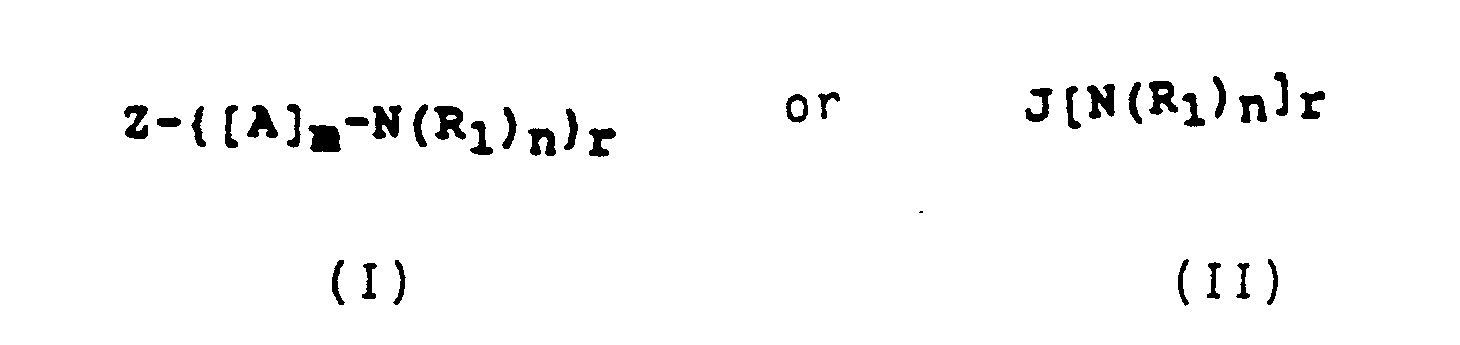
- the present invention relates to polymers and prepolymers which may be represented by any one of the following formulae:-
- fibre reactive grouping as used herein is to be understood as meaning a group having residual chemical reactivity such that it will be capable of causing a molecule to be bound to the surface of a fibre in such a way as not to be readily removable therefrom.
- examples include the fibre reactive dyes in which a variety of reactive halogen groupings are sited on the molecule and which, during dyeing, react with hydroxy or amino functionalities on the fibre surface to produce a chemical bond. It will be understood that electrical bonding forces, rather than chemical forces, could be involved and that a "reaction” as such need not occur.
- the terminology further includes species which will be attracted to a fibre surface and bind themselves thereto by means of cross-linking mechanisms.
- polyfunctional reactive group as used herein is to be understood as meaning a group which is capable of reacting with the amino functionality of compounds of formula I or II.
- the reactivity of group B needs to be complimentary to that of group R, in those compounds.
- the polymers and prepolymers may be derived from mixtures of one or more polyoxyalkyleneamines and that these may be joined by bridging groups.
- the bridging groups serve to link the polyoxyalkyleneamines and some examples of suitable groups were mentioned above.
- the bridging groups themselves could, of course, bear reactive species capable of reacting with protein fibres.
- the bridging group B could be incorporated into the molecular structure, whilst the prepolymer is being applied to the fibre, as a separate reactive crosslinking agent.
- the chemistry and reactions of the epihalohydrins, the alkyl polyhalides and formaldehyde, etc. are well known and it is not necessary to describe in detail the conditions required for their reaction with the polyoxyalkyleneamines according to this invention.
- the proportions used, however, are preferably such as to ensure that substantially all of the amino groups in the polyoxyalkyleneamine residues are reacted.
- the reaction is best performed at elevated temperature, typically within the range of from 40 to 150° C.
- the polymers and prepolymers of this invention are suitable for use in a method for imparting shrink resistance to wool and which comprises treating the wool with an aqueous solution of the polymer to be applied to the wool fibres.
- the application of the polymer alone can produce an acceptable level of shrink resistance in the wool.
- various reagents such as oxidative agents or reducing agents, can improve the effectiveness of a polymer treatment.
- the polymer treatment may be carried out prior to, in conjunction with or subsequent to any such further treatment of the wool. Most preferably, the polymer is applied subsequent to an oxidative pretreatment of the wool.
- oxidative pretreatments are a conventional procedure in the shrink-proofing of wool and a number of suitable treatments are well known.
- the wool could be treated with permonosulphuric acid.
- a chlorinating oxidative pretreatment may be employed and this would typically involve the use of chlorine gas.
- Chlorinating agents such as hypochlorite or sodium dichloroisocyanurate may also be employed, (optionally together with potassium permanganate or permonosulphate), typically at levels of 0.25-2.0% active chlorine by weight on the weight of the dry wool (o.w.w.), most preferably 0.5-1.2%.
- the optimum level of chlorine employed is generally dependent upon the level of polymer used in the next stage of the process.
- the pretreatment will, by itself, produce a small degree of shrink-resistance in the wool.
- the wool is subjected to antichlorination treatment with sulphite and rinsed and is then ready for the polymer application stage.
- the polymer or prepolymer may be applied to the wool in a conventional manner from a bath.
- the total amount of polymer solids applied to the wool fibre in the method of this invention is generally from 0.005 to 10% by weight, most preferably from 0.05% to 2.0%.
- the polymer or prepolymer can be used in either a batch or a continuous process for the treatment of wool.
- the wool is dried and may then be further processed in the usual manner.
- polymers and prepolymers of this invention could also be used for other applications such as, for example, emulsion breakers, anti-static agents, anti-crease agents and to impart stain resistance.
- To this solution was added 273.6 g (2.96 mole) epichlorohydrin with efficient stirring at room temperature in a reaction flask fitted with a water cooled reflux condenser. The mixture was then heated until the isopropanol began to boil, and then maintained at reflux for approximately 4 hours or until when 5 ml of the reaction mixture was diluted with 30 ml water a clear solution resulted. The flask was then allowed to cool and the reaction mixture tested as in 1.4 below.
- the three adducts prepared in 1.1-1.3 above were tested for their ability to stabilise wool against shrinkage by applying them to wool swatches which had been pretreated with an oxidative shrink resist pretreatment as follows.
- a quantity of 23.5 micron quality wool top was treated with a mixture of 2% o.w.w. dichloroisocyanuric acid sodium salt and 1 % o.w.w. potassium permonosulphate according to the Dylan XC2 process (Precision Processes (Textiles) Ltd) to produce a moderate degree of shrink resistance. This top was then spun to 2 x 24s worsted count and knitted into swatches with a cover factor of 1.29DT.
- Each swatch was then scoured for 15 min in 1% o.w.v. commercial nonionic detergent (Millscour XBN, Precision Processes (Textiles) and 3% o.w.w. of sodium bicarbonate at 45 C with a 30:1 liquor ratio, then rinsed once in warm water and once in cold.
- the swatches were treated as follows.
- the wet goods were entered into a fresh bath at a liquor ratio of 30:1.
- a 1 °o weight weight solution of the product from examples 1.1-1.3 above which was to be tested was prepared in cold water. A sufficient quantity of this solution was then drip fed into the treatment bath over 15 minutes. whilst agitating the test swatch, such that an amount of prepolymer solids equivalent to 1% by weight of the dry weight of the swatch was added to the bath.
- the temperature of the bath was then raised to 40 C and held at this temperature for approximately 20 minutes, whilst agitating the swatch, until the bath was shown to have exhausted by taking 10 ml of bath liquor and treating this with 2 ml of a 1% solids solution of sodium dodecylbenzene sulphonate in water, the absence of cloudiness or precipitate indicating exhaustion.
- Example 2 The various adducts from Example 2 were tested for their ability to stabilise wool against shrinkage during washing using the procedure given in Example 1.4, with the following results:
- Example 1.3 The dyeing properties of the material produced in Example 1.3 were examined by dyeing treated swatches with various dyestuffs. Samples of the dyebath liquor were extracted at various temperatures as the dyeing progressed, and the amount of dye present in the dyebath evaluated spectrophotometrically. All dyeings followed the same temperature pattern. Goods were entered cold in a wet state and the temperature increased to the boil at 1°C per minute to the boil and held at the boil for 1 hour. The goods were then rinsed and dried before testing for shrinkage and colour fastness. In all cases 2% o.w.w. of dyestuff was used, with 1.5% o.w.w. Albegal B (Ciba Geigy) and 2.0% ammonium acetate, the dyebath being held at pH5.5.
- Dye fastness results were comparable with those obtained from dyeings on a commercially available polyamide type resin (Polymer PKS, Precision Processes (Textiles) Ltd) dyed according to the same procedure.
- the attached graphs show the degree of strike of the dyestuff onto the fibre with increasing temperature when compared with swatches treated with commercially available polyamide resin and swatches which had only been given the pretreatment outlined in Example 1.4 above.
- the rate of strike of the dyestuff is reduced against that of the polyamide based polymer.
- Shrinkage testing gave the following for 3 x 5A on the IWS TM31 test:
- Table IV shows the quantities and identity of the polymers used and the results obtained.
- a specified quantity of aminopolyether was weighed into a flask equipped with stirrer. reflux condenser and dropping funnel 200ml of a isopropanol: water mixture was added to dissolve the resin and a specified quantity of formaldehyde solution (37% w/w in water) was added. The mixture was heated at reflux for 4 hours.
- Table V gives details of the preparation of such methylol-terminated resins. The products were useful as shrink resist agents when tested as described in Example 1.4.
Landscapes
- Chemical & Material Sciences (AREA)
- Engineering & Computer Science (AREA)
- Chemical Kinetics & Catalysis (AREA)
- Textile Engineering (AREA)
- Medicinal Chemistry (AREA)
- Organic Chemistry (AREA)
- Polymers & Plastics (AREA)
- Health & Medical Sciences (AREA)
- Treatments For Attaching Organic Compounds To Fibrous Goods (AREA)
- Polyurethanes Or Polyureas (AREA)
- Macromolecular Compounds Obtained By Forming Nitrogen-Containing Linkages In General (AREA)
- Polyethers (AREA)
- Phenolic Resins Or Amino Resins (AREA)
- Treatments Of Macromolecular Shaped Articles (AREA)
Abstract

- ii) a structure involving cross-linking or bridging of the above groups (11):-

- iii) a low molecular weight polymeric structure formed from the above groups (II):-

- J represents a residue derived from a polyfunctional polyether;
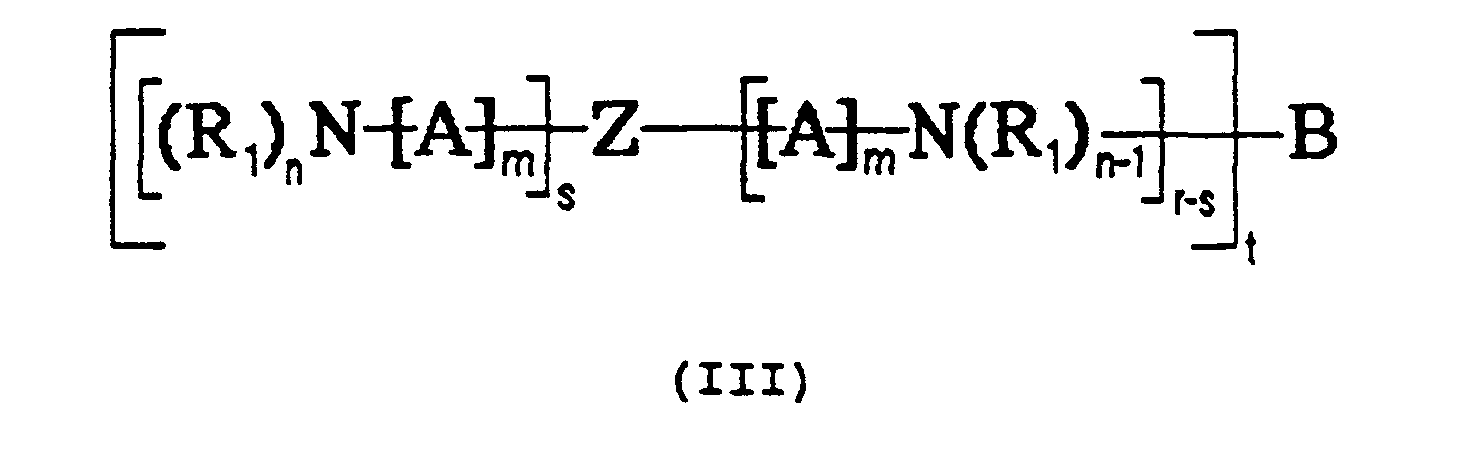
- K represents the monofuctional or polyfunctional residue derived from partial reaction of a prepolymer of the formula:

- B is the residue created by bi- or polyfunctional reaction between any polyfunctional reactive group and the parent amine of the title compound (formula (I) where R, is hydrogen in all cases) or is the residue of a reactive amino-acrylic polymer or a reactive polyamide polymer;
- Z represents a residue of a polyol;
- A represents a polyalkylene oxide residue;
- R, represents a fibre reactive grouping such as the residue derived from monofunctional reaction of an epihalohydrin, an alkyl or alkyl aryl polyhalide or a methylol grouping derived from monofunctional reaction of formaldehyde, or is alkyl, hydroxyalkyl or hydrogen, with the proviso that at least one group R, per polyoxyalkyleneamine residue, and preferably at least one for each nitrogen, retains residual fibre reactivity;
- m is between 4 and 50;
- n is 2 or 3, with the proviso that, where n is 3, the nitrogen atom involved also bears a formal positive charge;
- p is 1 or 2, with the proviso that, where p is 2, the nitrogen atom involved also bears a formal positive charge;
- r equals the functionality of group Z;
- t is a number representing the functionality of reaction of the residue B;
- s is a number between 1 and r-1;
- x is between 2 and 30; and
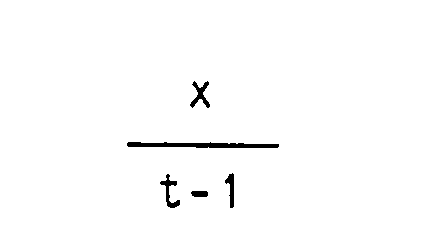
- y is from
with the general proviso that, in any given instance, the significance of a particular group Z, A, B, R, J or K in any given structure shall not be dictated by the significance of any other such group in the same formula, and further, wherever a formal positive charge is present in the structure, then an appropriate counter anion is taken to be present.
Description
- This invention relates to new polymers and prepolymers derived from polyoxyalkyleneamines. The polymers and prepolymers may be used in a process for the treatment of wool so as to impart shrink resistance. The polyoxyalkyleneamines of interest are a family of polyamines which have as their backbone repeated oxyalkylene units. Such materials have been available commercially for a number of years, for example, under the trade name of Jeffamines (Jeffamine is a registered trade mark). Belgian Patent No. 634,741 describes the preparation of polyoxyalkyleneamines by the reductive amination of polypropylene glycol ether with ammonia in the presence of Raney nickel catalyst and hydrogen. U.S. Patent Nos. 3,236,895 and 3,462,393 teach the synthesis of polyoxyalkyleneamines by the amination of polypropylene glycol via a sulphonic acid ester. In U.S. Patent No. 3,654,370 polyoxyalkyleneamines are produced by treating the corresponding polyol with ammonia and hydrogen over a nickel/copper/chromium catalyst.
- The polyoxyalkyleneamines have found a variety of uses. They are particularly effective as epoxy curing agents and have been used in epoxy adhesives, protective or decorative coatings and reinforced composites. Other applications include use in anti-static agents, surfactants, agricultural chemicals, cosmetics, oil recovery chemicals and textile treating agents.
- With regard to the latter application, that of textile treating agent, polyoxyalkyleneamines have been applied to a variety of fibres and textiles for various purposes. For example, German OS 2,645,954 describes the improvement of crease, abrasion and pilling resistance of wool textiles by the use of crosslinking agent amines (such as Jeffamine D-400) during the shrinkproofing of such textiles. However, the polyoxyalkyleneamine is used as a catalyst for the crosslinking of epoxy groups, following the application of resins from perchloroethylene, and its association with shrinkproofing treatment itself is merely incidental. British Patent No. 942,875 refers to the formation of water-soluble anti-static coatings for fibres by reacting polyoxyalkylenediamines with aldehydes. US Patent No. 3,175,987 discloses the reaction of polyethylene glycol diamine with an epoxide for the purpose of treating nylon cloth so as to resist soiling. German OS 2,058,317 refers to the reaction of a triethylene glycol diamine with urea to form a permanent press fabric treatment.
- Japanese Patent No. 71/33,152 describes the treatment of a nylon textile with an E-caprolactam- polyethylene glycol diamine-adipic acid copolymer to give improved washfast stain resistance, while Japanese Patent No. 71/37,675 relates to the melt-blending of a polyester fibre with a hexamethylenediam- monium terephthalate-E-caprolactamdiamino-polyethylene glycol-adipic acid copolymer for the purpose of improving dyeability. US Patent No. 3,738,864 discloses that the treatment of fibres with the reaction product of a polyoxypropylenediamine (Jeffamine D-1000) and a polyepoxide results in material with durable anti- static properties. US Patent No. 4,255,311 describes a composition useful for treatment of textiles so as to prevent creasing and which was prepared from a water-soluble epoxide resin, an acrylic copolymer and a polyoxyalkylene polyamine. US-A-3,676,287 teaches that adhesion in glass fibre-reinforced elastomers can be improved by coating the fibres with a mixture which includes a lubricant prepared by condensing Jeffamine D-2000 with oleic acid.
- Japanese Patent No. 84/89325 describes high rigidity resin compositions formed from a mixture of poly(phenyleneterephthalamide)-epichlorohydrin reaction product, Jeffamine D-230 and Jeffamine AC-398. US Patent No. 4,382,852 relates to demulsifiers for breaking bituminous oil-in-water emulsions and which are prepared by the condensation of certain polyoxyalkylenediamines (i.e. Jeffamines ED-2001, ED-600, ED-900, M-1000, D-230 and M-360) with epichlorohydrin. J. Med. Chem., 26(1), 7-11 refers to the preparation of compounds by the reaction of aryl glycidyl ethers with various Jeffamines and the evaluation of their affinity for s-adrenergic receptors of rat heart and lung. US Patent No. 4,323,709 discloses the reaction of epichlorohydrin with Jeffamine M-600 to give polymers useful as hydrocarbon oil additives. US Patent No. 4,239,497 describes fuel oil stabilising agents which inhibit sedimentation and discolouration during storage and are manufactured by the reaction of epichlorohydrin with amine-terminated polyoxypropylenes such as Jeffamine M-600. There is no suggestion in the prior art that any of these products could be used as shrink-resist polymers in processes for imparting a degree of shrink resistance to wool.
- Many ways of rendering wool shrink resistant are known. Typically, these involve subjecting the wool to an oxidative treatment, either alone or followed by a polymer treatment. The latter type of two-step treatment has become very popular and is now the major process used throughout the world.
- Various two-step shrink-proofing processes in which wool is treated first with an oxidative chlorinating agent and subsequently with a pre-formed synthetic polymer have been developed. A wide variety of polymers can be used in aqueous solution or dispersion, including polyamide-epichlorohydrin resins and polyacrylates. A review of work in this field by J. Lewis appears in Wool Science Review, May 1978, pages 23-42. British Patent Nos. 1,074,731 and 1,340,859 and U.S. Patent Nos. 2,926,154 and 2,961,347 describe two-step shrink-proofing processes and resins or polymers suitable for use therein. These polymers are typically reactive polyamides. The polyamides can be derived from a polyalkylene polyamine and a dicarboxylic acid, e.g. diethylenetriamine and adipic acid, and are prepared by reaction with epichlorohydrin.
- These conventional two-step processes confer good levels of shrink resistance but, despite achieving considerable commercial success, they do have significant disadvantages. It will be appreciated that the polymer is added to the oxidised wool to supplement the shrink resistance imparted by the oxidative pretreat, which may in some cases thus not be as severe as would be needed if this were the only treatment used to achieve the shrink resistance. The application of polymers, however, usually results in wool which has an undesirably harsh handle. To overcome this problem a softening agent is customarily employed during subsequent processing of the wool. Further, if the wool which has been treated with polymer is then dyed, the resulting rub fastness is generally inferior. This is particularly evident with certain dyestuffs commonly used in the wool industry. In general, it is found that the softening agents which are used to improve the handle of the wool will either exacerbate the poor rub fastness or are removed during the dyeing operation.
- The present invention provides new polymers and prepolymers which can be used in a method for the shrinkproofing of wool. This method not only confers a good level of shrink resistance, but also gives improved dyeing properties and a soft handle even without the use of additional softening agents.
- The polymers and prepolymers of this invention essentially result from the reaction of one or more polyoxyalkyleneamines, either as a simple mixture or joined by a polyfunctional bridging group in a prior reaction, with an epihalohydrin or other reactive species, such as formaldehyde, so as to generate a grouping on the molecule capable of reacting with protein fibre surfaces. The reactants are used in such proportions that preferably, though not necessarily, all of the amino groups are reacted.
- The present invention relates to polymers and prepolymers which may be represented by any one of the following formulae:-
- (i)

- ii) structure involving crosslinking or bridging of the above groups (I) or (II):

- iii) a low molecular weight polymeric structure formed from the above groups (I) or (II): {K}x-(-{B}y-K - (V) wherein
- Z represents a residue of a polyol, preferably a di- or trivalent polyol;'
- A represents a polyalkylene oxide residue, that is a polyether chain produced by polymerisation of, for example, ethylene, propylene or butylene oxides or tetrahydrofuran;
- B is the residue created by bi- or polyfunctional reaction between any polyfunctional reactive group and the parent amine of the title compounds (formula (I) where R, is hydrogen in all cases), or is the residue of a reactive amino-acrylic polymer (e.g. of the type described in EP-A-0129322) or a reactive polyamide polymer (e.g. of the type described in EP-A-0260017A or a Hercosett polymer), and may be taken, for example, to represent a group


- a group derived from low molecular weight reactive resins such as the Bisphenol A type,
- or a group derived from reaction of a cationic polymeric reactive species such as

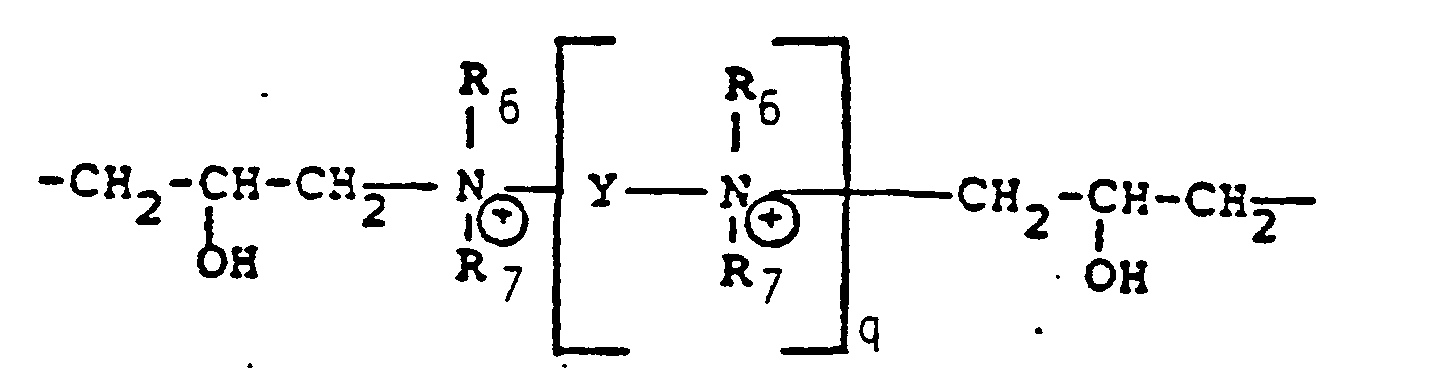
- Y is selected from C2-C6alkylene radicals, 2-hydroxy-1,3-propylene radicals, and the radicals:
- -CH2CH2NHCONHCH2CH2- and
- -CH2CH2CH2NHCONHCH2CH2CH2-
- and q is an integer of from 0 to 20, provided that when q is greater than 2, each of the symbols Y need not necessarily have the same significance;
- D represents a straight or branched chain hydrocarbon, polysiloxane or polyalkylene oxide residue, and which may also either bear functional groups or may contain functional groups, such as amino groups, which may in turn either bear one or more groups R, or, where B is polyfunctional rather than bifunctional, may represent a further functional reaction point of the group B with the rest of the molecular structure;
- E represents a group resulting from the reaction of a bi- or polyfunctional species capable of reacting with amino groups, for example: epihalohydrins, alkyl di- and polyhalides, dicarboxylic acids or their acyl halides and anhydrides, dicyandiamide, urea and formaldehyde;
- J represents a residue derived from a polyfunctional polyether;
- K represents the monofunctional or polyfunctional residue derived from partial reaction of the basic prepolymers in formulae (I) or (II), i.e. it represents the shaded area in formula (III) as follows:

- R, represents a fibre reactive grouping such as the residue derived from monofunctional reaction of an epihalohydrin, an alkyl or alkyl aryl polyhalide or a methylol grouping derived from monofunctional reaction of formaldehyde, or is alkyl, hydroxyalkyl or hydrogen, with the proviso that at least one group R1 per polyoxyalkyleneamine residue, and preferably at least one for each nitrogen, retains residual fibre reactivity; R2 represents a fibre reactive grouping such as the residue derived from monofunctional reaction of an epihalohydrin, an alkyl or alkyl aryl polyhalide or is a methylol grouping derived from monofunctional reaction of formaldehyde, or alkyl, hydroxyalkyl or hydrogen;
- R3 represents hydrogen or C,-C4 alkyl or hydroxyalkyl;
- R4 represents halogen or a group

- a group -(R3)pN[D]-Rs
- or a functional reaction point of the group B with the rest of the molecular structure, where B is polyfunctional rather than bifunctional;
- Rs represents hydrogen or
- a group -N(R2)n or -N(R3)n;
- m is between 4 and 50;
- n is 2 or 3, with the proviso that, where n is 3, the nitrogen atom involved also bears a formal positive charge;
- p is 1 or 2, with the proviso that, where p is 2, the nitrogen atom involved also bears a formal positive charge;
- r equals the functionality of group Z;
- t is a number representing the functionality of reaction of the residue B;
- s is a number between 1 and r-1;
- x is between 2 and 30; and
- y is from

- The term "fibre reactive grouping" as used herein is to be understood as meaning a group having residual chemical reactivity such that it will be capable of causing a molecule to be bound to the surface of a fibre in such a way as not to be readily removable therefrom. Examples include the fibre reactive dyes in which a variety of reactive halogen groupings are sited on the molecule and which, during dyeing, react with hydroxy or amino functionalities on the fibre surface to produce a chemical bond. It will be understood that electrical bonding forces, rather than chemical forces, could be involved and that a "reaction" as such need not occur. The terminology further includes species which will be attracted to a fibre surface and bind themselves thereto by means of cross-linking mechanisms.
- The term "polyfunctional reactive group" as used herein is to be understood as meaning a group which is capable of reacting with the amino functionality of compounds of formula I or II. The reactivity of group B needs to be complimentary to that of group R, in those compounds.
- It will be understood that the polymers and prepolymers may be derived from mixtures of one or more polyoxyalkyleneamines and that these may be joined by bridging groups. The bridging groups serve to link the polyoxyalkyleneamines and some examples of suitable groups were mentioned above. The bridging groups themselves could, of course, bear reactive species capable of reacting with protein fibres. It will also be appreciated that the bridging group B could be incorporated into the molecular structure, whilst the prepolymer is being applied to the fibre, as a separate reactive crosslinking agent.
- The chemistry and reactions of the epihalohydrins, the alkyl polyhalides and formaldehyde, etc. are well known and it is not necessary to describe in detail the conditions required for their reaction with the polyoxyalkyleneamines according to this invention. The proportions used, however, are preferably such as to ensure that substantially all of the amino groups in the polyoxyalkyleneamine residues are reacted. The reaction is best performed at elevated temperature, typically within the range of from 40 to 150° C.
- The polymers and prepolymers of this invention are suitable for use in a method for imparting shrink resistance to wool and which comprises treating the wool with an aqueous solution of the polymer to be applied to the wool fibres. The application of the polymer alone can produce an acceptable level of shrink resistance in the wool. It is, however, well known that the treatment of wool fibres with various reagents, such as oxidative agents or reducing agents, can improve the effectiveness of a polymer treatment. The polymer treatment may be carried out prior to, in conjunction with or subsequent to any such further treatment of the wool. Most preferably, the polymer is applied subsequent to an oxidative pretreatment of the wool.
- As previously mentioned, oxidative pretreatments are a conventional procedure in the shrink-proofing of wool and a number of suitable treatments are well known. For example, the wool could be treated with permonosulphuric acid. Alternatively, a chlorinating oxidative pretreatment may be employed and this would typically involve the use of chlorine gas. Chlorinating agents such as hypochlorite or sodium dichloroisocyanurate may also be employed, (optionally together with potassium permanganate or permonosulphate), typically at levels of 0.25-2.0% active chlorine by weight on the weight of the dry wool (o.w.w.), most preferably 0.5-1.2%. The optimum level of chlorine employed is generally dependent upon the level of polymer used in the next stage of the process. The pretreatment will, by itself, produce a small degree of shrink-resistance in the wool.
- The wool is subjected to antichlorination treatment with sulphite and rinsed and is then ready for the polymer application stage.
- The polymer or prepolymer may be applied to the wool in a conventional manner from a bath. The total amount of polymer solids applied to the wool fibre in the method of this invention is generally from 0.005 to 10% by weight, most preferably from 0.05% to 2.0%. The polymer or prepolymer can be used in either a batch or a continuous process for the treatment of wool.
- Following the polymer treatment, the wool is dried and may then be further processed in the usual manner.
- It has surprisingly been found that treatment of wool with the polymers or prepolymers of this invention results in a good level of shrink resistance. The treated wool also has a soft handle and there will usually be no need to use an additional softening agent. It has been found that the polymers are generally more effective than the polyamide types (e.g. Hercosett polymers) currently in commercial use, and result in an acceptable shrink resist with much lower polymer solids being deposited on the wool. This advantage, coupled with the lower cationicity of the polymers, further results in better dyeing characteristics. Rate of strike is lower and so the risk of unlevel dyeing is greatly reduced. Further, on repeated washing in a mixed wash load, there is less dye pickup from the laundry liquor and thus the garments will appear to soil less readily. In addition, having regard to the concern expressed about the amount of chlorinated materials being released into the environment, the present process has the desirable advantages of using polymers that can be applied to the wool at lower levels and which do not necessarily contain chlorine reactive species.
- It is believed that the polymers and prepolymers of this invention could also be used for other applications such as, for example, emulsion breakers, anti-static agents, anti-crease agents and to impart stain resistance.
- The polymers, prepolymers and method of this invention will now be illustrated by the following Examples.
- In the following examples, various amino containing prepolymers have been used. Their structures may be defined by one of the following structures.

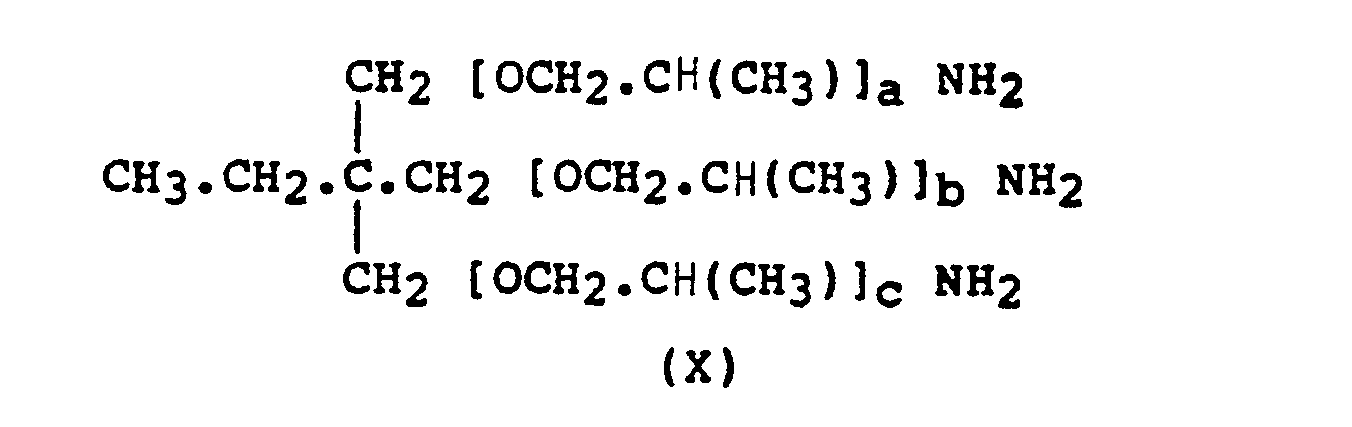

- Although in most cases the manufacturer quotes exact structures, additional technical data has been provided in the examples.
- In the following examples a distinction is made between the preparations based on the ratio of epichlorohydrin to amino nitrogen. For example a 1:1 molar ratio uses 1 mole of epichlorohydrin for each nitrogen atom in 1 mole of the amino containing prepolymer.
- A solution was prepared containing 3000g (approx. 1 mole) of a compound of formula XI (where a + b + c = 50, molecular weight approximately 3000, total amine 6.45 Mequivalents/g) in 6726.4 g of a mixture of 70 parts by weight isopropyl alcohol and 30 parts by weight water. To this solution was added 273.6 g (2.96 mole) epichlorohydrin with efficient stirring at room temperature in a reaction flask fitted with a water cooled reflux condenser. The mixture was then heated until the isopropanol began to boil, and then maintained at reflux for approximately 4 hours or until when 5 ml of the reaction mixture was diluted with 30 ml water a clear solution resulted. The flask was then allowed to cool and the reaction mixture tested as in 1.4 below.
- The procedure described in 1.1 above was followed with the following changes: 6452.5 g of 70% weight/weight isopropyl alcohol in water were used for the solution and 547.5 g (5.92 mole) of epichlorohydrin added.
- The procedure described in 1.1 above was followed except that 6178.9 g of 70% weight/weight isopropyl alcohol in water were used for the solution and 821.1 g (8.88 mole) epichlorohydrin added.
- The three adducts prepared in 1.1-1.3 above were tested for their ability to stabilise wool against shrinkage by applying them to wool swatches which had been pretreated with an oxidative shrink resist pretreatment as follows.
- A quantity of 23.5 micron quality wool top was treated with a mixture of 2% o.w.w. dichloroisocyanuric acid sodium salt and 1 % o.w.w. potassium permonosulphate according to the Dylan XC2 process (Precision Processes (Textiles) Ltd) to produce a moderate degree of shrink resistance. This top was then spun to 2 x 24s worsted count and knitted into swatches with a cover factor of 1.29DT.
- Each swatch was then scoured for 15 min in 1% o.w.v. commercial nonionic detergent (Millscour XBN, Precision Processes (Textiles) and 3% o.w.w. of sodium bicarbonate at 45 C with a 30:1 liquor ratio, then rinsed once in warm water and once in cold. The swatches were treated as follows.
- The wet goods were entered into a fresh bath at a liquor ratio of 30:1. A 1 °o weight weight solution of the product from examples 1.1-1.3 above which was to be tested was prepared in cold water. A sufficient quantity of this solution was then drip fed into the treatment bath over 15 minutes. whilst agitating the test swatch, such that an amount of prepolymer solids equivalent to 1% by weight of the dry weight of the swatch was added to the bath. The temperature of the bath was then raised to 40 C and held at this temperature for approximately 20 minutes, whilst agitating the swatch, until the bath was shown to have exhausted by taking 10 ml of bath liquor and treating this with 2 ml of a 1% solids solution of sodium dodecylbenzene sulphonate in water, the absence of cloudiness or precipitate indicating exhaustion.
- The treated swatches were then hydroextracted and tumble dried, then tested in a Wascator FOM7 washing machine according to the Test Method TM31 of the International Wool Secretariat. Shrinkage figures were then calculated, giving the following results:

- Various adducts of various polyamine prepolymers were prepared according to the general procedure described in 1.1 above with the variations shown overpage in Table I.
- The various adducts from Example 2 were tested for their ability to stabilise wool against shrinkage during washing using the procedure given in Example 1.4, with the following results:


- The dyeing properties of the material produced in Example 1.3 were examined by dyeing treated swatches with various dyestuffs. Samples of the dyebath liquor were extracted at various temperatures as the dyeing progressed, and the amount of dye present in the dyebath evaluated spectrophotometrically. All dyeings followed the same temperature pattern. Goods were entered cold in a wet state and the temperature increased to the boil at 1°C per minute to the boil and held at the boil for 1 hour. The goods were then rinsed and dried before testing for shrinkage and colour fastness. In all cases 2% o.w.w. of dyestuff was used, with 1.5% o.w.w. Albegal B (Ciba Geigy) and 2.0% ammonium acetate, the dyebath being held at pH5.5.
- Dye fastness results were comparable with those obtained from dyeings on a commercially available polyamide type resin (Polymer PKS, Precision Processes (Textiles) Ltd) dyed according to the same procedure.
- The attached graphs show the degree of strike of the dyestuff onto the fibre with increasing temperature when compared with swatches treated with commercially available polyamide resin and swatches which had only been given the pretreatment outlined in Example 1.4 above. The rate of strike of the dyestuff is reduced against that of the polyamide based polymer. Shrinkage testing gave the following for 3 x 5A on the IWS TM31 test:
- Acidol Yellow MSGL 8.1 %
- Sandolan Milling Red NFBL 13.7%
- The general procedure of example 1, using in all cases a 70% isopropanol in water solvent, was followed to prepare a number of further adducts of polyether amines either having the general structures


- The details of the preparations are outlined in Table il. The products were tested as described above (Example 1.4) and found useful as shrink resist agents.
- Various bridged adducts were prepared according to the general formula

- The following general preparative techniques were used:
- A: Condensation reactions with acids:
- A known quantity of the amino polyether was placed in a flask equipped with stirrer, distillation condenser, nitrogen bleed and dropping funnel. A known quantity of the bridging compound was added, and the mixture heated to 180-190°C with stirring until water was evolved. This was allowed to distill off until the theoretical quantity of water was evolved, or no further water could be removed. The flask was allowed to cool, and a suitable quantity of a specified isopropanol (IPA): water mixture was added to dissolve the product. A specified amount of epichlorohydrin was added and allowed to react at reflux temperature until amine titration indicated the reaction to be complete.
- B: Reaction with other bifunctional compounds:
- A known quantity of aminopolyether was placed in a flask with a specified quantity of isopropanol (IPA): water mixture. A specified quantity of bridging compound was added and the mixture heated at reflux with stirring for 3 hours. When amine titration indicated the reaction to be complete, a specified quantity of epichlorohydrin was added to the mixture and this was further heated for 4 hours or until an amine titration indicated the reaction to be complete.
- Details of the various preparations are given in Table III. The products were found to be useful as shrink resist agents.
-
- Note 1 The compound described in example 2.1 of British Patent 1,213.745, as a 50% solution in water.
- Note 2 The compound described in example 2.2. of British Patent 1,213,745, as a 50% solution in water.
- To illustrate the in-situ crosslinking effect of reactive polymers, the following polymers were prepared:
- 7.1) A reactive polyamide polymer prepared according to the procedure described in Example 3 of European Patent Application No. 0260017.
- 7.2) A reactive water soluble polyacrylate polymer was prepared as follows: into a suitable resin flask equipped with stirrer and reflux condenser were loaded 164g of isopropanol. The flask was heated to reflux for 1 hour to degas the solvent, then a mixture of 71.5g methyl methacrylate, 35.8g of dimethylaminoethyl methacrylate and 0.965g of azobisisobutyronitrile was dripped into the boiling solvent over 1 hour. The mixture was refluxed for 6 hours. The flask was cooled to 25 ° C and 64.5g of 3.53M hydrochloric acid and 97.4g of water added. Then 23.6g of epichlorohydrin was added and the mixture stirred for 24 hours at 25 C.
- 7.3) The preparation described in 7.2 was repeated using 2.412g of azobisisobutyronitrile. Before adding the epichlorohydrin, 26.9g of an alpha, omega-glycidyl organofunctional polydimethyl siloxane (Tego OF3010 Goldschmidt) followed by 21.24g of epichlorohydrin, and the reaction completed as before.
- 7.4) The preparation described in 7.3 was repeated except that 14.59g of a polyether diepoxy resin of molecular weight 640 (DER 732, Dow Chemicals) was added in place of the organofunctional polydimethylsiloxane.
- The polymers were then applied to wool as follows:
- 7.5) The procedure described in 1.4 above was followed except that varying quantities of selected products from the Examples 7.1-7.4 above were applied together with a polymer selected from Examples 1.1-1.3 5 or 6.
- 7.6) The procedure of 7.5 was repeated using untreated swatches knitted from 23.5 micron quality top spun to 2 x 21s worsted count. The swatches were then scoured as described in 1.4 and treated with 6% on weight of wool of commercial potassium permonosulphate (Dylanize Salt, PPT), at pH4.0 which was then neutralised with 5% o.w.w sodium sulphite. Thereupon the procedure from line 28 in example 1.4 was followed.
- Table IV shows the quantities and identity of the polymers used and the results obtained.
- A specified quantity of aminopolyether was weighed into a flask equipped with stirrer. reflux condenser and dropping funnel 200ml of a isopropanol: water mixture was added to dissolve the resin and a specified quantity of formaldehyde solution (37% w/w in water) was added. The mixture was heated at reflux for 4 hours.
- Table V gives details of the preparation of such methylol-terminated resins. The products were useful as shrink resist agents when tested as described in Example 1.4.
- Into a suitable resin flask equipped with a stirrer was placed 50g of water, 300g of methylethyl ketone and 187.5g of cyanuric chloride. The contents of the flask were maintained at 0°C whilst 4200g of a diamino polyether of structure XII (where a = 26) was slowly dripped in at such a rate that the temperature did not exceed 2°C. The flask was stirred at below 2 C for two hours, then slowly allowed to warm to room temperature, then heated slowly to 40°C until the titrated amine value remained constant. To this mixture was slowly added 185g of epichlorohydrin, then the flask fitted with a reflux condenser and the contents raised to reflux temperature until the titrated amine value remained constant. Evaluated as above, the product was found useful as a shrink resist agent.


Claims (11)




Applications Claiming Priority (2)
| Application Number | Priority Date | Filing Date | Title |
|---|---|---|---|
| GB8916906 | 1989-07-24 | ||
| GB898916906A GB8916906D0 (en) | 1989-07-24 | 1989-07-24 | New prepolymers and their use in a method for the treatment of wool |
Publications (3)
| Publication Number | Publication Date |
|---|---|
| EP0414377A2 true EP0414377A2 (en) | 1991-02-27 |
| EP0414377A3 EP0414377A3 (en) | 1991-07-03 |
| EP0414377B1 EP0414377B1 (en) | 2002-10-16 |
Family
ID=10660548
Family Applications (1)
| Application Number | Title | Priority Date | Filing Date |
|---|---|---|---|
| EP90307951A Expired - Lifetime EP0414377B1 (en) | 1989-07-24 | 1990-07-20 | Polymers and prepolymers and their use in a method for the treatment of wool |
Country Status (9)
| Country | Link |
|---|---|
| US (2) | US5438116A (en) |
| EP (1) | EP0414377B1 (en) |
| JP (1) | JP3132825B2 (en) |
| AT (1) | ATE226225T1 (en) |
| AU (1) | AU636372B2 (en) |
| DE (1) | DE69034010T2 (en) |
| ES (1) | ES2186666T3 (en) |
| GB (1) | GB8916906D0 (en) |
| NZ (1) | NZ234633A (en) |
Cited By (5)
| Publication number | Priority date | Publication date | Assignee | Title |
|---|---|---|---|---|
| WO1992007132A1 (en) * | 1990-10-15 | 1992-04-30 | Precision Processes Textiles | Softening agents |
| US5858023A (en) * | 1990-10-15 | 1999-01-12 | Precision Processes Textiles | Softening agents |
| WO2003008700A1 (en) * | 2001-07-17 | 2003-01-30 | Precision Processes Textiles Limited | Treatment of textiles with fluorinated polyethers |
| US9493475B2 (en) | 2012-09-18 | 2016-11-15 | Devan Chemicals Nv | Textile treatment compounds and compositions |
| US9758927B2 (en) | 2011-09-01 | 2017-09-12 | Colgate-Palmolive Company | Method for ease of ironing |
Families Citing this family (18)
| Publication number | Priority date | Publication date | Assignee | Title |
|---|---|---|---|---|
| GB9923921D0 (en) * | 1999-10-08 | 1999-12-08 | Unilever Plc | Fabric care composition |
| GB0021483D0 (en) * | 2000-09-01 | 2000-10-18 | Unilever Plc | Fabric care composition |
| JP4063486B2 (en) * | 2000-09-06 | 2008-03-19 | 日本電気株式会社 | Image search apparatus and method, and storage medium storing image search program |
| US20070083040A1 (en) * | 2003-10-27 | 2007-04-12 | Ludwig Hasemann | Storagestable concentrated aqueous solutions of anionic dis-or tetrazo dyestuffs |
| JP2008538388A (en) * | 2005-03-04 | 2008-10-23 | ダウ グローバル テクノロジーズ インコーポレイティド | Washable wool stretch fabric with dimensional stability |
| US7644373B2 (en) | 2006-01-23 | 2010-01-05 | Microsoft Corporation | User interface for viewing clusters of images |
| EP2978831B1 (en) | 2013-03-28 | 2020-12-02 | The Procter and Gamble Company | Cleaning compositions containing a polyetheramine, a soil release polymer, and a carboxymethylcellulose |
| MX2016002496A (en) | 2013-08-26 | 2016-05-31 | Procter & Gamble | Cleaning compositions containing a polyetheramine. |
| CN106164235B (en) | 2014-03-27 | 2020-01-31 | 宝洁公司 | Cleaning compositions comprising polyetheramines |
| WO2015148360A1 (en) | 2014-03-27 | 2015-10-01 | The Procter & Gamble Company | Cleaning compositions containing a polyetheramine |
| US9617502B2 (en) | 2014-09-15 | 2017-04-11 | The Procter & Gamble Company | Detergent compositions containing salts of polyetheramines and polymeric acid |
| US9850452B2 (en) | 2014-09-25 | 2017-12-26 | The Procter & Gamble Company | Fabric care compositions containing a polyetheramine |
| US9752101B2 (en) | 2014-09-25 | 2017-09-05 | The Procter & Gamble Company | Liquid laundry detergent composition |
| JP6396583B2 (en) | 2014-09-25 | 2018-09-26 | ザ プロクター アンド ギャンブル カンパニー | Cleaning composition containing polyetheramine |
| US9631163B2 (en) | 2014-09-25 | 2017-04-25 | The Procter & Gamble Company | Liquid laundry detergent composition |
| US9388368B2 (en) | 2014-09-26 | 2016-07-12 | The Procter & Gamble Company | Cleaning compositions containing a polyetheramine |
| US20170275565A1 (en) | 2016-03-24 | 2017-09-28 | The Procter & Gamble Company | Compositions containing an etheramine |
| US20250059470A1 (en) * | 2021-12-17 | 2025-02-20 | Specialty Operations France | New cationic polymers, process for producing the same from urea diamine condensates and polyepoxide derivatives, and uses thereof |
Family Cites Families (16)
| Publication number | Priority date | Publication date | Assignee | Title |
|---|---|---|---|---|
| IT626236A (en) * | 1959-01-16 | Boehme Chemie Gmbh | ||
| US3236895A (en) * | 1960-12-12 | 1966-02-22 | Dow Chemical Co | Polyoxyalkylenepolyamines |
| US3462393A (en) * | 1967-05-05 | 1969-08-19 | Dow Chemical Co | Epoxy resin with diamine of polyoxypropylene glycol and method of cure |
| US3763106A (en) * | 1969-11-28 | 1973-10-02 | Atlas Chem Ind | Polymers prepared by reacting urea with an amino alcohol or diamine followed by methylolation with formaldehyde |
| US3965072A (en) * | 1969-11-28 | 1976-06-22 | Ici United States Inc. | Polyurea-urethane polymers from urea, diamines and aminoalcohols |
| US3981913A (en) * | 1973-06-21 | 1976-09-21 | Ici United States Inc. | Mono-substituted ureas |
| US3996269A (en) * | 1973-06-21 | 1976-12-07 | Ici United States Inc. | Polyurethane polymers |
| AU1823676A (en) * | 1975-10-13 | 1978-04-06 | Commw Scient Ind Res Org | Treatment of wool with polyorganosiloxanes |
| US4061624A (en) * | 1976-07-26 | 1977-12-06 | Minnesota Mining And Manufacturing Company | Process for prepolymers and products |
| US4388209A (en) * | 1979-10-04 | 1983-06-14 | Henkel Corporation | Polyglycidyl ethers |
| US4239497A (en) * | 1979-11-08 | 1980-12-16 | Uop Inc. | Additives for hydrocarbon oils |
| GB8621171D0 (en) * | 1986-09-02 | 1986-10-08 | Precision Proc Textiles Ltd | Polyamides |
| DE3734916A1 (en) * | 1987-10-15 | 1989-04-27 | Hoechst Ag | COMPOSITION COMPONENT FOR ART RESINS, THESE INCLUDING HAIRCUSTANT MIXTURES AND THEIR USE |
| GB8725921D0 (en) * | 1987-11-05 | 1987-12-09 | Precision Proc Textiles Ltd | Treatment of wool |
| US4810535A (en) * | 1988-02-01 | 1989-03-07 | Ppg Industries, Inc. | Glycidol-modified polyepoxide-polyoxyalkylenepolyamine adducts |
| US4839460A (en) * | 1988-02-25 | 1989-06-13 | The Dow Chemical Company | Novel polymers from aminated polyethers and formaldehyde |
-
1989
- 1989-07-24 GB GB898916906A patent/GB8916906D0/en active Pending
-
1990
- 1990-07-20 EP EP90307951A patent/EP0414377B1/en not_active Expired - Lifetime
- 1990-07-20 ES ES90307951T patent/ES2186666T3/en not_active Expired - Lifetime
- 1990-07-20 DE DE69034010T patent/DE69034010T2/en not_active Expired - Fee Related
- 1990-07-20 AT AT90307951T patent/ATE226225T1/en not_active IP Right Cessation
- 1990-07-23 JP JP02196047A patent/JP3132825B2/en not_active Expired - Lifetime
- 1990-07-24 US US07/556,976 patent/US5438116A/en not_active Expired - Lifetime
- 1990-07-24 NZ NZ234633A patent/NZ234633A/en unknown
- 1990-07-24 AU AU59795/90A patent/AU636372B2/en not_active Ceased
-
1994
- 1994-07-07 US US08/271,743 patent/US5571286A/en not_active Expired - Fee Related
Cited By (6)
| Publication number | Priority date | Publication date | Assignee | Title |
|---|---|---|---|---|
| WO1992007132A1 (en) * | 1990-10-15 | 1992-04-30 | Precision Processes Textiles | Softening agents |
| US5858023A (en) * | 1990-10-15 | 1999-01-12 | Precision Processes Textiles | Softening agents |
| WO2003008700A1 (en) * | 2001-07-17 | 2003-01-30 | Precision Processes Textiles Limited | Treatment of textiles with fluorinated polyethers |
| US7186273B2 (en) | 2001-07-17 | 2007-03-06 | Devan-Ppt Chemicals Limited | Treatment of textiles with fluorinated polyethers |
| US9758927B2 (en) | 2011-09-01 | 2017-09-12 | Colgate-Palmolive Company | Method for ease of ironing |
| US9493475B2 (en) | 2012-09-18 | 2016-11-15 | Devan Chemicals Nv | Textile treatment compounds and compositions |
Also Published As
| Publication number | Publication date |
|---|---|
| NZ234633A (en) | 1995-02-24 |
| JPH0381324A (en) | 1991-04-05 |
| US5438116A (en) | 1995-08-01 |
| GB8916906D0 (en) | 1989-09-06 |
| AU5979590A (en) | 1991-01-24 |
| JP3132825B2 (en) | 2001-02-05 |
| US5571286A (en) | 1996-11-05 |
| AU636372B2 (en) | 1993-04-29 |
| DE69034010D1 (en) | 2002-11-21 |
| ES2186666T3 (en) | 2003-05-16 |
| EP0414377B1 (en) | 2002-10-16 |
| ATE226225T1 (en) | 2002-11-15 |
| DE69034010T2 (en) | 2003-02-06 |
| EP0414377A3 (en) | 1991-07-03 |
Similar Documents
| Publication | Publication Date | Title |
|---|---|---|
| EP0414377B1 (en) | Polymers and prepolymers and their use in a method for the treatment of wool | |
| US4184004A (en) | Treatment of textile fabrics with epoxy-polyoxyalkylene modified organosilicones | |
| CA1271290A (en) | Cationic polycondensate fixing agents | |
| US4921895A (en) | Preparation for finishing textile fibers and products and textile products having improved handle | |
| US4452606A (en) | Compositions useful for improving the fastness of dyeings on cellulosic substrates: precondensates of N-methylol compound with polyalkylene polyamine-epihalohydrin product | |
| US3347803A (en) | Process for the production of hardenable synthetic resinous products containing halohydrin groups | |
| US4101272A (en) | Process for the treatment of wool with polyorganosiloxanes | |
| US3709847A (en) | Preparations of reaction products of epoxides,fatty amines and basic polyamides,processes for their manufacture and their use | |
| WO2002092666A1 (en) | Modified polyorganosiloxanes, aqueous emulsions thereof, their production and their use | |
| EP0445077B1 (en) | A method and compositions for textile finishing | |
| JPH0127189B2 (en) | ||
| US5445652A (en) | Method for the treatment of cellulosic fibres with amino functional and silicone polymers | |
| US3647728A (en) | Preparations of polyaddition products processes for their manufacture and use | |
| US3649575A (en) | Stable preparations for finishing wool | |
| US3961892A (en) | Textile softening agents | |
| US5858023A (en) | Softening agents | |
| US3769365A (en) | Reaction product of epoxy resins,fatty amines,dicarboxylic acids and aminoplasts | |
| FR2560240A1 (en) | TEXTILE FIBER AFTER-TREATMENT PROCESS | |
| US5632781A (en) | Cationic polycondensate dye fixing agent and process of preparing the same | |
| EP0553217B1 (en) | Softening agents | |
| EP0260017A1 (en) | Polyamides, a process for the preparation thereof and their use in a method for the treatment of wool | |
| CA1045161A (en) | Polychlorohydrin ethers of tris-(hydroxymethyl)-aminomethane in association with polyglycol diamines | |
| Blanchard et al. | Factors affecting the dyeability of cotton crosslinked with polycarboxylic acid | |
| KR0134183B1 (en) | Micro-emulsion of aminopolysiloxans | |
| US7279519B2 (en) | Composition and method for treating textiles |
Legal Events
| Date | Code | Title | Description |
|---|---|---|---|
| PUAI | Public reference made under article 153(3) epc to a published international application that has entered the european phase |
Free format text: ORIGINAL CODE: 0009012 |
|
| AK | Designated contracting states |
Kind code of ref document: A2 Designated state(s): AT BE CH DE ES FR GB IT LI |
|
| PUAL | Search report despatched |
Free format text: ORIGINAL CODE: 0009013 |
|
| AK | Designated contracting states |
Kind code of ref document: A3 Designated state(s): AT BE CH DE ES FR GB IT LI |
|
| 17P | Request for examination filed |
Effective date: 19911216 |
|
| RAP1 | Party data changed (applicant data changed or rights of an application transferred) |
Owner name: PRECISION PROCESSES TEXTILES |
|
| 17Q | First examination report despatched |
Effective date: 19930219 |
|
| APCB | Communication from the board of appeal sent |
Free format text: ORIGINAL CODE: EPIDOS OBAPE |
|
| APCB | Communication from the board of appeal sent |
Free format text: ORIGINAL CODE: EPIDOS OBAPE |
|
| APCB | Communication from the board of appeal sent |
Free format text: ORIGINAL CODE: EPIDOS OBAPE |
|
| APCB | Communication from the board of appeal sent |
Free format text: ORIGINAL CODE: EPIDOS OBAPE |
|
| APAB | Appeal dossier modified |
Free format text: ORIGINAL CODE: EPIDOS NOAPE |
|
| GRAG | Despatch of communication of intention to grant |
Free format text: ORIGINAL CODE: EPIDOS AGRA |
|
| GRAG | Despatch of communication of intention to grant |
Free format text: ORIGINAL CODE: EPIDOS AGRA |
|
| GRAH | Despatch of communication of intention to grant a patent |
Free format text: ORIGINAL CODE: EPIDOS IGRA |
|
| GRAH | Despatch of communication of intention to grant a patent |
Free format text: ORIGINAL CODE: EPIDOS IGRA |
|
| GRAA | (expected) grant |
Free format text: ORIGINAL CODE: 0009210 |
|
| AK | Designated contracting states |
Kind code of ref document: B1 Designated state(s): AT BE CH DE ES FR GB IT LI |
|
| REF | Corresponds to: |
Ref document number: 226225 Country of ref document: AT Date of ref document: 20021115 Kind code of ref document: T |
|
| REG | Reference to a national code |
Ref country code: GB Ref legal event code: FG4D |
|
| REG | Reference to a national code |
Ref country code: CH Ref legal event code: EP |
|
| REF | Corresponds to: |
Ref document number: 69034010 Country of ref document: DE Date of ref document: 20021121 |
|
| REG | Reference to a national code |
Ref country code: CH Ref legal event code: NV Representative=s name: E. BLUM & CO. PATENTANWAELTE |
|
| ET | Fr: translation filed | ||
| REG | Reference to a national code |
Ref country code: ES Ref legal event code: FG2A Ref document number: 2186666 Country of ref document: ES Kind code of ref document: T3 |
|
| PGFP | Annual fee paid to national office [announced via postgrant information from national office to epo] |
Ref country code: AT Payment date: 20030729 Year of fee payment: 14 |
|
| PLBE | No opposition filed within time limit |
Free format text: ORIGINAL CODE: 0009261 |
|
| STAA | Information on the status of an ep patent application or granted ep patent |
Free format text: STATUS: NO OPPOSITION FILED WITHIN TIME LIMIT |
|
| 26N | No opposition filed |
Effective date: 20030717 |
|
| PG25 | Lapsed in a contracting state [announced via postgrant information from national office to epo] |
Ref country code: AT Free format text: LAPSE BECAUSE OF NON-PAYMENT OF DUE FEES Effective date: 20040720 |
|
| REG | Reference to a national code |
Ref country code: GB Ref legal event code: 711B |
|
| APAH | Appeal reference modified |
Free format text: ORIGINAL CODE: EPIDOSCREFNO |
|
| REG | Reference to a national code |
Ref country code: GB Ref legal event code: 711K |
|
| REG | Reference to a national code |
Ref country code: GB Ref legal event code: 711B |
|
| REG | Reference to a national code |
Ref country code: CH Ref legal event code: PFA Owner name: COATS SHELFCO PRECISION LIMITED Free format text: PRECISION PROCESSES TEXTILES#DYLAN LABORATORIES AMBERGATE#DERBY DE5 2EY (GB) -TRANSFER TO- COATS SHELFCO PRECISION LIMITED#1 THE SQUARE STOCKLEY PARK UXBRIDGE#MIDDLESEX UB11 1TD (GB) |
|
| REG | Reference to a national code |
Ref country code: ES Ref legal event code: PC2A |
|
| REG | Reference to a national code |
Ref country code: GB Ref legal event code: 711G |
|
| REG | Reference to a national code |
Ref country code: CH Ref legal event code: PFA Owner name: COATS SHELFCO PRECISION LIMITED Free format text: COATS SHELFCO PRECISION LIMITED#1 THE SQUARE STOCKLEY PARK UXBRIDGE#MIDDLESEX UB11 1TD (GB) -TRANSFER TO- COATS SHELFCO PRECISION LIMITED#1 THE SQUARE STOCKLEY PARK UXBRIDGE#MIDDLESEX UB11 1TD (GB) |
|
| PGFP | Annual fee paid to national office [announced via postgrant information from national office to epo] |
Ref country code: DE Payment date: 20080730 Year of fee payment: 19 |
|
| PGFP | Annual fee paid to national office [announced via postgrant information from national office to epo] |
Ref country code: FR Payment date: 20080627 Year of fee payment: 19 Ref country code: IT Payment date: 20080716 Year of fee payment: 19 |
|
| REG | Reference to a national code |
Ref country code: FR Ref legal event code: CD Ref country code: FR Ref legal event code: RM Ref country code: FR Ref legal event code: CA |
|
| PGFP | Annual fee paid to national office [announced via postgrant information from national office to epo] |
Ref country code: BE Payment date: 20080729 Year of fee payment: 19 |
|
| PGFP | Annual fee paid to national office [announced via postgrant information from national office to epo] |
Ref country code: CH Payment date: 20090609 Year of fee payment: 20 Ref country code: ES Payment date: 20090702 Year of fee payment: 20 |
|
| PGFP | Annual fee paid to national office [announced via postgrant information from national office to epo] |
Ref country code: GB Payment date: 20090805 Year of fee payment: 20 |
|
| BERE | Be: lapsed |
Owner name: *COATS SHELFCO PRECISION LTD Effective date: 20090731 |
|
| REG | Reference to a national code |
Ref country code: FR Ref legal event code: ST Effective date: 20100331 |
|
| PG25 | Lapsed in a contracting state [announced via postgrant information from national office to epo] |
Ref country code: FR Free format text: LAPSE BECAUSE OF NON-PAYMENT OF DUE FEES Effective date: 20090731 |
|
| PG25 | Lapsed in a contracting state [announced via postgrant information from national office to epo] |
Ref country code: DE Free format text: LAPSE BECAUSE OF NON-PAYMENT OF DUE FEES Effective date: 20100202 Ref country code: BE Free format text: LAPSE BECAUSE OF NON-PAYMENT OF DUE FEES Effective date: 20090731 |
|
| REG | Reference to a national code |
Ref country code: CH Ref legal event code: PL |
|
| REG | Reference to a national code |
Ref country code: GB Ref legal event code: PE20 Expiry date: 20100719 |
|
| REG | Reference to a national code |
Ref country code: ES Ref legal event code: FD2A Effective date: 20100721 |
|
| PG25 | Lapsed in a contracting state [announced via postgrant information from national office to epo] |
Ref country code: ES Free format text: LAPSE BECAUSE OF EXPIRATION OF PROTECTION Effective date: 20100721 |
|
| PG25 | Lapsed in a contracting state [announced via postgrant information from national office to epo] |
Ref country code: GB Free format text: LAPSE BECAUSE OF EXPIRATION OF PROTECTION Effective date: 20100719 |
|
| PG25 | Lapsed in a contracting state [announced via postgrant information from national office to epo] |
Ref country code: IT Free format text: LAPSE BECAUSE OF NON-PAYMENT OF DUE FEES Effective date: 20090720 |