EP0414288B1 - Contrast media - Google Patents
Contrast media Download PDFInfo
- Publication number
- EP0414288B1 EP0414288B1 EP90201964A EP90201964A EP0414288B1 EP 0414288 B1 EP0414288 B1 EP 0414288B1 EP 90201964 A EP90201964 A EP 90201964A EP 90201964 A EP90201964 A EP 90201964A EP 0414288 B1 EP0414288 B1 EP 0414288B1
- Authority
- EP
- European Patent Office
- Prior art keywords
- contrast medium
- paramagnetic metal
- contrast
- ray
- medium
- Prior art date
- Legal status (The legal status is an assumption and is not a legal conclusion. Google has not performed a legal analysis and makes no representation as to the accuracy of the status listed.)
- Expired - Lifetime
Links
Classifications
-
- A—HUMAN NECESSITIES
- A61—MEDICAL OR VETERINARY SCIENCE; HYGIENE
- A61K—PREPARATIONS FOR MEDICAL, DENTAL OR TOILETRY PURPOSES
- A61K49/00—Preparations for testing in vivo
- A61K49/06—Nuclear magnetic resonance [NMR] contrast preparations; Magnetic resonance imaging [MRI] contrast preparations
- A61K49/08—Nuclear magnetic resonance [NMR] contrast preparations; Magnetic resonance imaging [MRI] contrast preparations characterised by the carrier
- A61K49/10—Organic compounds
-
- A—HUMAN NECESSITIES
- A61—MEDICAL OR VETERINARY SCIENCE; HYGIENE
- A61K—PREPARATIONS FOR MEDICAL, DENTAL OR TOILETRY PURPOSES
- A61K49/00—Preparations for testing in vivo
- A61K49/04—X-ray contrast preparations
- A61K49/0433—X-ray contrast preparations containing an organic halogenated X-ray contrast-enhancing agent
- A61K49/0447—Physical forms of mixtures of two different X-ray contrast-enhancing agents, containing at least one X-ray contrast-enhancing agent which is a halogenated organic compound
- A61K49/0495—Physical forms of mixtures of two different X-ray contrast-enhancing agents, containing at least one X-ray contrast-enhancing agent which is a halogenated organic compound intended for oral administration
-
- A—HUMAN NECESSITIES
- A61—MEDICAL OR VETERINARY SCIENCE; HYGIENE
- A61K—PREPARATIONS FOR MEDICAL, DENTAL OR TOILETRY PURPOSES
- A61K49/00—Preparations for testing in vivo
- A61K49/06—Nuclear magnetic resonance [NMR] contrast preparations; Magnetic resonance imaging [MRI] contrast preparations
- A61K49/08—Nuclear magnetic resonance [NMR] contrast preparations; Magnetic resonance imaging [MRI] contrast preparations characterised by the carrier
- A61K49/085—Nuclear magnetic resonance [NMR] contrast preparations; Magnetic resonance imaging [MRI] contrast preparations characterised by the carrier conjugated systems
-
- Y—GENERAL TAGGING OF NEW TECHNOLOGICAL DEVELOPMENTS; GENERAL TAGGING OF CROSS-SECTIONAL TECHNOLOGIES SPANNING OVER SEVERAL SECTIONS OF THE IPC; TECHNICAL SUBJECTS COVERED BY FORMER USPC CROSS-REFERENCE ART COLLECTIONS [XRACs] AND DIGESTS
- Y10—TECHNICAL SUBJECTS COVERED BY FORMER USPC
- Y10S—TECHNICAL SUBJECTS COVERED BY FORMER USPC CROSS-REFERENCE ART COLLECTIONS [XRACs] AND DIGESTS
- Y10S436/00—Chemistry: analytical and immunological testing
- Y10S436/806—Electrical property or magnetic property
-
- Y—GENERAL TAGGING OF NEW TECHNOLOGICAL DEVELOPMENTS; GENERAL TAGGING OF CROSS-SECTIONAL TECHNOLOGIES SPANNING OVER SEVERAL SECTIONS OF THE IPC; TECHNICAL SUBJECTS COVERED BY FORMER USPC CROSS-REFERENCE ART COLLECTIONS [XRACs] AND DIGESTS
- Y10—TECHNICAL SUBJECTS COVERED BY FORMER USPC
- Y10T—TECHNICAL SUBJECTS COVERED BY FORMER US CLASSIFICATION
- Y10T436/00—Chemistry: analytical and immunological testing
- Y10T436/24—Nuclear magnetic resonance, electron spin resonance or other spin effects or mass spectrometry
Definitions
- the present invention relates to improvements in and relating to contrast media for use in diagnostic imaging, and especially to contrast media suitable for imaging the gastrointestinal (GI) tract.
- GI gastrointestinal
- contrast agents may be administered to the patient in order to enhance image contrast between regions into which the contrast agent distributes and those into which it does not, or between regions into which the contrast agent distributes unequally.
- the contrast agents comprise relatively high atomic number atoms, e.g. barium or iodine, as X-ray transmission generally decreases as atomic number increases.
- the contrast agents are generally substances which affect the nuclear spin reequilibration of the nuclei (hereinafter the "imaging nuclei" - generally water protons in body tissues and fluids) which are responsible for the MR signals from which MR images are generated.
- Lauterbur proposed the use of paramagnetic species, such as Mn(II), as MRI contrast agents (see Lauterbur et al., pages 752-759 in "Electrons to Tissues - Frontiers of Biological Energetics", Volume 1, edited by Dutton et al., Academic Press, New York, 1978) and more recently Schering AG, in EP-A-71564, proposed the use of the dimeglumine salt of the gadolinium(III) chelate of diethylenetriaminepentaacetic acid (GdDTPA-dimeglumine).
- GdDTPA-dimeglumine diethylenetriaminepentaacetic acid
- Particularly interesting MRI contrast agents thus include chelates of paramagnetic metal species, e.g. Gd(III), Mn(II), Cr(III), Dy(III) and Fe(III) with cyclic or acyclic polyaminocarboxylic acids such as DOTA, DTPA, DTPA-bismethylamide, DTPA-bismorpholide, DO3A, HP-DO3A and derivatives thereof.
- chelates of paramagnetic metal species e.g. Gd(III), Mn(II), Cr(III), Dy(III) and Fe(III)
- cyclic or acyclic polyaminocarboxylic acids such as DOTA, DTPA, DTPA-bismethylamide, DTPA-bismorpholide, DO3A, HP-DO3A and derivatives thereof.
- Paramagnetic substances have a relatively close range effect on the imaging nuclei and thus, to be effective as positive contrast agents, need to be in close proximity (at the molecular level) to water molecules. During passage through the GI system however water is absorbed and as result the contrast efficiency of paramagnetic MRI contrast media administered into the GI tract is reduced.
- paramagnetic MRI contrast agents may be formulated with iodinated X-ray contrast agents to produce a contrast medium which can be used for imaging the GI tract by X-ray and/or MR imaging and which overcomes or substantially reduces the side effects of the prior art mannitol containing oral MRI contrast media referred to above.
- the invention provides a contrast medium comprising a physiologically acceptable paramagnetic metal species containing substance together with a water soluble iodinated X-ray contrast agent.
- the contrast media of the invention can, as mentioned above, be used for both X-ray and MR imaging of the GI tract. This makes such media particularly attractive for use in the examination of infants and elderly patients, patients with problems swallowing and, most especially, patients with powerful acute pain in the abdominal region, i.e. so-called "acute abdomen”.
- the contrast media of the invention incorporate paramagnetic metal species, and since such metals have medium to high atomic weights, the efficiency of the media of the invention as X-ray contrast media is enhanced by the inclusion of the paramagnetic substance.
- the efficiency of the media as MRI contrast media is not only increased by inclusion of the iodinated X-ray contrast agent but this is achieved without incurring or with a significantly reduced occurrence of the drawbacks that resulted from the use of mannitol.
- the X-ray contrast agent in the media of the invention can be any iodinated, ionic or non-ionic water-soluble X-ray contrast agent, for example non-ionic monomers, ionic monomers, non-ionic dimers and ionic dimers. Such monomers or dimers generally contain within their molecular structure one or two triiodophenyl moieties respectively. Suitable examples include salts, e.g.
- iodamide sodium or meglumine salts, of iodamide, iothalamate, diatrizoate, ioxaglate and metrizoate, and non-ionics such as metrizamide (see DE-A-2031724), iopamidol (see BE-A-836355), iohexol (see GB-A-1548594), iotrolan (see EP-A-33426), iodecimol (see EP-A-49745), iodixanol (see EP-A-108638), ioglucol (see US-A-4314055), ioglucomide (see BE-A-846657), ioglunide (see DE-A-2456685), iogulamide (see BE-A-882309), iomeprol (see EP-A-26281), iopentol (see EP-A-105752), iopromide (see DE-A-2909439
- the counterion should, of course, be physiologically acceptable and in this regard mention may be made of alkali and alkaline earth metal cations, e.g. sodium and calcium, and cations of organic bases such as ethanolamine, diethanolamine, morpholine, glucamine and especially meglumine.
- alkali and alkaline earth metal cations e.g. sodium and calcium
- organic bases such as ethanolamine, diethanolamine, morpholine, glucamine and especially meglumine.
- Particular ionic X-ray contrast agents useful according to the invention thus include physiologically acceptable salts of 3-acetylamino-2,4-6-triiodobenzoic acid, 3,5-diacetamido-2,4,6-triiodobenzoic acid, 2,4,6-triiodo-3,5-dipropionamido-benzoic acid, 3-acetylamino-5-((acetylamino)methyl)-2,4,6-triiodobenzoic acid, 3-acetylamino-5-(acetylmethylamino)-2,4,6-triiodobenzoic acid, 5-acetamido-2,4,6-triiodo-N-((methylcarbamoyl)methyl)isophthalamic acid, 5-(2-methoxyacetamido)-2,4,6-triiodo-N-[2-hydroxy-1-(methylcarbamoyl)-ethyl]isophthalamic acid, 5-
- Both non-ionic and ionic X-ray contrast agents have their advantages in the MRI contrast media of the invention.
- non-ionic X-ray contrast agents a lower concentration can be used to achieve the same osmotic effect.
- non-ionics are especially suitable for contrast media for administration to young children and persons with perfused GI systems or suspected perfusion of the organ because of the generally lower systematic toxicity of non-ionic agents.
- Another advantage of the non-ionic agents is that they do not precipitate in the stomach.
- the X-ray contrast agents are more preferred as osmoactive agents than the conventional osmoactive agents such as the mannitol used in the Schering(EP-A-124766)/Claussen et al. (supra) studies since the side effects, meteorism and diarrhoea, observed with mannitol should be reduced or eliminated.
- the concentration of the X-ray contrast agent in the contrast media of the invention may vary over a wide range depending on factors such as its own chemical nature, the chemical and physical nature of the paramagnetic substance and other components in the contrast media, the intended administration route, the pre-administration dilution ratio (where the contrast medium is in a concentrated form for dilution, dissolution or dispersion prior to administration), and machine parameters such as the intended MRI pulse sequence or intended X-ray electron voltage.
- the concentration of the X-ray contrast agent is such that the formulation ready for administration contains 2 to 370 mgI/ml, especially 5 to 300 mgI/ml, most especially 10 to 200 mgI/ml.
- the dosage of the iodinated X-ray contrast medium will also vary over a wide range, and will be dependent on the same factors as mentioned above. However conveniently a dosage of 10 mgI/kg to 5 gI/kg, especially 100 mgI/kg to 2gI/kg may be given.
- the paramagnetic substance in the contrast medium of the invention can be any physiologically tolerable paramagnetic metal species containing substance.
- Chelates of paramagnetic metal species are particularly preferred, in particular chelates with cyclic or acyclic polyaminocarboxylic acids or derivatives, e.g. amides and esters, thereof.
- the chelating agents can conveniently be those mentioned in the literature discussed above, although DTPA (see US-A-4647447 (Schering)), DTPA-bismethylamide (see WO86/02841 (Salutar)), DTPA-bis(hydroxylated-alkylamides) (see EP-A-130934 (Schering) and US-A-4826673 (Mallinckrodt)), DOTA (see US-A-4639365 (Sherry)), DO3A and HP-DO3A (1,4,7,10-tetraazacyclododecane-1,4,7-triacetic acid and 1,4,7,10-tetraazacyclododecane-1(2-hydroxypropyl)-4,7,10-triacetic acid - see EP-A-232751 (Squibb)), are particularly preferred, especially for chelation of Gd(III).
- the paramagnetic substance can be soluble or insoluble and may, if desired, be bound to a carrier material, e.g. as suggested by Nycomed in EP-A-184899 and EP-A-186947.
- the carrier material is preferably biotolerable and non-biodegradable and particular mention in this regard may be made of insoluble polysaccharides and insoluble derivatives thereof, e.g. such as cellulose or those disclosed in EP-A-184899. It is also possible to use soluble salts of physiologically tolerable paramagnetic metals or particles of insoluble paramagnetic compounds, such as the gadolinium oxalate suggested by Runge in US-A-4615879.
- the paramagnetic metal is conveniently a metal having an atomic number of 21-29, 42, 44 and 57-71, e.g. gadolinium, europium, dysprosium, holmium, erbium, manganese, iron, chromium, nickel and copper. Gd, Dy, Mn, Or and Fe are particularly preferred.
- paramagnetic metal is bound in a chelate complex
- a buffer and/or an excess of the chelating agent, or a weaker metal complex thereof e.g. as suggested in EP-A-270483.
- the concentration and dosage of the paramagnetic substance will depend on factors such as those mentioned above in connection with the concentration and dosage of the X-ray contrast agent. In general, however, the concentration will be such that the contrast medium in a form ready for administration will contain the paramagnetic metal (PM) at 0.01 mmol to 1 mol PM/l, e.g. 0.01 to 100 mmol PM/l, especially 0.1 to 50 mmol PM/l, particularly 0.1 to 10 mmol PM/l.
- the dosage will conveniently lie in the range 0.01 micromol PM/kg to 10 mmol PM/kg, especially 0.1 micromol PM/kg to 5 mmol PM/kg, particularly 1 micromol PM/kg to 1 mmol PM/kg bodyweight.
- the contrast media of the invention may, of course, contain other components than the paramagnetic substance and the X-ray contrast agent, for example conventional pharmaceutical or veterinary formulation aids such as wetting agents, disintegrants, binders, fillers, stabilizers, viscosity enhancing agents, flavouring agents, colouring agents, buffers, pH adjusting agents, and liquid carrier media.
- conventional pharmaceutical or veterinary formulation aids such as wetting agents, disintegrants, binders, fillers, stabilizers, viscosity enhancing agents, flavouring agents, colouring agents, buffers, pH adjusting agents, and liquid carrier media.
- buffers in the contrast media of the invention is particularly preferred.
- a mucoadhesive for example, a polyacrylic acid or a derivative thereof, xanthan gum etc.
- the contrast media of the invention are particularly suited for use in the diagnostic imaging by MRI and/or X-ray imaging of the GI tract, and in particular the duodenum and the intestines.
- the contrast medium may be administered orally or rectally or through orally or rectally inserted tubes.
- the media are of course suitable for use in imaging other externally voided body cavities, e.g. the bladder, uterus and vagina.
- the invention provides the use of an iodinated X-ray contrast agent for the manufacture of a contrast medium further comprising a paramagnetic metal species, said medium being for use in diagnostic imaging of the gastrointestinal tract.
- the invention provides the use of a physiologically tolerable paramagnetic metal species containing substance for the manufacture of a contrast medium further comprising an iodinated X-ray contrast agent, said medium being for use in diagnostic imaging of the gastrointestinal tract.
- the invention provides a method of generating an image of a human or non-human, e.g. mammalian, subject, said method comprising administering a contrast medium according to the invention into an externally voided body cavity, e.g. the gastrointestinal tract, and generating an X-ray and/or magnetic resonance image of at least part said cavity.
- the invention provides a diagnostic contrast agent kit comprising a physiologically tolerable paramagnetic species containing substance and, packaged separately thereto, a water soluble iodinated X-ray contrast agent.
- the contrast medium will generally be administered in a dose of at least 30 ml for an adult human subject, more usually 200 to 1500 ml, especially 300 to 1000 ml.
- the dose may be taken in portions, e.g. for oral administration about 2/3 being ingested 20 minutes before imaging and the remainder being ingested immediately before the subject is placed in the imager.
- GdDTPA-BMA saccharin sodium and iohexol were dissolved in water (500 ml). Orange essence was dissolved in ethanol and slowly added to the aqueous solution. Water was added to bring the volume to 1000 ml and the solution was filled into a 1000 ml vial. The solution contains 1 mmol gadolinium and 140 g I per litre.
- GdDTPA-BMA and iohexol were prepared according to the methods of US-A-4687659 (Salutar) and US-A-4250113 (Nycomed) respectively.
- the components were dissolved in water (500 ml) at 50°C. Water was added to bring the volume to 1000 ml and the solution was filled into a 1000ml vial. The solution contained 10 mmol Gd and 200g I per litre.
- GdDTPA-dimeglumine and metrizoate were prepared according to the methods of US-A-4647447 (Schering) and US-A-3476802 (Nycomed) respectively.
- Gastrografin® available from Schering AG.
- Gastrografin contains the X-ray contrast agent diatrizoate sodium and diatrizoate meglumine at a concentration of 370 mg I/ml.
- the concentrate is diluted with three times its volume of water or juice before administration.
- the components were dissolved in water (500ml) at 40°C. Water was added to bring the volume to 1000 ml and the solution was filled into a 1000 ml vial.
- the solution contained 20 mmol gadolinium and 200g I per litre.
- GdDOTA lysine salt and Iopamidol were prepared according to the methods of W087/06229 (Guerbet) and US-A-4001323 (Bracco) respectively.
Landscapes
- Health & Medical Sciences (AREA)
- Veterinary Medicine (AREA)
- Epidemiology (AREA)
- Life Sciences & Earth Sciences (AREA)
- Animal Behavior & Ethology (AREA)
- General Health & Medical Sciences (AREA)
- Public Health (AREA)
- Radiology & Medical Imaging (AREA)
- Nuclear Medicine, Radiotherapy & Molecular Imaging (AREA)
- Medicinal Chemistry (AREA)
- Chemical & Material Sciences (AREA)
- Medicines Containing Antibodies Or Antigens For Use As Internal Diagnostic Agents (AREA)
- Electrochromic Elements, Electrophoresis, Or Variable Reflection Or Absorption Elements (AREA)
- Liquid Crystal (AREA)
- Devices For Indicating Variable Information By Combining Individual Elements (AREA)
- Steroid Compounds (AREA)
- Non-Silver Salt Photosensitive Materials And Non-Silver Salt Photography (AREA)
- Compositions Of Macromolecular Compounds (AREA)
Abstract
Description
- The present invention relates to improvements in and relating to contrast media for use in diagnostic imaging, and especially to contrast media suitable for imaging the gastrointestinal (GI) tract.
- In X-ray imaging and magnetic resonance imaging (MRI), contrast agents may be administered to the patient in order to enhance image contrast between regions into which the contrast agent distributes and those into which it does not, or between regions into which the contrast agent distributes unequally.
- For X-ray imaging, the contrast agents comprise relatively high atomic number atoms, e.g. barium or iodine, as X-ray transmission generally decreases as atomic number increases. For MR imaging however, the contrast agents are generally substances which affect the nuclear spin reequilibration of the nuclei (hereinafter the "imaging nuclei" - generally water protons in body tissues and fluids) which are responsible for the MR signals from which MR images are generated.
- Accordingly, in recent years, many such substances have been suggested for use as MRI contrast agents. Thus, for example, in 1978 Lauterbur proposed the use of paramagnetic species, such as Mn(II), as MRI contrast agents (see Lauterbur et al., pages 752-759 in "Electrons to Tissues - Frontiers of Biological Energetics", Volume 1, edited by Dutton et al., Academic Press, New York, 1978) and more recently Schering AG, in EP-A-71564, proposed the use of the dimeglumine salt of the gadolinium(III) chelate of diethylenetriaminepentaacetic acid (GdDTPA-dimeglumine).
- Many other paramagnetic MRI contrast agents have been suggested in the literature and in this regard reference may be had to EP-A-71564 (Schering), EP-A-130934 (Schering), US-A-4615879 (Runge), DE-A-3401052 (Schering), EP-A-185899 (Nycomed), EP-A-186947 (Nycomed), US-A-2387735 (Bersworth), US-A-2407645 (Bersworth), EP-A-165728 (Nycomed), US-A-4647447 (Schering), US-A-4826673 (Mallinckrodt), US-A-4639365 (Sherry), EP-A-299795 (Nycomed), DE-A-2918842 (Rexolin Chemicals AB), EP-A-258616 (Salutar), DE-A-3633245 (Schering), EP-A-263059 (Schering), EP-A-277088 (Schering) and DE-A-3633243 (IDF) and in the documents cited in these patent publications.
- Particularly interesting MRI contrast agents thus include chelates of paramagnetic metal species, e.g. Gd(III), Mn(II), Cr(III), Dy(III) and Fe(III) with cyclic or acyclic polyaminocarboxylic acids such as DOTA, DTPA, DTPA-bismethylamide, DTPA-bismorpholide, DO3A, HP-DO3A and derivatives thereof.
- While MRI has until now mainly been used for imaging the central nervous system, the technique has great potential for imaging externally voided body cavities and especially the GI tract. However, development of MRI as a technique for imaging the GI tract, or indeed the abdomen in general, has been hindered by the special problems of imaging the abdomen in which, in the absence of a contrast agent, inter-tissue contrast is relatively poor and there is thus a general need for improved MRI contrast media suitable for imaging such body cavities.
- Various substances have been evaluated as potential MRI contrast agents for the GI system, including for example paramagnetic compounds such as GdDTPA and GdDTPA-containing products are now in clinical trials as oral MRI contrast media (see for example Laniado et al. Fortschr. Röntgenstr. 147: 325-332 (1987), Kornmesser et al. Fortschr. Röntgenstr. 147: 550-556 (1987), Claussen et al. Fortschr. Röntgenstr. 148: 683-689 (1988), Laniado et al., Chapter 23 in "Enhanced Magnetic Resonance Imaging", edited by Runge, St Louis, 1989, and EP-124766 (Schering AG).
- Paramagnetic substances have a relatively close range effect on the imaging nuclei and thus, to be effective as positive contrast agents, need to be in close proximity (at the molecular level) to water molecules. During passage through the GI system however water is absorbed and as result the contrast efficiency of paramagnetic MRI contrast media administered into the GI tract is reduced.
- This problem has been addressed by Schering by the inclusion of mannitol within their GdDTPA-dimeglumine containing oral MRI contrast medium.
- Schering (EP-A-124766), Claussen et al., Kornmesser et al. and Laniado et al. (1989) (supra) thus report results for oral MRI contrast media containing 0.5 or 1.0 mmol/l GdDTPA and 0, 15 and 30 g/l mannitol. Without mannitol homogeneous contrast enhancement in the entire small bowel was observed with only 2 of 5 subjects, this was increased to 4 of 5 with 15 g/l mannitol and to 5 of 5 with 30 g/l mannitol.
- The addition of mannitol, however, resulted in side effects for the patients and even with only 15 g/l 13 out of 32 patients suffered meteorism and diarrhoea according to the results presented by Claussen et al. (supra).
- We have surprisingly found that paramagnetic MRI contrast agents may be formulated with iodinated X-ray contrast agents to produce a contrast medium which can be used for imaging the GI tract by X-ray and/or MR imaging and which overcomes or substantially reduces the side effects of the prior art mannitol containing oral MRI contrast media referred to above.
- In one aspect, therefore, the invention provides a contrast medium comprising a physiologically acceptable paramagnetic metal species containing substance together with a water soluble iodinated X-ray contrast agent.
- The contrast media of the invention can, as mentioned above, be used for both X-ray and MR imaging of the GI tract. This makes such media particularly attractive for use in the examination of infants and elderly patients, patients with problems swallowing and, most especially, patients with powerful acute pain in the abdominal region, i.e. so-called "acute abdomen".
- With such patients, it will be particularly advantageous to perform both MRI and X-ray imaging after the administration of only a single contrast agent, especially since relatively large volumes, e.g. 300-1000 ml, of contrast medium generally have to be administered in routine X-ray or MR imaging of the abdomen. Accordingly, use of a combined MR/X-ray imaging contrast medium will save both time and discomfort for the patient.
- Since the contrast media of the invention incorporate paramagnetic metal species, and since such metals have medium to high atomic weights, the efficiency of the media of the invention as X-ray contrast media is enhanced by the inclusion of the paramagnetic substance. On the other hand, the efficiency of the media as MRI contrast media is not only increased by inclusion of the iodinated X-ray contrast agent but this is achieved without incurring or with a significantly reduced occurrence of the drawbacks that resulted from the use of mannitol.
- The X-ray contrast agent in the media of the invention can be any iodinated, ionic or non-ionic water-soluble X-ray contrast agent, for example non-ionic monomers, ionic monomers, non-ionic dimers and ionic dimers. Such monomers or dimers generally contain within their molecular structure one or two triiodophenyl moieties respectively. Suitable examples include salts, e.g. sodium or meglumine salts, of iodamide, iothalamate, diatrizoate, ioxaglate and metrizoate, and non-ionics such as metrizamide (see DE-A-2031724), iopamidol (see BE-A-836355), iohexol (see GB-A-1548594), iotrolan (see EP-A-33426), iodecimol (see EP-A-49745), iodixanol (see EP-A-108638), ioglucol (see US-A-4314055), ioglucomide (see BE-A-846657), ioglunide (see DE-A-2456685), iogulamide (see BE-A-882309), iomeprol (see EP-A-26281), iopentol (see EP-A-105752), iopromide (see DE-A-2909439), iosarcol (see DE-A-3407473), iosimide (see DE-A-3001292), iotasul (see EP-A-22056), ioversol (see EP-A-83964) and ioxilan (see WO87/00757).
- Where the X-ray contrast agent is in salt form, the counterion should, of course, be physiologically acceptable and in this regard mention may be made of alkali and alkaline earth metal cations, e.g. sodium and calcium, and cations of organic bases such as ethanolamine, diethanolamine, morpholine, glucamine and especially meglumine.
- Particular ionic X-ray contrast agents useful according to the invention thus include physiologically acceptable salts of 3-acetylamino-2,4-6-triiodobenzoic acid, 3,5-diacetamido-2,4,6-triiodobenzoic acid, 2,4,6-triiodo-3,5-dipropionamido-benzoic acid, 3-acetylamino-5-((acetylamino)methyl)-2,4,6-triiodobenzoic acid, 3-acetylamino-5-(acetylmethylamino)-2,4,6-triiodobenzoic acid, 5-acetamido-2,4,6-triiodo-N-((methylcarbamoyl)methyl)isophthalamic acid, 5-(2-methoxyacetamido)-2,4,6-triiodo-N-[2-hydroxy-1-(methylcarbamoyl)-ethyl]isophthalamic acid, 5-acetamido-2,4,6-triiodo-N-methylisophthalamic acid, 5-acetamido-2,4,6-triiodo-N-(2-hydroxyethyl)-isophthalamic acid, 2-[[2,4,6-triiodo-3[(1-oxobutyl)-amino]phenyl]methyl]-butanoic acid, beta-(3-amino-2,4,6-triiodophenyl)-alpha-ethyl-propanoic acid, 3-ethyl-3-hydroxy-2,4,6-triiodophenyl-propanoic acid, 3-[[(dimethylamino)-methyl]amino]-2,4,6-triiodophenyl-propanoic acid (see Chem. Ber. 93: 2347 (1960)), alpha-ethyl-(2,4,6-triiodo-3-(2-oxo-1-pyrrolidinyl)-phenyl)-propanoic acid, 2-[2-[3-(acetylamino)-2,4,6-triiodophenoxy]ethoxymethyl]butanoic acid, N-(3-amino-2,4,6-triiodobenzoyl)-N-phenyl-β-aminopropanoic acid, 3-acetyl-[(3-amino-2,4,6-triiodophenyl)amino]-2-methylpropanoic acid, 5-[(3-amino-2,4,6-triiodophenyl)methylamino]-5-oxypentanoic acid, 4-[ethyl-[2,4,6-triiodo-3-(methylamino)-phenyl]amino]-4-oxo-butanoic acid, 3,3'-oxybis[2,1-ethanediyloxy-(1-oxo-2,1-ethanediyl)imino]bis-2,4,6-triiodobenzoic acid, 4,7,10,13-tetraoxahexadecane-1,16-dioyl-bis(3-carboxy-2,4,6-triiodoanilide), 5,5'-(azelaoyldiimino)-bis[2,4,6-triiodo-3-(acetylamino)methyl-benzoic acid], 5,5'-(apidoldiimino)bis(2,4,6-triiodo-N-methyl-isophthalamic acid), 5,5'-(sebacoyl-diimino)-bis(2,4,6-triiodo-N-methylisophthalamic acid), 5,5-[N,N-diacetyl-(4,9-dioxy-2,11-dihydroxy-1,12-dodecanediyl)diimino]bis(2,4,6-triiodo-N-methyl-isophthalamic acid), 5,5'5''-(nitrilotriacetyltriimino)tris(2,4,6-triiodo-N-methylisophthalamic acid), 4-hydroxy-3,5-diiodo-alpha-phenylbenzenepropanoic acid, 3,5-diiodo-4-oxo-1(4H)-pyridine acetic acid, 1,4-dihydro-3,5-diiodo-1-methyl-4-oxo-2,6-pyridinedicarboxylic acid, 5-iodo-2-oxo-1(2H)-pyridine acetic acid, and N-(2-hydroxyethyl)-2,4,6-triiodo-5-[2-[2,4,6-triiodo-3-(N-methylacetamido)-5-(methylcarbomoyl)benzamino]acetamido]-isophthalamic acid, as well as other non-ionic X-ray contrast agents proposed in the literature e.g. in J. Am. Pharm. Assoc., Sci Ed. 42: 721 (1953), CH-A-480071, JACS 78: 3210 (1956), DE-A-2229360, US-A-3476802, Arch. Pharm. (Weinheim, Ger) 306: 11 834 (1973), J. Med. Chem. 6: 24 (1963), FR-M-6777, Pharmazie 16: 389 (1961), US-A-2705726, US-A-2895988, Chem. Ber. 93: 2347 (1960), SA-A-68/01614, Acta Radiol. 12: 882 (1972), GB-A-870321, Rec. Trav. Chim. 87: 308 (1968), East German Patent 67209, DE-A-2050217, DE-A-2405652, Farm Ed. Sci. 28: 912(1973), Farm Ed. Sci. 28: 996 (1973), J. Med. Chem. 9: 964 (1966), Arzheim.-Forsch 14: 451 (1964), SE-A-344166, GB-A-1346796, US-A-2551696, US-A-1993039, Ann 494: 284 (1932), J. Pharm. Soc. (Japan) 50: 727 (1930), and US-A-4005188. The disclosures of these and all other documents cited therein are incorporated herein by reference.
- Both non-ionic and ionic X-ray contrast agents have their advantages in the MRI contrast media of the invention.
- Thus using ionic X-ray contrast agents, a lower concentration can be used to achieve the same osmotic effect. However, non-ionics are especially suitable for contrast media for administration to young children and persons with perfused GI systems or suspected perfusion of the organ because of the generally lower systematic toxicity of non-ionic agents. Another advantage of the non-ionic agents is that they do not precipitate in the stomach.
- The X-ray contrast agents are more preferred as osmoactive agents than the conventional osmoactive agents such as the mannitol used in the Schering(EP-A-124766)/Claussen et al. (supra) studies since the side effects, meteorism and diarrhoea, observed with mannitol should be reduced or eliminated.
- The concentration of the X-ray contrast agent in the contrast media of the invention may vary over a wide range depending on factors such as its own chemical nature, the chemical and physical nature of the paramagnetic substance and other components in the contrast media, the intended administration route, the pre-administration dilution ratio (where the contrast medium is in a concentrated form for dilution, dissolution or dispersion prior to administration), and machine parameters such as the intended MRI pulse sequence or intended X-ray electron voltage. Conveniently however, the concentration of the X-ray contrast agent is such that the formulation ready for administration contains 2 to 370 mgI/ml, especially 5 to 300 mgI/ml, most especially 10 to 200 mgI/ml.
- The dosage of the iodinated X-ray contrast medium will also vary over a wide range, and will be dependent on the same factors as mentioned above. However conveniently a dosage of 10 mgI/kg to 5 gI/kg, especially 100 mgI/kg to 2gI/kg may be given.
- The paramagnetic substance in the contrast medium of the invention can be any physiologically tolerable paramagnetic metal species containing substance. Chelates of paramagnetic metal species are particularly preferred, in particular chelates with cyclic or acyclic polyaminocarboxylic acids or derivatives, e.g. amides and esters, thereof. The chelating agents can conveniently be those mentioned in the literature discussed above, although DTPA (see US-A-4647447 (Schering)), DTPA-bismethylamide (see WO86/02841 (Salutar)), DTPA-bis(hydroxylated-alkylamides) (see EP-A-130934 (Schering) and US-A-4826673 (Mallinckrodt)), DOTA (see US-A-4639365 (Sherry)), DO3A and HP-DO3A (1,4,7,10-tetraazacyclododecane-1,4,7-triacetic acid and 1,4,7,10-tetraazacyclododecane-1(2-hydroxypropyl)-4,7,10-triacetic acid - see EP-A-232751 (Squibb)), are particularly preferred, especially for chelation of Gd(III). Other suitable paramagnetic metal chelates and chelating agents are disclosed for example in those patent publications and in EP-A-71564, EP-A-165728, EP-A-232751, EP-A-230893, EP-A-292689, EP-A-287465, DE-A-3633245, DE-A-3324235, EP-A-250358, EP-A-263059, EP-A-173163, EP-A-255471, US-A-4639365, US-A-4687659, WO86/02005, WO87/02893, WO85/05554, WO87/01594, WO87/06229, and in International Patent Applications Nos. PCT/EP90/00078 and PCT/EP90/00079 of Nycomed AS.
- The paramagnetic substance can be soluble or insoluble and may, if desired, be bound to a carrier material, e.g. as suggested by Nycomed in EP-A-184899 and EP-A-186947. Where the substance is carrier bound, the carrier material is preferably biotolerable and non-biodegradable and particular mention in this regard may be made of insoluble polysaccharides and insoluble derivatives thereof, e.g. such as cellulose or those disclosed in EP-A-184899. It is also possible to use soluble salts of physiologically tolerable paramagnetic metals or particles of insoluble paramagnetic compounds, such as the gadolinium oxalate suggested by Runge in US-A-4615879.
- In the paramagnetic substance, the paramagnetic metal is conveniently a metal having an atomic number of 21-29, 42, 44 and 57-71, e.g. gadolinium, europium, dysprosium, holmium, erbium, manganese, iron, chromium, nickel and copper. Gd, Dy, Mn, Or and Fe are particularly preferred.
- Where the paramagnetic metal is bound in a chelate complex, to reduce liberation in vivo of the paramagnetic metal it may be advantageous to include a buffer and/or an excess of the chelating agent, or a weaker metal complex thereof, e.g. as suggested in EP-A-270483.
- The concentration and dosage of the paramagnetic substance will depend on factors such as those mentioned above in connection with the concentration and dosage of the X-ray contrast agent. In general, however, the concentration will be such that the contrast medium in a form ready for administration will contain the paramagnetic metal (PM) at 0.01 mmol to 1 mol PM/l, e.g. 0.01 to 100 mmol PM/l, especially 0.1 to 50 mmol PM/l, particularly 0.1 to 10 mmol PM/l. Similarly, the dosage will conveniently lie in the range 0.01 micromol PM/kg to 10 mmol PM/kg, especially 0.1 micromol PM/kg to 5 mmol PM/kg, particularly 1 micromol PM/kg to 1 mmol PM/kg bodyweight.
- The contrast media of the invention may, of course, contain other components than the paramagnetic substance and the X-ray contrast agent, for example conventional pharmaceutical or veterinary formulation aids such as wetting agents, disintegrants, binders, fillers, stabilizers, viscosity enhancing agents, flavouring agents, colouring agents, buffers, pH adjusting agents, and liquid carrier media.
- The inclusion of buffers in the contrast media of the invention is particularly preferred.
- To improve contact at the gut wall, especially where the paramagnetic substance is particulate, it may also be advantageous to incorporate into the contrast medium of the invention a mucoadhesive, for example, a polyacrylic acid or a derivative thereof, xanthan gum etc.
- The contrast media of the invention, if necessary after dilution with or dispersion or dissolution in aqueous media, are particularly suited for use in the diagnostic imaging by MRI and/or X-ray imaging of the GI tract, and in particular the duodenum and the intestines. For such a purpose the contrast medium may be administered orally or rectally or through orally or rectally inserted tubes. However, as indicated earlier, the media are of course suitable for use in imaging other externally voided body cavities, e.g. the bladder, uterus and vagina.
- Thus viewed from another aspect, the invention provides the use of an iodinated X-ray contrast agent for the manufacture of a contrast medium further comprising a paramagnetic metal species, said medium being for use in diagnostic imaging of the gastrointestinal tract.
- Viewed from a further aspect, the invention provides the use of a physiologically tolerable paramagnetic metal species containing substance for the manufacture of a contrast medium further comprising an iodinated X-ray contrast agent, said medium being for use in diagnostic imaging of the gastrointestinal tract.
- Viewed from yet a further aspect, the invention provides a method of generating an image of a human or non-human, e.g. mammalian, subject, said method comprising administering a contrast medium according to the invention into an externally voided body cavity, e.g. the gastrointestinal tract, and generating an X-ray and/or magnetic resonance image of at least part said cavity.
- Viewed from a still yet further aspect the invention provides a diagnostic contrast agent kit comprising a physiologically tolerable paramagnetic species containing substance and, packaged separately thereto, a water soluble iodinated X-ray contrast agent.
- In the method of the invention, the contrast medium will generally be administered in a dose of at least 30 ml for an adult human subject, more usually 200 to 1500 ml, especially 300 to 1000 ml. The dose may be taken in portions, e.g. for oral administration about 2/3 being ingested 20 minutes before imaging and the remainder being ingested immediately before the subject is placed in the imager.
- The invention is further illustrated by the following examples:
-

GdDTPA-BMA, saccharin sodium and iohexol were dissolved in water (500 ml). Orange essence was dissolved in ethanol and slowly added to the aqueous solution. Water was added to bring the volume to 1000 ml and the solution was filled into a 1000 ml vial. The solution contains 1 mmol gadolinium and 140 g I per litre.
GdDTPA-BMA and iohexol were prepared according to the methods of US-A-4687659 (Salutar) and US-A-4250113 (Nycomed) respectively. -
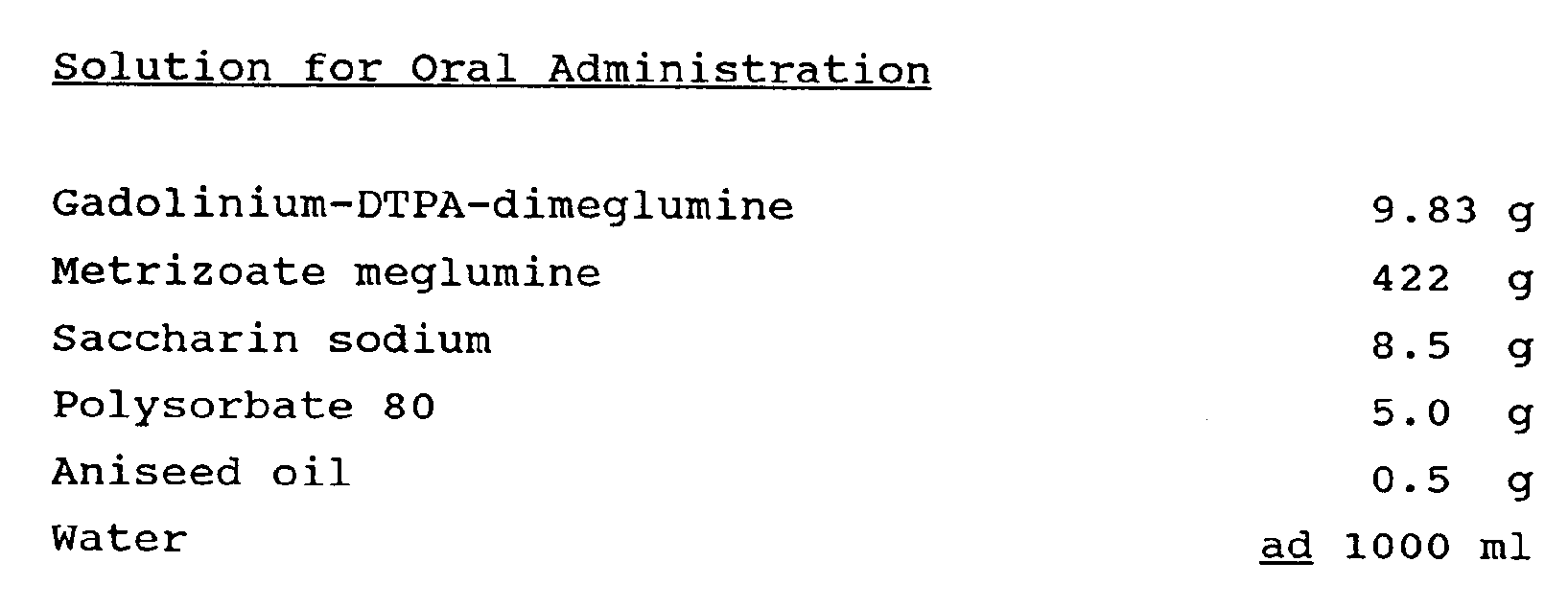
The components were dissolved in water (500 ml) at 50°C. Water was added to bring the volume to 1000 ml and the solution was filled into a 1000ml vial. The solution contained 10 mmol Gd and 200g I per litre.
GdDTPA-dimeglumine and metrizoate were prepared according to the methods of US-A-4647447 (Schering) and US-A-3476802 (Nycomed) respectively. - Concentrate for Dilution before Oral or Rectal Administration
627 mg (10 mmol) GdDTPA-BMA (See Example 1) is dissolved in 100 ml Gastrografin® (available from Schering AG).
Gastrografin contains the X-ray contrast agent diatrizoate sodium and diatrizoate meglumine at a concentration of 370 mg I/ml.
The concentrate is diluted with three times its volume of water or juice before administration. - 2 ml Magnevist® (available from Schering AG) is mixed into 100 ml Gastrografin® (see Example 3) and the mixture is diluted with 898 ml water. The resulting solution contains 1 mmol Gd/l and 37 g I/l.
-

- The components were dissolved in water (500ml) at 40°C. Water was added to bring the volume to 1000 ml and the solution was filled into a 1000 ml vial. The solution contained 20 mmol gadolinium and 200g I per litre.
- GdDOTA lysine salt and Iopamidol were prepared according to the methods of W087/06229 (Guerbet) and US-A-4001323 (Bracco) respectively.
Claims (14)
- A contrast medium comprising a physiologically tolerable paramagnetic metal species containing substance together with a water soluble iodinated X-ray contrast agent.
- A contrast medium as claimed in claim 1, wherein said X-ray contrast agent is selected from iodamide, iothalamate, diatrizoate, ioxaglate and metrizoate salts and metrizamide, iopamidol, iohexol, iotrolan, iodecimol, iodixanol, ioglucol, ioglucomide, ioglunide, iogulamide, iomeprol, iopentol, iopromide, iosarcol, iosimide, iotasul, ioversol and ioxilan.
- A contrast medium as claimed in either of claims 1 and 2, wherein said X-ray contrast agent is present at a concentration such that the formulation ready for administration contains 2 to 370 mg I/ml.
- A contrast medium as claimed in any of claims 1 to 3, wherein said physiologically tolerable paramagnetic metal species containing substance comprises a chelate of a paramagnetic metal ion.
- A contrast medium as claimed in claim 4, wherein the chelant for said chelate comprises a polyaminocarboxylic acid or a derivative thereof.
- A contrast medium as claimed in any of claims 1 to 5, wherein said paramagnetic metal species containing substance incorporates a carrier material.
- A contrast medium as claimed in claim 6, wherein said carrier material is an insoluble polysaccharide or an insoluble derivative thereof.
- A contrast medium as claimed in any of claims 1 to 7, wherein said paramagnetic metal has an atomic number of 21-29, 42, 44 or 55-71.
- A contrast medium as claimed in any of claims 1 to 8, wherein said paramagnetic metal is selected from Gd, Dy, Mn, Cr and Fe.
- A contrast medium as claimed in any of claims 1 to 9, wherein said paramagnetic metal is present at a concentration such that the formulation ready for administration contains 0.01 mmol to 1 mol paramagnetic metal per litre.
- The use of an iodinated X-ray contrast agent for the manufacture of a contrast medium further comprising a paramagnetic metal species, said medium being for use in diagnostic imaging of the gastrointestinal tract.
- The use of a physiologically tolerable paramagnetic metal species containing substance for the manufacture of a contrast medium further comprising an iodinated X-ray contrast agent, said medium being for use in diagnostic imaging of the gastrointestinal tract.
- A method of generating an image of a human or non-human body, said method comprising administering to an externally voided body cavity of said body a contrast medium as claimed in any one of claims 1 to 10 and generating an X-ray or magnetic resonance image of at least part of said body.
- A diagnostic contrast agent kit comprising a physiologically tolerable paromagnetic species containing substance and, packaged separately thereto, a water soluble iodinated X-ray contrast agent.
Applications Claiming Priority (2)
| Application Number | Priority Date | Filing Date | Title |
|---|---|---|---|
| GB898916781A GB8916781D0 (en) | 1989-07-21 | 1989-07-21 | Compositions |
| GB8916781 | 1989-07-21 |
Publications (2)
| Publication Number | Publication Date |
|---|---|
| EP0414288A1 EP0414288A1 (en) | 1991-02-27 |
| EP0414288B1 true EP0414288B1 (en) | 1994-03-23 |
Family
ID=10660460
Family Applications (2)
| Application Number | Title | Priority Date | Filing Date |
|---|---|---|---|
| EP90911456A Pending EP0473729A1 (en) | 1989-07-21 | 1990-07-19 | Contrast media |
| EP90201964A Expired - Lifetime EP0414288B1 (en) | 1989-07-21 | 1990-07-19 | Contrast media |
Family Applications Before (1)
| Application Number | Title | Priority Date | Filing Date |
|---|---|---|---|
| EP90911456A Pending EP0473729A1 (en) | 1989-07-21 | 1990-07-19 | Contrast media |
Country Status (13)
| Country | Link |
|---|---|
| US (1) | US5242683A (en) |
| EP (2) | EP0473729A1 (en) |
| JP (1) | JP3054660B2 (en) |
| AT (1) | ATE103183T1 (en) |
| AU (1) | AU641422B2 (en) |
| CA (1) | CA2055604A1 (en) |
| DE (1) | DE69007575T2 (en) |
| DK (1) | DK0414288T3 (en) |
| ES (1) | ES2052161T3 (en) |
| FI (1) | FI98988C (en) |
| GB (1) | GB8916781D0 (en) |
| NO (1) | NO302797B1 (en) |
| WO (1) | WO1991001149A1 (en) |
Families Citing this family (54)
| Publication number | Priority date | Publication date | Assignee | Title |
|---|---|---|---|---|
| US5114703A (en) * | 1989-05-30 | 1992-05-19 | Alliance Pharmaceutical Corp. | Percutaneous lymphography using particulate fluorocarbon emulsions |
| GB8916782D0 (en) * | 1989-07-21 | 1989-09-06 | Nycomed As | Compositions |
| US5547682A (en) * | 1989-12-22 | 1996-08-20 | Bioquest, Incorporated | Preparation and use of novel injectable RES avoiding inorganic particles for medical application |
| DE4115789A1 (en) * | 1991-05-10 | 1992-11-12 | Schering Ag | MACROCYCLIC POLYMER COMPLEX IMAGERS, THEIR COMPLEXES, METHOD FOR THEIR PRODUCTION AND THE PHARMACEUTICAL AGENTS CONTAINING THEM |
| WO1994027644A1 (en) * | 1993-06-02 | 1994-12-08 | Bracco S.P.A. | Iodinated paramagnetic chelates, and their use as contrast agents |
| US6162192A (en) | 1998-05-01 | 2000-12-19 | Sub Q, Inc. | System and method for facilitating hemostasis of blood vessel punctures with absorbable sponge |
| US6183497B1 (en) | 1998-05-01 | 2001-02-06 | Sub-Q, Inc. | Absorbable sponge with contrasting agent |
| US6071301A (en) | 1998-05-01 | 2000-06-06 | Sub Q., Inc. | Device and method for facilitating hemostasis of a biopsy tract |
| US6071300A (en) | 1995-09-15 | 2000-06-06 | Sub-Q Inc. | Apparatus and method for percutaneous sealing of blood vessel punctures |
| DE19641197C2 (en) * | 1996-09-24 | 1999-02-18 | Schering Ag | Ion pairs and their use as contrast agents |
| FR2772025B1 (en) * | 1997-12-10 | 2000-03-03 | Guerbet Sa | METAL CHELATES OF POLYAMINOCARBOXYLIC MACROCYCLES AND THEIR APPLICATION TO MAGNETIC RESONANCE IMAGING |
| US6315753B1 (en) | 1998-05-01 | 2001-11-13 | Sub-Q, Inc. | System and method for facilitating hemostasis of blood vessel punctures with absorbable sponge |
| US6200328B1 (en) | 1998-05-01 | 2001-03-13 | Sub Q, Incorporated | Device and method for facilitating hemostasis of a biopsy tract |
| US7625352B1 (en) | 1998-05-01 | 2009-12-01 | Sub-Q, Inc. | Depth and puncture control for system for hemostasis of blood vessel |
| US6610026B2 (en) | 1998-05-01 | 2003-08-26 | Sub-Q, Inc. | Method of hydrating a sponge material for delivery to a body |
| US20010045575A1 (en) | 1998-05-01 | 2001-11-29 | Mark Ashby | Device and method for facilitating hemostasis of a biopsy tract |
| EP1156741B1 (en) | 1999-02-10 | 2010-12-22 | Sub-Q, Inc. | Device for facilitating hemostasis of a biopsy tract |
| US6984219B2 (en) | 1999-09-23 | 2006-01-10 | Mark Ashby | Depth and puncture control for blood vessel hemostasis system |
| US7695492B1 (en) | 1999-09-23 | 2010-04-13 | Boston Scientific Scimed, Inc. | Enhanced bleed back system |
| US6540735B1 (en) | 2000-05-12 | 2003-04-01 | Sub-Q, Inc. | System and method for facilitating hemostasis of blood vessel punctures with absorbable sponge |
| US7201725B1 (en) | 2000-09-25 | 2007-04-10 | Sub-Q, Inc. | Device and method for determining a depth of an incision |
| WO2002087636A1 (en) | 2001-03-12 | 2002-11-07 | Sub-Q, Inc. | Methods for sterilizing cross-linked gelatin compositions |
| US8187625B2 (en) | 2001-03-12 | 2012-05-29 | Boston Scientific Scimed, Inc. | Cross-linked gelatin composition comprising a wetting agent |
| US6584355B2 (en) * | 2001-04-10 | 2003-06-24 | Cardiac Pacemakers, Inc. | System and method for measuring battery current |
| US7029489B1 (en) | 2001-05-18 | 2006-04-18 | Sub-Q, Inc. | System and method for delivering hemostasis promoting material to a blood vessel puncture site |
| US6863680B2 (en) * | 2001-11-08 | 2005-03-08 | Sub-Q, Inc. | System and method for delivering hemostasis promoting material to a blood vessel puncture site by fluid pressure |
| US7008440B2 (en) | 2001-11-08 | 2006-03-07 | Sub-Q, Inc. | System and method for delivering hemostasis promoting material to a blood vessel puncture site by fluid pressure |
| US7037323B2 (en) | 2001-11-08 | 2006-05-02 | Sub-Q, Inc. | Pledget-handling system and method for delivering hemostasis promoting material to a blood vessel puncture site by fluid pressure |
| US7192436B2 (en) | 2001-11-08 | 2007-03-20 | Sub-Q, Inc. | Pledget-handling system and method for delivering hemostasis promoting material to a blood vessel puncture site by fluid pressure |
| US7037322B1 (en) | 2001-11-08 | 2006-05-02 | Sub-Q, Inc. | System and method for delivering hemostasis promoting material to a blood vessel puncture with a staging tube |
| WO2004009064A1 (en) * | 2002-07-19 | 2004-01-29 | Mestex Ag | Use of neurotoxic substances for the production of a means for the treatment of joint pain and method for application of said means |
| US20040102730A1 (en) * | 2002-10-22 | 2004-05-27 | Davis Thomas P. | System and method for facilitating hemostasis of blood vessel punctures with absorbable sponge |
| US7955353B1 (en) | 2002-11-04 | 2011-06-07 | Sub-Q, Inc. | Dissolvable closure device |
| US8317821B1 (en) | 2002-11-04 | 2012-11-27 | Boston Scientific Scimed, Inc. | Release mechanism |
| US7455680B1 (en) | 2002-11-04 | 2008-11-25 | Boston Scientific Scimed, Inc. | Apparatus and method for inhibiting blood loss |
| US7378081B2 (en) * | 2003-01-29 | 2008-05-27 | Vincon Research Enterprises, Llc | Composition and method for direct visualization of the human appendix |
| US20050180920A1 (en) * | 2003-01-29 | 2005-08-18 | Vincenzo Giuliano | Oral contrast media composition for computerized axial tomographic examinations and method |
| US20040265235A1 (en) * | 2003-06-26 | 2004-12-30 | Uzgiris Egidijus Edward | Magnetic resonance contrast-enhancing agents and method for detecting and imaging artherosclerotic plaque |
| US7875043B1 (en) | 2003-12-09 | 2011-01-25 | Sub-Q, Inc. | Cinching loop |
| WO2006068639A1 (en) * | 2004-12-21 | 2006-06-29 | Vincenzo Giuliano | Oral contrast media composition for computerized axial tomographic examinations and method |
| US7384624B2 (en) * | 2004-12-27 | 2008-06-10 | James Raines | Oral contrast and method of producing the oral contrast |
| EP1830902A2 (en) * | 2004-12-30 | 2007-09-12 | Cinvention Ag | Combination comprising an agent providing a signal, an implant material and a drug |
| EP2014708A1 (en) * | 2005-01-13 | 2009-01-14 | Cinvention Ag | Shaped body made of a composite material |
| WO2006084382A1 (en) * | 2005-02-11 | 2006-08-17 | University Health Network | Compositions and methods for multimodal imaging |
| MX2007011388A (en) * | 2005-03-18 | 2007-11-13 | Cinv Ag | Process for the preparation of porous sintered metal materials. |
| MX2008000131A (en) * | 2005-07-01 | 2008-04-04 | Cinv Ag | Medical devices comprising a reticulated composite material. |
| AU2006303324A1 (en) * | 2005-10-18 | 2007-04-26 | Cinvention Ag | Thermoset particles and methods for production thereof |
| PL2029184T3 (en) * | 2006-05-26 | 2011-08-31 | Baxter Int | Injectable fibrin composition for bone augmentation |
| AU2007268174B2 (en) * | 2006-05-26 | 2013-05-09 | Baxter Healthcare S.A. | Injectable bone void filler |
| US8601223B1 (en) | 2006-09-19 | 2013-12-03 | Nvidia Corporation | Techniques for servicing fetch requests utilizing coalesing page table entries |
| MX2009010387A (en) * | 2007-03-26 | 2009-10-19 | Baxter Int | Injectable void filler for soft tissue augmentation. |
| NZ605674A (en) * | 2010-07-12 | 2014-11-28 | Ge Healthcare As | X-ray imaging at low contrast agent concentrations and/or low dose radiation |
| CA2862495A1 (en) * | 2012-01-11 | 2013-07-18 | Ge Healthcare As | X-ray imaging contrast media with low iodine concentration and x-ray imaging process |
| ES2683154T3 (en) * | 2013-12-04 | 2018-09-25 | Hovione Scientia Limited | Contrast media containing flavor masking formulations |
Family Cites Families (24)
| Publication number | Priority date | Publication date | Assignee | Title |
|---|---|---|---|---|
| US2387735A (en) * | 1941-07-03 | 1945-10-30 | Martin Dennis Company | Method of forming carboxylic amino acids |
| US2407645A (en) * | 1943-06-21 | 1946-09-17 | Martin Dennis Company | Aliphatic polycarboxylic amino acids and process of making them |
| US4647447A (en) * | 1981-07-24 | 1987-03-03 | Schering Aktiengesellschaft | Diagnostic media |
| DE3316703A1 (en) * | 1983-05-04 | 1984-11-08 | Schering AG, 1000 Berlin und 4709 Bergkamen | ORAL CONTRAST AGENT FOR MRI MRI AND THE PRODUCTION THEREOF |
| DE3324235A1 (en) * | 1983-07-01 | 1985-01-10 | Schering AG, 1000 Berlin und 4709 Bergkamen | NEW COMPLEX ILLUMINATORS, COMPLEX AND COMPLEX SALTS |
| US4615879A (en) * | 1983-11-14 | 1986-10-07 | Vanderbilt University | Particulate NMR contrast agents for gastrointestinal application |
| US5013831A (en) * | 1984-01-30 | 1991-05-07 | Enzo Biochem, Inc. | Detectable molecules, method of preparation and use |
| GB8413772D0 (en) * | 1984-05-30 | 1984-07-04 | Nyegaard & Co As | Chemical compounds |
| US4639365A (en) * | 1984-10-18 | 1987-01-27 | The Board Of Regents, The University Of Texas System | Gadolinium chelates as NMR contrast agents |
| EP0184899B1 (en) * | 1984-11-01 | 1990-04-18 | Nycomed As | Paramagnetic contrast agents for use in "in vivo" diagnostic methods using nmr, and their preparation |
| SE465907B (en) * | 1984-11-01 | 1991-11-18 | Nyegaard & Co As | DIAGNOSTIC AGENT CONTENT AND PARAMAGNETIC METAL |
| US4826673A (en) * | 1985-01-09 | 1989-05-02 | Mallinckrodt, Inc. | Methods and compositions for enhancing magnetic resonance imaging |
| US4880008A (en) * | 1985-05-08 | 1989-11-14 | The General Hospital Corporation | Vivo enhancement of NMR relaxivity |
| NZ212437A (en) * | 1985-06-17 | 1992-06-25 | Mark Philip Best | Site-directed antibody conjugates, and their preparation |
| JPS62153229A (en) * | 1985-12-27 | 1987-07-08 | Nippon Oil Co Ltd | Skin marker |
| US4885363A (en) * | 1987-04-24 | 1989-12-05 | E. R. Squibb & Sons, Inc. | 1-substituted-1,4,7-triscarboxymethyl-1,4,7,10-tetraazacyclododecane and analogs |
| IT1213029B (en) * | 1986-01-30 | 1989-12-07 | Bracco Ind Chimica Spa | PARAMAGNETIC METAL ION CHELATES. |
| US5104641A (en) * | 1986-03-07 | 1992-04-14 | M.R.I., Inc. | Nitroxide NMR contrast enhancing agents and their use in NMR imaging |
| AU608759B2 (en) * | 1986-08-04 | 1991-04-18 | Amersham Health Salutar Inc | NMR imaging with paramagnetic polyvalents metal salts of poly-(acid-alkylene-amido)-alkanes |
| IL83966A (en) * | 1986-09-26 | 1992-03-29 | Schering Ag | Amides of aminopolycarboxylic acids and pharmaceutical compositions containing them |
| DE3701665A1 (en) * | 1987-01-19 | 1988-07-28 | Schering Ag | POLYMER COMPLEXES, METHOD FOR THE PRODUCTION THEREOF AND PHARMACEUTICAL AGENTS CONTAINING THEM |
| DE3709851A1 (en) * | 1987-03-24 | 1988-10-06 | Silica Gel Gmbh Adsorptions Te | NMR DIAGNOSTIC LIQUID COMPOSITIONS |
| IE61746B1 (en) * | 1987-07-16 | 1994-11-30 | Nycomed Imaging As | Aminopolycarboxylic acids and derivatives thereof |
| US5114703A (en) * | 1989-05-30 | 1992-05-19 | Alliance Pharmaceutical Corp. | Percutaneous lymphography using particulate fluorocarbon emulsions |
-
1989
- 1989-07-21 GB GB898916781A patent/GB8916781D0/en active Pending
-
1990
- 1990-07-19 ES ES90201964T patent/ES2052161T3/en not_active Expired - Lifetime
- 1990-07-19 CA CA002055604A patent/CA2055604A1/en not_active Abandoned
- 1990-07-19 EP EP90911456A patent/EP0473729A1/en active Pending
- 1990-07-19 AU AU61438/90A patent/AU641422B2/en not_active Ceased
- 1990-07-19 EP EP90201964A patent/EP0414288B1/en not_active Expired - Lifetime
- 1990-07-19 JP JP2510854A patent/JP3054660B2/en not_active Expired - Fee Related
- 1990-07-19 WO PCT/EP1990/001197 patent/WO1991001149A1/en not_active Ceased
- 1990-07-19 AT AT90201964T patent/ATE103183T1/en active
- 1990-07-19 US US07/778,054 patent/US5242683A/en not_active Expired - Lifetime
- 1990-07-19 DK DK90201964.5T patent/DK0414288T3/en active
- 1990-07-19 DE DE69007575T patent/DE69007575T2/en not_active Expired - Fee Related
-
1992
- 1992-01-20 NO NO920261A patent/NO302797B1/en unknown
- 1992-01-20 FI FI920238A patent/FI98988C/en not_active IP Right Cessation
Also Published As
| Publication number | Publication date |
|---|---|
| ATE103183T1 (en) | 1994-04-15 |
| EP0414288A1 (en) | 1991-02-27 |
| FI98988B (en) | 1997-06-13 |
| FI98988C (en) | 1997-09-25 |
| NO920261D0 (en) | 1992-01-20 |
| EP0473729A1 (en) | 1992-03-11 |
| ES2052161T3 (en) | 1994-07-01 |
| FI920238A0 (en) | 1992-01-20 |
| DE69007575D1 (en) | 1994-04-28 |
| US5242683A (en) | 1993-09-07 |
| GB8916781D0 (en) | 1989-09-06 |
| WO1991001149A1 (en) | 1991-02-07 |
| CA2055604A1 (en) | 1991-01-22 |
| NO302797B1 (en) | 1998-04-27 |
| NO920261L (en) | 1992-01-20 |
| AU6143890A (en) | 1991-02-22 |
| AU641422B2 (en) | 1993-09-23 |
| DK0414288T3 (en) | 1994-04-11 |
| JP3054660B2 (en) | 2000-06-19 |
| DE69007575T2 (en) | 1994-07-21 |
| JPH04506807A (en) | 1992-11-26 |
Similar Documents
| Publication | Publication Date | Title |
|---|---|---|
| US5242683A (en) | Contrast media comprising a paramagnetic agent and an iodinated agent for x-ray and mri | |
| EP0414287B1 (en) | Particulate contrast media | |
| Bellin | MR contrast agents, the old and the new | |
| US5128121A (en) | Mixture of a positive and negative contrast agent for magnetic resonance imaging | |
| Runge et al. | Paramagnetic agents for contrast-enhanced NMR imaging: a review | |
| Mattrey et al. | Perfluorochemicals as gastrointestinal contrast agents for MR imaging: preliminary studies in rats and humans | |
| JP2854905B2 (en) | Chelate composition | |
| Rofsky et al. | Quantitative analysis of gadopentetate dimeglumine excreted in breast milk | |
| AU3602293A (en) | Contrast agents useful for both X-ray and MRI | |
| HU217075B (en) | Contrast media containing non-ionic contrast media with aqueous vehicle and process for their preparation | |
| CA2126346A1 (en) | Contrast media | |
| JPH08510458A (en) | Iodinated paramagnetic chelates and their use as contrast agents | |
| JP4310187B2 (en) | Ionic and non-ionic radiographic contrast agents for use in combined diagnostics of X-rays and nuclear magnetic resonance | |
| US5651955A (en) | Method of electrical impedance imaging using ionic metal chelates | |
| Sovak | Introduction: state of the art and design principles of contrast media | |
| CA1335819C (en) | Metal chelate containing diagnostic imaging contrast media | |
| Patil | 38 Contrast Agents | |
| Speck | New contrast media for neuroradiology |
Legal Events
| Date | Code | Title | Description |
|---|---|---|---|
| PUAI | Public reference made under article 153(3) epc to a published international application that has entered the european phase |
Free format text: ORIGINAL CODE: 0009012 |
|
| AK | Designated contracting states |
Kind code of ref document: A1 Designated state(s): GR |
|
| 17P | Request for examination filed |
Effective date: 19910307 |
|
| 17Q | First examination report despatched |
Effective date: 19911122 |
|
| XX | Miscellaneous (additional remarks) |
Free format text: VERBUNDEN MIT 90911456.3/0473729 (EUROPAEISCHE ANMELDENUMMER/VEROEFFENTLICHUNGSNUMMER) DURCH ENTSCHEIDUNG VOM 28.08.92. |
|
| RAP1 | Party data changed (applicant data changed or rights of an application transferred) |
Owner name: NYCOMED IMAGING AS |
|
| GRAA | (expected) grant |
Free format text: ORIGINAL CODE: 0009210 |
|
| AK | Designated contracting states |
Kind code of ref document: B1 Designated state(s): AT BE CH DE DK ES FR GB GR IT LI LU NL SE |
|
| REF | Corresponds to: |
Ref document number: 103183 Country of ref document: AT Date of ref document: 19940415 Kind code of ref document: T |
|
| XX | Miscellaneous (additional remarks) |
Free format text: VERBUNDEN MIT 90911456.3/0473729 (EUROPAEISCHE ANMELDENUMMER/VEROEFFENTLICHUNGSNUMMER) DURCH ENTSCHEIDUNG VOM 28.08.92. |
|
| REG | Reference to a national code |
Ref country code: DK Ref legal event code: T3 |
|
| REF | Corresponds to: |
Ref document number: 69007575 Country of ref document: DE Date of ref document: 19940428 |
|
| ITF | It: translation for a ep patent filed | ||
| ET | Fr: translation filed | ||
| REG | Reference to a national code |
Ref country code: ES Ref legal event code: FG2A Ref document number: 2052161 Country of ref document: ES Kind code of ref document: T3 |
|
| REG | Reference to a national code |
Ref country code: GR Ref legal event code: FG4A Free format text: 3012282 |
|
| EPTA | Lu: last paid annual fee | ||
| PLBE | No opposition filed within time limit |
Free format text: ORIGINAL CODE: 0009261 |
|
| STAA | Information on the status of an ep patent application or granted ep patent |
Free format text: STATUS: NO OPPOSITION FILED WITHIN TIME LIMIT |
|
| EAL | Se: european patent in force in sweden |
Ref document number: 90201964.5 |
|
| 26N | No opposition filed | ||
| ITTA | It: last paid annual fee | ||
| PGFP | Annual fee paid to national office [announced via postgrant information from national office to epo] |
Ref country code: GR Payment date: 19970702 Year of fee payment: 8 Ref country code: DK Payment date: 19970702 Year of fee payment: 8 |
|
| PGFP | Annual fee paid to national office [announced via postgrant information from national office to epo] |
Ref country code: CH Payment date: 19970708 Year of fee payment: 8 |
|
| PGFP | Annual fee paid to national office [announced via postgrant information from national office to epo] |
Ref country code: SE Payment date: 19970717 Year of fee payment: 8 |
|
| PGFP | Annual fee paid to national office [announced via postgrant information from national office to epo] |
Ref country code: BE Payment date: 19970718 Year of fee payment: 8 |
|
| PGFP | Annual fee paid to national office [announced via postgrant information from national office to epo] |
Ref country code: AT Payment date: 19970730 Year of fee payment: 8 |
|
| PGFP | Annual fee paid to national office [announced via postgrant information from national office to epo] |
Ref country code: NL Payment date: 19970731 Year of fee payment: 8 |
|
| PGFP | Annual fee paid to national office [announced via postgrant information from national office to epo] |
Ref country code: LU Payment date: 19970805 Year of fee payment: 8 |
|
| PG25 | Lapsed in a contracting state [announced via postgrant information from national office to epo] |
Ref country code: LU Free format text: LAPSE BECAUSE OF NON-PAYMENT OF DUE FEES Effective date: 19980719 Ref country code: AT Free format text: LAPSE BECAUSE OF NON-PAYMENT OF DUE FEES Effective date: 19980719 |
|
| PG25 | Lapsed in a contracting state [announced via postgrant information from national office to epo] |
Ref country code: SE Free format text: LAPSE BECAUSE OF NON-PAYMENT OF DUE FEES Effective date: 19980720 |
|
| PG25 | Lapsed in a contracting state [announced via postgrant information from national office to epo] |
Ref country code: LI Free format text: LAPSE BECAUSE OF NON-PAYMENT OF DUE FEES Effective date: 19980731 Ref country code: GR Free format text: LAPSE BECAUSE OF NON-PAYMENT OF DUE FEES Effective date: 19980731 Ref country code: DK Free format text: LAPSE BECAUSE OF NON-PAYMENT OF DUE FEES Effective date: 19980731 Ref country code: CH Free format text: LAPSE BECAUSE OF NON-PAYMENT OF DUE FEES Effective date: 19980731 Ref country code: BE Free format text: LAPSE BECAUSE OF NON-PAYMENT OF DUE FEES Effective date: 19980731 |
|
| BERE | Be: lapsed |
Owner name: NYCOMED IMAGING A.S. Effective date: 19980731 |
|
| PG25 | Lapsed in a contracting state [announced via postgrant information from national office to epo] |
Ref country code: NL Free format text: LAPSE BECAUSE OF NON-PAYMENT OF DUE FEES Effective date: 19990201 |
|
| REG | Reference to a national code |
Ref country code: CH Ref legal event code: PL |
|
| EUG | Se: european patent has lapsed |
Ref document number: 90201964.5 |
|
| NLV4 | Nl: lapsed or anulled due to non-payment of the annual fee |
Effective date: 19990201 |
|
| REG | Reference to a national code |
Ref country code: DK Ref legal event code: EBP |
|
| PGFP | Annual fee paid to national office [announced via postgrant information from national office to epo] |
Ref country code: ES Payment date: 20000719 Year of fee payment: 11 |
|
| PG25 | Lapsed in a contracting state [announced via postgrant information from national office to epo] |
Ref country code: ES Free format text: LAPSE BECAUSE OF NON-PAYMENT OF DUE FEES Effective date: 20010720 |
|
| REG | Reference to a national code |
Ref country code: GB Ref legal event code: IF02 |
|
| PGFP | Annual fee paid to national office [announced via postgrant information from national office to epo] |
Ref country code: FR Payment date: 20020709 Year of fee payment: 13 |
|
| PGFP | Annual fee paid to national office [announced via postgrant information from national office to epo] |
Ref country code: GB Payment date: 20020717 Year of fee payment: 13 |
|
| PGFP | Annual fee paid to national office [announced via postgrant information from national office to epo] |
Ref country code: DE Payment date: 20020724 Year of fee payment: 13 |
|
| PG25 | Lapsed in a contracting state [announced via postgrant information from national office to epo] |
Ref country code: GB Free format text: LAPSE BECAUSE OF NON-PAYMENT OF DUE FEES Effective date: 20030719 |
|
| PG25 | Lapsed in a contracting state [announced via postgrant information from national office to epo] |
Ref country code: DE Free format text: LAPSE BECAUSE OF NON-PAYMENT OF DUE FEES Effective date: 20040203 |
|
| GBPC | Gb: european patent ceased through non-payment of renewal fee |
Effective date: 20030719 |
|
| PG25 | Lapsed in a contracting state [announced via postgrant information from national office to epo] |
Ref country code: FR Free format text: LAPSE BECAUSE OF NON-PAYMENT OF DUE FEES Effective date: 20040331 |
|
| REG | Reference to a national code |
Ref country code: ES Ref legal event code: FD2A Effective date: 20020810 |
|
| REG | Reference to a national code |
Ref country code: FR Ref legal event code: ST |
|
| PG25 | Lapsed in a contracting state [announced via postgrant information from national office to epo] |
Ref country code: IT Free format text: LAPSE BECAUSE OF NON-PAYMENT OF DUE FEES;WARNING: LAPSES OF ITALIAN PATENTS WITH EFFECTIVE DATE BEFORE 2007 MAY HAVE OCCURRED AT ANY TIME BEFORE 2007. THE CORRECT EFFECTIVE DATE MAY BE DIFFERENT FROM THE ONE RECORDED. Effective date: 20050719 |