EP0414041B1 - Cushion material and method of manufacturing the same - Google Patents
Cushion material and method of manufacturing the same Download PDFInfo
- Publication number
- EP0414041B1 EP0414041B1 EP19900115182 EP90115182A EP0414041B1 EP 0414041 B1 EP0414041 B1 EP 0414041B1 EP 19900115182 EP19900115182 EP 19900115182 EP 90115182 A EP90115182 A EP 90115182A EP 0414041 B1 EP0414041 B1 EP 0414041B1
- Authority
- EP
- European Patent Office
- Prior art keywords
- fiber
- emulsion
- cushion
- aqueous
- hydrophilic
- Prior art date
- Legal status (The legal status is an assumption and is not a legal conclusion. Google has not performed a legal analysis and makes no representation as to the accuracy of the status listed.)
- Expired - Lifetime
Links
- 239000000463 material Substances 0.000 title claims description 46
- 238000004519 manufacturing process Methods 0.000 title claims description 7
- 239000000839 emulsion Substances 0.000 claims description 58
- 239000000835 fiber Substances 0.000 claims description 45
- 229920000728 polyester Polymers 0.000 claims description 43
- 229920001730 Moisture cure polyurethane Polymers 0.000 claims description 31
- 229920002635 polyurethane Polymers 0.000 claims description 26
- 239000004814 polyurethane Substances 0.000 claims description 26
- 239000002184 metal Substances 0.000 claims description 17
- 229920002994 synthetic fiber Polymers 0.000 claims description 14
- 239000012209 synthetic fiber Substances 0.000 claims description 14
- 238000000034 method Methods 0.000 claims description 12
- 229920000642 polymer Polymers 0.000 claims description 8
- 229920005749 polyurethane resin Polymers 0.000 claims description 8
- -1 polyethylene phthalate Polymers 0.000 claims description 7
- IQPQWNKOIGAROB-UHFFFAOYSA-N isocyanate group Chemical group [N-]=C=O IQPQWNKOIGAROB-UHFFFAOYSA-N 0.000 claims description 4
- 229920002972 Acrylic fiber Polymers 0.000 claims description 3
- 125000000129 anionic group Chemical group 0.000 claims description 3
- 125000002091 cationic group Chemical group 0.000 claims description 3
- QQVIHTHCMHWDBS-UHFFFAOYSA-L isophthalate(2-) Chemical compound [O-]C(=O)C1=CC=CC(C([O-])=O)=C1 QQVIHTHCMHWDBS-UHFFFAOYSA-L 0.000 claims description 3
- 229920001778 nylon Polymers 0.000 claims description 3
- 229920001515 polyalkylene glycol Polymers 0.000 claims description 3
- 229920001577 copolymer Polymers 0.000 claims description 2
- 229920000139 polyethylene terephthalate Polymers 0.000 claims description 2
- 239000005020 polyethylene terephthalate Substances 0.000 claims description 2
- 150000001875 compounds Chemical class 0.000 claims 2
- 229920000742 Cotton Polymers 0.000 description 60
- 241000219146 Gossypium Species 0.000 description 60
- XLYOFNOQVPJJNP-UHFFFAOYSA-N water Chemical compound O XLYOFNOQVPJJNP-UHFFFAOYSA-N 0.000 description 18
- 239000000203 mixture Substances 0.000 description 16
- DVKJHBMWWAPEIU-UHFFFAOYSA-N toluene 2,4-diisocyanate Chemical compound CC1=CC=C(N=C=O)C=C1N=C=O DVKJHBMWWAPEIU-UHFFFAOYSA-N 0.000 description 12
- 238000006243 chemical reaction Methods 0.000 description 10
- 239000012948 isocyanate Substances 0.000 description 10
- 239000003795 chemical substances by application Substances 0.000 description 8
- 230000006835 compression Effects 0.000 description 8
- 238000007906 compression Methods 0.000 description 8
- 239000006185 dispersion Substances 0.000 description 8
- 150000002513 isocyanates Chemical class 0.000 description 8
- 238000003756 stirring Methods 0.000 description 8
- 239000003960 organic solvent Substances 0.000 description 6
- 230000035699 permeability Effects 0.000 description 6
- IAYPIBMASNFSPL-UHFFFAOYSA-N Ethylene oxide Chemical compound C1CO1 IAYPIBMASNFSPL-UHFFFAOYSA-N 0.000 description 5
- GOOHAUXETOMSMM-UHFFFAOYSA-N Propylene oxide Chemical compound CC1CO1 GOOHAUXETOMSMM-UHFFFAOYSA-N 0.000 description 5
- 230000000903 blocking effect Effects 0.000 description 5
- PEDCQBHIVMGVHV-UHFFFAOYSA-N Glycerine Chemical compound OCC(O)CO PEDCQBHIVMGVHV-UHFFFAOYSA-N 0.000 description 4
- 238000010438 heat treatment Methods 0.000 description 4
- 229920005989 resin Polymers 0.000 description 4
- 239000011347 resin Substances 0.000 description 4
- 229920000877 Melamine resin Polymers 0.000 description 3
- ZMANZCXQSJIPKH-UHFFFAOYSA-N Triethylamine Chemical compound CCN(CC)CC ZMANZCXQSJIPKH-UHFFFAOYSA-N 0.000 description 3
- 239000002981 blocking agent Substances 0.000 description 3
- 238000009434 installation Methods 0.000 description 3
- UOCLXMDMGBRAIB-UHFFFAOYSA-N 1,1,1-trichloroethane Chemical compound CC(Cl)(Cl)Cl UOCLXMDMGBRAIB-UHFFFAOYSA-N 0.000 description 2
- PTBDIHRZYDMNKB-UHFFFAOYSA-N 2,2-Bis(hydroxymethyl)propionic acid Chemical compound OCC(C)(CO)C(O)=O PTBDIHRZYDMNKB-UHFFFAOYSA-N 0.000 description 2
- 229920005830 Polyurethane Foam Polymers 0.000 description 2
- 238000010521 absorption reaction Methods 0.000 description 2
- 239000011230 binding agent Substances 0.000 description 2
- 238000010494 dissociation reaction Methods 0.000 description 2
- 230000005593 dissociations Effects 0.000 description 2
- 230000007613 environmental effect Effects 0.000 description 2
- 239000003822 epoxy resin Substances 0.000 description 2
- 235000011187 glycerol Nutrition 0.000 description 2
- JDSHMPZPIAZGSV-UHFFFAOYSA-N melamine Chemical compound NC1=NC(N)=NC(N)=N1 JDSHMPZPIAZGSV-UHFFFAOYSA-N 0.000 description 2
- WHIVNJATOVLWBW-UHFFFAOYSA-N n-butan-2-ylidenehydroxylamine Chemical compound CCC(C)=NO WHIVNJATOVLWBW-UHFFFAOYSA-N 0.000 description 2
- 229920000647 polyepoxide Polymers 0.000 description 2
- 229920005862 polyol Polymers 0.000 description 2
- 150000003077 polyols Chemical class 0.000 description 2
- 239000011496 polyurethane foam Substances 0.000 description 2
- 239000011435 rock Substances 0.000 description 2
- GETQZCLCWQTVFV-UHFFFAOYSA-N trimethylamine Chemical compound CN(C)C GETQZCLCWQTVFV-UHFFFAOYSA-N 0.000 description 2
- 239000004593 Epoxy Substances 0.000 description 1
- OFOBLEOULBTSOW-UHFFFAOYSA-L Malonate Chemical compound [O-]C(=O)CC([O-])=O OFOBLEOULBTSOW-UHFFFAOYSA-L 0.000 description 1
- 239000004640 Melamine resin Substances 0.000 description 1
- ISWSIDIOOBJBQZ-UHFFFAOYSA-N Phenol Chemical compound OC1=CC=CC=C1 ISWSIDIOOBJBQZ-UHFFFAOYSA-N 0.000 description 1
- 125000002947 alkylene group Chemical group 0.000 description 1
- 230000000052 comparative effect Effects 0.000 description 1
- 238000007796 conventional method Methods 0.000 description 1
- 239000003431 cross linking reagent Substances 0.000 description 1
- 239000006260 foam Substances 0.000 description 1
- 239000003365 glass fiber Substances 0.000 description 1
- 230000005484 gravity Effects 0.000 description 1
- 239000012784 inorganic fiber Substances 0.000 description 1
- 150000002923 oximes Chemical class 0.000 description 1
- 230000000704 physical effect Effects 0.000 description 1
- 239000000126 substance Substances 0.000 description 1
- 229920003002 synthetic resin Polymers 0.000 description 1
- 239000000057 synthetic resin Substances 0.000 description 1
- 231100000331 toxic Toxicity 0.000 description 1
- 230000002588 toxic effect Effects 0.000 description 1
- 231100000419 toxicity Toxicity 0.000 description 1
- 230000001988 toxicity Effects 0.000 description 1
Images

Classifications
-
- D—TEXTILES; PAPER
- D04—BRAIDING; LACE-MAKING; KNITTING; TRIMMINGS; NON-WOVEN FABRICS
- D04H—MAKING TEXTILE FABRICS, e.g. FROM FIBRES OR FILAMENTARY MATERIAL; FABRICS MADE BY SUCH PROCESSES OR APPARATUS, e.g. FELTS, NON-WOVEN FABRICS; COTTON-WOOL; WADDING ; NON-WOVEN FABRICS FROM STAPLE FIBRES, FILAMENTS OR YARNS, BONDED WITH AT LEAST ONE WEB-LIKE MATERIAL DURING THEIR CONSOLIDATION
- D04H1/00—Non-woven fabrics formed wholly or mainly of staple fibres or like relatively short fibres
- D04H1/40—Non-woven fabrics formed wholly or mainly of staple fibres or like relatively short fibres from fleeces or layers composed of fibres without existing or potential cohesive properties
- D04H1/42—Non-woven fabrics formed wholly or mainly of staple fibres or like relatively short fibres from fleeces or layers composed of fibres without existing or potential cohesive properties characterised by the use of certain kinds of fibres insofar as this use has no preponderant influence on the consolidation of the fleece
- D04H1/4282—Addition polymers
- D04H1/43—Acrylonitrile series
-
- D—TEXTILES; PAPER
- D04—BRAIDING; LACE-MAKING; KNITTING; TRIMMINGS; NON-WOVEN FABRICS
- D04H—MAKING TEXTILE FABRICS, e.g. FROM FIBRES OR FILAMENTARY MATERIAL; FABRICS MADE BY SUCH PROCESSES OR APPARATUS, e.g. FELTS, NON-WOVEN FABRICS; COTTON-WOOL; WADDING ; NON-WOVEN FABRICS FROM STAPLE FIBRES, FILAMENTS OR YARNS, BONDED WITH AT LEAST ONE WEB-LIKE MATERIAL DURING THEIR CONSOLIDATION
- D04H1/00—Non-woven fabrics formed wholly or mainly of staple fibres or like relatively short fibres
- D04H1/40—Non-woven fabrics formed wholly or mainly of staple fibres or like relatively short fibres from fleeces or layers composed of fibres without existing or potential cohesive properties
- D04H1/42—Non-woven fabrics formed wholly or mainly of staple fibres or like relatively short fibres from fleeces or layers composed of fibres without existing or potential cohesive properties characterised by the use of certain kinds of fibres insofar as this use has no preponderant influence on the consolidation of the fleece
- D04H1/4326—Condensation or reaction polymers
- D04H1/4334—Polyamides
-
- D—TEXTILES; PAPER
- D04—BRAIDING; LACE-MAKING; KNITTING; TRIMMINGS; NON-WOVEN FABRICS
- D04H—MAKING TEXTILE FABRICS, e.g. FROM FIBRES OR FILAMENTARY MATERIAL; FABRICS MADE BY SUCH PROCESSES OR APPARATUS, e.g. FELTS, NON-WOVEN FABRICS; COTTON-WOOL; WADDING ; NON-WOVEN FABRICS FROM STAPLE FIBRES, FILAMENTS OR YARNS, BONDED WITH AT LEAST ONE WEB-LIKE MATERIAL DURING THEIR CONSOLIDATION
- D04H1/00—Non-woven fabrics formed wholly or mainly of staple fibres or like relatively short fibres
- D04H1/40—Non-woven fabrics formed wholly or mainly of staple fibres or like relatively short fibres from fleeces or layers composed of fibres without existing or potential cohesive properties
- D04H1/42—Non-woven fabrics formed wholly or mainly of staple fibres or like relatively short fibres from fleeces or layers composed of fibres without existing or potential cohesive properties characterised by the use of certain kinds of fibres insofar as this use has no preponderant influence on the consolidation of the fleece
- D04H1/4326—Condensation or reaction polymers
- D04H1/435—Polyesters
-
- D—TEXTILES; PAPER
- D04—BRAIDING; LACE-MAKING; KNITTING; TRIMMINGS; NON-WOVEN FABRICS
- D04H—MAKING TEXTILE FABRICS, e.g. FROM FIBRES OR FILAMENTARY MATERIAL; FABRICS MADE BY SUCH PROCESSES OR APPARATUS, e.g. FELTS, NON-WOVEN FABRICS; COTTON-WOOL; WADDING ; NON-WOVEN FABRICS FROM STAPLE FIBRES, FILAMENTS OR YARNS, BONDED WITH AT LEAST ONE WEB-LIKE MATERIAL DURING THEIR CONSOLIDATION
- D04H1/00—Non-woven fabrics formed wholly or mainly of staple fibres or like relatively short fibres
- D04H1/40—Non-woven fabrics formed wholly or mainly of staple fibres or like relatively short fibres from fleeces or layers composed of fibres without existing or potential cohesive properties
- D04H1/42—Non-woven fabrics formed wholly or mainly of staple fibres or like relatively short fibres from fleeces or layers composed of fibres without existing or potential cohesive properties characterised by the use of certain kinds of fibres insofar as this use has no preponderant influence on the consolidation of the fleece
- D04H1/4382—Stretched reticular film fibres; Composite fibres; Mixed fibres; Ultrafine fibres; Fibres for artificial leather
- D04H1/43825—Composite fibres
- D04H1/43828—Composite fibres sheath-core
-
- Y—GENERAL TAGGING OF NEW TECHNOLOGICAL DEVELOPMENTS; GENERAL TAGGING OF CROSS-SECTIONAL TECHNOLOGIES SPANNING OVER SEVERAL SECTIONS OF THE IPC; TECHNICAL SUBJECTS COVERED BY FORMER USPC CROSS-REFERENCE ART COLLECTIONS [XRACs] AND DIGESTS
- Y10—TECHNICAL SUBJECTS COVERED BY FORMER USPC
- Y10T—TECHNICAL SUBJECTS COVERED BY FORMER US CLASSIFICATION
- Y10T428/00—Stock material or miscellaneous articles
- Y10T428/24—Structurally defined web or sheet [e.g., overall dimension, etc.]
- Y10T428/24802—Discontinuous or differential coating, impregnation or bond [e.g., artwork, printing, retouched photograph, etc.]
- Y10T428/24826—Spot bonds connect components
-
- Y—GENERAL TAGGING OF NEW TECHNOLOGICAL DEVELOPMENTS; GENERAL TAGGING OF CROSS-SECTIONAL TECHNOLOGIES SPANNING OVER SEVERAL SECTIONS OF THE IPC; TECHNICAL SUBJECTS COVERED BY FORMER USPC CROSS-REFERENCE ART COLLECTIONS [XRACs] AND DIGESTS
- Y10—TECHNICAL SUBJECTS COVERED BY FORMER USPC
- Y10T—TECHNICAL SUBJECTS COVERED BY FORMER US CLASSIFICATION
- Y10T442/00—Fabric [woven, knitted, or nonwoven textile or cloth, etc.]
- Y10T442/20—Coated or impregnated woven, knit, or nonwoven fabric which is not [a] associated with another preformed layer or fiber layer or, [b] with respect to woven and knit, characterized, respectively, by a particular or differential weave or knit, wherein the coating or impregnation is neither a foamed material nor a free metal or alloy layer
- Y10T442/2484—Coating or impregnation is water absorbency-increasing or hydrophilicity-increasing or hydrophilicity-imparting
-
- Y—GENERAL TAGGING OF NEW TECHNOLOGICAL DEVELOPMENTS; GENERAL TAGGING OF CROSS-SECTIONAL TECHNOLOGIES SPANNING OVER SEVERAL SECTIONS OF THE IPC; TECHNICAL SUBJECTS COVERED BY FORMER USPC CROSS-REFERENCE ART COLLECTIONS [XRACs] AND DIGESTS
- Y10—TECHNICAL SUBJECTS COVERED BY FORMER USPC
- Y10T—TECHNICAL SUBJECTS COVERED BY FORMER US CLASSIFICATION
- Y10T442/00—Fabric [woven, knitted, or nonwoven textile or cloth, etc.]
- Y10T442/60—Nonwoven fabric [i.e., nonwoven strand or fiber material]
- Y10T442/69—Autogenously bonded nonwoven fabric
Definitions
- the present invention relates to a water-absorptive cushion which can be used in, e.g., vehicles, furniture, and bedclothes and a method of manufacturing the same.
- Various types of materials are conventionally used as a cushion of a sheet of a vehicle and the like.
- the material are a palm rock using fibers of a palm, a synthetic resin foam such as a polyurethane foam, and cotton consisting of organic synthetic fibers.
- the palm rock is easily flattened because it has a large specific gravity and has a problem in source supply stability, and the polyurethane foam easily becomes stuffy because its air permeability is poor and is uncomfortable to sit in.
- the organic synthetic fiber cotton has a low hardness and is therefore easily flattened.
- the organic synthetic fibers are impregnated with a polyurethane prepolymer, and this polyurethane prepolymer is hardened.
- the polyurethane prepolymer cannot be impregnated in the organic synthetic fibers because its viscosity is very high, it is diluted to adjust the viscosity.
- 1,1,1-trichloroethane or the like which is used as an organic solvent has strong toxicity, it cannot be directly disposed in consideration of environmental conditions. Therefore, a large-scale salvage installation or the like is required. In addition, since hardening of the polyurethane prepolymer requires water vapor, an expensive installation such as a boiler is required.
- a water-absorptive cushion obtained by impregnating three-dimensionally interwined fibers with an aqueous emulsion of hydrophilic polyurethane and hardening the resultant material with heat, wherein the surface of each fiber is covered with a hydrophilic polyurethane resin, and the fibers are bonded by said hydrophilic polyurethane resin at intersected portions of the fibers.
- a method of manufacturing a water-absorptive cushion comprising the steps of: impregnating an aqueous emulsion of hydrophilic polyurethane in three-dimensionally interwined fibers; removing an excessive aqueous emulsion of hydrophilic polyurethane; and hardening the aqueous emulsion of hydrophilic polyurethane impregnated in the fibers with heat.
- a figure shows a cushion according to a preferred embodiment of the present invention.
- the cushion consists of three-dimensionally interwined fibers 1.
- the surfaces of the fibers 1 are covered with a polyurethane resin 2, and the fibers 1 are interwined with each other at interwined portions by the polyurethane resin 2.
- Cottons of various types of organic synthetic fibers can be used as the three-dimensionally interwined fibers.
- the organic synthetic fiber are a polyester fiber, a nylon fiber, and an acryl fiber. These fibers can contain an inorganic fiber such as a metal fiber or a glass fiber.
- the thickness of the fiber is preferably 1 to 50 denier.
- a water-absorptive fiber is preferably used as the three-dimensionally interwined fiber.
- the water-absorptive fiber are cottons of various types of organic synthetic fibers subjected to a hydrophilic treatment by using, e.g., polyalkylene glycol, metal isophthalate, or copolymer polyethylene terephthalate.
- a stuffiness resistance is improved, and various physical properties can be improved.
- a method of manufacturing the cushion of the present invention is performed in accordance with the following steps.
- An aqueous polyurethane prepolymer can be used as the aqueous polyurethane polymer.
- the aqueous polyurethane prepolymer is prepared by reacting an isocyanate compound with polyol obtained by addition-polymerizing a mixture of alkylene oxides such as ethylene oxide and propylene oxide with glycerin.
- This aqueous polyurethane prepolymer may contain a hardening agent as needed. Examples of the hardening agent are an epoxy resin and a melamine resin.
- the concentration of an emulsion of the prepolymer is preferably 25% to 40%.
- a prepolymer containing a blocked isocyanate group can be used as the aqueous polyurethane prepolymer.
- This polyurethane prepolymer is prepared by blocking an isocyanate group of a prepolymer by a blocking agent such as an oxime, a malonate, and a phenol.
- the prepolymer is obtained by reacting an isocyanate compound with polyol obtained by addition-polymerising a mixture of ethylene oxide and propylene oxide with glycerin.
- a prepolymer having a nonionic and/or ionic hydrophilic site can be used as the aqueous polyurethane prepolymer.
- the nonionic hydrophilic site, the anionic hydrophilic site, and the cationic hydrophilic site are an EO chain, a COO ⁇ group and an SO3 ⁇ group, and NR3+, respectively.
- an excessive aqueous polyurethane prepolymer emulsion is removed. Removal of the excessive emulsion can be performed by using a centrifugal separator or a mangle so that a weight ratio of the fibers to the emulsion is 8 : 2 to 6 : 4.
- aqueous polyurethane prepolymer emulsion impregnated in the fibers is hardened with heat.
- a heating temperature for hardening is preferably 100°C to 150°C.
- the aqueous polyurethane is used as a binder for bonding the fibers at their intersected portions. Since the polyurethane is hydrophilic, its concentration can be arbitrarily adjusted by using water without using an organic solvent. Therefore, an emulsion having a desired concentration can be easily impregnated in the three-dimensionally interwined fibers.
- a hardening agent can be added to the aqueous polyurethane as needed so that the aqueous polyurethane prepolymer is easily hardened upon heating up to the above heating temperature.
- Polyetherpolyol (molecular weight : 3,000, functionality : 2) and TDI (tolylene diisocyanate) were reacted at 80°C for four hours, and an epoxy resin was added as a hardening agent to the resultant material to obtain an aqueous polyurethane prepolymer.
- the obtained aqueous polyurethane prepolymer was put into water under stirring to prepare an emulsion having a nonvolatile content of 30% and viscosity of 50 c.p. (20°C).
- polyester cotton (HYBAL 6d, available from TEIJIN LTD.), and the emulsion was removed from the resultant material by a centrifugal force until a predetermined amount of the emulsion remained.
- the resultant material was filled in a perforated metal mold to obtain a predetermined density.
- a weight ratio of the polyester cotton to the prepolymer emulsion was adjusted to be 7 : 3.
- a hot air at 120°C to 130°C was flowed to harden the polyester cotton filled in the mold for four minutes, and the hardened polyester cotton was released from the mold to obtain a cushion sample.
- a hot air at 120°C to 130°C was flowed to harden the polyester cotton filled in the mold for four minutes, and the hardened polyester cotton was released from the mold to obtain a cushion sample.
- Example 2 An excessive amount of an emulsion prepared following the same procedures as in Example 1 was impregnated in polyester cotton (HYBALs 6d & 40d [1 : 1 mixture]), and the emulsion was removed from the resultant material by a centrifugal force until a predetermined amount of the emulsion remained. The resultant material was filled in a perforated metal mold to obtain a predetermined density. At this time, a weight ratio of the polyester cotton to the prepolymer emulsion was adjusted to be 7 : 3.
- a hot air at 120°C to 130°C was flowed to harden the polyester cotton filled in the mold for four minutes, and the hardened polyester cotton was released from the mold to obtain a cushion sample.
- a hot air at 120°C to 130°C was flowed to harden the polyester cotton filled in the mold for four minutes, and the hardened polyester cotton was released from the mold to obtain a cushion sample.
- the polyurethane prepolymer in the polyester cotton filled in the form was hardened by a -NCO equivalent amount or more of water vapor at 100°C for four minutes, and the hardened polyester cotton was released from the mold to obtain a cushion sample.
- the cushions of the present invention (Examples 1 to 4) have substantially the same characteristics as those of the conventional cushion material using a polyurethane prepolymer having viscosity adjusted by an organic solvent (Control) in density, hardness, repeated compression strain, 70°C thermal compression strain, air permeability, bonded portion peel strength, and tensile strength, and have characteristics superior thereto in ball drop resilience, 50°C - 95% humidity thermal compression strain, and water absorption.
- the obtained blocked aqueous polyurethane prepolymer was put into water under stirring to prepare an emulsion having a nonvolatile content of 30% and viscosity of 120 c.p. (20°C).
- polyester cotton Hydrophilic Cotton 6d, available from TEIJIN LTD.
- the resultant material was filled in a perforated metal mold to obtain a predetermined density.
- a weight ratio of the polyester cotton to the prepolymer emulsion was adjusted to be 7 : 3.
- a hot air at 120°C to 130°C was flowed to harden the polyester cotton filled in the mold for four minutes, and the hardened polyester cotton was released from the mold to obtain a cushion sample.
- Polyetherpolyol (molecular weight : 1,000, functionality : 2) and TDI (tolylene diisocyanate) were reacted at 80°C for four hours, and an epoxy-based resin was added as a hardening agent to the resultant material to obtain an aqueous polyurethane prepolymer.
- the obtained aqueous polyurethane prepolymer was put into water under stirring to prepare an emulsion having a nonvolatile content of 30% and viscosity of 50 c.p. (20°C).
- polyester cotton Hydrophilic Cotton 6d, available from TEIJIN LTD.
- the resultant material was filled in a perforated metal mold to obtain a predetermined density.
- a weight ratio of the polyester cotton to the prepolymer emulsion was adjusted to be 7 : 3.
- a hot air at 120°C to 130°C was flowed to harden the polyester cotton filled in the mold for four minutes, and the hardened polyester cotton was released from the mold to obtain a cushion sample.
- Example 5 An excessive amount of an emulsion prepared following the same procedures as in Example 5 was impregnated in polyester cotton (Hydrophilic Cotton 6d, available from TEIJIN LTD.), and the emulsion was removed from the resultant material by using a mangle (5 to 6 kgf/cm2) until a predetermined amount of the emulsion remained. The resultant material was filled in a perforated metal mold to obtain a predetermined density. At this time, a weight ratio of the polyester cotton to the prepolymer emulsion was adjusted to be 7 : 3.
- a hot air at 120°C to 130°C was flowed to harden the polyester cotton filled in the mold for four minutes, and the hardened polyester cotton was released from the mold to obtain a cushion sample.
- the obtained blocked aqueous polyurethane prepolymer was put into water under stirring to prepare an emulsion having a nonvolatile content of 30.5% and viscosity of 120 c.p. (20°C).
- polyester cotton (HYBAL 6d, available from TEIJIN LTD.), and the emulsion was removed from the resultant material by a centrifugal force until a predetermined amount of the emulsion remained.
- the resultant material was filled in a perforated metal mold to obtain a predetermined density.
- a weight ratio of the polyester cotton to the prepolymer emulsion was adjusted to be 7 : 3.
- a hot air at 120°C to 130°C was flowed to harden the polyester cotton filled in the mold for four minutes, and the hardened polyester cotton was released from the mold to obtain a cushion sample.
- the cushion samples of the present invention (Examples 5 to 7) have substantially the same characteristics as those of the cushion sample not using a water-absorptive fiber (Example 8) in density, hardness, ball drop resilience, and repeated compression strain, and have characteristics superior thereto in bonded portion peel strength, tensile strength, and water absorption.
- Methylethylketooxime was added to the obtained prepolymer to complete a blocking reaction at 40°C for two hours, and the resultant material was put into water under strong stirring, thereby preparing a semiopaque aqueous dispersion composition.
- An excessive amount of the prepared aqueous dispersion composition was impregnated in polyester cotton (HYBAL 6d, available from TEIJIN LTD.).
- a predetermined amount of the composition was removed from the resultant material by a centrifugal force, and the resultant material was filled in a perforated metal mold to obtain a predetermined density.
- a weight ratio of the cotton to the polyurethane was adjusted to be 6.5 : 3.5.
- a hot air at 120°C to 130°C was flowed to harden the cotton filled in the mold for four minutes, and the hardened cotton was released from the mold to obtain a cushion sample.
- Polybutylene adipate having a molecular weight of 2,000 and an average funcionality of 2 was sufficiently dehydrated, and dimethylol propionic acid was added to dehydrated polybutylene adipate.
- tolylene diisocyanate was supplied to the resultant material to cause a reaction at 80°C for four hours so that an isocyanate index was 150, thereby preparing a viscous isocyanate terminated prepolymer.
- Methylethylketooxime was added to the obtained prepolymer to complete a blocking reaction at 40°C for two hours, and the resultant material was put into water containing triethylamine under strong stirring, thereby preparing a semiopaque aqueous dispersion composition.
- An excessive amount of the prepared aqueous dispersion composition was impregnated in polyester cotton (HYBALs 6d & 40d [1 : 1] Cotton Mixture, available from TEIJIN LTD.).
- a predetermined amount of the composition was removed from the resultant material by a centrifugal force, and the resultant material was filled in a perforated metal mold to obtain a predetermined density.
- a weight ratio of the cotton to the polyurethane was adjusted to be 6.5 : 3.5.
- a hot air at 120°C to 130°C was flowed to harden the cotton filled in the mold for four minutes, and the hardened cotton was released from the mold to obtain a cushion sample.
- tolylene diisocyanate was supplied to the resultant material to cause a reaction at 80°C for four hours so that an isocyanate index was 200, thereby preparing a viscous isocyanate terminal prepolymer.
- Methylethylketooxime was added to the obtained prepolymer to complete a blocking reaction at 40°C for two hours, and the resultant material was put into water containing trimethylamine under strong stirring, thereby preparing a semiopaque aqueous dispersion composition.
- An excessive amount of the prepared aqueous dispersion composition was impregnated in polyester cotton (HYBAL 20d, available from TEIJIN LTD.).
- a predetermined amount of the composition was removed from the resultant material by a centrifugal force, and the resultant material was filled in a perforated metal mold to obtain a predetermined density.
- a weight ratio of the cotton to the polyurethane was adjusted to be 6.5 : 3.5.
- a hot air at 120°C to 130°C was flowed to harden the cotton filled in the mold for four minutes, and the hardened cotton was released from the mold to obtain a cushion sample.
- Methylethylketooxime was added to the obtained prepolymer to complete a blocking reaction at 40°C for two hours, and the resultant material was put into water under strong stirring, thereby preparing a semiopaque aqueous dispersion composition.
- An excessive amount of the prepared aqueous dispersion composition was impregnated in polyester cotton (HYBAL 6d, available from TEIJIN LTD.).
- a predetermined amount of the composition was removed from the resultant material by using a mangle [2 kgf/cm3], and the resultant material was filled in a perforated metal mold to obtain a predetermined density.
- a weight ratio of the cotton to the polyurethane was adjusted to be 6.5 : 3.5.
- a hot air at 120°C to 130°C was flowed to harden the cotton filled in the mold for four minutes, and the hardened cotton was released from the mold to obtain a cushion sample.
- the cushion samples of the present invention (Examples 9 to 12) have substantially the same characteristics as those of the conventional cushion sample using a polyurethane prepolymer having viscosity adjusted by an organic solvent (Control) in density, hardness, repeated compression strain, 70°C-thermal compression strain, and air permeability, and have characteristics superior thereto in 50°C - 95% humidity thermal compression strain and bonded portion peel strength.
- aqueous polyurethane is used in the present invention, viscous adjustment can be performed by using water. Therefore, since a toxic organic solvent need not be used unlike in conventional methods, environmental conditions and workability can be improved. In addition, when a hardening agent is added to polyurethane, the polyurethane can be easily hardened at a predetermined heating temperature.
- a blocked aqueous polyurethane prepolymer When a blocked aqueous polyurethane prepolymer is used, it can be incorporated in water while cross-linkability of -NCO is maintained. Therefore, this prepolymer can be stably treated as an emulsion.
- a desired hardening temperature can be selected by arbitrarily selecting a blocking agent. In this manner, since crosslinkability is held even in the presence of water, high peel strength can be maintained in a fiber bonded portion even after water is removed.
- an excellent cushion material which can be used in vehicles, furniture, bedclothes, and the like.
Landscapes
- Engineering & Computer Science (AREA)
- Textile Engineering (AREA)
- Chemical & Material Sciences (AREA)
- Chemical Kinetics & Catalysis (AREA)
- Polyurethanes Or Polyureas (AREA)
- Nonwoven Fabrics (AREA)
- Laminated Bodies (AREA)
Description
- The present invention relates to a water-absorptive cushion which can be used in, e.g., vehicles, furniture, and bedclothes and a method of manufacturing the same.
- Various types of materials are conventionally used as a cushion of a sheet of a vehicle and the like. Examples of the material are a palm rock using fibers of a palm, a synthetic resin foam such as a polyurethane foam, and cotton consisting of organic synthetic fibers. However, the palm rock is easily flattened because it has a large specific gravity and has a problem in source supply stability, and the polyurethane foam easily becomes stuffy because its air permeability is poor and is uncomfortable to sit in. The organic synthetic fiber cotton has a low hardness and is therefore easily flattened.
- In recent years, therefore, a cushion material obtained by bonding crossing portions of three-dimensionally interwined organic synthetic fibers by a polyurethane resin has been developed and proposed in EP-A-0 337 113 (prior art according to Article 54(3))EPC. This cushion material has excellent air permeability, is not easily flattened, has high durability, and is light in weight.
- In order to manufacture the cushion material obtained by bonding crossing portions of three-dimensionally interwined organic synthetic fibers by a polyurethane resin, the organic synthetic fibers are impregnated with a polyurethane prepolymer, and this polyurethane prepolymer is hardened. In this case, however, since the polyurethane prepolymer cannot be impregnated in the organic synthetic fibers because its viscosity is very high, it is diluted to adjust the viscosity.
- 1,1,1-trichloroethane or the like, however, which is used as an organic solvent has strong toxicity, it cannot be directly disposed in consideration of environmental conditions. Therefore, a large-scale salvage installation or the like is required. In addition, since hardening of the polyurethane prepolymer requires water vapor, an expensive installation such as a boiler is required.
- It is an object of the present invention to provide a water-absorptive cushion which has excellent air permeability, is not easily flattened, has high durability, is light in weight, and has a high stuffiness resistance.
- It is another object of the present invention to provide a method of manufacturing a water-absorptive cushion which has excellent air permeability, is not easily flattened, has a high durability, is light in weight, and can be manufactured with high workability without using an organic solvent.
- According to the present invention, there is provided a water-absorptive cushion obtained by impregnating three-dimensionally interwined fibers with an aqueous emulsion of hydrophilic polyurethane and hardening the resultant material with heat, wherein the surface of each fiber is covered with a hydrophilic polyurethane resin, and the fibers are bonded by said hydrophilic polyurethane resin at intersected portions of the fibers.
- In addition, according to the present invention, there is provided a method of manufacturing a water-absorptive cushion, comprising the steps of:
impregnating an aqueous emulsion of hydrophilic polyurethane in three-dimensionally interwined fibers;
removing an excessive aqueous emulsion of hydrophilic polyurethane; and
hardening the aqueous emulsion of hydrophilic polyurethane impregnated in the fibers with heat. - This invention can be more fully understood from the following detailed description when taken in conjunction with the accompanying drawings, in which:
Figure is a view showing a cushion according to one embodiment of the present invention. - Preferred embodiments of the present invention will be described in detail below.
- A figure shows a cushion according to a preferred embodiment of the present invention. In this figure, the cushion consists of three-dimensionally interwined fibers 1. The surfaces of the fibers 1 are covered with a polyurethane resin 2, and the fibers 1 are interwined with each other at interwined portions by the polyurethane resin 2.
- Cottons of various types of organic synthetic fibers can be used as the three-dimensionally interwined fibers. Examples of the organic synthetic fiber are a polyester fiber, a nylon fiber, and an acryl fiber. These fibers can contain an inorganic fiber such as a metal fiber or a glass fiber.
- The thickness of the fiber is preferably 1 to 50 denier.
- A water-absorptive fiber is preferably used as the three-dimensionally interwined fiber. Examples of the water-absorptive fiber are cottons of various types of organic synthetic fibers subjected to a hydrophilic treatment by using, e.g., polyalkylene glycol, metal isophthalate, or copolymer polyethylene terephthalate. When the water-absorptive fiber is used, a stuffiness resistance is improved, and various physical properties can be improved.
- A method of manufacturing the cushion of the present invention is performed in accordance with the following steps.
- Firstly, three-dimensionally interwined fibers are impregnated with an aqueous polyurethane polymer emulsion.
- An aqueous polyurethane prepolymer can be used as the aqueous polyurethane polymer. The aqueous polyurethane prepolymer is prepared by reacting an isocyanate compound with polyol obtained by addition-polymerizing a mixture of alkylene oxides such as ethylene oxide and propylene oxide with glycerin. This aqueous polyurethane prepolymer may contain a hardening agent as needed. Examples of the hardening agent are an epoxy resin and a melamine resin. The concentration of an emulsion of the prepolymer is preferably 25% to 40%.
- A prepolymer containing a blocked isocyanate group can be used as the aqueous polyurethane prepolymer. This polyurethane prepolymer is prepared by blocking an isocyanate group of a prepolymer by a blocking agent such as an oxime, a malonate, and a phenol. The prepolymer is obtained by reacting an isocyanate compound with polyol obtained by addition-polymerising a mixture of ethylene oxide and propylene oxide with glycerin.
- A prepolymer having a nonionic and/or ionic hydrophilic site can be used as the aqueous polyurethane prepolymer. Examples of the nonionic hydrophilic site, the anionic hydrophilic site, and the cationic hydrophilic site are an EO chain, a COO⁻ group and an SO³⁻ group, and NR³⁺, respectively.
- Subsequently, an excessive aqueous polyurethane prepolymer emulsion is removed. Removal of the excessive emulsion can be performed by using a centrifugal separator or a mangle so that a weight ratio of the fibers to the emulsion is 8 : 2 to 6 : 4.
- Lastly, the aqueous polyurethane prepolymer emulsion impregnated in the fibers is hardened with heat. A heating temperature for hardening is preferably 100°C to 150°C.
- As described above, in the method of the present invention, the aqueous polyurethane is used as a binder for bonding the fibers at their intersected portions. Since the polyurethane is hydrophilic, its concentration can be arbitrarily adjusted by using water without using an organic solvent. Therefore, an emulsion having a desired concentration can be easily impregnated in the three-dimensionally interwined fibers.
- In addition, a hardening agent can be added to the aqueous polyurethane as needed so that the aqueous polyurethane prepolymer is easily hardened upon heating up to the above heating temperature.
- The present invention will be described in more detail below by way of its examples and comparative examples.
- Polyetherpolyol (molecular weight : 3,000, functionality : 2) and TDI (tolylene diisocyanate) were reacted at 80°C for four hours, and an epoxy resin was added as a hardening agent to the resultant material to obtain an aqueous polyurethane prepolymer. The obtained aqueous polyurethane prepolymer was put into water under stirring to prepare an emulsion having a nonvolatile content of 30% and viscosity of 50 c.p. (20°C). An excessive amount of the prepared emulsion was impregnated in polyester cotton (HYBAL 6d, available from TEIJIN LTD.), and the emulsion was removed from the resultant material by a centrifugal force until a predetermined amount of the emulsion remained. The resultant material was filled in a perforated metal mold to obtain a predetermined density. At this time, a weight ratio of the polyester cotton to the prepolymer emulsion was adjusted to be 7 : 3.
- A hot air at 120°C to 130°C was flowed to harden the polyester cotton filled in the mold for four minutes, and the hardened polyester cotton was released from the mold to obtain a cushion sample.
- An excessive amount of an emulsion prepared following the same procedures as in Example 1 except that a melamine-based resin was used as a hardening agent was impregnated in polyester cotton (HYBAL 20d, available from TEIJIN LTD.), and the emulsion was removed from the resultant material by a centrifugal force until a predetermined amount of the emulsion remained. The resultant material was filled in a perforated metal mold to obtain a predetermined density. At this time, a weight ratio of the polyester cotton and the prepolymer emulsion was adjusted to be 7 : 3.
- A hot air at 120°C to 130°C was flowed to harden the polyester cotton filled in the mold for four minutes, and the hardened polyester cotton was released from the mold to obtain a cushion sample.
- An excessive amount of an emulsion prepared following the same procedures as in Example 1 was impregnated in polyester cotton (HYBALs 6d & 40d [1 : 1 mixture]), and the emulsion was removed from the resultant material by a centrifugal force until a predetermined amount of the emulsion remained. The resultant material was filled in a perforated metal mold to obtain a predetermined density. At this time, a weight ratio of the polyester cotton to the prepolymer emulsion was adjusted to be 7 : 3.
- A hot air at 120°C to 130°C was flowed to harden the polyester cotton filled in the mold for four minutes, and the hardened polyester cotton was released from the mold to obtain a cushion sample.
- An excessive amount of an emulsion prepared following the same procedures as in Example 1 except that a melamine-based resin was used as a hardening agent was impregnated in polyester cotton (HYBAL 20d, available from TEIJIN LTD.), and the emulsion was removed from the resultant material by using a mangle (5 to 6 kgf/cm²) until a predetermined amount of the emulsion remained. The resultant material was filled in a perforated metal mold to obtain a predetermined density. At this time, a weight ratio of the polyester cotton to the prepolymer emulsion was adjusted to be 7 : 3.
- A hot air at 120°C to 130°C was flowed to harden the polyester cotton filled in the mold for four minutes, and the hardened polyester cotton was released from the mold to obtain a cushion sample. Control
- 55 parts by weight of 1,1,1-trichloroethane was added to 45 parts by weight of a polyurethane prepolymer (AX-710, available from Mitsui Toatsu chemicals, Inc., -NCO : 5.0%), and the viscosity of this solution was adjusted to be 70 c.p. An excessive amount of the resultant solution was impregnated in polyester cotton (HYBAL 6d, available from TEIJIN LTD.), and the solution was removed from the resultant material by a centrifugal force until a predetermined amount of the polyurethane prepolymer solution remained. The resultant material was filled in a perforated metal mold to obtain a predetermined density. At this time, a weight ratio of the polyester cotton to the prepolymer solution was adjusted to be 7 : 3.
- The polyurethane prepolymer in the polyester cotton filled in the form was hardened by a -NCO equivalent amount or more of water vapor at 100°C for four minutes, and the hardened polyester cotton was released from the mold to obtain a cushion sample.
- When various characteristics of the five types of cushion samples obtained by Examples 1 to 4 and Control were tested, the results listed in the following Table 1 were obtained.

- As shown in Table 1, the cushions of the present invention (Examples 1 to 4) have substantially the same characteristics as those of the conventional cushion material using a polyurethane prepolymer having viscosity adjusted by an organic solvent (Control) in density, hardness, repeated compression strain, 70°C thermal compression strain, air permeability, bonded portion peel strength, and tensile strength, and have characteristics superior thereto in ball drop resilience, 50°C - 95% humidity thermal compression strain, and water absorption.
- Polyetherpolyol (molecular weight : 3,000, functionality : 3) and TDI (tolylene diisocyanate) were reacted at 80°C for four hours, and methylethylketoneoxime (1.0 equivalent amount) was added to the resultant material to cause a reaction at 40°C for two hours to obtain a blocked aqueous polyurethane prepolymer (dissociation temperature = 110°C or more). The obtained blocked aqueous polyurethane prepolymer was put into water under stirring to prepare an emulsion having a nonvolatile content of 30% and viscosity of 120 c.p. (20°C). An excessive amount of the prepared emulsion was impregnated in polyester cotton (Hydrophilic Cotton 6d, available from TEIJIN LTD.), and the emulsion was removed from the resultant material by a centrifugal force until a predetermined amount of the emulsion remained. The resultant material was filled in a perforated metal mold to obtain a predetermined density. At this time, a weight ratio of the polyester cotton to the prepolymer emulsion was adjusted to be 7 : 3.
- A hot air at 120°C to 130°C was flowed to harden the polyester cotton filled in the mold for four minutes, and the hardened polyester cotton was released from the mold to obtain a cushion sample.
- Polyetherpolyol (molecular weight : 1,000, functionality : 2) and TDI (tolylene diisocyanate) were reacted at 80°C for four hours, and an epoxy-based resin was added as a hardening agent to the resultant material to obtain an aqueous polyurethane prepolymer. The obtained aqueous polyurethane prepolymer was put into water under stirring to prepare an emulsion having a nonvolatile content of 30% and viscosity of 50 c.p. (20°C). An excessive amount of the prepared emulsion was impregnated in polyester cotton (Hydrophilic Cotton 6d, available from TEIJIN LTD.), and the emulsion was removed from the resultant material by a centrifugal force until a predetermined amount of the emulsion remained. The resultant material was filled in a perforated metal mold to obtain a predetermined density. At this time, a weight ratio of the polyester cotton to the prepolymer emulsion was adjusted to be 7 : 3.
- A hot air at 120°C to 130°C was flowed to harden the polyester cotton filled in the mold for four minutes, and the hardened polyester cotton was released from the mold to obtain a cushion sample.
- An excessive amount of an emulsion prepared following the same procedures as in Example 5 was impregnated in polyester cotton (Hydrophilic Cotton 6d, available from TEIJIN LTD.), and the emulsion was removed from the resultant material by using a mangle (5 to 6 kgf/cm²) until a predetermined amount of the emulsion remained. The resultant material was filled in a perforated metal mold to obtain a predetermined density. At this time, a weight ratio of the polyester cotton to the prepolymer emulsion was adjusted to be 7 : 3.
- A hot air at 120°C to 130°C was flowed to harden the polyester cotton filled in the mold for four minutes, and the hardened polyester cotton was released from the mold to obtain a cushion sample.
- Polyetherpolyol (molecular weight : 3,000, functionality : 3) and TDI (tolylene diisocyanate) were reacted at 80°C for four hours, and methylethylketoneoxime (1.0 equivalent amount) was added to the resultant material to cause a reaction at 40°C for two hours to obtain a blocked aqueous polyurethane prepolymer (dissociation temperature = 110°C or more). The obtained blocked aqueous polyurethane prepolymer was put into water under stirring to prepare an emulsion having a nonvolatile content of 30.5% and viscosity of 120 c.p. (20°C). An excessive amount of the prepared emulsion was impregnated in polyester cotton (HYBAL 6d, available from TEIJIN LTD.), and the emulsion was removed from the resultant material by a centrifugal force until a predetermined amount of the emulsion remained. The resultant material was filled in a perforated metal mold to obtain a predetermined density. At this time, a weight ratio of the polyester cotton to the prepolymer emulsion was adjusted to be 7 : 3.
- A hot air at 120°C to 130°C was flowed to harden the polyester cotton filled in the mold for four minutes, and the hardened polyester cotton was released from the mold to obtain a cushion sample.
- When various characteristics of the five types of cushion samples obtained by Examples 5 to 8 were tested, the results listed in the following Table 2 were obtained.
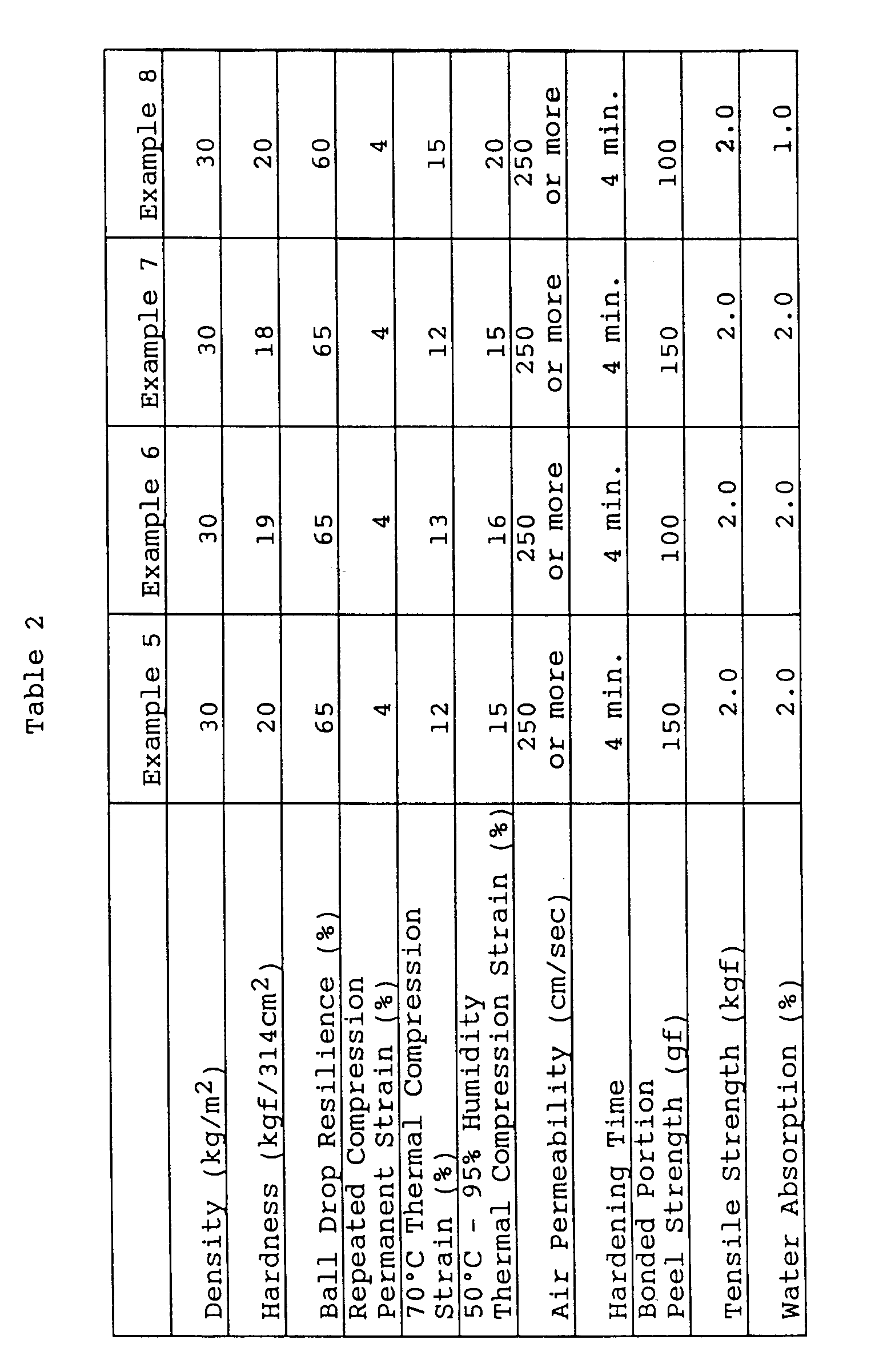
- As shown in Table 2, the cushion samples of the present invention (Examples 5 to 7) have substantially the same characteristics as those of the cushion sample not using a water-absorptive fiber (Example 8) in density, hardness, ball drop resilience, and repeated compression strain, and have characteristics superior thereto in bonded portion peel strength, tensile strength, and water absorption.
- Polyetherpolyol having a molecular weight of 3,000, an average functionality of 3, and a ratio of propylene oxide/ethylene oxide = 50/50 (wt%) was sufficiently dehydrated, and tolylene diisocyanate was supplied to dehydrated polyetherpolyol to cause a reaction at 80°C for four hours so that an isocyanate index was 200, thereby preparing a viscous isocyanate terminal prepolymer. Methylethylketooxime was added to the obtained prepolymer to complete a blocking reaction at 40°C for two hours, and the resultant material was put into water under strong stirring, thereby preparing a semiopaque aqueous dispersion composition. An excessive amount of the prepared aqueous dispersion composition was impregnated in polyester cotton (HYBAL 6d, available from TEIJIN LTD.). A predetermined amount of the composition was removed from the resultant material by a centrifugal force, and the resultant material was filled in a perforated metal mold to obtain a predetermined density. At this time, a weight ratio of the cotton to the polyurethane was adjusted to be 6.5 : 3.5. A hot air at 120°C to 130°C was flowed to harden the cotton filled in the mold for four minutes, and the hardened cotton was released from the mold to obtain a cushion sample.
- Polybutylene adipate having a molecular weight of 2,000 and an average funcionality of 2 was sufficiently dehydrated, and dimethylol propionic acid was added to dehydrated polybutylene adipate. In addition, tolylene diisocyanate was supplied to the resultant material to cause a reaction at 80°C for four hours so that an isocyanate index was 150, thereby preparing a viscous isocyanate terminated prepolymer. Methylethylketooxime was added to the obtained prepolymer to complete a blocking reaction at 40°C for two hours, and the resultant material was put into water containing triethylamine under strong stirring, thereby preparing a semiopaque aqueous dispersion composition. An excessive amount of the prepared aqueous dispersion composition was impregnated in polyester cotton (HYBALs 6d & 40d [1 : 1] Cotton Mixture, available from TEIJIN LTD.). A predetermined amount of the composition was removed from the resultant material by a centrifugal force, and the resultant material was filled in a perforated metal mold to obtain a predetermined density. At this time, a weight ratio of the cotton to the polyurethane was adjusted to be 6.5 : 3.5. A hot air at 120°C to 130°C was flowed to harden the cotton filled in the mold for four minutes, and the hardened cotton was released from the mold to obtain a cushion sample.
- Polyetherpolyol having a molecular weight of 1,000, an average funcionality of 2, and a ratio of propylene oxide/ethylene oxide = 80/20 (wt%) was sufficiently dehydrated, and dimethylol propionic acid was added to dehydrated polyetherpolyol. In addition, tolylene diisocyanate was supplied to the resultant material to cause a reaction at 80°C for four hours so that an isocyanate index was 200, thereby preparing a viscous isocyanate terminal prepolymer. Methylethylketooxime was added to the obtained prepolymer to complete a blocking reaction at 40°C for two hours, and the resultant material was put into water containing trimethylamine under strong stirring, thereby preparing a semiopaque aqueous dispersion composition. An excessive amount of the prepared aqueous dispersion composition was impregnated in polyester cotton (HYBAL 20d, available from TEIJIN LTD.). A predetermined amount of the composition was removed from the resultant material by a centrifugal force, and the resultant material was filled in a perforated metal mold to obtain a predetermined density. At this time, a weight ratio of the cotton to the polyurethane was adjusted to be 6.5 : 3.5. A hot air at 120°C to 130°C was flowed to harden the cotton filled in the mold for four minutes, and the hardened cotton was released from the mold to obtain a cushion sample.
- Polyetherpolyol having a molecular weight of 3,000, an average functionality of 3, and a ratio of propylene oxide/ethylene oxide = 50/50 (wt%) was sufficiently dehydrated, and tolylene diisocyanate was supplied to dehydrated polyetherpolyol to cause a reaction at 80°C for four hours so that an isocyanate index was 200, thereby preparing a viscous isocyanate terminal prepolymer. Methylethylketooxime was added to the obtained prepolymer to complete a blocking reaction at 40°C for two hours, and the resultant material was put into water under strong stirring, thereby preparing a semiopaque aqueous dispersion composition. An excessive amount of the prepared aqueous dispersion composition was impregnated in polyester cotton (HYBAL 6d, available from TEIJIN LTD.). A predetermined amount of the composition was removed from the resultant material by using a mangle [2 kgf/cm³], and the resultant material was filled in a perforated metal mold to obtain a predetermined density. At this time, a weight ratio of the cotton to the polyurethane was adjusted to be 6.5 : 3.5. A hot air at 120°C to 130°C was flowed to harden the cotton filled in the mold for four minutes, and the hardened cotton was released from the mold to obtain a cushion sample.
- When various characteristics of the five types of cushion samples obtained by Examples 9 to 12 and Control 1 were tested, the results listed in the following Table 3 were obtained.

- As is apparent from Table 3, the cushion samples of the present invention (Examples 9 to 12) have substantially the same characteristics as those of the conventional cushion sample using a polyurethane prepolymer having viscosity adjusted by an organic solvent (Control) in density, hardness, repeated compression strain, 70°C-thermal compression strain, and air permeability, and have characteristics superior thereto in 50°C - 95% humidity thermal compression strain and bonded portion peel strength.
- As has been described above, since aqueous polyurethane is used in the present invention, viscous adjustment can be performed by using water. Therefore, since a toxic organic solvent need not be used unlike in conventional methods, environmental conditions and workability can be improved. In addition, when a hardening agent is added to polyurethane, the polyurethane can be easily hardened at a predetermined heating temperature.
- When a blocked aqueous polyurethane prepolymer is used, it can be incorporated in water while cross-linkability of -NCO is maintained. Therefore, this prepolymer can be stably treated as an emulsion. A desired hardening temperature can be selected by arbitrarily selecting a blocking agent. In this manner, since crosslinkability is held even in the presence of water, high peel strength can be maintained in a fiber bonded portion even after water is removed.
- In addition, since a blocking agent is used, various types of crosslinking agents can be incorporated in a single solution. Therefore, a degree of freedom in selection of properties as a binder resin is increased. Furthermore, no water vapor is used in hardening, the scale of installation can be reduced.
- When an water-absorptive fiber is used, not only a stuffiness resistance and a thermal compression property are improved, but also tensile strength is improved.
- As described above, according to the present invention, there is provided an excellent cushion material which can be used in vehicles, furniture, bedclothes, and the like.
Claims (17)
- A water-absorptive cushion obtained by impregnating aqueous emulsion of hydrophilic polyurethane in three-dimensionally intertwined fibers (1) and hardening the resultant material with heat, wherein the surface of said fibers (1) is covered with a hydrophilic polyurethane resin, and said fibers are bonded by said hydrophilic polyurethane resin (2) at intersected portions of said fibers (1).
- A cushion according to claim 1, characterized in that said fiber (1) is an organic synthetic fiber.
- A cushion according to claim 2, characterized in that said organic synthetic fiber is selected from the group consisting of a polyester fiber, a nylon fiber, and an acryl fiber.
- A cushion according to claim 1, characterized in that the thickness of said fiber (1) is 1 to 50 denier.
- A cushion according to claim 1, characterized in that said fiber (1) is a water-absorptive fiber.
- A cushion according to claim 5, characterized in that said water-absorptive fiber (1) is an organic synthetic fiber subjected to a hydrophilic treatment by using a compound selected from the group consisting of polyalkylene glycol, metal isophthalate, and copolymerized polyethylene phthalate.
- A cushion according to claim 1, characterized in that said aqueous polyurethane polymer emulsion is an aqueous polyurethane prepolymer.
- A cushion according to claim 1, characterized in that said aqueous polyurethane polymer emulsion is a blocked aqueous polyurethane prepolymer emulsion.
- A cushion according to claim 1, characterized in that said aqueous polyurethane polymer contains a blocked isocyanate group and has anionic and/or cationic hydrophilic site.
- A method of manufacturing a water-absorptive cushion, characterized by comprising the steps of:
impregnating an aqueous emulsion of hydrophilic polyurethane in three-dimensionally intertwined fibers (1);
removing an excessive aqueous emulsion of hydrophilic polyurethane; and
hardening said aqueous emulsion of hydrophilic polyurethane impregnated in said fibers (1) with heat. - A method according to claim 10, characterized in that said fiber (1) is an organic synthetic fiber.
- A method according to claim 11, characterized in that said organic synthetic fiber (1) is selected from the group consisting of a polyester fiber, a nylon fiber, and an acryl fiber.
- A method according to claim 10, characterized in that said fiber (1) is a water-absorptive fiber.
- A method according to claim 13, characterized in that said water-absorptive fiber (1) is an organic fiber subjected to a hydrophilic treatment by using a compound selected from the group consisting of polyalkylene glycol, metal isophthalate, and copolymer polyethylene terephthalate.
- A method according to claim 10, characterized in that said aqueous polyurethane polymer emulsion is an aqueous polyurethane prepolymer.
- A method according to claim 10, characterized in that said aqueous polyurethane polymer emulsion is a blocked aqueous polyurethane prepolymer emulsion.
- A method according to claim 10, characterized in that said aqueous polyurethane polymer contains a blocked isocyanate group, and has anionic and/or cationic hydrophilic site.
Applications Claiming Priority (6)
| Application Number | Priority Date | Filing Date | Title |
|---|---|---|---|
| JP1207741A JPH0376854A (en) | 1989-08-10 | 1989-08-10 | Cushion material and its production |
| JP207741/89 | 1989-08-10 | ||
| JP207739/89 | 1989-08-10 | ||
| JP1207739A JPH0369651A (en) | 1989-08-10 | 1989-08-10 | Cushion body and production thereof |
| JP26500289A JP2514722B2 (en) | 1989-10-13 | 1989-10-13 | Cushion body and manufacturing method thereof |
| JP265002/89 | 1989-10-13 |
Publications (2)
| Publication Number | Publication Date |
|---|---|
| EP0414041A1 EP0414041A1 (en) | 1991-02-27 |
| EP0414041B1 true EP0414041B1 (en) | 1994-11-17 |
Family
ID=27328799
Family Applications (1)
| Application Number | Title | Priority Date | Filing Date |
|---|---|---|---|
| EP19900115182 Expired - Lifetime EP0414041B1 (en) | 1989-08-10 | 1990-08-07 | Cushion material and method of manufacturing the same |
Country Status (4)
| Country | Link |
|---|---|
| US (1) | US5021286A (en) |
| EP (1) | EP0414041B1 (en) |
| CA (1) | CA2022722C (en) |
| DE (1) | DE69014169T2 (en) |
Families Citing this family (8)
| Publication number | Priority date | Publication date | Assignee | Title |
|---|---|---|---|---|
| WO1991019032A1 (en) * | 1990-05-28 | 1991-12-12 | Teijin Limited | Novel cushioning structure and production thereof |
| US5610232A (en) * | 1993-09-24 | 1997-03-11 | H.B. Fuller Licensing & Financing, Inc. | Aqueous non-gelling, anionic polyurethane dispersions and process for their manufacture |
| FR2739494B1 (en) * | 1995-09-29 | 1997-11-14 | Suisse Electronique Microtech | PROCESS FOR MANUFACTURING MICROMECHANICS PARTS WITH A DIAMOND PART CONSISTING OF AT LEAST ONE TIP, AND MICROMECHANICAL PARTS WITH AT LEAST ONE DIAMOND TIP |
| US5801211A (en) * | 1996-10-04 | 1998-09-01 | Cinco, Inc. | Resilient fiber mass and method |
| USD565306S1 (en) | 2006-03-17 | 2008-04-01 | Sca Hygiene Products Ab | Embossed sheet with surface pattern |
| USD559552S1 (en) * | 2006-03-17 | 2008-01-15 | Sca Hygiene Products Ab | Embossed sheet with surface pattern |
| DE102009040473A1 (en) * | 2008-09-11 | 2010-11-04 | Cepventures International Corp. | Resilient construction for a mattress, upholstery or cushions |
| WO2021203215A1 (en) * | 2020-04-10 | 2021-10-14 | 李宇轩 | Composite cushion body having good supporting force and comfortable somatosensory layer |
Family Cites Families (5)
| Publication number | Priority date | Publication date | Assignee | Title |
|---|---|---|---|---|
| CH437194A (en) * | 1965-03-18 | 1967-06-15 | Matec Holding | Padding material made of fibers and foam made of fleece |
| US3459631A (en) * | 1965-11-24 | 1969-08-05 | Kem Wove Ind Inc | Bendable,high loft,bonded,non-woven,textile fabric |
| EP0125494B1 (en) * | 1983-05-13 | 1992-01-02 | Kuraray Co., Ltd. | Entangled fibrous mat having good elasticity and production thereof |
| JPH0791766B2 (en) * | 1984-12-28 | 1995-10-04 | 日本発条株式会社 | Cushion body and manufacturing method thereof |
| JPH0793990B2 (en) * | 1988-04-14 | 1995-10-11 | 日本発条株式会社 | Cushion body |
-
1990
- 1990-08-03 CA CA 2022722 patent/CA2022722C/en not_active Expired - Fee Related
- 1990-08-03 US US07/562,204 patent/US5021286A/en not_active Expired - Lifetime
- 1990-08-07 DE DE69014169T patent/DE69014169T2/en not_active Expired - Fee Related
- 1990-08-07 EP EP19900115182 patent/EP0414041B1/en not_active Expired - Lifetime
Also Published As
| Publication number | Publication date |
|---|---|
| US5021286A (en) | 1991-06-04 |
| DE69014169T2 (en) | 1995-05-18 |
| EP0414041A1 (en) | 1991-02-27 |
| CA2022722A1 (en) | 1991-02-11 |
| CA2022722C (en) | 1997-04-22 |
| DE69014169D1 (en) | 1994-12-22 |
Similar Documents
| Publication | Publication Date | Title |
|---|---|---|
| EP1558661B1 (en) | Heat resistant high moisture vapor transmission thermoplastic polyurethane | |
| DE69428844T2 (en) | Coated abrasive with a moisture-hardened base layer made of polyurethane hot-melt adhesive | |
| US20080066347A1 (en) | Internal Material of Sole, Shoe Insole and Boot | |
| US4110508A (en) | Foam sheet and method | |
| US5021286A (en) | Cushion material and method of manufacturing the same | |
| EP0424697B1 (en) | Aqueous polyurethane composition and its use | |
| US4182649A (en) | Polyurethane foam sheet and method | |
| CA1292337C (en) | Polyurethane dispersion and emulsion, sheet-like porous material and production process thereof | |
| US4957959A (en) | Prepolymer composition, process for its production, and its use | |
| GB2093051A (en) | Aqueous polyurethane composition and method of preparing composite sheet material therefrom | |
| EP1890878A1 (en) | Composite elements, comprising nonwoven thermoplastic polyurethane fabric | |
| US6017625A (en) | Water-absorptive polyurethane fiber and method of producing the same | |
| CN112095230B (en) | Super-soft super-fluffy spun-bonded non-woven fabric and preparation method thereof | |
| US4264645A (en) | Process for improving the water vapor absorption capacity of textile substrates | |
| CA1318201C (en) | Laminated dressing | |
| US5863983A (en) | Manufacturing method for blocked aqueous dispersion of polyurethanes | |
| US4902542A (en) | Cushion and method of manufacturing the same | |
| KR101929840B1 (en) | Upper for Shoes with moisture permeability and water-proof properties | |
| DE69320774T2 (en) | WATERPROOF CLOTH AND METHOD FOR THE PRODUCTION THEREOF | |
| WO2004042135A1 (en) | Articles treated with aqueous dispersions of poly(urea/urethanes) | |
| JP2514722B2 (en) | Cushion body and manufacturing method thereof | |
| JPH0369652A (en) | Cushion body and production thereof | |
| AU749640B2 (en) | Sponge | |
| KR890003172B1 (en) | Manufacturing method of upper artificial leather | |
| CA2190683A1 (en) | Interior trim panels and method for manufacturing such panels using silaceous materials |
Legal Events
| Date | Code | Title | Description |
|---|---|---|---|
| PUAI | Public reference made under article 153(3) epc to a published international application that has entered the european phase |
Free format text: ORIGINAL CODE: 0009012 |
|
| 17P | Request for examination filed |
Effective date: 19900904 |
|
| AK | Designated contracting states |
Kind code of ref document: A1 Designated state(s): AT BE DE FR GB IT SE |
|
| 17Q | First examination report despatched |
Effective date: 19930317 |
|
| GRAA | (expected) grant |
Free format text: ORIGINAL CODE: 0009210 |
|
| AK | Designated contracting states |
Kind code of ref document: B1 Designated state(s): DE FR GB IT |
|
| ITF | It: translation for a ep patent filed | ||
| REF | Corresponds to: |
Ref document number: 69014169 Country of ref document: DE Date of ref document: 19941222 |
|
| ET | Fr: translation filed | ||
| PLBE | No opposition filed within time limit |
Free format text: ORIGINAL CODE: 0009261 |
|
| STAA | Information on the status of an ep patent application or granted ep patent |
Free format text: STATUS: NO OPPOSITION FILED WITHIN TIME LIMIT |
|
| 26N | No opposition filed | ||
| PGFP | Annual fee paid to national office [announced via postgrant information from national office to epo] |
Ref country code: GB Payment date: 19960729 Year of fee payment: 7 |
|
| PG25 | Lapsed in a contracting state [announced via postgrant information from national office to epo] |
Ref country code: GB Free format text: LAPSE BECAUSE OF NON-PAYMENT OF DUE FEES Effective date: 19970807 |
|
| GBPC | Gb: european patent ceased through non-payment of renewal fee |
Effective date: 19970807 |
|
| PGFP | Annual fee paid to national office [announced via postgrant information from national office to epo] |
Ref country code: FR Payment date: 19980717 Year of fee payment: 9 |
|
| PGFP | Annual fee paid to national office [announced via postgrant information from national office to epo] |
Ref country code: DE Payment date: 19981029 Year of fee payment: 9 |
|
| PG25 | Lapsed in a contracting state [announced via postgrant information from national office to epo] |
Ref country code: FR Free format text: LAPSE BECAUSE OF NON-PAYMENT OF DUE FEES Effective date: 20000428 |
|
| PG25 | Lapsed in a contracting state [announced via postgrant information from national office to epo] |
Ref country code: DE Free format text: LAPSE BECAUSE OF NON-PAYMENT OF DUE FEES Effective date: 20000601 |
|
| REG | Reference to a national code |
Ref country code: FR Ref legal event code: ST |
|
| PG25 | Lapsed in a contracting state [announced via postgrant information from national office to epo] |
Ref country code: IT Free format text: LAPSE BECAUSE OF NON-PAYMENT OF DUE FEES;WARNING: LAPSES OF ITALIAN PATENTS WITH EFFECTIVE DATE BEFORE 2007 MAY HAVE OCCURRED AT ANY TIME BEFORE 2007. THE CORRECT EFFECTIVE DATE MAY BE DIFFERENT FROM THE ONE RECORDED. Effective date: 20050807 |