EP0413706B1 - 1,2,4-benzotriazine oxides as radiosensitizers and selective cytotoxic agents - Google Patents
1,2,4-benzotriazine oxides as radiosensitizers and selective cytotoxic agents Download PDFInfo
- Publication number
- EP0413706B1 EP0413706B1 EP89904704A EP89904704A EP0413706B1 EP 0413706 B1 EP0413706 B1 EP 0413706B1 EP 89904704 A EP89904704 A EP 89904704A EP 89904704 A EP89904704 A EP 89904704A EP 0413706 B1 EP0413706 B1 EP 0413706B1
- Authority
- EP
- European Patent Office
- Prior art keywords
- hydrocarbyl
- halogeno
- alkoxy
- hydroxy
- optionally substituted
- Prior art date
- Legal status (The legal status is an assumption and is not a legal conclusion. Google has not performed a legal analysis and makes no representation as to the accuracy of the status listed.)
- Expired - Lifetime
Links
Classifications
-
- C—CHEMISTRY; METALLURGY
- C07—ORGANIC CHEMISTRY
- C07D—HETEROCYCLIC COMPOUNDS
- C07D253/00—Heterocyclic compounds containing six-membered rings having three nitrogen atoms as the only ring hetero atoms, not provided for by group C07D251/00
- C07D253/08—Heterocyclic compounds containing six-membered rings having three nitrogen atoms as the only ring hetero atoms, not provided for by group C07D251/00 condensed with carbocyclic rings or ring systems
-
- C—CHEMISTRY; METALLURGY
- C07—ORGANIC CHEMISTRY
- C07D—HETEROCYCLIC COMPOUNDS
- C07D253/00—Heterocyclic compounds containing six-membered rings having three nitrogen atoms as the only ring hetero atoms, not provided for by group C07D251/00
- C07D253/08—Heterocyclic compounds containing six-membered rings having three nitrogen atoms as the only ring hetero atoms, not provided for by group C07D251/00 condensed with carbocyclic rings or ring systems
- C07D253/10—Condensed 1,2,4-triazines; Hydrogenated condensed 1,2,4-triazines
-
- A—HUMAN NECESSITIES
- A61—MEDICAL OR VETERINARY SCIENCE; HYGIENE
- A61K—PREPARATIONS FOR MEDICAL, DENTAL OR TOILETRY PURPOSES
- A61K31/00—Medicinal preparations containing organic active ingredients
- A61K31/33—Heterocyclic compounds
- A61K31/395—Heterocyclic compounds having nitrogen as a ring hetero atom, e.g. guanethidine or rifamycins
- A61K31/53—Heterocyclic compounds having nitrogen as a ring hetero atom, e.g. guanethidine or rifamycins having six-membered rings with three nitrogens as the only ring hetero atoms, e.g. chlorazanil, melamine
-
- A—HUMAN NECESSITIES
- A61—MEDICAL OR VETERINARY SCIENCE; HYGIENE
- A61K—PREPARATIONS FOR MEDICAL, DENTAL OR TOILETRY PURPOSES
- A61K31/00—Medicinal preparations containing organic active ingredients
- A61K31/33—Heterocyclic compounds
- A61K31/395—Heterocyclic compounds having nitrogen as a ring hetero atom, e.g. guanethidine or rifamycins
- A61K31/535—Heterocyclic compounds having nitrogen as a ring hetero atom, e.g. guanethidine or rifamycins having six-membered rings with at least one nitrogen and one oxygen as the ring hetero atoms, e.g. 1,2-oxazines
- A61K31/5375—1,4-Oxazines, e.g. morpholine
- A61K31/5377—1,4-Oxazines, e.g. morpholine not condensed and containing further heterocyclic rings, e.g. timolol
-
- A—HUMAN NECESSITIES
- A61—MEDICAL OR VETERINARY SCIENCE; HYGIENE
- A61K—PREPARATIONS FOR MEDICAL, DENTAL OR TOILETRY PURPOSES
- A61K41/00—Medicinal preparations obtained by treating materials with wave energy or particle radiation ; Therapies using these preparations
- A61K41/0038—Radiosensitizing, i.e. administration of pharmaceutical agents that enhance the effect of radiotherapy
-
- A—HUMAN NECESSITIES
- A61—MEDICAL OR VETERINARY SCIENCE; HYGIENE
- A61P—SPECIFIC THERAPEUTIC ACTIVITY OF CHEMICAL COMPOUNDS OR MEDICINAL PREPARATIONS
- A61P35/00—Antineoplastic agents
Definitions
- the invention relates to cytotoxic agents and radiotherapy effective against hypoxic cells. Specifically, the invention relates to selectively killing tumor cells and to sensitizing tumor cells to radiation using 1,2,4-benzotriazine oxides.
- Hypoxic cell radiosensitizers are compounds that selectively increase the sensitivity of hypoxic cells to destructive radiation. Cytotoxins which have enhanced activity under hypoxic conditions also provide a means for selective destruction of cells under low oxygen pressure. This specificity for hypoxic cells is important because it is tumors that are typically characterized by such cells. Virtually all tumors which are present as solid masses contain these cells, while normal cells generally have an adequate supply of oxygen. Accordingly, anti-tumor agents can be made selective for tumors by virtue of high activity under hypoxic conditions, and radiation can be employed more effectively in the presence of these sensitizers.
- a group of compounds which has not previously been suggested for use in either selectively killing hypoxic cells or in radiosensitizing such cells is 3-amino-1,2,4-benzotriazine 1,4-di-N-oxide and related compounds.
- Related US patents 3,980,779; 3,868,371; and 4,001,410 disclose the preparation of a group of these compounds and their use as anti-microbial agents, particularly by addition of these materials to livestock fodder.
- US patents 3,991,189 and 3,957,799 disclose derivatives of these compounds bearing substituents on the nitrogen of the 3-amino group. These compounds also have anti-microbial activity.
- the present invention provides additional compounds which specifically radiosensitize hypoxic cells in vitro and which, furthermore, are directly cytotoxic to hypoxic cells both in vitro and in vivo . Therefore, administration of these compounds prior to or following radiation treatment of tumors selectively kills the hypoxic (tumor) cells which survive the radiation dose. Both the ability of these compounds to radiosensitize hypoxic cells in vitro and especially their ability to selectively kill hypoxic cells directly are unexpected properties of these compounds.
- WO-A-8802366 published 7 April 1988, describes the use of certain 1,2,4-benzotriazine oxides as radiosensitizers and selective cytotoxic agents.
- US-A-2489359 is concerned with certain novel 7-halogen-3-(mono-and di-substituted amino)-1,2,4-benzotriazine compounds which are described as useful intermediates in the preparation of complex organic compounds including anti-malarial agents and dyes.
- US-A-2489352 is concerned with substituted 3-amino-1,2,4-benzotriazine-1-oxides considered to possess potential therapeutic value for use in the treatment of malaria.
- FR-A-2322140 is concerned with 3-alkoxy-benzo-1,2,4-triazines and their use as fungicides and bactericides.
- EP-A-0001090 is concerned with plant bactericide compositions containing 3-halo-benzotriazine-1-oxides.
- US-A-3482024 describes 1,2,4-benzotriazines for use in alleviating inflammation, edema, pain, fever and swelling of the joints.
- GB-A-1234845 is concerned with phosphoric, phosphonic, thionophosphoric and thionophosphonic acid esters of 3-hydroxybenzotriazine-1-N-oxides and their use as insecticides and acaricides.
- the invention provides a valuable addition to the group of compounds currently available as selective radiosensitizers and selective cytotoxic agents for hypoxic tumor cells. Some of the compounds useful in this regard are known compounds, others are novel.
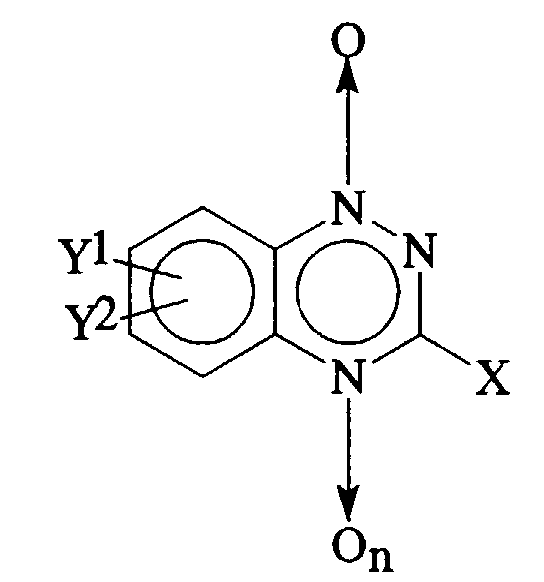
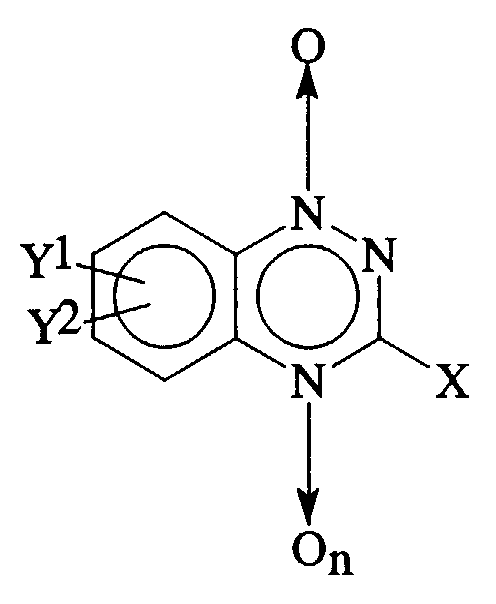
- X is H, or hydrocarbyl (1-4C), and said hydrocarbyl may further be optionally substituted with hydroxy, alkoxy, amino, or halogeno;
- a method of selectively killing hypoxic tumor cells in vitro comprises administering directly to the cells in vitro a compound of the formula wherein X is H, or hydrocarbyl (1-4C), and said hydrocarbyl may further be optionally substituted with hydroxy, alkoxy, amino, or halogeno;
- a method of radiosensitising hypoxic tumor cells in vitro comprises administering a compound of the formula wherein X is H, or hydrocarbyl (1-4C), and said hydrocarbyl may further be optionally substituted with hydroxy, alkoxy, amino, or halogeno;
- novel compounds encompassed by the above Formula are already known in the art as being useful for other purposes; other compounds are novel.
- novel compounds encompassed by the present invention and which may be prepared by methods disclosed herein include compounds represented by the formula wherein X is H, or hydrocarbyl (1-4C), and said hydrocarbyl may further be optionally substituted with hydroxy, alkoxy, amino or halogeno;
- the invention further provides a compound of the formula: wherein X is H, or hydrocarbyl (1-4C), and said hydrocarbyl may further be optionally substituted with hydroxy, alkoxy, amino or halogeno;
- the compounds useful in radiosensitizing hypoxic tumor cells as described herein are derivatives of 1,2,4-benzotriazine oxide.
- the hydrocarbyl group represented by Y 1 or Y 2 may contain 1-14 carbon atoms, may be saturated or unsaturated, cyclic or acyclic, and may optionally be interrupted by a single ether linkage.
- the unsubstituted form of Y 1 or Y 2 can be, for example, methyl, ethyl, n-propyl, s-butyl, n-hexyl, 2-methyl-n-pentyl, 2-ethoxyethyl, 3-(n-propoxy)-n-propyl, 4-methoxybutyl, cyclohexyl, tetrahydrofurfuryl, furfuryl, cyclohexenyl, 3-(n-decyloxy)-n-propyl, 4-methyloctyl, 4.7-dimethyloctyl, and the like.
- the hydrocarbyl may be substituted with one or two substituents as follows:
- the halogeno substituents are fluoro, chloro, bromo, or iodo.
- the alkoxy substituents represented by OR" may contain 1 to 4 carbon atoms, and include, for example, methoxy, n-propoxy, and t-butoxy.
- the amino substituent may be NH 2 , NHR a or NR a 2 , where each R a is independently an alkyl of 1-4 carbons or a morpholino moiety. R a may optionally be substituted with 1-2 hydroxy, alkoxy, amino, or halogeno substituents.
- acyloxy and acylamido groups are represented by R"COO- and R"CONH-, respectively, where R" contains 1-4 carbons, and their thio analogs are represented by R"CSO- and R"CSNH-.
- Alkyl sulfonyl and alkyl phosphonyl are, respectively, R"SO 2 and R"P(OR")O- wherein each R" is independently as above defined.
- Carboxy is the group -C(O)OH; alkoxycarbonyl is -C(O)OR"; carbamyl is -C(O)NH 2 ; and alkylcarbamyl is -C(O)NHR".
- the 1,2,4-benzotriazine may be used as the mono- or dioxide. Either the 1-nitrogen of the triazino ring may be oxidized, or both the 1- and 4-nitrogens may be oxidized.
- the dioxide may be prepared from the parent monoxide or 1,2,4-benzotriazine by peracid oxidation (see Robbins et al, J Chem Soc 3186 (1957) and Mason et al, J Chem Soc B 911 (1970)).
- the monoxide may be prepared by:
- the 1,2,4-benzotriazines may be prepared by cyclization of formazan precursors using BF 3 /AcOH (see Scheme I and Atallah and Nazer, Tetrahedron 38 :1793 (1982)).
- the oxidized benzotriazines of the invention may be used to radiosensitize or selectively kill hypoxic tumor cells in warm-blooded animal hosts.
- a way in which they may be used is in conjunction with agents known to selectively create hypoxia in tumors.
- agents known to selectively create hypoxia in tumors include the use of antihypertensive drugs such as hydralazine, or agents which affect the amount of oxygen carried by the blood. While these compounds will typically be used in cancer therapy of human patients, they may be used to kill hypoxic tumor cells in other warm blooded animal species such as other primates, farm animals such as cattle, and sports animals and pets such as horses, dogs, and cats.
- the compounds of the invention may, therefore, be used to radiosensitize or to kill neoplastic epithelial cells, endothelial cells, connective tissue cells, bone cells, muscle cells, nerve cells, and brain cells.
- carcinomas and sarcomas include carcinomas such as epithelial cell, acidic cell, alveolar cell, basal cell, basal squamous cell, cervical, renal, liver, Hurthle, Lucke, mucinous and Walker, and sarcomas such as Abernathy's, alveolar soft part, angiolithic, botyroid, encephaloid, endometria stroma, Ewing's fascicular, giant cell, lymphatic, Jensen's, juxtacortical osteogenic, Kaposi's, medullary, and synovial. Specific examples of tumors that have been sensitized with other radiosensitizers are reported in Adams, G.E., Cancer: A Comprehensive Treatise (F. Becker, Ed) vol 6, pp 181-223, Plenum, New York, 1977.
- the compounds may be administered to patients orally or parenterally (intravenously, subcutaneously, intramuscularly, intraspinally, intraperitoneally, and the like).
- parenterally When administered parenterally the compounds will normally be formulated in a unit dosage injectable form (solution, suspension, emulsion) with a pharmaceutically acceptable vehicle.
- a pharmaceutically acceptable vehicle are typically nontoxic and nontherapeutic. Examples of such vehicles are water, aqueous vehicles such as saline, Ringer's solution, dextrose solution, and Hank's solution and nonaqueous vehicles such as fixed oils (e.g., corn, cottonseed, peanut, and sesame), ethyl oleate, and isopropyl myristate.
- Sterile saline is a preferred vehicle and the compounds are sufficiently water soluble to provide a solution for all foreseeabie needs.
- the vehicle may contain minor amounts of additives such as substances that enhance solubility, isotonicity, and chemical stability, e.g., antioxidants, buffers, and preservatives.
- additives such as substances that enhance solubility, isotonicity, and chemical stability, e.g., antioxidants, buffers, and preservatives.
- the compounds When administered orally (or rectally) the compounds will usually be formulated into a unit dosage form such as a tablet, capsule, suppository or cachet.
- Such formulations typically include a solid, semisolid or liquid carrier or diluent.
- Exemplary diluents and vehicles are lactose, dextrose, sucrose, sorbitol, mannitol, starches, gum acacia, calcium phosphate, mineral oil, cocoa butter, oil of theobroma, aginates, tragacanth, gelatin, syrup, methylcellulose, polyoxyethylene sorbitan monolaurate, methyl hydroxybenzoate, propyl hydroxybenzoate, talc, and magnesium stearate.
- the amount of compound administered to the subject is sufficient to radiosensitize or to produce cytotoxicity in the malignant neoplasm to be treated but below that which may elicit toxic effects. This amount will depend upon the type of tumor, the species of the subject being treated, the indication dosage intended and the weight or body surface of the subject.
- the radiation may be administered to humans in a variety of different fractionation regimes, i.e., the total radiation dose is given in portions over a period of several days to several weeks. These are most likely to vary from daily (i.e., five times per week) doses for up to six weeks, to once weekly doses for four to six weeks.
- An individual dose of the benzotriazine will be given before or after each radiation treatment and is likely to be in the range of 0.01 to 20 mmol/kg and usually in the range of 0.1 to 2 mmol/kg.
- the compounds of the invention can be administered alone, with radiation or other cancer cytotoxic agents, with vasoactive drugs (e.g., hydralazine), or with procedures which reduce the amount of available oxygen carried by the blood such as anemia or drugs which increase the binding of oxygen to hemoglobin, all of which can enhance selectively the degree of hypoxia in the tumor.
- vasoactive drugs e.g., hydralazine
- procedures which reduce the amount of available oxygen carried by the blood such as anemia or drugs which increase the binding of oxygen to hemoglobin, all of which can enhance selectively the degree of hypoxia in the tumor.
- n is 1
- LD 50 is determined in BALB/c female mice (weighing 20-25 g) following intraperitoneal (ip) injection, unless the compound tested has low lipophilicity and is very soluble, wherein intravenous (iv) administration is used. LD 50 values at 1, 2, 5, and 60 days are determined by administering graded doses of the drug dissolved in physiological saline immediately prior to injection.
Landscapes
- Health & Medical Sciences (AREA)
- Chemical & Material Sciences (AREA)
- Organic Chemistry (AREA)
- Life Sciences & Earth Sciences (AREA)
- General Health & Medical Sciences (AREA)
- Veterinary Medicine (AREA)
- Public Health (AREA)
- Pharmacology & Pharmacy (AREA)
- Medicinal Chemistry (AREA)
- Animal Behavior & Ethology (AREA)
- Epidemiology (AREA)
- Chemical Kinetics & Catalysis (AREA)
- General Chemical & Material Sciences (AREA)
- Nuclear Medicine, Radiotherapy & Molecular Imaging (AREA)
- Pharmaceuticals Containing Other Organic And Inorganic Compounds (AREA)
- Nitrogen And Oxygen Or Sulfur-Condensed Heterocyclic Ring Systems (AREA)
- Nitrogen Condensed Heterocyclic Rings (AREA)
- Agricultural Chemicals And Associated Chemicals (AREA)
- Cosmetics (AREA)
Abstract
Description




Claims (12)
- Use of a compound of the formulawherein X is H, or hydrocarbyl (1-4C), and said hydrocarbyl may further be optionally substituted with hydroxy, alkoxy, amino, or halogeno;
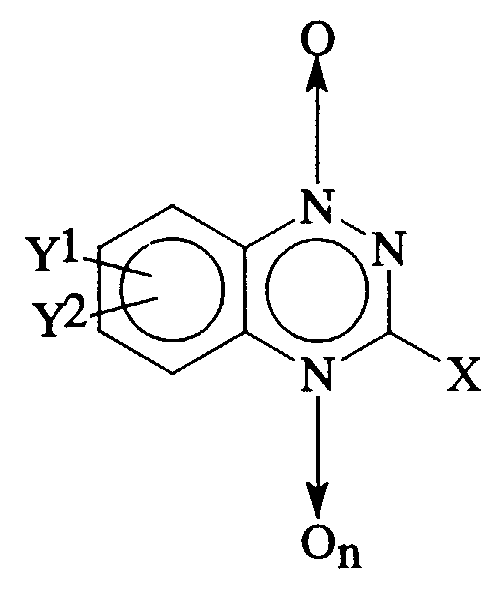 n is 1; andY1 and Y2 are independentlyH;halogeno;hydrocarbyl (1-14C) including cyclic and unsaturated hydrocarbyl, optionally substituted with 1 or 2 substituents selected from the group consisting of halogeno, hydroxy, epoxy, alkoxy, alkylthio, NH2, NHRa, NRa 2 (wherein each Ra is independently an alkyl of 1 to 4 carbon atoms or morpholino moiety, said alkyl and morpholino moieties being optionally substituted with one or two substituents selected from hydroxy, alkoxy, amino or halogeno substituents), morpholino, acyloxy, acylamido and their thio analogs, carboxy, alkoxycarbonyl, carbamyl or alkylcarbamyl, and wherein the hydrocarbyl can optionally be interrupted by a single ether (-0-) linkage including hydrocarbyloxy; orNHR', O(CO)R', NH(CO)R', O(SO)R', or O(POR')R' in which R' is hydrocarbyl (1-14C) including cyclic and unsaturated hydrocarbyl, optionally substituted with 1 or 2 substituents selected from the group consisting of halogeno, hydroxy, epoxy, alkoxy, alkylthio, NH2, NHRa, NRa 2 (wherein each Ra is as defined above), morpholino, acyloxy, acylamido and their thio analogs, carboxy, alkoxycarbonyl, carbamyl or alkylcarbamyl, and wherein the hydrocarbyl can optionally be interrupted by a single ether (-0-) linkage, including hydrocarbyloxy, orwhen X is H, methyl or ethyl, one of Y1 and Y2 is H and the other is NH2in the manufacture of a medicament for the treatment of the human or animal body for the selective killing of hypoxic tumor cells.
 - Use of3-ethyl-1,2,4-benzotriazine-1,4-dioxide, or3-propyl-1,2,4-benzotriazine-1,4-dioxide in the manufacture of a medicament for the treatment of the human or animal body for the selective killing of hypoxic tumor cells.
- A method of selectively killing hypoxic tumor cells in vitro which method comprises administering directly to the cells in vitro a compound of the formulawherein X is H, or hydrocarbyl (1-4C), and said hydrocarbyl may further be optionally substituted with hydroxy, alkoxy, amino, or halogeno;
 n is 1; andY1 and Y2 are independentlyH;halogeno;hydrocarbyl (1-14C) including cyclic and unsaturated hydrocarbyl, optionally substituted with 1 or 2 substituents selected from the group consisting of halogeno, hydroxy, epoxy, alkoxy, alkylthio, NH2, NHRa, NRa 2 (wherein each Ra is independently an alkyl of 1 to 4 carbon atoms or morpholino moiety, said alkyl and morpholino moieties being optionally substituted with one or two substituents selected from hydroxy, alkoxy, amino or halogeno substituents), morpholino, acyloxy, acylamido and their thio analogs, carboxy, alkoxycarbonyl, carbamyl or alkylcarbamyl, and wherein the hydrocarbyl can optionally be interrupted by a single ether (-0-) linkage including hydrocarbyloxy; orNHR', O(CO)R', NH(CO)R', O(SO)R', or O(POR')R' in which R' is hydrocarbyl (1-14C) including cyclic and unsaturated hydrocarbyl, optionally substituted with 1 or 2 substituents selected from the group consisting of halogeno, hydroxy, epoxy, alkoxy, alkylthio, NH2, NHRa, NRa 2 (wherein each Ra is as defined above), morpholino, acyloxy, acylamido and their thio analogs, carboxy, alkoxycarbonyl, carbamyl or alkylcarbamyl, and wherein the hydrocarbyl can optionally be interrupted by a single ether (-0-) linkage including hydrocarbyloxy, orwhen X is H, methyl or ethyl, one of Y1 and Y2 is H and the other is NH2.
 - A method of selectively killing hypoxic tumor cells in vitro which method comprises administering directly to the cells in vitro3-ethyl-1,2,4-benzotriazine-1,4-dioxide, or3-propyl-1,2,4-benzotriazine-1,4-dioxide.
- Use of a compound of the formula:wherein X is H, or hydrocarbyl (1-4C), and said hydrocarbyl may further be optionally substituted with hydroxy, alkoxy, amino, or halogeno;
 n is 0 or 1; andY1 and Y2 are independentlyH;halogeno;hydrocarbyl (1-14C) including cyclic and unsaturated hydrocarbyl, optionally substituted with 1 or 2 substituents selected from the group consisting of halogeno, hydroxy, epoxy, alkoxy, alkylthio, NH2, NHRa, NRa 2 (wherein each Ra is independently an alkyl of 1 to 4 carbon atoms or morpholino moiety, said alkyl and morpholino moieties being optionally substituted with one or two substituents selected from hydroxy, alkoxy, amino or halogeno substituents), morpholino, acyloxy, acylamido and their thio analogs, carboxy, alkoxycarbonyl, carbamyl or alkylcarbamyl, and wherein the hydrocarbyl can optionally be interrupted by a single ether (-0-) linkage including hydrocarbyloxy; orNHR', O(CO)R', NH(CO)R', O(SO)R', or O(POR')R' in which R' is hydrocarbyl (1-14C) including cyclic and unsaturated hydrocarbyl, optionally substituted with 1 or 2 substituents selected from the group consisting of halogeno, hydroxy, epoxy, alkoxy, alkylthio, NH2, NHRa, NRa 2 (wherein each Ra is as defined above), morpholino, acyloxy, acylamido and their thio analogs, carboxy, alkoxycarbonyl, carbamyl or alkylcarbamyl, and wherein the hydrocarbyl can optionally be interrupted by a single ether (-0-) linkage, including hydrocarbyloxy, orwhen n is 1 and X is H, methyl or ethyl, one of Y1 and Y2 is H and the other is NH2in the manufacture of a medicament for the treatment of the human or animal body for the radiosensitising of hypoxic tumor cells.
 - Use of a compound selected from the group consisting of:3-ethyl-1,2,4-benzotriazine-1,4-dioxide, and3-propyl-1,2,4-benzotriazine-1,4-dioxide in the manufacture of a medicament for the treatment of the human or animal body for the radiosensitising of hypoxic tumor cells.
- A method of radiosensitising hypoxic tumor cells in vitro, which method comprises administering a compound of the formulawherein X is H, or hydrocarbyl (1-4C), and said hydrocarbyl may further be optionally substituted with hydroxy, alkoxy, amino, or halogeno;
 n is 0 or 1; andY1 and Y2 are independentlyH;halogeno;hydrocarbyl (1-14C) including cyclic and unsaturated hydrocarbyl, optionally substituted with 1 or 2 substituents selected from the group consisting of halogeno, hydroxy, epoxy, alkoxy, alkylthio, NH2, NHRa, NRa 2 (wherein each Ra is independently an alkyl of 1 to 4 carbon atoms or morpholino moiety, said alkyl and morpholino moieties being optionally substituted with one or two substituents selected from hydroxy, alkoxy, amino or halogeno substituents), morpholino, acyloxy, acylamido and their thio analogs, carboxy, alkoxycarbonyl, carbamyl or alkylcarbamyl, and wherein the hydrocarbyl can optionally be interrupted by a single ether (-0-) linkage including hydrocarbyloxy; orNHR', O(CO)R', NH(CO)R', O(SO)R', or O(POR')R' in which R' is hydrocarbyl (1-14C) including cyclic and unsaturated hydrocarbyl, optionally substituted with 1 or 2 substituents selected from the group consisting of halogeno, hydroxy, epoxy, alkoxy, alkylthio, NH2, NHRa, NRa 2 (wherein each Ra is as defined above), morpholino, acyloxy, acylamido and their thio analogs, carboxy, alkoxycarbonyl, carbamyl or alkylcarbamyl, and wherein the hydrocarbyl can optionally be interrupted by a single ether (-0-) linkage, including hydrocarbyloxy, orwhen n is 1 and X is H, methyl or ethyl, one of Y1 and Y2 is H and the other is NH2.
 - A method of radiosensitising hypoxic tumor cells in vitro, which method comprises administering a compound selected from the group3-ethyl-1,2,4-benzotriazine-1,4-dioxide, and3-propyl-1,2,4-benzotriazine-1,4-dioxide.
- A compound of the formula:wherein X is H, or hydrocarbyl (1-4C), and said hydrocarbyl may further be optionally substituted with hydroxy, alkoxy, amino or halogeno;
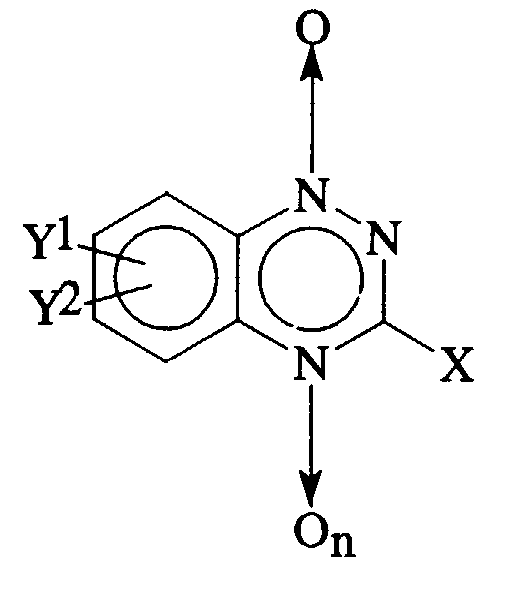 n is 0 or 1; andY1 and Y2 are independentlyH;halogeno;hydrocarbyl (1-14C) including cyclic and unsaturated hydrocarbyl, optionally substituted with 1 or 2 substituents selected from the group consisting of halogeno, hydroxy, epoxy, alkoxy, alkylthio, NH2, NHRa, NRa 2 (wherein each Ra is independently an alkyl of 1-4 carbon atoms or morpholino moiety, said alkyl and morpholino moieties being optionally substituted with one or two substituents selected from hydroxy, alkoxy, amino or halogeno substituents), morpholino, acyloxy, acylamido and their thio analogs, carboxy, alkoxycarbonyl, carbamyl or alkylcarbamyl, and wherein the hydrocarbyl can optionally be interrupted by a single ether (-0-) linkage including hydrocarbyloxy; orNHR', O(CO)R', NH(CO)R', O(SO)R', or O(POR')R' in which R' is hydrocarbyl (1-14C), including cyclic and unsaturated hydrocarbyl, optionally substituted with 1 or 2 substituents selected from the group consisting of halogeno, hydroxy, epoxy, alkoxy, alkylthio, NH2, NHRa, NRa 2 (wherein each Ra is as defined above), morpholino, acyloxy, acylamido and their thio analogs, carboxy, alkoxycarbonyl, carbamyl or alkylcarbamyl, and wherein the hydrocarbyl can optionally be interrupted by a single ether (-0-) linkage including hydrocarbyloxy; with the provisos that when Y1 and Y2 are hydrogen, X is other than methyl, and when n is 0, at least one of X, Y1 and Y2 is other than hydrogen.
 - A compound selected from the group consisting of3-ethyl-1,2,4-benzotriazine-1,4-dioxide, and3-propyl-1,2,4-benzotriazine-1,4-dioxide.
- A compound of the formula:wherein X is H, or hydrocarbyl (1-4C), and said hydrocarbyl may further be optionally substituted with hydroxy, alkoxy, amino or halogeno;
 n is 1; andY1 and Y2 are independentlyH;halogeno;hydrocarbyl (1-14C) including cyclic and unsaturated hydrocarbyl, optionally substituted with 1 or 2 substituents selected from the group consisting of halogeno, hydroxy, epoxy, alkoxy, alkylthio, NH2, NHRa, NRa 2 (wherein each Ra is independently an alkyl of 1-4 carbon atoms or morpholino moiety, said alkyl and morpholino moieties being optionally substituted with one or two substituents selected from hydroxy, alkoxy, amino or halogeno substituents), morpholino, acyloxy, acylamido and their thio analogs, carboxy, alkoxycarbonyl, carbamyl or alkylcarbamyl, and wherein the hydrocarbyl can optionally be interrupted by a single ether (-0-) linkage including hydrocarbyloxy; orNHR', O(CO)R', NH(CO)R', O(SO)R', or O(POR')R' in which R' is hydrocarbyl (1-14C), including cyclic and unsaturated hydrocarbyl, optionally substituted with 1 or 2 substituents selected from the group consisting of halogeno, hydroxy, epoxy, alkoxy, alkylthio, NH2, NHRa, NRa 2 (wherein each Ra is as defined above), morpholino, acyloxy, acylamido and their thio analogs, carboxy, alkoxycarbonyl, carbamyl or alkylcarbamyl, and wherein the hydrocarbyl can optionally be interrupted by a single ether (-0-) linkage, including hydrocarbyloxy; with the proviso that when Y1 and Y2 are hydrogen, X is other than methyl for use in the treatment of the human or animal body for the selective killing of hypoxic tumor cells.
 - A compound as defined in claim 9 or 10 for use in the treatment of the human or animal body for the radiosensitising of hypoxic tumor cells.
Applications Claiming Priority (3)
| Application Number | Priority Date | Filing Date | Title |
|---|---|---|---|
| US16987388A | 1988-03-18 | 1988-03-18 | |
| US169873 | 1988-03-18 | ||
| PCT/US1989/001037 WO1989008647A1 (en) | 1988-03-18 | 1989-03-15 | 1,2,4-benzotriazine oxides as radiosensitizers and selective cytotoxic agents |
Publications (2)
| Publication Number | Publication Date |
|---|---|
| EP0413706A1 EP0413706A1 (en) | 1991-02-27 |
| EP0413706B1 true EP0413706B1 (en) | 1998-09-02 |
Family
ID=22617563
Family Applications (1)
| Application Number | Title | Priority Date | Filing Date |
|---|---|---|---|
| EP89904704A Expired - Lifetime EP0413706B1 (en) | 1988-03-18 | 1989-03-15 | 1,2,4-benzotriazine oxides as radiosensitizers and selective cytotoxic agents |
Country Status (14)
| Country | Link |
|---|---|
| EP (1) | EP0413706B1 (en) |
| JP (1) | JP2793312B2 (en) |
| KR (1) | KR0140894B1 (en) |
| AT (1) | ATE170515T1 (en) |
| AU (1) | AU637572B2 (en) |
| CA (1) | CA1339217C (en) |
| DE (1) | DE68928802T2 (en) |
| DK (1) | DK175885B1 (en) |
| ES (1) | ES2013123A6 (en) |
| IE (1) | IE62911B1 (en) |
| NO (1) | NO179005C (en) |
| NZ (1) | NZ228323A (en) |
| PT (1) | PT90039B (en) |
| WO (1) | WO1989008647A1 (en) |
Families Citing this family (3)
| Publication number | Priority date | Publication date | Assignee | Title |
|---|---|---|---|---|
| AU646794B2 (en) * | 1989-09-18 | 1994-03-10 | Sri International | 1,2,4-benzotriazine oxides as radiosensitizers and selective cytotoxic agents |
| US5110347A (en) * | 1990-11-26 | 1992-05-05 | E. I Du Pont De Nemours And Company | Substituted fused heterocyclic herbicides |
| WO2005082867A1 (en) * | 2004-03-01 | 2005-09-09 | Auckland Uniservices Limited | Novel 1,2,4-benzotriazine-1,4-dioxides |
Family Cites Families (11)
| Publication number | Priority date | Publication date | Assignee | Title |
|---|---|---|---|---|
| US2489352A (en) * | 1946-04-10 | 1949-11-29 | Merck & Co Inc | Halogen compounds of 3 aminobenzotriazine 1, 2, 4 oxide-1 |
| US2489359A (en) * | 1947-01-10 | 1949-11-29 | Merck & Co Inc | Benzotriazines |
| CH487171A (en) * | 1963-10-22 | 1970-03-15 | Siegfried Ag | Process for the preparation of therapeutically active 1,2-dihydro-1,2,4-benzotriazines |
| DE1809390A1 (en) * | 1968-11-16 | 1970-06-11 | Bayer Ag | Phosphorus, phosphonic or thionophosphorus (- phosphonic) acid esters and process for their production |
| DE2255825C3 (en) * | 1972-11-15 | 1978-03-30 | Bayer Ag, 5090 Leverkusen | Microbicidal agents based on S-N-aminobenzo-l ^ -triazine-di-N-oxides (1,4) |
| IE38778B1 (en) * | 1973-02-02 | 1978-05-24 | Ciba Geigy | New 1,2,4-benzotriazine derivatives |
| SE7501624L (en) * | 1974-03-15 | 1975-09-16 | Ciba Geigy Ag | |
| DE2538179C2 (en) * | 1975-08-27 | 1986-05-28 | Bayer Ag, 5090 Leverkusen | 3-alkoxy-benzo-1,2,4-triazines, process for their preparation and their use as fungicides |
| US4091098A (en) * | 1977-04-25 | 1978-05-23 | Merck & Co., Inc. | 3-(1-PIPERAZINYL)-1,2,4-BENZOTRIAZINES AND N-oxides |
| DE2740887A1 (en) * | 1977-09-10 | 1979-03-22 | Bayer Ag | AGENTS FOR CONTROLLING PLANT BACTERIOS |
| WO1988002366A1 (en) * | 1986-09-25 | 1988-04-07 | Sri International | 1,2,4-benzotriazine oxides as radiosensitizers and selective cytotoxic agents |
-
1989
- 1989-03-06 IE IE72189A patent/IE62911B1/en not_active IP Right Cessation
- 1989-03-08 CA CA000593060A patent/CA1339217C/en not_active Expired - Fee Related
- 1989-03-14 NZ NZ228323A patent/NZ228323A/en unknown
- 1989-03-15 EP EP89904704A patent/EP0413706B1/en not_active Expired - Lifetime
- 1989-03-15 AT AT89904704T patent/ATE170515T1/en not_active IP Right Cessation
- 1989-03-15 KR KR1019890702141A patent/KR0140894B1/en not_active Expired - Fee Related
- 1989-03-15 WO PCT/US1989/001037 patent/WO1989008647A1/en not_active Ceased
- 1989-03-15 DE DE68928802T patent/DE68928802T2/en not_active Expired - Fee Related
- 1989-03-15 JP JP1504293A patent/JP2793312B2/en not_active Expired - Fee Related
- 1989-03-15 AU AU34337/89A patent/AU637572B2/en not_active Ceased
- 1989-03-17 ES ES8900991A patent/ES2013123A6/en not_active Expired - Lifetime
- 1989-03-17 PT PT90039A patent/PT90039B/en not_active IP Right Cessation
-
1990
- 1990-09-13 NO NO904003A patent/NO179005C/en not_active IP Right Cessation
- 1990-09-17 DK DK199002230A patent/DK175885B1/en not_active IP Right Cessation
Non-Patent Citations (9)
| Title |
|---|
| 35th ann. meeting of radiation res. soc and 7th ann. meeting of North Am. Hyperthermia group, Feb. 21-26 1987, Atlanta, US, 1986, page 114, No. FD-4; M. Brown et.al. * |
| Biochemical Pharmacology, 35, no.19, October 1, 1986, pages 3417-3420 K.R.Laderoute et al. * |
| Chemical Abstracts, volume 106, no. 13, 30 March 1987, (Columbus, Ohio, US), E M Zeman et al: 'SR-4233: a new bioreductive agent with high selective toxicity for hypoxic mammalian cells', see page 29, abstract 96684v, & Int. J. Radiat. Oncol., Biol., Phys. 1986, 12(7), 1239-42 * |
| Journal of American Chemical Society, Vol. 76, No. 13, 1954 (American Chemical Society, (US),) F J Wolf et al: 'Benzotriazines.I. A new series of compounds having antimalarial activity', see page 3551 - page 3553, see page 3552, table I * |
| Journal of American Chemical Society, Vol. 76, No. 18, 1954 (American Chemical Society, (US),) F J Wolf et al: 'Benzotriazines.II. Synthesis of 3-amino-7-halo-1,2,4-benzotriazine-1-oxides', see page 4611 - page 4613, see page 4612, table I * |
| Journal of Chromatography, Vol. 131, 1977 (Amsterdam) M S F Ross: 'Chromatographic analysis of azapropazone and related benzotriazines', see page 448 - page 452, see page 448, compound IV * |
| Radiotherapy and Oncology, 12(3), 1988 pages 209-218 E.M. Zeman et al. * |
| Tetrahedron, 38(12), 1982, 1793-1796, R.H. Atallah et al. * |
| The Journal of Organic Chemistry, Vol. 24, No. 6, 1959 (American Chemical Society, (US),) J. Jiu et al: 'Syntheses in the 1,2,4-benzotriazine series', see page 813 - page 818, see page 814, tables I,II; page 815 table IV * |
Also Published As
| Publication number | Publication date |
|---|---|
| AU3433789A (en) | 1989-10-05 |
| KR0140894B1 (en) | 1998-06-01 |
| AU637572B2 (en) | 1993-06-03 |
| ES2013123A6 (en) | 1990-04-16 |
| DK175885B1 (en) | 2005-05-23 |
| DK223090A (en) | 1990-11-15 |
| ATE170515T1 (en) | 1998-09-15 |
| DK223090D0 (en) | 1990-09-17 |
| DE68928802T2 (en) | 1999-04-01 |
| NZ228323A (en) | 1992-09-25 |
| CA1339217C (en) | 1997-08-05 |
| IE890721L (en) | 1989-09-18 |
| NO179005C (en) | 1996-07-17 |
| DE68928802D1 (en) | 1998-10-08 |
| PT90039B (en) | 1994-05-31 |
| WO1989008647A1 (en) | 1989-09-21 |
| NO179005B (en) | 1996-04-09 |
| EP0413706A1 (en) | 1991-02-27 |
| IE62911B1 (en) | 1995-03-08 |
| NO904003L (en) | 1990-09-13 |
| KR900700466A (en) | 1990-08-13 |
| JP2793312B2 (en) | 1998-09-03 |
| JPH03505867A (en) | 1991-12-19 |
| NO904003D0 (en) | 1990-09-13 |
| PT90039A (en) | 1989-11-10 |
Similar Documents
| Publication | Publication Date | Title |
|---|---|---|
| US6362184B1 (en) | 1, 2, 4-benzotriazine oxides as radiosensitizers and selective cytotoxic agents | |
| US5041653A (en) | Substituted benzamide radiosensitizers | |
| US5032617A (en) | Substituted benzamide radiosensitizers | |
| US5175287A (en) | Process for preparing 1,2,4-benzotriazine oxides | |
| EP0972517B1 (en) | Use of 1,2,4-benzotriazine oxides for the preparation of a medicament for the treatment of tumors | |
| EP0920314B1 (en) | Non-peptide g-csf mimetics | |
| EP0478545B1 (en) | 1,2,4-benzotriazine oxides as radiosensitizers and selective cytotoxic agents | |
| CA1338445C (en) | 1,2,4-benzotriazine oxides as radiosensitizers and selective cytotoxic agents | |
| WO1999052888A1 (en) | Butenolide derivatives as anti-cancer agents | |
| CA1339217C (en) | 1,2,4-benzotriazine oxides as radiosensitizers and selective cytotoxic agents | |
| JP2000500465A (en) | Blood regulatory compounds | |
| JPH1149676A (en) | Pyridine-based telomerase inhibitor | |
| CA2001903C (en) | 1,2,4-benzotriazine oxides as radiosensitizers and selective cytotoxic agents | |
| WO1986006628A1 (en) | Benzamide and nicotinamide radiosensitizers | |
| JPH1149777A (en) | Hetero five-membered ring-condensed pyridine-based telomerase inhibitor | |
| KR19990079186A (en) | Radiation sensitizers and 1,2,4-benzotriazine oxides as selective cytotoxic agents |
Legal Events
| Date | Code | Title | Description |
|---|---|---|---|
| PUAI | Public reference made under article 153(3) epc to a published international application that has entered the european phase |
Free format text: ORIGINAL CODE: 0009012 |
|
| 17P | Request for examination filed |
Effective date: 19900910 |
|
| AK | Designated contracting states |
Kind code of ref document: A1 Designated state(s): AT BE CH DE FR GB IT LI LU NL SE |
|
| 17Q | First examination report despatched |
Effective date: 19930615 |
|
| GRAG | Despatch of communication of intention to grant |
Free format text: ORIGINAL CODE: EPIDOS AGRA |
|
| GRAG | Despatch of communication of intention to grant |
Free format text: ORIGINAL CODE: EPIDOS AGRA |
|
| GRAH | Despatch of communication of intention to grant a patent |
Free format text: ORIGINAL CODE: EPIDOS IGRA |
|
| GRAH | Despatch of communication of intention to grant a patent |
Free format text: ORIGINAL CODE: EPIDOS IGRA |
|
| GRAA | (expected) grant |
Free format text: ORIGINAL CODE: 0009210 |
|
| AK | Designated contracting states |
Kind code of ref document: B1 Designated state(s): AT BE CH DE FR GB IT LI LU NL SE |
|
| REF | Corresponds to: |
Ref document number: 170515 Country of ref document: AT Date of ref document: 19980915 Kind code of ref document: T |
|
| REG | Reference to a national code |
Ref country code: CH Ref legal event code: EP |
|
| REF | Corresponds to: |
Ref document number: 68928802 Country of ref document: DE Date of ref document: 19981008 |
|
| REG | Reference to a national code |
Ref country code: CH Ref legal event code: NV Representative=s name: R. A. EGLI & CO. PATENTANWAELTE |
|
| ET | Fr: translation filed | ||
| PLBE | No opposition filed within time limit |
Free format text: ORIGINAL CODE: 0009261 |
|
| STAA | Information on the status of an ep patent application or granted ep patent |
Free format text: STATUS: NO OPPOSITION FILED WITHIN TIME LIMIT |
|
| 26N | No opposition filed | ||
| REG | Reference to a national code |
Ref country code: GB Ref legal event code: IF02 |
|
| PGFP | Annual fee paid to national office [announced via postgrant information from national office to epo] |
Ref country code: NL Payment date: 20070304 Year of fee payment: 19 |
|
| PGFP | Annual fee paid to national office [announced via postgrant information from national office to epo] |
Ref country code: SE Payment date: 20070307 Year of fee payment: 19 |
|
| PGFP | Annual fee paid to national office [announced via postgrant information from national office to epo] |
Ref country code: DE Payment date: 20070308 Year of fee payment: 19 |
|
| PGFP | Annual fee paid to national office [announced via postgrant information from national office to epo] |
Ref country code: AT Payment date: 20070313 Year of fee payment: 19 Ref country code: LU Payment date: 20070313 Year of fee payment: 19 |
|
| PGFP | Annual fee paid to national office [announced via postgrant information from national office to epo] |
Ref country code: CH Payment date: 20070314 Year of fee payment: 19 Ref country code: GB Payment date: 20070314 Year of fee payment: 19 |
|
| PGFP | Annual fee paid to national office [announced via postgrant information from national office to epo] |
Ref country code: BE Payment date: 20070514 Year of fee payment: 19 |
|
| PGFP | Annual fee paid to national office [announced via postgrant information from national office to epo] |
Ref country code: IT Payment date: 20070627 Year of fee payment: 19 |
|
| PGFP | Annual fee paid to national office [announced via postgrant information from national office to epo] |
Ref country code: FR Payment date: 20070308 Year of fee payment: 19 |
|
| BERE | Be: lapsed |
Owner name: *SRI INTERNATIONAL Effective date: 20080331 |
|
| REG | Reference to a national code |
Ref country code: CH Ref legal event code: PL |
|
| EUG | Se: european patent has lapsed | ||
| GBPC | Gb: european patent ceased through non-payment of renewal fee |
Effective date: 20080315 |
|
| PG25 | Lapsed in a contracting state [announced via postgrant information from national office to epo] |
Ref country code: NL Free format text: LAPSE BECAUSE OF NON-PAYMENT OF DUE FEES Effective date: 20081001 Ref country code: AT Free format text: LAPSE BECAUSE OF NON-PAYMENT OF DUE FEES Effective date: 20080315 |
|
| NLV4 | Nl: lapsed or anulled due to non-payment of the annual fee |
Effective date: 20081001 |
|
| REG | Reference to a national code |
Ref country code: FR Ref legal event code: ST Effective date: 20081125 |
|
| PG25 | Lapsed in a contracting state [announced via postgrant information from national office to epo] |
Ref country code: CH Free format text: LAPSE BECAUSE OF NON-PAYMENT OF DUE FEES Effective date: 20080331 Ref country code: SE Free format text: LAPSE BECAUSE OF NON-PAYMENT OF DUE FEES Effective date: 20080316 Ref country code: DE Free format text: LAPSE BECAUSE OF NON-PAYMENT OF DUE FEES Effective date: 20081001 Ref country code: LI Free format text: LAPSE BECAUSE OF NON-PAYMENT OF DUE FEES Effective date: 20080331 |
|
| PG25 | Lapsed in a contracting state [announced via postgrant information from national office to epo] |
Ref country code: BE Free format text: LAPSE BECAUSE OF NON-PAYMENT OF DUE FEES Effective date: 20080331 |
|
| PG25 | Lapsed in a contracting state [announced via postgrant information from national office to epo] |
Ref country code: FR Free format text: LAPSE BECAUSE OF NON-PAYMENT OF DUE FEES Effective date: 20080331 |
|
| PG25 | Lapsed in a contracting state [announced via postgrant information from national office to epo] |
Ref country code: GB Free format text: LAPSE BECAUSE OF NON-PAYMENT OF DUE FEES Effective date: 20080315 |
|
| PG25 | Lapsed in a contracting state [announced via postgrant information from national office to epo] |
Ref country code: IT Free format text: LAPSE BECAUSE OF NON-PAYMENT OF DUE FEES Effective date: 20080315 |
|
| PG25 | Lapsed in a contracting state [announced via postgrant information from national office to epo] |
Ref country code: LU Free format text: LAPSE BECAUSE OF NON-PAYMENT OF DUE FEES Effective date: 20080315 |