EP0413647B1 - Solid-form additive systems dispersible in aqueous media, and methods for their preparation - Google Patents
Solid-form additive systems dispersible in aqueous media, and methods for their preparation Download PDFInfo
- Publication number
- EP0413647B1 EP0413647B1 EP90420376A EP90420376A EP0413647B1 EP 0413647 B1 EP0413647 B1 EP 0413647B1 EP 90420376 A EP90420376 A EP 90420376A EP 90420376 A EP90420376 A EP 90420376A EP 0413647 B1 EP0413647 B1 EP 0413647B1
- Authority
- EP
- European Patent Office
- Prior art keywords
- surfactant
- water
- hydrophobic
- additives
- balance value
- Prior art date
- Legal status (The legal status is an assumption and is not a legal conclusion. Google has not performed a legal analysis and makes no representation as to the accuracy of the status listed.)
- Expired - Lifetime
Links
- 239000000654 additive Substances 0.000 title claims abstract description 93
- 238000000034 method Methods 0.000 title claims description 51
- 230000000996 additive effect Effects 0.000 title claims description 25
- 239000012736 aqueous medium Substances 0.000 title claims description 17
- 238000002360 preparation method Methods 0.000 title description 8
- 239000004094 surface-active agent Substances 0.000 claims abstract description 64
- 229920000642 polymer Polymers 0.000 claims abstract description 40
- 238000002844 melting Methods 0.000 claims abstract description 14
- 230000008018 melting Effects 0.000 claims abstract description 14
- 238000013019 agitation Methods 0.000 claims abstract description 10
- 239000002245 particle Substances 0.000 claims description 55
- 239000000155 melt Substances 0.000 claims description 42
- XLYOFNOQVPJJNP-UHFFFAOYSA-N water Substances O XLYOFNOQVPJJNP-UHFFFAOYSA-N 0.000 claims description 33
- 239000000203 mixture Substances 0.000 claims description 31
- 239000011343 solid material Substances 0.000 claims description 16
- BLXVTZPGEOGTGG-UHFFFAOYSA-N 2-[2-(4-nonylphenoxy)ethoxy]ethanol Chemical compound CCCCCCCCCC1=CC=C(OCCOCCO)C=C1 BLXVTZPGEOGTGG-UHFFFAOYSA-N 0.000 claims description 13
- FBWNMEQMRUMQSO-UHFFFAOYSA-N tergitol NP-9 Chemical compound CCCCCCCCCC1=CC=C(OCCOCCOCCOCCOCCOCCOCCOCCOCCO)C=C1 FBWNMEQMRUMQSO-UHFFFAOYSA-N 0.000 claims description 12
- 229920003176 water-insoluble polymer Polymers 0.000 claims description 9
- 238000010438 heat treatment Methods 0.000 claims description 7
- IGFHQQFPSIBGKE-UHFFFAOYSA-N 4-nonylphenol Polymers CCCCCCCCCC1=CC=C(O)C=C1 IGFHQQFPSIBGKE-UHFFFAOYSA-N 0.000 claims description 5
- 239000003086 colorant Substances 0.000 claims description 5
- SNQQPOLDUKLAAF-UHFFFAOYSA-N nonylphenol Polymers CCCCCCCCCC1=CC=CC=C1O SNQQPOLDUKLAAF-UHFFFAOYSA-N 0.000 claims description 5
- 239000006057 Non-nutritive feed additive Substances 0.000 claims description 4
- 239000002216 antistatic agent Substances 0.000 claims description 4
- 239000007822 coupling agent Substances 0.000 claims description 3
- 239000003381 stabilizer Substances 0.000 claims description 3
- IAYPIBMASNFSPL-UHFFFAOYSA-N Ethylene oxide Chemical compound C1CO1 IAYPIBMASNFSPL-UHFFFAOYSA-N 0.000 claims description 2
- ISWSIDIOOBJBQZ-UHFFFAOYSA-N Phenol Chemical compound OC1=CC=CC=C1 ISWSIDIOOBJBQZ-UHFFFAOYSA-N 0.000 claims description 2
- 239000012963 UV stabilizer Substances 0.000 claims description 2
- 239000012467 final product Substances 0.000 claims description 2
- 239000003063 flame retardant Substances 0.000 claims description 2
- 239000006078 metal deactivator Substances 0.000 claims description 2
- 239000002667 nucleating agent Substances 0.000 claims description 2
- 238000001816 cooling Methods 0.000 abstract description 3
- 239000006185 dispersion Substances 0.000 description 43
- -1 polypropylene Polymers 0.000 description 34
- 239000004615 ingredient Substances 0.000 description 26
- 239000000463 material Substances 0.000 description 22
- 230000008569 process Effects 0.000 description 22
- 239000001993 wax Substances 0.000 description 21
- 239000000839 emulsion Substances 0.000 description 19
- 239000008188 pellet Substances 0.000 description 19
- SSDSCDGVMJFTEQ-UHFFFAOYSA-N octadecyl 3-(3,5-ditert-butyl-4-hydroxyphenyl)propanoate Chemical compound CCCCCCCCCCCCCCCCCCOC(=O)CCC1=CC(C(C)(C)C)=C(O)C(C(C)(C)C)=C1 SSDSCDGVMJFTEQ-UHFFFAOYSA-N 0.000 description 18
- 239000007787 solid Substances 0.000 description 18
- 239000004743 Polypropylene Substances 0.000 description 16
- 229920001155 polypropylene Polymers 0.000 description 16
- 238000000576 coating method Methods 0.000 description 12
- 239000000843 powder Substances 0.000 description 12
- 239000011248 coating agent Substances 0.000 description 11
- CJZGTCYPCWQAJB-UHFFFAOYSA-L calcium stearate Chemical class [Ca+2].CCCCCCCCCCCCCCCCCC([O-])=O.CCCCCCCCCCCCCCCCCC([O-])=O CJZGTCYPCWQAJB-UHFFFAOYSA-L 0.000 description 10
- 239000002253 acid Substances 0.000 description 9
- 239000003963 antioxidant agent Substances 0.000 description 9
- 239000008116 calcium stearate Substances 0.000 description 9
- 235000013539 calcium stearate Nutrition 0.000 description 9
- 229920000098 polyolefin Polymers 0.000 description 9
- VBICKXHEKHSIBG-UHFFFAOYSA-N 1-monostearoylglycerol Chemical class CCCCCCCCCCCCCCCCCC(=O)OCC(O)CO VBICKXHEKHSIBG-UHFFFAOYSA-N 0.000 description 6
- 229920003171 Poly (ethylene oxide) Polymers 0.000 description 6
- 239000003795 chemical substances by application Substances 0.000 description 5
- 238000002156 mixing Methods 0.000 description 5
- 150000001298 alcohols Chemical class 0.000 description 4
- 230000003078 antioxidant effect Effects 0.000 description 4
- 238000013329 compounding Methods 0.000 description 4
- 150000001875 compounds Chemical class 0.000 description 4
- 235000014113 dietary fatty acids Nutrition 0.000 description 4
- 239000000194 fatty acid Substances 0.000 description 4
- 229930195729 fatty acid Natural products 0.000 description 4
- 238000000227 grinding Methods 0.000 description 4
- 239000003960 organic solvent Substances 0.000 description 4
- 239000002904 solvent Substances 0.000 description 4
- UHOVQNZJYSORNB-UHFFFAOYSA-N Benzene Chemical compound C1=CC=CC=C1 UHOVQNZJYSORNB-UHFFFAOYSA-N 0.000 description 3
- LYCAIKOWRPUZTN-UHFFFAOYSA-N Ethylene glycol Chemical compound OCCO LYCAIKOWRPUZTN-UHFFFAOYSA-N 0.000 description 3
- 239000004698 Polyethylene Substances 0.000 description 3
- 239000002202 Polyethylene glycol Substances 0.000 description 3
- KWYUFKZDYYNOTN-UHFFFAOYSA-M Potassium hydroxide Chemical compound [OH-].[K+] KWYUFKZDYYNOTN-UHFFFAOYSA-M 0.000 description 3
- 230000000052 comparative effect Effects 0.000 description 3
- 239000012141 concentrate Substances 0.000 description 3
- 238000009472 formulation Methods 0.000 description 3
- 239000011521 glass Substances 0.000 description 3
- 239000000314 lubricant Substances 0.000 description 3
- 238000004519 manufacturing process Methods 0.000 description 3
- GLDOVTGHNKAZLK-UHFFFAOYSA-N octadecan-1-ol Chemical compound CCCCCCCCCCCCCCCCCCO GLDOVTGHNKAZLK-UHFFFAOYSA-N 0.000 description 3
- 239000003921 oil Substances 0.000 description 3
- 235000013873 oxidized polyethylene wax Nutrition 0.000 description 3
- 239000004209 oxidized polyethylene wax Substances 0.000 description 3
- 238000005453 pelletization Methods 0.000 description 3
- 229920000573 polyethylene Polymers 0.000 description 3
- 229920001223 polyethylene glycol Polymers 0.000 description 3
- 150000003839 salts Chemical class 0.000 description 3
- 239000012748 slip agent Substances 0.000 description 3
- 230000000087 stabilizing effect Effects 0.000 description 3
- 238000003756 stirring Methods 0.000 description 3
- VTYYLEPIZMXCLO-UHFFFAOYSA-L Calcium carbonate Chemical compound [Ca+2].[O-]C([O-])=O VTYYLEPIZMXCLO-UHFFFAOYSA-L 0.000 description 2
- YNAVUWVOSKDBBP-UHFFFAOYSA-N Morpholine Chemical compound C1COCCN1 YNAVUWVOSKDBBP-UHFFFAOYSA-N 0.000 description 2
- PXHVJJICTQNCMI-UHFFFAOYSA-N Nickel Chemical compound [Ni] PXHVJJICTQNCMI-UHFFFAOYSA-N 0.000 description 2
- CDBYLPFSWZWCQE-UHFFFAOYSA-L Sodium Carbonate Chemical compound [Na+].[Na+].[O-]C([O-])=O CDBYLPFSWZWCQE-UHFFFAOYSA-L 0.000 description 2
- 230000002411 adverse Effects 0.000 description 2
- ADCOVFLJGNWWNZ-UHFFFAOYSA-N antimony trioxide Chemical compound O=[Sb]O[Sb]=O ADCOVFLJGNWWNZ-UHFFFAOYSA-N 0.000 description 2
- 239000007900 aqueous suspension Substances 0.000 description 2
- OGBUMNBNEWYMNJ-UHFFFAOYSA-N batilol Chemical class CCCCCCCCCCCCCCCCCCOCC(O)CO OGBUMNBNEWYMNJ-UHFFFAOYSA-N 0.000 description 2
- 230000015556 catabolic process Effects 0.000 description 2
- 230000008859 change Effects 0.000 description 2
- 239000008199 coating composition Substances 0.000 description 2
- 238000007872 degassing Methods 0.000 description 2
- 238000006731 degradation reaction Methods 0.000 description 2
- 238000001035 drying Methods 0.000 description 2
- 239000003995 emulsifying agent Substances 0.000 description 2
- 150000002148 esters Chemical class 0.000 description 2
- 238000002474 experimental method Methods 0.000 description 2
- 235000013305 food Nutrition 0.000 description 2
- 239000008187 granular material Substances 0.000 description 2
- 229920001903 high density polyethylene Polymers 0.000 description 2
- 239000004700 high-density polyethylene Substances 0.000 description 2
- 229920000092 linear low density polyethylene Polymers 0.000 description 2
- 238000011068 loading method Methods 0.000 description 2
- VNWKTOKETHGBQD-UHFFFAOYSA-N methane Chemical compound C VNWKTOKETHGBQD-UHFFFAOYSA-N 0.000 description 2
- LXCFILQKKLGQFO-UHFFFAOYSA-N methylparaben Chemical compound COC(=O)C1=CC=C(O)C=C1 LXCFILQKKLGQFO-UHFFFAOYSA-N 0.000 description 2
- 238000004806 packaging method and process Methods 0.000 description 2
- 238000006116 polymerization reaction Methods 0.000 description 2
- QELSKZZBTMNZEB-UHFFFAOYSA-N propylparaben Chemical compound CCCOC(=O)C1=CC=C(O)C=C1 QELSKZZBTMNZEB-UHFFFAOYSA-N 0.000 description 2
- 239000011734 sodium Substances 0.000 description 2
- 229910052708 sodium Inorganic materials 0.000 description 2
- 239000007921 spray Substances 0.000 description 2
- 150000005846 sugar alcohols Chemical class 0.000 description 2
- 239000000725 suspension Substances 0.000 description 2
- 239000003784 tall oil Substances 0.000 description 2
- 239000003017 thermal stabilizer Substances 0.000 description 2
- WSLYMVOHCOCFJW-UHFFFAOYSA-N (4-dodecoxy-4-hydroxycyclohexa-1,5-dien-1-yl)-phenylmethanone Chemical compound C1=CC(OCCCCCCCCCCCC)(O)CC=C1C(=O)C1=CC=CC=C1 WSLYMVOHCOCFJW-UHFFFAOYSA-N 0.000 description 1
- RGASRBUYZODJTG-UHFFFAOYSA-N 1,1-bis(2,4-ditert-butylphenyl)-2,2-bis(hydroxymethyl)propane-1,3-diol dihydroxyphosphanyl dihydrogen phosphite Chemical compound OP(O)OP(O)O.C(C)(C)(C)C1=C(C=CC(=C1)C(C)(C)C)C(O)(C(CO)(CO)CO)C1=C(C=C(C=C1)C(C)(C)C)C(C)(C)C RGASRBUYZODJTG-UHFFFAOYSA-N 0.000 description 1
- LMLLUTVRELKPNO-UHFFFAOYSA-N 1,2-dibromobicyclo[2.2.1]heptane ethene Chemical compound BrC1C2(CCC(C1)C2)Br.BrC2C1(CCC(C2)C1)Br.C=C LMLLUTVRELKPNO-UHFFFAOYSA-N 0.000 description 1
- RZRNAYUHWVFMIP-KTKRTIGZSA-N 1-oleoylglycerol Chemical compound CCCCCCCC\C=C/CCCCCCCC(=O)OCC(O)CO RZRNAYUHWVFMIP-KTKRTIGZSA-N 0.000 description 1
- ZMWRRFHBXARRRT-UHFFFAOYSA-N 2-(benzotriazol-2-yl)-4,6-bis(2-methylbutan-2-yl)phenol Chemical compound CCC(C)(C)C1=CC(C(C)(C)CC)=CC(N2N=C3C=CC=CC3=N2)=C1O ZMWRRFHBXARRRT-UHFFFAOYSA-N 0.000 description 1
- NMAGCVWUISAHAP-UHFFFAOYSA-N 3,5-ditert-butyl-2-(2,4-ditert-butylphenyl)-4-hydroxybenzoic acid Chemical compound CC(C)(C)C1=CC(C(C)(C)C)=CC=C1C1=C(C(O)=O)C=C(C(C)(C)C)C(O)=C1C(C)(C)C NMAGCVWUISAHAP-UHFFFAOYSA-N 0.000 description 1
- PZRWFKGUFWPFID-UHFFFAOYSA-N 3,9-dioctadecoxy-2,4,8,10-tetraoxa-3,9-diphosphaspiro[5.5]undecane Chemical compound C1OP(OCCCCCCCCCCCCCCCCCC)OCC21COP(OCCCCCCCCCCCCCCCCCC)OC2 PZRWFKGUFWPFID-UHFFFAOYSA-N 0.000 description 1
- DYIZJUDNMOIZQO-UHFFFAOYSA-N 4,5,6,7-tetrabromo-2-[2-(4,5,6,7-tetrabromo-1,3-dioxoisoindol-2-yl)ethyl]isoindole-1,3-dione Chemical compound O=C1C(C(=C(Br)C(Br)=C2Br)Br)=C2C(=O)N1CCN1C(=O)C2=C(Br)C(Br)=C(Br)C(Br)=C2C1=O DYIZJUDNMOIZQO-UHFFFAOYSA-N 0.000 description 1
- DBOSBRHMHBENLP-UHFFFAOYSA-N 4-tert-Butylphenyl Salicylate Chemical compound C1=CC(C(C)(C)C)=CC=C1OC(=O)C1=CC=CC=C1O DBOSBRHMHBENLP-UHFFFAOYSA-N 0.000 description 1
- RSWGJHLUYNHPMX-UHFFFAOYSA-N Abietic-Saeure Natural products C12CCC(C(C)C)=CC2=CCC2C1(C)CCCC2(C)C(O)=O RSWGJHLUYNHPMX-UHFFFAOYSA-N 0.000 description 1
- 239000004604 Blowing Agent Substances 0.000 description 1
- 239000004322 Butylated hydroxytoluene Substances 0.000 description 1
- NLZUEZXRPGMBCV-UHFFFAOYSA-N Butylhydroxytoluene Chemical compound CC1=CC(C(C)(C)C)=C(O)C(C(C)(C)C)=C1 NLZUEZXRPGMBCV-UHFFFAOYSA-N 0.000 description 1
- OYPRJOBELJOOCE-UHFFFAOYSA-N Calcium Chemical compound [Ca] OYPRJOBELJOOCE-UHFFFAOYSA-N 0.000 description 1
- UAUDZVJPLUQNMU-UHFFFAOYSA-N Erucasaeureamid Natural products CCCCCCCCC=CCCCCCCCCCCCC(N)=O UAUDZVJPLUQNMU-UHFFFAOYSA-N 0.000 description 1
- LFQSCWFLJHTTHZ-UHFFFAOYSA-N Ethanol Chemical compound CCO LFQSCWFLJHTTHZ-UHFFFAOYSA-N 0.000 description 1
- 229920000181 Ethylene propylene rubber Polymers 0.000 description 1
- 239000004605 External Lubricant Substances 0.000 description 1
- JZNWSCPGTDBMEW-UHFFFAOYSA-N Glycerophosphorylethanolamin Natural products NCCOP(O)(=O)OCC(O)CO JZNWSCPGTDBMEW-UHFFFAOYSA-N 0.000 description 1
- DGAQECJNVWCQMB-PUAWFVPOSA-M Ilexoside XXIX Chemical compound C[C@@H]1CC[C@@]2(CC[C@@]3(C(=CC[C@H]4[C@]3(CC[C@@H]5[C@@]4(CC[C@@H](C5(C)C)OS(=O)(=O)[O-])C)C)[C@@H]2[C@]1(C)O)C)C(=O)O[C@H]6[C@@H]([C@H]([C@@H]([C@H](O6)CO)O)O)O.[Na+] DGAQECJNVWCQMB-PUAWFVPOSA-M 0.000 description 1
- 239000004166 Lanolin Substances 0.000 description 1
- WLLGXSLBOPFWQV-UHFFFAOYSA-N MGK 264 Chemical compound C1=CC2CC1C1C2C(=O)N(CC(CC)CCCC)C1=O WLLGXSLBOPFWQV-UHFFFAOYSA-N 0.000 description 1
- FYYHWMGAXLPEAU-UHFFFAOYSA-N Magnesium Chemical compound [Mg] FYYHWMGAXLPEAU-UHFFFAOYSA-N 0.000 description 1
- DILJSNXGQARQSW-UHFFFAOYSA-N OP(O)(O)C1=CC=CC=C1 Chemical compound OP(O)(O)C1=CC=CC=C1 DILJSNXGQARQSW-UHFFFAOYSA-N 0.000 description 1
- 239000004952 Polyamide Substances 0.000 description 1
- 229920001214 Polysorbate 60 Polymers 0.000 description 1
- 239000004793 Polystyrene Substances 0.000 description 1
- KHPCPRHQVVSZAH-HUOMCSJISA-N Rosin Natural products O(C/C=C/c1ccccc1)[C@H]1[C@H](O)[C@@H](O)[C@@H](O)[C@@H](CO)O1 KHPCPRHQVVSZAH-HUOMCSJISA-N 0.000 description 1
- VYPSYNLAJGMNEJ-UHFFFAOYSA-N Silicium dioxide Chemical compound O=[Si]=O VYPSYNLAJGMNEJ-UHFFFAOYSA-N 0.000 description 1
- UIIMBOGNXHQVGW-DEQYMQKBSA-M Sodium bicarbonate-14C Chemical compound [Na+].O[14C]([O-])=O UIIMBOGNXHQVGW-DEQYMQKBSA-M 0.000 description 1
- 239000007983 Tris buffer Substances 0.000 description 1
- BZHJMEDXRYGGRV-UHFFFAOYSA-N Vinyl chloride Chemical compound ClC=C BZHJMEDXRYGGRV-UHFFFAOYSA-N 0.000 description 1
- BLXLSQIOCCHAHJ-UHFFFAOYSA-N [2,3,4-tri(nonyl)phenyl] dihydrogen phosphite Chemical compound CCCCCCCCCC1=CC=C(OP(O)O)C(CCCCCCCCC)=C1CCCCCCCCC BLXLSQIOCCHAHJ-UHFFFAOYSA-N 0.000 description 1
- HLVLKTYUBIGFFB-UHFFFAOYSA-N [2-hydroxy-4-(6-methylheptoxy)phenyl]-phenylmethanone Chemical compound OC1=CC(OCCCCCC(C)C)=CC=C1C(=O)C1=CC=CC=C1 HLVLKTYUBIGFFB-UHFFFAOYSA-N 0.000 description 1
- 150000007513 acids Chemical class 0.000 description 1
- 150000001252 acrylic acid derivatives Chemical class 0.000 description 1
- 239000004480 active ingredient Substances 0.000 description 1
- 239000011149 active material Substances 0.000 description 1
- 150000003973 alkyl amines Chemical class 0.000 description 1
- 150000008055 alkyl aryl sulfonates Chemical class 0.000 description 1
- 125000000217 alkyl group Chemical group 0.000 description 1
- 229910052782 aluminium Inorganic materials 0.000 description 1
- 150000001412 amines Chemical class 0.000 description 1
- CBTVGIZVANVGBH-UHFFFAOYSA-N aminomethyl propanol Chemical compound CC(C)(N)CO CBTVGIZVANVGBH-UHFFFAOYSA-N 0.000 description 1
- 150000003868 ammonium compounds Chemical class 0.000 description 1
- 239000002518 antifoaming agent Substances 0.000 description 1
- 235000013871 bee wax Nutrition 0.000 description 1
- 239000012166 beeswax Substances 0.000 description 1
- 229940092738 beeswax Drugs 0.000 description 1
- 230000008901 benefit Effects 0.000 description 1
- 125000000649 benzylidene group Chemical group [H]C(=[*])C1=C([H])C([H])=C([H])C([H])=C1[H] 0.000 description 1
- 239000003139 biocide Substances 0.000 description 1
- 230000033228 biological regulation Effects 0.000 description 1
- 229910021538 borax Inorganic materials 0.000 description 1
- 235000010354 butylated hydroxytoluene Nutrition 0.000 description 1
- 229940095259 butylated hydroxytoluene Drugs 0.000 description 1
- 239000011575 calcium Substances 0.000 description 1
- 229910052791 calcium Inorganic materials 0.000 description 1
- 229910000019 calcium carbonate Inorganic materials 0.000 description 1
- 235000010957 calcium stearoyl-2-lactylate Nutrition 0.000 description 1
- 150000001844 chromium Chemical class 0.000 description 1
- KRKNYBCHXYNGOX-UHFFFAOYSA-N citric acid Chemical class OC(=O)CC(O)(C(O)=O)CC(O)=O KRKNYBCHXYNGOX-UHFFFAOYSA-N 0.000 description 1
- 239000004927 clay Substances 0.000 description 1
- 239000000084 colloidal system Substances 0.000 description 1
- 229920001577 copolymer Polymers 0.000 description 1
- WHHGLZMJPXIBIX-UHFFFAOYSA-N decabromodiphenyl ether Chemical compound BrC1=C(Br)C(Br)=C(Br)C(Br)=C1OC1=C(Br)C(Br)=C(Br)C(Br)=C1Br WHHGLZMJPXIBIX-UHFFFAOYSA-N 0.000 description 1
- CZYWAPBZHJZHJD-UHFFFAOYSA-N dibenzocyclooctadiene Chemical compound C1CCCC2=CC=CC=C2C2=CC=CC=C21 CZYWAPBZHJZHJD-UHFFFAOYSA-N 0.000 description 1
- MTHSVFCYNBDYFN-UHFFFAOYSA-N diethylene glycol Chemical compound OCCOCCO MTHSVFCYNBDYFN-UHFFFAOYSA-N 0.000 description 1
- BEQVQKJCLJBTKZ-UHFFFAOYSA-N diphenylphosphinic acid Chemical compound C=1C=CC=CC=1P(=O)(O)C1=CC=CC=C1 BEQVQKJCLJBTKZ-UHFFFAOYSA-N 0.000 description 1
- UQGFMSUEHSUPRD-UHFFFAOYSA-N disodium;3,7-dioxido-2,4,6,8,9-pentaoxa-1,3,5,7-tetraborabicyclo[3.3.1]nonane Chemical compound [Na+].[Na+].O1B([O-])OB2OB([O-])OB1O2 UQGFMSUEHSUPRD-UHFFFAOYSA-N 0.000 description 1
- 238000009826 distribution Methods 0.000 description 1
- 239000003814 drug Substances 0.000 description 1
- 229920001971 elastomer Polymers 0.000 description 1
- 230000005611 electricity Effects 0.000 description 1
- 238000005516 engineering process Methods 0.000 description 1
- 229960001617 ethyl hydroxybenzoate Drugs 0.000 description 1
- 235000010228 ethyl p-hydroxybenzoate Nutrition 0.000 description 1
- 239000004403 ethyl p-hydroxybenzoate Substances 0.000 description 1
- NUVBSKCKDOMJSU-UHFFFAOYSA-N ethylparaben Chemical compound CCOC(=O)C1=CC=C(O)C=C1 NUVBSKCKDOMJSU-UHFFFAOYSA-N 0.000 description 1
- 238000011156 evaluation Methods 0.000 description 1
- 239000002360 explosive Substances 0.000 description 1
- 238000001125 extrusion Methods 0.000 description 1
- 150000004665 fatty acids Chemical class 0.000 description 1
- 150000002191 fatty alcohols Chemical class 0.000 description 1
- YQEMORVAKMFKLG-UHFFFAOYSA-N glycerine monostearate Natural products CCCCCCCCCCCCCCCCCC(=O)OC(CO)CO YQEMORVAKMFKLG-UHFFFAOYSA-N 0.000 description 1
- RZRNAYUHWVFMIP-HXUWFJFHSA-N glycerol monolinoleate Natural products CCCCCCCCC=CCCCCCCCC(=O)OC[C@H](O)CO RZRNAYUHWVFMIP-HXUWFJFHSA-N 0.000 description 1
- SVUQHVRAGMNPLW-UHFFFAOYSA-N glycerol monostearate Natural products CCCCCCCCCCCCCCCCC(=O)OCC(O)CO SVUQHVRAGMNPLW-UHFFFAOYSA-N 0.000 description 1
- 229940075507 glyceryl monostearate Drugs 0.000 description 1
- IXDBUVCZCLQKJF-UHFFFAOYSA-N hexadecyl 3-(3-hexadecoxy-3-oxopropyl)sulfanylpropanoate Chemical compound CCCCCCCCCCCCCCCCOC(=O)CCSCCC(=O)OCCCCCCCCCCCCCCCC IXDBUVCZCLQKJF-UHFFFAOYSA-N 0.000 description 1
- 239000003112 inhibitor Substances 0.000 description 1
- 239000002198 insoluble material Substances 0.000 description 1
- ZFSLODLOARCGLH-UHFFFAOYSA-N isocyanuric acid Chemical compound OC1=NC(O)=NC(O)=N1 ZFSLODLOARCGLH-UHFFFAOYSA-N 0.000 description 1
- 235000019388 lanolin Nutrition 0.000 description 1
- 229940039717 lanolin Drugs 0.000 description 1
- 239000004707 linear low-density polyethylene Substances 0.000 description 1
- 230000007774 longterm Effects 0.000 description 1
- 229920001684 low density polyethylene Polymers 0.000 description 1
- 239000004702 low-density polyethylene Substances 0.000 description 1
- 239000011777 magnesium Substances 0.000 description 1
- 229910052749 magnesium Inorganic materials 0.000 description 1
- ZLNQQNXFFQJAID-UHFFFAOYSA-L magnesium carbonate Chemical compound [Mg+2].[O-]C([O-])=O ZLNQQNXFFQJAID-UHFFFAOYSA-L 0.000 description 1
- 239000001095 magnesium carbonate Substances 0.000 description 1
- 229910000021 magnesium carbonate Inorganic materials 0.000 description 1
- 238000010907 mechanical stirring Methods 0.000 description 1
- 235000010270 methyl p-hydroxybenzoate Nutrition 0.000 description 1
- 239000004292 methyl p-hydroxybenzoate Substances 0.000 description 1
- 125000000325 methylidene group Chemical group [H]C([H])=* 0.000 description 1
- 229960002216 methylparaben Drugs 0.000 description 1
- 239000001788 mono and diglycerides of fatty acids Substances 0.000 description 1
- 230000008450 motivation Effects 0.000 description 1
- 238000000465 moulding Methods 0.000 description 1
- GOQYKNQRPGWPLP-UHFFFAOYSA-N n-heptadecyl alcohol Natural products CCCCCCCCCCCCCCCCCO GOQYKNQRPGWPLP-UHFFFAOYSA-N 0.000 description 1
- 229910052759 nickel Inorganic materials 0.000 description 1
- QUAMTGJKVDWJEQ-UHFFFAOYSA-N octabenzone Chemical compound OC1=CC(OCCCCCCCC)=CC=C1C(=O)C1=CC=CC=C1 QUAMTGJKVDWJEQ-UHFFFAOYSA-N 0.000 description 1
- 125000003431 oxalo group Chemical group 0.000 description 1
- 125000006353 oxyethylene group Chemical group 0.000 description 1
- 239000003973 paint Substances 0.000 description 1
- NFHFRUOZVGFOOS-UHFFFAOYSA-N palladium;triphenylphosphane Chemical compound [Pd].C1=CC=CC=C1P(C=1C=CC=CC=1)C1=CC=CC=C1.C1=CC=CC=C1P(C=1C=CC=CC=1)C1=CC=CC=C1.C1=CC=CC=C1P(C=1C=CC=CC=1)C1=CC=CC=C1.C1=CC=CC=C1P(C=1C=CC=CC=1)C1=CC=CC=C1 NFHFRUOZVGFOOS-UHFFFAOYSA-N 0.000 description 1
- MLCHBQKMVKNBOV-UHFFFAOYSA-N phenylphosphinic acid Chemical compound OP(=O)C1=CC=CC=C1 MLCHBQKMVKNBOV-UHFFFAOYSA-N 0.000 description 1
- 150000008104 phosphatidylethanolamines Chemical class 0.000 description 1
- 150000003904 phospholipids Chemical class 0.000 description 1
- 230000000704 physical effect Effects 0.000 description 1
- 229920001521 polyalkylene glycol ether Polymers 0.000 description 1
- 229920002647 polyamide Polymers 0.000 description 1
- 229920000728 polyester Polymers 0.000 description 1
- 229920000151 polyglycol Polymers 0.000 description 1
- 239000010695 polyglycol Substances 0.000 description 1
- 229920001296 polysiloxane Polymers 0.000 description 1
- 229920002223 polystyrene Polymers 0.000 description 1
- 229920000915 polyvinyl chloride Polymers 0.000 description 1
- 239000004800 polyvinyl chloride Substances 0.000 description 1
- 235000010232 propyl p-hydroxybenzoate Nutrition 0.000 description 1
- 239000004405 propyl p-hydroxybenzoate Substances 0.000 description 1
- 229920005653 propylene-ethylene copolymer Polymers 0.000 description 1
- 229960003415 propylparaben Drugs 0.000 description 1
- 238000003908 quality control method Methods 0.000 description 1
- 238000011084 recovery Methods 0.000 description 1
- 229920005989 resin Polymers 0.000 description 1
- 239000011347 resin Substances 0.000 description 1
- 229940043266 rosin Drugs 0.000 description 1
- 239000005060 rubber Substances 0.000 description 1
- 238000007127 saponification reaction Methods 0.000 description 1
- 229940116351 sebacate Drugs 0.000 description 1
- 150000004756 silanes Chemical class 0.000 description 1
- WXMKPNITSTVMEF-UHFFFAOYSA-M sodium benzoate Chemical compound [Na+].[O-]C(=O)C1=CC=CC=C1 WXMKPNITSTVMEF-UHFFFAOYSA-M 0.000 description 1
- 235000010234 sodium benzoate Nutrition 0.000 description 1
- 239000004299 sodium benzoate Substances 0.000 description 1
- 229910000029 sodium carbonate Inorganic materials 0.000 description 1
- 235000010339 sodium tetraborate Nutrition 0.000 description 1
- 239000004328 sodium tetraborate Substances 0.000 description 1
- 239000007962 solid dispersion Substances 0.000 description 1
- 239000000243 solution Substances 0.000 description 1
- 238000005507 spraying Methods 0.000 description 1
- 230000006641 stabilisation Effects 0.000 description 1
- 238000011105 stabilization Methods 0.000 description 1
- 230000003068 static effect Effects 0.000 description 1
- 238000003860 storage Methods 0.000 description 1
- 239000000454 talc Substances 0.000 description 1
- 229910052623 talc Inorganic materials 0.000 description 1
- 150000003899 tartaric acid esters Chemical class 0.000 description 1
- LVEOKSIILWWVEO-UHFFFAOYSA-N tetradecyl 3-(3-oxo-3-tetradecoxypropyl)sulfanylpropanoate Chemical compound CCCCCCCCCCCCCCOC(=O)CCSCCC(=O)OCCCCCCCCCCCCCC LVEOKSIILWWVEO-UHFFFAOYSA-N 0.000 description 1
- 230000001988 toxicity Effects 0.000 description 1
- 231100000419 toxicity Toxicity 0.000 description 1
- KHPCPRHQVVSZAH-UHFFFAOYSA-N trans-cinnamyl beta-D-glucopyranoside Natural products OC1C(O)C(O)C(CO)OC1OCC=CC1=CC=CC=C1 KHPCPRHQVVSZAH-UHFFFAOYSA-N 0.000 description 1
- 229910052723 transition metal Inorganic materials 0.000 description 1
- PYFJQRSJTZCTPX-UHFFFAOYSA-N tris(2,3-ditert-butylphenyl) phosphite Chemical compound CC(C)(C)C1=CC=CC(OP(OC=2C(=C(C=CC=2)C(C)(C)C)C(C)(C)C)OC=2C(=C(C=CC=2)C(C)(C)C)C(C)(C)C)=C1C(C)(C)C PYFJQRSJTZCTPX-UHFFFAOYSA-N 0.000 description 1
- WGKLOLBTFWFKOD-UHFFFAOYSA-N tris(2-nonylphenyl) phosphite Chemical compound CCCCCCCCCC1=CC=CC=C1OP(OC=1C(=CC=CC=1)CCCCCCCCC)OC1=CC=CC=C1CCCCCCCCC WGKLOLBTFWFKOD-UHFFFAOYSA-N 0.000 description 1
- 239000002966 varnish Substances 0.000 description 1
Classifications
-
- C—CHEMISTRY; METALLURGY
- C08—ORGANIC MACROMOLECULAR COMPOUNDS; THEIR PREPARATION OR CHEMICAL WORKING-UP; COMPOSITIONS BASED THEREON
- C08J—WORKING-UP; GENERAL PROCESSES OF COMPOUNDING; AFTER-TREATMENT NOT COVERED BY SUBCLASSES C08B, C08C, C08F, C08G or C08H
- C08J3/00—Processes of treating or compounding macromolecular substances
- C08J3/20—Compounding polymers with additives, e.g. colouring
- C08J3/22—Compounding polymers with additives, e.g. colouring using masterbatch techniques
- C08J3/226—Compounding polymers with additives, e.g. colouring using masterbatch techniques using a polymer as a carrier
-
- C—CHEMISTRY; METALLURGY
- C08—ORGANIC MACROMOLECULAR COMPOUNDS; THEIR PREPARATION OR CHEMICAL WORKING-UP; COMPOSITIONS BASED THEREON
- C08J—WORKING-UP; GENERAL PROCESSES OF COMPOUNDING; AFTER-TREATMENT NOT COVERED BY SUBCLASSES C08B, C08C, C08F, C08G or C08H
- C08J3/00—Processes of treating or compounding macromolecular substances
- C08J3/20—Compounding polymers with additives, e.g. colouring
- C08J3/205—Compounding polymers with additives, e.g. colouring in the presence of a continuous liquid phase
- C08J3/2053—Compounding polymers with additives, e.g. colouring in the presence of a continuous liquid phase the additives only being premixed with a liquid phase
-
- C—CHEMISTRY; METALLURGY
- C08—ORGANIC MACROMOLECULAR COMPOUNDS; THEIR PREPARATION OR CHEMICAL WORKING-UP; COMPOSITIONS BASED THEREON
- C08J—WORKING-UP; GENERAL PROCESSES OF COMPOUNDING; AFTER-TREATMENT NOT COVERED BY SUBCLASSES C08B, C08C, C08F, C08G or C08H
- C08J3/00—Processes of treating or compounding macromolecular substances
- C08J3/20—Compounding polymers with additives, e.g. colouring
- C08J3/22—Compounding polymers with additives, e.g. colouring using masterbatch techniques
-
- C—CHEMISTRY; METALLURGY
- C08—ORGANIC MACROMOLECULAR COMPOUNDS; THEIR PREPARATION OR CHEMICAL WORKING-UP; COMPOSITIONS BASED THEREON
- C08K—Use of inorganic or non-macromolecular organic substances as compounding ingredients
- C08K9/00—Use of pretreated ingredients
- C08K9/04—Ingredients treated with organic substances
-
- C—CHEMISTRY; METALLURGY
- C08—ORGANIC MACROMOLECULAR COMPOUNDS; THEIR PREPARATION OR CHEMICAL WORKING-UP; COMPOSITIONS BASED THEREON
- C08K—Use of inorganic or non-macromolecular organic substances as compounding ingredients
- C08K9/00—Use of pretreated ingredients
- C08K9/08—Ingredients agglomerated by treatment with a binding agent
-
- C—CHEMISTRY; METALLURGY
- C08—ORGANIC MACROMOLECULAR COMPOUNDS; THEIR PREPARATION OR CHEMICAL WORKING-UP; COMPOSITIONS BASED THEREON
- C08J—WORKING-UP; GENERAL PROCESSES OF COMPOUNDING; AFTER-TREATMENT NOT COVERED BY SUBCLASSES C08B, C08C, C08F, C08G or C08H
- C08J2471/00—Characterised by the use of polyethers obtained by reactions forming an ether link in the main chain; Derivatives of such polymers
Definitions
- This invention relates to solid form additive systems which are dispersible in aqueous media.
- the present invention relates to the preparation of such additive systems.
- the present invention relates to methods of applying additives to polymeric particles.
- the present invention relates to polymeric particles treated by such methods.
- additives employed to treat polymeric particles include antioxidants, processing aids, slip agents, antiblocking agents, antistatic agents, lubricants, UV stabilizers, coupling agents and colorants.
- additives are introduced to virgin polymeric particles at this stage usually in concentrate form.
- difficulty is encountered in metering the exact amounts of additive concentrate necessary to do a specific job. This is especially true for additives such as processing aids and external lubricants which are used at very low levels and usually cannot be added in a concentrate form.
- Some polymers are presently being manufactured with technology that does not lend itself to such techniques as melt compounding and pelletizing.
- Many polymers such as high density polyethylene, linear low density polyethylene, and polypropylene emerge from the polymerization reactor in a dry granular form, i.e., in a form similar to that of a fluidized bed system.
- additives for these polymers must be introduced by melting, compounding, and then pelletizing. This extra step increases the cost of such polymer manufacturing operations and can adversely affect the properties of such polymers.
- Yet another prior art process for the application of additives to polymeric particles involves the preparation of aqueous emulsions of additives, as disclosed, for example, in Patent Cooperation Treaty Document WO 86/04909.
- This process also discloses coating of polymeric particles by employing an aqueous emulsion or dispersion of additives, such as antioxidants, thermal stabilizing agents, colorants, and the like.
- additives such as antioxidants, thermal stabilizing agents, colorants, and the like.
- aqueous emulsions or dispersions can be applied by spray, wipe, dip systems, or the like to coat the polymeric particles before their normal drying or degassing operations.
- additive systems for the treatment of polymer particles wherein the additive systems can be handled in solid form, yet are readily water dispersible to produce aqueous application systems useful for the treatment of polymer particles.
- a wide range of additives such as antioxidants, thermal stabilizers, colorants, or the like, can be rendered water dispersible.
- Additional additives contemplated for use in the practice of the present invention include lubricants, mole release agents, antistatic agents, and the like.
- the invention water dispersible additive systems are easily handled because of their solid, typically free-flowing form. Once needed, the invention water dispersible additive systems can be readily dispersed in water to produce an aqueous emulsion or dispersion which can be used to coat polymeric particles before the normal drying or degassing operations employed in the normal polymer preparation and treatment environment. Coating of polymeric particles can be accomplished employing a variety of techniques, e.g., employing spray, wipe or dip systems.
- the invention water dispersible additive systems can be formulated for treating a wide variety of polymeric materials which can then be formed into articles made from such polymer particles.
- the resulting particles can be used in a wide range of applications, e.g., as film or packaging for food, medicine, and the like.
- Polymers which emerge from the polymerization reactor in particle form would substantially benefit from the application of such aqueous emulsions containing antioxidants and other additives by means of such an aqueous treatment.
- This means of introducing additives would eliminate melt compounding, lower production energy requirements, and minimize heat history on the polymer particles.
- EP-B-0 078 043 discloses a process for the preparation of vinyl chloride polymers and their use.
- EP-A-0 200 684 describes a process for stabilizing spherically polymerized polyolefines.
- US-A-4 708 979 relates to spherically polymerized polyolefines that can be stabilized by treatment with at least one emulsion or dispersion containing a certain stabilizer.
- US-A-4 040 996 describes processing additives which are incorporated in polyvinyl chloride resins to form molding compositions.
- a method for obtaining solid material dispersible in aqueous media from one or more meltable water-insoluble polymer additives and, optionally, one or more water-insoluble higher melting polymer additives said method consists of:
- a method for obtaining solid material dispersible in aqueous media containing at least one surfactant having a hydrophobic-lipophobic balance value of greater than 9 from one or more meltable water-insoluble polymer additives and, optionally, one or more water-insoluble higher melting polymer additives said method consists of:
- a solid material dispersible in aqueous medium comprising:
- the additives employed in the practice of the present invention may be selected from antioxidants, e.g., tetrakis[methylene 3-(3',5'-di-tert.butyl-4'-hydroxyphenyl)-propionate]methane, octadecyl 3-(3',5'-di-t-butyl-4-hydroxyphenyl)propionate, 1,3,5-trimethyl-2,4,6-tris-(3,5-di-tert-butyl)-4-(hydroxybenzyl)benzene, bis(2,4-di-t-butyl-phenyl) pentaerythritol diphosphite, tris(mono nonylphenyl)phosphite, 4,4'-butylidene-bis(5-methyl-2-t-butyl)phenol, tris(3,5-di-t-butyl-4-hydroxybenzyl)isocyanurate, tris-nonylphen
- the blends prepared by the process of the invention may optionally contain one or more emulsifiable waxes.
- the emulsifiable wax if present, is added to the melt phase of the polymer additive.
- the emulsifiable wax contemplated for use in the practice of the present invention may be any wax which can be readily emulsified, for example, emulsifiable polyolefin waxes such as oxidized polyolefin waxes or modified polyolefin waxes.
- emulsifiable polyolefin waxes such as oxidized polyolefin waxes or modified polyolefin waxes.
- Preferred oxidized polyolefin waxes include waxes having a density in the range of 0.92-0.96, melt viscosities in the range of 0.05 to 4 Pa.s (50-4,000 cp) at 125°C and an acid number in the range of 12-55.
- Exemplary waxes include an oxidized polyethylene wax having a density of 0.939, a melt viscosity of 0.25 Pa.s (250 cp) at 125°C and an acid number of 16; an oxidized polyethylene wax having a density of 0.942, a melt viscosity of 0.9 Pa.s (900 cp) at 125°C and an acid number of 15; an oxidized polyethylene wax having a density of 0.955, a melt viscosity of 0.25 Pa.s (250 cp) at 125°C and an acid number of 16; and a maleated polypropylene wax having a density of 0.934, a melt viscosity of 0,4 Pa.s (400 cp) at 190°C and an acid number of 47.
- the aqueous emulsions/dispersions prepared in accordance with the present invention may contain a variety of emulsifiable waxes, e.g., an emulsifiable polyethylene wax having a density of 0.939, a melt viscosity of 0.25 Pa.s (250 cp) at 125°C and an acid number of 16.
- emulsifiable waxes e.g., an emulsifiable polyethylene wax having a density of 0.939, a melt viscosity of 0.25 Pa.s (250 cp) at 125°C and an acid number of 16.
- Such emulsions may also contain surfactants and emulsifiers such as commercially available Tergitol (trademark) 15-S-15 [an ethoxylated linear alcohol having a hydrophilic-lipophilic balance of 15.4, as determined according to Griffin, W. C., Office, Dig. Federation Paint Varnish Prod.
- Such emulsions may also contain potassium hydroxide, sodium tetraborate, sodium carbonate, sodium bicarbonate, calcium carbonate or magnesium carbonate, morpholine, 2-amino-2-methylpropanol, tall oil fatty acid, ethylene glycol and ethoxylated stearyl alcohol [commercially available as Industrol A99 ].
- Temperatures sufficient to produce a melt phase can vary widely. Since many different additives can be processed in accordance with the present invention, a melt phase can be obtained with some additives at temperatures as low as 30°C, with some additives requiring temperatures of 250°C or higher in order to yield a melt phase. Preferably, temperatures employed to produce a melt phase from the combination of additives will fall in the range of 50 up to 200°C.
- meltable polymer additives are those which melt without substantial levels of degradation to produce a melt phase having a melt viscosity in the range of 10 -3 -1Pa.s (1-1000 cp) when subjected to temperatures sufficient to produce a melt phase.
- meltable polymer additives are those which produce a melt phase having a melt viscosity in the range of 10 -3 -0.5 Pa.s (1-500 cp) when heated to temperatures sufficient to produce a melt phase.
- Higher melting polymer additives contemplated for use in the practice of the present invention are materials which require elevated temperatures to melt or which suffer from substantial levels of degradation upon exposure to elevated temperatures. Such additives are also characterized by their ability to be dispersed or dissolved in the melt phase produced by the meltable polymer additive.
- the hydrophobic-lipophobic balance of a surfactant is an expression of the balance of the size and strength of the hydrophilic (polar) and the lipophilic (nonpolar) groups of the surfactant.
- low hydrophobic-lipophobic balance value surfactants refers to surfactants having a hydrophobic-lipophobic balance value less than 9, while the term “high hydrophobic-lipophobic balance value surfactant” refers to surfactant having a hydrophobic-lipophobic balance value of greater than 9.
- low hydrophobic-lipophobic balance value surfactant employed in the practice of the present invention will have a hydrophobic-lipophobic balance value falling in the range of about 2 up to 8, while preferred high hydrophobic-lipophobic balance value surfactants employed in the practice of the present invention will have a hydrophobic-lipophobic balance value of at least 10.
- hydrophobic-lipophobic balance values for many surfactants must be estimated by experimental methods.
- the experimental method of hydrophobic-lipophobic balance value determination entails blending the unknown surfactant in varying ratios with a surfactant having a known hydrophobic-lipophobic balance value, then using the blend to emulsify an oil for which the hydrophobic-lipophobic balance required to emulsify the oil (the "required HLB") is known.
- the blend which performs the best is deemed to have a hydrophobic-lipophobic balance value approximately equal to the required HLB of the oil, so that the hydrophobic-lipophobic balance value for the unknown material can be calculated.
- a rough approximation of the hydrophobic-lipophobic balance value for a range of surfactants can be obtained by evaluation of the water solubility of the particular surfactant as summarized in the following table: Behavior When Added to Water HLB Range No dispersibility in water 1-4 Poor dispersion 3-6 Milky dispersion after vigorous agitation 6-8 Stable milky dispersion (upper end almost translucent) 8-10 From translucent to clear dispersion 10-13 Clear solution 13+
- Exemplary low hydrophobic-lipophobic balance value surfactants contemplated for use in the practice of the present invention include:
- Exemplary high hydrophobic-lipophobic balance value surfactants contemplated for use in the practice of the present invention include:
- the amount of surfactant employed in the practice of the present invention can vary widely. Typically, the total amount of surfactants employed will fall in the range of about 0.5 up to 50 wt %, based on the total weight of the final composition; with the total amount of surfactants falling in the range of about 1 up to 10 wt % being preferred.
- the weight ratio of low hydrophobic-lipophobic balance value surfactants to high hydrophobic-lipophobic balance value surfactants employed in the practice of the present invention can vary widely. Typically, the weight ratio of low-hydrophobic-lipophobic balance value surfactant to high hydrophobic-lipophobic balance value surfactant will fall in the range of about 0.1 up to 10:1; with weight ratios in the range of about 0.5 up to 2:1 being preferred.
- the components of the invention composition can be combined in most any convenient manner. Thus, all components can be combined, then heated to produce a melt, or the meltable component can be heated alone, followed by addition of the other components. It is presently preferred that all additives contemplated for a given composition be combined and melted, then the low hydrophobic-lipophobic balance value surfactant(s) added, followed by addition of the high hydrophobic-lipophobic balance value surfactant(s).
- Agitation of the melt phase is desirable to aid production of a substantially homogeneous melt.
- Agitation can be provided by any suitable means, such as mechanical stirring, shaking.
- the combination is maintained under melt conditions and agitated for a time sufficient to produce a substantially homogeneous melt phase.
- melt phase When the melt phase is to be cooled, it is only necessary to cool the melt phase to the extent that the melt phase substantially solidifies to produce a solid material which is amenable to further handling, such as crushing, grinding, packaging.
- the solid material initially formed from the melt phase is subjected to the optional comminution step, this can be accomplished by a variety of techniques, as are well known to those of skill in the art, e.g., use of a ball mill, hammer mill, colloid mill.
- compositions are readily dispersed in aqueous media, typically by adding up to 50 wt % of polymer additive(s) to aqueous media, and agitating sufficiently to promote contact between the particles of additive and the aqueous media. Any suitable means to promote such contacting is acceptable for the desired agitation.
- the contact time required for dispersion of additive(s) can be as short as a few minutes up to 3 hours or longer. Preferably, under typical operating conditions, it will take in the range of about 0.1 up to 1 hour for complete dispersion of the additive(s).
- compositions can be dispersed in aqueous media in large quantities.
- loading of up to about 50 wt % solids in aqueous media are contemplated.
- Preferred loading levels fall in the range of about 5 up to 25 wt %, based on the total weight of polymer additive(s) and low hydrophobic-lipophobic balance value surfactant. Since it is frequently added separately to the aqueous media, the quantity of high hydrophobic-lipophobic balance value is indicated separately to vary in the range of about 0.1 up to 10 wt %, with quantities in the range of about 0.1 up to 1 wt % being preferred.
- aqueous emulsions or dispersions are useful, for example, for applying numerous polymer additives, either alone or in combination, to a wide range of polymer particles. This is readily accomplished by contacting the polymer particles with the above described aqueous emulsion or dispersion, e.g., by spraying the dispersion on the polymer particles, mixing polymer particles with the aqueous dispersion, and the like.
- Some preferred polymeric particles include, for example, polyolefins such as crystalline polypropylene, low density polyethylene, high density polyethylene and linear low density polyethylenes.
- Other polymeric materials include, for example, polystyrene, polyesters, polyamides and the like as well as copolymers such as crystalline propylene ethylene copolymers, rubbers such as ethylene propylene rubber and the like.
- the present invention provides polymeric particles which are stabilized in the above-mentioned unique and efficient manner.
- Irganox 1076 used as a thermal stabilizer and antioxidant for polymeric particles employing the process of this invention.
- Irganox 1076 is chemically known as octadecyl 3-(3',5'-di-tert-butyl-4'-hydroxyphenyl)propionate or octadecyl 3,5-di-tert-butyl-4-hydroxyhydrocinnamate, and supplied by Ciba-Geigy.
- the surfactants used are ethoxylated alkylphenols commercially known as Igepal (trademark) surfactants from GAF Corporation.
- An aqueous-dispersible material contains the following ingredients. Amount Ingredients (g) (%) Irganox 1076 100 93.9 Igepal CO-210 2.75 2.6 Igepal CO-630 3.75 3.5
- This example illustrates the preparation of an aqueous suspension using powder obtained from the process of the present invention.
- An aqueous-dispersible material prepared in accordance with Example 1 was employed for preparing an aqueous suspension. 20 g of crushed material is dispersed in 80 g of H 2 O using magnetic stirrer. Stable suspensions were prepared which remain dispersed in water for several weeks. Typical particle size of these dispersions is: % Relative Volume Particle size ⁇ m 10 8.95 50 18.90 90 33.09
- the particle size of the additive dispersion is large enough to promote settling in water. However, no settling was observed for several days, which may be due to the low density of the dispersed material (which has a density very close to that of water), and the proper selection of the surfactants.
- Example 1 is repeated in detail with the exception that the Irganox 1076 antioxidant is replaced with Epolene (trademark) E-14 wax.
- Epolene E-14 is an oxidized low molecular weight polyethylene wax supplied by Eastman Kodak Company.
- the composition of the ingredients used to convert Epolene E-14 wax from water-insoluble to water water-dispersible form is as follows: Amount Ingredients (g) (%) Epolene E-14 Wax 50 93.8 Igepal CO-210 1.4 2.6 Igepal CO-630 1.9 3.6
- the heating temperature used for Epolene E-14 wax was 140°C.
- the ground material prepared employing the process of this invention is water-dispersible.
- the dispersions were prepared in accordance with Example 2. Typical particle size of this aqueous dispersion is: % Relative Volume Particle size ⁇ m 10 3.61 50 9.12 90 20.12
- aqueous-dispersible additives contain the following ingredients: Amount Ingredients (g) (%) Irganox 1076 200 63.2 Epolene E-14 40 12.6 Calcium Stearate 63.5 20.1 Igepal CO-210 5.5 1.7 Igepal CO-630 7.5 2.4
- Example 4 The water-dispersible additives prepared in accordance with Example 4 were employed to stabilize polymeric particles. Aqueous dispersions containing 25% by weight additives (Example 4) were prepared. The dispersions were further diluted with water to obtain 6.25% additives by weight.
- 40 g of diluted aqueous-dispersion was applied to 500 g of polypropylene pellets having a density of 0.902 and a melt flow rate of 9.
- the amount of dispersion used was calculated to achieve the solid level of 0.5% solids by weight on the coated polypropylene pellets.
- the polypropylene pellets were placed in an oven for 15 min at 60 85°C before starting coating. The pellets should be warm in order to achieve good adhesion of solid dispersions employed for coating.
- the coated polypropylene did not exhibit a color shift when placed in an oven for 72 hrs at a temperature of 150°C.
- the desired ingredients can be included in the coating formulation either in the process of making water-dispersible additives or at the time of preparing dispersions from material prepared employing process described in this invention.
- Example 5 was repeated with the exception that the polypropylene pellets were coated with Epolene E-14 emulsion formulation as described in Patent Application No. 197,946 filed May 24, 1988 published November 30, 1989 under reference WO/89/11502.
- the amount of active material used for coating was the same, and the exception in coating process was that the pellets were placed for 15 min at 60°C before applying coating material prepared by the process of this invention, while pellets were coated without heating with Epolene E-14 emulsions.
- the coated polypropylene pellets were compared. Results demonstrated that both the formulations protect the pellets and did not change color when placed in an air-forced oven for 72 hrs at 150°C.
- Example 5 Example 5 was repeated with the exception that the amount of diluted aqueous dispersions contained 1.5 g solids instead of 2.5 g in coating formulations for polymeric particles.
- the coating conditions for applying material of the present invention were identical as outlined in Example 5, whereas for Epolene E-14 emulsion, the coating conditions were identical as described in Example 6.
- Example 4 was repeated with the exception that the Epolene E-14 wax was not included in preparing water-dispersible additives employing process of this invention.
- the composition of the ingredients is as follows: Amount Ingredients (g) (%) Irganox 1076 100 72.3 Calcium Stearate 31.8 23.0 Igepal CO-210 2.8 2.0 Igepal CO-630 3.8 2.7
- Irganox 1076 antioxidant and calcium stearate were placed in a glass container and heated using water-bath at a temperature of 75°C. The materials were completely mixed with a glass rod. The calcium stearate was dispersed in the melted Irganox 1076 at 75°C. To this dispersion, Igepal CO-210 and Igepal CO-630 were added and mixed completely. After 10 min, the container was removed from water-bath and left for cooling at room temperature. A solid was obtained and converted into powder form by the grinding process.
- the aqueous dispersions were prepared by adding 20 g water-dispersible additives, prepared using process of the present invention, to 80 g water.
- the aqueous dispersions were stable and did not settle for several weeks.
- the particle size and size distribution of the dispersion are as follows: % Relative Volume Particle size, ⁇ m 10 4.36 50 11.64 90 28.09
- Example 5 was repeated with the exception that the water-dispersible additives of Example 8 were employed in coating polymeric particles instead of material of Example 4.
- 10 g aqueous dispersions of Example 8 were diluted with 30 g water.
- the diluted dispersions contained 5% solid in water.
- the 40 g diluted dispersing containing 2 g solid were applied to 500 g polypropylene pellets having a density of 0.902 and a melt flow rate of 9.
- the amount of dispersion used was calculated to achieve the solid level of 0.4% solids by weight on the coated pellets.
- the coated polypropylene pellets did not exhibit a color change when placed in an air-forced oven for 3 days at a temperature of 150°C. This example demonstrates that the active ingredients can be coated on polymeric particles without Epolene E-14 wax in the formulation.
- composition of the water-dispersible powder is as follows: Amount Ingredients (g) (%) Irganox 1076 100.0 64.8 Calcium Stearate 31.8 20.6 Epolene E-14 20.0 13.0 Igepal CO-210 2.5 1.6
- aqueous dispersions were stable and did not settle, even after several weeks. This example demonstrates the importance of the surfactant concentration required to prepare water-dispersible powder for stabilizing polymeric particles.
- Example 4 demonstrates the importance of the process of this invention.
- the ingredients of Example 4 without employing process of this invention were dispersed in water.
- the composition of the ingredients is as follows: Amount Ingredients (g) (%) Irganox 1076 20.0 62.9 Epolene E-14 4.0 12.6 Calcium Stearate 6.4 20.1 Igepal CO-210 0.6 1.9 Igepal CO-630 0.8 2.5
- the ingredients (30.4 g) were dispersed in 150 g water containing 0.6 g Igepal CO-210 and 0.8 g Igepal CO-630. These ingredients were separated in distinct phases. In order to prepare water-dispersible additives, the ingredients should be processed as described in this invention.
- Example 4 was repeated with the exception that Tergitol (trademark) 15-S-7 and Tergitol 15-S-15 were used instead of Igepal CO-210 and Igepal CO-30 in converting water-insoluble additives to water-dispersible form in accordance with the process of this invention.
- Tergitol 15-S-7 and Tergitol 15-S-15 are the polyethylene glycol ether of linear alcohols and are available from Union Carbide Corporation.
- the composition of an aqueous-dispersible powder is as follows: Amount Ingredients (g) (%) Irganox 1076 75 63 Epolene E-14 15 12.6 Calcium Stearate 24 20.1 Tergitol 15-S-7 2.1 1.8 Tergitol 15-S-15 3.0 2.5
- Tergitol 15-S-7 and Tergitol 15-S-15 were placed in a beaker. These ingredients were melted using water-bath at 65°C. After complete mixing, Tergitol 15-S-7 and Tergitol 15-S-15 were added to the melted ingredients at 65°C. The melted ingredients were left for 10 min at 65°C after incorporating surfactants to the melt. The melted material was removed from water-bath and cooled at room temperature. At room temperature, solid ingredients were obtained, which can be converted to the fine powder by grinding process.
Landscapes
- Chemical & Material Sciences (AREA)
- Health & Medical Sciences (AREA)
- Chemical Kinetics & Catalysis (AREA)
- Medicinal Chemistry (AREA)
- Polymers & Plastics (AREA)
- Organic Chemistry (AREA)
- Processes Of Treating Macromolecular Substances (AREA)
- Compositions Of Macromolecular Compounds (AREA)
- Detergent Compositions (AREA)
- Colloid Chemistry (AREA)
- Pharmaceuticals Containing Other Organic And Inorganic Compounds (AREA)
- Medicines That Contain Protein Lipid Enzymes And Other Medicines (AREA)
- Medicinal Preparation (AREA)
Abstract
Description
- This invention relates to solid form additive systems which are dispersible in aqueous media. In one aspect, the present invention relates to the preparation of such additive systems. In another aspect, the present invention relates to methods of applying additives to polymeric particles. In a further aspect, the present invention relates to polymeric particles treated by such methods.
- Known methods of introducing additives to polymeric particles include dry blending the materials, melting, and compounding the melted blend with extruders and pelletizing or powdering to the desired physical form. The additives employed to treat polymeric particles include antioxidants, processing aids, slip agents, antiblocking agents, antistatic agents, lubricants, UV stabilizers, coupling agents and colorants.
- Another method of introducing additives to polymeric particles is to contact such particles with additive at the extruder hopper during end use processing. Additives such as colorants, slip agents, processing aids, blowing agents, and others are introduced to virgin polymeric particles at this stage usually in concentrate form. In many instances, difficulty is encountered in metering the exact amounts of additive concentrate necessary to do a specific job. This is especially true for additives such as processing aids and external lubricants which are used at very low levels and usually cannot be added in a concentrate form.
- Some polymers are presently being manufactured with technology that does not lend itself to such techniques as melt compounding and pelletizing. Many polymers such as high density polyethylene, linear low density polyethylene, and polypropylene emerge from the polymerization reactor in a dry granular form, i.e., in a form similar to that of a fluidized bed system. Presently, additives for these polymers must be introduced by melting, compounding, and then pelletizing. This extra step increases the cost of such polymer manufacturing operations and can adversely affect the properties of such polymers.
- Another method of coating polymeric particles with additives is disclosed in Japanese Patent 56-021815, issued to Tokoyama Soda. This patent teaches contacting polypropylene granules with a dispersion of additives in a solvent, followed by removal of the solvent. While some stabilization is thereby imparted to the coated polypropylene granules, the treated pellets have severe static electricity problems when subsequently processed, such as for example, by extrusion.
- It would be desirable to have available a simple process for applying additives to polymeric particles in order to enhance the stability of the particles without adversely affecting the physical properties and processability of the treated particles. Typical additives employed for treating polymeric particles have been applied using organic solvents since such additives are typically insoluble in water. Due to the ever increasing cost of organic solvents, the high cost of solvent recovery systems, as well as the toxicity and explosive nature of organic solvents, plus the strict air-quality controls imposed by federal regulations, there is a great deal of motivation for users of polymer additives to switch to water as the solvent of choice for applying such additives to polymeric particles.
- Yet another prior art process for the application of additives to polymeric particles involves the preparation of aqueous emulsions of additives, as disclosed, for example, in Patent Cooperation Treaty Document WO 86/04909. This process also discloses coating of polymeric particles by employing an aqueous emulsion or dispersion of additives, such as antioxidants, thermal stabilizing agents, colorants, and the like. These aqueous emulsions or dispersions can be applied by spray, wipe, dip systems, or the like to coat the polymeric particles before their normal drying or degassing operations.
- While the latter application system represents an advance in the state of the art by replacing the need for organic solvents with aqueous-based application systems, the main disadvantage of this aqueous application system is that it contains substantial quantities of water, which requires special handling and shipping of the aqueous emulsions or dispersions. For example, these emulsions or dispersions tend to freeze when exposed to extremely cold temperatures. Unfortunately, merely heating the frozen emulsion or suspension does not always result in the re-formation of stable emulsions or dispersions. Thus, exposure to temperature extremes and long term storage can cause problems in processing these aqueous emulsions or dispersions when it is attempted to apply these additive systems to polymer particles.
- In order to overcome the above-described limitations of the prior art, it would be desirable to prepare additive systems for the treatment of polymer particles wherein the additive systems can be handled in solid form, yet are readily water dispersible to produce aqueous application systems useful for the treatment of polymer particles.
- In accordance with the present invention, a wide range of additives, such as antioxidants, thermal stabilizers, colorants, or the like, can be rendered water dispersible. Additional additives contemplated for use in the practice of the present invention include lubricants, mole release agents, antistatic agents, and the like. The invention water dispersible additive systems are easily handled because of their solid, typically free-flowing form. Once needed, the invention water dispersible additive systems can be readily dispersed in water to produce an aqueous emulsion or dispersion which can be used to coat polymeric particles before the normal drying or degassing operations employed in the normal polymer preparation and treatment environment. Coating of polymeric particles can be accomplished employing a variety of techniques, e.g., employing spray, wipe or dip systems.
- The invention water dispersible additive systems can be formulated for treating a wide variety of polymeric materials which can then be formed into articles made from such polymer particles. The resulting particles can be used in a wide range of applications, e.g., as film or packaging for food, medicine, and the like.
- Polymers which emerge from the polymerization reactor in particle form would substantially benefit from the application of such aqueous emulsions containing antioxidants and other additives by means of such an aqueous treatment. This means of introducing additives would eliminate melt compounding, lower production energy requirements, and minimize heat history on the polymer particles.
- EP-B-0 078 043 discloses a process for the preparation of vinyl chloride polymers and their use. EP-A-0 200 684 describes a process for stabilizing spherically polymerized polyolefines. US-A-4 708 979 relates to spherically polymerized polyolefines that can be stabilized by treatment with at least one emulsion or dispersion containing a certain stabilizer. US-A-4 040 996 describes processing additives which are incorporated in polyvinyl chloride resins to form molding compositions.
- In accordance with the present invention, there is provided a method for obtaining solid material dispersible in aqueous media from one or more meltable water-insoluble polymer additives and, optionally, one or more water-insoluble higher melting polymer additives, said method consists of:
- a) heating said additives to a temperature sufficient to produce a melt phase,
- b) combining the resulting melt phase, at a temperature sufficient to maintain a melt phase, with at least one surfactant having a low hydrophobic-lipophobic balance value of less than 9 and at least one surfactant having a high hydrophobic-lipophobic balance value of greater than 9, the total amount of surfactants being in the range of 1 up to 10 wt %, based on the total weight of the final product, wherein said combining is carried out under sufficient agitation to provide a homogeneous mixed melt, and
- c) allowing the resulting blend obtained from step (b) to cool so as to obtain a water dispersible solid material.
- In accordance with another embodiment of the present invention, there is provided a method for obtaining solid material dispersible in aqueous media containing at least one surfactant having a hydrophobic-lipophobic balance value of greater than 9 from one or more meltable water-insoluble polymer additives and, optionally, one or more water-insoluble higher melting polymer additives, said method consists of:
- a) heating said additives to a temperature sufficient to produce a melt phase of at least the lowest melting of said additives,
- b) combining the resulting melt phase, at a temperature sufficient to maintain a melt phase, with at least one surfactant having a low hydrophobic-lipophobic balance value of less than 9, wherein said combining is carried out under sufficient agitation to provide a homogeneous mixed melt, and
- c) allowing the resulting blend obtained from step (b) to cool so as to obtain a water dispersible solid material; with the proviso that a concentration of a polyoxethylated nonylphenol having 1.5 moles of ethylene oxide bound per mole of nonylphenol (EO/NP mole ratio of 1.5) (Igepal CO-210) as surfactant having a low hydrophobic-lipophobic balance value must not be as low as 1.3% by weight when a polyoxethylated nonylphenol having an EO/NP mole ratio of 9 (Igepal CO-630) is used as surfactant having a high hydrophobic-lipophobic balance value with a concentration as low as 0.5% by weight.
- In accordance with yet another embodiment of the present invention, there is provided a solid material dispersible in aqueous medium, and obtainable by the method of the invention, said composition comprising:
- i) one or more water insoluble, meltable polymer additives and, optionally, one or more higher melting, water insoluble polymer additives (preferably wherein substantially all of said polymer additives have a particle size of less than about 40 micrometer), and
- ii) at least one hydrophobic-lipophobic balance value surfactant having a HLB value less than 9, wherein said surfactant is adsorbed on the surface of said water insoluble polymer additive particles.
- In accordance with still another embodiment of the present invention, there is provided a process for dispersing water insoluble polymer additives in aqueous medium by adding the above-described compositions to aqueous media under conditions of agitation and for a time sufficient to wet the composition with water.
- Further embodiments of the invention are set forth in more detail in the claims.
- In accordance with a still further embodiment of the present invention, there are provided stabilized polymer particles treated by the above-described method.
- The additives employed in the practice of the present invention may be selected from antioxidants, e.g., tetrakis[methylene 3-(3',5'-di-tert.butyl-4'-hydroxyphenyl)-propionate]methane, octadecyl 3-(3',5'-di-t-butyl-4-hydroxyphenyl)propionate, 1,3,5-trimethyl-2,4,6-tris-(3,5-di-tert-butyl)-4-(hydroxybenzyl)benzene, bis(2,4-di-t-butyl-phenyl) pentaerythritol diphosphite, tris(mono nonylphenyl)phosphite, 4,4'-butylidene-bis(5-methyl-2-t-butyl)phenol, tris(3,5-di-t-butyl-4-hydroxybenzyl)isocyanurate, tris-nonylphenyl phosphite; distearyl pentaerythritol diphosphite; tetrakis-(2,4-di-t-butylphenyl)-4,4'-biphenylylene-diphosphonite; tris(2,3-di-t-butylphenyl) phosphite; butylated hydroxy toluene; dicetyl thiodipropionate; dimyristyl thiodipropionate; poly(1,4-cyclohexylenedimethylene-3,3'-thiodipropionate (partially terminated with stearyl alcohol); coupling agents, e.g., silanes; titanates; chromium complexes; low molecular weight polyolefins (with carboxylic moieties); high molecular weight polyolefins and acrylates (with carboxylic moieties); chlorinated paraffins; antistatic agents, e.g., glycerol monostearates; ethyoxylated amines; polyethylene glycol; quarternary ammonium compounds (salts); nucleating agents, e.g., sodium benzoate; diphenyl phosphinic acid (including magnesium, sodium, calcium, aluminum salts); phenyl phosphinic acid (including salts); phenyl phosphorous acid (including salts); metal deactivators, e.g., oxalyl bis(benzylidene, hydrazide); 2,2'-oxamido bis-(ethyl 3-(3,5-di-t-butyl-4-hydroxyphenyl)propionate; lubricants/slip agents/antiblocking agents, e.g., diatomaceous silica (earth); talc; clay; metallic stearates; alkyl bis-stearamids; glycerol monostearates; polyethylene glycol; erucamid; oleamid; UV inhibitors, e.g., 2-hydroxy-4-octoxybenzophenone; 2-hydroxy-4-isooctoxybenzophenone; 4-hydroxy-4-n-dodecyloxybenzophenone; 2-(3-di-t-butyl-2-hydroxy-5-methylphenyl-5-chlorobenzotriazole; 2-(2-hydroxy-3,5-di-t-amylphenyl) benzotriazole; p-t-butylphenyl salicylate; 2,4-di-t-butylphenyl-3,5-di-t-butyl-4-hydroxybenzoate; nickel bis-ortho-ethyl(3,5-di-t-butyl-4-hydroxybenzyl)-phosphonate; 2,2',6,6'-tetramethyl-4-piperidinyl sebacate; flame retardants, e.g., decabromodiphenyl oxide; dodecachlorodimethane dibenzocyclooctane; ethylene bis-dibromo norbornane dicarboximide; ethylene bis-tetrabromophthalimide; antimony trioxide; biocides, e.g., methyl paraben, ethyl paraben, propyl paraben, halogenated alkyl organic compounds, transition metal carbamate salts; as well as mixtures of any two or more of the above mentioned classes of compounds, or mixtures of two or more compounds from within a given class of compound.
- The blends prepared by the process of the invention may optionally contain one or more emulsifiable waxes. The emulsifiable wax, if present, is added to the melt phase of the polymer additive.
- The emulsifiable wax contemplated for use in the practice of the present invention may be any wax which can be readily emulsified, for example, emulsifiable polyolefin waxes such as oxidized polyolefin waxes or modified polyolefin waxes. Preferred oxidized polyolefin waxes include waxes having a density in the range of 0.92-0.96, melt viscosities in the range of 0.05 to 4 Pa.s (50-4,000 cp) at 125°C and an acid number in the range of 12-55. Exemplary waxes include an oxidized polyethylene wax having a density of 0.939, a melt viscosity of 0.25 Pa.s (250 cp) at 125°C and an acid number of 16; an oxidized polyethylene wax having a density of 0.942, a melt viscosity of 0.9 Pa.s (900 cp) at 125°C and an acid number of 15; an oxidized polyethylene wax having a density of 0.955, a melt viscosity of 0.25 Pa.s (250 cp) at 125°C and an acid number of 16; and a maleated polypropylene wax having a density of 0.934, a melt viscosity of 0,4 Pa.s (400 cp) at 190°C and an acid number of 47.
- The aqueous emulsions/dispersions prepared in accordance with the present invention may contain a variety of emulsifiable waxes, e.g., an emulsifiable polyethylene wax having a density of 0.939, a melt viscosity of 0.25 Pa.s (250 cp) at 125°C and an acid number of 16. Such emulsions may also contain surfactants and emulsifiers such as commercially available Tergitol (trademark) 15-S-15 [an ethoxylated linear alcohol having a hydrophilic-lipophilic balance of 15.4, as determined according to Griffin, W. C., Office, Dig. Federation Paint Varnish Prod. Blubs, 28 446 (1956)], and anti-foam agents such as SWS-211 (a mixture of food grade emulsifiers, 10% by wt silicone compounds, and water). Such emulsions may also contain potassium hydroxide, sodium tetraborate, sodium carbonate, sodium bicarbonate, calcium carbonate or magnesium carbonate, morpholine, 2-amino-2-methylpropanol, tall oil fatty acid, ethylene glycol and ethoxylated stearyl alcohol [commercially available as Industrol A99].
- Temperatures sufficient to produce a melt phase, as contemplated by the invention method, can vary widely. Since many different additives can be processed in accordance with the present invention, a melt phase can be obtained with some additives at temperatures as low as 30°C, with some additives requiring temperatures of 250°C or higher in order to yield a melt phase. Preferably, temperatures employed to produce a melt phase from the combination of additives will fall in the range of 50 up to 200°C.
- Of the polymer additives contemplated for use in the practice of the present invention, those referred to as "meltable polymer additives" are those which melt without substantial levels of degradation to produce a melt phase having a melt viscosity in the range of 10-3-1Pa.s (1-1000 cp) when subjected to temperatures sufficient to produce a melt phase. Preferred meltable polymer additives are those which produce a melt phase having a melt viscosity in the range of 10-3-0.5 Pa.s (1-500 cp) when heated to temperatures sufficient to produce a melt phase.
- Higher melting polymer additives contemplated for use in the practice of the present invention are materials which require elevated temperatures to melt or which suffer from substantial levels of degradation upon exposure to elevated temperatures. Such additives are also characterized by their ability to be dispersed or dissolved in the melt phase produced by the meltable polymer additive.
- The hydrophobic-lipophobic balance of a surfactant is an expression of the balance of the size and strength of the hydrophilic (polar) and the lipophilic (nonpolar) groups of the surfactant.
- As used herein, the term "low hydrophobic-lipophobic balance value surfactants" refers to surfactants having a hydrophobic-lipophobic balance value less than 9, while the term "high hydrophobic-lipophobic balance value surfactant" refers to surfactant having a hydrophobic-lipophobic balance value of greater than 9. Preferably, low hydrophobic-lipophobic balance value surfactant employed in the practice of the present invention will have a hydrophobic-lipophobic balance value falling in the range of about 2 up to 8, while preferred high hydrophobic-lipophobic balance value surfactants employed in the practice of the present invention will have a hydrophobic-lipophobic balance value of at least 10.
- Hydrophobic-lipophobic balance values can be determined in a variety of ways. For example, hydrophobic-lipophobic balance numbers for certain types of nonionic agents, such as polyoxyethylene derivatives of fatty alcohols and polyhydric alcohol fatty acid esters, including those of polyglycols, can be calculated with the aid of the following equation:
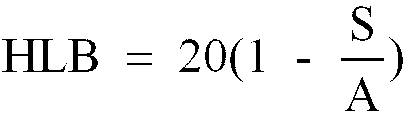
- For other surfactants such as esters of tall oil and rosin, bees wax, lanolin, hydrophobic-lipophobic balance values can be calculated from the equation:

- While the above formulas are satisfactory for many surfactants, the hydrophobic-lipophobic balance values for many surfactants must be estimated by experimental methods. The experimental method of hydrophobic-lipophobic balance value determination entails blending the unknown surfactant in varying ratios with a surfactant having a known hydrophobic-lipophobic balance value, then using the blend to emulsify an oil for which the hydrophobic-lipophobic balance required to emulsify the oil (the "required HLB") is known. The blend which performs the best is deemed to have a hydrophobic-lipophobic balance value approximately equal to the required HLB of the oil, so that the hydrophobic-lipophobic balance value for the unknown material can be calculated.
- A rough approximation of the hydrophobic-lipophobic balance value for a range of surfactants can be obtained by evaluation of the water solubility of the particular surfactant as summarized in the following table:
Behavior When Added to Water HLB Range No dispersibility in water 1-4 Poor dispersion 3-6 Milky dispersion after vigorous agitation 6-8 Stable milky dispersion (upper end almost translucent) 8-10 From translucent to clear dispersion 10-13 Clear solution 13+ - Exemplary low hydrophobic-lipophobic balance value surfactants contemplated for use in the practice of the present invention include:
- mono- and diglycerides,
- sorbitan fatty acid esters,
- polyoxyethylene sorbitol esters,
- polyoxyethylene alcohols,
- ethoxylated alkylphenols,
- ethoxylated alcohols,
- polyalkylene glycol ethers,
- phosphated mono- and diglycerides,
- citric acid esters of monoglycerides,
- diacetylated tartaric acid esters of monoglycerides,
- glycerol monooleate,
- sodium stearoyl lactylates,
- calcium stearoyl lactylates,
- phospholipids, or
- phosphatidyl ethanolamine,
- Exemplary high hydrophobic-lipophobic balance value surfactants contemplated for use in the practice of the present invention include:
- glycerol monostearate,
- polyoxyethylene sorbitan fatty acid esters,
- polyethylene sorbitol esters,
- polyoxyethylene acids,
- polyoxyethylene alcohols,
- polyoxyethylene alkyl amines,
- alkyl aryl sulfonates, or
- ethoxylated alkylphenols,
- The amount of surfactant employed in the practice of the present invention can vary widely. Typically, the total amount of surfactants employed will fall in the range of about 0.5 up to 50 wt %, based on the total weight of the final composition; with the total amount of surfactants falling in the range of about 1 up to 10 wt % being preferred.
- The weight ratio of low hydrophobic-lipophobic balance value surfactants to high hydrophobic-lipophobic balance value surfactants employed in the practice of the present invention can vary widely. Typically, the weight ratio of low-hydrophobic-lipophobic balance value surfactant to high hydrophobic-lipophobic balance value surfactant will fall in the range of about 0.1 up to 10:1; with weight ratios in the range of about 0.5 up to 2:1 being preferred.
- The components of the invention composition can be combined in most any convenient manner. Thus, all components can be combined, then heated to produce a melt, or the meltable component can be heated alone, followed by addition of the other components. It is presently preferred that all additives contemplated for a given composition be combined and melted, then the low hydrophobic-lipophobic balance value surfactant(s) added, followed by addition of the high hydrophobic-lipophobic balance value surfactant(s).
- Agitation of the melt phase is desirable to aid production of a substantially homogeneous melt. Agitation can be provided by any suitable means, such as mechanical stirring, shaking.
- The combination is maintained under melt conditions and agitated for a time sufficient to produce a substantially homogeneous melt phase.
- When the melt phase is to be cooled, it is only necessary to cool the melt phase to the extent that the melt phase substantially solidifies to produce a solid material which is amenable to further handling, such as crushing, grinding, packaging.
- When the solid material initially formed from the melt phase is subjected to the optional comminution step, this can be accomplished by a variety of techniques, as are well known to those of skill in the art, e.g., use of a ball mill, hammer mill, colloid mill.
- The invention compositions are readily dispersed in aqueous media, typically by adding up to 50 wt % of polymer additive(s) to aqueous media, and agitating sufficiently to promote contact between the particles of additive and the aqueous media. Any suitable means to promote such contacting is acceptable for the desired agitation.
- Depending on factors such as the particle size of the additive(s) to be dispersed, the temperature of the aqueous media, the quantity of additive(s), the quantity (and ratio) of high and low hydrophobic-lipophobic value surfactants, the contact time required for dispersion of additive(s) can be as short as a few minutes up to 3 hours or longer. Preferably, under typical operating conditions, it will take in the range of about 0.1 up to 1 hour for complete dispersion of the additive(s).
- The invention compositions can be dispersed in aqueous media in large quantities. Thus, loading of up to about 50 wt % solids in aqueous media are contemplated. Preferred loading levels fall in the range of about 5 up to 25 wt %, based on the total weight of polymer additive(s) and low hydrophobic-lipophobic balance value surfactant. Since it is frequently added separately to the aqueous media, the quantity of high hydrophobic-lipophobic balance value is indicated separately to vary in the range of about 0.1 up to 10 wt %, with quantities in the range of about 0.1 up to 1 wt % being preferred.
- The above-described aqueous emulsions or dispersions are useful, for example, for applying numerous polymer additives, either alone or in combination, to a wide range of polymer particles. This is readily accomplished by contacting the polymer particles with the above described aqueous emulsion or dispersion, e.g., by spraying the dispersion on the polymer particles, mixing polymer particles with the aqueous dispersion, and the like.
- Some preferred polymeric particles include, for example, polyolefins such as crystalline polypropylene, low density polyethylene, high density polyethylene and linear low density polyethylenes. Other polymeric materials include, for example, polystyrene, polyesters, polyamides and the like as well as copolymers such as crystalline propylene ethylene copolymers, rubbers such as ethylene propylene rubber and the like.
- The present invention provides polymeric particles which are stabilized in the above-mentioned unique and efficient manner.
- The invention will now be described in greater detail with reference to the following non-limiting examples.
- This example illustrates the preparation of water-dispersible Irganox (trademark) 1076 used as a thermal stabilizer and antioxidant for polymeric particles employing the process of this invention. Irganox 1076 is chemically known as octadecyl 3-(3',5'-di-tert-butyl-4'-hydroxyphenyl)propionate or octadecyl 3,5-di-tert-butyl-4-hydroxyhydrocinnamate, and supplied by Ciba-Geigy. The surfactants used are ethoxylated alkylphenols commercially known as Igepal (trademark) surfactants from GAF Corporation. An aqueous-dispersible material contains the following ingredients.
Amount Ingredients (g) (%) Irganox 1076 100 93.9 Igepal CO-210 2.75 2.6 Igepal CO-630 3.75 3.5 - The following procedure was used for converting water-insoluble Irganox 1076 to water-dispersible form.
- 1. Heat Irganox 1076 in a glass container at 60°C using water bath. The melted material was stirred to obtain the homogeneous melt phase.
- 2. Add to the melt phase a low HLB surfactant (e.g., Igepal CO-210). The surfactant was mixed completely by stirring device.
- 3. Add to the melt phase (Step 2) a high HLB value surfactant (e.g., Igepal CO-630). The surfactant was completely mixed in the melt phase using stirring device.
- 4. Cool the melt phase at room temperature. On cooling, melted ingredients convert to the solid form.
- 5. The solid material was crushed or ground to obtain a powder form.
- This example illustrates the preparation of an aqueous suspension using powder obtained from the process of the present invention. An aqueous-dispersible material prepared in accordance with Example 1 was employed for preparing an aqueous suspension. 20 g of crushed material is dispersed in 80 g of H2O using magnetic stirrer. Stable suspensions were prepared which remain dispersed in water for several weeks. Typical particle size of these dispersions is:
% Relative Volume Particle size µm 10 8.95 50 18.90 90 33.09 - The particle size of the additive dispersion is large enough to promote settling in water. However, no settling was observed for several days, which may be due to the low density of the dispersed material (which has a density very close to that of water), and the proper selection of the surfactants.
- Example 1 is repeated in detail with the exception that the Irganox 1076 antioxidant is replaced with Epolene (trademark) E-14 wax. Epolene E-14 is an oxidized low molecular weight polyethylene wax supplied by Eastman Kodak Company. The composition of the ingredients used to convert Epolene E-14 wax from water-insoluble to water water-dispersible form is as follows:
Amount Ingredients (g) (%) Epolene E-14 Wax 50 93.8 Igepal CO-210 1.4 2.6 Igepal CO-630 1.9 3.6 - The heating temperature used for Epolene E-14 wax was 140°C. The ground material prepared employing the process of this invention is water-dispersible. The dispersions were prepared in accordance with Example 2. Typical particle size of this aqueous dispersion is:
% Relative Volume Particle size µm 10 3.61 50 9.12 90 20.12 - This example illustrates the preparation of water-dispersible additives containing several water-insoluble materials employed in stabilizing polymeric particles. The aqueous-dispersible additives contain the following ingredients:
Amount Ingredients (g) (%) Irganox 1076 200 63.2 Epolene E-14 40 12.6 Calcium Stearate 63.5 20.1 Igepal CO-210 5.5 1.7 Igepal CO-630 7.5 2.4 - All ingredients (e.g., Irganox 1076 antioxidant, Epolene E-14 wax and calcium stearate) except surfactants were placed in a beaker. Using water-bath, ingredients were mixed in the melted Irganox 1076 at 85°C. After complete mixing, Igepal CO-210 and Igepal CO-630 were added to the melted Irganox 1076 containing calcium stearate and Epolene E-14 at 85°C. The material was removed from water-bath and cooled at room temperature. At room temperature, the material is obtained in solid form. The material is ground in order to achieve a fine powder, which is water-dispersible. The aqueous dispersions were prepared as described in Example 2. The dispersions were stable and did not settle for several weeks. The particle size of the dispersed material is as follows:
% Relative Volume Particle size µm 10 3.86 50 10.28 90 25.76 - The water-dispersible additives prepared in accordance with Example 4 were employed to stabilize polymeric particles. Aqueous dispersions containing 25% by weight additives (Example 4) were prepared. The dispersions were further diluted with water to obtain 6.25% additives by weight.
- 40 g of diluted aqueous-dispersion was applied to 500 g of polypropylene pellets having a density of 0.902 and a melt flow rate of 9. The amount of dispersion used was calculated to achieve the solid level of 0.5% solids by weight on the coated polypropylene pellets. The polypropylene pellets were placed in an oven for 15 min at 60 85°C before starting coating. The pellets should be warm in order to achieve good adhesion of solid dispersions employed for coating. The coated polypropylene did not exhibit a color shift when placed in an oven for 72 hrs at a temperature of 150°C. The desired ingredients can be included in the coating formulation either in the process of making water-dispersible additives or at the time of preparing dispersions from material prepared employing process described in this invention.
- Example 5 was repeated with the exception that the polypropylene pellets were coated with Epolene E-14 emulsion formulation as described in Patent Application No. 197,946 filed May 24, 1988 published November 30, 1989 under reference WO/89/11502. The amount of active material used for coating was the same, and the exception in coating process was that the pellets were placed for 15 min at 60°C before applying coating material prepared by the process of this invention, while pellets were coated without heating with Epolene E-14 emulsions. The coated polypropylene pellets were compared. Results demonstrated that both the formulations protect the pellets and did not change color when placed in an air-forced oven for 72 hrs at 150°C.
- Examples 5 and 6 were repeated with the exception that the amount of diluted aqueous dispersions contained 1.5 g solids instead of 2.5 g in coating formulations for polymeric particles. The coating conditions for applying material of the present invention were identical as outlined in Example 5, whereas for Epolene E-14 emulsion, the coating conditions were identical as described in Example 6.
- 40 g of diluted aqueous dispersions containing 1.5 g solid were applied to 500 g of polypropylene pellets having a density of 0.902 and a melt flow rate of 9. The amount of dispersion used was calculated to achieve the solid level of 0.3% solids by weight on the coated pellets. The coated polypropylene pellets were placed in an air-forced oven at a temperature of 150°C. These pellets turned brown in a period of 24 hrs, which suggests that the amount applied on pellets was not sufficient to protect the polymeric particles.
- Example 4 was repeated with the exception that the Epolene E-14 wax was not included in preparing water-dispersible additives employing process of this invention. The composition of the ingredients is as follows:
Amount Ingredients (g) (%) Irganox 1076 100 72.3 Calcium Stearate 31.8 23.0 Igepal CO-210 2.8 2.0 Igepal CO-630 3.8 2.7 - Irganox 1076 antioxidant and calcium stearate were placed in a glass container and heated using water-bath at a temperature of 75°C. The materials were completely mixed with a glass rod. The calcium stearate was dispersed in the melted Irganox 1076 at 75°C. To this dispersion, Igepal CO-210 and Igepal CO-630 were added and mixed completely. After 10 min, the container was removed from water-bath and left for cooling at room temperature. A solid was obtained and converted into powder form by the grinding process.
- The aqueous dispersions were prepared by adding 20 g water-dispersible additives, prepared using process of the present invention, to 80 g water. The aqueous dispersions were stable and did not settle for several weeks. The particle size and size distribution of the dispersion are as follows:
% Relative Volume Particle size, µm 10 4.36 50 11.64 90 28.09 - Example 5 was repeated with the exception that the water-dispersible additives of Example 8 were employed in coating polymeric particles instead of material of Example 4. For coating polypropylene pellets, 10 g aqueous dispersions of Example 8 were diluted with 30 g water. The diluted dispersions contained 5% solid in water. The 40 g diluted dispersing containing 2 g solid were applied to 500 g polypropylene pellets having a density of 0.902 and a melt flow rate of 9. The amount of dispersion used was calculated to achieve the solid level of 0.4% solids by weight on the coated pellets. The coated polypropylene pellets did not exhibit a color change when placed in an air-forced oven for 3 days at a temperature of 150°C. This example demonstrates that the active ingredients can be coated on polymeric particles without Epolene E-14 wax in the formulation.
- The composition of the water-dispersible powder is as follows:
Amount Ingredients (g) (%) Irganox 1076 100.0 64.8 Calcium Stearate 31.8 20.6 Epolene E-14 20.0 13.0 Igepal CO-210 2.5 1.6 - The procedure of preparing water-dispersible powder is the same as described in Example 4 except that the ingredients were melted at a temperatur of 60°C.
- 20 g powder prepared according to the process of this invention was dispersed in 80 g water containing 0.5 g Igepal CO-630 surfactant using stirring device.
- The aqueous dispersions were stable and did not settle, even after several weeks. This example demonstrates the importance of the surfactant concentration required to prepare water-dispersible powder for stabilizing polymeric particles.
- This example demonstrates the importance of the process of this invention. The ingredients of Example 4 without employing process of this invention were dispersed in water. The composition of the ingredients is as follows:
Amount Ingredients (g) (%) Irganox 1076 20.0 62.9 Epolene E-14 4.0 12.6 Calcium Stearate 6.4 20.1 Igepal CO-210 0.6 1.9 Igepal CO-630 0.8 2.5 - The ingredients (30.4 g) were dispersed in 150 g water containing 0.6 g Igepal CO-210 and 0.8 g Igepal CO-630. These ingredients were separated in distinct phases. In order to prepare water-dispersible additives, the ingredients should be processed as described in this invention.
- Example 4 was repeated with the exception that Tergitol (trademark) 15-S-7 and Tergitol 15-S-15 were used instead of Igepal CO-210 and Igepal CO-30 in converting water-insoluble additives to water-dispersible form in accordance with the process of this invention. Tergitol 15-S-7 and Tergitol 15-S-15 are the polyethylene glycol ether of linear alcohols and are available from Union Carbide Corporation. The composition of an aqueous-dispersible powder is as follows:
Amount Ingredients (g) (%) Irganox 1076 75 63 Epolene E-14 15 12.6 Calcium Stearate 24 20.1 Tergitol 15-S-7 2.1 1.8 Tergitol 15-S-15 3.0 2.5 - All ingredients except Tergitol 15-S-7 and Tergitol 15-S-15 were placed in a beaker. These ingredients were melted using water-bath at 65°C. After complete mixing, Tergitol 15-S-7 and Tergitol 15-S-15 were added to the melted ingredients at 65°C. The melted ingredients were left for 10 min at 65°C after incorporating surfactants to the melt. The melted material was removed from water-bath and cooled at room temperature. At room temperature, solid ingredients were obtained, which can be converted to the fine powder by grinding process.
- 20 g powder prepared employing this process was dispersed in 80 g water using magnetic stirrer. The powder settled slightly on standing for a few hours. This indicates that the amount of the two surfactants used should be optimized in order to eliminate the observed settling in the aqueous-dispersions.
Claims (11)
- A method for obtaining solid material dispersible in aqueous media from one or more meltable water-insoluble polymer additives and, optionally, one or more water-insoluble higher melting polymer additives, said method consists of:a) heating said additives to a temperature sufficient to produce a melt phase,b) combining the resulting melt phase, at a temperature sufficient to maintain a melt phase, with at least one surfactant having a low hydrophobic-lipophobic balance value of less than 9 and at least one surfactant having a high hydrophobic-lipophobic balance value of greater than 9, the total amount of surfactants being in the range of 1 up to 10 wt %, based on the total weight of the final product, wherein said combining is carried out under sufficient agitation to provide a homogeneous mixed melt, andc) allowing the resulting blend obtained from step (b) to cool so as to obtain a water dispersible solid material.
- A method for obtaining solid material dispersible in aqueous media containing at least one surfactant having a hydrophobic-lipophobic balance value of greater than 9 from one or more meltable water-insoluble polymer additives and, optionally, one or more water-insoluble higher melting polymer additives, said method consists of:a) heating said additives to a temperature sufficient to produce a melt phase of at least the lowest melting of said additives,b) combining the resulting melt phase, at a temperature sufficient to maintain a melt phase with at least one surfactant having a low hydrophobic-lipophobic balance value of less than 9, wherein said combining is carried out under sufficient agitation to provide a homogeneous mixed melt, andc) allowing the resulting blend obtained from step (b) to cool so as to obtain a water dispersible solid material; with the proviso that a concentration of a polyoxethylated nonylphenol having 1.5 moles of ethylene oxide bound per mole of phenol (EO/NP mole ratio of 1.5) (Igepal CO-210) as surfactant having a low hydrophobic-lipophobic balance value must not be as low as 1.3% by weight when a polyoxethylated nonylphenol having an EO/NP mole ratio of 9 (Igepal CO-630) is used as surfactant having a high hydrophobic-lipophobic balance value with a concentration as low as 0.5% by weight.
- A method in accordance with Claim 1 or Claim 2 further comprising:
d) comminuting the resulting solid material into a finely divided form. - A method in accordance with Claim 1 or Claim 2 wherein an emulsifiable wax is added to the melt phase of the polymer additive.
- A method in accordance with Claim 1 or Claim 2 wherein said polymer additives are selected from:thermal stabilizing agents,processing aids,colorants,antistatic agents,coupling agents,UV stabilizers,metal deactivators,nucleating agents, orflame retardants,as well as mixtures of any two or more thereof.
- A method in accordance with Claim 1 or Claim 2 wherein the temperature employed for step (a) is 5 up to 20°C above the melting point of the lowest melting polymer additive present in the combination.
- A method in accordance with Claim 1 wherein when at least two surfactants are used, the surfactant having the lower hydrophobic-lipophobic balance value is added to the melt phase in the step (b) prior to adding the surfactant having the higher hydrophobic-lipophobic balance value to the melt phase.
- A method in accordance with Claim 1 or Claim 2 wherein substantially all of said polymer additives have a particles size of less than 40 microns (µm).
- Solid material dispersable in aqueous medium obtainable by the method of any of Claims 1 to 8 comprising :i) one or more water insoluble, meltable polymer additives and, optionally, one or more higher melting, water insoluble polymer additives,ii) at least one hydrophobic-lipophobic balance value surfactant having a HLB value less than 9, wherein said surfactant is adsorbed on the surface of said water insoluble polymer additive particles.
- Solid material in accordance with Claim 9 further comprising :
iii) at least one high hydrophobic-lipophobic balance value surfactant having an HLB-value of greater than 9. - Solid material in accordance with Claim 9 further comprising :
iv) at least one emulsifiable wax.
Applications Claiming Priority (2)
| Application Number | Priority Date | Filing Date | Title |
|---|---|---|---|
| US07/392,759 US5204022A (en) | 1989-08-11 | 1989-08-11 | Solid-form additive systems dispersible in aqueous media |
| US392759 | 1989-08-11 |
Publications (3)
| Publication Number | Publication Date |
|---|---|
| EP0413647A2 EP0413647A2 (en) | 1991-02-20 |
| EP0413647A3 EP0413647A3 (en) | 1991-03-06 |
| EP0413647B1 true EP0413647B1 (en) | 1997-04-23 |
Family
ID=23551899
Family Applications (2)
| Application Number | Title | Priority Date | Filing Date |
|---|---|---|---|
| EP90420376A Expired - Lifetime EP0413647B1 (en) | 1989-08-11 | 1990-08-09 | Solid-form additive systems dispersible in aqueous media, and methods for their preparation |
| EP90913017A Pending EP0486600A1 (en) | 1989-08-11 | 1990-08-09 | Solid-form additive systems dispersible in aqueous media |
Family Applications After (1)
| Application Number | Title | Priority Date | Filing Date |
|---|---|---|---|
| EP90913017A Pending EP0486600A1 (en) | 1989-08-11 | 1990-08-09 | Solid-form additive systems dispersible in aqueous media |
Country Status (12)
| Country | Link |
|---|---|
| US (1) | US5204022A (en) |
| EP (2) | EP0413647B1 (en) |
| JP (1) | JPH04506979A (en) |
| KR (1) | KR927003695A (en) |
| AT (1) | ATE152151T1 (en) |
| AU (1) | AU645992B2 (en) |
| CA (1) | CA2063797C (en) |
| DE (1) | DE69030540T2 (en) |
| DK (1) | DK0413647T3 (en) |
| ES (1) | ES2100169T3 (en) |
| GR (1) | GR3023390T3 (en) |
| WO (1) | WO1991002020A1 (en) |
Families Citing this family (12)
| Publication number | Priority date | Publication date | Assignee | Title |
|---|---|---|---|---|
| US5300256A (en) * | 1989-08-11 | 1994-04-05 | Eastman Chemical Company | Solid-form additive systems dispersible in aqueous media |
| US5153029A (en) * | 1989-08-11 | 1992-10-06 | Eastman Kodak Company | Solid-form additive systems dispersible in aqueous media, methods for the preparation and application thereof to polymeric particles |
| US5358560A (en) * | 1991-10-04 | 1994-10-25 | Eastman Chemical Company | Solid-form additive systems dispersible in aqueous media and method for their preparation |
| BR9301365A (en) * | 1992-03-31 | 1993-10-13 | Union Carbide Chem Plastic | STABLE DISPERSION AND PROCESS TO COMBINE A POLYMERIC STABILIZER AND A POLYMER |
| US5290954A (en) * | 1992-08-13 | 1994-03-01 | Eastman Kodak Company | High clarity emulsions containing high melt viscosity maleated polypropylene wax |
| ZA97698B (en) * | 1996-01-30 | 1998-07-28 | Colgate Palmolive Co | Composition |
| US5843876A (en) * | 1996-01-30 | 1998-12-01 | Colgate-Palmolive Co. | Composition |
| US6362280B1 (en) | 1998-04-27 | 2002-03-26 | Honeywell International Inc. | Emulsible polyolefin wax |
| AU7927898A (en) * | 1998-07-13 | 2000-02-01 | Fortunato Joseph Micale | Water based dispersion of solid particles containing uv absorbing components as active ingredients, and method for obtaining such a dispersion |
| US7309729B1 (en) * | 2000-03-07 | 2007-12-18 | Rohm And Haas Company | Aqueous additive systems for polymeric matrices |
| EP1575895A1 (en) * | 2002-11-26 | 2005-09-21 | Ciba SC Holding AG | Phenolic antioxidants in crystalline form |
| US20050123759A1 (en) * | 2003-12-04 | 2005-06-09 | Roger Weinberg | Additive-coated resin and method of making same |
Family Cites Families (13)
| Publication number | Priority date | Publication date | Assignee | Title |
|---|---|---|---|---|
| US3876391A (en) * | 1969-02-28 | 1975-04-08 | Texaco Inc | Process of preparing novel micro emulsions |
| US3962123A (en) * | 1974-05-20 | 1976-06-08 | Ciba-Geigy Corporation | Phenolic antioxidant aqueous dispersions |
| US4040996A (en) * | 1976-03-09 | 1977-08-09 | American Hoechst Corporation | Method of incorporating processing additives in polyvinyl chloride resins and emulsion for use therein |
| JPS5951570B2 (en) * | 1979-07-30 | 1984-12-14 | 株式会社トクヤマ | Method of attaching additives to polypropylene powder |
| JPS5714655A (en) * | 1980-06-12 | 1982-01-25 | Ciba Geigy Ag | Easily dispersible dyestuff composition |
| JPS60255825A (en) * | 1984-05-31 | 1985-12-17 | Shinto Paint Co Ltd | Production of water-dispersible composition |
| CA1272339A (en) * | 1984-06-25 | 1990-07-31 | Paul James Mollinger | Process for pelletization of powder materials and products therefrom |
| US4619705A (en) * | 1984-07-11 | 1986-10-28 | Engelhard Corporation | Nonionic surfactant treated clays, methods of making same, water-based paints, organic solvent-based paints and paper coatings containing same |
| DE3580428D1 (en) * | 1984-07-25 | 1990-12-13 | Mitsui Petrochemical Ind | AQUEOUS DISPERSION AND METHOD FOR THEIR PRODUCTION. |
| US4898616A (en) * | 1985-02-15 | 1990-02-06 | Eastman Kodak Company | Aqueous additive systems, methods and polymeric particles |
| DE3673055D1 (en) * | 1985-05-02 | 1990-09-06 | Ciba Geigy Ag | METHOD FOR STABILIZING SPHERICAL POLYMERIZED POLYOLEFINS. |
| US4960814A (en) * | 1988-06-13 | 1990-10-02 | Eastman Kodak Company | Water-dispersible polymeric compositions |
| NL8803178A (en) * | 1988-12-27 | 1990-07-16 | Holland Colours Apeldoorn Bv | METHOD FOR THE MANUFACTURE OF A DYE AND / OR PIGMENT CONTAINING A WAX-BASED COMPOSITION AND PRODUCTS OBTAINED BY USE OF SUCH A COMPOSITION |
-
1989
- 1989-08-11 US US07/392,759 patent/US5204022A/en not_active Expired - Fee Related
-
1990
- 1990-08-09 DE DE69030540T patent/DE69030540T2/en not_active Expired - Fee Related
- 1990-08-09 KR KR1019920700294A patent/KR927003695A/en not_active Abandoned
- 1990-08-09 ES ES90420376T patent/ES2100169T3/en not_active Expired - Lifetime
- 1990-08-09 AT AT90420376T patent/ATE152151T1/en not_active IP Right Cessation
- 1990-08-09 CA CA002063797A patent/CA2063797C/en not_active Expired - Fee Related
- 1990-08-09 AU AU62764/90A patent/AU645992B2/en not_active Ceased
- 1990-08-09 EP EP90420376A patent/EP0413647B1/en not_active Expired - Lifetime
- 1990-08-09 WO PCT/US1990/004510 patent/WO1991002020A1/en not_active Ceased
- 1990-08-09 JP JP2511898A patent/JPH04506979A/en active Pending
- 1990-08-09 EP EP90913017A patent/EP0486600A1/en active Pending
- 1990-08-09 DK DK90420376.7T patent/DK0413647T3/en active
-
1997
- 1997-05-09 GR GR970401043T patent/GR3023390T3/en unknown
Also Published As
| Publication number | Publication date |
|---|---|
| DE69030540T2 (en) | 1997-08-07 |
| EP0486600A1 (en) | 1992-05-27 |
| AU6276490A (en) | 1991-03-11 |
| CA2063797C (en) | 1993-10-26 |
| ATE152151T1 (en) | 1997-05-15 |
| GR3023390T3 (en) | 1997-08-29 |
| ES2100169T3 (en) | 1997-06-16 |
| JPH04506979A (en) | 1992-12-03 |
| US5204022A (en) | 1993-04-20 |
| WO1991002020A1 (en) | 1991-02-21 |
| DE69030540D1 (en) | 1997-05-28 |
| EP0413647A3 (en) | 1991-03-06 |
| AU645992B2 (en) | 1994-02-03 |
| EP0413647A2 (en) | 1991-02-20 |
| KR927003695A (en) | 1992-12-18 |
| DK0413647T3 (en) | 1997-10-27 |
Similar Documents
| Publication | Publication Date | Title |
|---|---|---|
| EP0526546B1 (en) | Solid-form additive systems dispersible in aqueous media | |
| US5443910A (en) | Aqueous additive systems, methods and polymeric particles | |
| US5096493A (en) | Aqueous additive systems, methods and polymeric particles | |
| AU592972B2 (en) | Aqueous additive systems, methods and polymeric particles | |
| US4960644A (en) | Aqueous additive systems, methods and polymeric particles | |
| CA1335136C (en) | Aqueous additive systems, methods and polymeric particles | |
| CA2120018C (en) | Solid-form additive system dispersible in aqueous media and method for their preparation | |
| US4975120A (en) | Aqueous additive systems, methods and polymeric particles | |
| US5204022A (en) | Solid-form additive systems dispersible in aqueous media | |
| US4880470A (en) | Aqueous additive systems, methods and polymeric particles | |
| US6107383A (en) | Solid-form additive systems dispersible in aqueous media, methods for the preparation and application thereof to polymeric particles | |
| US5190579A (en) | Aqueous additive systems, methods and polymeric particles |
Legal Events
| Date | Code | Title | Description |
|---|---|---|---|
| PUAI | Public reference made under article 153(3) epc to a published international application that has entered the european phase |
Free format text: ORIGINAL CODE: 0009012 |
|
| PUAL | Search report despatched |
Free format text: ORIGINAL CODE: 0009013 |
|
| AK | Designated contracting states |
Kind code of ref document: A2 Designated state(s): GR |
|
| AK | Designated contracting states |
Kind code of ref document: A3 Designated state(s): GR |
|
| 17P | Request for examination filed |
Effective date: 19910729 |
|
| 17Q | First examination report despatched |
Effective date: 19920114 |
|
| RBV | Designated contracting states (corrected) |
Designated state(s): AT BE CH DE DK ES FR GB GR IT LI LU NL SE |
|
| XX | Miscellaneous (additional remarks) |
Free format text: VERBUNDEN MIT 90913017.1/0486600 (EUROPAEISCHE ANMELDENUMMER/VEROEFFENTLICHUNGSNUMMER) DURCH ENTSCHEIDUNG VOM 03.07.92. |
|
| RAP1 | Party data changed (applicant data changed or rights of an application transferred) |
Owner name: EASTMAN CHEMICAL COMPANY |
|
| GRAG | Despatch of communication of intention to grant |
Free format text: ORIGINAL CODE: EPIDOS AGRA |
|
| GRAH | Despatch of communication of intention to grant a patent |
Free format text: ORIGINAL CODE: EPIDOS IGRA |
|
| GRAH | Despatch of communication of intention to grant a patent |
Free format text: ORIGINAL CODE: EPIDOS IGRA |
|
| GRAA | (expected) grant |
Free format text: ORIGINAL CODE: 0009210 |
|
| AK | Designated contracting states |
Kind code of ref document: B1 Designated state(s): AT BE CH DE DK ES FR GB GR IT LI LU NL SE |
|
| REF | Corresponds to: |
Ref document number: 152151 Country of ref document: AT Date of ref document: 19970515 Kind code of ref document: T |
|
| XX | Miscellaneous (additional remarks) |
Free format text: VERBUNDEN MIT 90913017.1/0486600 (EUROPAEISCHE ANMELDENUMMER/VEROEFFENTLICHUNGSNUMMER) DURCH ENTSCHEIDUNG VOM 03.07.92. |
|
| REG | Reference to a national code |
Ref country code: CH Ref legal event code: NV Representative=s name: KIRKER & CIE SA Ref country code: CH Ref legal event code: EP |
|
| REF | Corresponds to: |
Ref document number: 69030540 Country of ref document: DE Date of ref document: 19970528 |
|
| ITF | It: translation for a ep patent filed | ||
| PGFP | Annual fee paid to national office [announced via postgrant information from national office to epo] |
Ref country code: DK Payment date: 19970616 Year of fee payment: 8 |
|
| REG | Reference to a national code |
Ref country code: ES Ref legal event code: FG2A Ref document number: 2100169 Country of ref document: ES Kind code of ref document: T3 |
|
| PGFP | Annual fee paid to national office [announced via postgrant information from national office to epo] |
Ref country code: NL Payment date: 19970625 Year of fee payment: 8 |
|
| PGFP | Annual fee paid to national office [announced via postgrant information from national office to epo] |
Ref country code: GB Payment date: 19970702 Year of fee payment: 8 |
|
| PGFP | Annual fee paid to national office [announced via postgrant information from national office to epo] |
Ref country code: SE Payment date: 19970717 Year of fee payment: 8 |
|
| PGFP | Annual fee paid to national office [announced via postgrant information from national office to epo] |
Ref country code: AT Payment date: 19970723 Year of fee payment: 8 |
|
| PGFP | Annual fee paid to national office [announced via postgrant information from national office to epo] |
Ref country code: GR Payment date: 19970725 Year of fee payment: 8 |
|
| REG | Reference to a national code |
Ref country code: GR Ref legal event code: FG4A Free format text: 3023390 |
|
| ET | Fr: translation filed | ||
| PGFP | Annual fee paid to national office [announced via postgrant information from national office to epo] |
Ref country code: FR Payment date: 19970812 Year of fee payment: 8 |
|
| PGFP | Annual fee paid to national office [announced via postgrant information from national office to epo] |
Ref country code: ES Payment date: 19970821 Year of fee payment: 8 |
|
| PGFP | Annual fee paid to national office [announced via postgrant information from national office to epo] |
Ref country code: BE Payment date: 19970908 Year of fee payment: 8 |
|
| PGFP | Annual fee paid to national office [announced via postgrant information from national office to epo] |
Ref country code: LU Payment date: 19970911 Year of fee payment: 8 |
|
| PGFP | Annual fee paid to national office [announced via postgrant information from national office to epo] |
Ref country code: CH Payment date: 19971014 Year of fee payment: 8 |
|
| REG | Reference to a national code |
Ref country code: DK Ref legal event code: T3 |
|
| PLBE | No opposition filed within time limit |
Free format text: ORIGINAL CODE: 0009261 |
|
| STAA | Information on the status of an ep patent application or granted ep patent |
Free format text: STATUS: NO OPPOSITION FILED WITHIN TIME LIMIT |
|
| 26N | No opposition filed | ||
| PG25 | Lapsed in a contracting state [announced via postgrant information from national office to epo] |
Ref country code: LU Free format text: LAPSE BECAUSE OF NON-PAYMENT OF DUE FEES Effective date: 19980809 Ref country code: GB Free format text: LAPSE BECAUSE OF NON-PAYMENT OF DUE FEES Effective date: 19980809 Ref country code: AT Free format text: LAPSE BECAUSE OF NON-PAYMENT OF DUE FEES Effective date: 19980809 |
|
| PG25 | Lapsed in a contracting state [announced via postgrant information from national office to epo] |
Ref country code: SE Free format text: LAPSE BECAUSE OF NON-PAYMENT OF DUE FEES Effective date: 19980810 Ref country code: ES Free format text: LAPSE BECAUSE OF NON-PAYMENT OF DUE FEES Effective date: 19980810 |
|
| PG25 | Lapsed in a contracting state [announced via postgrant information from national office to epo] |
Ref country code: LI Free format text: LAPSE BECAUSE OF NON-PAYMENT OF DUE FEES Effective date: 19980831 Ref country code: GR Free format text: LAPSE BECAUSE OF NON-PAYMENT OF DUE FEES Effective date: 19980831 Ref country code: DK Free format text: LAPSE BECAUSE OF NON-PAYMENT OF DUE FEES Effective date: 19980831 Ref country code: CH Free format text: LAPSE BECAUSE OF NON-PAYMENT OF DUE FEES Effective date: 19980831 Ref country code: BE Free format text: LAPSE BECAUSE OF NON-PAYMENT OF DUE FEES Effective date: 19980831 |
|
| BERE | Be: lapsed |
Owner name: EASTMAN CHEMICAL CY Effective date: 19980831 |
|
| PG25 | Lapsed in a contracting state [announced via postgrant information from national office to epo] |
Ref country code: NL Free format text: LAPSE BECAUSE OF NON-PAYMENT OF DUE FEES Effective date: 19990301 |
|
| GBPC | Gb: european patent ceased through non-payment of renewal fee |
Effective date: 19980809 |
|
| REG | Reference to a national code |
Ref country code: CH Ref legal event code: PL |
|
| PG25 | Lapsed in a contracting state [announced via postgrant information from national office to epo] |
Ref country code: FR Free format text: LAPSE BECAUSE OF NON-PAYMENT OF DUE FEES Effective date: 19990430 |
|
| EUG | Se: european patent has lapsed |
Ref document number: 90420376.7 |
|
| NLV4 | Nl: lapsed or anulled due to non-payment of the annual fee |
Effective date: 19990301 |
|
| REG | Reference to a national code |
Ref country code: FR Ref legal event code: ST |
|
| REG | Reference to a national code |
Ref country code: DK Ref legal event code: EBP |
|
| PGFP | Annual fee paid to national office [announced via postgrant information from national office to epo] |
Ref country code: DE Payment date: 20000830 Year of fee payment: 11 |
|
| PG25 | Lapsed in a contracting state [announced via postgrant information from national office to epo] |
Ref country code: DE Free format text: LAPSE BECAUSE OF NON-PAYMENT OF DUE FEES Effective date: 20020501 |
|
| REG | Reference to a national code |
Ref country code: ES Ref legal event code: FD2A Effective date: 19990910 |
|
| PG25 | Lapsed in a contracting state [announced via postgrant information from national office to epo] |
Ref country code: IT Free format text: LAPSE BECAUSE OF NON-PAYMENT OF DUE FEES Effective date: 20050809 |