EP0411751A1 - Renin inhibitory peptides - Google Patents
Renin inhibitory peptides Download PDFInfo
- Publication number
- EP0411751A1 EP0411751A1 EP90305978A EP90305978A EP0411751A1 EP 0411751 A1 EP0411751 A1 EP 0411751A1 EP 90305978 A EP90305978 A EP 90305978A EP 90305978 A EP90305978 A EP 90305978A EP 0411751 A1 EP0411751 A1 EP 0411751A1
- Authority
- EP
- European Patent Office
- Prior art keywords
- leu
- phe
- achpa
- dihydro
- oxo
- Prior art date
- Legal status (The legal status is an assumption and is not a legal conclusion. Google has not performed a legal analysis and makes no representation as to the accuracy of the status listed.)
- Withdrawn
Links
- 108010026906 renin inhibitory peptide Proteins 0.000 title 1
- 150000001875 compounds Chemical class 0.000 claims abstract description 136
- 125000004169 (C1-C6) alkyl group Chemical group 0.000 claims abstract description 32
- 125000004435 hydrogen atom Chemical class [H]* 0.000 claims abstract description 24
- 229910052739 hydrogen Inorganic materials 0.000 claims abstract description 22
- 239000001257 hydrogen Substances 0.000 claims abstract description 22
- 150000003839 salts Chemical class 0.000 claims abstract description 19
- IJGRMHOSHXDMSA-UHFFFAOYSA-N Atomic nitrogen Chemical compound N#N IJGRMHOSHXDMSA-UHFFFAOYSA-N 0.000 claims abstract description 16
- 229910052757 nitrogen Inorganic materials 0.000 claims abstract description 12
- 125000002924 primary amino group Chemical group [H]N([H])* 0.000 claims abstract description 12
- 229910052705 radium Inorganic materials 0.000 claims abstract description 11
- 229910052701 rubidium Inorganic materials 0.000 claims abstract description 11
- 125000006552 (C3-C8) cycloalkyl group Chemical group 0.000 claims abstract description 10
- 125000003178 carboxy group Chemical group [H]OC(*)=O 0.000 claims abstract description 10
- 125000000217 alkyl group Chemical group 0.000 claims abstract description 9
- 125000000623 heterocyclic group Chemical group 0.000 claims abstract description 9
- 125000002887 hydroxy group Chemical group [H]O* 0.000 claims abstract description 9
- 125000001072 heteroaryl group Chemical group 0.000 claims abstract description 8
- 229920006395 saturated elastomer Polymers 0.000 claims abstract description 8
- 125000005236 alkanoylamino group Chemical group 0.000 claims abstract description 7
- 125000003277 amino group Chemical group 0.000 claims abstract description 7
- 125000004432 carbon atom Chemical group C* 0.000 claims abstract description 7
- 125000001424 substituent group Chemical group 0.000 claims abstract description 7
- 125000006615 aromatic heterocyclic group Chemical group 0.000 claims abstract description 6
- 125000001997 phenyl group Chemical group [H]C1=C([H])C([H])=C(*)C([H])=C1[H] 0.000 claims abstract description 6
- 125000003107 substituted aryl group Chemical group 0.000 claims abstract description 6
- 229910052799 carbon Inorganic materials 0.000 claims abstract description 5
- 125000002496 methyl group Chemical group [H]C([H])([H])* 0.000 claims abstract description 5
- UYWQUFXKFGHYNT-UHFFFAOYSA-N phenylmethyl ester of formic acid Natural products O=COCC1=CC=CC=C1 UYWQUFXKFGHYNT-UHFFFAOYSA-N 0.000 claims abstract description 5
- 125000004191 (C1-C6) alkoxy group Chemical group 0.000 claims abstract description 4
- 125000004454 (C1-C6) alkoxycarbonyl group Chemical group 0.000 claims abstract description 4
- OKTJSMMVPCPJKN-UHFFFAOYSA-N Carbon Chemical compound [C] OKTJSMMVPCPJKN-UHFFFAOYSA-N 0.000 claims abstract description 4
- 125000004423 acyloxy group Chemical group 0.000 claims abstract description 4
- 125000001584 benzyloxycarbonyl group Chemical group C(=O)(OCC1=CC=CC=C1)* 0.000 claims abstract description 4
- 125000001589 carboacyl group Chemical group 0.000 claims abstract description 4
- 125000006624 (C1-C6) alkoxycarbonylamino group Chemical group 0.000 claims abstract description 3
- 125000004637 2-oxopiperidinyl group Chemical group O=C1N(CCCC1)* 0.000 claims abstract description 3
- 101100240519 Caenorhabditis elegans nhr-13 gene Proteins 0.000 claims abstract description 3
- 125000004390 alkyl sulfonyl group Chemical group 0.000 claims abstract description 3
- 125000003917 carbamoyl group Chemical group [H]N([H])C(*)=O 0.000 claims abstract description 3
- 125000005476 oxopyrrolidinyl group Chemical group 0.000 claims abstract description 3
- 238000000034 method Methods 0.000 claims description 65
- KDHWOCLBMVSZPG-UHFFFAOYSA-N 3-imidazol-1-ylpropan-1-amine Chemical compound NCCCN1C=CN=C1 KDHWOCLBMVSZPG-UHFFFAOYSA-N 0.000 claims description 54
- WFKAJVHLWXSISD-UHFFFAOYSA-N isobutyramide Chemical compound CC(C)C(N)=O WFKAJVHLWXSISD-UHFFFAOYSA-N 0.000 claims description 29
- -1 1-imidazolyl Chemical group 0.000 claims description 22
- 239000002253 acid Substances 0.000 claims description 16
- 150000001413 amino acids Chemical class 0.000 claims description 15
- 238000011282 treatment Methods 0.000 claims description 13
- 238000002360 preparation method Methods 0.000 claims description 11
- 229910052760 oxygen Inorganic materials 0.000 claims description 10
- 206010020772 Hypertension Diseases 0.000 claims description 9
- 229910052717 sulfur Inorganic materials 0.000 claims description 8
- 108010016626 Dipeptides Chemical group 0.000 claims description 5
- 239000003153 chemical reaction reagent Substances 0.000 claims description 5
- 125000004429 atom Chemical group 0.000 claims description 4
- 230000008569 process Effects 0.000 claims description 4
- 125000003349 3-pyridyl group Chemical group N1=C([H])C([*])=C([H])C([H])=C1[H] 0.000 claims description 3
- 125000000539 amino acid group Chemical group 0.000 claims description 3
- 239000003937 drug carrier Substances 0.000 claims description 3
- 239000008194 pharmaceutical composition Substances 0.000 claims description 3
- VOWKMMDXKYIBPG-YFKPBYRVSA-N (2s)-2-amino-3-(1h-pyrazol-5-yl)propanoic acid Chemical group OC(=O)[C@@H](N)CC1=CC=NN1 VOWKMMDXKYIBPG-YFKPBYRVSA-N 0.000 claims description 2
- XXJGBENTLXFVFI-UHFFFAOYSA-N 1-amino-methylene Chemical group N[CH2] XXJGBENTLXFVFI-UHFFFAOYSA-N 0.000 claims description 2
- 125000004105 2-pyridyl group Chemical group N1=C([*])C([H])=C([H])C([H])=C1[H] 0.000 claims description 2
- 125000004210 cyclohexylmethyl group Chemical group [H]C([H])(*)C1([H])C([H])([H])C([H])([H])C([H])([H])C([H])([H])C1([H])[H] 0.000 claims description 2
- 239000003814 drug Substances 0.000 claims description 2
- 125000000959 isobutyl group Chemical group [H]C([H])([H])C([H])(C([H])([H])[H])C([H])([H])* 0.000 claims description 2
- GAWIXWVDTYZWAW-UHFFFAOYSA-N C[CH]O Chemical group C[CH]O GAWIXWVDTYZWAW-UHFFFAOYSA-N 0.000 claims 1
- 125000002147 dimethylamino group Chemical group [H]C([H])([H])N(*)C([H])([H])[H] 0.000 claims 1
- 238000004519 manufacturing process Methods 0.000 claims 1
- 125000004573 morpholin-4-yl group Chemical group N1(CCOCC1)* 0.000 claims 1
- 125000004194 piperazin-1-yl group Chemical group [H]N1C([H])([H])C([H])([H])N(*)C([H])([H])C1([H])[H] 0.000 claims 1
- 239000000126 substance Substances 0.000 claims 1
- RAHZWNYVWXNFOC-UHFFFAOYSA-N sulfur dioxide Inorganic materials O=S=O RAHZWNYVWXNFOC-UHFFFAOYSA-N 0.000 claims 1
- 230000001225 therapeutic effect Effects 0.000 claims 1
- 239000002461 renin inhibitor Substances 0.000 abstract description 3
- 229940086526 renin-inhibitors Drugs 0.000 abstract description 2
- OKKJLVBELUTLKV-UHFFFAOYSA-N Methanol Chemical compound OC OKKJLVBELUTLKV-UHFFFAOYSA-N 0.000 description 144
- HEDRZPFGACZZDS-MICDWDOJSA-N Trichloro(2H)methane Chemical compound [2H]C(Cl)(Cl)Cl HEDRZPFGACZZDS-MICDWDOJSA-N 0.000 description 84
- XEKOWRVHYACXOJ-UHFFFAOYSA-N Ethyl acetate Chemical compound CCOC(C)=O XEKOWRVHYACXOJ-UHFFFAOYSA-N 0.000 description 78
- HEDRZPFGACZZDS-UHFFFAOYSA-N Chloroform Chemical compound ClC(Cl)Cl HEDRZPFGACZZDS-UHFFFAOYSA-N 0.000 description 76
- 239000007787 solid Substances 0.000 description 56
- 239000000463 material Substances 0.000 description 53
- RTZKZFJDLAIYFH-UHFFFAOYSA-N Diethyl ether Chemical compound CCOCC RTZKZFJDLAIYFH-UHFFFAOYSA-N 0.000 description 36
- 239000000203 mixture Substances 0.000 description 32
- XLYOFNOQVPJJNP-UHFFFAOYSA-N water Substances O XLYOFNOQVPJJNP-UHFFFAOYSA-N 0.000 description 32
- QTBSBXVTEAMEQO-UHFFFAOYSA-N Acetic acid Chemical compound CC(O)=O QTBSBXVTEAMEQO-UHFFFAOYSA-N 0.000 description 31
- VYPSYNLAJGMNEJ-UHFFFAOYSA-N Silicium dioxide Chemical compound O=[Si]=O VYPSYNLAJGMNEJ-UHFFFAOYSA-N 0.000 description 30
- 239000000741 silica gel Substances 0.000 description 30
- 229910002027 silica gel Inorganic materials 0.000 description 30
- YMWUJEATGCHHMB-UHFFFAOYSA-N Dichloromethane Chemical compound ClCCl YMWUJEATGCHHMB-UHFFFAOYSA-N 0.000 description 27
- ZMXDDKWLCZADIW-UHFFFAOYSA-N N,N-Dimethylformamide Chemical compound CN(C)C=O ZMXDDKWLCZADIW-UHFFFAOYSA-N 0.000 description 27
- 239000012043 crude product Substances 0.000 description 26
- VEXZGXHMUGYJMC-UHFFFAOYSA-N Hydrochloric acid Chemical compound Cl VEXZGXHMUGYJMC-UHFFFAOYSA-N 0.000 description 23
- LFQSCWFLJHTTHZ-UHFFFAOYSA-N Ethanol Chemical compound CCO LFQSCWFLJHTTHZ-UHFFFAOYSA-N 0.000 description 20
- HEMHJVSKTPXQMS-UHFFFAOYSA-M Sodium hydroxide Chemical compound [OH-].[Na+] HEMHJVSKTPXQMS-UHFFFAOYSA-M 0.000 description 18
- 238000004458 analytical method Methods 0.000 description 18
- KRKNYBCHXYNGOX-UHFFFAOYSA-N citric acid Chemical compound OC(=O)CC(O)(C(O)=O)CC(O)=O KRKNYBCHXYNGOX-UHFFFAOYSA-N 0.000 description 18
- DTQVDTLACAAQTR-UHFFFAOYSA-N Trifluoroacetic acid Chemical compound OC(=O)C(F)(F)F DTQVDTLACAAQTR-UHFFFAOYSA-N 0.000 description 16
- 239000002904 solvent Substances 0.000 description 16
- 239000007832 Na2SO4 Substances 0.000 description 14
- PMZURENOXWZQFD-UHFFFAOYSA-L Sodium Sulfate Chemical compound [Na+].[Na+].[O-]S([O-])(=O)=O PMZURENOXWZQFD-UHFFFAOYSA-L 0.000 description 14
- 238000006243 chemical reaction Methods 0.000 description 14
- 229910052938 sodium sulfate Inorganic materials 0.000 description 14
- 235000011152 sodium sulphate Nutrition 0.000 description 14
- 229960000583 acetic acid Drugs 0.000 description 13
- 229940024606 amino acid Drugs 0.000 description 12
- 235000001014 amino acid Nutrition 0.000 description 12
- 239000003208 petroleum Substances 0.000 description 12
- 238000004587 chromatography analysis Methods 0.000 description 11
- 239000000243 solution Substances 0.000 description 11
- 238000005859 coupling reaction Methods 0.000 description 10
- 239000003921 oil Substances 0.000 description 9
- 235000019198 oils Nutrition 0.000 description 9
- 239000000843 powder Substances 0.000 description 9
- UIIMBOGNXHQVGW-UHFFFAOYSA-M Sodium bicarbonate Chemical compound [Na+].OC([O-])=O UIIMBOGNXHQVGW-UHFFFAOYSA-M 0.000 description 8
- 230000008878 coupling Effects 0.000 description 8
- 238000010168 coupling process Methods 0.000 description 8
- 125000001495 ethyl group Chemical group [H]C([H])([H])C([H])([H])* 0.000 description 8
- 235000019441 ethanol Nutrition 0.000 description 7
- 239000012458 free base Substances 0.000 description 7
- 108090000783 Renin Proteins 0.000 description 6
- 229960004106 citric acid Drugs 0.000 description 6
- 235000015165 citric acid Nutrition 0.000 description 6
- 230000000694 effects Effects 0.000 description 6
- 125000005842 heteroatom Chemical group 0.000 description 6
- 239000000543 intermediate Substances 0.000 description 6
- 238000010992 reflux Methods 0.000 description 6
- 239000003981 vehicle Substances 0.000 description 6
- 102400000344 Angiotensin-1 Human genes 0.000 description 5
- 101800000734 Angiotensin-1 Proteins 0.000 description 5
- COLNVLDHVKWLRT-QMMMGPOBSA-N L-phenylalanine Chemical compound OC(=O)[C@@H](N)CC1=CC=CC=C1 COLNVLDHVKWLRT-QMMMGPOBSA-N 0.000 description 5
- RFCVXVPWSPOMFJ-STQMWFEESA-N Phe-Leu Chemical compound CC(C)C[C@@H](C(O)=O)NC(=O)[C@@H](N)CC1=CC=CC=C1 RFCVXVPWSPOMFJ-STQMWFEESA-N 0.000 description 5
- 102100028255 Renin Human genes 0.000 description 5
- 125000001246 bromo group Chemical group Br* 0.000 description 5
- 108010073101 phenylalanylleucine Proteins 0.000 description 5
- 239000000047 product Substances 0.000 description 5
- IYKLZBIWFXPUCS-VIFPVBQESA-N (2s)-2-(naphthalen-1-ylamino)propanoic acid Chemical compound C1=CC=C2C(N[C@@H](C)C(O)=O)=CC=CC2=C1 IYKLZBIWFXPUCS-VIFPVBQESA-N 0.000 description 4
- FPQQSJJWHUJYPU-UHFFFAOYSA-N 3-(dimethylamino)propyliminomethylidene-ethylazanium;chloride Chemical compound Cl.CCN=C=NCCCN(C)C FPQQSJJWHUJYPU-UHFFFAOYSA-N 0.000 description 4
- NHQDETIJWKXCTC-UHFFFAOYSA-N 3-chloroperbenzoic acid Chemical compound OOC(=O)C1=CC=CC(Cl)=C1 NHQDETIJWKXCTC-UHFFFAOYSA-N 0.000 description 4
- MHAJPDPJQMAIIY-UHFFFAOYSA-N Hydrogen peroxide Chemical compound OO MHAJPDPJQMAIIY-UHFFFAOYSA-N 0.000 description 4
- ROHFNLRQFUQHCH-YFKPBYRVSA-N L-leucine Chemical compound CC(C)C[C@H](N)C(O)=O ROHFNLRQFUQHCH-YFKPBYRVSA-N 0.000 description 4
- NINIDFKCEFEMDL-UHFFFAOYSA-N Sulfur Chemical compound [S] NINIDFKCEFEMDL-UHFFFAOYSA-N 0.000 description 4
- 239000005864 Sulphur Substances 0.000 description 4
- ORWYRWWVDCYOMK-HBZPZAIKSA-N angiotensin I Chemical compound C([C@@H](C(=O)N[C@@H]([C@@H](C)CC)C(=O)N[C@@H](CC=1NC=NC=1)C(=O)N1[C@@H](CCC1)C(=O)N[C@@H](CC=1C=CC=CC=1)C(=O)N[C@@H](CC=1NC=NC=1)C(=O)N[C@@H](CC(C)C)C(O)=O)NC(=O)[C@@H](NC(=O)[C@H](CCCN=C(N)N)NC(=O)[C@@H](N)CC(O)=O)C(C)C)C1=CC=C(O)C=C1 ORWYRWWVDCYOMK-HBZPZAIKSA-N 0.000 description 4
- 125000001309 chloro group Chemical group Cl* 0.000 description 4
- 125000004093 cyano group Chemical group *C#N 0.000 description 4
- 238000001914 filtration Methods 0.000 description 4
- 125000005843 halogen group Chemical group 0.000 description 4
- 125000000449 nitro group Chemical group [O-][N+](*)=O 0.000 description 4
- 238000007254 oxidation reaction Methods 0.000 description 4
- COLNVLDHVKWLRT-UHFFFAOYSA-N phenylalanine Natural products OC(=O)C(N)CC1=CC=CC=C1 COLNVLDHVKWLRT-UHFFFAOYSA-N 0.000 description 4
- 230000009467 reduction Effects 0.000 description 4
- 229910000030 sodium bicarbonate Inorganic materials 0.000 description 4
- 235000017557 sodium bicarbonate Nutrition 0.000 description 4
- 238000003756 stirring Methods 0.000 description 4
- 239000000725 suspension Substances 0.000 description 4
- DYHSDKLCOJIUFX-UHFFFAOYSA-N tert-butoxycarbonyl anhydride Chemical compound CC(C)(C)OC(=O)OC(=O)OC(C)(C)C DYHSDKLCOJIUFX-UHFFFAOYSA-N 0.000 description 4
- IJMMECIIPUTJIH-STQMWFEESA-N (3s,4s)-5-cyclohexyl-3-hydroxy-4-[(2-methylpropan-2-yl)oxycarbonylamino]pentanoic acid Chemical compound CC(C)(C)OC(=O)N[C@H]([C@@H](O)CC(O)=O)CC1CCCCC1 IJMMECIIPUTJIH-STQMWFEESA-N 0.000 description 3
- ASOKPJOREAFHNY-UHFFFAOYSA-N 1-Hydroxybenzotriazole Chemical compound C1=CC=C2N(O)N=NC2=C1 ASOKPJOREAFHNY-UHFFFAOYSA-N 0.000 description 3
- LMGGKDDTALLMEF-UHFFFAOYSA-N 3-(1,1,3-trioxo-1$l^{6},4-benzothiazin-4-yl)propanoic acid Chemical compound C1=CC=C2N(CCC(=O)O)C(=O)CS(=O)(=O)C2=C1 LMGGKDDTALLMEF-UHFFFAOYSA-N 0.000 description 3
- WCBILQWUWLALFZ-UHFFFAOYSA-N 3-oxo-4h-1,4-benzoxazine-6-carbonitrile Chemical compound C1=C(C#N)C=C2NC(=O)COC2=C1 WCBILQWUWLALFZ-UHFFFAOYSA-N 0.000 description 3
- WVDDGKGOMKODPV-UHFFFAOYSA-N Benzyl alcohol Chemical compound OCC1=CC=CC=C1 WVDDGKGOMKODPV-UHFFFAOYSA-N 0.000 description 3
- FBPFZTCFMRRESA-FSIIMWSLSA-N D-Glucitol Natural products OC[C@H](O)[C@H](O)[C@@H](O)[C@H](O)CO FBPFZTCFMRRESA-FSIIMWSLSA-N 0.000 description 3
- XEEYBQQBJWHFJM-UHFFFAOYSA-N Iron Chemical compound [Fe] XEEYBQQBJWHFJM-UHFFFAOYSA-N 0.000 description 3
- HNDVDQJCIGZPNO-YFKPBYRVSA-N L-histidine Chemical compound OC(=O)[C@@H](N)CC1=CN=CN1 HNDVDQJCIGZPNO-YFKPBYRVSA-N 0.000 description 3
- ROHFNLRQFUQHCH-UHFFFAOYSA-N Leucine Natural products CC(C)CC(N)C(O)=O ROHFNLRQFUQHCH-UHFFFAOYSA-N 0.000 description 3
- JGFZNNIVVJXRND-UHFFFAOYSA-N N,N-Diisopropylethylamine (DIPEA) Chemical compound CCN(C(C)C)C(C)C JGFZNNIVVJXRND-UHFFFAOYSA-N 0.000 description 3
- DNIAPMSPPWPWGF-UHFFFAOYSA-N Propylene glycol Chemical compound CC(O)CO DNIAPMSPPWPWGF-UHFFFAOYSA-N 0.000 description 3
- YXFVVABEGXRONW-UHFFFAOYSA-N Toluene Chemical compound CC1=CC=CC=C1 YXFVVABEGXRONW-UHFFFAOYSA-N 0.000 description 3
- ZMANZCXQSJIPKH-UHFFFAOYSA-N Triethylamine Chemical compound CCN(CC)CC ZMANZCXQSJIPKH-UHFFFAOYSA-N 0.000 description 3
- 239000008280 blood Substances 0.000 description 3
- 210000004369 blood Anatomy 0.000 description 3
- 239000012267 brine Substances 0.000 description 3
- 239000003054 catalyst Substances 0.000 description 3
- XBDQKXXYIPTUBI-UHFFFAOYSA-N dimethylselenoniopropionate Natural products CCC(O)=O XBDQKXXYIPTUBI-UHFFFAOYSA-N 0.000 description 3
- 238000001035 drying Methods 0.000 description 3
- 150000002148 esters Chemical class 0.000 description 3
- 238000011049 filling Methods 0.000 description 3
- HNDVDQJCIGZPNO-UHFFFAOYSA-N histidine Natural products OC(=O)C(N)CC1=CN=CN1 HNDVDQJCIGZPNO-UHFFFAOYSA-N 0.000 description 3
- NPZTUJOABDZTLV-UHFFFAOYSA-N hydroxybenzotriazole Substances O=C1C=CC=C2NNN=C12 NPZTUJOABDZTLV-UHFFFAOYSA-N 0.000 description 3
- 239000007788 liquid Substances 0.000 description 3
- GYIKZHCZMXHGKP-UHFFFAOYSA-N methyl 3-(3-oxo-1,4-benzothiazin-4-yl)propanoate Chemical compound C1=CC=C2N(CCC(=O)OC)C(=O)CSC2=C1 GYIKZHCZMXHGKP-UHFFFAOYSA-N 0.000 description 3
- 238000002156 mixing Methods 0.000 description 3
- 230000003647 oxidation Effects 0.000 description 3
- 150000002926 oxygen Chemical class 0.000 description 3
- 239000000546 pharmaceutical excipient Substances 0.000 description 3
- 108090000765 processed proteins & peptides Proteins 0.000 description 3
- 125000006239 protecting group Chemical group 0.000 description 3
- HPALAKNZSZLMCH-UHFFFAOYSA-M sodium;chloride;hydrate Chemical compound O.[Na+].[Cl-] HPALAKNZSZLMCH-UHFFFAOYSA-M 0.000 description 3
- 239000000600 sorbitol Substances 0.000 description 3
- 235000010356 sorbitol Nutrition 0.000 description 3
- 239000006188 syrup Substances 0.000 description 3
- 235000020357 syrup Nutrition 0.000 description 3
- 239000003826 tablet Substances 0.000 description 3
- HSBGURISCZRDKB-UHFFFAOYSA-N tert-butyl 3-(4-oxo-2,3-dihydro-1,5-benzothiazepin-5-yl)propanoate Chemical compound S1CCC(=O)N(CCC(=O)OC(C)(C)C)C2=CC=CC=C21 HSBGURISCZRDKB-UHFFFAOYSA-N 0.000 description 3
- XKVSTTHNVBKSHX-UHFFFAOYSA-N tert-butyl 5-fluoro-2-oxospiro[1h-indole-3,4'-piperidine]-1'-carboxylate Chemical compound C1CN(C(=O)OC(C)(C)C)CCC21C1=CC(F)=CC=C1NC2=O XKVSTTHNVBKSHX-UHFFFAOYSA-N 0.000 description 3
- 238000010792 warming Methods 0.000 description 3
- WTUOGGZPHJOAND-HOTGVXAUSA-N (2s)-4-methyl-2-[[(2s)-2-[(2-methylpropan-2-yl)oxycarbonylamino]-3-phenylpropanoyl]amino]pentanoic acid Chemical compound CC(C)C[C@@H](C(O)=O)NC(=O)[C@@H](NC(=O)OC(C)(C)C)CC1=CC=CC=C1 WTUOGGZPHJOAND-HOTGVXAUSA-N 0.000 description 2
- WSLDOOZREJYCGB-UHFFFAOYSA-N 1,2-Dichloroethane Chemical compound ClCCCl WSLDOOZREJYCGB-UHFFFAOYSA-N 0.000 description 2
- BJCBIJULJONCMY-UHFFFAOYSA-N 2-(3-oxo-4h-1,4-benzoxazin-6-yl)acetic acid Chemical compound O1CC(=O)NC2=CC(CC(=O)O)=CC=C21 BJCBIJULJONCMY-UHFFFAOYSA-N 0.000 description 2
- BVVMGUNQSDWSQG-UHFFFAOYSA-N 2-(6-methyl-3-oxo-1,4-benzoxazin-4-yl)acetic acid Chemical compound O1CC(=O)N(CC(O)=O)C2=CC(C)=CC=C21 BVVMGUNQSDWSQG-UHFFFAOYSA-N 0.000 description 2
- IUXDQDWFSMRZRM-UHFFFAOYSA-N 2-chloro-n-(2-hydroxy-5-methylphenyl)acetamide Chemical compound CC1=CC=C(O)C(NC(=O)CCl)=C1 IUXDQDWFSMRZRM-UHFFFAOYSA-N 0.000 description 2
- UVHXFYLLAUXYNW-UHFFFAOYSA-N 3-(1,1,4-trioxo-2,3-dihydro-1$l^{6},5-benzothiazepin-5-yl)propanoic acid Chemical compound O=S1(=O)CCC(=O)N(CCC(=O)O)C2=CC=CC=C21 UVHXFYLLAUXYNW-UHFFFAOYSA-N 0.000 description 2
- HLKRXKOGJJRTKX-UHFFFAOYSA-N 3-(3-oxo-1,4-benzothiazin-4-yl)propanoic acid Chemical compound C1=CC=C2N(CCC(=O)O)C(=O)CSC2=C1 HLKRXKOGJJRTKX-UHFFFAOYSA-N 0.000 description 2
- RDBNBKWAEISEFW-UHFFFAOYSA-N 3-(3-oxo-6-phenylmethoxycarbonyl-1,4-benzoxazin-4-yl)propanoic acid Chemical compound C1=C2N(CCC(=O)O)C(=O)COC2=CC=C1C(=O)OCC1=CC=CC=C1 RDBNBKWAEISEFW-UHFFFAOYSA-N 0.000 description 2
- JLFPRLJEYRVMAH-UHFFFAOYSA-N 3-(4-oxo-2,3-dihydro-1,5-benzothiazepin-5-yl)propanoic acid Chemical compound S1CCC(=O)N(CCC(=O)O)C2=CC=CC=C21 JLFPRLJEYRVMAH-UHFFFAOYSA-N 0.000 description 2
- YIXKDRHBQHTCJL-UHFFFAOYSA-N 3-(6-cyano-3-oxo-1,4-benzoxazin-4-yl)propanoic acid Chemical compound C1=C(C#N)C=C2N(CCC(=O)O)C(=O)COC2=C1 YIXKDRHBQHTCJL-UHFFFAOYSA-N 0.000 description 2
- WESAHNWBQGREOQ-UHFFFAOYSA-N 3-[3-oxo-6-(2-oxo-2-phenylmethoxyethyl)-1,4-benzoxazin-4-yl]propanoic acid Chemical compound C1=C2N(CCC(=O)O)C(=O)COC2=CC=C1CC(=O)OCC1=CC=CC=C1 WESAHNWBQGREOQ-UHFFFAOYSA-N 0.000 description 2
- UERQKVSJPCQOKG-UHFFFAOYSA-N 3-[6-[1-amino-2-[(2-methylpropan-2-yl)oxy]-2-oxoethyl]-3-oxo-1,4-benzoxazin-4-yl]propanoic acid Chemical compound O1CC(=O)N(CCC(O)=O)C2=CC(C(N)C(=O)OC(C)(C)C)=CC=C21 UERQKVSJPCQOKG-UHFFFAOYSA-N 0.000 description 2
- LTDRTQDXNDOKHG-UHFFFAOYSA-N 3-oxo-4h-1,4-benzothiazine-6-carbonitrile Chemical compound C1=C(C#N)C=C2NC(=O)CSC2=C1 LTDRTQDXNDOKHG-UHFFFAOYSA-N 0.000 description 2
- CIYUDMUBYRVMLP-UHFFFAOYSA-N 3-oxo-4h-1,4-benzoxazine-6-carboxylic acid Chemical compound O1CC(=O)NC2=CC(C(=O)O)=CC=C21 CIYUDMUBYRVMLP-UHFFFAOYSA-N 0.000 description 2
- VHYFNPMBLIVWCW-UHFFFAOYSA-N 4-Dimethylaminopyridine Chemical compound CN(C)C1=CC=NC=C1 VHYFNPMBLIVWCW-UHFFFAOYSA-N 0.000 description 2
- JSBZPNRRLJLZBE-UHFFFAOYSA-N 6-methyl-4h-1,4-benzoxazin-3-one Chemical compound O1CC(=O)NC2=CC(C)=CC=C21 JSBZPNRRLJLZBE-UHFFFAOYSA-N 0.000 description 2
- 241000220479 Acacia Species 0.000 description 2
- 102400000345 Angiotensin-2 Human genes 0.000 description 2
- 101800000733 Angiotensin-2 Proteins 0.000 description 2
- OKKJLVBELUTLKV-MZCSYVLQSA-N Deuterated methanol Chemical compound [2H]OC([2H])([2H])[2H] OKKJLVBELUTLKV-MZCSYVLQSA-N 0.000 description 2
- XTHFKEDIFFGKHM-UHFFFAOYSA-N Dimethoxyethane Chemical compound COCCOC XTHFKEDIFFGKHM-UHFFFAOYSA-N 0.000 description 2
- VZCYOOQTPOCHFL-OWOJBTEDSA-N Fumaric acid Chemical compound OC(=O)\C=C\C(O)=O VZCYOOQTPOCHFL-OWOJBTEDSA-N 0.000 description 2
- 108010010803 Gelatin Proteins 0.000 description 2
- PEDCQBHIVMGVHV-UHFFFAOYSA-N Glycerine Chemical compound OCC(O)CO PEDCQBHIVMGVHV-UHFFFAOYSA-N 0.000 description 2
- 206010019280 Heart failures Diseases 0.000 description 2
- CZGUSIXMZVURDU-JZXHSEFVSA-N Ile(5)-angiotensin II Chemical compound C([C@@H](C(=O)N[C@@H]([C@@H](C)CC)C(=O)N[C@@H](CC=1NC=NC=1)C(=O)N1[C@@H](CCC1)C(=O)N[C@@H](CC=1C=CC=CC=1)C([O-])=O)NC(=O)[C@@H](NC(=O)[C@H](CCCNC(N)=[NH2+])NC(=O)[C@@H]([NH3+])CC([O-])=O)C(C)C)C1=CC=C(O)C=C1 CZGUSIXMZVURDU-JZXHSEFVSA-N 0.000 description 2
- AGPKZVBTJJNPAG-WHFBIAKZSA-N L-isoleucine Chemical compound CC[C@H](C)[C@H](N)C(O)=O AGPKZVBTJJNPAG-WHFBIAKZSA-N 0.000 description 2
- LRQKBLKVPFOOQJ-YFKPBYRVSA-N L-norleucine Chemical compound CCCC[C@H]([NH3+])C([O-])=O LRQKBLKVPFOOQJ-YFKPBYRVSA-N 0.000 description 2
- 235000010643 Leucaena leucocephala Nutrition 0.000 description 2
- 241000124008 Mammalia Species 0.000 description 2
- BAPJBEWLBFYGME-UHFFFAOYSA-N Methyl acrylate Chemical compound COC(=O)C=C BAPJBEWLBFYGME-UHFFFAOYSA-N 0.000 description 2
- 150000001204 N-oxides Chemical class 0.000 description 2
- OFBQJSOFQDEBGM-UHFFFAOYSA-N Pentane Chemical compound CCCCC OFBQJSOFQDEBGM-UHFFFAOYSA-N 0.000 description 2
- NBIIXXVUZAFLBC-UHFFFAOYSA-N Phosphoric acid Chemical compound OP(O)(O)=O NBIIXXVUZAFLBC-UHFFFAOYSA-N 0.000 description 2
- JUJWROOIHBZHMG-UHFFFAOYSA-N Pyridine Chemical compound C1=CC=NC=C1 JUJWROOIHBZHMG-UHFFFAOYSA-N 0.000 description 2
- CDBYLPFSWZWCQE-UHFFFAOYSA-L Sodium Carbonate Chemical compound [Na+].[Na+].[O-]C([O-])=O CDBYLPFSWZWCQE-UHFFFAOYSA-L 0.000 description 2
- KGSPLRSCSLPEJV-UHFFFAOYSA-N [2-[(2-methylpropan-2-yl)oxy]-2-oxoethyl] 3-amino-4-[2-[(2-methylpropan-2-yl)oxy]-2-oxoethoxy]benzoate Chemical compound CC(C)(C)OC(=O)COC(=O)C1=CC=C(OCC(=O)OC(C)(C)C)C(N)=C1 KGSPLRSCSLPEJV-UHFFFAOYSA-N 0.000 description 2
- NYVVIBYAEJWARA-UHFFFAOYSA-N [2-[(2-methylpropan-2-yl)oxy]-2-oxoethyl] 4-[2-[(2-methylpropan-2-yl)oxy]-2-oxoethoxy]-3-nitrobenzoate Chemical compound CC(C)(C)OC(=O)COC(=O)C1=CC=C(OCC(=O)OC(C)(C)C)C([N+]([O-])=O)=C1 NYVVIBYAEJWARA-UHFFFAOYSA-N 0.000 description 2
- 230000003213 activating effect Effects 0.000 description 2
- 239000008186 active pharmaceutical agent Substances 0.000 description 2
- 125000004442 acylamino group Chemical group 0.000 description 2
- 230000010933 acylation Effects 0.000 description 2
- 238000005917 acylation reaction Methods 0.000 description 2
- 229910052783 alkali metal Inorganic materials 0.000 description 2
- 150000003973 alkyl amines Chemical class 0.000 description 2
- 229950006323 angiotensin ii Drugs 0.000 description 2
- 230000003276 anti-hypertensive effect Effects 0.000 description 2
- 125000003118 aryl group Chemical group 0.000 description 2
- QYSRNAPVODFAIA-UHFFFAOYSA-N benzyl 2-(3-oxo-4h-1,4-benzoxazin-6-yl)acetate Chemical compound C=1C=C2OCC(=O)NC2=CC=1CC(=O)OCC1=CC=CC=C1 QYSRNAPVODFAIA-UHFFFAOYSA-N 0.000 description 2
- SCDOWRCLUHIUKU-UHFFFAOYSA-N benzyl 3-oxo-4h-1,4-benzoxazine-6-carboxylate Chemical compound C=1C=C2OCC(=O)NC2=CC=1C(=O)OCC1=CC=CC=C1 SCDOWRCLUHIUKU-UHFFFAOYSA-N 0.000 description 2
- 125000001797 benzyl group Chemical group [H]C1=C([H])C([H])=C(C([H])=C1[H])C([H])([H])* 0.000 description 2
- UDYGXWPMSJPFDG-UHFFFAOYSA-M benzyl(tributyl)azanium;bromide Chemical compound [Br-].CCCC[N+](CCCC)(CCCC)CC1=CC=CC=C1 UDYGXWPMSJPFDG-UHFFFAOYSA-M 0.000 description 2
- 230000036772 blood pressure Effects 0.000 description 2
- 239000002775 capsule Substances 0.000 description 2
- 239000003795 chemical substances by application Substances 0.000 description 2
- GVPFVAHMJGGAJG-UHFFFAOYSA-L cobalt dichloride Chemical compound [Cl-].[Cl-].[Co+2] GVPFVAHMJGGAJG-UHFFFAOYSA-L 0.000 description 2
- 238000004440 column chromatography Methods 0.000 description 2
- 238000001816 cooling Methods 0.000 description 2
- 230000020176 deacylation Effects 0.000 description 2
- 238000005947 deacylation reaction Methods 0.000 description 2
- 238000010511 deprotection reaction Methods 0.000 description 2
- 208000037265 diseases, disorders, signs and symptoms Diseases 0.000 description 2
- 239000000945 filler Substances 0.000 description 2
- 239000000706 filtrate Substances 0.000 description 2
- 125000001153 fluoro group Chemical group F* 0.000 description 2
- 239000006260 foam Substances 0.000 description 2
- 125000002541 furyl group Chemical group 0.000 description 2
- 239000008273 gelatin Substances 0.000 description 2
- 229920000159 gelatin Polymers 0.000 description 2
- 235000019322 gelatine Nutrition 0.000 description 2
- 235000011852 gelatine desserts Nutrition 0.000 description 2
- 239000012362 glacial acetic acid Substances 0.000 description 2
- 230000026030 halogenation Effects 0.000 description 2
- 238000005658 halogenation reaction Methods 0.000 description 2
- XLYOFNOQVPJJNP-ZSJDYOACSA-N heavy water Substances [2H]O[2H] XLYOFNOQVPJJNP-ZSJDYOACSA-N 0.000 description 2
- 210000003734 kidney Anatomy 0.000 description 2
- JVTAAEKCZFNVCJ-UHFFFAOYSA-N lactic acid Chemical compound CC(O)C(O)=O JVTAAEKCZFNVCJ-UHFFFAOYSA-N 0.000 description 2
- HQKMJHAJHXVSDF-UHFFFAOYSA-L magnesium stearate Chemical compound [Mg+2].CCCCCCCCCCCCCCCCCC([O-])=O.CCCCCCCCCCCCCCCCCC([O-])=O HQKMJHAJHXVSDF-UHFFFAOYSA-L 0.000 description 2
- PKSQSHWWGHMWOS-UHFFFAOYSA-N methyl 2-(6-methyl-3-oxo-1,4-benzoxazin-4-yl)acetate Chemical compound C1=C(C)C=C2N(CC(=O)OC)C(=O)COC2=C1 PKSQSHWWGHMWOS-UHFFFAOYSA-N 0.000 description 2
- ZZXOQEBZQNYWSM-UHFFFAOYSA-N methyl 3-(1,1,3-trioxo-1$l^{6},4-benzothiazin-4-yl)propanoate Chemical compound C1=CC=C2N(CCC(=O)OC)C(=O)CS(=O)(=O)C2=C1 ZZXOQEBZQNYWSM-UHFFFAOYSA-N 0.000 description 2
- VPAOTCSRBMNNGX-UHFFFAOYSA-N methyl 3-(6-cyano-3-oxo-1,4-benzothiazin-4-yl)propanoate Chemical compound C1=C(C#N)C=C2N(CCC(=O)OC)C(=O)CSC2=C1 VPAOTCSRBMNNGX-UHFFFAOYSA-N 0.000 description 2
- IEWJLRJAXFQRTF-UHFFFAOYSA-N methyl 3-(6-cyano-3-oxo-1,4-benzoxazin-4-yl)propanoate Chemical compound C1=C(C#N)C=C2N(CCC(=O)OC)C(=O)COC2=C1 IEWJLRJAXFQRTF-UHFFFAOYSA-N 0.000 description 2
- VLNBUNWCGXSVKM-UHFFFAOYSA-N methyl 3-[6-[1-amino-2-[(2-methylpropan-2-yl)oxy]-2-oxoethyl]-3-oxo-1,4-benzothiazin-4-yl]propanoate Chemical compound C1=C(C(N)C(=O)OC(C)(C)C)C=C2N(CCC(=O)OC)C(=O)CSC2=C1 VLNBUNWCGXSVKM-UHFFFAOYSA-N 0.000 description 2
- GNAOYECJIGFEEU-UHFFFAOYSA-N methyl 3-[6-[1-amino-2-[(2-methylpropan-2-yl)oxy]-2-oxoethyl]-3-oxo-1,4-benzoxazin-4-yl]propanoate Chemical compound C1=C(C(N)C(=O)OC(C)(C)C)C=C2N(CCC(=O)OC)C(=O)COC2=C1 GNAOYECJIGFEEU-UHFFFAOYSA-N 0.000 description 2
- 125000002950 monocyclic group Chemical group 0.000 description 2
- 125000002757 morpholinyl group Chemical group 0.000 description 2
- 125000001624 naphthyl group Chemical group 0.000 description 2
- 238000006396 nitration reaction Methods 0.000 description 2
- LLLKFUPWGHQLPQ-UHFFFAOYSA-N o-ethyl 2-(4-cyano-2-nitrophenyl)ethanethioate Chemical compound CCOC(=S)CC1=CC=C(C#N)C=C1[N+]([O-])=O LLLKFUPWGHQLPQ-UHFFFAOYSA-N 0.000 description 2
- 238000007911 parenteral administration Methods 0.000 description 2
- 125000004193 piperazinyl group Chemical group 0.000 description 2
- 125000003386 piperidinyl group Chemical group 0.000 description 2
- 235000013855 polyvinylpyrrolidone Nutrition 0.000 description 2
- 239000001267 polyvinylpyrrolidone Substances 0.000 description 2
- 229920000036 polyvinylpyrrolidone Polymers 0.000 description 2
- BWHMMNNQKKPAPP-UHFFFAOYSA-L potassium carbonate Chemical compound [K+].[K+].[O-]C([O-])=O BWHMMNNQKKPAPP-UHFFFAOYSA-L 0.000 description 2
- GKKCIDNWFBPDBW-UHFFFAOYSA-M potassium cyanate Chemical compound [K]OC#N GKKCIDNWFBPDBW-UHFFFAOYSA-M 0.000 description 2
- 239000003755 preservative agent Substances 0.000 description 2
- 102000004196 processed proteins & peptides Human genes 0.000 description 2
- 238000011321 prophylaxis Methods 0.000 description 2
- 235000019260 propionic acid Nutrition 0.000 description 2
- 125000004076 pyridyl group Chemical group 0.000 description 2
- 125000000719 pyrrolidinyl group Chemical group 0.000 description 2
- 238000001953 recrystallisation Methods 0.000 description 2
- YGSDEFSMJLZEOE-UHFFFAOYSA-N salicylic acid Chemical compound OC(=O)C1=CC=CC=C1O YGSDEFSMJLZEOE-UHFFFAOYSA-N 0.000 description 2
- 239000012279 sodium borohydride Substances 0.000 description 2
- 229910000033 sodium borohydride Inorganic materials 0.000 description 2
- 239000012453 solvate Substances 0.000 description 2
- XTHPWXDJESJLNJ-UHFFFAOYSA-N sulfurochloridic acid Chemical compound OS(Cl)(=O)=O XTHPWXDJESJLNJ-UHFFFAOYSA-N 0.000 description 2
- FJCGPRCXOKZMQK-UHFFFAOYSA-N tert-butyl 2-(4-cyano-2-nitrophenoxy)acetate Chemical compound CC(C)(C)OC(=O)COC1=CC=C(C#N)C=C1[N+]([O-])=O FJCGPRCXOKZMQK-UHFFFAOYSA-N 0.000 description 2
- NGEBVLUGODRXQD-UHFFFAOYSA-N tert-butyl 2-amino-2-(3-oxo-4h-1,4-benzoxazin-6-yl)acetate Chemical compound O1CC(=O)NC2=CC(C(N)C(=O)OC(C)(C)C)=CC=C21 NGEBVLUGODRXQD-UHFFFAOYSA-N 0.000 description 2
- BNWCETAHAJSBFG-UHFFFAOYSA-N tert-butyl 2-bromoacetate Chemical compound CC(C)(C)OC(=O)CBr BNWCETAHAJSBFG-UHFFFAOYSA-N 0.000 description 2
- RPRFCWSCWJNHFW-UHFFFAOYSA-N tert-butyl 3-(1,1,4-trioxo-2,3-dihydro-1$l^{6},5-benzothiazepin-5-yl)propanoate Chemical compound O=S1(=O)CCC(=O)N(CCC(=O)OC(C)(C)C)C2=CC=CC=C21 RPRFCWSCWJNHFW-UHFFFAOYSA-N 0.000 description 2
- 125000000999 tert-butyl group Chemical group [H]C([H])([H])C(*)(C([H])([H])[H])C([H])([H])[H] 0.000 description 2
- ISXSCDLOGDJUNJ-UHFFFAOYSA-N tert-butyl prop-2-enoate Chemical compound CC(C)(C)OC(=O)C=C ISXSCDLOGDJUNJ-UHFFFAOYSA-N 0.000 description 2
- 125000001544 thienyl group Chemical group 0.000 description 2
- 238000001665 trituration Methods 0.000 description 2
- 239000000080 wetting agent Substances 0.000 description 2
- RPAJSBKBKSSMLJ-DFWYDOINSA-N (2s)-2-aminopentanedioic acid;hydrochloride Chemical class Cl.OC(=O)[C@@H](N)CCC(O)=O RPAJSBKBKSSMLJ-DFWYDOINSA-N 0.000 description 1
- QBHBHOSRLDPIHG-UHFFFAOYSA-N (4-hydroxy-3-nitrophenyl)acetic acid Chemical compound OC(=O)CC1=CC=C(O)C([N+]([O-])=O)=C1 QBHBHOSRLDPIHG-UHFFFAOYSA-N 0.000 description 1
- 125000004178 (C1-C4) alkyl group Chemical group 0.000 description 1
- 125000000229 (C1-C4)alkoxy group Chemical group 0.000 description 1
- 125000006700 (C1-C6) alkylthio group Chemical group 0.000 description 1
- BJEPYKJPYRNKOW-REOHCLBHSA-N (S)-malic acid Chemical compound OC(=O)[C@@H](O)CC(O)=O BJEPYKJPYRNKOW-REOHCLBHSA-N 0.000 description 1
- ZORQXIQZAOLNGE-UHFFFAOYSA-N 1,1-difluorocyclohexane Chemical compound FC1(F)CCCCC1 ZORQXIQZAOLNGE-UHFFFAOYSA-N 0.000 description 1
- ZYVYEJXMYBUCMN-UHFFFAOYSA-N 1-methoxy-2-methylpropane Chemical compound COCC(C)C ZYVYEJXMYBUCMN-UHFFFAOYSA-N 0.000 description 1
- IIZPXYDJLKNOIY-JXPKJXOSSA-N 1-palmitoyl-2-arachidonoyl-sn-glycero-3-phosphocholine Chemical compound CCCCCCCCCCCCCCCC(=O)OC[C@H](COP([O-])(=O)OCC[N+](C)(C)C)OC(=O)CCC\C=C/C\C=C/C\C=C/C\C=C/CCCCC IIZPXYDJLKNOIY-JXPKJXOSSA-N 0.000 description 1
- SXJZOGPXQRFWSC-UHFFFAOYSA-N 2-(3-oxo-2,4-dihydroquinoxalin-1-yl)acetic acid Chemical compound C1=CC=C2N(CC(=O)O)CC(=O)NC2=C1 SXJZOGPXQRFWSC-UHFFFAOYSA-N 0.000 description 1
- HZAXFHJVJLSVMW-UHFFFAOYSA-N 2-Aminoethan-1-ol Chemical compound NCCO HZAXFHJVJLSVMW-UHFFFAOYSA-N 0.000 description 1
- LBLYYCQCTBFVLH-UHFFFAOYSA-N 2-Methylbenzenesulfonic acid Chemical compound CC1=CC=CC=C1S(O)(=O)=O LBLYYCQCTBFVLH-UHFFFAOYSA-N 0.000 description 1
- NGNBDVOYPDDBFK-UHFFFAOYSA-N 2-[2,4-di(pentan-2-yl)phenoxy]acetyl chloride Chemical compound CCCC(C)C1=CC=C(OCC(Cl)=O)C(C(C)CCC)=C1 NGNBDVOYPDDBFK-UHFFFAOYSA-N 0.000 description 1
- ZMXYNJXDULEQCK-UHFFFAOYSA-N 2-amino-p-cresol Chemical compound CC1=CC=C(O)C(N)=C1 ZMXYNJXDULEQCK-UHFFFAOYSA-N 0.000 description 1
- 125000002941 2-furyl group Chemical group O1C([*])=C([H])C([H])=C1[H] 0.000 description 1
- 125000000175 2-thienyl group Chemical group S1C([*])=C([H])C([H])=C1[H] 0.000 description 1
- ITBODVOTGPHBBW-UHFFFAOYSA-N 3-(1,2,3,4-tetrahydroisoquinolin-2-ium-2-yl)propanoate Chemical compound C1=CC=C2CN(CCC(=O)O)CCC2=C1 ITBODVOTGPHBBW-UHFFFAOYSA-N 0.000 description 1
- CFXXFFWWXFQOIR-UHFFFAOYSA-N 3-[6-[1-amino-2-[(2-methylpropan-2-yl)oxy]-2-oxoethyl]-3-oxo-1,4-benzothiazin-4-yl]propanoic acid Chemical compound S1CC(=O)N(CCC(O)=O)C2=CC(C(N)C(=O)OC(C)(C)C)=CC=C21 CFXXFFWWXFQOIR-UHFFFAOYSA-N 0.000 description 1
- BMYNFMYTOJXKLE-UHFFFAOYSA-N 3-azaniumyl-2-hydroxypropanoate Chemical compound NCC(O)C(O)=O BMYNFMYTOJXKLE-UHFFFAOYSA-N 0.000 description 1
- 125000003682 3-furyl group Chemical group O1C([H])=C([*])C([H])=C1[H] 0.000 description 1
- RWVFPXSMXCZQFJ-UHFFFAOYSA-N 3-o-tert-butyl 1-o-methyl 2-(3-oxo-4h-1,4-benzoxazin-6-yl)propanedioate Chemical compound O1CC(=O)NC2=CC(C(C(=O)OC(C)(C)C)C(=O)OC)=CC=C21 RWVFPXSMXCZQFJ-UHFFFAOYSA-N 0.000 description 1
- YNYXMPFEBUIFOH-UHFFFAOYSA-N 3-o-tert-butyl 1-o-methyl 2-[3-amino-4-[2-[(2-methylpropan-2-yl)oxy]-2-oxoethoxy]phenyl]propanedioate Chemical compound CC(C)(C)OC(=O)C(C(=O)OC)C1=CC=C(OCC(=O)OC(C)(C)C)C(N)=C1 YNYXMPFEBUIFOH-UHFFFAOYSA-N 0.000 description 1
- 125000001541 3-thienyl group Chemical group S1C([H])=C([*])C([H])=C1[H] 0.000 description 1
- MSTDXOZUKAQDRL-UHFFFAOYSA-N 4-Chromanone Chemical compound C1=CC=C2C(=O)CCOC2=C1 MSTDXOZUKAQDRL-UHFFFAOYSA-N 0.000 description 1
- XBLPHYSLHRGMNW-UHFFFAOYSA-N 4-chloro-3-nitrobenzonitrile Chemical compound [O-][N+](=O)C1=CC(C#N)=CC=C1Cl XBLPHYSLHRGMNW-UHFFFAOYSA-N 0.000 description 1
- 125000000339 4-pyridyl group Chemical group N1=C([H])C([H])=C([*])C([H])=C1[H] 0.000 description 1
- GTFMIJNXNMDHAB-UHFFFAOYSA-N 4h-1,4-benzothiazin-3-one Chemical compound C1=CC=C2NC(=O)CSC2=C1 GTFMIJNXNMDHAB-UHFFFAOYSA-N 0.000 description 1
- QRYSWXFQLFLJTC-UHFFFAOYSA-N 616-82-0 Chemical compound OC(=O)C1=CC=C(O)C([N+]([O-])=O)=C1 QRYSWXFQLFLJTC-UHFFFAOYSA-N 0.000 description 1
- QTBSBXVTEAMEQO-UHFFFAOYSA-M Acetate Chemical compound CC([O-])=O QTBSBXVTEAMEQO-UHFFFAOYSA-M 0.000 description 1
- PQSUYGKTWSAVDQ-ZVIOFETBSA-N Aldosterone Chemical compound C([C@@]1([C@@H](C(=O)CO)CC[C@H]1[C@@H]1CC2)C=O)[C@H](O)[C@@H]1[C@]1(C)C2=CC(=O)CC1 PQSUYGKTWSAVDQ-ZVIOFETBSA-N 0.000 description 1
- PQSUYGKTWSAVDQ-UHFFFAOYSA-N Aldosterone Natural products C1CC2C3CCC(C(=O)CO)C3(C=O)CC(O)C2C2(C)C1=CC(=O)CC2 PQSUYGKTWSAVDQ-UHFFFAOYSA-N 0.000 description 1
- 235000019489 Almond oil Nutrition 0.000 description 1
- 208000024827 Alzheimer disease Diseases 0.000 description 1
- QGZKDVFQNNGYKY-UHFFFAOYSA-O Ammonium Chemical compound [NH4+] QGZKDVFQNNGYKY-UHFFFAOYSA-O 0.000 description 1
- VHUUQVKOLVNVRT-UHFFFAOYSA-N Ammonium hydroxide Chemical compound [NH4+].[OH-] VHUUQVKOLVNVRT-UHFFFAOYSA-N 0.000 description 1
- QMMRCKSBBNJCMR-KMZPNFOHSA-N Angiotensin III Chemical compound C([C@@H](C(=O)N[C@@H]([C@@H](C)CC)C(=O)N[C@@H](CC=1NC=NC=1)C(=O)N1[C@@H](CCC1)C(=O)N[C@@H](CC=1C=CC=CC=1)C(O)=O)NC(=O)[C@@H](NC(=O)[C@@H](N)CCCN=C(N)N)C(C)C)C1=CC=C(O)C=C1 QMMRCKSBBNJCMR-KMZPNFOHSA-N 0.000 description 1
- 102400000348 Angiotensin-3 Human genes 0.000 description 1
- 101800000738 Angiotensin-3 Proteins 0.000 description 1
- BSYNRYMUTXBXSQ-UHFFFAOYSA-N Aspirin Chemical compound CC(=O)OC1=CC=CC=C1C(O)=O BSYNRYMUTXBXSQ-UHFFFAOYSA-N 0.000 description 1
- 241000416162 Astragalus gummifer Species 0.000 description 1
- CPELXLSAUQHCOX-UHFFFAOYSA-M Bromide Chemical compound [Br-] CPELXLSAUQHCOX-UHFFFAOYSA-M 0.000 description 1
- 0 CCC*C(N(C)C)=O Chemical compound CCC*C(N(C)C)=O 0.000 description 1
- RNHVJBJVOGMYMW-UHFFFAOYSA-N CCCN(C)C(NC)=O Chemical compound CCCN(C)C(NC)=O RNHVJBJVOGMYMW-UHFFFAOYSA-N 0.000 description 1
- OYPRJOBELJOOCE-UHFFFAOYSA-N Calcium Chemical compound [Ca] OYPRJOBELJOOCE-UHFFFAOYSA-N 0.000 description 1
- 229920002134 Carboxymethyl cellulose Polymers 0.000 description 1
- 206010007559 Cardiac failure congestive Diseases 0.000 description 1
- 208000024172 Cardiovascular disease Diseases 0.000 description 1
- VEXZGXHMUGYJMC-UHFFFAOYSA-M Chloride anion Chemical compound [Cl-] VEXZGXHMUGYJMC-UHFFFAOYSA-M 0.000 description 1
- VGCXGMAHQTYDJK-UHFFFAOYSA-N Chloroacetyl chloride Chemical compound ClCC(Cl)=O VGCXGMAHQTYDJK-UHFFFAOYSA-N 0.000 description 1
- 229910021580 Cobalt(II) chloride Inorganic materials 0.000 description 1
- 229920002261 Corn starch Polymers 0.000 description 1
- FBPFZTCFMRRESA-JGWLITMVSA-N D-glucitol Chemical compound OC[C@H](O)[C@@H](O)[C@H](O)[C@H](O)CO FBPFZTCFMRRESA-JGWLITMVSA-N 0.000 description 1
- FEWJPZIEWOKRBE-JCYAYHJZSA-N Dextrotartaric acid Chemical compound OC(=O)[C@H](O)[C@@H](O)C(O)=O FEWJPZIEWOKRBE-JCYAYHJZSA-N 0.000 description 1
- QOSSAOTZNIDXMA-UHFFFAOYSA-N Dicylcohexylcarbodiimide Chemical compound C1CCCCC1N=C=NC1CCCCC1 QOSSAOTZNIDXMA-UHFFFAOYSA-N 0.000 description 1
- 239000004150 EU approved colour Substances 0.000 description 1
- 101710088235 Envelope glycoprotein C homolog Proteins 0.000 description 1
- 108090000790 Enzymes Proteins 0.000 description 1
- 102000004190 Enzymes Human genes 0.000 description 1
- IAYPIBMASNFSPL-UHFFFAOYSA-N Ethylene oxide Chemical compound C1CO1 IAYPIBMASNFSPL-UHFFFAOYSA-N 0.000 description 1
- 208000010412 Glaucoma Diseases 0.000 description 1
- DHMQDGOQFOQNFH-UHFFFAOYSA-N Glycine Chemical compound NCC(O)=O DHMQDGOQFOQNFH-UHFFFAOYSA-N 0.000 description 1
- 101000579218 Homo sapiens Renin Proteins 0.000 description 1
- 241000598436 Human T-cell lymphotropic virus Species 0.000 description 1
- 241000725303 Human immunodeficiency virus Species 0.000 description 1
- 241000713772 Human immunodeficiency virus 1 Species 0.000 description 1
- UFHFLCQGNIYNRP-UHFFFAOYSA-N Hydrogen Chemical compound [H][H] UFHFLCQGNIYNRP-UHFFFAOYSA-N 0.000 description 1
- 239000004354 Hydroxyethyl cellulose Substances 0.000 description 1
- 229920000663 Hydroxyethyl cellulose Polymers 0.000 description 1
- DGAQECJNVWCQMB-PUAWFVPOSA-M Ilexoside XXIX Chemical compound C[C@@H]1CC[C@@]2(CC[C@@]3(C(=CC[C@H]4[C@]3(CC[C@@H]5[C@@]4(CC[C@@H](C5(C)C)OS(=O)(=O)[O-])C)C)[C@@H]2[C@]1(C)O)C)C(=O)O[C@H]6[C@@H]([C@H]([C@@H]([C@H](O6)CO)O)O)O.[Na+] DGAQECJNVWCQMB-PUAWFVPOSA-M 0.000 description 1
- GUBGYTABKSRVRQ-QKKXKWKRSA-N Lactose Natural products OC[C@H]1O[C@@H](O[C@H]2[C@H](O)[C@@H](O)C(O)O[C@@H]2CO)[C@H](O)[C@@H](O)[C@H]1O GUBGYTABKSRVRQ-QKKXKWKRSA-N 0.000 description 1
- FYYHWMGAXLPEAU-UHFFFAOYSA-N Magnesium Chemical compound [Mg] FYYHWMGAXLPEAU-UHFFFAOYSA-N 0.000 description 1
- 235000019759 Maize starch Nutrition 0.000 description 1
- AFVFQIVMOAPDHO-UHFFFAOYSA-N Methanesulfonic acid Chemical compound CS(O)(=O)=O AFVFQIVMOAPDHO-UHFFFAOYSA-N 0.000 description 1
- 229920000168 Microcrystalline cellulose Polymers 0.000 description 1
- 238000007126 N-alkylation reaction Methods 0.000 description 1
- ZECSOKFEQQDUCP-GDYZQIPQSA-N N-arachidonoyl-L-alanine Chemical compound CCCCC\C=C/C\C=C/C\C=C/C\C=C/CCCC(=O)N[C@@H](C)C(O)=O ZECSOKFEQQDUCP-GDYZQIPQSA-N 0.000 description 1
- 241001538234 Nala Species 0.000 description 1
- BNUHAJGCKIQFGE-UHFFFAOYSA-N Nitroanisol Chemical compound COC1=CC=C([N+]([O-])=O)C=C1 BNUHAJGCKIQFGE-UHFFFAOYSA-N 0.000 description 1
- CTQNGGLPUBDAKN-UHFFFAOYSA-N O-Xylene Chemical compound CC1=CC=CC=C1C CTQNGGLPUBDAKN-UHFFFAOYSA-N 0.000 description 1
- 235000019502 Orange oil Nutrition 0.000 description 1
- KDLHZDBZIXYQEI-UHFFFAOYSA-N Palladium Chemical compound [Pd] KDLHZDBZIXYQEI-UHFFFAOYSA-N 0.000 description 1
- ZLMJMSJWJFRBEC-UHFFFAOYSA-N Potassium Chemical compound [K] ZLMJMSJWJFRBEC-UHFFFAOYSA-N 0.000 description 1
- 229910006069 SO3H Inorganic materials 0.000 description 1
- KEAYESYHFKHZAL-UHFFFAOYSA-N Sodium Chemical compound [Na] KEAYESYHFKHZAL-UHFFFAOYSA-N 0.000 description 1
- DBMJMQXJHONAFJ-UHFFFAOYSA-M Sodium laurylsulphate Chemical compound [Na+].CCCCCCCCCCCCOS([O-])(=O)=O DBMJMQXJHONAFJ-UHFFFAOYSA-M 0.000 description 1
- 239000004141 Sodium laurylsulphate Substances 0.000 description 1
- 229920002472 Starch Polymers 0.000 description 1
- KDYFGRWQOYBRFD-UHFFFAOYSA-N Succinic acid Natural products OC(=O)CCC(O)=O KDYFGRWQOYBRFD-UHFFFAOYSA-N 0.000 description 1
- QAOWNCQODCNURD-UHFFFAOYSA-N Sulfuric acid Chemical compound OS(O)(=O)=O QAOWNCQODCNURD-UHFFFAOYSA-N 0.000 description 1
- FEWJPZIEWOKRBE-UHFFFAOYSA-N Tartaric acid Natural products [H+].[H+].[O-]C(=O)C(O)C(O)C([O-])=O FEWJPZIEWOKRBE-UHFFFAOYSA-N 0.000 description 1
- 229920001615 Tragacanth Polymers 0.000 description 1
- GSEJCLTVZPLZKY-UHFFFAOYSA-N Triethanolamine Chemical compound OCCN(CCO)CCO GSEJCLTVZPLZKY-UHFFFAOYSA-N 0.000 description 1
- LTGDFCGZVDZHRN-UHFFFAOYSA-N [2-[(2-methylpropan-2-yl)oxy]-2-oxoethyl] 2-(3-oxo-4h-1,4-benzoxazin-6-yl)acetate Chemical compound O1CC(=O)NC2=CC(CC(=O)OCC(=O)OC(C)(C)C)=CC=C21 LTGDFCGZVDZHRN-UHFFFAOYSA-N 0.000 description 1
- IORXJFMSSOFDPV-UHFFFAOYSA-N [2-[(2-methylpropan-2-yl)oxy]-2-oxoethyl] 2-[3-amino-4-[2-[(2-methylpropan-2-yl)oxy]-2-oxoethoxy]phenyl]acetate Chemical compound NC1=C(OCC(=O)OC(C)(C)C)C=CC(=C1)CC(=O)OCC(=O)OC(C)(C)C IORXJFMSSOFDPV-UHFFFAOYSA-N 0.000 description 1
- AUQCJRPZLJUJLS-UHFFFAOYSA-N [2-[(2-methylpropan-2-yl)oxy]-2-oxoethyl] 2-[4-[2-[(2-methylpropan-2-yl)oxy]-2-oxoethoxy]-3-nitrophenyl]acetate Chemical compound C(C)(C)(C)OC(COC1=C(C=C(C=C1)CC(=O)OCC(=O)OC(C)(C)C)[N+](=O)[O-])=O AUQCJRPZLJUJLS-UHFFFAOYSA-N 0.000 description 1
- ADZTYOXIIBUFCO-UHFFFAOYSA-N [2-[(2-methylpropan-2-yl)oxy]-2-oxoethyl] 3-oxo-4h-1,4-benzoxazine-6-carboxylate Chemical compound O1CC(=O)NC2=CC(C(=O)OCC(=O)OC(C)(C)C)=CC=C21 ADZTYOXIIBUFCO-UHFFFAOYSA-N 0.000 description 1
- 229960001138 acetylsalicylic acid Drugs 0.000 description 1
- 230000002378 acidificating effect Effects 0.000 description 1
- 150000007513 acids Chemical class 0.000 description 1
- 239000011149 active material Substances 0.000 description 1
- 239000013543 active substance Substances 0.000 description 1
- 125000002252 acyl group Chemical group 0.000 description 1
- YKIOKAURTKXMSB-UHFFFAOYSA-N adams's catalyst Chemical compound O=[Pt]=O YKIOKAURTKXMSB-UHFFFAOYSA-N 0.000 description 1
- 239000000654 additive Substances 0.000 description 1
- 239000002671 adjuvant Substances 0.000 description 1
- 210000004100 adrenal gland Anatomy 0.000 description 1
- 229960002478 aldosterone Drugs 0.000 description 1
- 150000008044 alkali metal hydroxides Chemical class 0.000 description 1
- 150000001340 alkali metals Chemical class 0.000 description 1
- 229910052784 alkaline earth metal Inorganic materials 0.000 description 1
- 125000005194 alkoxycarbonyloxy group Chemical group 0.000 description 1
- 125000004644 alkyl sulfinyl group Chemical group 0.000 description 1
- 239000002168 alkylating agent Substances 0.000 description 1
- 229940100198 alkylating agent Drugs 0.000 description 1
- 230000029936 alkylation Effects 0.000 description 1
- 238000005804 alkylation reaction Methods 0.000 description 1
- 239000008168 almond oil Substances 0.000 description 1
- 150000001370 alpha-amino acid derivatives Chemical class 0.000 description 1
- 235000008206 alpha-amino acids Nutrition 0.000 description 1
- BJEPYKJPYRNKOW-UHFFFAOYSA-N alpha-hydroxysuccinic acid Natural products OC(=O)C(O)CC(O)=O BJEPYKJPYRNKOW-UHFFFAOYSA-N 0.000 description 1
- CEGOLXSVJUTHNZ-UHFFFAOYSA-K aluminium tristearate Chemical compound [Al+3].CCCCCCCCCCCCCCCCCC([O-])=O.CCCCCCCCCCCCCCCCCC([O-])=O.CCCCCCCCCCCCCCCCCC([O-])=O CEGOLXSVJUTHNZ-UHFFFAOYSA-K 0.000 description 1
- 150000001412 amines Chemical class 0.000 description 1
- QGZKDVFQNNGYKY-UHFFFAOYSA-N ammonia Natural products N QGZKDVFQNNGYKY-UHFFFAOYSA-N 0.000 description 1
- 150000003863 ammonium salts Chemical class 0.000 description 1
- 239000003708 ampul Substances 0.000 description 1
- 230000003444 anaesthetic effect Effects 0.000 description 1
- 230000000798 anti-retroviral effect Effects 0.000 description 1
- 239000008346 aqueous phase Substances 0.000 description 1
- 239000003125 aqueous solvent Substances 0.000 description 1
- QVGXLLKOCUKJST-UHFFFAOYSA-N atomic oxygen Chemical compound [O] QVGXLLKOCUKJST-UHFFFAOYSA-N 0.000 description 1
- 239000002585 base Substances 0.000 description 1
- 230000009286 beneficial effect Effects 0.000 description 1
- 125000000499 benzofuranyl group Chemical group O1C(=CC2=C1C=CC=C2)* 0.000 description 1
- 125000004196 benzothienyl group Chemical group S1C(=CC2=C1C=CC=C2)* 0.000 description 1
- 125000003236 benzoyl group Chemical group [H]C1=C([H])C([H])=C(C([H])=C1[H])C(*)=O 0.000 description 1
- 235000019445 benzyl alcohol Nutrition 0.000 description 1
- 125000002619 bicyclic group Chemical group 0.000 description 1
- 239000011230 binding agent Substances 0.000 description 1
- 230000015572 biosynthetic process Effects 0.000 description 1
- 239000006172 buffering agent Substances 0.000 description 1
- KDYFGRWQOYBRFD-NUQCWPJISA-N butanedioic acid Chemical compound O[14C](=O)CC[14C](O)=O KDYFGRWQOYBRFD-NUQCWPJISA-N 0.000 description 1
- 229910052791 calcium Inorganic materials 0.000 description 1
- 239000011575 calcium Substances 0.000 description 1
- 239000001506 calcium phosphate Substances 0.000 description 1
- 229910000389 calcium phosphate Inorganic materials 0.000 description 1
- 235000011010 calcium phosphates Nutrition 0.000 description 1
- 125000001951 carbamoylamino group Chemical group C(N)(=O)N* 0.000 description 1
- 150000001721 carbon Chemical group 0.000 description 1
- 229910002091 carbon monoxide Inorganic materials 0.000 description 1
- 239000001768 carboxy methyl cellulose Substances 0.000 description 1
- 235000010948 carboxy methyl cellulose Nutrition 0.000 description 1
- 150000001732 carboxylic acid derivatives Chemical class 0.000 description 1
- 239000008112 carboxymethyl-cellulose Substances 0.000 description 1
- 239000000969 carrier Substances 0.000 description 1
- 208000015114 central nervous system disease Diseases 0.000 description 1
- 230000008859 change Effects 0.000 description 1
- 238000001311 chemical methods and process Methods 0.000 description 1
- 239000003638 chemical reducing agent Substances 0.000 description 1
- 150000008280 chlorinated hydrocarbons Chemical class 0.000 description 1
- 238000003776 cleavage reaction Methods 0.000 description 1
- 239000003240 coconut oil Substances 0.000 description 1
- 235000019864 coconut oil Nutrition 0.000 description 1
- 238000007796 conventional method Methods 0.000 description 1
- DOBRDRYODQBAMW-UHFFFAOYSA-N copper(i) cyanide Chemical compound [Cu+].N#[C-] DOBRDRYODQBAMW-UHFFFAOYSA-N 0.000 description 1
- 239000006071 cream Substances 0.000 description 1
- 125000001995 cyclobutyl group Chemical group [H]C1([H])C([H])([H])C([H])(*)C1([H])[H] 0.000 description 1
- 125000000582 cycloheptyl group Chemical group [H]C1([H])C([H])([H])C([H])([H])C([H])([H])C([H])(*)C([H])([H])C1([H])[H] 0.000 description 1
- 125000000113 cyclohexyl group Chemical group [H]C1([H])C([H])([H])C([H])([H])C([H])(*)C([H])([H])C1([H])[H] 0.000 description 1
- 125000000640 cyclooctyl group Chemical group [H]C1([H])C([H])([H])C([H])([H])C([H])([H])C([H])(*)C([H])([H])C([H])([H])C1([H])[H] 0.000 description 1
- 125000001511 cyclopentyl group Chemical group [H]C1([H])C([H])([H])C([H])([H])C([H])(*)C1([H])[H] 0.000 description 1
- 125000001559 cyclopropyl group Chemical group [H]C1([H])C([H])([H])C1([H])* 0.000 description 1
- ZBCBWPMODOFKDW-UHFFFAOYSA-N diethanolamine Chemical compound OCCNCCO ZBCBWPMODOFKDW-UHFFFAOYSA-N 0.000 description 1
- 239000003085 diluting agent Substances 0.000 description 1
- 201000010099 disease Diseases 0.000 description 1
- 208000037765 diseases and disorders Diseases 0.000 description 1
- 239000007884 disintegrant Substances 0.000 description 1
- 239000002552 dosage form Substances 0.000 description 1
- 239000008157 edible vegetable oil Substances 0.000 description 1
- 239000003995 emulsifying agent Substances 0.000 description 1
- 239000000839 emulsion Substances 0.000 description 1
- 239000002702 enteric coating Substances 0.000 description 1
- 238000009505 enteric coating Methods 0.000 description 1
- BEFDCLMNVWHSGT-UHFFFAOYSA-N ethenylcyclopentane Chemical compound C=CC1CCCC1 BEFDCLMNVWHSGT-UHFFFAOYSA-N 0.000 description 1
- VFRSADQPWYCXDG-LEUCUCNGSA-N ethyl (2s,5s)-5-methylpyrrolidine-2-carboxylate;2,2,2-trifluoroacetic acid Chemical compound OC(=O)C(F)(F)F.CCOC(=O)[C@@H]1CC[C@H](C)N1 VFRSADQPWYCXDG-LEUCUCNGSA-N 0.000 description 1
- UAYKGOMDUQLCJS-UHFFFAOYSA-N ethylsulfanyl acetate Chemical compound CCSOC(C)=O UAYKGOMDUQLCJS-UHFFFAOYSA-N 0.000 description 1
- 238000001704 evaporation Methods 0.000 description 1
- 230000008020 evaporation Effects 0.000 description 1
- 210000003722 extracellular fluid Anatomy 0.000 description 1
- 238000000605 extraction Methods 0.000 description 1
- 239000003925 fat Substances 0.000 description 1
- 235000019197 fats Nutrition 0.000 description 1
- 239000012467 final product Substances 0.000 description 1
- 239000000796 flavoring agent Substances 0.000 description 1
- 239000012530 fluid Substances 0.000 description 1
- 125000002485 formyl group Chemical group [H]C(*)=O 0.000 description 1
- 230000022244 formylation Effects 0.000 description 1
- 238000006170 formylation reaction Methods 0.000 description 1
- 239000001530 fumaric acid Substances 0.000 description 1
- 229960002598 fumaric acid Drugs 0.000 description 1
- 235000011087 fumaric acid Nutrition 0.000 description 1
- 239000000499 gel Substances 0.000 description 1
- 235000011187 glycerol Nutrition 0.000 description 1
- 239000008187 granular material Substances 0.000 description 1
- 229940093915 gynecological organic acid Drugs 0.000 description 1
- 229910052736 halogen Inorganic materials 0.000 description 1
- 230000002140 halogenating effect Effects 0.000 description 1
- 150000002367 halogens Chemical class 0.000 description 1
- 238000010438 heat treatment Methods 0.000 description 1
- 229940088597 hormone Drugs 0.000 description 1
- 239000005556 hormone Substances 0.000 description 1
- 150000004677 hydrates Chemical class 0.000 description 1
- 230000007062 hydrolysis Effects 0.000 description 1
- 238000006460 hydrolysis reaction Methods 0.000 description 1
- 125000004356 hydroxy functional group Chemical group O* 0.000 description 1
- 235000019447 hydroxyethyl cellulose Nutrition 0.000 description 1
- 125000003037 imidazol-2-yl group Chemical group [H]N1C([*])=NC([H])=C1[H] 0.000 description 1
- 125000002140 imidazol-4-yl group Chemical group [H]N1C([H])=NC([*])=C1[H] 0.000 description 1
- 125000002883 imidazolyl group Chemical group 0.000 description 1
- 238000000338 in vitro Methods 0.000 description 1
- 125000003453 indazolyl group Chemical group N1N=C(C2=C1C=CC=C2)* 0.000 description 1
- 125000001041 indolyl group Chemical group 0.000 description 1
- 239000003112 inhibitor Substances 0.000 description 1
- 230000002401 inhibitory effect Effects 0.000 description 1
- 125000002346 iodo group Chemical group I* 0.000 description 1
- 229910052742 iron Inorganic materials 0.000 description 1
- 229960000310 isoleucine Drugs 0.000 description 1
- AGPKZVBTJJNPAG-UHFFFAOYSA-N isoleucine Natural products CCC(C)C(N)C(O)=O AGPKZVBTJJNPAG-UHFFFAOYSA-N 0.000 description 1
- 125000001972 isopentyl group Chemical group [H]C([H])([H])C([H])(C([H])([H])[H])C([H])([H])C([H])([H])* 0.000 description 1
- 125000001449 isopropyl group Chemical group [H]C([H])([H])C([H])(*)C([H])([H])[H] 0.000 description 1
- 125000005956 isoquinolyl group Chemical group 0.000 description 1
- 239000004310 lactic acid Substances 0.000 description 1
- 235000014655 lactic acid Nutrition 0.000 description 1
- 229960000448 lactic acid Drugs 0.000 description 1
- 239000008101 lactose Substances 0.000 description 1
- 239000000787 lecithin Substances 0.000 description 1
- 235000010445 lecithin Nutrition 0.000 description 1
- 229940067606 lecithin Drugs 0.000 description 1
- 238000012417 linear regression Methods 0.000 description 1
- 239000007937 lozenge Substances 0.000 description 1
- 210000004072 lung Anatomy 0.000 description 1
- 229910052749 magnesium Inorganic materials 0.000 description 1
- 239000011777 magnesium Substances 0.000 description 1
- 235000019359 magnesium stearate Nutrition 0.000 description 1
- 239000001630 malic acid Substances 0.000 description 1
- 235000011090 malic acid Nutrition 0.000 description 1
- 229940099690 malic acid Drugs 0.000 description 1
- 230000000873 masking effect Effects 0.000 description 1
- 230000010534 mechanism of action Effects 0.000 description 1
- YDCHPLOFQATIDS-UHFFFAOYSA-N methyl 2-bromoacetate Chemical compound COC(=O)CBr YDCHPLOFQATIDS-UHFFFAOYSA-N 0.000 description 1
- 229920000609 methyl cellulose Polymers 0.000 description 1
- 239000004292 methyl p-hydroxybenzoate Substances 0.000 description 1
- 235000010270 methyl p-hydroxybenzoate Nutrition 0.000 description 1
- 239000001923 methylcellulose Substances 0.000 description 1
- 235000010981 methylcellulose Nutrition 0.000 description 1
- 229940016286 microcrystalline cellulose Drugs 0.000 description 1
- 235000019813 microcrystalline cellulose Nutrition 0.000 description 1
- 239000008108 microcrystalline cellulose Substances 0.000 description 1
- 239000002480 mineral oil Substances 0.000 description 1
- 235000010446 mineral oil Nutrition 0.000 description 1
- 150000007522 mineralic acids Chemical class 0.000 description 1
- 230000009945 mood elevation Effects 0.000 description 1
- DUWWHGPELOTTOE-UHFFFAOYSA-N n-(5-chloro-2,4-dimethoxyphenyl)-3-oxobutanamide Chemical compound COC1=CC(OC)=C(NC(=O)CC(C)=O)C=C1Cl DUWWHGPELOTTOE-UHFFFAOYSA-N 0.000 description 1
- SYSQUGFVNFXIIT-UHFFFAOYSA-N n-[4-(1,3-benzoxazol-2-yl)phenyl]-4-nitrobenzenesulfonamide Chemical class C1=CC([N+](=O)[O-])=CC=C1S(=O)(=O)NC1=CC=C(C=2OC3=CC=CC=C3N=2)C=C1 SYSQUGFVNFXIIT-UHFFFAOYSA-N 0.000 description 1
- 125000004108 n-butyl group Chemical group [H]C([H])([H])C([H])([H])C([H])([H])C([H])([H])* 0.000 description 1
- 125000000740 n-pentyl group Chemical group [H]C([H])([H])C([H])([H])C([H])([H])C([H])([H])C([H])([H])* 0.000 description 1
- 125000004123 n-propyl group Chemical group [H]C([H])([H])C([H])([H])C([H])([H])* 0.000 description 1
- 125000001971 neopentyl group Chemical group [H]C([*])([H])C(C([H])([H])[H])(C([H])([H])[H])C([H])([H])[H] 0.000 description 1
- 125000004433 nitrogen atom Chemical group N* 0.000 description 1
- 239000002687 nonaqueous vehicle Substances 0.000 description 1
- 239000012038 nucleophile Substances 0.000 description 1
- VMPITZXILSNTON-UHFFFAOYSA-N o-anisidine Chemical compound COC1=CC=CC=C1N VMPITZXILSNTON-UHFFFAOYSA-N 0.000 description 1
- 229940006093 opthalmologic coloring agent diagnostic Drugs 0.000 description 1
- 239000010502 orange oil Substances 0.000 description 1
- 150000007524 organic acids Chemical class 0.000 description 1
- 235000005985 organic acids Nutrition 0.000 description 1
- 150000004967 organic peroxy acids Chemical class 0.000 description 1
- 239000012074 organic phase Substances 0.000 description 1
- 125000002971 oxazolyl group Chemical group 0.000 description 1
- 239000007800 oxidant agent Substances 0.000 description 1
- 230000001590 oxidative effect Effects 0.000 description 1
- MUMZUERVLWJKNR-UHFFFAOYSA-N oxoplatinum Chemical compound [Pt]=O MUMZUERVLWJKNR-UHFFFAOYSA-N 0.000 description 1
- 239000001301 oxygen Substances 0.000 description 1
- FJKROLUGYXJWQN-UHFFFAOYSA-N papa-hydroxy-benzoic acid Natural products OC(=O)C1=CC=C(O)C=C1 FJKROLUGYXJWQN-UHFFFAOYSA-N 0.000 description 1
- 239000003182 parenteral nutrition solution Substances 0.000 description 1
- 238000005897 peptide coupling reaction Methods 0.000 description 1
- 238000010647 peptide synthesis reaction Methods 0.000 description 1
- 239000000825 pharmaceutical preparation Substances 0.000 description 1
- 230000000144 pharmacologic effect Effects 0.000 description 1
- 235000011007 phosphoric acid Nutrition 0.000 description 1
- 229910003446 platinum oxide Inorganic materials 0.000 description 1
- 229910052700 potassium Inorganic materials 0.000 description 1
- 239000011591 potassium Substances 0.000 description 1
- 229910000027 potassium carbonate Inorganic materials 0.000 description 1
- 239000002244 precipitate Substances 0.000 description 1
- 239000002243 precursor Substances 0.000 description 1
- 230000002335 preservative effect Effects 0.000 description 1
- QLNJFJADRCOGBJ-UHFFFAOYSA-N propionamide Chemical compound CCC(N)=O QLNJFJADRCOGBJ-UHFFFAOYSA-N 0.000 description 1
- 229940095574 propionic acid Drugs 0.000 description 1
- 239000004405 propyl p-hydroxybenzoate Substances 0.000 description 1
- 235000010232 propyl p-hydroxybenzoate Nutrition 0.000 description 1
- 235000013772 propylene glycol Nutrition 0.000 description 1
- QELSKZZBTMNZEB-UHFFFAOYSA-N propylparaben Chemical compound CCCOC(=O)C1=CC=C(O)C=C1 QELSKZZBTMNZEB-UHFFFAOYSA-N 0.000 description 1
- 125000004353 pyrazol-1-yl group Chemical group [H]C1=NN(*)C([H])=C1[H] 0.000 description 1
- 125000003226 pyrazolyl group Chemical group 0.000 description 1
- 125000005495 pyridazyl group Chemical group 0.000 description 1
- UMJSCPRVCHMLSP-UHFFFAOYSA-N pyridine Natural products COC1=CC=CN=C1 UMJSCPRVCHMLSP-UHFFFAOYSA-N 0.000 description 1
- 125000000714 pyrimidinyl group Chemical group 0.000 description 1
- 125000002294 quinazolinyl group Chemical group N1=C(N=CC2=CC=CC=C12)* 0.000 description 1
- IUVKMZGDUIUOCP-BTNSXGMBSA-N quinbolone Chemical compound O([C@H]1CC[C@H]2[C@H]3[C@@H]([C@]4(C=CC(=O)C=C4CC3)C)CC[C@@]21C)C1=CCCC1 IUVKMZGDUIUOCP-BTNSXGMBSA-N 0.000 description 1
- 125000005493 quinolyl group Chemical group 0.000 description 1
- 238000003127 radioimmunoassay Methods 0.000 description 1
- 239000011541 reaction mixture Substances 0.000 description 1
- 230000035484 reaction time Effects 0.000 description 1
- 229960004889 salicylic acid Drugs 0.000 description 1
- 230000007017 scission Effects 0.000 description 1
- 238000007789 sealing Methods 0.000 description 1
- 125000002914 sec-butyl group Chemical group [H]C([H])([H])C([H])([H])C([H])(*)C([H])([H])[H] 0.000 description 1
- 125000003548 sec-pentyl group Chemical group [H]C([H])([H])C([H])([H])C([H])([H])C([H])(*)C([H])([H])[H] 0.000 description 1
- 238000000926 separation method Methods 0.000 description 1
- UQDJGEHQDNVPGU-UHFFFAOYSA-N serine phosphoethanolamine Chemical compound [NH3+]CCOP([O-])(=O)OCC([NH3+])C([O-])=O UQDJGEHQDNVPGU-UHFFFAOYSA-N 0.000 description 1
- 229910052708 sodium Inorganic materials 0.000 description 1
- 239000011734 sodium Substances 0.000 description 1
- 229910000029 sodium carbonate Inorganic materials 0.000 description 1
- 239000012312 sodium hydride Substances 0.000 description 1
- 229910000104 sodium hydride Inorganic materials 0.000 description 1
- 235000019333 sodium laurylsulphate Nutrition 0.000 description 1
- 229940080313 sodium starch Drugs 0.000 description 1
- 239000004334 sorbic acid Substances 0.000 description 1
- 235000010199 sorbic acid Nutrition 0.000 description 1
- 229940075582 sorbic acid Drugs 0.000 description 1
- 239000001593 sorbitan monooleate Substances 0.000 description 1
- 235000011069 sorbitan monooleate Nutrition 0.000 description 1
- 229940035049 sorbitan monooleate Drugs 0.000 description 1
- 238000010561 standard procedure Methods 0.000 description 1
- 239000008107 starch Substances 0.000 description 1
- 229940032147 starch Drugs 0.000 description 1
- 235000019698 starch Nutrition 0.000 description 1
- 239000007858 starting material Substances 0.000 description 1
- 230000001954 sterilising effect Effects 0.000 description 1
- 238000004659 sterilization and disinfection Methods 0.000 description 1
- 230000004936 stimulating effect Effects 0.000 description 1
- 238000006467 substitution reaction Methods 0.000 description 1
- 239000000758 substrate Substances 0.000 description 1
- 235000000346 sugar Nutrition 0.000 description 1
- 125000000020 sulfo group Chemical group O=S(=O)([*])O[H] 0.000 description 1
- 239000001117 sulphuric acid Substances 0.000 description 1
- 235000011149 sulphuric acid Nutrition 0.000 description 1
- 239000000829 suppository Substances 0.000 description 1
- 239000004094 surface-active agent Substances 0.000 description 1
- 239000000375 suspending agent Substances 0.000 description 1
- 238000003786 synthesis reaction Methods 0.000 description 1
- 239000002278 tabletting lubricant Substances 0.000 description 1
- 235000002906 tartaric acid Nutrition 0.000 description 1
- 239000011975 tartaric acid Substances 0.000 description 1
- 229960001367 tartaric acid Drugs 0.000 description 1
- 125000001973 tert-pentyl group Chemical group [H]C([H])([H])C([H])([H])C(*)(C([H])([H])[H])C([H])([H])[H] 0.000 description 1
- 125000001113 thiadiazolyl group Chemical group 0.000 description 1
- 125000000335 thiazolyl group Chemical group 0.000 description 1
- 125000003396 thiol group Chemical group [H]S* 0.000 description 1
- 210000001519 tissue Anatomy 0.000 description 1
- 231100000331 toxic Toxicity 0.000 description 1
- 230000002588 toxic effect Effects 0.000 description 1
- 230000002110 toxicologic effect Effects 0.000 description 1
- 231100000759 toxicological effect Toxicity 0.000 description 1
- 239000000196 tragacanth Substances 0.000 description 1
- 235000010487 tragacanth Nutrition 0.000 description 1
- 229940116362 tragacanth Drugs 0.000 description 1
- VZCYOOQTPOCHFL-UHFFFAOYSA-N trans-butenedioic acid Natural products OC(=O)C=CC(O)=O VZCYOOQTPOCHFL-UHFFFAOYSA-N 0.000 description 1
- 125000001425 triazolyl group Chemical group 0.000 description 1
- QORWJWZARLRLPR-UHFFFAOYSA-H tricalcium bis(phosphate) Chemical compound [Ca+2].[Ca+2].[Ca+2].[O-]P([O-])([O-])=O.[O-]P([O-])([O-])=O QORWJWZARLRLPR-UHFFFAOYSA-H 0.000 description 1
- GGUBFICZYGKNTD-UHFFFAOYSA-N triethyl phosphonoacetate Chemical compound CCOC(=O)CP(=O)(OCC)OCC GGUBFICZYGKNTD-UHFFFAOYSA-N 0.000 description 1
- IIHPVYJPDKJYOU-UHFFFAOYSA-N triphenylcarbethoxymethylenephosphorane Chemical compound C=1C=CC=CC=1P(C=1C=CC=CC=1)(=CC(=O)OCC)C1=CC=CC=C1 IIHPVYJPDKJYOU-UHFFFAOYSA-N 0.000 description 1
- 241001430294 unidentified retrovirus Species 0.000 description 1
- 238000009827 uniform distribution Methods 0.000 description 1
- 239000008215 water for injection Substances 0.000 description 1
- 238000010626 work up procedure Methods 0.000 description 1
- 239000008096 xylene Substances 0.000 description 1
Classifications
-
- C—CHEMISTRY; METALLURGY
- C07—ORGANIC CHEMISTRY
- C07D—HETEROCYCLIC COMPOUNDS
- C07D281/00—Heterocyclic compounds containing rings of more than six members having one nitrogen atom and one sulfur atom as the only ring hetero atoms
- C07D281/02—Seven-membered rings
- C07D281/04—Seven-membered rings having the hetero atoms in positions 1 and 4
- C07D281/08—Seven-membered rings having the hetero atoms in positions 1 and 4 condensed with carbocyclic rings or ring systems
- C07D281/10—Seven-membered rings having the hetero atoms in positions 1 and 4 condensed with carbocyclic rings or ring systems condensed with one six-membered ring
-
- C—CHEMISTRY; METALLURGY
- C07—ORGANIC CHEMISTRY
- C07K—PEPTIDES
- C07K5/00—Peptides containing up to four amino acids in a fully defined sequence; Derivatives thereof
- C07K5/02—Peptides containing up to four amino acids in a fully defined sequence; Derivatives thereof containing at least one abnormal peptide link
- C07K5/0205—Peptides containing up to four amino acids in a fully defined sequence; Derivatives thereof containing at least one abnormal peptide link containing the structure -NH-(X)3-C(=0)-, e.g. statine or derivatives thereof
-
- A—HUMAN NECESSITIES
- A61—MEDICAL OR VETERINARY SCIENCE; HYGIENE
- A61P—SPECIFIC THERAPEUTIC ACTIVITY OF CHEMICAL COMPOUNDS OR MEDICINAL PREPARATIONS
- A61P43/00—Drugs for specific purposes, not provided for in groups A61P1/00-A61P41/00
-
- A—HUMAN NECESSITIES
- A61—MEDICAL OR VETERINARY SCIENCE; HYGIENE
- A61P—SPECIFIC THERAPEUTIC ACTIVITY OF CHEMICAL COMPOUNDS OR MEDICINAL PREPARATIONS
- A61P9/00—Drugs for disorders of the cardiovascular system
- A61P9/12—Antihypertensives
-
- C—CHEMISTRY; METALLURGY
- C07—ORGANIC CHEMISTRY
- C07K—PEPTIDES
- C07K5/00—Peptides containing up to four amino acids in a fully defined sequence; Derivatives thereof
- C07K5/02—Peptides containing up to four amino acids in a fully defined sequence; Derivatives thereof containing at least one abnormal peptide link
- C07K5/0227—Peptides containing up to four amino acids in a fully defined sequence; Derivatives thereof containing at least one abnormal peptide link containing the (partial) peptide sequence -Phe-His-NH-(X)2-C(=0)-, e.g. Renin-inhibitors with n = 2 - 6; for n > 6 see C07K5/06 - C07K5/10
Definitions
- the invention relates to novel compounds having pharmacological activity, to processes for their preparation, to pharmaceutical preparations containing them and to their use in medicine.
- Renin is a natural enzyme, disorders in relation to which are implicated in many cases of hypertension. It is released into the blood from the kidney, and cleaves from a blood glycoprotein a decapeptide known as angiotensin-I. Circulating angiotensin-I is cleaved in plasma, and in lung, kidney and other tissues to an octapeptide, angiotensin-II, which raises blood pressure both directly by causing arteriolar constriction and indirectly by stimulating release of the sodium-retaining hormone aldosterone from the adrenal gland and thus causing a rise in extracellular fluid volume. The latter effect is caused by angiotensin-II itself or a heptapeptide cleavage product angiotensin-III.
- Inhibitors of renin have been described as useful in the treatment of hypertension.
- a group of compounds has now been discovered, which inhibit the enzyme renin and therefore have potential blood pressure lowering activity, useful in the treatment of hypertension.
- Compounds having an associated mechanism of action have also been described as possessing anti-retroviral activity and the present compounds may therefore be of potential use in the treatment of diseases caused by retroviruses including human immunodeficiency virus (HIV-1 and 2) and HTLV I and II. They may also be of potential use in the treatment of other cardiovascular disorders, such as congestive heart failure, and have beneficial effects on learning and memory and mood elevation activity, of potential use in the treatment of CNS disorders such as Alzheimer's disease and depression; they may also be of potential use in the treatment of glaucoma.
- the present invention provides a compound of formula (I), or a pharmaceutically acceptable salt thereof: wherein either Z1 is absent and Z2, Z3, Z4 and Z5 and the carbon atoms to which Z2 and Z5 are attached, form a 6-membered non-aromatic heterocyclic ring; or Z1, Z2, Z3, Z4, Z5 and the carbon atoms to which Z1 and Z5 are attached, form a 7-membered non-aromatic heterocyclic ring; E is absent or is (CH2) n or CH(CH2) n-1 wherein n is 1 to 4; A is -CONH-, -NHCO-, -COO-, -S(O) r - wherein r is 0, 1 or 2, or -CH2-; p is 0, 1 or 2; s is 0, 1, 2, 3 or 4; q is 0 or 1; R z is hydrogen, C1 ⁇ 6 alkyl or, when A is -CH2-, hydroxy; R a and R b are independently selected
- Z2, Z3, Z4 and Z5 therefore include Preferably Z2 is SO2 or O, Z3 is CH2, Z4 is CH2, Z5 is CH and E is attached at Z5; or Z2 is SO2, Z3 is CH, Z4 is CO, and Z5 is N and E is attached at Z5.
- Heterocyclic ring heteroatoms for Z1 to Z5 are selected from oxygen, sulphur, SO, SO2, nitrogen or N-alkyl.
- Z1, Z2, Z3, Z4 and Z5 then include wherein X is O, S, SO, SO2, NH, N-C1 ⁇ 6 alkyl or CH2.
- E is attached at a nitrogen atom.
- substituents in optionally substituted amino groups in R a /R b then include one or two groups independently selected from C1 ⁇ 6 alkyl or C1 ⁇ 6 alkyl substituted by carboxy, C1 ⁇ 6 alkoxycarbonyl, hydroxy or amino group.
- NR5R6 or other substituted amino groups in R a /R b may be pyrrolidinyl, piperidinyl, morpholinyl or piperazinyl optionally N-substituted by C1 ⁇ 6 alkyl.
- Suitable acyl groups in R7 when C1 ⁇ 6 alkyl substituted by acylamino, include C1 ⁇ 7 alkanoyl, or optionally substituted benzoyl.
- Suitable protecting groups in protected amino include benzyloxycarbonyl and t-butyloxycarbonyl.
- R a and R b is hydrogen and the other is CH2NH2, CO2H, CH2NHCH2CO2H or SO2CH2CO2H, attached at carbon atom a or b depicted in formula (I).
- 5- or 6-membered monocyclic or 9- or 10-membered bicyclic heteroaryl preferably contains one, two or three heteroatoms which are selected from the class of oxygen, nitrogen and sulphur and which, in the case of there being more than one heteroatom, are the same or different.
- Examples of 5- or 6-membered monocyclic heteroaryl containing one, two or three heteroatoms which are selected from the class of oxygen, nitrogen and sulphur include furyl, thienyl, pyrryl, oxazolyl, thiazolyl, imidazolyl and thiadiazolyl, and pyridyl, pyridazyl, pyrimidyl, pyrazolyl and triazolyl.
- Preferred examples of such groups include furanyl, thienyl, pyrryl and pyridyl, in particular 2- and 3-furanyl, 2- and 3-pyrryl, 2- and 3-thienyl, and 2-, 3- and 4-pyridyl.
- 9- or 10-membered bicyclic heteroaryl containing one, two or three heteroatoms which are selected from the class of oxygen, nitrogen and sulphur include benzofuranyl, benzothienyl, indolyl and indazolyl, quinolyl and isoquinolyl, and quinazolyl.
- examples of such groups include 2- and 3-benzofuranyl, 2- and 3-benzothienyl, and 2- and 3-indolyl, and 2- and 3-quinolyl and, for R11, 4-benzimidazolyl.
- Suitable examples of groups or atoms for optional substitution of R5 when benzyl and R9 and R11 include one, two or three substituents independently selected from C1 ⁇ 4 alkyl, C1 ⁇ 4 alkoxy, halo (such as fluoro, chloro, bromo), hydroxy, nitro, and cyano.
- R9 examples include phenyl and naphthyl
- preferred examples of R11 when aryl or heteroaryl include phenyl, imidazol-4-yl and -2-yl, pyrazol-1-yl and 4-methylpyrazol-1-yl.
- amino acid residue containing R2 is Leu, ⁇ -pyrazolylalanine or His.
- Abbreviations which may be used herein are as follows: Amino Acid Residue Abbreviations histidine His isoleucine Ile leucine Leu 1-naphthylalanine NAla norleucine Nle phenylalanine Phe The ⁇ -amino acid components are in the (S)-configuration (or L-form).
- the present invention provides a compound of formula (IA) or a pharmaceutically acceptable salt thereof: wherein X is Phe; Y is Leu or His; R31 is cyclohexylmethyl; R41 is C4 ⁇ 5 alkyl and s is 0 or s is 2 to 4 and R41 is carboxy or a saturated or unsaturated heterocyclic ring; and the remaining variables are as defined in formula (I).
- Suitable values for alkyl groups in R a , R b , R z , R and R2 to R12 in formulae (I) and (IA) include methyl, ethyl, n - and iso -propyl, n -, sec -, iso - and tert -butyl, n -, iso -, sec -, tert - and neo -pentyl.
- C3 ⁇ 8 cycloalkyl groups are cyclopropyl, cyclobutyl, cyclopentyl, cyclohexyl, cycloheptyl and cyclooctyl.
- Suitable values for R a and R b halo include fluoro, chloro, bromo and iodo, preferably chloro or bromo.
- R4 or R41 when alkyl is iso -butyl iso -butyl.
- R4 when monocyclic heteroaryl include those listed for R9 and R11, preferably 3-pyridyl or an N-oxide thereof, or 1-imidazolyl.
- R4 is a saturated heterocyclic ring
- suitable examples include piperidinyl, pyrrolidinyl, piperazinyl and morpholinyl; optionally N-substituted by C1 ⁇ 6 alkyl group(s), or as an N-oxide thereof.
- the right hand sequence in formula (I) and (IA) is preferably 4(S)-amino-5-cyclohexyl-3(S)-hydroxy-pentanoic acid (ACHPA), from the amino acid containing R3 or R31, to NH(CH2) s R4.
- ACHPA 4(S)-amino-5-cyclohexyl-3(S)-hydroxy-pentanoic acid
- n 1, 2 or 3.
- E is attached at Z5.
- Pharmaceutically acceptable salts include acid addition salts which may be, for example, salts with inorganic acids such, for example, as hydrochloric acid, hydrobromic acid, orthophosphoric acid or sulphuric acid, or organic acids such, for example, as methanesulphonic acid, toluenesulphonic acid, acetic acid, trifluoroacetic acid, propionic acid, lactic acid, citric acid, tartaric acid, fumaric acid, malic acid, succinic acid, salicylic acid or acetylsalicylic acid.
- inorganic acids such, for example, as hydrochloric acid, hydrobromic acid, orthophosphoric acid or sulphuric acid
- organic acids such, for example, as methanesulphonic acid, toluenesulphonic acid, acetic acid, trifluoroacetic acid, propionic acid, lactic acid, citric acid, tartaric acid, fumaric acid, malic acid, succinic acid, salicylic acid or
- Pharmaceutically acceptable salts may also include alkali metal salts, for example sodium or potassium, alkaline earth metal salts such as calcium or magnesium and ammonium or substituted ammonium salts, for example those with lower alkylamines such as triethylamine, hydroxy-lower alkylamines such as 2-hydroxyethylamine, bis-(2-hydroxyethyl)-amine or tris-(2-hydroxyethyl)-amine.
- alkali metal salts for example sodium or potassium
- alkaline earth metal salts such as calcium or magnesium
- ammonium or substituted ammonium salts for example those with lower alkylamines such as triethylamine, hydroxy-lower alkylamines such as 2-hydroxyethylamine, bis-(2-hydroxyethyl)-amine or tris-(2-hydroxyethyl)-amine.
- the invention extends to each of these forms and to mixtures thereof.
- the configuration at the carbon atoms bearing R1, R2 and R3 is the (S)-configuration.
- the compounds of the invention are preferably in pharmaceutically acceptable form.
- pharmaceutically acceptable form is meant, inter alia, of a pharmaceutically acceptable level of purity excluding normal pharmaceutical additives such as diluents and carriers, and including no material considered toxic at normal dosage levels.
- a pharmaceutically acceptable level of purity will generally be at least 50% excluding normal pharmaceutical additives, preferably 75%, more preferably 90% and still more preferably 95%.
- a compound of the invention may be prepared by those methods known in the art for the synthesis of compounds of analogous structure, such as peptides, and in this regard reference is made, by way of illustration only, to the literature reference: S.R. Pettit, " Synthetic Peptides " (Elsevier Scientific Publishing Co. 1976).
- the present invention also provides a compound of the present invention which has been prepared synthetically.
- a compound of the present invention may, for example, be formed by the sequential coupling of appropriate amino acids with the acid of formula (II): wherein R a ′ and R b ′ are R a and R b respectively or groups or atoms convertible thereto; or by the initial preparation and subsequent coupling of peptide subunits with the acid of formula (II), the subunits themselves prepared in stepwise manner; in either case classical solution chemistry methods analogous to those used in peptide synthesis, may be employed.
- the coupling reactions may be effected by, for example, activating the reacting carboxyl group of the acid of formula (II) or amino acid, and reacting this with the amino group of the substrate unit.
- suitable, optional activating and protecting (masking) groups and of suitable reaction conditions for the coupling reactions and for the introduction and removal of protecting groups giving, preferably, the minimum of racemisation, may be found in the above-referenced literature.
- the present invention further provides a process for the preparation of a compound of formula (I) or a pharmaceutically acceptable salt thereof which comprises reacting a reagent of the formula (III): wherein R a ′ and R b ′ are R a and R b respectively or groups or atoms convertible thereto; A1 is absent or represents an appropriate amino acid or dipeptide unit; J is OH or a leaving group; and the remaining variables are as hereinbefore defined; with a reagent of the formula (IV): wherein A2 is absent or represents an appropriate amino acid or dipeptide unit, such that A1 + A2 is -NHCHR1CONHCHR2CO-; and the remaining variables are as hereinbefore defined; and thereafter, if desired or necessary deprotecting (within A1 or A2) of the products, and/or converting Z1, Z2, Z3, Z4 or Z5 to other Z1, Z2, Z3, Z4 or Z5, R a ′ /R b ′ to R a and/or R b and//
- Suitable examples of J when a leaving group include halo, such as chloro or bromo, and other suitable groups which are displaceable by an amino nucleophile, such as C1 ⁇ 6 alkoxycarbonyloxy.
- A1 and/or A2 takes place conventionally, in accordance with the particular protecting group(s) employed.
- compositions may be formed conventionally.
- the reduction is carried out with a suitable reducing agent, such as that suitable for reducing nitroanisole to aminoanisole.
- deacylation is carried out by treatment with a base, such as an alkali metal hydroxide.
- the acylation is carried out with an acylating agent, such as the corresponding acid or acid chloride.
- Formylation is carried out with the free acid.
- halogenation is carried out with conventional halogenating agents.
- oxidation is carried out at below ambient temperatures in a non-aqueous solvent, such as a chlorinated hydrocarbon, in the presence of an organic peracid, such as 3-chloroperoxybenzoic acid, or in water in the presence of a soluble strong inorganic oxidant, such as an alkali metal permanganate or with aqueous hydrogen peroxide.
- a non-aqueous solvent such as a chlorinated hydrocarbon
- an organic peracid such as 3-chloroperoxybenzoic acid
- a soluble strong inorganic oxidant such as an alkali metal permanganate or with aqueous hydrogen peroxide.
- alkylation is carried out with a corresponding alkylating agent such as the chloride or bromide under conventional conditions.
- conversion to a ureido derivative is carried out by reaction with potassium cyanate in acidic methanol, at ambient temperature.
- the acids of formula (II) are either known compounds or are prepared by analogous methods to these and for structurally similar known compounds.
- a particularly suitable method of preparation of the compounds of the present invention are as described in the Description and Examples hereinafter.
- the couplings may be carried out sequentially beginning by coupling the acid of formula (II) with, for example, phenylalanine or 1-naphthylalanine, followed by coupling with Y, for example, leucine or histidine, and finally, coupling with the amino acid of formula (V).
- either the acid of formula (II) is coupled with a tripeptide unit formed between the amino acid of formula (V); leucine, histidine or other R2 containing amino acid; and phenylalanine or naphthylalanine; or alternatively the acid of formula (II) is coupled with phenylalanine or naphthylalanine and this is coupled with a dipeptide unit formed between the R2 containing amino acid and the amino acid of formula (V).
- the compounds of the invention have been found to be renin inhibitors, and therefore they are of potential use in the treatment of hypertension. They may also be of potential use in the other diseases and disorders hereinbefore referred to.
- the present invention also provides a pharmaceutical composition which comprises a compound of formula (I) or a pharmaceutically acceptable salt thereof, and a pharmaceutically acceptable carrier.
- a pharmaceutical composition which comprises a compound of formula (I) or a pharmaceutically acceptable salt thereof, and a pharmaceutically acceptable carrier.
- an anti-hypertensive pharmaceutical composition which comprises an anti-hypertensive effective amount of a compound of formula (I) or a pharmaceutically acceptable salt thereof, and a pharmaceutically acceptable carrier.
- compositions are preferably adapted for oral administration. However, they may be adapted for other modes of administration, for example parenteral administration for patients suffering from heart failure. Other alternative modes of administration include sublingual or transdermal administration.
- compositions may be in the form of tablets, capsules, powders, granules, lozenges, suppositories, reconstitutable powders, or liquid preparations, such as oral or sterile parenteral solutions or suspensions.
- composition of the invention is in the form of a unit dose.
- Unit dose presentation forms for oral administration may be tablets and capsules and may contain conventional excipients such as binding agents, for example syrup, acacia, gelatin, sorbitol, tragacanth, or polyvinylpyrrolidone; fillers, for example lactose, sugar, maize-starch, calcium phosphate, sorbitol or glycine; tabletting lubricants, for example magnesium stearate; disintegrants, for example starch, polyvinylpyrrolidone, sodium starch glycollate or microcrystalline cellulose; or pharmaceutically acceptable wetting agents such as sodium lauryl sulphate.
- binding agents for example syrup, acacia, gelatin, sorbitol, tragacanth, or polyvinylpyrrolidone
- fillers for example lactose, sugar, maize-starch, calcium phosphate, sorbitol or glycine
- tabletting lubricants for example magnesium stearate
- disintegrants for example star
- the solid oral compositions may be prepared by conventional methods of blending, filling or tabletting. Repeated blending operations may be used to distribute the active agent throughout those compositions employing large quantities of fillers. Such operations are of course conventional in the art.
- the tablets may be coated according to methods well known in normal pharmaceutical practice, in particular with an enteric coating.
- Oral liquid preparations may be in the form of, for example, emulsions, syrups, or elixirs, or may be presented as a dry product for reconstitution with water or other suitable vehicle before use.
- Such liquid preparations may contain conventional additives such as suspending agents, for example sorbitol, syrup, methyl cellulose, gelatin, hydroxyethylcellulose, carboxymethylcellulose, aluminium stearate gel, hydrogenated edible fats; emulsifying agents, for example lecithin, sorbitan monooleate, or acacia; non-aqueous vehicles (which may include edible oils), for example almond oil, fractionated coconut oil, oily esters such as esters of glycerine, propylene glycol, or ethyl alcohol; preservatives, for example methyl or propyl p-hydroxybenzoate or sorbic acid; and if desired conventional flavouring or colouring agents.
- suspending agents for example sorbitol, syrup, methyl cellulose,
- fluid unit dosage forms are prepared utilizing the compound and a sterile vehicle, and, depending on the concentration used, can be either suspended or dissolved in the vehicle.
- the compound can be dissolved in water for injection and filter sterilized before filling into a suitable vial or ampoule and sealing.
- adjuvants such as a local anaesthetic, a preservative and buffering agents can be dissolved in the vehicle.
- the composition can be frozen after filling into the vial and the water removed under vacuum.
- Parenteral suspensions are prepared in substantially the same manner, except that the compound is suspended in the vehicle instead of being dissolved, and sterilization cannot be accomplished by filtration.
- the compound can be sterilized by exposure to ethylene oxide before suspending in the sterile vehicle.
- a surfactant or wetting agent is included in the composition to facilitate uniform distribution of the compound.
- compositions may contain from 0.1% to 99% by weight, preferably from 10-60% by weight, of the active material, depending on the method of administration.
- the present invention further provides a method of prophylaxis or treatment of hypertension in mammals including man, which comprises administering to the suffering mammal an anti-hypertensively effective amount of a compound of formula (I) or a pharmaceutically acceptable salt thereof.
- a unit dose form of a composition of the invention may contain from 0.1 to 500 mg of a compound of the invention and more usually from 1 to 100 mg, for example 2 to 50 mg such as 2, 3, 4, 5, 10, 20 or 30mg.
- Such compositions may be administered from 1 to 6 times a day, more usually from 2 to 4 times a day, in a manner such that the daily dose is from 1 to 1000mg for a 70 kg human adult and more particularly from 5 to 500 mg.
- the present invention further provides a compound of formula (I) or a pharmaceutically acceptable salt thereof for use in the treatment or prophylaxis of hypertension.
- NMR showed this to be a ca 2:1 mixture of isomers.
- Phe-Leu-ACHPA isobutylamide .CH3CO2H (7.4g) was dissolved in ethyl acetate and extracted into aqueous citric acid. The extract was basified with sodium carbonate, and the product was isolated by extraction into chloroform, drying (Na2SO4) and evaporation in vacuo . This gave the title compound (3.2g).
- BOC-ACHPA 3-(1-imidazolyl)propylamide (0.18g) was dissolved in dichloromethane (4 ml), and cooled in ice. TFA (4 ml) was added. The mixture was swirled and left to stand at ambient temperature for 0.5h, and then evaporated, dissolved in dry DMF (3 ml) and cooled in ice. CBZ-Phe-Leu-OH (0.19g) and HOBT (0.062g) were stirred at 0 o C in dry DMF (3 ml), and DEC (0.088g) was added.
- 6-Cyano-2,3-dihydro-3-oxo-4H-1,4-benzoxazine (0.18g) (Description 6(b)) was hydrogenated over platinum dioxide (0.05g) in ethyl acetate (25 ml) containing di-tert-butyldicarbonate (0.23g) for 70h. Catalyst was filtered off, and the filtrate was evaporated. The crude product was chromatographed on silica gel using ethyl acetate/petroleum ether (b.p. 60-80 o C) (50-100% ethyl acetate, gradient). This gave the title compound (0.18g) as a white solid.
- tert-Butyl (2-amino-4-(tert-butoxycarbonylmethoxycarbonyl)phenoxy)acetate (3.96g) was heated at reflux in xylene for 48 h. After cooling to room temperature; solvent was removed in vacuo . The residues were triturated with petroleum ether (b.p. 60-80 o C) to give the title compound (2.22g) as a light grey solid.
- Methyl 6-cyano-2,3-dihydro-3-oxo-4H-1,4-benzothiazine-4-propanoate (0.75g) was dissolved with heating in methanol (10 ml), and stirred as cobalt (II) chloride.6H20 (1.29g) and sodium borohydride (0.46g) were added.
- the resultant black suspension was stirred for 30 min, partitioned between chloroform and water, acidified with 5M hydrochloric acid, basified with aqueous ammonia (sp.gr.0.88), and separated. The aqueous portion was further extracted with chloroform, and the combined organics were dried (Na2SO4) and evaporated in vacuo.
- This material was formed from methyl 6-(BOC-aminomethyl)-2,3-dihydro-3-oxo-4H-1,4-benzothiazine-4-propanoate (0.30g), following the procedure of Description 1(c).
- the crude product was dissolved in ether, filtered, evaporated, and triturated in 10% ethyl acetate/petroleum ether (b.p. 60-80 o C), giving the title compound (0.27g) as a yellow powder.
- This material was formed from 2,3-dihydro-6-methyl-3-oxo-4H-1,4-benzoxazine-4-acetic acid (0.041g) and Phe-Leu-ACHPA isobutylamide .CF3CO2H (0.100g) (Description 3(b)), following the procedure of Example 1.
- the crude product was chromatographed on silica gel using methanol/chloroform (0-5% methanol, gradient). This gave the title compound (0.107g) as a white solid.
- This material was formed from thiachromanyl-4-acetic acid 1,1-dioxide (0.068g) (Description 5(d)), following the procedure of Example 3.
- the crude product was chromatographed on silica gel using methanol/chloroform (0-5% methanol, gradient). This gave the title compound (0.075g) as a yellow solid.
- This material was formed from 6-cyano-2,3-dihydro-3-oxo-4H-1,4-benzoxazine-4-propanoic acid (0.078g) (Description 6(d)), following the procedure of Description 3(a).
- the crude product was chromatographed on silica gel using methanol/chloroform (0-5% methanol, gradient). This gave the title compound (0.21g) as a white solid.
- This material was formed from 2,3-dihydro-1,1,3-trioxo-4H-1,4-benzothiazine-4-propanoic acid (0.048g) (Description 8(b)) and Phe-Leu-ACHPA 3-(1-imidazolyl)propylamide .2CF3CO2H (0.084g) (Description 12(b)), following the procedure of Example 1, but omitting the wash with citric acid. The crude product was chromatographed on silica gel using methanol/chloroform (0-10% methanol, gradient). This gave the title compound (0.078g) as a white solid.
- Example 8a The corresponding free base (Example 8a) (0.065g) was dissolved in methanol (2 ml), acidified with a slight excess of 5M hydrochloric acid, diluted with water (40 ml), and immediately freeze-dried. This gave the title compound (0.065g) as a light white powder.
- This material was formed from 3-oxo-1,2,3,4-tetrahydroquinoxaline-1-acetic acid (0.043g)6, following the procedure of Example 1.
- the crude product was chromatographed on silica gel using methanol/chloroform (0-15% methanol, gradient). This gave the title compound (0.050g) as a light yellow solid.
- This material was formed from 6-(BOC-aminomethyl)-2,3-dihydro-3-oxo-4H-1,4-benzoxazine-4-propanoic acid (0.15g) (Description 10(c)), following the procedure of Example 8a.
- the crude product was chromatographed on silica gel using methanol/chloroform (0-10% methanol, gradient). This gave the title compound (0.21g) as a light yellow solid.
- This material was formed from 3-(1,2,3,4-tetrahydroisoquinolin-2-yl)propanoic acid (Description 11) (0.077g) following the procedure of Example 8a.
- the crude product was purified by chromatograpy on silica gel using methanol/chloroform (0-10% methanol, gradient) to give the title compound (0.11g) as a white solid.
- This material was formed from 6-benzyloxycarbonyl-2,3-dihydro-3-oxo-4H-1,4-benzoxazine-4-propanoic acid (Description 13(f)) (0.20g) following the procedure of Example 8a.
- the crude product was purified by chromatography on silica gel using methanol/chloroform (0-5% methanol, gradient) to give the title compound (0.26g) as a white solid.
- This material was formed from 3,4-dihydro-4-oxo-1,5-benzothiazepine-5(2H)-propanoic acid (Description 15(b)) (0.12g) following the procedure of Example 8a.
- the crude product was purified by chromatography on silica gel using methanol/chloroform (0-10% methanol, gradient) to give the title compound (0.18g) as a white solid.
- This material was formed from 3,4-dihydro-1,1,4-trioxo-1,5-benzothiazepine-5(2H)-propanoic acid (Description 16(b)) (0.15g), following the procedure of Example 8a.
- the crude product was purified by chromatography on silica gel using methanol/chloroform (0-10% methanol, gradient) to give the title compound (0.11g) as a slightly coloured solid.
- This material was formed from 6-(BOC-aminomethyl)-2,3-dihydro-3-oxo-4H-1,4-benzothiazine-4-propanoic acid (Description 17(e)) (0.20g), following the procedure of Example 8(a).
- the crude product was chromatographed on silica gel using methanol/chloroform (0-8%) methanol, gradient). This gave the title compound (0.17g) as a white powder.
- Renin inhibitory activity was estimated as the percentage change in renin activity in human plasma in the presence and absence of compound.
- the source of plasma was blood taken from healthy volunteers. Renin activity was defined by the difference in angiotensin I levels between two halves of a sample, one incubated at 37 o and the other at 4 o for 2 h.
- Angiotensin I levels were measured using a 125I- angiotensin I radioimmunoassay kit (NEN/DuPont, Stevenage). Results were calculated as the mean of at least two, duplicate determinations and IC50 values were calculated by linear regression analysis of at least three concentrations of compound.
Landscapes
- Chemical & Material Sciences (AREA)
- Organic Chemistry (AREA)
- Health & Medical Sciences (AREA)
- Medicinal Chemistry (AREA)
- Life Sciences & Earth Sciences (AREA)
- General Health & Medical Sciences (AREA)
- Engineering & Computer Science (AREA)
- Bioinformatics & Cheminformatics (AREA)
- Molecular Biology (AREA)
- Proteomics, Peptides & Aminoacids (AREA)
- Biophysics (AREA)
- Genetics & Genomics (AREA)
- Biochemistry (AREA)
- Animal Behavior & Ethology (AREA)
- Veterinary Medicine (AREA)
- Public Health (AREA)
- Chemical Kinetics & Catalysis (AREA)
- General Chemical & Material Sciences (AREA)
- Nuclear Medicine, Radiotherapy & Molecular Imaging (AREA)
- Pharmacology & Pharmacy (AREA)
- Crystallography & Structural Chemistry (AREA)
- Heart & Thoracic Surgery (AREA)
- Cardiology (AREA)
- Medicines That Contain Protein Lipid Enzymes And Other Medicines (AREA)
- Peptides Or Proteins (AREA)
- Pharmaceuticals Containing Other Organic And Inorganic Compounds (AREA)
Abstract
A compound of formula (I), or a pharmaceutically acceptable salt thereof:

wherein
either Z₁ is absent and Z₂, Z₃, Z₄ and Z₅ and the carbon atoms to which Z₂ and Z₅ are attached, form a 6-membered non-aromatic heterocyclic ring; or
Z₁, Z₂, Z₃, Z₄, Z₅ and the carbon atoms to which Z₁ and Z₅ are attached, form a 7-membered non-aromatic heterocyclic ring;
E is absent or is (CH₂)n or CH(CH₂)n-1 wherein n is 1 to 4;
A is -COHN-, -NHCO-, -COO-, -S(O)r- wherein r is 0, 1 or 2, or -CH₂-;
p is 0, 1 or 2;
s is 0, 1, 2, 3 or 4;
q is 0 or 1;
Rz is hydrogen, C₁₋₆ alkyl or, when A is -CH₂-, hydroxy;
Ra and Rb are independently selected from hydrogen or a substituent;
R₁ is CH₂R₉ wherein R₉ is optionally substituted aryl or heteroaryl;
R₂ is CHR₁₀R₁₁ wherein R₁₀ is hydrogen or methyl and R₁₁ is C₁₋₆ alkyl, C₃₋₈ cycloalkyl, optionally substituted aryl or heteroaryl, or R₁₁ is amino, C₂₋₇ alkanoylamino, 2-oxopyrrolidinyl, 2-oxopiperidinyl or C₁₋₆ alkoxycarbonylamino;
R₃ is CH₂R₁₂ wherein R₁₂ is C₁₋₆ alkyl, C₃₋₈ cycloalkyl or phenyl;
R₄ is C₁₋₆ alkyl, C₃₋₈ cycloalkyl, a saturated or unsaturated heterocyclic ring linked through carbon, hydroxy, C₁₋₆ alkoxy, C₁₋₇ alkanoyloxy, amino, C₁₋₇ alkanoylamino, amino substituted by one or two C₁₋₆ alkyl groups, C₁₋₆ alkylsulphonyl, carboxy, C₁₋₆ alkoxycarbonyl, benzyloxycarbonyl, aminocarbonyl or CH(NHR₁₃)CO₂R₁₄ wherein R₁₃ is hydrogen or C₁₋₆ alkanoyl and R₁₄ is hydrogen or C₁₋₆ alkyl; or (when s is 2 to 4) R₄ is a saturated or unsaturated heterocyclic ring linked through nitrogen; and
the dashed line represents an optional bond (when E is present);
which are renin inhibitors.
either Z₁ is absent and Z₂, Z₃, Z₄ and Z₅ and the carbon atoms to which Z₂ and Z₅ are attached, form a 6-membered non-aromatic heterocyclic ring; or
Z₁, Z₂, Z₃, Z₄, Z₅ and the carbon atoms to which Z₁ and Z₅ are attached, form a 7-membered non-aromatic heterocyclic ring;
E is absent or is (CH₂)n or CH(CH₂)n-1 wherein n is 1 to 4;
A is -COHN-, -NHCO-, -COO-, -S(O)r- wherein r is 0, 1 or 2, or -CH₂-;
p is 0, 1 or 2;
s is 0, 1, 2, 3 or 4;
q is 0 or 1;
Rz is hydrogen, C₁₋₆ alkyl or, when A is -CH₂-, hydroxy;
Ra and Rb are independently selected from hydrogen or a substituent;
R₁ is CH₂R₉ wherein R₉ is optionally substituted aryl or heteroaryl;
R₂ is CHR₁₀R₁₁ wherein R₁₀ is hydrogen or methyl and R₁₁ is C₁₋₆ alkyl, C₃₋₈ cycloalkyl, optionally substituted aryl or heteroaryl, or R₁₁ is amino, C₂₋₇ alkanoylamino, 2-oxopyrrolidinyl, 2-oxopiperidinyl or C₁₋₆ alkoxycarbonylamino;
R₃ is CH₂R₁₂ wherein R₁₂ is C₁₋₆ alkyl, C₃₋₈ cycloalkyl or phenyl;
R₄ is C₁₋₆ alkyl, C₃₋₈ cycloalkyl, a saturated or unsaturated heterocyclic ring linked through carbon, hydroxy, C₁₋₆ alkoxy, C₁₋₇ alkanoyloxy, amino, C₁₋₇ alkanoylamino, amino substituted by one or two C₁₋₆ alkyl groups, C₁₋₆ alkylsulphonyl, carboxy, C₁₋₆ alkoxycarbonyl, benzyloxycarbonyl, aminocarbonyl or CH(NHR₁₃)CO₂R₁₄ wherein R₁₃ is hydrogen or C₁₋₆ alkanoyl and R₁₄ is hydrogen or C₁₋₆ alkyl; or (when s is 2 to 4) R₄ is a saturated or unsaturated heterocyclic ring linked through nitrogen; and
the dashed line represents an optional bond (when E is present);
which are renin inhibitors.
Description
- The invention relates to novel compounds having pharmacological activity, to processes for their preparation, to pharmaceutical preparations containing them and to their use in medicine.
- Renin is a natural enzyme, disorders in relation to which are implicated in many cases of hypertension. It is released into the blood from the kidney, and cleaves from a blood glycoprotein a decapeptide known as angiotensin-I. Circulating angiotensin-I is cleaved in plasma, and in lung, kidney and other tissues to an octapeptide, angiotensin-II, which raises blood pressure both directly by causing arteriolar constriction and indirectly by stimulating release of the sodium-retaining hormone aldosterone from the adrenal gland and thus causing a rise in extracellular fluid volume. The latter effect is caused by angiotensin-II itself or a heptapeptide cleavage product angiotensin-III.
- Inhibitors of renin have been described as useful in the treatment of hypertension.
- A group of compounds has now been discovered, which inhibit the enzyme renin and therefore have potential blood pressure lowering activity, useful in the treatment of hypertension. Compounds having an associated mechanism of action have also been described as possessing anti-retroviral activity and the present compounds may therefore be of potential use in the treatment of diseases caused by retroviruses including human immunodeficiency virus (HIV-1 and 2) and HTLV I and II. They may also be of potential use in the treatment of other cardiovascular disorders, such as congestive heart failure, and have beneficial effects on learning and memory and mood elevation activity, of potential use in the treatment of CNS disorders such as Alzheimer's disease and depression; they may also be of potential use in the treatment of glaucoma.
- Accordingly, the present invention provides a compound of formula (I), or a pharmaceutically acceptable salt thereof:

either Z₁ is absent and Z₂, Z₃, Z₄ and Z₅ and the carbon atoms to which Z₂ and Z₅ are attached, form a 6-membered non-aromatic heterocyclic ring; or
Z₁, Z₂, Z₃, Z₄, Z₅ and the carbon atoms to which Z₁ and Z₅ are attached, form a 7-membered non-aromatic heterocyclic ring;
E is absent or is (CH₂)n or CH(CH₂)n-1 wherein n is 1 to 4;
A is -CONH-, -NHCO-, -COO-, -S(O)r- wherein r is 0, 1 or 2, or -CH₂-;
p is 0, 1 or 2;
s is 0, 1, 2, 3 or 4;
q is 0 or 1;
Rz is hydrogen, C₁₋₆ alkyl or, when A is -CH₂-, hydroxy;
Ra and Rb are independently selected from hydrogen or a substituent;
R₁ is CH₂R₉ wherein R₉ is optionally substituted aryl or heteroaryl;
R₂ is CHR₁₀R₁₁ wherein R₁₀ is hydrogen or methyl and R₁₁ is C₁₋₆ alkyl, C₃₋₈ cycloalkyl, optionally substituted aryl or heteroaryl, or R₁₁ is amino, C₂₋₇ alkanoylamino, 2-oxopyrrolidinyl, 2-oxopiperidinyl or C₁₋₆ alkoxycarbonylamino;
R₃ is CH₂R₁₂ wherein R₁₂ is C₁₋₆ alkyl, C₃₋₈ cycloalkyl or phenyl;
R₄ is C₁₋₆ alkyl, C₃₋₈ cycloalkyl, a saturated or unsaturated heterocyclic ring linked through carbon, hydroxy, C₁₋₆ alkoxy, C₁₋₇ alkanoyloxy, amino, C₁₋₇ alkanoylamino, amino substituted by one or two C₁₋₆ alkyl groups, C₁₋₆ alkylsulphonyl, carboxy, C₁₋₆ alkoxycarbonyl, benzyloxycarbonyl, aminocarbonyl or CH(NHR₁₃)CO₂R₁₄ wherein R₁₃ is hydrogen or C₁₋₆ alkanoyl and R₁₄ is hydrogen or C₁₋₆ alkyl; or (when s is 2 to 4) R₄ is a saturated or unsaturated heterocyclic ring linked through nitrogen; and
the dashed line represents an optional bond (when E is present). - Values of Z₂, Z₃, Z₄ and Z₅ include wherein one of Z₂, Z₃, Z₄ and Z₅ is attached to E and is N, CH or C (wherein the optional exocyclic bond is present); another of Z₂, Z₃, Z₄ and Z₅ is O, S, SO, SO₂ or NR wherein R is hydrogen or C₁₋₆ alkyl; another of Z₂, Z₃, Z₄ and Z₅ is O, S, SO, SO₂, NR or CH₂; and the other of Z₂, Z₃, Z₄ and Z₅ is S, SO, SO₂, NR, CH₂ or C=O provided that, one of Z₂ and Z₃, one of Z₃ and Z₄, or one of Z₄ and Z₅ is CH₂, CH or C when the other is S or O, or is CH₂, CH, C, NR or N when the other is SO or SO₂; or Z₃/Z₄ is SO, SO₂ or C=O when one of Z₂/Z₃ and Z₄/Z₅ is N or and the other is O, S, N or NR; or Z₂-Z₃-Z₄-Z₅ is -NRCOCON< or >NCOCONR-; or Z₂/Z₅ is CO, Z₃/Z₄ is O and Z₄,Z₅/Z₂,Z₃ are CH and CH₂.
i.e. the following are excluded in Z₂ to Z₅:- - i) adjacent same heteroatoms (O, S, N) except N-N; but no N-N-N;
- iii) SOx-SOy or O-Sy (x and y are 0-2);
- iv) O-CO, S-C-O, S-C-S;
- v) CO-SO or CO-SO₂;
- vi) two heteroatoms (O, S, N) separated by a Z when CO unless one of them is N;
- vii) more than two of Z₂ to Z₅ is CO.
- Examples of Z₂, Z₃, Z₄ and Z₅ therefore include

- Heterocyclic ring heteroatoms for Z₁ to Z₅ are selected from oxygen, sulphur, SO, SO₂, nitrogen or N-alkyl. The ring may include unsaturation (C=C) or a carbon attached to exocyclic oxo (C=O).
- Examples of Z₁, Z₂, Z₃, Z₄ and Z₅ then include

- Preferably E is attached at a nitrogen atom.
- Suitable examples of Ra and Rb include a moiety selected from halogen, C₁₋₆ alkyl, C₁₋₆ alkoxy, nitro, cyano, SH, SO₃H, CHO, C₁₋₆ alkyl substituted by hydroxy, C₁₋₆ alkanoyloxy, optionally substituted amino or by C₁₋₇ alkanoylamino, a group NR₅R₆, SO₂NR₅R₆, CO₂R₅, NHCONR₅R₆ or NHCOR₅ wherein R₅ is hydrogen, C₁₋₆ alkyl or optionally substituted benzyl and R₆ is hydrogen or C₁₋₆ alkyl, a group S(O)mR₇ wherein m is 0, 1 or 2 and R₇ is hydrogen or C₁₋₆ alkyl optionally substituted by amino, acylamino, protected amino, or CO₂H or a pharmaceutically acceptable ester (such as a C₁₋₆ alkyl ester) thereof; or a group CH=NR₈ wherein R₈ is C₁₋₆ alkyl optionally substituted by amino or hydroxy. Ra or Rb may also be a mercapto substituent such that the resulting compound is a disulphide.
- Suitable examples of substituents in optionally substituted amino groups in Ra/Rb then include one or two groups independently selected from C₁₋₆ alkyl or C₁₋₆ alkyl substituted by carboxy, C₁₋₆ alkoxycarbonyl, hydroxy or amino group.
- Alternatively, NR₅R₆ or other substituted amino groups in Ra/Rb may be pyrrolidinyl, piperidinyl, morpholinyl or piperazinyl optionally N-substituted by C₁₋₆ alkyl.
- Suitable acyl groups in R₇ when C₁₋₆ alkyl substituted by acylamino, include C₁₋₇ alkanoyl, or optionally substituted benzoyl. Suitable protecting groups in protected amino include benzyloxycarbonyl and t-butyloxycarbonyl.
- Preferably one of Ra and Rb is hydrogen and the other is CH₂NH₂, CO₂H, CH₂NHCH₂CO₂H or SO₂CH₂CO₂H, attached at carbon atom a or b depicted in formula (I).
- In regard to values of A and p and q, reference is hereby made to the following literature:-
- 1. J. Med. Chem. 1988, 31, 1918
(p = 1, q = 0, A = -CONH-) - 2. J. Med. Chem. 1987, 30, 1224
(p = 2, q = 0, A = -NHCO-) - 3. J. Med. Chem. 1987, 31, 701
(p = O, q = 0, A = -COO-) - 4. J. Med. Chem. 1987, 31, 1839
(p = 1, q = 1, A = -CONH-) - 5. J. Med. Chem. 1987, 30, 1729 and refs. therein
(p = 2, q = 1, A = S(O)r) - 6. WO 88/05050
(p = 0, q = 1, A = CH₂, Rz = OH) - 7. EP-A-172346
(p = 0, q = 1, A = CH₂, Rz = H) - Suitable values of R₉ and R₁₁ when aryl include phenyl or naphthyl and when heteroaryl, include a 5- or 6- membered monocyclic or 9- or 10- membered bicyclic of which 5- or 6- membered monocyclic heteroaryl is preferred. In addition, 5- or 6-membered monocyclic or 9- or 10-membered bicyclic heteroaryl preferably contains one, two or three heteroatoms which are selected from the class of oxygen, nitrogen and sulphur and which, in the case of there being more than one heteroatom, are the same or different. Examples of 5- or 6-membered monocyclic heteroaryl containing one, two or three heteroatoms which are selected from the class of oxygen, nitrogen and sulphur include furyl, thienyl, pyrryl, oxazolyl, thiazolyl, imidazolyl and thiadiazolyl, and pyridyl, pyridazyl, pyrimidyl, pyrazolyl and triazolyl. Preferred examples of such groups include furanyl, thienyl, pyrryl and pyridyl, in particular 2- and 3-furanyl, 2- and 3-pyrryl, 2- and 3-thienyl, and 2-, 3- and 4-pyridyl. Examples of 9- or 10-membered bicyclic heteroaryl containing one, two or three heteroatoms which are selected from the class of oxygen, nitrogen and sulphur include benzofuranyl, benzothienyl, indolyl and indazolyl, quinolyl and isoquinolyl, and quinazolyl. Examples of such groups include 2- and 3-benzofuranyl, 2- and 3-benzothienyl, and 2- and 3-indolyl, and 2- and 3-quinolyl and, for R₁₁, 4-benzimidazolyl.
- Suitable examples of groups or atoms for optional substitution of R₅ when benzyl and R₉ and R₁₁ include one, two or three substituents independently selected from C₁₋₄ alkyl, C₁₋₄ alkoxy, halo (such as fluoro, chloro, bromo), hydroxy, nitro, and cyano.
- Preferred examples of R₉ include phenyl and naphthyl, and preferred examples of R₁₁ when aryl or heteroaryl include phenyl, imidazol-4-yl and -2-yl, pyrazol-1-yl and 4-methylpyrazol-1-yl.
- Preferably the amino acid residue containing R₂ is Leu, β-pyrazolylalanine or His.
- Abbreviations which may be used herein are as follows:
Amino Acid Residue Abbreviations histidine His isoleucine Ile leucine Leu 1-naphthylalanine NAla norleucine Nle phenylalanine Phe - In a particular aspect, the present invention provides a compound of formula (IA) or a pharmaceutically acceptable salt thereof:

X is Phe;
Y is Leu or His;
R₃¹ is cyclohexylmethyl;
R₄¹ is C₄₋₅ alkyl and s is 0 or s is 2 to 4 and R₄¹ is carboxy or a saturated or unsaturated heterocyclic ring; and
the remaining variables are as defined in formula (I). - Suitable values for alkyl groups in Ra, Rb, Rz, R and R₂ to R₁₂ in formulae (I) and (IA) include methyl, ethyl, n- and iso-propyl, n-, sec-, iso- and tert-butyl, n-, iso-, sec-, tert- and neo-pentyl. C₃₋₈ cycloalkyl groups are cyclopropyl, cyclobutyl, cyclopentyl, cyclohexyl, cycloheptyl and cyclooctyl.
- Suitable values for Ra and Rb halo include fluoro, chloro, bromo and iodo, preferably chloro or bromo.
- Preferably R₄ or R₄¹ when alkyl is iso-butyl.
- Suitable examples of R₄ when monocyclic heteroaryl include those listed for R₉ and R₁₁, preferably 3-pyridyl or an N-oxide thereof, or 1-imidazolyl.
- When R₄ is a saturated heterocyclic ring, suitable examples include piperidinyl, pyrrolidinyl, piperazinyl and morpholinyl; optionally N-substituted by C₁₋₆ alkyl group(s), or as an N-oxide thereof.
- The right hand sequence in formula (I) and (IA) is preferably 4(S)-amino-5-cyclohexyl-3(S)-hydroxy-pentanoic acid (ACHPA), from the amino acid containing R₃ or R₃¹, to NH(CH₂)sR₄.
- Preferably n is 1, 2 or 3.
- Preferably E is attached at Z₅.
- Pharmaceutically acceptable salts include acid addition salts which may be, for example, salts with inorganic acids such, for example, as hydrochloric acid, hydrobromic acid, orthophosphoric acid or sulphuric acid, or organic acids such, for example, as methanesulphonic acid, toluenesulphonic acid, acetic acid, trifluoroacetic acid, propionic acid, lactic acid, citric acid, tartaric acid, fumaric acid, malic acid, succinic acid, salicylic acid or acetylsalicylic acid.
- Pharmaceutically acceptable salts may also include alkali metal salts, for example sodium or potassium, alkaline earth metal salts such as calcium or magnesium and ammonium or substituted ammonium salts, for example those with lower alkylamines such as triethylamine, hydroxy-lower alkylamines such as 2-hydroxyethylamine, bis-(2-hydroxyethyl)-amine or tris-(2-hydroxyethyl)-amine.
- It will be appreciated that the compounds of the invention may exist as solvates, such as hydrates, and these are included whenever, a compound of formula (I) or a salt thereof, is herein referred to.
- The compounds of formula (I) and (IA) wherein E is attached to Z₁/Z₂/Z₃/Z₄/Z₅ when CH, have at least one asymmetric centre in addition to those attached to R₁ and R₂ (in X and Y) and R₃ and those indicated in formula (IA), and are therefore capable of existing in more than one stereoisomeric form. The invention extends to each of these forms and to mixtures thereof. Preferably the configuration at the carbon atoms bearing R₁, R₂ and R₃ is the (S)-configuration.
- It will be appreciated that, when the optional bond depicted in formula (I) is present, the compounds are capable of existing in E and Z (trans and cis) forms. The invention extends to each of these forms and to mixtures thereof.
- The compounds of the invention are preferably in pharmaceutically acceptable form. By pharmaceutically acceptable form is meant, inter alia, of a pharmaceutically acceptable level of purity excluding normal pharmaceutical additives such as diluents and carriers, and including no material considered toxic at normal dosage levels. A pharmaceutically acceptable level of purity will generally be at least 50% excluding normal pharmaceutical additives, preferably 75%, more preferably 90% and still more preferably 95%.
- A compound of the invention may be prepared by those methods known in the art for the synthesis of compounds of analogous structure, such as peptides, and in this regard reference is made, by way of illustration only, to the literature reference: S.R. Pettit, "Synthetic Peptides" (Elsevier Scientific Publishing Co. 1976).
- The present invention also provides a compound of the present invention which has been prepared synthetically.
- A compound of the present invention may, for example, be formed by the sequential coupling of appropriate amino acids with the acid of formula (II):
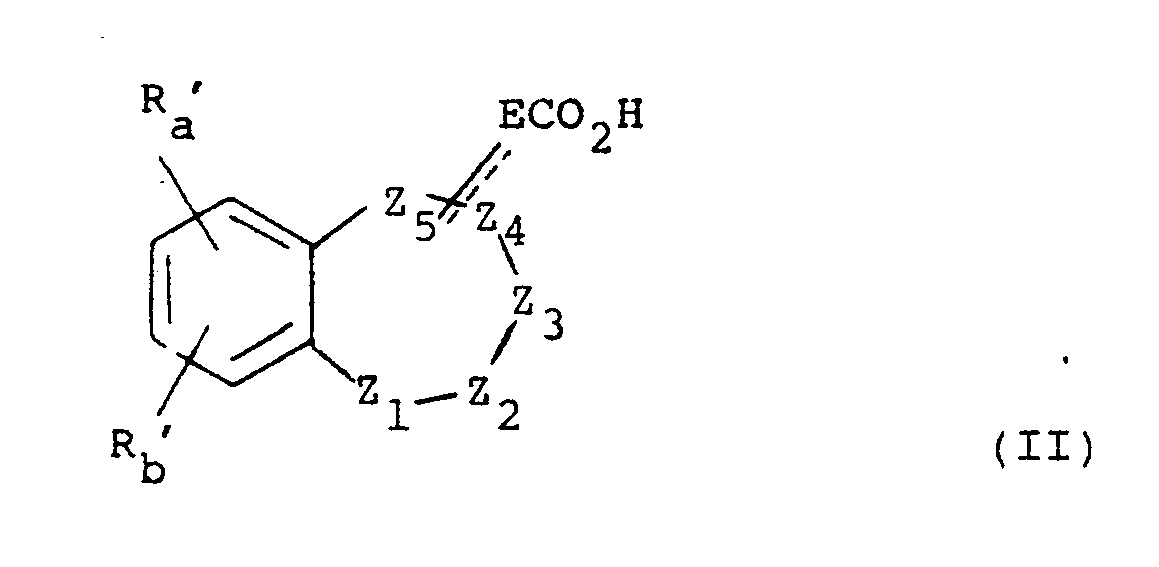
- The coupling reactions may be effected by, for example, activating the reacting carboxyl group of the acid of formula (II) or amino acid, and reacting this with the amino group of the substrate unit. Details of suitable, optional activating and protecting (masking) groups and of suitable reaction conditions (for the coupling reactions and for the introduction and removal of protecting groups) giving, preferably, the minimum of racemisation, may be found in the above-referenced literature.
- It will be appreciated that, when A is other than -CONH- or -COO-, the C-terminus group is other than an amino acid, in which case the coupling is carried out with an appropriate other precursor, as described in the aforementioned literature references 2., 5., 6. and 7.
- Accordingly, the present invention further provides a process for the preparation of a compound of formula (I) or a pharmaceutically acceptable salt thereof which comprises reacting a reagent of the formula (III):


A² is absent or represents an appropriate amino acid or dipeptide unit, such that A¹ + A² is -NHCHR₁CONHCHR₂CO-; and the remaining variables are as hereinbefore defined; and thereafter, if desired or necessary deprotecting (within A¹ or A²) of the products, and/or converting Z₁, Z₂, Z₃, Z₄ or Z₅ to other Z₁, Z₂, Z₃, Z₄ or Z₅, Ra′ /Rb′ to Ra and/or Rb and/or forming a pharmaceutically acceptable salt thereof. - Suitable examples of J when a leaving group include halo, such as chloro or bromo, and other suitable groups which are displaceable by an amino nucleophile, such as C₁₋₆ alkoxycarbonyloxy.
- It is generally preferred, especially when A¹ is not absent, however, that J is OH, and a suitable coupling reagent or dehydrating catalyst is used to effect the reaction, such as N,N-dicyclohexylcarbodiimide and those described in the Descriptions and Examples hereinafter.
- Deprotection of A¹ and/or A² takes place conventionally, in accordance with the particular protecting group(s) employed.
- Pharmaceutically acceptable salts may be formed conventionally.
- Z₁, Z₂, Z₃, Z₄ or Z₅ when S or SO may be converted to SO or SO₂ respectively (or S to SO₂) by conventional oxidation methods, such as those described hereinafter for conversion (vi) for Ra/Rb.
- It will be apparent that compounds of the formula (I) containing an Ra′ Rb′ group which is other than Ra/Rb and which is convertible to Ra/Rb group, are useful novel intermediates. A number of such conversions is possible, not only for the final product compounds of formula (1) when Ra′/Rb′ are other than Ra/Rb, but also within Ra/Rb, and also for their intermediates as follows:
- (i) a hydrogen substituent is convertible to a nitro substituent by nitration;
- (ii) a nitro substituent is convertible to an amino substituent by reduction;
- (iii) a C₁₋₇ acylamino substituent is convertible to an amino substituent by deacylation;
- (iv) an amino substituent is convertible to a C₁₋₇ acylamino substituent by acylation with a carboxylic acid derivative;
- (v) a hydrogen substituent is convertible to a halogen substituent by halogenation;
- (vi) an C₁₋₆ alkylthio or a C₁₋₆ alkylsulphinyl substituent is convertible to a C₁₋₆ alkylsulphinyl or C₁₋₆ alkylsulphonyl substituent respectively, by oxidation;
- (vii) an amino, aminosulphonyl, or NHCONH₂ substituent is convertible to a corresponding substituent which is substituted by one or two alkyl groups, by N-alkylation;
- (viii) an amino substituent is convertible to a group NHCONH₂, by reaction with potassium cyanate and acid;
- (ix) a hydrogen substituent is convertible to an aminosulphonyl substituent by treatment with ClSO₃H followed by HNR₅R₆;
- (x) a cyano substituent may be converted to an aminomethyl substituent by reduction;
- (xi) a bromo substituent may be converted to a cyano substituent by reaction with copper(I) cyanide.
- Conversions (i) to (xi) are only exemplary and are not exhaustive of the possibilities. It will be appreciated that it is often desirable to carry out these conversions at an earlier stage, in the intermediate acid of formula (II), especially in regard to conversion (iii).
- In regard to (i), nitration is carried out in accordance with known procedures.
- In regard to (ii), the reduction is carried out with a suitable reducing agent, such as that suitable for reducing nitroanisole to aminoanisole.
- In regard to (iii), deacylation is carried out by treatment with a base, such as an alkali metal hydroxide.
- In regard to (iv), the acylation is carried out with an acylating agent, such as the corresponding acid or acid chloride. Formylation is carried out with the free acid.
- In regard to (v), halogenation is carried out with conventional halogenating agents.
- In regard to (vi), oxidation is carried out at below ambient temperatures in a non-aqueous solvent, such as a chlorinated hydrocarbon, in the presence of an organic peracid, such as 3-chloroperoxybenzoic acid, or in water in the presence of a soluble strong inorganic oxidant, such as an alkali metal permanganate or with aqueous hydrogen peroxide.
- In regard to (vii), alkylation is carried out with a corresponding alkylating agent such as the chloride or bromide under conventional conditions.
- In regard to (viii), conversion to a ureido derivative is carried out by reaction with potassium cyanate in acidic methanol, at ambient temperature.
- In regard to (ix), the mixing with ClSO₃H takes place at low temperatures around 0oC and allowed to warm to ambient temperature. The subsequent reaction with the amine takes place at ambient temperature, in a solvent such as ethanol.
- In regard to (x), the reduction takes place by reaction with sodium borohydride/cobalt chloride; or platinum oxide/hydrogen.
- In regard to (xi), the reaction takes place under conventional conditions.
- Compounds of the general formulae (II) and (III) may themselves be prepared by standard techniques analogous to those described above.
- The acids of formula (II) are either known compounds or are prepared by analogous methods to these and for structurally similar known compounds.
- The preparation of the amino acid of formula (V):

- As regards the appropriate corresponding intermediates to those of formula (V), including those wherein A is other than -CONH-, reference is hereby made to the literature references 2. to 7. listed hereinbefore.
- It will be appreciated that protected forms of compounds of the present invention are novel intermediates and form an aspect of the invention.
- A particularly suitable method of preparation of the compounds of the present invention are as described in the Description and Examples hereinafter. The couplings may be carried out sequentially beginning by coupling the acid of formula (II) with, for example, phenylalanine or 1-naphthylalanine, followed by coupling with Y, for example, leucine or histidine, and finally, coupling with the amino acid of formula (V). In a preferred aspect, however, either the acid of formula (II) is coupled with a tripeptide unit formed between the amino acid of formula (V); leucine, histidine or other R₂ containing amino acid; and phenylalanine or naphthylalanine; or alternatively the acid of formula (II) is coupled with phenylalanine or naphthylalanine and this is coupled with a dipeptide unit formed between the R₂ containing amino acid and the amino acid of formula (V).
- As mentioned previously the compounds of the invention have been found to be renin inhibitors, and therefore they are of potential use in the treatment of hypertension. They may also be of potential use in the other diseases and disorders hereinbefore referred to.
- The present invention also provides a pharmaceutical composition which comprises a compound of formula (I) or a pharmaceutically acceptable salt thereof, and a pharmaceutically acceptable carrier. In particular, the present invention provides an anti-hypertensive pharmaceutical composition which comprises an anti-hypertensive effective amount of a compound of formula (I) or a pharmaceutically acceptable salt thereof, and a pharmaceutically acceptable carrier.
- The compositions are preferably adapted for oral administration. However, they may be adapted for other modes of administration, for example parenteral administration for patients suffering from heart failure. Other alternative modes of administration include sublingual or transdermal administration.
- The compositions may be in the form of tablets, capsules, powders, granules, lozenges, suppositories, reconstitutable powders, or liquid preparations, such as oral or sterile parenteral solutions or suspensions.
- In order to obtain consistency of administration it is preferred that a composition of the invention is in the form of a unit dose.
- Unit dose presentation forms for oral administration may be tablets and capsules and may contain conventional excipients such as binding agents, for example syrup, acacia, gelatin, sorbitol, tragacanth, or polyvinylpyrrolidone; fillers, for example lactose, sugar, maize-starch, calcium phosphate, sorbitol or glycine; tabletting lubricants, for example magnesium stearate; disintegrants, for example starch, polyvinylpyrrolidone, sodium starch glycollate or microcrystalline cellulose; or pharmaceutically acceptable wetting agents such as sodium lauryl sulphate.
- The solid oral compositions may be prepared by conventional methods of blending, filling or tabletting. Repeated blending operations may be used to distribute the active agent throughout those compositions employing large quantities of fillers. Such operations are of course conventional in the art. The tablets may be coated according to methods well known in normal pharmaceutical practice, in particular with an enteric coating.
- Oral liquid preparations may be in the form of, for example, emulsions, syrups, or elixirs, or may be presented as a dry product for reconstitution with water or other suitable vehicle before use. Such liquid preparations may contain conventional additives such as suspending agents, for example sorbitol, syrup, methyl cellulose, gelatin, hydroxyethylcellulose, carboxymethylcellulose, aluminium stearate gel, hydrogenated edible fats; emulsifying agents, for example lecithin, sorbitan monooleate, or acacia; non-aqueous vehicles (which may include edible oils), for example almond oil, fractionated coconut oil, oily esters such as esters of glycerine, propylene glycol, or ethyl alcohol; preservatives, for example methyl or propyl p-hydroxybenzoate or sorbic acid; and if desired conventional flavouring or colouring agents.
- For parenteral administration, fluid unit dosage forms are prepared utilizing the compound and a sterile vehicle, and, depending on the concentration used, can be either suspended or dissolved in the vehicle. In preparing solutions the compound can be dissolved in water for injection and filter sterilized before filling into a suitable vial or ampoule and sealing. Advantageously, adjuvants such as a local anaesthetic, a preservative and buffering agents can be dissolved in the vehicle. To enhance the stability, the composition can be frozen after filling into the vial and the water removed under vacuum. Parenteral suspensions are prepared in substantially the same manner, except that the compound is suspended in the vehicle instead of being dissolved, and sterilization cannot be accomplished by filtration. The compound can be sterilized by exposure to ethylene oxide before suspending in the sterile vehicle. Advantageously, a surfactant or wetting agent is included in the composition to facilitate uniform distribution of the compound.
- The compositions may contain from 0.1% to 99% by weight, preferably from 10-60% by weight, of the active material, depending on the method of administration.
- The present invention further provides a method of prophylaxis or treatment of hypertension in mammals including man, which comprises administering to the suffering mammal an anti-hypertensively effective amount of a compound of formula (I) or a pharmaceutically acceptable salt thereof.
- An effective amount will depend on the relative efficacy of the compounds of the present invention, the severity of the hypertension being treated and the weight of the sufferer. However, a unit dose form of a composition of the invention may contain from 0.1 to 500 mg of a compound of the invention and more usually from 1 to 100 mg, for example 2 to 50 mg such as 2, 3, 4, 5, 10, 20 or 30mg. Such compositions may be administered from 1 to 6 times a day, more usually from 2 to 4 times a day, in a manner such that the daily dose is from 1 to 1000mg for a 70 kg human adult and more particularly from 5 to 500 mg.
- No toxicological effects are indicated at the aforementioned dosage ranges.
- The present invention further provides a compound of formula (I) or a pharmaceutically acceptable salt thereof for use in the treatment or prophylaxis of hypertension.
- The following Description relates to the preparation of intermediates and the following Examples relate to the preparation of compounds of formula (I).
- The following Tabulations show the structures prepared. The following notations may be employed:-
4(S)-amino-5-cyclohexyl-3(S)-hydroxypentanoic acid isobutylamide ACHPAA 4(S)-amino-5-cyclohexyl-3(S)-hydroxypentanoic acid ACHPA 4(S)-amino-5-cyclohexyl-3(S)-hydroxypentanoic acid 3-(1-imidazolyl)propylamide ACHPA-API Trifluoroacetate Salt TFA Benzyloxycarbonyl CBZ tert-Butyloxycarbonyl BOC Point of attachment of E * 
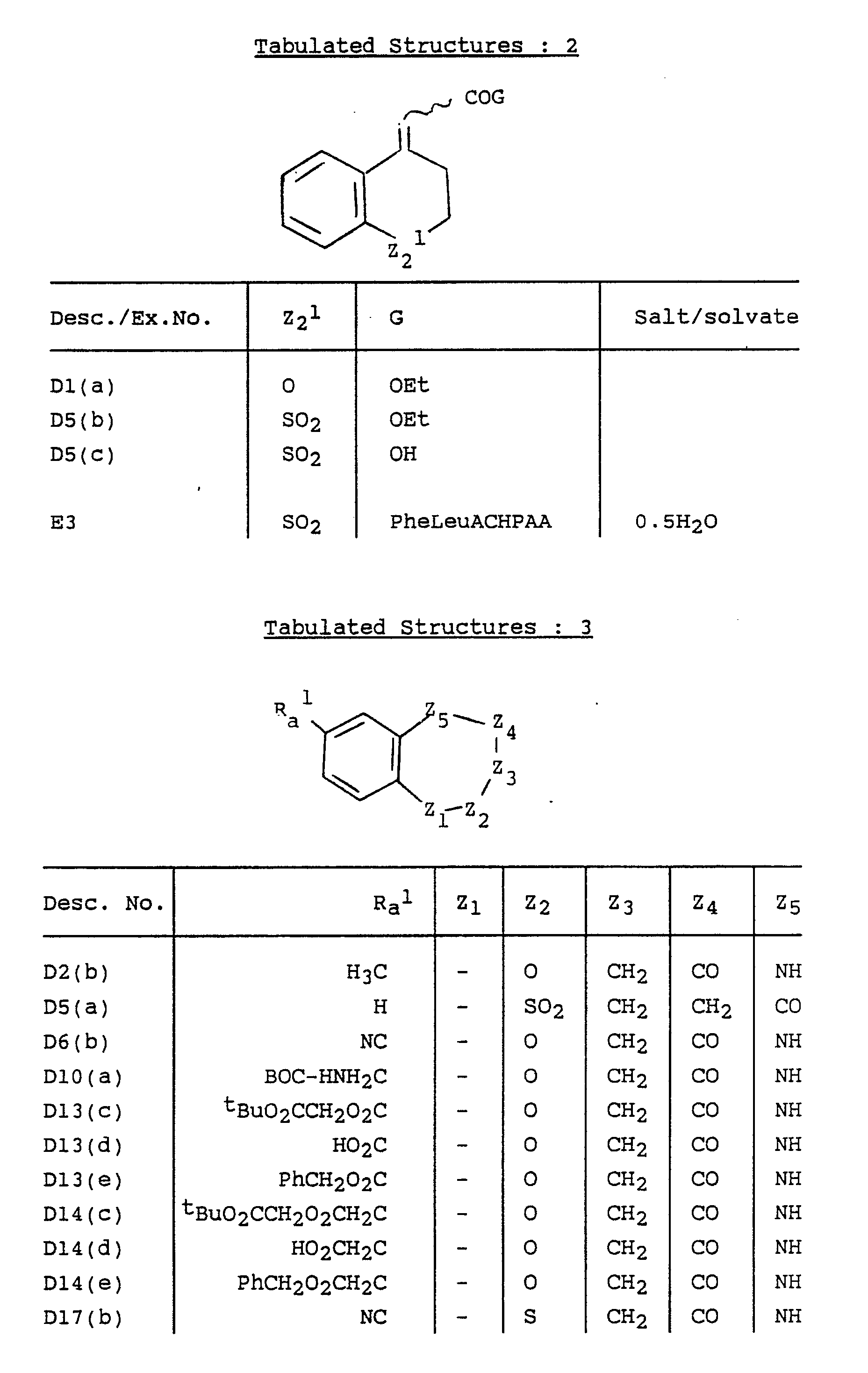
Tabulated Structures : 4 Rd-ACHPA-Re Desc. No. Rd Re Salt/Solvate D3(a) BOC-Phe-Leu NHiBu D3(b) Phe-Leu NHiBu TFA D4(a) CBZ-Phe-Leu NHiBu D4(b) Phe-Leu NHiBu CH₃CO₂H D4(c) Phe-Leu NHiBu D9(a) BOC API D9(b) CBZ-Phe-Leu API 0.5H₂O D9(c) Phe-Leu API D12(a) BOC-Phe-Leu API D12(b) Phe-Leu API 2TFA 


- Sodium hydride (80% in mineral oil, 1.11g) was stirred under nitrogen in dry dimethoxyethane (50ml) as triethyl phosphonoacetate (6.7ml) was added dropwise over 25 min. After stirring for a further 20 min, 4-chromanone (4.58g) was added dropwise in dry dimethoxyethane (15ml). The solution was stirred for 16h and poured into water. The product was extracted into ether, dried (Na₂SO₄), and evaporated in vacuo. Chromatography on silica gel using 20% ethyl acetate in petroleum ether (b.p.60-80oC) gave the title compound (1.83g) as a colourless oil. NMR showed this to be a ca 2:1 mixture of isomers.
NMR (δ)(CDCl₃): 1.3 (3H,m), 2.65 (dt)(minor) and 3.4 (dt)(major) (2H), 4.1-4.4 (4H,m), 5.7(s) (minor) and 6.35(s)(major)(1H), 6.8-7.0 (2H,m), 7.25 (1H,m), 7.6 (dd)(major) and 7.8(dd)(minor)(1H). - Ethyl chromanylidene-4-acetate (1.82g) was hydrogenated over 10% palladium on charcoal (0.52g) in ethanol (50ml) for 1h. Catalyst was filtered off, and the filtrate was evaporated in vacuo, giving the title compound (1.71g) as a colourless oil.
NMR (δ) (CDCl₃): 1.3 (3H,t), 1.85 (1H,m), 2.15 (1H, m), 2.5 (1H) and 2.8 (1H) (ABX), 3.35 (1H, m), 4.2 (2H, q), 6.75-6.9 (2H, m), 7.1 (2H, m). - Ethyl chromanyl-4-acetate (1.71g) and 10% aqueous sodium hydroxide (4.3ml) were dissolved in ethanol (20ml), and left to stand for 2h. The mixture was diluted with water, washed with chloroform, acidified (5M hydrochloric acid), and extracted with ethyl acetate. The extract was dried (Na₂SO₄) and evaporated in vacuo, giving the title compound (1.33g) as a white solid.
NMR (δ) (CDCl₃): 1.9 (1H, m), 2.2 (1H, m), 2.6 (1H) and 2.9 (1H) (ABX), 3.4 (1H, m), 4.2 (2H, m), 6.75-6.9 (2H, m), 7.1 (2H, m). - 2-Amino-4-methylphenol (5.00g) and pyridine (6.6ml) were stirred in dichloromethane (100ml) in ice, as chloroacetyl chloride (3.4ml) was added dropwise. The mixture was stirred for 16h, when water (100 ml) was added. After stirring for a further 0.5h, the layers were separated. The aqueous portion was acidified (5M hydrochloric acid) and extracted with chloroform, and then filtered. The grey solid so isolated was washed with water and dried in vacuo. Recrystallisation from methanol/chloroform then gave the title compound (2.08g) as an off-white powder.
NMR (δ) (DMSOd₆/CDCl₃): 2.2 (3H,s), 4.25 (2H,s), 6.75(2H,m), 7.25(1H, b), 8.8-9.5(2H,b). - To a suspension of 2-(chloroacetylamino)-4-methylphenol (3.24g) in ethanol (35ml) was added sodium hydroxide (0.85g) in water (5ml). The mixture was swirled until homogeneous, left to stand for 2h, and diluted with water (500ml). Filtration and drying in vacuo then gave the title compund (2.41g) as a slightly pink solid.
NMR (δ) (DMSOd₆) 2.25(3H,s), 4.55(2H,s), 6.6-6.95(3H,m), 10.65(1H, b). - 2,3-Dihydro-6-methyl-3-oxo-4H-1,4-benzoxazine (2.70g), anhydrous potassium carbonate (3.43g) and methyl bromoacetate (2.0ml) were stirred in dry dimethylformamide (DMF) (20ml) for 16h. The mixture was diluted with ethyl acetate (200ml), washed with water and brine, dried (Na₂SO₄) and evaporated in vacuo. Recrystallisation from chloroform/petroleum ether (b.p.60-80oC) then gave the title compound (2.41g) as white needles.
NMR (δ) (CDCl₃): 2.3(3H,s), 3.75(3H,s), 4.4-4.8(4H,m), 6.4-6.9(3H,m). - This material was formed from methyl 2,3-dihydro-6-methyl-3-oxo-4H-1,4-benzoxazine-4-acetate (1.70g), following the procedure of Description 1(c), but with methanol as solvent. This gave the title compound (1.23g).
NMR (δ)(DMSOd₆): 2.3(3H,s), 4.65(4H, 2xs), 6.7-7.0(3H,m). -
¹ J. Med. Chem. 1985, 28, 1779-1790. - BOC-Phe-Leu-OH (1.48g), 1-hydroxybenzotriazole (HOBT) (0.53g) and ACHPA isobutylamide (1.06g)¹ were stirred at 0oC in dry dimethylformamide (DMF) (10ml). 1-(3-Dimethylaminopropyl)-3-ethylcarbodiimide hydrochloride (DEC) (0.75g) was added, and the mixture was stirred for 18h, warming to ambient temperature. The mixture was diluted with ethyl acetate, washed with aqueous citric acid, water, aqueous sodium hydrogen carbonate and brine, dried (Na₂SO₄) and evaporated in vacuo. Chromatography on silica gel using methanol/chloroform (0-2% methanol, gradient) gave the title compound (1.91g).
NMR (δ) (CDCl₃): 0.7-2.3 (31 H,m) 2.8-3.2(4H,m), 3.8-4.3(4H,m), 6.4-7.4(8H,m). - BOC-Phe-Leu-ACHPA isobutylamide (2.32g) was dissolved with stirring in trifluoroacetic acid (10ml) at 0oC. After 1h, solvent was removed in vacuo, and the residue was triturated with ether to give the title compound.
NMR (δ) (CDCl₃): 0.6-2.5 (31H,m), 2.8-3.3(4H,m), 3.7-4.4(4H,m), 7.0-8.0(8H,m). - This material was formed from CBZ-Phe-Leu-OH (4.13g), following the procedure of Description 3(a). The crude product was purified by chromatography on silica gel using methanol/chloroform (0-3% methanol, gradient). This gave the title compound (6.40g) as a light brown solid.
NMR (δ) (CDCl₃): 0.75-1.85 (29H,m), 2.3(2H,m), 2.9-3.15 (4H,m), 4.0(2H,m), 4.3-4.5(2H,m), 5.05(2H,s), 5.5(1H,d), 6.5-6.85(3H,m), 7.1-7.4(11H,m). - This material was formed from CBZ-Phe-Leu-ACHPA isobutylamide (6.4g) following the procedure of Description 1(b), but using ethanol/acetic acid as solvent. This gave the title compound (7.4g), still containing residual acetic acid.
NMR (δ) (CDCl₃): 0.8-1.85(29H,m), 2.05(m), 2.35(2H,m), 2.9-3.2(4H,m), 3.95(2H,m), 4.15(1H,m), 4.3(1H,m), 7.25(5H,m), 8.0(b). - Phe-Leu-ACHPA isobutylamide .CH₃CO₂H (7.4g) was dissolved in ethyl acetate and extracted into aqueous citric acid. The extract was basified with sodium carbonate, and the product was isolated by extraction into chloroform, drying (Na₂SO₄) and evaporation in vacuo. This gave the title compound (3.2g).
NMR (δ) (CDCl₃): 0.7-1.0 (13H,m), 1.0-1.9(16H,m), 2.3(2H,ABX), 2.75(1H,dd), 3.05(2H,m), 3.2(1H,dd), 3.65(1H,dd), 3.95(2H,m), 4.35(1H,m), 6.5(1H,d), 6.6(1H,t), 7.15-7.35(6H,m), 7.7(1H,d). - Thiachroman-4-one (10.23g) was stirred in glacial acetic acid (50ml). Aqueous hydrogen peroxide (30%, 19.4ml) was added, and the mixture was brought to gentle reflux over 0.5h. After a further 0.5h at reflux, the mixture was cooled and poured into water (IL). The precipitate was filtered off, washed with water, and dried in vacuo, giving the title compound (10.00g) as a white solid.
NMR (δ) (CDCl₃): 3.4(2H,t), 3.7(2H,t), 7.8(2H,m), 8.0(1H,dd), 8.15(1H,dd). - Thiachroman-4-one 1,1-dioxide (2.44g) and (carbethoxymethylene)triphenylphosphorane (4.76g) were stirred at reflux in dry toluene (100ml) for 20h. Solvent was removed in vacuo, giving a brown solid, which was chromatographed on silica gel using ethyl acetate/petroleum ether (bp 60-80oC) (20-40% ethyl acetate, gradient). This gave the title compound (0.21g) as a yellow oil contaminated with ca 20% of starting material.
NMR (δ) (CDCl₃): 1.3(3H,t), 3.4(2H,t), 3.9(2H,td), 4.25(2H,q), 6.4(1H,s), 7.5-7.8(3H,m), 8.0(1H,m). - This material was formed from ethyl thiachromanylidene-4-acetate 1,1-dioxide (0.21g), following the procedure of Description 1(c). This gave the title compound (0.16g) as a yellow foam.
NMR (δ) (DMSOd₆) 3.4(m), 4.2(2H,m), 6.3(1H,t), 7.6-7.9(4H,m), 12.4(1H,b) - This material was formed from thiachromanylidene-4-acetic acid 1,1-dioxide (0.11g), following the procedure of Description 1(b). This gave the title compound (0.09g) as a yellow foam.
NMR (δ) (CD₃OD/CDCl₃) 1.25(2H,m), 2.45(m), 2.7(2H,m), 3.4-3.7(m), 7.4-7.9(4H,m). -
² Proc. Roy. Soc. (London) SerB, Vol 133, 30 (1946) - 4-Cyano-2-nitrophenol² (3.12g), sodium hydroxide (1.22g), benzyltributylammonium bromide (0.34g) and tert-butyl bromoacetate (5.6ml) were stirred vigorously at reflux in a mixture of water (100ml) and 1,2-dichloroethane (100ml) for 16h. The mixture was cooled, acidified (5M hydrochloric acid) and separated. The aqueous portion was extracted with dichloromethane, and the combined organics were dried (Na₂SO₄) and evaporated in vacuo. Chromatography on silica gel using ethyl acetate/petroleum ether (bp 60-80oC) (10-40% ethyl acetate, gradient) gave the title compound (4.26g) as a cream solid, mp 121-3oC.
NMR (δ) (CDCl₃): 1.5(9H,s), 4.75(2H,s), 7.05(1H,d), 7.8(1H,dd), 8.2(1H,d). - tert-Butyl (4-cyano-2-nitrophenoxy)acetate (5.33g) was stirred in glacial acetic acid (100ml) at 40oC as iron (electrolytic, 4x3.2g portions) was added over 2h. After a further 1h, the mixture was evaporated in vacuo, and the residue was suspended in water (500ml). Filtration and drying in vacuo then gave the title compound (2.74g) as a grey solid.
NMR (δ) (DMSOd₆): 4.75(2H,s), 7.0-7.5(3H,m), 12.0(1H,b). - This material was formed from 6-cyano-2,3-dihydro-3-oxo-4H-1,4-benzoxazine (0.26g) and methyl acrylate (0.14ml), following the procedure of Description 2(c). This gave the title compound (0.35g) as a colourless oil.
NMR (δ) (CDCl₃): 2;7(2H,t) 3.7(3H,s), 4.25(2H,t), 4.7(2H,s), 7.05(1H,d), 7.3-7.4(2H,m). - This material was formed from methyl 6-cyano-2,3-dihydro-3-oxo-4H-1,4-benzoxazine-4-propanoate (0.35g), following the procedure of Description 1(c). This gave the title compound (0.25g) as a white powder.
NMR (δ) (CDCl₃/DMSOd₆): 2.65(2H,t), 4.2(2H,t), 4.7(2H,s), 7.1(1H,d), 7.35(1H,dd), 7.55(1H,d). - This material was formed from 2,3-dihydro-3-oxo-4H-1,4-benzothiazine (2.00g), following the procedure of Description 6(c). This gave the title compound (2.97g) as a green-brown oil.
NMR (δ) (CDCl₃): 2.7(2H,t), 3.4(2H,s), 3.7(3H,s), 4.3(2H,t), 7.05(1H,dt), 7.15(1H,dd), 7.25(1H,dt), 7.35(1H,dd). - This material was formed from methyl 2,3-dihydro-3-oxo- 4H-1,4-benzothiazine-4-propanoate (0.19g), following the procedure of Description 1(c). This gave the title compound (0.14g) as a light yellow solid.
NMR (δ) (CDCl₃/DMSOd₆): 2.6(2H,t), 3.4(2H,s), 4.2(2H,t), 7.0(1H,m), 7.2-7.4(3H,m). - Methyl 2,3-dihydro-3-oxo-4H-1,4-benzothiazine-4-propanoate (0.10g) (Description 7(a)) and 3-chloroperoxybenzoic acid (50-55% grade, 0.29g) were stirred in dichloromethane (5ml) for 40 min. The mixture was then diluted with ethyl acetate (50ml), washed with 5% aqueous sodium hydrogen carbonate, dried (Na₂SO₄) and evaporated in vacuo. Chromatography on silica gel using ethyl acetate/petroleum ether (b.p. 60-80oC) (20-100% ethyl acetate, gradient) then gave the title compound (0.10g) as a white solid.
NMR (δ) (CDCl₃); 2.75(2H,t), 3.7(3H,s), 4.25(2H,s), 4.35(2H,t), 7.4(2H,m), 7.7(1H,dt), 8.0(1H,dd). - This material was formed from methyl 2,3-dihydro-1,1,3-trioxo-4H-1,4-benzothiazine-4-propanoate (0.10g), following the procedure of Description 1(c). This gave the title compound (0.05g) as a white solid.
NMR (δ) (CDCl₃/DMSOd₆): 2.65(2H,t), 4.3(2H,t), 4.55(2H,s), 7.4(1H,t), 7.55(1H,d), 7.75(1H,t), 7.9(1H,d). -
³J. Med. Chem. 1985, 28, 1779-1790. - This material was formed from BOC-ACHPA-OH³ (0.21g) and 1-(3-aminopropyl)imidazole (0.086 ml), following the procedure of Description 3(a), but omitting the citric acid wash. This gave the title compound (0.18g) as an oil.
- BOC-ACHPA 3-(1-imidazolyl)propylamide (0.18g) was dissolved in dichloromethane (4 ml), and cooled in ice. TFA (4 ml) was added. The mixture was swirled and left to stand at ambient temperature for 0.5h, and then evaporated, dissolved in dry DMF (3 ml) and cooled in ice. CBZ-Phe-Leu-OH (0.19g) and HOBT (0.062g) were stirred at 0oC in dry DMF (3 ml), and DEC (0.088g) was added. This mixture was stirred at 0oC for 15 min, and then DIPEA (0.22 ml) and the amine trifluoroacetate solution, prepared above, were added. After stirring for 16h, with warming to ambient temperature, the work up procedure of Description 9(a) was followed. The crude product was chromatographed on silica gel using methanol/chloroform (0-10% methanol, gradient). This gave the title compound (0.195g) as a white solid.
NMR (δ) (CDCl₃): 0.75-0.1 (7H, m), 1.05-2.5 (20H, m), 2.9-3.4 (4H, m), 3.9-4.1 (4H, m), 4.15-4.5 (2H, m), 5.0-5.15 (2H, m), 5.45 (b), 6.35-6.65 (2H, m), 6.9-7.1 (3H, m), 7.1-7.45 (10H, m), 7.5-7.8 (1H, m).
Analysis: C₄₀H₅₆N₆O₆.0.5H₂O requires C,66.2; H,7.9; N,11.6%. Found: C,65.9; H,7.7; N,11.3%.
M.S. (m/z) (FAB) (M+1)=717 (consistent with m.w.=716). - This material was formed from CBZ-Phe-Leu-ACHPA 3-(1-imidazolyl)propylamide (3.0g), following the procedure of Description 1(b). The crude product was chromatographed on silica gel using methanol/chloroform (0-16% methanol, gradient). This gave the title compound (1.4g) as a light yellow powder.
NMR (δ) (DMSOd₆): 0.7-1.9 (24H,m), 2.1 (2H,m), 2.55-2.7 (1H,m), 3.0 (3H,m), 3.8 (2H,m), 3.9 (2H,t), 4.3 (1H,q), 4.9 (1H,m), 6.85 (1H,b), 7.1-7.3 (6H,m), 7.4-7.8 (4H,m), 8.2 (1H,d). - 6-Cyano-2,3-dihydro-3-oxo-4H-1,4-benzoxazine (0.18g) (Description 6(b)) was hydrogenated over platinum dioxide (0.05g) in ethyl acetate (25 ml) containing di-tert-butyldicarbonate (0.23g) for 70h. Catalyst was filtered off, and the filtrate was evaporated. The crude product was chromatographed on silica gel using ethyl acetate/petroleum ether (b.p. 60-80oC) (50-100% ethyl acetate, gradient). This gave the title compound (0.18g) as a white solid.
NMR (δ) (DMSOd₆): 1.35(9H,s), 4.0(2H,d), 4.5(2H,s), 6.75(2H,m), 6.85(1H,d), 7.35(1H,t), 10.7(1H,s). - This material was formed from 6-(BOC-aminomethyl)-2,3-dihydro-3-oxo-4H-1,4-benzoxazine (0.17g), following the procedure of Description 6(c). This gave the title compound (0.24g) as a light yellow solid.
NMR (δ) (CDCl₃): 1.45(9H,s), 2.7(2H,t), 3.7(3H,s), 4.25(4H,m), 4.6(2H,s), 4.9(1H,b), 6.95(3H,m). - This material was formed from methyl 6-(BOC-aminomethyl)-2,3-dihydro-3-oxo-4H-1,4-benzoxazine-4-propanoate (0.23g), following the procedure of Description 1(c). This gave the title compound (0.19g) as a light yellow solid.
NMR (δ) (CDCl₃): 1.45(9H,s), 2.75(2H,t), 4.25(2H,m), 4.6(2H,s), 5.05(1H,b), 6.9(2H,m), 7.05(1H,b). -
⁴Coll. Czech. Chem. Commun. 43, (1983), 1759. - This material ws formed from ethyl 3-(1,2,3,4-tetrahydroisoquinolin-2-yl)propanoate⁴ (3.00g) following the procedure of Description 1(c). Removal of the solvent from the acidified reaction mixture gave an orange oil which was triturated with methanol/chloroform to give the title compound (2.69g) as a purple semi-solid.
NMR (δ) (DMSOd₆): 2.4-2.5(2H,m), 2.6-2.8(6H,m), 3.6(2H,bs), 7.0-7.2(4H,m). - This material was formed from BOC-ACHPA 3-(1-imidazolyl)propylamide (1.53g) (Description 9(a)) and BOC-Phe-Leu-OH (1.60g), following the procedure of Description 9(b). The crude product was chromatographed on silica gel using methanol/chloroform (0-10% methanol, gradient). This gave the title compound (1.95g).
NMR (δ) (CDCl₃): 0.7-1.05(8H,m), 1.05-1.9(2H,m), 2.0(2H,m), 2.2-2.5(2H,m), 2.9-3.6(5H,m), 3.9-4.5(6H,m), 5.1(b), 6.4(b), 6.6(bd), 7.0(1H,s), 7.05(1H,s), 7.15-7.4(m), 7.65(1H,s). - To a solution of BOC-Phe-Leu-ACHPA 3-(1-imidazolyl)-propylamide (0.60g) in dichloromethane (6 ml) was added trifluoroacetic acid (6 ml). The mixture was stirred for 1 h, and evaporated. Trituration with ether/pentane and filtration then gave the title compound (0.62g) as a white solid.
- 4-Hydroxy-3-nitrobenzoic acid (5.00g), tert-butyl bromoacetate (11.8 ml), sodium hydroxide (2.57g) and benzyltributylammonium bromide (0.52g) were stirred at reflux in water (50 ml) and 1,2-dichloroethane (50 ml) for 16h, then cooled to room temperature. After separation, the aqueous phase was acidified to pH 0 (5M hydrochloric acid) and extracted with chloroform (100 ml). The combined organics were dried (Na₂SO₄) and solvents removed in vacuo. The crude product was dissolved in ether, washed with 10% sodium hydroxide solution, dried (Na₂SO₄), and solvent was removed in vacuo. The crude product (9.46g) was purified by chromatography on silica gel using ethyl acetate/petroleum ether (b.p. 60-80oC) to give the title compound (8.03g) as a slightly coloured oil.
NMR (δ) (CDCl₃): 1.5 (18H,2xs), 4.7 (4H,s), 7.0 (1H,dd), 8.2 (1H,dd), 8.6 (1H,d). - This material was formed from tert-butyl (4-(tertbutoxycarbonylmethoxycarbonyl)-2-nitrophenoxy)acetate (4.20g) following the procedure of Description 1(b). This gave the title compound (3.96g) as a semi-solid.
NMR (δ) (CDCl₃): 1.5 (18H,s), 4.6 (2H,s), 4.7 (2H,s), 6.7 (1H,m), 7.5 (2H,m). - tert-Butyl (2-amino-4-(tert-butoxycarbonylmethoxycarbonyl)phenoxy)acetate (3.96g) was heated at reflux in xylene for 48 h. After cooling to room temperature; solvent was removed in vacuo. The residues were triturated with petroleum ether (b.p. 60-80oC) to give the title compound (2.22g) as a light grey solid.
NMR (δ) (CDCl₃): 1.5 (9H,s), 4.7 (4H,2xs), 7.0 (1H,d), 7.6 (1H,d), 7.8 (1H,dd), 8.5 (1H,bs). - 6-(tert-Butoxycarbonylmethoxycarbonyl-2,3-dihydro-3-oxo-4H-1,4-benzoxazine (2.11g) was stirred in ethanol (15 ml) with 10% sodium hydroxide solution (6.8 ml). The solution was diluted with water (50 ml) and washed with chloroform (2x20 ml), acidified to pH 0 (5M hydrochloric acid), then extracted with chloroform (3x20 ml) and ethyl acetate (2x20 ml). The combined organics were dried (Na₂SO₄) and solvents removed in vacuo to give the title compound (0.80g) as a white solid.
NMR (δ) (DMSOd₆): 4.6 (2H,s), 7.0 (1H,m), 7.5 (2H,m), 10.9 (1H,bs). - 6-Carboxy-2,3-dihydro-3-oxo-4H-1,4-benzoxazine (0.17g) was stirred with DEC (0.17g), benzyl alcohol (0.1 ml) and 4-dimethylaminopyridine (0.012g) in DMF (5 ml) for 16h. The solution was diluted with ethyl acetate (50 ml) and washed with water (3x15 ml). The combined organics were dried (Na₂SO₄) and solvents removed in vacuo to give the title compound (0.21g).
NMR (δ) (CDCl₃): 4.7 (2H,s), 5.35 (2H,s), 7.0 (1H,d), 7.3-7.5 (5H,m), 7.6 (1H,d), 7.7 (1H,dd), 8.4 (1H,bs). - This material was formed from 6-benzyloxycarbonyl-2,3-dihydro-3-oxo-4H-1,4-benzoxazine (0.85g) and tert-butyl acrylate (0.81g), following the procedure of Description 6(c). The crude product was stirred for 3h in dichloromethane (10 ml) and trifluoroacetic acid (10 ml). Removal of solvents gave the title compound (0.59g) as a white solid.
NMR (δ) (DMSOd₆): 2.6 (2H,t), 4.2 (2H,t), 4.7 (2H,s), 5.4 (2H,s), 7.1 (1H,m), 7.3-7.5 (5H,m), 7.7 (1H,m), 7.8 (1H,m). - This material was formed from 4-hydroxy-3-nitrophenylacetic acid (1.00g) following the procedure of Description 13(a). The crude product was purified by column chromatography on silica gel using ethyl acetate/petroleum ether (b.p. 60-80oC) (0-30% ethyl acetate, gradient). The title compound (1.85g) was isolated as an oil.
NMR (δ) (CDCl₃): 1.5 (18H,2xs), 3.7 (2H,s), 4.5 (2H,s), 4.6 (2H,s), 6.9 (1H,d), 7.5 (1H,dd), 7.8 (1H,d). - This material was formed from tert-butyl(4-(tert-butoxycarbonylmethoxycarbonylmethyl)-2-nitrophenoxy)acetate (1.85g) following the procedure of Description 1(b). This gave the title compound (1.50g) as a semi-solid.
NMR (δ) (CDCl₃): 1.5 (18H,2xs), 3.6 (2H,s), 4.5 (4H,2xs), 6.7 (2H,m), 6.9 (1H,s). - This material was formed from tert-butyl (2-amino-4-(tert-butoxycarbonylmethoxycarbonylmethyl)phenoxy)acetate (1.50g) following the procedure of Description 13(c) but with a reaction time of 16h. The title compound (1.04g) was isolated as a white solid.
NMR (δ) (CDCl₃): 15 (9H,s), 3.7 (1H,s), 4.5 (2H,s), 4.6 (2H,s), 6.8 (1H,s), 6.9 (1H,m). - This material was formed from 6-(tert-butoxycarbonylmethoxycarbonylmethyl)-2,3-dihydro-3-oxo-4H-1,4-benzoxazine (1.04g) following the procedure of Description 13(d). The title compound (0.39g) was isolated as a semi-solid.
NMR (δ) (DMSOd₆): 3.5 (2H,s), 4.6 (2H,s), 6.8 (2H,m), 6.9 (1H,m), 10.7 (1H,bs), 12.4 (1H,bs). - This material was formed from 6-(carboxymethyl)-2,3-dihydro-3-oxo-4H-1,4-benzoxazine (0.39g) following the procedure of Description 13(e). The title compound (0.36g) was isolated as an oil.
NMR (δ) (CDCl₃): 3.6 (2H,s), 4.6 (2H,s), 5.2 (2H,s), 6.8 (1H,m), 6.9 (2H,m), 7.3-7.4 (5H,m), 8.5 (1H,bs). - This material was formed from 6-(benzyloxycarbonylmethyl)-2,3-dihydro-3-oxo-4H-1,4-benzoxazine (0.36g) following the procedure of Description 13(f). The title compound (0.11g) was isolated as a white solid.
NMR (δ) (CDCl₃): 2.7 (2H,t), 3.6 (2H,s), 4.2 (2H,t), 4.6 (2H,s), 5.1 (2H,s), 6.9 (3H,m), 7.2-7.4 (5H,m). -
⁵ Synth. Commun. 15(7), 623. - This material was formed from 2,3-dihydro-1,5-benzothiazepin-4(5H)one⁵ (0.62g) and tert-butyl acrylate (2 ml) following the procedure of Description 6(c), giving the title compound (0.68g) as a white solid.
NMR (δ) (CDCl₃): 1.3 (9H,s), 2.4-2.6 (3H,m), 2.6-2.8 (1H,m), 3.3-3.4 (2H,m), 3.6-3.7 (1H,m), 4.4-4.6 (1H,m), 7.2 (1H,m), 7.3 (1H,dd), 7.5 (1H,m), 7.6 (1H,dd). - tert-Butyl 3,4-dihydro-4-oxo-1,5-benzothiazepine-5(2H)-propanoate (0.13g) was stirred in trifluoroacetic acid (20 ml) and dichloromethane (20 ml) for 3h. Removal of the solvent followed by trituration with ether gave the title compound (0.092g) as a white solid.
NMR (δ) (CDCl₃): 2.4-2.7 (3H,m), 2.7-3.0 (1H,m), 3.2-3.4 (2H,m), 3.6-3.8 (1H,m), 4.4-4.6 (1H,m), 7.2-7.3 (2H,m), 7.4-7.5 (1H,m), 7.6 (1H,m). - tert-Butyl 3,4-dihydro-4-oxo-1,5-benzothiazepine-5(2H)-propanoate (Description 15(a)) (0.52g) was stirred with 3-chloroperoxybenzoic acid (MCPBA) (70%, 0.83g) in dry dichloromethane for 16h. Solvent was removed in vacuo to give the crude product. This was purified by column chromatography on silica gel using ethyl acetate/petroleum ether (b.p. 60-80oC) (0-65% ethyl acetate, gradient) to give the title compound (0.45g) as a white solid.
NMR (δ) (CDCl₃): 1.4(9H,s), 2.5-2.9(4H,m), 3.4-3.6(1H,m), 3.8-3.9(2H,m), 4.4-4.5(1H,m), 7.4-7.5(2H,m), 7.7-7.8(1H,m), 8.0-8.1(1H,dd). - This material was formed from tert-butyl 3,4-dihydro-1,1,4-trioxo-1,5-benzothiazepine-5(2H)-propanoate (0.45g), following the procedure of Description 15(b). The title compound (0.3g) was isolated as a white solid.
NMR (δ) (DMSOd₆): 2.5-2.7(m), 3.6-3.9(3H,m), 4.1-4.3(1H,m), 7.5-7.6(1H,m), 7.7-7.9(3H,m). - This material was formed from 4-chloro-3-nitrobenzonitrile (5.00g) and ethyl mercaptoacetate (4.50 ml), following the procedure of Description 2(c). This gave the title compound (6.98g) as a green solid.
NMR (δ) (CDCl₃): 1.3(3H,t), 3.8(2H,s), 4.2(2H,q), 7.7(1H,d), 7.8(1H,dd), 8.6(1H,d). - Ethyl (4-cyano-2-nitrophenyl)thioacetate (2.6g) was refluxed with iron powder (2.01g) in acetic acid (100 ml) for 1h. After cooling to room temperature the solution was poured onto ice (200 ml), then extracted with chloroform (5x50 ml). The combined organic phases were washed with sodium hydrogen carbonate solution (3x50 ml), dried (Na₂SO₄), and solvents were removed in vacuo. The title compound (1.52g) was isolated as a pale yellow solid.
NMR (δ) (DMSOd₆/CDCl₃): 3.35(2H,s), 7.1(1H,dd), 7.2(1H,d), 7.3(1H,d), 10.7(1H,bs). - This material was formed from 6-cyano-2,3-dihydro-3-oxo-4H-1,4-benzothiazine (0.57g), following the procedure of Description 6(c). This gave the title compound (0.75g) as a yellow solid.
NMR (δ) (CDCl₃): 2.7(2H,t), 3.4(2H,s), 3.7(3H,s), 4.3(2H,t), 7.3(1H,dd), 7.4(1H,d), 7.5(1H,d). - Methyl 6-cyano-2,3-dihydro-3-oxo-4H-1,4-benzothiazine-4-propanoate (0.75g) was dissolved with heating in methanol (10 ml), and stirred as cobalt (II) chloride.6H₂0 (1.29g) and sodium borohydride (0.46g) were added. The resultant black suspension was stirred for 30 min, partitioned between chloroform and water, acidified with 5M hydrochloric acid, basified with aqueous ammonia (sp.gr.0.88), and separated. The aqueous portion was further extracted with chloroform, and the combined organics were dried (Na₂SO₄) and evaporated in vacuo.
- Di-tert-butyldicarbonate (0.59g) was added, and the mixture was dissolved in chloroform (10 ml), left to stand for 16h, and evaporated in vacuo. Chromatography on silica gel using ethyl acetate/petroleum ether (b.p. 60-80oC) (20-60% ethyl acetate, gradient) then gave the title compound (0.32g) as a yellow solid.
NMR (δ) (CDCl₃): 1.45(9H,s), 2.7(2H,t), 3.35(2H,s), 3.65(3H,s), 4.3(4H,m), 4.95(1H,b), 6.95(1H,dd), 7.1(1H,d), 7.3(1H,d). - This material was formed from methyl 6-(BOC-aminomethyl)-2,3-dihydro-3-oxo-4H-1,4-benzothiazine-4-propanoate (0.30g), following the procedure of Description 1(c). The crude product was dissolved in ether, filtered, evaporated, and triturated in 10% ethyl acetate/petroleum ether (b.p. 60-80oC), giving the title compound (0.27g) as a yellow powder.
NMR (δ) (CDCl₃): 1.45(9H,s), 2.75(2H,t), 3.4(2H,s), 4.3(4H,m), 6.95(1H,bm), 7.15(1H,bs), 7.3(1H,d). - Chromanyl-4-acetic acid (0.052g) and 1-hydroxybenzotriazole (HOBT) (0.040g) were stirred in dry dimethylformamide (DMF) (3ml) in ice. 1-(3-Dimethylaminopropyl)-3-ethylcarbodiimide hydrochloride (DEC) (0.052g) was added, and the mixture was stirred for 15 min. N,N-Diisopropylethylamine (DIPEA) (0.12ml) and Phe-Leu-ACHPA isobutylamide .CH₃CO₂H (0.129g) (Description 4(b)) were added. The mixture was stirred for 16h, warming to ambient temperature, diluted with ethyl acetate, washed with 5% aqueous citric acid, water, 5% aqueous sodium hydrogen carbonate and brine, dried (Na₂SO₄) and evaporated in vacuo. Chromatography on silica gel using methanol/chloroform (0-5% methanol, gradient) gave the title compound (0.076g) as a white solid.
NMR (δ) (DMSOd₆): 0.7-1.0(13H,m), 1.0-1.4(7H,m), 1.4-1.8(10H,m), 2.0-2.25(3H,m), 2.5(m), 2.65-3.1(6H,m), 3.75-4.1(4H,m), 4.35(1H,m), 4.65(1H,m), 4.8-5.0(1H,m), 6.7(1H,dd), 6.75(1H,m), 7.05(2H,m), 7.1-7.4(6H,m), 7.7(1H,m), 8.1-8.3(2H,m).
Analysis: C₄₁H₆₀N₄O₆.0.5H₂O required C, 69.0; H, 8.6; N, 7.8%. Found: C, 69.3; H, 8.5; N, 7.8%
M.S. (m/z) (FAB) (M+1)=705 (consistent with m.w.=704). - This material was formed from 2,3-dihydro-6-methyl-3-oxo-4H-1,4-benzoxazine-4-acetic acid (0.041g) and Phe-Leu-ACHPA isobutylamide .CF₃CO₂H (0.100g) (Description 3(b)), following the procedure of Example 1. The crude product was chromatographed on silica gel using methanol/chloroform (0-5% methanol, gradient). This gave the title compound (0.107g) as a white solid.
NMR (δ) (DMSOd₆): 0.7-1.0(13H,m), 1.0-1.8(16H,m), 2.1(2H,m), 2.2(3H,s), 2.7-3.1(4H,m), 3.75-3.9(2H,m), 4.3-4.65(6H,m), 4.8-4.9(1H,m), 6.5-6.6(1H,m), 6.75(1H,d), 6.85(1H,d), 7.15-7.55(6H,m), 7.7(1H,m), 8.15-8.25(1H,m), 8.45-8.55(1H,m).
Analysis: C₄₁H₅₉N₅O₇.H₂O requires C,65.5; H, 8.2; N, 9.3%. Found: C, 65.4; H, 7.9; N, 9.3%.
M.S. (m/z) (FAB) (M+1) 734 (consistent with m.w. = 733). - This method was formed from thiachromanylidene-4-acetic acid 1,1-dioxide (0.050g) (Description 5(c)) and Phe-Leu-ACHPA isobutylamide (0.098g) (Description 4(c)), following the procedure of Description 3(a). The crude product was chromatographed on silica gel using methanol/chloroform (0-5% methanol, gradient). This gave the title compound (0.100g) as a yellow-brown solid.
NMR (δ) (DMSOd₆): 0.7-1.0(14H,m), 1.0-1.8(15H,m), 2.1(2H,m), 2.7-2.9(4H,m), 3.05(1H,dd), 3.4(2H,m), 3.8(2H,m), 4.1(2H,m), 4.3(1H,m), 4.6(1H,m), 4.9(1H,m), 6.0(1H,t), 7.1-7.4(7H,m), 7.55(2H,m), 7.7(1H,bs), 7.85(1H,m), 8.2(1H,bd), 8.35(1H,bd).
Analysis: C₄₁H₅₈N₄O₇S.0.5H₂O requires C,64.8; H,7.8; N,7.4%. Found: C,64.8; H,7.8; N,7.2%.
M.S. (m/z) (FAB) (M+1) = 751 (consistent with m.w. = 750). - This material was formed from thiachromanyl-4-acetic acid 1,1-dioxide (0.068g) (Description 5(d)), following the procedure of Example 3. The crude product was chromatographed on silica gel using methanol/chloroform (0-5% methanol, gradient). This gave the title compound (0.075g) as a yellow solid.
NMR (δ) (DMSOd₆): 0.7-1.0(13H,m), 1.0-1.4(7H,m), 1.4-1.8(10H,m), 1.9-2.25(3H,m), 2.4-2.6(m), 2.7(1H,m), 2.9(2H,m), 3.0-3.2(1H,m), 3.2-3.6(m), 3.85(2H,m), 4.3(1H,m), 4.65(0.5H,m), 4.75(0.5H,m), 4.9(1H,m), 7.15-7.4(7H,m) 7.4-7.6(2H,m), 7.6-7.8(2H,m), 8.1-8.4(2H,m).
Analysis: C₄₁H₆₀N₄O₇S.0.5H₂O requires C,64.6; H,8.1; N,7.4%. Found C,64.5; H,8.0; N,7.5%.
M.S. (m/z) (FAB) (M+1) 753 (consistent with m.w. = 752). - This material was formed from 6-cyano-2,3-dihydro-3-oxo-4H-1,4-benzoxazine-4-propanoic acid (0.078g) (Description 6(d)), following the procedure of Description 3(a). The crude product was chromatographed on silica gel using methanol/chloroform (0-5% methanol, gradient). This gave the title compound (0.21g) as a white solid.
NMR (δ) (DMSOd₆): 0.7-1.0(13H,m), 1.0-1.45(7H,m), 1.45-1.8(9H,m), 2.1(2H,m), 2.4(2H,t), 2.7(1H,dd), 2.85(2H,m), 3.0(1H,dd), 3.8(3H,m), 4.0(1H,m), 4.3(1H,m), 4.6(1H,m), 4.75(2H,s), 4.9(1H,d), 7.1-7.35(7H,m), 7.5(1H,dd), 7.6(1H,d), 7.7(1H,t), 8.15(1H,d), 8.25(1H,d).
Analysis: C₄₂H₅₈N₆O₇.0.5H₂O requires C,65.7; H,7.7; N,10.9%. Found: C,65.8; H,7.8; N,11.3%.
M.S. (m/z) (FAB) (M+1) = 759 (consistent with m.w. = 758). - This material was formed from 2,3-dihydro-3-oxo-4H-1,4-benzothiazine-4-propanoic acid (0.051g) (Description 7(b)), following the procedure of Description 3(a). The crude product was chromatographed on silica gel using methanol/chloroform (0-5% methanol, gradient). This gave the title compound (0.11g) as a white solid.
NMR (δ) (DMSOd₆): 0.7-10(13H,m), 1.0-1.4(7H,m), 1.4-1.8(9H,m), 2.1(2H,m), 2.4(2H,m), 2.7(1H,dd), 2.85(2H,m), 3.0(1H,dd), 3.45(2H,s), 3.8-3.9(3H,m), 4.0(1H,m), 4.3(1H,m), 4.55(1H,m) 4.85(1H,d), 7.05(1H,m), 7.1-7.35(8H,m), 7.4(1H,d), 7.7(1H,t), 8.1(1H,d), 8.25(1H,d).
Analysis: C₄₁H₅₉N₅O₆S.0.5H₂O requires C,64.9; H,8.0; N,9.2%. Found C,64,8; H,8.0; N,9.1%.
M.S. (m/z) (FAB) (M+1) = 750 (consistent with m.w. = 749). - This material was formed from 2,3-dihydro-1,1,3-trioxo-4H-1,4-benzothiazine-4-propanoic acid (0.044g) (Description 8(b)), following the procedure of Description 3(a). The crude product was chromatographed on silica gel using methanol/chloroform (0-5% methanol, gradient). This gave the title compound (0.076g) as a white solid.
NMR (δ) (DMSOd₆): 0.7-1.0(13H,m), 1.0-1.8(16H,m), 2.1(2H,m), 2.4(2H,m), 2.7(1H,dd), 2.85(2H,m), 3.0(1H,dd), 3.8(2H,m), 3.95(1H,m), 4.1(1H,m), 4.3(1H,m), 4.55(1H,m), 4.75(2H,s), 4.85(1H,d), 7.1-7.25(5H,m), 7.3(1H,d), 7.4(1H,t), 7.55(1H,d), 7.7(1H,t), 7.75(1H,t), 7.9(1H,d), 8.15(1H,d), 8.3(1H,d).
Analysis: C₄₁H₅₉N₅O₈S.0.5H₂O requires C,62.3; H,7.7; N,8.9%. Found C,62.3; H,7.7; N,8.6%.
M.S. (m/z) (FAB) (M+1) = 782 (consistent with m.w. = 781). - This material was formed from 2,3-dihydro-1,1,3-trioxo-4H-1,4-benzothiazine-4-propanoic acid (0.048g) (Description 8(b)) and Phe-Leu-ACHPA 3-(1-imidazolyl)propylamide .2CF₃CO₂H (0.084g) (Description 12(b)), following the procedure of Example 1, but omitting the wash with citric acid. The crude product was chromatographed on silica gel using methanol/chloroform (0-10% methanol, gradient). This gave the title compound (0.078g) as a white solid.
NMR (δ) (DMSOd₆): 0.7-1.0 (8H,m), 1.0-1.85 (16H,m), 2.0-2.25 (2H,m), 2.4 (2H,m), 2.75 (1H,m), 2.9-3.1 (3H,m), 3.85 (2H,b), 3.9-4.2 (4H,m), 4.2-4.35 (1H,m), 4.55 (1H,m), 4.75-4.9 (3H,m), 6.85 (1H,2xs), 7.1-7.25 (6H,m), 7.25-7.6 (4H,m), 7.75 (2H,m), 7.9 (1H,d), 8.2 (1H,2xd), 8.3 (d) and 8.45 (d)(1H).
Analysis: C₄₃H₅₉N₇O₈S.1.5H₂O requires C,60.0; H,7.3; N,11.4%. Found: C,60.1; H,7.1; N,11.1%.
M.S. (m/z) (FAB) (M+1) = 834 (consistent with m.w. = 833). - The corresponding free base (Example 8a) (0.065g) was dissolved in methanol (2 ml), acidified with a slight excess of 5M hydrochloric acid, diluted with water (40 ml), and immediately freeze-dried. This gave the title compound (0.065g) as a light white powder.
-
⁶ N. Borthakur et al., Ind. J. Chem. 20B, 822 (1981). - This material was formed from 3-oxo-1,2,3,4-tetrahydroquinoxaline-1-acetic acid (0.043g)⁶, following the procedure of Example 1. The crude product was chromatographed on silica gel using methanol/chloroform (0-15% methanol, gradient). This gave the title compound (0.050g) as a light yellow solid.
NMR (δ) (DMSOd₆): 0.7-1.0 (13H,m), 1.0-1.4 (7H,m), 1.4-1.8 (9H,m), 2.1 (2H,m), 2.75 (1H,dd), 2.85 (2H,m), 3.05 (1H,dd), 3.8 (2H,m), 4.3 (1H,q), 4.6 (2H,m), 4.8 (1H,d), 4.9 (1H,d), 6.65 (1H,d), 7.0 (1H,m), 7.1-7.3 (7H,m), 7.35 (1H,d), 7.7 (1H,t), 8.2 (1H,d), 8.6 (1H,d), 12.05 (1H,b).
Analysis: C₄₀H₅₆N₆O₇.H₂O requires C,64.0; H,7.8%. Found: C,64.0; H,7.7%.
M.S. (m/z) (FAB) (M+1) 733 (consistent with m.w. = 732). - This material was formed from 6-(BOC-aminomethyl)-2,3-dihydro-3-oxo-4H-1,4-benzoxazine-4-propanoic acid (0.15g) (Description 10(c)), following the procedure of Example 8a. The crude product was chromatographed on silica gel using methanol/chloroform (0-10% methanol, gradient). This gave the title compound (0.21g) as a light yellow solid.
NMR (δ) (DMSOd₆): 0.8 (2H,m), 0.9 (6H,2xdd), 1.0-1.45 (14H,m), 1.45-1.9 (11H,m), 2.1 (2H,m), 2.4 (2H,t), 2.75 (1H,dd), 2.9-3.1 (3H,m), 3.75-3.9 (3H,m), 3.9-4.05 (3H,m), 4.1 (2H,d), 4.3 (1H,q), 4.5-4.65 (3H,m), 4.9 (1H,d), 6.85 (2H,m), 6.95 (1H,m), 7.0 (1H,s), 7.15 (2H,m), 7.25 (4H,m), 7.35 (2H,m), 7.6 (1H,s), 7.75 (1H,t), 8.2 (1H,d), 8.25 (1H,d), 8.3 (1H,s).
Analysis: C₄₉H₇₀N₈O₉.0.5 CHCl₃ requires C,61.0; H,7.3; N,11.5%. Found: C,60.9; H,7.3; N,11.5%.
M.S. (m/z) (FAB) (M+1) 915 (consistent with m.w. = 914). - 6-(BOC-aminomethyl)-2,3-dihydro-3-oxo-4H-1,4-benzoxazine-4-propanoyl-Phe-Leu-ACHPA 3-(1-imidazolyl)propylamide (0.19g) (Example 10) was dissolved in dichloromethane (3 ml). TFA (3 ml) was added, and the mixture was left to stand for 0.5h, evaporated, dissolved in water (25 ml), and freeze-dried. This gave the title compound (0.22g) as a fluffy white solid.
NMR (δ) (DMSOd₆): 0.7-1.0 (8H,m), 1.0-1.45 (7H,m), 1.45-1.7 (6H,m), 1.75 (1H,d), 1.9 (2H,m), 2.1 (2H,m), 2.45 (2H,m), 2.7 (1H,dd), 3.0 (3H,m), 3.85 (3H,m), 4.0 (3H,m), 4.2 (2H,t), 4.3 (1H,q), 4.55 (1H,m), 4.65 (2H,s), 4.9 (1H,b), 7.05 (2H,m), 7.1-7.3 (6H,m), 7.4 (1H,d), 7.7 (1H,s), 7.75 (1H,s), 7.85 (1H,t), 8.15 (3H,b), 8.25 (2H,t), 9.05 (1H,s), 14.5 (b).
Analysis: C₄₄H₆₂N₈O₇.3C₂HO₂F₃ requires C,51.9; H,5.7; N,9.7%. Found: C,52.3; H,5.8; N,9.8%.
M.S. (m/z) (FAB) (M+1) = 815 (consistent with m.w. of free base = 814). - This material was formed from 3-(1,2,3,4-tetrahydroisoquinolin-2-yl)propanoic acid (Description 11) (0.077g) following the procedure of Example 8a. The crude product was purified by chromatograpy on silica gel using methanol/chloroform (0-10% methanol, gradient) to give the title compound (0.11g) as a white solid.
NMR (δ) (DMSOd₆): 0.7-0.9 (8H,m), 1.0-1.7 (16H,m), 1.7-1.9 (4H,m), 2.0-2.2 (2H,m), 2.3 (2H,t), 2.5-2.8 (6H,m), 2.9-3.1 (3H,m), 3.5 (2H,m), 3.9-4.0 (2H,t), 4.3 (1H,m), 4.5 (1H,m), 4.9 (1H,m), 6.9 (1H,s), 7.0-7.4 (11H,m), 7.6 (1H,s), 7.7 (1H,t), 8.1 (1H,d), 8.3 (1H,d).
M.S. (m/z) (FAB) (M+1) = 770 (consistent with m.w. = 769. -
⁷ Ind. J. Chem. Vol.22B, 868 (1983). - This material was formed from 2,3-dihydro-3-oxo-4H-benzothiazine-2-acetic acid⁷ (0.11g), following the procedure of Example 8a. The crude product was chromatographed on silica gel using methanol/chloroform (0-8% methanol, gradient). This gave the title compound (0.28g).
NMR (δ) (DMSOd₆): 0.7-1.9 (24H,m), 2.1 (2H,m), 2.35 (1H,m), 2.6-2.85 (2H,m), 3.0 (3H,m), 3.75 (1H,m), 3.85 (2H,bs), 3.95 (2H,t), 4.3 (1H,m), 4.55 (1H,m), 4.8-4.9 (1H,2xd), 6.85 (1H,s), 7.0 (2H,m), 7.1-7.35 (9H,m), 7.6 (1H,s), 7.75 (1H,m), 8.05 (1H,m), 8.35 (1H,m), 10.6 (1H,s).
M.S. (m/z) (FAB) (M+1) = 788 (consistent with m.w. = 787). - This material was formed from the corresponding free base (Example 13a) (0.27g), following the procedure of Example 8b. This gave the title compound (0.27g) as a white powder.
NMR (δ) (DMSOd₆): 0.7-1.8 (22H,m), 1.9 (2H,m), 2.1 (2H,m), 2.35 (1H,m), 2.6-3.2 (5H,m), 3.75 (1H,m), 3.85 (2H,bs), 4.2 (2H,t), 4.3 (1H,m), 4.5 (1H,m), 7.0 (2H,m), 7.1-7.4 (8H,m), 7.7 (1H,s), 7.8 (1H,s), 7.85 (1H,m), 8.1 (1H,m), 8.3-8.5 (1H,m), 9.1 (1H,s), 10.6 (1H,s), 14.5 (1H,b).
Analysis: C₄₂H₅₇N₇O₆S.HCl.2H₂O requires C,58.6; H,7.3; N,11.4%. Found: C,58.5; H,6.9; N,11.3%. - This material was formed from 6-benzyloxycarbonyl-2,3-dihydro-3-oxo-4H-1,4-benzoxazine-4-propanoic acid (Description 13(f)) (0.20g) following the procedure of Example 8a. The crude product was purified by chromatography on silica gel using methanol/chloroform (0-5% methanol, gradient) to give the title compound (0.26g) as a white solid.
NMR (δ) (DMSOd₆): 0.6-1.8 (24H,m), 1.9 (2H,t), 2.1 (2H,d), 2.4 (2H,m), 2.7 (1H,m), 3.0 (3H,m), 3.7-4.7 (13H,m), 5.5 (2H,s), 7.0-7.5 (13H,m), 7.6 (2H,m), 7.7 (1H,m
M.S. (m/z) (FAB) (M+1) = 920 (consistent with m.w. = 919. - This material was formed from 6-benzyloxycarbonyl-2,3-dihydro-3-oxo-4H-1,4-benzoxazine-4-propanoyl-Phe-Leu-ACHPA 3-(1-imidazolyl)propylamide (Example 14) (0.25g), following the procedure of Description 1(b). Removal of solvent gave the title compound (0.20g) as a white solid.
NMR (δ) (DMSOd₆): 0.7-1.9 (24H,m), 2.1 (2H,m), 2.4-2.6 (3H,m), 2.6-2.8 (1H,m), 2.9-3.1 (4H,m), 3.8-4.0 (3H,m), 4.0-4.1 (3H,m), 4.3 (1H,m), 4.6 (1H,m), 4.7 (2H,s), 4.9 (1H,bs), 7.1 (2H,m), 7.1-7.4 (7H,m), 7.6 (2H,m), 7.8 (1H,m), 7.9 (1H,s), 8.2 (1H,d), 8.3 (1H,m).
M.S. (m/z) (FAB) (M+1) = 830 (consistent with m.w. = 829). - This material was formed from the corresponding free base (Example 15a) (0.19g), following the procedure of Example 8b to give the title compound (0.17g) as a white solid.
NMR (δ) (DMSOd₆): 0.6-1.8 (25H,m), 1.9 (2H,t), 2.1 (2H,m), 2.4 (2H,m), 2.7 (1H,m), 3.0 (3H,m), 3.8-4.7 (13H,m), 7.0-7.9 (13H,m), 8.2 (1H,d), 8.3 (1H,d), 9.1 (1H,s), 14.6 (1H,bs).
Analysis: C₄₄H₅₉N₇O₉.HCl.2.5H₂O requires C,58.0; H,7.2; N,10.8%. Found: C,57.6; H,6.7; N,10.5%. - This material was formed from 6-(benzyloxycarbonylmethyl)-2,3-dihydro-3-oxo-4H-1,4-benzoxazine-4-propanoic acid (Description 14(f)) (0.11g), following the procedure of Example 8a. The title compound (0.13g) was isolated as a white solid.
NMR (δ) (DMSOd₆): 0.6-1.9 (24H,m), 1.9 (2H,t), 2.1 (2H,m), 2.4 (2H,m), 2.8 (1H,m), 3.1 (3H,m), 3.5 (2H,s), 3.7-3.9 (3H,m), 4.0 (1H,m), 4.2 (2H,m), 4.3 (1H,m), 4.5 (3H,m), 5.5 (2H,s), 7.0-7.6 (15H,m), 7.7 (1H,m), 7.9 (1H,s), 8.2 (1H,d), 8.3-8.4 (2H,m).
M.S. (m/z) (FAB) (M+1) 934 (consistent with m.w. = 933). - This material was formed from 6-(benzyloxycarbonylmethyl)-2,3-dihydro-3-oxo-4H-1,4-benzoxazine-4-propanoyl-Phe-Leu-ACHPA 3-(1-imidazolyl)propylamide (Example 16) (0.12g), following the procedure of Description 1(b). The title compound (0.090g) was isolated as a brown solid.
NMR (δ) (DMSOd₆): 0.8-1.9 (24H,m), 2.1 (2H,m), 2.3-2.4 (2H,m), 2.7-2.8 (1H,m), 2.9-3.1 (4H,m), 3.5 (2H,m), 3.7-3.9 (3H,m), 3.9-4.0 (3H,m), 4.0-4.3 (3H,m), 4.5 (3H,m), 6.8-6.9 (3H,m), 7.0 (1H,s), 7.1-7.4 (6H,m), 7.6 (1H,m), 7.7 (1H,m), 8.1-8.4 (2H,m).
M.S. (m/z) (FAB) (M+1) = 844 (consistent with m.w. = 843). - This material was formed from the corresponding free base (Example 17a) (0.085g), following the procedure of Example 8(b). The title compound (0.086g) was isolated as a light brown solid.
NMR (δ) (DMSOd₆): 0.6-1.8 (24H,m), 1.9 (2H,m), 2.1 (2H,m), 2.4 (2H,m), 2.7 (1H,m), 3.5 (2H,s), 3.7-3.9 (3H,m), 4.0 (1H,m), 4.2 (2H,t), 4.3 (1H,m), 4.5 (3H,m), 6.9-7.5 (13H,m), 7.7 (1H,s), 7.8 (1H,s), 7.9 (1H,m), 8.3 (1H,m), 8.4 (1H,m), 14.4 (1H,bs). - This material was formed from 3,4-dihydro-4-oxo-1,5-benzothiazepine-5(2H)-propanoic acid (Description 15(b)) (0.12g) following the procedure of Example 8a. The crude product was purified by chromatography on silica gel using methanol/chloroform (0-10% methanol, gradient) to give the title compound (0.18g) as a white solid.
NMR (δ) (DMSOd₆): 0.6-1.9 (27H,m), 2.0-2.2 (2H,m), 2.2-2.6 (3H,m), 2.6-3.1 (4H,m), 3.1-3.6 (2H,m), 3.8-3.9 (2H,m), 3.9-4.0 (2H,m), 4.0-4.3 (4H,m), 4.4-4.5 (1H,m), 4.8-4.9 (1H,m), 6.9 (1H,s), 7.4-7.5 (2H,m), 7.6 (2H,m), 7.7 (1H,m), 8.1 (1H,d), 8.2 (1H,m), 8.3 (1H,s).
Analysis: C₄₄H₆₁N₇O₆S.0.5(CHCl₃) requires C,61.0; H,7.1; N,11.2%. Found: C,60.7; H,7.1; N,11.1%.
M.S. (m/z) (FAB) (M+1) = 816 (consistent with m.w. = 815). - This material was formed from 3,4-dihydro-1,1,4-trioxo-1,5-benzothiazepine-5(2H)-propanoic acid (Description 16(b)) (0.15g), following the procedure of Example 8a. The crude product was purified by chromatography on silica gel using methanol/chloroform (0-10% methanol, gradient) to give the title compound (0.11g) as a slightly coloured solid.
NMR (δ) (DMSOd₆): 0.6-1.9(27H,m), 2.0-2.2(2H,m), 2.4-2.6(1H,m), 2.6-2.8(1H,m), 2.8-3.2(3H,m), 3.6-4.0(6H,m), 4.2-4.4(1H,m), 4.4-4.5(1H,m), 4.8-4.9(1H,m), 6.9(1H,s), 7.1-7.3(8H,m), 7.5-7.9(5H,m), 7.9(1H,dd), 8.1(1H,d), 8.2(1H,m).
Analysis: C₄₄H₆₁N₇O₈S.2.5H₂O requires C,59.2; H,7.4; N,11.0%. Found: C,59.4; H,7.0; N,10.7%.
M.S. (m/z) (FAB) (M+1)=848 (consistent with m.w.=847). - This material was formed from the corresponding free base (Example 19a) (0.10g), following the procedure of Example 8(b). This gave the title compound (0.09g) as a slightly coloured solid.
NMR (δ) (DMSOd₆): 0.6-1.8(27H,m), 1.9(2H,m), 2.1(2H,m), 2.7(1H,m), 2.8-3.1(4H,m), 3.5-3.9(4H,m), 3.9-4.6(10H,m), 7.1-7.3(7H,m), 7.6(1H,t), 7.7(2H,m), 7.8-8.0(3H,m), 8.1-8.4(2H,m), 9.1(1H,s), 14.5(1H,bs).
Analysis: C₄₄H₆₁N₇O₈S.HCl.1.5H₂O requires C,58.0; H,7.2; N,10.8%. Found: C,57.9; H,6.9; N,10.5%. - This material was formed from 6-(BOC-aminomethyl)-2,3-dihydro-3-oxo-4H-1,4-benzothiazine-4-propanoic acid (Description 17(e)) (0.20g), following the procedure of Example 8(a). The crude product was chromatographed on silica gel using methanol/chloroform (0-8%) methanol, gradient). This gave the title compound (0.17g) as a white powder.
NMR (δ) (CDCl₃): 0.7-1.0(8H,m), 1.0-1.85(23H,m), 2.0(2H,m), 2.3-2.7(4H,m), 2.95-3.7(8H,m), 4.05(4H,m), 4.2-4.5(6H,m), 5.6(1H,bt), 6.8-7.1(4H,m), 7.1-7.8(m).
M.S. (m/z) (FAB) (M+1)=931 (consistent with m.w.=930). - This material was formed from 6-(BOC-aminomethyl)-2,3-dihydro-3-oxo-4H-1,4-benzothiazine-4-propanoyl-Phe-Leu-ACHPA 3-(1-imidazolyl)propylamide (Example 20) (0.15g), following the procedure of Example 11. This gave the title compound (0.14g) as a fluffy white solid.
M.S. (m/z) (FAB) (M+1)=831 (consistent with m.w. of free base=830). - This material was formed from the compound of Description 17(d), by successive S-oxidation (Description 8(a)), hydrolysis (Description 1(c)), peptide coupling (Example 8 a ) and N-deprotection (Example 11).
- Renin inhibitory activity was estimated as the percentage change in renin activity in human plasma in the presence and absence of compound. The source of plasma was blood taken from healthy volunteers. Renin activity was defined by the difference in angiotensin I levels between two halves of a sample, one incubated at 37o and the other at 4o for 2 h. Angiotensin I levels were measured using a ¹²⁵I- angiotensin I radioimmunoassay kit (NEN/DuPont, Stevenage). Results were calculated as the mean of at least two, duplicate determinations and IC₅₀ values were calculated by linear regression analysis of at least three concentrations of compound.
- The results were as follows:
Compound IC₅₀ (nm) E1 47 E2 220 E7 13 E11 25 E15 42 E18 8 E19 22
Claims (15)
1. A compound of formula (I), or a pharmaceutically acceptable salt thereof:

wherein
either Z₁ is absent and Z₂, Z₃, Z₄ and Z₅ and the carbon atoms to which Z₂ and Z₅ are attached, form a 6-membered non-aromatic heterocyclic ring; or
Z₁, Z₂, Z₃, Z₄, Z₅ and the carbon atoms to which Z₁ and Z₅ are attached, form a 7-membered non-aromatic heterocyclic ring;
E is absent or is (CH₂)n or CH(CH₂)n-1 wherein n is 1 to 4;
A is -CONH-, -NHCO-, -COO-, -S(O)r- wherein r is 0, 1 or 2, or -CH₂-;
p is 0, 1 or 2;
s is 0, 1, 2, 3 or 4;
q is 0 or 1;
Rz is hydrogen, C₁₋₆ alkyl or, when A is -CH₂-, hydroxy;
Ra and Rb are independently selected from hydrogen or a substituent;
R₁ is CH₂R₉ wherein R₉ is optionally substituted aryl or heteroaryl;
R₂ is CHR₁₀R₁₁ wherein R₁₀ is hydrogen or methyl and R₁₁ is C₁₋₆ alkyl, C₃₋₈ cycloalkyl, optionally substituted aryl or heteroaryl, or R₁₁ is amino, C₂₋₇ alkanoylamino, 2-oxopyrrolidinyl, 2-oxopiperidinyl or C₁₋₆ alkoxycarbonylamino;
R₃ is CH₂R₁₂ wherein R₁₂ is C₁₋₆ alkyl, C₃₋₈ cycloalkyl or phenyl;
R₄ is C₁₋₆ alkyl, C₃₋₈ cycloalkyl, a saturated or unsaturated heterocyclic ring linked through carbon, hydroxy, C₁₋₆ alkoxy, C₁₋₇ alkanoyloxy, amino, C₁₋₇ alkanoylamino, amino substituted by one or two C₁₋₆ alkyl groups, C₁₋₆ alkylsulphonyl, carboxy, C₁₋₆ alkoxycarbonyl, benzyloxycarbonyl, aminocarbonyl or CH(NHR₁₃)CO₂R₁₄ wherein R₁₃ is hydrogen or C₁₋₆ alkanoyl and R₁₄ is hydrogen or C₁₋₆ alkyl; or (when s is 2 to 4) R₄ is a saturated or unsaturated heterocyclic ring linked through nitrogen; and
the dashed line represents an optional bond (when E is present).
either Z₁ is absent and Z₂, Z₃, Z₄ and Z₅ and the carbon atoms to which Z₂ and Z₅ are attached, form a 6-membered non-aromatic heterocyclic ring; or
Z₁, Z₂, Z₃, Z₄, Z₅ and the carbon atoms to which Z₁ and Z₅ are attached, form a 7-membered non-aromatic heterocyclic ring;
E is absent or is (CH₂)n or CH(CH₂)n-1 wherein n is 1 to 4;
A is -CONH-, -NHCO-, -COO-, -S(O)r- wherein r is 0, 1 or 2, or -CH₂-;
p is 0, 1 or 2;
s is 0, 1, 2, 3 or 4;
q is 0 or 1;
Rz is hydrogen, C₁₋₆ alkyl or, when A is -CH₂-, hydroxy;
Ra and Rb are independently selected from hydrogen or a substituent;
R₁ is CH₂R₉ wherein R₉ is optionally substituted aryl or heteroaryl;
R₂ is CHR₁₀R₁₁ wherein R₁₀ is hydrogen or methyl and R₁₁ is C₁₋₆ alkyl, C₃₋₈ cycloalkyl, optionally substituted aryl or heteroaryl, or R₁₁ is amino, C₂₋₇ alkanoylamino, 2-oxopyrrolidinyl, 2-oxopiperidinyl or C₁₋₆ alkoxycarbonylamino;
R₃ is CH₂R₁₂ wherein R₁₂ is C₁₋₆ alkyl, C₃₋₈ cycloalkyl or phenyl;
R₄ is C₁₋₆ alkyl, C₃₋₈ cycloalkyl, a saturated or unsaturated heterocyclic ring linked through carbon, hydroxy, C₁₋₆ alkoxy, C₁₋₇ alkanoyloxy, amino, C₁₋₇ alkanoylamino, amino substituted by one or two C₁₋₆ alkyl groups, C₁₋₆ alkylsulphonyl, carboxy, C₁₋₆ alkoxycarbonyl, benzyloxycarbonyl, aminocarbonyl or CH(NHR₁₃)CO₂R₁₄ wherein R₁₃ is hydrogen or C₁₋₆ alkanoyl and R₁₄ is hydrogen or C₁₋₆ alkyl; or (when s is 2 to 4) R₄ is a saturated or unsaturated heterocyclic ring linked through nitrogen; and
the dashed line represents an optional bond (when E is present).
2. A compound according to claim 1 wherein Z₂ is SO₂ or O, Z₃ is CH₂, Z₄ is CH₂, Z₅ is CH and E is attached at Z₅; or Z₂ is SO₂, Z₃ is CH, Z₄ is CO, and Z₅ is N and E is attached at Z₅.
3. A compound according to claim 1 wherein Z₁ is present and Z₁, Z₂, Z₃, Z₄ and Z₅ are selected from:
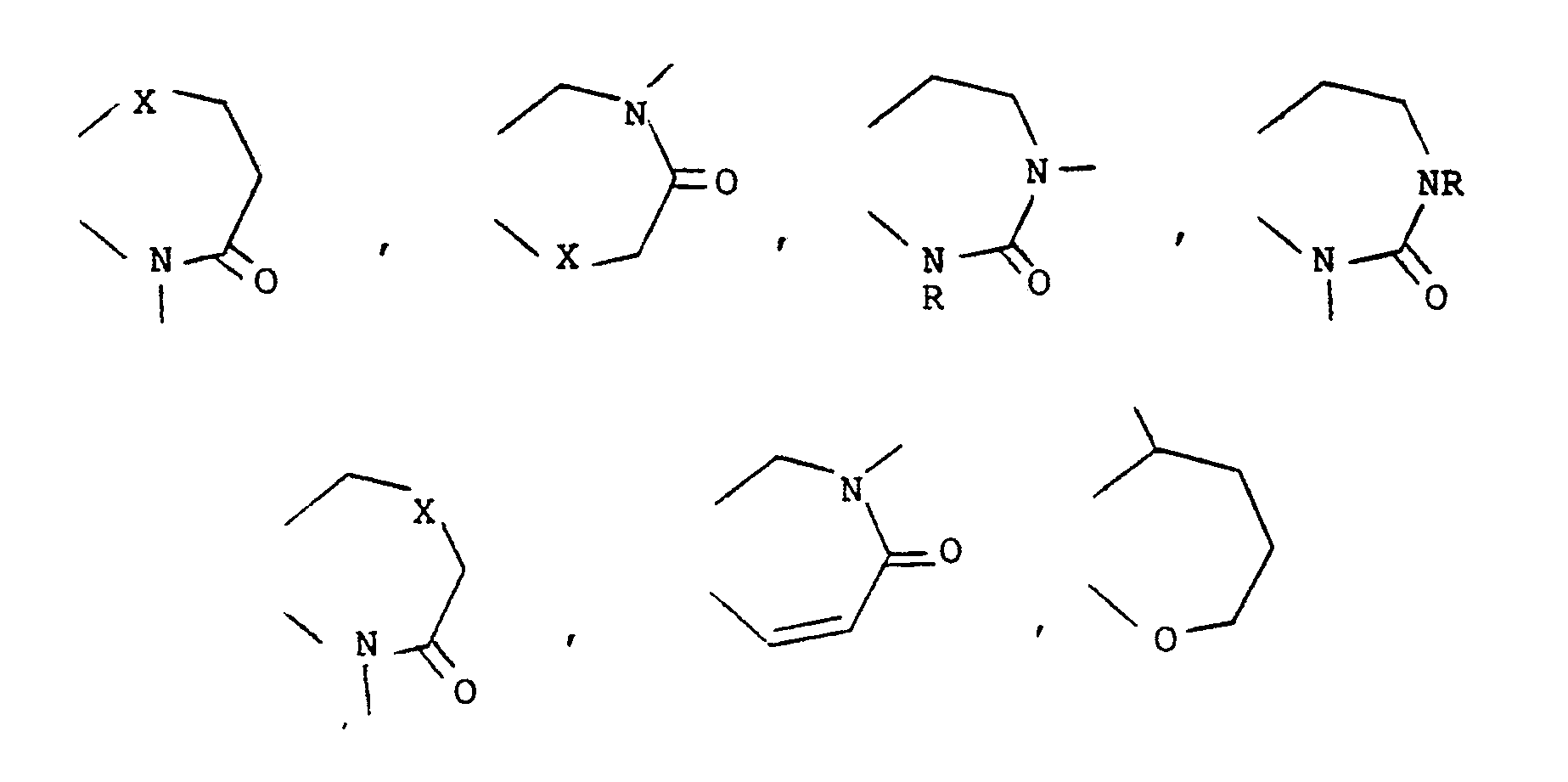
wherein X is O, S, SO₂, NH, N-C₁₋₆alkyl or CH₂.
4. A compound according to any one of claims 1 to 3 wherein one of Ra and Rb is hydrogen and the other is CH₂NH₂, CO₂H, CH₂NHCH₂CO₂H or SO₂CH₂CO₂H.
5. A compound according to any one of claims 1 to 4 wherein the amino acid residue containing R₂ is Leu, β-pyrazolylalanine or His.
6. A compound according to claim 1 of formula (IA) or a pharmaceutically acceptable salt thereof:

wherein
X is Phe;
Y is Leu or His;
R₃¹ is cyclohexylmethyl;
R₄¹ is C₄₋₅ alkyl and s is 0 or s is 2 to 4 and R₄¹ is carboxy or a saturated or unsaturated heterocyclic ring; and
the remaining variables are as defined in claim 1.
X is Phe;
Y is Leu or His;
R₃¹ is cyclohexylmethyl;
R₄¹ is C₄₋₅ alkyl and s is 0 or s is 2 to 4 and R₄¹ is carboxy or a saturated or unsaturated heterocyclic ring; and
the remaining variables are as defined in claim 1.
7. A compound according to any one of claims 1 to 6 wherein E is (CH₂)n wherein n is 1, 2 or 3 and E is attached at Z₄ or Z₅.
8. A compound according to any one of claims 1 to 7 wherein the sequence from the amino acid containing R₃ or R₃¹ to NH(CH₂)sR₄, is 4(S)amino-5-cyclohexyl-3(S)-hydroxypentanoic acid (ACHPA).
9. A compound according to any one of claims 1 to 8 wherein s is 0 and R₄ is isobutyl or s is 2, 3 or 4 and R₄ is 1-imidazolyl, 2-imidazolyl, 4-morpholinyl, 2-oxopyrrolidin-1-yl, 2-pyridyl, 2-pyridyl-N-oxide, 3-pyridyl, hydroxyethyl, acetylamino, 4-methylpiperazin-1-yl, piperazin-1-yl or dimethylamino.
10. A compound selected from the group consisting of:
chromanyl-4-acetyl-Phe-Leu-ACHPA isobutylamide,
2,3-dihydro-6-methyl-3-oxo-4H-1,4-benzoxazine-4-acetyl-Phe-Leu-ACHPA isobutylamide,
1,1-dioxothiachromanylidene-4-acetyl-Phe-Leu-ACHPA isobutylamide,
1,1-dioxothiachromanyl-4-acetyl-Phe-Leu-ACHPA isobutylamide,
6-cyano-2,3-dihydro-3-oxo-4H-1,4-benzoxazine-4-propanoyl-Phe-Leu-ACHPA isobutylamide,
2,3-dihydro-3-oxo-4H-1,4-benzothiazine-4-propanoyl-Phe-Leu-ACHPA isobutylamide,
2,3-dihydro-1,1,3-trioxo-4H-1,4-benzothiazine-4-propanoyl-Phe-Leu-ACHPA isobutylamide,
2,3-dihydro-1,1,3-trioxo-4H-1,4-benzothiazine-4-propanoyl-Phe-Leu-ACHPA 3-(1-imidazolyl)propylamide,
2,3-dioxo-1,2,3,4-tetrahydroquinoxaline-1-acetyl-Phe-Leu-ACHPA isobutylamide,
6-(BOC-aminomethyl)-2,3-dihydro-3-oxo-4H-1,4-benzoxazine-4-propanoyl-Phe-Leu-ACHPA 3-(1-imidazolyl)propylamide,
6-(aminomethyl)-2,3-dihydro-3-oxo-4H-1,4-benzoxazine-4-propanoyl-Phe-Leu-ACHPA 3-(1-imidazolyl)propylamide,
3-(1,2,3,4-tetrahydroisoquinolin-2-yl)propanoyl-Phe-Leu-ACHPA 3-(1-imidazolyl)propylamide,
2,3-dihydro-3-oxo-4H-1,4-benzothiazine-2-acetyl-Phe-Leu-ACHPA 3-(1-imidazolyl)propylamide,
6-benzyloxycarbonyl-2,3-dihydro-3-oxo-4H-1,4-benzoxazine-4-propanoyl-Phe-Leu-ACHPA 3-(1-imidazolyl)propylamide,
6-carboxy-2,3-dihydro-3-oxo-4H-1,4-benzoxazine-4-propanoyl-Phe-Leu-ACHPA 3-(1-imidazolyl)propylamide,
6-(benzyloxycarbonylmethyl)-2,3-dihydro-3-oxo-4H-1,4-benzoxazine-4-propanoyl-Phe-Leu-ACHPA 3-(1-imidazolyl)propylamide,
6-(carboxymethyl)-2,3-dihydro-3-oxo-4H-1,4-benzoxazine-4-propanoyl-Phe-Leu-ACHPA 3-(1-imidazolyl)propylamide,
3,4-dihydro-4-oxo-1,5-benzothiazepine-5(2H)-propanoyl-Phe-Leu-ACHPA 3-(1-imidazolyl)propylamide,
3,4-dihydro-1,1,4-trioxo-1,5-benzothiazepine-5(2H)-propanoyl-Phe-Leu-ACHPA 3-(1-imidazolyl)propylamide,
6-(BOC-aminomethyl)-2,3-dihydro-3-oxo-4H-1,4-benzo-thiazine-4-propanoyl-Phe-Leu-ACHPA 3-(1-imidazolyl)propylamide,
6-(aminomethyl)-2,3-dihydro-3-oxo-4H-1,4-benzothiazine-4-propanoyl-Phe-Leu-ACHPA 3-(1-imidazolyl)propylamide and
6-(aminomethyl)-2,3-dihydro-1,1,3-trioxo-4H-1,4-benzothiazine-4-propanoyl-Phe-Leu-ACHPA 3-(1-imidazolyl)propylamide.
chromanyl-4-acetyl-Phe-Leu-ACHPA isobutylamide,
2,3-dihydro-6-methyl-3-oxo-4H-1,4-benzoxazine-4-acetyl-Phe-Leu-ACHPA isobutylamide,
1,1-dioxothiachromanylidene-4-acetyl-Phe-Leu-ACHPA isobutylamide,
1,1-dioxothiachromanyl-4-acetyl-Phe-Leu-ACHPA isobutylamide,
6-cyano-2,3-dihydro-3-oxo-4H-1,4-benzoxazine-4-propanoyl-Phe-Leu-ACHPA isobutylamide,
2,3-dihydro-3-oxo-4H-1,4-benzothiazine-4-propanoyl-Phe-Leu-ACHPA isobutylamide,
2,3-dihydro-1,1,3-trioxo-4H-1,4-benzothiazine-4-propanoyl-Phe-Leu-ACHPA isobutylamide,
2,3-dihydro-1,1,3-trioxo-4H-1,4-benzothiazine-4-propanoyl-Phe-Leu-ACHPA 3-(1-imidazolyl)propylamide,
2,3-dioxo-1,2,3,4-tetrahydroquinoxaline-1-acetyl-Phe-Leu-ACHPA isobutylamide,
6-(BOC-aminomethyl)-2,3-dihydro-3-oxo-4H-1,4-benzoxazine-4-propanoyl-Phe-Leu-ACHPA 3-(1-imidazolyl)propylamide,
6-(aminomethyl)-2,3-dihydro-3-oxo-4H-1,4-benzoxazine-4-propanoyl-Phe-Leu-ACHPA 3-(1-imidazolyl)propylamide,
3-(1,2,3,4-tetrahydroisoquinolin-2-yl)propanoyl-Phe-Leu-ACHPA 3-(1-imidazolyl)propylamide,
2,3-dihydro-3-oxo-4H-1,4-benzothiazine-2-acetyl-Phe-Leu-ACHPA 3-(1-imidazolyl)propylamide,
6-benzyloxycarbonyl-2,3-dihydro-3-oxo-4H-1,4-benzoxazine-4-propanoyl-Phe-Leu-ACHPA 3-(1-imidazolyl)propylamide,
6-carboxy-2,3-dihydro-3-oxo-4H-1,4-benzoxazine-4-propanoyl-Phe-Leu-ACHPA 3-(1-imidazolyl)propylamide,
6-(benzyloxycarbonylmethyl)-2,3-dihydro-3-oxo-4H-1,4-benzoxazine-4-propanoyl-Phe-Leu-ACHPA 3-(1-imidazolyl)propylamide,
6-(carboxymethyl)-2,3-dihydro-3-oxo-4H-1,4-benzoxazine-4-propanoyl-Phe-Leu-ACHPA 3-(1-imidazolyl)propylamide,
3,4-dihydro-4-oxo-1,5-benzothiazepine-5(2H)-propanoyl-Phe-Leu-ACHPA 3-(1-imidazolyl)propylamide,
3,4-dihydro-1,1,4-trioxo-1,5-benzothiazepine-5(2H)-propanoyl-Phe-Leu-ACHPA 3-(1-imidazolyl)propylamide,
6-(BOC-aminomethyl)-2,3-dihydro-3-oxo-4H-1,4-benzo-thiazine-4-propanoyl-Phe-Leu-ACHPA 3-(1-imidazolyl)propylamide,
6-(aminomethyl)-2,3-dihydro-3-oxo-4H-1,4-benzothiazine-4-propanoyl-Phe-Leu-ACHPA 3-(1-imidazolyl)propylamide and
6-(aminomethyl)-2,3-dihydro-1,1,3-trioxo-4H-1,4-benzothiazine-4-propanoyl-Phe-Leu-ACHPA 3-(1-imidazolyl)propylamide.
11. A process for the preparation of a compound according to claim 1, which process comprises reacting a reagent of the formula (III):
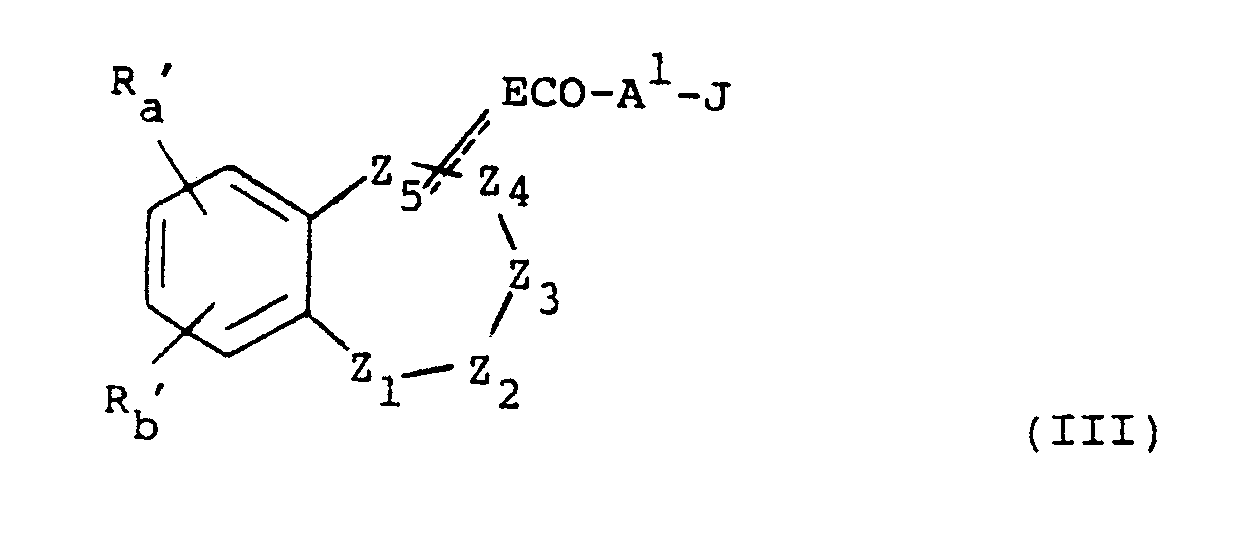
wherein Ra′ and Rb′ are Ra and Rb respectively or groups or atoms convertible thereto; A¹ is absent or represents an appropriate amino acid or dipeptide unit; J is OH or a leaving group; and the remaining variables are as defined in claim 1; with a reagent of the formula (IV):

wherein
A² is absent or represents an appropriate amino acid or dipeptide unit, such that A¹ + A² is -NHCHR₁CONHCHR₂CO-, and the remaining variables are as defined in claim 1; and thereafter, if desired or necessary deprotecting (within A¹ or A²) of the products, and/or converting Z₁, Z₂, Z₃, Z₄ or Z₅ to other Z₁, Z₂ Z₃, Z₄ or Z₅, Ra′/Rb′ to Ra and/or Rb and/or forming a pharmaceutically acceptable salt thereof.
A² is absent or represents an appropriate amino acid or dipeptide unit, such that A¹ + A² is -NHCHR₁CONHCHR₂CO-, and the remaining variables are as defined in claim 1; and thereafter, if desired or necessary deprotecting (within A¹ or A²) of the products, and/or converting Z₁, Z₂, Z₃, Z₄ or Z₅ to other Z₁, Z₂ Z₃, Z₄ or Z₅, Ra′/Rb′ to Ra and/or Rb and/or forming a pharmaceutically acceptable salt thereof.
12. A pharmaceutical composition comprising a compound according to any one of claims 1 to 10, and a pharmaceutically acceptable carrier.
13. A compound according to any one of claims 1 to 10 for use as an active therapeutic substance.
14. A compound according to any one of claims 1 to 10 for use in the treatment of hypertension.
15. Use of a compound according to any one of claims 1 to 10 in the manufacture of a medicament for use in the treatment of hypertension.
Applications Claiming Priority (6)
| Application Number | Priority Date | Filing Date | Title |
|---|---|---|---|
| GB898912989A GB8912989D0 (en) | 1989-06-06 | 1989-06-06 | Novel compounds |
| GB8912989 | 1989-06-06 | ||
| GB898918073A GB8918073D0 (en) | 1989-08-08 | 1989-08-08 | Novel compounds |
| GB8918073 | 1989-08-08 | ||
| GB898927875A GB8927875D0 (en) | 1989-12-08 | 1989-12-08 | Pharmaceuticals |
| GB8927875 | 1989-12-08 |
Publications (1)
| Publication Number | Publication Date |
|---|---|
| EP0411751A1 true EP0411751A1 (en) | 1991-02-06 |
Family
ID=27264512
Family Applications (1)
| Application Number | Title | Priority Date | Filing Date |
|---|---|---|---|
| EP90305978A Withdrawn EP0411751A1 (en) | 1989-06-06 | 1990-05-31 | Renin inhibitory peptides |
Country Status (6)
| Country | Link |
|---|---|
| EP (1) | EP0411751A1 (en) |
| JP (1) | JPH0341090A (en) |
| KR (1) | KR910000681A (en) |
| AU (1) | AU5625690A (en) |
| CA (1) | CA2018112A1 (en) |
| PT (1) | PT94255A (en) |
Cited By (5)
| Publication number | Priority date | Publication date | Assignee | Title |
|---|---|---|---|---|
| US5545640A (en) * | 1995-04-04 | 1996-08-13 | Bio-Mega/Boehringer Ingeleheim Research Inc. | Protease inhibiting succinic acid derivatives |
| WO1999009991A1 (en) * | 1997-08-22 | 1999-03-04 | Kaken Pharmaceutical Co., Ltd. | Novel amide derivatives |
| WO2007010383A1 (en) | 2005-07-22 | 2007-01-25 | Mochida Pharmaceutical Co., Ltd. | Novel heterocyclidene acetamide derivative |
| RU2451014C2 (en) * | 2005-07-22 | 2012-05-20 | Мотида Фармасьютикал Ко., Лтд. | Novel heterocyclidene acetamide derivative |
| US9096546B2 (en) | 2007-05-10 | 2015-08-04 | Albany Molecular Research, Inc. | Aryl- and heteroaryl-substituted tetrahydrobenzo-1,4-diazepines and use thereof to block reuptake of norepinephrine, dopamine, and serotonin |
Families Citing this family (1)
| Publication number | Priority date | Publication date | Assignee | Title |
|---|---|---|---|---|
| AU2004268455B2 (en) * | 2003-08-29 | 2009-12-17 | Ono Pharmaceutical Co., Ltd. | Compound capable of binding S1P receptor and pharmaceutical use thereof |
Citations (1)
| Publication number | Priority date | Publication date | Assignee | Title |
|---|---|---|---|---|
| WO1988003022A1 (en) * | 1986-10-31 | 1988-05-05 | Pfizer Inc. | Relatively low molecular weight polypeptides as renin inhibitors |
-
1990
- 1990-05-31 EP EP90305978A patent/EP0411751A1/en not_active Withdrawn
- 1990-06-04 AU AU56256/90A patent/AU5625690A/en not_active Abandoned
- 1990-06-04 CA CA002018112A patent/CA2018112A1/en not_active Abandoned
- 1990-06-04 PT PT94255A patent/PT94255A/en not_active Application Discontinuation
- 1990-06-05 KR KR1019900008340A patent/KR910000681A/en not_active Withdrawn
- 1990-06-06 JP JP2146405A patent/JPH0341090A/en active Pending
Patent Citations (1)
| Publication number | Priority date | Publication date | Assignee | Title |
|---|---|---|---|---|
| WO1988003022A1 (en) * | 1986-10-31 | 1988-05-05 | Pfizer Inc. | Relatively low molecular weight polypeptides as renin inhibitors |
Non-Patent Citations (1)
| Title |
|---|
| PEPTIDES: PROCEEDINGS OF THE TENTH AMERICAN PEPTIDE SYMPOSIUM, St. Louis, Missouri, 23rd - 28th May 1987, ed. G.R. MARSHALL, 1987, pages 474-475, ESCOM, Leiden, NL; D.J. KEMPF et al.: "Renin inhibitors based on novel dipeptide analogs: Increased efficacy through systematic inclusion of polar functionality" * |
Cited By (14)
| Publication number | Priority date | Publication date | Assignee | Title |
|---|---|---|---|---|
| US5545640A (en) * | 1995-04-04 | 1996-08-13 | Bio-Mega/Boehringer Ingeleheim Research Inc. | Protease inhibiting succinic acid derivatives |
| US7279573B2 (en) | 1997-08-22 | 2007-10-09 | Kaken Pharmaceutical Co., Ltd. | Amide derivatives |
| WO1999009991A1 (en) * | 1997-08-22 | 1999-03-04 | Kaken Pharmaceutical Co., Ltd. | Novel amide derivatives |
| US6864250B1 (en) | 1997-08-22 | 2005-03-08 | Kaken Pharmaceutical Co., Ltd. | N-acylated lipophilic amino acid derivatives |
| US7064121B2 (en) | 1997-08-22 | 2006-06-20 | Kaken Pharmaceutical Co., Ltd. | N-acylated lipophilic amino acid derivatives |
| EP1908753A4 (en) * | 2005-07-22 | 2009-11-11 | Mochida Pharm Co Ltd | NEW HETEROCYCLIDENE ACETAMIDE DERIVATIVE |
| WO2007010383A1 (en) | 2005-07-22 | 2007-01-25 | Mochida Pharmaceutical Co., Ltd. | Novel heterocyclidene acetamide derivative |
| US7910751B2 (en) | 2005-07-22 | 2011-03-22 | Mochida Pharmaceutical Co., Ltd. | Heterocyclidene acetamide derivative |
| AU2006271297B2 (en) * | 2005-07-22 | 2012-02-02 | Mochida Pharmaceutical Co., Ltd. | Novel heterocyclidene acetamide derivative |
| RU2451014C2 (en) * | 2005-07-22 | 2012-05-20 | Мотида Фармасьютикал Ко., Лтд. | Novel heterocyclidene acetamide derivative |
| AU2006271297C1 (en) * | 2005-07-22 | 2012-06-14 | Mochida Pharmaceutical Co., Ltd. | Novel heterocyclidene acetamide derivative |
| US8383839B2 (en) | 2005-07-22 | 2013-02-26 | Mochida Pharmaceutical Co., Ltd. | Heterocyclidene acetamide derivative |
| NO341962B1 (en) * | 2005-07-22 | 2018-03-05 | Mochida Pharm Co Ltd | New heterocyclidene acetamide derivative |
| US9096546B2 (en) | 2007-05-10 | 2015-08-04 | Albany Molecular Research, Inc. | Aryl- and heteroaryl-substituted tetrahydrobenzo-1,4-diazepines and use thereof to block reuptake of norepinephrine, dopamine, and serotonin |
Also Published As
| Publication number | Publication date |
|---|---|
| PT94255A (en) | 1991-02-08 |
| CA2018112A1 (en) | 1990-12-06 |
| KR910000681A (en) | 1991-01-30 |
| JPH0341090A (en) | 1991-02-21 |
| AU5625690A (en) | 1990-12-13 |
Similar Documents
| Publication | Publication Date | Title |
|---|---|---|
| EP0445467A1 (en) | Renin inhibitors and antiviral agents | |
| JP2515019B2 (en) | Amino acid derivatives | |
| AU653682B2 (en) | Dipeptide derivatives | |
| KR100662309B1 (en) | Melanocortin Receptor Ligand | |
| AU703744B2 (en) | Pyridinone-thrombin inhibitors | |
| US6350760B1 (en) | Substituted piperidines as melanocortin-4 receptor agonists | |
| NO177747B (en) | Analogous Process of Preparing Therapeutically Active Cycloalkyl Substituted Glutaramide | |
| JPH05230027A (en) | Amido-substituted derivatives of spiroindanyl camphor sulfonyloxytocin antagonists | |
| AU4849390A (en) | Heterocyclic peptide renin inhibitors | |
| JP2005504028A (en) | Substituted piperidines as modulators of melanocortin receptors | |
| CZ26396A3 (en) | Novel perhydroisoindole derivatives, process of their preparation and pharmaceutical compositions containing thereof | |
| CZ576590A3 (en) | Derivatives of amino acids, process of their preparation, their use and medicaments based thereon | |
| PH26816A (en) | Diol-containing renin inhibitors | |
| JPH06505474A (en) | Endothelin convertase inhibitor | |
| EP0416740A2 (en) | Novel compounds with renin-inhibiting activity | |
| CZ52893A3 (en) | 1-£2-(arylsulfonylamino)-1-oxoethyl|piperidine derivatives, process of their preparation and pharmaceutical preparations in which they are comprised | |
| JP3654908B2 (en) | Acylaminoalkenylene-amide derivatives as NK1 and NK2 antagonists | |
| JPS6210519B2 (en) | ||
| AU653059B2 (en) | Substituted amide derivatives of piperizinylcamphorsulfonyl oxytocin antagonists | |
| JPH09500133A (en) | Substituted piperazinyl camphor derivatives as antagonists of oxytocin | |
| CA2018112A1 (en) | Compounds | |
| EP0350163A2 (en) | Renin inhibitory peptides | |
| EP0375451A2 (en) | Compounds having a renin-inhibiting activity | |
| JPH1087567A (en) | Phenol ester derivatives, their production and use | |
| CA2004001A1 (en) | Amino acid derivatives |
Legal Events
| Date | Code | Title | Description |
|---|---|---|---|
| PUAI | Public reference made under article 153(3) epc to a published international application that has entered the european phase |
Free format text: ORIGINAL CODE: 0009012 |
|
| AK | Designated contracting states |
Kind code of ref document: A1 Designated state(s): AT BE CH DE DK ES FR GB GR IT LI LU NL SE |
|
| STAA | Information on the status of an ep patent application or granted ep patent |
Free format text: STATUS: THE APPLICATION IS DEEMED TO BE WITHDRAWN |
|
| 18D | Application deemed to be withdrawn |
Effective date: 19910807 |