EP0411159B1 - Method for determining enzymatic activity - Google Patents
Method for determining enzymatic activity Download PDFInfo
- Publication number
- EP0411159B1 EP0411159B1 EP90903917A EP90903917A EP0411159B1 EP 0411159 B1 EP0411159 B1 EP 0411159B1 EP 90903917 A EP90903917 A EP 90903917A EP 90903917 A EP90903917 A EP 90903917A EP 0411159 B1 EP0411159 B1 EP 0411159B1
- Authority
- EP
- European Patent Office
- Prior art keywords
- acetyl
- substrate
- activity
- enzyme
- assay
- Prior art date
- Legal status (The legal status is an assumption and is not a legal conclusion. Google has not performed a legal analysis and makes no representation as to the accuracy of the status listed.)
- Expired - Lifetime
Links
Images
Classifications
-
- C—CHEMISTRY; METALLURGY
- C12—BIOCHEMISTRY; BEER; SPIRITS; WINE; VINEGAR; MICROBIOLOGY; ENZYMOLOGY; MUTATION OR GENETIC ENGINEERING
- C12Q—MEASURING OR TESTING PROCESSES INVOLVING ENZYMES, NUCLEIC ACIDS OR MICROORGANISMS; COMPOSITIONS OR TEST PAPERS THEREFOR; PROCESSES OF PREPARING SUCH COMPOSITIONS; CONDITION-RESPONSIVE CONTROL IN MICROBIOLOGICAL OR ENZYMOLOGICAL PROCESSES
- C12Q1/00—Measuring or testing processes involving enzymes, nucleic acids or microorganisms; Compositions therefor; Processes of preparing such compositions
- C12Q1/34—Measuring or testing processes involving enzymes, nucleic acids or microorganisms; Compositions therefor; Processes of preparing such compositions involving hydrolase
- C12Q1/42—Measuring or testing processes involving enzymes, nucleic acids or microorganisms; Compositions therefor; Processes of preparing such compositions involving hydrolase involving phosphatase
-
- C—CHEMISTRY; METALLURGY
- C12—BIOCHEMISTRY; BEER; SPIRITS; WINE; VINEGAR; MICROBIOLOGY; ENZYMOLOGY; MUTATION OR GENETIC ENGINEERING
- C12Q—MEASURING OR TESTING PROCESSES INVOLVING ENZYMES, NUCLEIC ACIDS OR MICROORGANISMS; COMPOSITIONS OR TEST PAPERS THEREFOR; PROCESSES OF PREPARING SUCH COMPOSITIONS; CONDITION-RESPONSIVE CONTROL IN MICROBIOLOGICAL OR ENZYMOLOGICAL PROCESSES
- C12Q1/00—Measuring or testing processes involving enzymes, nucleic acids or microorganisms; Compositions therefor; Processes of preparing such compositions
- C12Q1/34—Measuring or testing processes involving enzymes, nucleic acids or microorganisms; Compositions therefor; Processes of preparing such compositions involving hydrolase
-
- C—CHEMISTRY; METALLURGY
- C12—BIOCHEMISTRY; BEER; SPIRITS; WINE; VINEGAR; MICROBIOLOGY; ENZYMOLOGY; MUTATION OR GENETIC ENGINEERING
- C12Q—MEASURING OR TESTING PROCESSES INVOLVING ENZYMES, NUCLEIC ACIDS OR MICROORGANISMS; COMPOSITIONS OR TEST PAPERS THEREFOR; PROCESSES OF PREPARING SUCH COMPOSITIONS; CONDITION-RESPONSIVE CONTROL IN MICROBIOLOGICAL OR ENZYMOLOGICAL PROCESSES
- C12Q2334/00—O-linked chromogens for determinations of hydrolase enzymes, e.g. glycosidases, phosphatases, esterases
-
- C—CHEMISTRY; METALLURGY
- C12—BIOCHEMISTRY; BEER; SPIRITS; WINE; VINEGAR; MICROBIOLOGY; ENZYMOLOGY; MUTATION OR GENETIC ENGINEERING
- C12Q—MEASURING OR TESTING PROCESSES INVOLVING ENZYMES, NUCLEIC ACIDS OR MICROORGANISMS; COMPOSITIONS OR TEST PAPERS THEREFOR; PROCESSES OF PREPARING SUCH COMPOSITIONS; CONDITION-RESPONSIVE CONTROL IN MICROBIOLOGICAL OR ENZYMOLOGICAL PROCESSES
- C12Q2334/00—O-linked chromogens for determinations of hydrolase enzymes, e.g. glycosidases, phosphatases, esterases
- C12Q2334/10—O-linked chromogens for determinations of hydrolase enzymes, e.g. glycosidases, phosphatases, esterases p-Nitrophenol derivatives
-
- G—PHYSICS
- G01—MEASURING; TESTING
- G01N—INVESTIGATING OR ANALYSING MATERIALS BY DETERMINING THEIR CHEMICAL OR PHYSICAL PROPERTIES
- G01N2333/00—Assays involving biological materials from specific organisms or of a specific nature
- G01N2333/90—Enzymes; Proenzymes
- G01N2333/914—Hydrolases (3)
- G01N2333/924—Hydrolases (3) acting on glycosyl compounds (3.2)
Definitions
- the present invention relates to an enzyme activity assay. More specifically, it relates to a method of assaying enzyme activity which involves using a substrate having a 3,4-dinitrophenoxy group at the end of a molecule, for assaying the activity of N-acetyl- ⁇ -D-glucosaminidase or N-acetyl- ⁇ -D-hexosaminidase, the activity of an acidic phosphatase, ⁇ -D-glucuronidase or ⁇ -D-galactosidase.
- the indication (absorbance) of the 3,4-dinitrophenol formed from the substrate is measured.
- NAGase N-acetyl- ⁇ -D-glucosaminidase or N-acetyl- ⁇ -D-hexosaminidase
- the prior art method uses p-nitrophenyl-N-acetyl- ⁇ -D-glucosaminide having a p-nitrophenoxy group at the end of a molecule as the substrate (with p-nitrophenol as aglycon), and quantitates by colorimetry the p-nitrophenol (aglycon) liberated by the action of the enzyme NAGase at a high pH region (see Method in Enzymology, Vol.
- the synthetic substrates obtained by synthesizing these acidic aglycons and N-acetyl- ⁇ -D-glucosamine have problems in that they are all difficult to dissolve in water, do not exhibit a satisfactory ionized color formation at a low pH, are per se unstable, and cause problems in enzyme reactions due to the bulky substituents at the 2-position.
- 2-chloro-4-nitrophenyl-N-acetyl- ⁇ -D-glucosaminide is difficult to dissolve in water, and therefore, the substrate cannot be sufficiently dissolved, and thus the procedure of preparing the reagent and the assay accuracy are markedly adversely affected and a satisfactory assay method cannot be obtained for practical application.
- a 2,4-dinitrophenyl-N-acetyl- ⁇ -D-glucosaminide substrate can be synthesized only with difficulty, and its yield is at most only 5%, even when using a synthetic method considered most suitable as a result of an investigation of various reaction conditions: This is due to the instability of this substance, and the utmost care must be taken to prevent hydrolysis even during the recrystallization at the final stage ( supra , J. Biol. Chem., Vol. 255, p. 11861 - 11869, 1980).
- Table 1 Enzyme Substrate N-acetyl- ⁇ -D-glucosaminidase (hexosaminidase) p-nitrophenyl-N-acetyl- ⁇ -D-glucosaminide (hexosaminide) ⁇ -D-glucosidase p-nitrophenyl- ⁇ -D-glucopyranoside ⁇ -D-glucosidase p-nitrophenyl- ⁇ -D-glucopyranoside ⁇ -D-galactosidase o-nitrophenyl- ⁇ -D-galactoside phosphatase p-nitrophenylphosphoric acid ⁇ -D-glucuronidase p-nitrophenyl- ⁇ -D-glucuronide esterase p-nitrophenylacetic acid allylsulphatase p-nitrophenylsulfuric acid
- An object of the present invention is to provide a method in which the substrate is sufficiently soluble in water and is stable when used as the substrate for a rate assay of NAGase or phosphatase, ⁇ -galactosidase, and ⁇ -glucuronidase, and further, exhibits an excellent color formability and quantitativity in the acidic pH region, and in which enzyme activity assay method an indication (absorbance) of 3,4-dinitrophenol formed from the substrate is employed.
- a method of assaying the activity of any one of the enzymes N-acetyl- ⁇ -D-glucosaminidase or N-acetyl- ⁇ -D-hexosaminidase activity, an acidic phosphatase, ⁇ -D-galactosidase or ⁇ -D-glucuronidase which comprises measuring the color indication (absorbance) of 3, 4-dinitrophenol formed by the action of the enzyme on a substrate molecule having a 3,4-dinitrophenoxy group at the end of the molecule.
- Examples of the method of the invention include an assay of N-acetyl- ⁇ -D-glucosaminidase or N-acetyl- ⁇ -D-hexosaminidase activity, or the activity of acidic phosphatase in a sample taken from a living body, and an assay of the activity of ⁇ -galactosidase or phosphatase to be used as a suitable labelling enzyme, and which makes use of a substrate having a 3,4-dinitrophenoxy group at the end of a molecule.
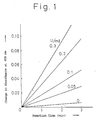
- FIG. 1 is a graph showing the correlation between the enzyme (NAGase) amount and absorbance change in Example 3.
- the present inventors carried out intensive investigations into the electron state of a benzene ring, and the stereospecific reactivity to obtain a nitrophenol compound instead of the above-described p-nitrophenol, and consequently, found that 3,4-dinitrophenol is suitable for the above-mentioned purpose from the standpoint that it is a derivative having a necessary acidity and does not have a bulky substituent at a position adjacent to the phenolic hydroxyl group, and synthesized various substrates with a 3,4-dinitrophenol bound to the end of a molecule to thereby accomplish the present invention.
- the 3,4-dinitrophenol per se to be used in the present invention is a known compound, but no report has been made public about the synthesis of N-acetyl- ⁇ -D-glucosaminide having this compound (bound) at the end of a molecule, and the properties are also unknown. Further, no report at all has been made about the utilization thereof for the substrate for an activity assay of enzymes in a living body, such as NAGase and phosphatase, and the substrate for measuring the activity of a labeled enzyme such as ⁇ -D-galactosidase.
- the 3,4-dinitrophenol to be used in the present invention is easily dissolved when bound to the end of a substrate molecule, and can be used as the enzyme substrate without the need for a dissolving auxiliary agent. Namely, when 3,4-dinitrophenol is bound to the end of N-acetyl- ⁇ -D-glucosaminide, an aqueous solution with a concentration having an extremely high practical applicability of 12 mM can be prepared, but the solution is very stable when stored at low temperatures.
- a solubilizing auxiliary agent such as cyclodextrin and crown ether
- the present invention (i) improves to a great extent the solubility and stability (storability) of the substrate in an aqueous solution of the acting pH of enzyme (neutral or acidic side), and (ii) makes the indication (absorbance measurement) pH of the measurement index substance (3,4-dinitrophenol) derived from of the enzyme reaction identical to or close to the acting pH of enzyme, and thus a correct and precise rate analysis is obtained.
- the purified condensed product was dissolved in methanol, and deacetylated with a small amount of sodium methylate as the catalyst, to give substantially quantitatively 3,4-dinitrophenyl-N-acetyl- ⁇ -D-glucosaminide, which was purified by recrystallization from hot ethanol.
- the 3,4-dinitrophenyl-N-acetyl- ⁇ -D-glucosaminide (hereinafter also called 3,4-DNG) was found to have sufficient water solubility to be used as the substrate, and an aqueous solution with a concentration of 12 mM sufficient for a NAGase activity assay was easily prepared. Also, the aqueous solution was found to be stable under ice-cooling, with only about a 1% decomposition occurring when left to stand at room temperature overnight, and the decomposition ratio under enzyme reaction conditions (pH 5, 37°C) for one hour being only 1.5%. The spectrum had a strong absorption at UV-ray 290 nm, but exhibited substantially no absorption at a visible portion 400 nm, and thus was optically remarkably distinguishable.
- Both of the above had solubilities of at least 10 mM, and the respective enzyme activities were assayed with urine and serum as the test samples, using substrates for an activity assay of ⁇ -D-galactosidase, ⁇ -D-glucuronidase, and phosphatase in a 20 mM phosphate buffer (pH 6.5) for galactosidase (derived from E. Coli), and in a 50 mM acetate buffer (pH 5.0) and a 40 mM citrate buffer (pH 5.1) for glucuronidase and acidic phosphatase.
- a reaction mixture containing 1.5 ml of a 0.2 M citrate buffer (pH 5) and 1.2 mM of 3,4-DNG (made up to a volume of 3 ml by an addition of an enzyme solution during the reaction) was equilibrated at 37°C, set in a spectrophotometer, and then 100 ⁇ l of an NAGase solution (enzyme of human placenta manufactured by Sigma, with activity values according to the standard assay method, Method in Enzymology, Vol 28, p.
- the calibration curve when the standard products were employed exhibited a linearity up to at least 200 U/liter, and the correlation with the 2-chloro-4-nitrophenyl-N-acetyl- ⁇ -D-glucosaminide substrate method also was good.
- NAGase activity assay values in living body fluids were as shown in Table 2.
- Table 2 Method of Invention 2-CNP-NAG method Urine-1 5.9 U/liter 5.2 U/liter Urine-2 8.5 U/liter 8.3 U/liter Urine-3 2.8 U/liter 2.6 U/liter Urine-4 10.4 U/liter 10.0 U/liter Note: 2-CNP-NAG method refers to 2-chloro-4-nitrophenyl-N-acetyl- ⁇ -D-glucosaminide substrate method.
- the calibration curve when the standard products were employed exhibited a linearity up to at least 200 U/liter, and the correlation with the p-nitrophenylphosphoric acid substrate method also was good.
- PNP-phosphoric acid method Serum-1 3.8 U/liter 3.5 U/liter Serum-2 7.2 U/liter 7.1 U/liter Serum-3 14.2 U/liter 13.5 U/liter Serum-4 2.5 U/liter 2.5 U/liter Note: PNP-phosphoric acid method refers to p-nitrophenylphospholic acid substrate method
- CD cyclodextrins
- the NAGase is measured based on Example 3, to obtain a similar good sensitization effect.
- the essence of the present invention resides in an assay of activity of enzymes as listed in Claim 1 which makes use of substrates having at the end of a molecule a 3,4-dinitrophenol group, which is little affected by the pH and temperature and exhibits an excellent solubility as aglycon and further, includes the applications described above.
- the substrate for an enzyme reaction in a sample taken from a living body, the enzyme activity assay method, and the reagent for use in the assay according to the present invention, as described above, have a particular effect of greatly improving the precision of a rate assay of NAGase and phosphatase, ⁇ -D-glucuronidase, and ⁇ -D-galactosidase.
Landscapes
- Chemical & Material Sciences (AREA)
- Organic Chemistry (AREA)
- Life Sciences & Earth Sciences (AREA)
- Zoology (AREA)
- Wood Science & Technology (AREA)
- Proteomics, Peptides & Aminoacids (AREA)
- Health & Medical Sciences (AREA)
- Engineering & Computer Science (AREA)
- Microbiology (AREA)
- Immunology (AREA)
- Physics & Mathematics (AREA)
- Molecular Biology (AREA)
- Biotechnology (AREA)
- Biophysics (AREA)
- Analytical Chemistry (AREA)
- Biochemistry (AREA)
- Bioinformatics & Cheminformatics (AREA)
- General Engineering & Computer Science (AREA)
- General Health & Medical Sciences (AREA)
- Genetics & Genomics (AREA)
- Measuring Or Testing Involving Enzymes Or Micro-Organisms (AREA)
Abstract
Description
- The present invention relates to an enzyme activity assay. More specifically, it relates to a method of assaying enzyme activity which involves using a substrate having a 3,4-dinitrophenoxy group at the end of a molecule, for assaying the activity of N-acetyl-β-D-glucosaminidase or N-acetyl-β-D-hexosaminidase, the activity of an acidic phosphatase, β-D-glucuronidase or β-D-galactosidase. In the method, the indication (absorbance) of the 3,4-dinitrophenol formed from the substrate is measured.
- To carry out an assay of the activity of N-acetyl-β-D-glucosaminidase or N-acetyl-β-D-hexosaminidase (hereinafter abbreviated as NAGase), which are indispensable for an early diagnosis of various kidney diseases such as uriniferous tubule disorders and diabetic kidney disorders, the prior art method uses p-nitrophenyl-N-acetyl-β-D-glucosaminide having a p-nitrophenoxy group at the end of a molecule as the substrate (with p-nitrophenol as aglycon), and quantitates by colorimetry the p-nitrophenol (aglycon) liberated by the action of the enzyme NAGase at a high pH region (see Method in Enzymology, Vol. 28, p. 772 - 776). Also, a method is employed in which m-cresol-sulfophthaleinyl-N-acetyl-β-D-glucosaminide is used as the substrate (Japanese Unexamined Patent Publication (Kokai) No. 58-994, Rinsho Byori (Clinical pathology) XXXI: 2179 (1983)).
- Nevertheless, although the optimum pH for NAGase enzyme action is around 5 in the acidic side region, p-nitrophenol and the like do not indicate a required color formation unless in the alkali side region having a pH of 8 or higher. Accordingly, to make an assay of the activity of the enzyme NAGase, in all cases the operations of mixing the enzyme and the substrate to initiate the reaction, stopping the reaction by an addition of an alkali solution after a certain time, and subjecting the reaction mixture to a spectroscopic photometer must be carried out, and thus a drawback arises in that a rate analysis by monitoring under suitable conditions (i.e., rate assay) cannot be performed.
- Accordingly, to perform a rate assay, attempts have been made to develop an N-acetyl-β-D-glucosaminide substrate having a compound (aglycon) convertible to p-nitrophenol bound thereto, which forms color at around pH 5 on the acidic side where the action of the NAGase is adequate. For this purpose, the substrates with the following nitro compounds as the aglycon have been proposed (Japanese Unexamined Patent Publication (Kokai) No. 61-177999):
- (a) 2,4-dinitrophenol (J. Biol. Chem., Vol. 255, p. 11861 - 11869, 1980);
- (b) 2-chloro-4-nitrophenol (Japanese Unexamined Patent Publication (Kokai) No. 61-112092;
- (c) 2,5-dinitrophenol;
- (d) 2,6-dichloro-4-nitrophenol;
- (e) 2,6-dibromo-4-nitrophenol;
- (f) 2,3,6-trichloro-4-nitrophenol;
- (g) 2,3,5,6-tetrabromo-4-nitrophenol;
- (h) 2,3,5,6-tetrachloro-4-nitrophenol;
- (i) 7-sulfo-2,4-dinitro-1-naphthol (Japanese Unexamined Patent Publication (Kokai) No. 61-177999).
- Since all of the above compounds have a bulky electron-attracting group substituted at the position adjacent to the phenolic hydroxyl group, to provide the properties of intensifying the acidity and ionization at a low pH to effect a color formation, the substrates having these bound (as aglycon) at the end of a molecule were expected to compensate for the above-mentioned drawback possessed by p-nitrophenol.
- Nevertheless, the synthetic substrates obtained by synthesizing these acidic aglycons and N-acetyl-β-D-glucosamine have problems in that they are all difficult to dissolve in water, do not exhibit a satisfactory ionized color formation at a low pH, are per se unstable, and cause problems in enzyme reactions due to the bulky substituents at the 2-position. For example, 2-chloro-4-nitrophenyl-N-acetyl-β-D-glucosaminide is difficult to dissolve in water, and therefore, the substrate cannot be sufficiently dissolved, and thus the procedure of preparing the reagent and the assay accuracy are markedly adversely affected and a satisfactory assay method cannot be obtained for practical application.
- Also, a 2,4-dinitrophenyl-N-acetyl-β-D-glucosaminide substrate can be synthesized only with difficulty, and its yield is at most only 5%, even when using a synthetic method considered most suitable as a result of an investigation of various reaction conditions: This is due to the instability of this substance, and the utmost care must be taken to prevent hydrolysis even during the recrystallization at the final stage (supra, J. Biol. Chem., Vol. 255, p. 11861 - 11869, 1980).
- As described above, the problems concerning the substrate of NAGase were not solved by using the various nitrophenol compounds convertible to p-nitrophenol and proposed to date.
- The enzymes and substrates thereof to which the state of the art as described above is applicable are shown in Table 1.
Table 1 Enzyme Substrate N-acetyl-β-D-glucosaminidase (hexosaminidase) p-nitrophenyl-N-acetyl-β-D-glucosaminide (hexosaminide) α-D-glucosidase p-nitrophenyl-α-D-glucopyranoside β-D-glucosidase p-nitrophenyl-β-D-glucopyranoside β-D-galactosidase o-nitrophenyl-β-D-galactoside phosphatase p-nitrophenylphosphoric acid β-D-glucuronidase p-nitrophenyl-β-D-glucuronide esterase p-nitrophenylacetic acid allylsulphatase p-nitrophenylsulfuric acid - An object of the present invention is to provide a method in which the substrate is sufficiently soluble in water and is stable when used as the substrate for a rate assay of NAGase or phosphatase, β-galactosidase, and β-glucuronidase, and further, exhibits an excellent color formability and quantitativity in the acidic pH region, and in which enzyme activity assay method an indication (absorbance) of 3,4-dinitrophenol formed from the substrate is employed.
- According to the invention there is provided a method of assaying the activity of any one of the enzymes N-acetyl-β-D-glucosaminidase or N-acetyl-β-D-hexosaminidase activity, an acidic phosphatase, β-D-galactosidase or β-D-glucuronidase, which comprises measuring the color indication (absorbance) of 3, 4-dinitrophenol formed by the action of the enzyme on a substrate molecule having a 3,4-dinitrophenoxy group at the end of the molecule. Examples of the method of the invention include an assay of N-acetyl-β-D-glucosaminidase or N-acetyl-β-D-hexosaminidase activity, or the activity of acidic phosphatase in a sample taken from a living body, and an assay of the activity of β-galactosidase or phosphatase to be used as a suitable labelling enzyme, and which makes use of a substrate having a 3,4-dinitrophenoxy group at the end of a molecule.
- The accompanying drawing, figure 1, is a graph showing the correlation between the enzyme (NAGase) amount and absorbance change in Example 3.
- The present inventors carried out intensive investigations into the electron state of a benzene ring, and the stereospecific reactivity to obtain a nitrophenol compound instead of the above-described p-nitrophenol, and consequently, found that 3,4-dinitrophenol is suitable for the above-mentioned purpose from the standpoint that it is a derivative having a necessary acidity and does not have a bulky substituent at a position adjacent to the phenolic hydroxyl group, and synthesized various substrates with a 3,4-dinitrophenol bound to the end of a molecule to thereby accomplish the present invention.
- The 3,4-dinitrophenol per se to be used in the present invention is a known compound, but no report has been made public about the synthesis of N-acetyl-β-D-glucosaminide having this compound (bound) at the end of a molecule, and the properties are also unknown. Further, no report at all has been made about the utilization thereof for the substrate for an activity assay of enzymes in a living body, such as NAGase and phosphatase, and the substrate for measuring the activity of a labeled enzyme such as β-D-galactosidase.
- The 3,4-dinitrophenol to be used in the present invention is easily dissolved when bound to the end of a substrate molecule, and can be used as the enzyme substrate without the need for a dissolving auxiliary agent. Namely, when 3,4-dinitrophenol is bound to the end of N-acetyl-β-D-glucosaminide, an aqueous solution with a concentration having an extremely high practical applicability of 12 mM can be prepared, but the solution is very stable when stored at low temperatures. In contrast, for example, 2-chloro-4-nitrophenol has an acidity of pk = 5.5, but 2-chloro-4-nitrophenyl-N-acetyl-β-D-glucosaminide prepared therefrom is difficult to dissolve, and when introducing same into an assaying kit, a sufficient solubility must be obtained by an addition of a solubilizing auxiliary agent such as cyclodextrin and crown ether, and therefore, the performance thereof as the reagent for the assay is not satisfactory.
- By introducing a 3,4-dinitrophenyl group instead of the substrate having a p-nitrophenoxy group, at the end of a molecule, as in the prior art (with e.g. p-nitrophenol as the aglycon), the present invention (i) improves to a great extent the solubility and stability (storability) of the substrate in an aqueous solution of the acting pH of enzyme (neutral or acidic side), and (ii) makes the indication (absorbance measurement) pH of the measurement index substance (3,4-dinitrophenol) derived from of the enzyme reaction identical to or close to the acting pH of enzyme, and thus a correct and precise rate analysis is obtained.
-
- The present invention is described with reference to the Examples, but of course the scope of the present invention is not limited to these Examples.
- According to the method of Holleman (Receuil des Travaux Chimiques des Pays-Bas, Vol. 21, p. 432 - 447, 1902), starting from 20 g of m-nitrophenol, via nitration with conc. nitric acid and separation from the side reaction products, 12 g of a pure 3,4-dinitrophenol was synthesized. The melting point was 134°C, which coincided with the value given in the literature supra.
- Then, from 1 g of the 3,4-dinitrophenol synthesized above, a powder of
potassium 3,4-dinitrophenolate was prepared and was refluxed together with 2 g of 2-acetamide-2-deoxy-3,4,6-tri-O-acetyl-α-1-chloro-D-glucosaminide in dry acetone for about 3 hours, the acetone was distilled off, the condensed product dissolved in chloroform, and anunreacted substance 3,4-dinitrophenolate removed with a dil. alkali to give 1.5 g of the condensed product, which was purified by recrystallization from ethanol. Finally, the purified condensed product was dissolved in methanol, and deacetylated with a small amount of sodium methylate as the catalyst, to give substantially quantitatively 3,4-dinitrophenyl-N-acetyl-β-D-glucosaminide, which was purified by recrystallization from hot ethanol. - The 3,4-dinitrophenyl-N-acetyl-β-D-glucosaminide (hereinafter also called 3,4-DNG) was found to have sufficient water solubility to be used as the substrate, and an aqueous solution with a concentration of 12 mM sufficient for a NAGase activity assay was easily prepared. Also, the aqueous solution was found to be stable under ice-cooling, with only about a 1% decomposition occurring when left to stand at room temperature overnight, and the decomposition ratio under enzyme reaction conditions (pH 5, 37°C) for one hour being only 1.5%. The spectrum had a strong absorption at UV-ray 290 nm, but exhibited substantially no absorption at a
visible portion 400 nm, and thus was optically remarkably distinguishable. - Using 3,4-dinitrophenol synthesized according to the same method as in Example 1, and 2,3,4,6-tetra-O-acetyl-α-1-chloro-D-galactoside and 2,3,4-tri-O-acetyl-α-1-chloro-D-glucuronide-6-methyl ester, 1.3 g and 0.7 g of the condensed products were obtained, respectively, and after recrystallization from ethanol, deacetylated in the same manner as in Example 1, followed by purification by a recrystallization again from ethanol.
- Similarly, 3,4-dinitrophenol was reacted with 2 g of each of POCl₃ and H₃PO₄ in pyridine, to obtain 1.5 g of the condensed product, which was purified by recrystallization as sodium salt.
- Both of the above had solubilities of at least 10 mM, and the respective enzyme activities were assayed with urine and serum as the test samples, using substrates for an activity assay of β-D-galactosidase, β-D-glucuronidase, and phosphatase in a 20 mM phosphate buffer (pH 6.5) for galactosidase (derived from E. Coli), and in a 50 mM acetate buffer (pH 5.0) and a 40 mM citrate buffer (pH 5.1) for glucuronidase and acidic phosphatase.
- A reaction mixture containing 1.5 ml of a 0.2 M citrate buffer (pH 5) and 1.2 mM of 3,4-DNG (made up to a volume of 3 ml by an addition of an enzyme solution during the reaction) was equilibrated at 37°C, set in a spectrophotometer, and then 100 µl of an NAGase solution (enzyme of human placenta manufactured by Sigma, with activity values according to the standard assay method, Method in Enzymology, Vol 28, p. 772 - 776, prepared to 5 kinds of 0, 50 U/liter, 100 U/liter, 200 U/liter and 300 U/liter) was added, and the change with lapse of time of the absorbance at the wavelength of 400 nm was immediately monitored, to obtain the results shown in Fig. 1. A proportional relationship can be seen between the reaction rate corrected with the control, and the enzyme amount, thus indicating that the rate assay was made correctly. The change with a lapse of time of the absorbance without an enzyme addition (control) showed a high reproducibility, and the subsequent assay was continued after once taking the control.
-
3,4-DNG 1.2 mM Citrate buffer (pH 5.0) 0.1 M - Into 150 µl of a test sample was added 3 ml of the reagent heated at 37°C for 5 minutes, to carry out the reaction, and the absorbance change at 400 nm per unit time was measured with the reagent blank as a control.
- The calibration curve when the standard products were employed exhibited a linearity up to at least 200 U/liter, and the correlation with the 2-chloro-4-nitrophenyl-N-acetyl-β-D-glucosaminide substrate method also was good.
- The NAGase activity assay values in living body fluids were as shown in Table 2.
Table 2 Method of Invention 2-CNP-NAG method Urine-1 5.9 U/liter 5.2 U/liter Urine-2 8.5 U/liter 8.3 U/liter Urine-3 2.8 U/liter 2.6 U/liter Urine-4 10.4 U/liter 10.0 U/liter Note: 2-CNP-NAG method refers to 2-chloro-4-nitrophenyl-N-acetyl-β-D-glucosaminide substrate method. -
3,4-Dinitrophenylphosphoric acid 10 mM Citrate buffer (pH 5.1) 40 mM - Into 20 µl of a test sample was added 200 µl of the reagent heated at 37°C for 5 minutes, to carry out the reaction, and the absorbance change at 400 nm per unit time was measured with the reagent blank as a control.
- The calibration curve when the standard products were employed exhibited a linearity up to at least 200 U/liter, and the correlation with the p-nitrophenylphosphoric acid substrate method also was good.
- The acidic phosphatase activity assay values in living body fluids were as shown in Table 3.
Table 3 Method of Invention PNP-phosphoric acid method Serum-1 3.8 U/liter 3.5 U/liter Serum-2 7.2 U/liter 7.1 U/liter Serum-3 14.2 U/liter 13.5 U/liter Serum-4 2.5 U/liter 2.5 U/liter Note: PNP-phosphoric acid method refers to p-nitrophenylphospholic acid substrate method -
- R-1
- Citrate buffer (pH 5.0) 0.1 M
- R-2
- 0.1 M citrate buffer (pH 5.0) containing 6
mM 3,4-DNG - After 20 µl of the test sample and 0.4 ml of R-1 were heated at 37°C for 5 minutes, 0.1 ml of R-2 was added to carry out the reaction, followed by a measurement of the change in absorbance at 400 nm.
- Mayassay NAG-R R (sold by Sanko Junyaku) was used in accordance with the manufacturer's instructions.
-
-
Method A Method B 2 U/liter 10.8% 83.4% 51 U/liter 3.7% 4.9% - A great difference appears in the assay precision near the normal value (several U/ml) of NAGase in urine, and the assay results show the advantage of the method of the present invention having an excellent substrate solubility.
- The assay reagent compositions in the above examples are general, and various applications are possible for those skilled in the art.
- For example, it is possible to conveniently add various surfactants to prevent turbidity in the test sample, to add antiseptics, stabilizers, and further, to add cyclodextrin or various derivatives thereof, for enhancing the color formation sensitivity, relatively reducing the reagent blank value, migrating the 3,4-dinitrophenol pKa value to the acidic side, and increasing the implemented S/N ratio.
- The cyclodextrins (CD) shown below were prepared to a final concentration of 2.4 mM, and the sensitizing effects thereof on 3,4-DNP in a 0.1 M citrate buffer (pH 5.0) are shown.
CD Sensitization ratio (%) No addition 100 α-CD's 103 - 104 β-CD's 111 - 146 γ-CD's 106 - For β-CD with a high sensitization efficiency, the NAGase is measured based on Example 3, to obtain a similar good sensitization effect.
- Particularly, for DEAE(diethylaminoethyl)-β-CD with a high water solubility and high sensitization effect, a 2-fold or higher elevation of the sensitivity is exhibited at a final concentration of 24 mM.
- The essence of the present invention resides in an assay of activity of enzymes as listed in
Claim 1 which makes use of substrates having at the end of a molecule a 3,4-dinitrophenol group, which is little affected by the pH and temperature and exhibits an excellent solubility as aglycon and further, includes the applications described above. - The substrate for an enzyme reaction in a sample taken from a living body, the enzyme activity assay method, and the reagent for use in the assay according to the present invention, as described above, have a particular effect of greatly improving the precision of a rate assay of NAGase and phosphatase, β-D-glucuronidase, and β-D-galactosidase.
Claims (6)
- A method of assaying the activity of any one of the enzymes N-acetyl-β-D-glucosaminidase or N-acetyl-β-D-hexosaminidase, an acidic phosphatase, β-D-galactosidase or β-D-glucuronidase, which comprises measuring the color indication (absorbance) of 3,4-dinitrophenol formed by the action of the enzyme on a substrate molecule having a 3,4-dinitrophenoxy group at the end of the molecule.
- A method according to claim 1 wherein the enzyme activity to be assayed is that of N-acetyl-β-D-glucosaminidase or N-acetyl-β-D-hexosaminidase in a sample taken from a living body, and the substrate is 3,4-dinitrophenyl-N-acetyl-β-D-glucosaminide or 3,4-dinitrophenyl-N-acetyl-β-D-hexosaminide.
- A method according to claim 1 wherein the enzyme activity to be assayed is an acidic phosphatase activity, and the substrate is 3,4-dinitrophenylphosphoric acid or a salt thereof.
- A method according to claim 1, wherein the enzyme activity to be assayed is an activity of β-D-glucuronidase in a sample taken from a living body, and the substrate is 3,4-dinitrophenyl-β-D-glucuronide.
- A method according to claim 1, wherein the enzyme activity to be assayed is an activity of β-D-galactosidase, and the substrate is 3,4-dinitrophenyl-β-D-galactoside.
- A method of assaying an enzyme activity as claimed in any one of claims 1 to 5, carried out in the presence of cyclodextrin.
Applications Claiming Priority (3)
| Application Number | Priority Date | Filing Date | Title |
|---|---|---|---|
| JP141597/89 | 1989-02-23 | ||
| JP4159789 | 1989-02-23 | ||
| PCT/JP1990/000221 WO1990010084A1 (en) | 1989-02-23 | 1990-02-23 | Substrate for enzymatic activity determination and method and reagent for determining enzymatic activity using said substrate |
Publications (3)
| Publication Number | Publication Date |
|---|---|
| EP0411159A1 EP0411159A1 (en) | 1991-02-06 |
| EP0411159A4 EP0411159A4 (en) | 1992-11-25 |
| EP0411159B1 true EP0411159B1 (en) | 1995-11-22 |
Family
ID=12612807
Family Applications (1)
| Application Number | Title | Priority Date | Filing Date |
|---|---|---|---|
| EP90903917A Expired - Lifetime EP0411159B1 (en) | 1989-02-23 | 1990-02-23 | Method for determining enzymatic activity |
Country Status (3)
| Country | Link |
|---|---|
| EP (1) | EP0411159B1 (en) |
| DE (1) | DE69023710T2 (en) |
| WO (1) | WO1990010084A1 (en) |
Families Citing this family (4)
| Publication number | Priority date | Publication date | Assignee | Title |
|---|---|---|---|---|
| US5444161A (en) * | 1989-08-16 | 1995-08-22 | Microgenics Corporation | Substrates for β-galactosidase |
| US5981206A (en) * | 1992-05-20 | 1999-11-09 | Johnson & Johnson Clinical Diagnostic Systems, Inc. | Dry analytical element and method for the detection of prostatic acid phosphatase |
| FR2710655B1 (en) * | 1993-09-29 | 1995-12-01 | Inst Nat Rech Securite | Method for carrying out a biological test intended to identify and assay genes, proteins and other molecules. |
| DE19830478A1 (en) * | 1998-07-08 | 2000-01-13 | Friedrich Schiller Uni Jena Bu | Assay for alkaline phosphatase based on measuring absorption or luminescence of azo dye especially in immunoassays |
Family Cites Families (2)
| Publication number | Priority date | Publication date | Assignee | Title |
|---|---|---|---|---|
| JPS61112092A (en) * | 1984-11-07 | 1986-05-30 | Meiji Seika Kaisha Ltd | Novel glucosamine derivative, and reagent for determination of n-acetyl-beta-d-glucosaminidase activity using said derivative as substrate |
| JPS61177999A (en) * | 1985-01-30 | 1986-08-09 | Toyobo Co Ltd | Measuring reagent for beta-n-acetyl-d-hexosaminidase activity |
-
1990
- 1990-02-23 EP EP90903917A patent/EP0411159B1/en not_active Expired - Lifetime
- 1990-02-23 DE DE69023710T patent/DE69023710T2/en not_active Expired - Fee Related
- 1990-02-23 WO PCT/JP1990/000221 patent/WO1990010084A1/en not_active Ceased
Non-Patent Citations (2)
| Title |
|---|
| ANALYTICAL BIOCHEMISTRY, vol. 183, no. 2, 01 December 1989, New York, NY (US); T. YAGI et al., pp. 245-249/ * |
| JOURNAL OF BIOLOGICAL CHEMISTRY, vol. 255, no. 24, 01 December 1980, Washington, DC (US); C.S. JONES et al., pp. 11861-11869/ * |
Also Published As
| Publication number | Publication date |
|---|---|
| EP0411159A1 (en) | 1991-02-06 |
| EP0411159A4 (en) | 1992-11-25 |
| DE69023710T2 (en) | 1996-04-18 |
| WO1990010084A1 (en) | 1990-09-07 |
| DE69023710D1 (en) | 1996-01-04 |
Similar Documents
| Publication | Publication Date | Title |
|---|---|---|
| US4716222A (en) | Substrates for hydrolases | |
| US4697006A (en) | Modified oligosaccharides used as substrate for measuring α-amylase activity | |
| US4668622A (en) | Phenolsulphonphthaleinyl-β-D-galactosides and diagnostic agents containing them | |
| HU198734B (en) | Process for producing glycosides of resorufin derivatives, process for determining the activity of glycosidases and enzymes splitting saccharide chain, and diagnostics for detecting enzymes | |
| EP0173255B1 (en) | Oligosaccharide derivatives and their use as substrate for measuring alpha-amylase activity | |
| EP0180961B1 (en) | Glucosamine derivatives and reagent for assaying n-acetyl-beta-d-glucosaminidase using the same as substrate | |
| EP0319993B1 (en) | Maltooligosaccharide derivatives and reagents for determination of amylase activity | |
| EP0153872B1 (en) | Method for the determination of the reduced form of nicotinamide adenine dinucleotide | |
| EP0411159A1 (en) | Method for determining enzymatic activity | |
| US5350677A (en) | Method of assaying phosphatase with 3,4-dinitrophenylphosphate | |
| US5399488A (en) | Method for assaying enzyme activity using N-acetyl-β-D-glucosamine derivatives | |
| EP0252525B1 (en) | Alpha-amylase assay using modified oligosaccharide and process for producing said modified oligosaccharide | |
| US5319078A (en) | α-amylase assay using modified oligosaccharide and process for producing said modified oligosaccharide | |
| JP2802662B2 (en) | Substrate for measuring enzyme activity, method for measuring enzyme activity using the same, and reagent for measurement | |
| US4983756A (en) | Novel choline derivative and method for detemining serum cholinesterase activity using the same | |
| US4717659A (en) | Novel method for determining cholinesterase activity | |
| US5350678A (en) | Method of differential assay for α-amylase isozymes and a kit for the same | |
| US4861713A (en) | Novel method for determining cholinesterase activity | |
| JPS63214193A (en) | Production of 6-glucosylmaltooligosaccharide derivative and measurement of alpha-amylase activity using said derivative | |
| EP0292169B1 (en) | Substrates for B-galactosidase | |
| JPS6087297A (en) | Cyclic acetal derivative of alpha,beta-nucleus-substituted phenylmaltooligoside, its preparation, and measurement of amylase activity using substrate thereof | |
| US5792619A (en) | Assay using oxidative chromogenic reagent | |
| JP3124444B2 (en) | Method and reagent for measuring exo-type sugar hydrolase activity | |
| JPS60997B2 (en) | Amylase activity measurement method | |
| JPH0532687A (en) | Alkoxymethylidene maltooligosaccharide derivative, reagent for measuring α-amylase activity containing the same, and method for measuring α-amylase activity using the same |
Legal Events
| Date | Code | Title | Description |
|---|---|---|---|
| PUAI | Public reference made under article 153(3) epc to a published international application that has entered the european phase |
Free format text: ORIGINAL CODE: 0009012 |
|
| AK | Designated contracting states |
Kind code of ref document: A1 Designated state(s): DE FR GB IT |
|
| 17P | Request for examination filed |
Effective date: 19910227 |
|
| A4 | Supplementary search report drawn up and despatched | ||
| AK | Designated contracting states |
Kind code of ref document: A4 Designated state(s): DE FR GB IT |
|
| 17Q | First examination report despatched |
Effective date: 19940519 |
|
| GRAA | (expected) grant |
Free format text: ORIGINAL CODE: 0009210 |
|
| AK | Designated contracting states |
Kind code of ref document: B1 Designated state(s): DE FR GB IT |
|
| REF | Corresponds to: |
Ref document number: 69023710 Country of ref document: DE Date of ref document: 19960104 |
|
| ITF | It: translation for a ep patent filed | ||
| ET | Fr: translation filed | ||
| PLBE | No opposition filed within time limit |
Free format text: ORIGINAL CODE: 0009261 |
|
| STAA | Information on the status of an ep patent application or granted ep patent |
Free format text: STATUS: NO OPPOSITION FILED WITHIN TIME LIMIT |
|
| 26N | No opposition filed | ||
| REG | Reference to a national code |
Ref country code: GB Ref legal event code: IF02 |
|
| REG | Reference to a national code |
Ref country code: GB Ref legal event code: 732E |
|
| REG | Reference to a national code |
Ref country code: FR Ref legal event code: CD |
|
| PGFP | Annual fee paid to national office [announced via postgrant information from national office to epo] |
Ref country code: FR Payment date: 20050208 Year of fee payment: 16 |
|
| PGFP | Annual fee paid to national office [announced via postgrant information from national office to epo] |
Ref country code: GB Payment date: 20050211 Year of fee payment: 16 |
|
| PGFP | Annual fee paid to national office [announced via postgrant information from national office to epo] |
Ref country code: DE Payment date: 20050426 Year of fee payment: 16 |
|
| REG | Reference to a national code |
Ref country code: FR Ref legal event code: CA |
|
| PG25 | Lapsed in a contracting state [announced via postgrant information from national office to epo] |
Ref country code: GB Free format text: LAPSE BECAUSE OF NON-PAYMENT OF DUE FEES Effective date: 20060223 |
|
| PGFP | Annual fee paid to national office [announced via postgrant information from national office to epo] |
Ref country code: IT Payment date: 20060228 Year of fee payment: 17 |
|
| PG25 | Lapsed in a contracting state [announced via postgrant information from national office to epo] |
Ref country code: DE Free format text: LAPSE BECAUSE OF NON-PAYMENT OF DUE FEES Effective date: 20060901 |
|
| GBPC | Gb: european patent ceased through non-payment of renewal fee |
Effective date: 20060223 |
|
| REG | Reference to a national code |
Ref country code: FR Ref legal event code: ST Effective date: 20061031 |
|
| PG25 | Lapsed in a contracting state [announced via postgrant information from national office to epo] |
Ref country code: FR Free format text: LAPSE BECAUSE OF NON-PAYMENT OF DUE FEES Effective date: 20060228 |
|
| PG25 | Lapsed in a contracting state [announced via postgrant information from national office to epo] |
Ref country code: IT Free format text: LAPSE BECAUSE OF NON-PAYMENT OF DUE FEES Effective date: 20070223 |