EP0410224B1 - Pyrrolo [2,1-b]thiazole derivatives - Google Patents
Pyrrolo [2,1-b]thiazole derivatives Download PDFInfo
- Publication number
- EP0410224B1 EP0410224B1 EP90113378A EP90113378A EP0410224B1 EP 0410224 B1 EP0410224 B1 EP 0410224B1 EP 90113378 A EP90113378 A EP 90113378A EP 90113378 A EP90113378 A EP 90113378A EP 0410224 B1 EP0410224 B1 EP 0410224B1
- Authority
- EP
- European Patent Office
- Prior art keywords
- group
- compound
- formula
- methyl
- thiazol
- Prior art date
- Legal status (The legal status is an assumption and is not a legal conclusion. Google has not performed a legal analysis and makes no representation as to the accuracy of the status listed.)
- Expired - Lifetime
Links
- 0 CC1[C@](*)C1N(C)C Chemical compound CC1[C@](*)C1N(C)C 0.000 description 17
Classifications
-
- C—CHEMISTRY; METALLURGY
- C07—ORGANIC CHEMISTRY
- C07D—HETEROCYCLIC COMPOUNDS
- C07D513/00—Heterocyclic compounds containing in the condensed system at least one hetero ring having nitrogen and sulfur atoms as the only ring hetero atoms, not provided for in groups C07D463/00, C07D477/00 or C07D499/00 - C07D507/00
- C07D513/02—Heterocyclic compounds containing in the condensed system at least one hetero ring having nitrogen and sulfur atoms as the only ring hetero atoms, not provided for in groups C07D463/00, C07D477/00 or C07D499/00 - C07D507/00 in which the condensed system contains two hetero rings
- C07D513/04—Ortho-condensed systems
-
- A—HUMAN NECESSITIES
- A61—MEDICAL OR VETERINARY SCIENCE; HYGIENE
- A61P—SPECIFIC THERAPEUTIC ACTIVITY OF CHEMICAL COMPOUNDS OR MEDICINAL PREPARATIONS
- A61P1/00—Drugs for disorders of the alimentary tract or the digestive system
- A61P1/16—Drugs for disorders of the alimentary tract or the digestive system for liver or gallbladder disorders, e.g. hepatoprotective agents, cholagogues, litholytics
-
- A—HUMAN NECESSITIES
- A61—MEDICAL OR VETERINARY SCIENCE; HYGIENE
- A61P—SPECIFIC THERAPEUTIC ACTIVITY OF CHEMICAL COMPOUNDS OR MEDICINAL PREPARATIONS
- A61P7/00—Drugs for disorders of the blood or the extracellular fluid
-
- C—CHEMISTRY; METALLURGY
- C07—ORGANIC CHEMISTRY
- C07D—HETEROCYCLIC COMPOUNDS
- C07D207/00—Heterocyclic compounds containing five-membered rings not condensed with other rings, with one nitrogen atom as the only ring hetero atom
- C07D207/02—Heterocyclic compounds containing five-membered rings not condensed with other rings, with one nitrogen atom as the only ring hetero atom with only hydrogen or carbon atoms directly attached to the ring nitrogen atom
- C07D207/18—Heterocyclic compounds containing five-membered rings not condensed with other rings, with one nitrogen atom as the only ring hetero atom with only hydrogen or carbon atoms directly attached to the ring nitrogen atom having one double bond between ring members or between a ring member and a non-ring member
- C07D207/22—Heterocyclic compounds containing five-membered rings not condensed with other rings, with one nitrogen atom as the only ring hetero atom with only hydrogen or carbon atoms directly attached to the ring nitrogen atom having one double bond between ring members or between a ring member and a non-ring member with hetero atoms or with carbon atoms having three bonds to hetero atoms with at the most one bond to halogen, e.g. ester or nitrile radicals, directly attached to ring carbon atoms
- C07D207/24—Oxygen or sulfur atoms
-
- C—CHEMISTRY; METALLURGY
- C07—ORGANIC CHEMISTRY
- C07D—HETEROCYCLIC COMPOUNDS
- C07D207/00—Heterocyclic compounds containing five-membered rings not condensed with other rings, with one nitrogen atom as the only ring hetero atom
- C07D207/02—Heterocyclic compounds containing five-membered rings not condensed with other rings, with one nitrogen atom as the only ring hetero atom with only hydrogen or carbon atoms directly attached to the ring nitrogen atom
- C07D207/30—Heterocyclic compounds containing five-membered rings not condensed with other rings, with one nitrogen atom as the only ring hetero atom with only hydrogen or carbon atoms directly attached to the ring nitrogen atom having two double bonds between ring members or between ring members and non-ring members
- C07D207/34—Heterocyclic compounds containing five-membered rings not condensed with other rings, with one nitrogen atom as the only ring hetero atom with only hydrogen or carbon atoms directly attached to the ring nitrogen atom having two double bonds between ring members or between ring members and non-ring members with hetero atoms or with carbon atoms having three bonds to hetero atoms with at the most one bond to halogen, e.g. ester or nitrile radicals, directly attached to ring carbon atoms
- C07D207/36—Oxygen or sulfur atoms
Definitions
- This invention relates to novel pyrrolothiazole derivatives represented by the following formula (I):
- the compounds of the formula (I) and the salts thereof are highly effective in suppressing denaturation and necrosis of hepatocytes and improving hepatopathy. Thus they serve as excellent pharmaceutical compositions for preventing or treating hepatic diseases.
- Glycyrrhizin and interferon are frequently applied in the clinical treatment of hepatic diseases.
- each of them is employed in the form of an injection which is an unsuitable pharmaceutical preparation for long term treating. Therefore they are not always satisfactory from a clinical viewpoint as treating and preventing agent for hepatic diseases.
- the present invention relates to the compounds of the formula (I), salts thereof and pharmaceutical compositions for preventing or treating hepatic diseases containing these compounds as an active ingredient.
- alkyl group used herein means a straight-chain alkyl group having 1 to 10 carbon atoms and a branched-chain alkyl group having 1 to 10 carbon atoms. More particularly, examples of the straight-chain alkyl group include methyl, ethyl, n-propyl, n-butyl, pentyl, hexyl, heptyl, octyl, decyl groups and the like, and examples of the branched-chain alkyl group include isopropyl, isobutyl, sec-butyl, tert-butyl, isopentyl, 1-methylbutyl, 1,1-dimethylbutyl, 1,2-dimethylbutyl, 1,3-dimethylbutyl, 1-methylpentyl, isohexyl groups and the like.
- cyclic alkyl group examples include cyclopropyl, cyclobutyl, cyclopentyl, cyclohexyl, cycloheptyl groups and the like.
- aryl group examples include phenyl, naphthyl, biphenyl groups and the like, and the aryl group may have one or more, preferably one to three substituents selected from an alkyl group, an alkoxy group, a halogen atom, a hydroxyl group, an amino group, a carboxyl group, a nitro group and trifluoromethyl group.
- hetero aryl group examples include 5- to 6-membered hetero aryl group such as furyl, thienyl, oxazolyl, imidazolyl, thiazolyl, pyrrolyl, pyridyl, pyrimidyl groups and the like, and the hetero aryl group may have one or more, preferably one to three substituents selected from an alkyl group, an alkoxy group, a halogen atom, a hydroxyl group, an amino group, a carboxyl group, a nitro group and a trifluoromethyl group.
- alkoxy group examples include methoxy, ethoxy, n-propoxy, isopropoxy, n-butoxy, tert-butoxy groups and the like.
- the alkoxy group for the substituent R2 may have one to three substituents in the alkyl group moiety selected from a halogen atom and a hydroxyl group, and preferable examples thereof include 2,2,2-trifluoroethyl group and 2-hydroxyethyl group.
- halogen atom examples include fluorine, chlorine, bromine and iodine atoms.
- NR4R5 may be an amino, alkylamino or cyclic amino group.
- the alkylamino group means a mono- or di-alkylamino group wherein said alkyl groups may be same or different and each of them has 1 to 6 carbon atoms, and examples thereof include methylamino, ethylamino, n-propylamino, isopropyl-amino, n-butylamino, isobutylamino, sec-butylamino, N,N-dimethylamino, N,N-diethylamino, N-methyl-N-ethylamino groups and the like.
- the cyclic amino group is a three-to seven-membered cyclic amino group which may have one or more, preferably one to two hetero atoms as ring atoms selected from an oxygen atom, a sulfur atom and a nitrogen atom and examples thereof include piperidino, morpholino, thiomorpholino, pyrrolidino, piperazino, aziridino, azetidino, imidazolidino, thiazolidino, oxazolidino, pyrazolidino, homopiperidino, homopiperazino groups and the like.
- R1 is a branched-chain alkyl group having 1 to 10 carbon atoms or a cycloalkyl group having 3 to 8 carbon atoms
- R2 is a mono or dialkylamino group with each alkyl group having 1 to 6 carbon atoms or a three- to seven-membered cyclic amino group which may contain one or more hetero atoms as ring atoms selected from a nitrogen atom, an oxygen atom and a sulfur atom.
- Particularly preferable compound among the compound of the present invention are those wherein R1 is an isopropyl group or a cyclohexyl group, R2 is a methylamino group, an ethylamino group or a morpholino group, R3 is a methyl group or a hydrogen atom and the bond between the 5- and 6-positions is a double bond.
- the present invention includes both of these geometrical isomers as well as a mixture thereof.
- the partial structure at C3-position in the formula (I) is represented by the following formula as convenient expression including the geometrical isomers.
- the compounds of the formula (I) may be in the form of optical isomers originating from the substituents R1, R2 and R3 and the asymmetric ring carbon wherein each ----- is a single bond. These optical isomers as well as a mixture thereof are included in the present invention.
- the salts of the compounds of the formula (I), particularly pharmaceutically acceptable salts thereof include acid addition salts with inorganic acids such as hydrochloric acid, sulfuric acid, nitric acid, etc., or organic acid such as fumaric acid, tartaric acid, maleic acid, succinic acid, etc., and salts involving the carboxyl group thereof, with alkali metals such as sodium, potassium, etc., or alkaline earth metals such as calcium, magnesium, etc.
- inorganic acids such as hydrochloric acid, sulfuric acid, nitric acid, etc.
- organic acid such as fumaric acid, tartaric acid, maleic acid, succinic acid, etc.
- salts involving the carboxyl group thereof with alkali metals such as sodium, potassium, etc., or alkaline earth metals such as calcium, magnesium, etc.
- the compounds of the present invention represented by the formula (I) may be produced by various methods. Typical examples thereof are as follows.
- R21 represents an alkoxy group which may have one or more substituents in the alkyl group moiety, an arylthio group which may have one or more substituents in the aryl group moiety or an aryloxy group which may have one or more substituents in the aryl group moiety, and X1and X2 each represents a halogen atom.
- the compound of formula (II) can be reacted with a compound of formula (III) or (IV) in the presence of an acid acceptor in an appropriate organic solvent to thereby produce the compound of the formula (Ia).
- the solvent include alcoholic solvents such as methanol, ethanol, isopropanol and the like, ethereal solvents such as tetrahydrofuran and benzene solvents such as benzene, toluene, xylene and the like.
- the acid acceptor include inorganic bases such as potassium carbonate and sodium carbonate, organic bases such as triethylamine, sodium acetate and potassium acetate, and the like. The reaction can be usually conducted at room temperature to 100°C for several hours to 24 hours.
- the compound of the formula (III) or (IV) can be generally used in equimolar amount as to the compound of the formula (II). Also, the acid acceptor can be used generally in equimolar amount to 3 times molar amount to the compound of the formula (II).
- R1, R3, R21 and ----- are same as defined above; and R4 and R5 independently represents a hydrogen atom or an alkyl group, or R4 and R5 form a cyclic amino group together with the nitrogen atom, which may contain hetero atoms as ring atom selected from a nitrogen atom, an oxygen atom and a sulfur atom.
- the compound of the formula (Ia) can be reacted with HNR4R5 optionally in the presence of a metal salt such as silver salt (for example, silver trifluoroacetate and the like) or a copper salt (for example, cuprous iodide and the like) in absence of solvent or in water, organic solvent or mixture thereof to thereby produce the compound of formula (Ib).
- a metal salt such as silver salt (for example, silver trifluoroacetate and the like) or a copper salt (for example, cuprous iodide and the like) in absence of solvent or in water, organic solvent or mixture thereof to thereby produce the compound of formula (Ib).
- the organic solvent include an alcoholic solvent (for example, methanol, ethanol, isopropanol and the like), an ethereal solvent (for example, dioxane, tetrahydrofuran and the like), dichloromethane, chloroform, etc.
- the reaction can be usually carried out at 0 to 50 °C for 1
- the metal salts can be used generally in catalytic amount to the compound of the formula (Ia).
- the compound NHR4R5 can be used generally in equimolar amount to in large excess amount to the compound of the formula (Ia).
- the compound of the formula (Ia) can be hydrolyzed with an alkali such as sodium hydroxide or potassium hydroxide in a solvent such as a mixture of water and alcoholic organic solvent, for example, methanol, ethanol, etc., at room temperature for 1 to 6 hours.
- a solvent such as a mixture of water and alcoholic organic solvent, for example, methanol, ethanol, etc.
- the obtained hydrolizate that is, compound of the formula (I) wherein R2 represents a hydroxyl group can be reacted with a carbonic acid or an organic acid such as pivalic acid and 2,2-dimethylbutylic acid in an inert organic solvent such as dichloromethane, tetrahydrofuran, etc., at 0°C to room temperature for several hours to several days to produce mixed acid anhydrides.
- the mixed acid anhydrides can be reacted with HNR4R5 in an inert organic solvent such as tetrahydrofuran, dichloromethane, etc., to thereby give the compound of the formula (Ib).
- the reaction can be usually carried out at 0°C to room temperature for several hours to several days.
- the alkali can be generally used in catalytic amount to the compound of the formula (Ia).
- the organic acid or carbonic acid can be used generally in equimolar amount to the compound of the formula (Ia).
- the compound HNR4R5 can be used generally in equimolar amount to in large excess amount to the compound of the formula (Ia).
- hydrolyzate can be reacted with HNR4R5 in the presence of 1-hydroxybenzotriazole and N,N'-dicyclohexylcarbodiimide or N,N'-diisopropylcarbodi-imide, or in the presence of 1,1'-carbonyldiimidazole in an inert organic solvent such as tetrahydrofuran, dichloromethane, etc., to thereby produce the compound of the formula (Ib).
- the reaction of hydrolyzate with HNR4R5 in the presence of 1-hydroxybenzotriazole can be preferably conducted in the presence of a catalytic amount of organic base such as 4-dimethylaminopyridine.
- the reaction can be usually carried out at 0°C to room temperature for several hours to several days.
- the compound HNR4R5 can be generally used in equimolar to in large excess amount to the hydrolyzate.
- each of 1-hydroxybenzotriazole, N,N'-dicyclohexylcarbodiimide, N,N'-diisopropylcarbodiimide, 1,1' - carbonyldiimidazole can be generally used in equimolar amount to hydrolyzate.
- R1, R2, R3 and ----- are same as defined above.
- the compound of the formula (Ic) can be reacted with a dehydrogenating agent in an appropriate solvent to thereby produce the compound of the general formula (Id).
- a dehydrogenating agent include palladium black, manganese dioxide, chloranil, 2,3-dichloro-5,6-dicyano-parabenzoquinone and the like.
- the solvent include dichloromethane, dichloroethane, chloroform, dioxane, tetrahydrofuran, mixtures thereof and the like.
- the reaction may be usually carried out at a temperature of from - 10 to 80 °C for several hours.
- the reaction may be preferably conducted in a mixture of tetrahydrofuran and chloroform at room temperature for approximately 1 hour.
- the dehydrogenating agent can be used generally in equimolar amount to in large excess amount to the compound of the formula (Ic).
- R1, R3, R4, R5, R21 and ----- are same as defined above.
- the compound of the formula (II) can be reacted with the compound of formula (III) or (IV) in an organic acid such as acetic acid, propionic acid, butyric acid to thereby produce the compound of the formula (Va).
- the reaction may be usually conducted at room temperature to 100 °C for several hours.
- the compound of the formula (Va) thus obtained can be reacted with HNR4R5, similar to the amidation of the production method B, to thereby produce the compound of the formula (Vb).
- the compounds of formulae (Va) and (Vb) can be reacted with a base such as 1,8-diazabicyclo[5.4.0]-7-undecene in an inert organic solvent such as dichloromethane, chloroform, tetrahydrofuran, benzene or toluene to thereby produce the compounds of the formulae (Ie) and (If).
- a base such as 1,8-diazabicyclo[5.4.0]-7-undecene
- an inert organic solvent such as dichloromethane, chloroform, tetrahydrofuran, benzene or toluene
- the starting compound of the formula (II) can be produced as follows. wherein, R1, R3 and ----- are same as defined above.
- the compound of the formula (VI) can be reacted with phosphorus pentasulfide or Lawesson's reagents in an inert organic solvent such as benzene, xylene, toluene, etc., at 50 to 60°C for 1 to 3 hours to produce the compound of the formula (II).
- an inert organic solvent such as benzene, xylene, toluene, etc.
- the compounds of the formula (I) or salts thereof can be adminstered sither orally or parenterally, preferably orally.
- the dose of the compounds of the formula (I) or salts thereof may be appropriately varied depending on the age, condition and body weight of the patient. It is generally recommended to administer the compound of the formula (I) or salts thereof to an adult in a dose of from 1 to 600 mg/day, preferably from 10 to 200 mg/day.
- the compound of the formula (I) or salts thereof may be formulated into various dosage forms such as tablet, capsule, powders and granules together with known additives (for example, filler, lubricant, binder) by conventional pharmaceutical techniques.
- the compounds of the formula (I) and salts thereof show a remarkable improving effect on an experimental hepatic injury induced by D-galactosamine in rats. Further, the compounds of the formula (I) or salts thereof improve complement-dependent hepatocyte necrosis induced by intravenous administration of a monoclonal antibody against liver cell membrane in rats [refer to Igaku no Ayumi, 146 , 3, 179 -180 (1988)].
- the compounds of the present invention are excellent as pharmaceutical preparations for preventing or treating hepatic diseases such as chronic hepatitis, acute hepatitis and hepaticcirrhosis.
- NOE nuclear Overhauser effect
- the NOE of the hydrogen atom at the 2'- or 5-position in the above formula was examined in dimethylsulfoxide (DMSO-d6). As a result, irradiation of the hydrogen atom at the 2'-position gave a 10 % NOE enhancement of the hydrogen atom at the 5-position while the latter gave a 6 % NOE enhancement of the former.
- DMSO-d6 dimethylsulfoxide
- the chloroform phase was successively washed with a saturated aqueous solution of sodium hydrogencarbonate and a saturated aqueous solution of sodium chloride and dried over sodium sulfate anhydride. After distilling off the solvent, the obtained crude crystals were recrystallized from ethanol. Thus 1.2 g of the title compound was obtained.
- test compound was suspended in a 1 % aqueous solution of methyl cellulose and orally administered at a dose of 400 mg/kg 1 hour before the induction of hepatic injury.
- D-galactosamine hydrochloride at 800 mg/kg was administered (subcutaneously) to rats to induce hepatitis. The animals were fasted after the administration of D-galactosamine. After 24 hours, the blood samples were collected from the vena cava under etherization and serum GPT and GOT were measured as indices of hepatic injury.
- Table 1 clearly shows the values of serum GPT and GOT in the test group were significantly lower than those in the disease control group.
- the compound of the present invention is proved to be highly effective in improving or preventing hepatitis induced by administration of D-galactosamine hydrochloride.
- Example 16 or 37 suspended in a 1 % aqueous solution of methyl cellulose was orally administered to male SD rats at a dose of 400 mg/kg. As a result, no animal died.
Landscapes
- Chemical & Material Sciences (AREA)
- Organic Chemistry (AREA)
- Health & Medical Sciences (AREA)
- Life Sciences & Earth Sciences (AREA)
- General Health & Medical Sciences (AREA)
- Veterinary Medicine (AREA)
- Chemical Kinetics & Catalysis (AREA)
- General Chemical & Material Sciences (AREA)
- Medicinal Chemistry (AREA)
- Nuclear Medicine, Radiotherapy & Molecular Imaging (AREA)
- Bioinformatics & Cheminformatics (AREA)
- Pharmacology & Pharmacy (AREA)
- Engineering & Computer Science (AREA)
- Animal Behavior & Ethology (AREA)
- Public Health (AREA)
- Hematology (AREA)
- Diabetes (AREA)
- Gastroenterology & Hepatology (AREA)
- Pharmaceuticals Containing Other Organic And Inorganic Compounds (AREA)
- Nitrogen And Oxygen Or Sulfur-Condensed Heterocyclic Ring Systems (AREA)
- Plural Heterocyclic Compounds (AREA)
- Thiazole And Isothizaole Compounds (AREA)
- Nitrogen Condensed Heterocyclic Rings (AREA)
- Detergent Compositions (AREA)
- Pyrrole Compounds (AREA)
Abstract
Description
- This invention relates to novel pyrrolothiazole derivatives represented by the following formula (I):

- wherein R₁ represents a hydrogen atom, an alkyl group having 1 to 10 carbon atoms or a cyclic alkyl group having 3 to 8 carbon atoms;
- R₂ represents a hydroxyl group, an alkoxy group having 1 to 10 carbon atoms which may have one to three substituents in the alkyl group moiety, an arylthio group which may have one or more substituents in the aryl group moiety, an aryloxy group which may have one or more substituents in the aryl group moiety, or the group NR₄R₅ wherein R₄ and R₅ which may be the same or different represent a hydrogen atom, or an alkyl group having 1 to 6 carbon atoms or R₄ and R₅ together with the nitrogen atom form a three to seven membered cyclic amino group, which may contain one or more hetero atoms as ring atoms selected from a nitrogen atom, an oxygen atom and a sulfur atom;
- R₃ represents a hydrogen atom, an alkyl group having 1 to 10 carbon atoms, an aryl group which may have one or more substituents, or a hetero aryl group which may have one or more substituents; and ----- represents a single bond or a double bond;
- The compounds of the formula (I) and the salts thereof are highly effective in suppressing denaturation and necrosis of hepatocytes and improving hepatopathy. Thus they serve as excellent pharmaceutical compositions for preventing or treating hepatic diseases.
- Glycyrrhizin and interferon are frequently applied in the clinical treatment of hepatic diseases. However each of them is employed in the form of an injection which is an unsuitable pharmaceutical preparation for long term treating. Therefore they are not always satisfactory from a clinical viewpoint as treating and preventing agent for hepatic diseases.
- We have conducted extensive studies in order to find a compound which is effective in suppressing denaturation and necrosis of hepatocytes and improving hepatic injury and shows high safety when administered via an oral route.
- The present invention relates to the compounds of the formula (I), salts thereof and pharmaceutical compositions for preventing or treating hepatic diseases containing these compounds as an active ingredient.
- The term "alkyl group" used herein means a straight-chain alkyl group having 1 to 10 carbon atoms and a branched-chain alkyl group having 1 to 10 carbon atoms. More particularly, examples of the straight-chain alkyl group include methyl, ethyl, n-propyl, n-butyl, pentyl, hexyl, heptyl, octyl, decyl groups and the like, and examples of the branched-chain alkyl group include isopropyl, isobutyl, sec-butyl, tert-butyl, isopentyl, 1-methylbutyl, 1,1-dimethylbutyl, 1,2-dimethylbutyl, 1,3-dimethylbutyl, 1-methylpentyl, isohexyl groups and the like.
- Examples of the cyclic alkyl group include cyclopropyl, cyclobutyl, cyclopentyl, cyclohexyl, cycloheptyl groups and the like.
- Examples of the aryl group include phenyl, naphthyl, biphenyl groups and the like, and the aryl group may have one or more, preferably one to three substituents selected from an alkyl group, an alkoxy group, a halogen atom, a hydroxyl group, an amino group, a carboxyl group, a nitro group and trifluoromethyl group.
- Examples of the hetero aryl group include 5- to 6-membered hetero aryl group such as furyl, thienyl, oxazolyl, imidazolyl, thiazolyl, pyrrolyl, pyridyl, pyrimidyl groups and the like, and the hetero aryl group may have one or more, preferably one to three substituents selected from an alkyl group, an alkoxy group, a halogen atom, a hydroxyl group, an amino group, a carboxyl group, a nitro group and a trifluoromethyl group.
- Examples of the alkoxy group include methoxy, ethoxy, n-propoxy, isopropoxy, n-butoxy, tert-butoxy groups and the like. The alkoxy group for the substituent R₂ may have one to three substituents in the alkyl group moiety selected from a halogen atom and a hydroxyl group, and preferable examples thereof include 2,2,2-trifluoroethyl group and 2-hydroxyethyl group.
- Examples of the halogen atom include fluorine, chlorine, bromine and iodine atoms. NR⁴R⁵ may be an amino, alkylamino or cyclic amino group.
- The alkylamino group means a mono- or di-alkylamino group wherein said alkyl groups may be same or different and each of them has 1 to 6 carbon atoms, and examples thereof include methylamino, ethylamino, n-propylamino, isopropyl-amino, n-butylamino, isobutylamino, sec-butylamino, N,N-dimethylamino, N,N-diethylamino, N-methyl-N-ethylamino groups and the like.
- The cyclic amino group is a three-to seven-membered cyclic amino group which may have one or more, preferably one to two hetero atoms as ring atoms selected from an oxygen atom, a sulfur atom and a nitrogen atom and examples thereof include piperidino, morpholino, thiomorpholino, pyrrolidino, piperazino, aziridino, azetidino, imidazolidino, thiazolidino, oxazolidino, pyrazolidino, homopiperidino, homopiperazino groups and the like.
- Among the compounds of the present invention represented by the formula (I), those are preferred wherein R1 is a branched-chain alkyl group having 1 to 10 carbon atoms or a cycloalkyl group having 3 to 8 carbon atoms, R₂ is a mono or dialkylamino group with each alkyl group having 1 to 6 carbon atoms or a three- to seven-membered cyclic amino group which may contain one or more hetero atoms as ring atoms selected from a nitrogen atom, an oxygen atom and a sulfur atom.
- Particularly preferable compound among the compound of the present invention are those wherein R₁ is an isopropyl group or a cyclohexyl group, R₂ is a methylamino group, an ethylamino group or a morpholino group, R₃ is a methyl group or a hydrogen atom and the bond between the 5- and 6-positions is a double bond.
- The compound of the formula (I), wherein the bond ----- at C₃-position represents a double bond, has the following geometrical isomers:

- The present invention includes both of these geometrical isomers as well as a mixture thereof.
- In the present invention, the partial structure at C₃-position in the formula (I) is represented by the following formula as convenient expression including the geometrical isomers.

- The compounds of the formula (I) may be in the form of optical isomers originating from the substituents R₁, R₂ and R₃ and the asymmetric ring carbon wherein each ----- is a single bond. These optical isomers as well as a mixture thereof are included in the present invention.
- The salts of the compounds of the formula (I), particularly pharmaceutically acceptable salts thereof include acid addition salts with inorganic acids such as hydrochloric acid, sulfuric acid, nitric acid, etc., or organic acid such as fumaric acid, tartaric acid, maleic acid, succinic acid, etc., and salts involving the carboxyl group thereof, with alkali metals such as sodium, potassium, etc., or alkaline earth metals such as calcium, magnesium, etc.
- Particular examples of the compounds of the present invention are as follows:
- ethyl (7-isopropoxycarbonyl-6-methyl-2,3,5,6-tetrahydro-pyrrolo[2,1-b]thiazol-3-ylidene)acetate;
- ethyl (7-methoxycarbonyl-2,3,5,6-tetrahydropyrrolo[2,1-b]-thiazol-3-ylidene)acetate;
- ethyl (7-ethoxycarbonyl-6-methyl-2,3,5,6-tetrahydro-pyrrolo[2,1-b]thiazol-3-ylidene)acetate;
- ethyl (7-ethoxycarbonyl-6-isopropyl-2,3,5,6-tetrahydro-pyrrolo[2,1-b]thiazol-3-ylidene)acetate;
- ethyl (7-isopropoxycarbonyl-6-isopropyl-2,3,5,6-tetrahydro-pyrrolo[2,1-b]thiazol-3-ylidene)acetate;
- ethyl (7-ethoxycarbonyl-6-phenyl-2,3,5,6-tetrahydropyrrolo-[2,1-b]thiazol-3-ylidene)acetate;
- ethyl (7-isopropoxycarbonyl-6-phenyl-2,3,5,6-tetrahydro-pyrrolo[2,1-b]thiazol-3-ylidene)acetate;
- methyl (7-ethoxycarbonyl-6-methyl-2,3,5,6-tetrahydropyrrolo-[2,1-b]thiazol-3-ylidene)acetate;
- ethyl (7-tert-butoxycarbonyl-2,3,5,6-tetrahydropyrrolo-[2,1-b]thiazol-3-ylidene)acetate;
- ethyl (7-sec-butoxycarbonyl-2,3,5,6-tetrahydropyrrolo-[2,I-b]thiazol-3-ylidene)acetate;
- 4-nitrophenyl (7-isopropoxycarbonyl-6-methyl-2,3,5,6-tetra-hydropyrrolo[2,1-b]thiazol-3-ylidene)acetate;
- S-phenyl (7-isopropoxycarbonyl-2,3,5,6-tetrahydropyrrolo-[2,1-b]thiazol-3-ylidene)thioacetate;
- S-phenyl (7-isopropoxycarbonyl-6-methyl-2,3,5,6-tetrahydro-pyrrolo[2,1-b]thiazol-3-ylidene)thioacetate;
- N-methyl-(7-isopropoxycarbonyl-6-methyl-2,3,5,6-tetrahydro-pyrrolo[2,1-b]thiazol-3-ylidene)acetamide;
- N-methyl-(7-isopropoxycarbonyl-2,3,5,6-tetrahydropyrrolo-[2,1-b]thiazol-3-ylidene)acetamide;
- N-methyl-(7-methoxycarbonyl-2,3,5,6-tetrahydropyrrolo[2,1-b]-thiazol-3-ylidene)acetamide;
- N-methyl-(7-ethoxycarbonyl-2,3,5,6-tetrahydropyrrolo[2,1-b]-thiazol-3-ylidene)acetamide;
- N-methyl-(7-tert-butoxycarbonyl-2,3,5,6-tetrahydropyrrolo-[2,1-b]thiazol-3-ylidene)acetamide;
- N-methyl-(7-sec-butoxycarbonyl-2,3,5,6-tetrahydropyrrolo-[2,1-b]thiazol-3-ylidene)acetamide;
- N-methyl-(7-cyclohexyloxycarbonyl-6-methyl-2,3,5,6-tetra-hydropyrrolo[2,1-b]thiazol-3-ylidene)acetamide;
- N-methyl-(7-ethoxycarbonyl-6-methyl-2,3,5,6-tetrahydro-pyrrolo[2,1-b]thiazol-3-ylidene)acetamide;
- N-methyl-(7-ethoxycarbonyl-6-isopropyl-2,3,5,6-tetrahydro-pyrrolo[2,1-b]thiazol-3-ylidene)acetamide;
- N-methyl-(7-isopropoxycarbonyl-6-isopropyl-2,3,5,6-tetra-hydropyrrolo[2,1-b]thiazol-3-ylidene)acetamide;
- N-methyl-(7-ethoxycarbonyl-6-phenyl-2,3,5,6-tetrahydro-pyrrolo[2,1-b]thiazol-3-ylidene)acetamide;
- N-methyl-(7-isopropoxycarbonyl-6-phenyl-2,3,5,6-tetrahydro-pyrrolo[2,1-b]thiazol-3-ylidene)acetamide;
- (7-isopropoxycarbonyl-6-methyl-2,3,5,6-tetrahydropyrrolo-[2,1-b]thiazol-3-ylidene)acetamide;
- N-ethyl-(7-isopropoxycarbonyl-6-methyl-2,3,5,6-tetrahydro-pyrrolo[2,1-b]thiazol-3-ylidene)acetamide;
- (7-isopropoxycarbonyl-2,3,5,6-tetrahydropyrrolo[2,1-b]-thiazol-3-ylidene)acetylpiperidine;
- (7-isopropoxycarbonyl-2,3,5,6-tetrahydropyrrolo[2,1-b]-thiazol-3-ylidene)acetylmorpholine;
- (7-isopropoxycarbonyl-2,3,5,6-tetrahydropyrrolo[2,1-b]-thiazol-3-ylidene)acetylthiomorpholine;
- N,N-dimethyl-(7-isopropoxycarbonyl-2,3,5,6-tetrahydropyrrolo-[2,1-b]thiazol-3-ylidene)acetamide;
- (7-isopropoxycarbonyl-6-methyl-2,3,5,6-tetrahydropyrrolo[2,1-b]thiazol-3-ylidene)acetylpiperidine;
- (7-isopropoxycarbonyl-6-methyl-2,3,5,6-tetrahydropyrrolo[2,1-b]thiazol-3-ylidene)acetylmorpholine;
- N,N-dimethyl-(7-isopropoxycarbonyl-6-methyl-2,3,5,6-tetra-hydropyrrolo[2,1-b]thiazol-3-ylidene)acetamide;
- ( 7-isopropoxycarbonyl-6-methyl-2,3,5,6-tetrahydropyrrolo[2,1-b]thiazol-3-ylidene)acetylthiomorpholine;
- N-methyl-(7-isopropoxycarbonyl-6-methyl-2,3-dihydropyrrolo-[2,1-b]thiazol-3-ylidene)acetamide;
- N-methyl-(7-isopropoxycarbonyl-2,3-dihydropyrro1o[2,1-b]-thiazol-3-ylidene)acetamide;
- N-methyl-(7 isopropoxycarbonyl-6-isopropyl-2,3-dihydro-pyrrolo[2,1-b]thiazol-3-ylidene)acetamide;
- N-methyl-(7-ethoxycarbonyl-6-methyl-2,3-dihydropyrrolo-[2,1-b]thiazol-3-ylidene)acetamide;
- (7-isopropoxycarbonyl-6-methyl-2,3-dihydropyrro1o[2,1-b]-thiazol-3-ylidene)acetamide;
- N-ethyl-(7-isopropoxycarbonyl-6-methyl-2,3-dihydropyrrolo-[2,1-b]thiazol-3-ylidene)acetamide;
- N-methyl-(7-isopropoxycarbonyl-6-phenyl-2,3-dihydropyrrolo-[2,1-b]thiazol-3-ylidene)acetamide;
- (7-isopropoxycarbonyl-6-methyl-2,3-dihydropyrrolo[2,1-b]-thiazol-3-ylidene)acetylmorpholine;
- (7-isopropoxycarbonyl-6-methyl-2,3-dihydropyrrolo[2,1-b]-thiazol-3-ylidene)acetylthiomorpholine;
- (7-isopropoxycarbonyl-6-methyl-2,3-dihydropyrro1o[2,1-b]-thiazol-3-ylidene)acetylpiperidine;
- N,N-dimethyl-(7-isopropoxycarbonyl-6-methyl-2,3-dihydro-pyrrolo[2,1-b]thiazol-3-ylidene)acetamide;
- N-methyl-(7-cyclohexyloxycarbonyl-6-methyl-2,3-dihydro-pyrrolo[2,1-b]thiazol-3-ylidene)acetamide;
- N-methyl-(6-ethyl-7-isopropoxycarbonyl-2,3-dihydropyrrolo-[2,1-b]thiazol-3-ylidene)acetamide;
- methyl (7-isopropoxycarbonyl-6-methyl-2,3,5,6-tetrahydro-pyrrolo[2,1-b]thiazol-3-yl)acetate;
- methyl (7-isopropoxycarbonyl-2,3,5,6-tetrahydropyrrolo-[2,1-b]thiazol-3-yl)acetate;
- N-methyl-(7-isopropoxycarbonyl-6-methyl-2,3,5,6-tetrahydro-pyrrolo[2,1-b]thiazol-3-yl)acetamide;
- N-methyl-(7-isopropoxycarbonyl-2,3,5,6-tetrahydropyrrolo-[2,1-b]thiazol-3-yl)acetamide;
- N-methyl-(7-isopropoxycarbonyl-6-methyl-2,3-dihydropyrrolo-[2,1-b]thiazol-3-yl)acetamide;
- N-methyl-(7-isopropoxycarbonyl-2,3-dihydropyrrolo[2,1-b]-thiazol-3-yl)acetamide;
- (7-isopropoxycarbonyl-6-methyl-2,3-dihydropyrrolo[2,1-b]-thiazol-3-yl)acetylmorpholine; and
- (7-isopropoxycarbonyl-6-methyl-2,3-dihydropyrrolo[2,1-b]-thiazol-3-yl)acetamide.
- The compounds of the present invention represented by the formula (I) may be produced by various methods. Typical examples thereof are as follows.
-

- The compound of formula (II) can be reacted with a compound of formula (III) or (IV) in the presence of an acid acceptor in an appropriate organic solvent to thereby produce the compound of the formula (Ia). Examples of the solvent include alcoholic solvents such as methanol, ethanol, isopropanol and the like, ethereal solvents such as tetrahydrofuran and benzene solvents such as benzene, toluene, xylene and the like. Examples of the acid acceptor include inorganic bases such as potassium carbonate and sodium carbonate, organic bases such as triethylamine, sodium acetate and potassium acetate, and the like. The reaction can be usually conducted at room temperature to 100°C for several hours to 24 hours.
- The compound of the formula (III) or (IV) can be generally used in equimolar amount as to the compound of the formula (II). Also, the acid acceptor can be used generally in equimolar amount to 3 times molar amount to the compound of the formula (II).
-

- The compound of the formula (Ia) can be reacted with HNR₄R₅ optionally in the presence of a metal salt such as silver salt (for example, silver trifluoroacetate and the like) or a copper salt (for example, cuprous iodide and the like) in absence of solvent or in water, organic solvent or mixture thereof to thereby produce the compound of formula (Ib). Examples of the organic solvent include an alcoholic solvent (for example, methanol, ethanol, isopropanol and the like), an ethereal solvent (for example, dioxane, tetrahydrofuran and the like), dichloromethane, chloroform, etc. The reaction can be usually carried out at 0 to 50 °C for 1 hour to 24 hours. The reaction can be preferably conducted in the presence of a metal salt at room temperature for several hours with the use of the compound of the formula (Ia) wherein R₂₁ is a 4-nitrophenoxy group or an arylthio group as an active ester compound.
- The metal salts can be used generally in catalytic amount to the compound of the formula (Ia). The compound NHR₄R₅ can be used generally in equimolar amount to in large excess amount to the compound of the formula (Ia).
- Also, the compound of the formula (Ia) can be hydrolyzed with an alkali such as sodium hydroxide or potassium hydroxide in a solvent such as a mixture of water and alcoholic organic solvent, for example, methanol, ethanol, etc., at room temperature for 1 to 6 hours. The obtained hydrolizate, that is, compound of the formula (I) wherein R₂ represents a hydroxyl group can be reacted with a carbonic acid or an organic acid such as pivalic acid and 2,2-dimethylbutylic acid in an inert organic solvent such as dichloromethane, tetrahydrofuran, etc., at 0°C to room temperature for several hours to several days to produce mixed acid anhydrides. Then, the mixed acid anhydrides can be reacted with HNR₄R₅ in an inert organic solvent such as tetrahydrofuran, dichloromethane, etc., to thereby give the compound of the formula (Ib). The reaction can be usually carried out at 0°C to room temperature for several hours to several days.
- The alkali can be generally used in catalytic amount to the compound of the formula (Ia). The organic acid or carbonic acid can be used generally in equimolar amount to the compound of the formula (Ia). Also, the compound HNR₄R₅ can be used generally in equimolar amount to in large excess amount to the compound of the formula (Ia).
- Furthermore, the above hydrolyzate can be reacted with HNR₄R₅ in the presence of 1-hydroxybenzotriazole and N,N'-dicyclohexylcarbodiimide or N,N'-diisopropylcarbodi-imide, or in the presence of 1,1'-carbonyldiimidazole in an inert organic solvent such as tetrahydrofuran, dichloromethane, etc., to thereby produce the compound of the formula (Ib). The reaction of hydrolyzate with HNR₄R₅ in the presence of 1-hydroxybenzotriazole can be preferably conducted in the presence of a catalytic amount of organic base such as 4-dimethylaminopyridine. The reaction can be usually carried out at 0°C to room temperature for several hours to several days. The compound HNR₄R₅ can be generally used in equimolar to in large excess amount to the hydrolyzate. Also, each of 1-hydroxybenzotriazole, N,N'-dicyclohexylcarbodiimide, N,N'-diisopropylcarbodiimide, 1,1' - carbonyldiimidazole can be generally used in equimolar amount to hydrolyzate.
-

- The compound of the formula (Ic) can be reacted with a dehydrogenating agent in an appropriate solvent to thereby produce the compound of the general formula (Id). Examples of the dehydrogenating agent include palladium black, manganese dioxide, chloranil, 2,3-dichloro-5,6-dicyano-parabenzoquinone and the like. Examples of the solvent include dichloromethane, dichloroethane, chloroform, dioxane, tetrahydrofuran, mixtures thereof and the like. The reaction may be usually carried out at a temperature of from - 10 to 80 °C for several hours. The reaction may be preferably conducted in a mixture of tetrahydrofuran and chloroform at room temperature for approximately 1 hour. The dehydrogenating agent can be used generally in equimolar amount to in large excess amount to the compound of the formula (Ic).
-

- The compound of the formula (II) can be reacted with the compound of formula (III) or (IV) in an organic acid such as acetic acid, propionic acid, butyric acid to thereby produce the compound of the formula (Va). The reaction may be usually conducted at room temperature to 100 °C for several hours.
- The compound of the formula (Va) thus obtained can be reacted with HNR₄R₅, similar to the amidation of the production method B, to thereby produce the compound of the formula (Vb).
- The compounds of formulae (Va) and (Vb) can be reacted with a base such as 1,8-diazabicyclo[5.4.0]-7-undecene in an inert organic solvent such as dichloromethane, chloroform, tetrahydrofuran, benzene or toluene to thereby produce the compounds of the formulae (Ie) and (If). The reaction can be usually carried out.
- Most of the starting compound of the above formula (II) are novel compound and can be produced by appropriately combining known processes [refer to Yakugaku Zasshi, 92, 465 - 470 (1972); Synthesis, 138 (1982); Compt. rend., 249, 1367 - 1368 (1957); and Journal of American Chemical Society, 66, 1883 (1944)].
- Generally, the starting compound of the formula (II) can be produced as follows.

- That is, the compound of the formula (VI) can be reacted with phosphorus pentasulfide or Lawesson's reagents in an inert organic solvent such as benzene, xylene, toluene, etc., at 50 to 60°C for 1 to 3 hours to produce the compound of the formula (II).
- The production process thereof will be described in detail in the Referential Examples hereinafter.
- The compounds of the formula (I) or salts thereof can be adminstered sither orally or parenterally, preferably orally.
- The dose of the compounds of the formula (I) or salts thereof may be appropriately varied depending on the age, condition and body weight of the patient. It is generally recommended to administer the compound of the formula (I) or salts thereof to an adult in a dose of from 1 to 600 mg/day, preferably from 10 to 200 mg/day. The compound of the formula (I) or salts thereof may be formulated into various dosage forms such as tablet, capsule, powders and granules together with known additives (for example, filler, lubricant, binder) by conventional pharmaceutical techniques.
- The compounds of the formula (I) and salts thereof show a remarkable improving effect on an experimental hepatic injury induced by D-galactosamine in rats. Further, the compounds of the formula (I) or salts thereof improve complement-dependent hepatocyte necrosis induced by intravenous administration of a monoclonal antibody against liver cell membrane in rats [refer to Igaku no Ayumi, 146, 3, 179 -180 (1988)].
- Thus the compounds of the present invention are excellent as pharmaceutical preparations for preventing or treating hepatic diseases such as chronic hepatitis, acute hepatitis and hepaticcirrhosis.
- To further illustrate the present invention, and not by way of limitation, the following referential Examples, Examples and Test Examples will be given.
- To 4.5 g of ethyl 4-methyl-2-thioxopyrrolidine-3- carboxylate, were added 200 ml of methyl propionate and 7.0 ml of titanium tetraisopropoxide. The resulting mixture was heated under reflux for 3 days. After distilling off the excessive methyl propionate under reduced pressure, water and chloroform were added to the residue and insoluble matters were filtered off. The chloroform layer was washed with water and a saturated aqueous solution of sodium chloride and dried over anhydrous sodium sulfate. After distilling off the chloroform, ethyl ether was added to the residue to thereby crystallize the same. Thus 2.2 g of the title compound was obtained. m.p.: 104 - 105 °C.
NMR spectrum δ (CDCl₃): - 1.22 (3H, d)
- 2.8 - 3.6 (3H, m)
- 3.95 (3H, s)
- 3.7 - 4.1 (1H, m).
- To 5.0 g of ethyl 4-methyl-2-thioxopyrrolidine-3-carboxylate were added 300 ml of isopropyl alcohol and 11.4 g of titanium tetraisopropoxide. The resulting mixture was heated under reflux for 24 hours. After distilling off the excessive isopropyl alcohol under reduced pressure, water and chloroform were added to the residue and insoluble matters were filtered off. The chloroform layer was washed with water and a saturated aqueous solution of sodium chloride and dried over anhydrous sodium sulfate. After distilling off the chloroform, 5.0 g of the title compound was obtained.
m.p.: 41 - 44 °C.
NMR spectrum δ (CDCl₃): - 1.1 - 1.4 (9H, m)
- 2.7 - 4.0 (4H, m)
- 5.11 (1H, m).
- In the same manner as described in Referential Example 2, each of the following compounds of Referential Examples 3 to 5 was prepared.
- NMR spectrum δ (CDCl₃):
- 0.9 - 1.4 (6H, m)
- 1.65 (2H, m)
- 2.55 (2H, m)
- 3.5 - 3.9 (3H, m)
- 4.84 (1H, m).
- NMR spectrum δ (CDCl₃) :
- 0.92 (6H, d)
- 1.28 (3H, d)
- 1.34 (3H, d)
- 1.5 - 2.0 (1H, m)
- 2.75 (1H, q)
- 3.2 - 3.9 (3H, m)
- 5.13 (1H, m).
- NMR spectrum δ (CDCl₃):
- 1.27 (3H, d)
- 1.35 (3H, d)
- 3.6 - 4.3 (4H, m)
- 5.16 (1H, m)
- 7.30 (5H, s).
- 2.5 g of ethyl 4-methyl-2-oxopyrrolidine-3-carboxylate and 3.4 g of phosphorus pentasulfide were added to 50 ml of benzene and stirred at 50 °C for 1 hour. After cooling, the insoluble matters were filtered off and the filtrate was concentrated. The residue was purified by silica gel chromatography to thereby give 2.1 g of the title compound as an oily product.
- NMR spectrum δ (CDCl₃):
- 1.23 (3H, d)
- 1.34 (3H, t)
- 2.80 - 4.00 (4H, m)
- 4.30 (2H, q).
- In the same manner as described in Referential Example 6, each of the following compounds of Referential Examples 7 and 8 was prepared.
- NMR spectrum δ (CDCl₃):
- 0.90 (6H, d)
- 1.32 (3H, t)
- 1.75 (1H, m)
- 2.75 (1H, m).
- NMR spectrum δ (CDCl₃):
- 1.32 (3H, t)
- 4.26 (1H, q)
- 4.28 (1H, q)
- 7.3 - 7.4 (5H, m).
- 1.7 g of tert-butyl 2-oxopyrrolidine-3-carboxylate and 1.8 g of Lawesson's reagent were added to 20 ml of benzene and stirred at 50 to 60 °C for 1 hour. After filtering the insoluble matters the solvent was distilled off and the obtained residue was purified by silica gel chromatography to thereby give 1.0 g of the title compound.
m.p.: 110 - 111 °C.
NMR spectrum δ (CDCl₃): - 1.50 (9H, s)
- 2.3 - 2.7 (2H, m)
- 3.4 - 4.0 (3H, m).
- 4.9 g of isopropyl 4-methyl-2-thioxopyrrolidine-3-carboxylate was dissolved in 50 ml of ethanol and 3.0 g of anhydrous sodium acetate and 7.7 g of 4-bromoacetoacetic acid ethyl ester were added thereto. The obtained mixture was stirred at room temperature for 3.5 hours. The crystals thus precipitated were collected by filtration, washed with water and dried. After recrystallization from a mixture of chloroform and ethanol, 3.3 g of the title compound was obtained.
m.p.: 103 - 104 °C.
Elemental analysis as C₁₅,H₂₁NO₄S: - calculated (%): C 57.86, H 6.80, N 4.50.
- found (%): C 57.92, H 6.61, N 4.36.
- 1.1 - 1.4 (12H, m)
- 3.1 - 4.0 (3H, m)
- 4.19 (2H, q)
- 4.76 (2H, d)
- 4.84 (1H, t)
- 5.07 (1H, m).
- In the same manner as described in Example 1, each of the following compounds of Examples 2 to 10 was prepared.
- m.p.: 182 - 184 °C.
NMR spectrum δ (CDCl₃): - 1.18 (3H, t)
- 2.9 - 3.2 (2H, m)
- 3.61 (3H, s)
- 3.6 - 3.9 (2H, m)
- 4.04 (2H, q)
- 4.80 (2H, s)
- 4.91 (1H, t).
- m.p.: 148 °C.
NMR spectrum δ (CDCl₃): - 1.27 (3H, t)
- 1.29 (3H, t)
- 1.32 (3H, d)
- 3.20 (1H, m)
- 3.5 - 4.0 (2H, m)
- 4.14 (2H, q)
- 4.19 (2H, q)
- 4.77 (2H, d)
- 4.85 (1H, t).
- m.p.: 100 °C.
NMR spectrum δ (CDCl₃): - 0.78 (3H, d)
- 0.94 (3H, d)
- 1.29 (3H, t)
- 1.31 (3H, t)
- 2.35 (1H, m)
- 3.4 - 3.7 (3H, m)
- 4.19 (2H, q)
- 4.24 (2H, q)
- 4.82 (2H, s)
- 4.94 (1H, s).
- m.p.: 70 - 72 °C.
NMR spectrum δ (CDCl₃): - 0.75 (3H, d)
- 0.88 (3H, d)
- 1.25 (3H, t)
- 1.25 (6H, d)
- 2.1 - 2.6 (1H, m)
- 3.3 - 3.6 (3H, m)
- 4.08 (2H, q)
- 4.70 (2H, s)
- 4.82 (1H, s)
- 5.00 (1H, m).
- m.p.: 163 - 164 °C.
NMR spectrum δ (CDCl₃): - 1.15 (3H, t)
- 1.28 (3H, t)
- 3.5 - 4.8 (7H, m)
- 4.90 (3H, s)
- 7.34 (5H, s).
- m.p.: 161 - 163 °C.
NMR spectrum δ (CDCl₃): - 1.00 (3H, d)
- 1.17 (3H, d)
- 1.26 (3H, t)
- 3.58 (1H, q)
- 4.00 (1H, d)
- 4.14 (2H, q)
- 4.65 (1H, q)
- 4.85 (3H, s)
- 4.98 (1H, m)
- 7.26 (5H, s).
- m.p.: 157 - 158 °C.
NMR spectrum δ (CDCl₃): - 1.31 (3H, t)
- 1.34 (3H, d)
- 3.71 (3H, s)
- 4.21 (2H, q)
- 4.80 (2H, t)
- 4.86 (1H, d).
- m.p.: 178 - 180 °C.
NMR spectrum δ (CDCl₃): - 1.30 (3H, t)
- 1.50 (9H, s)
- 3.0 - 3.3 (2H, m)
- 3.5 - 3.9 (2H, m)
- 4.18 (2H, q)
- 4.87 (3H, s).
- m.p.: 97 - 98 °C.
NMR spectrum δ (CDCl₃): - 0.94 (3H, t)
- 1.26 (3H, d)
- 1.28 (3H, t)
- 1.62 (2H, m)
- 3.19 (2H, t)
- 3.69 (2H, t)
- 4.16 (2H, q)
- 4.84 (3H, m)
- 4.95 (1H, m).
- 8.9 g of isopropyl 4-methyl-2-thioxopyrrolidine-3-carboxylate was dissolved in 200 ml of benzene and 5.1 g of anhydrous sodium acetate and 16.7 g of 4-nitrophenyl 4-bromoacetoacetate were added thereto. The obtained mixture was stirred at room temperature for 8 hours. Then 500 ml of chloroform was added and the mixture was washed with water and a saturated aqueous solution of sodium chloride. After drying and distilling off the solvent, the obtained residue was purified by silica gel column chromatography. A fraction eluted with dichloromethane was crystallized from a mixture of ether and n-hexane. Thus 11.9 g of the title compound was obtained.
m.p.: 182 - 183 °C.
Elemental analysis as C₁₉H₂₀N₂O₆S: - calculated (%): C 56.43, H 4.98, N 6.93.
- found (%): C 56.41, H 4.96, N 6.85.
- NMR spectrum δ (CDCl₃):
- 1.30 (6H, d)
- 1.38 (3H, d)
- 3.2 - 3.4 (1H, m)
- 3.5 - 4.1 (2H, m)
- 4.81 (2H, s)
- 5.05 (1H, s)
- 5.10 (1H, sept)
- 7.30 (2H, d)
- 8.28 (2H, d).
- To 15 ml of 70% aqueous methanol solution which contained 470 mg of sodium hydroxide, was added 3.0 g of ethyl (7-isopropoxycarbonyl-2,3,5,6-tetrahydropyrrolo-[2,1-b]thiazol-3-ylidene)acetate. The obtained mixture was stirred at room temperature for 3 hours. The solvent was evaporated to dryness. Then 50 ml of tetrahydrofuran and 1.8 ml of triethylamine were added thereto. 1.6 ml of pivaroyl chloride was further added and the mixture was stirred for 2 hours. Subsequently 1.1 ml of thiophenol was added and the mixture was stirred at room temperature for 24 hours. Water was added to the reaction mixture followed by extracting with dichloromethane. After washing with water, the extract was dried over anhydrous sodium sulfate and distilled off. The residue was purified by silica gel column chromatography. Thus 2.6 g of the title compound was obtained as pale yellow needles.
m.p.: 216 - 220 °C.
Elemental analysis as C₁₈,H₁₉NO₃S₂: - calculated (%): C 59.81, H 5.30, N 3.88.
- found (%): C 60.00, H 5.44, N 3.97.
- NMR spectrum δ (CDCl₃):
- 1.28 (6H, d)
- 3.20 (2H, t)
- 3.72 (2H, t)
- 4.78 (2H, s)
- 5.06 (1H, sep)
- 5.30 (1H, s)
- 7.44 (5H, s).
- In the same manner as described in Example 12, the title compound was prepared.
m.p.: 153 - 154 °C.
Elemental analysis as C₁₉H₂₁NO₃S₂: - calculated (%): C 60.77, H 5.64, N 3.73.
- found (%): C 60.67, H 5.70, N 3.71.
- NMR spectrum δ (CDCl₃):
- 1.29 (6H, d)
- 1.35 (3H, d)
- 3.2 - 4.0 (3H, m)
- 4.74 (2H, d)
- 5.08 (1H, sep)
- 5.32 (1H, t)
- 7.44 (5H, s).
- 1.2 g of ethyl (7-isopropoxycarbonyl-6-methyl-2,3,5,6-tetrahydropyrrolo[2,1-b]thiazol-3-ylidene)acetate was suspended in 25 ml of a 40 % aqueous solution of monomethylamine and stirred at room temperature for 24 hours. The precipitate was collected by filtration, washed with water and recrystallized from ethanol to thereby give 1.2 g of the title compound.
m.p.: 188 - 190 °C.
Elemental analysis as C₁₄,H₂₀N₂O₃S: - calculated (%): C 56.74, H 6.80, N 9.45.
- found (%): C 56.73, H 6.60, N 9.33.
- NMR spectrum δ (CDCl₃):
- 1.27 (6H, d)
- 1.31 (3H, d)
- 2.84 (3H, d)
- 3.0 - 3.8 (3H, m)
- 4.72 (1H, s)
- 4.86 (2H, d)
- 5.06 (1H, m).
- 2.0 g of N-methyl-(7-isopropoxycarbonyl-6-methyl-5,6- dihydropyrrolo[2,1-b]thiazol-3-yl)acetamide was dissolved in a solvent mixture of 60 ml of chloroform and 6 ml of methanol. 0.3 g of 1,8-diazabicyclo[5.4.0]-7-undecene was added thereto and the mixture was stirred at 20 °C for 15 hours. The reaction mixture was then washed with 20 ml of 5 % aqueous acetic acid, a 0.5 % aqueous solution of sodium hydrogencarbonate and a saturated aqueous solution of sodium chloride. The chloroform layer was dried over anhydrous sodium sulfate. After distilling off the chloroform, the obtained crude crystals were recrystallized from ethanol to thereby give 1.5 g of the title compound.
- In the same manner as described in Example 14, each of the following compounds of Examples 16 to 28 was prepared. m.p.: 197 - 198 °C.
Elemental analysis as C₁₃H₁₈N₂O₃S: - calculated (%): C 55.30, H 6.43, N 9.92.
- found (%): C 55.63, H 6.65, N 10.07.
- NMR spectrum δ (CDCl₃):
- 1.29 (6H, d)
- 2.87 (3H, d)
- 3.20 (2H, t)
- 3.66 (2H, t)
- 4.76 (1H, s)
- 4.96 (2H, s)
- 5.10 (1H, m).
- The compound thus obtained is represented by the followina structural formula:

- The nuclear Overhauser effect (hereinafter called NOE) of the hydrogen atom at the 2'- or 5-position in the above formula was examined in deuterated chloroform. As a result, irradiation of the hydrogen atom at the 2'-position gave a 7.5 % NOE enhancement of the hydrogen atom at the 5-position while the latter gave a 11.7 % NOE enhancement of the former.
- m.p.: 211 - 214 °C.
Elemental analysis as C₁₁H₁₄NO₃S: - calculated (%): C 51.95, H 5.55, N 11.02.
- found (%): C 52.08, H 5.80, N 10.98.
- NMR spectrum δ (CDCl₃):
- 2.59 (3H, d)
- 3.03 (2H, t)
- 3.59 (3H, s)
- 3.65 (2H, t)
- 4.79 (2H, bs)
- 4.95 (1H, t).
- m.p.: 208 - 209 °C.
Elemental analysis as C₁₂H₁₆N₂O₃S: - calculated (%): C 53.71, H 6.01, N 10.44.
- found (%): C 53.96, H 6.17, N 10.30.
- NMR spectrum δ (CDCl₃):
- 1.29 (3H, t)
- 2.84 (3H, d)
- 3.18 (2H, t)
- 3.64 (2H, t)
- 4.20 (2H, q)
- 4.73 (1H, s)
- 4.90 (2H, s).
- m.p.: 200 - 203 °C.
Elemental analysis as C₁₄H₂₀N₂O₃S: - calculated (%): C 56.71, H 6.80, N 9.49.
- found (%): C 56.65, H 6.86, N 9.40.
- NMR spectrum δ (CDCl₃):
- 1.50 (9H, s)
- 2.83 (3H, d)
- 3.0 - 3.3 (2H, m)
- 3.5 - 3.8 (2H, m)
- 4.70 (1H, t)
- 4.87 (2H, d).
- m.p.: 187 - 188 °C.
Elemental analysis as C₁₄H₂₀N₂O₃S·5H₂0: - calculated (%): C 55.06, H 6.93, N 9.17.
- found (%): C 55.00, H 6.76, N 9.20.
- NMR spectrum δ (CDCl₃):
- 0.93 (3H, t)
- 1.23 (3H, d)
- 1.60 (2H, m)
- 2.83 (3H, d)
- 3.17 (2H, t)
- 3.62 (2H, t)
- 4.72 (1H, br)
- 4.89 (2H, br)
- 4.91 (1H, m).
- m.p.: 178 - 180 °C.
Elemental analysis as C₁₇H₂₄N₂O₃S: - calculated (%): C 60.69, H 7.19, N 8.33.
- found (%): C 60.62, H 7.19, N 8.22.
- NMR spectrum δ (CDCl₃):
- 1.1 - 2.1 (13H, m)
- 2.85 (3H, d)
- 2.1 - 2.3 (1H, m)
- 2.4 - 3.0 (2H, m)
- 4.75 (1H, s)
- 4.87 (2H, s)
- 4.8 - 5.0 (1H, m).
- m.p.: 186 - 188 °C.
Elemental analysis as C₁₃H₁₈N₂O₃S: - calculated (%): C 55.30, H 6.43, N 9.92.
- found (%): C 55.36, H 6.46, N 9.44.
- NMR spectrum δ (CDCl₃):
- 1.29 (3H, t)
- 1.32 (3H, d)
- 2.84 (3H, d)
- 3.1 - 3.9 (3H, m)
- 4.19 (2H, q)
- 4.73 (2H, s)
- 4.86 (2H, s).
- m.p.: 180 - 182 °C.
Elemental analysis as C₁₅H₂₂N₂O₃S·0.2H₂O: - calculated (%): C 57.37, H 7.19, N 8.92.
- found (%): C 57.60, H 7.30, N 8.82.
- NMR spectrum δ (CDCl₃):
- 0.80 (3H, d)
- 0.94 (3H, d)
- 1.32 (3H, t)
- 2.36 (1H, m)
- 2.89 (3H, d)
- 3.3 - 3.7 (3H, m)
- 4.23 (2H, q)
- 4.83 (1H, s)
- 4.92 (2H, s).
- m.p.: 149 - 153 °C.
Elemental analysis as C₁₆H₂₄N₂O₃S: - calculated (%): C 59.23, H 7.46, N 8.63.
- found (%): C 59.05, H 7.22, N 8.41.
- NMR spectrum δ (CDCl₃):
- 0.77 (3H, d)
- 0.90 (3H, d)
- 1.27 (6H, d)
- 2.1 - 2.6 (1H, m)
- 2.80 (3H, d)
- 3.2 - 3.6 (3H, m)
- 4.80 (3H, s)
- 4.98 (1H, m).
- m.p.: 168 - 171 °C.
Elemental analysis as C₁₈H₂₀N₂O₃S: - calculated (%): C 62.77, H 5.85, N 8.13.
- found (%): C 62.77, H 5.94, N 7.86.
- NMR spectrum δ (CDCl₃):
- 1.13 (3H, t)
- 2.83 (3H, d)
- 3.4 - 5.8 (6H, m)
- 4.92 (2H, s)
- 7.26 (5H, s).
- m.p.: 143 - 146 °C.
Elemental analysis as C₁₉H₂₂N₂O₃S: - calculated (%): C 63.66, H 6.19, N 7.81.
- found (%): C 63.52, H 6.32, N 7.95.
- NMR spectrum δ (CDCl₃):
- 1.01 (3H, d)
- 1.17 (3H, d)
- 2.81 (3H, d)
- 3.50 (1H, q)
- 3.98 (1H, t)
- 4.5 - 5.1 (2H, m)
- 4.73 (1H, s)
- 4.90 (2H, d)
- 7.1 - 7.4 (5H, m).
- m.p.: 204 - 207 °C.
Elemental analysis as C₁₃H₁₈N₂O₃S: - calculated (%): C 55.30, H 6.43, N 9.92.
- found (%): C 55.35, H 6.52, N 9.95.
- NMR spectrum δ (CDCl₃):
- 1.28 (6H, d)
- 1.32 (3H, d)
- 3.0 - 3.3 (1H, m)
- 3.4 - 3.9 (2H, m)
- 4.82 (2H, s)
- 4.90 (1H, s)
- 5.02 (1H, m).
- m.p.: 116 - 119 °C.
Elemental analysis as C₁₅H₂₂N₂O₃S: - calculated (%): C 58.04, H 7.14, N 9.02.
- found (%): C 58.17, H 7.32, N 8.76.
- NMR spectrum δ (CDCl₃):
- 1.15 (3H, t)
- 1.27 (6H, d)
- 1.31 (3H, d)
- 3.1 - 4.0 (5H, m)
- 4.72 (1H, t)
- 4.85 (2H, d)
- 5.05 (1H, m).
- 1.0 g of S-phenyl (7-isopropoxycarbonyl-2,3,5,6-tetrahydropyrrolo[2,1-b]thiazol-3-ylidene)thioacetate and 1.2 g of piperidine were suspended in 40 ml of tetrahydrofuran and 740 mg of silver trifluoroacetate was added thereto under stirring at room temperature. After 2 hours, the insoluble matters were filtered off and the filtrate was concentrated. The residue was purified by silica gel column chromatography and recrystallized from ethanol. Thus 0.65 g of the title compound was obtained.
- m.p.: 128 - 130 °C.
Elemental analysis as C₁₇H₂₄N₂O₃S: - calculated (%): C 60.68, H 7.19, N 8.33.
- found (%): C 60.39, H 7.30, N 8.26.
- NMR spectrum δ (CDCl₃):
- 1.29 (6H, d)
- 1.65 (6H, m)
- 3.18 (2H, t)
- 3.50 (4H, m)
- 3.68 (2H, t)
- 4.90 (2H, s)
- 5.09 (1H, sep)
- 5.13 (1H, s).
- In the same manner as described in Example 29, each of the following compounds of Examples 30 and 31 was prepared.
- m.p.: 186 - 18.7 °C.
Elemental analysis as C₁₆H₂₂N₂O₄S: - calculated (%): C 56.78, H 6.55, N 8.28.
- found (%): C 56.48, H 6.57, N 8.14.
- NMR spectrum δ (CDCl₃):
- 1.28 (6H, d)
- 3.19 (2H, t)
- 3.5 - 3.8 (10H, m)
- 4.91 (2H, s)
- 5.06 (1H, s)
- 5.07 (1H, sep).
- m.p.: 183 - 185 °C.
Elemental analysis as C₁₆H₂₂N₂O₃S₂: - calculated (%): C 54.21, H 6.26, N 7.90.
- found (%): C 53.97, H 6.28, N 7.74.
- NMR spectrum δ (CDCl₃):
- 1.29 (6H, d)
- 2.66 (4H, t)
- 3.22 (2H, t)
- 3.72 (2H, t)
- 3.88 (4H, t)
- 4.94 (2H, s)
- 5.08 (1H, sep)
- 5.10 (1H, s).
- 1.0 g of S-phenyl (7-isopropoxycarbonyl-2,3,5,6-tetrahydropyrrolo[2,1-b]thiazol-3-ylidene)thioacetate was suspended in 10 ml of a 40 % aqueous solution of dimethylamine and stirred at room temperature for 1 hour. After distilling off the excessive dimethylamine, the obtained crude crystals were recrystallized from isopropyl alcohol. Thus 0.7 g of the title compound was obtained as crystals. m.p.: 159 - 160 °C.
Elemental analysis as C₁₄H₂₀N₂O₃S.0.6H₂O: - calculated (%): C 54.73, H 6.90, N 9.12.
- found (%): C 54.80, H 7.05, N 8.95.
- NMR spectrum δ (CDCl₃):
- 1.30 (6H, d)
- 3.06 (6H, s)
- 3.21(2H, t)
- 3.72 (2H, t)
- 4.95 (2H, s)
- 5.11 (1H, sep)
- 5.13 (1H, s).
- In the same manner as described in Example 32, each of the following compounds of Examples 33 and 34 was prepared.
- m.p.: 155 - 158 °C.
Elemental analysis as C₁₈H₂₆N₂O₃S: - calculated (%): C 61.69, H 7.48, N 7.99.
- found (%): C 61.56, H 7.44, N 7.80.
- NMR spectrum δ (CDCl₃):
- 1.27 (6H, d)
- 1.33 (3H, d)
- 2.5 - 2.8 (6H, m)
- 3.2 - 3.8 (7H, m)
- 4.85 (2H, d)
- 5.06 (1H, sep)
- 5.13 (1H, t).
- m.p.: 138 - 140 °C.
Elemental analysis as C₁₇H₂₄N₂O₄S: - calculated (%): C 57.93, H 6.86, N 7.95.
- found (%): C 57.76, H 6.90, N 7.80.
- NMR spectrum δ (CDCl₃):
- 1.27 (6H, d)
- 1.33 (3H, d)
- 3.1 - 3.4 (1H, m)
- 3.4 - 3.9 (10H, m)
- 4.85 (2H, d)
- 5.05 (1H, t)
- 5.13 (1H, sep).
- To 1.50 g of 4-nitrophenyl (7-isopropoxycarbonyl-6-methyl-2,3,5,6-tetrahydropyrrolo[2,1-b]thiazol-3-ylidene)-acetate, was added 40 ml of a 25 % aqueous solution of dimethylamine and the mixture was stirred at room temperature for 3 days. 40 ml of water was added thereto and the precipitate thus formed was collected by filtration, washed with water and dissolved in chloroform. After drying and distilling off the solvent, the crude crystals thus obtained were recrystallized from a solvent mixture of ether and n-hexane. Thus 0.6 g of the title compound was obtained. m.p.: 126 - 128 °C.
Elemental analysis as C₁₅H₂₂N₂O₃S: - calculated (%): C 58.04, H 7.14, N 9.02.
- found (%): C 58.28, H 7.15, N 9.08.
- NMR spectrum δ (CDCl₃):
- 1.24 (6H, d)
- 1.33 (3H, d)
- 3.02 (6H, s)
- 3.1 - 3.3 (1H, m)
- 3.5 - 3.9 (2H, m)
- 4.85 (2H, d)
- 5.08 (1H, sep)
- 5.10 (1H, t).
- In the same manner as described in Example 35, the title compound was prepared.
m.p.: 164 - 165 °C.
Elemental analysis as C₁₇H₂₄N₂O₃S₂: - calculated (%): C 55.41, H 6.56, N 7.60.
- found (%): C 55.23, H 6.56, N 7.38.
- NMR spectrum δ (CDCl₃):
- 1.27 (6H, d)
- 1.33 (3H, d)
- 2.5 - 2.8 (4H, m)
- 3.21 (1H, dd)
- 3.6 - 4.0 (6H, m)
- 4.85 (2H, d)
- 5.07 (1H, s)
- 5.13 (1H, sep).
- 15.3 g of N-methyl-(7-isopropoxycarbonyl-6-methyl-2,3,5,6-tetrahydropyrrolo[2,1-b]thiazol-3-ylidene)acetamide was dissolved in a solvent mixture comprising 300 ml of chloroform and 120 ml of tetrahydrofuran. Then 11.7 g of 2,3-dichloro-5,6-dicyano-parabenzoquinone was added thereto under stirring and cooling with cold water. After 0.5 hour, a saturated aqueous solution of sodium hydrogencarbonate was added thereto. After stirring, the insoluble matters were filtered off with the use of celite and the filtrate was extracted with chloroform. The chloroform phase was washed with water and a saturated aqueous solution of sodium chloride and dried. After distilling off the solvent, the obtained crude crystals were recrystallized from ethanol. Thus 12.5 g of the title compound was obtained.
m.p.: 173 - 175 °C.
Elemental analysis as C₁₄H₁₈N₂O₃S: - calculated (%): C 57.12, H 6.16, N 9.52.
- found (%): C 57.06, H 6.12, N 9.48.
- NMR spectrum δ (CDCl₃):
- 1.35 (6H, d)
- 2.27 (3H, s)
- 2.90 (3H, d)
- 4.91 (2H, d)
- 5.16 (1H, m)
- 5.6 (1H, m)
- 5.68 (1H, t)
- 6.67 (1H, s).
- The compound thus obtained is represented by the following structural formula:
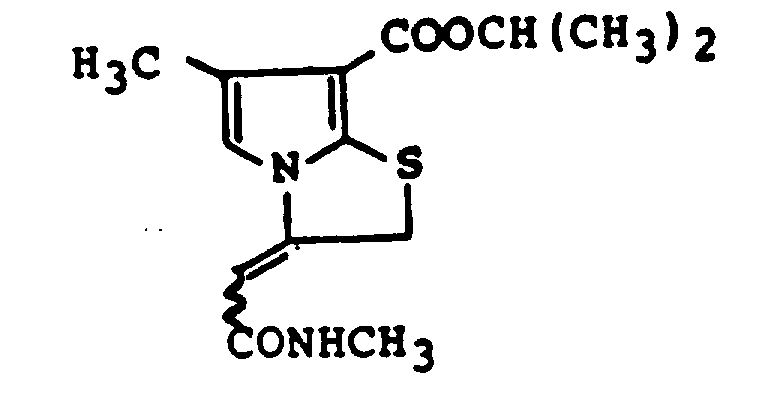
- The NOE of the hydrogen atom at the 2'- or 5-position in the above formula was examined in dimethylsulfoxide (DMSO-d⁶). As a result, irradiation of the hydrogen atom at the 2'-position gave a 10 % NOE enhancement of the hydrogen atom at the 5-position while the latter gave a 6 % NOE enhancement of the former.
- In the same manner as described in Example 37, each of the following compounds of Examples 38 to 49 was prepared.
- m.p.: 191 - 192 °C.
Elemental analysis as C₁₃H₁₆N₂O₃S: - calculated (%): C 55.70, H 5.75, N 9.99.
- found (%): C 55.67, H 5.86, N 10.00.
- NMR spectrum δ (CDCl₃):
- 1.33 (6H, d)
- 2.89 (3H, d)
- 4.98 (2H, d)
- 5.15 (1H, m)
- 5.60 (1H, d)
- 5.76 (1H, t)
- 6.73 (1H, d)
- 6.86 (1H, d).
- m.p.: 175 - 177 °C.
Elemental analysis as C₁₆H₂₂N₂O₃S: - calculated (%): C 59.62, H 6.56, N 8.70.
- found (%): C 59.50, H 6.62, N 8.83.
- NMR spectrum δ (CDCl₃):
- 1.20 (6H, d)
- 1.33 (6H, d)
- 2.87 (3H, d)
- 3.32 (1H, m)
- 4.85 (2H, d)
- 5.10 (1H, m)
- 5.68 (1H, t)
- 6.60 (1H, s).
- m.p.: 155 - 159 °C.
Elemental analysis as C₁₉H₂₀N₂O₃S: - calculated (%): C 64.00, H 5.66, N 7.86.
- found (%): C 63.79, H 5.64, N 7.90.
- NMR spectrum δ (CDCl₃):
- 1.26 (6H, d)
- 2.88 (3H, d)
- 4.92 (2H, d)
- 5.18 (1H, m)
- 5.75 (1H, t)
- 6.85 (1H, s)
- 7.3 - 7.7 (5H, m).
- m.p.: 177 - 178 °C.
Elemental analysis as C₁₃H₁₆N₂O₃S: - calculated (%): C 55.69, H 5.75, N 9.99.
- found (%): C 55.37, H 5.73, N 9.94.
- NMR spectrum δ (CDCl₃):
- 1.31 (3H, t)
- 2.22 (3H, d)
- 4.22 (2H, q)
- 4.84 (2H, d)
- 5.88 (1H, t)
- 6.72 (1H, d)
- 7.10 (1H, s).
- m.p.: 179 - 180 °C.
Elemental analysis as C₁₃H₁₆N₂O₃S: - calculated (%): C 55.70, H 5.75, N 9.99.
- found (%): C 55.73, H 5.71, N 10.06.
- NMR spectrum δ (CDCl₃):
- 1.27 (6H, d)
- 2.20 (3H, d)
- 4.82 (2H, d)
- 5.01 (1H, m)
- 6.04 (1H, t)
- 6.97 (1H, q).
- m.p.: 139 - 140 °C.
Elemental analysis as C₁₅H₂₀N₂0₃S: - calculated (%): C 58.42, H 6.54, N 9.08.
- found (%): C 58.25, H 6.33, N 9.25.
- NMR spectrum δ (CDCl₃):
- 1.15 (3H, t)
- 1.27 (6H, d)
- 2.28 (3H, s)
- 3.1 - 3.6 (2H, m)
- 4.90 (2H, d)
- 5.15 (1H, m)
- 5.68 (1H, t)
- 6.65 (1H, s).
- m.p.: 156 - 158 °C.
Elemental analysis as C₁₇H₂₂N₂O₄S: - calculated (%): C 58.27, H 6.33, N 7.99.
- found (%): C 58.45, H 6.32, N 7.90.
- NMR spectrum δ (CDCl₃):
- 1.33 (6H, d)
- 2.28 (3H, d)
- 3.4 - 3.9 (8H, m)
- 4.87 (2H, d)
- 5.15 (1H, sep)
- 6.06 (1H, t)
- 6.74 (1H, bs).
- m.p.: 149 - 155 °C.
Elemental analysis as C₁₇H₂₂N₂O₃S₂: - calculated (%): C 55.71, H 6.05, N 7.64.
- found (%): C 55.55, H 5.99, N 7.48.
- NMR spectrum δ (CDCl₃):
- 1.33 (6H, d)
- 2.28 (3H, d)
- 2.6 - 2.8 (4H, m)
- 3.7 - 4.1 (4H, m)
- 4.86 (2H, d)
- 5.18 (1H, sep)
- 6.06 (1H, t)
- 6.77 (1H, d).
- m.p.: 122 - 123 °C.
Elemental analysis as C₁₈H₂₄N₂O₃S: - calculated (%): C 62.04, H 6.94, N 8.04.
- found (%): C 61.80, H 6.98, N 7.88.
- NMR spectrum δ (CDCl₃):
- 1.33 (6H, d)
- 1.5 - 1.8 (6H, m)
- 2.28 (3H, d)
- 3.4 - 3.7 (4H, m)
- 4.87 (2H, d)
- 5.15 (1H, sep)
- 6.13 (1H, t)
- 6.76 (1H, d).
- m.p.: 132 - 135 °C.
Elemental analysis as C₁₅H₂₀N₂O₃S: - calculated (%): C 58.40, H 6.54, N 9.09.
- found (%): C 58.37, H 6.50, N 8.96.
- NMR spectrum δ (CDCl₃):
- 1.33 (6H, d)
- 2.29 (3H, d)
- 3.07 (6H, s)
- 4.88 (2H, d)
- 5.15 (1H, sep)
- 6.10 (1H, t)
- 6.75 (1H, d).
- m.p.: 179 - 181°C.
Elemental analysis as C₁₇H₂₂N₂O₃S: - calculated (%): C 61.05, H 6.63, N 8.38.
- found (%): C 61.02, H 6.68, N 8.20.
- NMR spectrum δ (CDCl₃):
- 1.1 - 2.2 (10H, m)
- 2.27 (3H, d)
- 2.89 (3H, d)
- 4.91 (2H, d)
- 4.9 - 5.1 (1H, m)
- 5.69 (1H, t)
- 6.65 (1H, q).
- m.p.: 179 - 182 °C.
Elemental analysis as C₁₅H₂₀N₂O₃S: - calculated (%): C 58.42, H 6.54, N 9.08.
- found (%): C 58.41, H 6.49, N 9.12.
- NMR spectrum δ (CDCl₃):
- 1.19 (3H, t)
- 1.33 (6H, d)
- 2.73 (2H, q)
- 2.89 (3H, d)
- 4.90 (2H, d)
- 5.15 (1H, sep)
- 5.71 (1H, t)
- 6.60 (1H, s).
- 4.0 g of isopropyl 4-methyl-2-thioxopyrrolidine-3-carboxylate, 4.7 g of methyl 4-bromocrotonate and 2.1 g of anhydrous sodium acetate were suspended in 100 ml of ethanol and stirred at 60 to 70 °C for 3 hours. After distilling off the solvent under reduced pressure, the residue was dissolved in ethyl acetate, washed with a saturated aqueous solution of sodium chloride and dried over anhydrous sodium sulfate. After distilling off the solvent, the obtained oily product was purified by silica gel column chromatography. Thus 4.5 g of the title compound was obtained in the form of a pale yellow oily product.
NMR spectrum δ (CDCl₃): - 1.1 - 1.3 (3H, m)
- 1.25 (6H, d)
- 2.2 - 3.8 (8H, m)
- 3.72 (3H, s)
- 5.03 (1H, sep).
- In the same manner as described in Example 50, the title compound was prepared.
Elemental analysis as C₁₃H₁₉NO₄S: - calculated (%): C 54.72, H 6.71, N 4.91.
- found (%): C 54.71, H 6.64, N 4.74.
- NMR spectrum δ (CDCl₃):
- 1.25 (6H, d)
- 2.5 - 3.8 (9H, m)
- 3.72 (3H, s)
- 5.03 (1H, sep).
- To 4.5 g of methyl (7-isopropoxycarbonyl-6-methyl-2,3,5,6- tetrahydropyrrolo[2,l-b]thiazol-3-yl)acetate was added 100 ml of a 40 % aqueous solution of monomethylamine. The mixture was stirred at room temperature for 20 hours. After distilling off the monomethylamine, the residue was extracted with chloroform. The chloroform layer was washed with a saturated aqueous solution of sodium chloride and dried over anhydrous sodium sulfate. After distilling off the solvent, 4.1 g of the title compound was obtained in the form of a colorless oily product.
Mass spectrum m/z: 298 (M⁺).
NMR spectrum δ (CDCl₃): - 1.25 (9H, d)
- 1.8 - 3.9 (8H, m)
- 2.81(3H, d)
- 5.01 (1H, sep).
- In the same manner as described in Example 52, the title compound was prepared.
m.p.: 79 - 95 °C.
Elemental analysis as C₁₃H₂₀N₂O₃S: - calculated (%): C 54.91, H 7.09, N 9.85.
- found (%): C 54.86, H 7.05, N 9.91.
- NMR spectrum δ (CDCl₃):
- 1.25 (6H, d)
- 2.3 - 3.8 (9H, m)
- 2.81 (3H, d)
- 5.00 (1H, sep).
- 4.1 g of N-methyl-(7-isopropoxycarbonyl-6-methyl-2,3,5,6- tetrahydropyrrolo[2,1-b]-thiazol-3-yl)acetamide was dissolved in 150 ml of chloroform and 3.9 g of 2,3-dicyano-5,6-dichloro-parabenzoquinone was added thereto under ice-cooling and stirring. The mixture was stirred at room temperature for 1 hour. After removing the insoluble matters, the chloroform layer was successively washed with a saturated aqueous solution of sodium hydrogencarbonate and a saturated aqueous solution of sodium chloride. After drying over anhydrous sodium sulfate and distilling off the solvent, the obtained residue was purified by silica gel column chromatography. Thus 2.0 g of the title compound was obtained.
m.p.: 108 - 109 °C.
Elemental analysis as C₁₄H₂₀N₂O₃S: - calculated (%): C 56.73, H 6.80, N 9.45.
- found (%): C 56.71, H 6.83, N 9.49.
- NMR spectrum δ (CDCl₃):
- 1.30 (6H, d)
- 2.18 (3H, d)
- 2.3 - 2.7 (2H, m)
- 2.80 (3H, d)
- 3.32 (1H, dd)
- 3.89 (1H, dd)
- 4.7 - 5.0 (1H, m)
- 5.08 (1H, m)
- 6.38 (1H, d).
- In the same manner as described in Example 54, the title compound was prepared.
m.p.: 117 - 119 °C.
Elemental analysis as C₁₃H₁₈N₂O₃S: - calculated (%): C 55.30, H 6.43, N 9.92.
- found (%): C 55.27, H 6.38, N 9.86.
- NMR spectrum δ (CDCl₃):
- 1.30 (6H, d)
- 2.57 (1H, s)
- 2.64 (1H, s)
- 2.80 (3H, d)
- 3.38 (1H, dd)
- 3.99 (1H, dd)
- 4.93 (1H, ddt)
- 5.10 (1H, sep)
- 6.53 (1H, d)
- 6.56 (1H, d).
- 1.54 g of (7-isopropoxycarbonyl-6-methyl-2,3-di-hydropyrrolo[2,1-b]thiazol-3-yl)acetic acid, 0.70 g of morpholine and 0.12 g of 4-N,N-dimethylaminopyridine were dissolved in 50 ml of dichloromethane. 1.44 g of N,N'-dicyclohexylcarbodiimide was added thereto under ice-cooling and stirring. Then the mixture was stirred at room temperature for 9 days. After filtering off the insoluble matters, the solvent was distilled off. The oily residue thus obtained was purified by silica gel column chromatography. After crystallizing from ether/n-hexane, 1.05 g of the title compound was obtained.
m.p.: 97 - 99 °C.
Elemental analysis as C₁₇H₂₄N₂O₄S: - calculated (%): C 57.93, H 6.86, N 7.95.
- found (%): C 57.99, H 6.91, N 7.90.
- NMR spectrum δ (CDCl₃):
- 1.32 (6H, d)
- 2.22 (3H, s)
- 2.5 - 2.8 (2H, m)
- 3.2 - 3.5 (3H, m)
- 3.4 - 3.7 (6H, m)
- 4.00 (1H, dd)
- 4.7 - 5.1 (1H, m)
- 5.13 (1H, sep)
- 6.42 (1H, s).
- 1.0 g of methyl (7-isopropoxycarbonyl-6-methyl-2,3-dihydropyrrolo[2,1-b]thiazol-3-yl)acetate was dissolved in 30 ml of methanol and 30 ml of concentrated aqueous ammonia was added thereto. The obtained mixture was stirred at room temperature for 6 days. After distilling off the ammonia, the residue was extracted with chloroform. The chloroform layer was washed with a saturated aqueous solution of sodium chloride and dried over anhydrous sodium sulfate. After distilling off the solvent, the obtained oily residue was crystallized from ether/n-hexane. Thus 0.3 g of the title compound was obtained.
m.p.: 143 - 146 °C.
Elemental analysis as C₁₃H₁₈N₂O₃S: - calculated (%):C 55.30, H 6.43, N 9.92.
- found (%): C 55.20, H 6.47, N 9.71.
- NMR spectrum δ (CDCl₃):
- 1.31 (6H, d)
- 2.21 (3H, d)
- 2.6 - 2.8 (2H, m)
- 3.34 (1H, dd)
- 3.94 (1H, dd)
- 4.7 - 5.0 (1H, m)
- 5.12 (1H, sep)
- 6.43 (1H, d).
- 2.0 g of isopropyl 4-methyl-2-thioxopyrrolidine-3-carboxylate was dissolved in 30 ml of acetic acid and 4.2 g of ethyl 4-bromoacetoacetate was added thereto. The mixture was stirred at 20 °C for 1 hour. After distilling off the acetic acid under reduced pressure, 50 ml of water and chloroform were added and the aqueous layer was collected.
- The aqueous layer was made alkaline with sodium hydrogencarbonate, extracted with chloroform, washed with water and dried over anhydrous sodium sulfate. After distilling off the chloroform, 1.5 g of the title compound was obtained in the form of an oily product.
NMR spectrum δ (CDCl₃): - 1.26 (6H, d)
- 1.28 (3H, t)
- 1.30 (3H, d)
- 3.37 (2H, s)
- 3.3 - 3.8 (2H, m)
- 3.9 - 4.2 (1H, m)
- 4.19 (2H, q)
- 5.06 (1H, m)
- 5.86 (1H, s).
- 3.3 g of ethyl (7-isopropoxycarbonyl-6-methyl-5,6-dihydropyrrolo[2,1-b]thiazol-3-yl)acetate was added to 60 ml of a 40 % aqueous solution of monomethylamine and stirred at 20 °C for 24 hours. The precipitate was collected by filtration, washed with water, dried, and recrystallized from ethanol. Thus 2.2 g of the title compound was obtained. m.p.: 203 - 205 °C.
Elemental analysis as C₁₄H₂₀N₂O₃S: - calculated (%): C 56.71, H 6.80, N 9.49.
- found (%): C 57.03, H 6.95, N 9.65.
- NMR spectrum δ (CDCl₃):
- 1.23 (6H, d)
- 1.27 (3H, d)
- 2.71 (3H, d)
- 3.30 (2H, s)
- 3.4 - 3.8 (2H, m)
- 4.17 (1H, m)
- 4.96 (1H, m)
- 5.92 (1H, s).
- 2.0 g of N-methyl-(7-isopropoxycarbonyl-6-methyl-5,6-dihydropyrrolo[2,1-b]thiazol-3-ylidene)acetamide was dissolved in 60 ml of chloroform and 0.3 ml of 1,8-diaza-bicyclo[5.4.0]-7-undecene was added thereto. The obtained mixture was stirred at room temperature overnight. Then the chloroform phase was successively washed with 20 ml of a 5 % aqueous solution of acetic acid and 10 ml of water. The chloroform phase was successively washed with a saturated aqueous solution of sodium hydrogencarbonate and a saturated aqueous solution of sodium chloride and dried over sodium sulfate anhydride. After distilling off the solvent, the obtained crude crystals were recrystallized from ethanol. Thus 1.2 g of the title compound was obtained.
- The compound thus obtained was completely identical with the one of Example 14 in m.p. and various spectrometric data.
- Male SD rats weighing 170 to 200 g were used.
- Each test compound was suspended in a 1 % aqueous solution of methyl cellulose and orally administered at a dose of 400 mg/kg 1 hour before the induction of hepatic injury.
- D-galactosamine hydrochloride at 800 mg/kg was administered (subcutaneously) to rats to induce hepatitis. The animals were fasted after the administration of D-galactosamine. After 24 hours, the blood samples were collected from the vena cava under etherization and serum GPT and GOT were measured as indices of hepatic injury.
- Table 1 shows the results.
-

- Table 1 clearly shows the values of serum GPT and GOT in the test group were significantly lower than those in the disease control group. Thus the compound of the present invention is proved to be highly effective in improving or preventing hepatitis induced by administration of D-galactosamine hydrochloride.
- The compound of the Example 16 or 37 suspended in a 1 % aqueous solution of methyl cellulose was orally administered to male SD rats at a dose of 400 mg/kg. As a result, no animal died.
salts thereof and pharmaceutical compositions for preventing or treating hepatic diseases containing the compound of the formula (I) or salts thereof as an active ingredient.
Claims (8)
- A novel compound represented by the following formula (I):
 wherein R₁ represents a hydrogen atom, an alkyl group having 1 to 10 carbon atoms or a cyclic alkyl group having 3 to 8 carbon atoms;R₂ represents a hydroxyl group, an alkoxy group having 1 to 10 carbon atoms which may have one to three substituents in the alkyl group moiety, an arylthio group which may have one or more substituents in the aryl group moiety, an aryloxy group which may have one or more substituents in the aryl group moiety, or the group NR₄R₅ wherein R₄ and R₅ which may be the same or different represent a hydrogen atom, or an alkyl group having 1 to 6 carbon atoms or R₄ and R₅ together with the nitrogen atom form a three to seven membered cyclic amino group, which may contain one or more hetero atoms as ring atoms selected from a nitrogen atom, an oxygen atom and a sulfur atom;R₃ represents a hydrogen atom, an alkyl group having 1 to 10 carbon atoms, an aryl group which may have one or more substituents, or a hetero aryl group which may have one or more substituents; and ----- represents a single bond or a double bond; and salts thereof.
 - A compound and salts thereof as claimed in claim 1, wherein R₁ is a branched-chain alkyl group having 1 to 10 carbon atoms or a cycloalkyl group having 3 to 8 carbon atoms, R₂ is a mono or dialkylamino group with each alkyl group having 1 to 6 carbon atoms or a three- to seven-membered cyclic amino group which may contain one or more hetero atoms as ring atoms selected from a nitrogen atom, an oxygen atom and a sulfur atom.
- A compound and salts thereof as claimed in claim 1, wherein R₁ is an isopropyl group or a cyclohexyl group, R₂ is a methylamino group, an ethylamino group or a morpholino group, R₃ is a methyl group or a hydrogen atom and the bond between the 5- and 6-positions is a double bond.
- A compound and salts thereof as claimed in claim 1, wherein R₁ is a isopropyl group, R₂ is a methylamino group and R₃ is a methyl group and the bond between 5- and 6-positions is a double bond.
- N-Methyl-(7-isopropoxycarbonyl-6-methyl-2,3-dihydropyrrolo[2,1-b]thiazol-3-ylidene)acetamide and salts thereof as claimed in claim 1.
- A pharmaceutical preparation for preventing or treating hepatic diseases which contains a compound according to any one of claims 1 to 5 as active ingredient.
- A process for preparing a compound of any one of claims 1 to 5
which comprises1) reacting a compound of the formula (II):

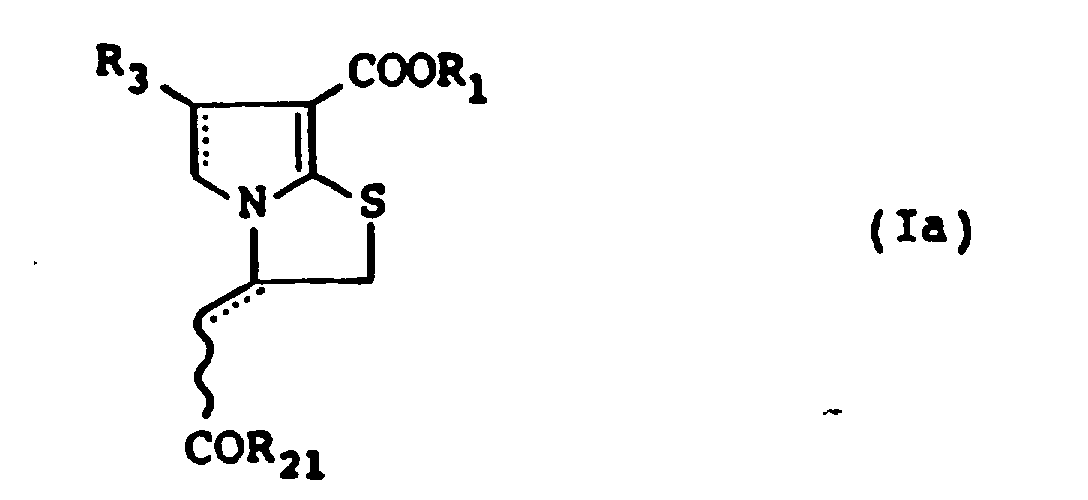 2) reacting a compound of said formula (Ia) with
 3) reacting a compound of the following formula:
 4) reacting a compound of the following formula:
 5) reacting a compound of the formula (Ic):
 6) reacting a compound of the formula (II):


- A process for preparing the pharmaceutical composition of claim 6 which comprises providing at least one compound of formula I in a form suitable for administration, optionally incorporated into a pharmaceutical carrier and/or adjuvant.
Applications Claiming Priority (2)
| Application Number | Priority Date | Filing Date | Title |
|---|---|---|---|
| JP15114189 | 1989-06-13 | ||
| JP151141/89 | 1989-07-13 |
Publications (2)
| Publication Number | Publication Date |
|---|---|
| EP0410224A1 EP0410224A1 (en) | 1991-01-30 |
| EP0410224B1 true EP0410224B1 (en) | 1996-01-10 |
Family
ID=15512262
Family Applications (1)
| Application Number | Title | Priority Date | Filing Date |
|---|---|---|---|
| EP90113378A Expired - Lifetime EP0410224B1 (en) | 1989-06-13 | 1990-07-12 | Pyrrolo [2,1-b]thiazole derivatives |
Country Status (23)
| Country | Link |
|---|---|
| US (1) | US5098919A (en) |
| EP (1) | EP0410224B1 (en) |
| JP (1) | JP2875605B2 (en) |
| KR (1) | KR910002874A (en) |
| CN (1) | CN1025337C (en) |
| AT (1) | ATE132870T1 (en) |
| AU (1) | AU624724B2 (en) |
| CA (1) | CA2021135A1 (en) |
| DD (1) | DD296492A5 (en) |
| DE (1) | DE69024713T2 (en) |
| DK (1) | DK0410224T3 (en) |
| ES (1) | ES2084622T3 (en) |
| FI (1) | FI903511A7 (en) |
| GR (1) | GR3018798T3 (en) |
| HU (1) | HU207331B (en) |
| IE (1) | IE902545A1 (en) |
| IL (1) | IL95021A (en) |
| NO (1) | NO903084L (en) |
| NZ (1) | NZ234450A (en) |
| PT (1) | PT94688A (en) |
| RU (2) | RU1836374C (en) |
| YU (1) | YU136490A (en) |
| ZA (1) | ZA905407B (en) |
Families Citing this family (3)
| Publication number | Priority date | Publication date | Assignee | Title |
|---|---|---|---|---|
| EP0891978B1 (en) * | 1997-07-18 | 2002-03-20 | F. Hoffmann-La Roche Ag | 5H-Thiazolo (3,2-a) pyrimidine derivatives |
| US20050244892A1 (en) * | 2004-02-27 | 2005-11-03 | Lazar Mitchell A | Resistin as a marker and therapeutic target for cardiovascular disease |
| EP2265957B1 (en) * | 2008-04-09 | 2013-07-24 | B.R.A.H.M.S GmbH | Pro-endothelin-1 for the prediction of impaired peak oxygen consumption |
Family Cites Families (2)
| Publication number | Priority date | Publication date | Assignee | Title |
|---|---|---|---|---|
| US4193926A (en) * | 1974-03-20 | 1980-03-18 | Schering Aktiengesellschaft | 4-(Polyalkoxy phenyl)-2-pyrrolidones |
| US4347186A (en) * | 1980-10-20 | 1982-08-31 | Syntex (U.S.A.) Inc. | Process for preparing 5-aroyl 1,2-dihydro-3-H pyrrolo[1,2-a]pyrrole-1-carboxylic acids and novel intermediates therein |
-
1990
- 1990-07-10 DD DD90342652A patent/DD296492A5/en not_active IP Right Cessation
- 1990-07-10 ZA ZA905407A patent/ZA905407B/en unknown
- 1990-07-10 IL IL9502190A patent/IL95021A/en not_active IP Right Cessation
- 1990-07-11 FI FI903511A patent/FI903511A7/en not_active Application Discontinuation
- 1990-07-11 NO NO90903084A patent/NO903084L/en unknown
- 1990-07-11 AU AU58904/90A patent/AU624724B2/en not_active Ceased
- 1990-07-11 NZ NZ234450A patent/NZ234450A/en unknown
- 1990-07-11 KR KR1019900010442A patent/KR910002874A/en not_active Ceased
- 1990-07-12 PT PT94688A patent/PT94688A/en not_active Application Discontinuation
- 1990-07-12 DE DE69024713T patent/DE69024713T2/en not_active Expired - Fee Related
- 1990-07-12 RU SU904830592A patent/RU1836374C/en active
- 1990-07-12 YU YU136490A patent/YU136490A/en unknown
- 1990-07-12 DK DK90113378.5T patent/DK0410224T3/en active
- 1990-07-12 AT AT90113378T patent/ATE132870T1/en not_active IP Right Cessation
- 1990-07-12 EP EP90113378A patent/EP0410224B1/en not_active Expired - Lifetime
- 1990-07-12 IE IE254590A patent/IE902545A1/en unknown
- 1990-07-12 ES ES90113378T patent/ES2084622T3/en not_active Expired - Lifetime
- 1990-07-13 US US07/552,031 patent/US5098919A/en not_active Expired - Fee Related
- 1990-07-13 JP JP2186896A patent/JP2875605B2/en not_active Expired - Fee Related
- 1990-07-13 CA CA002021135A patent/CA2021135A1/en not_active Abandoned
- 1990-07-13 CN CN90107066A patent/CN1025337C/en not_active Expired - Fee Related
- 1990-07-13 HU HU904214A patent/HU207331B/en not_active IP Right Cessation
-
1991
- 1991-08-22 RU SU915001347A patent/RU2026288C1/en active
-
1996
- 1996-01-25 GR GR960400186T patent/GR3018798T3/en unknown
Also Published As
| Publication number | Publication date |
|---|---|
| ES2084622T3 (en) | 1996-05-16 |
| AU5890490A (en) | 1991-01-17 |
| GR3018798T3 (en) | 1996-04-30 |
| FI903511A7 (en) | 1991-01-14 |
| RU2026288C1 (en) | 1995-01-09 |
| IL95021A0 (en) | 1991-06-10 |
| ATE132870T1 (en) | 1996-01-15 |
| JP2875605B2 (en) | 1999-03-31 |
| IL95021A (en) | 1994-06-24 |
| CN1049350A (en) | 1991-02-20 |
| PT94688A (en) | 1991-03-20 |
| JPH03128385A (en) | 1991-05-31 |
| HU207331B (en) | 1993-03-29 |
| HUT57221A (en) | 1991-11-28 |
| KR910002874A (en) | 1991-02-26 |
| DE69024713T2 (en) | 1996-06-13 |
| EP0410224A1 (en) | 1991-01-30 |
| CA2021135A1 (en) | 1991-01-14 |
| AU624724B2 (en) | 1992-06-18 |
| FI903511A0 (en) | 1990-07-11 |
| NO903084L (en) | 1991-01-14 |
| HU904214D0 (en) | 1990-12-28 |
| US5098919A (en) | 1992-03-24 |
| CN1025337C (en) | 1994-07-06 |
| ZA905407B (en) | 1991-04-24 |
| RU1836374C (en) | 1993-08-23 |
| DE69024713D1 (en) | 1996-02-22 |
| DK0410224T3 (en) | 1996-02-05 |
| NO903084D0 (en) | 1990-07-11 |
| DD296492A5 (en) | 1991-12-05 |
| IE902545A1 (en) | 1991-02-27 |
| YU136490A (en) | 1992-09-07 |
| NZ234450A (en) | 1991-10-25 |
Similar Documents
| Publication | Publication Date | Title |
|---|---|---|
| EP0054951B1 (en) | Dibenz(b,f)(1,4)oxazepine derivatives, process for preparing the same, and pharmaceutical compositions comprising the same | |
| NO791150L (en) | SUBSTITUTED 5,6-DIMETHYLPYRROLO / 2,3-D / PYRIMIDINES, PROCEDURES FOR THEIR PREPARATION AND THEIR USE AS MEDICINES | |
| CA2048511A1 (en) | Tricyclic compound or salts thereof, method for producing the same and antimicrobial agent containing the same | |
| EP0260491B1 (en) | 9-deazaguanines | |
| CA1038386A (en) | Pyrrolo(3,4-d) pyrimidines and methods for their preparation | |
| US3888983A (en) | Derivatives of thiazolino-pyrimidin-6-ones, in inducing analgesia | |
| US5098919A (en) | Pyrrolo(2,1-b)thiazole derivatives | |
| US5236926A (en) | 9-substituted-8-halo or -8-hydroxy-9-deazaguanines as inhibitors or PNP for pharmaceutical compositions | |
| US3073826A (en) | 3-pyrrolidylmethyl-4-quinazolones | |
| AU699636B2 (en) | Bicyclic amino group-substituted pyridonecarboxylic acid derivatives, esters thereof and salts thereof, and bicyclic amines useful as intermediates thereof | |
| US4497812A (en) | 2-Amino-5-aminomethyl-2-oxazolines, compositions and use | |
| CA2035397C (en) | Hexahydropyrrolo¬2,3-b|indole carbamates, -ureas, -amides and related compounds, a process for their preparation and their use as medicaments | |
| GB2030133A (en) | Tetrahydrothiopyrano (2,3-b) indole derivatives | |
| SU1181546A3 (en) | Method of producing condensed pyrimidine derivatives as racemates or optical isomers | |
| CA1327805C (en) | Pilocarpine derivatives | |
| US4584313A (en) | (Substituted-phenyl)-5-oxo-2-pyrrolidinepropanoic acids and esters thereof, and use for reversing electroconvulsive shock-induced amnesia | |
| US4002638A (en) | Benzazepine derivatives | |
| CA1049017A (en) | Pyrrolo (3,4-b) pyridines and methods for their preparation | |
| US4185104A (en) | Tranquillizing complexes | |
| IE50035B1 (en) | Hexahydro-trans-pyridoindole neuroleptic agents | |
| CA1045135A (en) | Pyrrolo(3,4-d)pyrimidines and methods for their preparation | |
| AU634004B2 (en) | Intermediates for substituted 9-amino-tetrahydro-acridines, a process for their preparation and their use as medicaments | |
| Scarborough et al. | Pyrrolidines. V. 3-Pyrrolidinylmethylamines and Quinoline Derivatives1 | |
| JP3000295B2 (en) | Pyrrolo [2,1-b] thiazole derivatives and agents for preventing / treating liver diseases containing the same | |
| US3202663A (en) | Ring e substituted yohimbanes |
Legal Events
| Date | Code | Title | Description |
|---|---|---|---|
| PUAI | Public reference made under article 153(3) epc to a published international application that has entered the european phase |
Free format text: ORIGINAL CODE: 0009012 |
|
| AK | Designated contracting states |
Kind code of ref document: A1 Designated state(s): AT BE CH DE DK ES FR GB GR IT LI LU NL SE |
|
| 17P | Request for examination filed |
Effective date: 19910717 |
|
| 17Q | First examination report despatched |
Effective date: 19930906 |
|
| ITF | It: translation for a ep patent filed | ||
| GRAA | (expected) grant |
Free format text: ORIGINAL CODE: 0009210 |
|
| AK | Designated contracting states |
Kind code of ref document: B1 Designated state(s): AT BE CH DE DK ES FR GB GR IT LI LU NL SE |
|
| REF | Corresponds to: |
Ref document number: 132870 Country of ref document: AT Date of ref document: 19960115 Kind code of ref document: T |
|
| REG | Reference to a national code |
Ref country code: DK Ref legal event code: T3 |
|
| REF | Corresponds to: |
Ref document number: 69024713 Country of ref document: DE Date of ref document: 19960222 |
|
| REG | Reference to a national code |
Ref country code: CH Ref legal event code: NV Representative=s name: BOVARD AG PATENTANWAELTE |
|
| REG | Reference to a national code |
Ref country code: GR Ref legal event code: FG4A Free format text: 3018798 |
|
| ET | Fr: translation filed | ||
| REG | Reference to a national code |
Ref country code: ES Ref legal event code: FG2A Ref document number: 2084622 Country of ref document: ES Kind code of ref document: T3 |
|
| PGFP | Annual fee paid to national office [announced via postgrant information from national office to epo] |
Ref country code: DK Payment date: 19960529 Year of fee payment: 7 |
|
| PGFP | Annual fee paid to national office [announced via postgrant information from national office to epo] |
Ref country code: SE Payment date: 19960531 Year of fee payment: 7 |
|
| PGFP | Annual fee paid to national office [announced via postgrant information from national office to epo] |
Ref country code: LU Payment date: 19960601 Year of fee payment: 7 |
|
| PGFP | Annual fee paid to national office [announced via postgrant information from national office to epo] |
Ref country code: BE Payment date: 19960624 Year of fee payment: 7 |
|
| PGFP | Annual fee paid to national office [announced via postgrant information from national office to epo] |
Ref country code: GR Payment date: 19960627 Year of fee payment: 7 |
|
| PGFP | Annual fee paid to national office [announced via postgrant information from national office to epo] |
Ref country code: GB Payment date: 19960703 Year of fee payment: 7 |
|
| PGFP | Annual fee paid to national office [announced via postgrant information from national office to epo] |
Ref country code: CH Payment date: 19960709 Year of fee payment: 7 |
|
| PGFP | Annual fee paid to national office [announced via postgrant information from national office to epo] |
Ref country code: ES Payment date: 19960716 Year of fee payment: 7 |
|
| PGFP | Annual fee paid to national office [announced via postgrant information from national office to epo] |
Ref country code: NL Payment date: 19960731 Year of fee payment: 7 Ref country code: FR Payment date: 19960731 Year of fee payment: 7 |
|
| PGFP | Annual fee paid to national office [announced via postgrant information from national office to epo] |
Ref country code: DE Payment date: 19960930 Year of fee payment: 7 |
|
| PGFP | Annual fee paid to national office [announced via postgrant information from national office to epo] |
Ref country code: AT Payment date: 19961014 Year of fee payment: 7 |
|
| PLBE | No opposition filed within time limit |
Free format text: ORIGINAL CODE: 0009261 |
|
| STAA | Information on the status of an ep patent application or granted ep patent |
Free format text: STATUS: NO OPPOSITION FILED WITHIN TIME LIMIT |
|
| 26N | No opposition filed | ||
| PG25 | Lapsed in a contracting state [announced via postgrant information from national office to epo] |
Ref country code: LU Free format text: LAPSE BECAUSE OF NON-PAYMENT OF DUE FEES Effective date: 19970712 Ref country code: GB Free format text: LAPSE BECAUSE OF NON-PAYMENT OF DUE FEES Effective date: 19970712 Ref country code: DK Free format text: LAPSE BECAUSE OF NON-PAYMENT OF DUE FEES Effective date: 19970712 Ref country code: AT Free format text: LAPSE BECAUSE OF NON-PAYMENT OF DUE FEES Effective date: 19970712 |
|
| REG | Reference to a national code |
Ref country code: DK Ref legal event code: EBP |
|
| PG25 | Lapsed in a contracting state [announced via postgrant information from national office to epo] |
Ref country code: SE Effective date: 19970713 |
|
| PG25 | Lapsed in a contracting state [announced via postgrant information from national office to epo] |
Ref country code: ES Free format text: LAPSE BECAUSE OF EXPIRATION OF PROTECTION Effective date: 19970714 |
|
| PG25 | Lapsed in a contracting state [announced via postgrant information from national office to epo] |
Ref country code: LI Free format text: LAPSE BECAUSE OF NON-PAYMENT OF DUE FEES Effective date: 19970731 Ref country code: GR Free format text: LAPSE BECAUSE OF NON-PAYMENT OF DUE FEES Effective date: 19970731 Ref country code: CH Free format text: LAPSE BECAUSE OF NON-PAYMENT OF DUE FEES Effective date: 19970731 Ref country code: BE Free format text: LAPSE BECAUSE OF NON-PAYMENT OF DUE FEES Effective date: 19970731 |
|
| BERE | Be: lapsed |
Owner name: DAIICHI PHARMACEUTICAL CO. LTD Effective date: 19970731 |
|
| PG25 | Lapsed in a contracting state [announced via postgrant information from national office to epo] |
Ref country code: NL Free format text: LAPSE BECAUSE OF NON-PAYMENT OF DUE FEES Effective date: 19980201 |
|
| GBPC | Gb: european patent ceased through non-payment of renewal fee |
Effective date: 19970712 |
|
| REG | Reference to a national code |
Ref country code: CH Ref legal event code: PL |
|
| PG25 | Lapsed in a contracting state [announced via postgrant information from national office to epo] |
Ref country code: FR Free format text: LAPSE BECAUSE OF NON-PAYMENT OF DUE FEES Effective date: 19980331 |
|
| NLV4 | Nl: lapsed or anulled due to non-payment of the annual fee |
Effective date: 19980201 |
|
| PG25 | Lapsed in a contracting state [announced via postgrant information from national office to epo] |
Ref country code: DE Free format text: LAPSE BECAUSE OF NON-PAYMENT OF DUE FEES Effective date: 19980401 |
|
| EUG | Se: european patent has lapsed |
Ref document number: 90113378.5 |
|
| REG | Reference to a national code |
Ref country code: FR Ref legal event code: ST |
|
| REG | Reference to a national code |
Ref country code: ES Ref legal event code: FD2A Effective date: 20010201 |
|
| PG25 | Lapsed in a contracting state [announced via postgrant information from national office to epo] |
Ref country code: IT Free format text: LAPSE BECAUSE OF NON-PAYMENT OF DUE FEES;WARNING: LAPSES OF ITALIAN PATENTS WITH EFFECTIVE DATE BEFORE 2007 MAY HAVE OCCURRED AT ANY TIME BEFORE 2007. THE CORRECT EFFECTIVE DATE MAY BE DIFFERENT FROM THE ONE RECORDED. Effective date: 20050712 |