EP0409651B1 - New Process for the preparation of anti-hypertensive benzopyran derivative - Google Patents
New Process for the preparation of anti-hypertensive benzopyran derivative Download PDFInfo
- Publication number
- EP0409651B1 EP0409651B1 EP90307975A EP90307975A EP0409651B1 EP 0409651 B1 EP0409651 B1 EP 0409651B1 EP 90307975 A EP90307975 A EP 90307975A EP 90307975 A EP90307975 A EP 90307975A EP 0409651 B1 EP0409651 B1 EP 0409651B1
- Authority
- EP
- European Patent Office
- Prior art keywords
- formula
- hours
- compound
- cyano
- alkali
- Prior art date
- Legal status (The legal status is an assumption and is not a legal conclusion. Google has not performed a legal analysis and makes no representation as to the accuracy of the status listed.)
- Expired - Lifetime
Links
- 238000000034 method Methods 0.000 title claims description 28
- 238000002360 preparation method Methods 0.000 title claims description 27
- 230000003276 anti-hypertensive effect Effects 0.000 title description 2
- 150000001562 benzopyrans Chemical class 0.000 title 1
- 150000001875 compounds Chemical class 0.000 claims description 60
- RRHGJUQNOFWUDK-UHFFFAOYSA-N Isoprene Chemical compound CC(=C)C=C RRHGJUQNOFWUDK-UHFFFAOYSA-N 0.000 claims description 32
- UHOVQNZJYSORNB-UHFFFAOYSA-N Benzene Chemical compound C1=CC=CC=C1 UHOVQNZJYSORNB-UHFFFAOYSA-N 0.000 claims description 30
- 238000006243 chemical reaction Methods 0.000 claims description 29
- HEDRZPFGACZZDS-UHFFFAOYSA-N Chloroform Chemical compound ClC(Cl)Cl HEDRZPFGACZZDS-UHFFFAOYSA-N 0.000 claims description 24
- CVNOWLNNPYYEOH-UHFFFAOYSA-N 4-cyanophenol Chemical compound OC1=CC=C(C#N)C=C1 CVNOWLNNPYYEOH-UHFFFAOYSA-N 0.000 claims description 23
- 239000002904 solvent Substances 0.000 claims description 23
- 239000007795 chemical reaction product Substances 0.000 claims description 19
- PCLIMKBDDGJMGD-UHFFFAOYSA-N N-bromosuccinimide Chemical compound BrN1C(=O)CCC1=O PCLIMKBDDGJMGD-UHFFFAOYSA-N 0.000 claims description 16
- XLYOFNOQVPJJNP-UHFFFAOYSA-N water Substances O XLYOFNOQVPJJNP-UHFFFAOYSA-N 0.000 claims description 15
- HNJBEVLQSNELDL-UHFFFAOYSA-N pyrrolidin-2-one Chemical compound O=C1CCCN1 HNJBEVLQSNELDL-UHFFFAOYSA-N 0.000 claims description 14
- 229910052783 alkali metal Inorganic materials 0.000 claims description 13
- 150000001340 alkali metals Chemical class 0.000 claims description 13
- 239000000203 mixture Substances 0.000 claims description 13
- VZGDMQKNWNREIO-UHFFFAOYSA-N tetrachloromethane Chemical compound ClC(Cl)(Cl)Cl VZGDMQKNWNREIO-UHFFFAOYSA-N 0.000 claims description 12
- UIIMBOGNXHQVGW-UHFFFAOYSA-M Sodium bicarbonate Chemical compound [Na+].OC([O-])=O UIIMBOGNXHQVGW-UHFFFAOYSA-M 0.000 claims description 10
- WYURNTSHIVDZCO-UHFFFAOYSA-N Tetrahydrofuran Chemical compound C1CCOC1 WYURNTSHIVDZCO-UHFFFAOYSA-N 0.000 claims description 8
- YDEQIYMIVRCVAH-UHFFFAOYSA-N 2,2-dimethylchromene-6-carbonitrile Chemical compound C1=C(C#N)C=C2C=CC(C)(C)OC2=C1 YDEQIYMIVRCVAH-UHFFFAOYSA-N 0.000 claims description 7
- QAOWNCQODCNURD-UHFFFAOYSA-N Sulfuric acid Chemical compound OS(O)(=O)=O QAOWNCQODCNURD-UHFFFAOYSA-N 0.000 claims description 7
- LPNYRYFBWFDTMA-UHFFFAOYSA-N potassium tert-butoxide Chemical compound [K+].CC(C)(C)[O-] LPNYRYFBWFDTMA-UHFFFAOYSA-N 0.000 claims description 7
- NBUWNTIATBQVDR-UHFFFAOYSA-N 2,2-dimethyl-3,4-dihydrochromene-6-carbonitrile Chemical compound N#CC1=CC=C2OC(C)(C)CCC2=C1 NBUWNTIATBQVDR-UHFFFAOYSA-N 0.000 claims description 6
- HZNVUJQVZSTENZ-UHFFFAOYSA-N 2,3-dichloro-5,6-dicyano-1,4-benzoquinone Chemical compound ClC1=C(Cl)C(=O)C(C#N)=C(C#N)C1=O HZNVUJQVZSTENZ-UHFFFAOYSA-N 0.000 claims description 6
- QTBSBXVTEAMEQO-UHFFFAOYSA-N Acetic acid Chemical compound CC(O)=O QTBSBXVTEAMEQO-UHFFFAOYSA-N 0.000 claims description 6
- VEXZGXHMUGYJMC-UHFFFAOYSA-N Hydrochloric acid Chemical compound Cl VEXZGXHMUGYJMC-UHFFFAOYSA-N 0.000 claims description 6
- NBIIXXVUZAFLBC-UHFFFAOYSA-N Phosphoric acid Chemical compound OP(O)(O)=O NBIIXXVUZAFLBC-UHFFFAOYSA-N 0.000 claims description 6
- 229950005499 carbon tetrachloride Drugs 0.000 claims description 6
- 150000001350 alkyl halides Chemical class 0.000 claims description 5
- 229910052700 potassium Inorganic materials 0.000 claims description 5
- 239000011591 potassium Substances 0.000 claims description 5
- 229910052708 sodium Inorganic materials 0.000 claims description 5
- 239000011734 sodium Substances 0.000 claims description 5
- 235000017557 sodium bicarbonate Nutrition 0.000 claims description 5
- 229910000030 sodium bicarbonate Inorganic materials 0.000 claims description 5
- DGAQECJNVWCQMB-PUAWFVPOSA-M Ilexoside XXIX Chemical compound C[C@@H]1CC[C@@]2(CC[C@@]3(C(=CC[C@H]4[C@]3(CC[C@@H]5[C@@]4(CC[C@@H](C5(C)C)OS(=O)(=O)[O-])C)C)[C@@H]2[C@]1(C)O)C)C(=O)O[C@H]6[C@@H]([C@H]([C@@H]([C@H](O6)CO)O)O)O.[Na+] DGAQECJNVWCQMB-PUAWFVPOSA-M 0.000 claims description 4
- AFVFQIVMOAPDHO-UHFFFAOYSA-N Methanesulfonic acid Chemical compound CS(O)(=O)=O AFVFQIVMOAPDHO-UHFFFAOYSA-N 0.000 claims description 4
- ZLMJMSJWJFRBEC-UHFFFAOYSA-N Potassium Chemical compound [K] ZLMJMSJWJFRBEC-UHFFFAOYSA-N 0.000 claims description 4
- VSCWAEJMTAWNJL-UHFFFAOYSA-K aluminium trichloride Chemical compound Cl[Al](Cl)Cl VSCWAEJMTAWNJL-UHFFFAOYSA-K 0.000 claims description 4
- 239000003849 aromatic solvent Substances 0.000 claims description 4
- 230000031709 bromination Effects 0.000 claims description 4
- 238000005893 bromination reaction Methods 0.000 claims description 4
- 238000007269 dehydrobromination reaction Methods 0.000 claims description 4
- VLTRZXGMWDSKGL-UHFFFAOYSA-N perchloric acid Chemical compound OCl(=O)(=O)=O VLTRZXGMWDSKGL-UHFFFAOYSA-N 0.000 claims description 4
- 150000004965 peroxy acids Chemical class 0.000 claims description 4
- YLQBMQCUIZJEEH-UHFFFAOYSA-N tetrahydrofuran Natural products C=1C=COC=1 YLQBMQCUIZJEEH-UHFFFAOYSA-N 0.000 claims description 4
- PKZZJLKUYUVLMJ-MNOVXSKESA-N (3s,4r)-3-bromo-4-hydroxy-2,2-dimethyl-3,4-dihydrochromene-6-carbonitrile Chemical compound C1=C(C#N)C=C2[C@@H](O)[C@H](Br)C(C)(C)OC2=C1 PKZZJLKUYUVLMJ-MNOVXSKESA-N 0.000 claims description 3
- HCYIWPLDKSWKGY-UHFFFAOYSA-N 2,2-dimethyl-1a,7b-dihydrooxireno[2,3-c]chromene-6-carbonitrile Chemical compound CC1(C)OC2=CC=C(C#N)C=C2C2C1O2 HCYIWPLDKSWKGY-UHFFFAOYSA-N 0.000 claims description 3
- NHQDETIJWKXCTC-UHFFFAOYSA-N 3-chloroperbenzoic acid Chemical compound OOC(=O)C1=CC=CC(Cl)=C1 NHQDETIJWKXCTC-UHFFFAOYSA-N 0.000 claims description 3
- 229960000583 acetic acid Drugs 0.000 claims description 3
- 239000002253 acid Substances 0.000 claims description 3
- 125000001797 benzyl group Chemical group [H]C1=C([H])C([H])=C(C([H])=C1[H])C([H])([H])* 0.000 claims description 3
- 239000003054 catalyst Substances 0.000 claims description 3
- 239000012362 glacial acetic acid Substances 0.000 claims description 3
- LULAYUGMBFYYEX-UHFFFAOYSA-N metachloroperbenzoic acid Natural products OC(=O)C1=CC=CC(Cl)=C1 LULAYUGMBFYYEX-UHFFFAOYSA-N 0.000 claims description 3
- 235000011007 phosphoric acid Nutrition 0.000 claims description 3
- OMPJBNCRMGITSC-UHFFFAOYSA-N Benzoylperoxide Chemical compound C=1C=CC=CC=1C(=O)OOC(=O)C1=CC=CC=C1 OMPJBNCRMGITSC-UHFFFAOYSA-N 0.000 claims description 2
- 230000002378 acidificating effect Effects 0.000 claims description 2
- 150000001338 aliphatic hydrocarbons Chemical class 0.000 claims description 2
- 239000007864 aqueous solution Substances 0.000 claims description 2
- 150000004945 aromatic hydrocarbons Chemical class 0.000 claims description 2
- 235000019400 benzoyl peroxide Nutrition 0.000 claims description 2
- 239000011968 lewis acid catalyst Substances 0.000 claims description 2
- 229940098779 methanesulfonic acid Drugs 0.000 claims description 2
- 239000007800 oxidant agent Substances 0.000 claims description 2
- QDRKDTQENPPHOJ-UHFFFAOYSA-N sodium ethoxide Chemical compound [Na+].CC[O-] QDRKDTQENPPHOJ-UHFFFAOYSA-N 0.000 claims description 2
- JOXIMZWYDAKGHI-UHFFFAOYSA-N toluene-4-sulfonic acid Chemical compound CC1=CC=C(S(O)(=O)=O)C=C1 JOXIMZWYDAKGHI-UHFFFAOYSA-N 0.000 claims description 2
- 238000006356 dehydrogenation reaction Methods 0.000 claims 3
- WQDUMFSSJAZKTM-UHFFFAOYSA-N Sodium methoxide Chemical compound [Na+].[O-]C WQDUMFSSJAZKTM-UHFFFAOYSA-N 0.000 claims 2
- BMTAFVWTTFSTOG-UHFFFAOYSA-N Butylate Chemical compound CCSC(=O)N(CC(C)C)CC(C)C BMTAFVWTTFSTOG-UHFFFAOYSA-N 0.000 claims 1
- PNZVFASWDSMJER-UHFFFAOYSA-N acetic acid;lead Chemical compound [Pb].CC(O)=O PNZVFASWDSMJER-UHFFFAOYSA-N 0.000 claims 1
- 239000003377 acid catalyst Substances 0.000 claims 1
- 150000007933 aliphatic carboxylic acids Chemical class 0.000 claims 1
- 150000008282 halocarbons Chemical class 0.000 claims 1
- BITYAPCSNKJESK-UHFFFAOYSA-N potassiosodium Chemical compound [Na].[K] BITYAPCSNKJESK-UHFFFAOYSA-N 0.000 claims 1
- PMZURENOXWZQFD-UHFFFAOYSA-L Sodium Sulfate Chemical compound [Na+].[Na+].[O-]S([O-])(=O)=O PMZURENOXWZQFD-UHFFFAOYSA-L 0.000 description 16
- 239000000243 solution Substances 0.000 description 14
- IAZDPXIOMUYVGZ-UHFFFAOYSA-N Dimethylsulphoxide Chemical compound CS(C)=O IAZDPXIOMUYVGZ-UHFFFAOYSA-N 0.000 description 13
- 239000011541 reaction mixture Substances 0.000 description 13
- HEMHJVSKTPXQMS-UHFFFAOYSA-M Sodium hydroxide Chemical compound [OH-].[Na+] HEMHJVSKTPXQMS-UHFFFAOYSA-M 0.000 description 11
- 239000000126 substance Substances 0.000 description 11
- 229910052938 sodium sulfate Inorganic materials 0.000 description 8
- 235000011152 sodium sulphate Nutrition 0.000 description 8
- 150000002924 oxiranes Chemical class 0.000 description 7
- QSILYWCNPOLKPN-UHFFFAOYSA-N 3-chloro-3-methylbut-1-yne Chemical compound CC(C)(Cl)C#C QSILYWCNPOLKPN-UHFFFAOYSA-N 0.000 description 6
- 239000012044 organic layer Substances 0.000 description 6
- 238000001816 cooling Methods 0.000 description 5
- 229960001760 dimethyl sulfoxide Drugs 0.000 description 5
- 239000010410 layer Substances 0.000 description 5
- 238000002844 melting Methods 0.000 description 5
- 230000008018 melting Effects 0.000 description 5
- 239000002244 precipitate Substances 0.000 description 4
- 239000000047 product Substances 0.000 description 4
- 238000006798 ring closing metathesis reaction Methods 0.000 description 4
- 235000011121 sodium hydroxide Nutrition 0.000 description 4
- KZNICNPSHKQLFF-UHFFFAOYSA-N succinimide Chemical compound O=C1CCC(=O)N1 KZNICNPSHKQLFF-UHFFFAOYSA-N 0.000 description 4
- HRDCVMSNCBAMAM-UHFFFAOYSA-N 3-prop-2-ynoxyprop-1-yne Chemical compound C#CCOCC#C HRDCVMSNCBAMAM-UHFFFAOYSA-N 0.000 description 3
- CSCPPACGZOOCGX-UHFFFAOYSA-N Acetone Chemical compound CC(C)=O CSCPPACGZOOCGX-UHFFFAOYSA-N 0.000 description 3
- TVZCRIROJQEVOT-CABCVRRESA-N Cromakalim Chemical compound N1([C@@H]2C3=CC(=CC=C3OC([C@H]2O)(C)C)C#N)CCCC1=O TVZCRIROJQEVOT-CABCVRRESA-N 0.000 description 3
- ZMXDDKWLCZADIW-UHFFFAOYSA-N N,N-Dimethylformamide Chemical compound CN(C)C=O ZMXDDKWLCZADIW-UHFFFAOYSA-N 0.000 description 3
- KEAYESYHFKHZAL-UHFFFAOYSA-N Sodium Chemical compound [Na] KEAYESYHFKHZAL-UHFFFAOYSA-N 0.000 description 3
- YXFVVABEGXRONW-UHFFFAOYSA-N Toluene Chemical compound CC1=CC=CC=C1 YXFVVABEGXRONW-UHFFFAOYSA-N 0.000 description 3
- 239000012298 atmosphere Substances 0.000 description 3
- 238000002474 experimental method Methods 0.000 description 3
- VLKZOEOYAKHREP-UHFFFAOYSA-N n-Hexane Chemical compound CCCCCC VLKZOEOYAKHREP-UHFFFAOYSA-N 0.000 description 3
- NLKNQRATVPKPDG-UHFFFAOYSA-M potassium iodide Chemical compound [K+].[I-] NLKNQRATVPKPDG-UHFFFAOYSA-M 0.000 description 3
- 239000012312 sodium hydride Substances 0.000 description 3
- 229910000104 sodium hydride Inorganic materials 0.000 description 3
- 229940083608 sodium hydroxide Drugs 0.000 description 3
- 239000012258 stirred mixture Substances 0.000 description 3
- RFFLAFLAYFXFSW-UHFFFAOYSA-N 1,2-dichlorobenzene Chemical compound ClC1=CC=CC=C1Cl RFFLAFLAYFXFSW-UHFFFAOYSA-N 0.000 description 2
- RYHBNJHYFVUHQT-UHFFFAOYSA-N 1,4-Dioxane Chemical compound C1COCCO1 RYHBNJHYFVUHQT-UHFFFAOYSA-N 0.000 description 2
- QGZKDVFQNNGYKY-UHFFFAOYSA-N Ammonia Chemical compound N QGZKDVFQNNGYKY-UHFFFAOYSA-N 0.000 description 2
- HEDRZPFGACZZDS-MICDWDOJSA-N Trichloro(2H)methane Chemical compound [2H]C(Cl)(Cl)Cl HEDRZPFGACZZDS-MICDWDOJSA-N 0.000 description 2
- 239000003513 alkali Substances 0.000 description 2
- 238000004458 analytical method Methods 0.000 description 2
- 229910052799 carbon Inorganic materials 0.000 description 2
- QZHPTGXQGDFGEN-UHFFFAOYSA-N chromene Chemical compound C1=CC=C2C=C[CH]OC2=C1 QZHPTGXQGDFGEN-UHFFFAOYSA-N 0.000 description 2
- 238000004440 column chromatography Methods 0.000 description 2
- BTCSSZJGUNDROE-UHFFFAOYSA-N gamma-aminobutyric acid Chemical compound NCCCC(O)=O BTCSSZJGUNDROE-UHFFFAOYSA-N 0.000 description 2
- 235000011167 hydrochloric acid Nutrition 0.000 description 2
- 229960000443 hydrochloric acid Drugs 0.000 description 2
- JEHCHYAKAXDFKV-UHFFFAOYSA-J lead tetraacetate Chemical compound CC(=O)O[Pb](OC(C)=O)(OC(C)=O)OC(C)=O JEHCHYAKAXDFKV-UHFFFAOYSA-J 0.000 description 2
- 230000007935 neutral effect Effects 0.000 description 2
- BWHMMNNQKKPAPP-UHFFFAOYSA-L potassium carbonate Chemical compound [K+].[K+].[O-]C([O-])=O BWHMMNNQKKPAPP-UHFFFAOYSA-L 0.000 description 2
- 238000000746 purification Methods 0.000 description 2
- 239000007787 solid Substances 0.000 description 2
- 239000011877 solvent mixture Substances 0.000 description 2
- 229960002317 succinimide Drugs 0.000 description 2
- 238000005292 vacuum distillation Methods 0.000 description 2
- APHWBGUCQBONMO-MNOVXSKESA-N (3s,4r)-4-amino-3-hydroxy-2,2-dimethyl-3,4-dihydrochromene-6-carbonitrile Chemical compound C1=C(C#N)C=C2[C@@H](N)[C@H](O)C(C)(C)OC2=C1 APHWBGUCQBONMO-MNOVXSKESA-N 0.000 description 1
- SEQRDAAUNCRFIT-UHFFFAOYSA-N 1,1-dichlorobutane Chemical compound CCCC(Cl)Cl SEQRDAAUNCRFIT-UHFFFAOYSA-N 0.000 description 1
- CEBKHWWANWSNTI-UHFFFAOYSA-N 2-methylbut-3-yn-2-ol Chemical compound CC(C)(O)C#C CEBKHWWANWSNTI-UHFFFAOYSA-N 0.000 description 1
- IIBHQTXJTUSHBK-UHFFFAOYSA-N 4-bromo-2,2-dimethyl-3,4-dihydrochromene-6-carbonitrile Chemical compound N#CC1=CC=C2OC(C)(C)CC(Br)C2=C1 IIBHQTXJTUSHBK-UHFFFAOYSA-N 0.000 description 1
- CDIIZULDSLKBKV-UHFFFAOYSA-N 4-chlorobutanoyl chloride Chemical compound ClCCCC(Cl)=O CDIIZULDSLKBKV-UHFFFAOYSA-N 0.000 description 1
- NLXLAEXVIDQMFP-UHFFFAOYSA-N Ammonia chloride Chemical class [NH4+].[Cl-] NLXLAEXVIDQMFP-UHFFFAOYSA-N 0.000 description 1
- 239000002841 Lewis acid Substances 0.000 description 1
- XYHTXVVSLOHPGA-UHFFFAOYSA-L O.[OH-].[OH-].[Na+].C[N+](C)(C)CC1=CC=CC=C1 Chemical compound O.[OH-].[OH-].[Na+].C[N+](C)(C)CC1=CC=CC=C1 XYHTXVVSLOHPGA-UHFFFAOYSA-L 0.000 description 1
- 238000009825 accumulation Methods 0.000 description 1
- 239000012190 activator Substances 0.000 description 1
- 238000005804 alkylation reaction Methods 0.000 description 1
- 229910021529 ammonia Inorganic materials 0.000 description 1
- 239000002220 antihypertensive agent Substances 0.000 description 1
- 229940030600 antihypertensive agent Drugs 0.000 description 1
- 238000006555 catalytic reaction Methods 0.000 description 1
- 150000008371 chromenes Chemical class 0.000 description 1
- 238000002425 crystallisation Methods 0.000 description 1
- 230000008025 crystallization Effects 0.000 description 1
- 238000004821 distillation Methods 0.000 description 1
- 229940079593 drug Drugs 0.000 description 1
- 239000003814 drug Substances 0.000 description 1
- 238000002330 electrospray ionisation mass spectrometry Methods 0.000 description 1
- 238000001704 evaporation Methods 0.000 description 1
- 230000008020 evaporation Effects 0.000 description 1
- 239000000706 filtrate Substances 0.000 description 1
- 125000000524 functional group Chemical group 0.000 description 1
- 229960003692 gamma aminobutyric acid Drugs 0.000 description 1
- 239000005457 ice water Substances 0.000 description 1
- 239000013462 industrial intermediate Substances 0.000 description 1
- 238000009776 industrial production Methods 0.000 description 1
- 150000007517 lewis acids Chemical class 0.000 description 1
- 239000012528 membrane Substances 0.000 description 1
- 239000003960 organic solvent Substances 0.000 description 1
- 150000002978 peroxides Chemical class 0.000 description 1
- 150000002989 phenols Chemical class 0.000 description 1
- 229910000027 potassium carbonate Inorganic materials 0.000 description 1
- 229940093956 potassium carbonate Drugs 0.000 description 1
- 235000011181 potassium carbonates Nutrition 0.000 description 1
- 235000007715 potassium iodide Nutrition 0.000 description 1
- 229960004839 potassium iodide Drugs 0.000 description 1
- 230000001376 precipitating effect Effects 0.000 description 1
- QGKLPGKXAVVPOJ-UHFFFAOYSA-N pyrrolidin-3-one Chemical compound O=C1CCNC1 QGKLPGKXAVVPOJ-UHFFFAOYSA-N 0.000 description 1
- 230000035484 reaction time Effects 0.000 description 1
- 210000000329 smooth muscle myocyte Anatomy 0.000 description 1
- -1 sodium-hydride-tetrahydrofuran Chemical compound 0.000 description 1
- QPCRJDOAZZMSKA-UHFFFAOYSA-M sodium;ethanol;hydrogen carbonate Chemical compound [Na+].CCO.OC([O-])=O QPCRJDOAZZMSKA-UHFFFAOYSA-M 0.000 description 1
- 230000003595 spectral effect Effects 0.000 description 1
- 238000003756 stirring Methods 0.000 description 1
- 239000001117 sulphuric acid Substances 0.000 description 1
- 235000011149 sulphuric acid Nutrition 0.000 description 1
- 239000013589 supplement Substances 0.000 description 1
- 238000004809 thin layer chromatography Methods 0.000 description 1
Classifications
-
- C—CHEMISTRY; METALLURGY
- C07—ORGANIC CHEMISTRY
- C07D—HETEROCYCLIC COMPOUNDS
- C07D405/00—Heterocyclic compounds containing both one or more hetero rings having oxygen atoms as the only ring hetero atoms, and one or more rings having nitrogen as the only ring hetero atom
- C07D405/02—Heterocyclic compounds containing both one or more hetero rings having oxygen atoms as the only ring hetero atoms, and one or more rings having nitrogen as the only ring hetero atom containing two hetero rings
- C07D405/04—Heterocyclic compounds containing both one or more hetero rings having oxygen atoms as the only ring hetero atoms, and one or more rings having nitrogen as the only ring hetero atom containing two hetero rings directly linked by a ring-member-to-ring-member bond
-
- A—HUMAN NECESSITIES
- A61—MEDICAL OR VETERINARY SCIENCE; HYGIENE
- A61P—SPECIFIC THERAPEUTIC ACTIVITY OF CHEMICAL COMPOUNDS OR MEDICINAL PREPARATIONS
- A61P9/00—Drugs for disorders of the cardiovascular system
- A61P9/12—Antihypertensives
-
- C—CHEMISTRY; METALLURGY
- C07—ORGANIC CHEMISTRY
- C07D—HETEROCYCLIC COMPOUNDS
- C07D311/00—Heterocyclic compounds containing six-membered rings having one oxygen atom as the only hetero atom, condensed with other rings
- C07D311/02—Heterocyclic compounds containing six-membered rings having one oxygen atom as the only hetero atom, condensed with other rings ortho- or peri-condensed with carbocyclic rings or ring systems
- C07D311/04—Benzo[b]pyrans, not hydrogenated in the carbocyclic ring
- C07D311/58—Benzo[b]pyrans, not hydrogenated in the carbocyclic ring other than with oxygen or sulphur atoms in position 2 or 4
Definitions
- the present invention is directed to a new process for the preparation of ( ⁇ )-6-cyano-3,4-dihydro-2,2-dimethyl-trans-4-(2-oxo-1-pyrrolidinyl)-2H-1-benzopyran-3-ol of the formula (VI) known as cromakaline (BRL-34 915).
- Cromakaline is a anti-hypertensive composition of novel acting mechanism. It belongs to the peripherial group of the anti-hypertensive agents, it acts by opening the potassium-chanels in the smooth muscle cells and it thereby prevents the accumulation of electric potential through the membranes. Accordingly it belongs to the potassium chanel activators [Drugs of the Future 11 , 175 (1986), 12 , 284 (1987), 13 , 269 (1988), 14 , 276 (1989)].
- the object of the invention was to elaborate a new economic and industrially available process for the preparation of cromakaline of the formula (VI).
- the present invention is directed to a new process for the preparation of ( ⁇ )-6-cyano-3,4-dihydro-2,2-dimethyl-trans-4-(2-oxo-1-pyrrolidinyl) -2H-1-benzopyran-3-ol of the formula (VI) starting from 4-cyano-phenol of the formula (I) comprising reacting 4-cyano-phenol of the formula (I) with isoprene resulting in 6-cyano-2,2-dimethyl-3,4-dihydro-2H-1-benzopyran of the formula (II) which is then converted to 6-cyano-2,2-dimethyl-2H-benzopyran of the formula (III) which is either converted to epoxide of the formula (V) in one step and converting the epoxide of the formula (V) to the end-product of the formula (VI) or compound of the formula (III
- hydrochloric acid As an acid, hydrochloric acid, sulphuric acid, orthophosphoric acid, perchloric acid, methanesulfonic acid or para toluene-sulfonic acid can be used, and as a solvent water immiscible organic solvents, such as aliphatic or aromatic hydrocarbons, e.g. hexane, benzene, toluene, or haloalkanes, e.g. chloroform or carbon tetrachloride, are suitable, and the reaction can be carried out at 30 - 120 °C, e.g at 60 - 80°C, within 5 - 15 hours, e.g. 4 - 6 hours.
- solvent water immiscible organic solvents such as aliphatic or aromatic hydrocarbons, e.g. hexane, benzene, toluene, or haloalkanes, e.g. chloroform or carbon tetrachlor
- a further basic point of our invention is that we can epoxidate the compound of the formula (III) in one step to the derivative of the formula (V) by using peracids in the presence of a haloalkane type solvent: M. Bartók and K. L. Láng, Oxiranes, Chapter 14, 610-618., in: The Chemistry of Functional Groups (Ed. by S. Patai), Supplement E. Part 2, Intersci. Publ. John Wiley and Sons (1980).
- the end-product of the formula (VI) can be prepared from the epoxide of the formula (V) in the presence of 1 to 1.2 mole equivalent of an alkali metal (preferably sodium) or alkali metal-alcoholate (preferably potassium-tert-butylate) by reacting it with 2-pyrrolidone serving also as a solvent at 20 - 100 °C (e.g. 20 - 30°C) within 2 - 8 hours (preferably 3 - 5 hours) with a yield of 90 %.
- an alkali metal preferably sodium
- alkali metal-alcoholate preferably potassium-tert-butylate
- 3-bromo-4-hydroxy-derivative of the formula (IV) is prepared from the compound of the formula (III) with N-bromo-succinimide then the reaction is preferably carried out in a solvent mixture of tetrahydrofuran or 1,4-dioxane with water.
- 2-pyrrolidone serving also as a solvent in the presence of alkali-metal-alcoholate, preferably potassium-tert-butylate at 25 - 70 °C, then the end-product of the formula (VI) can be obtained within 8 - 12 hours with an almost quantitative yield.
- cromakaline can be obtained with a yield of 55 - 65 % related to 4-cyano-phenol of the formula (I) as opposed to the maximal 6 - 8 % yield disclosed in EPO 0 076 075 and reproduced by our experiments.
- a white crystallite substance is obtained in the form of small needles. Yield: 25.7 g (90 %) Mp.: 229 - 230 °C [Literature m.p.: 230 - 231 °C, V.A. Ashwood et al.: J. Med. Chem. 29 , 2194 (1986)].
Landscapes
- Chemical & Material Sciences (AREA)
- Organic Chemistry (AREA)
- Health & Medical Sciences (AREA)
- Engineering & Computer Science (AREA)
- Bioinformatics & Cheminformatics (AREA)
- Cardiology (AREA)
- Heart & Thoracic Surgery (AREA)
- Chemical Kinetics & Catalysis (AREA)
- General Chemical & Material Sciences (AREA)
- Medicinal Chemistry (AREA)
- Nuclear Medicine, Radiotherapy & Molecular Imaging (AREA)
- Pharmacology & Pharmacy (AREA)
- Life Sciences & Earth Sciences (AREA)
- Animal Behavior & Ethology (AREA)
- General Health & Medical Sciences (AREA)
- Public Health (AREA)
- Veterinary Medicine (AREA)
- Plural Heterocyclic Compounds (AREA)
- Pharmaceuticals Containing Other Organic And Inorganic Compounds (AREA)
- Pyrane Compounds (AREA)
- Heterocyclic Carbon Compounds Containing A Hetero Ring Having Oxygen Or Sulfur (AREA)
- Low-Molecular Organic Synthesis Reactions Using Catalysts (AREA)
Description
- The present invention is directed to a new process for the preparation of (±)-6-cyano-3,4-dihydro-2,2-dimethyl-trans-4-(2-oxo-1-pyrrolidinyl)-2H-1-benzopyran-3-ol of the formula (VI)

known as cromakaline (BRL-34 915). - Cromakaline is a anti-hypertensive composition of novel acting mechanism. It belongs to the peripherial group of the anti-hypertensive agents, it acts by opening the potassium-chanels in the smooth muscle cells and it thereby prevents the accumulation of electric potential through the membranes. Accordingly it belongs to the potassium chanel activators [Drugs of the Future 11, 175 (1986), 12, 284 (1987), 13, 269 (1988), 14, 276 (1989)].
- Several independent methods are known for the preparation of cromakaline and analogues thereof: J.M. Evans et al.: J. Med. Chem. 26, 1582 (1983), J.M. Evans et al.: J. Med. Chem. 27, 1127 (1984), V.A. Ashwood et al.: J. Med. Chem. 29, 2194 (1986), EPO 0 009 912, EPO 0 046 652, EPO 0 076 075, EPO 0 093 535, EPO 0 120 426, EPO 0 120 427, EPO 0 120 428, EPO 0 126 311, EPO 0 126 350, EPO 0 126 367, EPO 0 138 134, EPO 0 173 848, EPO 0 271 271, EPO 0 274 821, EPO 0 277 611, EPO 0 286 975, PCT WO 85 00602, PCT WO 85 01290, PCT WO 88 00822.
- According to EPO 0 076 075 describing the possibilities for preparing cromakaline 4-cyano-phenol of the formula (I)

is reacted with 3-chloro-3-methyl-butyne resulting in propargyl-ether of the formula (IX)
which is then subjected to ring closure to produce 6-cyano-2,2-dimethyl-2H-1-benzopyran of the formula (III)
The compound of the formula (III) is then converted through 6-cyano-trans-3-bromo-3,4-dihydro-2,2-dimethyl-2H-1-benzopyran-4-ol to 6-cyano-3,4-dihydro-3,4-epoxy-2,2-dimethyl-2H-1-benzopyran of the formula (V).
From the compound of the formula (V) the end-product of the formula (VI) can be obtained by three independent routes. - 1.) Compound of the formula (V) is reacted with ammonia to produce 6-cyano-3,4-dihydro-2,2-dimethyl-trans-4-amino-2H-1-benzopyran-3-ol of the formula (VII)


- 2. The compound of the formula (V) is reacted with 4-amino-butyric acid in a sodium-hydrogen-carbonate-ethanol system, and the ring closure results in the end-product of the formula (VI).
- 3. The compound of the formula (V) is reacted with 2-pyrrolidone in the presence of sodium hydride and dimethyl-sulfoxide and the end-product of the formula (VI) is obtained.
- When reproducing the working examples of EPO 0 076 075 we observed the following circumstances:
- 4-cyano-phenol reacts with 3-chloro-3-methyl-butyne in the presence of sodium hydroxide - benzyl-trimethyl-ammonium-hydroxide - water and dichloro-butane at room temperature within 5-6 days, according to the patent specification propargyl-ether of the formula (IX) can be obtained with a yield of 69 %. The reaction was repeated several times but only a 46 - 50 % yield could be achieved. The reaction was carried out in acetone, dimethyl-sulfoxide, N,N-dimethyl-formamide solvent in the presence of potassium-carbonate and potassium-iodide at 50 - 150 °C, and after 30 - 40 hours reaction only 40 - 55 % yield could be achieved. The further problem is that only 3-hydroxy-3-methyl-butyne is commercially available and according to our experiences 3-chloro-3-methyl-butyne can be prepared from this compound with a yield of only 55 - 60 % by a difficult reaction. 3-chloro-3-methyl-butyne is a compound of poor stability, it decomposes upon standing and at the same time it polymerizes during the alkylation reaction or it decomposes at higher temperature. It can be said that the reaction of 4-cyano-phenol of the formula (I) and 3-chloro-3-methyl-butyne results in propargyl-ether of the formula (IX) with a yield of only 45 - 55 %, and this is then subjected to ring-closure in ortho-dichloro-benzene to 6-cyano-2,2-dimethyl-2H-1-benzopyran of the formula (III) with a yield of 80 % according to EPO 0 076 075. According to our own experimental experiences the reaction can be carried out with a yield of at most 70 % and the purification of the product of the formula (III) is a complicated procedure and can be performed by vacuum distillation or column chromatography. By this reaction the chromene derivatives of the formula (III) can be obtained with a yield of 35 % related to 4-cyano-phenol of the formula (I) and with a yield of 23 % related to 3-chloro-3-methyl-butyne.
- 3-bromo-4-hydroxy-derivatives of the formula (IV)

- The preparation of the end-product of the formula (VI) was carried out by the way which seemed to be the most simple method that is epoxide of the formula (V) was reacted with 3-pyrrolidone in the presence of sodium-hydride and dimethyl-sulfoxide. As to our surprise a rather complex reaction mixture was obtained and by thin layer chromatography 6-8 components could be detected the amount of which was commeasurable. The reaction was repeated several times, and the end-product of the formula (VI) could be prepared with a yield of 20 - 25 % only by the complicated column chromatography as opposed to the yield of 60 % in the disclosure.
- According to the procedure disclosed in the EPO 0 076 075 the end-product of the formula (VI) could be prepared only by a yield of 22 - 26 % related to 4-cyano-phenol of the formula (I) and the procedure when reproduced by our own experiments could be carried out with a yield of only 6 - 8 %.
- Accordingly, the procedures disclosed in EPO 0 076 075 are not suitable for the industrial preparation of cromakaline of the formula (VI).
- The object of the invention was to elaborate a new economic and industrially available process for the preparation of cromakaline of the formula (VI). The present invention is directed to a new process for the preparation of (±)-6-cyano-3,4-dihydro-2,2-dimethyl-trans-4-(2-oxo-1-pyrrolidinyl) -2H-1-benzopyran-3-ol of the formula (VI) starting from 4-cyano-phenol of the formula (I) comprising reacting 4-cyano-phenol of the formula (I) with isoprene resulting in 6-cyano-2,2-dimethyl-3,4-dihydro-2H-1-benzopyran of the formula (II)

which is then converted to 6-cyano-2,2-dimethyl-2H-benzopyran of the formula (III) which is either converted to epoxide of the formula (V) in one step and converting the epoxide of the formula (V) to the end-product of the formula (VI) or compound of the formula (III) is converted to 3-bromo-4-hydroxy-derivative of the formula (IV) which is then in one step converted to the end-product of the formula (VI). - The most important basis of our invention is that we have recognized that by reacting 4-cyano-phenol of the formula (I) with isopropene under mild reaction conditions the new compound of the formula (II) 6-cyano-3,4-dihydro-2,2-dimethyl-2H-1-benzopyran is obtained in an excellent yield. It is known that the reactions of substituted phenols and isoprene in the presence of alkali metals, preferably potassium and Lewis-acids, preferably aluminium-trichloride in aromatic solvents, preferably benzene at 60 - 100 °C result within 6 to 10 hours in substituted 3,4-dihydro-2,2-dimethyl-2H-1-benzopyrans with a yield of 80 - 90 % [L. Bolzoni et al.: Angew. Chem. Int. Ed. Engl. 17, 684 (1978)]. According to Japanese patent specifications 40 637/80, 43 039/80 and 15411/80 by reacting alkoxy-phenols and isoprene in an acid catalyzed reaction similarly quantitatively alkoxy-3,4-dihydro-2,2-dimethyl-2H-1-benzopyrans can be obtained. As an acid, hydrochloric acid, sulphuric acid, orthophosphoric acid, perchloric acid, methanesulfonic acid or para toluene-sulfonic acid can be used, and as a solvent water immiscible organic solvents, such as aliphatic or aromatic hydrocarbons, e.g. hexane, benzene, toluene, or haloalkanes, e.g. chloroform or carbon tetrachloride, are suitable, and the reaction can be carried out at 30 - 120 °C, e.g at 60 - 80°C, within 5 - 15 hours, e.g. 4 - 6 hours. According to our experiments when reacting 4-cyano-phenol of the formula (I) with isoprene under the mentioned reaction conditions 6-cyano-3,4-dihydro-2,2-dimethyl-2H-1-benzopyran of the formula (II) was obtained with a yield of 90 - 95 % which is according to our knowledge a new compound. The conversion of the compound of the formula (II) to 6-cyano-2,2-dimethyl-2H-1-benzopyran of the formula (III) can be performed by several independent routes:
- 1) The compound of the formula (II) is brominated in benzyl position by N-bromo-succinimide in haloalkanes in the presence of a trace of peroxide and 6-cyano-3,4-dihydro-2,2-dimethyl-4-bromo-2H-1-benzopyran of the formula (X)
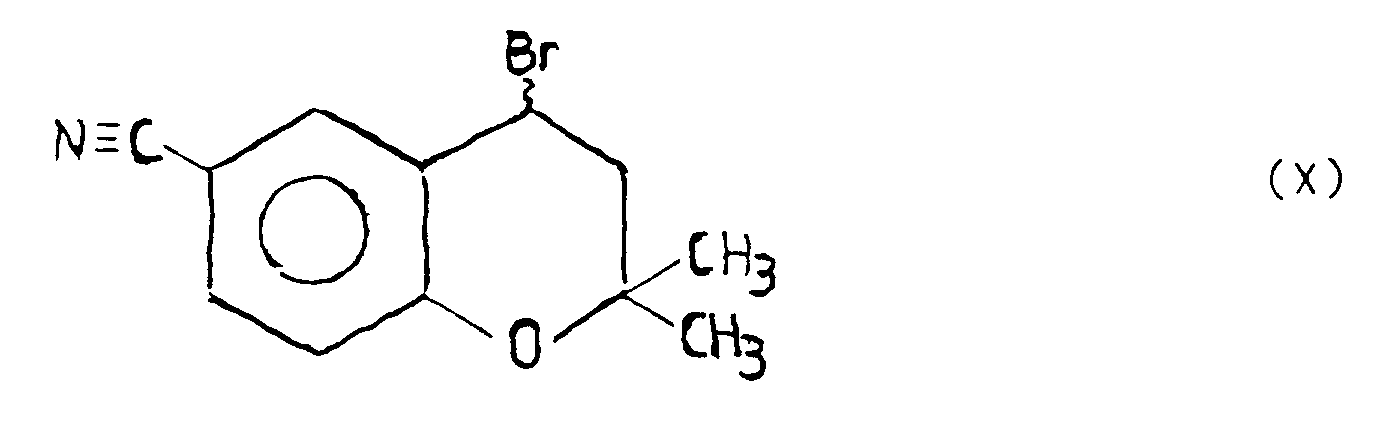
- 2) The new compound of the formula (II) can be oxidised in one step with almost quantitative yield by using lead tetraacetate in glacial acetic acid or with DDQ in an apolar solvent.
- A further basic point of our invention is that we can epoxidate the compound of the formula (III) in one step to the derivative of the formula (V) by using peracids in the presence of a haloalkane type solvent: M. Bartók and K. L. Láng, Oxiranes, Chapter 14, 610-618., in: The Chemistry of Functional Groups (Ed. by S. Patai), Supplement E. Part 2, Intersci. Publ. John Wiley and Sons (1980).
- The end-product of the formula (VI) can be prepared from the epoxide of the formula (V) in the presence of 1 to 1.2 mole equivalent of an alkali metal (preferably sodium) or alkali metal-alcoholate (preferably potassium-tert-butylate) by reacting it with 2-pyrrolidone serving also as a solvent at 20 - 100 °C (e.g. 20 - 30°C) within 2 - 8 hours (preferably 3 - 5 hours) with a yield of 90 %.
- If 3-bromo-4-hydroxy-derivative of the formula (IV) is prepared from the compound of the formula (III) with N-bromo-succinimide then the reaction is preferably carried out in a solvent mixture of tetrahydrofuran or 1,4-dioxane with water. We have further recognized that when reacting 3-bromo-4-hydroxy-derivative of the formula (IV) with 2-pyrrolidone serving also as a solvent in the presence of alkali-metal-alcoholate, preferably potassium-tert-butylate at 25 - 70 °C, then the end-product of the formula (VI) can be obtained within 8 - 12 hours with an almost quantitative yield.
- Summarizing our present invention is directed to a new process for the preparation of (±)-6-cyano-3,4-dihydro-2,2-dimethyl-trans-4-(2-oxo-1-pyrrolidinyl)-2H-1-benzopyran-3-ol of the formula (VI) from 4-cyano-phenol of the formula (I) by reacting 4-cyano-phenol of the formula (I) with isoprene at 30 - 120 °C in a solvent in the presence of alkali-metals and/or Lewis acid catalysts and/or under acidic conditions resulting in 6-cyano-3,4-dihydro-2,2-dimethyl-2H-1-benzopyran of the formula (II) which is then converted to 6-cyano-2,2-dimethyl-2H-1-benzopyran of the formula (III) at 40 - 150 °C in a solvent by using a catalyst and/or an oxidising agent or by bromination in the benzyl position and by dehydrobromination of the compound of the formula (X), and
- a) preparing 6-cyano-3,4-dihydro-2,2-dimethyl-3,4-epoxy-2H-1-benzopyran of the formula (V) in one step at 0 - 20 °C by using peracid in a solvent and converting the obtained compound of the formula (V) to the end-product of the formula (VI) by reacting it with 2-pyrrolidone in the presence of alkali-metals or alkali-metal-alcoholates at 20 - 100 °C,
- b) reacting a compound of the formula (III) with N-bromo-succinimide in a solvent at 20 - 120 °C to produce 6-cyano-3,4-dihydro-2,2-dimethyl-trans-3-bromo-4-hydroxy-2H-1-benzopyran of the formula (IV) which is then reacted with 2-pyrrolidone in the presence of alkali metals or alkali-metals-alcoholates at 20 - 100 °C to result in the end-product of the formula (VI).
- Further preferred features of the process are set out in the accompanying claims.
- Our present invention has the following advantages:
- 4-cyano-phenol of the formula (I) reacts unambiguously with isoprene with an almost quantitative yield,
- isoprene is an inexpensive, easily available industrial intermediate product,
- chromene of the formula (III) can be obtained with unambiguous reactions with a good yield, and thereby purified by crystallization (as opposed to the vacuum distillation disclosed in EPO 0 076 075),
- epoxide of the formula (V) can be obtained according to our invention in high purity in a crystalline form,
- end-product of the formula (VI) can be obtained under mild reaction conditions (there is no need to use the expensive sodium-hydride and dimethyl-sulfoxide which is dangerous for the environment and can be handled only with difficulty).
- the purification of the product and the working up of the reaction mixture is simple,
- the used solvents can be recovered by distillation and can be recycled,
- the reaction can be easily handled and performed on an increased scale, and
- industrial production does not need special equipment and the reactions can be carried out in conventional industrial equipment.
- According to the new process cromakaline can be obtained with a yield of 55 - 65 % related to 4-cyano-phenol of the formula (I) as opposed to the maximal 6 - 8 % yield disclosed in EPO 0 076 075 and reproduced by our experiments.
- Our present invention is further illustrated with the following examples.
- 5.95 g (0.05 mole) 4-cyano-phenol and 13.3 g (0.1 mole) aluminium-trichloride are dissolved in 200 ml of anhydrous benzene. Under intensive stirring 10 ml (0.1 mol) isoprene and 50 ml of absolute benzene are added dropwise. The reaction mixture is boiled for 6 hours. The reaction mixture is cooled and a solution of 250 ml saturated ammonium-chloride is added. The layers are separated, the organic layer is washed to neutral, dried above sodium-sulphate and the solvent is removed in vacuo. 17.29 g (92 %) of colourless oil are obtained.
n
Analysis: C H N calculated (%) 76.98 6.99 7.48 found (%) 76.80 7.07 7.40
PMR (CDCl₃): 1.35 (6H, s, 2CH₃), 1.83 (2H, t, J = 7 Hz, 3-CH₂), 2.80 (2H, t, J = 7 Hz, 4-CH₂), 6.80 (1H, dd, J₁ = 8 Hz, J₂ = 1 Hz, 7-H), 7.34 (2H, m, 5H and 8H)
MS (EI): 187 (60 %, M⁺), 172 (79 %), 158 (32 %), 144 (12 %), 132 (100 %), 116 (15 %). - 19.7 g (0.1 mole) of the compound of the formula (II) are dissolved in 200 ml of carbon-tetrachloride and 18.7 g (0.105 mole) N-bromo-succinimide and 1 g of dibenzoyl-peroxide are added.
- The reaction mixture is boiled for 5 hours. It is cooled, and the precipitated succinimide is filtered, washed with 2x200 ml of carbon-tetrachloride and the combined organic layer is washed to neutral and dried above sodium-sulphate and the solvent is removed. 25 g (94 %) of crystalline substance are obtained.
Mp.: 78 - 79 °C.Analysis: C H Br N calculated (%) 56.16 4.54 30.02 5.26 found (%) 56.00 4.60 30.10 5.20.
PMR (DMSO - d₆): 1.29 (3H, s, CH₃), 1.47 (3H, s, CH₃), 2.26-2.69 (2H, m, 3-CH₂), 5.76 (1H, m, Br-CH), 6.93 (1H, d, J = 10 Hz, 8-H), 7.64 (1H, dd, J₁ = 10 Hz, J₂ = 2 Hz, 7-H), 7.90 (1H, d, J = 2 Hz, 5-H). - 26.6 g (0.1 mole) of the compound of the formula (X) are dissolved in 300 ml of benzene and 11.2 g (0.1 mole) of potassium-tert-butylate are added. The reaction mixture is boiled for 4 hours. It is cooled and washed with 3 x 200 ml of water and dried above sodium-sulphate. After evaporation 17.5 g (95 %) of crystalline substance are obtained.
Mp.: 45 - 47 °C.
IR (KBr): 2230 cm⁻¹ (literature melting point: 36 - 37 °C (M. Harfenist and E. Thom: J. Org. Chem. 841 (1972)). - 26.6 g (0.1 mole) of the compound of the formula (X) are dissolved in 250 ml of benzene and 75.5 g (0.1 mole) 90 % sodium-ethylate are added and the reaction mixture is boiled for 6 hours. The subsequent procedure is similar to example 3. 17 g (92 %) of solid susbstance are obtained, melting at 45 - 46 °C.
- 11.9 g (0.1 mol) of 4-cyano-phenol are added to a stirred mixture of 220 g of 48 % sulfuric acid solution and 200 g of chloroform. At room temperature 14 g (0.2 mole) of isoprene are added and the reaction mixture is vigorously stirred at 60 °C for 5 hours. The mixture is cooled, the layers are separated and the organic layer is washed with 2 x 100 ml of water, 2 x 150 ml of 5 % sodium hydrogen carbonate solution and 2 x 100 ml water, and the mixture is then dried above sodium sulphate. The solvent is removed in vacuo. 17.7 g (95 %) of colourless oil are obtained the physical constant and spectral data of which are identical with the data disclosed in example 1.
- 11.9 g (0.1 mole) 4-cyano-phenol are added to a stirred mixture of 25 g of 85 % ortho-phosphoric acid solution and 250 g of chloroform. At room temperature 10.5 g (0.15 mole) isoprene are added, and the mixture is vigorously stirred at 60 °C for 4 hours. One may further proceed as disclosed in example 5. 17.5 g (93 %) of colourless oil are obtained.
- 11.9 g (0.1 mole) of 4-cyano-phenol are added to a stirred mixture of 40 g of 30 % hydrochloric-acid solution and 200 g of chloroform. 21 g (0.3 mole) isoprene are added at room temperature and the mixture is vigorously stirred at 60 °C for 5 hours. One may further proceed as disclosed in example 5. 16.8 g (90 %) of colourless oil are obtained.
- 18.7 g (0.1 mole) of the compound of the formula (II), 22.7 g (0.1 mole) 2,3-dichloro-5,6-dicyano-1,4-benzoquinone are boiled in 300 ml of absolute benzene for 38 hours. The solution is cooled, filtered and the mother lye is washed with 3 x 100 ml of 5 % sodium hydrogen carbonate, 3 x 100 ml of water and dried above sodium sulphate and the solvent is removed. 17 g (92 %) crystalline substance are obtained, melting at 45 - 47 °C.
- 18.7 g (0.01 mole) of the formula (II) are boiled for 2 hours in 150 ml of glacial acetic acid in the presence of 41.5 g lead tetraacetate. The mixture is cooled and poured on 200 g of crushed ice, extracted with 3 x 100 ml of chloroform and the organic layer is washed with 3 x 100 ml 5 % sodium-hydrogen carbonate and with 3 x 100 ml of water. The mixture is dried above sodium sulphate and after removing the solvent 17.4 g, 94 % of solid substance are obtained melting at 46 - 47 °C.
- 18.5 g (0.1 mole) of the compound of the formula (III) are dissolved in 300 ml of chloroform at room temperature whereafter the solvent is cooled with ice to 0-5 % and 37.74 g (0.011 mole) 50 % meta-chloro-perbenzoic acid are added. The mixture is further stirred for 3 hours and after ceasing the cooling the reaction is continued for 20 hours. The chloroform layer is then washed with 5 % sodium hydroxide solution and water. The organic layer is dried above sodium-sulphate and evaporated. Upon cooling a yellow slowly crystallizing oil is obtained.
Yield: 19.10 g (95 %)
Mp.: 104 - 105 °C (literature: gum, [J. M. Evans et al.: J. Med. Chem. 26, 1582 (1983)]. - 12.50 g (0.15 mole) sodium-hydrogen-carbonate are dissolved in 200 ml of water and the solution is then vigorously stirred with a solution of 18.52 g (0.1 mole) of the compound of the formula (III) in 300 ml chloroform. The reaction mixture is cooled to 0 - 5 °C and 37.74 g (0.11 mole) 50 % metachloro perbenzoic acid are added. The mixture is further stirred for 3 hours and then after stopping the cooling the reaction is continued for 20 hours. The layers are separated, the chloroform layer is washed with a 5 % sodium-hydroxide solution and with water. The organic layer is dried above sodium-sulphate and evaporated. Upon standing a pale yellow slowly crystallizing substance is obtained.
Yield: 18.50 g (92 %).
Mp.: 103 - 104 °C. - 18.52 g (0.1 mole) of the compound of the formula (III) are dissolved in an aqueous solution of 200 ml of 90 % tetrahydrofuran to which at 32 - 35 °C 35.59 g (0.2 mole) N-bromo-succinimide and 100 ml of 90 % tetrahydrofuran solution are added dropwise. The mixture is further reacted at room temperature for 7 hours and then it is evaporated. Upon cooling a yellow crystalline substance is precipitating which is dissolved hot in carbon-tetrachloride and the undissolved succinimide is filtered off and the filtrate is evaporated. A slowly crystallizing yellow oil is obtained. Yield: 26.8 g (95 %).
Mp.: 128.5 - 129.5 °C. (literature mp.: 128-128.5 °C, [J. M. Evans et al.: J. Med. Chem. 26, 1582 (1983)]. - 60 ml of 2-pyrrolidone are heated to 70 °C and under inert atmosphere 2.53 g (0.11 atom) metallic-sodium are added. After the addition is completed the solution is cooled to room temperature and 20.12 g (0.1 mole) of the compound of the formula (V) are added and the reaction is continued for 4 hours. The reaction mixture is then poured on 200 g of ice and stirred vigorously. A greyish white precipitate is obtained which is filtered, washed with iced water and dried. The raw product is recrystallized from a 3:2 mixture of chloroform and carbon-tetrachloride.
- A white crystallite substance is obtained in the form of small needles.
Yield: 25.7 g (90 %)
Mp.: 229 - 230 °C [Literature m.p.: 230 - 231 °C, V.A. Ashwood et al.: J. Med. Chem. 29, 2194 (1986)]. - 60 ml of pyrrolidone are heated to 40 °C and in inert atmosphere 4.30 g (0.11 atom) metallic-potassium are added. After the addition is completed, the solution is cooled to room-temperature and 20.12 g (0.1 mole) of a compound of the formula (V) are added and stirred for 4 hours. The reaction mixture is then poured on 200 g of ice and stirred vigorously. A greyish white precipitate is obtained. One may further proceed as given in example 13 and white crystalline substance is obtained in the form of small needles.
Yield: 27.2 g (95 %)
Mp.: 229 - 230 °C. - 90 ml of 2-pyrrolidone are heated to 70 °C and under inert atmosphere 4.83 g (0.21 atom) of metallic sodium are added. After the addition is completed the solution is cooled to room temperature and 28.21 g (0.1 mole) of the compound of the formula (IV) are added. After 4 hours of reaction time the reaction mixture is poured on 200 g of ice and stirred vigorously. One may further proceed as given in example 13.
- White crystalline substance is obtained in the form of small needles. Yield: 27 g (94 %), melting point: 229 - 230 °C.
- 20.12 g (0.1 mole) of the compound of the formula (V) are dissolved in 60 ml of 2-pyrrolidone at room temperature and 12.35 g (0.11 mole) of potassium tert-butylate are added. The reaction mixture is maintained at room temperature for 1.5 hours, whereafter it is poured on 200 g of ice. After a while, a pale yellow precipitate is obtained. One may further proceed as given in example 13. White crystalline substance is obtained in the form of small needles.
Yield: 25.5 g (85 %)
Mp.: 230 - 231 °C. - 28.21 g (0.1 mole) of the compound of the formula (IV) are dissolved in 90 ml of 2-pyrrolidone at room temperature and under cooling with ice water 23.56 g (0.21 mole) of potassium-tert-butylate are added. When the addition is completed, the mixture is stirred for 1.5 hours at room temperature and poured on 200 g of ice. Pale yellow precipitate is obtained. One may further proceed as given in example 13.
- White crystalline substance is obtained in the form of small needles.
Yield: 26 g (91 %)
Mp.: 230 - 231 °C.
Claims (15)
- Process for the preparation of (±)-6-cyano-3,4-dihydro-2,2-dimethyl-trans-4-(2-oxo-1-pyrrolidinyl)-2H-1-benzopyran-3-ole of the formula (VI)


 a.) preparing in one step 6-cyano-3,4-dihydro-2,2-dimethyl-3,4-epoxy-2H-1-benzopyran with peracids in a solvent at 0 - 20 °C, and then reacting the same with 2-pyrrolidone in the presence of alkali-metals or alkali metal alcoholates at 20 - 100°C resulting in the end-product of the formula (VI), orb.) reacting a compound of the formula (III)

- A process as claimed in claim 1 which comprises carrying out the reaction of 4-cyano-phenol of the formula (I) with isoprene in the presence of alkali metals, preferably potassium, in the presence of Lewis-type catalysts, preferably aluminium-trichloride in aromatic solvents, preferably in benzene at 60 - 80 °C for 2 - 10 hours, preferably 5 - 8 hours.
- A process as claimed in claim 2 wherein the molar ratio of 4-cyano-phenol of the formula (I):isoprene:potassium:aluminium-trichloride = 0.8 - 1.2 : 0.9 - 2 : 0.1 - 0.7 : 0.9 - 3, preferably 1 : 1 : 0.5 : 1.
- A process as claimed in claim 1 which comprises carrying out the reaction of 4-cyano-phenol of the formula (I) with isoprene in an acid catalyzed procedure in a water immiscible solvent and using as acid catalyst hydrochloric acid, sulfuric acid, orthophosphoric acid, perchloric acid, methanesulfonic acid, para-toluene-sulphonic acid, preferably sulfuric acid and using as a solvent aliphatic and aromatic hydrocarbons, haloalkane, preferably chloroform and performing the reaction at 60 - 80 °C preferably for 4 - 6 hours.
- The process as claimed in claim 4 wherein the molar ratio of 4-cyano-phenol of the formula (I) : isoprene is (0.1 - 1.0):(1 - 10), preferably 1 : 4.
- A process as claimed in claim 1 comprising obtaining the compound of the formula (III) by bromination in the benzyl-position of the compound of the formula (II) and dehydrobromination of the obtained compound of the formula (X).
- A process as claimed in claim 6 which comprises carrying out the bromination in benzyl-position of the compound of the formula (II) with 0.9 - 1.5 moleequivalent, preferably 1-1. moleequivalent N-bromo-succinimide in the presence of dibenzoyl-peroxide in a haloalkane, preferably carbon-tetrachloride, at 40 - 100 °C, preferably 70 - 80 °C for 3 - 15 hours, preferably 4 - 6 hours, and carrying out the dehydrobromination of the compound of the formula (X) in the presence of 0.7 - 1.5 moleequivalent, preferably 1-1.1 moleequivalent alkali-alcoholate, preferably sodium-ethylate or potassium-tert-butylate in aromatic solvents, preferably benzene, at 75 - 85 °C for 2 - 10 hours, preferably 4 - 7 hours.
- A process as claimed in claim 1 which comprises carrying out the preparation of the formula (III) by dehydrogenation of the compound of the formula (II).
- A process as claimed in claim 8 which comprises conducting dehydrogenation with 0.5 - 10 moleequivalents, preferably 1-3 moleequivalents, of 2,3-dichloro-5,6-dicyano-benzoquinone (DDQ) in aromatic solvents, preferably benzene, preferably at 75 - 80 °C, for 20 - 60 hours, preferably for 35 - 40 hours.
- A claim as claimed in claim 8 which comprises conducting a dehydrogenation with 0.5 - 10 moleequivalents, preferably 1 - 3 moleequivalents of lead tetraacetate in aliphatic carboxylic acid, preferably in glacial acetic acid at 90 - - 100 °C for 0.5 hour, preferably for 1 - 2 hours.
- A process as claimed in variant a) of claim 1 which comprises obtaining the compound of the formula (V)

- A process as claimed in variant a) of claim 1 which comprises obtaining the end-product of the formula (VI) by reacting a compound of the formula (V) and 2-pyrrolidone and performing the reaction in the presence of 1 - 1.2 moleequivalent of alkali-metal, preferably sodium, or alkali-metal-alcoholates, preferably sodium-methylate or potassium-tert.butylate at 20 - 100 °C for 2 - 8 hours, preferably 3 - 5 hours.
- A process as claimed in variant b) of claim 1, which comprises obtaining a compound of the formula (IV) by reacting a compound of the formula (III) with preferably 1 - 1.2 moleequivalents of N-bromo-succinimide and performing the reaction preferably in a mixture of tetrahydrofuran and water at 30 - 40 °C, preferably for 1.5 - 2.5 hours.
- A process as claimed in variant b) of claim 1, which comprises obtaining the end-product of the formula (VI) by reacting a compound of the formula (IV) with 2-pyrrolidone and the reaction is performed in the presence of 1 - 1.2 moleequivalents of alkali-metals, preferably sodium, or alkali-metal-alcoholates, preferably sodium-methylates or potassium-tert-butylates at 20 - 30 °C for 2 - 8 hours, preferably 3 - 5 hours.
- 6-cyano-2,2-dimethyl-3,4-dihydro-2H-1-benzopyran of the formula (II).
Applications Claiming Priority (2)
| Application Number | Priority Date | Filing Date | Title |
|---|---|---|---|
| HU893699A HU207861B (en) | 1989-07-21 | 1989-07-21 | Process for producing benzopirane derivative of blood pressure lowering activity |
| HU369989 | 1989-07-21 |
Publications (2)
| Publication Number | Publication Date |
|---|---|
| EP0409651A1 EP0409651A1 (en) | 1991-01-23 |
| EP0409651B1 true EP0409651B1 (en) | 1995-05-03 |
Family
ID=10965123
Family Applications (1)
| Application Number | Title | Priority Date | Filing Date |
|---|---|---|---|
| EP90307975A Expired - Lifetime EP0409651B1 (en) | 1989-07-21 | 1990-07-20 | New Process for the preparation of anti-hypertensive benzopyran derivative |
Country Status (12)
| Country | Link |
|---|---|
| US (1) | US5145985A (en) |
| EP (1) | EP0409651B1 (en) |
| JP (1) | JPH0358988A (en) |
| CZ (1) | CZ283969B6 (en) |
| DE (1) | DE69019080T2 (en) |
| ES (1) | ES2072982T3 (en) |
| HU (1) | HU207861B (en) |
| IL (1) | IL95143A (en) |
| PL (1) | PL286145A1 (en) |
| RU (2) | RU2036196C1 (en) |
| SK (1) | SK278873B6 (en) |
| YU (1) | YU139090A (en) |
Families Citing this family (5)
| Publication number | Priority date | Publication date | Assignee | Title |
|---|---|---|---|---|
| US5837702A (en) * | 1993-10-07 | 1998-11-17 | Bristol-Myers Squibb Co. | 4-arylamino-benzopyran and related compounds |
| US5869478A (en) * | 1995-06-07 | 1999-02-09 | Bristol-Myers Squibb Company | Sulfonamido substituted benzopyran derivatives |
| US5612323A (en) * | 1995-06-07 | 1997-03-18 | Bristol-Myers Squibb Company | Phosphinic ester substituted benzopyran derivatives |
| US5612370A (en) * | 1995-06-07 | 1997-03-18 | Bristol-Myers Squibb Company | Phenylglycine and phenylalaninen amido benzopyran derivatives |
| US5629429A (en) * | 1995-06-07 | 1997-05-13 | Bristol-Myers Squibb Company | Process for preparing 4-arylamino-benzopyran and related compounds |
Family Cites Families (5)
| Publication number | Priority date | Publication date | Assignee | Title |
|---|---|---|---|---|
| US4391815A (en) * | 1976-04-02 | 1983-07-05 | Beecham Group Limited | Cyanobenzano[b]pyrans |
| US4214963A (en) * | 1977-12-06 | 1980-07-29 | Javier Garcia de Lama | Process for the preparation of substituted 4H-pyran-4-ones |
| GB2107706A (en) * | 1981-09-25 | 1983-05-05 | Beecham Group Plc | Benzopyrans |
| HU194214B (en) * | 1983-02-15 | 1988-01-28 | Alkaloida Vegyeszeti Gyar | Process for producing 7-alkoxy-2h-chromene derivatives and insecticide and nematocide compositions containing them as active components |
| GB8308062D0 (en) * | 1983-03-24 | 1983-05-05 | Beecham Group Plc | Active compounds |
-
1989
- 1989-07-21 HU HU893699A patent/HU207861B/en not_active IP Right Cessation
-
1990
- 1990-06-25 US US07/543,142 patent/US5145985A/en not_active Expired - Fee Related
- 1990-07-17 YU YU139090A patent/YU139090A/en unknown
- 1990-07-20 EP EP90307975A patent/EP0409651B1/en not_active Expired - Lifetime
- 1990-07-20 SK SK3629-90A patent/SK278873B6/en unknown
- 1990-07-20 DE DE69019080T patent/DE69019080T2/en not_active Expired - Fee Related
- 1990-07-20 CZ CS903629A patent/CZ283969B6/en unknown
- 1990-07-20 JP JP2193788A patent/JPH0358988A/en active Pending
- 1990-07-20 PL PL28614590A patent/PL286145A1/en unknown
- 1990-07-20 ES ES90307975T patent/ES2072982T3/en not_active Expired - Lifetime
- 1990-07-20 IL IL9514390A patent/IL95143A/en not_active IP Right Cessation
- 1990-07-20 RU SU904830502A patent/RU2036196C1/en active
-
1992
- 1992-02-19 RU SU925010854A patent/RU2041223C1/en active
Non-Patent Citations (2)
| Title |
|---|
| BERGMANN, ROLF et al. "Synthesis and antihyperten- sive activity of 4-(1,2- -dihydro-2-oxo-1-pyridyl)-2H- -1-benzopyrans and related compounds, newpotassium channel activators" page 736, column 2, abstract-no. 55 531k * |
| CHEMICAL ABSTRACTS, vol. 112, no. 7, February 12, 1990, Columbus, Ohio, USA; BERGMANN, Rolf et al.: "Synthesis and antihypertensive activity of 4-(1,2-dihydro-2-oxo-1-pyridyl)-2H-1-benzopyrans and related compounds, new potassium channel activators", page 736, collumn 2, abstract no. 55 531k & J.Med. Chem. 1990, 33(2), 392-504 * |
Also Published As
| Publication number | Publication date |
|---|---|
| ES2072982T3 (en) | 1995-08-01 |
| HU207861B (en) | 1993-06-28 |
| IL95143A (en) | 1996-10-31 |
| US5145985A (en) | 1992-09-08 |
| RU2036196C1 (en) | 1995-05-27 |
| RU2041223C1 (en) | 1995-08-09 |
| HUT58321A (en) | 1992-02-28 |
| SK362990A3 (en) | 1998-04-08 |
| CZ283969B6 (en) | 1998-07-15 |
| CZ362990A3 (en) | 1998-03-18 |
| SK278873B6 (en) | 1998-04-08 |
| DE69019080T2 (en) | 1995-11-02 |
| PL286145A1 (en) | 1991-07-15 |
| YU139090A (en) | 1993-05-28 |
| JPH0358988A (en) | 1991-03-14 |
| DE69019080D1 (en) | 1995-06-08 |
| IL95143A0 (en) | 1991-06-10 |
| EP0409651A1 (en) | 1991-01-23 |
Similar Documents
| Publication | Publication Date | Title |
|---|---|---|
| HU221609B (en) | A method for preparation of arthropodicidal oxadiazines and intermediers and the intermediers | |
| EP0080381B1 (en) | Homobrassinolide, and its production and use | |
| EP0409651A1 (en) | New Process for the preparation of anti-hypertensive benzopyran derivative | |
| AU628395B2 (en) | Chroman derivatives | |
| US5223629A (en) | Process for the preparation of anti-hypertensive benzopyran | |
| Almansa et al. | 2, 2-Dialkylnaphthalen-1-ones as new potassium channel activators | |
| US6245913B1 (en) | Synthetic procedure for 5-methoxy-2-[(4-methoxy-3,5-dimethyl-2-pyridinyl)-methylthio]-IH-benzimidazole hydrochloride and its conversion to omeprazole | |
| JP3221874B2 (en) | Process for producing clausenamide and neoclausenamide and their derivatives | |
| JPS62142136A (en) | Manufacture of phenylpropanone | |
| KR860000623B1 (en) | Process for preparting pirbuterol and analogs | |
| JPH0570434A (en) | Production of novel 2-hydroxymethyl-4-methoxy-3,5-dimethylpyridine and its intermediate and their production | |
| KR19990008411A (en) | Improvement method of 4-hydroxy-2-pyrrolidone | |
| CN114394908B (en) | Method for preparing 2-hydroxy-3-aminoacetophenone | |
| PL148082B1 (en) | Method of obtaining novel chromathe and thiochromate methylene carboxylic derivatives | |
| JP5424272B2 (en) | Method for producing 9-hydroxymethyl-cyclohepta [b] pyridine-3-carboxylic acid ester derivative | |
| US6852867B2 (en) | Process for preparation of a benzofuran derivative | |
| WO2004064722A2 (en) | Process for the production of oxandrolone | |
| JPH07223992A (en) | Production of 2-methyl-1,4-naphthoquinone | |
| US4129576A (en) | Process for making ω-chloro-2,3,4-trihydroxyacetophenone | |
| JP2907475B2 (en) | Process for producing (1,2,3-thiadiazol-4-yl) carbaldehyde and intermediate | |
| KR19990015049A (en) | Method for preparing phenylpropionic acid derivative | |
| JPS58110536A (en) | Naphthacenequinone derivative | |
| KR960015006B1 (en) | Novel benzopyran-based hydroxymethylated metabolites and derivatives | |
| KR100192083B1 (en) | Process for preparing benzopyran derivatives | |
| JPS62230745A (en) | Production of 2-hydroxymethyl-2,5,12-trihydroxy-1,2,3,4-tetrahydronaphthacene-6,11-dione |
Legal Events
| Date | Code | Title | Description |
|---|---|---|---|
| PUAI | Public reference made under article 153(3) epc to a published international application that has entered the european phase |
Free format text: ORIGINAL CODE: 0009012 |
|
| AK | Designated contracting states |
Kind code of ref document: A1 Designated state(s): CH DE ES FR GB IT LI |
|
| 17P | Request for examination filed |
Effective date: 19910527 |
|
| 17Q | First examination report despatched |
Effective date: 19930618 |
|
| GRAA | (expected) grant |
Free format text: ORIGINAL CODE: 0009210 |
|
| AK | Designated contracting states |
Kind code of ref document: B1 Designated state(s): CH DE ES FR GB IT LI |
|
| REF | Corresponds to: |
Ref document number: 69019080 Country of ref document: DE Date of ref document: 19950608 |
|
| ITF | It: translation for a ep patent filed | ||
| ET | Fr: translation filed | ||
| REG | Reference to a national code |
Ref country code: ES Ref legal event code: FG2A Ref document number: 2072982 Country of ref document: ES Kind code of ref document: T3 |
|
| PLBE | No opposition filed within time limit |
Free format text: ORIGINAL CODE: 0009261 |
|
| STAA | Information on the status of an ep patent application or granted ep patent |
Free format text: STATUS: NO OPPOSITION FILED WITHIN TIME LIMIT |
|
| 26N | No opposition filed | ||
| PGFP | Annual fee paid to national office [announced via postgrant information from national office to epo] |
Ref country code: FR Payment date: 19970625 Year of fee payment: 8 |
|
| PGFP | Annual fee paid to national office [announced via postgrant information from national office to epo] |
Ref country code: ES Payment date: 19970701 Year of fee payment: 8 |
|
| PGFP | Annual fee paid to national office [announced via postgrant information from national office to epo] |
Ref country code: GB Payment date: 19970716 Year of fee payment: 8 |
|
| PGFP | Annual fee paid to national office [announced via postgrant information from national office to epo] |
Ref country code: CH Payment date: 19970721 Year of fee payment: 8 |
|
| PGFP | Annual fee paid to national office [announced via postgrant information from national office to epo] |
Ref country code: DE Payment date: 19970930 Year of fee payment: 8 |
|
| PG25 | Lapsed in a contracting state [announced via postgrant information from national office to epo] |
Ref country code: GB Free format text: LAPSE BECAUSE OF NON-PAYMENT OF DUE FEES Effective date: 19980720 |
|
| PG25 | Lapsed in a contracting state [announced via postgrant information from national office to epo] |
Ref country code: ES Free format text: LAPSE BECAUSE OF THE APPLICANT RENOUNCES Effective date: 19980721 |
|
| PG25 | Lapsed in a contracting state [announced via postgrant information from national office to epo] |
Ref country code: LI Free format text: LAPSE BECAUSE OF NON-PAYMENT OF DUE FEES Effective date: 19980731 Ref country code: CH Free format text: LAPSE BECAUSE OF NON-PAYMENT OF DUE FEES Effective date: 19980731 |
|
| GBPC | Gb: european patent ceased through non-payment of renewal fee |
Effective date: 19980720 |
|
| REG | Reference to a national code |
Ref country code: CH Ref legal event code: PL |
|
| PG25 | Lapsed in a contracting state [announced via postgrant information from national office to epo] |
Ref country code: FR Free format text: LAPSE BECAUSE OF NON-PAYMENT OF DUE FEES Effective date: 19990331 |
|
| PG25 | Lapsed in a contracting state [announced via postgrant information from national office to epo] |
Ref country code: DE Free format text: LAPSE BECAUSE OF NON-PAYMENT OF DUE FEES Effective date: 19990501 |
|
| REG | Reference to a national code |
Ref country code: FR Ref legal event code: ST |
|
| REG | Reference to a national code |
Ref country code: ES Ref legal event code: FD2A Effective date: 20001009 |
|
| PG25 | Lapsed in a contracting state [announced via postgrant information from national office to epo] |
Ref country code: IT Free format text: LAPSE BECAUSE OF NON-PAYMENT OF DUE FEES;WARNING: LAPSES OF ITALIAN PATENTS WITH EFFECTIVE DATE BEFORE 2007 MAY HAVE OCCURRED AT ANY TIME BEFORE 2007. THE CORRECT EFFECTIVE DATE MAY BE DIFFERENT FROM THE ONE RECORDED. Effective date: 20050720 |