EP0408357A2 - Polymerizable composition - Google Patents
Polymerizable composition Download PDFInfo
- Publication number
- EP0408357A2 EP0408357A2 EP90307628A EP90307628A EP0408357A2 EP 0408357 A2 EP0408357 A2 EP 0408357A2 EP 90307628 A EP90307628 A EP 90307628A EP 90307628 A EP90307628 A EP 90307628A EP 0408357 A2 EP0408357 A2 EP 0408357A2
- Authority
- EP
- European Patent Office
- Prior art keywords
- sulfinate
- monomer
- meth
- polymerizable composition
- general formula
- Prior art date
- Legal status (The legal status is an assumption and is not a legal conclusion. Google has not performed a legal analysis and makes no representation as to the accuracy of the status listed.)
- Granted
Links
- UKIGJRQPKMIJSA-UHFFFAOYSA-N C1C(C2CC=CC2)NC1 Chemical compound C1C(C2CC=CC2)NC1 UKIGJRQPKMIJSA-UHFFFAOYSA-N 0.000 description 1
Classifications
-
- C—CHEMISTRY; METALLURGY
- C08—ORGANIC MACROMOLECULAR COMPOUNDS; THEIR PREPARATION OR CHEMICAL WORKING-UP; COMPOSITIONS BASED THEREON
- C08F—MACROMOLECULAR COMPOUNDS OBTAINED BY REACTIONS ONLY INVOLVING CARBON-TO-CARBON UNSATURATED BONDS
- C08F2/00—Processes of polymerisation
- C08F2/46—Polymerisation initiated by wave energy or particle radiation
- C08F2/48—Polymerisation initiated by wave energy or particle radiation by ultraviolet or visible light
- C08F2/50—Polymerisation initiated by wave energy or particle radiation by ultraviolet or visible light with sensitising agents
-
- A—HUMAN NECESSITIES
- A61—MEDICAL OR VETERINARY SCIENCE; HYGIENE
- A61K—PREPARATIONS FOR MEDICAL, DENTAL OR TOILETRY PURPOSES
- A61K6/00—Preparations for dentistry
- A61K6/60—Preparations for dentistry comprising organic or organo-metallic additives
- A61K6/62—Photochemical radical initiators
-
- C—CHEMISTRY; METALLURGY
- C08—ORGANIC MACROMOLECULAR COMPOUNDS; THEIR PREPARATION OR CHEMICAL WORKING-UP; COMPOSITIONS BASED THEREON
- C08F—MACROMOLECULAR COMPOUNDS OBTAINED BY REACTIONS ONLY INVOLVING CARBON-TO-CARBON UNSATURATED BONDS
- C08F4/00—Polymerisation catalysts
- C08F4/06—Metallic compounds other than hydrides and other than metallo-organic compounds; Boron halide or aluminium halide complexes with organic compounds containing oxygen
-
- Y—GENERAL TAGGING OF NEW TECHNOLOGICAL DEVELOPMENTS; GENERAL TAGGING OF CROSS-SECTIONAL TECHNOLOGIES SPANNING OVER SEVERAL SECTIONS OF THE IPC; TECHNICAL SUBJECTS COVERED BY FORMER USPC CROSS-REFERENCE ART COLLECTIONS [XRACs] AND DIGESTS
- Y10—TECHNICAL SUBJECTS COVERED BY FORMER USPC
- Y10S—TECHNICAL SUBJECTS COVERED BY FORMER USPC CROSS-REFERENCE ART COLLECTIONS [XRACs] AND DIGESTS
- Y10S206/00—Special receptacle or package
- Y10S206/813—Adhesive
Definitions
- the present invention relates to polymerizable compositions, and more specifically provides polymerizable compositions with good storage stability comprising an aromatic sulfinate as polymerization initiator.
- a sulfinic acid or a salt thereof as a component of polymerization initiators for polymerizing radical-polymerizable monomers, for example a sulfinic acid, a sulfinic acid (or its salt)-oxidizer system, and a sulfinic acid (or its salt)-amine-peroxide system.
- a sulfinic acid for example a sulfinic acid, a sulfinic acid (or its salt)-oxidizer system, and a sulfinic acid (or its salt)-amine-peroxide system.
- Japanese Patent Application Laid-open No. 30193/1978 discloses a process comprising the use of a sulfinate-amine-peroxide system as a polymerization initiator for radical-polymerizable monomers.
- Japanese Patent Application Laid-open No. 75907/1982 discloses that this sulfinate-amine-peroxide system is particularly useful for the polymeriza
- aromatic sulfinates which have hitherto been used, e.g. benzenesulfinate and toluenesulfinate, add, when contracted with a (meth)acrylate, (meth)acrylamide or a (meth)acrylamide derivative, gradually to the double bond of the monomer, compositions comprising the sulfinate dissolved or suspended in the monomer will, when stored at room temperature, lose polymerization activity in a few weeks.
- the two components therefore must be stored in separate packages so that they will not be in contact with each other, which is a disadvantage in comparison with other systems in which the initiator and monomer can be packed and stored together.
- the present Applicants sought to provide a composition comprising a sulfinate and a polymerizable monomer, which has a long pot life (e.g. at least one year).
- the present invention provides a composition comprising:
- the present invention employs aromatic sulfinates represented by the general formula (I) having bulky substituents in their positions 2 and 6.
- R1 and R5 each is a substituent located in the ortho-position to the sulfinate group of the aromatic sulfinate and having sufficient bulkiness for exerting steric hindrance to addition of the sulfinate group to carbon-to-carbon double bond of a monomer. It is important that both R1 and R5 be bulky groups. If only one of the two groups is bulky, sufficient steric hindrance to the addition of the sulfinate group to the double bond will not be achieved. With respect to the bulkiness of the groups, although a carbon atom number of 1, e.g.
- a methyl group may suppress the addition reaction, for practical purposes the effect is attained with a carbon atom number of at least 2, preferably at least 3. While the addition is suppressed to a larger extent with an increasing number of carbon atoms, the effect of the suppression will become smaller once the substituent has a bulkiness of a certain degree. In view of this and commercial availability of raw material, the number of carbon atoms is up to 6 for practical purposes.
- R1 and R5 should, naturally, be inert to the double bond of monomers. Generally, R1 and R5 each is a hydrocarbon group which has 2 to 6 carbon atoms and may be substituted with one or more halogen atoms.
- Examples of the group are ethyl, 2-chloroethyl, 2-bromo-2-chloroethyl, propyl, isopropyl, perfluoropropyl, allyl, butyl, isobutyl, sec-butyl, tert-butyl, pentyl, isopentyl, neopentyl, tert-pentyl, cyclohexyl, phenyl, 4-bromophenyl and the like.
- R2, R3 and R4 may be any atoms and/or groups as long as they are inert to the double bond of monomers. Examples are hydrogen, fluoro, chloro, bromo, iodo, methyl, ethyl, 2-chloroethyl, 2-bromo-2-chloroethyl, propyl, isopropyl, per-fluoropropyl, allyl, butyl, isobutyl, sec-butyl, tert-butyl, pentyl, isopentyl, neopentyl, tert-pentyl, cyclohexyl, phenyl and 4-bromophenyl.
- M n+ is a cation with monovalency to 4-valency that can, as a counter ion for a sulfinic acid anion, form the sulfinate.
- M n+ are alkali metal ions, such as Li+, Na+, K+, Rb+, and Cs+, alkaline earth metal ions, such as Be2+, Mg2+, Ca2+, Sr2+ and Ba2, transition metal ions such as Cr2+, Cr3+, Mn2+, Fe2+, Fe3+, Co2+, CO3+, Ni2+, Cu2+, Zn2+, Rh3+, Pd2+, Ag+, Cd2+, Ir3+, Ir4+ and Hg2+, and ammonium ions, such as NH4+, (CH3CH2)3NH+,
- Preferred counter ions among these ions are Li+, Na+, K+, Mg2+, and Ca2+, since sulfinates thereof have good stability when stored in monomers and have good solubility in the monomers.
- the advantage of the present invention is most apparent when using monomers having a carbon-to-carbon double bond directly linked to an electron-attracting group such as -F, -Cl, -Br, -I, -CN, -NO2, -NO, -CO-, -CS-, -COO-, -COS-, -CSO-, -CSS-, -CONH2, -CONH- or -CON-.
- an electron-attracting group such as -F, -Cl, -Br, -I, -CN, -NO2, -NO, -CO-, -CS-, -COO-, -COS-, -CSO-, -CSS-, -CONH2, -CONH- or -CON-.
- (meth)acrylates, ⁇ -haloacrylates, (meth)acrylamides and derivatives thereof represented by the general formula wherein R6 represents a hydrogen atom, methyl group or halogen atom, R7 and R8 each represents a hydrogen atom or an organic group which may contain X represents an oxygen atom or nitrogen atom and m represents 0 where X is an oxygen atom and represents 1 where X is a nitrogen atom.
- Ethylene glycol di(meth)acrylate diethylene glycol di(meth)acrylate, triethylene glycol di(meth)acrylate, propylene glycol di(meth)acrylate, dipropylene glycol di(meth)acrylate, neopentyl glycol di(meth)acrylate, 1,6-hexanediol di(meth)acrylate, 1,10-decanediol di(meth)acrylate, bisphenol-A-di(meth)acrylate, 2,2-bis((meth)acryloyloxyethoxyphenyl)propane, 2,2-bis((meth)acryloyloxypolyethoxyphenyl)propane, 2,2-bis[4-(3-(meth)acryloyloxy-2-hydroxypropoxy)phenyl]propane, 1,2-bis(3-(meth)acryloyloxy-2-hydroxypropoxy)ethane and the like.
- Trimethylolpropane tri(meth)acrylate Trimethylolethane tri(meth)acrylate, tetramethylolmethane tri(meth)acrylate, pentaerythritol tetra(meth)acrylate and the like.
- (Meth)acrylamide N-methyl(meth)acrylamide, N-isopropyl(meth)acrylamide, N-n-octyl(meth)acrylamide, N-benzyl(meth)acrylamide, N-(2-hydroxyethyl) (meth)acrylamide, N-(2-dimethylaminoethyl) (meth)acrylamide, N,N-dimethyl(meth)acrylamide, N,N-dicyclohexyl(meth)acrylamide, N-methyl-N-phenyl(meth)acrylamide, N,N′-methylenebis(meth)acrylamide, 1,6-bis(meth)acrylamidehexane, and the like.
- copolymerizable monomers may be used singly or in combination.
- composition of the present invention is obtained by dissolving or suspending the compound represented by general formula [I] in the above monomer.
- the sulfinate represented by formula [1] is generally used in an amount of 0.01 to 10% by weight based on the weight of the composition, preferably in an amount of 0.03 to 5% by weight on the same basis.
- composition of the present invention is by itself extremely slow in initiating polymerization at room temperature, polymerization is effected by adding an oxidizer or by adding a photoinitiator, followed by photoradiation.
- organic peroxides capable of initiating polymerization by redox reaction with sulfinates may be employed, and diacyl peroxides are preferred.
- diacyl peroxides include, among other, benzoyl peroxide, m-toluoyl peroxide, 2,4-dichloro-benzoyl peroxide, octanoyl peroxide, lauroyl peroxide and succinoyl peroxide, among which particularly preferred are aromatic peroxides such as benzoyl peroxide and m-toluoyl peroxide.
- the oxidizer is stored in a package avoiding contact with the sulfinate represented by formula [I], and is, in polymerizing the composition of the present invention, added to the sulfinate generally in an amount of 0.01 to 500 parts by weight based on 1 parts by weight of the sulfinate.
- An amine may further be added to the sulfinate and oxidizer system to form a ternary initiator, whereby polymerization is much more accelerated.
- the amine while the amine can be stored in contact with the sulfinate with no problem, the amine must not contact the oxidizer to avoid premature polymerization.
- the amine is therefore packed together with the sulfinate.
- Aromatic secondary or tertiary amines are preferred for this purpose, and examples are N,N-dimethylaniline, N,N-dimethyl-p-toluidine, ethyl m-N,N-dimethylaminobenzoate, ethyl p-N,N-dimethylaminobenzoate, N,N-diethanolaniline, N,N-diethanol-p-toluidine, N,N-diethanol-m-chloroaniline, N,N-bis(3-hydroxypropyl)aniline, N,N-bis(3-hydroxypropyl)-p-toluidine, N,N-bis(2,3-dihydroxypropyl)aniline, N,N-bis(2,3-dihydroxypropyl)-p-toluidine, ethyl m-N,N-bis(2,3-dihydroxypropyl)aminobenzoate, N-methylaniline,
- Suitable photoinitiators are photosensitive dyes and ⁇ -diketones, and examples are Methylene blue, Eosin YS, diacetyl, 2,3-pentanedione, 2,3-hexanedione, 3,4-hexanedione, camphorquinone, bicyclo-[2.2.1]heptane-2,3-dione, acenaphthenequinone, 9,10-phenanthraquinone, 9,10-anthraquinone and the like.
- the photoinitiator is generally added in an amount of 0.01 to 500 parts by weight based on 1 part by weight of the compound of formula [I].
- composition of the present invention can comprise both the oxidizer and the photoinitiator and be subjected to both redox and photopolymerization.
- composition of the present invention is used as a primer, on which another polymerizable composition is applied
- polymerization may be effected by an initiator which has been contained in the other polymerizable composition and has migrated to the composition of the present invention, even when the composition of the present invention has not originally contained an oxidizer or photoinitiator.
- composition of the present invention may further comprise, as required, additives other than the above components, such as an inorganic filler, polymer, organic solvent, polymerization inhibitor, antioxidant, ultraviolet absorber, pigment, dye and the like.
- additives other than the above components, such as an inorganic filler, polymer, organic solvent, polymerization inhibitor, antioxidant, ultraviolet absorber, pigment, dye and the like.
- a polymer When a polymer is added, it can be added either as an insoluble filler or as a thickener which is soluble in the composition.
- compositions comprising conventional sulfinates can be stored at room temperature stably only for a few weeks
- compositions of the present invention may be stored at room temperature stably for at least one year and thus have significant practical advantages.
- the polymerizable composition of the present invention can polymerize rapidly on addition of an oxidizer or on addition of a photoinitiator, followed by photoradiation.
- the present compositions can be used as adhesives for various industrial uses and as moldable resins.
- One suitable use of the composition is in the dental field, where it is used as a dental adhesive.
- compositions were each placed in a glass ampoule tube, which was then sealed by fusion, and the tubes with their contents were stored at 37°C for 14 days.
- the amounts of the sulfinates before and after the storage were determined by high-performance liquid chromatography, and the ratios of remaining sulfinates after the storage at 37°C for 14 days were calculated. The results are shown in Table 1.
- compositions A and B were prepared.
- Composition A Parts by weight 2,2-Bis[4-(3-methacryloyloxy-2-hydroxypropoxy)phenyl]propane 40 Triethylene glycol dimethacrylate 30 2-Hydroxyethyl methacrylate 30 Sodium 2,4,6-triisopropylbenzenesulfinate 1 N,N-Diethanol-p-toluidine 2 Quartz powder silane-treated 300
- Composition B 2,2-Bis[4-(3-methacryloyloxy-2-hydroxypropoxy)phenyl]propane 40 Triethylene glycol dimethacrylate 30 10-Methacryloyloxydecyl dihydrogenphosphate 30 Benzoyl peroxide 2 Quartz powder silane-treated 300
- composition A just after preparation and after having been stored at 25°C for 1 year were each subjected to the following Test 1. Then the two samples were combined with composition B and subjected to the following Tests 2, 3 and 4.
- compositions A and B were kneaded together for 30 seconds, and the mixture was placed in a Teflon container having an inside diameter of 5 mm and a depth of 7 mm, and tested for curing or hardening time. A thermocouple was inserted in the kneaded mixture and temperature change was recorded. The time required until the stoppage of temperature increase due to polymerization heat was taken as the curing time. The results are shown in Table 2.
- a test surface to be bonded was prepared by patching an adhesive tape with a hole having a diameter of 5 mm to the surface of a nickel-chrome alloy plate (Now Chrom (I), made by Towa Giken Co.) ground with 1000-grit silicon-carbide abrasive paper.
- Round rods of SUS304 and having a diameter of 7 mm and a length of 25 mm were sand blasted on their end surface with alumina abrasive powder of particle size of 50 ⁇ m.
- a paste obtained by kneading equal amounts of compositions A and B were heaped and the paste was pressed onto the test surface to bond the rod to the surface.
- test piece thus prepared was immersed in water at 37°C and kept therein for 24 hours, and then tested for tensile bond strength using a universal tensile testing machine (Instron) at a crosshead speed of 2 mm/min. An average of measurements on 10 test pieces was calculated. The results are shown in Table 2.
- a labial enamel surface of bovine tooth was ground with silicon-carbide abrasive paper so that it was flat, and the flat surface was etched with a 40% aqueous phosphoric acid solution for 1 minute.
- an adhesive tape with a hole having a diameter of 5 mm was patched to prepare a test surface to be bonded.
- Round rods of SUS304 and having a diameter of 7 mm and a length of 25 mm were sand blasted on their end surface with alumina abrasive powder of particle size of 50 ⁇ m.
- a paste obtained by kneading equal amounts of compositions A and B was heaped and the paste was pressed onto the test surface to bond the rod to the surface.
- test piece thus prepared was immersed in water at 37°C and kept therein for 24 hours, and then tested for tensile bond strength using Instron at a crosshead speed of 2 mm/min. An average of measurements on 10 test pieces was calculated. The results are shown in Table 2.
- Example 8 was repeated except that sodium benzenesfulfinate was used instead of sodium 2,4,6-triisopropylbenzenesulfinate in composition A.
- Table 2 Example 8 Comparative Example 9 Just after preparation After storage at 25°C for 1 year Just after preparation After storage at 25°C for 1 year Test 1 (Retention of suflinic acid salt) (%) 100 89 100 0 Test 2 (Curing time) 8 min and 30 sec 8 min and 55 sec 8 min and 35 sec not hardened Tast 3 (Bond strength to nickel-chrome alloy) (kg/cm2) 419 408 420 not tested because this did not harden. Test 4 (Bond strength to bovine tooth enamel) (kg/cm2) 160 156 159 not tested because this did not harden.
- composition C Parts by weight 2,2-Bis[4-(3-methacryloyloxy-2-hydroxypropoxy)phenyl]propane 40 1,6-Bismethacrylamidehexane 30 2-Hydroxyethyl methacrylate 30 Sodium 2,4,6-triisopropylbenzenesulfinate 1 Camphorquinone 1
- a glass cylindrical sample tube having an inside diameter of 10 mm and a wall thickness of 0.8 mm was charged with 0.25 ml of the composition.
- the tube with its contents was irradiated from below through a visible light irradiator (Quick light, made by Kuraray Co., Ltd.); the contents hardened in 32 seconds.
- a part of the above composition was stored at room temperature for 1 year, and then subjected to the same irradiation test; it hardened in 35 seconds.
- a thermocouple was inserted in the composition and temperature change was recorded. The time required until the cessation of temperature increase due to polymerization heat was taken as the curing time.
- compositions D and E were prepared, and, after being stored at room temperature for 1 year, tested for adhesiveness to human tooth dentine.
- Composition D Parts by weight 2,2-Bis[4-(3-methacryloyloxy-2-hydroxypropoxy)phenyl]propane 20 2-Hydroxyethyl methacrylate 80 Sodium 2,4,6-triisopropylbenzenesulfinate 3 N,N-Dimethyl-p-toluidine 2 2,6-Di-t-butyl-4-methylphenol 0.03
- Composition E 2,2-Bis[4-(3-methacryloyloxy-2-hydroxypropoxy)phenyl]propane 35 Neopentyl glycol dimethacrylate 30 10-Methacryloyloxydecyl dihydrogenphosphate 35 Benzoyl peroxide 2 2,6-Di-t-butyl-4-methylphenol 0.03
- Human molar tooth was ground with a silicon-carbide abrasive paper to expose the dentine, and then acid-etched with a 40% aqueous phosphoric acid solution for 1 minute.
- An adhesive tape with a hole having a diameter of 5 mm was patched on this etched surface to prepare a test surface to be bonded.
- pieces of round rod of SUS304 and having a diameter of 7 mm and a length of 25 mm were sand blasted on their end surface with alumina abrasive powder of particle size of 50 ⁇ m.
- a paste obtained by kneading equal amounts of compositions D and E was applied both on this blasted end surface and on the human tooth test surface prepared above.
- Kneaded paste of a commercially available dental composite resin (CLEARFIL FII, made by Kuraray Co.) was heaped on the end surface of the rod and the paste was pressed onto the human tooth test surface to bond the rod to the surface. After 1 hour the test piece thus prepared was immersed in water at 37°C and kept therein for 24 hours, and then tested for tensile bond strength using Instron at a crosshead speed of 2 mm/min. An average of measurements on 8 test pieces was calculated to give 130 kg/cm2.
- CLARFIL FII commercially available dental composite resin
- compositions D and E stored at room temperature for 1 year as used in Example 10 were tested for metal-to-metal adhesiveness as follows.
- Two pieces of round rod of SUS304 and having a diameter of 7 mm and a length of 25 mm were sand blasted on their end surface with alumina grinding powder of particle size of 50 ⁇ m.
- Composition D was applied to the blasted end surface of one rod, while composition E to that of the other rod.
- the two surfaces were pressed with each other to bond, to prepare a test piece.
- the test piece was kept at 25°C for 24 hours, and then tested for tensile bond strength with Instron at a crosshead speed of 2 mm/min. An average of measurements on 10 test pieces was 382 kg/cm2.
Landscapes
- Chemical & Material Sciences (AREA)
- Health & Medical Sciences (AREA)
- Organic Chemistry (AREA)
- Polymers & Plastics (AREA)
- Medicinal Chemistry (AREA)
- Life Sciences & Earth Sciences (AREA)
- Chemical Kinetics & Catalysis (AREA)
- Animal Behavior & Ethology (AREA)
- Engineering & Computer Science (AREA)
- Public Health (AREA)
- General Health & Medical Sciences (AREA)
- Epidemiology (AREA)
- Oral & Maxillofacial Surgery (AREA)
- Biophysics (AREA)
- Veterinary Medicine (AREA)
- Materials Engineering (AREA)
- Dental Preparations (AREA)
- Adhesives Or Adhesive Processes (AREA)
- Polymerisation Methods In General (AREA)
- Polymerization Catalysts (AREA)
- Addition Polymer Or Copolymer, Post-Treatments, Or Chemical Modifications (AREA)
Abstract
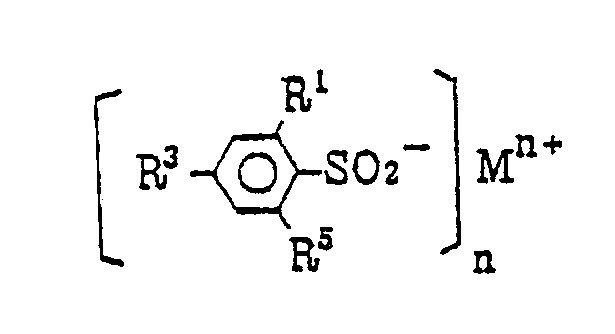
- (a) a sulfinate represented by the general formula [I]

- (b) a monomer.
Description
- The present invention relates to polymerizable compositions, and more specifically provides polymerizable compositions with good storage stability comprising an aromatic sulfinate as polymerization initiator.
- It has been proposed to use a sulfinic acid or a salt thereof as a component of polymerization initiators for polymerizing radical-polymerizable monomers, for example a sulfinic acid, a sulfinic acid (or its salt)-oxidizer system, and a sulfinic acid (or its salt)-amine-peroxide system. For example. Japanese Patent Application Laid-open No. 30193/1978 discloses a process comprising the use of a sulfinate-amine-peroxide system as a polymerization initiator for radical-polymerizable monomers. Further, Japanese Patent Application Laid-open No. 75907/1982 discloses that this sulfinate-amine-peroxide system is particularly useful for the polymerization of dental adhesives comprising an acidic monomer.
- However, since aromatic sulfinates which have hitherto been used, e.g. benzenesulfinate and toluenesulfinate, add, when contracted with a (meth)acrylate, (meth)acrylamide or a (meth)acrylamide derivative, gradually to the double bond of the monomer, compositions comprising the sulfinate dissolved or suspended in the monomer will, when stored at room temperature, lose polymerization activity in a few weeks.
- The two components therefore must be stored in separate packages so that they will not be in contact with each other, which is a disadvantage in comparison with other systems in which the initiator and monomer can be packed and stored together.
- Accordingly, the present Applicants sought to provide a composition comprising a sulfinate and a polymerizable monomer, which has a long pot life (e.g. at least one year).
- As a result of an intensive study to solve the above problem, it was found that introduction of bulky substituents into positions 2 and 6 of aromatic sulfinates dramatically suppress the addition of these sulfinates to the double bond of (meth)acrylates, (meth)acrylamides or derivatives thereof.
- Thus, the present invention provides a composition comprising:
- (a) a sulfinate represented by the general formula [I]

- (b) a monomer.
- The present invention employs aromatic sulfinates represented by the general formula (I) having bulky substituents in their positions 2 and 6.
- In the above-mentioned general formula [I], R¹ and R⁵ each is a substituent located in the ortho-position to the sulfinate group of the aromatic sulfinate and having sufficient bulkiness for exerting steric hindrance to addition of the sulfinate group to carbon-to-carbon double bond of a monomer. It is important that both R¹ and R⁵ be bulky groups. If only one of the two groups is bulky, sufficient steric hindrance to the addition of the sulfinate group to the double bond will not be achieved. With respect to the bulkiness of the groups, although a carbon atom number of 1, e.g. a methyl group, may suppress the addition reaction, for practical purposes the effect is attained with a carbon atom number of at least 2, preferably at least 3. While the addition is suppressed to a larger extent with an increasing number of carbon atoms, the effect of the suppression will become smaller once the substituent has a bulkiness of a certain degree. In view of this and commercial availability of raw material, the number of carbon atoms is up to 6 for practical purposes. R¹ and R⁵ should, naturally, be inert to the double bond of monomers. Generally, R¹ and R⁵ each is a hydrocarbon group which has 2 to 6 carbon atoms and may be substituted with one or more halogen atoms. Examples of the group are ethyl, 2-chloroethyl, 2-bromo-2-chloroethyl, propyl, isopropyl, perfluoropropyl, allyl, butyl, isobutyl, sec-butyl, tert-butyl, pentyl, isopentyl, neopentyl, tert-pentyl, cyclohexyl, phenyl, 4-bromophenyl and the like.
- R², R³ and R⁴ may be any atoms and/or groups as long as they are inert to the double bond of monomers. Examples are hydrogen, fluoro, chloro, bromo, iodo, methyl, ethyl, 2-chloroethyl, 2-bromo-2-chloroethyl, propyl, isopropyl, per-fluoropropyl, allyl, butyl, isobutyl, sec-butyl, tert-butyl, pentyl, isopentyl, neopentyl, tert-pentyl, cyclohexyl, phenyl and 4-bromophenyl.
- Mn+ is a cation with monovalency to 4-valency that can, as a counter ion for a sulfinic acid anion, form the sulfinate. Examples of Mn+ are alkali metal ions, such as Li⁺, Na⁺, K⁺, Rb⁺, and Cs⁺, alkaline earth metal ions, such as Be²⁺, Mg²⁺, Ca²⁺, Sr²⁺ and Ba², transition metal ions such as Cr²⁺, Cr³⁺, Mn²⁺, Fe²⁺, Fe³⁺, Co²⁺, CO³⁺, Ni²⁺, Cu²⁺, Zn²⁺, Rh³⁺, Pd²⁺, Ag⁺, Cd²⁺, Ir³⁺, Ir⁴⁺ and Hg²⁺, and ammonium ions, such as NH₄⁺, (CH₃CH₂)₃NH⁺,

- Preferred counter ions among these ions are Li⁺, Na⁺, K⁺, Mg²⁺, and Ca²⁺, since sulfinates thereof have good stability when stored in monomers and have good solubility in the monomers.
- Examples of sulfinates represented by general formula [I] are as follows.


- The advantage of the present invention is most apparent when using monomers having a carbon-to-carbon double bond directly linked to an electron-attracting group such as -F, -Cl, -Br, -I, -CN, -NO₂, -NO, -CO-, -CS-, -COO-, -COS-, -CSO-, -CSS-, -CONH₂, -CONH- or -CON-. Where monomers without the above electron-attracting groups, such as styrene, butadiene and allyl alcohol are used, sufficient storage stability is secured with conventional benzenesulfinates and toluenesulfinates. With monomers having the above electron-attracting groups, these conventional sulfinates, however, cannot achieve practical storage stability because of the occurrence of the addition reaction.
- Among monomers having carbon-to-carbon double bonds directly linked to an electron-attracting group, particularly suited for the purpose of the present invention are (meth)acrylates, α-haloacrylates, (meth)acrylamides and derivatives thereof, represented by the general formula


- Examples of the monomer represented by the above general formula are as follows. In the present invention the expression "(meth)acryl" means both methacryl and acryl.
- Methyl (meth)acrylate, ethyl (meth)acrylate, iso-butyl (meth)acrylate, n-hexyl (meth)acrylate, benzyl (meth)acrylate, decyl (meth)acrylate, lauryl (meth)acrylate, 2-hydroxyethyl (meth)acrylate, 2-(N,N-dimethylamino)ethyl (meth)acrylate, 2,3-dibromopropyl (meth)acrylate, oxiranylmethyl (meth)acrylate, 3-methacryloyloxypropyltrimethoxysilane and the like.
- Ethylene glycol di(meth)acrylate, diethylene glycol di(meth)acrylate, triethylene glycol di(meth)acrylate, propylene glycol di(meth)acrylate, dipropylene glycol di(meth)acrylate, neopentyl glycol di(meth)acrylate, 1,6-hexanediol di(meth)acrylate, 1,10-decanediol di(meth)acrylate, bisphenol-A-di(meth)acrylate, 2,2-bis((meth)acryloyloxyethoxyphenyl)propane, 2,2-bis((meth)acryloyloxypolyethoxyphenyl)propane, 2,2-bis[4-(3-(meth)acryloyloxy-2-hydroxypropoxy)phenyl]propane, 1,2-bis(3-(meth)acryloyloxy-2-hydroxypropoxy)ethane and the like.
- Trimethylolpropane tri(meth)acrylate, trimethylolethane tri(meth)acrylate, tetramethylolmethane tri(meth)acrylate, pentaerythritol tetra(meth)acrylate and the like.
-
- α-Fluoromethyl acrylate, α-chloromethyl acrylate, α-fluoroethyl acrylate, α-chlorobutyl acrylate, α-fluoro-2,2,2-trifuloroethyl acrylate, and the like.
- (Meth)acrylamide N-methyl(meth)acrylamide, N-isopropyl(meth)acrylamide, N-n-octyl(meth)acrylamide, N-benzyl(meth)acrylamide, N-(2-hydroxyethyl) (meth)acrylamide, N-(2-dimethylaminoethyl) (meth)acrylamide, N,N-dimethyl(meth)acrylamide, N,N-dicyclohexyl(meth)acrylamide, N-methyl-N-phenyl(meth)acrylamide, N,N′-methylenebis(meth)acrylamide, 1,6-bis(meth)acrylamidehexane, and the like.
- These copolymerizable monomers may be used singly or in combination.
- The composition of the present invention is obtained by dissolving or suspending the compound represented by general formula [I] in the above monomer. The sulfinate represented by formula [1] is generally used in an amount of 0.01 to 10% by weight based on the weight of the composition, preferably in an amount of 0.03 to 5% by weight on the same basis.
- Since the composition of the present invention is by itself extremely slow in initiating polymerization at room temperature, polymerization is effected by adding an oxidizer or by adding a photoinitiator, followed by photoradiation.
- As the oxidizer used in the invention, organic peroxides capable of initiating polymerization by redox reaction with sulfinates may be employed, and diacyl peroxides are preferred. Examples of the diacyl peroxides include, among other, benzoyl peroxide, m-toluoyl peroxide, 2,4-dichloro-benzoyl peroxide, octanoyl peroxide, lauroyl peroxide and succinoyl peroxide, among which particularly preferred are aromatic peroxides such as benzoyl peroxide and m-toluoyl peroxide. The oxidizer is stored in a package avoiding contact with the sulfinate represented by formula [I], and is, in polymerizing the composition of the present invention, added to the sulfinate generally in an amount of 0.01 to 500 parts by weight based on 1 parts by weight of the sulfinate. An amine may further be added to the sulfinate and oxidizer system to form a ternary initiator, whereby polymerization is much more accelerated. In this case, while the amine can be stored in contact with the sulfinate with no problem, the amine must not contact the oxidizer to avoid premature polymerization. When packaging the sulfinate and the oxidizer separately, the amine is therefore packed together with the sulfinate. Aromatic secondary or tertiary amines are preferred for this purpose, and examples are N,N-dimethylaniline, N,N-dimethyl-p-toluidine, ethyl m-N,N-dimethylaminobenzoate, ethyl p-N,N-dimethylaminobenzoate, N,N-diethanolaniline, N,N-diethanol-p-toluidine, N,N-diethanol-m-chloroaniline, N,N-bis(3-hydroxypropyl)aniline, N,N-bis(3-hydroxypropyl)-p-toluidine, N,N-bis(2,3-dihydroxypropyl)aniline, N,N-bis(2,3-dihydroxypropyl)-p-toluidine, ethyl m-N,N-bis(2,3-dihydroxypropyl)aminobenzoate, N-methylaniline, N-methyl-p-toluidine. The amine is generally added in an amount of 0.01 to 500 parts by weight based on 1 part by weight of the compound represented by formula [I].
- Suitable photoinitiators are photosensitive dyes and α-diketones, and examples are Methylene blue, Eosin YS, diacetyl, 2,3-pentanedione, 2,3-hexanedione, 3,4-hexanedione, camphorquinone, bicyclo-[2.2.1]heptane-2,3-dione, acenaphthenequinone, 9,10-phenanthraquinone, 9,10-anthraquinone and the like. The photoinitiator is generally added in an amount of 0.01 to 500 parts by weight based on 1 part by weight of the compound of formula [I].
- The composition of the present invention can comprise both the oxidizer and the photoinitiator and be subjected to both redox and photopolymerization.
- On the other hand, where the composition of the present invention is used as a primer, on which another polymerizable composition is applied, polymerization may be effected by an initiator which has been contained in the other polymerizable composition and has migrated to the composition of the present invention, even when the composition of the present invention has not originally contained an oxidizer or photoinitiator.
- The composition of the present invention may further comprise, as required, additives other than the above components, such as an inorganic filler, polymer, organic solvent, polymerization inhibitor, antioxidant, ultraviolet absorber, pigment, dye and the like. When a polymer is added, it can be added either as an insoluble filler or as a thickener which is soluble in the composition.
- As stated heretofore, introduction of bulky groups into positions 2 and 6 of a benzenesulfinate can suppress the rate of addition reaction of the sulfinate to the double bond of the monomer to below 1/10 the rate when conventional benzenesulfinates or toluenesulfinates are used. While compositions comprising conventional sulfinates can be stored at room temperature stably only for a few weeks, compositions of the present invention may be stored at room temperature stably for at least one year and thus have significant practical advantages.
- The polymerizable composition of the present invention can polymerize rapidly on addition of an oxidizer or on addition of a photoinitiator, followed by photoradiation. The present compositions can be used as adhesives for various industrial uses and as moldable resins. One suitable use of the composition is in the dental field, where it is used as a dental adhesive.
- Other features of the invention will become apparent in the course of the following descriptions of exemplary embodiments which are given for illustration of the invention and are not intended to be limiting thereof.
- There were used as the sulfinates, sodium 2,4,6-triethylbenzenesulfinate, sodium 2,4,6-triisopropylbenzenesulfinate, lithium 2,4,6-triisopropylbenzenesufinate, calcium 2,6-diisopropylbenzenesulfinate, lithium 2,4,6-tri-tert-butylbenzenesulfinate and sodium 2,4,6-triphenylbenzenesulfinate, and, as the polymerizable monomers, 2-hydroxyethyl methacrylate and a mixture of 2,2-bis[4-(3-methacryloyloxy-2-hydroxypropoxy)phenyl]propane, triethylene glycol dimethacrylate and 1,2-bis(3-methacryloyloxy-2-hydroxypropoxy)ethane, to prepare compositions of Examples 1 to 7 as shown in Table 1. These compositions were each placed in a glass ampoule tube, which was then sealed by fusion, and the tubes with their contents were stored at 37°C for 14 days. The amounts of the sulfinates before and after the storage were determined by high-performance liquid chromatography, and the ratios of remaining sulfinates after the storage at 37°C for 14 days were calculated. The results are shown in Table 1. The above procedures were repeated except for using, instead of the sulfinates used in Examples 1 to 7, sodium benzenesulfinate, sodium p-toluenesulfinate, sodium p-ethylbenzenesulfinate, sodium p-isopropylbenzenesulfinate, calcium p-isopropylbenzenesulfinate, calcium o-isopropylbenzenesulfinate and sodium 2,4,6-trimethylbenzenesulfinate, to prepare compositions of Comparative Examples 1 to 8.
- Regardless of absence or presence, or the type, of substituent in position 4, introduction of substituents having at least 2 carbon atoms into positions 2 and 6 significantly increased the retention of sulfinate. Where a substituent having at least 2 carbon atoms was introduced into only position 2 and where methyl groups were introduced into positions 2 and 6, there was observed some improvement in retention, which fell, however, far short of the retention achieved in the case where substituents having at least 2 carbon atoms were introduced in both positions 2 and 6.


- The following compositions A and B were prepared.
Composition A Parts by weight 2,2-Bis[4-(3-methacryloyloxy-2-hydroxypropoxy)phenyl]propane 40 Triethylene glycol dimethacrylate 30 2-Hydroxyethyl methacrylate 30 Sodium 2,4,6-triisopropylbenzenesulfinate 1 N,N-Diethanol-p-toluidine 2 Quartz powder silane-treated 300 Composition B 2,2-Bis[4-(3-methacryloyloxy-2-hydroxypropoxy)phenyl]propane 40 Triethylene glycol dimethacrylate 30 10-Methacryloyloxydecyl dihydrogenphosphate 30 Benzoyl peroxide 2 Quartz powder silane-treated 300 - The composition A just after preparation and after having been stored at 25°C for 1 year were each subjected to the following Test 1. Then the two samples were combined with composition B and subjected to the following Tests 2, 3 and 4.
- To 0.5 g of composition A 5 ml of methanol was added, the mixture was stirred well and the quartz powder was removed from the mixture by filtration. The amount of sodium 2,4,6-triisopropylbenzenesulfinate in the methanol solution was determined by high-performance liquid chromatography. The ratio of the amount of sodium 2,4,6-triisopropylbenzene-sulfinate after storage to that just after preparation was calculated. The results are shown in Table 2.
- Equal amounts of compositions A and B were kneaded together for 30 seconds, and the mixture was placed in a Teflon container having an inside diameter of 5 mm and a depth of 7 mm, and tested for curing or hardening time. A thermocouple was inserted in the kneaded mixture and temperature change was recorded. The time required until the stoppage of temperature increase due to polymerization heat was taken as the curing time. The results are shown in Table 2.
- A test surface to be bonded was prepared by patching an adhesive tape with a hole having a diameter of 5 mm to the surface of a nickel-chrome alloy plate (Now Chrom (I), made by Towa Giken Co.) ground with 1000-grit silicon-carbide abrasive paper. Round rods of SUS304 and having a diameter of 7 mm and a length of 25 mm were sand blasted on their end surface with alumina abrasive powder of particle size of 50µm. On the blasted end a paste obtained by kneading equal amounts of compositions A and B were heaped and the paste was pressed onto the test surface to bond the rod to the surface. After 1 hour the test piece thus prepared was immersed in water at 37°C and kept therein for 24 hours, and then tested for tensile bond strength using a universal tensile testing machine (Instron) at a crosshead speed of 2 mm/min. An average of measurements on 10 test pieces was calculated. The results are shown in Table 2.
- A labial enamel surface of bovine tooth was ground with silicon-carbide abrasive paper so that it was flat, and the flat surface was etched with a 40% aqueous phosphoric acid solution for 1 minute. On the etched surface an adhesive tape with a hole having a diameter of 5 mm was patched to prepare a test surface to be bonded. Round rods of SUS304 and having a diameter of 7 mm and a length of 25 mm were sand blasted on their end surface with alumina abrasive powder of particle size of 50µm. On the blasted end a paste obtained by kneading equal amounts of compositions A and B was heaped and the paste was pressed onto the test surface to bond the rod to the surface. After 1 hour the test piece thus prepared was immersed in water at 37°C and kept therein for 24 hours, and then tested for tensile bond strength using Instron at a crosshead speed of 2 mm/min. An average of measurements on 10 test pieces was calculated. The results are shown in Table 2.
- Example 8 was repeated except that sodium benzenesfulfinate was used instead of sodium 2,4,6-triisopropylbenzenesulfinate in composition A. This is Comparative Example 9 in Table 2.
Table 2 Example 8 Comparative Example 9 Just after preparation After storage at 25°C for 1 year Just after preparation After storage at 25°C for 1 year Test 1 (Retention of suflinic acid salt) (%) 100 89 100 0 Test 2 (Curing time) 8 min and 30 sec 8 min and 55 sec 8 min and 35 sec not hardened Tast 3 (Bond strength to nickel-chrome alloy) (kg/cm²) 419 408 420 not tested because this did not harden. Test 4 (Bond strength to bovine tooth enamel) (kg/cm²) 160 156 159 not tested because this did not harden. - The following composition C was prepared.
Composition C Parts by weight 2,2-Bis[4-(3-methacryloyloxy-2-hydroxypropoxy)phenyl]propane 40 1,6-Bismethacrylamidehexane 30 2-Hydroxyethyl methacrylate 30 Sodium 2,4,6-triisopropylbenzenesulfinate 1 Camphorquinone 1 - A glass cylindrical sample tube having an inside diameter of 10 mm and a wall thickness of 0.8 mm was charged with 0.25 ml of the composition. The tube with its contents was irradiated from below through a visible light irradiator (Quick light, made by Kuraray Co., Ltd.); the contents hardened in 32 seconds. A part of the above composition was stored at room temperature for 1 year, and then subjected to the same irradiation test; it hardened in 35 seconds. In determining the curing time, a thermocouple was inserted in the composition and temperature change was recorded. The time required until the cessation of temperature increase due to polymerization heat was taken as the curing time.
- The following compositions D and E were prepared, and, after being stored at room temperature for 1 year, tested for adhesiveness to human tooth dentine.
Composition D Parts by weight 2,2-Bis[4-(3-methacryloyloxy-2-hydroxypropoxy)phenyl]propane 20 2-Hydroxyethyl methacrylate 80 Sodium 2,4,6-triisopropylbenzenesulfinate 3 N,N-Dimethyl-p-toluidine 2 2,6-Di-t-butyl-4-methylphenol 0.03 Composition E 2,2-Bis[4-(3-methacryloyloxy-2-hydroxypropoxy)phenyl]propane 35 Neopentyl glycol dimethacrylate 30 10-Methacryloyloxydecyl dihydrogenphosphate 35 Benzoyl peroxide 2 2,6-Di-t-butyl-4-methylphenol 0.03 - Human molar tooth was ground with a silicon-carbide abrasive paper to expose the dentine, and then acid-etched with a 40% aqueous phosphoric acid solution for 1 minute. An adhesive tape with a hole having a diameter of 5 mm was patched on this etched surface to prepare a test surface to be bonded. Separately, pieces of round rod of SUS304 and having a diameter of 7 mm and a length of 25 mm were sand blasted on their end surface with alumina abrasive powder of particle size of 50µm. A paste obtained by kneading equal amounts of compositions D and E was applied both on this blasted end surface and on the human tooth test surface prepared above. Kneaded paste of a commercially available dental composite resin (CLEARFIL FII, made by Kuraray Co.) was heaped on the end surface of the rod and the paste was pressed onto the human tooth test surface to bond the rod to the surface. After 1 hour the test piece thus prepared was immersed in water at 37°C and kept therein for 24 hours, and then tested for tensile bond strength using Instron at a crosshead speed of 2 mm/min. An average of measurements on 8 test pieces was calculated to give 130 kg/cm².
- The compositions D and E stored at room temperature for 1 year as used in Example 10 were tested for metal-to-metal adhesiveness as follows.
- Two pieces of round rod of SUS304 and having a diameter of 7 mm and a length of 25 mm were sand blasted on their end surface with alumina grinding powder of particle size of 50µm. Composition D was applied to the blasted end surface of one rod, while composition E to that of the other rod. The two surfaces were pressed with each other to bond, to prepare a test piece. The test piece was kept at 25°C for 24 hours, and then tested for tensile bond strength with Instron at a crosshead speed of 2 mm/min. An average of measurements on 10 test pieces was 382 kg/cm².
- Obviously, numerous modifications and variations of the present invention are possible in light of the above teachings. It is therefore to be understood that the invention may be practiced otherwise than as specifically described herein.
Claims (12)


(a) said sulfinate represented by the general formula [I],
(b) a polymerizable monomer and
(c) an oxidizer;
said (a) and (c) being stored in separate packages and mixed with each other to effect polymerization.
(a) said sulfinate represented by the general formula [I],
(b) a polymerizable monomer
(c) an oxidizer, and
(d) an amine,
said oxidizer being stored in a separate package from (a) and (d).
Applications Claiming Priority (2)
| Application Number | Priority Date | Filing Date | Title |
|---|---|---|---|
| JP181382/89 | 1989-07-12 | ||
| JP1181382A JP2604472B2 (en) | 1989-07-12 | 1989-07-12 | Polymerizable composition |
Publications (3)
| Publication Number | Publication Date |
|---|---|
| EP0408357A2 true EP0408357A2 (en) | 1991-01-16 |
| EP0408357A3 EP0408357A3 (en) | 1991-10-02 |
| EP0408357B1 EP0408357B1 (en) | 1994-06-01 |
Family
ID=16099756
Family Applications (1)
| Application Number | Title | Priority Date | Filing Date |
|---|---|---|---|
| EP90307628A Expired - Lifetime EP0408357B1 (en) | 1989-07-12 | 1990-07-12 | Polymerizable composition |
Country Status (5)
| Country | Link |
|---|---|
| US (1) | US5486544A (en) |
| EP (1) | EP0408357B1 (en) |
| JP (1) | JP2604472B2 (en) |
| CA (1) | CA2020473C (en) |
| DE (1) | DE69009322T2 (en) |
Cited By (12)
| Publication number | Priority date | Publication date | Assignee | Title |
|---|---|---|---|---|
| EP0661034A1 (en) * | 1993-12-28 | 1995-07-05 | Tokuyama Corporation | Dental composition |
| WO1996000559A1 (en) * | 1994-06-30 | 1996-01-11 | Minnesota Mining And Manufacturing Company | Method for bonding amalgam to dental surfaces |
| US5554030A (en) * | 1994-06-30 | 1996-09-10 | Minnesota Mining And Manufacturing Company | Method for bonding non-amalgam restorative materials to dental surfaces |
| WO1998046196A3 (en) * | 1997-04-16 | 1999-04-01 | Dentsply Int Inc | Method and composition for adhering to tooth structure |
| US9289359B2 (en) | 2009-03-23 | 2016-03-22 | Ivoclar Vivadent Ag | Self-adhesive multicomponent dental material |
| US9427382B2 (en) | 1998-06-30 | 2016-08-30 | Dentsply International Inc. | Method and composition for adhering to tooth structure |
| US20160289178A1 (en) * | 2013-06-10 | 2016-10-06 | Amgen Inc. | Processes of making and crystalline forms of a mdm2 inhibitor |
| US9758495B2 (en) | 2013-03-14 | 2017-09-12 | Amgen Inc. | Heteroaryl acid morpholinone compounds as MDM2 inhibitors for the treatment of cancer |
| EP3470048A1 (en) * | 2017-10-13 | 2019-04-17 | Dentsply DeTrey GmbH | Photocurable dental composition |
| EP2233123B2 (en) † | 2009-03-24 | 2020-03-11 | Ivoclar Vivadent AG | Self-adhesive multi-component dental material |
| US11407721B2 (en) | 2013-02-19 | 2022-08-09 | Amgen Inc. | CIS-morpholinone and other compounds as MDM2 inhibitors for the treatment of cancer |
| EP4591847A1 (en) | 2024-01-23 | 2025-07-30 | Ivoclar Vivadent AG | 2-component dental materials based on crosslinked polymeric particles bearing acylthiourea groups |
Families Citing this family (10)
| Publication number | Priority date | Publication date | Assignee | Title |
|---|---|---|---|---|
| US5639837A (en) * | 1996-06-04 | 1997-06-17 | E. I. Du Pont De Nemours And Company | Process for making fluoropolymers |
| JP4179636B2 (en) * | 1997-06-09 | 2008-11-12 | 株式会社クラレ | Dental polymerizable composition |
| US6204302B1 (en) * | 1998-11-20 | 2001-03-20 | Bisco, Inc. | Photosensitizers for free radical polymerization initiation resins and method of making the same |
| JP2003216231A (en) * | 2002-01-18 | 2003-07-31 | Hitachi Ltd | On-site monitoring and operation equipment |
| US7064152B2 (en) * | 2003-09-26 | 2006-06-20 | 3M Innovative Properties Company | Arylsulfinate salts in photoinitiator systems for polymerization reactions |
| US7250452B2 (en) * | 2003-09-26 | 2007-07-31 | 3M Innovative Properties Company | Dental compositions and methods with arylsulfinate salts |
| US7030169B2 (en) * | 2003-09-26 | 2006-04-18 | 3M Innovative Properties Company | Arylsulfinate salts in initiator systems for polymeric reactions |
| US7026367B2 (en) * | 2003-09-26 | 2006-04-11 | 3M Innovative Properties Company | Photoiniators having triarylsulfonium and arylsulfinate ions |
| EP4331557A1 (en) | 2022-09-01 | 2024-03-06 | Ivoclar Vivadent AG | Radically polymerizable composition comprising a redox initiator system based on dihydropyridines |
| EP4414390A1 (en) | 2023-02-10 | 2024-08-14 | Ivoclar Vivadent AG | Acylthiourea oligomers suitable as redox initiator components and radically polymerizable compositions comprising them |
Family Cites Families (4)
| Publication number | Priority date | Publication date | Assignee | Title |
|---|---|---|---|---|
| US3573922A (en) * | 1965-04-23 | 1971-04-06 | Hughes Aircraft Co | Photopolymerizable composition and process |
| JPS5330193A (en) * | 1976-08-31 | 1978-03-22 | Kuraray Co | Human body hard tissue adhesive compostion |
| DE3135115A1 (en) * | 1981-09-04 | 1983-03-24 | Bayer Ag, 5090 Leverkusen | Photopolymerisation processes and photoactivators which are suitable for these processes |
| US4657941A (en) * | 1984-11-29 | 1987-04-14 | Dentsply Research & Development Corp. | Biologically compatible adhesive containing a phosphorus adhesion promoter and a sulfinic accelerator |
-
1989
- 1989-07-12 JP JP1181382A patent/JP2604472B2/en not_active Expired - Lifetime
-
1990
- 1990-07-05 CA CA002020473A patent/CA2020473C/en not_active Expired - Lifetime
- 1990-07-12 EP EP90307628A patent/EP0408357B1/en not_active Expired - Lifetime
- 1990-07-12 DE DE69009322T patent/DE69009322T2/en not_active Expired - Lifetime
-
1994
- 1994-09-12 US US08/304,434 patent/US5486544A/en not_active Expired - Lifetime
Cited By (20)
| Publication number | Priority date | Publication date | Assignee | Title |
|---|---|---|---|---|
| EP0661034A1 (en) * | 1993-12-28 | 1995-07-05 | Tokuyama Corporation | Dental composition |
| US5739177A (en) * | 1993-12-28 | 1998-04-14 | Tokuyama Corporation | Dental composition |
| WO1996000559A1 (en) * | 1994-06-30 | 1996-01-11 | Minnesota Mining And Manufacturing Company | Method for bonding amalgam to dental surfaces |
| US5554030A (en) * | 1994-06-30 | 1996-09-10 | Minnesota Mining And Manufacturing Company | Method for bonding non-amalgam restorative materials to dental surfaces |
| US5595487A (en) * | 1994-06-30 | 1997-01-21 | Minnesota Mining And Manufacturing Company | Method for bonding amalgam to dental surfaces |
| WO1998046196A3 (en) * | 1997-04-16 | 1999-04-01 | Dentsply Int Inc | Method and composition for adhering to tooth structure |
| US9427382B2 (en) | 1998-06-30 | 2016-08-30 | Dentsply International Inc. | Method and composition for adhering to tooth structure |
| US9289359B2 (en) | 2009-03-23 | 2016-03-22 | Ivoclar Vivadent Ag | Self-adhesive multicomponent dental material |
| EP2233123B2 (en) † | 2009-03-24 | 2020-03-11 | Ivoclar Vivadent AG | Self-adhesive multi-component dental material |
| US11407721B2 (en) | 2013-02-19 | 2022-08-09 | Amgen Inc. | CIS-morpholinone and other compounds as MDM2 inhibitors for the treatment of cancer |
| US9758495B2 (en) | 2013-03-14 | 2017-09-12 | Amgen Inc. | Heteroaryl acid morpholinone compounds as MDM2 inhibitors for the treatment of cancer |
| US9757367B2 (en) * | 2013-06-10 | 2017-09-12 | Amgen Inc. | Calcium propane-2-sulfinate dihydrate |
| US9801867B2 (en) | 2013-06-10 | 2017-10-31 | Amgen Inc. | Processes of making and crystalline forms of a MDM2 inhibitor |
| US9855259B2 (en) | 2013-06-10 | 2018-01-02 | Amgen Inc. | Processes of making and crystalline forms of a MDM2 inhibitor |
| US20160289178A1 (en) * | 2013-06-10 | 2016-10-06 | Amgen Inc. | Processes of making and crystalline forms of a mdm2 inhibitor |
| EP3470048A1 (en) * | 2017-10-13 | 2019-04-17 | Dentsply DeTrey GmbH | Photocurable dental composition |
| WO2019072787A1 (en) | 2017-10-13 | 2019-04-18 | Dentsply Detrey Gmbh | Photocurable dental composition |
| AU2018348667B2 (en) * | 2017-10-13 | 2022-05-05 | Dentsply Detrey Gmbh | Photocurable dental composition |
| US11844848B2 (en) | 2017-10-13 | 2023-12-19 | Dentsply Sirona Inc. | Photocurable dental composition |
| EP4591847A1 (en) | 2024-01-23 | 2025-07-30 | Ivoclar Vivadent AG | 2-component dental materials based on crosslinked polymeric particles bearing acylthiourea groups |
Also Published As
| Publication number | Publication date |
|---|---|
| CA2020473A1 (en) | 1991-01-13 |
| US5486544A (en) | 1996-01-23 |
| JPH0345602A (en) | 1991-02-27 |
| DE69009322T2 (en) | 1994-09-15 |
| EP0408357A3 (en) | 1991-10-02 |
| DE69009322D1 (en) | 1994-07-07 |
| EP0408357B1 (en) | 1994-06-01 |
| CA2020473C (en) | 2000-12-12 |
| JP2604472B2 (en) | 1997-04-30 |
Similar Documents
| Publication | Publication Date | Title |
|---|---|---|
| EP0408357B1 (en) | Polymerizable composition | |
| US4746685A (en) | Light curable dental composition | |
| US4097994A (en) | Dental restorative composition containing oligomeric BIS-GMA resin and Michler's ketone | |
| EP0155812B1 (en) | Dental compositions | |
| US20030018098A1 (en) | Multi-part dental compositions and kits | |
| JP6984044B2 (en) | One-part dental adhesive composition for fixing dental composites | |
| US5700875A (en) | Adhesive composition for dental treatment | |
| AU7550698A (en) | Polymerizable composition for dental use | |
| US4369262A (en) | Dental material based on crosslinked plastic and polymerizable binder | |
| CN108289794A (en) | Dental adhesive | |
| WO2022014492A1 (en) | Polymerization initiator, kit for preparing curable composition, curable composition, cured product, and dental material | |
| US4381386A (en) | Polymerizable adhesives containing boron initiators | |
| ES2916205T3 (en) | Dental composite materials with improved storage stability | |
| JPH025723B2 (en) | ||
| EP3415539B1 (en) | Polymerizable composition and kit thereof, and polymerization initiator | |
| JP2017105715A (en) | Dental cement | |
| JP4889992B2 (en) | Dental composite resin and dental filling kit | |
| WO2020138071A1 (en) | Monomer composition for dental materials, composition for dental materials, and dental material | |
| JPWO2020031897A1 (en) | Kits for preparing polymerization initiators, curable compositions, dental materials and curable compositions | |
| US5770638A (en) | Adhesive for dental resin composite materials | |
| US20190040261A1 (en) | Polymerizable composition and kit, and polymerization initiator | |
| JP7104486B2 (en) | High toughness silane coupling compounds and medical and dental curable compositions containing them | |
| JP3409291B2 (en) | Amine-based unsaturated compound and photocurable composition containing the same | |
| JP5574945B2 (en) | Photocurable composition | |
| JPH09157126A (en) | Dual cure dental adhesive system |
Legal Events
| Date | Code | Title | Description |
|---|---|---|---|
| PUAI | Public reference made under article 153(3) epc to a published international application that has entered the european phase |
Free format text: ORIGINAL CODE: 0009012 |
|
| AK | Designated contracting states |
Kind code of ref document: A2 Designated state(s): CH DE FR GB IT LI NL |
|
| PUAL | Search report despatched |
Free format text: ORIGINAL CODE: 0009013 |
|
| AK | Designated contracting states |
Kind code of ref document: A3 Designated state(s): CH DE FR GB IT LI NL |
|
| 17P | Request for examination filed |
Effective date: 19920321 |
|
| 17Q | First examination report despatched |
Effective date: 19920812 |
|
| GRAA | (expected) grant |
Free format text: ORIGINAL CODE: 0009210 |
|
| AK | Designated contracting states |
Kind code of ref document: B1 Designated state(s): CH DE FR GB IT LI NL |
|
| REF | Corresponds to: |
Ref document number: 69009322 Country of ref document: DE Date of ref document: 19940707 |
|
| ITF | It: translation for a ep patent filed | ||
| ET | Fr: translation filed | ||
| PLBE | No opposition filed within time limit |
Free format text: ORIGINAL CODE: 0009261 |
|
| STAA | Information on the status of an ep patent application or granted ep patent |
Free format text: STATUS: NO OPPOSITION FILED WITHIN TIME LIMIT |
|
| 26N | No opposition filed | ||
| REG | Reference to a national code |
Ref country code: GB Ref legal event code: IF02 |
|
| PGFP | Annual fee paid to national office [announced via postgrant information from national office to epo] |
Ref country code: FR Payment date: 20090710 Year of fee payment: 20 |
|
| PGFP | Annual fee paid to national office [announced via postgrant information from national office to epo] |
Ref country code: DE Payment date: 20090709 Year of fee payment: 20 Ref country code: NL Payment date: 20090705 Year of fee payment: 20 Ref country code: GB Payment date: 20090708 Year of fee payment: 20 Ref country code: CH Payment date: 20090721 Year of fee payment: 20 |
|
| PGFP | Annual fee paid to national office [announced via postgrant information from national office to epo] |
Ref country code: IT Payment date: 20090722 Year of fee payment: 20 |
|
| REG | Reference to a national code |
Ref country code: NL Ref legal event code: V4 Effective date: 20100712 |
|
| REG | Reference to a national code |
Ref country code: CH Ref legal event code: PL |
|
| REG | Reference to a national code |
Ref country code: GB Ref legal event code: PE20 Expiry date: 20100711 |
|
| PG25 | Lapsed in a contracting state [announced via postgrant information from national office to epo] |
Ref country code: NL Free format text: LAPSE BECAUSE OF EXPIRATION OF PROTECTION Effective date: 20100712 |
|
| PG25 | Lapsed in a contracting state [announced via postgrant information from national office to epo] |
Ref country code: GB Free format text: LAPSE BECAUSE OF EXPIRATION OF PROTECTION Effective date: 20100711 |
|
| PG25 | Lapsed in a contracting state [announced via postgrant information from national office to epo] |
Ref country code: DE Free format text: LAPSE BECAUSE OF EXPIRATION OF PROTECTION Effective date: 20100712 |