EP0408273B1 - Fosinopril tablet formulations - Google Patents
Fosinopril tablet formulations Download PDFInfo
- Publication number
- EP0408273B1 EP0408273B1 EP90307449A EP90307449A EP0408273B1 EP 0408273 B1 EP0408273 B1 EP 0408273B1 EP 90307449 A EP90307449 A EP 90307449A EP 90307449 A EP90307449 A EP 90307449A EP 0408273 B1 EP0408273 B1 EP 0408273B1
- Authority
- EP
- European Patent Office
- Prior art keywords
- sodium
- lactose
- povidone
- stearyl fumarate
- fosinopril
- Prior art date
- Legal status (The legal status is an assumption and is not a legal conclusion. Google has not performed a legal analysis and makes no representation as to the accuracy of the status listed.)
- Expired - Lifetime
Links
- BIDNLKIUORFRQP-XYGFDPSESA-N (2s,4s)-4-cyclohexyl-1-[2-[[(1s)-2-methyl-1-propanoyloxypropoxy]-(4-phenylbutyl)phosphoryl]acetyl]pyrrolidine-2-carboxylic acid Chemical compound C([P@@](=O)(O[C@H](OC(=O)CC)C(C)C)CC(=O)N1[C@@H](C[C@H](C1)C1CCCCC1)C(O)=O)CCCC1=CC=CC=C1 BIDNLKIUORFRQP-XYGFDPSESA-N 0.000 title description 4
- 229960002490 fosinopril Drugs 0.000 title description 4
- 239000007916 tablet composition Substances 0.000 title description 3
- 229960001880 fosinopril sodium Drugs 0.000 claims abstract description 37
- TVTJZMHAIQQZTL-WATAJHSMSA-M sodium;(2s,4s)-4-cyclohexyl-1-[2-[[(1s)-2-methyl-1-propanoyloxypropoxy]-(4-phenylbutyl)phosphoryl]acetyl]pyrrolidine-2-carboxylate Chemical compound [Na+].C([P@@](=O)(O[C@H](OC(=O)CC)C(C)C)CC(=O)N1[C@@H](C[C@H](C1)C1CCCCC1)C([O-])=O)CCCC1=CC=CC=C1 TVTJZMHAIQQZTL-WATAJHSMSA-M 0.000 claims abstract description 37
- MVPICKVDHDWCJQ-UHFFFAOYSA-N ethyl 3-pyrrolidin-1-ylpropanoate Chemical compound CCOC(=O)CCN1CCCC1 MVPICKVDHDWCJQ-UHFFFAOYSA-N 0.000 claims abstract description 30
- 229940045902 sodium stearyl fumarate Drugs 0.000 claims abstract description 30
- 239000007884 disintegrant Substances 0.000 claims abstract description 20
- 239000011230 binding agent Substances 0.000 claims abstract description 19
- 239000000945 filler Substances 0.000 claims abstract description 15
- 239000000314 lubricant Substances 0.000 claims abstract description 14
- 239000008172 hydrogenated vegetable oil Substances 0.000 claims abstract description 10
- 239000002934 diuretic Substances 0.000 claims abstract description 9
- 230000001882 diuretic effect Effects 0.000 claims abstract description 6
- WHNWPMSKXPGLAX-UHFFFAOYSA-N N-Vinyl-2-pyrrolidone Chemical compound C=CN1CCCC1=O WHNWPMSKXPGLAX-UHFFFAOYSA-N 0.000 claims description 42
- 238000000034 method Methods 0.000 claims description 35
- GUBGYTABKSRVRQ-QKKXKWKRSA-N lactose group Chemical group OC1[C@H](O)[C@@H](O)[C@H](O[C@H]2[C@H](O)[C@@H](O)[C@@H](O)[C@H](O2)CO)[C@H](O1)CO GUBGYTABKSRVRQ-QKKXKWKRSA-N 0.000 claims description 33
- 239000008101 lactose Substances 0.000 claims description 29
- 239000000203 mixture Substances 0.000 claims description 29
- 229920000036 polyvinylpyrrolidone Polymers 0.000 claims description 22
- 235000013855 polyvinylpyrrolidone Nutrition 0.000 claims description 22
- 229940069328 povidone Drugs 0.000 claims description 22
- 229960000913 crospovidone Drugs 0.000 claims description 18
- 229920000523 polyvinylpolypyrrolidone Polymers 0.000 claims description 18
- 235000013809 polyvinylpolypyrrolidone Nutrition 0.000 claims description 18
- 229920000168 Microcrystalline cellulose Polymers 0.000 claims description 13
- 239000008108 microcrystalline cellulose Substances 0.000 claims description 13
- 229940016286 microcrystalline cellulose Drugs 0.000 claims description 13
- 235000019813 microcrystalline cellulose Nutrition 0.000 claims description 13
- JIVPVXMEBJLZRO-CQSZACIVSA-N 2-chloro-5-[(1r)-1-hydroxy-3-oxo-2h-isoindol-1-yl]benzenesulfonamide Chemical compound C1=C(Cl)C(S(=O)(=O)N)=CC([C@@]2(O)C3=CC=CC=C3C(=O)N2)=C1 JIVPVXMEBJLZRO-CQSZACIVSA-N 0.000 claims description 10
- JZUFKLXOESDKRF-UHFFFAOYSA-N Chlorothiazide Chemical compound C1=C(Cl)C(S(=O)(=O)N)=CC2=C1NCNS2(=O)=O JZUFKLXOESDKRF-UHFFFAOYSA-N 0.000 claims description 10
- 229960001523 chlortalidone Drugs 0.000 claims description 10
- 238000005550 wet granulation Methods 0.000 claims description 10
- 229960002003 hydrochlorothiazide Drugs 0.000 claims description 9
- 239000003795 chemical substances by application Substances 0.000 claims description 7
- 229920002785 Croscarmellose sodium Polymers 0.000 claims description 6
- 235000010947 crosslinked sodium carboxy methyl cellulose Nutrition 0.000 claims description 6
- 229920000881 Modified starch Polymers 0.000 claims description 5
- 229920002472 Starch Polymers 0.000 claims description 5
- 239000004480 active ingredient Substances 0.000 claims description 5
- 239000001767 crosslinked sodium carboxy methyl cellulose Substances 0.000 claims description 5
- 239000004615 ingredient Substances 0.000 claims description 5
- 229920003109 sodium starch glycolate Polymers 0.000 claims description 5
- 239000008109 sodium starch glycolate Substances 0.000 claims description 5
- 229940079832 sodium starch glycolate Drugs 0.000 claims description 5
- 229940032147 starch Drugs 0.000 claims description 5
- 239000008107 starch Substances 0.000 claims description 5
- 235000019698 starch Nutrition 0.000 claims description 5
- 238000007908 dry granulation Methods 0.000 claims description 4
- 239000011734 sodium Substances 0.000 claims description 4
- 229910052708 sodium Inorganic materials 0.000 claims description 4
- 229920002153 Hydroxypropyl cellulose Polymers 0.000 claims description 2
- 239000001863 hydroxypropyl cellulose Substances 0.000 claims description 2
- 235000010977 hydroxypropyl cellulose Nutrition 0.000 claims description 2
- 238000003860 storage Methods 0.000 claims description 2
- 238000004519 manufacturing process Methods 0.000 claims 1
- 239000000546 pharmaceutical excipient Substances 0.000 abstract description 3
- HQKMJHAJHXVSDF-UHFFFAOYSA-L magnesium stearate Chemical compound [Mg+2].CCCCCCCCCCCCCCCCCC([O-])=O.CCCCCCCCCCCCCCCCCC([O-])=O HQKMJHAJHXVSDF-UHFFFAOYSA-L 0.000 description 10
- -1 4-phenylbutyl Chemical group 0.000 description 6
- 238000005469 granulation Methods 0.000 description 6
- 230000003179 granulation Effects 0.000 description 6
- 235000019359 magnesium stearate Nutrition 0.000 description 5
- 239000002904 solvent Substances 0.000 description 5
- 238000009472 formulation Methods 0.000 description 4
- LFQSCWFLJHTTHZ-UHFFFAOYSA-N Ethanol Chemical compound CCO LFQSCWFLJHTTHZ-UHFFFAOYSA-N 0.000 description 3
- 229940030606 diuretics Drugs 0.000 description 3
- XLYOFNOQVPJJNP-UHFFFAOYSA-N water Substances O XLYOFNOQVPJJNP-UHFFFAOYSA-N 0.000 description 3
- 239000005541 ACE inhibitor Substances 0.000 description 2
- 101710129690 Angiotensin-converting enzyme inhibitor Proteins 0.000 description 2
- 101710086378 Bradykinin-potentiating and C-type natriuretic peptides Proteins 0.000 description 2
- KFZMGEQAYNKOFK-UHFFFAOYSA-N Isopropanol Chemical compound CC(C)O KFZMGEQAYNKOFK-UHFFFAOYSA-N 0.000 description 2
- 229940044094 angiotensin-converting-enzyme inhibitor Drugs 0.000 description 2
- 229940030600 antihypertensive agent Drugs 0.000 description 2
- 239000002220 antihypertensive agent Substances 0.000 description 2
- 238000001035 drying Methods 0.000 description 2
- 239000012530 fluid Substances 0.000 description 2
- 239000008187 granular material Substances 0.000 description 2
- 229920001519 homopolymer Polymers 0.000 description 2
- 230000001681 protective effect Effects 0.000 description 2
- 159000000000 sodium salts Chemical class 0.000 description 2
- UUUHXMGGBIUAPW-UHFFFAOYSA-N 1-[1-[2-[[5-amino-2-[[1-[5-(diaminomethylideneamino)-2-[[1-[3-(1h-indol-3-yl)-2-[(5-oxopyrrolidine-2-carbonyl)amino]propanoyl]pyrrolidine-2-carbonyl]amino]pentanoyl]pyrrolidine-2-carbonyl]amino]-5-oxopentanoyl]amino]-3-methylpentanoyl]pyrrolidine-2-carbon Chemical compound C1CCC(C(=O)N2C(CCC2)C(O)=O)N1C(=O)C(C(C)CC)NC(=O)C(CCC(N)=O)NC(=O)C1CCCN1C(=O)C(CCCN=C(N)N)NC(=O)C1CCCN1C(=O)C(CC=1C2=CC=CC=C2NC=1)NC(=O)C1CCC(=O)N1 UUUHXMGGBIUAPW-UHFFFAOYSA-N 0.000 description 1
- GUBGYTABKSRVRQ-XLOQQCSPSA-N Alpha-Lactose Chemical compound O[C@@H]1[C@@H](O)[C@@H](O)[C@@H](CO)O[C@H]1O[C@@H]1[C@@H](CO)O[C@H](O)[C@H](O)[C@H]1O GUBGYTABKSRVRQ-XLOQQCSPSA-N 0.000 description 1
- 229920002261 Corn starch Polymers 0.000 description 1
- 108010010803 Gelatin Proteins 0.000 description 1
- 206010020772 Hypertension Diseases 0.000 description 1
- 102000004270 Peptidyl-Dipeptidase A Human genes 0.000 description 1
- 108090000882 Peptidyl-Dipeptidase A Proteins 0.000 description 1
- XBDQKXXYIPTUBI-UHFFFAOYSA-M Propionate Chemical compound CCC([O-])=O XBDQKXXYIPTUBI-UHFFFAOYSA-M 0.000 description 1
- 125000000218 acetic acid group Chemical group C(C)(=O)* 0.000 description 1
- DPXJVFZANSGRMM-UHFFFAOYSA-N acetic acid;2,3,4,5,6-pentahydroxyhexanal;sodium Chemical compound [Na].CC(O)=O.OCC(O)C(O)C(O)C(O)C=O DPXJVFZANSGRMM-UHFFFAOYSA-N 0.000 description 1
- 239000013543 active substance Substances 0.000 description 1
- XSDQTOBWRPYKKA-UHFFFAOYSA-N amiloride Chemical compound NC(=N)NC(=O)C1=NC(Cl)=C(N)N=C1N XSDQTOBWRPYKKA-UHFFFAOYSA-N 0.000 description 1
- 229960002576 amiloride Drugs 0.000 description 1
- 229960003515 bendroflumethiazide Drugs 0.000 description 1
- HDWIHXWEUNVBIY-UHFFFAOYSA-N bendroflumethiazidum Chemical compound C1=C(C(F)(F)F)C(S(=O)(=O)N)=CC(S(N2)(=O)=O)=C1NC2CC1=CC=CC=C1 HDWIHXWEUNVBIY-UHFFFAOYSA-N 0.000 description 1
- 230000036772 blood pressure Effects 0.000 description 1
- 239000013590 bulk material Substances 0.000 description 1
- 229960004064 bumetanide Drugs 0.000 description 1
- MAEIEVLCKWDQJH-UHFFFAOYSA-N bumetanide Chemical compound CCCCNC1=CC(C(O)=O)=CC(S(N)(=O)=O)=C1OC1=CC=CC=C1 MAEIEVLCKWDQJH-UHFFFAOYSA-N 0.000 description 1
- 229960002155 chlorothiazide Drugs 0.000 description 1
- 239000003086 colorant Substances 0.000 description 1
- 239000008120 corn starch Substances 0.000 description 1
- 229960001681 croscarmellose sodium Drugs 0.000 description 1
- 239000011928 denatured alcohol Substances 0.000 description 1
- 230000007613 environmental effect Effects 0.000 description 1
- 150000002148 esters Chemical class 0.000 description 1
- 229960003199 etacrynic acid Drugs 0.000 description 1
- AVOLMBLBETYQHX-UHFFFAOYSA-N etacrynic acid Chemical compound CCC(=C)C(=O)C1=CC=C(OCC(O)=O)C(Cl)=C1Cl AVOLMBLBETYQHX-UHFFFAOYSA-N 0.000 description 1
- 238000011156 evaluation Methods 0.000 description 1
- RGUQWGXAYZNLMI-UHFFFAOYSA-N flumethiazide Chemical compound C1=C(C(F)(F)F)C(S(=O)(=O)N)=CC2=C1NC=NS2(=O)=O RGUQWGXAYZNLMI-UHFFFAOYSA-N 0.000 description 1
- 229960003028 flumethiazide Drugs 0.000 description 1
- 229960003883 furosemide Drugs 0.000 description 1
- ZZUFCTLCJUWOSV-UHFFFAOYSA-N furosemide Chemical compound C1=C(Cl)C(S(=O)(=O)N)=CC(C(O)=O)=C1NCC1=CC=CO1 ZZUFCTLCJUWOSV-UHFFFAOYSA-N 0.000 description 1
- 229920000159 gelatin Polymers 0.000 description 1
- 239000008273 gelatin Substances 0.000 description 1
- 235000019322 gelatine Nutrition 0.000 description 1
- 235000011852 gelatine desserts Nutrition 0.000 description 1
- 238000005461 lubrication Methods 0.000 description 1
- QUIOHQITLKCGNW-TYYBGVCCSA-L magnesium;(e)-but-2-enedioate Chemical compound [Mg+2].[O-]C(=O)\C=C\C([O-])=O QUIOHQITLKCGNW-TYYBGVCCSA-L 0.000 description 1
- 239000000463 material Substances 0.000 description 1
- 238000005259 measurement Methods 0.000 description 1
- 229910052751 metal Inorganic materials 0.000 description 1
- 239000002184 metal Substances 0.000 description 1
- 238000012986 modification Methods 0.000 description 1
- 230000004048 modification Effects 0.000 description 1
- 239000003960 organic solvent Substances 0.000 description 1
- 238000004806 packaging method and process Methods 0.000 description 1
- 239000000825 pharmaceutical preparation Substances 0.000 description 1
- 229940127557 pharmaceutical product Drugs 0.000 description 1
- 125000005328 phosphinyl group Chemical group [PH2](=O)* 0.000 description 1
- 238000002360 preparation method Methods 0.000 description 1
- 238000012545 processing Methods 0.000 description 1
- 229960002429 proline Drugs 0.000 description 1
- HNJBEVLQSNELDL-UHFFFAOYSA-N pyrrolidin-2-one Chemical compound O=C1CCCN1 HNJBEVLQSNELDL-UHFFFAOYSA-N 0.000 description 1
- 150000003839 salts Chemical class 0.000 description 1
- LXMSZDCAJNLERA-ZHYRCANASA-N spironolactone Chemical compound C([C@@H]1[C@]2(C)CC[C@@H]3[C@@]4(C)CCC(=O)C=C4C[C@H]([C@@H]13)SC(=O)C)C[C@@]21CCC(=O)O1 LXMSZDCAJNLERA-ZHYRCANASA-N 0.000 description 1
- 229960002256 spironolactone Drugs 0.000 description 1
- 239000000126 substance Substances 0.000 description 1
- 239000003451 thiazide diuretic agent Substances 0.000 description 1
- 229960000356 tienilic acid Drugs 0.000 description 1
- AGHANLSBXUWXTB-UHFFFAOYSA-N tienilic acid Chemical compound ClC1=C(Cl)C(OCC(=O)O)=CC=C1C(=O)C1=CC=CS1 AGHANLSBXUWXTB-UHFFFAOYSA-N 0.000 description 1
- 239000003039 volatile agent Substances 0.000 description 1
Classifications
-
- A—HUMAN NECESSITIES
- A61—MEDICAL OR VETERINARY SCIENCE; HYGIENE
- A61K—PREPARATIONS FOR MEDICAL, DENTAL OR TOILETRY PURPOSES
- A61K9/00—Medicinal preparations characterised by special physical form
- A61K9/20—Pills, tablets, discs, rods
- A61K9/2004—Excipients; Inactive ingredients
-
- A—HUMAN NECESSITIES
- A61—MEDICAL OR VETERINARY SCIENCE; HYGIENE
- A61K—PREPARATIONS FOR MEDICAL, DENTAL OR TOILETRY PURPOSES
- A61K31/00—Medicinal preparations containing organic active ingredients
- A61K31/66—Phosphorus compounds
- A61K31/675—Phosphorus compounds having nitrogen as a ring hetero atom, e.g. pyridoxal phosphate
-
- A—HUMAN NECESSITIES
- A61—MEDICAL OR VETERINARY SCIENCE; HYGIENE
- A61K—PREPARATIONS FOR MEDICAL, DENTAL OR TOILETRY PURPOSES
- A61K9/00—Medicinal preparations characterised by special physical form
- A61K9/20—Pills, tablets, discs, rods
- A61K9/2004—Excipients; Inactive ingredients
- A61K9/2013—Organic compounds, e.g. phospholipids, fats
-
- A—HUMAN NECESSITIES
- A61—MEDICAL OR VETERINARY SCIENCE; HYGIENE
- A61P—SPECIFIC THERAPEUTIC ACTIVITY OF CHEMICAL COMPOUNDS OR MEDICINAL PREPARATIONS
- A61P43/00—Drugs for specific purposes, not provided for in groups A61P1/00-A61P41/00
-
- A—HUMAN NECESSITIES
- A61—MEDICAL OR VETERINARY SCIENCE; HYGIENE
- A61P—SPECIFIC THERAPEUTIC ACTIVITY OF CHEMICAL COMPOUNDS OR MEDICINAL PREPARATIONS
- A61P9/00—Drugs for disorders of the cardiovascular system
-
- A—HUMAN NECESSITIES
- A61—MEDICAL OR VETERINARY SCIENCE; HYGIENE
- A61P—SPECIFIC THERAPEUTIC ACTIVITY OF CHEMICAL COMPOUNDS OR MEDICINAL PREPARATIONS
- A61P9/00—Drugs for disorders of the cardiovascular system
- A61P9/12—Antihypertensives
Definitions
- Fosinopril its ability to inhibit the angiotensin converting enzyme and thus lower blood pressure in humans, and formulations of fosinopril including combinations with various diuretics are described in United States Patents US-A-4,337,201 and US-A-4,384,123.
- EP-A-288907 discloses an Angiotensin Converting Enzyme Inhibitor tablet formulation suitable for oral administration comprising gelatin as a binder, corn starch as a disintegrant, microcrystalline cellulose or lactose as a filler and magnesium stearate as a lubricant.
- This invention is directed to the discovery that the shelf life and stability of fosinopril sodium formulated as tablets is increased when the lubricant employed is sodium stearyl fumarate or hydrogenated vegetable oil as compared to tablets employing magnesium stearate as the lubricant.
- the tablet formulation can also include a diuretic, preferably chlorthalidone, a filler, a disintegrant, a binder, a lubricant, and other commonly employed pharmaceutically acceptable agents.
- the tablet can include a color agent or the tablets can be color film coated.
- the tablets can be prepared in a variety of shapes and can be scored for the convenience of the user.
- the invention provides a stable tablet comprising, on a weight percentage basis, from 1% to 25% fosinopril sodium, from 0% to 25% of a diuretic, from 30% to 90% of a filler, from 2% to 10% of a disintegrant, from 1% to 5% of a binder, or from 5% to 15% of a single agent which is both binder and disintegrant, and from 0.3% to 4% of a lubricant selected from sodium stearyl fumarate and hydrogenated vegetable oil.
- Fosinopril sodium having the chemical formula is an angiotensin converting enzyme inhibitor currently being clinically evaluated as an anti-hypertensive agent.
- Fosinopril sodium bulk material has a relatively low bulk density, exhibits poor flow characteristics, and adheres to metal surfaces during tableting.
- fosinopril sodium was tableted by a wet granulation process in which the tablet binder material was added to a solvent to form a solution of about 20% on a weight to weight basis.
- This invention is based on the discovery that by employing sodium stearyl fumarate or hydrogenated vegetable oil as the lubricant during the tableting of fosinopril sodium (instead of magnesium stearate), tablets having improved stability are obtained.
- the tablets thus prepared are significantly less moisture sensitive and have a useful shelf life without the need for protective packaging.
- Sodium stearyl fumarate is the preferred lubricant since hydrogenated vegetable oil can cause processing problems of sticking to the punch tips during long tableting runs.
- Suitable diuretics include chlorthalidone, the thiazide diuretics such as chlorothiazide, hydrochlorothiazide, flumethiazide, bendroflumethiazide, etc., ethacrynic acid, ticrynafen, furosemide, musolimine, bumetanide, triameterene, amiloride, spironolactone, and salts thereof with chlorthalidone and hydrochlorothiazide being preferred.
- Tablets prepared according to this invention generally contain from 5 mg. to 50 mg. of fosinopril sodium as the sole active agent or from 10 mg. to 75 mg. of a combination of fosinopril sodium and diuretic in a ratio of from 1:5 to 5:1 on a weight basis.
- tablets prepared according to this invention will include excipients such as a filler, a disintegrant, and a binder.
- the preferred filler is lactose or lactose and microcrystalline cellulose.
- the preferred disintegrants are selected from sodium carboxymethyl starch, cross linked sodium carboxymethyl starch, crospovidone, i.e., 1-ethenyl-2-pyrrolidinone homopolymer, cross linked sodium carboxymethylcellulose (AcDiSol® or Croscarmellose Sodium®), sodium starch glycolate, and mixtures thereof.
- the preferred binders are selected from povidone, i.e., 2-pyrrolidinone, 1-ethenyl-, homopolymer, hydroxypropyl cellulose, and mixtures thereof.
- povidone i.e., 2-pyrrolidinone
- 1-ethenyl-, homopolymer hydroxypropyl cellulose, and mixtures thereof.
- a single agent such as pregelatinzed starch can be employed as both disintegrant and binder.
- Other ingredients commonly employed in tableting pharmaceutical products can also be included such as coloring agents.
- the above ingredients will preferably be present in the final tablets as follows:
- the fosinopril sodium tablets of this invention can be prepared by conventional tablet forming techniques such as, for example, wet granulation and dry granulation.
- wet granulation the active ingredient or ingredients are mixed with portions of the filler and disintegrant.
- This blend is then wet granulated with a solution of the binder in a solvent.
- the solution will preferably be from 5% to 20% by weight of solvent and the preferred solvents include ethanol, isopropanol, and water.
- the resultant wet granulation is then dried and milled.
- the dried granulation is then mixed with the balance of the filler and disintegrant.
- the resulting blend is mixed with sodium stearyl fumarate, which is preferred, or hydrogenated vegetable oil to produce the final mix which is then compressed into tablets.
- the active ingredient or ingredients and the filler, disintegrant and binder are blended in a mixer (planetary or high shear) for several minutes.
- the blend is then milled and mixed with sodium stearyl fumarate, which is preferred, or hydrogenated vegetable oil to produce the final mix which is then compressed into tablets.
- the wet granulation process employing water as the solvent and the dry granulation process have the added advantage of avoiding the use of an organic solvent. This results in a cost savings as well as a safer process needing fewer environmental controls.
- 100,000 tablets of the above formulation were prepared as follows.
- a blend was prepared of fosinopril sodium (4000 g), chlorthalidone (1500 g), lactose (17,900 g), and crospovidone (700 g) in a suitable mixer such as planetary mixer or high shear mixer for 5 to 10 minutes.
- Povidone (900 g) was dissolved in water (7 liters) and the above blend was wet granulated with the entire povidone solution. The wet granulation was dried at 45 - 70° C. in a suitable dryer such as a tray drying oven or a fluid bed dryer until the volatile content of the wet granulation was less than 3% by weight.
- the dried granulation was passed through a hammer mill fitted with 0.03 - 0.07 inch screen operating at medium to fast speed, knives forward.
- the screened granulation was then mixed with lactose (13,900 g) and crospovidone (700 g) in the mixer (planetary or high shear) for 5 to 10 minutes.
- Sodium stearyl fumarate (400 g) was then added to the above blend and mixing was continued for 1 to 3 minutes.
- the final blend was then compressed into 400 mg tablets using a rotary tablet press.
- Tablets were prepared containing the following:
- 200,000 tablets of the above formulation were prepared as follows. Fosinopril sodium (1,000 g), lactose (16,500 g), Avicel (1,000 g) and crospovidone (700 g) were mixed in a suitable mixer (planetary or high shear) for 5 to 10 minutes. Povidone (800 g) was dissolved in denatured alcohol (4 liters) and blended with the above mixture forming a wet granulate. This wet granulate was dried at 45 - 70° C. in suitable dryer such as a tray drying oven or a fluid bed dryer until the volatile content of the wet granulation was less than 3% by weight.
- suitable dryer such as a tray drying oven or a fluid bed dryer until the volatile content of the wet granulation was less than 3% by weight.
- the dried granulation was passed through a hammer mill fitted with a 0.76 mm - 1.75 mm (0.03 - 0.07 inch) screen operating at medium to fast speed, knives forward.
- the screened granulation was mixed with lactose (12,100 g), Avicel® (7,000 g) and crospovidone (700 g) in a suitable mixer (planetary or high shear) for 5 to 10 minutes.
- Sodium stearyl fumarate was added to the above blend and mixed for 1 to 3 minutes in the same mixer. This final blend was then compressed into 200 mg tablets using a rotary tablet press.
- Tablets were prepared containing the following:
- 200,000 tablets of the above formulation were prepared as follows. Fosinopril sodium (1,000 g), lactose (28,600 g), Avicel® (8,000 g), crospovidone (1400 g) and povidone (800 g) were mixed in a suitable mixer (planetary or high shear) for 5 to 10 minutes. The blend was then passed through a hammer mill equipped with a 0.04 - 0.08 inch size round hole screen operating at medium speed, knives forward. Sodium stearyl fumarate (200 g) was added to the above blend and mixed for 1 to 3 minutes in the same mixer. This final blend was then compressed into 200 mg. tablets using a rotary tablet press.
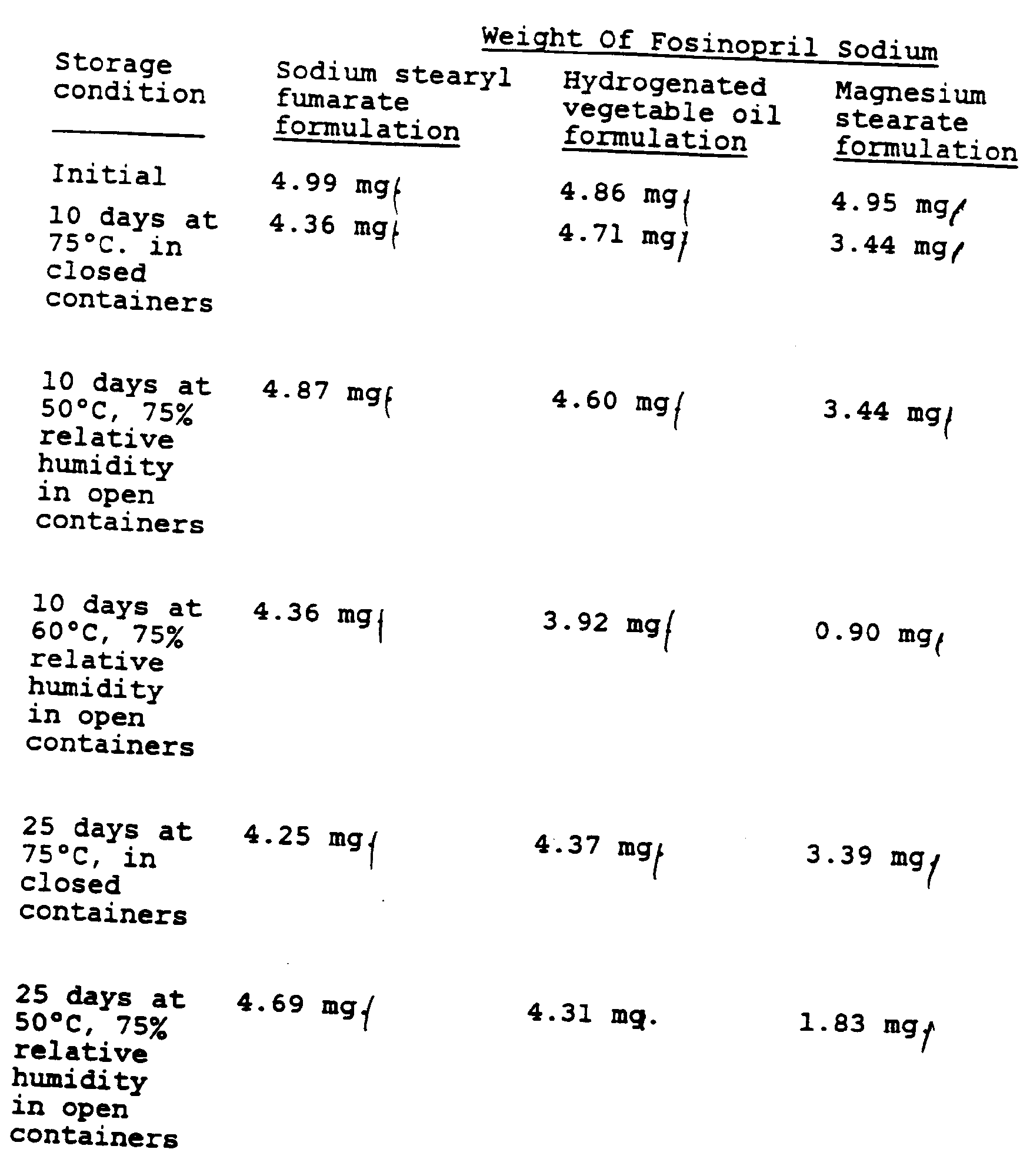
- fosinopril sodium tablets were prepared utilizing sodium stearyl fumarate, hydrogenated vegetable oil, and magnesium fumarate as the lubricant.
- the initial amount of fosinopril sodium was measured and similar measurements were made after 10 days and 25 days storage under varying conditions.
Landscapes
- Health & Medical Sciences (AREA)
- Life Sciences & Earth Sciences (AREA)
- Pharmacology & Pharmacy (AREA)
- Veterinary Medicine (AREA)
- Chemical & Material Sciences (AREA)
- Public Health (AREA)
- General Health & Medical Sciences (AREA)
- Medicinal Chemistry (AREA)
- Animal Behavior & Ethology (AREA)
- General Chemical & Material Sciences (AREA)
- Organic Chemistry (AREA)
- Nuclear Medicine, Radiotherapy & Molecular Imaging (AREA)
- Engineering & Computer Science (AREA)
- Chemical Kinetics & Catalysis (AREA)
- Bioinformatics & Cheminformatics (AREA)
- Epidemiology (AREA)
- Cardiology (AREA)
- Heart & Thoracic Surgery (AREA)
- Biophysics (AREA)
- Molecular Biology (AREA)
- Pharmaceuticals Containing Other Organic And Inorganic Compounds (AREA)
- Medicinal Preparation (AREA)
Abstract
Description
- The sodium salt of fosinopril, (4S)-4-cyclohexyl-1-[[[(RS)-1-hydroxy-2-methylpropoxy](4-phenylbutyl)phosphinyl]acetyl]-L-proline, propionate (ester) sodium salt, is currently undergoing clinical evaluation as an antihypertensive agent.
- Fosinopril, its ability to inhibit the angiotensin converting enzyme and thus lower blood pressure in humans, and formulations of fosinopril including combinations with various diuretics are described in United States Patents US-A-4,337,201 and US-A-4,384,123.
- The present invention is concerned with the use of particular lubricants in tablets containing fosinopril sodium. European Patent Application EP-A-288907 discloses an Angiotensin Converting Enzyme Inhibitor tablet formulation suitable for oral administration comprising gelatin as a binder, corn starch as a disintegrant, microcrystalline cellulose or lactose as a filler and magnesium stearate as a lubricant. Lexikon der Hilfstoffe fuer Pharmazie, Kosmetik und angegrenzde Gebiete, H.P. Fiedler, Band II (L-Z), 1989, Editio Cantor Aulendorf, page 858, "Natriumstearylfumarat" indicates that sodium stearyl fumarate is an alternative to magnesium stearate.
- This invention is directed to the discovery that the shelf life and stability of fosinopril sodium formulated as tablets is increased when the lubricant employed is sodium stearyl fumarate or hydrogenated vegetable oil as compared to tablets employing magnesium stearate as the lubricant. In addition to the fosinopril sodium, the tablet formulation can also include a diuretic, preferably chlorthalidone, a filler, a disintegrant, a binder, a lubricant, and other commonly employed pharmaceutically acceptable agents. The tablet can include a color agent or the tablets can be color film coated. The tablets can be prepared in a variety of shapes and can be scored for the convenience of the user.
- More specifically the invention provides a stable tablet comprising, on a weight percentage basis, from 1% to 25% fosinopril sodium, from 0% to 25% of a diuretic, from 30% to 90% of a filler, from 2% to 10% of a disintegrant, from 1% to 5% of a binder, or from 5% to 15% of a single agent which is both binder and disintegrant, and from 0.3% to 4% of a lubricant selected from sodium stearyl fumarate and hydrogenated vegetable oil.
- Fosinopril sodium having the chemical formula

is an angiotensin converting enzyme inhibitor currently being clinically evaluated as an anti-hypertensive agent. - Fosinopril sodium bulk material has a relatively low bulk density, exhibits poor flow characteristics, and adheres to metal surfaces during tableting. Previously, fosinopril sodium was tableted by a wet granulation process in which the tablet binder material was added to a solvent to form a solution of about 20% on a weight to weight basis.
- The fosinopril sodium and a portion of the tablet filler and disintegrant were then added. The mix was granulated and dried to less than 1% by weight of volatiles. The remainder of the tablet excipients were added and the final blend was obtained by lubrication with magnesium stearate. It was found that tablets produced from this blend were moisture sensitive and only marginally stable. In order to have a useful shelf life these tablets required the use of a protective package.
- This invention is based on the discovery that by employing sodium stearyl fumarate or hydrogenated vegetable oil as the lubricant during the tableting of fosinopril sodium (instead of magnesium stearate), tablets having improved stability are obtained. The tablets thus prepared are significantly less moisture sensitive and have a useful shelf life without the need for protective packaging. Sodium stearyl fumarate is the preferred lubricant since hydrogenated vegetable oil can cause processing problems of sticking to the punch tips during long tableting runs.
- As discussed in United States Patents US-A-4,337,201 and US-A-4,384,123, various diuretics can be combined with fosinopril sodium for the treatment of hypertension. Suitable diuretics include chlorthalidone, the thiazide diuretics such as chlorothiazide, hydrochlorothiazide, flumethiazide, bendroflumethiazide, etc., ethacrynic acid, ticrynafen, furosemide, musolimine, bumetanide, triameterene, amiloride, spironolactone, and salts thereof with chlorthalidone and hydrochlorothiazide being preferred.
- Tablets prepared according to this invention generally contain from 5 mg. to 50 mg. of fosinopril sodium as the sole active agent or from 10 mg. to 75 mg. of a combination of fosinopril sodium and diuretic in a ratio of from 1:5 to 5:1 on a weight basis.
- As discussed above, in addition to the actives, fosinopril sodium and the optional diuretic, and the lubricant, tablets prepared according to this invention will include excipients such as a filler, a disintegrant, and a binder. The preferred filler is lactose or lactose and microcrystalline cellulose. The preferred disintegrants are selected from sodium carboxymethyl starch, cross linked sodium carboxymethyl starch, crospovidone, i.e., 1-ethenyl-2-pyrrolidinone homopolymer, cross linked sodium carboxymethylcellulose (AcDiSol® or Croscarmellose Sodium®), sodium starch glycolate, and mixtures thereof. The preferred binders are selected from povidone, i.e., 2-pyrrolidinone, 1-ethenyl-, homopolymer, hydroxypropyl cellulose, and mixtures thereof. Alternatively, a single agent such as pregelatinzed starch can be employed as both disintegrant and binder. Other ingredients commonly employed in tableting pharmaceutical products can also be included such as coloring agents.
- On a weight percentage basis, the above ingredients will preferably be present in the final tablets as follows:

- The fosinopril sodium tablets of this invention can be prepared by conventional tablet forming techniques such as, for example, wet granulation and dry granulation. In the wet granulation process, the active ingredient or ingredients are mixed with portions of the filler and disintegrant. This blend is then wet granulated with a solution of the binder in a solvent. The solution will preferably be from 5% to 20% by weight of solvent and the preferred solvents include ethanol, isopropanol, and water. The resultant wet granulation is then dried and milled. The dried granulation is then mixed with the balance of the filler and disintegrant. The resulting blend is mixed with sodium stearyl fumarate, which is preferred, or hydrogenated vegetable oil to produce the final mix which is then compressed into tablets.
- In the dry granulation process, the active ingredient or ingredients and the filler, disintegrant and binder are blended in a mixer (planetary or high shear) for several minutes. The blend is then milled and mixed with sodium stearyl fumarate, which is preferred, or hydrogenated vegetable oil to produce the final mix which is then compressed into tablets.
- The wet granulation process employing water as the solvent and the dry granulation process have the added advantage of avoiding the use of an organic solvent. This results in a cost savings as well as a safer process needing fewer environmental controls.
- Tablets were prepared containing:

- 100,000 tablets of the above formulation were prepared as follows. A blend was prepared of fosinopril sodium (4000 g), chlorthalidone (1500 g), lactose (17,900 g), and crospovidone (700 g) in a suitable mixer such as planetary mixer or high shear mixer for 5 to 10 minutes. Povidone (900 g) was dissolved in water (7 liters) and the above blend was wet granulated with the entire povidone solution. The wet granulation was dried at 45 - 70° C. in a suitable dryer such as a tray drying oven or a fluid bed dryer until the volatile content of the wet granulation was less than 3% by weight. The dried granulation was passed through a hammer mill fitted with 0.03 - 0.07 inch screen operating at medium to fast speed, knives forward. The screened granulation was then mixed with lactose (13,900 g) and crospovidone (700 g) in the mixer (planetary or high shear) for 5 to 10 minutes. Sodium stearyl fumarate (400 g) was then added to the above blend and mixing was continued for 1 to 3 minutes. The final blend was then compressed into 400 mg tablets using a rotary tablet press.
- Following the procedure of Example 1, the following tablets were obtained.

- Following the procedure of Examples 1 to 5, the following tablets were obtained.

- The following tablets were prepared by a modification of the procedures of Examples 1 to 9.

- In the preparation of the tablets of Examples 10 and 11, a portion of the pregelatinized starch was added before the wet granulation step and the remainder was added to the dried granulation.
- Tablets were prepared containing the following:

- 200,000 tablets of the above formulation were prepared as follows. Fosinopril sodium (1,000 g), lactose (16,500 g), Avicel (1,000 g) and crospovidone (700 g) were mixed in a suitable mixer (planetary or high shear) for 5 to 10 minutes. Povidone (800 g) was dissolved in denatured alcohol (4 liters) and blended with the above mixture forming a wet granulate. This wet granulate was dried at 45 - 70° C. in suitable dryer such as a tray drying oven or a fluid bed dryer until the volatile content of the wet granulation was less than 3% by weight. The dried granulation was passed through a hammer mill fitted with a 0.76 mm - 1.75 mm (0.03 - 0.07 inch) screen operating at medium to fast speed, knives forward. The screened granulation was mixed with lactose (12,100 g), Avicel® (7,000 g) and crospovidone (700 g) in a suitable mixer (planetary or high shear) for 5 to 10 minutes. Sodium stearyl fumarate was added to the above blend and mixed for 1 to 3 minutes in the same mixer. This final blend was then compressed into 200 mg tablets using a rotary tablet press.
- Following the procedure of Example 12, the following tablets were obtained.

- Tablets were prepared containing the following:

- 200,000 tablets of the above formulation were prepared as follows. Fosinopril sodium (1,000 g), lactose (28,600 g), Avicel® (8,000 g), crospovidone (1400 g) and povidone (800 g) were mixed in a suitable mixer (planetary or high shear) for 5 to 10 minutes. The blend was then passed through a hammer mill equipped with a 0.04 - 0.08 inch size round hole screen operating at medium speed, knives forward. Sodium stearyl fumarate (200 g) was added to the above blend and mixed for 1 to 3 minutes in the same mixer. This final blend was then compressed into 200 mg. tablets using a rotary tablet press.
- Following the procedures of Examples 1 to 5 and 12 to 15, similar tablets were prepared substituting hydrogenated vegetable oil for the sodium stearyl fumarate.
- Following the procedure of Example 12 fosinopril sodium tablets were prepared utilizing sodium stearyl fumarate, hydrogenated vegetable oil, and magnesium fumarate as the lubricant. The initial amount of fosinopril sodium was measured and similar measurements were made after 10 days and 25 days storage under varying conditions.
Claims (25)
- A method of making a tablet with improved storage stability comprising, on a weight percentage basis, from 1% to 25% fosinopril sodium, from 0% to 25% of a diuretic, from 30% to 90% of a filler, from 2% to 10% of a disintegrant, and from 1% to 5% of a binder, or from 5% to 15% of a single agent which is both binder and disintegrant, said method comprising:(a) providing said ingredients;(b) including in said ingredients from 0.3% to 4% of a lubricant selected from sodium stearyl fumarate and hydrogenated vegetable oil; and(c) forming a tablet containing said ingredients and said lubricant.
- The method of claim 1 wherein said lubricant is sodium stearyl fumarate.
- The method of claim 2 wherein said filler is lactose or a blend of lactose and microcrystalline cellulose, said disintegrant is selected from sodium carboxymethyl starch, cross linked sodium carboxymethyl starch, crospovidone, cross linked sodium carboxymethylcellulose, sodium starch glycolate, and mixtures thereof, said binder is selected from povidone, hydroxypropyl cellulose, and mixtures thereof, and said single agent which is both binder and disintegrant is pregelatinized starch.
- The method of claim 3 wherein said tablet contains from 1% to 25% by weight of chlorthalidone.
- The method of claim 4 wherein said filler is lactose, said disintegrant is crospovidone, and said binder is povidone.
- The method of claim 5 wherein said tablet contains, on a weight percentage basis, 10% fosinopril sodium, 3.75% chlorthalidone, 79.5% lactose, 2.25% povidone, 3.5% crospovidone, and 1% sodium stearyl fumarate.
- The method of claim 5 wherein said tablet contains, on a weight percentage basis, 6.67% fosinopril sodium, 5% chlorthalidone, 81.58% lactose, 2.25% povidone, 3.5% crospovidone, and 1% sodium stearyl fumarate.
- The method of claim 5 wherein said tablet contains, on a weight percentage basis, 5% fosinopril sodium, 7.5% chlorthalidone, 80.5% lactose, 2.25% povidone, 3.75% crospovidone, and 1% sodium stearyl fumarate.
- The method of claim 5 wherein said tablet comprises, on a weight percentage basis, 5% fosinopril sodium, 25% chlorthalidone, 62.5% lactose, 3.0% povidone, 3.5% crospovidone, and 1% sodium stearyl fumarate.
- The method of claim 5 wherein said tablet comprises, on a weight percentage basis, 5% fosinopril sodium, 5% chlorthalidone, 82.5% lactose, 3% povidone, 3.5% crospovidone, and 1% sodium stearyl fumarate.
- The method of claim 3 wherein the only active ingredient is fosinopril sodium.
- The method of claim 11 wherein said filler is a mixture of lactose and microcrystalline cellulose, said disintegrant is crospovidone, and said binder is povidone.
- The method of claim 12 wherein said tablet contains, on a weight percentage basis, 2.5% fosinopril sodium, 69.7% lactose, 20% microcrystalline cellulose, 3.5% crospovidone, 2.25% povidone, and 2% sodium stearyl fumarate.
- The method of claim 12 wherein said tablet contains, on a weight percentage basis, 5% fosinopril sodium, 67.25% lactose, 20% microcrystalline cellulose, 3.5% crospovidone, 2.25% povidone, and 2% sodium stearyl fumarate.
- The method of claim 12 wherein said tablet contains, on a weight percentage basis, 10% fosinopril sodium, 62.25% lactose, 20% microcrystalline cellulose, 3.5% crospovidone, 2.25% povidone, and 2% sodium stearyl fumarate.
- The method of claim 12 wherein said tablet contains, on a weight percentage basis, 2.5% fosinopril sodium, 71.5% lactose, 20% microcrystalline cellulose, 3.5% crospovidone, 2% povidone, and 0.5% sodium stearyl fumarate.
- The method of claim 3 wherein said tablet contains from 1% to 25% by weight of hydrochlorothiazide.
- The method of claim 17 wherein said filler is lactose or a blend of lactose and microcrystalline cellulose, said disintegrant is cross linked sodium carboxymethylcellulose or sodium starch glycolate, said binder is povidone, and said single agent which is both binder and disintegrant is pregelatinized starch.
- The method of claim 18 wherein said tablet contains, on a weight percentage basis, 6.6% fosinopril sodium, 4.2% hydrochlorothiazide, 79.2% lactose, 2.0% povidone, 5.0% cross linked sodium carboxymethylcellulose, and 3.0% sodium stearyl fumarate.
- The method of claim 18 wherein said tablet contains, on a weight percentage basis, 5.0% fosinopril sodium, 6.25% hydrochlorothiazide, 78.75% lactose, 2.0% povidone, 5.0% cross linked sodium carboxymethylcellulose, and 3.0% sodium stearyl fumarate.
- The method of claim 18 wherein said tablet contains, on a weight percentage basis, 10.0% fosinopril sodium, 6.25% hydrochlorothiazide, 56.25% lactose, 20.0% microcrystalline cellulose, 2.0% povidone, 3.5% sodium starch glycolate, and 2.0% sodium stearyl fumarate.
- The method of claim 18 wherein said tablet contains, on a weight percentage basis, 5.0% fosinopril sodium, 6.25% hydrochlorothiazide, 61.75% lactose, 20.0% microcrystalline cellulose, 2.0% povidone, 3.5% sodium starch glycolate, and 1.5% sodium stearyl fumarate.
- The method of claim 18 wherein said tablet contains, on a weight percentage basis, 10.0% fosinopril sodium, 6.25% hydrochlorothiazide, 53.75% lactose, 20.0% microcrystalline cellulose, 8.0% pregelatinized starch, and 2.0% sodium stearyl fumarate.
- The method of claim 18 wherein said tablet contains, on a weight percentage basis, 5.0% fosinopril sodium, 6.25% hydrochlorothiazide, 59.25% lactose, 20.0% microcrystalline cellulose, 8.0% pregelatinized starch, and 1.5% sodium stearyl fumarate.
- The method of any preceding claim which comprises wet granulation or dry granulation.
Priority Applications (1)
| Application Number | Priority Date | Filing Date | Title |
|---|---|---|---|
| AT90307449T ATE100321T1 (en) | 1989-07-10 | 1990-07-09 | FOSINOPRIL CONTAINING TABLET FORMULATIONS. |
Applications Claiming Priority (2)
| Application Number | Priority Date | Filing Date | Title |
|---|---|---|---|
| US37768389A | 1989-07-10 | 1989-07-10 | |
| US377683 | 1989-07-10 |
Publications (2)
| Publication Number | Publication Date |
|---|---|
| EP0408273A1 EP0408273A1 (en) | 1991-01-16 |
| EP0408273B1 true EP0408273B1 (en) | 1994-01-19 |
Family
ID=23490122
Family Applications (1)
| Application Number | Title | Priority Date | Filing Date |
|---|---|---|---|
| EP90307449A Expired - Lifetime EP0408273B1 (en) | 1989-07-10 | 1990-07-09 | Fosinopril tablet formulations |
Country Status (8)
| Country | Link |
|---|---|
| EP (1) | EP0408273B1 (en) |
| JP (1) | JP2965633B2 (en) |
| AT (1) | ATE100321T1 (en) |
| CA (1) | CA2019324C (en) |
| DD (1) | DD299154A5 (en) |
| DE (1) | DE69006125T2 (en) |
| DK (1) | DK0408273T3 (en) |
| ES (1) | ES2062376T3 (en) |
Cited By (1)
| Publication number | Priority date | Publication date | Assignee | Title |
|---|---|---|---|---|
| WO2007003972A1 (en) * | 2005-06-30 | 2007-01-11 | Pharmathen S.A. | Improved pharmaceutical composition containing ace inhibitor and method for the preparation thereof |
Families Citing this family (14)
| Publication number | Priority date | Publication date | Assignee | Title |
|---|---|---|---|---|
| US5464632C1 (en) * | 1991-07-22 | 2001-02-20 | Prographarm Lab | Rapidly disintegratable multiparticular tablet |
| FR2679451B1 (en) * | 1991-07-22 | 1994-09-09 | Prographarm Laboratoires | MULTIPARTICLE TABLET WITH RAPID DELIVERY. |
| ES2059260B1 (en) * | 1992-10-06 | 1995-04-16 | Espanola Prod Quimicos | PROCEDURE FOR THE PREPARATION OF TABLETS CONTAINING DICLOFENACO; DISPERSIBLE IN WATER. |
| FR2766089B1 (en) * | 1997-07-21 | 2000-06-02 | Prographarm Lab | IMPROVED MULTIPARTICULAR TABLET WITH RAPID DELIVERY |
| FR2784895B1 (en) * | 1998-10-23 | 2004-12-17 | Gattefosse Ets Sa | MASK TASTE CHEWABLE TABLET AND IMMEDIATE RELEASE OF THE ACTIVE INGREDIENT AND MANUFACTURING METHOD |
| UA75569C2 (en) * | 1998-12-01 | 2006-05-15 | Reddys Lab Ltd Dr | Pharmaceutical composition of thiadiazolidinedione and method for its manufacture |
| CA2363053C (en) * | 2001-11-09 | 2011-01-25 | Bernard Charles Sherman | Clopidogrel bisulfate tablet formulation |
| KR20010114199A (en) * | 2001-12-11 | 2001-12-29 | 유형선 | Novel pharmaceutical composition |
| US7198653B2 (en) | 2003-07-31 | 2007-04-03 | Delavau Llc | Calcium carbonate granulation |
| US20050095287A1 (en) * | 2003-10-29 | 2005-05-05 | Matharu Amol S. | Fosinopril composition |
| EP3165220B2 (en) * | 2004-12-03 | 2024-11-13 | Merck Sharp & Dohme LLC | Pharmaceutical composition containing an anti-nucleating agent |
| US9138414B1 (en) | 2006-09-15 | 2015-09-22 | Delavau Llc | Calcium supplement having enhanced absorption |
| SI23149A (en) | 2009-09-21 | 2011-03-31 | Silverstone Pharma | New benzatin salts of ace inhibitors, procedure for their preparationand their application for treatment of cardiovascular diseases |
| US10076494B2 (en) | 2016-06-16 | 2018-09-18 | Dexcel Pharma Technologies Ltd. | Stable orally disintegrating pharmaceutical compositions |
Family Cites Families (4)
| Publication number | Priority date | Publication date | Assignee | Title |
|---|---|---|---|---|
| US4217347A (en) * | 1977-12-27 | 1980-08-12 | E. R. Squibb & Sons, Inc. | Method of treating hypertension and medicaments therefor |
| US4384123A (en) * | 1980-12-04 | 1983-05-17 | E. R. Squibb & Sons, Inc. | Phosphinylalkanoyl substituted prolines |
| US4793998A (en) * | 1986-10-20 | 1988-12-27 | Warner-Lambert Company | Stabilized drug compositions |
| AU612137B2 (en) * | 1987-04-27 | 1991-07-04 | E.R. Squibb & Sons, Inc. | Method for inhibiting loss of cognitive functions employing an ace inhibitor |
-
1990
- 1990-06-19 CA CA002019324A patent/CA2019324C/en not_active Expired - Lifetime
- 1990-07-09 ES ES90307449T patent/ES2062376T3/en not_active Expired - Lifetime
- 1990-07-09 AT AT90307449T patent/ATE100321T1/en not_active IP Right Cessation
- 1990-07-09 EP EP90307449A patent/EP0408273B1/en not_active Expired - Lifetime
- 1990-07-09 DE DE69006125T patent/DE69006125T2/en not_active Expired - Lifetime
- 1990-07-09 DK DK90307449.0T patent/DK0408273T3/en active
- 1990-07-10 JP JP2185179A patent/JP2965633B2/en not_active Expired - Lifetime
- 1990-10-01 DD DD90344330A patent/DD299154A5/en not_active IP Right Cessation
Non-Patent Citations (1)
| Title |
|---|
| LEXIKON DER HILFSSTOFFE FÜR PHARMAZIE, KOSMETIK UND ANGRENZENDE GEBIETE, vol. II, 1989, Editio Cantor Aulendorf; H.P.FIEDLER, p. 858# * |
Cited By (2)
| Publication number | Priority date | Publication date | Assignee | Title |
|---|---|---|---|---|
| WO2007003972A1 (en) * | 2005-06-30 | 2007-01-11 | Pharmathen S.A. | Improved pharmaceutical composition containing ace inhibitor and method for the preparation thereof |
| GR20050100332A (en) * | 2005-06-30 | 2007-01-19 | "��������" ������������ ����������� �������� �.�. | Improved phramaceutical composition containing ace inhibitor and method for the preperation thereof |
Also Published As
| Publication number | Publication date |
|---|---|
| ATE100321T1 (en) | 1994-02-15 |
| ES2062376T3 (en) | 1994-12-16 |
| DK0408273T3 (en) | 1994-02-28 |
| EP0408273A1 (en) | 1991-01-16 |
| JP2965633B2 (en) | 1999-10-18 |
| CA2019324C (en) | 1996-08-20 |
| DE69006125D1 (en) | 1994-03-03 |
| DE69006125T2 (en) | 1994-05-19 |
| JPH0348623A (en) | 1991-03-01 |
| DD299154A5 (en) | 1992-04-02 |
| CA2019324A1 (en) | 1991-01-10 |
Similar Documents
| Publication | Publication Date | Title |
|---|---|---|
| US5006344A (en) | Fosinopril tablet formulations | |
| CA2019324C (en) | Fosinopril tablet formulations | |
| EP0051706B1 (en) | Gelatin capsule dosage unit containing triamterene | |
| EA021317B1 (en) | Monolayer tablets comprising irbesartan and amlodipine, their preparation and their therapeutic application | |
| JP4709379B2 (en) | Pharmaceutical formulation containing levothyroxine sodium | |
| IL158306A (en) | Pharmaceutical dosage form of amorphous nelfinavir mesylate | |
| KR20010071765A (en) | Pharmaceutical levothyroxine preparation | |
| US5004651A (en) | Stabilizing system for solid dosage forms | |
| JPH04360833A (en) | Pharmaceutical containing 1,4-dihydropyridine derivative | |
| EP1531831B1 (en) | Fosinopril formulation | |
| JPH0678233B2 (en) | Pharmaceutical preparation having antihypertensive and cardioprotective effects | |
| SG172136A1 (en) | A disintegrating tablet | |
| US7074429B2 (en) | Fosinopril sodium tablet formulation | |
| WO1999018957A1 (en) | Stable pharmaceutical composition containing amlodipine besylate and atenolol | |
| KR100571614B1 (en) | Fast-soluble pharmaceutical composition | |
| GB2209669A (en) | Pharmaceutical composition containing high drug load | |
| US6737419B2 (en) | Benazepril hydrochloride tablet formulations | |
| EP0950419B1 (en) | A solid preparation and a method of manufacturing it | |
| GB2044101A (en) | Antihypertensive pharmaceutical compositions | |
| CA1209046A (en) | Diuretic/antihypertensive compositions and methods of preparation | |
| CA2285852C (en) | Pharmaceutical tablet comprising lisinopril disodium and microcrystalline cellulose | |
| CA2442898A1 (en) | Fosinopril sodium tablet formulation | |
| WO2008001184A2 (en) | Solid composition | |
| KR20040090975A (en) | Medicinal composition containing 2,2-dichloro-12-(4-chlorophenyl)-dodecanoic acid | |
| RU2203052C1 (en) | Solid medicinal form of enalapril |
Legal Events
| Date | Code | Title | Description |
|---|---|---|---|
| PUAI | Public reference made under article 153(3) epc to a published international application that has entered the european phase |
Free format text: ORIGINAL CODE: 0009012 |
|
| AK | Designated contracting states |
Kind code of ref document: A1 Designated state(s): AT BE CH DE DK ES FR GB GR IT LI LU NL SE |
|
| 17P | Request for examination filed |
Effective date: 19901219 |
|
| 17Q | First examination report despatched |
Effective date: 19911001 |
|
| GRAA | (expected) grant |
Free format text: ORIGINAL CODE: 0009210 |
|
| AK | Designated contracting states |
Kind code of ref document: B1 Designated state(s): AT BE CH DE DK ES FR GB GR IT LI LU NL SE |
|
| REF | Corresponds to: |
Ref document number: 100321 Country of ref document: AT Date of ref document: 19940215 Kind code of ref document: T |
|
| REG | Reference to a national code |
Ref country code: DK Ref legal event code: T3 |
|
| REF | Corresponds to: |
Ref document number: 69006125 Country of ref document: DE Date of ref document: 19940303 |
|
| ET | Fr: translation filed | ||
| ITF | It: translation for a ep patent filed | ||
| REG | Reference to a national code |
Ref country code: GR Ref legal event code: FG4A Free format text: 3011100 |
|
| EPTA | Lu: last paid annual fee | ||
| PLBE | No opposition filed within time limit |
Free format text: ORIGINAL CODE: 0009261 |
|
| STAA | Information on the status of an ep patent application or granted ep patent |
Free format text: STATUS: NO OPPOSITION FILED WITHIN TIME LIMIT |
|
| REG | Reference to a national code |
Ref country code: ES Ref legal event code: FG2A Ref document number: 2062376 Country of ref document: ES Kind code of ref document: T3 |
|
| 26N | No opposition filed | ||
| EAL | Se: european patent in force in sweden |
Ref document number: 90307449.0 |
|
| GBPC | Gb: european patent ceased through non-payment of renewal fee |
Effective date: 19940709 |
|
| REG | Reference to a national code |
Ref country code: GB Ref legal event code: 728V |
|
| REG | Reference to a national code |
Ref country code: GB Ref legal event code: 728Y |
|
| REG | Reference to a national code |
Ref country code: GB Ref legal event code: IF02 |
|
| PGFP | Annual fee paid to national office [announced via postgrant information from national office to epo] |
Ref country code: BE Payment date: 20090619 Year of fee payment: 20 |
|
| PGFP | Annual fee paid to national office [announced via postgrant information from national office to epo] |
Ref country code: DK Payment date: 20090714 Year of fee payment: 20 Ref country code: ES Payment date: 20090812 Year of fee payment: 20 Ref country code: FR Payment date: 20090710 Year of fee payment: 20 |
|
| PGFP | Annual fee paid to national office [announced via postgrant information from national office to epo] |
Ref country code: CH Payment date: 20090721 Year of fee payment: 20 Ref country code: GB Payment date: 20090708 Year of fee payment: 20 Ref country code: GR Payment date: 20090619 Year of fee payment: 20 Ref country code: LU Payment date: 20090804 Year of fee payment: 20 Ref country code: AT Payment date: 20090715 Year of fee payment: 20 Ref country code: NL Payment date: 20090705 Year of fee payment: 20 Ref country code: DE Payment date: 20090702 Year of fee payment: 20 Ref country code: SE Payment date: 20090708 Year of fee payment: 20 |
|
| PGFP | Annual fee paid to national office [announced via postgrant information from national office to epo] |
Ref country code: IT Payment date: 20090721 Year of fee payment: 20 |
|
| REG | Reference to a national code |
Ref country code: NL Ref legal event code: V4 Effective date: 20100709 |
|
| REG | Reference to a national code |
Ref country code: CH Ref legal event code: PL |
|
| REG | Reference to a national code |
Ref country code: DK Ref legal event code: EUP |
|
| REG | Reference to a national code |
Ref country code: GB Ref legal event code: PE20 Expiry date: 20100708 |
|
| BE20 | Be: patent expired |
Owner name: E.R. *SQUIBB & SONS INC. Effective date: 20100709 |
|
| REG | Reference to a national code |
Ref country code: ES Ref legal event code: FD2A Effective date: 20100710 |
|
| EUG | Se: european patent has lapsed | ||
| PG25 | Lapsed in a contracting state [announced via postgrant information from national office to epo] |
Ref country code: NL Free format text: LAPSE BECAUSE OF EXPIRATION OF PROTECTION Effective date: 20100709 Ref country code: ES Free format text: LAPSE BECAUSE OF EXPIRATION OF PROTECTION Effective date: 20100710 |
|
| PG25 | Lapsed in a contracting state [announced via postgrant information from national office to epo] |
Ref country code: GB Free format text: LAPSE BECAUSE OF EXPIRATION OF PROTECTION Effective date: 20100708 |
|
| PG25 | Lapsed in a contracting state [announced via postgrant information from national office to epo] |
Ref country code: DE Free format text: LAPSE BECAUSE OF EXPIRATION OF PROTECTION Effective date: 20100709 |