EP0408048B1 - Method of producing rigid urethane foam - Google Patents
Method of producing rigid urethane foam Download PDFInfo
- Publication number
- EP0408048B1 EP0408048B1 EP90113430A EP90113430A EP0408048B1 EP 0408048 B1 EP0408048 B1 EP 0408048B1 EP 90113430 A EP90113430 A EP 90113430A EP 90113430 A EP90113430 A EP 90113430A EP 0408048 B1 EP0408048 B1 EP 0408048B1
- Authority
- EP
- European Patent Office
- Prior art keywords
- polyol
- urethane foam
- rigid urethane
- producing
- foam
- Prior art date
- Legal status (The legal status is an assumption and is not a legal conclusion. Google has not performed a legal analysis and makes no representation as to the accuracy of the status listed.)
- Expired - Lifetime
Links
- 239000006260 foam Substances 0.000 title claims description 63
- JOYRKODLDBILNP-UHFFFAOYSA-N Ethyl urethane Chemical compound CCOC(N)=O JOYRKODLDBILNP-UHFFFAOYSA-N 0.000 title claims description 32
- 238000000034 method Methods 0.000 title claims description 15
- 150000003077 polyols Chemical class 0.000 claims description 63
- 229920005862 polyol Polymers 0.000 claims description 62
- 239000000203 mixture Substances 0.000 claims description 22
- 125000002887 hydroxy group Chemical group [H]O* 0.000 claims description 19
- XLYOFNOQVPJJNP-UHFFFAOYSA-N water Substances O XLYOFNOQVPJJNP-UHFFFAOYSA-N 0.000 claims description 16
- 239000004604 Blowing Agent Substances 0.000 claims description 11
- FBPFZTCFMRRESA-FSIIMWSLSA-N D-Glucitol Natural products OC[C@H](O)[C@H](O)[C@@H](O)[C@H](O)CO FBPFZTCFMRRESA-FSIIMWSLSA-N 0.000 claims description 11
- FBPFZTCFMRRESA-JGWLITMVSA-N D-glucitol Chemical compound OC[C@H](O)[C@@H](O)[C@H](O)[C@H](O)CO FBPFZTCFMRRESA-JGWLITMVSA-N 0.000 claims description 11
- -1 acyclic sugar alcohol Chemical class 0.000 claims description 11
- 239000000600 sorbitol Substances 0.000 claims description 11
- 239000003999 initiator Substances 0.000 claims description 10
- 229920001228 polyisocyanate Polymers 0.000 claims description 10
- 239000005056 polyisocyanate Substances 0.000 claims description 10
- 125000004432 carbon atom Chemical group C* 0.000 claims description 7
- VOZKAJLKRJDJLL-UHFFFAOYSA-N tolylenediamine group Chemical group CC1=C(C=C(C=C1)N)N VOZKAJLKRJDJLL-UHFFFAOYSA-N 0.000 claims description 5
- UPMLOUAZCHDJJD-UHFFFAOYSA-N 4,4'-Diphenylmethane Diisocyanate Chemical compound C1=CC(N=C=O)=CC=C1CC1=CC=C(N=C=O)C=C1 UPMLOUAZCHDJJD-UHFFFAOYSA-N 0.000 claims description 4
- 125000002947 alkylene group Chemical group 0.000 claims description 3
- FBPFZTCFMRRESA-UHFFFAOYSA-N hexane-1,2,3,4,5,6-hexol Chemical compound OCC(O)C(O)C(O)C(O)CO FBPFZTCFMRRESA-UHFFFAOYSA-N 0.000 claims description 3
- 230000001070 adhesive effect Effects 0.000 description 17
- PEDCQBHIVMGVHV-UHFFFAOYSA-N Glycerine Chemical compound OCC(O)CO PEDCQBHIVMGVHV-UHFFFAOYSA-N 0.000 description 16
- XEEYBQQBJWHFJM-UHFFFAOYSA-N Iron Chemical compound [Fe] XEEYBQQBJWHFJM-UHFFFAOYSA-N 0.000 description 14
- CYRMSUTZVYGINF-UHFFFAOYSA-N trichlorofluoromethane Chemical compound FC(Cl)(Cl)Cl CYRMSUTZVYGINF-UHFFFAOYSA-N 0.000 description 10
- 230000000052 comparative effect Effects 0.000 description 9
- 235000011187 glycerol Nutrition 0.000 description 8
- 229910052742 iron Inorganic materials 0.000 description 7
- 239000003381 stabilizer Substances 0.000 description 7
- MUBZPKHOEPUJKR-UHFFFAOYSA-N Oxalic acid Chemical compound OC(=O)C(O)=O MUBZPKHOEPUJKR-UHFFFAOYSA-N 0.000 description 6
- 239000000853 adhesive Substances 0.000 description 6
- 239000003054 catalyst Substances 0.000 description 6
- 238000004519 manufacturing process Methods 0.000 description 6
- 239000000047 product Substances 0.000 description 6
- ZBCBWPMODOFKDW-UHFFFAOYSA-N diethanolamine Chemical compound OCCNCCO ZBCBWPMODOFKDW-UHFFFAOYSA-N 0.000 description 4
- 229910052751 metal Inorganic materials 0.000 description 4
- 239000002184 metal Substances 0.000 description 4
- 150000005846 sugar alcohols Chemical class 0.000 description 4
- FRCHKSNAZZFGCA-UHFFFAOYSA-N 1,1-dichloro-1-fluoroethane Chemical compound CC(F)(Cl)Cl FRCHKSNAZZFGCA-UHFFFAOYSA-N 0.000 description 3
- OHMHBGPWCHTMQE-UHFFFAOYSA-N 2,2-dichloro-1,1,1-trifluoroethane Chemical compound FC(F)(F)C(Cl)Cl OHMHBGPWCHTMQE-UHFFFAOYSA-N 0.000 description 3
- NLZUEZXRPGMBCV-UHFFFAOYSA-N Butylhydroxytoluene Chemical compound CC1=CC(C(C)(C)C)=C(O)C(C(C)(C)C)=C1 NLZUEZXRPGMBCV-UHFFFAOYSA-N 0.000 description 3
- DNIAPMSPPWPWGF-UHFFFAOYSA-N Propylene glycol Chemical compound CC(O)CO DNIAPMSPPWPWGF-UHFFFAOYSA-N 0.000 description 3
- 238000005266 casting Methods 0.000 description 3
- 230000001010 compromised effect Effects 0.000 description 3
- 230000000694 effects Effects 0.000 description 3
- 238000005187 foaming Methods 0.000 description 3
- 235000021552 granulated sugar Nutrition 0.000 description 3
- 230000006872 improvement Effects 0.000 description 3
- HEBKCHPVOIAQTA-UHFFFAOYSA-N meso ribitol Natural products OCC(O)C(O)C(O)CO HEBKCHPVOIAQTA-UHFFFAOYSA-N 0.000 description 3
- 229920001296 polysiloxane Polymers 0.000 description 3
- GOOHAUXETOMSMM-UHFFFAOYSA-N Propylene oxide Chemical compound CC1CO1 GOOHAUXETOMSMM-UHFFFAOYSA-N 0.000 description 2
- 239000000654 additive Substances 0.000 description 2
- 229910052782 aluminium Inorganic materials 0.000 description 2
- XAGFODPZIPBFFR-UHFFFAOYSA-N aluminium Chemical compound [Al] XAGFODPZIPBFFR-UHFFFAOYSA-N 0.000 description 2
- 238000004458 analytical method Methods 0.000 description 2
- 239000003963 antioxidant agent Substances 0.000 description 2
- 239000004615 ingredient Substances 0.000 description 2
- 238000009413 insulation Methods 0.000 description 2
- 235000006408 oxalic acid Nutrition 0.000 description 2
- 230000000704 physical effect Effects 0.000 description 2
- 230000009467 reduction Effects 0.000 description 2
- 238000003860 storage Methods 0.000 description 2
- 239000000126 substance Substances 0.000 description 2
- HZAXFHJVJLSVMW-UHFFFAOYSA-N 2-Aminoethan-1-ol Chemical compound NCCO HZAXFHJVJLSVMW-UHFFFAOYSA-N 0.000 description 1
- FBPFZTCFMRRESA-KVTDHHQDSA-N D-Mannitol Chemical compound OC[C@@H](O)[C@@H](O)[C@H](O)[C@H](O)CO FBPFZTCFMRRESA-KVTDHHQDSA-N 0.000 description 1
- HEBKCHPVOIAQTA-QWWZWVQMSA-N D-arabinitol Chemical compound OC[C@@H](O)C(O)[C@H](O)CO HEBKCHPVOIAQTA-QWWZWVQMSA-N 0.000 description 1
- IAYPIBMASNFSPL-UHFFFAOYSA-N Ethylene oxide Chemical compound C1CO1 IAYPIBMASNFSPL-UHFFFAOYSA-N 0.000 description 1
- 206010019233 Headaches Diseases 0.000 description 1
- 229930195725 Mannitol Natural products 0.000 description 1
- CBENFWSGALASAD-UHFFFAOYSA-N Ozone Chemical compound [O-][O+]=O CBENFWSGALASAD-UHFFFAOYSA-N 0.000 description 1
- 239000004721 Polyphenylene oxide Substances 0.000 description 1
- 239000004743 Polypropylene Substances 0.000 description 1
- JVWLUVNSQYXYBE-UHFFFAOYSA-N Ribitol Natural products OCC(C)C(O)C(O)CO JVWLUVNSQYXYBE-UHFFFAOYSA-N 0.000 description 1
- 208000000453 Skin Neoplasms Diseases 0.000 description 1
- 238000010521 absorption reaction Methods 0.000 description 1
- 238000007259 addition reaction Methods 0.000 description 1
- 239000002390 adhesive tape Substances 0.000 description 1
- 230000002411 adverse Effects 0.000 description 1
- 150000001412 amines Chemical class 0.000 description 1
- 230000003078 antioxidant effect Effects 0.000 description 1
- 238000007664 blowing Methods 0.000 description 1
- 238000009835 boiling Methods 0.000 description 1
- 210000004027 cell Anatomy 0.000 description 1
- 210000002421 cell wall Anatomy 0.000 description 1
- 230000008859 change Effects 0.000 description 1
- 238000006243 chemical reaction Methods 0.000 description 1
- 239000003795 chemical substances by application Substances 0.000 description 1
- KYKAJFCTULSVSH-UHFFFAOYSA-N chloro(fluoro)methane Chemical compound F[C]Cl KYKAJFCTULSVSH-UHFFFAOYSA-N 0.000 description 1
- 239000003086 colorant Substances 0.000 description 1
- 150000001875 compounds Chemical class 0.000 description 1
- 239000013078 crystal Substances 0.000 description 1
- HEBKCHPVOIAQTA-NGQZWQHPSA-N d-xylitol Chemical compound OC[C@H](O)C(O)[C@H](O)CO HEBKCHPVOIAQTA-NGQZWQHPSA-N 0.000 description 1
- 230000003247 decreasing effect Effects 0.000 description 1
- 230000006866 deterioration Effects 0.000 description 1
- IRXRGVFLQOSHOH-UHFFFAOYSA-L dipotassium;oxalate Chemical compound [K+].[K+].[O-]C(=O)C([O-])=O IRXRGVFLQOSHOH-UHFFFAOYSA-L 0.000 description 1
- 238000005516 engineering process Methods 0.000 description 1
- 230000007613 environmental effect Effects 0.000 description 1
- 239000000706 filtrate Substances 0.000 description 1
- 239000003063 flame retardant Substances 0.000 description 1
- 239000007789 gas Substances 0.000 description 1
- 239000007792 gaseous phase Substances 0.000 description 1
- 229930182470 glycoside Natural products 0.000 description 1
- 238000013038 hand mixing Methods 0.000 description 1
- 231100000869 headache Toxicity 0.000 description 1
- 229910052739 hydrogen Inorganic materials 0.000 description 1
- 239000001257 hydrogen Substances 0.000 description 1
- 239000012770 industrial material Substances 0.000 description 1
- 231100000053 low toxicity Toxicity 0.000 description 1
- 239000000594 mannitol Substances 0.000 description 1
- 235000010355 mannitol Nutrition 0.000 description 1
- 239000000463 material Substances 0.000 description 1
- 230000013011 mating Effects 0.000 description 1
- 238000002156 mixing Methods 0.000 description 1
- 229920000570 polyether Polymers 0.000 description 1
- 229920001155 polypropylene Polymers 0.000 description 1
- RUOJZAUFBMNUDX-UHFFFAOYSA-N propylene carbonate Chemical compound CC1COC(=O)O1 RUOJZAUFBMNUDX-UHFFFAOYSA-N 0.000 description 1
- 239000011541 reaction mixture Substances 0.000 description 1
- 230000009257 reactivity Effects 0.000 description 1
- 230000001105 regulatory effect Effects 0.000 description 1
- HEBKCHPVOIAQTA-ZXFHETKHSA-N ribitol Chemical compound OC[C@H](O)[C@H](O)[C@H](O)CO HEBKCHPVOIAQTA-ZXFHETKHSA-N 0.000 description 1
- 230000005070 ripening Effects 0.000 description 1
- 201000000849 skin cancer Diseases 0.000 description 1
- 239000007858 starting material Substances 0.000 description 1
- 239000005437 stratosphere Substances 0.000 description 1
- 229940029284 trichlorofluoromethane Drugs 0.000 description 1
Images
Classifications
-
- C—CHEMISTRY; METALLURGY
- C08—ORGANIC MACROMOLECULAR COMPOUNDS; THEIR PREPARATION OR CHEMICAL WORKING-UP; COMPOSITIONS BASED THEREON
- C08J—WORKING-UP; GENERAL PROCESSES OF COMPOUNDING; AFTER-TREATMENT NOT COVERED BY SUBCLASSES C08B, C08C, C08F, C08G or C08H
- C08J9/00—Working-up of macromolecular substances to porous or cellular articles or materials; After-treatment thereof
- C08J9/04—Working-up of macromolecular substances to porous or cellular articles or materials; After-treatment thereof using blowing gases generated by a previously added blowing agent
- C08J9/12—Working-up of macromolecular substances to porous or cellular articles or materials; After-treatment thereof using blowing gases generated by a previously added blowing agent by a physical blowing agent
- C08J9/14—Working-up of macromolecular substances to porous or cellular articles or materials; After-treatment thereof using blowing gases generated by a previously added blowing agent by a physical blowing agent organic
- C08J9/142—Compounds containing oxygen but no halogen atom
-
- C—CHEMISTRY; METALLURGY
- C08—ORGANIC MACROMOLECULAR COMPOUNDS; THEIR PREPARATION OR CHEMICAL WORKING-UP; COMPOSITIONS BASED THEREON
- C08G—MACROMOLECULAR COMPOUNDS OBTAINED OTHERWISE THAN BY REACTIONS ONLY INVOLVING UNSATURATED CARBON-TO-CARBON BONDS
- C08G18/00—Polymeric products of isocyanates or isothiocyanates
- C08G18/06—Polymeric products of isocyanates or isothiocyanates with compounds having active hydrogen
- C08G18/28—Polymeric products of isocyanates or isothiocyanates with compounds having active hydrogen characterised by the compounds used containing active hydrogen
- C08G18/40—High-molecular-weight compounds
- C08G18/48—Polyethers
- C08G18/4804—Two or more polyethers of different physical or chemical nature
- C08G18/4816—Two or more polyethers of different physical or chemical nature mixtures of two or more polyetherpolyols having at least three hydroxy groups
-
- C—CHEMISTRY; METALLURGY
- C08—ORGANIC MACROMOLECULAR COMPOUNDS; THEIR PREPARATION OR CHEMICAL WORKING-UP; COMPOSITIONS BASED THEREON
- C08G—MACROMOLECULAR COMPOUNDS OBTAINED OTHERWISE THAN BY REACTIONS ONLY INVOLVING UNSATURATED CARBON-TO-CARBON BONDS
- C08G18/00—Polymeric products of isocyanates or isothiocyanates
- C08G18/06—Polymeric products of isocyanates or isothiocyanates with compounds having active hydrogen
- C08G18/28—Polymeric products of isocyanates or isothiocyanates with compounds having active hydrogen characterised by the compounds used containing active hydrogen
- C08G18/40—High-molecular-weight compounds
- C08G18/48—Polyethers
- C08G18/4829—Polyethers containing at least three hydroxy groups
-
- C—CHEMISTRY; METALLURGY
- C08—ORGANIC MACROMOLECULAR COMPOUNDS; THEIR PREPARATION OR CHEMICAL WORKING-UP; COMPOSITIONS BASED THEREON
- C08G—MACROMOLECULAR COMPOUNDS OBTAINED OTHERWISE THAN BY REACTIONS ONLY INVOLVING UNSATURATED CARBON-TO-CARBON BONDS
- C08G18/00—Polymeric products of isocyanates or isothiocyanates
- C08G18/06—Polymeric products of isocyanates or isothiocyanates with compounds having active hydrogen
- C08G18/28—Polymeric products of isocyanates or isothiocyanates with compounds having active hydrogen characterised by the compounds used containing active hydrogen
- C08G18/40—High-molecular-weight compounds
- C08G18/48—Polyethers
- C08G18/50—Polyethers having heteroatoms other than oxygen
- C08G18/5021—Polyethers having heteroatoms other than oxygen having nitrogen
- C08G18/5033—Polyethers having heteroatoms other than oxygen having nitrogen containing carbocyclic groups
-
- C—CHEMISTRY; METALLURGY
- C08—ORGANIC MACROMOLECULAR COMPOUNDS; THEIR PREPARATION OR CHEMICAL WORKING-UP; COMPOSITIONS BASED THEREON
- C08G—MACROMOLECULAR COMPOUNDS OBTAINED OTHERWISE THAN BY REACTIONS ONLY INVOLVING UNSATURATED CARBON-TO-CARBON BONDS
- C08G18/00—Polymeric products of isocyanates or isothiocyanates
- C08G18/06—Polymeric products of isocyanates or isothiocyanates with compounds having active hydrogen
- C08G18/70—Polymeric products of isocyanates or isothiocyanates with compounds having active hydrogen characterised by the isocyanates or isothiocyanates used
- C08G18/72—Polyisocyanates or polyisothiocyanates
- C08G18/721—Two or more polyisocyanates not provided for in one single group C08G18/73 - C08G18/80
- C08G18/727—Two or more polyisocyanates not provided for in one single group C08G18/73 - C08G18/80 comprising distillation residues or non-distilled raw phosgenation products
-
- C—CHEMISTRY; METALLURGY
- C08—ORGANIC MACROMOLECULAR COMPOUNDS; THEIR PREPARATION OR CHEMICAL WORKING-UP; COMPOSITIONS BASED THEREON
- C08J—WORKING-UP; GENERAL PROCESSES OF COMPOUNDING; AFTER-TREATMENT NOT COVERED BY SUBCLASSES C08B, C08C, C08F, C08G or C08H
- C08J9/00—Working-up of macromolecular substances to porous or cellular articles or materials; After-treatment thereof
- C08J9/02—Working-up of macromolecular substances to porous or cellular articles or materials; After-treatment thereof using blowing gases generated by the reacting monomers or modifying agents during the preparation or modification of macromolecules
-
- C—CHEMISTRY; METALLURGY
- C08—ORGANIC MACROMOLECULAR COMPOUNDS; THEIR PREPARATION OR CHEMICAL WORKING-UP; COMPOSITIONS BASED THEREON
- C08G—MACROMOLECULAR COMPOUNDS OBTAINED OTHERWISE THAN BY REACTIONS ONLY INVOLVING UNSATURATED CARBON-TO-CARBON BONDS
- C08G2110/00—Foam properties
- C08G2110/0025—Foam properties rigid
-
- C—CHEMISTRY; METALLURGY
- C08—ORGANIC MACROMOLECULAR COMPOUNDS; THEIR PREPARATION OR CHEMICAL WORKING-UP; COMPOSITIONS BASED THEREON
- C08G—MACROMOLECULAR COMPOUNDS OBTAINED OTHERWISE THAN BY REACTIONS ONLY INVOLVING UNSATURATED CARBON-TO-CARBON BONDS
- C08G2110/00—Foam properties
- C08G2110/0041—Foam properties having specified density
- C08G2110/005—< 50kg/m3
-
- C—CHEMISTRY; METALLURGY
- C08—ORGANIC MACROMOLECULAR COMPOUNDS; THEIR PREPARATION OR CHEMICAL WORKING-UP; COMPOSITIONS BASED THEREON
- C08G—MACROMOLECULAR COMPOUNDS OBTAINED OTHERWISE THAN BY REACTIONS ONLY INVOLVING UNSATURATED CARBON-TO-CARBON BONDS
- C08G2110/00—Foam properties
- C08G2110/0083—Foam properties prepared using water as the sole blowing agent
-
- C—CHEMISTRY; METALLURGY
- C08—ORGANIC MACROMOLECULAR COMPOUNDS; THEIR PREPARATION OR CHEMICAL WORKING-UP; COMPOSITIONS BASED THEREON
- C08J—WORKING-UP; GENERAL PROCESSES OF COMPOUNDING; AFTER-TREATMENT NOT COVERED BY SUBCLASSES C08B, C08C, C08F, C08G or C08H
- C08J2375/00—Characterised by the use of polyureas or polyurethanes; Derivatives of such polymers
- C08J2375/04—Polyurethanes
Definitions
- the present invention relates to a method of producing a rigid urethane foam and more particularly to a method of producing a urethane foam which comprises using a specific blend polyol and, as a principal blowing agent, water.
- Rigid urethane foam is industrial material having excellent heat-insulating property, moldablility and field processability and, as such, has been used in a broad spectrum of applications such as the heat insulation of electric refrigerators, buildings, cold storage warehouses, storage tanks, refrigerator ships and pipeline systems.
- a typical rigid urethane foam is manufactured by mixing and reacting a first component A the principal ingredients of which are a polyol, a catalyst, a foam stabilizer and a blowing agent and a second component B the principal ingredient of which is a polyisocyanate.
- the blowing agent generally used in the manufacture of urethane foams is trichloromonofluoromethane (hereinafter referred to as CFC-11).
- chlorofluorocarbon (hereinafter referred to as CFC), of which CFC-11 is a species, is chemically so stable that it diffuses into the stratosphere where it destroys the ozone layer.
- CFC chlorofluorocarbon
- the ultraviolet rays from the sun are not absorbed into the ozonosphere but reach the surface of the earth to increase the risk of skin cancer, for instance, thus causing serious environmental problems in recent years. Therefore, regulatory control is coming into effect in 1989 over the use of CFC.
- CFC-11 used in the manufacture of urethane foam, is also subject to the same control.
- CFC-11 is a very useful material offering the advantages of (1) adequate boiling point, (2) low thermal conductivity in gaseous state, (3) adequate solubility and, hence, viscosity-reducing property, and (4) noncombustibility and low toxicity.
- the inventors of the present invention conducted an extensive research for meeting the above-mentioned demand of the society for economizing CFC without sacrificing the unique characteristics of rigid urethane foams and found that the use of a specific blend polyol as a starting material enabled them to manufacture a rigid urethane foam having a good adhesive property with the use of a large proportion of water and realizing a drastic reduction of the CFC requirements.
- the present invention relates, therefore, to a method of producing a rigid urethane foam, having a density of 20 to 50 kg/m2, which comprises reacting a blend polyol consisting of a polyol having a hydroxyl value of 300 to 450 mg KOH/g as prepared by reacting an acyclic sugar alcohol of 5 to 6 carbon atoms as an initiator with an alkylene oxide and one or more other polyols, said blend polyol having an acyclic sugar alcohol (of 5 to 6 carbon atoms) content of 3 to 14 weight % based on the total amount of the blend polyol and an average hydroxyl value of 300 to 430 mg KOH/g, with a polyisocyanate using 4.0 to 7.0 weight parts of water based on 100 weight parts of said blend polyol as a blowing, agent.
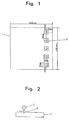
- Fig. 1 is a schematic view showing iron sheets (2) arranged on the foam (1)-contacting surface for testing the adhesive property of the foam.
- Fig. 2 is a schematic view showing a metal (3) screwed into the center of the iron sheet (2) on the foam (1).
- the polyol as prepared by using an acyclic sugar alcohol of 5 to 6 carbon atoms as an initiator, which is employed in the present invention, is a polyol obtainable by subjecting said sugar alcohol and an alkylene oxide, such as ethylene oxide (hereinafter referred to sometimes as EO), propylene oxide (hereinafter referred to sometimes as PO), etc., to addition reaction in the presence of a catalyst.
- an alkylene oxide such as ethylene oxide (hereinafter referred to sometimes as EO), propylene oxide (hereinafter referred to sometimes as PO), etc.
- sugar alcohol examples include hexitol such as sorbitol, mannitol, etc. and pentitol such as arabinitol, ribitol and so on. Particularly preferred is hexitol such as sorbitol.
- the polyol may be produced by using an active hydrogen compound, such as glycerin, in combination with such sugar alcohol. In any event, the resulting polyol should have a hydroxyl value in the range of 300 to 450 mg KOH/g. If the hydroxyl value is less than 300 mg KOH/g, the dimensional stability of the foam is sacrificed. Therefore, the polyol cannot be used in a sufficiently large amount and, hence, the expected improvement of adhesive property is compromised.
- the proportion of this polyol in the total blend polyol is 3 to 14 weight percent in terms of sugar alcohol content. If the proportion is less than the above range, the improvement of adhesive property is compromised, while any higher proportion in excess of the above range would cause an excessive increase in the viscosity of the polyol.
- the other polyol mentioned hereinbefore may be any known polyol.
- the hydroxyl value of the blend polyol containing such other polyol be within the range of 300 to 430 mg KOH/g. If the hydroxyl value is less than 300 mg KOH/g, the dimensional stability of the foam is compromised. Conversely if the hydroxyl value exceeds 430 mg KOH/g, no adequate improvement is realized in the adhesive property of the foam.
- a preferred example of said other polyol is a polyol prepared by using tolylenediamine as an initiator.
- the polyol having a hydroxyl value of 330 to 460 mg KOH/g is particularly suitable and the proportion of this polyol should be not more than 8 weight % of the total polyol component as a tolylenediamine content.
- the viscosity of the other polyol is not more than 3,000 m Pa ⁇ s (cps) at 25°C and preferably not more than 2,000 m Pa ⁇ s (cps) at the same temperature.
- the blend polyol described above is reacted with a polyisocyanate in the presence of water to give a rigid urethane foam.
- the quantity of water to be used is 4.0 to 7.0 weight parts based on 100 weight parts of the total blend polyol. If the proportion of water is less than 4.0 weight parts, the CFC-conserving effect is not sufficient and the low-temperature dimensional stability of the product foam, particularly that at -30°C, is sacrificed. The use of more than 7.0 weight parts of water is futile, for the resulting increase in foam density will not be commensurate with the increased use of water. It is also possible to use some other known blowing agent or agents, such as CFC-11, HCFC-123, HCFC-141b, etc. in a proportion not greater than 25 weight parts, in addition to water.
- the polyisocyanate to be employed in the present invention may be any of crude MDI, crude TDI and a TDI-prepolymer or any mixture thereof.
- the proportion of crude MDI is preferably not less than 70 weight %.
- the proportion of the polyisocyanate may be roughly the same as that in the conventional rigid urethan foam.
- the NCO/OH ratio may be 0.9 to 1.2.
- a foam stabilizer and a catalyst may also be employed.
- the foam stabilizer any of the known commercial stabilizers for rigid foams can be employed.
- B-8404, B-8407, B-8425 (Goldschmidt), F-305, F-345, F-373 (Shin-Etsu Chemical), SH-193 (Toray Silicone) and L-5420, L-5430, L-5350 (Nippon Unicar) may be mentioned.
- the proportion of the foam stabilizer may be that used generally.
- the foam stabilizer is used in a proportion of 0.5 to 5.0 weight parts based on 100 weight parts of the total blend polyol.
- any of the known amine catalysts can be employed.
- various other additives may also be incorporated.
- flame retardants include antioxidants, colorants, thinners (e.g. propylene carbonate) and so on.
- the resulting rigid urethane foam has a density of about 20 to 50 kg/m3.
- the CFC requirements can be reduced by 50 to 100 percent as compared with the known production technology for rigid urethane foam and, moreover, the adhesive property of the resulting foam is not inferior to that of the conventional urethane foam.
- a reactor (70l) equipped with heater and stirrer means was charged with 8.1 kg of sorbitol and 5.4 kg of glycerin, followed by addition of 175 g of KOH flakes.
- the charge was melted at a temperature of 100 to 110°C.
- 56.3 kg of PO was added and reacted.
- the residual small amount of unreacted PO was stripped off and the KOH was neutralized with 175 g of aqueous oxalic acid.
- the resulting potassium oxalate was filtered off and the filtrate was dehydrated.
- 500 ppm of 2,6-ditertiary-butyl-4-methylphenol (hereinafter referred to as BHT) was added as an antioxidant.
- the resulting polyether polyol had a hydroxyl value of 354 mg KOH/g and a viscosity of 1,500 m Pa ⁇ s (cps) (at 25°C). Its sorbitol content was 11.6%. This polyol is designated as SO-1.
- reference polyols 2 to 7 were prepared by varying the initiator, the amount of PO added and other parameters.
- the polyol had a hydroxyl value of 358 mg KOH/g and a viscosity of 8,000 m Pa ⁇ s (cps) (at 25°C). Its TDA content was 16.8 %.
- the aluminum surface of the mold which would contact the foam was covered with polypropylene film for ease of release.
- 50 mm x 50 mm iron sheets (No. 1 to 5) each having a 3 mm hole drilled in the center were stuck to the foam-contacting surface of the mold with double-coated adhesive tapes as illustrated in Fig. 1. As the foam contacted the mold surface, the foam adhered to the iron sheets. The adhesive strength between the foam and the iron sheet was measured to evaluate the adhesive strength of the foam.
- the initial adhesive strength between the foam and iron sheet was measured as follows. Thus, after the foam was cured for 6 minutes after casting, the panel foam was released from the mold and a metal was screwed into the center hole of the iron sheet as illustrated in Fig. 2. After 4 minutes (10 minutes after casting), the metal was pulled up from the metal beneath the panel with a push-pull scale (50 kg max.; Imada Seisakusho) and the maximum pulling force was recorded.
- a push-pull scale 50 kg max.; Imada Seisakusho
- Example 2 panel foams were prepared using the polyols indicated in Table 3 in accordance with the formulas shown in Table 4 and their physical properties were compared.
- polyols free of sorbitol such as the polyols of Comparative Examples 2 and 3, also fail to exhibit a satisfactory adhesive property.
- Comparative Example 6 is an example of the usual urethane foam system employing CFC-11. It should also be noticed that even the blend polyol is proper as in the polyol of Comparative Example 9, the foam is poor in low-temperature dimensional stability and the reduction of CFC requirements is unsatisfactory. (Note) Dimensional changes in excess of 2% are macroscopically visible. The dimensional change should not be more than 2 %.
Landscapes
- Chemical & Material Sciences (AREA)
- Health & Medical Sciences (AREA)
- Chemical Kinetics & Catalysis (AREA)
- Medicinal Chemistry (AREA)
- Polymers & Plastics (AREA)
- Organic Chemistry (AREA)
- Engineering & Computer Science (AREA)
- Materials Engineering (AREA)
- Polyurethanes Or Polyureas (AREA)
Description
- The present invention relates to a method of producing a rigid urethane foam and more particularly to a method of producing a urethane foam which comprises using a specific blend polyol and, as a principal blowing agent, water.
- Rigid urethane foam is industrial material having excellent heat-insulating property, moldablility and field processability and, as such, has been used in a broad spectrum of applications such as the heat insulation of electric refrigerators, buildings, cold storage warehouses, storage tanks, refrigerator ships and pipeline systems.
- A typical rigid urethane foam is manufactured by mixing and reacting a first component A the principal ingredients of which are a polyol, a catalyst, a foam stabilizer and a blowing agent and a second component B the principal ingredient of which is a polyisocyanate.
- The blowing agent generally used in the manufacture of urethane foams is trichloromonofluoromethane (hereinafter referred to as CFC-11).
- However, chlorofluorocarbon (hereinafter referred to as CFC), of which CFC-11 is a species, is chemically so stable that it diffuses into the stratosphere where it destroys the ozone layer. As a result, the ultraviolet rays from the sun are not absorbed into the ozonosphere but reach the surface of the earth to increase the risk of skin cancer, for instance, thus causing serious environmental problems in recent years. Therefore, regulatory control is coming into effect in 1989 over the use of CFC. CFC-11, used in the manufacture of urethane foam, is also subject to the same control.
- Under the circumstances, many explorations are in progress for finding blowing agents which may take the place of CFC but up to this day no other useful blowing agent has been developed as yet. HCFC-123 (2,2-dichloro-1,1,1-trifluoroethane), HCFC-141b (1,1-dichloro-1-fluoroethane) and so on have been proposed as substitutes for CFC-11 but none have been implemented on a commercial scale and, hence, we have had no industrially effective method of reducing the CFC requirements.
- Barring its adverse effects on the environment, CFC-11 is a very useful material offering the advantages of (1) adequate boiling point, (2) low thermal conductivity in gaseous state, (3) adequate solubility and, hence, viscosity-reducing property, and (4) noncombustibility and low toxicity.
- It is a great headache to the industry that it is now obliged to spare the use of this useful substance, CFC, and in the absence of a substitute blowing agent on the market, the only alternative means available is the utilization of water as a blowing agent. While the quantity of water used generally ranges from about 0.2 to 3.0 weight parts as pointed out in Japanese Patent Publication 53-9797/1978, the use of water in greater amounts would cause the following troubles.
- (1) Compared with the urethane foam rich in CFC-11, the proportion of CO₂ in the gaseous phase of the product urethane foam is larger, with the consequent deterioration of heat-insulating property.
- (2) Generally, the product urethane foam becomes friable.
- (3) As the proportion of CFC-11 is decreased, the viscosity of the system is increased so that the system becomes incompatible with the foaming machine.
- (4) The adhesive property of the urethane foam for the mating surface, particularly the initial adhesive strength, is seriously affected. This decrease in initial adhesive strength increases the incidence of detachment of the foam from the refrigerator or other insulation panel surface. This is a fatal drawback for any urethane foam, of which self-adhesion ought to be one of its basic requirements.
- (5) Because of the vigorous exothermic reaction between water and a polyisocyanate, foaming occurs with increased intensity so that the cell walls are destroyed by internal gas pressure to create local open cells. This would result in enhanced thermal conductivity and/or increased water absorption.
- The inventors of the present invention conducted an extensive research for meeting the above-mentioned demand of the society for economizing CFC without sacrificing the unique characteristics of rigid urethane foams and found that the use of a specific blend polyol as a starting material enabled them to manufacture a rigid urethane foam having a good adhesive property with the use of a large proportion of water and realizing a drastic reduction of the CFC requirements.
- The present invention relates, therefore, to a method of producing a rigid urethane foam, having a density of 20 to 50 kg/m², which comprises reacting a blend polyol consisting of a polyol having a hydroxyl value of 300 to 450 mg KOH/g as prepared by reacting an acyclic sugar alcohol of 5 to 6 carbon atoms as an initiator with an alkylene oxide and one or more other polyols, said blend polyol having an acyclic sugar alcohol (of 5 to 6 carbon atoms) content of 3 to 14 weight % based on the total amount of the blend polyol and an average hydroxyl value of 300 to 430 mg KOH/g, with a polyisocyanate using 4.0 to 7.0 weight parts of water based on 100 weight parts of said blend polyol as a blowing, agent.
- Fig. 1 is a schematic view showing iron sheets (2) arranged on the foam (1)-contacting surface for testing the adhesive property of the foam.
- Fig. 2 is a schematic view showing a metal (3) screwed into the center of the iron sheet (2) on the foam (1).
- The polyol as prepared by using an acyclic sugar alcohol of 5 to 6 carbon atoms as an initiator, which is employed in the present invention, is a polyol obtainable by subjecting said sugar alcohol and an alkylene oxide, such as ethylene oxide (hereinafter referred to sometimes as EO), propylene oxide (hereinafter referred to sometimes as PO), etc., to addition reaction in the presence of a catalyst.
- Examples of said sugar alcohol is hexitol such as sorbitol, mannitol, etc. and pentitol such as arabinitol, ribitol and so on. Particularly preferred is hexitol such as sorbitol. The polyol may be produced by using an active hydrogen compound, such as glycerin, in combination with such sugar alcohol. In any event, the resulting polyol should have a hydroxyl value in the range of 300 to 450 mg KOH/g. If the hydroxyl value is less than 300 mg KOH/g, the dimensional stability of the foam is sacrificed. Therefore, the polyol cannot be used in a sufficiently large amount and, hence, the expected improvement of adhesive property is compromised.
- On the other hand, if the hydroxyl value exceeds 450 mg KOH/g, the resulting foam becomes friable and the viscosity of the polyol itself becomes too high to be practically useful.
- The proportion of this polyol in the total blend polyol is 3 to 14 weight percent in terms of sugar alcohol content. If the proportion is less than the above range, the improvement of adhesive property is compromised, while any higher proportion in excess of the above range would cause an excessive increase in the viscosity of the polyol.
- The other polyol mentioned hereinbefore may be any known polyol.
- However, it is necessary that the hydroxyl value of the blend polyol containing such other polyol be within the range of 300 to 430 mg KOH/g. If the hydroxyl value is less than 300 mg KOH/g, the dimensional stability of the foam is compromised. Conversely if the hydroxyl value exceeds 430 mg KOH/g, no adequate improvement is realized in the adhesive property of the foam.
- A preferred example of said other polyol is a polyol prepared by using tolylenediamine as an initiator.
- With regard to the polyol prepared by using tolylenediamine as an initiator, the polyol having a hydroxyl value of 330 to 460 mg KOH/g is particularly suitable and the proportion of this polyol should be not more than 8 weight % of the total polyol component as a tolylenediamine content.
- It is preferred that the viscosity of the other polyol is not more than 3,000 m Pa·s (cps) at 25°C and preferably not more than 2,000 m Pa·s (cps) at the same temperature.
- In the present invention, the blend polyol described above is reacted with a polyisocyanate in the presence of water to give a rigid urethane foam.
- The quantity of water to be used is 4.0 to 7.0 weight parts based on 100 weight parts of the total blend polyol. If the proportion of water is less than 4.0 weight parts, the CFC-conserving effect is not sufficient and the low-temperature dimensional stability of the product foam, particularly that at -30°C, is sacrificed. The use of more than 7.0 weight parts of water is futile, for the resulting increase in foam density will not be commensurate with the increased use of water. It is also possible to use some other known blowing agent or agents, such as CFC-11, HCFC-123, HCFC-141b, etc. in a proportion not greater than 25 weight parts, in addition to water.
- The polyisocyanate to be employed in the present invention may be any of crude MDI, crude TDI and a TDI-prepolymer or any mixture thereof.
- If such a mixture is employed, the proportion of crude MDI, for instance, is preferably not less than 70 weight %.
- The proportion of the polyisocyanate may be roughly the same as that in the conventional rigid urethan foam. Thus, the NCO/OH ratio may be 0.9 to 1.2.
- In the production of the rigid urethane foam of the invention, a foam stabilizer and a catalyst, for instance, may also be employed. As the foam stabilizer, any of the known commercial stabilizers for rigid foams can be employed. Thus, for example, B-8404, B-8407, B-8425 (Goldschmidt), F-305, F-345, F-373 (Shin-Etsu Chemical), SH-193 (Toray Silicone) and L-5420, L-5430, L-5350 (Nippon Unicar) may be mentioned. No trouble will be encountered in the manufacture of the urethan foam even if a more active silicone compound for general flexible foams (e.g. B-8017) is used in addition to those silicones for rigid foams. The proportion of the foam stabilizer may be that used generally. Thus, the foam stabilizer is used in a proportion of 0.5 to 5.0 weight parts based on 100 weight parts of the total blend polyol.
- With regard to the catalyst, any of the known amine catalysts can be employed. According to the intended uses, various other additives may also be incorporated. Among such additives are flame retardants, antioxidants, colorants, thinners (e.g. propylene carbonate) and so on.
- The resulting rigid urethane foam has a density of about 20 to 50 kg/m³.
- In accordance with the present invention, the CFC requirements can be reduced by 50 to 100 percent as compared with the known production technology for rigid urethane foam and, moreover, the adhesive property of the resulting foam is not inferior to that of the conventional urethane foam.
- The following examples, reference examples, and comparative examples are further illustrative of the invention. In the examples, all parts and percents are by weight.
- A reactor (70ℓ) equipped with heater and stirrer means was charged with 8.1 kg of sorbitol and 5.4 kg of glycerin, followed by addition of 175 g of KOH flakes. The charge was melted at a temperature of 100 to 110°C. Then, at this temperature, 56.3 kg of PO was added and reacted. After 2 hours of ripening, the residual small amount of unreacted PO was stripped off and the KOH was neutralized with 175 g of aqueous oxalic acid. The resulting potassium oxalate was filtered off and the filtrate was dehydrated. Then, 500 ppm of 2,6-ditertiary-butyl-4-methylphenol (hereinafter referred to as BHT) was added as an antioxidant.
- The resulting polyether polyol had a hydroxyl value of 354 mg KOH/g and a viscosity of 1,500 m Pa·s (cps) (at 25°C). Its sorbitol content was 11.6%. This polyol is designated as SO-1.
- Using the same reactor as used in Reference Example 1, reference polyols 2 to 7 were prepared by varying the initiator, the amount of PO added and other parameters.
- The initiators used, the amounts of PO added and the results of analysis are summarized in Table 1.
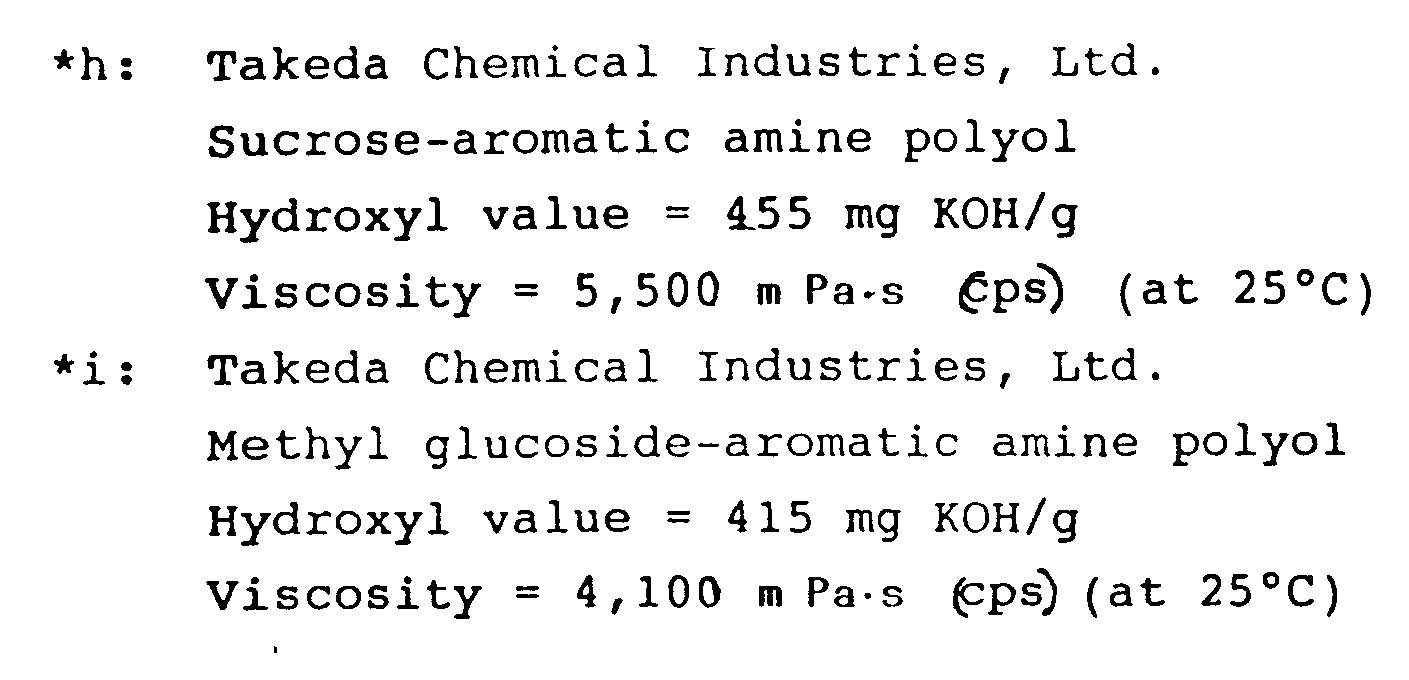
Table 1 Reference Example Initiators and amounts (kg) Amount of PO (kg) Hydroxyl value (mg KOH/g) Viscosity (cps, 25°C) m Pa·s Sorbitol content (%) Product code 1 Sorbitol 8.1 56.3 354 1,500 11.6 SO-1 Glycerin 5.4 2 Sorbitol 8.1 45.0 421 3,100 13.8 SO-2 Glycerin 5.4 3 Sorbitol 6.0 34.2 550 2,700 12.2 SO-3 Glycerin 9.0 4 Methyl glycoside 8.0 54.2 375 980 - MG-1 Glycerin 4.0 5 Granulated sugar 4.2 52.9 380 5,300 - SU-1 Glycerin 13.5 6 Granulated sugar 7.0 46.3 256 1,300 - SU-2 Glycerin 3.0 7 Granulated sugar 10.0 50.0 399 600 - SU-3 Propylene glycol 10.0 - The same reactor as used in Reference Example 1 was charged with 12 kg of 2·4, 2·6-tolylenediamine (hereinafter referred to sometimes as TDA), 175 g of KOH flakes and 2.0 kg of diethanolamine. Then, at 110 to 120°C, 57.0 kg of propylene oxide was added and reacted. The reaction mixture was neutralized with aqueous oxalic acid and dehydrated, and the resulting crystals were filtered. To the polyol thus obtained was added 500 ppm of BHT. This polyol is designated as TD-1.
- The polyol had a hydroxyl value of 358 mg KOH/g and a viscosity of 8,000 m Pa·s (cps) (at 25°C). Its TDA content was 16.8 %.
- In accordance with the same procedure as above, reference polyols were prepared.
- The compositions and analyses of these polyols are presented in Table 2.
Table 2 Reference Example Initiators and amounts (kg) Amount of PO (kg) Amount of EO (kg) Hydroxyl value (mg KOH/g) Viscosity (cps, 25°C) m Pa·s TDA/OTD content (%) Product code 8 TDA1) 12 57.0 - 358 8,000 16.8 TD-1 Diethanolamine 2 9 OTD2) 12 34.2 8.7 460 5,500 20.1 TD-2 Diethanolamine 4.4 10 TDA 12.3 28.6 12.2 470 15,000 22.2 TD-3 Diethanolamine 2.2 11 Monoethanolamine 13.4 60.8 - 500 400 - ME-1 1) TDA ... 2·4,2·6-tolylenediamine 2) OTD ... 2·3,3·4-tolylenediamine - Using the blend polyol A-1 indicated in Table 3 according to the formulas shown in Table 4, panel foaming was performed by the hand mixing method.
- Thus, 100 to 150 g of the polyol was premixed with the foam stabilizer, catalyst and blowing agent in the proportions indicated in Table 4 and the solution temperature was adjusted to 20 ± 1°C. Then, the required amount of polyisocyanate maintained at 20 ± 1°C was added to the polyol premix and the mixture was quickly stirred with a turbine mixer (1,600 rpm) for 5 to 7 seconds and cast in a predetermined quantity into a mold (for a rectangular panel measuring 500 mm x 500 mm x 30 mm; made of aluminum) maintained at 40 to 42°C, which was then covered. After 6-minutes curing in an oven at 50°C, the product was released from the mold and its physical properties were determined.
- The reactivity and foam density were also investigated by casting the system into an open box. The results are set forth in Table 4.
- The aluminum surface of the mold which would contact the foam was covered with polypropylene film for ease of release. In addition, 50 mm x 50 mm iron sheets (No. 1 to 5) each having a 3 mm hole drilled in the center were stuck to the foam-contacting surface of the mold with double-coated adhesive tapes as illustrated in Fig. 1. As the foam contacted the mold surface, the foam adhered to the iron sheets. The adhesive strength between the foam and the iron sheet was measured to evaluate the adhesive strength of the foam.
- The initial adhesive strength between the foam and iron sheet was measured as follows. Thus, after the foam was cured for 6 minutes after casting, the panel foam was released from the mold and a metal was screwed into the center hole of the iron sheet as illustrated in Fig. 2. After 4 minutes (10 minutes after casting), the metal was pulled up from the metal beneath the panel with a push-pull scale (50 kg max.; Imada Seisakusho) and the maximum pulling force was recorded.
- It is generally considered that an adhesive strength of not less than 30 kg/25 cm² is satisfactory.


- In the same manner as Example 1, panel foams were prepared using the polyols indicated in Table 3 in accordance with the formulas shown in Table 4 and their physical properties were compared.
- It will be apparent from Table 4 that the urethane foams according to Examples 1 to 6 of the invention exhibited excellent adhesive properties and satisfactory dimensional stability.
- Even when a polyol contains sorbitol, it does not exhibit a satisfactory adhesive property if its hydroxyl value is high as in Comparative Example 4 or its average hydroxyl value is high as in Comparative Example 4. The polyol of Comparative Example 5, which has a low hydroxyl value, is unsatisfactory in dimensional stability and very poor in compressive strength.
- Furthermore, polyols free of sorbitol, such as the polyols of Comparative Examples 2 and 3, also fail to exhibit a satisfactory adhesive property.
- It goes without saying that the ordinary commercial polyols exhibit poor adhesive property in such water-rich systems (Refer to Comparative Examples 7 and 8).
- Comparative Example 6 is an example of the usual urethane foam system employing CFC-11. It should also be noticed that even the blend polyol is proper as in the polyol of Comparative Example 9, the foam is poor in low-temperature dimensional stability and the reduction of CFC requirements is unsatisfactory.
(Note) Dimensional changes in excess of 2% are macroscopically visible. The dimensional change should not be more than 2 %.
Claims (8)
- A method of producing a rigid urethane foam, having a density of 20 to 50 kg/m², which comprises reacting a blend polyol consisting of a polyol having a hydroxyl value of 300 to 450 mg KOH/g as prepared by reacting an acyclic sugar alcohol of 5 to 6 carbon atoms as an initiator with an alkylene oxide and one or more other polyols, said blend polyol having an acyclic sugar alcohol (of 5 to 6 carbon atoms) content of 3 to 14 weight % based on the total amount of the blend polyol and an average hydroxyl value of 300 to 430 mg KOH/g, with a polyisocyanate using 4.0 to 7.0 weight parts of water based on 100 weight parts of said blend polyol as a blowing agent.
- A method of producing a rigid urethane foam as claimed in claim 1, wherein the acyclic sugar alcohol of 5 to 6 carbon atoms is hexitol.
- A method of producing a rigid urethane foam as claimed in claim 1, wherein the acyclic sugar alcohol of 5 to 6 carbon atoms is sorbitol.
- A method of producing a rigid urethane foam as claimed in claim 1, wherein the viscosity of the other polyol (s) as a whole is not more than 3,000 m Pa . s (cps) at 25° C.
- A method of producing a rigid urethane foam as claimed in claim 1, wherein the viscosity of the other polyol is not more than 2,000 m Pa . s (cps) at 25° C.
- A method of producing a rigid urethane foam as claimed in claim 1, wherein the other polyol is a polyol prepared by using tolylenediamine as an initiator and having a hydroxyl value of 330 to 460 mg KOH/g and the proportion of the other polyol is not more than 8 weight % as a tolylenediamine content.
- A method of producing a rigid urethane foam as claimed in claim 1, wherein the polyisocyanate is a mixture of crude MDI and other polyisocyanate(s), whose crude MDI content is not less than 70 weight %.
- A method of producing a rigid urethane foam as claimed in claim 1, wherein the NCO/OH ratio is 0.9 to 1.2.
Applications Claiming Priority (2)
| Application Number | Priority Date | Filing Date | Title |
|---|---|---|---|
| JP18299689 | 1989-07-14 | ||
| JP182996/89 | 1989-07-14 |
Publications (3)
| Publication Number | Publication Date |
|---|---|
| EP0408048A2 EP0408048A2 (en) | 1991-01-16 |
| EP0408048A3 EP0408048A3 (en) | 1992-03-18 |
| EP0408048B1 true EP0408048B1 (en) | 1995-05-03 |
Family
ID=16127936
Family Applications (1)
| Application Number | Title | Priority Date | Filing Date |
|---|---|---|---|
| EP90113430A Expired - Lifetime EP0408048B1 (en) | 1989-07-14 | 1990-07-13 | Method of producing rigid urethane foam |
Country Status (4)
| Country | Link |
|---|---|
| US (1) | US5091438A (en) |
| EP (1) | EP0408048B1 (en) |
| JP (1) | JP2851689B2 (en) |
| DE (1) | DE69019075T2 (en) |
Families Citing this family (9)
| Publication number | Priority date | Publication date | Assignee | Title |
|---|---|---|---|---|
| JPH0236217A (en) * | 1988-07-27 | 1990-02-06 | Hitachi Ltd | Rigid polyurethane foam, its production, heat-insulating material and refrigerator manufactured therewith |
| WO1994005718A1 (en) * | 1992-08-27 | 1994-03-17 | Stepan Company | Process for production of low density water-blown rigid foams with flow and dimensional stability |
| US5690855A (en) * | 1994-01-11 | 1997-11-25 | Sealed Air Corporation | Polyol blend, cellular polyurethane foam product made therefrom, and halogenated hydrocarbon-free process therefor |
| DE4427471A1 (en) * | 1994-08-03 | 1996-02-08 | Henkel Kgaa | One-component reactive adhesive |
| TW413688B (en) * | 1996-06-20 | 2000-12-01 | Huntsman Ici Chem Llc | Process for rigid polyurethane foams |
| DE19639121A1 (en) * | 1996-09-24 | 1998-03-26 | Basf Ag | Process for the production of rigid polyurethane foams |
| CA2312373A1 (en) * | 1997-12-04 | 1999-06-10 | Sol M. Mirasol | Low density co2-blown polyurethane foams and a process of preparing same |
| DE102004048728A1 (en) * | 2004-10-05 | 2006-04-06 | Basf Ag | Process for the production of rigid polyurethane foams |
| CN103435775B (en) * | 2013-08-05 | 2016-01-20 | 三棵树涂料股份有限公司 | The preparation method of multi-usage color inhibition PU solidifying priming paint agent |
Family Cites Families (11)
| Publication number | Priority date | Publication date | Assignee | Title |
|---|---|---|---|---|
| JPS539797B2 (en) * | 1975-02-21 | 1978-04-08 | ||
| JPS532596A (en) * | 1976-06-28 | 1978-01-11 | Dai Ichi Kogyo Seiyaku Co Ltd | Preparation of novel flame-retardant polyurethane foam |
| CA1083570A (en) * | 1976-07-13 | 1980-08-12 | Theodor Denzel | Pyrazolo [4',3':5,6] pyride [3,4-e] [1,2,4] triazolo- [1,5-a] pyrimidines derivatives |
| JPS5722329A (en) * | 1980-07-11 | 1982-02-05 | Tokyo Shibaura Electric Co | Power source system for artificial satellite |
| JPS59100124A (en) * | 1982-11-30 | 1984-06-09 | Asahi Oorin Kk | Molding of rigid foam |
| US4469822A (en) * | 1983-07-14 | 1984-09-04 | Basf Wyandotte Corporation | Alkylene oxide adducts of vicinal toluenediamine and co-initiators, useful for rigid polyurethane foams |
| US4487854A (en) * | 1983-12-27 | 1984-12-11 | Basf Wyandotte Corporation | Polyoxyalkylene polyether polyols and polyurethane foams prepared therefrom |
| US4555531A (en) * | 1985-01-14 | 1985-11-26 | Basf Wyandotte Corporation | Rigid polyurethane foams employing alkylene oxide adducts of alkanolamines |
| GB8516618D0 (en) * | 1985-07-01 | 1985-08-07 | Ici Plc | Polyether polyols |
| JPH01229023A (en) * | 1988-03-09 | 1989-09-12 | Mitsui Toatsu Chem Inc | Production of rigid polyurethane foam |
| US4943597A (en) * | 1988-12-07 | 1990-07-24 | The Dow Chemical Company | Polyether polyol formulations for hard CFC replacement by water blowing in rigid polyurethane foams |
-
1990
- 1990-07-10 US US07/550,367 patent/US5091438A/en not_active Expired - Lifetime
- 1990-07-13 JP JP2186812A patent/JP2851689B2/en not_active Expired - Fee Related
- 1990-07-13 DE DE69019075T patent/DE69019075T2/en not_active Expired - Fee Related
- 1990-07-13 EP EP90113430A patent/EP0408048B1/en not_active Expired - Lifetime
Also Published As
| Publication number | Publication date |
|---|---|
| EP0408048A2 (en) | 1991-01-16 |
| DE69019075T2 (en) | 1995-11-16 |
| DE69019075D1 (en) | 1995-06-08 |
| JPH03121117A (en) | 1991-05-23 |
| JP2851689B2 (en) | 1999-01-27 |
| US5091438A (en) | 1992-02-25 |
| EP0408048A3 (en) | 1992-03-18 |
Similar Documents
| Publication | Publication Date | Title |
|---|---|---|
| US4256846A (en) | Method of producing flameproof polyisocyanurate foams | |
| CN1072242C (en) | Method for making thermal insulation device | |
| US5350777A (en) | Production and use of open cell rigid polyurethane foam | |
| EP1153067B1 (en) | Open-celled semi-rigid foams with exfoliating graphite | |
| US4067833A (en) | Urethane-modified polyisocyanurate foams from oxyalkylated aniline and aromatic polyisocyanates | |
| AU722500B2 (en) | Process for the production of rigid polyurethane foams having low thermal conductivity | |
| IE910420A1 (en) | A foaming system for closed-cell rigid polyurethane foam | |
| US4711912A (en) | Polyisocyanurate foams from digestion products of polyalkylene terephthalate polymers and polyols | |
| US4291129A (en) | Composition and a method for controlling reaction pressures during the foaming process resulting in an easily flame retarded foam-in place insulation | |
| US5091438A (en) | Method of producing rigid urethane foam | |
| USRE31757E (en) | Composition and a method for controlling reaction pressures during the foaming process resulting in an easily flame retarded foam-in place insulation | |
| EP0397378A1 (en) | Hydrochlorofluorocarbon blown rigid polyurethane foams and their preparation | |
| CA1071350A (en) | Polyisocyanurate compositions and foams of improved friability and process of preparing same | |
| EP0431756B1 (en) | Polyol and rigid polyurethane foam | |
| EP0742237B1 (en) | Foamed thermal insulating material and insulated structure | |
| JP3242711B2 (en) | Polyol composition | |
| US6384098B1 (en) | Rigid polyurethane foam and process for producing the same | |
| US5472988A (en) | Process for producing polyisocyanurate foams | |
| US6355700B1 (en) | Foamed thermal insulating material and insulated structure | |
| JPH0364312A (en) | Production of rigid polyurethane foam | |
| US5112876A (en) | Polyether polyol and rigid polyurethane foam | |
| EP0486034B2 (en) | Flexible polyurethane foams and process for preparing them | |
| JPH0395212A (en) | Preparation of rigid polyurethane foam | |
| EP3464434B1 (en) | Flame retardant semi-rigid polyurethane foam | |
| JPH07133368A (en) | Method for producing rigid polyurethane foam |
Legal Events
| Date | Code | Title | Description |
|---|---|---|---|
| PUAI | Public reference made under article 153(3) epc to a published international application that has entered the european phase |
Free format text: ORIGINAL CODE: 0009012 |
|
| AK | Designated contracting states |
Kind code of ref document: A2 Designated state(s): DE FR GB IT |
|
| PUAL | Search report despatched |
Free format text: ORIGINAL CODE: 0009013 |
|
| AK | Designated contracting states |
Kind code of ref document: A3 Designated state(s): DE FR GB IT |
|
| RAP3 | Party data changed (applicant data changed or rights of an application transferred) |
Owner name: TAKEDA CHEMICAL INDUSTRIES, LTD. |
|
| 17P | Request for examination filed |
Effective date: 19920506 |
|
| 17Q | First examination report despatched |
Effective date: 19930806 |
|
| GRAA | (expected) grant |
Free format text: ORIGINAL CODE: 0009210 |
|
| AK | Designated contracting states |
Kind code of ref document: B1 Designated state(s): DE FR GB IT |
|
| ITF | It: translation for a ep patent filed | ||
| ET | Fr: translation filed | ||
| REF | Corresponds to: |
Ref document number: 69019075 Country of ref document: DE Date of ref document: 19950608 |
|
| PLBE | No opposition filed within time limit |
Free format text: ORIGINAL CODE: 0009261 |
|
| STAA | Information on the status of an ep patent application or granted ep patent |
Free format text: STATUS: NO OPPOSITION FILED WITHIN TIME LIMIT |
|
| 26N | No opposition filed | ||
| PGFP | Annual fee paid to national office [announced via postgrant information from national office to epo] |
Ref country code: GB Payment date: 19980706 Year of fee payment: 9 |
|
| PG25 | Lapsed in a contracting state [announced via postgrant information from national office to epo] |
Ref country code: GB Free format text: LAPSE BECAUSE OF NON-PAYMENT OF DUE FEES Effective date: 19990713 |
|
| GBPC | Gb: european patent ceased through non-payment of renewal fee |
Effective date: 19990713 |
|
| REG | Reference to a national code |
Ref country code: FR Ref legal event code: TP |
|
| PGFP | Annual fee paid to national office [announced via postgrant information from national office to epo] |
Ref country code: FR Payment date: 20030711 Year of fee payment: 14 |
|
| PGFP | Annual fee paid to national office [announced via postgrant information from national office to epo] |
Ref country code: DE Payment date: 20030724 Year of fee payment: 14 |
|
| PG25 | Lapsed in a contracting state [announced via postgrant information from national office to epo] |
Ref country code: DE Free format text: LAPSE BECAUSE OF NON-PAYMENT OF DUE FEES Effective date: 20050201 |
|
| PG25 | Lapsed in a contracting state [announced via postgrant information from national office to epo] |
Ref country code: FR Free format text: LAPSE BECAUSE OF NON-PAYMENT OF DUE FEES Effective date: 20050331 |
|
| REG | Reference to a national code |
Ref country code: FR Ref legal event code: ST |
|
| PG25 | Lapsed in a contracting state [announced via postgrant information from national office to epo] |
Ref country code: IT Free format text: LAPSE BECAUSE OF NON-PAYMENT OF DUE FEES;WARNING: LAPSES OF ITALIAN PATENTS WITH EFFECTIVE DATE BEFORE 2007 MAY HAVE OCCURRED AT ANY TIME BEFORE 2007. THE CORRECT EFFECTIVE DATE MAY BE DIFFERENT FROM THE ONE RECORDED. Effective date: 20050713 |