EP0403026B1 - 12-Substituted-12H-dibenzo(D,G)(1,3)dioxocin-6-carboxylic acids, herbicidal compositions, and a method of controlling undesirable vegetation - Google Patents
12-Substituted-12H-dibenzo(D,G)(1,3)dioxocin-6-carboxylic acids, herbicidal compositions, and a method of controlling undesirable vegetation Download PDFInfo
- Publication number
- EP0403026B1 EP0403026B1 EP90201541A EP90201541A EP0403026B1 EP 0403026 B1 EP0403026 B1 EP 0403026B1 EP 90201541 A EP90201541 A EP 90201541A EP 90201541 A EP90201541 A EP 90201541A EP 0403026 B1 EP0403026 B1 EP 0403026B1
- Authority
- EP
- European Patent Office
- Prior art keywords
- compound
- formula
- alkyl
- alkoxy
- dioxocin
- Prior art date
- Legal status (The legal status is an assumption and is not a legal conclusion. Google has not performed a legal analysis and makes no representation as to the accuracy of the status listed.)
- Expired - Lifetime
Links
- 239000000203 mixture Substances 0.000 title claims description 121
- 238000000034 method Methods 0.000 title claims description 42
- -1 12-Substituted-12H-dibenzo(D,G)(1,3)dioxocin-6-carboxylic acids Chemical class 0.000 title claims description 35
- 230000002363 herbicidal effect Effects 0.000 title claims description 16
- 150000001875 compounds Chemical class 0.000 claims description 201
- 229910052739 hydrogen Inorganic materials 0.000 claims description 34
- 125000002496 methyl group Chemical group [H]C([H])([H])* 0.000 claims description 29
- 239000002253 acid Substances 0.000 claims description 28
- 238000006243 chemical reaction Methods 0.000 claims description 27
- 238000010992 reflux Methods 0.000 claims description 25
- 239000001257 hydrogen Substances 0.000 claims description 23
- 125000000229 (C1-C4)alkoxy group Chemical group 0.000 claims description 22
- 125000004414 alkyl thio group Chemical group 0.000 claims description 20
- 150000002148 esters Chemical class 0.000 claims description 19
- 239000002904 solvent Substances 0.000 claims description 19
- 150000001408 amides Chemical class 0.000 claims description 17
- 125000004178 (C1-C4) alkyl group Chemical group 0.000 claims description 16
- 239000003153 chemical reaction reagent Substances 0.000 claims description 16
- 125000001997 phenyl group Chemical group [H]C1=C([H])C([H])=C(*)C([H])=C1[H] 0.000 claims description 16
- PEVVNTJHQRSIIP-UHFFFAOYSA-N lithium;methanidylsulfanylbenzene Chemical compound [Li+].[CH2-]SC1=CC=CC=C1 PEVVNTJHQRSIIP-UHFFFAOYSA-N 0.000 claims description 12
- 150000003839 salts Chemical class 0.000 claims description 12
- 125000004435 hydrogen atom Chemical group [H]* 0.000 claims description 11
- 125000001495 ethyl group Chemical group [H]C([H])([H])C([H])([H])* 0.000 claims description 10
- 125000002023 trifluoromethyl group Chemical group FC(F)(F)* 0.000 claims description 10
- 125000003545 alkoxy group Chemical group 0.000 claims description 9
- 125000000217 alkyl group Chemical group 0.000 claims description 9
- 239000002671 adjuvant Substances 0.000 claims description 8
- HNKJADCVZUBCPG-UHFFFAOYSA-N thioanisole Chemical compound CSC1=CC=CC=C1 HNKJADCVZUBCPG-UHFFFAOYSA-N 0.000 claims description 8
- LFQSCWFLJHTTHZ-UHFFFAOYSA-N Ethanol Chemical compound CCO LFQSCWFLJHTTHZ-UHFFFAOYSA-N 0.000 claims description 6
- JCXJVPUVTGWSNB-UHFFFAOYSA-N Nitrogen dioxide Chemical compound O=[N]=O JCXJVPUVTGWSNB-UHFFFAOYSA-N 0.000 claims description 6
- 125000004663 dialkyl amino group Chemical group 0.000 claims description 6
- 239000012634 fragment Substances 0.000 claims description 6
- 125000000951 phenoxy group Chemical group [H]C1=C([H])C([H])=C(O*)C([H])=C1[H] 0.000 claims description 6
- 125000003356 phenylsulfanyl group Chemical group [*]SC1=C([H])C([H])=C([H])C([H])=C1[H] 0.000 claims description 6
- 230000003197 catalytic effect Effects 0.000 claims description 5
- 238000010438 heat treatment Methods 0.000 claims description 5
- 230000008569 process Effects 0.000 claims description 5
- MDFFNEOEWAXZRQ-UHFFFAOYSA-N aminyl Chemical compound [NH2] MDFFNEOEWAXZRQ-UHFFFAOYSA-N 0.000 claims description 4
- 125000003178 carboxy group Chemical group [H]OC(*)=O 0.000 claims description 4
- 229910052744 lithium Inorganic materials 0.000 claims description 4
- QRIQLJICZIFSQD-UHFFFAOYSA-N spiro[benzo[d][1,3]benzodioxocine-5,1'-cyclopropane]-11-carboxylic acid Chemical compound C12=CC=CC=C2OC(C(=O)O)OC2=CC=CC=C2C21CC2 QRIQLJICZIFSQD-UHFFFAOYSA-N 0.000 claims description 4
- 125000006273 (C1-C3) alkyl group Chemical group 0.000 claims description 3
- 229930185605 Bisphenol Natural products 0.000 claims description 3
- 125000003236 benzoyl group Chemical group [H]C1=C([H])C([H])=C(C([H])=C1[H])C(*)=O 0.000 claims description 3
- 125000002915 carbonyl group Chemical group [*:2]C([*:1])=O 0.000 claims description 3
- 125000004209 (C1-C8) alkyl group Chemical group 0.000 claims description 2
- 229910000288 alkali metal carbonate Inorganic materials 0.000 claims description 2
- 150000008041 alkali metal carbonates Chemical class 0.000 claims description 2
- 125000004453 alkoxycarbonyl group Chemical group 0.000 claims 2
- 125000004473 dialkylaminocarbonyl group Chemical group 0.000 claims 2
- XMBWDFGMSWQBCA-UHFFFAOYSA-M iodide Chemical compound [I-] XMBWDFGMSWQBCA-UHFFFAOYSA-M 0.000 claims 1
- 229940006461 iodide ion Drugs 0.000 claims 1
- 238000004519 manufacturing process Methods 0.000 claims 1
- RTZKZFJDLAIYFH-UHFFFAOYSA-N Diethyl ether Chemical compound CCOCC RTZKZFJDLAIYFH-UHFFFAOYSA-N 0.000 description 125
- VLKZOEOYAKHREP-UHFFFAOYSA-N n-Hexane Chemical compound CCCCCC VLKZOEOYAKHREP-UHFFFAOYSA-N 0.000 description 87
- 239000000243 solution Substances 0.000 description 70
- CSNNHWWHGAXBCP-UHFFFAOYSA-L Magnesium sulfate Chemical compound [Mg+2].[O-][S+2]([O-])([O-])[O-] CSNNHWWHGAXBCP-UHFFFAOYSA-L 0.000 description 64
- OKKJLVBELUTLKV-UHFFFAOYSA-N Methanol Chemical compound OC OKKJLVBELUTLKV-UHFFFAOYSA-N 0.000 description 60
- YMWUJEATGCHHMB-UHFFFAOYSA-N Dichloromethane Chemical compound ClCCl YMWUJEATGCHHMB-UHFFFAOYSA-N 0.000 description 54
- 238000003756 stirring Methods 0.000 description 50
- 238000000425 proton nuclear magnetic resonance spectrum Methods 0.000 description 48
- 238000002360 preparation method Methods 0.000 description 47
- WYURNTSHIVDZCO-UHFFFAOYSA-N Tetrahydrofuran Chemical compound C1CCOC1 WYURNTSHIVDZCO-UHFFFAOYSA-N 0.000 description 46
- XLYOFNOQVPJJNP-UHFFFAOYSA-N water Substances O XLYOFNOQVPJJNP-UHFFFAOYSA-N 0.000 description 46
- 238000001704 evaporation Methods 0.000 description 37
- 230000008020 evaporation Effects 0.000 description 37
- 239000003921 oil Substances 0.000 description 36
- 235000019198 oils Nutrition 0.000 description 36
- 229910052943 magnesium sulfate Inorganic materials 0.000 description 32
- 235000019341 magnesium sulphate Nutrition 0.000 description 32
- KFZMGEQAYNKOFK-UHFFFAOYSA-N Isopropanol Chemical compound CC(C)O KFZMGEQAYNKOFK-UHFFFAOYSA-N 0.000 description 27
- 241000196324 Embryophyta Species 0.000 description 26
- 239000007787 solid Substances 0.000 description 26
- VEXZGXHMUGYJMC-UHFFFAOYSA-N Hydrochloric acid Chemical compound Cl VEXZGXHMUGYJMC-UHFFFAOYSA-N 0.000 description 25
- JXTHNDFMNIQAHM-UHFFFAOYSA-N dichloroacetic acid Chemical compound OC(=O)C(Cl)Cl JXTHNDFMNIQAHM-UHFFFAOYSA-N 0.000 description 24
- 238000001644 13C nuclear magnetic resonance spectroscopy Methods 0.000 description 23
- XEKOWRVHYACXOJ-UHFFFAOYSA-N Ethyl acetate Natural products CCOC(C)=O XEKOWRVHYACXOJ-UHFFFAOYSA-N 0.000 description 23
- YLQBMQCUIZJEEH-UHFFFAOYSA-N tetrahydrofuran Natural products C=1C=COC=1 YLQBMQCUIZJEEH-UHFFFAOYSA-N 0.000 description 23
- 238000002329 infrared spectrum Methods 0.000 description 22
- 238000002844 melting Methods 0.000 description 21
- 230000008018 melting Effects 0.000 description 21
- 239000000047 product Substances 0.000 description 21
- MZRVEZGGRBJDDB-UHFFFAOYSA-N N-Butyllithium Chemical compound [Li]CCCC MZRVEZGGRBJDDB-UHFFFAOYSA-N 0.000 description 18
- 125000001424 substituent group Chemical group 0.000 description 18
- CSCPPACGZOOCGX-UHFFFAOYSA-N Acetone Chemical compound CC(C)=O CSCPPACGZOOCGX-UHFFFAOYSA-N 0.000 description 17
- NLXLAEXVIDQMFP-UHFFFAOYSA-N Ammonia chloride Chemical compound [NH4+].[Cl-] NLXLAEXVIDQMFP-UHFFFAOYSA-N 0.000 description 16
- ZMXDDKWLCZADIW-UHFFFAOYSA-N N,N-Dimethylformamide Chemical compound CN(C)C=O ZMXDDKWLCZADIW-UHFFFAOYSA-N 0.000 description 12
- HEMHJVSKTPXQMS-UHFFFAOYSA-M Sodium hydroxide Chemical compound [OH-].[Na+] HEMHJVSKTPXQMS-UHFFFAOYSA-M 0.000 description 12
- 229960005215 dichloroacetic acid Drugs 0.000 description 12
- NLKNQRATVPKPDG-UHFFFAOYSA-M potassium iodide Chemical compound [K+].[I-] NLKNQRATVPKPDG-UHFFFAOYSA-M 0.000 description 12
- UFHFLCQGNIYNRP-UHFFFAOYSA-N Hydrogen Chemical compound [H][H] UFHFLCQGNIYNRP-UHFFFAOYSA-N 0.000 description 11
- VYPSYNLAJGMNEJ-UHFFFAOYSA-N Silicium dioxide Chemical compound O=[Si]=O VYPSYNLAJGMNEJ-UHFFFAOYSA-N 0.000 description 10
- 239000004009 herbicide Substances 0.000 description 10
- 229920006395 saturated elastomer Polymers 0.000 description 10
- KWYUFKZDYYNOTN-UHFFFAOYSA-M Potassium hydroxide Chemical compound [OH-].[K+] KWYUFKZDYYNOTN-UHFFFAOYSA-M 0.000 description 9
- QAOWNCQODCNURD-UHFFFAOYSA-N Sulfuric acid Chemical compound OS(O)(=O)=O QAOWNCQODCNURD-UHFFFAOYSA-N 0.000 description 9
- ZMANZCXQSJIPKH-UHFFFAOYSA-N Triethylamine Chemical compound CCN(CC)CC ZMANZCXQSJIPKH-UHFFFAOYSA-N 0.000 description 9
- 239000012074 organic phase Substances 0.000 description 9
- 239000004094 surface-active agent Substances 0.000 description 9
- LMBFAGIMSUYTBN-MPZNNTNKSA-N teixobactin Chemical compound C([C@H](C(=O)N[C@@H]([C@@H](C)CC)C(=O)N[C@@H](CO)C(=O)N[C@H](CCC(N)=O)C(=O)N[C@H]([C@@H](C)CC)C(=O)N[C@@H]([C@@H](C)CC)C(=O)N[C@@H](CO)C(=O)N[C@H]1C(N[C@@H](C)C(=O)N[C@@H](C[C@@H]2NC(=N)NC2)C(=O)N[C@H](C(=O)O[C@H]1C)[C@@H](C)CC)=O)NC)C1=CC=CC=C1 LMBFAGIMSUYTBN-MPZNNTNKSA-N 0.000 description 9
- 238000005160 1H NMR spectroscopy Methods 0.000 description 8
- LCGLNKUTAGEVQW-UHFFFAOYSA-N Dimethyl ether Chemical compound COC LCGLNKUTAGEVQW-UHFFFAOYSA-N 0.000 description 8
- IAZDPXIOMUYVGZ-UHFFFAOYSA-N Dimethylsulphoxide Chemical compound CS(C)=O IAZDPXIOMUYVGZ-UHFFFAOYSA-N 0.000 description 8
- OFBQJSOFQDEBGM-UHFFFAOYSA-N Pentane Chemical compound CCCCC OFBQJSOFQDEBGM-UHFFFAOYSA-N 0.000 description 8
- 235000019270 ammonium chloride Nutrition 0.000 description 8
- ILAHWRKJUDSMFH-UHFFFAOYSA-N boron tribromide Chemical compound BrB(Br)Br ILAHWRKJUDSMFH-UHFFFAOYSA-N 0.000 description 8
- 229910052799 carbon Inorganic materials 0.000 description 8
- 238000001030 gas--liquid chromatography Methods 0.000 description 8
- BWHMMNNQKKPAPP-UHFFFAOYSA-L potassium carbonate Chemical compound [K+].[K+].[O-]C([O-])=O BWHMMNNQKKPAPP-UHFFFAOYSA-L 0.000 description 8
- JOXIMZWYDAKGHI-UHFFFAOYSA-N toluene-4-sulfonic acid Chemical compound CC1=CC=C(S(O)(=O)=O)C=C1 JOXIMZWYDAKGHI-UHFFFAOYSA-N 0.000 description 8
- 239000000969 carrier Substances 0.000 description 7
- 238000009833 condensation Methods 0.000 description 7
- 230000005494 condensation Effects 0.000 description 7
- 238000001228 spectrum Methods 0.000 description 7
- WFDIJRYMOXRFFG-UHFFFAOYSA-N Acetic anhydride Chemical compound CC(=O)OC(C)=O WFDIJRYMOXRFFG-UHFFFAOYSA-N 0.000 description 6
- UIIMBOGNXHQVGW-UHFFFAOYSA-M Sodium bicarbonate Chemical compound [Na+].OC([O-])=O UIIMBOGNXHQVGW-UHFFFAOYSA-M 0.000 description 6
- YXFVVABEGXRONW-UHFFFAOYSA-N Toluene Chemical compound CC1=CC=CC=C1 YXFVVABEGXRONW-UHFFFAOYSA-N 0.000 description 6
- 150000007513 acids Chemical class 0.000 description 6
- 239000012267 brine Substances 0.000 description 6
- 125000001246 bromo group Chemical group Br* 0.000 description 6
- 239000013078 crystal Substances 0.000 description 6
- 238000004811 liquid chromatography Methods 0.000 description 6
- 125000004184 methoxymethyl group Chemical group [H]C([H])([H])OC([H])([H])* 0.000 description 6
- HPALAKNZSZLMCH-UHFFFAOYSA-M sodium;chloride;hydrate Chemical compound O.[Na+].[Cl-] HPALAKNZSZLMCH-UHFFFAOYSA-M 0.000 description 6
- KEAYESYHFKHZAL-UHFFFAOYSA-N Sodium Chemical compound [Na] KEAYESYHFKHZAL-UHFFFAOYSA-N 0.000 description 5
- 239000004480 active ingredient Substances 0.000 description 5
- ABQPEYRVNHDPIO-UHFFFAOYSA-N bromo(dimethyl)borane Chemical compound CB(C)Br ABQPEYRVNHDPIO-UHFFFAOYSA-N 0.000 description 5
- 150000001721 carbon Chemical group 0.000 description 5
- 239000003795 chemical substances by application Substances 0.000 description 5
- 239000012141 concentrate Substances 0.000 description 5
- 230000000694 effects Effects 0.000 description 5
- 239000012259 ether extract Substances 0.000 description 5
- 230000012010 growth Effects 0.000 description 5
- 239000007788 liquid Substances 0.000 description 5
- 239000012280 lithium aluminium hydride Substances 0.000 description 5
- WKGZINTVFLBGTK-UHFFFAOYSA-N methyl spiro[benzo[d][1,3]benzodioxocine-5,1'-cyclopropane]-11-carboxylate Chemical compound C12=CC=CC=C2OC(C(=O)OC)OC2=CC=CC=C2C21CC2 WKGZINTVFLBGTK-UHFFFAOYSA-N 0.000 description 5
- 239000012312 sodium hydride Substances 0.000 description 5
- 229910000104 sodium hydride Inorganic materials 0.000 description 5
- 239000007858 starting material Substances 0.000 description 5
- QGZKDVFQNNGYKY-UHFFFAOYSA-N Ammonia Chemical compound N QGZKDVFQNNGYKY-UHFFFAOYSA-N 0.000 description 4
- XTHFKEDIFFGKHM-UHFFFAOYSA-N Dimethoxyethane Chemical compound COCCOC XTHFKEDIFFGKHM-UHFFFAOYSA-N 0.000 description 4
- KWYHDKDOAIKMQN-UHFFFAOYSA-N N,N,N',N'-tetramethylethylenediamine Chemical compound CN(C)CCN(C)C KWYHDKDOAIKMQN-UHFFFAOYSA-N 0.000 description 4
- JUJWROOIHBZHMG-UHFFFAOYSA-N Pyridine Chemical compound C1=CC=NC=C1 JUJWROOIHBZHMG-UHFFFAOYSA-N 0.000 description 4
- UIIMBOGNXHQVGW-DEQYMQKBSA-M Sodium bicarbonate-14C Chemical class [Na+].O[14C]([O-])=O UIIMBOGNXHQVGW-DEQYMQKBSA-M 0.000 description 4
- WQDUMFSSJAZKTM-UHFFFAOYSA-N Sodium methoxide Chemical compound [Na+].[O-]C WQDUMFSSJAZKTM-UHFFFAOYSA-N 0.000 description 4
- DTQVDTLACAAQTR-UHFFFAOYSA-N Trifluoroacetic acid Chemical compound OC(=O)C(F)(F)F DTQVDTLACAAQTR-UHFFFAOYSA-N 0.000 description 4
- 239000012300 argon atmosphere Substances 0.000 description 4
- 239000002585 base Substances 0.000 description 4
- 150000001768 cations Chemical class 0.000 description 4
- 238000004587 chromatography analysis Methods 0.000 description 4
- 238000001816 cooling Methods 0.000 description 4
- 239000000284 extract Substances 0.000 description 4
- 238000001914 filtration Methods 0.000 description 4
- 235000013312 flour Nutrition 0.000 description 4
- 239000000543 intermediate Substances 0.000 description 4
- INQOMBQAUSQDDS-UHFFFAOYSA-N iodomethane Chemical compound IC INQOMBQAUSQDDS-UHFFFAOYSA-N 0.000 description 4
- 239000010410 layer Substances 0.000 description 4
- KVWLUDFGXDFFON-UHFFFAOYSA-N lithium;methanidyl(trimethyl)silane Chemical compound [Li+].C[Si](C)(C)[CH2-] KVWLUDFGXDFFON-UHFFFAOYSA-N 0.000 description 4
- NXPHGHWWQRMDIA-UHFFFAOYSA-M magnesium;carbanide;bromide Chemical compound [CH3-].[Mg+2].[Br-] NXPHGHWWQRMDIA-UHFFFAOYSA-M 0.000 description 4
- FRIJBUGBVQZNTB-UHFFFAOYSA-M magnesium;ethane;bromide Chemical compound [Mg+2].[Br-].[CH2-]C FRIJBUGBVQZNTB-UHFFFAOYSA-M 0.000 description 4
- 125000000956 methoxy group Chemical group [H]C([H])([H])O* 0.000 description 4
- NSPJNIDYTSSIIY-UHFFFAOYSA-N methoxy(methoxymethoxy)methane Chemical class COCOCOC NSPJNIDYTSSIIY-UHFFFAOYSA-N 0.000 description 4
- 150000004702 methyl esters Chemical class 0.000 description 4
- CTSLXHKWHWQRSH-UHFFFAOYSA-N oxalyl chloride Chemical compound ClC(=O)C(Cl)=O CTSLXHKWHWQRSH-UHFFFAOYSA-N 0.000 description 4
- 239000012071 phase Substances 0.000 description 4
- 229910000027 potassium carbonate Inorganic materials 0.000 description 4
- 238000010791 quenching Methods 0.000 description 4
- 239000000523 sample Substances 0.000 description 4
- GGUBFICZYGKNTD-UHFFFAOYSA-N triethyl phosphonoacetate Chemical compound CCOC(=O)CP(=O)(OCC)OCC GGUBFICZYGKNTD-UHFFFAOYSA-N 0.000 description 4
- IYPAGWBPGHFELL-UHFFFAOYSA-N 1-methoxy-2-[1-(2-methoxyphenyl)ethenyl]benzene Chemical compound COC1=CC=CC=C1C(=C)C1=CC=CC=C1OC IYPAGWBPGHFELL-UHFFFAOYSA-N 0.000 description 3
- ZWEHNKRNPOVVGH-UHFFFAOYSA-N 2-Butanone Chemical compound CCC(C)=O ZWEHNKRNPOVVGH-UHFFFAOYSA-N 0.000 description 3
- UHOVQNZJYSORNB-UHFFFAOYSA-N Benzene Chemical compound C1=CC=CC=C1 UHOVQNZJYSORNB-UHFFFAOYSA-N 0.000 description 3
- LYCAIKOWRPUZTN-UHFFFAOYSA-N Ethylene glycol Chemical compound OCCO LYCAIKOWRPUZTN-UHFFFAOYSA-N 0.000 description 3
- 238000003747 Grignard reaction Methods 0.000 description 3
- 235000019502 Orange oil Nutrition 0.000 description 3
- DNIAPMSPPWPWGF-UHFFFAOYSA-N Propylene glycol Chemical compound CC(O)CO DNIAPMSPPWPWGF-UHFFFAOYSA-N 0.000 description 3
- WGLPBDUCMAPZCE-UHFFFAOYSA-N Trioxochromium Chemical compound O=[Cr](=O)=O WGLPBDUCMAPZCE-UHFFFAOYSA-N 0.000 description 3
- 150000001412 amines Chemical class 0.000 description 3
- 238000004458 analytical method Methods 0.000 description 3
- 239000008346 aqueous phase Substances 0.000 description 3
- UAOMVDZJSHZZME-UHFFFAOYSA-N diisopropylamine Chemical compound CC(C)NC(C)C UAOMVDZJSHZZME-UHFFFAOYSA-N 0.000 description 3
- 238000009472 formulation Methods 0.000 description 3
- 238000007429 general method Methods 0.000 description 3
- 125000002887 hydroxy group Chemical group [H]O* 0.000 description 3
- DVSDBMFJEQPWNO-UHFFFAOYSA-N methyllithium Chemical compound C[Li] DVSDBMFJEQPWNO-UHFFFAOYSA-N 0.000 description 3
- 239000010502 orange oil Substances 0.000 description 3
- 230000008635 plant growth Effects 0.000 description 3
- LPNYRYFBWFDTMA-UHFFFAOYSA-N potassium tert-butoxide Chemical compound [K+].CC(C)(C)[O-] LPNYRYFBWFDTMA-UHFFFAOYSA-N 0.000 description 3
- 239000000843 powder Substances 0.000 description 3
- 238000004262 preparative liquid chromatography Methods 0.000 description 3
- 125000006239 protecting group Chemical group 0.000 description 3
- 239000000376 reactant Substances 0.000 description 3
- 238000001953 recrystallisation Methods 0.000 description 3
- 239000000741 silica gel Substances 0.000 description 3
- 229910002027 silica gel Inorganic materials 0.000 description 3
- 238000010898 silica gel chromatography Methods 0.000 description 3
- 239000002002 slurry Substances 0.000 description 3
- 229910000030 sodium bicarbonate Inorganic materials 0.000 description 3
- 235000017557 sodium bicarbonate Nutrition 0.000 description 3
- 238000010561 standard procedure Methods 0.000 description 3
- 239000000126 substance Substances 0.000 description 3
- 239000000725 suspension Substances 0.000 description 3
- 125000000999 tert-butyl group Chemical group [H]C([H])([H])C(*)(C([H])([H])[H])C([H])([H])[H] 0.000 description 3
- IMNIMPAHZVJRPE-UHFFFAOYSA-N triethylenediamine Chemical compound C1CN2CCN1CC2 IMNIMPAHZVJRPE-UHFFFAOYSA-N 0.000 description 3
- DYLIWHYUXAJDOJ-OWOJBTEDSA-N (e)-4-(6-aminopurin-9-yl)but-2-en-1-ol Chemical compound NC1=NC=NC2=C1N=CN2C\C=C\CO DYLIWHYUXAJDOJ-OWOJBTEDSA-N 0.000 description 2
- HMXSOLAETMBRQC-UHFFFAOYSA-N 1,1-bis(2-methoxyphenyl)ethanol Chemical compound COC1=CC=CC=C1C(C)(O)C1=CC=CC=C1OC HMXSOLAETMBRQC-UHFFFAOYSA-N 0.000 description 2
- JKHSRNOAHRMTKK-UHFFFAOYSA-N 1,2-dimethoxy-3-(methoxymethoxy)-4-[1-[2-(methoxymethoxy)phenyl]cyclopropyl]benzene Chemical compound COCOC1=CC=CC=C1C1(C=2C(=C(OC)C(OC)=CC=2)OCOC)CC1 JKHSRNOAHRMTKK-UHFFFAOYSA-N 0.000 description 2
- TWAORGGDPSUAOY-UHFFFAOYSA-N 1,2-dimethoxy-3-(methoxymethoxy)-4-[1-[2-(methoxymethoxy)phenyl]ethenyl]benzene Chemical compound COCOC1=CC=CC=C1C(=C)C1=CC=C(OC)C(OC)=C1OCOC TWAORGGDPSUAOY-UHFFFAOYSA-N 0.000 description 2
- PKZXCEVVANTTGF-UHFFFAOYSA-N 1,3-dinaphthalen-1-yloxypropan-2-ol Chemical compound C1=CC=C2C(OCC(COC=3C4=CC=CC=C4C=CC=3)O)=CC=CC2=C1 PKZXCEVVANTTGF-UHFFFAOYSA-N 0.000 description 2
- MGYFPWWWFXARMM-UHFFFAOYSA-N 1-[3-chloro-2-(methoxymethoxy)phenyl]-1-(2-methoxyphenyl)ethanol Chemical compound COCOC1=C(Cl)C=CC=C1C(C)(O)C1=CC=CC=C1OC MGYFPWWWFXARMM-UHFFFAOYSA-N 0.000 description 2
- XXMNEQBQDFIJIG-UHFFFAOYSA-N 1-chloro-2-(methoxymethoxy)-3-[1-[2-(methoxymethoxy)phenyl]cyclopropyl]benzene Chemical compound COCOC1=CC=CC=C1C1(C=2C(=C(Cl)C=CC=2)OCOC)CC1 XXMNEQBQDFIJIG-UHFFFAOYSA-N 0.000 description 2
- ZWIOEJIXUDHOPE-UHFFFAOYSA-N 1-chloro-2-(methoxymethoxy)-3-[1-[2-(methoxymethoxy)phenyl]ethenyl]benzene Chemical compound COCOC1=CC=CC=C1C(=C)C1=CC=CC(Cl)=C1OCOC ZWIOEJIXUDHOPE-UHFFFAOYSA-N 0.000 description 2
- SMJFIELODILNDM-UHFFFAOYSA-N 1-chloro-2-(methoxymethoxy)benzene Chemical compound COCOC1=CC=CC=C1Cl SMJFIELODILNDM-UHFFFAOYSA-N 0.000 description 2
- ULGZKRINXVWCLZ-UHFFFAOYSA-N 1-methoxy-2-(methoxymethoxy)-3-[1-[2-(methoxymethoxy)phenyl]cyclopropyl]benzene Chemical compound COCOC1=CC=CC=C1C1(C=2C(=C(OC)C=CC=2)OCOC)CC1 ULGZKRINXVWCLZ-UHFFFAOYSA-N 0.000 description 2
- HRODPORWSXHLAM-UHFFFAOYSA-N 1-methoxy-2-(methoxymethoxy)-3-[1-[2-(methoxymethoxy)phenyl]ethenyl]benzene Chemical compound COCOC1=CC=CC=C1C(=C)C1=CC=CC(OC)=C1OCOC HRODPORWSXHLAM-UHFFFAOYSA-N 0.000 description 2
- XVDPTLMHRMGZHM-UHFFFAOYSA-N 1-methoxy-2-[1-(2-methoxyphenyl)cyclopropyl]benzene Chemical compound COC1=CC=CC=C1C1(C=2C(=CC=CC=2)OC)CC1 XVDPTLMHRMGZHM-UHFFFAOYSA-N 0.000 description 2
- CJFKLXHQDIMUKW-UHFFFAOYSA-N 1-methoxy-2-[2-(2-methoxyphenyl)butan-2-yl]benzene Chemical compound C=1C=CC=C(OC)C=1C(C)(CC)C1=CC=CC=C1OC CJFKLXHQDIMUKW-UHFFFAOYSA-N 0.000 description 2
- WQEJBXWUAANQHU-UHFFFAOYSA-N 1-methoxy-2-[2-(2-methoxyphenyl)propan-2-yl]benzene Chemical compound COC1=CC=CC=C1C(C)(C)C1=CC=CC=C1OC WQEJBXWUAANQHU-UHFFFAOYSA-N 0.000 description 2
- MQXNNWDXHFBFEB-UHFFFAOYSA-N 2,2-bis(2-hydroxyphenyl)propane Chemical compound C=1C=CC=C(O)C=1C(C)(C)C1=CC=CC=C1O MQXNNWDXHFBFEB-UHFFFAOYSA-N 0.000 description 2
- JNGQZZUZGAWLRX-UHFFFAOYSA-N 2-(methoxymethoxy)benzaldehyde Chemical compound COCOC1=CC=CC=C1C=O JNGQZZUZGAWLRX-UHFFFAOYSA-N 0.000 description 2
- QQQJFJLZRMMQCF-UHFFFAOYSA-N 2-[1-(2-hydroxyphenyl)cyclopropyl]-5-methylphenol Chemical compound OC1=CC(C)=CC=C1C1(C=2C(=CC=CC=2)O)CC1 QQQJFJLZRMMQCF-UHFFFAOYSA-N 0.000 description 2
- IOECHHHQVINTOP-UHFFFAOYSA-N 2-[1-(2-hydroxyphenyl)cyclopropyl]-6-methoxyphenol Chemical compound COC1=CC=CC(C2(CC2)C=2C(=CC=CC=2)O)=C1O IOECHHHQVINTOP-UHFFFAOYSA-N 0.000 description 2
- ZTOJMIPSQZRGLY-UHFFFAOYSA-N 2-[1-(2-hydroxyphenyl)cyclopropyl]phenol Chemical compound OC1=CC=CC=C1C1(C=2C(=CC=CC=2)O)CC1 ZTOJMIPSQZRGLY-UHFFFAOYSA-N 0.000 description 2
- PEHXKUVLLWGBJS-UHFFFAOYSA-N 2-[1-(2-hydroxyphenyl)ethyl]phenol Chemical compound C=1C=CC=C(O)C=1C(C)C1=CC=CC=C1O PEHXKUVLLWGBJS-UHFFFAOYSA-N 0.000 description 2
- PDFIIHNUDFWDNM-UHFFFAOYSA-N 2-[1-(2-hydroxyphenyl)propyl]phenol Chemical compound C=1C=CC=C(O)C=1C(CC)C1=CC=CC=C1O PDFIIHNUDFWDNM-UHFFFAOYSA-N 0.000 description 2
- LUHJXVGOSHCSJE-UHFFFAOYSA-N 2-[1-hydroxy-1-(2-hydroxyphenyl)ethyl]phenol Chemical compound C=1C=CC=C(O)C=1C(O)(C)C1=CC=CC=C1O LUHJXVGOSHCSJE-UHFFFAOYSA-N 0.000 description 2
- YXPMNONNELUHPF-UHFFFAOYSA-N 2-[1-hydroxy-1-(2-hydroxyphenyl)propyl]phenol Chemical compound C=1C=CC=C(O)C=1C(O)(CC)C1=CC=CC=C1O YXPMNONNELUHPF-UHFFFAOYSA-N 0.000 description 2
- MVXIFJINBWYALF-UHFFFAOYSA-N 2-[2-(2-hydroxyphenyl)butan-2-yl]phenol Chemical compound C=1C=CC=C(O)C=1C(C)(CC)C1=CC=CC=C1O MVXIFJINBWYALF-UHFFFAOYSA-N 0.000 description 2
- VNQATGRRCAVEJA-UHFFFAOYSA-N 2-chloro-6-[1-(2-hydroxyphenyl)cyclopropyl]phenol Chemical compound OC1=CC=CC=C1C1(C=2C(=C(Cl)C=CC=2)O)CC1 VNQATGRRCAVEJA-UHFFFAOYSA-N 0.000 description 2
- FAEQTZORVOSMSP-UHFFFAOYSA-N 2-methoxy-1-[1-[2-(methoxymethoxy)phenyl]cyclopropyl]-4-methylbenzene Chemical compound COCOC1=CC=CC=C1C1(C=2C(=CC(C)=CC=2)OC)CC1 FAEQTZORVOSMSP-UHFFFAOYSA-N 0.000 description 2
- OEYMBYQCWWNNJA-UHFFFAOYSA-N 2-methoxy-1-[1-[2-(methoxymethoxy)phenyl]ethenyl]-4-methylbenzene Chemical compound COCOC1=CC=CC=C1C(=C)C1=CC=C(C)C=C1OC OEYMBYQCWWNNJA-UHFFFAOYSA-N 0.000 description 2
- OHOLAPOODILMTC-UHFFFAOYSA-N 6-[1-(2-hydroxyphenyl)cyclopropyl]-2,3-dimethoxyphenol Chemical compound OC1=C(OC)C(OC)=CC=C1C1(C=2C(=CC=CC=2)O)CC1 OHOLAPOODILMTC-UHFFFAOYSA-N 0.000 description 2
- VTYYLEPIZMXCLO-UHFFFAOYSA-L Calcium carbonate Chemical compound [Ca+2].[O-]C([O-])=O VTYYLEPIZMXCLO-UHFFFAOYSA-L 0.000 description 2
- HEDRZPFGACZZDS-UHFFFAOYSA-N Chloroform Chemical compound ClC(Cl)Cl HEDRZPFGACZZDS-UHFFFAOYSA-N 0.000 description 2
- 229920000742 Cotton Polymers 0.000 description 2
- ROSDSFDQCJNGOL-UHFFFAOYSA-N Dimethylamine Chemical compound CNC ROSDSFDQCJNGOL-UHFFFAOYSA-N 0.000 description 2
- PEDCQBHIVMGVHV-UHFFFAOYSA-N Glycerine Chemical compound OCC(O)CO PEDCQBHIVMGVHV-UHFFFAOYSA-N 0.000 description 2
- 244000068988 Glycine max Species 0.000 description 2
- 235000010469 Glycine max Nutrition 0.000 description 2
- 239000007818 Grignard reagent Substances 0.000 description 2
- WTDHULULXKLSOZ-UHFFFAOYSA-N Hydroxylamine hydrochloride Chemical compound Cl.ON WTDHULULXKLSOZ-UHFFFAOYSA-N 0.000 description 2
- YNAVUWVOSKDBBP-UHFFFAOYSA-N Morpholine Chemical compound C1COCCN1 YNAVUWVOSKDBBP-UHFFFAOYSA-N 0.000 description 2
- 239000002202 Polyethylene glycol Chemical class 0.000 description 2
- CDBYLPFSWZWCQE-UHFFFAOYSA-L Sodium Carbonate Chemical compound [Na+].[Na+].[O-]C([O-])=O CDBYLPFSWZWCQE-UHFFFAOYSA-L 0.000 description 2
- 101100054666 Streptomyces halstedii sch3 gene Proteins 0.000 description 2
- DKGAVHZHDRPRBM-UHFFFAOYSA-N Tert-Butanol Chemical compound CC(C)(C)O DKGAVHZHDRPRBM-UHFFFAOYSA-N 0.000 description 2
- 241000209140 Triticum Species 0.000 description 2
- 235000021307 Triticum Nutrition 0.000 description 2
- GXVRKXLEKIVKIG-UHFFFAOYSA-N [2-(methoxymethoxy)-3-methylphenyl]-(2-methoxyphenyl)methanol Chemical compound COCOC1=C(C)C=CC=C1C(O)C1=CC=CC=C1OC GXVRKXLEKIVKIG-UHFFFAOYSA-N 0.000 description 2
- SLSCLMNJMRCWOC-UHFFFAOYSA-N [2-(methoxymethoxy)-3-methylphenyl]-(2-methoxyphenyl)methanone Chemical compound COCOC1=C(C)C=CC=C1C(=O)C1=CC=CC=C1OC SLSCLMNJMRCWOC-UHFFFAOYSA-N 0.000 description 2
- YSLBAGDQHAWVSV-UHFFFAOYSA-N [2-(methoxymethoxy)phenyl]-(2-methoxy-4-methylphenyl)methanol Chemical compound COCOC1=CC=CC=C1C(O)C1=CC=C(C)C=C1OC YSLBAGDQHAWVSV-UHFFFAOYSA-N 0.000 description 2
- MSIBWHXDDQAXDR-UHFFFAOYSA-N [2-(methoxymethoxy)phenyl]-(2-methoxy-4-methylphenyl)methanone Chemical compound COCOC1=CC=CC=C1C(=O)C1=CC=C(C)C=C1OC MSIBWHXDDQAXDR-UHFFFAOYSA-N 0.000 description 2
- MCSUIZFGFPWXLK-UHFFFAOYSA-N [3,4-dimethoxy-2-(methoxymethoxy)phenyl]-[2-(methoxymethoxy)phenyl]methanol Chemical compound COCOC1=CC=CC=C1C(O)C1=CC=C(OC)C(OC)=C1OCOC MCSUIZFGFPWXLK-UHFFFAOYSA-N 0.000 description 2
- ZOTXYGFHHNIWJY-UHFFFAOYSA-N [3-chloro-2-(methoxymethoxy)phenyl]-[2-(methoxymethoxy)phenyl]methanol Chemical compound COCOC1=CC=CC=C1C(O)C1=CC=CC(Cl)=C1OCOC ZOTXYGFHHNIWJY-UHFFFAOYSA-N 0.000 description 2
- IAAAMTXZWDFMGU-UHFFFAOYSA-N [3-chloro-2-(methoxymethoxy)phenyl]-[2-(methoxymethoxy)phenyl]methanone Chemical compound COCOC1=CC=CC=C1C(=O)C1=CC=CC(Cl)=C1OCOC IAAAMTXZWDFMGU-UHFFFAOYSA-N 0.000 description 2
- ZDFWIUOUBSNRLI-UHFFFAOYSA-N [3-methoxy-2-(methoxymethoxy)phenyl]-[2-(methoxymethoxy)phenyl]methanol Chemical compound COCOC1=CC=CC=C1C(O)C1=CC=CC(OC)=C1OCOC ZDFWIUOUBSNRLI-UHFFFAOYSA-N 0.000 description 2
- IWHUMGLITIFQOO-UHFFFAOYSA-N [3-methoxy-2-(methoxymethoxy)phenyl]-[2-(methoxymethoxy)phenyl]methanone Chemical compound COCOC1=CC=CC=C1C(=O)C1=CC=CC(OC)=C1OCOC IWHUMGLITIFQOO-UHFFFAOYSA-N 0.000 description 2
- 230000002411 adverse Effects 0.000 description 2
- 150000001335 aliphatic alkanes Chemical class 0.000 description 2
- 239000003513 alkali Substances 0.000 description 2
- 229910052784 alkaline earth metal Inorganic materials 0.000 description 2
- 150000001336 alkenes Chemical class 0.000 description 2
- 125000003342 alkenyl group Chemical group 0.000 description 2
- VSCWAEJMTAWNJL-UHFFFAOYSA-K aluminium trichloride Chemical compound Cl[Al](Cl)Cl VSCWAEJMTAWNJL-UHFFFAOYSA-K 0.000 description 2
- 229910021529 ammonia Inorganic materials 0.000 description 2
- RDOXTESZEPMUJZ-UHFFFAOYSA-N anisole Chemical compound COC1=CC=CC=C1 RDOXTESZEPMUJZ-UHFFFAOYSA-N 0.000 description 2
- 239000007864 aqueous solution Substances 0.000 description 2
- WGQKYBSKWIADBV-UHFFFAOYSA-N benzylamine Chemical compound NCC1=CC=CC=C1 WGQKYBSKWIADBV-UHFFFAOYSA-N 0.000 description 2
- GSNBCDKAHGNAIE-UHFFFAOYSA-N bis(2-methoxyphenyl)methanone Chemical compound COC1=CC=CC=C1C(=O)C1=CC=CC=C1OC GSNBCDKAHGNAIE-UHFFFAOYSA-N 0.000 description 2
- IISBACLAFKSPIT-UHFFFAOYSA-N bisphenol A Chemical compound C=1C=C(O)C=CC=1C(C)(C)C1=CC=C(O)C=C1 IISBACLAFKSPIT-UHFFFAOYSA-N 0.000 description 2
- NRDRHLAEIODTGH-UHFFFAOYSA-N bromo(diethyl)borane Chemical compound CCB(Br)CC NRDRHLAEIODTGH-UHFFFAOYSA-N 0.000 description 2
- 125000000484 butyl group Chemical group [H]C([*])([H])C([H])([H])C([H])([H])C([H])([H])[H] 0.000 description 2
- RBHJBMIOOPYDBQ-UHFFFAOYSA-N carbon dioxide;propan-2-one Chemical compound O=C=O.CC(C)=O RBHJBMIOOPYDBQ-UHFFFAOYSA-N 0.000 description 2
- 239000004927 clay Substances 0.000 description 2
- 230000001276 controlling effect Effects 0.000 description 2
- 238000007796 conventional method Methods 0.000 description 2
- 239000012043 crude product Substances 0.000 description 2
- JHIVVAPYMSGYDF-UHFFFAOYSA-N cyclohexanone Chemical compound O=C1CCCCC1 JHIVVAPYMSGYDF-UHFFFAOYSA-N 0.000 description 2
- 238000000354 decomposition reaction Methods 0.000 description 2
- 230000017858 demethylation Effects 0.000 description 2
- 238000010520 demethylation reaction Methods 0.000 description 2
- 238000007865 diluting Methods 0.000 description 2
- 238000010790 dilution Methods 0.000 description 2
- 239000012895 dilution Substances 0.000 description 2
- 239000004495 emulsifiable concentrate Substances 0.000 description 2
- DNJIEGIFACGWOD-UHFFFAOYSA-N ethanethiol Chemical compound CCS DNJIEGIFACGWOD-UHFFFAOYSA-N 0.000 description 2
- ZKQFHRVKCYFVCN-UHFFFAOYSA-N ethoxyethane;hexane Chemical compound CCOCC.CCCCCC ZKQFHRVKCYFVCN-UHFFFAOYSA-N 0.000 description 2
- 239000003337 fertilizer Substances 0.000 description 2
- 125000000524 functional group Chemical group 0.000 description 2
- 239000011521 glass Substances 0.000 description 2
- 239000008187 granular material Substances 0.000 description 2
- 150000004795 grignard reagents Chemical class 0.000 description 2
- LHGVFZTZFXWLCP-UHFFFAOYSA-N guaiacol Chemical compound COC1=CC=CC=C1O LHGVFZTZFXWLCP-UHFFFAOYSA-N 0.000 description 2
- 230000007062 hydrolysis Effects 0.000 description 2
- 238000006460 hydrolysis reaction Methods 0.000 description 2
- 125000002346 iodo group Chemical group I* 0.000 description 2
- BINNQNCKBYVRHJ-UHFFFAOYSA-N methyl 1,2-dimethoxyspiro[benzo[d][1,3]benzodioxocine-5,1'-cyclopropane]-11-carboxylate Chemical compound C12=CC=C(OC)C(OC)=C2OC(C(=O)OC)OC2=CC=CC=C2C21CC2 BINNQNCKBYVRHJ-UHFFFAOYSA-N 0.000 description 2
- VFOYFVFRTRZLLE-UHFFFAOYSA-N methyl 1-chlorospiro[benzo[d][1,3]benzodioxocine-5,1'-cyclopropane]-11-carboxylate Chemical compound C12=CC=CC(Cl)=C2OC(C(=O)OC)OC2=CC=CC=C2C21CC2 VFOYFVFRTRZLLE-UHFFFAOYSA-N 0.000 description 2
- BVUFEGKUDRJVIE-UHFFFAOYSA-N methyl 2-methylspiro[benzo[d][1,3]benzodioxocine-5,1'-cyclopropane]-11-carboxylate Chemical compound C12=CC=C(C)C=C2OC(C(=O)OC)OC2=CC=CC=C2C21CC2 BVUFEGKUDRJVIE-UHFFFAOYSA-N 0.000 description 2
- GANFXTMMTYGQHJ-UHFFFAOYSA-N methyl 5-ethyl-5h-benzo[d][1,3]benzodioxocine-11-carboxylate Chemical compound O1C(C(=O)OC)OC2=CC=CC=C2C(CC)C2=CC=CC=C21 GANFXTMMTYGQHJ-UHFFFAOYSA-N 0.000 description 2
- UAEPNZWRGJTJPN-UHFFFAOYSA-N methylcyclohexane Chemical compound CC1CCCCC1 UAEPNZWRGJTJPN-UHFFFAOYSA-N 0.000 description 2
- 230000000051 modifying effect Effects 0.000 description 2
- SYSQUGFVNFXIIT-UHFFFAOYSA-N n-[4-(1,3-benzoxazol-2-yl)phenyl]-4-nitrobenzenesulfonamide Chemical class C1=CC([N+](=O)[O-])=CC=C1S(=O)(=O)NC1=CC=C(C=2OC3=CC=CC=C3N=2)C=C1 SYSQUGFVNFXIIT-UHFFFAOYSA-N 0.000 description 2
- JRZJOMJEPLMPRA-UHFFFAOYSA-N olefin Natural products CCCCCCCC=C JRZJOMJEPLMPRA-UHFFFAOYSA-N 0.000 description 2
- 229920001223 polyethylene glycol Chemical class 0.000 description 2
- UMJSCPRVCHMLSP-UHFFFAOYSA-N pyridine Natural products COC1=CC=CN=C1 UMJSCPRVCHMLSP-UHFFFAOYSA-N 0.000 description 2
- NPRDHMWYZHSAHR-UHFFFAOYSA-N pyridine;trioxochromium Chemical compound O=[Cr](=O)=O.C1=CC=NC=C1.C1=CC=NC=C1 NPRDHMWYZHSAHR-UHFFFAOYSA-N 0.000 description 2
- 230000000171 quenching effect Effects 0.000 description 2
- 239000000377 silicon dioxide Substances 0.000 description 2
- 239000002689 soil Substances 0.000 description 2
- 238000006467 substitution reaction Methods 0.000 description 2
- 238000012360 testing method Methods 0.000 description 2
- 230000009466 transformation Effects 0.000 description 2
- AQRLNPVMDITEJU-UHFFFAOYSA-N triethylsilane Chemical compound CC[SiH](CC)CC AQRLNPVMDITEJU-UHFFFAOYSA-N 0.000 description 2
- DEQUKPCANKRTPZ-UHFFFAOYSA-N (2,3-dihydroxyphenyl)-phenylmethanone Chemical class OC1=CC=CC(C(=O)C=2C=CC=CC=2)=C1O DEQUKPCANKRTPZ-UHFFFAOYSA-N 0.000 description 1
- 125000004400 (C1-C12) alkyl group Chemical group 0.000 description 1
- IYJMFRUHAKIKJI-UHFFFAOYSA-N 1,2-dimethoxyspiro[benzo[d][1,3]benzodioxocine-5,1'-cyclopropane]-11-carboxylic acid Chemical compound COC=1C(OC)=CC=C2C=1OC(C(O)=O)OC1=CC=CC=C1C21CC1 IYJMFRUHAKIKJI-UHFFFAOYSA-N 0.000 description 1
- QQIXDYXOUMABJF-UHFFFAOYSA-N 1-(methoxymethoxy)-2-methylbenzene Chemical compound COCOC1=CC=CC=C1C QQIXDYXOUMABJF-UHFFFAOYSA-N 0.000 description 1
- MHAZOZMSHDDARO-UHFFFAOYSA-N 1-chlorospiro[benzo[d][1,3]benzodioxocine-5,1'-cyclopropane]-11-carboxylic acid Chemical compound C12=CC=CC(Cl)=C2OC(C(=O)O)OC2=CC=CC=C2C21CC2 MHAZOZMSHDDARO-UHFFFAOYSA-N 0.000 description 1
- ARXJGSRGQADJSQ-UHFFFAOYSA-N 1-methoxypropan-2-ol Chemical compound COCC(C)O ARXJGSRGQADJSQ-UHFFFAOYSA-N 0.000 description 1
- UUFQTNFCRMXOAE-UHFFFAOYSA-N 1-methylmethylene Chemical compound C[CH] UUFQTNFCRMXOAE-UHFFFAOYSA-N 0.000 description 1
- YIYBRXKMQFDHSM-UHFFFAOYSA-N 2,2'-Dihydroxybenzophenone Chemical compound OC1=CC=CC=C1C(=O)C1=CC=CC=C1O YIYBRXKMQFDHSM-UHFFFAOYSA-N 0.000 description 1
- SBASXUCJHJRPEV-UHFFFAOYSA-N 2-(2-methoxyethoxy)ethanol Chemical compound COCCOCCO SBASXUCJHJRPEV-UHFFFAOYSA-N 0.000 description 1
- PAWQVTBBRAZDMG-UHFFFAOYSA-N 2-(3-bromo-2-fluorophenyl)acetic acid Chemical compound OC(=O)CC1=CC=CC(Br)=C1F PAWQVTBBRAZDMG-UHFFFAOYSA-N 0.000 description 1
- HZAXFHJVJLSVMW-UHFFFAOYSA-N 2-Aminoethan-1-ol Chemical compound NCCO HZAXFHJVJLSVMW-UHFFFAOYSA-N 0.000 description 1
- PKZJLOCLABXVMC-UHFFFAOYSA-N 2-Methoxybenzaldehyde Chemical compound COC1=CC=CC=C1C=O PKZJLOCLABXVMC-UHFFFAOYSA-N 0.000 description 1
- YDDNGERWZJEWKB-UHFFFAOYSA-N 2-[1-(2-hydroxyphenyl)cyclopropyl]-6-methylphenol Chemical compound CC1=CC=CC(C2(CC2)C=2C(=CC=CC=2)O)=C1O YDDNGERWZJEWKB-UHFFFAOYSA-N 0.000 description 1
- ZWKXLNGRQSMBAX-UHFFFAOYSA-N 2-[1-(2-methoxy-4-methylphenyl)cyclopropyl]phenol Chemical compound COC1=CC(C)=CC=C1C1(C=2C(=CC=CC=2)O)CC1 ZWKXLNGRQSMBAX-UHFFFAOYSA-N 0.000 description 1
- BFBKUYFMLNOLOQ-UHFFFAOYSA-N 2-butoxyethanamine Chemical compound CCCCOCCN BFBKUYFMLNOLOQ-UHFFFAOYSA-N 0.000 description 1
- NEZZOTBPPJDKKX-UHFFFAOYSA-N 2-chloro-1,3-dimethoxy-4-[1-(2-methoxyphenyl)ethyl]benzene Chemical compound COC1=C(Cl)C(OC)=CC=C1C(C)C1=CC=CC=C1OC NEZZOTBPPJDKKX-UHFFFAOYSA-N 0.000 description 1
- KHFWHEWJBWQWTG-UHFFFAOYSA-N 2-chloro-6-[1-(2-hydroxyphenyl)ethyl]phenol Chemical compound C=1C=CC(Cl)=C(O)C=1C(C)C1=CC=CC=C1O KHFWHEWJBWQWTG-UHFFFAOYSA-N 0.000 description 1
- RFVNOJDQRGSOEL-UHFFFAOYSA-N 2-hydroxyethyl octadecanoate Chemical compound CCCCCCCCCCCCCCCCCC(=O)OCCO RFVNOJDQRGSOEL-UHFFFAOYSA-N 0.000 description 1
- VUXHAROCLQMXKU-UHFFFAOYSA-N 2-methoxy-3-(methoxymethoxy)-4-[1-[2-(methoxymethoxy)phenyl]cyclopropyl]phenol Chemical compound COCOC1=CC=CC=C1C1(C=2C(=C(OC)C(O)=CC=2)OCOC)CC1 VUXHAROCLQMXKU-UHFFFAOYSA-N 0.000 description 1
- KVTOUUODKAHJCM-UHFFFAOYSA-N 2-methoxy-4-methylbenzaldehyde Chemical compound COC1=CC(C)=CC=C1C=O KVTOUUODKAHJCM-UHFFFAOYSA-N 0.000 description 1
- YRNDGUSDBCARGC-UHFFFAOYSA-N 2-methoxyacetophenone Chemical compound COCC(=O)C1=CC=CC=C1 YRNDGUSDBCARGC-UHFFFAOYSA-N 0.000 description 1
- REPUODPLIDYIEE-UHFFFAOYSA-N 2-methylspiro[benzo[d][1,3]benzodioxocine-5,1'-cyclopropane]-11-carboxylic acid Chemical compound C=1C(C)=CC=C2C=1OC(C(O)=O)OC1=CC=CC=C1C21CC1 REPUODPLIDYIEE-UHFFFAOYSA-N 0.000 description 1
- PZWSGLNXEQOPCH-UHFFFAOYSA-N 3,4-dimethoxy-2-(methoxymethoxy)benzaldehyde Chemical compound COCOC1=C(C=O)C=CC(OC)=C1OC PZWSGLNXEQOPCH-UHFFFAOYSA-N 0.000 description 1
- JVVSXFHNXSFPER-UHFFFAOYSA-N 5,5-dimethylbenzo[d][1,3]benzodioxocine-11-carboxylic acid Chemical compound O1C(C(O)=O)OC2=CC=CC=C2C(C)(C)C2=CC=CC=C21 JVVSXFHNXSFPER-UHFFFAOYSA-N 0.000 description 1
- DTBYTUWACWWMIO-UHFFFAOYSA-N 5-ethyl-5-methylbenzo[d][1,3]benzodioxocine-11-carboxylic acid Chemical compound O1C(C(O)=O)OC2=CC=CC=C2C(CC)(C)C2=CC=CC=C21 DTBYTUWACWWMIO-UHFFFAOYSA-N 0.000 description 1
- AXEVJVCQHDMAJJ-UHFFFAOYSA-N 5-ethyl-5h-benzo[d][1,3]benzodioxocine-11-carboxylic acid Chemical compound O1C(C(O)=O)OC2=CC=CC=C2C(CC)C2=CC=CC=C21 AXEVJVCQHDMAJJ-UHFFFAOYSA-N 0.000 description 1
- IXCQKGJMGWEDCH-UHFFFAOYSA-N 5h-benzo[d][1,3]benzodioxocine Chemical group O1COC2=CC=CC=C2CC2=CC=CC=C21 IXCQKGJMGWEDCH-UHFFFAOYSA-N 0.000 description 1
- XGAQKWXFPHTYFT-UHFFFAOYSA-N 5h-benzo[d][1,3]benzodioxocine-11-carboxylic acid Chemical class O1C(C(=O)O)OC2=CC=CC=C2CC2=CC=CC=C21 XGAQKWXFPHTYFT-UHFFFAOYSA-N 0.000 description 1
- DKPFZGUDAPQIHT-UHFFFAOYSA-N Butyl acetate Natural products CCCCOC(C)=O DKPFZGUDAPQIHT-UHFFFAOYSA-N 0.000 description 1
- CURLTUGMZLYLDI-UHFFFAOYSA-N Carbon dioxide Chemical compound O=C=O CURLTUGMZLYLDI-UHFFFAOYSA-N 0.000 description 1
- OKTJSMMVPCPJKN-OUBTZVSYSA-N Carbon-13 Chemical compound [13C] OKTJSMMVPCPJKN-OUBTZVSYSA-N 0.000 description 1
- 235000008733 Citrus aurantifolia Nutrition 0.000 description 1
- LVZWSLJZHVFIQJ-UHFFFAOYSA-N Cyclopropane Chemical compound C1CC1 LVZWSLJZHVFIQJ-UHFFFAOYSA-N 0.000 description 1
- FBPFZTCFMRRESA-FSIIMWSLSA-N D-Glucitol Natural products OC[C@H](O)[C@H](O)[C@@H](O)[C@H](O)CO FBPFZTCFMRRESA-FSIIMWSLSA-N 0.000 description 1
- 229920005682 EO-PO block copolymer Polymers 0.000 description 1
- 241000219146 Gossypium Species 0.000 description 1
- DGAQECJNVWCQMB-PUAWFVPOSA-M Ilexoside XXIX Chemical compound C[C@@H]1CC[C@@]2(CC[C@@]3(C(=CC[C@H]4[C@]3(CC[C@@H]5[C@@]4(CC[C@@H](C5(C)C)OS(=O)(=O)[O-])C)C)[C@@H]2[C@]1(C)O)C)C(=O)O[C@H]6[C@@H]([C@H]([C@@H]([C@H](O6)CO)O)O)O.[Na+] DGAQECJNVWCQMB-PUAWFVPOSA-M 0.000 description 1
- 240000007049 Juglans regia Species 0.000 description 1
- 235000009496 Juglans regia Nutrition 0.000 description 1
- 239000005909 Kieselgur Substances 0.000 description 1
- FYYHWMGAXLPEAU-UHFFFAOYSA-N Magnesium Chemical compound [Mg] FYYHWMGAXLPEAU-UHFFFAOYSA-N 0.000 description 1
- AMQJEAYHLZJPGS-UHFFFAOYSA-N N-Pentanol Chemical compound CCCCCO AMQJEAYHLZJPGS-UHFFFAOYSA-N 0.000 description 1
- CTQNGGLPUBDAKN-UHFFFAOYSA-N O-Xylene Chemical compound CC1=CC=CC=C1C CTQNGGLPUBDAKN-UHFFFAOYSA-N 0.000 description 1
- 240000007594 Oryza sativa Species 0.000 description 1
- 235000007164 Oryza sativa Nutrition 0.000 description 1
- ZLMJMSJWJFRBEC-UHFFFAOYSA-N Potassium Chemical compound [K] ZLMJMSJWJFRBEC-UHFFFAOYSA-N 0.000 description 1
- 239000005708 Sodium hypochlorite Substances 0.000 description 1
- ULUAUXLGCMPNKK-UHFFFAOYSA-N Sulfobutanedioic acid Chemical class OC(=O)CC(C(O)=O)S(O)(=O)=O ULUAUXLGCMPNKK-UHFFFAOYSA-N 0.000 description 1
- 235000011941 Tilia x europaea Nutrition 0.000 description 1
- XSQUKJJJFZCRTK-UHFFFAOYSA-N Urea Chemical compound NC(N)=O XSQUKJJJFZCRTK-UHFFFAOYSA-N 0.000 description 1
- 238000007239 Wittig reaction Methods 0.000 description 1
- 240000008042 Zea mays Species 0.000 description 1
- 235000005824 Zea mays ssp. parviglumis Nutrition 0.000 description 1
- 235000002017 Zea mays subsp mays Nutrition 0.000 description 1
- MCNWZKUNWJGDBR-UHFFFAOYSA-N [3,4-dimethoxy-2-(methoxymethoxy)phenyl]-[2-(methoxymethoxy)phenyl]methanone Chemical compound COCOC1=CC=CC=C1C(=O)C1=CC=C(OC)C(OC)=C1OCOC MCNWZKUNWJGDBR-UHFFFAOYSA-N 0.000 description 1
- DFTKYBRXRLJADL-UHFFFAOYSA-N [3,4-dimethoxy-2-(methoxymethyl)phenyl]-[2-(methoxymethoxy)phenyl]methanone Chemical compound COCOC1=CC=CC=C1C(=O)C1=CC=C(OC)C(OC)=C1COC DFTKYBRXRLJADL-UHFFFAOYSA-N 0.000 description 1
- 239000006096 absorbing agent Substances 0.000 description 1
- 125000002777 acetyl group Chemical group [H]C([H])([H])C(*)=O 0.000 description 1
- 239000003377 acid catalyst Substances 0.000 description 1
- 230000009471 action Effects 0.000 description 1
- 150000001260 acyclic compounds Chemical class 0.000 description 1
- 150000001299 aldehydes Chemical class 0.000 description 1
- 125000001931 aliphatic group Chemical group 0.000 description 1
- 150000001338 aliphatic hydrocarbons Chemical class 0.000 description 1
- 150000001342 alkaline earth metals Chemical class 0.000 description 1
- 150000005215 alkyl ethers Chemical class 0.000 description 1
- 150000001351 alkyl iodides Chemical class 0.000 description 1
- 150000008051 alkyl sulfates Chemical class 0.000 description 1
- 230000029936 alkylation Effects 0.000 description 1
- 238000005804 alkylation reaction Methods 0.000 description 1
- IXWIAFSBWGYQOE-UHFFFAOYSA-M aluminum;magnesium;oxygen(2-);silicon(4+);hydroxide;tetrahydrate Chemical compound O.O.O.O.[OH-].[O-2].[O-2].[O-2].[O-2].[O-2].[O-2].[O-2].[O-2].[O-2].[O-2].[Mg+2].[Al+3].[Si+4].[Si+4].[Si+4].[Si+4] IXWIAFSBWGYQOE-UHFFFAOYSA-M 0.000 description 1
- 125000003277 amino group Chemical group 0.000 description 1
- 229940072049 amyl acetate Drugs 0.000 description 1
- PGMYKACGEOXYJE-UHFFFAOYSA-N anhydrous amyl acetate Natural products CCCCCOC(C)=O PGMYKACGEOXYJE-UHFFFAOYSA-N 0.000 description 1
- 125000000129 anionic group Chemical group 0.000 description 1
- 239000002518 antifoaming agent Substances 0.000 description 1
- 239000004599 antimicrobial Substances 0.000 description 1
- 239000006286 aqueous extract Substances 0.000 description 1
- 125000003118 aryl group Chemical group 0.000 description 1
- QVGXLLKOCUKJST-UHFFFAOYSA-N atomic oxygen Chemical compound [O] QVGXLLKOCUKJST-UHFFFAOYSA-N 0.000 description 1
- 239000000440 bentonite Substances 0.000 description 1
- 229910000278 bentonite Inorganic materials 0.000 description 1
- SVPXDRXYRYOSEX-UHFFFAOYSA-N bentoquatam Chemical compound O.O=[Si]=O.O=[Al]O[Al]=O SVPXDRXYRYOSEX-UHFFFAOYSA-N 0.000 description 1
- 150000001555 benzenes Chemical class 0.000 description 1
- SRSXLGNVWSONIS-UHFFFAOYSA-N benzenesulfonic acid Chemical compound OS(=O)(=O)C1=CC=CC=C1 SRSXLGNVWSONIS-UHFFFAOYSA-N 0.000 description 1
- 229940092714 benzenesulfonic acid Drugs 0.000 description 1
- 230000033228 biological regulation Effects 0.000 description 1
- 230000015572 biosynthetic process Effects 0.000 description 1
- 238000009835 boiling Methods 0.000 description 1
- 239000011449 brick Substances 0.000 description 1
- RDHPKYGYEGBMSE-UHFFFAOYSA-N bromoethane Chemical compound CCBr RDHPKYGYEGBMSE-UHFFFAOYSA-N 0.000 description 1
- 229940045348 brown mixture Drugs 0.000 description 1
- 239000000872 buffer Substances 0.000 description 1
- 229910000019 calcium carbonate Inorganic materials 0.000 description 1
- OOCMUZJPDXYRFD-UHFFFAOYSA-L calcium;2-dodecylbenzenesulfonate Chemical compound [Ca+2].CCCCCCCCCCCCC1=CC=CC=C1S([O-])(=O)=O.CCCCCCCCCCCCC1=CC=CC=C1S([O-])(=O)=O OOCMUZJPDXYRFD-UHFFFAOYSA-L 0.000 description 1
- 239000004202 carbamide Substances 0.000 description 1
- 125000004432 carbon atom Chemical group C* 0.000 description 1
- 229960004424 carbon dioxide Drugs 0.000 description 1
- 235000011089 carbon dioxide Nutrition 0.000 description 1
- 238000001460 carbon-13 nuclear magnetic resonance spectrum Methods 0.000 description 1
- 150000001732 carboxylic acid derivatives Chemical group 0.000 description 1
- 125000002843 carboxylic acid group Chemical group 0.000 description 1
- 150000001735 carboxylic acids Chemical class 0.000 description 1
- 125000002091 cationic group Chemical group 0.000 description 1
- 239000003638 chemical reducing agent Substances 0.000 description 1
- 125000001309 chloro group Chemical group Cl* 0.000 description 1
- 229940117975 chromium trioxide Drugs 0.000 description 1
- GAMDZJFZMJECOS-UHFFFAOYSA-N chromium(6+);oxygen(2-) Chemical compound [O-2].[O-2].[O-2].[Cr+6] GAMDZJFZMJECOS-UHFFFAOYSA-N 0.000 description 1
- 238000004440 column chromatography Methods 0.000 description 1
- 239000008139 complexing agent Substances 0.000 description 1
- DOBRDRYODQBAMW-UHFFFAOYSA-N copper(i) cyanide Chemical compound [Cu+].N#[C-] DOBRDRYODQBAMW-UHFFFAOYSA-N 0.000 description 1
- 235000005822 corn Nutrition 0.000 description 1
- 238000005260 corrosion Methods 0.000 description 1
- 230000007797 corrosion Effects 0.000 description 1
- HBGGBCVEFUPUNY-UHFFFAOYSA-N cyclododecanamine Chemical compound NC1CCCCCCCCCCC1 HBGGBCVEFUPUNY-UHFFFAOYSA-N 0.000 description 1
- 230000020335 dealkylation Effects 0.000 description 1
- 238000006900 dealkylation reaction Methods 0.000 description 1
- DIOQZVSQGTUSAI-NJFSPNSNSA-N decane Chemical compound CCCCCCCCC[14CH3] DIOQZVSQGTUSAI-NJFSPNSNSA-N 0.000 description 1
- 238000006114 decarboxylation reaction Methods 0.000 description 1
- 230000018044 dehydration Effects 0.000 description 1
- 238000006297 dehydration reaction Methods 0.000 description 1
- 230000002939 deleterious effect Effects 0.000 description 1
- 238000011161 development Methods 0.000 description 1
- 230000018109 developmental process Effects 0.000 description 1
- 150000001983 dialkylethers Chemical class 0.000 description 1
- 235000014113 dietary fatty acids Nutrition 0.000 description 1
- PFZYFZRUPFUEOB-UHFFFAOYSA-N diethyl 2,2-dibromopropanedioate Chemical compound CCOC(=O)C(Br)(Br)C(=O)OCC PFZYFZRUPFUEOB-UHFFFAOYSA-N 0.000 description 1
- 229940043279 diisopropylamine Drugs 0.000 description 1
- NKDDWNXOKDWJAK-UHFFFAOYSA-N dimethoxymethane Chemical compound COCOC NKDDWNXOKDWJAK-UHFFFAOYSA-N 0.000 description 1
- YTSPYYHIGGRRLE-UHFFFAOYSA-N dioxocine-5-carboxylic acid Chemical class OC(=O)C1=CC=COOC=C1 YTSPYYHIGGRRLE-UHFFFAOYSA-N 0.000 description 1
- 239000002270 dispersing agent Substances 0.000 description 1
- 239000006185 dispersion Substances 0.000 description 1
- 238000006073 displacement reaction Methods 0.000 description 1
- 238000004821 distillation Methods 0.000 description 1
- 238000009826 distribution Methods 0.000 description 1
- MOTZDAYCYVMXPC-UHFFFAOYSA-N dodecyl hydrogen sulfate Chemical compound CCCCCCCCCCCCOS(O)(=O)=O MOTZDAYCYVMXPC-UHFFFAOYSA-N 0.000 description 1
- 229940043264 dodecyl sulfate Drugs 0.000 description 1
- DDXLVDQZPFLQMZ-UHFFFAOYSA-M dodecyl(trimethyl)azanium;chloride Chemical class [Cl-].CCCCCCCCCCCC[N+](C)(C)C DDXLVDQZPFLQMZ-UHFFFAOYSA-M 0.000 description 1
- 239000000975 dye Substances 0.000 description 1
- 238000000921 elemental analysis Methods 0.000 description 1
- 239000003995 emulsifying agent Substances 0.000 description 1
- 239000000839 emulsion Substances 0.000 description 1
- 230000007613 environmental effect Effects 0.000 description 1
- 125000001033 ether group Chemical group 0.000 description 1
- 150000002170 ethers Chemical class 0.000 description 1
- DLLJVQNYBYOKGS-UHFFFAOYSA-N ethoxyethane;pentane Chemical compound CCCCC.CCOCC DLLJVQNYBYOKGS-UHFFFAOYSA-N 0.000 description 1
- QCOUTLIPXYTRHN-UHFFFAOYSA-N ethyl 3-[2-(methoxymethoxy)-3-methylphenyl]-3-(2-methoxyphenyl)prop-2-enoate Chemical compound C=1C=CC(C)=C(OCOC)C=1C(=CC(=O)OCC)C1=CC=CC=C1OC QCOUTLIPXYTRHN-UHFFFAOYSA-N 0.000 description 1
- 125000004494 ethyl ester group Chemical group 0.000 description 1
- 125000000219 ethylidene group Chemical group [H]C(=[*])C([H])([H])[H] 0.000 description 1
- 238000000605 extraction Methods 0.000 description 1
- 239000000194 fatty acid Substances 0.000 description 1
- 229930195729 fatty acid Natural products 0.000 description 1
- 150000004665 fatty acids Chemical class 0.000 description 1
- 238000005187 foaming Methods 0.000 description 1
- 239000003205 fragrance Substances 0.000 description 1
- 239000000417 fungicide Substances 0.000 description 1
- 239000007789 gas Substances 0.000 description 1
- 230000035784 germination Effects 0.000 description 1
- 235000011187 glycerol Nutrition 0.000 description 1
- 229940100242 glycol stearate Drugs 0.000 description 1
- 150000002334 glycols Chemical class 0.000 description 1
- 229960001867 guaiacol Drugs 0.000 description 1
- MNWFXJYAOYHMED-UHFFFAOYSA-M heptanoate Chemical compound CCCCCCC([O-])=O MNWFXJYAOYHMED-UHFFFAOYSA-M 0.000 description 1
- FUZZWVXGSFPDMH-UHFFFAOYSA-N hexanoic acid Chemical compound CCCCCC(O)=O FUZZWVXGSFPDMH-UHFFFAOYSA-N 0.000 description 1
- 150000004678 hydrides Chemical class 0.000 description 1
- 150000002430 hydrocarbons Chemical group 0.000 description 1
- 125000001183 hydrocarbyl group Chemical group 0.000 description 1
- 150000002431 hydrogen Chemical group 0.000 description 1
- 239000012535 impurity Substances 0.000 description 1
- 239000004615 ingredient Substances 0.000 description 1
- 239000003112 inhibitor Substances 0.000 description 1
- 239000002917 insecticide Substances 0.000 description 1
- 239000013067 intermediate product Substances 0.000 description 1
- 239000003621 irrigation water Substances 0.000 description 1
- 125000000959 isobutyl group Chemical group [H]C([H])([H])C([H])(C([H])([H])[H])C([H])([H])* 0.000 description 1
- 125000001449 isopropyl group Chemical group [H]C([H])([H])C([H])(*)C([H])([H])[H] 0.000 description 1
- 230000002147 killing effect Effects 0.000 description 1
- 229920005610 lignin Polymers 0.000 description 1
- 239000004571 lime Substances 0.000 description 1
- 150000002642 lithium compounds Chemical class 0.000 description 1
- 229910052749 magnesium Inorganic materials 0.000 description 1
- 239000011777 magnesium Substances 0.000 description 1
- VTHJTEIRLNZDEV-UHFFFAOYSA-L magnesium dihydroxide Chemical compound [OH-].[OH-].[Mg+2] VTHJTEIRLNZDEV-UHFFFAOYSA-L 0.000 description 1
- 239000000347 magnesium hydroxide Substances 0.000 description 1
- 229910001862 magnesium hydroxide Inorganic materials 0.000 description 1
- 239000000463 material Substances 0.000 description 1
- QSHDDOUJBYECFT-UHFFFAOYSA-N mercury Chemical compound [Hg] QSHDDOUJBYECFT-UHFFFAOYSA-N 0.000 description 1
- 229910052753 mercury Inorganic materials 0.000 description 1
- 229910000000 metal hydroxide Inorganic materials 0.000 description 1
- 150000004692 metal hydroxides Chemical class 0.000 description 1
- UZKWTJUDCOPSNM-UHFFFAOYSA-N methoxybenzene Substances CCCCOC=C UZKWTJUDCOPSNM-UHFFFAOYSA-N 0.000 description 1
- 238000005667 methoxymethylation reaction Methods 0.000 description 1
- NVGDFWSPEAUNGP-UHFFFAOYSA-N methyl 1-methoxyspiro[benzo[d][1,3]benzodioxocine-5,1'-cyclopropane]-11-carboxylate Chemical compound C12=CC=CC(OC)=C2OC(C(=O)OC)OC2=CC=CC=C2C21CC2 NVGDFWSPEAUNGP-UHFFFAOYSA-N 0.000 description 1
- FFWPSESXOPAWQX-UHFFFAOYSA-N methyl 1-methylspiro[benzo[d][1,3]benzodioxocine-5,1'-cyclopropane]-11-carboxylate Chemical compound C12=CC=CC(C)=C2OC(C(=O)OC)OC2=CC=CC=C2C21CC2 FFWPSESXOPAWQX-UHFFFAOYSA-N 0.000 description 1
- UFSXKBKDPMZIIY-UHFFFAOYSA-N methyl 3-chloro-5-methyl-5h-benzo[d][1,3]benzodioxocine-11-carboxylate Chemical compound O1C(C(=O)OC)OC2=CC=CC=C2C(C)C2=CC(Cl)=CC=C21 UFSXKBKDPMZIIY-UHFFFAOYSA-N 0.000 description 1
- DDAOIJCUWSTQMQ-UHFFFAOYSA-N methyl 5,5-dimethylbenzo[d][1,3]benzodioxocine-11-carboxylate Chemical compound O1C(C(=O)OC)OC2=CC=CC=C2C(C)(C)C2=CC=CC=C21 DDAOIJCUWSTQMQ-UHFFFAOYSA-N 0.000 description 1
- IPBOPGTZWMVZBO-UHFFFAOYSA-N methyl 5-ethyl-5-methylbenzo[d][1,3]benzodioxocine-11-carboxylate Chemical compound O1C(C(=O)OC)OC2=CC=CC=C2C(CC)(C)C2=CC=CC=C21 IPBOPGTZWMVZBO-UHFFFAOYSA-N 0.000 description 1
- LWIANVLGNVRSDF-UHFFFAOYSA-N methyl 5-methyl-5h-benzo[d][1,3]benzodioxocine-11-carboxylate Chemical compound O1C(C(=O)OC)OC2=CC=CC=C2C(C)C2=CC=CC=C21 LWIANVLGNVRSDF-UHFFFAOYSA-N 0.000 description 1
- LSEFCHWGJNHZNT-UHFFFAOYSA-M methyl(triphenyl)phosphanium;bromide Chemical compound [Br-].C=1C=CC=CC=1[P+](C=1C=CC=CC=1)(C)C1=CC=CC=C1 LSEFCHWGJNHZNT-UHFFFAOYSA-M 0.000 description 1
- GYNNXHKOJHMOHS-UHFFFAOYSA-N methyl-cycloheptane Natural products CC1CCCCCC1 GYNNXHKOJHMOHS-UHFFFAOYSA-N 0.000 description 1
- 230000011987 methylation Effects 0.000 description 1
- 238000007069 methylation reaction Methods 0.000 description 1
- 238000002156 mixing Methods 0.000 description 1
- DIOQZVSQGTUSAI-UHFFFAOYSA-N n-butylhexane Natural products CCCCCCCCCC DIOQZVSQGTUSAI-UHFFFAOYSA-N 0.000 description 1
- 230000003472 neutralizing effect Effects 0.000 description 1
- 125000000449 nitro group Chemical group [O-][N+](*)=O 0.000 description 1
- 230000000269 nucleophilic effect Effects 0.000 description 1
- 239000004533 oil dispersion Substances 0.000 description 1
- 229940049964 oleate Drugs 0.000 description 1
- ZQPPMHVWECSIRJ-KTKRTIGZSA-N oleic acid Chemical compound CCCCCCCC\C=C/CCCCCCCC(O)=O ZQPPMHVWECSIRJ-KTKRTIGZSA-N 0.000 description 1
- 239000012044 organic layer Substances 0.000 description 1
- 239000007800 oxidant agent Substances 0.000 description 1
- 230000003647 oxidation Effects 0.000 description 1
- 238000007254 oxidation reaction Methods 0.000 description 1
- 239000001301 oxygen Substances 0.000 description 1
- 229910052760 oxygen Inorganic materials 0.000 description 1
- 239000002245 particle Substances 0.000 description 1
- 230000035515 penetration Effects 0.000 description 1
- 239000003208 petroleum Substances 0.000 description 1
- 230000000144 pharmacologic effect Effects 0.000 description 1
- 150000002989 phenols Chemical class 0.000 description 1
- 150000003014 phosphoric acid esters Chemical class 0.000 description 1
- 231100000208 phytotoxic Toxicity 0.000 description 1
- 230000000885 phytotoxic effect Effects 0.000 description 1
- 229920000151 polyglycol Polymers 0.000 description 1
- 239000010695 polyglycol Substances 0.000 description 1
- 229920000136 polysorbate Polymers 0.000 description 1
- 229910052700 potassium Inorganic materials 0.000 description 1
- 239000011591 potassium Substances 0.000 description 1
- NIJCMUOELUPYOX-UHFFFAOYSA-N propan-2-yl spiro[benzo[d][1,3]benzodioxocine-5,1'-cyclopropane]-11-carboxylate Chemical compound C12=CC=CC=C2OC(C(=O)OC(C)C)OC2=CC=CC=C2C21CC2 NIJCMUOELUPYOX-UHFFFAOYSA-N 0.000 description 1
- 125000001436 propyl group Chemical group [H]C([*])([H])C([H])([H])C([H])([H])[H] 0.000 description 1
- 239000008262 pumice Substances 0.000 description 1
- 239000012521 purified sample Substances 0.000 description 1
- 229910052903 pyrophyllite Inorganic materials 0.000 description 1
- 239000011541 reaction mixture Substances 0.000 description 1
- 238000011084 recovery Methods 0.000 description 1
- 230000009467 reduction Effects 0.000 description 1
- 238000011946 reduction process Methods 0.000 description 1
- 230000001105 regulatory effect Effects 0.000 description 1
- 235000009566 rice Nutrition 0.000 description 1
- 238000007363 ring formation reaction Methods 0.000 description 1
- 125000002914 sec-butyl group Chemical group [H]C([H])([H])C([H])([H])C([H])(*)C([H])([H])[H] 0.000 description 1
- 230000035945 sensitivity Effects 0.000 description 1
- 239000003352 sequestering agent Substances 0.000 description 1
- 239000000344 soap Substances 0.000 description 1
- 229910052708 sodium Inorganic materials 0.000 description 1
- 239000011734 sodium Substances 0.000 description 1
- 229910000029 sodium carbonate Inorganic materials 0.000 description 1
- APSBXTVYXVQYAB-UHFFFAOYSA-M sodium docusate Chemical compound [Na+].CCCCC(CC)COC(=O)CC(S([O-])(=O)=O)C(=O)OCC(CC)CCCC APSBXTVYXVQYAB-UHFFFAOYSA-M 0.000 description 1
- SUKJFIGYRHOWBL-UHFFFAOYSA-N sodium hypochlorite Chemical compound [Na+].Cl[O-] SUKJFIGYRHOWBL-UHFFFAOYSA-N 0.000 description 1
- RYYKJJJTJZKILX-UHFFFAOYSA-M sodium octadecanoate Chemical compound [Na+].CCCCCCCCCCCCCCCCCC([O-])=O RYYKJJJTJZKILX-UHFFFAOYSA-M 0.000 description 1
- 159000000000 sodium salts Chemical class 0.000 description 1
- KZOJQMWTKJDSQJ-UHFFFAOYSA-M sodium;2,3-dibutylnaphthalene-1-sulfonate Chemical compound [Na+].C1=CC=C2C(S([O-])(=O)=O)=C(CCCC)C(CCCC)=CC2=C1 KZOJQMWTKJDSQJ-UHFFFAOYSA-M 0.000 description 1
- 239000000600 sorbitol Substances 0.000 description 1
- 241000894007 species Species 0.000 description 1
- 125000003003 spiro group Chemical group 0.000 description 1
- 239000007921 spray Substances 0.000 description 1
- 230000007480 spreading Effects 0.000 description 1
- 238000003892 spreading Methods 0.000 description 1
- 125000005415 substituted alkoxy group Chemical group 0.000 description 1
- 239000000758 substrate Substances 0.000 description 1
- 125000004434 sulfur atom Chemical group 0.000 description 1
- 239000000375 suspending agent Substances 0.000 description 1
- 238000003786 synthesis reaction Methods 0.000 description 1
- FKHIFSZMMVMEQY-UHFFFAOYSA-N talc Chemical compound [Mg+2].[O-][Si]([O-])=O FKHIFSZMMVMEQY-UHFFFAOYSA-N 0.000 description 1
- 239000000454 talc Substances 0.000 description 1
- 229910052623 talc Inorganic materials 0.000 description 1
- 239000002562 thickening agent Substances 0.000 description 1
- 238000000844 transformation Methods 0.000 description 1
- 125000004665 trialkylsilyl group Chemical group 0.000 description 1
- 125000002889 tridecyl group Chemical group [H]C([*])([H])C([H])([H])C([H])([H])C([H])([H])C([H])([H])C([H])([H])C([H])([H])C([H])([H])C([H])([H])C([H])([H])C([H])([H])C([H])([H])C([H])([H])[H] 0.000 description 1
- 125000000026 trimethylsilyl group Chemical group [H]C([H])([H])[Si]([*])(C([H])([H])[H])C([H])([H])[H] 0.000 description 1
- GPRLSGONYQIRFK-MNYXATJNSA-N triton Chemical compound [3H+] GPRLSGONYQIRFK-MNYXATJNSA-N 0.000 description 1
- 230000000007 visual effect Effects 0.000 description 1
- 239000003039 volatile agent Substances 0.000 description 1
- 235000020234 walnut Nutrition 0.000 description 1
- 239000003643 water by type Substances 0.000 description 1
- 239000004562 water dispersible granule Substances 0.000 description 1
- 239000000080 wetting agent Substances 0.000 description 1
- 239000002023 wood Substances 0.000 description 1
- 238000010626 work up procedure Methods 0.000 description 1
- 239000008096 xylene Substances 0.000 description 1
Classifications
-
- C—CHEMISTRY; METALLURGY
- C07—ORGANIC CHEMISTRY
- C07D—HETEROCYCLIC COMPOUNDS
- C07D321/00—Heterocyclic compounds containing rings having two oxygen atoms as the only ring hetero atoms, not provided for by groups C07D317/00 - C07D319/00
- C07D321/12—Eight-membered rings
-
- A—HUMAN NECESSITIES
- A01—AGRICULTURE; FORESTRY; ANIMAL HUSBANDRY; HUNTING; TRAPPING; FISHING
- A01N—PRESERVATION OF BODIES OF HUMANS OR ANIMALS OR PLANTS OR PARTS THEREOF; BIOCIDES, e.g. AS DISINFECTANTS, AS PESTICIDES OR AS HERBICIDES; PEST REPELLANTS OR ATTRACTANTS; PLANT GROWTH REGULATORS
- A01N43/00—Biocides, pest repellants or attractants, or plant growth regulators containing heterocyclic compounds
- A01N43/02—Biocides, pest repellants or attractants, or plant growth regulators containing heterocyclic compounds having rings with one or more oxygen or sulfur atoms as the only ring hetero atoms
- A01N43/24—Biocides, pest repellants or attractants, or plant growth regulators containing heterocyclic compounds having rings with one or more oxygen or sulfur atoms as the only ring hetero atoms with two or more hetero atoms
Definitions
- the present invention relates to certain dibenzo[d,g][1,3]dioxocin-6-carboxylic acids substituted in the 12-position and, optionally, in other positions and to related compounds that are convertible to substituted dibenzo[d,g][1,3]dioxocin-6-carboxylic acids in the environment or in plants, to compositions containing these compounds, and to the use of these compounds as herbicides.
- substituted dibenzo[d,g][1,3]dioxocin-6-carboxylic acid compounds of Formula I wherein R1 and R2 each, independently represent H, CH3, or C2H5, with the proviso that not more than one of R1 and R2 represents hydrogen, or R1 and R2 together represent the fragment -CH2CH2-; R3 represents H or CH3; and X, X', Y, Y', Z, and Z' each, independently represent H, F, Cl, Br, I, CN, NO2, CO2H, NH2, C1-C4 alkyl, C1-C4 alkoxy, phenoxy, C1-C4 alkylthio, phenylthio, C1-C4 mono- or dialkylamino, (C1-C3 alkyl)carbonyl, or phenylcarbonyl, wherein each alkyl, alkoxy, and alkylthio group is optionally substituted with one or more compatible C1-C4
- the invention includes a method of controlling undesirable vegetation which comprises contacting the vegetation or the locus thereof with a compound of Formula I as defined above or with an obtainable compound which is oxidizable or hydrolyzable in plants or the environment to a dibenzo[d,g][1,3]dioxocin-6-carboxylic acid compound of Formula I.
- compositions containing an herbicidally effective amount of a compound of Formula I in admixture with an agriculturally acceptable adjuvant or carrier are usually applied to the undesirable vegetation or the locus thereof in either preemergence or postemergence operations.
- the compounds of Formula I wherein R1 and R2 together represent -CH2CH2- (the moiety -CR1R2-represents cyclopropylidine) are a generally preferred class.
- Compounds of Formula I wherein R3 represents hydrogen are also often preferred.
- Preferred ring substituents include H, F, Cl, Br, CH3, OCH3, SCH3, CF3, and OC6H5. It is often preferred to employ a compound of Formula I wherein at least one of X and X' represents a designated substituent other than hydrogen.
- the invention further embraces a method of preparing a compound of Formula XII wherein R1 and R2 together represent the fragment -CH2CH2-; each R4 independently represents C1-C4 alkyl optionally substituted with 1 or 2 C1-C4 alkoxy groups; and X, X', Y, Y', Z, and Z' each, independently represent H, F, Cl, Br, I, CN, NO2, C1-C4 alkyl, C1-C4 alkoxy, phenoxy, C1-C4 alkylthio, phenylthio, or C1-C4 dialkylamino, wherein each alkyl, alkoxy, and alkylthio group is optionally substituted with one or more compatible groups selected from C1-C4 alkoxy, C1-C4 alkylthio, F, Cl, Br, CN, and phenyl and wherein each phenyl group is optionally substituted with up to 3 groups selected from F, Cl, Br, CN
- the subject acids are characterized by the presence of a 12H-dibenzo[d,g][1,3]-dioxocin ring system, a carboxylic acid moiety in the 6-position, the presence of at least one hydrocarbon substituent in the 12-position (which substituents may form a carbocycle with the 12-position carbon atom), and the absence of substituents other than hydrogen at the 2- and 10-positions.
- the compounds of Formula I possess an asymmetric carbon atom at the 6-position and, whenever R2 and R3 are different, also possess a second asymmetric carbon atom at the 12-position. These compounds, therefore, can exist in several chiral and geometric isomeric forms. Each possible such isomer is described by Formula I and the present invention relates to each of these isomers independently as well as to all mixtures thereof.
- alkyl, alkenyl, alkoxy, and alkylthio as used herein include straight chain and branched chain isomers.
- typical alkyl groups are methyl, ethyl, 1-methylethyl, 1,1-dimethylethyl, propyl, 2-methylpropyl, 1-methylpropyl, and butyl.
- Compatible substituents are substituents that are chemically and sterically capable of existing in the designated positions at the same time.
- Agriculturally acceptable salts, esters and amides are those salts, esters and amides of the carboxylic acid group(s) of Formula I which have a cation, OR, NH2, NHR, or NRR moiety that is not itself significantly herbicidal to any crop being treated and not significantly deleterious to the applicator, the environment, or the ultimate user of any crop being treated.
- Suitable cations include, for example, those derived from alkali or alkaline earth metals and those derived from ammonia and amines.
- Preferred cations include sodium, potassium, magnesium, and aminium cations of the formula R5R6R7NH ⁇ wherein R5, R6, and R7 each, independently represents hydrogen or C1-C12 alkyl, C3-C12 cycloalkyl, or C3-C12 alkenyl, each of which is optionally substituted by one or more hydroxy, C1-C8 alkoxy, C1-C8 alkylthio or phenyl groups, provided that R5, R6, and R7 are sterically compatible.
- any two of R5, R6, and R7 together may represent an aliphatic difunctional moiety containing 1 to 12 carbon atoms and up to two oxygen or sulfur atoms.
- Salts of the compounds of Formula I can be prepared by treatment of compounds of Formula I with a metal hydroxide, such as sodium hydroxide, potassium hydroxide, or magnesium hydroxide, or an amine, such as ammonia, triethylamine, dimethylamine, hydroxyethylamine, trisallylamine, 2-butoxyethylamine, morpholine, cyclododecylamine, or benzylamine.
- a metal hydroxide such as sodium hydroxide, potassium hydroxide, or magnesium hydroxide
- an amine such as ammonia, triethylamine, dimethylamine, hydroxyethylamine, trisallylamine, 2-butoxyethylamine, morpholine, cyclododecylamine, or benzylamine.
- Suitable esters and amides include those wherein each R independently represents C1-C8 alkyl or C3-C8 alkenyl, each substituted with up to 3 compatible groups selected from C1-C4 alkoxy, F, Cl, Br, and phenyl, or phenyl optionally substituted with up to 3 groups selected from F, Cl, Br, CH3, or CF3.
- C1-C4 Alkyl esters are generally preferred and methyl and butyl esters are often specifically preferred.
- R1, R2, R3, X, X', Y, Y', Z, and Z' within the described limits does not appear to be critical to the general utility of the compounds, but it is a factor in determining the degree of herbicidal activity and the selectivity of the herbicidal action of these compounds. Consequently, some of the compounds are preferred.
- R1 and R2 substituents include methyl.
- Hydrogen is the preferred R3 substituent.
- compounds wherein each of these substituents represents hydrogen are often preferred.
- Compounds wherein at least one of X and X' represents a designated substituent other than hydrogen are also often preferred.
- substituents designated for X, X', Y, Y', Z, and Z' the following are often preferred: H, F, Cl, Br, CH3, OCH3, SCH3, CF3, and OC6H5.
- the compounds of Table I are illustrative of the compounds of the invention.
- those compounds which are readily oxidized and/or hydrolyzed in the environment or within a plant system to a compound of Formula I such as, for example, the 6-hydroxymethyl, 6-aminomethyl, 6-formyl, 6-(2-carboxyethyl), 6-(5-chloro-2-pentenyl), 6-cyano, 6-(2-dioxolanyl), and many other derivatives have approximately the same utility as the compound to which they degrade.
- the art is replete with other functional groups which are degradable to carboxylic acids, and accordingly, when any of these functional groups is present in place of the CO2H moiety in the 6-position of a compound of Formula I, a useful herbicide is obtained.
- the compounds of the present invention can be prepared in a number of ways.
- the most general method involves the condensation of a bisphenol compound of Formula II, wherein X, X', Y, Y', Z, Z', R1 and R2 are as defined hereinbefore, with a 2,2-dihaloalkanoic acid of Formula III, wherein R3 represents hydrogen or methyl and G denotes chloro or bromo; or with an ester or amide of such a 2,2-dihalo-alkanoic acid.
- Dichloroacetic acid is preferred.
- the process can be carried out essentially as described for related compounds in U.S. Patents 3,553,234 and 3,931,173, and J. Med. Chem. , 15 , 1273-1278 (1972).
- a compatible solvent such as a C3 or C4 alcohol
- the cyclization can be accomplished by condensation of a bisphenol of Formula II with diethyl dibromomalonate and base.
- the desired compound of Formula I can be obtained after hydrolysis and decarboxylation of the product prepared, using standard conditions for such reactions. This condensation requires less drastic conditions than the usual method and is valuable for compounds having substituents that are unstable in base, such as trifluoromethyl.
- compounds of Formula II wherein one of R1 and R2 represents methyl or ethyl and the other represents hydrogen can be prepared by condensing an appropriate compound of Formula IV wherein R'' represents methyl or methoxymethyl and W represents hydrogen or bromo with an appropriate compound of Formula V wherein R' represents methyl, methoxymethyl, or hydrogen and R''' represents methyl or ethyl with an alkyl lithium compound, such as butyl lithium, and subsequently reducing and dealkylating the bis(substituted-phenyl)methanol compound of Formula VI obtained.
- R'' is often preferably methoxymethyl and R' is often preferably methyl.
- W is usually preferably hydrogen unless X is hydrogen or bromo in which case bromo is usually preferable.
- the condensation can be carried out by first lithiating the compound of Formula IV with the alkyl lithium at about 0°C in an ether type solvent, such as tetrahydrofuran, in the presence of a complexing agent, such as tetramethylethylenediamine, and then allowing the lithium compound formed to react with the substituted acetyl or propionyl compound of Formula V under similar conditions.
- the compound of Formula VI formed can be recovered by adding a saturated aqueous solution of ammonium chloride and extracting with ether.
- a solvent such as methylene chloride
- the 1,1-bis(substituted-phenyl)alkane thus obtained can be dealkylated (have the R' and R'' alkyl groups removed) by most general methods for such reactions.
- methoxymethyl groups are removed incidentally in the trialkylsilane reduction process.
- methoxymethyl groups can be removed by allowing the compounds to react with p -toluene-sulfonic acid in refluxing methanol or by treatment with bromodiethylborane.
- Methyl groups can be removed by reaction with boron tribromide or bromodimethylborane.
- the methoxy containing compound is combined with boron tribromide or bromodimethylborane in a solvent, such as methylene chloride, at ambient temperature to effect the reaction.
- a solvent such as methylene chloride
- the resulting compound of Formula II can be recovered by conventional means, such as extraction into aqueous alkali and then adding acid.
- Ether compounds of Formula IV are readily prepared from the corresponding phenols of Formula VII by conventional methods.
- many of the compounds of Formula II can be prepared by condensation of a compound of Formula VII with a compound of Formula VIII using a Grignard reagent, such as ethyl magnesium bromide, in excess. Typically, the condensation is effected by combining the reagents in ether, replacing the ether with benzene after a short period, and heating the latter mixture at reflux for several hours.
- the compound of Formula II is recovered by conventional techniques for Grignard reactions.
- a large number of the starting material compounds of Formulas VII and VIII are known in the art or can be made by methods known in the art.
- One method of preparation of compounds of Formula IX is by oxidation of a compound of Formula VI wherein R''' represents hydrogen.
- Such compounds of Formula VI can, in turn, be prepared in the same manner as compounds of Formula VI wherein R''' represents methyl or ethyl by using a compound of Formula V wherein the R''' moiety is replaced by hydrogen.
- Dipyridine chromic oxide Colds' reagent
- pyridine and chromic oxide are combined at about 0°C and then an appropriate compound of Formula VI is added and the mixture allowed to react at or below ambient temperature for several hours.
- the desired product can be recovered by conventional means.
- Compounds of Formula II wherein one of R1 and R2 represents methyl or ethyl and the other represents hydrogen can be prepared from compounds of Formula IX by alkylation with methyl or ethyl magnesium bromide in ether under typical Grignard reaction conditions to obtain a compound of Formula VI.
- the product can be recovered using typical Grignard reaction work-up procedures.
- the compound of Formula VI can then be reduced and dealkyated as described hereinabove to obtain the desired compound of Formula II.
- Compounds of Formula II wherein both R1 and R2 represent methyl or ethyl or together R1 and R2 represent the moiety -CH2CH2- can be prepared from compounds of Formula IX by first converting the compound of Formula IX to a compound of Formula X This can be accomplished by treating the compound of Formula IX with methyl magnesium bromide to obtain a 1,1-bis(subtituted-phenyl)ethanol (compound of Formula VI wherein R''' represents methyl) as described above and then dehydrating this compound.
- Compounds of Formula VI obtained by other means are, of course, equally employed.
- the dehydration can be carried out, for example, by heating the compound of Formula VI in acetic anhydride containing a catalytic amount of sulfuric acid and recovering the product of Formula X by conventional means.
- alkyl ether derivatives of compounds of Formula X can be prepared by treatment of the dialkyl ether derivatives of compounds of Formula IX with methyltriphenyl-phosphonium bromide and sodium hydride in tetrahydrofuran, an application of the well-known Wittig reaction.
- the desired intermediates of Formula X can also be prepared by allowing a bis(methoxy-methyl) ether derivative of a compound of Formula IX to react in tetrahydrofuran first with trimethylsilylmethyl lithium and then with potassium t -butoxide to obtain a bis(methoxymethyl) ether derivative of a compound of Formula X and subsequently removing the methoxymethyl protecting groups with a standard reagent, such as methanol containing a catalytic amount of p -toluene-sulfonic acid. This is often a preferred method.
- the dimethyl ether analogs of the compounds of Formulas IX and X can be prepared from compounds of Formulas IX and X, respectively, for example, by treatment with methyl iodide and a base under conditions well known in the art.
- the bis(methoxymethyl) ether analogs can also be prepared by conventional procedures, which generally employ dimethoxymethane and an acid catalyst. Demethylation of the dimethyl ether analogs of compounds of Formulas II, IX, and X and the like can be accomplished by treatment with boron tribromide, bromodimethylborane or any of the other suitable reagent known in the art. De(methoxymethylation) of the bis(methoxymethyl) ether analogs of these compounds can be accomplished with the same reagents as well as with milder reagents, such as benzenesulfonic acid in methanol.
- Compounds of Formula II wherein one of R1 and R2 represents ethyl and the other represents methyl or ethyl can be prepared from compounds of Formula X by treatment of the dimethyl ether derivatives of these compounds with methyl lithium and then methyl or ethyl bromide.
- the methyl lithium is generally added to a solution of the reactant in tetrahydrofuran and after a 1 to 4 hour period the alkyl iodide is added slowly.
- the dimethyl ether analog of the desired compound of Formula X can be recovered by conventional means. It can be converted to a compound of Formula X by demethylation using standard methods.
- R1 and R2 together represent the moiety -CH2CH2- (the moiety bridging the two benzene rings is a cyclopropylidine moiety) and wherein each R4 independently represents C1-C4 alkyl optionally substituted with 1 or 2 C1-C4 alkoxy groups and X, X', Y, Y', Z, and Z' each, independently represent H, F, Cl, Br, I, CN, NO2, C1-C4 alkyl, C1-C4 alkoxy, phenoxy, C1-C4 alkylthio, phenylthio, or C1-C4 dialkylamino, wherein each alkyl, alkoxy, and alkylthio group is optionally substituted with one or more compatible groups selected from C1-C4 alkoxy, C1-C4 alkylthio, F, Cl, Br, CN, and phenyl and wherein each phenyl group is optionally
- a solution of phenylthiomethyl lithium in a compatible solvent is generally first prepared by adding an alkyl lithium reagent, such as butyl lithium, to a solution of thioanisole (methylthiobenzene) and an aliphatic tertiary amine, such as 1,4-diazabicyclo[2,2,2]octane, in a compatible solvent.
- a compatible solvent such as pentane, decane or another aliphatic hydrocarbon solvent or tetrahydrofuran, dimethoxy-ethane, diethyl ether or another ether type solvent
- an alkyl lithium reagent such as butyl lithium
- thioanisole methylthiobenzene
- an aliphatic tertiary amine such as 1,4-diazabicyclo[2,2,2]octane
- the mixture is generally cooled to around 0°C and the reaction allowed to proceed at temperatures up to about 30°C.
- the reaction is generally complete in less than one hour.
- the phenylthiomethyl lithium reagent prepared is generally combined with an approximately equimolar or lesser amount of a compound of Formula XI in a compatible solvent. The combination can be made over a wide range of temperatures and is often most conveniently carried out at about ambient temperature.
- the mixture is then generally heated to complete the conversion. Temperatures of 30°C to 100°C or the reflux temperature of the mixture are typically employed and the reaction is generally complete within 24 hours after the temperature is elevated.
- the desired product of Formula XII (a bisether derivative of a compound of Formula II wherein R1 and R2 together represent the moiety -CH2CH2-) can be recovered by conventional means. It is often readily recovered by quenching with water, separating the aqueous phase that forms, extracting the organic phase with more water, distilling the organic phase under reduced pressure to remove the volatile organics, and chromatographing the residue.
- Compounds of Formula II wherein R1 and R2 together represent the moiety -CH2CH2- can be obtained from the compounds prepared in the process described above by dealkyation using standard methods.
- a compatible solvent is one that dissolves at least a small amount of each reactant and which is chemically inert in the system.
- This intermediate in crude or purified form, is then generally added to lithium aluminum hydride in tetrahydrofuran and the mixture heated at reflux for several hours.
- the expected product is recovered by conventional means for such reactions.
- the procedure is similar to that described in Organic Synthesis , Collective Volume V, pp 509-510.
- the desired compound of Formula II is obtained by dealkylation of the ether substituents by conventional means.
- a t -butyl group can be used as a protecting group and removed by treatment with aluminum chloride
- a bromo or iodo substituent can be removed with a reducing agent or replaced by other groups by nucleophilic displacement, such as with cuprous cyanide
- a nitro group can be reduced to an amino group
- a trialkylsilyl group can be replaced by bromo or iodo
- a methoxy group can be converted to a hydroxy group with an alkanethiol and base.
- An hydroxy group can further be alkylated by known methods to alkoxy groups, including substituted alkoxy groups as defined hereinbefore. Such transformations are well known to those in the art.
- Compounds of Formula I wherein R3 represents methyl are usually best prepared by methylation of a compound of Formula I wherein R3 represents hydrogen.
- a compound of Formula I wherein R represents hydrogen is added dropwise with stirring to a solution of an alkyl lithium compound, such as butyl lithium, and diisopropylamine in a solvent, such as tetrahydrofuran, while cooling with dry-ice and acetone to about -78°C and after a few minutes adding excess methyl iodide.
- the 6-methyl compound can be recovered be conventional means, for example, by adding dilute aqueous hydrochloric acid and then extracting with ether.
- the compounds of the present invention can be used directly as herbicides, but it is generally preferable to first prepare a herbicidal composition containing one or more of the compounds in combination with an agriculturally acceptable adjuvant or carrier.
- Suitable adjuvants or carriers should not be phytotoxic to valuable crops, particularly at the concentrations employed in applying the compositions for selective weed control in the presence of crops, and should not react chemically with compounds of Formula I or other composition ingredients.
- Such mixtures can be designed for application directly to plants or their locus or can be concentrates or formulations which are normally diluted with additional carriers and adjuvants before application.
- They can be solids, such as, for example, dusts, granules, water dispersible granules, or wettable powders, or liquids, such as, for example, emulsifiable concentrates, solutions, emulsions or suspensions.
- Suitable agricultural adjuvants and carriers that are useful in preparing the herbicidal mixtures of the invention are well known to those skilled in the art.
- Liquid carriers that can be employed include water, toluene, xylene, petroleum naphtha, crop oil, acetone, methyl ethyl ketone, cyclohexanone, trichloroethylene, perchloroethylene, ethyl acetate, amyl acetate, butyl acetate, propylene glycol monomethyl ether and diethylene glycol monomethyl ether, isopropyl alcohol, amyl alcohol, ethylene glycol, propylene glycol, glycerine, and the like. Water is generally the carrier of choice for the dilution of concentrates.
- Suitable solid carriers include talc, pyrophyllite clay, silica, attapulgus clay, kieselguhr, chalk, diatomaceous earth, lime, calcium carbonate, bentonite clay, Fuller's earth, cotton seed hulls, wheat flour, soybean flour, pumice, wood flour, walnut shell flour, lignin, and the like.
- compositions of the present invention are advantageously employed in both solid and liquid compositions, especially those designed to be diluted with carrier before application.
- the surface-active agents can be anionic, cationic or nonionic in character and can be employed as emulsifying agents, wetting agents, suspending agents, or for other purposes.
- Typical surface active agents include salts of alkyl sulfates, such as diethanolammonium lauryl sulfate; alkylarylsulfonate salts, such as calcium dodecylbenzenesulfonate; alkylphenol-alkylene oxide addition products, such as nonylphenol-C18 ethoxylate; alcohol-alkylene oxide addition products, such as tridecyl alcohol-C16 ethoxylate; soaps, such as sodium stearate; alkylnaphthalenesulfonate salts, such as sodium dibutylnaphthalenesulfonate; dialkyl esters of sulfosuccinate salts, such as sodium di(2-ethylhexyl) sulfosuccinate; sorbitol esters, such as sorbitol oleate; quaternary amines, such as lauryl trimethylammonium chloride; polyethylene glycol esters of fatty acids,
- compositions commonly utilized in agricultural compositions include antifoam agents, compatibilizing agents, sequestering agents, uv absorbers, neutralizing agents and buffers, corrosion inhibitors, dyes, odorant, penetration aids, spreading agents, sticking agents, dispersing agents, thickening agents, freeze point depressants, antimicrobial agents, and the like.
- antifoam agents include antifoam agents, compatibilizing agents, sequestering agents, uv absorbers, neutralizing agents and buffers, corrosion inhibitors, dyes, odorant, penetration aids, spreading agents, sticking agents, dispersing agents, thickening agents, freeze point depressants, antimicrobial agents, and the like.
- the addition of crop oil and crop oil concentrates is typical.
- the compositions can also contain other compatible components, for example, other herbicides, plant growth regulants, fungicides, insecticides, and the like and can be formulated with solid, particulate fertilizer carriers such as ammonium nitrate, urea and the like or with liquid
- the concentration of the active ingredients in the herbicidal compositions of this invention is generally from 0.001 to 98 percent by weight. Concentrations from 0.01 to 90 percent by weight are often employed. In compositions designed to be employed as concentrates, the active ingredient is generally present in a concentration from 5 to 98 weight percent, preferably 10 to 90 weight percent. Such compositions are typically diluted with an inert carrier, such as water, before application. The diluted compositions usually applied to plants or their locus generally contain 0.001 to 5 weight percent active ingredient and preferably contain 0.01 to 1.0 percent
- compositions can be applied by the use of conventional ground or aerial dusters and sprayers, by addition to irrigation water, and by other conventional means known to those skilled in the art.
- General herbicide action is usually observed for compounds of Formula I at rates of greater than about 300 g/Ha for either preemergence or postemergence applications.
- Selective control of susceptible weeds in crops, such as cotton, soybeans, corn, rice, or wheat can be accomplished with certain of the compounds at application rates of 2 g/Ha to 500 g/Ha.
- An appropriate rate for each crop, compound and circumstance can be determined by simple range finding tests using the teachings herein.
- herbicide is used herein to mean an active ingredient which controls or adversely modifies growth of plants.
- vegetable controlling or “herbicidally effective” amount is meant an amount of active ingredient which causes an adversely modifying effect and includes deviations from natural development, killing, regulation, dessication, retardation, and the like.
- plants and “weeds” are meant to include germinant seeds, emerging seedlings and established vegetation. "Undesirable vegetation” is plant life present in a place where it is not wanted.
- Herbicidal activity is exhibited by the compounds of the present invention when they are applied directly to the plant or to the locus of the plant at any stage of growth or before emergence. The effect observed depends upon the plant species to be controlled, the stage of growth of the plant, the application parameters of dilution and spray drop size, the particle size of solid components, the environmental conditions at the time of use, the specific compound employed, the specific adjuvants and carriers employed, and the like, as well as the amount of chemical applied. These and other factors can be adjusted as is known in the art to promote selective herbicidal action.
- 1,1-Bis(2-methoxyphenyl)cyclopropane (10.0 g, 0.039 mole) was combined with 60 ml of dichloromethane and the mixture was cooled in an ice bath and then treated with 10.0 ml of bromodimethylborane with cooling and stirring. The starting material was consumed in less than 1 hour as determined by gas-liquid chromatography. The mixture was then diluted with 500 ml of ether and the resulting solution was extracted twice with water and then with water saturated with ammonium chloride, dried over magnesium sulfate, filtered, and concentrated by evaporation under reduced pressure to obtain 9.0 g (101 percent of theory) of the title compound as a brownish-black solid; m.p., 158 to 160°C. This eluted as one clean peak in gas-liquid chromatography and had a proton NMR spectrum consistent with the assigned structure.
- 2,2-Bis(2-hydroxyphenyl)butane was prepared in the same manner from 2,2-bis(2-methoxyphenyl)-butane, The proton NMR and infrared spectra were consistent with the assigned structure.
- a purified sample of the title compound was obtained by hydrolysis of its methyl ester from Example 4.
- a 0.070 g sample was dissolved in 10 ml of methanol containing 3 ml of 10 percent aqueous potassium hydroxide and the solution allowed to stir overnight.
- the mixture was then diluted with 10 ml of water and the resulting solution extracted with 50 ml of ether.
- the aqueous solution was acidified with 10 percent hydrochloric acid and then extracted with ether.
- the ether extract was dried over magnesium sulfate, filtered, and concentrated by evaporation under reduced pressure to obtain a solid.
- the crude spiro(cyclopropane-1,12'(12'H)-dibenzo[d,g][1,3]dioxocin)-6'-carboxylic acid from Example 3 was dissolved in 500 ml of methanol and 2.0 ml of sulfuric acid added. The mixture was heated at reflux and stirred for 3 hours. About half of the methanol was removed by evaporation under reduced pressure and the remaining solution was diluted with 1.5 liter of ether. The solution obtained was extracted several times with water and then with brine and was then dried over magnesium sulfate, filtered, and concentrated by evaporation under reduced pressure to obtain the title compound in impure form.
- Methyl spiro(cyclopropane-1,12'(12'H)-dibenzo[d,g][1,3]dioxocin)-6'-carboxylate (0.60 g) was dissolved in 30 ml of 2-propanol and a trace of sodium methoxide was added. The mixture was allowed to stir until ester interchange was complete as determined by gas-liquid chromatography. The solution was diluted with 150 ml of ether and the resulting solution was extracted several times with water, dried over magnesium sulfate and concentrated by evaporation under reduced pressure to obtain 0.38 g of the title compound as a white crystalline product melting at 84 to 87°C.
- the proton and carbon NMR and infrared spectra were consistent with the assigned structure.
- the ethyl ester was obtained in the same manner substituting ethanol for 2-propanol and was found to be pale yellow crystals melting at 114 to 115°C.
- the proton and carbon NMR and infrared spectra were consistent with the assigned structure.
- Methyl spiro(cyclopropane-1,12'(12'H)-dibenzo[d,g][1,3]dioxocin)-6'-carboxylate (1.30 g), hydroxylamine hydrochloride (1.03 g), sodium methoxide (0.74 g) and 25 ml of methanol were combined and heated to reflux with stirring. After a brief period, the heat was removed and the mixture allowed to stir at ambient temperature overnight. Ether (150 ml) was added and the resulting solution was extracted with dilute hydrochloric acid, water (several times) and finally with saturated aqueous ammonium chloride.
- 2,2'-Dimethoxybenzophenone (24.2 g, 0.14 mole) and 400 ml of ether were placed in a 1 liter flask and stirred at ambient temperature and methyl magnesium bromide (40 ml of 3.0 M solution in ether) was added dropwise. The resulting mixture was stirred overnight and then a few ml of water were added to quench the Grignard reagent. About 300 ml of ethyl acetate and 250 ml of 10 percent hydrochloric acid were then added and the mixture was shaken.
- 1,1-Bis(2-methoxyphenyl)ethanol (25.6 g) was combined with 250 ml of acetic anhydride and the mixture was heated at reflux for 4 hours. A drop of concentrated sulfuric acid was added and the heating continued for 10 min. The opaque brown mixture obtained was allowed to cool and was diluted with ether. The resulting solution was extracted twice with water, dried over magnesium sulfate, filtered, and concentrated by evaporation under reduced pressure to obtain a brownish-black solid. This was recrystallized from methanol to obtain 14.0 g of the title compound as tan crystals melting at 88 to 90°C. The proton NMR spectrum was consistent with the assigned structure.
- 1,1-Bis(2-methoxyphenyl)ethene (15.6 g), toluene (35 ml) and anisole (35 ml) were combined in a flask and 35 ml of a 3.7M hexane solution of Red-Al was added. The mixture was heated to reflux with stirring whereupon it turned dark red. After 2 hours the heat was removed and the mixture was allowed to stir overnight. The excess hydride reagent was carefully quenched with 1.0N hydrochloric acid. The mixture was then diluted with ether and the ethereal solution separated, dried over magnesium sulfate, filtered, and concentrated by evaporation under reduced pressure to obtain a golden-brown oil. This was triturated with hexane to obtain 3.70 of the title compound. The proton and carbon NMR spectra were consistent with the assigned structure. A second crop amounting to 2.45 g was obtained by adding methanol.
- Sodium hydride (2.60 g of 60 percent dispersion in oil) was placed in a 1 liter flask and extracted twice with pentane. To this was added first 250 ml of dimethylformamide and then, dropwise with stirring over 1 hour, 6.0 ml of ethanethiol in 40 ml of dimethylformamide. 2,2-Bis(2-methoxyphenyl)propane (8.0 g, 31 mmol) in 100 ml of dimethylformamide was then added and the mixture was heated at reflux with stirring for 24 hours and allowed to stand at ambient temperature for another approximately 18 hours. One liter of ether was added and the resulting solution was extracted with water and twice with 4.0N sodium hydroxide solution.
- 1,1-Bis(2-methoxyphenyl)ethene (5.6 g) was dissolved in 25 ml of tetrahydrofuran and 25 ml of a 1.3M solution of methyl lithium in ether was added dropwise with stirring. The solution became dark red and exothermed. After 2 hours, 5.0 ml of methyl iodide was added slowly with stirring. The solution again exothermed. When all of the methyl iodide had been added the starting material was found to be completely consumed and replaced by a single product by gas-liquid chromatography.
- the single isomer fraction gave a single isomer of the title acid as an oil which crystallized from ether-hexane on standing in an open dessicator and melted at 123 to 124°C.
- the mixed isomer fraction gave a 1:1 mixture of the isomers of the title acid as a glassy solid melting at about 80 to 85°C.
- the proton NMR and infrared spectra of both products were consistent with the assigned structures, including the isomer distribution.
- 1,1-Bis(2-hydroxyphenyl)propanol was prepared similarly using ethyl magnesium bromide.
- 1,1-Bis(2-hydroxyphenyl)ethanol (8.57 g) dissolved in 40 ml of dichloromethane was cooled with an ice bath and to this was added sequentially with stirring 3.70 ml of trifluoroacetic acid in 20 ml of dichloromethane and (dropwise) 7.67 ml of triethylsilane in 20 ml of dichloromethane. The mixture was allowed to warm to room temperature and react for another 2 hours. Ether and water were added and the phases separated. The organic phase was extracted with several small portions of 2N sodium hydroxide and the extracts were combined and acidified with hydrochloric acid. The resulting mixture was extracted with ether and the ether extract was dried over magnesium sulfate, filtered, and concentrated by evaporation under reduced pressure to obtain 6.10 g of the title compound as a brown oil.
- 1,1-Bis(2-hydroxyphenyl)propane was prepared similarly from 1,1-bis(2-hydroxyphenyl)propanol and 1-(3-chloro-2-methoxymethoxyphenyl)-1-(2-methoxyphenyl)ethane was prepared similarly from 1-(3-chloro-2-methoxymethoxyphenyl)-1-(2-methoxyphenyl)ethanol.
- 1,1-Bis(2-hydroxyphenyl)ethane was treated with dichloroacetic acid, potassium carbonate, and potassium iodide in isopropyl alcohol as in Example 3 and the product obtained was esterified with methanol as in Example 4 to obtain 1.71 g of the title compound as a mixture of cis and trans isomers. A portion of this was recrystallized from ether to obtain a pure sample of the cis isomer of the title compound as a white solid melting at 146 to 147°C. The geometry was determined by proton NMR spectroscopy.
- Methyl 12-ethyl-12H-dibenzo[d,g][1,3]dioxocin-6-carboxylate was prepared similarly from 1,1-bis(2-hydroxyphenyl)propane. A 1:1 mixture of cis and trans isomers was obtained as a white solid melting at 134.5 to 135.5°C after recrystallization with methylcyclohexane. The assigned structure was consistent with the proton NMR spectrum.
- Methyl 12-ethyl-12H-dibenzo[d,g][1,3]dioxocin-6-carboxylate as a 1:1 mixture of isomers (1.25 g) was hydrolyzed as in Example 3 to obtain the title compound (as a 1:1 mixture of cis and trans isomers) as an off-white solid melting at 142 to 145°C.
- the assigned structure was consistent with the proton NMR spectrum.
- Example 3 1-(3-Chloro-2-hydroxyphenyl)-1-(2-hydroxyphenyl)ethane was condensed with dichloroacetic acid as in Example 3 to obtain the acid of the title compound in impure form. This was esterified with methanol by the procedure of Example 4 to obtain a mixture of cis and trans isomers of the title compound. The mixture was liquid chromatographed to obtain one fraction identified as the trans isomer melting at 144 to 145°C and a second fraction containing an approximately 3.7:1 ratio of the isomers melting at 124 to 136°C. The assigned structures were consistent with the proton NMR spectra. Elemental analysis: Calc.
- the product mixture was extracted sequentially with water, 5 percent hydrochloric acid, water, and 5 percent sodium carbonate. It was then dried over magnesium sulfate, filtered, and concentrated by evaporation under reduced pressure to obtain an oil. This was purified by preparative liquid chromatography to obtain the title compound as an oil.
- the assigned structure was consistent with the proton NMR spectrum.
- Example 3 1-(3-Methyl-2-hydroxyphenyl)-1-(2-hydroxyphenyl)cyclopropane was condensed with dichloroacetic acid as in Example 3 to obtain the acid of the title compound in impure form. This was esterified with methanol by the procedure of Example 4 to obtain the title compound in impure form. This was purified by liquid chromatography, eluting with a 90:10 mixture of hexane and acetone to obtain 1.29 g of the title compound as a white crystalline solid melting at 98 to 99°C. The assigned structure was consistent with the proton and carbon NMR and infrared spectra.
- Triethylamine 50 ml was added and the slurry was swirled occasionally and was allowed to warm to room temperature.
- the slurry was diluted with 1 liter of ether and the resulting mixture was extracted with 3 to 300 ml portions of water, 300 ml of 2 percent hydrochloric acid, and 200 ml of saturated aqueous sodium bicarbonate, dried over magnesium sulfate, filtered, and concentrated by evaporation under reduced pressure to obtain 50.5 g of the title compound as a viscous pale orange-tinted oil.
- the proton and carbon NMR spectra were consistent with the assigned structure.
- 3-Methoxy-2-methoxymethoxy-2'-methoxymethoxybenzophenone was prepared similarly from (3-methoxy-2-methoxymethoxyphenyl)(2-methoxymethoxyphenyl)methanol and characterized by proton NMR spectroscopy.
- 1-(3-Methoxy-2-methoxymethoxyphenyl)-1-(2-methoxymethoxyphenyl)ethene was prepared similarly from 3-methoxy-2-methoxymethoxy-2'-methoxymethoxybenzophenone and characterized by proton NMR spectroscopy.
- Phenylthiomethyl lithium was prepared by adding 120 ml of 2.5M butyl lithium in hexane to a solution of 37.3 g of thioanisole and 33.7 g of 1,4-diazabicyclo[2,2,2]octane in 400 ml of tetrahydrofuran dropwise with stirring at 0°C and then allowing the mixture to react for 45 min at 0°C and 1 hour at room temperature. A solution of 50.2 g of 1-(3-chloro-2-methoxymethoxyphenyl)-1-(2-methoxymethoxyphenyl)ethene dissolved in 100 ml of tetrahydrofuran was added slowly to this at ambient temperature with stirring.
- the product cut was partially purified by liquid chromatography, eluting with a 95:5 mixture of hexane and ether to obtain 1.8 g of the title compound of about 82 percent purity (gas-liquid chromatography) as a viscous oil.
- the proton NMR spectrum was consistent with the assigned structure.
- a catalytic amount (0.05 g) of p -toluene-sulfonic acid was added to a solution of 1.8 g of impure 1-(3-chloro-2-methoxymethoxyphenyl)-1-(2-methoxymethoxyphenyl)cyclopropane in 45 ml of methanol and the mixture heated at reflux with stirring for 1 hour. It was then concentrated by evaporation under reduced pressure and diluted with 120 ml of ethyl acetate. The resulting solution was extracted with saturated aqueous sodium bicarbonate, dried over magnesium sulfate, filtered, and concentrated by evaporation under reduced pressure to obtain 1.45 g of a viscous oil.
- 1-(3-Methoxy-2-hydroxyphenyl)-1-(2-hydroxyphenyl)cyclopropane was prepared similarly from 1-(3-methoxy-2-methoxymethoxyphenyl)-1-(2-methoxymethoxyphenyl)cyclopropane and characterized by proton NMR spectroscopy.
- Example 3 1-(3-Chloro-2-hydroxyphenyl)-1-(2-hydroxyphenyl)cyclopropane was condensed with dichloroacetic acid as in Example 3 to obtain the acid of the title compound in impure form. This was esterified with methanol by the procedure of Example 4 to obtain the title compound in impure form. This was twice purified by liquid chromatography, eluting with a 90:10 mixture of hexane and ether, and crystallizing from hexane to obtain as a first crop 0.30 g of the title compound as a white crystalline solid melting at 105 to 111°C. A second crop of about 94 percent purity was also obtained. The proton and carbon NMR spectra were consistent with the assigned structure.
- Methyl 4'-chlorospiro(cyclopropane-1,12'(12'H)-dibenzo[d,g][1,3]dioxocin)-6'-carboxylate was hydrolyzed using the procedure of Example 4.
- the crude product was purified by recrystallization from an ether/hexane mixture to obtain the title compound as white granules melting at 154 to 158°C.
- the proton and carbon NMR spectra were consistent with the assigned structure.
- Example 3 1-(3-Methoxy-2-hydroxyphenyl)-1-(2-hydroxyphenyl)cyclopropane was condensed with dichloroacetic acid as in Example 3 to obtain the acid of the title compound in impure form. This was esterified with methanol and purified by the procedure of Example 4 to obtain the title compound as a white crystalline solid melting at 140 to 141°C. The proton NMR and infrared spectra were consistent with the assigned structure.
- the resulting mixture was concentrated under reduced pressure and purified by liquid chromatography using a Waters Prep 500 Chromatograph with a silica gel column and eluting with a 70:30 mixture of hexane and ethyl acetate to obtain 6.0 g (79 percent of theory) of the title compound as an oil.
- the proton and carbon NMR and infrared spectra were consistent with the assigned structure.
- Example 3 1-(2-Hydroxy-3,4-dimethoxyphenyl)-1-(2-hydroxyphenyl)cyclopropane was condensed with dichloroacetic acid as in Example 3 to obtain the acid of the title compound in impure form. This was esterified with methanol by the procedure of Example 4 to obtain a brown oil. This was purified by flash silica gel chromatography (25 mm x 6 inch), eluting with hexane containing ever increasing amounts of ether to obtain the title compound as a clear oil. The proton and carbon NMR and infrared spectra were consistent with the assigned structure.
- Example 31 The general procedure of Example 31 was followed using 2-methoxy-4-methylbenzaldehyde as the aldehyde. The title compound was obtained as a yellow oil in 77 percent yield. The proton and carbon NMR and infrared spectra were consistent with the assigned structure.
- Example 32 The general procedure of Example 32 was followed using (2-methoxymethoxyphenyl)(2-methoxy-4-methylphenyl)methanol and the product purified by liquid chromatography in a similar manner to obtain the title compound as an oil in 85 percent yield.
- the proton and carbon NMR and infrared spectra were consistent with the assigned structure.
- Example 33 The general procedure of Example 33 was followed using 2'-methoxymethoxy-2-methoxy-4-methylbenzophenone and the product was purified similarly to obtain the title compound as a clear oil.
- the proton and carbon NMR and infrared spectra were consistent with the assigned structure.
- Example 34 The general procedure of Example 34 was followed using 1-(2-methoxymethoxyphenyl)-1-(4-methyl-2-methoxyphenyl)ethene and, initially, 3.3 moles of phenylthiomethyl lithium reagent per mole of olefin.
- the title compound was obtained as a clear oil in 44 percent yield and its structure was verified by proton NMR spectroscopy.
- Example 3 1-(2-Hydroxy-4-methylphenyl)-1-(2-hydroxyphenyl)cyclopropane was condensed with dichloroacetic acid as in Example 3 to obtain the acid of the title compound in impure form. This was esterified with methanol by the procedure of Example 4 to obtain a hemi-hydrate of the title compound. The proton and carbon NMR and infrared spectra were consistent with the assigned structure.
- Methyl 3'-methylspiro(cyclopropane-1,12'(12'H)-dibenzo[d,g][1,3]dioxocin)-6'-carboxylate was hydrolyzed by the method of Example 37 to obtain the title compound as a white solid.
- the proton and carbon NMR spectra were consistent with the assigned structure.
- An emulsifiable concentrate formulation was prepared by mixing 3 parts by weight of methyl spiro(cyclo-propane-1,12'(12'H)-dibenzo[d,g][1,3]dioxocin)-6'-carboxylate with 5 parts of WitconateTM P12-20 surfactant (an amine salt of an alkylbenzenesulfonic acid), 5 parts of Polyglycol 26-2TM surfactant (an alkylphenol ethoxylate/propoxylate), and 87 percent Aromatic 100TM solvent (a blend of alkylated benzenes).
- the treated plants and control plants were placed in a greenhouse and held under conditions conducive to growth. After 13 days the percentage of control compared to the untreated plants was determined visually. Representative compounds tested, application rates employed, plant species tested, and results are given in Table II. The control is stated on a scale of 0 to 100 with 100 corresponding to complete kill and 0 to no effect. In this test an application of about 100 ppm results in an application of about 260 g/Ha.
Landscapes
- Chemical & Material Sciences (AREA)
- Organic Chemistry (AREA)
- Life Sciences & Earth Sciences (AREA)
- Agronomy & Crop Science (AREA)
- Pest Control & Pesticides (AREA)
- Plant Pathology (AREA)
- Health & Medical Sciences (AREA)
- Engineering & Computer Science (AREA)
- Dentistry (AREA)
- General Health & Medical Sciences (AREA)
- Wood Science & Technology (AREA)
- Zoology (AREA)
- Environmental Sciences (AREA)
- Agricultural Chemicals And Associated Chemicals (AREA)
- Organic Low-Molecular-Weight Compounds And Preparation Thereof (AREA)
Description
- The present invention relates to certain dibenzo[d,g][1,3]dioxocin-6-carboxylic acids substituted in the 12-position and, optionally, in other positions and to related compounds that are convertible to substituted dibenzo[d,g][1,3]dioxocin-6-carboxylic acids in the environment or in plants, to compositions containing these compounds, and to the use of these compounds as herbicides.
- Certain substituted dibenzo[d,g][1,3]dioxocin-6-carboxylic acids that are unsubstituted at the 12-position and certain of their corresponding esters and amides are known in the art and are reported to possess specific pharmacological utilities. See, for example, U.S. Patents 3,931,173 and 3,553,234 and J. Medicinal Chemistry, 15, 1273-1278 (1972). Little else is known about this class of compounds. The compounds of the present invention all contain substitution on the 12-position which is critical to the utility as herbicides. Certain 2,2-diphenoxyalkanoic acids, which might be considered to be related acyclic compounds and their plant growth regulating activity are also known (Chemical Abstracts 53, 20313f (1959) and 42, 1013f (1948)).
- It has now been found that substituted dibenzo[d,g][1,3]dioxocin-6-carboxylic acids having hydrocarbyl substitution at the 12-position carbon atom and the salts, esters and amides derived from these acids as well as other related compounds which are chemically or biochemically converted to these acids in the environment or within plants are useful herbicides.
- In particular, substituted dibenzo[d,g][1,3]dioxocin-6-carboxylic acid compounds of Formula I

wherein
R¹ and R² each, independently represent H, CH₃, or C₂H₅, with the proviso that not more than one of R¹ and R² represents hydrogen, or R¹ and R² together represent the fragment -CH₂CH₂-;
R³ represents H or CH₃; and
X, X', Y, Y', Z, and Z' each, independently represent H, F, Cl, Br, I, CN, NO₂, CO₂H, NH₂, C₁-C₄ alkyl, C₁-C₄ alkoxy, phenoxy, C₁-C₄ alkylthio, phenylthio, C₁-C₄ mono- or dialkylamino, (C₁-C₃ alkyl)carbonyl, or phenylcarbonyl, wherein each alkyl, alkoxy, and alkylthio group is optionally substituted with one or more compatible C₁-C₄ alkoxy, C₁-C₄ alkylthio, F, Cl, Br, CN, and phenyl groups and wherein each phenyl group is optionally substituted with up to 3 F, Cl, Br, CN, CF₃, C₁-C₄ alkyl, and C₁-C₄ alkoxy groups;
and the agriculturally acceptable salt, esters and amides thereof are compounds of the invention. - The invention includes a method of controlling undesirable vegetation which comprises contacting the vegetation or the locus thereof with a compound of Formula I as defined above or with an obtainable compound which is oxidizable or hydrolyzable in plants or the environment to a dibenzo[d,g][1,3]dioxocin-6-carboxylic acid compound of Formula I.
- Compositions containing an herbicidally effective amount of a compound of Formula I in admixture with an agriculturally acceptable adjuvant or carrier are usually applied to the undesirable vegetation or the locus thereof in either preemergence or postemergence operations.
- The compounds of Formula I wherein R¹ and R² together represent -CH₂CH₂- (the moiety -CR¹R²-represents cyclopropylidine) are a generally preferred class. Compounds of Formula I wherein R³ represents hydrogen are also often preferred. Preferred ring substituents include H, F, Cl, Br, CH₃, OCH₃, SCH₃, CF₃, and OC₆H₅. It is often preferred to employ a compound of Formula I wherein at least one of X and X' represents a designated substituent other than hydrogen.
- The invention further embraces a method of preparing a compound of Formula XII
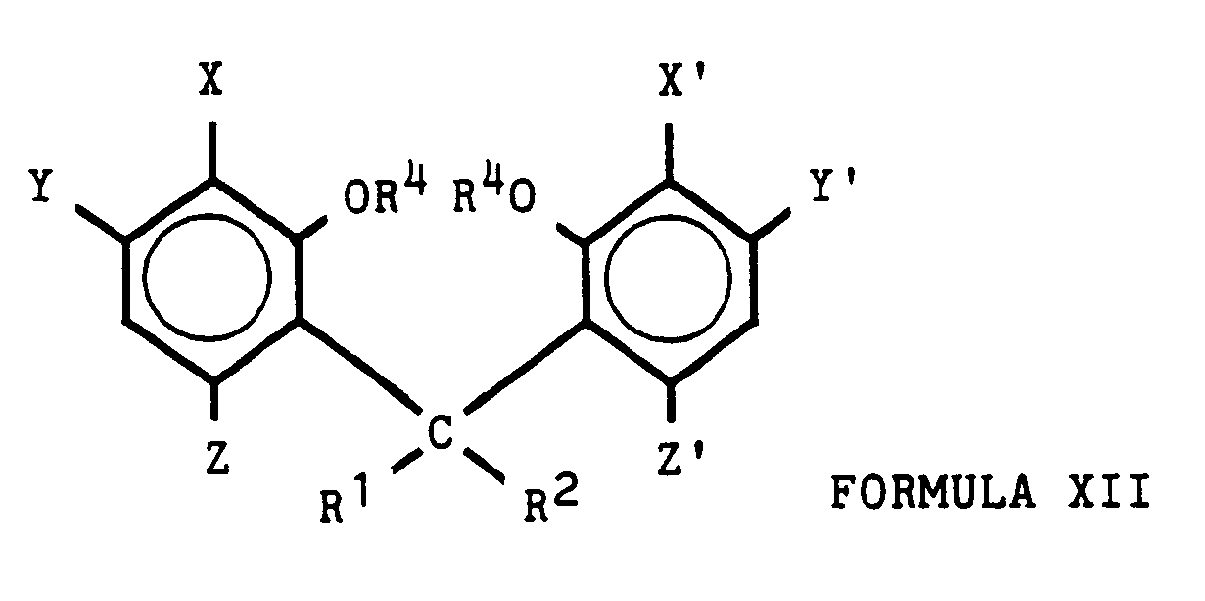
wherein
R¹ and R² together represent the fragment -CH₂CH₂-;
each R⁴ independently represents C₁-C₄ alkyl optionally substituted with 1 or 2 C₁-C₄ alkoxy groups; and
X, X', Y, Y', Z, and Z' each, independently represent H, F, Cl, Br, I, CN, NO₂, C₁-C₄ alkyl, C₁-C₄ alkoxy, phenoxy, C₁-C₄ alkylthio, phenylthio, or C₁-C₄ dialkylamino, wherein each alkyl, alkoxy, and alkylthio group is optionally substituted with one or more compatible groups selected from C₁-C₄ alkoxy, C₁-C₄ alkylthio, F, Cl, Br, CN, and phenyl and wherein each phenyl group is optionally substituted with up to 3 groups selected from F, Cl, Br, CN, CF₃, C₁-C₄ alkyl, and C₁-C₄ alkoxy
which comprises contacting thioanisole with a C₁-C₈ alkyl lithium reagent and an aliphatic tertiary amine in a compatible solvent to form a phenylthiomethyl lithium reagent and subsequently contacting said phenylthiomethyl lithium reagent with a compound of Formula XI
wherein R⁴, X, X', Y, Y', Z, and Z' are as defined hereinabove under conditions conducive to the reaction. - The 12-substituted 12H-dibenzo[d,g][1,3]dioxocin-6-carboxylic acid compounds of Formula I wherein R¹, R², R³, X, X', Y, Y', Z, and Z' are selected from among the substituents designated hereinbefore as well as the agriculturally acceptable salts, esters, and amides derived from these acids and all obtainable compounds that are converted to these acids when applied as herbicides are compounds within the scope of the invention. The subject acids are characterized by the presence of a 12H-dibenzo[d,g][1,3]-dioxocin ring system, a carboxylic acid moiety in the 6-position, the presence of at least one hydrocarbon substituent in the 12-position (which substituents may form a carbocycle with the 12-position carbon atom), and the absence of substituents other than hydrogen at the 2- and 10-positions.
- The compounds of Formula I possess an asymmetric carbon atom at the 6-position and, whenever R² and R³ are different, also possess a second asymmetric carbon atom at the 12-position. These compounds, therefore, can exist in several chiral and geometric isomeric forms. Each possible such isomer is described by Formula I and the present invention relates to each of these isomers independently as well as to all mixtures thereof.
- The terms alkyl, alkenyl, alkoxy, and alkylthio as used herein include straight chain and branched chain isomers. Thus, typical alkyl groups are methyl, ethyl, 1-methylethyl, 1,1-dimethylethyl, propyl, 2-methylpropyl, 1-methylpropyl, and butyl. Compatible substituents are substituents that are chemically and sterically capable of existing in the designated positions at the same time.
- Agriculturally acceptable salts, esters and amides are those salts, esters and amides of the carboxylic acid group(s) of Formula I which have a cation, OR, NH₂, NHR, or NRR moiety that is not itself significantly herbicidal to any crop being treated and not significantly deleterious to the applicator, the environment, or the ultimate user of any crop being treated.
- Suitable cations include, for example, those derived from alkali or alkaline earth metals and those derived from ammonia and amines. Preferred cations include sodium, potassium, magnesium, and aminium cations of the formula
R⁵R⁶R⁷NH⊕
wherein R⁵, R⁶, and R⁷ each, independently represents hydrogen or C₁-C₁₂ alkyl, C₃-C₁₂ cycloalkyl, or C₃-C₁₂ alkenyl, each of which is optionally substituted by one or more hydroxy, C₁-C₈ alkoxy, C₁-C₈ alkylthio or phenyl groups, provided that R⁵, R⁶, and R⁷ are sterically compatible. Additionally, any two of R⁵, R⁶, and R⁷ together may represent an aliphatic difunctional moiety containing 1 to 12 carbon atoms and up to two oxygen or sulfur atoms. Salts of the compounds of Formula I can be prepared by treatment of compounds of Formula I with a metal hydroxide, such as sodium hydroxide, potassium hydroxide, or magnesium hydroxide, or an amine, such as ammonia, triethylamine, dimethylamine, hydroxyethylamine, trisallylamine, 2-butoxyethylamine, morpholine, cyclododecylamine, or benzylamine. - Suitable esters and amides include those wherein each R independently represents C₁-C₈ alkyl or C₃-C₈ alkenyl, each substituted with up to 3 compatible groups selected from C₁-C₄ alkoxy, F, Cl, Br, and phenyl, or phenyl optionally substituted with up to 3 groups selected from F, Cl, Br, CH₃, or CF₃. C₁-C₄ Alkyl esters are generally preferred and methyl and butyl esters are often specifically preferred.
- The nature of the substituents R¹, R², R³, X, X', Y, Y', Z, and Z' within the described limits does not appear to be critical to the general utility of the compounds, but it is a factor in determining the degree of herbicidal activity and the selectivity of the herbicidal action of these compounds. Consequently, some of the compounds are preferred. With respect to R¹ and R², compounds having R¹ and R² together represent the moiety -CH₂CH₂-; i.e., compounds wherein the carbon atom at the 12-position is part of a cyclopropylidine moiety, are a preferred sub-set. These compounds are generally termed spiro(cyclopropane-1,12'(12'H)-dibenzo[d,g][1,3]dioxocin)-6'-carboxylates. Other preferred R¹ and R² substituents include methyl. Hydrogen is the preferred R³ substituent. With respect to the ring substituents X, X', Y, Y', Z, and Z', compounds wherein each of these substituents represents hydrogen are often preferred. Compounds wherein at least one of X and X' represents a designated substituent other than hydrogen are also often preferred. Of the substituents designated for X, X', Y, Y', Z, and Z', the following are often preferred: H, F, Cl, Br, CH₃, OCH₃, SCH₃, CF₃, and OC₆H₅.
- The compounds of Table I are illustrative of the compounds of the invention.


- Compounds which are obtainable employing the teachings herein, the teachings and suggestions of the prior art, and ordinary skill in the art and which degrade in the environment or within plants to a compound of Formula I will have utilities similar to the compounds of Formula I and the use of such compounds is within the scope of the present invention. Many such compounds can be envisioned. Thus, those compounds which are readily oxidized and/or hydrolyzed in the environment or within a plant system to a compound of Formula I, such as, for example, the 6-hydroxymethyl, 6-aminomethyl, 6-formyl, 6-(2-carboxyethyl), 6-(5-chloro-2-pentenyl), 6-cyano, 6-(2-dioxolanyl), and many other derivatives have approximately the same utility as the compound to which they degrade. The art is replete with other functional groups which are degradable to carboxylic acids, and accordingly, when any of these functional groups is present in place of the CO₂H moiety in the 6-position of a compound of Formula I, a useful herbicide is obtained.
- The compounds of the present invention can be prepared in a number of ways. The most general method involves the condensation of a bisphenol compound of Formula II, wherein X, X', Y, Y', Z, Z', R¹ and R² are as defined hereinbefore, with a 2,2-dihaloalkanoic acid of Formula III, wherein R³ represents hydrogen or methyl and G denotes chloro or bromo; or with an ester or amide of such a 2,2-dihalo-alkanoic acid. Dichloroacetic acid is preferred.

The process can be carried out essentially as described for related compounds in U.S. Patents 3,553,234 and 3,931,173, and J. Med. Chem., 15, 1273-1278 (1972). A mixture of a compound of Formula II, a compound of Formula III (or an ester or amide thereof), an alkali metal carbonate, such as potassium carbonate, and a catalytic amount of potassium iodide in a compatible solvent, such as a C₃ or C₄ alcohol, prepared and heated for a sufficient amount of time to effect the desired reaction. 2-Propanol is a preferred solvent and temperatures of about 82°C, which is the boiling point of 2-propanol, are preferred. The process usually requires 4 hours to 72 hours. - It is generally preferred to do the condensation with an acid of Formula III and, if desired, to subsequently convert the compound of Formula I (acid form) obtained to an agriculturally acceptable ester or amide using standard methods well known to those of ordinary skill in the art. It is sometimes preferred to choose the acid, ester or amide of a compound of Formula III which corresponds to a desired acid, ester or amide of the compound of Formula I to be prepared. In this way the subsequent interconversion or these functionalities to obtain the desired derivative can be avoided.
- Alternately, the cyclization can be accomplished by condensation of a bisphenol of Formula II with diethyl dibromomalonate and base. The desired compound of Formula I can be obtained after hydrolysis and decarboxylation of the product prepared, using standard conditions for such reactions. This condensation requires less drastic conditions than the usual method and is valuable for compounds having substituents that are unstable in base, such as trifluoromethyl.
- A few compounds of Formula II, wherein R¹ and/or R² represent methyl or ethyl and X, X', Y, Y', Z, and Z' are as defined hereinbefore, are known in the art. These and other compounds of Formula II can be prepared in a variety of ways. For example, compounds of Formula II wherein one of R¹ and R² represents methyl or ethyl and the other represents hydrogen can be prepared by condensing an appropriate compound of Formula IV wherein R'' represents methyl or methoxymethyl and W represents hydrogen or bromo with an appropriate compound of Formula V wherein R' represents methyl, methoxymethyl, or hydrogen and R''' represents methyl or ethyl with an alkyl lithium compound, such as butyl lithium, and subsequently reducing and dealkylating the bis(substituted-phenyl)methanol compound of Formula VI obtained. R'' is often preferably methoxymethyl and R' is often preferably methyl. W is usually preferably hydrogen unless X is hydrogen or bromo in which case bromo is usually preferable. The condensation can be carried out by first lithiating the compound of Formula IV with the alkyl lithium at about 0°C in an ether type solvent, such as tetrahydrofuran, in the presence of a complexing agent, such as tetramethylethylenediamine, and then allowing the lithium compound formed to react with the substituted acetyl or propionyl compound of Formula V under similar conditions. The compound of Formula VI formed can be recovered by adding a saturated aqueous solution of ammonium chloride and extracting with ether.


- A variety of methods exist for reducing and dealkylating the compounds of Formula VI to compounds of Formula II. It has been found convenient to first reduce the 1,1-bis(substituted-phenyl)alkanol to the corresponding 1,1-bis(substituted-phenyl)alkane with a trialkylsilane and trifluoroacetic acid. Typically, the compound of Formula VI is treated with these reagents in a solvent, such as methylene chloride, at ambient temperature. The product can be recovered by quenching the reaction mixture with saturated aqueous sodium bicarbonate and extracting with ether. The 1,1-bis(substituted-phenyl)alkane thus obtained can be dealkylated (have the R' and R'' alkyl groups removed) by most general methods for such reactions. Sometimes, methoxymethyl groups are removed incidentally in the trialkylsilane reduction process. Typically, methoxymethyl groups can be removed by allowing the compounds to react with p-toluene-sulfonic acid in refluxing methanol or by treatment with bromodiethylborane. Methyl groups can be removed by reaction with boron tribromide or bromodimethylborane. Typically, the methoxy containing compound is combined with boron tribromide or bromodimethylborane in a solvent, such as methylene chloride, at ambient temperature to effect the reaction. The resulting compound of Formula II can be recovered by conventional means, such as extraction into aqueous alkali and then adding acid. A large number of the starting material compounds of Formulas IV and V are known in the art or can be made by methods known in the art. Ether compounds of Formula IV are readily prepared from the corresponding phenols of Formula VII by conventional methods.
- Alternately, many of the compounds of Formula II can be prepared by condensation of a compound of Formula VII with a compound of Formula VIII using a Grignard reagent, such as ethyl magnesium bromide, in excess. Typically, the condensation is effected by combining the reagents in ether, replacing the ether with benzene after a short period, and heating the latter mixture at reflux for several hours. The compound of Formula II is recovered by conventional techniques for Grignard reactions. A large number of the starting material compounds of Formulas VII and VIII are known in the art or can be made by methods known in the art.

- Other methods exist for the preparation of compounds of Formula II. For example, many dihydroxybenzophenones of Formula IX are known in the art or can be made by methods known in the art and many of these can be converted to compounds of Formula II.

- One method of preparation of compounds of Formula IX is by oxidation of a compound of Formula VI wherein R''' represents hydrogen. Such compounds of Formula VI can, in turn, be prepared in the same manner as compounds of Formula VI wherein R''' represents methyl or ethyl by using a compound of Formula V wherein the R''' moiety is replaced by hydrogen. Dipyridine chromic oxide (Collins' reagent) is one suitable oxidizing agent for the transformation. In a typical procedure pyridine and chromic oxide are combined at about 0°C and then an appropriate compound of Formula VI is added and the mixture allowed to react at or below ambient temperature for several hours. The desired product can be recovered by conventional means.
- Compounds of Formula II wherein one of R¹ and R² represents methyl or ethyl and the other represents hydrogen can be prepared from compounds of Formula IX by alkylation with methyl or ethyl magnesium bromide in ether under typical Grignard reaction conditions to obtain a compound of Formula VI. The product can be recovered using typical Grignard reaction work-up procedures. The compound of Formula VI can then be reduced and dealkyated as described hereinabove to obtain the desired compound of Formula II.
- Compounds of Formula II wherein both R¹ and R² represent methyl or ethyl or together R¹ and R² represent the moiety -CH₂CH₂- can be prepared from compounds of Formula IX by first converting the compound of Formula IX to a compound of Formula X

This can be accomplished by treating the compound of Formula IX with methyl magnesium bromide to obtain a 1,1-bis(subtituted-phenyl)ethanol (compound of Formula VI wherein R''' represents methyl) as described above and then dehydrating this compound. Compounds of Formula VI obtained by other means are, of course, equally employed. The dehydration can be carried out, for example, by heating the compound of Formula VI in acetic anhydride containing a catalytic amount of sulfuric acid and recovering the product of Formula X by conventional means. An ethylidene analog (CH₂= replaced by CH₃CH=) can be prepared by substituting ethyl magnesium bromide for methyl magnesium bromide in the procedure. The method proceeds at least equally as well when the dimethyl ether of a compound of Formula IX is employed as the substrate and the dimethyl ether of the corresponding compound of Formula X is obtained. Alternately, the alkyl ether derivatives of compounds of Formula X can be prepared by treatment of the dialkyl ether derivatives of compounds of Formula IX with methyltriphenyl-phosphonium bromide and sodium hydride in tetrahydrofuran, an application of the well-known Wittig reaction. The desired intermediates of Formula X can also be prepared by allowing a bis(methoxy-methyl) ether derivative of a compound of Formula IX to react in tetrahydrofuran first with trimethylsilylmethyl lithium and then with potassium t-butoxide to obtain a bis(methoxymethyl) ether derivative of a compound of Formula X and subsequently removing the methoxymethyl protecting groups with a standard reagent, such as methanol containing a catalytic amount of p-toluene-sulfonic acid. This is often a preferred method. - The dimethyl ether analogs of the compounds of Formulas IX and X can be prepared from compounds of Formulas IX and X, respectively, for example, by treatment with methyl iodide and a base under conditions well known in the art. The bis(methoxymethyl) ether analogs can also be prepared by conventional procedures, which generally employ dimethoxymethane and an acid catalyst. Demethylation of the dimethyl ether analogs of compounds of Formulas II, IX, and X and the like can be accomplished by treatment with boron tribromide, bromodimethylborane or any of the other suitable reagent known in the art. De(methoxymethylation) of the bis(methoxymethyl) ether analogs of these compounds can be accomplished with the same reagents as well as with milder reagents, such as benzenesulfonic acid in methanol.
- Compounds of Formula II wherein one of R¹ and R² represents ethyl and the other represents methyl or ethyl can be prepared from compounds of Formula X by treatment of the dimethyl ether derivatives of these compounds with methyl lithium and then methyl or ethyl bromide. The methyl lithium is generally added to a solution of the reactant in tetrahydrofuran and after a 1 to 4 hour period the alkyl iodide is added slowly. The dimethyl ether analog of the desired compound of Formula X can be recovered by conventional means. It can be converted to a compound of Formula X by demethylation using standard methods.
- Compounds of Formula XII

wherein R¹ and R² together represent the moiety -CH₂CH₂- (the moiety bridging the two benzene rings is a cyclopropylidine moiety) and wherein each R⁴ independently represents C₁-C₄ alkyl optionally substituted with 1 or 2 C₁-C₄ alkoxy groups and X, X', Y, Y', Z, and Z' each, independently represent H, F, Cl, Br, I, CN, NO₂, C₁-C₄ alkyl, C₁-C₄ alkoxy, phenoxy, C₁-C₄ alkylthio, phenylthio, or C₁-C₄ dialkylamino, wherein each alkyl, alkoxy, and alkylthio group is optionally substituted with one or more compatible groups selected from C₁-C₄ alkoxy, C₁-C₄ alkylthio, F, Cl, Br, CN, and phenyl and wherein each phenyl group is optionally substituted with up to 3 groups selected from F, Cl, Br, CN, CF₃, C₁-C₄ alkyl, and C₁-C₄ alkoxy can be prepared from a compound of Formula XI,
wherein the substituents are defined in the same way, by treatment with phenylthiomethyl lithium. - A solution of phenylthiomethyl lithium in a compatible solvent, such as pentane, decane or another aliphatic hydrocarbon solvent or tetrahydrofuran, dimethoxy-ethane, diethyl ether or another ether type solvent, is generally first prepared by adding an alkyl lithium reagent, such as butyl lithium, to a solution of thioanisole (methylthiobenzene) and an aliphatic tertiary amine, such as 1,4-diazabicyclo[2,2,2]octane, in a compatible solvent. Approximately equimolar amounts of each of the reactants are employed although this is not critical. The mixture is generally cooled to around 0°C and the reaction allowed to proceed at temperatures up to about 30°C. The reaction is generally complete in less than one hour. The phenylthiomethyl lithium reagent prepared is generally combined with an approximately equimolar or lesser amount of a compound of Formula XI in a compatible solvent. The combination can be made over a wide range of temperatures and is often most conveniently carried out at about ambient temperature. The mixture is then generally heated to complete the conversion. Temperatures of 30°C to 100°C or the reflux temperature of the mixture are typically employed and the reaction is generally complete within 24 hours after the temperature is elevated. The desired product of Formula XII (a bisether derivative of a compound of Formula II wherein R¹ and R² together represent the moiety -CH₂CH₂-) can be recovered by conventional means. It is often readily recovered by quenching with water, separating the aqueous phase that forms, extracting the organic phase with more water, distilling the organic phase under reduced pressure to remove the volatile organics, and chromatographing the residue. Compounds of Formula II wherein R¹ and R² together represent the moiety -CH₂CH₂- can be obtained from the compounds prepared in the process described above by dealkyation using standard methods. A compatible solvent is one that dissolves at least a small amount of each reactant and which is chemically inert in the system.
- It is also possible to obtain compounds of Formula XII wherein R¹ and R² together represent the moiety -CH₂CH₂- from appropriate bisether derivatives of the compounds of Formula IX by treatment with triethyl phosphonoacetate and sodium hydride in an ether solvent, such as dimethoxyethane, followed by treatment of the intermediate obtained with lithium aluminum hydride in an ether solvent. The triethyl phosphonoacetate and sodium hydride are generally first combined and allowed to react and then the bisether derivative of a compound of Formula IX is added and the mixture heated for about a day. An intermediate product can be recovered by adding water and isolating the organic phase. This intermediate, in crude or purified form, is then generally added to lithium aluminum hydride in tetrahydrofuran and the mixture heated at reflux for several hours. The expected product is recovered by conventional means for such reactions. The procedure is similar to that described in Organic Synthesis, Collective Volume V, pp 509-510. The desired compound of Formula II is obtained by dealkylation of the ether substituents by conventional means.
- The choice of a method to use in the preparation of the desired compound of Formula II will depend on the availability of starting materials, the sensitivity of the substituents to the reaction conditions that will be employed in subsequent reactions, and the possibility of isomer formation which would make recovery of the desired product difficult. Protecting groups, such as t-butyl and trimethylsilyl, can be employed in the process and subsequently removed as is known in the art.
- It is not always necessary to prepare a compound of Formula II to obtain the corresponding compound of Formula I. It is often possible and desirable to prepare certain compounds of Formula I by converting one compound of Formula I (or a related compound with a substituent pattern not covered by Formula I) prepared as described herein or obtained in another manner to another compound of Formula I using convention chemical methods. Thus, for example, a t-butyl group can be used as a protecting group and removed by treatment with aluminum chloride, a bromo or iodo substituent can be removed with a reducing agent or replaced by other groups by nucleophilic displacement, such as with cuprous cyanide, a nitro group can be reduced to an amino group, a trialkylsilyl group can be replaced by bromo or iodo, and a methoxy group can be converted to a hydroxy group with an alkanethiol and base. An hydroxy group can further be alkylated by known methods to alkoxy groups, including substituted alkoxy groups as defined hereinbefore. Such transformations are well known to those in the art.
- It is further possible to prepare compounds of Formula I from compounds of Formula IX by first condensing the latter with a compound of Formula III in the same manner employed in the reaction of compounds of Formula II with compounds of Formula III and then appropriately modifying the 12-oxo analog of the compound of Formula I obtained by the general methods described herein or otherwise known in the art.
- Compounds of Formula I wherein R³ represents methyl are usually best prepared by methylation of a compound of Formula I wherein R³ represents hydrogen. In typical operations a compound of Formula I wherein R represents hydrogen is added dropwise with stirring to a solution of an alkyl lithium compound, such as butyl lithium, and diisopropylamine in a solvent, such as tetrahydrofuran, while cooling with dry-ice and acetone to about -78°C and after a few minutes adding excess methyl iodide. The 6-methyl compound can be recovered be conventional means, for example, by adding dilute aqueous hydrochloric acid and then extracting with ether.
- The compounds of the present invention can be used directly as herbicides, but it is generally preferable to first prepare a herbicidal composition containing one or more of the compounds in combination with an agriculturally acceptable adjuvant or carrier. Suitable adjuvants or carriers should not be phytotoxic to valuable crops, particularly at the concentrations employed in applying the compositions for selective weed control in the presence of crops, and should not react chemically with compounds of Formula I or other composition ingredients. Such mixtures can be designed for application directly to plants or their locus or can be concentrates or formulations which are normally diluted with additional carriers and adjuvants before application. They can be solids, such as, for example, dusts, granules, water dispersible granules, or wettable powders, or liquids, such as, for example, emulsifiable concentrates, solutions, emulsions or suspensions.
- Suitable agricultural adjuvants and carriers that are useful in preparing the herbicidal mixtures of the invention are well known to those skilled in the art.
- Liquid carriers that can be employed include water, toluene, xylene, petroleum naphtha, crop oil, acetone, methyl ethyl ketone, cyclohexanone, trichloroethylene, perchloroethylene, ethyl acetate, amyl acetate, butyl acetate, propylene glycol monomethyl ether and diethylene glycol monomethyl ether, isopropyl alcohol, amyl alcohol, ethylene glycol, propylene glycol, glycerine, and the like. Water is generally the carrier of choice for the dilution of concentrates.
- Suitable solid carriers include talc, pyrophyllite clay, silica, attapulgus clay, kieselguhr, chalk, diatomaceous earth, lime, calcium carbonate, bentonite clay, Fuller's earth, cotton seed hulls, wheat flour, soybean flour, pumice, wood flour, walnut shell flour, lignin, and the like.
- It is frequently desirable to incorporate one or more surface-active agents into the compositions of the present invention. Such surface-active agents are advantageously employed in both solid and liquid compositions, especially those designed to be diluted with carrier before application. The surface-active agents can be anionic, cationic or nonionic in character and can be employed as emulsifying agents, wetting agents, suspending agents, or for other purposes. Typical surface active agents include salts of alkyl sulfates, such as diethanolammonium lauryl sulfate; alkylarylsulfonate salts, such as calcium dodecylbenzenesulfonate; alkylphenol-alkylene oxide addition products, such as nonylphenol-C18 ethoxylate; alcohol-alkylene oxide addition products, such as tridecyl alcohol-C16 ethoxylate; soaps, such as sodium stearate; alkylnaphthalenesulfonate salts, such as sodium dibutylnaphthalenesulfonate; dialkyl esters of sulfosuccinate salts, such as sodium di(2-ethylhexyl) sulfosuccinate; sorbitol esters, such as sorbitol oleate; quaternary amines, such as lauryl trimethylammonium chloride; polyethylene glycol esters of fatty acids, such as polyethylene glycol stearate; block copolymers of ethylene oxide and propylene oxide; and salts of mono and dialkyl phosphate esters.
- Other adjuvants commonly utilized in agricultural compositions include antifoam agents, compatibilizing agents, sequestering agents, uv absorbers, neutralizing agents and buffers, corrosion inhibitors, dyes, odorant, penetration aids, spreading agents, sticking agents, dispersing agents, thickening agents, freeze point depressants, antimicrobial agents, and the like. The addition of crop oil and crop oil concentrates is typical. The compositions can also contain other compatible components, for example, other herbicides, plant growth regulants, fungicides, insecticides, and the like and can be formulated with solid, particulate fertilizer carriers such as ammonium nitrate, urea and the like or with liquid fertilizers.
- The concentration of the active ingredients in the herbicidal compositions of this invention is generally from 0.001 to 98 percent by weight. Concentrations from 0.01 to 90 percent by weight are often employed. In compositions designed to be employed as concentrates, the active ingredient is generally present in a concentration from 5 to 98 weight percent, preferably 10 to 90 weight percent. Such compositions are typically diluted with an inert carrier, such as water, before application. The diluted compositions usually applied to plants or their locus generally contain 0.001 to 5 weight percent active ingredient and preferably contain 0.01 to 1.0 percent
- The present compositions can be applied by the use of conventional ground or aerial dusters and sprayers, by addition to irrigation water, and by other conventional means known to those skilled in the art.
- General herbicide action is usually observed for compounds of Formula I at rates of greater than about 300 g/Ha for either preemergence or postemergence applications. Selective control of susceptible weeds in crops, such as cotton, soybeans, corn, rice, or wheat can be accomplished with certain of the compounds at application rates of 2 g/Ha to 500 g/Ha. An appropriate rate for each crop, compound and circumstance can be determined by simple range finding tests using the teachings herein.
- The term "herbicide" is used herein to mean an active ingredient which controls or adversely modifies growth of plants. By "vegetation controlling" or "herbicidally effective" amount is meant an amount of active ingredient which causes an adversely modifying effect and includes deviations from natural development, killing, regulation, dessication, retardation, and the like. The terms "plants" and "weeds" are meant to include germinant seeds, emerging seedlings and established vegetation. "Undesirable vegetation" is plant life present in a place where it is not wanted.
- Herbicidal activity is exhibited by the compounds of the present invention when they are applied directly to the plant or to the locus of the plant at any stage of growth or before emergence. The effect observed depends upon the plant species to be controlled, the stage of growth of the plant, the application parameters of dilution and spray drop size, the particle size of solid components, the environmental conditions at the time of use, the specific compound employed, the specific adjuvants and carriers employed, and the like, as well as the amount of chemical applied. These and other factors can be adjusted as is known in the art to promote selective herbicidal action.
- Sodium hydride (4.4 g of 60 percent oil dispersion) was placed in a flask with 140 ml of dimethoxyethane. This mixture was cooled with an ice bath and 22.3 g of triethyl phosphonoacetate was added dropwise with stirring over a 30 min period. A murky yellow solution was obtained. 2,2'-Dimethoxybenzophenone (20.2 g) was added and the resulting mixture was heated at reflux with stirring for 20 hours. It was then allowed to cool to ambient temperature and was diluted with 500 ml of ether. The resulting mixture was washed with 3 to 200 ml portions of 1N hydrochloric acid and with saturated sodium bicarbonate, dried over magnesium sulfate, filtered, and concentrated by evaporation under reduced pressure to obtain a turbid, viscous yellow oil. This material was found by gas chromatagraphy to be about 79 percent one compound. It was dissolved in 100 ml of tetrahydrofuran and the solution added dropwise with stirring to a slurry of 4.70 g of lithium aluminum hydride in 100 ml of tetrahydrofuran over a 40 min period. An exothermic reaction ensued. The mixture was heated at reflux for 3 hours and allowed to stand at ambient temperature overnight. About 100 ml of 10 percent sulfuric acid was added carefully with stirring to quench the excess lithium aluminum hydride. About 700 ml of ether was then added and the layers were separated. The ether layer was extracted with water, 10 percent hydrochloric acid, 10 percent potassium hydroxide, and brine. It was then dried over magnesium sulfate, filtered, and concentrated by evaporation under reduced pressure. The residue was purified by filtration chromatography on silica eluting with a 10:90 mixture of ether and hexane. The solvents were removed by evaporation under reduced pressure to obtain 5.6 g (26 percent of theory) of the title compound as pale yellow crystals melting at 146-149°C. The carbon-13 and proton nmr spectra were in agreement with the assigned structure.

- 1,1-Bis(2-methoxyphenyl)cyclopropane (10.0 g, 0.039 mole) was combined with 60 ml of dichloromethane and the mixture was cooled in an ice bath and then treated with 10.0 ml of bromodimethylborane with cooling and stirring. The starting material was consumed in less than 1 hour as determined by gas-liquid chromatography. The mixture was then diluted with 500 ml of ether and the resulting solution was extracted twice with water and then with water saturated with ammonium chloride, dried over magnesium sulfate, filtered, and concentrated by evaporation under reduced pressure to obtain 9.0 g (101 percent of theory) of the title compound as a brownish-black solid; m.p., 158 to 160°C. This eluted as one clean peak in gas-liquid chromatography and had a proton NMR spectrum consistent with the assigned structure.

- 2,2-Bis(2-hydroxyphenyl)butane was prepared in the same manner from 2,2-bis(2-methoxyphenyl)-butane, The proton NMR and infrared spectra were consistent with the assigned structure.
- An 18.5 g (0.082 mole) sample of unpurified 1,1-bis(2-hydroxyphenyl)cyclopropane was combined with 44.0 g (0.32 mole) of potassium carbonate, 2.0 g (0.012 mole) of potassium iodide, 8.0 ml of dichloroacetic acid, and 400 ml of isopropyl alcohol. The mixture was heated at reflux with stirring for 24 hours. Another 8.0 ml of dichloroacetic acid was added and the mixture heated at reflux with stirring for another 48 hours. The volatiles were then removed by evaporation under reduced pressure. The solid that remained was dissolved in 300 ml of water. The resulting solution was extracted with 500 ml of ether, acidified with concentrated hydrochloric acid (carefully due to foaming), and then extracted with three 500 ml portions of ether. The latter ether extracts were dried over magnesium sulfate, filtered, and concentrated under reduced pressure to obtain the title compound in crude form as a solid.
- A purified sample of the title compound was obtained by hydrolysis of its methyl ester from Example 4. A 0.070 g sample was dissolved in 10 ml of methanol containing 3 ml of 10 percent aqueous potassium hydroxide and the solution allowed to stir overnight. The mixture was then diluted with 10 ml of water and the resulting solution extracted with 50 ml of ether. The aqueous solution was acidified with 10 percent hydrochloric acid and then extracted with ether. The ether extract was dried over magnesium sulfate, filtered, and concentrated by evaporation under reduced pressure to obtain a solid. This was recrystallized from a 1:1 mixture of chloroform and hexane to obtain 0.33 g of the title compound as a white powder melting at 142.5-145°C. The proton NMR and infrared spectra were consistent with the assigned structure.

- The crude spiro(cyclopropane-1,12'(12'H)-dibenzo[d,g][1,3]dioxocin)-6'-carboxylic acid from Example 3 was dissolved in 500 ml of methanol and 2.0 ml of sulfuric acid added. The mixture was heated at reflux and stirred for 3 hours. About half of the methanol was removed by evaporation under reduced pressure and the remaining solution was diluted with 1.5 liter of ether. The solution obtained was extracted several times with water and then with brine and was then dried over magnesium sulfate, filtered, and concentrated by evaporation under reduced pressure to obtain the title compound in impure form. This was purified by filtration chromatography, eluting with a 9:1 mixture of hexane and ether to obtain the product as a pale yellow crystalline solid. This was recrystallized from methanol to obtain 9.55 g of the title compound as pale tan crystals melting at 123 to 126°C. The proton and carbon NMR and infrared spectra were consistent with the assigned structure.

- Methyl spiro(cyclopropane-1,12'(12'H)-dibenzo[d,g][1,3]dioxocin)-6'-carboxylate (0.60 g) was dissolved in 30 ml of 2-propanol and a trace of sodium methoxide was added. The mixture was allowed to stir until ester interchange was complete as determined by gas-liquid chromatography. The solution was diluted with 150 ml of ether and the resulting solution was extracted several times with water, dried over magnesium sulfate and concentrated by evaporation under reduced pressure to obtain 0.38 g of the title compound as a white crystalline product melting at 84 to 87°C. The proton and carbon NMR and infrared spectra were consistent with the assigned structure.

The ethyl ester was obtained in the same manner substituting ethanol for 2-propanol and was found to be pale yellow crystals melting at 114 to 115°C. The proton and carbon NMR and infrared spectra were consistent with the assigned structure.
- Methyl spiro(cyclopropane-1,12'(12'H)-dibenzo[d,g][1,3]dioxocin)-6'-carboxylate (1.30 g), hydroxylamine hydrochloride (1.03 g), sodium methoxide (0.74 g) and 25 ml of methanol were combined and heated to reflux with stirring. After a brief period, the heat was removed and the mixture allowed to stir at ambient temperature overnight. Ether (150 ml) was added and the resulting solution was extracted with dilute hydrochloric acid, water (several times) and finally with saturated aqueous ammonium chloride. The ethereal solution was then dried over magnesium sulfate, filtered, and concentrated by evaporation under reduced pressure to obtain the title compound as a fluffy white solid. This was recrystallized from ethyl acetate/hexane to obtain a 0.52 g first crop and a 0.20 g second crop of the title compound as a fine white powder melting at 127 to 135°C with decomposition. The proton NMR and infrared spectra were consistent with the assigned structure.

- 2,2'-Dimethoxybenzophenone (24.2 g, 0.14 mole) and 400 ml of ether were placed in a 1 liter flask and stirred at ambient temperature and methyl magnesium bromide (40 ml of 3.0 M solution in ether) was added dropwise. The resulting mixture was stirred overnight and then a few ml of water were added to quench the Grignard reagent. About 300 ml of ethyl acetate and 250 ml of 10 percent hydrochloric acid were then added and the mixture was shaken. The organic layer was next recovered, extracted with 100 ml of water and 100 ml of saturated sodium bicarbonate, dried over magnesium sulfate, filtered, and concentrated by evaporation under reduced pressure to obtain 25.6 g (98 percent of theory) of the title compound as a white solid melting at 122 to 123°C. The proton NMR spectrum was consistent with the assigned structure.
- 1,1-Bis(2-methoxyphenyl)ethanol (25.6 g) was combined with 250 ml of acetic anhydride and the mixture was heated at reflux for 4 hours. A drop of concentrated sulfuric acid was added and the heating continued for 10 min. The opaque brown mixture obtained was allowed to cool and was diluted with ether. The resulting solution was extracted twice with water, dried over magnesium sulfate, filtered, and concentrated by evaporation under reduced pressure to obtain a brownish-black solid. This was recrystallized from methanol to obtain 14.0 g of the title compound as tan crystals melting at 88 to 90°C. The proton NMR spectrum was consistent with the assigned structure.

- 1,1-Bis(2-methoxyphenyl)ethene (15.6 g), toluene (35 ml) and anisole (35 ml) were combined in a flask and 35 ml of a 3.7M hexane solution of Red-Al was added. The mixture was heated to reflux with stirring whereupon it turned dark red. After 2 hours the heat was removed and the mixture was allowed to stir overnight. The excess hydride reagent was carefully quenched with 1.0N hydrochloric acid. The mixture was then diluted with ether and the ethereal solution separated, dried over magnesium sulfate, filtered, and concentrated by evaporation under reduced pressure to obtain a golden-brown oil. This was triturated with hexane to obtain 3.70 of the title compound. The proton and carbon NMR spectra were consistent with the assigned structure.

A second crop amounting to 2.45 g was obtained by adding methanol. - Sodium hydride (2.60 g of 60 percent dispersion in oil) was placed in a 1 liter flask and extracted twice with pentane. To this was added first 250 ml of dimethylformamide and then, dropwise with stirring over 1 hour, 6.0 ml of ethanethiol in 40 ml of dimethylformamide. 2,2-Bis(2-methoxyphenyl)propane (8.0 g, 31 mmol) in 100 ml of dimethylformamide was then added and the mixture was heated at reflux with stirring for 24 hours and allowed to stand at ambient temperature for another approximately 18 hours. One liter of ether was added and the resulting solution was extracted with water and twice with 4.0N sodium hydroxide solution. The combined aqueous extracts were neutralized with concentrated hydrochloric acid to a pH of about 9 to 10. Ether (500 ml) was then added and, after shaking, the ether layer was separated, dried over magnesium sulfate, filtered, and concentrated by evaporation under reduced pressure to obtain about 3 g of the title compound as a brown oil containing some dimethylformamide. The proton NMR spectrum was consistent with the assigned structure.
- 2,2-Bis(2-hydroxyphenyl)propane (3 g of unpurified), potassium carbonate (6.5 g), potassium iodide (0.67 g) and dichloroacetic acid (1.0 ml at first, then another 1.2 ml) were combined in isopropyl alcohol and treated as in Example 3 to obtain the title acid in impure form. This was esterified by the procedure of Example 4 to obtain the methyl ester. The methyl ester obtained was purified by column chromatography on silica gel, eluting with an 85:15 mixture of hexane and ether, and then by recrystallization from ether-pentane to obtain 0.45 g of the title methyl ester compound as white crystals melting at 91 to 92°C. The proton NMR and infrared spectra were consistent with the assigned structure.

A sample of the methyl ester was hydrolyzed as in Example 3 to obtain the title acid compound as a pale yellow-orange glass melting below 50°C. - 1,1-Bis(2-methoxyphenyl)ethene (5.6 g) was dissolved in 25 ml of tetrahydrofuran and 25 ml of a 1.3M solution of methyl lithium in ether was added dropwise with stirring. The solution became dark red and exothermed. After 2 hours, 5.0 ml of methyl iodide was added slowly with stirring. The solution again exothermed. When all of the methyl iodide had been added the starting material was found to be completely consumed and replaced by a single product by gas-liquid chromatography. About 300 ml of ether was added and the resulting solution was extracted with 100 ml of water and then 100 ml of brine, dried over magnesium sulfate, filtered, and concentrated by evaporation under reduced pressure to obtain 5.46 g (88 percent of theory) of the title compound as a pale yellow crystalline solid melting at 49 to 52°C. The proton and carbon NMR and infrared spectra were consistent with the assigned structure.

- 2,2-Bis(2-hydroxyphenyl)butane in impure form was condensed with dichloroacetic acid as in Example 3 to obtain the title acid in impure form. This was esterified with methanol by the procedure of Example 4 to obtain a mixture of 2 isomers of the title ester in an approximately 1:1.5 ratio as determined by gas-liquid chromatography. This was column chromatographed eluting with a 90:10 mixture of hexane and ether to obtain a small fraction that was about 95 percent one isomer and a larger fraction that was a 1:1 mixture of cis/trans isomers. Both fractions were oils. The two fractions obtained were separately hydrolyzed to the title acid using the procedure of Example 3. The single isomer fraction gave a single isomer of the title acid as an oil which crystallized from ether-hexane on standing in an open dessicator and melted at 123 to 124°C. The mixed isomer fraction gave a 1:1 mixture of the isomers of the title acid as a glassy solid melting at about 80 to 85°C. The proton NMR and infrared spectra of both products were consistent with the assigned structures, including the isomer distribution.
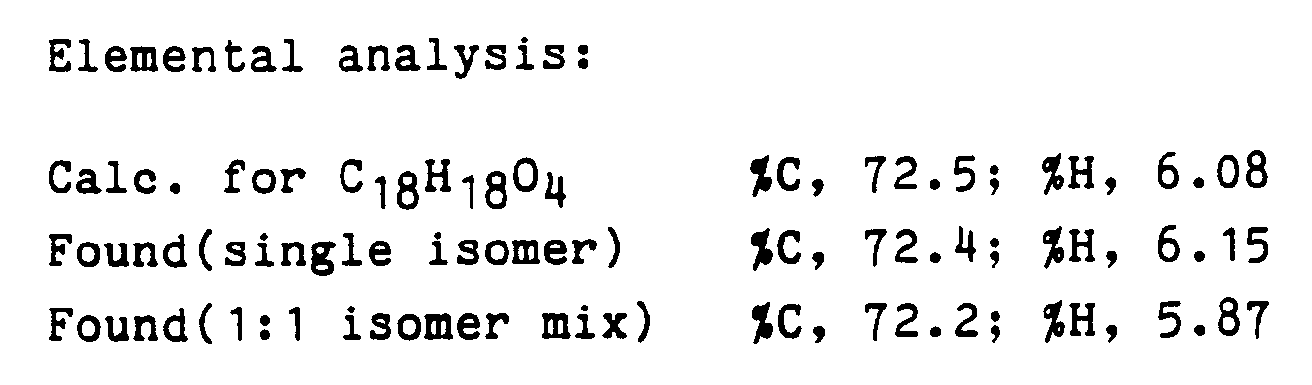
- A solution of 10.71 g of 2,2'-dihydroxybenzophenone in 100 ml of ether was prepared and added slowly with stirring to 76 ml of an ice-bath cooled 3.0M solution of methyl magnesium bromide in ether. The ice bath was removed and the mixture was allowed to react for another hour at ambient temperature and then it was heated at reflux for 2 hours. The reaction was quenched with 100 ml of saturated aqueous ammonium chloride, diluted with 100 ml of ether, and the phases separated. The aqueous phase was extracted with 2 to 100 ml portions of ether. The organic phase and ether extracts were combined and extracted with saturated aqueous ammonium chloride, dried over magnesium sulfate, filtered, and concentrated by evaporation under reduced pressure to obtain a yellow solid. This was recrystallized from an ether-hexane mixture to obtain 10.06 g (94 percent of theory) of the title compound as light yellow crystals. The proton NMR spectrum was consistent with the assigned structure.

- 1,1-Bis(2-hydroxyphenyl)propanol was prepared similarly using ethyl magnesium bromide.
- 1,1-Bis(2-hydroxyphenyl)ethanol (8.57 g) dissolved in 40 ml of dichloromethane was cooled with an ice bath and to this was added sequentially with stirring 3.70 ml of trifluoroacetic acid in 20 ml of dichloromethane and (dropwise) 7.67 ml of triethylsilane in 20 ml of dichloromethane. The mixture was allowed to warm to room temperature and react for another 2 hours. Ether and water were added and the phases separated. The organic phase was extracted with several small portions of 2N sodium hydroxide and the extracts were combined and acidified with hydrochloric acid. The resulting mixture was extracted with ether and the ether extract was dried over magnesium sulfate, filtered, and concentrated by evaporation under reduced pressure to obtain 6.10 g of the title compound as a brown oil.
- 1,1-Bis(2-hydroxyphenyl)propane was prepared similarly from 1,1-bis(2-hydroxyphenyl)propanol and 1-(3-chloro-2-methoxymethoxyphenyl)-1-(2-methoxyphenyl)ethane was prepared similarly from 1-(3-chloro-2-methoxymethoxyphenyl)-1-(2-methoxyphenyl)ethanol.
- 1,1-Bis(2-hydroxyphenyl)ethane was treated with dichloroacetic acid, potassium carbonate, and potassium iodide in isopropyl alcohol as in Example 3 and the product obtained was esterified with methanol as in Example 4 to obtain 1.71 g of the title compound as a mixture of cis and trans isomers. A portion of this was recrystallized from ether to obtain a pure sample of the cis isomer of the title compound as a white solid melting at 146 to 147°C. The geometry was determined by proton NMR spectroscopy.

- Methyl 12-ethyl-12H-dibenzo[d,g][1,3]dioxocin-6-carboxylate was prepared similarly from 1,1-bis(2-hydroxyphenyl)propane. A 1:1 mixture of cis and trans isomers was obtained as a white solid melting at 134.5 to 135.5°C after recrystallization with methylcyclohexane. The assigned structure was consistent with the proton NMR spectrum.
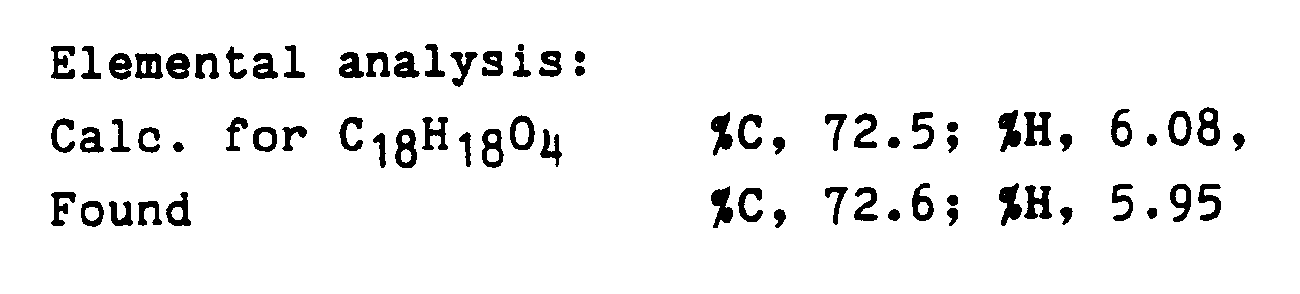
- Methyl 12-ethyl-12H-dibenzo[d,g][1,3]dioxocin-6-carboxylate as a 1:1 mixture of isomers (1.25 g) was hydrolyzed as in Example 3 to obtain the title compound (as a 1:1 mixture of cis and trans isomers) as an off-white solid melting at 142 to 145°C. The assigned structure was consistent with the proton NMR spectrum.

- 1-Chloro-2-methoxymethoxybenzene (20.0 g) was combined with 72.5 ml of 1.6M n-butyl lithium in hexane at 0°C with stirring and allowed to react for 4 hours. A solution of 16.0 ml of 2-methoxyacetophenone in 20 ml of tetrahydrofuran was then added with stirring. After a short reaction period, water and ether were added and the ether layer was dried over magnesium sulfate, filtered, and concentrated by evaporation under reduced pressure to obtain an oil. This was purified by liquid chromatography, eluting with a 95:5 mixture of hexane and ethyl acetate, to obtain 6.67 g of the title compound as an oil. The assigned structure was consistent with the proton NMR spectrum.
- 1-(3-Chloro-2-hydroxyphenyl)-1-(2-hydroxyphenyl)ethane was condensed with dichloroacetic acid as in Example 3 to obtain the acid of the title compound in impure form. This was esterified with methanol by the procedure of Example 4 to obtain a mixture of cis and trans isomers of the title compound. The mixture was liquid chromatographed to obtain one fraction identified as the trans isomer melting at 144 to 145°C and a second fraction containing an approximately 3.7:1 ratio of the isomers melting at 124 to 136°C. The assigned structures were consistent with the proton NMR spectra.
Elemental analysis:
Calc. for C₁₇H₁₅O₄Cl %C, 64.1; %H, 4.74Found (trans isomer) %C, 64.1; %H, 4.83
Found (mixed isomers) %C, 64.3; %H, 4.91 - 1-Methyl-2-methoxymethoxybenzene (15.2 g) was added to a mixture of 75 ml of a 1.6M solution of n-butyl lithium in hexane and 18.1 ml of tetramethylethylenediamine at 0°C with stirring. After 4 hours, 13.6 g of o-anisaldehyde dissolved in 30 ml of tetrahydrofuran was added. The mixture was allowed to react for 0.5 hour and was then poured into a mixture of ice and saturated aqueous ammonium chloride. The resulting mixture was extracted with ether and the ether extract was dried over magnesium sulfate, filtered, and concentrated by evaporation under reduced pressure to obtain 39.5 g of the title compound as an off-white solid. The assigned structure was consistent with the proton NMR spectrum.
- A solution of 8.72 ml of oxalyl chloride in 300 ml of dichloromethane was cooled with a dry ice-acetone bath and a solution of 13.9 ml of dimethyl sulfoxide in 50 ml of dichloromethane was added dropwise with stirring. After 30 min, (2-methoxyphenyl)(3-methyl-2-methoxymethoxyphenyl)methanol (26.4 g) dissolved in 100 ml of dichloromethane was added slowly with stirring and the mixture allowed to react for 1 hour. Triethylamine (64 ml) was then added and the resulting mixture was stirred another 30 min cold and then allowed to warm to room temperature. The product mixture was extracted sequentially with water, 5 percent hydrochloric acid, water, and 5 percent sodium carbonate. It was then dried over magnesium sulfate, filtered, and concentrated by evaporation under reduced pressure to obtain an oil. This was purified by preparative liquid chromatography to obtain the title compound as an oil. The assigned structure was consistent with the proton NMR spectrum.
- 2-Methoxymethoxy-3-methyl-2'-methoxybenzophenone (17.5 g) was combined with the sodium salt of triethyl phosphonoacetate (2.2 equivalents) in 250 ml of dimethoxyethane and the mixture heated at reflux with stirring for 2 days. Water and ether were added and the organic phase was separated, extracted with water, dried over magnesium sulfate, filtered, and concentrated by evaporation under reduced pressure to obtain an oil. This was purified by preparative liquid chromatography, eluting with a 90:10 mixture of hexane and acetone, to obtain ethyl 3-(2-methoxyphenyl)-3-(2-methoxymethoxy-3-methylphenyl)propenoate as an intermediate consisting of a mixture of isomers. The assigned structure was consistent with the proton NMR spectrum. This was dissolved in 50 ml of tetrahydrofuran and treated with 61 ml of a solution of 1M lithium aluminum hydride in tetrahydrofuran at ambient temperature with stirring. The mixture was heated at reflux with stirring for 4 hours. It was then allowed to cool, was quenched with 10 percent sulfuric acid, and was diluted with ether. The organic phase was separated, extracted with water, dried over magnesium sulfate, filtered, and concentrated by evaporation under reduced pressure to obtain a crude product. This was purified by preparative liquid chromatography, eluting with a 95:5 mixture of hexane and acetone, to obtain 6.01 g of the title compound as a gum. The assigned structure was consistent with the proton NMR spectrum.
- 1-(3-Methyl-2-hydroxyphenyl)-1-(2-hydroxyphenyl)cyclopropane was condensed with dichloroacetic acid as in Example 3 to obtain the acid of the title compound in impure form. This was esterified with methanol by the procedure of Example 4 to obtain the title compound in impure form. This was purified by liquid chromatography, eluting with a 90:10 mixture of hexane and acetone to obtain 1.29 g of the title compound as a white crystalline solid melting at 98 to 99°C. The assigned structure was consistent with the proton and carbon NMR and infrared spectra.

- A 1.6M solution of n-butyl lithium in hexane (140 ml) was placed in a 1 liter flask and cooled in an ice bath. To this was added with stirring 34 ml of tetramethylethylenediamine and, after a 10 min reaction period, 34.5 g of 1-chloro-2-methoxymethoxybenzene (dropwise over a 30 min period). A pale orange suspension formed and this was stirred for 4 hours continuing the ice bath cooling. A solution of 34.5 g of 2-methoxymethoxybenzaldehyde in 30 ml of tetrahydrofuran was added with stirring and cooling. The reaction was exothermic. When the addition was complete, the mixture was allowed to warm to room temperature and was then quenched carefully with water. The resulting mixture was poured into a mixture of 1 liter of ethyl acetate and 500 ml of aqueous ammonium chloride. The phases were separated and the organic phase was extracted twice with water and once with brine, dried over magnesium sulfate, filtered, and concentrated by evaporation under reduced pressure to obtain a viscous, pale orange oil. This was purified by filtration chromatography, eluting with mixtures of hexane and dichloromethane starting with pure hexane and ending with pure dichloromethane, to obtain 52.2 g (77 percent of theory) of the title compound as a pale yellow oil. The proton and carbon NMR and infrared spectra were consistent with the assigned structure.

- (3-Methoxy-2-methoxymethoxyphenyl) (2-methoxymethoxyphenyl)methanol (33.7 g) was prepared similarly from 33.6 g of 2-methoxyphenol and 33.2 g of 2-methoxymethoxybenzaldehyde and characterized by proton NMR spectroscopy.
- A solution of 16.0 ml of oxalyl chloride in 500 ml of dichloromethane was placed in a 1 liter flask and cooled with a dry ice-acetone bath. Dimethyl sulfoxide (14.0 ml) was added dropwise with stirring over a 10 min period. After a 40 min reaction period, a solution of 51.0 g of (3-chloro-2-methoxymethoxy-phenyl)(2-methoxymethoxyphenyl)methanol in 120 ml of dichloromethane was added dropwise over a 45 min period with stirring at about -78°C and allowed to react another 45 min. An orange suspension formed. Triethylamine (50 ml) was added and the slurry was swirled occasionally and was allowed to warm to room temperature. The slurry was diluted with 1 liter of ether and the resulting mixture was extracted with 3 to 300 ml portions of water, 300 ml of 2 percent hydrochloric acid, and 200 ml of saturated aqueous sodium bicarbonate, dried over magnesium sulfate, filtered, and concentrated by evaporation under reduced pressure to obtain 50.5 g of the title compound as a viscous pale orange-tinted oil. The proton and carbon NMR spectra were consistent with the assigned structure.
- 3-Methoxy-2-methoxymethoxy-2'-methoxymethoxybenzophenone was prepared similarly from (3-methoxy-2-methoxymethoxyphenyl)(2-methoxymethoxyphenyl)methanol and characterized by proton NMR spectroscopy.
- A 1.0M solution of trimethylsilylmethyl lithium in pentane (160 ml) was added with stirring to a solution of 50.5 g of 3-chloro-2-methoxymethoxy-2'-methoxymethoxybenzophenone in 500 ml of tetrahydrofuran over a 45 min period. There was a mild exotherm. Analysis by gas-liquid chromatography indicated the reaction was incomplete so another 10 ml of the trimethylsilylmethyl lithium solution was added. After a 20 min reaction period 7.3 g of potassium t-butoxide were added and the reaction was heated to reflux with a heating mantle and held there for 40 min. The mixture was then allowed to cool and was diluted with 1 liter of ether. The ethereal solution was extracted with 6 to 300 ml portions of water and 200 ml of brine, dried over magnesium sulfate, filtered, and concentrated by evaporation under reduced pressure to obtain 50.2 g of the title compound as a pale orange oil. The proton NMR spectrum was consistent with the assigned structure.
- 1-(3-Methoxy-2-methoxymethoxyphenyl)-1-(2-methoxymethoxyphenyl)ethene was prepared similarly from 3-methoxy-2-methoxymethoxy-2'-methoxymethoxybenzophenone and characterized by proton NMR spectroscopy.
- Phenylthiomethyl lithium was prepared by adding 120 ml of 2.5M butyl lithium in hexane to a solution of 37.3 g of thioanisole and 33.7 g of 1,4-diazabicyclo[2,2,2]octane in 400 ml of tetrahydrofuran dropwise with stirring at 0°C and then allowing the mixture to react for 45 min at 0°C and 1 hour at room temperature. A solution of 50.2 g of 1-(3-chloro-2-methoxymethoxyphenyl)-1-(2-methoxymethoxyphenyl)ethene dissolved in 100 ml of tetrahydrofuran was added slowly to this at ambient temperature with stirring. A brick red color developed. The mixture was heated to reflux for about 30 min. Analysis by gas-liquid chromatography indicated that the reaction was complete. The mixture was cooled, diluted with ether, and quenched with water. The solution was extracted several times with water and once with brine, dried over magnesium sulfate, filtered, and concentrated by evaporation under reduced pressure to obtain about 80 ml of a pale orange oil. This was subjected to a bulb-to-bulb distillation at up to 120°C and 0.3 mm of mercury pressure. The thioanisole impurity was removed and a product cut of less than 5 ml was collected. Considerable decomposition took place. The product cut was partially purified by liquid chromatography, eluting with a 95:5 mixture of hexane and ether to obtain 1.8 g of the title compound of about 82 percent purity (gas-liquid chromatography) as a viscous oil. The proton NMR spectrum was consistent with the assigned structure.
- 1-(3-Methoxy-2-methoxymethoxyphenyl)-1-(2-methoxymethoxyphenyl)cyclopropane was prepared similarly from 1-(3-methoxy-2-methoxymethoxyphenyl)-1-(2-methoxymethoxyphenyl)ethene and characterized by proton NMR spectroscopy.
- A catalytic amount (0.05 g) of p-toluene-sulfonic acid was added to a solution of 1.8 g of impure 1-(3-chloro-2-methoxymethoxyphenyl)-1-(2-methoxymethoxyphenyl)cyclopropane in 45 ml of methanol and the mixture heated at reflux with stirring for 1 hour. It was then concentrated by evaporation under reduced pressure and diluted with 120 ml of ethyl acetate. The resulting solution was extracted with saturated aqueous sodium bicarbonate, dried over magnesium sulfate, filtered, and concentrated by evaporation under reduced pressure to obtain 1.45 g of a viscous oil. This was found by proton NMR analysis to retain some methoxymethoxy groups so the procedure was repeated, this time refluxing for 2.5 hours. The title compound was obtained as a beige solid amounting to 1.41 g. The proton and carbon NMR spectra were consistent with the assigned structure.
- 1-(3-Methoxy-2-hydroxyphenyl)-1-(2-hydroxyphenyl)cyclopropane was prepared similarly from 1-(3-methoxy-2-methoxymethoxyphenyl)-1-(2-methoxymethoxyphenyl)cyclopropane and characterized by proton NMR spectroscopy.
- 1-(3-Chloro-2-hydroxyphenyl)-1-(2-hydroxyphenyl)cyclopropane was condensed with dichloroacetic acid as in Example 3 to obtain the acid of the title compound in impure form. This was esterified with methanol by the procedure of Example 4 to obtain the title compound in impure form. This was twice purified by liquid chromatography, eluting with a 90:10 mixture of hexane and ether, and crystallizing from hexane to obtain as a first crop 0.30 g of the title compound as a white crystalline solid melting at 105 to 111°C. A second crop of about 94 percent purity was also obtained. The proton and carbon NMR spectra were consistent with the assigned structure.

- Methyl 4'-chlorospiro(cyclopropane-1,12'(12'H)-dibenzo[d,g][1,3]dioxocin)-6'-carboxylate was hydrolyzed using the procedure of Example 4. The crude product was purified by recrystallization from an ether/hexane mixture to obtain the title compound as white granules melting at 154 to 158°C. The proton and carbon NMR spectra were consistent with the assigned structure.
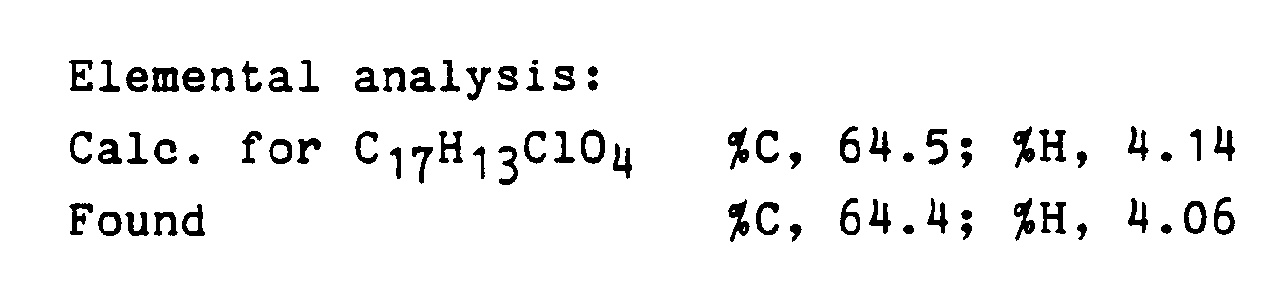
- 1-(3-Methoxy-2-hydroxyphenyl)-1-(2-hydroxyphenyl)cyclopropane was condensed with dichloroacetic acid as in Example 3 to obtain the acid of the title compound in impure form. This was esterified with methanol and purified by the procedure of Example 4 to obtain the title compound as a white crystalline solid melting at 140 to 141°C. The proton NMR and infrared spectra were consistent with the assigned structure.

- A 1.6M solution of butyl lithium in hexane (91 ml, 146 mmol) was placed in an oven-dried 500 ml 3-necked flask and cooled to 0°C and then 22.5 ml (20.1 mmol) of tetramethylethylenediamine was added with stirring. After a 10 min reaction period, a solution of 18.3 g (133 mmol) of methoxymethoxybenzine was added and the mixture allowed to stir for about 3.5 hours at 0°C. 3,4-Dimethoxy-2-methoxymethoxybenzaldehyde (30.0 g, 133 mmol) in 18 ml of tetrahydrofuran was then added dropwise with stirring. The mixture was allowed to warm to room temperature and stir for 1 hour and was then quenched with 50 ml of saturated aqueous ammonium chloride. The resulting mixture was extracted with 200 ml of ethyl acetate three times. The combined extracts were dried over magnesium sulfate and concentrated by evaporation under reduced pressure to obtain 48.5 g of an oil. This was purified by silica gel chromatography on an 8 inch diameter sintered glass funnel eluting with mixtures of hexane and dichloromethane increasing from 38 percent to 75 percent dichloromethane to obtain 32.2 g (68 percent of theory) of the title compound as a yellow oil. The proton and carbon NMR and infrared spectra were consistent with the assigned structure.

- A mixture 12.3 g (126 mmol) of chromium trioxide in 153 ml of dichloromethane was cooled to 0°C and 20.3 ml (252 mmol) of pyridine were added with stirring to obtain, after 45 min, a yellow-brown solution (Collin's reagent). (2-Methoxymethoxyphenyl)(3,4-dimethoxy-2-methoxymethoxyphenyl)methanol (7.67 g, 21 mmol) was added with stirring and the mixture allowed to warm to room temperature with stirring overnight. Twenty grams of florisil were added and the mixture was concentrated by evaporation under reduced pressure and filtered through celite and then further eluted with ether. The resulting mixture was concentrated under reduced pressure and purified by liquid chromatography using a Waters Prep 500 Chromatograph with a silica gel column and eluting with a 70:30 mixture of hexane and ethyl acetate to obtain 6.0 g (79 percent of theory) of the title compound as an oil. The proton and carbon NMR and infrared spectra were consistent with the assigned structure.

- A solution of 1.84 g (5.1 mmol) of 2'-methoxymethoxy-3,4-dimethoxy-2-methoxymethylbenzophenone in 17 ml of dry tetrahydrofuran was cooled to 0°C and 9.1 ml of 1.0M (9.1 mmol) of trimethylsilylmethyl lithium in pentane was added with stirring. After 2.5 hours, 0.38 ml (4.1 mmol) of t-butyl alcohol and 231 mg (2.0 mmol) of potassium t-butoxide were added and the mixture was heated at reflux with stirring for 4 hours. The resulting mixture was diluted with 40 ml of ether and the solution obtained was dried over magnesium sulfate and concentrated by evaporation under reduced pressure to obtain 2.0 g of an oil. This was purified by filtration chromatography on a 2 inch bed of silica gel eluting with hexane containing increasing amounts of ether to obtain the title compound as a clear oil. The proton and carbon NMR and infrared spectra were consistent with the assigned structure.

- A solution of 5.4 g (44 mmol) of thioanisole and 4.89 g (43.6 mmol) of 1,4-diazabicyclo[2,2,2]octane in 44 ml of tetrahydrofuran was placed in an oven-dried flask and cooled to 0°C. A 2.5M solution of butyl lithium in hexane (17.4 ml, 43.6 mmol) was added with stirring and the mixture allowed to warm to room temperature and react for about 1 hour to form phenylthiomethyl lithium. A solution of 3.14 g (8.71 mmol) of 1-(2-methoxymethoxyphenyl)-1-(3,4-dimethoxy-2-methoxymethoxyphenyl)ethene in tetrahydrofuran was added and the mixture heated to reflux with stirring under an argon atmosphere. After 10 hours another 21.8 mmol of phenylthiomethyl lithium was prepared and added to the mixture and refluxing was continued overnight. The mixture was then cooled and poured into 200 ml of 5 percent aqueous sodium hypochlorite solution and 200 g of ice and 150 ml of ether added. The organic phase was separated, dried over magnesium sulfate and concentrated by evaporation under reduced pressure to obtain 6.61 g of an oil. This was purified by silica gel chromatography (80 mm x 3 inch filter funnel), eluting with hexane containing ever increasing amounts of ether to obtain 1.16 g of the title compound as an oil. The proton and carbon NMR and infrared spectra were consistent with the assigned structure.

When an initial charge of 3.3 moles of phenylthiomethyl lithium per mole of olefin was employed, the product was 1-(2-methoxymethoxyphenyl)-1-(4-hydroxy-3-methoxy-2-methoxymethoxyphenyl)cyclopropane, an oil obtained in 33 percent yield and identified by proton NMR spectroscopy. - A solution of 1.16 g (3.1 mmol) of 1-(2-methoxymethoxyphenyl)-1-(3,4-dimethoxy-2-methoxymethoxyphenyl)cyclopropane and 80 mg (0.47 mmol) of p-toluenesulfonic acid in 26 ml of methanol was heated at reflux with stirring for 2 hours under an argon atmosphere. The mixture was concentrated to half by evaporation under reduced pressure and 40 ml of ether was added. The resulting solution was extracted with 30 ml of 5 percent aqueous sodium bicarbonate then 30 ml of water, dried over magnesium sulfate, and concentrated by evaporation under reduced pressure to obtain 880 mg of the title compound as a foamy oil. The proton NMR spectrum was consistent with the assigned structure.
- 1-(2-Hydroxy-3,4-dimethoxyphenyl)-1-(2-hydroxyphenyl)cyclopropane was condensed with dichloroacetic acid as in Example 3 to obtain the acid of the title compound in impure form. This was esterified with methanol by the procedure of Example 4 to obtain a brown oil. This was purified by flash silica gel chromatography (25 mm x 6 inch), eluting with hexane containing ever increasing amounts of ether to obtain the title compound as a clear oil. The proton and carbon NMR and infrared spectra were consistent with the assigned structure.

- A solution of 76 mg (0.23 mmol) of methyl 3',4'-dimethoxyspiro(cyclopropane-1,12'(12'H)-dibenzo[d,g][1,3]dioxocin)-6'-carboxylate in 0.46 ml of tetrahydrofuran was combined with 0.172 ml (0.35 mmol) of 2N aqueous sodium hydroxide and the mixture stirred for 1.3 hour. The resulting mixture was diluted with 0.5 ml of water, extracted with ether, and then acidified with 1N aqueous hydrochloric acid. The resulting mixture was extracted 3 times with 1 ml portions of ether and the combined ethereal extracts were dried over magnesium sulfate and concentrated by evaporation under reduced pressure to obtain the title compound in quantitative yield as a white solid. The proton and carbon NMR and infrared spectra were consistent with the assigned structure.

- The general procedure of Example 31 was followed using 2-methoxy-4-methylbenzaldehyde as the aldehyde. The title compound was obtained as a yellow oil in 77 percent yield. The proton and carbon NMR and infrared spectra were consistent with the assigned structure.

- The general procedure of Example 32 was followed using (2-methoxymethoxyphenyl)(2-methoxy-4-methylphenyl)methanol and the product purified by liquid chromatography in a similar manner to obtain the title compound as an oil in 85 percent yield. The proton and carbon NMR and infrared spectra were consistent with the assigned structure.

- The general procedure of Example 33 was followed using 2'-methoxymethoxy-2-methoxy-4-methylbenzophenone and the product was purified similarly to obtain the title compound as a clear oil. The proton and carbon NMR and infrared spectra were consistent with the assigned structure.

- The general procedure of Example 34 was followed using 1-(2-methoxymethoxyphenyl)-1-(4-methyl-2-methoxyphenyl)ethene and, initially, 3.3 moles of phenylthiomethyl lithium reagent per mole of olefin. The title compound was obtained as a clear oil in 44 percent yield and its structure was verified by proton NMR spectroscopy.
- A solution prepared from 490 mg (1.64 mmol) of 1-(2-methoxymethoxyphenyl)-1-(2-methoxy-4-methylphenyl)cyclopropane and 6.1 ml of a 1M solution (8.2 mmol) of bromodiethylborane in dichloromethane was stirred overnight under an argon atmosphere. Ten ml of water were added, the phases were separated, and the aqueous phase was extracted twice with 20 ml of dichloromethane. The combined organic extracts were dried over magnesium sulfate and concentrated by evaporation under reduced pressure to obtain 1-(2-hydroxyphenyl)1-(2-methoxy-4-methylphenyl)cyclopropane. The proton NMR spectrum was consistent with the assigned structure. This was dissolved in 0.8 ml (8.2 mmol) of a 5M solution of bromodimethylborane and allowed to stir overnight. Nothing happened. The mixture was cooled to 0°C and 3.3 ml (3.3 mmol) of a 1M solution of boron tribromide was added with stirring under an argon atmosphere. After a short reaction period 2 ml of water was added and the mixture was extracted with 2 ml of 5 percent aqueous sodium bicarbonate then with 2 ml of water, dried over magnesium sulfate and concentrated by evaporation under reduced pressure to obtain 350 mg (84 percent of theory) of the title compound as a foamy brown oil. The proton and carbon NMR spectra were consistent with the assigned structure.
- 1-(2-Hydroxy-4-methylphenyl)-1-(2-hydroxyphenyl)cyclopropane was condensed with dichloroacetic acid as in Example 3 to obtain the acid of the title compound in impure form. This was esterified with methanol by the procedure of Example 4 to obtain a hemi-hydrate of the title compound. The proton and carbon NMR and infrared spectra were consistent with the assigned structure.

- Methyl 3'-methylspiro(cyclopropane-1,12'(12'H)-dibenzo[d,g][1,3]dioxocin)-6'-carboxylate was hydrolyzed by the method of Example 37 to obtain the title compound as a white solid. The proton and carbon NMR spectra were consistent with the assigned structure.
- An emulsifiable concentrate formulation was prepared by mixing 3 parts by weight of methyl spiro(cyclo-propane-1,12'(12'H)-dibenzo[d,g][1,3]dioxocin)-6'-carboxylate with 5 parts of Witconate™ P12-20 surfactant (an amine salt of an alkylbenzenesulfonic acid), 5 parts of Polyglycol 26-2™ surfactant (an alkylphenol ethoxylate/propoxylate), and 87 percent Aromatic 100™ solvent (a blend of alkylated benzenes).
- Compounds of the invention were dissolved in a mixture of 14 ml acetone and 1 ml of dimethyl sulfoxide at one half of the most concentrated desired application concentration and the resulting solution was combined with 15 ml of an aqueous mixture containing about 20 percent isopropyl alcohol, about 2 percent Atplus 411F crop oil concentrate, and about 0.04 percent Triton X-155® surfactant. Solutions containing lower concentrations were prepared by diluting this mixture with a solution containing equal parts of a mixture of the second component described above and acetone containing 3 percent dimethyl sulfoxide. The solutions of known concentration were sprayed evenly onto various greenhouse-grown plant species to obtain total coverage in approximately the 2 to 4 leaf stage by means of a hand sprayer. The treated plants and control plants were placed in a greenhouse and held under conditions conducive to growth. After 13 days the percentage of control compared to the untreated plants was determined visually. Representative compounds tested, application rates employed, plant species tested, and results are given in Table II. The control is stated on a scale of 0 to 100 with 100 corresponding to complete kill and 0 to no effect. In this test an application of about 100 ppm results in an application of about 260 g/Ha.

- Compounds of the invention were dissolved in 15 ml of acetone at one half of the most concentrated desired application concentration and the resulting solution was combined with an equal volume of water containing 0.1 percent of Tween® 20 surfactant. Solutions containing lower concentrations were prepared by diluting this with additional aqueous surfactant solution. The seeds of a number of species of plants were planted in beds containing a loam agricultural soil and, after planting, predetermined amounts of the herbicide mixtures were sprayed on the soil surface and watered in to achieve the desired application rates. These and untreated control plants were then placed in a greenhouse under conditions conducive to germination and growth for a period of 14 days at which time a visual assessment was made of the reduction in stand and growth for the treated plants as compared to the control plants. Representative compounds tested, application rates employed, plant species tested, and results are given in Table III. The control is stated on a scale of 0 to 100 with 100 corresponding to complete kill and 0 to no effect.

Claims (10)
- A dibenzo[d,g][1,3]dioxocin-6-carboxylic acid compound of the formula

R¹ and R² each, independently represent H, CH₃, or C₂H₅, with the proviso that not more than one of R¹ and R² represents hydrogen, or R¹ and R² together represent the fragment -CH₂CH₂-;
R³ represents H or CH₃; and
X, X', Y, Y', Z, and Z' each, independently represent H, F, Cl, Br, I, CN, NO₂, CO₂H, NH₂, C₁-C₄ alkyl, C₁-C₄ alkoxy, phenoxy, C₁-C₄ alkylthio, phenylthio, C₁-C₄ mono- or dialkylamino, (C₁-C₃ alkyl)carbonyl, phenylcarbonyl, C₁-C₄ alkoxycarbonyl, or C₁-C₄ mono- or dialkylaminocarbonyl, wherein each alkyl, alkoxy, and alkylthio group is optionally substituted with one or more compatible C₁-C₄ alkoxy, C₁-C₄ alkylthio, F, Cl, Br, CN, or phenyl groups and wherein each phenyl group is optionally substituted with up to 3 F, Cl, Br, CN, CF₃, C₁-C₄ alkyl, and C₁-C₄ alkoxy groups;
and the agriculturally acceptable salt, esters and amides thereof. - A compound of Claim 1 wherein R¹ and R² taken together represent the fragment -CH₂CH₂-.
- A compound of either of Claim 1 or 2 wherein R³ represents hydrogen.
- A compound of Claim 3 wherein the compound is in the form of an agriculturally acceptable salt, ester, or amide.
- A compound of Claim 2, spiro(cyclopropane-1,12'(12'H)-dibenzo[d,g][1,3]dioxocin)-6'-carboxylic acid and its agriculturally acceptable esters, amides, and salts.
- An herbicidal composition comprising an agriculturally acceptable adjuvant or carrier and an herbicidally effective amount of a dibenzo[d,g][1,3]dioxocin-6-carboxylic acid compound of any one of Claims 1 to 5.
- A method of controlling undesirable vegetation which comprises contacting the vegetation or the locus thereof with a dibenzo[d,g][1,3]dioxocin-6-carboxylic acid compound of any one of Claims 1 to 5 or an obtainable compound which is oxidizable or hydrolyzable in plants or the environment to a dibenzo[d,g][1,3]dioxocin-6-carboxylic acid compound of any one of Claims 1 to 5.
- A method of Claim 7 wherein the vegetation is contacted postemergently.
- A process of preparing a compound of the formula

R¹ and R² together represent the fragment -CH₂CH₂-;
each R⁴ independently represents C₁-C₄ alkyl optionally substituted with 1 or 2 C₁-C₄ alkoxy groups; and
X, X', Y, Y', Z, and Z' each, independently represent H, F, Cl, Br, I, CN, NO₂, C₁-C₄ alkyl, C₁-C₄ alkoxy, phenoxy, C₁-C₄ alkylthio, phenylthio, or C₁-C₄ dialkylamino, wherein each alkyl, alkoxy, and alkylthio group is optionally substituted with one or more compatible C₁-C₄ alkoxy, C₁-C₄ alkylthio, F, Cl, Br, CN, or phenyl groups and wherein each phenyl group is optionally substituted with up to 3 F, Cl, Br, CN, CF₃, C₁-C₄ alkyl, and C₁-C₄ alkoxy groups
which comprises contacting thioanisole with a C₁-C₈ alkyl lithium reagent and an aliphatic tertiary amine in a compatible solvent to form a phenylthiomethyl lithium reagent and subsequently contacting said phenylthiomethyl lithium reagent with a compound of the formula
- A process for preparing a dibenzo[d,g][1,3]dioxocin-6-carboxylic acid compound of the formula

R¹ and R² each, independently represent hydrogen, methyl, or ethyl, with the proviso that not more than one of R¹ and R² represents hydrogen, or R¹ and R² together represent the fragment -CH₂CH₂-;
R³ represents H or CH₃; and
X, X', Y, Y', Z, and Z' each, independently represent H, F, Cl, Br, I, CN, NO₂, CO₂H, NH₂, C₁-C₄ alkyl, C₁-C₄ alkoxy, phenoxy, C₁-C₄ alkylthio, phenylthio, C₁-C₄ mono- or dialkylamino, (C₁-C₃ alkyl)carbonyl, phenylcarbonyl, C₁-C₄ alkoxycarbonyl, or C₁-C₄ mono- or dialkylaminocarbonyl, wherein each alkyl, alkoxy, and alkylthio group is optionally substituted with one or more compatible C₁-C₄ alkoxy, C₁-C₄ alkylthio, F, Cl, Br, CN, or phenyl groups and wherein each phenyl group is optionally substituted with up to 3 F, Cl, Br, CN, CF₃, C₁-C₄ alkyl, and C₁-C₄ alkoxy groups;
or a C₁-C₈ alkyl ester or amide thereof
which comprises combining a bisphenol compound of the formula
with a dihaloalkanoic acid of the formula
R³CG₂CO₂H
wherein R³ represents H or CH₃ and G represents Cl or Br or a C₁-C₈ ester or amide thereof,
an alkali metal carbonate, and a catalytic amount of iodide ion in a C₃ or C₄ alcohol solvent and heating at the reflux temperature for 4 to 72 hours.
Applications Claiming Priority (2)
| Application Number | Priority Date | Filing Date | Title |
|---|---|---|---|
| US366382 | 1989-06-15 | ||
| US07/366,382 US4938790A (en) | 1989-06-15 | 1989-06-15 | Herbicidal 12-substituted 12H-dibenzo(D,G)(1,3)dioxocin-6-carboxylic acids |
Publications (2)
| Publication Number | Publication Date |
|---|---|
| EP0403026A1 EP0403026A1 (en) | 1990-12-19 |
| EP0403026B1 true EP0403026B1 (en) | 1994-03-02 |
Family
ID=23442777
Family Applications (1)
| Application Number | Title | Priority Date | Filing Date |
|---|---|---|---|
| EP90201541A Expired - Lifetime EP0403026B1 (en) | 1989-06-15 | 1990-06-14 | 12-Substituted-12H-dibenzo(D,G)(1,3)dioxocin-6-carboxylic acids, herbicidal compositions, and a method of controlling undesirable vegetation |
Country Status (7)
| Country | Link |
|---|---|
| US (1) | US4938790A (en) |
| EP (1) | EP0403026B1 (en) |
| JP (1) | JPH03101678A (en) |
| AU (1) | AU626426B2 (en) |
| BR (1) | BR9002880A (en) |
| CA (1) | CA2018986A1 (en) |
| DE (1) | DE69006924T2 (en) |
Families Citing this family (5)
| Publication number | Priority date | Publication date | Assignee | Title |
|---|---|---|---|---|
| JPH04501859A (en) * | 1989-06-29 | 1992-04-02 | アイエスケー・バイオテック・コーポレーション | Novel glyoxylates and glyoxylate-activated plant growth regulating activators |
| US5274129A (en) * | 1991-06-12 | 1993-12-28 | Idaho Research Foundation, Inc. | Hydroxamic acid crown ethers |
| DE4305696A1 (en) * | 1993-02-25 | 1994-09-01 | Hoechst Ag | Detection method for the identification of inhibitors |
| CN1296366C (en) * | 2003-05-27 | 2007-01-24 | 沈阳化工研究院 | Dibenzocyclooctane carboxylic ether compounds with herbicidal activity |
| JP2015134904A (en) * | 2013-11-18 | 2015-07-27 | 東洋合成工業株式会社 | Compound for enhancing generation of chemical species |
Family Cites Families (4)
| Publication number | Priority date | Publication date | Assignee | Title |
|---|---|---|---|---|
| US3553234A (en) * | 1969-06-18 | 1971-01-05 | Richardson Merrell Inc | Dibenzo(d,g)(1,3)dioxocin-6-carboxylic acids, esters and salts |
| US3836543A (en) * | 1970-10-14 | 1974-09-17 | Richardson Merrell Inc | Method of preparing dibenzo(d,g)(1,3)dioxocin acids and salts thereof |
| US3931173A (en) * | 1971-07-22 | 1976-01-06 | Richardson-Merrell Inc. | Dioxocin carboxamide derivatives |
| HU166203B (en) * | 1972-12-18 | 1975-02-28 |
-
1989
- 1989-06-15 US US07/366,382 patent/US4938790A/en not_active Expired - Lifetime
-
1990
- 1990-06-13 BR BR909002880A patent/BR9002880A/en not_active Application Discontinuation
- 1990-06-14 AU AU57124/90A patent/AU626426B2/en not_active Ceased
- 1990-06-14 CA CA002018986A patent/CA2018986A1/en not_active Abandoned
- 1990-06-14 DE DE69006924T patent/DE69006924T2/en not_active Expired - Fee Related
- 1990-06-14 EP EP90201541A patent/EP0403026B1/en not_active Expired - Lifetime
- 1990-06-14 JP JP2154132A patent/JPH03101678A/en active Pending
Also Published As
| Publication number | Publication date |
|---|---|
| JPH03101678A (en) | 1991-04-26 |
| CA2018986A1 (en) | 1990-12-15 |
| DE69006924D1 (en) | 1994-04-07 |
| BR9002880A (en) | 1991-08-20 |
| EP0403026A1 (en) | 1990-12-19 |
| AU5712490A (en) | 1990-12-20 |
| DE69006924T2 (en) | 1994-06-09 |
| AU626426B2 (en) | 1992-07-30 |
| US4938790A (en) | 1990-07-03 |
Similar Documents
| Publication | Publication Date | Title |
|---|---|---|
| CA1331180C (en) | Alkoxy-1, 2, 4-triazolo [1,5-c] pyrimidine-2- sulfonamides, process for their preparation and intermediates | |
| US5089046A (en) | Aryl and heteroaryl diones | |
| KR900006519B1 (en) | Herbicidally active enols | |
| JPH02501309A (en) | heterocyclic compound | |
| JPS62258344A (en) | Acrylic acid derivatives, manufacture and fungicidal, insecticidal or plant growth regulator | |
| JPH0640813A (en) | Herbicidal 2,6-substituted pyridine | |
| US5608101A (en) | Substituted benzoyl (hetero)cyclic diones | |
| CA2263399A1 (en) | 1-alkyl-4-benzoyl-5-hydroxypyrazole compounds and their use as herbicides | |
| KR900001208B1 (en) | Method for preparing imidazolidinone and imidazolidinethione | |
| US4938790A (en) | Herbicidal 12-substituted 12H-dibenzo(D,G)(1,3)dioxocin-6-carboxylic acids | |
| JPH072735B2 (en) | Pyridine derivative, its production method and herbicide | |
| JPS6314782A (en) | Novel dialkylmaleinimide compound and herbicide | |
| US4999448A (en) | Method of preparing bis-phenol ethers | |
| US5071465A (en) | Herbicidal 12-substituted 12H-dibenzo[d,g][1,3]dioxocin-6-carboxylic acids | |
| US5158597A (en) | Herbicidal 12-substituted 12H-dibenzo[d,g]dioxocin-6-carboxylic acids | |
| US4979978A (en) | Herbicidal 12H-dibenzo[d,g][1,3]dioxocin-6-carboxylic acids | |
| EP0340828B1 (en) | 5-Fluoromethyl-1,2,4-triazolo(1,5-a)-pyrimidine-2-sulfonamides, process for their preparation and compositions for their use as herbicides | |
| JPS60228443A (en) | Beta-naphthylalkylamines | |
| EP1077972A1 (en) | 1-alkyl-4-[(3-oxetanyl-)benzoyl]-5-hydroxypyrazole compounds and their use as herbicides | |
| EP0843666B1 (en) | 4-substituted 5-polycyclylpyrimidine herbicides | |
| US5447905A (en) | N-indazolyl[1,2,4]triazolo[1,5-C]pyrimidine-2-sulfonamide herbicides | |
| AU686846B2 (en) | N-pyridinyl(1,2,4)triazolo(1,5-c)pyrimidine-2-sulfonamide herbicides | |
| EP0383319A2 (en) | Imidazopyridines, their production and use | |
| JPH0565515B2 (en) | ||
| JPH03251582A (en) | Imidazo(1,2-a)pyridyl compound |
Legal Events
| Date | Code | Title | Description |
|---|---|---|---|
| PUAI | Public reference made under article 153(3) epc to a published international application that has entered the european phase |
Free format text: ORIGINAL CODE: 0009012 |
|
| AK | Designated contracting states |
Kind code of ref document: A1 Designated state(s): DE FR GB NL |
|
| 17P | Request for examination filed |
Effective date: 19901219 |
|
| 17Q | First examination report despatched |
Effective date: 19930429 |
|
| RAP1 | Party data changed (applicant data changed or rights of an application transferred) |
Owner name: DOWELANCO |
|
| GRAA | (expected) grant |
Free format text: ORIGINAL CODE: 0009210 |
|
| AK | Designated contracting states |
Kind code of ref document: B1 Designated state(s): DE FR GB NL |
|
| REF | Corresponds to: |
Ref document number: 69006924 Country of ref document: DE Date of ref document: 19940407 |
|
| PGFP | Annual fee paid to national office [announced via postgrant information from national office to epo] |
Ref country code: NL Payment date: 19940630 Year of fee payment: 5 |
|
| ET | Fr: translation filed | ||
| PLBE | No opposition filed within time limit |
Free format text: ORIGINAL CODE: 0009261 |
|
| STAA | Information on the status of an ep patent application or granted ep patent |
Free format text: STATUS: NO OPPOSITION FILED WITHIN TIME LIMIT |
|
| 26N | No opposition filed | ||
| PG25 | Lapsed in a contracting state [announced via postgrant information from national office to epo] |
Ref country code: NL Effective date: 19960101 |
|
| NLV4 | Nl: lapsed or anulled due to non-payment of the annual fee |
Effective date: 19960101 |
|
| REG | Reference to a national code |
Ref country code: GB Ref legal event code: 732E |
|
| REG | Reference to a national code |
Ref country code: GB Ref legal event code: IF02 |
|
| PGFP | Annual fee paid to national office [announced via postgrant information from national office to epo] |
Ref country code: FR Payment date: 20040227 Year of fee payment: 15 |
|
| PGFP | Annual fee paid to national office [announced via postgrant information from national office to epo] |
Ref country code: GB Payment date: 20040329 Year of fee payment: 15 |
|
| PGFP | Annual fee paid to national office [announced via postgrant information from national office to epo] |
Ref country code: DE Payment date: 20040505 Year of fee payment: 15 |
|
| PG25 | Lapsed in a contracting state [announced via postgrant information from national office to epo] |
Ref country code: GB Free format text: LAPSE BECAUSE OF NON-PAYMENT OF DUE FEES Effective date: 20050614 |
|
| PG25 | Lapsed in a contracting state [announced via postgrant information from national office to epo] |
Ref country code: DE Free format text: LAPSE BECAUSE OF NON-PAYMENT OF DUE FEES Effective date: 20060103 |
|
| PG25 | Lapsed in a contracting state [announced via postgrant information from national office to epo] |
Ref country code: FR Free format text: LAPSE BECAUSE OF NON-PAYMENT OF DUE FEES Effective date: 20060228 |
|
| GBPC | Gb: european patent ceased through non-payment of renewal fee |
Effective date: 20050614 |
|
| REG | Reference to a national code |
Ref country code: FR Ref legal event code: ST Effective date: 20060228 |