EP0402322B1 - Process for the production of R(+)-aminocarnitine and S(-)-amino-carnitine - Google Patents
Process for the production of R(+)-aminocarnitine and S(-)-amino-carnitine Download PDFInfo
- Publication number
- EP0402322B1 EP0402322B1 EP90830159A EP90830159A EP0402322B1 EP 0402322 B1 EP0402322 B1 EP 0402322B1 EP 90830159 A EP90830159 A EP 90830159A EP 90830159 A EP90830159 A EP 90830159A EP 0402322 B1 EP0402322 B1 EP 0402322B1
- Authority
- EP
- European Patent Office
- Prior art keywords
- aminocarnitine
- chloride
- alpha
- crotonobetaine
- isolating
- Prior art date
- Legal status (The legal status is an assumption and is not a legal conclusion. Google has not performed a legal analysis and makes no representation as to the accuracy of the status listed.)
- Expired - Lifetime
Links
Classifications
-
- C—CHEMISTRY; METALLURGY
- C07—ORGANIC CHEMISTRY
- C07C—ACYCLIC OR CARBOCYCLIC COMPOUNDS
- C07C227/00—Preparation of compounds containing amino and carboxyl groups bound to the same carbon skeleton
- C07C227/30—Preparation of optical isomers
- C07C227/34—Preparation of optical isomers by separation of optical isomers
Definitions
- the present invention relates to a process for the production of R(+)-aminocarnitine and S(-)-aminocarnitine, by chromatographic separation on a silica gel column or fractional crystallisation of a mixture of diastereoisomers consisting of the benzyl esters of N-[S(-) alpha-methylbenzyl]-R(+)-aminocarnitine chloride and N-[S(-) alpha-methylbenzyl]-S(-)-aminocarnitine chloride, or a mixture of diastereoisomers consisting of the benzyl esters of N-[R(+) alpha-methylbenzyl]-R(+)-aminocarnitine chloride and N-[R(+) alpha-methylbenzyl]-S(-)-aminocarnitine chloride, followed by debenzylation of the separated diastereoisomers to yield R(+)-aminocarnitine chloride and S(-)-aminocarnitine chloride.
- R(+)-aminocarnitine chloride can be obtained by acid hydrolisis of R(-)-N-acetyl aminocarnitine, isolated as a product during the cultivaton of microorganisms of the genera Emericella or Aspergillus, or via a complex chemical procedure as described in the aforecited U.S. patent 4,521,432 (Takeda).
- R-aminocarnitine chloride and S-aminocarnitine chloride can also be obtained by resolution of a racemic mixture of ( ⁇ )-N-acetyl aminocarnitine, as described in SIGMA-TAU's Italian patent application 47738/87 (Italian patent 1,205,758 corresponding to EP application 287,523).
- the starting material, ( ⁇ )-N-acetyl aminocarnitine was synthesized as described by D. Jenkins in J. Biol. Chem., 260: 14748 (1985), using a rather complex five-step procedure starting with a uracil derivative.
- the object of the present invention is to provide a process for the production of R(+)-aminocarnitine and S(-)-aminocarnitine that does not entail the drawbacks of the prior art processes.
- the process of the present invention allows for the preparation of both enantiomers in good yields, utilising as the starting material a substance like crotonobetaine which is inexpensive and readily obtained by the dehydration of D-carnitine (a side product obtained during the preparation of L-carnitine).
- R(+) alpha-methylbenzylamine If R(+) alpha-methylbenzylamine is used, one obtains the benzyl esters of N-[R(+) alpha-methylbenzyl]-R(+)-aminocarnitine chloride and N-[R(+) alpha-methylbenzyl]-S(-)-aminocarnitine chloride; whereas if S(-) alpha-methylbenzylamine is employed, the benzyl esters of N-[S(-) alpha-methylbenzyl]-R(+)-aminocarnitine chloride and N-[S(-) alpha-methylbenzyl]-S(-)-aminocarnitine chloride are obtained.
- R(+)- and S(-)-aminocarnitine chloride are prepared as per the following synthesis scheme (scheme I): More particularly, the process of the present invention comprises the steps of:
- reaction raw material was dissolved in chloroform and eluted through a silica gel column (ratio 1:20), eluant: chloroform-methanol (95-5).
- step C viz. N-(R(+)alpha-methylbenzyl)R(+)-aminocarnitine benzyl ester (1 g; 0.0025 moles) was dissolved in 10 ml ethanol-H 2 0, ratio 1:1. To the resulting solution 500mg Pd(OH) 2 were added. The solution was hydrogenated at 4 atmospheres overnight. The catalyst was then filtered off and the resulting solution concentrated under vacuum.
- Aminocarnitine was derivatized with orthophtalic aldehyde and acetylcysteine according to a method used for the determination of aminoacid enantiomeric excess described in An. Chem. 51(11), 1667, 1979, as illustrated in scheme 2
- the derivatized mixture was analyzed via HPLC.
Landscapes
- Chemical & Material Sciences (AREA)
- Organic Chemistry (AREA)
- Analytical Chemistry (AREA)
- Organic Low-Molecular-Weight Compounds And Preparation Thereof (AREA)
- Acyclic And Carbocyclic Compounds In Medicinal Compositions (AREA)
- Indole Compounds (AREA)
- Catalysts (AREA)
- Low-Molecular Organic Synthesis Reactions Using Catalysts (AREA)
- Pharmaceuticals Containing Other Organic And Inorganic Compounds (AREA)
- Inorganic Compounds Of Heavy Metals (AREA)
Abstract
Description
- The present invention relates to a process for the production of R(+)-aminocarnitine and S(-)-aminocarnitine, by chromatographic separation on a silica gel column or fractional crystallisation of a mixture of diastereoisomers consisting of the benzyl esters of N-[S(-) alpha-methylbenzyl]-R(+)-aminocarnitine chloride and N-[S(-) alpha-methylbenzyl]-S(-)-aminocarnitine chloride, or a mixture of diastereoisomers consisting of the benzyl esters of N-[R(+) alpha-methylbenzyl]-R(+)-aminocarnitine chloride and N-[R(+) alpha-methylbenzyl]-S(-)-aminocarnitine chloride, followed by debenzylation of the separated diastereoisomers to yield R(+)-aminocarnitine chloride and S(-)-aminocarnitine chloride.
- Recently, the discovery of pharmacological properties of aminocarnitine (I,R=H) and certain acyl derivatives of aminocarnitine (I,R=acetyl, N-caproyl, palmitoyl) has aroused substantial interest.

- For example, D.L. Jenkins and O.W. Griffith have described antiketogenic and hypoglycemic effects of compounds (I) in their racemic form. Also, U.S. patent 4,521,432 (Takeda) describes the antiketogenic activity (with the accompanying possibility of applications in the treatment of diabetes) of an optically active derivative, (-)-N-acetyl aminocarnitine, inner salt ([a]p =-17.4°, c=1 ,H20). Analogous activity has been described for (+)-aminocarnitine chloride hydrochloride ([a]25 =+6.3°, c=1,1N AcOH).
- Therefore, we feel that it is necessary to have available a process that provides both enantiomeric forms of aminocarnitine.
- Actually, R(+)-aminocarnitine chloride can be obtained by acid hydrolisis of R(-)-N-acetyl aminocarnitine, isolated as a product during the cultivaton of microorganisms of the genera Emericella or Aspergillus, or via a complex chemical procedure as described in the aforecited U.S. patent 4,521,432 (Takeda).
- The synthesis of R(+)- and S(-)-aminocarnitine chloride starting from L- and from D-asparagine was described by Schinagawa in J. Med. Chem., 30:1458 (1987). However, this synthetic method is rather complex. Indeed, it includes seven steps and involves the use of particularly dangerous reagents, such as diazomethane. Therefore, it is not a method suitable for industrial production, and was of value only insofar as it permitted assignment of the absolute configurations of (+)-aminocarnitine and (-)-aminocarnitine as R-aminocarnitine and S-aminocarnitine, respectively.
- R-aminocarnitine chloride and S-aminocarnitine chloride can also be obtained by resolution of a racemic mixture of (±)-N-acetyl aminocarnitine, as described in SIGMA-TAU's Italian patent application 47738/87 (Italian patent 1,205,758 corresponding to EP application 287,523). However, in this case the starting material, (±)-N-acetyl aminocarnitine, was synthesized as described by D. Jenkins in J. Biol. Chem., 260: 14748 (1985), using a rather complex five-step procedure starting with a uracil derivative.
- The object of the present invention is to provide a process for the production of R(+)-aminocarnitine and S(-)-aminocarnitine that does not entail the drawbacks of the prior art processes. In particular, the process of the present invention allows for the preparation of both enantiomers in good yields, utilising as the starting material a substance like crotonobetaine which is inexpensive and readily obtained by the dehydration of D-carnitine (a side product obtained during the preparation of L-carnitine).
- To the benzylic ester of crotonobetaine chloride is added one of the two enantiomers of alpha-methylbenzylamine. Since it forms a new chiral centre, and since the addition is not stereospecific, both possible diastereoisomers are obtained. If R(+) alpha-methylbenzylamine is used, one obtains the benzyl esters of N-[R(+) alpha-methylbenzyl]-R(+)-aminocarnitine chloride and N-[R(+) alpha-methylbenzyl]-S(-)-aminocarnitine chloride; whereas if S(-) alpha-methylbenzylamine is employed, the benzyl esters of N-[S(-) alpha-methylbenzyl]-R(+)-aminocarnitine chloride and N-[S(-) alpha-methylbenzyl]-S(-)-aminocarnitine chloride are obtained.
- In either of these cases, it is possible to separate the diastereoisomers either by fractional crystallisation or by chromatography on silica gel. The separated diastereoisomers are then catalytically hydrogenated to simultaneously remove the N- and O-benzyl groups, yielding in a single step the final product: R(+)-aminocarnitine chloride or S(-)-aminocarnitine chloride.
- In accordance with the process of the present invention, R(+)- and S(-)-aminocarnitine chloride are prepared as per the following synthesis scheme (scheme I):

- (a) reacting crotonobetaine chloride with an excess amount of benzyl alcohol in the presence of an acid catalyst such as gaseous hydrochloric acid or thionyl chloride, concentrating the resulting reaction solution, thus isolating crotonobetaine benzylester chloride;
- (b) reacting crotonobetaine benzyl ester chloride with an excess amount of R or S alpha-methylbenzylamine, at 10°C-30°C, for 12-48 hours and isolating N-(alpha-methylbenzyl) aminocarnitine benzylester chloride from the resulting reaction mixture by precipitation with an organic solvent such as ethyl ether or acetonitrile;
- (c) resolving the thus formed diastereoisomers, preferably by fractional crystallisation with acetone or methylethylketone or by chromatography on a silica gel column using a gradient of chloroform-methanol as eluant;
- (d) subjecting each diastereoisomer to hydrogenolysis in a hydroalcoholic solution in the presence of a hydrogenation catalyst selected from the group consisting of palladium hydroxide and palladium chloride and isolating R(+) and S(-)-aminocarnitine chloride.
- The process of the present invention is illustrated by the following non-limiting example.
- Preparation of crotonobetaine benzylester chloride.
- 54 ml benzyl alcohol were added to crotonobetaine (15 g; 0.083 moles). The resulting mixture was cooled to 0°C. Thionyl chloride (35 ml; 0.495 moles) was slowly added to the mixture. The mixture was then kept at room temperature for 16 hours. Subsequently, the solution was concentrated under vacuum in order to remove the excess thionyl chloride. The residue was washed with isopropanol, concentrated under vacuum and taken up with acetone. The acetone solution was kept overnight at 4°C. A precipitate was obtained (19 g; yield 84%) which was filtered and dried. The analysis showed that the resulting compound was the title compound. TLC silica gel, eluant: chloroform: methanol: isopropanol: H20: acetic acid (42:28:7:10:10) RF = 0.7
- NMR D20 8 7.5 (5H, s, aromatic); 7.2-6.3(2H, m, CH=CH); 5.2 ( 2H, s,

- Melting point = 78-80°C
- STEP B
- Preparation of N-(alpha-methylbenzyl) aminocarnitine benzyl ester chloride.
- R(+) alpha-methylbenzylamine (47 ml; 0.37 moles) was added to crotonobetaine benzylester chloride (26 g; 0.096 moles). The resulting solution was kept understirring at room temperature for24 hours. Ethyl ether was added to the solution giving a precipitate (33 g; yield 87.5%).
- TLC silica gel, eluant: chloroform-methanol (80-20)
- The reaction raw material consisted of a mixture of the two diastereoisomers N-(R(+) alpha-methylbenzyl) R(+)-aminocarnitine benzylester chloride; inferior RF = 0.6; and N-(R(+) alpha-methylbenzyl) S(-)-aminocarnitine benzyl ester chloride superior RF = 0.8
- NMR D20 8 7.1 (10H, duplet s, aromatic); 5.0(2H, s,

- Resolution of diastereoisomers
- The reaction raw material was dissolved in chloroform and eluted through a silica gel column (ratio 1:20), eluant: chloroform-methanol (95-5).
- The following compounds were isolated:
- product at inferior RF:N-(R(+)alpha-methylbenzyl) R(+)-aminocarnitine benzyl ester chloride
- [α]25 D = -12(c=1, H2O)
- melting point: 176-178°C
- HPLC: column Tekopac C18
- eluant: Solvent A - CH3CN (58-42)
- (solvent A: methanol 100 ml + 85% H3P04 3ml + H20 balance to 1000 ml)
- detector UV 205 nm
- flow rate: 1 ml/min
- retention time: 6.69 min
- title: 95 %
- product at superior RF: N-(R(+)alpha-methylbenzyl) S(-)-aminocarnitine benzyl ester chloride
- [α]25 D = + 52.6 (c = 1, H20)
- melting point: 60-62°C
- HPLC: as above
- retention time: 8.28 min
- title: 90%
- Elementary analysis: (C22H3, N2ClO2)

- Elementary analysis: (C22H3, N2ClO2)
- The separation of the diastereoisomers was also obtained by crystallisation with methylethylketone that gave the compound at inferior RF with 80% purity, while the compound at superior RF remained in the mother liquors.
- Preparation of R(+)-aminocarnitine chloride.
- The compound at inferior RF of step C, viz. N-(R(+)alpha-methylbenzyl)R(+)-aminocarnitine benzyl ester (1 g; 0.0025 moles) was dissolved in 10 ml ethanol-H20, ratio 1:1. To the resulting solution 500mg Pd(OH)2 were added. The solution was hydrogenated at 4 atmospheres overnight. The catalyst was then filtered off and the resulting solution concentrated under vacuum.
- The residue was washed with isopropanol and the solid thus obtained was filtered off.
- 0.5 g of a crystalline compound were obtained.
- yield: 100%
- [α]25 D = +12 (c = 1, H20)
- melting point: 194°-196°C
- Elementary analysis: (C7H17N2ClO2)

- In order to compare the chemico-physical data ofaminocarnitine chloride with those disclosed in the chemical literature, R(+)-aminocarnitine chloride was treated with acqueous HCI until pH 1.8 was reached, and then lyophilized.
- A solid product was obtained.
- [α]

- melting point: 210°-212°C
- Elementary analysis: C7H18N2Cl2O2

- NMR D20 8 4.2(1H,

- HPLC: column micro Bondapack C18
- eluant: KH2P04 0.05 M-CH3CN(35-65)
- detector UV 205 nm
- flow rate: 1 ml/min
- retention time: 20.3 min
- Determination of the enantiomeric excess of R(+)-aminocarnitine chloride hydrochloride.
- Aminocarnitine was derivatized with orthophtalic aldehyde and acetylcysteine according to a method used for the determination of aminoacid enantiomeric excess described in An. Chem. 51(11), 1667, 1979, as illustrated in scheme 2
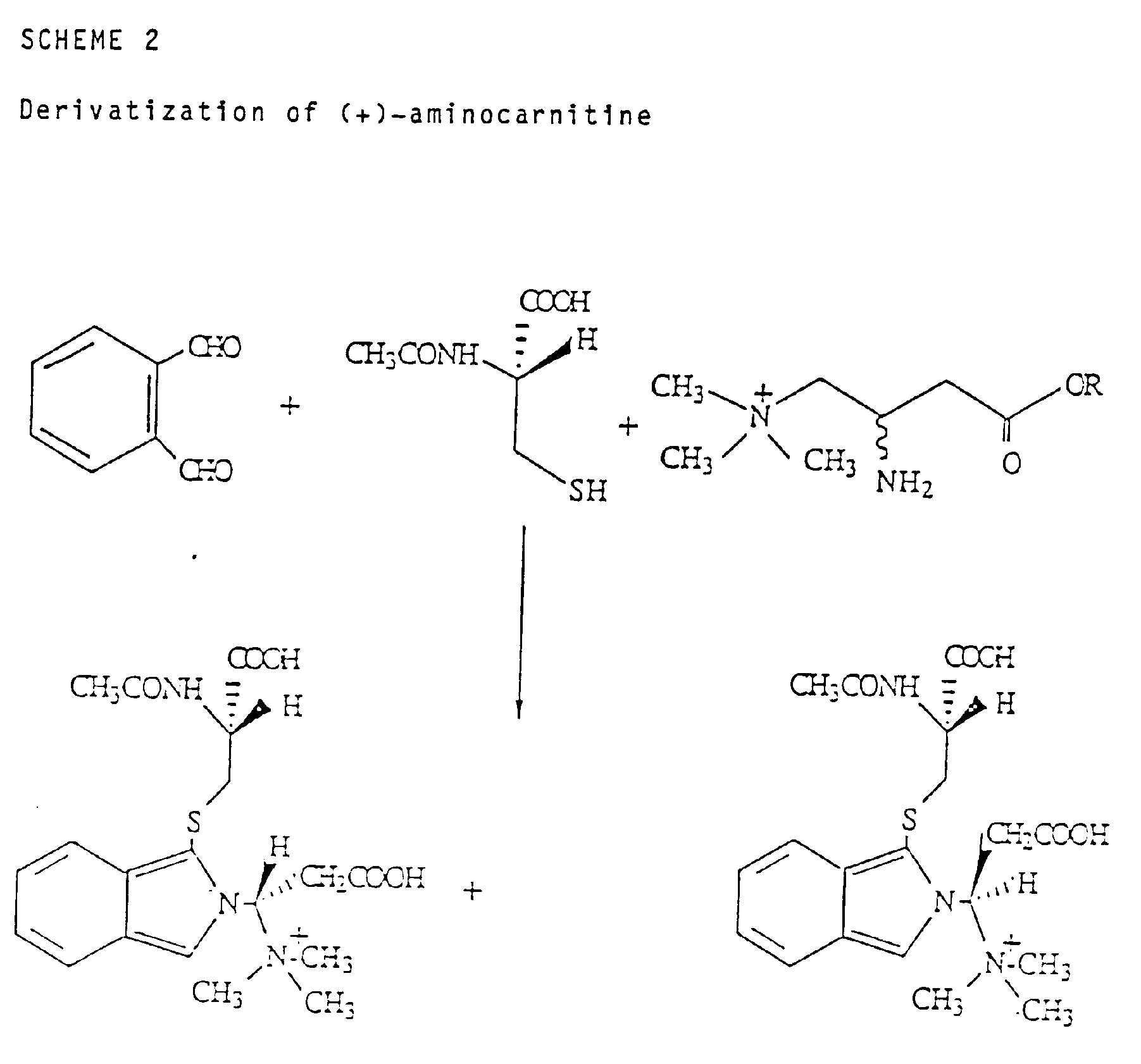
- The derivatized mixture was analyzed via HPLC.
- Column micro Bondapack C18
- eluant: NaCI040.05 M: CH3CN(97:3)
- detector UV 336 nm
- flow rate: 1ml/min
- 95% R(+)-aminocarnitine retention time: 17.5 min
- 5% S(-)-aminocarnitine retention time: 20.6 min
Claims (5)
Applications Claiming Priority (2)
| Application Number | Priority Date | Filing Date | Title |
|---|---|---|---|
| IT4784289 | 1989-04-12 | ||
| IT8947842A IT1231751B (en) | 1989-04-12 | 1989-04-12 | PROCEDURE FOR THE PRODUCTION OF R (+) AMMINOCARNITINE AND S (-) AMMINOCARNITINE |
Publications (3)
| Publication Number | Publication Date |
|---|---|
| EP0402322A2 EP0402322A2 (en) | 1990-12-12 |
| EP0402322A3 EP0402322A3 (en) | 1991-01-02 |
| EP0402322B1 true EP0402322B1 (en) | 1994-07-06 |
Family
ID=11262871
Family Applications (1)
| Application Number | Title | Priority Date | Filing Date |
|---|---|---|---|
| EP90830159A Expired - Lifetime EP0402322B1 (en) | 1989-04-12 | 1990-04-11 | Process for the production of R(+)-aminocarnitine and S(-)-amino-carnitine |
Country Status (8)
| Country | Link |
|---|---|
| US (1) | US5041643A (en) |
| EP (1) | EP0402322B1 (en) |
| JP (1) | JP2941350B2 (en) |
| AT (1) | ATE108174T1 (en) |
| DE (1) | DE69010405T2 (en) |
| DK (1) | DK0402322T3 (en) |
| ES (1) | ES2056431T3 (en) |
| IT (1) | IT1231751B (en) |
Families Citing this family (11)
| Publication number | Priority date | Publication date | Assignee | Title |
|---|---|---|---|---|
| IT1238344B (en) * | 1989-10-20 | 1993-07-13 | Sigma Tau Ind Farmaceuti | ESTERS OF L-CARNITINE WITH GAMMA-HYDROXYBUTIRRIC ACID AND PHARMACEUTICAL COMPOSITIONS THAT CONTAIN IT FOR THE INHIBITION OF NEURONAL DEGENERATION AND IN THE TREATMENT OF COMA |
| IT1240760B (en) * | 1990-02-12 | 1993-12-17 | Sigma Tau Ind Farmaceuti | ACYL-L-CARNITINE ESTERS WITH GAMMA-HYDROXYBUTIRRIC ACID AND PHARMACEUTICAL COMPOSITIONS THAT CONTAIN THEM FOR THE INHIBITION OF NEURONAL DEGENERATION AND IN THE TREATMENT OF COMA. |
| IT1254136B (en) * | 1992-01-16 | 1995-09-08 | Sigma Tau Ind Farmaceuti | ACIL CARNITINE ESTERS WITH LONG CHAIN ALIPHATIC ALCOHOLS AND PHARMACEUTICAL COMPOSITIONS THAT CONTAIN THEM, WITH ANTI-Fungal activity. |
| IT1254135B (en) * | 1992-01-16 | 1995-09-08 | Sigma Tau Ind Farmaceuti | ACIL CARNITINE ESTERS WITH LONG CHAIN ALIPHATIC ALCOHOLS AND PHARMACEUTICAL COMPOSITIONS CONTAINING THEM, WITH ANTIBACTERIAL ACTIVITY. |
| US5939561A (en) * | 1992-03-10 | 1999-08-17 | Rhone-Poulence Rorer S.A. | Process for the preparation of β-phenylisoserine and β-lactam and their analogues |
| FR2688499B1 (en) * | 1992-03-10 | 1994-05-06 | Rhone Poulenc Rorer Sa | PROCESS FOR THE PREPARATION OF BETA-PHENYLISOSERINE AND ITS ANALOGS. |
| HUT65327A (en) * | 1992-06-11 | 1994-05-02 | Sandoz Ag | Process for producing phosphinyloxy-propyl-ammonium inner sact derwatives ang pharmateutical preparations containing them |
| IT1261230B (en) * | 1993-04-08 | 1996-05-09 | Sigma Tau Ind Farmaceuti | IMPROVED PROCEDURE FOR THE PREPARATION OF L - (-) - CARNITINA STARTING FROM ITS PRECURSORS WITH OPPOSED CONFIGURATION. |
| IT1261828B (en) | 1993-07-14 | 1996-06-03 | Sigma Tau Ind Farmaceuti | ACIL L-CARNITINE ESTERS AND PHARMACEUTICAL COMPOSITIONS THAT CONTAIN THEM FOR THE TREATMENT OF THE ENDOTOXIC SHOCK. |
| IT1261489B (en) * | 1993-07-29 | 1996-05-23 | Sigma Tau Ind Farmaceuti | PROCEDURE FOR THE PRODUCTION OF R AMMINOCARNITINA AND S AMMINOCARNITINA. |
| US7776915B2 (en) * | 2005-03-24 | 2010-08-17 | Tracie Martyn International, Llc | Topical formulations and methods of use |
Family Cites Families (5)
| Publication number | Priority date | Publication date | Assignee | Title |
|---|---|---|---|---|
| US4521432A (en) * | 1981-11-26 | 1985-06-04 | Takeda Chemical Industries, Ltd. | Physiologically active substance FA-5859, its derivative, their production and use |
| US4767781A (en) * | 1981-11-26 | 1988-08-30 | Takeda Chemical Industries, Ltd. | Derivatives of beta-amino-gamma-trimethylammonio-butyrate and their production and use |
| CH652270GA3 (en) * | 1983-05-19 | 1985-11-15 | ||
| US4781863A (en) * | 1984-04-02 | 1988-11-01 | Cornell Research Foundation, Inc. | Aminocarnitines |
| IT1205758B (en) * | 1987-03-18 | 1989-03-31 | Sigma Tau Ind Farmaceuti | PROCEDURE FOR THE PRODUCTION OF (-) N-ACETYL AMINO CARNITINE AND OF (+) N-ACETYL AMINO CARNITINE |
-
1989
- 1989-04-12 IT IT8947842A patent/IT1231751B/en active
-
1990
- 1990-04-10 US US07/506,823 patent/US5041643A/en not_active Expired - Lifetime
- 1990-04-11 ES ES90830159T patent/ES2056431T3/en not_active Expired - Lifetime
- 1990-04-11 DE DE69010405T patent/DE69010405T2/en not_active Expired - Lifetime
- 1990-04-11 JP JP2096137A patent/JP2941350B2/en not_active Expired - Lifetime
- 1990-04-11 EP EP90830159A patent/EP0402322B1/en not_active Expired - Lifetime
- 1990-04-11 DK DK90830159.1T patent/DK0402322T3/en active
- 1990-04-11 AT AT90830159T patent/ATE108174T1/en not_active IP Right Cessation
Also Published As
| Publication number | Publication date |
|---|---|
| IT8947842A0 (en) | 1989-04-12 |
| EP0402322A2 (en) | 1990-12-12 |
| JP2941350B2 (en) | 1999-08-25 |
| DE69010405T2 (en) | 1994-10-20 |
| ATE108174T1 (en) | 1994-07-15 |
| IT1231751B (en) | 1991-12-21 |
| DK0402322T3 (en) | 1994-10-24 |
| ES2056431T3 (en) | 1994-10-01 |
| HK1005866A1 (en) | 1999-01-29 |
| US5041643A (en) | 1991-08-20 |
| DE69010405D1 (en) | 1994-08-11 |
| JPH02304049A (en) | 1990-12-17 |
| EP0402322A3 (en) | 1991-01-02 |
Similar Documents
| Publication | Publication Date | Title |
|---|---|---|
| EP0339764B1 (en) | Process for preparing carnitine | |
| US4254053A (en) | Process for manufacturing D camphorate of L carnitinamide and D camphorate of D carnitinamide | |
| US5041643A (en) | Process for the production of R(+)-aminocarnitine and S(-)-aminocarnitine | |
| EP1457487A1 (en) | Process for production of optically active cis-piperidine derivatives | |
| CA2111898C (en) | Process for manufacturing l-(-)-carnitine from a waste product having opposite configuration | |
| HK1005861B (en) | Process for manufacturing l-(-)-carnitine from a waste product having opposite configuration | |
| US5532409A (en) | Process for producing R-aminocarnitine and S-aminocarnitine | |
| KR100301951B1 (en) | Process for the production of L-(-)-carnitine from wastes with opposite arrangement | |
| HK1005860B (en) | Process for producing r-aminicarnitine and s-aminocarnitine | |
| HK1005866B (en) | Process for the production of r(+)-aminocarnitine and s(-)-amino-carnitine | |
| EP0823416B1 (en) | Process for producing cyclohexylamino acids | |
| KR100301952B1 (en) | Process for the production of L-(-)-carnitine from wastes with opposite arrangement | |
| GB2036744A (en) | Eburnane derivatives | |
| EP0287523B1 (en) | Process for producing (-) n-acetylaminocarnitine and (+) n-acetylaminocarnitine | |
| EP0765876B1 (en) | Process for the preparation of (s)-beta-hydroxy-gamma-butyrolactone | |
| EP0902011B1 (en) | Gamma-oxo-homophenylalanine derivatives and process for producing homophenylalanine derivatives by reducing the same | |
| US4343947A (en) | Carnitinamides of optically active aminoacids | |
| EP0169819B1 (en) | Process for preparing l-norcarnitine hydrochloride | |
| US5959141A (en) | 1-amino-2-hydroxycycloalkanecarboxylic acid derivatives | |
| JPH0217165A (en) | (2s,3r)-3-amino-2-acyloxy-4-phenylbutyronitrile derivative and production thereof | |
| JPS63192746A (en) | 3-cyano-2-hydroxypropyltrimethylammonium- diacetyltartrate and production thereof | |
| JPH06211847A (en) | Production of optically active d-n-piperonyl-2-amino-@(3754/24)benzo(b)thiophen-3-yl)-propionylamide | |
| HK1005587B (en) | Process for producing (-) n-acetylaminocarnitine and (+) n-acetylaminocarnitine |
Legal Events
| Date | Code | Title | Description |
|---|---|---|---|
| PUAI | Public reference made under article 153(3) epc to a published international application that has entered the european phase |
Free format text: ORIGINAL CODE: 0009012 |
|
| PUAL | Search report despatched |
Free format text: ORIGINAL CODE: 0009013 |
|
| AK | Designated contracting states |
Kind code of ref document: A2 Designated state(s): AT BE CH DE DK ES FR GB GR LI LU NL SE |
|
| AK | Designated contracting states |
Kind code of ref document: A3 Designated state(s): AT BE CH DE DK ES FR GB GR LI LU NL SE |
|
| 17P | Request for examination filed |
Effective date: 19910121 |
|
| 17Q | First examination report despatched |
Effective date: 19930125 |
|
| GRAA | (expected) grant |
Free format text: ORIGINAL CODE: 0009210 |
|
| AK | Designated contracting states |
Kind code of ref document: B1 Designated state(s): AT BE CH DE DK ES FR GB GR LI LU NL SE |
|
| REF | Corresponds to: |
Ref document number: 108174 Country of ref document: AT Date of ref document: 19940715 Kind code of ref document: T |
|
| REF | Corresponds to: |
Ref document number: 69010405 Country of ref document: DE Date of ref document: 19940811 |
|
| ET | Fr: translation filed | ||
| K2C3 | Correction of patent specification (complete document) published |
Effective date: 19940706 |
|
| REG | Reference to a national code |
Ref country code: GR Ref legal event code: FG4A Free format text: 3012526 |
|
| REG | Reference to a national code |
Ref country code: ES Ref legal event code: FG2A Ref document number: 2056431 Country of ref document: ES Kind code of ref document: T3 |
|
| REG | Reference to a national code |
Ref country code: DK Ref legal event code: T3 |
|
| EAL | Se: european patent in force in sweden |
Ref document number: 90830159.1 |
|
| PLBE | No opposition filed within time limit |
Free format text: ORIGINAL CODE: 0009261 |
|
| STAA | Information on the status of an ep patent application or granted ep patent |
Free format text: STATUS: NO OPPOSITION FILED WITHIN TIME LIMIT |
|
| 26N | No opposition filed | ||
| REG | Reference to a national code |
Ref country code: GB Ref legal event code: IF02 |
|
| REG | Reference to a national code |
Ref country code: CH Ref legal event code: PFA Owner name: SIGMA-TAU INDUSTRIE FARMACEUTICHE RIUNITE S.P.A. Free format text: SIGMA-TAU INDUSTRIE FARMACEUTICHE RIUNITE S.P.A.#VIALE SHAKESPEARE, 47#ROMA (IT) -TRANSFER TO- SIGMA-TAU INDUSTRIE FARMACEUTICHE RIUNITE S.P.A.#VIALE SHAKESPEARE, 47#ROMA (IT) |
|
| PGFP | Annual fee paid to national office [announced via postgrant information from national office to epo] |
Ref country code: ES Payment date: 20090427 Year of fee payment: 20 Ref country code: DK Payment date: 20090428 Year of fee payment: 20 |
|
| PGFP | Annual fee paid to national office [announced via postgrant information from national office to epo] |
Ref country code: LU Payment date: 20090505 Year of fee payment: 20 Ref country code: FR Payment date: 20090417 Year of fee payment: 20 Ref country code: NL Payment date: 20090423 Year of fee payment: 20 Ref country code: DE Payment date: 20090429 Year of fee payment: 20 Ref country code: SE Payment date: 20090429 Year of fee payment: 20 Ref country code: AT Payment date: 20090319 Year of fee payment: 20 |
|
| PGFP | Annual fee paid to national office [announced via postgrant information from national office to epo] |
Ref country code: BE Payment date: 20090528 Year of fee payment: 20 |
|
| PGFP | Annual fee paid to national office [announced via postgrant information from national office to epo] |
Ref country code: CH Payment date: 20090427 Year of fee payment: 20 |
|
| PGFP | Annual fee paid to national office [announced via postgrant information from national office to epo] |
Ref country code: GR Payment date: 20090428 Year of fee payment: 20 Ref country code: GB Payment date: 20090429 Year of fee payment: 20 |
|
| REG | Reference to a national code |
Ref country code: CH Ref legal event code: PL |
|
| REG | Reference to a national code |
Ref country code: NL Ref legal event code: V4 Effective date: 20100411 |
|
| REG | Reference to a national code |
Ref country code: DK Ref legal event code: EUP |
|
| BE20 | Be: patent expired |
Owner name: *SIGMA-TAU INDUSTRIE FARMACEUTICHE RIUNITE S.P.A. Effective date: 20100411 |
|
| REG | Reference to a national code |
Ref country code: GB Ref legal event code: PE20 Expiry date: 20100410 |
|
| EUG | Se: european patent has lapsed | ||
| REG | Reference to a national code |
Ref country code: ES Ref legal event code: FD2A Effective date: 20100412 |
|
| PG25 | Lapsed in a contracting state [announced via postgrant information from national office to epo] |
Ref country code: NL Free format text: LAPSE BECAUSE OF EXPIRATION OF PROTECTION Effective date: 20100411 Ref country code: ES Free format text: LAPSE BECAUSE OF EXPIRATION OF PROTECTION Effective date: 20100412 |
|
| PG25 | Lapsed in a contracting state [announced via postgrant information from national office to epo] |
Ref country code: GB Free format text: LAPSE BECAUSE OF EXPIRATION OF PROTECTION Effective date: 20100410 |
|
| PG25 | Lapsed in a contracting state [announced via postgrant information from national office to epo] |
Ref country code: DE Free format text: LAPSE BECAUSE OF EXPIRATION OF PROTECTION Effective date: 20100411 |