EP0398620B1 - Poly(oxyalkylene) modified phthalocyanine colorants - Google Patents
Poly(oxyalkylene) modified phthalocyanine colorants Download PDFInfo
- Publication number
- EP0398620B1 EP0398620B1 EP90305187A EP90305187A EP0398620B1 EP 0398620 B1 EP0398620 B1 EP 0398620B1 EP 90305187 A EP90305187 A EP 90305187A EP 90305187 A EP90305187 A EP 90305187A EP 0398620 B1 EP0398620 B1 EP 0398620B1
- Authority
- EP
- European Patent Office
- Prior art keywords
- mixture
- colorant
- alkyl
- substituted
- groups
- Prior art date
- Legal status (The legal status is an assumption and is not a legal conclusion. Google has not performed a legal analysis and makes no representation as to the accuracy of the status listed.)
- Expired - Lifetime
Links
- 239000003086 colorant Substances 0.000 title claims abstract description 117
- -1 Poly(oxyalkylene) Polymers 0.000 title claims abstract description 95
- IEQIEDJGQAUEQZ-UHFFFAOYSA-N phthalocyanine Chemical class N1C(N=C2C3=CC=CC=C3C(N=C3C4=CC=CC=C4C(=N4)N3)=N2)=C(C=CC=C2)C2=C1N=C1C2=CC=CC=C2C4=N1 IEQIEDJGQAUEQZ-UHFFFAOYSA-N 0.000 title claims description 21
- 239000000203 mixture Substances 0.000 claims abstract description 210
- 125000003118 aryl group Chemical group 0.000 claims abstract description 30
- 125000001424 substituent group Chemical group 0.000 claims abstract description 30
- 125000002947 alkylene group Chemical group 0.000 claims abstract description 21
- 229920003240 metallophthalocyanine polymer Polymers 0.000 claims abstract description 21
- 239000001257 hydrogen Substances 0.000 claims abstract description 19
- 229910052739 hydrogen Inorganic materials 0.000 claims abstract description 19
- 125000004435 hydrogen atom Chemical group [H]* 0.000 claims abstract description 16
- 125000005647 linker group Chemical group 0.000 claims abstract description 15
- 125000000753 cycloalkyl group Chemical group 0.000 claims abstract description 12
- UFHFLCQGNIYNRP-UHFFFAOYSA-N Hydrogen Chemical compound [H][H] UFHFLCQGNIYNRP-UHFFFAOYSA-N 0.000 claims abstract description 9
- 150000001338 aliphatic hydrocarbons Chemical class 0.000 claims abstract description 9
- 125000000547 substituted alkyl group Chemical group 0.000 claims abstract description 6
- 125000000732 arylene group Chemical group 0.000 claims abstract description 4
- 150000001412 amines Chemical class 0.000 claims description 48
- 229920005989 resin Polymers 0.000 claims description 44
- 239000011347 resin Substances 0.000 claims description 44
- 125000000217 alkyl group Chemical group 0.000 claims description 33
- 229910052802 copper Inorganic materials 0.000 claims description 23
- 239000010949 copper Substances 0.000 claims description 23
- RYGMFSIKBFXOCR-UHFFFAOYSA-N Copper Chemical compound [Cu] RYGMFSIKBFXOCR-UHFFFAOYSA-N 0.000 claims description 21
- 125000003545 alkoxy group Chemical group 0.000 claims description 19
- 150000002367 halogens Chemical class 0.000 claims description 16
- 229910052736 halogen Inorganic materials 0.000 claims description 15
- 125000002887 hydroxy group Chemical group [H]O* 0.000 claims description 13
- 229920002635 polyurethane Polymers 0.000 claims description 13
- 239000004814 polyurethane Substances 0.000 claims description 13
- 229920001187 thermosetting polymer Polymers 0.000 claims description 12
- 125000002252 acyl group Chemical group 0.000 claims description 11
- 125000005530 alkylenedioxy group Chemical group 0.000 claims description 11
- 229910006080 SO2X Inorganic materials 0.000 claims description 10
- 125000004414 alkyl thio group Chemical group 0.000 claims description 10
- 125000004104 aryloxy group Chemical group 0.000 claims description 10
- 238000004519 manufacturing process Methods 0.000 claims description 10
- 229920005992 thermoplastic resin Polymers 0.000 claims description 10
- 239000000463 material Substances 0.000 claims description 8
- 229910052759 nickel Inorganic materials 0.000 claims description 8
- LYCAIKOWRPUZTN-UHFFFAOYSA-N Ethylene glycol Chemical compound OCCO LYCAIKOWRPUZTN-UHFFFAOYSA-N 0.000 claims description 7
- 125000004183 alkoxy alkyl group Chemical group 0.000 claims description 7
- 229920001169 thermoplastic Polymers 0.000 claims description 7
- 125000004453 alkoxycarbonyl group Chemical group 0.000 claims description 6
- 125000005529 alkyleneoxy group Chemical group 0.000 claims description 6
- 229920000728 polyester Polymers 0.000 claims description 6
- 239000012260 resinous material Substances 0.000 claims description 6
- 239000004743 Polypropylene Substances 0.000 claims description 5
- 125000004423 acyloxy group Chemical group 0.000 claims description 5
- 229910052794 bromium Inorganic materials 0.000 claims description 5
- 229910052801 chlorine Inorganic materials 0.000 claims description 5
- 229910052731 fluorine Inorganic materials 0.000 claims description 5
- 229910052740 iodine Inorganic materials 0.000 claims description 5
- 229910052751 metal Inorganic materials 0.000 claims description 5
- 239000002184 metal Substances 0.000 claims description 5
- 229920001155 polypropylene Polymers 0.000 claims description 5
- 239000004416 thermosoftening plastic Substances 0.000 claims description 5
- XECAHXYUAAWDEL-UHFFFAOYSA-N acrylonitrile butadiene styrene Chemical compound C=CC=C.C=CC#N.C=CC1=CC=CC=C1 XECAHXYUAAWDEL-UHFFFAOYSA-N 0.000 claims description 4
- 239000004676 acrylonitrile butadiene styrene Substances 0.000 claims description 4
- 229920000122 acrylonitrile butadiene styrene Polymers 0.000 claims description 4
- 125000005160 aryl oxy alkyl group Chemical group 0.000 claims description 4
- 125000005110 aryl thio group Chemical group 0.000 claims description 4
- 229920000139 polyethylene terephthalate Polymers 0.000 claims description 4
- 239000005020 polyethylene terephthalate Substances 0.000 claims description 4
- 125000005041 acyloxyalkyl group Chemical group 0.000 claims description 3
- 239000004925 Acrylic resin Substances 0.000 claims description 2
- 229920000178 Acrylic resin Polymers 0.000 claims description 2
- 229920008347 Cellulose acetate propionate Polymers 0.000 claims description 2
- 229920002292 Nylon 6 Polymers 0.000 claims description 2
- 229920002302 Nylon 6,6 Polymers 0.000 claims description 2
- 239000004952 Polyamide Substances 0.000 claims description 2
- 239000004698 Polyethylene Substances 0.000 claims description 2
- 239000004793 Polystyrene Substances 0.000 claims description 2
- 229920001328 Polyvinylidene chloride Polymers 0.000 claims description 2
- 229920002301 cellulose acetate Polymers 0.000 claims description 2
- 229920006217 cellulose acetate butyrate Polymers 0.000 claims description 2
- 229920001577 copolymer Polymers 0.000 claims description 2
- WGCNASOHLSPBMP-UHFFFAOYSA-N hydroxyacetaldehyde Natural products OCC=O WGCNASOHLSPBMP-UHFFFAOYSA-N 0.000 claims description 2
- 229920000092 linear low density polyethylene Polymers 0.000 claims description 2
- 239000004707 linear low-density polyethylene Substances 0.000 claims description 2
- 229920003229 poly(methyl methacrylate) Polymers 0.000 claims description 2
- 229920002647 polyamide Polymers 0.000 claims description 2
- 229920001748 polybutylene Polymers 0.000 claims description 2
- 229920001707 polybutylene terephthalate Polymers 0.000 claims description 2
- 239000004417 polycarbonate Substances 0.000 claims description 2
- 229920000515 polycarbonate Polymers 0.000 claims description 2
- 229920000573 polyethylene Polymers 0.000 claims description 2
- 239000004926 polymethyl methacrylate Substances 0.000 claims description 2
- 229920002223 polystyrene Polymers 0.000 claims description 2
- 239000004800 polyvinyl chloride Substances 0.000 claims description 2
- 229920000915 polyvinyl chloride Polymers 0.000 claims description 2
- 239000005033 polyvinylidene chloride Substances 0.000 claims description 2
- SCUZVMOVTVSBLE-UHFFFAOYSA-N prop-2-enenitrile;styrene Chemical compound C=CC#N.C=CC1=CC=CC=C1 SCUZVMOVTVSBLE-UHFFFAOYSA-N 0.000 claims description 2
- 229920000638 styrene acrylonitrile Polymers 0.000 claims description 2
- 125000000383 tetramethylene group Chemical group [H]C([H])([*:1])C([H])([H])C([H])([H])C([H])([H])[*:2] 0.000 claims description 2
- 125000001183 hydrocarbyl group Chemical group 0.000 claims 3
- 125000004122 cyclic group Chemical group 0.000 claims 1
- 125000004990 dihydroxyalkyl group Chemical group 0.000 claims 1
- CBOIHMRHGLHBPB-UHFFFAOYSA-N hydroxymethyl Chemical compound O[CH2] CBOIHMRHGLHBPB-UHFFFAOYSA-N 0.000 claims 1
- 239000008247 solid mixture Substances 0.000 claims 1
- 125000003396 thiol group Chemical class [H]S* 0.000 claims 1
- 239000000758 substrate Substances 0.000 abstract description 12
- 229920005830 Polyurethane Foam Polymers 0.000 abstract description 6
- 239000011496 polyurethane foam Substances 0.000 abstract description 6
- YMWUJEATGCHHMB-UHFFFAOYSA-N Dichloromethane Chemical compound ClCCl YMWUJEATGCHHMB-UHFFFAOYSA-N 0.000 description 226
- 239000000243 solution Substances 0.000 description 117
- XLYOFNOQVPJJNP-UHFFFAOYSA-N water Substances O XLYOFNOQVPJJNP-UHFFFAOYSA-N 0.000 description 113
- 238000006243 chemical reaction Methods 0.000 description 52
- CDBYLPFSWZWCQE-UHFFFAOYSA-L Sodium Carbonate Chemical compound [Na+].[Na+].[O-]C([O-])=O CDBYLPFSWZWCQE-UHFFFAOYSA-L 0.000 description 48
- WYURNTSHIVDZCO-UHFFFAOYSA-N Tetrahydrofuran Chemical compound C1CCOC1 WYURNTSHIVDZCO-UHFFFAOYSA-N 0.000 description 44
- 239000000543 intermediate Substances 0.000 description 36
- 239000007788 liquid Substances 0.000 description 34
- 239000000047 product Substances 0.000 description 34
- 230000007935 neutral effect Effects 0.000 description 28
- 150000003839 salts Chemical class 0.000 description 28
- CSNNHWWHGAXBCP-UHFFFAOYSA-L Magnesium sulfate Chemical compound [Mg+2].[O-][S+2]([O-])([O-])[O-] CSNNHWWHGAXBCP-UHFFFAOYSA-L 0.000 description 27
- 238000007792 addition Methods 0.000 description 27
- 238000009472 formulation Methods 0.000 description 25
- 238000000034 method Methods 0.000 description 24
- 229910000029 sodium carbonate Inorganic materials 0.000 description 24
- 239000011541 reaction mixture Substances 0.000 description 22
- LFQSCWFLJHTTHZ-UHFFFAOYSA-N Ethanol Chemical compound CCO LFQSCWFLJHTTHZ-UHFFFAOYSA-N 0.000 description 19
- 239000002904 solvent Substances 0.000 description 18
- 238000002835 absorbance Methods 0.000 description 17
- 125000005702 oxyalkylene group Chemical group 0.000 description 16
- GQHTUMJGOHRCHB-UHFFFAOYSA-N 2,3,4,6,7,8,9,10-octahydropyrimido[1,2-a]azepine Chemical compound C1CCCCN2CCCN=C21 GQHTUMJGOHRCHB-UHFFFAOYSA-N 0.000 description 15
- 239000003054 catalyst Substances 0.000 description 14
- 235000019441 ethanol Nutrition 0.000 description 14
- PXHVJJICTQNCMI-UHFFFAOYSA-N nickel Substances [Ni] PXHVJJICTQNCMI-UHFFFAOYSA-N 0.000 description 14
- 239000000049 pigment Substances 0.000 description 14
- 230000008569 process Effects 0.000 description 14
- 150000004982 aromatic amines Chemical class 0.000 description 13
- IJGRMHOSHXDMSA-UHFFFAOYSA-N Atomic nitrogen Chemical compound N#N IJGRMHOSHXDMSA-UHFFFAOYSA-N 0.000 description 12
- OKKJLVBELUTLKV-UHFFFAOYSA-N Methanol Chemical compound OC OKKJLVBELUTLKV-UHFFFAOYSA-N 0.000 description 12
- ZMXDDKWLCZADIW-UHFFFAOYSA-N N,N-Dimethylformamide Chemical compound CN(C)C=O ZMXDDKWLCZADIW-UHFFFAOYSA-N 0.000 description 12
- KWYUFKZDYYNOTN-UHFFFAOYSA-M Potassium hydroxide Chemical compound [OH-].[K+] KWYUFKZDYYNOTN-UHFFFAOYSA-M 0.000 description 12
- YXFVVABEGXRONW-UHFFFAOYSA-N Toluene Chemical compound CC1=CC=CC=C1 YXFVVABEGXRONW-UHFFFAOYSA-N 0.000 description 12
- 150000001875 compounds Chemical class 0.000 description 12
- 150000003141 primary amines Chemical class 0.000 description 12
- 239000000126 substance Substances 0.000 description 12
- XTHPWXDJESJLNJ-UHFFFAOYSA-N chlorosulfonic acid Substances OS(Cl)(=O)=O XTHPWXDJESJLNJ-UHFFFAOYSA-N 0.000 description 11
- 229920000642 polymer Polymers 0.000 description 11
- 239000007787 solid Substances 0.000 description 11
- YQCQRPXVCLGQGD-UHFFFAOYSA-N 2,9,16,23-tetraphenoxy-29h,31h-phthalocyanine Chemical compound C=1C=C2C(N=C3NC(C4=CC=C(OC=5C=CC=CC=5)C=C43)=NC=3NC([C]4C=CC(OC=5C=CC=CC=5)=CC4=3)=NC=3N=C([C]4C=CC(OC=5C=CC=CC=5)=CC4=3)N=3)=NC=3C2=CC=1OC1=CC=CC=C1 YQCQRPXVCLGQGD-UHFFFAOYSA-N 0.000 description 10
- 239000000654 additive Substances 0.000 description 10
- 150000001805 chlorine compounds Chemical class 0.000 description 10
- 239000000975 dye Substances 0.000 description 10
- 238000002156 mixing Methods 0.000 description 10
- 125000000449 nitro group Chemical group [O-][N+](*)=O 0.000 description 10
- 229920005862 polyol Polymers 0.000 description 10
- 150000003077 polyols Chemical class 0.000 description 10
- 239000002244 precipitate Substances 0.000 description 10
- 238000010992 reflux Methods 0.000 description 9
- CSCPPACGZOOCGX-UHFFFAOYSA-N Acetone Chemical compound CC(C)=O CSCPPACGZOOCGX-UHFFFAOYSA-N 0.000 description 8
- VEXZGXHMUGYJMC-UHFFFAOYSA-N Hydrochloric acid Chemical compound Cl VEXZGXHMUGYJMC-UHFFFAOYSA-N 0.000 description 8
- QAOWNCQODCNURD-UHFFFAOYSA-N Sulfuric acid Chemical compound OS(O)(=O)=O QAOWNCQODCNURD-UHFFFAOYSA-N 0.000 description 8
- 230000000052 comparative effect Effects 0.000 description 8
- 239000006260 foam Substances 0.000 description 8
- 239000005457 ice water Substances 0.000 description 8
- 238000012545 processing Methods 0.000 description 8
- 0 COc1ccc(*S(N)(=O)=O)cc1 Chemical compound COc1ccc(*S(N)(=O)=O)cc1 0.000 description 7
- 150000001298 alcohols Chemical class 0.000 description 7
- XCJYREBRNVKWGJ-UHFFFAOYSA-N copper(II) phthalocyanine Chemical class [Cu+2].C12=CC=CC=C2C(N=C2[N-]C(C3=CC=CC=C32)=N2)=NC1=NC([C]1C=CC=CC1=1)=NC=1N=C1[C]3C=CC=CC3=C2[N-]1 XCJYREBRNVKWGJ-UHFFFAOYSA-N 0.000 description 7
- 238000001125 extrusion Methods 0.000 description 7
- QTBSBXVTEAMEQO-UHFFFAOYSA-N Acetic acid Chemical compound CC(O)=O QTBSBXVTEAMEQO-UHFFFAOYSA-N 0.000 description 6
- IAYPIBMASNFSPL-UHFFFAOYSA-N Ethylene oxide Chemical compound C1CO1 IAYPIBMASNFSPL-UHFFFAOYSA-N 0.000 description 6
- WMFOQBRAJBCJND-UHFFFAOYSA-M Lithium hydroxide Chemical compound [Li+].[OH-] WMFOQBRAJBCJND-UHFFFAOYSA-M 0.000 description 6
- 238000009833 condensation Methods 0.000 description 6
- 230000005494 condensation Effects 0.000 description 6
- 238000001914 filtration Methods 0.000 description 6
- 238000010438 heat treatment Methods 0.000 description 6
- 238000002329 infrared spectrum Methods 0.000 description 6
- 229910052757 nitrogen Inorganic materials 0.000 description 6
- BWHMMNNQKKPAPP-UHFFFAOYSA-L potassium carbonate Chemical compound [K+].[K+].[O-]C([O-])=O BWHMMNNQKKPAPP-UHFFFAOYSA-L 0.000 description 6
- 238000002360 preparation method Methods 0.000 description 6
- CRZSSXUMRNESCC-UHFFFAOYSA-N 4-phenoxybenzene-1,2-dicarbonitrile Chemical compound C1=C(C#N)C(C#N)=CC=C1OC1=CC=CC=C1 CRZSSXUMRNESCC-UHFFFAOYSA-N 0.000 description 5
- 239000004593 Epoxy Substances 0.000 description 5
- GOOHAUXETOMSMM-UHFFFAOYSA-N Propylene oxide Chemical group CC1CO1 GOOHAUXETOMSMM-UHFFFAOYSA-N 0.000 description 5
- 239000002585 base Substances 0.000 description 5
- 230000008901 benefit Effects 0.000 description 5
- 229910017052 cobalt Inorganic materials 0.000 description 5
- 239000010941 cobalt Substances 0.000 description 5
- GUTLYIVDDKVIGB-UHFFFAOYSA-N cobalt atom Chemical compound [Co] GUTLYIVDDKVIGB-UHFFFAOYSA-N 0.000 description 5
- 238000001816 cooling Methods 0.000 description 5
- RBTKNAXYKSUFRK-UHFFFAOYSA-N heliogen blue Chemical compound [Cu].[N-]1C2=C(C=CC=C3)C3=C1N=C([N-]1)C3=CC=CC=C3C1=NC([N-]1)=C(C=CC=C3)C3=C1N=C([N-]1)C3=CC=CC=C3C1=N2 RBTKNAXYKSUFRK-UHFFFAOYSA-N 0.000 description 5
- 150000007529 inorganic bases Chemical class 0.000 description 5
- 238000013508 migration Methods 0.000 description 5
- 230000005012 migration Effects 0.000 description 5
- UHOVQNZJYSORNB-UHFFFAOYSA-N monobenzene Natural products C1=CC=CC=C1 UHOVQNZJYSORNB-UHFFFAOYSA-N 0.000 description 5
- 229920000098 polyolefin Polymers 0.000 description 5
- 239000012258 stirred mixture Substances 0.000 description 5
- 238000003756 stirring Methods 0.000 description 5
- GZLPFEYTAAXJCP-UHFFFAOYSA-N 3,5-dimethyl-1,2-oxazole-4-sulfonyl chloride Chemical group CC1=NOC(C)=C1S(Cl)(=O)=O GZLPFEYTAAXJCP-UHFFFAOYSA-N 0.000 description 4
- ALHPOFHGCINMIJ-UHFFFAOYSA-N 4-methoxy-3-phenoxybenzene-1,2-dicarbonitrile Chemical compound COC1=CC=C(C#N)C(C#N)=C1OC1=CC=CC=C1 ALHPOFHGCINMIJ-UHFFFAOYSA-N 0.000 description 4
- GWEVSGVZZGPLCZ-UHFFFAOYSA-N Titan oxide Chemical compound O=[Ti]=O GWEVSGVZZGPLCZ-UHFFFAOYSA-N 0.000 description 4
- BGYHLZZASRKEJE-UHFFFAOYSA-N [3-[3-(3,5-ditert-butyl-4-hydroxyphenyl)propanoyloxy]-2,2-bis[3-(3,5-ditert-butyl-4-hydroxyphenyl)propanoyloxymethyl]propyl] 3-(3,5-ditert-butyl-4-hydroxyphenyl)propanoate Chemical compound CC(C)(C)C1=C(O)C(C(C)(C)C)=CC(CCC(=O)OCC(COC(=O)CCC=2C=C(C(O)=C(C=2)C(C)(C)C)C(C)(C)C)(COC(=O)CCC=2C=C(C(O)=C(C=2)C(C)(C)C)C(C)(C)C)COC(=O)CCC=2C=C(C(O)=C(C=2)C(C)(C)C)C(C)(C)C)=C1 BGYHLZZASRKEJE-UHFFFAOYSA-N 0.000 description 4
- DHKHKXVYLBGOIT-UHFFFAOYSA-N acetaldehyde Diethyl Acetal Natural products CCOC(C)OCC DHKHKXVYLBGOIT-UHFFFAOYSA-N 0.000 description 4
- 150000001241 acetals Chemical class 0.000 description 4
- 239000002253 acid Substances 0.000 description 4
- 230000015572 biosynthetic process Effects 0.000 description 4
- 239000000038 blue colorant Substances 0.000 description 4
- CJZGTCYPCWQAJB-UHFFFAOYSA-L calcium stearate Chemical compound [Ca+2].CCCCCCCCCCCCCCCCCC([O-])=O.CCCCCCCCCCCCCCCCCC([O-])=O CJZGTCYPCWQAJB-UHFFFAOYSA-L 0.000 description 4
- 239000012141 concentrate Substances 0.000 description 4
- 150000002170 ethers Chemical class 0.000 description 4
- 239000003517 fume Substances 0.000 description 4
- 150000002430 hydrocarbons Chemical group 0.000 description 4
- LQNUZADURLCDLV-UHFFFAOYSA-N nitrobenzene Chemical compound [O-][N+](=O)C1=CC=CC=C1 LQNUZADURLCDLV-UHFFFAOYSA-N 0.000 description 4
- 238000010899 nucleation Methods 0.000 description 4
- 230000006911 nucleation Effects 0.000 description 4
- 125000006353 oxyethylene group Chemical group 0.000 description 4
- 229920001296 polysiloxane Polymers 0.000 description 4
- 238000006722 reduction reaction Methods 0.000 description 4
- 239000003381 stabilizer Substances 0.000 description 4
- RYHBNJHYFVUHQT-UHFFFAOYSA-N 1,4-Dioxane Chemical compound C1COCCO1 RYHBNJHYFVUHQT-UHFFFAOYSA-N 0.000 description 3
- ZNQVEEAIQZEUHB-UHFFFAOYSA-N 2-ethoxyethanol Chemical compound CCOCCO ZNQVEEAIQZEUHB-UHFFFAOYSA-N 0.000 description 3
- KFZMGEQAYNKOFK-UHFFFAOYSA-N Isopropanol Chemical compound CC(C)O KFZMGEQAYNKOFK-UHFFFAOYSA-N 0.000 description 3
- ISWSIDIOOBJBQZ-UHFFFAOYSA-N Phenol Chemical compound OC1=CC=CC=C1 ISWSIDIOOBJBQZ-UHFFFAOYSA-N 0.000 description 3
- 229910000564 Raney nickel Inorganic materials 0.000 description 3
- HEMHJVSKTPXQMS-UHFFFAOYSA-M Sodium hydroxide Chemical compound [OH-].[Na+] HEMHJVSKTPXQMS-UHFFFAOYSA-M 0.000 description 3
- ZMANZCXQSJIPKH-UHFFFAOYSA-N Triethylamine Chemical compound CCN(CC)CC ZMANZCXQSJIPKH-UHFFFAOYSA-N 0.000 description 3
- 239000000370 acceptor Substances 0.000 description 3
- 229910001854 alkali hydroxide Inorganic materials 0.000 description 3
- 229910000288 alkali metal carbonate Inorganic materials 0.000 description 3
- 150000008041 alkali metal carbonates Chemical class 0.000 description 3
- 125000003277 amino group Chemical group 0.000 description 3
- PYKYMHQGRFAEBM-UHFFFAOYSA-N anthraquinone Natural products CCC(=O)c1c(O)c2C(=O)C3C(C=CC=C3O)C(=O)c2cc1CC(=O)OC PYKYMHQGRFAEBM-UHFFFAOYSA-N 0.000 description 3
- 150000004056 anthraquinones Chemical class 0.000 description 3
- 239000008116 calcium stearate Substances 0.000 description 3
- 235000013539 calcium stearate Nutrition 0.000 description 3
- 238000010531 catalytic reduction reaction Methods 0.000 description 3
- MTHSVFCYNBDYFN-UHFFFAOYSA-N diethylene glycol Chemical compound OCCOCCO MTHSVFCYNBDYFN-UHFFFAOYSA-N 0.000 description 3
- 239000002270 dispersing agent Substances 0.000 description 3
- 239000006185 dispersion Substances 0.000 description 3
- 230000000694 effects Effects 0.000 description 3
- 239000004615 ingredient Substances 0.000 description 3
- 238000002347 injection Methods 0.000 description 3
- 239000007924 injection Substances 0.000 description 3
- VBEGHXKAFSLLGE-UHFFFAOYSA-N n-phenylnitramide Chemical compound [O-][N+](=O)NC1=CC=CC=C1 VBEGHXKAFSLLGE-UHFFFAOYSA-N 0.000 description 3
- 239000012038 nucleophile Substances 0.000 description 3
- 229920005672 polyolefin resin Polymers 0.000 description 3
- 229910000027 potassium carbonate Inorganic materials 0.000 description 3
- 238000010926 purge Methods 0.000 description 3
- 238000010791 quenching Methods 0.000 description 3
- 230000000171 quenching effect Effects 0.000 description 3
- 239000012429 reaction media Substances 0.000 description 3
- 230000009467 reduction Effects 0.000 description 3
- YBBRCQOCSYXUOC-UHFFFAOYSA-N sulfuryl dichloride Chemical compound ClS(Cl)(=O)=O YBBRCQOCSYXUOC-UHFFFAOYSA-N 0.000 description 3
- 150000003512 tertiary amines Chemical class 0.000 description 3
- DVKJHBMWWAPEIU-UHFFFAOYSA-N toluene 2,4-diisocyanate Chemical compound CC1=CC=C(N=C=O)C=C1N=C=O DVKJHBMWWAPEIU-UHFFFAOYSA-N 0.000 description 3
- IMNIMPAHZVJRPE-UHFFFAOYSA-N triethylenediamine Chemical compound C1CN2CCN1CC2 IMNIMPAHZVJRPE-UHFFFAOYSA-N 0.000 description 3
- 239000008096 xylene Substances 0.000 description 3
- 150000003738 xylenes Chemical class 0.000 description 3
- WTFAGPBUAGFMQX-UHFFFAOYSA-N 1-[2-[2-(2-aminopropoxy)propoxy]propoxy]propan-2-amine Chemical class CC(N)COCC(C)OCC(C)OCC(C)N WTFAGPBUAGFMQX-UHFFFAOYSA-N 0.000 description 2
- VKPQLZPZPYQFOK-UHFFFAOYSA-N 2-acetamidobenzenesulfonyl chloride Chemical compound CC(=O)NC1=CC=CC=C1S(Cl)(=O)=O VKPQLZPZPYQFOK-UHFFFAOYSA-N 0.000 description 2
- POAOYUHQDCAZBD-UHFFFAOYSA-N 2-butoxyethanol Chemical compound CCCCOCCO POAOYUHQDCAZBD-UHFFFAOYSA-N 0.000 description 2
- WPHUUIODWRNJLO-UHFFFAOYSA-N 2-nitrobenzenesulfonyl chloride Chemical compound [O-][N+](=O)C1=CC=CC=C1S(Cl)(=O)=O WPHUUIODWRNJLO-UHFFFAOYSA-N 0.000 description 2
- NTZMSBAAHBICLE-UHFFFAOYSA-N 4-nitrobenzene-1,2-dicarbonitrile Chemical compound [O-][N+](=O)C1=CC=C(C#N)C(C#N)=C1 NTZMSBAAHBICLE-UHFFFAOYSA-N 0.000 description 2
- 229910021591 Copper(I) chloride Inorganic materials 0.000 description 2
- XEEYBQQBJWHFJM-UHFFFAOYSA-N Iron Chemical compound [Fe] XEEYBQQBJWHFJM-UHFFFAOYSA-N 0.000 description 2
- SECXISVLQFMRJM-UHFFFAOYSA-N N-Methylpyrrolidone Chemical compound CN1CCCC1=O SECXISVLQFMRJM-UHFFFAOYSA-N 0.000 description 2
- UFWIBTONFRDIAS-UHFFFAOYSA-N Naphthalene Chemical class C1=CC=CC2=CC=CC=C21 UFWIBTONFRDIAS-UHFFFAOYSA-N 0.000 description 2
- 238000012356 Product development Methods 0.000 description 2
- SMWDFEZZVXVKRB-UHFFFAOYSA-N Quinoline Chemical compound N1=CC=CC2=CC=CC=C21 SMWDFEZZVXVKRB-UHFFFAOYSA-N 0.000 description 2
- NPXOKRUENSOPAO-UHFFFAOYSA-N Raney nickel Chemical compound [Al].[Ni] NPXOKRUENSOPAO-UHFFFAOYSA-N 0.000 description 2
- VYPSYNLAJGMNEJ-UHFFFAOYSA-N Silicium dioxide Chemical compound O=[Si]=O VYPSYNLAJGMNEJ-UHFFFAOYSA-N 0.000 description 2
- YTPLMLYBLZKORZ-UHFFFAOYSA-N Thiophene Chemical compound C=1C=CSC=1 YTPLMLYBLZKORZ-UHFFFAOYSA-N 0.000 description 2
- 239000003377 acid catalyst Substances 0.000 description 2
- 230000000996 additive effect Effects 0.000 description 2
- 125000001931 aliphatic group Chemical group 0.000 description 2
- MWPLVEDNUUSJAV-UHFFFAOYSA-N anthracene Chemical class C1=CC=CC2=CC3=CC=CC=C3C=C21 MWPLVEDNUUSJAV-UHFFFAOYSA-N 0.000 description 2
- RQPZNWPYLFFXCP-UHFFFAOYSA-L barium dihydroxide Chemical compound [OH-].[OH-].[Ba+2] RQPZNWPYLFFXCP-UHFFFAOYSA-L 0.000 description 2
- 229910001863 barium hydroxide Inorganic materials 0.000 description 2
- IOJUPLGTWVMSFF-UHFFFAOYSA-N benzothiazole Chemical compound C1=CC=C2SC=NC2=C1 IOJUPLGTWVMSFF-UHFFFAOYSA-N 0.000 description 2
- 125000000649 benzylidene group Chemical group [H]C(=[*])C1=C([H])C([H])=C([H])C([H])=C1[H] 0.000 description 2
- IISBACLAFKSPIT-UHFFFAOYSA-N bisphenol A Chemical compound C=1C=C(O)C=CC=1C(C)(C)C1=CC=C(O)C=C1 IISBACLAFKSPIT-UHFFFAOYSA-N 0.000 description 2
- 238000009835 boiling Methods 0.000 description 2
- AXCZMVOFGPJBDE-UHFFFAOYSA-L calcium dihydroxide Chemical compound [OH-].[OH-].[Ca+2] AXCZMVOFGPJBDE-UHFFFAOYSA-L 0.000 description 2
- 239000000920 calcium hydroxide Substances 0.000 description 2
- 229910001861 calcium hydroxide Inorganic materials 0.000 description 2
- 238000004040 coloring Methods 0.000 description 2
- OXBLHERUFWYNTN-UHFFFAOYSA-M copper(I) chloride Chemical compound [Cu]Cl OXBLHERUFWYNTN-UHFFFAOYSA-M 0.000 description 2
- 239000013078 crystal Substances 0.000 description 2
- 238000002425 crystallisation Methods 0.000 description 2
- 230000008025 crystallization Effects 0.000 description 2
- 229940045803 cuprous chloride Drugs 0.000 description 2
- 150000002009 diols Chemical class 0.000 description 2
- ZUOUZKKEUPVFJK-UHFFFAOYSA-N diphenyl Chemical class C1=CC=CC=C1C1=CC=CC=C1 ZUOUZKKEUPVFJK-UHFFFAOYSA-N 0.000 description 2
- 125000000623 heterocyclic group Chemical group 0.000 description 2
- 150000004679 hydroxides Chemical class 0.000 description 2
- 239000011261 inert gas Substances 0.000 description 2
- 239000007791 liquid phase Substances 0.000 description 2
- 239000012263 liquid product Substances 0.000 description 2
- BDAGIHXWWSANSR-UHFFFAOYSA-N methanoic acid Natural products OC=O BDAGIHXWWSANSR-UHFFFAOYSA-N 0.000 description 2
- 238000000465 moulding Methods 0.000 description 2
- CMWTZPSULFXXJA-VIFPVBQESA-N naproxen Chemical compound C1=C([C@H](C)C(O)=O)C=CC2=CC(OC)=CC=C21 CMWTZPSULFXXJA-VIFPVBQESA-N 0.000 description 2
- 229910052760 oxygen Inorganic materials 0.000 description 2
- NWVVVBRKAWDGAB-UHFFFAOYSA-N p-methoxyphenol Chemical compound COC1=CC=C(O)C=C1 NWVVVBRKAWDGAB-UHFFFAOYSA-N 0.000 description 2
- 239000002245 particle Substances 0.000 description 2
- 239000008188 pellet Substances 0.000 description 2
- 239000001007 phthalocyanine dye Substances 0.000 description 2
- 238000007747 plating Methods 0.000 description 2
- BASFCYQUMIYNBI-UHFFFAOYSA-N platinum Chemical compound [Pt] BASFCYQUMIYNBI-UHFFFAOYSA-N 0.000 description 2
- 229920000647 polyepoxide Polymers 0.000 description 2
- 229920005749 polyurethane resin Polymers 0.000 description 2
- 239000000843 powder Substances 0.000 description 2
- 239000000376 reactant Substances 0.000 description 2
- 238000010107 reaction injection moulding Methods 0.000 description 2
- 239000011342 resin composition Substances 0.000 description 2
- 235000010356 sorbitol Nutrition 0.000 description 2
- PXQLVRUNWNTZOS-UHFFFAOYSA-N sulfanyl Chemical class [SH] PXQLVRUNWNTZOS-UHFFFAOYSA-N 0.000 description 2
- 229910052717 sulfur Inorganic materials 0.000 description 2
- 229920003002 synthetic resin Polymers 0.000 description 2
- 239000000057 synthetic resin Substances 0.000 description 2
- 239000003039 volatile agent Substances 0.000 description 2
- 238000005406 washing Methods 0.000 description 2
- ZWAJLVLEBYIOTI-OLQVQODUSA-N (1s,6r)-7-oxabicyclo[4.1.0]heptane Chemical compound C1CCC[C@@H]2O[C@@H]21 ZWAJLVLEBYIOTI-OLQVQODUSA-N 0.000 description 1
- BCMCBBGGLRIHSE-UHFFFAOYSA-N 1,3-benzoxazole Chemical compound C1=CC=C2OC=NC2=C1 BCMCBBGGLRIHSE-UHFFFAOYSA-N 0.000 description 1
- KEQGZUUPPQEDPF-UHFFFAOYSA-N 1,3-dichloro-5,5-dimethylimidazolidine-2,4-dione Chemical compound CC1(C)N(Cl)C(=O)N(Cl)C1=O KEQGZUUPPQEDPF-UHFFFAOYSA-N 0.000 description 1
- HIXDQWDOVZUNNA-UHFFFAOYSA-N 2-(3,4-dimethoxyphenyl)-5-hydroxy-7-methoxychromen-4-one Chemical compound C=1C(OC)=CC(O)=C(C(C=2)=O)C=1OC=2C1=CC=C(OC)C(OC)=C1 HIXDQWDOVZUNNA-UHFFFAOYSA-N 0.000 description 1
- MZEFPNGNRHGMLB-UHFFFAOYSA-N 2-(3-nitroanilino)ethane-1,1-diol Chemical compound OC(O)CNC1=CC=CC([N+]([O-])=O)=C1 MZEFPNGNRHGMLB-UHFFFAOYSA-N 0.000 description 1
- WWSJZGAPAVMETJ-UHFFFAOYSA-N 2-[4-[2-(2,3-dihydro-1H-inden-2-ylamino)pyrimidin-5-yl]-3-ethoxypyrazol-1-yl]-1-(2,4,6,7-tetrahydrotriazolo[4,5-c]pyridin-5-yl)ethanone Chemical compound C1C(CC2=CC=CC=C12)NC1=NC=C(C=N1)C=1C(=NN(C=1)CC(=O)N1CC2=C(CC1)NN=N2)OCC WWSJZGAPAVMETJ-UHFFFAOYSA-N 0.000 description 1
- IQUPABOKLQSFBK-UHFFFAOYSA-N 2-nitrophenol Chemical compound OC1=CC=CC=C1[N+]([O-])=O IQUPABOKLQSFBK-UHFFFAOYSA-N 0.000 description 1
- XJCVRTZCHMZPBD-UHFFFAOYSA-N 3-nitroaniline Chemical compound NC1=CC=CC([N+]([O-])=O)=C1 XJCVRTZCHMZPBD-UHFFFAOYSA-N 0.000 description 1
- XTWFKMOELYYKGC-UHFFFAOYSA-N 3-phenoxybenzene-1,2-dicarbonitrile Chemical compound N#CC1=CC=CC(OC=2C=CC=CC=2)=C1C#N XTWFKMOELYYKGC-UHFFFAOYSA-N 0.000 description 1
- UGNSMKDDFAUGFT-UHFFFAOYSA-N 4,4-dimethyl-2-phenyl-5h-1,3-oxazole Chemical compound CC1(C)COC(C=2C=CC=CC=2)=N1 UGNSMKDDFAUGFT-UHFFFAOYSA-N 0.000 description 1
- OSWFIVFLDKOXQC-UHFFFAOYSA-N 4-(3-methoxyphenyl)aniline Chemical compound COC1=CC=CC(C=2C=CC(N)=CC=2)=C1 OSWFIVFLDKOXQC-UHFFFAOYSA-N 0.000 description 1
- GRDXCFKBQWDAJH-UHFFFAOYSA-N 4-acetamidobenzenesulfonyl chloride Chemical compound CC(=O)NC1=CC=C(S(Cl)(=O)=O)C=C1 GRDXCFKBQWDAJH-UHFFFAOYSA-N 0.000 description 1
- BTJIUGUIPKRLHP-UHFFFAOYSA-N 4-nitrophenol Chemical compound OC1=CC=C([N+]([O-])=O)C=C1 BTJIUGUIPKRLHP-UHFFFAOYSA-N 0.000 description 1
- CTQNGGLPUBDAKN-UHFFFAOYSA-N Cc1ccccc1C Chemical compound Cc1ccccc1C CTQNGGLPUBDAKN-UHFFFAOYSA-N 0.000 description 1
- 229910021580 Cobalt(II) chloride Inorganic materials 0.000 description 1
- MYMOFIZGZYHOMD-UHFFFAOYSA-N Dioxygen Chemical compound O=O MYMOFIZGZYHOMD-UHFFFAOYSA-N 0.000 description 1
- BRLQWZUYTZBJKN-UHFFFAOYSA-N Epichlorohydrin Chemical compound ClCC1CO1 BRLQWZUYTZBJKN-UHFFFAOYSA-N 0.000 description 1
- VGGSQFUCUMXWEO-UHFFFAOYSA-N Ethene Chemical compound C=C VGGSQFUCUMXWEO-UHFFFAOYSA-N 0.000 description 1
- 239000005977 Ethylene Substances 0.000 description 1
- CTKINSOISVBQLD-UHFFFAOYSA-N Glycidol Chemical compound OCC1CO1 CTKINSOISVBQLD-UHFFFAOYSA-N 0.000 description 1
- 229920000877 Melamine resin Polymers 0.000 description 1
- NTIZESTWPVYFNL-UHFFFAOYSA-N Methyl isobutyl ketone Chemical compound CC(C)CC(C)=O NTIZESTWPVYFNL-UHFFFAOYSA-N 0.000 description 1
- UIHCLUNTQKBZGK-UHFFFAOYSA-N Methyl isobutyl ketone Natural products CCC(C)C(C)=O UIHCLUNTQKBZGK-UHFFFAOYSA-N 0.000 description 1
- FXHOOIRPVKKKFG-UHFFFAOYSA-N N,N-Dimethylacetamide Chemical compound CN(C)C(C)=O FXHOOIRPVKKKFG-UHFFFAOYSA-N 0.000 description 1
- SVYKKECYCPFKGB-UHFFFAOYSA-N N,N-dimethylcyclohexylamine Chemical compound CN(C)C1CCCCC1 SVYKKECYCPFKGB-UHFFFAOYSA-N 0.000 description 1
- 229920003171 Poly (ethylene oxide) Polymers 0.000 description 1
- 239000007868 Raney catalyst Substances 0.000 description 1
- KJTLSVCANCCWHF-UHFFFAOYSA-N Ruthenium Chemical compound [Ru] KJTLSVCANCCWHF-UHFFFAOYSA-N 0.000 description 1
- 229910005948 SO2Cl Inorganic materials 0.000 description 1
- AWMVMTVKBNGEAK-UHFFFAOYSA-N Styrene oxide Chemical compound C1OC1C1=CC=CC=C1 AWMVMTVKBNGEAK-UHFFFAOYSA-N 0.000 description 1
- XSQUKJJJFZCRTK-UHFFFAOYSA-N Urea Chemical compound NC(N)=O XSQUKJJJFZCRTK-UHFFFAOYSA-N 0.000 description 1
- 238000007259 addition reaction Methods 0.000 description 1
- 230000002411 adverse Effects 0.000 description 1
- 238000004220 aggregation Methods 0.000 description 1
- 230000002776 aggregation Effects 0.000 description 1
- 229920000180 alkyd Polymers 0.000 description 1
- 125000000746 allylic group Chemical group 0.000 description 1
- 229910052782 aluminium Inorganic materials 0.000 description 1
- XAGFODPZIPBFFR-UHFFFAOYSA-N aluminium Chemical compound [Al] XAGFODPZIPBFFR-UHFFFAOYSA-N 0.000 description 1
- PNEYBMLMFCGWSK-UHFFFAOYSA-N aluminium oxide Inorganic materials [O-2].[O-2].[O-2].[Al+3].[Al+3] PNEYBMLMFCGWSK-UHFFFAOYSA-N 0.000 description 1
- 239000003963 antioxidant agent Substances 0.000 description 1
- 239000007864 aqueous solution Substances 0.000 description 1
- 239000010425 asbestos Substances 0.000 description 1
- 150000001555 benzenes Chemical class 0.000 description 1
- 239000004305 biphenyl Chemical class 0.000 description 1
- 235000010290 biphenyl Nutrition 0.000 description 1
- 238000000071 blow moulding Methods 0.000 description 1
- 239000001055 blue pigment Substances 0.000 description 1
- 238000005282 brightening Methods 0.000 description 1
- CDQSJQSWAWPGKG-UHFFFAOYSA-N butane-1,1-diol Chemical compound CCCC(O)O CDQSJQSWAWPGKG-UHFFFAOYSA-N 0.000 description 1
- 239000006227 byproduct Substances 0.000 description 1
- 238000003490 calendering Methods 0.000 description 1
- 239000004202 carbamide Substances 0.000 description 1
- 125000002837 carbocyclic group Chemical group 0.000 description 1
- 125000003178 carboxy group Chemical group [H]OC(*)=O 0.000 description 1
- 150000001735 carboxylic acids Chemical class 0.000 description 1
- 238000009903 catalytic hydrogenation reaction Methods 0.000 description 1
- 230000008859 change Effects 0.000 description 1
- 239000003610 charcoal Substances 0.000 description 1
- 239000007795 chemical reaction product Substances 0.000 description 1
- 239000011248 coating agent Substances 0.000 description 1
- 238000000576 coating method Methods 0.000 description 1
- GVPFVAHMJGGAJG-UHFFFAOYSA-L cobalt dichloride Chemical compound [Cl-].[Cl-].[Co+2] GVPFVAHMJGGAJG-UHFFFAOYSA-L 0.000 description 1
- 238000013329 compounding Methods 0.000 description 1
- 239000000470 constituent Substances 0.000 description 1
- 238000007796 conventional method Methods 0.000 description 1
- SSJXIUAHEKJCMH-UHFFFAOYSA-N cyclohexane-1,2-diamine Chemical compound NC1CCCCC1N SSJXIUAHEKJCMH-UHFFFAOYSA-N 0.000 description 1
- 150000001934 cyclohexanes Chemical class 0.000 description 1
- 238000000113 differential scanning calorimetry Methods 0.000 description 1
- GYZLOYUZLJXAJU-UHFFFAOYSA-N diglycidyl ether Chemical compound C1OC1COCC1CO1 GYZLOYUZLJXAJU-UHFFFAOYSA-N 0.000 description 1
- XXBDWLFCJWSEKW-UHFFFAOYSA-N dimethylbenzylamine Chemical compound CN(C)CC1=CC=CC=C1 XXBDWLFCJWSEKW-UHFFFAOYSA-N 0.000 description 1
- 238000006073 displacement reaction Methods 0.000 description 1
- 238000009826 distribution Methods 0.000 description 1
- 238000004043 dyeing Methods 0.000 description 1
- 229920001971 elastomer Polymers 0.000 description 1
- 239000000806 elastomer Substances 0.000 description 1
- 239000012039 electrophile Substances 0.000 description 1
- 125000003700 epoxy group Chemical group 0.000 description 1
- 239000003822 epoxy resin Substances 0.000 description 1
- RTZKZFJDLAIYFH-UHFFFAOYSA-N ether Substances CCOCC RTZKZFJDLAIYFH-UHFFFAOYSA-N 0.000 description 1
- 238000002474 experimental method Methods 0.000 description 1
- 239000000835 fiber Substances 0.000 description 1
- 239000010408 film Substances 0.000 description 1
- 239000010419 fine particle Substances 0.000 description 1
- 239000003063 flame retardant Substances 0.000 description 1
- 235000019253 formic acid Nutrition 0.000 description 1
- 238000007429 general method Methods 0.000 description 1
- 125000003827 glycol group Chemical group 0.000 description 1
- 229930195733 hydrocarbon Natural products 0.000 description 1
- 150000002431 hydrogen Chemical group 0.000 description 1
- XLYOFNOQVPJJNP-UHFFFAOYSA-M hydroxide Chemical compound [OH-] XLYOFNOQVPJJNP-UHFFFAOYSA-M 0.000 description 1
- 238000010348 incorporation Methods 0.000 description 1
- 238000001746 injection moulding Methods 0.000 description 1
- 230000003993 interaction Effects 0.000 description 1
- 229910052742 iron Inorganic materials 0.000 description 1
- 150000002576 ketones Chemical class 0.000 description 1
- 239000004922 lacquer Substances 0.000 description 1
- 239000000314 lubricant Substances 0.000 description 1
- 230000007246 mechanism Effects 0.000 description 1
- JDSHMPZPIAZGSV-UHFFFAOYSA-N melamine Chemical compound NC1=NC(N)=NC(N)=N1 JDSHMPZPIAZGSV-UHFFFAOYSA-N 0.000 description 1
- 229910021645 metal ion Inorganic materials 0.000 description 1
- 150000002739 metals Chemical class 0.000 description 1
- 125000001434 methanylylidene group Chemical group [H]C#[*] 0.000 description 1
- 125000000956 methoxy group Chemical group [H]C([H])([H])O* 0.000 description 1
- 229940043265 methyl isobutyl ketone Drugs 0.000 description 1
- 230000001617 migratory effect Effects 0.000 description 1
- 238000012986 modification Methods 0.000 description 1
- 230000004048 modification Effects 0.000 description 1
- VASLZLLCXCVMAF-UHFFFAOYSA-N n-(2,2-dihydroxyethyl)-n-phenylnitramide Chemical compound OC(O)CN([N+]([O-])=O)C1=CC=CC=C1 VASLZLLCXCVMAF-UHFFFAOYSA-N 0.000 description 1
- 229910000480 nickel oxide Inorganic materials 0.000 description 1
- 239000002667 nucleating agent Substances 0.000 description 1
- 230000000269 nucleophilic effect Effects 0.000 description 1
- 239000003605 opacifier Substances 0.000 description 1
- 230000003287 optical effect Effects 0.000 description 1
- 239000011368 organic material Substances 0.000 description 1
- 229910052762 osmium Inorganic materials 0.000 description 1
- SYQBFIAQOQZEGI-UHFFFAOYSA-N osmium atom Chemical compound [Os] SYQBFIAQOQZEGI-UHFFFAOYSA-N 0.000 description 1
- GNRSAWUEBMWBQH-UHFFFAOYSA-N oxonickel Chemical class [Ni]=O GNRSAWUEBMWBQH-UHFFFAOYSA-N 0.000 description 1
- 239000001301 oxygen Substances 0.000 description 1
- 239000003208 petroleum Substances 0.000 description 1
- OJMIONKXNSYLSR-UHFFFAOYSA-N phosphorous acid Chemical compound OP(O)O OJMIONKXNSYLSR-UHFFFAOYSA-N 0.000 description 1
- XQZYPMVTSDWCCE-UHFFFAOYSA-N phthalonitrile Chemical group N#CC1=CC=CC=C1C#N XQZYPMVTSDWCCE-UHFFFAOYSA-N 0.000 description 1
- 229920006391 phthalonitrile polymer Polymers 0.000 description 1
- 239000004014 plasticizer Substances 0.000 description 1
- 229910052697 platinum Inorganic materials 0.000 description 1
- 229920000570 polyether Polymers 0.000 description 1
- 229920001228 polyisocyanate Polymers 0.000 description 1
- 239000005056 polyisocyanate Substances 0.000 description 1
- 235000013824 polyphenols Nutrition 0.000 description 1
- 239000002243 precursor Substances 0.000 description 1
- XOFYZVNMUHMLCC-ZPOLXVRWSA-N prednisone Chemical compound O=C1C=C[C@]2(C)[C@H]3C(=O)C[C@](C)([C@@](CC4)(O)C(=O)CO)[C@@H]4[C@@H]3CCC2=C1 XOFYZVNMUHMLCC-ZPOLXVRWSA-N 0.000 description 1
- QQONPFPTGQHPMA-UHFFFAOYSA-N propylene Natural products CC=C QQONPFPTGQHPMA-UHFFFAOYSA-N 0.000 description 1
- 125000004805 propylene group Chemical group [H]C([H])([H])C([H])([*:1])C([H])([H])[*:2] 0.000 description 1
- 239000008262 pumice Substances 0.000 description 1
- 229920005604 random copolymer Polymers 0.000 description 1
- 230000035484 reaction time Effects 0.000 description 1
- 238000011160 research Methods 0.000 description 1
- 229910052703 rhodium Inorganic materials 0.000 description 1
- 239000010948 rhodium Substances 0.000 description 1
- MHOVAHRLVXNVSD-UHFFFAOYSA-N rhodium atom Chemical compound [Rh] MHOVAHRLVXNVSD-UHFFFAOYSA-N 0.000 description 1
- 229910052895 riebeckite Inorganic materials 0.000 description 1
- 229910052707 ruthenium Inorganic materials 0.000 description 1
- 239000000565 sealant Substances 0.000 description 1
- 239000000741 silica gel Substances 0.000 description 1
- 229910002027 silica gel Inorganic materials 0.000 description 1
- 239000012265 solid product Substances 0.000 description 1
- 229940124530 sulfonamide Drugs 0.000 description 1
- 150000003456 sulfonamides Chemical class 0.000 description 1
- 238000006277 sulfonation reaction Methods 0.000 description 1
- 125000004434 sulfur atom Chemical group 0.000 description 1
- 230000026676 system process Effects 0.000 description 1
- 239000004753 textile Substances 0.000 description 1
- 238000002076 thermal analysis method Methods 0.000 description 1
- 239000004634 thermosetting polymer Substances 0.000 description 1
- VLLMWSRANPNYQX-UHFFFAOYSA-N thiadiazole Chemical compound C1=CSN=N1.C1=CSN=N1 VLLMWSRANPNYQX-UHFFFAOYSA-N 0.000 description 1
- 229930192474 thiophene Natural products 0.000 description 1
- 150000003673 urethanes Chemical class 0.000 description 1
- 239000012463 white pigment Substances 0.000 description 1
Classifications
-
- C—CHEMISTRY; METALLURGY
- C09—DYES; PAINTS; POLISHES; NATURAL RESINS; ADHESIVES; COMPOSITIONS NOT OTHERWISE PROVIDED FOR; APPLICATIONS OF MATERIALS NOT OTHERWISE PROVIDED FOR
- C09B—ORGANIC DYES OR CLOSELY-RELATED COMPOUNDS FOR PRODUCING DYES, e.g. PIGMENTS; MORDANTS; LAKES
- C09B47/00—Porphines; Azaporphines
- C09B47/04—Phthalocyanines abbreviation: Pc
- C09B47/08—Preparation from other phthalocyanine compounds, e.g. cobaltphthalocyanineamine complex
- C09B47/20—Obtaining compounds having sulfur atoms directly bound to the phthalocyanine skeleton
-
- C—CHEMISTRY; METALLURGY
- C08—ORGANIC MACROMOLECULAR COMPOUNDS; THEIR PREPARATION OR CHEMICAL WORKING-UP; COMPOSITIONS BASED THEREON
- C08K—Use of inorganic or non-macromolecular organic substances as compounding ingredients
- C08K5/00—Use of organic ingredients
- C08K5/36—Sulfur-, selenium-, or tellurium-containing compounds
- C08K5/43—Compounds containing sulfur bound to nitrogen
-
- C—CHEMISTRY; METALLURGY
- C09—DYES; PAINTS; POLISHES; NATURAL RESINS; ADHESIVES; COMPOSITIONS NOT OTHERWISE PROVIDED FOR; APPLICATIONS OF MATERIALS NOT OTHERWISE PROVIDED FOR
- C09B—ORGANIC DYES OR CLOSELY-RELATED COMPOUNDS FOR PRODUCING DYES, e.g. PIGMENTS; MORDANTS; LAKES
- C09B47/00—Porphines; Azaporphines
- C09B47/04—Phthalocyanines abbreviation: Pc
- C09B47/08—Preparation from other phthalocyanine compounds, e.g. cobaltphthalocyanineamine complex
- C09B47/18—Obtaining compounds having oxygen atoms directly bound to the phthalocyanine skeleton
-
- C—CHEMISTRY; METALLURGY
- C09—DYES; PAINTS; POLISHES; NATURAL RESINS; ADHESIVES; COMPOSITIONS NOT OTHERWISE PROVIDED FOR; APPLICATIONS OF MATERIALS NOT OTHERWISE PROVIDED FOR
- C09B—ORGANIC DYES OR CLOSELY-RELATED COMPOUNDS FOR PRODUCING DYES, e.g. PIGMENTS; MORDANTS; LAKES
- C09B47/00—Porphines; Azaporphines
- C09B47/04—Phthalocyanines abbreviation: Pc
- C09B47/08—Preparation from other phthalocyanine compounds, e.g. cobaltphthalocyanineamine complex
- C09B47/22—Obtaining compounds having nitrogen atoms directly bound to the phthalocyanine skeleton
-
- C—CHEMISTRY; METALLURGY
- C09—DYES; PAINTS; POLISHES; NATURAL RESINS; ADHESIVES; COMPOSITIONS NOT OTHERWISE PROVIDED FOR; APPLICATIONS OF MATERIALS NOT OTHERWISE PROVIDED FOR
- C09B—ORGANIC DYES OR CLOSELY-RELATED COMPOUNDS FOR PRODUCING DYES, e.g. PIGMENTS; MORDANTS; LAKES
- C09B47/00—Porphines; Azaporphines
- C09B47/04—Phthalocyanines abbreviation: Pc
- C09B47/08—Preparation from other phthalocyanine compounds, e.g. cobaltphthalocyanineamine complex
- C09B47/24—Obtaining compounds having —COOH or —SO3H radicals, or derivatives thereof, directly bound to the phthalocyanine radical
- C09B47/26—Amide radicals
-
- C—CHEMISTRY; METALLURGY
- C09—DYES; PAINTS; POLISHES; NATURAL RESINS; ADHESIVES; COMPOSITIONS NOT OTHERWISE PROVIDED FOR; APPLICATIONS OF MATERIALS NOT OTHERWISE PROVIDED FOR
- C09B—ORGANIC DYES OR CLOSELY-RELATED COMPOUNDS FOR PRODUCING DYES, e.g. PIGMENTS; MORDANTS; LAKES
- C09B69/00—Dyes not provided for by a single group of this subclass
Definitions
- This invention concerns new colorant compositions, their manufacture and their uses, and particularly concerns such compositions for the tinting or deeper coloring of natural and synthetic polymeric or resinous materials or substrates, especially polyurethanes and other thermosetting resins and polyolefins, wherein the chemical structures of the colorants are readily tailored to meet, in exceptional manner, the physical and chemical requirements of the specific industrial application.
- Some of the desired physical and chemical characteristics of such colorants in addition to having at least substantial tinctorial power include one or more of excellent clarity and light fastness, high heat stability, crystal structure and shade immutability, availability as liquids or at least good resin compatibility at processing temperatures for easy blending with the substrate, easy clean-up from processing, homogeneity of dispersal in the substrate, non-nucleating propensity of the colorant, and resistance to migration, settling, streaking, plating, subliming, blooming and the like of the colorant from the substrate.
- Patent 4,640,690 it is taught to color thermoplastic resins with compounds which contain conventional types of organic dyes such as azo, anthraquinone, triarylmethane and methine, linked directly to a poly(oxyalkylene) moiety through a nitrogen, oxygen or sulfur atom or a carboxyl group.
- organic dyes such as azo, anthraquinone, triarylmethane and methine
- the methods for associating the poly(oxyalkylene) moieties with the chromophore are specific to the reactants. For example, in the preparation of azo containing colorants an aromatic amine is reacted with an alkylene oxide under basic conditions. Similarly, where the poly(oxyalkylene) is attached directly to an anthraquinone nucleus the method comprises reacting a hydroxy substituted anthraquinone with an amino group on a poly(oxyalkylene). Neither of these nor similar methods are useful in the present invention.
- thermosetting substrates limits the utility of the product in, e.g., high temperature applications for which the substrate material may actually have been designed. This results from the inherent instability of the conventional organic dye moiety at the higher use or processing temperatures of the product substrate.
- CuPc copper phthalocyanine
- U.S. 4,634,555 which are solids in contrast to the great majority of the compounds of the present invention.
- the liquid colorants of the present invention are quite easily blended uniformly with a variety of thermoplastic or thermosetting resins.
- the solid prior art CuPc compositions need to be converted into fine particles and then blended in conventional equipment which necessarily is time consuming and operator intensive, and incurs homogeneity problems, substantial power requirements, and great difficulty in handling and equipment clean-up.
- GB-A-1477396 (Ciba-Geigy) discloses certain new watersoluble dyes or optical brighteners which are of utility in dyeing or brightening organic materials, in particular textiles (see page 17, line 45 to page 18, line 10).
- the dyes disclosed contain a (poly)alkylene glycol group such as a polyoxyethylene or polyoxypropylene group.
- metal-containing phthalocyanine dyes concerns compounds in which the polyoxyalkylene group is simply terminated by a hydrogen atom, so that the terminal group is -R-OH. There is no suggestion that the terminal groups found to be useful in the present invention would be at all suitable for modification of dye substances.
- JP 63/264674 discloses an additive compound for admixture into pigments to prevent aggregation of the pigments when in aqueous solution is disclosed.
- the additive compound comprises up to four (poly)oxyalkylene chains. Again the (poly)oxyalkylene chains disclosed all simply terminate with a hydrogen atom, ie. in a group -R-OH. There is no disclosure of such groups terminating in other moieties such as, for example, alkyl or aryl groups. In amended Claim 1 the non-hydrogen termination group of at least one (poly)oxyalkylene chain is specifically recited.
- JP 166880 (Canon) is concerned with a stable ink jet recording system where the pigment is stabilised by addition of a separate compound containing (poly)oxyethylene groups. There is no disclosure of the pigment itself being so modified. In addition, all of the (poly)oxyethylene groups terminate in a hydrogen moiety, ie. in a group -R-OH.
- metallo-phthalocyanine dyes are modifed by addition of four chains comprising two or three oxyethylene and/or oxypropylene groups. Each chain is terminated by an alkyl group. in the present invention each group Y contains more than 3 -RO- groups per colorant molecule. This clearly distinguishes over the compounds specifically exemplified in US-A-3287470 which have, at maximum, a total of 12 such groups.
- Objects, therefore, of the present invention are to provide colorants, the physical and chemical properties of which are readily modifiable to adapt them for blending or incorporation into various polymeric substrates, especially in thermosetting resin materials, wherein the colorants exhibit one or more of the aforementioned characteristics of substantial tinctorial power, light fastness, excellent clarity, high heat stability, crystal structure and shade immutability, availability as liquids for easy blending with the substrate; to give essentially complete homogeneity of colorant, easy clean-up from processing, non-nucleating propensity, and resistance to migration, settling, streaking, plating, subliming and blooming of the colorant from the substrate; to provide compositions comprising polymeric substrates, especially polyurethane foams, tinted or deeper colored with the present colorants; and to provide a highly efficient and non-complex process for the manufacture of the present colorants.
- the colorant has a formula selected from, wherein R2 is selected from H or unsubstituted or substituted alkyl, cycloalkyl, aryl or Y; A1, A2, and A3 are each a nonionic metallophthalocyanine chromophore which can be substituted or 2unsubstituted; Z is an arylene moiety; each D or D' is selected from a covalent bond or a linking group consisting of or containing at least one of -O-, -S-, -N(R3)-, or -N(SO2R4)- as the linking moiety, wherein R4 is unsubstituted or substituted alkyl, cycloaliphatic or aryl, and R3 is R4 or hydrogen; or D in combination with Z can also be a covalent bond; ring P can be unsubstituted or 2substituted in addition to the
- the phthalocyanine chromophore can be provided with one to four -SO2X groups, each of which can be reacted with a reactive amine group HN(R2)- which can be on the same or different ones of the poly(oxyalkylene) moieties Y.
- HN(R2)- reactive amine group
- Y reactive amine group
- steric hinderance is less likely to interfere with the reaction of multiple HN(R2)-groups spaced thereon with multiple SO2X groups on the same phthalocyanine chromophore.
- the phthalocyanine chromophore can be provided with one to sixteen -D-Z-SO2X groups, each of which can be reacted with the reactive amine group HN(R2)- which can be chemically associated with the same or different ones of poly(oxyalkylene) moieties Y.
- HN(R2)- which can be chemically associated with the same or different ones of poly(oxyalkylene) moieties Y.
- Y moiety is large, steric hinderance is less likely to interfere with the reaction of multiple HN(R2)-groups spaced thereon with multiple -SO2X groups on the same phthalocyanine chromophore.
- preferred reaction media include water, ketones, alcohols or ethers containing acid acceptors such as alkali metal carbonates, hydroxides or tertiary amines.
- the arylene moiety Z includes mono- and multi-cyclic aromatic hydrocarbon moieties such as unsubstituted or substituted benzene, naphthalene, anthracene, and biphenyl; of various heterocyclic moieties, unsubstituted or substituted, such as that of thiophene, benzothiazole, benzoxazole,thiadiazole, or quinoline, and various combinations of such carbocyclic and heterocyclic moieties.
- the linking group D preferably is selected from O, S, -O-alkylene-cycloalkylenealkylene-Q-, -O-alkylene-Q-, -O-cycloalkylene-Q-, or -O-alkylene-arylene-alkylene-O- wherein Q is selected from -O-, -S-, -SO2, N(R3)-, or N(SO2R4)-.
- Thermoplastic resins which may be used according to the present invention include a wide range of synthetic resins and synthetic resin compositions which are known in the art as being essentially thermoplastic in nature.
- the term "thermoplastic” is used herein in its conventional sense to mean a resin "having the property of softening or fusing when heated and of hardening again when cooled” (see Webster's Seventh Collegiate Dictionary, G & C Merriam Co., 1965).
- Thermoplastic resins are to be clearly distinguished both in terms of their essential physical and chemical characteristics from thermosetting resins.
- thermosetting used herein is also used in its conventional sense to means a resin "having the property of becoming permanently rigid when heated or cured.
- thermoplastic resin systems which may be employed include a wide range of polyolefin polymers, e.g., polyethylene, linear low density polyethylene, polyproplene, polybutylene and copolymers made from ethylene, propylene and/or butylene.
- polyolefin polymers e.g., polyethylene, linear low density polyethylene, polyproplene, polybutylene and copolymers made from ethylene, propylene and/or butylene.
- thermoplastic polymers which may be employed according to the present invention include polyvinyl chloride, polyvinylidene chloride, cellulosic resins such as cellulose acetate, cellulose acetate butyrate and cellulose acetate propionate, acrylic resins such as polymethyl methacrylate, styrene acrylonitrile, polystyrene, polycarbonate and acrylonitrile butadiene-styrene (therein ABS), polyamides such as nylon 6 and nylon 66 and polyesters such as polyethylene terephthalate, especially glycol modified polyethylene terephthalate and polybutylene terephthalate.
- the colorants may be employed in the thermoplastic resins in a minor amount sufficient to provide the desired degree of coloration in the resin.
- the actual amount used will, in addition to the desired depth of shade, depend upon the tinctorial strength of the chromophore used and the overall molecular weight of the colorant, e.g., chromophore plus poly(oxyalkylene) chain length.
- the amount of colorant employed may be from about 0.0001 percent to about 10 percent, preferably from about 0.001 Percent to about 3 percent, and most preferably from about 0.1 to about 1.0 percent by weight based upon the overall weight of the resin composition.
- additives may also be present in the resin compositions of the present invention.
- additives may include plasticizers, antioxidants, stabilizers, lubricants, flame retardants, nucleating agents and other additives which will be readily identified by those skilled in the art.
- the colorants have been observed to have little or no adverse interactions with these conventional additives.
- additives which improve the clarity of such resins may be particularly desirable for use in combination with colorants as described herein to provide resin products that are both colored and which also have excellent clarity.
- One particular class of additives which have been found to be useful in this regard are the benzylidene sorbitols including substituted benzylidene sorbitols such as those described in U.S. Pat. No. 4,018,118 to Hamada, et al. (E.C. Chemical); U.S. Pat. No. 4,371,645 to Mahaffey (Milliken Research Corporation); and Japanese Pat. No. SHO [1977] 53-117044 to Kobsyashi, et al. (New Japan Chemical).
- the particular shade of the colorant will depend primarily upon the particular chromophore group selected.
- a large variety of colors and shades may be obtained by blending two or more colorants. Blending the colorants of the present invention can be readily accomplished as the colorants are polymeric materials which may have substantially identical solubility characteristics, which are dictated by the nature of the polymeric chain. Therefore, the colorants are in general soluble in one another, and are also in general completely compatible with each other.
- the colorant may be incorporated into the thermoplastic resin using conventional techniques such as those employed to incorporate other additives in such resins.
- the colorant may be incorporated into the resin by simply adding it to the resin while the resin is in a plasticized or molten state, typically prior to formation of the polymer into its final shape, e.g., by molding, extrusion or blow-molding.
- thermoplastic resin to be colored is a polyolefin resin
- the process may be carried out by adding a colorant comprised of a poly(oxyalkylene) substituted chromophore group directly to the molten polymer, by tumbling it onto a pre-extruded pelletized resin, or by mixing it into the resin powder prior to extrusion.
- the polymer may then be molded or extruded in the usual manner, i.e., in the same way as for polyolefin resins which are not colored. Details about these procedures may be found in the relevant literature.
- a concentrate of the colorant in an appropriate resin or vehicle may first be prepared.
- Such concentrate may contain an appropriately high percentage of colorant.
- the concentrates may be in the form of liquids, solids, e.g., powders or pellets, as may be desired. These concentrates may then be incorporated into the thermoplastic resin as is well understood in the art.
- the colorants used in the process and in the composition of the present invention are polymeric colorants which may according to one embodiment be in the liquid phase. Thus, if in the liquid phase, they may be added to the thermoplastic polymer melt in solvent-free form rather than in the form of solutions or dispersions in a suitable solvent or dispersing medium. Obviously, liquids may have certain processing advantages over solids, and moreover liquids may, if desired, be added directly to the molten polymer and therefore contain no extraneous solvent or dispersing agents. This process may, therefore, provide unusual and advantageous properties in the final thermoplastic resin product. Alternatively, however, the colorants may be premixed with minor amounts of a solvent or dispersing agent which is compatible with the resin, thus providing certain processing advantages.
- the liquid colorant may be incorporated into the thermosetting resins by simply adding it to the reaction mixture or to one of the components of the reaction mixture before or during the poly addition reaction.
- the thermosetting resin to be colored is a polyurethane resin
- the process may be carried out by adding the coloring agent in the form of a liquid to the polyol or even in some instances to the polyisocyanate component of the reaction mixture with before or during polyurethane formation.
- the subsequent reaction may be carried out in the usual manner, i.e., in the same way as for polyurethane resins which are not colored. Details about this procedure may be found in the relevant literature.
- the present coloring agents of one embodiment of the present invention are polymeric, liquid, reactive coloring agents. Thus, they may be added to the reaction mixture or to one of the components thereof in solvent-free form rather than in the form of solutions or dispersions in suitable solvent or dispersing medium. Obviously liquids have significant processing advantages over solids, and moreover liquids of the present invention may, if desired, be added directly to the reaction mixture and therefore contain no extraneous nonreactive solvent or dispersing agent. This process may, therefore, provide unusual and advantageous properties in the final thermoset resin product. Alternatively, however, the coloring agent may be premixed with minor amounts of one or more of the precursors of the polymeric product, thus providing certain processing advantages.
- thermosetting resins to which the process of the present invention may be applied may be made by the reaction of a nucleophile with an electrophile.
- examples of such resins include alkyds, allylics, the amines, e.g., melamine and urea, epoxies, phenolics, polyesters, silicones and urethanes.
- the thermosetting resin colored according to the present invention can be used in a variety of different end uses, e.g., as moldings, sealants, elastomers, films, fibers, lacquers, coating and foamed materials.
- the present colorants may quite advantageously be employed for the production of foams, such as polyurethane foams which may be soft, semi-rigid or rigid foams, or the so-called polyurethane integral skin and microcellular foams.
- foams are useful for producing shaped products by injection molding, extrusion or calendaring and may be obtained by adding the liquid coloring agent to the polyol or diol component of the reaction mixture, or to one of the other components, although addition to the polyol component is preferred.
- the polyols may be polyesters which contain hydroxyl groups, in particular reaction products of dihydric alcohols and dibasic carboxylic acids, or polyethers which contain hydroxyl groups, in particular products of the addition of ethylene oxide, propylene oxide, styrene oxide or epichlorohydrin to water, alcohols or amines, preferably dialcohols.
- the colorant may also be admixed with chain extending diols, e.g., ethylene glycol, diethylene glycol and butane diol. In general, it is desirable not to use more than about 20 percent by weight of colorant based on the weight of polyol. In most cases very strong colorations are produced with a small proportion of the colorant, for example, from about 0.1 to about 2 percent, preferably 0.5 to 1 percent by weight colorant based on the weight of polyol.
- the present colorants are, in themselves, polymeric compounds, they may be soluble, for instance, in most polyols which would be used in polyurethane manufacture, in most epoxy formulations, in polyester formulations and themselves in admixtures. This property may be particularly valuable in that this solubility may permit rapid mixing and homogeneous distribution throughout the resin, thus eliminating shading differences and streaks when properly mixed, the colorant may have no tendency to settle as would be the case with pigment dispersions, and it is possible to prepare a blend of two or more colorants which provides a wide range of color availability.
- the present liquid reactive coloring agents may also be of considerable value in reaction injection molding (RIM) applications.
- the RIM process is a method of producing molded polyurethanes and other polymers wherein the two reactive streams are mixed while being poured into a mold. Upon reaction, the polymer is "blown" by chemicals to produce a foam structure. This process may be hindered by the presence of solid particles, such as conventional pigments. The present invention may not cause this hindrance because there are no particles in the system and the colorant becomes part of the polymer through reaction with one of the components.
- Route 1 involves the condensation of metallophthalocyanine sulfonyl chloride (I) with at least a stoichiometric quantity of poly(oxyalkylene) containing amines (II) or (III) in the presence of an inorganic base at a temperature of from about 0°C to about 100°C to give the desired phthalocyanine containing polyalkyleneoxy moiety Y.
- Reaction media include water, alcohols or ethers containing acid acceptors such as alkali metal carbonates, hydroxides or tertiary amines.
- Route 2 involves the reaction of a phthalonitrile moiety containing a leaving group B(IV), such as nitro or halogen, with a nucleophile (V)[A.W.Snow & J.R.Griffth, Marcomolecules, 17(1614-1624)].
- This reaction is preferably carried out in polar high-boiling solvents such as N,N-dimethylformamide and N-mexhyl-2-pyrrolidinone.
- Intermediates (VI) are converted into metallophthalocyanines (VII) by known techniques using metals ions.
- Route 3 involves the reaction of a metallophthalocyanine containing 1-16 halogens (x) with nucleophile (V) to give (XI), a metallophthalocyanine moiety which contains 1 to 16 groups of the formula -D-Z-H [BASF, BP 1,537,375].
- This nucleophilic displacement reaction is preferably carried out in at a high temperature in a polar high-boiling solvent such as N,N-dimethylformamide, N,N-dimethylacetamide, or N-methyl-2-pyrrolidinone. Chlorosulfonation at low temperature gives compounds (XII), which may contain a multiplicity of -D-Z-SO2Cl groups.
- Compounds (X11) are then reacted with amines (II) or (III) to give the sulfonamide derivatives (IX) and (XIII), of the invention.
- intermediate (VI) may be mixed with unsubstituted or substituted phthalonitriles containing a wide variety of substituents such as halogen, lower alkyl, lower alkoxy, alkylthio, arylthio, etc. and the mixture treated with metal ions to give metallophthalocyanines containing a wide variety of substituents.
- substituents such as halogen, lower alkyl, lower alkoxy, alkylthio, arylthio, etc.
- These intermediates may be chlorosulfonated and the corresponding sulfonyl chlorides reacted with amines (II) or (III) to give highly substituted metallophthalocyanines containing the polyalkyleneoxy moiety Y.
- the preferred aromatic amines (II) finding special utility in the manufacture of the preferred colorants of the present invention are prepared according to Routes 1-6.
- Route 1 involves the hydroxyalkylation of a nitrophenol (I) with an alkylene oxide in the presence of a base catalyst.
- Suitable alkylene oxides include, for example, ethylene oxide, propylene oxide, butylene oxide, and mixtures of two or more of such compounds.
- the hydroxyalkylation reaction may be accomplished by the reaction of alkylene oxide at about 80-150°C.
- the alkylene oxide is added in the presence of an inert gas such as nitrogen until the desired amount of alkylene oxide has been absorbed. This reaction is carried out with or without solvents. If solvents are desired, toluene, xylenes, nitrobenzene, dioxane are just a few solvents that may be used.
- Useful base catalysts include potassium hydroxide, lithium hydroxide, calcium hydroxide, and barium hydroxide.
- the amount of basic catalyst can vary but is usually in the range of from about 0.2 to about 2 percent by weight of the phenol.
- certain tertiary organic amines are useful catalysts, such as dimethylaminocyclohexane, triethylamine, and benzyldimethylamine.
- the poly(oxyalkylated) nitro intermediates (II) are converted into aromatic amines (III) by catalytic hydrogenation.
- Any suitable reduction catalyst may be used, for example, Raney nickel, nickel oxides, finely divided metals such as iron, cobalt, platinum, ruthenium, osmium, and rhodium.
- metal catalysts supported on pumice, asbestos, Kieselguhr, alumina, silica gel or charcoal work equally as well.
- the amount of catalyst can vary from about 0.025 to 15 percent by weight based on the nitro
- Reduction temperatures of from about 20°C to about 90°C are operable although temperatures of 40°C to 90°C are preferred since they usually provide faster reaction times and higher yields of the aromatic amines (III).
- pressures ranging from about 3447 - 12411 kPa (about 500 to about 1800 psi) of hydrogen may be used.
- the reduction reaction is usually carried out in the presence of a suitable solvent such as: lower alcohols, i.e., methyl alcohol, ethyl alcohol, and isopropyl alcohol; ethers such as dioxane; hydrocarbons such as benzene, toluene, xylenes, cyclohexanes, and petroleum ether; and mixtures of lower alcohols and water, i.e., about equal parts by weight of ethyl alcohol and water.
- a suitable solvent such as: lower alcohols, i.e., methyl alcohol, ethyl alcohol, and isopropyl alcohol; ethers such as dioxane; hydrocarbons such as benzene, toluene, xylenes, cyclohexanes, and petroleum ether; and mixtures of lower alcohols and water, i.e., about equal parts by weight of ethyl alcohol and water.
- the amount of solvent which is preferred ranges from about 30 to
- Route 2 involves the hydroxyalkylation of a nitroaniline (IV) with an alkylene oxide in a two-step procedure.
- the first step can be carried out in tbe presence or absence of an acid catalyst.
- Suitable alkylene oxides include, for example, ethylene oxide, propylene oxide, butylene oxide, cyclohexane oxide, glycidol, and mixtures of two or more of such compounds.
- hydroxyalkylation may be accomplished by the reaction of the alkylene oxide at about 80-150°C.
- the alkylene oxide is added in the presence of an inert gas such as nitrogen until two or more equivalents of the desired amount of alkylene oxide have been absorbed.
- This reaction is carried out with or without solvents. If solvents are desired, toluene, xylenes, nitrobenzene, dioxane or the like may be used.
- an acid catalyst can be employed to effect the hydroxyalkylation such as formic acid or acetic acid. Generally, acid-catalyzed hydroxyalkylation is performed at a lower temperature to avoid the formation of by-products.
- Temperatures from about 40°C to about 120°C can be employed depending on the basicity of the nitroaniline (IV) to be hydroxyalkylated.
- the amount of acid may vary widely, i.e., from about 0.5 to 10 percent weight of nitroaniline may be employed.
- the nitropoly(oxyalkylene) intermediate (V) is prepared by the use of base catalysts such as potassium hydroxide, lithium hydroxide, calcium hydroxide, and barium hydroxide.
- base catalysts such as potassium hydroxide, lithium hydroxide, calcium hydroxide, and barium hydroxide.
- the amount of basic catalyst can vary but is usually in the range of from about 0.2 to about 2 percent by weight of the nitro reactant.
- the reaction temperature can vary widely but temperatures in the range from 100°C to about 150°C are preferred.
- the corresponding aromatic amines (VI) are then prepared by conversion of the poly(oxyalkylene) nitro intermediates (V) by catalytic reduction as described in Route 1 above.
- Route 3 involves the condensation of an acetamidobenzene sulfonyl chloride intermediate (VII) with at least a stoichiometric quantity of an aliphatic poly(oxyalkylene) amine (VIII) in the presence of inorganic base at a temperature of from about 0°C to about 100°C to form an acetamidopoly(oxyalkylene) intermediate (IX). Further heating at 80°C to 100°C hydrolyzes the corresponding acetamidopoly(oxyalkylene) intermediate (IX) intothe aromatic poly(oxyalkylene) amine (X).
- VIII Commercially available amines (VIII) are the JEFFAMINE series described in Texaco Chemical Company, New Product Development brochures as the M, D, ED, DU, BUD, T, MNPA, and the EDR series, the disclosures of which are incorporated herein by reference and copies of which are transmitted herewith.
- Route 4 involves the condensation of an acetamidobenzenesulfonyl chloride intermediate (VII) with at least a stoichiometric quantity of an aromatic poly(oxyalkylene) amine (XI) in the presence of inorganic base at a temperature of from about 0°C to about 100°C to form an acetamidopoly(oxyalkylene) intermediate (XII). Further heating at 80°C to 100°C under strongly basic conditions hydrolyzes the corresponding acetamidopoly(oxyalkylene) intermediate (XII) into the aromatic poly(oxyalkylene) amine (XIII).
- Route 5 involves the condensation of a nitrobenzenesulfonyl chloride intermediate (XIV) with at least a stoichiometric quantity of an aliphatic poly(oxyalkylene) amine (VIII) in the presence of inorganic base at a temperature of from about 0°C to about 100°C to form a nitropoly(oxyalkylene) intermediate (XV).
- Route 6 involves the condensation of a nitrobenzenesulfonyl chloride intermediate (XIV) with at least a stoichiometric quantity of an aromatic poly(oxyalkylene) amine (XI) in the presence of inorganic base at a temperature of from about 0°C to about 100°C to form a nitropoly(oxyalkylene) intermediate (XVII).
- a mixture is prepared by adding 142.7 grams (0.26 mole) of an aromatic primary amine with an amine equivalent weight of 1.82 meq/g) to 31.4 grams of sodium carbonate(0.30 mole) in 250 grams of water. The mixture is stirred mechanically and cooled to 10-15°C, and 259 grams (0.105 mole) of a 33% active aqueous wet cake of freshly prepared copper phthalocyaninesulfonyl chloride derivative (containing an average of about 2 chlorosulfonyl groups per molecule) are added to the mixture over one and a half hours.After the addition is complete, the mixture is warmed to 50°C for an additional two hours to insure complete reaction. Afterwards, the mixture is cooled and the product is extracted into methylene chloride.
- the methylene chloride solution is separated from the salt water solution, washed several times with water to neutral pH, and dried over anhydrous magnesium sulfate. The dried methylene chloride solution is filtered and stripped under reduced pressure at 90°C to give a blue liquid with an absorbance maximum at 668 nm.
- One hundred thirty grams (1 mole) of p-nitrophenol, 3 grams of potassium hydroxide catalyst, and 350 milliters of methylisobutyl ketone are charged into a two-liter pressure reactor. The mixture is stripped at 93°C for 15 minutes, then purged with nitrogen to 5 psi. The mixture is heated to 120°C and 44 grams (1 mole) ethylene oxide are added. After 90 minutes at 120°C, 396 grams (9 moles) ethylene oxide are then added to the reactor. After 5 hours hold time, the contents of the reactor are stripped of all volatiles under reduced pressure at 110°C for 45 minutes to give a liquid intermediate.
- a mixture is prepared by adding 188 grams (0.19 moles) of an aromatic primary amine with an amine equivalent weight of 1.01 meq/g) to 24.0 grams (0.23 moles) sodium carbonate in 400 ml of THF.
- the mixture is cooled to 10-15°C and 100 grams (0.061mole) of a 50% active aqueous wet cake of freshly prepared copper phthalocyanine-sulfonyl chloride derivative (containing an average of about 2 chlorosulfonyl groups per molecule) are added to the mixture over one and a half hours.
- the mixture in warmed to 50°C for an additional two hours to insure complete reaction. Afterwards, the mixture is cooled and the product is extracted into methylen chloride.
- the corresponding methylene chloride/THF solution is separated from the salt water solution.
- the THF solution is allowed to evaporate in a fume hood, 300 ml of methylene chloride are added followed by 300 ml of water.
- the methylene chloride solution is separated from the salt water solution, further washed several times with water to neutral pH, and dried over anhydrous magnesium sulfate. The dried solution is filtered and stripped under reduced pressure at 90°C to obtain a blue liquid with an absorbance maximum at 667 nm.
- a mixture is prepared by adding 174 grams (0.19 mole) of an aromatic primary amine with an amine equivalent weight of 1.09 meq/g) to 24.0 grams (0.23 mole) sodium carbonate in 400 ml of THF.
- the mixture is cooled to 10-15°C and 100 grams (0.061 mole) of a 50% active aqueous wet cake of freshly prepared copper phthalocyanine-sulfonyl chloride derivative (containing an average of about 2 chlorosulfonyl groups per molecule) are added to the mixture over one and a half hours. After the addition is complete, the mixture is warmed to 50°C for an additional two hours to insure complete reaction. Afterwards, the mixture is cooled and the product is extracted into methylene chloride.
- the corresponding methylene chloride/THF solution is separated from the salt water solution.
- the THF solution is allowed to evaporate in a fume hood, 300 ml of methylene chloride are added followed by 300 ml of water.
- the methylene chloride solution is separated from the salt water solution, further washed several times with water to neutral pH, and dried over anhydrous magnesium sulfate. The dried solution is filtered and stripped under reduced pressure at 90°C to a blue liquid with an absorbance maximum at 664 nm.
- a mixture is prepared by adding 715 grams (1 mole) of a primary amine with an amine equivalent weight of 1.40 meq/g) to 122 grams (1.2 moles) sodium carbonate in 250 ml of THF. The mixture is cooled to 10-15°C and 233 grams (1 mole) of 4-acetamidobenzene sulfonyl chloride are added to the mixture over one half hour. After the addition is complete, the mixture is warmed to 30°C for an additional two hours to insure complete reaction. Forty grams (1 mole) of sodium hydroxide are added to the mixture and the mixture is heated to reflux one hour. Afterwards, the mixture was cooled and the product is extracted into methylene chloride. The corresponding methylene chloride solution is separated from the salt water solution. The methylene chloride solution is separated from the salt water solution, further washed several times with water to neutral pH, and dried over anhydrous magnesium sulfate. The dried solution is filtered and stripped under reduced pressure at 90°C to a liquid intermediate.
- a mixture is prepared by adding 98.4 grams (0.19 mole) of an aromatic primary amine with an amine equivalent weight of 1.93 meq/g to 24.0 grams (0.23 mole) sodium carbonate in 400 ml of THF.
- the mixture is cooled to 10-15°C and 100 grams (0.061 mole) of a 50% active aqueous wet cake of freshly prepared copper phthalocyaninesulfonyl chloride derivative (containing an average of about 2 chlorosulfonyl groups per molecule) are added to the mixture over one and a half hours. After the addition is complete, the mixture is warmed to 50°C for an additional two hours to insure complete reaction. Afterwards, the mixture is cooled and the product is extracted into methylene chloride.
- the corresponding methylene chloride/THF solution is separated from the salt water solution.
- the THF solution is allowed to evaporate in a fume hood, 300 ml of methylene chloride are added followed by 300 ml of water.
- the methylene chloride solution is separated from the salt water solution, further washed several times with water to neutral pH, and dried over anhydrous magnesium sulfate The dried solution is filtered and stripped under reduced pressure at 90°C to a blue liquid with an absorbance maximum at 664 nm.
- Example 11 Fifty grams (0.0302 mole) of the acetal prepared in Example 11 are added along with 100 ml of water to a three necked 250 ml flask equipped with overhead stirrer, heating mantle, and Dean-Stark trap. The mixture is heated to 80°C and 2 grams of 70% sulfuric acid are added. This reaction mixture is maintained at 80°C until no more acetone can be detected overhead in the trap. The mixture is then cooled and the product is extracted into methylene chloride. The methylene chloride solution is separated, washed several times with water to neutral pH, and dried over anhydrous magnesium sulfate. The dried methylene chloride solution is filtered and stripped under reduced pressure at 90°C to give a blue product containing a hydroxyl band in the IR spectrum.
- a mixture is prepared by adding 60.3 grams (0.11 mole) of an aromatic primary amine with an amine equivalent weight of 1.82 meq/g) to 25.7 grams sodium carbonate in 500 ml of water.
- the mixture is cooled to 10-15°C and 0.0242 mole of an aqueous wet cake of freshly prepared tetraphenoxy copper phthalocyanine sulfonyl chloride derivative (containing an average of about four chlorosulfonyl groups per molecule) is added to the mixture.
- the mixture was warmed to 50°C for an additional two hours to insure complete reaction.
- Three hundred ml of methylene chloride are added followed by 300 ml of water.
- the methylene chloride solution is separated from the salt water solution, further washed several times with water to neutral pH, and dried over anhydrous magnesium sulfate. The dried solution is filtered and stripped under reduced pressure at 90°C to give a blue liquid.
- a mixture is prepared by adding of 147 grams (0.67 mole) of 4-phenoxyphthalonitrile, 16.6 grams (0.16 mole) of cuprous chloride to 2670 ml of Cellosolve. The mixture is heated at reflux. One hundred and two grams (0.67 mole) of DBU(1,8-diazabicyclo[5.4.0]-undec-7-ene are added to the reaction mixture. This mixture is then heated at reflux for about six hours. During this time the reaction proceeds and the mixture turns blue and a solid precipitates. The precipitate is collected by filtration, washed with 3 percent hydrochloric acid solution, water, then ethanol. The copper tetraphenoxy-pththalocyanine is obtained with a maximum absorbance at 680nm.
- a mixture is prepared by adding 104 grams (1.1 moles) of phenol, 173 grams (1 mole) of 4-nitrophthalonitrile, and 207 grams of potassium carbonate in 1667 ml of dimethylformamide. The mixture is heated to 70°C and mechanically stirred. Samples are taken of this reaction mixture periodically and analyzed by GLC. After five hours, the reaction is complete. The 4-phenoxyphthalonitrile is isolated by quenching the crude reaction mixture in ice water. The product is further purified by washing the crude precipitate with dilute sodium carbonate and then water. Finally the 4-phenoxyphthalonitrile is vacuum dried at 60°C.
- a mixture is prepared by adding 80.7 grams (0.11 mole) of a primary amine with an amine equivalent weight of 1.35 meq/g) to 25.7 grams sodium carbonate in 500 ml of water.
- the mixture is cooled to 10-15°C and 0.0242 mole of an aqueous wet cake of freshly prepared tetraphenoxy copper phthalocyaninesulfonyl chloride derivative from Comparative Example 4 (containing an average of about four chlorosulfonyl groups per molecule) is added to the mixture.
- the mixture is warmed to 50°C for an additional two hours to insure complete reaction. Three hundred ml of methylene chloride is added followed by 300 ml of water.
- the methylene chloride solution is separated from the salt water solution, further washed several times with water to neutral pH, and dried over anhydrous magnesium sulfate. The dried solution is filtered and stripped under reduced pressure at 90°C to give a blue liquid with maximum absorbance at 617 nm.
- a mixture is prepared by adding 241.4 grams (0.275 mole) of a primary amine with an amine equivalent weight of 2.70 meq/g) to 64.7 grams sodium carbonate in 400 ml of THF.
- the mixture is cooled to 10-15°C and 0.061 mole of an aqueous wet cake of freshly prepared tetraphenoxy copper phthalocyaninesulfonyl chloride derivative from Comparative Example 4 (containing an average of about four chlorosulfonyl groups per molecule) is added to the mixture.
- the mixture is warmed to 50°C for an additional two hours to insure complete reaction. Three hundred ml of methylene chloride is added followed by 300 ml of water.
- the methylene chloride solution is separated from the salt water solution, further washed several times with water to neutral pH, and dried over anhydrous magnesium sulfate. The dried solution is filtered and stripped under reduced pressure at 90°C to give a blue liquid with maximum absorbance at 617 nm.
- Example 4 One hundred and fifty grams (0.061 mole) of the acetal prepared in Example 4 are added along with 100 ml of water to a three necked 250 ml flask equipped with overhead stirrer, heating mantle, and Dean Stark trap. The mixture is heated to 80°C and 4 grams of 70% sulfuric acid are added. This reaction mixture is maintained at 80°C until no more acetone could be detected overhead in the trap. The mixture is then cooled and the product is extracted into methylene chloride. The methylene chloride solution is separated, washed several times with water to neutral pH, and dried over anhydrous magnesium sulfate. The dried methylene chloride solution is filtered and stripped under reduced pressure at 90°C to give a blue product containing a hydroxyl band in the IR spectrum.
- a mixture is prepared by adding 142.5 grams (0.275 mole) of an aromatic primary amine with an amine equivalent weight of 1.93 meq/g to 64.7 grams sodium carbonate in 400 ml of THF. The mixture is cooled to 10-15°C and 0.061 mole of an aqueous wet cake of freshly prepared tetraphenoxy copper phthalocyanine. sulfonyl chloride derivative from Example #6 (containing an average of about four chlorosulfonyl groups per molecule) is added to the mixture. After the additions is complete, the mixture is warmed to 50°C for an additional two--hours to insure complete reaction. Three hundred milliters of methylene chloride are added followed by 300 ml of water. The methylene chloride solution is separated from the salt water solution, further washed several times with water to neutral pH, and dried over anhydrous magnesium sulfate. The dried solution is filtered and stripped under reduced pressure at 90°C to give a blue liquid.
- Example 5 One hundred and eighty grams (0.061 mole) of the acetal prepared in Example 5 are added along with 100 ml of water to a three-necked 250 ml flask equipped with overhead stirrer, heating mantle, and Dean-Stark trap. The mixture is heated to 80°C and 4 grams of 70% sulfuric acid are added. This reaction mixture is maintained at 80°C until no more acetone can be detected overhead in the trap. The mixture is then cooled and the product is extracted into methylene chloride. The methylene chloride solution is separated, washed several times with water to neutral pH, and dried over anhydrous magnesium sulfate. The dried methylene chloride solution is filtered and stripped under reduced pressure at 90°C to give a blue product containing a hydroxyl band in the IR spectrum.
- a mixture is prepared by adding 177.8 grams (0.18 mole) of an aromatic primary amine with an amine equivalent weight of 1.01 meq/g) to 42.4 grams sodium carbonate in 400 ml of THF.
- the mixture is cooled to 10-15°C and 0.040 mole of an aqueous wet cake of freshly prepared tetraphenoxy cobalt phthalocyanine sulfonyl chloride derivative (containing an average of about four chlorosulfonyl groups per molecule) is added to the mixture.
- the mixture is waned to 50°C for an additional two hours to insure complete reaction.
- Three hundred milliters of methylene chloride are added followed by 300 ml of water.
- the methylene chloride solution is separated from the salt water solution, further washed several times with water to neutral pH, and dried over anhydrous magnesium sulfate.
- the dried solution is filtered and stripped under reduced pressure at 90°C to give a blue colorant.
- a mixture is prepared by adding of 147 grams (0.667 mole) of 4-phenoxyphthalonitrile, and 20.0 grams (0.162 mole) of cobalt(II) chloride to 2632 ml of butyl Cellosolve. The mixture is heated at reflux. One hundred grams (0.667 mole) of DBU (1,8-diazabicyclo[5.4.0]-undec-7-ene) are added to the reaction mixture. This mixture is then heated at reflux for about six hours. During this time the reaction proceeds and the mixture turns blue and a solid precipitates. The precipitate is collected by filtration, washed with 3 percent hydrochloric acid solution, water, then ethanol.
- a mixture was prepared by adding 133.2 grams (0.18 mole) of a primary amine with an amine equivalent weight of 1.35 meq/g) to 42.4 grams sodium carbonate in 400 ml of THF. The mixture was cooled to 10-15°C and 0.040 mole of an aqueous wet cake of freshly prepared tetraphenoxy cobalt phthalocyanine sulfonyl chloride derivative from comparitive Example 7 (containing an average about four chlorosulfonyl groups per molecule) was added to the mixture. After the addition was complete, the mixture was warmed to 50°C for an additional two hours to insure complete reaction. Three hundred ml of methylene chloride was added followed by 300 ml of water. The methylene chloride solution was separated from the salt water solution, further washed several times with water to neutral pH, and dried over anhydrous magnesium sulfate. The dried solution was filtered and stripped under reduced pressure at 90°C to give a blue colorant.
- a mixture is prepared by adding 122.7 grams (0.16 mole) of an aromatic primary amine with an amine equivalent weight of 1.30 meq/g) to 36.2 grams sodium carbonate in 200 ml of THF. The mixture is cooled to 10-15°C and 0.0242 mole of an aqueous wet cake of freshly prepared tetraphenoxy nickel phthalocyanine sulfonyl chloride derivative (containing an average of about four chlorosulfonyl groups per molecule) is added to the mixture. After the addition is complete, the mixture is warmed to 50°C for an additional two hours to insure complete reaction. Three hundred milliters of methylene chloride are added followed by 300 ml of water. The methylene chloride solution is separated from the salt water solution, further washed several times with water to neutral pH, and dried over anhydrous magnesium sulfate. The dried solution is filtered and stripped under reduced pressure at 90°C to give a blue liquid.
- a mixture is prepared by adding of 44 grams (0.20 mole) of 4-phenoxyphthalonitrile, 12.4 grams (0.05 mole) of nickel(II) acetate tetrahydrate to 925 ml of Cellosolve. The mixture is heated at reflux collecting water in a Dean-Stark trap. The trap is emptied of azeotrope several times to insure that water was removed and make-up Cellosolve solvent is added to keep the volume constant in the reaction vessel. Thirty-one grams (0.20 mole) of DBU (l,8-diazabicyclo[5.4.0]-undec-7-ene) are added to the reaction mixture. This mixture is then heated at reflux for about six hours.
- DBU l,8-diazabicyclo[5.4.0]-undec-7-ene
- a mixture is prepared by adding l07.3 grams (0.16 mole) of a primary amine with an amine equivalent weight of 1.43 meq/g) to 36.2 grams sodium carbonate in 200 ml of THF.
- the mixture is cooled to 10-15°C and 0.0242 mole of an aqueous wet cake of freshly prepared tetraphenoxy nickel phthalocyanine sulfonyl chloride derivative from Example 7 (containing an average of about four chlorosulfonyl groups per molecule) is added to the mixture.
- the mixture in warmed to 50°C for an additional two hours to insure complete reaction. Three hundred ml of methylene chloride is added followed by 300 ml of water.
- the methylene chloride solution is separated from the salt water solution, further washed several times with water to neutral pH, and dried over anhydrous magnesium sulfate. The dried solution is filtered and stripped under reduced pressure at 90°C to give a blue liquid with maximum absorbance at 618 nm.
- a mixture is prepared by adding 74.0 grams (0.135 mole) of an aromatic primary amine with an amine equivalent weight of 1.82 meq/g to 31.8 grams sodium carbonate in 400 ml of water. The mixture is cooled to 10-15°C and 0.030 mole of an aqueous wet cake of freshly prepared tetra-p-methoxyphenoxy copper phthalocyanine sulfonyl chloride derivative (containing an average of about four chlorosulfonyl groups per molecule) is added to the mixture. After the addition is complete, the mixture is warmed to 50°C for an additional two hours to insure complete reaction. Three hundred milliters of methylene chloride are added followed by 300 ml of water. The methylene chloride solution is separated from the salt water solution, further washed several times with water to neutral pH, and dried over anhydrous magnesium sulfate. The dried solution is filtered and stripped under reduced pressure at 90°C to give a blue liquid.
- a mixture is prepared by adding of 164.5 grams (0.67 mole) of p-methoxyphenoxyphthalonitrile, 16.3 grams (0.166 mole) of cuprous chloride to 4000 ml of butyl Cellosolve. The mixture is heated at reflux. One hundred and two grams (0.67 mole) of DBU (1,8-diazabicyclo[5.4.0]-undec-7-ene) are added to the reaction mixture. This mixture is then heated at reflux for about six hours. During this time the reaction proceeds and the mixture turns blue and a solid precipitates. The precipitate is collected by filtration, washed with 3 percent hydrochloric acid solution, water, then ethanol. The copper tetra-p-methoxyphenoxy-pththalocyanine is obtained with maximum absorbance at 680nm.
- a mixture is prepared by adding 136.4 grams (1.1 moles) of p-methoxyphenol, 173 grams ( 1mole) of 4-nitrophthalonitrile, and 207 grams of potassium carbonate in 1667 ml of dimethylformamide. The mixture is heated to 70°C and mechanically stirred. Samples are taken of this reaction mixture periodically and analyzed by GLC. After five hours, the reaction is complete. The p-methoxy-phenoxyphthalonitrile is isolated by quenching the crude reaction mixture in ice water. The product is further purified by washing the crude precipitate with dilute sodium carbonate and then water. Finally the p-methoxyphenoxyphthalonitrile is vacuum dried at 60°C.
- a mixture is prepared by adding 100.0 grams (0.135 mole) of a primary amine with an amine equivalent weight of 1.35 meq/g) to 31.8 grams sodium carbonate in 400 ml of water.
- the mixture is cooled to 10-15°C and 0.030 mole of an aqueous wet cake of freshly prepared tetra-p-methoxyphenoxy copper phthalocyanine sulfonyl chloride derivative from comparitive example 8 (containing an average of about four chlorosulfonyl groups per molecute) is added to the mixture.
- comparitive example 8 containing an average of about four chlorosulfonyl groups per molecute
- the mixture is warmed to 50°C for an additional two hours to insure complete reaction.
- Three hundred ml of methylene chloride is added followed by 300 ml of water.
- the methylene chloride solution is separated from the salt water solution, further washed several times with water to neutral pH, and dried over anhydrous magnesium sulfate
- a mixture is prepared by adding 168 grams (0.306 mole) of an aromatic primary amine with an amine equivalent weight of 1.82 meq/g) to 72.1 grams sodium carbonate in 400 ml of THF. The mixture is cooled to 10-15°C and 0.034 mole of an aqueous wet cake of freshly prepared tetraphenoxy copper phthalocyanine sulfonyl chloride derivative (containing an average of about eight chlorosulfonyl groups per molecule) is added to the mixture. After the addition is complete, the mixture is warmed to 50°C for an additional two hours to insure complete reaction. Three hundred milliters of methylene chloride are added followed by 300 ml of water. The methylene chloride solution is separated from the salt water solution, further washed several times with water to neutral pH, and dried over anhydrous magnesium sulfate. The dried solution is filtered and stripped under reduced pressure at 90°C to give a blue colorant.
- a mixture is prepared by adding 226.7 grams (0.306 mole) of a primary amine with an amine equivalent weight of 1.35 meq/g) to 72.1 grams sodium carbonate in 400 ml of THF.
- the mixture is cooled to 10-15°C and 0.034 mole of an aqueous wet cake of freshly prepared tetraphenoxy copper phthalocyaninesulfonyl chloride derivative from comparitive example 9 (containing an average of about eight chlorosulfonyl groups per molecule) is added to the mixture.
- the mixture is warmed to 50°C for an additional two hours to insure complete reaction.
- Three hundred ml of methylene chloride is added followed by 300 ml of water.
- the methylene chloride solution is separated from the salt water solution, further washed several times with water to neutral pH, and dried over anhydrous magnesium sulfate.
- the dried solution is filtered and stripped under reduced pressure at 90°C to give a blue colorant.
- a mixture is prepared by adding 189.6 grams (0.26moles) of a primary amine with an amine equivalent weight of 1.35 meq/g) to 31.4 grams of sodium carbonate(0.30 moles) in 250 grams of water. The mixture is stirred mechanically and cooled to 10-15°C, and 259 grams (0.105 moles) of a 33% active aqueous wet cake of freshly prepared copper phthalocyaninesulfonylchloride derivative(containing an average of about 2 chlorosulfonyl groups per molecule) are added to the mixture over one and a half hours. After the addition is complete, the mixture is warmed to 50°C for an additional two hours to insure complete reaction.
- the mixture is cooled and the product is extracted into methylene chloride.
- the methylene chloride solution is separated from the salt water solution, washed several times with water to neutral pH, and dried over anhydrous magnesium sulfate.
- the dried methylene chloride solution is filtered and stripped under reduced pressure at 90°C to give a blue liquid with an absorbance at 667 nm.
- a mixture is prepared by adding 71.4 grams (0.10 moles) of a primary amine with an amine equivalent weight of 1.33 meq/g to 21.6 grams (0.20 moles) sodium carbonate in 500 ml of water.
- the mixture is cooled to 10-15°C and 0.026 moles of an aqueous wet cake of freshly prepared copper phthalocyaninesulfonyl chloride derivative (containing an average of about 4 chlorosulfonyl groups per molecule) is added to the mixture over one-half hour.
- the mixture is warmed to 50°C for an additional two hours to insure complete reaction. Afterwards, the mixture is cooled and the product is extracted into methylene chloride.
- the methylene chloride solution is separated from the salt water solution, washed several times with water to neutral pH, and dried over anhydrous magnesium sulfate. The dried methylene chloride solution is filtered and stripped under reduced pressure at 90°C to give a blue liquid with an absorbance at 667 nm.
- a mixture is prepared by adding 244.8 grams (0.41 moles) of Jeffamine M-600 primary amine with an amine equivalent weight of 1.66 meq/g to 173.0 grams (1.63 moles) sodium carbonate in 1000 ml of water.
- the mixture is cooled to 10-15°C and 0.10 moles of an aqueous wet cake of freshly prepared nickel phthalocyaninesulfonyl chloride derivative (containing an average of about 4 chlorosulfonyl groups per molecule) is added to the mixture about one hour.
- the addition is complete, the mixture is warmed to 50°C to for an additional two hours to insure complete reaction. Afterwards, the mixture is cooled and the product is extracted into methylene chloride.
- the methylene chloride solution is separated from the salt water solution, washed several times with water to neutral pH, and dried over anhydrous magnesium sulfate. The dried methylene chloride solution is filtered and stripped under reduced pressure at 90°C to give a blue liquid with an absorbance at 660 nm.
- a mixture is prepared by adding 44.1 grams (0.062 moles) of a primary amine with an amine equivalent weight of 1.35 meq/g to 11.9 grams (0.11 moles) sodium carbonate in 250 ml of water.
- the mixture is cooled to 10-15°C and 0.014 moles an aqueous wet cake of freshly prepared cobalt phthalocyaninesulfonyl chloride derivative (containing an average of about 4 chlorosulfonyl groups per molecule) is added to the mixture over one and a half hours.
- the addition is complete, the mixture is warmed to 50°C to for an additional two hours to insure complete reaction. Afterwards, the mixture is cooled and the product is extracted into methylene chloride.
- the methylene chloride solution is separated from the salt water solution, washed several times with water to neutral pH, and dried over anhydrous magnesium sulfate. The dried methylene chloride solution is filtered and stripped under reduced pressure at 90°C to give a blue liquid with an absorbance at 661 nm.
- a mixture is prepared by adding 70.3 grams (0.19 moles) of a primary amine with an amine equivalent weight of 2.7 meq/g to 24.0 grams (0.23 moles) sodium carbonate in 400 ml of THF.
- the mixture is cooled to 10-15°C and 100 grams (0.061 moles) of a 50% active aqueous wet cake of freshly prepared copper phthalocyaninesulfonyl chloride derivative (containing an average of about 2 chlorosulfonyl groups per molecule) is added to the mixture over one and a half hours.
- the mixture is warmed to 50°C to for an additional two hours to insure complete reaction. Afterwards, the mixture is cooled and the product is extracted into methylene chloride.
- the corresponding methylene chloride/THF solution is separated from the salt water solution.
- the THF solution is allowed to evaporate in a fume hood, 300 ml of methylene chloride is added followed by 300 ml of water.
- the methylene chloride solution is separated from the salt water solution, further washed several times with water to neutral pH, and dried over anhydrous magnesium sulfate. The dried solution is filtered and stripped under reduced pressure at 90°C to a blue liquid with an absorbance at 667 nm.
- a mixture is prepared by adding 130.4 grams (0.352 moles) of a primary amine with an amine equivalent weight of 2.7 meq/g to 52.1 grams (0.081 moles) potassium carbonate in 500 ml of water.
- the mixture is cooled to 10-15°C and 0.88 moles of an aqueous wet cake of freshly prepared nickel phthalocyaninesulfonyl chloride derivative (containing an average of about 4 chlorosulfonyl groups per molecule) is added to the mixture over one-half hour.
- the addition is complete, the mixture is warmed to 50°C to for an additional two hours to insure complete reaction. Afterwards, the mixture is cooled and the product is extracted into methylene chloride.
- the methylene chloride solution is separated from the salt water solution, washed several times with water to neutral pH, and dried over anhydrous magnesium sulfate The dried methylene chloride solution is filtered and stripped under reduced pressure at 90°C to give a blue liquid with an absorbance at 662 nm.
- Example #25 Fifty grams (0.22 moles) of the acetal prepared in Example #25 are added along with 100 ml of water to a three necked 250 ml flask equipped with overhead stirrer, heating mantle, and Dean Stark trap. The mixture is heated to 80°C and 2 grams of 70% sulfuric acid is added. This reaction mixture is maintained at 80°C until no more acetone could be detected overhead in the trap. The mixture is then cooled and the product is extracted into methylene chloride. The methylene chloride solution is separated, washed several times with water to neutral pH, and dried over anhydrous magnesium sulfate. The dried methylene chloride solution is filtered and stripped under reduced pressure at 90°C to give a blue product containing a hydroxyl band in the IR spectrum and an absorbance at 661 nm.
- This example illustrates the use of the present polymeric phthalocyanine colorants in polyolefin systems.
- the following formulations are preblended using a paddle type mixer and the colorant of comparitive Example 1 *INGREDIENT Formulation 1 4MF Polypropylene resin (Exxon 9142G) 99.47% Irganox 1010 (Ciba-Geigy) 800 ppm Millad 3940 2500 ppm Calcium stearate 1000 ppm Polymeric colorant (Example#1) 1000 ppm *INGREDIENT Formulation 2 4MF Polypropylene resin (Exxon 9142G) 99.62% Irganox 1010 (Ciba-Geigy) 800 ppm TiO2 1000 ppm Calcium stearate 1000 ppm Polymeric colorant comparitive Example 1 1000 ppm Calcium stearate functions as a stabilizer; Irganox 1010 is a registered trademark of Ciba-Geigy Corporation for a hinder
- the formulations shown above are melt compounded on a Brabender Twin Screw Mixer with a stock temperature of 245-250°C.
- the compounded samples are then injection molded on a small toggle clamp machine into two-step plaques with thicknesses of 1.27-2.16 mm (50 and 85 mils).
- Formulation #1 has good clarity and a deep cyan shade.
- Formulation #2 is opaque and has a medium cyan shade. Both formulationa process well in addition to having properties such as excellent heat stability, non-nucleation, non-migration and ease of resin clean-up.
- a polyurethane foam is prepared using colorant of comparitive Example 3 in the formulation shown below: Niax 16-56 Polyol(Union Carbide Corp.) 100 g Water 4.8 ml Dabco 33 LV(Air Products) 0.31 ml T-9 Catalyst(M&T Chemical Co.) 0.2 ml L-520 Silicone(Union Carbide Corp.) 1.5 ml Methylene Chloride 5.4 ml Toluene Diisocyanate 55 ml Colorant comparitive Example 3 1.0 g
- This foam is cured for one hour at 160°F to give an even, bright, aqua blue shade.
- the polymeric colorant is not extractable with methanol, indicating that the colorant has copolymerized into the polyurethane structure.
- This example illustrates the use of the present polymeric phthalocyanine colorants in epoxy systems.
- the epoxy cured product has good clarity and a deep cyan shade.
- the resin system processes well in addition to having properties such as excellent heat stability, non-nucleation, non-migration and ease of resin clean up.
- the formulations shown above melt compounded on a Brabender Twin Screw Mixer with a stock temperature of 245-250°C.
- the compounded samples are then injection molded on a small toggle clamp machine into two-step plaques with thickness of 1.27-2.16 mm (50 and 85 mils).
- Formulation #1 has good clarity and is a deep cyan shade.
- Formulation #2 is opaque and has a medium cyan shade. Both formulations processed well in addition to having properties such as excellent heat stability, non-nucleation, non-migration and ease of resin clean up.
- a polyurethane foam is prepared using the colorant of comparitive Example 5 in the formulation shown below: Niax 16-56 Polyol(Union Carbide Corp.) 100 g Water 4.8 ml Dabco 33 LV(Air Products) 0.31 ml T-9 Catalyst(M&T Chemical Co.) 0.2 ml L-520 Silicone(Union Carbide Corp.) 1.5 ml Methylene Chloride 5.4 ml Toluene Diisocyanate 55 ml Colorant comparitive Example 5 1.0 g
- This foam is cured for one hour at 71.1°C (160°F) to give an even, bright, aqua blue shade.
- the polymeric colorant is not extractable with methanol, indicating that the colorant had copolymerized into the polyurethane structure.
- This example demonstrates the improved heat stability of a polymeric copper phthalocyanine over copper phthalocyanine pigment.
- the polymeric colorant of Example 11 and copper phthalocyanine blue pigment, C.I. Pigment Blue 15 (Sun Chemical company, 99% pure) are evaluated in the following formulations: INGREDIENT Formulation A Formulation B 4MF Polypropylene resin (Exxon 9142G) 5000g 5000g Irganox 1010 (Ciba-Geigy) 5g 5g Irgaphos 168 (Ciba-Geigy) 2.5g 2.5g Calcium stearate 5g 5g Polymeric colorant (Example 11 12.5g - Copper phthalocyanine pigment (C.I.
- Pigment Blue 15 Pigment Blue 15
- Iragaphos 168 is a registered trademark of Ciba-Geigy Corporation for a mixed phosphite/phosphonite stabilizer.
- the additives are mixed mechanically, melt compounded at 227°C (440°F) through a one inch extruder, and chopped into pellets.
- Injection molded step plaques (2x7.62 cm (2x3")) are prepared from each formulation. The resins are then re-extruded two more times at 575°F, and plaques are molded after each extrusion. Color changes (delta E) between the control plaques-B- (227°C (440°F extrusion)) and the plaques-A-(present invention) after re-extrusion are measured on a Hunter Colorimeter. The results shown in the table below indicate that the non-polymeric pigment showed significant change in shade during high temperature extrusion, while the polymeric colorant of Example 11 of the present invention is virtually unchanged.
- a polyurethane foam is prepared using the colorant of Comparative Example 10 in the formulation shown below: Niax 16-56 Polyol(Union Carbide Corp.) 100 g Water 4.8 ml Dabco 33 LV (Air Products) 0.31 ml T-9 Catalyst (M&T Chemical Co.) 0.2 ml L-520 Silicone (Union Carbide Corp.) 1.5 ml Methylene Chloride 5.4 ml Toluene Diisocyanate 55 ml Colorant Of comparitive Example 10 1 g
- This foam is cured for one hour at 71.1°C (160°F) to give a product having an even, bright, aqua blue shade.
- the polymeric colorant is not extractable with methanol, indicating that the colorant had copolymerized into the polyurethane structure.
Landscapes
- Chemical & Material Sciences (AREA)
- Organic Chemistry (AREA)
- Health & Medical Sciences (AREA)
- Chemical Kinetics & Catalysis (AREA)
- Medicinal Chemistry (AREA)
- Polymers & Plastics (AREA)
- Compositions Of Macromolecular Compounds (AREA)
- Processes Of Treating Macromolecular Substances (AREA)
- Nitrogen Condensed Heterocyclic Rings (AREA)
- Polyurethanes Or Polyureas (AREA)
- Coloring (AREA)
- Polyethers (AREA)
Abstract
Description
- This invention concerns new colorant compositions, their manufacture and their uses, and particularly concerns such compositions for the tinting or deeper coloring of natural and synthetic polymeric or resinous materials or substrates, especially polyurethanes and other thermosetting resins and polyolefins, wherein the chemical structures of the colorants are readily tailored to meet, in exceptional manner, the physical and chemical requirements of the specific industrial application.
- Some of the desired physical and chemical characteristics of such colorants in addition to having at least substantial tinctorial power, include one or more of excellent clarity and light fastness, high heat stability, crystal structure and shade immutability, availability as liquids or at least good resin compatibility at processing temperatures for easy blending with the substrate, easy clean-up from processing, homogeneity of dispersal in the substrate, non-nucleating propensity of the colorant, and resistance to migration, settling, streaking, plating, subliming, blooming and the like of the colorant from the substrate.
- Other desirable colorant properties and also other problems often encountered with the use of pigment material are discussed in U.S. Patent 4,284,729 the disclosure of which is incorporated herein by reference. In that patent which is principally concerned with coloring thermosetting or cross linkable resins, it is disclosed that conventional organic dyes can be modified with poly(oxyalkylene) constituents which carry reactive groups for entering the colorant into the polymer chain, e.g., by condensation. This technique is indicated as providing a mechanism whereby highly efficient (high tinctorial power) conventional organic dyes can readily be incorporated, chemically, into the resin molecule such that the dyes become essentially non migratory. Similarly, in U.S. Patent 4,640,690, it is taught to color thermoplastic resins with compounds which contain conventional types of organic dyes such as azo, anthraquinone, triarylmethane and methine, linked directly to a poly(oxyalkylene) moiety through a nitrogen, oxygen or sulfur atom or a carboxyl group.
- It is noted that in these patents the methods for associating the poly(oxyalkylene) moieties with the chromophore are specific to the reactants. For example, in the preparation of azo containing colorants an aromatic amine is reacted with an alkylene oxide under basic conditions. Similarly, where the poly(oxyalkylene) is attached directly to an anthraquinone nucleus the method comprises reacting a hydroxy substituted anthraquinone with an amino group on a poly(oxyalkylene). Neither of these nor similar methods are useful in the present invention.
- It has been found, moreover, that the use of such conventional organic dye moieties in thermosetting substrates limits the utility of the product in, e.g., high temperature applications for which the substrate material may actually have been designed. This results from the inherent instability of the conventional organic dye moiety at the higher use or processing temperatures of the product substrate.
- Also noted here are the copper phthalocyanine (CuPc) compounds of U.S. 4,634,555 which are solids in contrast to the great majority of the compounds of the present invention. The liquid colorants of the present invention are quite easily blended uniformly with a variety of thermoplastic or thermosetting resins. In contrast, the solid prior art CuPc compositions need to be converted into fine particles and then blended in conventional equipment which necessarily is time consuming and operator intensive, and incurs homogeneity problems, substantial power requirements, and great difficulty in handling and equipment clean-up.
- GB-A-1477396 (Ciba-Geigy) discloses certain new watersoluble dyes or optical brighteners which are of utility in dyeing or brightening organic materials, in particular textiles (see page 17, line 45 to page 18, line 10). The dyes disclosed contain a (poly)alkylene glycol group such as a polyoxyethylene or polyoxypropylene group. However the only teaching of metal-containing phthalocyanine dyes concerns compounds in which the polyoxyalkylene group is simply terminated by a hydrogen atom, so that the terminal group is -R-OH. There is no suggestion that the terminal groups found to be useful in the present invention would be at all suitable for modification of dye substances.
- JP 63/264674 (Tokyo Ink) discloses an additive compound for admixture into pigments to prevent aggregation of the pigments when in aqueous solution is disclosed. The additive compound comprises up to four (poly)oxyalkylene chains. Again the (poly)oxyalkylene chains disclosed all simply terminate with a hydrogen atom, ie. in a group -R-OH. There is no disclosure of such groups terminating in other moieties such as, for example, alkyl or aryl groups. In amended Claim 1 the non-hydrogen termination group of at least one (poly)oxyalkylene chain is specifically recited. JP 166880 (Canon) is concerned with a stable ink jet recording system where the pigment is stabilised by addition of a separate compound containing (poly)oxyethylene groups. There is no disclosure of the pigment itself being so modified. In addition, all of the (poly)oxyethylene groups terminate in a hydrogen moiety, ie. in a group -R-OH.
- In US-A-3287470 (Pugin) metallo-phthalocyanine dyes are modifed by addition of four chains comprising two or three oxyethylene and/or oxypropylene groups. Each chain is terminated by an alkyl group. in the present invention each group Y contains more than 3 -RO- groups per colorant molecule. This clearly distinguishes over the compounds specifically exemplified in US-A-3287470 which have, at maximum, a total of 12 such groups. There is no teaching in US-A-3287470 which would lead the skilled man to appreciate the advantage of longer (poly)oxyalkylene groupings to reduce the steric hindrance problems associated with the reaction between multiple HN(R₂) groups and -SO₂X groups on the same dye chromophore.
- Objects, therefore, of the present invention are to provide colorants, the physical and chemical properties of which are readily modifiable to adapt them for blending or incorporation into various polymeric substrates, especially in thermosetting resin materials, wherein the colorants exhibit one or more of the aforementioned characteristics of substantial tinctorial power, light fastness, excellent clarity, high heat stability, crystal structure and shade immutability, availability as liquids for easy blending with the substrate; to give essentially complete homogeneity of colorant, easy clean-up from processing, non-nucleating propensity, and resistance to migration, settling, streaking, plating, subliming and blooming of the colorant from the substrate; to provide compositions comprising polymeric substrates, especially polyurethane foams, tinted or deeper colored with the present colorants; and to provide a highly efficient and non-complex process for the manufacture of the present colorants.
- These and other objects hereinafter becoming evident have been attained in accordance with the present invention in which the colorant has a formula selected from,

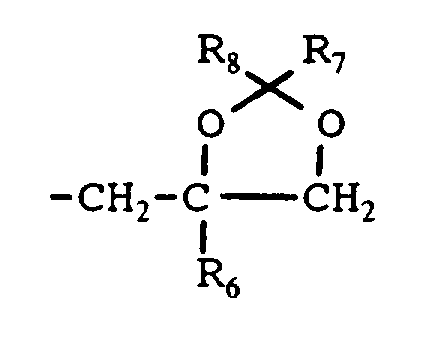
- In certain preferred embodiments:
- (a) A₁ is a nonionic metallophthalocyanine chromophore which can be substituted with 1-8 substitutents selected from halogen, alkyl, alkoxy, alkylthio, or aryloxy; Y is a poly(oxyalkylene) moiety comprised of more than three numeric units or mixture thereof of the formula (-RO-) wherein, each R is straight or branched alkylene of 2-4 carbons or mixtures thereof, up to about 20 mole percent of said monomeric units may be connected by one or more linking groups selected from alkyleneoxy, aryleneoxy, alkylenedioxy, alkylenetrioxy, -N(R₃)-, or -N(R₂)CON(R₂)-, wherein each R₃ is selected from R₂ or -SO₂-A₁, and wherein Y can be terminated by or contain as branch substituents, 1-3 groups or moieties selected from alkyl, cycloalkyl, acyl, or aryl; wherein any of the above recited hydrocarbon groups, moieties or substituents may themselves be substituted, for example, with up to four substituents selected from alkyl, halogen, mercapto, alkylthio, arylthio, aryl, cycloalkyl, alkoxycarbonyl, hydroxy, alkoxy, alkylenedioxy, -N(R₂)CO(R₂)(R₂), -N(R₂) (R₂), -N(R₂)SO₂-A₁,-N(R₂)acyl or acyloxy substituents which are known in the art; and wherein each aliphatic hydrocarbon portion or moiety of the groups, moieties or substituents recited above contains from 1-12, preferably 1-4 carbons;
- (b) A₂ is a nonionic metallophthalocyanine chromophore which can be substituted with 1-12 substitutents selected from halogen, alkyl, alkoxy, alkylthio, or aryloxy, or one to four -SO₂N(R₂)-Y; Y is a poly(oxyalkylene) moiety comprised of more than three monomeric units or mixture thereof of the formula (-RO-) wherein, each R is straight or branched alkylene of 2-4 carbons or mixtures thereof, up to about 20 mole percent of said monomeric units may be connected by one or more linking groups selected from alkyleneoxy, aryleneoxy, alkylenediaxy, alkylenetrioxy, -N(R₅)- , or -N(R₂)CON(R₂)-, wherein each R₅ is selected from R₂ or -SO₂-A₂, and wherein Y can be terminated by or contain as branch substituents, 1-3 groups or moieties selected from alkyl, cycloalkyl, acyl, or aryl; wherein any of the above recited hydrocarbon groups, moieties or substituents may themselves be substituted, for example, may contain up to four substituents selected from alkyl, halogen, alkoxycarbonyl, hydroxy, alkoxy, alkylenedioxy, aryloxy, alkoxyalkyl, aryloxyalkyl, mercapto, alkylthio, arylthio, -N(R₂)CO(R₂)(R₂), -N(R₂)(R₂), -N(R₂)SO₂-A₂, -N(R₂)-acyl, -CON(R₂)(R₂), acyloxy or the like substituents which are known in the art; and wherein each aliphatic hydrocarbon portion or moiety of the groups, moieties or substituents recited above contains from 1-20, preferably 1-12 carbons;
- (c) A₃ is a nonionic metallophthalocyanine chromophore which can be substituted with 1-12 substitutents selected from halogen, alkyl, alkoxy, alkylthio, or aryloxy; Y is a poly(oxyalkylene) moiety comprised of more than three monomeric units or mixture thereof of the formula (-RO-) wherein, each R is straight or branched alkylene of 2-4 carbons or mixtures thereof, up to about 20 mole percent of said monomeric units may be connected by one or more linking groups selected from alkyleneoxy, aryleneoxy, alkylenedioxy, alkylenetrioxy, -N(R₅)-, or -N(R₂)CON(R₂)-, wherein each R₅ is selected from R₂ or SO₂-A₃, and wherein Y can be terminated by or contain as branch substituents, 1-3 groups or moieties selected from alkyl, cycloalkyl, acyl, or aryl; wherein any of the above recited hydrocarbon groups, moieties or substituents may themselves be substituted, for example, may contain up to four substituents selected from alkyl, aryl, aryloxy, alkoxyalkyl, aryloxyalkyl, halogen, alkoxycarbonyl, hydroxy, alkoxy, alkylenedioxy, -CON(R₂)(R₂), -N(R₂)CON(R₂)(R₂)-, -N(R₂)(R₂), -N(R₂)SO₂-A₃, -N(R₂)acyl, acyloxy or the like substituents which are known in the art; and wherein each aliphatic hydrocarbon portion or moiety of the groups, moieties or substituents recited above contains from 1-12 carbons;
- (d) Y has an average molecular weight of from about 200 to about 1500;
- (e) each of the chromophores A₁, A₂, or A₃ is unsubstituted;
- (f) Y is terminated with a group selected from alkyl, aryl, acyl, alkoxyalkyl, acyloxyalkyl, or a group of the formula

- (g) the total mole percentage of all -(RO)- unit linking groups relative to all said units in Y is from zero to about 20 percent;
- (h) R₂ is hydrogen or Y;
- (i) R is -CH₂CH₂-, -CH(CH₃)CH₂-, -CH(C₂H₅)CH₂- or mixtures thereof;
- (j) the chromophore is an unsubstituted phthalocyanine complexed with of Cu, Ni, or Al;
- (k) the polymeric or resinous material composition contains from about 0.001 to about 10.0 weight percent of one or a mixture of any of the colorants as defined above;
- (l) the material is thermoplastic;
- (m) the material is polyurethane;
- (n) -D-Z- is selected from -O-arylene-, -S-arylene, -SO₂-arylene-, -N(R₃)-arylene-, -N(SO₂R₄)-arylene-, or -O-alkylene-O-arylene- or a covalent bond;
- (o) the process for preparing the colorant comprising reacting at a temperature of from about 0°C to about 100°C, a metallophthalocyanine of the formula A₁-(SO₂X)1-4, with at least a stoichiometric quantity of an amine of the formula HN(R₂)Y wherein X is selected from Cl, F, Br, I, or alkoxy.
- (p) the process for preparing the colorant comprising reacting at a temperature of from about 0°C to about 100°C, metallophthalocyanine of the formula; A₂-(D-Z-SO₂X)₁₋₁₆ with at least a stoichiometric quantity of an amine of the formula; HN(R₂)Y wherein X is selected from Cl, F, Br, I, or alkoxy; and
- (q) the process for preparing the colorant comprising reacting at a temperature of from about 0°C to about 100°C, a metallophthalocyanine of the formula A₃-(D-Z-SO₂X)₁₋₁₆ with at least a stoichiometric quantity of an amine of the formula

- With reference to (o) above, the phthalocyanine chromophore can be provided with one to four -SO₂X groups, each of which can be reacted with a reactive amine group HN(R₂)- which can be on the same or different ones of the poly(oxyalkylene) moieties Y. In this regard it is noted that where the Y moiety is large, steric hinderance is less likely to interfere with the reaction of multiple HN(R₂)-groups spaced thereon with multiple SO₂X groups on the same phthalocyanine chromophore.
- With reference to (p) and (q) above, the phthalocyanine chromophore can be provided with one to sixteen -D-Z-SO₂X groups, each of which can be reacted with the reactive amine group HN(R₂)- which can be chemically associated with the same or different ones of poly(oxyalkylene) moieties Y. In this regard it is noted that where the Y moiety is large, steric hinderance is less likely to interfere with the reaction of multiple HN(R₂)-groups spaced thereon with multiple -SO₂X groups on the same phthalocyanine chromophore. In the above processes of (o), (p), and (q), preferred reaction media include water, ketones, alcohols or ethers containing acid acceptors such as alkali metal carbonates, hydroxides or tertiary amines. The arylene moiety Z includes mono- and multi-cyclic aromatic hydrocarbon moieties such as unsubstituted or substituted benzene, naphthalene, anthracene, and biphenyl; of various heterocyclic moieties, unsubstituted or substituted, such as that of thiophene, benzothiazole, benzoxazole,thiadiazole, or quinoline, and various combinations of such carbocyclic and heterocyclic moieties. Specific ones of such Z moieties are given in the tables below. The linking group D preferably is selected from O, S, -O-alkylene-cycloalkylenealkylene-Q-, -O-alkylene-Q-, -O-cycloalkylene-Q-, or -O-alkylene-arylene-alkylene-O- wherein Q is selected from -O-, -S-, -SO₂, N(R₃)-, or N(SO₂R₄)-.
- Thermoplastic resins which may be used according to the present invention include a wide range of synthetic resins and synthetic resin compositions which are known in the art as being essentially thermoplastic in nature. The term "thermoplastic" is used herein in its conventional sense to mean a resin "having the property of softening or fusing when heated and of hardening again when cooled" (see Webster's Seventh Collegiate Dictionary, G & C Merriam Co., 1965). Thermoplastic resins are to be clearly distinguished both in terms of their essential physical and chemical characteristics from thermosetting resins. The term "thermosetting" used herein is also used in its conventional sense to means a resin "having the property of becoming permanently rigid when heated or cured.
- Examples of thermoplastic resin systems which may be employed include a wide range of polyolefin polymers, e.g., polyethylene, linear low density polyethylene, polyproplene, polybutylene and copolymers made from ethylene, propylene and/or butylene. Other thermoplastic polymers which may be employed according to the present invention include polyvinyl chloride, polyvinylidene chloride, cellulosic resins such as cellulose acetate, cellulose acetate butyrate and cellulose acetate propionate, acrylic resins such as polymethyl methacrylate, styrene acrylonitrile, polystyrene, polycarbonate and acrylonitrile butadiene-styrene (therein ABS), polyamides such as nylon 6 and nylon 66 and polyesters such as polyethylene terephthalate, especially glycol modified polyethylene terephthalate and polybutylene terephthalate.
- As mentioned above, the colorants may be employed in the thermoplastic resins in a minor amount sufficient to provide the desired degree of coloration in the resin. The actual amount used will, in addition to the desired depth of shade, depend upon the tinctorial strength of the chromophore used and the overall molecular weight of the colorant, e.g., chromophore plus poly(oxyalkylene) chain length. Typically the amount of colorant employed may be from about 0.0001 percent to about 10 percent, preferably from about 0.001 Percent to about 3 percent, and most preferably from about 0.1 to about 1.0 percent by weight based upon the overall weight of the resin composition.
- Other conventional additives may also be present in the resin compositions of the present invention. For instance, such additives may include plasticizers, antioxidants, stabilizers, lubricants, flame retardants, nucleating agents and other additives which will be readily identified by those skilled in the art. In general, the colorants have been observed to have little or no adverse interactions with these conventional additives.
- Because the colorants if used properly ordinarily do not detract from the clarity of the resin, it has been found that additives which improve the clarity of such resins may be particularly desirable for use in combination with colorants as described herein to provide resin products that are both colored and which also have excellent clarity. One particular class of additives which have been found to be useful in this regard are the benzylidene sorbitols including substituted benzylidene sorbitols such as those described in U.S. Pat. No. 4,018,118 to Hamada, et al. (E.C. Chemical); U.S. Pat. No. 4,371,645 to Mahaffey (Milliken Research Corporation); and Japanese Pat. No. SHO [1977] 53-117044 to Kobsyashi, et al. (New Japan Chemical).
- The particular shade of the colorant will depend primarily upon the particular chromophore group selected. A large variety of colors and shades may be obtained by blending two or more colorants. Blending the colorants of the present invention can be readily accomplished as the colorants are polymeric materials which may have substantially identical solubility characteristics, which are dictated by the nature of the polymeric chain. Therefore, the colorants are in general soluble in one another, and are also in general completely compatible with each other.
- According to the process of the invention, the colorant may be incorporated into the thermoplastic resin using conventional techniques such as those employed to incorporate other additives in such resins. For instance, the colorant may be incorporated into the resin by simply adding it to the resin while the resin is in a plasticized or molten state, typically prior to formation of the polymer into its final shape, e.g., by molding, extrusion or blow-molding. For instance when the thermoplastic resin to be colored is a polyolefin resin the process may be carried out by adding a colorant comprised of a poly(oxyalkylene) substituted chromophore group directly to the molten polymer, by tumbling it onto a pre-extruded pelletized resin, or by mixing it into the resin powder prior to extrusion. The polymer may then be molded or extruded in the usual manner, i.e., in the same way as for polyolefin resins which are not colored. Details about these procedures may be found in the relevant literature.
- Alternatively, a concentrate of the colorant in an appropriate resin or vehicle may first be prepared. Such concentrate may contain an appropriately high percentage of colorant. The concentrates may be in the form of liquids, solids, e.g., powders or pellets, as may be desired. These concentrates may then be incorporated into the thermoplastic resin as is well understood in the art.
- The colorants used in the process and in the composition of the present invention are polymeric colorants which may according to one embodiment be in the liquid phase. Thus, if in the liquid phase, they may be added to the thermoplastic polymer melt in solvent-free form rather than in the form of solutions or dispersions in a suitable solvent or dispersing medium. Obviously, liquids may have certain processing advantages over solids, and moreover liquids may, if desired, be added directly to the molten polymer and therefore contain no extraneous solvent or dispersing agents. This process may, therefore, provide unusual and advantageous properties in the final thermoplastic resin product. Alternatively, however, the colorants may be premixed with minor amounts of a solvent or dispersing agent which is compatible with the resin, thus providing certain processing advantages.
- According to the process of the invention, the liquid colorant may be incorporated into the thermosetting resins by simply adding it to the reaction mixture or to one of the components of the reaction mixture before or during the poly addition reaction. For instance, when the thermosetting resin to be colored is a polyurethane resin the process may be carried out by adding the coloring agent in the form of a liquid to the polyol or even in some instances to the polyisocyanate component of the reaction mixture with before or during polyurethane formation. The subsequent reaction may be carried out in the usual manner, i.e., in the same way as for polyurethane resins which are not colored. Details about this procedure may be found in the relevant literature.
- The present coloring agents of one embodiment of the present invention are polymeric, liquid, reactive coloring agents. Thus, they may be added to the reaction mixture or to one of the components thereof in solvent-free form rather than in the form of solutions or dispersions in suitable solvent or dispersing medium. Obviously liquids have significant processing advantages over solids, and moreover liquids of the present invention may, if desired, be added directly to the reaction mixture and therefore contain no extraneous nonreactive solvent or dispersing agent. This process may, therefore, provide unusual and advantageous properties in the final thermoset resin product. Alternatively, however, the coloring agent may be premixed with minor amounts of one or more of the precursors of the polymeric product, thus providing certain processing advantages.
- The thermosetting resins to which the process of the present invention may be applied may be made by the reaction of a nucleophile with an electrophile. Examples of such resins include alkyds, allylics, the amines, e.g., melamine and urea, epoxies, phenolics, polyesters, silicones and urethanes. The thermosetting resin colored according to the present invention can be used in a variety of different end uses, e.g., as moldings, sealants, elastomers, films, fibers, lacquers, coating and foamed materials. It has been found in particular that the present colorants may quite advantageously be employed for the production of foams, such as polyurethane foams which may be soft, semi-rigid or rigid foams, or the so-called polyurethane integral skin and microcellular foams. Such foams are useful for producing shaped products by injection molding, extrusion or calendaring and may be obtained by adding the liquid coloring agent to the polyol or diol component of the reaction mixture, or to one of the other components, although addition to the polyol component is preferred. The polyols may be polyesters which contain hydroxyl groups, in particular reaction products of dihydric alcohols and dibasic carboxylic acids, or polyethers which contain hydroxyl groups, in particular products of the addition of ethylene oxide, propylene oxide, styrene oxide or epichlorohydrin to water, alcohols or amines, preferably dialcohols. The colorant may also be admixed with chain extending diols, e.g., ethylene glycol, diethylene glycol and butane diol. In general, it is desirable not to use more than about 20 percent by weight of colorant based on the weight of polyol. In most cases very strong colorations are produced with a small proportion of the colorant, for example, from about 0.1 to about 2 percent, preferably 0.5 to 1 percent by weight colorant based on the weight of polyol.
- Because the present colorants are, in themselves, polymeric compounds, they may be soluble, for instance, in most polyols which would be used in polyurethane manufacture, in most epoxy formulations, in polyester formulations and themselves in admixtures. This property may be particularly valuable in that this solubility may permit rapid mixing and homogeneous distribution throughout the resin, thus eliminating shading differences and streaks when properly mixed, the colorant may have no tendency to settle as would be the case with pigment dispersions, and it is possible to prepare a blend of two or more colorants which provides a wide range of color availability. The present liquid reactive coloring agents may also be of considerable value in reaction injection molding (RIM) applications. The RIM process is a method of producing molded polyurethanes and other polymers wherein the two reactive streams are mixed while being poured into a mold. Upon reaction, the polymer is "blown" by chemicals to produce a foam structure. This process may be hindered by the presence of solid particles, such as conventional pigments. The present invention may not cause this hindrance because there are no particles in the system and the colorant becomes part of the polymer through reaction with one of the components.
- General methods for preparing the colorants wherein each A is an unsubstituted or substituted phthalocyanine moiety include the following three routes:


- Route 1 involves the condensation of metallophthalocyanine sulfonyl chloride (I) with at least a stoichiometric quantity of poly(oxyalkylene) containing amines (II) or (III) in the presence of an inorganic base at a temperature of from about 0°C to about 100°C to give the desired phthalocyanine containing polyalkyleneoxy moiety Y. Reaction media include water, alcohols or ethers containing acid acceptors such as alkali metal carbonates, hydroxides or tertiary amines.
- Route 2 involves the reaction of a phthalonitrile moiety containing a leaving group B(IV), such as nitro or halogen, with a nucleophile (V)[A.W.Snow & J.R.Griffth, Marcomolecules, 17(1614-1624)]. This reaction is preferably carried out in polar high-boiling solvents such as N,N-dimethylformamide and N-mexhyl-2-pyrrolidinone. Intermediates (VI) are converted into metallophthalocyanines (VII) by known techniques using metals ions. Intermediates (VII) are then chlorosulfonated using excess chlorosulfonic acid at about 0-30°C to introduce chlorosulfonyl groups into the Z ring of (VII). If chlorosulfonation is desired also on the phthalocyanine ring itself, higher temperatures may be employed. Compounds (VIII) are then reacted with amines (II) or (III) to give the desired phthalocyanine containing polyalkyleneoxy moiety Y.
- Route 3 involves the reaction of a metallophthalocyanine containing 1-16 halogens (x) with nucleophile (V) to give (XI), a metallophthalocyanine moiety which contains 1 to 16 groups of the formula -D-Z-H [BASF, BP 1,537,375]. This nucleophilic displacement reaction is preferably carried out in at a high temperature in a polar high-boiling solvent such as N,N-dimethylformamide, N,N-dimethylacetamide, or N-methyl-2-pyrrolidinone. Chlorosulfonation at low temperature gives compounds (XII), which may contain a multiplicity of -D-Z-SO₂Cl groups. Compounds (X11) are then reacted with amines (II) or (III) to give the sulfonamide derivatives (IX) and (XIII), of the invention.
- Obviously, many variations of the above reactions are possible. For example, in Route 2, intermediate (VI) may be mixed with unsubstituted or substituted phthalonitriles containing a wide variety of substituents such as halogen, lower alkyl, lower alkoxy, alkylthio, arylthio, etc. and the mixture treated with metal ions to give metallophthalocyanines containing a wide variety of substituents. These intermediates may be chlorosulfonated and the corresponding sulfonyl chlorides reacted with amines (II) or (III) to give highly substituted metallophthalocyanines containing the polyalkyleneoxy moiety Y.
- The preferred aromatic amines (II) finding special utility in the manufacture of the preferred colorants of the present invention are prepared according to Routes 1-6.

- Route 1 involves the hydroxyalkylation of a nitrophenol (I) with an alkylene oxide in the presence of a base catalyst. Suitable alkylene oxides include, for example, ethylene oxide, propylene oxide, butylene oxide, and mixtures of two or more of such compounds.
- The hydroxyalkylation reaction may be accomplished by the reaction of alkylene oxide at about 80-150°C. The alkylene oxide is added in the presence of an inert gas such as nitrogen until the desired amount of alkylene oxide has been absorbed. This reaction is carried out with or without solvents. If solvents are desired, toluene, xylenes, nitrobenzene, dioxane are just a few solvents that may be used.
- Useful base catalysts include potassium hydroxide, lithium hydroxide, calcium hydroxide, and barium hydroxide. The amount of basic catalyst can vary but is usually in the range of from about 0.2 to about 2 percent by weight of the phenol. In addition, certain tertiary organic amines are useful catalysts, such as dimethylaminocyclohexane, triethylamine, and benzyldimethylamine. The poly(oxyalkylated) nitro intermediates (II) are converted into aromatic amines (III) by catalytic hydrogenation. Any suitable reduction catalyst may be used, for example, Raney nickel, nickel oxides, finely divided metals such as iron, cobalt, platinum, ruthenium, osmium, and rhodium. Furthermore, metal catalysts supported on pumice, asbestos, Kieselguhr, alumina, silica gel or charcoal work equally as well. The amount of catalyst can vary from about 0.025 to 15 percent by weight based on the nitro intermediate (II) used.
- Reduction temperatures of from about 20°C to about 90°C are operable although temperatures of 40°C to 90°C are preferred since they usually provide faster reaction times and higher yields of the aromatic amines (III). For the reduction of the nitro intermediates (II), pressures ranging from about 3447 - 12411 kPa (about 500 to about 1800 psi) of hydrogen may be used.
- The reduction reaction is usually carried out in the presence of a suitable solvent such as: lower alcohols, i.e., methyl alcohol, ethyl alcohol, and isopropyl alcohol; ethers such as dioxane; hydrocarbons such as benzene, toluene, xylenes, cyclohexanes, and petroleum ether; and mixtures of lower alcohols and water, i.e., about equal parts by weight of ethyl alcohol and water. The amount of solvent which is preferred ranges from about 30 to about 80 percent by weight of the reaction mixture weight.

- Route 2 involves the hydroxyalkylation of a nitroaniline (IV) with an alkylene oxide in a two-step procedure. The first step can be carried out in tbe presence or absence of an acid catalyst. Suitable alkylene oxides include, for example, ethylene oxide, propylene oxide, butylene oxide, cyclohexane oxide, glycidol, and mixtures of two or more of such compounds.
- In the first step, hydroxyalkylation may be accomplished by the reaction of the alkylene oxide at about 80-150°C. The alkylene oxide is added in the presence of an inert gas such as nitrogen until two or more equivalents of the desired amount of alkylene oxide have been absorbed. This reaction is carried out with or without solvents. If solvents are desired, toluene, xylenes, nitrobenzene, dioxane or the like may be used. Alternatively, an acid catalyst can be employed to effect the hydroxyalkylation such as formic acid or acetic acid. Generally, acid-catalyzed hydroxyalkylation is performed at a lower temperature to avoid the formation of by-products.
- Temperatures from about 40°C to about 120°C can be employed depending on the basicity of the nitroaniline (IV) to be hydroxyalkylated. The amount of acid may vary widely, i.e., from about 0.5 to 10 percent weight of nitroaniline may be employed.
- In the second step, the nitropoly(oxyalkylene) intermediate (V) is prepared by the use of base catalysts such as potassium hydroxide, lithium hydroxide, calcium hydroxide, and barium hydroxide. The amount of basic catalyst can vary but is usually in the range of from about 0.2 to about 2 percent by weight of the nitro reactant. The reaction temperature can vary widely but temperatures in the range from 100°C to about 150°C are preferred.
- The corresponding aromatic amines (VI) are then prepared by conversion of the poly(oxyalkylene) nitro intermediates (V) by catalytic reduction as described in Route 1 above.

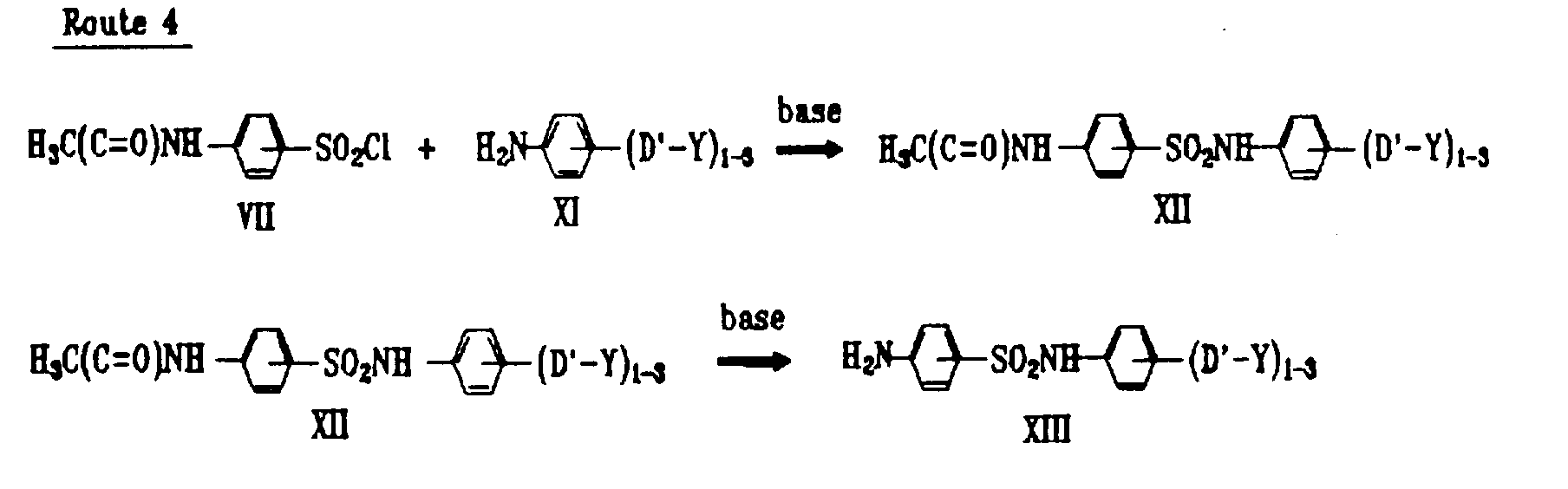
- Commercially available amines (VIII) are the JEFFAMINE series described in Texaco Chemical Company, New Product Development brochures as the M, D, ED, DU, BUD, T, MNPA, and the EDR series, the disclosures of which are incorporated herein by reference and copies of which are transmitted herewith.
- Similarly, Route 4 involves the condensation of an acetamidobenzenesulfonyl chloride intermediate (VII) with at least a stoichiometric quantity of an aromatic poly(oxyalkylene) amine (XI) in the presence of inorganic base at a temperature of from about 0°C to about 100°C to form an acetamidopoly(oxyalkylene) intermediate (XII). Further heating at 80°C to 100°C under strongly basic conditions hydrolyzes the corresponding acetamidopoly(oxyalkylene) intermediate (XII) into the aromatic poly(oxyalkylene) amine (XIII).


- The corresponding aromatic amine (XVI) is then prepared by conversion of the poly(oxyalkylene) nitro intermediate (XV) by catalytic reduction as described in Route 1 above.
- Route 6 involves the condensation of a nitrobenzenesulfonyl chloride intermediate (XIV) with at least a stoichiometric quantity of an aromatic poly(oxyalkylene) amine (XI) in the presence of inorganic base at a temperature of from about 0°C to about 100°C to form a nitropoly(oxyalkylene) intermediate (XVII).
- The corresponding aromatic amine (XVIII) is then prepared by conversion of the poly(oxyalkylene) nitro intermediate (XVII) by catalytic reduction as described in Route 1 above.
- Typical aromatic amines (II) finding special utility in the present invention are included in the following formulae:


- R₉ is hydrogen or 1-3 groups selected from -CH₃, -C₂H₅, -n-C₃H₇, -iso-C₃H₇, -n-C₄H₉, -OCH₃, or -OC₂H₅;
- R₁₀ is alkyl of 1-6 carbons; and
- R₁₁ is hydrogen or R₁₀.
- Commercially available and preferred amines (III) from which the present preferred colorants are prepared are the JEFFAMINE series described in Texaco Chemical Company, New Product Development brochures as the M, D, ED, DU, BUD, T, MNPA: and the EDR series. Typical such amines have the formulae:
(11) R₁₂-O(C₂H₄O)₁₋₁₉[CH₂CH(CH₃)O]₂₋₃₁CH₂CH(CH₃)NH₂ ;




(16) H₂NCH(CH₃)CH₂[OCH(CH₃)CH₂]a(OCH₂CH₂)b[OCH₂CH(CH₃)]cNH₂ ;

(18) HOCH(CH₃)CH₂NHCH(CH₃)CH₂[OCH₂CH(CH₃)]2.6NHCH₂CH(CH₃)OH ;

- The following examples illustrate preparation of the present colorants, the parts and percentages, unless otherwise stated being by weight. The abbreviations EO, PO, BO refer to -OC₂H₄-, -OCH(CH₃)CH₂-, and -OCH(C₂H₅)CH₂-, respectively.
-

- A mixture is prepared by adding 142.7 grams (0.26 mole) of an aromatic primary amine with an amine equivalent weight of 1.82 meq/g) to 31.4 grams of sodium carbonate(0.30 mole) in 250 grams of water. The mixture is stirred mechanically and cooled to 10-15°C, and 259 grams (0.105 mole) of a 33% active aqueous wet cake of freshly prepared copper phthalocyaninesulfonyl chloride derivative (containing an average of about 2 chlorosulfonyl groups per molecule) are added to the mixture over one and a half hours.After the addition is complete, the mixture is warmed to 50°C for an additional two hours to insure complete reaction. Afterwards, the mixture is cooled and the product is extracted into methylene chloride. The methylene chloride solution is separated from the salt water solution, washed several times with water to neutral pH, and dried over anhydrous magnesium sulfate. The dried methylene chloride solution is filtered and stripped under reduced pressure at 90°C to give a blue liquid with an absorbance maximum at 668 nm.
-

- In a 2000 milliter autoclave are charged 579 grams (1 mole) of 4-nitrophenoxypoly(oxyalkylene) intermediate, 1200 milliters of ethyl alcohol and 93 grams of wet Raney nickel catalyst. The autoclave is then purged three times with hydrogen gas and heated to 85-90°C at a pressure of about 1300 psi. After about two hours the hydrogen uptake ceases. A sample is removed and vacuum stripped of solvent. The IR spectrum of this sample shows no nitro bands and the presence of an amine band indicating that the reaction is complete. The autoclave is cooled and vented. The liquid product is isolated by filtering the reaction mixture and stripping away the solvent under reduced pressure.
-

- One hundred thirty grams (1 mole) of p-nitrophenol, 3 grams of potassium hydroxide catalyst, and 350 milliters of methylisobutyl ketone are charged into a two-liter pressure reactor. The mixture is stripped at 93°C for 15 minutes, then purged with nitrogen to 5 psi. The mixture is heated to 120°C and 44 grams (1 mole) ethylene oxide are added. After 90 minutes at 120°C, 396 grams (9 moles) ethylene oxide are then added to the reactor. After 5 hours hold time, the contents of the reactor are stripped of all volatiles under reduced pressure at 110°C for 45 minutes to give a liquid intermediate.
-

- A mixture is prepared by adding 188 grams (0.19 moles) of an aromatic primary amine with an amine equivalent weight of 1.01 meq/g) to 24.0 grams (0.23 moles) sodium carbonate in 400 ml of THF. The mixture is cooled to 10-15°C and 100 grams (0.061mole) of a 50% active aqueous wet cake of freshly prepared copper phthalocyanine-sulfonyl chloride derivative (containing an average of about 2 chlorosulfonyl groups per molecule) are added to the mixture over one and a half hours. After the addition is complete, the mixture in warmed to 50°C for an additional two hours to insure complete reaction. Afterwards, the mixture is cooled and the product is extracted into methylen chloride. The corresponding methylene chloride/THF solution is separated from the salt water solution. The THF solution is allowed to evaporate in a fume hood, 300 ml of methylene chloride are added followed by 300 ml of water. The methylene chloride solution is separated from the salt water solution, further washed several times with water to neutral pH, and dried over anhydrous magnesium sulfate. The dried solution is filtered and stripped under reduced pressure at 90°C to obtain a blue liquid with an absorbance maximum at 667 nm.
-

- In a 2000 milliter autoclave are charged 1018 grams (1 mole) of 3-nitroanilino-poly(ozyalkylene) intermediate, 600 milliters of ethyl alcohol and 130 grams of wet Raney nickel catalyst. The autoclave is then purged three times with hydrogen gas and heated to 85-90°C at a pressure of about 8963 kPa (1300 psi). After about two hours the hydrogen uptake ceases. A sample is removed and vacuum stripped of solvent. The IR spectrum of this sample shows no nitro bands and the presence of an amine band indicating that the reaction is complete. The autoclave is cooled and vented. The liquid product is isolated by filtering the reaction mixture and stripping away the solvent under reduced pressure.
-

-

- Four hundred eighty three grams (3.5 moles) of m-nitroaniline, 173 grams of acetic acid, and 578 grams of water are charged into a one-gallon pressure reactor. The mixture is purged with nitrogen to 34.5 kPa (5 psi) and heated to 35°C. Three hundred eight grams (7 moles) of ethylene oxide are added over several hours and the reaction mixture in heated overnight at 35°C. The dihydroxyethylnitroaniline intermediate is isolated by quenching the mixture in ice water. The resulting solid is reslurried several times with water and then finally with dilute base until neutral. The resulting solid product is vacuum dried at 40°C.
-

- A mixture is prepared by adding 174 grams (0.19 mole) of an aromatic primary amine with an amine equivalent weight of 1.09 meq/g) to 24.0 grams (0.23 mole) sodium carbonate in 400 ml of THF. The mixture is cooled to 10-15°C and 100 grams (0.061 mole) of a 50% active aqueous wet cake of freshly prepared copper phthalocyanine-sulfonyl chloride derivative (containing an average of about 2 chlorosulfonyl groups per molecule) are added to the mixture over one and a half hours. After the addition is complete, the mixture is warmed to 50°C for an additional two hours to insure complete reaction. Afterwards, the mixture is cooled and the product is extracted into methylene chloride. The corresponding methylene chloride/THF solution is separated from the salt water solution. The THF solution is allowed to evaporate in a fume hood, 300 ml of methylene chloride are added followed by 300 ml of water. The methylene chloride solution is separated from the salt water solution, further washed several times with water to neutral pH, and dried over anhydrous magnesium sulfate. The dried solution is filtered and stripped under reduced pressure at 90°C to a blue liquid with an absorbance maximum at 664 nm.
-

- A mixture is prepared by adding 715 grams (1 mole) of a primary amine with an amine equivalent weight of 1.40 meq/g) to 122 grams (1.2 moles) sodium carbonate in 250 ml of THF. The mixture is cooled to 10-15°C and 233 grams (1 mole) of 4-acetamidobenzene sulfonyl chloride are added to the mixture over one half hour. After the addition is complete, the mixture is warmed to 30°C for an additional two hours to insure complete reaction. Forty grams (1 mole) of sodium hydroxide are added to the mixture and the mixture is heated to reflux one hour. Afterwards, the mixture was cooled and the product is extracted into methylene chloride. The corresponding methylene chloride solution is separated from the salt water solution. The methylene chloride solution is separated from the salt water solution, further washed several times with water to neutral pH, and dried over anhydrous magnesium sulfate. The dried solution is filtered and stripped under reduced pressure at 90°C to a liquid intermediate.
-

- A mixture is prepared by adding 98.4 grams (0.19 mole) of an aromatic primary amine with an amine equivalent weight of 1.93 meq/g to 24.0 grams (0.23 mole) sodium carbonate in 400 ml of THF. The mixture is cooled to 10-15°C and 100 grams (0.061 mole) of a 50% active aqueous wet cake of freshly prepared copper phthalocyaninesulfonyl chloride derivative (containing an average of about 2 chlorosulfonyl groups per molecule) are added to the mixture over one and a half hours. After the addition is complete, the mixture is warmed to 50°C for an additional two hours to insure complete reaction. Afterwards, the mixture is cooled and the product is extracted into methylene chloride. The corresponding methylene chloride/THF solution is separated from the salt water solution. The THF solution is allowed to evaporate in a fume hood, 300 ml of methylene chloride are added followed by 300 ml of water. The methylene chloride solution is separated from the salt water solution, further washed several times with water to neutral pH, and dried over anhydrous magnesium sulfate The dried solution is filtered and stripped under reduced pressure at 90°C to a blue liquid with an absorbance maximum at 664 nm.
-

- Fifty grams (0.0302 mole) of the acetal prepared in Example 11 are added along with 100 ml of water to a three necked 250 ml flask equipped with overhead stirrer, heating mantle, and Dean-Stark trap. The mixture is heated to 80°C and 2 grams of 70% sulfuric acid are added. This reaction mixture is maintained at 80°C until no more acetone can be detected overhead in the trap. The mixture is then cooled and the product is extracted into methylene chloride. The methylene chloride solution is separated, washed several times with water to neutral pH, and dried over anhydrous magnesium sulfate. The dried methylene chloride solution is filtered and stripped under reduced pressure at 90°C to give a blue product containing a hydroxyl band in the IR spectrum.
-

- A mixture is prepared by adding 60.3 grams (0.11 mole) of an aromatic primary amine with an amine equivalent weight of 1.82 meq/g) to 25.7 grams sodium carbonate in 500 ml of water. The mixture is cooled to 10-15°C and 0.0242 mole of an aqueous wet cake of freshly prepared tetraphenoxy copper phthalocyanine sulfonyl chloride derivative (containing an average of about four chlorosulfonyl groups per molecule) is added to the mixture. After the addition is complete, the mixture was warmed to 50°C for an additional two hours to insure complete reaction. Three hundred ml of methylene chloride are added followed by 300 ml of water. The methylene chloride solution is separated from the salt water solution, further washed several times with water to neutral pH, and dried over anhydrous magnesium sulfate. The dried solution is filtered and stripped under reduced pressure at 90°C to give a blue liquid.
-
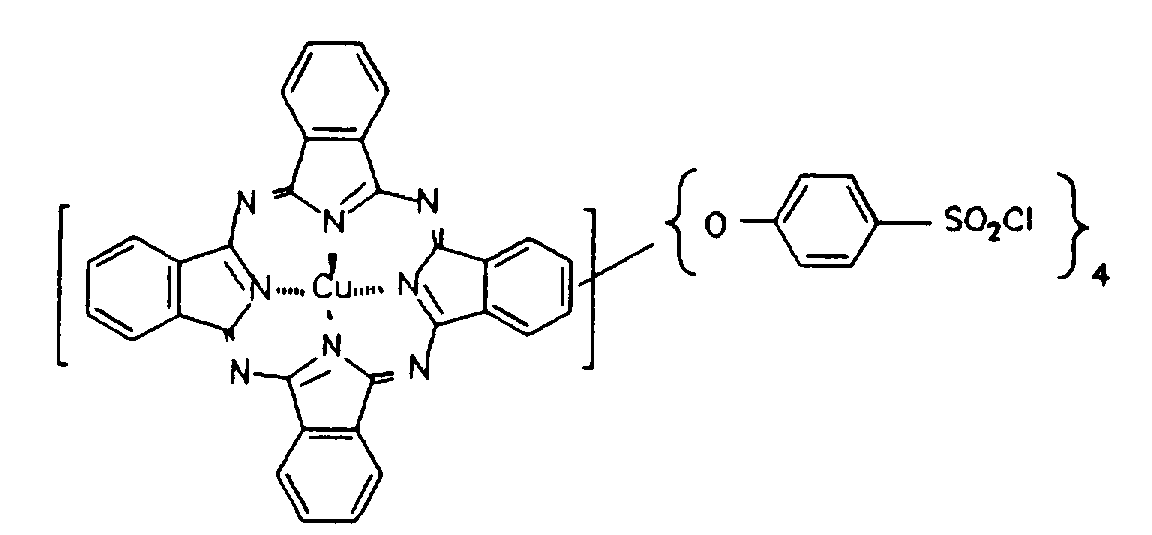
- Thirty one grams (0.03 mole) of copper tetraphenoxyphthalocyanine are dissolved at less than 0°C in 263 grams of chlorosulfuric acid. The cooling bath is removed and the solution is allowed to warm to room temperature over two hours. The solution is further heated to 30°C for about two hours after which the heat is removed and the solution is allowed to stir overnight at room temperature. The solution is then poured very gradually into a stirred mixture of water and ice. The dull blue supsenion is filtered and washed with ice water several times.
-

-

-

- A mixture is prepared by adding 80.7 grams (0.11 mole) of a primary amine with an amine equivalent weight of 1.35 meq/g) to 25.7 grams sodium carbonate in 500 ml of water. The mixture is cooled to 10-15°C and 0.0242 mole of an aqueous wet cake of freshly prepared tetraphenoxy copper phthalocyaninesulfonyl chloride derivative from Comparative Example 4 (containing an average of about four chlorosulfonyl groups per molecule) is added to the mixture. After the addition is complete, the mixture is warmed to 50°C for an additional two hours to insure complete reaction. Three hundred ml of methylene chloride is added followed by 300 ml of water. The methylene chloride solution is separated from the salt water solution, further washed several times with water to neutral pH, and dried over anhydrous magnesium sulfate. The dried solution is filtered and stripped under reduced pressure at 90°C to give a blue liquid with maximum absorbance at 617 nm.
-

- A mixture is prepared by adding 241.4 grams (0.275 mole) of a primary amine with an amine equivalent weight of 2.70 meq/g) to 64.7 grams sodium carbonate in 400 ml of THF. The mixture is cooled to 10-15°C and 0.061 mole of an aqueous wet cake of freshly prepared tetraphenoxy copper phthalocyaninesulfonyl chloride derivative from Comparative Example 4 (containing an average of about four chlorosulfonyl groups per molecule) is added to the mixture. After the addition was complete, the mixture is warmed to 50°C for an additional two hours to insure complete reaction. Three hundred ml of methylene chloride is added followed by 300 ml of water. The methylene chloride solution is separated from the salt water solution, further washed several times with water to neutral pH, and dried over anhydrous magnesium sulfate. The dried solution is filtered and stripped under reduced pressure at 90°C to give a blue liquid with maximum absorbance at 617 nm.
-

- One hundred and fifty grams (0.061 mole) of the acetal prepared in Example 4 are added along with 100 ml of water to a three necked 250 ml flask equipped with overhead stirrer, heating mantle, and Dean Stark trap. The mixture is heated to 80°C and 4 grams of 70% sulfuric acid are added. This reaction mixture is maintained at 80°C until no more acetone could be detected overhead in the trap. The mixture is then cooled and the product is extracted into methylene chloride. The methylene chloride solution is separated, washed several times with water to neutral pH, and dried over anhydrous magnesium sulfate. The dried methylene chloride solution is filtered and stripped under reduced pressure at 90°C to give a blue product containing a hydroxyl band in the IR spectrum.
-

- A mixture is prepared by adding 142.5 grams (0.275 mole) of an aromatic primary amine with an amine equivalent weight of 1.93 meq/g to 64.7 grams sodium carbonate in 400 ml of THF. The mixture is cooled to 10-15°C and 0.061 mole of an aqueous wet cake of freshly prepared tetraphenoxy copper phthalocyanine. sulfonyl chloride derivative from Example #6 (containing an average of about four chlorosulfonyl groups per molecule) is added to the mixture. After the additions is complete, the mixture is warmed to 50°C for an additional two--hours to insure complete reaction. Three hundred milliters of methylene chloride are added followed by 300 ml of water. The methylene chloride solution is separated from the salt water solution, further washed several times with water to neutral pH, and dried over anhydrous magnesium sulfate. The dried solution is filtered and stripped under reduced pressure at 90°C to give a blue liquid.
-

- One hundred and eighty grams (0.061 mole) of the acetal prepared in Example 5 are added along with 100 ml of water to a three-necked 250 ml flask equipped with overhead stirrer, heating mantle, and Dean-Stark trap. The mixture is heated to 80°C and 4 grams of 70% sulfuric acid are added. This reaction mixture is maintained at 80°C until no more acetone can be detected overhead in the trap. The mixture is then cooled and the product is extracted into methylene chloride. The methylene chloride solution is separated, washed several times with water to neutral pH, and dried over anhydrous magnesium sulfate. The dried methylene chloride solution is filtered and stripped under reduced pressure at 90°C to give a blue product containing a hydroxyl band in the IR spectrum.
-

- A mixture is prepared by adding 177.8 grams (0.18 mole) of an aromatic primary amine with an amine equivalent weight of 1.01 meq/g) to 42.4 grams sodium carbonate in 400 ml of THF. The mixture is cooled to 10-15°C and 0.040 mole of an aqueous wet cake of freshly prepared tetraphenoxy cobalt phthalocyanine sulfonyl chloride derivative (containing an average of about four chlorosulfonyl groups per molecule) is added to the mixture. After the addition is complete, the mixture is waned to 50°C for an additional two hours to insure complete reaction. Three hundred milliters of methylene chloride are added followed by 300 ml of water. The methylene chloride solution is separated from the salt water solution, further washed several times with water to neutral pH, and dried over anhydrous magnesium sulfate. The dried solution is filtered and stripped under reduced pressure at 90°C to give a blue colorant.
-

- Thirty-one grams (0.03 mole) of cobalt tetraphenoxyphthalocyanine are dissolved at less than 0°C in 260 grams of chlorosulfuric acid. The cooling bath is removed and the solution is allowed to warm to room temperature over two hours. The solution is further heated to 30°C for about two hours after which the heat is removed and the solution is allowed to stir overnight at room temperature. The solution is then poured very gradually into a stirred mixture of water and ice. The dull blue supsenion is filtered and washed with ice water several times.
-

-

- A mixture was prepared by adding 133.2 grams (0.18 mole) of a primary amine with an amine equivalent weight of 1.35 meq/g) to 42.4 grams sodium carbonate in 400 ml of THF. The mixture was cooled to 10-15°C and 0.040 mole of an aqueous wet cake of freshly prepared tetraphenoxy cobalt phthalocyanine sulfonyl chloride derivative from comparitive Example 7 (containing an average about four chlorosulfonyl groups per molecule) was added to the mixture. After the addition was complete, the mixture was warmed to 50°C for an additional two hours to insure complete reaction. Three hundred ml of methylene chloride was added followed by 300 ml of water. The methylene chloride solution was separated from the salt water solution, further washed several times with water to neutral pH, and dried over anhydrous magnesium sulfate. The dried solution was filtered and stripped under reduced pressure at 90°C to give a blue colorant.
-

- A mixture is prepared by adding 122.7 grams (0.16 mole) of an aromatic primary amine with an amine equivalent weight of 1.30 meq/g) to 36.2 grams sodium carbonate in 200 ml of THF. The mixture is cooled to 10-15°C and 0.0242 mole of an aqueous wet cake of freshly prepared tetraphenoxy nickel phthalocyanine sulfonyl chloride derivative (containing an average of about four chlorosulfonyl groups per molecule) is added to the mixture. After the addition is complete, the mixture is warmed to 50°C for an additional two hours to insure complete reaction. Three hundred milliters of methylene chloride are added followed by 300 ml of water. The methylene chloride solution is separated from the salt water solution, further washed several times with water to neutral pH, and dried over anhydrous magnesium sulfate. The dried solution is filtered and stripped under reduced pressure at 90°C to give a blue liquid.
-

- Thirty-one grams (0.0344 mole) of nickel tetraphenoxyphthalocyanine are dissolved at less than 0°C in 264 grams of chlorosulfuric acid. The cooling bath is removed and the solution is allowed to warm to room temperature over two hours. The solution is further heated to 30°C for about two hours after which the heat is removed and the solution is allowed to stir overnight at room temperature. The solution is then poured very gradually into a stirred mixture of water and ice. The dull blue supsenion is filtered and washed with ice water several times.
-

-
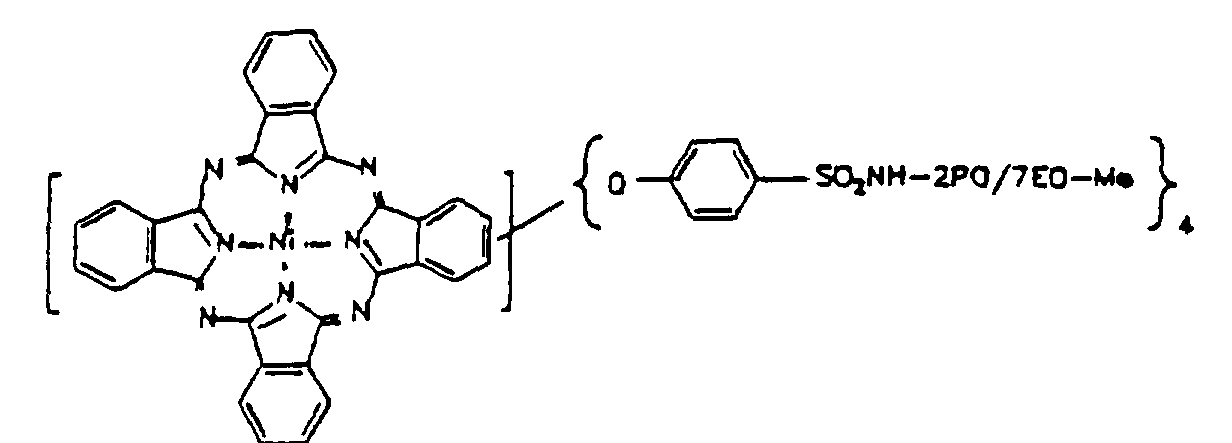
- A mixture is prepared by adding l07.3 grams (0.16 mole) of a primary amine with an amine equivalent weight of 1.43 meq/g) to 36.2 grams sodium carbonate in 200 ml of THF. The mixture is cooled to 10-15°C and 0.0242 mole of an aqueous wet cake of freshly prepared tetraphenoxy nickel phthalocyanine sulfonyl chloride derivative from Example 7 (containing an average of about four chlorosulfonyl groups per molecule) is added to the mixture. After the addition is complete, the mixture in warmed to 50°C for an additional two hours to insure complete reaction. Three hundred ml of methylene chloride is added followed by 300 ml of water. The methylene chloride solution is separated from the salt water solution, further washed several times with water to neutral pH, and dried over anhydrous magnesium sulfate. The dried solution is filtered and stripped under reduced pressure at 90°C to give a blue liquid with maximum absorbance at 618 nm.
-

- A mixture is prepared by adding 74.0 grams (0.135 mole) of an aromatic primary amine with an amine equivalent weight of 1.82 meq/g to 31.8 grams sodium carbonate in 400 ml of water. The mixture is cooled to 10-15°C and 0.030 mole of an aqueous wet cake of freshly prepared tetra-p-methoxyphenoxy copper phthalocyanine sulfonyl chloride derivative (containing an average of about four chlorosulfonyl groups per molecule) is added to the mixture. After the addition is complete, the mixture is warmed to 50°C for an additional two hours to insure complete reaction. Three hundred milliters of methylene chloride are added followed by 300 ml of water. The methylene chloride solution is separated from the salt water solution, further washed several times with water to neutral pH, and dried over anhydrous magnesium sulfate. The dried solution is filtered and stripped under reduced pressure at 90°C to give a blue liquid.
-

- Thirty-five grams (0.03 mole) of copper tetra-p-methoxy-phenoxyphthalocyanine are dissolved at less than 0°C in 263 grams of chlorosulfuric acid. The cooling bath is removed and the solution is allowed to warm to room temperature over two hours. The solution is further heated to 30°C for about two hours after which the heat is removed and the solution is allowed to stir overnight at room temperature. The solution is then poured very gradually into a stirred mixture of water and ice. The dull blue supsenion is filtered and washed with ice water several times.
-

-

-

- A mixture is prepared by adding 100.0 grams (0.135 mole) of a primary amine with an amine equivalent weight of 1.35 meq/g) to 31.8 grams sodium carbonate in 400 ml of water. The mixture is cooled to 10-15°C and 0.030 mole of an aqueous wet cake of freshly prepared tetra-p-methoxyphenoxy copper phthalocyanine sulfonyl chloride derivative from comparitive example 8 (containing an average of about four chlorosulfonyl groups per molecute) is added to the mixture. After the addition is complete, the mixture is warmed to 50°C for an additional two hours to insure complete reaction. Three hundred ml of methylene chloride is added followed by 300 ml of water. The methylene chloride solution is separated from the salt water solution, further washed several times with water to neutral pH, and dried over anhydrous magnesium sulfate. The dried solution is filtered and stripped under reduced pressure at 90°C to give a blue liquid.
-
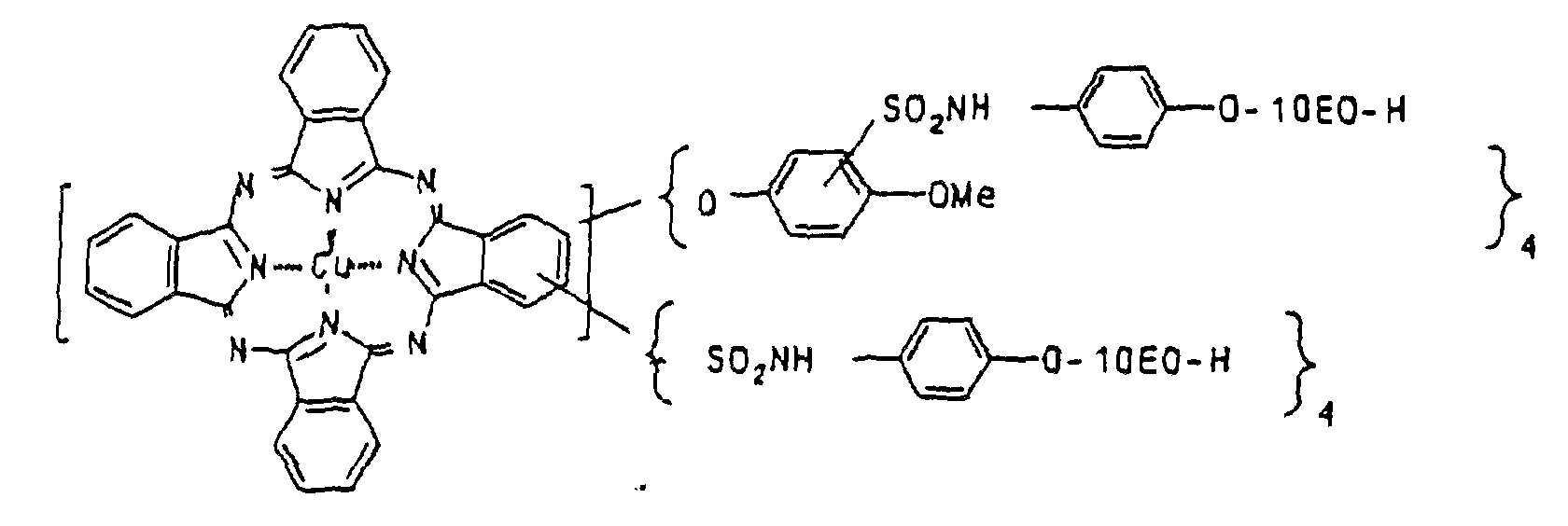
- A mixture is prepared by adding 168 grams (0.306 mole) of an aromatic primary amine with an amine equivalent weight of 1.82 meq/g) to 72.1 grams sodium carbonate in 400 ml of THF. The mixture is cooled to 10-15°C and 0.034 mole of an aqueous wet cake of freshly prepared tetraphenoxy copper phthalocyanine sulfonyl chloride derivative (containing an average of about eight chlorosulfonyl groups per molecule) is added to the mixture. After the addition is complete, the mixture is warmed to 50°C for an additional two hours to insure complete reaction. Three hundred milliters of methylene chloride are added followed by 300 ml of water. The methylene chloride solution is separated from the salt water solution, further washed several times with water to neutral pH, and dried over anhydrous magnesium sulfate. The dried solution is filtered and stripped under reduced pressure at 90°C to give a blue colorant.
-

- A mixture is prepared by adding 226.7 grams (0.306 mole) of a primary amine with an amine equivalent weight of 1.35 meq/g) to 72.1 grams sodium carbonate in 400 ml of THF. The mixture is cooled to 10-15°C and 0.034 mole of an aqueous wet cake of freshly prepared tetraphenoxy copper phthalocyaninesulfonyl chloride derivative from comparitive example 9 (containing an average of about eight chlorosulfonyl groups per molecule) is added to the mixture. After the addition is complete, the mixture is warmed to 50°C for an additional two hours to insure complete reaction. Three hundred ml of methylene chloride is added followed by 300 ml of water. The methylene chloride solution is separated from the salt water solution, further washed several times with water to neutral pH, and dried over anhydrous magnesium sulfate. The dried solution is filtered and stripped under reduced pressure at 90°C to give a blue colorant.
-

- Thirty-one grams (0.03 mole) of copper tetraphenoxyphthalocyanine are dissolved at less than 0°C in 400 grams of chlorosulfuric acid. The cooling bath is removed and the solution is allowed to warm to room temperature over two hours. The solution is further heated to 70°C for about two hours then at 130°C for eight hours. The heat is removed and the solution is allowed to stir overnight at room temperature. The solution is then poured very gradually into a stirred mixture of water and ice. The dull blue supsenion is filtered and washed with ice water several times.
-

- A mixture is prepared by adding 189.6 grams (0.26moles) of a primary amine with an amine equivalent weight of 1.35 meq/g) to 31.4 grams of sodium carbonate(0.30 moles) in 250 grams of water. The mixture is stirred mechanically and cooled to 10-15°C, and 259 grams (0.105 moles) of a 33% active aqueous wet cake of freshly prepared copper phthalocyaninesulfonylchloride derivative(containing an average of about 2 chlorosulfonyl groups per molecule) are added to the mixture over one and a half hours. After the addition is complete, the mixture is warmed to 50°C for an additional two hours to insure complete reaction. Afterwards, the mixture is cooled and the product is extracted into methylene chloride. The methylene chloride solution is separated from the salt water solution, washed several times with water to neutral pH, and dried over anhydrous magnesium sulfate. The dried methylene chloride solution is filtered and stripped under reduced pressure at 90°C to give a blue liquid with an absorbance at 667 nm.
-

- A mixture is prepared by adding 71.4 grams (0.10 moles) of a primary amine with an amine equivalent weight of 1.33 meq/g to 21.6 grams (0.20 moles) sodium carbonate in 500 ml of water. The mixture is cooled to 10-15°C and 0.026 moles of an aqueous wet cake of freshly prepared copper phthalocyaninesulfonyl chloride derivative (containing an average of about 4 chlorosulfonyl groups per molecule) is added to the mixture over one-half hour. After the addition is complete, the mixture is warmed to 50°C for an additional two hours to insure complete reaction. Afterwards, the mixture is cooled and the product is extracted into methylene chloride. The methylene chloride solution is separated from the salt water solution, washed several times with water to neutral pH, and dried over anhydrous magnesium sulfate. The dried methylene chloride solution is filtered and stripped under reduced pressure at 90°C to give a blue liquid with an absorbance at 667 nm.
-

- A mixture is prepared by adding 244.8 grams (0.41 moles) of Jeffamine M-600 primary amine with an amine equivalent weight of 1.66 meq/g to 173.0 grams (1.63 moles) sodium carbonate in 1000 ml of water. The mixture is cooled to 10-15°C and 0.10 moles of an aqueous wet cake of freshly prepared nickel phthalocyaninesulfonyl chloride derivative (containing an average of about 4 chlorosulfonyl groups per molecule) is added to the mixture about one hour. When the addition is complete, the mixture is warmed to 50°C to for an additional two hours to insure complete reaction. Afterwards, the mixture is cooled and the product is extracted into methylene chloride. The methylene chloride solution is separated from the salt water solution, washed several times with water to neutral pH, and dried over anhydrous magnesium sulfate. The dried methylene chloride solution is filtered and stripped under reduced pressure at 90°C to give a blue liquid with an absorbance at 660 nm.
-

- A mixture is prepared by adding 44.1 grams (0.062 moles) of a primary amine with an amine equivalent weight of 1.35 meq/g to 11.9 grams (0.11 moles) sodium carbonate in 250 ml of water. The mixture is cooled to 10-15°C and 0.014 moles an aqueous wet cake of freshly prepared cobalt phthalocyaninesulfonyl chloride derivative (containing an average of about 4 chlorosulfonyl groups per molecule) is added to the mixture over one and a half hours. When the addition is complete, the mixture is warmed to 50°C to for an additional two hours to insure complete reaction. Afterwards, the mixture is cooled and the product is extracted into methylene chloride. The methylene chloride solution is separated from the salt water solution, washed several times with water to neutral pH, and dried over anhydrous magnesium sulfate. The dried methylene chloride solution is filtered and stripped under reduced pressure at 90°C to give a blue liquid with an absorbance at 661 nm.
-
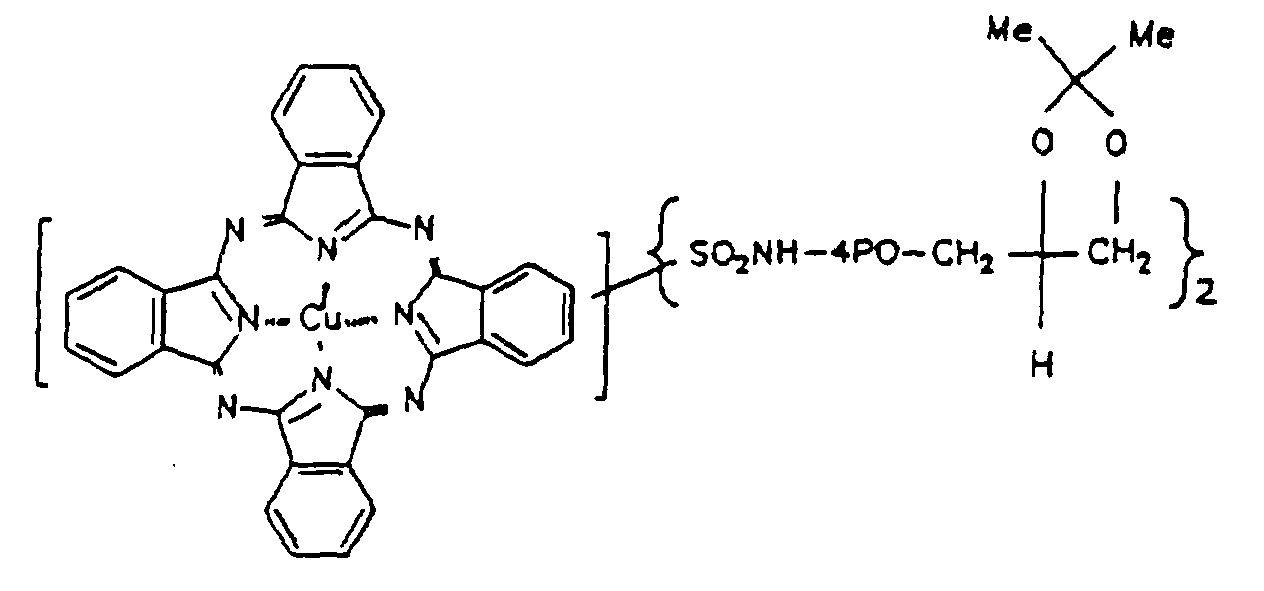
- A mixture is prepared by adding 70.3 grams (0.19 moles) of a primary amine with an amine equivalent weight of 2.7 meq/g to 24.0 grams (0.23 moles) sodium carbonate in 400 ml of THF. The mixture is cooled to 10-15°C and 100 grams (0.061 moles) of a 50% active aqueous wet cake of freshly prepared copper phthalocyaninesulfonyl chloride derivative (containing an average of about 2 chlorosulfonyl groups per molecule) is added to the mixture over one and a half hours. After the addition is complete, the mixture is warmed to 50°C to for an additional two hours to insure complete reaction. Afterwards, the mixture is cooled and the product is extracted into methylene chloride. The corresponding methylene chloride/THF solution is separated from the salt water solution. The THF solution is allowed to evaporate in a fume hood, 300 ml of methylene chloride is added followed by 300 ml of water. The methylene chloride solution is separated from the salt water solution, further washed several times with water to neutral pH, and dried over anhydrous magnesium sulfate. The dried solution is filtered and stripped under reduced pressure at 90°C to a blue liquid with an absorbance at 667 nm.
-

- A mixture is prepared by adding 130.4 grams (0.352 moles) of a primary amine with an amine equivalent weight of 2.7 meq/g to 52.1 grams (0.081 moles) potassium carbonate in 500 ml of water. The mixture is cooled to 10-15°C and 0.88 moles of an aqueous wet cake of freshly prepared nickel phthalocyaninesulfonyl chloride derivative (containing an average of about 4 chlorosulfonyl groups per molecule) is added to the mixture over one-half hour. When the addition is complete, the mixture is warmed to 50°C to for an additional two hours to insure complete reaction. Afterwards, the mixture is cooled and the product is extracted into methylene chloride. The methylene chloride solution is separated from the salt water solution, washed several times with water to neutral pH, and dried over anhydrous magnesium sulfate The dried methylene chloride solution is filtered and stripped under reduced pressure at 90°C to give a blue liquid with an absorbance at 662 nm.
-

- Fifty grams (0.22 moles) of the acetal prepared in Example #25 are added along with 100 ml of water to a three necked 250 ml flask equipped with overhead stirrer, heating mantle, and Dean Stark trap. The mixture is heated to 80°C and 2 grams of 70% sulfuric acid is added. This reaction mixture is maintained at 80°C until no more acetone could be detected overhead in the trap. The mixture is then cooled and the product is extracted into methylene chloride. The methylene chloride solution is separated, washed several times with water to neutral pH, and dried over anhydrous magnesium sulfate. The dried methylene chloride solution is filtered and stripped under reduced pressure at 90°C to give a blue product containing a hydroxyl band in the IR spectrum and an absorbance at 661 nm.
- This example illustrates the use of the present polymeric phthalocyanine colorants in polyolefin systems. The following formulations are preblended using a paddle type mixer and the colorant of comparitive Example 1
*INGREDIENT Formulation 1 4MF Polypropylene resin (Exxon 9142G) 99.47% Irganox 1010 (Ciba-Geigy) 800 ppm Millad 3940 2500 ppm Calcium stearate 1000 ppm Polymeric colorant (Example#1) 1000 ppm *INGREDIENT Formulation 2 4MF Polypropylene resin (Exxon 9142G) 99.62% Irganox 1010 (Ciba-Geigy) 800 ppm TiO₂ 1000 ppm Calcium stearate 1000 ppm Polymeric colorant comparitive Example 1 1000 ppm - After mixing, the formulations shown above are melt compounded on a Brabender Twin Screw Mixer with a stock temperature of 245-250°C. The compounded samples are then injection molded on a small toggle clamp machine into two-step plaques with thicknesses of 1.27-2.16 mm (50 and 85 mils).
- Formulation #1 has good clarity and a deep cyan shade. Formulation #2 is opaque and has a medium cyan shade. Both formulationa process well in addition to having properties such as excellent heat stability, non-nucleation, non-migration and ease of resin clean-up.
- This example illustrates the use of polymeric phthalocyanine colorants in polyurethane. A polyurethane foam is prepared using colorant of comparitive Example 3 in the formulation shown below:
Niax 16-56 Polyol(Union Carbide Corp.) 100 g Water 4.8 ml Dabco 33 LV(Air Products) 0.31 ml T-9 Catalyst(M&T Chemical Co.) 0.2 ml L-520 Silicone(Union Carbide Corp.) 1.5 ml Methylene Chloride 5.4 ml Toluene Diisocyanate 55 ml Colorant comparitive Example 3 1.0 g - This foam is cured for one hour at 160°F to give an even, bright, aqua blue shade. The polymeric colorant is not extractable with methanol, indicating that the colorant has copolymerized into the polyurethane structure.
- This example illustrates the use of the present polymeric phthalocyanine colorants in epoxy systems. The colorant prepared according to Example 1 is incorporated into a cured epoxy system according to the following procedure: To a beaker containing 100 grams of epoxy resin based on diglycidyl ether of bisphenol A(n=0.2, WPE=185-195) of the formula

- The epoxy cured product has good clarity and a deep cyan shade. The resin system processes well in addition to having properties such as excellent heat stability, non-nucleation, non-migration and ease of resin clean up.
- This example illustrates the use of the present polymeric phthalocyanine colorants in polyolefin systems. The following formulations are preblended using a paddle type mixer and the colorant of Example 3

- After mixing, the formulations shown above melt compounded on a Brabender Twin Screw Mixer with a stock temperature of 245-250°C. The compounded samples are then injection molded on a small toggle clamp machine into two-step plaques with thickness of 1.27-2.16 mm (50 and 85 mils).
- Formulation #1 has good clarity and is a deep cyan shade. Formulation #2 is opaque and has a medium cyan shade. Both formulations processed well in addition to having properties such as excellent heat stability, non-nucleation, non-migration and ease of resin clean up.
- This example illustrates the use of polymeric phthalocyanine colorants of the present invention in polyurethane. A polyurethane foam is prepared using the colorant of comparitive Example 5 in the formulation shown below:
Niax 16-56 Polyol(Union Carbide Corp.) 100 g Water 4.8 ml Dabco 33 LV(Air Products) 0.31 ml T-9 Catalyst(M&T Chemical Co.) 0.2 ml L-520 Silicone(Union Carbide Corp.) 1.5 ml Methylene Chloride 5.4 ml Toluene Diisocyanate 55 ml Colorant comparitive Example 5 1.0 g - This foam is cured for one hour at 71.1°C (160°F) to give an even, bright, aqua blue shade. The polymeric colorant is not extractable with methanol, indicating that the colorant had copolymerized into the polyurethane structure.
- This example demonstrates the improved heat stability of a polymeric copper phthalocyanine over copper phthalocyanine pigment. The polymeric colorant of Example 11 and copper phthalocyanine blue pigment, C.I. Pigment Blue 15 (Sun Chemical company, 99% pure) are evaluated in the following formulations:
INGREDIENT Formulation A Formulation B 4MF Polypropylene resin (Exxon 9142G) 5000g 5000g Irganox 1010 (Ciba-Geigy) 5g 5g Irgaphos 168 (Ciba-Geigy) 2.5g 2.5g Calcium stearate 5g 5g Polymeric colorant (Example 11 12.5g - Copper phthalocyanine pigment (C.I. Pigment Blue 15) - 5g - The additives are mixed mechanically, melt compounded at 227°C (440°F) through a one inch extruder, and chopped into pellets. Injection molded step plaques (2x7.62 cm (2x3")) are prepared from each formulation. The resins are then re-extruded two more times at 575°F, and plaques are molded after each extrusion. Color changes (delta E) between the control plaques-B- (227°C (440°F extrusion)) and the plaques-A-(present invention) after re-extrusion are measured on a Hunter Colorimeter. The results shown in the table below indicate that the non-polymeric pigment showed significant change in shade during high temperature extrusion, while the polymeric colorant of Example 11 of the present invention is virtually unchanged.

- This example demonstrates the ease with which the present invention polymeric colorants are purged from compounding equipment such as extruders. After completion of the heat stability experiments for each formulation of Example 19, the extruder is purged with one-pound shots of uncolored resin until the extrudate showed an insignificant amount of residual color. For formulation A (containing the polymeric colorant of Example 11), 3-4 pounds of purge resin are required to obtain a virtually colorless extrudate. In contrast, for formulation B (copper phthalocyanine pigment, C.I. Pigment Blue 15), blue color is still observed in the extrudate even after purging the extruder with twenty-five one-pound shots of purge resin.
- This example demonstrates the non-nucleation properties of polymeric phthalocyanine colorants of the present invention verses conventional phthalocyanine pigment in a polyolefin resin. Formulation A (contains polymeric colorant of Example 11) and formulation B (contains phthalocyanine pigment) from Example 19 are analyzed by Differential Scanning Calorimetry (Perkin-Elmer Series 7 Thermal Analysis system) to determine crystallization temperature. The base resin (uncolored) is also tested. The results shown in the table below indicate that the present invention polymeric colorant has no effect on crystallization properties, while in contrast, the conventional phthalocyanine pigment, C.I. Pigment Blue 15 has a significant effect.

- This example illustrates the use of the present invention polymeric phthalocyanine colorants in polyurethane. A polyurethane foam is prepared using the colorant of Comparative Example 10 in the formulation shown below:
Niax 16-56 Polyol(Union Carbide Corp.) 100 g Water 4.8 ml Dabco 33 LV (Air Products) 0.31 ml T-9 Catalyst (M&T Chemical Co.) 0.2 ml L-520 Silicone (Union Carbide Corp.) 1.5 ml Methylene Chloride 5.4 ml Toluene Diisocyanate 55 ml Colorant Of comparitive Example 10 1 g - This foam is cured for one hour at 71.1°C (160°F) to give a product having an even, bright, aqua blue shade. The polymeric colorant is not extractable with methanol, indicating that the colorant had copolymerized into the polyurethane structure.
- The following tables further illustrate specific colorants of the present invention, wherein the terminating group W of Y is separated out from Y column for purposes of clarity, and wherever A is used in the tables, it designates the metallophthalocyanine specified in that example.


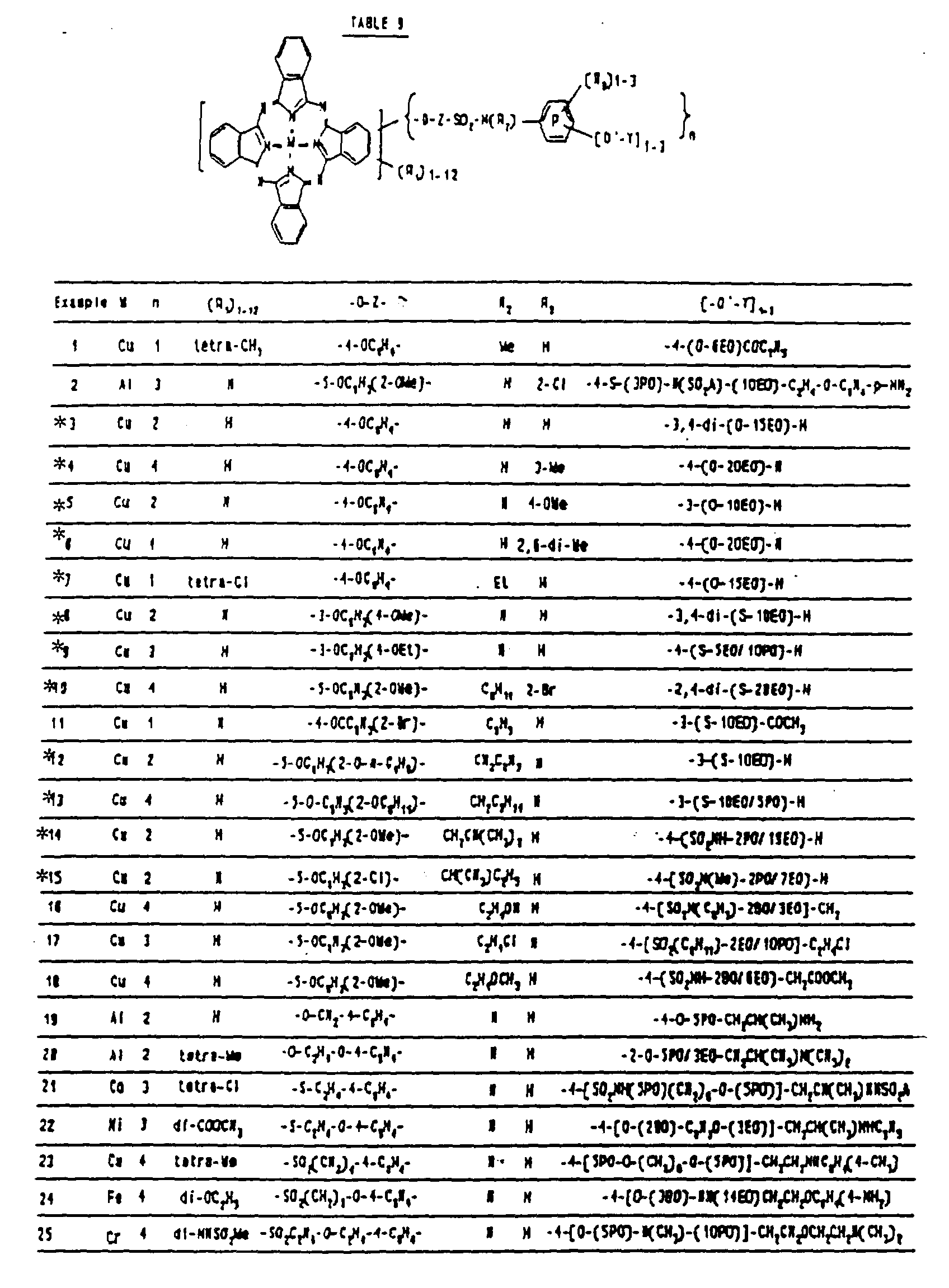


Claims (24)
- A colorant having the formula:


- A colorant having the formula A₁-[SO₂-N(R₂)-Y]₁₋₄ wherein;R is selected from hydrogen, alkyl, cycloalkyl, aryl or Y;A₁ is a nonionic, metallophthalocyanine chromophore which can be substituted with 1-8 substituents selected from halogen, alkyl, alkoxy, alkylthio, or aryloxy;Y is a poly(oxyalkylene) moiety comprised of more than three monomeric units or mixture thereof of the formula (-RO-) wherein each R is substituted or unsubstituted straight or branched alkylene of 2-4 carbons or mixtures thereof, up to about 20 mole percent of said monomeric units may be interconnected by one or more linking groups selected from alkyleneoxy, aryleneoxy, alkylenedioxy, alkylenetrioxy, -N(R₃)- or -N(R₂)CON(R₂)-, wherein each R₃ is selected from R₂ or -SO₂-A₁, and wherein Y can be terminated by or contain as branch substituents, 1-3 groups or moieties selected from alkyl, cycloalkyl, acyl, or aryl; and wherein any of the above recited hydrocarbon groups, moieties or substituents may themselves be substituted with up to four substituents selected from alkyl, halogen, mercapto, alkylthio, arylthio, aryl, cycloalkyl, alkoxycarbonyl, hydroxy, alkoxy, alkylenedioxy, -N(R₂)CO(R₂)(R₂), -N(R₂)SO₂-A, -N(R₂)-acyl, or acyloxy.
- A colorant according to Claim 1 wherein A₂ is a nonionic metallophthalocyanine chromophore which can be substituted with 1-12 substitutents selected from halogen, alkyl, alkoxy, alkylthio, or aryloxy; Y is a poly(oxyalkylene) moiety comprised of more than three monomeric units of the formula (-RO-) wherein, each R is straight or branched alkylene of 2-4 carbons or mixtures thereof, up to about 20 mole percent of said monomeric units may be connected by one or more linking groups selected from alkyleneoxy, aryleneoxy, alkylenedioxy, alkylenetrioxy, -N(R₅)-, or -N(R₂)CON(R₂)-; wherein each R₅ is selected from R₂ or -SO₂-A₂, and wherein Y can be terminated by hydrogen, or by or contain as branch substituents, 1-3 groups or moieties selected from alkyl, cycloalkyl, acyl, or aryl; wherein any of the above recited hydrocarbon groups, moieties or substituents may themselves be substituted with up to four substitutents selected from alkyl, aryl, aryloxy, alkoxyalkyl, aryloxyalkyl, halogen, alkoxycarbonyl, hydroxy, alkoxy, alkylenedioxy, -CON(R₂)(R₂), -N(R₂)CON(R₂)(R₂), -N(R₂)(R₂), -N(R₂)SO₂-A₂, -N(R₂)-acyl, or acyloxy; and wherein each aliphatic hydrocarbon portion or moiety of the groups, moieties or substituents recited above contains from 1-12 carbons.
- A colorant according to Claim 1 wherein A₃ is a nonionic metallophthalocyanine chromophore which can be substituted with 1-12 substitutents selected from halogen, alkyl, alkoxy, alkylthio, or aryloxy; Y is a poly(oxyalkylene) moiety comprised of more than three monomeric units of the formula (-RO-) wherein, each R is straight or branched alkylene of 2-4 carbons or mixtures thereof, up to about 20 mole percent of said monomeric units may be connected by one or more linking groups selected from alkyleneoxy, aryleneoxy, alkylenedioxy, alkylenetrioxy, -N(R₅)-, or -N(R₂)CON(R₂)-; wherein each R₅ is selected from R₂ or -SO₂-A₃, and wherein Y can be terminated by hydrogen, or by or contain as branch substitutes, 1-3 groups or moieties selected from alkyl, cycloalkyl, acyl, or aryl; wherein any of the above recited hydrocarbon groups, moieties or substituents may themselves be substituted with up to four substituents selected from alkyl, aryl, aryloxy, alkoxyalkyl, aryloxyalkyl, halogen, alkoxycarbonyl, hydroxy, alkoxy, alkylenedioxy, -CON(R₂)(R₂), -N(R₂)CON(R₂)(R₂), -N(R₂)(R₂), -N(R₂)SO₂-A₃, -N(R₂)-acyl, or acyloxy; and wherein each aliphatic hydrocarbon portion or moiety of the groups, moieties or substituents recited above contains from 1-12 carbons.
- A colorant of Claim 1 wherein the metal is copper, each Y has an average molecular weight of from about 200 to about 1500 and each aliphatic hydrocarbon portion or moiety of the said groups, moieties or substituents contains from 1-12 carbons.
- A colorant as claimed in any of Claims 1 to 5 wherein the chromophore nuclei are unsubstituted.
- A colorant as claimed in any of Claims 1 to 6 wherein Y is terminated with a group of the formula:

- A colorant as claimed in any of Claims 1 to 7 wherein the total mole percentage of all linking groups for the total -(RO)- units in Y is from zero to about 10 percent.
- A colorant as claimed in any of Claims 1 to 8 wherein each of R₂ or R₃ is hydrogen.
- A colorant as claimed in any of Claims 1 to 9 wherein R is -CH₂CH₂-, -CH(CH₃)CH₂-, -CH(C₂H₅)CH₂-, or mixtures thereof.
- A colorant as claimed in any of Claims 1 to 6 or 8 to 10 wherein Y is selected from those of the formula: -2PO/14EO-Me; -2PO/7EO-Me; -2PO/1OED-Me; 2PO/14EO-Me; -3PO/6EO-CH(CH₃)CH₂C(OH)(CH₃)₂; -4PO-CH₂CH(OH)CH₂OH; and

- A colorant as claimed in any of Claims 1 to 11 wherein the chromophore is an unsubstituted phthalocyanine of Cu, Ni or Co; R₂ is hydrogen; and Y is terminated with a group selected from alkyl, mono- or dihydroxy alkyl, or cyclic dioxyalkylene.
- A colorant as claimed in any of Claims 1 to 12 wherein -D-Z- is selected from -O-arylene-, -S-arylene-, -SO₂-arylene-, -N(R₃)-arylene-, -N(SO₂R₄)-arylene-, or -O-alkylene-O-arylene-.
- A colorant according to any of Claims 1 to 12 wherein -D-Z- is a covalent bond.
- A polymeric or resinous material composition containing from about 0.0001 to about 10.0 weight percent of one or a mixture of any of the colorants as defined in any of Claims 1 to 14.
- The composition of Claim 15 wherein the colorant or mixtures of colorants comprises from about 0.001 to about 3.0 weight percent of the composition.
- The composition as claimed in either of Claims 15 and 16 wherein said resinous material is thermoplastic.
- The composition as claimed in either of Claims 15 and 16 wherein said resinous material is thermosetting.
- The composition of any of Claims 15 to 18 wherein said polymeric or resinous material is polyurethane.
- The composition of any of Claims 15 to 17 wherein said thermoplastic resin is selected from polyethylene, linear low density polyethylene, polypropylene, polybutylene, co-polymers made from ethylene, propylene and/or butylene, polyvinyl chloride, polyvinylidene chloride, cellulosic resins, cellulose acetate, cellulose acetate butyrate and cellulose acetate propionate, acrylic resins such as polymethyl methacrylate, styrene acrylonitrile, polystyrene, polycarbonate and acrylonitrile butadiene-styrene (therein ABS), polyamides such as nylon 6 and nylon 66 and polyesters such as polyethylene terephthalate, especially glycol modified polyethylene terephthalate and polybutylene terephthalate.
- A composition as claimed in Claim 20 wherein said resin material comprises a polyester.
- A formed structure comprised of a solid composition of any of Claims 15 to 21.
- The process for preparing a colorant of Claim 2 comprising reacting at a temperature of from about 0°C to about 100°C, a metallophthalocyanine of the formula A₁-(SO₂X)₁₋₄ with at least a stoichiometric quantity of an amine of the formula HN(R₂)Y wherein X is selected from Cl, F, Br, I, or alkoxy of 1-4 carbons.
- The process for preparing a colorant of Claim 3 comprising reacting at a temperature of from about 0°C to about 100°C, a metallophthalocyanine of the formula A₂-(D-Z-SO₂X)₁₋₁₆ with at least a stoichiometric quantity of an amine of the formula HN(R2)Y wherein X is selected from Cl, F, Br, I or alkoxy of 1-4 carbons.
Applications Claiming Priority (6)
| Application Number | Priority Date | Filing Date | Title |
|---|---|---|---|
| US408357 | 1982-08-16 | ||
| US07/354,184 US5177200A (en) | 1989-05-19 | 1989-05-19 | Poly(oxyalkylene) modified phthalocyanine colorants |
| US354184 | 1989-05-19 | ||
| US07/371,477 US5149800A (en) | 1989-06-26 | 1989-06-26 | Poly(oxyalkylene) modified phthalocyanine colorants |
| US371477 | 1989-06-26 | ||
| US40835789A | 1989-09-18 | 1989-09-18 |
Publications (3)
| Publication Number | Publication Date |
|---|---|
| EP0398620A2 EP0398620A2 (en) | 1990-11-22 |
| EP0398620A3 EP0398620A3 (en) | 1991-02-27 |
| EP0398620B1 true EP0398620B1 (en) | 1996-04-17 |
Family
ID=27408166
Family Applications (1)
| Application Number | Title | Priority Date | Filing Date |
|---|---|---|---|
| EP90305187A Expired - Lifetime EP0398620B1 (en) | 1989-05-19 | 1990-05-15 | Poly(oxyalkylene) modified phthalocyanine colorants |
Country Status (5)
| Country | Link |
|---|---|
| EP (1) | EP0398620B1 (en) |
| JP (1) | JP2866152B2 (en) |
| AT (1) | ATE136919T1 (en) |
| CA (1) | CA2017115C (en) |
| DE (1) | DE69026529T2 (en) |
Cited By (1)
| Publication number | Priority date | Publication date | Assignee | Title |
|---|---|---|---|---|
| US20220363697A1 (en) * | 2019-11-04 | 2022-11-17 | Kd Finechem Co., Ltd. | Colorant for heat transfer fluid, and composition comprising same |
Families Citing this family (7)
| Publication number | Priority date | Publication date | Assignee | Title |
|---|---|---|---|---|
| GB9817235D0 (en) * | 1998-08-08 | 1998-10-07 | Zeneca Ltd | Compound,composition and use |
| GB9818831D0 (en) * | 1998-08-29 | 1998-10-21 | Ciba Sc Holding Ag | Process for the manufacture of substituted amido phthalocyanine derivatives |
| TW588091B (en) | 1998-08-29 | 2004-05-21 | Ciba Sc Holding Ag | Pigment compositions containing substituted amido phthalocyanine derivatives |
| GB9818824D0 (en) * | 1998-08-29 | 1998-10-21 | Ciba Geigy Ag | Pigment compositions containing substituited amido phthalocyanine derivatives |
| GB0420081D0 (en) * | 2004-09-10 | 2004-10-13 | Avecia Ltd | Phthalocyanines for ink-jet printing |
| JP4193007B1 (en) | 2007-03-12 | 2008-12-10 | Dic株式会社 | Pigment composition for color filter |
| EP2840112B2 (en) | 2013-08-21 | 2026-05-20 | Baerlocher Gmbh | Stabilized polymer compositions and manufacturing processes for them |
Citations (2)
| Publication number | Priority date | Publication date | Assignee | Title |
|---|---|---|---|---|
| US3287470A (en) * | 1962-07-10 | 1966-11-22 | Geigy Ag J R | Metal phthalocyanine dyestuffs |
| GB1477396A (en) * | 1973-09-27 | 1977-06-22 | Ciba Geigy Ag | Water-soluble organic dyestuffs and optical brighteners and their manufacture and use |
Family Cites Families (3)
| Publication number | Priority date | Publication date | Assignee | Title |
|---|---|---|---|---|
| GB1596281A (en) * | 1977-02-21 | 1981-08-26 | Ici Ltd | Dispersions |
| GB8421558D0 (en) * | 1984-08-24 | 1984-09-26 | Ici Plc | Water-soluble dye |
| US4758243A (en) * | 1986-05-27 | 1988-07-19 | Milliken Research Corporation | Process for coloring polyester shaped articles |
-
1990
- 1990-05-15 EP EP90305187A patent/EP0398620B1/en not_active Expired - Lifetime
- 1990-05-15 AT AT90305187T patent/ATE136919T1/en not_active IP Right Cessation
- 1990-05-15 DE DE69026529T patent/DE69026529T2/en not_active Expired - Fee Related
- 1990-05-18 CA CA002017115A patent/CA2017115C/en not_active Expired - Fee Related
- 1990-05-19 JP JP2130124A patent/JP2866152B2/en not_active Expired - Fee Related
Patent Citations (2)
| Publication number | Priority date | Publication date | Assignee | Title |
|---|---|---|---|---|
| US3287470A (en) * | 1962-07-10 | 1966-11-22 | Geigy Ag J R | Metal phthalocyanine dyestuffs |
| GB1477396A (en) * | 1973-09-27 | 1977-06-22 | Ciba Geigy Ag | Water-soluble organic dyestuffs and optical brighteners and their manufacture and use |
Non-Patent Citations (2)
| Title |
|---|
| JP 166880 (English translation) * |
| JP 63/264674 (English translation) * |
Cited By (1)
| Publication number | Priority date | Publication date | Assignee | Title |
|---|---|---|---|---|
| US20220363697A1 (en) * | 2019-11-04 | 2022-11-17 | Kd Finechem Co., Ltd. | Colorant for heat transfer fluid, and composition comprising same |
Also Published As
| Publication number | Publication date |
|---|---|
| CA2017115A1 (en) | 1990-11-19 |
| EP0398620A3 (en) | 1991-02-27 |
| DE69026529T2 (en) | 1996-10-17 |
| JPH03149266A (en) | 1991-06-25 |
| EP0398620A2 (en) | 1990-11-22 |
| ATE136919T1 (en) | 1996-05-15 |
| DE69026529D1 (en) | 1996-05-23 |
| JP2866152B2 (en) | 1999-03-08 |
| CA2017115C (en) | 2001-10-16 |
Similar Documents
| Publication | Publication Date | Title |
|---|---|---|
| US5270363A (en) | Poly(oxyalkylene) modified phthalocyanine colorants | |
| US5135972A (en) | Poly(oxyalkylene) modified phthalocyanine colorants | |
| US5177200A (en) | Poly(oxyalkylene) modified phthalocyanine colorants | |
| CA1239728A (en) | Process for in situ coloration of thermosetting resins | |
| DE69029128T2 (en) | Intermediates and dyes with increasingly primary hydroxyl-containing poly (oxyalkylene) residues and their preparation | |
| US4775748A (en) | Reactive colorants | |
| US4751254A (en) | Process for in situ coloration of thermosetting resins | |
| NL8101522A (en) | METHOD FOR COLORING THERMO-CURING RESIN | |
| US5149800A (en) | Poly(oxyalkylene) modified phthalocyanine colorants | |
| JPH0264119A (en) | Manufacture of polyurethane resin colored with anthraquinone coloring agent and product of said resin | |
| EP0270306A2 (en) | Anthrapyridone compounds, their production process and their use | |
| US6426416B1 (en) | Anthraquinone and condensed anthraquinone colorants having sulfonamido linked poly (oxyalkylene) moieties and their preparation | |
| US6245138B1 (en) | Pigment preparations useful for ink-jet printing | |
| EP0166566B1 (en) | Resin colorants and resin coloration | |
| CA2017115C (en) | Poly(oxyalkylene) modified phthalocyanine colorants | |
| DE19727079A1 (en) | Triphendioxazine | |
| DE69121436T2 (en) | Organic materials bearing sulfonamido-bonded poly (oxyalkylene) groups and their production | |
| US5240464A (en) | Organic materials having sulfonamido linked poly(oxyalkylene) moieties and their preparation | |
| EP1314754B1 (en) | Bridged Perinones/Quinophtalones | |
| EP0827986B1 (en) | Bridged perinone, quinophthalone and perinone-quinophthalone | |
| DE19636032A1 (en) | Bridged perinone, quino-phthalone or perinone-quino-phthalone compound | |
| EP1446443B1 (en) | Novel polymeric blue anthraquinone-derivative colorants | |
| KR0152266B1 (en) | Dianthraquinonyl compounds | |
| US4866112A (en) | Thermoplastics containing a nickel complex pigment | |
| EP1417265B1 (en) | Liquid colour compositions with acyglycerols as dispersants |
Legal Events
| Date | Code | Title | Description |
|---|---|---|---|
| PUAI | Public reference made under article 153(3) epc to a published international application that has entered the european phase |
Free format text: ORIGINAL CODE: 0009012 |
|
| AK | Designated contracting states |
Kind code of ref document: A2 Designated state(s): AT BE CH DE DK ES FR GB GR IT LI LU NL SE |
|
| PUAL | Search report despatched |
Free format text: ORIGINAL CODE: 0009013 |
|
| AK | Designated contracting states |
Kind code of ref document: A3 Designated state(s): AT BE CH DE DK ES FR GB GR IT LI LU NL SE |
|
| 17P | Request for examination filed |
Effective date: 19910731 |
|
| 17Q | First examination report despatched |
Effective date: 19930803 |
|
| GRAH | Despatch of communication of intention to grant a patent |
Free format text: ORIGINAL CODE: EPIDOS IGRA |
|
| GRAA | (expected) grant |
Free format text: ORIGINAL CODE: 0009210 |
|
| ITF | It: translation for a ep patent filed | ||
| AK | Designated contracting states |
Kind code of ref document: B1 Designated state(s): AT BE CH DE DK ES FR GB GR IT LI LU NL SE |
|
| PG25 | Lapsed in a contracting state [announced via postgrant information from national office to epo] |
Ref country code: NL Free format text: LAPSE BECAUSE OF FAILURE TO SUBMIT A TRANSLATION OF THE DESCRIPTION OR TO PAY THE FEE WITHIN THE PRESCRIBED TIME-LIMIT Effective date: 19960417 Ref country code: LI Free format text: LAPSE BECAUSE OF FAILURE TO SUBMIT A TRANSLATION OF THE DESCRIPTION OR TO PAY THE FEE WITHIN THE PRESCRIBED TIME-LIMIT Effective date: 19960417 Ref country code: GR Free format text: LAPSE BECAUSE OF FAILURE TO SUBMIT A TRANSLATION OF THE DESCRIPTION OR TO PAY THE FEE WITHIN THE PRESCRIBED TIME-LIMIT Effective date: 19960417 Ref country code: ES Free format text: THE PATENT HAS BEEN ANNULLED BY A DECISION OF A NATIONAL AUTHORITY Effective date: 19960417 Ref country code: DK Effective date: 19960417 Ref country code: CH Free format text: LAPSE BECAUSE OF FAILURE TO SUBMIT A TRANSLATION OF THE DESCRIPTION OR TO PAY THE FEE WITHIN THE PRESCRIBED TIME-LIMIT Effective date: 19960417 Ref country code: AT Effective date: 19960417 |
|
| REF | Corresponds to: |
Ref document number: 136919 Country of ref document: AT Date of ref document: 19960515 Kind code of ref document: T |
|
| REF | Corresponds to: |
Ref document number: 69026529 Country of ref document: DE Date of ref document: 19960523 |
|
| PG25 | Lapsed in a contracting state [announced via postgrant information from national office to epo] |
Ref country code: LU Free format text: LAPSE BECAUSE OF NON-PAYMENT OF DUE FEES Effective date: 19960531 |
|
| PG25 | Lapsed in a contracting state [announced via postgrant information from national office to epo] |
Ref country code: SE Effective date: 19960717 |
|
| ET | Fr: translation filed | ||
| NLV1 | Nl: lapsed or annulled due to failure to fulfill the requirements of art. 29p and 29m of the patents act | ||
| REG | Reference to a national code |
Ref country code: CH Ref legal event code: PL |
|
| PLBE | No opposition filed within time limit |
Free format text: ORIGINAL CODE: 0009261 |
|
| STAA | Information on the status of an ep patent application or granted ep patent |
Free format text: STATUS: NO OPPOSITION FILED WITHIN TIME LIMIT |
|
| 26N | No opposition filed | ||
| PGFP | Annual fee paid to national office [announced via postgrant information from national office to epo] |
Ref country code: BE Payment date: 20010427 Year of fee payment: 12 |
|
| REG | Reference to a national code |
Ref country code: GB Ref legal event code: IF02 |
|
| PG25 | Lapsed in a contracting state [announced via postgrant information from national office to epo] |
Ref country code: BE Free format text: LAPSE BECAUSE OF NON-PAYMENT OF DUE FEES Effective date: 20020531 |
|
| PGFP | Annual fee paid to national office [announced via postgrant information from national office to epo] |
Ref country code: GB Payment date: 20040512 Year of fee payment: 15 |
|
| PGFP | Annual fee paid to national office [announced via postgrant information from national office to epo] |
Ref country code: DE Payment date: 20040630 Year of fee payment: 15 |
|
| PG25 | Lapsed in a contracting state [announced via postgrant information from national office to epo] |
Ref country code: IT Free format text: LAPSE BECAUSE OF NON-PAYMENT OF DUE FEES;WARNING: LAPSES OF ITALIAN PATENTS WITH EFFECTIVE DATE BEFORE 2007 MAY HAVE OCCURRED AT ANY TIME BEFORE 2007. THE CORRECT EFFECTIVE DATE MAY BE DIFFERENT FROM THE ONE RECORDED. Effective date: 20050515 Ref country code: GB Free format text: LAPSE BECAUSE OF NON-PAYMENT OF DUE FEES Effective date: 20050515 |
|
| PGFP | Annual fee paid to national office [announced via postgrant information from national office to epo] |
Ref country code: FR Payment date: 20050517 Year of fee payment: 16 |
|
| PG25 | Lapsed in a contracting state [announced via postgrant information from national office to epo] |
Ref country code: DE Free format text: LAPSE BECAUSE OF NON-PAYMENT OF DUE FEES Effective date: 20051201 |
|
| GBPC | Gb: european patent ceased through non-payment of renewal fee |
Effective date: 20050515 |
|
| REG | Reference to a national code |
Ref country code: FR Ref legal event code: ST Effective date: 20070131 |
|
| PG25 | Lapsed in a contracting state [announced via postgrant information from national office to epo] |
Ref country code: FR Free format text: LAPSE BECAUSE OF NON-PAYMENT OF DUE FEES Effective date: 20060531 |