EP0398358B1 - Aluminum electroplating method - Google Patents
Aluminum electroplating method Download PDFInfo
- Publication number
- EP0398358B1 EP0398358B1 EP90109469A EP90109469A EP0398358B1 EP 0398358 B1 EP0398358 B1 EP 0398358B1 EP 90109469 A EP90109469 A EP 90109469A EP 90109469 A EP90109469 A EP 90109469A EP 0398358 B1 EP0398358 B1 EP 0398358B1
- Authority
- EP
- European Patent Office
- Prior art keywords
- aluminum
- chloride
- ethyl
- bromide
- plating
- Prior art date
- Legal status (The legal status is an assumption and is not a legal conclusion. Google has not performed a legal analysis and makes no representation as to the accuracy of the status listed.)
- Expired - Lifetime
Links
- 0 CCC*(*)(C1)C(CCCC2)C2N1*1IC1 Chemical compound CCC*(*)(C1)C(CCCC2)C2N1*1IC1 0.000 description 1
Classifications
-
- C—CHEMISTRY; METALLURGY
- C25—ELECTROLYTIC OR ELECTROPHORETIC PROCESSES; APPARATUS THEREFOR
- C25D—PROCESSES FOR THE ELECTROLYTIC OR ELECTROPHORETIC PRODUCTION OF COATINGS; ELECTROFORMING; APPARATUS THEREFOR
- C25D3/00—Electroplating: Baths therefor
- C25D3/66—Electroplating: Baths therefor from melts
- C25D3/665—Electroplating: Baths therefor from melts from ionic liquids
-
- C—CHEMISTRY; METALLURGY
- C25—ELECTROLYTIC OR ELECTROPHORETIC PROCESSES; APPARATUS THEREFOR
- C25D—PROCESSES FOR THE ELECTROLYTIC OR ELECTROPHORETIC PRODUCTION OF COATINGS; ELECTROFORMING; APPARATUS THEREFOR
- C25D3/00—Electroplating: Baths therefor
- C25D3/02—Electroplating: Baths therefor from solutions
- C25D3/42—Electroplating: Baths therefor from solutions of light metals
- C25D3/44—Aluminium
Definitions
- 1,2,3-trialkylimidazolium halide (III) may include 1,2,3-trimethylimidazolium bromide, 1,2,3-trimethylimidazolium iodide, 1,2-dimethyl-3-ethylimidazolium bromide, 1,2-dimethyl-3-ethylimidazolium chloride, 1,2-dimethyl-3-butylimidazolium fluoride and the like.
- a cold rolled steel plate with a plate thickness of 0.5 mm applied with solvent vapor washing, alkali defatting and acid washing in conventional manners was dried, and immediately thereafter dipped in the compositions shown in the foregoing Examples previously maintained in nitrogen atmosphere as the electric aluminum plating bath.
Landscapes
- Chemical & Material Sciences (AREA)
- Engineering & Computer Science (AREA)
- Chemical Kinetics & Catalysis (AREA)
- Electrochemistry (AREA)
- Materials Engineering (AREA)
- Metallurgy (AREA)
- Organic Chemistry (AREA)
- Electroplating And Plating Baths Therefor (AREA)
Description
- This invention relates to a method for plating electrochemically aluminum efficiently by use of a composition containing aluminum.
- Electroplating of aluminum can be done with difficulty in a plating bath of an aqueous solution system, because affinity of aluminum for oxygen is great, with the potential being lower than hydrogen. For this reason, electroplating of aluminum has been investigated in non-aqueous solution systems, particularly in a plating bath of an organic solvent system.
- As such organic solvent system plating bath, a solution of aluminum chloride and LiAlH₄ or LiH dissolved in ether or a solution of aluminum chloride and LiAlH₄ dissolved in tetrahydrofuran is a representative example (e.g. D.E. Couch et al, J. Electrochem., Vol. 99 (6), p. 234). However, since all of these plating baths contain very active LiAlH₄ or LiH therein, if oxygen or moisture exists, the reaction with those occurred to effect decomposition, whereby current efficiency was lowered, or the life of the bath became shortened. Also, the boiling point of an organic solvent is low, thus having a problem that the risk of explosion or combustion is high.
- Further, as another example, there has been also proposed a plating bath of triethyl aluminum and NaF dissolved in toluene (R. Suchentrunk, Z. Werkstofftech, Vol. 12, p. 190). However, also in this case, handling of triethyl aluminum with high danger poses a very great problem, and practical application thereof may be considered to be difficult.
- As described above, although the prior arts may be somewhat successful in the technical task of plating aluminum, they can be hardly said to be widely applicable in general as practical technique because of difficulty in handling of the chemical substances employed.
- EP-A-0 274 774 discloses a process for the preparation of aluminum by electrodeposition from a molten salt mixture of an aluminum trihalide and a tetrahydrocarbyl ammonium halide comprising the addition to the melt of a small amount of a halide of lithium, sodium or potassium.
- The present invention is directed to a novel aluminum electroplating method as claimed in any of claims 1 to 10.
- The present invention proposes a novel electric aluminum plating bath easy in handling and capable of efficiently plating of aluminum, a plating method by use of the bath. Thus, according to the proposal of the present invention, plating of aluminum is possible at high current efficiency and high current density, and with good productivity.
- Further, in the electric aluminum plating bath and the plating method by use of the bath of the present invention, by use of aluminum for the electrode, Al ions consumed by plating can be automatically supplemented by Al dissolution from the anode, and therefore bath management can be easy, and is also more excellent in workability in this respect than other methods.
- The present inventors have made investigations intensively about aluminum electroplating bath and plating method by use of the bath, and consequently found that a composition formed by mixing an aluminum halide with at least one of a bicyclic quaternary amidinium, a 1-alkylaminopyridinium halide, a trialkylimidazolium halide, a benzimidazolium halide or an alicyclic quaternary ammonium halide as an onium halide of a nitrogen-containing compound has excellent characteristics as the aluminum electroplating bath.
- One characteristic feature of the composition according to the present invention resides in forming a low melting compound in wide composition range of two compounds, which becomes a liquid easily handled over a wide range also at normal temperature. The second characteristic feature is that these compositions have considerably high ion conductivity under molten state.
- Thus, these characteristic features are excellent important basic characteristics, and the present composition can be said to have very excellent characteristics as aluminum electroplating bath.
- The bicyclic quaternary amidinium halide as the onium halide of a nitrogen-containing compound as herein described is a compound represented by the following formula:

wherein R¹ is an alkyl group having 1 to 12 carbon atoms, R² represents an alkylene group having 1 to 6 carbon atoms except 1 carbon atom, R³ represents an alkylene group having 1 to 6 carbon atoms except 1 and 2 carbon atoms, the alkyl group or alkylene group mentioned here referring to straight hydrocarbon groups, branched hydrocarbon groups and further those containing aromatic hydrocarbon groups in a part thereof and X represents a halogen atom. - 1-Alkylaminopyridinium halide is a compound represented by the formula:

wherein R⁴ is an alkyl group having 1 to 12 carbon atoms, R⁵ is a hydrogen atom or an alkyl group having 1 to 6 carbon atoms and R⁶ is an alkyl group having 1 to 6 carbon atoms, the alkyl group mentioned here referring to straight hydrocarbon groups, branched hydrocarbon groups and further those containing aromatic hydrocarbon groups in a part thereof and X has the same meaning as defined above. - Trialkylimidazolium halide is a 1,2,3-trialkylimidazolium halide compound represented by the formula:

wherein R7, R⁸ and R⁹ each represent an alkyl group having 1 to 6 carbon atoms, the alkyl group mentioned here referring to straight hydrocarbon groups, branched hydrocarbon groups and further those containing aromatic hydrocarbon groups in a part thereof and X has the same meaning as defined above. - Alkylbenzimidazolium halide is a 1,3-dialkylbenzimidazolium halide compound represented by the formula:

wherein R¹⁰ and R¹¹ each represent an alkyl group having 1 to 6 carbon atoms and X has the same meaning as defined above. - Alicyclic quaternary ammonium halide is a compound represented by the formula:

wherein R¹² represents an alkylene group having 1 to 6 carbon atoms except 1 and 2 carbon atoms, R¹³ and R¹⁴ each represent an alkyl group having 1 to 6 carbon atoms and X has the same meaning as defined above. - Specific examples of the bicyclic quaternary amidinium halide (I) may include 5-methyl-1-aza-5-azoniabicyclo-[4,3,0]5-nonene bromide, 5-ethyl-1-aza-5-azoniabicyclo-[4,3,0)5-nonene chloride, 8-methyl-1-aza-8-azoniabicyclo-[5,4,0]7-undecene iodide, 8-ethyl-1-aza-8-azoniabicyclo-[5,4,0]7-undecene chloride and the like.
- Specific examples of the 1-alkylaminopyridinium halide (II) may include 1-methyl-4-dimethylaminopyridinium iodide, 1-ethyl-4-dimethylaminopyridinium bromide, 1-ethyl-4-dimethylaminopyridinium chloride, 1-ethyl-4-(N-ethyl-N-methyl)aminopyridinium chloride, 1-ethyl-4-aminopyridinium iodide, 1-n-butyl-4-dimethylaminopyridinium fluoride, 1-benzyl-4-dimethylaminopyridinium chloride, 1-n-octyl-4-dimethylaminopyridinium chloride, 1-ethyl-4-piperidinopyridinium bromide, 1-ethyl-4-pyrrolidinopyridinium chloride, 1-ethyl-4-pyrrolidinopyridinium bromide and the like.
- Specific examples of the 1,2,3-trialkylimidazolium halide (III) may include 1,2,3-trimethylimidazolium bromide, 1,2,3-trimethylimidazolium iodide, 1,2-dimethyl-3-ethylimidazolium bromide, 1,2-dimethyl-3-ethylimidazolium chloride, 1,2-dimethyl-3-butylimidazolium fluoride and the like.
- Specific examples of the 1,3-dialkylbenzimidazolium halide (IV) may include 1,3-dimethylbenzimidazolium bromide, 1,3-dimethylbenzimidazolium iodide, 1-methyl-3-ethylbenzimidazolium bromide, 1-methyl-3-ethylbenzimidazolium chloride, 1-methyl-3-butylbenzimidazolium fluoride, 1-ethyl-3-propyl-benzimidazolium bromide and the like.
- Specific examples of the alicyclic quaternary ammonium halide (V) may include N,N-dimethylpyrrolidinium bromide, N-ethyl-N-methylpyrrolidinium chloride, N,N-dimethylpiperidinium bromide, N-ethyl-N-methylpiperidinium chloride, N,N-diethylpiperidinium bromide and the like.
- As the aluminum halide, AlX₃ (X = halogen), specifically AlF₃, AlCl₃, AlBr₃ and AlI₃ can be included.
- The plating bath of the composition having a low melting point and containing aluminum according to the present invention is prepared by mixing and melting an aluminum halide and an onium halide of a nitrogen-containing compound. In this case, a composition having a low melting point can be made by mixing 20 to 80 mole % of an aluminum halide and 80 to 20 mole % of an onium halide of a nitrogen-containing compound, preferably 50 to 70 mole % of an aluminum halide and 30 to 50 mole % of an onium halide of a nitrogen-containing compound. For example, in the composition of aluminum chloride and 5-ethyl-1-aza-5-azoniabicyclo[4,3,0]5-nonene chloride, a composition which is liquid at room temperature and has considerably low viscosity can be obtained in the entire region of aluminum chloride concentration of 55 to 80 mole %.
- In the composition of aluminum chloride and 1-ethyl-4-dimethylaminopyridinium bromide, it is liquid at 50 °C in the entire region of aluminum chloride concentration of 20 to 80 mole %, in the composition of aluminum chloride and 1,2-dimethyl-3-ethylimidazolium bromide, it is liquid at 50 °C in the entire region of aluminum chloride concentration of 55 to 80 mole %, in the composition of aluminum chloride and 1-methyl-3-ethylbenzimidazolium bromide, it is liquid at normal temperature in the entire region of aluminum concentration of 55 to 80 mole %, and in the composition of aluminum chloride and N-ethyl-N-methylpiperidinium bromide, it is liquid at normal temperature in the entire region of aluminum chloride concentration of 60 to 75 mole %, and compositions each with considerably low concentration can be obtained.
- In the case of practicing efficiently aluminum electro-plating by use of the above-mentioned aluminum electro-plating bath, a preferable range as the plating bath may comprise 50 to 75 mole % of an aluminum halide and 25 to 50 mole % of an onium halide of a nitrogen-containing compound, more preferably 55 to 70 mole % of an aluminum halide and 30 to 45 mole % of an onium halide of a nitrogen-containing compound and most preferably 60 to 67 mole % of an aluminum halide and 33 to 40 mole % of an onium halide. In a system where the aluminum halide is too small, the reaction which may be considered to be the decomposition of the onium cation occurs, while in a system where the aluminum halide is too much, the viscosity of the bath tends to be elevated undesirably.
- The novel composition can be generally prepared according to the process comprising the two steps as described below.
- As the first step, an alkyl halide and a nitrogen-containing compound together with a reaction solvent are charged into a reactor made of a glass, and the reaction is carried out at 20 to 200 °C, preferably 50 to 120 °C. After the reaction, the solvent and the unreacted materials are removed to obtain an onium halide of the nitrogen-containing compound. In this case, as the reaction solvent, hydrocarbons such as benzene, toluene, hexane, water, polar solvents such as methanol, ethanol, tetrahydrofuran, dimethylformamide, dimethyl sulfoxide, can be used.
- In the second step, the onium halide of the nitrogen-containing compound prepared in the first step and the aluminum halide are heated and mixed under the state suspended in an appropriate solvent under an inert gas atmosphere, followed by removal of the solvent, whereby a desired aluminum electroplating bath can be prepared. In this case, since considerable heat generation is accompanied during mixing, it is necessary to take care so that the temperature will not be raised uncontrollably. As the reaction solvent in this case, aromatic hydrocarbons such as benzene, toluene, chlorobenzene can be used.
- Aluminum electroplating is generally practiced under dry oxygen-free atmosphere from such points as maintenance of stability of the plating bath and plating properties. Plating can be effected at good current efficiency and uniformly under the plating conditions of a bath temperature of 0 to 300 °C, preferably 20 to 100 °C with direct current or pulse current and a current density of 0.01 to 50 A/dm², preferably 1 to 20 A/dm². If the bath temperature is too low, no uniform plating can be effected, while if the bath temperature is too high or the current density is too high, decomposition of onium cations, nonunifomization of plated layer, and further lowering in current efficiency will occur undesirably.
- In the case of plating a strip uniformly and continuously, the Al ion concentration is required to be maintained at a level within a certain range by supplementing Al ions, but in this case, when the anode is made a soluble electrode made of aluminum, Al ions can be supplemented automatically corresponding to the current passage amount, whereby the Al ion concentration can be maintained within a certain range without supplementing aluminum halide.
- In the case of effecting plating at a low temperature, it is effective to add an organic solvent into the plating bath. In this case, as the organic solvent, inert solvents such as benzene, toluene, xylene and chlorobenzene are preferred, and they may be used in an amount generally of 5 to 100 % by volume added.
- Also, for increasing the conductivity of the plating bath or effecting uniformization of the aluminum plated layer, it is effective to add a halide of an alkali metal or an alkaline earth metal. In this case, as examples of alkali metal or alkaline earth metal halides, LiCl, NaCl, NaF, CaCl₂, for instance can be included, and these compounds may be used in an amount of 0.1 to 30 mole % added in the plating bath.
- The present invention will be explained in more detail below by referring to Examples by which the present invention is not limited.
- Into an autoclave made of stainless steel were charged 1.0 mole (96.1 g) of 1,2-dimethylimidazole, 1.1 mole (119.9 g) of ethyl bromide and 50 g of methanol as the solvent, and the reaction was carried out under stirring at 90 °C for 5 hours. From the reaction product were removed the solvent and unreacted materials by use of a rotary evaporator to give 201.5 g of a solid. The solid was 1,2-dimethyl-3-ethylimidazolium bromide, and the yield of the reaction based on 1,2-dimethylimidazole was 98 mole %.
- Next, 20.5 g (0.10 mole) of the resulting 1,2-dimethyl-3-ethylimidazolium bromide were placed in a reactor made of a glass in nitrogen atmosphere, and 26.6 g (0.20 mole) of aluminum chloride were gradually mixed. By throwing of aluminum chloride and heating to 80 °C, the reaction occurred at the solid interface with 1,2-dimethyl-3-ethylimidazolium bromide, whereby liquefaction progressed gradually. However, since the reaction was accompanied with heat generation, the total amount of aluminum chloride was thrown carefully so that the reaction temperature did not exceed 90 °C. The mixture was liquid at normal temperature, and exhibited a conductivity of 6.5 mS/cm at 25 °C. Also, in this system, the relationship between temperature and conductivity when the molar ratio of aluminum chloride to 1,2-dimethyl-3-ethylimidazolium bromide is varied from 1.2 to 2 has become as shown in Table 1. Since the system is under solution state at 50 °C within the range of all molar ratios, and also exhibits high conductivity, it is excellent as electric aluminum plating bath.

- According to the same reaction method as in Example 1, 1,2-dimethyl-3-ethylimidazolium chloride was prepared from 1,2-dimethylimidazole and ethyl chloride (Example 2), 1,2-dimethyl-3-butylimidazolium chloride from 1,2-dimethylimidazole and butyl chloride (Example 3), and 1,2,3-trimethylimidazolium bromide from 1,2-dimethylimidazole and methyl bromide (Example 4).
- These quaternary salts were mixed with aluminum chloride according to the same method as in Example 1 to prepare compositions with a molar ratio of aluminum chloride to quaternary salt of 2.0. The results of measurement of conductivities of these compositions are shown in Table 2.
- Further, a composition of aluminum bromide and 1,2-dimethyl-3-ethylimidazolium chloride prepared in Example 2 with a molar ratio of aluminum chloride to quaternary salt of 2.0 was prepared (Example 5), and the result of measurement of conductivity is shown in Table 2.
Table 2 Conductivities of various compositions Example Temperature (°C) Conductivity (mS/cm) 2 25 6.8 50 12.6 3 25 4.8 50 10.2 4 25 4.6 50 10.1 5 50 9.3 - A cold rolled steel plate with a plate thickness of 0.5 mm applied with solvent vapor washing, alkali defatting and acid washing in conventional manners was dried, and immediately thereafter dipped in the compositions shown in the foregoing Examples previously maintained in nitrogen atmosphere as the electric aluminum plating bath.
- Then, with the cold rolled plate as the cathode, and an aluminum plate (purity 99.99 %, plate thickness 1.0 mm) as the anode, aluminum plating was effected with direct current.
- When plating was performed by use of the composition of aluminum chloride and 1,2-dimethyl-3-ethylimidazolium bromide with a molar ratio of 2.0 of Example 1 as the plating bath under the electrolytic conditions of a bath temperature of 25 °C, a current density of 1 A/dm², electrolysis time of 30 minutes, a dense aluminum plating with a thickness of plated layer of 6 µm was obtained at a current efficiency of 95 % or higher.
- By use of a plating bath of the composition of aluminum chloride and 1,2-dimethyl-3-ethylimidazolium chloride with a molar ratio of 2.0 of Example 2, aluminum plating was effected on the cold rolled steel plate according to the same method as in Example 6.
- When plating was performed under the electrolytic conditions of a bath temperature of 50 °C, a current density of 4 A/dm² and an electrolysis time of 10 minutes, a dense aluminum plating with a thickness of 8 µm of the plated layer was obtained at a current efficiency of 95 % or higher.
- A plating bath comprising the composition of aluminum chloride and 1,2-dimethyl-3-ethylimidazolium chloride with a molar ratio of 2.0 of Example 2 and toluene as organic solvent mixed at 1 : 1 (volume ratio) was prepared. The plating bath exhibited a conductivity of 16.3 mS/cm at 25 °C, and exhibited a value higher by 2-fold or more as compared with one not mixed with toluene.
- By use of the plating bath, aluminum plating was effected according to the same method as in Example 6.
- When plating was performed under the electrolytic conditions of a bath temperature of 25 °C, a current density of 1 A/dm² and an electrolysis time of 30 minutes, a dense and glossy aluminum plating with a thickness of 6 µm of the plated layer was obtained at a current efficiency of 95 % or higher.
- By use of a plating bath of the composition of aluminum chloride and 1,2-dimethyl-3-butylimidazolium chloride with a molar ratio of 2.0 of Example 3, aluminum plating was effected on a steel plate (plate thickness 0.5 mm) according to the same method as in Example 6.
- When plating was performed under the electrolytic conditions of a bath temperature of 50 °C, a current density of 4 A/dm² and an electrolysis time of 10 minutes, a dense aluminum plating with a thickness of 8 µm of the plated layer was obtained at a current efficiency of 95 % or higher.
- Into an autoclave made of stainless steel were charged 1.0 mole (122.2 g) of 4-dimethylaminopyridine, 1.1 mole (119.9 g) of ethyl bromide and 120 g of ethanol as the solvent, and the reaction was carried out under stirring at 110 °C for 9 hours. From the reaction product were removed the solvent and unreacted materials by use of a rotary evaporator to give 229.1 g of a solid. The solid was 1-ethyl-4-dimethylaminopyridinium bromide, and the yield of the reaction based on 4-dimethylaminopyridine was 99 mole %.
- Next, 23.1 g (0.10 mole) of 1-ethyl-4-dimethylaminopyridinium bromide were placed in a reactor made of a glass in nitrogen atmosphere, and 13.3 g (0.10 mole) of aluminum chloride were gradually mixed. By throwing of aluminum chloride, the reaction occurred at the solid interface with 1-ethyl-4-dimethylaminopyridinium bromide, whereby liquefaction progressed gradually. However, since the reaction was accompanied with heat generation, the total amount of aluminum chloride was thrown carefully so that the reaction temperature did not exceed 70 °C. The mixture was liquid at normal temperature, and exhibited a conductivity of 8.1 mS/cm at 25 °C. Also, in this system, the relationship between temperature and conductivity when the molar ratio of aluminum chloride to 1-ethyl-4-dimethylaminopyridinium bromide is varied from 0.8 to 2 has become as shown in Table 3. Since the system is under solution state at normal temperature within the range of all molar ratios, and also exhibits high conductivity, it is excellent as electric aluminum plating bath.

- According to the same reaction method as in Example 10, 1-ethyl-4-dimethylaminopyridinium chloride was prepared from 4-dimethylaminopyridine and ethyl chloride (Example 11), 1-ethyl-4-(1-pyrrolidinyl)pyridinium chloride from 4-(1-pyrrolidinyl)pyridine and ethyl chloride (Example 12).
- These quaternary salts were mixed with aluminum chloride according to the same method as in Example 10 to prepare compositions with molar ratios of aluminum chloride to quaternary salt of 1.0 and 2.0. The results of measurement of conductivities of these compositions are shown in Table 4.
- Further, a composition of aluminum bromide and 1-ethyl-4-dimethylaminopyridinium chloride prepared in Example 11 with molar ratios of 1.0 and 2.0 was prepared (Example 13), and the results of measurement of conductivities are shown in Table 4.
Table 4 Conductivities of various compositions Example Molar ratio Temperature (°C) Conductivity (mS/cm) 11 1.0 25 9.8 50 10.5 2.0 25 6.4 50 13.1 12 1.0 25 4.7 50 10.1 2.0 25 3.1 50 7.2 13 1.0 50 14.7 2.0 50 10.2 - A cold rolled steel plate with a plate thickness of 0.5 mm applied with solvent vapor washing, alkali defatting and acid washing in conventional manners was dried, and immediately thereafter dipped in the compositions shown in the foregoing Examples previously maintained in nitrogen atmosphere as the electric aluminium plating bath.
- Then, with the cold rolled plate as the cathode, and an aluminium plate (purity 99.99 %, plate thickness 1.0 mm) as the anode, aluminium plating was effected with direct current.
- When plating was performed by use of the composition of aluminium chloride and 1-ethyl-4-dimethylaminopyridinium bromide with a molar ratio of 2.0 of Example 10 as the plating bath under the electrolytic conditons of a bath temperature of 25 °C, a current density of 1 A/dm², electrolysis time of 30 minutes, a dense aluminum plating with a thickness of plated layer of 6 µm was obtained at a current efficiency of 95 % or higher.
- By use of a plating bath of the composition of aluminum chloride and 1-ethyl-4-dimethylaminopyridinium chloride with a molar ratio of 2.0 of Example 11, aluminum plating was effected on the cold rolled steel plate according to the same method as in Example 14.
- When plating was performed under the electrolytic conditions of a bath temperature of 50 °C, a current density of 10 A/dm² and an electrolysis time of 10 minutes, a dense aluminum plating with a thickness of 20 µm of the plated layer was obtained at a current efficiency of 95 % or higher.
- A plating bath comprising the composition of aluminum chloride and 1-ethyl-4-dimethylaminopyridinium chloride with a molar ratio of 2.0 of Example 11 and toluene as organic solvent mixed at 1 : 1 (volume ratio) was prepared. The plating bath exhibited a conductivity of 12.6 mS/cm at 25 °C, and exhibited a value higher by 2-fold or more as compared with one not mixed with toluene.
- By use of the plating bath, aluminum plating was effected according to the same method as in Example 15.
- When plating was performed under the electrolytic conditions of a bath temperature of 25 °C, a current density of 1 A/dm² and an electrolysis time of 30 minutes, a dense and glossy aluminum plating with a thickness of 6 µm of the plated layer was obtained at a current efficiency of 95 % or higher.
- By use of a plating bath of the composition of aluminum chloride and 1-ethyl-4-(1-pyrrolidinyl)pyridinium chloride with a molar ratio of 2.0 of Example 12, aluminum plating was effected on a steel plate (plate thickness 0.5 mm) according to the same method as in Example 14.
- When plating was performed under the electrolytic conditions of a bath temperature of 50 °C, a current density of 10 A/dm² and an electrolysis time of 10 minutes, a dense aluminum plating with a thickness of 20 µm of the plated layer was obtained at a current efficiency of 95 % or higher.
- Into an autoclave made of stainless steel were charged 1.0 mole (124.2 g) of 1,5-diazabicyclo[4,3,0]5-nonene, 1.1 mole (71.0 g) of ethyl chloride and 100 g of isopropanol as the solvent, and the reaction was carried out under stirring at 110 °C for 5 hours. From the reaction product were removed the solvent and unreacted materials by use of a rotary evaporator to give 186.8 g of a solid. The solid was 5-ethyl-1-aza-5-azoniabicyclo[4,3,0]5-nonene chloride, and the yield of the reaction based on 1,5-diazabicyclo-[4,3,0]5-nonene was 99 mole %.
- Next, 18.9 g (0.10 mole) of 5-ethyl-1-aza-5-azoniabicyclo[4,3,0]5-nonene chloride obtained was placed in a reactor made of a glass in nitrogen atmosphere, and 26.6 g (0.20 mole) of aluminum chloride was gradually mixed. By throwing of aluminum chloride and heating to 80 °C, the reaction occurred at the solid interface with 5-ethyl-1-aza-5-azoniabicyclo[4,3,0]5-nonene chloride, whereby liquefaction progressed gradually. However, since the reaction was accompanied with heat generation, the total amount of aluminum chloride was thrown carefully so that the reaction temperature did not exceed 90 °C. The mixture was liquid at normal temperature, and exhibited a conductivity of 2.9 mS/cm at 25 °C. Also, in this system, the relationship between temperature and conductivity when the molar ratio of aluminum chloride to 5-ethyl-1-aza-5-azoniabicyclo[4,3,0]5-nonene chloride is varied from 1.2 to 2 has become as shown in Table 5. Since the system is under solution state at room temperature within the range of all molar ratios, and also exhibits high conductivity, it is excellent as electric aluminum plating bath.

- According to the same reaction method as in Example 18, 5-methyl-1-aza-5-azoniabicyclo[4,3,0]5-nonene bromide was prepared from 1,5-diazabicyclo[4,3,0]5-nonene and methyl bromide (Example 19), 8-methyl-1-aza-8-azoniabicyclo-[5,4,0]7-undecene iodide from 1,8-diazabicyclo[5,4,0]7-undecene and methyl iodide (Example 20) and 8-ethyl-1-aza-8-azoniabicyclo[5,4,0]7-undecene chloride from 1,8-diaza-bicyclo[5,4,0]7-undecene and ethyl chloride (Example 21).
- These quaternary salts were mixed with aluminum chloride according to the same method as in Example 18 to prepare compositions with a molar ratio of aluminum chloride to quaternary salt of 2.0. The results of measurement of conductivities of these compositions are shown in Table 6.
- Further, a composition of aluminum bromide and 5-ethyl-1-aza-5-azoniabicyclo[4,3,0]5-nonene chloride prepared in Example 18 with a molar ratio of 2.0 was prepared (Example 22), and the result of measurement of conductivity is shown in Table 6.
Table 6 Conductivities of various compositions Example Temperature (°C) Conductivity (mS/cm) 19 25 2.4 50 4.6 20 25 1.1 50 2.7 21 25 1.2 50 3.4 22 50 4.3 - A cold rolled steel plate with a plate thickness of 0.5 mm applied with solvent vapor washing, alkali defatting and acid washing in conventional manners was dried, and immediately thereafter dipped in the compositions shown in the foregoing Examples previously maintained in nitrogen atmosphere as the electric aluminum plating bath.
- Then, with the cold rolled plate as the cathode, and an aluminum plate (purity 99.99 %, plate thickness 1.0 mm) as the anode, aluminum plating was effected with direct current.
- When plating was performed by use of the composition of aluminum chloride and 5-ethyl-1-aza-5-azoniabicyclo[4,3,0]5-nonene chloride with a molar ratio of 2.0 of Example 18 as the plating bath under the electrolytic conditions of a bath temperature of 25 °C, a current density of 1 A/dm², electrolysis time of 30 minutes, a dense aluminum plating with a thickness of plated layer of 6 µm was obtained at a current efficiency of 95 % or higher.
- By use of a plating bath of the composition of aluminum chloride and 8-ethyl-1-aza-8-azoniabicyclo[5,4,0]7-undecene chloride with a molar ratio of 2.0 of Example 21, aluminum plating was effected on the cold rolled steel plate according to the same method as in Example 23.
- When plating was performed under the electrolytic conditions of a bath temperature of 50 °C, a current density of 4 A/dm² and an electrolysis time of 10 minutes, a dense aluminum plating with a thickness of 8 µm of the plated layer was obtained at a current efficiency of 95 % or higher.
- A plating bath comprising the composition of aluminum chloride and 8-ethyl-1-aza-8-azoniabicyclo[5,4,0]7-undecene chloride with a molar ratio of 2.0 of Example 21 and toluene as organic solvent mixed at 1 : 1 (volume ratio) was prepared. The plating bath exhibited a conductivity of 9.3 mS/cm at 25 °C, and exhibited a value higher by 9-fold or more as compared with one not mixed with toluene.
- By use of the plating bath, aluminum plating was effected according to the same method as in Example 23.
- When plating was performed under the electrolytic conditions of a bath temperature of 25 °C, a current density of 1 A/dm² and an electrolysis time of 30 minutes, a dense and glossy aluminum plating with a thickness of 6 µm of the plated layer was obtained at a current efficiency of 95 % or higher.
- Into an autoclave made of stainless steel were charged 1.0 mole (132.2 g) of 1-methylbenzimidazole, 1.1 mole (119.9 g) of ethyl bromide and 100 g of methanol as the solvent, and the reaction was carried out under stirring at 90 °C for 5 hours. From the reaction product were removed the solvent and unreacted materials by use of a rotary evaporator to give 236.7 g of a solid. The solid was 1-methyl-3-ethylbenzimidazolium bromide, and the yield of the reaction based on 1-methylbenzimidazole was 98 mole %.
- Next, 24.1 g (0.10 mole) of 1-methyl-3-ethylbenzimidazolium bromide were placed in a reactor made of a glass in nitrogen atmosphere, and 26.6 g (0.20 mole) of aluminum chloride were gradually mixed. By throwing of aluminum chloride, the reaction occurred at the solid interface with 1-methyl-3-ethylbenzimidazolium bromide, whereby liquefaction progressed gradually. However, since the reaction was accompanied with heat generation, the total amount of aluminum chloride was thrown carefully so that the reaction temperature did not exceed 80 °C. The mixture was liquid at normal temperature, and exhibited a conductivity of 2.6 mS/cm at 25 °C. Also, in this system, the relationship between temperature and conductivity when the molar ratio of aluminum chloride to 1-methyl-3-ethylbenzimidazolium bromide is varied from 1 to 2 has become as shown in Table 7. Since the system is under solution state at normal temperature within the range of all molar ratios, and also exhibits high conductivity, it is excellent as an electric aluminum plating bath.

- According to the same reaction method as in Example 26, 1-methyl-3-ethylbenzimidazolium chloride was synthesized from 1-methylbenzimidazole and ethyl chloride (Example 27), and 1-isopropyl-3-ethylbenzimidazolium bromide from 1-isopropylbenzimidazole and ethyl bromide (Example 28).
- These quaternary salts were mixed with aluminum chloride according to the same method as in Example 26 to prepare compositions with a molar ratio of aluminum chloride to quaternary salt of 2.0. The results of measurement of conductivities of these compositions are shown in Table 8.
- Further, a composition of aluminum bromide and 1-methyl-3-ethylbenzimidazolium chloride prepared in Example 26 with a molar ratio of 2.0 was prepared (Example 29), and the result of measurement of conductivity is shown in Table 8.
Table 8 Conductivities of various compositions Example Temperature (°C) Conductivity (mS/cm) 27 25 2.7 50 6.6 28 25 1.2 50 3.4 29 50 4.7 - A cold rolled steel plate with a plate thickness of 0.5 mm applied with solvent vapor washing, alkali defatting and acid washing in conventional manners was dried, and immediately thereafter dipped in the compositions shown in the foregoing Examples previously maintained in nitrogen atmosphere as the electric aluminum plating bath.
- Then, with the cold rolled plate as the cathode, and an aluminum plate (purity 99.99 %, plate thickness 1.0 mm) as the anode, aluminum plating was effected with direct current.
- When plating was performed by use of the composition of aluminum chloride and 1-methyl-3-ethylbenzimidazolium bromide with a molar ratio of 2.0 of Example 26 as the plating bath under the electrolytic conditions of a bath temperature of 25 °C, a current density of 1 A/dm², electrolysis time of 30 minutes, a dense aluminum plating with a thickness of plated layer of 6 µm was obtained at a current efficiency of 95 % or higher.
- By use of a plating bath of the composition of aluminum chloride and 1-methyl-3-ethylbenzimidazolium chloride with a molar ratio of 2.0 of Example 27, aluminum plating was effected on the cold rolled steel plate according to the same method as in Example 30.
- When plating was performed under the electrolytic conditions of a bath temperature of 50 °C, a current density of 4 A/dm² and an electrolysis time of 10 minutes, a dense aluminum plating with a thickness of 8 µm of the plated layer was obtained at a current efficiency of 95 % or higher.
- A plating bath comprising the composition of aluminum chloride and 1-isopropyl-3-ethylbenzimidazolium bromide with a molar ratio of 2.0 of Example 28 and toluene as organic solvent mixed at 1 : 1 (volume ratio) was prepared. The plating bath exhibited a conductivity of 8.1 mS/cm at 25 °C, and exhibited a value higher by 6-fold or more as compared with one not mixed with toluene.
- By use of the plating bath, aluminum plating was effected according to the same method as in Example 30.
- When plating was performed under the electrolytic conditions of a bath temperature of 25 °C, a current density of 1 A/dm² and an electrolysis time of 30 minutes, a dense and glossy aluminum plating with a thickness of 6 µm of the plated layer was obtained at a current efficiency of 95 % or higher.
- Into an autoclave made of a glass were charged 1.0 mole (88.2 g) of N-methylpiperidine, 1.1 mole (119.9 g) of ethyl bromide and 50 g of methanol as the solvent, and the reaction was carried out under stiring at 50 °C for 5 hours. From the reaction product were removed the solvent and unreacted materials by use of a rotary evaporator to give 204.0 g of a solid. The solid was N-ethyl-N-methylpiperidinium bromide, and the yield of the reaction based on N-methylpiperidine was 98 mole %.
- Next, 20.8 g (0.10 mole) of N-ethyl-N-methylpiperidinium bromide and 12.5 g of toluene were placed in a reactor made of a glass in nitrogen atmosphere, and 26.6 g (0.20 mole) of aluminum chloride were gradually mixed. By throwing of aluminum chloride, the reaction occurred at the solid interface with N-ethyl-N-methylpiperidinium bromide, whereby liquefaction progressed gradually. However, since the reaction was accompanied with heat generation, the total amount of aluminum chloride was thrown carefully so that the reaction temperature did not exceed 70 °C. After sufficient progress of the reaction, toluene was evaporated. The mixture was liquid at normal temperature, and exhibited a conductivity of 1.6 mS/cm at 25 °C. Also, in this system, since the relationship between temperature and conductivity in the presence and after evaporation of toluene has become as shown in Table 9, and also high conductivity is exhibited, it is excellent as electric aluminum plating bath.
Table 9 Relationship between molar ratio and conductivity Toluene After evaporation Temperature 25 (°C) 6.8 1.6 30 8.0 2.0 40 10.0 2.8 50 - 4.0 60 - 5.2 - According to the same reaction method as in Example 33, N,N-dimethylpyrrolidinium bromide was synthesized from N-methylpyrrolidine and methyl bromide (Example 34), N,N-diethylpiperidinium bromide from N-ethylpiperidine and ethyl bromide (Example 35), and N-ethyl-N-methylbyrrolidinium bromide from N-methylpyrrolidine and ethyl bromide (Example 36).
- These quaternary salts were mixed with aluminum chloride according to the same method as in Example 33 to prepare compositions with a molar ratio of aluminum chloride to quaternary salt of 2.0. The results of measurement of conductivities of these compositions are shown in Table 10.
Table 10 Conductivities of various compositions Example Temperature (°C) Conductivity (mS/cm) Toluene After evaporation 34 25 7.4 2.1 50 14.6 5.1 35 25 10.2 2.3 50 17.2 5.4 36 50 10.0 3.4 - A cold rolled steel plate with a plate thickness of 0.5 mm applied with solvent vapor washing, alkali defatting and acid washing in conventional manners was dried, and immediately thereafter dipped in the compositions shown in the foregoing Examples previously maintained in nitrogen atmosphere as the electric aluminum plating bath.
- Then, with the cold rolled plate as the cathode, and an aluminum plate (purity 99.99 %, plate thickness 1.0 mm) as the anode, aluminum plating was effected with direct current.
- When plating was performed by use of the composition of aluminum chloride and N-ethyl-N-methylpiperidinium bromide with a molar ratio of 2.0 of Example 33 as the plating bath under the electrolytic conditions of a bath temperature of 25 °C, a current density of 1 A/dm², electrolysis time of 30 minutes, a dense aluminum plating with a thickness of plated layer of 6 µm was obtained at a current efficiency of 95 % or higher.
- By use of a plating bath of the composition of aluminum chloride and N,N-dimethylpyrrolidinium bromide with a molar ratio of 2.0 of Example 34, aluminum plating was effected on the cold rolled steel plate according to the same method as in Example 37.
- When plating was performed under the electrolytic conditions of a bath temperature of 50 °C, a current density of 4 A/dm² and an electrolysis time of 10 minutes, a dense aluminum plating with a thickness of 8 µm of the plated layer was obtained at a current efficiency of 95 % or higher.
- By use of a plating bath before evaporation of toluene comprising the composition of aluminum chloride and N,N-diethylpiperidinium bromide with a molar ratio of 2.0 of Example 35, aluminum plating was effected according to the method as described in Example 37.
- When plating was performed under the electrolytic conditions of a bath temperature of 25 °C, a current density of 1 A/dm² and an electrolysis time of 30 minutes, a dense and glossy aluminum plating with a thickness of 6 µm of the plated layer was obtained at a current efficiency of 95 % or higher.
- By use of a plating bath of the composition of aluminum chloride and N-ethyl-N-methylpyrrolidinium bromide with a molar ratio of 2.0 of Example 36, aluminum plating was effected on a steel plate (plate thickness 0.5 mm) according to the same method as in Example 37.
- When plating was performed under the electrolytic conditions of a bath temperature of 25 °C, a current density of 1 A/dm² and an electrolysis time of 30 minutes, a dense aluminum plating with a thickness of 6 µm of the plated layer was obtained at a current efficiency of 95 % or higher.
- According to the present invention, aluminum plating is possible at high current efficiency and with high current density and good productivity.
- Further, in the electric aluminum plating bath and the plating method with that bath of the present invention, when aluminum is used for the anode, Al ions consumed by plating are automatically supplemented by Al dissolution from the anode, and therefore bath management is simple, and workability is more excellent also in this respect than other methods.
- The specific features of the novel composition according to the present invention are that it forms a low melting compound to become a liquid which can be handled easily even at normal temperature, and also that the novel composition has a considerably high ion conductivity under molten state, and further that the alicyclic quaternary ammonium cation, etc. is electrochemically stable.
- Thus, these specific features are important specific features of the plating bath, and according to the composition of the present invention, aluminum plating is possible at high current efficiency and high current density, and also with good productivity.
- Further, in the aluminum electroplating method by use of the composition of the present invention, by use of aluminum for the anode, Al ions consumed by plating can be supplemented by Al dissolution from the anode, whereby the bath management can be simple to give more excellent workability in this respect than other methods.
Claims (10)
- An aluminum electroplating method, which comprises using a low melting composition comprising a mixture of 20 to 80 mole % of an aluminum halide and 80 to 20 mole % of an onium halide of a nitrogen-containing compound selected from the group consisting of those shown below as the plating bath:(i) bicyclic quaternary amidinium halides of the formula:
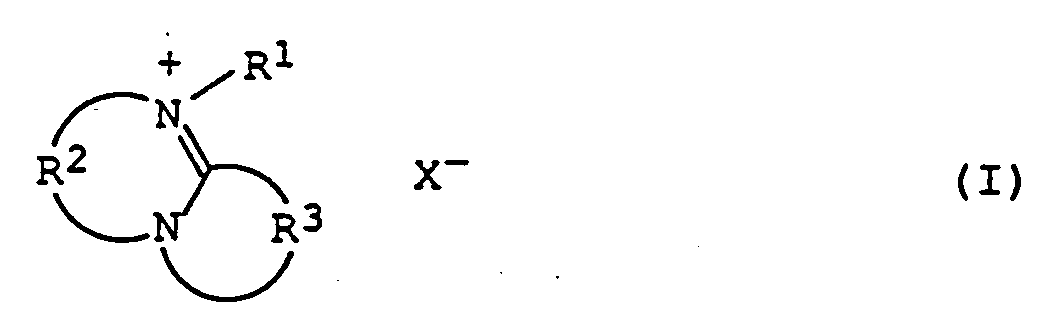 (ii) 1-alkylaminopyridinium halides of the formula:
 (iii) trialkylimidazolium halides of the formula:
 (iv) benzimidazolium halides of the formula:
 (v) alicyclic quaternary ammonium halides of the formula:
- An aluminum electroplating method according to Claim 1, wherein a plating bath containing 0.1 to 30 mole % of an alkali metal and/or alkaline earth metal halide added in the bath of Claim 1 is used.
- An aluminum electroplating method according to Claim 1, wherein an electric plating method containing an organic solvent added in the plating bath of Claim 1 is used.
- An aluminum electroplating method; which comprises effecting plating with a direct current or pulse current in a bath temperature of 0 to 300 °C, a current density of 0.01 to 50 A/dm² by use of the plating bath of Claim 1.
- An aluminum electroplating method, which comprises effecting plating by use of the plating bath of Claim 1, with the anode being made of aluminum.
- An aluminum electroplating method according to Claim 1, wherein the bicyclic quaternary amidinium halide (I) is a compound selected from the group consisting of 5-methyl-1-aza-5-azoniabicyclo-[4,3,0]5-nonene bromide, 5-ethyl-1-aza-5-azoniabicyclo-[4,3,0]5-nonene chloride, 8-methyl-1-aza-8-azoniabicyclo-[5,4,0]7-undecene iodide and 8-ethyl-1-aza-8-azoniabicyclo-[5,4,0]7-undecene chloride.
- An aluminum electroplating method according to Claim 1, wherein the 1-alkylaminopyridinium halide (II) is a compound selected from the group consisting of 1-methyl-4-dimethylaminopyridinium iodide, 1-ethyl-4-dimethylaminopyridinium bromide, 1-ethyl-4-dimethylaminopyridinium chloride, 1-ethyl-4-(N-ethyl-N-methyl)aminopyridinium chloride, 1-ethyl-4-aminopyridinium iodide, 1-n-butyl-4-dimethylaminopyridinium fluoride, 1-benzyl-4-dimethylaminopyridinium chloride, 1-n-octyl-4-dimethylaminopyridinium chloride, 1-ethyl-4-piperidinopyridinium bromide, 1-ethyl-4-pyrrolidinopyridinium chloride and 1-ethyl-4-pyrrolidinopyridinium bromide.
- An aluminum electroplating method according to Claim 1, wherein the 1,2,3-trialkylimidazolium halide (III) is a compound selected from the group consisting of 1,2,3-trimethylimidazolium bromide, 1,2,3-trimethylimidazolium iodide, 1,2-dimethyl-3-ethylimidazolium bromide, 1,2-dimethyl-3-ethylimidazolium chloride and 1,2-dimethyl-3-butylimidazolium fluoride.
- An aluminum electroplating method according to Claim 1, wherein the 1,3-dialkylbenzimidazolium halide (IV) is a compound selected from the group consisting of 1,3-dimethylbenzimidazolium bromide, 1,3-dimethylbenzimidazolium iodide, 1-methyl-3-ethylbenzimidazolium bromide, 1-methyl-3-ethylbenzimidazolium chloride, 1-methyl-3-butylbenzimidazolium fluoride and 1-ethyl-3-propyl-benzimidazolium bromide.
- An aluminum electroplating method according to Claim 1, wherein the alicyclic quaternary ammonium halide (V) is a compound selected from the group consisting of N,N-dimethylpyrrolidinium bromide, N-ethyl-N-methylpyrrolidinium chloride, N,N-dimethylpiperidinium bromide, N-ethyl-N-methylpiperidinium chloride and N,N-diethylpiperidinium bromide.
Applications Claiming Priority (12)
| Application Number | Priority Date | Filing Date | Title |
|---|---|---|---|
| JP12274189A JPH02305989A (en) | 1989-05-18 | 1989-05-18 | Composition having low melting point and aluminum electroplating method with bath of this composition |
| JP122740/89 | 1989-05-18 | ||
| JP122741/89 | 1989-05-18 | ||
| JP12274089A JPH02305988A (en) | 1989-05-18 | 1989-05-18 | Composition having low melting point and aluminum electroplating method with bath of this composition |
| JP158289/89 | 1989-06-22 | ||
| JP15828989A JPH0324291A (en) | 1989-06-22 | 1989-06-22 | Composition having low melting point and aluminum electroplating method with same as bath |
| JP193862/89 | 1989-07-28 | ||
| JP19386289A JPH0361392A (en) | 1989-07-28 | 1989-07-28 | Composition having low melting point and aluminum electroplating method using the same as bath |
| JP26903389A JPH03134194A (en) | 1989-10-18 | 1989-10-18 | Low-melting point composition and electric aluminum plating method |
| JP26903289A JPH03134193A (en) | 1989-10-18 | 1989-10-18 | Low-melting point composition and electric aluminum plating method |
| JP269032/89 | 1989-10-18 | ||
| JP269033/89 | 1989-10-18 |
Publications (3)
| Publication Number | Publication Date |
|---|---|
| EP0398358A2 EP0398358A2 (en) | 1990-11-22 |
| EP0398358A3 EP0398358A3 (en) | 1991-03-27 |
| EP0398358B1 true EP0398358B1 (en) | 1994-03-09 |
Family
ID=27552619
Family Applications (1)
| Application Number | Title | Priority Date | Filing Date |
|---|---|---|---|
| EP90109469A Expired - Lifetime EP0398358B1 (en) | 1989-05-18 | 1990-05-18 | Aluminum electroplating method |
Country Status (3)
| Country | Link |
|---|---|
| US (1) | US5041194A (en) |
| EP (1) | EP0398358B1 (en) |
| DE (1) | DE69007163T2 (en) |
Families Citing this family (35)
| Publication number | Priority date | Publication date | Assignee | Title |
|---|---|---|---|---|
| US5264111A (en) * | 1992-08-07 | 1993-11-23 | General Motors Corporation | Methods of making thin InSb films |
| DE19716495C1 (en) * | 1997-04-19 | 1998-05-20 | Aluminal Oberflaechentechnik | Electrolyte for high speed electrolytic deposition of aluminium@ |
| US6204386B1 (en) * | 1998-11-05 | 2001-03-20 | Arteva North America S.A.R.L. | Method for esterification of carboxylic or polycarboxylic acid in the presence of supercritical fluids and catalysts therefor |
| DE60010472T2 (en) | 2000-10-27 | 2005-05-19 | Centre National De La Recherche Scientifique (C.N.R.S.) | Imidazolium salts and the use of these ionic liquids as a solvent and as a catalyst |
| EP1698606B1 (en) * | 2003-12-25 | 2013-02-20 | Sumitomo Chemical Company, Limited | Fluorinating agent and method for producing fluorine-containing compound using same |
| US7504008B2 (en) * | 2004-03-12 | 2009-03-17 | Applied Materials, Inc. | Refurbishment of sputtering targets |
| US20060021870A1 (en) * | 2004-07-27 | 2006-02-02 | Applied Materials, Inc. | Profile detection and refurbishment of deposition targets |
| US20060081459A1 (en) * | 2004-10-18 | 2006-04-20 | Applied Materials, Inc. | In-situ monitoring of target erosion |
| US9127362B2 (en) | 2005-10-31 | 2015-09-08 | Applied Materials, Inc. | Process kit and target for substrate processing chamber |
| US20070125646A1 (en) | 2005-11-25 | 2007-06-07 | Applied Materials, Inc. | Sputtering target for titanium sputtering chamber |
| JP5270846B2 (en) | 2007-02-09 | 2013-08-21 | ディップソール株式会社 | Electric Al-Zr alloy plating bath using room temperature molten salt bath and plating method using the same |
| US8968536B2 (en) | 2007-06-18 | 2015-03-03 | Applied Materials, Inc. | Sputtering target having increased life and sputtering uniformity |
| US7901552B2 (en) | 2007-10-05 | 2011-03-08 | Applied Materials, Inc. | Sputtering target with grooves and intersecting channels |
| JP4530111B2 (en) * | 2008-10-15 | 2010-08-25 | 日立金属株式会社 | Electro-aluminum plating solution and method for forming aluminum plating film |
| JP5403053B2 (en) * | 2009-06-29 | 2014-01-29 | 日立金属株式会社 | Method for producing aluminum foil |
| CN102668199B (en) * | 2009-11-11 | 2016-01-20 | 日立金属株式会社 | The aluminium foil of spread loads carbonaceous particles |
| JP2012007233A (en) * | 2010-04-22 | 2012-01-12 | Sumitomo Electric Ind Ltd | Method for manufacturing aluminum structure and the aluminum structure |
| EP2623643A4 (en) * | 2010-09-30 | 2015-03-04 | Hitachi Ltd | ALUMINUM ELECTROLYTIC DEPOSITION SOLUTION |
| EP2639341B1 (en) * | 2010-11-11 | 2020-01-22 | Hitachi Metals, Ltd. | Method for producing aluminium foil |
| US8580886B2 (en) | 2011-09-20 | 2013-11-12 | Dow Corning Corporation | Method for the preparation and use of bis (alkoxysilylorgano)-dicarboxylates |
| US8778163B2 (en) | 2011-09-22 | 2014-07-15 | Sikorsky Aircraft Corporation | Protection of magnesium alloys by aluminum plating from ionic liquids |
| WO2013062026A1 (en) * | 2011-10-27 | 2013-05-02 | 日立金属株式会社 | Method for manufacturing porous aluminum foil, porous aluminum foil, positive electrode collector for electricity storage device, electrode for electricity storage device, and electricity storage device |
| US9269998B2 (en) | 2013-03-13 | 2016-02-23 | Fluidic, Inc. | Concave gas vent for electrochemical cell |
| ES2689668T3 (en) * | 2013-03-13 | 2018-11-15 | Nantenergy, Inc. | Synergistic additives for electrochemical cells with electrodeposited fuel |
| US10208391B2 (en) | 2014-10-17 | 2019-02-19 | Ut-Battelle, Llc | Aluminum trihalide-neutral ligand ionic liquids and their use in aluminum deposition |
| CN109565097A (en) | 2016-07-22 | 2019-04-02 | 南特能源公司 | Defogging system for electrochemical cell |
| BR112019000713B1 (en) | 2016-07-22 | 2023-04-25 | Nantenergy, Inc | ELECTROCHEMICAL CELL AND METHOD OF CONSERVING MOISTURE INSIDE AN ELECTROCHEMICAL CELL |
| CN106782980B (en) * | 2017-02-08 | 2018-11-13 | 包头天和磁材技术有限责任公司 | The manufacturing method of permanent-magnet material |
| EP3815172A4 (en) | 2018-06-29 | 2022-03-09 | Form Energy, Inc. | ROLLING DIAPHRAGM SEAL |
| WO2020006419A1 (en) | 2018-06-29 | 2020-01-02 | Form Energy Inc. | Metal air electrochemical cell architecture |
| US11424484B2 (en) | 2019-01-24 | 2022-08-23 | Octet Scientific, Inc. | Zinc battery electrolyte additive |
| WO2020264344A1 (en) | 2019-06-28 | 2020-12-30 | Form Energy Inc. | Device architectures for metal-air batteries |
| US11142841B2 (en) | 2019-09-17 | 2021-10-12 | Consolidated Nuclear Security, LLC | Methods for electropolishing and coating aluminum on air and/or moisture sensitive substrates |
| WO2021226399A1 (en) | 2020-05-06 | 2021-11-11 | Form Energy, Inc. | Decoupled electrode electrochemical energy storage system |
| WO2023183254A1 (en) * | 2022-03-20 | 2023-09-28 | Cornell University | Electrolyte compositions, methods of making same, uses thereof |
Family Cites Families (7)
| Publication number | Priority date | Publication date | Assignee | Title |
|---|---|---|---|---|
| US2446331A (en) * | 1944-02-14 | 1948-08-03 | William Marsh Rice Inst For Th | Electrodeposition of aluminum |
| US2446350A (en) * | 1944-02-29 | 1948-08-03 | William Marsh Rice Inst For Th | Electrodeposition of aluminum |
| US4003804A (en) * | 1975-12-31 | 1977-01-18 | Scientific Mining & Manufacturing Company | Method of electroplating of aluminum and plating baths therefor |
| DE3776124D1 (en) * | 1986-12-04 | 1992-02-27 | Shell Int Research | ELECTRODEPOSITION OF ALUMINUM. |
| DE3875943T2 (en) * | 1987-07-13 | 1993-04-01 | Nisshin Steel Co Ltd | METHOD FOR ELECTROPLATING A METAL LAYER WITH ALUMINUM. |
| US4747916A (en) * | 1987-09-03 | 1988-05-31 | Nisshin Steel Co., Ltd. | Plating bath for electrodeposition of aluminum and process for the same |
| JP2662635B2 (en) * | 1988-04-26 | 1997-10-15 | 日新製鋼株式会社 | Electric aluminum plating bath and plating method using the bath |
-
1990
- 1990-05-15 US US07/523,361 patent/US5041194A/en not_active Expired - Fee Related
- 1990-05-18 EP EP90109469A patent/EP0398358B1/en not_active Expired - Lifetime
- 1990-05-18 DE DE69007163T patent/DE69007163T2/en not_active Expired - Fee Related
Also Published As
| Publication number | Publication date |
|---|---|
| DE69007163T2 (en) | 1994-08-04 |
| DE69007163D1 (en) | 1994-04-14 |
| EP0398358A3 (en) | 1991-03-27 |
| US5041194A (en) | 1991-08-20 |
| EP0398358A2 (en) | 1990-11-22 |
Similar Documents
| Publication | Publication Date | Title |
|---|---|---|
| US5041194A (en) | Aluminum electroplating method | |
| El Abedin et al. | Additive free electrodeposition of nanocrystalline aluminium in a water and air stable ionic liquid | |
| JP2662635B2 (en) | Electric aluminum plating bath and plating method using the bath | |
| Zhao et al. | Electrodeposition of aluminium from nonaqueous organic electrolytic systems and room temperature molten salts | |
| US5074973A (en) | Non-aqueous electrolytic aluminum plating bath composition | |
| Fellner et al. | Electrolytic aluminium plating in molten salt mixtures based on AlCl3 I: Influence of the addition of tetramethylammonium chloride | |
| EP0339535B1 (en) | Plating bath for electrodeposition of aluminum and plating process making use of the bath | |
| EP2821529B1 (en) | Method for electrical aluminum plating and method for producing aluminum foil | |
| JPH02305988A (en) | Composition having low melting point and aluminum electroplating method with bath of this composition | |
| JP4986122B2 (en) | Electrolytic aluminum plating solution and aluminum plating film | |
| KR950032247A (en) | Process for preparing tertiary diarylalkylphosphine | |
| JPH03134193A (en) | Low-melting point composition and electric aluminum plating method | |
| US5543522A (en) | Process for preparing an ambient temperature molten salt using thionyl chloride | |
| JPH0361392A (en) | Composition having low melting point and aluminum electroplating method using the same as bath | |
| JPH03134194A (en) | Low-melting point composition and electric aluminum plating method | |
| JPH0421794A (en) | Composition having low melting point and aluminum electroplating method | |
| JPH02305989A (en) | Composition having low melting point and aluminum electroplating method with bath of this composition | |
| JPH04231492A (en) | Low melting composition and electrogalvanizing method | |
| JPH0324291A (en) | Composition having low melting point and aluminum electroplating method with same as bath | |
| JP2001511848A (en) | Chromium plating from plating baths activated by alkane disulfonic acid-alkane sulfonic acid compounds with inhibitors such as amine alkane sulfonic acids and heterocyclic bases | |
| JP2623485B2 (en) | Electro-aluminum plating method to make plane orientation of plating film uniform | |
| JP3061281B2 (en) | Al-Mn alloy electroplating bath | |
| JPH04231493A (en) | Low melting composition and electrochrome plating method | |
| JPH0762590A (en) | Electro aluminum plating method | |
| JPH0297691A (en) | Molybdenum electroplating bath and plating method by bath thereof |
Legal Events
| Date | Code | Title | Description |
|---|---|---|---|
| PUAI | Public reference made under article 153(3) epc to a published international application that has entered the european phase |
Free format text: ORIGINAL CODE: 0009012 |
|
| AK | Designated contracting states |
Kind code of ref document: A2 Designated state(s): DE FR IT NL |
|
| PUAL | Search report despatched |
Free format text: ORIGINAL CODE: 0009013 |
|
| AK | Designated contracting states |
Kind code of ref document: A3 Designated state(s): DE FR IT NL |
|
| 17P | Request for examination filed |
Effective date: 19910611 |
|
| 17Q | First examination report despatched |
Effective date: 19920826 |
|
| GRAA | (expected) grant |
Free format text: ORIGINAL CODE: 0009210 |
|
| AK | Designated contracting states |
Kind code of ref document: B1 Designated state(s): DE FR IT NL |
|
| PG25 | Lapsed in a contracting state [announced via postgrant information from national office to epo] |
Ref country code: NL Effective date: 19940309 Ref country code: IT Free format text: LAPSE BECAUSE OF FAILURE TO SUBMIT A TRANSLATION OF THE DESCRIPTION OR TO PAY THE FEE WITHIN THE PRE;WARNING: LAPSES OF ITALIAN PATENTS WITH EFFECTIVE DATE BEFORE 2007 MAY HAVE OCCURRED AT ANY TIME BEFORE 2007. THE CORRECT EFFECTIVE DATE MAY BE DIFFERENT FROM THE ONE RECORDED.SCRIBED TIME-LIMIT Effective date: 19940309 |
|
| REF | Corresponds to: |
Ref document number: 69007163 Country of ref document: DE Date of ref document: 19940414 |
|
| ET | Fr: translation filed | ||
| NLV1 | Nl: lapsed or annulled due to failure to fulfill the requirements of art. 29p and 29m of the patents act | ||
| PLBE | No opposition filed within time limit |
Free format text: ORIGINAL CODE: 0009261 |
|
| STAA | Information on the status of an ep patent application or granted ep patent |
Free format text: STATUS: NO OPPOSITION FILED WITHIN TIME LIMIT |
|
| 26N | No opposition filed | ||
| PGFP | Annual fee paid to national office [announced via postgrant information from national office to epo] |
Ref country code: FR Payment date: 19990521 Year of fee payment: 10 |
|
| PGFP | Annual fee paid to national office [announced via postgrant information from national office to epo] |
Ref country code: DE Payment date: 19990610 Year of fee payment: 10 |
|
| PG25 | Lapsed in a contracting state [announced via postgrant information from national office to epo] |
Ref country code: FR Free format text: LAPSE BECAUSE OF NON-PAYMENT OF DUE FEES Effective date: 20010131 |
|
| PG25 | Lapsed in a contracting state [announced via postgrant information from national office to epo] |
Ref country code: DE Free format text: LAPSE BECAUSE OF NON-PAYMENT OF DUE FEES Effective date: 20010301 |
|
| REG | Reference to a national code |
Ref country code: FR Ref legal event code: ST |