EP0397362B1 - Electrochemical detection of growth of micro-organisms - Google Patents
Electrochemical detection of growth of micro-organisms Download PDFInfo
- Publication number
- EP0397362B1 EP0397362B1 EP90304657A EP90304657A EP0397362B1 EP 0397362 B1 EP0397362 B1 EP 0397362B1 EP 90304657 A EP90304657 A EP 90304657A EP 90304657 A EP90304657 A EP 90304657A EP 0397362 B1 EP0397362 B1 EP 0397362B1
- Authority
- EP
- European Patent Office
- Prior art keywords
- cathode
- micro
- nutrient medium
- indicator species
- electrical property
- Prior art date
- Legal status (The legal status is an assumption and is not a legal conclusion. Google has not performed a legal analysis and makes no representation as to the accuracy of the status listed.)
- Expired - Lifetime
Links
- 244000005700 microbiome Species 0.000 title claims abstract description 32
- 230000012010 growth Effects 0.000 title claims abstract description 22
- 238000000835 electrochemical detection Methods 0.000 title description 8
- AUNGANRZJHBGPY-SCRDCRAPSA-N Riboflavin Chemical compound OC[C@@H](O)[C@@H](O)[C@@H](O)CN1C=2C=C(C)C(C)=CC=2N=C2C1=NC(=O)NC2=O AUNGANRZJHBGPY-SCRDCRAPSA-N 0.000 claims abstract description 48
- 235000015097 nutrients Nutrition 0.000 claims abstract description 25
- 241000894007 species Species 0.000 claims abstract description 25
- AUNGANRZJHBGPY-UHFFFAOYSA-N D-Lyxoflavin Natural products OCC(O)C(O)C(O)CN1C=2C=C(C)C(C)=CC=2N=C2C1=NC(=O)NC2=O AUNGANRZJHBGPY-UHFFFAOYSA-N 0.000 claims abstract description 24
- 239000002151 riboflavin Substances 0.000 claims abstract description 24
- 229960002477 riboflavin Drugs 0.000 claims abstract description 24
- 235000019192 riboflavin Nutrition 0.000 claims abstract description 24
- 238000000034 method Methods 0.000 claims description 20
- 239000004411 aluminium Substances 0.000 claims description 14
- 229910052782 aluminium Inorganic materials 0.000 claims description 14
- XAGFODPZIPBFFR-UHFFFAOYSA-N aluminium Chemical compound [Al] XAGFODPZIPBFFR-UHFFFAOYSA-N 0.000 claims description 14
- 230000008859 change Effects 0.000 claims description 11
- 239000010931 gold Substances 0.000 claims description 11
- 230000009604 anaerobic growth Effects 0.000 claims description 9
- PCHJSUWPFVWCPO-UHFFFAOYSA-N gold Chemical group [Au] PCHJSUWPFVWCPO-UHFFFAOYSA-N 0.000 claims description 9
- 229910052737 gold Inorganic materials 0.000 claims description 9
- 239000008363 phosphate buffer Substances 0.000 claims description 9
- 230000009467 reduction Effects 0.000 claims description 7
- FVTCRASFADXXNN-SCRDCRAPSA-N flavin mononucleotide Chemical compound OP(=O)(O)OC[C@@H](O)[C@@H](O)[C@@H](O)CN1C=2C=C(C)C(C)=CC=2N=C2C1=NC(=O)NC2=O FVTCRASFADXXNN-SCRDCRAPSA-N 0.000 claims description 2
- 229950001574 riboflavin phosphate Drugs 0.000 claims description 2
- LWIHDJKSTIGBAC-UHFFFAOYSA-K tripotassium phosphate Chemical compound [K+].[K+].[K+].[O-]P([O-])([O-])=O LWIHDJKSTIGBAC-UHFFFAOYSA-K 0.000 claims 1
- 238000001514 detection method Methods 0.000 abstract description 12
- 239000002609 medium Substances 0.000 description 45
- 239000001301 oxygen Substances 0.000 description 17
- 229910052760 oxygen Inorganic materials 0.000 description 17
- QVGXLLKOCUKJST-UHFFFAOYSA-N atomic oxygen Chemical compound [O] QVGXLLKOCUKJST-UHFFFAOYSA-N 0.000 description 16
- ZJTJUVIJVLLGSP-UHFFFAOYSA-N lumichrome Chemical compound N1C(=O)NC(=O)C2=C1N=C1C=C(C)C(C)=CC1=N2 ZJTJUVIJVLLGSP-UHFFFAOYSA-N 0.000 description 12
- 150000001875 compounds Chemical class 0.000 description 11
- 239000000243 solution Substances 0.000 description 9
- 238000012360 testing method Methods 0.000 description 9
- 239000000872 buffer Substances 0.000 description 7
- 238000002474 experimental method Methods 0.000 description 7
- 238000007792 addition Methods 0.000 description 5
- 230000007246 mechanism Effects 0.000 description 5
- BXRFQSNOROATLV-UHFFFAOYSA-N 4-nitrobenzaldehyde Chemical compound [O-][N+](=O)C1=CC=C(C=O)C=C1 BXRFQSNOROATLV-UHFFFAOYSA-N 0.000 description 4
- 241000606124 Bacteroides fragilis Species 0.000 description 4
- 208000003217 Tetany Diseases 0.000 description 4
- 230000000694 effects Effects 0.000 description 4
- RWSXRVCMGQZWBV-WDSKDSINSA-N glutathione Chemical compound OC(=O)[C@@H](N)CCC(=O)N[C@@H](CS)C(=O)NCC(O)=O RWSXRVCMGQZWBV-WDSKDSINSA-N 0.000 description 4
- 230000004044 response Effects 0.000 description 4
- XLYOFNOQVPJJNP-UHFFFAOYSA-N water Substances O XLYOFNOQVPJJNP-UHFFFAOYSA-N 0.000 description 4
- 229930192627 Naphthoquinone Natural products 0.000 description 3
- 239000008280 blood Substances 0.000 description 3
- 210000004369 blood Anatomy 0.000 description 3
- 238000004090 dissolution Methods 0.000 description 3
- 239000012153 distilled water Substances 0.000 description 3
- -1 gold and aluminium Chemical class 0.000 description 3
- XLYOFNOQVPJJNP-ZSJDYOACSA-N heavy water Substances [2H]O[2H] XLYOFNOQVPJJNP-ZSJDYOACSA-N 0.000 description 3
- 238000012544 monitoring process Methods 0.000 description 3
- 150000002791 naphthoquinones Chemical class 0.000 description 3
- 230000001954 sterilising effect Effects 0.000 description 3
- AZQWKYJCGOJGHM-UHFFFAOYSA-N 1,4-benzoquinone Chemical compound O=C1C=CC(=O)C=C1 AZQWKYJCGOJGHM-UHFFFAOYSA-N 0.000 description 2
- IJGRMHOSHXDMSA-UHFFFAOYSA-N Atomic nitrogen Chemical compound N#N IJGRMHOSHXDMSA-UHFFFAOYSA-N 0.000 description 2
- 108010024636 Glutathione Proteins 0.000 description 2
- MJVAVZPDRWSRRC-UHFFFAOYSA-N Menadione Chemical compound C1=CC=C2C(=O)C(C)=CC(=O)C2=C1 MJVAVZPDRWSRRC-UHFFFAOYSA-N 0.000 description 2
- DFPAKSUCGFBDDF-UHFFFAOYSA-N Nicotinamide Chemical compound NC(=O)C1=CC=CN=C1 DFPAKSUCGFBDDF-UHFFFAOYSA-N 0.000 description 2
- FAPWRFPIFSIZLT-UHFFFAOYSA-M Sodium chloride Chemical compound [Na+].[Cl-] FAPWRFPIFSIZLT-UHFFFAOYSA-M 0.000 description 2
- 230000010261 cell growth Effects 0.000 description 2
- 238000001914 filtration Methods 0.000 description 2
- OVBPIULPVIDEAO-LBPRGKRZSA-N folic acid Chemical compound C=1N=C2NC(N)=NC(=O)C2=NC=1CNC1=CC=C(C(=O)N[C@@H](CCC(O)=O)C(O)=O)C=C1 OVBPIULPVIDEAO-LBPRGKRZSA-N 0.000 description 2
- 229960003180 glutathione Drugs 0.000 description 2
- 238000011534 incubation Methods 0.000 description 2
- CSFWPUWCSPOLJW-UHFFFAOYSA-N lawsone Chemical compound C1=CC=C2C(=O)C(O)=CC(=O)C2=C1 CSFWPUWCSPOLJW-UHFFFAOYSA-N 0.000 description 2
- LQNUZADURLCDLV-UHFFFAOYSA-N nitrobenzene Chemical compound [O-][N+](=O)C1=CC=CC=C1 LQNUZADURLCDLV-UHFFFAOYSA-N 0.000 description 2
- 239000008057 potassium phosphate buffer Substances 0.000 description 2
- 239000000126 substance Substances 0.000 description 2
- UIXPTCZPFCVOQF-UHFFFAOYSA-N ubiquinone-0 Chemical compound COC1=C(OC)C(=O)C(C)=CC1=O UIXPTCZPFCVOQF-UHFFFAOYSA-N 0.000 description 2
- YBADLXQNJCMBKR-UHFFFAOYSA-M (4-nitrophenyl)acetate Chemical compound [O-]C(=O)CC1=CC=C([N+]([O-])=O)C=C1 YBADLXQNJCMBKR-UHFFFAOYSA-M 0.000 description 1
- FRASJONUBLZVQX-UHFFFAOYSA-N 1,4-naphthoquinone Chemical compound C1=CC=C2C(=O)C=CC(=O)C2=C1 FRASJONUBLZVQX-UHFFFAOYSA-N 0.000 description 1
- CMWKITSNTDAEDT-UHFFFAOYSA-N 2-nitrobenzaldehyde Chemical compound [O-][N+](=O)C1=CC=CC=C1C=O CMWKITSNTDAEDT-UHFFFAOYSA-N 0.000 description 1
- SLAMLWHELXOEJZ-UHFFFAOYSA-N 2-nitrobenzoic acid Chemical compound OC(=O)C1=CC=CC=C1[N+]([O-])=O SLAMLWHELXOEJZ-UHFFFAOYSA-N 0.000 description 1
- KIPMDPDAFINLIV-UHFFFAOYSA-N 2-nitroethanol Chemical compound OCC[N+]([O-])=O KIPMDPDAFINLIV-UHFFFAOYSA-N 0.000 description 1
- FBTSQILOGYXGMD-LURJTMIESA-N 3-nitro-L-tyrosine Chemical compound OC(=O)[C@@H](N)CC1=CC=C(O)C([N+]([O-])=O)=C1 FBTSQILOGYXGMD-LURJTMIESA-N 0.000 description 1
- 229910000838 Al alloy Inorganic materials 0.000 description 1
- 241000894006 Bacteria Species 0.000 description 1
- 241000193468 Clostridium perfringens Species 0.000 description 1
- 241000193449 Clostridium tetani Species 0.000 description 1
- MYMOFIZGZYHOMD-UHFFFAOYSA-N Dioxygen Chemical compound O=O MYMOFIZGZYHOMD-UHFFFAOYSA-N 0.000 description 1
- WQZGKKKJIJFFOK-GASJEMHNSA-N Glucose Natural products OC[C@H]1OC(O)[C@H](O)[C@@H](O)[C@@H]1O WQZGKKKJIJFFOK-GASJEMHNSA-N 0.000 description 1
- OVBPIULPVIDEAO-UHFFFAOYSA-N N-Pteroyl-L-glutaminsaeure Natural products C=1N=C2NC(N)=NC(=O)C2=NC=1CNC1=CC=C(C(=O)NC(CCC(O)=O)C(O)=O)C=C1 OVBPIULPVIDEAO-UHFFFAOYSA-N 0.000 description 1
- 229910019142 PO4 Inorganic materials 0.000 description 1
- 230000004075 alteration Effects 0.000 description 1
- 238000013459 approach Methods 0.000 description 1
- 239000007864 aqueous solution Substances 0.000 description 1
- 230000005587 bubbling Effects 0.000 description 1
- 229940041514 candida albicans extract Drugs 0.000 description 1
- 238000006243 chemical reaction Methods 0.000 description 1
- 239000003638 chemical reducing agent Substances 0.000 description 1
- 239000000470 constituent Substances 0.000 description 1
- 239000000356 contaminant Substances 0.000 description 1
- 238000011109 contamination Methods 0.000 description 1
- 239000002872 contrast media Substances 0.000 description 1
- 238000001816 cooling Methods 0.000 description 1
- 230000007423 decrease Effects 0.000 description 1
- MNNHAPBLZZVQHP-UHFFFAOYSA-N diammonium hydrogen phosphate Chemical compound [NH4+].[NH4+].OP([O-])([O-])=O MNNHAPBLZZVQHP-UHFFFAOYSA-N 0.000 description 1
- UYEUUXMDVNYCAM-UHFFFAOYSA-N dioxotetrahydropteridine Natural products N1=CC=NC2=NC(O)=NC(O)=C21 UYEUUXMDVNYCAM-UHFFFAOYSA-N 0.000 description 1
- 229910001882 dioxygen Inorganic materials 0.000 description 1
- 238000011067 equilibration Methods 0.000 description 1
- 229960000304 folic acid Drugs 0.000 description 1
- 235000019152 folic acid Nutrition 0.000 description 1
- 239000011724 folic acid Substances 0.000 description 1
- 230000005764 inhibitory process Effects 0.000 description 1
- 238000013383 initial experiment Methods 0.000 description 1
- 150000002500 ions Chemical class 0.000 description 1
- 238000002955 isolation Methods 0.000 description 1
- 239000012528 membrane Substances 0.000 description 1
- 229910052751 metal Inorganic materials 0.000 description 1
- 239000002184 metal Substances 0.000 description 1
- 150000002739 metals Chemical class 0.000 description 1
- 230000000813 microbial effect Effects 0.000 description 1
- 239000001964 microbiological growth medium Substances 0.000 description 1
- 229960003966 nicotinamide Drugs 0.000 description 1
- 235000005152 nicotinamide Nutrition 0.000 description 1
- 239000011570 nicotinamide Substances 0.000 description 1
- 229910052757 nitrogen Inorganic materials 0.000 description 1
- 238000007254 oxidation reaction Methods 0.000 description 1
- 150000002926 oxygen Chemical class 0.000 description 1
- NBIIXXVUZAFLBC-UHFFFAOYSA-K phosphate Chemical compound [O-]P([O-])([O-])=O NBIIXXVUZAFLBC-UHFFFAOYSA-K 0.000 description 1
- 239000010452 phosphate Substances 0.000 description 1
- 238000002360 preparation method Methods 0.000 description 1
- 108010009004 proteose-peptone Proteins 0.000 description 1
- NIPZZXUFJPQHNH-UHFFFAOYSA-N pyrazine-2-carboxylic acid Chemical compound OC(=O)C1=CN=CC=N1 NIPZZXUFJPQHNH-UHFFFAOYSA-N 0.000 description 1
- 150000003287 riboflavins Chemical class 0.000 description 1
- 239000012266 salt solution Substances 0.000 description 1
- 239000000523 sample Substances 0.000 description 1
- 238000012216 screening Methods 0.000 description 1
- 230000011664 signaling Effects 0.000 description 1
- 239000011780 sodium chloride Substances 0.000 description 1
- 239000002904 solvent Substances 0.000 description 1
- 238000004659 sterilization and disinfection Methods 0.000 description 1
- 239000000725 suspension Substances 0.000 description 1
- 238000012546 transfer Methods 0.000 description 1
- 239000012137 tryptone Substances 0.000 description 1
- 235000012711 vitamin K3 Nutrition 0.000 description 1
- 239000011652 vitamin K3 Substances 0.000 description 1
- 229940041603 vitamin k 3 Drugs 0.000 description 1
- 239000012138 yeast extract Substances 0.000 description 1
Images

Classifications
-
- C—CHEMISTRY; METALLURGY
- C12—BIOCHEMISTRY; BEER; SPIRITS; WINE; VINEGAR; MICROBIOLOGY; ENZYMOLOGY; MUTATION OR GENETIC ENGINEERING
- C12Q—MEASURING OR TESTING PROCESSES INVOLVING ENZYMES, NUCLEIC ACIDS OR MICROORGANISMS; COMPOSITIONS OR TEST PAPERS THEREFOR; PROCESSES OF PREPARING SUCH COMPOSITIONS; CONDITION-RESPONSIVE CONTROL IN MICROBIOLOGICAL OR ENZYMOLOGICAL PROCESSES
- C12Q1/00—Measuring or testing processes involving enzymes, nucleic acids or microorganisms; Compositions therefor; Processes of preparing such compositions
- C12Q1/02—Measuring or testing processes involving enzymes, nucleic acids or microorganisms; Compositions therefor; Processes of preparing such compositions involving viable microorganisms
- C12Q1/04—Determining presence or kind of microorganism; Use of selective media for testing antibiotics or bacteriocides; Compositions containing a chemical indicator therefor
-
- G—PHYSICS
- G01—MEASURING; TESTING
- G01N—INVESTIGATING OR ANALYSING MATERIALS BY DETERMINING THEIR CHEMICAL OR PHYSICAL PROPERTIES
- G01N2333/00—Assays involving biological materials from specific organisms or of a specific nature
- G01N2333/195—Assays involving biological materials from specific organisms or of a specific nature from bacteria
- G01N2333/33—Assays involving biological materials from specific organisms or of a specific nature from bacteria from Clostridium (G)
Definitions
- This invention relates to the electrochemical detection of growth of micro-organisms.
- Apparatus and methods are known for the detection of growth of micro-organisms using a sterile nutrient medium in which are placed two electrodes (anode and cathode).
- the growth of a micro-organism placed in the nutrient medium can be detected by measuring the changing potential between the electrodes. It has been observed that when growth of the micro-organisms reaches a particular stage the potential shows a marked change, e.g. a steep fall.
- EP-A-0313411 there is described a method of detecting micro-organisms in a cell in which an electrical D.C. input is applied across the two electrodes while maintaining constant current or constant potential conditions in the cell, and monitoring either voltage or current respectively in the cell against time. While these and other similar systems have been used successfully for detection of micro-organisms, the underlying mechanism giving rise to monitorable electrical changes has not hitherto been fully understood.
- the present invention has been developed to enable the above-described electrochemical detection techniques to be used for anaerobic organisms.
- US-A-4009078 discloses that electrostatic charges are associated with all cell growth.
- GB-A-2000805 describes a method for detecting bacteria in a medium by using an "electron transporter" which is capable of forming a redox system and of intervening in growth of cells so that the proportions of its oxidised and reduced form are modified. The oxido-reduction balance is then measured.
- a method for detecting anaerobic growth of a micro-organism in a sterile nutrient medium comprising the steps of:
- a method for detecting anaerobic growth of a micro-organism in a sterile nutrient medium comprising the stpes of:
- the term “consumed” is used herein to denote a detectable alteration in the indicator species such that it can no longer be reduced at the relevant electrode.
- a presently preferred indicator species is riboflavin. This has been found by the inventors to give start potentials which are comparable with existing aerobic detection systems and which remain steady until growth of micro-organisms reaches a particular level.
- the method preferably involves the addition to the nutrient medium of a phosphate buffer. This controls the pH of the medium and the dissolution of the aluminium of the anode, and so improves the signal-to-noise ratio of the system.
- Inorganic orthophosphates are suitable as the phosphate buffer.
- the invention also provides an apparatus for detecting anaerobic growth of a micro-organism.
- an apparatus comprises a nutrient medium in which has been dissolved an electrochemically reducible indicator species which is consumed by the micro-organism during anaerobic growth thereof, and, in contact with the nutrient medium, two electrodes with means for sensing, via said electrodes, a change in an electrical property of the nutrient medium during said anaerobic growth.
- Figure 1 shows a detection system formed by an electrochemical cell comprising a container 1 in which is placed a sterile nutrient broth 2. A gold electrode 3 and an aluminium electrode 4 secured in a stopper 5 are placed in contact with the nutrient medium 2. A further stopper 6 seals the container 1. A resistor 7 is connected across the electrodes 3,4 with a voltmeter 8 for sensing the potential galvanically developed across the resistor.
- the operation of the detection system of Figure 1 for aerobic samples is known (for example, from our British Patent Specification No 2142433), and will not be described herein. However, to aid in understanding the present invention, an explanation of the mechanism underlying detection in aerobic samples will first be given.
- the difference in absolute potentials between gold and aluminium electrodes in this system is of the order of 500mV.
- Current generated by this electropotential is passed through the resistance 7.
- the current arises from electrons flowing from the aluminium electrode to the gold electrode since the aluminium electrode has a more negative potential.
- the present inventors have reasoned that, if when electrons arrive at the gold they are not removed, then the potential of the gold would quickly become more negative and ultimately reach that of the aluminium. The current would then cease. In the presence of dissolved molecular oxygen, however, this does not occur but instead oxygen molecules are reduced at the gold electrode by accepting electrons therefrom.
- the source of electrons is maintained at the aluminium electrode by its slow dissolution as trivalently charged ions.
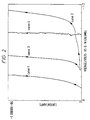
- Figure 2 compares the use of riboflavin in an anaerobic system with an aerobic system (in which oxygen is the indicator species).
- curve 1 shows the current/voltage curve for a fully aerated solution.
- the curve results from the reduction of oxygen and this is demonstrated by curve 2 which was obtained after de-oxygenating the same solution by bubbling nitrogen through it for about 2 hours. It is clear that under these conditions no current flows until much more negative potentials are reached, when the reduction of water occurs:- 2H2O + 2e ⁇ ---> H2 + 2OH ⁇
- curve 3 is obtained indicating that the riboflavin is being electrochemically reduced.
- Curve 4 shows the current/voltage curve for the dissolution of the aluminium electrode. (The modulus of the current has been taken since it has a positive sign because it is an oxidation reaction).
- the Applicants have introduced riboflavin into anaerobic control media, and have recorded steady voltages of about 350-400mV. Moreover, when micro-organisms which have been introduced into the cells have grown, a significant reduction of this voltage to about 200mV has occurred.
- a control medium including the following constituents was prepared, using distilled water as solvent. The quantities given are per litre of distilled water.
- 1% w/v solutions/suspensions of the compounds to be tested were prepared in distilled water and 0.5ml added to 50ml of the control medium. The final concentration of each compound was a nominal 0.01%.
- Containers were then entered into an electrochemical detection system as follows, the experiments designated Lab Code 67-4 to 67-49 relating to the control medium with the addition of the compounds to be tested.
- the same control medium as before was prepared, and the three compounds being studied further were added to amounts of this medium.
- the media produced were then sterilized either by autoclaving at 15 psi for 15 minutes or by filtration through a 0.22 »m membrane (with no precautions taken to keep the medium anaerobic). Immediately after sterilization the containers were stoppered and stored at room temperature for 24 hours.
- the containers were then entered into an electrochemical detection system as follows:- LAB CODE ADDITION 69A and 69AF Riboflavin (0.006%) 69B and 69BF Naphthoquinone (0.0015%) 69C and 69CF 4 Nitrobenzaldehyde (0.006%) 69D and 69DF Lumichrome (0.002%) (F denotes that the medium was filter sterilized).
- the containers were inoculated with either Clostridium tetani or Bacteroides fragilis on day 7 or Clostridium perfringens on day 8. Approximately 100 organisms were added to each bottle.
- RIBOFLAVIN The control containers gave the expected smooth signal of 400mV and the growth of the test organisms was indicated by a voltage drop of 150mV. Filter sterilized medium resulted in a signal of about 375mV and Cl. perfringens failed to grow and signal. Later experiments showed that some riboflavin derivatives, e.g. riboflavin phosphate, could be used instead of riboflavin.
- NAPHTHOQUINONE The voltage declined from 400mV to 300mV over the 10 day incubation period. Although growth of the three organisms was observed in this medium, the voltage drop was only 50mV. In contrast medium that had been filter sterilized gave a voltage output of 500mV. The signal from two of the bottles deteriorated after about day 5. Growth of B. fragilis was signalled by a voltage drop of 150mV whilst Cl. tetani gave a 200 - 250mV drop. Cl. perfringens failed to grow and signal. A later experiment showed that 2-hydroxy-1, 4-naphthoquinone at 0.004% concentration could be used as the indicator species.
- NITROBENZALDEHYDE The voltage output from autoclaved medium was approximately 325mV declining to 225mV over the incubation period. Although growth of the test organisms was observed there was no voltage change. The signal response from filter sterilized medium was variable. All three test organisms grew with B. fragilis signalling after 24 hours and Cl. tetani after 48 hours. Cl. perfringens failed to signal, although the voltage output from this container was some 100mV less than the other containers in the series.
- LUMICHROME The voltage output from autoclaved medium was less than 300mV and the growth of the test organisms was not signalled by a voltage drop. Filter sterilized medium gave a high voltage output (c 500mV) which declined over the ten day period. Cl. tetani failed to grow in this medium, whilst B. fragilis and a contaminant grew and signalled. ( Cl. perfringens was not added to this series). The control container gave a response indicative of growth, but no contamination was visually observed.
- filter sterilized media gave higher voltage outputs than media that had been autoclaved, suggesting that during autoclaving the compounds are either lost from the medium or changed in some way.
- signal generated by filtered media was generally less stable possible because some residual oxygen was present. It is believed that this problem could be overcome by filter sterilizing and dispensing hot media in an anaerobic atmosphere, increasing the amount of reducing agent (e.g. glutathione) and/or increasing the equilibration time.
- reducing agent e.g. glutathione
- the present inventors have examined the effect of varying the phosphate buffer concentration in the control medium, by monitoring the signal generated by the control medium with 0.006% riboflavin. Reduction of the phosphate buffer concentration from 200mM to 75mM was shown to have little effect on signal quality, although the time taken to reach maximum voltage increased from 3 hours (200mM buffer) to 12 hours (75mM buffer). However, the experiments were performed in the absence of human blood. In the experiments set out below modified control media were prepared with five different potassium phosphate buffer concentrations, and 5ml of human blood was added to the medial on entry into an electrochemical detection system.
- Control medium containing 125mM potassium phosphate buffer and riboflavin at 0.006% concentration was diluted with the same control medium but lacking any phosphate buffer to give a series of test media containing 0, 25, 50, 75, 100 and 125mM buffer concentrations with 0.006% riboflavin. Regardless of buffer concentration, all the test media containing buffer had a pH of 7.3 after autoclaving whilst the corresponding pH value of the test medium without phosphate buffer was 7.8. Each test medium was dispensed into four containers, and the containers were autoclaved.
Landscapes
- Chemical & Material Sciences (AREA)
- Life Sciences & Earth Sciences (AREA)
- Organic Chemistry (AREA)
- Health & Medical Sciences (AREA)
- Engineering & Computer Science (AREA)
- Zoology (AREA)
- Wood Science & Technology (AREA)
- Proteomics, Peptides & Aminoacids (AREA)
- Molecular Biology (AREA)
- Bioinformatics & Cheminformatics (AREA)
- Immunology (AREA)
- Microbiology (AREA)
- Biophysics (AREA)
- Analytical Chemistry (AREA)
- Physics & Mathematics (AREA)
- Toxicology (AREA)
- Biochemistry (AREA)
- Biotechnology (AREA)
- General Engineering & Computer Science (AREA)
- General Health & Medical Sciences (AREA)
- Genetics & Genomics (AREA)
- Measuring Or Testing Involving Enzymes Or Micro-Organisms (AREA)
- Apparatus Associated With Microorganisms And Enzymes (AREA)
- Micro-Organisms Or Cultivation Processes Thereof (AREA)
- Farming Of Fish And Shellfish (AREA)
Abstract
Description
- This invention relates to the electrochemical detection of growth of micro-organisms.
- Apparatus and methods are known for the detection of growth of micro-organisms using a sterile nutrient medium in which are placed two electrodes (anode and cathode). The growth of a micro-organism placed in the nutrient medium can be detected by measuring the changing potential between the electrodes. It has been observed that when growth of the micro-organisms reaches a particular stage the potential shows a marked change, e.g. a steep fall.
- In our British Patent Specification No 2142433 the Applicants have described an apparatus by which the growth of micro-organisms in a plurality of samples can be monitored electrochemically, by monitoring the potential difference developed galvanically between two electrodes of different metals, e.g. gold and aluminium, in contact with the samples.
- Further, in the Applicants' European Patent Application Publication No EP-A-0313411 there is described a method of detecting micro-organisms in a cell in which an electrical D.C. input is applied across the two electrodes while maintaining constant current or constant potential conditions in the cell, and monitoring either voltage or current respectively in the cell against time. While these and other similar systems have been used successfully for detection of micro-organisms, the underlying mechanism giving rise to monitorable electrical changes has not hitherto been fully understood.
- It has been discovered by the present inventors that the underlying mechanism involves the reduction of free dissolved oxygen at the cathode in the transfer of electrical charge between the electrodes. Whilst for aerobic samples using gold and aluminium electrodes there is a measurable potential of the order of 400-500mV in the absence of micro-organisms, falling to 200-300mV with the growth of micro-organisms and consumption by them of the dissolved oxygen, for anaerobic cells the initial measurable potential is extremely low or even zero because of the absence of dissolved oxygen. With this condition it is on the face of it impossible to use the known electrochemical detection techniques for anaerobic organisms.
- The present invention has been developed to enable the above-described electrochemical detection techniques to be used for anaerobic organisms.
- Other techniques are known for the detection of micro-organisms. US-A-4009078 discloses that electrostatic charges are associated with all cell growth. GB-A-2000805 describes a method for detecting bacteria in a medium by using an "electron transporter" which is capable of forming a redox system and of intervening in growth of cells so that the proportions of its oxidised and reduced form are modified. The oxido-reduction balance is then measured.
- According to one aspect of the present invention there is provided a method for detecting anaerobic growth of a micro-organism in a sterile nutrient medium comprising the steps of:
- a) forming a solution of said nutrient medium with an indicator species; and
- b) sensing the change of an electrical property of said solution while in direct contact with two electrodes, one of which is a cathode,
- According to another aspect there is provided a method for detecting anaerobic growth of a micro-organism in a sterile nutrient medium comprising the stpes of:
- a) forming a solution of said nutrient medium with an indicator species; and
- b) sensing the change of an electrical property of said solution while in direct contact with two electrodes, one of which is a cathode,
- The term "consumed" is used herein to denote a detectable alteration in the indicator species such that it can no longer be reduced at the relevant electrode.
- A presently preferred indicator species is riboflavin. This has been found by the inventors to give start potentials which are comparable with existing aerobic detection systems and which remain steady until growth of micro-organisms reaches a particular level.
- Using an aluminium (or aluminium alloy) anode the method preferably involves the addition to the nutrient medium of a phosphate buffer. This controls the pH of the medium and the dissolution of the aluminium of the anode, and so improves the signal-to-noise ratio of the system. Inorganic orthophosphates are suitable as the phosphate buffer.
- From a second aspect thereof the invention also provides an apparatus for detecting anaerobic growth of a micro-organism. Accordingly such an apparatus comprises a nutrient medium in which has been dissolved an electrochemically reducible indicator species which is consumed by the micro-organism during anaerobic growth thereof, and, in contact with the nutrient medium, two electrodes with means for sensing, via said electrodes, a change in an electrical property of the nutrient medium during said anaerobic growth.
- For a better understanding of the present invention and to show how the same may be carried into effect, reference will now be made by way of example to the accompanying drawings in which:-
- Figure 1 is a diagrammatic sketch of an electrochemical detection apparatus; and
- Figure 2 is a graph comparing aerobic and anaerobic detection systems.
- Figure 1 shows a detection system formed by an electrochemical cell comprising a
container 1 in which is placed asterile nutrient broth 2. Agold electrode 3 and analuminium electrode 4 secured in a stopper 5 are placed in contact with thenutrient medium 2. A further stopper 6 seals thecontainer 1. A resistor 7 is connected across theelectrodes voltmeter 8 for sensing the potential galvanically developed across the resistor. The operation of the detection system of Figure 1 for aerobic samples is known (for example, from our British Patent Specification No 2142433), and will not be described herein. However, to aid in understanding the present invention, an explanation of the mechanism underlying detection in aerobic samples will first be given. - The difference in absolute potentials between gold and aluminium electrodes in this system is of the order of 500mV. Current generated by this electropotential is passed through the resistance 7. The current arises from electrons flowing from the aluminium electrode to the gold electrode since the aluminium electrode has a more negative potential. The present inventors have reasoned that, if when electrons arrive at the gold they are not removed, then the potential of the gold would quickly become more negative and ultimately reach that of the aluminium. The current would then cease. In the presence of dissolved molecular oxygen, however, this does not occur but instead oxygen molecules are reduced at the gold electrode by accepting electrons therefrom. The source of electrons is maintained at the aluminium electrode by its slow dissolution as trivalently charged ions.
- The reactions are probably
- At the Al electrode :
-
Al ---> Al³⁺ + 3e-
- At the Au electrode :
-
O₂+2H₂O+2e- ->H₂O₂+2OH⁻
and/or
O₂+2H₂O+4e- ->4OH
- As the mechanism relies on the consumption of free oxygen, it is not suitable for anaerobic micro-organisms. By applying their discovery of the aerobic mechanism to anaerobic systems the present inventors have identified the necessary qualities of an indicator species which could be used in place of oxygen for an anaerobic system. The criteria which the Applicants believe must be satisfied are
- (1) that the indicator species should be electrochemically reducible;
- (2) that it should be soluble in the nutrient medium; and
- (3) that it can be utilised by the micro-organisms for growth. It is also desirable that the indicator species should withstand autoclaving to sterilise the nutrient medium. This is not essential since other sterilising procedures, e.g. filtering, could be adopted. There is no obvious route to the isolation of suitable species satisfying these criteria, but the inventors have discovered that riboflavin is suitable, and is preferred.
- Figure 2 compares the use of riboflavin in an anaerobic system with an aerobic system (in which oxygen is the indicator species).
- Figure 2,
curve 1, shows the current/voltage curve for a fully aerated solution. The curve results from the reduction of oxygen and this is demonstrated bycurve 2 which was obtained after de-oxygenating the same solution by bubbling nitrogen through it for about 2 hours. It is clear that under these conditions no current flows until much more negative potentials are reached, when the reduction of water occurs:-
2H₂O + 2e⁻ ---> H₂ + 2OH⁻
However, when riboflavin is added to this anaerobic system,curve 3 is obtained indicating that the riboflavin is being electrochemically reduced. -
Curve 4 shows the current/voltage curve for the dissolution of the aluminium electrode. (The modulus of the current has been taken since it has a positive sign because it is an oxidation reaction). - It is clear from these curves that the riboflavin behaves in a similar manner to oxygen and so should work in a detection system. However, because the curve for the riboflavin is closer to the aluminium curve than is the oxygen curve, a lower voltage would be expected when riboflavin is used in place of oxygen. It should also be noted that these experiments have been performed in salt solution, and some differences are to be expected when a micro-biological growth medium is used.
- The Applicants have introduced riboflavin into anaerobic control media, and have recorded steady voltages of about 350-400mV. Moreover, when micro-organisms which have been introduced into the cells have grown, a significant reduction of this voltage to about 200mV has occurred.
- While the above description relates to an Al/Au electrode cell, it will be appreciated that similar results could be obtained in an impressed voltage or current system as is described in European Patent Application Publication No EP-A-0313411.
- Further experiments have been carried out to isolate species other than riboflavin which are suitable for use in an anaerobic detection system.
- An initial experiment involved screening 14 compounds that either had similar chemical structures to riboflavin or had structures which could accept electrons. Since the majority of the compounds were insoluble in aqueous solutions and the effect of autoclaving was not considered, the following experimental protocol was used.
- A control medium including the following constituents was prepared, using distilled water as solvent. The quantities given are per litre of distilled water.
-
Proteose Peptone No 310g Tryptone 5g Yeast Extract 5g D-Glucose 2.5g Sodium Chloride 2.3g Di-ammonium hydrogen orthophosphate 7.3g Glutathione 4g
After preparation the control medium was dispensed into containers and autoclaved for 15 minutes at 15 psi. Immediately after autoclaving the containers were stoppered. - 1% w/v solutions/suspensions of the compounds to be tested were prepared in distilled water and 0.5ml added to 50ml of the control medium. The final concentration of each compound was a nominal 0.01%. Containers were then entered into an electrochemical detection system as follows, the experiments designated Lab Code 67-4 to 67-49 relating to the control medium with the addition of the compounds to be tested.
LAB CODE COMPOUND 67-1 to 67-3 Control, No Additions 67-4 to 67-6 Riboflavin (0.006%) 67-7 to 67-9 Nitrobenzene 67-10 to 67-12 4-Nitrobenzaldehyde 67-13 to 67-15 2-Nitroethanol 67-16 to 67-18 Nitrobenzoic Acid 67-19 to 67-21 p-Nitrophenylacetate 67-22 to 67-24 Folic Acid 67-25 to 67-27 3-Nitro-L-Tyrosine 67-28 to 67-30 2-Pyrazine Carboxylic Acid 67-31 to 67-33 2,3 Dimethoxy-5- methyl 67-34 to 67-36 Menadione 67-37 to 67-39 Lumichrome 67-40 to 67-42 Lumazine Monohydrate 67-43 to 67-45 Nicotinamide 67-46 to 67-49 P-Benzoquinone
The Applicants found that the control medium without any additions gave an unacceptably low signal. Moreover, the majority of the compounds listed above did not improve the signal level. However, two compounds, 4-Nitrobenzaldehyde and Lumichrome, when added to the control medium, resulted in a signal which was comparable to that given by the control medium with riboflavin. Therefore, Lumichrome, 4-Nitrobenzaldehyde and Naphthoquinone (which was not available for the initial screen but had previously been found to be effective) were examined further. - The same control medium as before was prepared, and the three compounds being studied further were added to amounts of this medium. The media produced were then sterilized either by autoclaving at 15 psi for 15 minutes or by filtration through a 0.22 »m membrane (with no precautions taken to keep the medium anaerobic). Immediately after sterilization the containers were stoppered and stored at room temperature for 24 hours. The containers were then entered into an electrochemical detection system as follows:-
LAB CODE ADDITION 69A and 69AF Riboflavin (0.006%) 69B and 69BF Naphthoquinone (0.0015%) 69C and 69CF 4 Nitrobenzaldehyde (0.006%) 69D and 69DF Lumichrome (0.002%) (F denotes that the medium was filter sterilized). - It is to be noted that the solubility of the Napthoquinone and Lumichrome was such that even with the small amounts used, some of the compound failed to dissolve.
- The containers were inoculated with either Clostridium tetani or Bacteroides fragilis on day 7 or Clostridium perfringens on
day 8. Approximately 100 organisms were added to each bottle. - Initial "humps" appeared in the filter sterilized containers, probably the result of the presence of residual oxygen in the medium.
- RIBOFLAVIN. The control containers gave the expected smooth signal of 400mV and the growth of the test organisms was indicated by a voltage drop of 150mV. Filter sterilized medium resulted in a signal of about 375mV and Cl. perfringens failed to grow and signal. Later experiments showed that some riboflavin derivatives, e.g. riboflavin phosphate, could be used instead of riboflavin.
- NAPHTHOQUINONE. The voltage declined from 400mV to 300mV over the 10 day incubation period. Although growth of the three organisms was observed in this medium, the voltage drop was only 50mV. In contrast medium that had been filter sterilized gave a voltage output of 500mV. The signal from two of the bottles deteriorated after about day 5. Growth of B. fragilis was signalled by a voltage drop of 150mV whilst Cl. tetani gave a 200 - 250mV drop. Cl. perfringens failed to grow and signal. A later experiment showed that 2-hydroxy-1, 4-naphthoquinone at 0.004% concentration could be used as the indicator species.
- NITROBENZALDEHYDE. The voltage output from autoclaved medium was approximately 325mV declining to 225mV over the incubation period. Although growth of the test organisms was observed there was no voltage change. The signal response from filter sterilized medium was variable. All three test organisms grew with B. fragilis signalling after 24 hours and Cl. tetani after 48 hours. Cl. perfringens failed to signal, although the voltage output from this container was some 100mV less than the other containers in the series.
- LUMICHROME. The voltage output from autoclaved medium was less than 300mV and the growth of the test organisms was not signalled by a voltage drop. Filter sterilized medium gave a high voltage output (c 500mV) which declined over the ten day period. Cl. tetani failed to grow in this medium, whilst B. fragilis and a contaminant grew and signalled. (Cl. perfringens was not added to this series). The control container gave a response indicative of growth, but no contamination was visually observed.
- In conclusion, filter sterilized media gave higher voltage outputs than media that had been autoclaved, suggesting that during autoclaving the compounds are either lost from the medium or changed in some way. However the signal generated by filtered media was generally less stable possible because some residual oxygen was present. It is believed that this problem could be overcome by filter sterilizing and dispensing hot media in an anaerobic atmosphere, increasing the amount of reducing agent (e.g. glutathione) and/or increasing the equilibration time.
- The present inventors have examined the effect of varying the phosphate buffer concentration in the control medium, by monitoring the signal generated by the control medium with 0.006% riboflavin. Reduction of the phosphate buffer concentration from 200mM to 75mM was shown to have little effect on signal quality, although the time taken to reach maximum voltage increased from 3 hours (200mM buffer) to 12 hours (75mM buffer). However, the experiments were performed in the absence of human blood. In the experiments set out below modified control media were prepared with five different potassium phosphate buffer concentrations, and 5ml of human blood was added to the medial on entry into an electrochemical detection system.
- Control medium containing 125mM potassium phosphate buffer and riboflavin at 0.006% concentration was diluted with the same control medium but lacking any phosphate buffer to give a series of test media containing 0, 25, 50, 75, 100 and 125mM buffer concentrations with 0.006% riboflavin. Regardless of buffer concentration, all the test media containing buffer had a pH of 7.3 after autoclaving whilst the corresponding pH value of the test medium without phosphate buffer was 7.8. Each test medium was dispensed into four containers, and the containers were autoclaved.
- Human blood (5ml) was added to the containers immediately on cooling, prior to their entry into the detection system. Cl. tetani was inoculated into one container from each test medium.
- All the inoculated containers showed a response, the voltage signal level increasing with the phosphate buffer concentration. However, high levels of buffer concentration were found to delay the response, it is believed because of inhibition of the microbial growth by the phosphate. Low levels of buffer concentration, on the other hand, gave low signal-to-noise ratios.
- Further studies carried out by the Applicant have revealed or confirmed the following substances which can be used in place of riboflavin as the electrochemically reducible indicator species.


in that the indicator species is electrochemically reducible at the cathode to enable a current to flow through the solution and is consumed by the micro-organisms for their growth, the growth of the micro-organisms accordingly causing a change in said potential difference.
in that the indicator species is electrochemically reducible at the cathode to enable a current to flow through the solution and is consumed by the micro-organisms for their growth, the growth of the micro-organism accordingly causing a change in said developed voltage or developed current.
Claims (10)
- A method for detecting anaerobic growth of a micro-organism in a sterile nutrient medium comprising the steps of:a) forming a solution of said nutrient medium with an indicator species; andb) sensing the change of an electrical property of said solution while in direct contact with at least one electrode,characterised in that step b) is carried out with the solution in direct contact with both an anode and a cathode electrically connected outside the medium in an electrical circuit
in that the electrical property is related to current flowing in the electrical circuit as a result of reduction of the indicator species at the cathode, and
in that the indicator species comprises riboflavin or a derivative thereof which is reducible electrochemically at the cathode so as to remove electrons therefrom, the indicator species being furthermore consumed by the micro-organisms as they grow so that a predetermined level of growth results in a detectable change in said electrical property. - A method according to claim 1 wherein the anode is connected to the cathode outside the medium via a resistor and wherein the electrical property is the potential difference developed galvanically across said resistor.
- A method according to claim 1 wherein the electrical circuit includes means for applying an electrical DC input between the anode and the cathode to maintain constant current or constant potential conditions and wherein the electrical property is voltage or current respectively.
- A method as claimed in any preceding claim in which the electrochemically reducible indicator species comprises riboflavin at a concentration in the nutrient medium of about .006%.
- A method as claimed in any of claims 1 to 3 wherein the indicator species comprises riboflavin phosphate.
- A method as claimed in claim 1 or 2 in which the anode electrode comprises aluminium.
- A method as claimed in claim 6 wherein a phosphate buffer is added to the nutrient medium.
- A method as claimed in claim 7 wherein the phosphate buffer comprises potassium orthophosphate.
- An apparatus for detecting anaerobic growth of a micro-organism in accordance with the method of any preceding claim, which comprises a sterile nutrient medium in which has been dissolved an electrochemically reducible indicator species comprising riboflavin or its derivatives which is consumed by the micro-organisms during anaerobic growth thereof and, in con=act with the nutrient medium, an anode and a cathode (3,4), the apparatus further comprising means (7,8) for sensing a change in an electrical property of the nutrient medium during said anaerobic growth, said electrical property being related to current flow as a result of reduction of the indicator species at the cathode.
- An apparatus as claimed in claim 8 in which the cathode is gold and the anode comprises aluminium, the electrical property being detected as a change in galvanically generated potential across a resistor (7) connected between the anode and the cathode (3,4).
Applications Claiming Priority (4)
| Application Number | Priority Date | Filing Date | Title |
|---|---|---|---|
| GB898910539A GB8910539D0 (en) | 1989-05-08 | 1989-05-08 | Electrochemical detection of growth of micro-organisms |
| GB8910539 | 1989-05-08 | ||
| GB8921068A GB2237386A (en) | 1989-05-08 | 1989-09-18 | Detecting anaerobic growth of micro-organisms |
| GB8921068 | 1989-09-18 |
Publications (2)
| Publication Number | Publication Date |
|---|---|
| EP0397362A1 EP0397362A1 (en) | 1990-11-14 |
| EP0397362B1 true EP0397362B1 (en) | 1995-06-21 |
Family
ID=26295328
Family Applications (1)
| Application Number | Title | Priority Date | Filing Date |
|---|---|---|---|
| EP90304657A Expired - Lifetime EP0397362B1 (en) | 1989-05-08 | 1990-04-30 | Electrochemical detection of growth of micro-organisms |
Country Status (8)
| Country | Link |
|---|---|
| EP (1) | EP0397362B1 (en) |
| AT (1) | ATE124141T1 (en) |
| CA (1) | CA2016218A1 (en) |
| DE (1) | DE69020241T2 (en) |
| DK (1) | DK0397362T3 (en) |
| ES (1) | ES2076313T3 (en) |
| GR (1) | GR3017382T3 (en) |
| IE (1) | IE67042B1 (en) |
Families Citing this family (2)
| Publication number | Priority date | Publication date | Assignee | Title |
|---|---|---|---|---|
| DE4328689A1 (en) * | 1993-08-26 | 1995-03-02 | Beiersdorf Ag | Method for detecting and counting microorganisms |
| FR2785620B1 (en) | 1998-11-05 | 2003-02-07 | Bio Merieux | DETECTION OF ALL MICRO-ORGANISMS IN A SAMPLE |
Family Cites Families (5)
| Publication number | Priority date | Publication date | Assignee | Title |
|---|---|---|---|---|
| GB1433887A (en) * | 1973-04-19 | 1976-03-17 | Bactomatic Inc | Microbiological detection apparatus |
| US4009078A (en) * | 1975-01-24 | 1977-02-22 | The United States Of America As Represented By The Administrator Of The National Aeronautics And Space Administration | Detecting the presence of microorganisms |
| FR2396974A1 (en) * | 1977-07-04 | 1979-02-02 | Anvar | METHOD OF DETECTION AND STUDY OF A CELLULAR OR SIMILAR ACTIVITY AND MEANS FOR THE IMPLEMENTATION OF SUCH A PROCESS |
| DE3175570D1 (en) * | 1980-03-08 | 1986-12-11 | Japan Tectron Instr Corp | Methods of monitoring micro-organisms and media for culture |
| GB8516912D0 (en) * | 1985-07-04 | 1985-08-07 | Johnson Matthey Plc | Detecting growth of micro-organisms |
-
1990
- 1990-04-30 DK DK90304657.1T patent/DK0397362T3/en active
- 1990-04-30 EP EP90304657A patent/EP0397362B1/en not_active Expired - Lifetime
- 1990-04-30 DE DE69020241T patent/DE69020241T2/en not_active Expired - Fee Related
- 1990-04-30 AT AT90304657T patent/ATE124141T1/en not_active IP Right Cessation
- 1990-04-30 ES ES90304657T patent/ES2076313T3/en not_active Expired - Lifetime
- 1990-05-07 CA CA002016218A patent/CA2016218A1/en not_active Abandoned
- 1990-05-07 IE IE165190A patent/IE67042B1/en not_active IP Right Cessation
-
1995
- 1995-09-13 GR GR950402499T patent/GR3017382T3/en unknown
Also Published As
| Publication number | Publication date |
|---|---|
| EP0397362A1 (en) | 1990-11-14 |
| ES2076313T3 (en) | 1995-11-01 |
| CA2016218A1 (en) | 1990-11-08 |
| DE69020241D1 (en) | 1995-07-27 |
| DK0397362T3 (en) | 1995-08-14 |
| IE67042B1 (en) | 1996-02-21 |
| ATE124141T1 (en) | 1995-07-15 |
| GR3017382T3 (en) | 1995-12-31 |
| DE69020241T2 (en) | 1995-12-07 |
| IE901651L (en) | 1990-11-08 |
Similar Documents
| Publication | Publication Date | Title |
|---|---|---|
| Kaplan et al. | Evaluation and simplification of the assimilable organic carbon nutrient bioassay for bacterial growth in drinking water | |
| Criddle et al. | Promitochondria of anaerobically grown yeast. I. Isolation and biochemical properties | |
| Boswell et al. | Phosphate uptake and release by Acinetobacter johnsonii in continuous culture and coupling of phosphate release to heavy metal accumulation | |
| Matsunaga et al. | Electrode system for the determination of microbial populations | |
| EP0135023B1 (en) | Method for sensitivity testing bacteria | |
| Brendel et al. | Common steps in the repair of alkylation and radiation damage in yeast | |
| Nishikawa et al. | Dye-coupled electrode system for the rapid determination of cell populations in polluted water | |
| EP4372076A1 (en) | Aromatic polyester decomposing bacteria | |
| Matsunaga et al. | Electrochemical determination of cell populations | |
| Sakai et al. | BOD sensor using magnetic activated sludge | |
| EP0397362A1 (en) | Electrochemical detection of growth of micro-organisms | |
| US4390620A (en) | Method and composition for the detection and study of cellular activity or the like and means for applying such method | |
| US5300428A (en) | Electrochemical detection of growth of micro-organisms | |
| Shapiro et al. | Initial anaerobic biofilm development | |
| Zilberstein et al. | Na+ gradient-coupled porters of EScherichia coli share a common subunit. | |
| Sarró et al. | Biofouling on austenitic stainless steels in spent nuclear fuel pools | |
| US5116757A (en) | Mevalonic acid-producing microorganism | |
| Roth et al. | Chemiluminescence by Listeria monocytogenes | |
| EP0217854B1 (en) | Method for the monitoring and control of microbial populations | |
| Nistor et al. | Detection of Escherichia coli in water by culture-based amperometric and luminometric methods | |
| Maoyu et al. | Electrode system for determination of microbial cell populations in polluted water | |
| EP0944732B1 (en) | Method and apparatus for measuring use of a substrate in a microbially catalysed reaction | |
| Sadoff et al. | Electrolysis as a means of aerating submerged cultures of microorganisms | |
| Tilton et al. | PHYSIOLOGY OF SELENITE REDUCTION BY ENTEROCOCCI: I. INFLUENCE OF ENVIRONMENTAL VARIABLES | |
| Wollemberger et al. | Microbial membrane electrode for steroid assay |
Legal Events
| Date | Code | Title | Description |
|---|---|---|---|
| PUAI | Public reference made under article 153(3) epc to a published international application that has entered the european phase |
Free format text: ORIGINAL CODE: 0009012 |
|
| 17P | Request for examination filed |
Effective date: 19900507 |
|
| AK | Designated contracting states |
Kind code of ref document: A1 Designated state(s): AT BE CH DE DK ES FR GB GR IT LI LU NL SE |
|
| 17Q | First examination report despatched |
Effective date: 19930406 |
|
| RAP1 | Party data changed (applicant data changed or rights of an application transferred) |
Owner name: CARNAUDMETALBOX PLC |
|
| RAP1 | Party data changed (applicant data changed or rights of an application transferred) |
Owner name: CARNAUDMETALBOX PLC |
|
| GRAA | (expected) grant |
Free format text: ORIGINAL CODE: 0009210 |
|
| AK | Designated contracting states |
Kind code of ref document: B1 Designated state(s): AT BE CH DE DK ES FR GB GR IT LI LU NL SE |
|
| PG25 | Lapsed in a contracting state [announced via postgrant information from national office to epo] |
Ref country code: GR Free format text: LAPSE BECAUSE OF FAILURE TO SUBMIT A TRANSLATION OF THE DESCRIPTION OR TO PAY THE FEE WITHIN THE PRESCRIBED TIME-LIMIT Effective date: 19950621 |
|
| REF | Corresponds to: |
Ref document number: 124141 Country of ref document: AT Date of ref document: 19950715 Kind code of ref document: T |
|
| REF | Corresponds to: |
Ref document number: 69020241 Country of ref document: DE Date of ref document: 19950727 |
|
| ET | Fr: translation filed | ||
| REG | Reference to a national code |
Ref country code: DK Ref legal event code: T3 |
|
| ITF | It: translation for a ep patent filed | ||
| REG | Reference to a national code |
Ref country code: ES Ref legal event code: FG2A Ref document number: 2076313 Country of ref document: ES Kind code of ref document: T3 |
|
| REG | Reference to a national code |
Ref country code: GR Ref legal event code: FG4A Free format text: 3017382 |
|
| PLBE | No opposition filed within time limit |
Free format text: ORIGINAL CODE: 0009261 |
|
| STAA | Information on the status of an ep patent application or granted ep patent |
Free format text: STATUS: NO OPPOSITION FILED WITHIN TIME LIMIT |
|
| PG25 | Lapsed in a contracting state [announced via postgrant information from national office to epo] |
Ref country code: LU Free format text: LAPSE BECAUSE OF NON-PAYMENT OF DUE FEES Effective date: 19960430 Ref country code: LI Effective date: 19960430 Ref country code: DK Effective date: 19960430 Ref country code: CH Effective date: 19960430 Ref country code: BE Effective date: 19960430 Ref country code: AT Effective date: 19960430 |
|
| REG | Reference to a national code |
Ref country code: DK Ref legal event code: EBP |
|
| PG25 | Lapsed in a contracting state [announced via postgrant information from national office to epo] |
Ref country code: SE Effective date: 19960501 |
|
| PG25 | Lapsed in a contracting state [announced via postgrant information from national office to epo] |
Ref country code: ES Free format text: LAPSE BECAUSE OF EXPIRATION OF PROTECTION Effective date: 19960503 |
|
| 26N | No opposition filed | ||
| BERE | Be: lapsed |
Owner name: CARNAUDMETALBOX P.L.C. Effective date: 19960430 |
|
| PG25 | Lapsed in a contracting state [announced via postgrant information from national office to epo] |
Ref country code: NL Effective date: 19961101 |
|
| REG | Reference to a national code |
Ref country code: GR Ref legal event code: MM2A Free format text: 3017382 |
|
| REG | Reference to a national code |
Ref country code: CH Ref legal event code: PL |
|
| PG25 | Lapsed in a contracting state [announced via postgrant information from national office to epo] |
Ref country code: FR Effective date: 19961227 |
|
| PG25 | Lapsed in a contracting state [announced via postgrant information from national office to epo] |
Ref country code: DE Effective date: 19970101 |
|
| NLV4 | Nl: lapsed or anulled due to non-payment of the annual fee |
Effective date: 19961101 |
|
| REG | Reference to a national code |
Ref country code: FR Ref legal event code: ST |
|
| EUG | Se: european patent has lapsed |
Ref document number: 90304657.1 |
|
| PGFP | Annual fee paid to national office [announced via postgrant information from national office to epo] |
Ref country code: GB Payment date: 19970319 Year of fee payment: 8 |
|
| PG25 | Lapsed in a contracting state [announced via postgrant information from national office to epo] |
Ref country code: GB Free format text: LAPSE BECAUSE OF NON-PAYMENT OF DUE FEES Effective date: 19980430 |
|
| GBPC | Gb: european patent ceased through non-payment of renewal fee |
Effective date: 19980430 |
|
| REG | Reference to a national code |
Ref country code: ES Ref legal event code: FD2A Effective date: 19991201 |
|
| PG25 | Lapsed in a contracting state [announced via postgrant information from national office to epo] |
Ref country code: IT Free format text: LAPSE BECAUSE OF NON-PAYMENT OF DUE FEES;WARNING: LAPSES OF ITALIAN PATENTS WITH EFFECTIVE DATE BEFORE 2007 MAY HAVE OCCURRED AT ANY TIME BEFORE 2007. THE CORRECT EFFECTIVE DATE MAY BE DIFFERENT FROM THE ONE RECORDED. Effective date: 20050430 |