EP0397094B1 - Spread spectrum communication system - Google Patents
Spread spectrum communication system Download PDFInfo
- Publication number
- EP0397094B1 EP0397094B1 EP90108602A EP90108602A EP0397094B1 EP 0397094 B1 EP0397094 B1 EP 0397094B1 EP 90108602 A EP90108602 A EP 90108602A EP 90108602 A EP90108602 A EP 90108602A EP 0397094 B1 EP0397094 B1 EP 0397094B1
- Authority
- EP
- European Patent Office
- Prior art keywords
- signal
- spread spectrum
- code
- communication system
- keying
- Prior art date
- Legal status (The legal status is an assumption and is not a legal conclusion. Google has not performed a legal analysis and makes no representation as to the accuracy of the status listed.)
- Expired - Lifetime
Links
Images




Classifications
-
- H—ELECTRICITY
- H04—ELECTRIC COMMUNICATION TECHNIQUE
- H04B—TRANSMISSION
- H04B1/00—Details of transmission systems, not covered by a single one of groups H04B3/00 - H04B13/00; Details of transmission systems not characterised by the medium used for transmission
- H04B1/69—Spread spectrum techniques
- H04B1/707—Spread spectrum techniques using direct sequence modulation
-
- H—ELECTRICITY
- H04—ELECTRIC COMMUNICATION TECHNIQUE
- H04L—TRANSMISSION OF DIGITAL INFORMATION, e.g. TELEGRAPHIC COMMUNICATION
- H04L27/00—Modulated-carrier systems
- H04L27/02—Amplitude-modulated carrier systems, e.g. using on-off keying; Single sideband or vestigial sideband modulation
Definitions
- the present invention relates to a spread spectrum communication system. More specifically, the present invention relates a spread spectrum communication system in which an information signal is communicated in a remote control or remote sensing.
- a spread spectrum communication system wherein a carrier signal a spectrum of which is spread by a binary pseudo noise code (hereinafter, simply called as "PN code") having a spectrum width sufficiently broader than an information signal is transmitted, and at a receiving side, an original information signal is restored by multiplying a received signal by a PN code which is the same as that being used at a transmitting side.
- PN code binary pseudo noise code
- a tau-dither method as shown in Fig. 1 is well known.
- a received spread spectrum signal is inputted to a first multiplier 1a through an input terminal IN.
- an output of a VCO (voltage-controlled oscillator) 2 is phase-modulated by an output signal from a low-frequency oscillator 3 such as a multivibrator in a phase demodulator 4.
- An output from the phase demodulator 4 is given to a PN code generator 5 and used as a clock signal therein.
- a PN code from the PN code generator 5 is multiplied by the received spread spectrum signal in the first multiplier 1a.
- An output from the first multiplier 1a is given to a demodulator 8 through a bandpass filter 7a.
- An output of the bandpass filter 7a is envelope-detected in the demodulator 8 to be outputted to an output terminal OUT.
- An output of the demodulator 8 is further given to a second multiplier 1b through a bandpass filter 7b. Then, in the second multiplier 1b, the output signal from the low-frequency oscillator 3 is multiplied by an output signal from the bandpass filter 7b.
- An output signal of the second multiplier 1b is given to the VCO 2 through a low-pass filter 9 as a control signal.
- a level of the output signal from the first multiplier 1a is changed as shown in Fig. 2 in accordance with a relative change of phases of the PN code included an inputted spread spectrum signal and the PN code from the PN code generator 5.
- This amplitude-modulated components are derived by the bandpass filter 7b and thereafter multiplied by the rectangular signal in the second multiplier 1b so that a direct current signal having a correct polarity and a correct level is obtainable to be given to the VCO 2 as a control signal.
- a frequency of the VCO 2 is changed by the control signal, thereby to change the phase of the PN code from PN code generator 5.
- US-A-4 285 060 discloses a spread spectrum communication system including pseudo noise generating means.
- the signal power measuring means In order to prevent the jamming properties to be effected by the variable gain characteristic of the separate channels, it is proposed to incorporate the signal power measuring means rather than to process the correlation of the signals. This signal power measuring means make the circuit configuration of the spread spectrum communication system complex, too.
- a principal object of the present invention is to provide a novel spread spectrum communication system.
- Another object of the present invention is to provide a spread spectrum communication system in which a circuit configulation at a receiving side can be simple.
- Another object of the present invention is to provide a spread spectrum communication system wherein it is not necessary to use specific circuit components for synchronizing a PN code at a transmitter with a PN code at a receiver.
- a phase of the second PN code is gradually changed with respect to a phase of the first PN code. Therefore, a phase correlation can be cyclically established between the first PN code and the second PN code. In a state where such a phase correlation is established, an output is obtained in a receiver and, by detecting the output, an original on-off keying signal can be restored.
- a relative phase of the first and second PN codes is cyclically changed, and therefore, it is possible to synchronize both the PN codes with each other without any specific additional means such as a phase modulator. Therefore, in comparison with a receiver in accordance with conventional tau-dither method as shown in Fig. 1, a circuit configuration of the receiver becomes simple.
- the spread spectrum communication system in accordance with present invention suits to communicate an information signal, that is, an on-off keying signal such as a control signal, sensing signal or the like in a remote control system, remote sensing system or the like.
- Fig. 1 is a block diagram showing a conventional tau-dither method.
- Fig. 2 is a graph showing a change of an output signal amplitude with respect to a relative change of phases of PN codes in a spread spectrum communication system.
- Fig. 3A and 3B are block diagrams showing one embodiment in accordance with the present invention, wherein Fig. 3A shows a transmitter and Fig. 3B shows a receiver.
- Fig. 4 is a block diagram showing a PN code generator shown in Fig. 3A.
- Fig. 5 is a block diagram showing a PN code generator shown in Fig. 3B.
- Fig. 6 is an illustrative view showing a PN code generated by a PN code generator of Fig. 4.
- Fig. 7 is an illustrative view showing a PN code generated by a PN code generator of Fig.5.
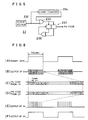
- Fig. 8 is a waveform chart showing an operation of the embodiment shown in Fig. 3A and Fig. 3B.
- Fig. 9 is an illustrative view showing another example of a PN code.
- Fig. 10A and Fig. 10B are block diagrams showing another embodiment in accordance with present invention, wherein Fig. 10A shows a transmitter and Fig. 10B shows a receiver.
- Fig. 11 is a waveform chart showing an operation of the embodiment shown in Fig. 10A.
- Fig. 12 is a circuit diagram showing a modified example of the embodiment as shown in Fig. 10A.
- Fig. 13 is a circuit diagram showing a receiver for receiving a spread spectrum signal from a transmitter as shown in Fig. 12.
- a spread spectrum communication system of this embodiment shown includes a transmitter 10 and a receiver 20.
- the transmitter 10 includes a ten-key 11, for example, and a key signal from the ten-key 11 is converted into an on-off keying signal of 1 kbps, for example, by an encoder 12.
- the on-off keying signal is given to a gate circuit 13 which receives a carrier signal of 300 MHz, for example, from an oscillator 14.
- the gate circuit 13 gives the carrier signal from the oscillator 14 to a spread spectrum modulating portion 15 within an on-period of the on-off keying signal.
- the spread spectrum modulating portion 15 includes a PN code generator 16 and a multiplier 17 which multiplies an output signal from the gate circuit 13 by a first PN code from the PN code generator 16. An output of the multiplier 17 is transmitted from a transmission antenna 19 through a transmission amplifier 18.
- the receiver 20 includes a reception antenna 21 which receives a spread spectrum signal being transmitted from the transmission antenna 19, and the spread spectrum signal received by the reception antenna 21 is given to a spread spectrum demodulating portion 22.
- the spread spectrum demodulating portion 22 includes a PN code generator 23 and a multiplier 24 which multiplies a received spread spectrum signal by a second PN code from PN code generator 23.
- An output of the multiplier 24 is given to a detector 26 through a bandpass filter 25.
- the detector 26 envelope-detects an output of the bandpass filter 25 and an output thereof is given to a decoder 27.
- the PN code generator 16 includes a 2-bit shift registor 161 and a clock from a clock source 162 is applied to the shift registor 161 as a shift clock thereof. Outputs of respective bits of the shift registor 161 are given to an exclusive OR gate 163 and an output of the exclusive OR gate 163 is inputted to the most significant bit of the shift registor 161. Then, a first PN code is outputted from the least significant bit of the shift registor 161.
- a first PN code x, y and z such as "1", “1” and “0" are cyclically outputted. Therefore, the first PN code is formed by repetition of the data of 3 bits, for example.
- the PN code generator 23 of the receiver 20 includes a 2-bit shift registor 231.
- a clock from a clock source 232 is given to the shift registor 231 as a shift clock thereof through one input of an OR gate 233.
- an output of 4-nary counter 234 is given, which receives a clock from the clock source 232 as a count input thereof.
- outputs of respective bits of the shift registor 231 are applied to respective inputs of an exclusive OR gate 235 an output of which is given to the most significant bit of the shift registor 231.
- a second PN code is outputted from the least significant bit of the shift registor 231.
- a clock as shown in Fig. 7(A) is outputted from the clock source 232 and the clock is counted by the 4-nary counter 234. Therefore, an output which becomes the high level at every 4 clocks is outputted from the 4-nary counter 234, as shown in Fig. 7(B). Since the output of the 4-nary counter 234 and the clock from the clock source 232 are applied to the OR gate 233, an output of the OR gate 233 becomes as shown in Fig. 7(C).
- a width of the PN code x is expanded to double each of the other PN codes y and z due to the output of the 4-nary counter 234. Therefore, a front half of the PN code x becomes a blank or indefinite bit "*" (a dummy bit). Therefore, as shown Fig. 7(D), *, x, y and z are cyclically outputted from the PN code generator 23 shown in Fig. 5. Therefore, the second PN code is formed by repetition of the data of 4 bits.
- a phase of the second PN code can be gradually changed with respect to a phase of the first PN code.
- An output signal from the gate circuit 13 is supplied to the spread spectrum modulating portion 15 and multiplied by the first PN code from the PN code generator 16 in the multiplier 17.
- the first PN code is the repetition of x, y and z as shown Fig. 6(B), that is, Fig. 8(C).
- a signal which is spectrum-spread by the spread spectrum modulating portion 15 is amplified by the transmission amplifier 18 and thereafter transmitted from the transmission antenna 19.
- a transmitted signal is received by the reception antenna 21 of the receiver 20, and therefore, a received spread spectrum signal is given to the spread spectrum demodulating portion 22.
- a spread spectrum demodulation is performed by multiplying the spread spectrum signal by the second PN code from the PN code generator 23.
- the second PN code from the PN code generator 23 is formed by repetition of the data of 4 bits which is x, y and z plus an indefinite bit, as shown in Fig. 7(D), that is, Fig. 8(D).
- the second PN code from the PN code generator 23 is formed by the data of 3 bits of x, y and z plus 1 bit being indefinite, the same becomes equal to the first PN code x, y and z which is phase-shifted gradually one by one bit. Therefore, a correlation between the first PN code included in a received spread spectrum signal and the second PN code is established at every 12 bits. Therefore, the output of the multiplier 22 becomes as shown Fig. 8(E).
- a correlation between the first PN code in the spread spectrum modulating portion 15 and the second PN code in the spread spectrum demodulating portion 22 is established at every 12 microseconds, and therefore, in response to the on-off keying signal, ten (10) correlation signals are outputted as shown in Fig. 8 (E).
- Such correlation signals are given to the detector 26 through the bandpass filter 25 and envelope-detected therein. Therefore, the output of the detector 26 becomes the same as an originally inputted on-off keying signal as shown in Fig.8 (F). Then, a detected output is decoded by the decoder 27 and applied to an equipment (not shown) to be controlled as a control signal. Therefore, the equipment to be controlled is controlled to be brought in a state or mode designated by the on-off keying signal.
- one indefinite bit is inserted so that the phase of the second PN code of the receiver 20 can be gradually shifted to that of the first PN code of the transmitter 10.
- frequencies of both the PN codes may be slightly and gradually deviated from each other as shown in Fig. 9.
- correlation signals are obtained from the spread spectrum demodulating portion 22 only at portions indicated by oblique lines in Fig. 9. Then, correlation signals are inputted to the detector 26 from the bandpass filter 25 and envelope-detected therein. Therefore, as similar to the above described embodiment, in such a case, it is possible to restore an original on-off keying signal.
- clock frequency of the clock source at the receiving side may be different from that of the clock source at the transmitting side, for example, the clock source 162.
- an off-state is longer than an on-state. If the PN code generator 16 is operated in the off-state and a power source thereof is a battery, such a battery is used wastefully. Therefore, in an embodiment shown in Fig. 10A and Fig. 10B, in the off-state of the on-off keying signal, the operations of the PN code generator 16′ and 23′ are stopped, thereby to save an energy.
- a transmitter 10 includes a signal input portion 31 which includes a combination of the ten-key 11 and the encoder 12 shown in Fig. 3A or a sensor (not shown) and inputs an on-off keying signal.
- the on-off keying signal from the signal input portion 31 is inputted to a carrier generator 32 which includes an oscillator similar to the oscillator 14 shown in Fig. 3A and further applied to a reset signal generator 33.
- the carrier generator 32 includes a gate circuit 13 as shown in Fig. 3A and modulates a carrier signal by the on-off keying signal. Therefore, an output of the carrier generator 32 becomes similar to a signal as shown in Fig. 8(B).
- a PN code generator 16′ includes a 5-bit shift registor 161′ and a clock signal from the clock source 162 is applied to one input of an AND gate 164.
- the on-off keying signal from the signal input portion 31 is applied to the other input of the AND gate 164.
- An output of the AND gate 164 is applied to the shift registor 161′ as a shift clock thereof.
- a reset signal from the reset signal generator 33 is further applied to the shift registor 161′.
- An upper second bit and the least significant bit of the shift registor 161′ are applied to respective inputs of the exclusive OR gate 163. Then, the output of the exclusive OR gate 163 is inputted to the most significant bit of the shift registor 161′. Then, an output from the least significant bit of the shift registor 161′ is outputted as a first PN code.
- the AND gate 161 is enabled only a time when an output of the signal input portion 31, that is, on-off keying signal is the on-state. Therefore, from the AND gate 164, as shown in Fig. 11(D), a clock signal (Fig. 11(C)) from the clock source 162 is given to the shift registor 161′ in only the on-state of the on-off keying signal. Therefore, only in the on-state of the on-off keying signal, the first PN code is outputted from the PN code generator 16′, as shown in Fig. 11(E). Then, an output of the carrier generator 32 as shown in Fig.
- the reset signal generator 33 detects a falling edge of the on-off keying signal and outputs a reset signal in response thereto.
- the reset signal is applied to reset inputs of flip-flops (not shown) constituting the shift registor 161′, and therefore, the shift registor 161′ is reset at the falling edge of the on-off keying signal to be returned to an initial state thereof. Therefore, the shift registor 161′ starts to operate from the initial state thereof whenever the on-off keying signal becomes the on-state.
- the first PN code from the PN code generator 16′ is prevented from being disturbed.
- the receiver 20 is provided with a reception detector 34.
- the reception detector 34 detects a signal inputted from the reception antenna 21 and applies an enable signal to the PN code generator 23′. Therefore, the PN code generator 23′ performs an operation similar to that described above when a spread spectrum signal is received so as to generate the second PN code.
- the second PN code is generated so that a phase of the second PN code in the receiver 20 is gradually shifted from a phase of the first PN code in the transmitter 10 at every repetition interval, whereby, as similar to the embodiment shown in Fig. 3A and Fig. 3B, it is possible to omit a phase modulator which was used in the conventional tau-dither method from the receiver 20.
- an output of the detector 26 is applied to the decoder 27 and a waveform shaping circuit 35.
- the waveform shaping circuit 35 shapes a signal as envelope-detected into a pulse and applies the same to a differential circuit 36.
- the differential circuit 36 detects a falling edge of a signal from the waveform shaping circuit 35 and, in response to a detection, applies a reset signal to the PN code generator 23′.
- the reset signal resets a shift registor 231 (Fig. 5) constituting the PN code generator 23′, as similar to the reset signal from the reset signal generator 33 of Fig. 10A. Therefore, as similar to the PN code generator 16′, the PN code generator 23′ starts to operate from an initial state thereof whenever a spread spectrum signal is received, whereby the second PN code is prevented from being disturbed.
- a spread spectrum signal is obtained through a multiplication of a carrier signal modulated by the on-off keying signal and the PN code; however, a generation of the carrier signal and spread spectrum modulation may be simultaneously performed as shown in Fig. 12.
- a carrier generator 32′ is provided with an oscillator 37 having a variable capacitance diode 38, and the first PN code from the PN code generator 16′ (or 16) is applied to an anode of the variable capacitance diode 38. Then, when the on-off keying signal becomes the on-state, a transistor 39 is turned-on and thus the carrier oscillator 37 constituted by the variable capacitance diode 38 is operated. When the carrier oscillator 37 is in an oscillation state, an anode voltage of the variable capacitance diode 38 is changed by a voltage of the first PN code.
- a capacitance value of the variable capacitance diode 38 is changed in accordance with the first PN code, and therefore, as similar to the previous embodiments, a signal being spectrum-spread by the first PN code is resultingly transmitted from the transmission antenna 19.
- a receiver may be changed as shown in Fig. 13.
- a reception tuning circuit 40 connected to the reception antenna 21 includes a capacitor 410 and a coil 420, and the reception tuning circuit 40 having a reception band width of 400 kHz is tuned at 300 MHz, for example.
- An oscillator 50 generates a carrier signal in response to the presence of a received signal, and the oscillator 50 includes a transistor 501, resistors 502, 503 and 504 for setting a collector current of the direct current of the transistor 501, a collector resistor 505, and capacitors 506 and 507 and a coil 508 for determining an oscillation frequency thereof.
- An oscillation output from the oscillator 50 is detected by a diode 60 an output end of which is connected to a time constant circuit 70 which includes a capacitor 710 and a resistor 720.
- a first reference voltage source 80 outputs a first reference voltage having a voltage value equal to a collector bias voltage of the transistor 501, and a direct current voltage filtered by the time constant circuit 70 is compared with a second reference voltage from a second reference voltage source 100 by a comparing circuit 90.
- the oscillator 50 when a signal existing in the reception band width of the reception tuning circuit 40 is received, the oscillator 50 becomes a state where a carrier signal is oscillated. On the other hand, a signal becomes absent in reception band width, the oscillator 50 becomes a stopped state. Therefore, an output of the oscillator 50 becomes a carrier signal modulated by the on-off keying signal resultingly. Then, a modulated carrier signal is detected by the diode 60 and filtered by the time constant circuit 70, and the output from the time constant circuit 70 is compared with the second reference voltage by the comparing circuit 90, whereby the modulated carrier signal is restored as the on-off keying signal.
Landscapes
- Engineering & Computer Science (AREA)
- Computer Networks & Wireless Communication (AREA)
- Signal Processing (AREA)
- Digital Transmission Methods That Use Modulated Carrier Waves (AREA)
- Selective Calling Equipment (AREA)
Description
- The present invention relates to a spread spectrum communication system. More specifically, the present invention relates a spread spectrum communication system in which an information signal is communicated in a remote control or remote sensing.
- Conventionally, a spread spectrum communication system is known, wherein a carrier signal a spectrum of which is spread by a binary pseudo noise code (hereinafter, simply called as "PN code") having a spectrum width sufficiently broader than an information signal is transmitted, and at a receiving side, an original information signal is restored by multiplying a received signal by a PN code which is the same as that being used at a transmitting side.
- In such a spread spectrum communication system, since the spectrum of the information signal is spread by a PN code having a broader spectrum width, in order to correctly restore the information signal, it is necessary to synchronize the PN code which is generated at the receiving side with the PN code at the transmitting side.
- As a method for synchronizing both the PN codes, a tau-dither method as shown in Fig. 1 is well known. In Fig. 1, a received spread spectrum signal is inputted to a first multiplier 1a through an input terminal IN. In addition, an output of a VCO (voltage-controlled oscillator) 2 is phase-modulated by an output signal from a low-frequency oscillator 3 such as a multivibrator in a
phase demodulator 4. An output from thephase demodulator 4 is given to aPN code generator 5 and used as a clock signal therein. A PN code from thePN code generator 5 is multiplied by the received spread spectrum signal in the first multiplier 1a. An output from the first multiplier 1a is given to ademodulator 8 through abandpass filter 7a. An output of thebandpass filter 7a is envelope-detected in thedemodulator 8 to be outputted to an output terminal OUT. An output of thedemodulator 8 is further given to asecond multiplier 1b through a bandpass filter 7b. Then, in thesecond multiplier 1b, the output signal from the low-frequency oscillator 3 is multiplied by an output signal from the bandpass filter 7b. An output signal of thesecond multiplier 1b is given to theVCO 2 through a low-pass filter 9 as a control signal. - In the spread spectrum communication system, it is known that a level of the output signal from the first multiplier 1a is changed as shown in Fig. 2 in accordance with a relative change of phases of the PN code included an inputted spread spectrum signal and the PN code from the
PN code generator 5. - Now, assuming that an initial phase of the PN code from the
PN code generator 5 exists a position of a point aa of Fig. 2 and the phase is advanced and shifted to a point ab, a relative phase of both the PN codes plys between both the points aa and ab in accordance with a rectangular signal from the low-frequency oscillator 3, and in response thereto, the output signal of the first multiplier 1a is subjected to an amplitude modulation at the same frequency as that of the rectangular signal. This amplitude-modulated components are derived by the bandpass filter 7b and thereafter multiplied by the rectangular signal in thesecond multiplier 1b so that a direct current signal having a correct polarity and a correct level is obtainable to be given to theVCO 2 as a control signal. A frequency of theVCO 2 is changed by the control signal, thereby to change the phase of the PN code fromPN code generator 5. - In addition, in a case where the relative phase of the both PN codes plys between points ba and bb, a polarity of the output of the first multiplier 1a is reversed and a phase change of the PN code from the
PN code generator 5 is also reversed. - Furthermore, in a case where the relative phase of the both the PN codes plys between points ca and cb sandwiching a peak of a correlation output as shown in Fig. 2, no change occurs in an amplitude of the output signal from the first multiplier 1a. Therefore, no amplitude-modulated components to be supplied to the
second multiplier 1b exist, and thus, an oscillation frequency of theVCO 2, that is, the phase of the PN code from thePN code generator 5 is not changed. - In such a tau-dither method, in order to synchronize the phase of the PN code at the receiving side with that of the PN code at the transmitting side, it is necessary to use the phase modulator 3 as shown in Fig. 1. Therefore, a circuit configuration thereof was complex.
- US-A-4 285 060 discloses a spread spectrum communication system including pseudo noise generating means. In order to prevent the jamming properties to be effected by the variable gain characteristic of the separate channels, it is proposed to incorporate the signal power measuring means rather than to process the correlation of the signals. This signal power measuring means make the circuit configuration of the spread spectrum communication system complex, too.
- Therefore, a principal object of the present invention is to provide a novel spread spectrum communication system.
- Another object of the present invention is to provide a spread spectrum communication system in which a circuit configulation at a receiving side can be simple.
- Another object of the present invention is to provide a spread spectrum communication system wherein it is not necessary to use specific circuit components for synchronizing a PN code at a transmitter with a PN code at a receiver.
- These objects are achieved by a spread spectrum communication system according to
claim 1, a remote control system according toclaim 15, and a remote sensing means according toclaim 16. The further subclaims are related to different aspects of the present invention. - A phase of the second PN code is gradually changed with respect to a phase of the first PN code. Therefore, a phase correlation can be cyclically established between the first PN code and the second PN code. In a state where such a phase correlation is established, an output is obtained in a receiver and, by detecting the output, an original on-off keying signal can be restored. In accordance with present invention, a relative phase of the first and second PN codes is cyclically changed, and therefore, it is possible to synchronize both the PN codes with each other without any specific additional means such as a phase modulator. Therefore, in comparison with a receiver in accordance with conventional tau-dither method as shown in Fig. 1, a circuit configuration of the receiver becomes simple.
- The spread spectrum communication system in accordance with present invention suits to communicate an information signal, that is, an on-off keying signal such as a control signal, sensing signal or the like in a remote control system, remote sensing system or the like.
- The objects and other objects, features, aspects and advantages of the present invention will become more apparent from the following detailed description of the embodiments of the present invention when taken in conjunction with accompanying drawings.
- Fig. 1 is a block diagram showing a conventional tau-dither method.
- Fig. 2 is a graph showing a change of an output signal amplitude with respect to a relative change of phases of PN codes in a spread spectrum communication system.
- Fig. 3A and 3B are block diagrams showing one embodiment in accordance with the present invention, wherein Fig. 3A shows a transmitter and Fig. 3B shows a receiver.
- Fig. 4 is a block diagram showing a PN code generator shown in Fig. 3A.
- Fig. 5 is a block diagram showing a PN code generator shown in Fig. 3B.
- Fig. 6 is an illustrative view showing a PN code generated by a PN code generator of Fig. 4.
- Fig. 7 is an illustrative view showing a PN code generated by a PN code generator of Fig.5.
- Fig. 8 is a waveform chart showing an operation of the embodiment shown in Fig. 3A and Fig. 3B.
- Fig. 9 is an illustrative view showing another example of a PN code.
- Fig. 10A and Fig. 10B are block diagrams showing another embodiment in accordance with present invention, wherein Fig. 10A shows a transmitter and Fig. 10B shows a receiver.
- Fig. 11 is a waveform chart showing an operation of the embodiment shown in Fig. 10A.
- Fig. 12 is a circuit diagram showing a modified example of the embodiment as shown in Fig. 10A.
- Fig. 13 is a circuit diagram showing a receiver for receiving a spread spectrum signal from a transmitter as shown in Fig. 12.
- With reference to Fig. 3A and Fig. 3B, a spread spectrum communication system of this embodiment shown includes a
transmitter 10 and areceiver 20. - The
transmitter 10 includes a ten-key 11, for example, and a key signal from the ten-key 11 is converted into an on-off keying signal of 1 kbps, for example, by anencoder 12. The on-off keying signal is given to agate circuit 13 which receives a carrier signal of 300 MHz, for example, from anoscillator 14. Thegate circuit 13 gives the carrier signal from theoscillator 14 to a spreadspectrum modulating portion 15 within an on-period of the on-off keying signal. The spreadspectrum modulating portion 15 includes aPN code generator 16 and amultiplier 17 which multiplies an output signal from thegate circuit 13 by a first PN code from thePN code generator 16. An output of themultiplier 17 is transmitted from atransmission antenna 19 through atransmission amplifier 18. - The
receiver 20 includes areception antenna 21 which receives a spread spectrum signal being transmitted from thetransmission antenna 19, and the spread spectrum signal received by thereception antenna 21 is given to a spreadspectrum demodulating portion 22. The spreadspectrum demodulating portion 22 includes aPN code generator 23 and amultiplier 24 which multiplies a received spread spectrum signal by a second PN code fromPN code generator 23. An output of themultiplier 24 is given to adetector 26 through abandpass filter 25. Thedetector 26 envelope-detects an output of thebandpass filter 25 and an output thereof is given to adecoder 27. - Now, with reference Fig. 4, a description will be made on the
PN code generator 16 included in the spreadspectrum modulating portion 15 of thetransmitter 10. ThePN code generator 16 includes a 2-bit shift registor 161 and a clock from aclock source 162 is applied to theshift registor 161 as a shift clock thereof. Outputs of respective bits of theshift registor 161 are given to an exclusive ORgate 163 and an output of the exclusive ORgate 163 is inputted to the most significant bit of theshift registor 161. Then, a first PN code is outputted from the least significant bit of theshift registor 161. - If the contents of the
shift registor 161 are initially "11", the output of the exclusive ORgate 163 becomes "0", and therefore, the contents of theshift registor 161 becomes "01" in response to a next clock from theclock source 162. At this time, the exclusive ORgate 163 receives "0" and "1" and thus outputs "1". Therefore, when a next shift clock is given thereto, the contents of theshift registor 161 becomes "10". Therefore, the output of the exclusive ORgate 163 becomes "1" again and, when a next shift clock is given thereto, the contents of theshift registor 161 becomes "11". Thus, as shown in Fig. 6, in response to each of the shift clocks from theclock source 162, a first PN code x, y and z such as "1", "1" and "0" are cyclically outputted. Therefore, the first PN code is formed by repetition of the data of 3 bits, for example. - With reference to Fig. 5, as similar to the
PN code generator 16, thePN code generator 23 of thereceiver 20 includes a 2-bit shift registor 231. A clock from aclock source 232 is given to theshift registor 231 as a shift clock thereof through one input of anOR gate 233. To the other input of theOR gate 233, an output of 4-nary counter 234 is given, which receives a clock from theclock source 232 as a count input thereof. Then, outputs of respective bits of theshift registor 231 are applied to respective inputs of an exclusive ORgate 235 an output of which is given to the most significant bit of theshift registor 231. Then, a second PN code is outputted from the least significant bit of theshift registor 231. - A clock as shown in Fig. 7(A) is outputted from the
clock source 232 and the clock is counted by the 4-nary counter 234. Therefore, an output which becomes the high level at every 4 clocks is outputted from the 4-nary counter 234, as shown in Fig. 7(B). Since the output of the 4-nary counter 234 and the clock from theclock source 232 are applied to theOR gate 233, an output of theOR gate 233 becomes as shown in Fig. 7(C). - If the contents of the
shift registor 231 is initially "11", the output of the exclusive OR gate 253 becomes "0", and the output thereof is given to the most significant bit of theshift registor 231. Therefore, when a next shift clock is applied thereto through theOR gate 233, the contents of theshift registor 231 becomes "01". At a timing of a next shift clock, the contents of theshift registor 231 becomes "10". Therefore, as similar to thePN code generator 16 as shown in Fig. 4, a second PN code x, y and z such as "1", "1" and "0" are outputted from theshift registor 231. However, as seen from Fig. 7(C) and Fig. 7(D), a width of the PN code x is expanded to double each of the other PN codes y and z due to the output of the 4-nary counter 234. Therefore, a front half of the PN code x becomes a blank or indefinite bit "*" (a dummy bit). Therefore, as shown Fig. 7(D), *, x, y and z are cyclically outputted from thePN code generator 23 shown in Fig. 5. Therefore, the second PN code is formed by repetition of the data of 4 bits. Thus, by making the number of bits of the first PN code different from the number of bits of the second PN code, a phase of the second PN code can be gradually changed with respect to a phase of the first PN code. - With reference to Fig. 8, if the ten-
key 11 of thetransmitter 10 is operated, in response to an operation thereof, an on-off keying signal as shown in Fig. 8(A) is outputted from theencoder 12. Therefore, a carrier signal from theoscillator 14 is modulated by the on-off keying signal by thegate circuit 13, as shown in Fig. 8(B). - An output signal from the
gate circuit 13 is supplied to the spreadspectrum modulating portion 15 and multiplied by the first PN code from thePN code generator 16 in themultiplier 17. As described above, the first PN code is the repetition of x, y and z as shown Fig. 6(B), that is, Fig. 8(C). Then, a signal which is spectrum-spread by the spreadspectrum modulating portion 15 is amplified by thetransmission amplifier 18 and thereafter transmitted from thetransmission antenna 19. - A transmitted signal is received by the
reception antenna 21 of thereceiver 20, and therefore, a received spread spectrum signal is given to the spreadspectrum demodulating portion 22. In the spreadspectrum demodulating portion 22, a spread spectrum demodulation is performed by multiplying the spread spectrum signal by the second PN code from thePN code generator 23. - As described above, the second PN code from the
PN code generator 23 is formed by repetition of the data of 4 bits which is x, y and z plus an indefinite bit, as shown in Fig. 7(D), that is, Fig. 8(D). In other words, since the second PN code from thePN code generator 23 is formed by the data of 3 bits of x, y and z plus 1 bit being indefinite, the same becomes equal to the first PN code x, y and z which is phase-shifted gradually one by one bit. Therefore, a correlation between the first PN code included in a received spread spectrum signal and the second PN code is established at every 12 bits. Therefore, the output of themultiplier 22 becomes as shown Fig. 8(E). - Assuming that a signal width of the on-off keying signal is 120 microseconds, for example, and a signal width (chip) of each of the first and second PN codes is 1 microsecond, a correlation between the first PN code in the spread
spectrum modulating portion 15 and the second PN code in the spreadspectrum demodulating portion 22 is established at every 12 microseconds, and therefore, in response to the on-off keying signal, ten (10) correlation signals are outputted as shown in Fig. 8 (E). - Such correlation signals are given to the
detector 26 through thebandpass filter 25 and envelope-detected therein. Therefore, the output of thedetector 26 becomes the same as an originally inputted on-off keying signal as shown in Fig.8 (F). Then, a detected output is decoded by thedecoder 27 and applied to an equipment (not shown) to be controlled as a control signal. Therefore, the equipment to be controlled is controlled to be brought in a state or mode designated by the on-off keying signal. - In addition, in the above described embodiment, one indefinite bit is inserted so that the phase of the second PN code of the
receiver 20 can be gradually shifted to that of the first PN code of thetransmitter 10.
However, frequencies of both the PN codes may be slightly and gradually deviated from each other as shown in Fig. 9. When the PN codes as shown in Fig. 9 are utilized, correlation signals are obtained from the spreadspectrum demodulating portion 22 only at portions indicated by oblique lines in Fig. 9. Then, correlation signals are inputted to thedetector 26 from thebandpass filter 25 and envelope-detected therein. Therefore, as similar to the above described embodiment, in such a case, it is possible to restore an original on-off keying signal. In addition, in order to deviate the frequencies of both the PN codes from each other, clock frequency of the clock source at the receiving side may be different from that of the clock source at the transmitting side, for example, theclock source 162. - As shown in Fig. 8(A), in an on-off keying signal from the ten-key 11 (Fig. 3A) or a various sensor (not shown), an off-state is longer than an on-state. If the
PN code generator 16 is operated in the off-state and a power source thereof is a battery, such a battery is used wastefully. Therefore, in an embodiment shown in Fig. 10A and Fig. 10B, in the off-state of the on-off keying signal, the operations of thePN code generator 16′ and 23′ are stopped, thereby to save an energy. - With reference to Fig. 10A, a
transmitter 10 includes asignal input portion 31 which includes a combination of the ten-key 11 and theencoder 12 shown in Fig. 3A or a sensor (not shown) and inputs an on-off keying signal. The on-off keying signal from thesignal input portion 31 is inputted to acarrier generator 32 which includes an oscillator similar to theoscillator 14 shown in Fig. 3A and further applied to areset signal generator 33. Thecarrier generator 32 includes agate circuit 13 as shown in Fig. 3A and modulates a carrier signal by the on-off keying signal. Therefore, an output of thecarrier generator 32 becomes similar to a signal as shown in Fig. 8(B). - In this embodiment shown, a
PN code generator 16′ includes a 5-bit shift registor 161′ and a clock signal from theclock source 162 is applied to one input of an ANDgate 164. The on-off keying signal from thesignal input portion 31 is applied to the other input of the ANDgate 164. An output of the ANDgate 164 is applied to theshift registor 161′ as a shift clock thereof. A reset signal from thereset signal generator 33 is further applied to theshift registor 161′. An upper second bit and the least significant bit of theshift registor 161′ are applied to respective inputs of the exclusive ORgate 163. Then, the output of the exclusive ORgate 163 is inputted to the most significant bit of theshift registor 161′. Then, an output from the least significant bit of theshift registor 161′ is outputted as a first PN code. - In the
PN code generator 16′ shown in Fig. 10A, as shown in Fig. 11, the ANDgate 161 is enabled only a time when an output of thesignal input portion 31, that is, on-off keying signal is the on-state. Therefore, from the ANDgate 164, as shown in Fig. 11(D), a clock signal (Fig. 11(C)) from theclock source 162 is given to theshift registor 161′ in only the on-state of the on-off keying signal. Therefore, only in the on-state of the on-off keying signal, the first PN code is outputted from thePN code generator 16′, as shown in Fig. 11(E). Then, an output of thecarrier generator 32 as shown in Fig. 11(B) is multiplied by the first PN code in themultiplier 17, and therefore, a spread spectrum signal as shown in Fig. 11(F) is outputted from themultiplier 17 and the same is transmitted from thetransmission antenna 19. Thus, in this embodiment shown, an operation of thePN code generator 16′ in the off-state of the on-off keying signal is stopped. - In addition, the
reset signal generator 33 detects a falling edge of the on-off keying signal and outputs a reset signal in response thereto. The reset signal is applied to reset inputs of flip-flops (not shown) constituting theshift registor 161′, and therefore, theshift registor 161′ is reset at the falling edge of the on-off keying signal to be returned to an initial state thereof. Therefore, theshift registor 161′ starts to operate from the initial state thereof whenever the on-off keying signal becomes the on-state. Thus, the first PN code from thePN code generator 16′ is prevented from being disturbed. - As described above, in the off-state of the on-off keying signal, no spread spectrum signal is transmitted from the
transmitter 10, and therefore, in thereceiver 20, it is necessary to surely receive and demodulate a spread spectrum signal when the same is transmitted from thetransmitter 10. Therefore, an embodiment shown in Fig. 10B, thereceiver 20 is provided with areception detector 34. Thereception detector 34 detects a signal inputted from thereception antenna 21 and applies an enable signal to thePN code generator 23′. Therefore, thePN code generator 23′ performs an operation similar to that described above when a spread spectrum signal is received so as to generate the second PN code. - In addition, in this embodiment shown in Fig. 10A and Fig. 10B, the second PN code is generated so that a phase of the second PN code in the
receiver 20 is gradually shifted from a phase of the first PN code in thetransmitter 10 at every repetition interval, whereby, as similar to the embodiment shown in Fig. 3A and Fig. 3B, it is possible to omit a phase modulator which was used in the conventional tau-dither method from thereceiver 20. - Furthermore, in the embodiment shown in Fig. 10B, an output of the
detector 26 is applied to thedecoder 27 and awaveform shaping circuit 35. Thewaveform shaping circuit 35 shapes a signal as envelope-detected into a pulse and applies the same to adifferential circuit 36. Thedifferential circuit 36 detects a falling edge of a signal from thewaveform shaping circuit 35 and, in response to a detection, applies a reset signal to thePN code generator 23′. The reset signal resets a shift registor 231 (Fig. 5) constituting thePN code generator 23′, as similar to the reset signal from thereset signal generator 33 of Fig. 10A. Therefore, as similar to thePN code generator 16′, thePN code generator 23′ starts to operate from an initial state thereof whenever a spread spectrum signal is received, whereby the second PN code is prevented from being disturbed. - In addition, in the embodiment shown in Fig. 3A or Fig. 10A, a spread spectrum signal is obtained through a multiplication of a carrier signal modulated by the on-off keying signal and the PN code; however, a generation of the carrier signal and spread spectrum modulation may be simultaneously performed as shown in Fig. 12.
- More specifically, in Fig. 12 embodiment, a
carrier generator 32′ is provided with anoscillator 37 having avariable capacitance diode 38, and the first PN code from thePN code generator 16′ (or 16) is applied to an anode of thevariable capacitance diode 38. Then, when the on-off keying signal becomes the on-state, atransistor 39 is turned-on and thus thecarrier oscillator 37 constituted by thevariable capacitance diode 38 is operated. When thecarrier oscillator 37 is in an oscillation state, an anode voltage of thevariable capacitance diode 38 is changed by a voltage of the first PN code. Therefore, a capacitance value of thevariable capacitance diode 38 is changed in accordance with the first PN code, and therefore, as similar to the previous embodiments, a signal being spectrum-spread by the first PN code is resultingly transmitted from thetransmission antenna 19. - When Fig. 12 embodiment is used, a receiver may be changed as shown in Fig. 13.
- In Fig. 13, a
reception tuning circuit 40 connected to thereception antenna 21 includes acapacitor 410 and acoil 420, and thereception tuning circuit 40 having a reception band width of 400 kHz is tuned at 300 MHz, for example. Anoscillator 50 generates a carrier signal in response to the presence of a received signal, and theoscillator 50 includes atransistor 501,resistors transistor 501, acollector resistor 505, and capacitors 506 and 507 and acoil 508 for determining an oscillation frequency thereof. An oscillation output from theoscillator 50 is detected by adiode 60 an output end of which is connected to a timeconstant circuit 70 which includes acapacitor 710 and aresistor 720. A firstreference voltage source 80 outputs a first reference voltage having a voltage value equal to a collector bias voltage of thetransistor 501, and a direct current voltage filtered by the timeconstant circuit 70 is compared with a second reference voltage from a secondreference voltage source 100 by a comparingcircuit 90. - Then, in Fig. 13 embodiment, when a signal existing in the reception band width of the
reception tuning circuit 40 is received, theoscillator 50 becomes a state where a carrier signal is oscillated. On the other hand, a signal becomes absent in reception band width, theoscillator 50 becomes a stopped state. Therefore, an output of theoscillator 50 becomes a carrier signal modulated by the on-off keying signal resultingly. Then, a modulated carrier signal is detected by thediode 60 and filtered by the timeconstant circuit 70, and the output from the timeconstant circuit 70 is compared with the second reference voltage by the comparingcircuit 90, whereby the modulated carrier signal is restored as the on-off keying signal. - Although the present invention has been described and illustrated in detail, it is clearly understood that the same is by way of illustration and example only and is not to be taken by way of limitation, the spirit and scope of the present invention being limited only by the terms of the appended claims.
Claims (16)
- A spread spectrum communication system, comprising:
inputting means (11) for inputting an on-off keying signal;
first pseudo-noise (PN) code generating means (16) for generating a first pseudo-noise (PN) code;
spread sprectrum modulating means (17) for producing a spread spectrum signal by said on-off keying signal, a carrier signal and said first PN code;
means (18) for transmitting said spread spectrum signal;
receiving means (20) for receiving said spread spectrum signal transmitted from said transmitting means; such that the carrier signal is gated by said on-off keying signal and modulated by said first PN-code;
reproducing means (22) for reproducing said carrier signal which has been modulated by said on-off keying signal from said spread spectrum signal received by said receiving means; and
means for detecting (26) a reproduced carrier signal and for outputting said on-off keying signal. - A spread spectrum communication system in accordance with claim 1, wherein said reproducing means (22) includes second PN code generating means (23) for generating a second PN code having the phase which is gradually changed with respect to a phase of said first PN code, and spread spectrum demodulating means for spread spectrum demodulating the received spread spectrum signal using said second PN code from said second PN code generating means (23).
- A spread spectrum communication system in accordance with claim 2, wherein said second PN code generating means (23) includes means for generating said second PN code with a repetition interval that is different from a repetition interval of said first PN code.
- A spread spectrum communication system in accordance with claim 3, wherein said first PN code generating means (16) includes means (161, 162) for generating said first PN code by repetition of data of a first predetermined number of bits, and said second PN code generating means (23) includes means (231, 232) for generating said second PN code by repetition of data of a second predetermined number of bits different from said first predetermined number of bits.
- A spread spectrum communication system in accordance with claim 3, wherein said first PN code generating means (16) includes means for generating said first PN code by repetition of data of a predetermined number of bits with a first predetermined interval, and said second PN code generating means (23) includes means for generating said second PN code by repetition of data of said predetermined number of bits with a second predetermined interval different from said first predetermined interval.
- A spread spectrum communication system in accordance with claim 2, wherein said reproducing means (22) includes multiplying means (24) for multiplying said received spread spectrum signal by said second PN code.
- A spread spectrum communication system in accordance with claim 1, further comprising disabling means (12, 13) for disabling said first PN code generating means when said on-off keying signal is in an off-state.
- A spread spectrum communication system in accordance with claim 7, further comprising initializing means (33) for initializing said first PN code generating means (16) at a trailing edge of said on-state of said on-off keying signal.
- A spread spectrum communication system in accordance with claim 7, further comprising disabling means (34) for disabling said second PN code generating means (23) when no spread spectrum signal is received by said receiving means.
- A spread spectrum communication system in accordance with claim 9, further comprising initializing means (34) for initializing said second PN code generating means (23) when said receiving means (20) ceases to receive said spread spectrum signal.
- A spread spectrum communication system in accordance with claim 1, wherein said spread spectrum modulating means (17) includes modulating means for modulating said carrier signal by said on-off keying signal, and a multiplying means for multiplying an output of said modulating means by said first PN code.
- A spread spectrum communication system in accordance with claim 2, wherein said spread spectrum demodulating means (24) includes multiplying means for multiplying said spread spectrum signal as received by said second PN code.
- A spread spectrum communication system in accordance with claim 1, wherein said spread spectrum modulating means (17) includes an oscillator (14) which is enabled or disabled by said on-off keying signal and has a variable capacitance element (37), a capacitance of said variable capacitance element being changed by said first PN code, resultingly said spread spectrum signal is generated.
- A spread spectrum communication system in accordance with claim 1, wherein said reproducing means (22) includes an oscillator, and by operating said oscillator in response to the presence of a spread spectrum signal received by said receiving means (20), whereby said carrier signal modulated by said on-off keying signal is generated.
- A remote control system, comprising:
a key (31);
converting means (39) for converting a key signal from said key into an on-off keying signal;
first pseudo-noise (PN) code generating means (16) for generating a first pseudo-noise (PN) code;
spread spectrum modulating means (17) for producing a spread spectrum signal by said on-off keying signal, a carrier signal and said first PN code;
means (18) for transmitting said spread spectrum signal;
receiving means (21) for receiving said spread spectrum signal as transmitted from said transmitting means (18); such that the carrier signal is gated by said on-off keying signal and modulated by said first PN-code;
reproducing means (22) for reproducing a carrier signal modulated by said on-off keying signal from said spread spectrum signal being received by said receiving means (21); and
means (26) for detecting a reproduced carrier signal and for outputting said on-off keying signal. - A remote sensing system, comprising:
a sensor for inputting an on-off keying signal;
first pseudo-noise (PN) code generating means (16) for generating a first pseudo-noise (PN) code;
spread spectrum modulating means (17) for producing a spread spectrum signal by said on-off keying signal, a carrier signal and said first PN code;
means (18) for transmitting said spread spectrum signal;
receiving means (21) for receiving said spread spectrum signal as transmitted from said transmitting means (18); such that the carrier signal is gated by said on-off keying signal and modulated by said first PN-code
reproducing means (22) for reproducing a carrier signal modulated by said on-off keying signal from said spread spectrum signal being received by said receiving means (21); and
means (26) for detecting a reproduced carrier signal and for outputting said on-off keying signal.
Applications Claiming Priority (4)
| Application Number | Priority Date | Filing Date | Title |
|---|---|---|---|
| JP11483689 | 1989-05-08 | ||
| JP114836/89 | 1989-05-08 | ||
| JP3868490 | 1990-02-20 | ||
| JP38684/90 | 1990-02-20 |
Publications (3)
| Publication Number | Publication Date |
|---|---|
| EP0397094A2 EP0397094A2 (en) | 1990-11-14 |
| EP0397094A3 EP0397094A3 (en) | 1992-07-08 |
| EP0397094B1 true EP0397094B1 (en) | 1995-05-10 |
Family
ID=26377962
Family Applications (1)
| Application Number | Title | Priority Date | Filing Date |
|---|---|---|---|
| EP90108602A Expired - Lifetime EP0397094B1 (en) | 1989-05-08 | 1990-05-07 | Spread spectrum communication system |
Country Status (3)
| Country | Link |
|---|---|
| EP (1) | EP0397094B1 (en) |
| JP (1) | JPH0773234B2 (en) |
| DE (1) | DE69019226T2 (en) |
Families Citing this family (5)
| Publication number | Priority date | Publication date | Assignee | Title |
|---|---|---|---|---|
| US5960028A (en) * | 1995-08-11 | 1999-09-28 | Sharp Kabushiki Kaisha | Spread spectrum communication system |
| US5683432A (en) * | 1996-01-11 | 1997-11-04 | Medtronic, Inc. | Adaptive, performance-optimizing communication system for communicating with an implanted medical device |
| US6519328B1 (en) * | 2000-08-28 | 2003-02-11 | Telenetwork, Inc. | Variable low frequency offset, differential, OOK, high-speed twisted pair communication using telephone load coils |
| JP4602100B2 (en) * | 2004-08-24 | 2010-12-22 | 富士通コンポーネント株式会社 | Communication device |
| GB201420783D0 (en) * | 2014-11-22 | 2015-01-07 | Savine Stanislav | Systems and methods of transmitting and encrypting information |
Family Cites Families (4)
| Publication number | Priority date | Publication date | Assignee | Title |
|---|---|---|---|---|
| US4285060A (en) * | 1978-02-28 | 1981-08-18 | Harris Corporation | Spread spectrum code tracking loop |
| JPS55625A (en) * | 1978-06-16 | 1980-01-07 | Nec Corp | Amplitude modulator |
| JP2516338B2 (en) * | 1986-05-16 | 1996-07-24 | アルプス電気 株式会社 | Communication device |
| US4864588A (en) * | 1987-02-11 | 1989-09-05 | Hillier Technologies Limited Partnership | Remote control system, components and methods |
-
1990
- 1990-04-27 JP JP2113129A patent/JPH0773234B2/en not_active Expired - Fee Related
- 1990-05-07 EP EP90108602A patent/EP0397094B1/en not_active Expired - Lifetime
- 1990-05-07 DE DE69019226T patent/DE69019226T2/en not_active Expired - Fee Related
Also Published As
| Publication number | Publication date |
|---|---|
| JPH0773234B2 (en) | 1995-08-02 |
| JPH03273724A (en) | 1991-12-04 |
| DE69019226D1 (en) | 1995-06-14 |
| EP0397094A3 (en) | 1992-07-08 |
| EP0397094A2 (en) | 1990-11-14 |
| DE69019226T2 (en) | 1996-01-04 |
Similar Documents
| Publication | Publication Date | Title |
|---|---|---|
| US5136614A (en) | Spread spectrum communication system | |
| US5280499A (en) | Spread spectrum communication system | |
| US5500871A (en) | Spread spectrum communication transmitter an LSI therefor | |
| US5008899A (en) | Receiver for spectrum spread communication | |
| US5959550A (en) | Remote meter reading system | |
| US4926440A (en) | Spread-spectrum communication apparatus | |
| US5898230A (en) | Motor vehicle with a central locking unit and a remote control for its operation | |
| WO1992002094A1 (en) | Sawc phase-detection method and apparatus | |
| JPH0685782A (en) | Spectrum spread receiver and spectrum spread transmitter / receiver using this device | |
| US5995536A (en) | System for discrete data transmission with noise-like, broadband signals | |
| US4884284A (en) | Spread spectrum receiver | |
| EP0397094B1 (en) | Spread spectrum communication system | |
| US6335946B1 (en) | Method and a device for broadband transmission | |
| JP2000174666A (en) | Spread spectrum signal receiver | |
| EP0600710B1 (en) | Spread spectrum receiving apparatus | |
| EP0553713B1 (en) | Radio communication system | |
| US4873699A (en) | Method and device for coding and decoding a broadband transmission | |
| JPS6411178B2 (en) | ||
| RU2085046C1 (en) | Digital data transmission system | |
| US6914478B2 (en) | Demodulation method and demodulator | |
| US5235616A (en) | Bidirectional data transmission system | |
| JP3094005B2 (en) | Apparatus and method for decoding spread spectrum signal and apparatus and method for transmitting and receiving spread spectrum signal | |
| KR0162826B1 (en) | Transmitting receiving apparatus of spread spectrum communication system for error compensation of carrier frequency | |
| RU2024198C1 (en) | Digital data transmission system using complex waveform signals | |
| JP2584294B2 (en) | Spread spectrum signal demodulation circuit |
Legal Events
| Date | Code | Title | Description |
|---|---|---|---|
| PUAI | Public reference made under article 153(3) epc to a published international application that has entered the european phase |
Free format text: ORIGINAL CODE: 0009012 |
|
| AK | Designated contracting states |
Kind code of ref document: A2 Designated state(s): DE FR GB |
|
| 17P | Request for examination filed |
Effective date: 19901228 |
|
| PUAL | Search report despatched |
Free format text: ORIGINAL CODE: 0009013 |
|
| AK | Designated contracting states |
Kind code of ref document: A3 Designated state(s): DE FR GB |
|
| 17Q | First examination report despatched |
Effective date: 19940308 |
|
| GRAA | (expected) grant |
Free format text: ORIGINAL CODE: 0009210 |
|
| AK | Designated contracting states |
Kind code of ref document: B1 Designated state(s): DE FR GB |
|
| PG25 | Lapsed in a contracting state [announced via postgrant information from national office to epo] |
Ref country code: FR Effective date: 19950510 |
|
| REF | Corresponds to: |
Ref document number: 69019226 Country of ref document: DE Date of ref document: 19950614 |
|
| EN | Fr: translation not filed | ||
| PLBE | No opposition filed within time limit |
Free format text: ORIGINAL CODE: 0009261 |
|
| STAA | Information on the status of an ep patent application or granted ep patent |
Free format text: STATUS: NO OPPOSITION FILED WITHIN TIME LIMIT |
|
| 26N | No opposition filed | ||
| REG | Reference to a national code |
Ref country code: GB Ref legal event code: IF02 |
|
| PGFP | Annual fee paid to national office [announced via postgrant information from national office to epo] |
Ref country code: DE Payment date: 20070503 Year of fee payment: 18 |
|
| PGFP | Annual fee paid to national office [announced via postgrant information from national office to epo] |
Ref country code: GB Payment date: 20070502 Year of fee payment: 18 |
|
| GBPC | Gb: european patent ceased through non-payment of renewal fee |
Effective date: 20080507 |
|
| PG25 | Lapsed in a contracting state [announced via postgrant information from national office to epo] |
Ref country code: DE Free format text: LAPSE BECAUSE OF NON-PAYMENT OF DUE FEES Effective date: 20081202 |
|
| PG25 | Lapsed in a contracting state [announced via postgrant information from national office to epo] |
Ref country code: GB Free format text: LAPSE BECAUSE OF NON-PAYMENT OF DUE FEES Effective date: 20080507 |