EP0395296B1 - Microbial decontamination - Google Patents
Microbial decontamination Download PDFInfo
- Publication number
- EP0395296B1 EP0395296B1 EP90304179A EP90304179A EP0395296B1 EP 0395296 B1 EP0395296 B1 EP 0395296B1 EP 90304179 A EP90304179 A EP 90304179A EP 90304179 A EP90304179 A EP 90304179A EP 0395296 B1 EP0395296 B1 EP 0395296B1
- Authority
- EP
- European Patent Office
- Prior art keywords
- water
- acid
- solution
- reagents
- dry
- Prior art date
- Legal status (The legal status is an assumption and is not a legal conclusion. Google has not performed a legal analysis and makes no representation as to the accuracy of the status listed.)
- Expired - Lifetime
Links
Images

Classifications
-
- A—HUMAN NECESSITIES
- A01—AGRICULTURE; FORESTRY; ANIMAL HUSBANDRY; HUNTING; TRAPPING; FISHING
- A01N—PRESERVATION OF BODIES OF HUMANS OR ANIMALS OR PLANTS OR PARTS THEREOF; BIOCIDES, e.g. AS DISINFECTANTS, AS PESTICIDES OR AS HERBICIDES; PEST REPELLANTS OR ATTRACTANTS; PLANT GROWTH REGULATORS
- A01N31/00—Biocides, pest repellants or attractants, or plant growth regulators containing organic oxygen or sulfur compounds
- A01N31/08—Oxygen or sulfur directly attached to an aromatic ring system
-
- A—HUMAN NECESSITIES
- A01—AGRICULTURE; FORESTRY; ANIMAL HUSBANDRY; HUNTING; TRAPPING; FISHING
- A01N—PRESERVATION OF BODIES OF HUMANS OR ANIMALS OR PLANTS OR PARTS THEREOF; BIOCIDES, e.g. AS DISINFECTANTS, AS PESTICIDES OR AS HERBICIDES; PEST REPELLANTS OR ATTRACTANTS; PLANT GROWTH REGULATORS
- A01N25/00—Biocides, pest repellants or attractants, or plant growth regulators, characterised by their forms, or by their non-active ingredients or by their methods of application, e.g. seed treatment or sequential application; Substances for reducing the noxious effect of the active ingredients to organisms other than pests
- A01N25/34—Shaped forms, e.g. sheets, not provided for in any other sub-group of this main group
-
- A—HUMAN NECESSITIES
- A01—AGRICULTURE; FORESTRY; ANIMAL HUSBANDRY; HUNTING; TRAPPING; FISHING
- A01N—PRESERVATION OF BODIES OF HUMANS OR ANIMALS OR PLANTS OR PARTS THEREOF; BIOCIDES, e.g. AS DISINFECTANTS, AS PESTICIDES OR AS HERBICIDES; PEST REPELLANTS OR ATTRACTANTS; PLANT GROWTH REGULATORS
- A01N37/00—Biocides, pest repellants or attractants, or plant growth regulators containing organic compounds containing a carbon atom having three bonds to hetero atoms with at the most two bonds to halogen, e.g. carboxylic acids
- A01N37/16—Biocides, pest repellants or attractants, or plant growth regulators containing organic compounds containing a carbon atom having three bonds to hetero atoms with at the most two bonds to halogen, e.g. carboxylic acids containing the group; Thio analogues thereof
-
- A—HUMAN NECESSITIES
- A01—AGRICULTURE; FORESTRY; ANIMAL HUSBANDRY; HUNTING; TRAPPING; FISHING
- A01N—PRESERVATION OF BODIES OF HUMANS OR ANIMALS OR PLANTS OR PARTS THEREOF; BIOCIDES, e.g. AS DISINFECTANTS, AS PESTICIDES OR AS HERBICIDES; PEST REPELLANTS OR ATTRACTANTS; PLANT GROWTH REGULATORS
- A01N59/00—Biocides, pest repellants or attractants, or plant growth regulators containing elements or inorganic compounds
-
- A—HUMAN NECESSITIES
- A61—MEDICAL OR VETERINARY SCIENCE; HYGIENE
- A61L—METHODS OR APPARATUS FOR STERILISING MATERIALS OR OBJECTS IN GENERAL; DISINFECTION, STERILISATION OR DEODORISATION OF AIR; CHEMICAL ASPECTS OF BANDAGES, DRESSINGS, ABSORBENT PADS OR SURGICAL ARTICLES; MATERIALS FOR BANDAGES, DRESSINGS, ABSORBENT PADS OR SURGICAL ARTICLES
- A61L15/00—Chemical aspects of, or use of materials for, bandages, dressings or absorbent pads
- A61L15/16—Bandages, dressings or absorbent pads for physiological fluids such as urine or blood, e.g. sanitary towels, tampons
- A61L15/42—Use of materials characterised by their function or physical properties
- A61L15/44—Medicaments
-
- A—HUMAN NECESSITIES
- A61—MEDICAL OR VETERINARY SCIENCE; HYGIENE
- A61L—METHODS OR APPARATUS FOR STERILISING MATERIALS OR OBJECTS IN GENERAL; DISINFECTION, STERILISATION OR DEODORISATION OF AIR; CHEMICAL ASPECTS OF BANDAGES, DRESSINGS, ABSORBENT PADS OR SURGICAL ARTICLES; MATERIALS FOR BANDAGES, DRESSINGS, ABSORBENT PADS OR SURGICAL ARTICLES
- A61L15/00—Chemical aspects of, or use of materials for, bandages, dressings or absorbent pads
- A61L15/16—Bandages, dressings or absorbent pads for physiological fluids such as urine or blood, e.g. sanitary towels, tampons
- A61L15/42—Use of materials characterised by their function or physical properties
- A61L15/46—Deodorants or malodour counteractants, e.g. to inhibit the formation of ammonia or bacteria
-
- A—HUMAN NECESSITIES
- A61—MEDICAL OR VETERINARY SCIENCE; HYGIENE
- A61L—METHODS OR APPARATUS FOR STERILISING MATERIALS OR OBJECTS IN GENERAL; DISINFECTION, STERILISATION OR DEODORISATION OF AIR; CHEMICAL ASPECTS OF BANDAGES, DRESSINGS, ABSORBENT PADS OR SURGICAL ARTICLES; MATERIALS FOR BANDAGES, DRESSINGS, ABSORBENT PADS OR SURGICAL ARTICLES
- A61L2/00—Disinfection or sterilisation of materials or objects, in general; Accessories therefor
- A61L2/16—Disinfection or sterilisation of materials or objects, in general; Accessories therefor using chemical substances
-
- A—HUMAN NECESSITIES
- A61—MEDICAL OR VETERINARY SCIENCE; HYGIENE
- A61L—METHODS OR APPARATUS FOR STERILISING MATERIALS OR OBJECTS IN GENERAL; DISINFECTION, STERILISATION OR DEODORISATION OF AIR; CHEMICAL ASPECTS OF BANDAGES, DRESSINGS, ABSORBENT PADS OR SURGICAL ARTICLES; MATERIALS FOR BANDAGES, DRESSINGS, ABSORBENT PADS OR SURGICAL ARTICLES
- A61L2/00—Disinfection or sterilisation of materials or objects, in general; Accessories therefor
- A61L2/16—Disinfection or sterilisation of materials or objects, in general; Accessories therefor using chemical substances
- A61L2/18—Liquid substances
-
- A—HUMAN NECESSITIES
- A61—MEDICAL OR VETERINARY SCIENCE; HYGIENE
- A61L—METHODS OR APPARATUS FOR STERILISING MATERIALS OR OBJECTS IN GENERAL; DISINFECTION, STERILISATION OR DEODORISATION OF AIR; CHEMICAL ASPECTS OF BANDAGES, DRESSINGS, ABSORBENT PADS OR SURGICAL ARTICLES; MATERIALS FOR BANDAGES, DRESSINGS, ABSORBENT PADS OR SURGICAL ARTICLES
- A61L2/00—Disinfection or sterilisation of materials or objects, in general; Accessories therefor
- A61L2/16—Disinfection or sterilisation of materials or objects, in general; Accessories therefor using chemical substances
- A61L2/20—Gaseous substances, e.g. vapours
-
- A—HUMAN NECESSITIES
- A61—MEDICAL OR VETERINARY SCIENCE; HYGIENE
- A61L—METHODS OR APPARATUS FOR STERILISING MATERIALS OR OBJECTS IN GENERAL; DISINFECTION, STERILISATION OR DEODORISATION OF AIR; CHEMICAL ASPECTS OF BANDAGES, DRESSINGS, ABSORBENT PADS OR SURGICAL ARTICLES; MATERIALS FOR BANDAGES, DRESSINGS, ABSORBENT PADS OR SURGICAL ARTICLES
- A61L2/00—Disinfection or sterilisation of materials or objects, in general; Accessories therefor
- A61L2/24—Apparatus using programmed or automatic operation
Definitions
- This invention relates to microbial decontamination, in particular to a method of microbial decontamination and to apparatus and other means for use therein.
- the present invention relates to anti-microbial agents. It finds particular application in conjunction with automated sterilizing or disinfecting of medical instruments and will be described with particular reference thereto. However, it is to be appreciated that the present invention will find utility in sterilizing and disinfecting a wide range of objects, either automatically or manually.
- most medical instruments have been sterilized in a steam autoclave. In hospitals and large facilities, medical instruments and equipment were transported to a central sterilizing facility where they were sterilized under the supervision of sterilizing room technicians. In a steam autoclave, the equipment was subject to superheated steam at high pressures, depressurized, and cooled.
- One of the drawbacks of the steam autoclave is that many medical instruments cannot withstand the high temperatures and pressures. Another drawback resides in the one to two hour cycle time.
- Liquid sterilization systems were utilized for equipment which would not withstand the high temperatures of steam sterilization or were too expensive to use only once per day as is necessitated by the long sterilizing times of ethylene oxide sterilization.
- the equipment was immersed in a vat or tank that had been filled with a sterilizing solution, such as stabilized hydrogen peroxide or glutaraldehyde. Because such liquid sterilizations were normally performed manually, the skill and care of the technician were controlling factors in whether sterilization or disinfection were, in fact, attained. In many instances, the technician was required to mix the components of the anti-microbial composition. Even when mixed properly, relatively long immersion times on the order of six to ten hours were commonly required to assure sterilization. Moreover, many liquid sterilization systems were highly corrosive to metal parts, particularly brass, copper, and aluminum. With long immersion times, even brass and stainless steel could be pitted and sharp cutting edges dulled.
- Peracetic acid is one of the most potent organic peroxide biocides. Peracetic acid is available in a liquid form as an equilibrium mixture with acetic acid and hydrogen peroxide. Peracetic acid is limited in its usefulness as a chemical sterilant for medical devices because it has a very low pH and is very corrosive to metals, e.g. carbon, steel, and brass, even in dilute solutions. Buffers and anticorrosive agents must be added to protect the steel and brass parts of medical instruments. However, relatively large amounts of buffering and anticorrosive agents must be employed, due not only to the low pH and acidity of the peracetic acid equilibrium mixture, but also to neutralize the effects of the biologically inert acetic acid and hydrogen peroxide.
- the peracetic acid and hydrogen peroxide in the equilibrium mixture tend to degrade slowly, liberating gaseous oxygen.
- a venting system In order to prevent gas pressure from accumulating in the containers holding the peracetic acid mixture, a venting system must be provided.
- the venting systems tend to vent not only oxygen, but also very corrosive and highly pungent vapors which must be neutralized by special packaging.
- TAED N,N,N′,N′-tetraacetylethylene diamine
- TAGU tetraacetylglycouracil
- GB-A- 1 566 671 discloses storable compositions for dilution with water to form anti-microbial solutions, which comprise: (A) an acyloxy-aromatic carboxylic acid and (B) a source of hydrogen peroxide.
- Our EP-A-0 232 170 discloses a method of sterilizing an item which is enclosed in an interior of a module which is closed to the ambient atmosphere by causing a sterilant solution to flow into and remain in contact with the module interior until the item and the module interior are sterilized and draining the sterilant solution from the module interior and further characterized by:
- a microbial decontamination system comprising: a source of water; a container for holding an item to be microbially decontaminated; a tubing system for providing a fluid flow path for received water from the water source to the container; a reservoir for receiving powdered reagents including at least one of a buffer, a detergent, and anti-corrosive, and for receiving a vented ampule, the ampule comprising: a vent passage defining a vent aperture at one end thereof; an exterior wall surrounding the vent aperture and defining an interior volume which is less than half filled with an antimicrobial solution, the exterior wall being sealed to the vent passage; the reservoir being connected with the tubing system such that the received water dissolves the powdered reagent; and an antimicrobial solution discharging means for selectively discharging the antimicrobial solution from the ampule into the water.
- the present invention provides a method of microbially decontaminating an item by immersing the item in an anti-microbial solution formed by reacting a soluble acid precurser and a soluble peracid compound in a dilutant, characterized by:
- the invention provides a microbial decontamination apparatus which comprises: a chamber (20) for receiving an item to be decontaminated with a strong oxidant solution; a pre-measured dose of dry reagents which when dissolved in water produces a strong oxidant solution; a receiving region (34) for receiving the pre-measured dose; a pump (50) for selectivelypumping the strong oxidant solution to the chamber; interconnecting tubing for interconnecting the dry reagent-receiving region (34) with the pump, the chamber, and a water supply (10), whereby water from the water supply can selectively flow through the reagent-receiving region (34) and intermix with the dry reagents to form the strong oxidant solution and such that the pump selectively circulates the strong oxidant solution through the chamber (20).
- the powdered reagents include a water-soluble acid precursor and a water-soluble peroxy compound and the dilutant includes water.
- the acid precursor includes acetylsalicylic acid and the persalt includes sodium perborate in appropriate concentrations to produce a peracetic acid solution in a concentration of0.2% w/v.
- a premeasured sealed vial of antimicrobial concentrate contains a water soluble acid precursor and a water soluble peroxy compound which, when mixed with water, produce a strong oxidant peracetic acid and buffer solution.
- the acid precursor is a acetylsalicylic acid and the peracid is sodium perborate which results in a peracetic acid peroxy compound and buffer solution.
- One advantage of the present invention is that it is stable during shipping and handling. No special venting is required.
- Another advantage of the present invention is that it provides an anti-microbial agent which quickly sterilizes or disinfects medical equipment or the like.
- Another advantage of the present invention is that it works on substantially all materials with minimal corrosion.
- Yet another advantage of the present invention is that it facilitates automated sterilizing and minimizes the opportunity for operator error.
- a dilutant or water source 10 supplies water or other fluid reagents.
- the water source includes a length of tubing 12 connected with a water spigot or other building plumbing and a control valve 14 for selectively preventing and permitting the flow of water to a sterilizing means 16 .
- the sterilizing means is a filter which removes particles which are as large or larger than bacteria. Thermal, chemical, radiological, and other conventional water sterilizing means are also contemplated.
- an in-line water treatment means may be provided for modifying the chemical composition of the water.
- a water softening cartridge may be provided for reducing or eliminating calcium and magnesium salts from the water.
- various water treatments may be added to the water, such as a wetting agent, a sequestering agent, or others of the reagents to be discussed herein below.
- a tubing system 18 connects the filter or other sterilizing means 16 with a basin or other means 20 for receiving an item to be sterilized.
- the basin receives a removable container or tray 22 configured in accordance with the item to be sterilized, e.g. an endoscope.
- the container may have appropriate liquid ports, vents, sterilant distribution system, medical instrument positioners and retainers, closures, etc. such that instruments can be sterilized, rinsed, and stored within the container without opening the container.
- a lid 24 is sealed to the basin in a lowered position by a resilient gasket 26 .
- a transparent window 28 is defined in the lid.
- the tubing system 18 includes a basin inlet 30 for filling the basin to surround the items with a sterilant solution and a basin drain 32 .
- a reagent receiving well 34 collects the fluid from the filled basin.
- Vent lines 36 enable air to be vented from the container and basin such that they are completely filled with the sterilant solution, rinse water, or other liquids. Any excess fluid is discharged through check valve 38 into a drain line 40 .
- a sealed ampule 42 with a premeasured dose of dry ingredients that form corrosion inhibitors and anti-microbial agents when mixed with water is emptied into the well 34 .
- two compartments may be provided such that the corrosion inhibitors are introduced and circulated first over the item to be sterilized or disinfected. This provides corrosion protection before the corrosive anti-microbial agent contacts the item.
- the corrosion inhibitors and anti-microbial agent reach the item contemporaneously.
- the powdered water-soluble reagents include compositions when mixed with water or a water-based solution, form a strong oxidant or other antimicrobial agent. The reagents further provide buffers and anticorrosive agents.
- the dry ingredients include a water-soluble acid precursor and a water-soluble persalt which, when dissolved in water, form a peracetic acid solution with an anti-microbially effective concentration of peracetic acid.
- the water soluble acid precursor and water soluble peracid react or are mixed with other ingredients to provide a buffer, e.g. a borate, for bringing the pH to a neutral level and to inhibit steel corrosion.
- a buffer e.g. a borate
- Other corrosion inhibitors such as a molybdate for inhibiting aluminum and steel corrosion, a triazole for inhibiting copper and brass corrosion, and the like are optionally included in the powdered ingredients.
- Wetting and sequestering agents may also be included in the dry ingredients.
- a pump 50 selectively draws solution or water from the basin 20 through well 34 and returns it to the basin inlet 30 .
- the water dissolves the powdered reagents allowing them to react, forming the antimicrobial solution.
- the vent line 36 is very short and of a substantial diameter such that the solution is circulated over exposed surfaces of the drain check valve 38 and an air sterilizing filter 52 .
- a heating coil 54 adjusts the temperature of the solution. Recirculation continues until the interior of the medical items and all exposed surfaces of the tubing system, pump, basin, container, and valves are sterilized. Alternately, once fully dissolved and distributed the sterilant may remain quiescent without further circulation for a selected duration.
- the antimicrobial solution is drained through a drain valve 56 .
- Sterile air is drawn into the system through the air sterilizing filter 52 that removes any particles the size of a bacteria or larger.
- the fill valve 14 is opened and the drain valve 56 is closed such that the sterile filter 16 provides a source of sterile rinse.
- the sterile rinse liquid flows only in contact with sterilized surfaces of the tubing system and valves in order to assure sterility. Every tubing and valve surface from the filter 16 to the drain has been exposed to the circulating antimicrobial solution for a sufficient duration to assure that it is microbial contamination-free.
- the pump 50 circulates the sterile rinse through the system for a selected duration sufficient to rinse any deposits or residue, such as salts, that strong buffered solutions tend to deposit. At the end of the rinse cycle, the rinse solution is drained by opening the drain valve 56 . When a return valve 60 is closed, the pump 50 pumps liquid from the system out the drain valve 56 . Additional drain lines (not shown) and aspirators or pumps (not shown) may be provided for removing liquids from every region of the system. The exact location of such additional drains will be dependent on the bends and contours of the plumbing system.
- the ampule contains acetylsalicylic acid (acid precursor) and sodium perborate (persalt).
- the relative amounts of these two additives are selected so as to produce the chemical reaction:
- the total volume of dry ingredients is such that the resultant water solution has a concentration of peracetic acid of 0.2% w/v - a biocidally effective concentration.
- the Sodium Metaborate (NaBO2) is an inorganic corrosion inhibitor and the Salicylic acid is an organic corrosion inhibitor with a benzoate function.
- an additional powdered water-soluble phosphate is also present in the ampule to provide additional corrosion resistance when dissolved by the water.
- the chemical formulation of the phosphate is preferably selected such that it is inert relative to the above described chemical reaction, or at least does not interfere with the chemical reactions formation of peracetic acid and corrosion inhibitors.
- a 0.2% w/v peracetic acid solution and associated corrosion inhibitors generated by the above chemical reaction is anti-microbially effective with twelve minutes exposure at 50°C even to Clostridium sporgenes inoculum on a penicylinders carrier, the carrier and inoculum most resistant to peroxyacetic acid.
- Antimicrobial test results are summarized in Table 1 below in which each test was conducted at 50°C with twelve minutes exposure and the peracetic acid at 0.2% w/v.
- oxidizing or antimicrobial agents can also be generated in situ , such as chlorine dioxide, chlorine, hydrogen peroxide, and mixtures thereof. More specifically, potassium chromates, sodium chloride, and phosphates may be mixed according to the following equation to produce a strong chlorine oxidant on the addition of water: K2Cr2O7 + 6 NACl + 7 H3PO4 ⁇ 4 K2HPO4 + Cr2N(HPO4)3 + HOCl + 6H+ + H2O Optionally, excess dichromate and an organic corrosion inhibitor may be provided for improved buffering and corrosion inhibiting.
- Hydrogen peroxide and an inorganic inhibitor can be generated: NaBO3 + H2O + H3PO4 ⁇ H2O2 + NaBO2 + H3PO4
- chlorine dioxide can be generated from powdered ingredients on the addition of water: 2NaClO2 + LiClO + H2O ⁇ 2ClO2 + NaOH + NaCl + LiOH
- a mixed biocide system can be achieved by adding sodium chloride to the peracetic acid reaction to produce hypochlorous acid.
- corrosion inhibitors are added which result in three corrosion inhibitors in the final solution.
- the copper and brass corrosion inhibitors are preferably benzotriazoles and tolytriazoles, which are preferred due to their stability in the presence of strong oxidizing compounds.
- Mercaptobenzathiozol might also be utilized but is more apt to be oxidized or destabilized by strong oxidizers.
- Azoles, benzoates, and other five membered ring compounds may also prove acceptable as copper and brass corrosion inhibitors.
- the anti-corrosive buffering compounds may include a mixture of phosphate in sufficient volume to produce a final concentration of 1.25% weight per volume and molybdates in an appropriate amount to produce a final solution of .011% weight per volume.
- Phosphates may also be effective in the range of 0.2% to 12% and the molybdates may be effective from 0.1 to 10%.
- chromates, dichromates, tungstates, vanadates, other borates, and combinations thereof may be substituted in appropriate concentrations to inhibit steel corrosion, i.e. buffer to a generally neutral pH, and aluminum corrosion.
- a sequestering agent appropriate to prevent precipitation such as sodium hexametaphosphate, may be provided.
- the sequestering agent may be eliminated. However, to insure universal applicability with any water that might be utilized, the presence of a sequestering agent is preferred.
- the wetting agent has also been found to increase penetration of the anti-microbials improving anti-microbial efficacy while reducing corrosion.
- Coupons of 410 stainless steel, brass (ASTM B36-C 2600), aluminum (5052-H 32), and carbon steel scalpel blades were exposed to two changes of sterilant mix for a total of four hours exposure at 50-55°C.
- One set of coupons was run in distilled water and a sterilant mix (0.5% sodium perborate and 0.5% aspirin) and a second set in tap water and sterilant mix.
- a second set of tests was performed using brass and aluminum coupons, and carbon steel scalpel blades in a matrix with concentrations of disodium phosphate of 0, 0.2, 0.4, 0.5, and 0.7% and concentrations of benzotriazole of 0, 0.001, 0.005, 0.01, and 0.02%.
- concentrations of disodium phosphate of 0, 0.2, 0.4, 0.5, and 0.7% and concentrations of benzotriazole of 0, 0.001, 0.005, 0.01, and 0.02%.
- Each type of coupons were exposed to sterilant mix and additives for three hours at 50-55°C. All coupons were rinsed well with distilled water and acetone and allowed to dry before evaluation.
- the holder holding the reagents can be, for example, a sealed container, for instance a cup or dish which can be of plastics material, having a heat-sealed peel-off top or other closure.
Landscapes
- Health & Medical Sciences (AREA)
- Life Sciences & Earth Sciences (AREA)
- General Health & Medical Sciences (AREA)
- Chemical & Material Sciences (AREA)
- Public Health (AREA)
- Animal Behavior & Ethology (AREA)
- Epidemiology (AREA)
- Engineering & Computer Science (AREA)
- Veterinary Medicine (AREA)
- Wood Science & Technology (AREA)
- Environmental Sciences (AREA)
- Zoology (AREA)
- Dentistry (AREA)
- Plant Pathology (AREA)
- Pest Control & Pesticides (AREA)
- Agronomy & Crop Science (AREA)
- General Chemical & Material Sciences (AREA)
- Chemical Kinetics & Catalysis (AREA)
- Materials Engineering (AREA)
- Hematology (AREA)
- Inorganic Chemistry (AREA)
- Toxicology (AREA)
- Agricultural Chemicals And Associated Chemicals (AREA)
- Apparatus For Disinfection Or Sterilisation (AREA)
- Medicines Containing Material From Animals Or Micro-Organisms (AREA)
- Micro-Organisms Or Cultivation Processes Thereof (AREA)
- Preventing Corrosion Or Incrustation Of Metals (AREA)
- Measuring Or Testing Involving Enzymes Or Micro-Organisms (AREA)
Abstract
Description
- This invention relates to microbial decontamination, in particular to a method of microbial decontamination and to apparatus and other means for use therein.
- The present invention relates to anti-microbial agents. It finds particular application in conjunction with automated sterilizing or disinfecting of medical instruments and will be described with particular reference thereto. However, it is to be appreciated that the present invention will find utility in sterilizing and disinfecting a wide range of objects, either automatically or manually. Heretofore, most medical instruments have been sterilized in a steam autoclave. In hospitals and large facilities, medical instruments and equipment were transported to a central sterilizing facility where they were sterilized under the supervision of sterilizing room technicians. In a steam autoclave, the equipment was subject to superheated steam at high pressures, depressurized, and cooled. One of the drawbacks of the steam autoclave is that many medical instruments cannot withstand the high temperatures and pressures. Another drawback resides in the one to two hour cycle time.
- Instruments and equipment which could not withstand the pressure or temperature of the autoclave were commonly sterilized with ethylene oxide gas. The equipment was sealed in a sterilizing chamber which was pressurized with the ethylene oxide gas. After an appropriate sterilizing cycle, the equipment was degassed for twelve to sixteen hours in a vacuum or about 72 hours in ambient atmospheric conditions to remove the highly toxic ethylene oxide. One of the drawbacks to ethylene oxide sterilization resided in the long cycle times. Another drawback resided in the need for training technicians to handle the highly toxic ethylene oxide gas systems. Yet another drawback was that some medical equipment could not be sterilized with ethylene oxide gas.
- Liquid sterilization systems were utilized for equipment which would not withstand the high temperatures of steam sterilization or were too expensive to use only once per day as is necessitated by the long sterilizing times of ethylene oxide sterilization. The equipment was immersed in a vat or tank that had been filled with a sterilizing solution, such as stabilized hydrogen peroxide or glutaraldehyde. Because such liquid sterilizations were normally performed manually, the skill and care of the technician were controlling factors in whether sterilization or disinfection were, in fact, attained. In many instances, the technician was required to mix the components of the anti-microbial composition. Even when mixed properly, relatively long immersion times on the order of six to ten hours were commonly required to assure sterilization. Moreover, many liquid sterilization systems were highly corrosive to metal parts, particularly brass, copper, and aluminum. With long immersion times, even brass and stainless steel could be pitted and sharp cutting edges dulled.
- Peracetic acid is one of the most potent organic peroxide biocides. Peracetic acid is available in a liquid form as an equilibrium mixture with acetic acid and hydrogen peroxide. Peracetic acid is limited in its usefulness as a chemical sterilant for medical devices because it has a very low pH and is very corrosive to metals, e.g. carbon, steel, and brass, even in dilute solutions. Buffers and anticorrosive agents must be added to protect the steel and brass parts of medical instruments. However, relatively large amounts of buffering and anticorrosive agents must be employed, due not only to the low pH and acidity of the peracetic acid equilibrium mixture, but also to neutralize the effects of the biologically inert acetic acid and hydrogen peroxide. The peracetic acid and hydrogen peroxide in the equilibrium mixture tend to degrade slowly, liberating gaseous oxygen. In order to prevent gas pressure from accumulating in the containers holding the peracetic acid mixture, a venting system must be provided. The venting systems tend to vent not only oxygen, but also very corrosive and highly pungent vapors which must be neutralized by special packaging.
- In the bleaching art, dry compositions have been mixed with an activator compound to release a peroxy bleaching substance. Typically, an inorganic peroxide or other hydrogen peroxide releasing agent is intermixed with an activator compound. Of the dozen or so classes of activator compounds, N,N,N′,N′-tetraacetylethylene diamine (TAED) and tetraacetylglycouracil (TAGU) are most common. These activator compounds are large organic molecules with limited solubility in water. With the acid precursor compounds, having relatively low water solubilities, only small concentrations of peracetic acid can be produced. Moreover, the undissolved solids of the precursor and activator compounds become temporarily suspended in the solution and can deposit in and block small channels of immersed equipment.
- GB-A- 1 566 671 discloses storable compositions for dilution with water to form anti-microbial solutions, which comprise: (A) an acyloxy-aromatic carboxylic acid and (B) a source of hydrogen peroxide.
- Our EP-A-0 232 170 discloses a method of sterilizing an item which is enclosed in an interior of a module which is closed to the ambient atmosphere by causing a sterilant solution to flow into and remain in contact with the module interior until the item and the module interior are sterilized and draining the sterilant solution from the module interior and further characterized by:
- (a) passing a sterile rinse fluid into the module interior to rinse the item; and,
- (b) passing a bacteria-free drying gas through the module to dry the item and the module interior.
- Our EP-A-0 332 310, which is an intermediate publication, discloses a microbial decontamination system comprising:
a source of water;
a container for holding an item to be microbially decontaminated;
a tubing system for providing a fluid flow path for received water from the water source to the container;
a reservoir for receiving powdered reagents including at least one of a buffer, a detergent, and anti-corrosive, and for receiving a vented ampule, the ampule comprising:
a vent passage defining a vent aperture at one end thereof;
an exterior wall surrounding the vent aperture and defining an interior volume which is less than half filled with an antimicrobial solution, the exterior wall being sealed to the vent passage;
the reservoir being connected with the tubing system such that the received water dissolves the powdered reagent; and
an antimicrobial solution discharging means for selectively discharging the antimicrobial solution from the ampule into the water. - In a first aspect the present invention provides a method of microbially decontaminating an item by immersing the item in an anti-microbial solution formed by reacting a soluble acid precurser and a soluble peracid compound in a dilutant, characterized by:
- (a) measuring preselected amounts of dry reagents including the acid precurser and the peracid;
- (b) packaging the measured dry acid precurser and peracid in a holder and storing the holder until items are to be microbially decontaminated;
- (c) opening the holder and intermixing the dry acid precurser and the dry peracid compound with the dilutant to form the anti-microbial solution; and
- (d) immersing the item in the anti-microbial solution;
the intermixing and immersing steps including:
recirculating the anti-microbial solution from a chamber in which the item is disposed through interconnecting tubing and back to the chamber, whereby the interconnecting tubing - and chamber interior are microbially decontaminated together with the item; and
the method including a rinsing step of passing a microbially decontaminated rinse liquid from a source of the rinse liquid through the interconnecting tubing to the chamber such that the rinse liquid passes only in contact with surfaces that have been microbially decontaminated, whereby the rinse liquid is prevented from carrying microbial contamination to the item. - In a second aspect the invention provides a microbial decontamination apparatus which comprises: a chamber (20) for receiving an item to be decontaminated with a strong oxidant solution;
a pre-measured dose of dry reagents which when dissolved in water produces a strong oxidant solution;
a receiving region (34) for receiving the pre-measured dose;
a pump (50) for selectivelypumping the strong oxidant solution to the chamber;
interconnecting tubing for interconnecting the dry reagent-receiving region (34) with the pump, the chamber, and a water supply (10), whereby water from the water supply can selectively flow through the reagent-receiving region (34) and intermix with the dry reagents to form the strong oxidant solution and such that the pump selectively circulates the strong oxidant solution through the chamber (20). - In accordance with a more limited aspect of the present invention, the powdered reagents include a water-soluble acid precursor and a water-soluble peroxy compound and the dilutant includes water.
- In accordance with a yet more limited aspect of the present invention the acid precursor includes acetylsalicylic acid and the persalt includes sodium perborate in appropriate concentrations to produce a peracetic acid solution in a concentration of0.2% w/v.
- In accordance with another aspect of the present invention, a premeasured sealed vial of antimicrobial concentrate is provided. The vial contains a water soluble acid precursor and a water soluble peroxy compound which, when mixed with water, produce a strong oxidant peracetic acid and buffer solution.
- In accordance with a more limited aspect of the present invention, the acid precursor is a acetylsalicylic acid and the peracid is sodium perborate which results in a peracetic acid peroxy compound and buffer solution.
- One advantage of the present invention is that it is stable during shipping and handling. No special venting is required.
- Another advantage of the present invention is that it provides an anti-microbial agent which quickly sterilizes or disinfects medical equipment or the like.
- Another advantage of the present invention is that it works on substantially all materials with minimal corrosion.
- Yet another advantage of the present invention is that it facilitates automated sterilizing and minimizes the opportunity for operator error.
- There are now described, by way of example and with reference to the accompanying drawings, preferred embodiments of the method and apparatus of the invention. The invention may take form in various components and arrangements of components or in various steps and arrangements of steps. The drawings are only for purposes of illustrating a preferred embodiment and are not to be construed as limiting the invention.
- In the drawings:
- FIGURE 1 is a perspective view of a sterilizing apparatus in accordance with the present invention; and
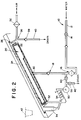
- FIGURE 2 is a tubing diagram of the sterilizer of FIGURE 1.
- With reference to FIGURES 1 and 2, a dilutant or water source 10 supplies water or other fluid reagents. In the preferred sterilizer embodiment, the water source includes a length of
tubing 12 connected with a water spigot or other building plumbing and acontrol valve 14 for selectively preventing and permitting the flow of water to a sterilizing means 16. In the preferred embodiment, the sterilizing means is a filter which removes particles which are as large or larger than bacteria. Thermal, chemical, radiological, and other conventional water sterilizing means are also contemplated. Optionally, an in-line water treatment means may be provided for modifying the chemical composition of the water. For example, a water softening cartridge may be provided for reducing or eliminating calcium and magnesium salts from the water. Alternately, various water treatments may be added to the water, such as a wetting agent, a sequestering agent, or others of the reagents to be discussed herein below. - A
tubing system 18 connects the filter or other sterilizing means 16 with a basin orother means 20 for receiving an item to be sterilized. In the preferred embodiment, the basin receives a removable container ortray 22 configured in accordance with the item to be sterilized, e.g. an endoscope. The container may have appropriate liquid ports, vents, sterilant distribution system, medical instrument positioners and retainers, closures, etc. such that instruments can be sterilized, rinsed, and stored within the container without opening the container. Alid 24 is sealed to the basin in a lowered position by aresilient gasket 26. Optionally, atransparent window 28 is defined in the lid. - The
tubing system 18 includes abasin inlet 30 for filling the basin to surround the items with a sterilant solution and abasin drain 32. A reagent receiving well 34 collects the fluid from the filled basin.Vent lines 36 enable air to be vented from the container and basin such that they are completely filled with the sterilant solution, rinse water, or other liquids. Any excess fluid is discharged throughcheck valve 38 into adrain line 40. - A sealed
ampule 42 with a premeasured dose of dry ingredients that form corrosion inhibitors and anti-microbial agents when mixed with water is emptied into thewell 34. Optionally, two compartments may be provided such that the corrosion inhibitors are introduced and circulated first over the item to be sterilized or disinfected. This provides corrosion protection before the corrosive anti-microbial agent contacts the item. In the preferred embodiment, the corrosion inhibitors and anti-microbial agent reach the item contemporaneously. As described in greater detail below, the powdered water-soluble reagents include compositions when mixed with water or a water-based solution, form a strong oxidant or other antimicrobial agent. The reagents further provide buffers and anticorrosive agents. More specifically to the preferred embodiment, the dry ingredients include a water-soluble acid precursor and a water-soluble persalt which, when dissolved in water, form a peracetic acid solution with an anti-microbially effective concentration of peracetic acid. Moreover, the water soluble acid precursor and water soluble peracid react or are mixed with other ingredients to provide a buffer, e.g. a borate, for bringing the pH to a neutral level and to inhibit steel corrosion. Other corrosion inhibitors, such as a molybdate for inhibiting aluminum and steel corrosion, a triazole for inhibiting copper and brass corrosion, and the like are optionally included in the powdered ingredients. Wetting and sequestering agents may also be included in the dry ingredients. - The operator closes the
lid 24 and the system is filled with water. Apump 50 selectively draws solution or water from thebasin 20 through well 34 and returns it to thebasin inlet 30. The water dissolves the powdered reagents allowing them to react, forming the antimicrobial solution. Preferably, thevent line 36 is very short and of a substantial diameter such that the solution is circulated over exposed surfaces of thedrain check valve 38 and anair sterilizing filter 52. Aheating coil 54 adjusts the temperature of the solution. Recirculation continues until the interior of the medical items and all exposed surfaces of the tubing system, pump, basin, container, and valves are sterilized. Alternately, once fully dissolved and distributed the sterilant may remain quiescent without further circulation for a selected duration. - After the preselected sterilization or disinfecting period, the antimicrobial solution is drained through a
drain valve 56. Sterile air is drawn into the system through theair sterilizing filter 52 that removes any particles the size of a bacteria or larger. Thefill valve 14 is opened and thedrain valve 56 is closed such that thesterile filter 16 provides a source of sterile rinse. Note that the sterile rinse liquid flows only in contact with sterilized surfaces of the tubing system and valves in order to assure sterility. Every tubing and valve surface from thefilter 16 to the drain has been exposed to the circulating antimicrobial solution for a sufficient duration to assure that it is microbial contamination-free. Thepump 50 circulates the sterile rinse through the system for a selected duration sufficient to rinse any deposits or residue, such as salts, that strong buffered solutions tend to deposit. At the end of the rinse cycle, the rinse solution is drained by opening thedrain valve 56. When areturn valve 60 is closed, thepump 50 pumps liquid from the system out thedrain valve 56. Additional drain lines (not shown) and aspirators or pumps (not shown) may be provided for removing liquids from every region of the system. The exact location of such additional drains will be dependent on the bends and contours of the plumbing system. - In the preferred embodiment, the ampule contains acetylsalicylic acid (acid precursor) and sodium perborate (persalt). The relative amounts of these two additives are selected so as to produce the chemical reaction:

The total volume of dry ingredients is such that the resultant water solution has a concentration of peracetic acid of 0.2% w/v - a biocidally effective concentration. The Sodium Metaborate (NaBO₂) is an inorganic corrosion inhibitor and the Salicylic acid is an organic corrosion inhibitor with a benzoate function. Preferably, an additional powdered water-soluble phosphate is also present in the ampule to provide additional corrosion resistance when dissolved by the water. The chemical formulation of the phosphate is preferably selected such that it is inert relative to the above described chemical reaction, or at least does not interfere with the chemical reactions formation of peracetic acid and corrosion inhibitors. - A 0.2% w/v peracetic acid solution and associated corrosion inhibitors generated by the above chemical reaction is anti-microbially effective with twelve minutes exposure at 50°C even to Clostridium sporgenes inoculum on a penicylinders carrier, the carrier and inoculum most resistant to peroxyacetic acid. Antimicrobial test results are summarized in Table 1 below in which each test was conducted at 50°C with twelve minutes exposure and the peracetic acid at 0.2% w/v.
- Other oxidizing or antimicrobial agents can also be generated in situ, such as chlorine dioxide, chlorine, hydrogen peroxide, and mixtures thereof. More specifically, potassium chromates, sodium chloride, and phosphates may be mixed according to the following equation to produce a strong chlorine oxidant on the addition of water:

Optionally, excess dichromate and an organic corrosion inhibitor may be provided for improved buffering and corrosion inhibiting. - Hydrogen peroxide and an inorganic inhibitor can be generated:

- Similarly, chlorine dioxide can be generated from powdered ingredients on the addition of water:

- A mixed biocide system can be achieved by adding sodium chloride to the peracetic acid reaction to produce hypochlorous acid.

- Excess peracetic acid is deliberately present such that both peracetic acid and hypochlorous acid are present in the biocidal solution.
- In these compositions, it is preferable to add additional corrosion inhibitors and buffers to protect copper, brass, aluminum, steel, and the like. Preferably, corrosion inhibitors are added which result in three corrosion inhibitors in the final solution. One is an organic inhibitor, one is an inorganic inhibitor, and the third can be either.
- The copper and brass corrosion inhibitors are preferably benzotriazoles and tolytriazoles, which are preferred due to their stability in the presence of strong oxidizing compounds. Mercaptobenzathiozol might also be utilized but is more apt to be oxidized or destabilized by strong oxidizers.
- Azoles, benzoates, and other five membered ring compounds may also prove acceptable as copper and brass corrosion inhibitors.
- By way of example, the anti-corrosive buffering compounds may include a mixture of phosphate in sufficient volume to produce a final concentration of 1.25% weight per volume and molybdates in an appropriate amount to produce a final solution of .011% weight per volume. Phosphates may also be effective in the range of 0.2% to 12% and the molybdates may be effective from 0.1 to 10%. Optionally, chromates, dichromates, tungstates, vanadates, other borates, and combinations thereof, may be substituted in appropriate concentrations to inhibit steel corrosion, i.e. buffer to a generally neutral pH, and aluminum corrosion.
- In hard water, the phosphates tend to cause calcium and magnesium salts to precipitate and coat the instruments being sterilized and parts of the sterilizing system. A sequestering agent appropriate to prevent precipitation, such as sodium hexametaphosphate, may be provided. Of course, if deionized or soft water is utilized the sequestering agent may be eliminated. However, to insure universal applicability with any water that might be utilized, the presence of a sequestering agent is preferred.
- A wetting agent present from 0.001 to 1.0% (w/v) improves the wetting of the surface of the instrument by the anti-microbial agent. The wetting agent has also been found to increase penetration of the anti-microbials improving anti-microbial efficacy while reducing corrosion.
- The following are examples that illustrate the corrosion inhibiting effectiveness of various strong oxidant anti-microbial formulations. Coupons of 410 stainless steel, brass (ASTM B36-C 2600), aluminum (5052-H 32), and carbon steel scalpel blades were exposed to two changes of sterilant mix for a total of four hours exposure at 50-55°C. One set of coupons was run in distilled water and a sterilant mix (0.5% sodium perborate and 0.5% aspirin) and a second set in tap water and sterilant mix. A second set of tests was performed using brass and aluminum coupons, and carbon steel scalpel blades in a matrix with concentrations of disodium phosphate of 0, 0.2, 0.4, 0.5, and 0.7% and concentrations of benzotriazole of 0, 0.001, 0.005, 0.01, and 0.02%. Each type of coupons were exposed to sterilant mix and additives for three hours at 50-55°C. All coupons were rinsed well with distilled water and acetone and allowed to dry before evaluation.
- Corrosion or discoloration was noted on all materials using just the basic peracetic acid, sodium metaborate, and salicylic acid solution. Carbon steel and 410 stainless steel showed only minor corrosion. Aluminum was discolored and showed some pitting. Brass was heavily corroded on most surfaces and showed some pitting. In the matrix, the addition of 0.001% benzotriazole or 0.4% phosphate eliminated corrosion on carbon steel. The addition of 0.4% phosphate eliminated corrosion on aluminum. For brass, the addition of 0.2% phosphate or 0.05% benzotriazole eliminated pitting corrosion. However, phosphate caused darkening of brass which was apparent unless 0.02% benzotriazole was added. Random spotting of brass occurred at all concentrations. This sort of corrosion can be eliminated by adding a surfactant.
- The invention has been described with reference to the preferred embodiments. Obviously, modifications and alterations will occur to others upon reading and understanding the preceding detailed description. It is intended that the invention be construed as including all such alterations and modifications insofar as they come within the scope of the appended claims or the equivalents thereof.
- The holder holding the reagents can be, for example, a sealed container, for instance a cup or dish which can be of plastics material, having a heat-sealed peel-off top or other closure.
Claims (16)
- A method of microbially decontaminating an item by immersing the item in an anti-microbial solution formed by reacting a soluble acid precurser and a soluble peracid compound in a dilutant, characterized by:(a) measuring preselected amounts of dry reagents including the acid precurser and the peracid;(b) packaging the measured dry acid precurser and peracid in a holder and storing the holder until items are to be microbially decontaminated;(c) opening the holder and intermixing the dry acid precurser and the dry peracid compound with the dilutant to form the anti-microbial solution; and(d) immersing the item in the anti-microbial solution;
the intermixing and immersing steps including:
recirculating the anti-microbial solution from a chamber in which the item is disposed through interconnecting tubing and back to the chamber, whereby the interconnecting tubing and chamber interior are microbially decontaminated together with the item; and
the method including a rinsing step of passing a microbially decontaminated rinse liquid from a source of the rinse liquid through the interconnecting tubing to the chamber such that the rinse liquid passes only in contact with surfaces that have been microbially decontaminated, whereby the rinse liquid is prevented from carrying microbial contamination to the item. - A method according to Claim 1, in which the soluble acid precurser comprises acetylsalicylic acid, the soluble peracid comprises sodium perborate and the dilutant is water; and the acetylsalicylic acid and the sodium perborate are dissolved in the water in the intermixing step to form a resultant solution that has at least 0.02% w/v concentration of peracetic acid.
- A method according to Claim 1, in which the dry reagents comprise any of the following mixtures (a) to (e);(a) K₂Cr₂O₇, NaCl, and H₃PO₄;(b) NaBO₃ and H₃PO₄;(c) NaClO₂ and LiClO₃;(d) Acetylsalicylic acid and NaBO₃; and(e) Acetylsalicylic, NaBO₃, and NaCl.
- A method according to any of the preceding claims, in which the dry reagents further include at least one corrosion inhibitor selected from:
benzotriazoles, tolytriazoles, mercaptobenzathiozol, azoles, benzoates, molybdates, phosphates, chromates, dichromates, tungstates, vanadates, and borates. - A method according to any of claims 1-3, in which the dry reagents further include at least one organic corrosion inhibitor selected from:
benzotriazoles, tolytriazoles, mercaptobenzathiozol, azoles, imidazoles, thiozoles, indoles, pyrazoles, and benzoates;
and at least one inorganic corrosion inhibitor selected from:
molybdates, phosphates, chromates, dichromates, tungstates, silicates, vanadates, and borates. - A method according to any of the preceding claims, in which the dry reagents are in the form of powders.
- A method according to any of the preceding claims in which the intermixing is effected mechanically.
- A method according to any of the preceding claims, in which the intermixing of the acid precurser and peracid compound in the dilutant produces a corrosion inhibitor or a buffering agent.
- A microbial decontamination apparatus which comprises:
a chamber (20) for receiving an item to be decontaminated with a strong oxidant solution;
a pre-measured dose of dry reagents which when dissolved in water produces a strong oxidant solution;
a receiving region (34) for receiving the pre-measured dose;
a pump (50) for selectively pumping the strong oxidant solution to the chamber;
interconnecting tubing for interconnecting the dry reagent-receiving region (34) with the pump, the chamber, and a water supply (10), whereby water from the water supply can selectively flow through the reagent-receiving region (34) and intermix with the dry reagents to form the strong oxidant solution and such that the pump selectively circulates the strong oxidant solution through the chamber (20). - An apparatus according to Claim 9, which includes a plurality of disposable holders (42), each holder holding a preselected dose of the dry reagents to be received in the reagent receiving region.
- An apparatus according to Claim 9 or 10, in which the dry reagents comprise any of the following (a) to (e):(a) K₂Cr₂O₇, NaCl, and H₃PO₄;(b) NaBO₃ and H₃PO₄;(c) NaClO₂ and LiClO;(d) Acetylsalicylic acid and NaBO₃; and(e) Acetylsalicylic acid, NaBO₃, and NaCl.
- An apparatus according to Claim 9, 10 or 11,
in which the dry reagents include at least one corrosion inhibitor selected from:
benzotriazoles, tolytriazoles, mercaptobenzathiozol, azoles, imidazoles, thiozoles, indoles, pyrazoles, benzoates, molybdates, phosphates, chromates, silicates, dichromates, tungstates, vanadates, and borates. - A cartridge, pack, ampoule, or other holder (42) for use in the method of claim 1 or with the apparatus of claim 9, said holder holding premeasured amounts of reagents such that when the reagents are mixed with a water-containing liquid, there is produced an aqueous solution of a strong oxidant.
- A holder according to claim 13 whose reagents comprise any of the following mixtures (a) to (e):(a) K₂Cr₂O₇, NaCl, and H₃PO₄;(b) NaBO₃ and H₃PO₄;(c) NaClO₂ and LiClO;(d) Acetylsalicylic acid and NaBO₃; and,(e) Acetylsalicylic acid, NaBO₃, and NaCl.
- A holder according to claim 13 whose reagents comprise a premeasured dose of powdered acetylsalicylic acid and sodium perborate such that when the powdered reagents are mixed with water, a peracetic acid anti-microbial agent and sodium metaborate and salicylic acid corrosion inhibitors are formed and dissolve in the water to form a corrosion-inhibiting anti-microbial solution for one cycle of an automated microbial decontaminating apparatus.
- A holder according to claim 13, 14 or 15, which includes also at least one corrosion inhibitor selected from:
benzotriazoles, tolytriazoles, mercaptobenzathiozol, azoles, imidazoles, thiozoles, indoles, pyrazoles, benzoates, molybdates, phosphates, chromates, silicates, dichromates, tungstates, vanadates, and borates.
Applications Claiming Priority (2)
| Application Number | Priority Date | Filing Date | Title |
|---|---|---|---|
| US07/342,189 US5116575A (en) | 1986-02-06 | 1989-04-24 | Powdered anti-microbial composition |
| US342189 | 1989-04-24 |
Publications (3)
| Publication Number | Publication Date |
|---|---|
| EP0395296A2 EP0395296A2 (en) | 1990-10-31 |
| EP0395296A3 EP0395296A3 (en) | 1991-09-11 |
| EP0395296B1 true EP0395296B1 (en) | 1994-06-29 |
Family
ID=23340756
Family Applications (1)
| Application Number | Title | Priority Date | Filing Date |
|---|---|---|---|
| EP90304179A Expired - Lifetime EP0395296B1 (en) | 1989-04-24 | 1990-04-19 | Microbial decontamination |
Country Status (9)
| Country | Link |
|---|---|
| US (1) | US5116575A (en) |
| EP (1) | EP0395296B1 (en) |
| JP (1) | JPH02295564A (en) |
| AT (1) | ATE107863T1 (en) |
| CA (1) | CA2011124C (en) |
| DE (1) | DE69010265T2 (en) |
| DK (1) | DK0395296T3 (en) |
| ES (1) | ES2057387T3 (en) |
| HK (1) | HK183696A (en) |
Families Citing this family (125)
| Publication number | Priority date | Publication date | Assignee | Title |
|---|---|---|---|---|
| US5350563A (en) * | 1986-02-06 | 1994-09-27 | Steris Corporation | Cold sterilant with extended active life |
| US5552115A (en) * | 1986-02-06 | 1996-09-03 | Steris Corporation | Microbial decontamination system with components porous to anti-microbial fluids |
| US5407685A (en) * | 1986-02-06 | 1995-04-18 | Steris Corporation | Controlled oxygen/anti-microbial release films |
| US5209909A (en) * | 1986-02-06 | 1993-05-11 | Steris Corporation | Two compartment cup for powdered sterilant reagent components |
| CA2012862C (en) * | 1989-05-09 | 1995-11-07 | Edward T. Schneider | Container for holding equipment during sterilization |
| GB9211499D0 (en) * | 1992-05-30 | 1992-07-15 | Univ Salford Business Services | Endoscope washing and disinfection |
| JP3549883B2 (en) * | 1992-10-01 | 2004-08-04 | アメリカン ステリライザー カンパニー | Liquid dispensing system and dispensing method based on accumulator |
| US5302375A (en) * | 1992-11-19 | 1994-04-12 | Colgate-Palmolive Company | Oral composition having improved tooth whitening effect |
| US5707739A (en) * | 1995-06-05 | 1998-01-13 | Southwest Research Institute | Powdered biocidal compositions |
| US6046243A (en) * | 1993-02-12 | 2000-04-04 | Bernard Technologies, Inc. | Compositions for sustained release of a gas |
| WO1994027645A1 (en) * | 1993-05-28 | 1994-12-08 | Porton International Plc | System for packaging and delivering of a sterile powder medium |
| WO1994028944A1 (en) * | 1993-06-14 | 1994-12-22 | Porton International Plc | System for packaging and delivering of a sterile powder medium |
| US5460962A (en) * | 1994-01-04 | 1995-10-24 | Organogenesis Inc. | Peracetic acid sterilization of collagen or collagenous tissue |
| GB2292687A (en) * | 1994-08-26 | 1996-03-06 | Bruce Philip Green | Corrosion inhibition of oxidant-based anti-microbial compositions |
| US5529750A (en) * | 1994-09-08 | 1996-06-25 | Steris Corporation | Container with internal liquid distribution port for holding equipment with internal passages during sterilization |
| US6007772A (en) * | 1994-10-06 | 1999-12-28 | Green; Bruce Philip | Cold sterilant solution |
| GB9420201D0 (en) * | 1994-10-06 | 1994-11-23 | Green Bruce P | Cold sterilant solution |
| US5723095A (en) * | 1995-12-28 | 1998-03-03 | Steris Corporation | Cleaner concentrate formulation for biological waste fluid handling systems |
| AU3780097A (en) * | 1996-08-05 | 1998-02-25 | Ddw Botha Patente Bk | A stethoscope warming device |
| WO1998011776A1 (en) * | 1996-09-18 | 1998-03-26 | Bernard Technologies, Inc. | Powders providing controlled sustained release of a gas |
| US5888528A (en) * | 1997-05-19 | 1999-03-30 | Bernard Technologies, Inc. | Sustained release biocidal powders |
| US7556767B2 (en) * | 1997-12-17 | 2009-07-07 | Ethicon, Inc. | Integrated washing and sterilization process |
| US20050163655A1 (en) * | 1997-06-11 | 2005-07-28 | Szu-Min Lin | Integrated washing and sterilization process |
| US6203756B1 (en) | 1997-12-17 | 2001-03-20 | Johnson & Johnson Medical, Inc. | Integrated cleaning sterilization process |
| US7229591B2 (en) * | 1997-08-21 | 2007-06-12 | Ethicon, Inc. | Lumen sterilization device and method |
| ES2217607T3 (en) | 1997-12-04 | 2004-11-01 | Steris Corporation | CHEMICAL MODIFICATION OF ELECTROCHEMICALLY ACTIVATED WATER. |
| US6015529A (en) * | 1997-12-17 | 2000-01-18 | Johnson & Johnson Medical, Inc. | Tray/container system for cleaning/sterilization processes |
| US6596232B1 (en) | 1997-12-17 | 2003-07-22 | Ethicon, Inc. | Device processing apparatus and method having positive pressure with two partitions to minimize leakage |
| US6013227A (en) * | 1997-12-17 | 2000-01-11 | Johnson & Johnson Medical, Inc. | Lumen device reprocessor without occlusion |
| US6187266B1 (en) | 1997-12-17 | 2001-02-13 | Johnson & Johnson Medical, Inc. | Integrated cleaning/sterilization process with lumen devices |
| US6685895B1 (en) | 1997-12-17 | 2004-02-03 | Ethicon, Inc. | Method and apparatus for processing device with reduced occlusion |
| US6645430B1 (en) | 1997-12-17 | 2003-11-11 | Ethicon, Inc. | Method and apparatus for processing device with fluid submersion |
| US6083458A (en) * | 1997-12-17 | 2000-07-04 | Ethicon, Inc. | Apparatus and method for providing fluid to devices with reduced or without occlusion |
| US6605304B1 (en) | 1998-02-09 | 2003-08-12 | Bernard Technologies, Inc. | Silicate-containing powders providing controlled, sustained gas release |
| US6277408B1 (en) | 1998-02-09 | 2001-08-21 | Southwest Research Institute | Silicate-containing powders providing controlled, sustained gas release |
| US20020064479A1 (en) | 1998-03-26 | 2002-05-30 | Nobuyuki Nakanishi | Apparatus for washing and disinfecting-sterilizing endoscope |
| ITVR980033A1 (en) * | 1998-04-30 | 1999-10-30 | Farmec Di Tabasso Renato & C S | PROCEDURE FOR OBTAINING A PERACETIC ACID-BASED DISINFECTANT. |
| EP1117294B1 (en) | 1998-10-01 | 2006-01-25 | Minntech Corporation | Multi-part anti-microbial sterilization compositions and methods |
| US6203767B1 (en) | 1998-11-06 | 2001-03-20 | Steris Corporation | Peracetic acid card reader and card style sensor |
| AU1827600A (en) | 1998-11-23 | 2000-06-13 | Ecolab Inc. | Non-corrosive sterilant composition |
| CA2353645C (en) * | 1998-12-03 | 2013-03-12 | Redox Chemicals, Inc. | Novel methods of protecting plants from pathogens |
| US6312645B1 (en) | 1998-12-30 | 2001-11-06 | Ethicon, Inc. | Container with collapsible pouch for cleaning or sterilization |
| US6534002B1 (en) | 1998-12-30 | 2003-03-18 | Ethicon, Inc. | Flow of fluid through a lumen device from smaller-caliber end to larger-caliber end |
| WO2000039003A1 (en) | 1998-12-30 | 2000-07-06 | Ethicon, Inc. | Sterile packaging for flexible endoscopes |
| US6352837B1 (en) | 1999-02-22 | 2002-03-05 | 3M Innovative Properties Company | Rapid readout sterilization indicator for liquid peracetic acid sterilization procedures |
| US6749807B1 (en) | 1999-05-19 | 2004-06-15 | Steris Corporation | Flow through chemical indicator for measurement of active biocidal agents in a single use package |
| US6527872B1 (en) | 1999-07-28 | 2003-03-04 | Steris Inc. | Environmentally friendly peracetic acid decontamination formula with increased performance and chemical stability |
| DE60004060T2 (en) * | 1999-08-05 | 2004-04-22 | Steris Inc., Temecula | ELETROLYTIC SYNTHESIS OF PERACETIC ACID |
| AU2000248557A1 (en) * | 2000-05-17 | 2001-11-26 | Raymond C Kralovic | Method of removing microbial contamination |
| US7271137B2 (en) * | 2000-06-29 | 2007-09-18 | Sandia Corporation | Decontamination formulations for disinfection and sterilization |
| US6929705B2 (en) | 2001-04-30 | 2005-08-16 | Ak Steel Corporation | Antimicrobial coated metal sheet |
| FR2829394B1 (en) * | 2001-09-12 | 2005-08-19 | Seppic Sa | NOVEL PROCESS FOR PREPARING DISINFECTANT COMPOSITION, METHOD FOR DISINFECTING MEDICAL DEVICES, AND TWO-COMPONENT DISINFECTING SYSTEM |
| US7001873B2 (en) * | 2001-10-05 | 2006-02-21 | Steris Inc. | Decontamination of surfaces contaminated with prion-infected material with oxidizing agent-based formulations |
| JP2005528883A (en) * | 2001-10-05 | 2005-09-29 | ステリス インコーポレイテッド | In vitro model for priocidal activity |
| CN1777666B (en) * | 2003-04-22 | 2010-11-03 | R.T.范德比尔特公司 | Organic ammonium tungstate and organic ammonium molybdate compound and preparation method thereof |
| US7071152B2 (en) * | 2003-05-30 | 2006-07-04 | Steris Inc. | Cleaning and decontamination formula for surfaces contaminated with prion-infected material |
| US7314966B2 (en) * | 2003-08-01 | 2008-01-01 | Steris Inc. | Method for deactivating and maintaining items in a deactivated state |
| US7229599B2 (en) * | 2003-08-01 | 2007-06-12 | Steris Inc. | Chemical delivery container |
| US7135142B2 (en) | 2003-08-01 | 2006-11-14 | Steris Inc. | Filter assembly for a reprocessor |
| US7169369B2 (en) * | 2003-08-01 | 2007-01-30 | Steris Inc. | Method and device for deactivating items and for maintaining such items in a deactivated state |
| US7476368B2 (en) * | 2003-08-01 | 2009-01-13 | American Sterilizer Company | Method and device for deactivating items and for maintaining such items in a deactivated state |
| US7662759B1 (en) * | 2005-01-28 | 2010-02-16 | Sandia Corporation | Decontamination formulation with additive for enhanced mold remediation |
| US7550420B2 (en) * | 2005-04-29 | 2009-06-23 | E. I. Dupont De Nemours And Company | Enzymatic production of peracids using perhydrolytic enzymes |
| US7612030B2 (en) * | 2005-04-29 | 2009-11-03 | E. I. Du Pont De Nemours And Company | Enzymatic production of peracids using perhydrolytic enzymes |
| AU2006278364B2 (en) * | 2005-08-05 | 2012-04-19 | Hemostasis, Llc | Antimicrobial composition and system |
| US7723083B2 (en) | 2005-12-13 | 2010-05-25 | E.I. Du Pont De Nemours And Company | Production of peracids using an enzyme having perhydrolysis activity |
| US7964378B2 (en) * | 2005-12-13 | 2011-06-21 | E.I. Du Pont De Nemours And Company | Production of peracids using an enzyme having perhydrolysis activity |
| US7951566B2 (en) | 2005-12-13 | 2011-05-31 | E.I. Du Pont De Nemours And Company | Production of peracids using an enzyme having perhydrolysis activity |
| US8518675B2 (en) | 2005-12-13 | 2013-08-27 | E. I. Du Pont De Nemours And Company | Production of peracids using an enzyme having perhydrolysis activity |
| AU2007224161B2 (en) * | 2006-03-06 | 2010-06-17 | American Sterilizer Company | Method for generating a microbial deactivation fluid in an apparatus for deactivating instruments and devices |
| US20090074881A1 (en) * | 2006-05-02 | 2009-03-19 | Bioneutral Laboratories Corporation Usa | Antimicrobial cidality formulations with residual efficacy, uses thereof, and the preparation thereof |
| US9034390B2 (en) * | 2006-05-02 | 2015-05-19 | Bioneutral Laboratories Corporation | Anti-microbial composition and method for making and using same |
| US9700644B2 (en) * | 2006-08-15 | 2017-07-11 | American Sterilizer Company | One part, solids containing decontamination blend composition |
| US9724550B2 (en) * | 2006-08-15 | 2017-08-08 | American Sterilizer Company | One part, solids containing decontamination blend composition |
| USD571478S1 (en) | 2006-10-25 | 2008-06-17 | American Sterilizer Company | Container for reprocessing medical devices |
| US7473658B2 (en) * | 2006-11-13 | 2009-01-06 | E. I. Du Pont Nemours And Company | Partially fluorinated amino acid derivatives as gelling and surface active agents |
| MX2009006649A (en) * | 2006-12-22 | 2009-08-12 | Fmc Corp | IMPROVED PERACETIC ACID COMPOSITION. |
| WO2009057835A1 (en) * | 2007-10-31 | 2009-05-07 | Jinsik Lee | Acidic antibiotic composition containing peracid and acetyl salicylic acid |
| JP5504268B2 (en) | 2008-08-13 | 2014-05-28 | イー・アイ・デュポン・ドウ・ヌムール・アンド・カンパニー | Control of enzymatic peracid production |
| WO2010039958A1 (en) | 2008-10-03 | 2010-04-08 | E.I. Dupont De Nemours And Company | Improved perhydrolases for enzymatic peracid generation |
| US20110177145A1 (en) | 2009-07-27 | 2011-07-21 | E.I. Du Pont De Nemours And Company | In situ preparation of peracid-based removable antimicrobial coating compositions and methods of use |
| AU2010281409B2 (en) | 2009-07-27 | 2014-08-14 | The Chemours Company Fc, Llc | Enzymatic in situ preparation of peracid-based removable antimicrobial coating compositions and methods of use |
| US20110177148A1 (en) * | 2009-07-27 | 2011-07-21 | E. I. Du Pont De Nemours And Company | Enzymatic in situ preparation of peracid-based removable antimicrobial coating compositions and methods of use |
| US8222012B2 (en) | 2009-10-01 | 2012-07-17 | E. I. Du Pont De Nemours And Company | Perhydrolase for enzymatic peracid production |
| US7927854B1 (en) | 2009-12-07 | 2011-04-19 | E. I. Du Pont De Nemours And Company | Perhydrolase providing improved peracid stability |
| US7923233B1 (en) * | 2009-12-07 | 2011-04-12 | E. I. Du Pont De Nemours And Company | Perhydrolase providing improved peracid stability |
| US7932072B1 (en) | 2009-12-07 | 2011-04-26 | E. I. Du Pont De Nemours And Company | Perhydrolase providing improved peracid stability |
| US7960528B1 (en) * | 2009-12-07 | 2011-06-14 | E. I. Du Pont De Nemours And Company | Perhydrolase providing improved peracid stability |
| US7910347B1 (en) | 2009-12-07 | 2011-03-22 | E. I. Du Pont De Nemours And Company | Perhydrolase providing improved peracid stability |
| EP2553092B1 (en) | 2010-03-26 | 2014-04-23 | E.I. Du Pont De Nemours And Company | Process for the purification of proteins |
| WO2011119706A1 (en) | 2010-03-26 | 2011-09-29 | E.I. Dupont De Nemours And Company | Perhydrolase providing improved specific activity |
| WO2011119708A1 (en) | 2010-03-26 | 2011-09-29 | E.I. Dupont De Nemours And Company | Perhydrolase providing improved specific activity |
| WO2011119714A1 (en) | 2010-03-26 | 2011-09-29 | E.I. Dupont De Nemours And Company | Perhydrolase providing improved specific activity |
| WO2011119710A1 (en) | 2010-03-26 | 2011-09-29 | E.I. Dupont De Nemours And Company | Perhydrolase providing improved specific activity |
| WO2011119712A1 (en) | 2010-03-26 | 2011-09-29 | E.I. Dupont De Nemours And Company | Perhydrolase providing improved specific activity |
| WO2012087966A2 (en) | 2010-12-20 | 2012-06-28 | E. I. Du Pont De Nemours And Company | Targeted perhydrolases |
| BR112013015459B8 (en) | 2010-12-20 | 2018-06-12 | Du Pont | peracid generation method, oral care product and composition |
| US8394616B2 (en) | 2010-12-21 | 2013-03-12 | E.I. Du Pont De Nemours And Company | Perhydrolase variant providing improved specific activity |
| US8389256B2 (en) | 2010-12-21 | 2013-03-05 | E.I. Du Pont De Nemours And Company | Perhydrolase variant providing improved specific activity |
| WO2012087788A1 (en) | 2010-12-21 | 2012-06-28 | E.I. Dupont De Nemours And Company | Perhydrolase variant providing improved specific activity |
| WO2012087790A1 (en) | 2010-12-21 | 2012-06-28 | E.I. Dupont De Nemours And Company | Perhydrolase variant providing improved specific activity |
| WO2012087792A1 (en) | 2010-12-21 | 2012-06-28 | E.I. Dupont De Nemours And Company | Perhydrolase variant providing improved specific activity |
| WO2012087785A1 (en) | 2010-12-21 | 2012-06-28 | E.I. Dupont De Nemours And Company | Perhydrolase variant providing improved specific activity |
| WO2012087786A1 (en) | 2010-12-21 | 2012-06-28 | E.I. Dupont De Nemours And Company | Perhydrolase variant providing improved specific activity |
| US8389259B2 (en) | 2010-12-21 | 2013-03-05 | E.I. Du Pont De Nemours And Company | Perhydrolase variant providing improved specific activity |
| ES2537892T3 (en) | 2011-06-29 | 2015-06-15 | General Electric Company | Sterilizing and pasteurizing solutions without molybdates |
| US8546120B2 (en) | 2011-10-25 | 2013-10-01 | E. I. Du Pont De Nemours And Company | Perhydrolase variant providing improved specific activity |
| US8962294B2 (en) | 2011-10-25 | 2015-02-24 | E. I. Du Pont De Nemours And Company | Perhydrolase variant providing improved specific activity |
| US8735125B2 (en) | 2011-10-25 | 2014-05-27 | E. I. Du Pont De Nemours And Company | Perhydrolase variant providing improved specific activity |
| WO2013062885A1 (en) | 2011-10-25 | 2013-05-02 | E.I. Dupont De Nemours And Company | Perhydrolase variant providing improved specific activity |
| US8486679B2 (en) | 2011-10-25 | 2013-07-16 | E. I. Du Pont De Nemours And Company | Perhydrolase variant providing improved specific activity |
| US8546119B2 (en) | 2011-10-25 | 2013-10-01 | E. I. Du Pont De Nemours And Company | Perhydrolase variant providing improved specific activity |
| US8809030B2 (en) | 2011-10-25 | 2014-08-19 | E. I. Du Pont De Nemours And Company | Perhydrolase variant providing improved specific activity |
| US8956843B2 (en) | 2011-10-25 | 2015-02-17 | E. I. Du Pont De Nemours And Company | Perhydrolase variant providing improved specific activity |
| US8557556B2 (en) | 2011-10-25 | 2013-10-15 | E. I. Du Pont De Nemours And Company | Perhydrolase variant providing improved specific activity |
| WO2013096045A1 (en) | 2011-12-19 | 2013-06-27 | E. I. Du Pont De Nemours And Company | Perhydrolase variants providing improved specific activity in the presence of surfactant |
| MX2014011654A (en) | 2012-03-30 | 2014-10-24 | Du Pont | Enzymes useful for peracid production. |
| BR112014024216B1 (en) | 2012-03-30 | 2022-04-05 | E.I. Du Pont De Nemours And Company | Process for the production of a peroxycarboxylic acid, composition and system for generating and supplying peracid |
| US8841098B2 (en) | 2012-03-30 | 2014-09-23 | E.I. Du Pont De Nemours And Company | Enzymes useful for peracid production |
| JP6335874B2 (en) | 2012-03-30 | 2018-05-30 | イー・アイ・デュポン・ドウ・ヌムール・アンド・カンパニーE.I.Du Pont De Nemours And Company | Enzymes useful for peracid production |
| EP2831250B1 (en) | 2012-03-30 | 2021-11-24 | DuPont US Holding, LLC | Enzymes useful for peracid production |
| EP3068222B1 (en) * | 2013-11-11 | 2019-12-04 | Whiteley Corporation Pty Ltd | Disinfectant composition |
| US10022189B2 (en) | 2013-12-16 | 2018-07-17 | Stryker Sustainability Solutions, Inc. | Apparatus and method for cleaning an instrument |
| WO2017083605A1 (en) | 2015-11-12 | 2017-05-18 | Ecolab Usa Inc. | Identification and characterization of novel corrosion inhibitor molecules |
| AU2017335832B2 (en) | 2016-09-28 | 2022-01-27 | Medivators Inc. | Systems and methods for using solid high-level disinfection chemistries to produce disinfectant solutions |
Citations (1)
| Publication number | Priority date | Publication date | Assignee | Title |
|---|---|---|---|---|
| FR2229426A1 (en) * | 1973-05-15 | 1974-12-13 | Reusse Maurice | Biodegradable antiseptic detergent powder - for use in hospitals, public buildings etc. |
Family Cites Families (16)
| Publication number | Priority date | Publication date | Assignee | Title |
|---|---|---|---|---|
| JPS503433A (en) * | 1973-05-16 | 1975-01-14 | ||
| NL7608266A (en) * | 1975-08-16 | 1977-02-18 | Henkel & Cie Gmbh | CONCENTRATES OF MICROBICIDE AGENTS. |
| NL7608265A (en) * | 1975-08-16 | 1977-02-18 | Henkel & Cie Gmbh | STABLE CONCENTRATES OF FUNCTIONAL RESOURCES IN STORAGE. |
| JPS52110055A (en) * | 1976-03-11 | 1977-09-14 | Nelson Res & Dev | Contact lens preserve solution |
| DE2701133C3 (en) * | 1977-01-13 | 1985-08-29 | Schülke & Mayr GmbH, 2000 Norderstedt | Storable mixture, when dissolved in water, results in a solution with a high antimicrobial effect |
| US4120652A (en) * | 1977-10-03 | 1978-10-17 | Fmc Corporation | Aromatic sulfonyl azides as peroxygen activators |
| US4115060A (en) * | 1977-10-03 | 1978-09-19 | Fmc Corporation | N-sulfonylimidazoles as peroxygen activators |
| JPS59169302U (en) * | 1983-04-26 | 1984-11-13 | 日産化学工業株式会社 | Sterilization tablets for septic tank effluent water |
| US4547381A (en) * | 1983-11-10 | 1985-10-15 | Rio Linda Chemical Co., Inc. | Dry compositions for the production of chlorine dioxide |
| FR2578332B1 (en) * | 1985-01-30 | 1989-03-31 | Air Liquide | ASEPTISAN COMPOSITION FOR CONTACT LENSES |
| GB8515079D0 (en) * | 1985-06-14 | 1985-07-17 | Kellway Pharma | Contact lens cleaning & disinfection |
| JPS6297692A (en) * | 1985-10-24 | 1987-05-07 | Shikoku Chem Corp | Sterilizing cleaning agent having high solubility and lasting property |
| US5037623A (en) * | 1986-02-06 | 1991-08-06 | Steris Corporation | Sterilant concentrate injection system |
| US4731222A (en) * | 1986-02-06 | 1988-03-15 | Innovative Medical Technologies | Automated liquid sterilization system |
| US4938262A (en) * | 1987-05-20 | 1990-07-03 | Johnson & Johnson Medical, Inc. | Fluid injection system |
| CA1321137C (en) * | 1988-08-08 | 1993-08-10 | Raymond C. Kralovic | Anti-microbial composition |
-
1989
- 1989-04-24 US US07/342,189 patent/US5116575A/en not_active Expired - Lifetime
-
1990
- 1990-02-28 CA CA002011124A patent/CA2011124C/en not_active Expired - Lifetime
- 1990-04-19 AT AT90304179T patent/ATE107863T1/en not_active IP Right Cessation
- 1990-04-19 ES ES90304179T patent/ES2057387T3/en not_active Expired - Lifetime
- 1990-04-19 DK DK90304179.6T patent/DK0395296T3/en active
- 1990-04-19 EP EP90304179A patent/EP0395296B1/en not_active Expired - Lifetime
- 1990-04-19 DE DE69010265T patent/DE69010265T2/en not_active Expired - Lifetime
- 1990-04-24 JP JP2108585A patent/JPH02295564A/en active Granted
-
1996
- 1996-10-03 HK HK183696A patent/HK183696A/en not_active IP Right Cessation
Patent Citations (1)
| Publication number | Priority date | Publication date | Assignee | Title |
|---|---|---|---|---|
| FR2229426A1 (en) * | 1973-05-15 | 1974-12-13 | Reusse Maurice | Biodegradable antiseptic detergent powder - for use in hospitals, public buildings etc. |
Also Published As
| Publication number | Publication date |
|---|---|
| JPH02295564A (en) | 1990-12-06 |
| JPH0455710B2 (en) | 1992-09-04 |
| US5116575A (en) | 1992-05-26 |
| EP0395296A3 (en) | 1991-09-11 |
| DE69010265T2 (en) | 1994-12-01 |
| CA2011124A1 (en) | 1990-10-24 |
| DK0395296T3 (en) | 1994-10-31 |
| EP0395296A2 (en) | 1990-10-31 |
| ES2057387T3 (en) | 1994-10-16 |
| DE69010265D1 (en) | 1994-08-04 |
| HK183696A (en) | 1996-10-11 |
| CA2011124C (en) | 1999-03-02 |
| ATE107863T1 (en) | 1994-07-15 |
Similar Documents
| Publication | Publication Date | Title |
|---|---|---|
| CA2011124C (en) | Powdered anti-microbial composition | |
| US5077008A (en) | Anti-microbial composition | |
| US6171551B1 (en) | Electrolytic synthesis of peracetic acid and other oxidants | |
| CA1321137C (en) | Anti-microbial composition | |
| US6797681B2 (en) | Environmentally friendly peracetic acid decontamination formula with increased performance and chemical stability | |
| CA2058671C (en) | Office size instrument sterilization system | |
| EP1036037B1 (en) | Chemical modification of electrochemically activated water | |
| US6589565B1 (en) | Non-corrosive sterilant composition | |
| EP0862465B1 (en) | Two compartment cup for powdered sterilant reagent components | |
| EP0686048B1 (en) | Medical and biological waste decontamination system | |
| JPH0673541B2 (en) | Container divided into two, a system using the container, and a method of using the container | |
| EP0766571B1 (en) | Cutter for opening sterilant reagent cups | |
| US6482358B1 (en) | Three part cup for packaging cleaning and sterilizing agents and sequential cutter | |
| WO2001087358A1 (en) | Method of removing microbial contamination | |
| US6103189A (en) | Method of removing microbial contamination | |
| GB2292687A (en) | Corrosion inhibition of oxidant-based anti-microbial compositions | |
| EP0870853A1 (en) | Corrosion inhibitor for an antimicrobial composition | |
| AU2006278364B2 (en) | Antimicrobial composition and system |
Legal Events
| Date | Code | Title | Description |
|---|---|---|---|
| PUAI | Public reference made under article 153(3) epc to a published international application that has entered the european phase |
Free format text: ORIGINAL CODE: 0009012 |
|
| AK | Designated contracting states |
Kind code of ref document: A2 Designated state(s): AT BE CH DE DK ES FR GB GR IT LI LU NL SE |
|
| PUAL | Search report despatched |
Free format text: ORIGINAL CODE: 0009013 |
|
| AK | Designated contracting states |
Kind code of ref document: A3 Designated state(s): AT BE CH DE DK ES FR GB GR IT LI LU NL SE |
|
| 17P | Request for examination filed |
Effective date: 19920303 |
|
| 17Q | First examination report despatched |
Effective date: 19920925 |
|
| RAP1 | Party data changed (applicant data changed or rights of an application transferred) |
Owner name: STERIS CORPORATION |
|
| GRAA | (expected) grant |
Free format text: ORIGINAL CODE: 0009210 |
|
| AK | Designated contracting states |
Kind code of ref document: B1 Designated state(s): AT BE CH DE DK ES FR GB GR IT LI LU NL SE |
|
| REF | Corresponds to: |
Ref document number: 107863 Country of ref document: AT Date of ref document: 19940715 Kind code of ref document: T |
|
| REF | Corresponds to: |
Ref document number: 69010265 Country of ref document: DE Date of ref document: 19940804 |
|
| ITF | It: translation for a ep patent filed | ||
| ET | Fr: translation filed | ||
| REG | Reference to a national code |
Ref country code: ES Ref legal event code: FG2A Ref document number: 2057387 Country of ref document: ES Kind code of ref document: T3 |
|
| REG | Reference to a national code |
Ref country code: DK Ref legal event code: T3 |
|
| REG | Reference to a national code |
Ref country code: GR Ref legal event code: FG4A Free format text: 3013321 |
|
| EAL | Se: european patent in force in sweden |
Ref document number: 90304179.6 |
|
| PLBE | No opposition filed within time limit |
Free format text: ORIGINAL CODE: 0009261 |
|
| STAA | Information on the status of an ep patent application or granted ep patent |
Free format text: STATUS: NO OPPOSITION FILED WITHIN TIME LIMIT |
|
| 26N | No opposition filed | ||
| REG | Reference to a national code |
Ref country code: GB Ref legal event code: IF02 |
|
| REG | Reference to a national code |
Ref country code: CH Ref legal event code: PFA Owner name: STERIS CORPORATION Free format text: STERIS CORPORATION#9450 PINENEEDLE DRIVE#MENTOR/OH (US) -TRANSFER TO- STERIS CORPORATION#9450 PINENEEDLE DRIVE#MENTOR/OH (US) |
|
| PGFP | Annual fee paid to national office [announced via postgrant information from national office to epo] |
Ref country code: DK Payment date: 20080429 Year of fee payment: 19 Ref country code: CH Payment date: 20080430 Year of fee payment: 19 Ref country code: LU Payment date: 20080505 Year of fee payment: 19 |
|
| PGFP | Annual fee paid to national office [announced via postgrant information from national office to epo] |
Ref country code: AT Payment date: 20080402 Year of fee payment: 19 |
|
| PGFP | Annual fee paid to national office [announced via postgrant information from national office to epo] |
Ref country code: BE Payment date: 20080527 Year of fee payment: 19 |
|
| PGFP | Annual fee paid to national office [announced via postgrant information from national office to epo] |
Ref country code: NL Payment date: 20080424 Year of fee payment: 19 Ref country code: SE Payment date: 20080429 Year of fee payment: 19 |
|
| PGFP | Annual fee paid to national office [announced via postgrant information from national office to epo] |
Ref country code: GR Payment date: 20080430 Year of fee payment: 19 |
|
| PGFP | Annual fee paid to national office [announced via postgrant information from national office to epo] |
Ref country code: ES Payment date: 20090427 Year of fee payment: 20 |
|
| PGFP | Annual fee paid to national office [announced via postgrant information from national office to epo] |
Ref country code: FR Payment date: 20090417 Year of fee payment: 20 Ref country code: DE Payment date: 20090429 Year of fee payment: 20 Ref country code: IT Payment date: 20090428 Year of fee payment: 20 |
|
| BERE | Be: lapsed |
Owner name: *STERIS CORP. Effective date: 20090430 |
|
| PGFP | Annual fee paid to national office [announced via postgrant information from national office to epo] |
Ref country code: GB Payment date: 20090429 Year of fee payment: 20 |
|
| REG | Reference to a national code |
Ref country code: CH Ref legal event code: PL |
|
| REG | Reference to a national code |
Ref country code: DK Ref legal event code: EBP |
|
| EUG | Se: european patent has lapsed | ||
| NLV4 | Nl: lapsed or anulled due to non-payment of the annual fee |
Effective date: 20091101 |
|
| PG25 | Lapsed in a contracting state [announced via postgrant information from national office to epo] |
Ref country code: LI Free format text: LAPSE BECAUSE OF NON-PAYMENT OF DUE FEES Effective date: 20090430 Ref country code: CH Free format text: LAPSE BECAUSE OF NON-PAYMENT OF DUE FEES Effective date: 20090430 Ref country code: AT Free format text: LAPSE BECAUSE OF NON-PAYMENT OF DUE FEES Effective date: 20090419 |
|
| PG25 | Lapsed in a contracting state [announced via postgrant information from national office to epo] |
Ref country code: NL Free format text: LAPSE BECAUSE OF NON-PAYMENT OF DUE FEES Effective date: 20091101 |
|
| PG25 | Lapsed in a contracting state [announced via postgrant information from national office to epo] |
Ref country code: DK Free format text: LAPSE BECAUSE OF NON-PAYMENT OF DUE FEES Effective date: 20090430 |
|
| REG | Reference to a national code |
Ref country code: GB Ref legal event code: PE20 Expiry date: 20100418 |
|
| PG25 | Lapsed in a contracting state [announced via postgrant information from national office to epo] |
Ref country code: BE Free format text: LAPSE BECAUSE OF NON-PAYMENT OF DUE FEES Effective date: 20090430 |
|
| REG | Reference to a national code |
Ref country code: ES Ref legal event code: FD2A Effective date: 20100420 |
|
| PG25 | Lapsed in a contracting state [announced via postgrant information from national office to epo] |
Ref country code: GR Free format text: LAPSE BECAUSE OF NON-PAYMENT OF DUE FEES Effective date: 20091104 |
|
| PG25 | Lapsed in a contracting state [announced via postgrant information from national office to epo] |
Ref country code: ES Free format text: LAPSE BECAUSE OF EXPIRATION OF PROTECTION Effective date: 20100420 |
|
| PG25 | Lapsed in a contracting state [announced via postgrant information from national office to epo] |
Ref country code: GB Free format text: LAPSE BECAUSE OF EXPIRATION OF PROTECTION Effective date: 20100418 |
|
| PG25 | Lapsed in a contracting state [announced via postgrant information from national office to epo] |
Ref country code: LU Free format text: LAPSE BECAUSE OF NON-PAYMENT OF DUE FEES Effective date: 20090419 |
|
| PG25 | Lapsed in a contracting state [announced via postgrant information from national office to epo] |
Ref country code: SE Free format text: LAPSE BECAUSE OF NON-PAYMENT OF DUE FEES Effective date: 20090420 |
|
| PG25 | Lapsed in a contracting state [announced via postgrant information from national office to epo] |
Ref country code: DE Free format text: LAPSE BECAUSE OF EXPIRATION OF PROTECTION Effective date: 20100419 |