EP0394487B2 - Elastic polyurethane foam and process for its production - Google Patents
Elastic polyurethane foam and process for its production Download PDFInfo
- Publication number
- EP0394487B2 EP0394487B2 EP89911605A EP89911605A EP0394487B2 EP 0394487 B2 EP0394487 B2 EP 0394487B2 EP 89911605 A EP89911605 A EP 89911605A EP 89911605 A EP89911605 A EP 89911605A EP 0394487 B2 EP0394487 B2 EP 0394487B2
- Authority
- EP
- European Patent Office
- Prior art keywords
- polyol
- weight
- polymer
- polyoxyalkylene polyol
- polyoxyalkylene
- Prior art date
- Legal status (The legal status is an assumption and is not a legal conclusion. Google has not performed a legal analysis and makes no representation as to the accuracy of the status listed.)
- Expired - Lifetime
Links
Classifications
-
- C—CHEMISTRY; METALLURGY
- C08—ORGANIC MACROMOLECULAR COMPOUNDS; THEIR PREPARATION OR CHEMICAL WORKING-UP; COMPOSITIONS BASED THEREON
- C08G—MACROMOLECULAR COMPOUNDS OBTAINED OTHERWISE THAN BY REACTIONS ONLY INVOLVING UNSATURATED CARBON-TO-CARBON BONDS
- C08G18/00—Polymeric products of isocyanates or isothiocyanates
- C08G18/06—Polymeric products of isocyanates or isothiocyanates with compounds having active hydrogen
- C08G18/28—Polymeric products of isocyanates or isothiocyanates with compounds having active hydrogen characterised by the compounds used containing active hydrogen
- C08G18/40—High-molecular-weight compounds
- C08G18/63—Block or graft polymers obtained by polymerising compounds having carbon-to-carbon double bonds on to polymers
- C08G18/632—Block or graft polymers obtained by polymerising compounds having carbon-to-carbon double bonds on to polymers onto polyethers
-
- C—CHEMISTRY; METALLURGY
- C08—ORGANIC MACROMOLECULAR COMPOUNDS; THEIR PREPARATION OR CHEMICAL WORKING-UP; COMPOSITIONS BASED THEREON
- C08G—MACROMOLECULAR COMPOUNDS OBTAINED OTHERWISE THAN BY REACTIONS ONLY INVOLVING UNSATURATED CARBON-TO-CARBON BONDS
- C08G18/00—Polymeric products of isocyanates or isothiocyanates
- C08G18/06—Polymeric products of isocyanates or isothiocyanates with compounds having active hydrogen
- C08G18/28—Polymeric products of isocyanates or isothiocyanates with compounds having active hydrogen characterised by the compounds used containing active hydrogen
- C08G18/40—High-molecular-weight compounds
- C08G18/48—Polyethers
- C08G18/4833—Polyethers containing oxyethylene units
- C08G18/4837—Polyethers containing oxyethylene units and other oxyalkylene units
-
- C—CHEMISTRY; METALLURGY
- C08—ORGANIC MACROMOLECULAR COMPOUNDS; THEIR PREPARATION OR CHEMICAL WORKING-UP; COMPOSITIONS BASED THEREON
- C08G—MACROMOLECULAR COMPOUNDS OBTAINED OTHERWISE THAN BY REACTIONS ONLY INVOLVING UNSATURATED CARBON-TO-CARBON BONDS
- C08G18/00—Polymeric products of isocyanates or isothiocyanates
- C08G18/06—Polymeric products of isocyanates or isothiocyanates with compounds having active hydrogen
- C08G18/28—Polymeric products of isocyanates or isothiocyanates with compounds having active hydrogen characterised by the compounds used containing active hydrogen
- C08G18/40—High-molecular-weight compounds
- C08G18/48—Polyethers
- C08G18/4866—Polyethers having a low unsaturation value
-
- C—CHEMISTRY; METALLURGY
- C08—ORGANIC MACROMOLECULAR COMPOUNDS; THEIR PREPARATION OR CHEMICAL WORKING-UP; COMPOSITIONS BASED THEREON
- C08G—MACROMOLECULAR COMPOUNDS OBTAINED OTHERWISE THAN BY REACTIONS ONLY INVOLVING UNSATURATED CARBON-TO-CARBON BONDS
- C08G18/00—Polymeric products of isocyanates or isothiocyanates
- C08G18/06—Polymeric products of isocyanates or isothiocyanates with compounds having active hydrogen
- C08G18/28—Polymeric products of isocyanates or isothiocyanates with compounds having active hydrogen characterised by the compounds used containing active hydrogen
- C08G18/67—Unsaturated compounds having active hydrogen
- C08G18/671—Unsaturated compounds having only one group containing active hydrogen
- C08G18/672—Esters of acrylic or alkyl acrylic acid having only one group containing active hydrogen
-
- C—CHEMISTRY; METALLURGY
- C08—ORGANIC MACROMOLECULAR COMPOUNDS; THEIR PREPARATION OR CHEMICAL WORKING-UP; COMPOSITIONS BASED THEREON
- C08G—MACROMOLECULAR COMPOUNDS OBTAINED OTHERWISE THAN BY REACTIONS ONLY INVOLVING UNSATURATED CARBON-TO-CARBON BONDS
- C08G2110/00—Foam properties
- C08G2110/0008—Foam properties flexible
-
- C—CHEMISTRY; METALLURGY
- C08—ORGANIC MACROMOLECULAR COMPOUNDS; THEIR PREPARATION OR CHEMICAL WORKING-UP; COMPOSITIONS BASED THEREON
- C08G—MACROMOLECULAR COMPOUNDS OBTAINED OTHERWISE THAN BY REACTIONS ONLY INVOLVING UNSATURATED CARBON-TO-CARBON BONDS
- C08G2110/00—Foam properties
- C08G2110/0041—Foam properties having specified density
- C08G2110/005—< 50kg/m3
-
- C—CHEMISTRY; METALLURGY
- C08—ORGANIC MACROMOLECULAR COMPOUNDS; THEIR PREPARATION OR CHEMICAL WORKING-UP; COMPOSITIONS BASED THEREON
- C08G—MACROMOLECULAR COMPOUNDS OBTAINED OTHERWISE THAN BY REACTIONS ONLY INVOLVING UNSATURATED CARBON-TO-CARBON BONDS
- C08G2110/00—Foam properties
- C08G2110/0083—Foam properties prepared using water as the sole blowing agent
Definitions
- the present invention relates to the use of a polyoxyalkylene polyol as defined in claim 1 for the manufacture of polyurethane flexible foam seat cushions for automobiles.
- US-A-4,687,851 discloses polyurethane elastomers prepared from high equivalent weight polyahls. The obtained polymers are elastomeric materials having good resiliency and excellent tensile properties.
- EP-A-0 220 697 discloses flexible polyurethane foams obtained from polymer-polyols however, the document nothing about an unsaturation degree of a polyoxyalkylene polyol use. Further, the document does not disclose any resonant properties of the produced foams.
- the present invention provides a use of a polyoxyalkylene polyol having an oxypropylene group content of at least 70 % by weight, a terminal oxyethylene group content of at least 5 % by weight, a number of hydroxyl groups of from 2 to 8, a hydroxyl value (X mgKOH/g) of from 5 to 38 and a total unsaturation degree (Y meq/g) of not more than 0.04, provided that when X is from 32.5 to 38; Y satisfies the formula Y ⁇ 0.9/(X-10), for the manufacture of polyurethane flexible foam seat cushions for automobiles, having an impact resilience of the core of at least 70 % (measured in accordance with JIS K 6401) and a resonant frequency of not higher than 3.5 Hz (measured in accordance with JAS O B407-82), said manufacture being defined according to claim 1.
- the resonant frequency is not higher than 3.5 Hz.
- the impact resiliency of the core is at least 70%, and further, the wet heat permanent strain is preferably not higher than 10%.
- the polyoxyalkylene polyol used as a starting material for polyurethane is usually produced by ring-opening addition polymerization of an alkylene oxide such as propylene oxide to an initiator such as a polyhydric alcohol by means of an alkali catalyst such as an alkali metal hydroxide.
- an alkali catalyst such as an alkali metal hydroxide.
- this unsaturated monool is not in such a serious amount in the case of a polyoxyalkylene polyol having a hydroxyl value of about 56 which is widely used as a starting material for polyurethane flexible foam.
- a polyoxyalkylene polyol having a low hydroxyl value which is used as a starting material for e.g. polyurethane elastomer
- the presence of this unsaturated monool is likely to create a problem.
- the total unsaturation degree usually becomes at least 0.1 meq/g.
- the polyoxyalkylene polyol used in the present invention has a low unsaturation degree as compared with a starting material commonly employed for polyurethane flexible foam, whereby the conventional problems, particularly the problems observed in the case of employing a high molecular weight polyoxyalkylene polyol having a hydroxyl value of not higher than 38 (a decrease in the hardness, a decrease in the impact resiliency, a deterioration in the compression permanent strain and a deterioration in the curability at the time of molding the foam) can be controlled, and it is excellent in the vibration attenuation properties.
- Such a polyoxyalkylene polyol can usually be obtained by using a catalyst other than an alkali catalyst, for example, by using zinc diethyl, iron chloride, metal porphyrin or a double metal cyanide complex, as the catalyst.
- a catalyst other than an alkali catalyst for example, by using zinc diethyl, iron chloride, metal porphyrin or a double metal cyanide complex, as the catalyst.
- a particularly excellent polyoxyalkylene polyol is obtainable by the use of a double metal cyanide complex.
- a polyol having from 2 to 8, particularly from 2 to 4 hydroxyl groups such as a polyester-type polyol, a hydroxyl group-containing polydiene-type polymer or a polycarbonate-type polyol, may optionally incorporated, as the case requires. It is particularly preferred to use at least one polyoxyalkylene polyol or a polymer-dispersed polyol containing such a polyoxyalkylene polyol as the matrix, or to use it as the main component in combination with a small amount (usually not more than 30% by weight) of a polyester-type or a hydroxyl group-containing polydiene-type polymer.
- the polyoxyalkylene polyol used in the present invention is a polyoxyalkylene polyol having at least 70% by weight, particularly at least 80% by weight, of oxypropylene groups derived from 1,2-propylene oxide, a terminal oxyethylene group content of at least 5 % by weight, a number of hydroxyl groups of from 2 to 8, a hydroxyl value (X mgKOH/g) of from 5 to 38 and a total unsaturation degree (Y meq/g) of not more than 0.04, provided that when X is from 32.5 to 38, Y satisfies the formula Y ⁇ 0.9/(X-10).
- a polyoxyalkylene polyol having a high primary hydroxyl value is preferred.
- Such a polyoxyalkylene polyol has oxyethylene groups or polyoxyethylene block chains at its molecular terminals. The proportion of such oxyethylene groups present at the terminal portions is at least 5% by weight, more preferably from 5 to 30% by weight, most preferably from 5 to 20% by weight.
- the polyoxyalkylene polyol in the present invention may be a mixture of two or more different types. However, it is preferred that it does not substantially contain a polyoxyalkylene polyol with a hydroxyl value exceeding 38. In such a case, the hydroxyl value, the number of hydroxyl groups and the total unsaturation degree are represented by average values.
- the polyoxyalkylene polyol has the upper limit of Y being 0.07 when X is not higher than about 22.9. Further, the hydroxyl value is more preferably from 5 to 28.
- a polymer-dispersed polyol can be employed as the polyol of the present invention.
- the polyol as the matrix for the polymer-dispersed polyol is required to be the above-mentioned polyoxyalkylene polyol.
- the polymer-dispersed polyol is a dispersion having fine polymer particles dispersed stably in this matrix.
- an addition polymerization polymer or a condensation polymerization polymer may be mentioned.
- a polymer-dispersed polyol wherein the matrix is a conventional polyol, is known and is widely used a polyol for polyurethane flexible foam.
- the polymer-dispersed polyol in the present invention can be produced by a conventional method using the above polyoxyalkylene polyol as the matrix. Further, a relatively small amount of a conventional polymer-dispersed polyol may be added to the above polyoxyalkylene polyol. In such a case, a polyol constituting the matrix of the conventional polymer-dispersed polyol will be added in a small amount to the above polyoxyalkylene polyol. Even in such a case, the relation of the hydroxyl value and the total unsaturation degree of the above polyoxyalkylene polyol is required to be satisfied as an average. Thus, the polyoxyalkylene polyol constituting the matrix for the polymer-dispersed polyol in the present invention, is required to satisfy the above requirements (e.g. the relation of the hydroxyl value and the total unsaturation degree).
- the fine polymer particles in the polymer-dispersed polyol are made of an addition polymerization type polymer such as a homopolymer or copolymer of acrylonitrile, styrene, methacrylate, an alkyl methacrylate, an alkyl acrylate or other vinyl monomer, or a condensation polymerization type polymer such as a polyester, polyurea, polyurethane or a melamine resin.
- the hydroxyl value of the entire polymer-dispersed polyol will usually be lower than the hydroxyl value of the polyol as the matrix. Accordingly, the hydroxyl value of the entire polymer-dispersed polyol having the above polyoxyalkylene polyol as the matrix, is preferably from 5 to 38, more preferably from 5 to 28.
- the content of the fine polymer particles in the polymer-dispersed polyol or in a mixture of such a polymer-dispersed polyol and the above polyoxyalkylene polyol is usually not higher than 60% by weight, preferably not higher than 40% by weight.
- the amount of the fine polymer particles is not required to be large. On the other hand, even if the amount is excessive, there is no particular disadvantage other than the economical disadvantage. In most cases, they are sufficiently effective in an amount of not higher than 20% by weight.
- the presence of fine polymer particles in the polyoxyalkylene polyol is not essential. However, the presence is effective for the improvement of the hardness, the air permeability and other physical properties of the foam. Accordingly, the fine polymer particles are preferably present in an amount of at least 0.1% by weight, more preferably at least 1% by weight, most preferably at least 2% by weight.
- the present invention it is possible to react only the above polyoxyalkylene polyol having a low hydroxyl value (i.e. a high molecular weight) (provided that water is excluded) with the isocyanate compound.
- a low molecular weight polyfunctional compound reactive with an isocyanate group (which is called a crosslinking agent in the present invention) can be used together with the high molecular weight polyoxyalkylene polyol.
- This polyfunctional compound is a compound having two isocyanate-reactive groups such as hydroxyl groups, primary amino groups or secondary amino groups and having a molecular weight of not higher than 300, per isocyanate-reactive group.
- Such a crosslinking agent includes a compound which is usually called a crosslinking agent or a chain extender in the polyurethane technical field.
- a compound includes, for example, polyhydric alcohols, alkanolamines, polyamines, and low molecular weight polyoxyalkylene polyol type polyols obtained by adding small amounts of alkylene oxides to polyhydric alcohols, akanolamines, saccharides, polyamines, monoamines or polyhydric phenols. Further, low molecular weight polyester type polyols or polyamines may also be employed.
- Ethylene glycol, propylene glycol, 1,4-butanediol and glycerol, diethanolamine and triethanolamine, t-butyltolylenediamine, diethyltolylenediamine and chlorodiaminobenzene, are employed.
- Polyoxyalkylene type polyols having a hydroxyl value of at least 200 and from 3 to 8 hydroxyl groups may be used.
- Such a polyfunctional compound is used preferably in an amount of not higher than about 10 parts by weight, particularly not higher than 5 parts by weight, per 100 parts by weight of the high molecular weight polyol. There is no particular restriction as to the lower limit of the amount. However, in its use, adequate effectiveness is obtainable with an amount of about 0.2 part by weight.
- the polyisocyanate compound may be an aromatic, alicyclic or aliphatic polyisocyanate having at least two isocyanate groups, a mixture of at least two such polyisocyanates, as well as modified polyisocyanates obtained by modifying them.
- polyisocyanates such as tolylene diisocyanate (TDI), diphenylmethane diisocyanate (MDI), polymethylenepolyphenyl isocyanate (so called crude MDI), xylylene diisocyanate (XDI), isophorone diisocyanate (IPDI) and hexamethylene diisocyanate (HMDI), and their prepolymer type modified products, nulate modified products, urea modified products and carbodiimide modified products.
- TDI tolylene diisocyanate
- MDI diphenylmethane diisocyanate
- XDI xylylene diisocyanate
- IPDI isophorone diisocyanate
- HMDI hexamethylene diisocyanate
- TDI tolylene diisocyanate
- MDI diphenylmethane diisocyanate
- XDI xylylene diisocyanate
- IPDI is
- the isocyanate group content in the polyisocyanate compound in the present invention is preferably at least 15% by weight, particularly preferably at least 20% by weight.
- a catalyst for the reaction of the polyol and the polyisocyanate compound, it is required to employ a catalyst.
- a metal compound catalyst such as an organotin compound for accelerating the reaction of the active hydrogen-containing group with the isocyanate group, or a tertiary amine catalyst such as triethylenediamine, may be used.
- a polymerization catalyst for reacting isocyanate groups to one another such as a metal salt of a carboxylic acid, may be used as the case requires.
- a foam stabilizer for forming good foam is used.
- a foam stabilizer of silicone type or a foam stabilizer of fluorine-containing compound type may, for example, be mentioned.
- Other optional additives include, for example, a filler such as silica, alumina or calcium carbonate, an antioxidant, an ultraviolet absorber, a stabilizer such as a photostabilizer, a colorant and a flame retardant.
- a foaming agent a water-type foaming agent, a halogenated hydrocarbon such as R-11 (trichlorofluoromethane), R-12 (difluorodichloromethane), R-123 (1,1-dichloro-2,2,2-trifluoroethane), R-12B 2 (difluorodibromomethane), R-141b (1,1-dichloro-1-fluoroethane) or methylene chloride, butane, hexane, air or nitrogen, are employed.
- a halogenated hydrocarbon such as R-11 (trichlorofluoromethane), R-12 (difluorodichloromethane), R-123 (1,1-dichloro-2,2,2-trifluoroethane), R-12B 2 (difluorodibromomethane), R-141b (1,1-dichloro-1-fluoroethane) or methylene chloride, butane, hexane, air
- the water-type foaming agent may be water itself or a compound capable of generating water at the time of the reaction, such as a hydrate.R-11, R-12, R-123, R-12B2, R-141b or methylene chloride halogenated hydrocarbon may be used as a foaming agent in combination with the water-type foaming agent.
- the amount of the polyisocyanate compound used is calculated on the basis of the sum obtained by adding the water-type foaming agent to the total of the high molecular weight polyol and the low molecular weight polyfunctional compound, and it is preferred to use the polyisocyanate compound in an amount of from 0.8 to 1.3 equivalent relative to 1 equivalent of the sum.
- 100 Times of the equivalent of this polyisocyanate compound is usually called (isocyanate) index. Accordingly, the index of the polyisocyanate compound is preferably from 80 to 130.
- polyoxyalkylene polyols were used as starting materials for polyurethane flexible foams described hereinafter.
- Each polyol was prepared by adding propylene oxide to an initiator of polyoxypropylene polyol having a molecular weight of from 400 to 600 by means of a zinc hexacyanocobaltate complex as a catalyst, then deactivating the catalyst, and adding ethylene oxide by means of an alkali catalyst, followed by purification to remove the catalyst component.
- Table 1 the names of the obtained polyoxyalkylene polyols, and the numbers of hydroxyl groups (N), the hydroxyl values (X), the oxyethylene contents (EO) and the total unsaturation degrees (Y) of the polyoxyalkylene polyols, are shown.
- polyols J, K, and L are polyoxyalkylene polyols prepared by reacting propylene oxide to an initiator (glycerol) by means of an alkali catalyst, and then reacting ethylene oxide thereto, followed by purification.
- the names of such polymer-dispersed polyols are represented by adding p to the names of the respective polyols (example: polyol Ap).
- polyurethane flexible foams were prepared.
- the polyisocyanate compound was added to a mixture of all the starting materials except for the polyisocyanate compound, followed by stirring.
- the mixture was immediately injected into a mold of 350 mm x 350 mm and 100 mm in height heated to 60°C or 40°C (No. 1 and No. 17), and the mold was closed and left at room temperature for 5 minutes.
- the molded polyurethane flexible foam was taken out from the mold.
- the following physical properties of the foam were measured.
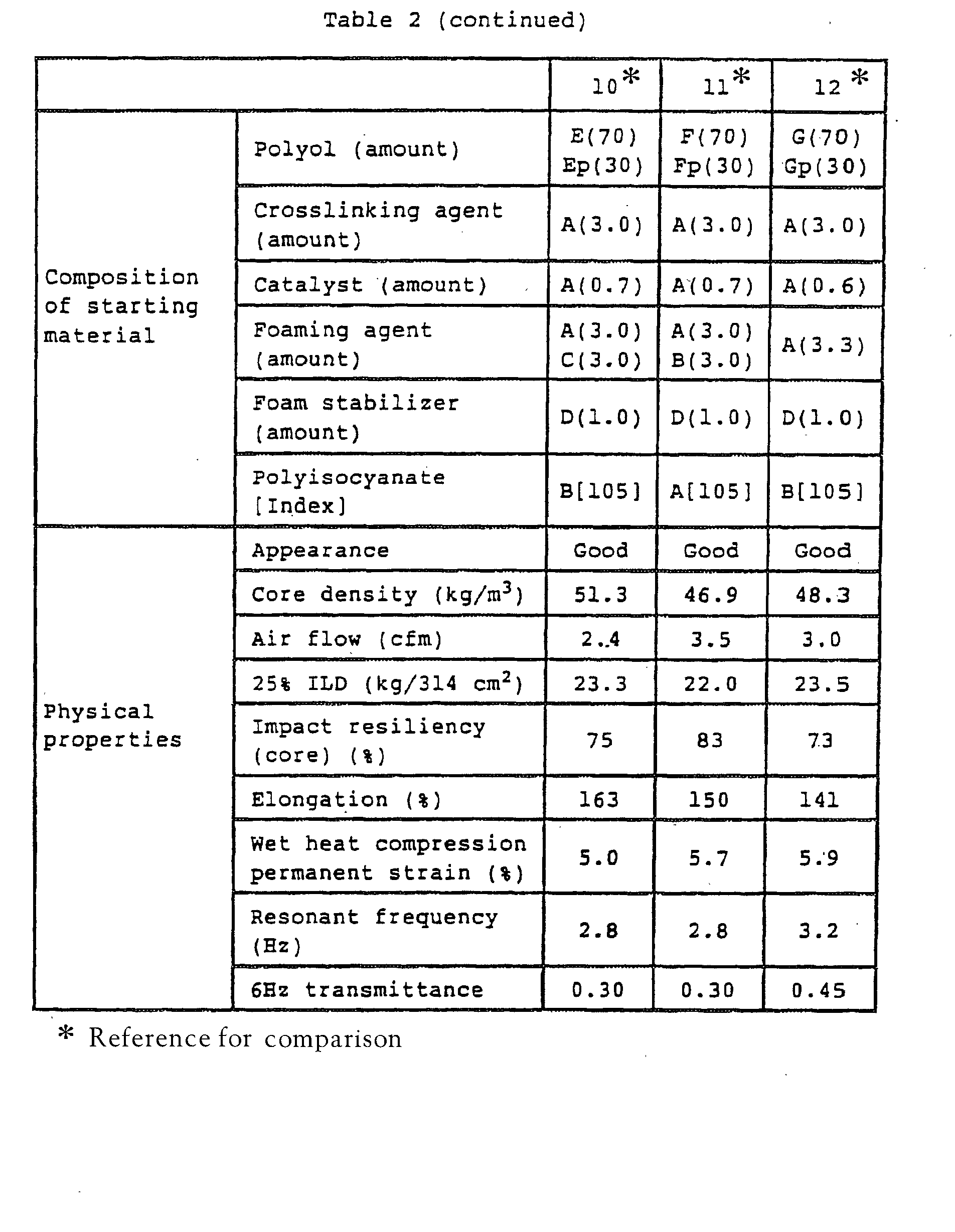
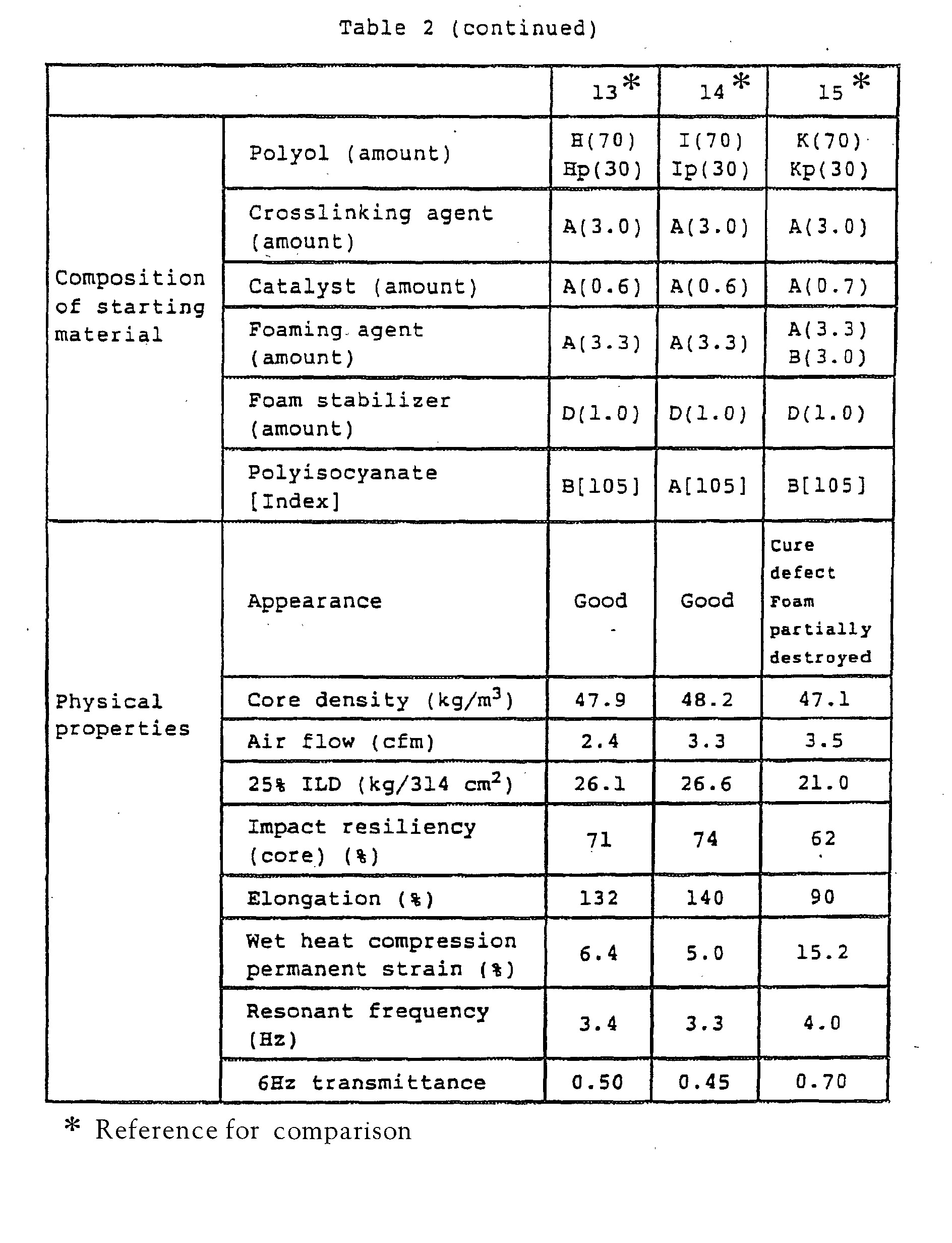
- the types of the starting materials, the amounts (represented by parts by weight, provided that the amount of the polyisocyanate compound used was represented by the isocyanate index (100 times of the equivalent ratio)), and the physical properties of the foam are shown in Table 2. The physical properties were measured by the following methods.
Landscapes
- Chemical & Material Sciences (AREA)
- Health & Medical Sciences (AREA)
- Chemical Kinetics & Catalysis (AREA)
- Medicinal Chemistry (AREA)
- Polymers & Plastics (AREA)
- Organic Chemistry (AREA)
- Polyurethanes Or Polyureas (AREA)
- Manufacture Of Porous Articles, And Recovery And Treatment Of Waste Products (AREA)
Abstract
Description
- The present invention relates to the use of a polyoxyalkylene polyol as defined in claim 1 for the manufacture of polyurethane flexible foam seat cushions for automobiles.
- In recent years, various new studies have been made to improve the properties of polyurethane flexible foam. For example, reflecting a trend for grading up of e.g. automobiles, improvement of the vibration characteristics of seat cushions, is desired. The relation between the vibration of the car body and the human being is not uniform. However, it is suggested that it is effective for the improvement of the comfortable ride to take a particularly large attenuation of the frequency region (e.g. from 4 to 8 Hz or from 6 to 20 Hz) to which human being is particularly sensitive. Accordingly, it is considered possible to substantially improve the comfortable ride if the seat cushion is made of a polyurethane flexible foam having a resonant frequency lower than this frequency region. However, heretofore, no polyurethane flexible foam has been known which has a resonant frequency of less than 4 Hz.
- US-A-4,687,851 discloses polyurethane elastomers prepared from high equivalent weight polyahls. The obtained polymers are elastomeric materials having good resiliency and excellent tensile properties.
- EP-A-0 220 697 discloses flexible polyurethane foams obtained from polymer-polyols however, the document nothing about an unsaturation degree of a polyoxyalkylene polyol use. Further, the document does not disclose any resonant properties of the produced foams.
- The present invention provides a use of a polyoxyalkylene polyol having an oxypropylene group content of at least 70 % by weight, a terminal oxyethylene group content of at least 5 % by weight, a number of hydroxyl groups of from 2 to 8, a hydroxyl value (X mgKOH/g) of from 5 to 38 and a total unsaturation degree (Y meq/g) of not more than 0.04, provided that when X is from 32.5 to 38; Y satisfies the formula Y ≤ 0.9/(X-10), for the manufacture of polyurethane flexible foam seat cushions for automobiles, having an impact resilience of the core of at least 70 % (measured in accordance with JIS K 6401) and a resonant frequency of not higher than 3.5 Hz (measured in accordance with JAS O B407-82), said manufacture being defined according to claim 1.
- For the polyurethane flexible foam, it is essential that its resonant frequency is not higher than 3.5 Hz. In addition, the impact resiliency of the core is at least 70%, and further, the wet heat permanent strain is preferably not higher than 10%. Now, each starting material component in the present invention will be described.
- The polyoxyalkylene polyol used as a starting material for polyurethane, is usually produced by ring-opening addition polymerization of an alkylene oxide such as propylene oxide to an initiator such as a polyhydric alcohol by means of an alkali catalyst such as an alkali metal hydroxide. In such a process, a monool having an unsaturated group is formed as a byproduct, and the production rate of this unsaturated monool increases with an increase of the molecular weight of the polyol (with a decrease of the hydroxyl value). The presence of this unsaturated monool is not in such a serious amount in the case of a polyoxyalkylene polyol having a hydroxyl value of about 56 which is widely used as a starting material for polyurethane flexible foam. However, in a polyoxyalkylene polyol having a low hydroxyl value which is used as a starting material for e.g. polyurethane elastomer, the presence of this unsaturated monool is likely to create a problem. For example, with a polyoxyalkylene polyol having a hydroxyl value of about 34, the total unsaturation degree usually becomes at least 0.1 meq/g. Further, it has been practically impossible to prepare a polyoxyalkylene polyol having a still lower hydroxyl value by means of an alkali catalyst, since its total unsaturation degree becomes remarkably high.
- Further, even if an flexible foam is produced by using a polyoxyalkylene polyol having a high total unsaturation degree, there will be problems such as a decrease in the hardness, a decrease in the impact resiliency, a deterioration in the compression permanent strain, a deterioration in the curability at the time of molding the foam, etc.
- The polyoxyalkylene polyol used in the present invention has a low unsaturation degree as compared with a starting material commonly employed for polyurethane flexible foam, whereby the conventional problems, particularly the problems observed in the case of employing a high molecular weight polyoxyalkylene polyol having a hydroxyl value of not higher than 38 (a decrease in the hardness, a decrease in the impact resiliency, a deterioration in the compression permanent strain and a deterioration in the curability at the time of molding the foam) can be controlled, and it is excellent in the vibration attenuation properties.
- Such a polyoxyalkylene polyol can usually be obtained by using a catalyst other than an alkali catalyst, for example, by using zinc diethyl, iron chloride, metal porphyrin or a double metal cyanide complex, as the catalyst. A particularly excellent polyoxyalkylene polyol is obtainable by the use of a double metal cyanide complex. Methods for producing such a polyoxyalkylene polyol are disclosed, for example, in the following documents:
- USP 3,829,505, USP 3,941,849, USP 4,355,188,
- USP 3,427,334, USP 3,427,335, USP 4,472,560,
- USP 4,477,589, EP 283,148
-
- Further, in addition to the polyoxyalkylene polyol, a polyol having from 2 to 8, particularly from 2 to 4 hydroxyl groups, such as a polyester-type polyol, a hydroxyl group-containing polydiene-type polymer or a polycarbonate-type polyol, may optionally incorporated, as the case requires. It is particularly preferred to use at least one polyoxyalkylene polyol or a polymer-dispersed polyol containing such a polyoxyalkylene polyol as the matrix, or to use it as the main component in combination with a small amount (usually not more than 30% by weight) of a polyester-type or a hydroxyl group-containing polydiene-type polymer.
- The polyoxyalkylene polyol used in the present invention is a polyoxyalkylene polyol having at least 70% by weight, particularly at least 80% by weight, of oxypropylene groups derived from 1,2-propylene oxide, a terminal oxyethylene group content of at least 5 % by weight, a number of hydroxyl groups of from 2 to 8, a hydroxyl value (X mgKOH/g) of from 5 to 38 and a total unsaturation degree (Y meq/g) of not more than 0.04, provided that when X is from 32.5 to 38, Y satisfies the formula Y ≤ 0.9/(X-10).
- As the above polyoxyalkylene polyol, a polyoxyalkylene polyol having a high primary hydroxyl value is preferred. Such a polyoxyalkylene polyol has oxyethylene groups or polyoxyethylene block chains at its molecular terminals. The proportion of such oxyethylene groups present at the terminal portions is at least 5% by weight, more preferably from 5 to 30% by weight, most preferably from 5 to 20% by weight.
- The polyoxyalkylene polyol in the present invention may be a mixture of two or more different types. However, it is preferred that it does not substantially contain a polyoxyalkylene polyol with a hydroxyl value exceeding 38. In such a case, the hydroxyl value, the number of hydroxyl groups and the total unsaturation degree are represented by average values. In the present invention, the polyoxyalkylene polyol has the upper limit of Y being 0.07 when X is not higher than about 22.9. Further, the hydroxyl value is more preferably from 5 to 28.
- As the polyol of the present invention, a polymer-dispersed polyol can be employed. The polyol as the matrix for the polymer-dispersed polyol is required to be the above-mentioned polyoxyalkylene polyol. The polymer-dispersed polyol is a dispersion having fine polymer particles dispersed stably in this matrix. As the polymer, an addition polymerization polymer or a condensation polymerization polymer may be mentioned. A polymer-dispersed polyol wherein the matrix is a conventional polyol, is known and is widely used a polyol for polyurethane flexible foam. The polymer-dispersed polyol in the present invention can be produced by a conventional method using the above polyoxyalkylene polyol as the matrix. Further, a relatively small amount of a conventional polymer-dispersed polyol may be added to the above polyoxyalkylene polyol. In such a case, a polyol constituting the matrix of the conventional polymer-dispersed polyol will be added in a small amount to the above polyoxyalkylene polyol. Even in such a case, the relation of the hydroxyl value and the total unsaturation degree of the above polyoxyalkylene polyol is required to be satisfied as an average. Thus, the polyoxyalkylene polyol constituting the matrix for the polymer-dispersed polyol in the present invention, is required to satisfy the above requirements (e.g. the relation of the hydroxyl value and the total unsaturation degree).
- The fine polymer particles in the polymer-dispersed polyol are made of an addition polymerization type polymer such as a homopolymer or copolymer of acrylonitrile, styrene, methacrylate, an alkyl methacrylate, an alkyl acrylate or other vinyl monomer, or a condensation polymerization type polymer such as a polyester, polyurea, polyurethane or a melamine resin. By the presence of such fine polymer particles, the hydroxyl value of the entire polymer-dispersed polyol will usually be lower than the hydroxyl value of the polyol as the matrix. Accordingly, the hydroxyl value of the entire polymer-dispersed polyol having the above polyoxyalkylene polyol as the matrix, is preferably from 5 to 38, more preferably from 5 to 28.
- The content of the fine polymer particles in the polymer-dispersed polyol or in a mixture of such a polymer-dispersed polyol and the above polyoxyalkylene polyol, is usually not higher than 60% by weight, preferably not higher than 40% by weight. The amount of the fine polymer particles is not required to be large. On the other hand, even if the amount is excessive, there is no particular disadvantage other than the economical disadvantage. In most cases, they are sufficiently effective in an amount of not higher than 20% by weight. The presence of fine polymer particles in the polyoxyalkylene polyol is not essential. However, the presence is effective for the improvement of the hardness, the air permeability and other physical properties of the foam. Accordingly, the fine polymer particles are preferably present in an amount of at least 0.1% by weight, more preferably at least 1% by weight, most preferably at least 2% by weight.
- In the present invention, it is possible to react only the above polyoxyalkylene polyol having a low hydroxyl value (i.e. a high molecular weight) (provided that water is excluded) with the isocyanate compound. However, a low molecular weight polyfunctional compound reactive with an isocyanate group (which is called a crosslinking agent in the present invention) can be used together with the high molecular weight polyoxyalkylene polyol. This polyfunctional compound is a compound having two isocyanate-reactive groups such as hydroxyl groups, primary amino groups or secondary amino groups and having a molecular weight of not higher than 300, per isocyanate-reactive group. Such a crosslinking agent includes a compound which is usually called a crosslinking agent or a chain extender in the polyurethane technical field. Such a compound includes, for example, polyhydric alcohols, alkanolamines, polyamines, and low molecular weight polyoxyalkylene polyol type polyols obtained by adding small amounts of alkylene oxides to polyhydric alcohols, akanolamines, saccharides, polyamines, monoamines or polyhydric phenols. Further, low molecular weight polyester type polyols or polyamines may also be employed. Ethylene glycol, propylene glycol, 1,4-butanediol and glycerol, diethanolamine and triethanolamine, t-butyltolylenediamine, diethyltolylenediamine and chlorodiaminobenzene, are employed. Polyoxyalkylene type polyols having a hydroxyl value of at least 200 and from 3 to 8 hydroxyl groups may be used. Such a polyfunctional compound is used preferably in an amount of not higher than about 10 parts by weight, particularly not higher than 5 parts by weight, per 100 parts by weight of the high molecular weight polyol. There is no particular restriction as to the lower limit of the amount. However, in its use, adequate effectiveness is obtainable with an amount of about 0.2 part by weight.
- The polyisocyanate compound may be an aromatic, alicyclic or aliphatic polyisocyanate having at least two isocyanate groups, a mixture of at least two such polyisocyanates, as well as modified polyisocyanates obtained by modifying them. Specifically, there may be mentioned, for example, polyisocyanates such as tolylene diisocyanate (TDI), diphenylmethane diisocyanate (MDI), polymethylenepolyphenyl isocyanate (so called crude MDI), xylylene diisocyanate (XDI), isophorone diisocyanate (IPDI) and hexamethylene diisocyanate (HMDI), and their prepolymer type modified products, nulate modified products, urea modified products and carbodiimide modified products. Preferably, at least one aromatic polyisocyanate selected from TDI, MDI, crude MDI and their modified products, is employed. More preferably, a mixture comprising at least one of MDI, crude MDI and their modified products and TDI or its modified products, is employed. The amount of TDI is preferably from 50 to 100% by weight.
- The isocyanate group content in the polyisocyanate compound in the present invention is preferably at least 15% by weight, particularly preferably at least 20% by weight.
- For the reaction of the polyol and the polyisocyanate compound, it is required to employ a catalyst. As the catalyst, a metal compound catalyst such as an organotin compound for accelerating the reaction of the active hydrogen-containing group with the isocyanate group, or a tertiary amine catalyst such as triethylenediamine, may be used. Further, a polymerization catalyst for reacting isocyanate groups to one another, such as a metal salt of a carboxylic acid, may be used as the case requires. Further, a foam stabilizer for forming good foam, is used. As the foam stabilizer, a foam stabilizer of silicone type or a foam stabilizer of fluorine-containing compound type may, for example, be mentioned. Other optional additives include, for example, a filler such as silica, alumina or calcium carbonate, an antioxidant, an ultraviolet absorber, a stabilizer such as a photostabilizer, a colorant and a flame retardant.
- As mentioned above, in the present invention, as the foaming agent, a water-type foaming agent, a halogenated hydrocarbon such as R-11 (trichlorofluoromethane), R-12 (difluorodichloromethane), R-123 (1,1-dichloro-2,2,2-trifluoroethane), R-12B2 (difluorodibromomethane), R-141b (1,1-dichloro-1-fluoroethane) or methylene chloride, butane, hexane, air or nitrogen, are employed. The water-type foaming agent may be water itself or a compound capable of generating water at the time of the reaction, such as a hydrate.R-11, R-12, R-123, R-12B2, R-141b or methylene chloride halogenated hydrocarbon may be used as a foaming agent in combination with the water-type foaming agent.
- In a case where a water-type foaming agent is employed as the foaming agent, a part of the above polyisocyanate compound reacts with water to generate carbon dioxide gas. Accordingly, the amount of the polyisocyanate compound used is calculated on the basis of the sum obtained by adding the water-type foaming agent to the total of the high molecular weight polyol and the low molecular weight polyfunctional compound, and it is preferred to use the polyisocyanate compound in an amount of from 0.8 to 1.3 equivalent relative to 1 equivalent of the sum. 100 Times of the equivalent of this polyisocyanate compound is usually called (isocyanate) index. Accordingly, the index of the polyisocyanate compound is preferably from 80 to 130.
- The following polyoxyalkylene polyols were used as starting materials for polyurethane flexible foams described hereinafter. Each polyol was prepared by adding propylene oxide to an initiator of polyoxypropylene polyol having a molecular weight of from 400 to 600 by means of a zinc hexacyanocobaltate complex as a catalyst, then deactivating the catalyst, and adding ethylene oxide by means of an alkali catalyst, followed by purification to remove the catalyst component. In Table 1, the names of the obtained polyoxyalkylene polyols, and the numbers of hydroxyl groups (N), the hydroxyl values (X), the oxyethylene contents (EO) and the total unsaturation degrees (Y) of the polyoxyalkylene polyols, are shown.
- The polyols used for the purpose of comparison (polyols J, K, and L) are polyoxyalkylene polyols prepared by reacting propylene oxide to an initiator (glycerol) by means of an alkali catalyst, and then reacting ethylene oxide thereto, followed by purification.
Name N EO (wt%) X (mgKOH/g) Y (meq/g) Polyol A 3 15 24 0.020 Polyol B 3 10 10 0.025 Polyol C 4 10 10 0.025 Polyol D 3 12 17 0.023 Polyol E 3 12 11 0.026 Polyol F 3 10 14 0.025 Polyol G 3 15 28 0.020 Polyol H 3 15 32 0.018 Polyol I 4 17 28 0.020 Polyol J 3 15 28 0.10 Polyol K 3 15 32 0.15 Polyol L 3 15 34 0.102 - Polymer-dispersed polyols containing the above polyoxyalkylene polyols as matrix and containing 20% by weight of fine particles of polyacrylonitrile, were used. The names of such polymer-dispersed polyols are represented by adding p to the names of the respective polyols (example: polyol Ap).
- Other materials used for the preparation of polyurethane flexible foams are as follows.
- Crosslinking agent:
- A: A sorbitol-propylene oxide-ethylene oxide adduct. Hydroxyl value: 450 (molecular weight of about 125 per hydroxyl group) Reference for comparison
- B: Diethanolamine
-
- Catalysts:
- A: Triethylenediamine solution ("Dabco 33LV" tradename)
- B: N-ethylmorpholine
- C: Stannous octoate
- D: Tertiary amine catalyst ("Kaolizer No. 1" tradename, sold by Kao Corporation)
-
- Foaming agent
- A: Water
- B: 1,1-Dichloro-2,2,2-trifluoroethane (R-123)
- C: 1,1-Dichloro-1-fluoroethane (R-141b)
-
- Foam stabilizer:
- A: Silicone type foam stabilizer ("L-5750S" tradename, sold by Nippon Unika K.K.)
- B: Silicone type foam stabilizer ("L-5309" tradename, sold by Nippon Unika K.K.)
- C: Silicone type foam stabilizer ("SF-2962" tradename, sold by Toray Silicone K.K.)
- D: Silicone type foam stabilizer ("SRX-274C" tradename, sold by Toray Silicone K.K.)
-
- Polyisocyanate compounds:
- A: TDI-80
- B: Mixture of TDI-80 and crude MDI ("MR-200" tradename, sold by Nippon Polyurethane K.K.) in a weight ratio of 80/20.
- C: Modified MD2 for polyurethane flexible foam (NCO content: 27%)
-
- Using the starting materials as identified in Table 2, polyurethane flexible foams were prepared.
- The polyisocyanate compound was added to a mixture of all the starting materials except for the polyisocyanate compound, followed by stirring. The mixture was immediately injected into a mold of 350 mm x 350 mm and 100 mm in height heated to 60°C or 40°C (No. 1 and No. 17), and the mold was closed and left at room temperature for 5 minutes. Then, the molded polyurethane flexible foam was taken out from the mold. Then, the following physical properties of the foam were measured. The types of the starting materials, the amounts (represented by parts by weight, provided that the amount of the polyisocyanate compound used was represented by the isocyanate index (100 times of the equivalent ratio)), and the physical properties of the foam are shown in Table 2. The physical properties were measured by the following methods.
Appearance: Visually evaluated
Air flow: ASTM D1564
25% ILD: JIS K6401
Impact resilience: JIS K6401
Elongation: JIS K6401
Wet heat permanent strain: JIS K6401
Resonant frequency: JASO B407-82
6 Hz transmittance: JASO B407-82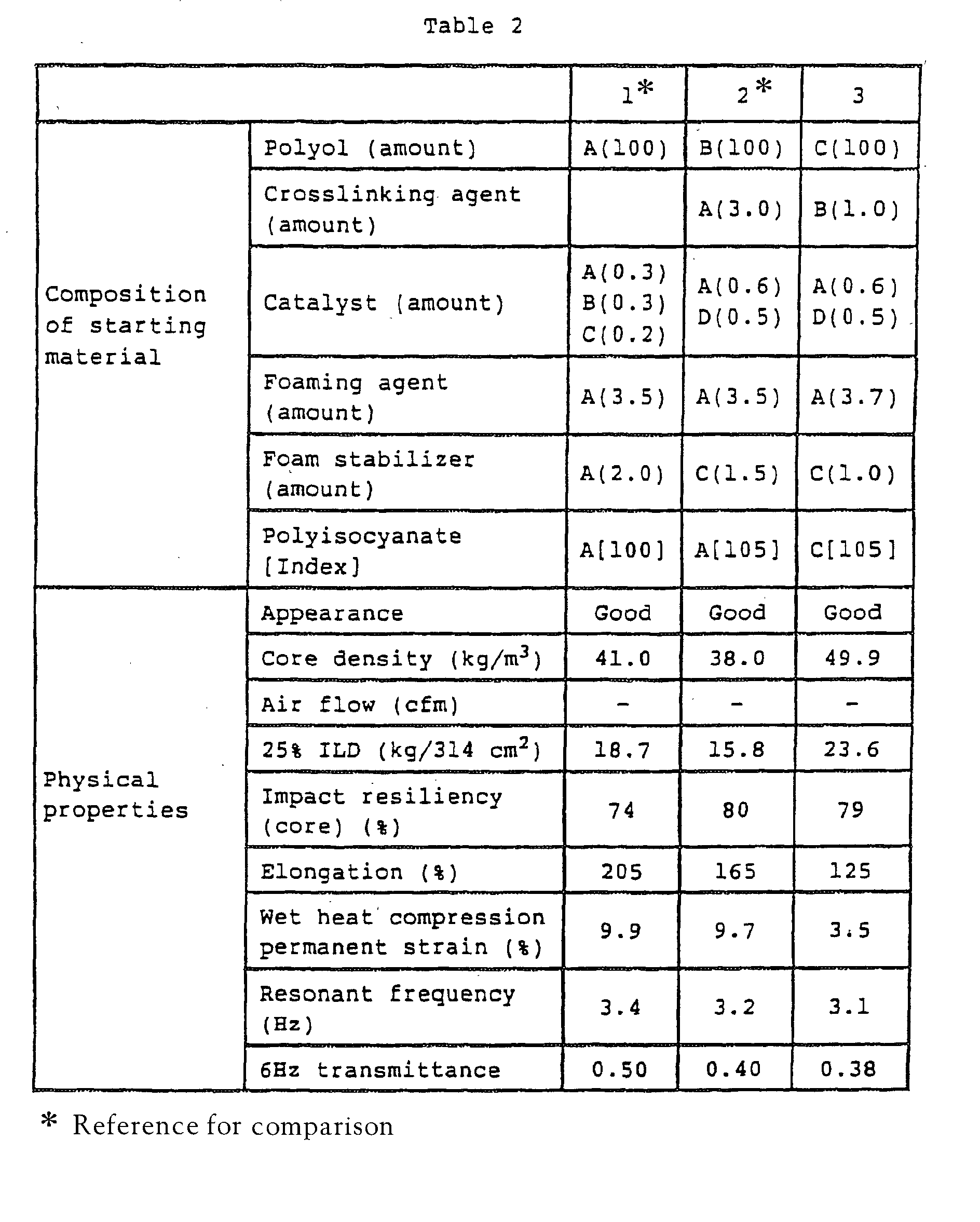



Claims (11)
- Use of a polyoxyalkylene polyol having an oxypropylene group content of at least 70 % by weight, a terminal oxyethylene group content of at least 5 % by weight, a number of hydroxyl groups of from 2 to 8, hydroxyl value (X mgKOH/g) of from 5 to 38 and a total unsaturation degree (Y meq/g) of not more than 0.04, provided that when X is from 32.5 to 38, Y satisfies the formula Y ≤ 0.9/(X-10), for the manufacture of polyurethane flexible foam seat cushions for automobiles, having an impact resilience of the core of at least 70% (measured in accordance with JIS K 6401) and a resonant frequency of not higher than 3.5 Hz (measured in accordance with JAS 0 B407-82), said manufacture comprising reacting at least one high molecular weight polyol selected from the group consisting of said polyoxyalkylene polyol and a polymer-dispersed polyol containing said polyoxyalkylene polyol as the matrix, a crosslinking agent and a polyisocyanate compound in the presence of a catalyst, a foaming agent and a foam stabilizer as assisting agents, wherein the crosslinking agent is a polyfunctional compound having two isocyanate reactive groups and having a molecular weight of not higher than 300 per isocyanate-reactive group or glycerol, diethanolamine, triethanolamine, t-butyltolylenediamine, diethyltolylenediamine or chlorodiaminobenzene.
- The use according to Claim 1, wherein the polyoxyalkylene polyol has a hydroxyl value (X) of from 5 to 28 and a total unsaturation degree (Y) of not more than 0.04.
- The use according to Claim 1, wherein the polymer-dispersed polyol contains from 1 to 4°% by weight of fine polymer particles.
- The use according to Claim 3, wherein the fine polymer particles are fine particles of a vinyl polymer.
- The use according to Claim 1, wherein the crosslinking agent is used in an amount of from 0.2 to 10 parts by weight per 100 parts by weight of the polyol.
- The use according to Claim 1, wherein the polyisocyanate compound is an aromatic polyisocyanate.
- The use according to claim 1 wherein the foaming agent is water. or water and a halogenated hydrocarbon selected from R-11 (trichlorofluoromethane), R-12 (difluorodichloromethane). R-123 (1.1-dichloro-2.2,2-trifluoroethane), R-12B2 (difluorodibromomethane), R-141b (1,1-dichloro-1-fluoroethane) or methylene chloride.
- Use of a polyoxyalkylene polyol having an oxypropylene group content of at least 70% by weight, a terminal oxyethylene group content of at least 5 % by weight, a number of hydroxyl groups of from 2 to 8, a hydroxyl value (X mgKOH/g) of from 5 to 38 and a total unsaturation degree (Y meq/g) of not more than 0.07, with X and Y being in the following relation: Y ≤ 0.9/(X-10) with the proviso that the formula is applicable in a range of x > 10 for the manufacture of polyurethane flexible foam seat cushions for automobiles, having an impact resilience of the core of at least 70% (measured in accordance with JIS K 6401) and a resonant frequency of not higher than 3.5 Hz (measured in accordance with JAS 0 B407-82), said manufacture comprising reacting a polymer-dispersed polyol wherein the matrix is the above-mentioned polyoxyalkylene polyol and fine polymer particles are dispersed stably in the matrix, from 0.2 to 10 parts by weight, per 100 parts by weight of the polymer-dispersed polyol, of a crosslinking agent and an aromatic polyisocyanate in an amount of from 0.8 to 1.3 equivalent of the total amount of the polymer-dispersed polyol, the crosslinking agent and water when a foaming agent contains water, in the presence of a catalyst, a foaming agent and a foam stabilizer, wherein the crosslinking agent is a polyfunctional compound having two isocyanate reactive groups and having a molecular weight of not higher than 300 per isocyanate-reactive group or glycerol, diethanolamine, triethanolamine, t-butyltolylenediamine, diethyltolylenediamine or chlorodiaminobenzene.
- The use according to Claim 8, wherein the polymer-dispersed polyol contains from 1 to 40% by weight of fine polymer particles.
- The use according to Claim 9, wherein the fine. polymer particles are fine particles of a vinyl polymer.
- The use according to Claim 8, wherein the polyoxyalkylene polyol has a hydroxyl value of from 5 to 28 and a total unsaturation degree of not more than 0.04.
Applications Claiming Priority (7)
| Application Number | Priority Date | Filing Date | Title |
|---|---|---|---|
| JP26729788 | 1988-10-25 | ||
| JP26729788 | 1988-10-25 | ||
| JP267297/88 | 1988-10-25 | ||
| JP2964489 | 1989-02-10 | ||
| JP29644/89 | 1989-02-10 | ||
| JP2964489 | 1989-02-10 | ||
| PCT/JP1989/001067 WO1990004613A1 (en) | 1988-10-25 | 1989-10-18 | Elastic polyurethane foam and process for its production |
Publications (4)
| Publication Number | Publication Date |
|---|---|
| EP0394487A1 EP0394487A1 (en) | 1990-10-31 |
| EP0394487A4 EP0394487A4 (en) | 1991-04-10 |
| EP0394487B1 EP0394487B1 (en) | 1996-03-27 |
| EP0394487B2 true EP0394487B2 (en) | 2005-02-16 |
Family
ID=26367869
Family Applications (1)
| Application Number | Title | Priority Date | Filing Date |
|---|---|---|---|
| EP89911605A Expired - Lifetime EP0394487B2 (en) | 1988-10-25 | 1989-10-18 | Elastic polyurethane foam and process for its production |
Country Status (5)
| Country | Link |
|---|---|
| US (1) | US5093380A (en) |
| EP (1) | EP0394487B2 (en) |
| JP (1) | JP2616054B2 (en) |
| DE (1) | DE68926107T3 (en) |
| WO (1) | WO1990004613A1 (en) |
Families Citing this family (51)
| Publication number | Priority date | Publication date | Assignee | Title |
|---|---|---|---|---|
| US5300535A (en) * | 1988-10-25 | 1994-04-05 | Asahi Glass Company Ltd. | Method for producing polyurethane flexible foam |
| JP2616056B2 (en) * | 1988-10-25 | 1997-06-04 | 旭硝子株式会社 | Method for producing polyurethane elastic foam |
| JP2615927B2 (en) * | 1988-10-25 | 1997-06-04 | 旭硝子株式会社 | Method for producing polyurethane foam |
| JPH03244620A (en) * | 1990-02-23 | 1991-10-31 | Asahi Glass Co Ltd | Production of polyurethane foam |
| JP2616055B2 (en) * | 1988-10-25 | 1997-06-04 | 旭硝子株式会社 | Method for producing polyurethane elastic foam |
| AU640673B2 (en) * | 1989-06-16 | 1993-09-02 | Dow Chemical Company, The | Process for preparing elastomeric polyurethane or polyurethane-urea polymers, and polyurethanes so prepared |
| US5010117A (en) * | 1989-06-16 | 1991-04-23 | Dow Chemical Company | Flexible polyurethane foams prepared using low unsaturation polyether polyols |
| US5288921A (en) * | 1992-06-16 | 1994-02-22 | Imperial Chemical Industries Plc | Process for reducing unsaturation on polyols |
| CA2105327C (en) * | 1992-11-09 | 2002-06-25 | James E. Shrewsburg | Two-component polyurethane flexible foam system having improved elongation, tensile strength and tear resistance |
| GB9325468D0 (en) * | 1993-12-13 | 1994-02-16 | Ici Plc | Process for purifying polyols |
| EP0677543B2 (en) * | 1994-04-12 | 2006-11-15 | Mitsui Chemicals, Inc. | Preparation of polyoxyalkylene polyols, polymer polyols and flexible polyurethane foams |
| US5549841A (en) * | 1995-03-24 | 1996-08-27 | Arco Chemical Technology, L.P. | Process for manufacturing foam with improved wet set properties |
| US5688861A (en) * | 1995-11-30 | 1997-11-18 | Arco Chemical Technology, L.P. | Process for the preparation of polyol polymer dispersions |
| US5700847A (en) * | 1995-12-04 | 1997-12-23 | Arco Chemical Technology, L.P. | Molded polyurethane foam with enhanced physical properties |
| US5668191A (en) * | 1995-12-21 | 1997-09-16 | Arco Chemical Technology, L.P. | One-shot cold molded flexible polyurethane foam from low primary hydroxyl polyols and process for the preparation thereof |
| US5605939A (en) * | 1996-01-26 | 1997-02-25 | Arco Chemical Technology, L.P. | Poly(oxypropylene/oxyethylene) random polyols useful in preparing flexible high resilience foam with reduced tendencies toward shrinkage and foam prepared therewith |
| US5576382A (en) * | 1996-05-05 | 1996-11-19 | Arco Chemical Technology, L.P. | Aqueous polyurethane dispersions based on polyether polyols of low monol content |
| WO1998044016A1 (en) | 1997-04-02 | 1998-10-08 | Sanyo Chemical Industries, Ltd. | Polyurethane foam, process for producing the same, and foam forming composition |
| US6207794B1 (en) | 1997-05-28 | 2001-03-27 | Mitsui Chemical, Inc. | Polyoxyalkylene polyols, derivatives thereof, and process for producing the polyoxyalkylene polyols |
| JP3905638B2 (en) * | 1997-05-28 | 2007-04-18 | 三井化学株式会社 | Polyoxyalkylene polyol and derivatives thereof, and method for producing the polyoxyalkylene polyol |
| JP3933790B2 (en) * | 1998-05-01 | 2007-06-20 | 三井化学株式会社 | Polyoxyalkylene polyol and polymer-dispersed polyol |
| US6051622A (en) * | 1998-09-17 | 2000-04-18 | Arco Chemical Technology, L.P. | Low resilience, low frequency molded polyurethane foam |
| CA2406114A1 (en) | 2000-04-14 | 2001-10-25 | Yoshinori Toyota | Process for producing flexible polyurethane foam |
| WO2001083107A2 (en) | 2000-04-28 | 2001-11-08 | Synuthane International, Inc. | Double metal cyanide catalysts containing polyglycol ether complexing agents |
| US6635737B1 (en) | 2000-05-26 | 2003-10-21 | Williamette Valley Company | Polymers derived from low unsaturation polyamines |
| US6598251B2 (en) | 2001-06-15 | 2003-07-29 | Hon Technology Inc. | Body support system |
| CN1257928C (en) * | 2001-07-18 | 2006-05-31 | 旭硝子株式会社 | Polyol and method for producing polymer-dispersed polyol |
| EP1283231A1 (en) | 2001-08-06 | 2003-02-12 | Asahi Glass Company Ltd. | Flexible polyurethane foam, its production method and material system for its production |
| EP1316571B1 (en) * | 2001-11-29 | 2006-10-04 | Asahi Glass Co., Ltd. | Flexible polyurethane foam and method for its production |
| DE60221219T2 (en) | 2001-11-30 | 2007-11-15 | Asahi Glass Co., Ltd. | Flexible polyurethane foam and process for its preparation |
| KR100930000B1 (en) * | 2001-12-21 | 2009-12-07 | 아사히 가라스 가부시키가이샤 | Low-elasticity soft polyurethane foam and its manufacturing method |
| WO2003072626A1 (en) * | 2002-02-27 | 2003-09-04 | Asahi Glass Company, Limited | Process for production of flexible polyurethane foam |
| US20040154718A1 (en) * | 2003-02-06 | 2004-08-12 | Doesburg Van I. | Polyurethane filled tire and method of making same |
| KR101115276B1 (en) * | 2003-09-19 | 2012-03-05 | 아사히 가라스 가부시키가이샤 | Flexible polyurethane foam and process for producing the same |
| DE102004051048A1 (en) * | 2004-10-19 | 2006-04-20 | Bayer Materialscience Ag | Soft elastic foams of low bulk densities and compression hardness |
| KR20070084023A (en) * | 2004-11-18 | 2007-08-24 | 아사히 가라스 가부시키가이샤 | Manufacturing method of flexible polyurethane foam |
| WO2008038678A1 (en) * | 2006-09-27 | 2008-04-03 | Asahi Glass Company, Limited | Method for producing soft polyurethane foam |
| EP2077287B1 (en) * | 2006-10-25 | 2013-06-26 | Asahi Glass Company, Limited | Method for producing soft polyurethane foam |
| WO2009001783A1 (en) * | 2007-06-22 | 2008-12-31 | Asahi Glass Company, Limited | Method for production of polymer-dispersed polyol, and method for production of flexible polyurethane foam |
| JP5303885B2 (en) | 2007-09-18 | 2013-10-02 | 旭硝子株式会社 | Method for producing flexible polyurethane foam and flexible polyurethane foam |
| JP5356727B2 (en) | 2008-05-26 | 2013-12-04 | 花王株式会社 | Process for producing polyoxyalkylene alkyl ether |
| US20110086996A1 (en) * | 2008-06-16 | 2011-04-14 | Sanyo Chemical Industries, Ltd. | Polymer polyol and method for producing polyurethane |
| CN102574976B (en) | 2009-10-05 | 2014-01-08 | 旭硝子株式会社 | Method for producing soft polyurethane foam and sheet |
| TW201120077A (en) | 2009-10-05 | 2011-06-16 | Asahi Glass Co Ltd | Soft polyurethane foam, method for producing the same, and seat cushion for automobile |
| JP2011174063A (en) * | 2010-01-29 | 2011-09-08 | Sanyo Chem Ind Ltd | Method for producing flexible polyurethane foam |
| JP5545364B2 (en) * | 2010-04-30 | 2014-07-09 | 旭硝子株式会社 | Polyoxyalkylene polyol, polymer-dispersed polyol, flexible polyurethane foam, and production method thereof |
| JP2012214779A (en) * | 2011-03-30 | 2012-11-08 | Asahi Glass Co Ltd | Production method and sheet of flexible polyurethane foam |
| JP5807673B2 (en) | 2011-03-30 | 2015-11-10 | 旭硝子株式会社 | Method for producing polyether polyol and flexible polyurethane foam, and sheet |
| JP2012214778A (en) * | 2011-03-30 | 2012-11-08 | Asahi Glass Co Ltd | Method for producing soft polyurethane foam, and sheet |
| AU2014318648B2 (en) * | 2013-09-13 | 2017-09-07 | Dow Global Technologies Llc | PIPA polyol based viscoelastic foams |
| KR102024870B1 (en) | 2019-02-26 | 2019-09-24 | 주식회사 유니크라미 | Surface strengthening method of seal slip with reinforced coating agent to enhance the porosity and abrasion of polyurethane foam and reinforcing coating for surface reinforcement of polyurethane foam |
Family Cites Families (18)
| Publication number | Priority date | Publication date | Assignee | Title |
|---|---|---|---|---|
| US3829505A (en) * | 1970-02-24 | 1974-08-13 | Gen Tire & Rubber Co | Polyethers and method for making the same |
| CA1032432A (en) * | 1973-01-22 | 1978-06-06 | Bela Prokai | Polyether urethane foam |
| JPS5231232B2 (en) * | 1973-06-12 | 1977-08-13 | ||
| US4098729A (en) * | 1974-04-08 | 1978-07-04 | Th. Goldschmidt Ag | Process of producing cross-linked urethane-group comprising foams of open-cell structure |
| GR68082B (en) * | 1979-04-28 | 1981-10-30 | Polyol Int Bv | |
| JPS5858364B2 (en) * | 1979-09-07 | 1983-12-24 | 旭硝子株式会社 | Method for producing polyether compounds |
| JPS5643322A (en) * | 1979-09-18 | 1981-04-22 | Asahi Glass Co Ltd | Production of polyether compound |
| US4326047A (en) * | 1980-11-06 | 1982-04-20 | The Dow Chemical Company | Process for reacting alkylene oxides with hydroxyl-containing initiator compounds |
| JPS5915336A (en) * | 1982-07-17 | 1984-01-26 | Sony Corp | Receiving device |
| CA1225093A (en) * | 1983-06-29 | 1987-08-04 | Glenn A. Taylor | Connected block branched polypropylene glycols |
| US4487854A (en) * | 1983-12-27 | 1984-12-11 | Basf Wyandotte Corporation | Polyoxyalkylene polyether polyols and polyurethane foams prepared therefrom |
| JPS6136315A (en) * | 1984-07-30 | 1986-02-21 | Nisshinbo Ind Inc | Vibration-damping material |
| US4687851A (en) * | 1985-08-15 | 1987-08-18 | The Dow Chemical Company | Polyurethane elastomers prepared from high equivalent weight polyahls |
| JP2616056B2 (en) * | 1988-10-25 | 1997-06-04 | 旭硝子株式会社 | Method for producing polyurethane elastic foam |
| JP2616055B2 (en) * | 1988-10-25 | 1997-06-04 | 旭硝子株式会社 | Method for producing polyurethane elastic foam |
| JP2615927B2 (en) * | 1988-10-25 | 1997-06-04 | 旭硝子株式会社 | Method for producing polyurethane foam |
| US5010117A (en) * | 1989-06-16 | 1991-04-23 | Dow Chemical Company | Flexible polyurethane foams prepared using low unsaturation polyether polyols |
| JPH0381314A (en) * | 1989-08-24 | 1991-04-05 | Sanyo Chem Ind Ltd | Production of highly resilient polyurethane foam |
-
1989
- 1989-10-18 DE DE68926107T patent/DE68926107T3/en not_active Expired - Lifetime
- 1989-10-18 US US07/499,346 patent/US5093380A/en not_active Expired - Lifetime
- 1989-10-18 WO PCT/JP1989/001067 patent/WO1990004613A1/en not_active Ceased
- 1989-10-18 EP EP89911605A patent/EP0394487B2/en not_active Expired - Lifetime
- 1989-10-20 JP JP1271833A patent/JP2616054B2/en not_active Expired - Lifetime
Also Published As
| Publication number | Publication date |
|---|---|
| EP0394487B1 (en) | 1996-03-27 |
| EP0394487A1 (en) | 1990-10-31 |
| EP0394487A4 (en) | 1991-04-10 |
| JP2616054B2 (en) | 1997-06-04 |
| JPH0314812A (en) | 1991-01-23 |
| DE68926107D1 (en) | 1996-05-02 |
| WO1990004613A1 (en) | 1990-05-03 |
| US5093380A (en) | 1992-03-03 |
| DE68926107T2 (en) | 1996-10-31 |
| DE68926107T3 (en) | 2005-07-07 |
Similar Documents
| Publication | Publication Date | Title |
|---|---|---|
| EP0394487B1 (en) | Elastic polyurethane foam and process for its production | |
| KR100663682B1 (en) | Manufacturing method of flexible polyurethane foam | |
| US5300535A (en) | Method for producing polyurethane flexible foam | |
| KR100930000B1 (en) | Low-elasticity soft polyurethane foam and its manufacturing method | |
| EP1316573B1 (en) | Flexible polyurethane foam and method for its production | |
| US5437822A (en) | Method for producing a skin-formed polyurethane foam molded product | |
| AU2002300415B2 (en) | Flexible polyurethane foam, its production method and material system for its production | |
| JPH05255474A (en) | Production of flexible polyurethane foam | |
| HK1004606B (en) | Polyurethane foams | |
| CA2039217A1 (en) | Polyurethane foams blown only with water | |
| EP0694047B1 (en) | Polyurethane foams | |
| JP2616055B2 (en) | Method for producing polyurethane elastic foam | |
| JP4058954B2 (en) | Flexible polyurethane foam | |
| JP2615927B2 (en) | Method for producing polyurethane foam | |
| EP0443614A2 (en) | Method for producing polyurethane flexible foam | |
| JP2616056B2 (en) | Method for producing polyurethane elastic foam | |
| JP3075412B2 (en) | Method for producing polyurethane foam | |
| JP2002265555A (en) | Method for producing flexible polyurethane foam | |
| JPH09176274A (en) | Manufacturing method of seat cushion material for snowmobile | |
| JPH08176258A (en) | Highly elastic polyurethane foam manufacturing method | |
| JP2003147044A (en) | Method for producing flexible polyurethane foam | |
| JP2616056C (en) | ||
| JP2002256049A (en) | Method for producing flexible polyurethane foam | |
| GB2414735A (en) | Combustion modified foam |
Legal Events
| Date | Code | Title | Description |
|---|---|---|---|
| PUAI | Public reference made under article 153(3) epc to a published international application that has entered the european phase |
Free format text: ORIGINAL CODE: 0009012 |
|
| 17P | Request for examination filed |
Effective date: 19900625 |
|
| AK | Designated contracting states |
Kind code of ref document: A1 Designated state(s): DE FR GB IT |
|
| A4 | Supplementary search report drawn up and despatched |
Effective date: 19910218 |
|
| AK | Designated contracting states |
Kind code of ref document: A4 Designated state(s): DE FR GB IT |
|
| RIN1 | Information on inventor provided before grant (corrected) |
Inventor name: TAKEYASU, HIROMITSU Inventor name: DOI, TAKAO Inventor name: SONOBE, TSUNEHISA Inventor name: YAMAGUCHI, YOSHIYUKI |
|
| 17Q | First examination report despatched |
Effective date: 19921221 |
|
| GRAH | Despatch of communication of intention to grant a patent |
Free format text: ORIGINAL CODE: EPIDOS IGRA |
|
| GRAA | (expected) grant |
Free format text: ORIGINAL CODE: 0009210 |
|
| AK | Designated contracting states |
Kind code of ref document: B1 Designated state(s): DE FR GB IT |
|
| ITF | It: translation for a ep patent filed | ||
| REF | Corresponds to: |
Ref document number: 68926107 Country of ref document: DE Date of ref document: 19960502 |
|
| ET | Fr: translation filed | ||
| PLBQ | Unpublished change to opponent data |
Free format text: ORIGINAL CODE: EPIDOS OPPO |
|
| PLBI | Opposition filed |
Free format text: ORIGINAL CODE: 0009260 |
|
| PLBQ | Unpublished change to opponent data |
Free format text: ORIGINAL CODE: EPIDOS OPPO |
|
| PLBI | Opposition filed |
Free format text: ORIGINAL CODE: 0009260 |
|
| PLBF | Reply of patent proprietor to notice(s) of opposition |
Free format text: ORIGINAL CODE: EPIDOS OBSO |
|
| 26 | Opposition filed |
Opponent name: IMPERIAL CHEMICAL INDUSTRIES PLC Effective date: 19961216 |
|
| 26 | Opposition filed |
Opponent name: DOW CHEMICAL EUROPE S.A. Effective date: 19961224 Opponent name: IMPERIAL CHEMICAL INDUSTRIES PLC Effective date: 19961216 |
|
| PLBF | Reply of patent proprietor to notice(s) of opposition |
Free format text: ORIGINAL CODE: EPIDOS OBSO |
|
| PLBF | Reply of patent proprietor to notice(s) of opposition |
Free format text: ORIGINAL CODE: EPIDOS OBSO |
|
| RDAH | Patent revoked |
Free format text: ORIGINAL CODE: EPIDOS REVO |
|
| APAC | Appeal dossier modified |
Free format text: ORIGINAL CODE: EPIDOS NOAPO |
|
| APAE | Appeal reference modified |
Free format text: ORIGINAL CODE: EPIDOS REFNO |
|
| APAC | Appeal dossier modified |
Free format text: ORIGINAL CODE: EPIDOS NOAPO |
|
| APAC | Appeal dossier modified |
Free format text: ORIGINAL CODE: EPIDOS NOAPO |
|
| REG | Reference to a national code |
Ref country code: FR Ref legal event code: CA |
|
| RAP2 | Party data changed (patent owner data changed or rights of a patent transferred) |
Owner name: ASAHI GLASS CO., LTD. |
|
| PLAB | Opposition data, opponent's data or that of the opponent's representative modified |
Free format text: ORIGINAL CODE: 0009299OPPO |
|
| R26 | Opposition filed (corrected) |
Opponent name: HUNTSMAN ICI CHEMICALS, LLC * 19961224 DOW CHEMICA Effective date: 19961216 |
|
| PLAB | Opposition data, opponent's data or that of the opponent's representative modified |
Free format text: ORIGINAL CODE: 0009299OPPO |
|
| R26 | Opposition filed (corrected) |
Opponent name: HUNTSMAN INTERNATIONAL LLC * 19961224 DOW CHEMICAL Effective date: 19961216 |
|
| REG | Reference to a national code |
Ref country code: GB Ref legal event code: IF02 |
|
| APCC | Communication from the board of appeal sent |
Free format text: ORIGINAL CODE: EPIDOS OBAPO |
|
| APAC | Appeal dossier modified |
Free format text: ORIGINAL CODE: EPIDOS NOAPO |
|
| APBP | Date of receipt of notice of appeal recorded |
Free format text: ORIGINAL CODE: EPIDOSNNOA2O |
|
| APBU | Appeal procedure closed |
Free format text: ORIGINAL CODE: EPIDOSNNOA9O |
|
| PUAH | Patent maintained in amended form |
Free format text: ORIGINAL CODE: 0009272 |
|
| STAA | Information on the status of an ep patent application or granted ep patent |
Free format text: STATUS: PATENT MAINTAINED AS AMENDED |
|
| 27A | Patent maintained in amended form |
Effective date: 20050216 |
|
| AK | Designated contracting states |
Kind code of ref document: B2 Designated state(s): DE FR GB IT |
|
| APAH | Appeal reference modified |
Free format text: ORIGINAL CODE: EPIDOSCREFNO |
|
| ET3 | Fr: translation filed ** decision concerning opposition | ||
| PGFP | Annual fee paid to national office [announced via postgrant information from national office to epo] |
Ref country code: DE Payment date: 20081016 Year of fee payment: 20 |
|
| PGFP | Annual fee paid to national office [announced via postgrant information from national office to epo] |
Ref country code: IT Payment date: 20081028 Year of fee payment: 20 |
|
| PGFP | Annual fee paid to national office [announced via postgrant information from national office to epo] |
Ref country code: FR Payment date: 20081014 Year of fee payment: 20 |
|
| PGFP | Annual fee paid to national office [announced via postgrant information from national office to epo] |
Ref country code: GB Payment date: 20081015 Year of fee payment: 20 |
|
| PLAB | Opposition data, opponent's data or that of the opponent's representative modified |
Free format text: ORIGINAL CODE: 0009299OPPO |
|
| REG | Reference to a national code |
Ref country code: GB Ref legal event code: PE20 Expiry date: 20091017 |
|
| PG25 | Lapsed in a contracting state [announced via postgrant information from national office to epo] |
Ref country code: GB Free format text: LAPSE BECAUSE OF EXPIRATION OF PROTECTION Effective date: 20091017 |