EP0393883B1 - Novel cytotoxic cyclic depsipeptides from the tunicate trididemnum solidum - Google Patents
Novel cytotoxic cyclic depsipeptides from the tunicate trididemnum solidum Download PDFInfo
- Publication number
- EP0393883B1 EP0393883B1 EP90303672A EP90303672A EP0393883B1 EP 0393883 B1 EP0393883 B1 EP 0393883B1 EP 90303672 A EP90303672 A EP 90303672A EP 90303672 A EP90303672 A EP 90303672A EP 0393883 B1 EP0393883 B1 EP 0393883B1
- Authority
- EP
- European Patent Office
- Prior art keywords
- didemnin
- didemnins
- give
- nmr
- methanol
- Prior art date
- Legal status (The legal status is an assumption and is not a legal conclusion. Google has not performed a legal analysis and makes no representation as to the accuracy of the status listed.)
- Expired - Lifetime
Links
- 241000804473 Trididemnum solidum Species 0.000 title claims abstract description 6
- 230000001472 cytotoxic effect Effects 0.000 title abstract 2
- 108010002156 Depsipeptides Proteins 0.000 title description 2
- 231100000433 cytotoxic Toxicity 0.000 title 1
- KYHUYMLIVQFXRI-XYUQHQMCSA-N (2s)-n-[(2r)-1-[[(3s,6s,8s,12s,13r,16s,17r,20s,23s)-13-[(2s)-butan-2-yl]-12-hydroxy-20-[(4-methoxyphenyl)methyl]-6,17,21-trimethyl-3-(2-methylpropyl)-2,5,7,10,15,19,22-heptaoxo-8-propan-2-yl-9,18-dioxa-1,4,14,21-tetrazabicyclo[21.3.0]hexacosan-16-yl]amino Chemical class CN([C@H](CC(C)C)C(=O)N[C@@H]1C(=O)N[C@@H]([C@H](CC(=O)O[C@H](C(=O)[C@H](C)C(=O)N[C@@H](CC(C)C)C(=O)N2CCC[C@H]2C(=O)N(C)[C@@H](CC=2C=CC(OC)=CC=2)C(=O)O[C@@H]1C)C(C)C)O)[C@@H](C)CC)C(=O)[C@@H]1CCCN1C(=O)C(C)O KYHUYMLIVQFXRI-XYUQHQMCSA-N 0.000 claims abstract description 8
- BUHGEDVBBOQECR-HGESRAKOSA-N (4s)-4-[[(2s)-5-amino-2-[[(2s)-5-amino-2-[[(3r)-3-hydroxydecanoyl]amino]-5-oxopentanoyl]amino]-5-oxopentanoyl]amino]-5-[(2s)-1-[(2s)-2-[[(2r)-1-[[(3s,6s,8s,12s,13s,16s,17s,20s,23s)-13-[(2s)-butan-2-yl]-12-hydroxy-20-[(4-methoxyphenyl)methyl]-6,17,21-trime Chemical compound CCCCCCC[C@@H](O)CC(=O)N[C@@H](CCC(N)=O)C(=O)N[C@@H](CCC(N)=O)C(=O)N[C@@H](CCC(O)=O)C(=O)O[C@@H](C)C(=O)N1CCC[C@H]1C(=O)N(C)[C@H](CC(C)C)C(=O)N[C@@H]1C(=O)N[C@@H]([C@@H](C)CC)[C@@H](O)CC(=O)O[C@@H](C(C)C)C(=O)[C@H](C)C(=O)N[C@@H](CC(C)C)C(=O)N2CCC[C@H]2C(=O)N(C)[C@@H](CC=2C=CC(OC)=CC=2)C(=O)O[C@H]1C BUHGEDVBBOQECR-HGESRAKOSA-N 0.000 claims abstract description 4
- GXKAOWYTJPGGBI-BHTIDRDUSA-N (4s)-4-[[(2s)-5-amino-2-[[(2s)-5-amino-2-[[(2s)-5-amino-2-[[(3r)-3-hydroxydecanoyl]amino]-5-oxopentanoyl]amino]-5-oxopentanoyl]amino]-5-oxopentanoyl]amino]-5-[(2s)-1-[(2s)-2-[[(2r)-1-[[(3s,6s,8s,12s,13s,16s,17s,20s,23s)-13-[(2s)-butan-2-yl]-12-hydroxy-20- Chemical compound CCCCCCC[C@@H](O)CC(=O)N[C@@H](CCC(N)=O)C(=O)N[C@@H](CCC(N)=O)C(=O)N[C@@H](CCC(N)=O)C(=O)N[C@@H](CCC(O)=O)C(=O)O[C@@H](C)C(=O)N1CCC[C@H]1C(=O)N(C)[C@H](CC(C)C)C(=O)N[C@@H]1C(=O)N[C@@H]([C@@H](C)CC)[C@@H](O)CC(=O)O[C@@H](C(C)C)C(=O)[C@H](C)C(=O)N[C@@H](CC(C)C)C(=O)N2CCC[C@H]2C(=O)N(C)[C@@H](CC=2C=CC(OC)=CC=2)C(=O)O[C@H]1C GXKAOWYTJPGGBI-BHTIDRDUSA-N 0.000 claims abstract description 3
- 229930189582 didemnin Natural products 0.000 claims description 34
- 238000000034 method Methods 0.000 claims description 14
- 150000002148 esters Chemical class 0.000 claims description 9
- -1 acyl amides Chemical class 0.000 claims description 7
- 150000003839 salts Chemical class 0.000 claims description 6
- 201000010099 disease Diseases 0.000 claims description 3
- 208000037265 diseases, disorders, signs and symptoms Diseases 0.000 claims description 3
- 238000000605 extraction Methods 0.000 claims description 3
- 230000001613 neoplastic effect Effects 0.000 claims description 3
- 238000002360 preparation method Methods 0.000 claims description 2
- 239000003814 drug Substances 0.000 claims 2
- 238000004519 manufacturing process Methods 0.000 claims 2
- 239000013543 active substance Substances 0.000 claims 1
- 150000001875 compounds Chemical class 0.000 abstract description 13
- 239000002246 antineoplastic agent Substances 0.000 abstract 1
- 229940041181 antineoplastic drug Drugs 0.000 abstract 1
- OKKJLVBELUTLKV-UHFFFAOYSA-N Methanol Chemical compound OC OKKJLVBELUTLKV-UHFFFAOYSA-N 0.000 description 51
- YMWUJEATGCHHMB-UHFFFAOYSA-N Dichloromethane Chemical compound ClCCl YMWUJEATGCHHMB-UHFFFAOYSA-N 0.000 description 42
- XQZOGOCTPKFYKC-VSZULPIASA-N (2r)-n-[(3s,6s,8s,12s,13r,16s,17r,20s,23s)-13-[(2s)-butan-2-yl]-12-hydroxy-20-[(4-methoxyphenyl)methyl]-6,17,21-trimethyl-3-(2-methylpropyl)-2,5,7,10,15,19,22-heptaoxo-8-propan-2-yl-9,18-dioxa-1,4,14,21-tetrazabicyclo[21.3.0]hexacosan-16-yl]-4-methyl-2-(m Chemical compound C([C@H]1C(=O)O[C@H](C)[C@H](NC(=O)[C@@H](CC(C)C)NC)C(=O)N[C@@H]([C@H](CC(=O)O[C@H](C(=O)[C@H](C)C(=O)N[C@@H](CC(C)C)C(=O)N2CCC[C@H]2C(=O)N1C)C(C)C)O)[C@@H](C)CC)C1=CC=C(OC)C=C1 XQZOGOCTPKFYKC-VSZULPIASA-N 0.000 description 33
- XEKOWRVHYACXOJ-UHFFFAOYSA-N Ethyl acetate Chemical compound CCOC(C)=O XEKOWRVHYACXOJ-UHFFFAOYSA-N 0.000 description 33
- 108010061297 didemnins Proteins 0.000 description 31
- HEDRZPFGACZZDS-MICDWDOJSA-N Trichloro(2H)methane Chemical compound [2H]C(Cl)(Cl)Cl HEDRZPFGACZZDS-MICDWDOJSA-N 0.000 description 26
- HEDRZPFGACZZDS-UHFFFAOYSA-N Chloroform Chemical compound ClC(Cl)Cl HEDRZPFGACZZDS-UHFFFAOYSA-N 0.000 description 24
- 238000005160 1H NMR spectroscopy Methods 0.000 description 22
- 239000000203 mixture Substances 0.000 description 17
- JUJWROOIHBZHMG-UHFFFAOYSA-N Pyridine Chemical compound C1=CC=NC=C1 JUJWROOIHBZHMG-UHFFFAOYSA-N 0.000 description 16
- KXDHJXZQYSOELW-UHFFFAOYSA-M Carbamate Chemical compound NC([O-])=O KXDHJXZQYSOELW-UHFFFAOYSA-M 0.000 description 15
- IAZDPXIOMUYVGZ-UHFFFAOYSA-N Dimethylsulphoxide Chemical compound CS(C)=O IAZDPXIOMUYVGZ-UHFFFAOYSA-N 0.000 description 15
- 239000007787 solid Substances 0.000 description 15
- VYPSYNLAJGMNEJ-UHFFFAOYSA-N Silicium dioxide Chemical compound O=[Si]=O VYPSYNLAJGMNEJ-UHFFFAOYSA-N 0.000 description 14
- 239000002904 solvent Substances 0.000 description 14
- 238000002000 high resolution fast-atom bombardment mass spectrometry Methods 0.000 description 13
- IJGRMHOSHXDMSA-UHFFFAOYSA-N Atomic nitrogen Chemical compound N#N IJGRMHOSHXDMSA-UHFFFAOYSA-N 0.000 description 12
- KFZMGEQAYNKOFK-UHFFFAOYSA-N Isopropanol Chemical compound CC(C)O KFZMGEQAYNKOFK-UHFFFAOYSA-N 0.000 description 12
- 150000004702 methyl esters Chemical class 0.000 description 12
- VLKZOEOYAKHREP-UHFFFAOYSA-N n-Hexane Chemical compound CCCCCC VLKZOEOYAKHREP-UHFFFAOYSA-N 0.000 description 12
- 239000012071 phase Substances 0.000 description 12
- MIOPJNTWMNEORI-UHFFFAOYSA-N camphorsulfonic acid Chemical compound C1CC2(CS(O)(=O)=O)C(=O)CC1C2(C)C MIOPJNTWMNEORI-UHFFFAOYSA-N 0.000 description 11
- 238000004128 high performance liquid chromatography Methods 0.000 description 10
- 239000000741 silica gel Substances 0.000 description 10
- 229910002027 silica gel Inorganic materials 0.000 description 10
- XLYOFNOQVPJJNP-UHFFFAOYSA-N water Substances O XLYOFNOQVPJJNP-UHFFFAOYSA-N 0.000 description 10
- 108090000765 processed proteins & peptides Proteins 0.000 description 9
- VEXZGXHMUGYJMC-UHFFFAOYSA-N Hydrochloric acid Chemical compound Cl VEXZGXHMUGYJMC-UHFFFAOYSA-N 0.000 description 8
- UBVACUZVNTVHTE-JTQLQIEISA-N methyl (3s)-3-hydroxydecanoate Chemical compound CCCCCCC[C@H](O)CC(=O)OC UBVACUZVNTVHTE-JTQLQIEISA-N 0.000 description 8
- UMJSCPRVCHMLSP-UHFFFAOYSA-N pyridine Natural products COC1=CC=CN=C1 UMJSCPRVCHMLSP-UHFFFAOYSA-N 0.000 description 8
- 238000004440 column chromatography Methods 0.000 description 7
- 238000004185 countercurrent chromatography Methods 0.000 description 7
- 230000005484 gravity Effects 0.000 description 7
- 239000000463 material Substances 0.000 description 7
- YXFVVABEGXRONW-UHFFFAOYSA-N Toluene Chemical compound CC1=CC=CC=C1 YXFVVABEGXRONW-UHFFFAOYSA-N 0.000 description 6
- UBVACUZVNTVHTE-SNVBAGLBSA-N methyl (3r)-3-hydroxydecanoate Chemical compound CCCCCCC[C@@H](O)CC(=O)OC UBVACUZVNTVHTE-SNVBAGLBSA-N 0.000 description 6
- BDHFUVZGWQCTTF-UHFFFAOYSA-M sulfonate Chemical compound [O-]S(=O)=O BDHFUVZGWQCTTF-UHFFFAOYSA-M 0.000 description 6
- 241000251555 Tunicata Species 0.000 description 5
- 239000002253 acid Substances 0.000 description 5
- 238000006243 chemical reaction Methods 0.000 description 5
- 210000003918 fraction a Anatomy 0.000 description 5
- 238000004817 gas chromatography Methods 0.000 description 5
- 238000002955 isolation Methods 0.000 description 5
- 229910052757 nitrogen Inorganic materials 0.000 description 5
- 102000004196 processed proteins & peptides Human genes 0.000 description 5
- 239000000047 product Substances 0.000 description 5
- 238000000425 proton nuclear magnetic resonance spectrum Methods 0.000 description 5
- BGABKEVTHIJBIW-UHFFFAOYSA-N (7,7-dimethyl-3-oxo-4-bicyclo[2.2.1]heptanyl)methanesulfonyl chloride Chemical compound C1CC2(CS(Cl)(=O)=O)C(=O)CC1C2(C)C BGABKEVTHIJBIW-UHFFFAOYSA-N 0.000 description 4
- IMNFDUFMRHMDMM-UHFFFAOYSA-N N-Heptane Chemical compound CCCCCCC IMNFDUFMRHMDMM-UHFFFAOYSA-N 0.000 description 4
- 150000001413 amino acids Chemical class 0.000 description 4
- 150000004657 carbamic acid derivatives Chemical class 0.000 description 4
- 125000004093 cyano group Chemical group *C#N 0.000 description 4
- 238000004992 fast atom bombardment mass spectroscopy Methods 0.000 description 4
- 239000000499 gel Substances 0.000 description 4
- 229930188796 nordidemnin Natural products 0.000 description 4
- WFDIJRYMOXRFFG-UHFFFAOYSA-N Acetic anhydride Chemical compound CC(=O)OC(C)=O WFDIJRYMOXRFFG-UHFFFAOYSA-N 0.000 description 3
- UHOVQNZJYSORNB-UHFFFAOYSA-N Benzene Chemical compound C1=CC=CC=C1 UHOVQNZJYSORNB-UHFFFAOYSA-N 0.000 description 3
- 241001465754 Metazoa Species 0.000 description 3
- 0 NC(*=O)=*C(N)=O Chemical compound NC(*=O)=*C(N)=O 0.000 description 3
- PMZURENOXWZQFD-UHFFFAOYSA-L Sodium Sulfate Chemical compound [Na+].[Na+].[O-]S([O-])(=O)=O PMZURENOXWZQFD-UHFFFAOYSA-L 0.000 description 3
- HEMHJVSKTPXQMS-UHFFFAOYSA-M Sodium hydroxide Chemical compound [OH-].[Na+] HEMHJVSKTPXQMS-UHFFFAOYSA-M 0.000 description 3
- ZMANZCXQSJIPKH-UHFFFAOYSA-N Triethylamine Chemical compound CCN(CC)CC ZMANZCXQSJIPKH-UHFFFAOYSA-N 0.000 description 3
- JJSCUXAFAJEQGB-MRVPVSSYSA-N [(1r)-1-isocyanatoethyl]benzene Chemical compound O=C=N[C@H](C)C1=CC=CC=C1 JJSCUXAFAJEQGB-MRVPVSSYSA-N 0.000 description 3
- 239000012634 fragment Substances 0.000 description 3
- 150000002500 ions Chemical class 0.000 description 3
- 238000001819 mass spectrum Methods 0.000 description 3
- 238000006140 methanolysis reaction Methods 0.000 description 3
- LSLAZLSLSCFXNW-UHFFFAOYSA-N methylenedidemnin a Chemical compound CN1C(=O)C2CCCN2C(=O)C(CC(C)C)NC(=O)C(C)C(=O)C(C(C)C)OC(=O)CC(O)C(C(C)CC)NC(=O)C(N2C(C(CC(C)C)N(C)C2)=O)C(C)OC(=O)C1CC1=CC=C(OC)C=C1 LSLAZLSLSCFXNW-UHFFFAOYSA-N 0.000 description 3
- 239000012044 organic layer Substances 0.000 description 3
- 125000001997 phenyl group Chemical group [H]C1=C([H])C([H])=C(*)C([H])=C1[H] 0.000 description 3
- 125000002924 primary amino group Chemical group [H]N([H])* 0.000 description 3
- 238000000926 separation method Methods 0.000 description 3
- 229910052938 sodium sulfate Inorganic materials 0.000 description 3
- 235000011152 sodium sulphate Nutrition 0.000 description 3
- 239000000126 substance Substances 0.000 description 3
- 238000004885 tandem mass spectrometry Methods 0.000 description 3
- UNILWMWFPHPYOR-KXEYIPSPSA-M 1-[6-[2-[3-[3-[3-[2-[2-[3-[[2-[2-[[(2r)-1-[[2-[[(2r)-1-[3-[2-[2-[3-[[2-(2-amino-2-oxoethoxy)acetyl]amino]propoxy]ethoxy]ethoxy]propylamino]-3-hydroxy-1-oxopropan-2-yl]amino]-2-oxoethyl]amino]-3-[(2r)-2,3-di(hexadecanoyloxy)propyl]sulfanyl-1-oxopropan-2-yl Chemical compound O=C1C(SCCC(=O)NCCCOCCOCCOCCCNC(=O)COCC(=O)N[C@@H](CSC[C@@H](COC(=O)CCCCCCCCCCCCCCC)OC(=O)CCCCCCCCCCCCCCC)C(=O)NCC(=O)N[C@H](CO)C(=O)NCCCOCCOCCOCCCNC(=O)COCC(N)=O)CC(=O)N1CCNC(=O)CCCCCN\1C2=CC=C(S([O-])(=O)=O)C=C2CC/1=C/C=C/C=C/C1=[N+](CC)C2=CC=C(S([O-])(=O)=O)C=C2C1 UNILWMWFPHPYOR-KXEYIPSPSA-M 0.000 description 2
- FYSSBMZUBSBFJL-UHFFFAOYSA-N 3-hydroxydecanoic acid Chemical compound CCCCCCCC(O)CC(O)=O FYSSBMZUBSBFJL-UHFFFAOYSA-N 0.000 description 2
- CSCPPACGZOOCGX-UHFFFAOYSA-N Acetone Chemical compound CC(C)=O CSCPPACGZOOCGX-UHFFFAOYSA-N 0.000 description 2
- NLXLAEXVIDQMFP-UHFFFAOYSA-N Ammonia chloride Chemical compound [NH4+].[Cl-] NLXLAEXVIDQMFP-UHFFFAOYSA-N 0.000 description 2
- CDBYLPFSWZWCQE-UHFFFAOYSA-L Sodium Carbonate Chemical compound [Na+].[Na+].[O-]C([O-])=O CDBYLPFSWZWCQE-UHFFFAOYSA-L 0.000 description 2
- DTQVDTLACAAQTR-UHFFFAOYSA-N Trifluoroacetic acid Chemical compound OC(=O)C(F)(F)F DTQVDTLACAAQTR-UHFFFAOYSA-N 0.000 description 2
- 150000007513 acids Chemical class 0.000 description 2
- 125000002252 acyl group Chemical group 0.000 description 2
- 230000000259 anti-tumor effect Effects 0.000 description 2
- 230000004071 biological effect Effects 0.000 description 2
- 210000004027 cell Anatomy 0.000 description 2
- 238000000006 cell growth inhibition assay Methods 0.000 description 2
- 150000001793 charged compounds Chemical class 0.000 description 2
- 229910001873 dinitrogen Inorganic materials 0.000 description 2
- 125000000291 glutamic acid group Chemical group N[C@@H](CCC(O)=O)C(=O)* 0.000 description 2
- 125000003745 glyceroyl group Chemical group C(C(O)CO)(=O)* 0.000 description 2
- 230000007062 hydrolysis Effects 0.000 description 2
- 238000006460 hydrolysis reaction Methods 0.000 description 2
- 239000010410 layer Substances 0.000 description 2
- 238000002844 melting Methods 0.000 description 2
- 230000008018 melting Effects 0.000 description 2
- VNWKTOKETHGBQD-UHFFFAOYSA-N methane Chemical compound C VNWKTOKETHGBQD-UHFFFAOYSA-N 0.000 description 2
- YRHYCMZPEVDGFQ-UHFFFAOYSA-N methyl decanoate Chemical compound CCCCCCCCCC(=O)OC YRHYCMZPEVDGFQ-UHFFFAOYSA-N 0.000 description 2
- 230000003287 optical effect Effects 0.000 description 2
- 239000002245 particle Substances 0.000 description 2
- 238000005192 partition Methods 0.000 description 2
- 239000011541 reaction mixture Substances 0.000 description 2
- 238000004007 reversed phase HPLC Methods 0.000 description 2
- 238000010898 silica gel chromatography Methods 0.000 description 2
- 239000000377 silicon dioxide Substances 0.000 description 2
- 230000003595 spectral effect Effects 0.000 description 2
- LXMSZDCAJNLERA-ZHYRCANASA-N spironolactone Chemical compound C([C@@H]1[C@]2(C)CC[C@@H]3[C@@]4(C)CCC(=O)C=C4C[C@H]([C@@H]13)SC(=O)C)C[C@@]21CCC(=O)O1 LXMSZDCAJNLERA-ZHYRCANASA-N 0.000 description 2
- 238000003756 stirring Methods 0.000 description 2
- ZDHXKXAHOVTTAH-UHFFFAOYSA-N trichlorosilane Chemical compound Cl[SiH](Cl)Cl ZDHXKXAHOVTTAH-UHFFFAOYSA-N 0.000 description 2
- 239000005052 trichlorosilane Substances 0.000 description 2
- QAEDZJGFFMLHHQ-UHFFFAOYSA-N trifluoroacetic anhydride Chemical compound FC(F)(F)C(=O)OC(=O)C(F)(F)F QAEDZJGFFMLHHQ-UHFFFAOYSA-N 0.000 description 2
- DFVFTMTWCUHJBL-RQJHMYQMSA-N (3s,4r)-4-amino-3-hydroxy-6-methylheptanoic acid Chemical compound CC(C)C[C@@H](N)[C@@H](O)CC(O)=O DFVFTMTWCUHJBL-RQJHMYQMSA-N 0.000 description 1
- LPRCRBKXEIAFGX-KRFAUTMISA-N (4s)-4-[[(2s)-5-amino-2-[[(2s)-2,5-diamino-5-oxopentanoyl]amino]-5-oxopentanoyl]amino]-5-[(2s)-1-[(2s)-2-[[(2r)-1-[[(3s,6s,8s,12s,13s,16s,17s,20s,23s)-13-[(2s)-butan-2-yl]-12-hydroxy-20-[(4-methoxyphenyl)methyl]-6,17,21-trimethyl-3-(2-methylpropyl)-2,5,7, Chemical compound CN([C@H](CC(C)C)C(=O)N[C@@H]1C(=O)N[C@H]([C@H](CC(=O)O[C@H](C(=O)[C@H](C)C(=O)N[C@@H](CC(C)C)C(=O)N2CCC[C@H]2C(=O)N(C)[C@@H](CC=2C=CC(OC)=CC=2)C(=O)O[C@H]1C)C(C)C)O)[C@@H](C)CC)C(=O)[C@@H]1CCCN1C(=O)[C@H](C)OC(=O)[C@H](CCC(O)=O)NC(=O)[C@H](CCC(N)=O)NC(=O)[C@@H](N)CCC(N)=O LPRCRBKXEIAFGX-KRFAUTMISA-N 0.000 description 1
- DSSYKIVIOFKYAU-XCBNKYQSSA-N (R)-camphor Chemical group C1C[C@@]2(C)C(=O)C[C@@H]1C2(C)C DSSYKIVIOFKYAU-XCBNKYQSSA-N 0.000 description 1
- FYSSBMZUBSBFJL-VIFPVBQESA-N (S)-3-hydroxydecanoic acid Chemical class CCCCCCC[C@H](O)CC(O)=O FYSSBMZUBSBFJL-VIFPVBQESA-N 0.000 description 1
- 238000001644 13C nuclear magnetic resonance spectroscopy Methods 0.000 description 1
- MCSXGCZMEPXKIW-UHFFFAOYSA-N 3-hydroxy-4-[(4-methyl-2-nitrophenyl)diazenyl]-N-(3-nitrophenyl)naphthalene-2-carboxamide Chemical compound Cc1ccc(N=Nc2c(O)c(cc3ccccc23)C(=O)Nc2cccc(c2)[N+]([O-])=O)c(c1)[N+]([O-])=O MCSXGCZMEPXKIW-UHFFFAOYSA-N 0.000 description 1
- 241000124001 Alcyonacea Species 0.000 description 1
- QGZKDVFQNNGYKY-UHFFFAOYSA-N Ammonia Chemical compound N QGZKDVFQNNGYKY-UHFFFAOYSA-N 0.000 description 1
- 241001454726 Aplousobranchia Species 0.000 description 1
- 241000251557 Ascidiacea Species 0.000 description 1
- VEXZGXHMUGYJMC-UHFFFAOYSA-M Chloride anion Chemical compound [Cl-] VEXZGXHMUGYJMC-UHFFFAOYSA-M 0.000 description 1
- 241000251556 Chordata Species 0.000 description 1
- 125000003643 D-glutamine group Chemical group [H]N([H])[C@@]([H])(C(=O)[*])C([H])([H])C([H])([H])C(N([H])[H])=O 0.000 description 1
- 241000450599 DNA viruses Species 0.000 description 1
- 241001529204 Didemnidae Species 0.000 description 1
- KYHUYMLIVQFXRI-SJPGYWQQSA-N Didemnin B Chemical compound CN([C@H](CC(C)C)C(=O)N[C@@H]1C(=O)N[C@@H]([C@H](CC(=O)O[C@H](C(=O)[C@H](C)C(=O)N[C@@H](CC(C)C)C(=O)N2CCC[C@H]2C(=O)N(C)[C@@H](CC=2C=CC(OC)=CC=2)C(=O)O[C@@H]1C)C(C)C)O)[C@@H](C)CC)C(=O)[C@@H]1CCCN1C(=O)[C@H](C)O KYHUYMLIVQFXRI-SJPGYWQQSA-N 0.000 description 1
- 241000196324 Embryophyta Species 0.000 description 1
- 241001074396 Enterogona Species 0.000 description 1
- 238000005033 Fourier transform infrared spectroscopy Methods 0.000 description 1
- 230000005526 G1 to G0 transition Effects 0.000 description 1
- 241000282412 Homo Species 0.000 description 1
- DGAQECJNVWCQMB-PUAWFVPOSA-M Ilexoside XXIX Chemical compound C[C@@H]1CC[C@@]2(CC[C@@]3(C(=CC[C@H]4[C@]3(CC[C@@H]5[C@@]4(CC[C@@H](C5(C)C)OS(=O)(=O)[O-])C)C)[C@@H]2[C@]1(C)O)C)C(=O)O[C@H]6[C@@H]([C@H]([C@@H]([C@H](O6)CO)O)O)O.[Na+] DGAQECJNVWCQMB-PUAWFVPOSA-M 0.000 description 1
- 229930192278 Methylenedidemnin Natural products 0.000 description 1
- 241000845082 Panama Species 0.000 description 1
- NBIIXXVUZAFLBC-UHFFFAOYSA-N Phosphoric acid Chemical compound OP(O)(O)=O NBIIXXVUZAFLBC-UHFFFAOYSA-N 0.000 description 1
- QAOWNCQODCNURD-UHFFFAOYSA-N Sulfuric acid Chemical compound OS(O)(=O)=O QAOWNCQODCNURD-UHFFFAOYSA-N 0.000 description 1
- 241000700605 Viruses Species 0.000 description 1
- HLRAZPBRONOBEX-SSDOTTSWSA-N [(1r)-1-phenylethyl] carbamate Chemical class NC(=O)O[C@H](C)C1=CC=CC=C1 HLRAZPBRONOBEX-SSDOTTSWSA-N 0.000 description 1
- WETWJCDKMRHUPV-UHFFFAOYSA-N acetyl chloride Chemical compound CC(Cl)=O WETWJCDKMRHUPV-UHFFFAOYSA-N 0.000 description 1
- 239000012346 acetyl chloride Substances 0.000 description 1
- 238000005903 acid hydrolysis reaction Methods 0.000 description 1
- 230000010933 acylation Effects 0.000 description 1
- 238000005917 acylation reaction Methods 0.000 description 1
- 235000019270 ammonium chloride Nutrition 0.000 description 1
- 238000004458 analytical method Methods 0.000 description 1
- 230000000840 anti-viral effect Effects 0.000 description 1
- 239000008346 aqueous phase Substances 0.000 description 1
- 230000015572 biosynthetic process Effects 0.000 description 1
- 238000001460 carbon-13 nuclear magnetic resonance spectrum Methods 0.000 description 1
- 238000000262 chemical ionisation mass spectrometry Methods 0.000 description 1
- 239000007795 chemical reaction product Substances 0.000 description 1
- 238000005356 chiral GC Methods 0.000 description 1
- WORJEOGGNQDSOE-UHFFFAOYSA-N chloroform;methanol Chemical compound OC.ClC(Cl)Cl WORJEOGGNQDSOE-UHFFFAOYSA-N 0.000 description 1
- 238000011208 chromatographic data Methods 0.000 description 1
- 238000003776 cleavage reaction Methods 0.000 description 1
- 229940126543 compound 14 Drugs 0.000 description 1
- 229940125782 compound 2 Drugs 0.000 description 1
- 239000000470 constituent Substances 0.000 description 1
- 239000013078 crystal Substances 0.000 description 1
- 238000002425 crystallisation Methods 0.000 description 1
- 230000008025 crystallization Effects 0.000 description 1
- 125000005534 decanoate group Chemical group 0.000 description 1
- 238000000354 decomposition reaction Methods 0.000 description 1
- 238000001212 derivatisation Methods 0.000 description 1
- KYHUYMLIVQFXRI-UHFFFAOYSA-N didemnin B Natural products CC1OC(=O)C(CC=2C=CC(OC)=CC=2)N(C)C(=O)C2CCCN2C(=O)C(CC(C)C)NC(=O)C(C)C(=O)C(C(C)C)OC(=O)CC(O)C(C(C)CC)NC(=O)C1NC(=O)C(CC(C)C)N(C)C(=O)C1CCCN1C(=O)C(C)O KYHUYMLIVQFXRI-UHFFFAOYSA-N 0.000 description 1
- 241001493065 dsRNA viruses Species 0.000 description 1
- 238000010828 elution Methods 0.000 description 1
- XQZOGOCTPKFYKC-UHFFFAOYSA-N epididemnin A1 Natural products CN1C(=O)C2CCCN2C(=O)C(CC(C)C)NC(=O)C(C)C(=O)C(C(C)C)OC(=O)CC(O)C(C(C)CC)NC(=O)C(NC(=O)C(CC(C)C)NC)C(C)OC(=O)C1CC1=CC=C(OC)C=C1 XQZOGOCTPKFYKC-UHFFFAOYSA-N 0.000 description 1
- 238000002474 experimental method Methods 0.000 description 1
- 238000010265 fast atom bombardment Methods 0.000 description 1
- 238000001914 filtration Methods 0.000 description 1
- 238000013467 fragmentation Methods 0.000 description 1
- 238000006062 fragmentation reaction Methods 0.000 description 1
- 238000004108 freeze drying Methods 0.000 description 1
- 125000000524 functional group Chemical group 0.000 description 1
- 239000007789 gas Substances 0.000 description 1
- 239000001056 green pigment Substances 0.000 description 1
- 230000012010 growth Effects 0.000 description 1
- 125000002887 hydroxy group Chemical group [H]O* 0.000 description 1
- 238000000338 in vitro Methods 0.000 description 1
- 208000015181 infectious disease Diseases 0.000 description 1
- 229910052500 inorganic mineral Inorganic materials 0.000 description 1
- 208000032839 leukemia Diseases 0.000 description 1
- 150000002634 lipophilic molecules Chemical class 0.000 description 1
- 238000000622 liquid--liquid extraction Methods 0.000 description 1
- 230000014759 maintenance of location Effects 0.000 description 1
- GXHFUVWIGNLZSC-UHFFFAOYSA-N meldrum's acid Chemical compound CC1(C)OC(=O)CC(=O)O1 GXHFUVWIGNLZSC-UHFFFAOYSA-N 0.000 description 1
- 239000011707 mineral Substances 0.000 description 1
- 230000004048 modification Effects 0.000 description 1
- 238000012986 modification Methods 0.000 description 1
- 238000004305 normal phase HPLC Methods 0.000 description 1
- 238000000655 nuclear magnetic resonance spectrum Methods 0.000 description 1
- 238000004810 partition chromatography Methods 0.000 description 1
- 238000009521 phase II clinical trial Methods 0.000 description 1
- 239000000049 pigment Substances 0.000 description 1
- 229920003053 polystyrene-divinylbenzene Polymers 0.000 description 1
- 239000011148 porous material Substances 0.000 description 1
- 230000003389 potentiating effect Effects 0.000 description 1
- 238000000746 purification Methods 0.000 description 1
- 229920005989 resin Polymers 0.000 description 1
- 239000011347 resin Substances 0.000 description 1
- 239000011435 rock Substances 0.000 description 1
- 229920006395 saturated elastomer Polymers 0.000 description 1
- 230000007017 scission Effects 0.000 description 1
- 239000011734 sodium Substances 0.000 description 1
- 229910052708 sodium Inorganic materials 0.000 description 1
- 229910000033 sodium borohydride Inorganic materials 0.000 description 1
- 239000012279 sodium borohydride Substances 0.000 description 1
- 229910000029 sodium carbonate Inorganic materials 0.000 description 1
- 238000000638 solvent extraction Methods 0.000 description 1
- 239000011877 solvent mixture Substances 0.000 description 1
- 238000001179 sorption measurement Methods 0.000 description 1
- 238000001228 spectrum Methods 0.000 description 1
- 239000007858 starting material Substances 0.000 description 1
- 238000005556 structure-activity relationship Methods 0.000 description 1
- 239000000725 suspension Substances 0.000 description 1
- 238000003786 synthesis reaction Methods 0.000 description 1
- 229920002994 synthetic fiber Polymers 0.000 description 1
- YFMIQSKJICWDHW-UHFFFAOYSA-L tunichlorin Chemical compound [H+].[Ni+2].[N-]1C2=C(C=3C(C(C)C(=CC=4C(=C(CO)C(=C5)N=4)C)N=3)CCC([O-])=O)CC([O-])=C2C(C)=C1C=C1C(CC)=C(C)C5=N1 YFMIQSKJICWDHW-UHFFFAOYSA-L 0.000 description 1
- 239000003643 water by type Substances 0.000 description 1
Images




Classifications
-
- C—CHEMISTRY; METALLURGY
- C07—ORGANIC CHEMISTRY
- C07K—PEPTIDES
- C07K11/00—Depsipeptides having up to 20 amino acids in a fully defined sequence; Derivatives thereof
- C07K11/02—Depsipeptides having up to 20 amino acids in a fully defined sequence; Derivatives thereof cyclic, e.g. valinomycins ; Derivatives thereof
-
- A—HUMAN NECESSITIES
- A61—MEDICAL OR VETERINARY SCIENCE; HYGIENE
- A61P—SPECIFIC THERAPEUTIC ACTIVITY OF CHEMICAL COMPOUNDS OR MEDICINAL PREPARATIONS
- A61P31/00—Antiinfectives, i.e. antibiotics, antiseptics, chemotherapeutics
- A61P31/12—Antivirals
-
- A—HUMAN NECESSITIES
- A61—MEDICAL OR VETERINARY SCIENCE; HYGIENE
- A61P—SPECIFIC THERAPEUTIC ACTIVITY OF CHEMICAL COMPOUNDS OR MEDICINAL PREPARATIONS
- A61P35/00—Antineoplastic agents
-
- C—CHEMISTRY; METALLURGY
- C07—ORGANIC CHEMISTRY
- C07K—PEPTIDES
- C07K7/00—Peptides having 5 to 20 amino acids in a fully defined sequence; Derivatives thereof
- C07K7/02—Linear peptides containing at least one abnormal peptide link
-
- A—HUMAN NECESSITIES
- A61—MEDICAL OR VETERINARY SCIENCE; HYGIENE
- A61K—PREPARATIONS FOR MEDICAL, DENTAL OR TOILETRY PURPOSES
- A61K38/00—Medicinal preparations containing peptides
Definitions
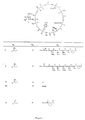
- Didemnin A ( 3 ) is the simplest and most abundant constituent, and it consists of five amino acid and two non-amino acid subunits.
- these compounds can be used to treat neoplastic diseases in animals and humans. Further, since these novel compounds are active against DNA and RNA viruses, they can be used to treat infections in humans, animals, and plants that are caused by such viruses. Acid addition salts and acyl derivatives of the novel didemnins can be made and used for the same biological purposes as the parent compounds.
- Figures 1, 1A, 1B, and 1C show the structural formulas of the bold-faced compound numbers.
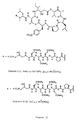
- Figure 2 shows 1 H NMR data of didemnins X, E, Y, and D.
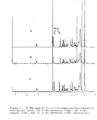
- Figure 3 shows 1 H NMR data of the methanolysis product of didemnin X, denoted “ 12 ", and didemnin B.
- Figure 4 shows chiral gas chromatographic data of didemnins X, Y, and E.
- Figure 5 shows 1 H NMR data of 3-[(+)-10-camphorsulfonyl]decanoic acid methyl ester, (A) 3-(R) synthetic (16a), (B) 3-(R) natural (14b), and (C) 3-(S) synthetic (16b), derivatives.
- the organism from which didemnins (X and Y) are extracted is a colonial marine tunicate of the family Didemnidae, Trididemnum solidum . This is in the suborder Aplousobranchia of the order Enterogona of the class Ascidiacea of the subphylum Urochordata of the phylum Chordata.
- the animals can be readily obtained by scuba techniques at depths of 10 to 100 feet where they encrust rocks, sponges, gorgonians, etc., in colony sizes up to 3 feet in diameter and 1/2 inch in thickness. Depending on location, they are green-white to purple-white to brown-white to orange-white.
- a variety of methods can be used to isolate and purify the didemnins and nordidemnins from samples of the tunicate organism, for example, solvent extraction, partition chromatography, silica gel chromatography, liquid-liquid distribution in a Craig apparatus, adsorption on resins, and crystallization from solvents.
- IR Infrared
- IR Infrared
- IR Infrared
- Optical rotations were measured with a Jasco DIP 360 digital polarimeter with a sodium lamp (589 nm) using a 5 cm (0.8 ml) cell.
- NMR spectra were obtained with a General Electric QE-300 instrument (300 MHz for 1 H, 75 MHz for 13 C). Chemical shifts are reported in ppm referenced to the chloroform peak at delta 7.26 ppm for 1 H and 77.0 ppm for 13 C, unless otherwise noted.
- High- and low-resolution (HR and LR) fast atom bombardment (FAB) mass spectra were measured by L.S. Rong on a VG Analytical ZAB.
- EI mass spectra were measured by Dr. R.M. Milberg with a Finnigan MAT CH-5 DF spectrometer and a Finnigan MAT 731 instrument equipped with a multichannel signal analyzer. Melting points were determined on a Reichert microscope melting point apparatus and were not corrected. Gravity columns were prepared with commercial grade (Alfa large pore 58 micron) silica gel or NS gel (Nihon Seimitsu Kagaku, Tokyo; polystyrene divinyl benzene copolymer).
- High performance liquid chromatography HPLC was performed on a system containing an Altex model 110A pump, a Waters Associates R-401 differential refractometer, and a Beckman 153 UV detector.
- An Altex Ultrasphere silica 25 cm x 0.4 cm, 5 m particle size
- Alltech Spherisorb C-18, phenyl, amino, or cyano columns 25 cm x 1 cm, 5 or 10 m particle size
- the lower phase was used as a mobile phase to give crude didemnins D ( 8 ), E ( 9 ), Y ( 2 ), and X ( 1 ), 169 mg, 416 mg, 120 mg, and 248 mg, respectively, in order of elution.
- the crude peptides were purified by successive NS gel column chromatography, reversed phase, and normal phase HPLC to give the pure peptides.
- Vigorous hydrolysis of 13 with 3 N hydrochloric acid gave a lipophilic compound 14 .
- the molecular formula of C 10 H 20 O 3 was determined by HRFABMS.
- 1 H NMR spectra of 14 including decoupling experiments, along with HREI data of a fragment ion at m / z 89.023886 for the formula of C 3 H 5 O 3 + (Scheme II) showed that the structure of 14 was 3-hydroxydecanoic acid. This was confirmed by comparison of 1 H NMR data of 14 and its methyl ester 14a with those of synthetic ( R , S )-3-hydroxydecanoic acid ( 15 ) and its methyl ester.
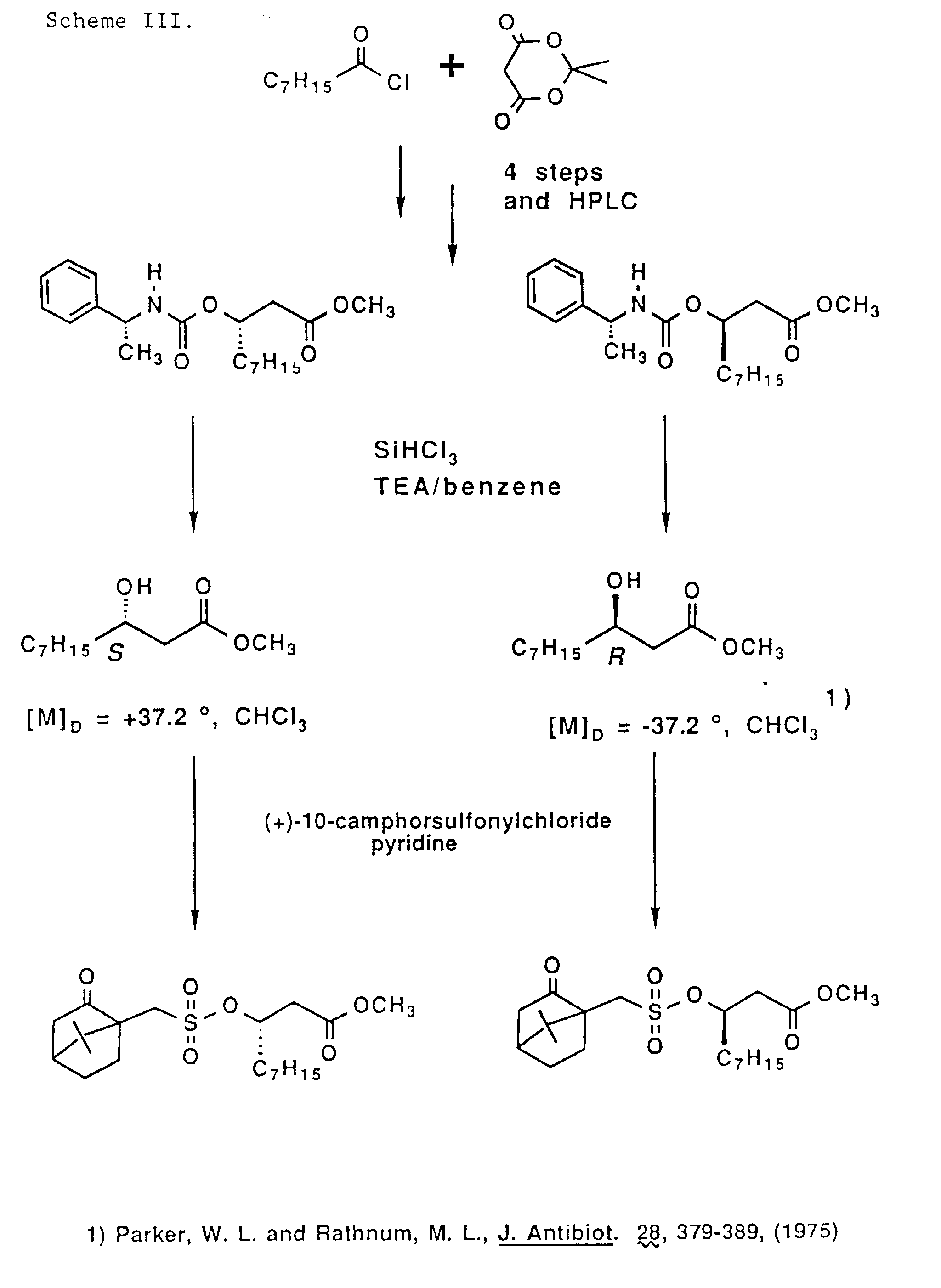
- the absolute stereochemistry of 14a was determined by direct comparison of the 1 H NMR data of the (+)-10-camphorsulfonyl derivative 14b with those of the synthetic methyl-3-( R )- and methyl-3-( S )-[(+)-10-camphorsulfonyl]decanoates, 16a and 16b , respectively.
- a three-day L1210 cell growth inhibition assay showed ID 50 0.004 and 0.0064 ug/ml for 1 and 2 , respectively, which are of the same magnitude as that of 4 .
- the results are summarized in Table 1, supra .
- fraction A Extraction and initial separation to obtain fraction A were done as follows: Tunicate sample AHCE #614 was collected on the southwest side of Long Cay, Lighthouse Reef, Caribbean, 17° 11.8' N by 87° 36.5' W at a depth of 50 to 100 feet. The sample was placed in 2-propanol and stored at -10°C until it was extracted by the procedure shown in Scheme I. A part of fraction A (18 g) was used to recover didemnins X and Y.
- the product was purified by silica gel gravity column chromatography (dichloromethane) to give a light yellow oil (14.6 g). A part of the oil (650 mg) was dissolved in THF (10 mL). To the solution was added a suspension of sodium borohydride (120 mg, 3.2 mmol) and water (1 mL) at 0°C with stirring for 1 hour. The reaction was quenched by adding acetone (5 mL), the solvent was removed in vacuo, and the residual material was triturated with dichloromethane.
- the saponified material was dissolved in water (1 mL) and the pH of the solution was adjusted to 1 by adding 6 N HCl. Dichloromethane was added to the solution, and the organic layer was dried over sodium sulfate. The solvent was removed in vacuo to give 127 mg (83%) of 15 as fine crystals: mp 74°C; 1 H NMR (CDCl 3 ), identical with that of 14 .
- ester 14a (0.89 mg), (+)-10-camphorsulfonyl chloride (4.6 mg), and pyridine (0.2 mL) was allowed to stand at room temperature for 12 hours, then pyridine was removed with a stream of nitrogen.
- the resulting oil was passed through a silica gel Sep-Pak column with dichloromethane/ethyl acetate (5:1) then purified by HPLC using a cyano analytical column with hexane/2-propanol (20:1) to give 0.95 mg of an oil: 1 H NMR (CDCl 3 ), identical with that of 16a ; see Figure 5.
- the didemnins are weakly basic, they form salts with mineral acids such as HCl, H 2 SO 4 , and H 3 PO 4 .
- Such salts can be prepared by suspending the didemnins in water, adding a dilute acid until the pH of the solution is about 3 to 4, and freeze-drying the solution to provide a dried residue of the didemnin salt.
- the didemnins have free amino and hydroxyl groups available for derivatization.
- acyl amides and esters of the didemnins can be prepared by methods well known to those skilled in the art.
- Acyl derivatives of the didemnins can be used for the same biological purposes as the parent compounds.
- Acids which can be used in the acylation of a didemnin are as disclosed in U.S. Patent No. 4,548,814, Columns 3 and 4.
- the administration of didemnins X and Y can be carried out as disclosed in U.S. Patent No. 4,548,814, Columns 9 through 15. This patent is incorporated herein by reference thereto for the above-noted disclosures.
Landscapes
- Chemical & Material Sciences (AREA)
- Organic Chemistry (AREA)
- Health & Medical Sciences (AREA)
- Life Sciences & Earth Sciences (AREA)
- General Health & Medical Sciences (AREA)
- Medicinal Chemistry (AREA)
- Biochemistry (AREA)
- Biophysics (AREA)
- Genetics & Genomics (AREA)
- Molecular Biology (AREA)
- Proteomics, Peptides & Aminoacids (AREA)
- Chemical Kinetics & Catalysis (AREA)
- Veterinary Medicine (AREA)
- Public Health (AREA)
- Animal Behavior & Ethology (AREA)
- General Chemical & Material Sciences (AREA)
- Nuclear Medicine, Radiotherapy & Molecular Imaging (AREA)
- Pharmacology & Pharmacy (AREA)
- Virology (AREA)
- Oncology (AREA)
- Communicable Diseases (AREA)
- Medicines That Contain Protein Lipid Enzymes And Other Medicines (AREA)
- Peptides Or Proteins (AREA)
- Medicines Containing Material From Animals Or Micro-Organisms (AREA)
- Pharmaceuticals Containing Other Organic And Inorganic Compounds (AREA)
- Preparation Of Compounds By Using Micro-Organisms (AREA)
- Organic Low-Molecular-Weight Compounds And Preparation Thereof (AREA)
- Nitrogen Condensed Heterocyclic Rings (AREA)
Abstract
Description
- Didemnins, antitumor and antiviral cyclic depsipeptides, were initially isolated in 1981 from the Caribbean tunicate Trididemnum solidum (Rinehart Jr., K.L., J.B. Gloer, J.C. Cook Jr., S.A Mizsak, T.A. Scahill [1981] J. Am. Chem. Soc. 103:1857). So far, nine related peptides, didemnins A (3), B (4), C (5), nordidemnins A (6), and B (7), didemnins D (8), E (9), G (10), and methylene didemnin A (11) have been characterized (Rinehart Jr., KL., J.B. Gloer, R.G. Hughes Jr., H.E. Renis, J.P. McGovren, E.B. Swynenberg, D.A. Stringfellow, S.L. Kuentzel, L.H. Li [1981] Science 212:933; Gloer, J.B. [1983] Ph.D. Dissertation, University of Illinois at Urbana-Champaign; Gutowsky, R.E. [1984] M.Sc. Thesis, University of Illinois at Urbana-Champaign). See Figures 1, 1A, 1B, and 1C for the structural formulas of the bold face compound numbers referred to herein. Didemnin A (3) is the simplest and most abundant constituent, and it consists of five amino acid and two non-amino acid subunits. The structure of one of the non-amino acid subunits, (3S,4R,5S)-isostatine, was originally assigned as (3S,4R)-statine, but was later found to be incorrect, and it was revised during the synthetic study of 3 (Rinehart, K.L., V. Kishore, S. Nagarajan, R.J. Lake, J.B. Gloer, F.A Bozich, K.-M. Li, R.E. Maleczka Jr., W.L. Todsen, M.H.G. Munro, D.W. Sullins, R. Sakai [1987] J. Am. Chem. Soc. 109:6846; Rinehart, K.L., V. Kishore, K.C. Bible, R. Sakai, D.W. Sullins, K.-M. Li [1988] J. Nat. Prod. 51:1; Sakai, R., First Year Paper I, University of Illinois at Urbana-Champaign). Of the didemnins isolated so far, 4 has shown the most potent biological activities, and strong antitumor efficacy has led this compound into Phase II clinical trials. Structurally, all didemnins except for nor- and methylene didemnins contain 3 as the basic skeleton, and the only differences between them are their side chains. Differences in the side chain or simple modifications in the ring functional groups, however, cause drastic changes in their biological properties (Gloer [1983], supra). These interesting structure-activity relationships stimulated us to find new didemnins for further chemical and biological studies. See U.S. Patent No. 4,548,814, which discloses and claims processes for preparing didemnins A, B, and C, and nordidemnins A, B, and C. Also, see U.S. Patent No. 4,493,796, which discloses and claims didemnins A, B, C, D, and E.
- An extract of the marine tunicate Trididemnum solidum (Subphylum Urochordata) was chromatographed as shown in
Scheme 1 to allow isolation of the new compounds, didemnins X (1) and Y (2). Their structures were elucidated by chemical and spectral methods, largely fast atom bombardment mass spectrometry (FABMS) and MS/MS studies, and are shown in Figure 2. The absolute stereochemistry of the β-hydroxydecanoyl group was determined by comparison with synthetic material. As shown in Table 1, didemnins X and Y inhibit the growth of L1210 mouse leukemia cells in vitro.Three-day L1210 cell growth inhibition assay (at 37°C). ID50 ID90 ID50 ID90 Didemnin ug/mL ug/mL ug/mL ug/mL X 0.004 0.017 0.0048 0.017 Y 0.0064 0.021 0.0048 0.02 D 0.0034 0.015 0.0042 0.016 E 0.0011 0.0076 0.0008 0.0056 B 0.0038 0.015 A 0.0078 0.058 - Thus, these compounds can be used to treat neoplastic diseases in animals and humans. Further, since these novel compounds are active against DNA and RNA viruses, they can be used to treat infections in humans, animals, and plants that are caused by such viruses. Acid addition salts and acyl derivatives of the novel didemnins can be made and used for the same biological purposes as the parent compounds.
- Figures 1, 1A, 1B, and 1C show the structural formulas of the bold-faced compound numbers.
- Figure 2 shows 1H NMR data of didemnins X, E, Y, and D.
- Figure 3 shows 1H NMR data of the methanolysis product of didemnin X, denoted "12", and didemnin B.
- Figure 4 shows chiral gas chromatographic data of didemnins X, Y, and E.
- Figure 5 shows 1H NMR data of 3-[(+)-10-camphorsulfonyl]decanoic acid methyl ester, (A) 3-(R) synthetic (16a), (B) 3-(R) natural (14b), and (C) 3-(S) synthetic (16b), derivatives.
- The organism from which didemnins (X and Y) are extracted is a colonial marine tunicate of the family Didemnidae, Trididemnum solidum. This is in the suborder Aplousobranchia of the order Enterogona of the class Ascidiacea of the subphylum Urochordata of the phylum Chordata. The animals can be readily obtained by scuba techniques at depths of 10 to 100 feet where they encrust rocks, sponges, gorgonians, etc., in colony sizes up to 3 feet in diameter and 1/2 inch in thickness. Depending on location, they are green-white to purple-white to brown-white to orange-white.
- Specific locations from which these organisms have been obtained are as follows:
- (1) Southwest side of Long Cay, Lighthouse Reef, Belize, 17° 11.8' N by 87° 36.5' W at a depth of 50 to 100 feet;
- (2) Rada el Cove, Isla San Andrés, Colombia, 12° 31' 46" N by 81° 44' 5" W at 25 to 33 feet;
- (3) Palancar Reef, Isla de Cozumel, Mexico, 20° 18.2' N by 87° 2.5' W at 60 to 100 feet;
- (4) On the west side of the southern tip of Turneffe Island, Belize, 17° 11.3' N by 87° 55.6' W at 50 to 75 feet;
- (5) Punta Oeste, Coxen's Hole Harbor, Isla Roatan, Honduras, 16° 15' N by 86° 38' W at 10 to 70 feet;
- (6) On the leeward side of the westernmost Holandes Cay, Isla San Blas, Panama, 9° 35.6' N by 78° 47' W at 60 feet.
-
- A variety of methods can be used to isolate and purify the didemnins and nordidemnins from samples of the tunicate organism, for example, solvent extraction, partition chromatography, silica gel chromatography, liquid-liquid distribution in a Craig apparatus, adsorption on resins, and crystallization from solvents.
- Infrared (IR) spectra were recorded on an IBM IR/32 FTIR. Optical rotations were measured with a Jasco DIP 360 digital polarimeter with a sodium lamp (589 nm) using a 5 cm (0.8 ml) cell. NMR spectra were obtained with a General Electric QE-300 instrument (300 MHz for 1H, 75 MHz for 13C). Chemical shifts are reported in ppm referenced to the chloroform peak at delta 7.26 ppm for 1H and 77.0 ppm for 13C, unless otherwise noted. High- and low-resolution (HR and LR) fast atom bombardment (FAB) mass spectra were measured by L.S. Rong on a VG Analytical ZAB. High- and low-resolution electron ionization (EI) mass spectra were measured by Dr. R.M. Milberg with a Finnigan MAT CH-5 DF spectrometer and a Finnigan MAT 731 instrument equipped with a multichannel signal analyzer. Melting points were determined on a Reichert microscope melting point apparatus and were not corrected. Gravity columns were prepared with commercial grade (Alfa large pore 58 micron) silica gel or NS gel (Nihon Seimitsu Kagaku, Tokyo; polystyrene divinyl benzene copolymer). High performance liquid chromatography (HPLC) was performed on a system containing an Altex model 110A pump, a Waters Associates R-401 differential refractometer, and a Beckman 153 UV detector. An Altex Ultrasphere silica (25 cm x 0.4 cm, 5 m particle size) and Alltech Spherisorb C-18, phenyl, amino, or cyano columns (25 cm x 1 cm, 5 or 10 m particle size) were used. A PC Inc. Ito multi-layer coil separator-extractor was used for centrifugal counter current chromatography (CCC). Gas chromatography (GC) analyses were carried out by using a Varian Model 3700 GC and an Alltech Associate Inc., Chirasil-Val II capillary column (25 m x 0.32 mm) at a flow rate of 1.2 mL/min with a programmed oven temperature [90°-(4°C/min)-180°C].
- During the large-scale isolation of 4, a large amount of polar fraction A was produced (Scheme I) (Gutowsky supra). From this fraction, didemnins D (8) and E (9), along with the novel tunichlorin pigments (Rinehart, Kishore, Bible et al. [1988] supra), have been isolated.
- In the isolation of these new peptides, efficient solvent partition and centrifugal counter current chromatography (CCC) were used extensively to avoid potential loss and decomposition of polar components. A portion of fraction A (9 g) was partitioned between the upper and the lower phases of ethyl acetate/heptane/methanol/water (7:4:4:3). FABMS of the two phases indicated that the polar peptides were concentrated almost exclusively in the lower phase. The lower phase from the solvent partition was then separated by CCC with toluene/ethyl acetate/methanol/water (6:7:4:4) as the solvent system. The lower phase was used as a mobile phase to give crude didemnins D (8), E (9), Y (2), and X (1), 169 mg, 416 mg, 120 mg, and 248 mg, respectively, in order of elution. The crude peptides were purified by successive NS gel column chromatography, reversed phase, and normal phase HPLC to give the pure peptides.
- The molecular weight of 1 was deduced as C82H131N13O23 from HRFABMS. 1H and 13C NMR spectra of 1 and 2 were poorly resolved probably due to poor solubility and conformational inhomogeneity in the solution at room temperature. However, the complete spectral patterns of 1 and 2 were very similar to those of 4, 8, and 9 (Figures 1, 1A, 1B, and 1C), implying that 1 and 2 have the same basic skeleton as the other didemnins. Partial methanolysis of 1 gave 12 and 13 as the two major products. HRFABMS of 12 showed a molecular formula of C57H89N7O15, the same as that of 4. 1H NMR and optical rotation data of 12 were identical with those of authentic 4 (Figure 3).
Compound 13 has very poor solubility in common solvents except for DMSO and DMF, and 1H NMR signals of 13 in DMSO or DMF are very broad at room temperature. The molecular formula of 13 was deduced from HRFABMS data as C26H46N6O9, suggesting that 13 must be a methyl ester of the side chain of 1. LRFABMS data showed fragmentation ions at m/z 555.3, 427.3, 299.2, and 188.2, and HRFABMS of each fragment ion showed that 13 contains three glutamyl units and a terminal C-10 compound (Scheme II). - A comparison of chiral GC data of the hydrolyzates of 1 and 9 showed the amino acid composition of 1 to be exactly that of 9, including the absolute stereochemistry (Figure 4).
- Vigorous hydrolysis of 13 with 3 N hydrochloric acid gave a
lipophilic compound 14. The molecular formula of C10H20O3 was determined by HRFABMS. 1H NMR spectra of 14, including decoupling experiments, along with HREI data of a fragment ion at m/z 89.023886 for the formula of C3H5O3 + (Scheme II) showed that the structure of 14 was 3-hydroxydecanoic acid. This was confirmed by comparison of 1H NMR data of 14 and itsmethyl ester 14a with those of synthetic (R,S)-3-hydroxydecanoic acid (15) and its methyl ester. - The absolute stereochemistry of 14a was determined by direct comparison of the 1H NMR data of the (+)-10-
camphorsulfonyl derivative 14b with those of the synthetic methyl-3-(R)- and methyl-3-(S)-[(+)-10-camphorsulfonyl]decanoates, 16a and 16b, respectively. - The preparation of optically pure synthetic methyl esters of 3-(R)- and 3-(S)-
hydroxydecanoic acids 15a and 15b was carried out by separating an epimeric mixture of the (R)-methylbenzyl carbamates (Pirkle, W.H., J.R. Hauske [1977] J. Org. Chem. 42:2781) (17a and 17b) by HPLC using a phenyl bonded silica gel column. The isolated, optically pure carbamates were then cleaved with trichlorosilane to give methyl-3-(R)-hydroxydecanoate (15a) ([M]D = -37.3°) and methyl-3-(S)-hydroxydecanoate (15b) ([M]D = 37.2°). The esters were converted to (+)-10-camphorsulfonates (16a and 16b) (Scheme III). 1H NMR spectra of the derivatives showed a very distinctive AB quartet for the C-10 position of the camphor moiety. The 1H NMR spectrum of 14b was superimposable on that of 16a (Figure 5). - Therefore, the structure of 1 was determined as (R)-3-hydroxydecanoyl-L-Gln-L-Gln-L-Gln-didemnin B.
- Didemnin Y (2), isolated as a minor component, showed a molecular ion at m/z 1795.0119 (M + H) and HRFAB mass spectra gave the molecular formula C87H139N15O25; 1 and 2 differ in molecular formula by C5H8N2O2, corresponding to a glutamyl unit. These data, along with 1H NMR spectra very similar to those of 1, suggest that the structure of 2 is 3-hydroxydecanoyl-L-Gln-L-Gln-L-Gln-L-Gln-didemnin B. This was confirmed by MS/MS, LR- and HRFABMS for the molecular ion of 2 and partially hydrolyzed compound 9 (Scheme IV). The stereochemistry at C-3 of the 3-hydroxydecanoyl moiety was determined analytically. Compound 2 (6 mg) was hydrolysed to give side chain fragment 9 (2.3 mg). FABMS and MS/MS data of 9 secured the sequence (Scheme IV). Acid hydrolysis of 9 (1 mg) followed by treatment with (R)-methylbenzylisocyanate gave the
diastereomeric carbamate 10, whose retention time on HPLC (normal phase cyano-column) compared with those of synthetic carbamates indicated that the configuration at C-3 of 3-hydroxydecanoyl subunit was also R (Scheme V). - A three-day L1210 cell growth inhibition assay showed ID50 0.004 and 0.0064 ug/ml for 1 and 2, respectively, which are of the same magnitude as that of 4. The results are summarized in Table 1, supra.
- Following are examples which illustrate procedures, including the best mode, for practicing the invention. These examples should not be construed as limiting. All percentages are by weight and all solvent mixture proportions are by volume unless otherwise noted.
- Extraction and initial separation to obtain fraction A were done as follows: Tunicate sample AHCE #614 was collected on the southwest side of Long Cay, Lighthouse Reef, Belize, 17° 11.8' N by 87° 36.5' W at a depth of 50 to 100 feet. The sample was placed in 2-propanol and stored at -10°C until it was extracted by the procedure shown in Scheme I. A part of fraction A (18 g) was used to recover didemnins X and Y.
- Isolation of didemnins. A part of fraction A (9 g) was partitioned between the lower and the upper phases of a mixture of ethyl acetate/heptane/methanol/water (7:4:4:3). Both lower and upper phases were concentrated to give solids (4.5 g each). A portion of the solid from the lower layer (1 g) was separated by CCC using toluene/ethyl acetate/methanol/water (6:7:7:4) as the solvent system with the lower phase being used as the mobile phase, at a flow rate of 2 mL/min at 600 rpm. A total of 40 fractions (24 mL each) were collected. The stationary phase was recovered from the first 10 fractions.
Fraction 11 was concentrated in vacuo to give crude 8 (169 mg).Fractions crude 8 was purified by successive C-18 reversed-phase gravity column chromatography and HPLC using a C-18 column with methanol/water (8:2) to givepure peptide 8 as a faint green solid (Rinehart, Gloer, Hughes et al. [1981], supra): mp 154-164°C (lit. [Rinehart, Gloer, Hughes et al., supra] mp 159-161°C); [alpha]D = -81.5° (c 0.4, CHCl3) (lit. [Rinehart, Gloer, Hughes et al., supra] [alpha]D = -89.4°); 1H NMR (CDCl3 delta 7.04 (2 H, d, J = 8.4 Hz), 6.80 (2 H, d, J = 8.4 Hz), 3.75 (3 H, s), 3.02 (3 H, s), 2.50 (3 H, s); HRFABMS calcd. for C77H118N14O23: 1607.8573 (M + H). Found: 1607.8590. - A semi-pure sample of didemnin E was purified by the procedure employed for 8 to give
pure peptide 9 as a colorless solid: mp 158-166°C (lit. [Rinehart, Gloer, Hughes et al., supra] mp 164-166°C); [alpha]D = -86.6° (c 1.98, CHCl3) (lit. [Rinehart, Gloer, Hughes et al., supra] [alpha]D = -90.6°); 1H NMR (CDCl3) delta 7.05 (2 H, d, J = 8.1 Hz), 6.80 (2 H, d, J = 8.1 Hz), 3.76 (3 H, s), 3.10 (3 H, s), 2.51 (3 H, s); HRFABMS calcd. for C72H109N12O21: 1479.7987 (M + H). Found: 1479.7993. - Fractions 14-16 were combined to give 100 mg of a solid. A methanol soluble part of the solid, after filtration, was chromatographed on a gravity column packed with a NS gel with methanol to give 49.5 mg of a peptidal fraction. This was purified on HPLC using an amino column with methanol followed by a silica gel column with chloroform/methanol (3:1) to give pure peptide 2 (11.3 mg), amorphous; [alpha]D = -65° (c 0.93, CHCl3-MeOH); IR (Neat) 3310, 2950, 1720, 1650 cm-1; 1H NMR (CDCl3-methanol-d 4) delta 7.30 (2 H, d, J = 8.1 Hz), 6.70 (2 H, d, J = 8.1 Hz), 3.74 (3 H, s), 2.98 (3 H, s), 2.49 (3 H, s); HRFABMS calcd. for C87H139N15O25: 1795.0145 (M + H). Found: 1795.0119.
- Fractions 19-29 from the CCC separation were also combined to afford a light green solid (248 mg). This solid was separated by NS gel column chromatography using methanol to afford a peptidal solid. This material was passed through a Sep-Pak silica gel column which had been treated with ammonia gas with chloroform/methanol (4:1) to remove green pigments. The peptide was purified on HPLC using a silica gel column with chloroform/methanol (4:1) to give 1 (107 mg): solid; mp 156-158°C; [alpha]D = -8.6° (c 6.35, CHCl3); IR (Neat) 3450, 3300, 2950, 1720, 1650 cm-1; 1H NMR (CDCl3-methanol-d 4) delta 7.02 (2 H, d, J = 8.4 Hz), 6.78 (2 H, d, J = 8.4 Hz), 3.72 (3 H, s), 3.00 (3 H, s), 2.47 (3 H, s); HRFABMS calcd. for C82H131N13O23: 1666.9559 (M + H). Found: 1666.9533.
- To a solution of 1 (122 mg) in 2 mL of methanol was added excess sodium carbonate (25 mg) with stirring at room temperature until TLC indicated the starting material had been consumed (0.5 hr). The reaction mixture was filtered, and concentrated to give a mixture of methanol-soluble products. The solid was dissolved in DMSO and filtered to remove the residual salts. Removal of the DMSO by a stream of nitrogen gave a colorless solid 13 (35 mg): [alpha]D = 19° (c 0.14, DMSO); LR- and HRFABMS see Scheme II. The methanol-soluble portion was filtered to remove residual solid, then further separated on reversed-phase HPLC using a C-18 column with methanol/water (4:1) to give a major component along with five minor compounds. The major product was re-chromatographed to give a pure solid 12: mp 152-156°C; 1H NMR (CDCl3) see Figure 3; HRFABMS calcd. for C57H89N7O15: 1112.6495 (M + H). Found: 1112.6502.
- A sample of 1 (3 mg) was heated with 0.5 mL of 6 N HCl at 110°C for 21 hours. Dichloromethane was added to the mixture and the aqueous phase was evaporated to dryness. The residual material was treated with a mixture of methanol/acetyl chloride (10:1) at 110°C for 0.5 hr. The solvent was removed with a stream of nitrogen gas, and the resulting oil was then treated with trifluoroacetic anhydride/trifluoroacetic acid (0.2 mL, each) at 110°C for 4 minutes. Excess acid was removed with a stream of nitrogen gas, and the residue was dissolved in 1 mL of dichloromethane for GC analysis. Samples of hydrolyzed 3, 4, and 9 were prepared by the same procedure.
- Compound 13 (12.3 mg) was dissolved in 3 N HCl (1 mL) and heated at 120°C in a sealed sample vial for 8 hours. The mixture was extracted with dichloromethane (2
X 1 mL), the organic layer was dried over sodium sulfate, and the solvent was removed to give 14 as a white solid: 1H NMR (CDCl3) delta 4.03 (1 H, br s), 2.55 (1 H, br d, J = 17.7 Hz), 2.45 (1 H, dd, J = 17.1 Hz), 1.63-1.38 (2 H, m), 1.25 (br s), 0.88 (br t, J = 5.7 Hz); HRFABMS calcd. for C10H20O3: 189.1491 (M + H). Found: 189.1486. HREIMS calcd. for C3H5O3: 89.023886. Found: 89.023886. This compound was then treated with a mixture of methanol/acetic anhydride (9:1) for 30 minutes at 120°C in a sealed vial. The solvent was removed with a stream of nitrogen. The residual material was separated on a silica Sep-Pak column with dichloromethane/ethyl acetate (5:1) to give 0.89 mg of 14a as an oil: 1H NMR (CDCl3) delta 4.00 (1 H, m), 3.71 (3 H, s), 2.46 (1 H, dd, J = 3.3, 16.5 Hz), 2.40 (1 H, dd, J = 90 16.8 Hz), 1.54-1.34 m, 1.28 br s, 0.88(3 H, t, J = 6.3 Hz). - Octanyl chloride (16.2 g, 0.088 mol) was added to a solution of 2,2-dimethyl-1,3-dioxane-4,6-dione (11.5 g, 0.080 mol) in dichloromethane (100 mL) and pyridine (12.8 mL) at 0°C over 10 minutes. The reaction mixture was stirred for 1 hour at room temperature. The reaction product was partitioned successively between dichloromethane, and aqueous HCl (10%), and then water. The organic portion was concentrated to give a deep red oil and then refluxed with methanol (250 ml) for 12 hours. The product was purified by silica gel gravity column chromatography (dichloromethane) to give a light yellow oil (14.6 g). A part of the oil (650 mg) was dissolved in THF (10 mL). To the solution was added a suspension of sodium borohydride (120 mg, 3.2 mmol) and water (1 mL) at 0°C with stirring for 1 hour. The reaction was quenched by adding acetone (5 mL), the solvent was removed in vacuo, and the residual material was triturated with dichloromethane. The organic solubles were purified by silica gel gravity column chromatography with dichloromethane/ethyl acetate (3:1) to give (R,S)-methyl-3-hydroxydecanoate as an oil: 1H NMR, identical with that of 14a; 13C NMR (CDCl3) delta 173.79, 67.92, 51.50, 41.17, 36.52, 31.74, 29.42, 29.17, 25.44, 22.58, 14.00. A mixture of the methyl ester (166 mg, 0.82 mmol) with 6 N sodium hydroxide was heated at 110°C for 1 minute. The saponified material was dissolved in water (1 mL) and the pH of the solution was adjusted to 1 by adding 6 N HCl. Dichloromethane was added to the solution, and the organic layer was dried over sodium sulfate. The solvent was removed in vacuo to give 127 mg (83%) of 15 as fine crystals: mp 74°C; 1H NMR (CDCl3), identical with that of 14.
- A mixture of (R,S)-methyl-3-hydroxydecanoate (87 mg, 0.43 mmol) and (+)-10-camphorsulfonyl chloride (125 mg, 0.499 mmol) dissolved in pyridine (0.5 mL) was allowed to stand at room temperature for 12 hours. Pyridine was removed in vacuo, and the residual oil was subjected to gravity silica gel column chromatography with chloroform/ethyl acetate (9:1) to give 132 mg of an epimeric mixture (73%) of 16a and 16b as an oil: 1H NMR (CDCl3), see Figure 4.
- A mixture of
ester 14a (0.89 mg), (+)-10-camphorsulfonyl chloride (4.6 mg), and pyridine (0.2 mL) was allowed to stand at room temperature for 12 hours, then pyridine was removed with a stream of nitrogen. The resulting oil was passed through a silica gel Sep-Pak column with dichloromethane/ethyl acetate (5:1) then purified by HPLC using a cyano analytical column with hexane/2-propanol (20:1) to give 0.95 mg of an oil: 1H NMR (CDCl3), identical with that of 16a; see Figure 5. - A mixture of (R)-alpha-methylbenzyl isocyanate (668 mg, 4.5 mmol) and (R,S)-methyl-3-hydroxydecanoate (850 mg, 4.2 mmol) was dissolved in dichloromethane (2 mL) and pyridine (0.5 mL), and refluxed for 42 hours. The solvent was removed in vacuo, and the resulting oil was purified by gravity column chromatography using silica gel with hexane/2-propanol (20:1) to give 1.19 g of a mixture of
carbamates 17a and 17b (78%) as an oil: CIMS (M + H, methane) m/z (rel. intensity) 350.2 (100), 334.2 (12), 318.2 (8), 272.2 (2), 246 (43), 233.1 (37), 203.2 (43), 185.2 (95), 164.1 (60), 153.1 (33), 120.1 (40), 105.1 (80), 85.0 (35), 71.1 (30), 59.1 (38). A mixture of 17a and 17b (70 mg) was separated on HPLC, using a phenyl column with hexane/2-propanol (60:1), to afford 28 mg of opticallypure carbamate 17a as the less polar isomer: 1H NMR (CDCl3) delta 7.30 (5 H, m), 5.07 (1 H, m), 4.95 (1 H, br d, J = 6 Hz), 4.92 (1 H, br m), 3.68 (3 H, s); [alpha]D = 33.8° (c 2.80, CHCl3). The more polar fraction gave 29 mg of the other optically pure carbamate 17b: [alpha]D = 36.6° (c 2.88, CHCl3); 1H NMR (CDCl3) delta 7.30 (5 H, m), 5.06 (1 H, m), 4.95 (1 H, br d), 4.88 (1 H, br m), 3.56 (3 H, s). - To a solution of 17b (22.5 mg) in 1 mL of dried benzene was added 20 uL of triethylamine and 25 ul of trichlorosilane. The mixture was stirred for 36 hours et room temperature, then saturated aqueous ammonium chloride (1 mL) was added. The organic layer was dried over sodium sulfate, and the solvent was removed with a stream of nitrogen. The resulting material was purified by HPLC using a cyano column with hexane/ethyl acetate (4:1) to give 4.4 mg (33%) of optically pure S ester 15b as an oil; [M]D = 37.2° (c 0.243, CHCl3). The other isomer (24.2 mg) 17a was cleaved by the same procedure to give 7.05 mg (54%) of pure R ester 15b as an oil; [M]D = -37.2° (c 0.565, CHCl3), (lit. [Parker, W.L. and M.L. Rathnum (1975) J. Antibiot. 28:379], [M]D = -37°).
- A mixture of (S)-ester 15b (1.89 mg) and (+)-10-camphorsulfonyl chloride (11.5 mg) was dissolved in pyridine (0.5 mL) and allowed to stand at room temperature for 5 hours. Pyridine was removed with a stream of nitrogen, and the residual material was separated by silica gel Sep-Pak column chromatography with dichloromethane/ethyl acetate (5:1). The resulting oil was purified on HPLC using a cyano column with dichloromethane/ethyl acetate (5:1) to give
pure sulfonate 16b as an oil: 1H NMR (CDCl3) delta 5.12 (1 H, ddt, J = 6.1, 6.1, 6.1 Hz), 3.72 (3 H, s), 3.59 (1 H, d, J = 15.0 Hz), 3.09 (1 H, d, J = 15.0 Hz). The (R)-ester 15a was converted to the corresponding (+)-10-camphorsulfonate by using the same procedure to give 16a as an oil: 1H NMR (CDCl3) delta 5.12 (1 H, ddt, J = 6.1, 6.1, 6.1 Hz), 3.72 (3 H, s), 3.67 (1 H, d, 15.0 Hz), 3.01 (1 H, d, 15.0 Hz). - Since the didemnins are weakly basic, they form salts with mineral acids such as HCl, H2SO4, and H3PO4. Such salts can be prepared by suspending the didemnins in water, adding a dilute acid until the pH of the solution is about 3 to 4, and freeze-drying the solution to provide a dried residue of the didemnin salt.
- The didemnins have free amino and hydroxyl groups available for derivatization. Thus, acyl amides and esters of the didemnins can be prepared by methods well known to those skilled in the art. Acyl derivatives of the didemnins can be used for the same biological purposes as the parent compounds.
- Acids which can be used in the acylation of a didemnin are as disclosed in U.S. Patent No. 4,548,814,
Columns Columns 9 through 15. This patent is incorporated herein by reference thereto for the above-noted disclosures.



Claims (6)
- A didemnin of the formulawherein R =
 or
or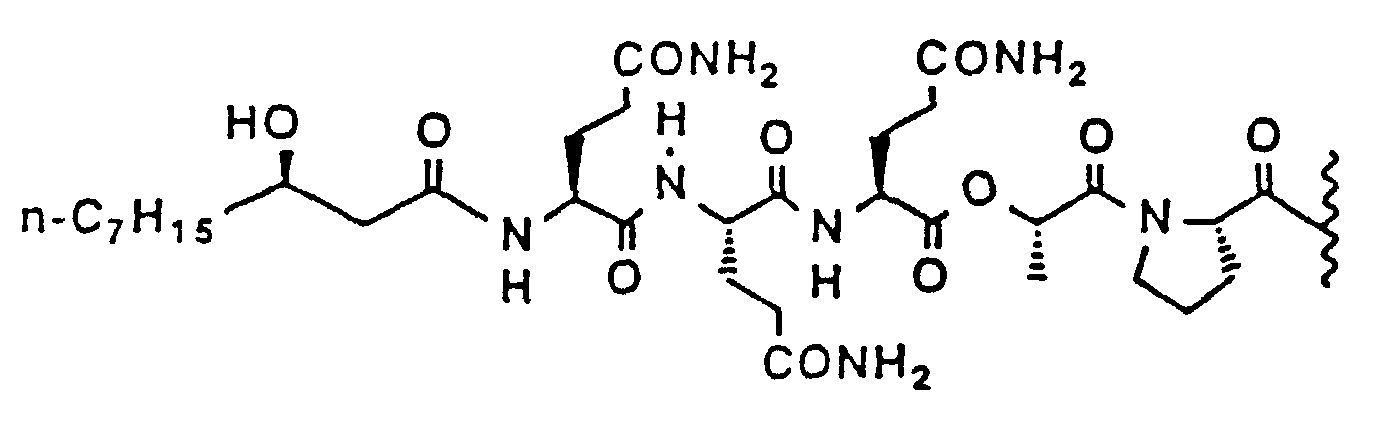

- Didemnin X, according to claim 1, wherein R =or the salts, acyl amides, and esters thereof.

- Didemnin Y, according to claim 1, wherein R =or the salts, acyl amides, and esters thereof.

- Use of a didemnin according to any preceding claim, for the manufacture of a medicament for use in the treatment of a neoplastic disease.
- A process for the preparation of a didemnin according to any of claims 1 to 3, which comprises extraction from the marine tunicate Trididemnum solidum.
- A process for the manufacture of a medicament for use in thetreatmentof a neoplastic disease, wherein a didemnin prepared according to the process of claim 5 is employed as active agent.
Applications Claiming Priority (2)
| Application Number | Priority Date | Filing Date | Title |
|---|---|---|---|
| US07/335,903 US4948791A (en) | 1989-04-10 | 1989-04-10 | Novel Cytotoxic cyclic depsipeptides from the tunicate trididemnum solidum |
| US335903 | 1989-04-10 |
Publications (2)
| Publication Number | Publication Date |
|---|---|
| EP0393883A1 EP0393883A1 (en) | 1990-10-24 |
| EP0393883B1 true EP0393883B1 (en) | 1999-08-25 |
Family
ID=23313708
Family Applications (1)
| Application Number | Title | Priority Date | Filing Date |
|---|---|---|---|
| EP90303672A Expired - Lifetime EP0393883B1 (en) | 1989-04-10 | 1990-04-05 | Novel cytotoxic cyclic depsipeptides from the tunicate trididemnum solidum |
Country Status (10)
| Country | Link |
|---|---|
| US (1) | US4948791A (en) |
| EP (1) | EP0393883B1 (en) |
| JP (1) | JP3431920B2 (en) |
| AT (1) | ATE183751T1 (en) |
| AU (1) | AU640130B2 (en) |
| CA (1) | CA2012867C (en) |
| DE (1) | DE69033257T2 (en) |
| DK (1) | DK0393883T3 (en) |
| ES (1) | ES2140373T3 (en) |
| GR (1) | GR3031846T3 (en) |
Families Citing this family (14)
| Publication number | Priority date | Publication date | Assignee | Title |
|---|---|---|---|---|
| US20030148933A1 (en) | 1990-10-01 | 2003-08-07 | Pharma Mar S.A. | Derivatives of dehydrodidemnin B |
| DE4120327A1 (en) * | 1991-06-20 | 1992-12-24 | Basf Ag | NEW PEPTIDES, THEIR PREPARATION AND USE |
| US6156724A (en) * | 1996-06-07 | 2000-12-05 | Rinehart; Kenneth L. | Uses of didemnins as immunomodulating agents |
| US5830996A (en) * | 1996-09-27 | 1998-11-03 | University Of Utah Research Foundation | Cyclic peptide antitumor agent from an ascidian |
| JP2001503746A (en) | 1996-10-24 | 2001-03-21 | ザ・ボード・オブ・トラステイーズ・オブ・ザ・ユニバーシテイ・オブ・イリノイ | Semisynthetic method for didemnin analogues |
| US6034058A (en) * | 1997-04-15 | 2000-03-07 | Rinehart; Kenneth L. | Semi-synthetic alanyl dilemnin analogs |
| GB9803448D0 (en) | 1998-02-18 | 1998-04-15 | Pharma Mar Sa | Pharmaceutical formulation |
| GB0103750D0 (en) * | 2001-02-15 | 2001-04-04 | Pharma Mar Sa | Synthetic methods for aplidine and new antitumoral derivatives methods of making and using them |
| UA76718C2 (en) * | 2000-06-30 | 2006-09-15 | Фарма Мар, С.А. | Anticancer aplidine derivatives |
| HK1054191A1 (en) | 2000-10-12 | 2003-11-21 | Pharma Mar, S.A. | Treatment of cancers by aplidine in conjunction with a myoprotector |
| RU2341283C2 (en) | 2003-03-12 | 2008-12-20 | Фарма Мар, С.А. | Advanced treatment of tumours |
| ATE406171T1 (en) | 2003-03-12 | 2008-09-15 | Dana Farber Cancer Inst Inc | APLIDINE FOR THE TREATMENT OF MULTIPLE MYELOMA |
| US8258098B2 (en) | 2006-02-28 | 2012-09-04 | Pharma Mar, S.A. | Antitumoral treatments |
| US11332480B2 (en) | 2017-04-27 | 2022-05-17 | Pharma Mar, S.A. | Antitumoral compounds |
Family Cites Families (1)
| Publication number | Priority date | Publication date | Assignee | Title |
|---|---|---|---|---|
| FR2576022B1 (en) * | 1985-01-11 | 1987-09-11 | Rhone Poulenc Sante | NOVEL DERIVATIVES OF PRISTINAMYCIN II B, THEIR PREPARATION AND THE PHARMACEUTICAL COMPOSITIONS CONTAINING THEM |
-
1989
- 1989-04-10 US US07/335,903 patent/US4948791A/en not_active Expired - Lifetime
-
1990
- 1990-03-22 CA CA002012867A patent/CA2012867C/en not_active Expired - Fee Related
- 1990-04-05 AT AT90303672T patent/ATE183751T1/en not_active IP Right Cessation
- 1990-04-05 ES ES90303672T patent/ES2140373T3/en not_active Expired - Lifetime
- 1990-04-05 DK DK90303672T patent/DK0393883T3/en active
- 1990-04-05 EP EP90303672A patent/EP0393883B1/en not_active Expired - Lifetime
- 1990-04-05 DE DE69033257T patent/DE69033257T2/en not_active Expired - Fee Related
- 1990-04-09 AU AU53053/90A patent/AU640130B2/en not_active Ceased
- 1990-04-10 JP JP09327490A patent/JP3431920B2/en not_active Expired - Fee Related
-
1999
- 1999-11-16 GR GR990402940T patent/GR3031846T3/en unknown
Also Published As
| Publication number | Publication date |
|---|---|
| JPH03135999A (en) | 1991-06-10 |
| ES2140373T3 (en) | 2000-03-01 |
| DE69033257D1 (en) | 1999-09-30 |
| CA2012867A1 (en) | 1990-10-10 |
| ATE183751T1 (en) | 1999-09-15 |
| JP3431920B2 (en) | 2003-07-28 |
| AU640130B2 (en) | 1993-08-19 |
| DE69033257T2 (en) | 2000-04-13 |
| CA2012867C (en) | 1999-09-21 |
| DK0393883T3 (en) | 2000-03-20 |
| AU5305390A (en) | 1990-10-11 |
| GR3031846T3 (en) | 2000-02-29 |
| EP0393883A1 (en) | 1990-10-24 |
| US4948791A (en) | 1990-08-14 |
Similar Documents
| Publication | Publication Date | Title |
|---|---|---|
| US4948791A (en) | Novel Cytotoxic cyclic depsipeptides from the tunicate trididemnum solidum | |
| USRE39887E1 (en) | Dehydrodidemnin B | |
| US4950649A (en) | Didemnins and nordidemnins | |
| US4493796A (en) | Didemnins A, B, C, and derivatives thereof, as antiviral agents | |
| SE448386B (en) | NEW CYCLOSPORIN DERIVATIVES, PROCEDURE FOR PREPARING THEM AND PHARMACEUTICAL COMPOSITION CONTAINING THEM | |
| JPS61197585A (en) | Novel bliostatin 4-8 | |
| AU627453B2 (en) | Peptide derivatives | |
| US20020037835A1 (en) | Semi-synthetic studies toward didemnin analogues | |
| Rinehart et al. | Synthesis and properties of the eight isostatine stereoisomers | |
| JPS61274696A (en) | Antibiotic chloropolysporin b and c | |
| US4782135A (en) | Composition of matter and process | |
| JPH0344398A (en) | Antifungal and antibiotic substance r106 derivative | |
| KR100229257B1 (en) | Polyhydroxycyclopentane derivatives, their preparation and their therapeutic use | |
| Hallock et al. | Gentrymine B1, the first quaternary isoquinoline alkaloid from Ancistrocladus korupensis | |
| US5137870A (en) | Didemnins and nordidemnins | |
| US20030148933A1 (en) | Derivatives of dehydrodidemnin B | |
| EP0375058B1 (en) | New retro-inverso analogues of trymopentin, the method for their synthesis and their use in the preparation of pharmaceutical compositions | |
| CN112159462B (en) | Coibatide A derivative and application thereof | |
| SU1095588A1 (en) | Cyclic analog of enkephalin displaying analgetic effect | |
| SUOURO et al. | Solid-phase synthesis of cyclooctadepsipeptide N-4909 using a cyclization-cleavage method with oxime resin | |
| EP0608109A1 (en) | Isolation and structural elucidation of cephalostatin 7, 8 and 9, and their use as anti-tumor agents | |
| EP0050856B1 (en) | New peptide, process for its preparation and pharmaceutical composition containing it | |
| WO1997039025A1 (en) | A cyclic hepta-peptide derivative from colonial ascidians, lissoclinum sp. | |
| WO2015172047A1 (en) | Cyclic peptide compounds and related methods, salts and compositions | |
| Malipeddi et al. | Synthesis, anhelmintic, antimicrobial and anti-inflammatory activities of axinastatin-3 |
Legal Events
| Date | Code | Title | Description |
|---|---|---|---|
| PUAI | Public reference made under article 153(3) epc to a published international application that has entered the european phase |
Free format text: ORIGINAL CODE: 0009012 |
|
| AK | Designated contracting states |
Kind code of ref document: A1 Designated state(s): AT BE CH DE DK ES FR GB GR IT LI LU NL SE |
|
| 17P | Request for examination filed |
Effective date: 19901212 |
|
| 17Q | First examination report despatched |
Effective date: 19930329 |
|
| GRAG | Despatch of communication of intention to grant |
Free format text: ORIGINAL CODE: EPIDOS AGRA |
|
| GRAG | Despatch of communication of intention to grant |
Free format text: ORIGINAL CODE: EPIDOS AGRA |
|
| GRAH | Despatch of communication of intention to grant a patent |
Free format text: ORIGINAL CODE: EPIDOS IGRA |
|
| GRAH | Despatch of communication of intention to grant a patent |
Free format text: ORIGINAL CODE: EPIDOS IGRA |
|
| GRAA | (expected) grant |
Free format text: ORIGINAL CODE: 0009210 |
|
| AK | Designated contracting states |
Kind code of ref document: B1 Designated state(s): AT BE CH DE DK ES FR GB GR IT LI LU NL SE |
|
| REF | Corresponds to: |
Ref document number: 183751 Country of ref document: AT Date of ref document: 19990915 Kind code of ref document: T |
|
| REG | Reference to a national code |
Ref country code: CH Ref legal event code: EP |
|
| REF | Corresponds to: |
Ref document number: 69033257 Country of ref document: DE Date of ref document: 19990930 |
|
| ITF | It: translation for a ep patent filed | ||
| REG | Reference to a national code |
Ref country code: CH Ref legal event code: NV Representative=s name: RITSCHER & SEIFERT |
|
| ET | Fr: translation filed | ||
| REG | Reference to a national code |
Ref country code: ES Ref legal event code: FG2A Ref document number: 2140373 Country of ref document: ES Kind code of ref document: T3 |
|
| REG | Reference to a national code |
Ref country code: DK Ref legal event code: T3 |
|
| PLBE | No opposition filed within time limit |
Free format text: ORIGINAL CODE: 0009261 |
|
| STAA | Information on the status of an ep patent application or granted ep patent |
Free format text: STATUS: NO OPPOSITION FILED WITHIN TIME LIMIT |
|
| 26N | No opposition filed | ||
| REG | Reference to a national code |
Ref country code: GB Ref legal event code: IF02 |
|
| PGFP | Annual fee paid to national office [announced via postgrant information from national office to epo] |
Ref country code: GR Payment date: 20060314 Year of fee payment: 17 |
|
| PGFP | Annual fee paid to national office [announced via postgrant information from national office to epo] |
Ref country code: DE Payment date: 20060330 Year of fee payment: 17 |
|
| PGFP | Annual fee paid to national office [announced via postgrant information from national office to epo] |
Ref country code: NL Payment date: 20060403 Year of fee payment: 17 |
|
| PGFP | Annual fee paid to national office [announced via postgrant information from national office to epo] |
Ref country code: GB Payment date: 20060405 Year of fee payment: 17 |
|
| PGFP | Annual fee paid to national office [announced via postgrant information from national office to epo] |
Ref country code: SE Payment date: 20060406 Year of fee payment: 17 |
|
| PGFP | Annual fee paid to national office [announced via postgrant information from national office to epo] |
Ref country code: FR Payment date: 20060410 Year of fee payment: 17 |
|
| PGFP | Annual fee paid to national office [announced via postgrant information from national office to epo] |
Ref country code: AT Payment date: 20060412 Year of fee payment: 17 |
|
| PGFP | Annual fee paid to national office [announced via postgrant information from national office to epo] |
Ref country code: CH Payment date: 20060413 Year of fee payment: 17 |
|
| PGFP | Annual fee paid to national office [announced via postgrant information from national office to epo] |
Ref country code: DK Payment date: 20060419 Year of fee payment: 17 |
|
| PGFP | Annual fee paid to national office [announced via postgrant information from national office to epo] |
Ref country code: LU Payment date: 20060420 Year of fee payment: 17 |
|
| PGFP | Annual fee paid to national office [announced via postgrant information from national office to epo] |
Ref country code: IT Payment date: 20060430 Year of fee payment: 17 |
|
| PGFP | Annual fee paid to national office [announced via postgrant information from national office to epo] |
Ref country code: ES Payment date: 20060523 Year of fee payment: 17 |
|
| PGFP | Annual fee paid to national office [announced via postgrant information from national office to epo] |
Ref country code: BE Payment date: 20060616 Year of fee payment: 17 |
|
| REG | Reference to a national code |
Ref country code: DK Ref legal event code: EBP |
|
| REG | Reference to a national code |
Ref country code: CH Ref legal event code: PL |
|
| GBPC | Gb: european patent ceased through non-payment of renewal fee |
Effective date: 20070405 |
|
| BERE | Be: lapsed |
Owner name: THE *BOARD OF TRUSTEES OF THE UNIVERSITY OF ILLINO Effective date: 20070430 |
|
| NLV4 | Nl: lapsed or anulled due to non-payment of the annual fee |
Effective date: 20071101 |
|
| PG25 | Lapsed in a contracting state [announced via postgrant information from national office to epo] |
Ref country code: DE Free format text: LAPSE BECAUSE OF NON-PAYMENT OF DUE FEES Effective date: 20071101 Ref country code: NL Free format text: LAPSE BECAUSE OF NON-PAYMENT OF DUE FEES Effective date: 20071101 |
|
| PG25 | Lapsed in a contracting state [announced via postgrant information from national office to epo] |
Ref country code: LI Free format text: LAPSE BECAUSE OF NON-PAYMENT OF DUE FEES Effective date: 20070430 Ref country code: AT Free format text: LAPSE BECAUSE OF NON-PAYMENT OF DUE FEES Effective date: 20070405 Ref country code: CH Free format text: LAPSE BECAUSE OF NON-PAYMENT OF DUE FEES Effective date: 20070430 |
|
| PG25 | Lapsed in a contracting state [announced via postgrant information from national office to epo] |
Ref country code: BE Free format text: LAPSE BECAUSE OF NON-PAYMENT OF DUE FEES Effective date: 20070430 |
|
| PG25 | Lapsed in a contracting state [announced via postgrant information from national office to epo] |
Ref country code: DK Free format text: LAPSE BECAUSE OF NON-PAYMENT OF DUE FEES Effective date: 20070430 Ref country code: GB Free format text: LAPSE BECAUSE OF NON-PAYMENT OF DUE FEES Effective date: 20070405 |
|
| PG25 | Lapsed in a contracting state [announced via postgrant information from national office to epo] |
Ref country code: SE Free format text: LAPSE BECAUSE OF NON-PAYMENT OF DUE FEES Effective date: 20070406 |
|
| REG | Reference to a national code |
Ref country code: ES Ref legal event code: FD2A Effective date: 20070407 |
|
| PG25 | Lapsed in a contracting state [announced via postgrant information from national office to epo] |
Ref country code: FR Free format text: LAPSE BECAUSE OF NON-PAYMENT OF DUE FEES Effective date: 20070430 |
|
| PG25 | Lapsed in a contracting state [announced via postgrant information from national office to epo] |
Ref country code: GR Free format text: LAPSE BECAUSE OF NON-PAYMENT OF DUE FEES Effective date: 20071102 Ref country code: ES Free format text: LAPSE BECAUSE OF NON-PAYMENT OF DUE FEES Effective date: 20070407 |
|
| PG25 | Lapsed in a contracting state [announced via postgrant information from national office to epo] |
Ref country code: LU Free format text: LAPSE BECAUSE OF NON-PAYMENT OF DUE FEES Effective date: 20070405 |
|
| PG25 | Lapsed in a contracting state [announced via postgrant information from national office to epo] |
Ref country code: IT Free format text: LAPSE BECAUSE OF NON-PAYMENT OF DUE FEES Effective date: 20070405 |