EP0393781A2 - Dopamine pro-drug - Google Patents
Dopamine pro-drug Download PDFInfo
- Publication number
- EP0393781A2 EP0393781A2 EP90200937A EP90200937A EP0393781A2 EP 0393781 A2 EP0393781 A2 EP 0393781A2 EP 90200937 A EP90200937 A EP 90200937A EP 90200937 A EP90200937 A EP 90200937A EP 0393781 A2 EP0393781 A2 EP 0393781A2
- Authority
- EP
- European Patent Office
- Prior art keywords
- hydrogen
- formula
- alkyl
- aminoacid
- group
- Prior art date
- Legal status (The legal status is an assumption and is not a legal conclusion. Google has not performed a legal analysis and makes no representation as to the accuracy of the status listed.)
- Granted
Links
- 0 **CC(CCC1O)=CC1O Chemical compound **CC(CCC1O)=CC1O 0.000 description 2
Classifications
-
- C—CHEMISTRY; METALLURGY
- C07—ORGANIC CHEMISTRY
- C07F—ACYCLIC, CARBOCYCLIC OR HETEROCYCLIC COMPOUNDS CONTAINING ELEMENTS OTHER THAN CARBON, HYDROGEN, HALOGEN, OXYGEN, NITROGEN, SULFUR, SELENIUM OR TELLURIUM
- C07F9/00—Compounds containing elements of Groups 5 or 15 of the Periodic Table
- C07F9/02—Phosphorus compounds
- C07F9/06—Phosphorus compounds without P—C bonds
- C07F9/08—Esters of oxyacids of phosphorus
- C07F9/09—Esters of phosphoric acids
- C07F9/12—Esters of phosphoric acids with hydroxyaryl compounds
-
- A—HUMAN NECESSITIES
- A61—MEDICAL OR VETERINARY SCIENCE; HYGIENE
- A61P—SPECIFIC THERAPEUTIC ACTIVITY OF CHEMICAL COMPOUNDS OR MEDICINAL PREPARATIONS
- A61P13/00—Drugs for disorders of the urinary system
- A61P13/02—Drugs for disorders of the urinary system of urine or of the urinary tract, e.g. urine acidifiers
-
- A—HUMAN NECESSITIES
- A61—MEDICAL OR VETERINARY SCIENCE; HYGIENE
- A61P—SPECIFIC THERAPEUTIC ACTIVITY OF CHEMICAL COMPOUNDS OR MEDICINAL PREPARATIONS
- A61P15/00—Drugs for genital or sexual disorders; Contraceptives
-
- A—HUMAN NECESSITIES
- A61—MEDICAL OR VETERINARY SCIENCE; HYGIENE
- A61P—SPECIFIC THERAPEUTIC ACTIVITY OF CHEMICAL COMPOUNDS OR MEDICINAL PREPARATIONS
- A61P25/00—Drugs for disorders of the nervous system
-
- A—HUMAN NECESSITIES
- A61—MEDICAL OR VETERINARY SCIENCE; HYGIENE
- A61P—SPECIFIC THERAPEUTIC ACTIVITY OF CHEMICAL COMPOUNDS OR MEDICINAL PREPARATIONS
- A61P9/00—Drugs for disorders of the cardiovascular system
-
- A—HUMAN NECESSITIES
- A61—MEDICAL OR VETERINARY SCIENCE; HYGIENE
- A61P—SPECIFIC THERAPEUTIC ACTIVITY OF CHEMICAL COMPOUNDS OR MEDICINAL PREPARATIONS
- A61P9/00—Drugs for disorders of the cardiovascular system
- A61P9/12—Antihypertensives
Definitions
- the present invention relates to dopamine pro-drugs and, more particularly, to monophosphorylated L-dopa esters having high bioavailability by oral route.
- dopamine is an endogenous catecholamine endowed with important pharmacological effects. However, owing to unfavorable pharmacodynamic profile, dopamine is not therapeutically useful when administered to animals.
- L-dopa i.e. L-3,4-dihydroxyphenylalanine
- L-dopa is a precursor of dopamine and that L-dopa is used in therapy for the treatment of Parkinson's disease.
- L-dopa which is pharmacologically inert as such, is rapidily absorbed from the small bowel by an active transport system for aromatic aminoacids.
- L-dopa Since about 95% of orally administered L-dopa is rapidly decarboxylated in the periphery to dopamine which does not penetrate the blood-brain barrier, large doses must be taken to allow sufficient accumulation of L-dopa in the brain, where its decarboxylation raises the central dopamine concentration required in the therapy of Parkinson's disease.
- the concurrent administration of peripherally acting inhibitors of L-dopa decarboxylase can reduce the required dose of L-dopa (Goodman and Gilman's The Pharmacological Basis of Therapeutics, 7th Ed., page 475 to 480, Macmillan Publishing Company, New York).
- EP-B1-0 167 204 teaches improving absorption of catecolamines by phosphorylation of one hydroxy phenol group thereof.
- L-dopa is not a catecolamine and its major drawback is peripheral decarboxylation rather than absorption.
- US-A-4,618,484 and 4,695,449 disclose mono- and di-phosphorylated derivatives of dopa and pharmaceutically acceptable salts thereof in the treatment of melanomas wherein the phosphorous is the 32P isotope.
- R or R1 is hydrogen and the other one is a group of formula wherein R4 is hydrogen, phenyl, alkylphenyl or a C1-C6 alkyl optionally substituted by one to three groups selected from hydroxy, alkoxy, acyloxy, amino, carboxy or alkoxycarbonyl; R2 is a straight or branched C1-C4 alkyl, a C3-C6 cycloalkyl or a phenylalkyl having from 1 to 4 C atoms in the alkyl portion optionally substituted by 1 to 3 substituents selected from halogens, C1-C3 alkoxy and C1-C3 alkyl; R3 is hydrogen or an acyl group of a natural alpha-aminoacid selected from glycine, alanine, valine
- natural aminoacid means those aminoacids wherein the possible asymmetric carbon atom has S configuration.
- Suitable pharmaceutically acceptable acids are hydrochloric, hydrobromic, phosphoric, sulfuric, lactic, succinic, tartaric, acetic, salicylic, citric, benzoic, p-hydroxybenzoic, naphthalen-2-sulfonic, adipic and pimelic acid.
- Suitable pharmaceutically acceptable bases are sodium, potassium, calcium, magnesium and ammonium hydroxide, ethanolamine and tromethanol.
- the compounds of this invention are useful in the treatment of renal failure, Parkinson's disease, heart failure and hypertension and may be administered orally.
- R4 are hydrogen, methyl, ethyl, isopropyl, phenyl and benzyl.
- R2 are methyl, ethyl, isopropyl, butyl, isobutyl, cyclopentyl, cyclohexyl, 2-phenylethyl and 3-(4-methoxy-phenyl)-ethyl.
- R3 are hydrogen or an acyl group of a natural alpha-aminoacid selected from glycine, alanine, leucine and methionine, or an acyl group of an ester of a natural acidic aminoacid of formula wherein n is 2 and R6 is hydrogen.
- acyl means the an acyl group of an aliphatic carboxylic acid having from 1 to 5 carbon atoms or benzoyl.
- Another object of this invention is to provide a process for the preparation of a compound of formula I and the salts thereof, comprising
- Step (i) is preferably carried out in a suitable solvent at a temperature of from -80°C to +100°C.
- suitable solvents are the phosphorylating agent itself and the inert organic solvents such as hydrocarbons, halocarbons, ethers, esters, amides, tertiary and heterocyclic amines.
- step (i) is preferably carried out in the presence of suitable acid acceptors such as alkali and earth-alkaline carbonates or bicarbonates or tertiary and heterocyclic amines, such as triethylamine and pyridine, which may also act as the solvent.
- suitable acid acceptors such as alkali and earth-alkaline carbonates or bicarbonates or tertiary and heterocyclic amines, such as triethylamine and pyridine, which may also act as the solvent.
- the phenol hydroxy group to be phosphorylated can be salified in advance with a base such as sodium hydride, sodium methylate or potassium t.butylate.
- phosphorylation yield compounds wherein R4 is hydrogen (hereinafter called phosphoric monoesters) or wherein R4 is different from H (hereinafter called phosphoric diesters).
- preferred phosphorylating agents are orthophosphoric, pyrophosphoric and polyphosphoric acids, phosphorus pentoxide, chlorophosphoric acids, phosphoryl chloride and bromide, from which phosphoric monoesters are obtained directly or after an optional hydrolysis with water at the end of the phosphorylation reaction;
- other suitable phosphorylating agents having protective groups to be removed at the end of the phosphorylation reaction are dibenzyl- or diphenyl-phosphochloridate and 2-chloro-2-oxo-1,3,2-benzodioxaphosphate, the protective groups being removable by hydrogenolysis and oxidation, respectively, or 4,5-dimethyl-2-(1-imidazolyl)-2-oxo-1,3,2-dioxaphosphate;
- 2-cyanoethylphosphate and dibenzylphosphate require the addition of a suitable condensing agent such as N,N-dicyclohexylcarbodiimide.
- Phosphoric diesters can be prepared both by direct phosphorylation or by alkylation of the corresponding monoesters.
- preferred phosphorylating agents are the phosphodichloridates of formula and phosphochloridates of formula wherein R7 has the same meaning of R4 or is a benzyl group; that at the end of the phosphorylation reaction require the removal of the chlorine atom or of the protective group OR7 by hydrolysis or hydrogenolysis.
- a phosphoric diester preferably in the form of an alkali or silver salt, carrying benzyl as a protective group
- a phosphoric diester preferably in the form of an alkali or silver salt, carrying benzyl as a protective group
- R4X an alkylating agent of formula R4X wherein X is a halogen atom, an alkylsulphonyloxy or an arylsulphonyloxy group
- protection of the compound IIa is preferably performed at the amino group, when R3 is hydrogen, and also at one of the two phenol hydroxy groups.
- the latter protection has the aim to direct phosphorylation on the free hydroxy group only, so avoiding formation of isomer mixtures.
- the amino group (NH2) of the natural alpha-aminoacid or of compound III and IV is also preferably protected before performing step (iii) or when preparing compound IIa.
- step (iii) The artisan will also recognized that compound IIa can easily be prepared with the conventional techniques of step (iii).
- step (i) When step (i) is carried out without protecting one of the two hydroxy phenol groups of compound IIa, a mixture mainly consisting of the two monophosphorylated products, 3- and 4-monophosphate, is obtained.
- the two regioisomers may be separated by chromatography or crystallization.
- the compounds of the present invention are orally adsorbed and generate metabolically dopamine thus producing useful pharmacological effects via stimulation of dopaminergic receptors.
- the compounds of the present invention proved to have a vasodilating effect onto the renal district in anesthetized dog at a dose of 0.1-50 mg/kg i.p.
- Emodynamic parameters were recorded on a Gould Brush MK 200 Graph Recorder while the pressure catheters were connected to a Bell and Howell Pressure Transducers and the electromagnetic flow transducer was connected to a Biotronex BL 613 Flowmeter.
- the compounds of formula I proved to have an antagonist action on the motility depression induced by reserpine (4 mg/kg ip) in mouse pretreated 16 hours before with iproniazide (150 mg/kg os) at a dose of 50-600 mg/kg i.p. (Wintroub B.V. et al, Am. J. Physiol. 217 , 1716, 1969).
- the compounds of this invention are useful in the therapy of Parkinson's disease and of cardiovascular diseases such as heart failure, hypertension and renal failure.
- Another object of the present invention is therefore to provide pharmaceutical compositions containing one or more compounds of formula I or their pharmaceutically acceptable salts optionally together with one or more excipients suitable for pharmaceutical use.
- compositions of the present invention may be solid, such as tablets, granules, pills, capsules, or liquid, such as solutions, syrups, emulsions and are prepared according to conventional methods.
- They may be administered both enterally and parenterally.
- the preferred administration way is the oral route.
- the doses may vary depending on the selected pharmaceutical form and the individual response of the patient but usually are in the range of from 100 mg to 5 g per day.
- the salts are filtered off and the reaction mixture is kept at 5°C overnight.
- a solid separates, namely N-benzyloxycarbonyl-3,4-O-dibenzyl-L-dopa ethyl ester which is filtered.
- the reaction mixture is diluted with water (20 ml) and is kept under stirring at room temperature for 9 hours.
- a solution of 20% tetramethylammonium hydroxyde (5.95 g; 13.1 mmoles) in methyl alcohol is added to a solution of 3-O-benzyl-N-benzyloxycarbonyl-L-dopa (5 g; 11.9 mmoles) in methyl alcohol (50 ml).
- the solvent is removed under reduced pressure; the residue is dissolved in dimethylformamide (50 ml) and n.butyl iodide (4.6 g ; 25 mmoles) is added.
- the solution is washed with water and extracted with ethyl ether.
- the organic layer is separated, washed with water, dried on sodium sulfate and evaporated to dryness.
- a suspension of 60% NaH in mineral oil (1.8 g; 45 mmoles) is added at 0-5°C to a solution of N-benzyloxycarbonyl-3-O-benzyl-L-dopa ethyl ester (18.5 g; 41 mmoles), prepared as described in example 1, in dimethylformamide (185 ml).
- acetic acid is added (2 ml); the reaction mixture is diluted with water, toluene is separated and the aqueous phase is extracted with ethyl ether.
- a suspension of N-(N-benzyloxycarbonyl-gamma-L-glutamyl-alfa-ethyl ester)-3-hydroxy-4-phosphonyloxy-L-phenylalanine ethyl ester sodium salt (7.3 g; 11.8 mmoles), prepared as disclosed in example 6, and 10% Pd on charcoal (1.4 g) in 80% ethanol (200 ml) is kept at a pressure of 3-4 hydrogen atmospheres until theoretical absorption.
- the catalyst is filtered off, the solvent is evaporated and the residue is suspended in acetone, filtered and recrystallized from 95% ethanol obtaining N-(gamma-L-glutamyl- alfa-ethyl ester)-3-hydroxy-4-phosphonyloxy-L-phenylalanine ethyl ester sodium salt melting at 139-143°C.
Landscapes
- Health & Medical Sciences (AREA)
- Chemical & Material Sciences (AREA)
- Organic Chemistry (AREA)
- General Health & Medical Sciences (AREA)
- Life Sciences & Earth Sciences (AREA)
- General Chemical & Material Sciences (AREA)
- Veterinary Medicine (AREA)
- Chemical Kinetics & Catalysis (AREA)
- Medicinal Chemistry (AREA)
- Nuclear Medicine, Radiotherapy & Molecular Imaging (AREA)
- Public Health (AREA)
- Pharmacology & Pharmacy (AREA)
- Bioinformatics & Cheminformatics (AREA)
- Animal Behavior & Ethology (AREA)
- Engineering & Computer Science (AREA)
- Biochemistry (AREA)
- Heart & Thoracic Surgery (AREA)
- Molecular Biology (AREA)
- Cardiology (AREA)
- Neurology (AREA)
- Endocrinology (AREA)
- Reproductive Health (AREA)
- Urology & Nephrology (AREA)
- Neurosurgery (AREA)
- Biomedical Technology (AREA)
- Acyclic And Carbocyclic Compounds In Medicinal Compositions (AREA)
- Peptides Or Proteins (AREA)
- Medicines That Contain Protein Lipid Enzymes And Other Medicines (AREA)
- Medicinal Preparation (AREA)
Abstract

salts thereof with pharmaceutically acceptable acids or bases, a process for the preparation thereof and a pharmaceutical composition containing said compound or a salt thereof are described.
Description
- The present invention relates to dopamine pro-drugs and, more particularly, to monophosphorylated L-dopa esters having high bioavailability by oral route.
- It is known that dopamine is an endogenous catecholamine endowed with important pharmacological effects. However, owing to unfavorable pharmacodynamic profile, dopamine is not therapeutically useful when administered to animals.
- It is also known that L-dopa, i.e. L-3,4-dihydroxyphenylalanine, is a precursor of dopamine and that L-dopa is used in therapy for the treatment of Parkinson's disease. L-dopa, which is pharmacologically inert as such, is rapidily absorbed from the small bowel by an active transport system for aromatic aminoacids. Since about 95% of orally administered L-dopa is rapidly decarboxylated in the periphery to dopamine which does not penetrate the blood-brain barrier, large doses must be taken to allow sufficient accumulation of L-dopa in the brain, where its decarboxylation raises the central dopamine concentration required in the therapy of Parkinson's disease. Alternatively, the concurrent administration of peripherally acting inhibitors of L-dopa decarboxylase can reduce the required dose of L-dopa (Goodman and Gilman's The Pharmacological Basis of Therapeutics, 7th Ed., page 475 to 480, Macmillan Publishing Company, New York). In order to inhibit peripheral decarboxylation, it has also been recommended (i) to incorporate L-dopa or a derivative thereof capable of being cleaved enzymatically in vivo to yield L-dopa in enteric-coated pharmaceutical formulations comprising an effervescent base (UK-A-1,485,676) or (ii) to use some specific pro-drugs of L-dopa via oral (US-A-3,891,696; EP-A-0 309 827) or rectal route (US-A-4,663,349).
- In turn, EP-B₁-0 167 204 teaches improving absorption of catecolamines by phosphorylation of one hydroxy phenol group thereof. L-dopa, however, is not a catecolamine and its major drawback is peripheral decarboxylation rather than absorption.
- In addition, US-A-3,132,171 discloses that dopadiphosphate is watersoluble and stable in aqueous solutions while the pharmacodynamic profile of dopa seems to remain unaffected.
- Finally, US-A-4,618,484 and 4,695,449 disclose mono- and di-phosphorylated derivatives of dopa and pharmaceutically acceptable salts thereof in the treatment of melanomas wherein the phosphorous is the ³²P isotope.
- We have now surprisingly found that phosphorylation of one hydroxy phenol group of some L-dopa esters affords new dopamine pro-drugs which are endowed with a high bioavailability by oral route.
- Although the reason for this improvement is still unknown, a decrease in peripheral decarboxylation could account for said improved bioavailability.
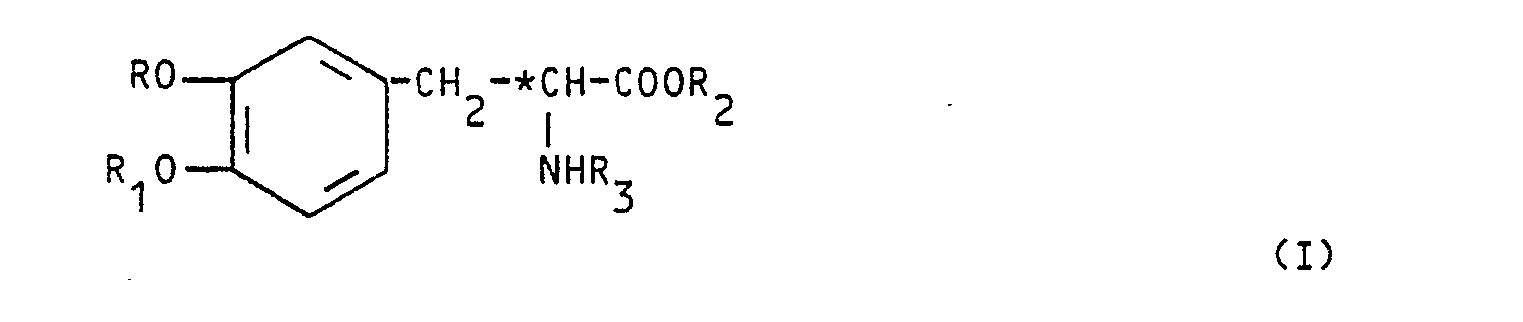
- It is an object of this invention to provide a monophosphorylated L-dopa ester of formula

the asymmetric carbon atom marked with an asterisk has S configuration, and either R or R₁ is hydrogen and the other one is a group of formula
R₄ is hydrogen, phenyl, alkylphenyl or a C₁-C₆ alkyl optionally substituted by one to three groups selected from hydroxy, alkoxy, acyloxy, amino, carboxy or alkoxycarbonyl;
R₂ is a straight or branched C₁-C₄ alkyl, a C₃-C₆ cycloalkyl or a phenylalkyl having from 1 to 4 C atoms in the alkyl portion optionally substituted by 1 to 3 substituents selected from halogens, C₁-C₃ alkoxy and C₁-C₃ alkyl;
R₃ is hydrogen or an acyl group of a natural alpha-aminoacid selected from glycine, alanine, valine, leucine, isoleucine, serine, threonine, cysteine, cystine, methionine, proline, hydroxyproline, phenylalanine, tyrosine, tryptophan, arginine, lysine, and histidine, optionally N-acylated by a C₁-C₄ acyl, or an acyl group of a natural aminoacid ester of formula
n is 1 or 2;
R₅ is a C₁-C₃ alkyl,
R₆ is hydrogen or a C₁-C₄ acyl;
and the salts thereof with pharmaceutically acceptable acids or bases. - As used herein, the term "natural aminoacid" means those aminoacids wherein the possible asymmetric carbon atom has S configuration.
- Examples of suitable pharmaceutically acceptable acids are hydrochloric, hydrobromic, phosphoric, sulfuric, lactic, succinic, tartaric, acetic, salicylic, citric, benzoic, p-hydroxybenzoic, naphthalen-2-sulfonic, adipic and pimelic acid.
- Examples of suitable pharmaceutically acceptable bases are sodium, potassium, calcium, magnesium and ammonium hydroxide, ethanolamine and tromethanol.
- The compounds of this invention are useful in the treatment of renal failure, Parkinson's disease, heart failure and hypertension and may be administered orally.
- Preferred meanings of R₄ according to this invention are hydrogen, methyl, ethyl, isopropyl, phenyl and benzyl.
- Preferred meanings of R₂ are methyl, ethyl, isopropyl, butyl, isobutyl, cyclopentyl, cyclohexyl, 2-phenylethyl and 3-(4-methoxy-phenyl)-ethyl.
- Preferred meanings of R₃ are hydrogen or an acyl group of a natural alpha-aminoacid selected from glycine, alanine, leucine and methionine, or an acyl group of an ester of a natural acidic aminoacid of formula
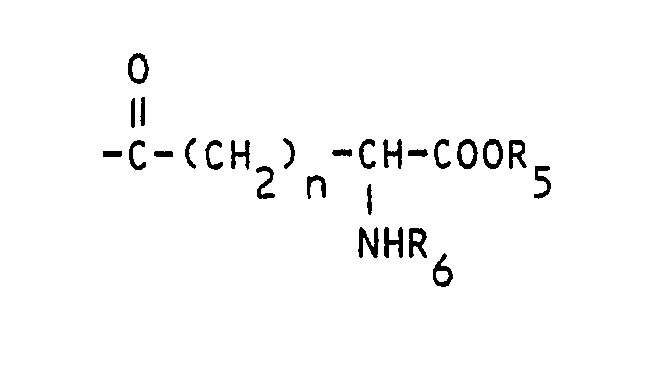
n is 2 and
R₆ is hydrogen. - Whenever not differently stated, acyl means the an acyl group of an aliphatic carboxylic acid having from 1 to 5 carbon atoms or benzoyl.
- Another object of this invention is to provide a process for the preparation of a compound of formula I and the salts thereof, comprising
- (i) phosphorylating an L-dopa ester of formula IIa optionally protected at one hydroxy phenol group and, when R₃ is hydrogen, at the amino group

with a suitable phosphorylating agent, - (ii) removing the protective groups, if any, to yield a monophosphorylated L-dopa ester of formula

- (iii) optionally reacting a monophosphorylated L-dopa ester of formula I wherein R₃ is hydrogen with an optionally protected and N-acylated natural alpha-aminoacid or with a natural acidic aminoacid of formula

- (iii) removing the protective groups, if any, to yield a compound of formula I, and
- (iv) if desired, adding a pharmaceutically acceptable acid or base to a compound of formula I to yield the corresponding pharmaceutically acceptable salt.
- Step (i) is preferably carried out in a suitable solvent at a temperature of from -80°C to +100°C. Typical examples of suitable solvents are the phosphorylating agent itself and the inert organic solvents such as hydrocarbons, halocarbons, ethers, esters, amides, tertiary and heterocyclic amines.
- When phosphorylation releases acidic compounds, step (i) is preferably carried out in the presence of suitable acid acceptors such as alkali and earth-alkaline carbonates or bicarbonates or tertiary and heterocyclic amines, such as triethylamine and pyridine, which may also act as the solvent.
- Alternatively, in order to neutralize the acidic compounds released during the phosphorylation step, the phenol hydroxy group to be phosphorylated can be salified in advance with a base such as sodium hydride, sodium methylate or potassium t.butylate.
- Depending on the phosphorylating agent and method which is used, phosphorylation yield compounds wherein R₄ is hydrogen (hereinafter called phosphoric monoesters) or wherein R₄ is different from H (hereinafter called phosphoric diesters).
- In the preparation of phosphoric monoesters, preferred phosphorylating agents are orthophosphoric, pyrophosphoric and polyphosphoric acids, phosphorus pentoxide, chlorophosphoric acids, phosphoryl chloride and bromide, from which phosphoric monoesters are obtained directly or after an optional hydrolysis with water at the end of the phosphorylation reaction; other suitable phosphorylating agents having protective groups to be removed at the end of the phosphorylation reaction are dibenzyl- or diphenyl-phosphochloridate and 2-chloro-2-oxo-1,3,2-benzodioxaphosphate, the protective groups being removable by hydrogenolysis and oxidation, respectively, or 4,5-dimethyl-2-(1-imidazolyl)-2-oxo-1,3,2-dioxaphosphate; 2-cyanoethylphosphate and dibenzylphosphate require the addition of a suitable condensing agent such as N,N-dicyclohexylcarbodiimide.
- Phosphoric diesters can be prepared both by direct phosphorylation or by alkylation of the corresponding monoesters.
- In case of direct phosphorylation, preferred phosphorylating agents are the phosphodichloridates of formula


- In the case of the alkylation, a phosphoric monoester is reacted with an alcohol of formula
R₄OH - Alternatively, a phosphoric diester, preferably in the form of an alkali or silver salt, carrying benzyl as a protective group, can be alkylated with an alkylating agent of formula
R₄X
wherein
X is a halogen atom, an alkylsulphonyloxy or an arylsulphonyloxy group; and then removing by hydrogenolysis the benzyl protective group. - Before step (i), protection of the compound IIa is preferably performed at the amino group, when R₃ is hydrogen, and also at one of the two phenol hydroxy groups. The latter protection has the aim to direct phosphorylation on the free hydroxy group only, so avoiding formation of isomer mixtures.
- In a similar way, the amino group (NH₂) of the natural alpha-aminoacid or of compound III and IV is also preferably protected before performing step (iii) or when preparing compound IIa.
- The artisan will recognize that all the protection and deprotection steps optionally performed in the process of this invention can be carried out according to conventional techniques of the peptide chemistry.
- The artisan will also recognized that compound IIa can easily be prepared with the conventional techniques of step (iii).
- The process of this invention is substantially similar to that of EP-B₁-0 167 204 which is therefore incorporated herein by reference.
- When step (i) is carried out without protecting one of the two hydroxy phenol groups of compound IIa, a mixture mainly consisting of the two monophosphorylated products, 3- and 4-monophosphate, is obtained.
- The two regioisomers may be separated by chromatography or crystallization.
- The compounds of the present invention are orally adsorbed and generate metabolically dopamine thus producing useful pharmacological effects via stimulation of dopaminergic receptors.
- Namely, the compounds of the present invention proved to have a vasodilating effect onto the renal district in anesthetized dog at a dose of 0.1-50 mg/kg i.p.
- Mongrels of both sexes anesthetized with sodium pentobarbital (35 mg/kg e.v.) were used.
- Artificial respiration was accomplished by means of a endotracheal tube with a Starling Ideal pump at a ventilation frequency of 16-18 cycles/minute, a flow rate of 16-17 ml/kg in order to obtain pO₂, pCO₂, and pH values of arterial blood of 85-100 mmHg, 30-40 mmHg and 7.35-7.45, respectively (Radiometer Copenhagen BMS 3 MK 2 Blood Microsystem Blood Gas Analyzer). Duodenum was insulated by abdomen incision and a polyethylene catheter was inserted for administering the drug. Left renal artery was isolated retroperitoneally, an electromagnetic transducer and a pneumatic obturator were positioned around the vessel to measure mechanical zero and blood flow, respectively.
- Emodynamic parameters were recorded on a Gould Brush MK 200 Graph Recorder while the pressure catheters were connected to a Bell and Howell Pressure Transducers and the electromagnetic flow transducer was connected to a Biotronex BL 613 Flowmeter.
- Moreover, the compounds of formula I proved to have an antagonist action on the motility depression induced by reserpine (4 mg/kg ip) in mouse pretreated 16 hours before with iproniazide (150 mg/kg os) at a dose of 50-600 mg/kg i.p. (Wintroub B.V. et al, Am. J. Physiol. 217, 1716, 1969).
- The compounds of this invention are useful in the therapy of Parkinson's disease and of cardiovascular diseases such as heart failure, hypertension and renal failure.
- Another object of the present invention is therefore to provide pharmaceutical compositions containing one or more compounds of formula I or their pharmaceutically acceptable salts optionally together with one or more excipients suitable for pharmaceutical use.
- The compositions of the present invention may be solid, such as tablets, granules, pills, capsules, or liquid, such as solutions, syrups, emulsions and are prepared according to conventional methods.
- They may be administered both enterally and parenterally. The preferred administration way is the oral route.
- The doses may vary depending on the selected pharmaceutical form and the individual response of the patient but usually are in the range of from 100 mg to 5 g per day.
- The following examples are provided in order to better illustrate the present invention without, however, limiting it.
- A solution of N-benzyloxycarbonyl-L-dopa ethyl ester (135 g; 0.375 moles), benzyl chloride (94.94 g; 0.75 moles) and sodium bicarbonate (94.5 g; 1.125 moles) in absolute ethyl alcohol (1.35 l) is refluxed for 8 hours.
- The salts are filtered off and the reaction mixture is kept at 5°C overnight.
- A solid separates, namely N-benzyloxycarbonyl-3,4-O-dibenzyl-L-dopa ethyl ester which is filtered.
- The solution is evaporated to dryness and the two isomers 3-O-benzylether and 4-O-benzylether are separated by chromatography on silica gel column (eluent, CH₂Cl₂; CH₃CN = 86:4).
- From the fractions containing the less polar product, N-benzyloxycarbonyl-3-O-benzyl-L-dopa ethyl ester is obtained, m.p. 74-75°C (isopropyl ether).
¹H-NMR (300 MHz, CDCl₃) delta (ppm); 1.23 (3H, t); 2.97-3.10 (2H, m); 4.07-4.12 (2H, m); 4.57-4.62 (1H, m); 5.02 (2H, s); 5.11 (2H, d); 6.62 (1H, dd); 6.71 (1H, d); 6.85 (1H, d); 7.29-7.42 (10H, m). - From fractions containing the more polar product, N-benzyloxycarbonyl-4-O-benzyl-L-dopa ethyl ester is obtained as chromatographically pure oil (thin layer chromatography, eluent, CH₂Cl₂: CH₃CN = 96:4, I₂ vapours detection).
¹H-NMR (300 MHz, CDCl₃) delta (ppm): 1.26 (3H, t); 3.03 (2H, d); 4.18 (2H, q); 4.55-4.62 (1H, m); 5.09 (4H, d); 6.57 (1H, dd); 6.7 (1H, d); 6.82 (1H, d); 7.28-7.42 (10H, m). -
- NaOH 10N (8.9 ml; 89 mmoles) is added to a solution of 3-O-benzyl-N-benzyloxycarbonyl-L-dopa ethyl ester (20 g; 44.5 mmoles), prepared as described in example 1, in absolute ethyl alcohol (200 ml) at a temperature of 5-10°C.
- The reaction mixture is diluted with water (20 ml) and is kept under stirring at room temperature for 9 hours.
- Concentrate HCl is added and the sodium chloride which separates is removed by filtration; the solution is then concentrated under reduced pressure, diluted with ethyl acetate and washed with water. After drying on sodium sulfate, the solvent is evaporated and the oily residue crystallized from a mixture of isopropyl ether and petroleum ether. m.p. 85 - 88°C
Mass spectrum (chemical ionization, positive ions, ionization gas : ammonia) m/e 439 (M⁺ + 1 + NH₃ adduct). - A solution of 20% tetramethylammonium hydroxyde (5.95 g; 13.1 mmoles) in methyl alcohol is added to a solution of 3-O-benzyl-N-benzyloxycarbonyl-L-dopa (5 g; 11.9 mmoles) in methyl alcohol (50 ml). The solvent is removed under reduced pressure; the residue is dissolved in dimethylformamide (50 ml) and n.butyl iodide (4.6 g ; 25 mmoles) is added. After three hours at room temperature under stirring, the solution is washed with water and extracted with ethyl ether. The organic layer is separated, washed with water, dried on sodium sulfate and evaporated to dryness. The residue is purified by chromatography on silica gel column (eluent, CH₂Cl₂). The title compound is thus obtained as a chromotographically pure oil (thin layer chromatography - eluent, CH₂Cl₂: CH₃CN = 95:5, I₂ vapours detection).
Mass spectrum (chemical ionization, negative ions, ionization gas : ammonia) m/e 476 (M⁺ - 1), 386 (M⁺ -C₇H₇). - Working in a similar manner the following product has been prepared:
3-O-benzyl-N-benzyloxycarbonyl-L-dopa 2-phenylethyl ester
chromotographically pure oil (thin layer chromatography - eluent, CH₂Cl₂: CH₃CN = 95:5, I₂ vapours detection).
Mass spectrum (chemical ionization, positive ions, ionization gas : isobutane) m/e 526 (M⁺ + 1).
3-O-benzyl-N-benzyloxycarbonyl-L-dopa isopropyl ester
chromotographically pure oil (thin layer chromatography - eluent, CH₂Cl₂: CH₃CN = 95:5, I₂ vapours detection).
Mass spectrum (chemical ionization, positive ions, ionization gas : isobutane) m/e 464 (M⁺ + 1). - Thionyl chloride (5,07 g; 42,6 mmoles) is addaed to a solution of 3-O-benzyl-N-benzyloxycarbonyl-L-dopa (6 g; 14,2 mmoles) in cyclohexyl alcohol (60 ml) at 0-5° C. After 30 hours at room temperature, the reaction mixture is evaporated to dryness and washed as described for the preparation of 3-O-benzyl-N-benzyloxycarbonyl-L-dopa n.butyl ester. The product is obtained as a chromotographically pure oil (thin layer chromatography - eluent, CH₂Cl₂: CH₃CN = 96:4, I₂ vapours detection).
Mass spectrum (chemical ionization, positive ions, ionization gas : isobutane) m/e 504 (M⁺ + 1). -
- A suspension of 60% NaH in mineral oil (1.8 g; 45 mmoles) is added at 0-5°C to a solution of N-benzyloxycarbonyl-3-O-benzyl-L-dopa ethyl ester (18.5 g; 41 mmoles), prepared as described in example 1, in dimethylformamide (185 ml).
- After one hour at this temperature, a solution of dibenzylphosphochloridate (14.53; 49 mmoles) in toluene (145 ml) is added dropwise.
- After further 30 minutes, acetic acid is added (2 ml); the reaction mixture is diluted with water, toluene is separated and the aqueous phase is extracted with ethyl ether.
- The combined organic phases are washed with water and dried on Na₂SO₄.
- After solvent evaporation, the residue is purified by chromatography on silica gel column (eluting with CH₂Cl₂ with increasing quantities of ethyl acetate up to 10%).
- N-benzyloxycarbonyl-3-benzyloxy-4-dibenzylphosphonyloxy-L-phenylalanine ethyl ester is thus obtained in the form of pure oil (thin layer chromatography; eluent, CH₂Cl₂:ethyl acetate = 9:1, I₂ vapours detection).
¹H-NMR (300 MHz, CDCl₃) delta (ppm): 1.21 (3H, t); 3.0-3.11 (2H, m); 4.05-4.18 (2H, m); 4.58-4.66 (1H, m); 4.95-5.11 (8H, m); 6.64 (1H, dd); 6.77 (1H, d); 7.12 (1H, dd); 7.18-7.39 (21H, m). - Working in a similar manner the following compounds have been obtained:
N-benzyloxycarbonyl-4-benzyloxy-3-dibenzylphosphonyloxy-L-phenylalanine ethyl ester as a chromatographically pure oil (thin layer chromotography - eluent, CH₂Cl₂:ethyl acetate = 9:1, I₂ vapours detection).
¹H-NMR (300 MHz, CDCl₃) delta (ppm): 1.22 (3H, t); 2.92-3.08 (2H, m); 4.15 (2H, q); 4.55 (1H, m); 5.01-5.11 (8H, m); 6.86 (2H, s); 7.88 (1H, s); 7.18-7.42 (21H, m).
N-benzyloxycarbonyl-3-benzyloxy-4-ethylphosphonyloxy-L-phenylalanine ethyl ester as a chromotographically pure oil (thin layer chromatography - eluent, CH₂Cl₂:methanol:water:acetic acid = 49:15:1:1, I₂ vapours detection).
¹H-NMR (300 Mhz, DMSO-d₆) delta (ppm): 0.99 (3H, t); 1.11 (3H, t); 2.72-2.96 (2H, m); 3.78 (2H, m); 3.78 (2H, quintet); 4.05 (2H, q); 4.14-4.22 (1H, m); 4.97-5.02 (2H, m); 6.68 (1H, dd); 6.95 (1H, d); 7.26-7.43 (11H, m).
N-benzyloxycarbonyl-3-benzyloxy-4-dibenzylphosphonyloxy-L-phenylalanine n.butyl ester as a chromatographically pure oil (thin layer chromotography - eluent, petroleum ether: ethyl acetate = 65:35, I₂ vapours detection).
¹H-NMR (300 MHz, CDCl₃) delta (ppm): 0.92 (3H, t); 1.23-1.38 (2H, m); 1.52-1.62 (2H, m); 3.05 (2H, t); 4.00-4.15 (2H, m); 4.62 (1H, dd); 4.95 (2H, s); 5.02 (2H, s); 5.06 (2H, s); 5.10 (2H, s); 6.64 (1H,dd); 6.76(1H,d); 7.12 (1H, dd); 7.19-7.39 (20H, m).
N-benzyloxycarbonyl-3-benzyloxy-4-dibenzylphosphonyloxy-L-phenylalanine 2-phenylethyl ester as a chromatographically pure oil (thin layer chromotography - eluent, petroleum ether: ethyl acetate = 65:35, I₂ vapours detection).
N-benzyloxycarbonyl-3-benzyloxy-4-dibenzylphosphonyloxy-L-phenylalanine isopropyl ester as a chromatographically pure oil (thin layer chromotography - eluent, petroleum ether: ethyl acetate = 65:35, I₂ vapours detection).
N-benzyloxycarbonyl-3-benzyloxy-4-dibenzylphosphonyloxy-L-phenylalanine cyclohexyl ester as a chromatographically pure oil (thin layer chromotography - eluent, petroleum ether: ethyl acetate = 65:35, I₂ vapours detection). - A suspension of N-benzyloxycarbonyl-3-benzyloxy-4-dibenzylphosphonyloxy-L-phenylalanine ethyl ester (23 g; 32.4 mmoles) prepared as described in example 4, 10% palladium on charcoal (2.3 g) in a mixture of ethanol (250 ml) and water (50 ml) is kept at a pressure of 3-4 hydrogen atmospheres until theoretical absorption.
- The catalyst is filtered off, the solvent is evaporated and the residue is crystallized from a mixture of ethyl alcohol : water = 1:2.
3-hydroxy-4-phosphonyloxy-L-phenylalanine ethyl ester melting at 162-166°C is obtained by filtration.
¹H-NMR (300 MHz, D₂O) delta (ppm): 1.27 (3H, t); 3.09-3.31 (2H, m); 3.59-3.68 (1H, m); 4.30 (2H, q); 6.78 (1H, dd); 6.85 (1H, d); 7.22 (1H, d). - Working in a similar manner the following compounds were obtained:
4-hydroxy-3-phosphonyloxy-L-phenylalanine ethyl ester
m.p. 197-200°C
¹H-NMR (300 MHz, D₂O) delta (ppm): 1,27 (3H, t); 3.08-3.32 (2H, m); 4.28 (2H, q); 4.36 (1H, m); 6.90-6.96 (2H, m), 7.16 (1H, s).
L-dopa 4-O-ethylphosphate ethyl ester
having a m.p. higher than 203°C (dec.)
¹H-NMR (300 MHz, D₂O) delta (ppm): 1.22-1.29 (6H, m); 3.10-3.28 (2H, m); 4.04 (2H, quintet); 4.24-4.35 (3H, m); 6.78 (1H, dd); 6.85 (1H, d); 7.22 (1H, dd).
3-hydroxy-4-phosphonyloxy-L-phenylalanine n.butyl ester
m.p. 184-186°C (from water/ethyl alcohol)
¹H-NMR (300 MHz, DMSO-d₆) delta (ppm) 0.88 (3H, t); 1.29 (2H, sextet); 1.52 (2H, quintet); 2.92 (2H, d); 4.10 (2H, t); 4.19 (1H, t); 6.47 (1H, dd); 6.49 (1H, d); 6.75 (1H, dd). 3-hydroxy-4-phosphonyloxy-L-phenylalanine 2-phenylethyl ester
m.p. 184-190°C (from water/ethyl alcohol)
¹H-NMR (300 MHz, DMSO-d₆) delta (ppm) 2.71-2.82 (2H, m); 2.86 (2H, t); 3.86 (1H, t); 4.18-4.31 (2H, m); 6.34 (1H, dd); 6.52 (1H, d); 6.74 (1H, d); 7.12-7.31 (5H, m). 3-hydroxy-4-phosphonyloxy-L-phenylalanine isopropyl ester
m.p. 165-175°C (from water/ethyl alcohol)
¹H-NMR (300 MHz, D₂O) delta (ppm) 1.28 (6H, d); 3.08-3.31 (2H, m); 4.31 (1H, t); 5.11 (1H, quintet); 6.75 (1H, dd); 6.81 (1H, d); 7.15 (1H, d).
3-hydroxy-4-phosphonyloxy-L-phenylalanine cyclohexyl ester
m.p. 198-200°C (from water/ethyl alcohol)
¹H-NMR (300 MHz, DMSO-d₆) delta (ppm) 1.20-1.78 (m, 10H); 2.82-2.97 (2H, m); 4.15 (1H, t); 4.68-4.76 (1H, m); 6.45 (1H, dd); 6.55 (1H, d); 6.75 (1H, d). - To a solution of 3-hydroxy-4-phosphonyloxy-L-phenylalanine ethyl ester (4 g; 13.1 mmoles), prepared as described in example 5, and NaHCO₃ (1.1 g; 13.1 mmoles) in water (80 ml), a solution of N-benzyloxycarbonyl-L-glutamic-alfa-ethyl ester gamma-N-hydroxysuccinimide ester acid (6.39 g; 15.7 moles) in ethanol (80 ml).
- After 2 hours, the solution is concentrated to small volume and a saturated solution of NaCl is added to the residue; the product which solidifies is filtered, washed with a saturated solution of NaCl, with ethyl ether, suspended under stirring in acetone. The salt is discharged by filtration, the solution is evaporated to dryness; ethyl ether is added to the residue and the mixture is filtered. N-(N-benzyloxycarbonyl-gamma-L-glutamyl-alfa ethyl ester)-3-hydroxy-4-phosphonyloxy-L-phenylalanine ethyl ester sodium salt is thus obtained and used in next step as it is.
¹H-NMR (300 MHz, DMSO-D₆) delta (ppm); 1.12 (3H, t); 1.18 (3H, t); 1.68-1.96 (2H, m); 2.19 (2H, t); 2.70-2.87 (2H, m); 3.98-4.12 (3H, m); 4.28-4.35 (1H, m); 5.05 (2H, m), 6.46 (1H, dd); 6.55 (1H, d); 6.69 (1H, d). - Working in a similar manner the following compounds were obtained:
N-(N-benzyloxycarbonyl-gamma-L-glutamyl-alfa ethyl ester)-3-hydroxy-4-ethylphosphonyloxy-L-phenylalanine ethyl ester ammonium salt as a chromatographically pure oil (thin layer chromatography - eluent, n.butanol:acetic acid:water:toluene: acetone = 1:1:1:1:1, U.V. light, I₂ vapours detection).
¹H-NMR (300 MHz, DMSO-d₆) delta (ppm): 1.02-1.18 (9H, m); 1.68-1.96 (1H, m); 2.19 (2H, t); 2.71-2.88 (2H, m); 3.45 (1H, m); 3.76 (2H, quintet); 3.96-4.11 (6H, m); 4.28-4.35 (1H, m); 5.02 (2H, d); 6.48 (1H, dd); 6.56 (1H, d); 6.66 (1H, dd).
N-(N-benzyloxycarbonylglycyl)-3-hydroxy-4-phosphonyloxy-L-phenylalanine ethyl ester ammonium salt as a chromatographically pure oil (thin layer chromatography - eluent, n.butanol:acetic acid:water:toluene:acetone = 1:1:1:1:1, U.V. light, I₂ vapours detection).
N-(N-benzyloxycarbonylglycyl)-4-hydroxy-3-phosphonyloxy-L-phenylalanine ethyl ester ammonium salt as a chromatographically pure oil (thin layer chromatography - eluent, n.butanol:acetic acid:water:toluene:acetone = 1:1:1:1:1, U.V. light, I2 vapours detection).
N-(N-benzyloxycarbonyl-L-alanyl)-3-hydroxy-4-phosphonyloxy-L-phenylalanine ethyl ester ammonium salt as a chromatographically pure oil (thin layer chromatography - eluent, n.butanol : acetic acid:water:toluene:acetone = 1:1:1:1:1, U.V. light, I₂ vapours detection).
¹H-NMR (300 MHz, D₂O) delta (ppm): 1.05-1.08 (3H, m); 1.26 (3H, s); 2.80-3.10 (2H, m); 3.65 (1H, q); 4.06-4.18 (2H, m); 5.12 (2H, s); 6.62-6.74 (2H, m); 7.08 (1H, d); 7.28-7.40 (5H, m).
N-(N-benzyloxycarbonyl-L-leucyl)-3-hydroxy-4-phosphonyloxy-L-phenylalanine ethyl ester ammonium salt as a chromatographically pure oil (thin layer chromatography - eluent, n.butanol: acetic acid:water:toluene:acetone = 1:1:1:1:1, U.V. light, I₂ vapours detection). - A suspension of N-(N-benzyloxycarbonyl-gamma-L-glutamyl-alfa-ethyl ester)-3-hydroxy-4-phosphonyloxy-L-phenylalanine ethyl ester sodium salt (7.3 g; 11.8 mmoles), prepared as disclosed in example 6, and 10% Pd on charcoal (1.4 g) in 80% ethanol (200 ml) is kept at a pressure of 3-4 hydrogen atmospheres until theoretical absorption.
- The catalyst is filtered off, the solvent is evaporated and the residue is suspended in acetone, filtered and recrystallized from 95% ethanol obtaining N-(gamma-L-glutamyl- alfa-ethyl ester)-3-hydroxy-4-phosphonyloxy-L-phenylalanine ethyl ester sodium salt melting at 139-143°C.
¹H-NMR (300 MHz, DMSO-d₆) delta (ppm): 1.26 (3H, t); 1.28 (3H, t); 1.88-2.08 (2H, m); 2.3-2.48 (2H, m); 2.82-2.91 (1H, m); 3.18-3.25 (1H, m); 3.8 (1H, t); 4.18-4.31 (2H, m); 4.68-4.73 (1H, m); 6.71-6.76 (2H, m); 7.07 (1H, d).
- Working in a similar manner the following compounds were obtained:
N-(gamma-L-glutamyl-alfa-ethyl ester)-3-hydroxy-4-ethylphosphonyloxy-L-phenylalanine ethyl ester sodium salt,
m.p. 90°C (slow decomposition).
¹H-NMR (300 MHz, D₂O) delta (ppm): 1.20-1.28 (9H, m); 1.85-2.07 (2H, m); 2.38 (2H, t); 2.88-2.96 (1H, m); 3.12-3.20 (1H, m); 3.64 (1H, t); 4.02 (2H, quintet); 4.21 (4H, quintet); 4.63-4.68 (1H, m); 6.78 (1H, dd); 6.83 (1H, d); 7.18 (1H, dd).
N-(N-acetyl-L-methionyl)-3-hydroxy-4-phosphonyloxy-L-phenylalanine ethyl
m.p. 115-120°C
¹H-NMR (300 MHz, D₂O) delta (ppm); 1.22 (3H, t); 1.74-1.98 (2H, m); 1.99 (3H, s); 2.06 (3H, s); 2.32-2.54 (2H, m); 2.9-3.0 (1H, m); 3.12-3.25 (1H, m); 4.18 (2H, q); 4.19-4.38 (1H, m); 4.62-4.68 (1H, m); 6.73 (1H, dd); 6.82 (1H, d); 7.18 (1H, d).
N-glycyl-3-hydroxy-4-phosphonyloxy-L-phenylalanine ethyl ester
m.p. 224-227°C
¹H-NMR (300 MHz, D₂O) delta (ppm): 1.29 (3H, t); 2.91-2.94 (1H, m); 3.18-3.23 (1H, m); 3.73 (2H, s); 4.24 (2H, q); 4.68-4.80 (1H, m); 6.73-6.79 (2H, m); 7.08 (1H, d).
N-glycyl-4-hydroxy-3-phosphonyloxy-L-phenylalanine ethyl ester
m.p. 210-213°C
¹H-NMR (300 MHz, D₂O) delta (ppm). 1.24 (3H, t); 2.92-2.99 (1H, dd); 3.15-3.22 (1H, dd); 3.80 (2H, s); 4.22 (2H, d); 4.82 (1H, m); 6.92 (2H, bs); 7.10 (1H, s).
N-(L-alanyl)-3-hydroxy-4-phosphonyloxy-L-phenylalanine ethyl ester
m.p. 199-203°C
¹H-NMR (300 MHz, D₂O) delta (ppm): 1.23 (3H, t); 1.49 (3H, t); 2.96-3.04 (1H, dd); 3.16-3.22 (1H, dd); 4.02 (1H, q); 4.21 (1H, q); 4.69 (1H, m); 6.78 (1H, dd); 6.85 (1H, d); 7.19 (1H, d).
N-leucyl-3-hydroxy-4-phosphonyloxy-L-phenylalanine ethyl ester
m.p. 217-219°C.
¹H-NMR (300 MHz, D₂O) delta (ppm): 0.94 (3H,t); 1.26 (3H, t); 1.56 (2H, d); 2.91-2.98 (1H, dd); 3.17-3.25 (1H, dd); 3.87 (1H, t); 4.22 (2H, q); 4.75 (1H, m); 6.75 (1H, d); 6.78 (1H, d); 7.08 (1H, d).
Claims (9)
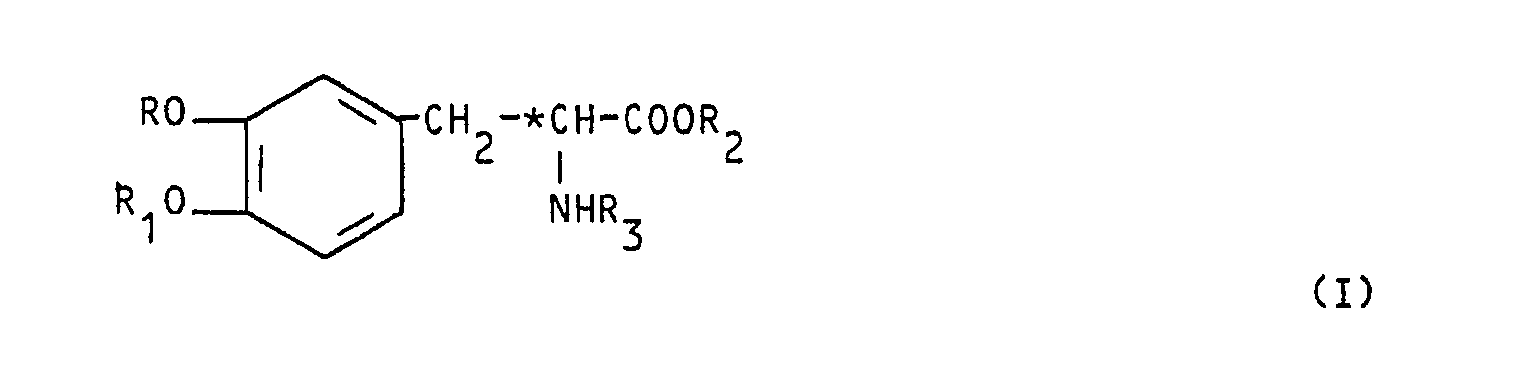
the asymmetric carbon atom marked with an asterisk has S configuration, and either R or R₁ is hydrogen and the other one is a group of formula
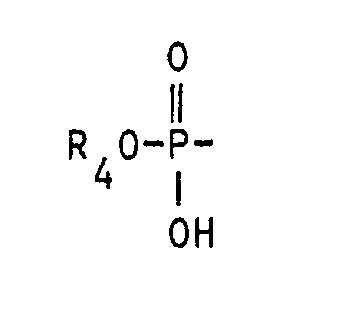
R₄ is hydrogen, phenyl, alkylphenyl or a C₁-C₆ alkyl optionally substituted by one to three groups selected from hydroxy, alkoxy, acyloxy, amino, carboxy or alkoxycarbonyl;
R₂ is a straight or branched C₁-C₄ alkyl, a C₃-C₆ cycloalkyl or a phenylalkyl having from 1 to 4 C atoms in the alkyl portion optionally substituted by 1 to 3 substituents selected from halogens, C₁-C₃ alkoxy and C₁-C₃ alkyl;
R₃ is hydrogen or an acyl group of a natural alpha-aminoacid selected from glycine, alanine, valine, leucine, isoleucine, serine, threonine, cysteine, cystine, methionine, proline, hydroxyproline, phenylalanine, tyrosine, tryptophan, arginine, lysine, and histidine, optionally N-acylated by a C₁-C₄ acyl, or an acyl group of a natural aminoacid ester of formula

n is 1 or 2;
R₅ is a C₁-C₃ alkyl;
R₆ is hydrogen or a C₁-C₄ acyl;
and salts thereof with pharmaceutically acceptable acids or bases.

n=2 and
R₆ is hydrogen.

the asymmetric carbon atom marked with an asterisk has S configuration, and either R or R₁ is hydrogen and the other one is a group of formula

R₄ is hydrogen, phenyl, alkylphenyl or a C₁-C₆ alkyl optionally substituted by one to three groups selected from hydroxy, alkoxy, acyloxy, amino, carboxy or alkoxycarbonyl;
R₂ is a straight or branched C₁-C₄ alkyl, a C₃-C₆ cycloalkyl or a phenylalkyl having from 1 to 4 C atoms in the alkyl portion optionally substituted by 1 to 3 substituents selected from halogens, C₁-C₃ alkoxy and C₁-C₃ alkyl;
R₃ is hydrogen or an acyl group of a natural alpha-aminoacid selected from glycine, alanine, valine, leucine, isoleucine, serine, threonine, cysteine, cystine, methionine, proline, hydroxyproline, phenylalanine, tyrosine, tryptophan, arginine, lysine, and histidine, optionally N-acylated by a C₁-C₄ acyl, or an acyl group of a natural aminoacid ester of formula


n is 1 or 2;
R₅ is a C₁-C₃ alkyl;
R₆ is hydrogen or a C₁-C₄ acyl;
or a salt thereof with pharmaceutically acceptable acids or bases, optionally together with one or more excipients suitable for pharmaceutical use.

n=2 and
R₆ is hydrogen.

the asymmetric carbon atom marked with an asterisk has S configuration, and either R or R₁ is hydrogen and the other one is a group of formula

R₄ is hydrogen, phenyl, alkylphenyl or a C₁-C₆ alkyl optionally substituted by one to three groups selected from hydroxy, alkoxy, acyloxy, amino, carboxy or alkoxycarbonyl;
R₂ is a straight or branched C₁-C₄ alkyl, a C₃-C₆ cycloalkyl or a phenylalkyl having from 1 to 4 C atoms in the alkyl portion optionally substituted by 1 to 3 substituents selected from halogens, C₁-C₃ alkoxy and C₁-C₃ alkyl;
R₃ is hydrogen or an acyl group of a natural alpha-aminoacid selected from glycine, alanine, valine, leucine, isoleucine, serine, threonine, cysteine, cystine, methionine, proline, hydroxyproline, phenylalanine, tyrosine, tryptophan, arginine, lysine, and histidine, optionally N-acylated by a C₁-C₄ acyl, or an acyl group of a natural aminoacid ester of formula

R₅ is a C₁-C₃ alkyl;
R₆ is hydrogen or a C₁-C₄ acyl;
and salts thereof with pharmaceutically acceptable acids or bases, comprising

with a suitable phosphorylating agent,


Applications Claiming Priority (4)
| Application Number | Priority Date | Filing Date | Title |
|---|---|---|---|
| IT2021089 | 1989-04-20 | ||
| IT8920210A IT1229854B (en) | 1989-04-20 | 1989-04-20 | Mono:phosphorylated l-dopa ester(s) with high bio:availability |
| IT2020989 | 1989-04-20 | ||
| IT8920209A IT1229853B (en) | 1989-04-20 | 1989-04-20 | Mono:phosphorylated l-dopa ester(s) with high bio:availability |
Publications (3)
| Publication Number | Publication Date |
|---|---|
| EP0393781A2 true EP0393781A2 (en) | 1990-10-24 |
| EP0393781A3 EP0393781A3 (en) | 1991-01-09 |
| EP0393781B1 EP0393781B1 (en) | 1995-02-08 |
Family
ID=26327445
Family Applications (1)
| Application Number | Title | Priority Date | Filing Date |
|---|---|---|---|
| EP90200937A Expired - Lifetime EP0393781B1 (en) | 1989-04-20 | 1990-04-17 | Dopamine pro-drug |
Country Status (6)
| Country | Link |
|---|---|
| US (1) | US5073547A (en) |
| EP (1) | EP0393781B1 (en) |
| JP (1) | JPH02292290A (en) |
| AT (1) | ATE118216T1 (en) |
| DE (1) | DE69016688T2 (en) |
| ES (1) | ES2070994T3 (en) |
Cited By (11)
| Publication number | Priority date | Publication date | Assignee | Title |
|---|---|---|---|---|
| WO1995026337A1 (en) * | 1994-03-25 | 1995-10-05 | Vertex Pharmaceuticals Incorporated | Novel carbamates and ureas as modifiers of multi-drug resistance |
| EP0849263A3 (en) * | 1996-12-17 | 1999-02-03 | Eli Lilly And Company Limited | Pharmaceutical substituted propanoic acid derivatives |
| EP1044017A4 (en) * | 1998-01-05 | 2005-01-05 | Univ Johns Hopkins | Supplement for dialysis patients |
| WO2016065019A1 (en) * | 2014-10-21 | 2016-04-28 | Abbvie Inc. | Carbidopa and l-dopa prodrugs and their use to treat parkinson's disease |
| WO2017184871A1 (en) * | 2016-04-20 | 2017-10-26 | Abbvie Inc. | Carbidopa and l-dopa prodrugs and methods of use |
| US10117843B2 (en) | 2015-01-20 | 2018-11-06 | Abbvie Inc. | Levodopa and carbidopa intestinal gel and methods of use |
| WO2022190100A1 (en) * | 2021-03-10 | 2022-09-15 | Neuroderm, Ltd. | Stabilized liquid compositions comprising a levodopa-tyrosine conjugate and uses thereof |
| US11844754B2 (en) | 2020-11-17 | 2023-12-19 | Neuroderm, Ltd. | Methods for treatment of Parkinson's disease |
| US12161612B2 (en) | 2023-04-14 | 2024-12-10 | Neuroderm, Ltd. | Methods and compositions for reducing symptoms of Parkinson's disease |
| US12251365B2 (en) | 2018-11-15 | 2025-03-18 | Abbvie Inc. | Pharmaceutical formulations for subcutaneous administration |
| US12533417B2 (en) | 2018-12-05 | 2026-01-27 | B. G. Negev Technologies And Applications Ltd., At Ben-Gurion University | L-DOPA and/or DOPA decarboxylse inhibitors conjugated to sugar for the treatment of dopamine-responsive disorders |
Families Citing this family (20)
| Publication number | Priority date | Publication date | Assignee | Title |
|---|---|---|---|---|
| DE19630826A1 (en) * | 1996-07-31 | 1998-02-05 | Duro Galvanit Chemie | Treating contaminated water e.g. in swimming pools |
| EP1596808A4 (en) * | 2003-02-07 | 2007-04-04 | Yissum Res Dev Co | L-dopa amide derivatives and uses thereof |
| UA88792C2 (en) * | 2004-11-10 | 2009-11-25 | Таргасепт, Інк. | Hydroxybenzoate salts of metanicotine compounds |
| US7459469B2 (en) | 2004-11-10 | 2008-12-02 | Targacept, Inc. | Hydroxybenzoate salts of metanicotine compounds |
| US7226188B2 (en) * | 2004-11-19 | 2007-06-05 | Whiterock Design, Llc | Stage lighting methods and apparatus |
| EP2021325A2 (en) * | 2006-05-09 | 2009-02-11 | AstraZeneca AB | Salt forms of (2s)-(4e)-n-methyl-5-[3-(5-isopropoxypyridin)yl]-4-penten-2-amine |
| TWI389889B (en) * | 2006-05-09 | 2013-03-21 | Targacept Inc | Novel polymorph forms of (2s)-(4e)-n-methyl-5-[3-(5-isopropoxypyridin)yl]-4-penten-2-amine |
| WO2008091588A1 (en) * | 2007-01-22 | 2008-07-31 | Targacept, Inc. | Intranasal, buccal, and sublingual administration of metanicotine analogs |
| CN103180277A (en) | 2010-05-20 | 2013-06-26 | 塔格塞普特股份有限公司 | New process for the preparation of aryl substituted olefinic amines |
| CR20200225A (en) | 2017-11-24 | 2020-07-25 | H Lundbeck As | New catecholamine prodrugs for use in the treatment of parkinson's disease |
| WO2019155464A1 (en) | 2018-02-08 | 2019-08-15 | Yissum Research Development Company Of The Hebrew University Of Jerusalem Ltd | Dopamine precursors |
| CN110294789A (en) * | 2018-03-21 | 2019-10-01 | 海南大学 | The synthetic method of the oligopeptides containing DOPA and its application in terms of anti-Parkinson's disease prodrug |
| US11104697B2 (en) | 2019-05-20 | 2021-08-31 | H. Lundbeck A/S | Process for the manufacture of (2S,3S,4S,5R,6S)-3,4,5-trihydroxy-6-(((4AR,10AR)-7-hydroxy-1- propyl-1,2,3,4,4A,5,10,10A-octahydrobenzo[g]quinolin-6-yl)oxy)tetrahydro-2H-pyran-2-carboxylic acid |
| US11168056B2 (en) | 2019-05-20 | 2021-11-09 | H. Lundbeck A/S | Process for the manufacturing of (6aR,10aR)-7-propyl-6,6a,7,8,9,10,10a,11-octahydro-[1,3]dioxolo[4′,5′:5,6]benzo[1,2-G]quinoline and (4aR,10aR)-1-propyl-1,2,3,4,4a,5,10,10a-octahydro-benzo[G]quinoline-6,7-diol |
| US11130775B2 (en) | 2019-05-20 | 2021-09-28 | H. Lundbeck A/S | Solid forms of (2S,3S,4S,5R,6S)-3,4,5-trihydroxy-6-(((4aR,10aR)-7-hydroxy-1-propyl-1,2,3,4,4A,5,10,10A-octahydrobenzo[g]quinolin-6-yl)oxy)tetrahydro-2H-pyran-2-carboxylic acid |
| US11111263B2 (en) | 2019-05-20 | 2021-09-07 | H. Lundbeck A/S | Process for the manufacture of (2S,3S,4S,5R,6S)-3,4,5-trihydroxy-6-(((4aR,10aR)-7-hydroxy-1-propyl-1,2,3,4,4a,5,10,10a-octahydrobenzo[g]quinolin-6-yl)oxy)tetrahydro-2H-pyran-2-carboxylic acid |
| JP7641234B2 (en) | 2019-05-21 | 2025-03-06 | ハー・ルンドベック・アクチエゼルスカベット | Novel catecholamine prodrugs for use in the treatment of Parkinson's disease |
| EP3972971A1 (en) | 2019-05-21 | 2022-03-30 | H. Lundbeck A/S | New catecholamine prodrugs for use in the treatment of parkinson's diseases |
| JP7562562B2 (en) | 2019-05-21 | 2024-10-07 | ハー・ルンドベック・アクチエゼルスカベット | Novel catecholamine prodrugs for use in the treatment of Parkinson's disease |
| EP3972600B1 (en) | 2019-05-21 | 2026-02-18 | H. Lundbeck A/S | Catecholamine carbamate prodrugs for use in the treatment of parkinson s disease |
Family Cites Families (8)
| Publication number | Priority date | Publication date | Assignee | Title |
|---|---|---|---|---|
| US3132171A (en) * | 1962-06-18 | 1964-05-05 | Strong Cobb Arner Inc | 3, 4-diphosphatophenyl-alanine and process for making same |
| US3891696A (en) * | 1973-11-02 | 1975-06-24 | Interx Research Corp | Novel, transient pro-drug forms of l-dopa |
| US4618484A (en) * | 1983-03-30 | 1986-10-21 | Yale University | Composition and method for treatment of melanomas |
| US4508706A (en) * | 1983-03-30 | 1985-04-02 | Yale University | Composition for increasing melanin in mammalian skin and hair |
| US4695449A (en) * | 1983-03-30 | 1987-09-22 | Yale University | Composition and method for treatment of melanomas |
| IT1213182B (en) * | 1984-06-25 | 1989-12-14 | Simes | DERIVATIVES OF COMPOUNDS WITH A CATECOLAMINICAL STRUCTURE. |
| IT1200427B (en) * | 1985-03-22 | 1989-01-18 | Afros Spa | PROCESS AND PLANT FOR THE MOLDING OF PIECES IN EXPANDED PLASTIC MATERIAL, WITH SPRAY PREFORMED PARTS OR INSERTS IN THE SAME FORMING MOLD |
| US4663349A (en) * | 1985-12-30 | 1987-05-05 | Merck & Co., Inc. | Rectally absorbable form of L-dopa |
-
1990
- 1990-04-17 DE DE69016688T patent/DE69016688T2/en not_active Expired - Fee Related
- 1990-04-17 EP EP90200937A patent/EP0393781B1/en not_active Expired - Lifetime
- 1990-04-17 ES ES90200937T patent/ES2070994T3/en not_active Expired - Lifetime
- 1990-04-17 AT AT90200937T patent/ATE118216T1/en not_active IP Right Cessation
- 1990-04-20 JP JP2103274A patent/JPH02292290A/en active Pending
- 1990-04-20 US US07/512,211 patent/US5073547A/en not_active Expired - Lifetime
Cited By (26)
| Publication number | Priority date | Publication date | Assignee | Title |
|---|---|---|---|---|
| WO1995026337A1 (en) * | 1994-03-25 | 1995-10-05 | Vertex Pharmaceuticals Incorporated | Novel carbamates and ureas as modifiers of multi-drug resistance |
| EP0849263A3 (en) * | 1996-12-17 | 1999-02-03 | Eli Lilly And Company Limited | Pharmaceutical substituted propanoic acid derivatives |
| EP1044017A4 (en) * | 1998-01-05 | 2005-01-05 | Univ Johns Hopkins | Supplement for dialysis patients |
| CN111362980B (en) * | 2014-10-21 | 2022-10-18 | 艾伯维公司 | Carbidopa and levodopa prodrugs and their use for treating parkinson's disease |
| TWI718999B (en) * | 2014-10-21 | 2021-02-21 | 美商艾伯維有限公司 | Carbidopa and l-dopa prodrugs and methods of use |
| KR20170071599A (en) * | 2014-10-21 | 2017-06-23 | 애브비 인코포레이티드 | Carbidopa and l-dopa prodrugs and their use to treat parkinson's disease |
| JP2023174770A (en) * | 2014-10-21 | 2023-12-08 | アッヴィ・インコーポレイテッド | Carbidopa and L-dopa prodrugs and methods of their use |
| JP2017537066A (en) * | 2014-10-21 | 2017-12-14 | アッヴィ・インコーポレイテッド | Carbidopa and L-dopa prodrugs and methods for their use |
| AU2021201414B2 (en) * | 2014-10-21 | 2023-05-11 | Abbvie Inc. | Carbidopa and L-dopa prodrugs and their use to treat Parkinson's disease |
| US10174061B2 (en) | 2014-10-21 | 2019-01-08 | Abbvie Inc. | Carbidopa and L-dopa prodrugs and methods of use |
| CN111362980A (en) * | 2014-10-21 | 2020-07-03 | 艾伯维公司 | Carbidopa and levodopa prodrugs and their use in the treatment of Parkinson's disease |
| US10730895B2 (en) | 2014-10-21 | 2020-08-04 | Abbvie Inc. | Carbidopa prodrug |
| JP2020189864A (en) * | 2014-10-21 | 2020-11-26 | アッヴィ・インコーポレイテッド | Carbidopa and l-dopa prodrugs and methods of using the same |
| RU2743347C2 (en) * | 2014-10-21 | 2021-02-17 | Эббви Инк. | Carbidopa and l-dopa prodrugs and use thereof for treating parkinson's disease |
| US9446059B2 (en) | 2014-10-21 | 2016-09-20 | Abbvie Inc. | Carbidopa and L-dopa prodrugs and methods of use |
| AU2015335941B2 (en) * | 2014-10-21 | 2021-04-01 | Abbvie Inc. | Carbidopa and L-dopa prodrugs and their use to treat Parkinson's disease |
| US11091507B2 (en) | 2014-10-21 | 2021-08-17 | Abbvie Inc. | Methods of treating Parkinson's disease |
| WO2016065019A1 (en) * | 2014-10-21 | 2016-04-28 | Abbvie Inc. | Carbidopa and l-dopa prodrugs and their use to treat parkinson's disease |
| US10117843B2 (en) | 2015-01-20 | 2018-11-06 | Abbvie Inc. | Levodopa and carbidopa intestinal gel and methods of use |
| WO2017184871A1 (en) * | 2016-04-20 | 2017-10-26 | Abbvie Inc. | Carbidopa and l-dopa prodrugs and methods of use |
| EP4295909A3 (en) * | 2016-04-20 | 2024-07-17 | AbbVie Inc. | Carbidopa and l-dopa prodrugs and methods of use |
| US12251365B2 (en) | 2018-11-15 | 2025-03-18 | Abbvie Inc. | Pharmaceutical formulations for subcutaneous administration |
| US12533417B2 (en) | 2018-12-05 | 2026-01-27 | B. G. Negev Technologies And Applications Ltd., At Ben-Gurion University | L-DOPA and/or DOPA decarboxylse inhibitors conjugated to sugar for the treatment of dopamine-responsive disorders |
| US11844754B2 (en) | 2020-11-17 | 2023-12-19 | Neuroderm, Ltd. | Methods for treatment of Parkinson's disease |
| WO2022190100A1 (en) * | 2021-03-10 | 2022-09-15 | Neuroderm, Ltd. | Stabilized liquid compositions comprising a levodopa-tyrosine conjugate and uses thereof |
| US12161612B2 (en) | 2023-04-14 | 2024-12-10 | Neuroderm, Ltd. | Methods and compositions for reducing symptoms of Parkinson's disease |
Also Published As
| Publication number | Publication date |
|---|---|
| US5073547A (en) | 1991-12-17 |
| EP0393781B1 (en) | 1995-02-08 |
| DE69016688T2 (en) | 1995-10-05 |
| EP0393781A3 (en) | 1991-01-09 |
| DE69016688D1 (en) | 1995-03-23 |
| ES2070994T3 (en) | 1995-06-16 |
| ATE118216T1 (en) | 1995-02-15 |
| JPH02292290A (en) | 1990-12-03 |
Similar Documents
| Publication | Publication Date | Title |
|---|---|---|
| EP0393781B1 (en) | Dopamine pro-drug | |
| EP0072286B1 (en) | Organic amide compounds derived from nitrogenous lipids | |
| US4493832A (en) | Certain glycerol-phosphoryl choline derivatives, compositions containing same and method of using same | |
| EP1017672B1 (en) | New npy antagonists | |
| EP0352815B1 (en) | Prodrugs of dopamine | |
| EP2461683A1 (en) | Bicyclic aryl sphingosine 1-phosphate analogs | |
| JPS6112911B2 (en) | ||
| EP1009750B1 (en) | Novel (alpha-aminophosphino) peptide derivatives, method for making same and therapeutic applications thereof | |
| EP0430336B1 (en) | Process for the preparation of 4-O-phosphates of dopamine and dopamine derivatives | |
| US4426391A (en) | [(Alkoxycarbonyl)oxy]alkyl esters of methyldopa | |
| FI83420B (en) | ANALOGIFICATE FARAMENT FRAMSTAELLNING AV TERAPEUTISKT ANVAENDBARA MONO-O-FOSFATESTRAR AV KATEKOLAMINER. | |
| EP0333000B1 (en) | Peptides with inhibitory activity of enzymatic systems, process for their preparation and pharmaceutical compositions containing them | |
| EP1664089B1 (en) | Base-substituted benzylamine analogs for use as coagulation factor xa inhibitors, the production and use thereof | |
| IL118869A (en) | ANTIMICROBIAL MIXTURES COMPRISING α-AMINO ACIDS AND CYCLOPENTANE-β-AMINO ACIDS AND PHARMACEUTICAL COMPOSITIONS CONTAINING THEM | |
| WO2020084147A1 (en) | Novel aminophosphinic derivatives as aminopeptidase a inhibitors | |
| DE3939747A1 (en) | RENININHIBITIC PEPTIDES, METHOD FOR THE PRODUCTION THEREOF AND THEIR USE IN MEDICINAL PRODUCTS | |
| EP1073664B1 (en) | (alpha-aminophosphino) peptidesderivative and compositions containing same | |
| US5438047A (en) | Diphosphates of catecholamines and pharmaceutical compositions containing them | |
| SU1709912A3 (en) | Method for the synthesis of 4-phenylbutylphosphonic acid proline-containing ester | |
| US4868211A (en) | Derivatives of L-amino acyl L-carnitine, process for their preparation pharmaceutical compositions having hepatoprotecting activity containing same | |
| EP2279997A1 (en) | Fluorinated cyclopropane analogs of glutamic acid | |
| KR20230143165A (en) | Benzazepine compounds, methods for their preparation and pharmaceutical uses thereof |
Legal Events
| Date | Code | Title | Description |
|---|---|---|---|
| PUAI | Public reference made under article 153(3) epc to a published international application that has entered the european phase |
Free format text: ORIGINAL CODE: 0009012 |
|
| AK | Designated contracting states |
Kind code of ref document: A2 Designated state(s): AT BE CH DE DK ES FR GB GR IT LI LU NL SE |
|
| PUAL | Search report despatched |
Free format text: ORIGINAL CODE: 0009013 |
|
| AK | Designated contracting states |
Kind code of ref document: A3 Designated state(s): AT BE CH DE DK ES FR GB GR IT LI LU NL SE |
|
| 17P | Request for examination filed |
Effective date: 19910605 |
|
| RAP1 | Party data changed (applicant data changed or rights of an application transferred) |
Owner name: ZAMBON GROUP S.P.A. |
|
| 17Q | First examination report despatched |
Effective date: 19940208 |
|
| GRAA | (expected) grant |
Free format text: ORIGINAL CODE: 0009210 |
|
| AK | Designated contracting states |
Kind code of ref document: B1 Designated state(s): AT BE CH DE DK ES FR GB GR IT LI LU NL SE |
|
| PG25 | Lapsed in a contracting state [announced via postgrant information from national office to epo] |
Ref country code: DK Effective date: 19950208 Ref country code: AT Effective date: 19950208 |
|
| REF | Corresponds to: |
Ref document number: 118216 Country of ref document: AT Date of ref document: 19950215 Kind code of ref document: T |
|
| ITF | It: translation for a ep patent filed | ||
| REF | Corresponds to: |
Ref document number: 69016688 Country of ref document: DE Date of ref document: 19950323 |
|
| PG25 | Lapsed in a contracting state [announced via postgrant information from national office to epo] |
Ref country code: LU Free format text: LAPSE BECAUSE OF NON-PAYMENT OF DUE FEES Effective date: 19950430 |
|
| ET | Fr: translation filed | ||
| REG | Reference to a national code |
Ref country code: ES Ref legal event code: FG2A Ref document number: 2070994 Country of ref document: ES Kind code of ref document: T3 |
|
| REG | Reference to a national code |
Ref country code: GR Ref legal event code: FG4A Free format text: 3016013 |
|
| PLBE | No opposition filed within time limit |
Free format text: ORIGINAL CODE: 0009261 |
|
| STAA | Information on the status of an ep patent application or granted ep patent |
Free format text: STATUS: NO OPPOSITION FILED WITHIN TIME LIMIT |
|
| 26N | No opposition filed | ||
| PGFP | Annual fee paid to national office [announced via postgrant information from national office to epo] |
Ref country code: ES Payment date: 20000316 Year of fee payment: 11 |
|
| PGFP | Annual fee paid to national office [announced via postgrant information from national office to epo] |
Ref country code: GR Payment date: 20000321 Year of fee payment: 11 |
|
| PGFP | Annual fee paid to national office [announced via postgrant information from national office to epo] |
Ref country code: SE Payment date: 20000323 Year of fee payment: 11 Ref country code: CH Payment date: 20000323 Year of fee payment: 11 |
|
| PGFP | Annual fee paid to national office [announced via postgrant information from national office to epo] |
Ref country code: BE Payment date: 20000327 Year of fee payment: 11 |
|
| PGFP | Annual fee paid to national office [announced via postgrant information from national office to epo] |
Ref country code: NL Payment date: 20000428 Year of fee payment: 11 |
|
| PG25 | Lapsed in a contracting state [announced via postgrant information from national office to epo] |
Ref country code: SE Free format text: LAPSE BECAUSE OF NON-PAYMENT OF DUE FEES Effective date: 20010418 Ref country code: ES Free format text: LAPSE BECAUSE OF NON-PAYMENT OF DUE FEES Effective date: 20010418 |
|
| PG25 | Lapsed in a contracting state [announced via postgrant information from national office to epo] |
Ref country code: GR Free format text: LAPSE BECAUSE OF NON-PAYMENT OF DUE FEES Effective date: 20010430 Ref country code: BE Free format text: LAPSE BECAUSE OF NON-PAYMENT OF DUE FEES Effective date: 20010430 |
|
| PG25 | Lapsed in a contracting state [announced via postgrant information from national office to epo] |
Ref country code: LI Free format text: LAPSE BECAUSE OF NON-PAYMENT OF DUE FEES Effective date: 20010516 Ref country code: CH Free format text: LAPSE BECAUSE OF NON-PAYMENT OF DUE FEES Effective date: 20010516 |
|
| BERE | Be: lapsed |
Owner name: ZAMBON GROUP S.P.A. Effective date: 20010430 |
|
| PG25 | Lapsed in a contracting state [announced via postgrant information from national office to epo] |
Ref country code: NL Free format text: LAPSE BECAUSE OF NON-PAYMENT OF DUE FEES Effective date: 20011101 |
|
| EUG | Se: european patent has lapsed |
Ref document number: 90200937.2 |
|
| REG | Reference to a national code |
Ref country code: CH Ref legal event code: PL |
|
| REG | Reference to a national code |
Ref country code: GB Ref legal event code: IF02 |
|
| NLV4 | Nl: lapsed or anulled due to non-payment of the annual fee |
Effective date: 20011101 |
|
| REG | Reference to a national code |
Ref country code: ES Ref legal event code: FD2A Effective date: 20030203 |
|
| PGFP | Annual fee paid to national office [announced via postgrant information from national office to epo] |
Ref country code: FR Payment date: 20040305 Year of fee payment: 15 |
|
| PGFP | Annual fee paid to national office [announced via postgrant information from national office to epo] |
Ref country code: GB Payment date: 20040426 Year of fee payment: 15 |
|
| PGFP | Annual fee paid to national office [announced via postgrant information from national office to epo] |
Ref country code: DE Payment date: 20040629 Year of fee payment: 15 |
|
| PG25 | Lapsed in a contracting state [announced via postgrant information from national office to epo] |
Ref country code: IT Free format text: LAPSE BECAUSE OF NON-PAYMENT OF DUE FEES;WARNING: LAPSES OF ITALIAN PATENTS WITH EFFECTIVE DATE BEFORE 2007 MAY HAVE OCCURRED AT ANY TIME BEFORE 2007. THE CORRECT EFFECTIVE DATE MAY BE DIFFERENT FROM THE ONE RECORDED. Effective date: 20050417 Ref country code: GB Free format text: LAPSE BECAUSE OF NON-PAYMENT OF DUE FEES Effective date: 20050417 |
|
| PG25 | Lapsed in a contracting state [announced via postgrant information from national office to epo] |
Ref country code: DE Free format text: LAPSE BECAUSE OF NON-PAYMENT OF DUE FEES Effective date: 20051101 |
|
| GBPC | Gb: european patent ceased through non-payment of renewal fee |
Effective date: 20050417 |
|
| PG25 | Lapsed in a contracting state [announced via postgrant information from national office to epo] |
Ref country code: FR Free format text: LAPSE BECAUSE OF NON-PAYMENT OF DUE FEES Effective date: 20051230 |
|
| REG | Reference to a national code |
Ref country code: FR Ref legal event code: ST Effective date: 20051230 |