EP0391680B1 - Process for preparing carboxylic acids - Google Patents
Process for preparing carboxylic acids Download PDFInfo
- Publication number
- EP0391680B1 EP0391680B1 EP90303593A EP90303593A EP0391680B1 EP 0391680 B1 EP0391680 B1 EP 0391680B1 EP 90303593 A EP90303593 A EP 90303593A EP 90303593 A EP90303593 A EP 90303593A EP 0391680 B1 EP0391680 B1 EP 0391680B1
- Authority
- EP
- European Patent Office
- Prior art keywords
- catalyst
- alcohol
- alkyl
- rhodium
- hydrogen
- Prior art date
- Legal status (The legal status is an assumption and is not a legal conclusion. Google has not performed a legal analysis and makes no representation as to the accuracy of the status listed.)
- Expired - Lifetime
Links
- 238000004519 manufacturing process Methods 0.000 title claims abstract description 6
- 150000001735 carboxylic acids Chemical class 0.000 title abstract description 5
- 239000003054 catalyst Substances 0.000 claims abstract description 56
- 239000010948 rhodium Substances 0.000 claims abstract description 38
- MHOVAHRLVXNVSD-UHFFFAOYSA-N rhodium atom Chemical compound [Rh] MHOVAHRLVXNVSD-UHFFFAOYSA-N 0.000 claims abstract description 34
- 239000003381 stabilizer Substances 0.000 claims abstract description 34
- 238000000034 method Methods 0.000 claims abstract description 33
- 229910052703 rhodium Inorganic materials 0.000 claims abstract description 33
- LFQSCWFLJHTTHZ-UHFFFAOYSA-N Ethanol Chemical compound CCO LFQSCWFLJHTTHZ-UHFFFAOYSA-N 0.000 claims abstract description 31
- 238000005810 carbonylation reaction Methods 0.000 claims abstract description 31
- 230000006315 carbonylation Effects 0.000 claims abstract description 30
- 125000002496 methyl group Chemical group [H]C([H])([H])* 0.000 claims abstract description 19
- 125000004432 carbon atom Chemical group C* 0.000 claims abstract description 14
- 150000001412 amines Chemical class 0.000 claims abstract description 9
- 125000000217 alkyl group Chemical group 0.000 claims abstract description 3
- 150000001732 carboxylic acid derivatives Chemical class 0.000 claims description 21
- XLYOFNOQVPJJNP-UHFFFAOYSA-N water Substances O XLYOFNOQVPJJNP-UHFFFAOYSA-N 0.000 claims description 16
- 229910052739 hydrogen Inorganic materials 0.000 claims description 15
- 239000001257 hydrogen Substances 0.000 claims description 15
- 150000004694 iodide salts Chemical class 0.000 claims description 15
- UGFAIRIUMAVXCW-UHFFFAOYSA-N Carbon monoxide Chemical compound [O+]#[C-] UGFAIRIUMAVXCW-UHFFFAOYSA-N 0.000 claims description 14
- 229910002091 carbon monoxide Inorganic materials 0.000 claims description 14
- UFHFLCQGNIYNRP-UHFFFAOYSA-N Hydrogen Chemical compound [H][H] UFHFLCQGNIYNRP-UHFFFAOYSA-N 0.000 claims description 10
- 125000001453 quaternary ammonium group Chemical group 0.000 claims description 10
- 238000006243 chemical reaction Methods 0.000 claims description 6
- 150000002148 esters Chemical class 0.000 claims description 6
- 102220029346 rs34541442 Human genes 0.000 claims description 6
- 239000007788 liquid Substances 0.000 claims description 5
- 239000012429 reaction media Substances 0.000 claims description 5
- 150000001768 cations Chemical class 0.000 claims description 4
- 102220007331 rs111033633 Human genes 0.000 claims description 4
- 125000004051 hexyl group Chemical group [H]C([H])([H])C([H])([H])C([H])([H])C([H])([H])C([H])([H])C([H])([H])* 0.000 claims description 3
- 125000004435 hydrogen atom Chemical group [H]* 0.000 claims description 3
- 125000002347 octyl group Chemical group [H]C([*])([H])C([H])([H])C([H])([H])C([H])([H])C([H])([H])C([H])([H])C([H])([H])C([H])([H])[H] 0.000 claims description 3
- 125000000484 butyl group Chemical group [H]C([*])([H])C([H])([H])C([H])([H])C([H])([H])[H] 0.000 claims description 2
- PXBRQCKWGAHEHS-UHFFFAOYSA-N dichlorodifluoromethane Chemical compound FC(F)(Cl)Cl PXBRQCKWGAHEHS-UHFFFAOYSA-N 0.000 claims description 2
- 150000002431 hydrogen Chemical group 0.000 claims description 2
- 238000011065 in-situ storage Methods 0.000 claims description 2
- 125000004169 (C1-C6) alkyl group Chemical group 0.000 claims 1
- 125000004209 (C1-C8) alkyl group Chemical group 0.000 claims 1
- QTBSBXVTEAMEQO-UHFFFAOYSA-N Acetic acid Chemical compound CC(O)=O QTBSBXVTEAMEQO-UHFFFAOYSA-N 0.000 abstract description 36
- OKKJLVBELUTLKV-UHFFFAOYSA-N Methanol Chemical compound OC OKKJLVBELUTLKV-UHFFFAOYSA-N 0.000 abstract description 36
- NURQLCJSMXZBPC-UHFFFAOYSA-N 3,4-dimethylpyridine Chemical compound CC1=CC=NC=C1C NURQLCJSMXZBPC-UHFFFAOYSA-N 0.000 abstract description 4
- XLSZMDLNRCVEIJ-UHFFFAOYSA-N 4-methylimidazole Chemical compound CC1=CNC=N1 XLSZMDLNRCVEIJ-UHFFFAOYSA-N 0.000 abstract description 4
- YSHMQTRICHYLGF-UHFFFAOYSA-N 4-tert-butylpyridine Chemical compound CC(C)(C)C1=CC=NC=C1 YSHMQTRICHYLGF-UHFFFAOYSA-N 0.000 abstract description 2
- ULKLGIFJWFIQFF-UHFFFAOYSA-N 5K8XI641G3 Chemical compound CCC1=NC=C(C)N1 ULKLGIFJWFIQFF-UHFFFAOYSA-N 0.000 abstract description 2
- 239000007791 liquid phase Substances 0.000 abstract description 2
- LLXWQABBXSMICP-UHFFFAOYSA-M 1-hydroxypyridin-1-ium;iodide Chemical class [I-].O[N+]1=CC=CC=C1 LLXWQABBXSMICP-UHFFFAOYSA-M 0.000 abstract 1
- JBOIAZWJIACNJF-UHFFFAOYSA-N 1h-imidazole;hydroiodide Chemical group [I-].[NH2+]1C=CN=C1 JBOIAZWJIACNJF-UHFFFAOYSA-N 0.000 abstract 1
- VJXRKZJMGVSXPX-UHFFFAOYSA-N 4-ethylpyridine Chemical compound CCC1=CC=NC=C1 VJXRKZJMGVSXPX-UHFFFAOYSA-N 0.000 abstract 1
- BJDYCCHRZIFCGN-UHFFFAOYSA-N pyridin-1-ium;iodide Chemical class I.C1=CC=NC=C1 BJDYCCHRZIFCGN-UHFFFAOYSA-N 0.000 abstract 1
- 235000011054 acetic acid Nutrition 0.000 description 12
- RAXXELZNTBOGNW-UHFFFAOYSA-N imidazole Natural products C1=CNC=N1 RAXXELZNTBOGNW-UHFFFAOYSA-N 0.000 description 9
- 238000001556 precipitation Methods 0.000 description 8
- PZSJYEAHAINDJI-UHFFFAOYSA-N rhodium(3+) Chemical compound [Rh+3] PZSJYEAHAINDJI-UHFFFAOYSA-N 0.000 description 8
- 239000000203 mixture Substances 0.000 description 7
- 0 *C(CCN(*)C1)C1(*)C1CCCCC1 Chemical compound *C(CCN(*)C1)C1(*)C1CCCCC1 0.000 description 6
- INQOMBQAUSQDDS-UHFFFAOYSA-N iodomethane Chemical compound IC INQOMBQAUSQDDS-UHFFFAOYSA-N 0.000 description 6
- HSZCZNFXUDYRKD-UHFFFAOYSA-M lithium iodide Chemical compound [Li+].[I-] HSZCZNFXUDYRKD-UHFFFAOYSA-M 0.000 description 5
- IJGRMHOSHXDMSA-UHFFFAOYSA-N Atomic nitrogen Chemical compound N#N IJGRMHOSHXDMSA-UHFFFAOYSA-N 0.000 description 4
- 229940107816 ammonium iodide Drugs 0.000 description 4
- XMBWDFGMSWQBCA-UHFFFAOYSA-N hydrogen iodide Chemical compound I XMBWDFGMSWQBCA-UHFFFAOYSA-N 0.000 description 4
- 239000011550 stock solution Substances 0.000 description 4
- 238000006555 catalytic reaction Methods 0.000 description 3
- 125000001495 ethyl group Chemical group [H]C([H])([H])C([H])([H])* 0.000 description 3
- 238000002474 experimental method Methods 0.000 description 3
- 229910052757 nitrogen Inorganic materials 0.000 description 3
- -1 rhodium (I) anion Chemical class 0.000 description 3
- MCTWTZJPVLRJOU-UHFFFAOYSA-N 1-methyl-1H-imidazole Chemical compound CN1C=CN=C1 MCTWTZJPVLRJOU-UHFFFAOYSA-N 0.000 description 2
- ITQTTZVARXURQS-UHFFFAOYSA-N 3-methylpyridine Chemical compound CC1=CC=CN=C1 ITQTTZVARXURQS-UHFFFAOYSA-N 0.000 description 2
- 229910001516 alkali metal iodide Inorganic materials 0.000 description 2
- 230000002950 deficient Effects 0.000 description 2
- 125000001449 isopropyl group Chemical group [H]C([H])([H])C([H])(*)C([H])([H])[H] 0.000 description 2
- 239000000463 material Substances 0.000 description 2
- 125000004108 n-butyl group Chemical group [H]C([H])([H])C([H])([H])C([H])([H])C([H])([H])* 0.000 description 2
- 125000004123 n-propyl group Chemical group [H]C([H])([H])C([H])([H])C([H])([H])* 0.000 description 2
- 230000003647 oxidation Effects 0.000 description 2
- 238000007254 oxidation reaction Methods 0.000 description 2
- 238000002360 preparation method Methods 0.000 description 2
- UBQKCCHYAOITMY-UHFFFAOYSA-N pyridin-2-ol Chemical compound OC1=CC=CC=N1 UBQKCCHYAOITMY-UHFFFAOYSA-N 0.000 description 2
- 230000002829 reductive effect Effects 0.000 description 2
- 125000002914 sec-butyl group Chemical group [H]C([H])([H])C([H])([H])C([H])(*)C([H])([H])[H] 0.000 description 2
- 238000000926 separation method Methods 0.000 description 2
- 239000000243 solution Substances 0.000 description 2
- 125000000999 tert-butyl group Chemical group [H]C([H])([H])C(*)(C([H])([H])[H])C([H])([H])[H] 0.000 description 2
- 238000010998 test method Methods 0.000 description 2
- 239000012085 test solution Substances 0.000 description 2
- HNULCUYNXDDQCB-UHFFFAOYSA-M 1,2-dimethylpyridin-1-ium;iodide Chemical compound [I-].CC1=CC=CC=[N+]1C HNULCUYNXDDQCB-UHFFFAOYSA-M 0.000 description 1
- VFLYBWGSQGMWHP-UHFFFAOYSA-N 3-methyl-1h-imidazol-3-ium;iodide Chemical compound [I-].C[N+]=1C=CNC=1 VFLYBWGSQGMWHP-UHFFFAOYSA-N 0.000 description 1
- GCNTZFIIOFTKIY-UHFFFAOYSA-N 4-hydroxypyridine Chemical compound OC1=CC=NC=C1 GCNTZFIIOFTKIY-UHFFFAOYSA-N 0.000 description 1
- XBDQKXXYIPTUBI-UHFFFAOYSA-M Propionate Chemical compound CCC([O-])=O XBDQKXXYIPTUBI-UHFFFAOYSA-M 0.000 description 1
- ATJFFYVFTNAWJD-UHFFFAOYSA-N Tin Chemical compound [Sn] ATJFFYVFTNAWJD-UHFFFAOYSA-N 0.000 description 1
- KXKVLQRXCPHEJC-UHFFFAOYSA-N acetic acid trimethyl ester Natural products COC(C)=O KXKVLQRXCPHEJC-UHFFFAOYSA-N 0.000 description 1
- 150000001243 acetic acids Chemical class 0.000 description 1
- 150000001267 acyl iodides Chemical class 0.000 description 1
- 150000001298 alcohols Chemical class 0.000 description 1
- 239000003513 alkali Substances 0.000 description 1
- 229910052783 alkali metal Inorganic materials 0.000 description 1
- 150000001340 alkali metals Chemical class 0.000 description 1
- 229910001619 alkaline earth metal iodide Inorganic materials 0.000 description 1
- 229910052787 antimony Inorganic materials 0.000 description 1
- WATWJIUSRGPENY-UHFFFAOYSA-N antimony atom Chemical compound [Sb] WATWJIUSRGPENY-UHFFFAOYSA-N 0.000 description 1
- 238000013459 approach Methods 0.000 description 1
- 229910052799 carbon Inorganic materials 0.000 description 1
- 125000003178 carboxy group Chemical group [H]OC(*)=O 0.000 description 1
- 239000007809 chemical reaction catalyst Substances 0.000 description 1
- 150000001875 compounds Chemical class 0.000 description 1
- 238000001816 cooling Methods 0.000 description 1
- 230000007812 deficiency Effects 0.000 description 1
- 230000000694 effects Effects 0.000 description 1
- 238000005886 esterification reaction Methods 0.000 description 1
- 229910052732 germanium Inorganic materials 0.000 description 1
- GNPVGFCGXDBREM-UHFFFAOYSA-N germanium atom Chemical compound [Ge] GNPVGFCGXDBREM-UHFFFAOYSA-N 0.000 description 1
- 229940071870 hydroiodic acid Drugs 0.000 description 1
- 125000002887 hydroxy group Chemical group [H]O* 0.000 description 1
- 239000012535 impurity Substances 0.000 description 1
- 230000002427 irreversible effect Effects 0.000 description 1
- 229910001511 metal iodide Inorganic materials 0.000 description 1
- 125000000896 monocarboxylic acid group Chemical group 0.000 description 1
- 238000006464 oxidative addition reaction Methods 0.000 description 1
- BDERNNFJNOPAEC-UHFFFAOYSA-N propan-1-ol Chemical compound CCCO BDERNNFJNOPAEC-UHFFFAOYSA-N 0.000 description 1
- 150000004672 propanoic acids Chemical class 0.000 description 1
- 235000019260 propionic acid Nutrition 0.000 description 1
- 238000006722 reduction reaction Methods 0.000 description 1
- 238000006894 reductive elimination reaction Methods 0.000 description 1
- 230000008929 regeneration Effects 0.000 description 1
- 238000011069 regeneration method Methods 0.000 description 1
- 238000011160 research Methods 0.000 description 1
- KXAHUXSHRWNTOD-UHFFFAOYSA-K rhodium(3+);triiodide Chemical compound [Rh+3].[I-].[I-].[I-] KXAHUXSHRWNTOD-UHFFFAOYSA-K 0.000 description 1
- 238000005070 sampling Methods 0.000 description 1
- 230000006641 stabilisation Effects 0.000 description 1
- 238000012360 testing method Methods 0.000 description 1
- 150000003573 thiols Chemical class 0.000 description 1
- 229910052718 tin Inorganic materials 0.000 description 1
- 238000012546 transfer Methods 0.000 description 1
Classifications
-
- C—CHEMISTRY; METALLURGY
- C07—ORGANIC CHEMISTRY
- C07C—ACYCLIC OR CARBOCYCLIC COMPOUNDS
- C07C51/00—Preparation of carboxylic acids or their salts, halides or anhydrides
- C07C51/10—Preparation of carboxylic acids or their salts, halides or anhydrides by reaction with carbon monoxide
- C07C51/12—Preparation of carboxylic acids or their salts, halides or anhydrides by reaction with carbon monoxide on an oxygen-containing group in organic compounds, e.g. alcohols
-
- C—CHEMISTRY; METALLURGY
- C07—ORGANIC CHEMISTRY
- C07C—ACYCLIC OR CARBOCYCLIC COMPOUNDS
- C07C53/00—Saturated compounds having only one carboxyl group bound to an acyclic carbon atom or hydrogen
- C07C53/08—Acetic acid
Definitions
- the present invention relates to an improved process for making carboxylic acids having (n+1) carbon atoms by the carbonylation of alcohols having n carbon atoms in the presence of rhodium catalysts.
- the present invention relates to the production of acetic acid by the carbonylation of methanol using a rhodium catalyst.
- acetic acid by the rhodium catalysed carbonylation of methanol is a well known process which is operated upon a commercial scale.
- Such a process is an example of a genus of similar processes in which an alcohol having n carbon atoms is converted into a carboxylic acid having (n+1) carbon atoms by carbonylation (i.e. reaction with carbon monoxide).
- Reaction of the alcohol with carbon monoxide is typically carried out in the liquid phase in the presence of a dissolved rhodium catalyst and a promoter comprising the iodide derivative of the alcohol.
- the process is further described generically in GB 1233121 whilst Applied Industrial Catalysis volume 1 p 275-296 (1983) details the conversion of methanol to acetic acid.
- EP 55618 discloses that the tendency of rhodium catalysts to precipitate in those parts of an alcohol carbonylation plant which are carbon monoxide deficient (eg flash tanks, transfer pipes and recycle loops) can be overcome by having a catalyst stabiliser present in the plant.
- Preferred stabilisers are (a) N,N,N1,N1-tetramethyl-o-phenylenediamine and 2,3′-dipyridyls, (b) substituted diphosphines of formula (R1)(R2)P-R3-P(R4)(R5), (c) dibasic or polybasic carboxylic acids having the formula HOOC-Y1-COOH and (HOOC-Y2)(HOOC-Y3)NY1N(Y4COOH)(Y5COOH) and (d) compounds of germanium, antimony, tin or an alkali metal.
- EP 153834 teaches that imidazole or thiol stabilisers can also be used. This application illustrates the use of N-methylimidazole.
- EP 161874 teaches that, if a catalyst stabiliser selected from metal iodides and quaternary ammonium iodides is employed, then the tendency of the catalyst to precipitate under low water conditions is reduced.
- Preferred stabilisers are alkali and alkaline earth metal iodides, eg lithium iodide.
- the quaternary ammonium iodide N-methylpicolinium iodide is also specifically disclosed.
- a process for preparing a carboxylic acid having (n + 1) carbon atoms by reaction of carbon monoxide with an alcohol having n carbon atoms in the presence of a rhodium catalyst which process comprises feeding the alcohol and/or an ester of the alcohol and the carboxylic acid together with carbon monoxide to a carbonylation reactor and removing the carboxylic acid from the carbonylation reactor characterised by maintaining in the carbonylation reactor during the course of the process a liquid reaction medium comprising: (a) at least a finite quantity of water, (b) a catalyst stabiliser selected from the group consisting of quaternary ammonium iodides having the formula:- and wherein the groups R, R1, R2 and R4 are independently selected from hydrogen or C1 to C20 alkyl groups and R3 is a C1 to C20 alkyl group with the proviso that at least one R2 group is other than hydrogen, (c) the iodide derivative corresponding to the alcohol, (d)
- the present invention solves the problem defined above by using certain selected quaternary ammonium iodides which have been shown not to generate sparingly soluble rhodium containing complexes even under very severe conditions designed to enhance rhodium precipitation.
- the quaternary ammonium iodides selected also have the additional advantage that they are particularly effective in preventing precipitation when the water content of the carbonylation reactor is low relative to conventional processes. Indeed they are superior to the stabilisers disclosed in EP 161874.
- the rhodium catalyst and catalyst stabiliser are removed from the carbonylation reactor with the carboxylic acid.
- the carboxylic acid, rhodium catalyst and catalyst stabiliser are then passed to a zone which is deficient in carbon monoxide relative to the carbonylation reactor and where for example separation of the carboxylic acid from the other components takes place.
- the rhodium catalyst and catalyst stabiliser are recycled to the carbonylation reactor.
- such a separation and recycle process is characterised by the fact that the rhodium catalyst and catalyst stabiliser are always together when there is a deficiency of carbon monoxide.
- the primary invention and the embodiment can be used when the finite quantity of water in the carbonylation reactor is typical of that used on conventional methanol carbonylation plant (14-15% weight), the technology is especially suitable where the water content of the carbonylation reactor is lower than conventionally used, eg in the range 0.1 to 12% weight preferably 0.5 to 8% weight.
- the preferred feedstocks are monofunctional aliphatic alcohols having from 1 to 8 carbon atoms.
- Most preferred feedstocks are methanol, ethanol and propanol with methanol being of prime importance as the methanol to acetic acid process is commercially proven technology.
- the overall stoichiometry of the process can be represented by the equation.
- R′OH + CO ⁇ R′COOH wherein R′ is an organic moiety meeting the criterion defined in the previous paragraph.
- R′ is an organic moiety meeting the criterion defined in the previous paragraph.
- the product carboxylic acid obtained for a given alcohol can be readily determined.
- the product carboxylic acids are respectively acetic and propionic acids.
- the carbonylation reactor reaches steady state and maintains a liquid reaction medium having steady state composition comprising constant amounts of water, catalyst stabiliser, iodide derivative, ester of the carboxylic acid and the alcohol, rhodium catalyst and carboxylic acid.
- the carbonylation reactor contains little free alcohol on account of the rapid esterification reaction between the carboxylic acid and the alcohol.
- the liquid reaction medium has a composition in which the individual components fall within the following ranges:
- the preferred range of compositions is water (0.5%-8%), methyl acetate (2-8%), methyl iodide (10-16%), catalyst stabiliser (10-20%) and rhodium catalyst (300-1200 ppm) with the balance being acetic acid and trace impurities.
- the carbonylation reactor is suitably maintained at a temperature in the range 100-200°C and at a carbon monoxide pressure in the range 1 x 10⁶ - 2 x 10⁷ Pa (10-200 atmospheres).
- the temperature is in the range 140 to 200°C and the pressure in the range 1 x 10⁶ - 1 x 10⁷ Pa (10-100 atmospheres). Under such conditions the carbonylation reaction occurs rapidly.
- R groups are the same as the R′ group comprising the organic moiety of the alcohol, iodide derivative and carboxylic acid.
- the R1, R2 and R4 groups on the other hand are suitably hydrogen or C1 to C8 alkyl, preferably hydrogen or C1 to C6 alkyl and R3 is suitably C1 to C8 alkyl, preferably C1 to C6 alkyl with the proviso defined above.
- Examples of preferred catalyst stabilisers in each of classes (1) and (2) are those where the R1, R2 and R4 groups are selected from hydrogen, methyl, ethyl, n-propyl, iso-propyl, n-butyl, sec-butyl and t-butyl and the R3 group is selected from methyl, ethyl, n-propyl, iso-propyl, n-butyl, sec-butyl and t-butyl.
- catalyst stabilisers are iodide salts of the cation:-
- catalyst stabiliser is comprised of iodide salts of the cation where R11 is either hydrogen or methyl, R12 is C1 to C4 alkyl and R10 is methyl.
- the catalyst stabilisers can be prepared by quaternising the corresponding amines having the formulae:- or with an organic iodide of formula RI.
- the R group in the organic iodide can be the same as or different to any R group in the corresponding amine. It is of course preferred to quaternise those amines corresponding to the preferred catalyst stablisers defined above. In the case where the R groups are R′ it is therefore possible to generate the catalyst stabiliser in situ by feeding the corresponding amine when the process is started-up or feed or recycle streams are topped-up. Experience has shown that under the operating conditions of the process quaternisation of such amines takes place rapidly. Once quaternised the catalyst stabiliser will be recycled in the usual way.
- test solution having the composition:-
- Rhodium triiodide (1.57g), water (7.4g), hydroiodic acid (0.92g), and acetic acid (34.0g) were placed in a Fischer Porter vessel. This was purged and charged with 9 x 10⁵ Pa (8 barg) carbon monoxide then sealed and heated to 130°C for 4 hours during which time the RhI3 dissolved to give a clear orange solution.
- Example 1 catalyst stock solution (2.0g) and methyl iodide (0.50g) were added to a solution of LiI (25mmol) in acetic acid (19.15g) and stirred for 5 minutes. After sampling the mixture was sealed in a Fischer Porter vessel under 1 x 10⁵ Pa (1 bara) nitrogen and heated to 180°C for 22 hours. After cooling this was sampled, both samples being centrifuged then analysed for [Rh], [H2O], and [I ⁇ ]. For Examples 2 to 4, the amines were quaternised as described for the solubility experiments then treated with catalyst stock solution and methyl iodide as in Example 1. The results are shown in the following table:-
Landscapes
- Chemical & Material Sciences (AREA)
- Organic Chemistry (AREA)
- Chemical Kinetics & Catalysis (AREA)
- Engineering & Computer Science (AREA)
- Oil, Petroleum & Natural Gas (AREA)
- Organic Low-Molecular-Weight Compounds And Preparation Thereof (AREA)
- Low-Molecular Organic Synthesis Reactions Using Catalysts (AREA)
- Catalysts (AREA)
- Preparation Of Compounds By Using Micro-Organisms (AREA)
- Pyridine Compounds (AREA)
- Nitrogen Condensed Heterocyclic Rings (AREA)
Abstract
Description
- The present invention relates to an improved process for making carboxylic acids having (n+1) carbon atoms by the carbonylation of alcohols having n carbon atoms in the presence of rhodium catalysts. In particular the present invention relates to the production of acetic acid by the carbonylation of methanol using a rhodium catalyst.
- The production of acetic acid by the rhodium catalysed carbonylation of methanol is a well known process which is operated upon a commercial scale. Such a process is an example of a genus of similar processes in which an alcohol having n carbon atoms is converted into a carboxylic acid having (n+1) carbon atoms by carbonylation (i.e. reaction with carbon monoxide). Reaction of the alcohol with carbon monoxide is typically carried out in the liquid phase in the presence of a dissolved rhodium catalyst and a promoter comprising the iodide derivative of the alcohol. The process is further described generically in GB 1233121 whilst Applied Industrial Catalysis volume 1 p 275-296 (1983) details the conversion of methanol to acetic acid.
- As a result of much basic research, it is now believed that the rhodium species responsible for catalysis in such processes is the rhodium (I) anion [Rh(CO)₂I₂]⁻. Mechanistic studies suggest that catalysis is effected by a cycle of reaction steps involving inter alia the generation of a rhodium (III) species by oxidative addition of the iodide derivative of the alcohol to [Rh(CO)₂I₂]⁻ and the subsequent regeneration of [Rh(CO)₂I₂]⁻ by reductive elimination of an acyl iodide from the rhodium (III) species. This cycle of oxidation and reduction reactions between the rhodium (I) and rhodium (III) oxidation states leads to a problem because, under certain conditions, rhodium (III) species eg RhI₃ or Rh(CO)I₅²⁻ salts are generated which are either sparingly soluble or insoluble in the medium in which the process is carried out. Hence there is a tendency for catalyst precipitation to occur and for all practical purposes irreversible removal of rhodium from the catalyst cycle. Such loss of catalyst from the reaction medium and catalyst cycle is unacceptable firstly because it causes the productivity of the process to decrease and secondly because the rhodium, which is extremely valuable, is difficult to recover.
- It has been observed that precipitation of insoluble rhodium (III) species has the greatest tendency to occur when the levels of carbon monoxide are low and/or when the process is operated in the presence of less than 14-15% by weight water. On a commercial scale, the former tendency can cause problems in those parts of a methanol carbonylation plant where the overpressure of carbon monoxide is low, whilst the latter has meant that most methanol carbonylation plants have typically operated with a standing concentration of about 14-15% by weight water in the carbonylation reactor.
- An approach to solving the problem of rhodium (III) species precipitation has been described in EP 55618 and EP 161874. EP 55618 discloses that the tendency of rhodium catalysts to precipitate in those parts of an alcohol carbonylation plant which are carbon monoxide deficient (eg flash tanks, transfer pipes and recycle loops) can be overcome by having a catalyst stabiliser present in the plant. Preferred stabilisers are (a) N,N,N¹,N¹-tetramethyl-o-phenylenediamine and 2,3′-dipyridyls, (b) substituted diphosphines of formula (R₁)(R₂)P-R₃-P(R₄)(R₅), (c) dibasic or polybasic carboxylic acids having the formula HOOC-Y₁-COOH and (HOOC-Y₂)(HOOC-Y₃)NY₁N(Y₄COOH)(Y₅COOH) and (d) compounds of germanium, antimony, tin or an alkali metal.
- A related application EP 153834 teaches that imidazole or thiol stabilisers can also be used. This application illustrates the use of N-methylimidazole.
- EP 161874 teaches that, if a catalyst stabiliser selected from metal iodides and quaternary ammonium iodides is employed, then the tendency of the catalyst to precipitate under low water conditions is reduced. Preferred stabilisers are alkali and alkaline earth metal iodides, eg lithium iodide. The quaternary ammonium iodide N-methylpicolinium iodide is also specifically disclosed.
- The prior art discussed above thus shows that, by using one of a number of catalyst stabilisers, it is possible to reduce the tendency of rhodium catalysts to precipitate as an insoluble rhodium (III) species. Recently, however, it has been found that a problem arises when quaternary ammonium iodides, such as N-methylimidazolium iodide and N-methyl picolinium iodide, are used in that such iodides themselves tend to generate sparingly soluble rhodium containing complexes thereby leading to loss of rhodium.
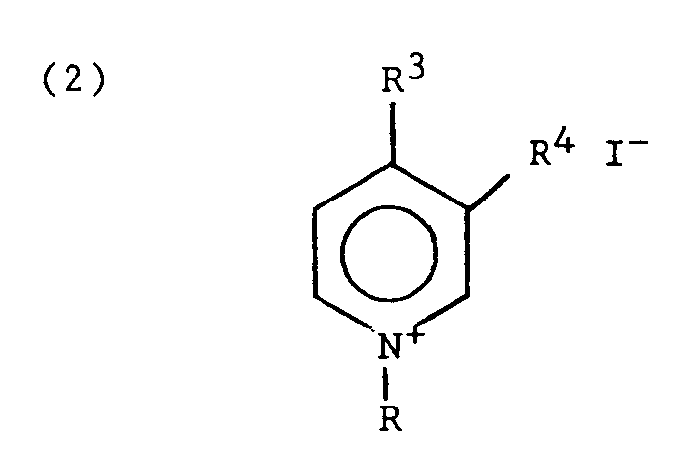
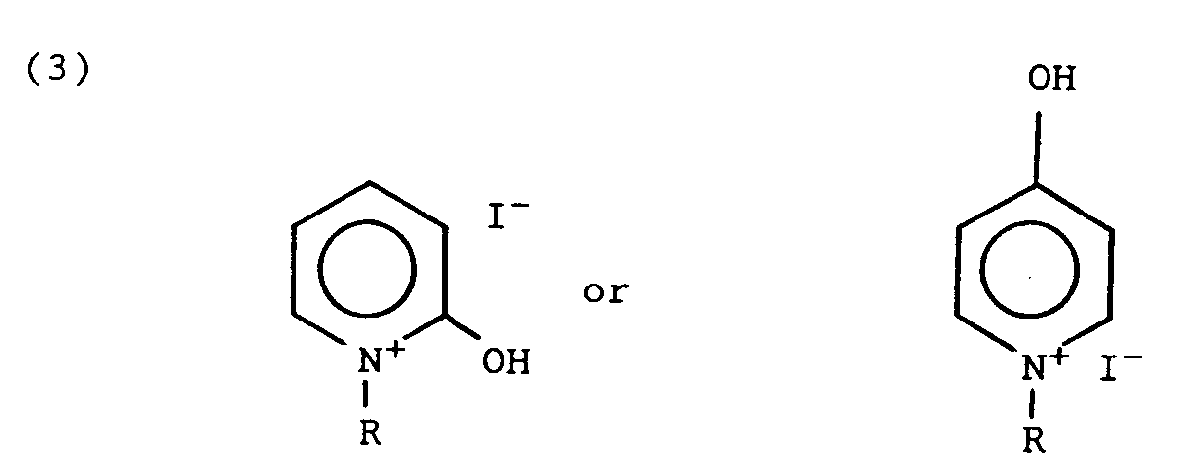
- According to the present invention there is provided a process for preparing a carboxylic acid having (n + 1) carbon atoms by reaction of carbon monoxide with an alcohol having n carbon atoms in the presence of a rhodium catalyst which process comprises feeding the alcohol and/or an ester of the alcohol and the carboxylic acid together with carbon monoxide to a carbonylation reactor and removing the carboxylic acid from the carbonylation reactor characterised by maintaining in the carbonylation reactor during the course of the process a liquid reaction medium comprising: (a) at least a finite quantity of water, (b) a catalyst stabiliser selected from the group consisting of quaternary ammonium iodides having the formula:-

and
wherein the groups R, R¹, R² and R⁴ are independently selected from hydrogen or C₁ to C₂₀ alkyl groups and R³ is a C₁ to C₂₀ alkyl group with the proviso that at least one R² group is other than hydrogen, (c) the iodide derivative corresponding to the alcohol, (d) the ester of the carboxylic acid and the alcohol, (e) a rhodium catalyst, and (f) the carboxylic acid. - The present invention solves the problem defined above by using certain selected quaternary ammonium iodides which have been shown not to generate sparingly soluble rhodium containing complexes even under very severe conditions designed to enhance rhodium precipitation. The quaternary ammonium iodides selected also have the additional advantage that they are particularly effective in preventing precipitation when the water content of the carbonylation reactor is low relative to conventional processes. Indeed they are superior to the stabilisers disclosed in EP 161874.
- In a preferred embodiment of the process defined above, the rhodium catalyst and catalyst stabiliser are removed from the carbonylation reactor with the carboxylic acid. The carboxylic acid, rhodium catalyst and catalyst stabiliser are then passed to a zone which is deficient in carbon monoxide relative to the carbonylation reactor and where for example separation of the carboxylic acid from the other components takes place. Thereafter the rhodium catalyst and catalyst stabiliser are recycled to the carbonylation reactor. In the preferred embodiment such a separation and recycle process is characterised by the fact that the rhodium catalyst and catalyst stabiliser are always together when there is a deficiency of carbon monoxide.
- Whilst the primary invention and the embodiment can be used when the finite quantity of water in the carbonylation reactor is typical of that used on conventional methanol carbonylation plant (14-15% weight), the technology is especially suitable where the water content of the carbonylation reactor is lower than conventionally used, eg in the range 0.1 to 12% weight preferably 0.5 to 8% weight.
- Considering the alcohol having n carbon atoms, whilst this can be in principle be any alcohol having from 1 to 20 carbon atoms and at least one hydroxyl group, the preferred feedstocks are monofunctional aliphatic alcohols having from 1 to 8 carbon atoms. Most preferred feedstocks are methanol, ethanol and propanol with methanol being of prime importance as the methanol to acetic acid process is commercially proven technology.
- The overall stoichiometry of the process can be represented by the equation.

wherein R′ is an organic moiety meeting the criterion defined in the previous paragraph. From this equation the product carboxylic acid obtained for a given alcohol can be readily determined. Thus in the cases of methanol (R′ = CH₃) and ethanol (R′ = C₂H₅), the product carboxylic acids are respectively acetic and propionic acids. - Whilst the processes of the present invention can be operated batchwise, in most cases continuous operation is preferred. During continuous operation the alcohol and/or an ester of the alcohol and the product carboxylic acid are fed to a carbonylation reactor together with the carbon monoxide, sufficient water to maintain a finite concentration in the reactor rhodium catalyst, iodide derivative and catalyst stabiliser. It will be appreciated that, as the last four components are not consumed during the process, they will be continuously recycled to the reactor from the product stream with only the occasional top-up of material as necessary. Corresponding to the continuous feeding of components to the carbonylation reactor, a product stream, comprising product carboxylic acid, water, rhodium catalyst, iodide derivative and catalyst stabiliser, is continuously removed. The net effect of this is that the carbonylation reactor reaches steady state and maintains a liquid reaction medium having steady state composition comprising constant amounts of water, catalyst stabiliser, iodide derivative, ester of the carboxylic acid and the alcohol, rhodium catalyst and carboxylic acid. In practice the carbonylation reactor contains little free alcohol on account of the rapid esterification reaction between the carboxylic acid and the alcohol.
- For the processes of the present invention it is preferred that at steady state the liquid reaction medium has a composition in which the individual components fall within the following ranges:

- Specifically for the carbonylation of methanol to acetic acid the preferred range of compositions is water (0.5%-8%), methyl acetate (2-8%), methyl iodide (10-16%), catalyst stabiliser (10-20%) and rhodium catalyst (300-1200 ppm) with the balance being acetic acid and trace impurities.
- The carbonylation reactor is suitably maintained at a temperature in the range 100-200°C and at a carbon monoxide pressure in the range 1 x 10⁶ - 2 x 10⁷ Pa (10-200 atmospheres). Preferably the temperature is in the range 140 to 200°C and the pressure in the range 1 x 10⁶ - 1 x 10⁷ Pa (10-100 atmospheres). Under such conditions the carbonylation reaction occurs rapidly.
- Considering the three classes of catalyst stabilisers defined above it is preferred that at least one of the R groups is the same as the R′ group comprising the organic moiety of the alcohol, iodide derivative and carboxylic acid. The R¹, R² and R⁴ groups on the other hand are suitably hydrogen or C₁ to C₈ alkyl, preferably hydrogen or C₁ to C₆ alkyl and R³ is suitably C₁ to C₈ alkyl, preferably C₁ to C₆ alkyl with the proviso defined above. Examples of preferred catalyst stabilisers in each of classes (1) and (2) are those where the R¹, R² and R⁴ groups are selected from hydrogen, methyl, ethyl, n-propyl, iso-propyl, n-butyl, sec-butyl and t-butyl and the R³ group is selected from methyl, ethyl, n-propyl, iso-propyl, n-butyl, sec-butyl and t-butyl.
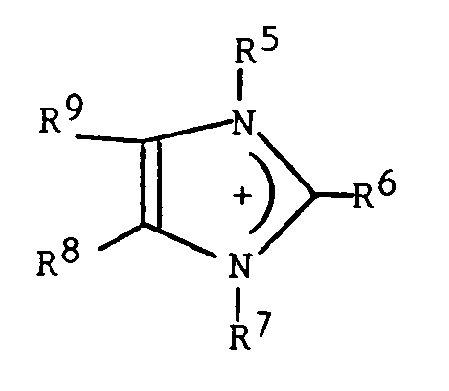
- One particularly preferred class of catalyst stabilisers are iodide salts of the cation:-

Where - (i) R⁵ and R⁷ are methyl
- (ii) R⁸ is hydrogen
- (iii) R⁶ is C₁ to C₂₀ alkyl or hydrogen
and - (iv) R⁹ is C₁ to C₂₀ alkyl
- Most preferred examples of this class are where (1) R⁶=C₂H₅, R⁵, R⁷ and R⁹=CH₃ and R⁸=H or (2) R⁶ and R⁸=H, and R⁵,R⁷ and R⁹=CH₃.
- Another particularly important class of catalyst stabiliser is comprised of iodide salts of the cation

where R¹¹ is either hydrogen or methyl, R¹² is C₁ to C₄ alkyl and R¹⁰ is methyl. Preferred examples are where (1) R¹¹=H and R¹²=C₂H₅, (2) R¹¹=H and R¹²=t-C₄H₉ and (3) R¹¹ and R¹²=CH₃. - The catalyst stabilisers can be prepared by quaternising the corresponding amines having the formulae:-


or
with an organic iodide of formula RI. The R group in the organic iodide can be the same as or different to any R group in the corresponding amine. It is of course preferred to quaternise those amines corresponding to the preferred catalyst stablisers defined above. In the case where the R groups are R′ it is therefore possible to generate the catalyst stabiliser in situ by feeding the corresponding amine when the process is started-up or feed or recycle streams are topped-up. Experience has shown that under the operating conditions of the process quaternisation of such amines takes place rapidly. Once quaternised the catalyst stabiliser will be recycled in the usual way. - The present invention is now illustrated by the following examples:-
- 25 mmol of the relevant amine was dissolved in acetic acid along with 25 mmol of methyl iodide. The mixture was heated to 180°C under nitrogen for 12 hours in a pressure vessel.
- The cooled mixture was mixed with further methyl iodide and a stock solution of rhodium in aqueous acetic acid to produce a test solution having the composition:-
- Rhodium
- 550 ppm
- Water
- 2% by weight
- Methyl Iodide
- 2% by weight
- Acetic Acid
- balance
- The above test solution was stirred at 25°C for 1 hour and the resulting liquid analysed for water, ionic iodide and soluble rhodium. The results are shown in the following table:-

- The results show that for the quaternised (R = CH₃) forms of 4-methylimidazole, 2-ethyl-4-methylimidazole (class (1) R² = CH₃ and H; R¹ , C₂H₅), 3,4-Lutidine (class (2) R³ = R⁴ = CH₃), 4-t-butylpyridine, 2-hydroxypyridine and 4-hydroxypyridine, little precipitation of rhodium (III) occurs relative to previously described materials (eg N-methylimidazole, 3-picoline or imidazole).
- The following experiments demonstrate that the quaternary ammonium iodide stabilisers of the present invention are not only more soluble than those previously disclosed (eg imidazole) but also that they are superior to alkali metal iodides in their ability to prevent rhodium precipitation at elevated temperature.
- Rhodium triiodide (1.57g), water (7.4g), hydroiodic acid (0.92g), and acetic acid (34.0g) were placed in a Fischer Porter vessel. This was purged and charged with 9 x 10⁵ Pa (8 barg) carbon monoxide then sealed and heated to 130°C for 4 hours during which time the RhI₃ dissolved to give a clear orange solution.
- In Example 1, catalyst stock solution (2.0g) and methyl iodide (0.50g) were added to a solution of LiI (25mmol) in acetic acid (19.15g) and stirred for 5 minutes. After sampling the mixture was sealed in a Fischer Porter vessel under 1 x 10⁵ Pa (1 bara) nitrogen and heated to 180°C for 22 hours. After cooling this was sampled, both samples being centrifuged then analysed for [Rh], [H₂O], and [I⁻].
For Examples 2 to 4, the amines were quaternised as described for the solubility experiments then treated with catalyst stock solution and methyl iodide as in Example 1.
The results are shown in the following table:-
- The reduced catalyst precipitation recorded with the selected quaternary ammonium iodides shows these to be the more effective stabilisers for the rhodium catalyst under the test conditions.
Claims (10)
- A process for preparing a carboxylic acid having (n + 1) carbon atoms by reaction of carbon monoxide with an alcohol having n carbon atoms in the presence of a rhodium catalyst which process comprises feeding the alcohol and/or an ester of the alcohol and the carboxylic acid together with carbon monoxide to a carbonylation reactor and removing the carboxylic acid from the carbonylation reactor characterised by maintaining in the carbonylation reactor during the course of the process a liquid reaction medium comprising: (a) at least a finite quantity of water, (b) a catalyst stabiliser selected from the group consisting of quaternary ammonium iodides having the formula:-


- A process as claimed in claim 1 characterised in that at least one of the R groups is the same as the organic moiety comprising the alcohol having n carbon atoms.
- A process as claimed in either claim 1 or claim 2 characterised in that the R¹, R² and R⁴ groups are independently selected from hydrogen or C₁ to C₈ alkyl and R³ is a C₁ to C₈ alkyl group.
- A process as claimed in claim 3 characterised in that the R¹, R² and R⁴ groups are independently selected from hydrogen or C₁ to C₆ alkyl and R³ is a C₁ to C₆ alkyl group.
- A process as claimed in claim 1 characterised in that the catalyst stabiliser is an iodide salt of the cation
- A process as claimed in claim 5 characterised in that the catalyst stabiliser is chosen such that either R⁶=C₂H₅ and R⁹=CH₃ or R⁶=H and R⁹=CH₃.
- A process as claimed in claim 1 characterised in that the catalyst stabiliser is an iodide salt of the cation

- A process as claimed in claim 7 characterised in that the catalyst stabiliser is chosen such that (1) R¹¹=H and R¹²=C₂H₅ or (2) R¹¹=H and R¹²=t-C₄H₉ or (3) R¹¹ and R¹²=CH₃.
- A process as claimed in claim 1 characterised in that from 0.5 to 8% weight water is maintained in the carbonylation reactor.
- A process as claimed in claim 1 characterised in that the catalyst stabiliser is generated in situ in the carbonylation reactor by quaternising a corresponding amine with the iodide derivative corresponding to the alcohol.
Applications Claiming Priority (4)
| Application Number | Priority Date | Filing Date | Title |
|---|---|---|---|
| GB898907763A GB8907763D0 (en) | 1989-04-06 | 1989-04-06 | Process for preparing carboxylic acids |
| GB8907763 | 1989-04-06 | ||
| GB8918588 | 1989-08-15 | ||
| GB898918588A GB8918588D0 (en) | 1989-08-15 | 1989-08-15 | Process for preparing carboxylic acids |
Publications (2)
| Publication Number | Publication Date |
|---|---|
| EP0391680A1 EP0391680A1 (en) | 1990-10-10 |
| EP0391680B1 true EP0391680B1 (en) | 1994-06-15 |
Family
ID=26295177
Family Applications (1)
| Application Number | Title | Priority Date | Filing Date |
|---|---|---|---|
| EP90303593A Expired - Lifetime EP0391680B1 (en) | 1989-04-06 | 1990-04-04 | Process for preparing carboxylic acids |
Country Status (10)
| Country | Link |
|---|---|
| EP (1) | EP0391680B1 (en) |
| JP (1) | JP2839367B2 (en) |
| KR (1) | KR0163040B1 (en) |
| AT (1) | ATE107271T1 (en) |
| BR (1) | BR9006285A (en) |
| CA (1) | CA2028821A1 (en) |
| DE (1) | DE69009829T2 (en) |
| ES (1) | ES2055322T3 (en) |
| NO (1) | NO173935C (en) |
| WO (1) | WO1990011991A1 (en) |
Families Citing this family (21)
| Publication number | Priority date | Publication date | Assignee | Title |
|---|---|---|---|---|
| GB9021454D0 (en) * | 1990-10-03 | 1990-11-14 | Bp Chem Int Ltd | Process |
| GB9120902D0 (en) * | 1991-10-02 | 1991-11-13 | Bp Chem Int Ltd | Purification process |
| GB9211671D0 (en) * | 1992-06-02 | 1992-07-15 | Bp Chem Int Ltd | Process |
| FR2735399B1 (en) * | 1995-06-16 | 1997-07-25 | Inst Francais Du Petrole | NOVEL CATALYTIC COMPOSITION BASED ON TRANSITIONAL METAL COMPLEXES AND METHOD FOR THE HYDROGENATION OF UNSATURATED COMPOUNDS |
| US5731472A (en) * | 1995-12-06 | 1998-03-24 | Union Carbide Chemicals & Plastics Technology Corporation | Metal-ligand complex catalyzed processes |
| US6090987A (en) * | 1998-07-06 | 2000-07-18 | Union Carbide Chemicals & Plastics Technology Corporation | Metal-ligand complex catalyzed processes |
| GB9819079D0 (en) | 1998-09-03 | 1998-10-28 | Bp Chem Int Ltd | Carbonylation process |
| GB9819606D0 (en) | 1998-09-08 | 1998-11-04 | Bp Chem Int Ltd | Carbonylation process |
| EP1501779B1 (en) | 2002-05-06 | 2009-12-23 | Eastman Chemical Company | Continuous carbonylation process |
| US7737298B2 (en) | 2006-06-09 | 2010-06-15 | Eastman Chemical Company | Production of acetic acid and mixtures of acetic acid and acetic anhydride |
| US7582792B2 (en) | 2006-06-15 | 2009-09-01 | Eastman Chemical Company | Carbonylation process |
| US7253304B1 (en) | 2006-06-20 | 2007-08-07 | Eastman Chemical Company | Carbonylation process |
| US7629491B2 (en) * | 2006-06-26 | 2009-12-08 | Eastman Chemical Company | Hydrocarboxylation process |
| TW200930698A (en) | 2008-01-07 | 2009-07-16 | China Petrochemical Dev Corp | Method for manufacturing carboxylic acid anhydride |
| EP2093209A1 (en) | 2008-02-19 | 2009-08-26 | BP Chemicals Limited | Process for the production of acetic acid |
| US7820855B2 (en) * | 2008-04-29 | 2010-10-26 | Celanese International Corporation | Method and apparatus for carbonylating methanol with acetic acid enriched flash stream |
| TW201022202A (en) | 2008-12-04 | 2010-06-16 | China Petrochemical Dev Corp | Method for producing carboxylic acid anhydride |
| TW201209034A (en) | 2010-08-31 | 2012-03-01 | China Petrochemical Dev Corp | Production method for carboxylic acid anhydride |
| US9012683B2 (en) | 2010-11-12 | 2015-04-21 | Eastman Chemical Company | Coproduction of acetic acid and acetic anhydride |
| US8637699B2 (en) | 2011-04-15 | 2014-01-28 | Lyondell Chemical Technology, L.P. | Process for the manufacture of acetic acid |
| US8742168B2 (en) | 2011-05-31 | 2014-06-03 | Lyondell Chemical Technology, L.P. | Process for the production of acetic acid |
Family Cites Families (5)
| Publication number | Priority date | Publication date | Assignee | Title |
|---|---|---|---|---|
| CA1058636A (en) * | 1975-03-10 | 1979-07-17 | Nabil Rizkalla | Process for preparing carboxylic acid anhydrides |
| DE3144772A1 (en) * | 1981-11-11 | 1983-05-19 | Hoechst Ag, 6230 Frankfurt | METHOD FOR PRODUCING ACETIC ACID ANHYDRIDE AND ACETIC ACID |
| EP0109212B1 (en) * | 1982-11-04 | 1987-05-27 | BP Chemicals Limited | Process for the preparation of acids |
| GB8404136D0 (en) * | 1984-02-16 | 1984-03-21 | Bp Chem Int Ltd | Carbonylation process |
| CA1228867A (en) * | 1984-05-03 | 1987-11-03 | Celanese Corporation | Methanol carbonylation process |
-
1990
- 1990-04-04 WO PCT/GB1990/000502 patent/WO1990011991A1/en not_active Ceased
- 1990-04-04 EP EP90303593A patent/EP0391680B1/en not_active Expired - Lifetime
- 1990-04-04 BR BR909006285A patent/BR9006285A/en not_active Application Discontinuation
- 1990-04-04 DE DE69009829T patent/DE69009829T2/en not_active Expired - Fee Related
- 1990-04-04 CA CA002028821A patent/CA2028821A1/en not_active Abandoned
- 1990-04-04 KR KR1019900702566A patent/KR0163040B1/en not_active Expired - Fee Related
- 1990-04-04 ES ES90303593T patent/ES2055322T3/en not_active Expired - Lifetime
- 1990-04-04 JP JP2505190A patent/JP2839367B2/en not_active Expired - Lifetime
- 1990-04-04 AT AT90303593T patent/ATE107271T1/en not_active IP Right Cessation
- 1990-12-05 NO NO905267A patent/NO173935C/en unknown
Also Published As
| Publication number | Publication date |
|---|---|
| EP0391680A1 (en) | 1990-10-10 |
| NO905267D0 (en) | 1990-12-05 |
| ES2055322T3 (en) | 1994-08-16 |
| JPH03505331A (en) | 1991-11-21 |
| KR920700187A (en) | 1992-02-19 |
| DE69009829T2 (en) | 1994-10-13 |
| NO905267L (en) | 1990-12-05 |
| AU623002B2 (en) | 1992-04-30 |
| WO1990011991A1 (en) | 1990-10-18 |
| KR0163040B1 (en) | 1999-01-15 |
| ATE107271T1 (en) | 1994-07-15 |
| NO173935B (en) | 1993-11-15 |
| DE69009829D1 (en) | 1994-07-21 |
| AU5333790A (en) | 1990-11-05 |
| JP2839367B2 (en) | 1998-12-16 |
| BR9006285A (en) | 1991-08-06 |
| NO173935C (en) | 1994-02-23 |
| CA2028821A1 (en) | 1990-10-07 |
Similar Documents
| Publication | Publication Date | Title |
|---|---|---|
| US5442107A (en) | Preparing carboxylic acids | |
| KR0163040B1 (en) | Process for preparing carboxylic acids | |
| JP4698945B2 (en) | Ionic liquid | |
| EP0573189A1 (en) | Process for the production of acetic acid | |
| DE69115424T2 (en) | Process for the preparation of carboxylic anhydrides | |
| US2727902A (en) | Process for the production of aliphatic oxygen compounds by carbonylation of alcohols and ethers | |
| AU621987B2 (en) | Process for preparing carboxylic acids | |
| NO830470L (en) | PROCEDURE FOR THE SIMPLE PREPARATION OF CARBOXYLIC ACIDS AND ACID ANHYRIDES. | |
| AU623002C (en) | Process for preparing carboxylic acids | |
| EP0029176A1 (en) | Process for the production of carboxylic anhydrides | |
| US4614816A (en) | Preparation of carboxylic acids and esters thereof | |
| EP0063105B1 (en) | Process for producing ethyl acetate by homologation of methyl acetate | |
| EP0046870B1 (en) | Process for the preparation of anhydrous alkyl iodide | |
| CN1031260C (en) | Process for preparing carboxylic acids | |
| US6395928B1 (en) | Rhodium-catalyzed carbonylation using non-acetate lithium, sodium and potassium inorganic salts as promoters to produce carboxylic acids | |
| HU208298B (en) | Process for producing saturated carboxylic acids | |
| US4585889A (en) | Carbonylation process for the production of monoesters aromatic dicarboxylic acids from phosphonium salts | |
| JPS591695B2 (en) | Production method of carboxylic acid | |
| RU1808826C (en) | Method of acetic acid synthesis | |
| PL163582B1 (en) | Method for the production of carboxylic acids | |
| US4599435A (en) | Preparation of 6-carboxy-3,4-dihydro-2H-pyran | |
| CA1065868A (en) | Mono fumarate of 3-pyridymethyl nicotinate and a process for the preparation thereof | |
| JPS5835976B2 (en) | Method for producing carboxylic acid anhydride by carbonylation | |
| DE3338882C2 (en) | ||
| JPS5874635A (en) | Carbonylation of methyl acetate |
Legal Events
| Date | Code | Title | Description |
|---|---|---|---|
| PUAI | Public reference made under article 153(3) epc to a published international application that has entered the european phase |
Free format text: ORIGINAL CODE: 0009012 |
|
| AK | Designated contracting states |
Kind code of ref document: A1 Designated state(s): AT BE DE ES FR GB IT LU NL SE |
|
| 17P | Request for examination filed |
Effective date: 19901213 |
|
| 17Q | First examination report despatched |
Effective date: 19920713 |
|
| RAP1 | Party data changed (applicant data changed or rights of an application transferred) |
Owner name: BP CHEMICALS LIMITED |
|
| GRAA | (expected) grant |
Free format text: ORIGINAL CODE: 0009210 |
|
| AK | Designated contracting states |
Kind code of ref document: B1 Designated state(s): AT BE DE ES FR GB IT LU NL SE |
|
| PG25 | Lapsed in a contracting state [announced via postgrant information from national office to epo] |
Ref country code: AT Effective date: 19940615 |
|
| REF | Corresponds to: |
Ref document number: 107271 Country of ref document: AT Date of ref document: 19940715 Kind code of ref document: T |
|
| ITF | It: translation for a ep patent filed | ||
| REF | Corresponds to: |
Ref document number: 69009829 Country of ref document: DE Date of ref document: 19940721 |
|
| REG | Reference to a national code |
Ref country code: ES Ref legal event code: FG2A Ref document number: 2055322 Country of ref document: ES Kind code of ref document: T3 |
|
| ET | Fr: translation filed | ||
| EAL | Se: european patent in force in sweden |
Ref document number: 90303593.9 |
|
| PGFP | Annual fee paid to national office [announced via postgrant information from national office to epo] |
Ref country code: SE Payment date: 19950223 Year of fee payment: 6 |
|
| PG25 | Lapsed in a contracting state [announced via postgrant information from national office to epo] |
Ref country code: ES Free format text: LAPSE BECAUSE OF NON-PAYMENT OF DUE FEES Effective date: 19950405 |
|
| PLBE | No opposition filed within time limit |
Free format text: ORIGINAL CODE: 0009261 |
|
| STAA | Information on the status of an ep patent application or granted ep patent |
Free format text: STATUS: NO OPPOSITION FILED WITHIN TIME LIMIT |
|
| PGFP | Annual fee paid to national office [announced via postgrant information from national office to epo] |
Ref country code: BE Payment date: 19950427 Year of fee payment: 6 |
|
| PG25 | Lapsed in a contracting state [announced via postgrant information from national office to epo] |
Ref country code: LU Free format text: LAPSE BECAUSE OF NON-PAYMENT OF DUE FEES Effective date: 19950430 |
|
| 26N | No opposition filed | ||
| PG25 | Lapsed in a contracting state [announced via postgrant information from national office to epo] |
Ref country code: NL Effective date: 19951101 |
|
| NLV4 | Nl: lapsed or anulled due to non-payment of the annual fee |
Effective date: 19951101 |
|
| PG25 | Lapsed in a contracting state [announced via postgrant information from national office to epo] |
Ref country code: SE Effective date: 19960405 |
|
| PG25 | Lapsed in a contracting state [announced via postgrant information from national office to epo] |
Ref country code: BE Effective date: 19960430 |
|
| BERE | Be: lapsed |
Owner name: BP CHEMICALS LTD Effective date: 19960430 |
|
| EUG | Se: european patent has lapsed |
Ref document number: 90303593.9 |
|
| REG | Reference to a national code |
Ref country code: ES Ref legal event code: FD2A Effective date: 19990405 |
|
| PGFP | Annual fee paid to national office [announced via postgrant information from national office to epo] |
Ref country code: GB Payment date: 20010316 Year of fee payment: 12 |
|
| PGFP | Annual fee paid to national office [announced via postgrant information from national office to epo] |
Ref country code: DE Payment date: 20010321 Year of fee payment: 12 |
|
| PGFP | Annual fee paid to national office [announced via postgrant information from national office to epo] |
Ref country code: FR Payment date: 20010326 Year of fee payment: 12 |
|
| REG | Reference to a national code |
Ref country code: GB Ref legal event code: IF02 |
|
| PG25 | Lapsed in a contracting state [announced via postgrant information from national office to epo] |
Ref country code: GB Free format text: LAPSE BECAUSE OF NON-PAYMENT OF DUE FEES Effective date: 20020404 |
|
| PG25 | Lapsed in a contracting state [announced via postgrant information from national office to epo] |
Ref country code: DE Free format text: LAPSE BECAUSE OF NON-PAYMENT OF DUE FEES Effective date: 20021101 |
|
| GBPC | Gb: european patent ceased through non-payment of renewal fee |
Effective date: 20020404 |
|
| PG25 | Lapsed in a contracting state [announced via postgrant information from national office to epo] |
Ref country code: FR Free format text: LAPSE BECAUSE OF NON-PAYMENT OF DUE FEES Effective date: 20021231 |
|
| REG | Reference to a national code |
Ref country code: FR Ref legal event code: ST |
|
| PG25 | Lapsed in a contracting state [announced via postgrant information from national office to epo] |
Ref country code: IT Free format text: LAPSE BECAUSE OF NON-PAYMENT OF DUE FEES;WARNING: LAPSES OF ITALIAN PATENTS WITH EFFECTIVE DATE BEFORE 2007 MAY HAVE OCCURRED AT ANY TIME BEFORE 2007. THE CORRECT EFFECTIVE DATE MAY BE DIFFERENT FROM THE ONE RECORDED. Effective date: 20050404 |