EP0391673B1 - Preparation of glutaric acid derivatives - Google Patents
Preparation of glutaric acid derivatives Download PDFInfo
- Publication number
- EP0391673B1 EP0391673B1 EP90303573A EP90303573A EP0391673B1 EP 0391673 B1 EP0391673 B1 EP 0391673B1 EP 90303573 A EP90303573 A EP 90303573A EP 90303573 A EP90303573 A EP 90303573A EP 0391673 B1 EP0391673 B1 EP 0391673B1
- Authority
- EP
- European Patent Office
- Prior art keywords
- alkoxy
- formula
- tert
- acid
- compound
- Prior art date
- Legal status (The legal status is an assumption and is not a legal conclusion. Google has not performed a legal analysis and makes no representation as to the accuracy of the status listed.)
- Expired - Lifetime
Links
- 0 *C(CC(CCCC1)(C(*)=O)C1=O)C(O*)=O Chemical compound *C(CC(CCCC1)(C(*)=O)C1=O)C(O*)=O 0.000 description 6
- QRPGJNDEKKJGDP-UHFFFAOYSA-N NC(CC1(CCCC1)N)O Chemical compound NC(CC1(CCCC1)N)O QRPGJNDEKKJGDP-UHFFFAOYSA-N 0.000 description 1
- JZLCCWJJUNPFRJ-UHFFFAOYSA-N OC(CC1(CCCC1)O)I Chemical compound OC(CC1(CCCC1)O)I JZLCCWJJUNPFRJ-UHFFFAOYSA-N 0.000 description 1
- KGBUGWINUVQXLR-UHFFFAOYSA-N OC(CCCC1)C1C(I)=O Chemical compound OC(CCCC1)C1C(I)=O KGBUGWINUVQXLR-UHFFFAOYSA-N 0.000 description 1
Classifications
-
- C—CHEMISTRY; METALLURGY
- C07—ORGANIC CHEMISTRY
- C07C—ACYCLIC OR CARBOCYCLIC COMPOUNDS
- C07C65/00—Compounds having carboxyl groups bound to carbon atoms of six—membered aromatic rings and containing any of the groups OH, O—metal, —CHO, keto, ether, groups, groups, or groups
- C07C65/32—Compounds having carboxyl groups bound to carbon atoms of six—membered aromatic rings and containing any of the groups OH, O—metal, —CHO, keto, ether, groups, groups, or groups containing keto groups
-
- C—CHEMISTRY; METALLURGY
- C07—ORGANIC CHEMISTRY
- C07C—ACYCLIC OR CARBOCYCLIC COMPOUNDS
- C07C67/00—Preparation of carboxylic acid esters
- C07C67/30—Preparation of carboxylic acid esters by modifying the acid moiety of the ester, such modification not being an introduction of an ester group
-
- C—CHEMISTRY; METALLURGY
- C07—ORGANIC CHEMISTRY
- C07C—ACYCLIC OR CARBOCYCLIC COMPOUNDS
- C07C201/00—Preparation of esters of nitric or nitrous acid or of compounds containing nitro or nitroso groups bound to a carbon skeleton
- C07C201/06—Preparation of nitro compounds
- C07C201/12—Preparation of nitro compounds by reactions not involving the formation of nitro groups
-
- C—CHEMISTRY; METALLURGY
- C07—ORGANIC CHEMISTRY
- C07C—ACYCLIC OR CARBOCYCLIC COMPOUNDS
- C07C67/00—Preparation of carboxylic acid esters
- C07C67/30—Preparation of carboxylic acid esters by modifying the acid moiety of the ester, such modification not being an introduction of an ester group
- C07C67/313—Preparation of carboxylic acid esters by modifying the acid moiety of the ester, such modification not being an introduction of an ester group by introduction of doubly bound oxygen containing functional groups, e.g. carboxyl groups
-
- C—CHEMISTRY; METALLURGY
- C07—ORGANIC CHEMISTRY
- C07C—ACYCLIC OR CARBOCYCLIC COMPOUNDS
- C07C69/00—Esters of carboxylic acids; Esters of carbonic or haloformic acids
- C07C69/74—Esters of carboxylic acids having an esterified carboxyl group bound to a carbon atom of a ring other than a six-membered aromatic ring
-
- C—CHEMISTRY; METALLURGY
- C07—ORGANIC CHEMISTRY
- C07C—ACYCLIC OR CARBOCYCLIC COMPOUNDS
- C07C2601/00—Systems containing only non-condensed rings
- C07C2601/06—Systems containing only non-condensed rings with a five-membered ring
- C07C2601/08—Systems containing only non-condensed rings with a five-membered ring the ring being saturated
Definitions
- This invention relates to a process for the preparation of glutaric acid derivatives.
- the invention relates to a process for the preparation of 1-[2-(alkoxycarbonyl)ethyl]-1-cyclopentanecarboxylic acid derivatives, the use of which has previously been disclosed in EP-A-0274234 as intermediates for the preparation of certain substituted glutaramide diuretic agents having utility in the treatment of hypertension, heart failure, renal insufficiency and in other disorders.
- EP-A-0274234 describes two methods for the preparation of 1-[2-(alkoxycarbonyl)ethyl]-1-cyclopentanecarboxylic acid derivatives by which the dianion derived from cyclopentanecarboxylic acid by treatment with a strong base, e.g. lithium diisopropylamide, is treated with either (i) an acrylate derivative, or (ii) an ester of 3-bromopropanoic acid followed by optional further alkylation as required, to provide the desired products.
- a strong base e.g. lithium diisopropylamide
- 1-[2-(alkoxycarbonyl)ethyl]-1-cyclopentanecarboxylic acid derivatives may be unexpectedly prepared by the oxidative rearrangement of 2-acyl- or 2-alkoxycarbonyl-cyclohexanone derivatives, offering further commercially important improvements over the existing processes such as ease and lower cost of operation.
- the present invention provides a process for preparing a compound of the formula:- or a base salt thereof, wherein
- R 1 is C l -C 4 alkyl, phenyl or C 1 -C 4 alkoxy.
- R 1 is methyl, phenyl or ethoxy.
- R 1 is methyl or ethoxy.
- R 2 is hydrogen or C 1 -C 6 alkyl optionally substituted by one C 1 -C 6 alkoxy or C 1 -C 6 alkoxy(C 1 -C 6 alkoxy)- substituent.
- R 2 is hydrogen, 2-methoxyethoxymethyl, 2-methoxyethyl or methoxymethyl.
- R 2 is hydrogen or 2-methoxyethoxymethyl.
- R 3 is C 1 -C 6 alkyl or benzyl, said benzyl group being optionally ring-substituted by one nitro or C l -C 4 alkoxy substituent.
- R 3 is ethyl, tert-butyl, benzyl, 4-nitrobenzyl or 4-methoxybenzyl.
- R 3 is tert-butyl.
- base salts of the compounds of the formula (I) include alkali metal, alkaline earth metal, ammonium and mono-, di- or tri(C 1 -C 4 alkyl)ammonium salts.
- the base salt of a compound of the formula (I) is the isopropylammonium salt.
- the source of peroxide ions includes reagents such as hydrogen peroxide, peroxy acids (e.g. peroxy(C i -C 4 )alkanoic acids), sodium perborate or a hydrate thereof, and sodium percarbonate, which are used in the presence of water.
- peroxy acids e.g. peroxy(C i -C 4 )alkanoic acids
- sodium perborate or a hydrate thereof e.g. peroxy(C i -C 4 )alkanoic acids
- sodium perborate or a hydrate thereof e.g. sodium percarbonate
- sodium percarbonate sodium percarbonate
- the reaction is preferably carried out using hydrogen peroxide in the presence of water.
- the reaction is preferably carried out in a suitable solvent in the presence of acid or base. Although the reaction does proceed slowly under neutral conditions, it has been found that acidic or basic reaction conditions accelerate the rate.
- Suitable solvents for the reaction include C 1 -C S alkanols and toluene.
- the solvent is methanol, tert-butanol or toluene.
- the solvent is tert-butanol.
- preferred acids include mineral acids and C l -C 4 alkanoic acids.
- the acid is sulphuric acid or acetic acid.
- the reaction may also be carried out using a C l -C 4 alkanoic acid as the solvent in the absence of an additional acid.
- Acetic acid is preferred.
- preferred bases include sodium or potassium hydroxide, carbonate or bicarbonate.
- the base is sodium hydroxide or sodium or potassium bicarbonate.
- Sodium percarbonate is a basic reagent per se and is typically not used in the presence of acid or a further base.
- reaction conditions and, in particular, the solvent and the nature and/or concentration of the acid or base used in the process provided by the present invention are chosen such that the reaction proceeds safely and at a favourable rate, without hydrolysis or transesterification of the ester functionality in the starting material (II) or product (I) occurring.
- a preferred embodiment of the present invention provides a process for preparing a compound of the formula (I), or a base salt thereof, comprising reaction of a compound of the formula (II) with
- a most preferred embodiment of the present invention provides a process for preparing a compound of the formula (I), or a base salt thereof, comprising reaction of a compound of the formula (II) with
- Sodium perborate is commercially available in several different hydrate forms, although the tetrahydrate (e.g. available from the Aldrich Chemical Company Ltd.) is preferred for the purpose of the present invention.
- Sodium perborate tetrahydrate may be formulated as either NaB0 3 .4H 2 0 or NaB0 2 .H 2 0 2 .3H 2 0 and provides a source of peroxide ions in aqueous solution:-
- Sodium percarbonate is a commercially available (e.g. from Fluka Chemicals Ltd.) bleaching agent and provides a source of peroxide ions in the presence of water.
- the molecular formula is generally represented as Na 2 C0 3 . 3/2 H 2 0 2 (see Chem. Lett., 1986, 665-6).
- Alkyl and alkoxy groups containing 3 or more carbon atoms and C 4 -alkanoic acids may be straight or branched chain.
- the process provided by the present invention may be carried out according to the following methods:-1.
- a stirred solution of a compound of the formula (II) in a suitable organic solvent e.g. t-butanol or toluene
- a suitable organic solvent e.g. t-butanol or toluene
- an aqueous (typically about 30 weight %) solution of hydrogen peroxide and a catalytic amount of a suitable acid, e.g. sulphuric acid preferably maintaining the reaction temperature at below 50°C, most preferably at about room temperature, throughout the addition.
- the reaction is further stirred at room temperature for up to 24 hours although longer reaction times may be necessary.
- the product of the formula (I) is isolated and purified using conventional techniques.
- reaction time will vary in each individual case dependent on several factors, such as the nature of the substituents and the reaction temperature employed.
- the course of the reaction may be monitored using conventional methods, e.g. thin-layer chromatography.
- the starting materials of the formula (II) may be prepared by a Michael addition reaction as illustrated in Scheme 1, using comparable reaction conditions to those described by Kryshtal et al, Synthesis, [1979], 107. wherein R 1 , R 2 and R 3 are as previously defined for a compound of the formula (I).
- an acrylate derivative of the formula (IV) is added to a stirred mixture of a compound of the formula (III), potassium carbonate and a catalytic amount of benzyltriethylammonium chloride in toluene at about room temperature, and the reaction further stirred at from room temperature to 50°C, preferably at about 40°C, for up to 24 hours.
- the product of the formula (II) is isolated and purified using conventional techniques.
- the reaction may also be performed in the absence of benzyltriethylammonium chloride by reacting a compound of the formula (III) with an acrylate derivative of the formula (IV) in the presence of a suitable base, e.g. potassium carbonate or potassium tert-butoxide, in a suitable organic solvent, e.g. a C l -C 4 alkanol (preferably tert-butanol) or acetonitrile, at about room temperature.
- a suitable base e.g. potassium carbonate or potassium tert-butoxide
- a suitable organic solvent e.g. a C l -C 4 alkanol (preferably tert-butanol) or acetonitrile
- R 2 is other than hydrogen in this reaction and potassium tert-butoxide is used as the base, it is preferably added to the reaction mixture at about -10°C and this is followed by a period of stirring of the reaction at from 0°C to room temperature.
- the compounds of the formula (III) and the acrylate derivatives of the formula (IV) are either known compounds which may also be commercially available, or are prepared by conventional methods in accordance with literature precedents.
- a base salt of a compound of the formula (I) may be prepared by mixing together solutions containing approximately equimolar amounts of a compound of the formula (I) and a suitable base. The base salt is recovered by filtration or by evaporation of the solvent.
- the invention also includes the novel intermediates of the formula (II).
- the mixture was partitioned between toluene (25 mL) and 5% aqueous sodium sulphite solution and the layers separated.
- the toluene layer was washed with dilute aqueous ammonia solution (25 mL of 0.880 ammonia in 200 mL of distilled water, 4 x 25 mL).
- the combined aqueous extracts were washed with toluene (25 mL), acidified to pH 2-3 with 5.0N aqueous hydrochloric acid solution and extracted with toluene (3 x 25 mL).
- the combined toluene extracts were dried over magnesium sulphate, filtered and concentrated under reduced pressure to give an oil, (1.11g, 61%).
- the crude product was crystallised from pentane (7.5 mL/g) to give the title compound as a colourless solid.
- Rf. 0.28 sica, hexane/ethyl acetate 2:1).
- the dichloromethane layer was washed with water (10 ml), the combined aqueous extracts acidified to pH 2 with 5.0M aqueous hydrochloric acid solution and extracted with n-hexane (2 x 20 mL).
- the combined n-hexane extracts were washed with water (5 mL) concentrated under reduced pressure and azeotropically dried with ethyl acetate to give the title acid, (3.99 g, 96% by GC normalisation).
- Rf. 0.44 sica, ethyl acetate, 1% acetic acid).
- the crude product (3.4 g, 0.01 mol) was dissolved in 34 mL of n-hexane and isopropylamine (0.61 g, 0.01 mol) added at room temperature.
- the precipitated salt was cooled to 0°C, granulated for 2 hours and collected to give the title compound (3.57 g, 72.1% overall yield; HPLC main band assay 98.7%), m.p. 84-87°C.
- the toluene layer was washed with dilute aqueous ammonia solution (25 mL of 0.880 ammonia in 200 mL of distilled water, 4 x 25 mL).
- the combined aqueous extracts were washed with toluene (25 mL), acidified to pH 2-3 with 5.0N aqueous hydrochloric acid solution and extracted with toluene (3 x 25 mL).
- the combined toluene extracts were dried over magnesium sulphate, filtered and concentrated under reduced pressure to give an oil which solidified on standing, (0.96 g, 61.9%).
- the toluene layer was washed with dilute aqueous ammonia solution (25 mL of 0.880 ammonia in 200 mL of distilled water, 4 x 25 mL).
- the combined aqueous extracts were washed with toluene (25 mL), acidified to pH 2-3 with 5.0N aqueous hydrochloric acid solution and extracted with toluene (3 x 25 mL).
- the combined toluene extracts were dried over magnesium sulphate, filtered and concentrated under reduced pressure to give the title compound as an oil, (0.746g, 44.6%).
- Rf. 0.16 (silica, hexane/ethyl acetate 2:1).
- the toluene layer was washed with dilute aqueous ammonia solution (25 mL of 0.880 ammonia in 200 mL of distilled water, 4 x 25 ml).
- the combined aqueous extracts were acidified to pH 2-3 with 5.0N aqueous hydrochloric acid solution and extracted with toluene (3 x 25 mL).
- the combined toluene extracts were dried over magnesium sulphate, filtered and concentrated under reduced pressure to give the title acid as a colourless oil, (0.816g, 44%).
- Rf. 0.24 (silica, hexane/ethyl acetate 2:1).
- the toluene layer was washed with dilute aqueous ammonia solution (25 mL of 0.880 ammonia in 200 mL of distilled water, 4 x 25 mL).
- the combined aqueous extracts were acidified to pH 2-3 with 5.0N aqueous hydrochloric acid solution and extracted with toluene (3 x 25 mL).
- the combined toluene extracts were dried over magnesium sulphate, filtered and concentrated under reduced pressure to give the title acid as a colourless oil which solidified on standing, (1.119 g, 62%).
- Rf. 0.25 (silica, hexane/ethyl acetate 2:1).
- the mixture was partitioned between hexane (40 ml) and 5% aqueous sodium sulphite solution (25 mL) and the layers separated.
- the hexane layer was washed with dilute aqueous ammonia solution (25 mL of 0.880 ammonia in 200 mL of distilled water, 5 x 40 mL).
Landscapes
- Chemical & Material Sciences (AREA)
- Organic Chemistry (AREA)
- Chemical Kinetics & Catalysis (AREA)
- Organic Low-Molecular-Weight Compounds And Preparation Thereof (AREA)
- Addition Polymer Or Copolymer, Post-Treatments, Or Chemical Modifications (AREA)
- Detergent Compositions (AREA)
- Pharmaceuticals Containing Other Organic And Inorganic Compounds (AREA)
Abstract
Description
- This invention relates to a process for the preparation of glutaric acid derivatives.
- More specifically the invention relates to a process for the preparation of 1-[2-(alkoxycarbonyl)ethyl]-1-cyclopentanecarboxylic acid derivatives, the use of which has previously been disclosed in EP-A-0274234 as intermediates for the preparation of certain substituted glutaramide diuretic agents having utility in the treatment of hypertension, heart failure, renal insufficiency and in other disorders.
- EP-A-0274234 describes two methods for the preparation of 1-[2-(alkoxycarbonyl)ethyl]-1-cyclopentanecarboxylic acid derivatives by which the dianion derived from cyclopentanecarboxylic acid by treatment with a strong base, e.g. lithium diisopropylamide, is treated with either (i) an acrylate derivative, or (ii) an ester of 3-bromopropanoic acid followed by optional further alkylation as required, to provide the desired products. However, the favoured route, involving use of an acrylate derivative, cannot be used for certain preferred embodiments of the present invention due to competing elimination reactions.
- It has now been discovered that 1-[2-(alkoxycarbonyl)ethyl]-1-cyclopentanecarboxylic acid derivatives may be unexpectedly prepared by the oxidative rearrangement of 2-acyl- or 2-alkoxycarbonyl-cyclohexanone derivatives, offering further commercially important improvements over the existing processes such as ease and lower cost of operation.
- Thus the present invention provides a process for preparing a compound of the formula:-

wherein - R2 is hydrogen or C1-C6 alkyl optionally substituted by up to 3 substituents each independently selected from C1-C6 alkoxy and C1-C6 alkoxy(C1-C6 alkoxy)-; and
- R3 is C1-C6 alkyl or benzyl, said benzyl group being optionally ring-substituted by up to 2 nitro or Cl-C4 alkoxy substituents, comprising reaction of a compound of the formula:-

- R1 is Cl-C4 alkyl, phenyl, benzyl or Cl-C4 alkoxy; and
- R2 and R3 are as previously defined for a compound of the formula (I), with hydrogen peroxide or a source of peroxide ions: said process being optionally followed by conversion of the compound of the formula (I) to a base salt thereof.
- Preferably, R1 is Cl-C4 alkyl, phenyl or C1-C4 alkoxy.
- More preferably, R1 is methyl, phenyl or ethoxy.
- Most preferably, R1 is methyl or ethoxy.
- Preferably, R2 is hydrogen or C1-C6 alkyl optionally substituted by one C1-C6 alkoxy or C1-C6 alkoxy(C1-C6 alkoxy)- substituent.
- More preferably, R2 is hydrogen, 2-methoxyethoxymethyl, 2-methoxyethyl or methoxymethyl.
- Most preferably, R2 is hydrogen or 2-methoxyethoxymethyl.
- Preferably, R3 is C1-C6 alkyl or benzyl, said benzyl group being optionally ring-substituted by one nitro or Cl-C4 alkoxy substituent.
- More preferably, R3 is ethyl, tert-butyl, benzyl, 4-nitrobenzyl or 4-methoxybenzyl.
- Most preferably, R3 is tert-butyl.
- Examples of base salts of the compounds of the formula (I) include alkali metal, alkaline earth metal, ammonium and mono-, di- or tri(C1-C4 alkyl)ammonium salts.
- Preferably the base salt of a compound of the formula (I) is the isopropylammonium salt.
- The source of peroxide ions includes reagents such as hydrogen peroxide, peroxy acids (e.g. peroxy(Ci-C4)alkanoic acids), sodium perborate or a hydrate thereof, and sodium percarbonate, which are used in the presence of water. Preferably hydrogen peroxide, sodium perborate tetrahydrate or sodium percarbonate is used. Most preferably hydrogen peroxide is used.
- The skilled man will appreciate that a certain amount of water must be present in the reaction mixture so that peroxide ions may be generated from the reagent.
- The reaction is preferably carried out using hydrogen peroxide in the presence of water.
- The reaction is preferably carried out in a suitable solvent in the presence of acid or base. Although the reaction does proceed slowly under neutral conditions, it has been found that acidic or basic reaction conditions accelerate the rate.
- Suitable solvents for the reaction include C1-CS alkanols and toluene.
- Preferably the solvent is methanol, tert-butanol or toluene.
- Most preferably the solvent is tert-butanol.
- When the reaction is carried out in the presence of acid, preferred acids include mineral acids and Cl-C4 alkanoic acids.
- Preferably the acid is sulphuric acid or acetic acid. The reaction may also be carried out using a Cl-C4 alkanoic acid as the solvent in the absence of an additional acid. Acetic acid is preferred.
- When the reaction is carried out in the presence of base, preferred bases include sodium or potassium hydroxide, carbonate or bicarbonate.
- Preferably the base is sodium hydroxide or sodium or potassium bicarbonate.
- Sodium percarbonate is a basic reagent per se and is typically not used in the presence of acid or a further base.
- The reaction conditions and, in particular, the solvent and the nature and/or concentration of the acid or base used in the process provided by the present invention are chosen such that the reaction proceeds safely and at a favourable rate, without hydrolysis or transesterification of the ester functionality in the starting material (II) or product (I) occurring.
- A preferred embodiment of the present invention provides a process for preparing a compound of the formula (I), or a base salt thereof, comprising reaction of a compound of the formula (II) with
- (a) aqueous hydrogen peroxide in
- (i) a suitable organic solvent in the presence of an acid,
- (ii) a suitable organic solvent in the presence of a base, or
- (iii) a Cl-C4 alkanoic acid;
- (b) sodium perborate, or a hydrate thereof, in a Cl-C4 alkanoic acid; or
- (c) sodium percarbonate in a suitable organic solvent in the presence of water: said process being optionally followed by a conversion of the compound of the formula (I) to a base salt thereof, wherein R1, R2 and R3 are as previously defined for compounds of the formulae (I) and (II).
- A most preferred embodiment of the present invention provides a process for preparing a compound of the formula (I), or a base salt thereof, comprising reaction of a compound of the formula (II) with
- (a) aqueous hydrogen peroxide in
- (i) tert-butanol or toluene in the presence of a catalytic amount of sulphuric acid,
- (ii) either tert-butanol in the presence of sodium or potassium bicarbonate, or methanol in the presence of sodium hydroxide, or
- (iii) acetic acid;
- (b) sodium perborate tetrahydrate in acetic acid; or
- (c) sodium percarbonate in tert-butanol in the presence of water: said process being optionally followed
by conversion of the compound of the formula (I) to a base salt thereof, wherein R1, R2 and R3 are as previously defined for compounds of the formulae (I) and (II). - Sodium perborate is commercially available in several different hydrate forms, although the tetrahydrate (e.g. available from the Aldrich Chemical Company Ltd.) is preferred for the purpose of the present invention. Sodium perborate tetrahydrate may be formulated as either NaB03.4H20 or NaB02.H202.3H20 and provides a source of peroxide ions in aqueous solution:-
- [B(OH)3(O2H)-+ H2O→ [B(OH)4]-+ H202
(see F. A. Cotton and G. Wilkinson, Advanced Inorganic Chemistry, 5th Edition, page 172). - Sodium percarbonate is a commercially available (e.g. from Fluka Chemicals Ltd.) bleaching agent and provides a source of peroxide ions in the presence of water. The molecular formula is generally represented as Na2C03. 3/2 H202 (see Chem. Lett., 1986, 665-6).
- Alkyl and alkoxy groups containing 3 or more carbon atoms and C4-alkanoic acids may be straight or branched chain.
- The process provided by the present invention may be carried out according to the following methods:-1. In a typical procedure, a stirred solution of a compound of the formula (II) in a suitable organic solvent, e.g. t-butanol or toluene, is cautiously treated with an aqueous (typically about 30 weight %) solution of hydrogen peroxide and a catalytic amount of a suitable acid, e.g. sulphuric acid, preferably maintaining the reaction temperature at below 50°C, most preferably at about room temperature, throughout the addition. The reaction is further stirred at room temperature for up to 24 hours although longer reaction times may be necessary. The product of the formula (I) is isolated and purified using conventional techniques.
- 2. In a typical procedure, a stirred solution of a compound of the formula (II) in a suitable organic solvent, e.g. a C1-C4 alkanol such as tert-butanol or methanol, is cautiously treated with a suitable base, e.g. sodium or potassium hydroxide or bicarbonate, and an aqueous (typically about 30 weight %) solution of hydrogen peroxide, maintaining the reaction temperature at from 0°C to 50°C throughout the additions. The reaction is further stirred at from room temperature to 50°C for up to 24 hours, or longer if necessary. The product of the formula (I) is isolated and purified by conventional techniques.
- 3. In a typical procedure, a stirred solution of a compound of the formula (II) in a Cl-C4 alkanoic acid, e.g. acetic acid, is cautiously treated with an aqueous (typically about 30 weight %) solution of hydrogen peroxide, maintaining the reaction temperature at below 40°C throughout the addition to avoid hydrolysis of the ester functionalility. The reaction is further stirred at room temperature for up to 24 hours. The product of the formula (I) is isolated and purified using conventional techniques.
- 4. In a typical procedure, a stirred solution of a compound of the formula (II) in a Cl-C4 alkanoic acid, e.g. acetic acid, is treated portionwise with sodium perborate tetrahydrate maintaining the reaction temperature at below 20°C during the addition. The mixture is further stirred at room temperature for up to 48 hours. The product of the formula (I) is isolated and purified using conventional techniques.
- 5. In a typical procedure, a stirred solution of a compound of the formula (II) in a suitable organic solvent, e.g. a Cl-C4 alkanol such as tert-butanol, is treated with sodium percarbonate at about room temperature. The reaction is stirred at from room temperature to 60°C for about 24 hours. The product of the formula (I) is isolated and purified by conventional techniques.
- It will be appreciated by the skilled man that the reaction time will vary in each individual case dependent on several factors, such as the nature of the substituents and the reaction temperature employed.
- The course of the reaction may be monitored using conventional methods, e.g. thin-layer chromatography.
- The starting materials of the formula (II) may be prepared by a Michael addition reaction as illustrated in Scheme 1, using comparable reaction conditions to those described by Kryshtal et al, Synthesis, [1979], 107.

- In a typical procedure, an acrylate derivative of the formula (IV) is added to a stirred mixture of a compound of the formula (III), potassium carbonate and a catalytic amount of benzyltriethylammonium chloride in toluene at about room temperature, and the reaction further stirred at from room temperature to 50°C, preferably at about 40°C, for up to 24 hours. The product of the formula (II) is isolated and purified using conventional techniques.
- The reaction may also be performed in the absence of benzyltriethylammonium chloride by reacting a compound of the formula (III) with an acrylate derivative of the formula (IV) in the presence of a suitable base, e.g. potassium carbonate or potassium tert-butoxide, in a suitable organic solvent, e.g. a Cl-C4 alkanol (preferably tert-butanol) or acetonitrile, at about room temperature. When R2 is other than hydrogen in this reaction and potassium tert-butoxide is used as the base, it is preferably added to the reaction mixture at about -10°C and this is followed by a period of stirring of the reaction at from 0°C to room temperature. The product of the formula (II) is isolated and purified by conventional techniques.
- The compounds of the formula (III) and the acrylate derivatives of the formula (IV) are either known compounds which may also be commercially available, or are prepared by conventional methods in accordance with literature precedents.
- A base salt of a compound of the formula (I) may be prepared by mixing together solutions containing approximately equimolar amounts of a compound of the formula (I) and a suitable base. The base salt is recovered by filtration or by evaporation of the solvent.
- The invention also includes the novel intermediates of the formula (II).
-

- To a solution of crude 2-acetyl-2-[2-(tert-butoxycarbonyl)ethyl]cyclohexanone (see Preparations 1 and 2) (42 g, 0.15 mol) in t-butanol (84 mL) was cautiously added a 30% aqueous hydrogen peroxide solution (21 mL, 0.187 mol) and conc. sulphuric acid (0.25 mL, 98% w/w) at room temperature, maintaining the reaction temperature below 50°C during the addition. The mixture was stirred at room temperature for 18 hours, partitioned between dichloromethane (100 mL) and water (100 mL), and the layers separated. The dichloromethane layer was washed with 5% aqueous sodium sulphite solution (50 mL), dried over magnesium sulphate, filtered and concentrated under reduced pressure to give a pale yellow solid, (43 g). The solid partially crystallised on standing overnight to provide, after collecting and washing with pentane, the title compound, (15.5 g).
- The mother liquors were concentrated and purified by column chromatography on silica gel by eluting with ethyl acetate/hexane (1:10) to provide, after combination and evaporation of appropriate fractions, a further 14.47 g of the title compound (combined yield = 29.97 g, 78%).
- 1H-NMR (300 MHz, CDCI3): 8 = 1.45 (s, 9H), 1.45-1.60 (m, 2H), 1.62-1.78 (m, 4H), 1.92-1.99 (m, 2H), 2.11-2.21 (m, 2H), 2.21-2.33 (m, 2H) ppm.
-

- To a solution of 2-acetyl-2-[2-(tert-butoxycarbonyl)ethyl]cyclohexanone (see Preparations 1 and 2) (2.0 g, 7.45 mmol) and concentrated sulphuric acid (98% w/w, one drop) in toluene (6.0 mL) was added, dropwise, a 30% aqueous solution of hydrogen peroxide (1.05 mL, 9.31 mmol) at room temperature. The mixture was stirred for 68 hours at room temperature, treated with a further quantity of a 30% aqueous solution of hydrogen peroxide (0.4 mL, 3.72 mmol) and stirred for a further 16 hours at room temperature. The mixture was partitioned between toluene (25 mL) and 5% aqueous sodium sulphite solution and the layers separated. The toluene layer was washed with dilute aqueous ammonia solution (25 mL of 0.880 ammonia in 200 mL of distilled water, 4 x 25 mL). The combined aqueous extracts were washed with toluene (25 mL), acidified to pH 2-3 with 5.0N aqueous hydrochloric acid solution and extracted with toluene (3 x 25 mL). The combined toluene extracts were dried over magnesium sulphate, filtered and concentrated under reduced pressure to give an oil, (1.11g, 61%). The crude product was crystallised from pentane (7.5 mL/g) to give the title compound as a colourless solid. Rf. 0.28 (silica, hexane/ethyl acetate 2:1).
- 1H-NMR (300 MHz, CDCI3): 8 = 1.45 (s, 9H), 1.45-1.60 (m, 2H), 1.62-1.78 (m, 4H), 1.92-1.99 (m, 2H), 2.11-2.21 (m, 2H), 2.21-2.33 (m, 2H) ppm.
-

-

- To a solution of crude 2-acetyl-2-[2-(benzyloxycarbonyl)ethyl]cyclohexanone (see Preparation 3) (19.7 g, 0.065 mol) in tert-butanol (35 mL) at room temperature was cautiously added, over a period of 30 minutes, a 30% aqueous hydrogen peroxide solution (8.8 mL, 0.078 mol) and concentrated sulphuric acid (0.25 mL, 98% w/w). The mixture was stirred at room temperature for 20 hours, partitioned between dichloromethane (100 mL) and water (100 mL) and the layers separated. The dichloromethane layer was washed with a 5% aqueous sodium sulphite solution (50 mL), dried over magnesium sulphate, filtered and concentrated under reduced pressure. Purification of the residue by chromatography on silica gel by initially eluting with ethyl acetate/hexane (1:2 changing to 1:1), followed by neat ethyl acetate in the latter stages, gave, after combination and evaporation of appropriate fractions, the title compound as a yellow oil, (12.17 g, 72%). Rf. 0.17 (silica, hexane/ethyl acetate/acetic acid, 74:25:1).
- IR (thin film): v = 3800-2400, 1735, 1695, 1450 cm-1.
-

-

- To a solution of 2-acetyl-2-[2-(ethoxycarbonyl)ethyl]cyclohexanone (see Preparation 4) (40 g, 0.16 mol) in tert-butanol (85 mL) was added, dropwise, a 30% aqueous solution of hydrogen peroxide (21.7 mL, 0.19 mol) and concentrated sulphuric acid (0.25 mL, 98% w/w) at room temperature. The mixture was further stirred for 24 hours, partitioned between dichloromethane (100 mL) and distilled water (100 mL) and the layers separated. The dichloromethane layer was washed with 5% aqueous sodium sulphite solution, dried over magnesium sulphate, filtered and concentrated under reduced pressure to give a yellow oil, (34.35 g). Purification of this material by chromatography on silica by eluting with ethyl acetate/hexane (1:2 changing to 1:1), followed by neat ethyl acetate in the latter stages, gave, after combination and evaporation of appropriate fractions, the title compound as a yellow oil, (22.96 g, 67%). Rf. 0.28 (silica, ethyl acetate/hexane, 1:1).
- 1H-NMR (300 MHz, CDCI3): 8 = 1.31 (t, 3H), 1.47-1.62 (m, 2H), 1.62-1.82 (m, 4H), 1.92-2.08 (m, 2H), 2.10-2.27 (m, 2H), 2.32-2.46 (m, 2H), 4.19 (q, 2H) ppm.
- 13C-NMR (75.5 MHz, CDCI3): 8 = 14.26, 25.15, 31.21, 33.56, 36.15, 53.21, 60.49, 173.38, 183.52 ppm.
-

- To a solution of 2-acetyl-2-[2-(tert-butoxycarbonyl)-3-(2-methoxyethoxy)propyl]cyclohexanone (see Preparations 5 and 11) (50 mg, 0.14 mmol) in tert-butanol (0.5 mL) was added a 30% aqueous hydrogen peroxide solution (0.02 mL, 0.168 mmol) and concentrated sulphuric acid (one drop) at room temperature. The mixture was stirred at room temperature for 4 hours, partitioned between dichloromethane (10 mL) and water (10 mL), and the layers separated. The aqueous layer was extracted with dichloromethane (2 x 10 mL), the combined organic extracts dried over magnesium sulphate, filtered and concentrated under reduced pressure to give the title compound, (49 mg). Rf. 0.36 (silica, ethyl acetate).
- 1H-NMR (300 MHz, CDCI3): 8 = 1.43 (s, 9H), 1.43-1.60 (m, 2H), 1.61-1.65 (m, 4H) 1.78 (dd, 1 H) 2.0 (dd, 1 H) , 2.08-2.20 (m, 2H), 2.59-2.70 (m, 1 H), 3.38 (s, 3H) 3.48-3.65 (m, 6H) ppm.
-
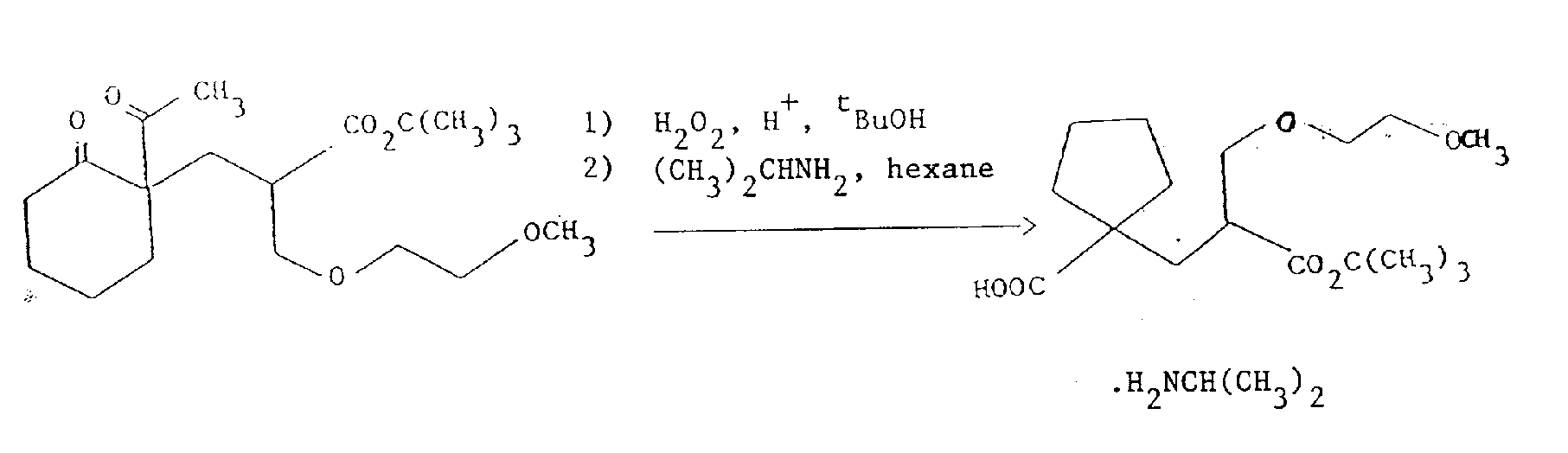
- To a solution of 2-acetyl-2-[2-tert-butoxycarbonyl)-3-(2-methoxyethoxy)propyl]cyclohexanone (see Preparations 5 and 11)) (5.45 g, 0.015 mol) in tert-butanol (10.9 mL) and concentrated sulphuric acid (one drop) was added a 30% aqueous hydrogen peroxide solution (2.1 mL, 0.018 mol) at room temperature. The mixture was stirred at room temperature for 24 hours, partitioned between dichloromethane (20 mL) and 2.0M aqueous sodium hydroxide solution (20 mL) and the layers separated. The dichloromethane layer was washed with water (10 ml), the combined aqueous extracts acidified to pH 2 with 5.0M aqueous hydrochloric acid solution and extracted with n-hexane (2 x 20 mL). The combined n-hexane extracts were washed with water (5 mL) concentrated under reduced pressure and azeotropically dried with ethyl acetate to give the title acid, (3.99 g, 96% by GC normalisation). Rf. 0.44 (silica, ethyl acetate, 1% acetic acid).
- 13C-NMR (75.5 MHz, CDCI3): 8 = 24.44, 24.80, 27.82, 34.97, 36.51, 37.29, 44.43, 53.35, 58.84, 70.06, 71.72, 73.20, 80.44, 173.88, 183.33 ppm.
- The crude product (3.4 g, 0.01 mol) was dissolved in 34 mL of n-hexane and isopropylamine (0.61 g, 0.01 mol) added at room temperature. The precipitated salt was cooled to 0°C, granulated for 2 hours and collected to give the title compound (3.57 g, 72.1% overall yield; HPLC main band assay 98.7%), m.p. 84-87°C.
- 1 H-NMR (300 MHz, CDCI3): 8 = 1.23 (d, 6H), 1.45 (s, 9H), 1.35-1.50 (m, 2H), 1.58-1.70 (m, 4H), 1.78 (dd, 1 H), 1.88 (dd, 1 H), 2.05-2.19 (m, 2H), 2.60-2.69 (m, 1 H), 3.28 (heptet, 1 H), 3.36 (s, 3H), 3.48-3.62 (m, 6H), 5.98 (brs, 3H) ppm.
- 13C-NMR (75 MHz, CDCI3): 8 = 21.99, 24.51, 24.97, 27.86, 34.64, 37.14, 37.98, 43.05, 44.94, 54.57, 58.78, 69.91, 71.68, 73.48, 79.98, 174.79, 183.22 ppm.
-

-

- To a solution of 2-acetyl-2-[2-(4-nitrobenzyloxycarbonyl)ethyl]cyclohexanone (see Preparation 8) (1.68 g, 4.85 mmol) in tert-butanol (3.3 mL) was added, dropwise, a 30% aqueous solution of hydrogen peroxide (0.65 mL, 5.82 mmol) and concentrated sulphuric acid (98% w/w, one drop) at room temperature. The mixture was stirred for 48 hours, partitioned between toluene (25 mL) and 5% aqueous sodium sulphite solution and the layers separated. The toluene layer was washed with dilute aqueous ammonia solution (25 mL of 0.880 ammonia in 200 mL of distilled water, 4 x 25 mL). The combined aqueous extracts were washed with toluene (25 mL), acidified to pH 2-3 with 5.0N aqueous hydrochloric acid solution and extracted with toluene (3 x 25 mL). The combined toluene extracts were dried over magnesium sulphate, filtered and concentrated under reduced pressure to give an oil which solidified on standing, (0.96 g, 61.9%). The crude product was recrystallised from ethyl acetate/hexane 1:1 (3 mL/g) to give the title acid, m.p. 78-80°C. Rf. 0.27 (silica, hexane/ethyl acetate 2:1 + 1% acetic acid).
- 1H-NMR (300 MHz, CDCI3): 8 = 1.49-1.61 (m, 2H), 1.63-1.78 (m, 4H), 1.97-2.06 (m, 2H), 2.11-2.22 (m, 2H), 2.42-2.50 (m, 2H), 5.22 (s, 2H), 7.55 (d, 2H), 8.23 (d, 2H) ppm.
- 13C-NMR (75 MHz, CDCI3): 8 = 24.98, 30.80, 33.12, 36.03, 52.86, 64.71, 123.68, 128.30, 143.03, 147.61, 172.71, 183.79 ppm.
-

-

- To a solution of 2-benzoyl-2-[2-(4-methoxybenzyloxycarbonyl)ethyl]cyclohexanone (see Preparation 9) (2.16 g, 5.47 mmol) in tert-butanol (4.3 mL) was added, dropwise, a 30% aqueous solution of hydrogen peroxide (0.74 mL, 6.56 mmol) and concentrated sulphuric acid (98% w/w, one drop) at room temperature. The mixture was stirred for 48 hours, partitioned between toluene (25 mL) and 5% aqueous sodium sulphite solution and the layers separated. The toluene layer was washed with dilute aqueous ammonia solution (25 mL of 0.880 ammonia in 200 mL of distilled water, 4 x 25 mL). The combined aqueous extracts were washed with toluene (25 mL), acidified to pH 2-3 with 5.0N aqueous hydrochloric acid solution and extracted with toluene (3 x 25 mL). The combined toluene extracts were dried over magnesium sulphate, filtered and concentrated under reduced pressure to give the title compound as an oil, (0.746g, 44.6%). Rf. 0.16 (silica, hexane/ethyl acetate 2:1).
- 1H-NMR (300 MHz, CDCI3): 8 = 1.45-1.59 (m, 2H), 1.65-1.78 (m, 4H), 1.98-2.06 (m, 2H), 2.12-2.22 (m, 2H), 2.34-2.46 (m, 2H), 3.84 (s, 3H), 5.06 (s, 2H), 6.91 (d, 2H), 7.31 (d, 2H) ppm.
-

-

- To a solution of 2-acetyl-2-[2-(tert-butoxycarbonyl)ethyl]cyclohexanone (see Preparations 1 and 2) (2.06 g, 7.67 mmol) in methanol (8.0 mL) was added, dropwise, a 30% aqueous solution of hydrogen peroxide (1.04 mL, 9.21 mmol) at room temperature. The mixture was cooled to 0°C and a 20% aqueous solution of sodium hydroxide (1.0 mL) added dropwise. The mixture was stirred for 24 hours at room temperature, partitioned between toluene (25 mL) and 5% aqueous sodium sulphite solution and the layers separated. The toluene layer was washed with dilute aqueous ammonia solution (25 mL of 0.880 ammonia in 200 mL of distilled water, 4 x 25 ml). The combined aqueous extracts were acidified to pH 2-3 with 5.0N aqueous hydrochloric acid solution and extracted with toluene (3 x 25 mL). The combined toluene extracts were dried over magnesium sulphate, filtered and concentrated under reduced pressure to give the title acid as a colourless oil, (0.816g, 44%). Rf. 0.24 (silica, hexane/ethyl acetate 2:1).
- 1H-NMR (300 MHz, CDCI3): 8 = 1.45 (s, 9H), 1.45-1.60 (m, 2H), 1.62-1.78 (m, 4H), 1.92-1.99 (m, 2H), 2.11-2.21 (m, 2H), 2.21-2.33 (m, 2H) ppm.
-

- To a solution of 2-acetyl-2-[2-(tert-butoxycarbonyl)ethyl]cyclohexanone (see Preparations 1 and 2) (2.0 g, 7.45 mmol) in tert-butanol (4.0 mL) was added, in one portion, sodium percarbonate (0.935 g, 5.96 mmol) at room temperature. The mixture was heated to 50-55°C for 8 hours, stirred at room temperature for 16 hours, partitioned between toluene (25 mL) and 5% aqueous sodium sulphite solution and the layers separated. The toluene layer was washed with dilute aqueous ammonia solution (25 mL of 0.880 ammonia in 200 mL of distilled water, 4 x 25 mL). The combined aqueous extracts were acidified to pH 2-3 with 5.0N aqueous hydrochloric acid solution and extracted with toluene (3 x 25 mL). The combined toluene extracts were dried over magnesium sulphate, filtered and concentrated under reduced pressure to give the title acid as a colourless oil which solidified on standing, (1.119 g, 62%). Rf. 0.25 (silica, hexane/ethyl acetate 2:1).
- 1H-NMR (300 MHz, CDCI3): 8 = 1.45 (s, 9H), 1.45-1.60 (m, 2H), 1.62-1.78 (m, 4H), 1.92-1.99 (m, 2H), 2.11-2.21 (m, 2H), 2.21-2.33 (m, 2H) ppm.
-

- To a solution of 2-acetyl-2-[2-(tert-butoxycarbonyl)ethyl]cyclohexanone (see Preparations 1 and 2) (1.0 g, 3.72 mmol) in acetic acid (10 mL) was added sodium perborate tetrahydrate (0.57 g, 3.72 mmol) in one portion at 15°C. The mixture was mechanically stirred for 1 hour during which time the internal temperature rose to 18°C. A further portion of sodium perborate tetrahydrate (0.57 g, 3.72 mmol) was then added and the mixture stirred for a further 1 hour. After this time a final portion of sodium perborate tetrahydrate (0.57 g, 3.72 mmol) was added and the mixture stirred at room temperature for 48 hours. The reaction was filtered to remove solids and the filter pad washed with ethyl acetate (2 x 25 mL). The combined filtrate and washings were washed with 5% aqueous sodium sulphite solution (2 x 50 ml), dried over magnesium sulphate, filtered and concentrated under reduced pressure to give a colourless oil, (0.92 g). The crude product was crystallised from pentane (4 mL/g) to give the title acid as a colourless solid, (0.617 g, 68.5%). Rf. 0.3 (silica, hexane/ethyl acetate, 2:1).
- 1H-NMR (300 MHz, CDCI3): 8 = 1.45 (s, 9H), 1.45-1.60 (m, 2H), 1.62-1.78 (m, 4H), 1.92-1.99 (m, 2H), 2.11-2.21 (m, 2H), 2.21-2.33 (m, 2H) ppm.
-

-

- To a suspension of 2-[2-(tert-butoxycarbonyl)ethyl]-2-ethoxycarbonylcyclohexanone (see Preparation 10) (1.0 g, 3.35 mmol) and sodium hydrogen carbonate (0.281 g, 3.35 mmol) in tert-butanol (2.0 mL) was added, in four portions over a period of 1.5 hours, a 30% aqueous solution of hydrogen peroxide (4 x 0.11 ml, 4.0 mmol) at 40°C. The mixture was stirred at 40°C for 20 hours. A fifth charge of a 30% aqueous solution of hydrogen peroxide (0.11 mL) and a further quantity of sodium hydrogen carbonate (0.281 g, 3.35 mmol) was added, and the mixture stirred at 40°C for 8 hours. The mixture was partitioned between hexane (40 ml) and 5% aqueous sodium sulphite solution (25 mL) and the layers separated. The hexane layer was washed with dilute aqueous ammonia solution (25 mL of 0.880 ammonia in 200 mL of distilled water, 5 x 40 mL). The combined aqueous extracts were acidified to pH 2-3 with 5.0N aqueous hydrochloric acid solution and extracted with dichloromethane (3 x 25 mL). The combined dichloromethane extracts were washed with distilled water (25 mL), dried over magnesium sulphate, filtered and concentrated under reduced pressure to give the title compound as an oil, (0.362 g, 44.6%). Rf. 0.29 (silica, hexane/ethyl acetate 2:1).
-

- The following Preparations illustrates the preparation of certain intermediates used in the preceding Examples:-
-

- To a suspension of 2-acetylcyclohexanone (100 g, 0.71 mol), potassium carbonate (118.3 g, 0.85 mol) and benzyltriethylammonium chloride (3.18 g, 0.014 mol) in toluene (280 mL), was added, in one portion, tert-butyl acrylate (137.1 g, 155.2 mL, 1.07 mol) at room temperature. The suspension was stirred at 40°C for 18 hours, diluted with distilled water (1 L) and toluene (500 mL), and the layers separated. The aqueous layer was extracted with toluene (3 x 500 mL), the combined toluene extracts dried over magnesium sulphate, filtered and concentrated under reduced pressure to give a brown oil, (197.8 g). Rf. 0.41 (silica, hexane/ethyl acetate, 3:1). The crude product was used without further purification.
- An analytical sample was prepared from the crude reaction product by chromatography on silica gel by eluting with ethyl acetate/hexane (1:4) to provide, after combination and evaporation of appropriate fractions, the title compound as a colourless oil.
- IR (thin film): v = 2980, 2940, 2870, 1725, 1695, 1500, 1365cm-1
-

-

- To a suspension of 2-acetylcyclohexanone (2.8 g, 0.02 mol) and potassium carbonate (2.8 g, 0.02 mol) in tert-butanol (16.8 mL) was added tert-butyl acrylate (3.33 g, 0.026 mol) over a period of 10 minutes at room temperature. The suspension was stirred at room temperature for 48 hours, diluted with distilled water (16.8 mL) and dichloromethane (16.8 mL) and the layers separated. The aqueous layer was extracted with dichloromethane (16.8 mL) and the combined dichloromethane extracts concentrated under reduced pressure to give a brown oil (5.05 g). The crude product was crystallised from n-pentane (50 mL) to give the title compound as a colourless solid, (3.02 g, 56.2%), m.p. 47-53°C. Rf. 0.41 (silica, hexane/ethyl acetate 2:1). 1H-NMR (300 MHz, CDCI3): 8 = 1.41-1.55 (m, 2H), 1.47 (s, 9H), 1.62-1.84 (m, 4H), 1.96-2.04 (m, 2H), 2.10-2.21 (m, 2H), 2.17 (s, 3H), 2.26-2.53 (m, 2H) ppm.
-

-

- To a solution of 2-acetylcyclohexanone (9.6 g, 0.068 mol), potassium carbonate (11.3 g, 0.082 mol) and benzyltriethylammonium chloride (0.3 g, 0.0013 mol) in toluene (26 mL), was added benzyl acrylate (16.72 g, 0.103 mol) at room temperature. The mixture was heated at 40°C for 20 hours, cooled, partitioned between water (200 mL) and toluene (200 mL) and the layers separated. The aqueous layer was extracted with toluene (2 x 200 mL), the combined organic extracts dried over magnesium sulphate, filtered and concentrated under reduced pressure to provide the title compound as a pale yellow oil, (20.7 g), Rf. 0.2 (silica, hexane/diethyl ether, 2:1). The crude product was used without further purification.
- An analytical sample was prepared from the crude reaction product by chromatography on silica gel by eluting with hexane/ether (2:1) to provide, after combination and evaporation of appropriate fractions, the product as a colourless oil. IR (thin film): v = 2940, 2870, 1735, 1715, 1695, 1450cm-1.
-

-

- To a solution of 2-acetylcyclohexanone (25 g, 0.18 mol), potassium carbonate (29.5 g, 0.21 mol) and benzyltriethylammonium chloride (0.8 g, 0.0035 mol) in toluene (70 mL) was added ethyl acrylate (29 mL, 27 g, 0.27 mol) at room temperature. The mixture was heated at 40°C for 20 hours, filtered and partitioned between distilled water (200 mL) and toluene (200 mL). The organic layer was dried over magnesium sulphate, filtered and concentrated under reduced pressure to give the title compound as a brown oil, (41.7 g, 97%).
- The crude product was used in Example 4 without further purification.
-

- To a suspension of 2-acetylcyclohexanone (103 mg, 0.88 mmol), potassium carbonate (121 mg, 0.88 mmol) and benzyltriethylammonium chloride (3 mg, 0.015 mmol) in toluene (0.5 mL) was added, in one portion, tert-butyl 2-(2-methoxyethoxymethyl)acrylate (see Preparations 6 and 7) (191 mg, 0.88 mmol) at room temperature. The suspension was stirred at room temperature for 18 hours, at 40°C for 8 hours, cooled and diluted with water (10 mL) and extracted with ethyl acetate (3 x 10 mL). The combined organic extracts were dried over magnesium sulphate and concentrated to dryness under reduced pressure. The crude product was purified by flash column chromatography on silica gel by eluting with hexane/ethyl acetate (2:1) to provide, after combination and evaporation of appropriate fractions, the desired product as a colourless oil, (86 mg). Rf. 0.2 (silica, hexane/ethyl acetate, 2:1).
- IR (thin film: v = 2980, 2935, 2870, 1720, 1695, 1450cm-1.
-

-

- To a solution of tert-butyl 2-(bromomethyl)acrylate (2.0 g, 9.0 mmol) in 2-methoxyethanol (30 mL) at 0°C was added, in one portion, potassium carbonate (2.5 g, 18 mmol) and the mixture stirred at 0°C for 1 hour. The reaction was diluted with distilled water (100 mL) and extracted with dichloromethane (100 mL). The layers were separated and the aqueous layer further extracted with dichloromethane (2 x 50 ml). The combined organic extracts were dried over magnesium sulphate, filtered and concentrated under reduced pressure. The residue was purified by chromatography on silica by eluting with hexane/ethyl acetate (2:1) to give, after combination and evaporation of appropriate fractions, the title compound as a yellow oil, (1.6 g, 82%). Rf. 0.32 (silica, hexane/ethyl acetate, 2:1).
- 1H-NMR (300 MHz, CDCla): 8 = 1.50 (s, 9H), 3.42 (s, 3H), 3.56-3.63 (m, 2H), 3.65-3.74 (m, 2H), 4.25 (s, 2H), 5.84 (s, 1 H), 6.25 (s, 1 H) ppm.
-

- To a solution of tert-butyl methacrylate (10 g, 70.3 mmol) in dichloromethane (44 mL) was added, in one portion, p-toluenesulphinic acid, sodium salt, dihydrate (15 g, 70.3 mmol) followed by iodine (17.8 g, 70.3 mmol) and the mixture stirred at room temperature for 24 hours. The reaction was cooled to 0°C and triethylamine (10.6 g, 105.4 mmol) was added over a period of 10 minutes. The mixture was stirred at 0°C for 15 minutes and at room temperature for 3 hours, diluted with dichloromethane (100 mL) and distilled water (100 mL). The layers were separated and the aqueous layer further extracted with dichloromethane (50 mL). The combined organic extracts were washed with 1.ON aqueous hydrochloric acid solution (50 mL), saturated aqueous sodium hydrogen carbonate solution (50 mL), distilled water (50 mL) and concentrated under reduced pressure to give a yellow-brown oil, (19.63 g). The material was dissolved in ethyl acetate (40 mL) and triethylamine (7.1 g, 70.3 mmol) added. The mixture was heated at reflux for 8 hours and stirred at room temperature for 16 hours, washed with distilled water (100 mL), 1.0N aqueous hydrochloric acid solution (100 mL), saturated aqueous sodium hydrogen carbonate solution (100 mL) and the organic layer concentrated under reduced pressure to give a yellow-brown oil (17 g). The crude product was crystallised from hexane/ethyl acetate 4:1 (5 mL/g) to give the title compound as a yellow solid, (13.09 g, 62.8%; 98.64% pure by GC normalisation). Rf. 0.31 (silica, hexane/ethyl acetate, 3:1).
- 1 H-NMR (300 MHz, CDCl3): 8 = 1.35 (s, 9H), 2.48 (s, 3H), 4.12 (s, 2H), 5.91 (s, 1 H), 6.47 (s, 1 H), 7.34 (d, 2H), 7.75 (d, 2H) ppm.
- 13C-NMR (75 MHz, CDCl3): 8 = 21.67, 27.81, 57.54, 81.73, 128.91, 129.70, 130.55, 132.53, 135.63, 144.83, 163.80 ppm.
-
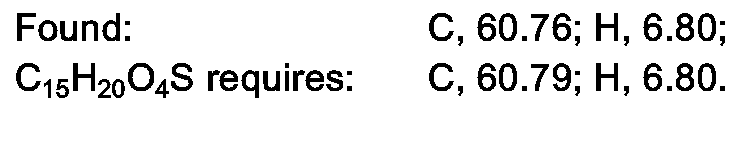
- To a suspension of the product of part (a) (14 g, 0.047 mol) in 2-methoxyethanol (70 mL) at 0°C was added, in one portion, potassium carbonate (13.06 g, 0.094 mol) and the mixture stirred at 0°C for 3 hours. The reaction was diluted with distilled water (100 mL) and extracted with dichloromethane (100 mL). The layers were separated and the aqueous layer further extracted with dichloromethane (50 mL) and the combined organic extracts concentrated under reduced pressure. The residue was purified by chromatography on silica eluting with hexane/ethyl acetate (6:1) to give, after combination and evaporation of appropriate fractions, the title compound as a colourless oil, (8.62 g, 84%). Rf. 0.32 (silica, hexane/ethyl acetate, 2:1).
- 1H-NMR (300 MHz, CDCla): 8 = 1.50 (s, 9H), 3.42 (s, 3H), 3.56-3.63 (m, 2H), 3.65-3.74 (m, 2H), 4.25 (s, 2H), 5.84 (s, 1 H), 6.25 (s, 1 H) ppm.
-

- The title compound was prepared in 69% yield after chromatography (silica gel, gradient elution with hexane/ethyl acetate) from 2-acetylcyclohexanone and p-nitrobenzyl acrylate using a similar method to that used in Preparation 2. Rf. 0.2 (silica, hexane/ethyl acetate, 2:1).
- 1H-NMR (300 MHz, CDCl3): 8 = 1.40-1.78 (m, 4H), 1.89-2.47 (m, 8H), 2.07 (s, 3H), 5.13 (s, 2H), 7.45 (d, 2H), 8.17 (d, 2H) ppm.
-

-

- The title compound was prepared in 65.5% yield after chromatography (silica gel, hexane/ethyl acetate 4:1) from 2-benzoylcyclohexanone and p-methoxybenzyl acrylate using a similar method to that used in Preparation 2. (M+ 394.13, 53%). Rf. 0.39 (silica, hexane/ethyl acetate 2:1).
- 1H-NMR (300 MHz, CDCl3): 8 = 1.38-1.49 (m, 1H), 1.68-1.82 (m, 3H), 1.98-2.57 (m, 7H), 2.82-2.91 (m, 1H), 3.82 (s, 3H), 5.03 (s, 2H), 6.87 (d, 2H), 7.26 (d, 2H), 7.42 (t, 2H), 7.56 (t, 1 H), 7.88 (d, 2H) ppm.
-

-

- To a solution of 2-ethoxycarbonylcyclohexanone (5.0 g, 0.029 mol) and tert-butyl acrylate (4.83 g, 0.037 mol) in tert-butanol (30 mL) was added, in one portion, potassium carbonate (4.0 g, 0.029 mol). The suspension was stirred at room temperature for 22 hours, diluted with dichloromethane (100 mL) and distilled water (100 mL) and the layers separated. The aqueous layer was extracted with dichloromethane (2 x 100 mL) and the combined dichloromethane extracts dried over magnesium sulphate, filtered and concentrated under reduced pressure. The residue was purified by chromatography on silica by eluting with hexane/ethyl acetate (4:1) to give, after combination and evaporation of appropriate fractions, the title compound as a colourless oil, (7.99 g, 92.3%; 98.92% by GC normalisation) (MH+ 299.03, 8.53%). Rf. 0.15 (silica, hexane/ethyl acetate 4:1). 1H-NMR (300 MHz, CDCl3): 8 = 1.20 (t, 3H), 1.37 (s, 9H), 1.52-2.46 (m, 12H), 4.08-4.21 (m, 2H) ppm.
- 13C-NMR (62 MHz, CDCl3): 8 = 13.97, 22.38, 27.36, 27.91, 29.52, 30.49, 36.06, 40.85, 59.87, 61.19, 80.10, 171.61, 172.22, 207.39 ppm.
-

-

- To a suspension of 2-acetylcyclohexanone (3.5g, 0.025 mol) and tert-butyl 2-(2-methoxyethoxymethyl)acrylate (see Preparations 6 and 7) (5.41g, 0.025 mol) in acetonitrile (20 mL) was added, in one portion, potassium tert-butoxide (0.14g, 0.0012 mol) at -10°C. The mixture was stirred at -10°C for 24 hours, at 0°C for 6 hours and at room temperature for 18 hours. The mixture was partitioned between ethyl acetate (15 mL) and distilled water (30 mL) and the layers separated. The aqueous layer was extracted with ethyl acetate (2 x 15 mL) and the combined ethyl acetate extracts concentrated under reduced pressure to give a brown oil (7.52 g). The residue was purified by chromatography on silica by eluting with hexane/ethyl acetate (4:1) to give, after combination and evaporation of appropriate fractions, the title compound as a colourless oil, (4.98g, 55.8%). Rf. 0.23 (silica, hexane/ethyl acetate, 2:1).
-

Claims (15)

wherein

said process being optionally followed by conversion of the compound of the formula (I) to a base salt thereof.


and
Applications Claiming Priority (2)
| Application Number | Priority Date | Filing Date | Title |
|---|---|---|---|
| GB8907704 | 1989-04-05 | ||
| GB898907704A GB8907704D0 (en) | 1989-04-05 | 1989-04-05 | Preparation of glutaric acid derivatives |
Publications (3)
| Publication Number | Publication Date |
|---|---|
| EP0391673A1 EP0391673A1 (en) | 1990-10-10 |
| EP0391673B1 true EP0391673B1 (en) | 1993-06-09 |
| EP0391673B2 EP0391673B2 (en) | 1997-04-02 |
Family
ID=10654523
Family Applications (1)
| Application Number | Title | Priority Date | Filing Date |
|---|---|---|---|
| EP90303573A Expired - Lifetime EP0391673B2 (en) | 1989-04-05 | 1990-04-03 | Preparation of glutaric acid derivatives |
Country Status (28)
| Country | Link |
|---|---|
| US (2) | US5166406A (en) |
| EP (1) | EP0391673B2 (en) |
| JP (1) | JPH0761978B2 (en) |
| KR (1) | KR920005848B1 (en) |
| CN (1) | CN1028023C (en) |
| AT (1) | ATE90331T1 (en) |
| CA (1) | CA2013743C (en) |
| DD (1) | DD293343A5 (en) |
| DE (1) | DE69001852T3 (en) |
| DK (1) | DK0391673T3 (en) |
| EG (1) | EG19016A (en) |
| ES (1) | ES2055321T5 (en) |
| FI (1) | FI93722C (en) |
| GB (1) | GB8907704D0 (en) |
| GR (1) | GR3023288T3 (en) |
| HU (1) | HU206189B (en) |
| IE (1) | IE62931B1 (en) |
| IL (1) | IL93945A (en) |
| MX (1) | MX173989B (en) |
| MY (1) | MY105529A (en) |
| NO (1) | NO173233C (en) |
| NZ (1) | NZ233196A (en) |
| PH (1) | PH27240A (en) |
| PL (1) | PL163316B1 (en) |
| PT (1) | PT93644B (en) |
| RU (1) | RU1838292C (en) |
| YU (1) | YU65890A (en) |
| ZA (1) | ZA902590B (en) |
Cited By (1)
| Publication number | Priority date | Publication date | Assignee | Title |
|---|---|---|---|---|
| WO2023013994A1 (en) * | 2021-08-02 | 2023-02-09 | 주식회사 미토이뮨테라퓨틱스 | Novel indole derivative, pharmaceutical composition comprising same, and use thereof |
Families Citing this family (4)
| Publication number | Priority date | Publication date | Assignee | Title |
|---|---|---|---|---|
| US5714628A (en) * | 1989-04-05 | 1998-02-03 | Pfizer, Inc. | Preparation of glutaric acid derivatives |
| US7040559B2 (en) | 2004-04-02 | 2006-05-09 | Fellowes Inc. | Shredder with lock for on/off switch |
| US7631822B2 (en) | 2004-09-10 | 2009-12-15 | Fellowes Inc. | Shredder with thickness detector |
| CN120157578B (en) * | 2025-03-17 | 2025-11-18 | 质肽药业(泰州)有限公司 | Preparation method of mono-tert-butyl octadecanedioate |
Family Cites Families (3)
| Publication number | Priority date | Publication date | Assignee | Title |
|---|---|---|---|---|
| US2466926A (en) | 1947-06-26 | 1949-04-12 | Rohm & Haas | 2-acyl-2-(beta-carbalkoxyethyl)-cycloalkanones |
| US2466678A (en) | 1947-06-26 | 1949-04-12 | Rohm & Haas | Acylated suberates and azelates |
| KR880007441A (en) * | 1986-12-11 | 1988-08-27 | 알렌 제이.스피겔 | Spiro-Substituted Glutaramide Diuretics |
-
1989
- 1989-04-05 GB GB898907704A patent/GB8907704D0/en active Pending
-
1990
- 1990-03-29 IL IL9394590A patent/IL93945A/en not_active IP Right Cessation
- 1990-04-02 MY MYPI90000514A patent/MY105529A/en unknown
- 1990-04-03 DE DE69001852T patent/DE69001852T3/en not_active Expired - Fee Related
- 1990-04-03 EP EP90303573A patent/EP0391673B2/en not_active Expired - Lifetime
- 1990-04-03 DK DK90303573.1T patent/DK0391673T3/en active
- 1990-04-03 MX MX020151A patent/MX173989B/en unknown
- 1990-04-03 CA CA002013743A patent/CA2013743C/en not_active Expired - Fee Related
- 1990-04-03 KR KR1019900004544A patent/KR920005848B1/en not_active Expired
- 1990-04-03 PT PT93644A patent/PT93644B/en not_active IP Right Cessation
- 1990-04-03 AT AT90303573T patent/ATE90331T1/en not_active IP Right Cessation
- 1990-04-03 ES ES90303573T patent/ES2055321T5/en not_active Expired - Lifetime
- 1990-04-04 HU HU902079A patent/HU206189B/en not_active IP Right Cessation
- 1990-04-04 YU YU00658/90A patent/YU65890A/en unknown
- 1990-04-04 FI FI901699A patent/FI93722C/en not_active IP Right Cessation
- 1990-04-04 US US07/504,493 patent/US5166406A/en not_active Ceased
- 1990-04-04 NZ NZ233196A patent/NZ233196A/en unknown
- 1990-04-04 NO NO901534A patent/NO173233C/en unknown
- 1990-04-04 ZA ZA902590A patent/ZA902590B/en unknown
- 1990-04-04 IE IE121390A patent/IE62931B1/en not_active IP Right Cessation
- 1990-04-04 DD DD90339435A patent/DD293343A5/en not_active IP Right Cessation
- 1990-04-04 RU SU904743590A patent/RU1838292C/en active
- 1990-04-04 PL PL90284615A patent/PL163316B1/en unknown
- 1990-04-05 JP JP2091331A patent/JPH0761978B2/en not_active Expired - Lifetime
- 1990-04-05 CN CN90102041A patent/CN1028023C/en not_active Expired - Fee Related
- 1990-04-05 PH PH40333A patent/PH27240A/en unknown
- 1990-04-05 EG EG21890A patent/EG19016A/en active
-
1997
- 1997-04-29 GR GR970400953T patent/GR3023288T3/en unknown
- 1997-05-15 US US08/856,612 patent/USRE35865E/en not_active Expired - Lifetime
Cited By (1)
| Publication number | Priority date | Publication date | Assignee | Title |
|---|---|---|---|---|
| WO2023013994A1 (en) * | 2021-08-02 | 2023-02-09 | 주식회사 미토이뮨테라퓨틱스 | Novel indole derivative, pharmaceutical composition comprising same, and use thereof |
Also Published As
Similar Documents
| Publication | Publication Date | Title |
|---|---|---|
| EP0391673B2 (en) | Preparation of glutaric acid derivatives | |
| EP0169688B1 (en) | Process for preparing anti-inflammatory cycloalkylidenemethylphenylacetic acid derivatives | |
| US3953490A (en) | Preparation of (3-trifluoromethylphenoxy)(4-chlorophenyl)acetonitrile | |
| US5714628A (en) | Preparation of glutaric acid derivatives | |
| EP0101570B1 (en) | Method for the resolution of racemic 2-cp-difluoromethoxy phenyl)-3-methylbutyric acid | |
| US4499294A (en) | Process for production of methyl 2-tetradecylgycidate | |
| US5079381A (en) | Method for the preparation of 4-methylsulfonyl benzoic acid derivatives and intermediates | |
| US4020129A (en) | Production of dithiophosphoric acid-O,O-diesters | |
| US4540524A (en) | Methods for preparing lower alkyl α-fluoro-α-cyanoacetate and its carbanion | |
| US2889325A (en) | Derivatives of 1, 3 (2h)-dioxo-1-pyrazolo [a]-benzo [c] cinnoline | |
| US4448982A (en) | Selective process for the preparation of hydroxy alkyl phenoxy benzoates | |
| US5091068A (en) | Preparation of 3-trichloromethyl-pyridine | |
| GB2159156A (en) | Process for the preparation of alkyl 3-chlorosulfonylthiophene-2-carboxylate | |
| US4798688A (en) | 2-alkoxy-5-chloro-benzenesulfonates useful for the preparation of 2-alkoxybenzosulfonamides | |
| JP2614108B2 (en) | Method for producing sulfenyl oxime carbamate derivative | |
| JP4686466B2 (en) | Method for producing cyclic N-substituted α-iminocarboxylic acid | |
| Cristau et al. | Synthesis of α, α-Disubstituted α-Acetoxy Esters and α, α-Disubstituted α-Hydroxy Acids by Baeyer-Villiger Oxidation of the Corresponding β-Ketoesters | |
| USH504H (en) | Process for the preparation of alkyl 3-chlorosulfonylthiophene-2-carboxylate | |
| US4689415A (en) | Trans octahydroquinoline intermediate | |
| JPH0248549A (en) | Production of 1,3-diacetoxy-2-acetoxymethoxypropane | |
| JPS63313767A (en) | Production of thiodiglycol ester | |
| JPS60169465A (en) | Preparation of bezazocine derivative | |
| GB2104064A (en) | Manufacture of beta -acetylpyruvic acid alkyl esters | |
| CZ281432B6 (en) | Process for preparing 2-propenyl ester of (e,e)-2,4-hexadienic acid |
Legal Events
| Date | Code | Title | Description |
|---|---|---|---|
| REG | Reference to a national code |
Ref country code: DK Ref legal event code: T4 |
|
| PUAI | Public reference made under article 153(3) epc to a published international application that has entered the european phase |
Free format text: ORIGINAL CODE: 0009012 |
|
| 17P | Request for examination filed |
Effective date: 19900410 |
|
| AK | Designated contracting states |
Kind code of ref document: A1 Designated state(s): AT BE CH DE DK ES FR GB GR IT LI LU NL SE |
|
| 17Q | First examination report despatched |
Effective date: 19920624 |
|
| GRAA | (expected) grant |
Free format text: ORIGINAL CODE: 0009210 |
|
| AK | Designated contracting states |
Kind code of ref document: B1 Designated state(s): AT BE CH DE DK ES FR GB GR IT LI LU NL SE |
|
| REF | Corresponds to: |
Ref document number: 90331 Country of ref document: AT Date of ref document: 19930615 Kind code of ref document: T |
|
| REG | Reference to a national code |
Ref country code: DK Ref legal event code: T3 |
|
| REF | Corresponds to: |
Ref document number: 69001852 Country of ref document: DE Date of ref document: 19930715 |
|
| ET | Fr: translation filed | ||
| ITF | It: translation for a ep patent filed | ||
| REG | Reference to a national code |
Ref country code: GR Ref legal event code: FG4A Free format text: 3008466 |
|
| PLBI | Opposition filed |
Free format text: ORIGINAL CODE: 0009260 |
|
| 26 | Opposition filed |
Opponent name: PFIZER LIMITED Effective date: 19940301 |
|
| NLR1 | Nl: opposition has been filed with the epo |
Opponent name: PFIZER LIMITED. |
|
| EPTA | Lu: last paid annual fee | ||
| REG | Reference to a national code |
Ref country code: ES Ref legal event code: FG2A Ref document number: 2055321 Country of ref document: ES Kind code of ref document: T3 |
|
| EAL | Se: european patent in force in sweden |
Ref document number: 90303573.1 |
|
| PLAW | Interlocutory decision in opposition |
Free format text: ORIGINAL CODE: EPIDOS IDOP |
|
| PUAH | Patent maintained in amended form |
Free format text: ORIGINAL CODE: 0009272 |
|
| STAA | Information on the status of an ep patent application or granted ep patent |
Free format text: STATUS: PATENT MAINTAINED AS AMENDED |
|
| 27A | Patent maintained in amended form |
Effective date: 19970402 |
|
| AK | Designated contracting states |
Kind code of ref document: B2 Designated state(s): AT BE CH DE DK ES FR GB GR IT LI LU NL SE |
|
| PGFP | Annual fee paid to national office [announced via postgrant information from national office to epo] |
Ref country code: ES Payment date: 19970421 Year of fee payment: 8 |
|
| PG25 | Lapsed in a contracting state [announced via postgrant information from national office to epo] |
Ref country code: GR Free format text: THE PATENT HAS BEEN ANNULLED BY A DECISION OF A NATIONAL AUTHORITY Effective date: 19970429 |
|
| REG | Reference to a national code |
Ref country code: CH Ref legal event code: AEN Free format text: MAINTIEN DU BREVET DONT L'ETENDUE A ETE MODIFIEE |
|
| ET3 | Fr: translation filed ** decision concerning opposition | ||
| ITF | It: translation for a ep patent filed | ||
| NLR2 | Nl: decision of opposition | ||
| NLR3 | Nl: receipt of modified translations in the netherlands language after an opposition procedure | ||
| REG | Reference to a national code |
Ref country code: ES Ref legal event code: DC2A Kind code of ref document: T5 Effective date: 19970514 |
|
| REG | Reference to a national code |
Ref country code: DK Ref legal event code: T4 |
|
| REG | Reference to a national code |
Ref country code: GR Ref legal event code: FG4A Free format text: 3023288 |
|
| PGFP | Annual fee paid to national office [announced via postgrant information from national office to epo] |
Ref country code: SE Payment date: 19980316 Year of fee payment: 9 |
|
| PGFP | Annual fee paid to national office [announced via postgrant information from national office to epo] |
Ref country code: DK Payment date: 19980319 Year of fee payment: 9 Ref country code: DE Payment date: 19980319 Year of fee payment: 9 |
|
| PGFP | Annual fee paid to national office [announced via postgrant information from national office to epo] |
Ref country code: FR Payment date: 19980324 Year of fee payment: 9 |
|
| PGFP | Annual fee paid to national office [announced via postgrant information from national office to epo] |
Ref country code: NL Payment date: 19980325 Year of fee payment: 9 |
|
| PGFP | Annual fee paid to national office [announced via postgrant information from national office to epo] |
Ref country code: GB Payment date: 19980401 Year of fee payment: 9 |
|
| PGFP | Annual fee paid to national office [announced via postgrant information from national office to epo] |
Ref country code: BE Payment date: 19980402 Year of fee payment: 9 Ref country code: AT Payment date: 19980402 Year of fee payment: 9 |
|
| PGFP | Annual fee paid to national office [announced via postgrant information from national office to epo] |
Ref country code: GR Payment date: 19980430 Year of fee payment: 9 |
|
| PGFP | Annual fee paid to national office [announced via postgrant information from national office to epo] |
Ref country code: CH Payment date: 19980512 Year of fee payment: 9 |
|
| PGFP | Annual fee paid to national office [announced via postgrant information from national office to epo] |
Ref country code: LU Payment date: 19980526 Year of fee payment: 9 |
|
| PG25 | Lapsed in a contracting state [announced via postgrant information from national office to epo] |
Ref country code: LU Free format text: LAPSE BECAUSE OF NON-PAYMENT OF DUE FEES Effective date: 19990403 Ref country code: GB Free format text: LAPSE BECAUSE OF NON-PAYMENT OF DUE FEES Effective date: 19990403 Ref country code: AT Free format text: LAPSE BECAUSE OF NON-PAYMENT OF DUE FEES Effective date: 19990403 |
|
| PG25 | Lapsed in a contracting state [announced via postgrant information from national office to epo] |
Ref country code: SE Free format text: LAPSE BECAUSE OF NON-PAYMENT OF DUE FEES Effective date: 19990404 |
|
| PG25 | Lapsed in a contracting state [announced via postgrant information from national office to epo] |
Ref country code: ES Free format text: LAPSE BECAUSE OF NON-PAYMENT OF DUE FEES Effective date: 19990405 |
|
| PG25 | Lapsed in a contracting state [announced via postgrant information from national office to epo] |
Ref country code: LI Free format text: LAPSE BECAUSE OF NON-PAYMENT OF DUE FEES Effective date: 19990430 Ref country code: DK Free format text: LAPSE BECAUSE OF NON-PAYMENT OF DUE FEES Effective date: 19990430 Ref country code: CH Free format text: LAPSE BECAUSE OF NON-PAYMENT OF DUE FEES Effective date: 19990430 Ref country code: BE Free format text: LAPSE BECAUSE OF NON-PAYMENT OF DUE FEES Effective date: 19990430 |
|
| BERE | Be: lapsed |
Owner name: PFIZER INC. Effective date: 19990430 |
|
| PG25 | Lapsed in a contracting state [announced via postgrant information from national office to epo] |
Ref country code: NL Free format text: LAPSE BECAUSE OF NON-PAYMENT OF DUE FEES Effective date: 19991101 |
|
| GBPC | Gb: european patent ceased through non-payment of renewal fee |
Effective date: 19990403 |
|
| REG | Reference to a national code |
Ref country code: CH Ref legal event code: PL |
|
| PG25 | Lapsed in a contracting state [announced via postgrant information from national office to epo] |
Ref country code: FR Free format text: LAPSE BECAUSE OF NON-PAYMENT OF DUE FEES Effective date: 19991231 |
|
| NLV4 | Nl: lapsed or anulled due to non-payment of the annual fee |
Effective date: 19991101 |
|
| EUG | Se: european patent has lapsed |
Ref document number: 90303573.1 |
|
| REG | Reference to a national code |
Ref country code: FR Ref legal event code: ST |
|
| PG25 | Lapsed in a contracting state [announced via postgrant information from national office to epo] |
Ref country code: DE Free format text: LAPSE BECAUSE OF NON-PAYMENT OF DUE FEES Effective date: 20000201 |
|
| REG | Reference to a national code |
Ref country code: DK Ref legal event code: EBP |
|
| REG | Reference to a national code |
Ref country code: ES Ref legal event code: FD2A Effective date: 20010503 |
|
| PG25 | Lapsed in a contracting state [announced via postgrant information from national office to epo] |
Ref country code: IT Free format text: LAPSE BECAUSE OF NON-PAYMENT OF DUE FEES;WARNING: LAPSES OF ITALIAN PATENTS WITH EFFECTIVE DATE BEFORE 2007 MAY HAVE OCCURRED AT ANY TIME BEFORE 2007. THE CORRECT EFFECTIVE DATE MAY BE DIFFERENT FROM THE ONE RECORDED. Effective date: 20050403 |